
Knife History

The history of knives and other edged instruments is tied to the history of people in general. As humankind’s oldest tool, unraveling knife history can lead to even more surprising and enriching information to better understand the world.

What Knife Would Jim Bowie Carry Today?

0

If he were in his prime today, Jim’s EDCs would run the gamut.

Jim Bowie is known for more than a few things, among others the Sandbar Fight, the Battle of the Alamo and the knife called by his surname for nearly 200 years. A member of the BLADE Magazine Cutlery Hall of Fame®, he was a businessman, soldier, pioneer and frontiersman, and a gentleman of means. While he gave his life at the Alamo 190 years ago this March 6, if he were as immortal as his namesake knife, what would be his EDC today?

BLADE® field editor Reuben Bolieu knows knives, the outdoors and bushcraft.

“If Jim Bowie were around today, he’d do as I’m sure he did back in his time—use the best materials on hand up to his standards,” Reuben observed. “I believe his everyday carry would reflect both tradition and modern utility. Two blades from Bear Forest Knives stand out: the GT-EDC and the Thunder. Each offers distinct advantages and together capture the essence of Bowie’s legacy.”

The GT-EDC belt knife is compact yet capable. At 8 inches overall with a 4-inch blade, it balances portability with cutting power. The eighth-inch thickness gives precise control and strength without excess weight, while 1095 carbon steel ensures durability in the field. A 90-degree spine adds fire-starting utility, and the full flat grind makes slicing efficient. Finished in a rock-tumbled acid wash, it carries a rugged look that matches its performance.
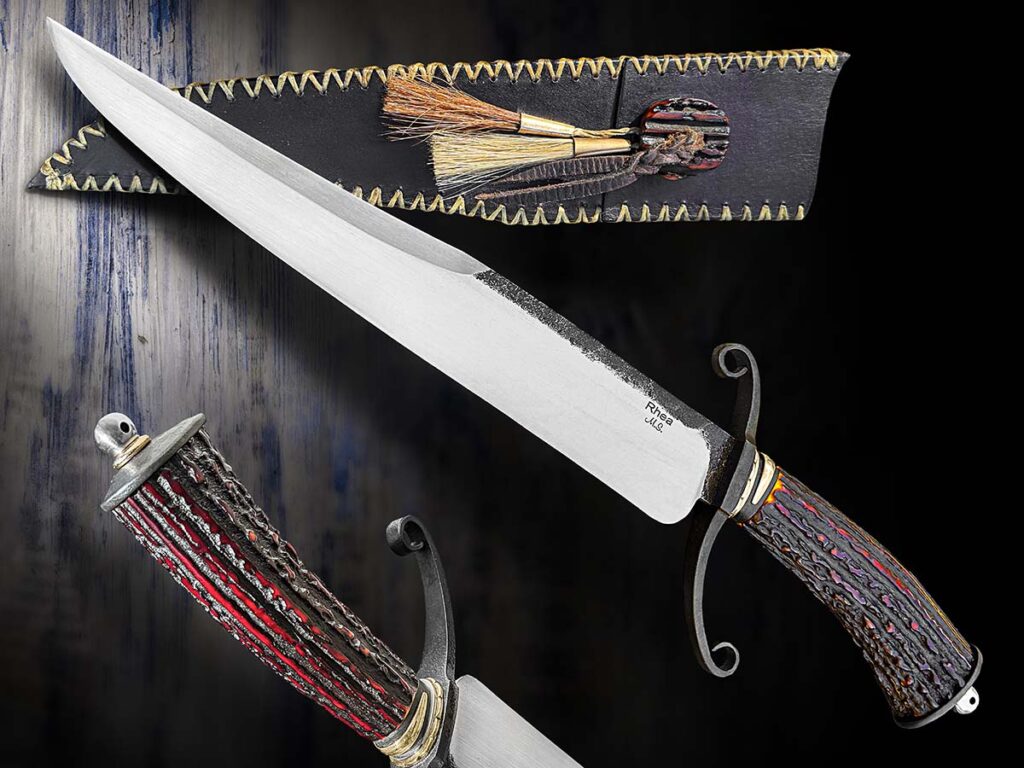
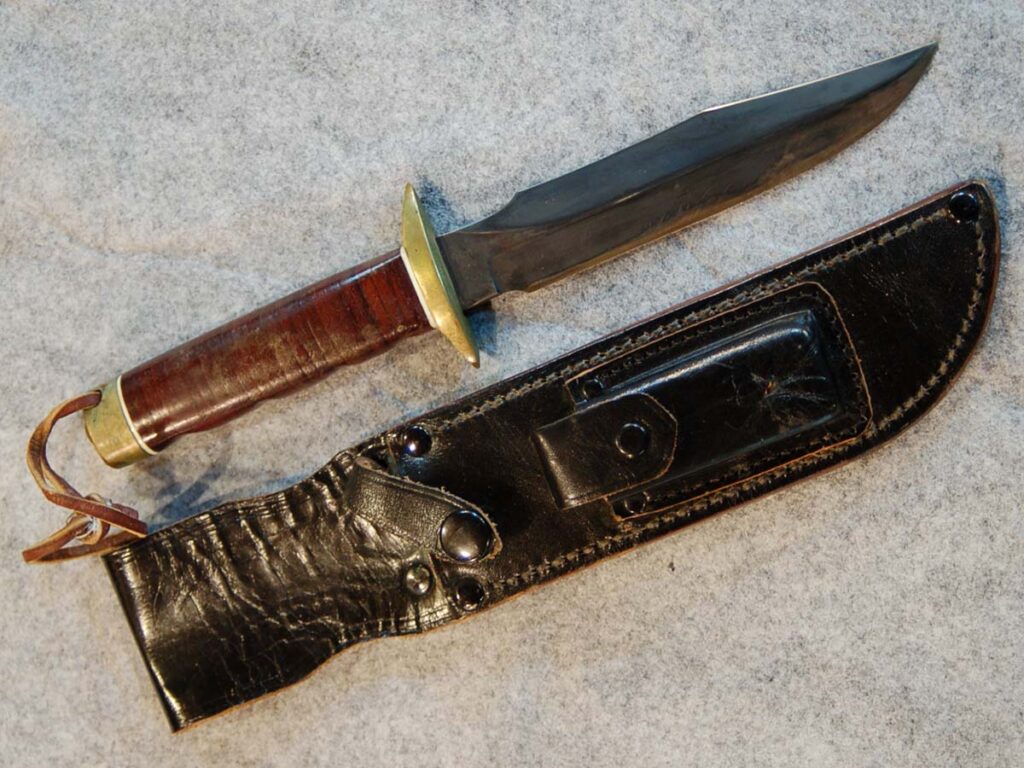
In ABS master smith Lin Rhea’s view, Jim Bowie would still be carrying a bowie knife, forged and differentially heat treated, with a few touches of class. A modern-styled knife with a hint of the Sandbar Fight like Lin’s Preacher (facing page) would fill Bowie’s bill. Kay Rhea made the sheath. (Jocelyn Frasier knife image)

The sheath is .080-inch-thick black Kydex, with a nylon cross-draw/scout belt loop. Though definitely not the typical way to carry a knife in Bowie’s days, in modern EDC terms it’s the Bowie spirit distilled into a pocket-sized package.

On the other hand, Bowie was known for carrying big steel. It was not just acceptable for him to carry a big knife, it was expected. That’s where the Thunder comes in. At 15 3/8 inches overall with a 10-inch blade, it commands respect the moment it clears leather. At 3/16-inch thick, the 52100 carbon steel blade is built for performance. The high-saber grind delivers power on every cut, while the 90-degree spine adds versatility. The rock-tumbled acid-wash finish speaks to hard use, not polish. Natural linen Micarta® scales lock into the hand, and the JRE Industries brown leather sheath completes the package.

The Thunder is more than a knife—it’s a frontier weapon, a tool and a statement. Bowie would carry it with pride, knowing size and steel would give him the edge on any foe.

Together, these knives show the evolution of Bowie’s legacy. The GT-EDC represents modern practicality—lightweight, efficient and discreet. The Thunder embodies the old-school bowie ethos—large, commanding and battle-ready.
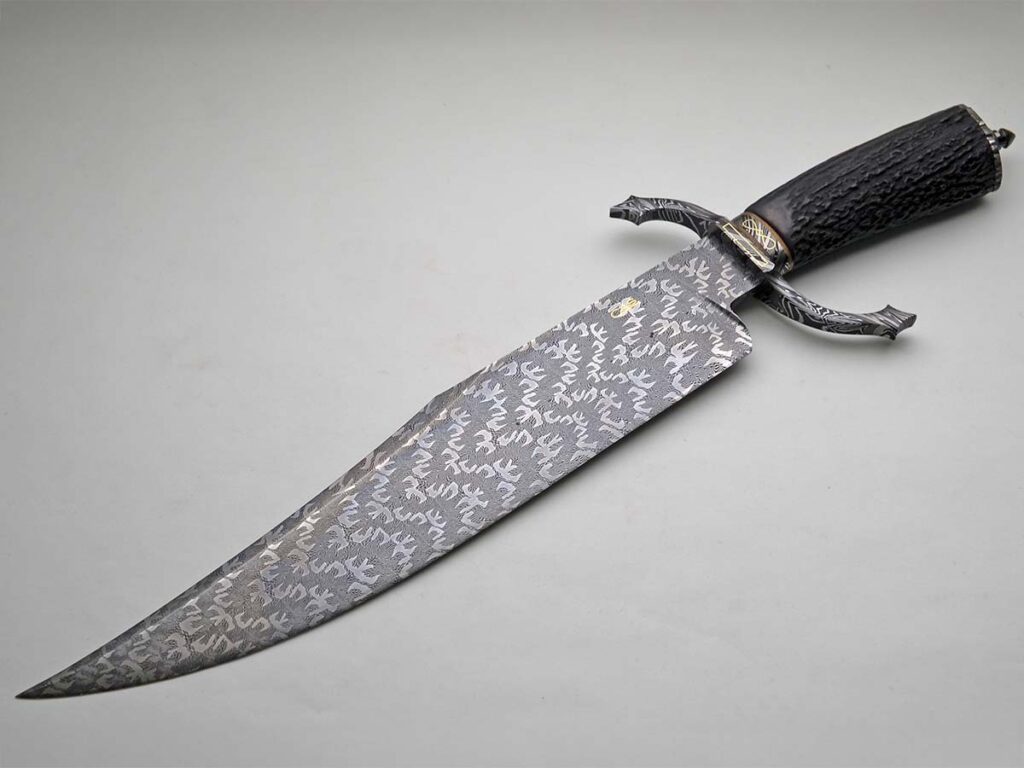
“Bowie would carry something like one of the CAS knives,” purveyor/retired ABS master smith Dave Ellis said. “They’re perfectly executed with high-end materials and expert technique.” A Sobral Brothers/CAS bowie in mosaic damascus, S-guard, gold accents and stag handle applies. (Dave Ellis/Exquisiteknives.com image)

“If Jim Bowie lived today, I believe he’d carry both,” Bolieu stated. “The GT-EDC for daily utility, the Thunder for the moments when steel decides fate—both made in the USA. In either case, he’d have the edge on any foe.”

The Preacher

Few bladesmiths merge both historic and modern influences in their bowie knives as well as ABS master smith Lin Rhea. If anyone can predict how a contemporary Bowie would blend historic knife design with modern materials and flair, it’s Lin.

“I try to pay homage to the old craftsmen and their techniques,” Rhea observed of his bladesmithing approach. “That’s how I know how to do things: the old way.”

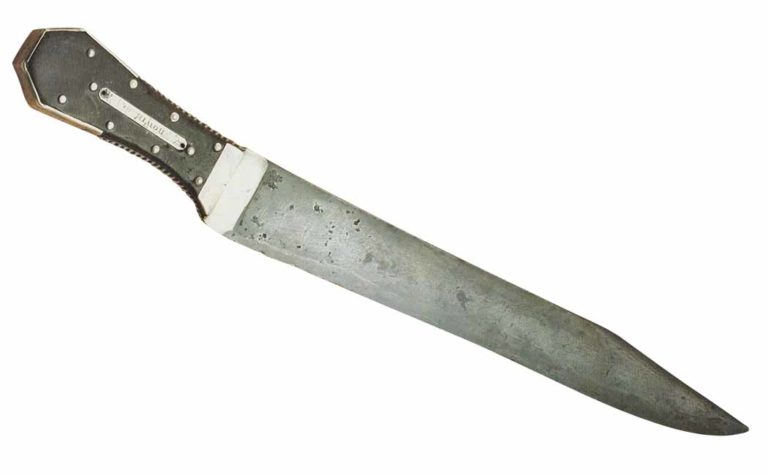
According to Lin, after the Sandbar Fight Bowie sought out James Black, who made the knife known as Bowie No. 1. Black lived in Washington, Arkansas, just down the road from where Rhea lives today.
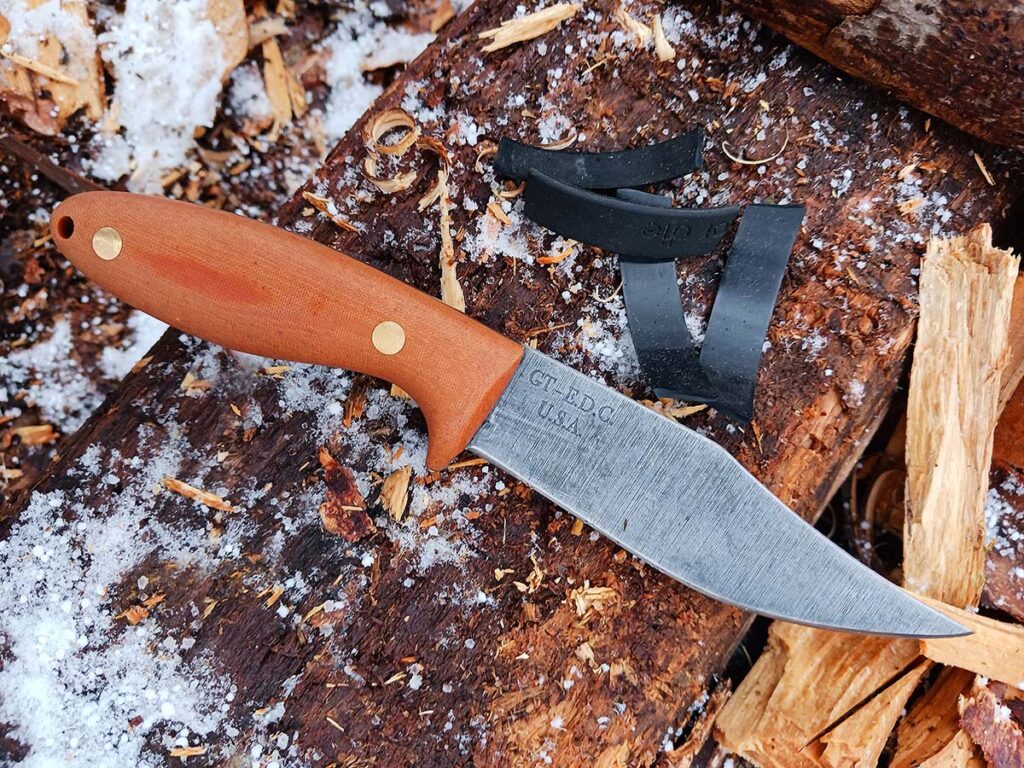
With the pronounced clip-point blade, it’s easy to see the Bowie influence on the GT-EDC from Bear Forest Knives. Would a Bowie-inspired EDC be on Jim’s hip?

“I think for sure he’d go with some kind of S-guard bowie knife, with a sharpened clip and a stag handle. It would be both fancy and practical,” Lin opined. “Bowie went to James Black because his blades had a reputation for toughness as well as innovation, using silver in such a way as to render the handles waterproof.”

Compared to the knives of the time, the bowie was larger than usual and had a larger handle, too. Obviously, to Lin, Bowie would still be carrying a bowie knife, forged and differentially heat-treated, with a few touches of class. He’d still carry an innovative version of his old-faithful design. A modern-styled knife like Lin’s Preacher would fit the bill.

High End

Dave Ellis is a custom knife purveyor and a retired ABS master smith. He knows how to make a world-class knife and what it takes to buy and sell knives of the highest quality and price points.

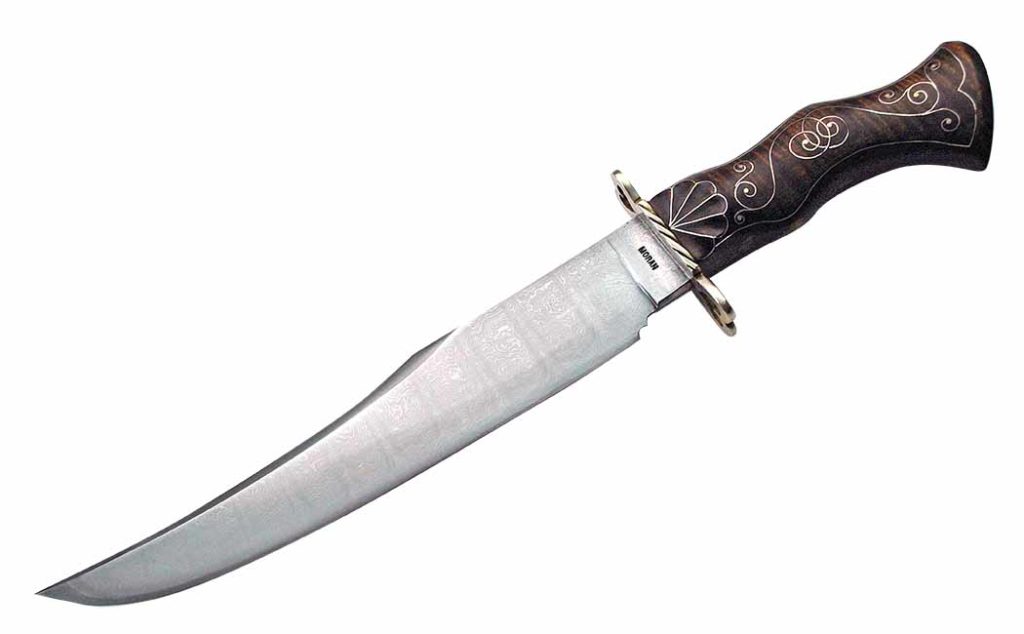
“If we were just thinking about price points, Bowie could carry a Loveless Big Bear or a Bill Moran damascus ST-24,” Dave noted. “Both would be $60,000 to $80,000 in today’s dollars.” Vintage examples of those knives are so valuable because they were made by two iconic Cutlery Hall of Famers and are historic, nearly antique. Would Bowie carry such an expensive knife that’s several decades old? You be the judge.
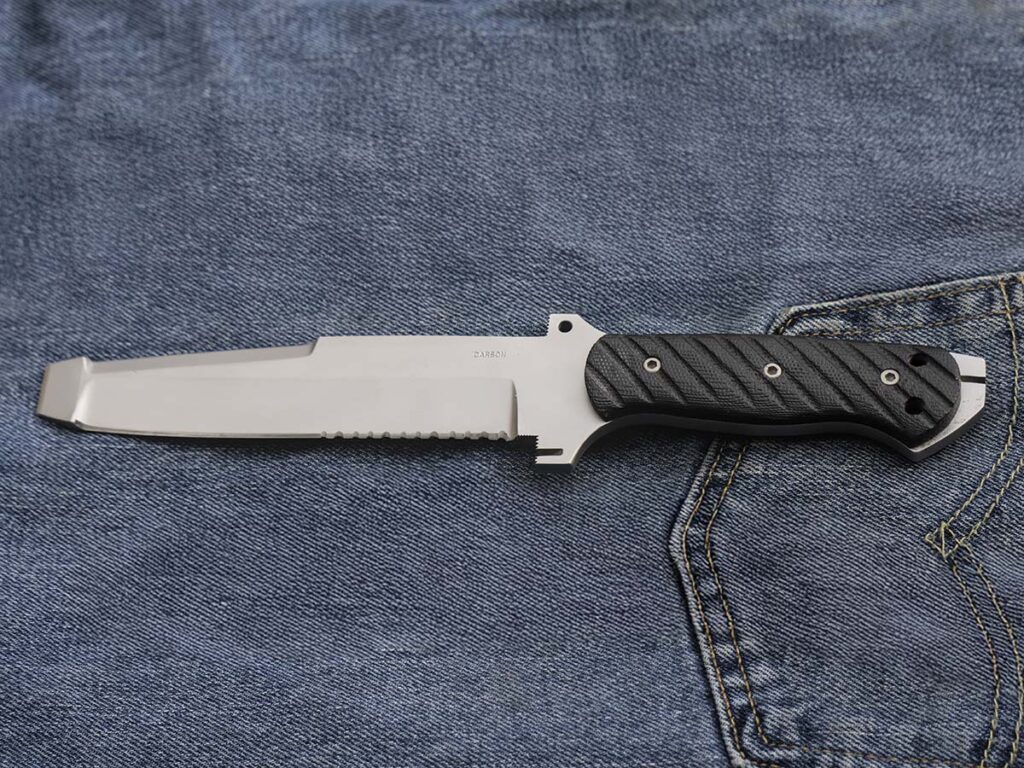
Veteran EOD tech Rob Cude said Bowie would carry at least two knives. One might be like the knife Cude and Kit Carson designed that eventually became the Buck Knives Intrepid. The original design featured a special wedge-shaped tip, a sharpened spine area for cutting metal straps and an exposed tang for durability during hammering.

Dave and your intrepid reporter discussed jewel-encrusted daggers by Cutlery Hall-of-Famer Buster Warenski, engraved Warren Osborne autos and $100,000 Japanese katanas. We ultimately recognized that Bowie had a flair for the practical. While he may very well carry a knife that screams “I’m rich!” it would also have to do its basic job.

When it comes to the highest modern expressions of the bowie knife, the South Americans stand out. Whether by the Sobral Brothers/CAS Knives, ABS master smiths Dionatam Franco and Rodrigo Sfreddo or other top artisans, the merger of high quality and performance within the bowie genre is very evident.

“I’m thinking Bowie would carry something like one of the CAS knives,” Ellis said. “They’re perfectly executed with high-end materials and expert technique, and at a first glance are still immediately recognizable as bowie knives.”

Warfighter Knives

Serving his country with acts of valor as a first-class warfighter, veteran explosive ordnance demolition (EOD) tech Rob Cude spent his career in the shadows. Success in his job meant frustration for the bad guys and safety and silence for the good ones.
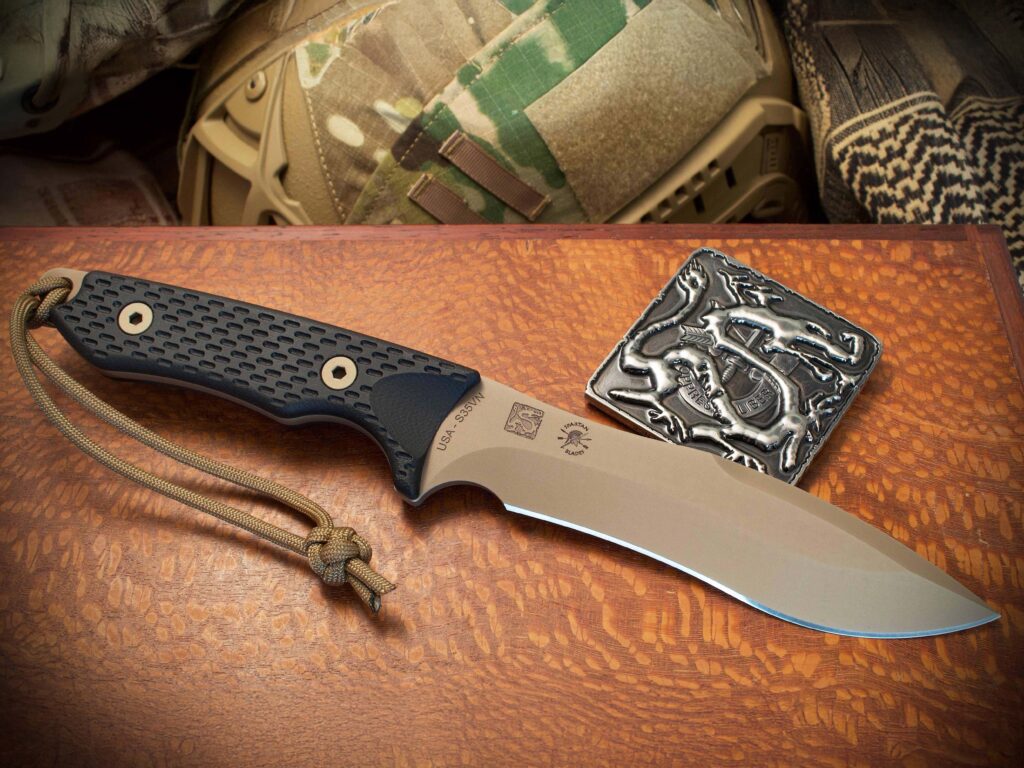
According to Rob Cude, something like the Spartan Ronin Shinto with a recurve blade, long edge and a bit of belly for utility jobs would be on Bowie’s hip. Blade steel and length: CPM MagnaCut stainless and 5 5/8 inches. Country of origin: USA. MSRP: $385-$420.

Rob’s background is in knife design for special forces, military and EOD. In the 1990s, he sought out Cutlery Hall-of-Fame maker Kit Carson to build exactly the knife that would suit his needs. The modern warfighter may jump out of a plane, swim from a boat or trek over land, none of which lend themselves to a wimpy knife.

In tandem with Kit, Rob designed the knife that would in 1998 become the Intrepid from Buck Knives. The original design featured a special wedge-shaped tip, a distinctive sharpened area on the spine for cutting metal straps, an exposed tang for durability during hammering, and a ceramic bead finish that was much more rust-resistant than a sandblasted one. Stainless 440C steel was the best game going at the time and had a suitable combination of hardness and toughness.

“If your knife edge rolls or the knife bends, you can fix it,” Rob advised, “but if it chips or breaks, you’re stuck.”

From Rob’s soldier perspective, Bowie would carry a gun and at least two knives. As technology has evolved, the tools of the soldier have evolved. Given how Bowie was responsible for the evolution of a knife style, it makes sense that his tastes would continue to evolve as well. A modern Bowie would carry one knife for work and another for self-defense.

“Something like the Spartan Ronin Shinto would be on Bowie’s hip,” Rob opined. “It has a recurve blade with a long cutting edge but also has a bit of belly that works well for utility tasks.

“Whether it’s cutting lines and straps or opening MREs, a fixed blade in the 5-to-6-inch range is on every modern fighter’s hip. He would also carry a backup knife for self-defense, and a pistol and rifle as well. Bowie was proficient in the tools of his time and that’s his real legacy. He’d carry that proficiency forward into the modern age, adapting to the tools of our time.”

In the end, of course, we’ll never know exactly what a modern Jim Bowie would carry if he could, but one thing’s for sure: you’d not want to meet him on a sandbar or battlefield to find out.

More Knife History:

American Knives: Legendary Designs From The Land Of The Free

0

Are these the best American knives? Maybe, maybe not. One thing is for sure, these are some of the blades folk most associated most closely with the good ol’ USA.

If the knife isn’t man’s oldest tool, it’s probably a close second. It has been around in some form since time began. Styles, looks, form and function have steadily evolved, and even though the basics of a particular type may have originated somewhere else, there are those that are associated most closely with the good ol’ USA.

These are knife styles that the buying public, the collector, the factory, and the custom maker would probably associate with the United States more closely than any other country.

“You have to start with the time period when knives actually became ‘American,’” explained BLADE Magazine Cutlery Hall of Fame® member Bruce Voyles. “From the first settlers, the Spanish in Florida or the Vikings, every knife they brought to this country was made and came from somewhere else.”

American Designs Come Into Their Own

Voyles points to the truly American knife and says that the history of the country allows for a nod to the J. Russell Green River Works in the 1830s—the mountain man period when skinning knives were pretty much an enhanced version of the butcher knife—the epic sandbar fight that brought the bowie knife to the forefront, George Schrade and the introduction of the switchblade, and other examples of knives that are associated with America.

“Everything changed, and the cutlery world was turned on its ear when Jim Bowie got into a duel and that turned into a melee in 1827,” Voyles commented. “This happened across the river from Natchez, Mississippi, and you didn’t have good roads in those days. The rivers were the highways and when this happens, soon the story is heard in other river cities—New Orleans, Memphis, St. Louis and Cincinnati. Everybody hears this amazing story. Everybody wants a knife like Jim Bowie used, Bowie’s knife and then the bowie knife.”

Voyles related the story of George Schrade and the New York City patent office. “A guy comes in with something that looks like an automatic,” Bruce smiled. “George Schrade tinkers with it and invents the switchblade knife. He is the one that made it a production knife that people could afford. There were others around, but he got the patent on that style knife. Schrade kept tinkering with it, and he brought his brothers in and started Schrade Cutlery Company to produce George Schrade’s switchblades. So, now the modern American switchblade is truly an American knife, though the government banned it in 1958.”

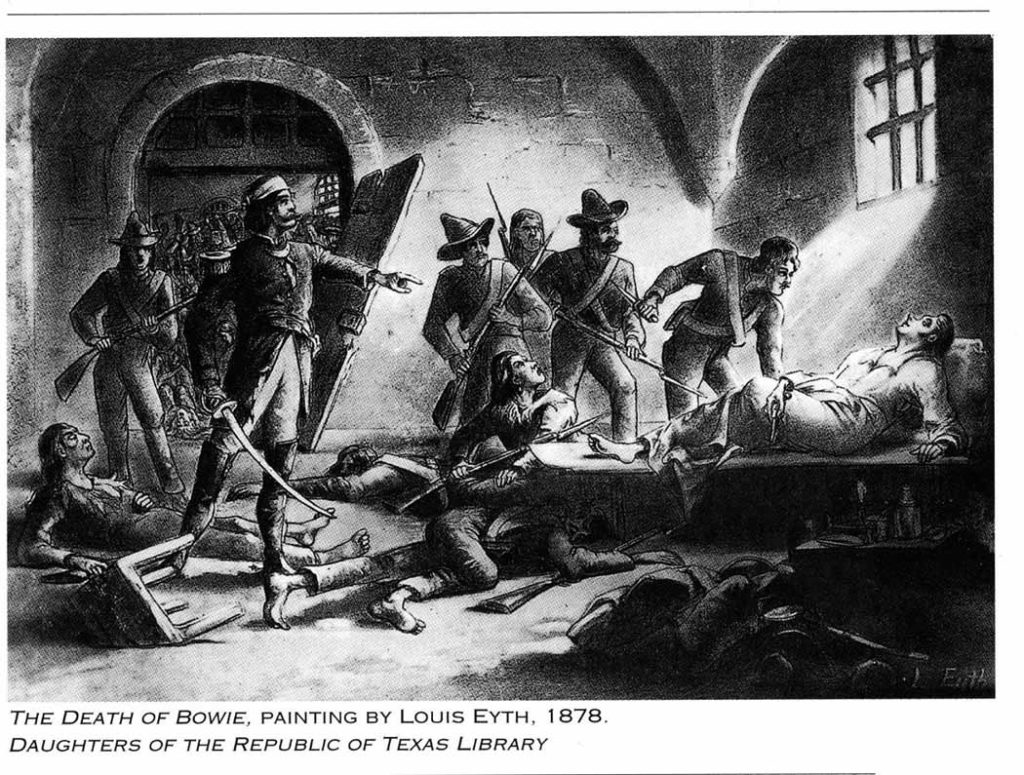
In addition to his participating in the famous Sandbar Fight after which his knife became a sensation on both sides of the Atlantic, Jim Bowie also fought and died in the Battle of the Alamo.

There is, of course, with every innovation in cutlery or other endeavors, a ripple effect. And Schrade Cutlery is a great example as its knife production expanded and the brand became one of the most recognized in the world.

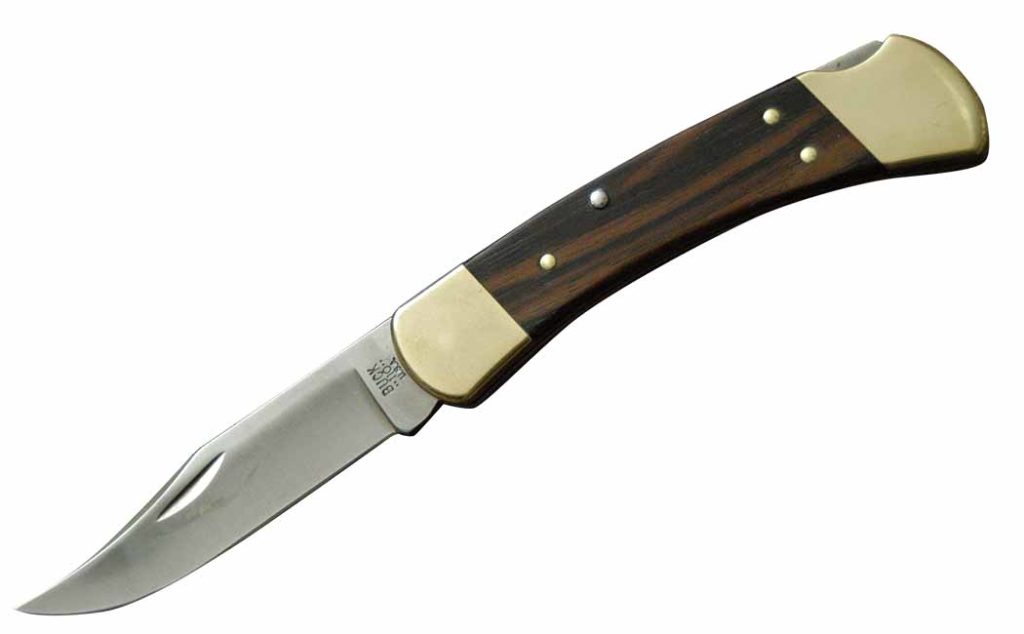
While folding hunters have been out there seemingly forever, Voyles categorically asserts that the Buck 110, which took the knife world by storm almost 60 years ago, is an American knife that deserves to be categorized all by itself.

“Nothing else looked like that knife when Al Buck made it,” Voyles reasoned. “The other lockback folding hunters looked like pocketknives, but I defy you to show me a look like the Buck 110 that existed any earlier. It’s an American style of its own because everybody copied it. The Buck 110 had different construction and sturdiness, and it was so distinctly different that everybody else copied it. The design was so different, and that is attested to by the number of people who copied it.”

According to Bruce Voyles, when Al Buck made the Buck 110 in the mid-1960s, nothing else looked quite like it.

Cutlery Hall-Of-Famer Dan Delavan of plazacutlery.com adds, “Americans have introduced a lot of different blades in the past, including the bowie, KA-BAR combat knife, the hollow-handle survival knife, as well as the basic Boy Scout knife. Each knife served a very basic function, from war to camp and basic scouting activities.

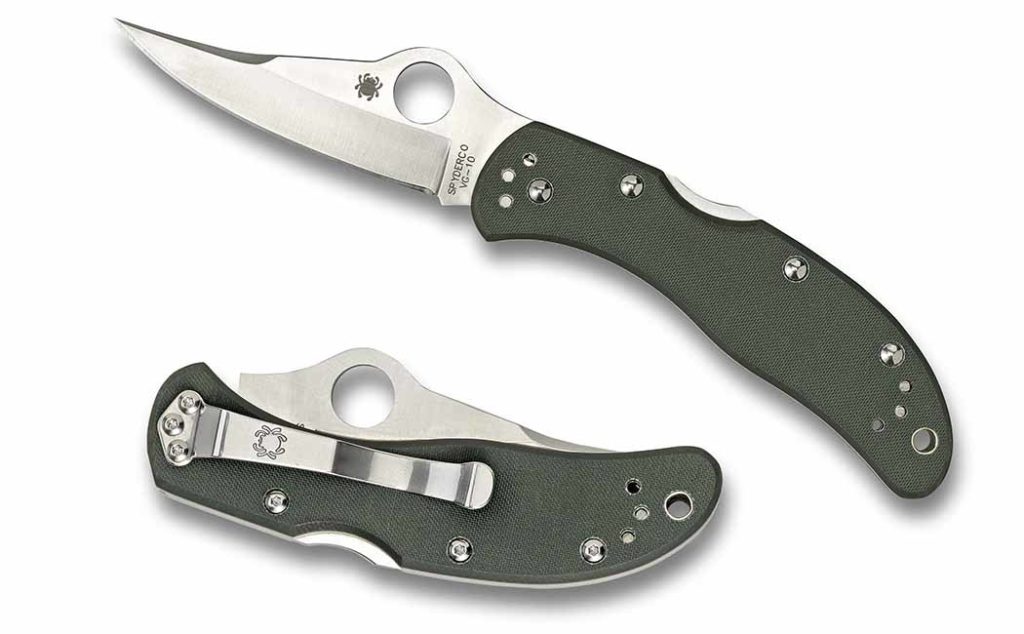
“I think the Spyderco hole is all American,” Delavan opined. “Sal and Gail Glesser came into my shop [the old Plaza Cutlery retail knife store in Costa Mesa, California] back at the very beginning with their folder with the pocket clip and the hole in the blade. They were doing county fairs at that time with their sharpener and introducing their knives. We bought on the spot and have been a lifelong dealer ever since. That has led to a lot of different openings for folders and remains a mainstay in the industry.”

While many may think serrations when they think Spyderco—and they would be correct—the most significant Spyderco innovations are the hole in the blade and the pocket clip. The Worker was the first Spyderco knife with those features, and it was reproduced in 2017 as seen here in one of the company’s sprint production runs.

Quintessential American Knives

Bowie

Historical or modern, vintage or recent, knives with that American flair are identifiable and recognized at home and abroad. Cutlery Hall-Of-Famer Goldie Russell of A.G. Russell Knives sees the bowie as iconic.

“The bowie knife is the quintessential American knife,” she noted. “It is believed that the first was made for Jim Bowie in the blacksmith shop of James Black* in south Arkansas. [Bowie knives] became so popular that they were manufactured by Sheffield cutlery factories for the American market.”

Fixed Blade Hunting Knives

Russell goes on to raise the work of Cutlery Hall-Of-Famer Bob Loveless and his fixed-blade hunting knives to the top as well. “Bob Loveless forever changed the style of the hunting knife with his drop-point, semi-skinner and utility blade shapes, with the drop-point hunter being the most popular,” she continued. “The influence these knives have had on the world knife market includes not just the blade shapes, but also the shaping of the handles to better fit the hand. These models have clearly influenced the shapes, look and feel of knives made by generations of knifemakers, and will continue to do so for decades to come.”

Bill Moran’s Mark

Bill Moran’s statuesque ST-24 not only paved the way for knives of carbon damascus in the 1970s and beyond, but subsequent models in mosaic and stainless damascus as well. (Dave Ellis image)

Also influencing generations of knifemakers were the many camp knives, bowies, fighters and other fixed blades forged from the damascus steel reintroduced by Cutlery Hall-Of-Famer Bill Moran in the early 1970s. Moran’s damascus knives set the stage not only for a plethora of standard carbon damascus knives but also later for stainless damascus and mosaic damascus knives.

Multi-Tool

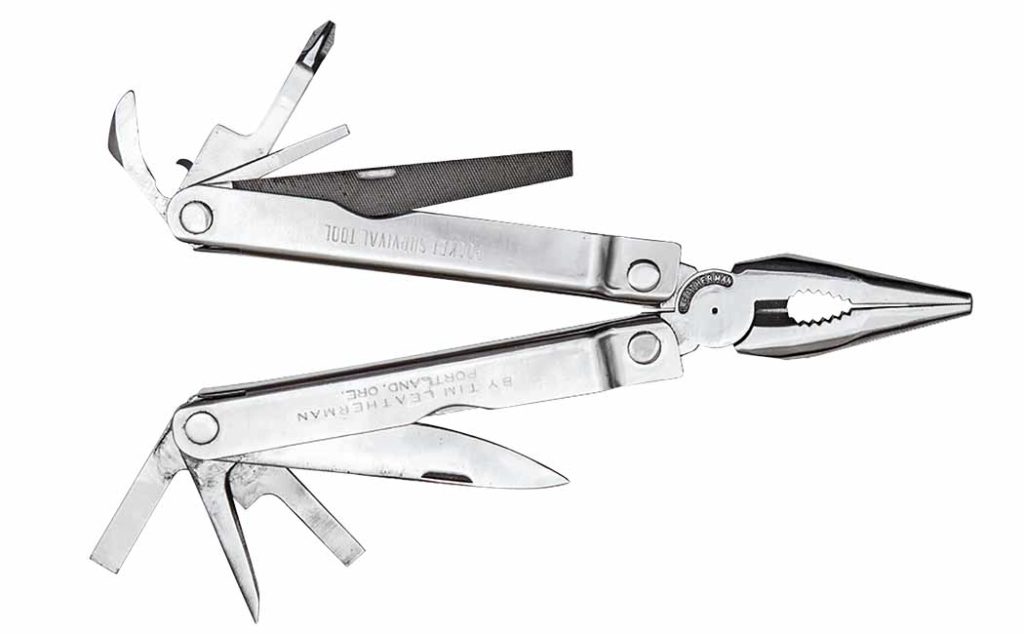
Tim Leatherman holds the multi-tool (also inset) that started it all: the original Leatherman tool, the PST (Pocket Survival Tool).
Tim Leatherman holds the multi-tool that started it all: the original Leatherman tool, the PST (Pocket Survival Tool).

Then, there are the variations on a theme. The multi-tool, for some a knife and for others something totally separate, has nonetheless influenced the cutlery market and is among those chiefly American styles.

“Tim Leatherman’s inspiration in the design of the first Leatherman tool created an entire category in the world of knives,” Goldie Russell explained, “but also in the tool industry. Most construction workers, farmers, carpenters, forestry workers and many other segments of our society carry a multi-tool every day. Those who are not carrying one will usually have one in their toolbox.”

American Knife Innovation

Linerlock

Inventiveness, in itself, is not uniquely American. However, at times the original has the potential for improvement, and just as Schrade improved the switchblade, Cutlery Hall-Of-Famer Michael Walker revolutionized what would become the linerlock.

Cattaraugus made a pocketknife with a brass spring/lever that helped prop the blade in the open position. “Walker changed the design so that when the lever locked it kept the long, clean lines of the knife,” Voyles observed. “The bottom side of the blade is blocked, and the big bump there has got something to hold onto. Walker’s lock does not block the bottom of the blade. It blocks the butt end of the tang. Michael didn’t patent it†, and every major manufacturer in the world has knocked it off. Nobody thought it would have such an impact. However, any knife with a locking liner is an American knife because it was an American innovation that did it.”

Russell echoes the sentiment that Walker’s linerlock was revolutionary and an American innovation. “Michael Walker’s genius of replacing the slip-joint spring with the ball detent spawned the entire generation of modern EDC knives,” she added. “His innovation allowed a portion of the liner to be utilized as a locking device. The idea caught on quickly with handmade knifemakers and has now become an integral part of the manufacturing process for almost every manufacturer of knives. This method of creating a locking folder has made knifemaking much simpler, with much less skill necessary to make an excellent functioning knife.”

Tactical Folder

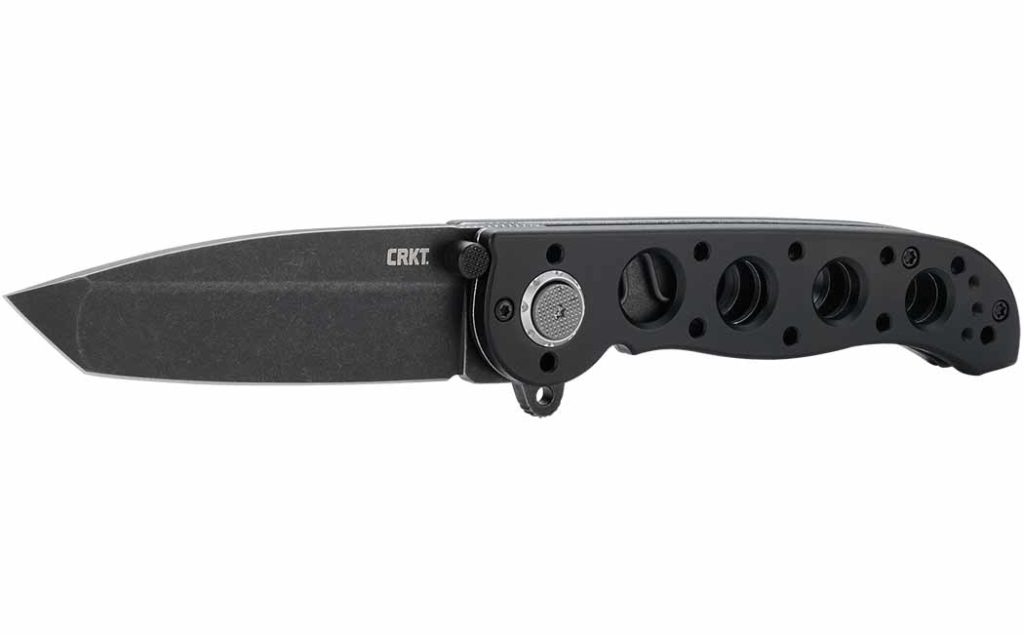
One result of Kit Carson’s popularization of the flipper folder is his long-running series of M16 flipper folders for CRKT. Among the latest iterations is the M16-02DB. In addition to being a flipper folder, the original M16 also was among the earlier top factory tactical folders.

The tactical folder took the world of knives by storm in the mid-to-late 1990s, offering a one-hand folder—usually black—with a non-glare stainless steel blade, a synthetic handle, a linerlock and a pocket clip. While some called it more a marketing approach than a knife, the fact that the folder dominated the market for at least a decade if not longer cannot be denied.

Flipper Folder

Searching her memory and experience, Goldie Russell also identifies the flipper folder popularized by Cutlery Hall-Of-Famer Kit Carson and the SpeedSafe assisted opener by Cutlery Hall-Of-Famer Ken Onion as innovative, influential styles that the world associates with the United States. “When combined with the Walker linerlock, the Carson flipper adds the ability to open the knife as fast, or faster, than a switchblade knife,” she remarked. “It’s a clear improvement over the stud or hole in the blade for the purpose of one-hand opening. The use of the flipper as an opening device has become prevalent throughout knifemaking across the world.

“Then, Ken Onion’s addition of a spring to launch the blade open** is another American innovation that has changed the landscape of the knife industry,” she concluded. “Nearly every American brand utilizes some variation of Ken’s way of using a spring to open a blade quickly. The genius was the bias toward closure that kept a folder from being deemed an automatic.”

Rambo’s Influence

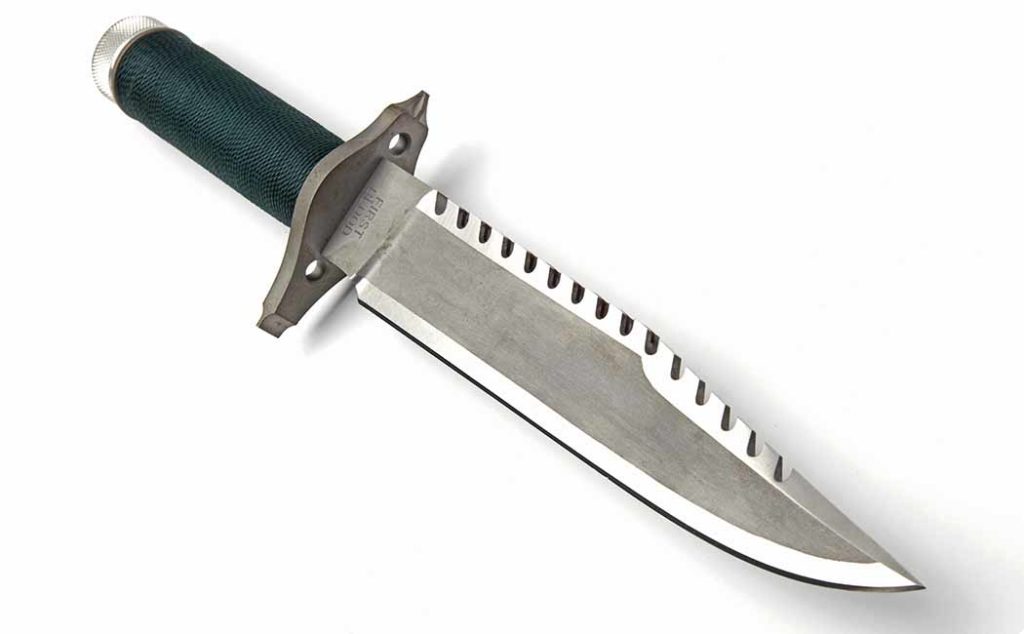
Jimmy Lile’s Rambo knives started the hollow-handle-survival-knife craze that dominated the 1980s and beyond. (from the Randy Rousseau collection)

As the Rambo film franchise grew in popularity during the 1980s, the work of Cutlery Hall-Of-Famers Jimmy Lile and later Gil Hibben made the knives in those motion pictures stars in themselves, rivaling Sylvester Stallone for worldwide acclaim. Voyles insists that the Rambo knife is an American phenomenon that still impacts the knife market today.

“The Rambo knife is uniquely American for two reasons,” Bruce said. “Jimmy Lile designed it and made the knives for the first two movies, and it ignited a boom in survival knives that exists today. Then, the other historical tie-in is that in the 1980s every boy who could walk had a survival knife with a big, round compass on the end and a hollow handle. Even today, those boys are adults and they love the nostalgia of that handmade Rambo knife. Indirectly, Jimmy Lile created all this, and the Rambo knife is uniquely American in that regard.”

Final Cut

Considering the knives closely associated with the United States, their impact is obvious. Those styles associated with the good ol’ USA still resonate across the market and in the inventive minds of those who brought them into being.

*Editor’s note: While many do indeed believe that James Black made a knife for Jim Bowie in Black’s shop, such a knife has never been definitively proved to be as such because Black did not mark his knives.
†Though unable to obtain a patent on the linerlock, Walker was able to obtain a trademark on the name linerlock, a trademark that has since elapsed.
**Cutlery Hall-Of-Famer Blackie Collins also made one of the first versions of an assisted opener.

More Knife History:

Legendary knives that gave the U.S. military its edge

These knives formed the tip of the U.S. Military’s spear.

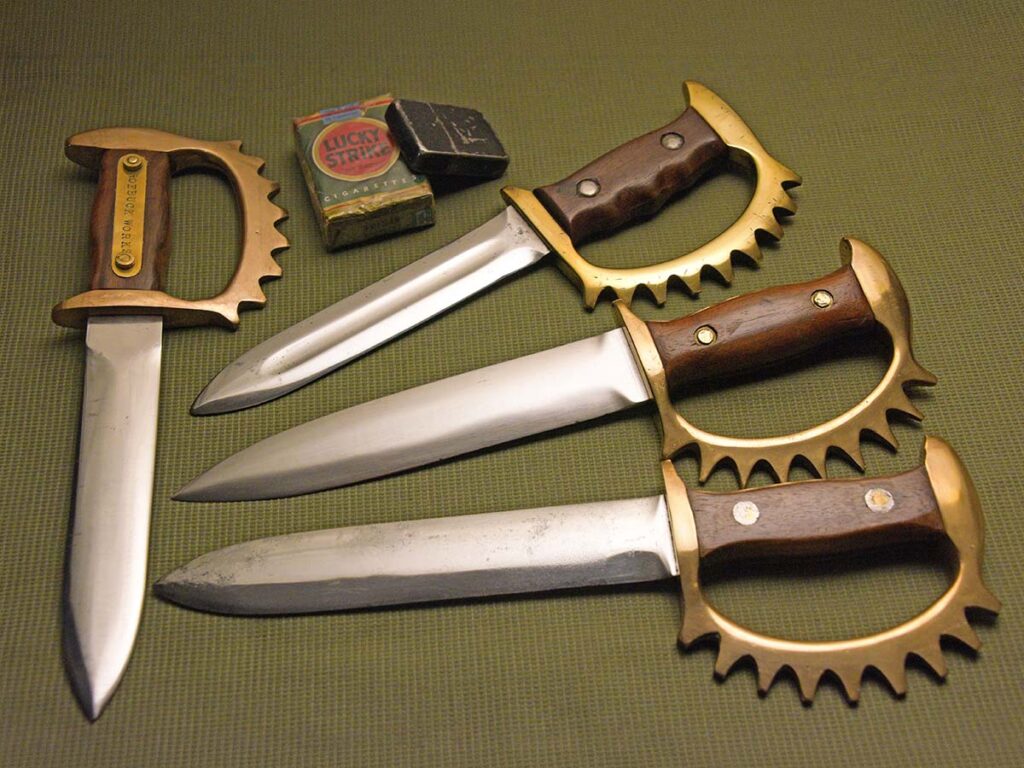
The 20th and 21st centuries saw some of the most iconic of military knives. From the World War I trench knives with the imposing knuckle-duster D-guards to today’s modern folders and fixed blades, a few, in no particular order, stand out above the rest:

  • USN Mark II/USMC fighting-utility knife*: According to Army Special Forces veteran and Spartan Blades co-owner Curtis Iovito, “The KA-BAR fighting/utility knife is arguably the most recognizable American military knife ever produced. Introduced in 1942 for the U.S. Marine Corps during World War II, it solved a critical problem: troops needed a knife that could serve both as a weapon and a field utility tool.
    “Marines used it for everything from opening ammunition crates and cutting brush to close-quarters combat. Its design struck a near-perfect balance between fighting knife and utility blade, and it has influenced military knife design ever since.”
    “As an issue knife, the classic USN Mark II filled the same role as the Randall Model 1, but in a much more ‘democratized’ sense. Very few soldiers could get a Randall,” explained Army veteran and Spyderco Special Projects Coordinator Michael Janich, “but the Mark II/Ka-Bar was ubiquitous. Although it ultimately became best known as the Ka-Bar and most closely associated with the Marine Corps, it was manufactured by many other companies and widely issued. As a mass-produced item, it was—and still is—a very capable knife and continued to serve with distinction in many other wars after World War II.”
    “The USMC fighting knife has not always been made by KA-BAR, and KA-BAR didn’t even make them first, but they made it their own,” noted Marine Corps veteran/knifemaker Les George. “It’s the stereotypical military knife in the western hemisphere.” Added Army 5th Special Forces veteran/BLADE field editor/knifemaker Kim Breed, “It is a multi-use combat knife used in one form or fashion in all branches of the service.”
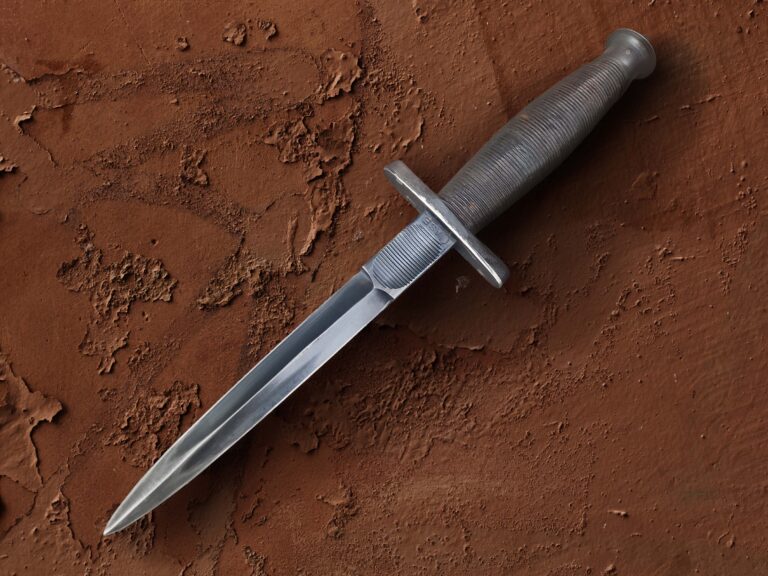
  • V-42: As Janich noted, “The V-42 is not only one of the sexiest fighting knife designs ever created, it also has perhaps the strongest pedigree since it was designed for and by the First Special Service Force, aka The Devil’s Brigade, of World War II fame. Its unique design and signature sheath reflect the original mission of that unit, which is regarded as the predecessor of current U.S. Army Special Forces units and Canada’s Joint Task Force 2. This iconic design is also immortalized in many U.S. military unit insignia, though it is often mistaken for the Fairbairn-Sykes dagger.”
  • Randall Model 1: “Randall has done more to influence modern knife design language than most,” George wrote. “The Model 1 is what I think of as peak Randall. Its influence ranges from World War II to the unit-made SOG knives in Vietnam to the modern SOG knife company.”
    “This iconic design epitomizes everything a military-style fighting knife should be,” Janich opined. “Its blade captures the spirit of the classic bowie knife, but in a leaner, more maneuverable form. The sharpened false edge allows it to back cut and penetrate with extreme authority, and its handle design allows for a grip that is both deft and secure. The fact that it continues to serve downrange in the same basic form to this day is a testament to the fact that it started out damned near perfect.”
  • Gerber Mark II: “The shortcomings of the original Fairbairn-Sykes and the many variations it inspired became very well-known both during and after World War II,” Janich wrote. “The Gerber Mark II addressed and corrected all of these to offer a superior fighting dagger design. Although it was a private-purchase item, like Randalls, it was much more accessible to servicemen and more widely carried. Its unique variations and its evolution over time also created its own rich history.” Janich added the fact it was the favored combat knife of Michael D. Echanis, decorated Vietnam veteran, accomplished martial artist and hand-to-hand combat knife writer and editor, enhanced its mystique and widespread appeal as well.

More Standouts

Gene Gutierrez
Gene Gutierrez

Any number of other U.S. military knives have stood out since the turn of the 20th century. Among them are the M3 trench knife, M1 bayonet, the Applegate-Fairbairn dagger and the Applegate-Fairbairn folder.

“The M3 was what the Army chose to issue in World War II,” George noted. “In purest terms, it also had a fairly short service life, but in real terms it is what became the M4 bayonet on down the line to the M7 bayonet that I used to run the assault course in boot camp in the ’90s. Its influence has been widespread.”

“The World War II-era M1 bayonet, designed for use with the M1 Garand rifle, played an important role in American infantry combat during World War II and beyond. I remember so many old World War II vets telling me stories about the bayonet,” Iovito recalled. “Shorter and more practical than earlier bayonets, the M1 reflected the changing nature of warfare where mobility and close-quarters fighting often occurred in tight environments. Many soldiers also carried the bayonet as a fighting and utility knife when not mounted on their rifles. Its durable construction and effective blade profile made it a reliable tool throughout several conflicts.”

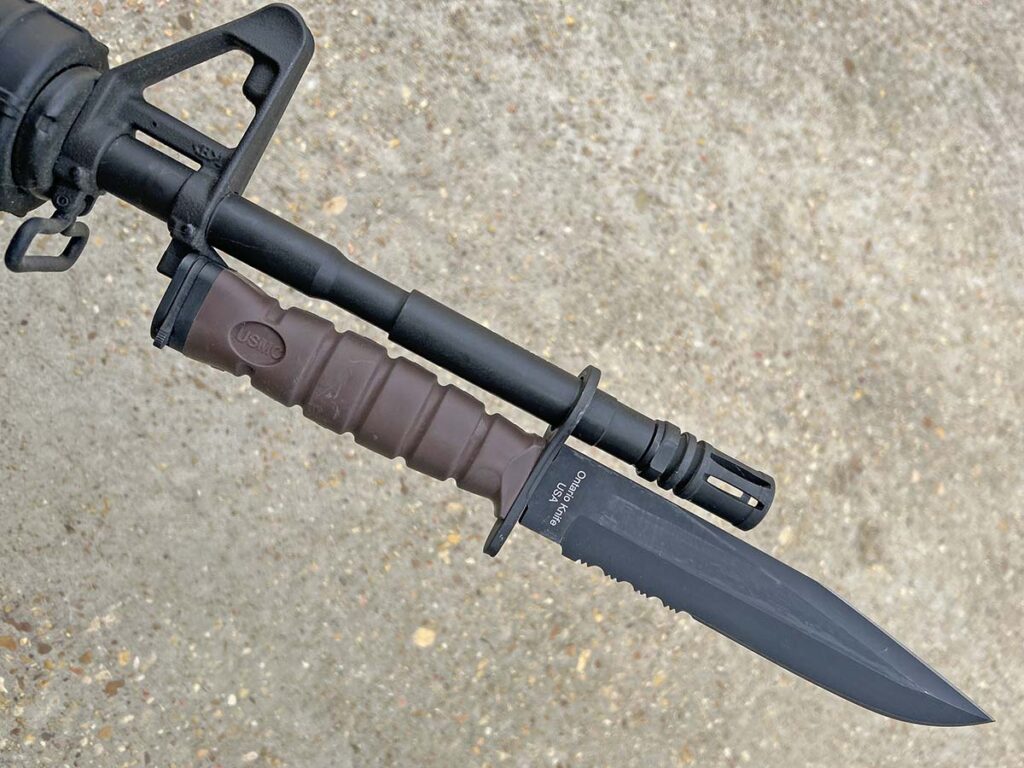
One of U.S. Marine Les George’s teammates mounted an Ontario OKC-3S similar to this one on an M4 to help quell a tense situation on the streets of Fallujah. (Les George image)

The Applegate-Fairbairn dagger and Gerber A-F folder were named after Cutlery Hall-of-Famer Col. Rex Applegate and W.E. Fairbairn
of Fairbairn-Sykes Commando Knife fame.

“Another design that corrected the flaws of the Fairbairn-Sykes dagger was the Applegate-Fairbairn dagger,” Janich observed. “Designed during World War II by Col. Applegate and W.E. Fairbairn, it never got beyond the prototype stage before the war ended. Decades later, it finally saw production by several major knife companies. Although very noteworthy on its own, it also inspired a scaled-down folding version that set a new and different standard in folding and fighting knife design. The original A-F Folder design was a collaboration between Col. Applegate and consummate custom knifemakers Bill Harsey and Butch Vallotton.” Added Harsey, a Cutlery Hall-of-Famer in his own right, “The Gerber version of the folding knife was a long-running project, and I was told by Gerber that the Army ordered 50,000 pieces at one time for the troops, which were delivered.”

Few knives enjoy legendary U.S. military status as much as the SOG Bowie, which served as the inspiration for the name of today’s SOG knife company. “The Special Forces SOG Bowie is one of the most iconic knives associated with American special operations forces,” Iovito wrote. “Inspired by the knife carried by members of the Military Assistance Command, Vietnam Studies and Observations Group during the Vietnam War, the SOG Bowie reflects a fusion of classic bowie knife design with modern military needs. Its lineage connects directly to clandestine operations carried out in Southeast Asia, where unconventional warfare units often relied on rugged equipment that could handle jungle conditions and extreme use.”

Howard Cole was famous for making knuckle knives such as these three rare nine-pointers and one eight-pointer. A paratrooper named Clyde McClelland carried the center nine-pointer during World War II. (Image courtesy of Louis Chow)

Folding knives have never been so popular in the U.S. military as they have in the past 40 years, and at or near the top of that list are the Al Mar SERE, CRKT M-16 and Spyderco Endura.

“While many earlier military knives were fixed blades, modern soldiers frequently rely on folding knives for everyday field use. One of the most influential examples is the Spyderco Endura,” Janich began. “For me, the knife carries a very personal meaning. During Operation Just Cause in Panama, I found myself tangled in my parachute harness after landing while under fire. I used my Spyderco Endura to cut myself free from the harness so I could move and get back into the fight. That moment left an indelible mark on me and reinforced the reality that sometimes the most important piece of equipment you carry is the knife in your pocket. The Endura is lightweight, corrosion resistant and extremely functional, and its opening hole allows rapid one-handed deployment, even with gloves. Its reliability and practicality have made it a favorite among soldiers who need a dependable cutting tool for daily field tasks.”

In the fall of 1984, Harsey helped Al Mar do a run of just over 50 large folders for Col. Nick Rowe, who had been tasked by the Army to run the SERE (Survival, Evasion, Resistance and Escape) School near Fort Bragg, North Carolina. “All modern Special Forces soldiers, aka Green Berets, and other high-risk military members including pilots undergo this training,” Harsey stated. “I finished my part of unmarked knives in time for Al Mar to get them on an airplane bound for Fort Bragg and into Col. Rowe’s hands for an important mission date. I never heard another thing about this project. Later this knife would become known as the AL Mar SERE folding knife.”

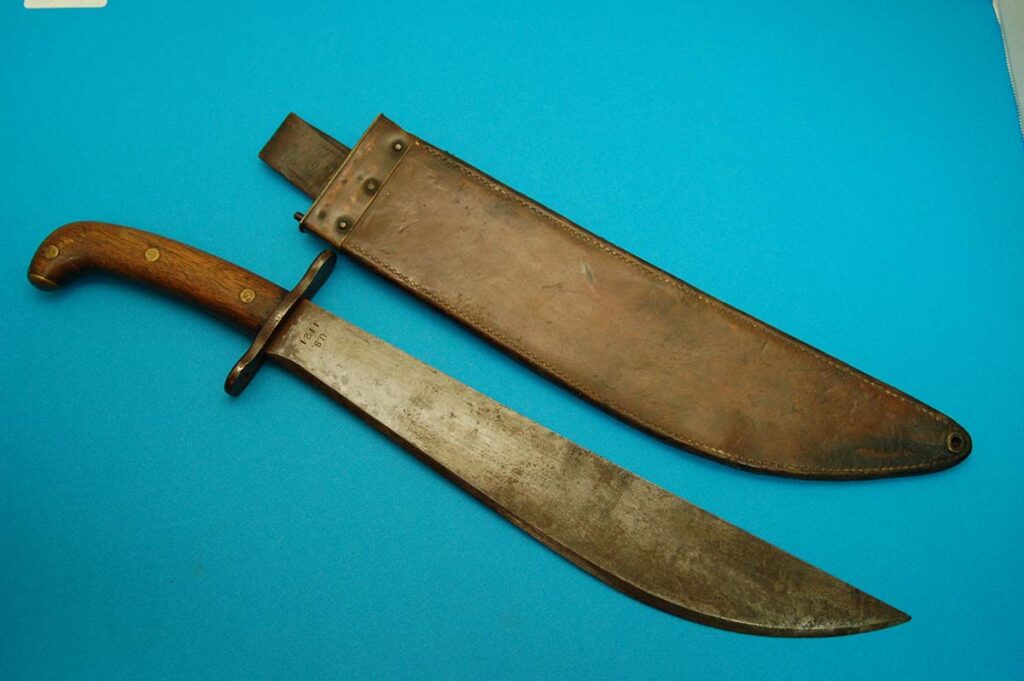
The Field Artillery Corps designed the Model of 1909 bolo for use by crew-served weapons during World War I. It was for clearing fields of fire to enable the limbers and horses to navigate the towed artillery into place. (Images courtesy of Frank Trzaska)

As for the CRKT M-16, its universality during the Iraq War guarantees its spot on the list. “I am not aware of this knife ever being issued but there was a time when you saw them everywhere,” George wrote. “Guys would buy them at the PX and clip them on the outside of their vests. They were everywhere, and they did everything!”

Standard Setters

The foregoing includes but a few of the knives that have served the USA and served it well over 250 years of saving the world from tyranny and oppression and setting the standard billions aspire to today. Other notable knives, in no particular order, include:

The M9, M11 and OKC-3S bayonets; Camillus Jet Pilot Survival Knife; Chris Reeve Yarborough; OSS Smatchet; Collins M1942 Machete; Swiss Army knife; Spartan Blades Ares, Difensa and Harsey Dagger; Randall Models 2 and 18; Gerber Silver Trident Knife and Mark I; G.I. four-bladed pocketknife; Schrade Mark II Paratrooper switchblade; G.I. Machete; Leatherman and Gerber multi-tools; and Western 49 Bowie.

According to Army Special Forces veteran Curtis Iovito, the Special Forces SOG Bowie reflects a fusion of classic bowie design with modern military needs. “Its lineage connects directly to clandestine operations carried out in Southeast Asia,” he wrote, “where unconventional warfare units often relied on rugged equipment that could handle jungle conditions and extreme use.” (Frank Trzaska’s knife and image)

Which ones are we omitting? Let us know. And while you celebrate the semiquincentennial of your favorite nation throughout the year, never forget: knives have played a monumental role in the success of the U.S. military and the building of the USA up to now and for the foreseeable future.

It doesn’t get much sharper than that.

*Though they are two different knives, the USN Mark II and USMC fighting/utility knife are grouped together for the purposes of this story because of their similarity in design and their across-the-board use by U.S. service personnel, especially during World War II. Also, the spelling of KA-BAR refers to the knife manufacturer that continues in operation, while Ka-Bar refers to the generic name service personnel gave the knife, a name that persists to this day.

Military Knives:

Daryl Meier: Sensei of Steel

In on the ground floor of the damascus knife movement, Daryl Meier has left an indelible mark forging and teaching.

I haven’t seen Daryl Meier for a number of years but there was a time when he was a regular at the BLADE, Guild and other knife shows. Sporting a cross between a goatee and a van dyke, glasses and his ever-present octagonal cap covering longish hair, Daryl stood out in a crowd. He looked equal parts World War II French Resistance fighter, 1950s beatnik and Vincent van Gogh (minus the red hair). In fact, it almost would have been more fitting if his name were Daryl van Meier. I can see him looking at me now, shaking his head in mild disgust at such a notion.

Daryl has a soft, laid-back way of talking that has kind of a hypnotic effect. Then, just when you think you’re going into a trance, he makes an observation that snaps you back to reality, elicits a laugh or otherwise makes you think. He has a great sense of humor and never takes himself too seriously. There is no ego in Daryl. He’s just Daryl.

BLADE Magazine Cutlery Hall-of-Fame® member Steve Schwarzer has known Daryl much longer and much better than me. When I asked Steve to write a story about Daryl, he jumped at the chance, and the result is very enlightening as to Daryl’s impact on damascus and the teaching of bladesmithing in general.

Steve writing the story was more appropriate than I thought at the time. In researching Steve and Daryl, I rediscovered that they each have entries in the top 13 custom knives from the years 1989-2000: Schwarzer’s groundbreaking Hunter’s Dream in mosaic damascus at No. 3 and Meier’s American Spirit Bowie at No. 9. The knives were selected in a poll of industry authorities and appeared in the June 2013 BLADE® story, “A Decade of Excellence.” Daryl presented the American Spirit Bowie in person to President George H.W. Bush in the White House in 1990.

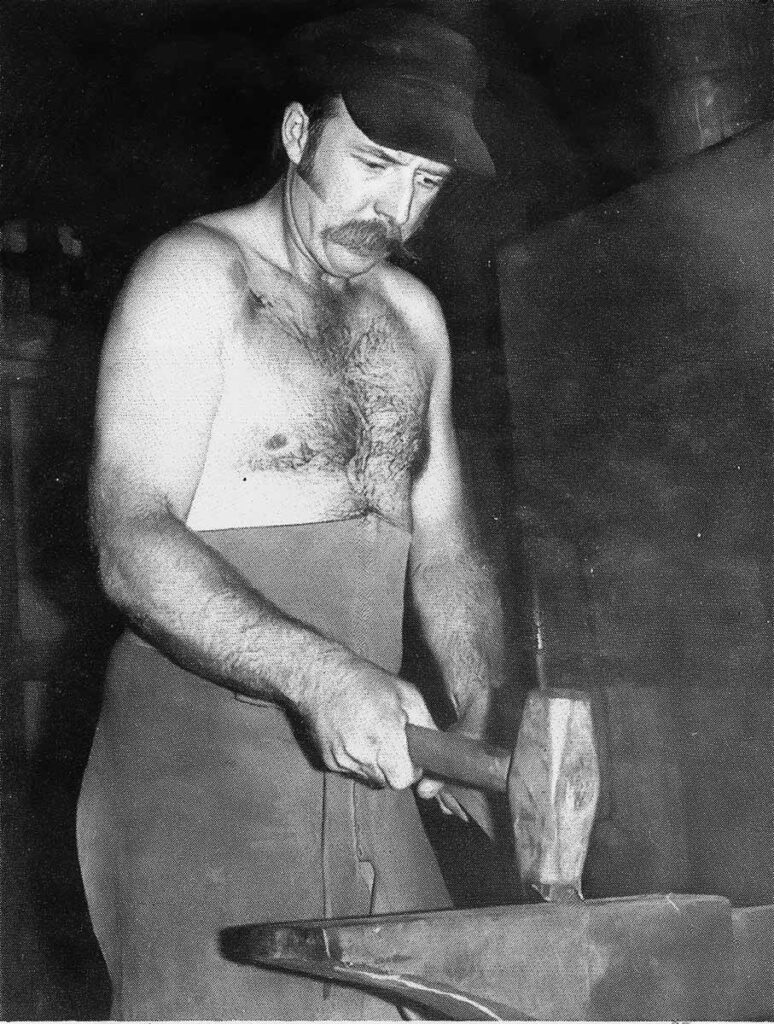
Daryl Meier forging steel in 1976.

Daryl’s contributions to damascus are legend.

As early as 1976 he was teaching a four-week course on forging damascus steel, no doubt one of the first such courses in the modern custom knife era. He was one of the first if not the first to write a regular column on damascus steel called—surprise!—“Damascus Steel” for BLADE in the early 1980s. One of the columns was titled “Wootz Revisited” and featured an image of a misspelled “Stephen Swertzer”—aka Steve Schwarzer—doing the ancient silk scarf-cutting test.

As important as Daryl’s contributions to the forging of damascus have been his dissemination of his damascus in general he probably has had more impact on the knife industry. Call him the Sensei of Steel. He was among the first if not the first to make damascus for use by other knifemakers, and helped inspire others to do the same, including Cutlery Hall-of-Famer Devin Thomas, Mike Norris, Bob Eggerling, Chris Marks, Gary House and others.

Today, making damascus for use by other knifemakers has long been a sub-industry unto itself—and Daryl was there at the beginning of it all. For these and other contributions, he was awarded the BLADE Magazine Industry Achievement Award in 2008.

The last time I talked to Daryl was about a year ago by phone. He sounded chipper and upbeat as ever. In fact, even in his early 80s he remains physically active and was all excited about a new pursuit—dancing—and how he was attending local dances on a weekly basis. Always ready to try new things, even in the fourth quarter of life—that’s Daryl. And I bet he can beat a mean rug, too!

More On Damascus Knives:

Lorenzis, Ruple Join Cutlery Hall Of Fame

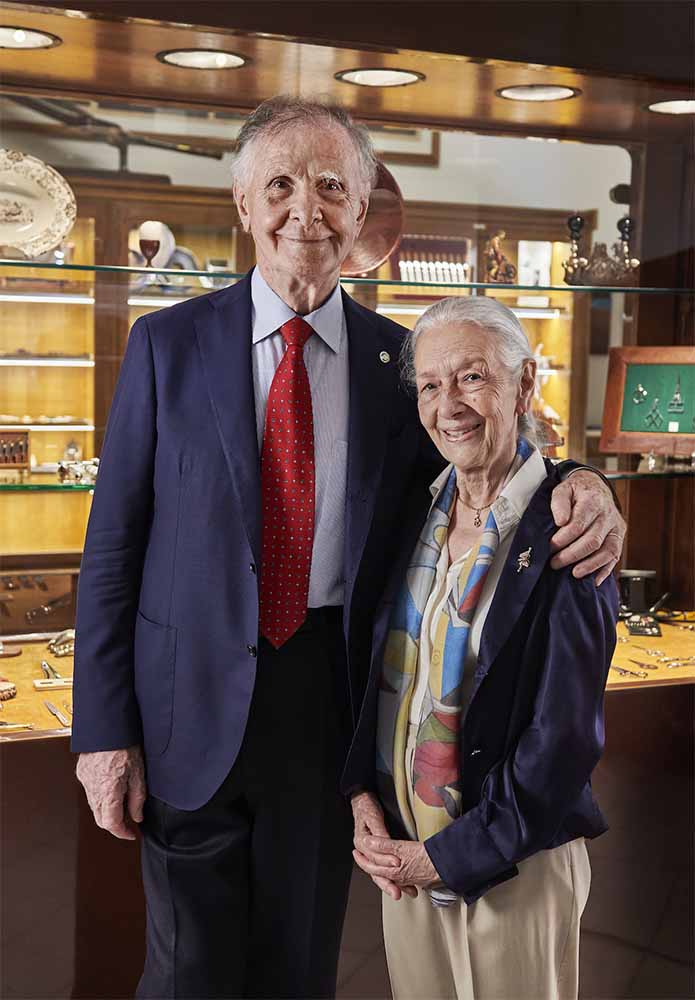
The BLADE Magazine Cutlery Hall Of Fame® is proud to announce three most-deserving inductees for 2022: the husband-and-wife team of Mr. and Mrs. Aldo and Edda Lorenzi and Bill Ruple.

All will be formally inducted in a special Cutlery Hall-Of-Fame ceremony and breakfast during BLADE Show 2022 June 3-5 at the Cobb Galleria Centre in Atlanta.

One of the most prolific, long-running supporters of custom knives in modern cutlery history, the Lorenzis forged a name known in knife circles far and wide while operating their G. Lorenzi retail knife store in Milan, Italy, where they sold knives of some of the greatest knifemakers of all time, including Cutlery Hall-Of-Fame members Buster Warenski, Bob Loveless, Michael Walker, Jimmy Lile, Gil Hibben, Ron Lake, Frank Centofante and many more.

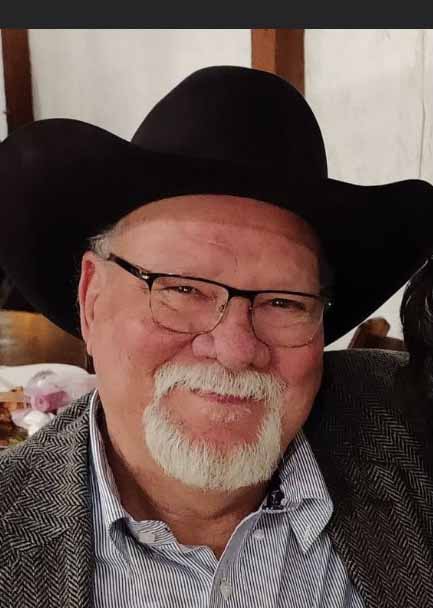
Meanwhile, hailing from Pleasonton, Texas, Ruple is one of the most successful slip-joint makers of the 21st century, winning many awards for his traditional pocketknives, and also serving as a teacher and mentor to an entire generation of award-winning slip-joint makers from Texas and elsewhere.

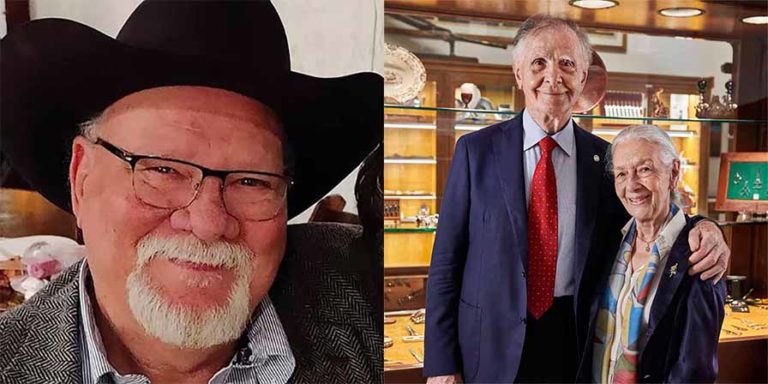
Aldo and Edda Lorenzi (Francesco Pachi image)

Aldo And Edda Lorenzi

Aldo and Edda Lorenzi operated G. Lorenzi retail cutlery store in Milan from 1959 until its close in February 2014. The Lorenzis regularly attended the world’s most important knife shows, buying scores of knives for sale in their shop. They bought so many knives at shows, in fact, that the Lorenzis’ presence often determined a show’s success or failure. The support and exposure they gave to American makers in particular by selling their knives in their store in one of the most exclusive shopping areas in Milan was pivotal in introducing American custom knives to Europe.

In 1995 they won The Knifemakers’ Guild’s prestigious Nate Posner Award “in recognition for outstanding service in the promotion of handcrafted cutlery.” They also won the BLADE Magazine 2014 Industry Achievement Award for their decades of supporting the custom knife industry. For five years ending in 2019, they sponsored the Aldo and Edda Lorenzi Award for the Guild Show and the BLADE Show, with each event’s award-winning maker receiving $1,000 cash and a plaque—10 awards and $10,000 in all. The Lorenzis also are most supportive of the William F. Moran Foundation and are one of the Foundation’s first chartered member couples.

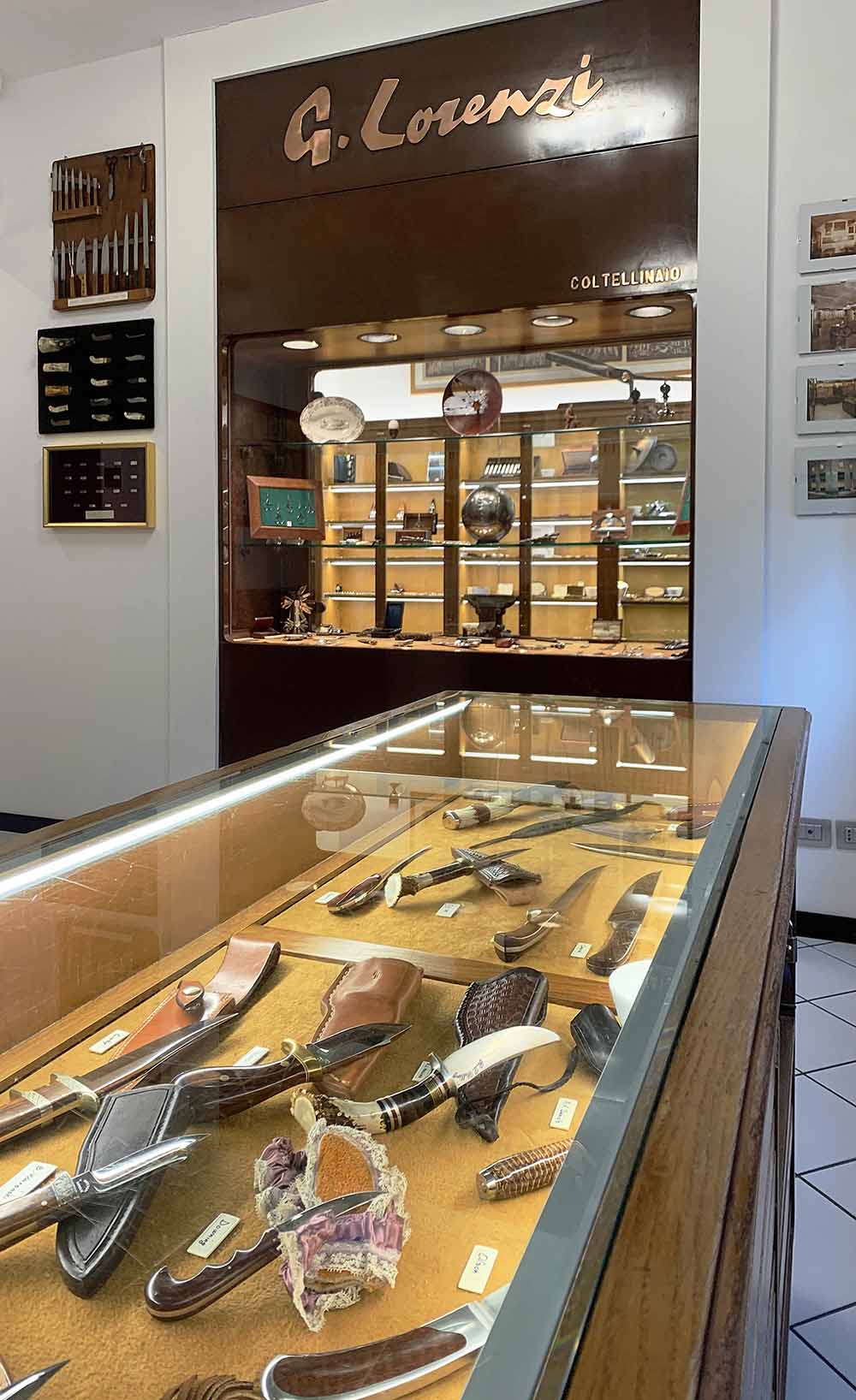
An exterior display window (shown here in the background) from the original G. Lorenzi shop is a centerpiece of the Lorenzis’ new museum. It was one of the store’s six “eyes” that communicated with window shoppers in one of Milan’s most exclusive retail districts, the counters of which, over the years, displayed more than 18,000 types of items. In the foreground is a display case of some of the Lorenzis’ favorite custom knives. (Francesco Pachi image)

“More loyal ambassadors of the art cannot be found,” one sitting Cutlery Hall-Of-Fame member noted of the Lorenzis. “Their store was like a museum, always welcoming visitors and ready to educate them on fine cutlery and custom knives. Several prominent collectors got their start by buying a custom knife at the Lorenzis’ store.”

In fact, the Lorenzis have assembled their massive collection of over 2,000 knives (including 150 custom knives by the world’s best makers spanning the past half century), 700 books, 1,000 magazines and prints, and related items in a new state-of-the-art museum in Milan (December BLADE®, page 60). The museum contains the knives in elegant oak display cases, a recreation of the copper-paneled room that featured the small entrance door to the G. Lorenzi store in Milan, a wooden portable knife grinder used by Aldo’s father and the store’s namesake, Giovanni Lorenzi, almost a century ago, and much more.

Bill Ruple
Bill Ruple

Bill Ruple

In the eyes of one sitting member of the Cutlery Hall-Of-Fame, Bill Ruple, an award-winning custom knifemaker specializing in traditional pocketknives/slip joints and multi-blades, has done as much as anyone to promote the knife business. Bill served on the board of the Texas Knifemakers Association, taught many how to make traditional knives and is very free with his knowledge. In recognition of this fact, he was presented with the BLADE Show 2019 Aldo and Edda Lorenzi Award. The award went to a knifemaker who excels in terms of teaching and mentoring his or her fellow makers in the art of knifemaking.

Having built knives for 34 years, Ruple is a premier maker of slip joints and possesses a selfless willingness to teach others how to do it, usually in his shop in Pleasanton, Texas, and also at BLADE University, the BLADE Show, BLADE Show West and other venues. He has helped many get started with the slip joint, one of the oldest yet most challenging folders to make. His kindness and patience validates something other makers know all too well—that he is most willing to share knowledge with and encourage, critique and mentor makers everywhere.

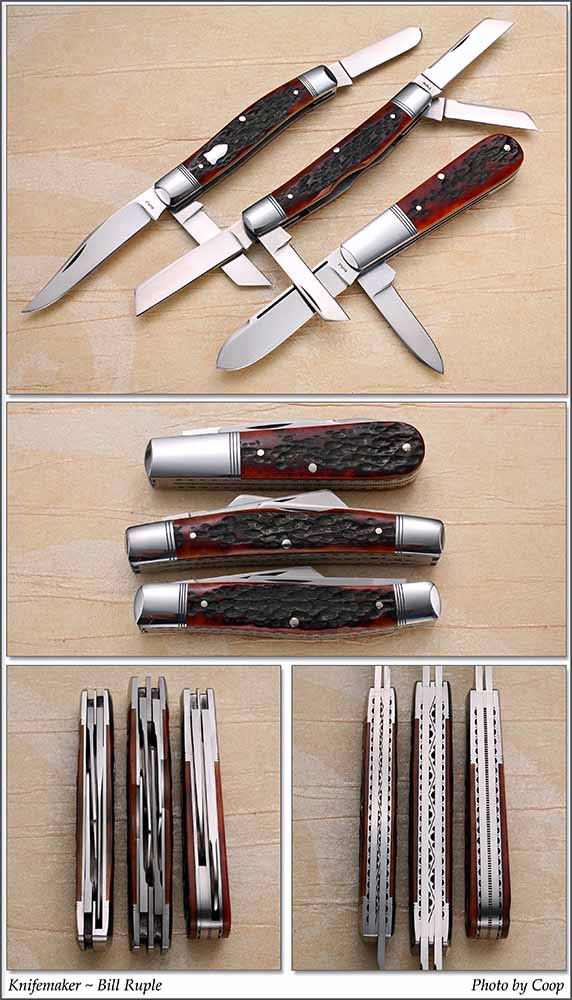
A selection of Bill Ruple’s slip joints in an array of open, closed and spine images show Bill’s awesome talent and versatility as a knifemaker. (SharpByCoop image)

Bill has taught quite a few who have become award-winning makers in their own right, including Rusty Preston, Luke Swenson, Tom Ploppert, Phil Jacob, Bubba Crouch, Toby Hill, Enrique Pena and others. A number have gone on to teach also, spreading Ruple’s knowledge to others who no doubt do the same as well. Bill does not limit his shared knowledge to just stock removal makers, receiving the American Bladesmith Society’s President’s Award for teaching ABS members how to make slip joints. Finally, Bill has donated some of his knives to knife shows and other cutlery organizations to raise funds for their various needs.

Hall Of Fame Criteria

Selected by a vote of sitting Cutlery Hall-Of-Fame members, the inductees are selected based on the following criteria: demonstrated extraordinary service to the knife industry; displayed honesty, character and integrity; advanced the industry by the creativity and originality of their works or contributions; as ambassadors or outstanding contributors, have furthered the positive impact of the knife industry on the world at large, and, in summary, have demonstrated a worthiness to be a member of this prestigious group.

The latest inductees exhibit all these qualities and more and represent a most worthy Cutlery Hall-Of-Fame induction class of 2022.

Read About Past Hall Of Fame Inductees:

Bob Loveless’ Influence Still Touches Those Closest To Him

Robin Askew moves on, but her father remains there for her.

The constant, the heart and soul of BLADE Magazine Cutlery Hall-of-Fame® member Bob Loveless, was wrapped up in custom knives. There was little time for anything else and there were only rare occasions that he travelled. Bob and his wife, Yoshi, made a few trips to Japan or to Hawaii, on a rare occasion to Europe, but most often with some business purpose involved as well.

And over time, Robin Askew came to appreciate and understand the singular purpose, laser-like focus and personal intensity that drove her father. He was capable of kindness but often brutally frank. He was willing to entertain young knifemakers, share information and then criticize or dismiss flaws with stark, unvarnished perspective. With patience that was sometimes fleeting, he did not suffer fools gladly.

But then, his personality was a tapestry, like all of us, an amalgam of inherited traits and life experience. His mother and father had sent him to live on a farm with grandparents at a young age. According to Robin, he lived and worked with the hired hands, not as a grandchild. At just 15 years old, he joined the Merchant Marine when his mother told the white lie that he was of age.

In addition to the knife her dad made for her, Robin’s other favorite keepsake is a photo of him, a joyous grin radiating from his face, as a cluster of pigeons lands on his shoulders and arms during a visit to Rome many years ago. “It’s a beautiful picture,” Robin stated, “and I look at it every day.”

It wasn’t easy for Bob Loveless, right from the start. But he made something of his opportunities and his native talents, shared them in the way he knew how, paying the price along the way and leaving a body of work of insight into what is beauty and flow in a handmade knife, like no one else has. For the record, he never billed himself as the world’s best knifemaker. He wasn’t, and he freely acknowledged that others were much more deserving of applause for their skills. It was his eye, perspective and sense of beauty and design that thoroughly set him apart.

Four Careers

When Robin grew up, moved out and moved on, she carried the best and the most worrisome of life experiences with her. She made her own way and has come to understand and appreciate the journey.

“I’ve really had four careers,” she reflected. “I worked 11 years in the banking industry and 20 years as a correctional peace officer at Pelican Bay State Prison in Crescent City, California, with 12 years as a peace officer. Put that together with the work in Dad’s office and then when my husband, Jimmie Askew, and I had a restaurant in Crescent City, California.”
When she worked in banking, Robin went to Crescent City on business for her employer. While there she met the most eligible bachelor in town. “It was a 400-mile, eight-hour drive to Crescent City, and I was supposed to be there for a month,” she said. “It became one of those wonderful love stories. Jimmie and I were meant to be together.”

Bob Loveless photographed Robin’s son Nico during a regular visit while they were “out and about.” Nico was 9. The resemblance to his grandfather is striking. (Bob Loveless image)

Jimmie was an award-winning chef, and with Robin’s business background the couple put together a fine restaurant that served a variety of entrees.

“I met Jimmie in 1984,” she recalled wistfully. “We got married the next year, and he passed away 12 years later. He made prime rib, barbecue pork spareribs and fresh seafood. He would go out in the morning on his boat and catch 300 to 400 pounds of rock cod. He would clean the fish and then serve it that night. It was the best seafood in all of Crescent City—wonderful. We also had meat from our mesquite grill, chicken parmesan, grilled Italian sausage, vegetarian dishes and the deep-fried seafood platter.”

Nico

The couple had one son, Nico, who is now 36. When Robin speaks of those days, a tinge of heartache touches her words. But also during that time, she rediscovered the love and care that her father had always had for the family.

Nico and Robin
Nico and Robin

“Dad came up from Riverside to visit us a month before Jimmie died,” Robin recalled. He had been in touch by telephone continually and made himself the father figure that a 7-year-old boy needed during a tragic time.

“After Jimmie died, Dad would come up regularly,” Robin related. “He took Nico fishing four or five times a year. Grandpa was there for Nico. He taught him how to shoot a gun and would charter a boat on the Chetco River in Oregon and they would fish together. He came up to see Nico play soccer, baseball and football, and he stepped in to take care of my son.”

When Bob wasn’t physically present, he was always in touch with Robin and Nico. He worried that Robin worked in the toughest place at Pelican Bay State Prison. It was called the “shoe,” and he once told Robin how he worried for her safety. Her response was from deep inside, a manifestation of something she learned when her father made the introduction to that Japanese gentleman years earlier: “I told my dad, ‘I show them [the inmates] respect, and they show me respect. It’s really the safest place in the prison to work.’ I told him there were two officers for every inmate and that I really had no qualms about it.”

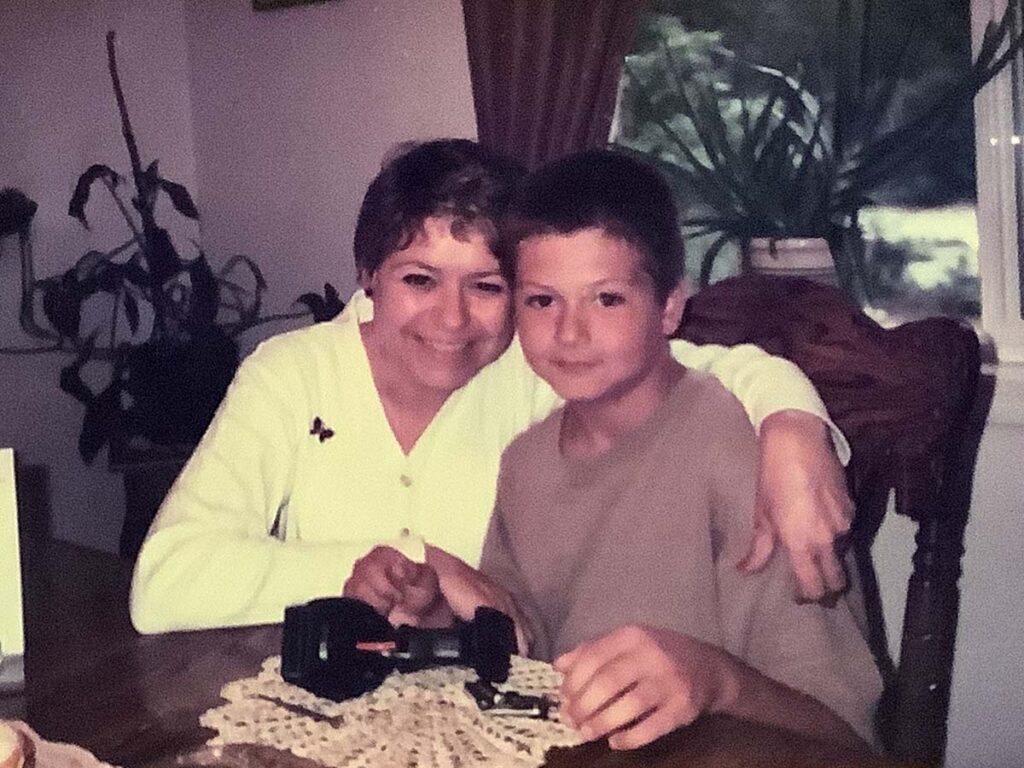
Bob took this picture when he visited Robin and Nico not long after Jimmie Askew passed away. Nico was 10.

That soft spot in Bob’s heart came through time and again as he cared for his daughter and grandson. “He would call us and say, ‘What’s Nico doing?’ He wrote a check to pay for Nico’s braces. He was there for both of us. Being a widow raising a young boy, I could call him anytime and we would talk. I also started to do that with my mother because I wanted to reach out and make sure that my contact with my family was really strong. Dad was so far away, but I talked to him at least once a week. He became the type of dad that my son needed.”

Traits & Quirks

All the while, the legend of Bob Loveless continued to grow. Tales were told. Knives were made and sold. Stories were swapped, and the maker slowly but surely grasped his own impact on the world of knives. At the same time, his various interests, personality traits and, yes, his quirks made him more than just a knifemaking phenomenon. They made him a marvel, a celebrity and an icon.

Bob always carried a gun. “Even when I was a little girl,” Robin laughed, “I remember that he would hang his gun on the towel rack in the bathroom.” For some time, he enjoyed rabbit hunting in the desert with friends. But then another fork in the road pointed a different direction when it came to outdoor activities.

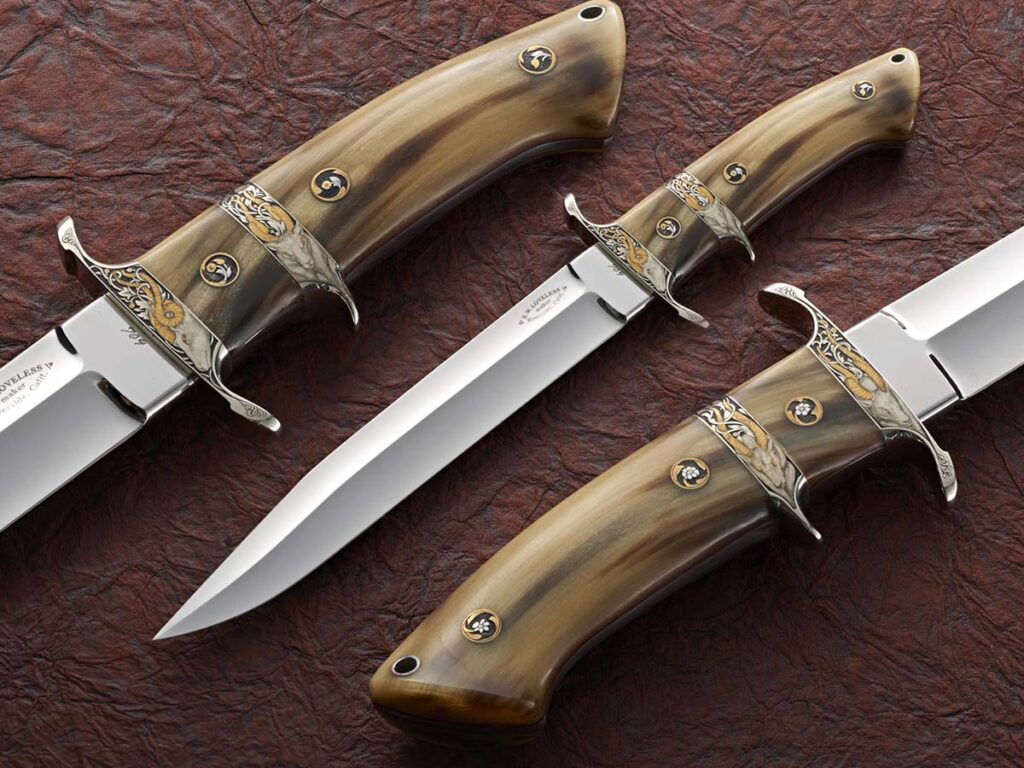
It was his eye, perspective and sense of beauty and design that set Bob Loveless apart. Few if any of his knives capture these traits better than his Big Bear fighter in sheep horn and gold engraving by Dan Wilkerson. (from the John Denton collection; Eric Eggly/PointSeven image)

Robin commented, “They took a lot of hunting trips, and one day Dad decided to stop shooting animals with a gun. He started shooting pictures with a camera. He loved photography, and I have no idea how all that started—but, gosh, I remember when I was a young kid he would take me and Allison on the weekends to camera stores. He would go in and talk for a couple of hours, and we were bored out of our minds. He would take pictures like you wouldn’t believe.”

Adding to Bob’s repertoire of activities, he was also an accomplished gunsmith. If these endeavors sound like a lot to pack into a lifetime, then there is no hesitation in labeling Loveless a true “Renaissance Man.”

Nonetheless, he had pursued his passions, probably without seeking the fame that came along with them. “I do know he never liked living in fancy houses,” Robin remarked. “But he had sports cars, and his favorite car depended on his age bracket. He would drive the back roads to the Chinese restaurant in Riverside and hit 100 miles per hour. At one time, he had three cars and two airplanes. He was a pilot with a lot of camera equipment. He probably got his pilot’s license before he moved to Riverside. I forget what year he got rid of his planes. He had crashed and it was no fault of his own. It happened when a bigger plane was landing and he got banged up. He had a limp after that.”

Keepsakes

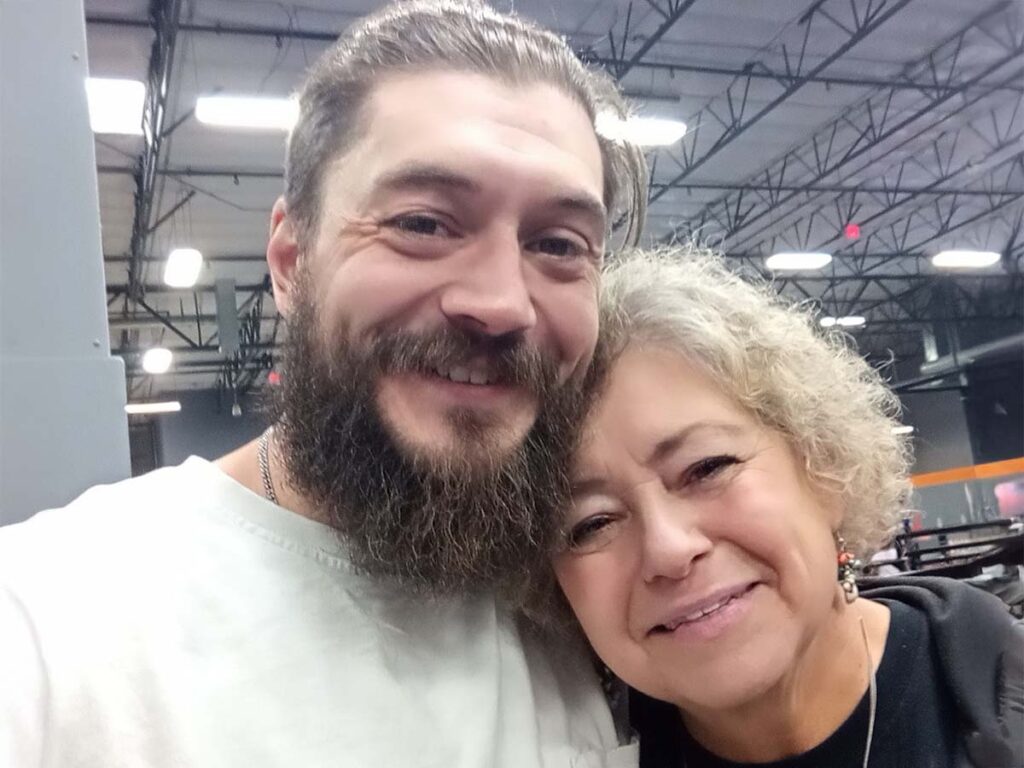
Writes Robin: “My handsome son Nico as he is today, shaggy beard and all. As a mother, I think his eyes and smile show what a kind and good man he is. I know his grandpa would agree with me and like this picture very much.”

Today, Robin’s heart is warmed by her memories, her strong Christian faith, and the knowledge that her dad truly became a father. His life was a mosaic of love and loss, turmoil and moments of calm, fiery and icy emotion, but always with a heart for the good and for his family. She clings to at least a couple of special items that symbolize the tie that binds.

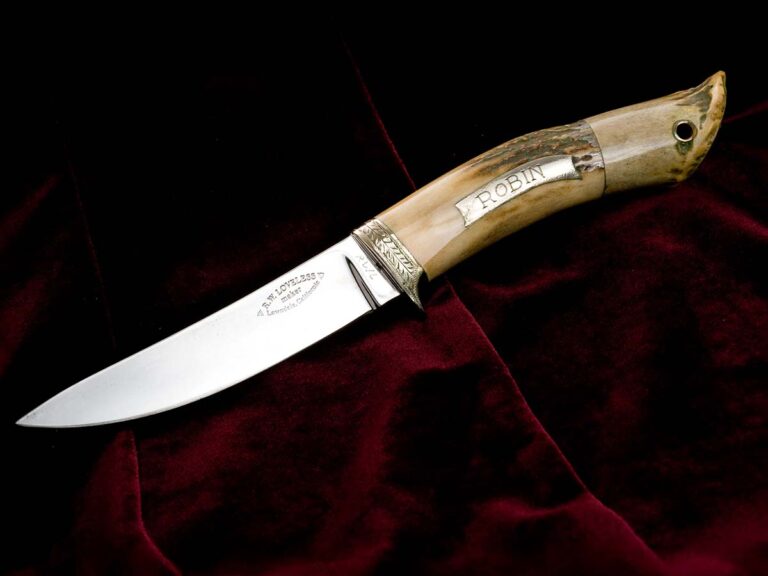
He made a banana skinner for her when she graduated from high school. “It has a stag handle with intricate engraving that he had done by a silversmith,” Robin said, “and I think the handle is at least 6 inches long with the blade about 7 inches. It is absolutely beautiful.”

A few years ago, Steve Johnson cleaned the knife up and put an edge on it. Dave Ellis took photographs of the one-of-a-kind piece, and John Denton, likely the foremost authority on Loveless knives in the world today, offered powerful words and urged her to treasure it always.

His various interests, personality traits and quirks made Bob Loveless more than just a knifemaking phenomenon—they made him a marvel, a celebrity and an icon.

The other keepsake is a photo of Bob, a joyous grin radiating from his face, as a cluster of pigeons lands on his shoulders and arms during a visit to Rome many years ago. It captures a sliver of his enjoyment of life, a glimpse into the heart and soul of just who he was. He was the gruff guy that gave generously to the local animal shelter, the edgy and matter-of-fact curmudgeon who handed substantial financial support to the UPS driver who had served faithfully in the area for years when Bob found out the guy had fallen on hard times. He was simply their quiet benefactor.

“It’s a beautiful picture and I look at it every day,” Robin offered. She ponders exactly where his genius came from and concludes that he inherited it from his mother. She admits that the spark of “genius” has not emerged from any other family member and concludes, “It was meant to be. That kind of genius is created before birth. My father was extremely gifted, and I always knew that.”

True enough, he was gifted, and in some ways that only a relative few others were even aware of.

Growing up Loveless and living within the sphere of influence her famous father created has been an adventure for Robin Askew, a thrill ride that began so many years ago, one that continues well after her dad’s departure from this Earth.

Read More On Bob Loveless:

Bayonets: An Iconic, Historic Blade

Few Blades Are As Historic As The Bayonet. The Knife Has Evolved Into An All-Rounder Still Issued By The Marines. 

Oddly enough, the history of the bayonet likely began in the hunting field, not the battlefield. By at least one account, the edged weapon was a tool of the French boar hunter in the 1500s. Tusks and a bad attitude, it’s understandable why these gents strapped their hunting knives to the muzzles of their muskets.

Soon after some enterprising soldier figured the invention–in original French baïonnette–might prove useful in warfare, and the iconic edged weapon was off to the races for the next four centuries. Presently, bayonets have essentially become military relics, if employed generally only as a training tool to acclimate soldiers to close-quarters combat.

Despite this, these fairly antiquated edged weapons still stir the imagination of military heroics of yore. Not to mention, in nearly all their versions, bayonets remain one of the coolest and most accessible historic edged weapons to collect.

In the article, we’ll look at some of the major styles of these modified edged tools, how the implement has evolved and who actually continues to make them. So gird your loins, we’re charging forward on bayonets.  

Major Bayonet Styles

A bayonet is so much more than just that. There were, and still are, several different designs of the implement, most mirroring the technology and ethos of war fighting of its particular era. 

Plug Bayonet

The plug bayonet is the earliest known bayonet and dates back to the 1500s or 1600s. The idea is rather simple. if you couldn’t use your gun to shoot or simply don’t have time to reload you turned to the knife. In this case, typically a double-edged dagger with a rounded handle that affixed the implatment directly in the muzzle of a musket barrel.

These earliest bayonets were really fully-fledged daggers in their own right. They lacked a proper pommel as can be imagined, but they could be used exactly like any other dagger. Most in this era were used in a manner of last resort. If a soldier found himself out of ammunition or facing a fast-moving enemy, he would likely want to put in his bayonet and hope for the best. 

The bayonet at this time was the product of changing warfare. While firearms were becoming more prevalent on the battlefield, they were slow to load. Additionally, the close-quarters combat of the medieval era still reigned supreme. In turn, soldiers required an option to hold off infantry and cavalry charges once their one shot was spent. 

Offset (Socket) Bayonet

While it may surprise some, the classic socket bayonet most think of during the flintlock era of warfare was not in full use by 1700. Attempts had been made prior to developing an offset bayonet allowing the soldier to load and fire with it attached. But it wasn’t until several critical battles in the late 1600s that evolution took hold. In particular, the battle of Killiecrankie in 1689. HereScottish Protestant forces were thoroughly defeated by Jacobite Scottish Highlanders, who charged and destroyed their enemy with broadswords and targes. 

This defeat came in part due to the plug bayonets the Protestants utilized. In what would be a rather ironic turn, the Scottish Jacobites would eventually meet their end and the end of their cause at the tip of the bayonet. Outfitted with socket bayonets at the Battle of Culloden in 1746, the British were able to let loose a point-blank volley on the charging Highlanders, then finish the rest with their bayonets. The British had even devised tactical doctrine for the use of the weapon, training to a charging man to their side, instead of in front to strike beneath his raised sword arm.

History Of The American Bayonet

M7 Bayonet
The M7 is a legendary American bayonet that is still manufactured today.

Americans were somewhat slow to adopt the bayonet in warfare, giving the British somewhat an edge in the early days of the Revolutionary War. Of course deadly in charges, attached to the British Pattern 1769 Short Land musket–or Brown Bess–the implement also was somewhat a psychological weapon. Said to be the most feared weapon of the British arsenal, the Red Coats mass assaults with a long, gleaming triangular knife at the end of their muskets made all but the most disciplined break.

The Continental Army proved a quick study once trained with the bayonet  by Maj. Gen. Baron von Steuben at Valley Forge in 1773. By the end of the war, there were even strokes of genius with the American use of the bayonet, such as when American Lt. Col. Alexander Hamilton (also the first Secretary of the Treasury) led a bayonet-only assault on redoubt 10 during the last days of the Battle of Yorktown. 

Early on, the Continental Army utilized a triangular socket bayonet similar to the British, however on the French Charleville Musket. But its use spread and the wicked device was eventually found on the Brown Bess–the most used arm of the Continental Army.

The bayonets in American service were standard European-style socket-mounted with triangular blades. This remains so through several iterations, including the Harper’s Ferry 1801 pattern, 1807 and 1810 Springfield patterns, M1816, and M1855.   

The M1855 served through the Civil War, where it saw extensive use on the Springfield rifle muskets. The .58 caliber rifle muskets loaded the same way as old muskets and could fire quickly and were very accurate and had substantial range. The bullets used in these guns had a hollow base that expanded into the rifling when it was fired, thus imparting spin. The war was devastating, and there were many bayonet charges, most with mixed results and high casualties. 

More accurate firearms and the introduction of repeating arms mitigated the effectiveness of the bayonet during the Civil War. It is estimated, only around 1 percent of all casualties were a result of bayonet wounds.

Sword Bayonet

sword bayonet
Pattern 1907 Bayonet. (Source: CC by 4.0)

Despite the effectiveness of “cold steel” assaults waning in the face of technological advancement, the bayonet persisted, though evolved to remain relevant.   

A more interesting detour around the time of the American Civil War, was the multi-purpose sword bayonet used by the British. The British Infantry Rifle of 1800–1840–later known as the Baker Rifle–utilized this style. The idea, essentially, was to give soldiers the ability to stave off cavalry charges when used as a bayonet, but also outfit them with a side arm–a short sword–for close-quarters combat. These sword bayonets had knife handles mated to exceedingly long blades, sometimes over 20 inches. 

Surprisingly, this style of bayonet was used all the way into World War I, despite little evidence the elongated blade provided any advantage. Perhaps the most famous final rendition was the Pattern 1907 Sword Bayonet, found on the British Short Magazine Lee Enfield rifle in the Great War. 

The American bayonets of the pre-WW1 era were a bit more well-designed. The bayonet designed for the American Krag rifle (the M1892), for example, had an 11.7-inch blade and could serve as a camp tool as well for daily chores. The Americans ended up following the Europeans’ lead in World War I a bit with the M1905 bayonet, which sported a 16-inch blade. Additionally, there were 17-inch versions used on the trench shotguns and backup rifles like the M1917 Enfield. 

Knife Bayonet

M9 Bayonet
The M9 bayonet works as a traditional bayonet but is more commonly used as a fighting/camp knife.

After WWI, most militaries of the world focused on making the bayonet in the form of a camp knife, something that was worth it to carry for general use that had more than one regular use. The time leading to WW2 produced the highly functional and realistically-sized M1 bayonet for the M1 rifle. The M1 carbine was also set up to use one, and it had its own small setup in the M4 bayonet knife. These knife-style bayonets eventually ran through several iterations leading up to the M7 bayonet for the M16 rifle in the late 1950s. 

As a regular tool, the knife bayonet is great and doesn’t remove any of the function in either role. It can be used for all sorts of tasks and also be mounted on the gun. The later M9 became a full-on utility and fighting knife for the M16 series. It is a large, Bowie-style knife that closely resembles the Ka-Bar. It added some additional utility features like serrations for cutting straps and rope and a wire cutter. Later on, the OKC-3S knife bayonet was adopted by the USMC. These remain standard today. 

Bayonet Realities

The reality of the bayonet is that it is not a principle fighting weapon. Today we are seeing most rifles fitted with a mountain of accessories, from variable power optics, lasers, suppressors, and bipods. 

 The bayonet has, for most of its history, been a weapon of intimidation. Very few times did any two armies charge each other with bayonets, usually one side fled first. Even in our modern era there have been bayonet charges, but again to no effect other than to scatter the enemy. 

Edged weapons do have a role in modern warfare; everyone needs a good knife at minimum. If your rifle has no provision to attach one or you’re using a suppressor, there is no real need to carry a bayonet specifically as opposed to a dedicated knife that serves your purposes. 

Bayonets will always be a curiosity not because of how they were used, but rather why they were used well beyond their abilities. While it is certainly a dangerous thing and absolutely lethal, getting that close to your enemies means you’re having an exceedingly bad day. But, as history has shown, a man with a sharp stick and nothing to lose can sometimes win the day.


Read More

  • The M7 Bayonet: From Combat To Campsite
  • Best M9 Bayonet Options For The Civilian Enthusiast
  • Best Ka-Bar: Modern Options Of The Historic Knife
Advertisement

Must Read Articles

Read this before you make a knife

Knifemaking 101 – Read This Before You Make a Knife

  by Wayne Goddard My experience has taught me that there's nothing like digging in and getting started. I've often said the hardest part of the...
how to forge damascus steel

How to Forge Damascus

Advertisement
Advertisement