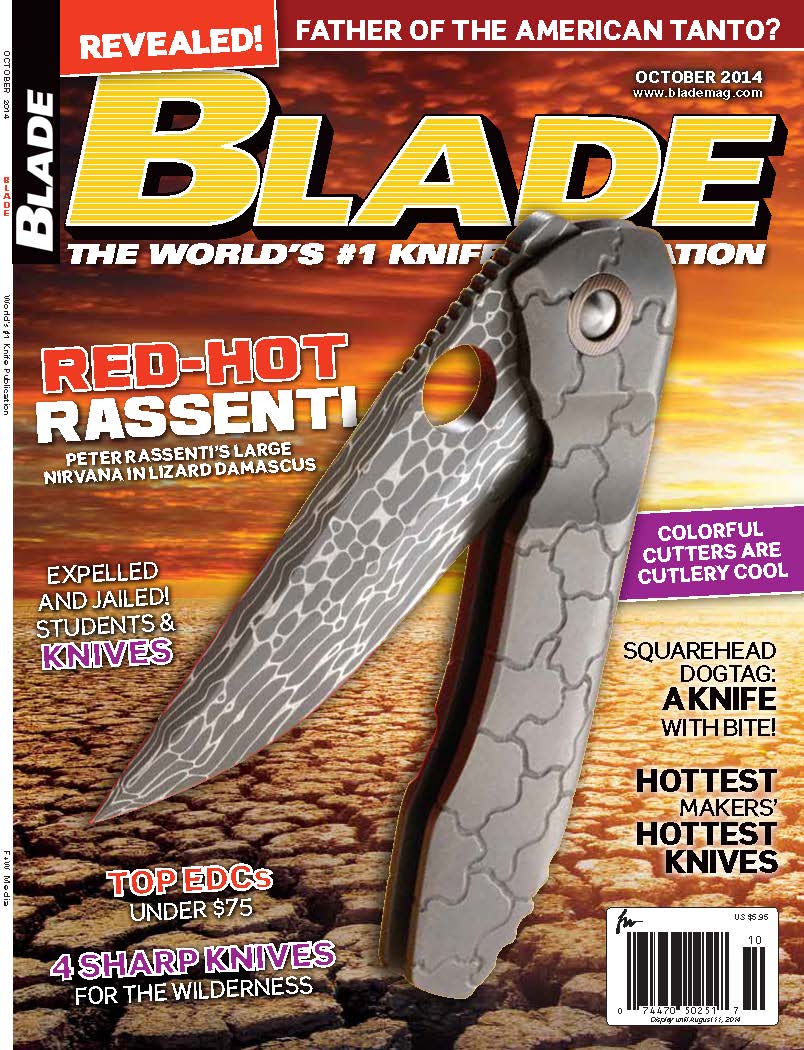
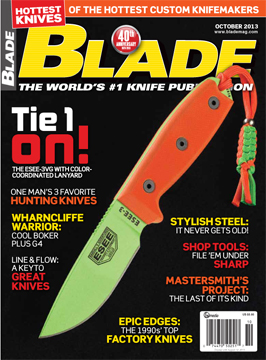
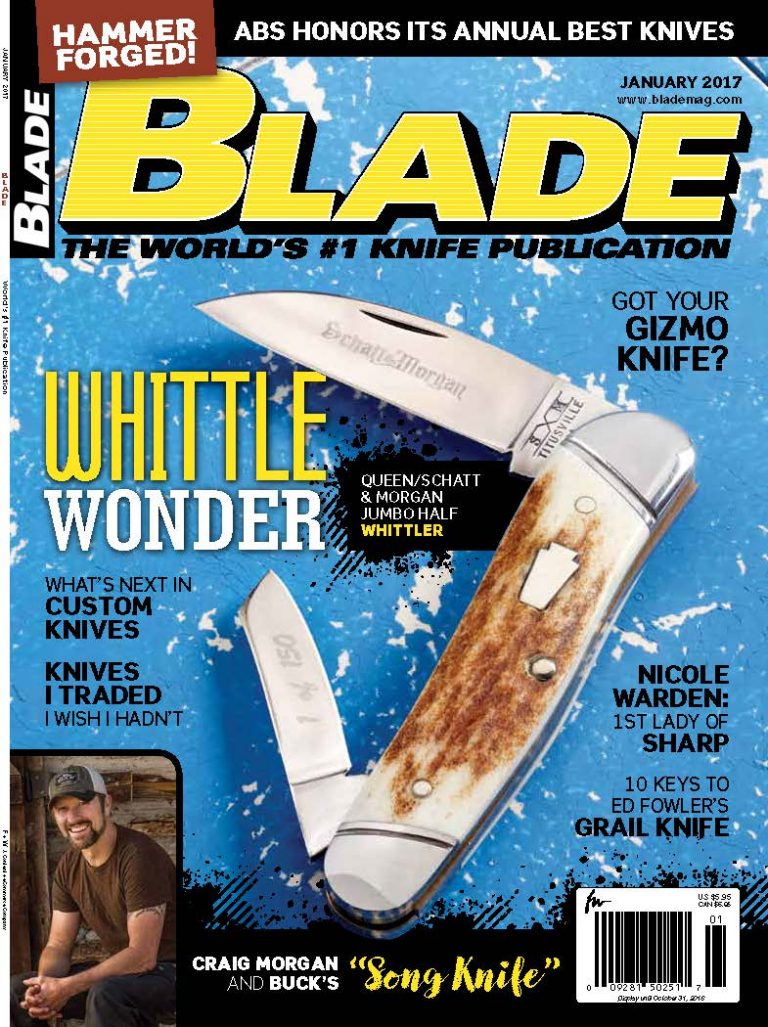
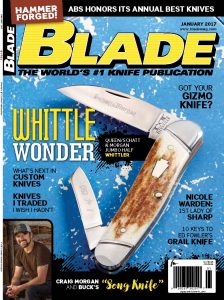
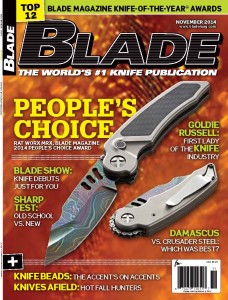
The eye-popping ESEE-3VG in a Venom Green blade, orange G-10 handle and a lanyard to match is the cover knife for the October BLADE® (www.blademag.com), on newsstands now!
The knife is an appetizer for the lead-in story on lanyards and beads, a growing accessory trend on today’s finest knives.
Want the inside story on the real reason the TSA decided to tuck its wings and rescind its approval of carry-on knives on commercial airliners? American Knife & Tool Institute’s Jan Billeb fills you in via the special question-and-answer story, “TSA Carry-On Knife Plan Grounded.”
The hottest makers’ hottest custom knives are the focus of BLADE (www.blademag.com) Managing Editor Joe Kertzman’s “Knives & Makers Catch Fire!” and custom knife purveyor Les Robertson offers the conclusion of his informative story on “What To Look For In A Forged Knife.”
If you like knife tests, MSG Kim Breed (5th Special Forces, retired) puts the Boker Plus G4 through the paces in “Wharncliffe Warrior,” and new BLADE (www.blademag.com) contributor Alan Clemons reveals his trio of favorite hunting knives in the aptly named “One Man’s 3 Favorite Hunters.”
Bladesmiths basically sprouted from the blacksmithing trade, but there are differences between the two vocations. ABS master smith Joe Szilaski outlines those differences in “Bladesmiths vs. Blacksmiths: What’s the Difference?”
Ever think about what goes on in a maker’s mind before he designs a knife, how he arrives at a certain line or curve, a rounded edge here or a palm swell there? ABS master smith Lin Rhea explains some of those thought processes in “Line & Flow: A Key To Top Knives.”
Factory/custom collaboration knives go back over 40 years, but they didn’t really take off until the early 1990s–and they’re still going strong. Dexter Ewing takes you on a tour of the latest versions in “Stylish Steel: It Never Gets Old!”
Bear & Son’s Mini Rancor IX and 778SR Sideliner come in at the right price for EDC performance.
Look at the calendar and it’s apparent the year is dwindling down to its final days. Yet, there are some knifemakers still as busy as ever, squeezing new models into the final days of 2023. Among these is Bear & Son Cutlery.
Earlier this month, the Jacksonville, Ala., manufacturer unveiled two new folders, each with the trappings of solid EDC options. The OPS Mini Rancor IX and 778SR Sideliner are both designed to provide everyday, at-hand performance. However, the knives go about offering this up in slightly different ways.
OPS Mini Rancor IX
Mini Rancor IX
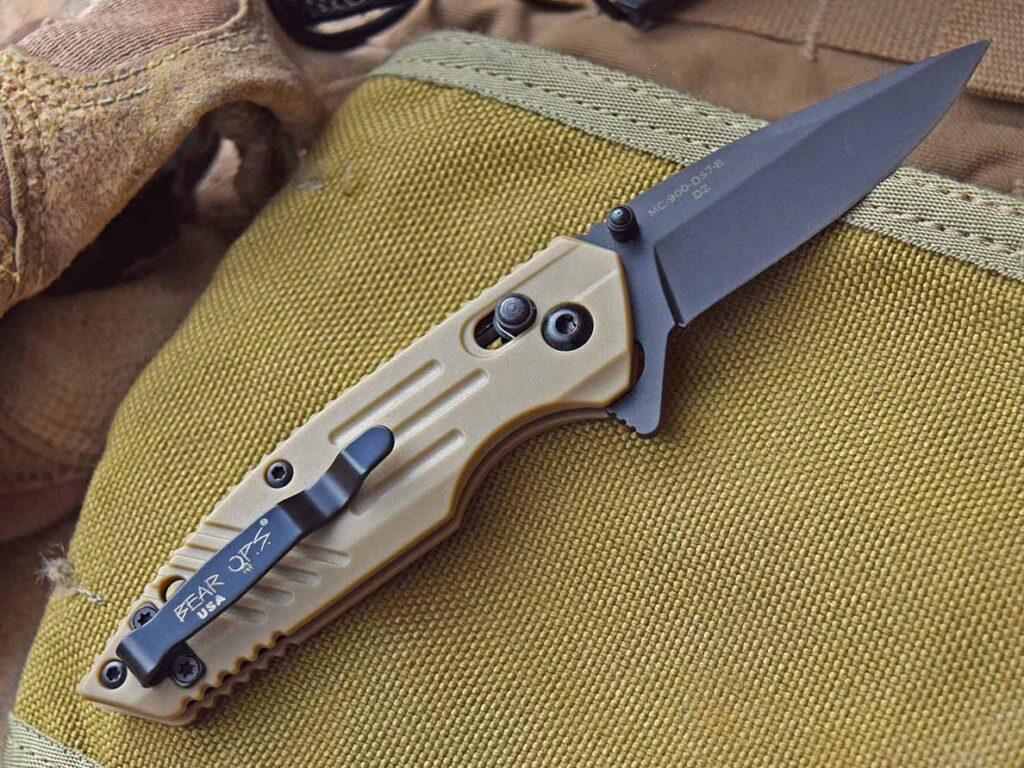
No bigger than a minute, the drop point flipper is the smallest option in Bear & Son’s growing Rancor line. While its predecessors weren’t gargantuan by any stretch of the imagination, the Mini Rancor IX is sized much more practically for a day-to-day option and for lighter duty.
Bear outfits the knife with a 2.5-inch blade, for a package that measures in at a very nimble and usable 6 inches in overall length when deployed. The manufacturer opted for D2 stainless steel—a high carbon, high chromium alloy—a common option for higher-end production knives. The steel gives the blade excellent edge retention and wear resistance, plus the ability to easily get touched up when resharpening is required. Giving the stainless steel an extra layer of corrosion and stain resistance, Bear & Son applies a black finish.
The handle of the knife is Zytel—a thermoplastic from the nylon family—with jimping along the spine and along the lower front. Further enhancing the hold of the knife, Bear textures the grip with significant milling, which in the sand-colored handle gives it a dynamic look. The ergonomics appear comfortable and the tapered profile of the handle should give the user a supreme purchase on the knife.
Rounding the knife off is a slide lock—similar to an axis—with offers strong lockup, as well as a fast and safe ability to put the blade away. Also, with familiarity, the lock can also make deployment lightning fast. Adding to getting the blade into action are ambidextrous thumb studs and a kicker. The knife boasts a stainless steel insert to provide backbone and it comes outfitted with a deep carry, tip-up pocket clip.
Bear OPS Mini Rancor IX Specs: Model Number: MC-900-DS7-B Blade Material: D2 Tool Steel Handle Material: Tan Zytel Rockwell: 58-60 Closed Length: 3.62 inches Locking Type: Slide Lock Open Length: 6 inches Edge Length: 2.30 inches Weight: 1.60 ounces Extras: Thumb Studs, pocket clip, stainless steel inserts, Lifetime Warranty Origin: Jacksonville, Alabama MSRP: $91
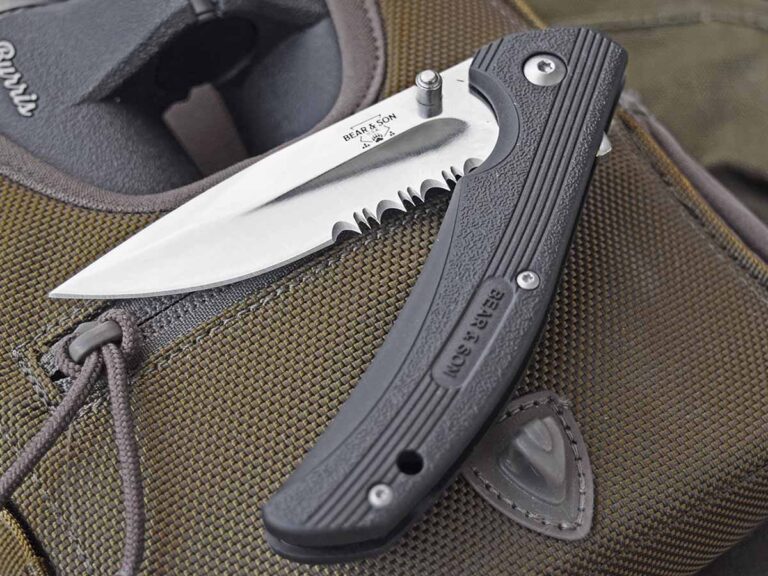
778SR Sideliner
A slightly larger option, the 778SR Sideliner nevertheless offers up a fairly tidy package for those looking for a budget knife. Catching the eye right off is the high-polished 3.25-inch, 440 stainless steel blade with a drop point profile. A quick note on the steel choice, it is softer than many other alloys but does—in general—provide a balanced package of edge retention and corrosion resistance. The tip comes to a very fine point, not only making it dexterous on fine-cutting jobs but also making it great at puncturing. Adding to its cutting prowess are aggressive serrations at the hind of the edge and terminating before the belly.
Again, Bear & Son opts for Zytel for the handle and gives it a pebble finish with some milling down the midline. Given its long and tapered shape, the thermoplastic should provide a comfortable grip and fit most hands fairly well. In its core, the liner lock has a stainless-steel liner, giving the knife a measure of overall ruggedness. Rounding out the package are both thumb studs and a kicker for deployment.
778SR Specs: Model Number: 778SR Blade Material: 440 Stainless Steel Blade Shape: Drop Point Handle Material: Black Zytel Lock Type: Linerlock Overall Length: 7-1/4 in. Edge Length: 3-1/4 in. Weight: 2.9 ounces Extras: Stainless Steel Pocketknife, Thumb Studs, Torx Screws, Lifetime Warranty Origin: Jacksonville, Alabama MSRP: $45
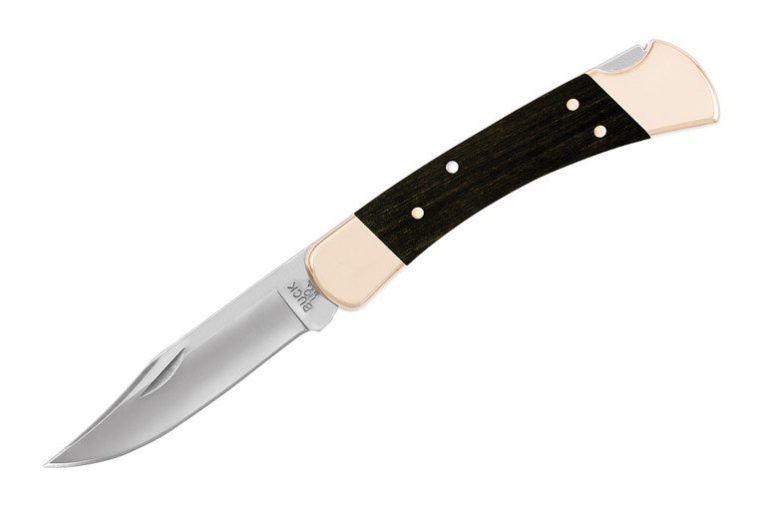
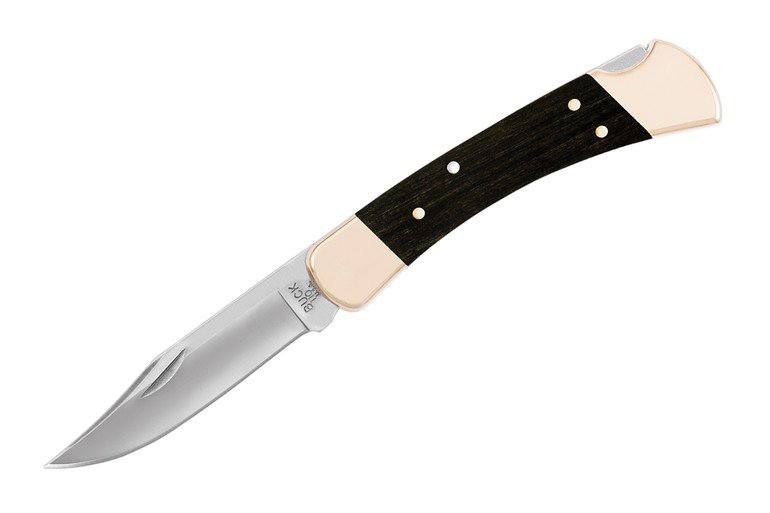
The Buck 110 pictured here, one of the most common folding knives in the United States, could’ve counted as an illegal “gravity knife” under a now-repealed New York law. If the blade could open with a flick, as determined by a law enforcement officer, the possessor of the knife could be arrested and charged with a felony.
In general terms, the now-defunct restriction defined a gravity knife as one with a locking blade able to open with the flick of a wrist. As many in the knife community know, the difference between a folding knife that can and can’t open with a flick is minute. A stiff folding knife on Monday may loosen up by Friday with regular use.
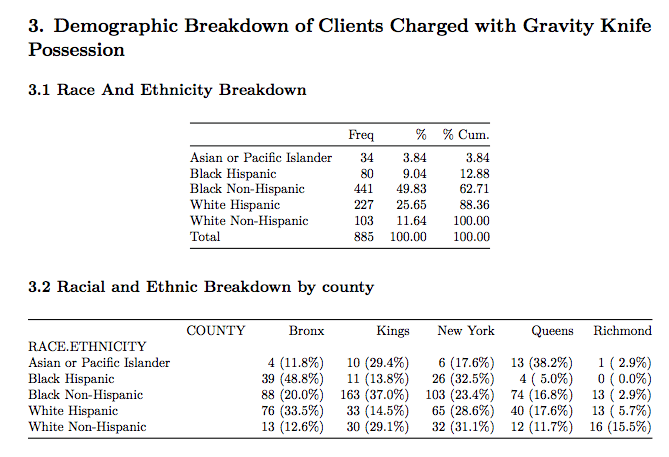
However, up until last week, that small difference came with big consequences, including felony charges or prison time for the 4,000 people arrested each year in New York state. Even if those people, overwhelmingly from minority backgrounds, committed no other crime, possession of a gravity knife alone was grounds for arrest. Due to the vague wording of the law, what constituted a gravity knife was left to the discretion of the arresting law enforcement officers.
A report issued by the Legal Aid Society in 2018 details the lopsided demographics of those charged under the gravity knife ban. Click the image to download the full report (PDF).
As such, major media outlets featured faces familiar to the world of knives in news packages, such as Doug Ritter of Knife Rights.
Reactions
News of Gov. Cuomo’s signature, tempered by the fact that that same governor vetoed the repeal twice before, came as a welcome development to those in the knife community and beyond.
“After nine years fighting, it is a relief to close the book on this extraordinary abuse of authority by a corrupt system that has terrorized over 70,000 honest, law-abiding people, disproportionately minorities, for simply carrying a common tool used daily in their lives. I am thrilled that we and our partners across the political spectrum in this fight have finally prevailed, but it is a sad commentary on the state of politics and justice in New York State, New York City and at the Second Circuit that it took this long and that tens of thousands of innocent folks had to suffer so much for so long,” Ritter said in a Knife Rights article posted May 30.
“A sincere thanks to the New York Legal Aid Society, Rep. Dan Quart, and Senator Diane Savino for not giving up on solving the inconsistency and ambiguity that the NY gravity knife law created. We began working with attorneys at the NY Legal Aid Society on draft language back in 2010 – never imaging success would take so long,” a statement on the website of the American Knife & Tool Institute (AKTI) read.
“For far too long, the NYPD exploited the gravity-knife ban to drive up arrest numbers at the expense of our clients,” Tina Luong, an attorney representing the Legal Aid Society, was quoted as saying in The New York Times.
BLADE reached out for comment from a number of organizations, and had yet to receive responses as of this writing.
NYC Mayor Expresses Opposition
Despite the repeal, some officials remain determined to enforce the restriction through some other mutation. New York City Mayor Bill de Blasio’s office expressed its opposition to the repeal, vowing to find “an alternative” method of restricting gravity knives.
Complete the BLADE® reader survey and get a 25% off coupon to ShopBlade.com and possibly win one of 10 free one-year BLADE subscriptions.
The best way for BLADE® to fulfill the needs of its readers is to go right to the source—the readers themselves. If you read BLADE, you can help us satisfy your knife lust by taking our BLADE READER SURVEY.
Not only will you help us help you, but by completing the survey you will get a special 25-percent-off discount code that you can use at ShopBlade.com through Nov. 10, and an opportunity to enter our drawing to possibly win one of 10 one-year subscriptions to BLADE.
What kinds of knives do you like reading about? Tacticals, EDCs, bowies, folders, utility knives, factory or custom, contemporary or antique? Do you like to read knifemaker and/or knife company profiles or do you prefer stories on how to make knives, how to collect or how to use them? Or are your tastes geared more toward knife testing, knife design or the materials to make knife blades, handles and more? Are you into sheaths, sharpeners and other knife accessories? Do you like to read about knife history, military knives, art knives, knife shows, knifemaking schools or something else? Tell us. We will take the results and modify our editorial content to meet your needs.
All successful magazines conduct reader surveys and study the results to see if what they are doing meets with reader needs and approval. If what they are doing is not meeting the readers’ needs, successful magazines see what it is the readers want through the survey results and amend their editorial approach to fill those wants. BLADE has been doing it this way for well over a quarter century and the approach must work because we remain the World’s No. 1 Knife Publication and have been No. 1 for over three decades.
Please take our survey and feel free to add your comments concerning where the magazine needs improvement, no matter what the area: story content, illustrations, writers, layout and more. And please pay particular attention to the questions concerning how much you participate in social media. Those questions are new to this survey and will be most helpful in determining how we address the worldwide social media phenomenon going forward.
Sometime in the early 1990s, a journalist—to the chagrin of the handful of other knifemakers also still working in Sheffield, England—described Stan Shaw as “The Last Little Mester,” and the title stuck until Stan’s passing in February. Stan made many fancy pocketknives but “Little Mester” was never simply a title that denoted mastership of a craft skill.
Historically, workers in the Sheffield cutlery industry were notoriously independent. As the industry moved from craft-based to industrialization, nearly all cutlers were on piece-work and would rent space in the workshop—a yard of bench or a “trough” for grinding. Work came from other workers, and each worker did a very specific task on the knife before it was passed to the next worker. The process was efficient because of the hyper-specialization of all of the workers in the chain. There was a complicated, ever-changing network of subcontracting, renting, supplying and rivalries, but no one learned all the processes to make a knife—there was no concept of sole-authorship.
In her thesis, Sally-Ann Taylor* states that the “differing opinions regarding the status of the little mester reflected the actual diversity in his possible position and role. Some felt that the title implied that his enterprise should involve him in a certain number of commercial risks and liabilities. Sometimes he was an actual workman himself, obtaining orders from larger factors, merchant or manufacturers, and then employing a few men to help him … sometimes even these workers would employ others beneath them, but usually only members of their own family—particularly women and children.” Hence, little mesters were small-scale flexible employers, recruiting workers to supplement their own labor as required.
In 1844, a commentator on the cutlery trades stated that “there are several modes of conducting the manufacture, but the factory system is not one of them … there is no large building, under a central authority, in which a piece of steel goes in one door and comes out at another converted into knives, scissors and razors. Nearly all the items of cutlery made at Sheffield travel about the town several times before they are finished.”**
HE KNEW at 14
Stan didn’t come from a cutlery background. He was born in 1926 in a small village outside Sheffield, and, after seeing a market stall of knives, decided at 14 that that was what he wanted to do. By chance, he walked into the prestigious company, Ibberson, and spoke to the owner, Billy Ibberson.
Pointing to a showcase displaying the firm’s best pocketknives, Stan said he’d like to learn how to make such knives. As Stan recalled, “Billy then fetched up one of the cutlers, Ted Osbourne—a little bloke about 5 feet or so tall—and asked, ‘Will you have him?” He said, ‘Yes.’ And I started on the Monday at an apprentice’s wage of 10 shillings a week.”
When Stan joined the firm, the old patterns of working had long gone; “little mesters” and “factors” had morphed into the more familiar patterns of factory working, with all the workers employed by the company and paid a wage. He was one of the last apprentices to be taken on and his curiosity about the entire process of making folding pocketknives was insatiable. As he moved through Ibberson and other companies over the years, he actively approached other workers to learn their processes as well as his own. It was this breadth of training that made him unique and was vital to him in later life.
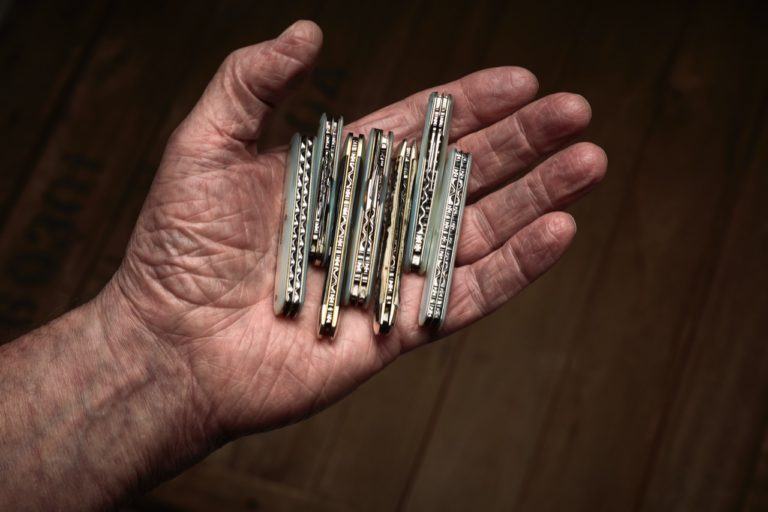
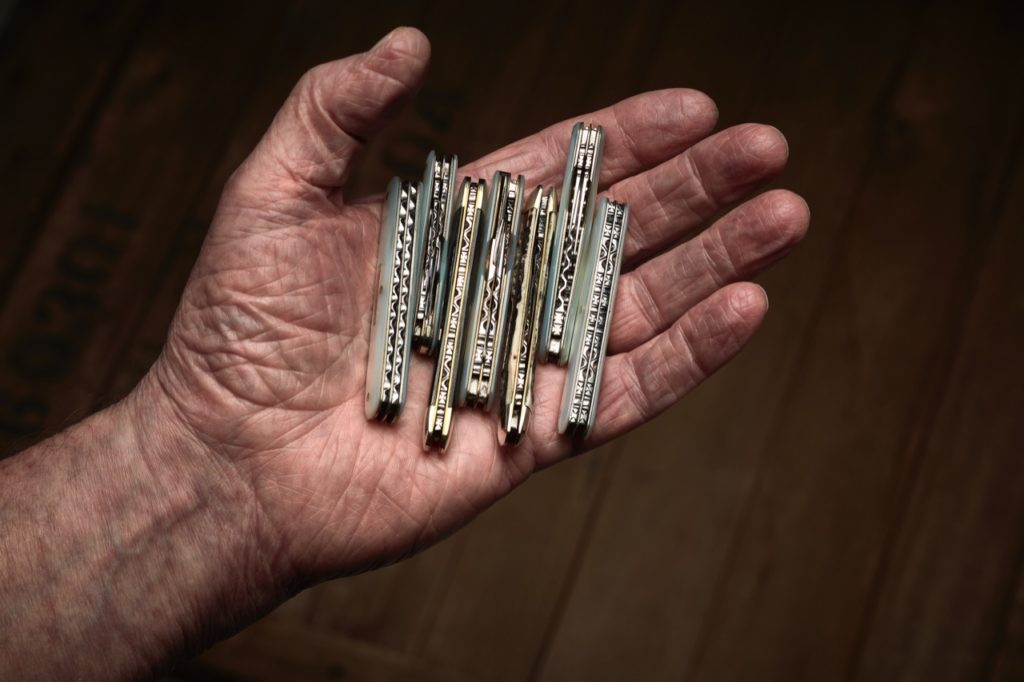
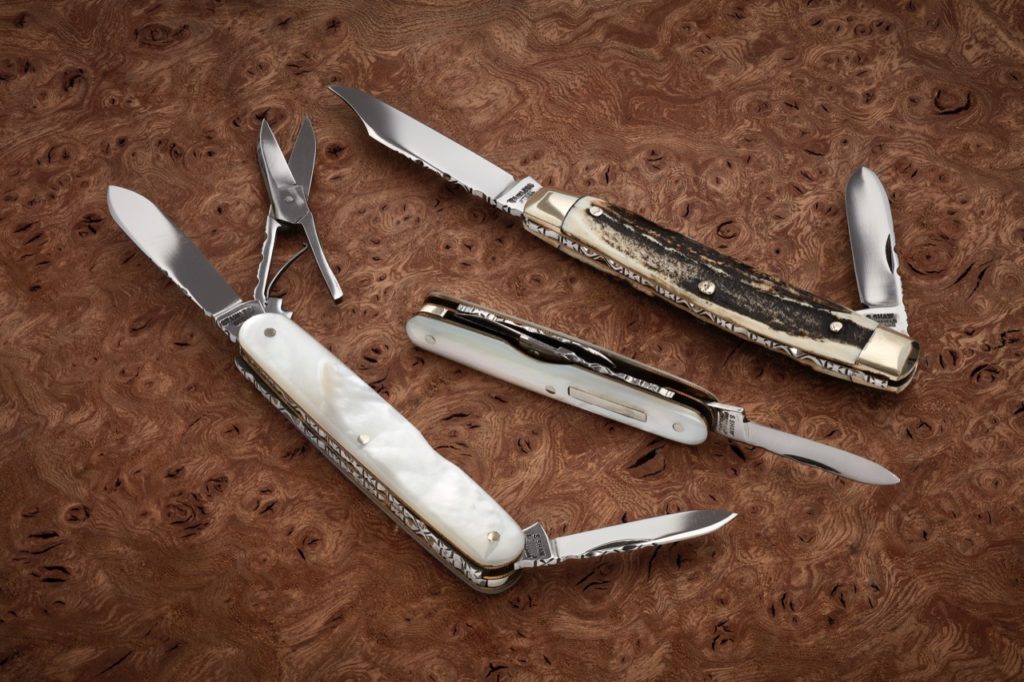
A sampling of Stan Shaw’s pocketknives with richly fileworked blade spines and backsprings. Look close and you can see the Maltese crosses for which Stan was so well known. (image by Carl Whitham, Sheffield)
THEIR PATHS CROSS
By the beginning of the 1980s, the contraction of the Sheffield cutlery industry was such that there were no more companies left to employ him, so he set-up his own workshop in Garden Street. It was there, 10 years later, that our paths crossed.
I had made a set of three folding knives for a college project and hadn’t been able to find anyone still making traditional Sheffield slip joints to ask for advice. A couple of years later, I heard Stan being interviewed on the radio and realized that I still desperately wanted to learn to make knives. I packed up my workshop in London and moved to Sheffield to persuade him, in person, to take me on as his apprentice. He welcomed me into his workshop but said that he was nearly 70 and too old for an apprentice. Instead, he offered me his bucket of old, handforged blades and springs, told me to select a handful and “go and figure it out yourself because it’s not that hard.” He would always be there to help if I got stuck.
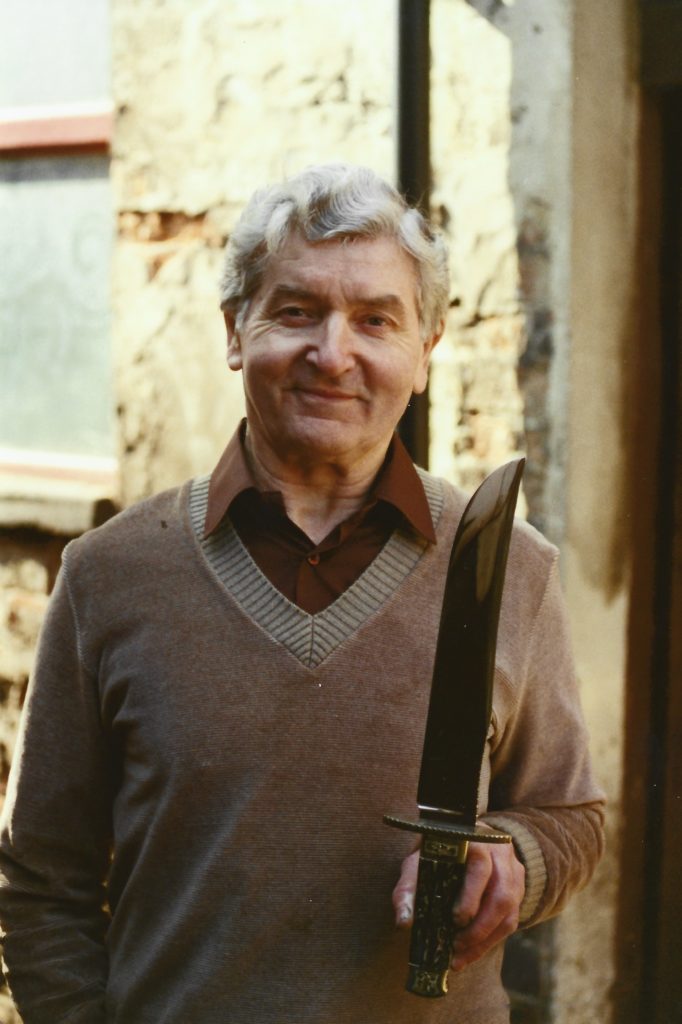
Stan Shaw as he appeared in the early 1990s. (Geoffrey Tweedale image)
A few years ago, when I was gently teasing him about still having a 10-year waiting list for his knives, he said, “I should have taken you on then, lass, you’d just about be useful to me now!” So, for all the times our paths crossed, for all the gentle encouragement and for completely changing my life’s path when I was 23 years old, thank you, Stan.
Stan was not a “little mester.” He was a master and was proud that he could make his knives from start to finish, a concept that would be completely alien to Sheffield knifemakers a hundred years ago.
Stan Shaw, whose career of making classic pocketknives spanned almost 80 years, passed in late February at the age of 94.
He started work for W.G. Ibberson in Sheffield, the old knifemaking capital of England, in 1941. Apprenticed to Fred and Ted Osborne, men Stan described as the two best cutlers in Sheffield, he eventually succeeded them in 1954 as the company’s top maker of pocketknives. Though the Sheffield knife industry was in rapid decline, he continued making knives, renting an old workshop in 1983 and becoming an independent cutler.
As Stan moved through Ibberson and other companies over the years, he actively approached other workers to learn their processes as well as his own. It was this breadth of training that made him unique and was vital to him in later life. (image by Carl Whitham, Sheffield)
As an independent he did it all in the making of his pocketknives, and he did it all quite well. As he said in “Stan Shaw: Little Mester of Sheffield” in the May 1994 BLADE: “I have to do everything now because there are no forgers, grinders, scissor-makers and so on left. My earlier experience with Ibberson’s has proved invaluable in that respect. All my knives are hafted, ground and assembled by me. It’s harder work but the satisfaction is greater. Scissors, files, punches, shields, shackles, handles, scales, bolsters—the list is endless—but each part is made by me on these wheels and dollies with only hacksaws, files and a few other traditional tools, such as my parser. The only job I don’t do is the occasional engraving I have done on the bolsters.”
His knives are testaments to the classic exhibition pieces, many with a host of blades and other tools and implements. In 2003 he became an honorary freeman of the Company Cutlers and in 2017 was awarded the British Empire Medal. As late as 2019, into his 90s, he continued to clock in bright and early in the mornings to make pocketknives at Kelham Island Museum. In the interim he served as a mentor to many makers, including award-winner Grace Horne, among others.—by BLADE® staff
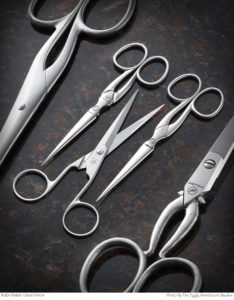
In addition to pocketknives, the author is also well known for her award-winning custom scissors made in the original knifemaking center of the United Kingdom—Sheffield, England. (Eric Eggly/PointSeven image)
The Author, Grace Horne
Editor’s note: An award-winning knifemaker from Sheffield, England, the author currently makes traditional folders. For more information contact her at Dept. BL9, The Old Public Convenience, 469 Fulwood Rd., Sheffield, United Kingdom, S10 30A [email protected], gracehorn.co.uk. Also: Steven and Kylie Cocker, Instagram @steven_cocker_sheffield; Michael May www.michaelmayknives.com; and/or Michael and Ashley Harrison plus apprentice at A Wrights & Sons www.penknives-and-scissors.co.uk.
*Tradition and Change: The Sheffield Cutlery Trades 1870-1914; Sally-Ann Taylor
**The Penny Magazine Supplement, April 1844, p.168; Thomas Allen
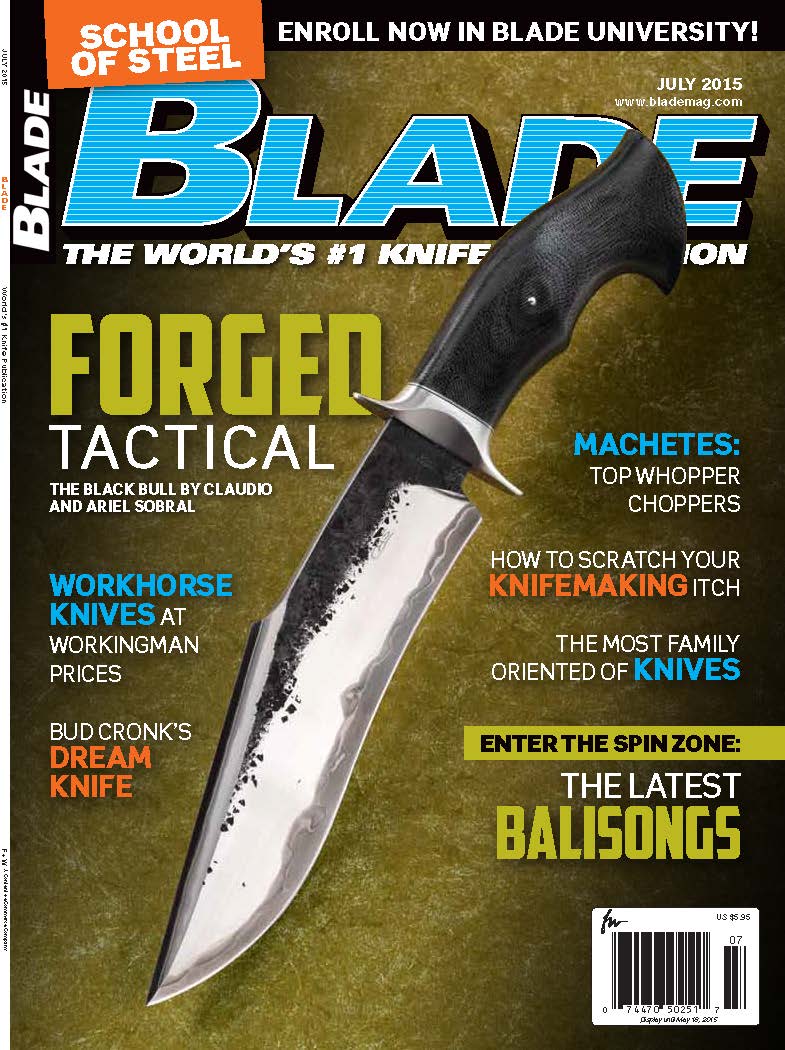
Forged tacticals are heating up in the new BLADE®, on newsstands NOW!
Forged tacticals as a trending new niche market, perhaps the best knives to use in corrosive saltwater environments, four hot new butterfly knives, the latest machetes and a comprehensive preview of the 2nd Annual BLADE University highlight the new BLADE®, on most newsstands today.
Purveyor Les Robertson specializes in tactical and handforged knives, so it only stands to reason he would be on the cusp of the edge if forged tactical knives were to become hot as firecrackers—and apparently such is the case. Find out why, which ones are hot and more in Robertson’s “A Niche Market In The Making?”
Spyderco has long touted its H1 steel as being not just stainless but stain proof. Ocean kayaker Lance Clinton decided to try out the company’s Pacific Salt model while floating off the coast of Costa Rica. Find out what he found out about this intriguing blade material in “Down To The Sea With Knives.”
Balisongs—aka butterfly knives—have long intrigued edged enthusiasts, and the latest examples of the genre will capture your fancy in “Enter The Spin Zone.” Factory machetes, meanwhile, are appearing in ever-increasing numbers. Check out some of the latest of the long blades in “Those Magnificent Machetes.”
BLADE University, a fresh approach to knife education at knife shows, was a huge hit at last year’s BLADE Show—and this year’s 2nd Annual BLADE University has been expanded to cover a wider range of topics, including knife grinding, collecting, how to have your design picked up by a knife manufacturer, 3D CAD/CAM knife design, how to engrave, how to design combat knives, how to make handles and guards, introduction to bladesmithing, how to sharpen, what to look for in the best high performance knife and much. Get the complete lowdown in “School of Steel.” BLADE University will commence a day before through the show Saturday of the BLADE Show, which will be June 5-7 at the Cobb Galleria in Atlanta.
There’s much more in the latest issue of BLADE. Check it out at your local newsstand.
Recommended:
Stay abreast of the latest developments on this and many more knife rights issues with a subscription to BLADE.
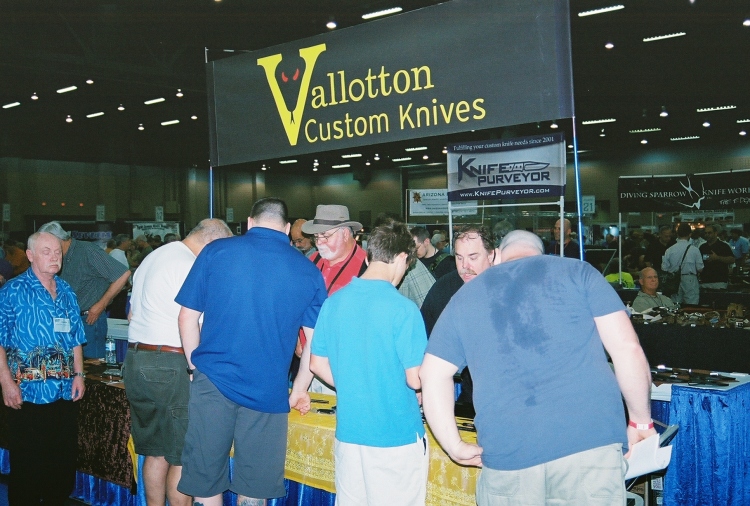
Butch Vallotton’s table was abuzz with activity at last year’s BLADE Show (www.bladeshow.com). We need your help to get Georgia Knife Preemption Bill SB432 scheduled for a vote in the coming days or it will not become law.
Georgia Knife Preemption Bill SB432 must be scheduled for a vote in the coming days or it will not become law, Knife Rights reported.
SB432 makes certain that Georgia’s knife laws are consistent throughout the state. As the home of the BLADE Show (www.bladeshow.com), this is very important to knife owners, collectors and manufacturers and means millions of dollars in business to Georgia.
The Georgia legislature is in the final hours of the 2012 session and there are a lot of bills competing to be heard before the legislature adjourns, most likely on Thursday.
It is critical for you to call the office of Georgia’s Speaker of the House David Ralston and POLITELY request that he “please schedule SB432 for a vote as soon as possible.” That’s all the message you need to leave.
If you are a BLADE Show attendee, or ever plan to be, and even if you are not a Georgia resident, you have a stake in this issue…CALL TODAY! Phone calls will have the greatest impact.
Georgia House Speaker David Ralston: 404-656-5020 Email: [email protected]
For more on the latest knives, knife legislation, knifemaking instruction, knife trends, knifemakers, what knives to buy and where and much more, subscribe to BLADE Magazine, the World’s No. 1 Knife Publication. For subscription information click on http://www.shopblade.com/product/blade-magazine-one-year-subscripti…?r+ssfb032712#BL1SU.