Brian Tighe, maker of the “Twist Tighe” in all Damasteel damascus steel, is slated to be among the world’s top custom makers exhibiting their knives at the 23rd Annual East Coast Custom Knife Show Friday through Sunday, March 2-4.
Produced by Steve D’lack of Hawthorn Galleries, the show will be held at the Westin Hotel-Jersey City Newport in Jersey City, New Jersey.
For more on the latest knives, knife legislation, knifemaking instruction, knife trends, knifemakers, what knives to buy and where and much more, subscribe to BLADE Magazine, the World’s No. 1 Knife Publication. For subscription information click onhttp://www.shopblade.com/product/blade-magazine-one-year-subscripti…?r+ssfb030112#BL1SU
The battle to stop federal measures that punish law-abiding citizens and do little to address the issue of elephant ivory poaching has entered a new phase.
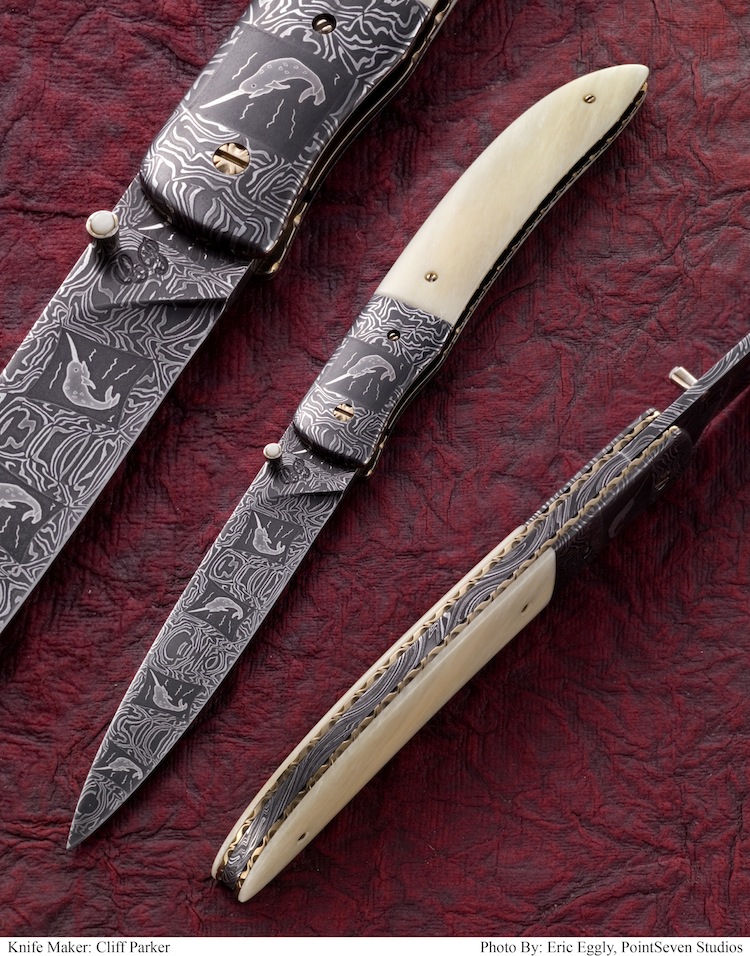
The ivory battle has entered a new phase, and the deadline for your ivory letter to Fish & Wildlife is April 14. One among many of the problems with the proposed federal regulations is that legal fossil ivory like antique narwhal, such as on Cliff Parker’s folder, may be mistaken by federal officials for elephant ivory and confiscated. (PointSeven photo)
If you are a duly authorized representative of a company with “significant commercial operations and employees,” now is the time to present U.S. Fish & Wildlife with a letter to oppose the pending federal measures, the first round of which reportedly is due to be released sometime this month. However, if you act no later than April 14 and send the letter to FWS, you will be in time to have your voice heard by those who can amend or even stop those measures before they happen.
Simply email the following letter to Doug Ritter of Knife Rights at [email protected], and he will forward it with others to FWS officials expressing concern over the harm the new federal measure would cause, not only to worldwide elephant populations but also to law-abiding citizens who own ivory knives and other ivory products and have owned the very same ones for years, if not decades.
The letter is as follows:
Subject: Ivory Ban Knife Community Letter
My name is (insert your full name) and I am (insert your executive position in the organization or company) of (insert name of your organization or company). As its duly authorized representative, I request that you add our name to the Knife Community letter opposing U.S. Fish and Wildlife Service’s proposed ban on commercial trade in elephant ivory.
(Insert Official Address of your Organization or Company)
(Insert Organization of Company Website)
(Insert your phone number in case of questions)
Regards,
(Insert Your Name)
(Insert Your Title)
(Insert Your Company’s Name)
(Insert Your Mailing Address)
(Insert Your Website Address)
(Insert Your Email Address)
(Insert Your Phone Number)
For the latest knives, knife news, trends and more, stay tuned to blademag.com.
Editor’s note: Ken Warner, the visionary behind and original editor of the acclaimed KNIVES annual book series, recently passed away. In tribute, BLADE is featuring this article from the August 2009 magazine issue about this titan of knives.
The turn of a phrase, the flow of the narrative, and simply getting the story straight are hallmarks of the writing craft. BLADE Magazine Cutlery Hall-Of-Famer® Ken Warner brought the ability to perform each of these, along with an unmatched eloquence, to the knife industry.
Universally, knife authorities acknowledge him as the individual who lifted custom knives out of the shadows. He helped to accomplish this with a straightforward, crisp, and clean writing style that captured the imagination of readers for nearly half a century.
A “True Poet” of the Knife Community
Warner edited and wrote much of the first Knives annual in 1981. The series went on to transform the knife industry. He continued editing the annuals until 2000. BLADE managing editor Joe Kertzman assumed the reins beginning with the 2001 edition.
“Ken Warner is the true poet of the knife community,” related BLADE field editor Ed Fowler. “While he did not write the most knife articles, what he did write was worth reading and serves as an eloquent inspiration for all who have thoughts to share. He had no axe to grind other than to share knowledge. As a fledgling knifemaker, I used to read his comments and soon learned that he knew well his subject matter.”
Though he is not currently writing—he instead stays busy offering a wide range of fixed blades and folders through his Ken Warner Knives knife company—there is always the possibility that Warner will return to print. Meanwhile, he says he is becoming computer savvy enough to run a knife forum on the internet and to continue his online blog (kenwarnerknives.blogspot.com). He also stays busy designing knives.
“I’m 80 years old,” he reflected, “and I have some things I want to say and there are some stories I can do that nobody else can do because I was there. I will get to that when I get to it.”
Forging a Path
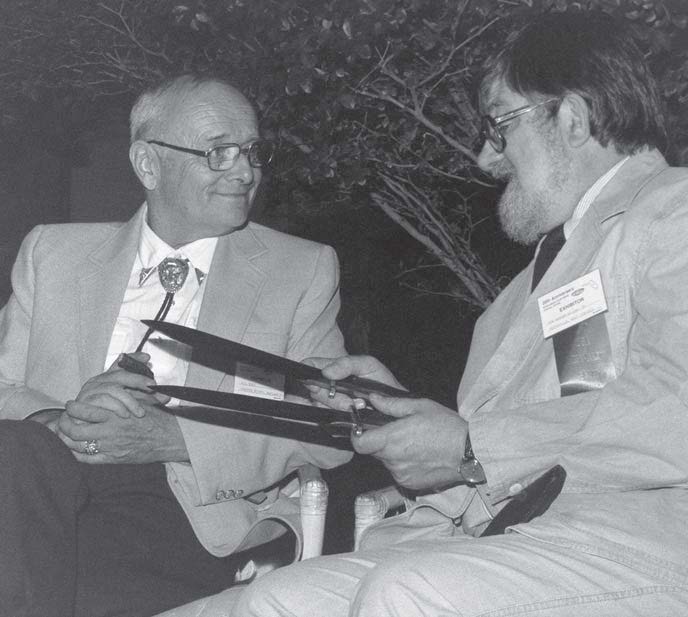
Blade Magazine Cutlery Hall-Of-Famers Bill Moran (left) and Ken Warner were good friends. According to Cutlery Hall-Of-Famer B.R. Hughes, Warner was the first to write about Moran and his knives in a national magazine. Here Moran and Warner visit and talk knives at an early 1980s Knifemakers’ Guild Show. (photo courtesy of B.R. Hughes)
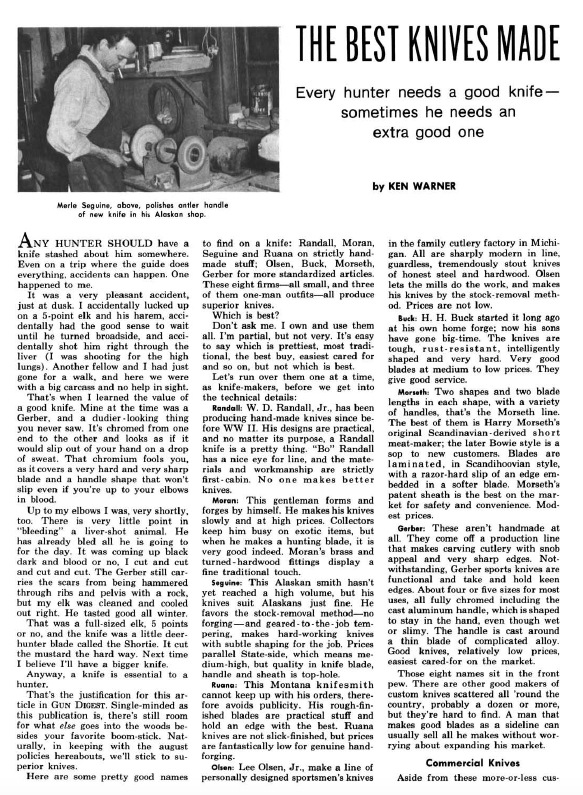
Literally, when custom knives began to gain national and international attention, Warner was there. In fact, he was the prime mover in publicizing the work of the knifemakers. As a writer for the popular annual Gun Digest, he started writing about knives in 1964. That first article, titled The Best Knives Made, has been reprinted numerous times.
Back then, though, it was a challenge just to get enough material to put a story together.
“I could hardly find any knifemakers,” Warner commented. “I found [Bill] Moran and [Bo] Randall, and Buck was small then and I wrote about them. However, a number of knifemakers and collectors have told me that the article got them started. Bob Loveless, for example, has told me that he was about to give up making knives because it wasn’t going any place. Then, he read the article and decided that somebody would understand. There was a time that I was actually giving away Loveless knives just to see what people thought of them. Butch and Rita Winter were pre-eminent collectors of handmade knives, and they told me I got them started.”
A Calling
Educating the general public about knives evolved into something of a mission for Warner. In 1976, he wrote The Practical Book Of Knives, a primer of information on the mechanics, components, function and terminology associated with knives. Through editorial contributions to a number of publications, he has managed to spread the word.
Along the way, he has gained a multitude of friends and admirers. One of the closest was with the legendary Cutlery Hall-Of-Famer, Bill Moran. BLADE field editor and Cutlery Hall-Of-Famer B.R. Hughes, co-author of the Moran biography, Master Of The Forge, credits Warner with his introduction to the great bladesmith.
A Man of Many Firsts
Ken Warner’s The Best Knives Made article in the Gun Digest 1966 book was a game-changing moment for what is now the modern knife industry.
“Ken was one of the first to write knowledgeably about handmade knives, and he’s important to me personally because he’s how I heard about Bill Moran,” Hughes remarked. “Ken used to live close to Moran’s shop and visited there often. He was the first to write about Moran in a national magazine. He mentioned Moran in the Gun Digest article in 1964, and that article did more to publicize handmade knives than everything written about them up to that time.”
Of course, Moran, Hughes, Don Hastings and Bill Bagwell went on to found the American Bladesmith Society in 1976 and the rest, as they say, is history.
Hughes said he remembers working at a magazine called Gunsport in the mid-1960s and Warner was the editor. Even then, Hughes knew Warner was something special.
“Ken’s writing was a cut above what I was used to seeing in a gun magazine,” Hughes continued. “I soon became shotgun editor of Gunsport, and no gun magazine of that day was going to publish a lot of knife articles, but Ken got a knife article in there from time to time.”
When Warner left Gunsport to publish his own magazine, Gunfacts, the idea of writing about knives had caught on.
Hughes said he recalls a memo circulating to ask if anyone else at Gunsport had an interest in or knowledge of handmade knives. Hughes raised his hand, contacted Cutlery Hall-Of-Famer A.G. Russell for a crash course in handmades, and took up writing about knives himself.
The Knives (KNIVES) Books
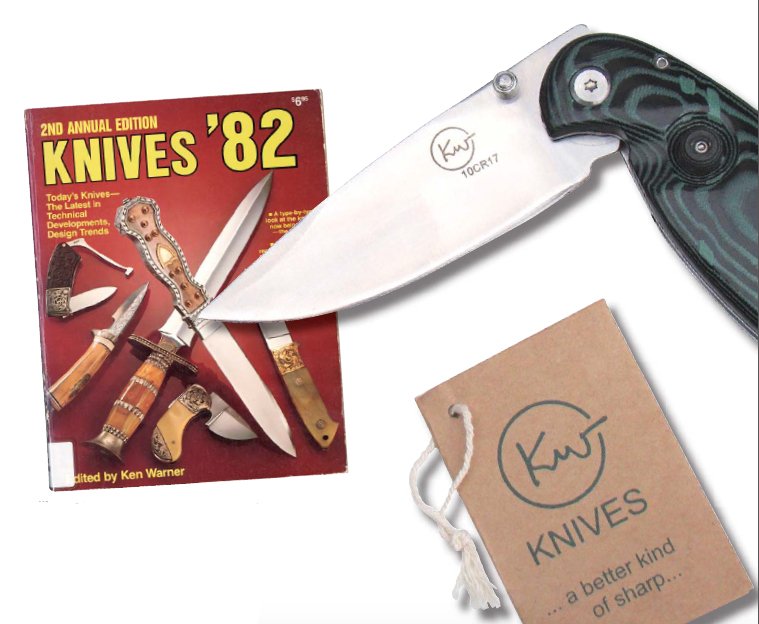
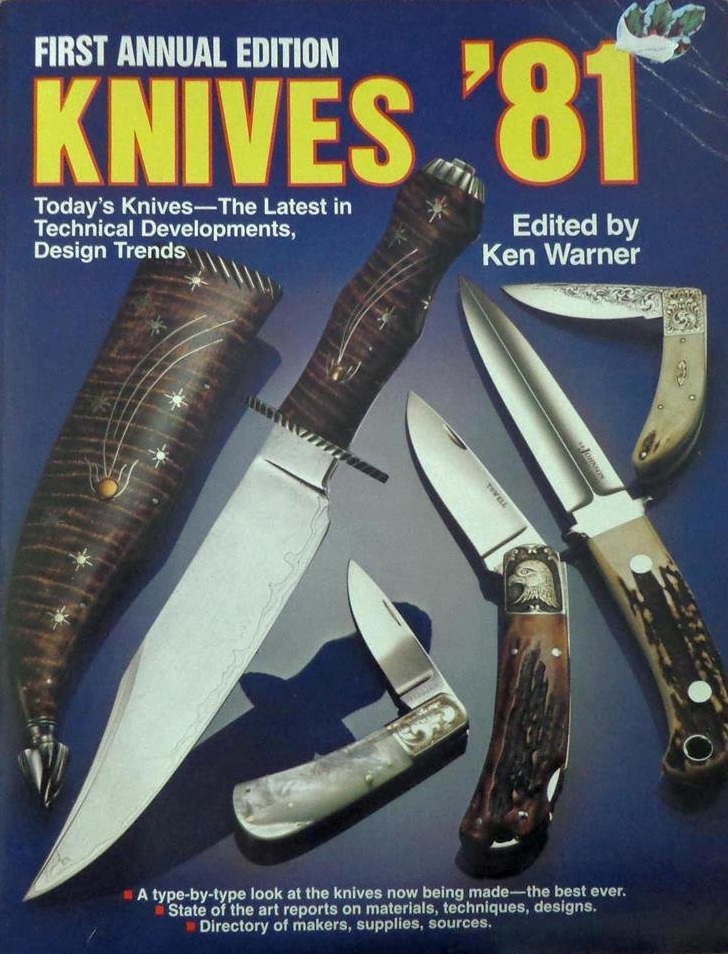
The cover of the knife book that started it all.
For many, Warner’s greatest single contribution to the knife industry was not that first article in Gun Digest, nor his continuing effort to publish knife stories in popular magazines. Rather, it was the publishing of the first Knives annual in 1981 that sparked what became an explosion of interest in handmade knives.
“The big thing with Ken is that he mainstreamed knife interest, and everybody credits him with that,” assessed Cutlery Hall-Of-Famer Bruce Voyles, with whom Warner co-authored the book Knives Digest in 1999. “That, in my opinion, was not his greatest contribution. That came when he got the Knives series started. For the first time you had a listing of not just a particular organization’s members but all knife people. You also had pictures. It was a snapshot of the state of the knife industry at the time, particularly handmades—and the industry was pretty disorganized at the time unless you were a member of the Knifemakers’ Guild.
“I think he gave tremendous publicity to people that had not gotten publicity,” Voyles continued. “Plus, there’s something that most people will not notice about him unless he has edited something they’ve written. He’s one of the most gifted editors I have ever known in any genre. He takes average stuff and makes it sound good, and makes good stuff sound fabulous while making it flow easily. The different thing about Ken’s writing and editing is that Ken made it readable. Most of the stuff before Ken was clumsy, and he made it interesting. He could make the phone book interesting. One of my favorite quotes was when his former wife said some years ago, ‘Ken has the most annoying habit of being right most of the time.’”
Recognition
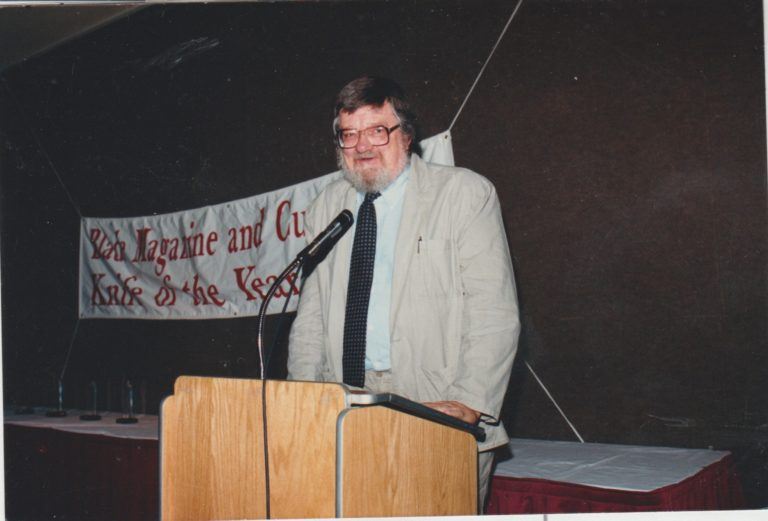
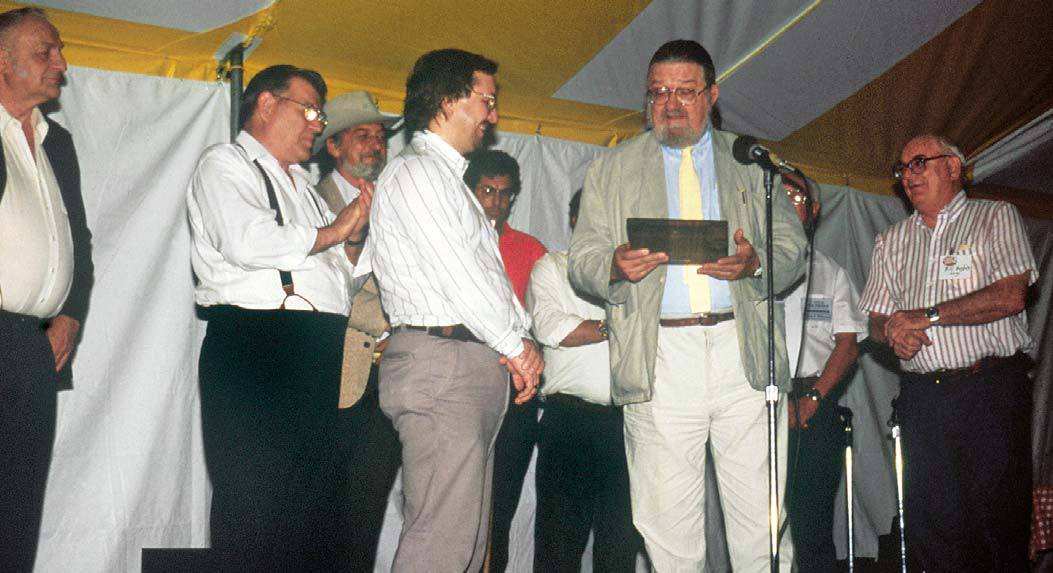
Ken Warner inducts Bruce Voyles into the BLADE Magazine Cutlery Hall Of Fame at the 1993 BLADE Show Awards Banquet in Stone Mountain, Georgia. From left: George Herron, A.G. Russell, Buster Warenski, the inductee, Paul Tausig, Joe Mangiaracina, Warner, Houston Price and B.R. Hughes. All but Tausig and Mangiaracina are in the Cutlery Hall Of Fame. Along with Col. Rex Applegate, Hughes joined Voyles as an inductee that year.
Among the many happenings during his association with Warner, Voyles will never forget that it was Warner who organized Voyles’ induction into the Cutlery Hall of Fame at the awards banquet of the 1993 BLADE Show. It was Voyles’ 40th birthday, and Warner took the stage to announce—to Voyles’ surprise—that he was being inducted by acclamation of all living members of the hall at the time.
When Warner and A.G. Russell were inducted into the hall at the 1988 BLADE Show, each was invited to the banquet to provide the introduction speech for the other’s induction. Neither Russell nor Warner knew they were being honored themselves.
“Ken said at the time that as long as there was a BLADE Show, he would eat the BLADE Show’s rubber chicken,” Voyles grinned. “Then, the next year we presented Ken with a rubber chicken and taped a knife that he liked inside the chicken’s mouth.”
Warner is also a member of the ABS Hall Of Fame and counts the society’s prestigious Don Hastings Award among his many honors.
A Lasting Legacy
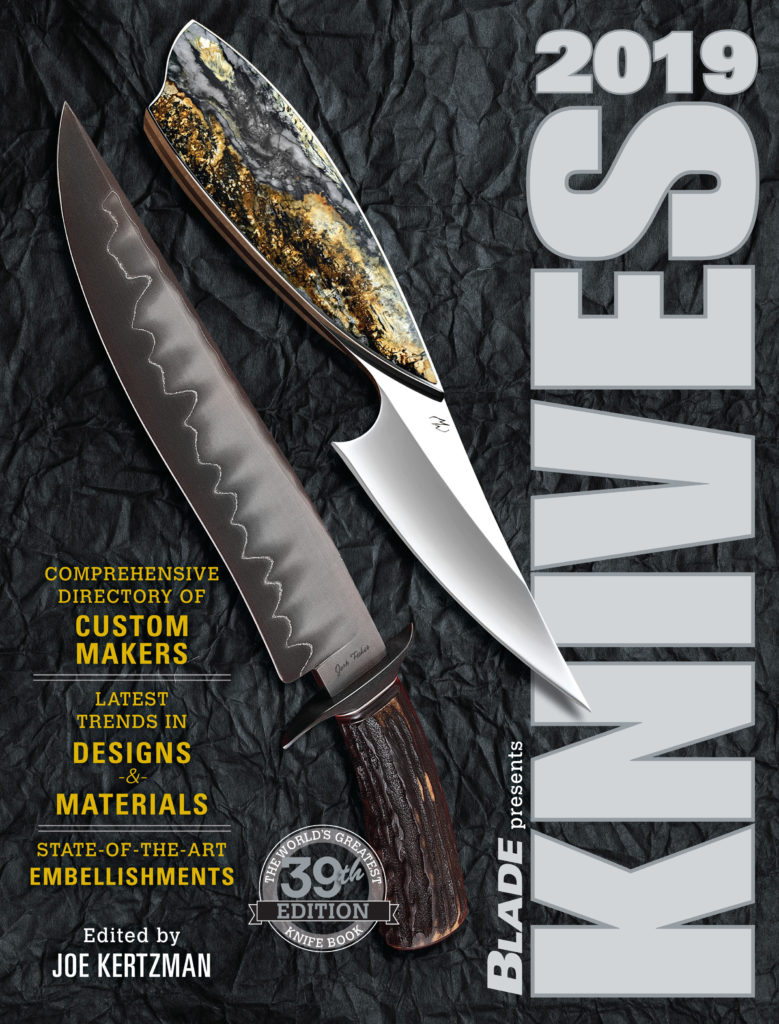
The most recent KNIVES annual book on shelves is KNIVES 2019.
Fowler said Warner was the right man for the successful development and promotion of what has become a virtually indispensable part of the knife industry, a book which will celebrate its 40th anniversary in 2020.
“Thanks to his knowledge, editorial ability, choice of writers and relevant topics, Ken started a legacy to the knife community that continues to this day,” Fowler noted. “Ken knew the difference between a hunter and an art knife, as well as the pretenders, and described each knife eloquently. Many of his one-sentence comments were worth hundreds of words. He inspired many makers through his comments on design, steels, handle materials, leatherwork and scrimshaw. Reading back through my collection of his books, I find many of his comments that I once glanced over were far from simple but offered great understanding and predictions of the future and well being of our community.”
A Renaissance Man
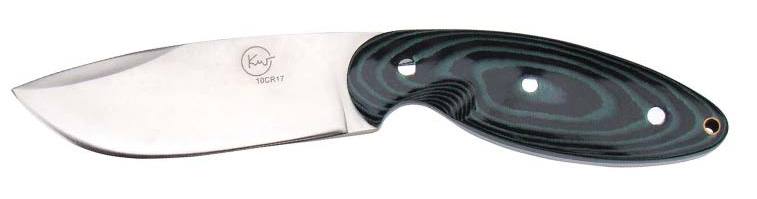
The Warner SGG is a knife of all work, with lots of belly and a good bit of sharp. The blade is 5 inches of 10CR17 and, of course, is convex ground all the way. The drop of the grip puts the edge where it is needed. (Warner photo and caption)
Warner, it turns out, is something of a renaissance man as well. Fowler related sharing a huge bowl of crab legs following the BLADE Show a few years back.
“We debated the styles of Steinbeck and Hemingway, as well as other great authors, what makes poetry great, and the responsibilities of authors,” Fowler recalled. “I learned that everything we write is an echo of our total experience. The more we read and the greater our personal experience, then the better we will be able to express our thoughts. There is no question in my mind that Ken Warner has been, is and continues to be one of the great, if not the finest, of icons of the community of knives.”
Perhaps the greatest test of a true “living legend” is that he has contributed to his lifelong interest, building something where little or nothing existed before, and assuring that his influence will last long after he and his contemporaries are gone.
In the case of Ken Warner and the knife industry, there is no better definition.
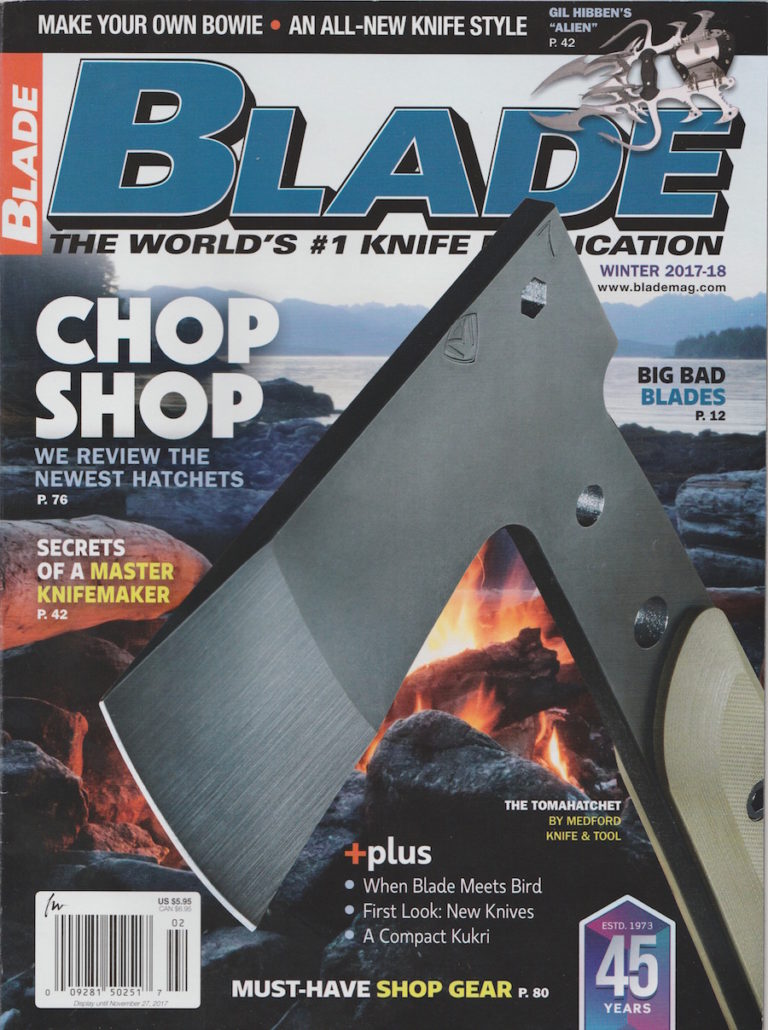
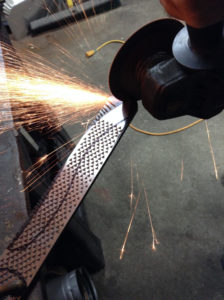
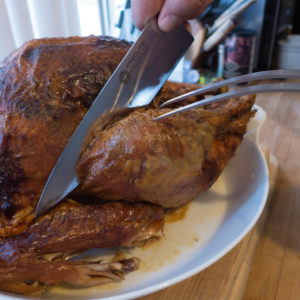
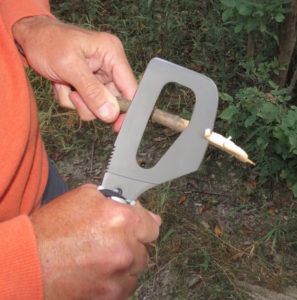
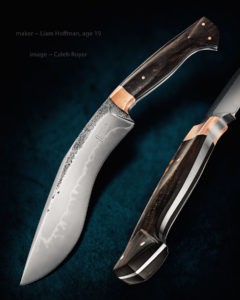
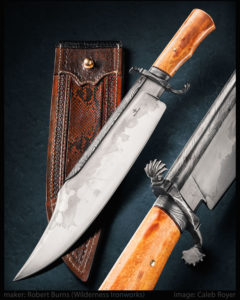
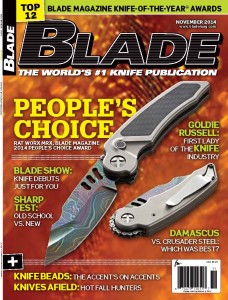
Bag Big Blades ‘n Edges in the latest issue of BLADE®—on newsstands now!Big blades can be fun to make and Chris Amos shows you how to make a big bowie in part one of his story this issue.Big blades go hand-in-hand with Thanksgiving and turkey carving. The Boker Arbolito Carving Set is big bird ready!A hatchet may not fit into your classic definition of big blades but it definitely can act like one, such as the Farson from Fremont Knives.In the realm of big blades, kukris are large and in charge—even compact ones such as this one by Liam Hoffman.As far as big blades go, Robert Burns’s Joe Musso Bowie is a cutting behemoth.
Big Blades ‘n Edges, including reviews of the newest factory hatchets, some of today’s top custom bowies and four top turkey carving sets, highlight the latest BLADE®, on newsstands NOW!
The latest BLADE leads off with “Big Bad Blades,” Daniel Jackson’s assessment of some of today’s hottest bowies and their makers, including Mike Quesenberry, James Huse II, Jason Fry and Robert Burns. Each has an approach to “America’s Knife” sure to stir your bowie blood. Speaking of which, if Daniel’s story makes you want to “take the next step,” check out part one of “How To Make a Bowie” by Chris Amos.
In “Chop Shop,” join Abe Elias as he takes four contemporary hatchets—the Tomahatchet cover piece, Condor Tool & Knife Greenland, Browning Outdoorsman and Fremont Knives Farson—and subjects them to a round of hacking and cutting exercises. And in “Turkey Cuts,” James Morgan Ayres not only tests a quartet of the latest factory turkey carving sets from Victorinox, Santa Fe Stoneworks, KAI Shun and Boker Arbolito, but he shows you how to prepare your bird for Thanksgiving, too!
Speaking of history, Pat Covert examines the over six decades of making Rambo and Star Trek knives, reproducing Paul Ehlers‘ fantasy knife designs, terms as president of The Knifemakers’ Guild, holding a private audience with Elvis Presley and much more of the fascinating life of Cutlery Hall-Of-Famer Gil Hibben.
There’s more, including a new breed of modern slip joints, the very first story of the very first issue of BLADE (then the American Blade), Liam Hoffman‘s compact kukri and scintillating scads of sharp stuff, all in the latest issue of BLADE.
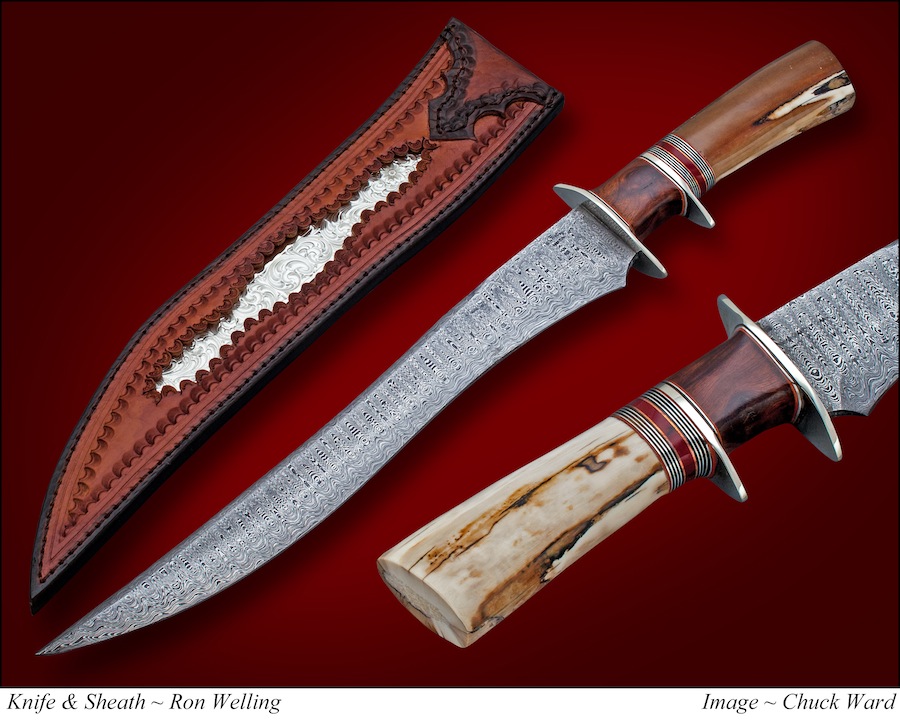
A measure that would have banned the sale of such beautiful mammoth ivory knives as this one by Ron Welling failed to pass muster in Washington state. (Chuck Ward photo)
Knife and ivory legislation that affects your right to own, carry and sell knives at both the federal and state levels has been heating up lately, including a victory for proponents of the sale of legal elephant and mammoth ivory in the state of Washington.
Washington’s proposed bans were overcome by a combined effort that included Knife Rights, the NRA and the Legal Ivory Rights Coalition, Mike Vellekamp of Fox Knives USA and Tim Wegner of Blade-Tech.
According to Knife Rights’ Doug Ritter, the proposed bans would not have saved a single living elephant while “taking hundreds of millions of dollars from millions of honest, law-abiding Americans. It makes no sense to unfairly penalize Americans for the illegal and immoral activities that continue to threaten elephants, and which these proposed ivory bans do nothing to ameliorate.”
Meanwhile, among the new or pending measures at the state and federal level are:
•Knife law preemption bills in Indiana, Kentucky, Mississippi, Nevada, Oklahoma, South Carolina, Texas and Vermont, measures that ensure consistent enforcement of state laws everywhere in each applicable state, and a special federal knife preemption law that would protect transporting knives from state to state in certain instances;
•Laws affecting switchblades and other specific knife styles/patterns in Illinois, Maine, Nevada, New York and Oklahoma;
•New ivory bans in Florida, Illinois, Vermont, New York and Hawaii, with ivory bans pending in Connecticut, Maryland, Iowa, Oklahoma and California, and the African Elephant Conservation and Legal Ivory Possession Act on the federal level, and;
•In one of the world’s leading anti-knife nut capitals, New York Sen. Tony Avella of Queens proposed a ludicrous ban on machetes after several recent local attacks involving the utilitarian tools.
U.S. Senators Mike Enzi (R-WY) and Ron Wyden (D-OR) introduced the federal Knife Owners’ Protection Act (KOPA) this past Wednesday. KOPA would allow legal interstate travel of those transporting knives, provided the knives are transported to and from states where the law allows possession of said knives, and the knives are transported in closed containers. For more information, visit AKTI.org.
Oklahoma bills for knife preemption and to repeal the switchblade ban cleared major hurdles recently when both were passed by the Oklahoma House Public Safety Committee. Both measures head to the state House before going to the Senate. For more information on them and other state knife laws—including the ridiculous anti-machete bill in New York—visit kniferights.org.
At least two of the new state ivory laws—in Florida and Illinois—ban not only the sale of ivory but also the sale of mammoth ivory and/or make no exemptions for the sale of mammoth ivory. Meanwhile, the new punitive measure in New York would increase the criminal and civil penalties in its already existing laws banning the sale of ivory from living animals and mammoth ivory. On the up side, Hawaii has tabled its proposed ivory bans, though that scheduling “could change at any time.” For more information, visit elephantprotection.org.
Spartan Blades and KA-BAR announce the launch of Euro Blade Worx (EBX), a new joint venture in the Czech Republic.
Pineland Cutlery, Inc., dba Spartan Blades, announces the launch of Euro Blade Worx (EBX), “a major new international initiative designed to meet the growing demand for premium knives in the European market.” Formed in collaboration with American knife manufacturer KA-BAR Knives and Czech knife designer Ondřej Němec, the joint venture represents a strategic move to localize production and better serve European customers.
Headquartered in South Moravia, Czech Republic, EBX was established to solve a common challenge for European buyers: accessing high-end knives without incurring the burdens of overseas shipping costs, customs duties, value added taxes and long delivery times.
As Spartan Blades and KA-BAR expanded their presence in Europe, it became clear that a local manufacturing solution was essential.
“For years, we attended the IWA Outdoor Classics trade show in Germany and heard the same thing over and over: ‘Your knives are excellent, but they’re just too expensive to get here,’” said Curtis Iovito, co-founder of Spartan Blades and president of product development and marketing at Pineland Cutlery. “After listening closely and exploring our options, we realized the best path forward was to manufacture directly in Europe.”
That vision led to a partnership with Ondřej Němec, a respected Czech knife designer and entrepreneur with deep roots in both trade and knife craftsmanship. Němec had previously founded and led a successful knife brand in the region and had collaborated with both Spartan and KA-BAR on earlier projects.
“As soon as we started working with Ondřej, it was clear he shared our values—precision, quality and a deep respect for the craft,” Iovito said. “He understood what we were trying to build before we even finished laying it out.”
With more than 153 years of combined knifemaking experience between Spartan Blades, KA-BAR and Němec, EBX brings together heritage and innovation in a facility equipped with advanced machining, grinding and assembly capabilities—fully supported by European logistics and operations.
In its first year, EBX will focus on producing and distributing Spartan Blades and KA-BAR knives within the European Union, dramatically reducing shipping times and removing many of the barriers that previously stood in the way of European customers. Looking ahead, the company plans to expand its capabilities to support other premium knife brands seeking access to the European market.
“This is more than a factory—it’s a knifemaking and logistics hub designed for the next generation,” said Němec, EBX’s new managing director. “We’re blending European manufacturing tradition with American design innovation to serve a truly international community.”
By uniting American legacy brands with European craftsmanship, EBX is poised to redefine how premium knives are made and delivered across the continent.
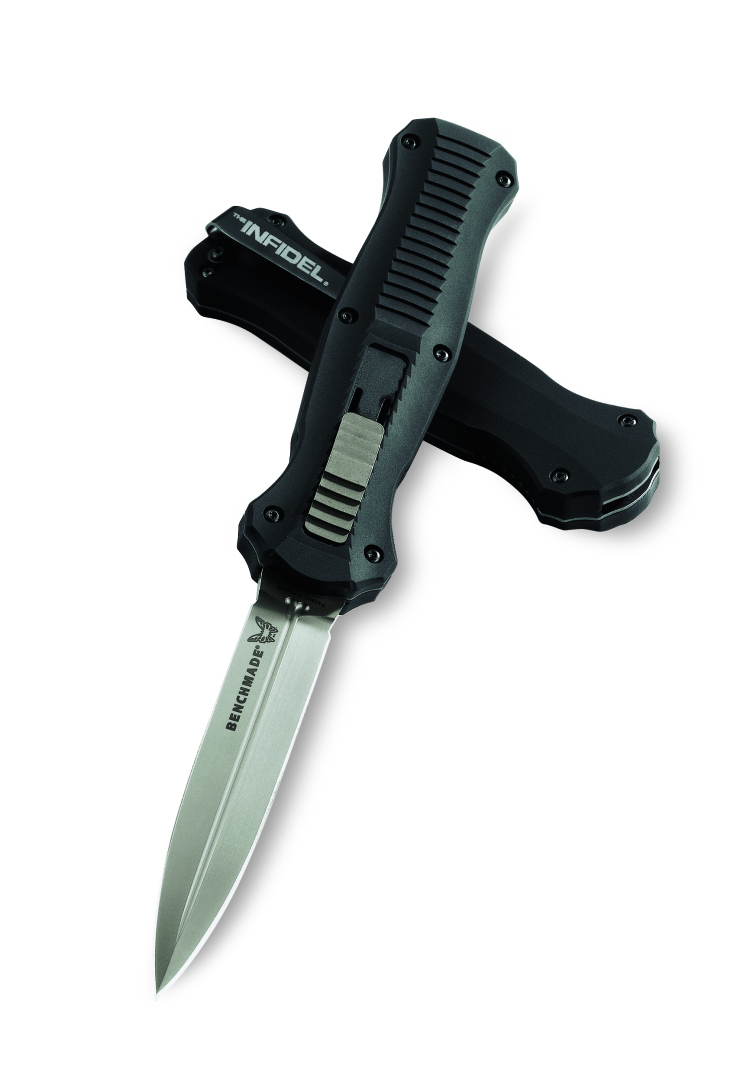
According to Knife Rights, Missouri Governor Jay Nixon has signed legislation repealing the ban on the possession, sale and manufacture of automatics—such as the Benchmade Infidel (pictured above)—in Missouri as long as they are not “in violation of federal law.” In practical terms, it means you cannot do so in interstate commerce, on Indian reservations or wherever federal regulations may prevent such activities.
Knife Rights officials indicated they worked closely with the National Rifle Association on this important legislation and appreciate the NRA as a strong partner in their second front in defense of the Second Amendment.
For more on the latest knives, knife legislation, knifemaking instruction, knife trends, knifemakers, what knives to buy and where and much more, subscribe to BLADE® Magazine, the World’s No. 1 Knife Publication. Click on http://www.shopblade.com/blade-magazine-one-year-subscription-us/?r+ssfb071112 for more information.


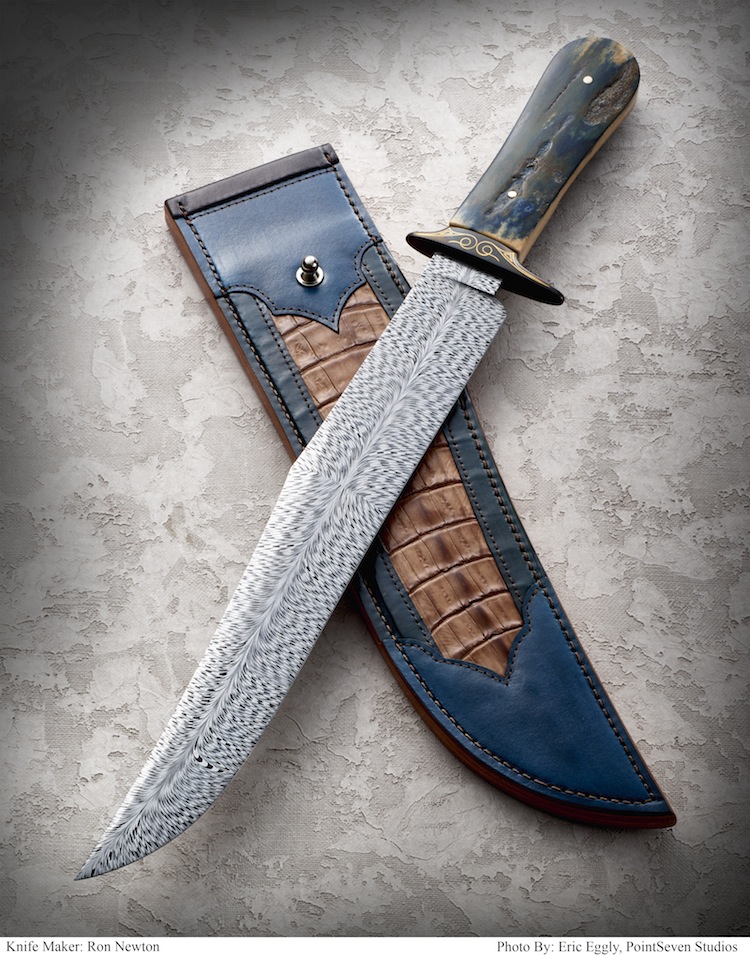



 Brian Tighe, maker of the “Twist Tighe” in all Damasteel damascus steel, is slated to be among the world’s top custom makers exhibiting their knives at the 23rd Annual East Coast Custom Knife Show Friday through Sunday, March 2-4.