Knifemaking

Knifemaking is the building of a knife, which includes the blade, handle and other accouterments. Blades are made by either removing metal from a steel blank via a grinder – known as stock removal – and the forging to shape of hot steel into a blade in the process known as bladesmithing. Other parts, including bolsters, guards, pommels, etc., are needed to complete the finished knife.

Featured Knives – – Knife Collecting – – Tactical Knives – – Survival Knives

Knife Handle Material: Natural, Synthetic And Hybrid Moments

Natural and synthetic materials are equal parts fashionable and functional.

2024 Knives annual
This article appeared in the 2024 KNIVES annual.

They complement one another in an easy, seamless union—blade and handle. One without the other means the knife is incomplete, or it isn’t a knife at all.

Along with the search for proper blade steel, appropriate handle material is the second critical element in the presentation, form, and function of the knife itself. Natural and synthetic handles play their roles. They bring utility and aesthetics to the package, and the maker’s choice sets the tone. Availability, cost, and maker’s preference fit into the equation when choosing the right handle material. And then, of course, the intended knife use weighs heavily.

In the end, it’s the eye of the artist that drives the visual element, and the job to be done by the user that directs his or her choice. The handle makes the knife complete.

At Masecraft Supply Company, co-owner Chris Hartman sees the supplier’s role as the facilitator. Never interfering with the artist’s concept, he views Masecraft as a provider of the palette. “We don’t advise what to use,” he reasons. “We are not big fans of, ‘You know what you should do …’ or telling a customer what to use, but more in supplying a wide variety of options to choose from. We are always willing to answer questions about our materials a customer may have, but it’s just not a good idea to advise what is right for them. That’s the maker’s choice.”

With that said, where is the market headed today? What does the landscape look like in terms of availability, trends, and timing?

“The majority seem to be sticking with composite laminates like G-10, canvas and linen Micarta, and Richlite,” Hartman says. “Natural materials like bone and horn seem to be in a continuing decline. Exotic woods still do well, but availability and pricing have become issues over the last two years.”

John Cammenga, vice president of operations at White River Knife & Tool, Inc., deals primarily in synthetic knife handle materials. He indicates that knifemakers who build hard-use models often lean toward durable synthetic handles and that the laminate trend holds up there as well, particularly with material available in a variety of colors.

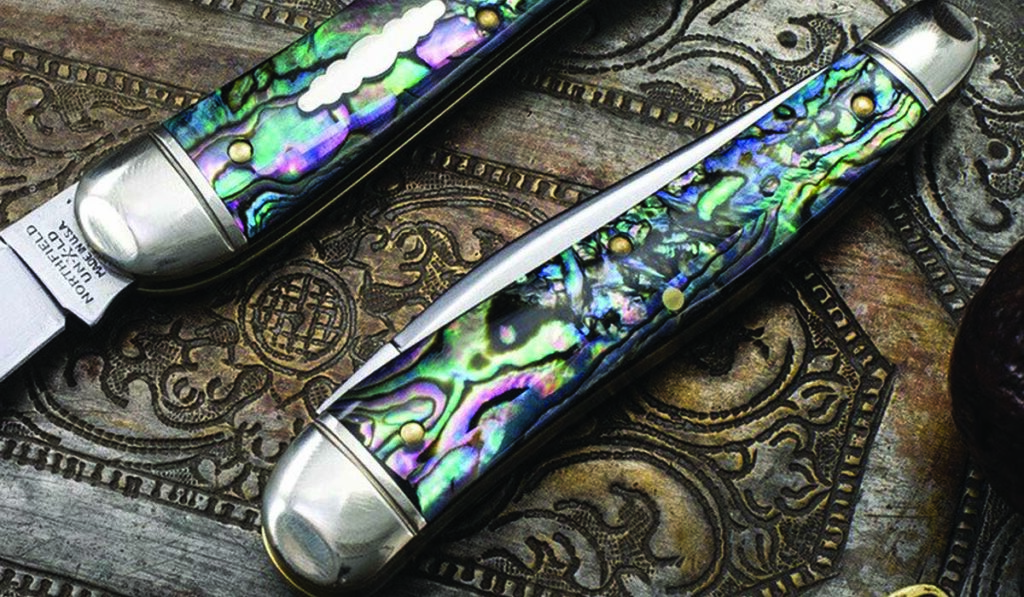
Northfield UN-X-LD knife
This Northfield UN-X-LD knife from Great Eastern Cutlery (GEC), which registered the trademark and uses it on premium GEC pocketknives, features ALVS (acrylic laminated veneer shell) handle scales from Masecraft Supply Company. The dazzling shell veneer consists of real shell and high-impact acrylic laminated together within the sheet.

“The majority of our handle materials are synthetic,” Cammenga says, “and this is primarily due to stability and longevity. But many look great as well. Multi-color layers of fabric bonded with phenolic or polyester resin can have the look of wood, yet last much longer. Additionally, many of these are tackier when wet, giving the user additional hand purchase in tough weather or when processing game. Carbon fiber and G-10 are available in an ever-expanding array of colors and patterns and almost bulletproof when it comes to wear and tear.”

Choosing Knife Handle Material

The choice of materials, Cammenga explains, comes directly down to the proposed use of the knife. For hunting, fishing, camping or bushcraft, White River almost always recommends synthetic handle material. However, John still gives a nod to personal preference. Some users simply must have a natural handle, and the aesthetic factor comes into play there.

“It’s hard to beat the beauty of a highly figured burl!” he comments. “Some, such as desert ironwood burl, are not only beautiful but also extremely tough.”

Tom Krein is an experienced custom knifemaker who worked for the great Bob Dozier and ran the custom shop for A.G. Russell Knives before embarking on his own venture during 30 years in the business. Making small utility and hunting knives primarily, he agrees that handle material choice relates to a few simple concepts.

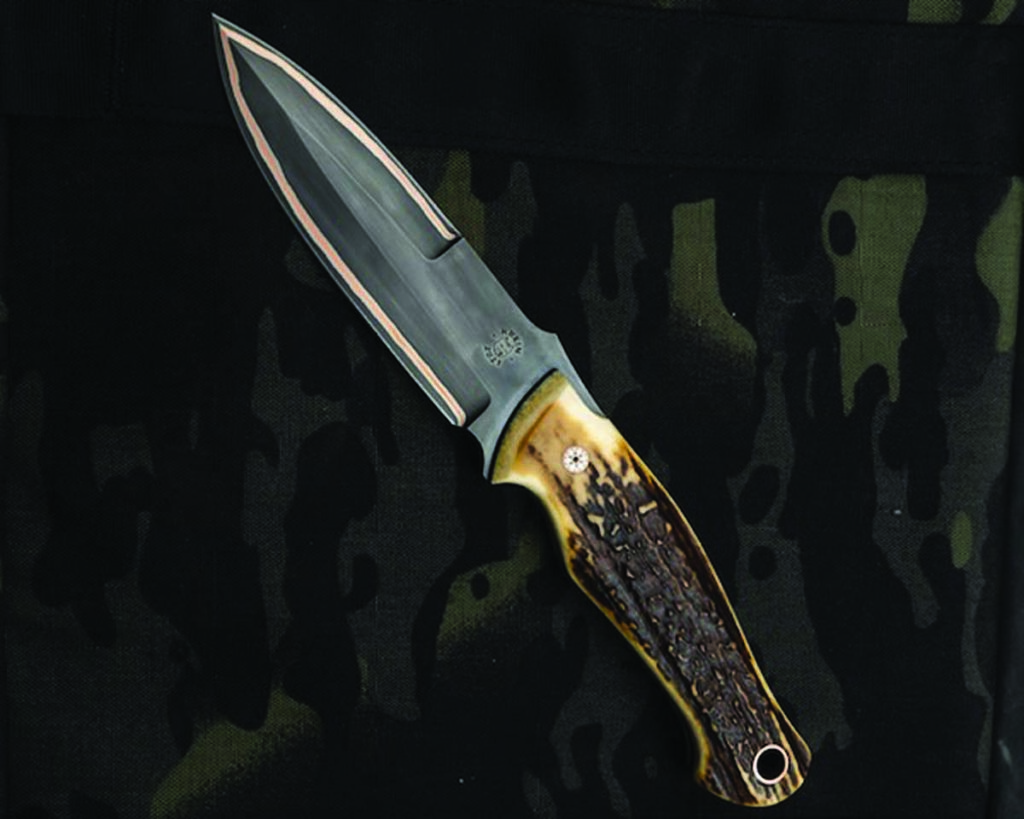
Tom Krein’s “Mako” model features a Dion Damascus san mai steel blade with a copper-color stag handle.

“It comes down to the customer’s needs, willingness to care for the knife, aesthetics, and budget,” Krein relates. “Natural materials should hold up nicely with proper care assuming everything goes according to plan. Sometimes stuff happens—a knife falls into a sink of water, or it starts to rain while hunting, or your knife gets lost in the yard for a week. Synthetics hold up better when stuff goes south. For customers, I recommend getting what you like and learning how to take care of it. For knifemakers, I suggest picking the mind of another maker who uses the material you want so you can learn how to use it. Overall, we are a helpful bunch of people.”

Traditional handle materials and their innovative, eye-popping counterparts coexist at Santa Fe Stoneworks, a provider of materials to the art knife market since 1978. Santa Fe not only affixes those materials to its own knives, but also provides the service for Spyderco and Kershaw while doing private label work as well.

President Bill Wirtel leads the family business, and the company’s roster of natural handle materials includes the best of the best. “We work with factory knives and apply gemstones, exotic woods, shells like gold- and black-lip pearl, and fossils such as woolly mammoth tooth, tusk, bone, and petrified dinosaur bone,” he remarks.

As for Santa Fe’s synthetics, Fordite, a car paint overspray, Surfite surfboard overspray, and a cholla cactus-like material that is made in the shop have found favor with makers and buyers alike.

Material Mash Up

“We are looking for design and color, so we mix natural with manmade stone and epoxies,” Wirtel explains. “Our fossils are all stabilized so they work great for a handle material. We see hybrid materials gaining popularity as they provide the best of both natural and composite materials. Fordite and Surfite have been selling well. Our synthetic cholla cactus line that we make here, stabilizing it with different colored epoxies, is becoming a big seller as well. We also have mammoth tusk fusion. This is stabilized fragments of mammoth ivory that are fused together under immense pressure. The result is a beautiful and hard composite that is densely packed with mammoth ivory.”

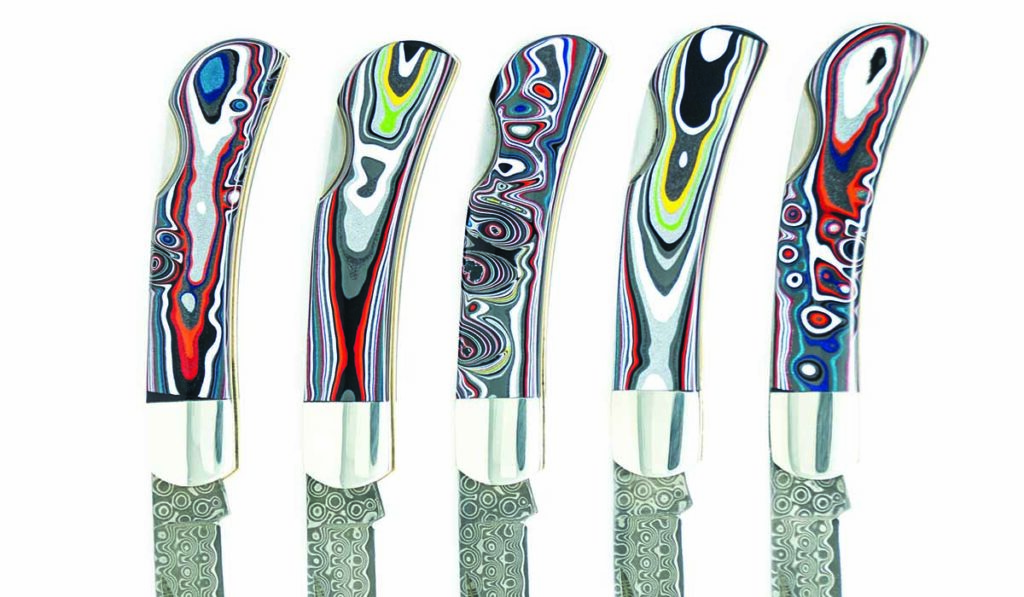
Fordite car paint handle material adds a fun flair to this series of Santa Fe Stoneworks 3-inch lock-back folders
Fordite car paint handle material adds a fun flair to this series of Santa Fe Stoneworks 3-inch lock-back folders with damascus blades.

Fordite is an interesting option that comes from a surprising source. Also known as Detroit agate or motor agate, the material consists of pre-1985 automobile paint that hardened sufficiently to be cut and polished. It formed from enamel paint slag, which built up over the years in layers on the tracks and skids where cars were hand spray-painted. The buildup hardened in ovens intended to cure the paint on car bodies. After so much of that buildup, the brightly colored and layered paint had to be removed. Its allure caught on with some autoworkers who brought pieces home with them. From there, the beautiful Fordite material, which can be cut and polished into a spectacular look, found its way onto knife handles.

The Masecraft perspective is somewhat dictated by availability. “Sambar stag is not coming back,” Hartman stresses. “It has been banned by India for export since sometime around 2005, I believe, so that’s almost 20 years now, and I see no chance of this ever-changing. What’s still available out there now is it. Game over!”

“Black-lip, gold, and white mother-of-pearl all are still available,” he adds, “just not in larger size pieces as they were 20-50 years ago. They are overharvested and not as healthy as before. Demand for shell is down overall. It is not very tactical, and we seem to be in a tactical and bushcraft market for the last two decades. Shell tended to be more of a gentleman’s pocketknife material, so it’s not exactly the big trend right now.”

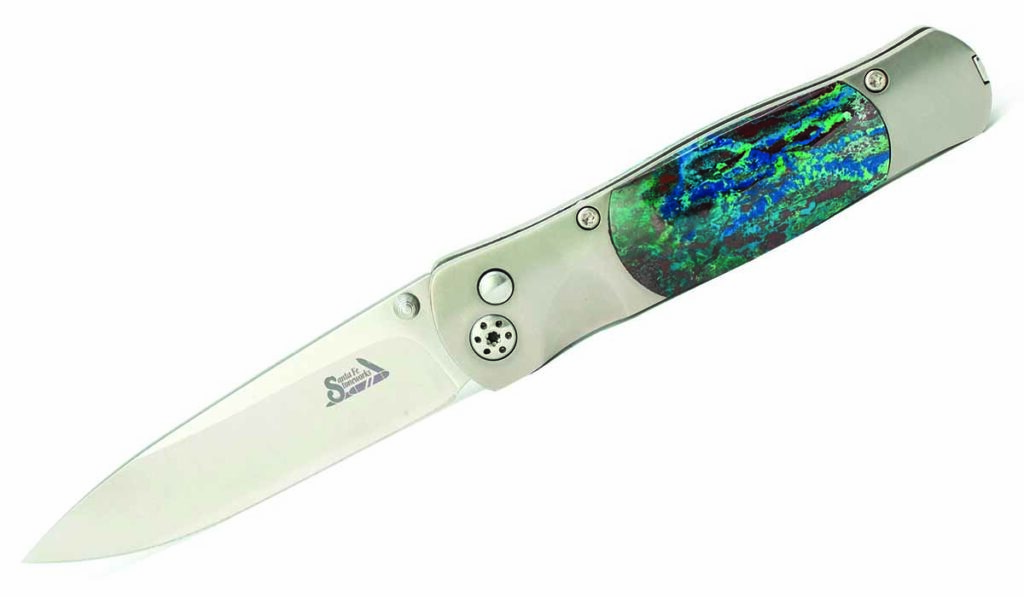
Santa Fe Stoneworks El Rey model is handled in a spectacular turquoise/abalone/bronze hybrid gemstone
This Santa Fe Stoneworks El Rey model is handled in a spectacular turquoise/abalone/bronze hybrid gemstone and includes a mother-of-pearl button inlay.

“Many of the companies that used a lot of shell on knives are gone or simply don’t have the people who know how to work with it anymore,” Hartman adds. “Shell is still one of the most beautiful materials ever, so much so that it seems to be the hardest to reproduce in any type of synthetic alternative that even comes close to its natural beauty. We can come close, but there is still nothing like the real thing.”

Krein sees a swing toward synthetics and higher-end natural materials as well. “Right now, there is a huge push to find and use vintage Micartas,” he relates. “I’ve also seen G-10 usage go up a ton over the years. G-10 holds up to use extremely well, is relatively inexpensive, and machines and grinds easily. I’ve also noticed quite a few new businesses that specialize in exotic stabilized woods. Stag has always been a desired and quality knifemaking material, and with exceptional stag being much harder to find, it is even more desirable, particularly when done [harvested and finished] properly.”

Watching the high-end polymer Ultem begin to trend as a new synthetic handle material has been interesting for Krein, and his affinity for giraffe bone has not waned. It’s something he calls the “latest real pickup in natural materials.”

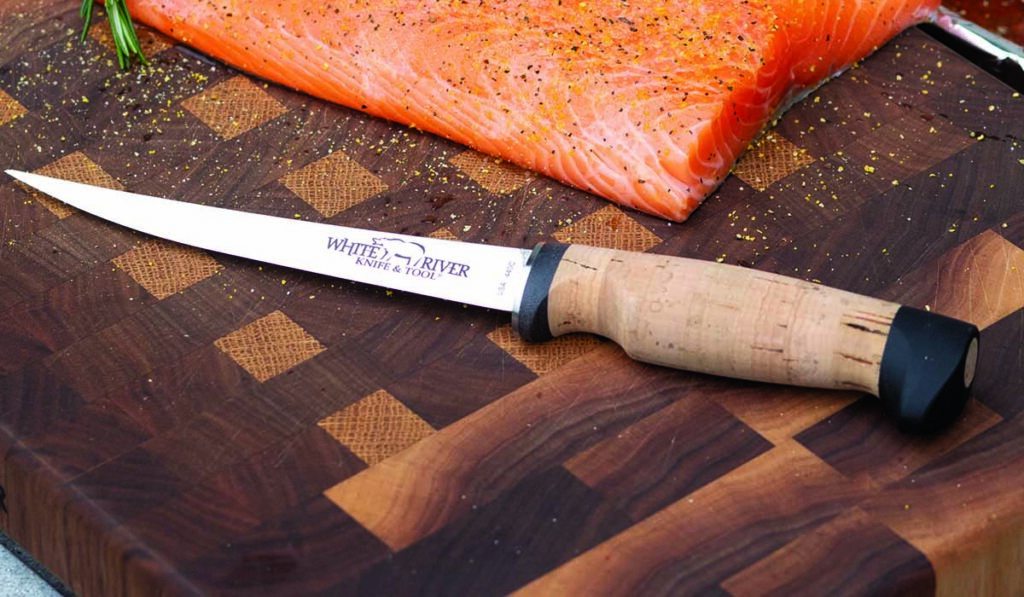
White River Knife & Tool fillet knife with cork handle
White River Knife & Tool purchases synthetic material made in the USA, so supply chain issues have not been a problem. The one material the company imports, cork, has increased in price, but its supply has been uninterrupted. White River’s Traditional Fillet knife incorporates a handle of imported cork for easy cleanup and a tight grip in slippery conditions.

“I often see new makers using very exotic materials,” Krein concludes. “These materials are costly and often not used anywhere close to their potential. I recommend that new makers learn to use simpler materials like Micarta to their full potential. This leaves funds available for other materials and equipment while allowing a new maker to develop their skills. Just because a knife has expensive materials doesn’t make it better or more interesting to me. It’s developing the skills to make simple materials look elegant that I appreciate.”

Those Hybrid Moments

Hybrid handle material is on the rise, and Cammenga is pleased with the growing popularity of marbled synthetics. “Right now, there is strong demand,” he notes. “This is true in both cloth/resin laminates and carbon-fiber/resin laminates. For those who want natural wood, bone or antler, acrylic ‘stabilized’ scales have been popular for quite some time. They provide the user with a natural material, which has been made tougher by introducing acrylic resin into the fibers. Currently the marbled look is in with almost all materials, but we have made several knife models using G-10 and rubber combinations, as well as others from polyester cloth and resins.”

Masecraft is keeping a close eye on the development of new materials, but the course is charted by ingenuity rather than discovery. “As far as new natural materials, that’s going to be extremely rare,” Hartman observes. “The earth is not really producing anything new, so unless we have not discovered it yet, the odds are low. More likely, some natural materials will disappear and become endangered, banned, or extinct. Human history tells us the availability of natural material will decrease while prices increase. You will see more hybrids of natural and synthetic combinations, and all kinds of new synthetics will continue to be introduced.”

vintage Micarta
Knifemaker Tom Krein says there’s a huge push to find and use vintage Micarta, such as on the handle of his pocket bowie model.

Supply often dictates how well demand is satisfied, and the inherent scarcity of some handle materials has been exacerbated by supply chain concerns in areas. Even as the COVID-19 pandemic has eased, the resilience of the supply chain remains an open question. Some suppliers and makers have faced shortages of stock items, while others have adapted, moved on to other, more readily available options, or simply been patient.

“I have been sourcing materials for over 44 years, and most of our suppliers know us and what we want,” Wirtel relates. “Obviously, we’ve had supply chain issues, but we have been able to work around them. We make our product to order, so we range in delivery time from a few weeks to a few months.”

Krein is positive regarding availability, saying, “There have been slight wait times for some synthetics, particularly Micarta, during the pandemic, but it seems like everything is back on track here. There has and will continue to be more demand for quality stag than availability. I’ve seen a bit less of quality exotic stabilized woods like exhibition-grade ironwood and Koa.”

While the supply chain phenomenon has been universal, Hartman is pragmatic. Going with the flow makes the Masecraft operation run as smoothly as possible. “There are supply chain issues with everything globally,” he observes. “I can’t think of anything on the planet that hasn’t been affected in some way, shape or form and that doesn’t have a price increase or isn’t in short supply, and it’s all things, countries, and markets.”

Dozier Knives produced this fixed blade with a Richlite handle from Masecraft Supply Company
Dozier Knives produced this fixed blade with a Richlite handle from Masecraft Supply Company composed of approximately 65% Forest Stewardship Council (FSC)®-certified recycled paper and 35% phenolic resin.

“If you don’t have the chip, you can’t produce the car,” Hartman says. “If you don’t have OD Green dye, you can’t make OD Green G-10. If one key part is missing due to supply chain issues, the product simply cannot be made, and that is affecting all things.”

Staying domestic has been a problem solver for White River Knife & Tool, according to Cammenga. “Because White River purchases synthetic material made within the U.S., our supply chain has not been a problem. The one material we do import, cork, has increased in price, but our supply has been uninterrupted.”

Considering the handle-blade combination that makes the knife come together for the spectrum of customers and users, today’s material options appear more diverse than ever. Although some shortages in natural materials may never be plentiful again, fusions of natural and synthetic options open the door to creativity. And the imagination is always fertile ground for innovation.

More On Knife Handles:

Cool Custom: Ryan Breuer’s Relic Dagger

Breuer’s Relic Dagger is Bronze Age solid gold.

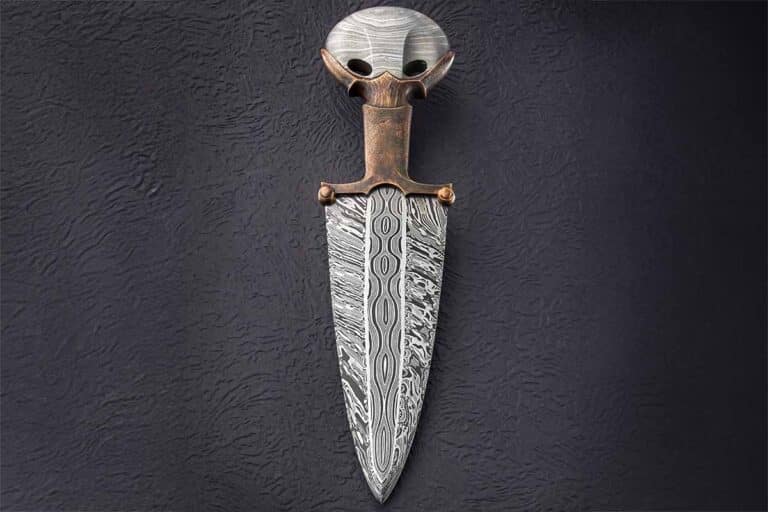
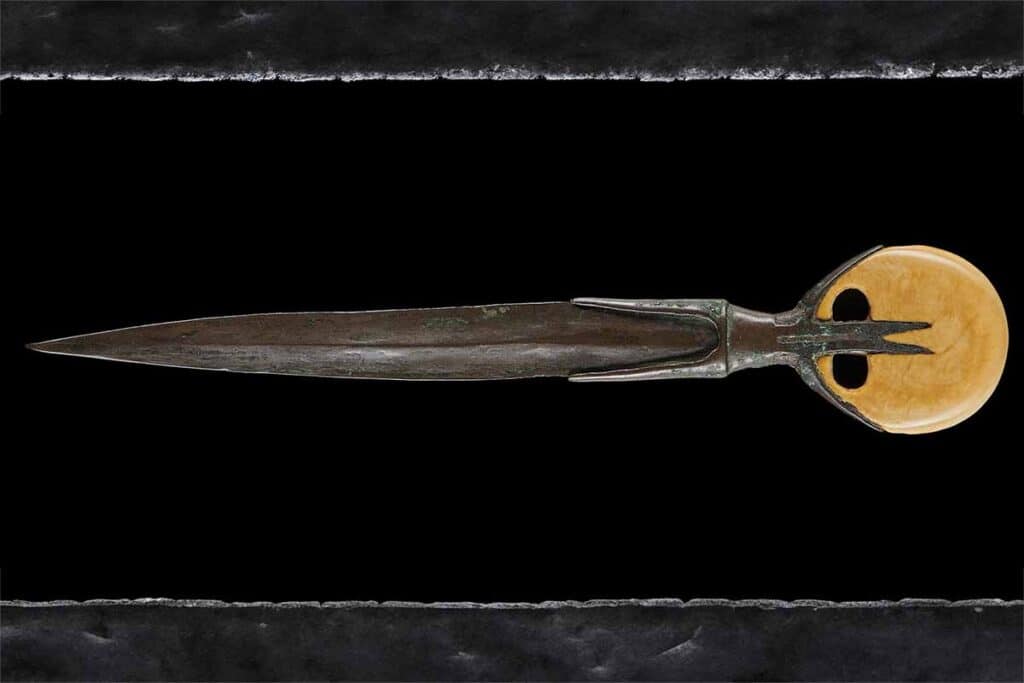
While it may appear to be an alien looking back at you, the Relic Dagger by ABS journeyman smith Ryan Breuer is inspired by Egyptian daggers from the Bronze Age that were made over 6,000 years ago.

The pommel on the originals are believed to have been made of hippo ivory.

“There’s such a striking shape to it,” Ryan said. “It very clearly looks like a human form in the handle holding up either a head or maybe the sun. It’s as if those who made the daggers thousands of years ago are looking back at me. It’s almost spooky.”

The damascus blade is a collaboration between Ryan and bladesmith Jason Morrissey, though Ryan gives Jason most of the credit for the steel. The blade is a composite mosaic damascus, with twisted mosaic edge bars of Jason’s steel and Ryan’s “eyes” mosaic in the core.

Ryan Breuer
Ryan Breuer

Ryan ground, heat treated and finished the blade. The hilt is cast bronze made with the lost-wax process. The pommel is pattern-welded wrought iron and pure nickel, manipulated to imitate layers of organic ivory. Ryan drilled the two holes for the “eyes.”

Breuer Relic Dagger Specs
Maker: Ryan Breuer
Blade length: 7.5”
Blade material: Composite mosaic damascus of 1084 carbon and 15N20 nickel alloy steels
Blade width @ base: 31/8”
Overall length: 12.75”
Maker’s price: $3,000

See More Custom Knives:

Master Bladesmiths Showcase Their Best Long Swords

See the artistry and craftsmanship of seven custom swords from some of the best bladesmiths in the world.

Not only do swords bring out the best in some makers, those who make quality versions of them often seem to be among the best makers as well. Check out the long blades on this and the facing page and see if you agree.

Garbriel Turner: Jineta

Garbriel Turner: Jineta

The Jineta by Garbriel Turner has a 28-inch wootz blade, an ancient walrus ivory grip and iron/gold fittings. Blade grind: flat. Overall length: 36.5 inches.


Eric Estlund: Oak Themed Storta

Eric Estlund: Oak Themed Storta

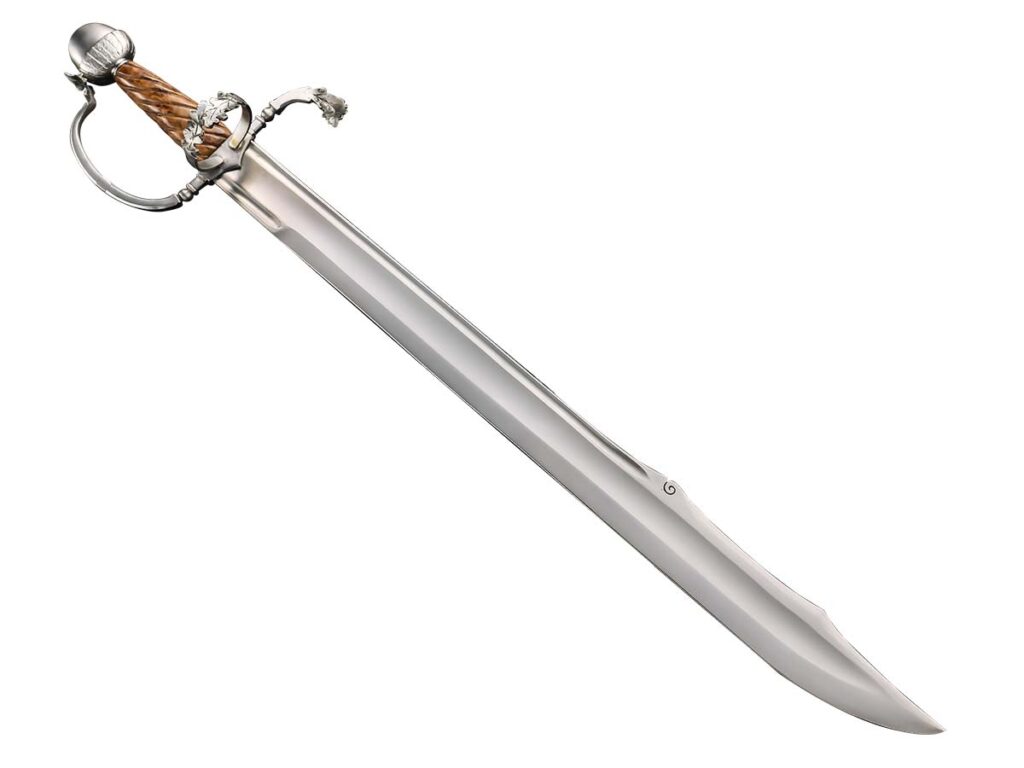
Eric Estlund’s Oak Themed Storta is in a 17th-century Italian style. The 28-inch blade is 8670 carbon steel and the handle is oak burl. An acorn pommel helps complete the theme. A high-relief scabbard (not shown) and steel leaf chape with carved acorn finial add to the presentation.


Matt Parkinson: Arming Sword

Matt Parkinson: Viking Sword

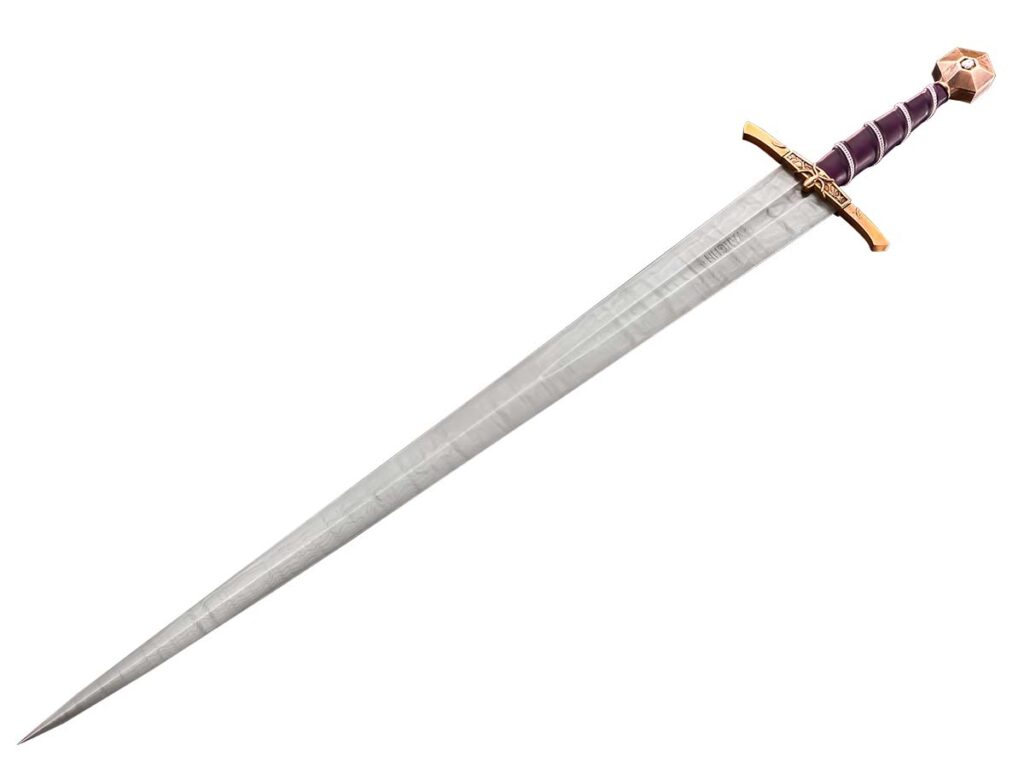
The sword shown is an Arming sword with a complex laddered and mosaic damascus blade. Polished steel fittings and a spalted maple handle. 29-inch blade 36-inches overall, weighing in at 2 pounds 10 ounces.


Zack Jonas: Wakizashi

Zack Jonas: Wakizashi

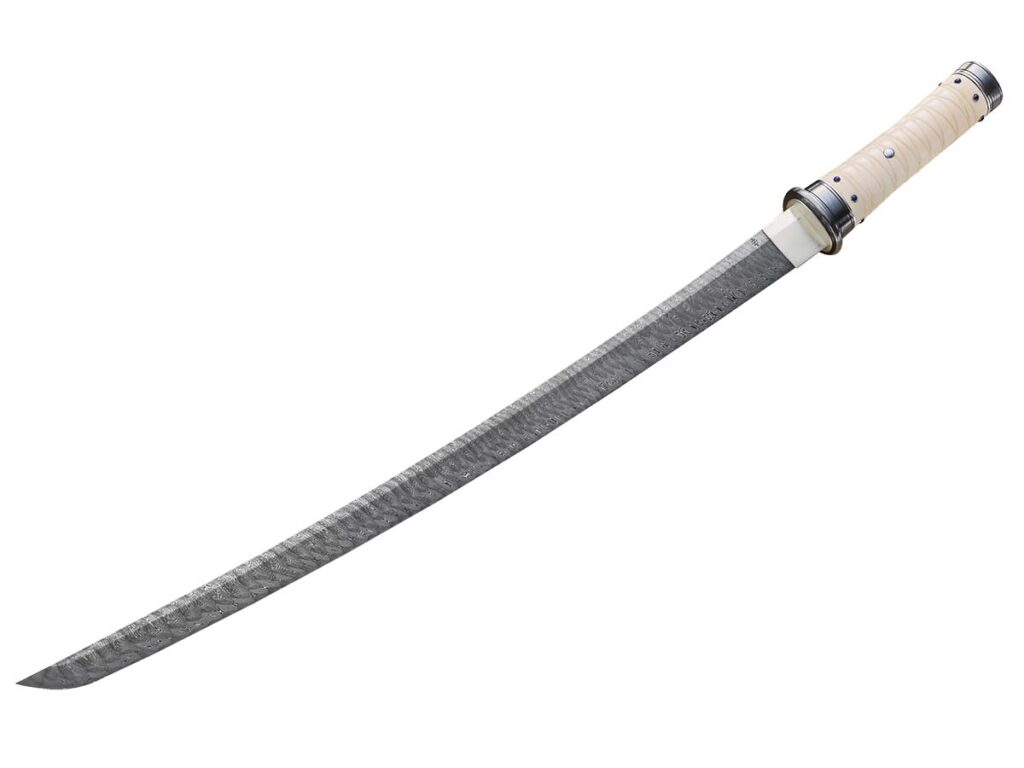
A Gordian core twist damascus completes the 22-inch blade of a Zack Jonas wakizashi. Fittings: W’s damascus and silver. The handle is interior mammoth ivory. Blade pattern: shinogi-zukuri. Overall length: 28 inches. The colorful scabbard (not shown) is by Matt Venier.


Ben Abbott: Viking Sword

Ben Abbott: Viking Sword

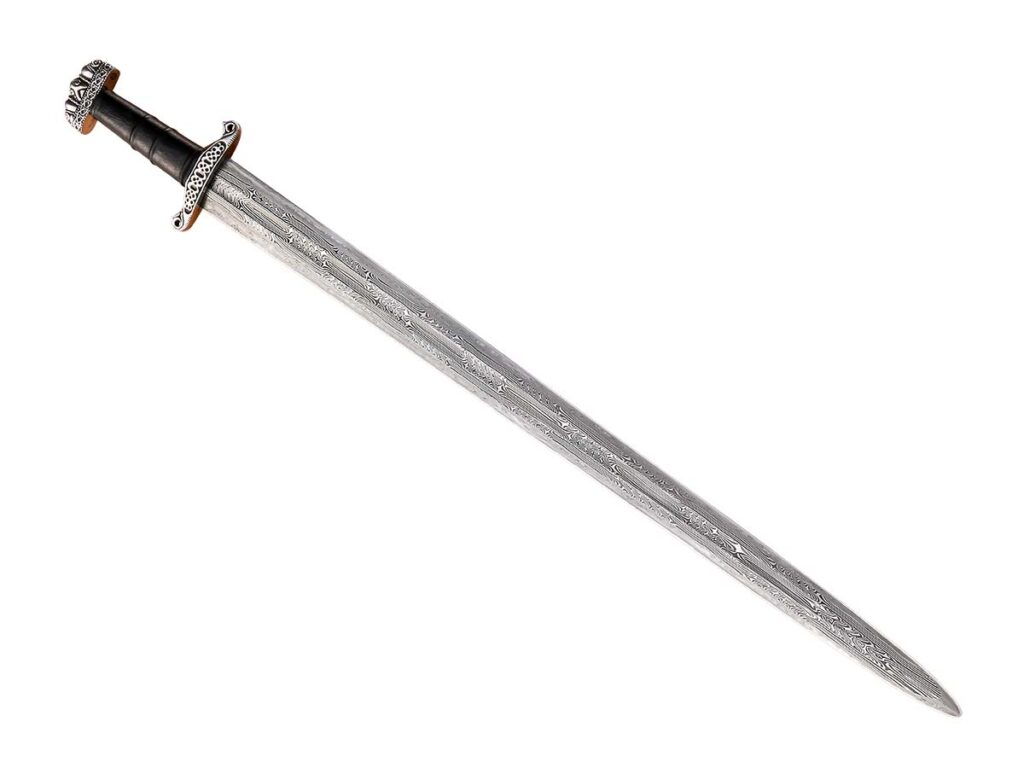
A 26-inch blade of multi-bar damascus, a leather-covered wood handle and cast sterling silver fittings outfit Ben Abbott’s Viking sword repro. Ben carved the waxes for the guard and pommel.


Ryan Breuer: PhD Sword

Ryan Breuer: PhD Sword

We published a closeup of the handle of Ryan Breuer’s PhD Sword the September 2025 issue. Here’s the full-blown model. The 32-inch blade is a damascus of 1084 carbon and 15N20 nickel-alloy steels. The handle is birch, leather and sterling silver.Overall length: 40 inches.


Jordan Borstelmann: Elmslie Type I

Jordan Borstelmann: Elmslie Type I

Jordan Borstelmann’s Elmslie Type I of a falchion sword boasts a 28-inch blade of 1075 carbon steel and a handle of leather, cord and wood. Blade grind: flat. Guard: 1045 carbon steel. Overall length: 35 inches.

Read More On Swords:

Bark River Knives Shuts Down Amid Steel Controversy

Bark River Knives owner Mike Stewart took to Facebook to admit to closure and the use of Chinese steel in Made-in-U.S.A. labeled knives.

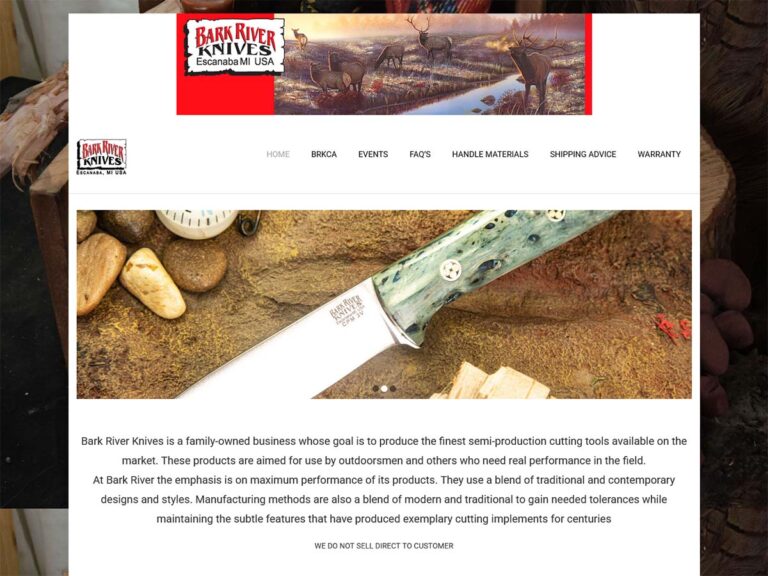
Bark River Knives of Escanaba, Mich., has officially ceased operations following a public admission by owner Mike Stewart that the company utilized Chinese steel in blades marketed as American-made CPM 154. The announcement, made via Facebook on March 23, confirmed that the long-standing fixed-blade manufacturer concluded all business as of March 20.

In his statement, Stewart took full responsibility for the deceptive labeling, characterizing the use of imported steel as a measure intended to keep the company afloat. Stewart argued the alternative steel met his internal testing for toughness and stain resistance, with edge retention nearly matching that of Crucible Industries’ CPM 154. He further claimed that because the knife blanks underwent more than five distinct operations in the Michigan shop—including grinding, reshaping and etching—they technically met his interpretation of “Made in the U.S.A.” criteria.

It should be noted, the Federal Trade Commission (FTC) standards mandate a product must consist of “all or virtually all” domestic components to carry the label. Stewart admitted the steel was definitely mis-marked on the following models:

  • Camp Bolo
  • Fox River Trailing Point
  • Highwayman 4
  • Mini-Manitou
  • Gladstone Hunter
  • Bitterroot Caper
  • Select recent Club Knives

The closure follows a period of increasing pressure from collectors and dealers, alongside significant financial litigation, Outdoorlife.com reported. Stewart noted in his post that the shutdown was “long overdue” and should have occurred two years prior.

Stewart announced that his son, Jim Stewart, will open a new, 100 percent independent knife company. Notably, Jim Stewart has agreed to take over the warranties that would have normally been serviced by Bark River. Mike Stewart clarified that he will have no hand in the new entity and intends to exit the industry entirely after 50 years. Mike Stewart emphasized that his dealers, his wife Lesley and Jim Stewart were entirely blameless in the decision to substitute the blade steel.

More On Knife Steel:

Shop Dump: Tools The Pros Use

Renowned Makers Across The World Talk About The Tools They Use To Craft Their Metal Creations.

A good craftsman needs good tools. Without a well-stocked shop, knifemakers are held back from creating to the best of their abilities. This trio of makers from around the globe talk about what they use and how it affects their knifemaking.

Jim Crowell

Look close and you can see the faint hamon on this tactical model by Jim Crowell

American Bladesmith Society master smith Jim Crowell has been making knives for over 40 years. A member of the ABS Hall of Fame, he is known for his masterfully hand-forged blades. His Mountain View, Arkansas, shop is well stocked, and he leads off with the Wilmont TAG and Beaumont KMG belt grinders.

“Wow!” he said of the Wilmont. “You talk about smooth running and great and easy tracking, with a swing-out work rest it doesn’t get any better. I really like the work rest, as you just swing it out and lock it—no wrenches or Allen wrenches, adding or removing parts. Worth every penny and then some.”

He continued with praise for the Beaumont KMG. 

“I have used many of these in different schools and have had three myself, to include the one I am using now. These are great grinders and the broad range of excellent attachments makes them top contenders in my book. Both have 1.5-inch tool arms, which means you can switch tooling between the two—a good idea, I think. The small wheel attachments for both are great, and the Beaumont rotary platen is something special.”

Broaches and file guides by machinist/ABS master smith John Perry are next.

“When John designs and makes a tool for knifemaking, there is no compromise, nor anything you don’t need,” Crowell commented. “He knows what the tool needs to do and makes sure it performs in an exemplary manner. There is no reason one’s tools should not be pleasing to the eye. Just hold the gingerbread, please!”

Jim credits the broaches for definitively solving the age-old problem of fitting a square peg—or really a rectangular hole—into a round hole. He calls them indispensable in the shop and they are available in numerous widths. The filing guide eliminates concerns with getting the guard to fit flush to the shoulders of the ricasso.

“Oh, the stories I’ve heard,” Jim smiled. “John’s shoulder fixtures are precise and have several other uses besides filing the shoulder on the tang, but that’s how I use mine the most.”

Crowell tipped his hand a bit in identifying the “Widget” as one of his favorite tools. “This is a handy little thing I added to my slack belt assembly on the Beaumont KNG grinder,” he remarked. “It fits in such a manner as I can run the belt underneath it and use the slack belt feature. You can also run the belt over the top and have a radius that, if properly used, will make minor adjustments to the plunge lines, as well as the choil area under the ricasso. An added benefit is that the sanding lines are lateral now and alleviate trying to sand longitudinally in the radius of the plunge line that was created vertically. Love it!”

The maker summed up his preferences for each of his top tools by identifying their best characteristic. “Realistic design by folks who are intimate with making knives,” he reasoned. “My tools and equipment are not fashion statements. They are not necessarily ‘pretty.’ They were made to do a job and do that job well. There is a subtle beauty in that.”

Jens Anso

]Jens Anso is probably best known for his folders, including this framelock flipper.

Danish custom knifemaker Jens Anso zeroes in on a combination of purchased and self-made shop tools that give him the edge in a full day’s work. He describes his shop as sometimes cluttered, though that’s often a hallmark of a busy and productive craftsman.

The first tool he cites is his horizontal grinder he built about 20 years ago. 

“At that point in time I was used to building grinders and put this one together from parts I had lying around, including a two-speed motor with about 2.2 horsepower, so it will not slow down regardless of what I throw at it. This grinder was fundamental in creating the career I have,” he noted. “Even though I now have new, fancy machines, this one just performs really well. I finished more than a thousand folders using this grinder, especially the frames. It uses a Hardcore small wheel attachment and is super fast to change wheels and belts. It has a small platen that goes on and off really fast, too. This is what all my handles with ANSO texture were ground on!”

The purchased tool side of Anso’s shop is occupied by, among other implements, a Hardcore Maximizer.

“It’s kind of the industrial version of the grinder I described above, though this can do a lot more,” he remarked. “Lots of wheels and platens. It’s slower to change belts and wheels on, but once done will perform! Between this and my other two conventional Hardcore grinders, I am pretty much set. I used to build all my grinders because good commercial grinders for knifemaking are not available in Denmark, and it used to be difficult to import them from the U.S. But I have imported two of these Maximizers and two conventional grinders since then because I prefer making knives rather than making machines.”

A lengthy search also produced the ideal drill presses for Anso’s knifemaking. Though it took a while, they fill the bill to his exacting standards. 

“I had been on the hunt for a great drill press for ages and finally found these vintage Danish-made CLOU machines,” he recalled. “They are heavy duty but precise, have excellent depth stop and two-speed motors, as well as pulleys for changing speeds. This is a fantastic machine for knifemaking. I have had as many as eight of these at the same time but am down to three in active use. With CNC making its entrance into my shop, I still need a few good drill presses but I don’t need eight.”

Lucas Burnley

Asian-style folders with crisply ground blades are a Lucas Burnley specialty. (Eric Eggly/PointSeven knife image)

Lucas Burnley takes a philosophical approach to the development and use of functional implements.

“Like any skill, time is one of the most valuable assets you have,” he observed. “However, buying or building the right tools and equipment will go a long way in speeding your improvement. My tool purchases usually come down to application or interest. The tools I list are considered necessary at a base level and would be able to work well in almost any shop regardless of what type of knife is being made.”

He points to his burly Bader B3 2×72 variable-speed belt grinder as a key player in the day-to-day function of his shop. 

“When someone asks what piece of machinery they should buy first, this is usually my answer. For me, the grinder is the single most important tool in a basic knifemaking shop. With this machine, you can profile blanks, grind blades, shape handles, and about 100 other small steps that make it worth its weight in gold. Buying a quality machine is going to pay off more than you can imagine in the long run.”

Lucas recently added a TW-90 grinder from Wuertz Machine Works and advises that if a maker’s budget allows for it, the TW-90 is a fantastic addition that allows even more complementary functionality to the 2×72 platform. Also, he noted, “If you’re on a limited budget the KMG 1 from Beaumont Machine is a great option. You can skip the variable-speed drive and use the step pulleys and add the VFD [variable frequency drive] down the road.”

A 15-inch belt-top drill press is another valuable component of Burnley’s shop. “One thing the belt grinder can’t do is drill holes,” he laughed. “While you can use a hand drill, a bench-top drill gives you a lot of capacity for short money. Adding a keyless chuck will increase your speed with tool changes. I’ve had a number of these machines over the years, and there are a number of good options on the market. I currently have a model from WEN but will be replacing it with a comparable model from Jet Tools shortly. Quality here matters but much less so than with the grinder. These are not meant to be precision machines, but for 90 percent of the tasks you give them they will be just fine. When I first started building folders, I didn’t have a milling machine and was able to use my drill press to cut the lock relief, lock slot and face on a number of knives with a little creative problem solving.”

A metal cutting band saw and CAD (computer aided design) capability round out the top pieces of equipment for Lucas. The band saw delivers greater speed and efficiency. He has a 14-inch Delta wood/metal band saw made in 1951 that his dad found at a yard sale 17 years ago. 

“The only reason I have it in third place is that your belt grinder will allow you to profile both blades and handle parts if you start with a narrow bar stock,” he related. “With a band saw you will be able to buy larger sheets of material, nest your parts more efficiently, and ultimately use less abrasives, saving time and money through every step.”

Taking time to learn CAD can be a game changer. “One of the best pieces of advice I could give any maker is to learn CAD,” Lucas noted. “Even if you don’t have the money to buy tools or a shop to work in, if you have a computer you can start building a skill set that will help you for years to come. Fusion360 offers free software for hobbyists, and there is an endless number of tutorials available online.”

Read More

Cool Customs: Matt Williams’ BBQ Chef’s Knife

A Woodworker By Trade, Matt Williams Crafts Knives Meant For Rugged Use, Including His BBQ Chef’s Knife.

A woodworker by profession that includes making cutting boards, Matt Williams got into knifemaking too and is glad he did because of the feedback he gets from customers. His BBQ Chef’s Knife is a case in point.

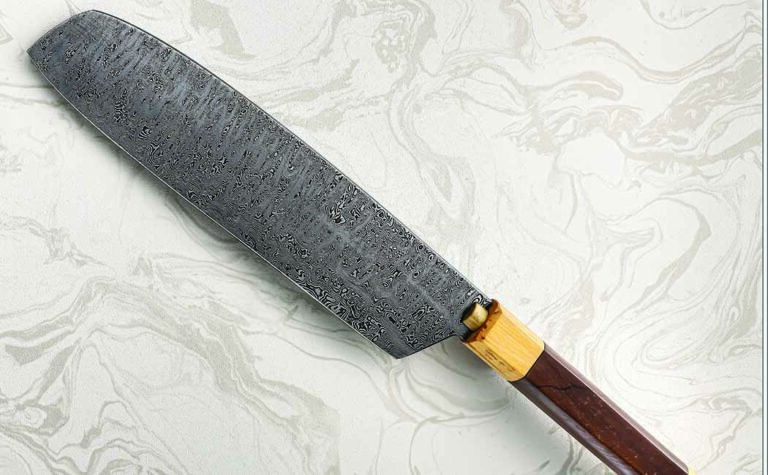
His clients told him his chef’s knives were too thin, especially the local Texas barbecue chefs who need thick, tough blades for separating ribs and joints in competitive barbecue events. As a result, he built the BBQ Chef’s Knife on a santoku cutting base with a thicker blade and a “really aggressive feel” built to take abuse.

Matt Williams

Matt lives on an old pecan orchard by the Colorado River and stabilizes and spalts the pecan for his turned-wood handles. The handle for his BBQ model is done in a wa style split down the middle with round dowels of white oak left proud to contrast with the darker pecan. He also forged the steel and made pretty much everything but the coffee for the blade etch. 

The combination of his new-style chef’s knives and cutting boards is just the ticket for the highly competitive local Texas barbecue chefs. Along with his custom knife work, Williams also makes one-of-a-kind cutting boards as well that he sells through his website.

BBQ Chef’s Knife Specs
Blade Length: 9 inches
Blade Material: 400-layer damascus of 15N20 nickel alloy and 1084 carbon steels
Hande Material: Spalted pecan, cedar elm and white oak
Handle Style: Wa
Overall Length: 15 inches
Knife To Know: The blade tapers from .169 of an inch at the thickest point to .05 of an inch at the thinnest point
Maker’s Price For A Similar Piece: $750

Read More

D.I.Y. Power Hammer: Do You Really Need One?

0

Why a power hammer may or may not be for you.

I think almost every smith wishes at some point he or she had a power hammer. 

It’s loud, powerful and moves metal quickly. It’s also the key to improving the production speed of forging and making damascus steel, and speed without sacrificing quality quickly translates into increased revenue and more fun.

It’s under such conditions that the smith turns to the Internet and begins to look for a hammer. Quickly he or she discovers several things. 

First are stories of people who got incredible deals on a hammer stored in a barn somewhere. These are like hunting stories of novices killing giant whitetail bucks, or fishing stories of a kid catching a 12-pound largemouth bass. The stories are true but it’s not likely to happen to you that way. If you’re one of the lucky ones who find a running Little Giant 50-pound power hammer for $200 at a garage sale, I don’t like you and I don’t want to hear your story. LOL!

Jason Fry and Travis Fry
According to the author—at left with his brother/fellow maker Travis Fry at BLADE Show Texas—a good power hammer improves forging production speed without sacrificing quality. His sub-hilt fighter features “Trashcan” canister damascus. (SharpByCoop knife image)

The next thing the smith discovers is there are running hammers to be had in the world, and they’re expensive. Along with just about everything else, the prices of hammers have increased the past few years. The odds of finding a working used hammer in your area are slim, even if you are willing to pay retail.

Whether you’re looking at the new production hammers or rebuilt old ones the price tag is steep, sometimes even $5,000 or $10,000. That’s a lot of knives and for many folks, there’s no way to justify the cost. On the other hand, if you can swing it, there are many high-quality production hammers on the market that will serve you well.

Meanwhile, desperate for a tool that seems just out of reach, the smith turns again to the Internet and searches “how to build a power hammer.”  

Little Giant was manufactured in 1917
This 50-pound Little Giant was manufactured in 1917 and is a clean-running example of what’s available on the used hammer market. (James Rodriguez image)

My D.I.Y. Power Hammer

I competed on the History Channel’s Forged in Fire in May 2018 (season five, episode 26, Qinglong Ji). I thought about several ways to prepare for the show. 

One was to practice various smithing techniques. I forged quite a few blades and practiced my forge welding. Another way to prepare is to work on equipment. I built a new forge out of castable refractory suitable for forge welding. I also decided to build a power hammer. 

I figured that if I made the final round on the show, I’d sure like to have a power hammer to use in the final build. If I were eliminated in the first two rounds I’d be disappointed, but in the end, I’d still have a tool that few smiths get to have.

Consequently, I spent five weekends in April and May building a spring helve power hammer, a style often called an Appalachian or Rusty hammer. Because I had a friend with an epic scrapyard, I was able to build the hammer for under $250. I did end up trading a few knives to my friend for the metal as well.

I spent about 50 hours of work building my hammer over the course of a month. I could have built roughly $2,000 worth of knives during that time, maybe more. Between the time I spent and the knives I traded, I estimate I have roughly $3,500 in my hammer. For that price, I could have purchased a running and functional hammer. The reason for me to take the DIY path was cash outlay—I had more time than money. 

D.I.Y. Power Hammer Considerations

I believe strongly that in order to successfully build a power hammer, you need several things. 

Piotr Delega DIY power hammer
Poland’s Piotr Delega, who goes by SteelCraft on YouTube, built his own hammer. He’s a great fabricator with engineering skills and a completely stocked machine shop. He started with a fully functioning LEGO model, created a 3D software model, and then built this fine functioning hammer.

Mechanical Inclination

The first is to be mechanically inclined. Building a hammer from scrap is exactly like building a racecar from a tub of LEGOs, and nothing at all like building the same from a boxed LEGO set. In a set, there are step-by-step instructions with pictures and perfectly shaped pieces that fit together. If you build a hammer from scrap, there are no plans, instructions or pictures. You’ll have to sort through materials looking for a piece that fits or that will serve the purpose you need, just like when you dig through the LEGO tub looking for four matching wheels. 

If you don’t have the necessary experience in mechanical design and fabrication, if you can’t visualize and then build, if you can’t anticipate future problems before you weld everything together, you may be better with a tire hammer or purchasing a complete hammer.

Welding Ability

Second, you need to be able to weld, and you need a welding machine with high enough amperage to weld thick steel. An import 110v wire feed doesn’t have the power to weld the sizes of steel that you’ll need to build a hammer. I used a 220v 180-amp class wire feed, and it was underpowered for some of the heaviest welds on my hammer, requiring multiple passes to get adequate penetration. It’s not what I’d recommend, but it’s what I had.

Regarding your welding method, stick or MIG or flux core wire feed is up to you, as all can do the job if the machine is powerful enough and you have the skills. SPECIAL NOTE: If you don’t have confidence you can weld steel well enough for the weld to hold up under extreme stresses, then you should buy a hammer.

LEGO power hammer
This is the fully operational LEGO toy power hammer made by Piotr Delega. He built a 3D software model based on it and used the model as the game plan from which to construct the full-size functioning hammer shown above.

The Right Shop

Next, you’re thinking of building a machine that is loud and heavy.  If you work out of a one-car garage or live in an apartment, it just won’t work.  If you are a member of a homeowner’s association (HOA) or live in a city with zealous code enforcement officers, good luck. 

If you have employees and need OSHA approval or insurance for your shop, you should buy a hammer instead of trying to make one. If you have touchy neighbors who already don’t like the fact that you forge in the backyard because they’re irritated by your two-hour hand-hammer-and-anvil sessions on Saturday afternoons, good luck. I’m fortunate enough to have neighbors who think my hobby is cool, a city with weak code enforcement, and I have a shop in my backyard. 

With a proper base plate and a heavy anvil, you’re building a tool that could easily weigh 1,500 pounds. If you work in sales, oilfield, church or some other vocation where you move every few years, you need to think about how you’re going to move your hammer should the need arise. I built mine with several bolt-together joints so I can break it down into parts of a few hundred pounds each that can be lifted with an engine hoist.

Materials Source

Finally, a good source of scrap metal is a must if you want to build your hammer economically.  If you have to go buy steel at retail, you’ll end up spending as much as a new hammer costs. If you can score your steel for cheap to free, you’re good to build.

Read More On Knife Steel:

Advertisement

Must Read Articles

Read this before you make a knife

Knifemaking 101 – Read This Before You Make a Knife

  by Wayne Goddard My experience has taught me that there's nothing like digging in and getting started. I've often said the hardest part of the...
how to forge damascus steel

How to Forge Damascus

Advertisement
Advertisement