Knifemaking is the building of a knife, which includes the blade, handle and other accouterments. Blades are made by either removing metal from a steel blank via a grinder – known as stock removal – and the forging to shape of hot steel into a blade in the process known as bladesmithing. Other parts, including bolsters, guards, pommels, etc., are needed to complete the finished knife.
I think almost every smith wishes at some point he or she had a power hammer.
It’s loud, powerful and moves metal quickly. It’s also the key to improving the production speed of forging and making damascus steel, and speed without sacrificing quality quickly translates into increased revenue and more fun.
It’s under such conditions that the smith turns to the Internet and begins to look for a hammer. Quickly he or she discovers several things.
First are stories of people who got incredible deals on a hammer stored in a barn somewhere. These are like hunting stories of novices killing giant whitetail bucks, or fishing stories of a kid catching a 12-pound largemouth bass. The stories are true but it’s not likely to happen to you that way. If you’re one of the lucky ones who find a running Little Giant 50-pound power hammer for $200 at a garage sale, I don’t like you and I don’t want to hear your story. LOL!
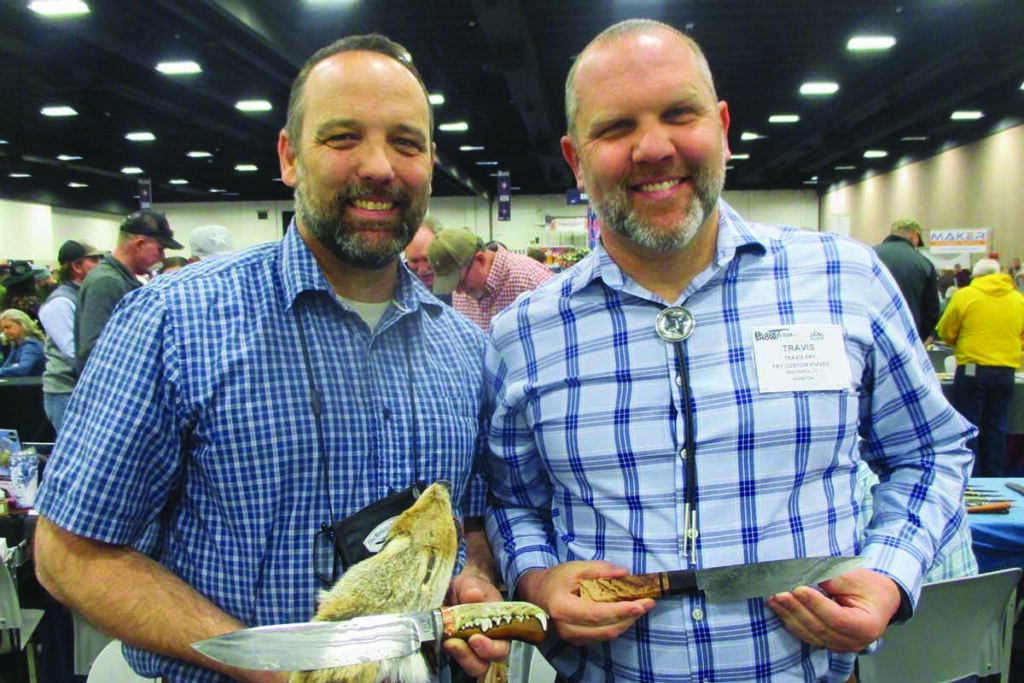
According to the author—at left with his brother/fellow maker Travis Fry at BLADE Show Texas—a good power hammer improves forging production speed without sacrificing quality. His sub-hilt fighter features “Trashcan” canister damascus. (SharpByCoop knife image)
The next thing the smith discovers is there are running hammers to be had in the world, and they’re expensive. Along with just about everything else, the prices of hammers have increased the past few years. The odds of finding a working used hammer in your area are slim, even if you are willing to pay retail.
Whether you’re looking at the new production hammers or rebuilt old ones the price tag is steep, sometimes even $5,000 or $10,000. That’s a lot of knives and for many folks, there’s no way to justify the cost. On the other hand, if you can swing it, there are many high-quality production hammers on the market that will serve you well.
Meanwhile, desperate for a tool that seems just out of reach, the smith turns again to the Internet and searches “how to build a power hammer.”
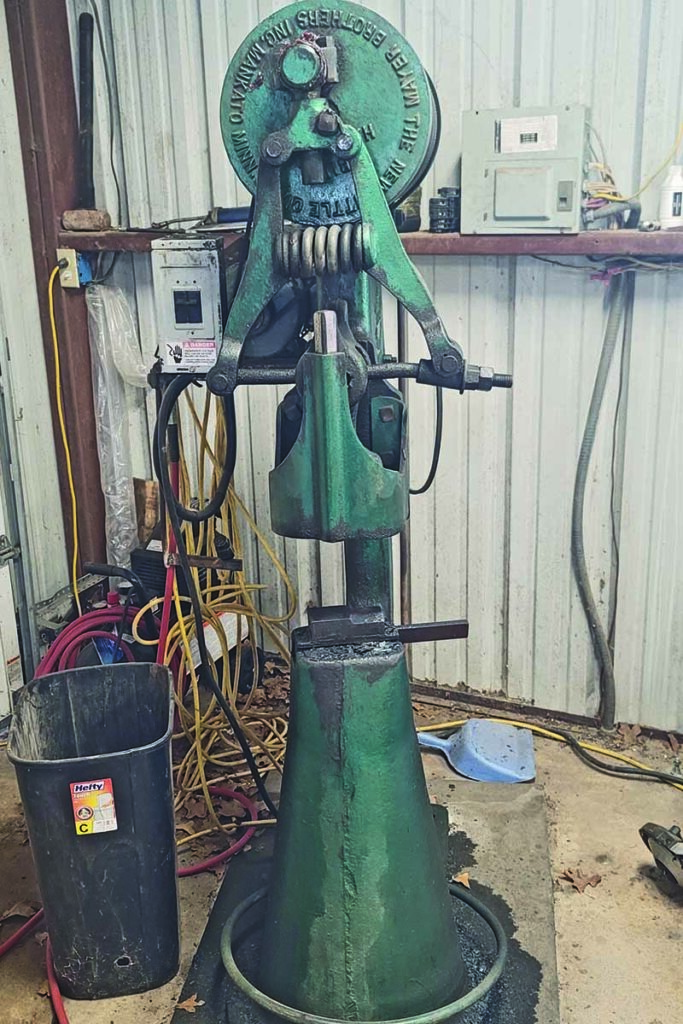
This 50-pound Little Giant was manufactured in 1917 and is a clean-running example of what’s available on the used hammer market. (James Rodriguez image)
My D.I.Y. Power Hammer
I competed on the History Channel’s Forged in Fire in May 2018 (season five, episode 26, Qinglong Ji). I thought about several ways to prepare for the show.
One was to practice various smithing techniques. I forged quite a few blades and practiced my forge welding. Another way to prepare is to work on equipment. I built a new forge out of castable refractory suitable for forge welding. I also decided to build a power hammer.
I figured that if I made the final round on the show, I’d sure like to have a power hammer to use in the final build. If I were eliminated in the first two rounds I’d be disappointed, but in the end, I’d still have a tool that few smiths get to have.
Consequently, I spent five weekends in April and May building a spring helve power hammer, a style often called an Appalachian or Rusty hammer. Because I had a friend with an epic scrapyard, I was able to build the hammer for under $250. I did end up trading a few knives to my friend for the metal as well.
I spent about 50 hours of work building my hammer over the course of a month. I could have built roughly $2,000 worth of knives during that time, maybe more. Between the time I spent and the knives I traded, I estimate I have roughly $3,500 in my hammer. For that price, I could have purchased a running and functional hammer. The reason for me to take the DIY path was cash outlay—I had more time than money.
D.I.Y. Power Hammer Considerations
I believe strongly that in order to successfully build a power hammer, you need several things.
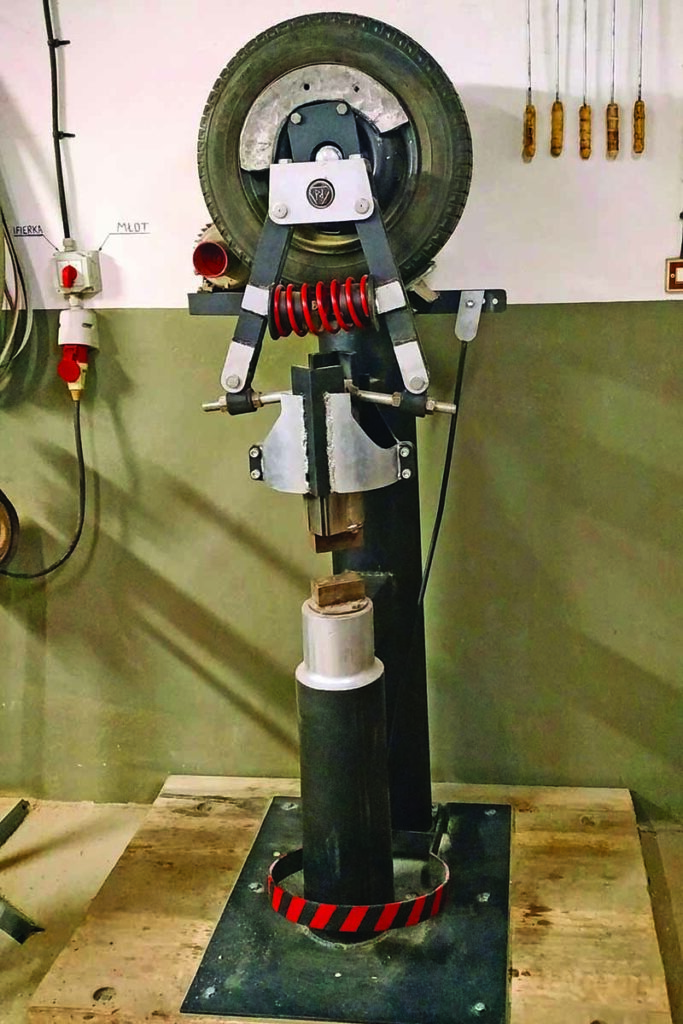
Poland’s Piotr Delega, who goes by SteelCraft on YouTube, built his own hammer. He’s a great fabricator with engineering skills and a completely stocked machine shop. He started with a fully functioning LEGO model, created a 3D software model, and then built this fine functioning hammer.
Mechanical Inclination
The first is to be mechanically inclined. Building a hammer from scrap is exactly like building a racecar from a tub of LEGOs, and nothing at all like building the same from a boxed LEGO set. In a set, there are step-by-step instructions with pictures and perfectly shaped pieces that fit together. If you build a hammer from scrap, there are no plans, instructions or pictures. You’ll have to sort through materials looking for a piece that fits or that will serve the purpose you need, just like when you dig through the LEGO tub looking for four matching wheels.
If you don’t have the necessary experience in mechanical design and fabrication, if you can’t visualize and then build, if you can’t anticipate future problems before you weld everything together, you may be better with a tire hammer or purchasing a complete hammer.
Welding Ability
Second, you need to be able to weld, and you need a welding machine with high enough amperage to weld thick steel. An import 110v wire feed doesn’t have the power to weld the sizes of steel that you’ll need to build a hammer. I used a 220v 180-amp class wire feed, and it was underpowered for some of the heaviest welds on my hammer, requiring multiple passes to get adequate penetration. It’s not what I’d recommend, but it’s what I had.
Regarding your welding method, stick or MIG or flux core wire feed is up to you, as all can do the job if the machine is powerful enough and you have the skills. SPECIAL NOTE: If you don’t have confidence you can weld steel well enough for the weld to hold up under extreme stresses, then you should buy a hammer.
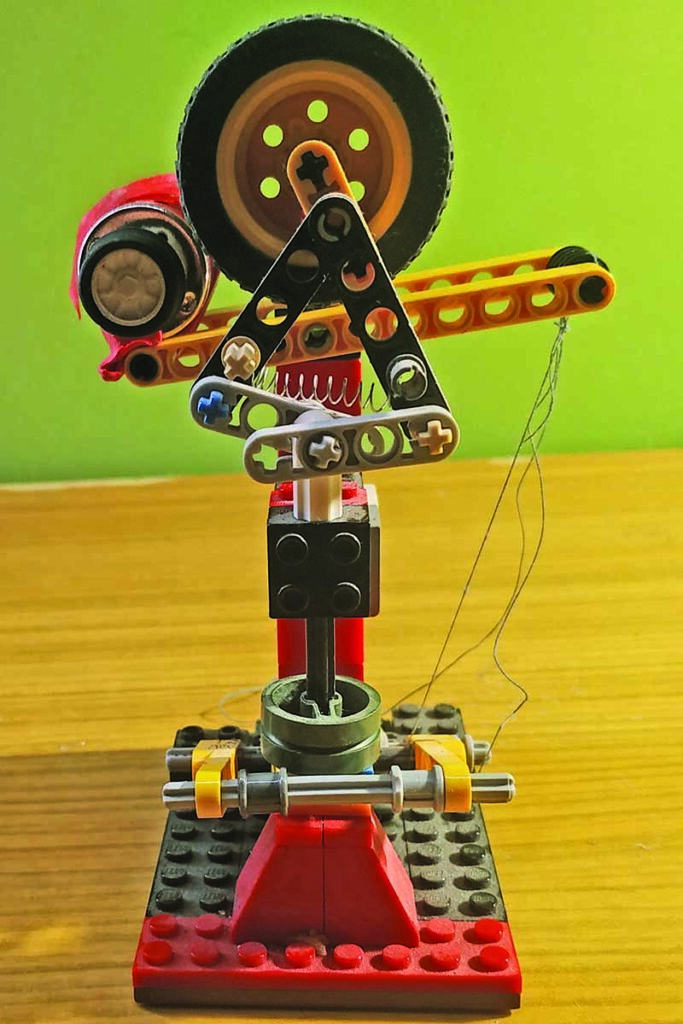
This is the fully operational LEGO toy power hammer made by Piotr Delega. He built a 3D software model based on it and used the model as the game plan from which to construct the full-size functioning hammer shown above.
The Right Shop
Next, you’re thinking of building a machine that is loud and heavy. If you work out of a one-car garage or live in an apartment, it just won’t work. If you are a member of a homeowner’s association (HOA) or live in a city with zealous code enforcement officers, good luck.
If you have employees and need OSHA approval or insurance for your shop, you should buy a hammer instead of trying to make one. If you have touchy neighbors who already don’t like the fact that you forge in the backyard because they’re irritated by your two-hour hand-hammer-and-anvil sessions on Saturday afternoons, good luck. I’m fortunate enough to have neighbors who think my hobby is cool, a city with weak code enforcement, and I have a shop in my backyard.
With a proper base plate and a heavy anvil, you’re building a tool that could easily weigh 1,500 pounds. If you work in sales, oilfield, church or some other vocation where you move every few years, you need to think about how you’re going to move your hammer should the need arise. I built mine with several bolt-together joints so I can break it down into parts of a few hundred pounds each that can be lifted with an engine hoist.
Materials Source
Finally, a good source of scrap metal is a must if you want to build your hammer economically. If you have to go buy steel at retail, you’ll end up spending as much as a new hammer costs. If you can score your steel for cheap to free, you’re good to build.
Three critical aspects of creating or choosing a quality blade are steel selection, heat treatment and geometry. This feature focuses on the first of these, and the first any aspiring knifemaker or enthusiast will be tasked with—choosing the right blade steel for you and your knives.
To the casual observer, the steel selection process wouldn’t seem like such a big deal, but as in-depth as this article is, it barely scratches the surface of the topic.
Not all steels are created equal. Each varies as much as knife style and is designed for a specific application. So, matching the correct steel to the specific blade, intended use, and maker or user can be critical in creating a quality tool. Choosing the best alloy for your purpose can mean the difference between achieving the highest performance by effortlessly allowing the steel to do what it does best and struggling to pound a square peg into a round hole by forcing it to do something it was never designed to accomplish.
From my observations after a lifetime of providing metallurgical consulting services for various industrial clients and countless knifemakers, the latter rarely select steel with the same analytical vigor as the former. Rather than independent research to match steel chemistry to a process and product, knifemakers often choose whatever alloy everybody else is using.
American Bladesmith Society Journeyman Smith John Schultz chose well with 1075 steel for its natural toughness on his recurved chopper.
Be it a ubiquitous old favorite or the newest rage in the “steel of the month club,” no single alloy is the best fit for every knife, use or maker. On the other hand, the one area where knifemakers often exceed my industrial clients is letting frugality make the choice. The number of knifemakers who have told me they use a specific type of steel because of their access to a cheap or free supply is unfortunate.
The trouble with these approaches is needlessly steepening the learning curve for many a new maker or knife user. I can’t count the number of times I have heard a frustrated knifemaker state that an alloy they have tried is a bad steel. But there is no such thing as bad steel. Industry wouldn’t bother wasting time, effort or money on steel that wasn’t optimum for its intended purpose. There are poor application choices and bad heat treatments. Any fault lies with the knifemakers or bladesmiths and not the steel.
A36 is an excellent steel choice for use in buildings and bridges, but it is a bad reflection on knifemakers if they insist on making a blade with it. The steel properties of A36 are not conducive to knife blades. Alloys like 1095 or O-1 can make good hunting knife blades, but if the steels are heat treated like 5160, they won’t measure up in edge performance. I can’t tell you how often I’ve bitten my tongue when shown a blade fashioned from steel with barely enough carbon for adequate strength or an abrasion-resistant edge.
If knifemakers have to deviate from standard heat treatment practices with unorthodox extra steps, it is most likely the result of a steel choice that does not match their application or methods. You can under-soak or over-temper a 1% carbon steel sword or use an alloy better suited for such a blade. You can add several steps to heat-treating richly alloyed steel in your forge or choose a steel that readily responds to that heat source.
Intended Knife Use
Rather than using hard and soft layers for damascus, the author, Kevin Cashen, has always combined toughness with abrasion resistance, as in this O1/L6 skinner.
The problem is that we often proceed from the wrong direction. Whatever the reason, many knifemakers have already settled on their steel before determining what knife they will fashion, but how can you make the right choice in a material before you even know its intended use?
A better model for success is letting the primary tasks a knife is meant to perform determine needs and goals. Develop a plan to achieve those goals by designing a hand tool that will perform a specific task or even multiple tasks, keeping in mind that the intended uses of a single knife can be much more varied than people think. With the desired tasks for the edged tool in mind, choose the material based on the desired properties inherent to each steel’s specific chemistry. Equally important is recognizing the limits of a maker’s abilities to work with a given chemistry.
To explain how to choose the correct steel for you and your knives, the myriad of blade designs is distilled down to two primary categories. The first group—fine-cutting knives—is designed to perform keen slicing or aggressive slashing. They are most often used in a draw-type cut that is optimized like a saw at the microscopic level. Think of scalpels, skinning and hunting knives, and many kitchen knives. Their edges are thin, flat or hollow ground for cutting various soft, fibrous materials.
This group has a subcategory of blades, including some kitchen knives and razors, that will be identical in many design features and desired properties, but they are used more in a push cut. Regardless, impact toughness is not nearly as crucial as abrasion resistance for knives like this.
The effects of carbon content in a simple steel can be seen on the Iron-Carbon phase diagram.
In contrast, the second group—choppers—is used in straight-on, push-type motions, cleaving, or cutting that often involves impact. These knives cut more like a chisel than a blade drawn into a cut like a saw. Camp knives, some bowies, and many swords fall into this category. They benefit from polished, beefier, convex edge grinds that don’t require abrasion resistance as much as impact toughness.
By definition, a knife is a cutting tool. If we should ever find ourselves detracting from a blade’s ability to cut in any part of our plan or execution thereof, we may need to consider whether making a knife or another tool is the better option.
Thus, all the properties discussed herein are relevant to cutting. A fundamental condition for a blade to slice through material is that it must be stronger than the cutting medium. There is tremendous load pressure at the microscopic level, where the cut is initiated. So, almost by definition, strength must be a top priority in any knife edge.
For this article, strength is the ability to resist deformation under load. Opposing this prized quality of strength is ductility, or the ability to easily deform without edge or blade failure. Knifemakers heat treat steel to replace ductility with strength. For millennia, it was the job of the blade maker to find the most acceptable compromise between strength and ductility for their blades to cut while avoiding brittle failure.
Steel Strength
The graph shows the total hardness from proper solution in steels soaked for 1 minute and 10 minutes, respectively, illustrating the effects alloying can have on heating requirements.
There are many types of strength in steel. Examples are compressive strength and tensile strength. These and shear strength are not as apparent in general knife use, so knifemakers more easily conceptualize them as hardness.
The other quality prized in a blade is toughness, which should be viewed as the steel’s ability to withstand shock from sudden loads rather than bending in a ductile manner under gradual load. These are two entirely different behaviors, with one being more relevant to a blade used in chopping. Rather than the Faustian bargain of trading strength for ductility, the Holy Grail of blade making is maintaining high strength with impact toughness. In chopping-type blades, impact toughness is almost as valuable as strength.
The next property to consider in a knife blade is abrasion resistance. Microscopically, the knife edge is subjected to tremendous wear, even when cutting seemingly soft materials. It is this wear that results in the tool dulling when used. Abrasion resistance is the steel’s ability to withstand such friction effects. While this property does increase with overall hardness, steel’s unique makeup gives it abrasion resistance above and beyond hardness and even independently from it. Within the steel, there might also be carbide particles with a hardness that far exceeds the overall Rockwell measurement numbers of the blade. Fine cutting and slicing blades benefit more from abrasion resistance than impact toughness.
Although the possible steel choices for modern knifemakers are endless, for simplicity’s sake, this discussion is limited to non-stainless alloys commonly used by forgers and grinders alike. Although many knifemakers have become dependent on AISI (American Iron and Steel Institute) or SAE (Society of Automotive Engineers) steel names, such titles as 1084, W-2 or 80CrV2 lack specificity and meaning compared to studying the individual steel’s chemistry in determining its potential properties.
The more alloying helps us in gentler quenches, the more attention must be paid to proper heating, making some steels a better match for a forge and others a digital oven.
I strongly encourage knifemakers to study the chemistry of any potential steel choices to decide which one to use and how to work it. A supplier that provides the chemistry for your steel understands this and is well worth doing business with rather than a source that omits the alloy’s makeup.
Carbon content is the first consideration within a steel’s chemistry and perhaps the most important. Carbon is the main element responsible for strength in steel. The more carbon a steel has, the greater strength can be achieved in hardening. However, this is only true to a certain point; maximum hardness in carbon steel is achieved at around .80% carbon, and beyond this, not much more is gained in that area. Putting more carbon than .80% into the solution during the hardening process can harm a bladesmith’s goals. However, carbon beyond this optimum level will add abrasion resistance if allowed to stay in carbide form.
This sweet spot in carbon levels around .80% is known as the eutectoid. It is the most efficient use of carbon in steel, with no leftover iron (ferrite) or any leftover carbide (cementite). Steels with less than .80% carbon content are inherently tougher and less brittle, while steels with more can have much greater abrasion resistance with a tendency to be less tough. This is important to consider when choosing steel for your intended blade purpose. Does a machete need abrasion resistance? Does a skinning knife need to be tough? Choosing 1075 for one or 1095 for the other could make all the difference in having a steel that will work for you or against you in creating that blade.
In centuries past, bladesmiths had no choice but to compromise between strength and ductility when working with simple iron-carbon material. But then, starting in the early 19th century, alloying changed everything. Finally, with the intentional addition of other elements to steel, bladesmiths could have their cake and eat it, too.
Steel Alloys
Combining it in one chart helps select the correct steel based on knife use and a knifemaker’s heat-treating equipment.
A sword in the 13th century that had to be kept in the low hardness ranges could now be just as tough at much higher hardness levels. Fine slicing cutters could have an abrasion-resistant carbide boost far exceeding simple cementite abilities. But with these gains in performance came greater demands for more precise controls in heat treating, atmosphere, and more refined blade quenches. Today, even the most basic carbon steels have enough alloys to radically differentiate them from the old steel. Anybody who thought they would water quench 1084, just like traditional tamahagane steel, can attest to this fact.
For this reason, another critical factor must be considered in proper steel selection beyond the type of knife being made. It is why the premise of this article is choosing the right steel for you and your knife. Our modern steel alchemists may have created the perfect high-tech steel for a knifemaker’s application. But if they’re learning the ropes, or all they own is a humble forge, it could still be a terrible choice for their knife.
If your shop is equipped with a digitally controlled oven, all the many modern alloy options are available if you learn the rules each steel choice requires. The same chemistry that makes one steel harden in almost any oil or air makes it much more finicky when heated before being quenched. An alloy steel may have the potential to outperform a simple carbon steel, but not if you lack the equipment necessary to unlock that potential.
Figure 1 shows the as-quenched hardness results of a series of tests involving simple heating versus a standard 10-minute soak on commonly used steels. Here, the effect of increased alloying is plain to see when looking at each steel’s time and temperature requirements, which many open-flame heat sources or forges may struggle to meet. Unless armed with an excellent understanding of the metallurgy, a smith desiring to stick with more traditional tools would be better served by more traditional steels. Simple carbon steels such as “W” or 10XX series are like what forges were initially made for and will allow the traditional smith to produce a fine blade effortlessly.
Knowing what each of the additional alloying elements brings to the table is valuable in knowing what to seek in steel. If you’re looking for impact toughness, consider chemistries that include nickel or silicon. These additions affect the iron’s atomic lattice, which acts like a shock absorber. For a knife needing abrasion resistance, a boost from the more powerful carbide formers can give you longer wear than simple cementite, with two of the most common examples being vanadium (above .25% of overall elements) or tungsten. Chromium will also help in this area to a lesser extent.
If you wish to achieve a fully hardened blade with minimal effort, manganese over 1% or relatively modest additions of chromium are just the ticket for leaving behind your stressful days of the water quench. And, of course, for applications where simple carbon steels would rust too quickly, chromium over 11% will also help resist corrosion. The chart in Figure 2 brings together all these considerations. On a final note, it must be conceded that a skilled bladesmith with a solid knowledge of heat treatment could push several of these alloys into adjacent categories. Still, here, we’ve focused on the path of least resistance.
By capitalizing on the characteristics of an alloy’s chemistry, a maker can spend less time getting it to behave in the desired manner and more time maximizing its performance.
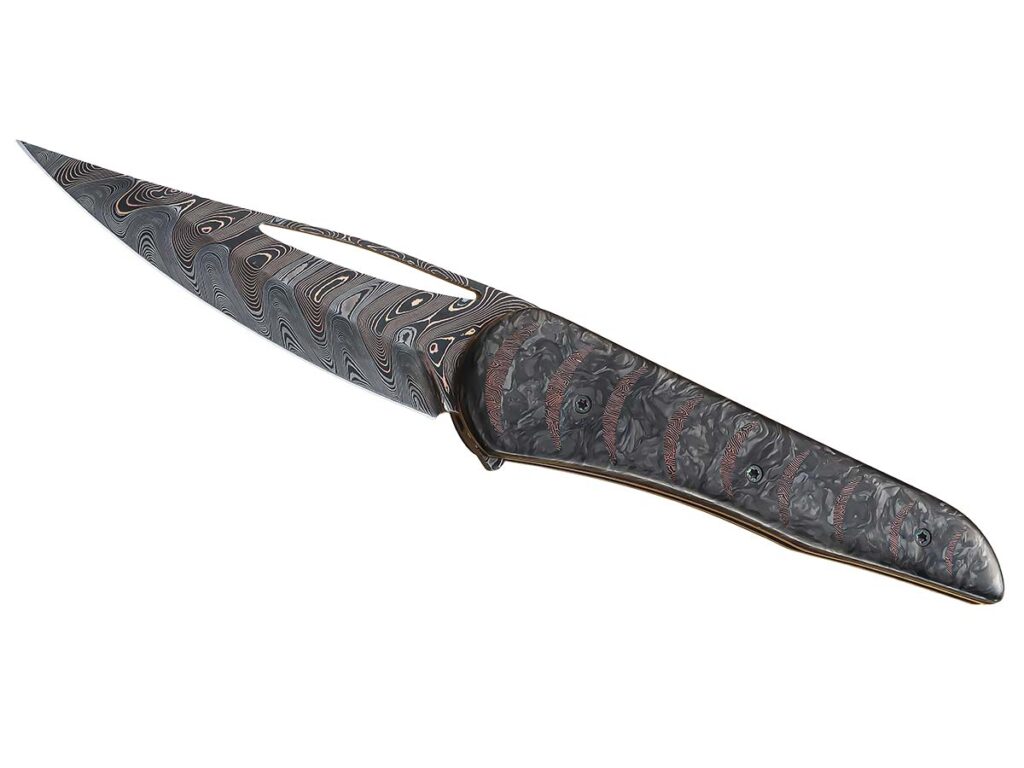
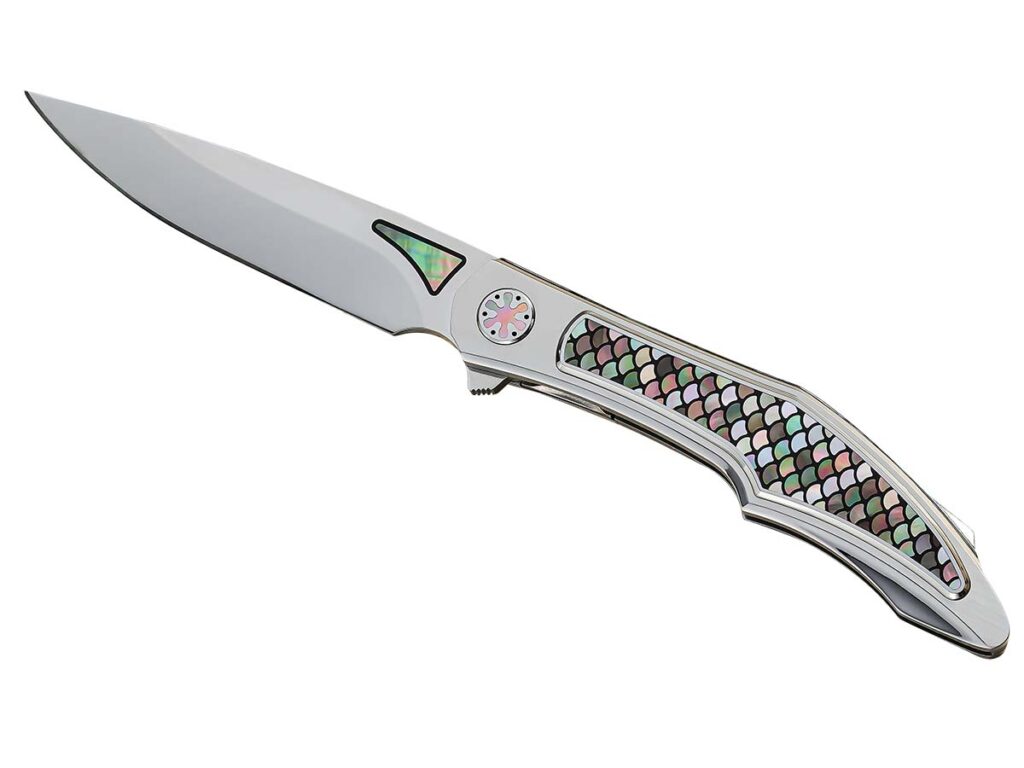
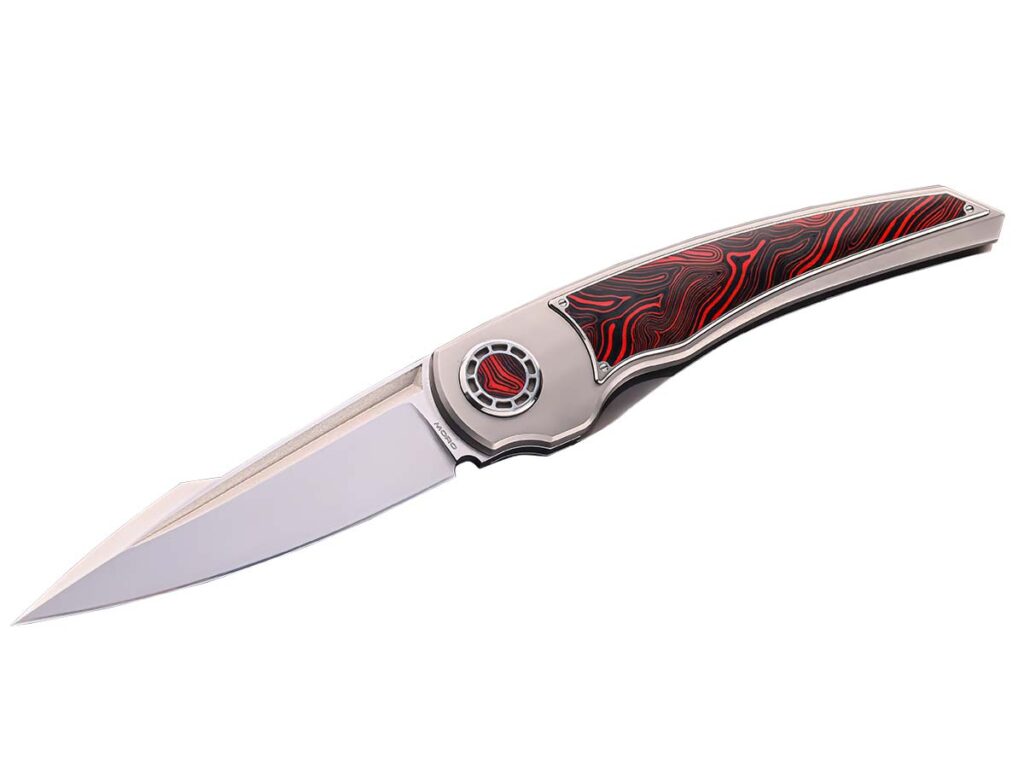
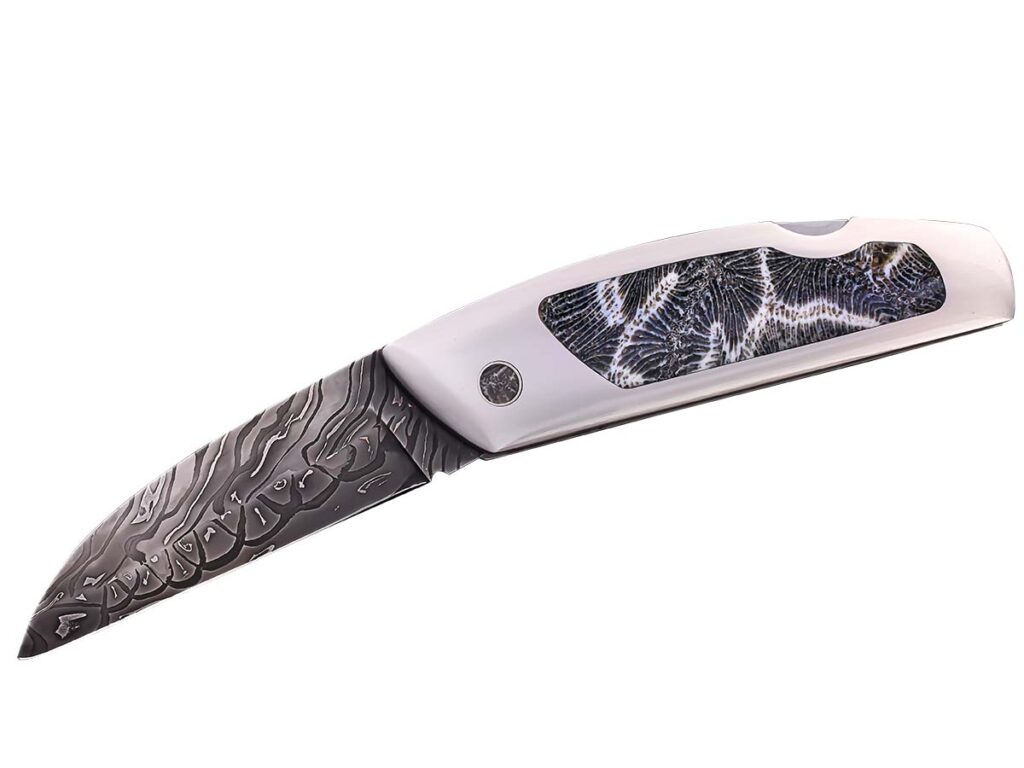
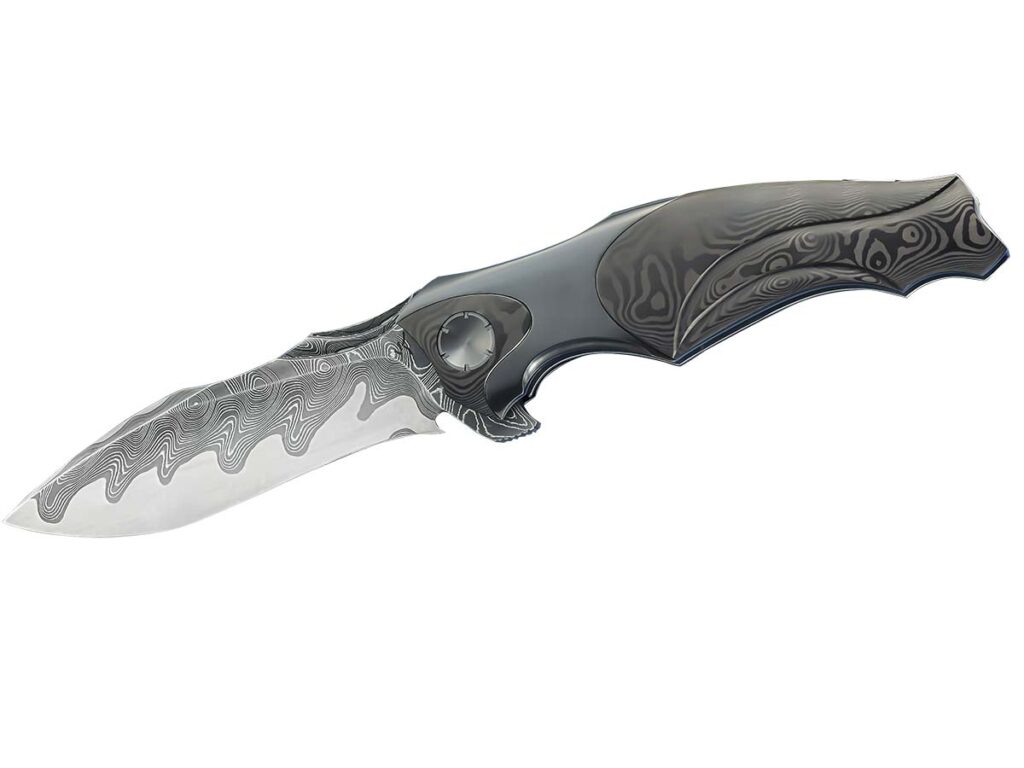
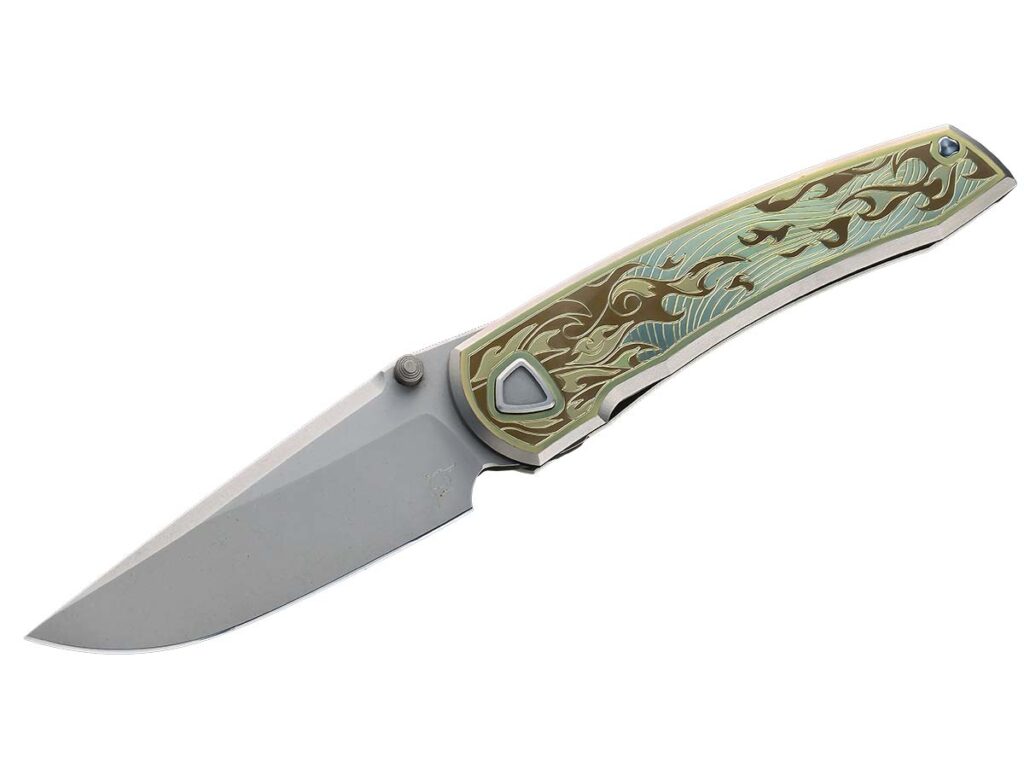
The best in blade and handle materials decorated some of the most creative folder designs anywhere at the recent New York Custom Knife Show. Enjoy seven of them in all their glory on this and the facing page.
Alan Hollerbach Flipper Folder
Alan Hollerbach’s flipper folder has a 4-inch hollow-ground blade of damascus forged by Baker Forge & Tool, and scales of Fatcarbon carbon fiber and carbon fiber inlays. All hardware is titanium. Closed length: 4.5 inches.
Eyal Landesman Mini Tritan Flipper
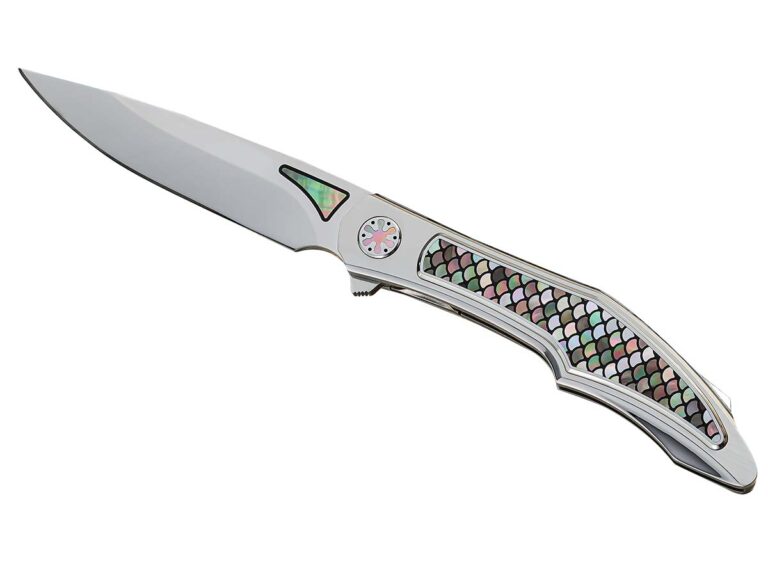
The Mini Tritan flipper folder by Eyal Landesman sports a 3.5-inch blade of mirror-polished RWL34 stainless steel. The mosaic “fish scale” inlay includes assorted “scales” of black-lip and white mother-of-pearl. Closed length: 4 inches.
Corrado Moro Vantage Framelock Flipper Folder
The Vantage framelock flipper folder by Corrado Moro features a 3.38-inch harpoon-pattern blade of RWL34 stainless steel with a tapered fuller in the flat. The frame and pocket clip are Grade 5 titanium and the handle and pivot inlays are a G-10 composite. Closed length: 4.62 inches.
Chris Richardson Lockback Folder
Panel and pivot inlays of fossilized coral and a 3.5-inch flat-ground blade of mosaic twist damascus top off Chris Richardson’s lockback folder. Frame: 416 stainless steel. Closed length: 4.5 inches.
Jeremy Krammes Helix Flipper Folder
Jeremy Krammes helps celebrates his 20th year of knifemaking with his Helix flipper folder in Chad Nichols damascus blade steel, a titanium frame, carbon fiber scales and a zirconium bolster and pocket clip. The 3.5-inch recurve blade is hollow ground.
Edison Barajas Waka Folder
Edison Barajas combines new school with old on his Waka folder, using titanium for the scales engraved by Wilfred Valtakis II and a thumb stud to open the 3.25-inch blade of premium stainless steel. Closed length: 4.5 inches.
Stefano Compostella Stria XL
Stria XL by Italy’s Stefano Compostella sports a 5-inch wharncliffe blade of premium stainless steel. The linerlock flipper folder features Damasteel handle overlay and titanium liners.
Schwarzer’s blister busters and Terzuola’s effective efficiencies.
Editor’s Note: Jim Hammond has been a full-time knifemaker since 1977 and a member of the Knifemakers Guild since 1978. He was the first maker to work with CRKT and has many well-known designs to his name. This is the first of an ongoing column in which he uncovers the tightly held secrets of master knifemakers.
Welcome to Secrets of the Shop, where we dive deep into specific techniques and tips highlighted in the work of premier makers and knife smiths. While trade secrets often imply guarded formulas, for knifemakers, they are keystone discoveries that hone processes and perfect craftsmanship. This column seeks to turn these unrevealed secrets into shared solutions.
Popping Blisters
A veteran ABS master smith and BLADE® Magazine Cutlery Hall of Fame® member, Steve Schwarzer is probably best known for his pioneering work in the canister method of forging mosaic damascus. He is considered one of the finest instructors and ambassadors of the forged blade and of mosaic damascus, teaching at seminars and hammer-ins on the subjects for decades in Europe, South Africa, the USA and elsewhere.
During welding, a cold shut—a spot of incomplete merging of steel—can produce a trapped-gas bubble known as a blister. The spots where these void occur heat at different rates than the surrounding material and turn black. Often caused by worn and cupped dies, these blisters typically form along the billet’s perimeter.
Steve’s solution to addressing blisters is as follows:
Release the Gas: Punch a hole directly into the blister.
Flux and Forge: Drop borax into the hole and use a small rounding hammer to forge the area, pressing air out of the seam to recreate a uniform weld.
Refinement: Check the surface for flatness. Steve utilizes belt and stone surface grinders to achieve trued flats and maximize uniform contact.
To prevent blisters, Steve welds the edges of a billet before the center using a radiused fullering die. Going this route is less prone to create blisters than a flat die, though more apt to distortion. This technique was vital when Steve and Neil Kamimura created a million-layer billet that was folded rather than stacked, requiring the resolution of numerous small cold shuts.
Mosaic On A Budget
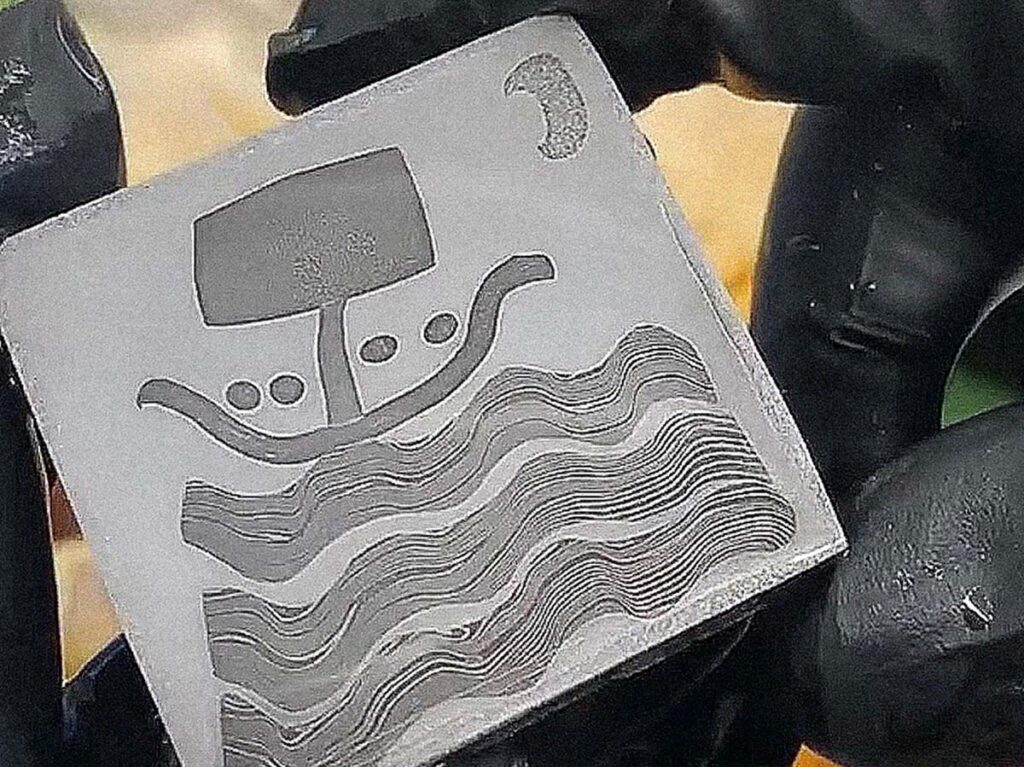
Schwarzer uses what he calls a “tiling” process with his canister damascus, sawing off the end to expose the image, and forge-welding them side-by-side to maximize the visual impact across the blade’s surface. (Steve Schwarzer image)
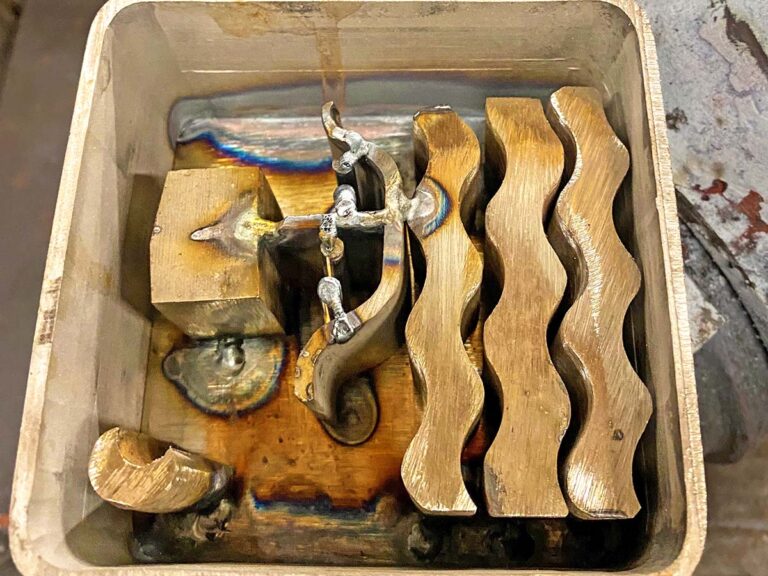
While CNC and EDM equipment can create intricate designs, a more affordable approach involves the sintering process of canister welding damascus, a method originated by Steve and Daryl Meier.
Steve’s canister process is as follows:
Composition: A square canister is preferred to maintain the image’s shape using flat dies. Content determines the pattern—solid metals form the primary image, while powder fill creates the background.
Preparation: Both ends must be welded shut to exclude oxygen.
Release Agents: To free the billet from the canister, Steve uses white spray paint; the titanium dioxide acts as an immediate release agent, oxidizing upon heating. Other options include White Out and stainless-steel foil.
Sintering: Steve recommends a soak time of at least 30-plus minutes. Expect a size reduction of roughly 30 percent as micro-spaces between particles collapse.
To expose the end-grain imagery, Steve uses what he calls a “tiling” technique. Band sawing sliced off the billet exposes the faces of the pattern. Then, forge-welding them side-by-side, he maximizes the visual impact across the blade’s surface. Note flat grinds are customary with this process, as deep grinding can distort the integrity of the imagery, especially with twisted materials.
For New Makers
Steve offers two foundational tips for those entering the craft. First bit of advice Schwarzer makes is to, “Avoid unknown materials, even if they’re free.” Without knowing the composition of “mystery steel,” you can never accurately repeat your results. He also suggests makers define their own path, saying, “Don’t chase anybody else’s dreams. Chase your own.”
Cutting Coupons
Bob Terzuola was a pioneer in using lasers and waterjets in his manufacturing process. Among the efficiencies he incorporated in using these tools was cutting what he calls “coupons.” These are simply uniform blade blanks and liner sections. Keeping a load of these on hand speeds up the manufacturing process, while maintaining the integrity of the knife. (Bob Terzuola image)
Known as the “Godfather” of the tactical folding knife, Bob Terzuola has been a full-time maker since 1980 and was inducted into the Cutlery Hall of Fame in 2023. His longevity in the craft stems from a blend of old-school design and modernized production efficiency. Terzuola was a pioneer in the mid-’80s, becoming the first maker to utilize laser cutting for components. Today, he uses waterjet cutting to create generic rectangular blade blanks and liner sections, which he calls “coupons.”
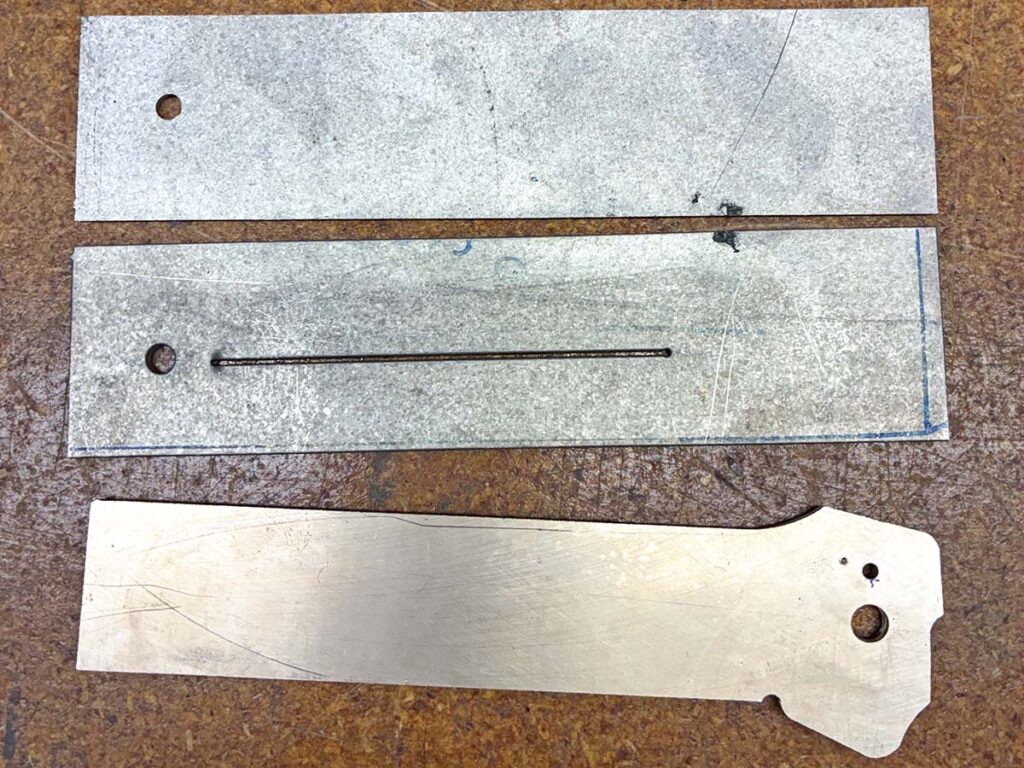
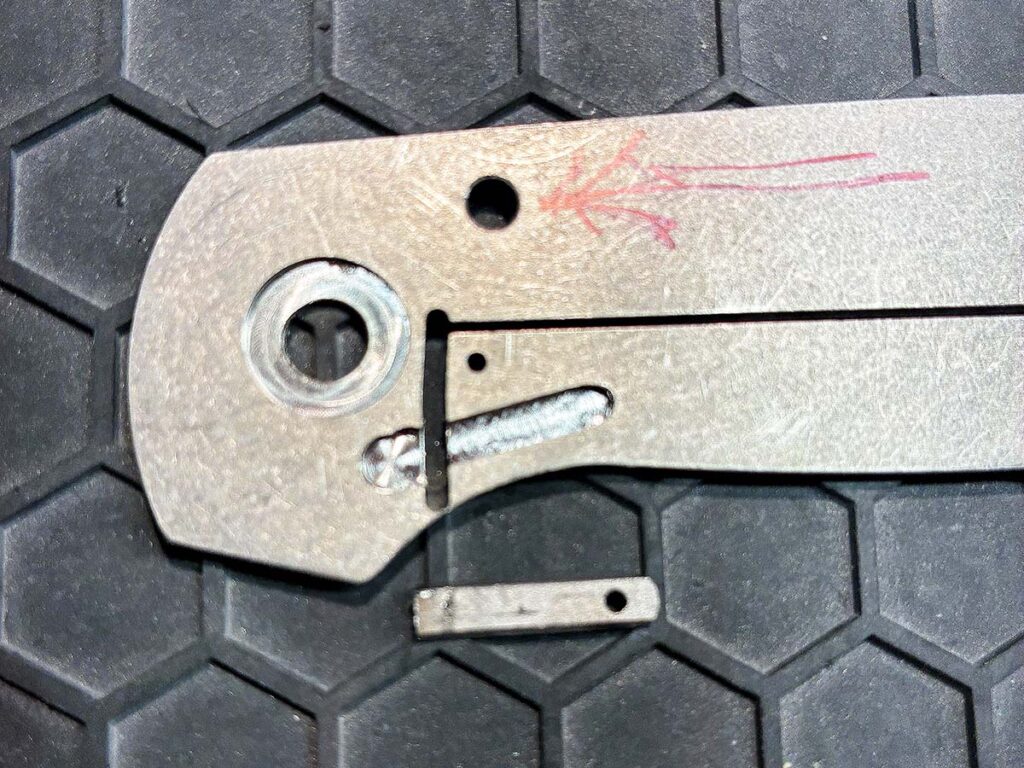
For the blade blanks, Terzuola profiles the rear area with the lock face, thumb ran and pivot/stop pin holes (roughed to 80 percent diameter). The rest remains rectangular, allowing him to incorporate any pattern with minimal grinding. Bob has his CPM 154 stainless steel blanks commercially surface ground to 0.135-inch before heat-treating them himself to HRC 59. For the liners—0.080-inch titanium in our discussion—the coupons are left square, containing only the pivot hole and the horizontal slot for the locking spring arm.
Notably, Terzuola grinds his blades after they are hardened. He argues grinding annealed steel can lead to warping during heat treat and causes the belt to gouge material. Grinding hardened steel, by contrast, is like slicing meat with a razor blade rather than digging dirt from a hole. Despite these modern efficiencies, he said he remains a “pencil-and-paper guy,” eschewing CAD for hand-drawn patterns to maintain design commonality.
Finishing Simplified
Despite modern efficiencies Terzuola has incorporated into his manufacturing process, he remains traditional in his designs. That is, he avoids CAD, instead using pencil and paper to hand-draw all of his knives. (Bob Terzuola image)
Bob’s finishing process for CPM 154 is remarkably lean. He utilizes a 90-durometer smooth-face rubber contact wheel and a simple two-belt sequence. First, he does a rough grind with an 80-grit ceramic belt, then finishes with a 3M Trizact A16 (1,200-grit) belt. He specifically avoids 60-grit belts, noting that their mesh size is twice as large as 80-grit, creating scratches that are twice as deep and significantly harder to clean up. To ensure blade-lock longevity, he now uses a heat-treated 440-C stainless steel insert in the titanium spring arm. This provides a steel-on-steel lockup, eliminating the wear issues common with titanium.
For New Makers
Terzuola encourages beginners to find their own niche and not get locked into a single model. He emphasizes mastering the fundamentals with hand tools: learn to tap holes, use files and sharpen twist drills. He and I agreed, new makers should also gain proficiency with mills, lathes and surface grinders to be old-school efficient rather than purely CNC-reliant.
Veronique Laurent Has Become One Of The Most Accomplished Smiths In The World Even After Fighting Against Prejudice In Her Native Belgium.
I come from Texas where a knifemaker is more likely to wear boots and a cowboy hat than a suit and tie. In many parts of the world, it’s commonly assumed that a knifemaker is a man.
This past March I caught up with American Bladesmith Society Master Smith Veronique Laurent at BLADE Show Texas in Fort Worth, Cowtown, USA. She had no boots or cowboy hat and her accent isn’t “Southern,” but she’s sure enough a bona fide knifemaker.
Veronique comes from Brussels, Belgium, where French is the spoken language. Now, I don’t speak French, so out of respect I asked her how a non-French-speaking person should pronounce her name.
Over here she’ll answer to the Americanized Veronica Lawrent, but the correct answer is more like Vehr-o-NIK-eh Law-ron, with the rolled R’s in the middle of each. In Belgium the people use the last name first, so she’s often just called “Laurent.” Now that you can read her name in your head in a beautiful French accent, let’s move on to the interesting part of the story.
Veronique found her first career as a clerk at a Belgian TV station. She did cold metalworking as a hobby. While on holiday in France in 2004, she attended a knifemaking and blacksmithing event similar to a U.S. hammer-in. She later took a one-day knifemaking class with the Belgian Knife Society and never looked back.
She became involved with the Society and learned more about knifemaking from the members of that community. The group eventually broke up but not before Veronique was well on her way.
In 2010, again in France, she attended a hammer-in that included ABS Master Smiths/BLADE Magazine Cutlery Hall-Of-Fame® members Joe Keeslar and Jay Hendrickson. In Belgium and France, a woman is not commonly accepted as a knifemaker. So it was that Veronique was pleased and surprised by the hospitality that Joe and Jay showed her, particularly with the respect they gave her as a craftsperson.
For while a female knifemaker is a bit of an American rarity, being female isn’t an automatic gale-force headwind in the American knifemaking journey. In Europe, however, things are quite different. Veronique struggled to sell knives in Europe even as her skills advanced.
“When a man came to my table and picked up a knife, he would ask me who the maker was,” she recalled. “When I said that I made the knife, he would then ask the person next to me who made the knife. Once he knew I was the knifemaker, he’d put the knife down and walk away. In Europe they don’t want to buy a knife from a woman.” She made it her goal to be a full-time maker, and her American contacts became even more important.
Becoming An ABS Master Smith
Veronique (left) makes a point as her fellow panel members—from right, ABS Journeyman Smith Lora Schwarzer and knifemakers Grace Horne and Abie Lyons—listen during the Women’s Bladesmith/Knifemaker Panel class of BLADE University at BLADE Show ’22.
After her contact with Keeslar, she journeyed to the 2013 BLADE Show and gained her ABS journeyman smith certification. She then began corresponding with ABS Master Smith John White, who encouraged her to learn to build takedown knives.
“In 2015 I built my first takedown knife, and that same week I received the ABS email notification that John White had passed away,” she recalled. “I built all of my master smith test knives as takedowns in his memory.”
Veronique pretty well blew away the crowd at the 2015 BLADE Show and gained her MS stamp. After the show, she and ABS Master Smith Jean-Louis Regel of France spent three weeks in Brazil learning advanced damascus techniques from ABS Master Smith Rodrigo Sfreddo.
“After I was a master smith, I began to ‘exist’ in Europe,” she noted. “I became a full-time knifemaker shortly after that.” Even with American renown and credibility, the headwinds of bias still were a challenge in her home country. “People were rude, and it made me think ‘I will show you!’ Their bad attitude became my motivation,” she said.
She began to work with Jean-Louis more and more (Jean-Louis also earned his MS in 2015). Because of bias, it was often assumed that he did her work for her, that he made her damascus or that she worked only in his shop. This was not the case.
Though to Americans it makes sense that the two French-speaking master smiths must be connected, the real story is that Veronique and Jean-Louis each have their own shops in their hometowns. Their shops are roughly 375 miles apart, with Veronique in Belgium and Jean-Louis in France. The journey between them takes about eight hours.
Even in Texas, where we measure trips in hours, not miles, an eight-hour trip is a “long haul” or a “far piece.” While the distance was significant, they covered it about once a month depending on workflow. Veronique says that she has better grinding and finishing tools in her shop, while Jean-Louis has a bigger shop with better damascus-making equipment.
Veronique and Jean-Louis attended the International Custom Cutlery Exposition (now BLADE Show Texas) in Fort Worth in 2018, and each won multiple awards.
“In all my trips to America, only one time has anyone set my knife down rudely like in Europe,” she noted. They joined The Knifemakers’ Guild on that trip also and spent a week learning bladesmithing from ABS Master Smith Rick Dunkerley.
Covid got in the way of travel plans and so Veronique and Jean-Louis were unable to return to America until this year’s BLADE Show Texas. As an American, it wouldn’t cross my mind to visit France regularly to try to sell knives, so I was curious why Veronique keeps coming back. She explained that “Europe doesn’t like to ship big knives. It is very complicated and expensive. Sometimes you can ship a small letter opener or something, but it is very difficult.”
Rather than fight the restrictions, it’s easier to travel over here and sell her work where it is in high demand. Another thing she does is make a “junior baby” model of each major piece. If she makes a dagger, she makes another small one. If she makes a big bowie, she makes a similar hunter. These smaller pieces tend to sell better in Europe than the big works.
Veronique Laurent’s Knives
Based on the Musso Bowie, Veronique’s Big Boy Bowie won Best Fighter at BLADE Show Texas. It has a 13-inch feather damascus blade of O2 and 45NCD16 tool steels with a riveted brass back. Parts of the guard are mirror polished, parts are stippled, and parts are engraved with raised flowers. The handle is ancient walrus ivory. Overall length: 18.5 inches. (SharpByCoop image)
Veronique had a good variety of knives at BLADE Show Texas that showcased her skills and versatility: a large brass-backed bowie, a few elegant hunters and a folding dagger.
“It was an honor to be asked to make a big bowie,” she observed. “It’s a man’s knife and it took many years for a man to trust that I could build a large bowie.”
While she doesn’t build knives “to order,” she does keep a list of customers who are looking for a particular type of knife. “I don’t take orders. I want to be free!” she explained. She’d been asked to build a big bowie and did her research and came across the Musso Bowie. She built the Big Boy Bowie and it promptly won Best Fighter in Fort Worth.
Big Boy is highlighted by a feather damascus blade of O2 and 45NCD16 tool steels with a riveted brass back. The guard is O2 also. Parts of the guard are mirror polished, parts are stippled, and parts are engraved with raised flowers.
“O2 steel is good because you can finish it many ways and it works well for the engraving,” Veronique explained.
The handle is ancient walrus ivory. Also on her table was a fine damascus folding dagger that won the show’s custom judging award for Best Folding Knife. All the fittings, engraving, jewel settings, and display box are by Veronique.
So where does one go next when you’re already known worldwide?
“I want to focus on engraving and filework,” she said. “I am also learning to make automatic folding knives from Rick Dunkerley.”
Veronique is a strong woman and plays well at what is often a man’s game. She doesn’t take orders but builds a few major pieces in several categories each year. She prefers email communication from Americans because it is difficult to hear and translate over the phone. She’ll be at the major shows, but you’d better get there early as her work is in high demand.
For more information about Veronique Laurent and her knives e-mail her at [email protected].
Master bladesmith Lin Rhea was recently recognized as an Arkansas Living Treasure by the Arkansas Arts Council.
Knifemaker, blacksmith, teacher … Lin Rhea has many titles. Hang another one on the master craftsman—living treasure.
That honor was bestowed upon him by the folks in his home state with Rhea recently being named the Arkansas Arts Council’s 2023 Arkansas Living Treasure. The annual award—chosen through a panel of independent judges—recognizes masters of traditional crafts and folk art in the state, of which Arkansas has a rich and wide-ranging tradition. Since the award’s inception in 2002, it has honored craftsmen (and women) from basket makers to log-cabin carpenters. Given Rhea’s propensity for traditional knifemaking and blacksmithing techniques, the Arkansas native fits right in the honor roll.
“Lin Rhea is an outstanding addition to the Arkansas Living Treasure program,” Mike Mills, secretary of the Arkansas Department of Parks, Heritage and Tourism, said in a news release. “He has contributed so much to the rich creative culture of Arkansas.”
Rhea is the second bladesmith to earn Arkansas Living Treasure recognition. In 2007, James R. Cook of Nashville, Ark., was recognized for his contributions to the craft.
Rhea has been a blasdsmith for more than 20 years and earned his master bladesmith rating through the American. Bladesmithing Society. He studied the craft at the Bill Moran School of Bladesmithing, centered at Arkansas’ Old Washington State Park. And he is known as an avid and expert historian of the state’s knifemaking tradition.
Along those lines, he presented the finer points of James Black and his creation—the Bowie Knife—at the 2023 BLADE Show Texas. The seminar not only delved into the technological advancements Black introduced to knifemaking but the ethical considerations of reproducing his work. This is a hot-button topic, given Black never signed his work.
Despite rooting himself in the traditional aspect of knifemaking, Rhea also has a keen eye for advancing the craft. Perhaps one of his more notable endeavors to this end is his X-Rhea knife, which he set out as a personal challenge to create a knife—handle and all—from a single piece of steel. As always, he turned to two tools to complete the task—fire and steel.
“Moreover, I wanted it to look good and be comfortable and as structurally sound as any good knife should be, without being overly heavy,” Rhea said in a 2021 BLADE Magazine article he authored on the genesis of the X-Rhea Knife.
As for being recognized as an Arkansas Living Treasure, Rhea admits to being quite humbled.
“I’ve gone back and looked at other videos the museum (Historic Arkansas Museum) has produced of the other Living Treasures and I know one or two of them personally, and I’ve known them for quite some time,” Rhea said, in an Arkansas Times article, “But to be associated with that group is quite an honor.”
Rhea will be honored with a reception 4-7 p.m. June 17 at Little Rock’s Historic Arkansas Museum. This coincides with the reopening of the museum’s Knife Gallery, which displays several of Rhea’s creations.
Read Up On Knife History:
Last Little Mester of Sheffield: Remembering Stan Shaw
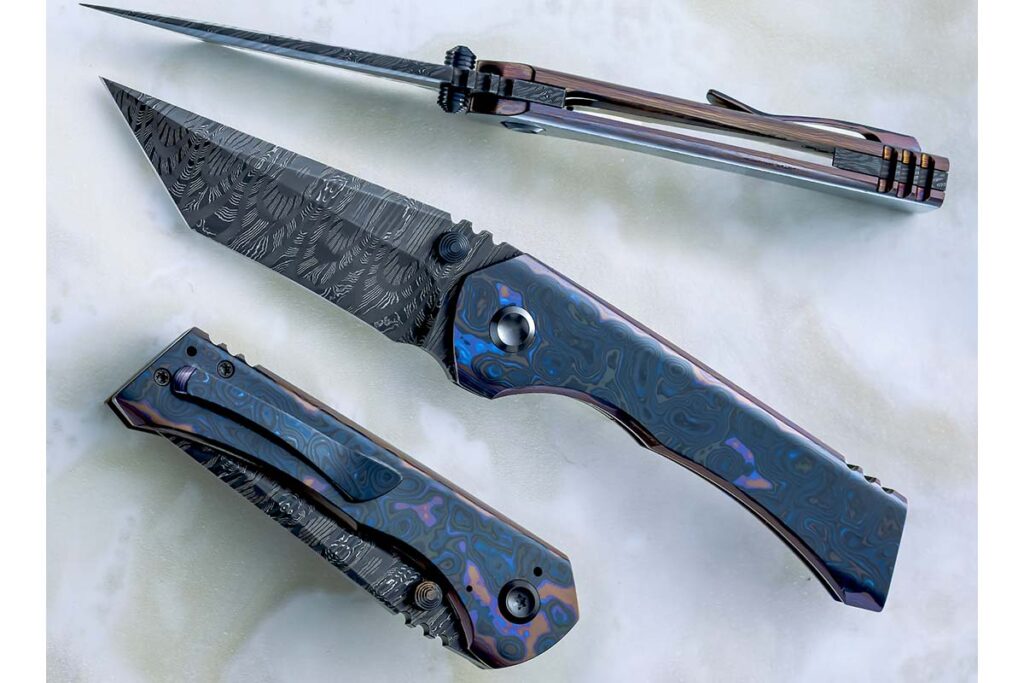
Not one of his everyday builds, the Taka v2s by Brian Brown features a notable blade, handle and lock.
Brian Brown likes a good, pointy tanto.
“It’s kind of a straight hollow grind all the way from the choil to the tip in a climbing grind,” he explained of the blade on his Taka v2s dress tactical folder. Grinding it that way helped him keep the blade extremely thin from the recurve edge to the tip. “You’ve got to be really careful [at the edge] because that’s gonna be the lowest spot where it gets thinnest the fastest—and I’ve burned through them before,” he noted.
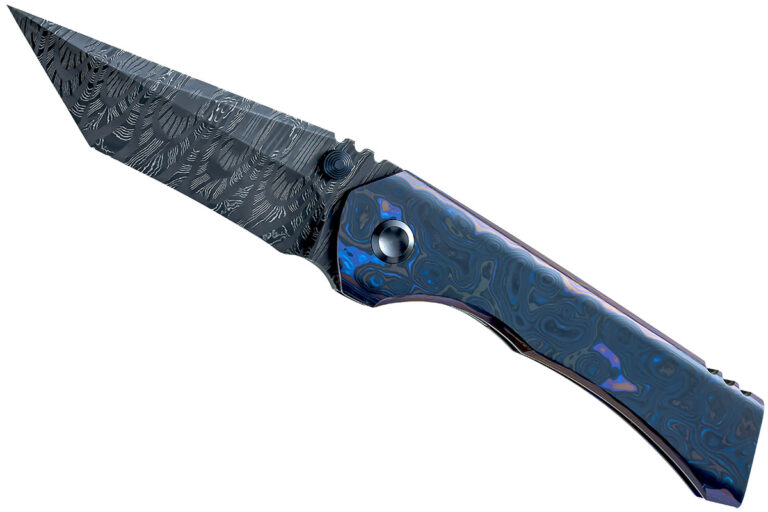
Brian Brown said he had to be careful grinding/removing the top layer of the Black Top Timascus™ handle material by Alpha Knife Supply or he would expose too much of the titanium and change the color—somewhat visible here on the spine. The 3.125-inch blade is FireClone 2 forged by Mike Norris, which Brian lauded as some of the best stainless damascus anywhere. Closed length: 4.375 inches. (SharpByCoop knife image)
Only the second one he’s done, the folder’s linerlock-like inset lock enabled him to use the fancy handle material paired with a straight, solid piece of Grade 5 titanium for the lockbar. There are several more steps involved but the upshot is the scales are symmetrical as with a linerlock—a symmetry Brian prefers to that of a framelock. Plus, the inset lock results in a thinner handle than with a linerlock because the lock side must be relieved to make room for the lockbar.