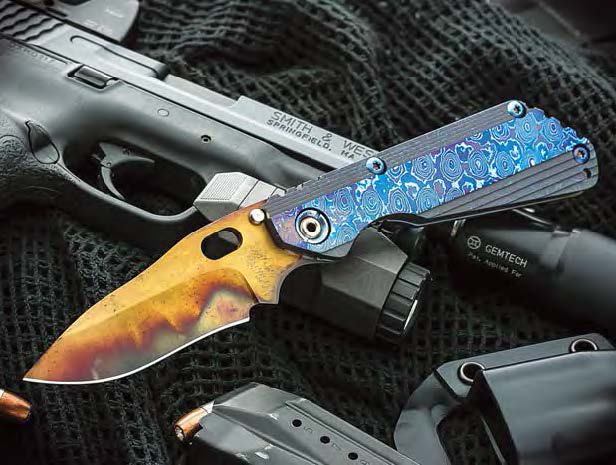
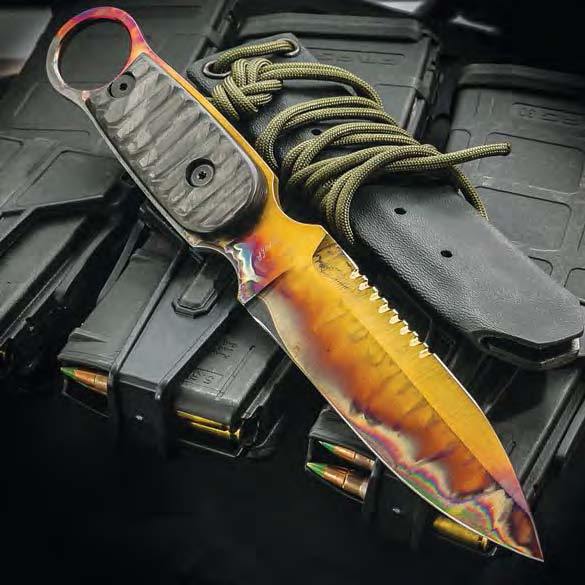
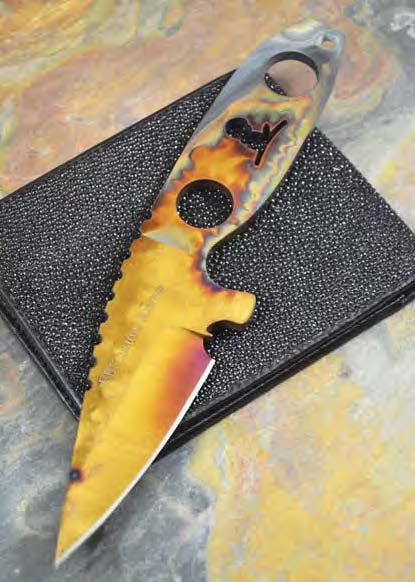
Knifemaking is the building of a knife, which includes the blade, handle and other accouterments. Blades are made by either removing metal from a steel blank via a grinder – known as stock removal – and the forging to shape of hot steel into a blade in the process known as bladesmithing. Other parts, including bolsters, guards, pommels, etc., are needed to complete the finished knife.
The thumb stud is reliable, time-tested and add dynamic dash to these customer folders.
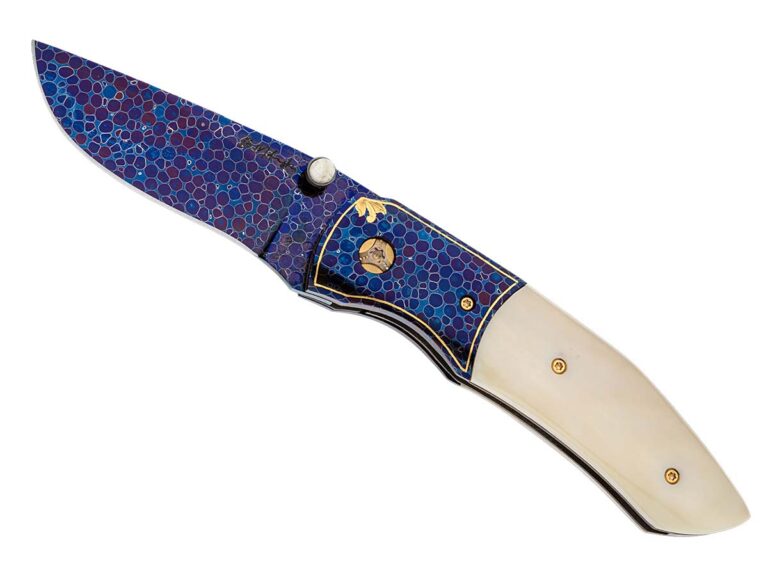
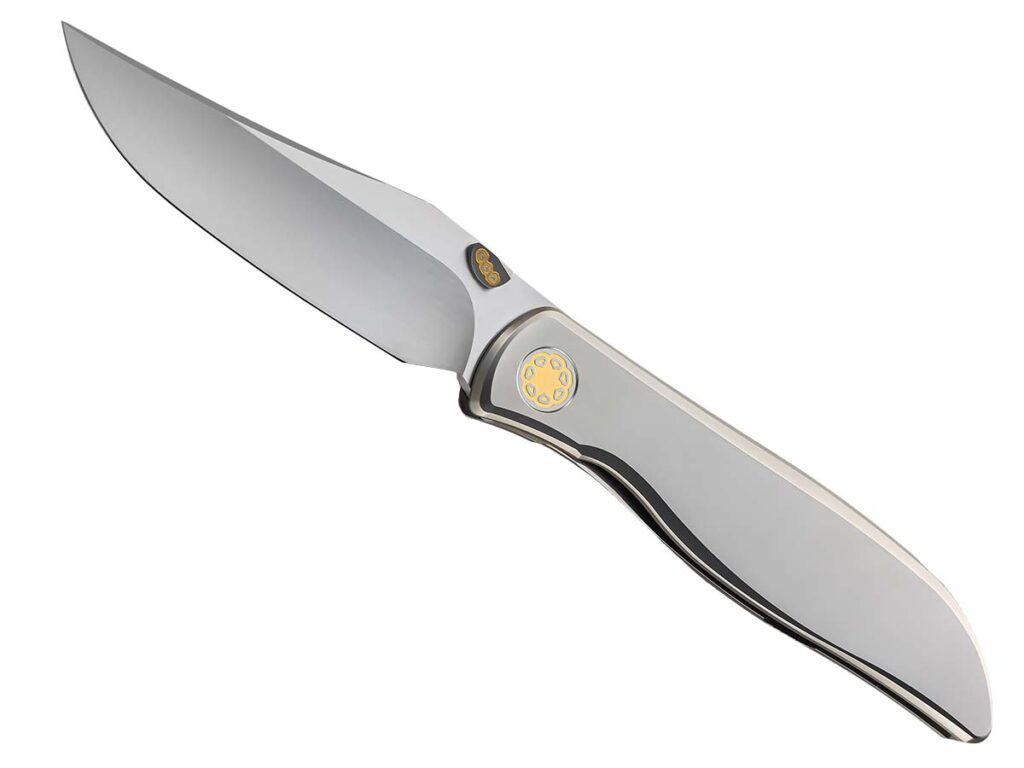
Aside from the good ol’ nail nick, thumb studs are among the most enduring opening systems for folding knives. Why not? Typically ambidextrous, easy to manipulate and lightning fast, the reliable deployment feature has a lot going for it. Not to mention, on these custom knives, they add equal parts dash and traditional appeal.
Michael Raymond: Ziura folder
Forty-nine 24k gold inlays set into a 6-4 titanium frame elevate Michael Raymond’s Ziura folder. The swedge-ground Bohler M390 blade measures 3.53 inches with an 8.08-inch overall length. (SharpByCoop image)
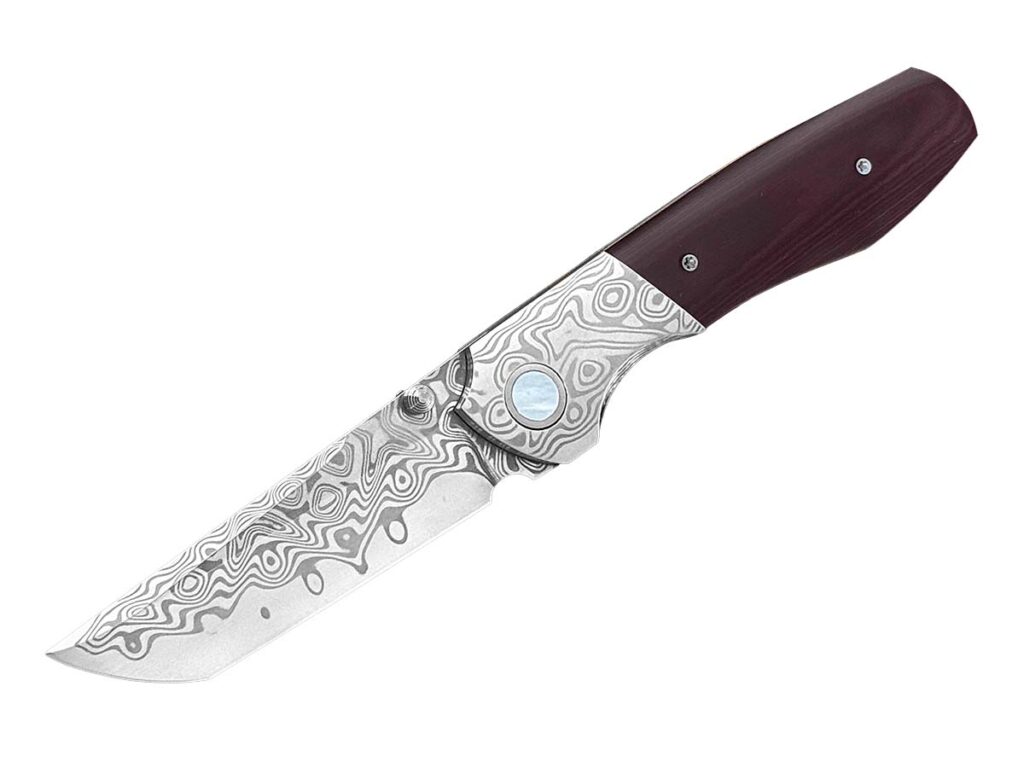
David Beaver: Shogun Horizon Folder
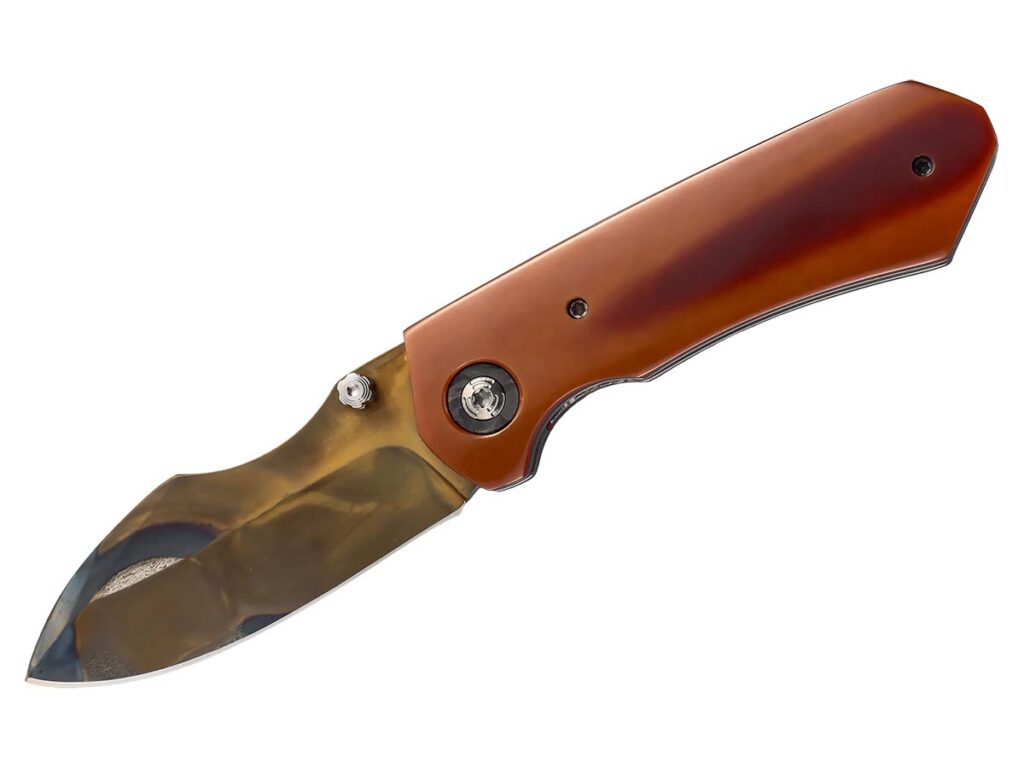
Vintage red linen Micarta scales and a hollow-ground Damasteel Baldur on Damacore blade highlight David Beaver’s Shogun Horizon folder. Blade and overall lengths: 3.75 and 8.5 inches. The maker’s price for similar knife is $1,800. (Jocelyn Frasier image)
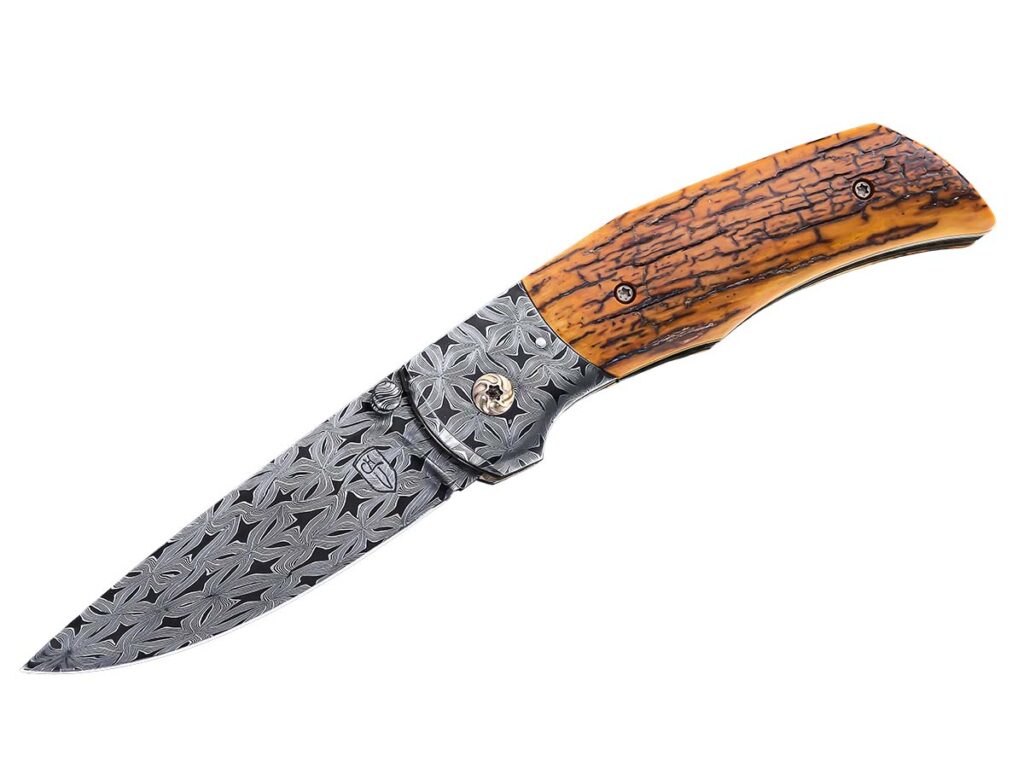
Cody Hofsommer: Mammoth Ivory Folder
Mammoth ivory scales and mosaic damascus bolsters define a sole-authorship flat-ground folder by Cody Hofsommer. The 1080/15n20 mosaic Damascus blade measures 3.375 inches with an 8-inch overall length. (SharpByCoop image)
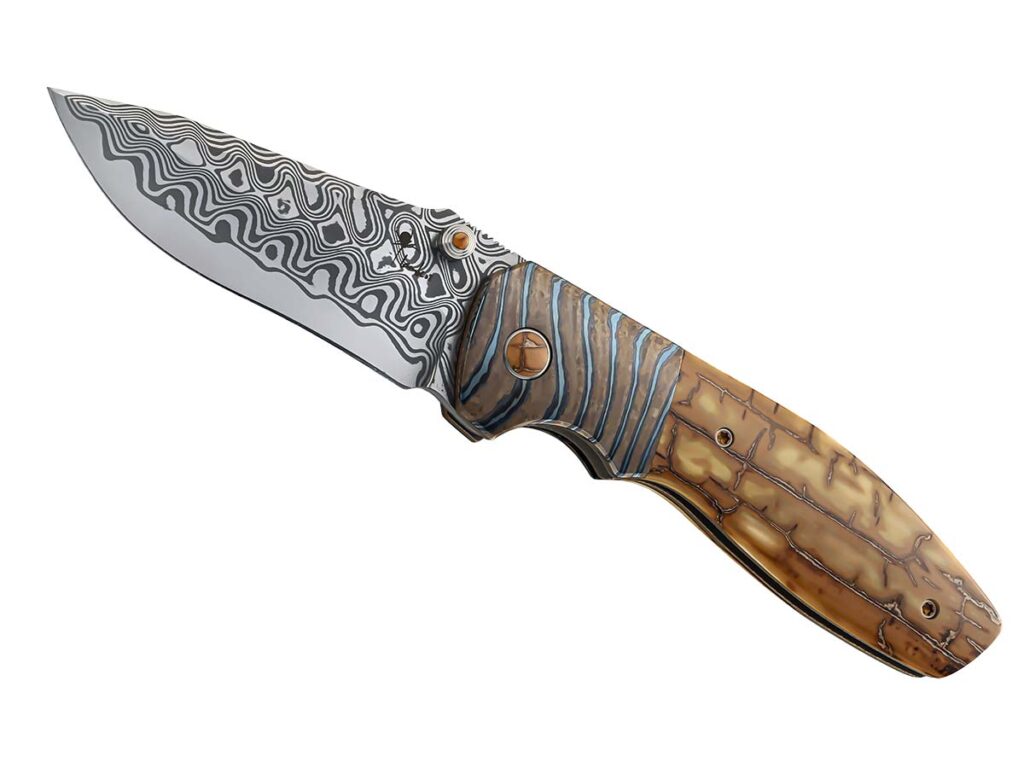
Kirby Lambert: Augustus Mini Folder
A hollow-ground Damacore blade and mammoth ivory scales distinguish the Augustus Mini folder by Kirby Lambert. Bolsters are titanium and 2IRC damascus. Blade and overall lengths: 3.25 and 8 inches. (SharpByCoop image)
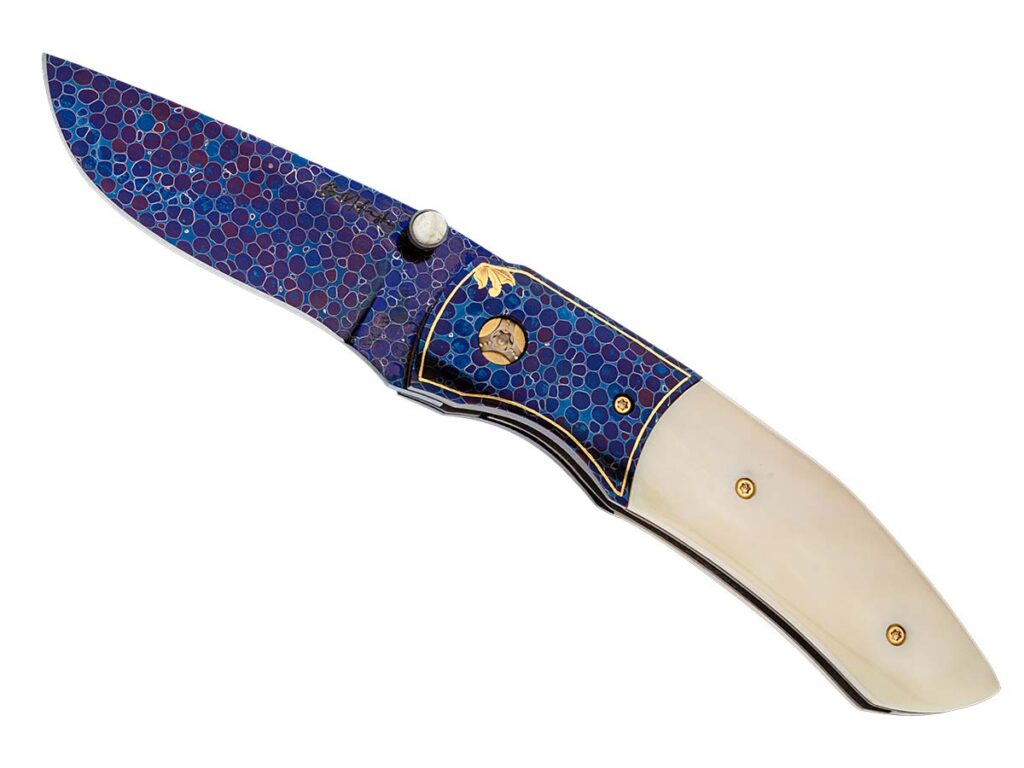
Brian Milinski: Paratrooper Elegante Linerlock
Nitre blued Rietveld damascus and fossilized walrus tusk scales characterize Brian Milinski’s Paratrooper Elegante linerlock. Joe Mason engraved and inlaid the matching bolsters. Blade and overall lengths: 3.25 and 7.75 inches. The maker’s price for a similar knife is $3,400. (Jocelyn Frasier image)
KC Gray: Titanium Folder
A 3.5-inch SM100 blade paired with vintage Micarta scales defines this 8-inch dress locking folder by Tucson maker KC Gray. The titanium frame includes marble carbon-fiber pivot collars and a black anodized clip. (SharpByCoop image)
Sean Alonzo: Ani
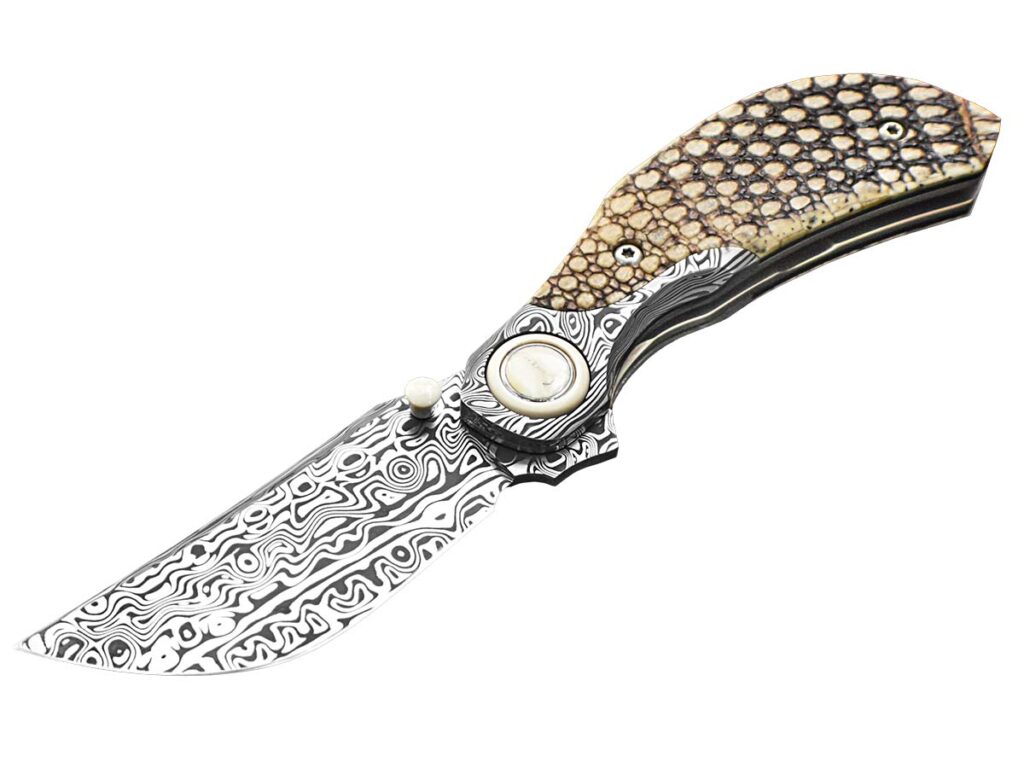
Sean Alonzo’s Ani 3.2 linerlock features armadillo carapace, warthog ivory, and a hollow-ground Yggdrasil Damasteel blade. Blade and overall lengths: 3.2 and 7.8 inches. Maker’s price for a similar knife $5,500. (Jocelyn Frasier image)
Knifemakers From Around The World Share What Equipment They Can’t Live Without And How It Helps In Creating Their Knives.
There are high-quality knifemakers on every continent. We chatted with some of the world’s best makers about what equipment and tools are must-haves for them in their shop.
Bertie Rietveld
Bertie’s Legacy Roman pugio in Dragonskin damascus with a Stanhope lens just below the guard and lapis lazuli cylinders with titanium spacers in-between is spectacular even by his high standards. Overall length: 16 inches. (SharpByCoop image)
One of the world’s leading makers of art knives, South Africa’s Bertie Rietveld is known for magnificent custom daggers and fixed blades, many in his Dragonskin damascus and with a Stanhope lens at the ricasso, a peek into which reveals whatever image Bertie likes to put there—usually the Stanhope logo.
Among his knifemaking equipment that proves invaluable to building his award-winning knives are his Rosa Italian precision drill presses.
“I have three of them,” he wrote, “each one set up with a different-diameter drill bit so I don’t have to change bits. The speeds are set to match the ideal speed of each drill bit in the chuck of each machine. They are super accurate and an absolute pleasure to use when drilling small holes. Each one has a light that automatically comes on when you start the drill. They’re probably 30 years old but I have rebuilt them to their former glory.”
Next on Bertie’s list of top knifemaking machines is his Schaublin 102 plain lathe.
“It was manufactured in 1961, which makes it a year older than me!” he grinned. “I have a full set of collets and chucks for it and use it a lot to turn small pins and pivots for my folders. It’s one of those machines built in the golden area of mechanical excellence: the 1960s. I love working on it because it’s very accurate and just a solid, well-built machine.”
Third among his most valuable knifemaking machines is his Cutlermatic belt grinder, which he built about 20 years ago when he ran Batavia Engineering.
“We built some 300 of these grinders for knifemakers at the time,” he recalled. “This machine has a whole myriad of contact wheels, from 2 inch to 20 inch, and is fitted with an inverter speed control. I use it to grind all my knives and also for hundreds of other grinding jobs. It’s probably the most used machine in my shop. It has a foot pedal to change belts and also some really bright LED lights on stalks so I can see where I’m grinding.”
The fourth machine is “Shaya,” Bertie’s “famous” 500-pound Massey power hammer. It was built in 1941 and he completely rebuilt it in 2000, a process that took eight years.
“I make all my damascus on this hammer, Dragonskin, Nebula, and Fracture, as well as other laminar damascus. It is a gentle giant but packs a mean punch when at full speed. Hardly a week goes by when I don’t have two or three forging sessions.”
Murray Sterling
Murray makes nothing but folders, including slip joints, linerlocks, and lockbacks. Among the latter is this fileworked and engraved straight-edge model in mother-of-pearl.
Murray Sterling turned 93 the first day of Spring and still makes knives like he’s 39. What are the most important pieces of knifemaking equipment for the self-described “old-school machinist” on the low side of 100 who’s been making knives for over three decades?
First are his four 2×72 belt grinders. He made three of them, including one he built 25 years ago that he uses 90 percent of the time.
“I hollow grind and profile all my folders and finish all my folders with it,” he wrote. “The only other grinder I bought new was a square wheel in 1989. I only use it for 45-degree scales.”
Next on Murray’s list is his Taft Pierce surface grinder. “This is probably the most important machine in the shop for making folders, and that’s all I make now,” he wrote.
The machine is over 50 years old and Murray bought it 20 years ago when it came available from a company his son worked for that was in the process of upgrading its machinery.
“In making folding knives, everything has to be flat,” Murray observed. “This machine is one of the best ways to achieve that. It has upgraded the quality of my folders by 100 percent. It also has a 2×72 belt attachment and, with a 60-grit belt, you can remove a lot of material fairly fast.”
Murray has four disc grinders, including two side-by-side models with 9-inch and 12-inch discs, the former with a 100-grit abrasive and the latter with a 320-grit one. Murray made the tables for the grinders 20 years ago. The motor for the 12-inch grinder is the original one from his square wheel grinder, the latter which he reoutfitted with a DC motor a couple of years after he bought it. The grinder on the fixed 45-degree table he uses for knife parts that need to be made square, such as backsprings for slip joints and lockbars.
The handiest machine in Murray’s shop is his Burgmaster drill press. He bought it in 1967 and uses it to drill 90 percent of the holes in his knives. It has six spindles, each of which runs at a different RPM.
“I can set it up with a tap drill, clearance drill, and counter bore for .080-inch screws,” he wrote. “It makes things quick and easy. I would hate to do without any of these machines. I also have a lathe and make my own bushings and pivot pins.”
Brian Tomberlin
An example of Brion’s knives is his Nagabowie—a Japanese-style blade with hamon complemented by a bowie handle.
ABS master smith Brion Tomberlin makes a lot of hidden-tang knives in his shop in Norman, Oklahoma, and a set of handle broaches he got from fellow ABS master smith John Perry are a must-have for that style of knife construction.
“They do a great job of opening up the slot for the tang in handle blocks,” Brion observed. “I bought the first two from John way back when there was a Spirit of Steel knife show in Mesquite, Texas, probably his first or second batch of them. I still use them all the time. They’re very finely crafted tools.
“Another must-have tool for me and most makers is a set of calipers. In order to get things fitted correctly, such as guards and getting the measurements on things like the depth of clips even on both sides, you need to have accurate measurements. A good knifemaker thinks in thousandths and you need to be able to accurately measure them. So, I have calipers everywhere. I’ve got to have them.”
Brion uses a Foredom tool on every knife that leaves his shop.
“It’s a super versatile tool,” he noted. “I’m sure everyone has used Dremel tools, especially the variable-speed models. But the Dremel tools wear out and I hear all the time that people keep buying them every two or so years because the tools stop working. So, save money and get the standard rotary-flex-shaft tool used in the jewelry trades. Just get a Foredom tool and you will not regret it.
“Mine is variable speed and reversible and that is what I suggest. I bought it from an old name in knifemaking supplies, Mick Koval [of Koval Supply], over twenty years ago. It’s still going strong. There is so much you can do with them and they have so many attachments. Rio Grande and Gesswein jewelry supply are knifemakers’ friends. I use this tool for guards, contouring buttcaps to match stag, polishing things, carving, etc. It has so many uses.”
Another tool Brion uses on every knife he makes is his trusty file guide.
“The shoulder filing guide or just plain file guide should be standard in every maker’s shop,” he advised. “My main one is a carbide-faced model from Riverside Machine in DeQueen, Arkansas.
“You need to get the shoulders on a blade flat in order to get the guard to fit up correctly,” Brion wrote. A file guide will do that. “Also, with the carbide faces you can use the guide with grinding belts to get the plunges even. I bought this years ago when Uncle Al [Alton Lawrence of Riverside Machine] first started making them. It has served me well. You don’t have to have the carbide faces as there are hardened steel file guides too, but pay the extra money and get the carbide—you will not regret it.”
Rounding out Brion’s top knifemaking tools are his machinist squares.
“You have to be able to lay out lines and have them be true, everything from laying out guard slots to making sure things are 90 degrees, such as platens on grinders,” he advised. That’s where the machinist squares come into play. “You have to have them and they aren’t expensive. Making sure your layout lines are correct will help you make better knives,” Brion concluded. “Every knife shop should have them.”
Ben Seward’s breacher SWAT Axe salutes officer’s 21 years of police service
When ABS journeyman smith Ben Seward went to make his first axe, he didn’t settle for something easy—he went the whole hog on a special breaching model as a retirement gift for a 21-year law enforcement veteran.
Sgt. Magnus Gervol retired from the Whatcom County, Washington Sheriffs Office after a career that included 15 years on the SWAT team and 14 years as a sniper.
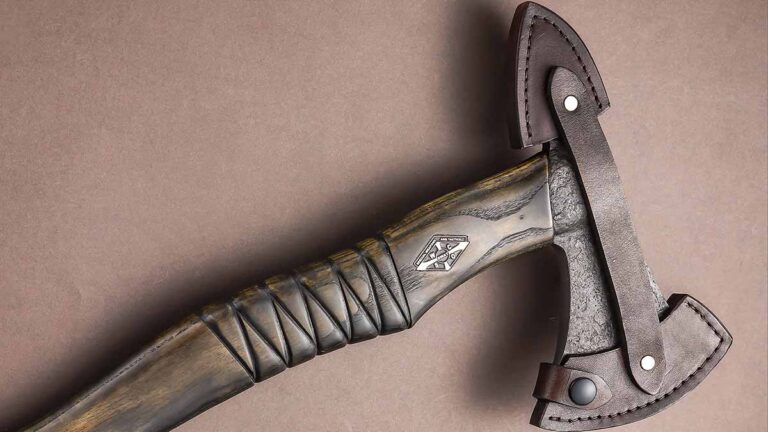
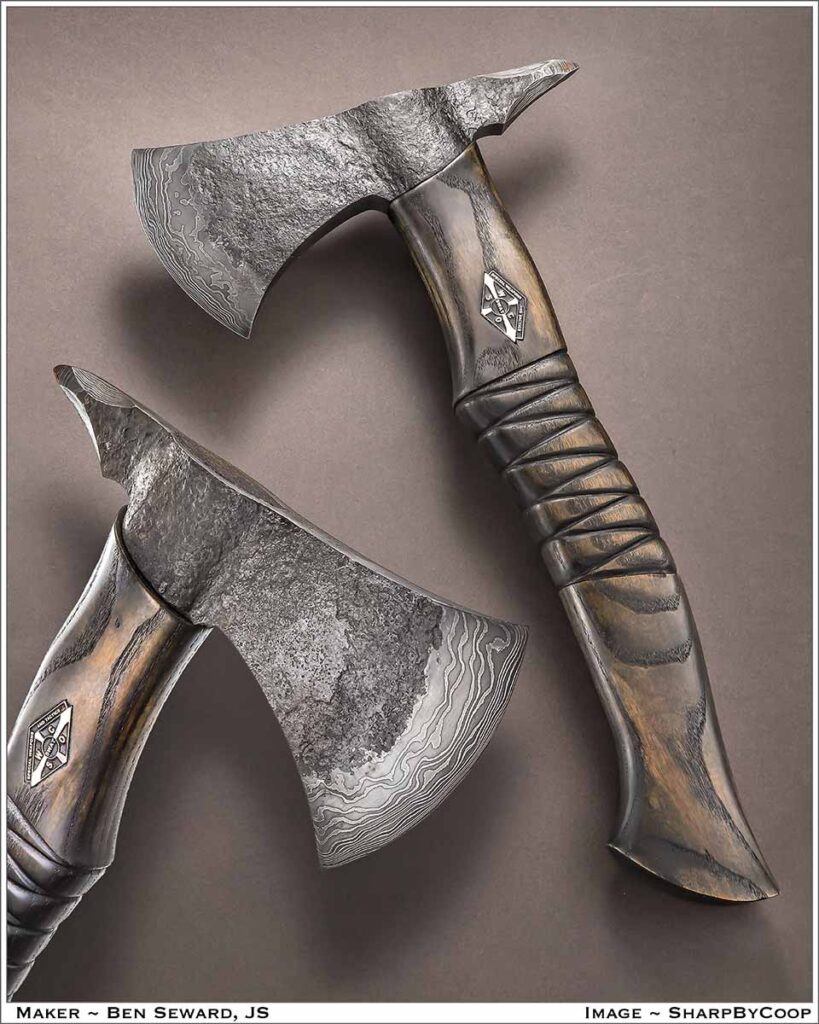
Members of the Sheriffs Office contacted Ben, who forged the axe from the barrel of a Remington 700 SPS tactical sniper rifle. The idea was to make a tactical axe with a beard and a tomahawk spike. The handle is Ozark white oak. Ben’s dad, David, who specializes in sheaths, made the leather sheath.
Ben forge welded the rifle barrel into a bar and layered it up with other carbon steels. He forged the two flats of the head roughly into a triangle and pieced in the bit for the cutting edge. All of the head, including the edge and spike, is forged of the same damascus.
SWAT Axe Specs Maker: Ben Seward Head Size: 7.75” Bit Size: 3.5” Head/Bit Material: Damascus forged from the barrel of a sniper rifle and 1080 carbon and 15N20 nickel-alloy steels; includes a rough-forged finish Handle: Ozark white oak Handel Length : 14” Maker’s Price For A Similar Breaching Axe (excluding the steel from the sniper rifle): $1,500
Nitinol, also referred to as “Ni-Ti-Nol,” was first discovered back in 1959 by scientists William Buehler and Frederic Wang at the Naval Ordnance Laboratory. The Ni-Ti-Nol acronym stands for “Nickel-Titanium-Naval Ordnance Laboratory.”
Beuhler and Wang were searching for a super-elastic alloy for missile nose cones that would be pliable at extreme heat, yet return to its original shape after cooling. Their efforts were a success, but because the incredibly tough alloy was so difficult to process and machine, it wasn’t used until much later.
Knifemaking Discovers Nitinol a Half-Century Later
Duane Dwyer of Strider Knives was the main force behind SM-100 (HIPTiNite), and his signed custom Strider MT2 showcases a brilliantly heat-treated SM-100 blade mated to machined carbon fiber handle scales. (Brady Miller image)
Custom knifemaker Duane Dwyer of Strider Knives became interested in Nitinol back in 2005 while searching for a super hard metal alloy that would not rust. He approached metallurgist and friend Scott Devanna, vice president of technology at SB Specialty Metals, and inquired about the possibility of producing Nitinol using the particle metallurgy process, which had never been done.
Shortly afterwards Devanna introduced Dwyer to Eric Bono, a metallurgist and knifemaker who also had an interest in the alloy, and the three men began to explore the possibilities of incorporating the alloy into knives.
Nitinol Becomes SM-100 (HIPTiNite)
Duane Dwyer of Strider Knives was the main force behind SM-100 (HIPTiNite), and his signed custom Strider MT2 showcases a brilliantly heat-treated SM-100 blade mated to machined carbon fiber handle scales. (Brady Miller image)
With his metallurgical knowledge and experience, Bono developed a working, powdered metal version of the alloy in 2006, which the partners dubbed “SM-100.” It took several more years to refine the alloy and processes, and in 2009, Bono and business partner Fred Yolton formed a company, Summit Metals LLC, to produce SM-100.
Since that time, SM-100 (60 percent nickel and 40 percent titanium), which the company markets under the name “HIPTiNite,” has garnered interest not only in the knife industry, but also by NASA and the Formula 1 racing industry.
Properties of SM-100
The SM-100 brand of Nitinol, like its forerunner, is extremely tough. While a typical sanding belt can be used to grind several typical, mono-steel knife blades, it requires several belts, in many cases six or more, for the same process using the SM-100 alloy.
Made and sold in small quantities, the cost of SM-100 isn’t cheap. Add to that the cost of belts and additional time to shape and grind the material, and the cost per knife skyrockets.
On the positive side, SM-100 is noncorrosive, and while stainless steel will rust, Devanna says you can throw an SM-100 knife into saltwater for 50 years without the material corroding.
An Explosion of Coloring
Bono discovered during his development of SM-100 that it can be heat colored into an exquisite rainbow of colors. Due to the titanium content, SM-100 oxidizes into a blaze of bright hues just like other alloys incorporating titanium, but the process of achieving the color effects is quite different.
Bono confides that the magic happens during the heat-treating process, in which he allows small pockets of air to leak onto the surface of the knife. Prior to heat treating, the blades are wrapped in foil and small holes are punched into the wrapping.
When heat treated, different colors occur depending on the oxygen content of certain areas of the blade material as the surface oxidizes. The end result is the explosion of color on the SM-100 blades.
The price for bright, eye-popping colors doesn’t come cheap, but then new innovations rarely do.
Survival instructor, author and TV star Creek Stewart cross-carries a Whiskey Knives Corvid.
When Matthew Stewart was 5, his grandfather gave him a nickname that would chart the course of his life. “I was always playing in the creek,” said Creek Stewart, survival instructor, author and star of The Weather Channel’s now-cancelled “Fat Guys In The Woods.” No matter the time or weather, the boy was at the creek—happy. Not much has changed, except the budding outdoorsman of yore has now built an empire on his comfortable, family-friendly style of survival instruction. All things Creek also includes the soundly crafted, old-timey line of Whiskey Knives, which in addition to being ideally designed for bushcraft and easy on the wallet, also offers some scaled-down versions of classic styles that hands of all sizes can control. You can read all about Whiskey Knives and how they are made in an upcoming issue of BLADE magazine. If you’re not a subscriber, sign up so you don’t miss it.
Creek is “everywhere” and there are good reasons for that, not least being that he is genuinely warm and friendly. “I like working with people,” he said. Creek was a Boy Scout and an Eagle Scout. The first E in the CRE///K logo is representative of a scratch from an eagle’s talons. He continues to be a devotee of the Boy Scouts of America and a counselor for the Wilderness Survival merit badge. He lives the Be Prepared Boy Scout motto, and opted for Not If But When as his own tagline. Yes, scouts are being taught all kinds of skills, explained Creek, “but they’re also building character and learning life lessons.” He listed perseverance, teamwork, manners, camaraderie—all things the Boy Scouts instilled in him.
At Butler University in Indianapolis, Creek first perused a pharmacy major, but the misdirection, the urban setting and a campus crow that thought it was an alarm clock brought him to an awakening. You can read about his adventures trying to snare the bird on his website at The Crow, but in summary, the crow reawakened Creek’s inner woodsman. He decided he wanted to teach wilderness survival skills and set about making it happen.
He settled on a business major, a plan that would serve him well. During his sophomore year, he wrote and illustrated a wilderness survival field manual that collected his knowledge at the time. He had the book printed and spiral-bound, and offered free classes at Boy Scout troops to peddle it. He sold books, but he longed for a way to bring his customers to him rather than traveling to them. He asked his parents if he could teach a class in the woods on the family farm. Although still unnerved by his switch in major, they agreed. He sent out press releases and 15 people showed up. He’s been teaching ever since, part-time for many years but never quitting on his dream.
Creek’s business schooling helped him hone his marketing strategy. His many brands include, in addition to Whiskey Knives, Willow Haven Outdoor Survival School where he teaches one-day and weekend getaway survival courses on his 20-acre property, complete with lodge, in Anderson, Indiana. He also is lead instructor for the Escape The Woods challenge, which takes place at various locales around the country. The Not If But When Survival Store, which his parents now run, offers a collection of widely available survival items. And, Apocabox is a bimonthly subscription; six times a year members receive a box of survival tools and gear, hand-picked by Creek. It also includes a challenge that you can practice in the calm and comfort of a non-crisis. For instance, the December box included instructions on making snowshoes from your Christmas tree.
Creek’s overview of Whiskey Knives includes a revelation: his first knife.
Creek also saw that writing was going to be essential to reaching the right people—namely men and women of all ages and abilities. (While other survival instructors might emphasize immersing you in a survival scenario while you’re still learning, Creek feels that people absorb more and retain it longer, if they’re warm, dry and fed.)
His best-selling book is “Build the Perfect Bug Out Bag,” but he offers one on putting together a bug-out vehicle, two on survival skills and an intriguing one on the survival skills used in “The Hunger Games.” But Creek has also written two fiction books. “Stuck” is a short story about a Boy Scout dropout who through a series of bad decisions finds himself in a crisis situation—quicksand!—that he can only survive by using what he learned in scouting. “Rugosa” is a young-adult romance, due out this month. The novel has been in the works for six years. “I’m really sticking my neck out on this one.” Creek is anxious to see if his fans “get” it. “I’m a survivalist, but I’m also a person,” Creek said. (Check back for an upcoming review.)
Some people learn about Creek via completely different avenues. They may read some of his guest posts on The Art of Manliness blog and other websites. “I’ve known Brett (McKay, founder of AoM) a long time. I’m so proud to be a part of that,” Creek said. The Art of Manliness celebrates men stepping boldly into their roles as men, husbands and fathers, and includes articles on everything from health and style to relationships and how to survive in the wild. Creek has also been a guest on television shows such as TODAY, Inside Edition and Fox & Friends. He’s been featured in magazines like Men’s Fitness, Backpacker and Outdoor Life. And he was the star of The Weather Channel’s hit show, “Fat Guys in the Woods.”
When IBM purchased the digital portion of The Weather Channel in 2015, many programs were slashed, and “Fat Guys in the Woods” was just one of them. The show provided Creek with the ideal outlet for his wildlife survival instructing and was an inspiration to viewers who wanted to spend more time in the outdoors or jumpstart a healthier lifestyle. Three sedentary buddies would spend a week with Creek, learning survival basics. The last 24 hours would be spent alone, each man building his own shelter and fire. Creek would award one of them with a knife-sheath set. One would stand out as needing encouragement, or being there for the right reasons or excelling in a certain skill. “He gave it everything he got—a job well done,” as Creek put it.
That kit was an Ontario Knife Company’s Black Bird SK-5 wilderness survival knife with a sheath designed by Paul Scheiter of Hedgehog Leatherworks. It was the sheath that had Creek thinking about how to fine-tune the products he offered going forward. “I love my parents, and every day I get to spend with them (at Not If But When) is a blessing,” Creek said. He’s also happy to provide a place where people can find all the products he recommends in one place. But what he really likes is working with small American businesses that reflect simple, well-made, traditional craftsmanship. “I like things that have a story.”
That quest for mom-and-pop entrepreneurship and throwback workmanship with a story behind it, is what led to one of Creeks proudest collaborations: Whiskey Knives made by Reptile Toolworks in Kentucky. To read more about this partnership and exactly how Whiskey Knives are constructed, be sure to subscribe to subscribe to BLADE magazine.
BLADE Magazine is all about the blade: what it’s made out of, how its made, to what specifications and even who makes it. Be sure to keep your issues coming as the months tick down to BLADE Show, June 2-4 in Atlanta, Georgia. At $21.98 you’ll save 70 percent off the newsstand rate. Other options include digital, Canadian print and International print subscriptions.
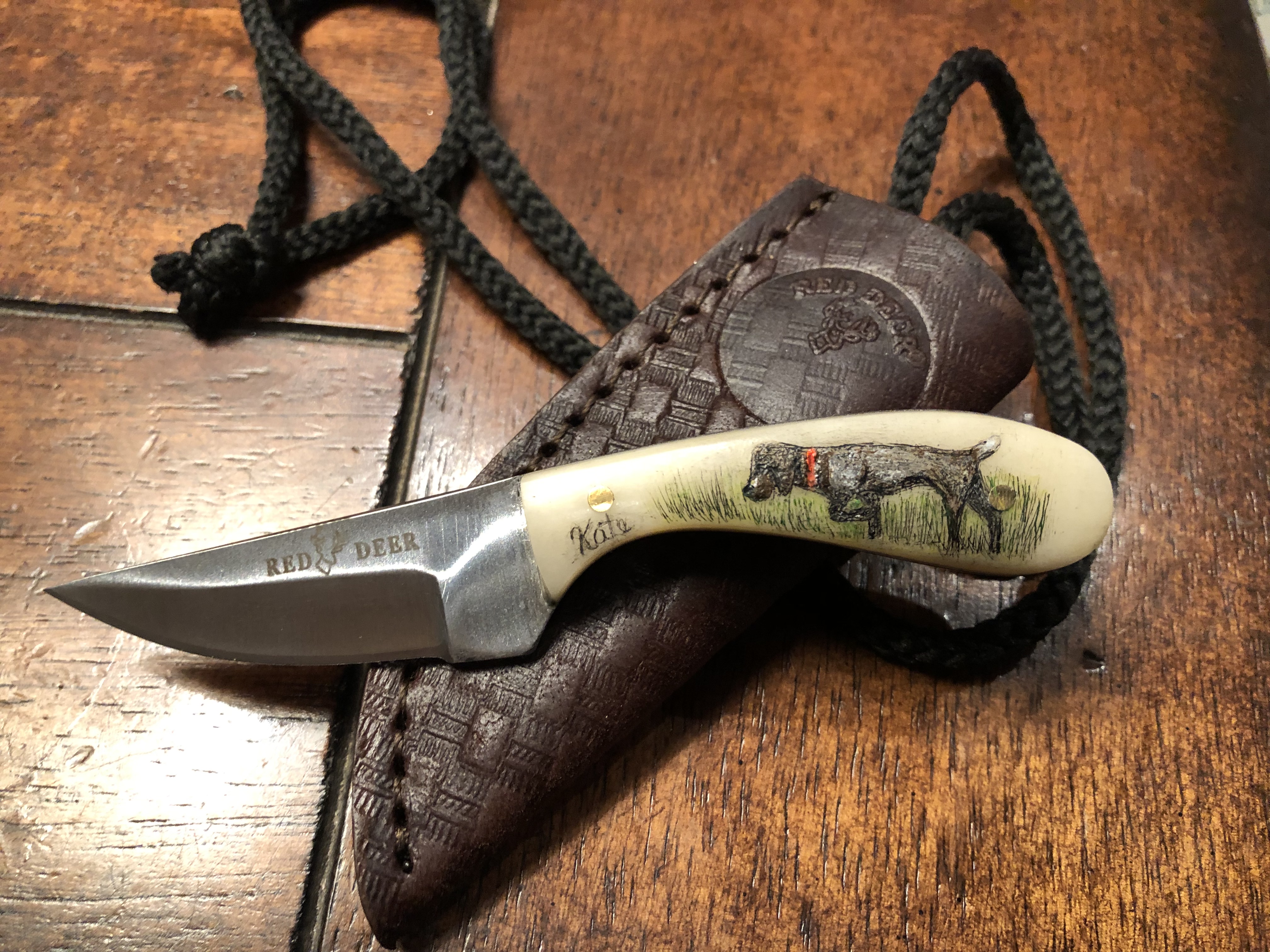
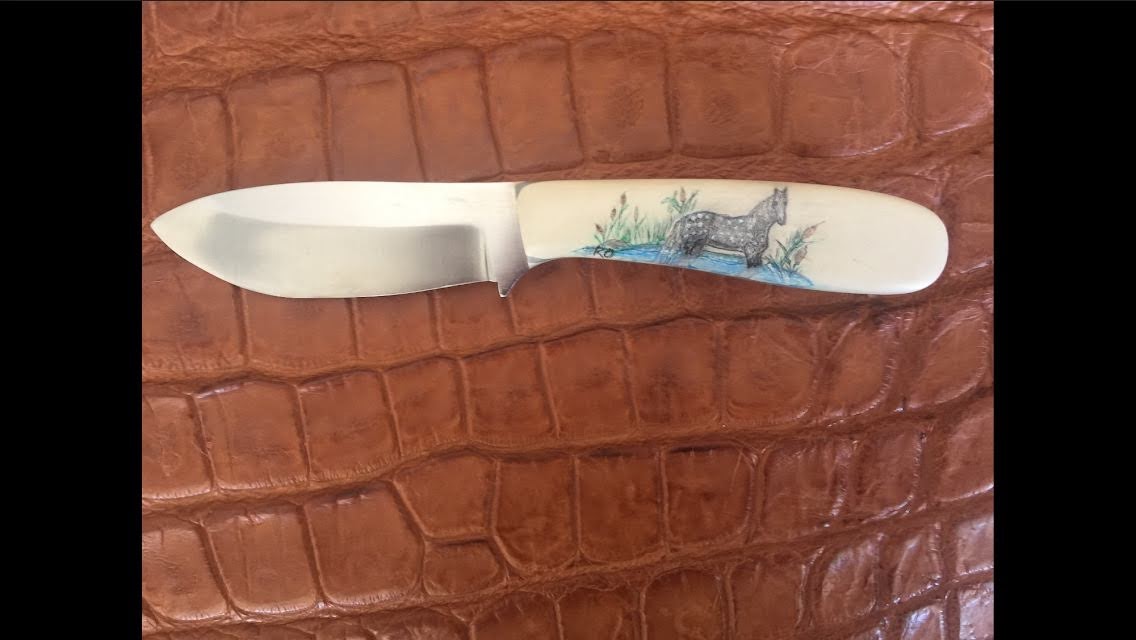
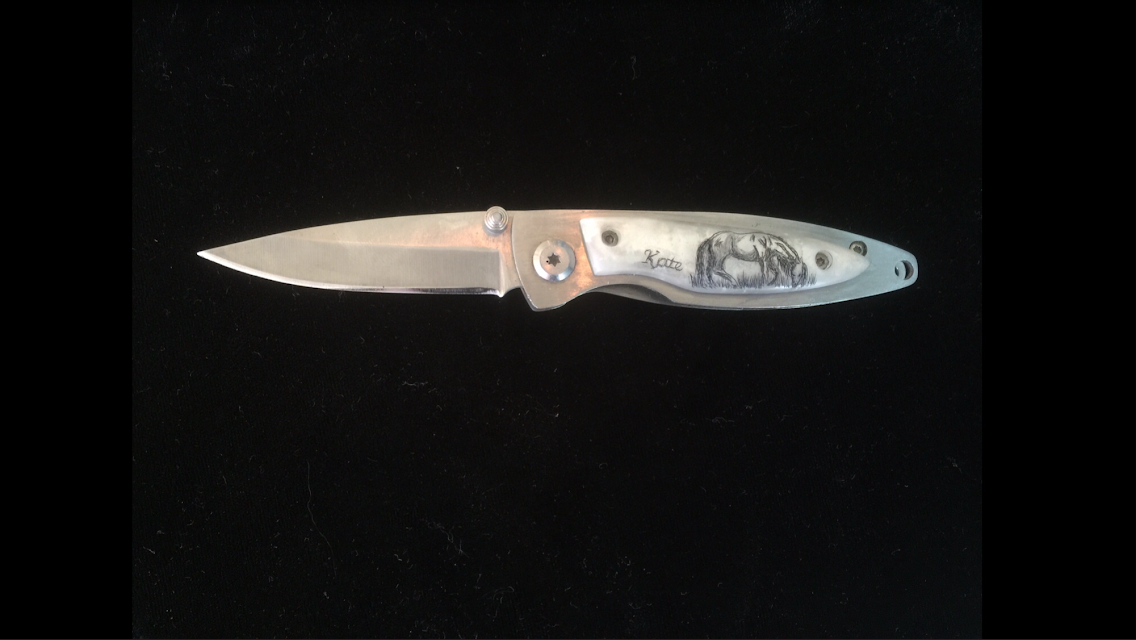
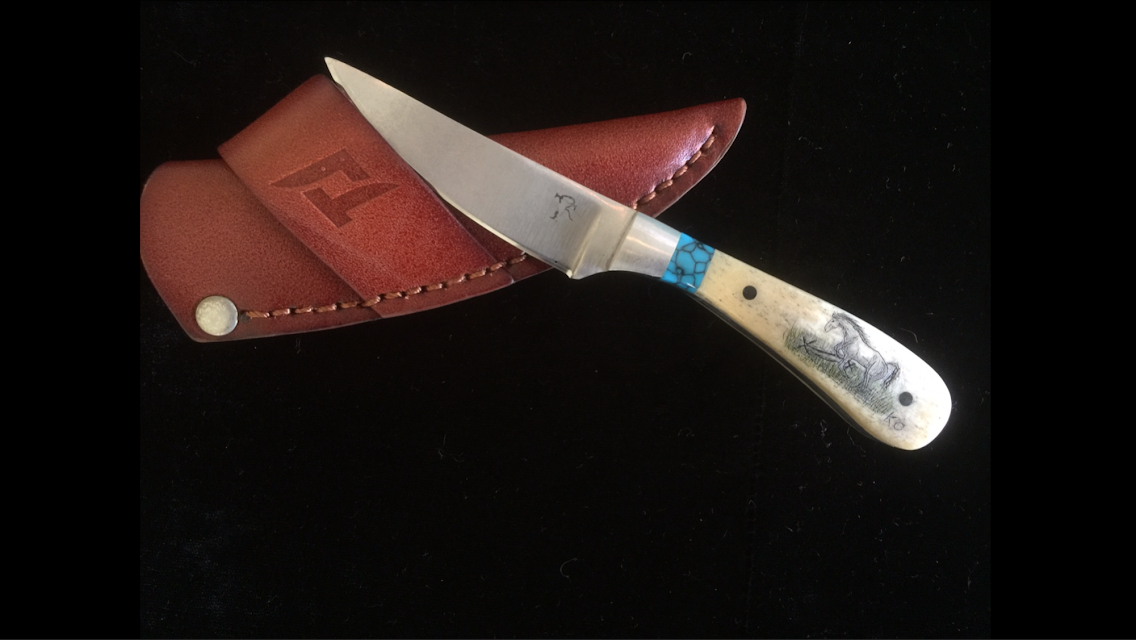
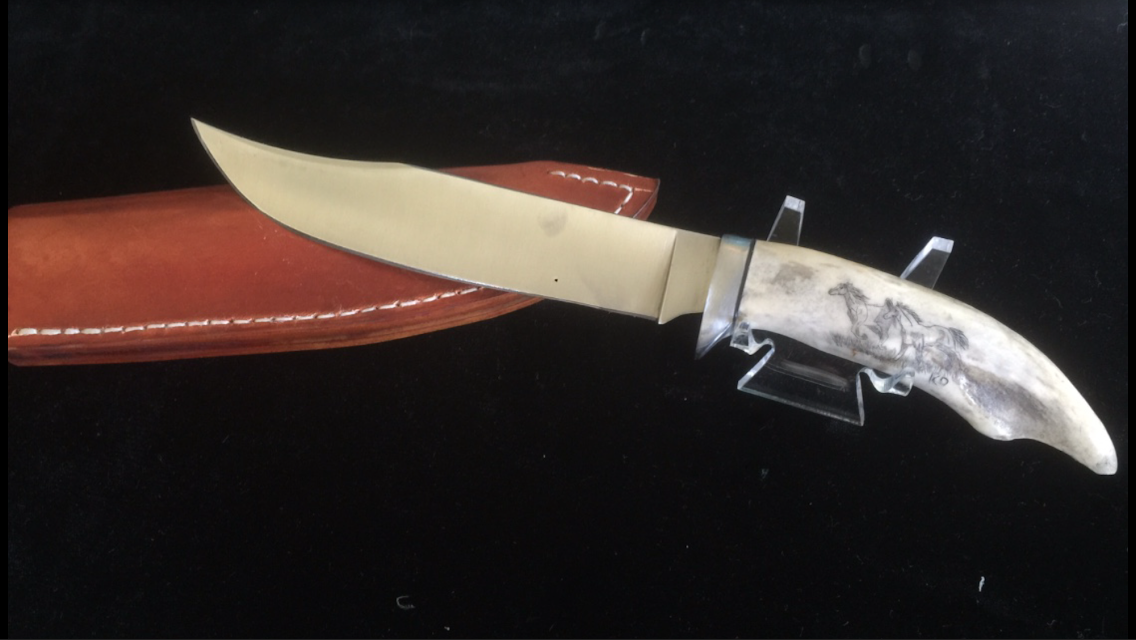
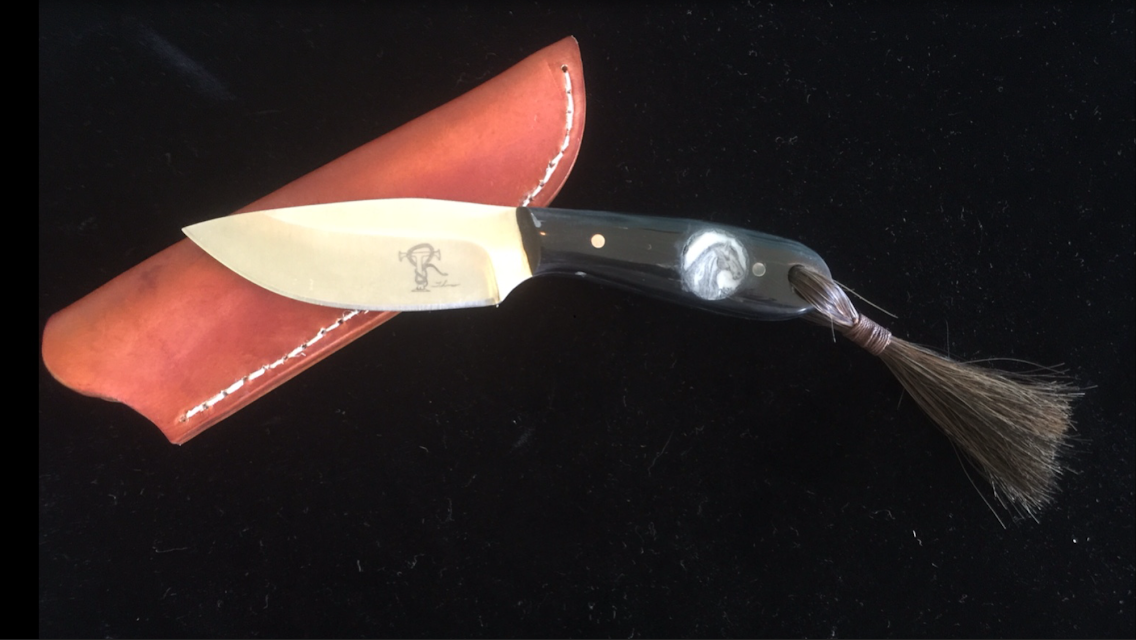
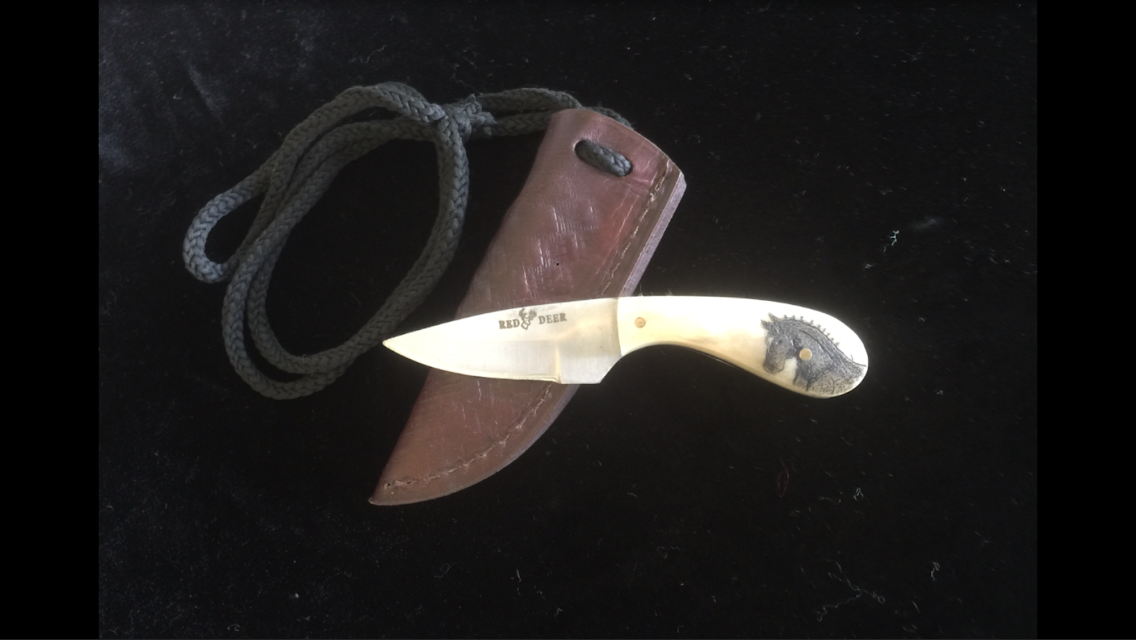
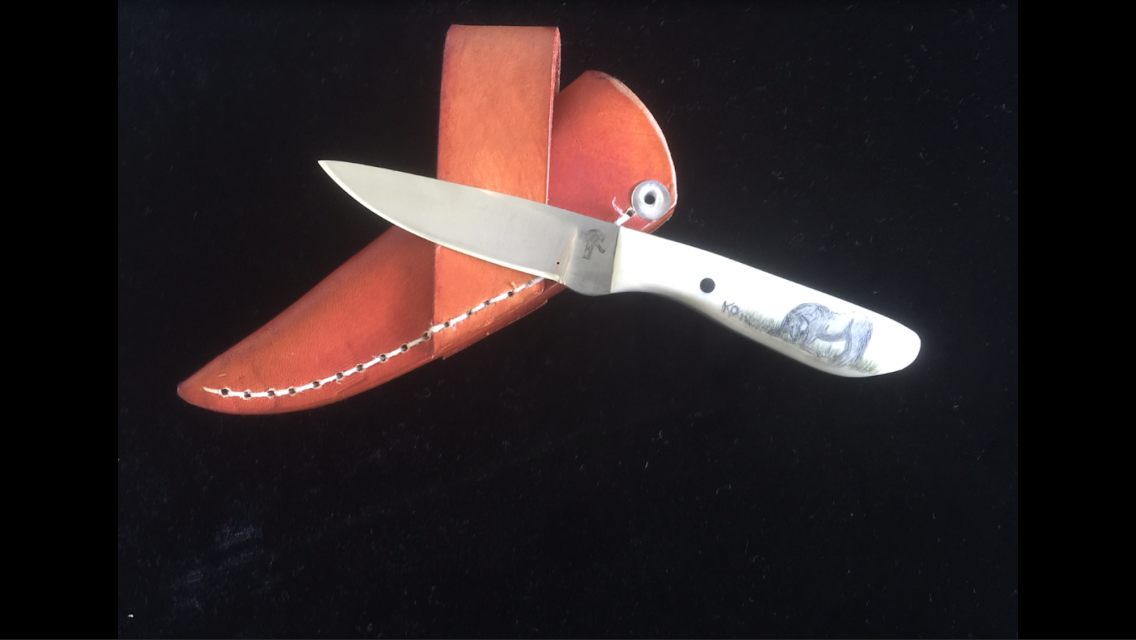
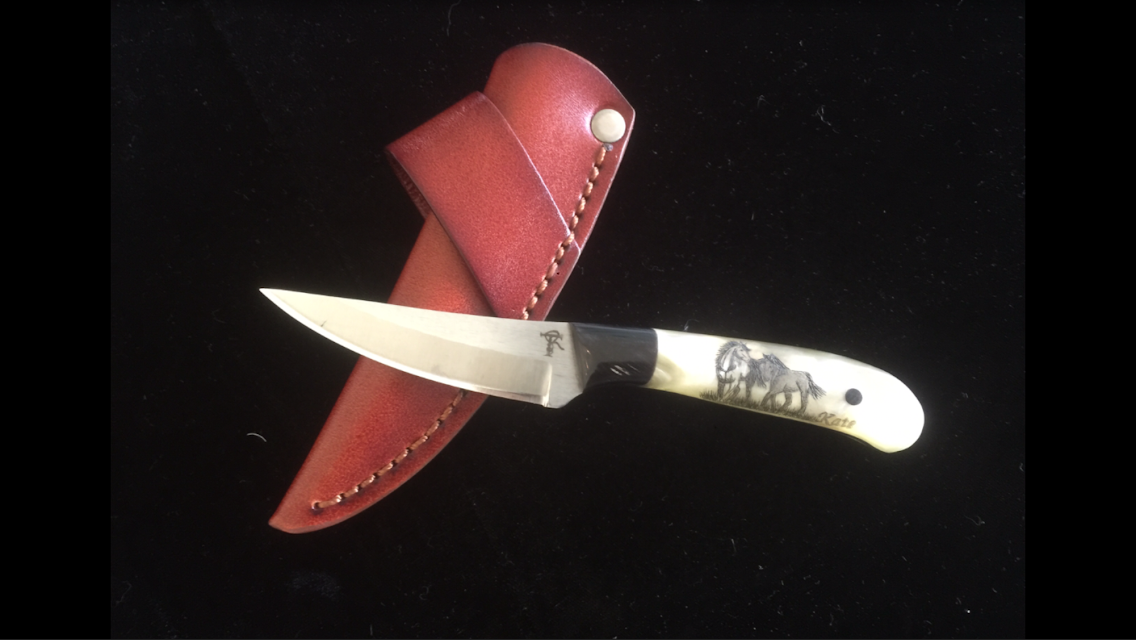
Kate Opre, of Montana, is still in high school, but she’s taking up scrimshaw in a way that’s catching the attention of many in the knife world. Who says the kids aren’t all right?
Opre wrote to BLADE about why she’s interested in this rich tradition, and she sent in some of her work. Who are we to keep such feats to ourselves? With her parents’ permission, we’re running her submission here.
How a High Schooler Came Into Scrimshaw
For Opre, the permanence of scrimshaw is part of the appeal.
“I love all forms of art, but scrimshaw is really special,” she wrote in an e-mail. “It’s a challenge because you can’t really erase; if you mess up you have to sand off the whole thing and restart.”
That requires focus, something it seems is in short supply in today’s technology-drenched world.
“It takes a lot of patience to scrimshaw. Some pieces take days, but others could take months to complete,” Opre wrote. “Not very many people know about scrimshaw anymore. Hopefully, I can have the opportunity to show people what scrimshaw is.”
She trained under Thomas and Debi Rucker (Knives By Thomas), and she makes knives in addition to handling the scrimshaw. Horses are a favorite design, and she displays her work at horse shows.
By the looks of things, BLADE expects a rewarding career to come. Keep going!
GiantMouse is pushing the boundaries of two renowned Danish designers, but together with an American businessman are building a better collaboration model.
By now knife industry followers know that renowned Danish knife designers Jesper Voxnaes and Jens Anso teamed up to create GiantMouse LLC. What you might not know is that a California businessman with a love of knives became the organizational drive behind the endeavor. Jim Wirth asked a simple question over beers with Voxnaes and Anso that solidified the venture, and bettered the collaboration model creatively and financially.
When Wirth turned 14, his older brother Chris gave him a small Gerber pocketknife with mother-of-pearl scales as a birthday present. He loved looking at that work of art, and yet, the knife got plenty of use too. From then on, Wirth began attending knife shows, like the former Bay Area Knife Collectors Association show in Santa Clara. He joined that organization so he could attend the meetings and learn more about the knife industry.
His love of knives—and watches—grew and he continued to attend shows, adding the New York Custom Knife Show and BLADE Show. Meanwhile, he developed a data warehouse-business intelligence firm that became an Inc. 500 Fastest-Growing Company. After a merger, Hewlett-Packard bought the company, and Wirth was set as far as his family and living expenses were concerned. He began consulting, advising owners of young businesses and angel-investing, or backing business that show promise.
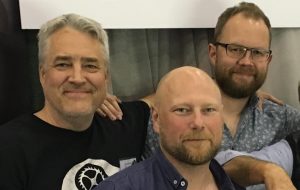
Jim Wirth, left, a businessman and angel investor, suggested that Danish designers Jesper Voxnaes, middle, and Jens Anso, right, start a new company to produce knives they collaborate on, sharing in profits rather than receiving a royalty percentage.
Wirth had always been a fan of the work of Voxnaes and Anso, so at a BLADE Show, although he’d met them before as a customer, he was more formally introduced to the men through a common friend. Over drinks, Wirth inquired about the royalties each knifemaker was making in their partnerships with well-known manufacturers. Although mum on details, designer royalties on any manufacturing collaboration range from 3 to 7 percent, sometimes as high as 10, of net sales. There are countless variables that determine the final cut, however, according to numerous sources in the knife and product development industries, 5 percent is thought to be fair for both the designer and the factory that takes the risk on whether the product will be a success or not.
Voxnaes and Anso revealed that they had indeed co-designed some knives together. They had even come up with a potential company name, GiantMouse, because Denmark is a tiny country in a giant world and they wanted GiantMouse to be a small knife brand in a giant knife industry. Wirth asked why they hadn’t produced these knives they’d worked on. And with that question, GiantMouse came into being.
The P in the GMP2 version stands for pirate and if you look closely, the mouse logo is wearing an eyepatch.
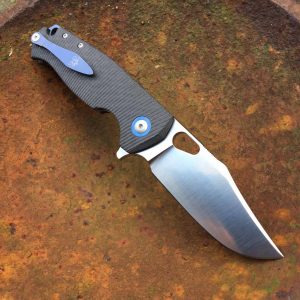
The three men determined that they would only do limited runs of folders four times a year, 300 in a standard finish and 100 in a special finish. These 100 “pirate” versions would include the GiantMouse logo with a patch over its eye. The GM2—GM for GiantMouse and 2 for sequential order—for example, is a full-size everyday carry folding bowie with carbon fiber handle scales. The backspacer, clip and pivot ring are a rich blue anodized titanium. The nested lockbar is also titanium. The 3.3-inch blade is made of Bohler M390 Microclean powder corrosion-resistant martensitic stainless steel with a satin finish and is ground to a 0.157-inch thickness. The handle length is 4.62 inches, and the knife weighs 4 ounces.
The GiantMouse team knew they always wanted to have some knives available for sale, so they do not limit sales of their fixed knives like the GMF2.
Although the folders are discontinued as soon as the 400 pieces sell out, the GiantMouse fixed-blade runs are unlimited. The GMF2—F for fixed—for example, with leather sheath, is a throwback to a Nordic work blade that can be used for everything from bushcrafting to everyday tasks. The 3.62-inch blade is made of Bohler N690 cobalt high-performance powder steel, ground to a 0.157-inch thickness and finished in a fine stonewash. The 4.43-inch Micarta handle brings the overall length to 8.12 inches. The knife weighs 4.1 ounces.
The way the designers look at it, according to Anso, is that by working very closely and combining their skills, each designer is forced out of his individual comfort zone. Integrating each maker’s ideas and style without compromising on design quality is “a difficult task but makes for a very strong design if done right.” It’s important to each man that the other is able to vouch for everything involved in the design. Both must be happy with the final result of each knife.
Anso and Voxnaes both started making knives in 1989, and they both lived in rural northern Jutland, only about 30 miles apart. They didn’t actually meet until 2005 at a small knife show. They instantly hit it off and have been close friends and colleagues ever since, explained Anso.
The two friends met Wirth at a BLADE Show when Wirth was collecting knives. “With Jim’s well-known talent for business, high ethics and passion for quality, combined with our skills and experience in the knife business, the idea of GiantMouse Knives started to take form,” Anso stated.
As chief executive officer, Wirth drew up the articles of incorporation and launched the website. He also set up the fulfillment center in Southern California. The knives are manufactured in Maniago, Italy, and Voxnaes and Anso handle all interactions with the manufacturer from approving prototypes, through test runs, to quality control of the finished knives. A final inspection is performed when the knives arrive in California. Out of a run of 400, perhaps a half-dozen will be returned because the blade is slightly off center or a flipper action isn’t as smooth as it should be. The knives are then sent to the fulfillment center where they are put in branded packaging and sent to customers.
One might figure that short runs of well-designed knives would be unaffordable because you don’t have a high number of pieces over which to spread the start-up costs. There can also be fees if runs don’t meet a minimum quantity. But the founding trio at GiantMouse committed themselves to this route because it incentivized the designers. “They’re challenged to create more designs. It’s exciting,” Wirth said. And as partners in the company, the designers share in the profits with Wirth. This both pushes the designers and rewards them for their efforts perhaps more than a percent-of-net-sales royalty would.
All along the goal has been to create exceptional knife designs, produce them at the highest quality possible and keep them affordable. For example, the maker’s list price for the GM2, in standard finish, is $325; the GMP2—the P standing for pirate—in special finish, is $375. Ten dollars from the sale of every folder, and currently $20 from every fixed blade, is donated to Save The Children. (The organization helps ensure children at home and abroad receive the heath care, nutrition, education and protection they need to grow up happy and secure.)
Wirth said that he got to go to Demark and see the operations of both designers. Then the trio drove to a knife show. “I sat in the back and listened to Jens and Jesper talking in Danish. Every once in a while, I’d hear ‘Jim,’ and I’d be like, ‘heeey.’ The only Danish I learned was something written on the radio, something like ‘the radio isn’t on.’ Now that’s what I say to them when I see them.” Wirth laughed telling the story. He seemed happy, like you might imagine a 14-year-old boy would be over receiving a beautifully designed knife.
Know What Great Knife Design Is
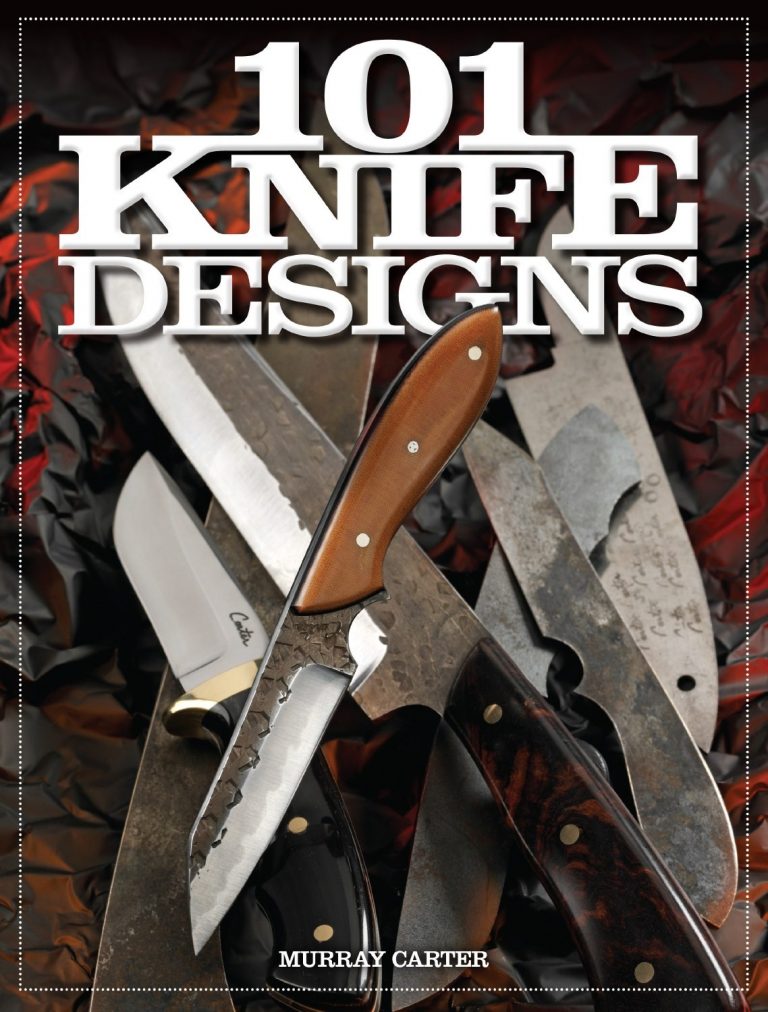
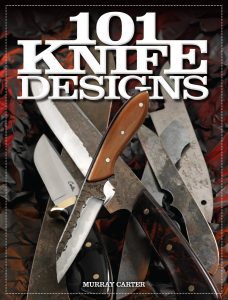
“101 Knife Designs”will give you both theory and beauty behind the great knife designs.
Understanding what makes a great design makes you a better collector and a better maker. “101 Knife Designs” by Murray Carter will not only inspire your work with detailed discussion of blade design, but will give you full-color images of exquisitely designed knives to ogle. At $19.53 you save $10.43 off the cover price.