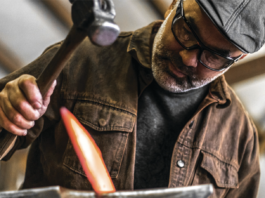
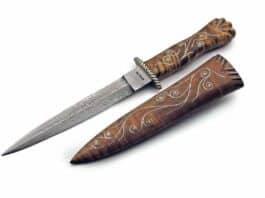
Knifemaking is the building of a knife, which includes the blade, handle and other accouterments. Blades are made by either removing metal from a steel blank via a grinder – known as stock removal – and the forging to shape of hot steel into a blade in the process known as bladesmithing. Other parts, including bolsters, guards, pommels, etc., are needed to complete the finished knife.
There must be something in the Amazonian water. In the global phenomenon of custom knives, there are few geographic locales that sizzle hotter than Brazil. The country has sharp makers and attracts talent, creating some of the world’s most desirable knives. Here is a look at some of the steel expertise emanating from the equatorial nation and its cutlery shows.
Romário Ribeiro Fighter
Sleek and dark, Romário Ribeiro’s 12-inch fully integral fighter of 52100 carbon steel won the Best Handle Award at Salão Paulista de Cutelaria 2025. It’s no wonder, with a seamless and intricate keyhole-style construction, and jacaranda wood and 24k gold inlays creating a boundless night sky motif, complete with a rising crescent moon.
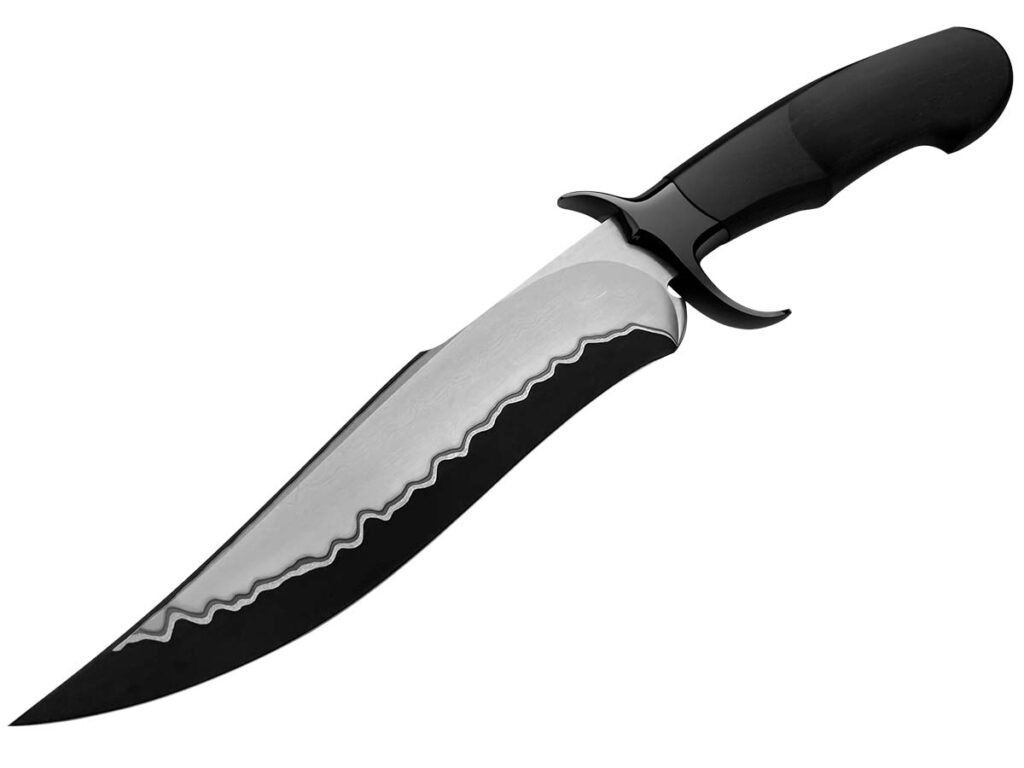
Gustavo Schuenck Fighter
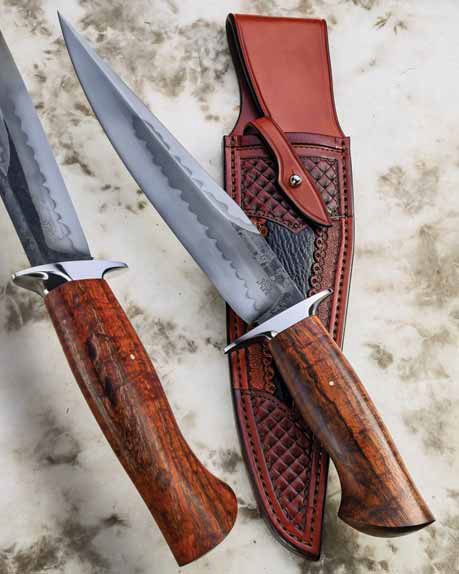
Winner of the Best Fighter Knife Award at Salão Paulista de Cutelaria 2025, Gustavo Schuenck’s blade is aggressively beautiful. San mai steel of 9½ inches with a black phosphate finish ties together with the knife’s pitch-colored jacaranda handle. The nuanced recurve toward the heel offers flow in the build, paired with an understated yet sweeping guard.
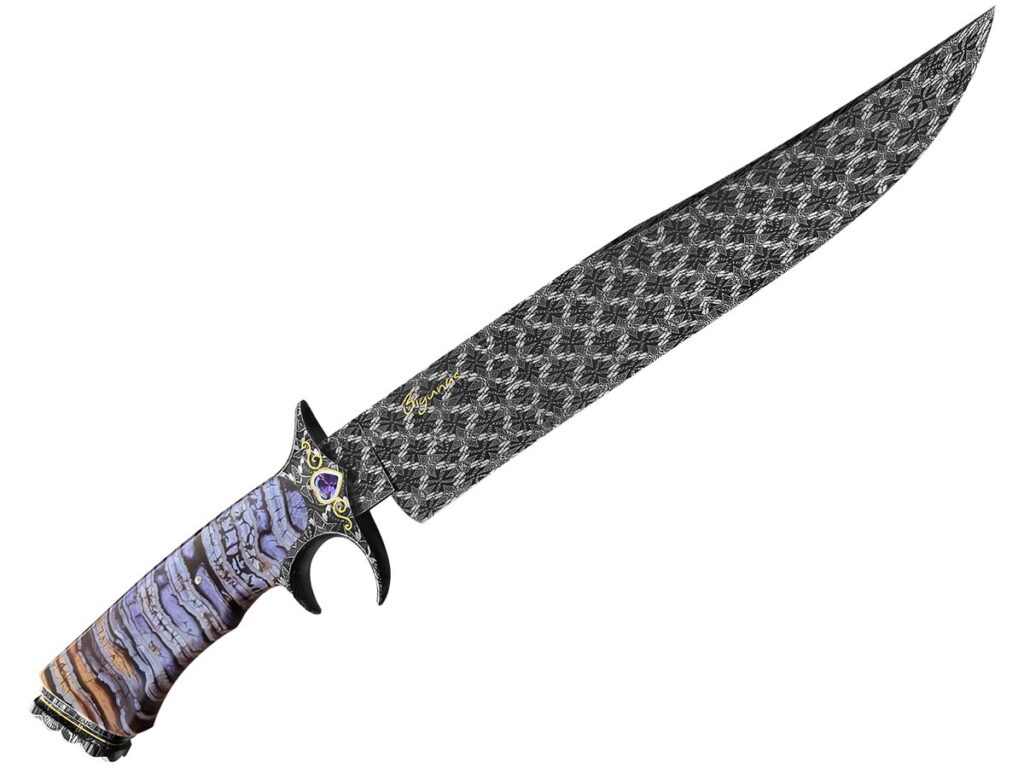
Alexandre Biguna Bowie
Near-perfect symmetry of Alexandre Bigunas’ basketweave mosaic damascus bowie can’t help but fascinate. The meticulous work on the 10-inch blade is contrasted by the striking color of the sub-hilt’s mammoth-molar handle and pair of amethyst stones on either side of the guard. Topping off Bigunas’ work, 24k inlay, including his signature on the blade.
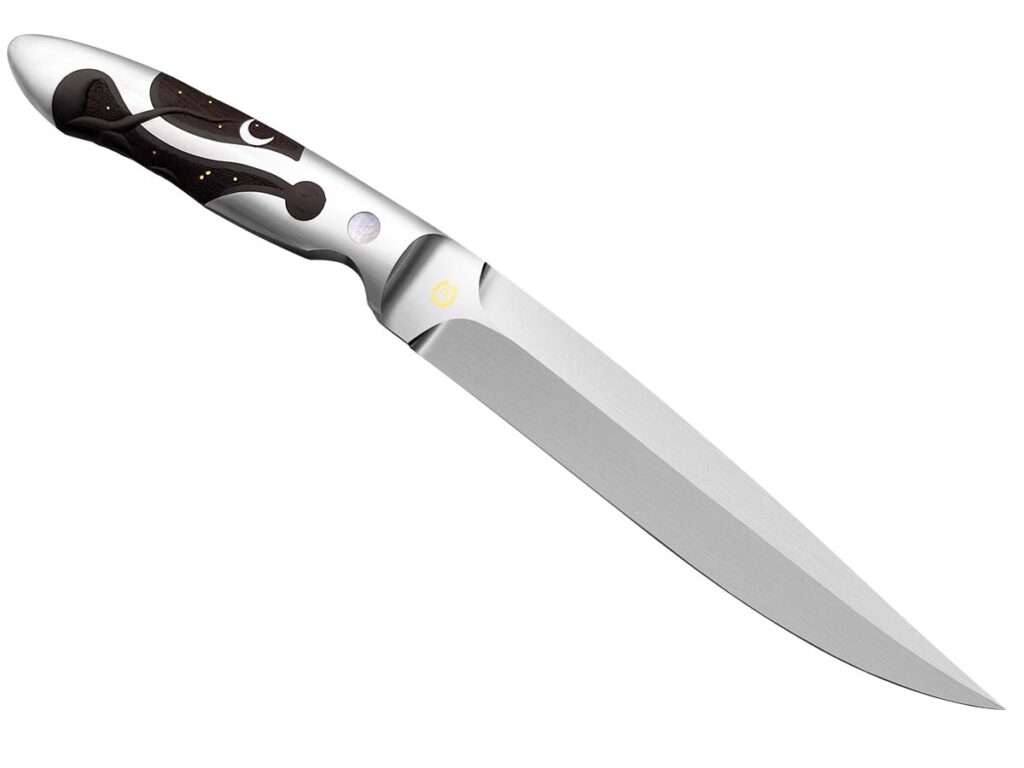
Júlio Cézar Ribeiro Gentleman’s Slip Joint
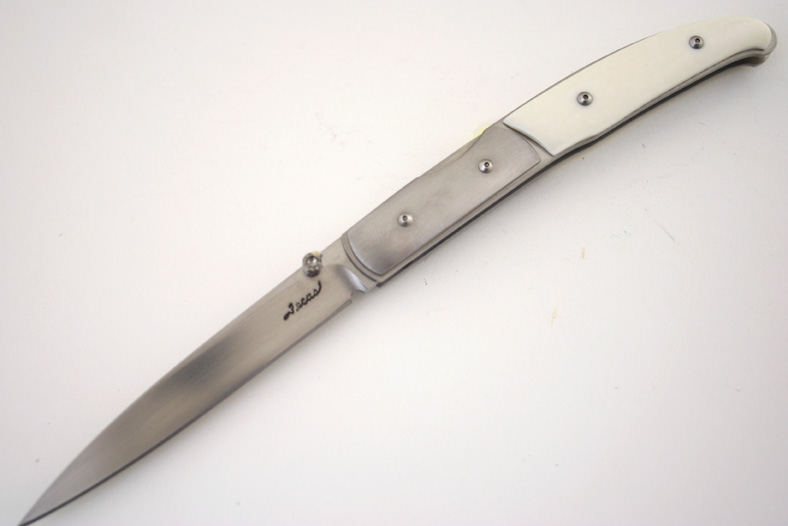
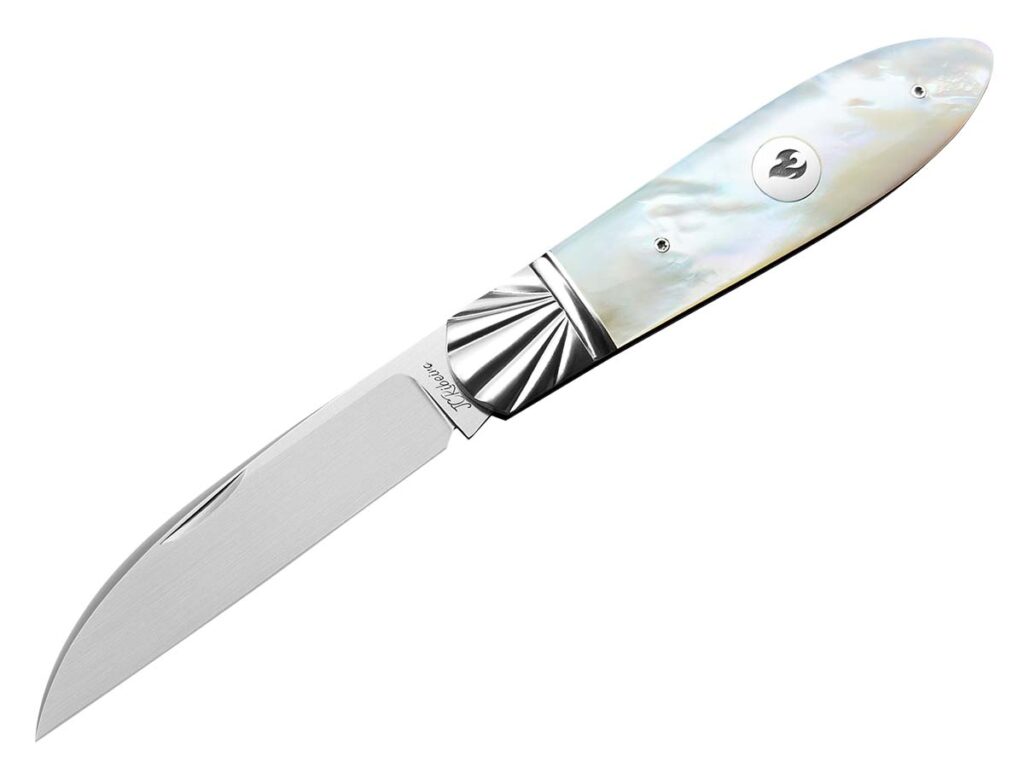
Simple, clean and classy are the driving ideas behind Júlio Cézar Ribeiro’s gentleman’s slip joint. The Brazilian’s spotless execution also caught the judges’ eyes at Salão Paulista de Cutelaria 2025, with the knife winning Best Traditional Folder. Notable aspects of the knife includes the swooping spine of the RWL 34 steel Wharncliff blade, maintaining the knife’s overall geometry with its teardrop mother-of-pearl handle.
Lizandro Bertoni Bowie
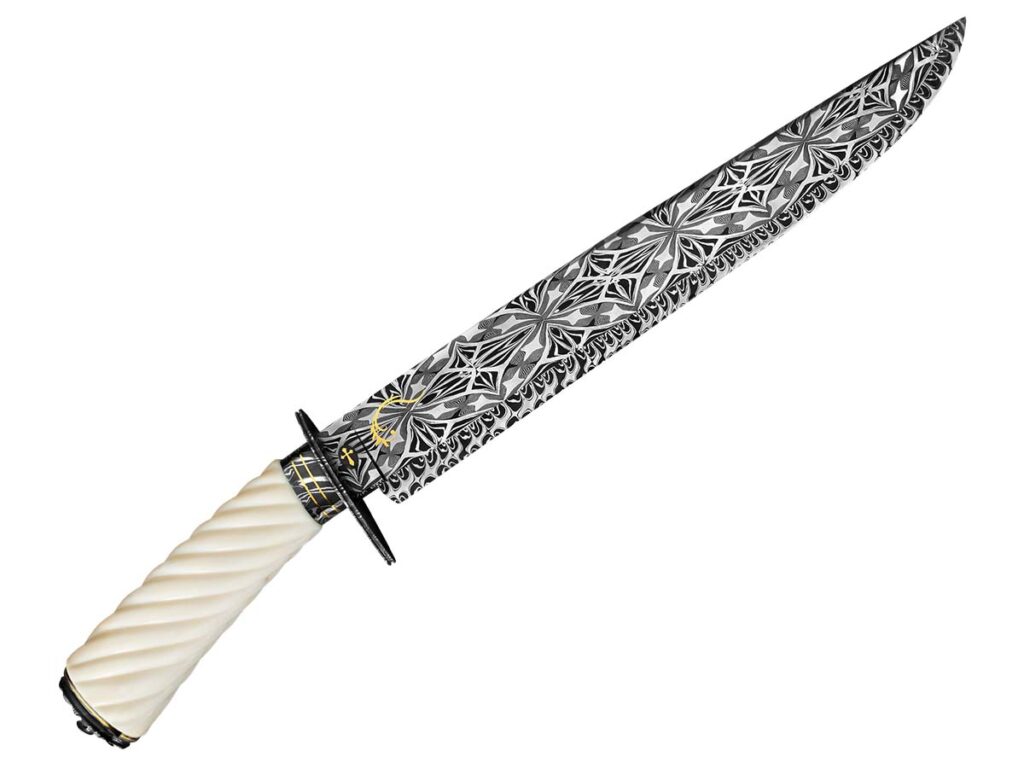
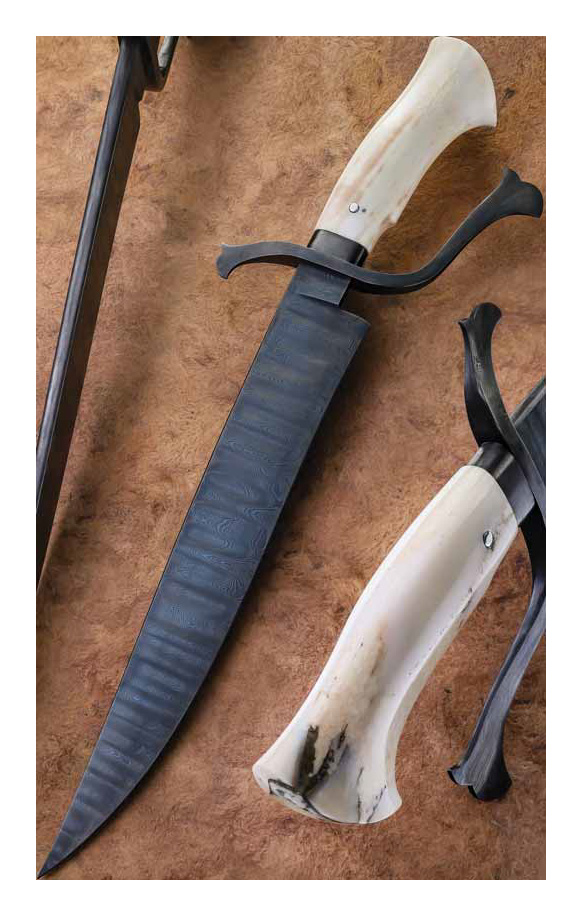
Lizandro Bertoni’s bowie is a study in contrasts. The flats of the 16-inch, 1085 and 15N20 damascus blade dominate with a starburst-like mosaic pattern, but give way to a cross pattern at the edge. Further, the busy ornamentation of the blade is contrasted with the calmer design of its walrus-ivory handle and the smooth lines of its texturing.
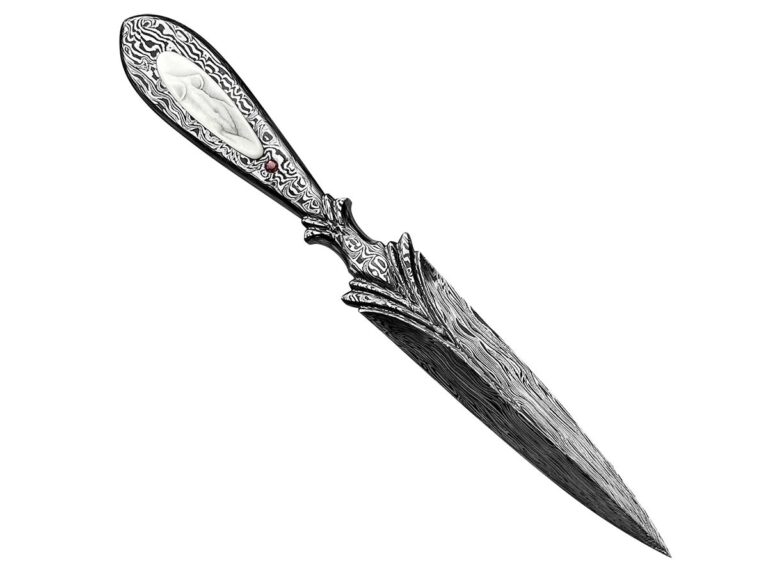
Vanuti Fiori Dagger
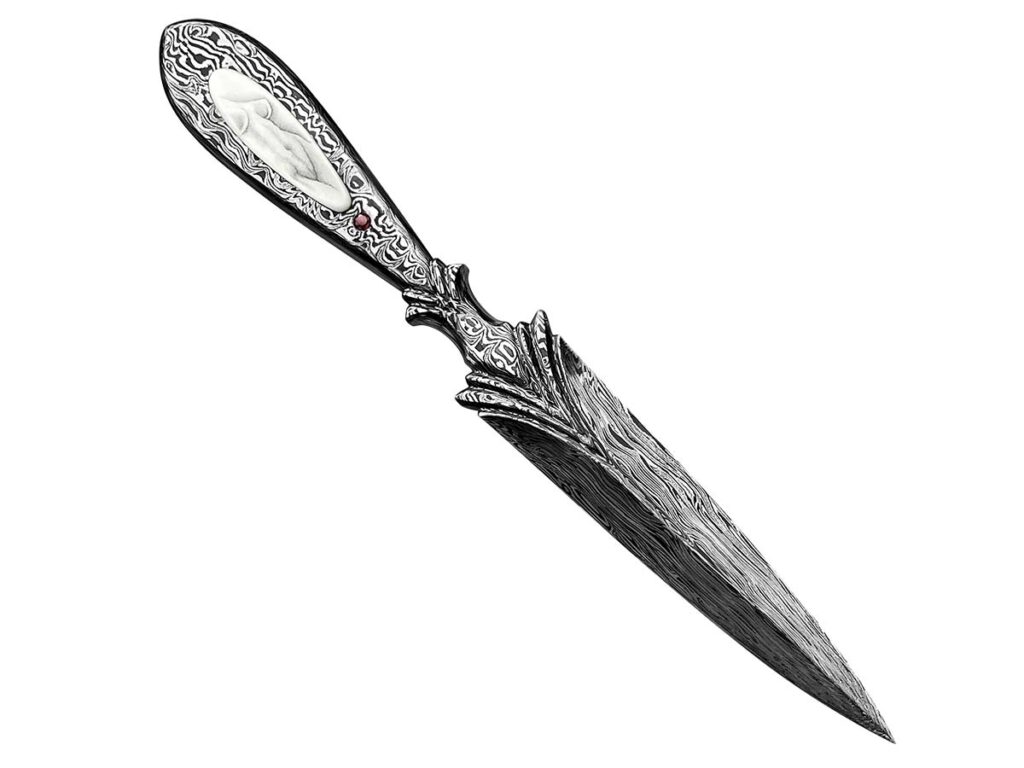
Dang sexy is all that can be said of “Lady of the Night,” a collaboration between knifemaker Vanuti Fiori and engraver Gabriel Krebs. It’s not only the lines of Fiori’s integral dagger that drip sex appeal, but also Krebs’ alluring feminine -form scrimshaw on its mother-of-pearl inserts.
Francisco Wlach Gaucho
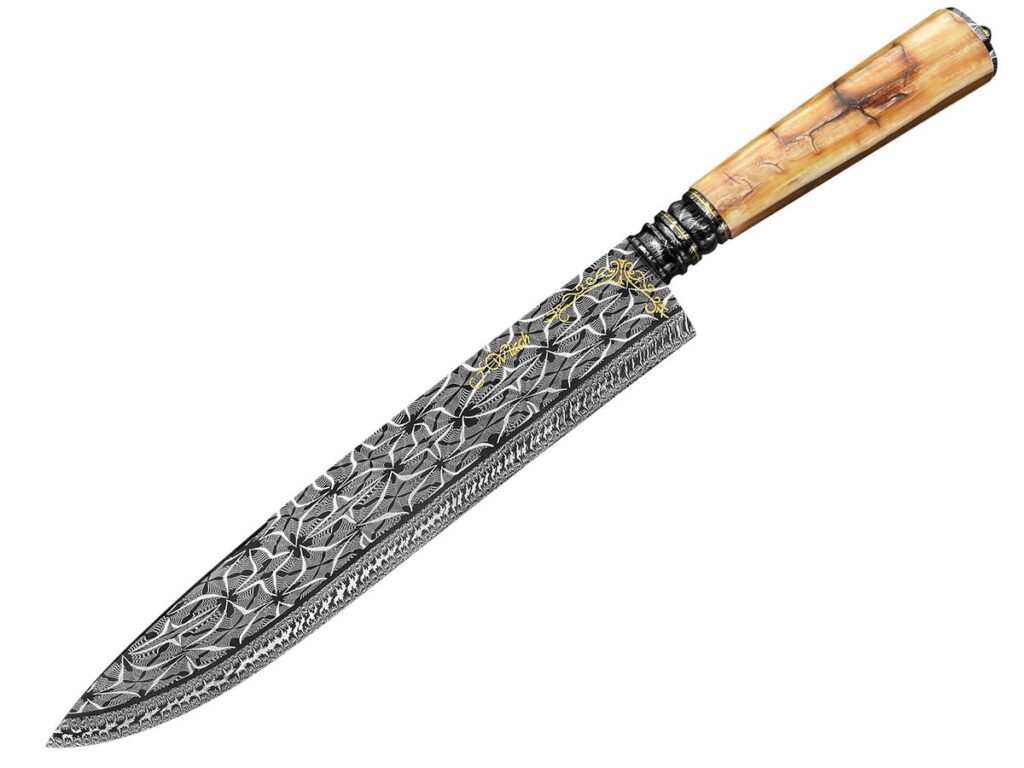
Francisco Wlach takes the workingman’s gaucho knife to a different level with the execution of his knife’s 10-inch laced mosaic blade. Wlach creates movement on the blade with a very uniform pattern over the majority of the steel, contrasted by a more subtle pattern along the edge. Gold inlay, integral bolster and mammoth-tooth handle would make this blade any gaucho’s pride.
Editor’s note: This article was originally published in 2005, so be sure to adjust for inflation. That said, Wayne Goddard’s $50 Knife Shop book is the next step if you’re looking to get started on a minimal budget.
The short answer: A few thousand dollars if you want to get serious about knifemaking, and considerably less than that for hobby projects.
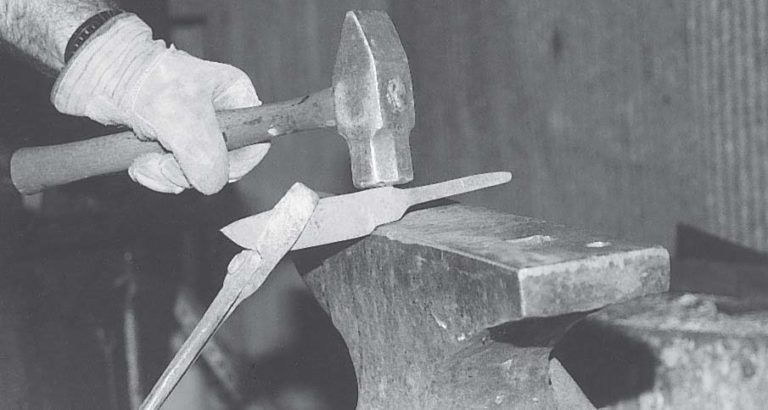
At most forging demonstrations I do, I try to use only minimal tools because I want people to see what can be accomplished with just a few basic implements—a hammer, a few tongs, a good anvil and a forge. Most folks are not set up with every type of tool that can be used in bladesmithing. As you have seen, with just a few basic tools you can make much more than just a basic knife or hawk.
Using only basic tools does require a bit more sweat. This may be fine if you are a part-time blacksmith or bladesmith, but may not be the most efficient avenue for someone trying to make a living at it. If the latter is the case, you can quickly run into thousands of dollars setting up your shop.
Next step: Learn how to get started making knives with just 50 bucks in tools in “Wayne Goddard’s $50 Knife Shop.”
For starters, if you do not already have a place to set up your forge, then the biggest expense will be for shop space. Obviously, the space cannot be an old woodshed. Keep in mind that you are working with hot metal and fire, and that you need to set up the forge where the metal sparks will not fly where they could cause trouble.
The room also will need good ventilation, no matter if your forge uses gas or coal.
If you already have such a place to use as your forge room, then you can start setting things up. Your next biggest expense will be the forge itself, either gas or coal. I recommend a gas forge because it is cleaner and you have more control of the heat. Such a forge could run about $600.
You need a good anvil; my preference would be at least a 125-150 pounder. You will need a sturdy worktable with a quality, heavy-duty vise, a bench grinder, and a few well-chosen tongs and hammers. This will be all you need to do most of your bladesmithing.
However, whoever told you that you can spend thousands of dollars setting up a shop with all the tools was not pulling your leg. Power hammers, various dies, a drill press and other tools of the trade will make your work easier. Specialized knifemaker’s grinders from Burr King, Bader or Square Wheel will cost you but will be worth the investment.
You could write a whole book on tools that would make your life easier and your pocket emptier. Visit a well-established blacksmith shop and you will be surprised how much tooling will be there. Of course, you do not have to purchase everything at once, but over the years as time and funds allow, you probably will.
My opinion is that you do not have to spend thousands of dollars to set up a shop where you can create a great variety of beauty and function. However, if bladesmithing is your chosen trade, to not invest in the equipment that will save you time and sweat is not a smart option.
Like they say, you need to spend money to make money.
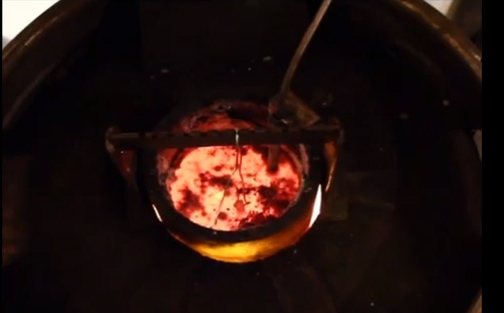
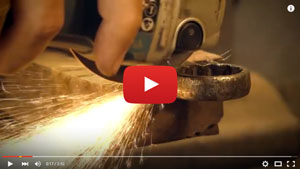
This video from the American Bladesmith Society (ABS) explains how to perform salt bath heat treating. It’s part of the Phoenix knife project ABS members created. You can see video about the incredible ABS Phoenix knife here.
Here’s a bit of background from the ABS about the Phoenix knife:
The Phoenix Knife was originally created by several members of the ABS Board, then disaster struck and it was damaged in a house fire. On its second life, several ABS Board Members contributed in the efforts to bring it back to life including Master Smith Kevin Cashen shown in this video heat treating the blade and bringing the knife back to life. Stay tuned for the third video about “Rockwell Testing” the blade.
To follow the Phoenix knife through its stages, be sure to subscribe to the ABS YouTube channel. There are plenty of knife videos online, but the expert insights from ABS are a cut above.
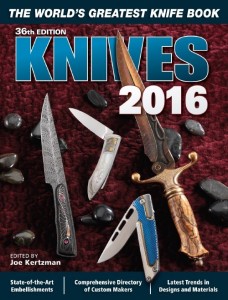
Putting on display custom knifemaking at its finest, Knives is back in its 36th edition. The trusted guide for knife collectors, enthusiasts, knifemakers, and dealers around the world, this knife book covers the latest and greatest from front to back. Get it here
After Decades In And Around The Knife Industry, The Author Reflects On His Five Favorite Knifemakers And What Makes Them So Memorable.
Over the past 38 years, I’ve met thousands of knifemakers with work ranging from newbie to legend. Being a newbie myself at first, I found myself gravitating to the newer makers, primarily because I could afford their knives and could get one without waiting years or decades.
Today I approach things differently and look for outstanding makers who share the following traits:
•Each is charismatic in his own way;
•Each gives of both his time and talent(s) to educate others, and;
•Each has a great sense of humor and is serious about his knives.
Here are my five favorite American makers who share the traits I look for most.
Walter Brend
The SF Dagger by Walter Brend features an 8-inch blade of D2 tool steel with a satin finish and Walter’s impeccable grind lines. Handle: black Micarta®. Guard: stainless steel. Special features: Full-tang construction, double edge, thong hole and a skullcrusher pommel. Overall length: 12.75 inches. (SharpByCoop knife image)
During my military service in the U.S. Army 101st Airborne, my unit went through processing for an overseas deployment. At the time I was carrying a Robert Parrish hollow-handle fighter with a serrated blade. It was suggested to me that I find a new knife that didn’t have serrations. That was the bad news. The good news is I had to buy a new knife, and the search began.
Scanning a magazine I saw a photo of three knives, all different lengths of the same model. I was immediately drawn to one of the knives, found the maker’s contact information and called him. On the other end of the line was Walter Brend and I ordered the knife: an 8-inch Model 2. In October 1985 I bought my first of hundreds of knives from Walter. In my opinion, his Model 2 is the finest tactical fixed blade in the world.
What draws my eye to the knife are the impeccable grinds. Perfect symmetry runs the length of the blade, including both the top and bottom grinds. The radiused guard and contoured handle are also trademarks of Walter’s work. These features may not be more evident anywhere than in his daggers. Clean, precise, sleek and lethal are words that all come to mind.
David Broadwell
According to the author, David Broadwell makes the world’s best sub-hilt fighters. An example is his Fuller Sub-Hilt Fighter in a 9-inch blade of Delbert Ely damascus. Handle: ancient ivory. Guard, sub-hilt and pommel: damascus. Overall length: 14 inches. (Image courtesy of Photography By NB Designs)
I was visiting family and friends near Chicago in 1988 and attended a small knife show. I had recently started buying guardless fighters, as the knives’ clean lines appealed to me. On the show table before me was a beautiful guardless fighter with an engraved bolster. The knife felt great in my hand and the price was more than reasonable. I bought the fixed blade from David Broadwell.
My favorite knife has always been and still is the sub-hilt fighter, and David excels at making one. Having written about him for several publications, I have always pointed out I think he makes the best sub-hilt fighter(s) in the world.
David is an artist in the true sense of the word. His eye for detail and beauty in steel is exceptional. He and I have collaborated on several designs over the years. He takes my basic two-dimensional linear drawing and brings it to three-dimensional life.
Diversification is one of David’s hallmarks. In the early 2000s I asked him to build knives that featured stone handles. Most were sub-hilt fighters and today remain some of my favorites.
When Bob Neal and I did our LDC Custom Knife series, David was the only maker to contribute both a folder and a fixed blade to it. Today he creates masterworks of art that would be at home in any museum in the world. While my design ideas were not always his favorites, David delivers knives that were everything I had hoped for—and more.
RJ Martin
RJ Martin has won awards for both best tactical folder multiple times and also best tactical fixed blade at past BLADE Shows. His Ghost Pepper Q36 cover knife sports a 4-inch blade of Chad Nichols damascus, a titanium frame and hand-rubbed zirconium bolsters. Scales and spacer material: black carbo quartz w/orange G-10 back-side inlays. (SharpByCoop knife image)
I was at The Knifemakers’ Guild Show in 1996 and, like everyone else, walked up and down the aisles looking for that one special knife or 12. I passed a maker who had Japanese-style tacticals on his table. I took two steps, did an about-face and walked back to the table. I was greeted by the big friendly smile many now know belongs to RJ Martin.
The guards, handles, sheaths and particularly the blades were the cleanest I had ever seen on a Japanese-style tactical. Trends change and I suggested to RJ that he should consider making a tactical folder. Within a month he sent me his first one, the Q30. I couldn’t believe it was his first folder. It easily rivaled most of the well-known tactical folder makers of the day. Then again, I should have expected this from a lead airframe engineer for Sikorsky helicopters such as RJ. He lives in the world of thousandths of an inch and milligrams.
From 2000 to 2010, RJ made 12 different limited designs for my Robertson’s Custom Cutlery Vanguard series. They featured hollow-handle fighters, a sub-hilt fighter, Japanese-style tacticals and, of course, folders. He is one of the few knifemakers in the world skilled enough to do it all with equal excellence. Quite notably, he has won the award for both best tactical folder a number of times and also best tactical fixed blade at past BLADE Shows.
Today his folders are among the most sought after in the world. Unlike so many of the tactical folders built over the past decade, his increased in price in the aftermarket. For those in pursuit of a level of perfection most of us cannot appreciate, RJ is that perfectionist.
George Herron
The author stated the knives George Herron made are design-driven, exactly what you would expect from a lifelong hunter and fisherman. The Herron Model #12 boasts a 6.5-inch blade of ATS-34 stainless steel with a mirror finish. (Impress By Design knife image)
I was attending the 1987 BLADE Show when a friend introduced me to BLADE Magazine Cutlery Hall-Of-Fame® member George Herron. With his pipe hanging from his lip, George said, “Lad, what is it you do for a living?” I said, “Mr. Herron, I’m in the Army.” He smiled and said, “I was in the Army, too. You see anything on the table you like?”
Had I known then what I know now, I would have bought every knife on the table. His knives were clean, lightweight, possessed exceptional handle ergonomics and were design-driven—all traits you would expect from a lifelong hunter and fisherman.
Years after meeting George and his wife, Miss Barbara, I attended the Southern Wildlife Expo in Charleston, South Carolina. This was long before the drawings and bid-up knives that have become common today. It wasn’t long before I noticed over 90 people waiting in line. I asked the person at the end of the queue if this was the line for admission to the show. He said, “No, this is the line to get a knife from Mr. Herron.” With that, I bought my show ticket and went to the table where Miss Barbara was standing.
There I was treated to an experience akin to watching children waiting to visit Santa Claus. They all had ordered their Herron knives long in advance of the Wildlife Expo. They approached the table, paid Miss Barbara and she handed their knife to George. It was then you would see young and old alike light up as if it were Christmas morning as they received the “toy” they had longed for—a Herron knife from George himself. I saw three generations of knife buyers—first-time knife buyers, hardcore Herron collectors, they were all there. It was truly a sight to behold.
Steve Randall
As the author noted, there is never any backward movement with the work of ABS master smith Steve Randall—his knives always continue to improve. Steve’s 7-Bar-Twist Sub-Hilt has a 10-inch blade of a seven-bar-twist damascus in 1080 carbon and 15N20 nickel-alloy steels, and an ancient walrus ivory handle. Maker’s price at press time: $3,300. (Alison Randall knife image)
Before the 2015 BLADE Show, I was checking out custom knifemakers’ work on various social media platforms. I kept returning to one maker in particular, ABS journeyman smith Steve Randall.
While photos can be deceiving, I have a pretty good eye for knives. Looking at images of his knives, I could tell he too had a good eye and understood making knives well beyond the short time he had been making them. He combined all the dimensions and aspects of the knife to make it flow.
I bought my first knife from Steve at that 2015 BLADE Show. In 2016 he earned his ABS master smith stamp. In 2022 his knives continue to impress me. There is no backward movement with his work and his knives continue to improve.
One of Steve’s best attributes is that he is willing to learn and try new things. In my opinion, many ABS master smiths are reluctant to work outside their comfort zone. I have asked Steve to build knives for me and my clients that may have some aspects he had never done before. Steve and his work never disappoint.
I was fortunate to have worked with or still work with my five favorite American makers. They have taught me so much about the art of knifemaking, and those who are with us still do. (Mr. Herron passed away in 2007). Perhaps more importantly I consider each of them a friend.
You Can Never Have Too Much Pizza, And You Can Never Go Wrong Buying A Pizza Cutter Made By Andrew Meers.
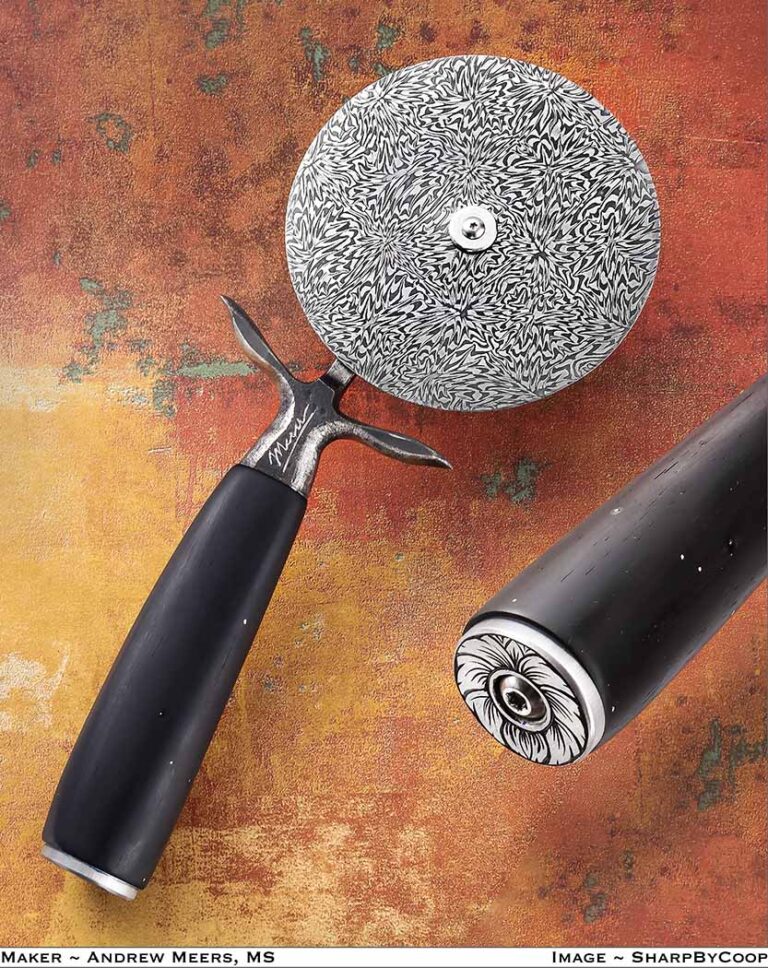
Andrew Meers loves pizza, so when his factory pizza cutter broke, he fixed it—and then made his first-ever custom version of one. The result has features only an award-winning ABS master smith such as Andrew would include.
Fresh out of the oven is the mesmerizing disc cutter in a W’s explosion pattern mosaic damascus. A pet peeve is loose pizza cutter discs that rattle, so he tightened his down with the help of a folding-knife pivot fitting.
The arm and guard are forged stainless with a blackened brut de forge look. He forged the crossguard in a plant-like shape, drawing the quillons out and giving them fullers for a bud-like appearance. The grip is ebony inlaid with bits of silver to resemble stars in the night sky.
If 20th-century actor, comedian and singer Dean “The King of Cool” Martin were here, he might croon, “When the moon hits your eye like a big pizza pie, that’s amore.”
Pizza Cutter Specs Model: Pizza cutter Maker: Andrew Meers Dimensions: The cutting disc is 3.5 inches in diameter; the cutter’s overall length is 9 inches Disc Material: W’s explosion pattern mosaic damascus of 1084 carbon and 15N20 nickel-alloy steels Handle frame and guard: Blackened forged stainless w/a brut de forge look Scale material: Ebony inlaid w/silver “stars” Engraving: In a traditional Japanese line style by Andrew Meers Andrew’s price for a similar piece: This one sold for $850 Andrew’s favorite pizzas: Meat Lovers, including the Whole Hog (red sauce, pepperoni, bacon, red onion, green pepper, jalapeno and mozzarella), and the Margherita, a typical Neapolitan pizza w/San Marzano tomatoes, fresh mozzarella, fresh basil, salt and extra-virgin olive oil
The short answer: A handle design favored by custom knifemakers that resembles a bird’s head with a short beak at the butt of the handle.
Given the practicality and curves of the bird’s-beak handle, it is small wonder that it is quite the popular grip among today’s knifemakers. In fact, the design resembling a bird’s head with a short beak at the butt of the handle has appeared in many cultures over many centuries.
Tad Lynch indicated that crafting a good bird’s-beak design requires practice and the courage to push things. His Irish Traveler Fighter features a handle of koa, a 9-inch blade of W2 tool steel with hamon and is 14 inches overall. His list price for a similar knife starts at $1,100. (SharpByCoop knife image)
“You see it in different variations on Persian daggers and swords,” said North Carolina knifemaker Ken Hall. “Also, some kukris have the ‘hook’ in the handle. In American knives you see it in some of the Buck knife designs.”
When the ABS journeyman smith with 11 years of experience is not forging in the Smoky Mountains, he raises honeybees, hikes and teaches others the craft. He made a bowie in January in preparation for an ABS master smith test that had to be pushed back because of a bicycle accident.
While many makers make a bird’s-beak handle with a dense hardwood, Paul DiStefano took a risk on a material that has a reputation of being temperamental: ancient walrus ivory. Blade length and material: 12 inches and 500 layers of 1095 carbon and 15N20 nickel alloy steels. His list price for a similar knife: $1,800. (SharpByCoop knife image)
He picked the bird’s-beak handle design because it pairs well with large knives, especially those with recurve or clip-point blades. A big block of wood large enough to develop the butt’s shape is one of the best material sizes for the design, Hall explained.
“The bird’s beak provides a more controlled grip for the hand,” he noted. “The contour snugs around the little finger, keeping the knife from slipping forward while in use.”
The result, combined with a balanced knife, is a tool that feels like an extension of the hand.