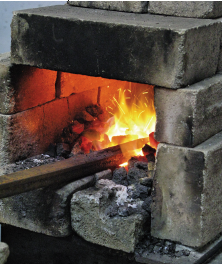
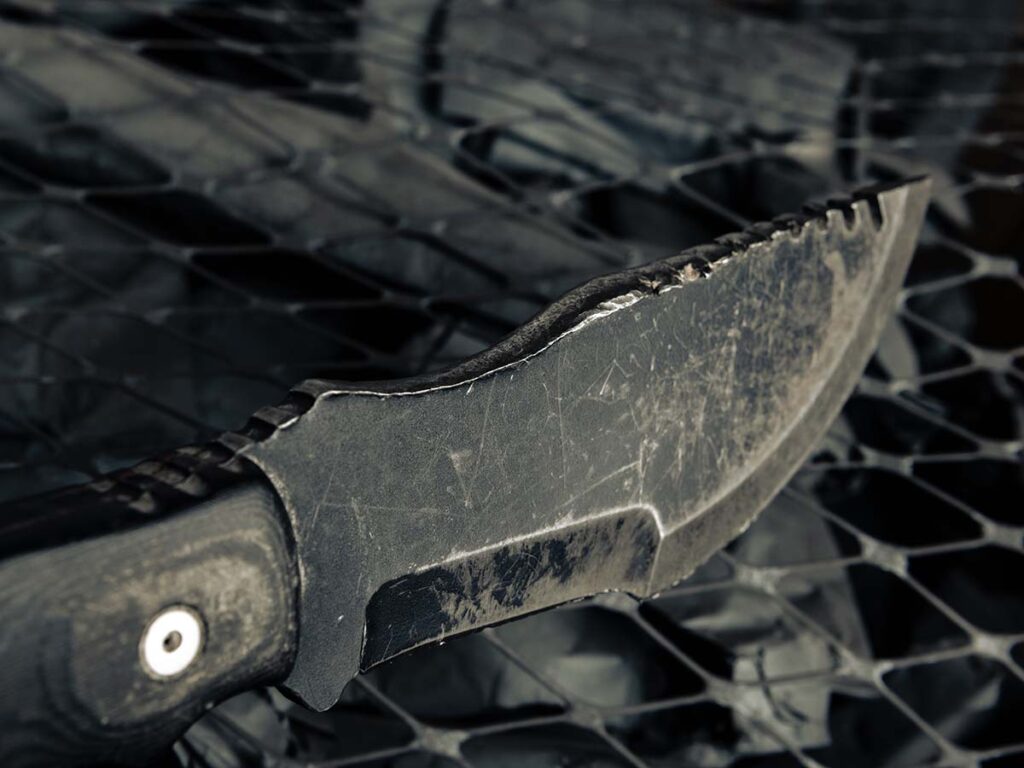
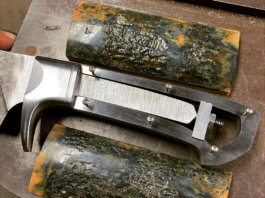
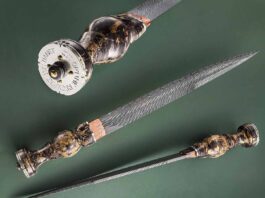
Knifemaking is the building of a knife, which includes the blade, handle and other accouterments. Blades are made by either removing metal from a steel blank via a grinder – known as stock removal – and the forging to shape of hot steel into a blade in the process known as bladesmithing. Other parts, including bolsters, guards, pommels, etc., are needed to complete the finished knife.
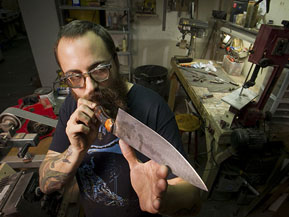
It’s always nice when mainstream media, in this case the Philadelphia Daily News, covers a local knifemaker and the knives he creates. Such was the case recently, July 24, 2014, when philly.com ran a story titled “Brewerytown Knifemaker’s On Point With His BiltSharp Products,” about knifemaker Adam Balkovic of BiltSharp Manufacturing Co.
KNIVES don’t make the man. But in the case of Adam Balkovic, founder of BiltSharp, a man definitely makes the knives. Emphasis on the singular. In addition to being the creator of the Philly-based bespoke forgery, founded in 2012, Balkovic also serves as its CEO, creative director, marketer, chief fabricator and sales coordinator. He is the steadily growing company’s only employee – and he’s happy to report that he’s got an excellent relationship with his supervisor.
“When I come to work now, I do whatever the hell I want,” he said. “It’s very fulfilling.”
Look at the pieces Balkovic, a native of the small York County town of Dillsburg, produces with his bare hands, and it’s easy to assume he’s been at the craft for years, apprenticing under an experienced blacksmith, or maybe an elderly Japanese blademaker.
But while the work screams veteran craftsman, Balkovic has been at this for only a few years and is entirely self-taught. Right now, in his inventory there’s a nearly foot-long chef’s knife, made from raw, military-grade 52100 carbon steel and mounted on a gorgeous polished handle of rare Southeast Asian amboyna burl. There’s a one-of-a-kind hunter’s blade … Click here to read the rest of the story.Click here to see more quality cutlery.
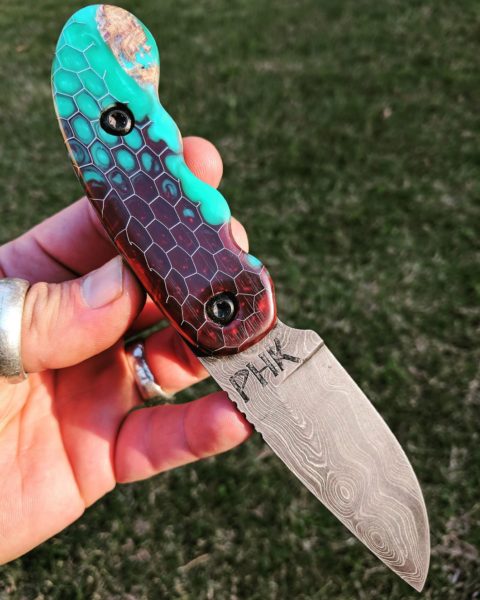
Knives 2014 provides the types of knives they make, technical information, and embellishments like engraving, scrimshaw, jewel inlay, wire inlay, carving, sculpting and etching.
The first and most logical approach is to select steel by doing some research on cutlery grade steel. Topics to especially pay attention to are the chemical composition of different steels and the effects of each chemical; isothermal transformation graphs for different steels; the effects and importance of thermal cycles, including annealing, quenching and tempering; the availability and cost of the steels and, perhaps most importantly, how easy the steels are to work by hand.
The above paragraph only took a few lines to write and a few minutes to compose, and yet many metallurgists will spend their whole lives researching those points. Pursue it to your heart’s content, and to that end I have included a thorough bibliography at the back of this book. However, to get you focused back on the task at hand, suffice it to say that there are some specifi cs you will need to concentrate on when selecting steel. These are:
• The amount of carbon in the steel
• Forging temperature range
• Annealing temperature, quenching temperature and tempering temperature
• Availability
• Overall workability
Let’s examine each of these in a little more detail.
Carbon is added to iron (Fe) to make steel. Carbon is the element that enables steel to harden when it is quenched at the proper temperature. Steel is unique in this aspect; all other metals soften when subjected to the same thermal cycle. The amount of carbon is very important. Too little carbon will fail to make steel harden when quenched, and too much carbon turns cutlery steel into cast steel. Generally speaking, less than 0.5 percent carbon is considered low carbon steel, and not suitable for blades. More than 1.6 percent carbon is considered extremely high carbon steel, and is very tricky to make into a blade. More than two percent usually equates to cast steel. Hence, most blades in the world have a carbon content between 0.5 percent and 1.5 percent.
In this range, all other factors being equal, the more carbon, the harder the blade gets when quenched. The harder the blade, the finer an edge and the longer it will stay sharp.
Forging temperature range is the temperature at which you can “work” or manipulate the steel. Most steel can be worked between a bright red heat and orange/yellow heat (approx .700~900 degrees Celsius, 1290-1650 Fahrenheit) and it will yield under the blow of the hammer, bend or twist etc.
Below this range the steel will cease to yield to manipulation and can be damaged by subjecting it to stress. Likewise, steel can be irreversibly damaged from working it at too high a temperature.
Annealing, quenching and tempering are the three phases of heat treating steel. These temperatures are very critical figures to commit to memory for the steel you are working. The heart and soul of a blade is the heat treat, as the final quality of the blade will be determined by how successfully these three operations are accomplished. Knowing the proper temperatures, and knowing what they look and feel like, is a critical skill for the bladesmith.
Availability determines whether or not you will be able to try forging that ‘super-steel’ you have been reading about. If you cannot locate or buy the steel in question, the pursuit becomes meaningless. Cost is another factor. Even if you locate the steel of your dreams, it may cost too much to have it shipped to your location. You want to know if you can acquire the steel for a reasonable cost and if it will be available in the foreseeable future.
Overall workability considers how the steel in question compares to other steels. Is it easy to manipulate under the hammer when you are forging it? How does it heat treat? Is it prone to warping, bending or cracking? Is it easy to straighten after heat treating? How does it take a final polish?
These questions are easier to answer once you have experience with a few of the common steels.
Here are 5 ways to get your knives featured in BLADE, either in print or online. Our goal is to include as many different types of knives and as many different knifemakers and manufactures as we can in each issue and online. We try not to double up on any individual or company, though sometimes it’s unavoidable. That means that we’re always looking for makers who haven’t been featured before. There are some restrictions, but those will be covered under each category.
Be sure to Like and Follow BLADE Magazine on Facebook. If you’re on Twitter, look for BLADE Magazine. We’re @blade_magazine on Instagram.
First, please Like and Follow BLADE Magazine on Facebook and Follow BLADE Magazine on Twitter and @blade_magazine on Instagram. That way you can see online stories when they’re posted, which may prompt other story ideas.
3 essentials for all 5 publishing options
Our Enthusiasm
We have to like your knife. But wait! We like ALL kinds of knives: cooking, everyday carry, bushcraft, hunting, tactical. We like fixed blades and folders of every deployment and locking mechanism. We like art knives that we’d be proud to put on our shelves. We like all shapes and sizes of knives, of every conceivable blade design and grind. We welcome smiths, stock-removal makers, manufacturers, collectors. Whether you’re just reaching your artistic stride or you’ve been involved in the knife industry for decades, you’re part of the BLADE community. So, don’t be shy. Chances are, we’ll thoroughly appreciate your knife or your perspective on the industry. The only way we’ll be able to see your knife, however, is if you show it to us in a well-done photograph.
Your Enthusiasm
How hard are you willing to work to make your knife look its best in a photo? Or, are you willing and able to hire a professional to take photos so that you can concentrate on knifemaking? The answer to either of those questions will be the measure of your enthusiasm. Other pieces of information will be required, but those details seem easier to acquire than photographs that do justice to your knife.
High-Quality Images
Poor-quality photos will definitely dampen our enthusiasm to publish them, no matter how beautiful your knife is. If the photo is out of focus, low resolution, poorly composed, lacking in contrast, flat or poorly lit, we’ll ask you to get better photos. As challenging as it will seem, it ensures that a poor image doesn’t run side by side with a stellar one, making your knife look lesser than it really is. You can read more about what we expect by reading “6 Things BLADE Looks For In a Knife Photo.”
Let’s say you have terrific photos, then what?
5 ways to get your knives featured in BLADE
‘What’s New’
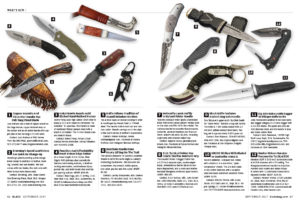
The “What’s New” section of BLADE magazine features knives from six manufacturers and six custom knifemakers. Occasionally a tomahawk, tool or knife accessory will be included, but the focus, as always, is on knives.
The “What’s New” section of BLADE magazine highlights 12 new knives each issue, six from manufacturers, six from custom knifemakers. And, guess what? If you’ve never been in “What’s New” before, everything you’ve made is “new” in that not all of our readers have seen your work before. If you’ve already been in “What’s New,” perhaps there is something new you’ve been trying out: a different design or grind, or you usually make fixed knives and now you’re moving into folders, or you’re using a different engraver. After being in “What’s New,” you must wait at least 12 months before you can be eligible again, and makers who haven’t been in before will take precedence. Just to reiterate, our goal is to get as many different knives into BLADE as possible. We will occasionally include a tomahawk, sharpener or other knife accessory, but mostly the section features factory and custom knives.
Requirements: High-Resolution Image, Short Description
All that’s needed for “What’s New” is a high-resolution, print-quality image of your knife. Bottom line: 300 dpi or higher, 8-10 inches on the longest side, be that vertical or horizontal, and .jpg format. Now, for “What’s New” we use “cutaways,” or just the knife devoid of its background. This means that you don’t need to worry about creating an artistic vignette or still life with your knife. You do have to worry about getting the best picture you can get. For more on what makes an acceptable photo, read “6 Things BLADE Looks For In A Knife Photo.”
You will also need to supply a list of specs and a few sentences describing the item’s usage. Be sure to note if there’s anything new-to-you about it. They say there are no new stories, just different ways of telling them, and that could also be said of knives. True innovation does happen, and of course, we’re eager to hear about that. However, a maker might be working on new things all the time in his or her shop and that counts!
‘Knifemaker Showcase’
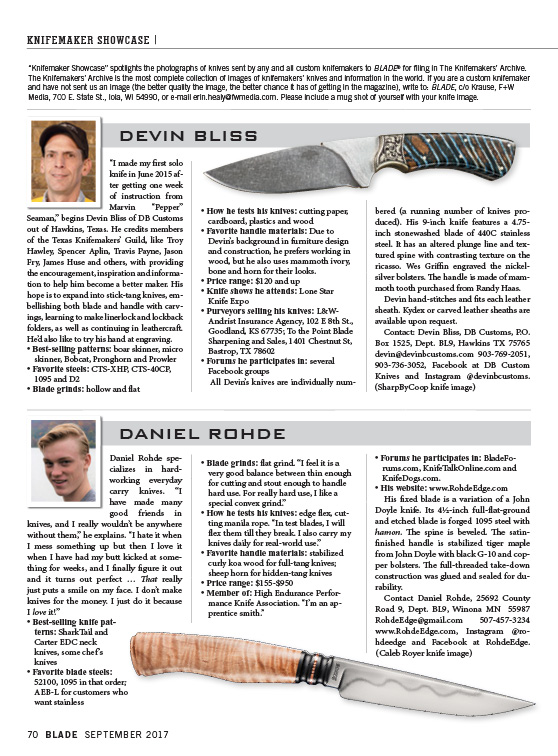
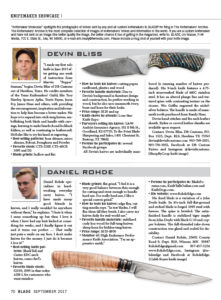
In BLADE magazine’s “Knifemaker Showcase,” six custom knifemakers are featured every month. A well-done knife image, a mugshot and an interview are required for inclusion in this section.
“Knifemaker Showcase” features six custom knifemakers each month all with a half-page layout that includes a mugshot, cutaway knife image and bulleted interview. The goal here is find out more about you, your start in knifemaking, your influences and your preferred materials, designs and ways of connecting with your customers. You’ll need to answer a questionnaire, explaining why you make the choices you do when crafting a knife. You can type out your answers, or if you’re not into typing, we can interview you over the phone once you’ve had a chance to think about your answers. After you’ve been in “Knifemaker Showcase,” you must wait at least 12 months before you’re eligible to be in it again, and makers who’ve never been featured before will take precedence. That way we can shine the spotlight on as many different makers as possible.
Again, our designers use cutaway images of knifes in this section, so a clean backdrop is best. You want to make sure your contrast is good and that nothing, including shadow, fabric, grass, encroaches on the edges of the knife. To learn more about the differences between a good photo and a bad one, read “6 Things BLADE Looks For In A Knife Photo.”
A mugshot is a portrait of you. It can be taken outside or in your shop, but the background will be mostly eliminated since we’ll be cropping in on your face. Don’t wear sunglasses. This is a chance for readers to meet you face-to-face, so to speak. If you’re wearing a hat, just make sure your face is not cast in shadow. Even though it will run small, your photo still needs to be print-quality. Keep in mind that if you submit a family portrait, for example, we will need to crop in on just you, so the size and resolution will need to be higher to account for that.
You’ll need to answer all the questions on the questionnaire unless something doesn’t apply to you. Too much information is better than too little.
BLADEmag.com
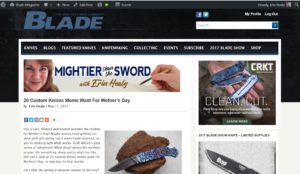
“Mightier Than The Sword with Erin Healy” is one BLADEmag.com blog where knifemakers and manufacturers can suggest story ideas of interest to everyone within the industry.
The blogs on our website allow us to take as much or as little space as is required to tell a story. Here is where we have the freedom to explore all kinds of stories related to the industry. BLADEmag.com stories can be about manufacturers, distributors, collectors or knifemakers; they can cover everything from how you made a cast spruce cone handle to how you’ve used knives in your family or on the job, whether it’s skinning deer, cross-chopping herbs in a restaurant kitchen or employing various grips in edged-weapon martial arts. The story can be about one particular knife or a collection. The source can be a multinational corporation with operations on more than one continent or a lone individual in his or her shop. BLADEmag.com strives to be a resource for all things knife, so histories and how-tos are of particular interest.
We welcome guest bloggers, provided the topic you’re writing about is not self-promotional. What this means is that you cannot write about your own knives or services. Pay is non-existent, but bragging rights are impressive. You will need to be able to write well, or be open to guidance and editing. You will need to provide a paragraph-long biography and a mugshot to run with your story, as well as illustrative images.
Requirements: A Good Story, Good Images
The thing about a story, whether it’s a topic you suggest for us to explore or one you’d like to try your hand at writing, is that it needs to have a story—a beginning, middle and end, an angle, a hook. If you as someone in the knife industry find it interesting then, chances are, others will as well. Even though BLADEmag.com will always focus on the knife, we also know that it is the people behind the knife that makes the story compelling to read. The whys are always interesting to include, as well as trying to describe how a material or process contributes to the feel or wow-factor of a knife.
Although knifemaker profiles are reserved for Knifemaker Showcase in print and BLADEmag.com stories online, other ideas for BLADE magazine are always welcome. The final decision for a feature article within the pages of BLADE rests with the editor. Oftentimes in the course of conducting an interview with a manufacturer or knifemaker for “What’s New,” “Knifemaker Showcase” or BLADEmag.com, we find other stories to write about in print.
To get a story into print, images must be top-notch. Focus, contrast, lighting, composition, depth of field all matter. Resolution must be high; size must be large. To fully understand what this means, read “6 Things BLADE Looks For In A Knife Photo.”
Social Media
Make sure to follow us on tag us in your social media photos so we see them and use #BladeMagazine
Requirements: Images, Specifications, Intended Usage, Contact Information
Some knife warranty claims stretch the limits, while others are just plain bizarre.
It’s an honorable option, a sensible aspect of a purchase contract, but can be the source of confusion, head scratching and plain ridiculousness.
The warranty is the buyer’s insurance policy. It’s the seller’s willingness to stake a reputation for quality on the performance of the product—in this case, a knife—or at least that’s what it’s meant to be. However, there are times when real life strains what is actually believable. So, when we explore the nature of the warranty with some of the finest knife companies in the world, a few of their warranty claims simply flirt with the edge of reason.
Wacky warranty claims, contentions from supposedly “dissatisfied” customers, are out there. Frankly, when some of these are brought to light, they are simply unbelievable. Give a nod to customer creativity, but then get real and consider what happens to a solid performing knife that is not simply put to good use, hard work and tough labor. Beating a knife with a hammer, soaking the handle and blade in corrosive liquid for an extended period, or shooting the defenseless edged tool with a gun are all beyond the pale. Follow such escapades with a dose of sheer audacity and what you get are warranty claims that would make a rational individual shake his or her head.
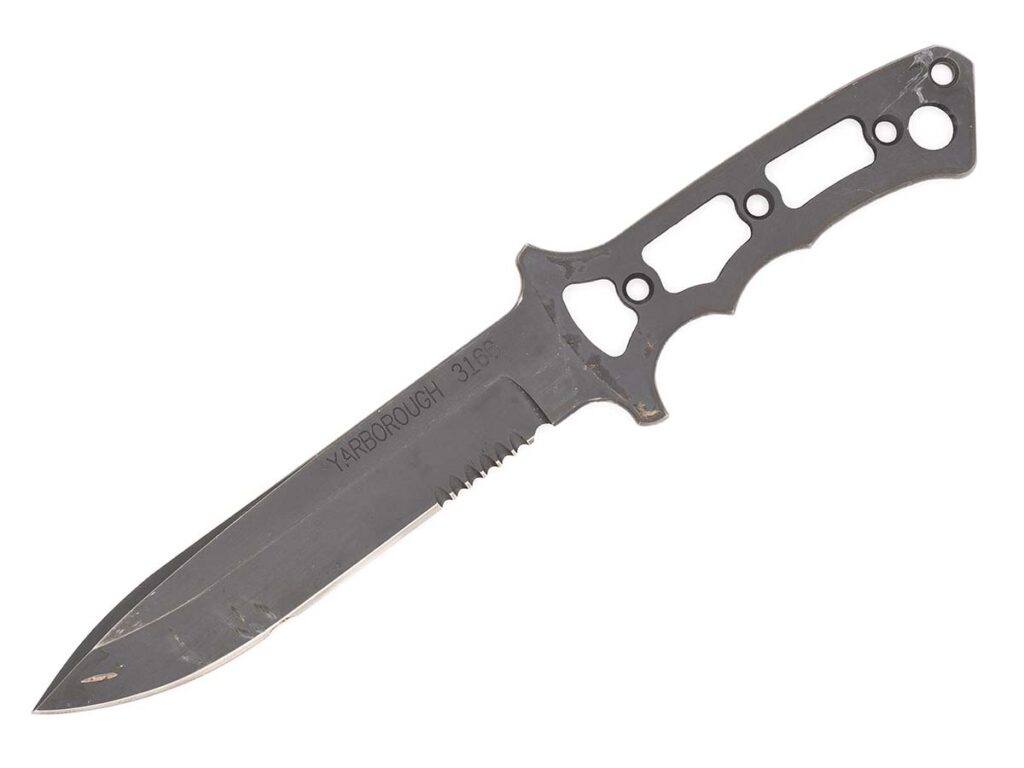
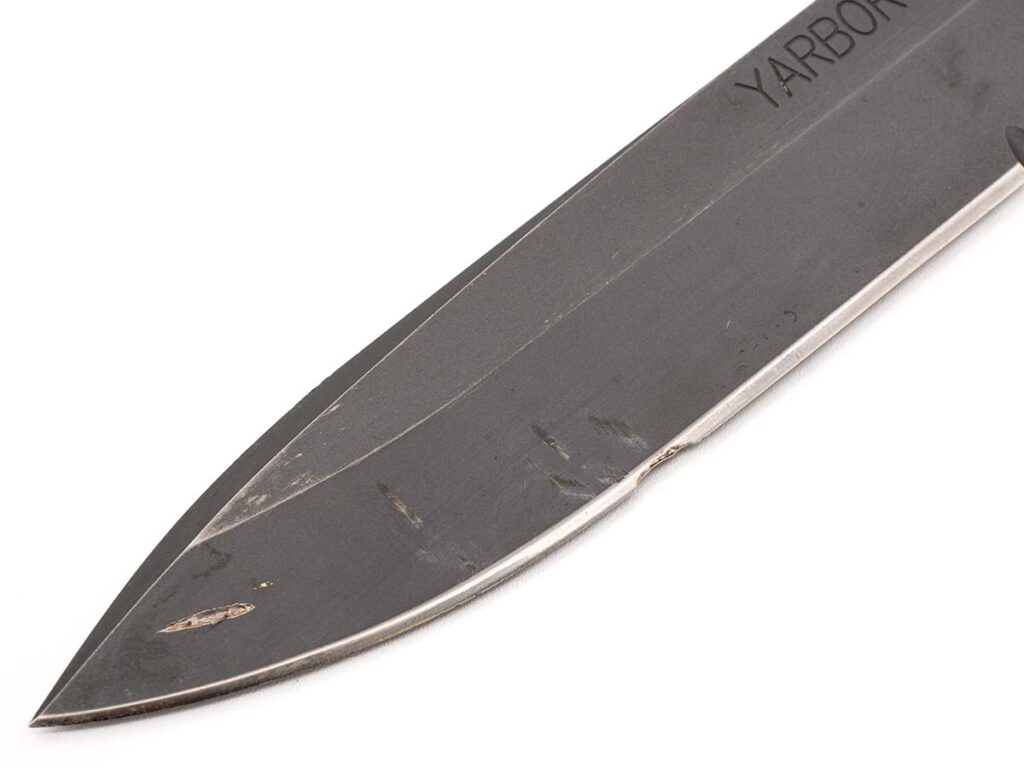
After an Army Special Forces soldier used his Chris Reeve Yarborough to cut a live electric cable during a mission, he sent in the damaged knife with $50 asking for repairs. The company sent the $50 back along with a new knife. Anne Reeve keeps the original knife, shown here, in her safe deposit box.
“A customer put a MagnaCut blade in a glass of saltwater for seven hours and claimed the rusting and pitting should be covered by our warranty!” recalled Anne Reeve of Chris Reeve Knives. “Another requested we replace the packaging of the parts he ordered because they smelled too strongly of perfume or lotion. A customer sent a knife in for a re-blade, and the original blade had an arrow and a smiley face welded onto it.”
Really? Try a few more from Chris Reeve Knives. A customer complained that the phosphor bronze washers of his Sebenza had stains on them and simply would not accept that it was normal patina. He also complained that the knife was not sharp and he had to sharpen it himself. He ground half the blade away and then said he should get a completely new knife. A customer shot his knife with a 9mm pistol and then sent the company a photo of the broken knife while requesting a new one under the standard warranty.
At Chris Reeve Knives, reputation is everything, and the company stands by its knives. But let’s sanity check. Warranties are not “get out of jail free cards” for new knives.
“We try to keep consistency in our warranty, but we do sometimes vary on case-by-case situations,” Anne explained. “Over the years we have tightened things up a bit because often we felt we would give an inch and the customer would take a mile.”
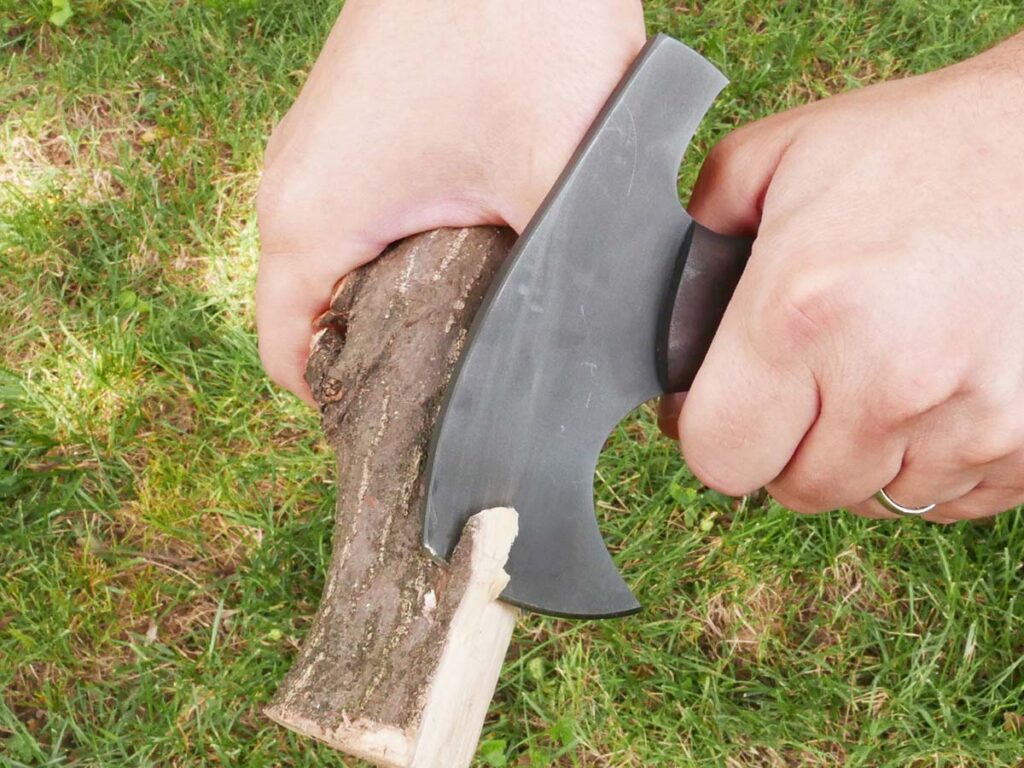
“Normal blade finish wear is not covered under warranty,” Daniel Winkler observed. “Working knives should look used.” The Winkler Hunter Axe LT shows some normal finish wear here. (Covert image)
Still, going out of their way to accommodate, the folks at Chris Reeve Knives have had some remarkable experiences.
“Mostly the customers who push back are simply rude,” Anne related. “Some just hang up or threaten to sell their knife. A customer informed us once that they had cut very acidic fruit multiple times and refused to clean the knife afterwards. They were furious we would not warranty their now rusted blade. Another customer took his brand new Umnumzaan and stabbed in into a tree. He then pried it 90 degrees to ‘tip test’ it. The tip snapped, and he claimed we should warranty the blade because what he did should not be considered misuse or abuse.”
Among unusual requests that Chris Reeve Knives went beyond the call of duty, or warranty, to make right, Anne has great memories. When a customer sent a 5.5-inch Green Beret in for recoating and it was lost in return shipping, the company made a custom iteration of the discontinued 5.5-inch knife from a 7-inch Green Beret blade blank. A sheath was available from the company archives and both were sent to the customer. When Reeve knives were abused by U.S. Customs officials, the company removed the scratches caused by bouncing around loose in transit, making the owner happy even though there was no warranty obligation. After an Army Special Forces soldier used his Yarborough to cut a live electric cable during a mission, he sent in the damaged knife with $50 asking for repairs. The company sent the $50 back along with a new knife.
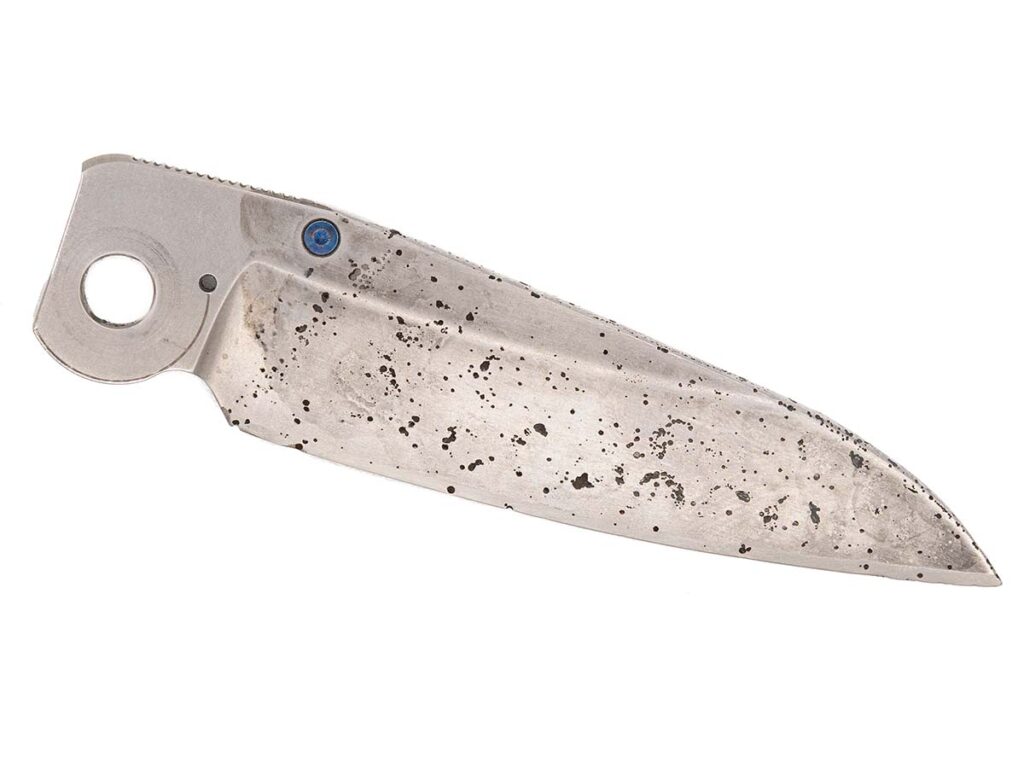
Anne Reeve said a customer put the MagnaCut stainless steel blade of a Chris Reeve knife in a glass of saltwater for seven hours and claimed the rusting and pitting should be covered by the company’s warranty. Of course, like all stainless steels, MagnaCut stains less but is not stain proof. Quite understandably, the warranty request was denied.
“That original knife lives in my safe deposit box now,” Anne smiled. “On a few occasions we have older knives returned for sharpening and we can tell that the knife has been lovingly sharpened so many times that the blade is worn out. We have replaced the blades. When we made the One Piece Range, the paperwork specifically said that it was not a throwing knife and breakage from throwing would not be covered by warranty. A couple of times we had knives returned that were broken in two. The dings made it quite obvious that the knife had been thrown. Back then, we would replace the knife and give the customer a verbal slap on the wrist.”
Though Reeve, like other companies, has found it necessary to scrutinize warranty requests more closely in recent years, the dedicated effort to make the customer happy remains strong. At Chris Reeve Knives, the warranty is, as Anne puts it, “phenomenal.”
Judgment Calls
When did the rules change? Where does the line between normal expectation and radical knife recklessness blur?
A closeup of the blade and edge damage the Chris Reeve Knives Yarborough incurred after being used by the SF operative to cut a live electric cable is a tribute to the toughness of the company’s knives.
“We’ve had a few forgeries sent to us for repairs,” commented BLADE Magazine Cutlery Hall-of-Fame® member Daniel Winkler of Winkler Knives. “Reactions from customers can get hot when they learn they have been duped. Not many warranty requests are really ‘crazy’; normal sharpening or sometimes fixing a damaged tip. People also request a re-finish for worn blades. If a knife fails for any reason we will either fix it or replace it, and normal blade finish wear is not covered under warranty. Working knives should look used.”
Winkler is sensitive to certain situations and sees extraordinary conditions for what they are.
“On a few occasions we have sent replacement knives without receiving damaged ones back,” he remarked. “One was a military user that used his knife to destroy a communications location in a war zone. He fried the power supply, and it fused the knife in the connection. Another was a hiker who saved his dog in a rockslide. His knife fell to the bottom of a gorge, so we replaced it, too. A third was used in a home situation where a man used his Winkler knife to stab an intruder to save his family. His knife was held as evidence, so we sent him a new one.”
A tornado destroyed a home and carried away a safe full of knives, including several TOPS Knives models. Two to three years later, the safe was found. The knives were intact and basically undamaged. When TOPS was contacted for help with slight rust on the blade and engraving, the company obliged at no cost.
There lies the real judgment call in rendering the warranty verdict. Does the customer’s story pass the simple test of reasonableness? If so, most companies might feel a pang of compassion and try to resolve the request in the interest of good customer relations. Still, it’s a tough challenge sometimes. As much as a customer might feel slighted if a warranty request is dishonored, the maker might well feel used when the circumstances are not plausible or strain the normal standards that most people would accept.
“We go out of our way to promote positive customer relations,” Daniel added. “We have replaced or refunded knives and axes that we probably shouldn’t have due to how they were damaged in abuse, like prying or throwing. We will normally take the hit, but if it happens again we do not honor any warranty.”
Case-By-Case Decisions
At TOPS Knives, warranty requests are evaluated with the best outcome in mind. “Our philosophy on our warranty is that we have some things that will void a warranty or won’t be covered under warranty, but we still handle them all on a case-by-case basis,” remarked general manager Craig Powell. “The people that are honest and level with us are way more likely to get their issue handled under warranty—even if it shouldn’t be—than people that are rude or clearly lying to us.
“I always find it funny when someone says something happened to their knife and then the actual damage to the knife in no way matches their description,” Powell continued. “Like, maybe they think we don’t actually use or test our own gear and so we don’t know what would cause certain things to happen. But really, in the end very few people that contact us with an issue treat us poorly. So the vast majority get help under warranty.”
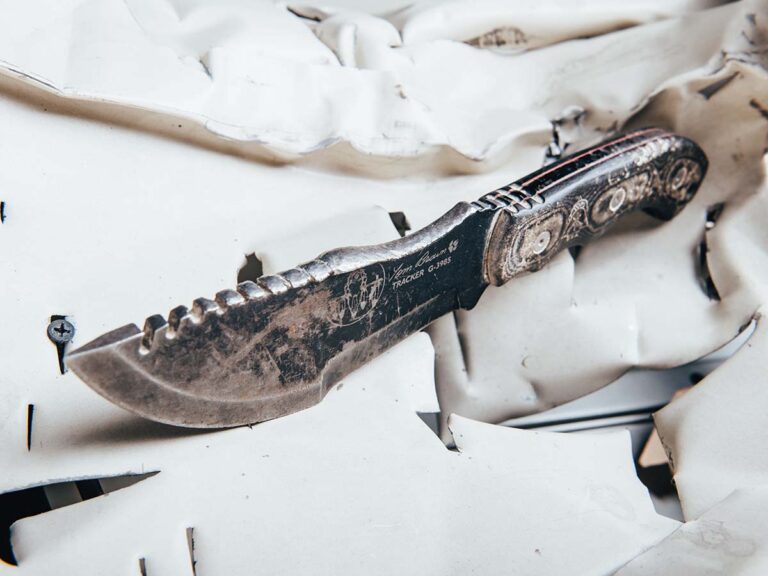
Back to the TOPS Tom Brown Tracker that was lost in the Iraqi IED incident: the local who originally found it after the explosion used it to split wood. The saw teeth had basically been mushroomed out of existence from the local beating on the knife with a piece of metal. Considering how the U.S. serviceman originally lost the knife, TOPS fulfilled the warranty.
Powell remembers certain circumstances that were somewhat unusual prior to a warranty request.
“When I had only been working here for a year or two, I took a call from a guy that was concerned about an issue with his Silent Hero. I talked to him for probably 15 minutes trying to figure out what was wrong. He kept saying that the knife was getting deformed and all he was doing was [batonning the blade spine to make] firewood. It probably took me longer than it should have, but I finally thought to ask what he was using as a baton. Turns out he was using the hammer side of a hatchet as his baton. So, a thick piece of metal is what he was using rather than a stick. I chuckled to myself and then we talked through the process of having a hatchet in your hand and choosing to use a knife to process firewood rather than the hatchet. He said ‘Oh!’ Then he basically apologized and said he understood. We didn’t end up fixing that knife for him, but that was because he realized what he had done and probably kept it as a reminder or trophy.”
On another occasion, a tornado destroyed a home and carried away a safe full of knives, including TOPS models. Some two to three years later, the safe was found. The knives were intact and basically undamaged. When TOPS was contacted for help with slight rust on the blade and engraving, the company obliged at no cost. Hikers have been known to lose TOPS knives on the trail and then miraculously find them months later. When the owner of one of these calls for warranty assistance, the TOPS folks fix the knives up, cleaning and refurbishing before sending them back in the context of a lesson learned: hold onto your valuables while out in the woods, especially your knife.
Extreme Situations
Military experiences have brought up several warranty requests, and these are sometimes caused by extreme situations. A Tom Brown Tracker was lost during the horrific explosion of an IED (improvised explosive device) in Iraq. The soldier involved was a chaplain, who returned some time later to the village where the explosion occurred. An old lady came forward with his knife after an interpreter and a $20 bill did some talking. The knife had been used in splitting wood.
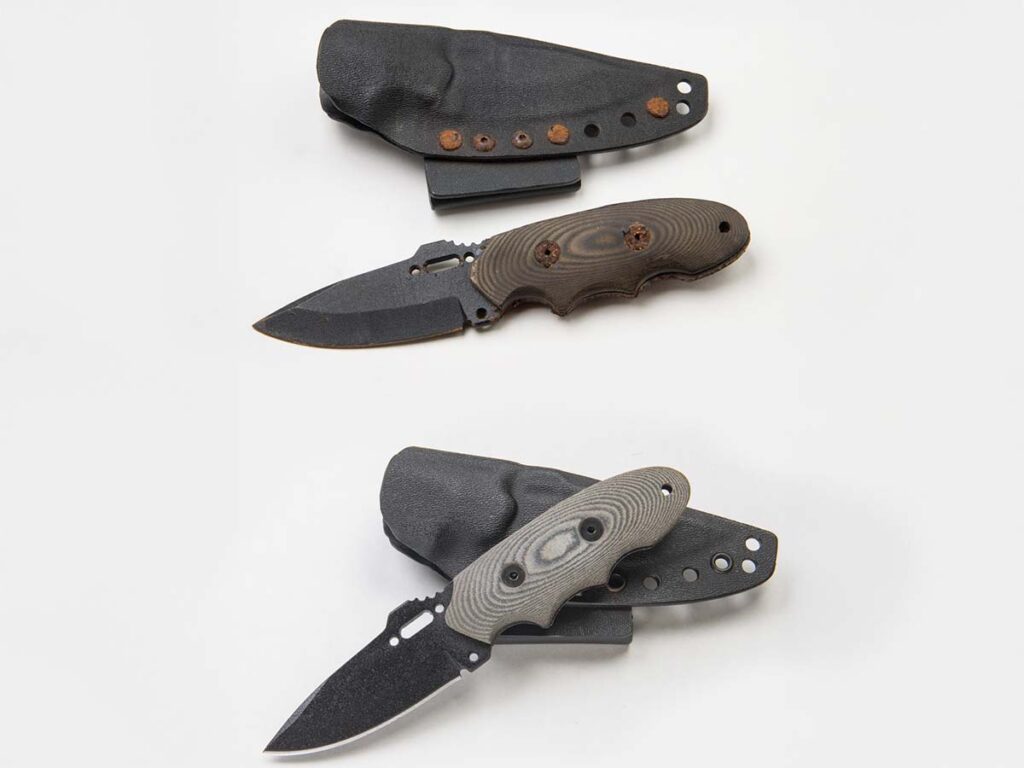
“It was beat to hell,” Powell remembered. “The saw teeth had basically been mushroomed out of existence from this lady beating on it with a piece of metal. We swapped the soldier a new one and still have that knife [above] here today.”
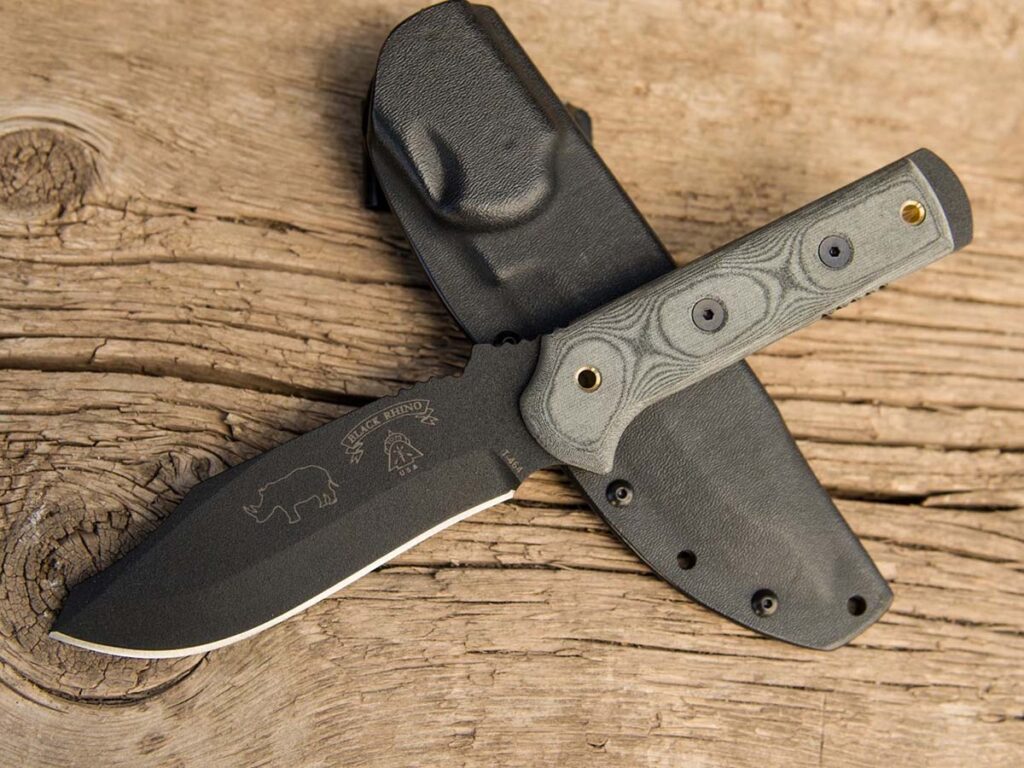
A TOPS Knives Black Rhino was lost when a desert barracks burned to the ground. The scales were completely gone and the knife could not be repaired. TOPS sent the destroyed piece back to the serviceman along with a brand-new Black Rhino like this one.
A Black Rhino was lost when a desert barracks burned to the ground. The owner recovered the knife. Its scales were completely gone and the knife could not be repaired. TOPS sent the destroyed piece back to the serviceman along with a brand-new Black Rhino.
“While our policy isn’t a no-fault policy, we still cover most issues,” Craig said. “We know what we’re making is quality, and we strive for that on every knife. So anything that a customer’s knife should be able to do but doesn’t is going to get covered.”
In the broadest sense, the warranty works both ways. It protects buyer and seller and invokes the sense of quality and pride of craftsmanship, with reasonable performance expectation and use. There are outliers, but for the most part both knifemaker and knife user work together with warranties to achieve positive resolutions.
Get a gander at what’s on the slate for NSM in 2026.
According to a recent post by Niagara Specialty Metals (NSM) on BladeForums, NSM (nsm-ny.com) had several steels and materials available either now or that were “incoming” as BLADE was going to press.
The list includes: MagnaCut; CPM154; S30V; S35VN; S45VN; S90V; 3V; 4V; CruWear (aka NSM Wear); 154CM; 20CV; M4; CPM D2; D2; 440C ESR; 416; and 6-4 titanium. The new MagnaMax (page 66) should be available in 2026.
The post stated that all particle metallurgy grades are “coming in from Erasteel and Carpenter and the quality has been excellent.” All of NSM’s air-melt steels and 6-4 titanium are domestic.
The only grades off the list at press time were 15V, 110V and Rex 121. “They were Crucible exclusives,” the post noted of the three grades not on the list, “and we’re working with the mills to bring them back once production can be re-established.”
“A knife capable of movement and gifted with intelligence …”
—Jean-Marc Laroche
“On fitting your hand into that of the knife, you already feel a strange clasping in response when, suddenly, the mechanical fingers close! You can’t get free! With the same movement, an eye opens and stares at you intensely. It’s awake! Now you are under its control, and the knife is master of you who dared to take it in your grasp.”
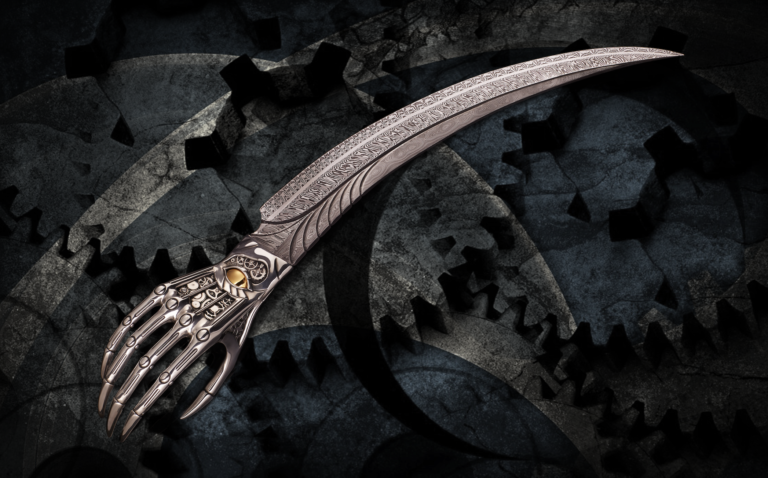
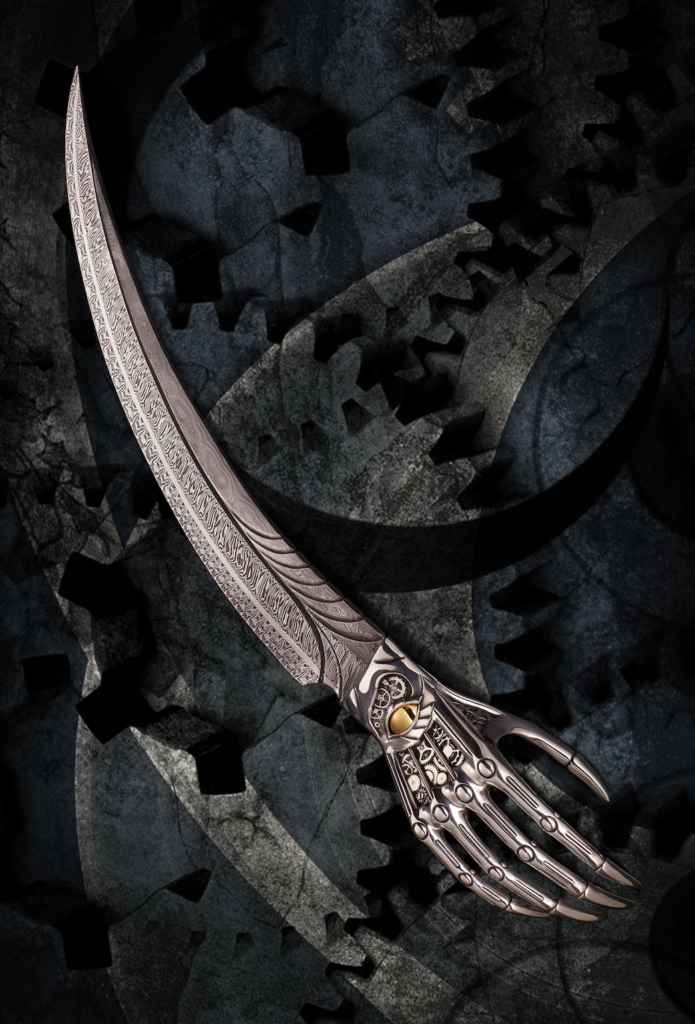
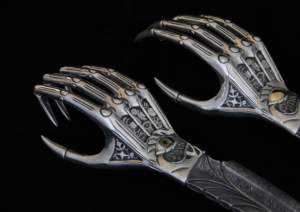
Above: The Living Knife by Jean-Marc Laroche features a mechanical hand for a handle that, as you grab it, literally grabs you back. The damascus blade is a composite of 15N20, 15LM and UHB11 high-alloy nickel and carbon steels in explosion, twist and random patterns forged by Swedish maker Roger Bergh. Overall length: 25 inches. (images courtesy of Jean-Marc Laroche)
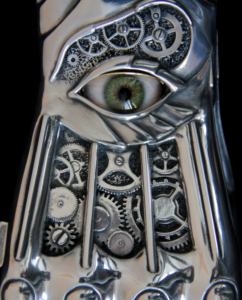
In addition to the above, French knifemaker/artist Jean-Marc Laroche refers to his latest creation—this issue’s cover piece—as “The Living Knife.” Since it has a “hand” for a handle with “fingers” that close, an “eye” and an overall lifelike appearance, who are we to argue? As you grab the handle, the “fingers” actually grab back so that it’s hard to tell who’s holding whom. And, as the fingers grab your hand, the “eye” opens. The hand also is embellished with gears in the Steampunk style.
A close-up of the silver-plated bronze hand shows the detail of the gears in a Steampunk motif. (image courtesy of Jean-Marc Laroche)
The opening eye.
The Living Knife is indeed a most unusual creation—but then Laroche has been making otherworldly pieces for over two decades. Even by his standards, though, this one takes his knife art into uncharted territory.
“It was from the cinema of fantasy films that I drew my inspiration,” he notes. “It took me 12 years to implement my idea, six months to carry it out and a fair number of technical difficulties had to be overcome.
“Yet here it is, like a cunning thing from another time that a mad inventor out of the 19th century would have dreamed up. This biomechanical being activates its workings to move its fingers; it seizes control of the situation with its eye’s intelligence.”
The Living Knife is an assembly of mechanical parts, the prototype having been made in resin. A few rare versions in bronze, gold and silver are in the process of being forged.
“Swedish knifemaker Roger Bergh participated in this project. Indeed, I have been talking to Roger about it for 10 years and he has always been enthusiastic,” Laroche observes. “Roger first forges damascus steel to obtain various types of structures; he then assembles them into magnificent combinations. A world-renowned knifemaker, he has remained down-to-earth and open. Working with him is a real pleasure.”
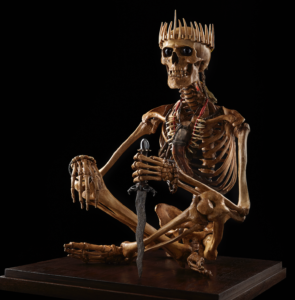
In addition to knives, Jean-Marc Laroche sculpts skeletons on a lifelike scale. An example is his “Warlord,” a kind of Javanese king holding a kris. The skeleton is resin on a steel structure. The crown is assorted animal bones, the eyes are natural quartz crystal, and the necklaces and bracelets are from “different ethnic tribes.” The knife is made from an old Indonesian kris blade, some teeth and hematite.
KNIFE SPECTACULAR
BLADE® first learned of Laroche at the 1992 East Coast Custom Knife Show, where his knives with “alien-head” handles were a show hit. The alien heads were those of animals he customized and coated with a special resin.
In 1997 Laroche’s “Mother Ship with Fighters”—a set of four knives including one large one and three smaller ones with dagger blades and curved, claw-like guards—was a winner of the annual BLADEhandmade Best In Show Award. His “Byakhee,” a spectacular knife with a handle resembling a large, bat-like bird inspired by the science-fiction stories of H.P. Lovecraft, won Best Fantasy Knife at the 1998 BLADE Show West.
Laroche introduced The Living Knife to an appreciative audience this past June at the FICX, an invitation-only knife show in Paris that also featured a few U.S. makers, including Kevin Casey. It was Jean-Marc’s first knife show since 2002. Since then he had been involved in other forms of sculpture and exhibiting them worldwide.
Actually, The Living Knife is not Laroche’s first attempt at such a piece, his “Devil Hand” predating it. However, the Devil Hand did not have the mechanical grasping capability, the same materials or other select features of Laroche’s newest rendition. Laroche said he also has made two knives similar to The Living Knife, the first being sold to the Instituto Ricardo Brennand (http://www.institutoricardobrennand.org.br/index2.html), a museum in Recife, Brazil.
For a video on how The Living Knife operates, watch the video below:


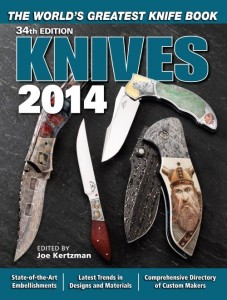 Knives 2014, 34th Edition