Knifemaking is the building of a knife, which includes the blade, handle and other accouterments. Blades are made by either removing metal from a steel blank via a grinder – known as stock removal – and the forging to shape of hot steel into a blade in the process known as bladesmithing. Other parts, including bolsters, guards, pommels, etc., are needed to complete the finished knife.
In BLADE®’s continuing series entitled Midweek Maker, we are in our third installment of Midweek Maker Military Style: Tracy LaRock of LaRock Knives.
Tracy LaRock grew up on a dairy farm and spent every spare moment hunting, trapping and fishing. He served as a mortarman in U.S. Marine Corps from 1990 to 1995, but he didn’t stay out for long. In 1997 he signed on with the Texas Army National Guard, in artillery and recruiting, and still serves today. “So knives have been a part of my daily life since the beginning,” he commented.
“In 2008 Atmar Lester was showing a knife he made to some folks at church. I asked him some questions and he pointed me in the direction I needed to go,” Tracy related. “To start off it was basic tools and head-scratching, then I discovered the forums and tutorials.” Thomas Rucker and Percy Richardson let Tracy visit their shops. In 2014 he started making slip joints. After completing a few he reached out for help and received helpful insights from knifemakers Luke Swenson, Jared Oser and Enrique Pena among others.
“I hope to become a full-time maker in a couple years when I hang this uniform up for the last time,” he noted. Tracy lives in Lufkin, Texas with his wife, Mia, and their three sons.
Best-selling knife patterns: TimberJack and TimberJack Jr., traditional slip joints
Favorite blade steels: W2, 1095, O1. “Most are W2 because I have long since fallen down the hamon hole,” Tracy quipped.
Blade grinds: flat
How he tests his knives: rope, cardboard
Favorite handle materials: green canvas Micarta and ironwood
Price range: $350-$850
Forums he participates in: Facebook Group like Making Slipjoints and Lockbacks
As Tracy LaRock retires from the military, he will be able to focus more time on making his TimberJack slip joints. His wife Mia LaRock does a terrific job running the Facebook Group at LaRock Knifes.
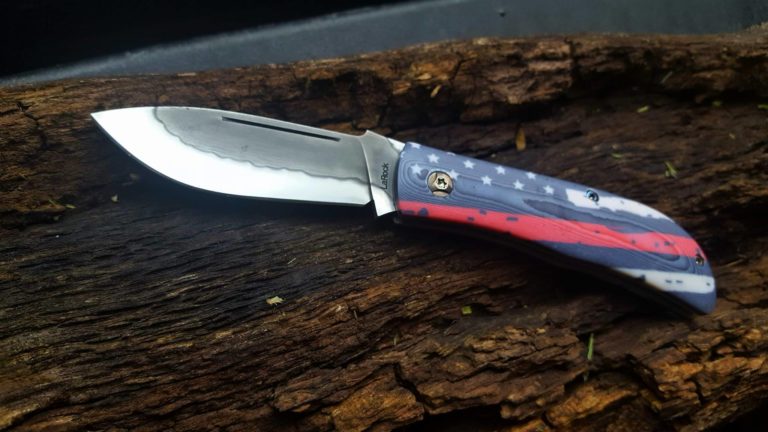
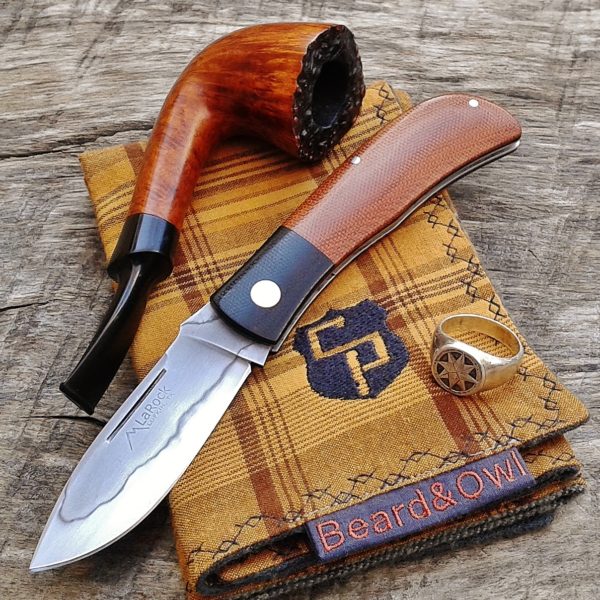
The above TimberJack has a 3-inch blade of W2 with hamon. The handle is fashioned from canvas Micarta scales. Overall length is 7.25 inches. Maker’s list price: $425.
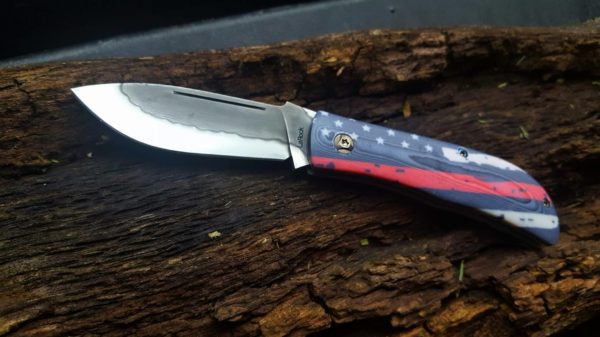
This Tracy LaRock creation is also a TimberJack with a 3-inch blade of W2 steel with hamon. The handle is American flag Carv-X. Overall length is 7 3/4 inches. The screw construction is done with titanium screws from TiConnector. Maker’s list price: $750.
Contact Tracy or Mia LaRock at 936-238-9077, [email protected], on Facebook at LaRock Knives or on Instagram @tracylarock.
Subscribe To BLADE For More Stories Like This
An annual U.S. subscription to BLADE is $21.98. You can get your 13 issues sent to Canada for $39.98 and internationally for $49.98. Or go green and get your issues sent digitally for $17.98.
A one year’s subscription to BLADE® will ensure you’re the first to read all six Knifemaker Showcase stories. You’ll also get the latest knife news, knifemaking how-tos, knife reviews, plus knife history and articles that tap into the knowledge of both the legends and the up-and-comers. Don’t miss out. Subscribe.
Nitinol, also referred to as “Ni-Ti-Nol,” was first discovered back in 1959 by scientists William Buehler and Frederic Wang at the Naval Ordnance Laboratory. The Ni-Ti-Nol acronym stands for “Nickel-Titanium-Naval Ordnance Laboratory.”
Beuhler and Wang were searching for a super-elastic alloy for missile nose cones that would be pliable at extreme heat, yet return to its original shape after cooling. Their efforts were a success, but because the incredibly tough alloy was so difficult to process and machine, it wasn’t used until much later.
Knifemaking Discovers Nitinol a Half-Century Later
Duane Dwyer of Strider Knives was the main force behind SM-100 (HIPTiNite), and his signed custom Strider MT2 showcases a brilliantly heat-treated SM-100 blade mated to machined carbon fiber handle scales. (Brady Miller image)
Custom knifemaker Duane Dwyer of Strider Knives became interested in Nitinol back in 2005 while searching for a super hard metal alloy that would not rust. He approached metallurgist and friend Scott Devanna, vice president of technology at SB Specialty Metals, and inquired about the possibility of producing Nitinol using the particle metallurgy process, which had never been done.
Shortly afterwards Devanna introduced Dwyer to Eric Bono, a metallurgist and knifemaker who also had an interest in the alloy, and the three men began to explore the possibilities of incorporating the alloy into knives.
Nitinol Becomes SM-100 (HIPTiNite)
Duane Dwyer of Strider Knives was the main force behind SM-100 (HIPTiNite), and his signed custom Strider MT2 showcases a brilliantly heat-treated SM-100 blade mated to machined carbon fiber handle scales. (Brady Miller image)
With his metallurgical knowledge and experience, Bono developed a working, powdered metal version of the alloy in 2006, which the partners dubbed “SM-100.” It took several more years to refine the alloy and processes, and in 2009, Bono and business partner Fred Yolton formed a company, Summit Metals LLC, to produce SM-100.
Since that time, SM-100 (60 percent nickel and 40 percent titanium), which the company markets under the name “HIPTiNite,” has garnered interest not only in the knife industry, but also by NASA and the Formula 1 racing industry.
Properties of SM-100
The SM-100 brand of Nitinol, like its forerunner, is extremely tough. While a typical sanding belt can be used to grind several typical, mono-steel knife blades, it requires several belts, in many cases six or more, for the same process using the SM-100 alloy.
Made and sold in small quantities, the cost of SM-100 isn’t cheap. Add to that the cost of belts and additional time to shape and grind the material, and the cost per knife skyrockets.
On the positive side, SM-100 is noncorrosive, and while stainless steel will rust, Devanna says you can throw an SM-100 knife into saltwater for 50 years without the material corroding.
An Explosion of Coloring
Bono discovered during his development of SM-100 that it can be heat colored into an exquisite rainbow of colors. Due to the titanium content, SM-100 oxidizes into a blaze of bright hues just like other alloys incorporating titanium, but the process of achieving the color effects is quite different.
Bono confides that the magic happens during the heat-treating process, in which he allows small pockets of air to leak onto the surface of the knife. Prior to heat treating, the blades are wrapped in foil and small holes are punched into the wrapping.
When heat treated, different colors occur depending on the oxygen content of certain areas of the blade material as the surface oxidizes. The end result is the explosion of color on the SM-100 blades.
The price for bright, eye-popping colors doesn’t come cheap, but then new innovations rarely do.
Knife industry pros give their takes on what the hot knife steels will be in the year ahead.
Every cutlery buyer faces a dizzying array of steel choices when it comes to buying that next knife, an array that represents the proverbial “double-edged sword.” While it’s nice to have choices, it can also be hard to keep up with so many options. Fortunately, industry professionals are available to help sort out which stainless and carbon varieties are either catching fire or cooling off.
*The steels are listed in no particular order by the knife patterns/types for which they are favored most by users and makers, according to the story’s sources.
MagnaCut Reigns Supreme
Last year when BLADE took the temperature of steel suppliers, the clear-cut champion of blade materials was Crucible Industries’ CPM MagnaCut stainless. The creation of steel guru Larrin Thomas, MagnaCut remains on top and will stay there for the foreseeable future. Bob Shabala, president of Niagara Specialty Metals, praised the high-performance blade material last year and still does today.
CPM MagnaCut stainless ruled among knife steels in 2024 and will continue to hold sway in 2025. A representative example is the new CRKT Q, a folder in titanium and carbon fiber designed by Richard Rogers. Country of origin: Italy. MSRP: $225.
“We have sold about 320 tons of CPM MagnaCut since its introduction in 2020. It is our biggest selling cutlery grade right now and I don’t expect that to change anytime soon,” Bob said, adding the qualifier, “This is from Niagara Specialty Metals’ limited perspective. I’m sure other mills are working on new grades which I’m not privy to.”
One reason MagnaCut is so popular is it embraces all cutlery genres with ease.
“CPM MagnaCut remains in high demand across various knife patterns,” Bob observed. “Some customers currently using MagnaCut for fixed blades are expanding into folding knives and have expressed plans to continue using the steel for their new designs, reflecting its versatility and ongoing popularity.”
MagnaCut maestro Larrin Thomas
Scott Devanna, vice president of technology and a metallurgist for SB Specialty Metals, tends to concur.
“I’m not sure there will be a new ‘super steel’ introduced in 2025. The introduction of new steels seems to have a three-to-four-year cycle, and with the recent intro of CPM MagnaCut such new introductions may be a few years off. We sell a lot of MagnaCut,” he stated. “I’ve learned over the years that new is very often the primary driver when new grades are introduced. This is what happened with CPM S30V, CPM 20CV and its European equivalent M390, and a few other grades.”
It should be noted that MagnaCut technically is going into its fifth year of existence. As you can see, it takes a while for a steel to work its way into the manufacturing pipeline and be given a thumbs up or thumbs down by the end user.
Specialty Grade Steels
Meanwhile, other specialty grade steels aren’t being ignored. In fact, many knife consumers prefer other steels that suit their needs better, both of the stainless and carbon varieties.
CPM 154 stainless will continue to be a steel of choice for custom hunting knives, here on the Cowboy Knife by David Fleming in a handle of sheep horn from a Rocky Mountain bighorn. Overall length: 7 inches.
“CPM S30V, one of the original cutlery-grade steels, continues to be one of our best-selling products,” Shabala noted. “Despite its age*, S30V maintains a strong position in the market, demonstrating its enduring reliability and widespread appeal among knifemakers.
Devanna agrees.
“CPM S30V is still a favorite for hunting knives, as well as CPM 154,” he noted. “For everyday carry folders, M390, CPM 20CV and CPM 154 are still used quite a bit as well.”
Scott said CPM S30V and S35VN remain strong for tactical folders.
Bob Shabala, Niagara Specialty Metals
Custom knifemakers aren’t as easily swayed by trends and tend to go with steels they are comfortable using, are time-proven to them personally, or geared to their particular customer base. While many are on the MagnaCut train, they tend to be more diverse in their choices.
“Other steels popular among custom knifemakers are M390, CPM 20CV, CPM 154, and to a lesser extent CPM S30V and CPM S35VN,” Devanna stated. “I have heard that CTS-XHP will be re-introduced, and this grade developed quite a following when it was readily available—especially for kitchen knives and high-end folders.”
Added Shabala, “CPM 154 is always popular with the custom makers.”
Carbon Steel
THE CARBON EQUATION The outdoor crowd—bushcrafters, survivalists and open-air tactical users—has to be pleased with the attention they’ve been getting from the industry. These users’ requirements are different and they prefer a subset of steels all their own.
While major outdoor knife manufacturers like TOPS and ESEE still sell the bulk of their knives in 1095, they have been gradually offering their customers more steel diversity, including stainless versions such as S35VN. The TOPS Shadow Hunter has a 4.5-inch blade of 1095 carbon steel in a tungsten Cerakote®. Country of origin: USA. MSRP: $250.
“CPM 3V and 4V are favored for hard-use knives due to the steels’ toughness, while CPM S90V and 20CV are popular among users who prioritize wear and corrosion resistance,” Shabala observed. “CPM 3V and CPM 4V are carbon steels that continue to sell well in specific areas. 3V is in high demand for bushcraft knives and 4V is being used by the current national champion in BladeSports International cutting competitions, Ben Propst. His wife Sue Ann is now using it and in 2024 they both won cutting events in Kokomo and the Smoky Mountain Knife Works fall festival.”
“I think CPM 3V and CPM Cruwear—mostly for bushcraft/survival knives as well as tactical fixed blades—are gaining popularity in the market,” Devanna opined. “CPM 3V has proven itself over the years and continues to be a popular grade. CTS PD#1 was in this category but availability of this grade is a problem.”
While major outdoor knife manufacturers like TOPS and ESEE still sell the bulk of their knives in 1095 carbon steel, they have been slowly offering their customers more diversity in their lines, including such stainless versions as S35VN.
Overall Take
As Shabala and Devanna noted, MagnaCut will be the top dog among steels in 2025, but it’s certainly not the only hound in the kennel.
Shane Magnussen uses the CPM S90V supplied by New Jersey Steel Baron on his model BBV2 folder. Closed length: 4.54 inches. (SharpByCoop image)
The cutlery industry is so diverse in the competition among manufacturers, custom makers, genres of knives and budget categories, there’s room for many different stainless and carbon steels. While what’s in the works remains unknown to most, you can bet there are teams of metallurgists working on the next great knife steel as these words are written.
As a knife enthusiast and cutlery buyer your choices are bountiful in all categories—from EDC to outdoor, fixed blade to folder—and affordable to expensive. Some users buy one knife to last for years while others rotate their carry or require cutting fare for specific purposes.
The good news is your knife and steel options have never been better!
*Editor’s note: The first-ever steel both designed and made specifically for knife blades, CPM S30V has been used for knives since 2001.
When BLADE Magazine Cutlery Hall-Of-Fame® member Bill Moran reintroduced knives with damascus blades at the 1973 Knifemakers’ Guild Show, little did he know how much damascus would evolve, redefine itself, expand into new media, and no telling what other recreations and rebirthings it has experienced in the half-century since that fateful weekend in the Muehlebach Hotel in downtown Kansas City.
On this page are some of today’s reincarnations of the material in its various forms, methods, materials and more. What’s staggering to consider is there are so many more variations—not only now but also to come. It is a phenomenon that is truly unique to the custom knife industry and should be celebrated and promoted whenever possible.
David Lisch Templars Mosaic
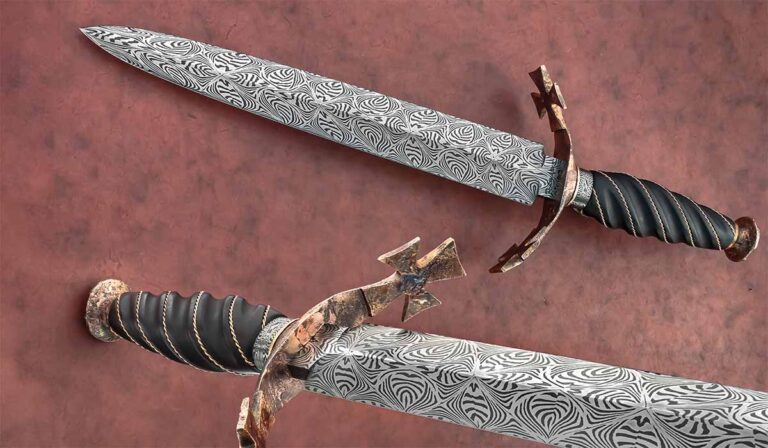
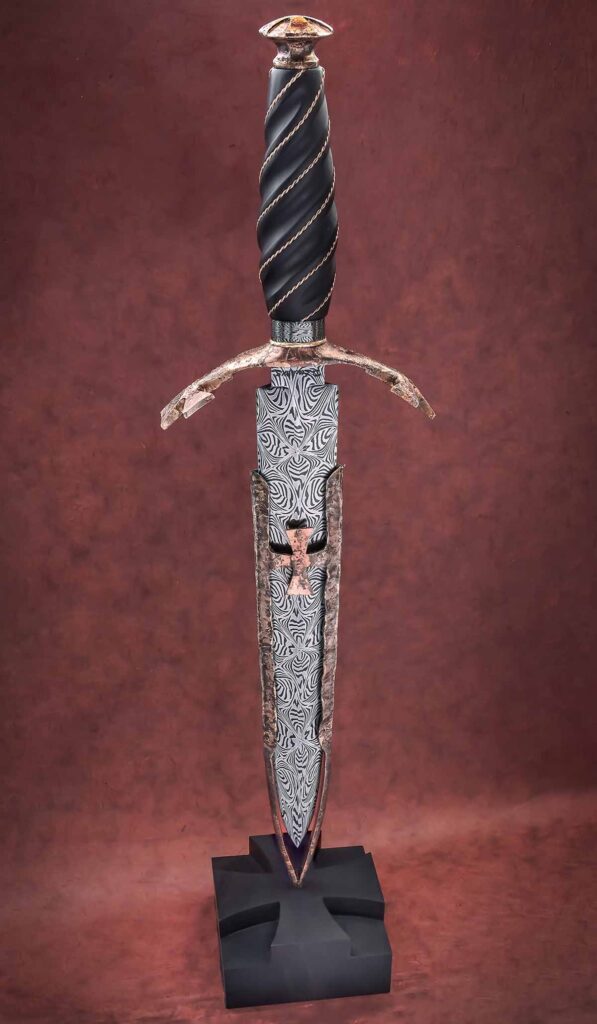
David Lisch’s spectacular art dagger features a 12-inch blade of his Templars Mosaic Damascus, a blackwood handle with gold wire wrap and a guard of pure iron covered in melted gold. Overall length: 17.75 inches. The knife comes with a stand that includes an embellished templars’ cross and one carved in the base as well. (SharpByCoop knife images)
Sporting a pattern ABS master smith David Lisch christened Templars Mosaic, the blade for his dagger is one he forged from 15N20 nickel-alloy and 1080 carbon steels and etched in ferric chloride.
“I was aiming for a bold, bright pattern that had a cross-like shape but wanted it to be a bit organic,” he wrote. The Templars’ cross also is represented on the guard and the finial, and there is one on the stand that holds the knife as well. “All these parts are pure iron covered in melted gold,” he noted. The dagger also has a domed gold spacer between the guard and Dragon Thunder damascus spacer that the fluted-blackwood-with-gold-wire-inlay handle butts up against.
“I made this dagger out of the love I have for creating art with no concern about how long it took or how much money I would make from it,” David stressed. “I did the handle twice and I did the big finial twice. I sold the piece for $10,000 and will not be making another one like this. You can be sure that the love I have for creating will take me to a new dagger, sword or bowie knife that tries to fill the void in me that can only be filled by creating art.”
Jeremy Yelle Jellyroll Mosaic Turkish Twist
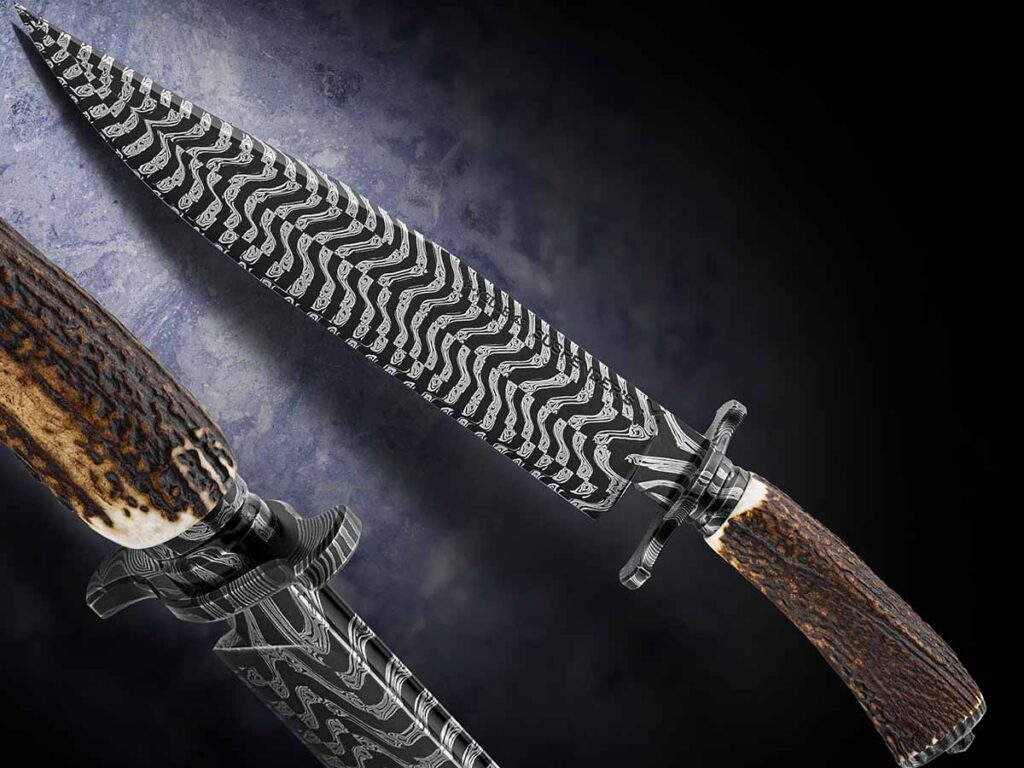
The steels for the jellyroll mosaic Turkish twist pattern damascus of the collaborative bowie by Jeremy Yelle (right) and Alex Houle (left) is forged from 1080 carbon and 15N20 nickel-alloy steels. Blade and overall lengths: 10.25 and 15.5 inches. Their list price for a similar knife: $2,600. (Jocelyn Frasier knife image edit)
The blade damascus of ABS journeyman smith Jeremy Yelle’s and SBK Cutlery’s stag bowie is a positively electric jellyroll mosaic Turkish twist pattern Jeremy forged in a collaboration with his friend Alex Houle of SBK. Alex forged the collaborative damascus into a blade and Jeremy made the handle.
“We began by welding a billet of alternate layers,” Jeremy wrote of the forging process. The pair drew the billet into a bar and jelly rolled it. “Then we squared it up and welded a four-way incorporating some 1-inch-square 1080,” he continued. They welded the billet, drew it out to ¾-inch square, cut and twisted it, and made a Turkish-twist stack that Alex forged into a blade. “You can also see the ‘fish mouth*’ weld Alex did so the edge bar and the spine meet properly,” Jeremy wrote. “He did a wonderful job making the blade.” Jeremy showed Alex how to work with stag and they finished the parts. Alex revealed the beautiful pattern via a two-step etching process using a solution of ferric chloride and finishing the etch with a coffee-darkening soak and hot wax finish.
Zane Dvorak Multi-Bar
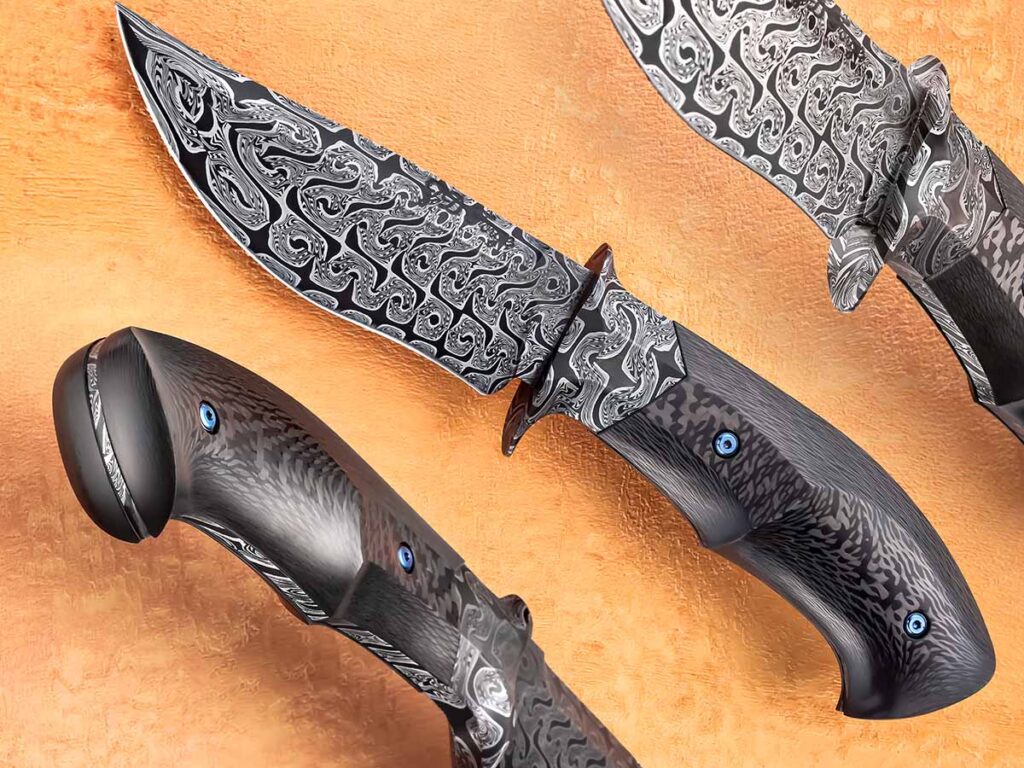
The 4.25-inch blade of Zane Dvorak’s hunter is a multi-bar damascus of 1084 carbon and 15N20 nickel-alloy steels. Overall length: 9.25 inches. His price for a similar knife: $2,400. (SharpByCoop image)
The blade of Zane Dvorak’s hunter is a multi-bar damascus of 1084 carbon and 15N20 nickel-alloy steels. Zane forged the blade/tang of four twisted bars of a twisted-bar pattern, and forged welded the guards and bolsters on with the same pattern. He bird’s mouthed the blade tip and rewelded it back together to create flowing outer bars. For etchant he used Gator Piss Acid from Baker Forge & Tool.
Bird’s mouthing is a process done on multi-bar, mosaic or other types of damascus patterns. According to Zane, it involves cutting a triangle out of the end of the rectangular parent bar—the shape of which somewhat resembles a bird’s mouth—then bringing the steel of the edge and spine back together to form the point of the blade. By doing so the blade exhibits a better consistency and overall flow of the pattern.
Andrew Blomfield Alternate Pattern
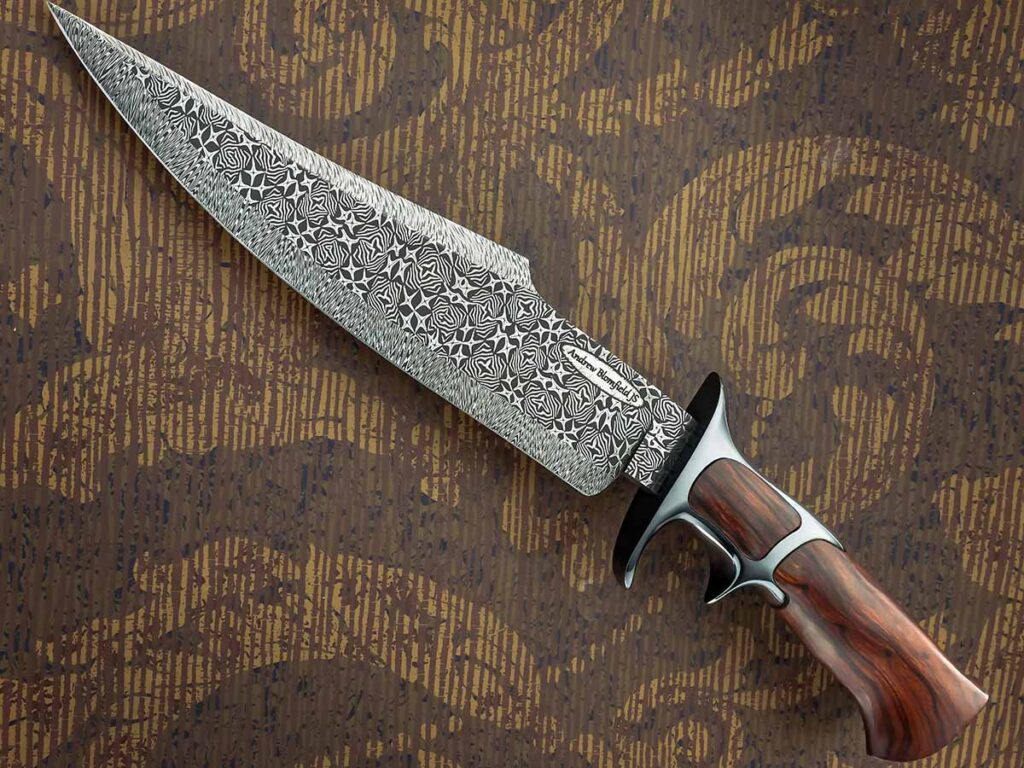
The mosaic damascus for Andrew Blomfield’s sub-hilt fighter is a combo of two separate billets welded in an alternate pattern. Blade and overall lengths: 9.5 and 14.5 inches. Blade grind: flat. Andrew’s price for a similar knife: $3,000. (SharpByCoop image)
The material mid-blade of Andrew Blomfield’s sub-hilt fighter is a combination of two separate billets of mosaic damascus welded in an alternate pattern. The edge is a straight feather pattern forge welded around the edge. The blade is a combination of pieces from three separate billets. The steels are 1084 carbon and 15N20 nickel alloy etched with ferric chloride.
The integral sub-hilt is 1020 low-carbon steel hot salt blued to a deep black finish. The handle is desert ironwood. The knife is of a full takedown construction.
Frank Edwards Palm Leaf Mosaic Pattern
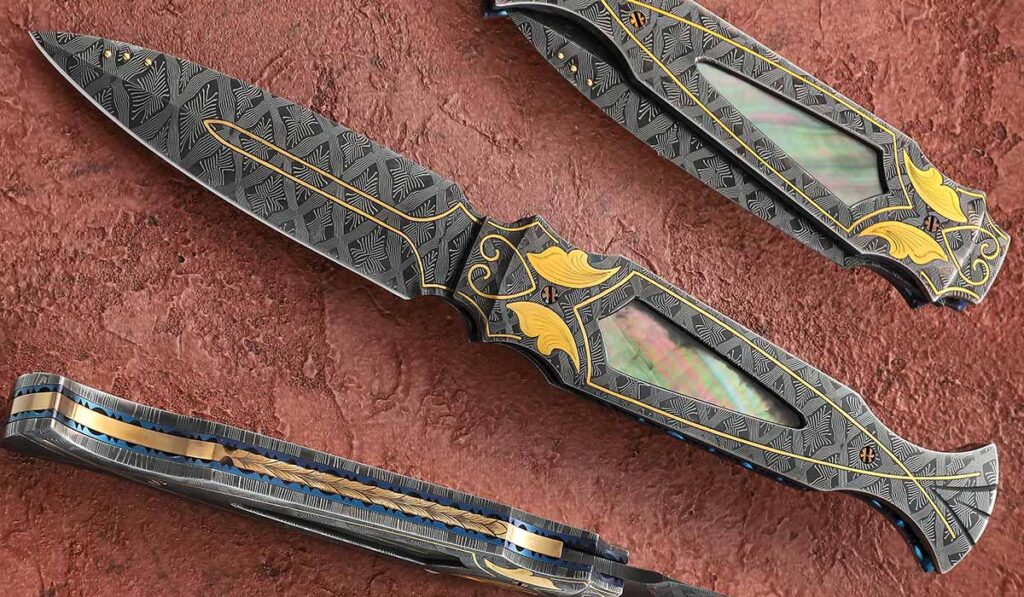
The Palm Leaf mosaic damascus by Frank Edwards is an interweaving river system of straight lines. The handle inlay is black-lip mother-of-pearl. Blade and closed lengths: 3 and 4.25 inches. His price for a similar knife: $1,900. (SharpByCoop knife image)
The multi-bar damascus of Frank Edwards’s folding dagger blade is in a Palm Leaf mosaic pattern. Starting with a billet of straight lines, he reduced it all into a square and then biased the squares, four-waying the billet into a 1.5-inch square.
As Frank explained his recipe, “Forge weld another billet of straight lines, keeping them straight as possible to .5 inch by 1.5 inches. Add that to the previous billet and forge weld and reduce to a 1×1-inch square. Then four-way it again. This will give you the frame around the palm leaves. Keep repeating that until you achieve the size of pattern for the knife you’re building.
“The key to getting good mosaics is a slower reduction [of the steel]. We have presses and power hammers that help but they can move too much metal too fast, which will destroy a mosaic in a hurry. The slower reduction allows the billet to stay uniform throughout the length of the bar.” To expose the pattern he etched the blade with a four-to-one mixture of water/ferric chloride in 10-minute cycles, using 2,000-grit sandpaper between cycles.
Jackson Rumble Stunning Pattern
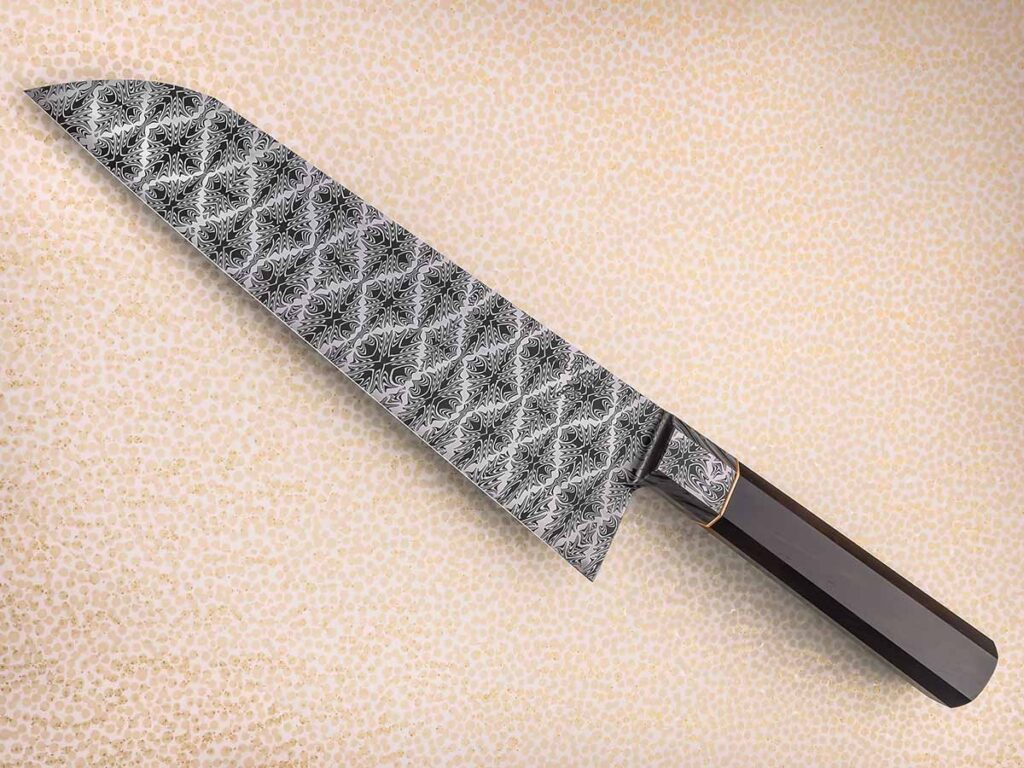
The 8-inch blade of an integral chef’s knife by Jackson Rumble boasts a mesmerizing and at press time unnamed damascus pattern forged from 1084 carbon and 15N20 nickel-alloy steels. The handle is African blackwood. Overall length: 13 inches. The maker’s price for a similar knife would start at $2,500. (SharpByCoop knife image)
The technique for the stunning pattern on newly named ABS master smith Jackson Rumble’s chef’s knife is what he calls a “pretty standard process” of four-way welding and re-square cycles. Not bad for “pretty standard,” eh (page 28, top left)? The initial stack has large sections of both light and dark steels interspersed through the alternating layers, and Jackson added extra-light steel to the billet in the later stages of the forging process.
“Finally, I used the Filicietti Flip method to transfer the pattern to the face of the billet,” he wrote. “For the etching process I used ferric chloride followed by coffee.” OK, Jackson, so what’s the “Filicietti Flip method”?
“I’ve heard the Filicietti Flip called other names like the Ferry Flip, or just tile welding,” he explained. “Basically, after you’ve finished building the pattern in the end grain of the billet, you take it to a bandsaw and cut slices off the end at a 35-degree angle. This makes a bunch of pieces in the shape of parallelograms or tiles. The tiles can then be rotated and forge welded back together to form a new billet. Instead of having the pattern showing on the end of the billet, the pattern will repeat itself along the face of the billet.”
We’re glad we asked.
*Also called fish lips, fish mouth is when the tip of the billet begins to curl up on either side during rough forging to resemble a fish’s mouth or lips, thus the name. It is an easy fix for knowledgeable bladesmiths such as Alex Houle.
Creek Stewart uses his survival knowledge, and a few good knifes, to tell a rockling adventure story, with a good romance interwoven throughout.
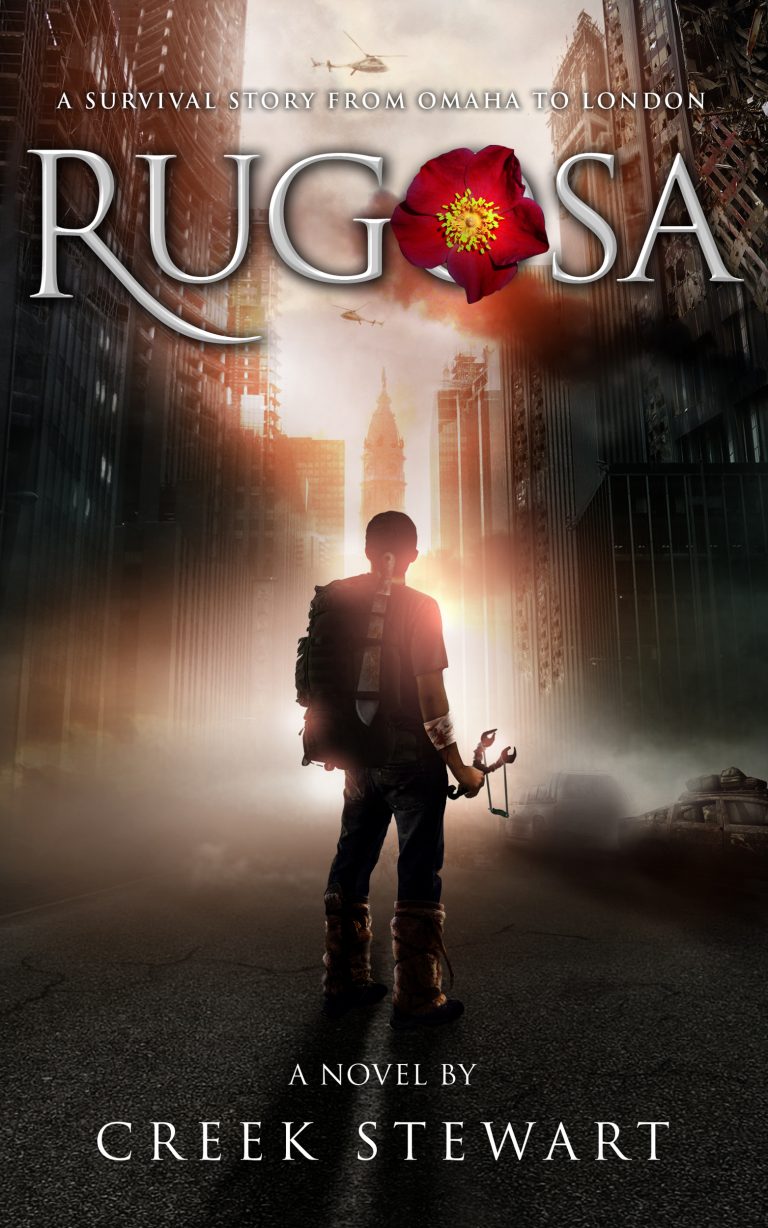
Valentine’s Day saw the release of survivalist and Whiskey Knives co-collaborator Creek Stewart’s young-adult romance novel, “Rugosa.” What knife enthusiasts will appreciate about this adventure is that by page 4 a machete crafted from a lawn-mower blade has made an appearance, and many others follow.
In the dystopian world of post-globalization America, 17-year-old Omaha Hoyt must leave the farm and woods were he is most at ease and travel to the city to rescue his love. The plan is to stay on back roads and subsist off his trapping and foraging skills. Very quickly plans change and the lifelong Boy Scout is forced to help someone he meets along the way.
Omaha’s pocketknife gets lots of use, and his sister makes a survival girl’s dream barrette that is shaped like a butterfly with cutting edges, a fishing line wrap with hooks for antennae, and is apparently weighted for easy throwing as a weapon. In what one might consider the equivalent of a gun getting reloaded in a movie, in the book there is actually a knife-sharpening scene.
This is not to say that “Rugosa” is knife heavy. It’s first and foremost a survival story about a 17-year-old who uses his scout training to survive physical and emotional challenges. But knives are more than an essential tool in this book. They each have a story behind them. Even the knife used against the protagonist is rich in lore.
“Rugosa” is also equal part love story. An author must possess the emotional intelligence to remember what it was like to be 17 and be able to convey what’s going on in the heart of a young man before that youth necessarily understands his own emotions, never mind knows how to convey them. It’s hard not to come across as a mature adult when writing from the perspective of a teen, but Creek creates a believable character. You can read more about the wilderness survival instructor and knife co-collaborator at “Survivalist Creek’s Life Led Naturally to Whiskey Knives.”
The book’s opening is slightly choppy, but only because editors now demand action begin in the fist paragraph. The beginning describes the farm and woods where Omaha lives with his mother and sister and the secret storage bunker he keeps hidden by “Rugosa.” It’s relaxed reading and idyllic, but once Omaha departs on his mission, the excitement is ramped up and the pace is non-stop. It’s easily read in a day or two.
You can get the paperback edition of “Rugosa” for $14.99 and the Kindle version for $3.99 through Amazon. Young-adult novels are one of the healthiest segments of publishing, probably because they’re fun for adults to read as well.
If you’d like to learn more about how Creek collaborated with Hank Gevedon of Reptile Toolworks to create Whiskey Knives, the bushcrafters that look like they stepped out of a 1700s mountain man’s kit, be sure to pick up the June 2017 edition of BLADE Magazine.
And yes, Creek is working on a follow-up novel to “Rugosa.” It takes place during the same timeframe but is told from the perspective of Omaha’s love interest, London, while she struggles to survive during the hostile takeover of Philadelphia.
Build a bug-out bag for your next adventure
Follow Creek’s instructions for putting together your emergency kit and you’ll have least a fighting chance of surviving.
Master smiths explore the symmetry, skill and survivalist roots of a classic.
It’s part adventure with a bit of notoriety and a dash of creativity. For the modern custom knifemaker, several styles are brought to life with history in mind. And the push dagger is one of them.
Maybe seldom seen, but always intriguing, push daggers trace their lineage to a bygone era when self-defense at the card table or on the street meant quick deployment from a vest pocket. For sure, that perspective spurs some custom makers to insert the push dagger into their repertoire while the stylized and subtle blend of blade and handle combine for a unique test of shop skill.
“They’re a backup tool,” explained ABS master smith and BLADE Magazine Cutlery Hall-of-Fame® member Steve Schwarzer. “They were typically carried in the 1700s and 1800s along with a one-shot pistol. After that shot, the push dagger was the next position. It’s been around for a long time as an extension of your arm with a blade, and it is hard to take away from somebody that is skilled in its use.”
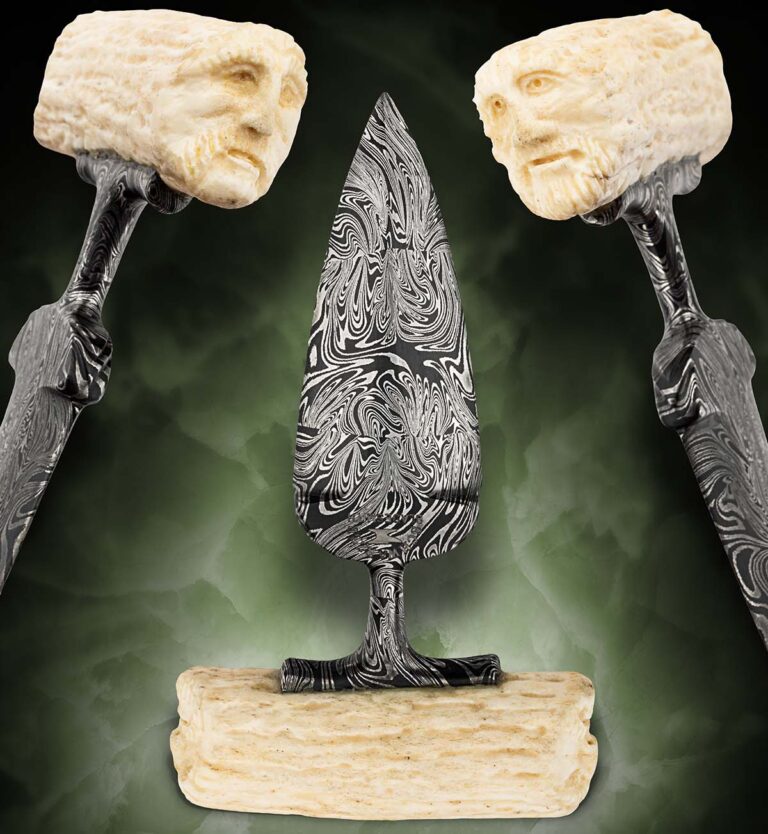
Schwarzer’s featured push dagger with stag handle and evocative faces carved on both ends is 5¾ inches long with a 3¾-inch blade of mosaic damascus steel. He has actually made two push daggers in this style and designed another for Benchmade about 20 years ago. “For me, they’re fun, and that’s why I like to make them,” he commented. “I’ve always had a fascination about them and adapted my martial arts background to training with them. The design traditionally is with a very short blade, and in martial arts, it has to do with the alignment of the hand and arm bones, along with the shape of the blade, which is double-edged traditionally. Everything in nature is curved for an effective cutting surface.”
Harvey Dean Tejas
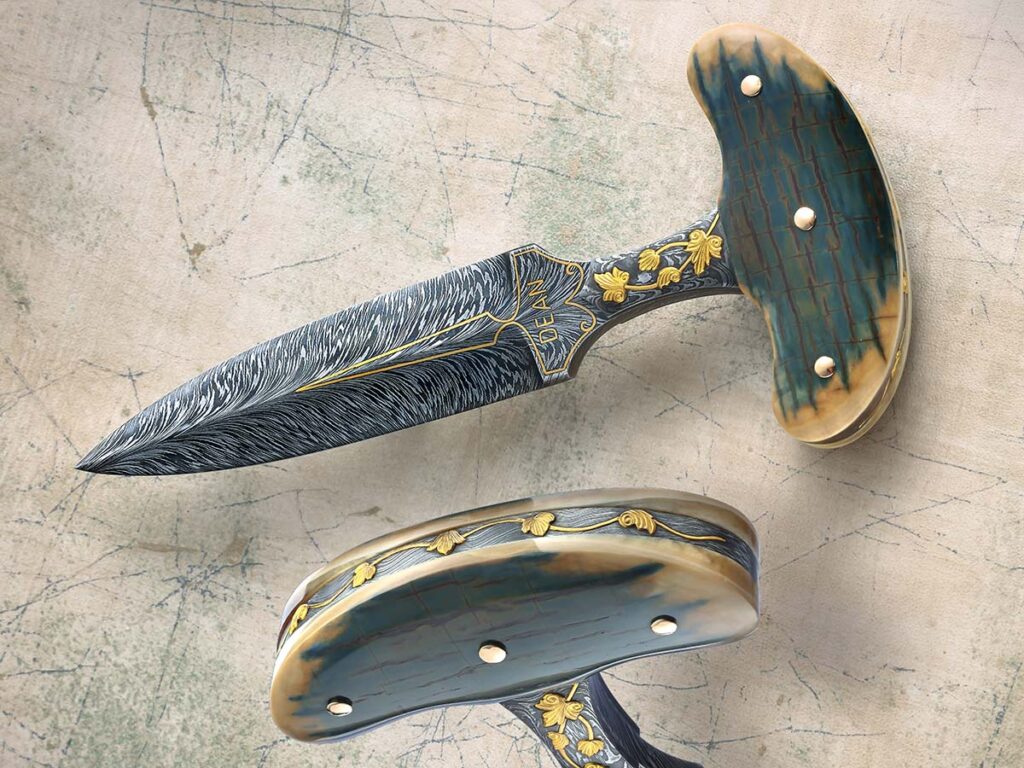
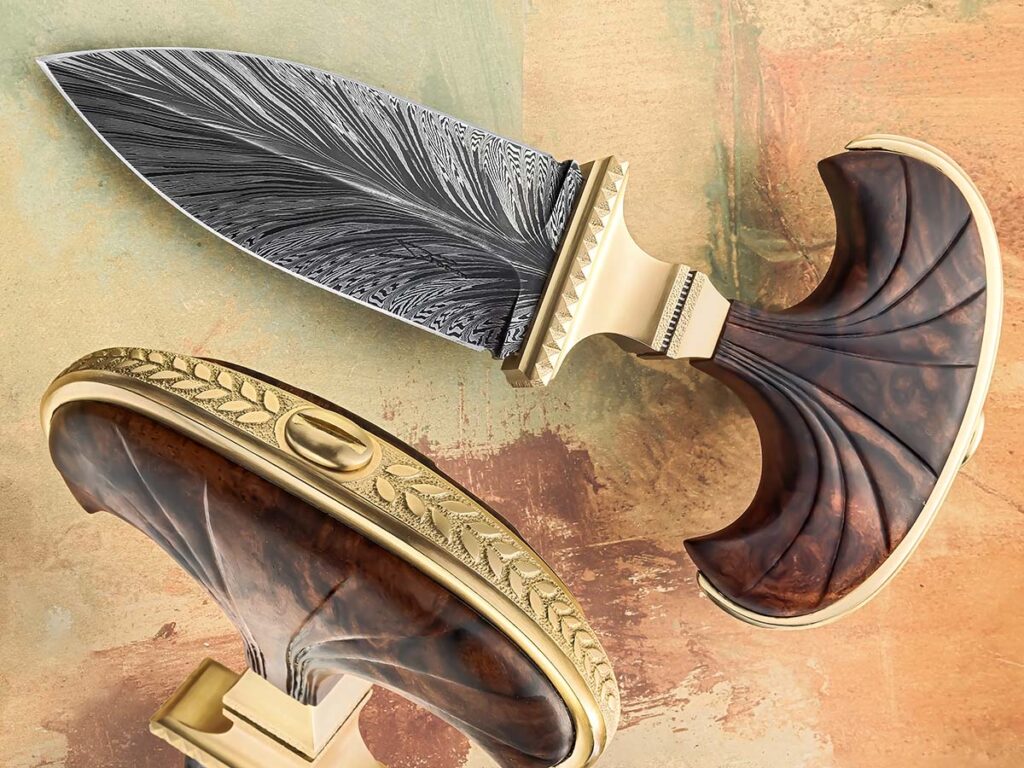
Why a push dagger? Harvy Dean (inset) puts it succinctly, “They’re just cool.” That certainly holds true for his Tajas push dagger, with an elegant feather damascus blade, 24k gold raised vine work and a fossilized walrus tusk handle. At 16 1/2 inchces in length, Dean gave himself plenty of knife to decorate. (SharpByCoop image)
Legendary master smith and Hall of Famer Harvey Dean enjoys the historical aspect as well. “They’re just cool,” he offered. “A lot of people made them back years ago, and there was the idea of concealing them in the vest. Some were made with nickel-silver scabbards and called lapel knives because they were pinned under the vest or coat lapel.”
Dean’s pictured Tejas push dagger is a departure from standard sizing, with an overall length of 16¼ inches, with an 11-inch ladder pattern damascus blade and handle of fossilized walrus ivory. But then, everything is bigger in Texas.
“I’ve always liked [master smith] Larry Fuegen’s push daggers, and his work has had a lot of influence on mine,” Harvey said. “You really make them like any other knife, and I usually do around two or three a year. I like to use ivory and damascus and a stag handle is next up. I don’t do many plain ones, and most of mine are with two-piece handles. As far as marketing is concerned, you’ve got to have that special person who likes them–but they do usually sell quick.”
Hawks Nest Custom Push Talon
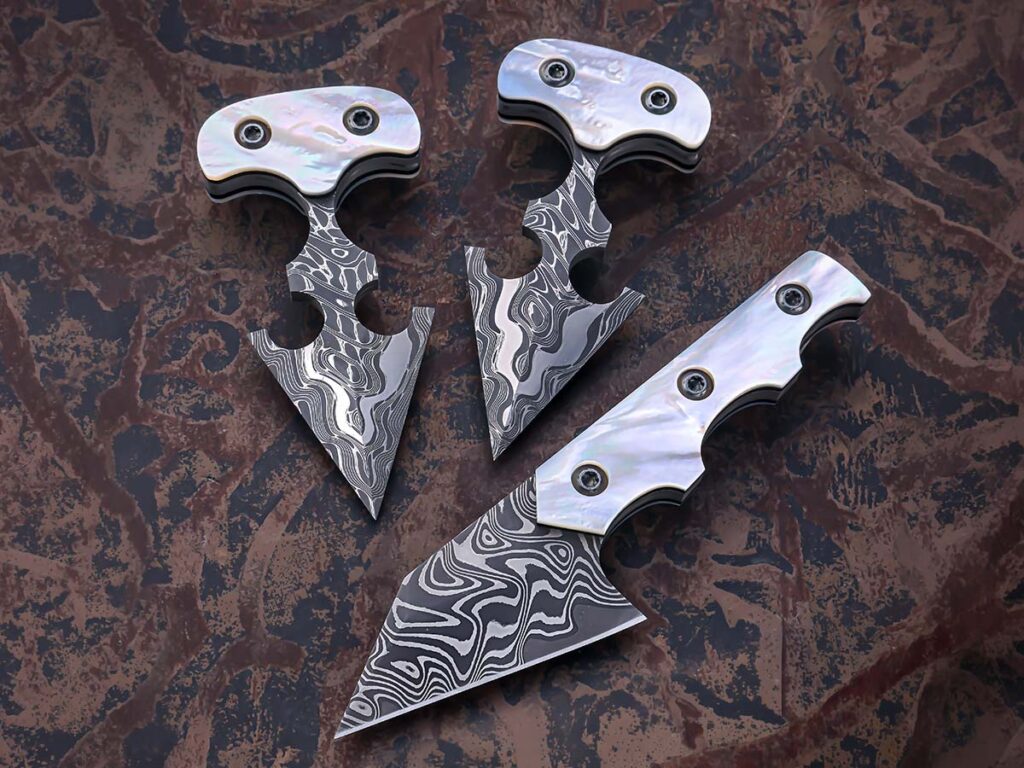
Matt Hunter (inset) has always had a thing for concealed carry knives, but admits his mother-of-pearl handled push daggers were his first crack at the style of knife. Angular and wickedly attractive, the Nichols Slither Armor Core stainless damascus daggers were designed as a matching set with his HawkWing knife, also pictured. (SharpByCoop image)
Damascus blade, mother-of-pearl handle and variations on the push dagger theme highlight Matt Hunter’s work at Hawks Nest Customs. He is a huge fan of concealed carry knives and started down the road with a boot dagger, neck knife and then his Push Talon.
“I think any dagger is challenging due to the symmetrical grinds that are required,” he noted. “You’ve really got to nail each and every one of them or the entire build needs to be scrapped. These push daggers are made with Nichols Slither Armor Core stainless damascus and mother-of-pearl on Westinghouse black canvas Micarta liners. “Believe it or not, these were my first push daggers,” Matt added. “These were originally made for a customer to match the HawkWing, which is also in this photo. I told him I was planning on doing a pair of matching push daggers, and he asked if we could do the mother of pearl to match his knife. So, I obliged.”
Zack Jonas Totem
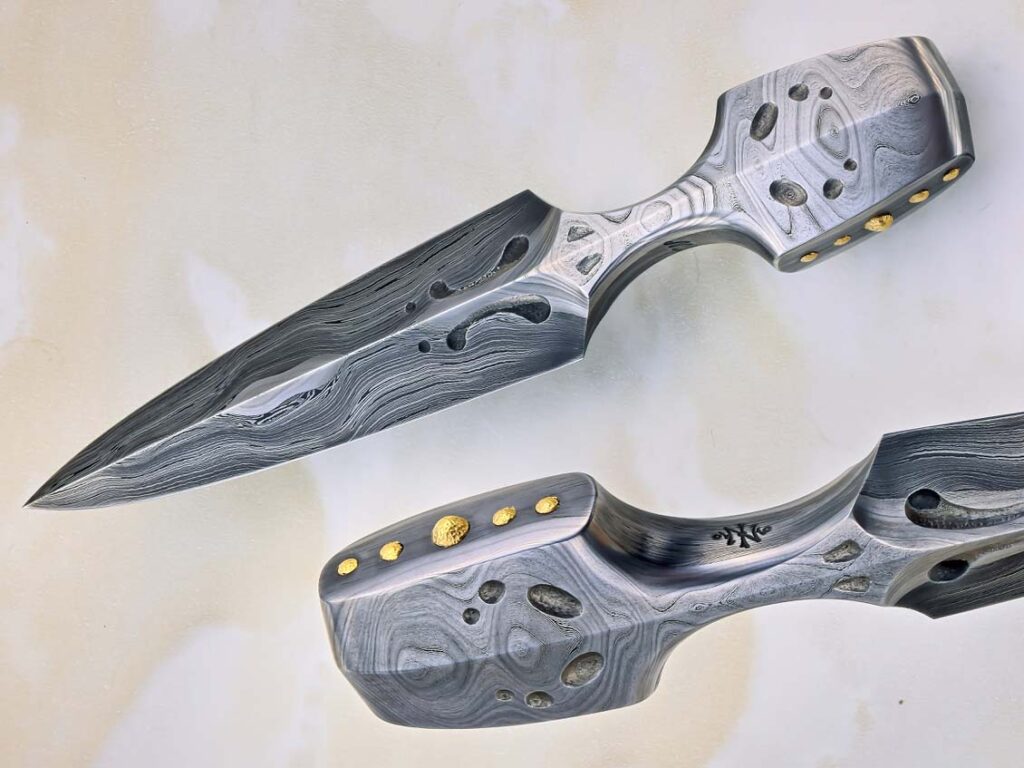
A study in starkness, Zack Jonas’ Totem push dagger grabs the eye with its clean lines and depth of damascus. That’s a san mai steel with laddered W’s and faces in a 1,000-layer laminate with pure nickel. Adding to its Spartan charm are its gold handle accents. (SharpByCoop image)
The Zack Jonas push dagger featured is his Totem model with a blade length of 4 inches and an overall length of 6½ inches. Its gold handle accents complement a san mai steel with laddered W’s and faces in a 1,000-layer laminate with pure nickel.
“The push dagger is one of the few knives that is actually designed to be folded into a tightly closed fist,” the master smith explained. “That means you have to make sure the handle comfortably conforms to the shape of the human hand in that unusual position. A push dagger is not a particularly functional tool outside the very limited frame of hand-to-hand combat; if you don’t have a secure grip when you need it, you’ve got a real problem.
“There are few makers that come to mind as design influences,” Jonas concluded. “[Master smith] J.D. Smith’s early influence on my career is never far from my hand or eye. I also think of Peter Johnsson’s work as I’m designing. He has never done a push dagger that I’m aware of, but I like to try and channel the way he conducts tension through his lines. Peter and [master smith] Kevin Cashen both come to mind when I think of the functionality in any dagger.”
Andrew Meers Rose Of Sharon
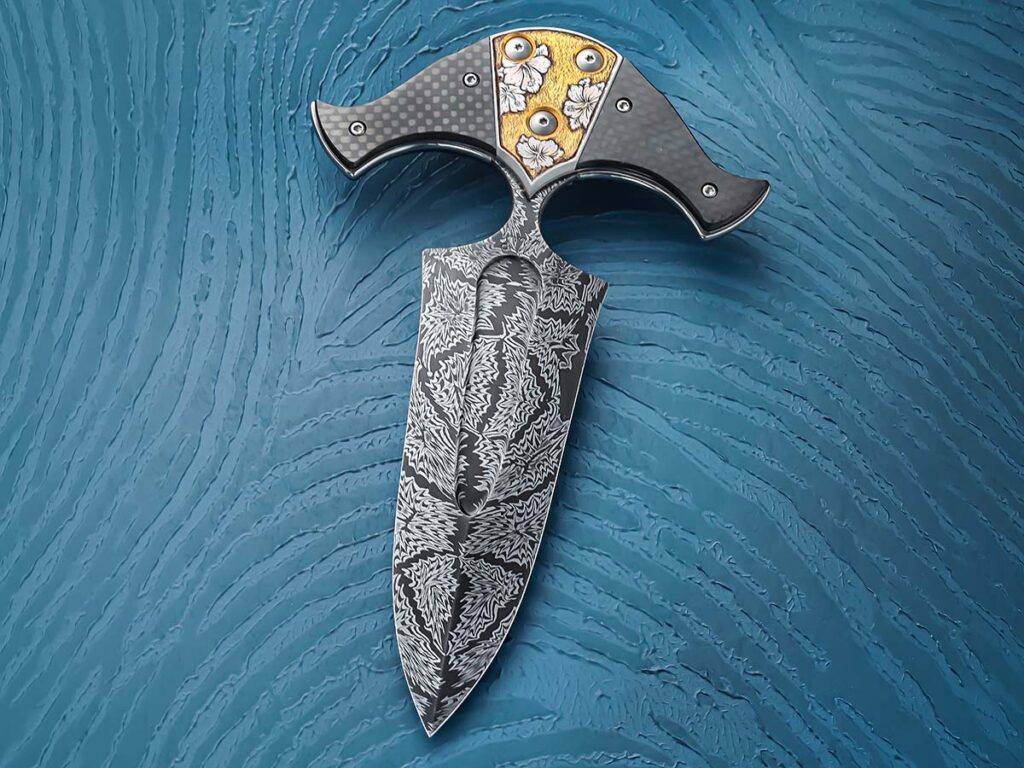
A bold mix of materials, Andrew Meers utilizes carbon fiber, stainless steel, gold and a splintered mosaic damascus to bring-together this 9-inch push dagger. The centerpiece of the knife is its elegant Rose of Sharron engraving with the gold backing. (SharpByCoop image)
Andrew Meers included a push dagger in his ABS master smith set, which was complete with forged trout iron texture engraved with pangolins. “Push daggers have a place in my childhood memory,” he related. “I remember seeing one at a museum and being fascinated. In retrospect, I think having mostly seen conventionally handled pieces in media and collections, the manner in which the hand engages the handle is what is attractive to me.”
Meers’ featured push dagger is his first with a carbon fiber handle and a groove in the blade. Its 7-inch damascus blade is framed in stainless steel, and the engraving depicts the Rose of Sharon with a gold-plated relief background. The entire push dagger is 9 inches long. Andrew produced his first push dagger in 2014 and has made several since. His longest measured between 23 and 24 inches.
Jean Potvin Romanesque
Since push daggers are illegal in Jean Pierre Potvin’s homeland of Canada, he had to come up with a clever trick to get his his Romanesque push dagger past airport security and to a buyer at a show in Las Vegas. His solution, remove the illicit handle and replace it with a toilet plunger handle. (SharpbyCoop image)
“This push dagger is Roman in style,” remarked Jean Pierre Potvin. “It came about quite by chance. I rarely design in advance when I create. I prefer to let my imagination run free and follow new ideas that present themselves during the making process. During the making, I saw that it had a somewhat Roman style, and I continued in that direction with this result.”
Potvin’s push dagger measures 8 inches overall with a 4½-inch blade of damascus in 15N20 and 1084 carbon steel. The handle is fashioned from stabilized walnut burl and brass furniture. He had previously made only one push dagger. That was in 2022, and it was much smaller. “I had a buyer at the Nashville knife show,” he remembered, “and I had packed it in my luggage to take there. But when I got to the Montreal airport, it was confiscated by airport security.”
Since push daggers are illegal in Canada, that experience inspired Jean Pierre to remove the actual handle and replace it with a toilet plunger handle the next time he traveled with a push dagger. He made it to Las Vegas that second time and reattached the original handle after arrival. “It’s really funny because it’s the same dagger, but having a cross handle makes it illegal,” he smiled. “Sometimes you have to use tricks to get what you want.”
Somehow, the push dagger and its adventurous history seem to fit right in with Potvin’s novel experience.
Check Out More Cool Customs:
Cool Custom: Tony Lewis’ Tribute Knife To Steve Dunn
Cool Customs: Rocco Nawrocki’s Knife For Sergeant Bunker
The rich tradition of knifemaking is full of rewards, but it demands respect. The ways a knife shop can inflict bodily harm are endless. That’s why BLADE asked knifemakers to share some of the worst accidents in their shops. Hopefully, others can learn how to avoid making the same mistakes.
Stay safe!
“Like a Missile Straight at My Right Shin”
Lesson: Save sharpening for the last steps of making a knife.
There’s a reason sharpening should ALWAYS be the last thing you do on any knife before it leaves the shop.
A few years back I was working on a large Bowie. The customer requested a sharp, full convex edge on the clip/swedge area. Against my better judgement, I got in a hurry and sharpened this swedge as soon as the knife was back from heat treat…with a lot of work left to perform with this razor sharp edge on the clip.
Somehow I managed to let the tip of the knife bite into a cork belt which caught it and ripped it out of my hands and sent it like a missile straight at my right shin. Since that top edge was sharp it cut through my boot and buried itself about 3/4-inches into my leg. It filled my boot with blood and ended all work for a couple days.
If I hadn’t been wearing boots or if both edges had been sharpened, I’m sure it would’ve exited the backside of my ankle and possibly crippled me, or worse. It was a lesson that reinforced a very basic rule of our craft and I don’t think I’ll ever forget it.
The buffer is the silent sleepy monster that can lull you into a wheelchair for life or just take it from you in the blink of an eye.
When I started making knives about six years ago, I had this cheap Ryobi buffer that I spent like $40 on. Thank God I did, because if it would’ve been stronger, I’d probably not be here right now. That thing ripped a fully sharpened drop-point hunter right out of my hands and spun it around to to the ground with the tip hitting first.
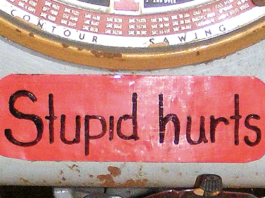
I was sitting down in front of the buffer, and the knife went right through my legs. Stupid hurts, and that was as stupid as it gets.
I still probably I don’t realize how close I was to death. It scared the s*** out of me, enough so as to never use the buffer facing in front of me ever again. I stick to the side now, and am always alert with the door locked so no one can come in to distract me.
I love making knives and every thing about it, except for the buffing and polishing.
“All the Skin and Part of the Finger Nail was Ground Off”
Lesson: Wear gloves while using a grinder.
While rough grinding a blade on my 2×72 belt grinder, I was pressing pretty hard against a 36-grit belt. At the time, I thought to myself, I need to stop and grab a pair of leather gloves.”
Sure enough, the blade slips, and I drove my finger in to the belt. It was only a split second, and I jerked back instantly. It was still enough time for 36-grit traveling at 1,750 rpm to do the job. All the skin and part of the finger nail was ground off.
I always say I put a little blood into every knife, usually when hand finishing, but dang this one was to excess. Lesson learned. I now keep a dedicated pair of gloves by the grinder when performing heavy roughing.
I was forging and tried to use a pair of tongs that didn’t grip the work well enough. This knocked the piece I was holding loose. The blade dropped right in the gap between my work boot and my ankle.
By the time I could get it knocked out of my boot and my foot in the water bucket, I had a perfect, knife-shaped burn on my ankle.
Lessons learned. Don’t forge in shorts. Either use tongs that hold well, forge from barstock, or weld short pieces of blade steel to a rebar handle.
Last winter, I got up before daylight with a plan to forge a couple skinners. It was extremely cold out, and I have no heat in my shop. So I lit the forge, which is pretty cold-natured due to its size. It has a small doorway in the rear that I keep blocked off with a fire brick.
Well, the fire brick fell off onto the ground at some point, and the forge was shooting flames out the rear. I fumbled around sleepily and walked behind the forge to get my gloves and glasses put on. Unbeknown to me, the flames were reaching the back of my coveralls. I started smelling something burning and immediately felt the heat.
I had caught my butt cheeks on fire.
So I sprinted through the door like a battering ram and did a flying back smacker into a couple inches of snow we had gotten through the night. I hadn’t felt pain back there like that since I was a kid when I sprayed my dad with a water hose while he was finishing concrete.
The coveralls were toast. There was a fist-sized hole in them that left me with two, half dollar-sized blisters and a hairless rear end like the bear on “The Great Outdoors.”
Complacency is the number one cause of accidents on job sites. Working around a 2,000-degree forge is no different.