Knifemaking

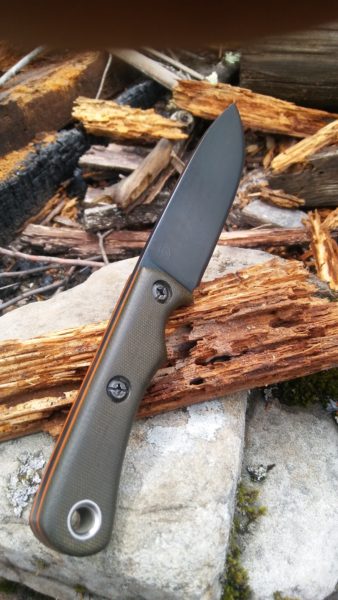
Knifemaking is the building of a knife, which includes the blade, handle and other accouterments. Blades are made by either removing metal from a steel blank via a grinder – known as stock removal – and the forging to shape of hot steel into a blade in the process known as bladesmithing. Other parts, including bolsters, guards, pommels, etc., are needed to complete the finished knife.

Featured Knives – – Knife Collecting – – Tactical Knives – – Survival Knives

MagnaMax and Pop’s ProCut: The Next Super Steels?

Specially engineered for knife blades, the two alloys are at the cutting edge of metallurgy.

Editor’s note: The genius behind MagnaCut—arguably today’s most popular blade steel for both custom and factory knives—the author has helped create two new blade materials that he fully expects to meet with wide-ranging acceptance as well. Following is his story on his latest voyage into his favorite subject.

I pitched the idea of MagnaCut steel to Crucible Steel and Niagara Specialty Metals in 2019. I said I had an idea for a steel that would match the best of the non-stainless powder-metallurgy steels in terms of wear resistance and toughness. This would be a big deal because there has been a longstanding gulf between the performance of carbon steels and stainless steels. My team and I successfully turned the idea into MagnaCut, released in 2021, which had a microstructure like a non-stainless steel while being stainless—offering the best properties of both.

I intentionally sought balanced properties with MagnaCut so it was both tough and wear-resistant, similar to non-stainless grades such as CPM 4V, CPM CruWear and Vanadis 4 Extra. Knife enthusiasts, especially those into folders, often seek higher-wear-resistance steels for maximum edge retention. Instead, I tried to push for a more balanced set of properties so knife buyers could see the benefits of having high toughness in addition to good wear resistance. This can allow knives to be made with thinner edges for better cutting ability, because toughness helps thinner edges resist chipping. In my edge retention tests with the CATRA (Cutlery Allied Trades Research Association) edge testing machine, thinner edges with smaller angles lead to larger differences in edge retention than the steel choice, or even the heat treatment! It seems many knife buyers have seen the light as MagnaCut has gained quite a bit of popularity since its release.

MagnaMax Steel

Nonetheless, I also knew knife enthusiasts would ask for something more wear-resistant. The folder crowd is not as worried about toughness and are seemingly always asking for greater wear resistance and edge retention. However, when the wear resistance gets too high, the steel becomes “unbalanced,” and the toughness becomes a significant issue. I see images of broken folders semi-regularly from the most extreme wear-resistance grades.
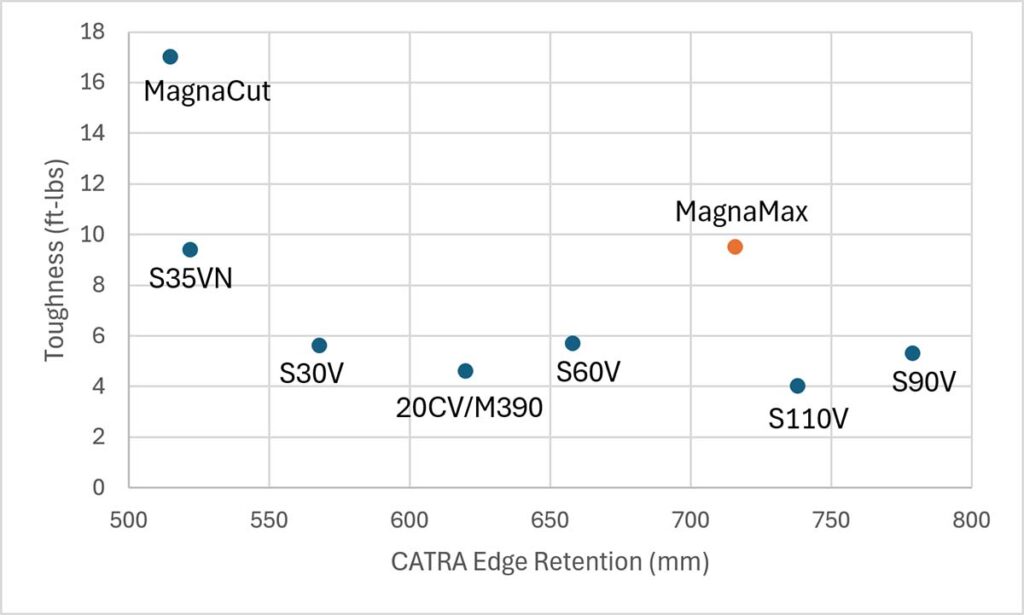
MagnaMax shares the same high corrosion resistance and good hardness potential as MagnaCut, but has higher wear resistance at the cost of some toughness. Because MagnaMax shares a similar microstructure to non-stainless steels, its toughness level for that high wear resistance is excellent.

The “sweet spot” for higher-wear-resistance products seems to be in the family of non-stainless alloys such as CPM 10V, Vanadis 8 and K390. In particular, K390 has been building in popularity through Spyderco knives in recent years for its excellent combination of properties. I had actually proposed to Crucible and Niagara way back in 2019 that, after we were successful with MagnaCut, I had another idea I was calling stainless 10V at the time.

This led to a new product called MagnaMax, a higher-wear-resistance steel in the same family as MagnaCut. It shares the same high corrosion resistance and good hardness potential as MagnaCut, but has higher wear resistance at the cost of some toughness. Because it shares a similar microstructure to non-stainless steels, its toughness level for that high wear resistance is excellent.

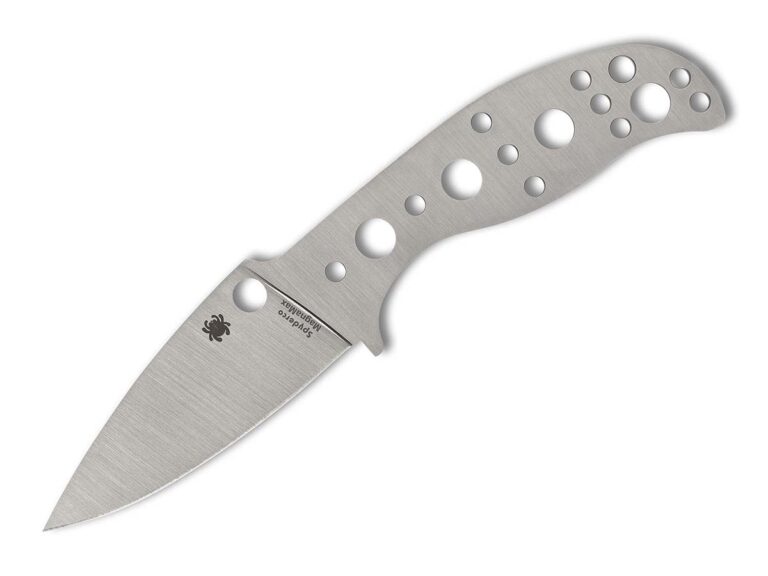
Two of the highest-toughness stainless powder-metallurgy steels before MagnaCut were CPM S35VN and CPM 154. MagnaMax matches the toughness of those grades while being much more wear-resistant. In recent years, one of the more popular folding knife steels has been M390, and MagnaMax has over twice the toughness and substantially higher slicing edge retention. Spyderco used the second prototype heat of MagnaMax in a series of its Mule series knives intended for enthusiasts to try out different steels. A Spyderco Forum member known as vivi said he cut 325 gallons worth of cardboard strips with one of these knives. He reported, “Even without adding the numbers up, I can say this steel has the best edge retention of any steel I’ve tried.”
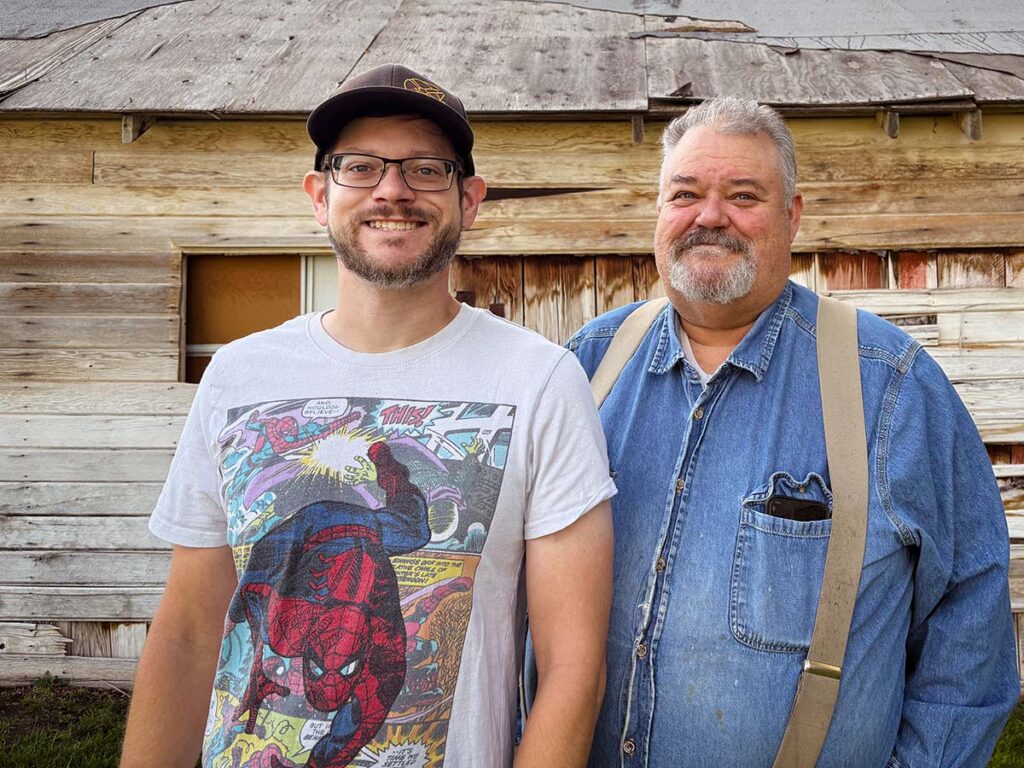
The author (left) and his father, BLADE Magazine Cutlery Hall-of-Fame® member Devin “Hoss” Thomas.

The development of MagnaMax was not without its issues, however. The first two test heats of the steel were made by Crucible, a longstanding U.S.-based steel company that unfortunately went out of business in 2025. Crucible is the company behind many of the industry’s leading knife steels like 154CM, S30V, S35VN and 3V. Crucible is the company that invented powder metallurgy itself, a significant innovation providing the excellent properties of all the “CPM” (Crucible Particle Metallurgy) grades. Crucible went under basically right while it was making the second test heat of MagnaMax. A couple of slabs were even recovered from a pile of scrap after the company was dismantled so my team could test it. We made the first test heat of MagnaMax back in March 2023, and we are just now approaching the product’s wide release.

Niagara Specialty Metals (NSM), the company that hot rolls, anneals and distributes the majority of the leading steel grades, has played a key role in keeping these steels alive. Crucible relied on NSM for hot rolling the high-end, complex grades, as it is the only facility in the United States capable of processing them.

Niagara had already assumed an active role in the knife industry many years before, taking over the distribution of blade steels over a decade ago after Crucible’s first bankruptcy in 2009. It pushed for new grades like CPM S45VN, and without NSM, I’m not sure MagnaCut would ever have been made. Niagara is working with other suppliers of powder-metallurgy steel, including Carpenter and Erasteel, to ensure these grades remain available. My team has been working closely with these partners on the development of MagnaMax, but that also means we almost had to start over after Crucible’s unfortunate demise. The good news is I have been testing MagnaMax made by Erasteel, and the properties look excellent, at least as good as the Crucible-made material. And it’s actually looking a little better.

Pop’s ProCut Steel

Perhaps sometimes I get carried away working on new knife steels that push the boundaries for wear resistance. Some knifemakers are looking for simpler grades that are easy to forge, grind and finish.
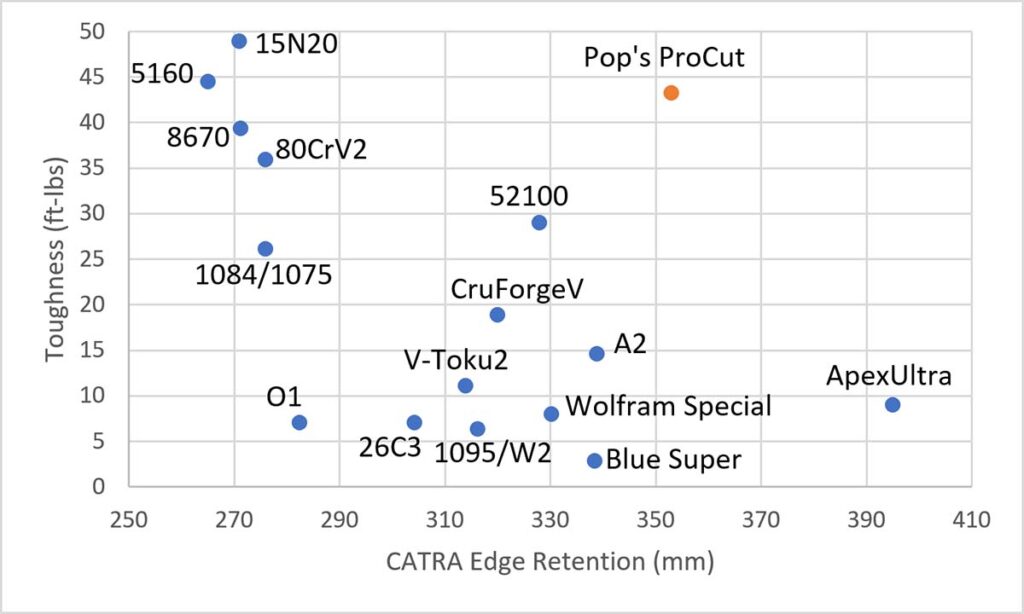
Pop’s ProCut’s toughness matched that of steels like 8670 and 5160, known for their excellent toughness. The edge retention was better than the majority of forgeable grades outside of ApexUltra, a high-performance forging grade.

Joey Berry of Pop’s Knife Supply contacted me in March 2024 asking for an improved version of Pop’s most popular grade, 80CrV2, which is known for being very easy to work, high in toughness and low in cost. I told Joey I would need to think about it because I had no idea off the top of my head what version of 80CrV2 would fill the niche of bladesmiths who want something inexpensive and easy to work. However, I have always enjoyed working with Pop’s Knife Supply, so I gave some serious thought to what kind of steel would be ideal for Joey’s request.

Pop’s is growing rapidly and has been a big supporter of mine, selling copies of my books—Knife Engineering and The Story of Knife Steel. It has been expanding its steel offerings and its steel education base to better serve customers, and I knew a steel along these lines would be a good fit for it. One of the trade-offs with knife steel design is when you add some elements like vanadium in significant amounts, things like forgeability and finishability go down. How could I make something new and exciting without pushing so much it becomes difficult for knifemakers to work with?

I thought about how high-nickel steels like 15N20, L6 and 8670 are known for their excellent toughness—at the top of my charts—but also have very limited wear resistance. I also knew some relatively rare steels like Blue #1, V-Toku2 and Wolfram Special have small additions of tungsten and vanadium for wear resistance. In grades with higher amounts of those elements, I start to see complaints from makers about the difficulty of working with them, though they seem to be at a place where they hit the right balance before forging and hand sanding become issues. These tungsten-vanadium steels are relatively challenging to find, often expensive when you do, and their toughness is much lower than the high nickel grades. As a result, the idea was to combine the high nickel approach for toughness with the controlled additions of tungsten and vanadium for wear resistance.
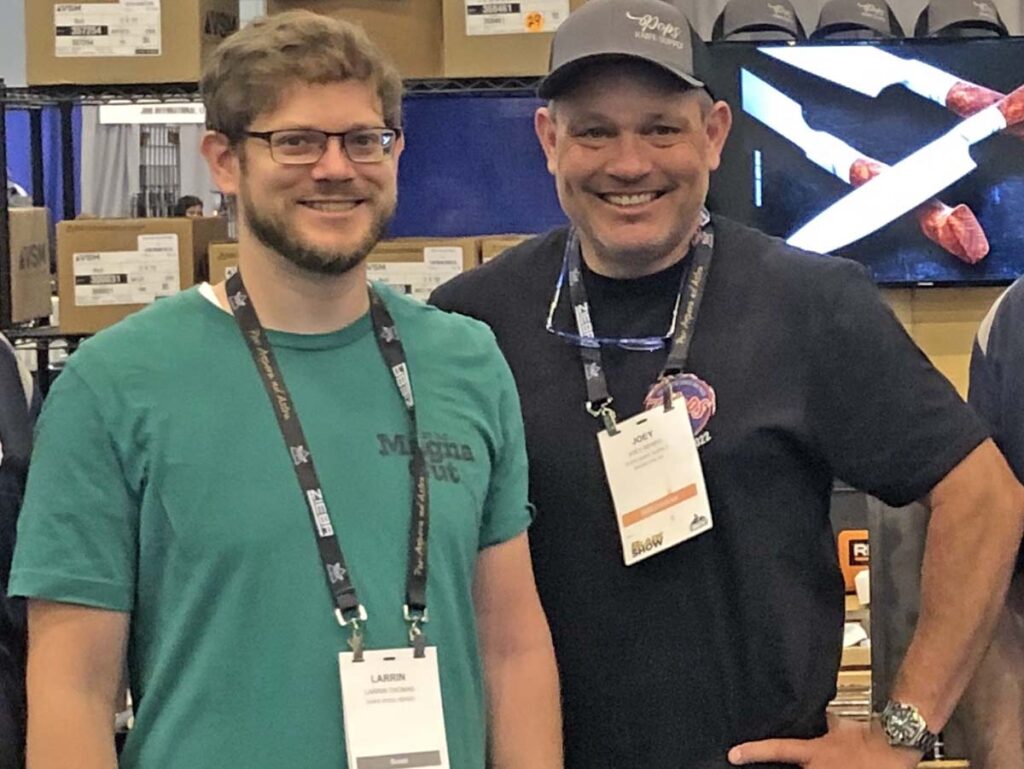
The author (left) and Joey Berry of Pop’s Knife Supply.

Another major factor for this development was the ease of heat treating. Often, steels like 1084 are recommended to novice makers for heat treating in a forge because it is dead simple to harden—just heat it to nonmagnetic and dunk it in oil. However, these grades are also very easy to overheat; they come out hard, but the toughness is greatly reduced. Only a few seconds in a forge past nonmagnetic can lead to a reduction in toughness.

On the flip side are grades like 80CrV2 that have chromium and vanadium additions to limit grain growth, so overheating isn’t as much of an issue. But the chromium also means you must heat past nonmagnetic and hold it there to ensure the carbides dissolve. The chromium slows everything down. However, I thought if we kept the chromium content very low the new steel could still be quenched from nonmagnetic and achieve full hardness, while the tungsten and vanadium additions would create tiny carbides that “pin” the grain boundaries so overheating and grain growth are not issues. This would make the easiest-to-heat-treat knife steel ever. Just heat it past nonmagnetic and quench it, and you will get high hardness and toughness every time.

My team and I got a steel company to agree to try the composition I proposed and waited (im)patiently for the steel to arrive. This was a major investment for Pop’s Knife Supply, and there was no guarantee the new steel would work just because it sounded good on paper. Fortunately, however, when we tested the steel, its toughness matched steels like 8670 and 5160, known for their excellent toughness. The edge retention was better than the majority of forgeable grades outside of ApexUltra, a high-performance forging grade I developed with makers Marco Guldimann and Tobias Hangler. And in testing the heat-treating range, we found it could be quenched anywhere from 1400°F up to 1750°F—over 300°F! This met our target of making a steel that is easy to heat treat.

Reports from makers have been very positive for Pop’s ProCut. They have praised the ease of working as well as the tested performance. Dawson Knives related: “We found it to be an excellent steel that 1) Offers a razor-sharp edge on par or better than other modern steels; 2) Holds that edge cut after cut; 3) Displays excellent lateral strength (it flexed close to 20 degrees in either direction and returned to true); and 4) Extreme impact resistance (edge resisted chipping, cracking or rolling when driven into a piece of steel Unistrut with a sledge hammer). We are able to get our edge hardness to Rockwell C of 62-63 and still retain superb flexibility.”
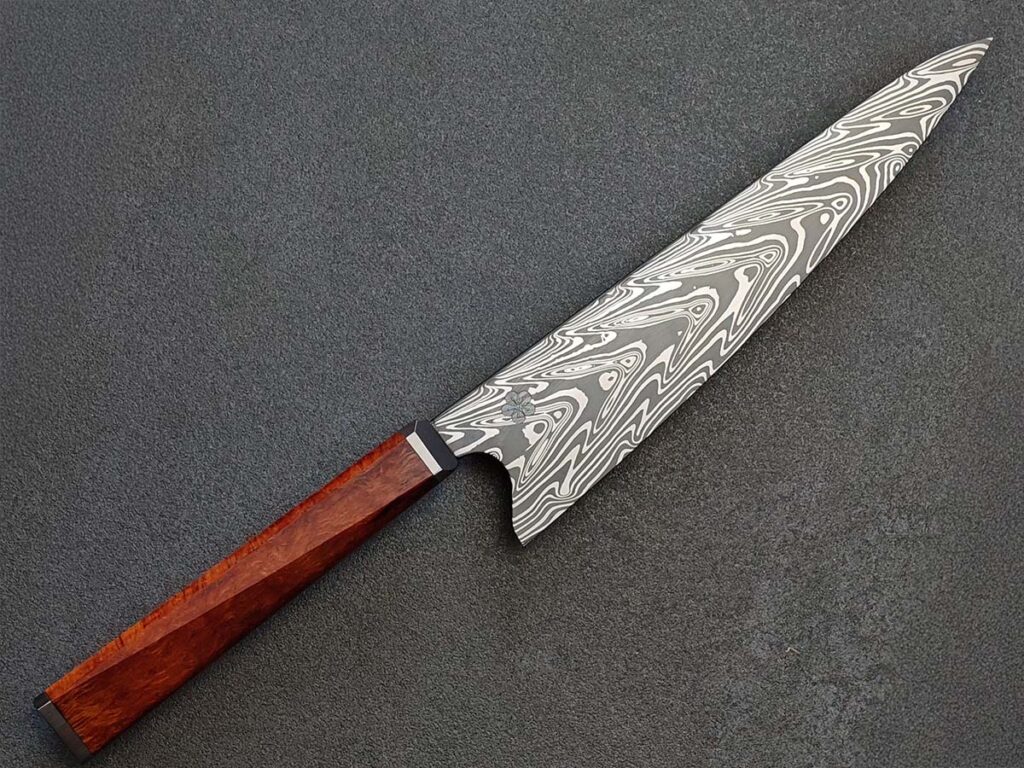
Kurt Glatt forged Pop’s ProCut and ApexUltra steels for the damascus blade of his chef’s knife.

Another exciting aspect of ProCut is the high nickel content (2 percent like 15N20) allows it to be used in pattern-welded damascus as a “bright” layer. This gives a new, higher-edge retention steel for use in damascus. As noted, previous high nickel grades have very low wear resistance. It can even be used in combination with other high-wear-resistance grades to make superior edge-retention damascus. I have seen a couple of knives using both ProCut and ApexUltra for some excellent-looking and performing damascus.

More To Come?

I’m constantly working on new ideas, though it’s hard to predict which projects will pan out or when they’ll be released. It’s been incredibly rewarding to see the steels I’ve developed used by top knifemakers and major knife companies, and to hear from end users who genuinely love them. When my dad, BLADE Magazine Cutlery Hall-of-Fame® member Devin “Hoss” Thomas, took me to my first knife show as a teenager, I never would have thought I would be working on such cool stuff.

More On Knife Steel:

Knifemakers And Their Tools

0

Knifemakers From Around The World Share What Equipment They Can’t Live Without And How It Helps In Creating Their Knives.

There are high-quality knifemakers on every continent. We chatted with some of the world’s best makers about what equipment and tools are must-haves for them in their shop. 

Bertie Rietveld

Bertie’s Legacy Roman pugio in Dragonskin damascus with a Stanhope lens just below the guard and lapis lazuli cylinders with titanium spacers in-between is spectacular even by his high standards. Overall length: 16 inches. (SharpByCoop image)

One of the world’s leading makers of art knives, South Africa’s Bertie Rietveld is known for magnificent custom daggers and fixed blades, many in his Dragonskin damascus and with a Stanhope lens at the ricasso, a peek into which reveals whatever image Bertie likes to put there—usually the Stanhope logo.

Among his knifemaking equipment that proves invaluable to building his award-winning knives are his Rosa Italian precision drill presses. 

“I have three of them,” he wrote, “each one set up with a different-diameter drill bit so I don’t have to change bits. The speeds are set to match the ideal speed of each drill bit in the chuck of each machine. They are super accurate and an absolute pleasure to use when drilling small holes. Each one has a light that automatically comes on when you start the drill. They’re probably 30 years old but I have rebuilt them to their former glory.”

Next on Bertie’s list of top knifemaking machines is his Schaublin 102 plain lathe. 

“It was manufactured in 1961, which makes it a year older than me!” he grinned. “I have a full set of collets and chucks for it and use it a lot to turn small pins and pivots for my folders. It’s one of those machines built in the golden area of mechanical excellence: the 1960s. I love working on it because it’s very accurate and just a solid, well-built machine.”

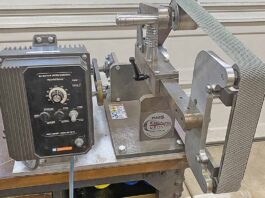
Third among his most valuable knifemaking machines is his Cutlermatic belt grinder, which he built about 20 years ago when he ran Batavia Engineering. 

“We built some 300 of these grinders for knifemakers at the time,” he recalled. “This machine has a whole myriad of contact wheels, from 2 inch to 20 inch, and is fitted with an inverter speed control. I use it to grind all my knives and also for hundreds of other grinding jobs. It’s probably the most used machine in my shop. It has a foot pedal to change belts and also some really bright LED lights on stalks so I can see where I’m grinding.”

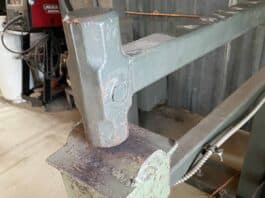
The fourth machine is “Shaya,” Bertie’s “famous” 500-pound Massey power hammer. It was built in 1941 and he completely rebuilt it in 2000, a process that took eight years. 

“I make all my damascus on this hammer, Dragonskin, Nebula, and Fracture, as well as other laminar damascus. It is a gentle giant but packs a mean punch when at full speed. Hardly a week goes by when I don’t have two or three forging sessions.”

Murray Sterling 

Murray makes nothing but folders, including slip joints, linerlocks, and lockbacks. Among the latter is this fileworked and engraved straight-edge model in mother-of-pearl.

Murray Sterling turned 93 the first day of Spring and still makes knives like he’s 39. What are the most important pieces of knifemaking equipment for the self-described “old-school machinist” on the low side of 100 who’s been making knives for over three decades?

First are his four 2×72 belt grinders. He made three of them, including one he built 25 years ago that he uses 90 percent of the time. 

“I hollow grind and profile all my folders and finish all my folders with it,” he wrote. “The only other grinder I bought new was a square wheel in 1989. I only use it for 45-degree scales.”

Next on Murray’s list is his Taft Pierce surface grinder. “This is probably the most important machine in the shop for making folders, and that’s all I make now,” he wrote. 

The machine is over 50 years old and Murray bought it 20 years ago when it came available from a company his son worked for that was in the process of upgrading its machinery.

“In making folding knives, everything has to be flat,” Murray observed. “This machine is one of the best ways to achieve that. It has upgraded the quality of my folders by 100 percent. It also has a 2×72 belt attachment and, with a 60-grit belt, you can remove a lot of material fairly fast.”

Murray has four disc grinders, including two side-by-side models with 9-inch and 12-inch discs, the former with a 100-grit abrasive and the latter with a 320-grit one. Murray made the tables for the grinders 20 years ago. The motor for the 12-inch grinder is the original one from his square wheel grinder, the latter which he reoutfitted with a DC motor a couple of years after he bought it. The grinder on the fixed 45-degree table he uses for knife parts that need to be made square, such as backsprings for slip joints and lockbars.

The handiest machine in Murray’s shop is his Burgmaster drill press. He bought it in 1967 and uses it to drill 90 percent of the holes in his knives. It has six spindles, each of which runs at a different RPM. 

“I can set it up with a tap drill, clearance drill, and counter bore for .080-inch screws,” he wrote. “It makes things quick and easy. I would hate to do without any of these machines. I also have a lathe and make my own bushings and pivot pins.”

Brian Tomberlin

An example of Brion’s knives is his Nagabowie—a Japanese-style blade with hamon complemented by a bowie handle.

ABS master smith Brion Tomberlin makes a lot of hidden-tang knives in his shop in Norman, Oklahoma, and a set of handle broaches he got from fellow ABS master smith John Perry are a must-have for that style of knife construction.

“They do a great job of opening up the slot for the tang in handle blocks,” Brion observed. “I bought the first two from John way back when there was a Spirit of Steel knife show in Mesquite, Texas, probably his first or second batch of them. I still use them all the time. They’re very finely crafted tools.

“Another must-have tool for me and most makers is a set of calipers. In order to get things fitted correctly, such as guards and getting the measurements on things like the depth of clips even on both sides, you need to have accurate measurements. A good knifemaker thinks in thousandths and you need to be able to accurately measure them. So, I have calipers everywhere. I’ve got to have them.”

Brion uses a Foredom tool on every knife that leaves his shop. 

“It’s a super versatile tool,” he noted. “I’m sure everyone has used Dremel tools, especially the variable-speed models. But the Dremel tools wear out and I hear all the time that people keep buying them every two or so years because the tools stop working. So, save money and get the standard rotary-flex-shaft tool used in the jewelry trades. Just get a Foredom tool and you will not regret it.

“Mine is variable speed and reversible and that is what I suggest. I bought it from an old name in knifemaking supplies, Mick Koval [of Koval Supply], over twenty years ago. It’s still going strong. There is so much you can do with them and they have so many attachments. Rio Grande and Gesswein jewelry supply are knifemakers’ friends. I use this tool for guards, contouring buttcaps to match stag, polishing things, carving, etc. It has so many uses.”

Another tool Brion uses on every knife he makes is his trusty file guide. 

“The shoulder filing guide or just plain file guide should be standard in every maker’s shop,” he advised. “My main one is a carbide-faced model from Riverside Machine in DeQueen, Arkansas.

“You need to get the shoulders on a blade flat in order to get the guard to fit up correctly,” Brion wrote. A file guide will do that. “Also, with the carbide faces you can use the guide with grinding belts to get the plunges even. I bought this years ago when Uncle Al [Alton Lawrence of Riverside Machine] first started making them. It has served me well. You don’t have to have the carbide faces as there are hardened steel file guides too, but pay the extra money and get the carbide—you will not regret it.”

Rounding out Brion’s top knifemaking tools are his machinist squares.

“You have to be able to lay out lines and have them be true, everything from laying out guard slots to making sure things are 90 degrees, such as platens on grinders,” he advised. That’s where the machinist squares come into play. “You have to have them and they aren’t expensive. Making sure your layout lines are correct will help you make better knives,” Brion concluded. “Every knife shop should have them.”

Read More

Wicked Breacher: Ben Seward’s SWAT Axe

Ben Seward’s breacher SWAT Axe salutes officer’s 21 years of police service

When ABS journeyman smith Ben Seward went to make his first axe, he didn’t settle for something easy—he went the whole hog on a special breaching model as a retirement gift for a 21-year law enforcement veteran.

Sgt. Magnus Gervol retired from the Whatcom County, Washington Sheriffs Office after a career that included 15 years on the SWAT team and 14 years as a sniper.

Ben Seward Swat Ax profile

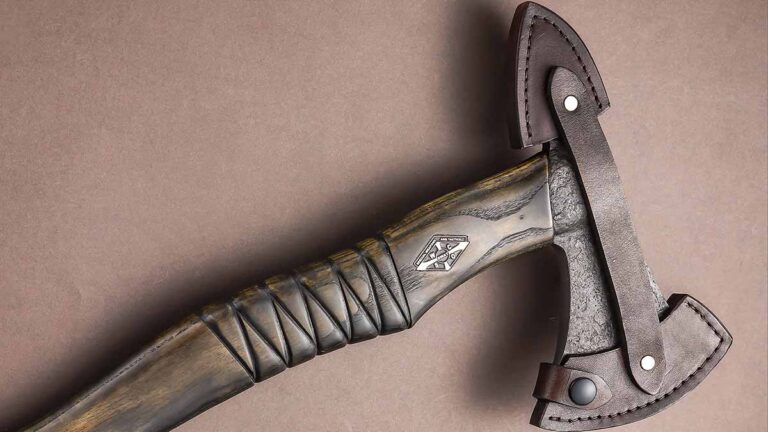
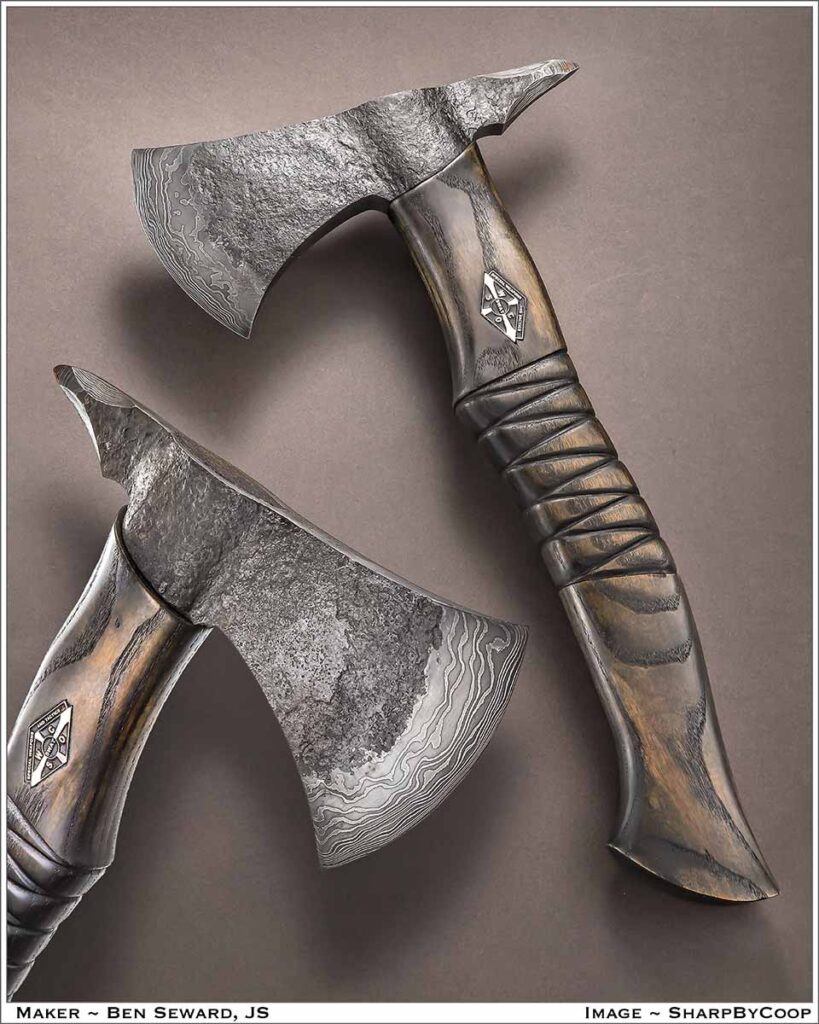
Members of the Sheriffs Office contacted Ben, who forged the axe from the barrel of a Remington 700 SPS tactical sniper rifle. The idea was to make a tactical axe with a beard and a tomahawk spike. The handle is Ozark white oak. Ben’s dad, David, who specializes in sheaths, made the leather sheath.

Ben forge welded the rifle barrel into a bar and layered it up with other carbon steels. He forged the two flats of the head roughly into a triangle and pieced in the bit for the cutting edge. All of the head, including the edge and spike, is forged of the same damascus.

SWAT Axe Specs
Maker: Ben Seward
Head Size: 7.75”
Bit Size: 3.5”
Head/Bit Material: Damascus forged from the barrel of a sniper rifle and 1080 carbon and 15N20 nickel-alloy steels; includes a rough-forged finish
Handle: Ozark white oak
Handel Length : 14”
Maker’s Price For A Similar Breaching Axe (excluding the steel from the sniper rifle): $1,500

Check Out More Cool Custom Knives:

Little Giant Power Hammer Design Differences

While visiting Sid Suedmeier at the Little Giant shop in Nebraska City, NE he explained the differences between the Old and New style Little Giant Power Hamm…

ABS New England Hammer-In – Cutting Demonstration

0

The Cutting Demonstration was sponsored by the American Bladesmith Society at its 4th New England Hammer-In at the New England School of Metalwork (NESM) earlier this month in Auburn, Maine.


BLADE Recommends

Before you can enter competitions like this one, you’ll need a “big kid” knife sharpening system. Check out the GATCO Natural Arkansas Sharpening Kit at ShopBlade.com. With practice, you’ll be able to hone the perfect edge for competition or other purposes.

Click here to go to ShopBlade.com and get the GATCO Natural Arkansas Sharpening Kit for 20% off retail.

Tim Britton’s Badger: Old Keen Kutter Pattern Reborn

A sensational slip joint, Tim Britton’s Badger revives the Keen Kutter pattern with a ton of flare.

When ABS master smith Bruce Bump showed an old Keen Kutter penknife pattern to veteran knifemaker Tim Britton, Tim fell in love with it and immediately set to making his own iteration.

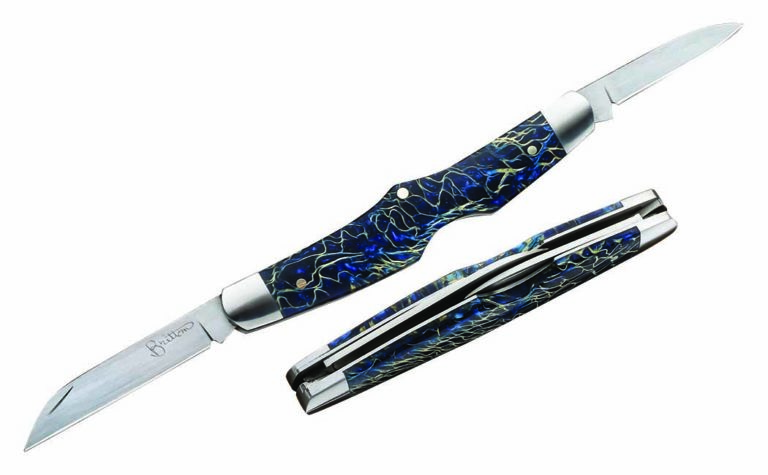
The blades are BG-42 stainless steel that, as Tim noted, has high ductility and holds an edge forever. He flat ground them on his “ancient” 18-inch, 200-pound Porter Cable disc sander. However, it’s the handle that really stands out. Consisting of stabilized diseased ash burl from Whistle in the Woods, the material looks synthetic but isn’t.

Tim Britton , 80, has been making knives since 1971 and has focused a lot in recent years on slip joints, with the Badger being the latest. He’s got about six antique pocketknife designs on his to-do list for this year, including a peanut and a copperhead. (knife image courtesy of Tim Britton)

“The light stuff in it looks like explosions,” Tim said. “I’ve never seen anything like it.” The projection on the spine fits right in between the user’s index and middle fingers and the groove on the underside cradles the latter for a comfortable, secure grip.

Calling it the Badger, Tim said he made 10 of them and had four or five at BLADE Show 2022.

Badger Spec Check
Knife Name: Badger
Maker: Tim Britton
Blade Steel: BG-42 stainless
Blade Grinds: Flat
Handle Material: Stabilized diseased ash burl from Whistle in the Woods
Closed Length: 3.5 inches
Maker’s Price For A Similar Knife: $375

More Knife Collecting And Custom Knives

“All the Skin Was Ground Off” – 5 Knife Shop Horror Stories

0

injuries from making knives

The rich tradition of knifemaking is full of rewards, but it demands respect. The ways a knife shop can inflict bodily harm are endless. That’s why BLADE asked knifemakers to share some of the worst accidents in their shops. Hopefully, others can learn how to avoid making the same mistakes.

Stay safe!


“Like a Missile Straight at My Right Shin”

Lesson: Save sharpening for the last steps of making a knife.

There’s a reason sharpening should ALWAYS be the last thing you do on any knife before it leaves the shop.

A few years back I was working on a large Bowie. The customer requested a sharp, full convex edge on the clip/swedge area. Against my better judgement, I got in a hurry and sharpened this swedge as soon as the knife was back from heat treat…with a lot of work left to perform with this razor sharp edge on the clip.

Somehow I managed to let the tip of the knife bite into a cork belt which caught it and ripped it out of my hands and sent it like a missile straight at my right shin. Since that top edge was sharp it cut through my boot and buried itself about 3/4-inches into my leg. It filled my boot with blood and ended all work for a couple days.

If I hadn’t been wearing boots or if both edges had been sharpened, I’m sure it would’ve exited the backside of my ankle and possibly crippled me, or worse. It was a lesson that reinforced a very basic rule of our craft and I don’t think I’ll ever forget it.

Martin Olexey
Martin Olexey Blades


“The Knife Went Right Through My Legs”

Lesson: Stand to the side of the buffer.

The buffer is the silent sleepy monster that can lull you into a wheelchair for life or just take it from you in the blink of an eye.

When I started making knives about six years ago, I had this cheap Ryobi buffer that I spent like $40 on. Thank God I did, because if it would’ve been stronger, I’d probably not be here right now. That thing ripped a fully sharpened drop-point hunter right out of my hands and spun it around to to the ground with the tip hitting first.

I was sitting down in front of the buffer, and the knife went right through my legs. Stupid hurts, and that was as stupid as it gets.

I still probably I don’t realize how close I was to death. It scared the s*** out of me, enough so as to never use the buffer facing in front of me ever again. I stick to the side now, and am always alert with the door locked so no one can come in to distract me.

I love making knives and every thing about it, except for the buffing and polishing.

Roger Barnes
BC Cutlery Co.


“All the Skin and Part of the Finger Nail was Ground Off”

Lesson: Wear gloves while using a grinder.

While rough grinding a blade on my 2×72 belt grinder, I was pressing pretty hard against a 36-grit belt. At the time, I thought to myself, I need to stop and grab a pair of leather gloves.”

Sure enough, the blade slips, and I drove my finger in to the belt. It was only a split second, and I jerked back instantly. It was still enough time for 36-grit traveling at 1,750 rpm to do the job. All the skin and part of the finger nail was ground off.

I always say I put a little blood into every knife, usually when hand finishing, but dang this one was to excess. Lesson learned. I now keep a dedicated pair of gloves by the grinder when performing heavy roughing.

Gene Border
Edge of the Border Knives


“A Perfect, Knife-Shaped Burn on My Ankle”

Lesson: Use tongs that grip work securely.

I was forging and tried to use a pair of tongs that didn’t grip the work well enough. This knocked the piece I was holding loose. The blade dropped right in the gap between my work boot and my ankle.

By the time I could get it knocked out of my boot and my foot in the water bucket, I had a perfect, knife-shaped burn on my ankle.

Lessons learned. Don’t forge in shorts. Either use tongs that hold well, forge from barstock, or weld short pieces of blade steel to a rebar handle.

Dave Armour
Armour Cutlery


“I had Caught My Butt Cheeks on Fire”

Lesson: Don’t become complacent around forges.

Last winter, I got up before daylight with a plan to forge a couple skinners. It was extremely cold out, and I have no heat in my shop. So I lit the forge, which is pretty cold-natured due to its size. It has a small doorway in the rear that I keep blocked off with a fire brick.

Well, the fire brick fell off onto the ground at some point, and the forge was shooting flames out the rear. I fumbled around sleepily and walked behind the forge to get my gloves and glasses put on. Unbeknown to me, the flames were reaching the back of my coveralls. I started smelling something burning and immediately felt the heat.

I had caught my butt cheeks on fire.

So I sprinted through the door like a battering ram and did a flying back smacker into a couple inches of snow we had gotten through the night. I hadn’t felt pain back there like that since I was a kid when I sprayed my dad with a water hose while he was finishing concrete.

The coveralls were toast. There was a fist-sized hole in them that left me with two, half dollar-sized blisters and a hairless rear end like the bear on “The Great Outdoors.”

Complacency is the number one cause of accidents on job sites. Working around a 2,000-degree forge is no different.

Davey Pratt
Bonds Creek Knives

Learn First-Aid For Knifemakers From A Doctor


While you’re at BLADE Show 2019 this June in Atlanta, be sure to take the First-Aid For Knifemakers class, hosted by Dr. Martin Payne. Register here.


Advertisement

Must Read Articles

Read this before you make a knife

Knifemaking 101 – Read This Before You Make a Knife

  by Wayne Goddard My experience has taught me that there's nothing like digging in and getting started. I've often said the hardest part of the...
how to forge damascus steel

How to Forge Damascus

Advertisement
Advertisement