
Knifemaking

Knifemaking is the building of a knife, which includes the blade, handle and other accouterments. Blades are made by either removing metal from a steel blank via a grinder – known as stock removal – and the forging to shape of hot steel into a blade in the process known as bladesmithing. Other parts, including bolsters, guards, pommels, etc., are needed to complete the finished knife.

Featured Knives – – Knife Collecting – – Tactical Knives – – Survival Knives

Knife Warranty Claims: The Good, Bad And Ugly

Some knife warranty claims stretch the limits, while others are just plain bizarre.

It’s an honorable option, a sensible aspect of a purchase contract, but can be the source of confusion, head scratching and plain ridiculousness.

The warranty is the buyer’s insurance policy. It’s the seller’s willingness to stake a reputation for quality on the performance of the product—in this case, a knife—or at least that’s what it’s meant to be. However, there are times when real life strains what is actually believable. So, when we explore the nature of the warranty with some of the finest knife companies in the world, a few of their warranty claims simply flirt with the edge of reason.

Wacky warranty claims, contentions from supposedly “dissatisfied” customers, are out there. Frankly, when some of these are brought to light, they are simply unbelievable. Give a nod to customer creativity, but then get real and consider what happens to a solid performing knife that is not simply put to good use, hard work and tough labor. Beating a knife with a hammer, soaking the handle and blade in corrosive liquid for an extended period, or shooting the defenseless edged tool with a gun are all beyond the pale. Follow such escapades with a dose of sheer audacity and what you get are warranty claims that would make a rational individual shake his or her head.
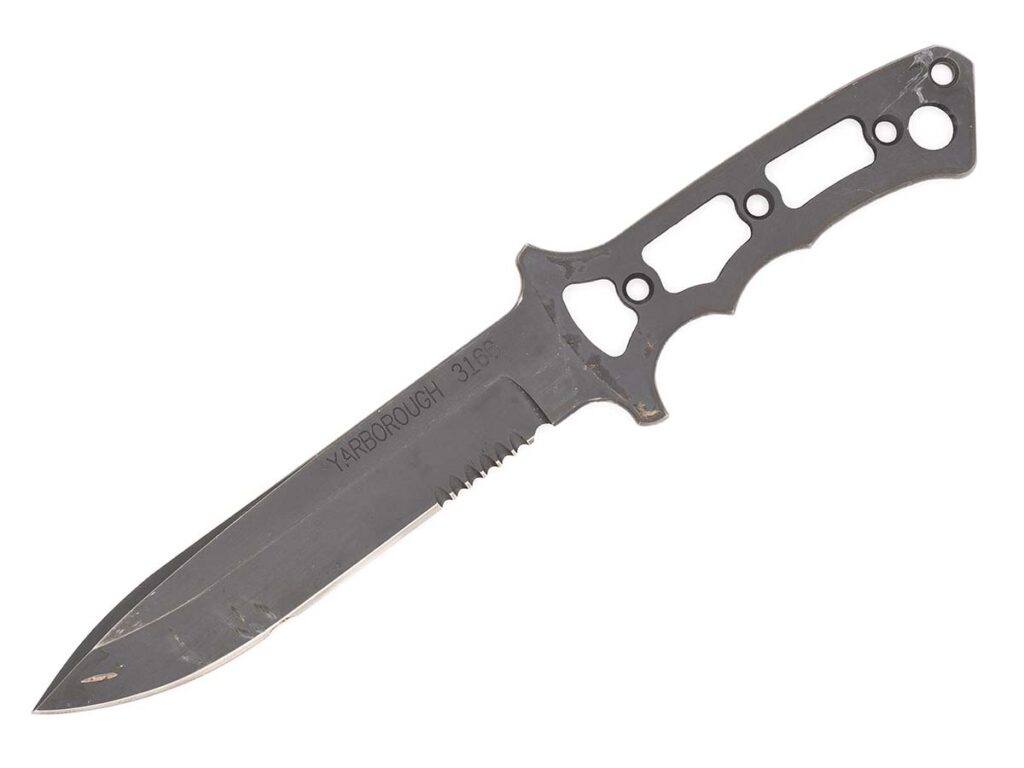
After an Army Special Forces soldier used his Chris Reeve Yarborough to cut a live electric cable during a mission, he sent in the damaged knife with $50 asking for repairs. The company sent the $50 back along with a new knife. Anne Reeve keeps the original knife, shown here, in her safe deposit box.

“A customer put a MagnaCut blade in a glass of saltwater for seven hours and claimed the rusting and pitting should be covered by our warranty!” recalled Anne Reeve of Chris Reeve Knives. “Another requested we replace the packaging of the parts he ordered because they smelled too strongly of perfume or lotion. A customer sent a knife in for a re-blade, and the original blade had an arrow and a smiley face welded onto it.”

Really? Try a few more from Chris Reeve Knives. A customer complained that the phosphor bronze washers of his Sebenza had stains on them and simply would not accept that it was normal patina. He also complained that the knife was not sharp and he had to sharpen it himself. He ground half the blade away and then said he should get a completely new knife. A customer shot his knife with a 9mm pistol and then sent the company a photo of the broken knife while requesting a new one under the standard warranty.

At Chris Reeve Knives, reputation is everything, and the company stands by its knives. But let’s sanity check. Warranties are not “get out of jail free cards” for new knives.

“We try to keep consistency in our warranty, but we do sometimes vary on case-by-case situations,” Anne explained. “Over the years we have tightened things up a bit because often we felt we would give an inch and the customer would take a mile.”
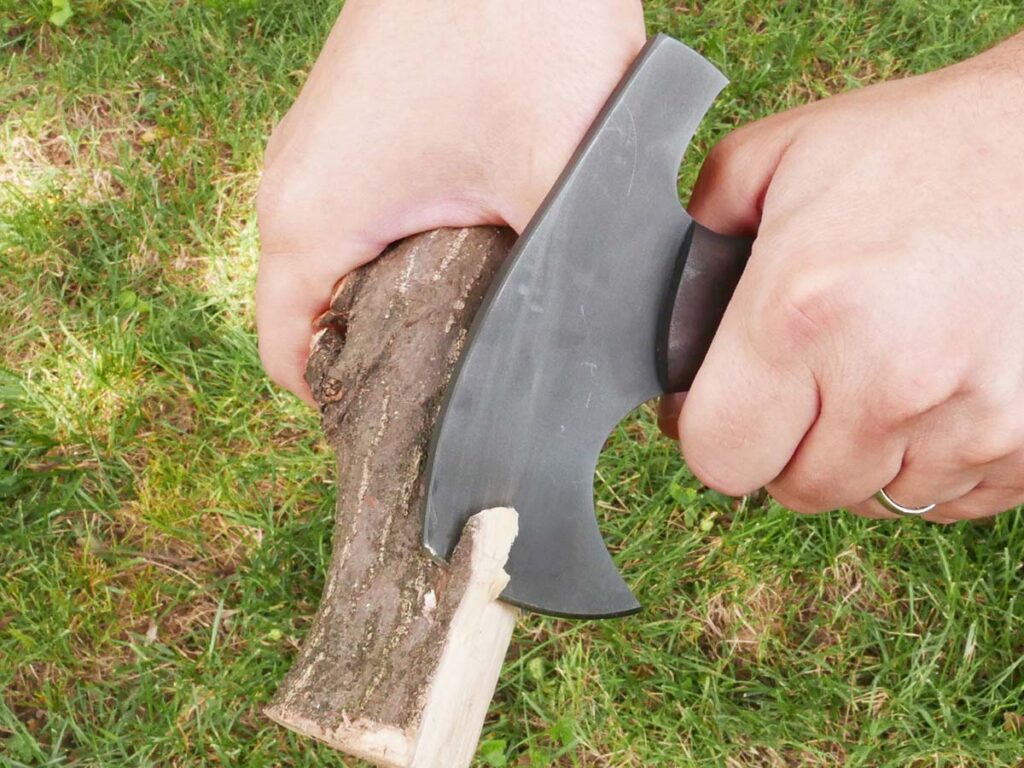
“Normal blade finish wear is not covered under warranty,” Daniel Winkler observed. “Working knives should look used.” The Winkler Hunter Axe LT shows some normal finish wear here. (Covert image)

Still, going out of their way to accommodate, the folks at Chris Reeve Knives have had some remarkable experiences.

“Mostly the customers who push back are simply rude,” Anne related. “Some just hang up or threaten to sell their knife. A customer informed us once that they had cut very acidic fruit multiple times and refused to clean the knife afterwards. They were furious we would not warranty their now rusted blade. Another customer took his brand new Umnumzaan and stabbed in into a tree. He then pried it 90 degrees to ‘tip test’ it. The tip snapped, and he claimed we should warranty the blade because what he did should not be considered misuse or abuse.”

Among unusual requests that Chris Reeve Knives went beyond the call of duty, or warranty, to make right, Anne has great memories. When a customer sent a 5.5-inch Green Beret in for recoating and it was lost in return shipping, the company made a custom iteration of the discontinued 5.5-inch knife from a 7-inch Green Beret blade blank. A sheath was available from the company archives and both were sent to the customer. When Reeve knives were abused by U.S. Customs officials, the company removed the scratches caused by bouncing around loose in transit, making the owner happy even though there was no warranty obligation. After an Army Special Forces soldier used his Yarborough to cut a live electric cable during a mission, he sent in the damaged knife with $50 asking for repairs. The company sent the $50 back along with a new knife.
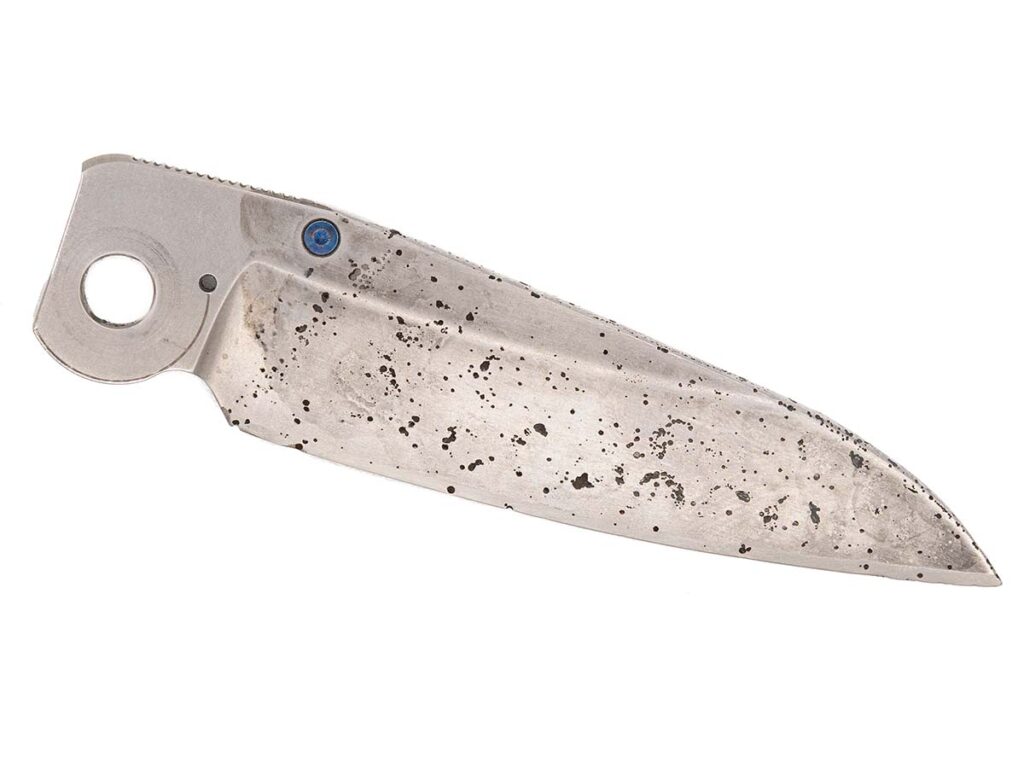
Anne Reeve said a customer put the MagnaCut stainless steel blade of a Chris Reeve knife in a glass of saltwater for seven hours and claimed the rusting and pitting should be covered by the company’s warranty. Of course, like all stainless steels, MagnaCut stains less but is not stain proof. Quite understandably, the warranty request was denied.

“That original knife lives in my safe deposit box now,” Anne smiled. “On a few occasions we have older knives returned for sharpening and we can tell that the knife has been lovingly sharpened so many times that the blade is worn out. We have replaced the blades. When we made the One Piece Range, the paperwork specifically said that it was not a throwing knife and breakage from throwing would not be covered by warranty. A couple of times we had knives returned that were broken in two. The dings made it quite obvious that the knife had been thrown. Back then, we would replace the knife and give the customer a verbal slap on the wrist.”

Though Reeve, like other companies, has found it necessary to scrutinize warranty requests more closely in recent years, the dedicated effort to make the customer happy remains strong. At Chris Reeve Knives, the warranty is, as Anne puts it, “phenomenal.”

Judgment Calls

When did the rules change? Where does the line between normal expectation and radical knife recklessness blur?
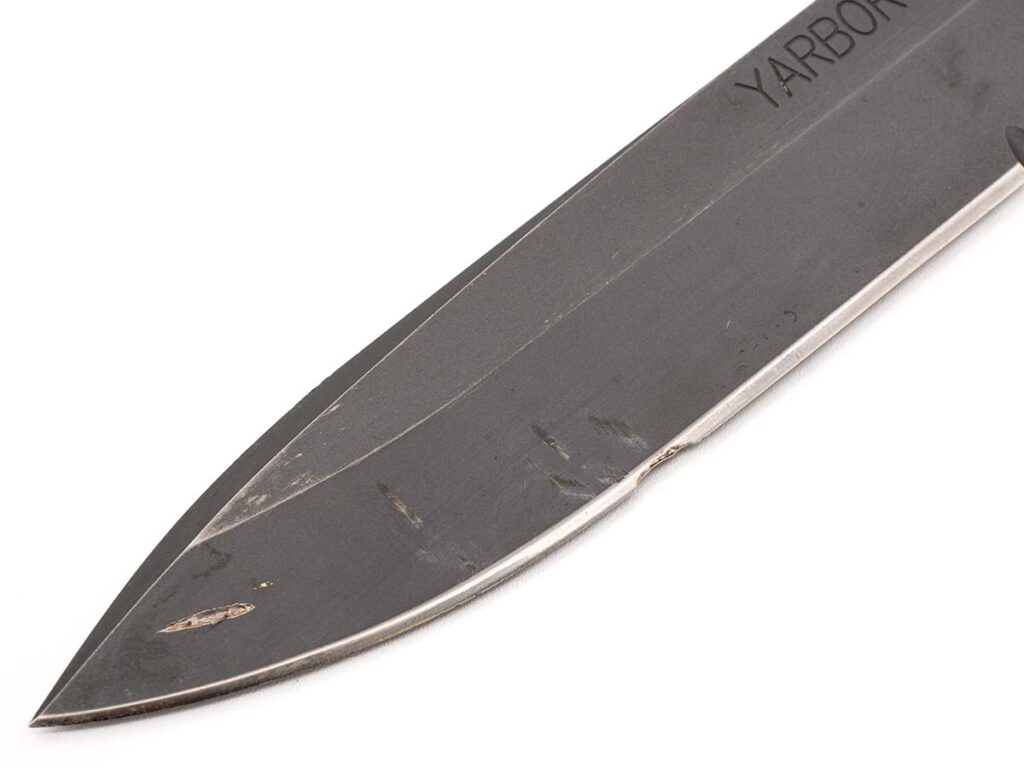
A closeup of the blade and edge damage the Chris Reeve Knives Yarborough incurred after being used by the SF operative to cut a live electric cable is a tribute to the toughness of the company’s knives.

“We’ve had a few forgeries sent to us for repairs,” commented BLADE Magazine Cutlery Hall-of-Fame® member Daniel Winkler of Winkler Knives. “Reactions from customers can get hot when they learn they have been duped. Not many warranty requests are really ‘crazy’; normal sharpening or sometimes fixing a damaged tip. People also request a re-finish for worn blades. If a knife fails for any reason we will either fix it or replace it, and normal blade finish wear is not covered under warranty. Working knives should look used.”

Winkler is sensitive to certain situations and sees extraordinary conditions for what they are.

“On a few occasions we have sent replacement knives without receiving damaged ones back,” he remarked. “One was a military user that used his knife to destroy a communications location in a war zone. He fried the power supply, and it fused the knife in the connection. Another was a hiker who saved his dog in a rockslide. His knife fell to the bottom of a gorge, so we replaced it, too. A third was used in a home situation where a man used his Winkler knife to stab an intruder to save his family. His knife was held as evidence, so we sent him a new one.”
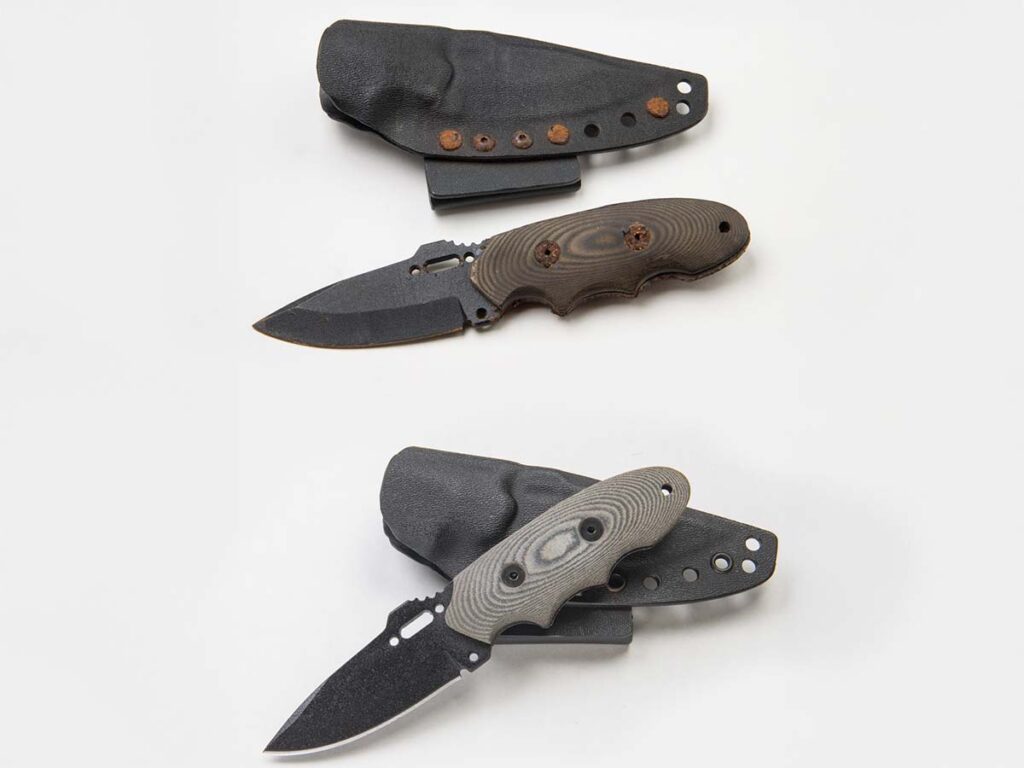
A tornado destroyed a home and carried away a safe full of knives, including several TOPS Knives models. Two to three years later, the safe was found. The knives were intact and basically undamaged. When TOPS was contacted for help with slight rust on the blade and engraving, the company obliged at no cost.

There lies the real judgment call in rendering the warranty verdict. Does the customer’s story pass the simple test of reasonableness? If so, most companies might feel a pang of compassion and try to resolve the request in the interest of good customer relations. Still, it’s a tough challenge sometimes. As much as a customer might feel slighted if a warranty request is dishonored, the maker might well feel used when the circumstances are not plausible or strain the normal standards that most people would accept.

“We go out of our way to promote positive customer relations,” Daniel added. “We have replaced or refunded knives and axes that we probably shouldn’t have due to how they were damaged in abuse, like prying or throwing. We will normally take the hit, but if it happens again we do not honor any warranty.”

Case-By-Case Decisions

At TOPS Knives, warranty requests are evaluated with the best outcome in mind. “Our philosophy on our warranty is that we have some things that will void a warranty or won’t be covered under warranty, but we still handle them all on a case-by-case basis,” remarked general manager Craig Powell. “The people that are honest and level with us are way more likely to get their issue handled under warranty—even if it shouldn’t be—than people that are rude or clearly lying to us.

“I always find it funny when someone says something happened to their knife and then the actual damage to the knife in no way matches their description,” Powell continued. “Like, maybe they think we don’t actually use or test our own gear and so we don’t know what would cause certain things to happen. But really, in the end very few people that contact us with an issue treat us poorly. So the vast majority get help under warranty.”
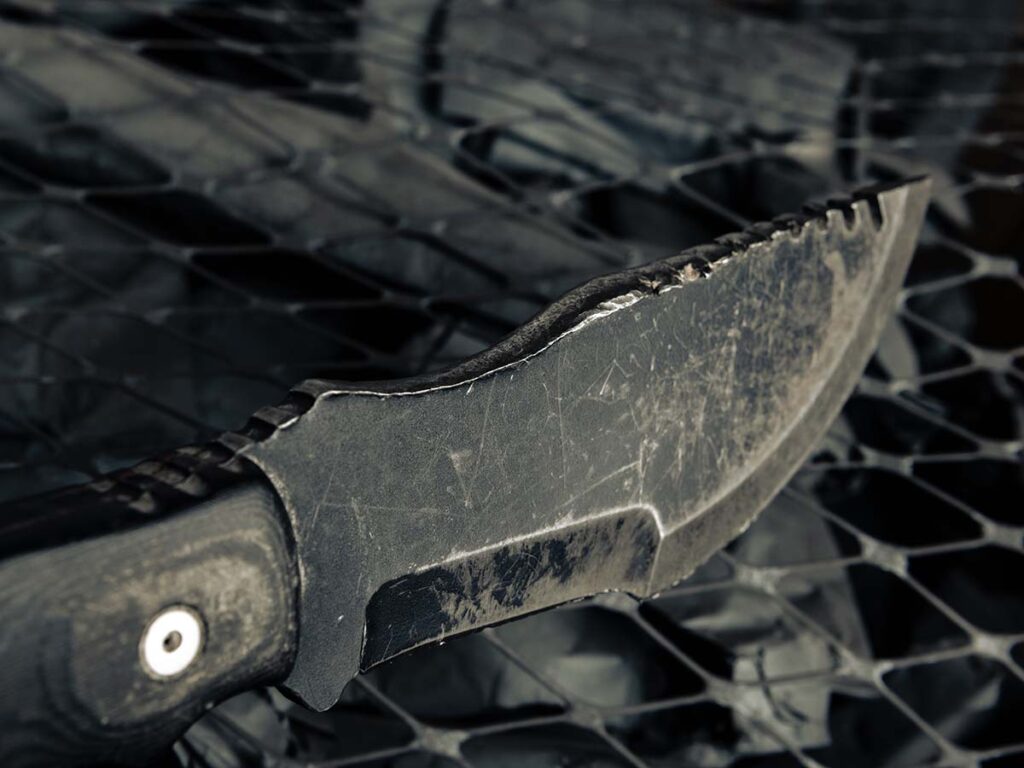
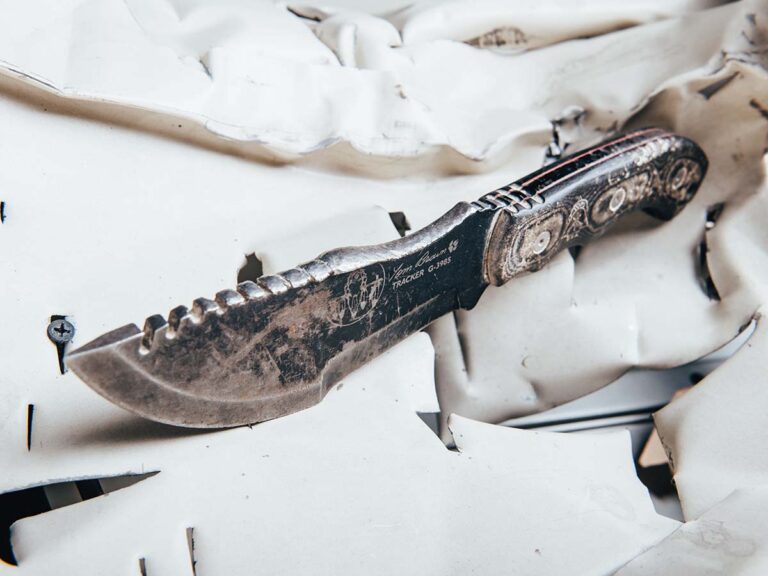
Back to the TOPS Tom Brown Tracker that was lost in the Iraqi IED incident: the local who originally found it after the explosion used it to split wood. The saw teeth had basically been mushroomed out of existence from the local beating on the knife with a piece of metal. Considering how the U.S. serviceman originally lost the knife, TOPS fulfilled the warranty.

Powell remembers certain circumstances that were somewhat unusual prior to a warranty request.

“When I had only been working here for a year or two, I took a call from a guy that was concerned about an issue with his Silent Hero. I talked to him for probably 15 minutes trying to figure out what was wrong. He kept saying that the knife was getting deformed and all he was doing was [batonning the blade spine to make] firewood. It probably took me longer than it should have, but I finally thought to ask what he was using as a baton. Turns out he was using the hammer side of a hatchet as his baton. So, a thick piece of metal is what he was using rather than a stick. I chuckled to myself and then we talked through the process of having a hatchet in your hand and choosing to use a knife to process firewood rather than the hatchet. He said ‘Oh!’ Then he basically apologized and said he understood. We didn’t end up fixing that knife for him, but that was because he realized what he had done and probably kept it as a reminder or trophy.”

On another occasion, a tornado destroyed a home and carried away a safe full of knives, including TOPS models. Some two to three years later, the safe was found. The knives were intact and basically undamaged. When TOPS was contacted for help with slight rust on the blade and engraving, the company obliged at no cost. Hikers have been known to lose TOPS knives on the trail and then miraculously find them months later. When the owner of one of these calls for warranty assistance, the TOPS folks fix the knives up, cleaning and refurbishing before sending them back in the context of a lesson learned: hold onto your valuables while out in the woods, especially your knife.

Extreme Situations

Military experiences have brought up several warranty requests, and these are sometimes caused by extreme situations. A Tom Brown Tracker was lost during the horrific explosion of an IED (improvised explosive device) in Iraq. The soldier involved was a chaplain, who returned some time later to the village where the explosion occurred. An old lady came forward with his knife after an interpreter and a $20 bill did some talking. The knife had been used in splitting wood.

“It was beat to hell,” Powell remembered. “The saw teeth had basically been mushroomed out of existence from this lady beating on it with a piece of metal. We swapped the soldier a new one and still have that knife [above] here today.”
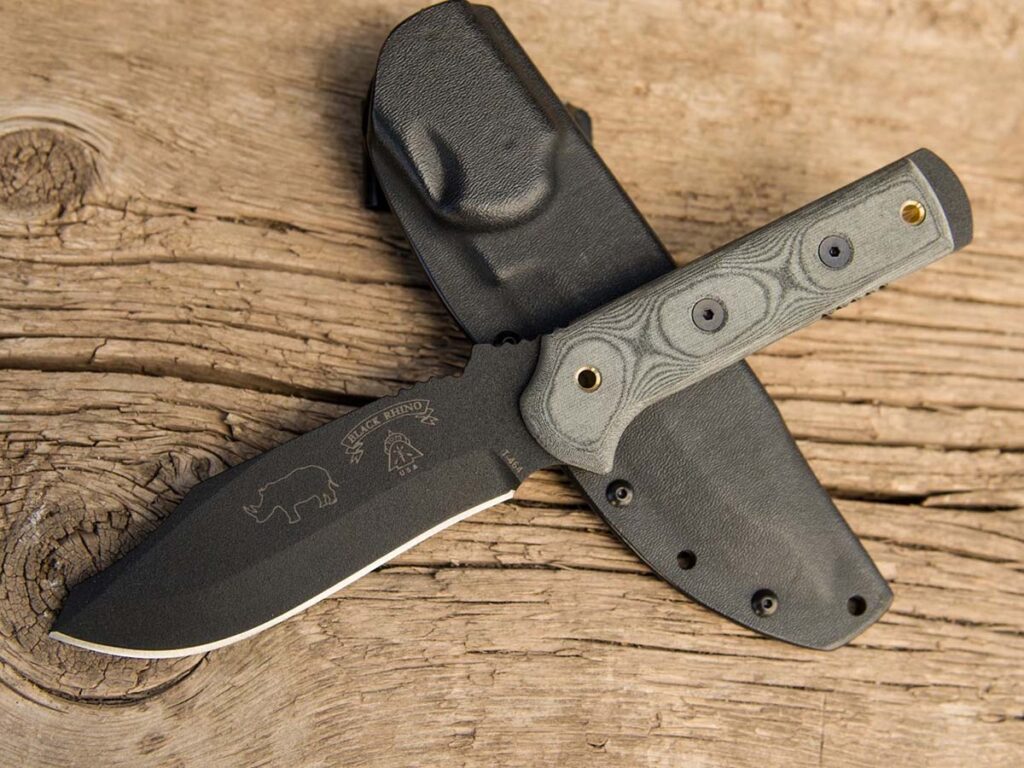
A TOPS Knives Black Rhino was lost when a desert barracks burned to the ground. The scales were completely gone and the knife could not be repaired. TOPS sent the destroyed piece back to the serviceman along with a brand-new Black Rhino like this one.

A Black Rhino was lost when a desert barracks burned to the ground. The owner recovered the knife. Its scales were completely gone and the knife could not be repaired. TOPS sent the destroyed piece back to the serviceman along with a brand-new Black Rhino.

“While our policy isn’t a no-fault policy, we still cover most issues,” Craig said. “We know what we’re making is quality, and we strive for that on every knife. So anything that a customer’s knife should be able to do but doesn’t is going to get covered.”

In the broadest sense, the warranty works both ways. It protects buyer and seller and invokes the sense of quality and pride of craftsmanship, with reasonable performance expectation and use. There are outliers, but for the most part both knifemaker and knife user work together with warranties to achieve positive resolutions.

More On Knife Business:

Spectacles In Steel: A Look At Definitive Damascus Patterns

Modern makers’ takes on this age-old steel art.

When BLADE Magazine Cutlery Hall-Of-Fame® member Bill Moran reintroduced knives with damascus blades at the 1973 Knifemakers’ Guild Show, little did he know how much damascus would evolve, redefine itself, expand into new media, and no telling what other recreations and rebirthings it has experienced in the half-century since that fateful weekend in the Muehlebach Hotel in downtown Kansas City.

On this page are some of today’s reincarnations of the material in its various forms, methods, materials and more. What’s staggering to consider is there are so many more variations—not only now but also to come. It is a phenomenon that is truly unique to the custom knife industry and should be celebrated and promoted whenever possible.

David Lisch Templars Mosaic

David Lisch’s dagger
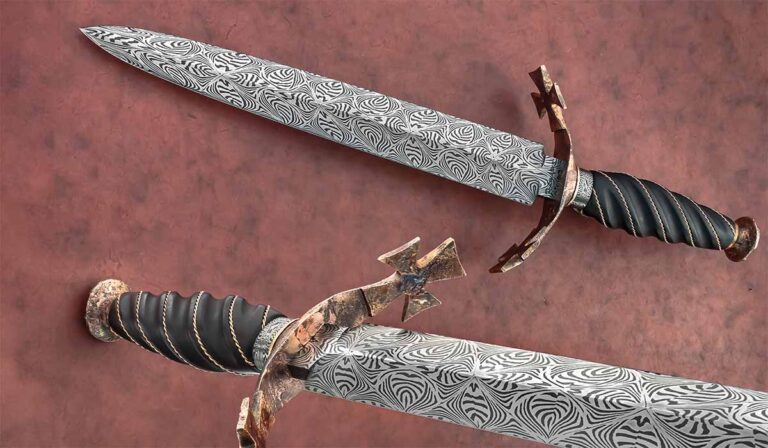
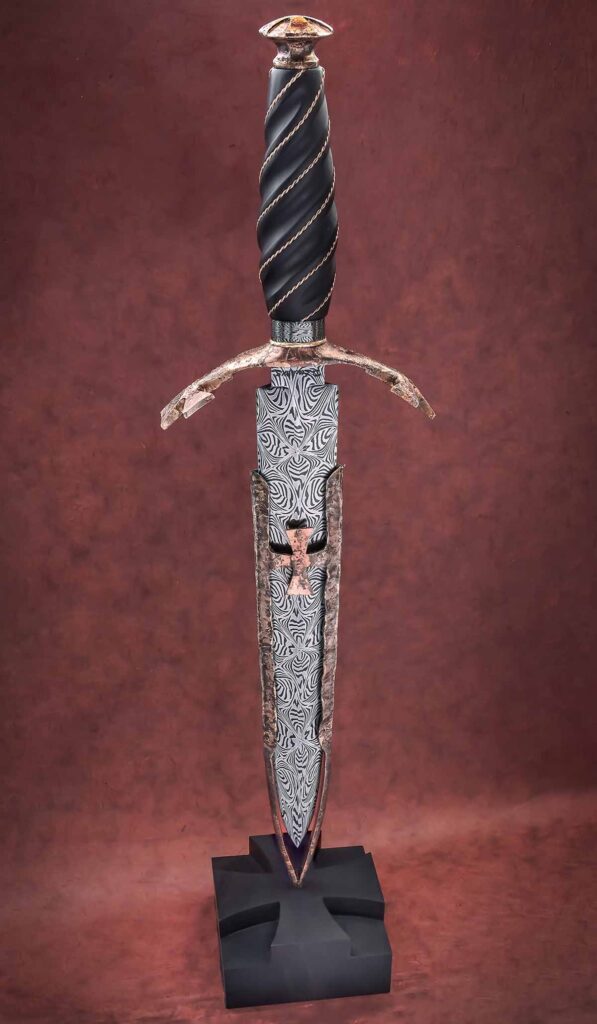
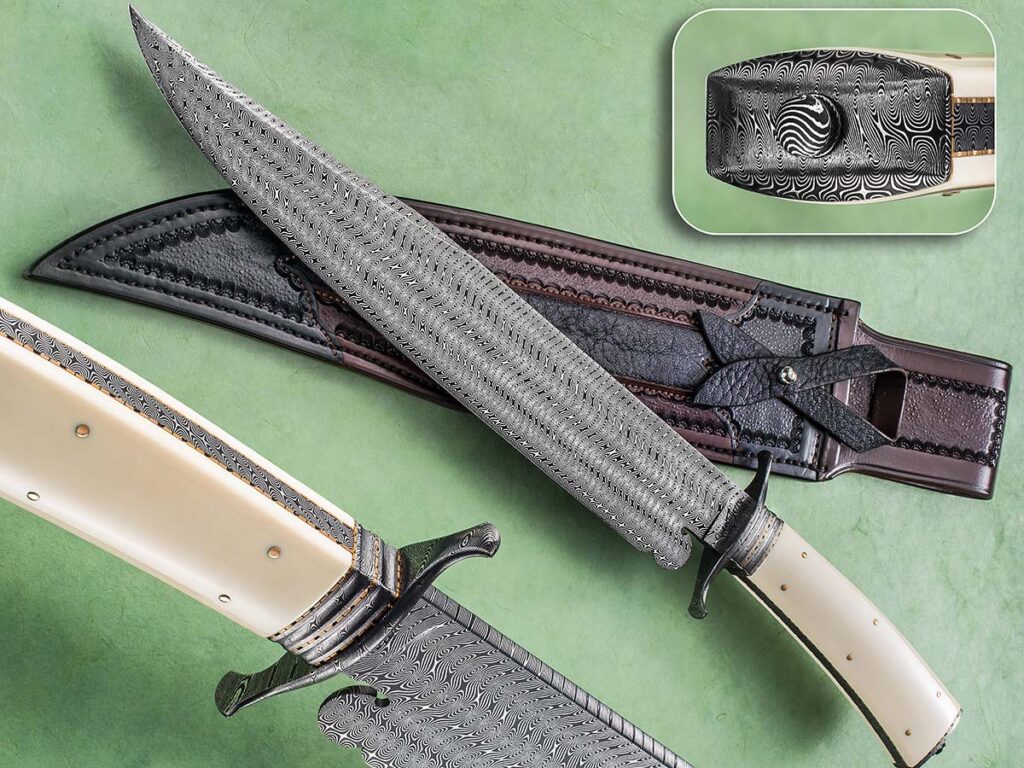
David Lisch’s spectacular art dagger features a 12-inch blade of his Templars Mosaic Damascus, a blackwood handle with gold wire wrap and a guard of pure iron covered in melted gold. Overall length: 17.75 inches. The knife comes with a stand that includes an embellished templars’ cross and one carved in the base as well. (SharpByCoop knife images)

Sporting a pattern ABS master smith David Lisch christened Templars Mosaic, the blade for his dagger is one he forged from 15N20 nickel-alloy and 1080 carbon steels and etched in ferric chloride.

“I was aiming for a bold, bright pattern that had a cross-like shape but wanted it to be a bit organic,” he wrote. The Templars’ cross also is represented on the guard and the finial, and there is one on the stand that holds the knife as well. “All these parts are pure iron covered in melted gold,” he noted. The dagger also has a domed gold spacer between the guard and Dragon Thunder damascus spacer that the fluted-blackwood-with-gold-wire-inlay handle butts up against.

“I made this dagger out of the love I have for creating art with no concern about how long it took or how much money I would make from it,” David stressed. “I did the handle twice and I did the big finial twice. I sold the piece for $10,000 and will not be making another one like this. You can be sure that the love I have for creating will take me to a new dagger, sword or bowie knife that tries to fill the void in me that can only be filled by creating art.”

Jeremy Yelle Jellyroll Mosaic Turkish Twist

jellyroll mosaic Turkish twist pattern damascus
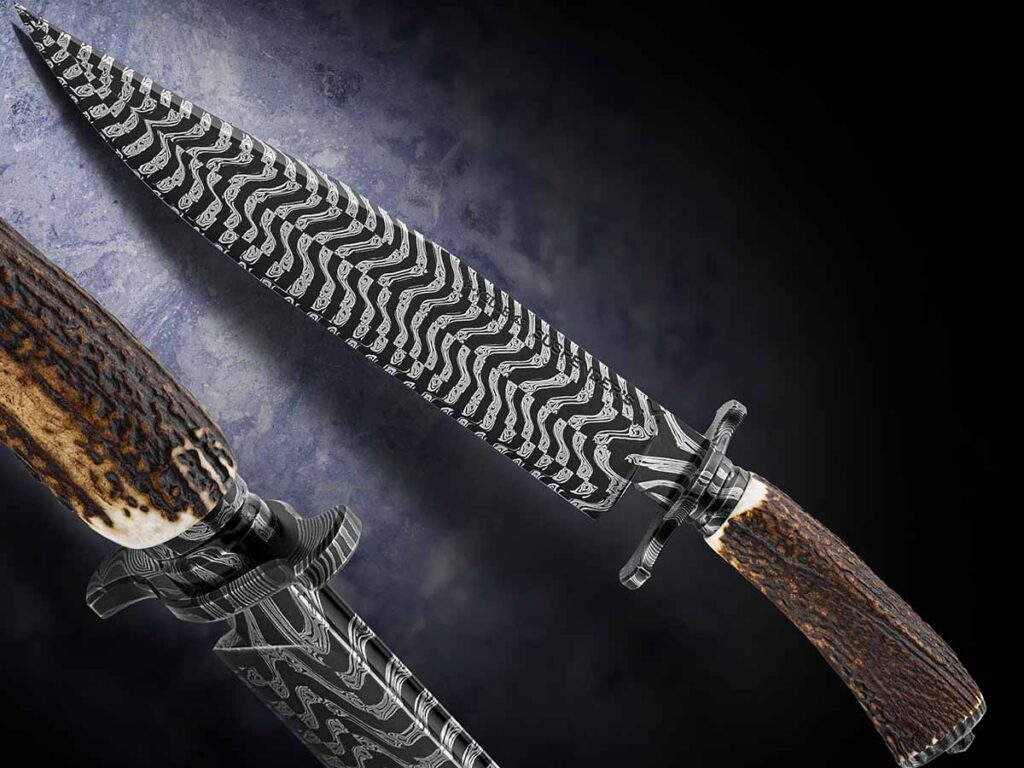
The steels for the jellyroll mosaic Turkish twist pattern damascus of the collaborative bowie by Jeremy Yelle (right) and Alex Houle (left) is forged from 1080 carbon and 15N20 nickel-alloy steels. Blade and overall lengths: 10.25 and 15.5 inches. Their list price for a similar knife: $2,600. (Jocelyn Frasier knife image edit)

The blade damascus of ABS journeyman smith Jeremy Yelle’s and SBK Cutlery’s stag bowie is a positively electric jellyroll mosaic Turkish twist pattern Jeremy forged in a collaboration with his friend Alex Houle of SBK. Alex forged the collaborative damascus into a blade and Jeremy made the handle.

“We began by welding a billet of alternate layers,” Jeremy wrote of the forging process. The pair drew the billet into a bar and jelly rolled it. “Then we squared it up and welded a four-way incorporating some 1-inch-square 1080,” he continued. They welded the billet, drew it out to ¾-inch square, cut and twisted it, and made a Turkish-twist stack that Alex forged into a blade. “You can also see the ‘fish mouth*’ weld Alex did so the edge bar and the spine meet properly,” Jeremy wrote. “He did a wonderful job making the blade.” Jeremy showed Alex how to work with stag and they finished the parts. Alex revealed the beautiful pattern via a two-step etching process using a solution of ferric chloride and finishing the etch with a coffee-darkening soak and hot wax finish.

Zane Dvorak Multi-Bar

multi-bar damascus
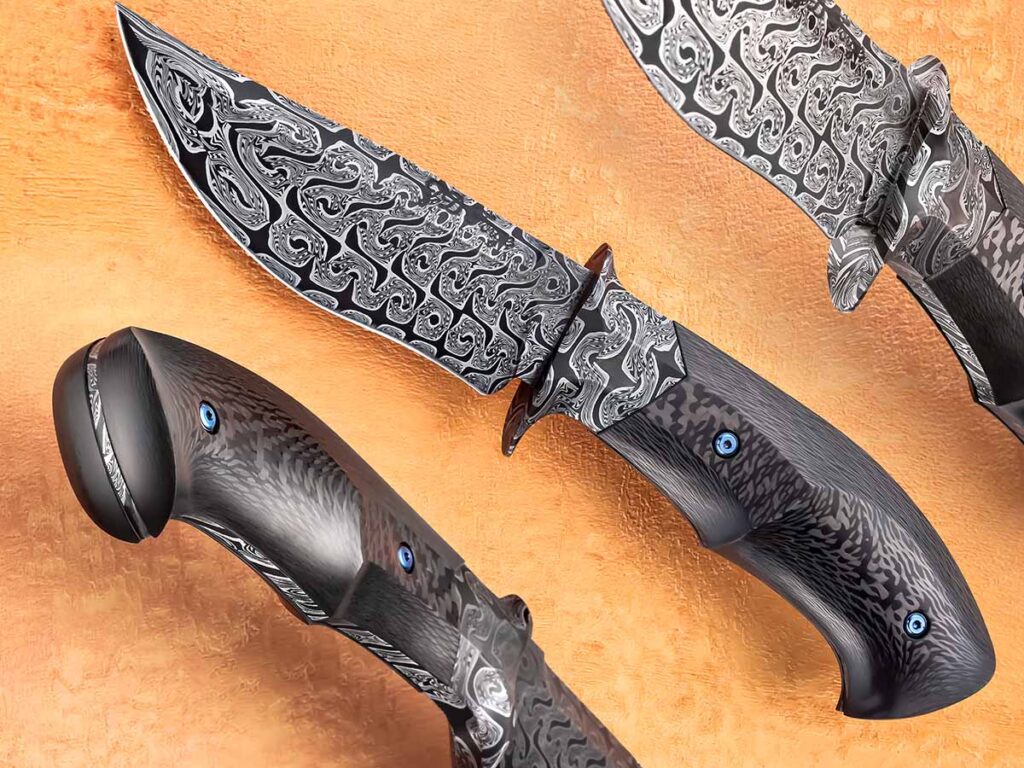
The 4.25-inch blade of Zane Dvorak’s hunter is a multi-bar damascus of 1084 carbon and 15N20 nickel-alloy steels. Overall length: 9.25 inches. His price for a similar knife: $2,400. (SharpByCoop image)

The blade of Zane Dvorak’s hunter is a multi-bar damascus of 1084 carbon and 15N20 nickel-alloy steels. Zane forged the blade/tang of four twisted bars of a twisted-bar pattern, and forged welded the guards and bolsters on with the same pattern. He bird’s mouthed the blade tip and rewelded it back together to create flowing outer bars. For etchant he used Gator Piss Acid from Baker Forge & Tool.

Bird’s mouthing is a process done on multi-bar, mosaic or other types of damascus patterns. According to Zane, it involves cutting a triangle out of the end of the rectangular parent bar—the shape of which somewhat resembles a bird’s mouth—then bringing the steel of the edge and spine back together to form the point of the blade. By doing so the blade exhibits a better consistency and overall flow of the pattern.

Andrew Blomfield Alternate Pattern

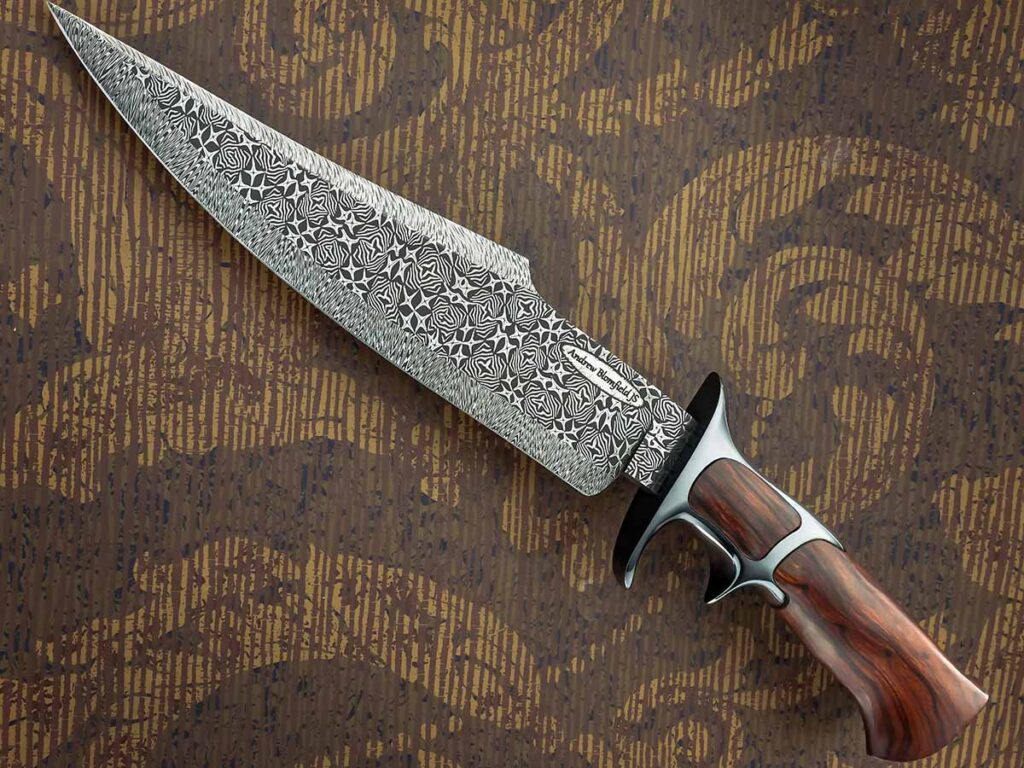
mosaic damascus Andrew Blomfield’s sub-hilt fighter
The mosaic damascus for Andrew Blomfield’s sub-hilt fighter is a combo of two separate billets welded in an alternate pattern. Blade and overall lengths: 9.5 and 14.5 inches. Blade grind: flat. Andrew’s price for a similar knife: $3,000. (SharpByCoop image)

The material mid-blade of Andrew Blomfield’s sub-hilt fighter is a combination of two separate billets of mosaic damascus welded in an alternate pattern. The edge is a straight feather pattern forge welded around the edge. The blade is a combination of pieces from three separate billets. The steels are 1084 carbon and 15N20 nickel alloy etched with ferric chloride.

The integral sub-hilt is 1020 low-carbon steel hot salt blued to a deep black finish. The handle is desert ironwood. The knife is of a full takedown construction.

Frank Edwards Palm Leaf Mosaic Pattern

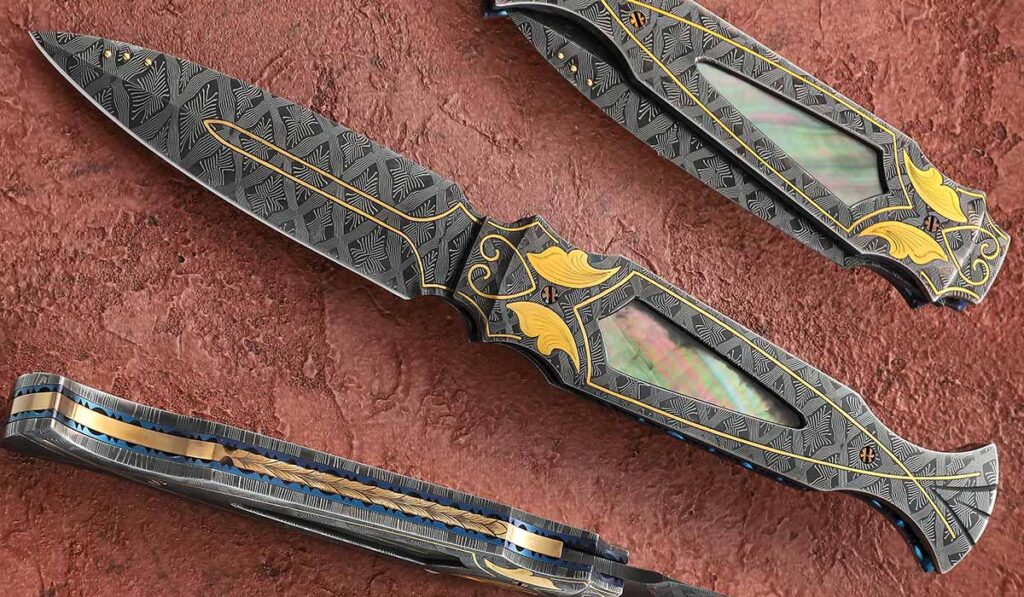
 Palm Leaf mosaic damascus by Frank Edwards i
The Palm Leaf mosaic damascus by Frank Edwards is an interweaving river system of straight lines. The handle inlay is black-lip mother-of-pearl. Blade and closed lengths: 3 and 4.25 inches. His price for a similar knife: $1,900. (SharpByCoop knife image)

The multi-bar damascus of Frank Edwards’s folding dagger blade is in a Palm Leaf mosaic pattern. Starting with a billet of straight lines, he reduced it all into a square and then biased the squares, four-waying the billet into a 1.5-inch square.

As Frank explained his recipe, “Forge weld another billet of straight lines, keeping them straight as possible to .5 inch by 1.5 inches. Add that to the previous billet and forge weld and reduce to a 1×1-inch square. Then four-way it again. This will give you the frame around the palm leaves. Keep repeating that until you achieve the size of pattern for the knife you’re building.

“The key to getting good mosaics is a slower reduction [of the steel]. We have presses and power hammers that help but they can move too much metal too fast, which will destroy a mosaic in a hurry. The slower reduction allows the billet to stay uniform throughout the length of the bar.” 
To expose the pattern he etched the blade with a four-to-one mixture of water/ferric chloride in 10-minute cycles, using 2,000-grit sandpaper between cycles.

Jackson Rumble Stunning Pattern

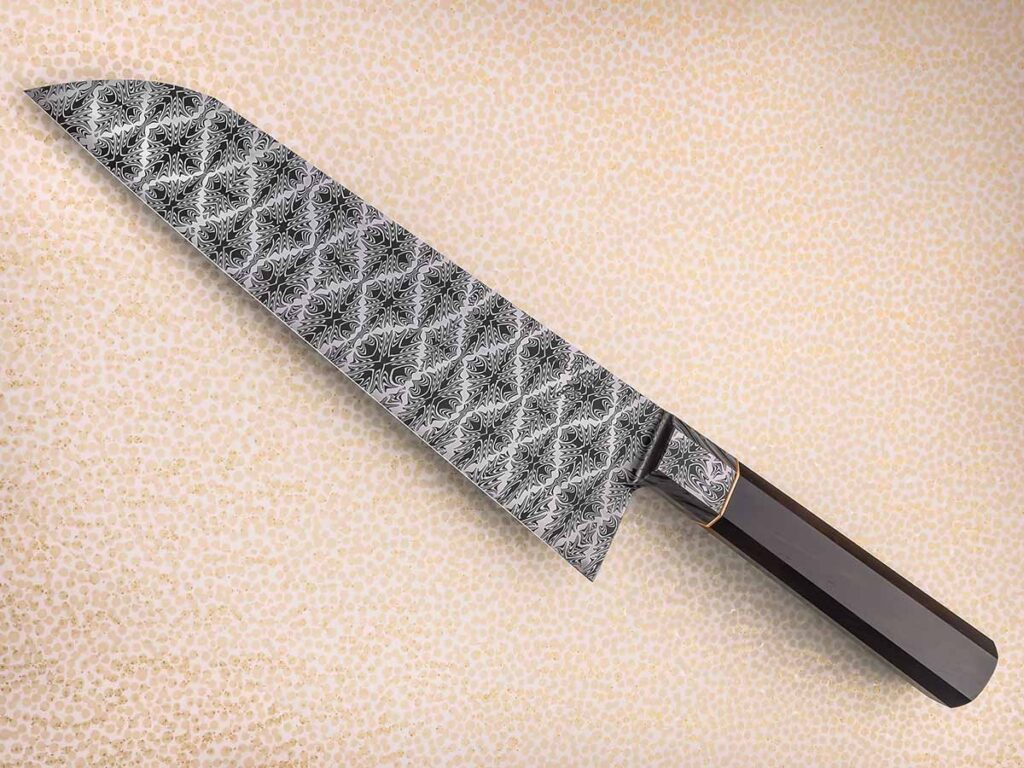
unnamed damascus pattern
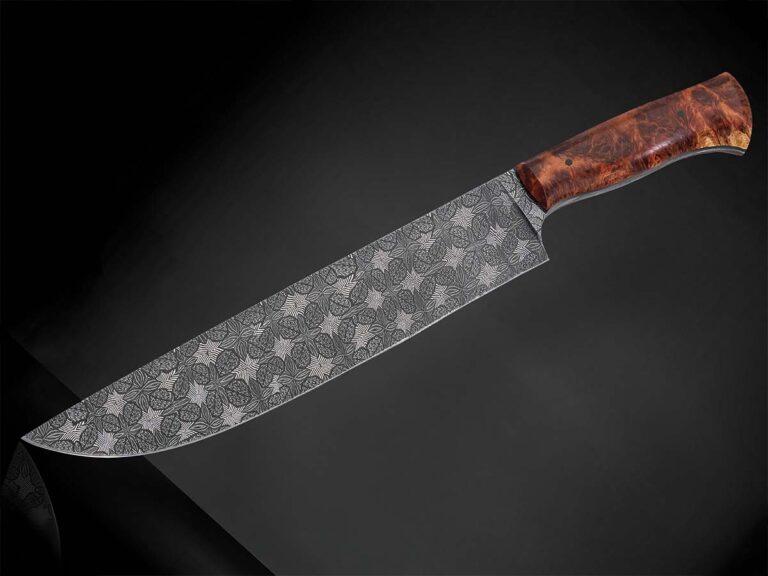
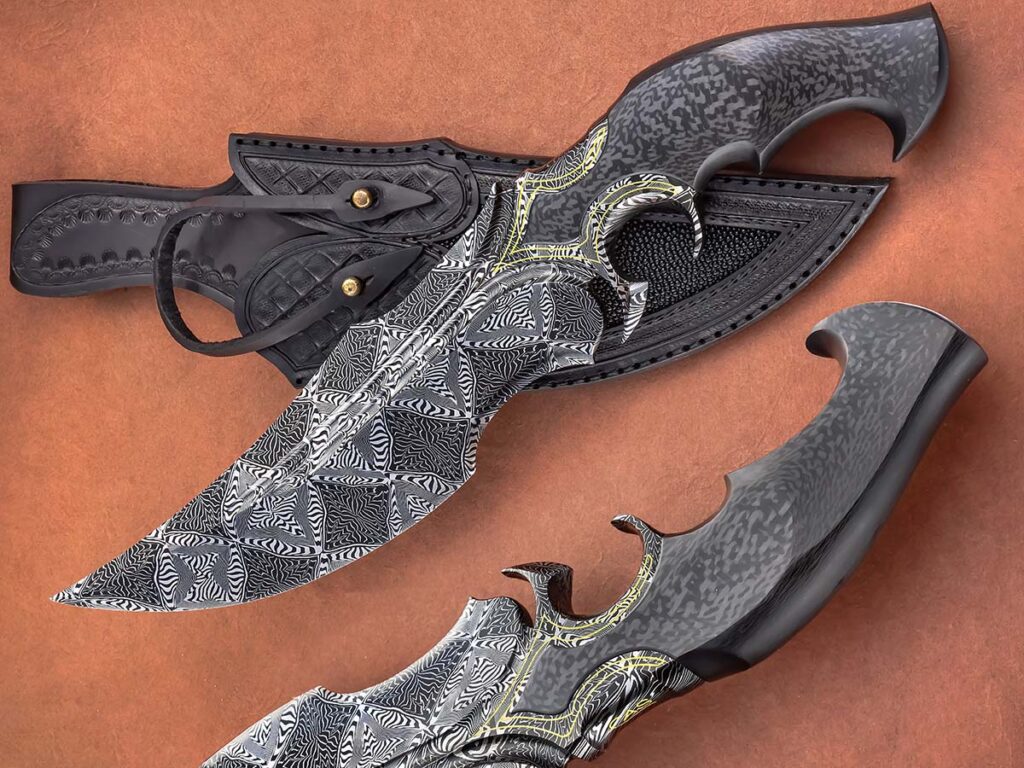
The 8-inch blade of an integral chef’s knife by Jackson Rumble boasts a mesmerizing and at press time unnamed damascus pattern forged from 1084 carbon and 15N20 nickel-alloy steels. The handle is African blackwood. Overall length: 13 inches. The maker’s price for a similar knife would start at $2,500. (SharpByCoop knife image)

The technique for the stunning pattern on newly named ABS master smith Jackson Rumble’s chef’s knife is what he calls a “pretty standard process” of four-way welding and re-square cycles. Not bad for “pretty standard,” eh (page 28, top left)? The initial stack has large sections of both light and dark steels interspersed through the alternating layers, and Jackson added extra-light steel to the billet in the later stages of the forging process.

“Finally, I used the Filicietti Flip method to transfer the pattern to the face of the billet,” he wrote. “For the etching process I used ferric chloride followed by coffee.”
OK, Jackson, so what’s the “Filicietti Flip method”?

“I’ve heard the Filicietti Flip called other names like the Ferry Flip, or just tile welding,” he explained. “Basically, after you’ve finished building the pattern in the end grain of the billet, you take it to a bandsaw and cut slices off the end at a 35-degree angle. This makes a bunch of pieces in the shape of parallelograms or tiles. The tiles can then be rotated and forge welded back together to form a new billet. Instead of having the pattern showing on the end of the billet, the pattern will repeat itself along the face of the billet.”

We’re glad we asked.

*Also called fish lips, fish mouth is when the tip of the billet begins to curl up on either side during rough forging to resemble a fish’s mouth or lips, thus the name. It is an easy fix for knowledgeable bladesmiths such as Alex Houle.

Check Out More Cool Custom Knives:

World’s Hottest Knives in April BLADE®

The steel that changed knives forever, the hottest custom makers’ hottest knives, how to build an emergency shelter, Chad Nichols’ MokuTi knife material, how to recognize future knife collectibles, these and much more highlight the new April BLADE®, on most newsstands NOW.

Bill Moran’s introduction of damascus steel at the 1973 Knifemakers’ Guild Show 40 yaers ago this year is the focus of “Steel That Changed Knives Forever.” Find out from those who were there what that was like and from others how the introduction transformed the industry and continues to do so today.

If you were stranded in the woods and needed to build an emergency shelter in a short amount of time, could you do it? James Ayres shows you how in “Shelter From The Storm.”

The custom knives most in demand change at any given moment. Get the latest installment of how they’re changing and what they are in “On The Boil!” The cover knife made by Jim Burke and designed by Tashi Bharucha is one of them.

If somebody asked you what factory knives you should collect now for the future, what would be your answer? See if it gibes with those who know in “Knife Pros Reveal What To Collect.”

There’s much more—a profile of knifemaker Will Zermeno, Ray Kirk’s giveaway knife for the upcoming Arkansas Custom Knife Show, the latest in mid-tech knives, how to clean hunting knives, part two of Ed Fowler’s step-by-step how-to on sheep horn knife handles, a test of Joel Worley’s “Woodsman” brut de forge knife and much more, all in the April BLADE.

For subscription information to BLADE click on BL0413CAN_finalwww.shopblade.com/blade-magazine-one-year-subscription-us?lid=ssfbbl013113

Knifemakers: Tell BLADE About Your Knife Shop Accidents

0

Accidents while making knives

In light of the devastating fire allegedly started by an amateur knifemakerBLADE doesn’t want anyone else to learn bladesmithing trial-by-fire style, literally.

That’s why we want to hear about your accidents in your knife shops. There’s no shame, and you can remain anonymous if you’d like. The point is prevent someone else from making the same mistake.

The focus here is on safety. Preventative tips are welcome, too.

Your contributions will be used in an upcoming BLADE feature. Thank you!

    Have a photo? Upload it here


    Dagger Design: The Geometry of Penetration

    Form, function and purpose of daggers–the most stab-ready knives.

    Few weapons are as simple in concept yet as demanding to design as the dagger. At first glance, it is merely a blade—sometimes short, sometimes long, usually but not always double edged—yet every aspect of its form has been refined over millennia for one purpose: stabbing. Unlike blades that balance cutting, slicing or chopping, a dagger’s geometry, materials and ergonomics allow no compromises in pursuit of its one purpose.

    From early Bronze-Age thrusting knives to the stilettos of the Renaissance, every angle in any dimension maximizes straight-line penetration. Whether for combat or display, understanding this purpose is essential for anyone who wishes to design, craft or appreciate these edged weapons. Even the most ornate ceremonial dagger should appear “stab-ready” at a glance, communicating the implied threat of the utilitarian tool with a statement of status and opulence.

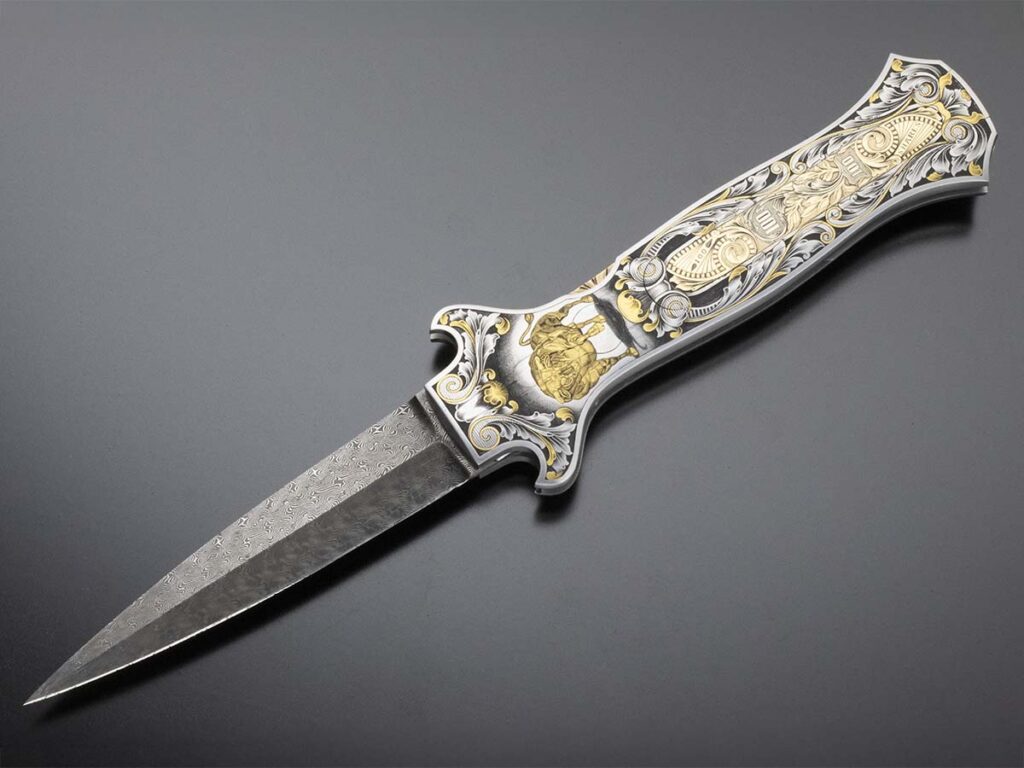
    This modern cinquedea by Vince Evans has a blade with a broad, rigid base tapering to an unforgiving point. Fullers down the middle serve to make the blade both lighter and stiffer. Equal parts status symbol and lethal instrument, it embodies the dagger’s refusal to compromise between beauty and purpose.
    This modern cinquedea by Vince Evans has a blade with a broad, rigid base tapering to an unforgiving point. Fullers down the middle serve to make the blade both lighter and stiffer. Equal parts status symbol and lethal instrument, it embodies the dagger’s refusal to compromise between beauty and purpose.

    Dagger Design Points

    Every deadly stab starts with three critical design choices that define a dagger’s unwavering purpose. A dagger blade must have sufficient spine thickness and ricasso rigidity to resist excessive bending under thrust load; it should be tapered to an acute but robust point for minimal tip-entry resistance; and it requires flexibility balanced with rigidity so it can reach vital organs, often protected by armor, without breaking.

    Early thrusting blades illustrate this principle as far back as the late Bronze Age. A broad base near the guard tapers rapidly to a narrow point, ensuring rigidity at the grip and sharpness at the tip. By the 1st century A.D., the Roman pugio perfected it. With a base often exceeding 5⁄16 inch in thickness and a central ridge tapering to a sharp apex, the pugio shed weight without losing stiffness. In practice, its point could pierce leather, flesh or weak links in chain mail, while its spine endured repeated jabs against shield bosses and bucklers.

    Extreme ornament, unconventional design, and opulent materials cannot disguise lethal intent and pure stabbing functionality in Bertie Rietveld’s ornamental dagger.
    Extreme ornament, unconventional design, and opulent materials cannot disguise lethal intent and pure stabbing functionality in Bertie Rietveld’s ornamental dagger.

    Yet precision in stabbing demands more than brute strength, it requires avoiding gratuitous cutting‐oriented features in a thrusting design.

    Serrations, upswept points, hooked tips, prying points and even bottle openers can be handy on a knife, depending on the task, but all of these undermine the straight-line force a dagger needs and disrupt smooth entry. If you ever find yourself in a situation where stabbing is required, by all means use whatever you’ve got—just don’t complain when your bottle-opener tip gets snagged in an assailant’s clothing. However, if you have the luxury of time and thought to design and make a dagger, strip away anything that doesn’t serve pure penetration. A dagger’s geometry remains laser-focused on stabbing effectiveness.

    Lastly, a dagger must balance penetration depth with material limits. A tip too slender might break or bend against bone or metal, while a tip too blunt simply won’t enter. Ancient workers of bronze and iron didn’t have modern labs or spreadsheets, yet somehow found the Goldilocks Zone that balanced reach and resilience. A well-tempered tip is tough enough to survive bone contact without snapping, yet with correct geometry stays stiff enough to slip between armor plates. Only through precise taper and temper can a dagger achieve depth without sacrificing strength.

    Even in this highly stylized dagger by Jordan Lamothe, the spine ridge provides the stiffness and rigidity required for uncompromising penetration.
    Even in this highly stylized dagger by Jordan Lamothe, the spine ridge provides the stiffness and rigidity required for uncompromising penetration.

    Combat Daggers Vs Art Daggers

    From the earliest times, daggers fell into two broad categories: weapons of combat and symbols of prestige.

    The combat dagger was stripped to essentials—minimal ornamentation, maximum toughness—while the art or status dagger has always been free to bend the rules of pure function to satisfy aesthetic expression and make statements of personality and prestige. Nonetheless, even the most ornate display piece must exude “stab-readiness” at first glance, a silent promise inherited from its lethal lineage.

    The complex damascus pattern and construction style of this dagger by Australia’s Jackson Rumble demonstrates that while he understands the essentials of a dagger, he’s not afraid to push the boundaries of expression without compromising either the stabbing function or his artistic vision.
    The complex damascus pattern and construction style of this dagger by Australia’s Jackson Rumble demonstrates that while he understands the essentials of a dagger, he’s not afraid to push the boundaries of expression without compromising either the stabbing function or his artistic vision.

    Surviving examples of Roman pugios from army camps demonstrate the utilitarian design, but gilded pieces from the same era, with elaborate inlays and inscriptions, do not stray far from purpose despite the decoration. All share the same fundamental geometry: a stiff, thick base, reinforced spine and unwavering taper to a sharp, flat-ground point.

    The ornamented variants—often gifted as symbols of rank or worn by the wealthy and powerful—could feature ivory grips or gilded fittings without diminishing their stabbing credibility. Regardless of personal status or the knife’s level of ornamentation, no one who saw a pugio drawn in malice would misunderstand the message or the danger. Combat heritage endows art daggers with an unmistakable threat that no amount of embellishment can conceal, though the pugios that did in Julius Caesar probably looked rather nice.

    The complex damascus pattern and construction style of this dagger by Australia’s Jackson Rumble demonstrates that while he understands the essentials of a dagger, he’s not afraid to push the boundaries of expression without compromising either the stabbing function or his artistic vision.
    The complex damascus pattern and construction style of this dagger by Australia’s Jackson Rumble demonstrates that while he understands the essentials of a dagger, he’s not afraid to push the boundaries of expression without compromising either the stabbing function or his artistic vision.

    Another example is the pesh-kabz, a Persian-born dagger later adopted and lavishly ornamented by Mughal weaponsmiths. Its single-edged blade featured a thick spine and acutely tapered point, designed to pierce heavy mail and laminated armor. As Mughal craftsmanship flourished in Agra and Delhi, artisans added damascened patterns, jeweled pommels and silk-wrapped grips. Yet even a fully jeweled pesh-kabz retained the same reinforced spine and narrow, forward-weighted geometry as its battlefield ancestors. Worn at court in gilded sheaths, these daggers exhibited status while making it clear that underneath the glamor was a blade as deadly as any used in war. Art and combat, then, remain entwined.

    The junction of the handle, guard, and blade is where the true masters separate from the merely good—every element is a decision between comfort, control and ornament that fit together with no gaps. (Mike Quesenberry, Best of Show/Best Art Knife, 2011 OKCA Show)
    The junction of the handle, guard, and blade is where the true masters separate from the merely good—every element is a decision between comfort, control and ornament that fit together with no gaps. (Mike Quesenberry, Best of Show/Best Art Knife, 2011 OKCA Show)

    This enduring marriage of lethality and ornamentation sets the stage for a deeper question: what separates an ordinary dagger from one that truly masters its intended purpose? The answer lies not just in history but in the details of profile, geometry, balance and structural refinement—each a mark of a dagger designed to do exactly what it must.

    More On Daggers:

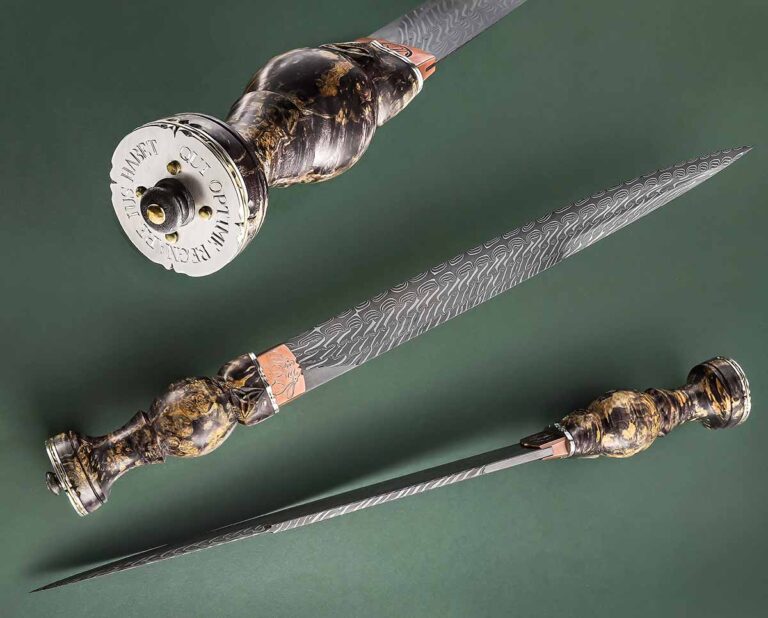
    Cool Custom: Derick Kemper’s Scottish Dirk

    A bonnie blade to be sure, Kemper makes a statement with his Scottish dirk.

    Derick Kemper celebrates his Scottish heritage with his sprawling reproduction of a Scottish dirk. It’s overstated to salute the legend and lore of his Scottish Highlander ancestors who fought so valiantly for their independence from Great Britain, beginning with the Jacobite rising of 1745.

    The edge of the stunning damascus blade is a simple twist pattern of W2 carbon and 15N20 nickel alloy steels. The three bars above it are Derick’s version of Robert Eggerling’s paisley pattern—a modified twist of 203E carbon steel for the bright section and W2 and 15N20 as well.

    The habaki has Derick’s Damselfly Forge stamp of two damselflies and his initials in the middle engraved on one side, and the white rose of Scotland’s “Bonnie Prince Charlie” (1720-1788) on the other.

    Derick Kemper
    Derick Kemper

    The chess-piece-like handle is oversized as well, with the pommel engraved in Latin, Qui Optime Regnare Ius Habet. The English translation is “Who hath best right to reign,” a slogan that appeared on the flags and accouterments of many of the Highlanders in the 18th century.

    Check Out More Cool Custom Knives:

    Hottest Damascus Patterns, According to Top Bladesmiths

    0

    Top bladesmiths discuss the three hottest damascus patterns.

    As damascus patterns emerge through the years, their popularity waxes and wanes. The steel itself, layers of intrigue and interest, experimentation and innovation captivate the steel forger, the custom maker and the knife-buying public like nothing else. The patterns abound and in recent reviews of photos, commentary from those in the business and observation it appears that the feather and mosaic, with twist not far behind, have been and continue to be hot.

    “I agree that feather and mosaic patterns are predominantly what is made, or certainly what is getting photographed [a lot],” related ABS master smith Steve Randall. “Both patterns are popular because they have lots of character and can be pretty dramatic. Feather patterns are very cool because they can be unique yet still hold true to the feather pattern. The mosaics can move off into so many different styles. They allow the maker to be really creative.”

    Feather Damascus Pattern

    ABS master smith Bill Burke praises the versatility of the feather pattern and its breadth of presentation.

    “I think that you see a lot of feather pattern because it is so striking and looks good on almost any knife style,” he commented. “It is also quite a challenge to produce. A well-done feather will have a flow from end to end with nicely curved veins, while a feather that has interruptions in the pattern or has the center area drawn out into a long ‘V’ shape then curves out rather sharply to the edge is not done so well. I don’t feel a feather pattern is difficult to do after one has mastered pattern welding. It becomes difficult when an inexperienced smith rushes into trying to make a feather before mastering basic pattern-welding techniques.”

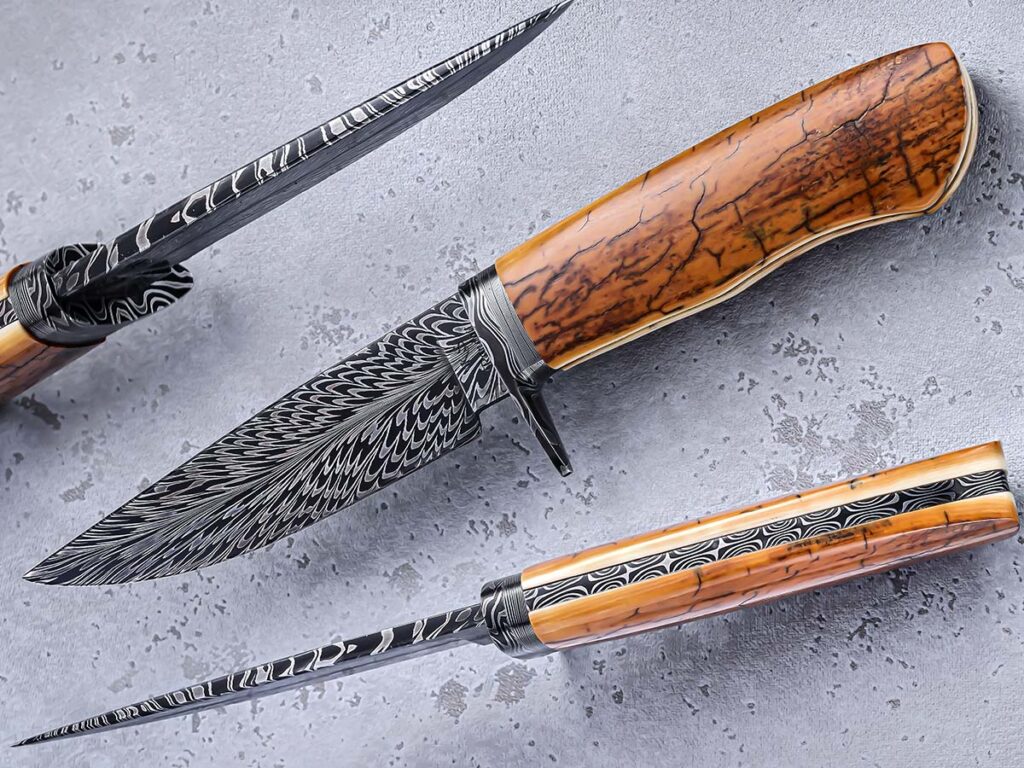
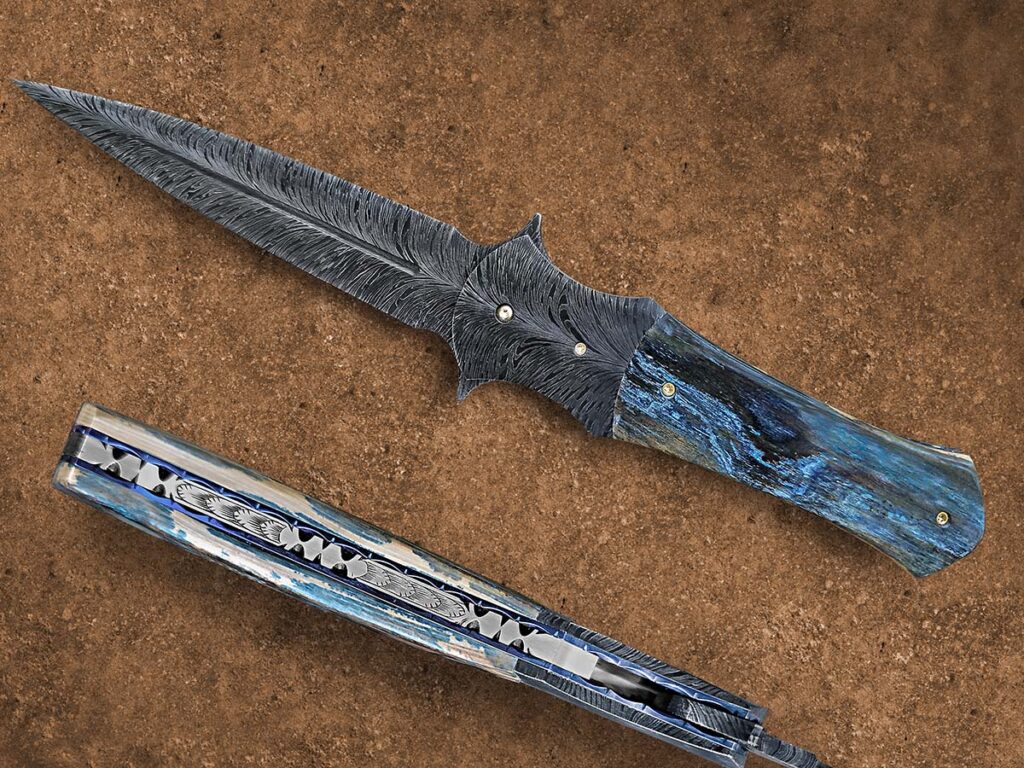
    “Feather patterns are very cool because they can be unique yet still hold true to the feather pattern,” Steve Randall observed. He matches up the feather pattern with a mastodon ivory handle on his frame-handle hunter. Overall length: 9 inches. (SharpByCoop image)
    “Feather patterns are very cool because they can be unique yet still hold true to the feather pattern,” Steve Randall observed. He matches up the feather pattern with a mastodon ivory handle on his frame-handle hunter. Overall length: 9 inches. (SharpByCoop image)

    BLADE Magazine Cutlery Hall-of-Fame® member and ABS master smith Steve Schwarzer sees the artistry in the feather pattern as well, and when he considers the magnitude of its relative surge concludes, “Absolutely. What you don’t see much of is images and the forge skill required to put that in damascus. Both the feather and mosaic damascus are fairly easy to do, and with the internet there are thousands of recipes out there with visual step-by-step instructions. I did the first feather pattern ever done in a folding knife, and [Cutlery Hall-of-Famer] Don Fogg in his Life and Death Dagger was the only one who did a feather pattern before me. I did the first that was recognizable in the folding knife.”

    Degree of difficulty is and will forever be a matter of individual perspective and opinion. Randall stresses the experience level of the maker in fashioning the feather pattern.

    “I would say that feather damascus can be a difficult pattern,” he offered. “There are a lot of pieces that have to forge weld together, which opens the opportunity for cold shuts or poor welds. Once that happens, you’ve pretty much got a paper weight.”

    Mosaic Damascus Pattern

    The perspective on mosaic damascus is similar to that of the feather pattern. Its uptick in popularity is driven by the skill of the maker and the diversity of the presentation. Mosaic makes its statement in both subtle and bold blade aesthetics.

    “While a simple twist pattern is rather mundane,” Bill Burke noted, “when four or more bars are twisted in opposite directions and stacked one on top of the other to create a Turkish twist, the result can be striking.” A lavish five-bar Turkish-twist damascus comprises the blade, including the Spanish notch at the base of the edge, on Mike Quesenberry’s Mediterranean bowie. (SharpByCoop image)
    “While a simple twist pattern is rather mundane,” Bill Burke noted, “when four or more bars are twisted in opposite directions and stacked one on top of the other to create a Turkish twist, the result can be striking.” A lavish five-bar Turkish-twist damascus comprises the blade, including the Spanish notch at the base of the edge, on Mike Quesenberry’s Mediterranean bowie. (SharpByCoop image)

    “Mosaic patterns do lend themselves to individual creativity,” Burke remarked. “They can vary from not too hard to extremely difficult to do. Mosaics are limited only by the smith’s skill and imagination. Mosaics that are done well will have the patterns lined up with no unintended interruptions in the elements and all the individual tiles matched up well.”

    Tiles, incidentally, are the small, angled pieces of steel that are carefully assembled and then forge-welded together to create the distinctive, repeating mosaic pattern. The tiles are cut from the billet or block of welded steel that forms the basis for the creation of any damascus pattern. The tile cuts are made with a scarf joint that facilitates the joining of the surfaces to be mated during the forge welding process.

    ABS master smith Mike Quesenberry is a big fan of the mosaic pattern, particularly its possibilities for expression.

    Mike Quesenberry stated the black and silver contrast of mosaic patterns can do “all kinds of crazy, wild things. It is huge with so many possibilities, and it turns out to be a really good pattern that some like in a fine look and others prefer in a bold statement.” The Sobral Brothers go bold with the pattern on their keyhole subhilt fighter. Overall length: 13 inches. (SharpByCoop image)
    Mike Quesenberry stated the black and silver contrast of mosaic patterns can do “all kinds of crazy, wild things. It is huge with so many possibilities, and it turns out to be a really good pattern that some like in a fine look and others prefer in a bold statement.” The Sobral Brothers go bold with the pattern on their keyhole subhilt fighter. Overall length: 13 inches. (SharpByCoop image)

    “I love mosaic and its creativity,” he declared, “along with the fact that smiths can take mosaic and make it bold or fine and there are all sorts or variations that make it fantastic, from W’s to many others. You can add different layers to fine and thick material, 1080 or 15N20 or whatever alloy. That black and silver contrast can do all kinds of crazy, wild things.

    It is huge with so many possibilities, and it turns out to be a really good pattern that some like in a fine look and others prefer in a bold statement.”

    Things To Look For

    Assessing the quality of the individual feather and mosaic product is an exercise in discernment and preference along with the display of basic skill that is evident. Randall takes a subjective point of view.

    “One of the most important signs of a feather pattern that is well done is its flow through the blade,” he observed. “The feather should flow from the center of the ricasso through the blade and out the tip. Both feather and mosaics being well done are in the eye of the beholder. Layer count has a big impact. The higher the count does not always make the pattern better.”

    Bill Burke indicated a well-done feather pattern will have a flow from end to end with nicely curved veins. ABS master smith Scott Gallagher nails the concept in the feather-pattern blade of his Dolan Dagger Folder. Closed length: 5.25 inches. (Jocelyn Frasier image)
    Bill Burke indicated a well-done feather pattern will have a flow from end to end with nicely curved veins. ABS master smith Scott Gallagher nails the concept in the feather-pattern blade of his Dolan Dagger Folder. Closed length: 5.25 inches. (Jocelyn Frasier image)

    Schwarzer agrees that the individual’s taste has a tremendous weight in the interpretation of well-done damascus.

    “It’s all subjective,” he related. “It involves how pleasing to the eye the fine or bold patterns are. The whole thing can’t be just a hodgepodge of stuff stuck together. It has to tell a story, and if it tells a story, then it is art—and to a lot of people it is great art. There is stuff out there that is incredibly complicated to do that looks simple on the face of it, but it isn’t. We are in the infancy of pattern welding, and a lot of it has come from Daryl Meier.

    “There have been patterns out there with faces and images in them since the 1700s,” Steve continued, “and now we are painting with steel. When Bill Moran showed up with random-pattern blades in the early ’70s, he was continuing something that had never stopped. Pattern welding has probably been going on for 4,000 years, and you have to forge, fold and weld the iron to clean it. Then, when you get the alloy in there, it shows the pattern. Pattern welding, including feather and mosaic damascus, is a technique and a skill set that is developed. Once you develop that skill, the trick is to get it back together without flaws, turning something mundane into something striking. Mosaic requires more planning and skill than feather.”

    One of the pioneers in—and a most outstanding forger of—Turkish twist damascus is Jerry Rados (inset), who forged the steel for the Wall Street Knife by Joe Kious. Jerry’s Turkish twist has what Steve Schwarzer calls a kaleidoscopic appearance.  (KnifePurveyor.com knife image)
    One of the pioneers in—and a most outstanding forger of—Turkish twist damascus is Jerry Rados (inset), who forged the steel for the Wall Street Knife by Joe Kious. Jerry’s Turkish twist has what Steve Schwarzer calls a kaleidoscopic appearance. (KnifePurveyor.com knife image)

    Twist Damascus Pattern

    Although some patterns may stand out from others for a while, there are always those that maintain their place among the most popular. Twist patterns and specifically Turkish twist are regularly in the conversation when collectors are seeking their prize blade.

    “Twist and Turkish twist are the same and totally different at the same time,” smiled Burke. “While a simple twist pattern is rather mundane, when four or more bars are twisted in opposite directions and stacked one on top of the other to create a Turkish twist, the result can be striking. However, like almost all other patterns these two can also be drawn out or stretched too far, which detracts from the looks of the pattern. While a simple twist is relatively easy, the Turkish twist billet is wrought with potential for failure and is very labor intensive.”

    A key element in producing twist patterns is control, and Schwarzer respects the precision required.

    “Very precise control is necessary in the twisting so you get that twisting the same in fine or coarse layers,” he said. “Jerry Rados was the American guy who did the most of that, and we both learned from Daryl Meier in Carbondale [Illinois]. The early blades made by Daryl in the 1980s are beautiful, but you’ve got to be almost [obsessive compulsive] to produce that stuff. It involves a lot of planning and the turns have to be precise. You can twist mosaic and make it look like a kaleidoscope.”

    Chris Roosendaal’s feather pattern in 1084 carbon- and 15N20 nickel-alloy steels borders on the mesmerizing. The scales are black G-10 and Micarta®. Overall length: 11.22 inches. (Rod Hoare image)
    Chris Roosendaal’s feather pattern in 1084 carbon- and 15N20 nickel-alloy steels borders on the mesmerizing. The scales are black G-10 and Micarta®. Overall length: 11.22 inches. (Rod Hoare image)

    Randall says that a Turkish twist done right is “very classy.” Its degree of difficulty is a cut above basic twist, but in his experience, it isn’t quite as demanding as feather pattern work due to the requirement of fewer pieces to “cut, flip and weld together.”

    When Quesenberry talks Turkish twist, he affirms his love of the look but decries the amount of waste he sees in its production.

    “I’m a huge fan,” he commented, “and I love the fact that it’s an appealing pattern. But I don’t like the huge amount of waste. To me, the cool pattern is in the middle third of the bar. There aren’t really a lot of American and European guys into Turkish twist, but some of the South Americans are really pros who are turning out some bold patterns.”

    Shifting Damascus Pattern Preferences

    Of course, the shifting preferences and envelope of creativity that is constantly pushed keep the damascus conversation going. And it is likely to remain lively long into the future.

    “Trying to say one pattern or another is more popular is always subjective,” Randall concluded. “There are some great classic patterns that are very appealing. For example, the ladder, twist, crushed W’s and others. Sometimes the mosaics get visually busy, so some people don’t enjoy them as much, but who doesn’t love a feather or explosion pattern? They are too cool. Some of it does depend on the overall knife design. The blade design and size with guard and handle can enhance—or take away—from a pattern.”

    Considering damascus pattern popularity past, present and future, one element is certain. The driving force of creativity and the artistry of the forge will keep this ancient steel relevant for generations to come.

    More On Damascus:

    Advertisement

    Must Read Articles

    Read this before you make a knife

    Knifemaking 101 – Read This Before You Make a Knife

      by Wayne Goddard My experience has taught me that there's nothing like digging in and getting started. I've often said the hardest part of the...
    how to forge damascus steel

    How to Forge Damascus

    Advertisement
    Advertisement