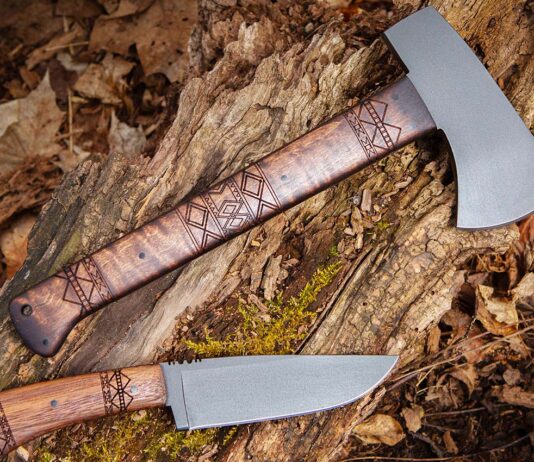
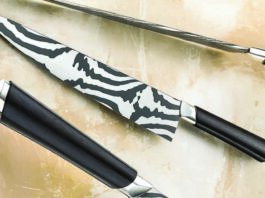
Knifemaking is the building of a knife, which includes the blade, handle and other accouterments. Blades are made by either removing metal from a steel blank via a grinder – known as stock removal – and the forging to shape of hot steel into a blade in the process known as bladesmithing. Other parts, including bolsters, guards, pommels, etc., are needed to complete the finished knife.
So, you’re going to build a power hammer… now’s the time to consider where to get your parts.
The first thing you’ll have to decide is which style of power hammer you will build. There are as many designs as there are folks who build hammers, but they fall into two basic categories: helve hammers and linkage hammers.
Power Hammer Styles
Linkage Hammer
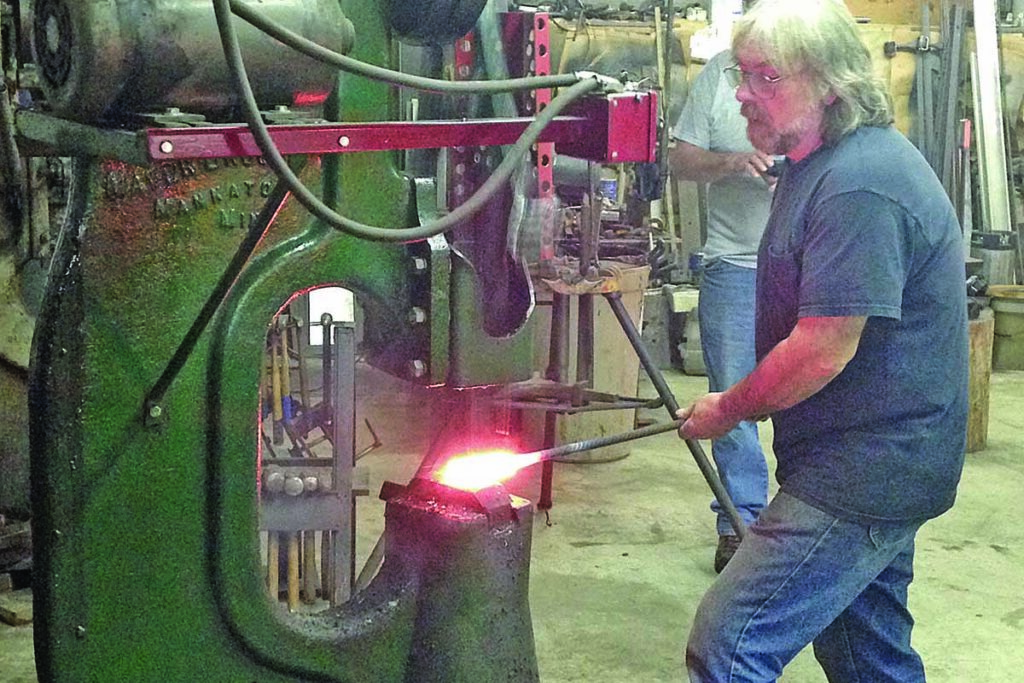
At the basic level, a helve hammer has an arm that moves up and down on a fulcrum to move the hammer head up and down. A linkage hammer uses a wheel, tire or disk that rotates and uses the rotation to move the hammer head up and down. The Little Giant power hammer design uses a linkage, as does the commonly home-built tire hammer.
The Little Giant power hammer design uses a linkage, as does the commonly home-built tire hammer. ABS master smith/BLADE® field editor Joe Szilaski pounds away with his 50-pound Little Giant. (Lori Szilaski image)
Helve Hammer
I chose to build an Appalachian-style spring helve hammer because I had access to a variety of leaf springs, and because the design is more intuitive and less mechanically precise. I figured correctly that I could build a helve hammer design from scratch, but that a tire hammer had some engineering points that would be difficult for me to figure out. If you have access to uniform steel sizes or must buy your steel, I suggest a tire hammer. I had good scrap steel and didn’t want to buy much.
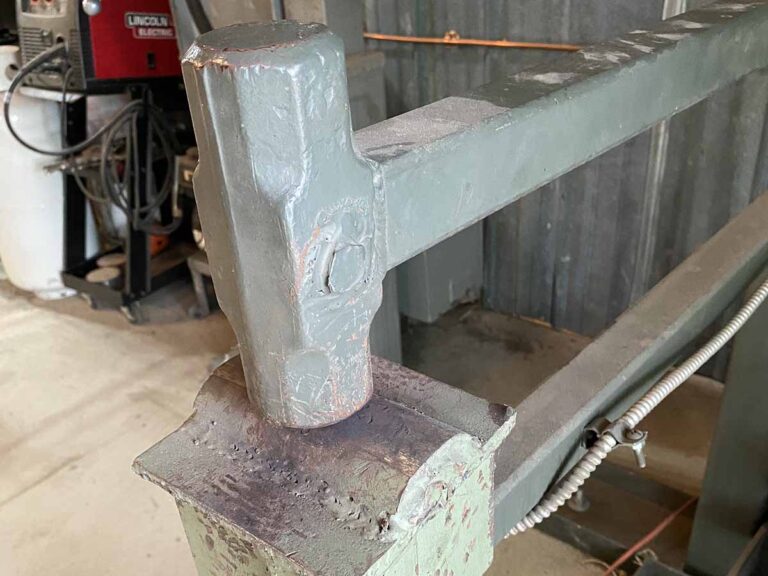
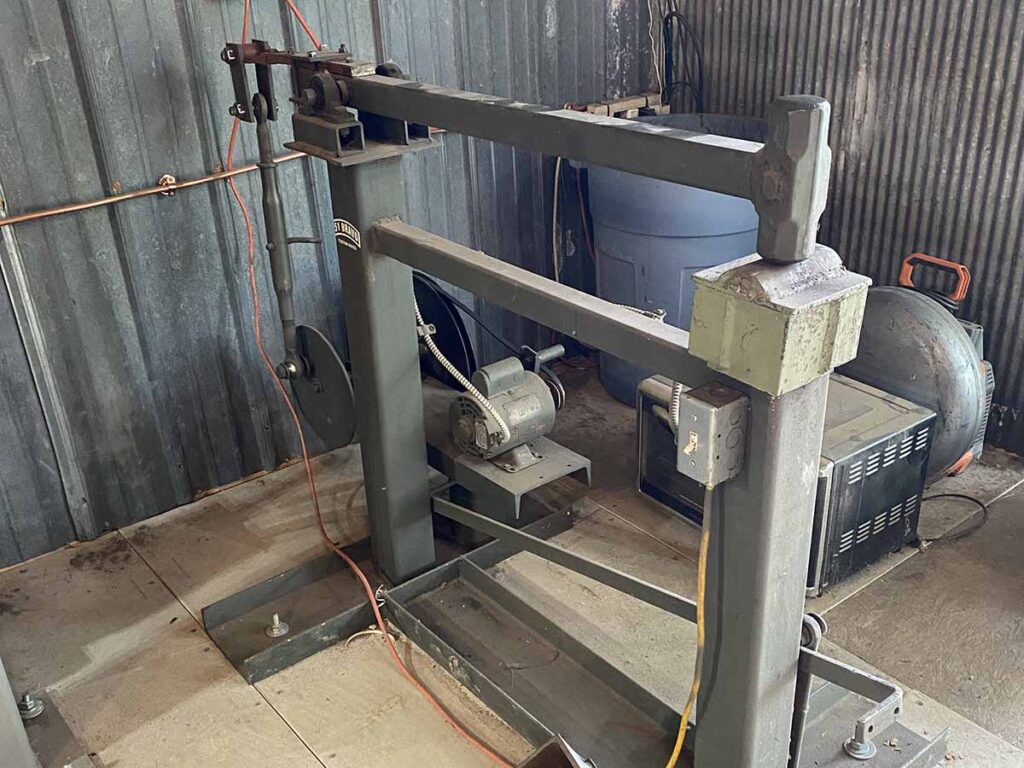
I’m focusing on the upright, heavier, more efficient metal-moving machines. Even so, it’s worth mentioning the smaller, simpler but less efficient helve hammers. I came across a good example in the shop of Shawn Moulenbelt, a Michigan bladesmith who was on season seven of Forged in Fire. His hammer used various sizes of hollow square tubing, a sledgehammer head and a half-horsepower motor. He used a slack belt clutch and interchangeable die plates. His hammer was built by Rusty Glovebox on YouTube and is a solid DIY (do-it-yourself) design.
Bladesmith Shawn Moulenbelt’s helve hammer uses various sizes of hollow square tubing, a sledgehammer head and a half-horsepower motor. On the upside, these hammers are quick and fairly straightforward to build. On the downside, they’re not all that great at their one job: moving metal. Even so, a similar light use-DIY power hammer is much more efficient than your arm, and much less likely to get tired.
On the upside, helve hammers are quick and fairly straightforward to build. On the downside, they’re not all that great at their one job: moving metal. Even so, a similar light use-DIY power hammer is much more efficient than your arm, and much less likely to get tired. In my mind, if you have the time and skill to build a small hammer, you can just as easily build a bigger one. Even so, the small helve hammers may be just the ticket for your shop.
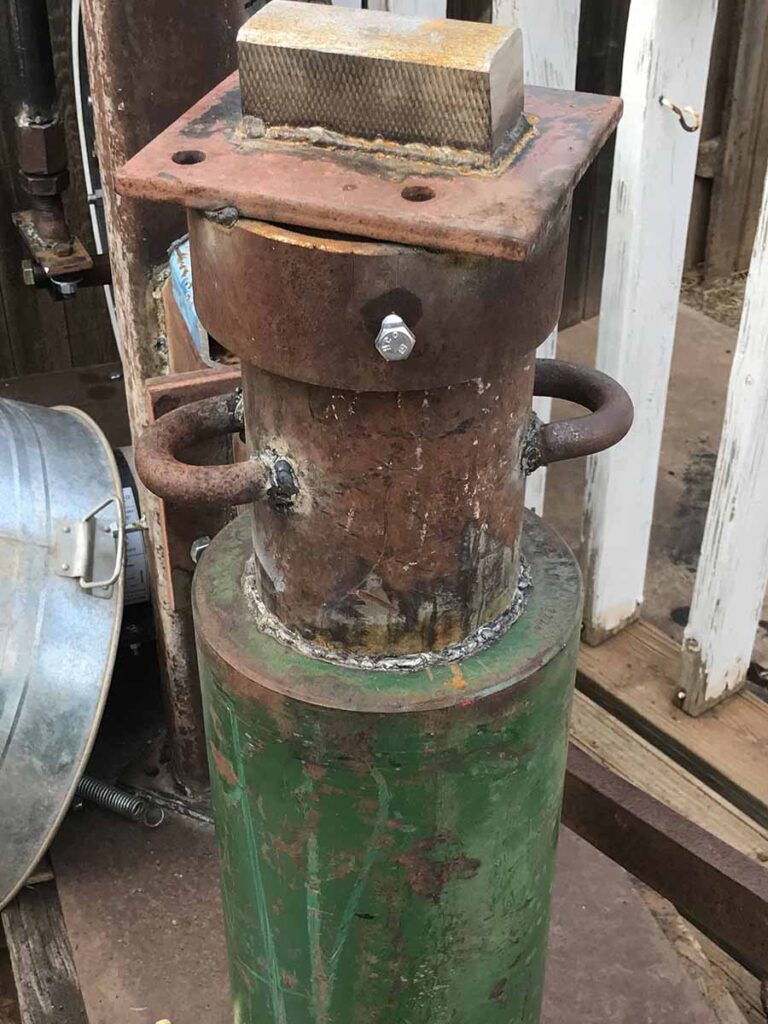
The author’s home-built hammer combines a 5-inch piece of round stock with a heavy sleeve from a “mud pump” to make an anvil that weighs around 400 pounds.
Resourcing An Anvil
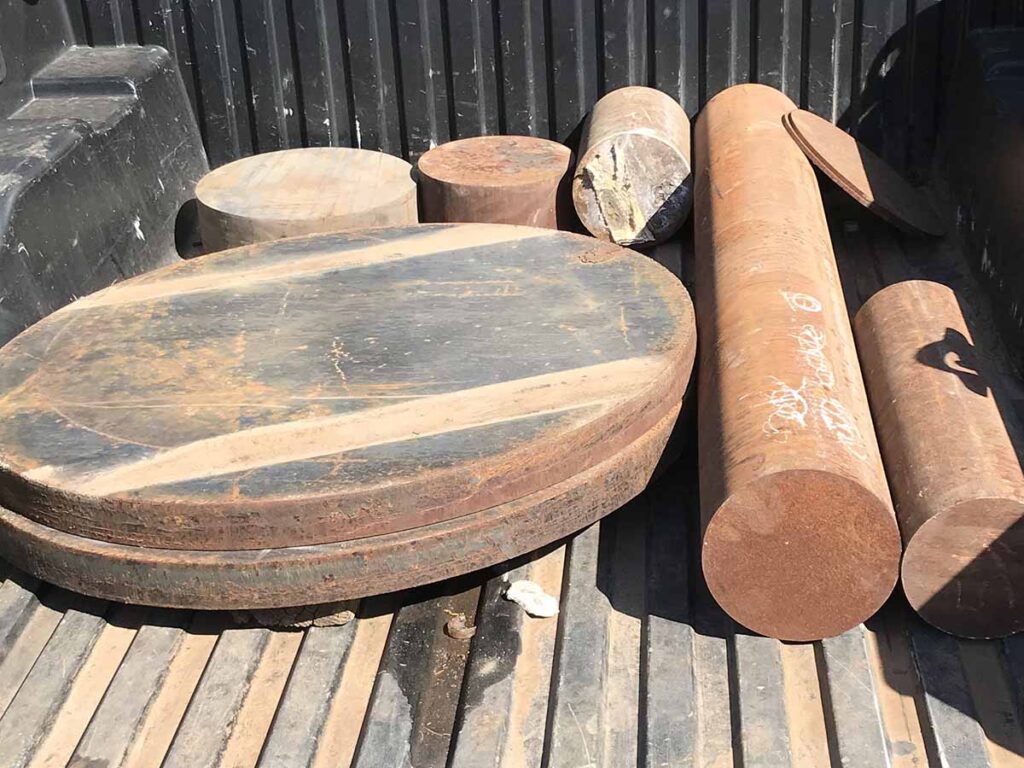
There are many different things that can make a suitable anvil for a power hammer and many more things that cannot. What you are looking for in an anvil is a solid piece of steel that weighs anywhere from 150 to 600-800 pounds, which can be difficult to acquire.
Sometimes you can find solid square or round bar steel. Some folks recommend railroad axles. Others suggest forklift tines welded together. I’ve seen sections of a 2-inch square bar welded together into a solid 6×6. I’ve seen pieces of 1-inch plate welded where the hammer strikes the ends. Whatever you can find needs to be solid or able to be welded into a solid, single, massive piece, and your welder has to have the power to stick it all together. My hammer is built on a 32-inch piece of 5-inch round bar welded inside a mud pump sleeve that has a 5-inch bore. The total weight of my anvil is around 400 pounds.
What Not To Use
Don’t be tempted to think you can get a piece of something hollow like pipe or square tubing and fill it up and make a suitable anvil. Each stroke of your hammer pounds the steel in-between the hammer head and your anvil, pushing your anvil toward the ground. If you have any movement, vibration or give in your anvil, the force is absorbed by the movement and not efficiently transferred to your workpiece.
Anvil To Hammer Head Ratio
When you finally locate this difficult-to-find thing, it won’t likely be the size or shape you want. My anvil was round, which doesn’t easily weld to square tubing, for example. I had to deal with it. As noted, my anvil was around 400 pounds total weight. Yours may be more or less. You should design your hammer with a minimum 1:10 head-to-anvil ratio. Since I had a 400-pound anvil, I built a 40-pound head. If all you can find is a 200-pound hunk of steel for your anvil, you should stick to a 20-pound head or so. Design your hammer around your anvil, as the anvil is the hardest part to find. Alternatively, find the weight you need for the anvil and use the tire hammer plans.
Another consideration is the base for your hammer. I’d recommend the thickest steel plate you can find, mounted on the firmest foundation you can muster. If I could have built on 1-inch plate and bolted it to a 24-inch-deep concrete pad set into a concrete shop floor, I’d have done it. I had to make do with what I could find in my “free” scrapyard, and deal with the limitations of my shop setting.
Power Hammer Center Post
For any hammer you need a center post. The post should be heavy enough to withstand the extreme forces involved in rocking a spring arm or linkage with a heavy hammer on one end. I used a piece of 4-inch tubing with half-inch walls. Others have used thinner-walled but larger cross-section square or rectangular tubing, heavy walled pipe or sections of I beam. The tire hammer plans call for a 6-foot-long piece of quarter-inch wall and 5-inch square tubing.
Final Cut
Another consideration is the base for your hammer. The author scored some 2-inch-thick, 30-inch-round, 300-pound base plates out of the “drop” pile at a local steel distributor, along with several other potential anvils.
My power hammer has become an essential tool in my shop, to the point that I sometimes wonder how I ever lived without it. I have only begun to explore its full potential. I built it for my appearance on Forged in Fire, where I was fortunate to make the final. I was able to come home and use my hammer to build my final edged piece for FIF. I lost the contest but ultimately still have a power hammer, and I can still take pride in the fact I built it myself from little more than a pile of junk.
It may take you a few months to gather all the primary parts, or you may get lucky and find them all in one place. Next month’s article will focus on building considerations for a spring helve hammer, and later we’ll discuss the Clay Spencer DIY tire hammer.
Known For His High-Quality Custom Knives, RJ Martin Has Earned A Spot As One Of America’s Most Creative Knifemakers.
Between his exquisite custom knives and numerous collaborations with factory cutlery companies, RJ Martin has become a legacy name in the knife industry. As a teenager he was inspired by a Sports Afield article on knifemaker Bob Dozier and decided to try his hand at knifemaking, which he did with very satisfactory results. The seed was planted for what would become a lifelong passion of working with steel, the results of which are his incredible knives today.
To get there he studied at Rensselaer Polytechnic Institute in Troy, New York, graduating in 1984 with a degree in materials engineering. From there he spent 17 years working in the aircraft industry designing parts and mechanisms for hi-tech helicopters. This exposed him to a wide range of materials including carbon fiber and titanium and, just as important, CNC (Computer Numerical Control) machining. You couldn’t ask for a better prelude to becoming a custom knifemaker.
When Martin retired in 2001, he rediscovered his love for knifemaking and set up shop. At the time the modern tactical knife era was in full swing, so RJ jumped on board and hasn’t gotten off the train since. His tactical folders are his mainstay and if you look at his body of work, his designs flow like a river.
RJ Martin’s Most Important Tools
One half of Martin’s favorite, and most important sets of tools: his hands.
RJ came right out of the chute with a surprise when tendering his most important shop tool.
“My two favorite tools, bar none, are my own hands,” he begins. “Without them, I could not use any hand or machine tools. More importantly, I’d miss out on the incredible satisfaction working with my hands brings me. It’s important to take good care of your hands and eyes, and your lungs, because knifemaking will take its toll over time. I have had multiple hand and finger surgeries over the years to correct wear and tear—and a couple of my digits have suffered substantial injuries from knifemaking—so they’ve got character! Knifemaking is a contact sport and, banged up as they are, I wouldn’t trade them for anything. Lynyrd Skynyrd had it exactly right in their song Red White & Blue when they sang, ‘If you want to know where I’ve been, just look at my hands.’
“My favorite grinder is my Burr King BBA20, 2×72-inch belt model. It’s super smooth, runs incredibly true, and the 20-inch-diameter 60 durometer wheel lets me grind my bevels high while keeping my blades very strong. I re-grind almost all my blades after heat treating using this machine. The slow speed range is critical for steels like CPM S110V, S125V and MagnaCut, as they must be ground slowly with coolant and light pressure after the heat treat because they are so incredibly wear resistant. I got the adjustable-height pedestal stand because I’m tall, plus the super fancy ergonomic work rest option because it’s just too cool. This machine is also very quiet!”
The Tools RJ Martin Uses
RJ’s Sears 6×48-inch belt sander and the stand it’s sitting on belonged to his father, Richard, “who was a gifted artist, a great parent and—most of all—a decent and caring man. He never made a knife in his life but he encouraged me to make them.”
“And then there’s Sophia, my alter-ego and companion,” RJ continues. “Sophia is an Ares Seiki R5030, three-axis CNC mill built in 2021, and she’s, well, a badass! With 14 tools in her carousel and a 20,000 RPM dual-contact spindle running high-precision Big Kaiser 30-taper toolholders, she is my girl with a short skirt and a long jacket! With properly designed tooling, good [numerical control] programs and quality carbide tools, her precision is incredible. I named her Sophia because her name literally means ‘Wisdom,’ and she is indeed wise! I gave her some awesome LED lights made by OC White to illuminate her beautiful work, and I keep her super clean. She is, after all, a woman of class and distinction! Sophia wears my mom’s American flag, which I pass by every morning when I enter my shop.
“Finally, my Sears 6×48-inch belt sander and the stand it’s sitting on belonged to my father, Richard, who was a gifted artist, a great parent and—most of all—a decent and caring man. He never made a knife in his life but he encouraged me to make them.
“Those hands I wrote about earlier? They came from my father. Of this, I am certain. He passed before I really hit my stride as a knifemaker and I miss him dearly,” RJ notes. “So, I keep this machine in my row of grinders to remind me every day where I came from and how grateful I am to be able to work hard at a job that I love and am successful at.”
A week after BLADE Magazine Cutlery Hall-Of-Fame® member Bob Loveless died at age 81 on Sept. 2, 2010, Los Angeles Times reporter Valerie J. Nelson wrote a lengthy story on the man who sold his first knife to the Abercrombie & Fitch sporting outfitter for $14 more than 55 years earlier.
Nelson wrote that Loveless “made some of the world’s most coveted sporting cutlery by refining knife design to high art.” These succinct words convey a glimpse of the influence this giant in the cutlery industry wielded during his lifetime. In this 50th anniversary year for BLADE®, his legacy stands tall among those who have dedicated their lives in building the knife industry to what it is today.
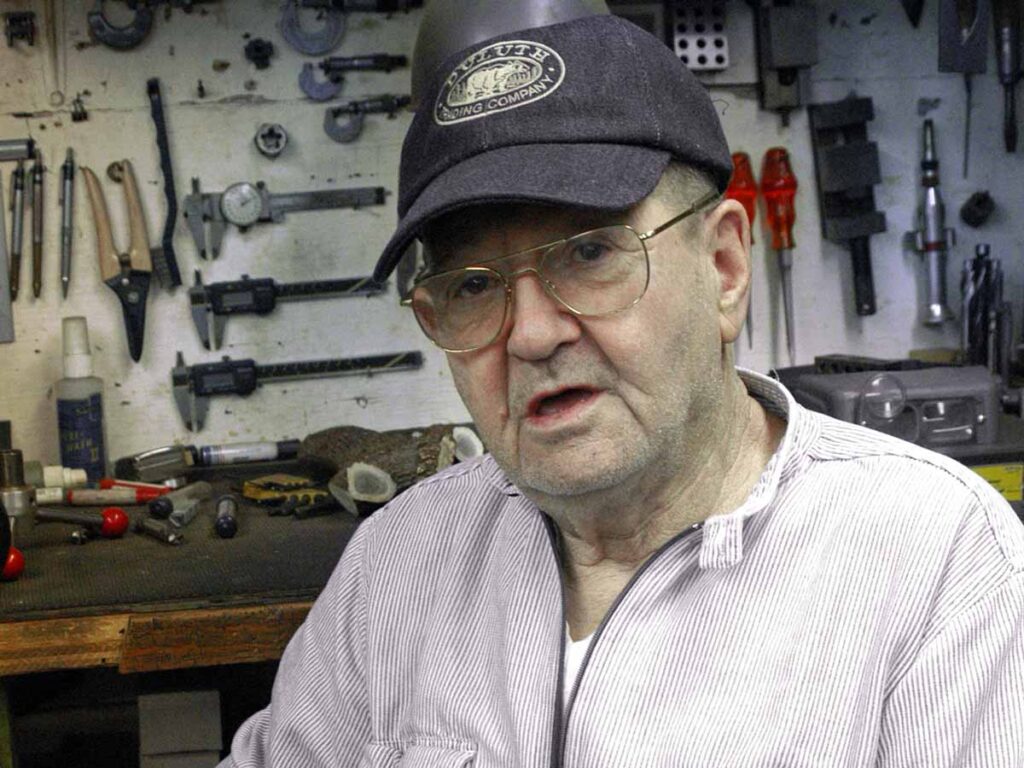
Bob Loveless in his shop in October 2006. (image courtesy of Aaron Merritt, grandson of Jim Merritt)
Truth is, there’s scarcely an aspect, nook or cranny of the knife business that Robert Waldorf Loveless did not touch during his lifetime. He was forthright, sometimes gruff and always prone to speak his mind. During an interview for BLADE, he once asked this writer what the tapping noise was that he heard in the background. When I responded that it was the keys clicking as I was taking notes while we talked, he bluntly asked, “Can’t you remember anything? Why can’t you just listen?”
Loveless’ Defining Designs
No matter. Loveless was articulate, extremely intelligent and deep down passionate about art in knives. Cutlery Hall-Of-Famer Bruce Voyles knew Loveless and respected him for what he was.
“The thing about Loveless is he made a knife with eye appeal,” Bruce observed. “It was different, and a lot of people don’t understand why, but it was [his use of the] natural French curve. It was the design appeal.”
True enough, Loveless was a master of design. He had actually studied briefly at the Institute of Design in Chicago in the 1950s, and was a student of the Bauhaus Movement, a cultural and artistic design wave that peaked in the mid-1930s, something of a North Star, a muse if you will. Its dictum: Form Follows Function.
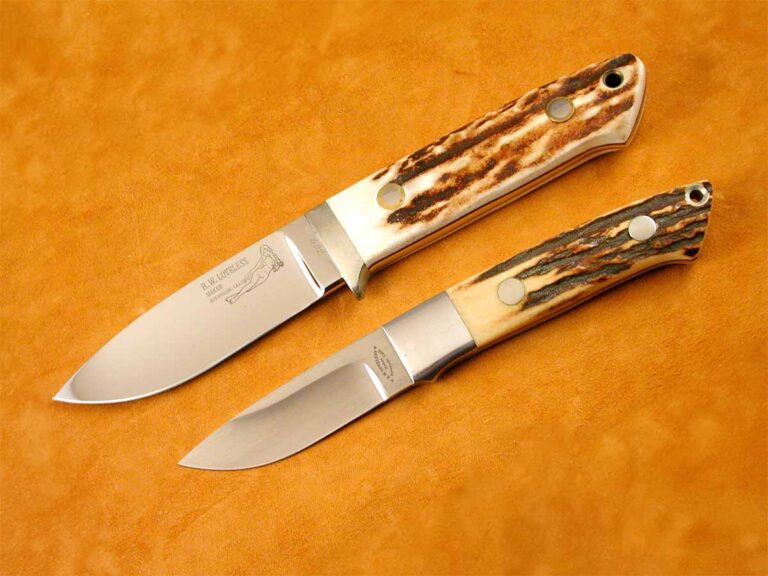
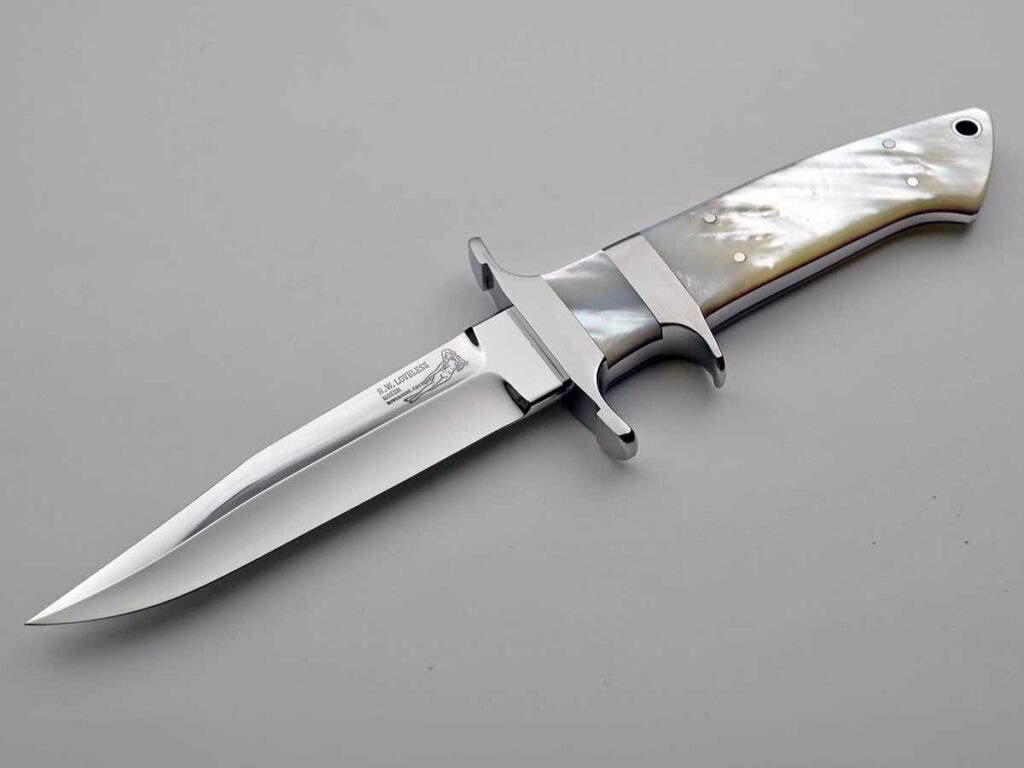
Another of Loveless’s favorite designs is the sub-hilt, radiant in one of Bob’s Baby Bear fighters with mother-of-pearl scales, Naked Lady logo and Riverside, California, stamp. (Exquisiteknives.com image)
Longtime Loveless authority John Denton told reporter Nelson, “He is pretty much the Picasso of the knife world and the father of 20th century knifemaking. His design is what made him famous.”
Dave Ellis, proprietor of Exquisiteknives.com, agrees.
“Going back to the 1950s, Loveless has been instrumental in perfecting some of the more common traits found in contemporary knives,” he related. “The dropped hunter is probably Bob’s most emulated design, although the Archer chute, sub-hilt fighter and more show that Bob did not rest on his laurels. When a smaller, carry-sized fighter was called for, Loveless came up with the New York Special.”
Denton recalled the Loveless willingness to revive and reintroduce design and construction concepts that caught hold in modern times and energized new frontiers of imagination and artistry.
“He was not the first to use the tapered tang,” John explained, “but he found out about it from an old knife made in the 1850s that was given to him by Billy DuPont of the DuPont family. Loveless brought it back into the modern world with the tapered tang taking the weight out of the knife. Bob said, ‘It has to look so good you want to pick it up and feel so good you don’t want to put it down.’”
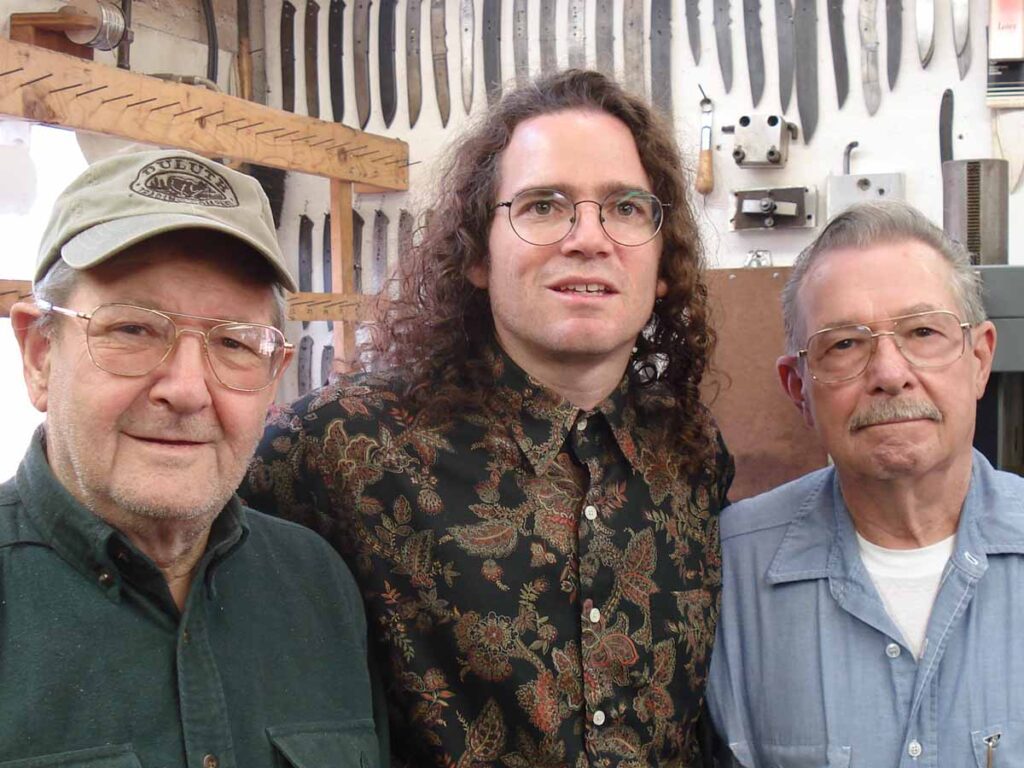
From left, Bob Loveless, John Denton and Jim Merritt in the Loveless shop in Riverside, California.
According to Denton, Loveless also brought the brass wrap handle, hidden pin, two-tone pins and half tang into play.
Design achievement crowns Bob’s career, but there was so much more to him—so much that attempting to compile a summary of his contributions would require more space than this publication might allot in another half-century.
Voyles commented, “I always liked him because he could sum up a complex subject in a sentence. He and I visited one time and I would throw out topic after topic, and he would snap back a quick response. When you left him you knew you left somebody that was phenomenally intelligent on a variety of topics, but that doesn’t mean he had social graces.”
One of Bruce’s favorite Loveless memories was Bob’s rationale during the controversy that raged within the Knifemakers’ Guild as to what truly defined a handmade knife. Loveless liked Jack Daniel’s, so Voyles and Cutlery Hall-Of-Famer Dan Delavan bought a 1.75-liter bottle of Gentleman Jack whiskey (Single Barrel wasn’t available at the time) and presented it to Loveless at his home in Riverside, California.
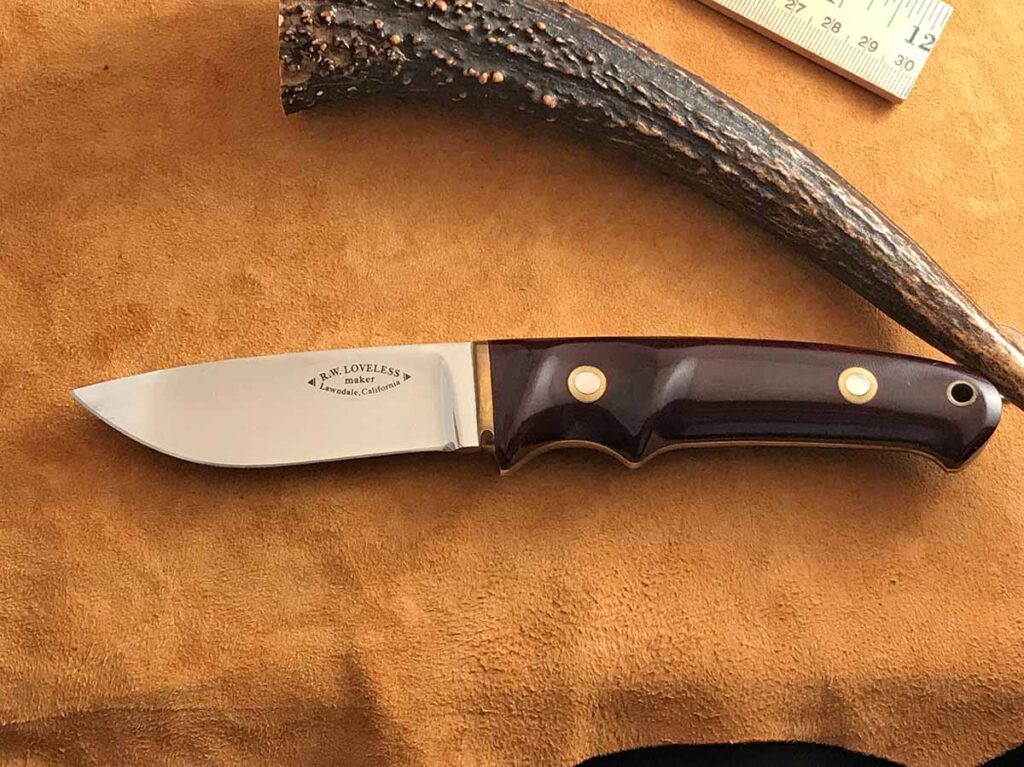
In an arrangement between Loveless and Schrade’s Uncle Henry Baer facilitated by A.G. Russell, Loveless sent this actual prototype to Schrade to copy and make the Schrade Loveless collaboration in the early 1970s. It has no guard, an “improved handle,” and a more pronounced belly than most of the Loveless dropped hunters of later years. The handle is burgundy Micarta®. As John Denton observed, the knife “has a magical feel from the ol’ man.” (Denton image)
“I said to him, ‘I hope you will accept this gift in the spirit in which it is intended,’” Bruce smiled. “He laughed and put the bottle on his shelf. Then we sat down and asked him what he believed to be the definition of a handmade knife. We videotaped his answer. He said, ‘I wish I had a machine that I could dump handle material, steel and pins into, and then a knife would come out the other end, boxed and ready to send to somebody. So, make your knives any way you want to. The marketplace will sort you out soon enough.’”
Simple, straightforward and wise.
Bob’s Impact On The Industry
Loveless played a pivotal role in the genesis of knifemakers’ organizations. He was a founding member of the Knifemakers’ Guild and a pioneer with the California Knifemaker’s Association. He was a staunch supporter of knife shows, bringing people to the events just with his mere presence. According to Ellis, Bob regularly attended the Guild Show, BLADE Show, Solvang Show, California Custom Knife Show and Phil Lobred’s Art Knife Invitational
Loveless also brought along younger knifemakers, working with them and offering advice. A few include Jim Merritt, D.F. Kressler, Yoshihito Aida, Cutlery Hall-Of-Famer D’ Holder and Steve Johnson. Bob’s style and artistic interpretation live on in part with the work of these incredible craftsmen.
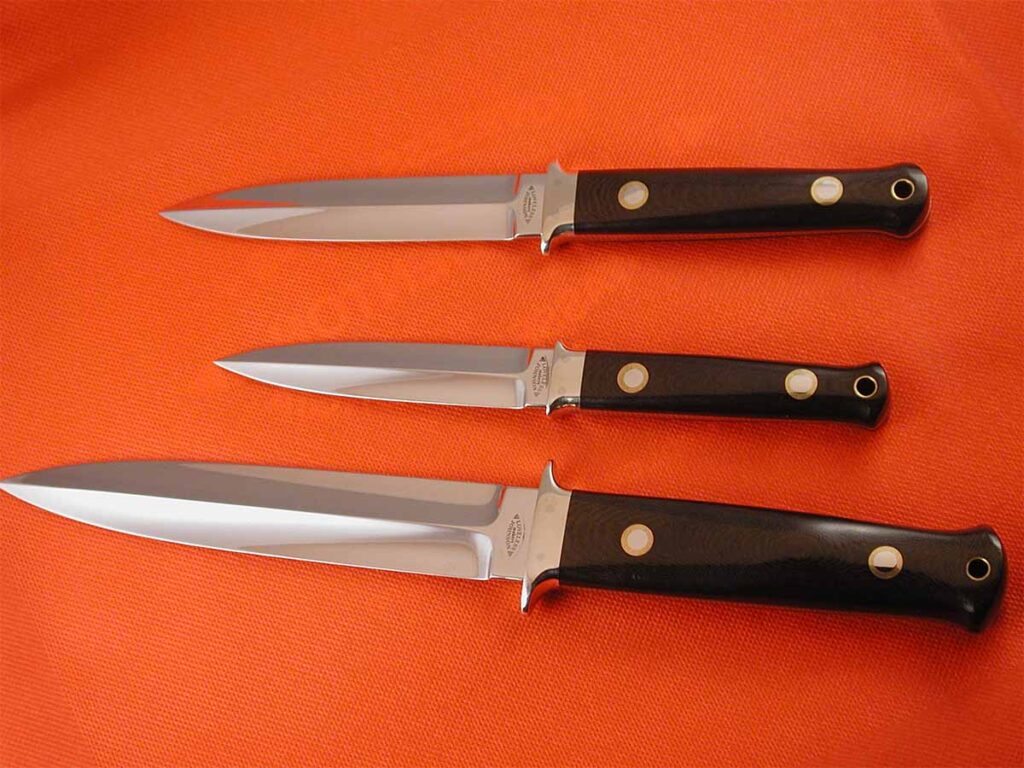
Steve Johnson worked in the Loveless shop in the early ’70s and remembers Bob fondly. “He was a true friend to those who were genuine and sincere with him,” Steve noted. Of this rare set of Loveless-Johnson daggers John Denton wrote simply, “Three really great knives.” (Denton image)
“Many a maker is in debt to Bob Loveless for the support, counsel, corrections and guidance that he gave,” Johnson said. “He was a true friend to those who were genuine and sincere with him, and the relationship that they had with him. Bob, as we know, was outspoken and quick to correct what he felt was not right or smart, which led to some loving him and others not, a bit like Ed Henry—love or hate—but both were so very good to me personally!”
Materials Maven
Loveless was an innovator in the aspect of materials as well, including 154CM stainless steel and the introduction of ATS-34 from Japan, while also popularizing Micarta® as a handle material.
Ellis commented, “Loveless pioneered the use of many of the common steels used today, especially 154CM. The shop was able to purchase such quantities that Bob could pretty much order what he wanted. The favorite handle material of the Loveless shop was green Micarta.”
Johnson remembered, “There was a stack of 154CM steel lying in the driveway at 4319 W 187th Street [the address of the Loveless shop] the day I first walked in. Bob mentioned that he was excited to get some blades done and heat treated right off. Green canvas Micarta was set in stone as the best handle material in Bob’s view. It’s still right up there on top and is used by many a maker. It’s because of Bob’s legacy that this happens.”
Global Influence
A lasting dimension of the Loveless legacy was his bridge to Japan, as well as his overtures in the European markets.
“Bob was deified to the extent that every Japanese knifemaker included his designs among their offerings,” Ellis explained. “Bob was an icon in Japan, and to this day many of the top makers in Asia have Loveless designs in their repertoires.”
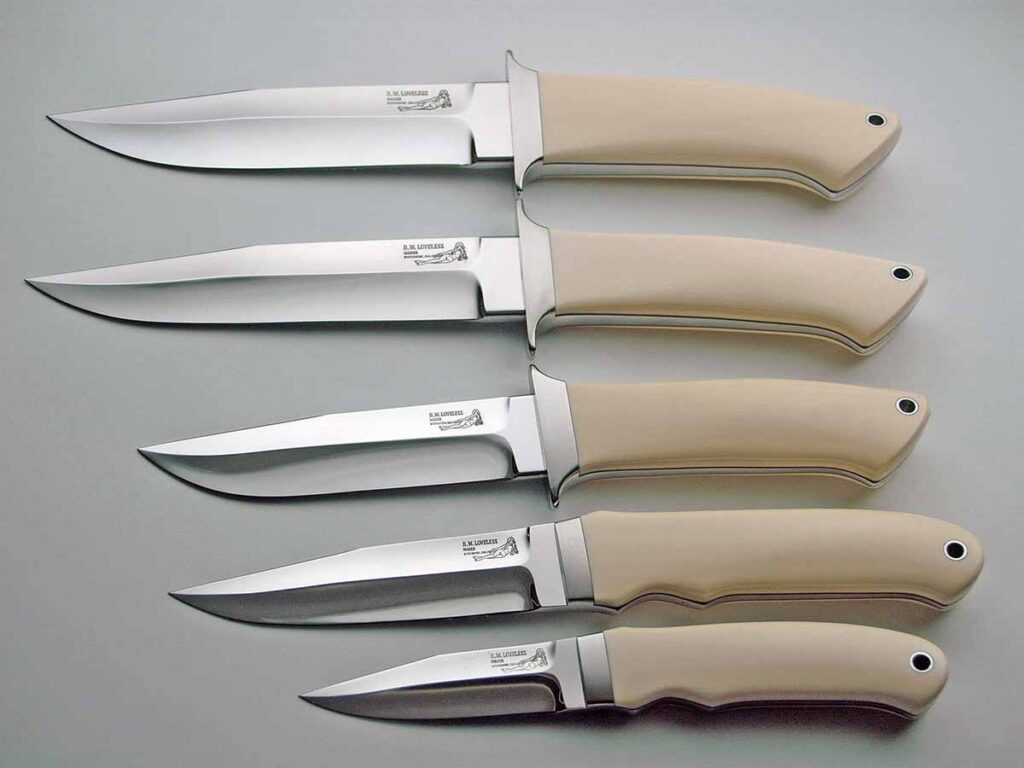
Five Loveless fixed blades sport the no bolt/no pin look in ivory handles. (Exquisiteknives.com image)
Voyles commented, “Bob went over there and showed the Japanese how to make good knives. I went to Japan in 1981 or ’82, and in every factory I went to there was a picture of Bob Loveless and the factory owner. The thing was that Bob’s wife, Yoshiko, was Japanese, so he didn’t have a problem with the language barrier, and he went to Japan to show them how to make knives that appeal to Americans.”
Loveless used his connections to make things happen, and Voyles credits him with the evolution of the folding knife among Japanese manufacturers, as well as a surge in the Japanese collector market.
“Bob didn’t make folders and the Japanese wanted folders,” Bruce recalled. “He had worked on a design with Jess Horn, and Bob put Jess and Japanese collectors in touch with each other. Horn also had a series of folders that he patterned after the old Remington Bullets. When Japanese collectors discovered that, their market for vintage Remingtons went straight through the roof. Loveless sowed the seeds in the 1990s for the collectibility of vintage knives in Japan.”
Collecting Loveless
Today, a Loveless knife is a collectible phenomenon in its own right. Name the year, name the mark on the blade, name the style and the materials, it will sell for astonishing dollars. Denton has noted some models made in the 1970s that sold for $400 then and have reached the rarefied air of $100,000 or more in recent years. The power of Loveless pricing simply takes your breath away.
Bruce is quick to add that Loveless was professionally unselfish. “If you wanted to make a style of his knife in your factory, that was OK,” Bruce noted. “Just ask him.”
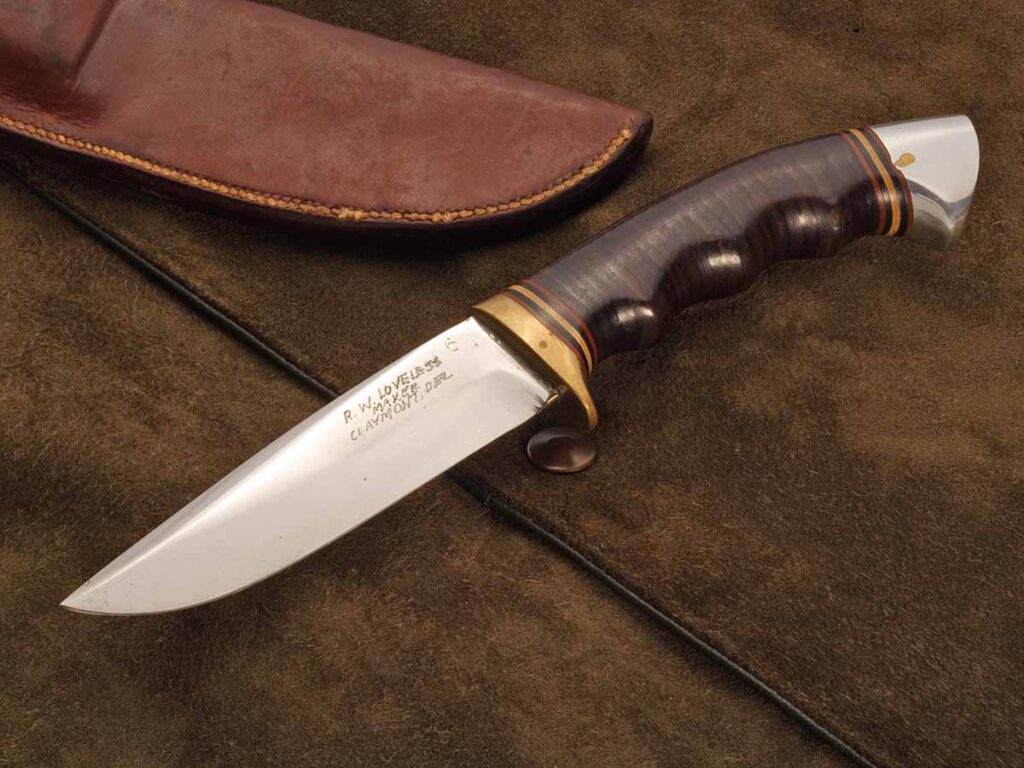
Circa 1955, Loveless sold his first knife to Abercrombie & Fitch for $14 (adjusted for inflation, almost $160 in today’s money). Loveless made this early model for A&F in his shop in Claymont, Delaware.
The pervasive Loveless influence stretched far and wide, from the custom knife shop to the factory.
“His designs for and collaborations with Schrade, Gerber, Lone Wolf and others, and the factory knife market in general, were significant,” Ellis recalled. “Early on the astute factories were taken by Loveless designs and made limited editions in dropped hunters and others. These days factory collaborations are quite common, and you can thank Bob Loveless if you want to give credit where it is due.”
When Sports Illustrated called Loveless for an interview in 1980 and the magazine published his words in the same edition that featured tennis superstar Bjorn Borg on the cover, the impact on the entire knife universe was transcendent. When asked why so many people considered his knives “better” than those of others, he mused, “A knife is an extension of your experience. And I’ve had more experiences than most people. There’s more character running in my veins.”
For those who knew Bob, just the knowing was an unforgettable experience. His contributions to his present and to the futures of others in the knife industry remains incalculable. And so, the longevity of a man does not reside in his years on Earth, but in the perpetual remembrance of his ideas, his workmanship and his innovative perspective on the world.
Therefore, it can be said that when Loveless left us he did not go gentle into that good night. He did not fade away. He didn’t drop the mic. He handed it to those with the foresight and the intestinal fortitude for the days to come. Now, what do we say and do? Loveless might grouse. He might gripe. But he just might also manage a grin.
A knifemaker and other knife pros take different approaches to the Ukraine-Russia conflict.
The ravages of war often have global impact—even when the fighting is half a world away and the devastation is seen through pictures and words rather than bullets and bombs. War, anywhere, tends to touch the lives and livelihoods of many.
The knife industry, both factory and custom, is no different. The war in Ukraine has brought devastation to the country, and its end was nowhere in sight as BLADE® was going to press. Ukrainian resistance is robust, probably in sharp contrast to the results anticipated when Russian President Vladimir Putin decided to invade his sovereign neighbor. While the resilient Ukrainians defend against such aggression, where and how does the knife industry feel the long reach of war?
Oleksii Nesterenko is a custom knifemaker. He is also Ukrainian.
“On February 24,” he commented, “Russia, with the support of Belarus, launched an open military attack on Ukraine. My city, Kyiv, was one of the main goals. After systematic rocket attacks on the city, my wife and children were forced to evacuate to Germany.”
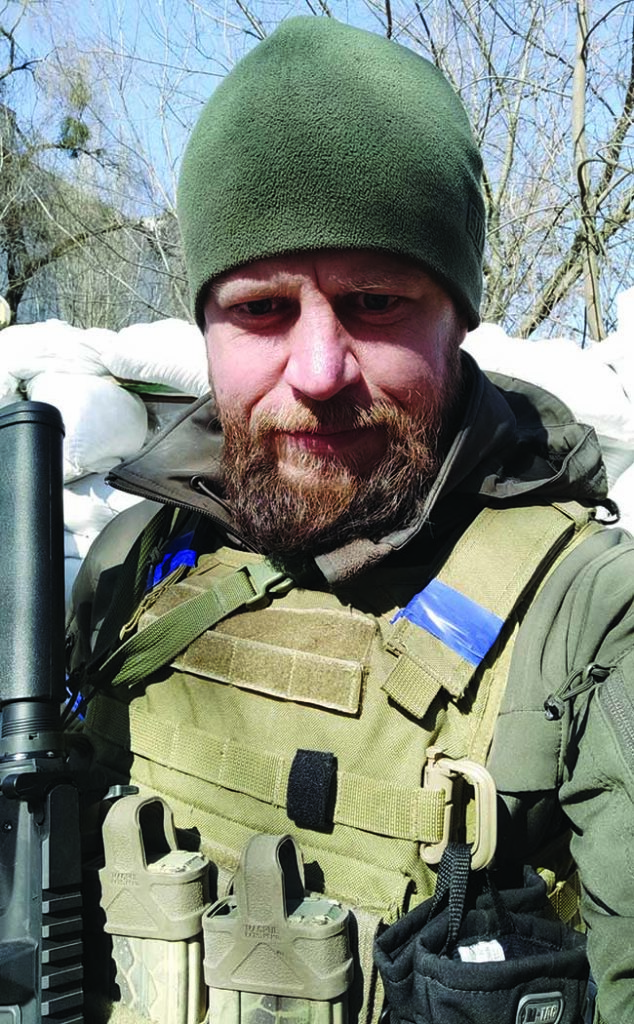
At press time, Ukrainian knifemaker Oleksii Nesterenko had signed a contract as a territorial defense volunteer for Ukraine and had stopped making knives.
The war came home to Oleksii, and his life may very likely never be the same. He has responded to the call to defend his country. “I signed a contract for a territorial defense volunteer and stopped making knives,” he said. “As far as I know, the work of some knifemakers who work in the cities where there are no active hostilities has changed too. Many have abandoned the making of collectible knives and make simple, utilitarian knives and other devices for the military.”
Purveyor Dave Stark of Steel Addiction Custom Knives sells Oleksii’s work, and despite the fact there is a temporary suspension of custom pieces from the Ukrainian maker, Dave praises the quality of his knives.
“Oleksii’s fit and finish and his attention to detail are what set him apart from his peers,” Stark noted. “His choice of materials and the manner in which they are finished really make his work stand out. His hand-rubbed satin finish on his blades is some of the best I’ve seen. The knives feel great in the hand and mechanically are spot on. I would say his style is ‘dress tactical.’ He uses Damasteel’s pattern-welded steel, damascus, mother-of-pearl, mokuti, zircuti and zirconium.”
Perhaps current events will make Nesterenko’s knives even more highly sought after in the future. Meanwhile, he is consumed with the dirty business at hand.
“Now in the Kyiv region where I live, Russian troops are defeated and active hostilities have ceased,” Oleksii reported. “But I am still on duty at checkpoints and volunteer. We help the civilian population in the villages near the front. I think that in a few weeks I will have time to partially return to knifemaking.” While he is hopeful and actively involved in the defense of his country, Nesterenko has kept an eye on the conditions of the knife industry in Ukraine and anticipates some adaptations.
“Currently, there are no problems with the supply of materials for the production and shipment of knives abroad,” he advised, “so I look forward to returning to work. I am sure that a knifemaker can make a quality knife only if he uses it for its intended purpose. That’s why I used to make only EDC knives. Thanks to the war, I understand what requirements a tactical folding knife must meet. I have already drawn several designs and am waiting for the opportunity to get started.”
Changes in demand are not noticeable at this time, according to Oleksii, and orders are in the queue for delivery around the world into 2023. Still, he warned, “I think that the consequences of the war in Ukraine will affect the economies of many countries. And over time, that will affect collectors.”
Little Change
In much of the domestic knife industry, little in the way of change has occurred due to the war thus far. Custom knife purveyor Les Robertson said that by mid-April FedEx service to Ukraine had been suspended. Therefore, the volume of knives conventionally being sent to Ukraine has probably been curtailed, at least somewhat. Neighboring European Union countries are still moving mail into Ukraine.
Les Robertson
“No one is sending knives directly to anyone in Ukraine,” Les noted. He went on to comment that factory sales to “armchair warriors” may in fact tick upward as the war persists.
Purveyor Neil Ostroff of True North Knives agrees that the current custom knife market is maintaining its status quo. “In my opinion, as a dealer,” he commented, “we have no change from the customers concerning knives from either Ukraine—now on hold—or Russia. Several Ukrainian knifemakers have set up in Poland, and they do not want to be named.”
Still, Ostroff is somewhat insulated businesswise from the turmoil in Eastern Europe. “Going forward, I see no issues coming through, as there have been none so far,” he observed. “And most if not all of my clientele prefer to buy only USA-made items, which is what I prefer to supply as well.”
From the factory perspective, Joe Bradley, director of sales and marketing for KA-BAR, has noticed virtually no changes in activity. “The war in Ukraine hasn’t had any impact on us at all,” he remarked. “As far as production, and even consumption, the impact has been zero.”
Bradley added that supply and demand are in line. “We have not seen an increase. Currently, we are seeing the market being more impacted by inflation than anything else. I think most of the people, at least Westerners, in the Ukraine already had their supplies and as a result didn’t have a need to buy anything new. Production and logistics have been a problem since the start of COVID,” he observed, “and are just now starting to get back on track and return to a semblance of normalcy.”
KA-BAR has experienced no changes in product offerings or knife styles as a result of the war in Ukraine. However, Bradley offers one interesting point of view. “If anything, this war has shown the merits of what some might consider antiquated weaponry like the AK-47,” he pointed out. The AK-47 is perhaps the world’s most famous assault rifle, arising in the Soviet Union during the Cold War, experiencing authentic production models and knockoffs made in the millions, and arming military organizations around the world for well over half a century.
“Free The Oppressed”
Spartan Blades is located in Fayetteville, North Carolina, near the gates of Fort Bragg, home of the U.S. Army’s XVIII Airborne Corps and Special Operations Command. Spartan owners Curtis Iovito and Mark Carey, both Special Forces veterans, have seen a groundswell of support for Ukraine. Knife sales bear the unmistakable mark of the conflict.
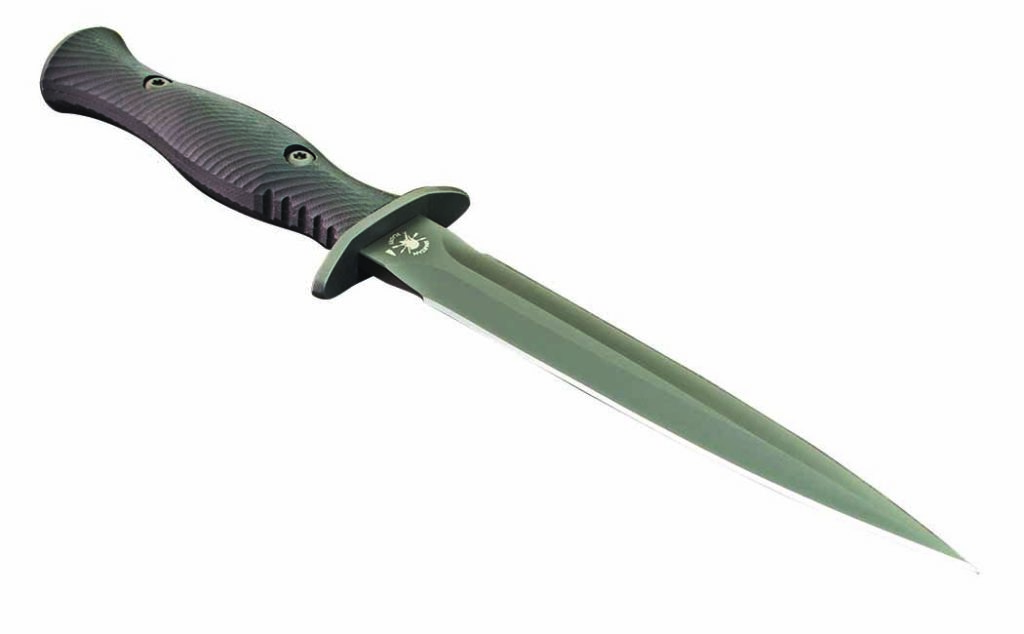
According to Curtis Iovito of Spartan Blades, more military professionals and contractors buy the company’s Gold Line knives. An example is the Spartan-Harsey Dagger in a 6-inch blade of CPM S35VN stainless steel with a hollow grind. MSRP starts at $390. Bill Harsey is the designer.
“Most of the sales are to people here in the U.S. with notes that they are purchasing for folks in the Ukraine,” explained Curtis in acknowledging the market uptick. “Several orders have had short tags like ‘Free the Oppressed in the Ukraine’ or ‘Support the War against Russian Aggression.’ Because we are at Fort Bragg, we have several Special Mission units from friendly foreign countries drop by the shop to pick up knives for their use. While that isn’t uncommon, it’s happening more than usual. We’ve noticed during our discussions with them that things have a more serious tone.”
Others buying more knives from Spartan Blades include people from all walks of life and military involvement. Curtis said, “Our Gold Line knives are going to more of the military professionals and contractors, and our Silver- and Bronze-grade knives are selling to folks across the spectrum. Many of the knives bought are by civilians that later donate the knives to NGOs [non-governmental organizations] that ship in bulk to Ukraine.”
As far as production, it’s business as usual at Spartan Blades, a longtime producer of knives that go to war. There are a few new items on the horizon, and the owners expect business to be brisk in the days ahead.
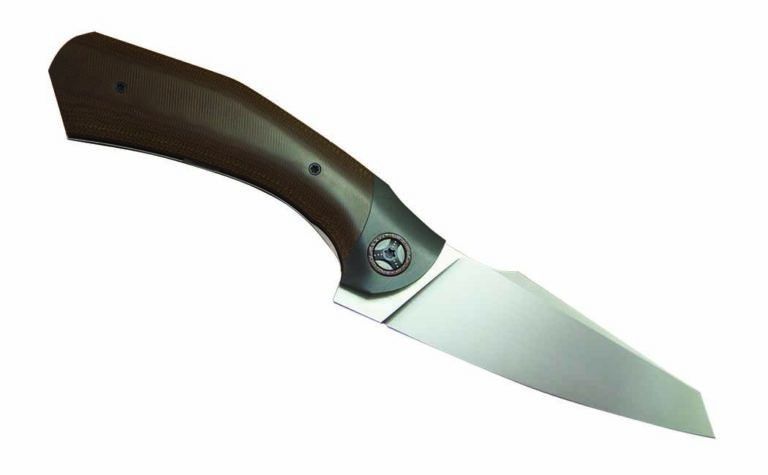
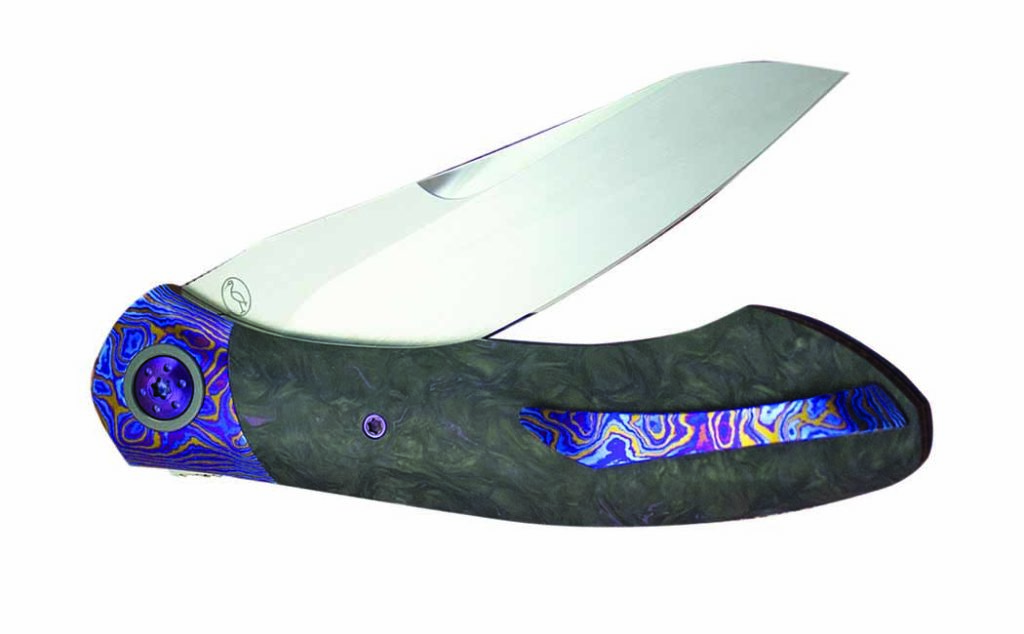
Oleksii employs M390 stainless steel for the 3.75-inch blade and a handle of black and purple Fat carbon fiber for his Morph flipper folder. The bolster is Timascus™ and the pivot rings and back spacer are zirconium. Closed length: 8 5/8 inches. Retail price: $2,800. (Steel Addiction Custom Knives image)
“Honestly, the war in Ukraine hasn’t affected how we do things here at Spartan Blades,” Iovito asserted. “We’ve made knives through the last two decades for troops in both Afghanistan and Iraq, so things are kind of par for the course. “We have several new knives coming out around the end of this year,” he continued. “We had planned on releasing these later but have sped up because the price point and style match some of the requirements we have seen lately. They are being designed by William W. Harsey, Jr.—a fighter, a Nessmuk and a kukri blade. They will be in 1095 Cro-Van blade steel and made in conjunction with KA-BAR Knives. Pricing has not been determined yet, but we are shooting for a sub-$200 retail price. The first one produced will be a fighter later this year.”
Surveying the knife landscape today begs a few questions as Iovito and Carey plan for the future, uncertain as it may be.
“We have seen a slight increase in steel prices, but we haven’t raised our prices in over a decade,” Curtis stated. “We assume we will continue to see price increases soon in commercial, off-the–shelf parts but are keeping our fingers crossed. We believe we will see an increase in knife demand as it appears the conflict in Ukraine [will not end as soon as many thought it would].”
The war has had other effects, including dampening attendance at European trade shows.
“We were very surprised that most of the U.S. knife companies did not attend the IWA show* in Nuremberg, Germany, this year,” Curtis noted. “We even had people thanking us for attending, as you could tell they are counting on U.S. support even if it is just showing up to support them in spirit. There was definitely a new and urgent concern about military spending. The German government approached two companies that I know of and bought their whole inventory—cutting checks the same day!”
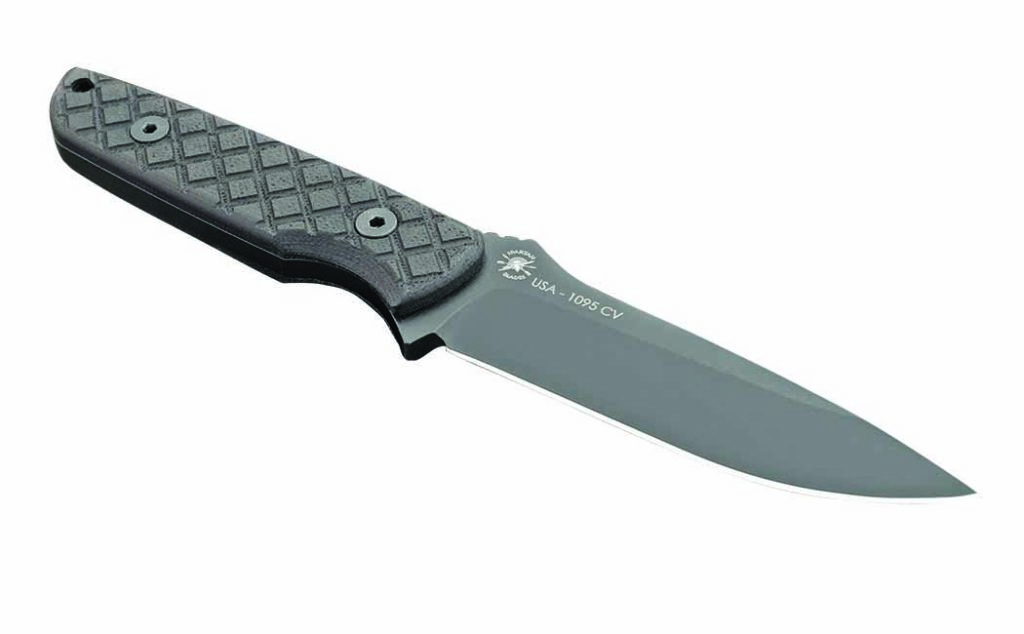
Curtis Iovito indicated Spartan’s affordable Silver- and Bronze-grade knives are selling well to people across the spectrum. One of the latest examples of a Silver-grade knife is the Alala in a 3.75-inch blade of Cro-Van carbon steel with a saber grind. MSRP: $159.
In wartime, uncertainty often reigns. However, awareness, preparation, and the desire to return to the shop are evidence that the ongoing conflict in Ukraine will influence the future of the entire knife industry for the foreseeable future.
*Held each spring, the IWA OutdoorClassics (iwa.info) is the European equivalent of the Shooting, Hunting, Outdoor, Trade (SHOT) Show stateside, and is a place where many new factory knives are debuted.
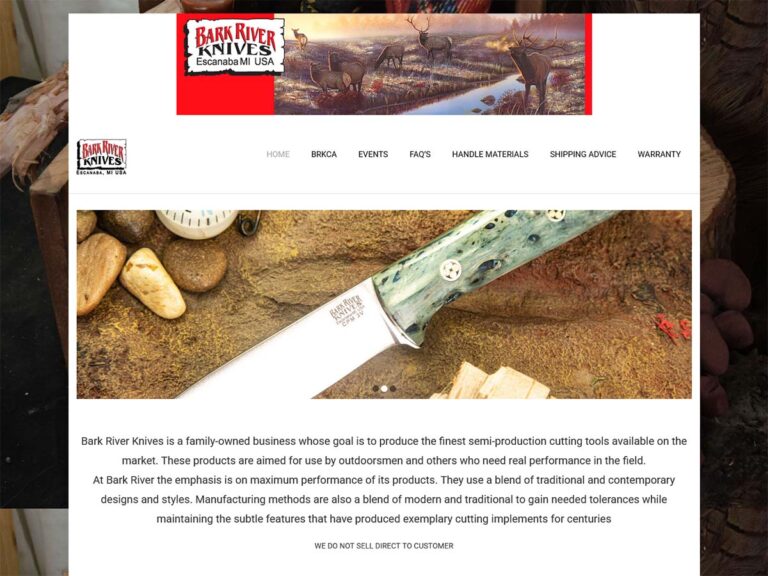
Bark River Knives owner Mike Stewart took to Facebook to admit to closure and the use of Chinese steel in Made-in-U.S.A. labeled knives.
Bark River Knives of Escanaba, Mich., has officially ceased operations following a public admission by owner Mike Stewart that the company utilized Chinese steel in blades marketed as American-made CPM 154. The announcement, made via Facebook on March 23, confirmed that the long-standing fixed-blade manufacturer concluded all business as of March 20.
In his statement, Stewart took full responsibility for the deceptive labeling, characterizing the use of imported steel as a measure intended to keep the company afloat. Stewart argued the alternative steel met his internal testing for toughness and stain resistance, with edge retention nearly matching that of Crucible Industries’ CPM 154. He further claimed that because the knife blanks underwent more than five distinct operations in the Michigan shop—including grinding, reshaping and etching—they technically met his interpretation of “Made in the U.S.A.” criteria.
It should be noted, the Federal Trade Commission (FTC) standards mandate a product must consist of “all or virtually all” domestic components to carry the label. Stewart admitted the steel was definitely mis-marked on the following models:
Camp Bolo
Fox River Trailing Point
Highwayman 4
Mini-Manitou
Gladstone Hunter
Bitterroot Caper
Select recent Club Knives
The closure follows a period of increasing pressure from collectors and dealers, alongside significant financial litigation, Outdoorlife.com reported. Stewart noted in his post that the shutdown was “long overdue” and should have occurred two years prior.
Stewart announced that his son, Jim Stewart, will open a new, 100 percent independent knife company. Notably, Jim Stewart has agreed to take over the warranties that would have normally been serviced by Bark River. Mike Stewart clarified that he will have no hand in the new entity and intends to exit the industry entirely after 50 years. Mike Stewart emphasized that his dealers, his wife Lesley and Jim Stewart were entirely blameless in the decision to substitute the blade steel.
Is a U.S. Army Ranger made or is he born? Is it the training he receives that makes him a Ranger, or is there some innate quality in him that draws him to Ranger training in the first place? If you tell former U.S. Army Ranger Sergeant Kyle Gahagan (pronounced guh-HAY-gan) that he doesn’t have the proper credentials for full-time employment with your company, he’ll proceed to acquire three doctorates. If you were to suggest that he not go to work at the auto-body shop if the pain in his right arm is so bad that he cannot hold a toothbrush, he’ll go anyway and tape a hammer to his forearm. If you crush his 10-year-old spirit by telling him that the knife he spent hours making is no good and throwing it on the ground, he will one day use that craft to not only heal himself from the emotional ravages of war, but to help heal other veterans as well. Never tell an Army Ranger he cannot make a knife.
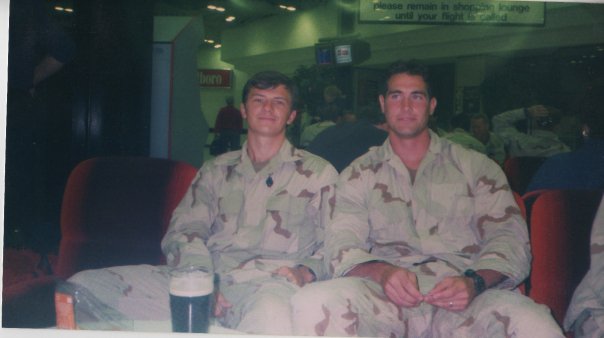
U.S. Army Ranger Sergeant Kyle Gahagan, right, pauses for a drink with Chris Hickox after his first tour in Afghanistan. Kyle is using blacksmithing to help counsel veterans as they find new missions in life.
Kyle doesn’t remember a time when he didn’t want to be a soldier. As a boy, he would dress the part and play army for hours. He came from a military family with a grandfather who served in the U.S. Navy during World War II and a father who retired as a full Colonel after a near-three-decade career in the Army’s Armor branch. Kyle was born in Colorado and lived in Kentucky and Germany, but from ages 8 to 11 the family lived in Savannah, Georgia. He would see the then-black-bereted Rangers of the 1st Ranger Battalion, who were stationed at Hunter Army Airfield in Savannah, and he knew that’s what he wanted to be. “I thought they were the coolest guys on the whole planet,” he said.
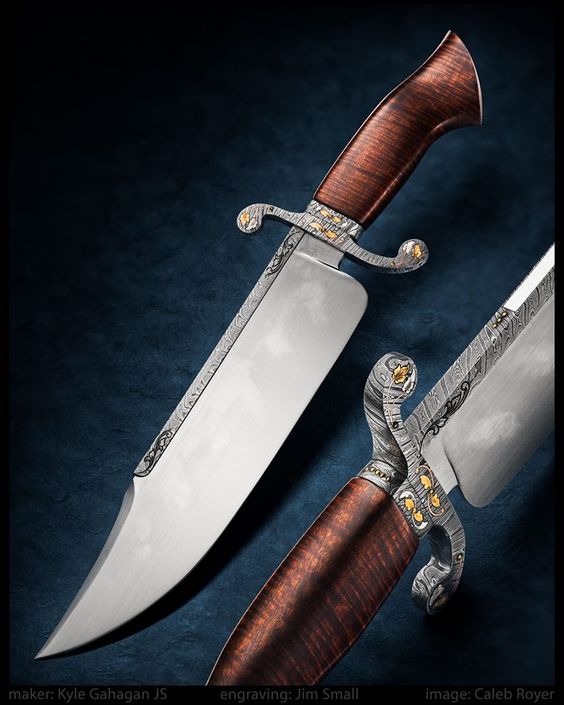
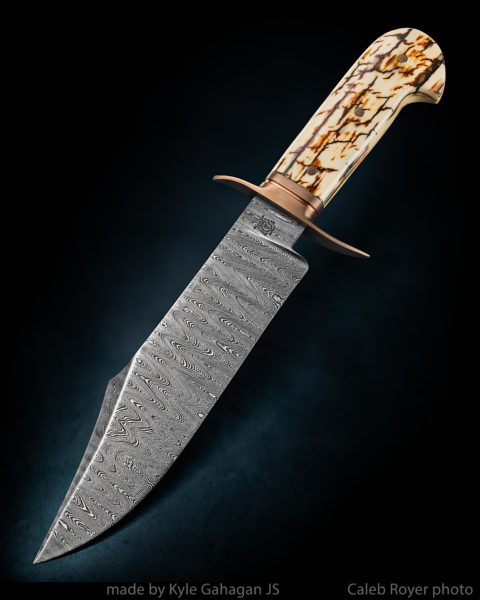
Growing up Kyle remembers a giant-to-him W. R. Case & Sons bowie on display above the mantle. He was not allowed to touch it, but he spent many hours studying it. When he became a knifemaker the only thing he wanted to make was big bowies. Only now he was bigger and so his bowies kept getting larger to recapture the proportion of his boyhood fascination with the big bowie. “I had to scale that back a bit,” he says with a laugh. This one has a 12.5-inch blade of forge-welded 1075 annd 15N20 steels with a fossil walrus ivory handle. Maker’s list price: $3200. Contacts for Gahagan Knives are listed at the bottom of this article.
Kyle got his first knife from his maternal grandfather when he was 5. It was a little Old Timer pocketknife to go with the shotgun he got for deer hunting. “I hunted with my grandfather until he couldn’t hunt anymore,” he said. His father transferred back to German, so Kyle saw him infrequently. It was his grandfather who spent time with the hyperactive boy, teaching him how to hunt and build things, how to work with his hands. At 10 his grandfather handed him a piece of aluminum and told him to go make something with it. It was his first attempt at making a knife. Although not an easy material to be cutting and grinding on, he crafted something resembling a knife. There was no heat treating involved, he said with a rare chuckle.
As Kyle learned more, he once spent a long time forging a knife. He hammered painstakingly to forge-weld steel for the blade. He made a wooden sheath, carefully lining up the wood grain. “I was so proud of that knife,” he said. He took it to an area knifemaker. That maker couldn’t stop telling him how bad it was. He threw it on the ground. “It crushed me,” Kyle said. “I didn’t make another knife for about 20 years.” He didn’t even tell his grandfather what had happened. “I think he thought I just grew out of my interest in it.”
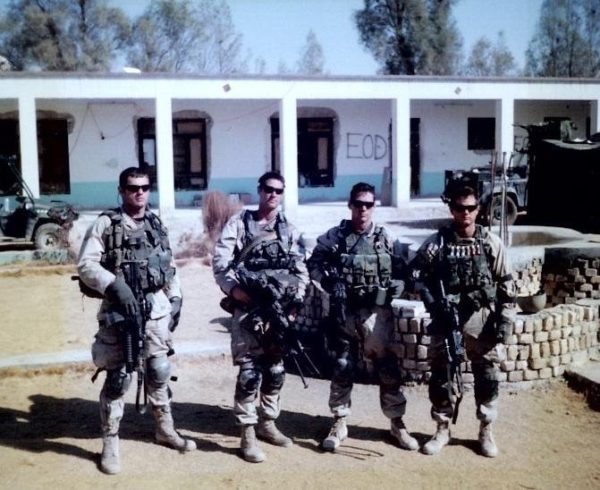
U.S. Army Ranger Kyle Gahagan, second from left, was deployed twice to Afghanistan. This was taken in Kandahar before a mission on his first tour.
In 1999 at the age of 19, Kyle enlisted in the Army with a Ranger contract. He was engaged when he went in and was married in between basic training and Airborne school. He went into the Ranger Indoctrination Program and Ranger school and was assigned to his boyhood heroes’ unit, 1st Battalion, 75th Ranger Regiment. But then 9/11 hit and he was being deployed back to back. He did two deployments in Afghanistan and two in Iraq, but because they blend into what amounted to nearly three years of being gone, he can’t quite recall the order. He was a SAW gunner in Afghanistan, he led a team for a while, and in Iraq, he was an S3, which organized training operations in the rear and coordinated missions during combat.
During one training session, Kyle was giving a private a block of instruction on the M203 grenade launcher. It hit a buried mortar not 15 meters away. They were able to determine that the grenade had not had sufficient time to arm itself, so the mine had caused most of the damage. Kyle received shrapnel wounds to his face, chin, neck and right leg. In a parachute training jump Kyle got his right arm entangled in his rigging, which led to a torn tendon and debilitating tendinitis. His unit was involved in the Jessica Lynch rescue, but the mission that had the most impact on Kyle was the Ranger rescue of a Navy SEAL team on the third day of Operation Anaconda, a sweep of al Qaeda and Taliban forces in the Shahikot Valley of Eastern Afghanistan.
Although not on the mission, Kyle lost three friends on the firefight atop Takur Ghar Mountain: Rangers Marc Anderson, Bradley Crose (with whom Kyle attended paramedic school) and Mathew Commons. You can read about the harrowing battle for Roberts Ridge in Sean Naylor’s “Not A Good Day to Die, The Untold Story of Operation Anaconda” and in Malcolm MacPherson’s “Roberts Ridge, A Story Of Courage And Sacrifice On Takur Ghar Mountain, Afghanistan.” Kyle can go for days without thinking about his brother Rangers, but then something in life will remind him that they’re not here to live their lives.
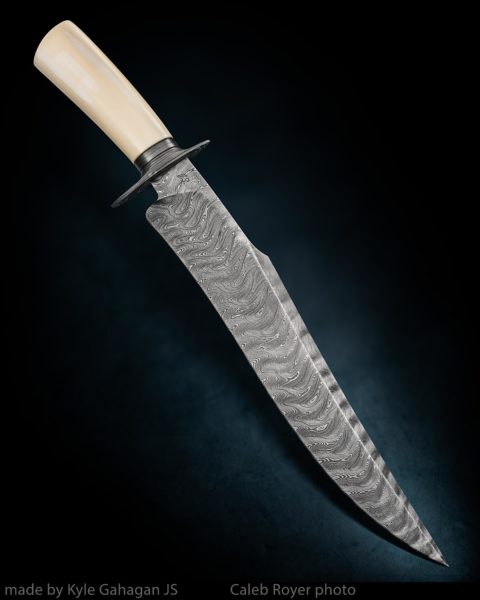
This Gahagan Knives bowie has a 10.5-inch blade made of forge-welded 1075 and 15N20 steels. The handle is mammoth ivory with a bronze guard. Maker’s list price: $3000. Contacts are listed at the bottom of this article.
Kyle would have stayed in the Army, but after seeing his parents divorce and his father remarry two more times, he knew he didn’t want to lose his wife over his career choice. He felt it wasn’t fair to Dana, so he transitioned out in 2004. Their daughter, Zoe, was born right after Kyle got out, and their son, David, was born in 2011. At first Kyle wasn’t sure what he wanted to do. He worked in an autobody shop, but when the pain in his right arm, exacerbated by a bone spur on his clavicle, got so bad he could barely function, he knew he had to find other work. “On my last day, the pain was so bad I couldn’t hold a hammer—I couldn’t hold a toothbrush.” He taped the hammer to his forearm and at the end of the day told his boss that he just couldn’t do the work anymore.
He was at the right place at the right time to land a job as an IT (information technology) contractor for Lowe’s, developing three data centers, one in Texas and two in North Carolina. When Kyle applied for full-time employment, the company told him it could not hire him because he lacked a degree. So, he went back to school. His mother was a teacher, so education has always been important to him. In the end, “100 percent and then some” in keeping with the Ranger creed, he came away with three doctorates, two in education and one in psychology.
Kyle Gahagan made this 10.5-inch blade with forge-welded 1075 and 15N20 steels. The guard uses the same steel, and the handle is ringed gidgee wood. Maker’s list price: $3500. Some Gahagan Knives pieces are available through https://exquisiteknives.com or you can contact Kyle via the methods listed at the bottom of this article.
During this time Kyle was an administrator to a local college, a school principal and eventually an acting superintendent. His frustration grew as he continually tried to hold students and parents to high standards. Kyle ensured that the children had what they needed to succeed, but if they didn’t follow the rules, they faced the consequences. He felt undermined, however, by a politically-correct environment in which his decisions were often overturned. Eventually, he just quit.
When Kyle was a school administrator, his chief financial officer asked him to make a knife he could give to his future brother-in-law as a wedding gift. Kyle was reconnected with that kid who had became engrossed in making the best knife he could make. “I enjoyed the process,” Kyle said. He began making knives “as a hobby.” Although he may not have recognized it at the time, that sounds like too casual an approach for a craft that would end up tying his love of knifemaking, education, psychology and his warrior brethren together, giving him a new mission in life.
In 2013 Nate Bocker began Resilience Forge in Virginia. Nate served in the Army with the 249th Engineer Battalion. The active-duty sergeant sought a way to help the wounded warrior community. He thought by teaching veterans the skill of bladesmithing they could hammer out some of the issues associated with post-traumatic stress disorder, receive appropriate physical therapy for some injuries and have the foundation of a new skill they could expand into a trade if they so chose. Nate’s first student christened the program Blade Therapy. Kyle then launched Resilience Forge North Carolina and began implementing standard operating procedures so that the non-profit could expand nationally. No matter where a veteran attended, they’d know that the program would be the same.
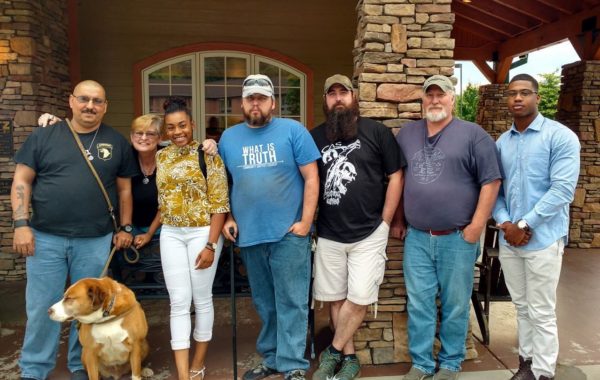
The Department of Defense made a video of ABS journeyman smith and former Army Ranger Kyle Gahagan, third from right, to celebrate the work he’s done in helping veterans. You can watch it below.
The irony is that there is no structure to the program. Veterans when they’re transitioning from active duty or medical care into civilian life don’t have a schedule. “My door is always open,” Kyle said. All a veteran has to do is call ahead and he is there to provide counselling in the active environment of the forge. “Sitting on a couch and talking doesn’t work with the military mindset. They want to be producing something,” he said. Lots can unfold in the course of making a knife in one of Kyle’s classes. Take the 96-year-old veteran who was on Omaha Beach on the D-Day Invasion of Normandy. “He couldn’t do much,” Kyle said, but it was only a couple of weeks after visiting Resilience Forge that the veteran’s wife called. “She said, ‘I don’t know what you did, but my husband is happier.’ He had opened up to her,” Kyle said. And now Kyle is happy too. He’s found his new mission.
He knows what it’s like to reach that point where it’s darkest. Where the trudging goes on incessantly, you feel miserable physically and mentally, you’re exhausted and there’s no clear purpose to your life. Irrespective of his constant advancements career-wise, Kyle knows the heartbreak of remembering lost buddies. Anderson had been a school teacher. “We all face it,” Kyle said. At one point the emotional and physical pain was so bad that he walked away from the one thing that could have ever compelled him to leave the Army: his marriage. That lasted six months. There is a point, even in knifemaking, when the challenges seem to go on for too long, when things don’t fall naturally into place, when braking the blade seems nobler than letting it crack under stress.
Kyle taps into each veteran’s ability to adapt and overcome. Even though he’s teaching a physical skill, he’s giving veterans back their confidence, their ability to overcome and adapt. He helps them find their flexibility, their resiliency, their ability to fight back and achieve self-sustainability again. He can’t tell the veteran what his new mission is, but he can guide and support him while he figures it out. And that knife that they thought they couldn’t finish becomes a token of what they’re capable of accomplishing.
DoD News In Focus: Taking the Edge Off
Kyle’s plans, not surprisingly, are big. He currently puts veterans up in area hotels. He’d like to get a camper that he could use to haul a mobile forge to VA hospitals. He could use it for sleeping on those trips and to accommodate veterans when they’re at Resilience Forge. The VA is now sending patients to him. He sees the program expanding across the country, and eventually, Dana leaving her insurance agent job and working with him. He hints at perhaps another doctorate, and in 2018 he’ll be testing for his American Bladesmith Society master smith rating in Kansas. He uses a power hammer when he’s forging his own knives, but he teaches by hand. He’s hoping to stave off another tendinitis surgery, but he can feel his tendinitis getting worse. Like many veterans, his battle for coverage continues. Even so, his mission is crystal clear, and he is happier than he’s ever been.
Donations and Inquiries
To make a donation to Resilience Forge North Carolina, you can access gahaganknives.com through Paypal, or you can mail a check made out to Joy To The World Foundation to Kyle at the address below. The Joy To The World Foundation provides administrative services, such as tax preparation, to non-profits.
You can read your digital issues of BLADE Magazine anywhere you have your phone, tablet or computer, and there’s no need to find storage for all your old issues.
If piling-up issues of magazines seems like a waste to you… If you feel like you don’t have time to read a magazine… If you like the stories we offer in BLADE, but want a more economical option, then a digital subscription is the answer. An annual subscription to BLADE is $17.98, $4 off the print price.