
Knifemaking

Knifemaking is the building of a knife, which includes the blade, handle and other accouterments. Blades are made by either removing metal from a steel blank via a grinder – known as stock removal – and the forging to shape of hot steel into a blade in the process known as bladesmithing. Other parts, including bolsters, guards, pommels, etc., are needed to complete the finished knife.

Featured Knives – – Knife Collecting – – Tactical Knives – – Survival Knives

GiantMouse Builds A Better Collaboration Model

The GM2 has the GiantMouse logo on the blue anodized titanium clip.
GiantMouse is pushing the boundaries of two renowned Danish designers, but together with an American businessman are building a better collaboration model.

By now knife industry followers know that renowned Danish knife designers Jesper Voxnaes and Jens Anso teamed up to create GiantMouse LLC. What you might not know is that a California businessman with a love of knives became the organizational drive behind the endeavor. Jim Wirth asked a simple question over beers with Voxnaes and Anso that solidified the venture, and bettered the collaboration model creatively and financially.

When Wirth turned 14, his older brother Chris gave him a small Gerber pocketknife with mother-of-pearl scales as a birthday present. He loved looking at that work of art, and yet, the knife got plenty of use too. From then on, Wirth began attending knife shows, like the former Bay Area Knife Collectors Association show in Santa Clara. He joined that organization so he could attend the meetings and learn more about the knife industry.

His love of knives—and watches—grew and he continued to attend shows, adding the New York Custom Knife Show and BLADE Show. Meanwhile, he developed a data warehouse-business intelligence firm that became an Inc. 500 Fastest-Growing Company. After a merger, Hewlett-Packard bought the company, and Wirth was set as far as his family and living expenses were concerned. He began consulting, advising owners of young businesses and angel-investing, or backing business that show promise.
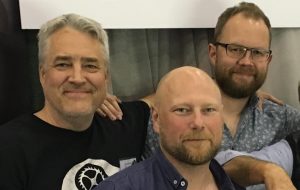
The American businessman and Danish designers behind the success of GiantMouse Knives.
Jim Wirth, left, a businessman and angel investor, suggested that Danish designers Jesper Voxnaes, middle, and Jens Anso, right, start a new company to produce knives they collaborate on, sharing in profits rather than receiving a royalty percentage.

Wirth had always been a fan of the work of Voxnaes and Anso, so at a BLADE Show, although he’d met them before as a customer, he was more formally introduced to the men through a common friend. Over drinks, Wirth inquired about the royalties each knifemaker was making in their partnerships with well-known manufacturers. Although mum on details, designer royalties on any manufacturing collaboration range from 3 to 7 percent, sometimes as high as 10, of net sales. There are countless variables that determine the final cut, however, according to numerous sources in the knife and product development industries, 5 percent is thought to be fair for both the designer and the factory that takes the risk on whether the product will be a success or not.

Voxnaes and Anso revealed that they had indeed co-designed some knives together. They had even come up with a potential company name, GiantMouse, because Denmark is a tiny country in a giant world and they wanted GiantMouse to be a small knife brand in a giant knife industry. Wirth asked why they hadn’t produced these knives they’d worked on. And with that question, GiantMouse came into being.
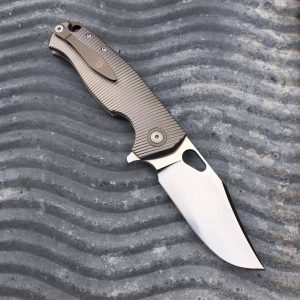
GMP2 is released with a upscaled finish, also in limited quantity, but still at a collectable cost.
The P in the GMP2 version stands for pirate and if you look closely, the mouse logo is wearing an eyepatch.

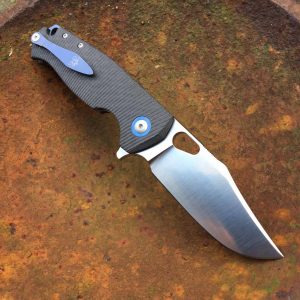
The three men determined that they would only do limited runs of folders four times a year, 300 in a standard finish and 100 in a special finish. These 100 “pirate” versions would include the GiantMouse logo with a patch over its eye. The GM2—GM for GiantMouse and 2 for sequential order—for example, is a full-size everyday carry folding bowie with carbon fiber handle scales. The backspacer, clip and pivot ring are a rich blue anodized titanium. The nested lockbar is also titanium. The 3.3-inch blade is made of Bohler M390 Microclean powder corrosion-resistant martensitic stainless steel with a satin finish and is ground to a 0.157-inch thickness. The handle length is 4.62 inches, and the knife weighs 4 ounces.
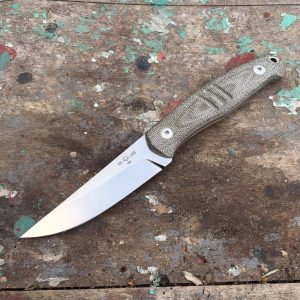
The GMF2 is based on a Nordic work knife, but can be used for bushcrafting or everyday chores.
The GiantMouse team knew they always wanted to have some knives available for sale, so they do not limit sales of their fixed knives like the GMF2.

Although the folders are discontinued as soon as the 400 pieces sell out, the GiantMouse fixed-blade runs are unlimited. The GMF2—F for fixed—for example, with leather sheath, is a throwback to a Nordic work blade that can be used for everything from bushcrafting to everyday tasks. The 3.62-inch blade is made of Bohler N690 cobalt high-performance powder steel, ground to a 0.157-inch thickness and finished in a fine stonewash. The 4.43-inch Micarta handle brings the overall length to 8.12 inches. The knife weighs 4.1 ounces.

The way the designers look at it, according to Anso, is that by working very closely and combining their skills, each designer is forced out of his individual comfort zone. Integrating each maker’s ideas and style without compromising on design quality is “a difficult task but makes for a very strong design if done right.” It’s important to each man that the other is able to vouch for everything involved in the design. Both must be happy with the final result of each knife.

Anso and Voxnaes both started making knives in 1989, and they both lived in rural northern Jutland, only about 30 miles apart. They didn’t actually meet until 2005 at a small knife show. They instantly hit it off and have been close friends and colleagues ever since, explained Anso.

The two friends met Wirth at a BLADE Show when Wirth was collecting knives. “With Jim’s well-known talent for business, high ethics and passion for quality, combined with our skills and experience in the knife business, the idea of GiantMouse Knives started to take form,” Anso stated.

As chief executive officer, Wirth drew up the articles of incorporation and launched the website. He also set up the fulfillment center in Southern California. The knives are manufactured in Maniago, Italy, and Voxnaes and Anso handle all interactions with the manufacturer from approving prototypes, through test runs, to quality control of the finished knives. A final inspection is performed when the knives arrive in California. Out of a run of 400, perhaps a half-dozen will be returned because the blade is slightly off center or a flipper action isn’t as smooth as it should be. The knives are then sent to the fulfillment center where they are put in branded packaging and sent to customers.

One might figure that short runs of well-designed knives would be unaffordable because you don’t have a high number of pieces over which to spread the start-up costs. There can also be fees if runs don’t meet a minimum quantity. But the founding trio at GiantMouse committed themselves to this route because it incentivized the designers. “They’re challenged to create more designs. It’s exciting,” Wirth said. And as partners in the company, the designers share in the profits with Wirth. This both pushes the designers and rewards them for their efforts perhaps more than a percent-of-net-sales royalty would.

All along the goal has been to create exceptional knife designs, produce them at the highest quality possible and keep them affordable. For example, the maker’s list price for the GM2, in standard finish, is $325; the GMP2—the P standing for pirate—in special finish, is $375. Ten dollars from the sale of every folder, and currently $20 from every fixed blade, is donated to Save The Children. (The organization helps ensure children at home and abroad receive the heath care, nutrition, education and protection they need to grow up happy and secure.)

Wirth said that he got to go to Demark and see the operations of both designers. Then the trio drove to a knife show. “I sat in the back and listened to Jens and Jesper talking in Danish. Every once in a while, I’d hear ‘Jim,’ and I’d be like, ‘heeey.’ The only Danish I learned was something written on the radio, something like ‘the radio isn’t on.’ Now that’s what I say to them when I see them.” Wirth laughed telling the story. He seemed happy, like you might imagine a 14-year-old boy would be over receiving a beautifully designed knife.

Know What Great Knife Design Is
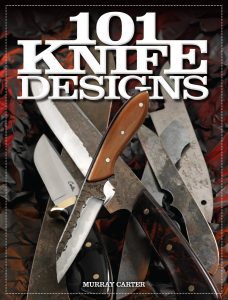
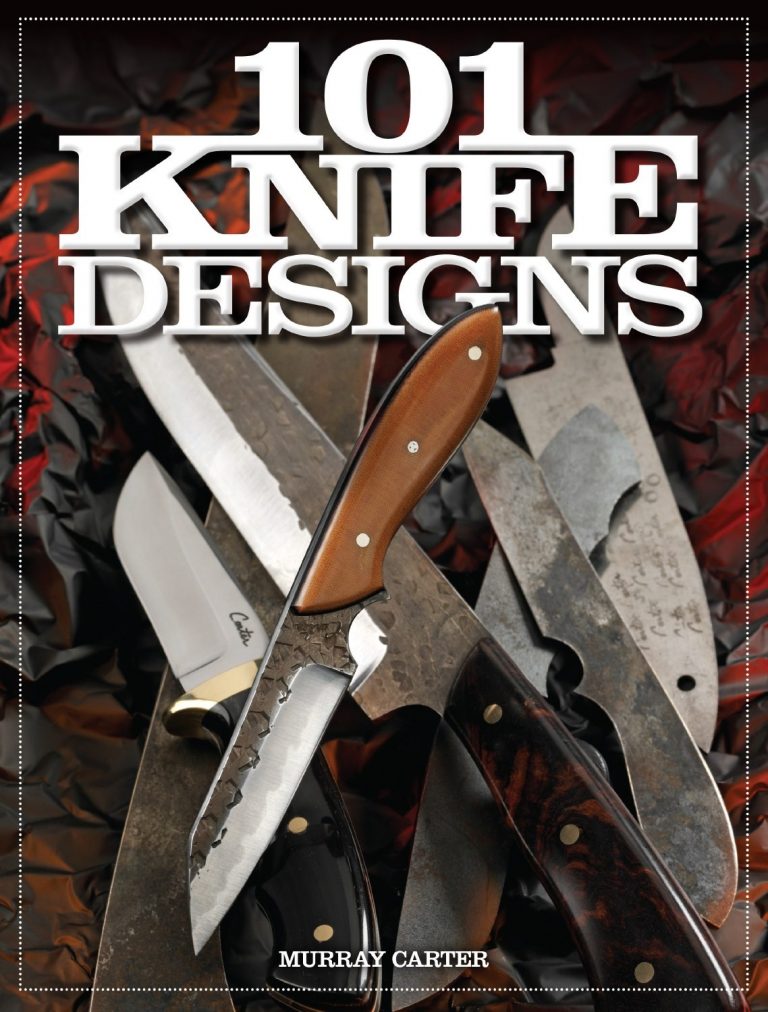
"101 Knife Designs"will give you both theory and beauty behind the great knife designs.
“101 Knife Designs”will give you both theory and beauty behind the great knife designs.

Understanding what makes a great design makes you a better collector and a better maker. “101 Knife Designs” by Murray Carter will not only inspire your work with detailed discussion of blade design, but will give you full-color images of exquisitely designed knives to ogle. At $19.53 you save $10.43 off the cover price.
M.A.C.K.: What Are Machine Assisted Custom Knives?

Learn what the latest BLADE Show custom knife award is all about.

Some people are familiar with “Mack Daddy,” the 1992 Sir Mix-a-lot album with the smash hit “Baby Got Back.” On the other end of the cultural spectrum is the Mack truck, the reliable American long-haul vehicle revered by truckers and country songs. Knife enthusiasts may also be familiar with the Bobby Darin’s classic Mack the Knife: “O the shark, babe, has such teeth, dear …” Just now coming into the knife culture is the idea of a “M.A.C.K” knife, which stands for “machine assisted custom knife.”

Custom, Production And M.A.CKnives

Savvy BLADE® readers know the difference between a “custom” and a “production” knife. A custom knife is made by a craftsman using a combination of skill, experience and tools. The maker grinds the blade, polishes it, installs a handle and fittings, and so forth. Custom knives are often made one at a time or in small batches. Sometimes portions of the process are outsourced, such as waterjetting blade profiles or using a professional heat treater. In general, the maker’s name is prominently featured on the blade, such as Tom Overeynder, Gary Langley, etc. The price of custom knives can be quite high, particularly as the complexity of the knife and the magnitude of the maker’s reputation increases.

By contrast, a production knife is made in bulk using modern or traditional manufacturing techniques. Blades are made by the hundreds or thousands, ground and polished by machines, and assembled in a factory or large production shop. In general, the name of the company is prominently featured, like Case, Benchmade, White River Knife & Tool, etc. Sometimes a production knife will feature the name of the designer, such as the various CRKT production knives that have BLADE Magazine Cutlery Hall-Of-Fame® member Ken Onion’s name. Production knives may be expensive but are generally more affordable than custom knives of similar materials and construction.

Princteon Wong award-winning knife
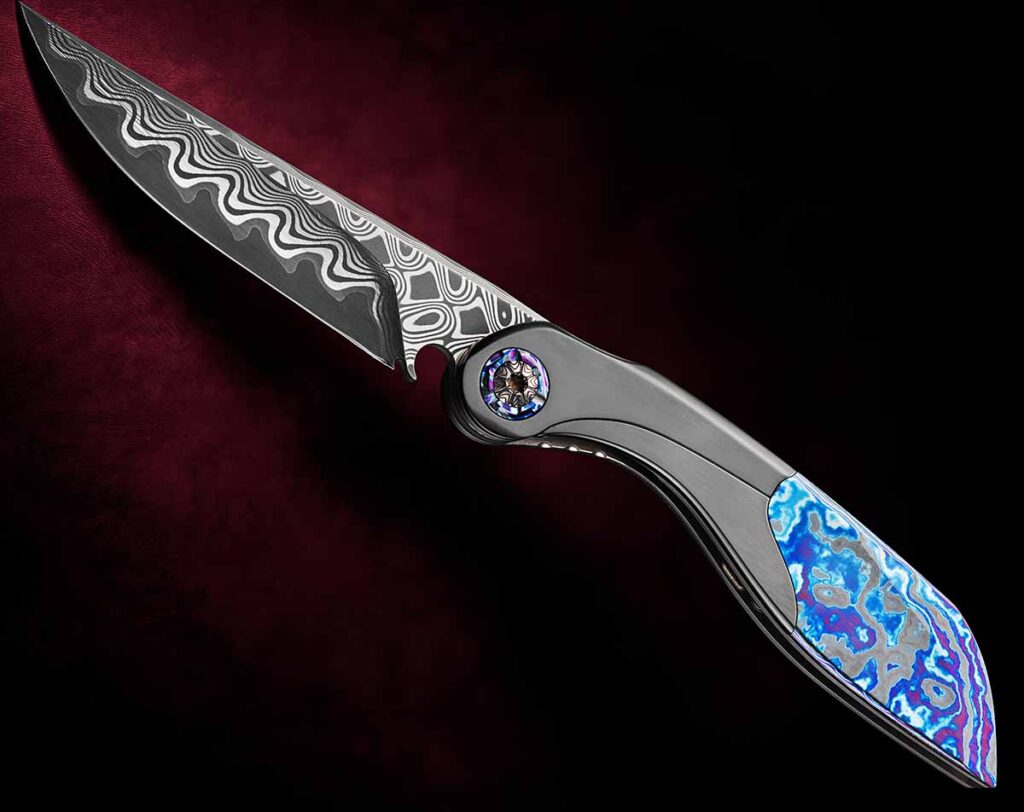
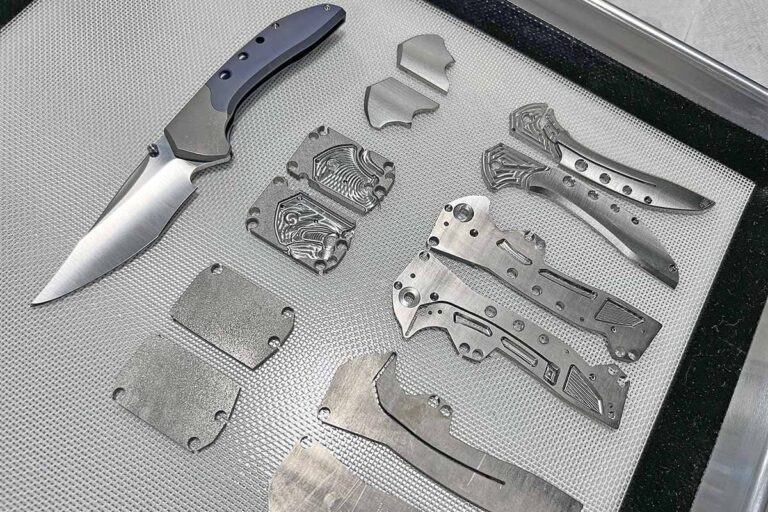
Princeton Wong has a five-axis waterjet in his machine shop, so he makes everything but the screws. An example of his work is this award-winning knife from the 2021 International Custom Cutlery Exposition, now known as BLADE Show Texas. (Caleb Royer image)

In between custom and production is a vast world described by the umbrella term mid-tech. It describes knives that use both production and custom techniques or methods in varying proportions. Some would say that any knife that has production techniques like waterjet is a mid-tech, while others would argue that as long as a person does the final assembly and fit up, a knife can be called a custom.

It takes talent, practice, education and skill to make a knife by hand. Many makers of such knives have no problem with using machines like a band saw, 2×72 belt grinder, manual mill or pantograph. At some level, almost every modern handmade, aka custom, knife is “machine assisted.” At the same time, the industry recognizes that when it’s primarily the maker’s dexterity and artistic vision that makes the knife, the label of custom or even “handmade” applies.

It also takes talent, practice, education and skill to program a series of CNC (Computer Numerically Controlled) waterjets, grinders and mills to make a knife by machine. Custom guys often make “polished turds” and “boat anchors” at the beginning. Beginner machine guys break tooling and crash expensive machines. In neither case does a person wake up one Tuesday and immediately become a competent knifemaker.

Think about the amount of variability in custom/handmade knifemaking. Each steel, each belt, each grinder speed, each brand of sandpaper, and every variable changes the process. If you heat treat your own steel, you must master temperature control, soak time, quench speed, decarb, warpage and tempering, and must use a different formula for each steel. After dealing with all that, is making a knife by machine any easier?

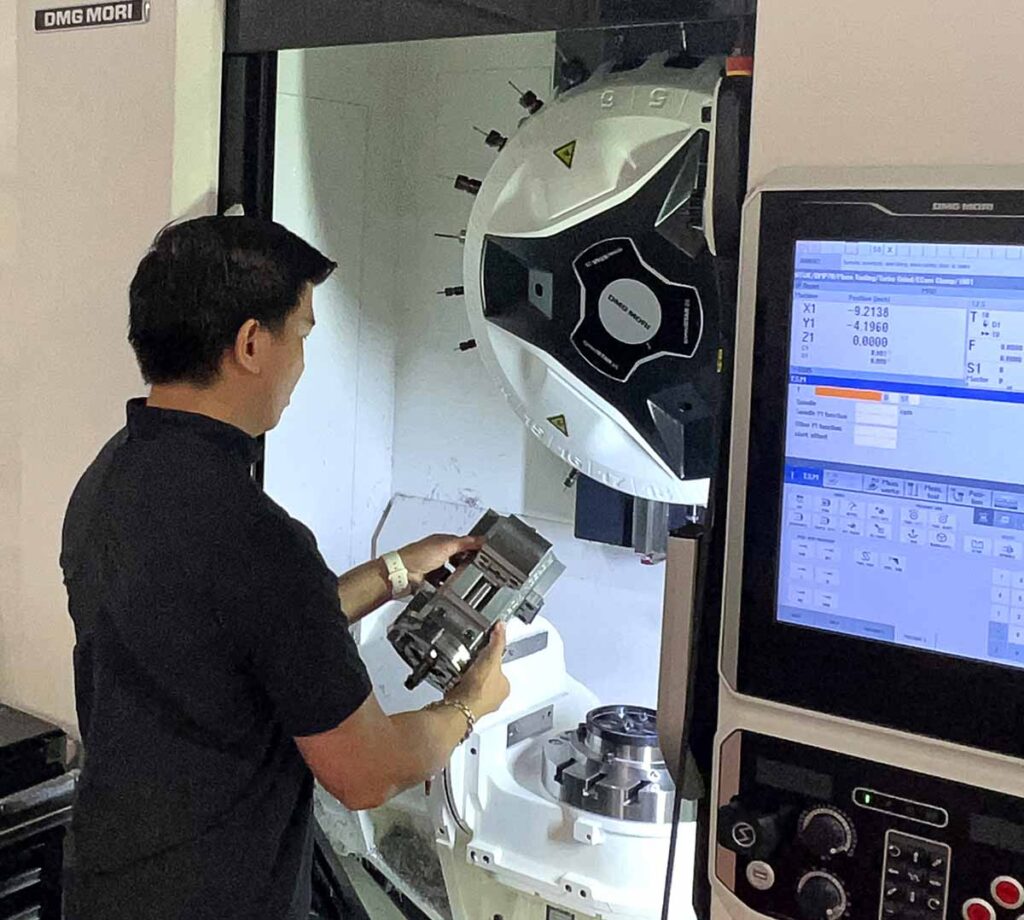
Princeton Wong operates the CNC mill. It can cut complex 3D
Princeton Wong operates the CNC mill. It can cut complex 3D shapes in metal and handle material.

Not according to M.A.C.K. knifemaker Princeton Wong. In CNC you deal with the geometry and composition of various cutting tools, plus the speeds and feeds at which you apply them. You must figure out fixturing to hold your workpiece, and how to work the tool in a way that leaves the desired surface finish. “It’s the same idea as using different belts or different files for each task,” Princeton explains, “but the variables are infinitely more complex. And then on top of that, you still have to learn and master all of the different hand-finishing techniques.”

So how does the knife industry show respect to the skills and talent of the makers who artfully combine programming with handwork? How do you showcase the ability of a maker who can run both a HAAS CNC mill and a belt grinder?

Defining M.A.C.K. Knives

BLADE Show 2023 included for the first time an award category for M.A.C.K. knives. According to the category rules:

The knife must be of the folding/locking, non-slip-joint, EDC variety that is first and foremost a cutting tool. It must be functional, beautiful and have great ergonomics, yet still have practical applications and uses. It must consist of both at least one handmade feature—such as hand-ground blades, hand-contoured scales, manually machined parts, etc.—and of automated features such as waterjet-cut liners/scales, CNC’d handles, etc. The judges will assume that the knife’s parts that are not handmade are made through a machine-aided process.

What background education and experience does it take to make a quality M.A.C.K. knife? Just like with any other skill set, the path is quite diverse. Take Princeton for example. Knifemaking for him growing up was a passion.

“As an Asian kid into martial arts, I’ve always had a love for bladed implements,” he notes.

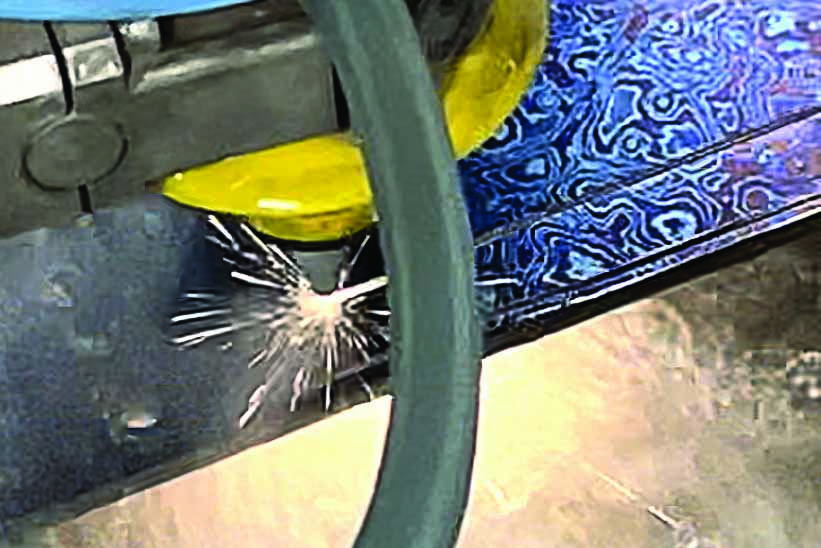
A waterjet machine uses a high-pressure stream of water and abrasives to cut profiles in flat stock.
A waterjet machine uses a high-pressure stream of water and abrasives to cut profiles in flat stock. Princeton Wong uses his waterjet here to cut Timascus™ for folder handles.

He bought a Sherline mill after high school that had been converted to CNC, and learned by trial and error from there.

“After years of fiddling with stuff, breaking endmills and crappy software, I finally started figuring it out,” he observes. But for Princeton, learning wasn’t all trial and error. He studied mechanical engineering and graphic design in college. He had jobs in print, web, graphics and fabrication. Eventually, he started his own machine shop serving automotive and architectural clients. In 2018 he decided to use his machining skills to make knives.

“I didn’t know the knife industry or knife people but had a machine shop, so I gave it a shot,” he recalls. “I didn’t own a ‘real’ belt grinder until I was two years into making knives. I had a 4×36 from Lowe’s but was able to do very close work on the CNCs. By focusing on an intentionally machined look, I was able to get by.”

Princeton has a five-axis waterjet in his machine shop, so he makes “everything but the screws.” Earlier in his progress, he would bandsaw blanks and then fixture them in his CNC mill.

“I never had a need to outsource, but most people don’t have 70 amps of 480-volt three-phase electricity to run a $100,000 waterjet,” he says.

A waterjet cuts steel and other plates into shapes, “but it doesn’t make knives.” It’s a highly efficient profile-cutting tool.

Bridging The Gap Between Custom And Production

Most people don’t take Wong’s path and start out as fully equipped and capable machinists when they begin making knives.

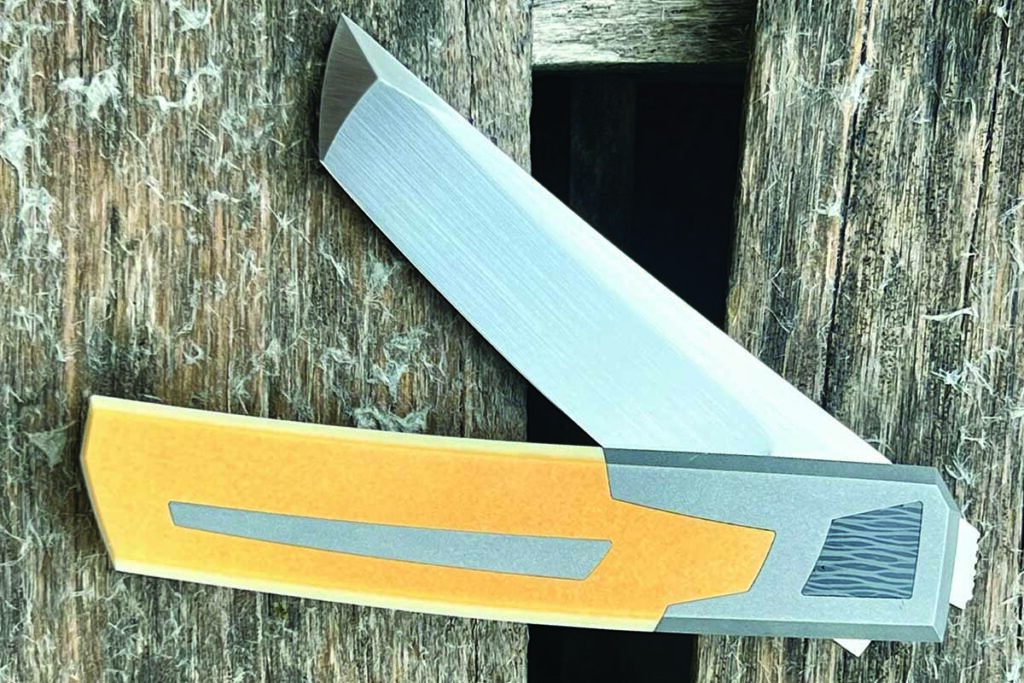
Consider the precise fitting and complex geometry of the joints on Jared Oeser’s “Tachi” folder.
Consider the precise fitting and complex geometry of the joints on Jared Oeser’s “Tachi” folder. Integral bolsters and Westinghouse Micarta® come together quite well.

M.A.C.K. knifemaker Jared Oeser started like many makers, with a mentor, a few tools and a new hobby. As a homebuilder, his business took a hit in the 2011 recession. Faced with spare time, he took up knifemaking. After a few fixed blades he moved fairly quickly into slip joints, merging modern materials into traditional designs at a time when that was a new thing. He continues to push the limits and bridge the gap between traditional designs and the “modern” folding knives.

About five years ago a friend needed a place to store a CNC mill. Oeser agreed to store it in exchange for lessons and use of the machine in the meantime. By the time the friend needed the machine back Oeser was hooked and bought his machine shortly thereafter.

After five years, he considers himself not good enough to make a knife completely on the machine. Coding for CNC is quite a different skill set, far beyond traditional knifemaking.

“I don’t want to go 100 percent machine,” Jared says. “I like the hand work, and I’ve gone about as far as I want toward machine-made. Everybody kind of finds their ‘spot,’ but the key is to disclose it, to say it. Don’t say ‘mine’s handmade’ if you’re afraid to say how you did it. At the end of the day, you’ve got to be good at hand work and have a skill set to make a quality knife.”

Handmade Vs Machine Assisted Knives

So what’s the difference between a “custom/handmade” and a “machine assisted” knife?

Wong suggested that a machine assisted knife should have a bit more precision than the typical custom knife. Because you can machine to exact tolerances and fit, there’s less room for error. He also suggested that the maker should try to push the boundaries of the machine’s capabilities. Just like there are a few knifemaking operations that can only be done by hand, such as Wolfgang Loerchner’s amazing hand-filed creations, there are also machinable features that people wouldn’t realistically try by hand. Creativity isn’t limited to hand tools.

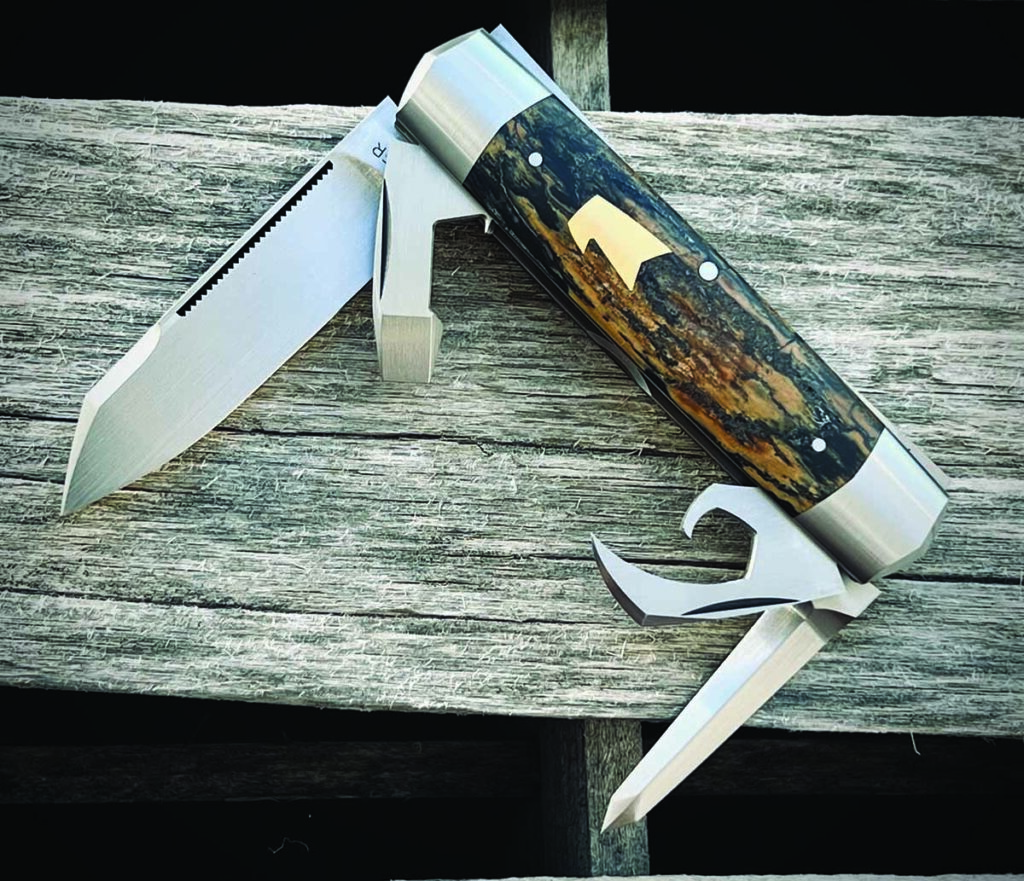
Jared Oeser’s “Eagle” is a four-blade slip joint
Jared Oeser’s “Eagle” is a four-blade slip joint. This one has mammoth ivory handles and a 14k-gold shield, combining modern techniques with traditional materials.

According to Oeser, “Among the makers and collectors I know, we’re OK with whatever a knife is, as long as you honestly disclose how you built the knife.”

He considers his knives machine assisted. On a slip joint, he uses a HAAS CNC mill to cut out the shapes of the liners, the shield inlay pocket, and to profile the blade and spring. Even though he uses a CNC mill that is squarely in the “machine assisted” category, using it primarily to cut profiles is pretty much the same thing as a waterjet.

Taking The Plunge Into M.A.C.K.

As a mostly one-off knifemaker myself, I was curious what it takes to build a knife that falls squarely into the M.A.C.K. category.

After talking with some M.A.C.K. makers, I found the process seems to typically begin with waterjet cutting. Either the maker has used a waterjet before and has his or her own CAD (Computer Aided Design) files, or the contracted machine shop will have a CAD expert on staff. Experienced CAD folks can work from a drawing or PDF for things as simple as profiles, and may use modeling software for contours and handles.

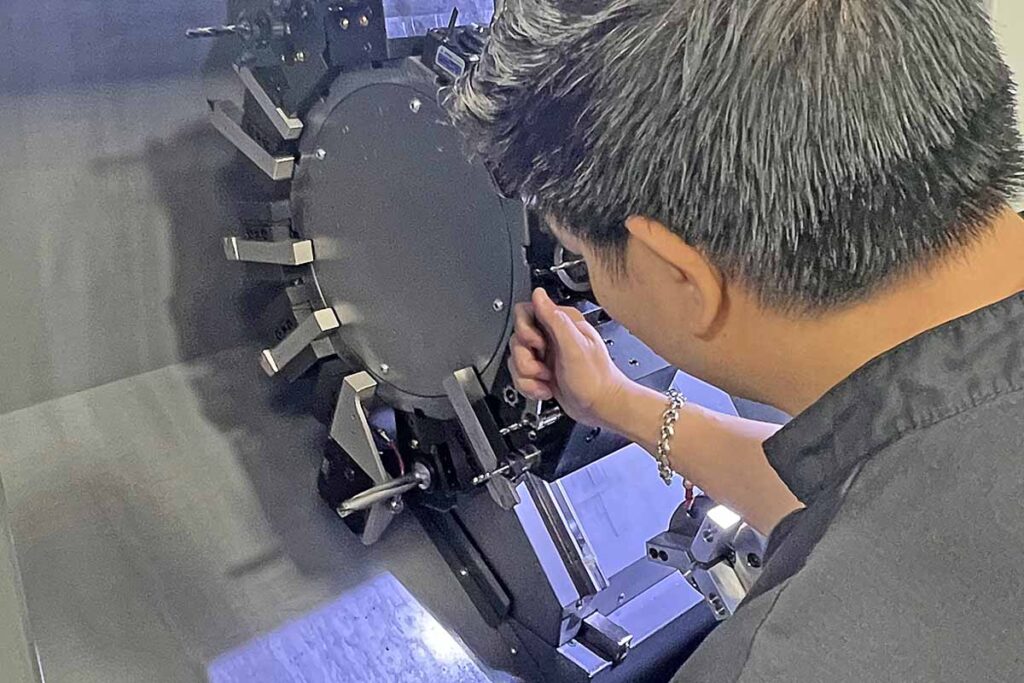
Princeton Wong checks the tooling on a CNC lathe.
Princeton Wong checks the tooling on a CNC lathe. The lathe cuts precise round stock, such as screws and folder pivots.

Typically the liners are cut and the holes spotted, or are occasionally fully drilled and tapped. Pocket clips and backspacers come pre-cut. Handle profiles and contours are cut with a ball end mill, leaving a fairly clean finish. Sometimes this finish by itself is sufficient, while other times more hand polishing is necessary to achieve the final effect. Blades are typically delivered cut to contour, and the maker often does the bevel grinding by jig or by hand on a traditional belt grinder. Other times the blades come with machined bevels at varying degrees of surface finish. Once again, it’s up to the maker to decide if the machined finish is sufficient or if further hand work is necessary.

If you’ve ever used waterjet or milled parts, you know that the edge finishes are not precise. If you’ve had holes spotted but not drilled, you still have to drill and tap the holes. All in all, even in a knife that comes to you in a bag from a machine shop, there’s more to a cleanly finished M.A.C.K. knife than just assembly. If you want to be a winner in the M.A.C.K. category, you’ve got to have the hand finishing techniques down pat.

If you want a firsthand look at a quality M.A.C.K. knife, check out the applicable tables at a BLADE Show. Whether you prefer the events in Atlanta, Texas or Utah, there’s no doubt that “M.A.C.K. is back in town.”

More On Knife Handles:

4 Steps to Perfect Freehand Sharpening


1) Select a Sharpener

Invest in a good bench stone. You have the natural ones like the Arkansas stones and the manmade ones such as the Norton India stone. There are also the diamond-bonded stones that many companies produce.

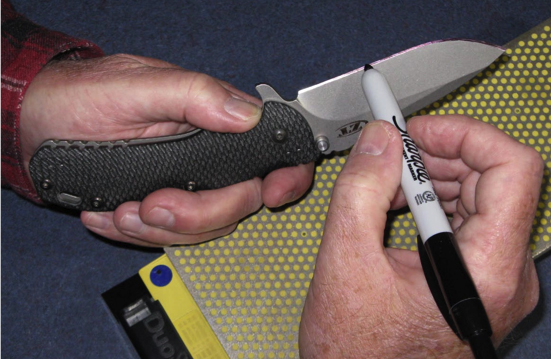
2) Color the Edge

With a black ink permanent marker, color the entire cutting edge or primary bevel on both sides of the blade. The objective is to sharpen off the black ink. After you remove the ink from both sides of the blade, it will be sharp.

3) Adjust Accordingly

Take a few strokes on the stone and then examine the edge bevel. If you see ink toward the top of the bevel, decrease the angle of the blade to the stone. Conversely, if you see ink toward the bottom of the bevel, increase the angle to capture that part.

4) Remove the Ink

After you sharpen the ink from the cutting edge, you will have to remove any stray marker ink. A liquid-based adhesive and paint remover is ideal for the job. Place a few drops on a paper towel and very carefully wipe the cutting edge.

Going Forward

After you get the hang of it, skip the permanent marker step. Congratulations, you’re now a freehand sharpening pro!


A Dazzler For Kaz

A Father, With The Help Of His Uncle, Works To Make A One-Of-A-Kind Knife For His Son After Living The Life Of A Military Kid.

The hardest question for my son Zachary “Kaz” Kazmir to answer is “Where are you from?” His answer usually falls along the lines of, “Home is where the military takes your family.”

Zach’s answer is true for just about any token “military brat.” Military families often move every two to three years—that’s a rate of 10 times more than average civilian families. Living this kind of life for a child requires tremendous resilience, exceptional adaptability, and an uncommonly high maturity level. Zach would repeatedly get settled in a routine, a school, a friend group, and community activities, only to pick up, leave it all behind and start fresh again. 

Oh, and the trials of life do not stop there. He persevered through my frequent deployments, earthquakes, accidents, and even a direct hit by one of the strongest tornadoes ever recorded while he was living in Moore, Oklahoma. Zach’s life led him on a journey spanning two countries, four states, and five schools.

Bobby Kazmir and his son Zach.

I wanted to give the young man something special on the occasion of his 21st birthday. Even with all the places he’s lived and the experiences he’s had, Zach’s fondest memories always gravitate to his time in Okinawa, Japan. The first memories of his life were created there. Okinawa will forever hold a special place in his heart. With that, I set out to have a knife crafted in hopes of capturing and honoring these priceless memories for him.

Uncle Stanley

I could think of no better place to turn for such a task than my uncle, Stanley Buzek. Uncle Stanley is a knifemaker from Caldwell, Texas, and is most certainly the right man for the job. There’s no one I know who puts as much heart into his craft as Uncle Stanley. He guided me through the many options, and I closed in on what would become the most meaningful and elegant 4.5-inch, two-blade Texas trapper I’ve ever seen.

My uncle crafted the frame and liners from raw bars of integral 416 stainless steel. As with each of his knives, he added a personal touch to the spine. This was truly amazing to witness. I’ve seen many of his finished knives over the years, but I hadn’t realized the level of precise craftsmanship he put into the pieces that non-makers like myself often take for granted. Most of us just naturally look to the business end of a blade.

In thinking of the knife for this gift, I aimed to give Zach a glimpse into his resiliency through my eyes. He has been stretched so thin that at times his only choice to keep from breaking was to fold over in the fetal position to regain his strength. He’s been heated, hammered, pressed to the edge of his capabilities, put back in the fire, crushed, bent beyond his limits, beaten down even more, and subjected to unrelenting pressures in different directions.

Nonetheless, he emerged from the fire stronger than ever before, with a character that can only be described as beautiful—just like the banding and mottling of damascus. The beautiful steel forged by Bill Poor couldn’t be more fitting for this knife. Bill transformed raw 1084 carbon and 15N20 nickel-alloy steels into an extra-fine River of Fire pattern with elaborate feathering that perfectly captures how I view Zach’s coming-of-age: indicative of many intense moments, but not scarred. Instead, radiating with a unique, luxurious magnificence that exemplifies resilience.

Making The Knife Handle

The next essential element on my mind was the scale material. (I called it the “side of the knife” but you know how knifemakers are about educating the ignorant.) The scales had to be more than just the perfect material, they had to be uniquely sourced. I wanted my son to have a literal piece of his childhood that he could hold in his hands whenever he wanted. 

Scanning the beach for seashells while barefoot along the shoreline of Okinawa’s Devils Cove is no doubt among Zach’s favorite island memories.

I reached out to a military friend stationed in Okinawa to acquire a piece of one of the famed, colossal banyan trees from the island. With travel restrictions, import/export regulations on agricultural items, and COVID-related shipping delays, it proved much more difficult than we expected. However, my contact was able to come through! After nearly a year, a heavily worn, 5-by-10-inch piece of banyan tree finally arrived in the mail.

Uncle Stanley was reluctant to use banyan. He cautioned me not to get my hopes up because he knew how challenging it can be to properly stabilize such a soft wood. In addition, the sample was very weathered, extra-soft, and had several deep cracks inflicted in transit during shipping. In other words, there wasn’t a lot of room for error! 

Uncle Stanley sent the wood to the very capable Terry Dunn of TNT Enterprises, and I was truly blown away by what he was able to do. Dunn not only stabilized the wood, he preserved its beautifully subtle grains and the small, intricate pitch pocket. The latter is a cavity in the wood where the tree suffered some sort of damage over its life, or a small knot of sorts if you will.

Stanley assembled the sleek trapper, affixed the scales, and presented me with a truly remarkable knife. Then he took it from my hands and said, “Now it’s time to go get it ‘scratched up.’”

Engraving The Knife

A slight fear came over me. I worried that an engraver could potentially damage this work of art. However, the worry left me as quick as it came when I learned the engraver was Alice B. Carter. I’ve seen her amazing work in the past. I knew she could add another layer of beauty to the piece.

To my surprise, Alice asked so much more than, “What would you like me to engrave?” She had an authentic interest in the story of the knife and its eventual recipient. I think she asked me more about Zach than she did about art that day. I shared with her the things Zach tends to reminisce about from his time in Okinawa, and we honed in on a few specifics.

One of the first memories of his life is enjoying the annual Cherry Blossom Festival in Okinawa’s capital city of Naha. The festival draws crowds of thousands each January to see the city streets completely encased in the vibrant blooms. Zach also speaks of how massive he remembers the banyan trees being there. If you’ve never seen a 200-year-old banyan, the behemoths appear to be as old as time and so wide they seem to fill the sky with a majestic, towering presence as if from a fantasy movie. 

Alice’s smile grew wider and wider as we continued to talk through a few other details. She drew inspiration from our chat and created an absolute masterpiece. Engraving for more than 40 hours and inlaying more than six feet of 24k-gold wire, she created so much more than a scene or picture. Her art marvelously captured the emotions connected to the memories.

Reaching from corner to corner on the upper bolster of the facing side shines the island of Okinawa in pure, radiant gold. The shading effect seems to literally draw the island’s shape out from the knife. Carefully inlaid in the exact location of Kadena Air Base where Zach lived on the island, a one-millimeter copper marker memorializes his time there. 

The lower bolsters hold a personal message from father to son: Ichi-go ichi-e. Emblazoned in bold Japanese Kanji, it is an idiom roughly translating to “for this time only.” Reaching from corner to corner on one side of the upper bolster shines the island of Okinawa engraved by Alice Carter in 24k gold. The knife’s oversized shield brilliantly gleams Zach’s nickname of “KAZ” in Japanese-styled English letters. (SharpByCoop image)

On the opposite side in exquisite detail is an ancient, powerful banyan tree spanning from edge to edge. In a beautiful complement to the gold inlay, the banyan’s leaves are adorned with Alice’s self-alloyed green gold. Zach can view the upper bolsters in remembrance of the land he once knew.

As is customary in the military, a servicemember’s last name becomes his or her first name. It’s the military way. Kazmir was shortened to “Kaz” almost immediately, and that nickname stuck for the entire two decades I served. As Zach approached adulthood, he began to go by this moniker as well. The knife’s oversized shield brilliantly gleams “KAZ” in Japanese-styled English letters—an embodiment of how I’ve passed on my name to my boy.

Finally, the lower bolsters hold a personal message from father to son: Ichi-go ichi-e. Emblazoned in bold Japanese Kanji, the message is an idiom roughly translating to “for this time only.” It means that Zach’s experience in Okinawa was truly a once-in-a-lifetime episode that can never be duplicated, and he should treasure it forever.

Alice brought all the components together by incorporating gorgeous cherry blossoms engraved with intricate detail resulting in what I see as the perfect gift. Zach received it as a Christmas present and shed some heavy tears as I explained each element. He and I are both still amazed at how everyone came together to help me make this one-of-a-kind knife happen.

Uncle Stanley once told me that nearly every knifemaker is an expert at something, but no knifemaker is an expert at everything. He described knifemaking as a network of experts who bring their talents together to make the impossible possible. In the military, we have a term for this—it’s called synergy. With this beautiful piece, I’m convinced the knifemaking community is synergy at its finest.

For more information about the knife, contact Stanley Buzek, Dept. BL8, P.O. Box 621, Caldwell, TX 77836 346-412-2532 [email protected], s.buzekknives.com.

Read More

Cool Customs: Tim Britton’s Badger

0

Inspired By The Keen Kutter Pen Knife, Tim Britton’s Badger Is A Refined, Modern Version Of The Classic Knife.

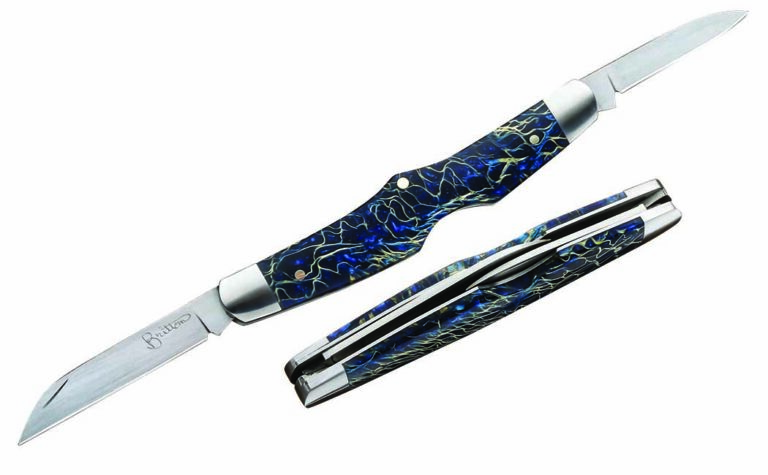
When ABS master smith Bruce Bump showed an old Keen Kutter penknife pattern to veteran knifemaker Tim Britton, Tim fell in love with it and immediately set to making his own iteration.

The blades of his version are BG-42 stainless steel that, as Tim noted, has high ductility and holds an edge forever. He flat ground them on his “ancient” 18-inch, 200-pound Porter Cable disc sander. However, it’s the handle that really stands out.

Consisting of stabilized diseased ash burl from Whistle in the Woods, the material looks synthetic but isn’t. “The light stuff in it looks like explosions,” Tim said. “I’ve never seen anything like it.” The projection on the spine fits right in between the user’s index and middle fingers and the groove on the underside cradles the latter for a comfortable, secure grip.

Tim Britton

Calling it the Badger, Tim made 10 of them and showed them off to the world at BLADE Show 2022 in Atlanta. 

Who Is Tim Britton

Britton has been making knives since 1971 and has spent much of his time recently creating slip joints, of which the Badger is one of his latest. While his knifemaking career started by making hunting knives for dressing game to crafting tactical knives and small folders and slip joints from his shop in Winston-Salem, North Carolina. 

With more than a half century of experience, Britton has carved a place, pun intended, for himself among the top knifemakers in the country.

Badger Knife Specs
Maker: Tim Britton
Blade Steel: BG-42 stainless
Blade Grind: Flat
Handle Material: Stabilized diseased ash burl from Whistle in the Woods
Closed Length: 3.5 inches
Maker’s Price For A Similar Knife: $375

Read More

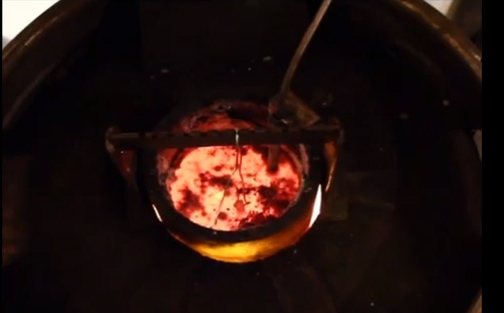
Video: Salt Bath Heat Treating

0

This video from the American Bladesmith Society (ABS) explains how to perform salt bath heat treating. It’s part of the Phoenix knife project ABS members created. You can see video about the incredible ABS Phoenix knife here.

Here’s a bit of background from the ABS about the Phoenix knife:

The Phoenix Knife was originally created by several members of the ABS Board, then disaster struck and it was damaged in a house fire. On its second life, several ABS Board Members contributed in the efforts to bring it back to life including Master Smith Kevin Cashen shown in this video heat treating the blade and bringing the knife back to life. Stay tuned for the third video about “Rockwell Testing” the blade.

To follow the Phoenix knife through its stages, be sure to subscribe to the ABS YouTube channel. There are plenty of knife videos online, but the expert insights from ABS are a cut above.

How to make a knifeAlso recommended is BLADE’s Guide to Making Knives, 3rd Edition. It covers heat treating and many other steps in the knifemaking process.

Knife Handle Ergonomics 101: Getting A Grip On The Basics

1

Design factors are crucial in matching the knife handle and the hand.

It all started with a stone. Held between the thumb and index finger, it could be used to cut things efficiently if the user learned how to keep the edge sharp.
It was the birth of knife technology.

The next step was to attach the stone to a stick. The stick handle afforded more versatility on how the stone blade could be used. Even though it started out looking like a mere piece of broomstick, there is some obvious utility in it since many knives today have the same simple shape. As a result, though knife handle technology did advance quickly at first, it really hasn’t changed that much in several thousand years. The reason is hand ergonomics. There are only so many ways a handle can fit into the human hand, though small differences in handle design can sometimes be profoundly important.

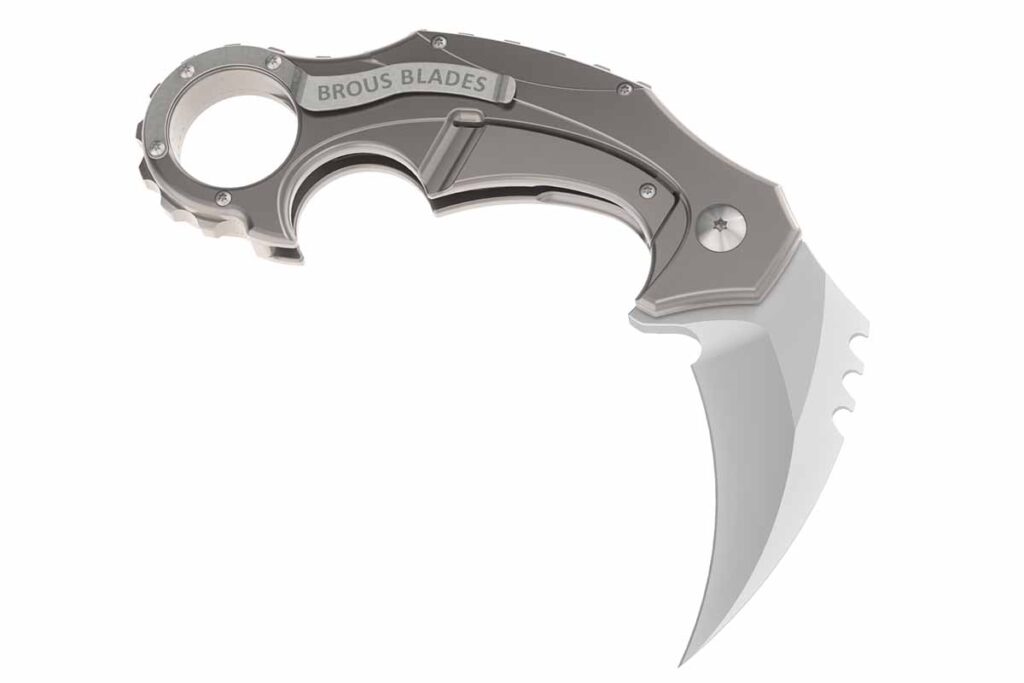
Asymmetric handles can improve grip but also limit versatility.
Asymmetric handles can improve grip but also limit versatility. An example is the karambit. The handle of the Elite Enforcer from Brous Blades is designed to provide a reliable grip in forward or reverse tactical positions. (Brous Blades image)

I bet that, as a knife collector, you have handled hundreds of knives and often exclaimed, “This knife is perfect.” We all have. What did we mean? What were we thinking? I would also bet the knife handle fit very snugly in your hand when you thought that. You were able to get a firm grip while you envisioned yourself using the knife on a camping trip, or perhaps defending your life, or doing a multitude of different tasks. The handle wasn’t too big, nor too little. There were no pressure points or sharp contours that caused discomfort. Your approval of the handle was probably appropriate to the task you were contemplating. However, while all blade configurations are not well suited for every possible task, likewise, for best use the knife handle design must complement the blade to which it is attached.

Cutting Jobs

Let’s simplify knife tasks into four basic categories:

  1. First are the simple everyday cutting chores, better known as “everyday carry” stuff. Open a package, cut a string, peel an apple, it’s just EDC. You think any tool with a sharp edge will do—and you’re right;
  2. Second is where you must open 500 cardboard boxes or a similar job that takes some degree of force and puts a lot of stress on your hand;
  3. Third is where you slice 10,000 tomatoes. Well, private, that’s a rough eight-hour shift in the mess hall! Many kitchen knives have some very non-ergonomic handles. Not a big deal if you’re cutting just one tomato, but in eight hours of doing that your hand might actually get some permanent damage. Yes, permanent;
  4. Fourth is an oft-used example and the pinnacle of all scenarios: defending your life. Oh yes, there has been many a knife made for extreme situations. It’s fun to own a big bowie!

The perfect handle for an EDC has so much latitude that the word perfect doesn’t seem like it should ever be used. Going to the other extreme of the fourth category, the concern would be on grip strength. You would not want to lose hold of the knife during a life-or-death situation. A handle that provides a good grip probably would sacrifice some versatility, though in an extreme situation grip strength is probably more important than versatility.

Size

Is the size of the handle’s diameter really important? There is some leeway here, but once you get into endless tomato and box cutting and especially the need for maximum “grip strength” during life-and-death situations, it is a very important factor. According to many studies, as the handle diameter is progressively increased, so too is the grip strength—at least up to a certain point. After that, grip strength starts to decrease.

It is a bit odd that shoe sizes come in a variety of lengths, even half sizes, and also various widths, but gloves are basically small, medium, large and extra large. Why not size gloves more like shoes? The expression “fits like a glove” might mean you are lucky to find a pair that actually fits.

Does one size fit all? Yes, sometimes. But just like buying shoes, you have to put them on and walk around the store a while. If you plan to climb a mountain, you better be damn sure that the shoes will fit, perform and not cause blisters. If a knife handle feels good, then is it good? Probably so. There are many knife handles that “look good” but the proof is how they feel in your hand, your particular hand.

Knife Handle Diameter

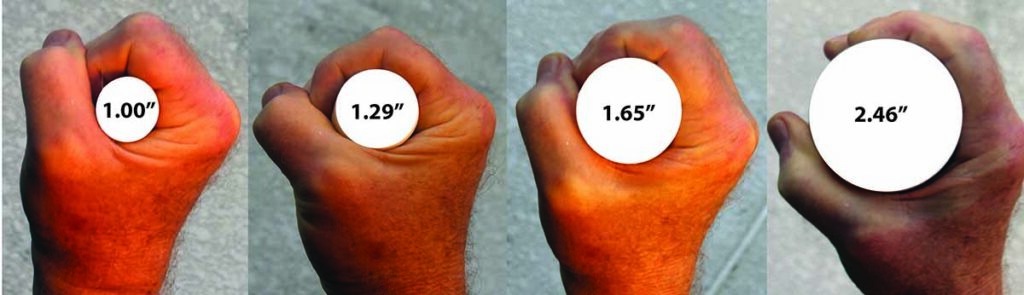
Knife Handle Grip Diameters

Gripping round sticks/knife handles of different diameters results in different ergonomic effects.

The first example shows less than optimal grip strength with a thin handle having diminished contact area between the palm and the handle surface. The force is maximum when the thumb and fingertips are directed parallel to the palm.

The second example favors a strong grip. The fingers are also able to wrap around the handle and there is more surface contact available.

The third example is near the peak of biomechanical advantage. Grip strength might be a little improved from the second example or perhaps a little diminished. Not very different there. Importantly, the thumb and fingers can still cross over each other. There is more advantage from friction. This might be the best fit for a baseball bat. Yet for a knife there will be less ability to change the hand position, which may be a disadvantage. Some consider a diameter of about 1.5 inches to offer the strongest grip and this example is a little larger than that.

The fourth example is loss of grip strength. The fingers can’t encase the handle. The strong ergonomic “power grip” is transforming to the ergonomically weaker “pinch grip.” —by LeRoi Price

Hand vs Handle

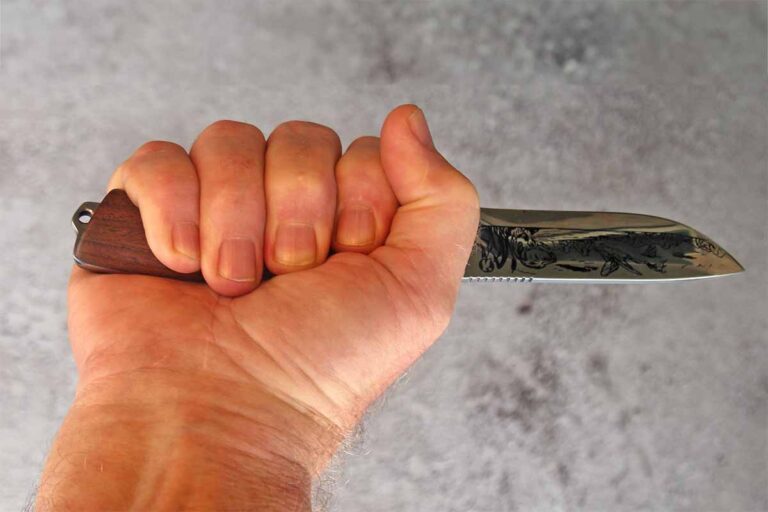
We already know about handle diameter. What about shape? Though the round shape of a broom handle works for a knife handle, an oval configuration fits well into the hand and, importantly, allows for indexing of the blade’s cutting edge. Most knife handles have a basically oval cross section.

Form follows function but it begins with ergonomics. There are several dedicated handle configurations that are suited well to a special purpose but are mainly limited to use for that single special purpose. One of the most notable examples is the karambit handle. Asymmetric handles can improve the grip but also limit versatility.

The anatomy, ergonomics and biomechanics of the hand present some challenges for handle design.

Palm Anatomy

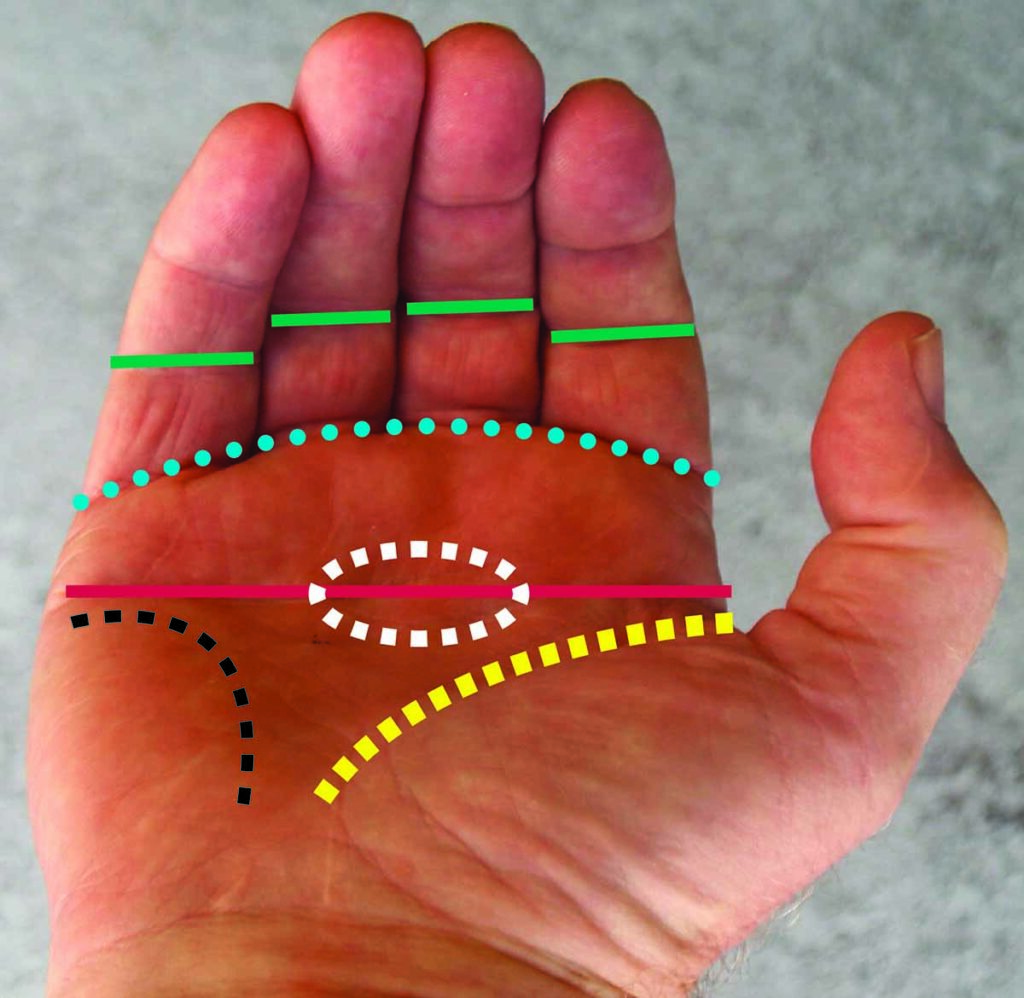
Palm Anatomy

Prominent features of palm anatomy play a pivotal role in hand ergonomics. The red line is the actual bending point of the fingers. The blue dots are where the fingers bend from the palm. The green dashes are the second of the three bending points of the fingers. The yellow squares represent the prominence of the base of the thumb. The black hyphens indicate the small prominence of the heal of the hand. The oval of white squares is a hollow space in the center of the palm.

Note: the hand is not like a door hinge. These lines move as the hand goes from flat open to a closed fist. Now look at the back of your hand as it goes from open to a fist. The knuckles go from a fairly flat line to a downward curve. The finger joints all have a different radius at which they bend.
Hand ergonomics is not a static condition, which makes things difficult for handle design.

Handle Subtlies

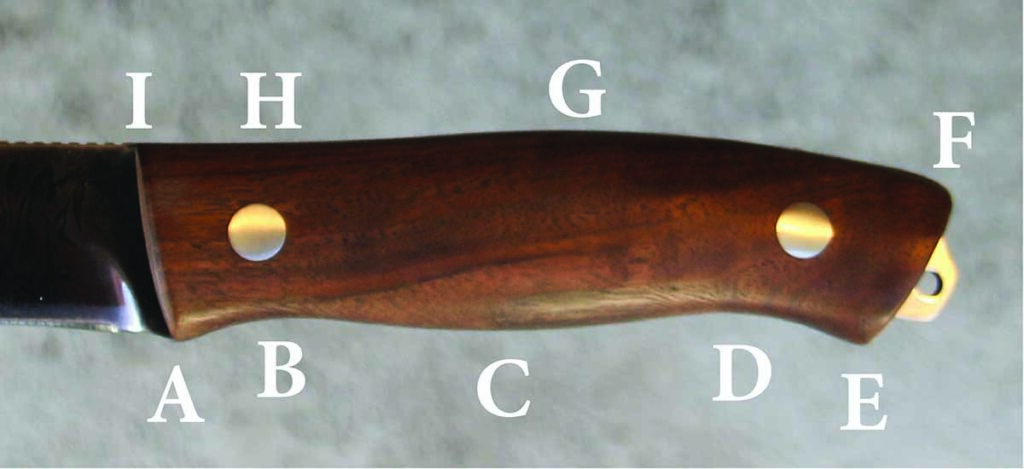
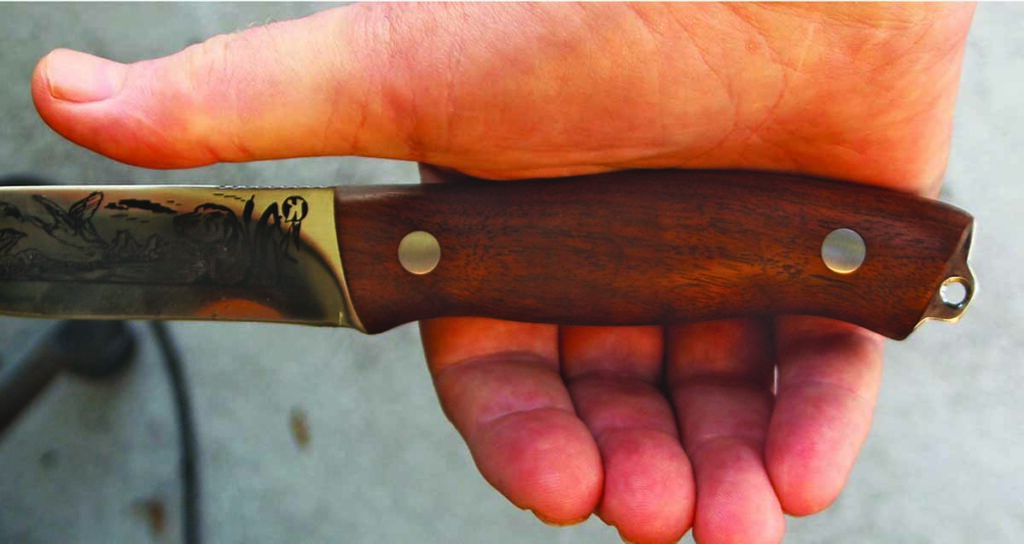
Here is a simple camp knife and somebody made it right. I’ll point out my reasons why starting with the finger groove (B). It is well demarcated though not deep nor very pronounced—just like all the subtle features of this handle. This allows the handle to be more easily manipulated than if the fingers are forced into deep recesses. The groove fits the index finger.

A slight forward rise (A) forms an integral guard. This is an important feature. Some knives like this one have a brass guard in front that is not just mere decoration. A rising protrusion (C) fits into the space of the middle and index fingers. Then it’s down to the groove where the little finger resides (D). Another protrusion (E) captures the little finger and forms a rear guard—again, important for a camp knife.

Area “F” extends more rearward and slopes down to contact the heal of the hand. A slight swell (G) fits into the palm. Some knives are flat in this area but that doesn’t fit hand anatomy well. The handle has a very subtle hollow at “H.” This is where the web of the thumb makes contact, which makes it best to keep it subtle. Area “I” rises slightly here but often is left flat in many knives. This is where you place your thumb when doing some tasks. Putting a guard on the handle spine is less effective than putting one underneath because there are no bones in the thumb web—though slightly rising at “I” is useful.

Conclusion

There is no agreement on the shape of the perfect handle, so you are left with my opinion. On the other hand, you have something to think about and can investigate further. My opinion is this: While there is no such thing as “perfect,” there is still “good enough.” The same can be said for a lot of things.

The handle’s outer contours attempt to nest into the hand’s inner contours
The handle’s outer contours attempt to nest into the hand’s inner contours. A perfect fit of the handle into the palm would not necessarily make for the so-called perfect handle since there are so many variables, such as the strength a particular finger can generate, the forces the blade will be subjected to during use, wrist angle to the blade, slippery conditions, etc. Non-slip handle texture is a different topic altogether, as well as a spongy outer surface that slightly conforms to the user’s palm.

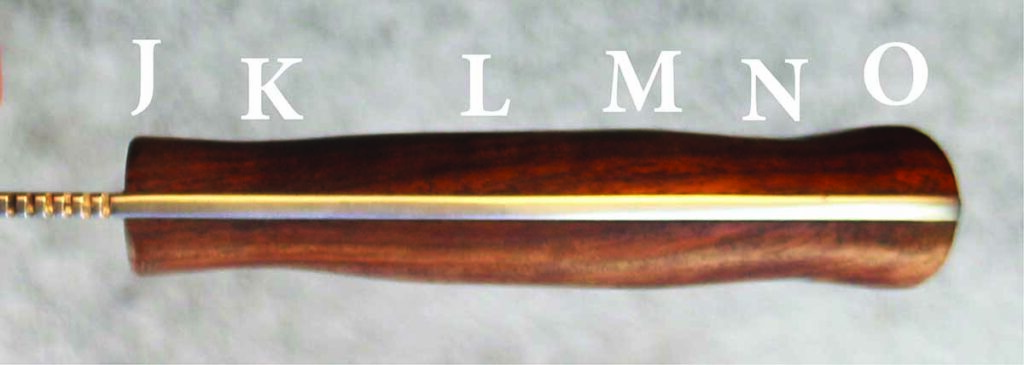
I shouldn’t give numbers but I know you’re going to be curious about some. For a 5-foot-8-inch man, shoe size 9D which correlates to a large size glove, the handle configuration should be oval with a top-to-bottom dimension of 1.125 inch and 1 inch width. These suggestions are approximate, of course, but are the actual dimensions of the pictured camp knife seen with a handle length of 4.675 inches. (Go up to perhaps 1.5 inches height for a combat knife.) The back of the handle should be convex as well as the lower belly. A shallow groove for the index finger is a good option, and perhaps a second one for the middle finger as well. More finger grooves improve grip strength but are a detriment to the ability to manipulate the knife. They also add pressure points.

Ergonomics in a folder also? Absolutely!
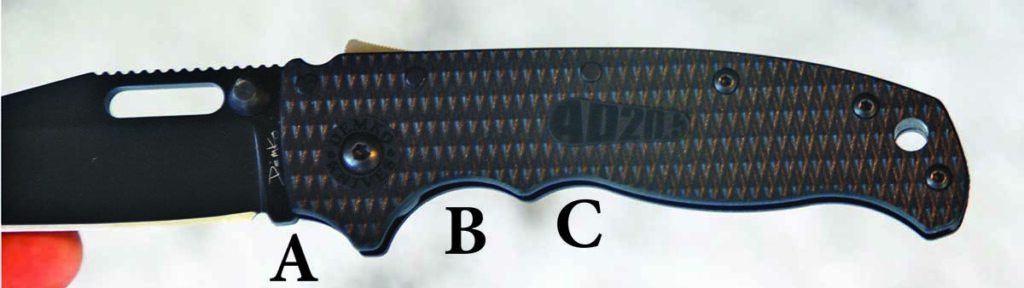
Ergonomics in a folder also? Absolutely! A Demko AD20.5 has a protrusion/integral guard between areas “B” and “C” that creates two finger grooves. The extra finger groove as well as the protrusion/integral guard forward of “B” are good ideas in a folder. The features increase grip strength, which is hindered in folder handles since they are thin compared to fixed-blade handles. The front of the handle is not squared off, which provides for a finger groove at “A.”

When you find a knife handle that doesn’t feel right, it is probably not right for you. Nonetheless, finding one that fits your hand “good enough” is probably the best you can do, and all you need to do.

More On Knife Handles:

Advertisement

Must Read Articles

Read this before you make a knife

Knifemaking 101 – Read This Before You Make a Knife

  by Wayne Goddard My experience has taught me that there's nothing like digging in and getting started. I've often said the hardest part of the...
how to forge damascus steel

How to Forge Damascus

Advertisement
Advertisement