5 LEADING SHARPENING RODS TAKE THE AUTHOR’S SHARP TEST
The sharpening rod is perhaps the No. 1 kitchen knife accessory in many households. Why? Usually 8 to 12 inches long, it is a hardened steel rod with a coating of industrial diamonds that helps abrade steel and lightly sharpens a cutting edge. Most models are basic and there’s not much to them. They are more effective than standard butcher-type steels that align the edge and don’t remove material, and are good for regular maintenance of kitchen knives in between professional sharpening.
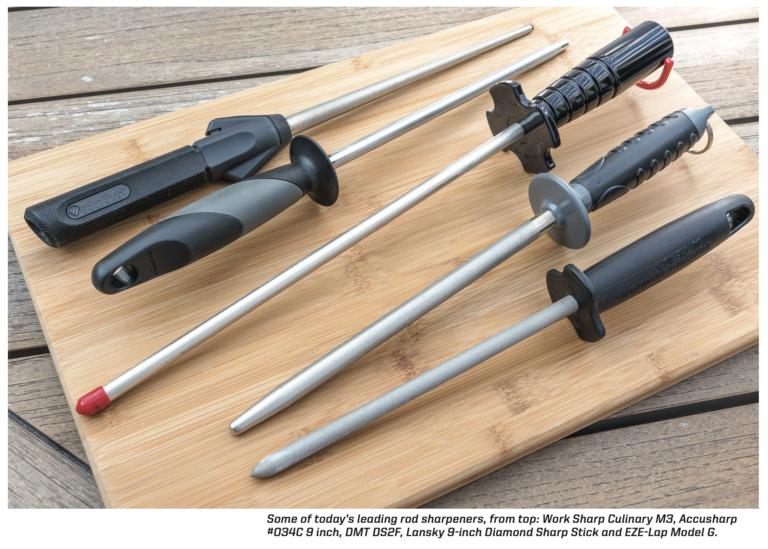
Accusharp 9-inch
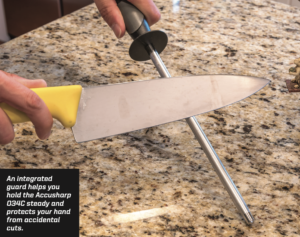
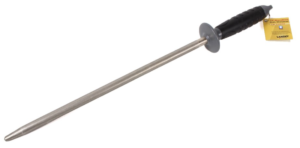
Accusharp offers a 9-inch sharpening steel, model #034C. The ergonomic, rubber overmold handle makes it easy to hold thanks to the non-slip grip. It stores easily in a drawer or hangs from an extra-large handle hole. The guard is round, so the sharpener will roll when you set it down, which can be annoying. It does not come with a container for protection while not in use.
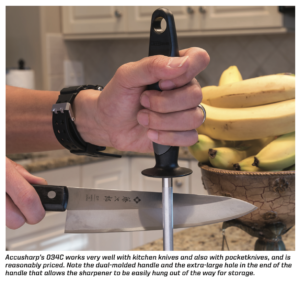
The steel and its fine abrasive in a 1500 grit maintains a blade well. My only complaint is with the soft rubber part of the co-molded handle. The rubber is in a diagonal shape and on one end closest to the guard of the test model, it is visibly raised and you can peel it back a bit. However, if it comes undone, you can easily fix it with a strong adhesive. Country of origin: China. MSRP: $34.99.
TOOTHIER EDGES: Lansky’s Diamond Sharp Stick
The handle of Lansky’s 9-inch Diamond Sharp Stick is a dual-material, rubber overmold for both comfort and durability. Like most sharpening-steel handles, a full integral guard protects your hand from accidental cuts. A split ring affixed to the handle’s end provides for hanging the rod on a hook or nail.
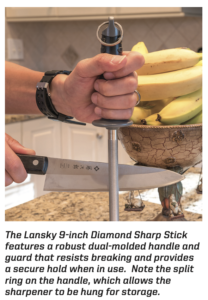
The Sharp Stick has a hard plastic tube that fits over it and secures in place by an O-ring that slides down the rod close to the guard. You can remove the O-ring but you must leave it on to take advantage of the hard plastic tube to protect the sharpening rod surface when stored. The O-ring is positioned far down on the handle to not interfere with operation.
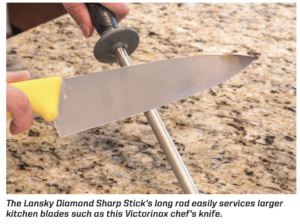
I discovered something interesting with the Sharp Stick. As with all the test models, the grit is fine but the Lansky seemed most aggressive in the cut and produces a toothier edge than the rest. In my opinion this is very good, as I prefer a toothier edge on my kitchen knives, though some do not.
The rubber gripping portion of the handle is textured well, and offers a great purchase with wet or dry hands. The guard is also robust in appearance, as some equate robustness with better quality. That’s not always the case but with this one it definitely is. Country of origin: China. MSRP: $33.99.
Diamond Machining Technology (DMT) DS2F
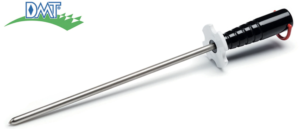
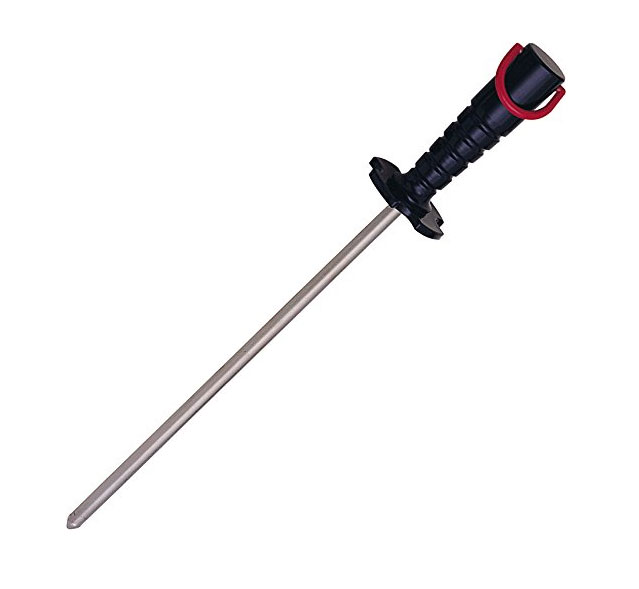
In my opinion, the Diamond Machining Technology (DMT) DS2F diamond sharpening steel is superior in several ways to the balance of the test rods. The fine-grit diamond-coated model has a red plastic/rubber tip. DMT uses a color-coded system to denote various grits, including red for fine. The tip also helps stabilize the rod on a flat surface. The DS2F ships in a nice, clear vinyl pouch that locks around the guard. The pouch is great for storage.
While the other test models have dual-molded handles that incorporate hard plastic and firm rubber for comfort, the DMT has a hard plastic one. However, don’t turn your nose up just yet. The handle tapers gradually toward the guard, which makes the entire grip fill your hand nicely. There are also five grooves on the tapered part that enhance a secure hold. The guard has four semi-circular cutouts to provide anti-roll qualities, which I really like. The DMT doesn’t roll at all when you put it down. A plastic shackle attached to the handle end for hanging also is color-coded to grit. The shackle can be removed if you desire. It’s creature comforts like these that make the difference between a good product and a great one.
The DMT is definitely a top performer. The 12-inch rod captures pretty much all sizes of kitchen knives. Of all the test models, I felt the DMT produced the finest edge, that is, the edge isn’t toothy or grabby, it’s just plain sharp. The D2SF leaves a nice, refined finish on the cutting edge.
One thing about the handle shape: Since it tapers toward the guard, it forces you to nestle your hand up against the guard when holding it. This stabilizes the sharpener in your hand. When you grip it farther away from the guard, the sharpener isn’t as stable—something to consider. If you prefer holding your sharpening rod, you might want to get the DMT for this very feature. This is just a top-notch, high-end sharpener. Country of origin: USA. MSRP: $53.59.
EZE-Lap Model G
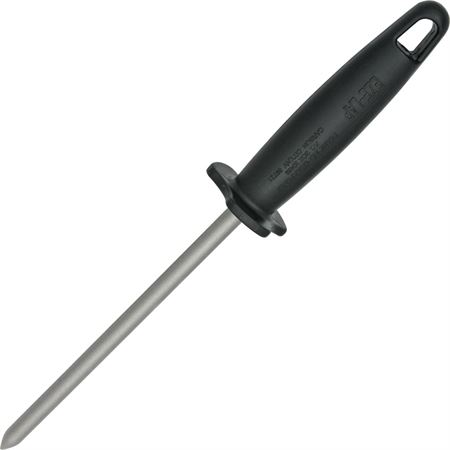
The 8-inch EZE-Lap Model G is the shortest of the test models. The shorter rod allows for easy use as well as com pact storage inside a drawer. It comes in a fine grit to produce a nice working edge in a minimal amount of time. The large-diameter plastic handle has enough girth for a comfortable hold. The integral guard is very much like the DMT D2SF’s, with a non-round shape that helps curb rolling on a flat surface. Well done! An extra-large handle hole promotes hanging for storage.
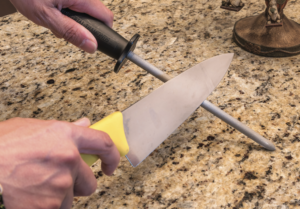
The thing about a shorter rod like the Model G is you must be quick on the draw when working on longer kitchen knives, such as 8-inch chef’s knives and up. Compared to 10- and 12-inch rods, you’re losing real estate to work from and must pull the blade across the length of the Model G quicker. For shorter blades, this should not be an issue. On the other hand, the smaller size is ideal for camping, traveling in an RV, etc.
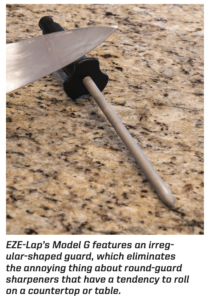
The Model G ships in a stiff paper sleeve, which can be reused to protect the rod as well as other items stored near/by it. The sharpener felt very coarse to the touch out of the packaging. All diamond sharpeners do. As you use them they will smooth out, though this has no bearing on performance, and performance-wise the EZE-Lap does very well. Country of origin: USA. MSRP: $31.95.
Work Sharp Culinary M3 Sharpener
The Work Sharp Culinary M3 sharpener takes the basic diamond-coated steel rod sharpener and improves on its function by offering choices. The M3 comes with not one but two rods—coarse-grit steel with a diamond coating and a fine-grit ceramic rod. Both rods interchange with the included ergonomic handle and are secured in place by strong magnets.
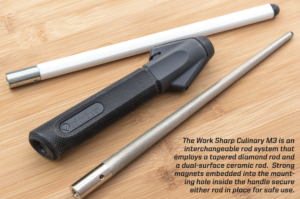
The 8.25-inch steel rod tapers gradually from handle to tip. At the end of the rod is a rubber button, which helps stabilize the sharpener when the end is placed on a table or countertop and the handle is held with one hand. It sounds like a typical steel rod until you get to the handle.
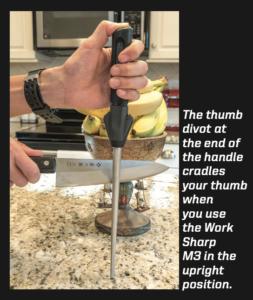
Instead of the standard integral, flared guard is a pair of ramped surfaces that serve as angle guides. When you hold the sharpener upright, place the side of the blade on the rod and rest it against the ramped surface. Then, with the standard motion using a rod sharpener, travel down the rod, holding the blade at the preset angle. Bring the opposite side of the blade to the other side of the rod and repeat. The gripping part of the handle is firm-textured rubber, and a thumb divot on the end helps stabilize the sharpener in use.
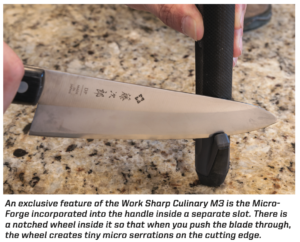
A little “MicroForge” slot in one of the guides contains a small yet wide serrated wheel. After you get a sharp edge, remove the rod from the handle and place the end of the handle on the table, in similar fashion to how you were sharpening. Place the blade in the slot at the tip. With light pressure, push the blade through until the handle gets to the tang, then stop. The serrated wheel will crimp the edge slightly, forming tiny and evenly spaced micro serrations. The serrations act like bigger serrations found on other kitchen knives. Using the MicroForge feature is not mandatory, but it is designed as an additional function to help provide the longest-lasting edge possible.
The steel rod cuts fast to restore dull edges. It provides a working edge in a minimal amount of time. Follow up with the fine ceramic rod after the edge has been established to refine it further. The ceramic rod’s smooth and fluted sides give a choice of edge finishes: a bit more bite with the latter and a more polished edge with the former.
The M3 ships in a sturdy cardboard box, the sharpener parts store inside a tray, and the tray slides into the box. The steel rod has a protective plastic sleeve, too. It is the most comprehensive of the test lot. Country of origin: Parts sourced globally, U.S. assembled/calibrated. MSRP: $69.99.
HOW TO USE A ROD
No matter the brand or model, sharpening steels are used the same way. Most manufacturers recommend using one while standing at the kitchen counter or seated at a table.
Take the sharpening steel and place the tip on the table, held upright with the handle at the top. With one hand, grasp the handle firmly, keeping it perpendicular with the flat surface at all times. With the other hand, grasp the knife handle and place the blade at a 20-to-30 degree angle in relation to the sharpening steel. Place the blade as close to the guard as possible, set to start at the part of the blade closest to the tang. In one motion, move the blade down the length of the rod while at the same time draw the blade fully across the steel. When you near the flat surface you are working from, though without touching the surface, you should be at the blade tip.
Raise the blade to where you started from, switching the blade to the opposite side, then repeat the same stroke. Then, return to the side you started from, and repeat once again. Do an equal amount of strokes for both sides of the blade.
As you become more comfortable using the sharpening steel, you can forego the flat surface and hold the steel with one hand similar to how you would a large kitchen knife. With the other hand, place the blade on the rod at the recommended 20-to-30 degree angle and lightly push the blade across the rod, ending at the blade tip. I highly recommend you not proceed to this step until you are confident enough, because with this alternate method chances for not holding the angle correctly is greater.
Whatever method you use, remember to always use light strokes. There is no need to bear down on the blade with pressure. Let the rod do the work.