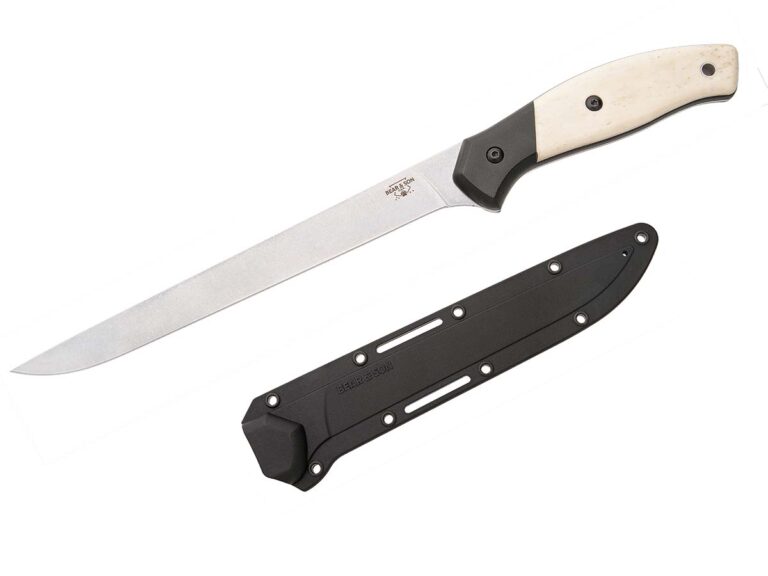
Bear & Son Cutlery’s new White Smooth Bone Professional Fillet Knife delivers precision, durability and American craftsmanship for serious anglers.
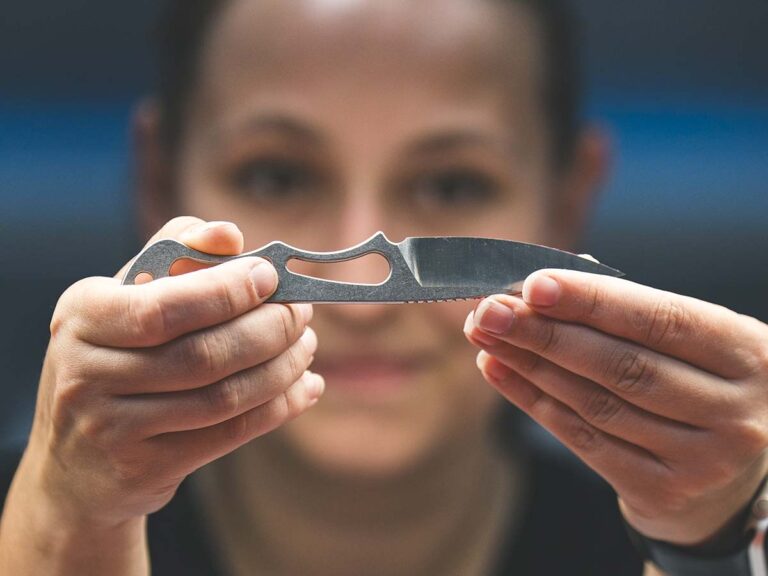
Summer fishing season just got a serious upgrade. Bear & Son Cutlery has introduced the new 11 7/8-inch White Smooth Bone Professional Fillet Knife, a purpose-built tool for anglers who demand precision from dock to dinner table.
Crafted in Alabama by a company known for keeping every step of production in-house, the WSB66 combines classic styling with modern steel performance. Bear & Son Cutlery’s fully self-contained factory handles everything—from blanking dies and heat treating to grinding, assembly, and hand-finishing—ensuring consistent quality and genuine American craftsmanship in every knife.
At the core of the Professional Fillet Knife is a 7-inch Sandvik 14C28N stainless steel blade, engineered for razor-sharp cuts, long-lasting edge retention and resistance to corrosion, even in saltwater environments. Whether trimming trout in the mountains or breaking down snapper on the coast, the blade delivers clean, efficient slices with ease.
Weighing just 4.9 ounces, the knife offers balance and control that make quick work of everything from panfish to redfish. Its White Smooth Bone handle provides a secure, comfortable grip while adding a touch of traditional character. A protective plastic blade guard ensures safe transport and storage, whether stowed in a tackle box or kitchen drawer.
True to Bear & Son’s mission of building affordable, American-made knives, the Professional Fillet Knife is designed for anglers of all levels—weekend fishermen, seasoned guides and anyone who values a dependable blade at camp or on the water.
White Smooth Bone Professional Fillet Knife Specs Blade Material: Sandvik 14C28N Stainless Steel Handle Material: White Smooth Bone Overall Length: 11 7/8″ Blade Length: 7″ Features: Protective Plastic Blade Guard Weight: 4.9 oz. Origin: Jacksonville, Alabama MSRP: $140
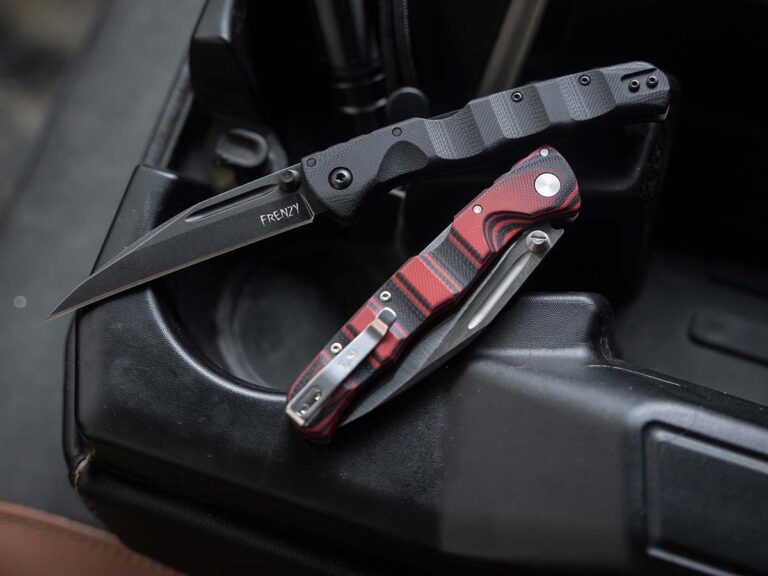
Discover the new Cold Steel Frenzy II folding knife, designed by Andrew Demko and inspired by the Japanese Kabutowari.
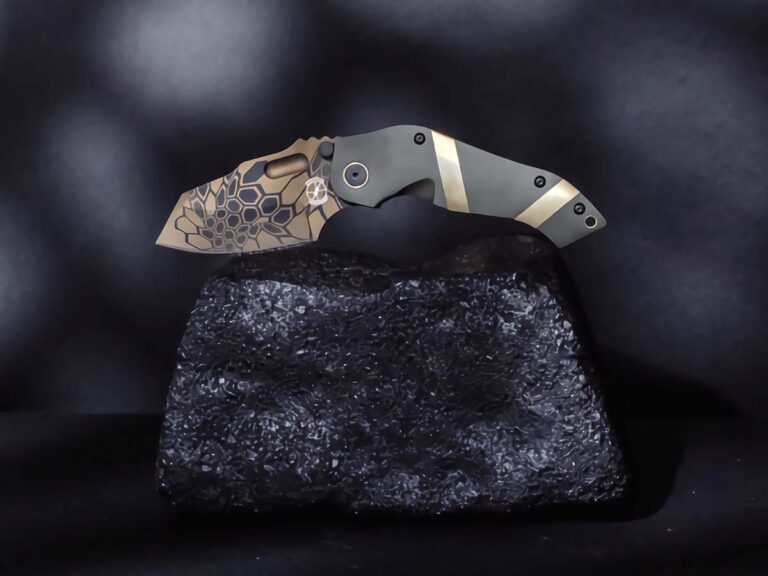
Cold Steel has never been shy about bold designs, and the new Frenzy II folding knife is no exception. Designed by custom knifemaker Andrew Demko, the Frenzy II takes its cues from the ancient Japanese Kabutowari and morphs those warrior-worthy aesthetics into a mega-folder ready for today’s EDC crowd.
Let’s start with the blade. At 5.5 inches, it’s not subtle—but it is refined. Forged from premium S35VN powdered steel, the long, flat edge and needle-sharp point make it as functional as it is fearsome. You get top-tier edge retention, durability and slicing performance, all dressed up with a satin line-grain polish and a deep fuller that plays with light like a katana in the sun.
But Cold Steel didn’t stop there. The Frenzy II is all about balance—of power and precision, size and slimness. Despite its impressive blade length, the handle is slim, flat and built for pocket comfort. Crafted from dual-tone, 3D CNC-machined G-10 scales, it’s grippy, eye-catching, and disappears under a shirt tail. This knife may look large, but it carries light and lean.
And yes, the Frenzy II comes equipped with Cold Steel’s bombproof Tri-Ad lock, so when that blade is deployed, it’s staying put. That kind of confidence is why Cold Steel has earned the trust of law enforcement, military and serious knife users for decades.
So, who’s the Frenzy II for? Anyone who appreciates a fusion of heritage-inspired design and modern performance. Whether you’re a collector, a gear geek, or someone who just wants a folding knife that can go toe-to-toe with fixed blades, this one’s worth a serious look.
Frenzi II Specs Weight: 5.7oz Blade Thickness: .14″ Blade Length: 5-1/2″ Blade Steel: American S35VN Handle Length/Material: 6 3/4″ Long Duo Tone G10 Overall Length: 12-14″ Additional Features: Pocket / Belt Clip Knife Type: Folder Blade Length Range: 5+ in Steel Family: CPM Blade Shape: Sheepsfoot Locking Mechanism: Tri-Ad Lock
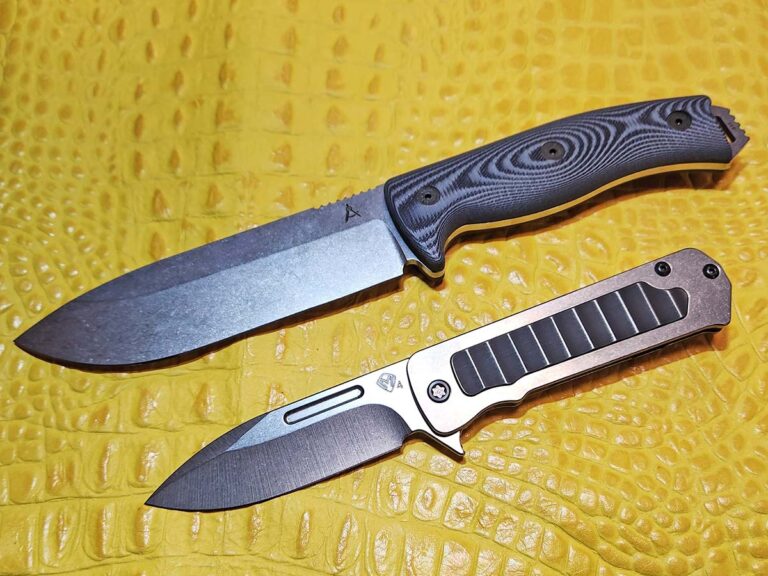
Explore the world of build-your-own knives with firsthand reviews of Medford’s TFF-4 folder and Architect’s AK 5.5 fixed blade.
In my early days of being a knifemaker, the internet played a factor in my business, largely in getting me exposure on various knife forums. As the years passed, it helped grow my enterprise, making international sales possible. These days, you can hardly imagine a knife business without the ’net.
One of the greatest challenges was helping customers decide on their orders. I had a “record” exchange with one customer of 51 emails to nail down the order. Needless to say, I later deleted the customer’s email from my files.
One way for knife enthusiasts and makers to avoid such kerfuffles is for the customer to “build” his or her knife on the company’s site and get the price, all in real time. Enter two of the outfits that provide that service today: Medford Knife & Tool and Architect Knives (there are others as well).
I went to both sites, followed their processes and “assembled” my knives. Following are the results.
MEDFORD TFF-4 Build
If you’ve read my articles over time, you know I have a thing for knife names. While TFF-4 (starting MSRP $550) doesn’t stand out, I must start cutting companies some slack as the sheer number of manufacturers makes giving a model a name that’s not already taken nearly impossible.
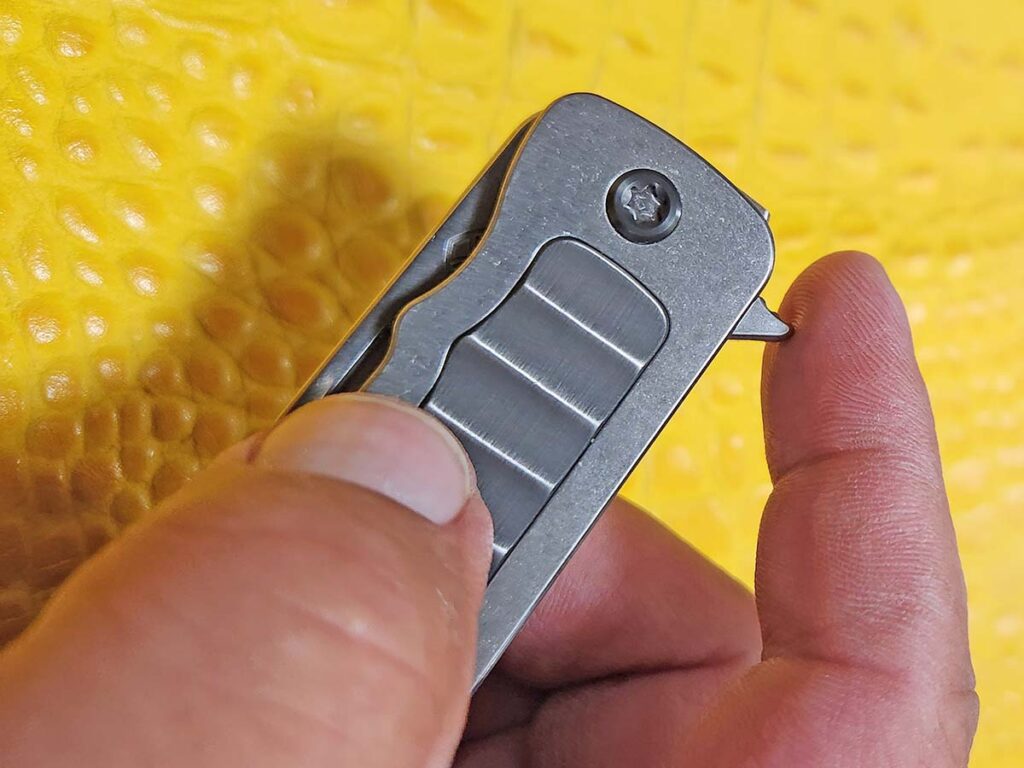
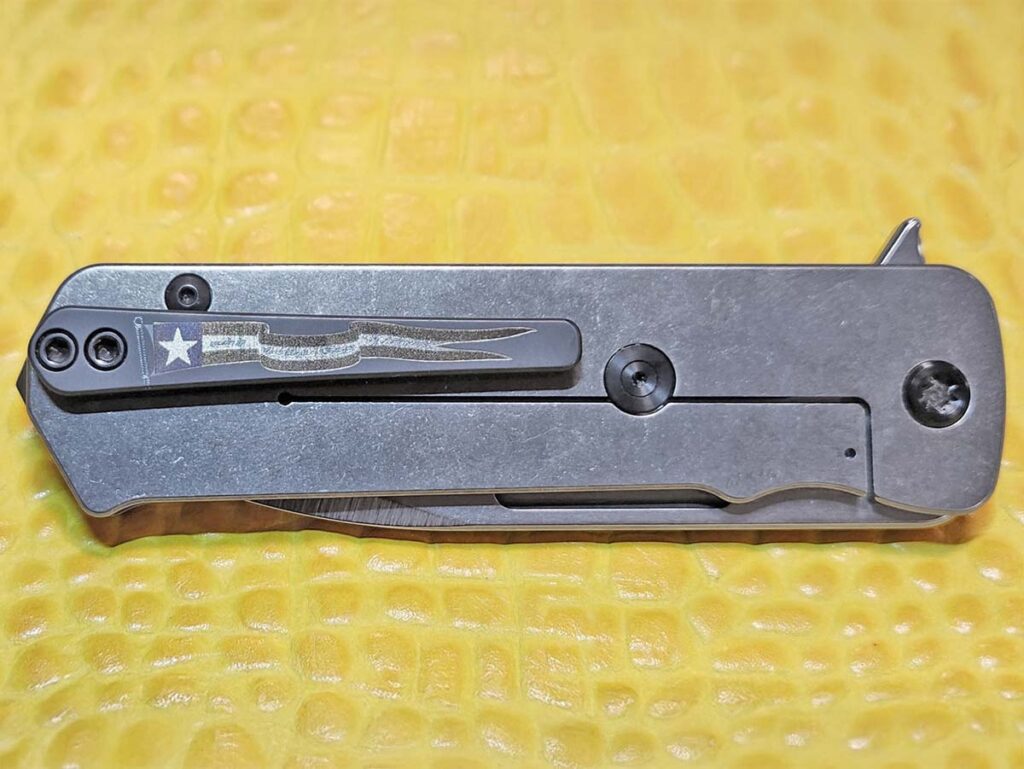
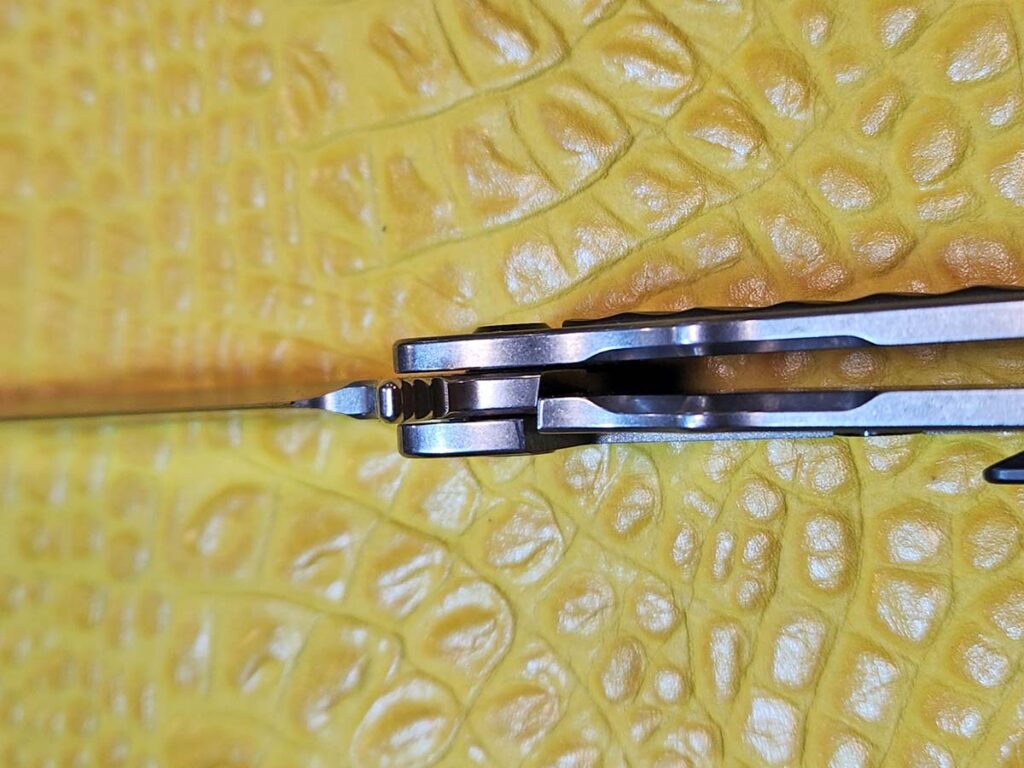
The flipper action is crisp and quick on the TFF-4. Medford provides a pronounced flip so you can quickly deploy the blade.
Anyway, back to the build.
Go to the Medford site and make your way to the “build your own knife now” button. You have three choices: folder, fixed blade or auto. Each of the applicable website pages gives you an overview of the models available. I chose folders and the TFF-4.
It couldn’t be much simpler. Follow the process starting with blade type. As you make each choice, the knife evolves and you start to see it develop. For instance, if you choose the bronze finish the color changes to match your choice. Keep in mind the devil is in the details, so play around a little bit. Either you can have everything match or you can play with contrast.
“I decided to go with a contrasting presentation by making the pivot point, screws and handle inlay black along with the spacer,” the author wrote of the TFF-4. “I could have just made the inlay black and matched the rest to the body. Options are the beauty of a build-your-own knife. I ordered the clip in black as well.”
There were only a couple of cons with the build. Granted, this is my opinion. The example knife was at the top of the page, so as I scrolled down to make my selections, I was constantly scrolling back up to see the result. Secondly, there is no visual representation of the inlay until you choose it. You select your inlay from a pull-down menu and then color options for the inlay from a second pull down. Small things, I know, but they aren’t hard knocks for me. The process still went slick as goose droppings on ice. Part of the fun is going through a number of variations. I just wish I had the money to order all the ones I like.
Medford Results
Tank best describes the resulting TFF-4. If Gucci made a tank, this would be it. I mean this in a nice way. It has style and is built solidly—think a Chris Reeve Sebenza on steroids. It’s clean and the finish is impeccable. It is a framelock design built to point. Lock up is solid and it releases smoothly with no sticking.
As the author noted, it is a lot trickier at times to get a quality lock up on a linerlock or framelock. “On the TFF-4’s framelock Medford has matched the balance between solid lock up and ease of use,” he assessed.
The blade is hollow ground from S45VN stainless. Keep in mind, you don’t have a choice of steels. Medford leaves grind lines on the hollow grind and a false grind to contrast the flat. I enjoy a hollow grind on my folders, as they are easy to get razor sharp due to the fine edge. The TFF-4 is a flipper design and opens lightning fast.
For carry, it has a robust designer clip. A downside to a sturdy clip can be that it’s difficult to attach to some pockets. The TFF-4 clip being so tight with a small opening angle makes it a bit difficult to capture some pocket rims.
Medford provides a solid user with its build-it-yourself folder. I like the clean presentation and have enjoyed carrying it. My experience with its one-handed operation has guaranteed it’s going to be riding in my pocket regularly.
ARCHITECT AK 5.5 Build
In the AK 5.5 (MSRP $285), Architect Knives offers a build-it-yourself EDC fixed blade. The blade lengths range from 3 to 8 inches in half-inch increments. At first, I saw what I thought would make an excellent bushcraft camp knife. I chose the AK 5.5 for the aesthetics and larger outdoor chores. Had I wanted an urban EDC, I would have gone with the 3-inch blade; in fact, I might still do that.
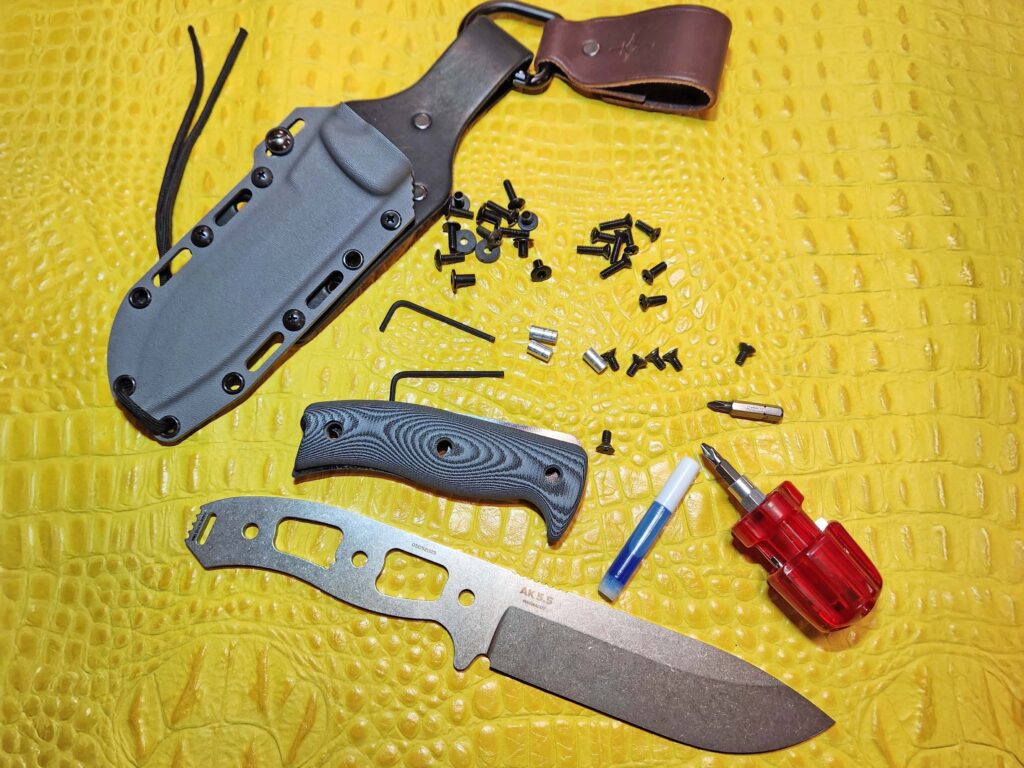
When the author pulled everything out of the bags for the Architect AK 5.5, this is what he got. The sheath was assembled. A threaded post system attaches the scales, and there were plenty of extra screws for the sheath and handle. All the bags are quality and of the Ziploc® type. Tool users will appreciate them.
To start the build process, Architect provides an icon-driven selection menu to the left and you get to see your knife develop to the right. From mine, I chose MagnaCut stainless steel, Midnite 1×1 layer G-10, and a gun-metal grey Kydex sheath with leather backer and a dangler attachment.
Operating the site was a breeze. Navigating the plethora of choices was what took time. There are too many to list here. Let’s just say if you can’t find a carry style you like with all the options Architect provides, a paper bag is your only choice. It truly was a breeze to design my AK 5.5. Each icon activates a pull-down menu of options you can choose from while still viewing your example.
ARCHITECT Results
Architect sends you a knife but it is more like you receive a kit. The knife shows up with some assembly required. You get your blade, all the hardware (plus extras) and all your options. The company provides some thread-lock epoxy and two Allen keys for the handle hardware. You will need a slotted screwdriver and a Phillips to assemble the sheath. It wasn’t much work and everything went together in a matter of minutes. I assembled mine in the front seat of my truck in the parking lot. Yes, I carry tools with me.
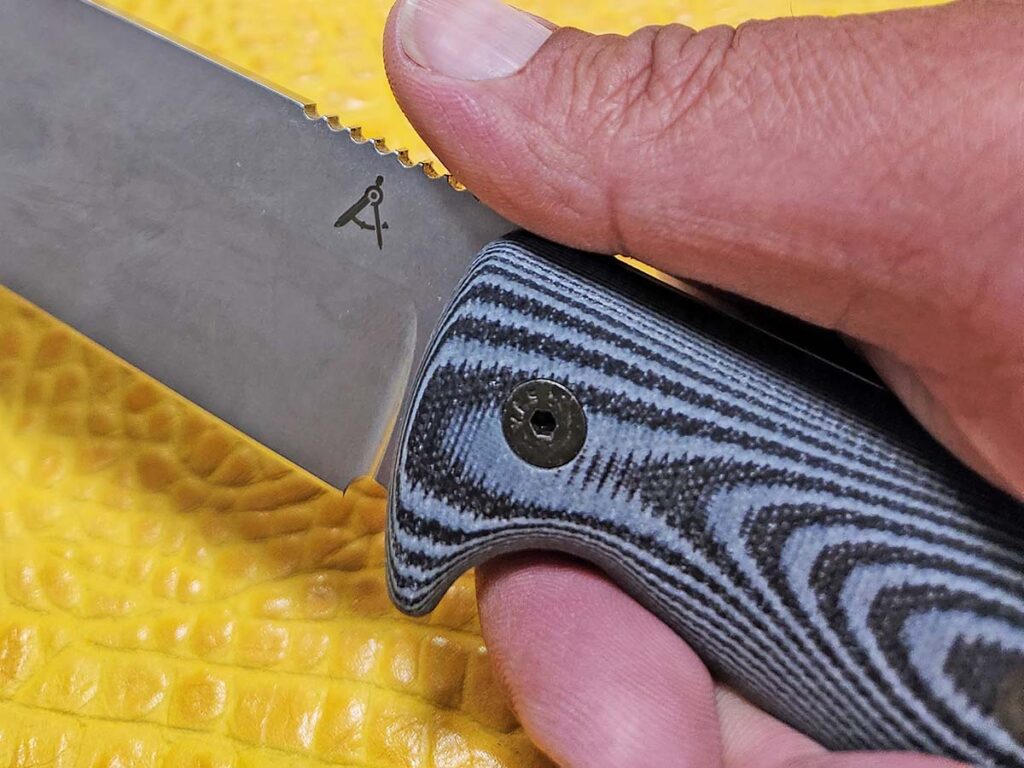
“I like thumb gimping,” the author stated of the feature on the AK 5.5, “but I will probably knock it down a bit.”
My AK 5.5 came shaving sharp out of the box. I was immediately impressed with the ergonomics of the handle. It has an extended tang with gimping and the extension has a lanyard hole. There are a number of carry options, as mentioned. I chose the Kydex with leather belt loop. The Kydex has a tension-adjustment screw and I customized the tension to my liking. As an extra I got the dangler option, which Architect gets from Casstrom with the “D” carabiner.
The blade sports a high saber grind and the spine has gimping for a thumb rest. I found the gimping a tad crisp on my thumb. It’s a sturdy knife and definitely a cutter. At the rear of the edge is a micro choil. I often find micro choils get caught up on things. The blade carves well but, as to be expected with its 1.5-inch width, it doesn’t excel at detail work. Overall, I am very pleased with the knife and would have no issue taking it on an adventure.
No Downsides
As a maker, I see no downside to building a knife online. As a customer, I see no downside, either. For both parties it streamlines the design processes and allows instant generation of information. Best of all, for the customer it eliminates a lot of the guesswork and stress associated with ordering.
Spartan Blades and KA-BAR announce the launch of Euro Blade Worx (EBX), a new joint venture in the Czech Republic.
Pineland Cutlery, Inc., dba Spartan Blades, announces the launch of Euro Blade Worx (EBX), “a major new international initiative designed to meet the growing demand for premium knives in the European market.” Formed in collaboration with American knife manufacturer KA-BAR Knives and Czech knife designer Ondřej Němec, the joint venture represents a strategic move to localize production and better serve European customers.
Headquartered in South Moravia, Czech Republic, EBX was established to solve a common challenge for European buyers: accessing high-end knives without incurring the burdens of overseas shipping costs, customs duties, value added taxes and long delivery times.
As Spartan Blades and KA-BAR expanded their presence in Europe, it became clear that a local manufacturing solution was essential.
“For years, we attended the IWA Outdoor Classics trade show in Germany and heard the same thing over and over: ‘Your knives are excellent, but they’re just too expensive to get here,’” said Curtis Iovito, co-founder of Spartan Blades and president of product development and marketing at Pineland Cutlery. “After listening closely and exploring our options, we realized the best path forward was to manufacture directly in Europe.”
That vision led to a partnership with Ondřej Němec, a respected Czech knife designer and entrepreneur with deep roots in both trade and knife craftsmanship. Němec had previously founded and led a successful knife brand in the region and had collaborated with both Spartan and KA-BAR on earlier projects.
“As soon as we started working with Ondřej, it was clear he shared our values—precision, quality and a deep respect for the craft,” Iovito said. “He understood what we were trying to build before we even finished laying it out.”
With more than 153 years of combined knifemaking experience between Spartan Blades, KA-BAR and Němec, EBX brings together heritage and innovation in a facility equipped with advanced machining, grinding and assembly capabilities—fully supported by European logistics and operations.
In its first year, EBX will focus on producing and distributing Spartan Blades and KA-BAR knives within the European Union, dramatically reducing shipping times and removing many of the barriers that previously stood in the way of European customers. Looking ahead, the company plans to expand its capabilities to support other premium knife brands seeking access to the European market.
“This is more than a factory—it’s a knifemaking and logistics hub designed for the next generation,” said Němec, EBX’s new managing director. “We’re blending European manufacturing tradition with American design innovation to serve a truly international community.”
By uniting American legacy brands with European craftsmanship, EBX is poised to redefine how premium knives are made and delivered across the continent.
Sniper Bladeworks is sharpening its presence in the independent retail market.
The Kansas City-based tactical knife brand has officially joined forces with Nation’s Best Sports (NBS), a premier buying group serving more than 450 independent sporting goods retailers across the country. As one of only a handful of cutlery vendors approved for NBS, Sniper Bladeworks will debut its partnership at the upcoming NBS Fall Semi-Annual Market, held August 18–21 in Fort Worth, Texas.
For Sniper Bladeworks, this moment marks a major step forward in its mission to get quality, hard-use knives into the hands of professionals and working Americans. “Heartfelt thanks to Tyler and the entire NBS team for entrusting our brand and product,” said Sniper CEO Adam Pener. “Being an approved NBS vendor means something, and we’re honored to be part of this trusted network.”
To celebrate the partnership, Sniper is rolling out exclusive show specials available only to NBS dealersthrough August 31. The deals include special pricing on best-selling models, early access to upcoming 2025 releases, and tiered ordering incentives for event attendees. “We built these specials just for the NBS audience,” said Sniper COO Houston DeFoe. “This is a rare opportunity to grab premium blades at unbeatable pricing, just in time for hunting season.”
Founded by former SWAT sniper Lance Abernathy, Sniper Bladeworks has earned a loyal following for its distinct ergonomic designs and no-nonsense performance. Its knives—many featuring the brand’s signature pistol-grip handles—are built with end-users in mind, from tactical operators to outdoor adventurers. The company relaunched in 2020 with a blockbuster Kickstarter campaign and has since completed three successful production runs, expanding its catalog of field-proven, limited-edition models.
While the knives speak for themselves, the team behind them is just as committed to service. “We’re excited to connect face-to-face with the NBS community in Fort Worth,” said DeFoe. “This show is about more than sales—it’s about building relationships with the family-owned dealers who serve America’s hunters, cops, EMTs, and outdoorsmen.”
At the show, dealers can expect:
Exclusive pricing on top models
Hands-on demos and live meet-and-greets
Sneak peeks at 2025 limited releases
Event-only ordering incentives
With this new partnership, Sniper Bladeworks cements its place in the gear rooms, range bags, and tackle boxes of America’s hardest-working knife users—right where it belongs.
Learn how to spot flaws in Damascus steel blades, like delamination and inclusions, with expert tips from master bladesmiths.
They may be small and insignificant or obvious and glaring, but the skill that is involved in forging damascus steel and then fashioning blades and furniture that adorn custom knives like no other component naturally produces the potential for flaws in the steel itself.
Ironically, the structure of damascus steel, the allure of its beauty and texture, images and etched artistry, is brought together with the potential for a flaw. The production of billets that contain welded elements of 1080 carbon- and 15N20 nickel-alloy steels or other variations involves the marriage of metals. And like any union there is the possibility of a fault. The flaws may be serious or inconsequential. For the buyer, the ability to spot an imperfection and make a value judgment is highly beneficial in the ownership experience.
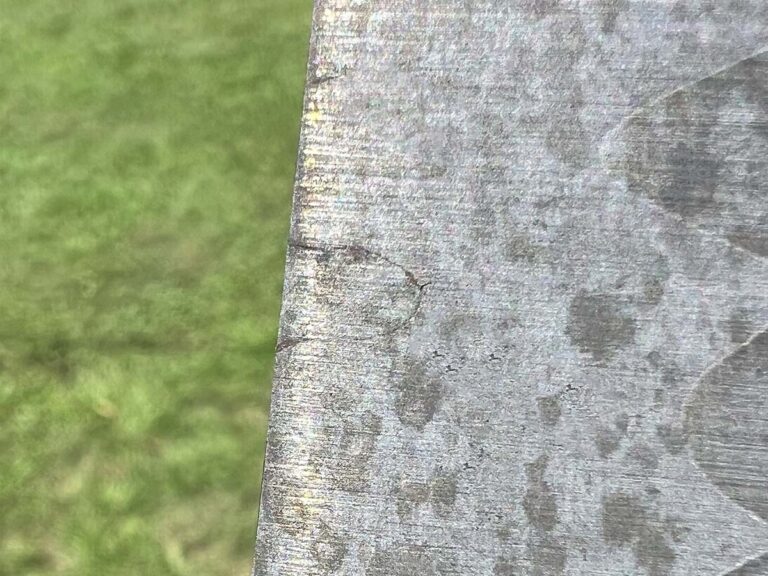
“I would say the most common flaw in a damascus blade is delamination,” ABS master smith Lin Rhea opined. “This shouldn’t be in a knife that is offered for sale. It’s usually evident as a hairline void in the layering and could occur anywhere on a blade. But I see them mostly in the deepest part of the blade as they are revealed in the bevel grinds. I believe this could be prevented by being sure the billet is up to proper welding heat before extracting it from the forge for the first weld in the particular stage of pattern development.”
In a similar perspective, ABS master smith Bill Burke sees imperfections as “a closed shut or incomplete weld that can be found anywhere on the blade. It can be seen as a dark or silvery line in lightly etched damascus or becomes a deep crevasse on heavily etched damascus—and it is caused by the smith not letting a billet soak at heat long enough before welding, or by manipulating a weld that has not been fully set and then working this tear back into the pattern.”
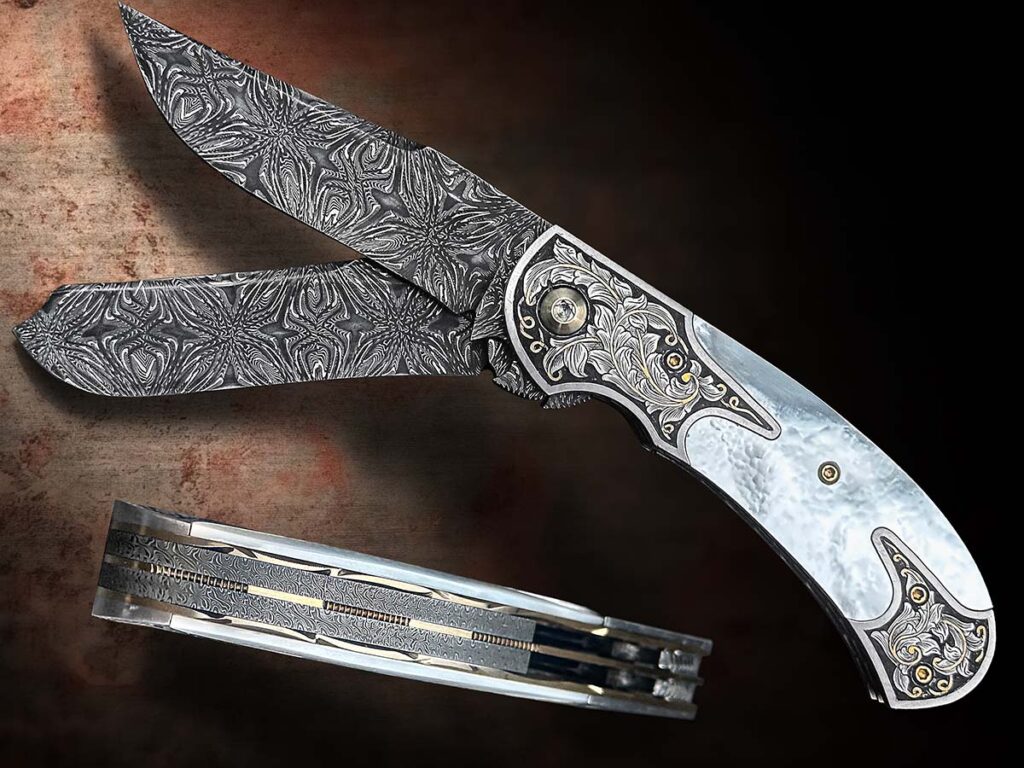
Fortunately for knife enthusiasts, most quality damascus knives are free of flaws, such as Eliot Maldonado’s saddlehorn trapper in Blackbird damascus by Chris Zimmerman. (Jocelyn Frasier image)
ABS master smith Steve Randall agrees and sees these types of imperfections and other potential flaws as well.
“The most common flaw on a damascus blade is the cold shut or an area where the pieces did not weld,” he observed. “It is not so much where it occurs on the blade such as the tip, edge or spine, but where the two different steels meet in the pattern. It’s the two steels that didn’t weld together that creates the flaw, and sometimes they aren’t noticed until [the maker starts] grinding into the blade.
“I would say another common flaw for damascus, mosaic specifically, would be shadow lines from the tiling process,” Steve continued. “Structurally they don’t change the steel, but they can detract from the mosaic visually.”
Both Rhea and Burke have encountered other flaws related to the fusion of the two steels in damascus.
“Less common is an inclusion of some kind,” Burke explained. “Twenty years ago flux inclusions were fairly common. Now one sees inclusions of weld filler material, though, overall, inclusions are less common now than 20 years ago. Inclusions are always found in between the elements that make up the pattern in a bar of damascus.”
Lin added, “I’ve also seen where the maker has left a bit of welding rod material within the damascus blade. This appears as a cloudy gray area and is pretty distinct in appearance from the hardened damascus. In the event wrought iron or mild steel is mixed with high carbon and the layering is of a relatively low number count, this could be part of the intended pattern, so it might be acceptable.”
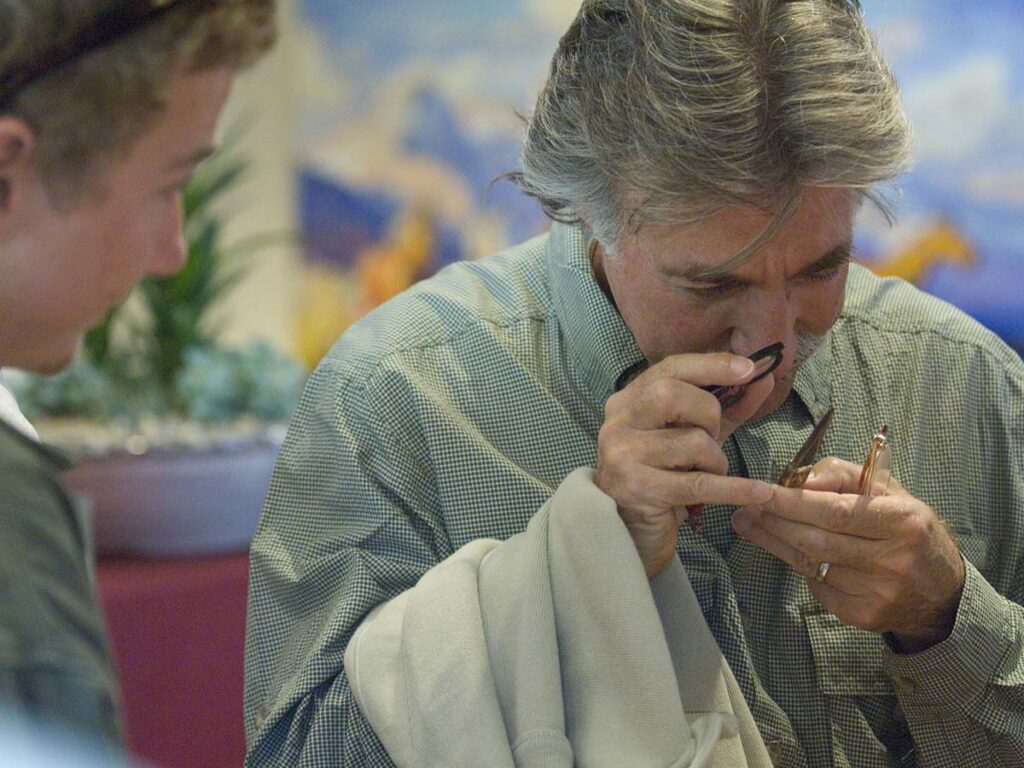
“If you’re at a show and feel you want to look at the blade under a magnifier, then you should ask the maker if he minds,” Bill Burke noted. “If he says ‘no’ or gets upset, then thank him and walk away.” (Eric Eggly/PointSeven image)
According to ABS master smith/BLADE Magazine Cutlery Hall-of-Fame® member Steve Schwarzer, the particular combination of steels might raise the prospects for a flaw to develop, especially when the skills of the maker are evolving. He commented.
“The worst flaws are the delaminations and inclusions,” he said. “These might come from poor welding practices and the choice of alloys involved. Some welds are much easier to make than others and a higher level of skill may be required. Most of it is visual—bad welds are bad welds and don’t have the necessary molecular bond.”
For a potential buyer the ability to spot a flaw is an attribute that pays off when dollars are exchanged for the finished product. Although a flaw may have no impact on the structural integrity of the damascus steel itself, the degree of impairment—if any—ultimately lies with the potential buyer who assesses the level of discrepancy. Approaching a maker’s table, discussing the damascus, and taking a closer look at the blade will sometimes generate relevant conversation and exchange of information. Flaws can show up anywhere in damascus construction, so visual inspection comes with the territory.
Schwarzer advises buyers to check the knife thoroughly.
“Using magnification helps. If the blade doesn’t look right, it probably isn’t. A flaw may show up as a bright spot in a dark area, and some skilled people can reweld their billets. I do that regularly and especially when I do guards and stuff, taking a light hammer and welding heat to fix it, but not everything can be repaired. Sometimes there is no way to repair it, and that is one reason why I hardly ever sell damascus steel—[and if I do] only to skilled professionals.”
Visual Signs
When a buyer’s interest is piqued, the next steps involve courtesy and cordial exchange with the knifemaker.
“Flaws in damascus can range from very hard to see to blaring and obvious,” Burke remarked. “An experienced eye in good light and magnification are the best ways I know to detect them. Some can be felt, but feeling the blade and running your fingers up and down and across it are not reliable and can cause rust and tarnish. If you’re at a show and feel you want to look at the blade under a magnifier, then you should ask the maker if he minds. If he says ‘no’ or gets upset, then thank him and walk away.”
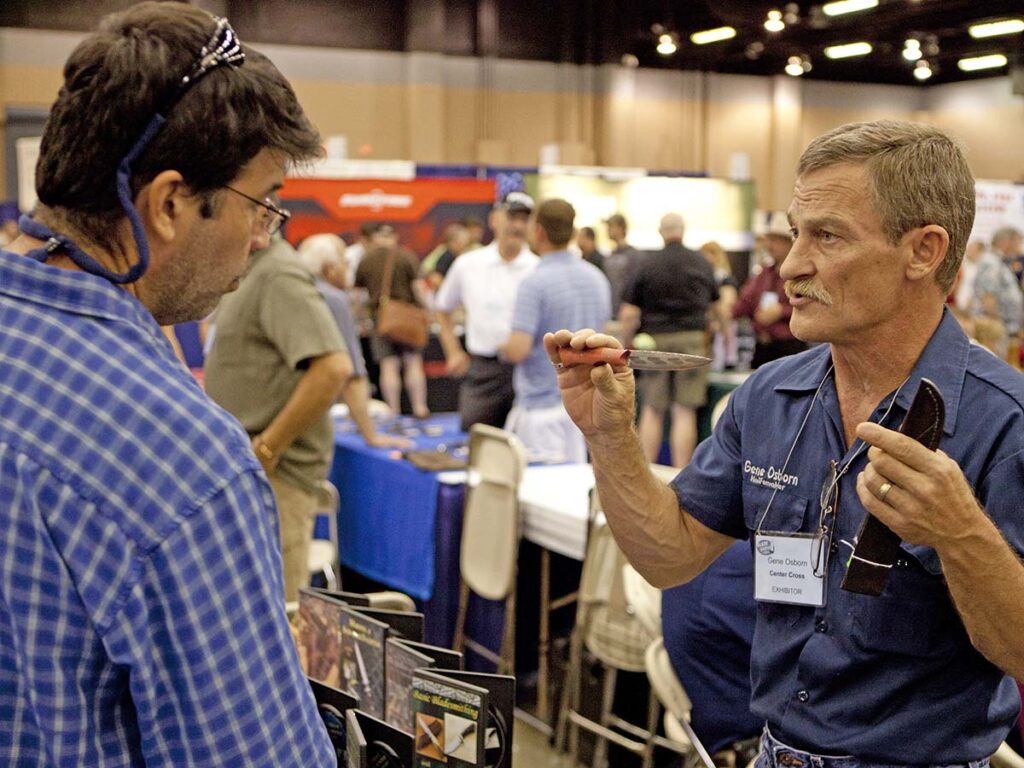
Steve Randall said most makers would not intentionally sell a knife knowing it had a flaw or without first pointing it out to the buyer. Gene Osborn (right) discusses a damascus knife with a customer at a past BLADE Show. (Eric Eggly/PointSeven image)
Randall concurs with that point of view.
“Bright light sure helps,” he observed. “It is difficult to find small flaws once a damascus blade has been etched. Running your fingers over the blade won’t tell you anything, and if you’re at a show I advise not doing it. Using a magnifying glass at the maker’s table could be awkward, and I would suggest respectfully asking before doing it.”
Historically, skilled makers and smiths have assessed their own work and identified flaws, correcting them or chalking up a flawed blade to the hazards of the craft. When ABS master smith Mike Quesenberry considers the flaw in context, he is frank in his response.
“The smith sees the weld lines with flaws before the steel is etched. To me that is something the smith has to deal with. I don’t have any problem scrapping a blade if [a flaw] shows up in the process. The hand sanding and grinding are where the time is really invested, and makers should be honest with their work. If you see a flaw, scrap it,” he stressed. “The best way to fix a flaw is to throw that blade away and start over again.”
Schwarzer smiles when he relates the style of an ancient practice.
“Japanese smiths worked out a way to hide a flaw if it didn’t mechanically affect the viability of the blade. They would do a nice little gold inlay. That was done in Persia, too, and a lot of other places. They would put artwork over something that was unseemly. If you have $300 in a blade and there is no mechanical problem, then that is a way to make it go away. It’s been said that the difference between a journeyman and a master smith is the size of the screw-up you can fix.”
Rhea acknowledges the human side of the situation. There may be a temptation to continue working on a knife with a flaw in the damascus, but then comes the realization on the part of the maker that causes him to refrain from that option. “When a buyer sees any odd discoloration in the form of surface treatment, color or texture, ask questions and give the maker the opportunity to explain or rethink his position,” he noted.
Resolving Situations
Bladesmiths and custom makers are genuinely committed to excellence. However, at times there may be a situation involving a flaw. When a purchaser detects something that may or may not be an imperfection, talking with the maker can resolve the situation to mutual satisfaction.
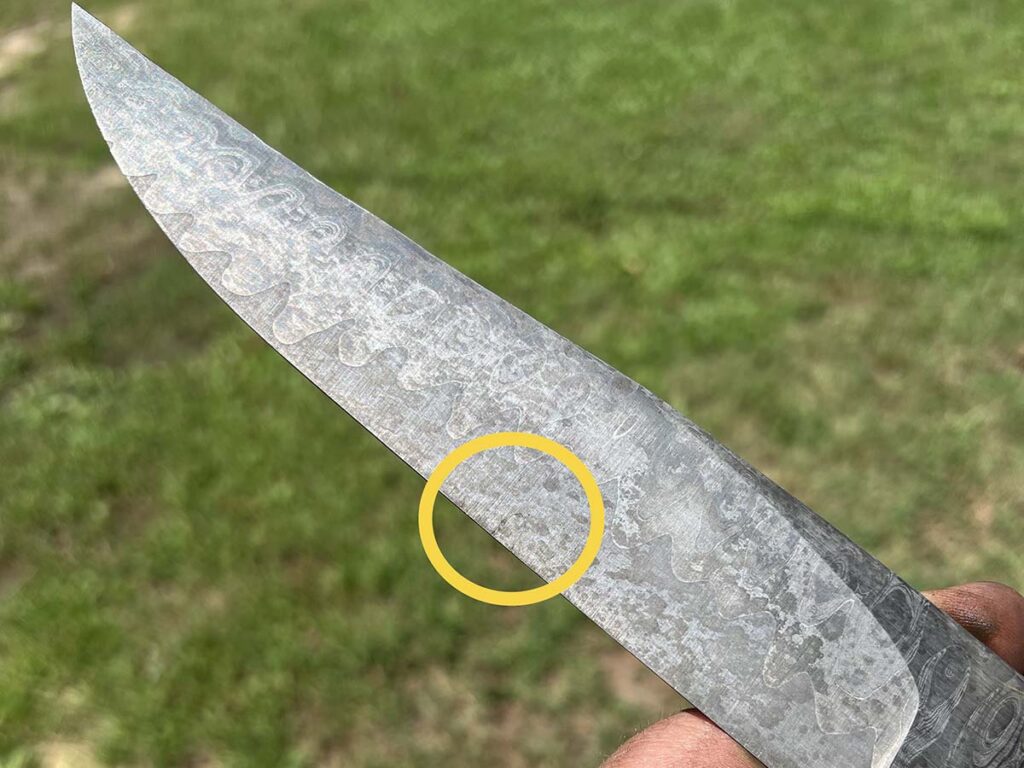
A welding flaw might pass a cursory glance, which is why you should always inspect any damascus blade you plan to buy closely.
“If you buy a blade and then find a flaw, you should contact the maker and ask them about it,” Burke advised. “If it is something you cannot live with, ask for a refund or allow the maker to replace the flawed knife. In most cases, the maker is going to be unaware of the flaw. If the maker is aware of the flaw or refuses to do anything for you, then you either have to keep it and say, ‘Oh well’ or sell it to someone else with full disclosure of the flaw.”
“When I have a buyer who experiences issues of any kind, I would prefer that they contact me and give me the opportunity to evaluate, discuss and make it right,” Randall noted. “I’m sure most makers would not intentionally sell a knife knowing it had a flaw or without first pointing it out to the buyer.”
Rhea sees the interested parties taking the high road in almost every case. “Most makers will honestly make a sale with good intent and in good faith,” he reasoned. “If there’s a problem just contact the maker and let him or her explain or make it right. Ultimately his reputation is on the line and he deserves the chance to make it an overall pleasant experience.
“When it comes to flaws and issues,” Lin concluded, “we all have them and we handle them in our own ways. To the degree we act to prevent problems for the buyer we also prevent problems for ourselves as makers, as well as enhance our reputation. Leaving flaws in damascus will reflect on our honesty and our attitude toward the buyer. This is something to think about very seriously. So, will there be problems? Yes, but we should go to great effort to prevent them rather than having to correct things that might be perceived as an oversight. In the end, we are human and will want to use common courtesy and humility in our dealings.”
Celebrate the new class of master and journeyman smiths! See who received the top honors from the American Bladesmith Society at the recent BLADE Show.
The American Bladesmith Society awarded its coveted ratings of master smith and journeyman smith at the recent BLADE Show in Atlanta.
Three applicants achieved the rating pinnacle of master smith:
Andrew Blomfield (Australia)
Luiz Gustavo Gonçalves (Brazil)
Erik McCright (Weatherford, Texas)
Gonçalves also won the awards for Best Kitchen Knife and Best Fighter during the BLADE Show custom knife judging competition.
Argentina’s Matias Funes was awarded his ABS journeyman smith stamp during the 44th Annual BLADE Show after his five test knives met with the approval of the ABS JS judging panel. (SharpByCoop image)
Journeyman smith stamps were awarded to:
Felipe Cavallin (Brazil)
Jason W. Coy (Squires, Missouri)
Viktor De Bonte (Woodinville, Washington)
Adam Fromholtz (Australia)
Matias Funes (Argentina)
PJ Gouws (South Africa)
Nate “Tuna” Grant (Seguin, Texas)
Matthew Hartwig (Bozeman, Montana)
Nishan Mood (Fullerton, California)
Christopher Moss (Asheboro, North Carolina)
William Porto (Brazil)
Willie Van Der Merwe (South Africa)
Jan C. Vatelau, (Boise, Idaho)
Michael Hobbs (Shelbyville, Tennessee)
In addition, Gonçalves won the award for the best knife presented by a master smith applicant for judging, and Funes won the award for the best knife presented by a journeyman smith applicant for judging.
Journeyman smiths are the second highest level of ABS member bladesmiths, surpassed only by master smiths. Each must pass rigorous tests before achieving their respective rates, with the journeyman smiths having to wait a specified time once making JS before they can apply for the top rating of MS. For a complete rundown of the tests, requirements and other bona fides of both ratings, visit americanbladesmith.org and click on “Member Resources.”