Home Blog Page 26

Knifemaking Business: Commission Knives, Designs And More

1

A veteran maker shares timeless advice on commissions, design, and running a successful craft business.

I rarely do commissions. It’s difficult to keep some clients from wanting to take part in the process. Their job is to tell you how much they like the piece when it is finished and gather the money to cover their overextended budgets. In your role as crafter/knifemaker, don’t let them bully you. There are no grounds for complaints if you give them what they originally approached you about.

The most difficult part of doing commissions, aka taking orders, is keeping everything on schedule. A delivery date is just that. Even if it’s a couple of years out, don’t wait until the end to go looking for materials and services. Casters work better with a heads-up beforehand and engravers may need a year to get past what they are working on. As a result, get your name on the list with others waiting for a bit of the crafters’ time to cast your pieces and for the engraver to work out a design for your project.

I run on satisfied customers. One black mark cancels out a slew of gold stars. I’ve never had a customer who wasn’t satisfied, period. I give even my smallest work the same close attention to detail as the larger and more standout ones. Every piece deserves the most attention I can give it to bring it to the right state of finish when everything is done.

I don’t spend time debating how much it costs if they are paying up front. It’s out of your hands at that point. If they insist and it does make for a tighter presentation, I have no complaints—if I’m still doing it my way.
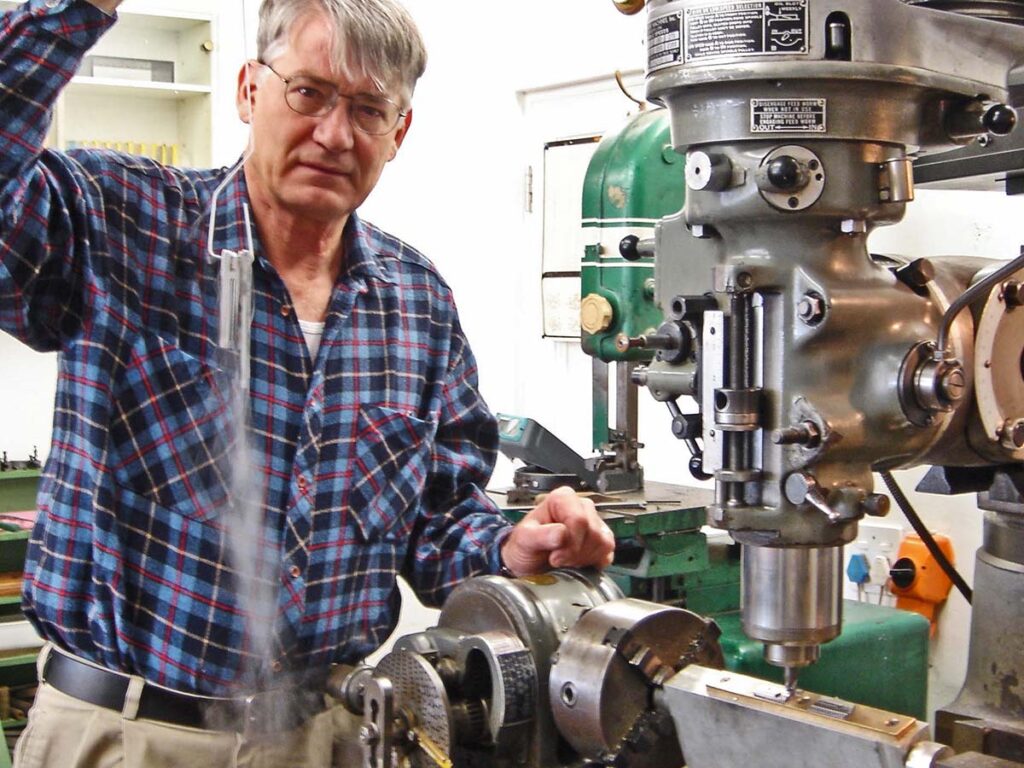
When buying tools think about their longevity—good ones last, cheap ones don’t. South African knifemaker Des Horn’s Bridgeport milling machine is one of the good ones. (Des Horn image)

One time I had a 36-carat uncut ruby for a specific part of a presentation. The clients changed that out and added another $10,000 to the materials list. Put a pound of 24k gold in the mix, two feet of AAA lapis lazuli and another pound of silver and you have nearly a year of work making it all look like something that befits the materials. There is nothing finer than 24k gold and large ruby star sapphires set in deep blue AAA lapis lazuli.

Of course, there is the matter of it not existing until you do it. That part can be intimidating at times. Then there are the occasions when the client goes well over the beginning budget. If this happens, you must deal with the backlash from him blaming you, when all was done at his request.

Maintain Your Health

People were making wondrous things with simple ingredients 4,000 years ago, without the benefit of dental care, bifocals and electric lights and on a diet that barely sustained them most of the time. They died by 45 usually, so had only the time between when they were 9 or 10 until their eyes began to fail them by 40 or so. I have been making and selling my work for more than 50 years with all the benefits living in a civilized time can bring. I am still excited about projects, no matter the size. I still eat lots of fruits and greens and shredded wheat large biscuits.

If you want to do your best work, you must stay healthy. Like any other working mechanism, your body tissues need the time to relax and rejuvenate. For example, if you don’t give the fingers in your hand enough time off, they will give you problems later in your career. The cartilage in your joints will only take so much punishment, so give the muscle tissues in these areas time to relax a bit before moving onto your next project.
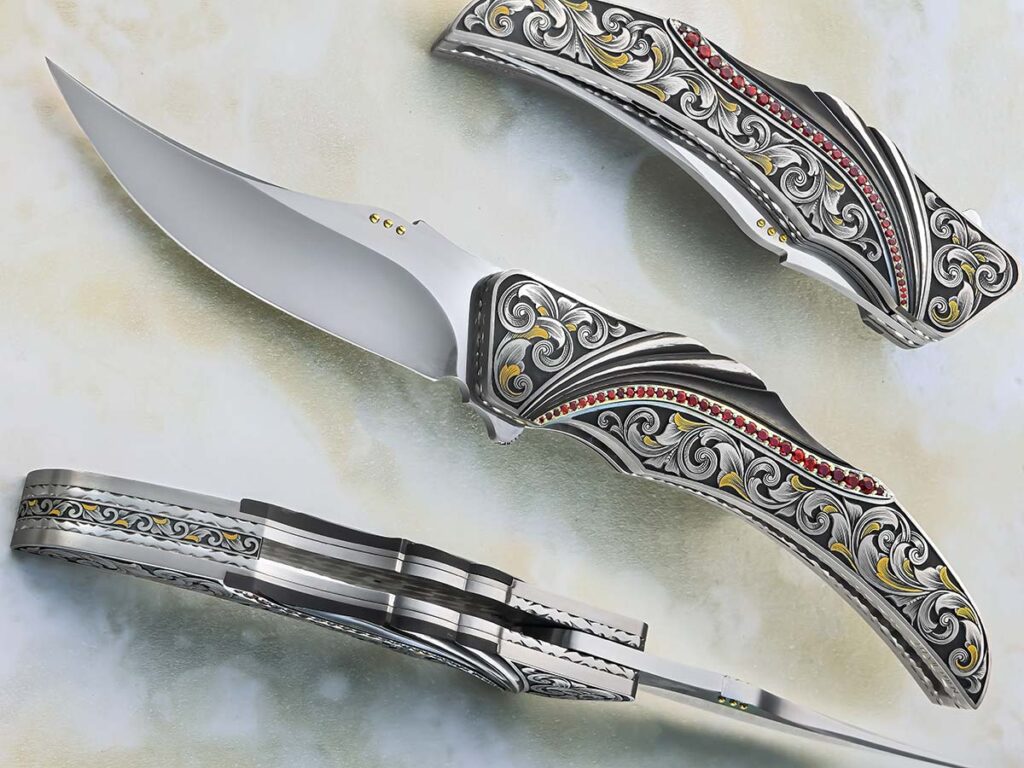
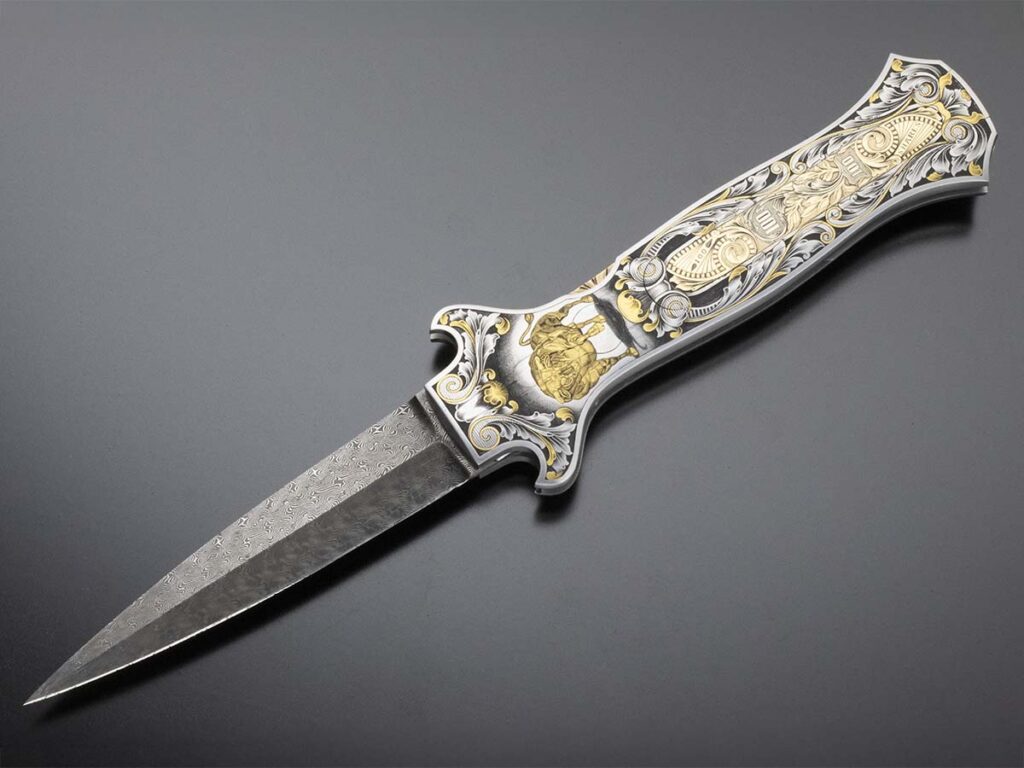
Engravers may need a year to finish an ongoing project before they can accept your order. As a result, get your name on the list with others waiting for an engraver to work out a design for your project. The engraving on a Herucus Blomerus folder is by Henk Viljoen. (SharpByCoop image)

Sometimes it may take a few days for an overworked appendage to return to normal if you’ve stressed it in some way. Always protect your eyes and ears from foreign objects and stressful sounds. I finally took the large subwoofer out of my studio because it was leaving me partially deaf by the end of the day, even more so than most of my tools.

Design Process

Design is where you make your identity come to life with a few pencil marks and colored markers. You want to present a consistent image that people will remember and that you can live with in the future.

The most important thing to know when you begin making anything is what it’s supposed to look like when it’s finished. That’s where those blank sheets of paper and erasures come into play.

Make your design mistakes on paper. Don’t wait until you’re well into something before admitting to there being some mystery grey areas concerning how it’s supposed to work. Wait to start something until you have a good idea as to how to feasibly do it. The sketches are just that; they allow you to put a bunch of feasible ideas down on paper next to each other and put big X’s on the ones that don’t work with the others. It may take a few tries to get what you’re looking for down, but now you can start thinking about materials, colors, etc., and establish the theme of the drawing. This will help you decide the things needed to make it real.
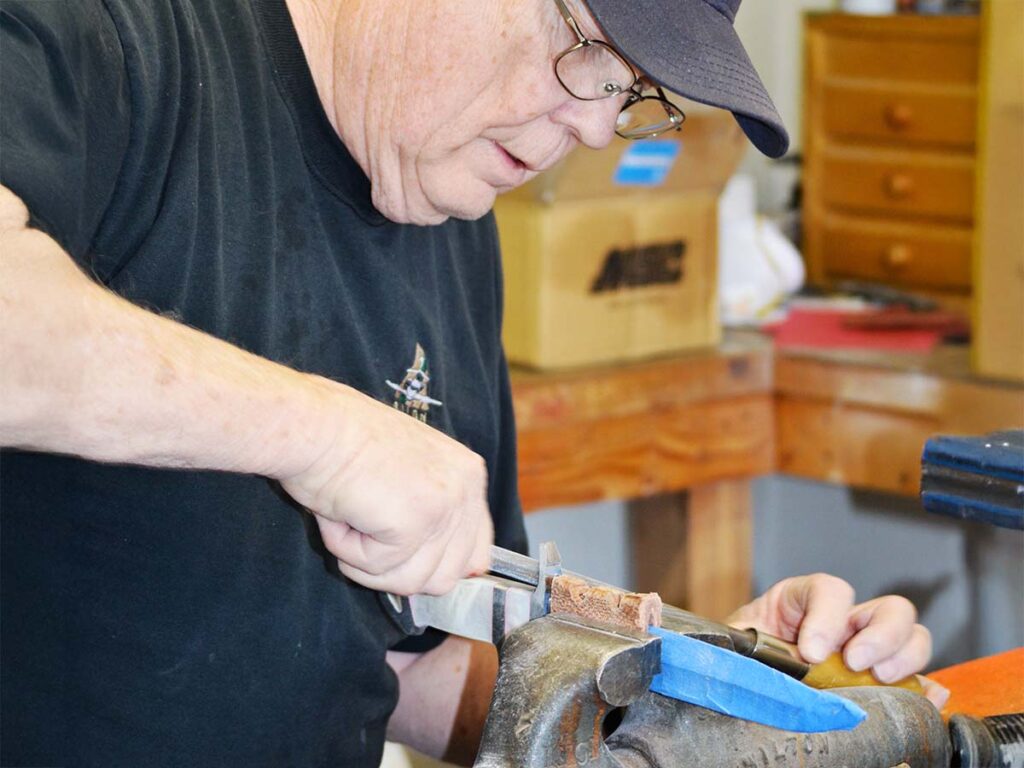
Your body needs time to relax and rejuvenate. For example, if you don’t give your fingers enough time off, they will give you problems later in your career. Steve Johnson files a guard in his shop. (Steve Johnson image)

Once you’re working, don’t deviate from the drawings unless it will make it a stronger presentation. I always try and give the piece the best ideas I can to make it able to stand with the other things I have made, and give the customer the best I can do at the time. It makes for more hours but also gives a much stronger presentation.

Money Matters

All crafters have money fixed firmly in their minds. If you can just get the circumstances right, you know people will like your work and you will sell it.

As a group, crafters are undercapitalized and have no backup cash for when calamity strikes. Until you can show a profit and can pay your suppliers, you don’t have enough funds to sustain your business when the bottom falls out of your market, either locally or globally. All of today’s crafters have experienced this. I wish I had an answer—I wish someone had an answer.

Maintaining Materials

Materials are “the paint” of my work: silver for white, gold for yellow of differing shades, bronze for brown gold, jade for green, emeralds for green, Nigerian green tourmaline for green, rubies for red, carnelian for orange/red, lapis lazuli for blue, etc. Your stockpile of materials controls the variables in your work. Where would Van Gogh have been without yellow, orange and electric blues on his pallet?
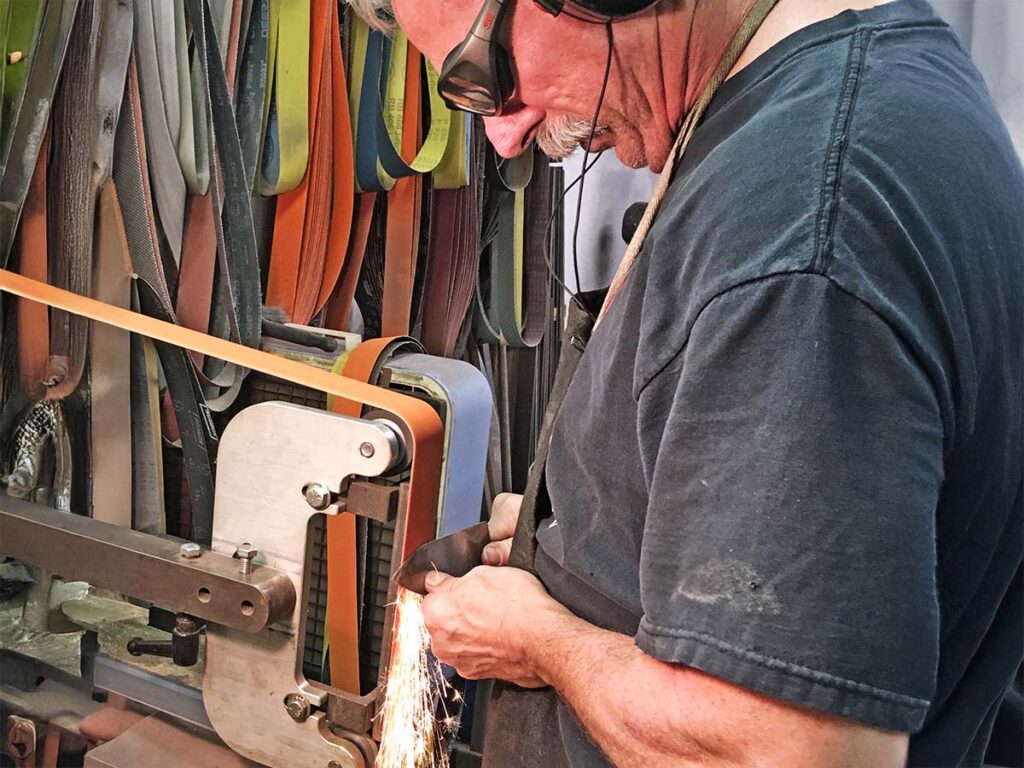
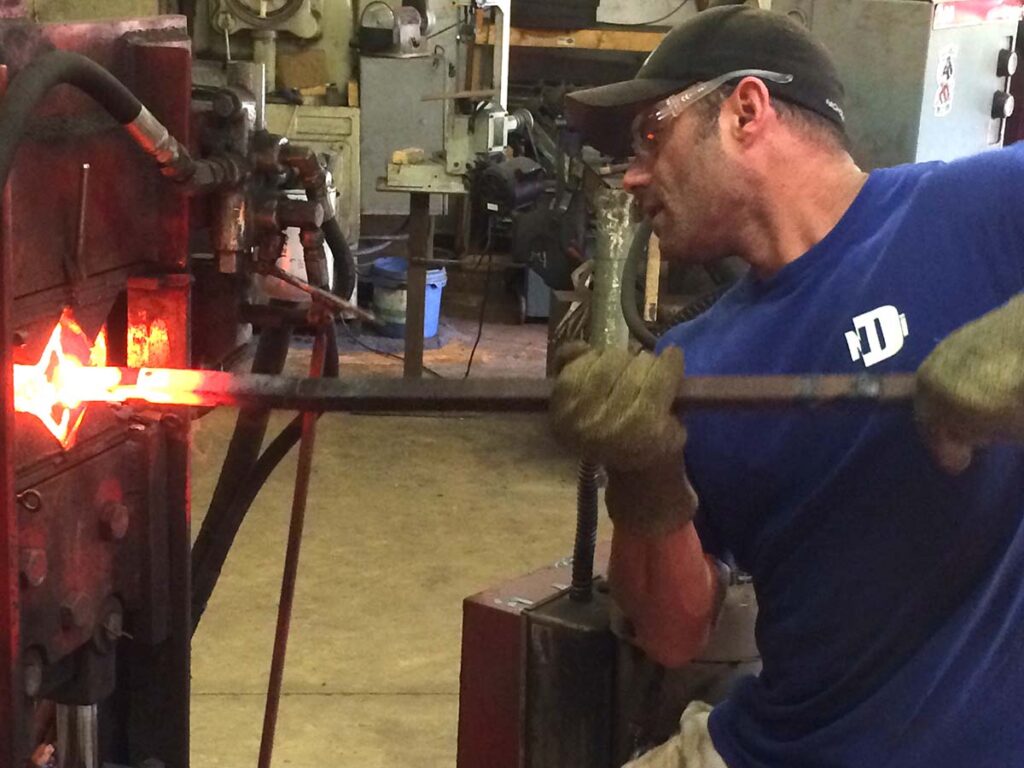
Always protect your eyes and ears from foreign objects and stressful sounds. ABS master smith Steve Randall shows how it’s done. (Steve Randall image)

It has always been considered easier to do color photography than black and white photography. I think there is a correlation in craft. The simpler the design, the more important it is not to deviate from the original line. A fine example of this is the work of Wolfgang Loerchner; it is so clean and simple in design, with wonderful materials, and no room for any deviation in the completed piece. That’s difficult for me. His work is spotlessly fine while I spend part of my time trying to make it look like I didn’t have any difficulties in the making.

If your budget allows it, always stockpile unusual materials that are necessary in your work so there are no down times while you wait for four feet of Madagascar ebony, or a pallet of clay to be dropped at your step. If you already have it on hand, there are no delays.

Buy quality materials. You don’t want your turned goblet to twist and crack and eventually fall apart because the wood wasn’t properly dried or treated after it was done. Most natural materials will take no heat because they were created at normal earth temperatures. Too much heat and anything will crack—if not today, weeks or years later. Epoxies usually give way at anything over 150° F. Buffers will bring the temperature up to that point quickly, making the epoxy no more than a filler rather than bonding the materials together.

Knifemaking Tools

Every craft has its list of necessary items you need to do it well. When you’re buying those things think on the longevity of the tool—good tools last, cheap ones don’t. I’m still using items I purchased in the early ’70s on a regular basis. They don’t always have to be “show dog quality” in appearance if they still work well.

Conclusion
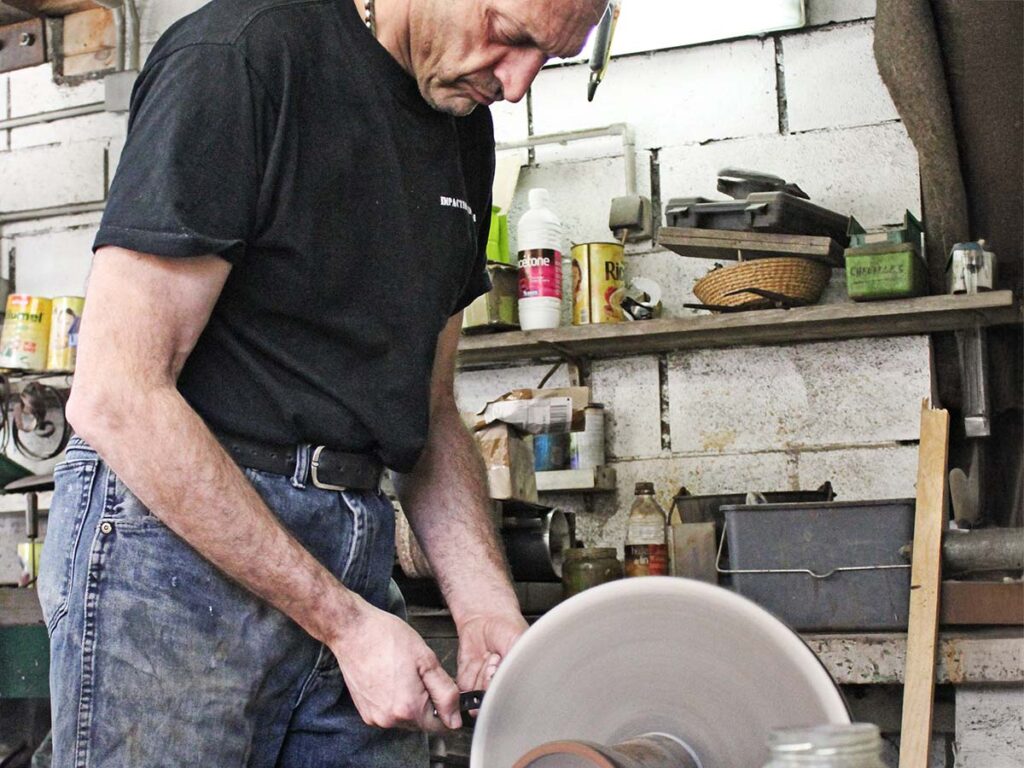
Too much heat and anything will crack—if not today, weeks or years later. Epoxies usually give way at anything over 150° F. Buffers will bring the temperature up to that point quickly, making the epoxy no more than a filler rather than bonding the materials together. Veteran French knifemaker Fred Perrin polishes a knife on an old-school buffing wheel in his shop. (image courtesy of Michael Janich)


To you out there who have jumped on the craft wagon: always think things all the way through beforehand. It will make your landing much more enjoyable. I know I have given you a list of things that is larger than you want to deal with, but if you want to see your name in lights someday, you must follow the simple rules every business must have to survive or you will only make it more difficult for yourself, your career as a crafter, and, most of all, your family standing behind you.

It’s always a swim against the current for all of us.

More On Knife Marketing:

Master Bladesmiths Showcase Their Best Long Swords

See the artistry and craftsmanship of seven custom swords from some of the best bladesmiths in the world.

Not only do swords bring out the best in some makers, those who make quality versions of them often seem to be among the best makers as well. Check out the long blades on this and the facing page and see if you agree.

Garbriel Turner: Jineta

Garbriel Turner: Jineta

The Jineta by Garbriel Turner has a 28-inch wootz blade, an ancient walrus ivory grip and iron/gold fittings. Blade grind: flat. Overall length: 36.5 inches.


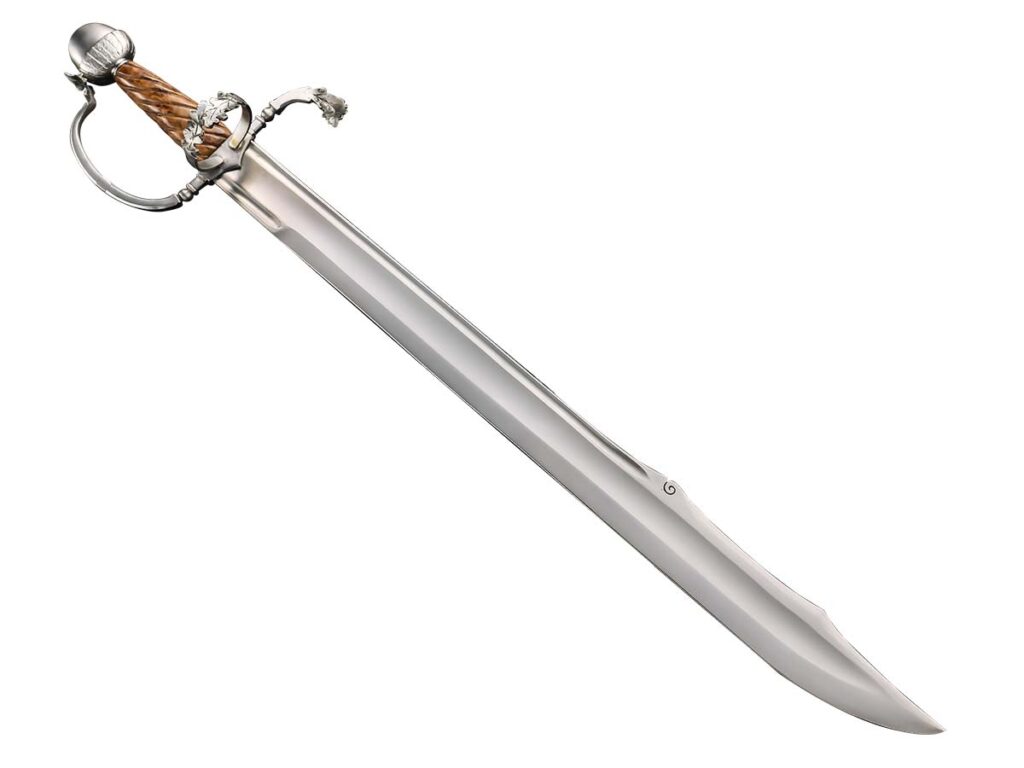
Eric Estlund: Oak Themed Storta

Eric Estlund: Oak Themed Storta

Eric Estlund’s Oak Themed Storta is in a 17th-century Italian style. The 28-inch blade is 8670 carbon steel and the handle is oak burl. An acorn pommel helps complete the theme. A high-relief scabbard (not shown) and steel leaf chape with carved acorn finial add to the presentation.


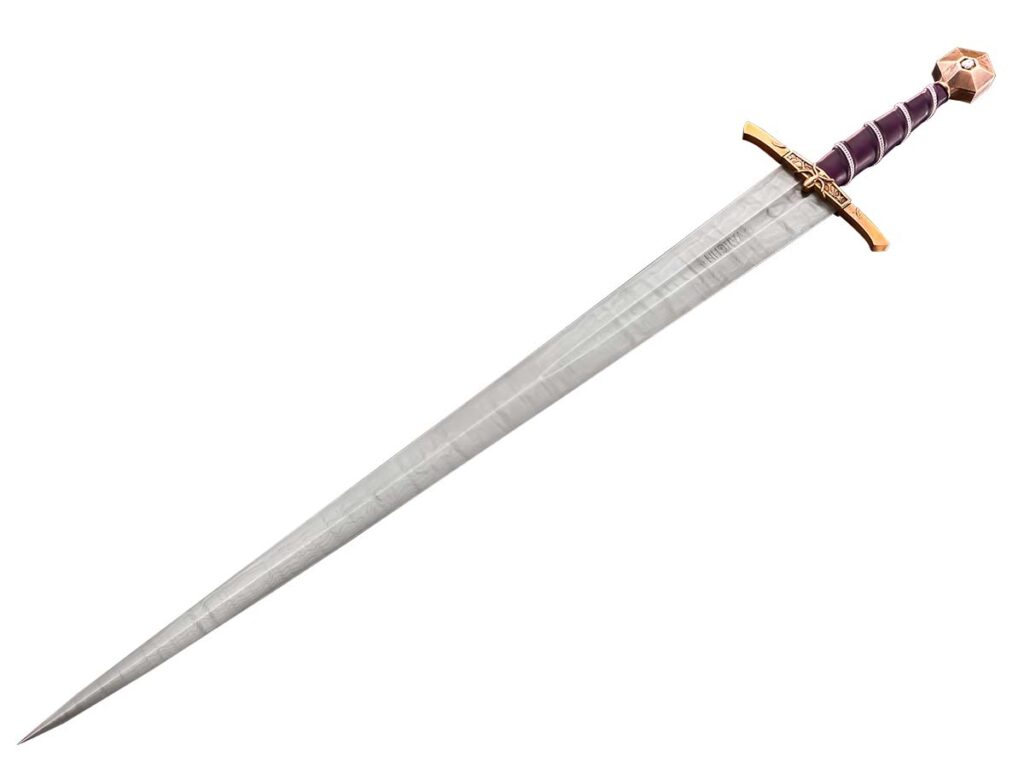
Matt Parkinson: Arming Sword

Matt Parkinson: Viking Sword

The sword shown is an Arming sword with a complex laddered and mosaic damascus blade. Polished steel fittings and a spalted maple handle. 29-inch blade 36-inches overall, weighing in at 2 pounds 10 ounces.


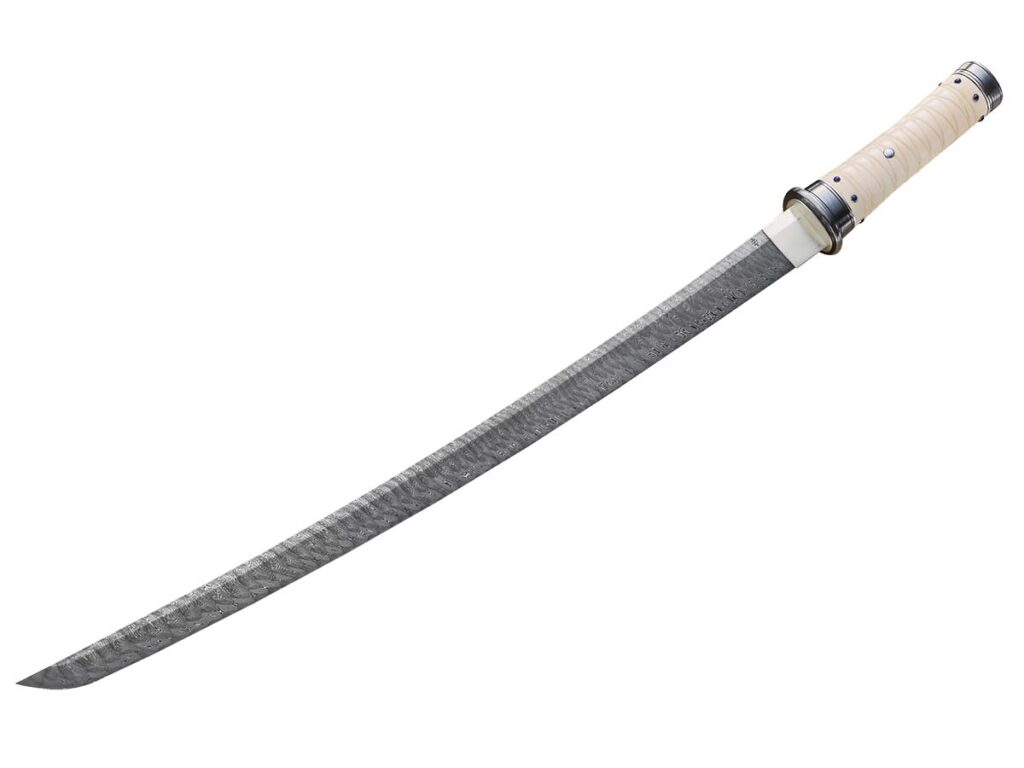
Zack Jonas: Wakizashi

Zack Jonas: Wakizashi

A Gordian core twist damascus completes the 22-inch blade of a Zack Jonas wakizashi. Fittings: W’s damascus and silver. The handle is interior mammoth ivory. Blade pattern: shinogi-zukuri. Overall length: 28 inches. The colorful scabbard (not shown) is by Matt Venier.


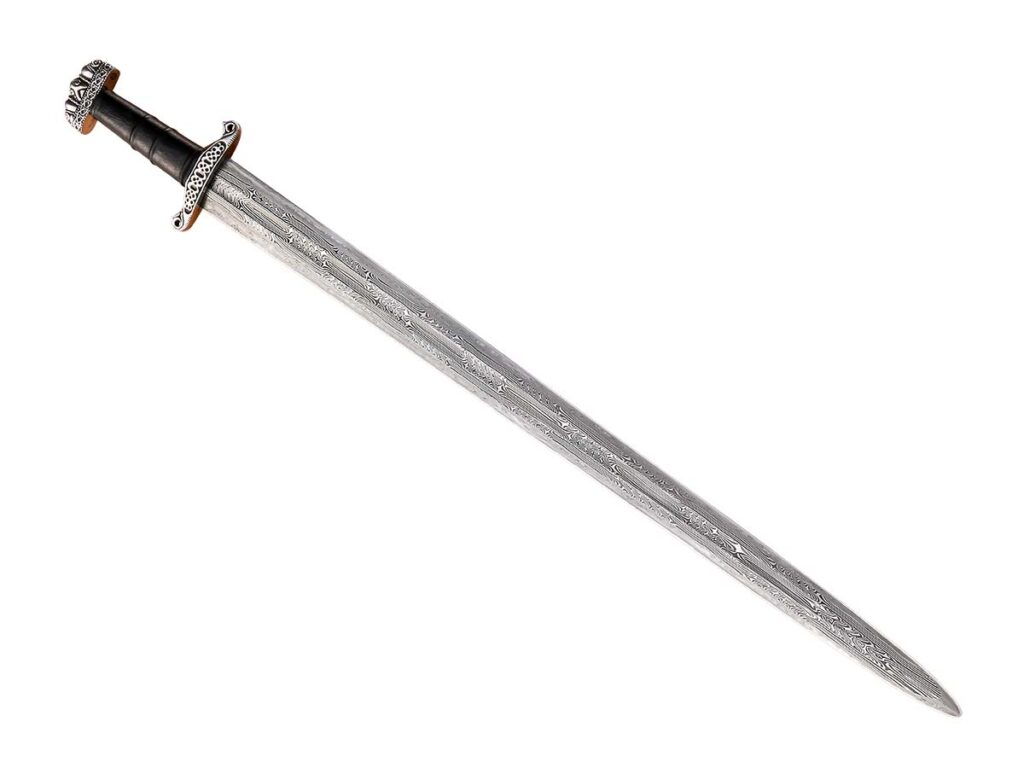
Ben Abbott: Viking Sword

Ben Abbott: Viking Sword

A 26-inch blade of multi-bar damascus, a leather-covered wood handle and cast sterling silver fittings outfit Ben Abbott’s Viking sword repro. Ben carved the waxes for the guard and pommel.


Ryan Breuer: PhD Sword

Ryan Breuer: PhD Sword

We published a closeup of the handle of Ryan Breuer’s PhD Sword the September 2025 issue. Here’s the full-blown model. The 32-inch blade is a damascus of 1084 carbon and 15N20 nickel-alloy steels. The handle is birch, leather and sterling silver.Overall length: 40 inches.


Jordan Borstelmann: Elmslie Type I

Jordan Borstelmann: Elmslie Type I

Jordan Borstelmann’s Elmslie Type I of a falchion sword boasts a 28-inch blade of 1075 carbon steel and a handle of leather, cord and wood. Blade grind: flat. Guard: 1045 carbon steel. Overall length: 35 inches.

Read More On Swords:

Hottest Damascus Patterns, According to Top Bladesmiths

0

Top bladesmiths discuss the three hottest damascus patterns.

As damascus patterns emerge through the years, their popularity waxes and wanes. The steel itself, layers of intrigue and interest, experimentation and innovation captivate the steel forger, the custom maker and the knife-buying public like nothing else. The patterns abound and in recent reviews of photos, commentary from those in the business and observation it appears that the feather and mosaic, with twist not far behind, have been and continue to be hot.

“I agree that feather and mosaic patterns are predominantly what is made, or certainly what is getting photographed [a lot],” related ABS master smith Steve Randall. “Both patterns are popular because they have lots of character and can be pretty dramatic. Feather patterns are very cool because they can be unique yet still hold true to the feather pattern. The mosaics can move off into so many different styles. They allow the maker to be really creative.”

Feather Damascus Pattern

ABS master smith Bill Burke praises the versatility of the feather pattern and its breadth of presentation.

“I think that you see a lot of feather pattern because it is so striking and looks good on almost any knife style,” he commented. “It is also quite a challenge to produce. A well-done feather will have a flow from end to end with nicely curved veins, while a feather that has interruptions in the pattern or has the center area drawn out into a long ‘V’ shape then curves out rather sharply to the edge is not done so well. I don’t feel a feather pattern is difficult to do after one has mastered pattern welding. It becomes difficult when an inexperienced smith rushes into trying to make a feather before mastering basic pattern-welding techniques.”

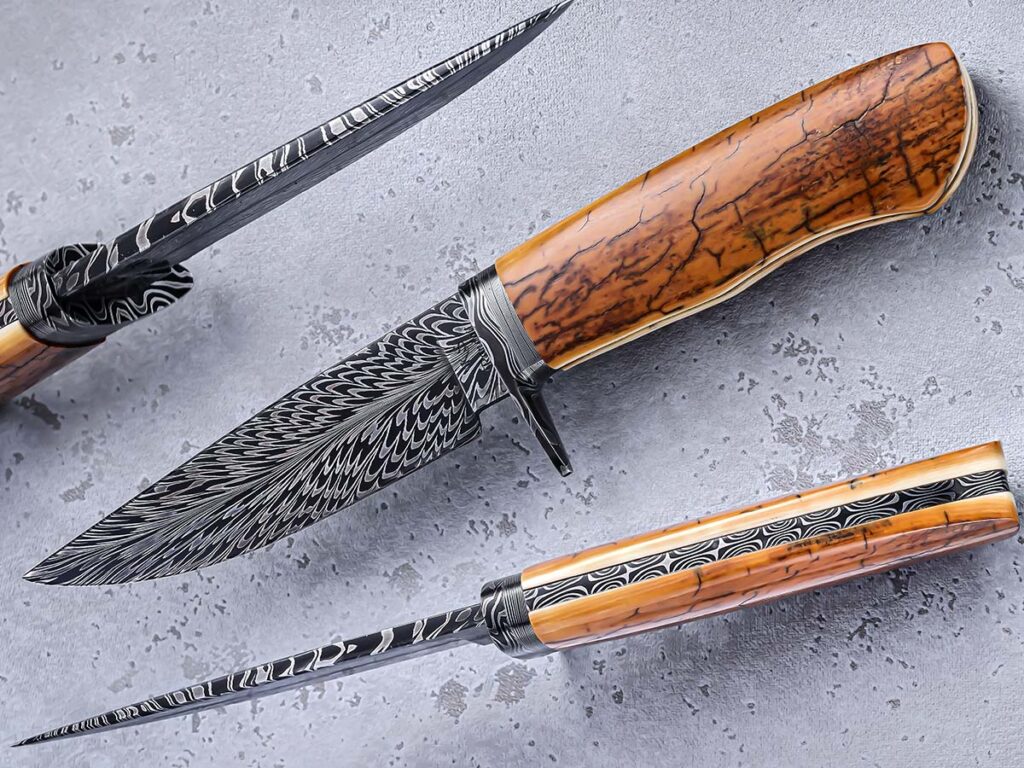
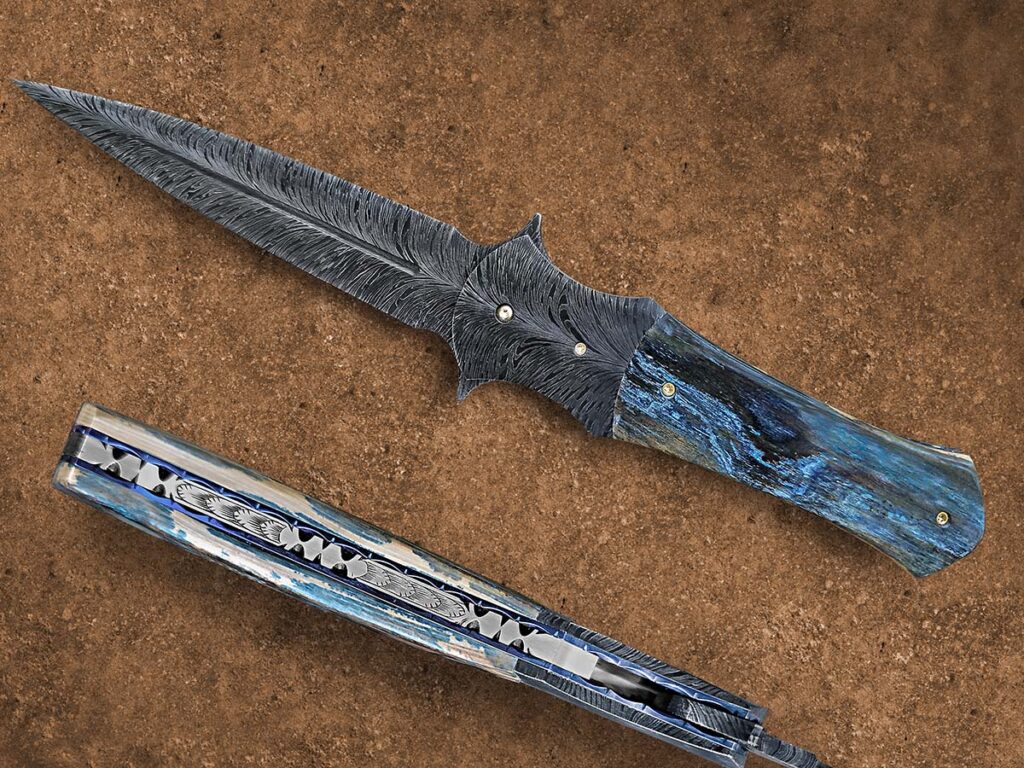
“Feather patterns are very cool because they can be unique yet still hold true to the feather pattern,” Steve Randall observed. He matches up the feather pattern with a mastodon ivory handle on his frame-handle hunter. Overall length: 9 inches. (SharpByCoop image)

BLADE Magazine Cutlery Hall-of-Fame® member and ABS master smith Steve Schwarzer sees the artistry in the feather pattern as well, and when he considers the magnitude of its relative surge concludes, “Absolutely. What you don’t see much of is images and the forge skill required to put that in damascus. Both the feather and mosaic damascus are fairly easy to do, and with the internet there are thousands of recipes out there with visual step-by-step instructions. I did the first feather pattern ever done in a folding knife, and [Cutlery Hall-of-Famer] Don Fogg in his Life and Death Dagger was the only one who did a feather pattern before me. I did the first that was recognizable in the folding knife.”

Degree of difficulty is and will forever be a matter of individual perspective and opinion. Randall stresses the experience level of the maker in fashioning the feather pattern.

“I would say that feather damascus can be a difficult pattern,” he offered. “There are a lot of pieces that have to forge weld together, which opens the opportunity for cold shuts or poor welds. Once that happens, you’ve pretty much got a paper weight.”

Mosaic Damascus Pattern

The perspective on mosaic damascus is similar to that of the feather pattern. Its uptick in popularity is driven by the skill of the maker and the diversity of the presentation. Mosaic makes its statement in both subtle and bold blade aesthetics.

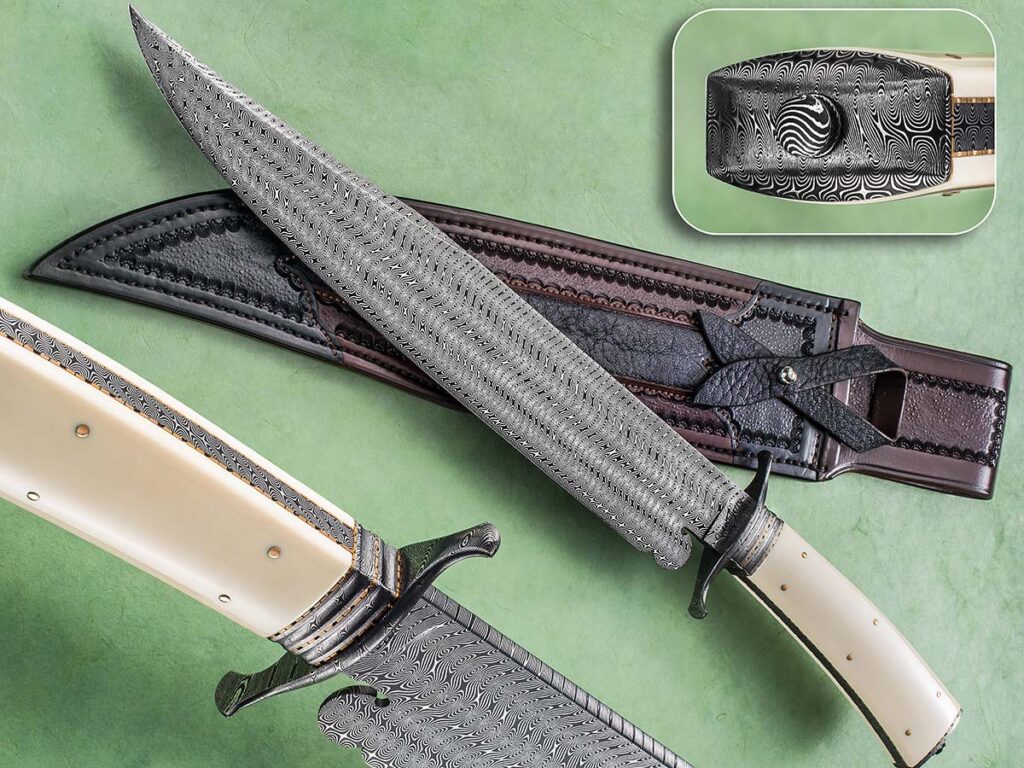
“While a simple twist pattern is rather mundane,” Bill Burke noted, “when four or more bars are twisted in opposite directions and stacked one on top of the other to create a Turkish twist, the result can be striking.” A lavish five-bar Turkish-twist damascus comprises the blade, including the Spanish notch at the base of the edge, on Mike Quesenberry’s Mediterranean bowie. (SharpByCoop image)

“Mosaic patterns do lend themselves to individual creativity,” Burke remarked. “They can vary from not too hard to extremely difficult to do. Mosaics are limited only by the smith’s skill and imagination. Mosaics that are done well will have the patterns lined up with no unintended interruptions in the elements and all the individual tiles matched up well.”

Tiles, incidentally, are the small, angled pieces of steel that are carefully assembled and then forge-welded together to create the distinctive, repeating mosaic pattern. The tiles are cut from the billet or block of welded steel that forms the basis for the creation of any damascus pattern. The tile cuts are made with a scarf joint that facilitates the joining of the surfaces to be mated during the forge welding process.

ABS master smith Mike Quesenberry is a big fan of the mosaic pattern, particularly its possibilities for expression.

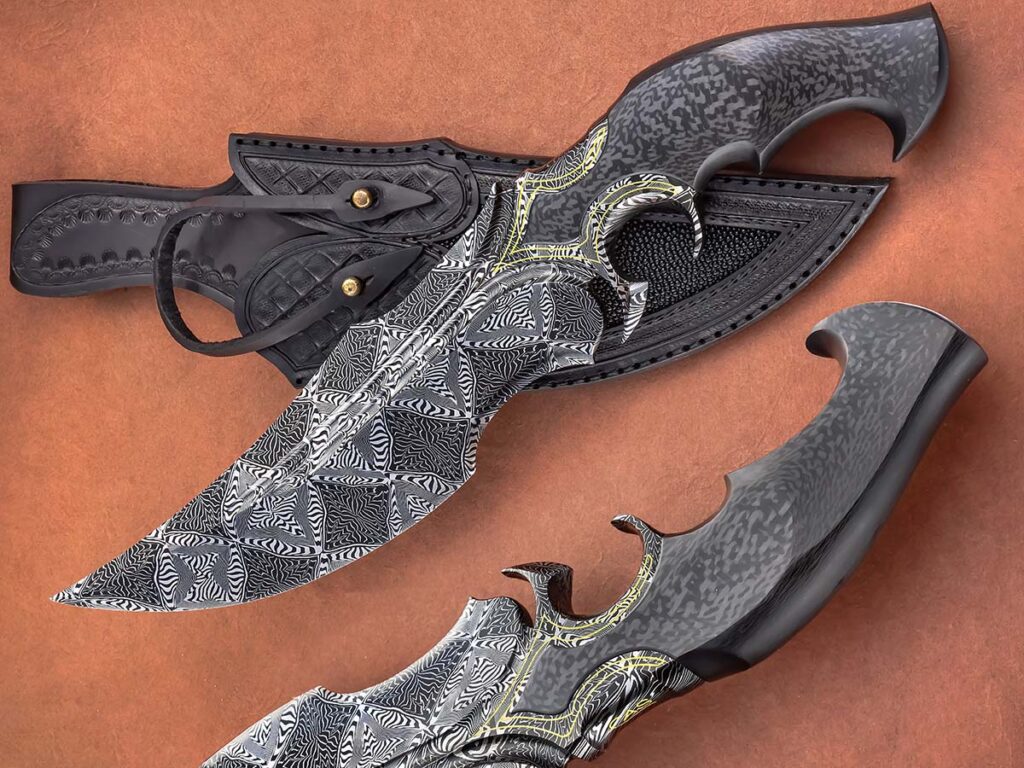
Mike Quesenberry stated the black and silver contrast of mosaic patterns can do “all kinds of crazy, wild things. It is huge with so many possibilities, and it turns out to be a really good pattern that some like in a fine look and others prefer in a bold statement.” The Sobral Brothers go bold with the pattern on their keyhole subhilt fighter. Overall length: 13 inches. (SharpByCoop image)

“I love mosaic and its creativity,” he declared, “along with the fact that smiths can take mosaic and make it bold or fine and there are all sorts or variations that make it fantastic, from W’s to many others. You can add different layers to fine and thick material, 1080 or 15N20 or whatever alloy. That black and silver contrast can do all kinds of crazy, wild things.

It is huge with so many possibilities, and it turns out to be a really good pattern that some like in a fine look and others prefer in a bold statement.”

Things To Look For

Assessing the quality of the individual feather and mosaic product is an exercise in discernment and preference along with the display of basic skill that is evident. Randall takes a subjective point of view.

“One of the most important signs of a feather pattern that is well done is its flow through the blade,” he observed. “The feather should flow from the center of the ricasso through the blade and out the tip. Both feather and mosaics being well done are in the eye of the beholder. Layer count has a big impact. The higher the count does not always make the pattern better.”

Bill Burke indicated a well-done feather pattern will have a flow from end to end with nicely curved veins. ABS master smith Scott Gallagher nails the concept in the feather-pattern blade of his Dolan Dagger Folder. Closed length: 5.25 inches. (Jocelyn Frasier image)

Schwarzer agrees that the individual’s taste has a tremendous weight in the interpretation of well-done damascus.

“It’s all subjective,” he related. “It involves how pleasing to the eye the fine or bold patterns are. The whole thing can’t be just a hodgepodge of stuff stuck together. It has to tell a story, and if it tells a story, then it is art—and to a lot of people it is great art. There is stuff out there that is incredibly complicated to do that looks simple on the face of it, but it isn’t. We are in the infancy of pattern welding, and a lot of it has come from Daryl Meier.

“There have been patterns out there with faces and images in them since the 1700s,” Steve continued, “and now we are painting with steel. When Bill Moran showed up with random-pattern blades in the early ’70s, he was continuing something that had never stopped. Pattern welding has probably been going on for 4,000 years, and you have to forge, fold and weld the iron to clean it. Then, when you get the alloy in there, it shows the pattern. Pattern welding, including feather and mosaic damascus, is a technique and a skill set that is developed. Once you develop that skill, the trick is to get it back together without flaws, turning something mundane into something striking. Mosaic requires more planning and skill than feather.”

One of the pioneers in—and a most outstanding forger of—Turkish twist damascus is Jerry Rados (inset), who forged the steel for the Wall Street Knife by Joe Kious. Jerry’s Turkish twist has what Steve Schwarzer calls a kaleidoscopic appearance.  (KnifePurveyor.com knife image)
One of the pioneers in—and a most outstanding forger of—Turkish twist damascus is Jerry Rados (inset), who forged the steel for the Wall Street Knife by Joe Kious. Jerry’s Turkish twist has what Steve Schwarzer calls a kaleidoscopic appearance. (KnifePurveyor.com knife image)

Twist Damascus Pattern

Although some patterns may stand out from others for a while, there are always those that maintain their place among the most popular. Twist patterns and specifically Turkish twist are regularly in the conversation when collectors are seeking their prize blade.

“Twist and Turkish twist are the same and totally different at the same time,” smiled Burke. “While a simple twist pattern is rather mundane, when four or more bars are twisted in opposite directions and stacked one on top of the other to create a Turkish twist, the result can be striking. However, like almost all other patterns these two can also be drawn out or stretched too far, which detracts from the looks of the pattern. While a simple twist is relatively easy, the Turkish twist billet is wrought with potential for failure and is very labor intensive.”

A key element in producing twist patterns is control, and Schwarzer respects the precision required.

“Very precise control is necessary in the twisting so you get that twisting the same in fine or coarse layers,” he said. “Jerry Rados was the American guy who did the most of that, and we both learned from Daryl Meier in Carbondale [Illinois]. The early blades made by Daryl in the 1980s are beautiful, but you’ve got to be almost [obsessive compulsive] to produce that stuff. It involves a lot of planning and the turns have to be precise. You can twist mosaic and make it look like a kaleidoscope.”

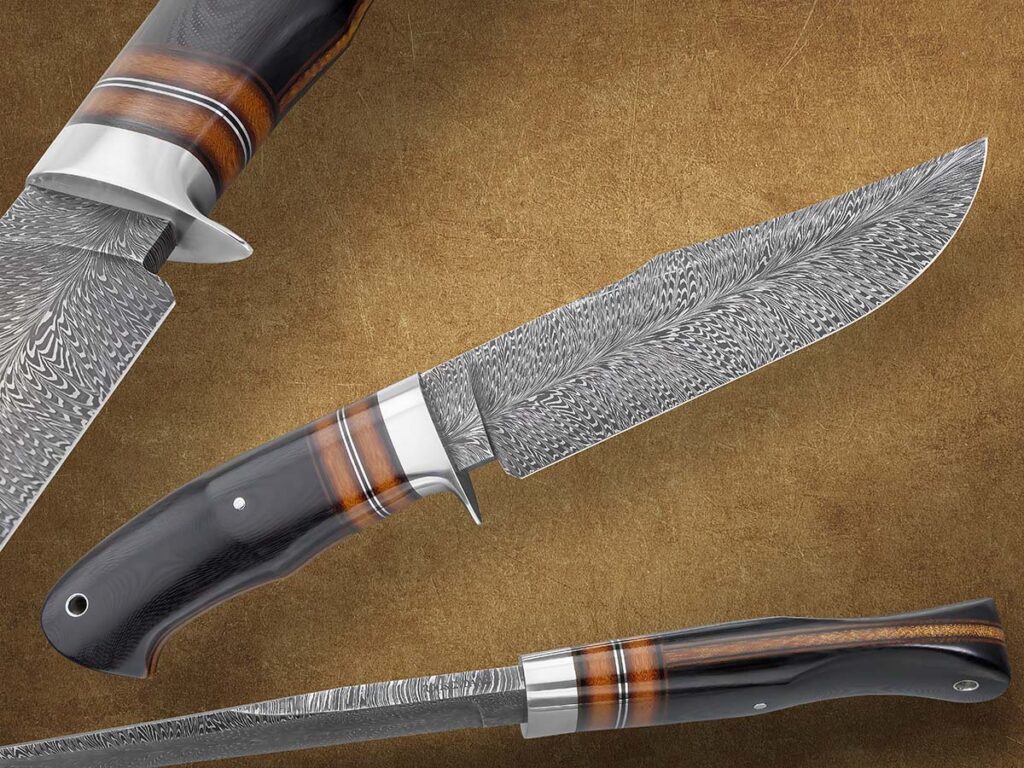
Chris Roosendaal’s feather pattern in 1084 carbon- and 15N20 nickel-alloy steels borders on the mesmerizing. The scales are black G-10 and Micarta®. Overall length: 11.22 inches. (Rod Hoare image)

Randall says that a Turkish twist done right is “very classy.” Its degree of difficulty is a cut above basic twist, but in his experience, it isn’t quite as demanding as feather pattern work due to the requirement of fewer pieces to “cut, flip and weld together.”

When Quesenberry talks Turkish twist, he affirms his love of the look but decries the amount of waste he sees in its production.

“I’m a huge fan,” he commented, “and I love the fact that it’s an appealing pattern. But I don’t like the huge amount of waste. To me, the cool pattern is in the middle third of the bar. There aren’t really a lot of American and European guys into Turkish twist, but some of the South Americans are really pros who are turning out some bold patterns.”

Shifting Damascus Pattern Preferences

Of course, the shifting preferences and envelope of creativity that is constantly pushed keep the damascus conversation going. And it is likely to remain lively long into the future.

“Trying to say one pattern or another is more popular is always subjective,” Randall concluded. “There are some great classic patterns that are very appealing. For example, the ladder, twist, crushed W’s and others. Sometimes the mosaics get visually busy, so some people don’t enjoy them as much, but who doesn’t love a feather or explosion pattern? They are too cool. Some of it does depend on the overall knife design. The blade design and size with guard and handle can enhance—or take away—from a pattern.”

Considering damascus pattern popularity past, present and future, one element is certain. The driving force of creativity and the artistry of the forge will keep this ancient steel relevant for generations to come.

More On Damascus:

Cool Custom: Robert Burns’ Ancient Iron Bowie

Explore the classic clip-point bowie knife from apprentice smith Robert Burns of Wilderness Ironworks.

ABS apprentice smith Robert Burns of Wilderness Ironworks wanted a project that would take him back to the roots of being a bladesmith, and appears to have satisfied that desire through his classic clip-point bowie.

“My goal was to combine the ancient and the contemporary,” he wrote.

For the ancient, he started with iron ore from Minnesota and iron sand from Connecticut. He smelted the two into bloom steel, which he then refined, “my goal being to make a steel fine enough that it could potentially pass for modern damascus”—thus the “contemporary.”

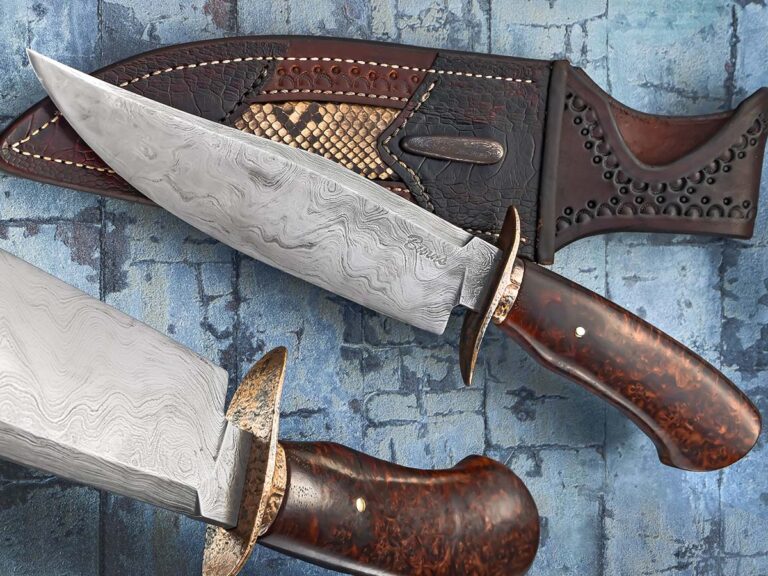
Robert Burns of Pittsburgh, Pennsylvania, used ancient materials such as iron ore and iron sand for the blade and a historic mix for the fittings of his sole-authorship bowie.

To augment the “ancient,” he used a “historic mix from the Bronze Age” for the bronze for the fittings.

As Robert noted, the knife is true sole authorship, from starting ore to the finished sheath.

More Custom Knives:

Blades and Bands: Ready To Cut Through Outdoor Chores

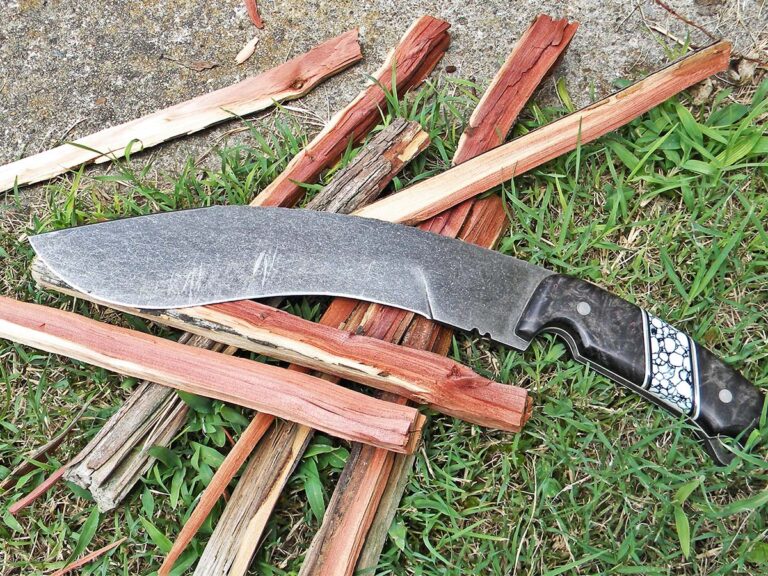
Blades and Bands Kukri is a forward-cutting knife design.

In the search for knives to test for “Spec Sheet,” I get referrals. Tracy Price is one. He’s a fairly new knifemaker but does quality work. The Kukri is a knife he made for himself to push his skills, something most makers do.

It’s always good to learn a different way to do things or a new shape. The more skills, the wider variety of knives the maker can build. No matter how pretty they look, form and function must be there. Let’s see how the Kukri functions.

Blades and Bands Kukri Specs

Maker: Tracy Price, Blades and Bands LLC
Blade length: 9”
Blade material: 5160 carbon steel
Blade grind: Flat
Blade @widest: 1 7/8”
Blade finish: Stonewashed
Handle: Stabilized maple burl w/TruStone™ inlay
Extras: Thong hole; spine of “flintknapped” steel
Weight: 20.1 ozs.
Overall length: 13 3/16”
Sheath: Kydex available
MSRP: $299.99

Pros

  • Exceptional Chopping and Whacking Power
  • Excellent Edge Retention
  • Durable Construction

Cons

  • Weight Can Be a Factor in Control

Kukri Light-Duty Cutting

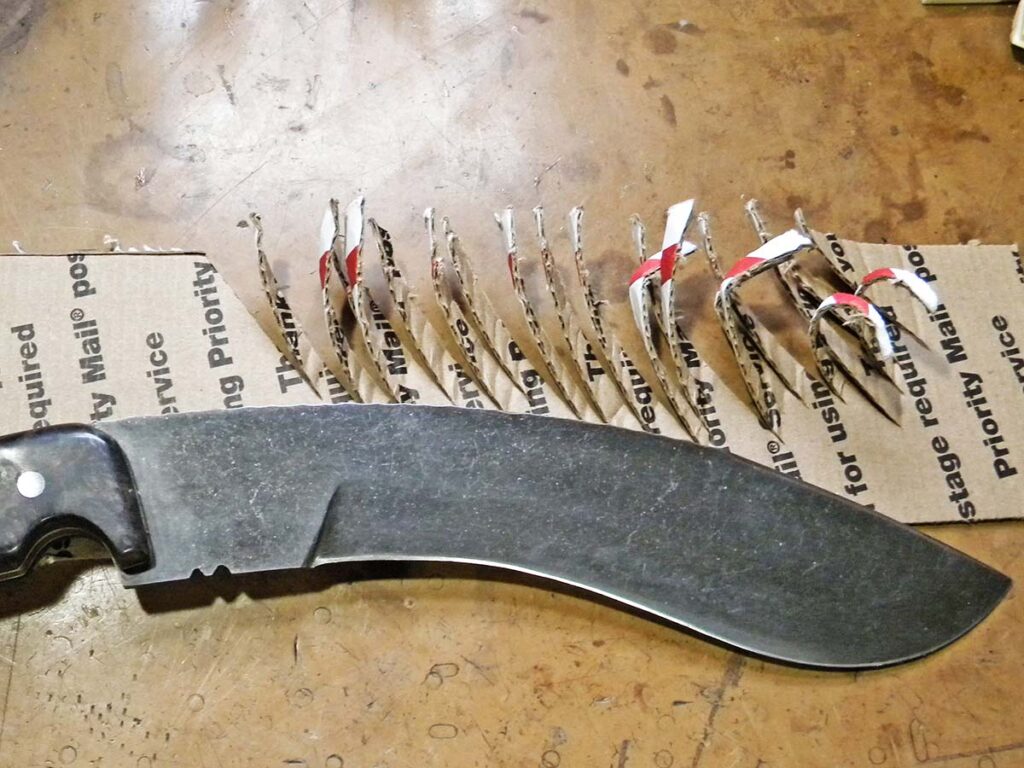
The cardboard slices curled from the edge geometry but resulted in no slowing down of the edge.

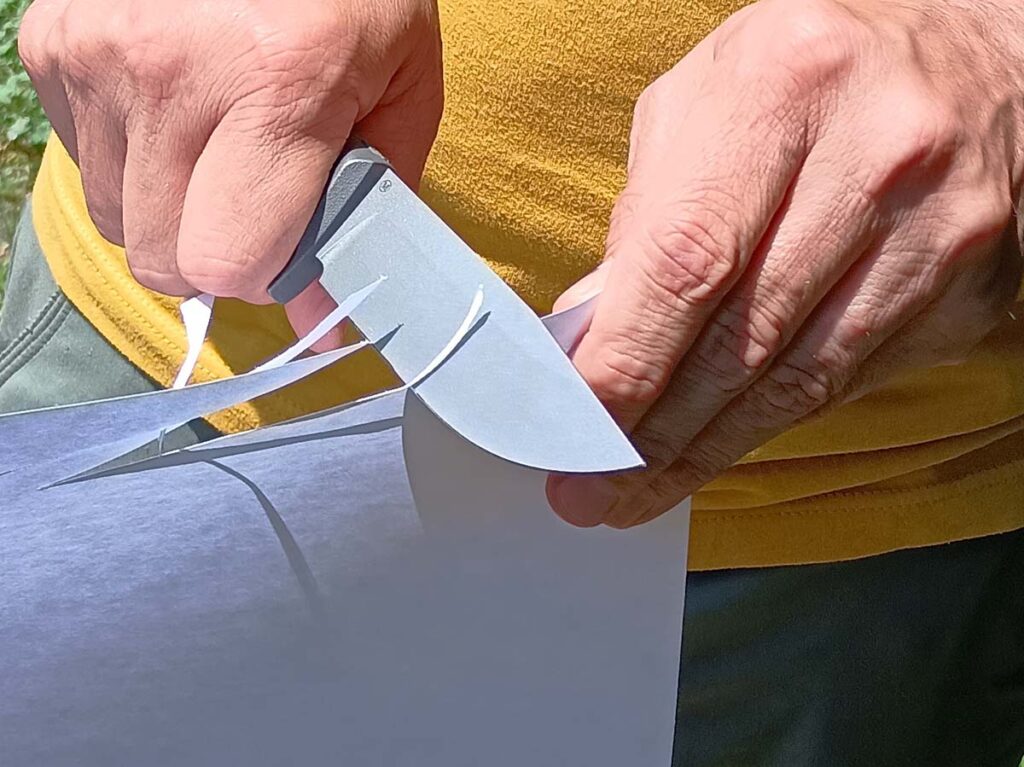
For a quick edge check, I use the paper slice. The knife cut smoothly and fast. The blade shape pulled the edge through the paper. I had to control the knife’s forward weight, but after a few slices, it was no issue. It’s a sharp blade for sure.

I cut up an old postage box and used a side of it for a single-walled cardboard cut. The knife sliced aggressively and was easy to control. The slices curled from the edge geometry but resulted in no slowing down of the edge.

Kukri Medium-Duty Cutting

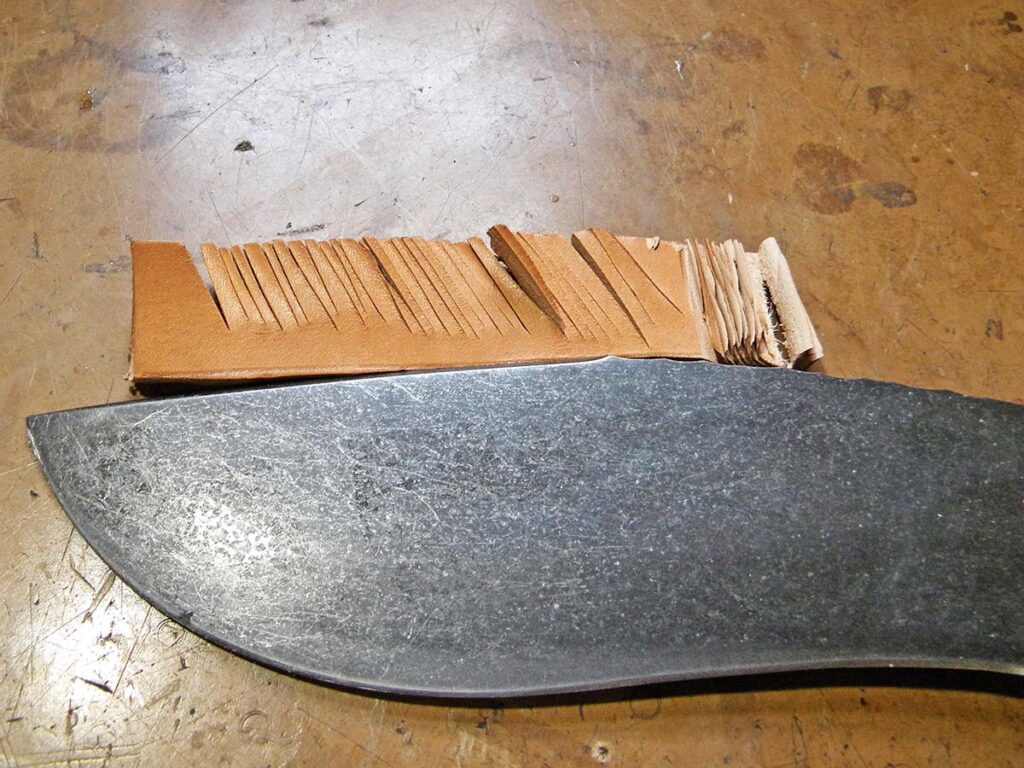
The Kukri smoked the leather cut.

Next up: 8-ounce leather for skiving. I shaved a thin slice of leather to remove the squared-off cut during sheath construction to get the leather to flow together. It was fairly easy to skive the leather; I just had to be careful of the excess part of the blade I was not using. In other words, I was both skiving leather and shaving wood off my workbench at the same time.

Cutting leather was one push and the edge hit bottom. The Kukri smoked the leather cut. I moved up and down the blade and couldn’t find a dull spot. The blade belly was the smoothest. Again, I forgot to check the clearance on the first cut and carved into my benchtop. I’m blaming it on the heat.

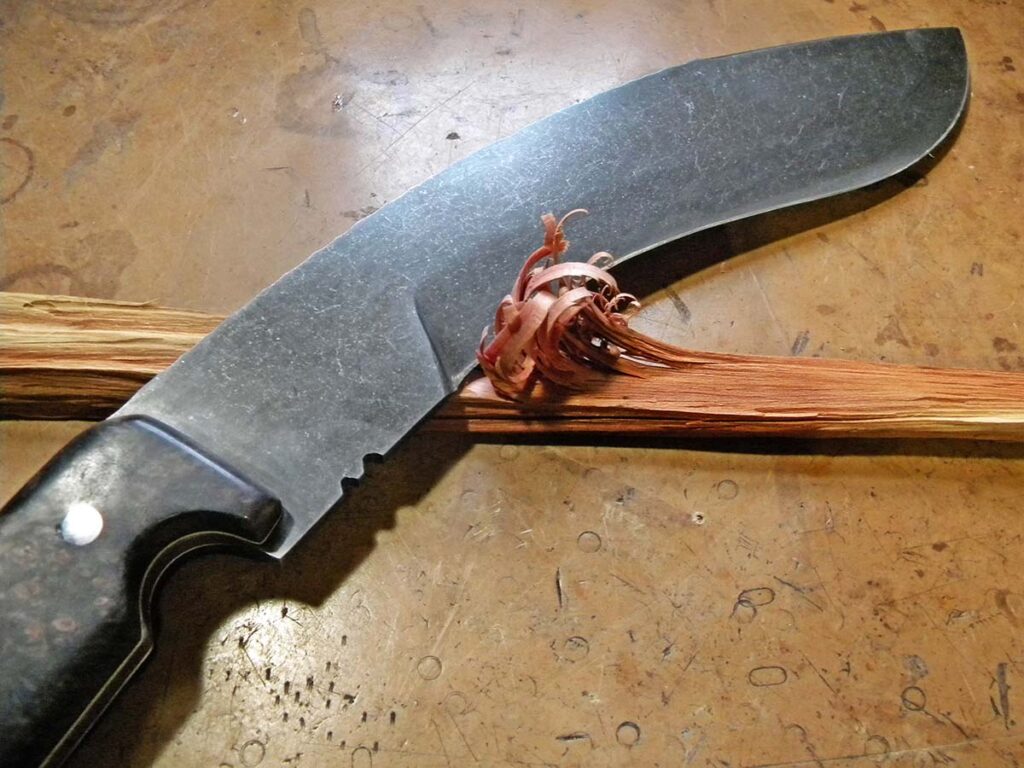
It was time to whittle some fire sticks. I easily controlled the depth of the curlicues by choking up on the handle. The knife curlicued the cedar very quickly. Yes, the Kukri can be used for finer chores, too.

Kukri Heavy-Duty Cutting

The author easily controlled the depth of the curlicues by choking up on the handle.

Chopping was next on the test menu. Finally, I got to use the Kukri and put some whacking into it. Using some red cedar firewood as a base, I started chopping kindling. One whack and I was halfway through the piece. The forward balance worked perfectly for splitting—and man, does it whack! The choil does have a sharp spot but that was easily fixed.

I went back to slicing the original piece of paper to check for dulling and/or chips. The Kukri sliced the now-damp paper very well (97° F and 90 percent humidity make paper kind of soggy). It was simply too hot to stay in the shop—test over!

Final Cut

The Kukri is an excellent field/camp knife. It’s made to chop and whack in the outdoors. However, I soften the edge of the steel at the choil.

More Knife Reviews:

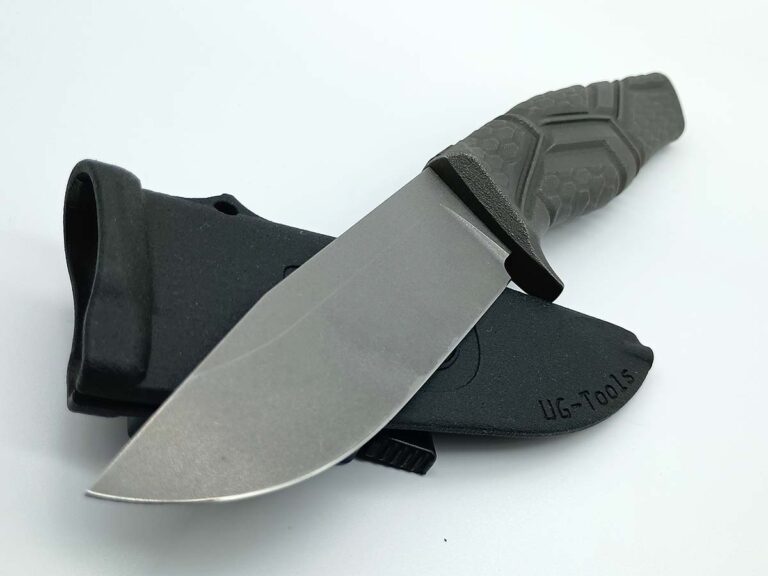
UG Tools TiNy: Knife Of The Year® Proves Sweet Indeed

The TiNy packs hefty performance into a light package.

Despite hailing from Germany, Philipp Utsch and Jan Gierse are fluent in the basest American vernacular—Twinkies and violence.

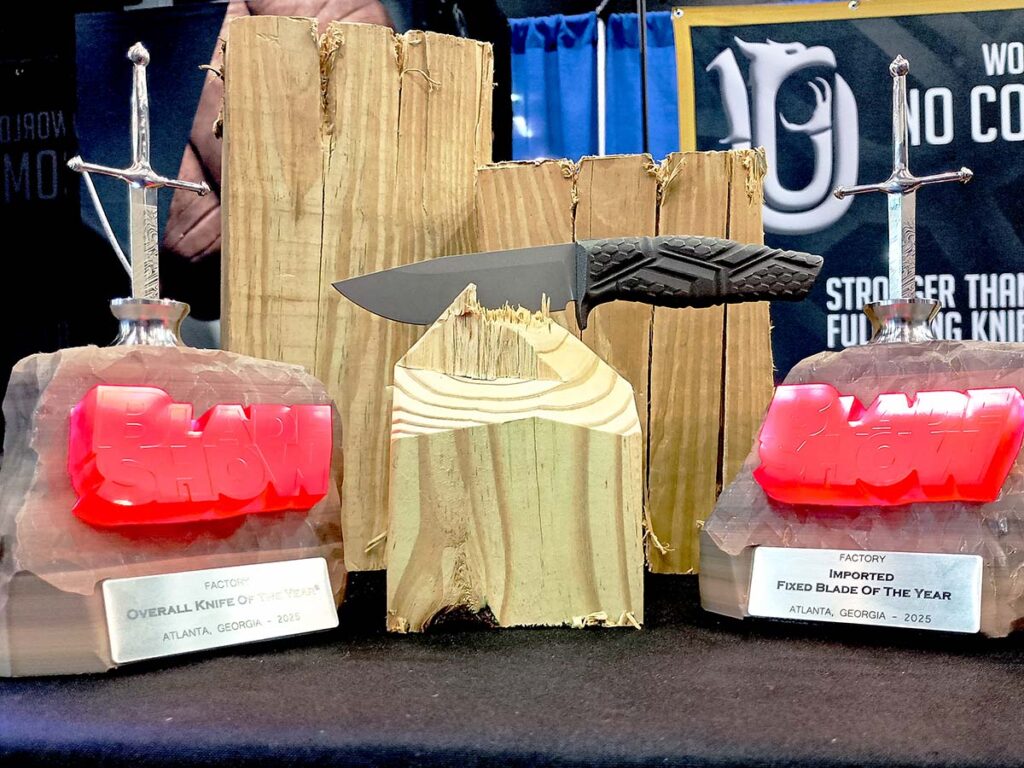
To say smashing a knife weighing all of two of the spongy confections through an 8-by-8 pine post was heard loud and clear at BLADE Show 2025 is an understatement. Aside from wowing some of the most discerning knife collectors, makers and users in the world, the tandem of Teutonic toolmakers also took home the event’s most coveted hardware.

It’s rare for fixed-blade knives to reach the pinnacle of edged tool accolades—BLADE Magazine’s Knife of the Year®. Yet, the German-made gem proved to have the edge over nearly 400 other knives clamoring for the singular honor. How?

Quite simple. Utsch and Gierse’s burgeoning knifemaking concern—UG Tools—and its award-winning knife—the TiNy—took the world’s oldest tool and firmly planted it in the 21st century.

UG Tools TiNy Specs

Total weight: 2.82 ounces
Total length: 8.27 inches
Blade length: 3.94 inches
Blade thickness: .11 inches
Blade steel: MagnaCut @65 HRC
Handle material: Titanium
Handle weight: 1.34 ounces
MSRP: ~$380

Pros

  • Extremely Lightweight
  • Superior Ergonomics and Balance
  • Exceptional Durability

Cons

  • Bordering On Expensive

Rise of UG Tools

One of the more interesting aspects of the TiNy’s meteoric rise is that this was UG Tools’ first official appearance at the BLADE Show. Utsch and Gierse were in attendance at the 2024 edge-stravaganze, but as attendees, not exhibitors.

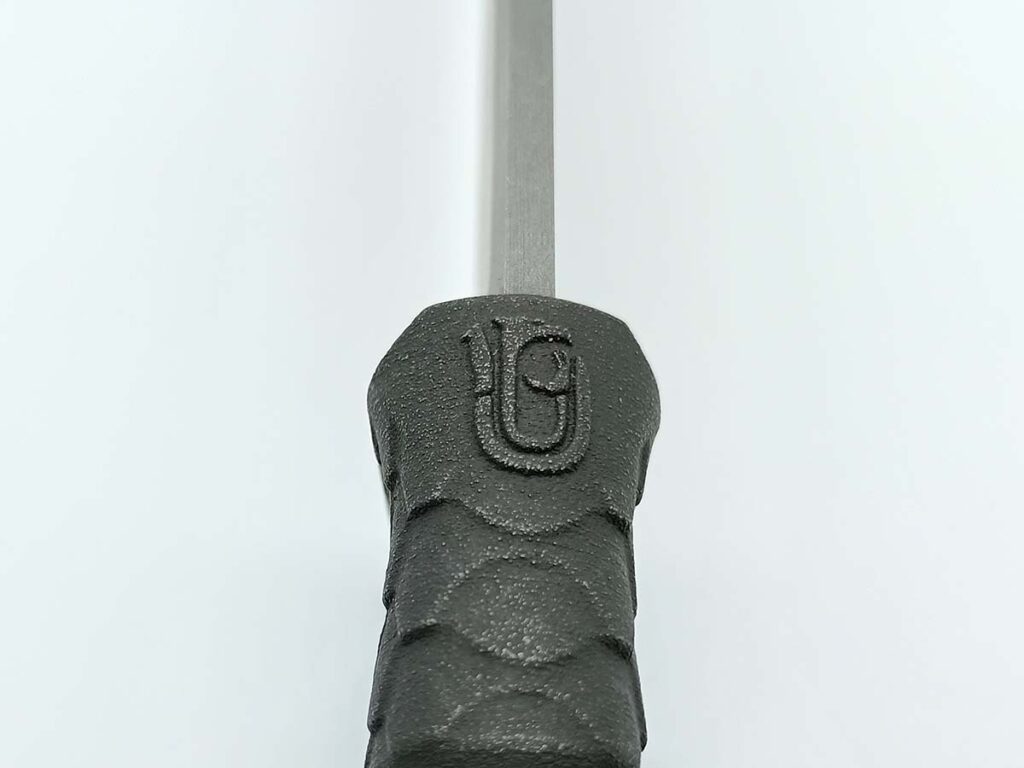
UG Tool’s mark is a combination of the founder’s last initials and some Teutonic ferocity.

The duo’s concern is also relatively new, founded in 2021. Not that knifemaking, fabrication and manufacturing were mysteries to UG’s founders.

Utsch has 20 years of knifemaking under his belt, but his daytime gig was a maintenance manager* in the founders’ hometown of Sundern. And Gierse’s career aspirations were focused on manufacturing, as he was pursuing his PhD in mechanical engineering.

It turns out, there was a lot of serendipity in those backgrounds.

Gierse’s topic focus is 3D printing—in particular, Selective Laser Melting (SLM). When he first moved into this field academically and got access to an SLM machine, a titanium knife handle was among his initial projects.

Down the line, that handle ate at him. He saw its potential, something revolutionary. He was acquainted with Utsch and approached him with the idea of teaming up to create a complete knife.

Thanks to its innovation and performance, the TiNy won both Imported Fixed Blade Knife of the Year and Knife of the year honors. It’s also stuck into some of its handy work, as the guys from UG Tools hacked through fence posts to demonstrate the knife’s resilience.
Thanks to its innovation and performance, the TiNy won both Imported Fixed Blade Knife of the Year and Knife of the Year® honors. It’s also stuck into some of its handy work, as the guys from UG Tools hacked through fence posts to demonstrate the knife’s resilience.

The bladesmith was instantly intrigued.

“[W]hen Jan suddenly sent me a photo of the first titanium handle out of the blue in 2021, I knew immediately what I was looking at. The potential was immediately clear to me,” Utsch said.

Getting A Handle On The TiNy

Funny as it might sound, the handle is the belle of the ball on the tiny. It’s where much of the innovation lies.

Additive manufactured, and hollow, the human-tool interface cuts the knife down to a scant 2.82 ounces—or two Twinkies. For a practical-tactical knife, this opens up a wealth of potential.

The old saying for backcountry hunting, military campaigns or just plain hiking is “Ounces make pounds, and pounds make pain.” At 8.27 inches in overall length, weight savings are substantial for a full-sized hunting, camping or military knife (the TiNy could fill all three roles).

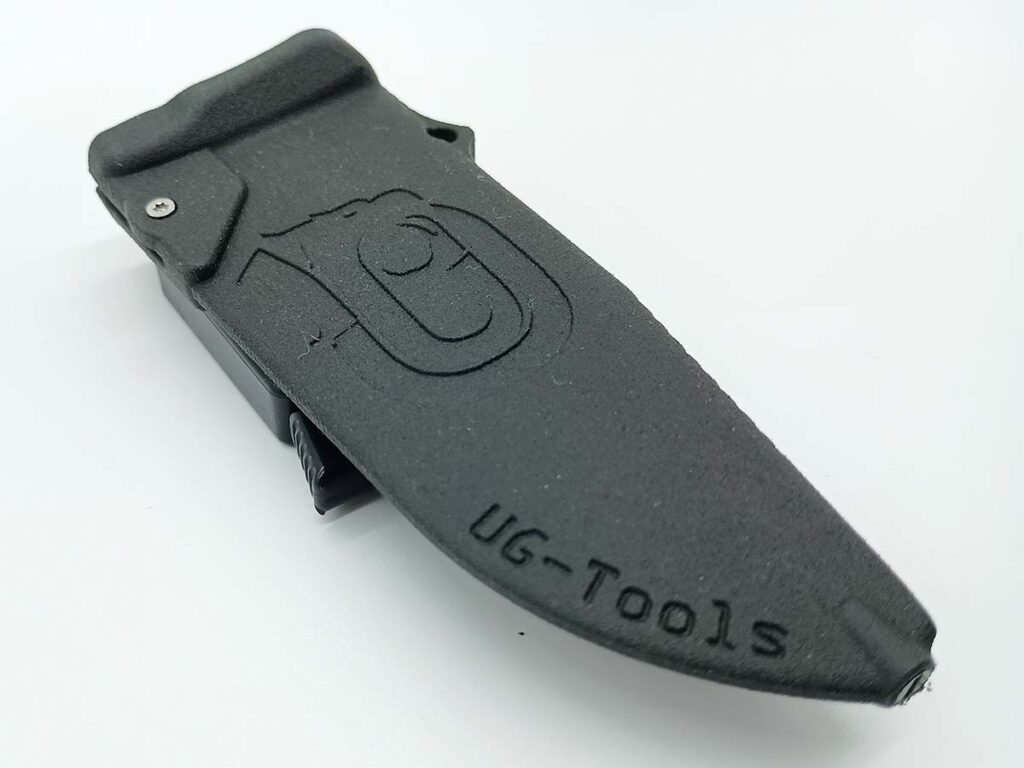
UG’s design prowess overflows to the TiNy’s sheath, a sturdy Kydex unit with a retention-adjustment screw and UltiLink for unlimited attachment/carry options. An aside, given the hollow handle, it makes a very satisfying ping when clipped all the way into its sheath.
UG’s design prowess overflows to the TiNy’s sheath, a sturdy Kydex unit with a retention-adjustment screw and UltiClip UltiLink for unlimited attachment/carry options. An aside, given the hollow handle, it makes a very satisfying ping when clipped all the way into its sheath.

However, keeping things light isn’t the only advantage of the 3D printed handle.

TiNy’s Big Ergonomics

The sky is nearly the limit when it comes to SLM manufacturing, allowing for the TiNy’s advanced—if not nuanced—ergonomics. From the Pango model, I spentd time testing, which isit’s the most enjoyable aspect of the knife.

Plain and simple, in my medium-sized mitts, it feels good to hold.

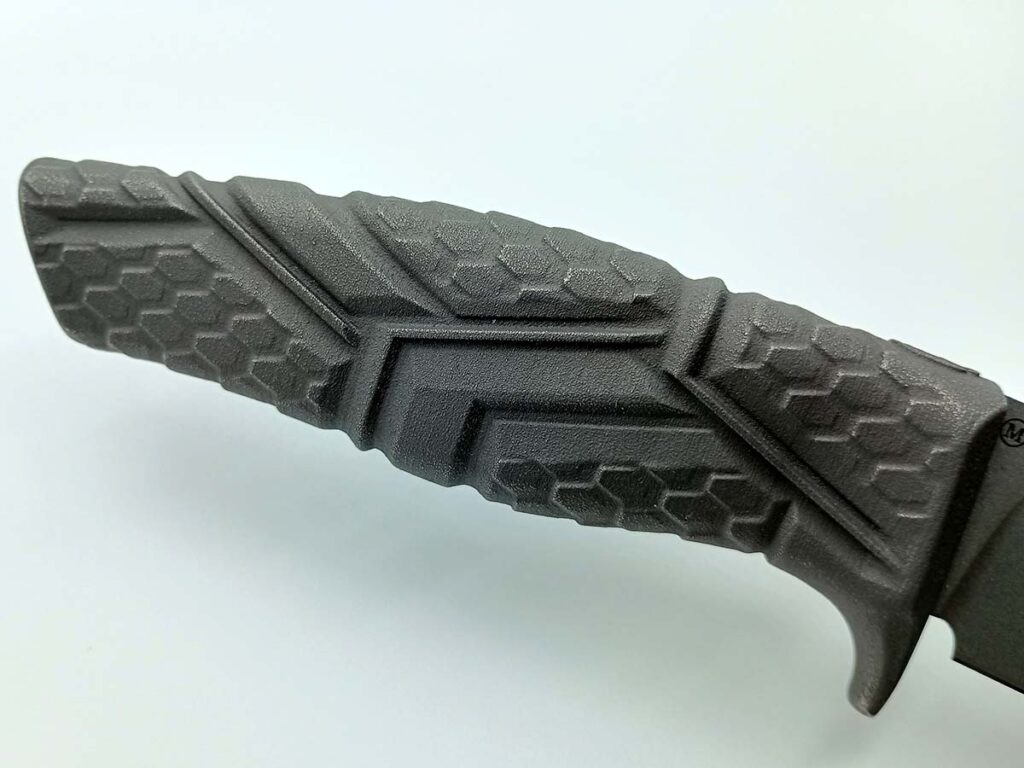
Well thought out, the handle swells and recesses at the right spots to form-fit my medium-sized hands. Yet, but for my money, the integral grip texturing gets the most accolades. A mixture of dragon scale and linear elements—with a fine pebble finish—the handle stays in place no matter what axis force is applied.

The TiNy’s 3D-printed handle isn’t only lightweight, but also as comfortable as the day is long. In testing, the Pango pattern stuck firmly to the hand without firing up a hot spot.

A final point, the knife is extremely well-balanced. Using my finger as a fulcrum, it’s right behind the guard, making the blade very agile and easy to manipulate.

TiNy Blade

The 4-inch drop-point blade is very clean and understated, but well-formed for a general outdoor knife. Given UG pulled out all the stops and used MagnaCut steel, it’s also more than ready for hard use.

I appreciated the long, straight cutting surface just behind the belly. It is ample enough to facilitate larger push cuts and gives it plenty of edge on pull cuts.

Turning to Magnacut steel, UG produced a high-functioning cutting tool that requires little maintenance. Through general testing, the knife retained the same edge with which it came out of the box.

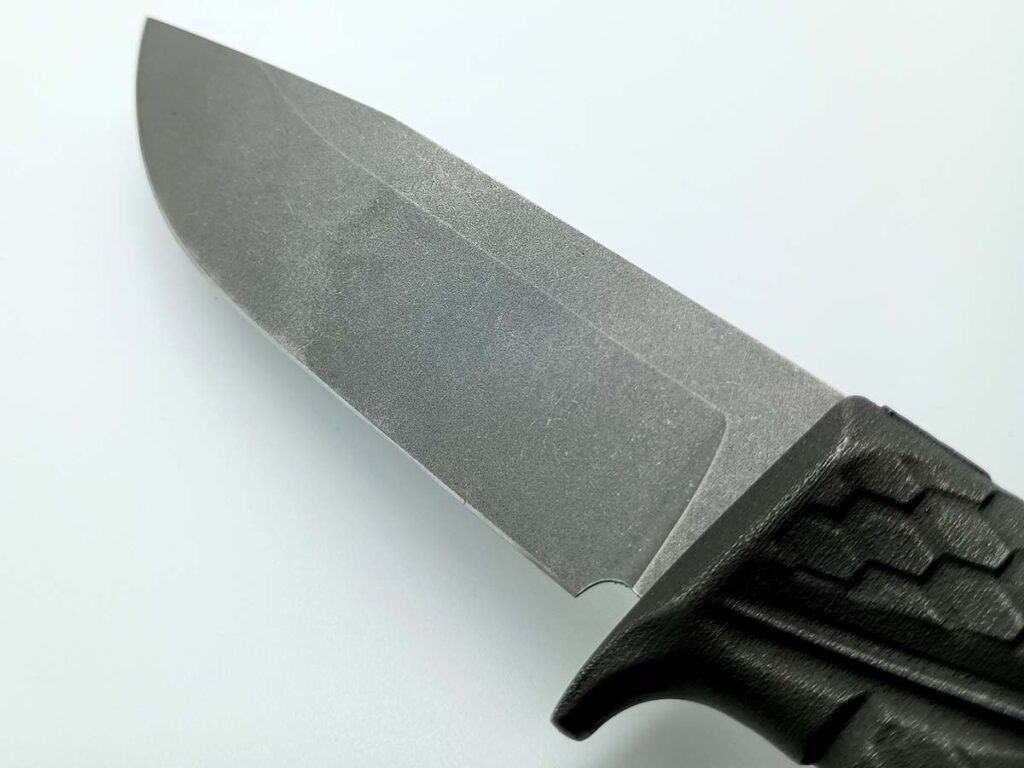
The drop on the point was just right for me to index when choking up on a pinch grip, like you might use field dressing a buck or the like. And the blade’s stonewashed finish gives it a level of tackiness, as well as hiding inevitable abuse.

TiNy Ruggedness

Interestingly, the TiNy is neither a full nor a classic tang knife, a fact that might get some traditionalists to clutch their pearls. Utsch and Gierse whacking it through an 8-inch by 8-inch post should put to rest any concerns about durability. But what’s going on to keep the blade and handle happily married?

“The extreme load-bearing capacity is achieved by the very precise press fit, in which the oversized blade is pressed into the undersized handle,” Gierse said. “This type of connection has been proven in industry for well over 100 years and transfers forces through a permanently elastic, form-fitting connection.”

UG’s knife made quick work battoning through a nearly 3-inch diameter elm log.

UG has done its testing on the knife, as well as sold several thousand and has yet to encounter a blade-handle separation.

“So far, we have not been able to damage the connection between the handle and the blade, even under extreme stress tests,” Gierse said. “This makes the knife behave like an ultra-light, fully integrated knife. Of course, the blade can break under excessive overload, just like any other knife. Despite the best heat treatment and steel, there are natural physical limits that even we cannot overcome.”

Testing The TiNny

I would have liked to have tested the TiNy during hunting season, to really put the knife through its paces. However, I received my test model during the summer and deadlines call.

In turn, I put it through a small, very unscientific laboratory evaluation that included:

  • Initial sharpness test on 20-pound bond paper: The tiny passed my initial sharpness test with flying colors.
  • Push-cut test on 1/8-inch thick1/8-inch-thick leather: It snapped straight through the leather with an audible pop.
  • Pull-cut test on ¼-inch double-wall cardboard: The knife made quick work of the cardboard, through 100 some cuts.
  • Durability Test Battoning Siberian Elm Log: Had no problem passing through a seasoned 3-inch diameter log, splitting it roughly a third of the way through. Will note, this did mar the blade finish some.
  • Follow-up sharpness test on 20-pound bond paper: No edge loss from the initial test.

Overall Impression

I was impressed with the cutting performance of the TiNy; however, I wasn’t too surprised given the blade material. There’s a reason why MagnaCut continues to demand respect in the marketplace and this was proven out by the blade maintaining its edge after moderate use.

I walked away most impressed with the comfort and controllability of the knife, thanks to a well-thought-out handle. I did wonder if the linear aspects of the texturing would prove hot with extended work. This wasn’t the case. I could have worked all day with the TiNy and not thought twice.

Before and after testing, the TiNy’s blade was razor sharp, able to shave through 20 bond with ease.

I’m not the only one.

James Rodebaugh met Utsch and Gierse in 2024, when they attended the BLADE Show as attendees. The duo gave the ABS Master Bladesmith and custom knifemaker a TiNy for field testing, with Rodebaugh taking it on hunting trips in both Alaska and Wyoming.

Dressing game and spatchcocking fowl, the knife proved resilient. He also tested a concern I have with any metal-handled knife—performance in cold weather.

“The printed titanium handle surprised me,” he said. “I thought it would be cold to the hand but warmed to body temp from approximately 20 degrees Fahrenheit in a heartbeat.”

Good to know you won’t take off palm flesh if you’re gutting a deer in the bowels of winter.

Final Cut

Rarely do knives—even ones deemed top-of-class—vastly change the manufacturing landscape. Is the UG TiNy one of those sea-change pieces of cutlery? Only time—and likely mimicry—will tell.

What can be said is that Utsch and Gierse have concocted a version of the age-old fixed blade that firmly plants its feet in modern manufacturing. And they’ve done so at a level that should make the TiNy a useful and trustworthy piece of kit, be it in the backwoods or battlefield.

For two Twinkies’ worth of knife that’s pretty sweet.

More Reviews:

Damascus Steel: Experts Forecast Growth In The Knife Industry

From copper-infused patterns to stainless steel sheets, discover the innovations driving the red-hot market for production damascus.

Are we seeing a bit of “global warming” in the knife industry, where red-hot damascus steel is getting even hotter? BLADE® spoke with some industry leaders, and 2025 and beyond looks good to them when it comes to production damascus in both carbon and stainless steels.

There are many individual makers who make high-quality damascus in simple and complex patterns in their home shops, backyards or shared maker spaces. This article focuses instead on production damascus forged by specialized outfits such as Baker Forge & Tool, Damasteel, Chad Nichols Damascus and Vegas Forge. At a level beyond “regular” damascus makers, these companies make steel for the masses, for production companies, and specialize in innovative new materials that are sure to delight the industry.

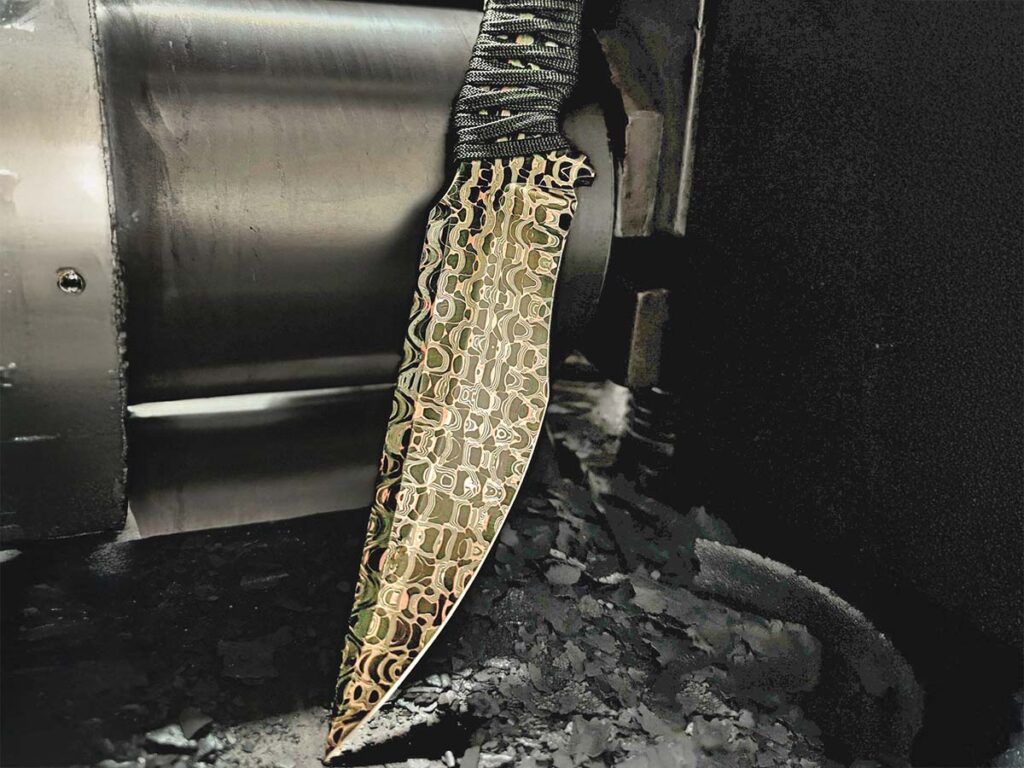
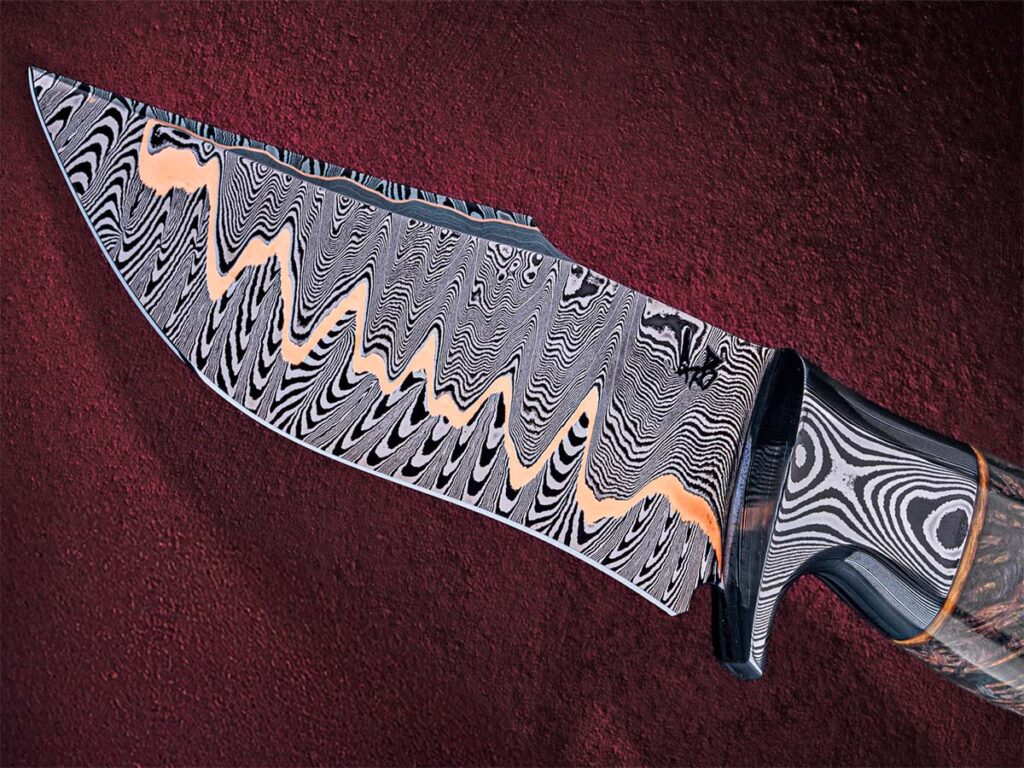
BLADE readers will be familiar with Baker Forge & Tool, a prolific producer of innovative damascus patterns that include copper, such as CopperMai, TigerMai, GoMai and others.

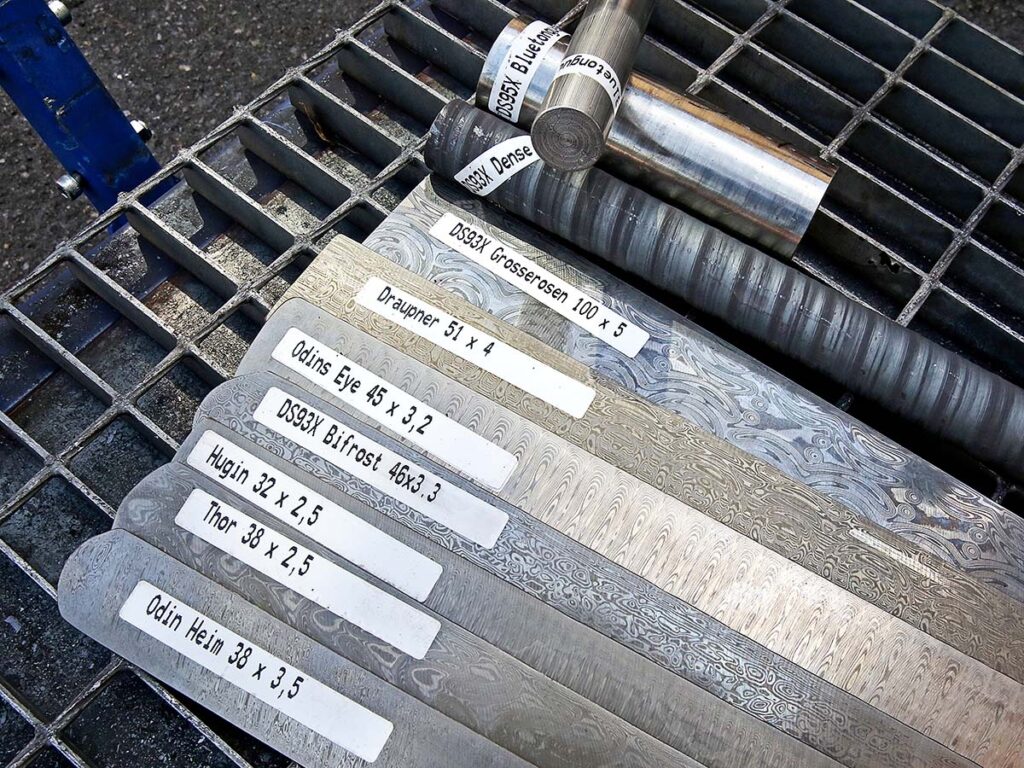
DS93X steel—fourth from bottom in bar form—is Damasteel’s standard mix, “combining good performance with good looks.” “For us it’s more about expanding the patterns than about trying new steel combos,” noted Per Jarbelius. The other patterns in bar form are representative examples of what you can expect from the Swedish steel maker.

“We make carbon steel damascus patterns with copper, and they’ve been hot. We expect them to stay hot through 2025,” Coy Baker said. When it comes to steel selection, the company most often sticks with the gold standard combination of 1084 carbon and 15N20 nickel-alloy steels.

Baker also has been experimenting with Apex Ultra as a core steel for its copper san-mai. For those unfamiliar, Apex Ultra is a tungsten steel alloy, kind of a super-52100 carbon steel. It’s made in small batches and is hard to get in the USA, but Baker has found that the material makes a great damascus core.

“Demand for our Apex core billets far outpaces supply,” Coy noted.

Baker has also been experimenting with stainless and copper damascus and san-mai, using 154CM and AEB-L stainless steels. This writer also makes knives and that combo sounds quite challenging to forge. Baker confirmed that it was very challenging and wouldn’t reveal any secrets, other than the 154CM etches light and the AEB-L etches darker.

Growth In The ‘Sip

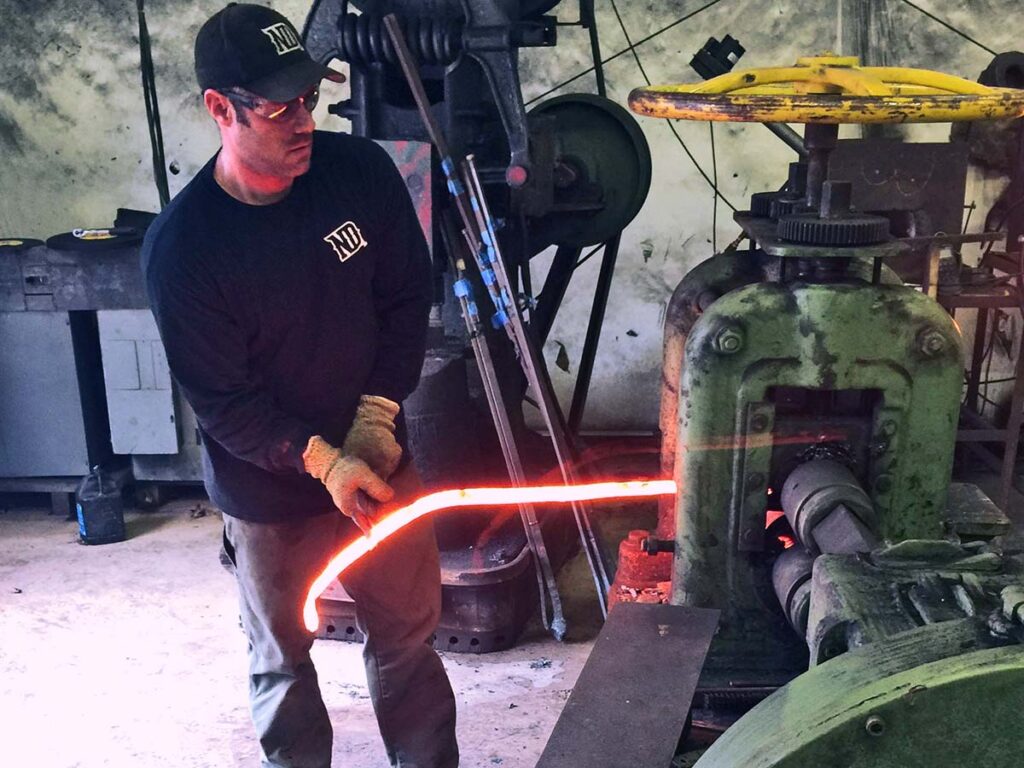
Down in beautiful Bush Springs, Mississippi, Chad Nichols makes traditional carbon steel damascus at a production level.

Vegas Forge has always been innovative and 2025 will be no exception. “We’ve figured out how to do copper in with the damascus pattern manipulation, not just as a line between san-mai,” Jesse Harber noted. (Vegasforge.com image)

“I stick mostly to carbon steel 1075 or 1095 plus 15N20 with occasionally a little bit of 3V,” Nichols explained. “I’ve got my process down and these steels go together well.” He makes a variety of mosaic patterns, most of which go to a single manufacturer. “The carbon steels are so much more organic,” Nichols said. “You can do so much more with them in a cost-effective way.”

Nichols’ goal for 2025 is to increase his production of mosaic patterns.

“There just aren’t many people doing production mosaics,” he said. “It’s a great opportunity for growth.”

Another area he’d like to see grow in 2025 is the use of exotic and historical materials. He’s made a run of steel for Boker with steel from a German Tiger tank, and has a run coming for William Henry with some leaf springs sourced by WH.

Collab Designs

Damascus isn’t just a U.S. product. Damasteel produces high-quality stainless steel damascus in Sweden.

Chad Nichols (above) stated the goal at Chad Nichols Damascus for 2025 is to increase the production of mosaic patterns.

“Our DS93X steel is our standard mix, combining good performance with good looks,” Damasteel’s Per Jarbelius remarked. “For us it’s more about expanding the patterns than about trying new steel combos.”

DS93X is described as a “patented powder metallurgy product” that includes “two different hardenable steel grades.” “We use only stainless steel,” Jarbelius explained, ‘because it doesn’t rust and has the same or better performance.”

Damasteel historically produces a new pattern each year. For 2025 it also has begun a special project to collaboratively design patterns. Benchmade collaborated with Damasteel to make a steel pattern called “Monarch” exclusively for the Benchmade Gold Class Necron balisong. Jarbelius is excited for the potential to expand the collaborative effort with other companies who want proprietary patterns.

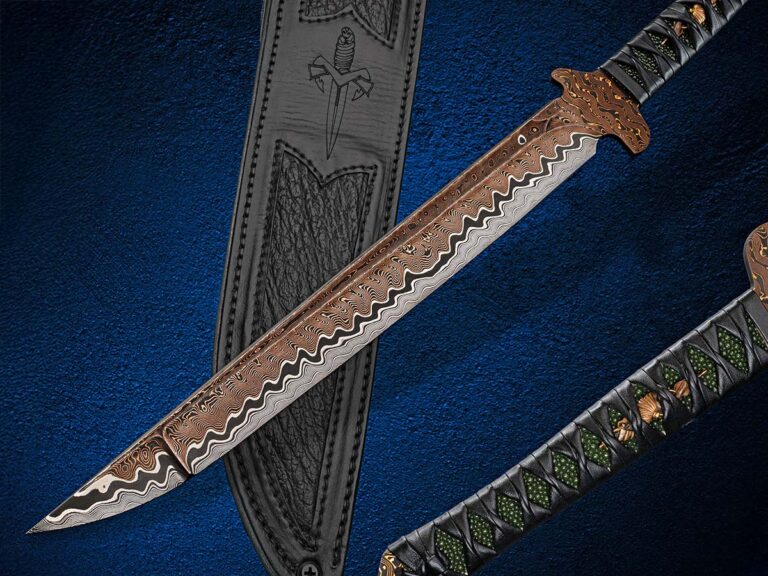
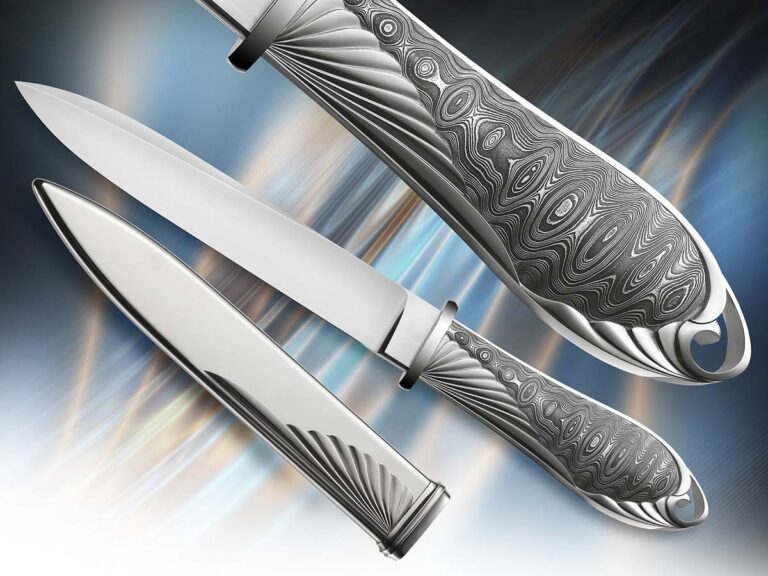
In another innovation, Damasteel has developed the capability to produce stainless damascus in sheets, not just bars. This will come in handy for small-batch and mid-tech production. The sheet steel pattern is called “Drakkar,” which is the old Norse word for the dragon-shaped Viking longboats.

Copper In The Pattern

What happens in Vegas may stay in Vegas, but that’s not the slogan for Vegas Forge, whose damascus is well known worldwide. It is a consistent producer of high-quality carbon and stainless damascus in complex patterns.

Baker Forge & Tool has been experimenting with Apex Ultra as a core steel for copper san-mai. This integral fighter by Greyson Weltyk features Baker copper damascus for its recurve harpoon blade. (Bakerforge.com image)

“One of our most popular patterns is ‘Reptilian,’ which has three alloys included: O1, 1075 and nickel,” observed the company’s Jesse Harber.

Vegas Forge has always been innovative and 2025 will be no exception.

“We’ve figured out how to do copper in with the damascus pattern manipulation, not just as a line between san-mai,” Jesse noted. “We can take our Reptilian pattern with copper in it, and then clad that billet over an O1 or 1095 core.”

As far as stainless goes, Vegas Forge continues to push the complexity of its patterns. Its most popular pattern, “Virus,” begins with a single stack of 1200 pieces! The company uses 154CM cores for most of its stainless san-mai, along with CTS XHP when available.

Ultimate Hotness

What kind of knives do the manufacturers predict for ultimate hotness in 2025?

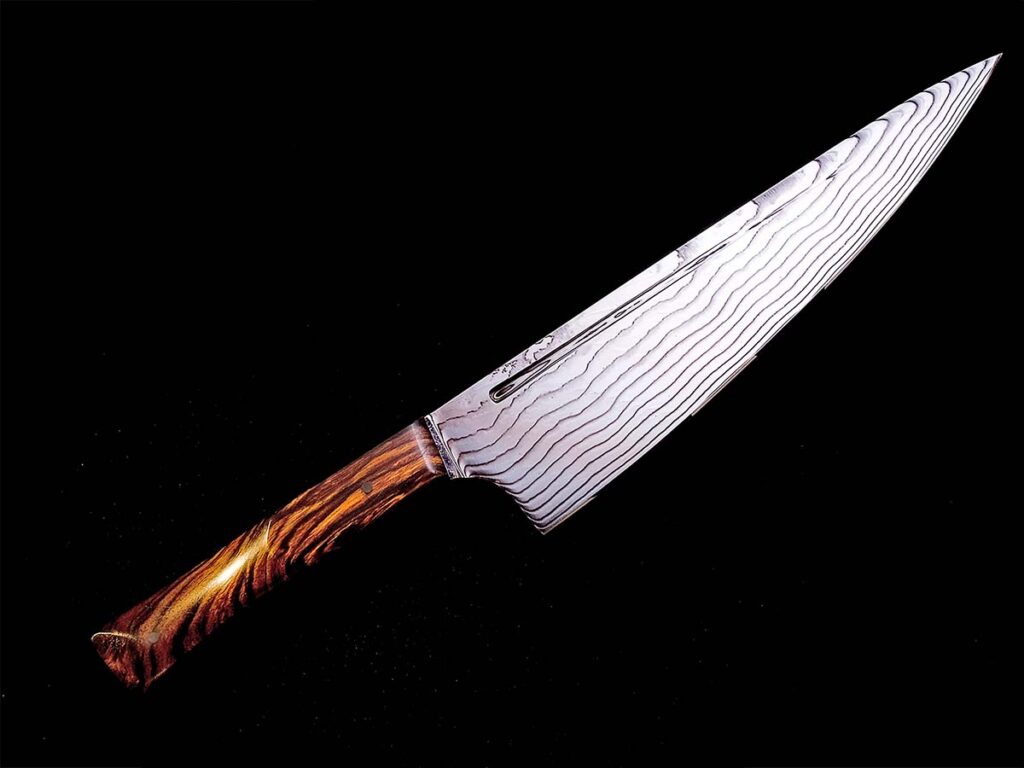
Damasteel has developed the capability to produce stainless damascus in sheets, not just bars. The sheet steel pattern is called “Drakkar,” the old Norse word for the dragon-shaped Viking longboats, and is used here on a chef’s knife by a local Swedish cutler.

Both Baker and Jarbelius indicated culinary knives will stay hot, especially in stainless. Baker pointed out that stainless steel handles kitchen abuse better, and this writer agrees. Per said Damasteel’s Damacore and DC18N nitrogen steels are top of the line, and the company has a culinary knife coming in partnership with BLADE Magazine Cutlery Hall-of-Fame® member Ken Onion and CRKT. Both Damasteel officials and Chad Nichols agree that complex patterns are expected to do well for the pocketknife and one-off makers.

Jarbelius “expects growth in the complex pattern market” even as Damasteel’s basic traditional rose, ladder and twist damascus patterns remain best sellers. Nichols states that the mosaic niche he addresses will continue to grow.

All four steel makers expect growth in the production side of the market. Even in a slower economy, the big knife manufacturing companies are still producing limited runs of high-quality damascus knives. Baker looks for growth in his damascus-core san-mai steels.

“They’re easier to get a consistent etch on than the mono-steel cores,” he explained.

Chad Nichols stated that he expects growth in the use of mosaic damascus steels by factory knife companies in 2025.

Manufacturing is all about consistency and efficient processes. Damasteel achieves consistency by using the same steel combo for all its patterns. Nichols gets there by batch building for specific manufacturers so that each run is internally consistent. Harber mentioned that he was approached at BLADE Show West* by multiple production companies looking to order steel for 100-to-200-piece runs. He indicated he expects the mid-range sub-$800 production folders to stay hot.

Gonna Be Intersting

The new year is going to be an interesting one for the economy and politics, both of which are inextricably entwined. Fortunately, thanks to the work of those in the damascus industry, it’ll also be an interesting year in the world of knives. If nothing else, knife enthusiasts will have plenty of beautiful damascus production knives coming off the assembly lines to keep them entertained.

More On Steel:

Advertisement

Must Read Articles

Read this before you make a knife

Knifemaking 101 – Read This Before You Make a Knife

  by Wayne Goddard My experience has taught me that there's nothing like digging in and getting started. I've often said the hardest part of the...
how to forge damascus steel

How to Forge Damascus

Advertisement
Advertisement