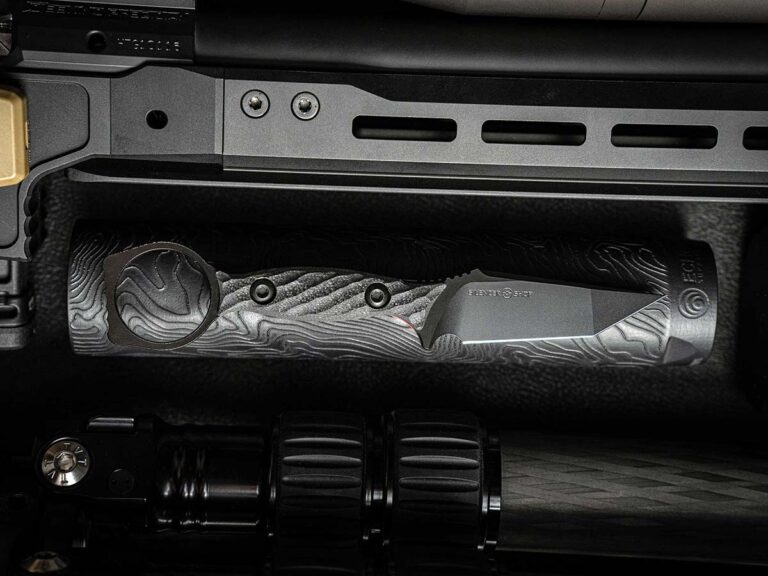
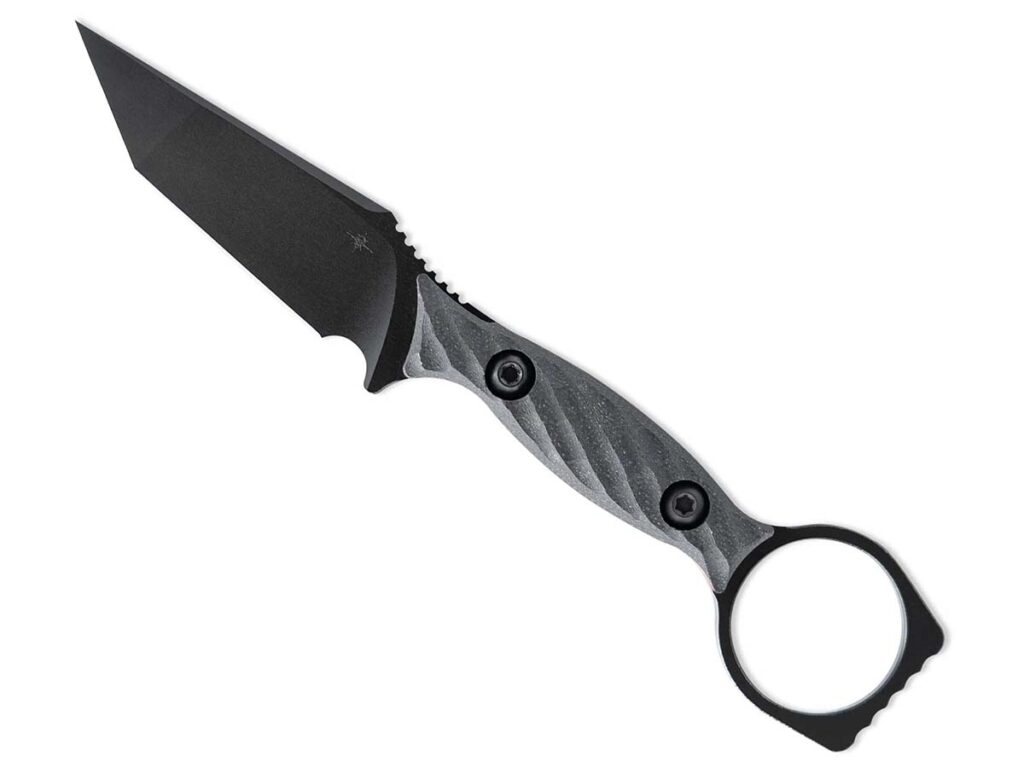
The ring-knife fixed blade is meant to offer a light and nimble option.
Toor Knives and Silencer Shop have given knife fans something to make noise about. Teaming up, the tactical knife maker and suppressor retailer release the Hendrix, a limited-edition compact fixed blade. Built as the right-sized EDC option for belt or gear bag, the fixed blade is manufactured in San Diego.
The Hendrix boasts a 2.5-inch tanto blade ground from CPM MagnaCut steel and heat-treated to a hardness rating of 62–64 HRC. Developed specifically for cutlery, MagnaCut offers high corrosion resistance alongside strong edge retention and toughness, making it well-suited for a low-maintenance field or range tool. The blade measures .155 inches thick, providing structural support despite its shorter profile.
The Hendrix’s overall length is 7.875 inches, with a total weight of 2.9 ounces. The size and weight not only make it nimble in the hand, but also ultralight on the beltline. Adding to its strength, the knife features full-tang construction; adding to this are ergonomic and rugged black G10 handle scales fitted to the knife with stainless steel hardware. Toor tops it off with an integrated rear retention ring to aid in quick retrieval and control. Each knife ships with a two-piece Kydex sheath designed for modular mounting options on chest rigs, belts or boots.
According to Toor Knives founder and CEO Connor Toor and Silencer Shop vice president of marketing Matthew Pompa, the project was designed to offer an American-made, lightweight backup blade with tactical and EDC uses in mind. Fans will have to be quick if they dig the fixed blade. The Hendrix is available directly through both the Toor Knives and Silencer Shop websites as a single-run production. Once current inventory is exhausted, the model will not be re-entered into standard production.
Hendrix Specs Overall Length: 7.875” Blade Length: 2.50” Blade Thickness: .155” Blade Steel: CPM MagnaCut (62–64 HRC) Handle Material: Black G10 Hardware: Stainless Steel Sheath: Two-Piece Kydex Weight: 2.90 oz. Country of Origin: USA MSRP: $295
New inductees span the world of custom and factory knives.
A notable assortment of those who for many years enhanced or continue to enhance the overall improvement of the knife industry highlights the 2026 class of inductees into the BLADE Magazine Cutlery Hall of Fame®.
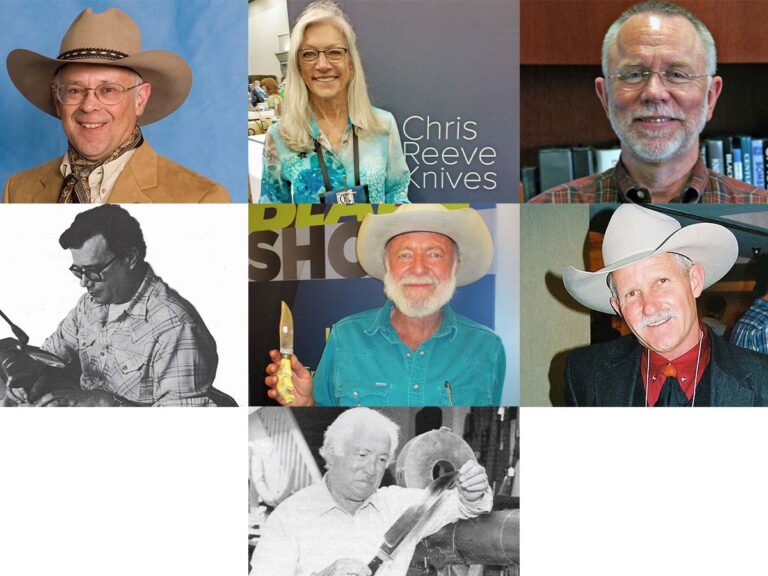
The new honorees include three living and four deceased members. Among the former are CRKT co-founder Rod Bremer and Anne Reeve, owner/president of Chris Reeve Knives, on the factory side, and American Bladesmith Society master smith Larry Fuegen from the custom realm.
The posthumous inductees are bladesmith/writer Ed Fowler, custom knife purveyor Nate Posner, knifemaker/knifemaking supplier Bob Engnath and ABS master smith Tim Hancock.
All were formally inducted in a special ceremony during the BLADE Magazine Cutlery Hall-of-Fame Breakfast the Saturday morning of the BLADE Show, June 6, in the Renaissance Waverly, the host hotel adjoining the Cobb Convention Center in Atlanta.
Rod Bremer
Rod Bremer along with partner Paul Gillespie, founded Columbia River Knife & Tool and progressed the concept of manufacturing custom designs at a price any consumer could afford.
Along with partner Paul Gillespie, Rod Bremer started Columbia River Knife & Tool (CRKT) in 1994. The concept was to bring world-class-quality knives to the U.S. market in the designs of custom knifemakers—as of today, CRKT has used the designs of over 50 such makers—and innovation at a price that virtually all consumers can afford.
According to a nominator, Rod’s integrity qualifies him for the Hall of Fame, a good example being that “CRKT pays the makers/designers royalties for as long as the knife sells. To this day, Rod is still paying royalties to the estates of Ed Halligan, Jon Graham, Cutlery Hall-of-Famer Kit Carson and several others.” Added the nominator, “CRKT started the Forged by War program to help veterans and their charities. So far the program has donated over $500,000 to the charities of the veteran’s choice.”
Under Rod’s leadership, CRKT has won a number of BLADE Magazine Knife-of-The-Year® Awards. In the process, he helped enhance Southeast Asia knife manufacturing by teaching and demanding that the Taiwanese factories produce the highest-quality knives possible.
He has bolstered pro-knife initiatives through his work as an American Knife & Tool (AKTI) Board of Regents member, working on issues that benefit the knife industry. His resume includes: 1) Election to the AKTI Board of Regents (2009); 2) Playing an active role in the monumental defeat of U.S. Customs’ attempt to classify all one-hand knives as switchblades (2009); 3) Recipient of Knife Rights’ inaugural Freedom’s Guardian Award for his role in upholding knife rights industry wide (2011); 4) Elected AKTI vice president (2011); 5) Organized and hosted AKTI anti-counterfeiting round table and presented related seminars for BLADE University at BLADE Show 2013; and 6) Elected (2014) AKTI president, a position he held through 2016.
Anne Reeve
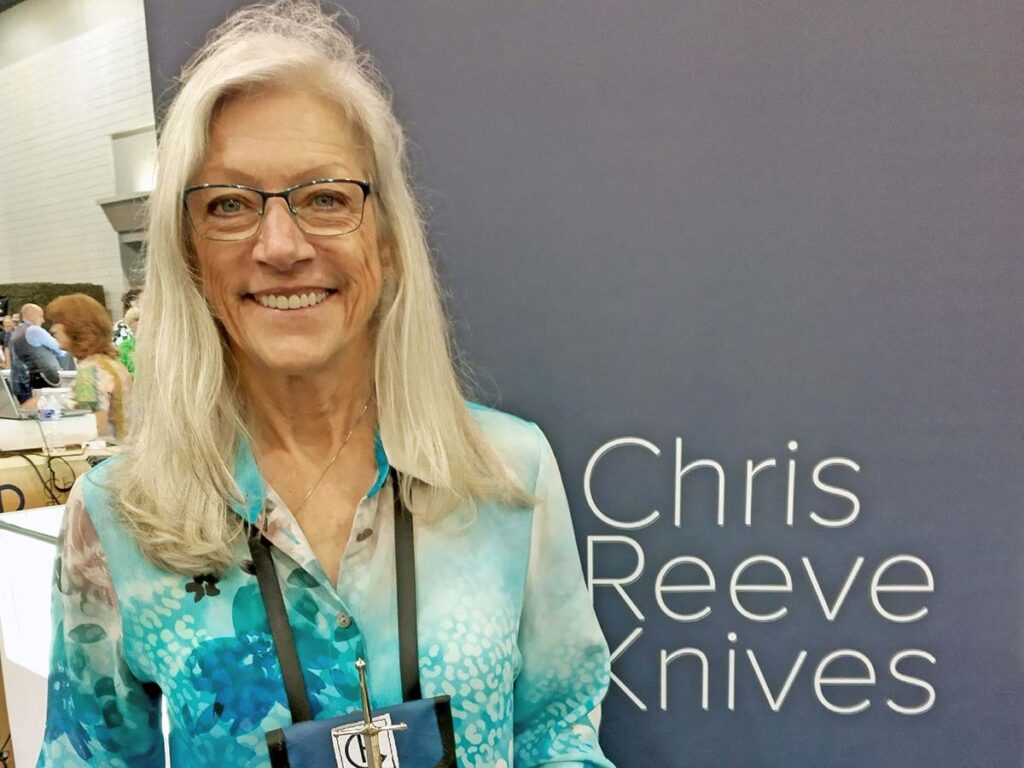
Anne Reeve’s leadership brought Chris Reeve knives to new heights.
According to a nominator, in 1986, Anne Reeve joined the then-fledgling Chris Reeve Knives and quickly became an integral part of the company. Her partner, both in life and business, Cutlery Hall-Of-Famer Chris Reeve, was the craftsman, and a great one at that. While Chris’s forte was knife design, Anne’s strengths were administration and bookkeeping. Anne spent many of the following years lending a hand where she could, helping to build a company known for quality and excellence.
For most of the early years, Chris Reeve Knives was just Anne and Chris plus a handful of employees, which meant Anne wore many hats. As the company grew, Anne stepped more into working behind the scenes in administration and customer service. Her years of answering the phone and meeting customers, partnered with her determination to ‘do the right thing,’ laid the groundwork for the knife manufacturer’s international reputation for excellence. Today, the company has around 150 dealers worldwide.
On the knife legislation front, Anne showed support for both the American Knife & Tool Institute and Knife Rights with encouragement, donations of knives and cash, and attending and sponsoring related functions. She has been treasurer of the Idaho Knife Association since 2018 and is an active member of the organizing committee for the IKA’s annual show.
After a nearly 30-year partnership, Chris retired, and Anne took a massive leap of faith and bought Chris’s share of the company. With the help of their son, Tim, and a team of young, talented and enthusiastic leaders, Anne has trailblazed Chris Reeve Knives into new territory. As the nominator concluded, “Investment in equipment and employees has resulted in revenue more than doubling under her leadership, the quantity of knives produced each month continues to increase, the quality of those knives is better than ever, and demand continues to significantly outpace production. Her determination to keep the integrity of Chris Reeve Knives, coupled with the highest quality products and customer service, has set a standard in the knife industry.” Helping cap it off, Anne won the BLADE Magazine 2025 Industry Achievement Award for her many contributions to the craft and cutlery community.
Bob Engnath
Bob Engnath was a mentor to countless new makers through his knife kits.
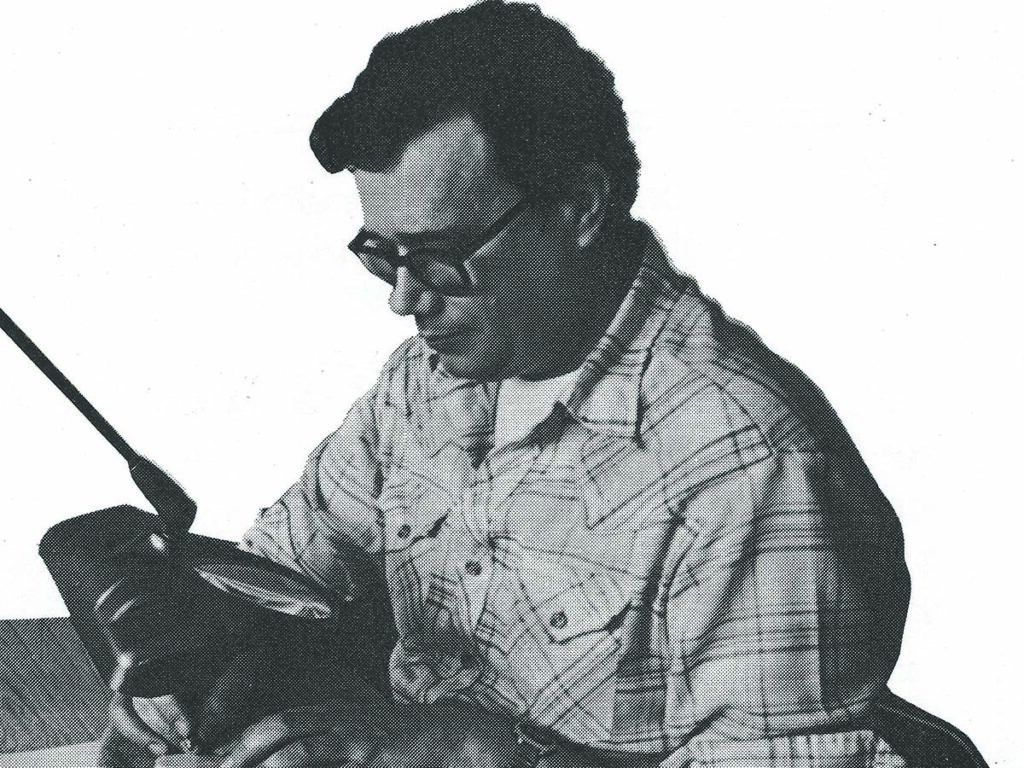
Bob Engnath built his first knife in 1972 and went full-time in ’79, making kit blades, tantos, swords and assorted knives in carbon steel. His base of operations was Blades ‘N’ Stuff, a retail shop he ran in Glendale, California, that offered tools, supplies and materials for knifemakers, bladesmiths and swordsmiths.
He produced several editions of a comprehensive publication he also called Blades ‘n’ Stuff, a 70-or-so-page 8-by-11-inch “Catalog and Instruction Manual, featuring Handcrafted Blades by Bob Engnath and Knifemakers’ Supplies.” Sold for $5, it contained copious amounts of knowledge and instruction for anyone who wanted to make a knife or sword, including line art of his many patterns, knifemaking how-to’s with diagrams, tips and do’s and don’ts, and tons of sage advice on various steels, heat treating, knifemaking machines and materials, finishing, how to forge damascus, shop safety and other invaluable information. In addition to his catalogs, Bob also wrote the books The Scrimshaw Connection and The Second Scrimshaw Connection.
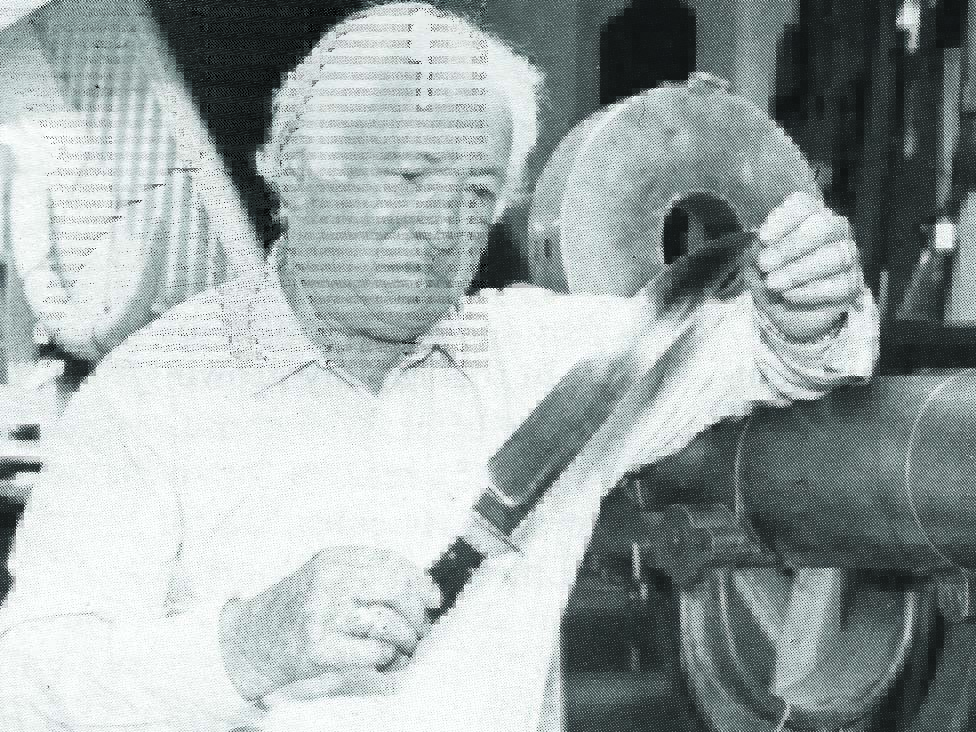
Engnath was a dedicated blade grinder and considered by many the best grinder of the time, providing blanks his customers could finish on their own. He gave many makers their start and dispensed an untold amount of knifemaking knowledge to anyone interested enough to listen, usually free of charge. According to one source, “Bob was a mentor to countless new makers through his knife kits, leaving a lasting legacy in the knife community.”
Summed up another source, Bob “was an excellent role model for any man in the knife business. He never said a bad word about anyone, took the knife business where it had not been before, his ethics were outstanding, his word was ironclad. I’d rather have had a handshake with Bob Engnath than a lawyered-up contract with any other knife name you care to mention. He was a hero and an example to a lot of people.”
Ed Fowler
Ed Fowler was noted as epitomizing the philosophy of the cutlery fabricator.
Selling his first knife in 1962, Ed Fowler epitomized “the philosophy of the cutlery fabricator,” noted one nominator. Though not the first to use 52100 carbon steel for knife blades, Ed helped popularize it as it became a go-to material among today’s bladesmiths. He long performed and encouraged the multiple quenching of blades during heat treatment.
He wrote the monthly column “Knife Talk” for BLADE® for well over a quarter century. In BLADE’s reader surveys, along with Cutlery Hall-of-Famer Wayne Goddard, Ed completed the top one-two team of most popular BLADE writers year-in and year-out. Ed compiled his “Knife Talk” columns into two books: Knife Talk I: The Art & Science of Knife Making and Knife Talk II: The High Performance Blade. He conducted demos for many years on a variety of subjects at the BLADE Show, plus a class at BLADE University.
Formerly an ABS master smith, he went on to create the High Endurance Performance Knife Association, an organization dedicated to a greater understanding of the knives its members make, the steels they use, the process necessary for the knives to reach their maximum performance potential, and to share this understanding with any and all who seek it. He taught knifemaking to many, including more than a few who have gone on to become ABS journeyman and master smiths, including Audra Draper, Wade Colter, Shane Taylor, Bill Burke and Cutlery Hall-of-Famer Rick Dunkerley among the latter.
Wrote one nominator, Ed was “very passionate about what a knife should do. He indulged anyone who wanted to share time or debate ‘the concept of cut,’ as he called it.” Ed would pit his high-performance 52100 knives against all comers in what he called “real world tests,” cutting and doing things with the knives many consider abusive, until the knives failed. Ed continued using this testing regimen, observing that though you may never have to use a knife in such a manner, “What if you had to and the only tool you had at your disposal was your knife? Wouldn’t you take comfort in knowing that if ever push came to shove, you had a knife you could stake your life on?”
Larry Fuegen
Larry Fuegen became renowned for his sole authorship of knives, including ornate handle carvings and sheathwork.
Larry Fuegen started forging knives in 1975. According to a sitting Hall of Famer, from that time on all of Larry’s knives were sole authorship. He became a full-time knifemaker in 1987 and earned his American Bladesmith Society master smith rating in 1989.
“Since I’ve known Larry, he has been a unique person who made unique knives,” the Hall of Famer wrote. “He started making friction folders after meeting Cutlery Hall-of-Famer Jim Schmidt at an ABS hammer-in. Years later, Larry took those folders to a whole new level. For years, he did gargoyle-type carvings on them and later started doing other renditions, like his folder featuring the Spanish explorer Hernan Cortes wearing a gold helmet and Larry’s carved face of his idea of what Cortes looked like. Besides these great folders, he made many ornate bowies, daggers and hunters that had carving, texturing and engraving done in a way to set his work apart from anyone else.
“For me, what stood out most were his push daggers. I believe if you Googled push daggers a picture of Larry Fuegen would come up. He not only crafted knives, he also did his own leatherwork, which was top quality. He also made some of the best bits and spurs anywhere. In addition to his quality work he designed and built the tools he needed to produce his knives, leatherwork, and bits and spurs.”
He was voted into the Art Knife Invitational in 1999 and every year thereafter until 2022. Circa 2008 another of his ornately done friction folders, entitled Alaric, King of the Visigoths, went on permanent display at the Smithsonian American Art Museum’s Luce Foundation. He has been featured in many magazine articles and books, among the latter including Greatest Living Knifemakers by Cutlery Hall-of-Famer Steve Shackleford.
Larry passed his knowledge on, teaching at numerous hammer-ins and seminars around the country. He is very knowledgeable and is willing to share with anyone. He is the personification of the traits required for induction into the Cutlery Hall of Fame.
Tim Hancock
Tim Hancock was known not only as a skilled craftsman but also as a mentor who instilled an ethical approach to knifemaking in his students.
Teaching others how to make “the total knife” played a huge role in defining Tim Hancock. “He taught and demonstrated at many hammer-ins in the areas of embellishment, design, blade forging, grinding, heat treating and sheath making,” ABS master smith Larry Fuegen observed. “He wanted to share his methods and thoughts with others. He also gave private lessons in his shop to many aspiring makers. The influence of his recognizable style can be seen in the work of many makers. Just as [Cutlery Hall-of-Famers] Bill Moran and Bob Loveless influenced many with their designs, so did Tim with his work.”
Added knifemaker Michael Vagnino, “I suppose the most important thing I learned from Tim was integrity. The knife you make is in fact a part of you. How it turns out is more about how honest you were when making it. When Tim told me that, it really made me pause. From that moment on, I viewed making knives in a new light.”
Tim earned his ABS master smith rating in 1993 and won an impressive number of honors for his knives, including the 2010 W.F. Moran Award. He was known for his award-winning period bowies, including though not limited to dog-bone bowies. Dr. David Darom dedicated an entire hardback book, Tim Hancock: The Western Bladesmith, to highlighting Tim’s knives and knifemaking career, even his penchant for forging silver-mounted bits and spurs and other Western gear. From 2001 to 2015, Tim was a member of the Art Knife Invitational, an organization of the world’s 25 greatest knifemakers spearheaded by Cutlery Hall-of-Famer Phil Lobred.
Nate Posner
Nate Posner was a key figure in promoting and purveying handmade knives and was known for the utmost integrity when dealing with makers and customers.
Nate Posner started the San Francisco Gun Exchange in 1948 and built it into what he called the “Firearms Center of the West.” It had most everything firearm related but it was his displays of custom and factory knives that pertain here.
Along with Cutlery Hall-of-Famers A.G. Russell and Dan Delavan and also Bob Gaddis and Dave Harvey of Nordic Knives, Nate was among the first custom knife purveyors. He was known for telling his customers that to get the best price, instead of buying custom knives from middlemen such as him, they should buy directly from the maker. Of course, if the customers wanted the handmade knife in question immediately, they often had to buy it from one of the few purveyors such as Nate to avoid spending what might be years on a waiting list. However, it was being up front that put Nate in good stead not only with his knife customers but the Guild, too—for both buying/selling the makers’ knives and treating what often were the makers’ customers/prospective customers in a professional manner.
At one time he had over 350 custom knives on display, with at least that many others in stock. Circa 1975, he ordered knives from dozens of makers, most active or past Guild members. Eventually he culled his list to about 25 or 30, including one of his favorites, D. E. Henry. Others included Tommy Lee, Jess Horn, Herman Schneider, Corbet Sigman, the then-team of Scott Sawby and Steve Mullin, and future Cutlery Hall-of-Famers Frank Centofante, Jimmy Lile, Bob Loveless, George Herron, Bo Randall and more.
Thanks to the high store profile he gave custom knives and their makers to knife and gun buyers alike, Nate was one of the most important custom knife promoters of his or any era. As a result, the honor the Guild gives annually to an individual who provides “Outstanding Service in the Promotion of Handcrafted Cutlery” is called the Nate Posner Award.
The masterful and meticulous impact of the Hall of Famer.
The knife world changed forever on New Year’s Day in 1980. In a geodesic dome house, situated in the mountains high above Taos, New Mexico, Michael Walker proclaimed, “Today, I am a knifemaker!”
Not that he had a ton of experience in the field prior. Up to the roaring ’80s, Walker’s resume was dotted with employment common among many of the free-spirited residents of Northern New Mexico—sculptor, jewelry maker and purveyor of firewood. Perhaps this eclectic background of the aesthetic ideal and practical application was the right balance for him to make his mark in the world of cutlery. The maker has spent a career marrying the beautiful and functional, something that might have only come from someone who not only designed rings and necklaces, but also split logs.
Locking In
Michael Walker
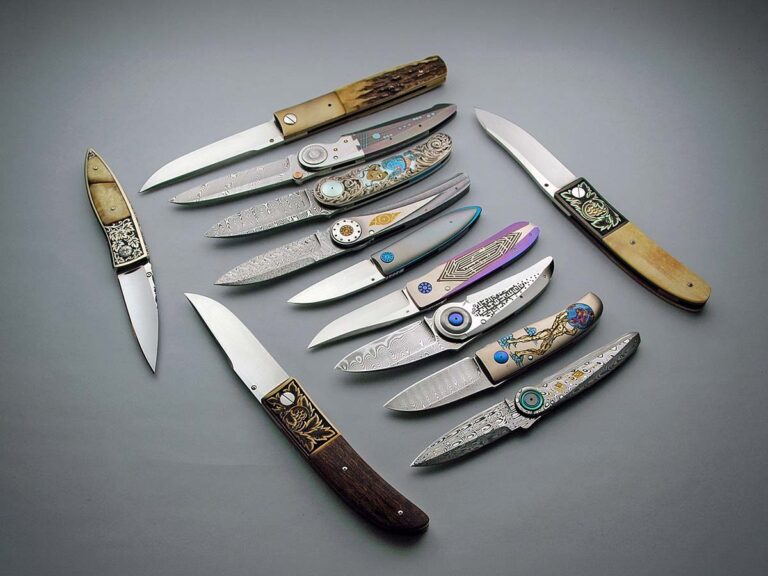
Even on the BLADE Magazine Cutlery Hall of Fame® member’s most artistic designs, there is always an undercurrent of practicality. In particular, his locking mechanisms have shaped modern folding knives. But even turning to innovation as a hallmark had a streak of sensibility. According to Walker, in his 128-square-foot log cabin workshop, he minted 10 fixed-blade knives to start his career. He then realized he’d have to make 10 sheaths to house them. Not wanting to go down the leather-working rabbit hole, he immediately switched his focus to folding knives.
At first, Michael’s work—at least mechanically—was somewhat rote, mainly slip joints and folders. But soon after his knifemaking endeavor started, he began revolutionizing how a blade locked in place. Arguably, his most weighty invention came early, when the “Walker Liner Lock” was born around 1981. Walker’s inspiration for creating the linerlock was a knife that could open with one hand without repositioning it.
To the greater knife world and beyond, Walker’s most lasting legacy is the liner lock, an innovation the author points out was developed as the maker’s solution to operating a knife one handed. While it’s among his best known contributions to knife design, Walker rarely employs it in his more recent creations. (SharpByCoop image)
Most knife enthusiasts are familiar with the locking system, prevalent as it is today. Steve Shackleford described it thusly, in his section on Michael in Greatest Living Knifemakers: “Basically, the linerlock consists of a spring cut out of the titanium liner of a knife handle that, when the blade is opened, is released and moves under the blade tang to hold it open. To close, simply push the spring back toward its original position in the liner and pull the blade closed.”
While Walker is known for his titanium liners, to start, his folders had liners of 440C steel, which he split with a jeweler’s saw and hardened on the tip. Initially, the hardened liner did the trick, but once moving to titanium springs around 1984, he found the material had a tendency to gall, leaving marks or trails on the blade. Incorporating a ball left the blade pristine and, as he found, assisted the closing of the blade. After using the ball detent for a year, Michael discovered a pin was more suitable for the job, and to this day, Walker still uses a press-fitted pin as he can put a bevel or a radius on it so that the operation is better than if a ball were used.
Over the course of his career as a knifemaker, Walker has earned a slew of patents and trademarks for his folder-related inventions. Two such examples are the Zipper blade (top) in which a hard edge metal is fused with a tough spine metal. And the lever lock (bottom), of which of his many lock designs. (David Ellis image)
It’s worth noting that some greats have worked personally or drawn inspiration from Walker’s liner lock. Walker inspired such notable makers as Bob Terzuola and Ernest Emerson, to name just two. The liner lock was just the start for Walker’s refinement of locking mechanisms and knives in general. At present, he holds numerous patents and trademarks pertaining to design elements within knives.
Appraising his career at the Solvang Show 2025, Michael believes two patents are his most significant—the Zipper blade and the blade lock folder. The Zipper is the process of fusing two different metals so a blade has a hard edge and a tough back. While the blade lock is a button lock, with the button situated on the blade and doubling as a thumb stud.
Walker’s first Zipper blade was made from 416 stainless steel with a Vascowear cutting edge. The two were Tig-welded together. Eventually, Michael began to use titanium for the spine, but as it could not be Tig-welded to steel, he used a wire EDM machine for the task. Generally, ATS-34 or 440C was used for the cutting edge on his Zipper blades. Over the years, he has used zirconium, with Walker pointing out that wire EDM can be used to mate most disparate metals. Of his Zippers, Walker’s “Sharktooth” is among his most desirable and his first to attain two patents, both for the composite blade and the blade lock design.
Walker has been fairly open in sharing his design and innovations with makers of all stripes, such as at BLADE University in the picture. Early on, he personally taught legend Bob Terzola his method of making liner locks. (Steve Shackleford image)
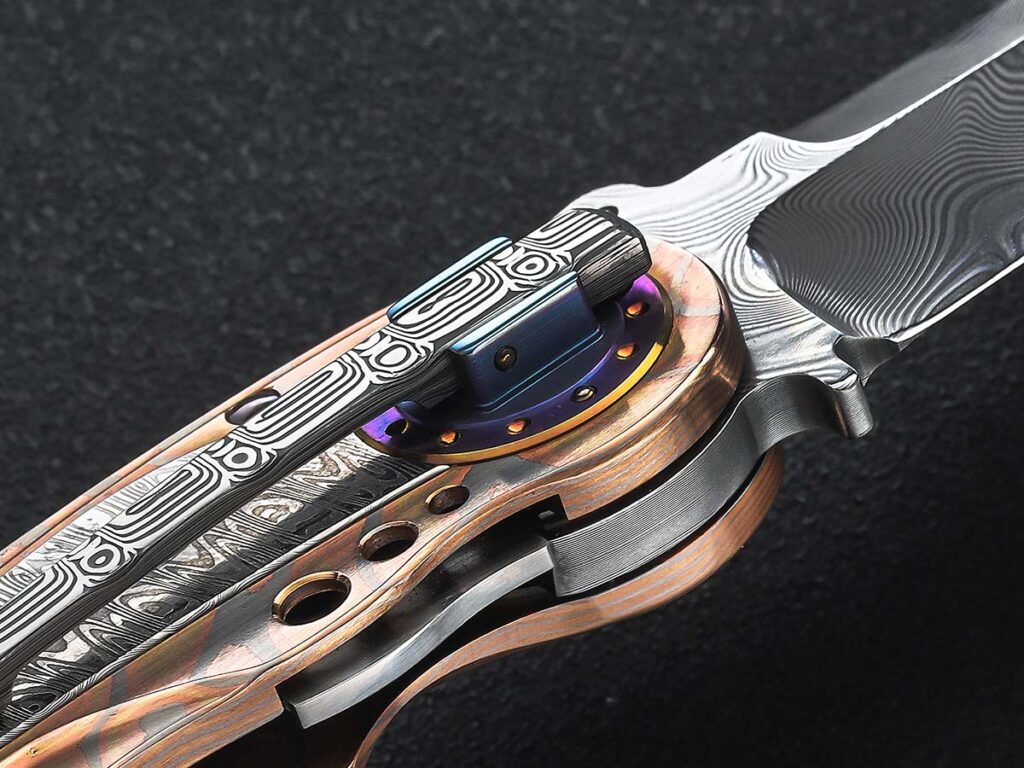
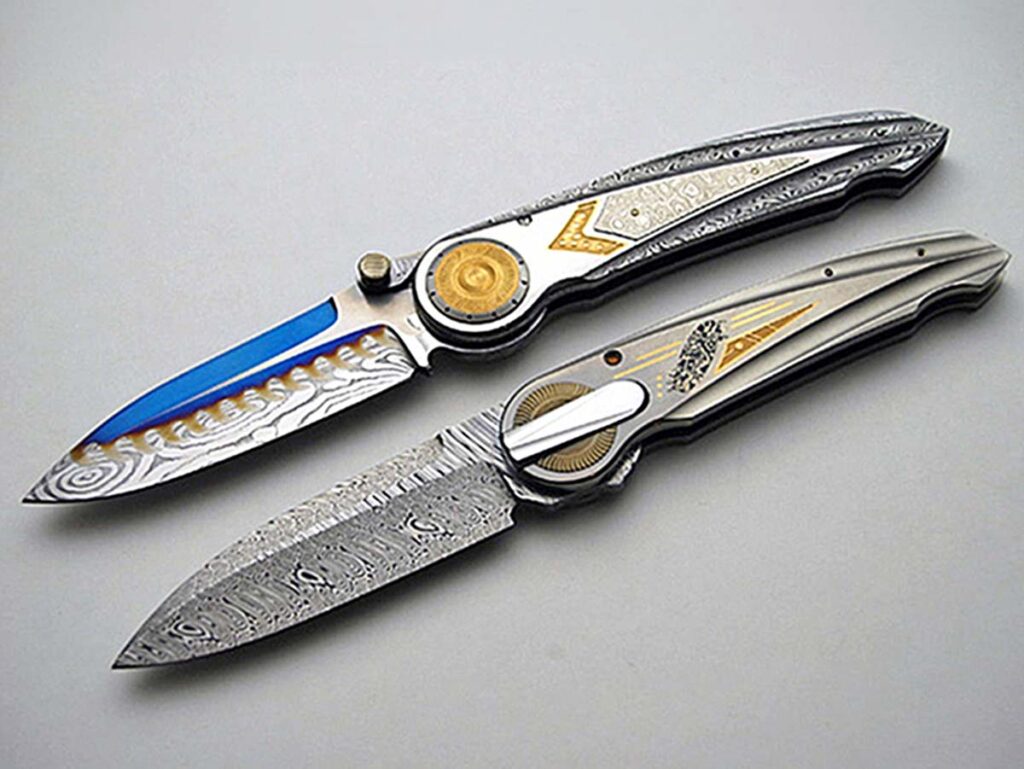
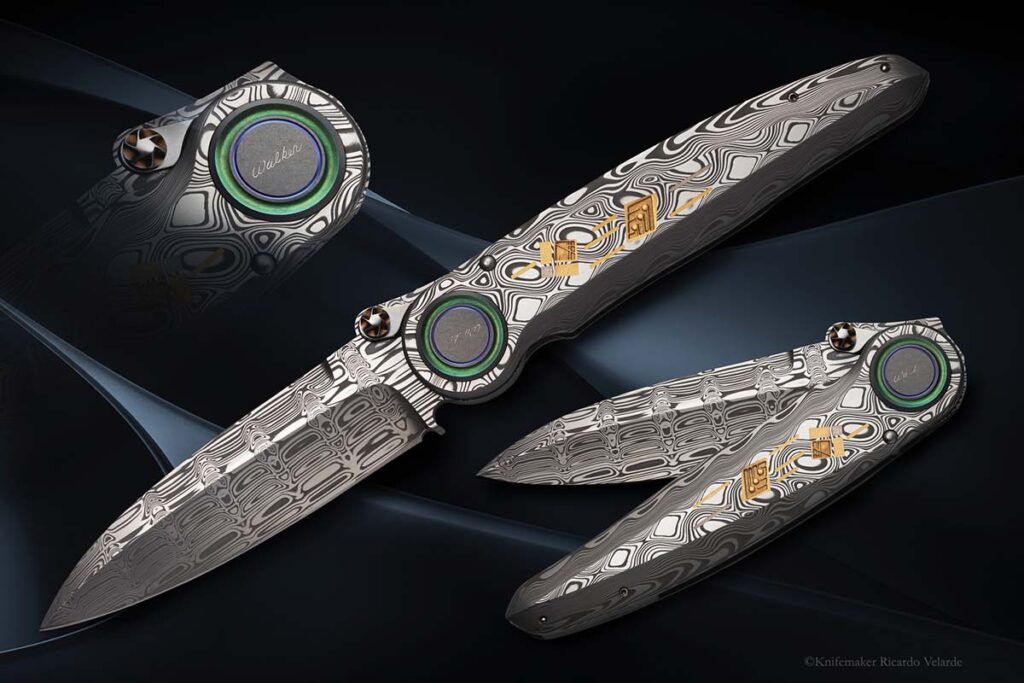
As for his blade lock, here’s my take on one of my favorite Walker designs. When you first hold it in your hand, there is an immediate connection. Typically made with a Damasteel frame, featuring multiple precious-metal inlays, it’s striking in appearance. The blade lock itself—typically fashioned from a rare metal—is simple, quick and silent. The blade grinds are always precise, and the work is as tight as a Swiss watch.
In addition to these advances in knife design, blade aficionados also have Walker to thank for the Crowbar Lock, Lake and Walker Knife Safety (designed in conjunction with Ron Lake), ball bearing lock, and Toughlock. It’s worth noting that many of these intriguing mechanisms can still be found in production knives by Spyderco, CRKT, Schrade, Boker and Klotzli.
Material And Design
Walker’s impact on knife engineering is undeniable, but shouldn’t overshadow his artistic flair. His initial tools when he first ventured into knifemaking were a belt grinder and jewelry-making tools. He may have upgraded his equipment over the years, but he never lost his jeweler’s eye in executing cutlery.
Another clever invention of Walker’s the author points to is the blade lock, a dual-purpose lock. It functions not only as a thumb stud to open the knife, but depressed, it also unlocks the blade to close it, as well. (Image courtesy of David Ellis)
A defining moment for Walker came roughly in 1984, when he brought titanium and anodized titanium to custom knife making. His wife, Patricia, was using the material in her jewelry at the time and played a role in some of his earlier work. Michael said he did the solid anodizing of titanium elements (he credits Reactive Metal Studio for refining his skills), while his wife did the multicolored selective anodizing. Patricia’s contributions remain striking today.
Titanium brings up an interesting anecdote Michael relayed about those early years. Sans a phone in his home, his early business was conducted over a local pay phone—including acquiring 100 pounds of scrap titanium for the princely sum of $100. Anyhow, Michael poured quarters into the phone, attaining material, and laughingly said that it was tough to remain professional in the winter with the snow and wind blowing and the operator coming on the line to ask him to deposit more money.
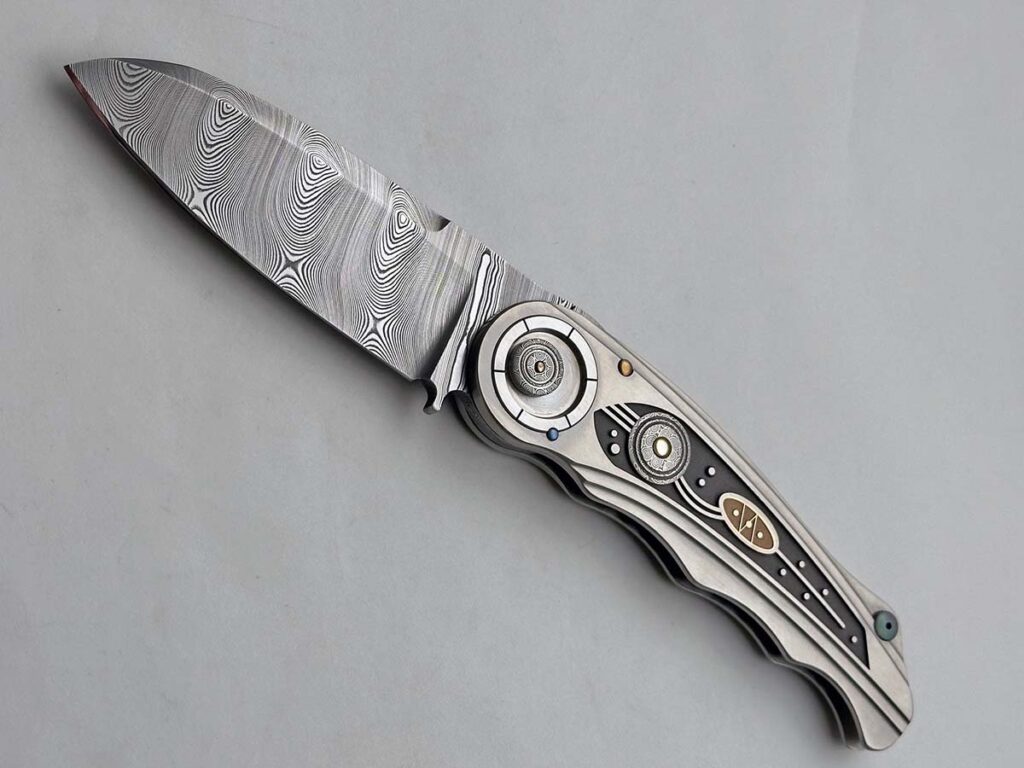
Material is far from the only defining aspect of Walker’s design language. The form of his knives is distinct and recognizable as a “Walker,” drawing from wellsprings of different influences and mentors. Among the most important, Walker chalks up Charles Loloma, an Indian jeweler and silversmith, who, Michael said, “really thought out of the box.” Frank Lloyd Wright and the Art Deco movement play undeniable roles in the development of his knife forms.
Next to his mechanical contributions to knifemaking, the author points to Walker’s eclectic use of materials and eye for design as important influences to the knife world. The above slide lock is an example, with the distinctive art deco stylings, with multiple metals used on the handle’s inlay. (David Ellis image)
As for knifemaking mentors, Michael said he made his knives by trial and error and quickly learned from his mistakes. He joked, Joe Cordova signed his Knifemaker’s Guild sheet, but Joe made totally different knives than Michael, so he was not really a mentor. Those closest to him had an impact. Outside his initial customer base of friends and family, Walker pointed to retailer/collector Don Buchanan as playing an important role. Walker would bring his knives to Buchanan’s shop, and Don would give him his opinions on things to improve. Buchanan began to sell Walker’s knives and would keep the No. 1 from the lot and sell Nos. 2-10 of each model.
Collecting Walker
I have known Michael for many years. He is very interesting to talk to and approachable when you can find him behind the table at a knife show. I have been a fan and collector of his work for as long as I can remember. Seeing Michael and his knives at the late Phil Lobred’s Art Knife Invitational Show was as exciting as chatting with Bob Loveless or Bill Moran. When the greats of custom knifemaking are mentioned, Michael’s name certainly will be at the top or near it.
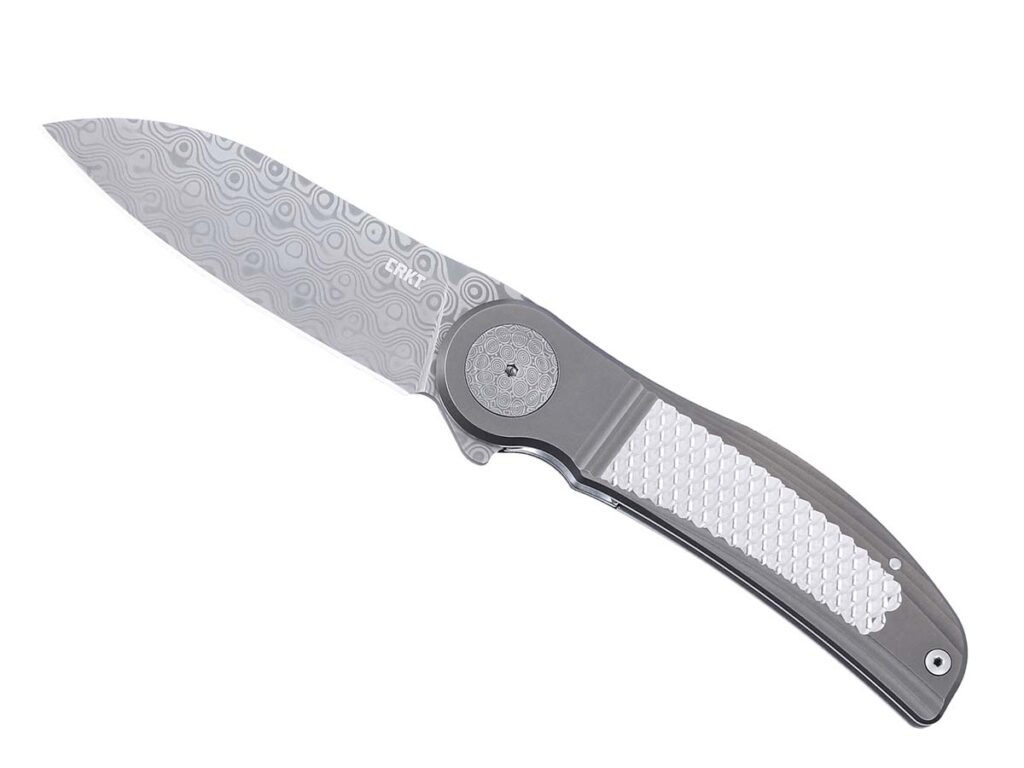
Walker’s work is considered highly collectable, the author pointing many run into five figures. But, his designs are found in many production variants, such as this CRKT Monument.
Any astute collector would be interested in the value of his creations. Will it hold its value? Can I resell when I need to? Early on, I saw Michael’s work moving for $3,000 plus. Not long after, those same style knives doubled. Michael’s Zipper folders climb from $12,000 to over $100,000 in an incredibly short period of time. Currently, a Michael Walker folder is not inexpensive. A nice Bladelock might run you close to $20,000. Rest assured that in time, and that could possibly be a very short time, there will be a buyer, and with some patience, you should be able to turn a nice profit. That said, I caution buyers to always select a knife based on its likability more than turning a quick profit. This goes for any knife!
Michael Walker will go down in history as one of the greatest knifemakers … ever. His remarkable talents, as well as his innovative lock designs, have revolutionized and invigorated the custom knife world.
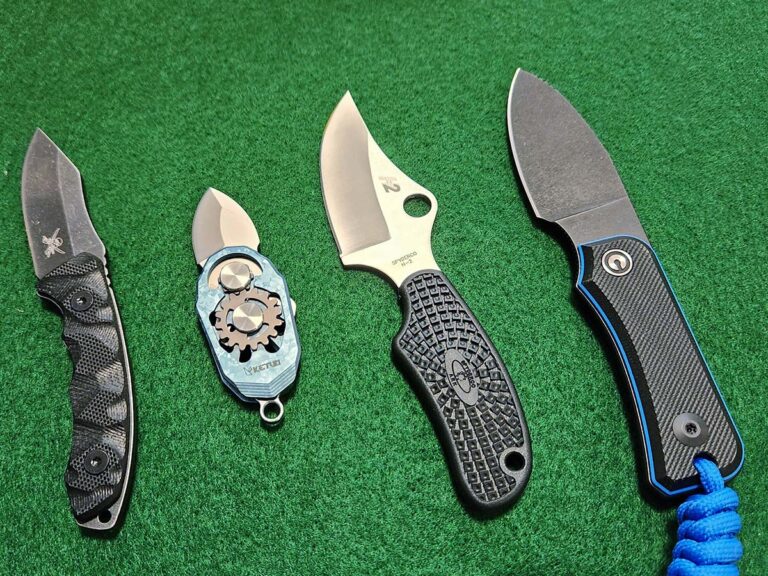
Over the years, I have struggled with neck knives, because to call them such seems so limiting. A small, fixed blade has an abundance of uses, and as far as ways to carry one, they run the gamut. A small fixed blade can go from neck carry to backup, depending on how you tote it and what you intend to use it for.
Spyderco Ark
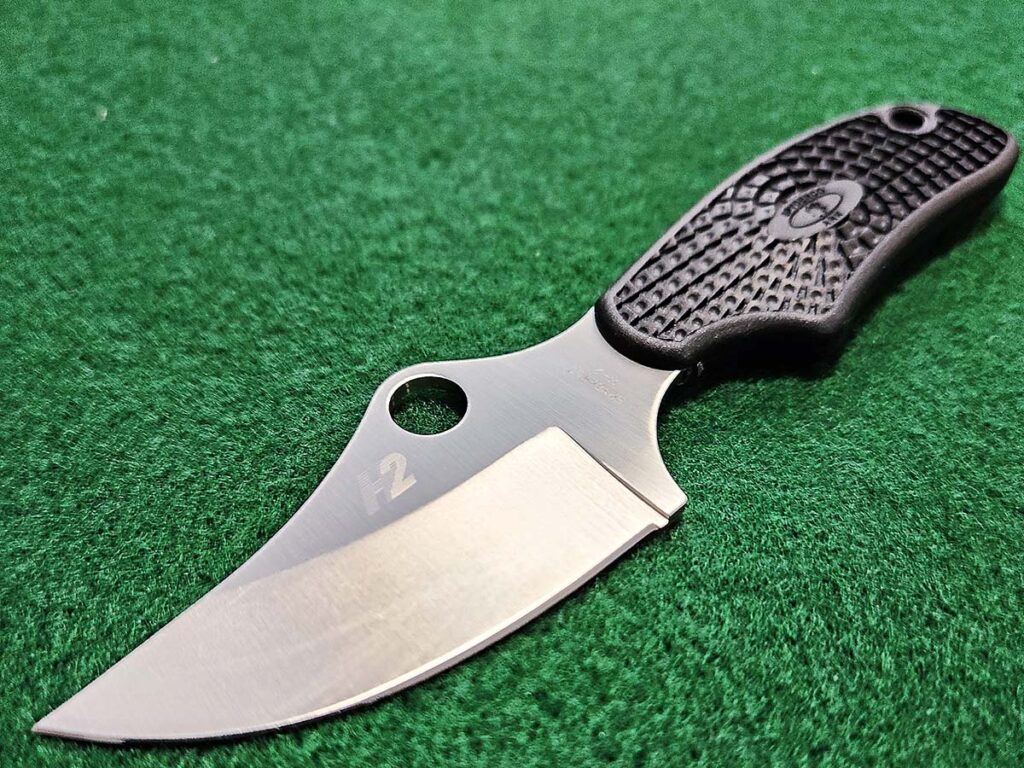
The hollow grind on the Ark gives it a keen edge and thin cross section that the authors found easy for sharpening.
To a T, the Ark fills the classical neck knife niche. Spyderco offers a small, trailing-tip clip point with some belly, providing the knife with a longer cutting edge for the overall length of the blade. A hollow grind on the H-2 steel blade gives the Ark its edge and the steel itself endows the Ark with much-needed rust resistance. Neck carry can prove hard on a knife, exposing it to perspiration and body oils.
For the handle, Spyderco opted for an overmolded design of fiberglass-reinforced nylon (FRN). A solid choice for this type of knife and the chores it faces. FRN maintains sturdiness while keeping the knife light. And it is wispy. Spyderco lists the knife’s weight at .9 ounces. At the time of writing, my scale is broken, but the feel of it tells me the company isn’t stretching its heft. If you used one word to describe the Ark, it’d be “light.” As for the handle’s profile, it has a classic index-finger choil, flaring out to a larger two-finger section, providing a solid grip on the small tool.
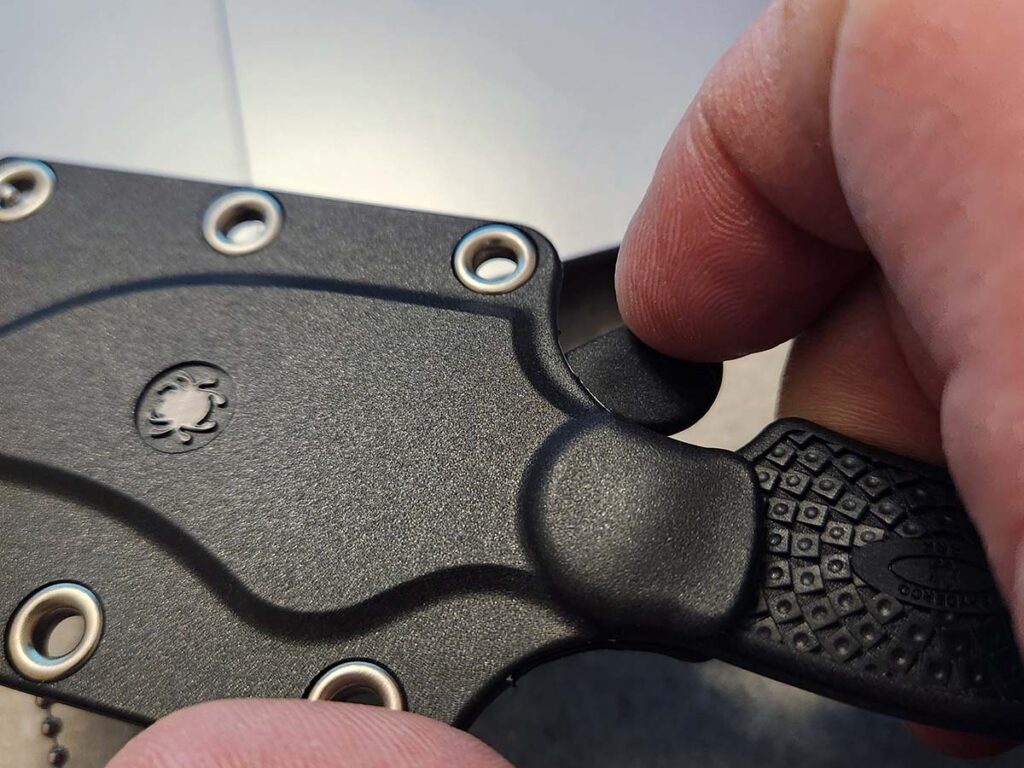
As for the sheath, it is made from polymer and boasts a solid locking system. At no point do you have to worry about the blade working free as you move during activities. This is good, given that, like most neck knives, the carry position hangs it upside down. Deployment is easy and fast, even with the sheath’s solid retention. And carry is pleasant, almost a second thought, given the Ark is not a boat anchor hanging around your neck.
The Ark’s sheath comes with a lock to ensure the knife safely stays put. It’s easy enough to disengage, placing minimal pressure on the tab to release the knife.
If you are using it for self-defense or just to have a readily available blade, it is more than enough for both. I did find the sheath a bit fidgety when putting the knife back in. Not enough to make it a deal breaker. The locking system makes it so you must line things up properly when you go to sheath it. I would say a person could get a lot of use out of this blade.
Ark Specs Blade Length: 2.56″ Overall Length: 4.98″ Blade Steel: H-2 Handle Material: FRN Weight: .9 oz. Grind: Hollow Sheath: Kydex Country Of Origin: Japan MSRP: $124
Ketuo Beetle
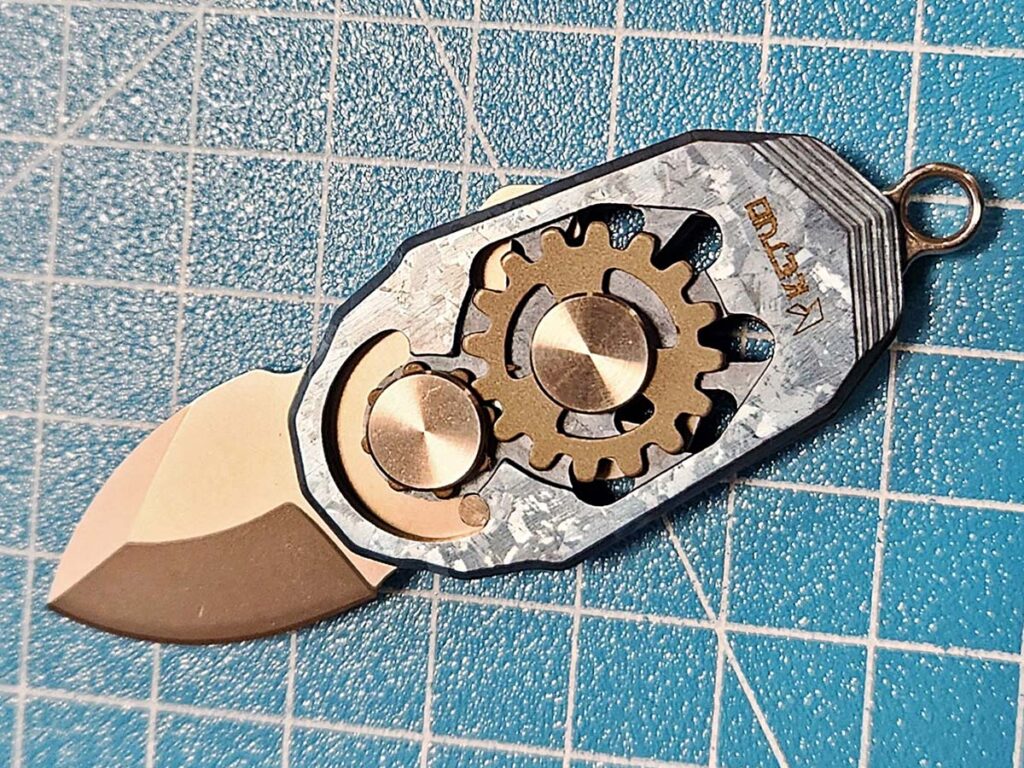
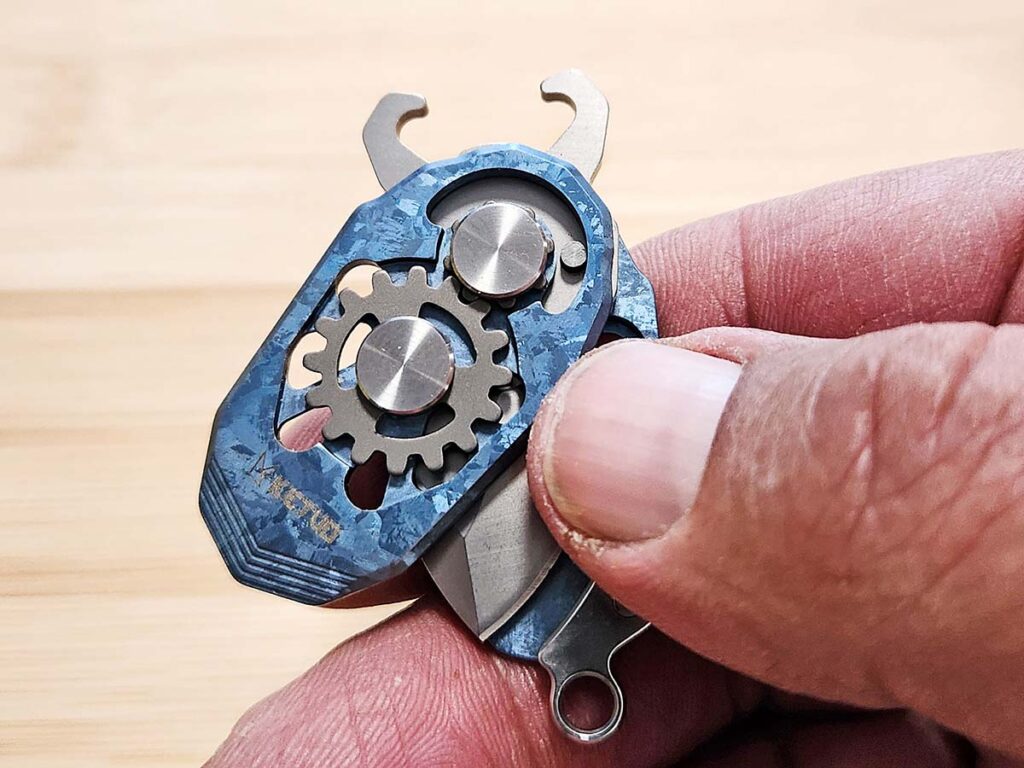
The author found the Beetle extremely small, thus relegating it to light-duty EDC chores, such as unboxing packages. That said, its saber-grind is impeccable and impressive on this petite knife.
First off, this design has major bling. With multiple colors and a crystallized titanium finish, it’s a looker, alright. At first glance, it gave me vibes of the old CRKT Ashworth Turtle knife.
Due to its size, the Beetle’s role is best confined to small chores, like opening packages your EDC gear arrives in. As a necklace, though, it might not be readily available; it is very discreet. You basically have a knife that passes as jewelry; if a person isn’t familiar with what they are looking at, you won’t set off any alarms. If you needed a small, quick edge, then the Beetle would shine as a tethered blade or keychain tool.
With practice, even though it is small, and I mean very small, you can get fast with it. The blade is a small spear tip design made from M390 steel. How they managed to saber-grind such a petite blade is an engineering feat. In short, the major chore this blade is suited for is everyday unboxing … or possibly a street fight with an Oompa Loompa.
Opening the Beetle isn’t that hard even though it is so small. Just slide the scale with the gear past the detent and safely rotate until open. To close the knife, rinse and repeat.
I would be remiss if I didn’t mention the pincers at the end of the knife double as a bottle opener. The company refers to them as the knife’s “foot,” but the idea of a trotter opening my beer is unappealing. Ketuo, feel free to steal “pincers” from me as a marketing idea. Overall, the knife has more bling than hardcore utility, but this wouldn’t be the first knife people bought based on flash over function.
Beetle Specs Blade Length: .9″ Overall Length: 2.79″ Blade Steel: M390 Handle Material: Titanium Weight: 1.09 oz. Grind: Saber Country Of Origin: China MSRP: $95
Skallywag MK2
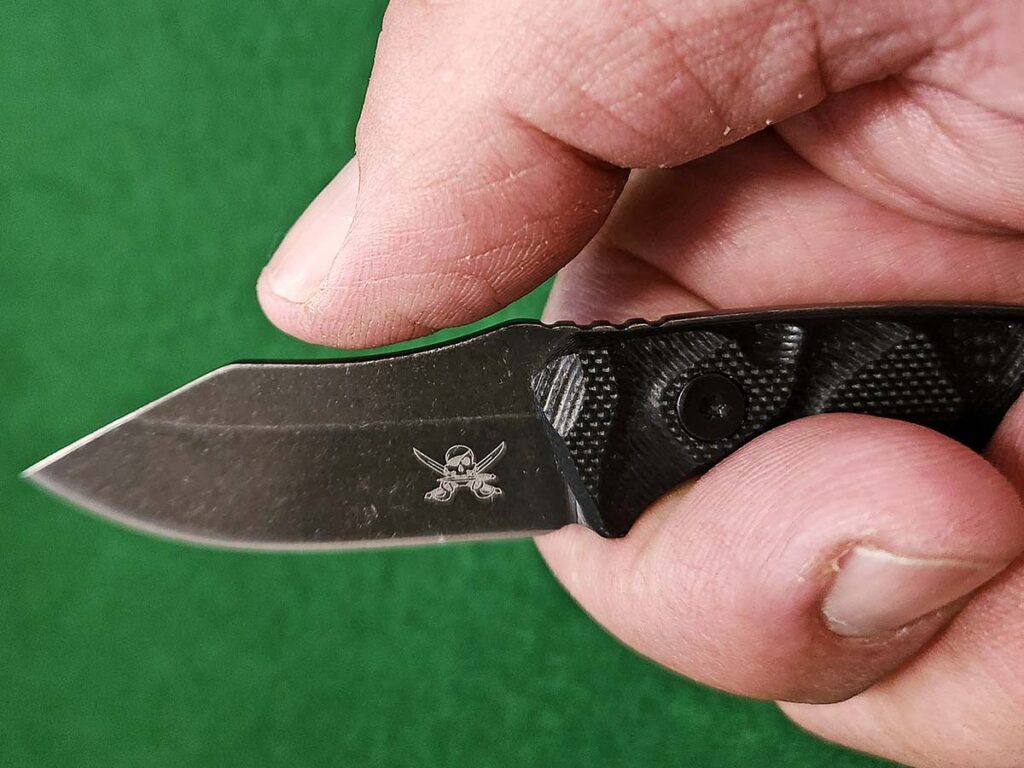
The author found the scallop on the back of the MK2 the perfect spot to land his thumb to get more power behind a cut. One might even think it was designed that way.
Skallywag has a traditional-style neck knife you could use as a neck knife or pocket fixed knife with a tether. It comes with a molded Kydex sheath. My sheath fit is spot on with a positive lock and no rattling for a quiet carry. As a blade style, it is a 2-inch-long stylized clip point with a thumb indent, so that you can drive some power into the blade.
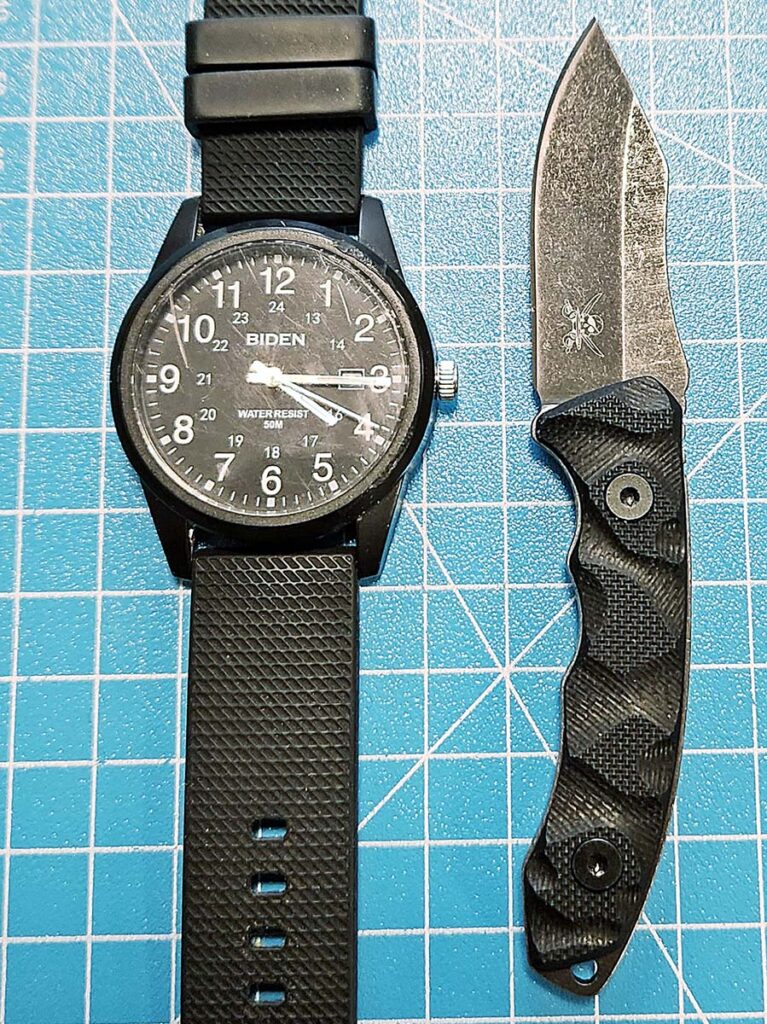
The 420 blade is hollow ground with a black-coated, stonewashed finish. Made with a sturdy full tang, the MK2 is grippy thanks to scalloped G10 scales. Even with the positive texturing, I wished Skallywag had given me a bit more handle or lengthened the design. To be fair, I have large, beefy hands.
Some folks might turn their nose up at 420 steel, but this is a mistake, at least in the case of the MK2. The knife came razor-sharp out of the box and, in the long run, won’t rust like some of the other higher carbon steels. Best of all, 420 keeps this knife at a low price point. You can put it in a kit and not lament having a $100 bill tied up in a backup knife.
Looking at the Skallywag, the author points out that even though the design provides a small blade, it keeps the handle large in proportion. He goes on to say, this facilitates the important aspect of a knife—control.
If there was any nit to pick, the MK2 is a bit on the heavy side for its size. When I took my calipers to it, I got 1/8-inch material thickness. Add the G10, and it is a neck knife you will know you are carrying. It suits my idea of a dependable small knife for quick, small jobs and at a great bang-for-your-buck price.
MK2 Specs Blade Length: 2″ Overall Length: 4.7″ Blade Steel: 420 Handle Material: G10 Weight: 1.2 oz. Grind: Flat Sheath: Kydex Country Of Origin: China MSRP: $35
Civivi Baby Banter
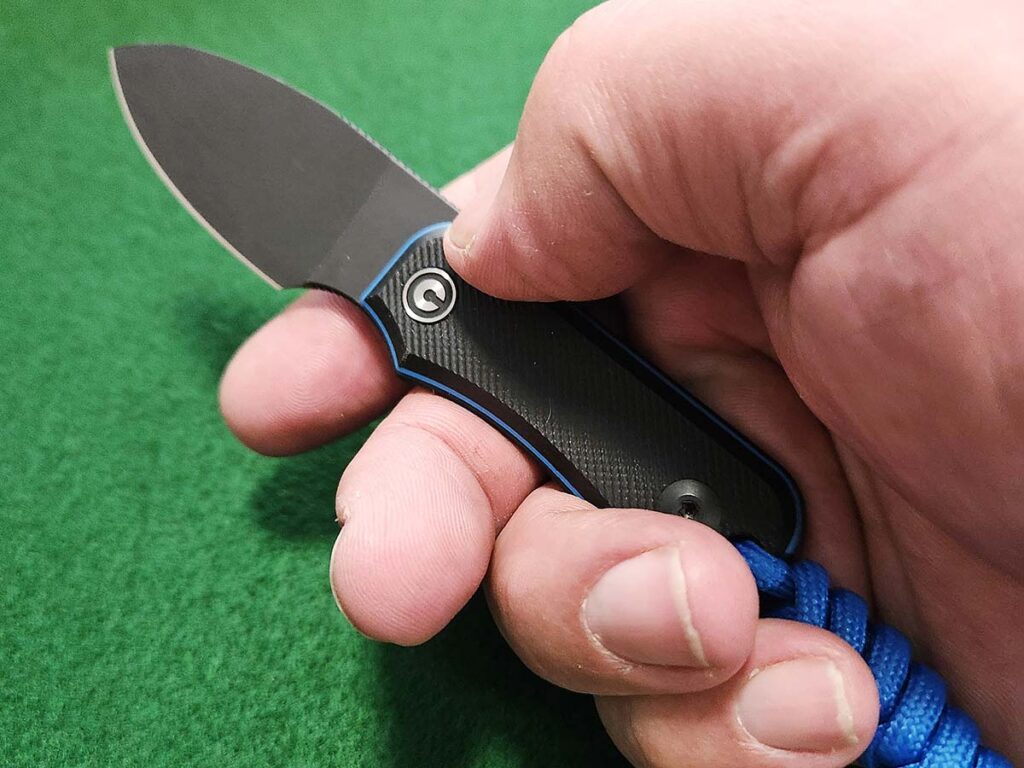
Even discounting the author’s relatively large hands, the Baby Banter is basically a three-finger knife. Civivi, however, gives you a horse tail-style lanyard to give your pinky a place to land.
The largest knife of the group, the Baby Banter, measures 5 inches in overall length. It has a flat-ground drop-point blade made from Nitro-V steel. Civivi uses a full tang design with G10 scales. The one they sent me has textured black G10 and blue liners. Keeping everything in place, the company uses mechanical fasteners to attach the scales.
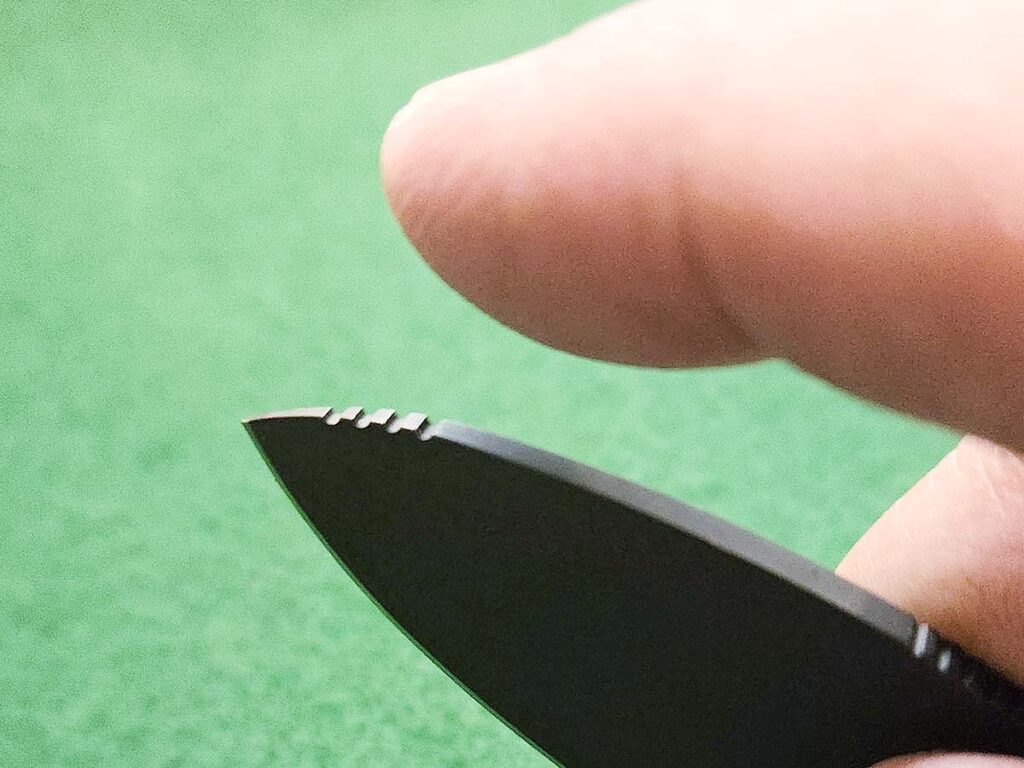
On the spine, Civivi includes two jimping points, one for the thumb near the handle and the other toward the tip. The jimping toward the tip facilitates a solid purchase point for your index finger while using a pinch hold. The whole blade is done up in a black stonewashed finish. To extend your grip a bit, they include a blue paracord lanyard.
For carrying the knife, you have a couple of choices. You can use the bead chain for neck carry or the belt clip that the company includes. Given the size of the knife, to my mind, it would better fit as a little pocket or belt carry option. When I had it around my neck, it worked well, and the large size allowed me to clear my clothing to access the knife. Yet expect the knife to have a constant presence carried this way. The sheath is made from Kydex and the belt clip is fastened with two screws. When all is said and done, I plan to take the clip off and add an UltiClip to give it a bit more versatility.
On the Baby Banter, the forward jimping provided the author’s index finger with a solid purchase while using a pinch hold.
All these knives came with bead chains. I would not put a knife or hang anything around my neck, for that matter, that did not have a fail-proof breakaway system. I don’t want to take a chance on being choked by my own knife. Neck knives are versatile tools. No one says you must carry them around your neck. In fact, all the best pocket-carry fixed blades I carry started as someone’s idea of a neck knife. If you haven’t carried a small, fixed-blade as an EDC, I would invite you to try it.
Baby Banter Specs Blade Length: 2.39″ Overall Length: 5″ Blade Steel: Nitro-V Handle Material: G10 Weight: 6.07oz. Grind: Flat Sheath: Kydex Country Of Origin: China MSRP: $68
Sharp makers and even sharper knives were the order of June 5-7, at the Cobb Convention Center, for the 45th Annual BLADE Show in Atlanta. Creeping up on a half-century, the show continued to prove the defining event of the global knife industry, as makers, edged wares and collectors from all points of the compass crowded the event floor in the year’s keenest cutlery convention. New knife drops, veteran craftsmen at the apex of their trade and new makers sending ripples through the market all kept the marquee event’s edge.
Notable among the usual fare of the show was the renovation and construction of BLADE Show’s home venue. Nearly half of the center (formerly known as the Cobb Galleria Centre) lay in rubble as the improvement project—slated for completion before the 2027 show—reached its midway point. While it created some minor inconveniences for attendees, it didn’t dampen the sharp seekers’ spirits. The general attendance line for the opening day stretched from the lobby entrance, down the street, around the corner and up to nearly the second level of the center’s parking garage. For those who have braved the crowds to find their must-have blade at previous shows, it was par for the course.
A rare Bill Moran knife in damascus. (Steve Shackleford image)
BLADE Show 2026 included all the fanfare the knife world has come to expect on the first full weekend of June. BLADE Magazine Knife of the Year® and BLADE Show Custom Knife awards bestowed honors on the newest crop of factory and custom knives. BLADE Magazine Cutlery Hall-of Fame® welcomed seven new and much deserving members at its Saturday breakfast. BLADE University was as bustling with students as ever, as its pupils sharpened up on subjects such as sheath making, knife marketing, knife designing, sharpening, new steels and much more. BladeSports International conducted its annual World Championship Cutting Competition and Blade HQ held the balisong flipping competition, Balicomp 2026. Knifemakers and companies from around the world displayed their work. And the American Bladesmith Society and Knifemakers’ Guild each held important meetings, with a good share of each organizations’ members in one place.
Of course, the business of knives has never been the only draw of the legendary show. Atlanta also plays a backdrop where old industry acquaintances are renewed, new friendship are struck and a little play hard is unleashed after the work hard is over. To that end, the infamous Pit—the notorious sunken lounge of the Renaissance Atlanta Waverly—was in full swing for the entirety of the event and well into the wee hours of each morning. Blurry eyes the next day be damned.
WE Knives were all smiles after netting the Best Imported Fixed Blade at the 2026 Knife of the Year® awards. (Patrick Diedrich image)
In synopsis, BLADE 45 showed the event is as sharp as ever and will continue to stay that way.
KEEN TIME ON THE FLOOR The focal point of many knife enthusiasts’ year, BLADE Show was abuzz with activity, particularly the first two days. Most vendors reported their peaks came in the first five hours of Friday and Saturday, with activity ebbing roughly around 3 p.m. As for Sunday, the terse day had its typical average traffic.
It’s easy to get mesmorized with a knife and the story behind it. That’s part of the allure of BLADE Show. (Patrick Diedrich image)
Exhibitors, overall, had a positive perception of the show’s attendance gauging it at or above last year. Impressive, given BLADE once again encompassed both the convention center’s main hall and the adjacent “Baller” room. As for sales, most of those looking to move knives across their tables or out of their booths came away happy.
“I had strong sales, so my impression is favorable,” said New Hampshire-based ABS master smith Zack Jonas. “I heard the usual mix of people selling well and selling poorly. Overall, the energy on the floor seemed good—not notably different from other years.”
The crowd was impressive at the 2026 BLADE Show, with a steady stream of knife fanatics filing through general admission the first two days of the show. (Patrick Diedrich image)
He continued, “My sense is that the crowd was actually a little better this year. Hard to say from my limited perspective, but it seemed a little more active.”
Jonas conjectured the heightened activity he and some other custom makers enjoyed might have been intensified thanks to the Arts In Metal show presented by BLADE Show that preceded the big event. The small and exclusive custom knife show, run in a ballroom of the Renaissance Atlanta Waverly on June 4, might have attracted some higher-end buyers, who then went on to spend at BLADE Show.
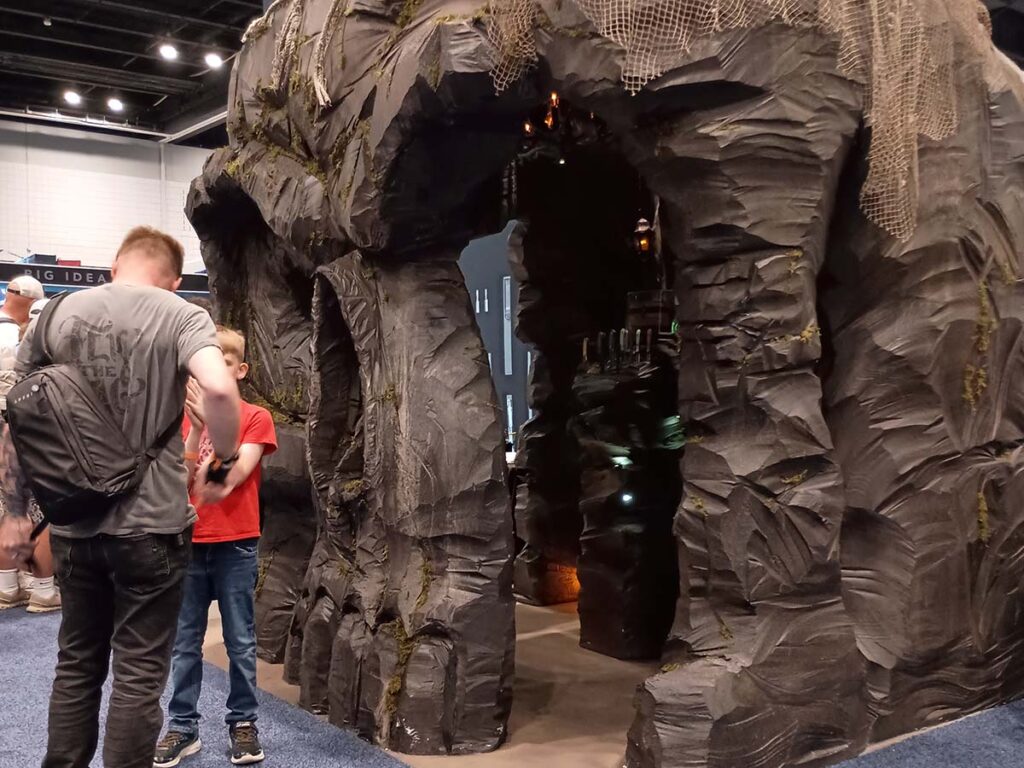
Big Idea Designs always pull out the big guns when it comes to booth layout. This year’s was a skull-shaped cave with a treasure trove of the company’s knives inside (left). (Elwood Shelton image)
A great many factory booths, too, were hot as ever with knife buyers. White River Knives’ John Cammenga, Sr. estimates he moved 90 percent of the stock his company brought to the show. Jens Anso of Anso’s of Denmark approximates he moved 70 percent of his blades. And Mike Sweeney from Heretic Knives said they moved 100 percent of their knives. “People were excited and seemed ready to buy,” Sweeney said.
Purveyor of high-end custom knives, Dave Ellis of Exquisite Knives, reported slower sales, saying that of the custom cutlery he brought, he sold two lower-priced chef’s knives. But preshow, he had made a doozy of a deal on an amber-stag Chute crafted by BLADE Magazine Hall of Fame member Bob Loveless, of which he then delivered at the event.
BladeSport International took over the parking lot just outside the main hallway of the Cobb Convention Center for its World Championship. The competition was sharp, and knives were sharper. (Patrick Diedrich image)
Important as sales are, BLADE Show is also a networking event, giving insiders the chance to make contacts and close deals. The show was, in many respects, a catalyst for the factory-custom collaborations that have become staples of the marketplace. Olive Knives—a first-time exhibitor at the show—especially found this aspect important as it forges forward in the industry.
“Beyond table sales, the show punched above its weight for us on networking,” relayed Etienne Roux, international sales strategy for the South African-American company. “We came specifically to connect with key people in the industry, and we did exactly that. Future conversations are already in motion. For a first outing, that’s a win.”
Ed Fowler, who passed earlier this year, was a long-time fixture at BLADE Show. He was there in spirit this year, thanks to a memorial his protégé Chris Amos set up at his booth. Ed was best known for his ram-horn handles, of which Amos shows off a pair. (Steve Shackleford images)
By and large, the crowd at Atlanta was composed of seasoned buyers and collectors. Exhibitors saw some new faces, but the biggest knife event of the year was dominated by an educated and, to some, familiar base of consumers. As reported, this didn’t make for an overly selective customer base.
As far as trends at the show, no one knife, material or maker seemed to dominate. Jonas mentioned folders remained the hot ticket. And Cammenga felt DLT Trading’s new MK2 was a hit (it’s a Ka-Bar style knife, but with a Micarta handle). And there were plenty of not-to-miss aspects of the BLADE Show, from atmosphere to talent, and makers interacting with customers face to face. His booth situated in the main hall, Anso points to one don’t-miss aspect about the show in particular—the Baller Room. “‘The second’ room, this has a very different vibe than the main room,” he wrote. “Almost like a show inside the show.”
UNUSUAL CUTS
As always, Balicomp by BladeHQ was a huge draw for BLADE Show 2026, with some of the nation’s best flippers pitting themselves against each other. Bryce Nelson (center) defended his title in 2026, with Moiz Khalil (left) coming in second and Kris Poshka (right) finishing third. (Patrick Diedrich image)
The new and novel come first to mind when thinking about the BLADE Show. But there are always quieter, but no less moving facets to the show. Perhaps one of the more intriguing features are some of the classic blades that float through the hallowed hall of the event.
In addition to the Loveless Chute Ellis brought with him to Atlanta, he also had one of the icon’s more fascinating creations, the pokey little New York Special. A valuable knife, the custom retailer nevertheless did not find a buyer for it. One of Jonas’ more memorable experiences was bonding with a collector over one of his swords … and, apparently, one of the attendee’s.
“I had a local visitor who was very excited about my sword,” he said. “He identified himself as a collector of Indo-Persian and Southeast Asian swords, and he was eager to chat about my inspiration for [my] piece. He actually came back a second day to show me pieces from his own collection.”
A couple of legends in the land of sharps. Larry Fuegen and Anne Reeve pose together after being inducted into the BLADE Magazine Cutlery Hall of Fame. (Steve Shackleford image)
It would also be remiss not to mention one of the fixtures of BLADE Show and BLADE Magazine receiving honors at the BLADE Knife of the Year awards Saturday evening. Hall-of-Famer Steve Shackleford was recognized with the Industry Achievement Award at the ceremony for his 41 years of work on the magazine, having retired as editor-in-chief earlier this year. Likely more so than the trophy, the extended standing ovation the knife scribe received from all those in attendance was a testament to his legacy.
NEXT UP At 45, BLADE Show remains fresh as ever and will continue so into the future. Looking ahead, there is more edgy fun ahead with BLADE Show West slated for October 9-10 at Salt Lake City’s Salt Place and BLADE Show Texas March 12-13, 2027, at the Fort Worth Convention Center. Of course, the granddaddy of them all, BLADE Show, will return to Atlanta next June 4-6, so keep that weekend clear. Until then, stay sharp.
Garra Fixed Blade expands on BLACKHAWK’s popular karambit design.
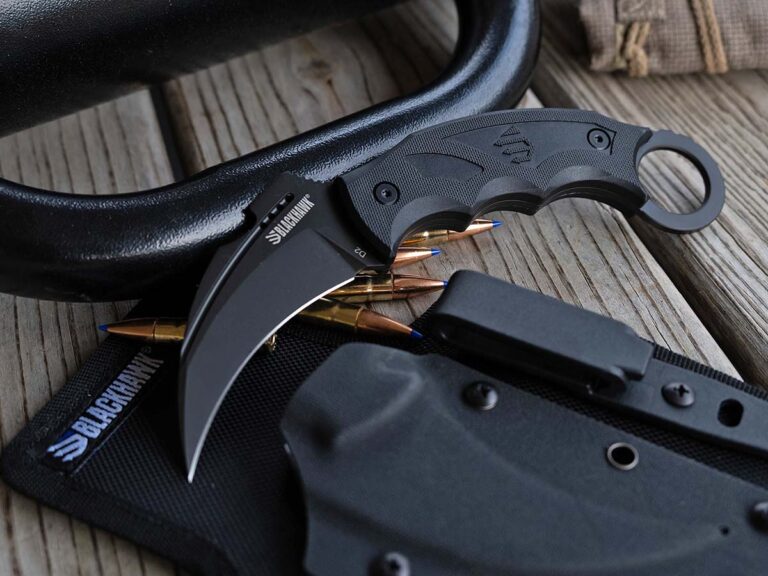
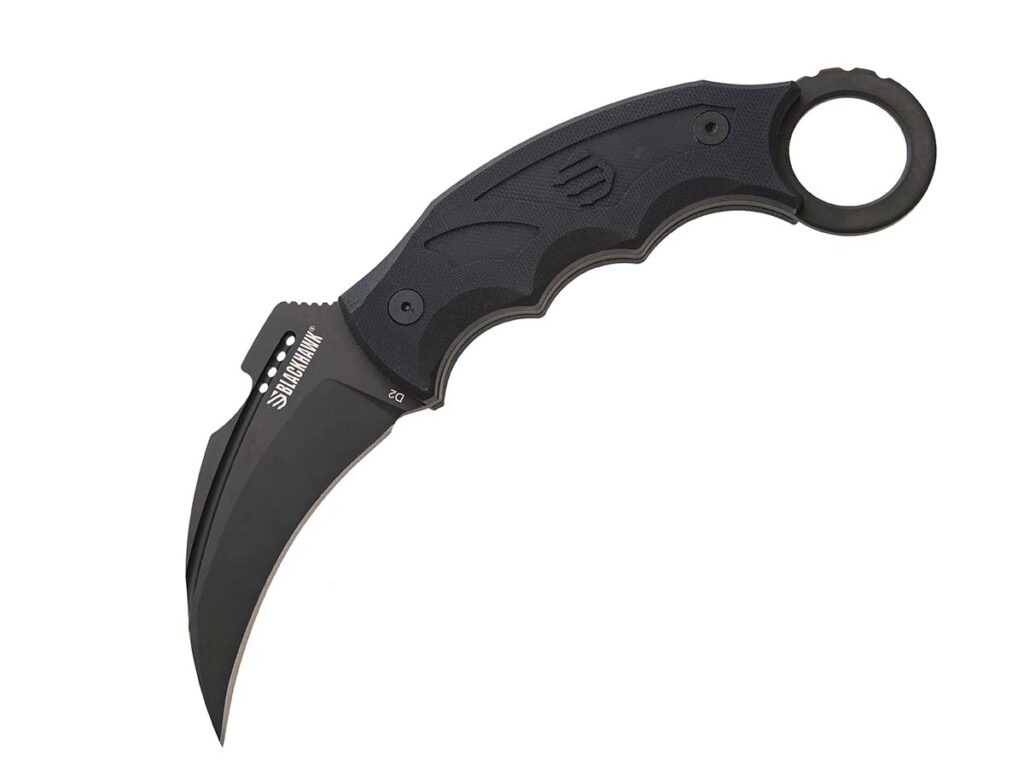
Look out tactical fans! Blackhawk expanded its tactical lineup with the release of the Garra Fixed Karambit. Manufactured in Taiwan, the fixed-blade design builds on the ergonomics of the brand’s popular Garra III folder, using nearly the same wicked blade profile and the earlier model’s finger ring, but in a full-tang, fixed option.
At the center of the Garra is its 3.25-inch blade ground from D2 tool steel. A high-carbon tool steel, the alloy is widely recognized for wear resistance and edge retention and is a time-tested knife steel. These properties allow the Garra Fixed to resist chipping under heavy stress, though users should remember its high carbide content makes it somewhat more demanding to sharpen. Blackhawk finishes off the blade with a non-reflective black finish, which not only reduces glare but inhibits corrosion.
Measuring 8 inches overall, the knife features textured Zytel handle scales, available in black or tan. The rear finger ring is a love-hate feature for most knife fan. It facilitates quick grip transitions between forward and reverse holds and gives positive retention during hard utility or defense work. But some find rings get in the way and create the potential for a broken finger in hard use. It’s a matter of opinion and taste.
Weighing 7.5 ounces, each Garra ships with both a conceal-carry and a removable Kydex sheath designed for belt or gear integration. The Garra Fixed Karambit carries an MSRP of $160.
Garra Fixed Karambit Specs Manufacturer: BLACKHAWK® Overall Length: 8.00 in. Blade Length: 3.25 in. Blade Steel: D2 Tool Steel Handle Material: Zytel (Black or Tan) Sheath: Kydex sheath and conceal-carry holster Weight: 7.50 oz. Country of Origin: Taiwan MSRP: $160
In a short time, Montana Knife Company has become a staple for hunters, outdoorsmen, cooks and skilled tradesmen. The interesting part is that the company has carved its place purely off fixed-blade knives.
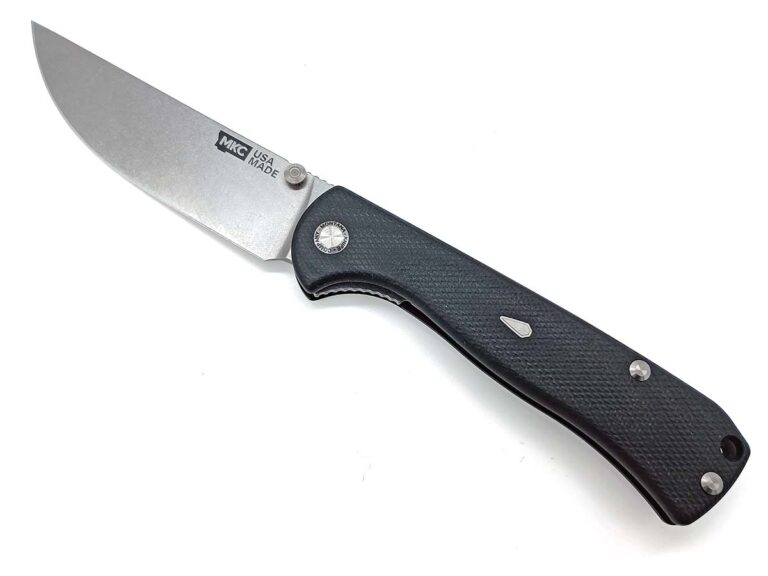
This all changed at the beginning of the summer, when MKC introduced its first folding knife—the Montana. The liner lock is certain to grab attention purely off the brand’s current popularity. But a knife only makes it if it’s able to cut it—literally speaking. With that said, let’s see how the Montana is executed and if it holds down its primary job of splitting things asunder.
The Montana is positioned as a general, hard-use EDC and is unassuming in looks, cutting a blue-collar profile with a contoured axe-handle-style grip of G10. The scale is checkered, not to the point of creating a hundred little hotspots, but enough to facilitate extra purchase on the knife. The build features 420 liners and pocket clip, and titanium is used for the spacers and hardware.
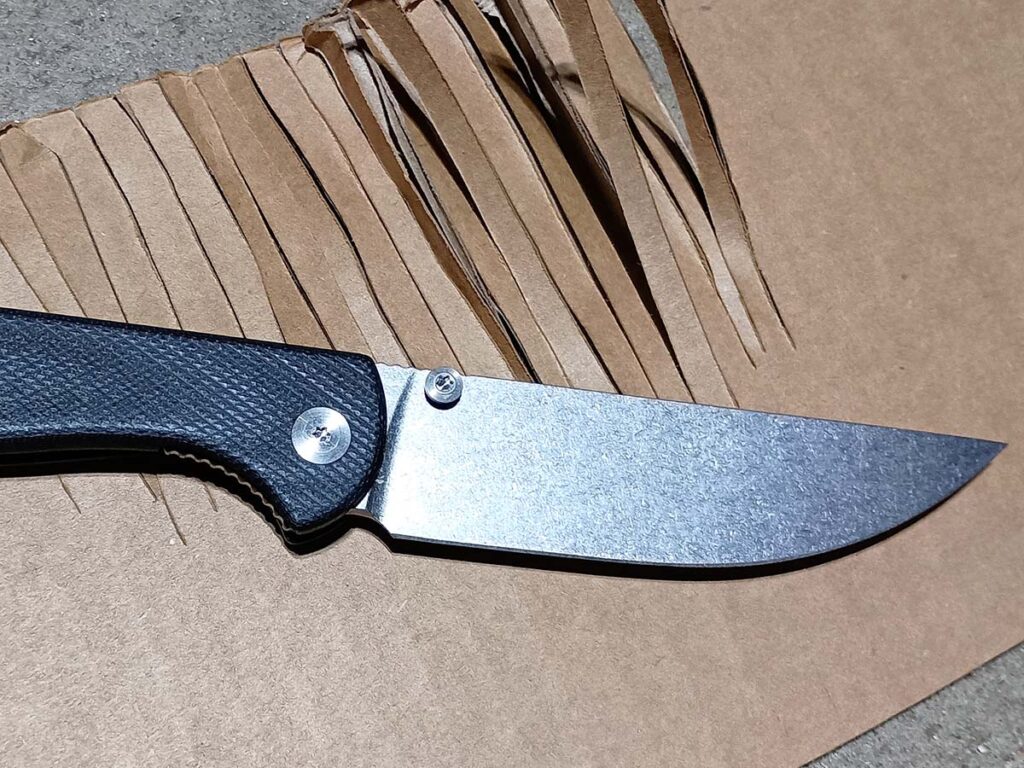
The MKC knife was very aggressive through double-wall cardboard and proved very controllable. The edge almost seemed to get sharper the longer it cut through the material.
The blade deploys via removable thumb studs and to that end, its action initially was the showstopper out of the box. MKC perfectly tuned the detent on the knife and running the blade on ceramic bearings in a bronze ring, deployment is lightning-fast and certain. The blade itself is MagnaCut with a full flat grind, a straight spine and no drop to the tip. The blade has a good belly to it for more delicate slicing chores and the tip is very fine, giving it the likely chops for precise cutting work. Some nice additions to the knife include a small section of jimping at the rear of the spine and a sharpening choil.
To test the keenness out of the box, 20-bond paper was the order of the day. The Montana didn’t disappoint, with an excellent factory edge and smooth stonewashed finish producing fine slices through the paper and a very satisfying cutting sound as it passed through. Upping the ante, the liner lock tackled double-wall cardboard. Here the Montana was very aggressive, splitting off even fingers of the box flap and proving easy to control through the material without losing its edge along the way.
Off To The Woods
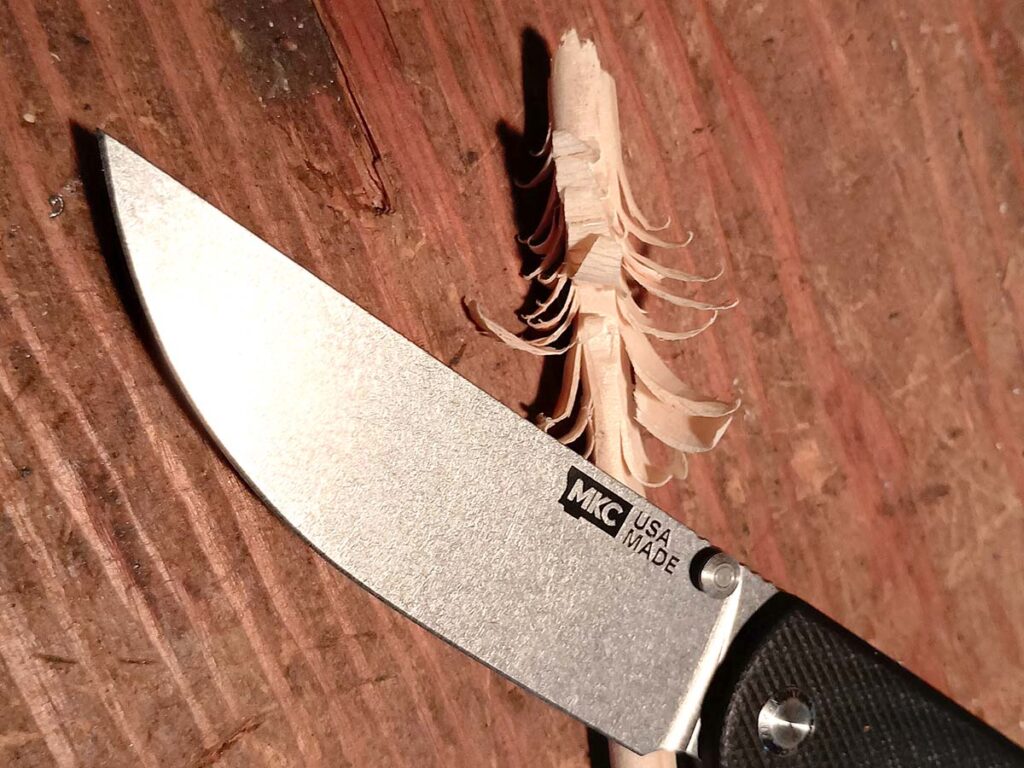
Lighter fare in the books, it was time to see what MKC’s folder could do against some more substantial material that over time tests an edge. Initially, it tackled a piece of pine dowel, which was whittled away at to create a firestick. The knife produced uniform and dainty curlicues and showed restraint when working these more delicate cuts. But it also proved it had bite for deeper cuts and significant material removal. The jimping was a welcome addition to the spine and helped direct the blade in the wood; however, the nearly 90-degree spine of the rest of the blade was a bit harsh on the off-hand thumb. A small price to pay for what is certain to be a solid striking surface for a ferro rod.
An adept whittler, the knife could shave fine and chunky curlicues from a piece of pine dowl. The 90-degree spine did have some bite on the offhand thumb when executing push cuts into the wood.
It was really time to put the edge to the test, hacking through a 1.5-inch furring strip. Even though it was pine again, it’s a worthy measure of an edge and a good replica of field use, such as having to hack down a small piece of timber or through a deer pelvis. The blade performed admirably, but it’s certainly not a duty for which the knife was designed. Light as it is (2.84 ounces), it required more hacks than would be required from a heavier blade.
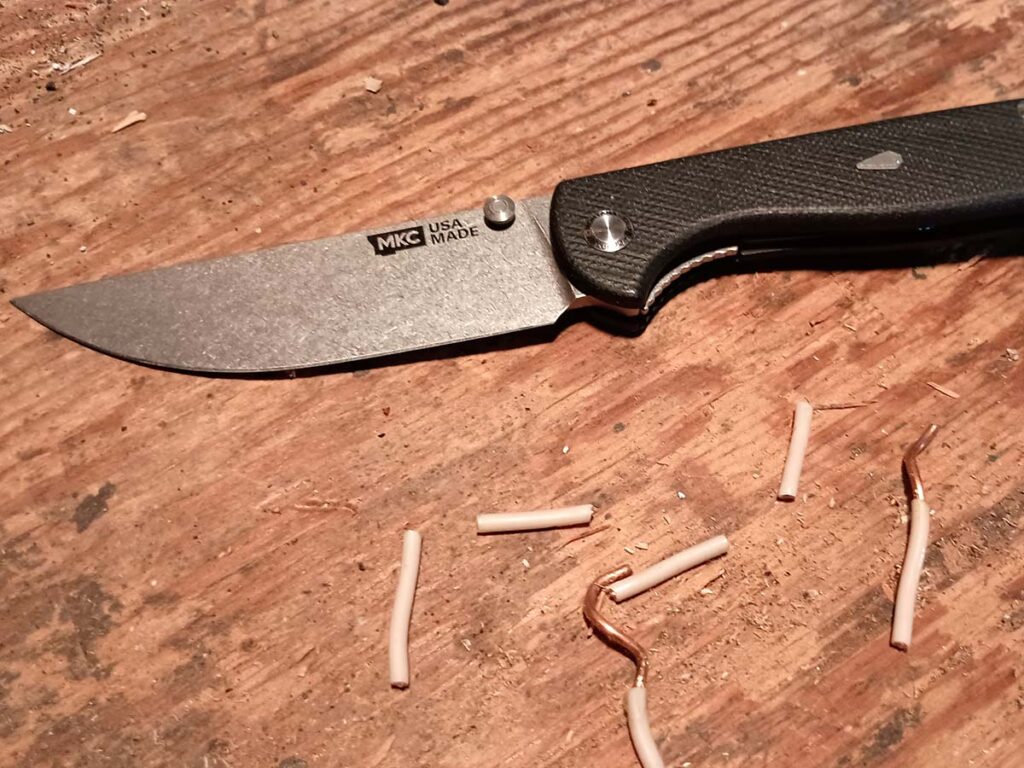
To really give the Montana a run for its money, test the overall blade construction and see if it really cut muster as a hard-use option for a working man, the knife was pitted against insulated 6-gauge solid copper wire—what you’d run into in a lot of residential electrical projects. The knife divided the wire into 10 pieces with ease, each segment coming loose with a single swipe from a rubber mallet.
Rounding everything out, 20-bond paper was again centerstage testing the knife’s edge retention. Overall, there was little difference in the Montana’s cutting prowess from when it was freshly taken out of the box. A pretty solid showing.
Final Cut
The knife made quick work of copper wiring, dividing it with the help of a rubber mallet. The edge was undamaged in clipping the 6-gauge wire and remained sharp enough to shear paper afterward easily.
You never know what chaos an EDC knife might be called to tackle. Thus, it better be designed to withstand the unknown. Overall, it seems MKC has accomplished this with the Montana. The edge showed its worth through general tasks an everyday carry would expect to face. As impressive, after some moderate abuse, the action and lock both were still tight as drums. A bit on the spendy side, yes, but for an electrician, rancher or anyone else that needs a dependable blade, the Montana is likely to prove a value.