Grace Horne makes what, for her especially, is the buy of a lifetime.
Scissors-making maven Grace Horne scored a find of a lifetime recently when she obtained the antique Scissor Sword made in 1851 by George Oates of Sheffield, England.
A Sheffield native, Grace thought she had lost out on the one-of-a-kind piece when someone else bought it after her computer crashed halfway through an auction of David Hayden-Wright’s collection of historical British knives in 2023.However, a dealer contacted her this past spring with a picture of the piece asking if she had ever seen it. Grace of course had, asked who owned it, contacted the owner and bought it from him at BLADE Show 2024.
Grace Horne
The sword was made especially for London’s iconic 1851 Crystal Palace Exhibition and is in Wright’s book, The Heritage of English Knives. In part, Wright wrote the sword was “conceived to represent two completely different visual images, one an elegant diamond tapering blade flat hilted court sword … the other an exceptionally large pair of attractive display tailor’s scissors … The long split blades form a diamond section with closing catch piece at the tip, each has foliate blued panels highlighted by the mirror polished steel, the steel ribbed ricasso forming the concealed hinge.
The split inner blade faces with white frost etched floral panels and the scrolled legend, ‘Manufactured by – George Oates – Sheffield.’” We seriously doubt Grace and the Scissor Sword will part company anytime soon.
Autumn is here and, unlike the weather, knifemakers show no signs of cooling down. If anything, factory and custom makers are as hot as ever with a ton of new knives hitting the market. We picked out 12 great-looking recent drops certain to carve a place into your heart.
Jess Hoffman Donegal
Knife pattern: Skinner Blade length: 4” Blade steel: AEB-L stainless Blade grind: Full flat Handle material: Camel bone Overall length: 8.25” Sheath: Leather Maker’s price for a similar knife and sheath: $230 Maker’s remarks: “My Donegal is a cross between a Nessmuk and a Canadian belt knife. It’s available in three different overall sizes: 8.25, 6.75 and 5.75 inches.” Maker: Jess Hoffman, jhoffmanknives.com (Jocelyn Frasier image)
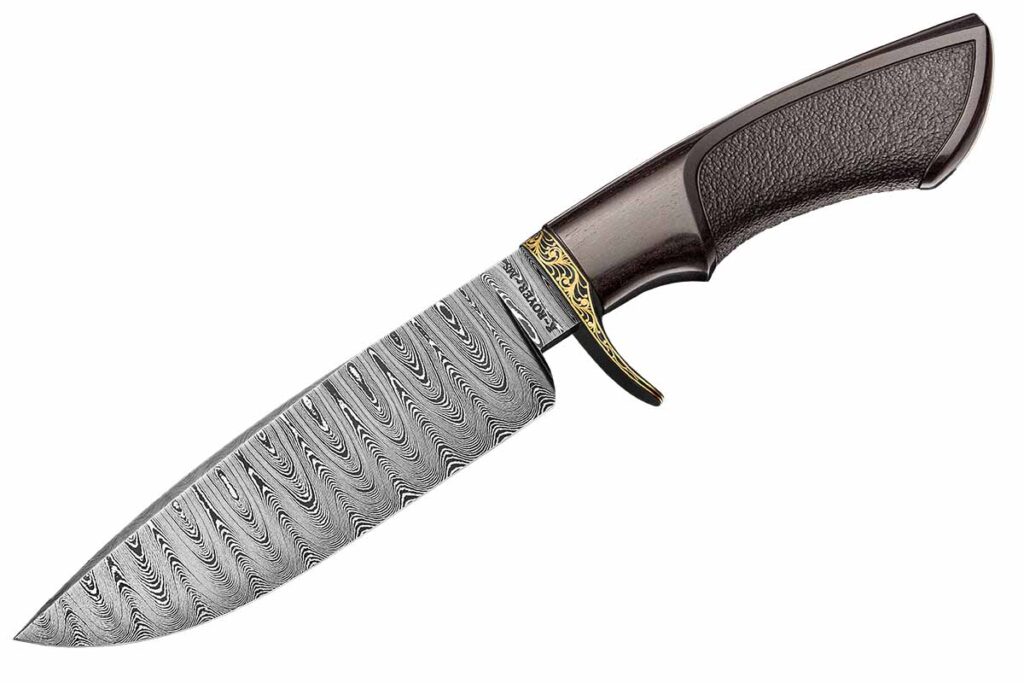
Kyle Royer Damascene Hunter
Knife type: Fixed blade Blade length: 5” Blade material: Ladder-pattern damascus of 1084 carbon and 15N20 nickel-alloy steels Blade grind: Flat w/convex edge Handle: Sculpted blackwood w/texturing Bolster: Damascene-covered guard w/24k gold and gun bluing Overall length: 9.25” Maker’s price for a similar knife: $9,500 Maker’s remarks: “This piece is particularly special as it’s the first gold overlay I’ve done using hundreds of tiny 24k-gold wires. Additionally, it has a beautifully textured blackwood handle.” Maker: Kyle Royer, kyleroyerknives.com (Jocelyn Frasier image)
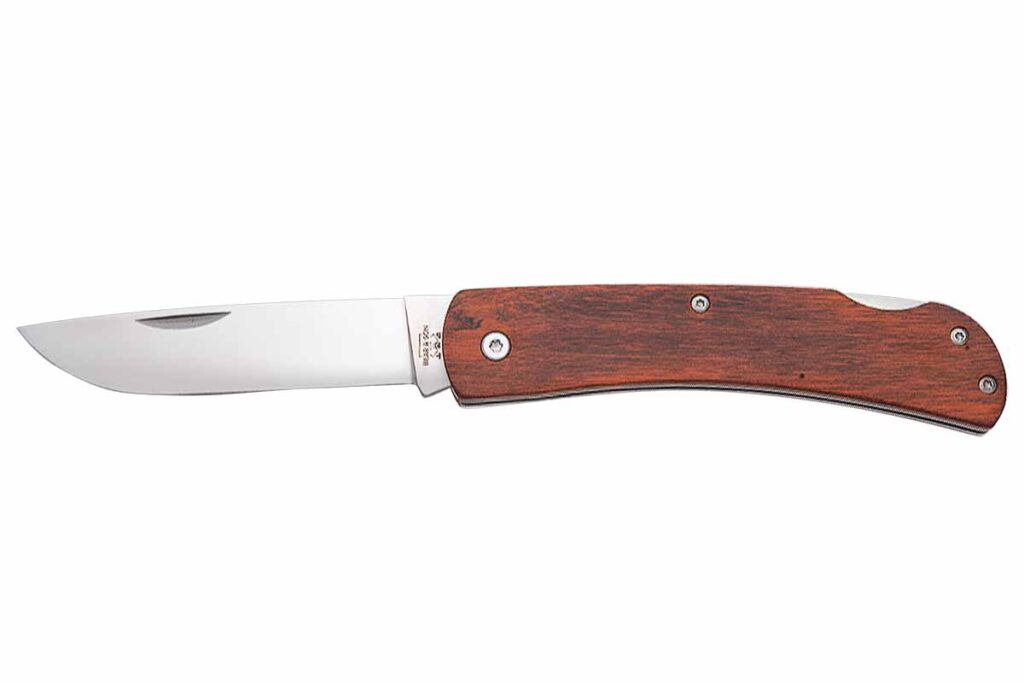
Bear & Son Cutlery Farmhand
Blade length: 3 5/8” Blade steel: 440 stainless Blade pattern: Drop point Blade opener: Nail nick Handle material: Aluminum, bone and rosewood (shown) options Pocket clip: Yes Lock: Lockback Weight: 1.1 ozs. Closed length: 2.75” Knife to know: Handle color options include black, blue, orange, purple, red and white smooth bone, and brown rosewood Country of origin: USA MSRP: $37.49 to $51.99 Company: Bear & Son Cutlery, www.bearandsoncutlery.com
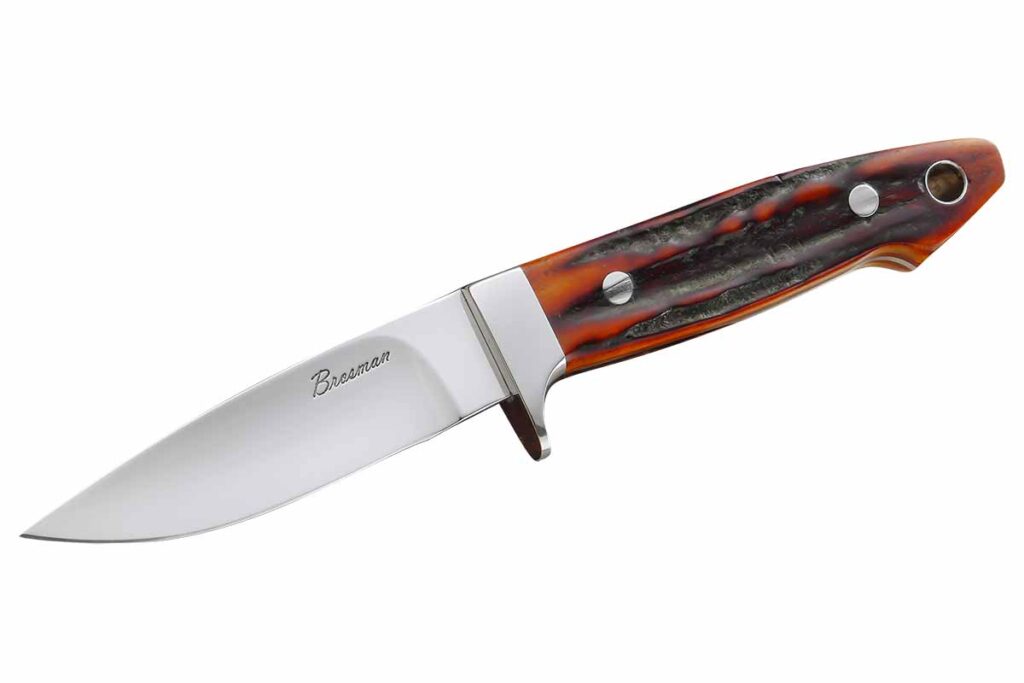
Craig Brosman Hunter
Blade length: 2.75” Blade steel: RWL 34 stainless Blade grind: Hollow Blade pattern: Drop point Blade finish: Mirror polished Handle material: European red stag and Westinghouse Micarta® liners; w/hole for lanyard Construction: Tapered tang Bolster/guard: 416 stainless Overall length: 6 9/16” Sheath: Leather pouch w/clip by Aaron Sybrant Maker’s price for a similar knife & sheath: $550 Maker: Craig Brosman, (SharpByCoop image)
Billy Pearce Hunter
Blade length: 5.1” Blade material: 1075 carbon steel Blade grind: “V” Blade thickness @ricasso: .177” Blade @widest: 1.18” Blade pattern: Clip point Handle: Bocote wood Spacer: G-10 Guard & pin: 416 stainless steel Overall length: 9.64” Knife to know: Billy Pearce is an apprentice smith in the American Bladesmith Society Maker’s price for a similar knife: Contact maker for info Maker: Billy Pearce, (Rod Hoare image)
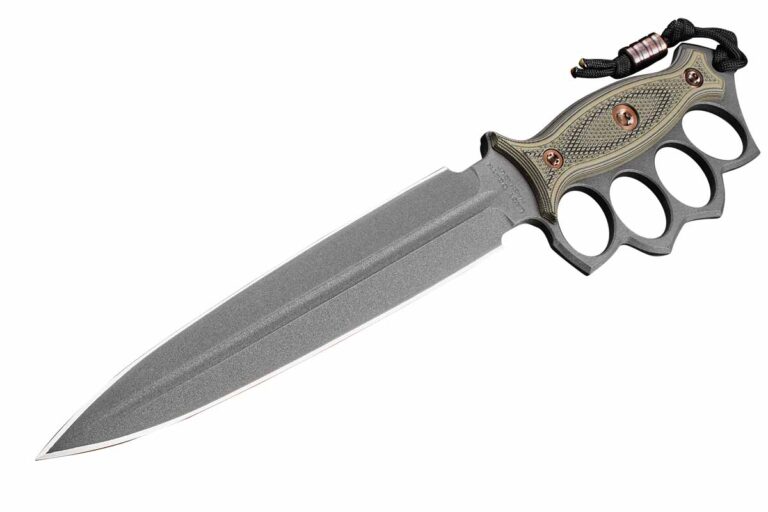
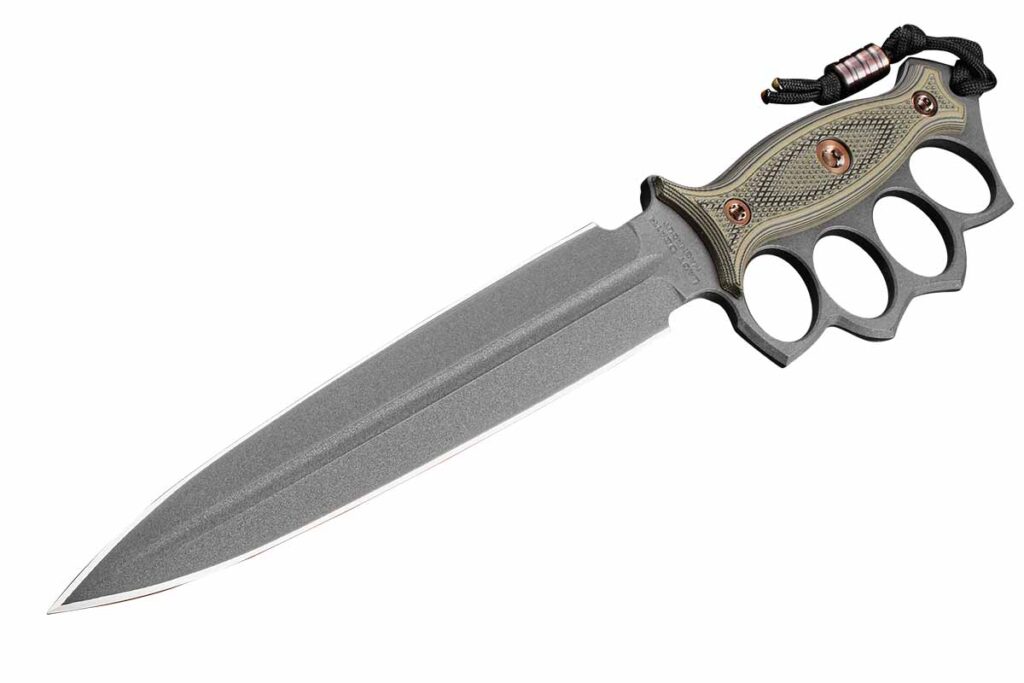
RMJ Tactical Lady Death
Knife pattern: Classic trench knife Blade length: 9 5/8” Blade material: CPM 3V carbon steel Rockwell hardness: 60-61 HRC Blade @thickest: 3/16” Blade finish: Cobalt Cerakote® Handle: Checkered Dirty Olive G-10 Handle hardware: Grade 5 titanium anodized bronze Weight: 18.3 ozs. Overall length: 15” Sheath: Brown leather w/green canvas inlay; ambidextrous and wears on a belt or attached to PALS webbing Knife to know: Double-edged blade w/long fuller; knuckle-duster-style handle; pommel pronounced for use as a hammer Country of origin: USA MSRP: $975 Company: RMJ Tactical, www.rmjtactical.com
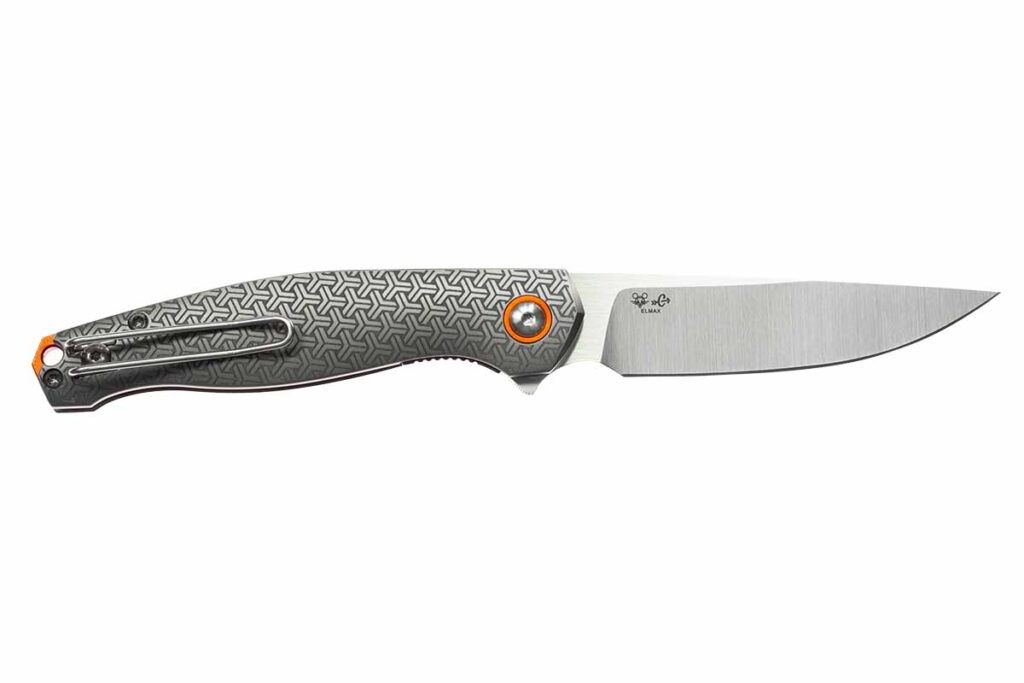
GiantMouse Carryology Sonoma V2 Auxikko
Knife type: EDC folder Blade length: 3.425” Blade steel: Elmax stainless Rockwell hardness: 60 HRC Blade @thickest: .138” Blade finish: Satin Lock: Linerlock Pivot hardware: Ball bearings Handle material: Titanium laser engraved w/the Carryology Auxikko pattern Backspacer: Aluminum anodized orange w/built-in hole for a lanyard Pocket clip: Wire, deep carry, reversible Weight: 3.8 ozs. Closed length: 4.5” Knife to know: Limited edition of 400 numbered pieces Country of origin: Made by Reate in China MSRP: $295 Company: GiantMouse, giantmouse.com
Gary Martindale Loveless Chute Knife Repro
Blade length: 4.25” Blade steel: CPM 154 stainless Blade grind: Hollow Handle: Amber stag Bolster/crossguard: 416 stainless Overall length: 9” Sheath: Basketweave-leather belt pouch w/snap Maker’s price for a similar knife: Contact maker for info Maker: Gary Martindale, (SharpByCoop image)
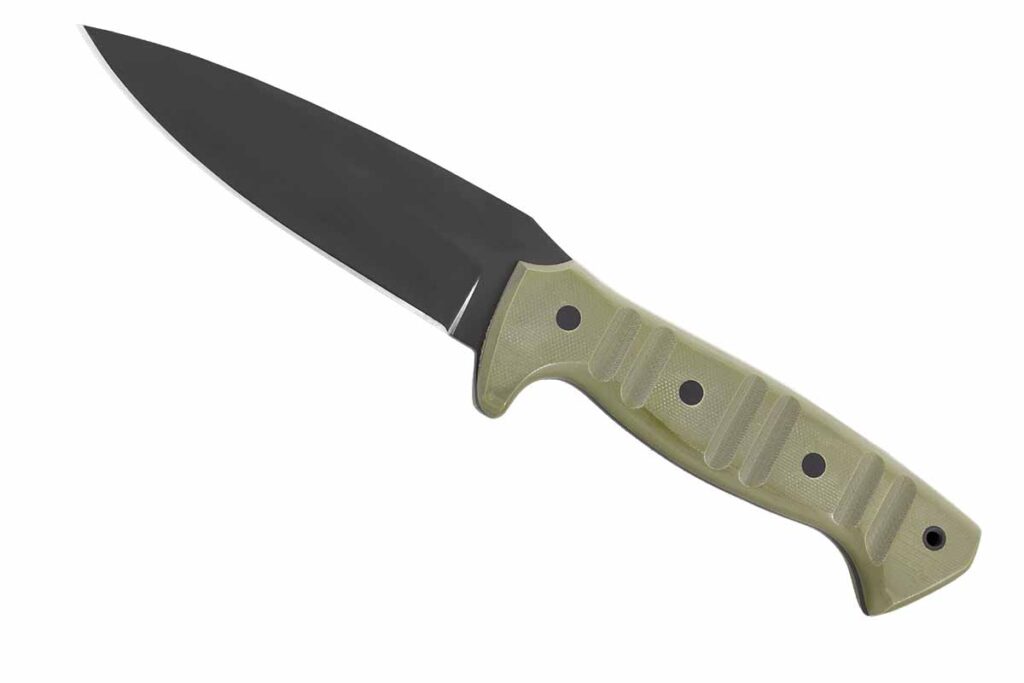
Grimdog Blades Australia Draugr Mk III
Knife type: Military utility Blade length: 4.9” Blade material: Thyssenkrupp 80CrV2 carbon steel Blade grind: Flat sabre Blade thickness @ricasso: .138” Blade finish: Cerakote® H190 Armour Black Handle material: Olive green G-10 Overall length: 10.47” Maker’s price for a similar knife: Contact maker for info Knife to know: Christian Holm is a member of the Australian Knifemakers Guild Maker: Grimdog Blades Australia, (Rod Hoare image)
Liam Walle Bird & Trout
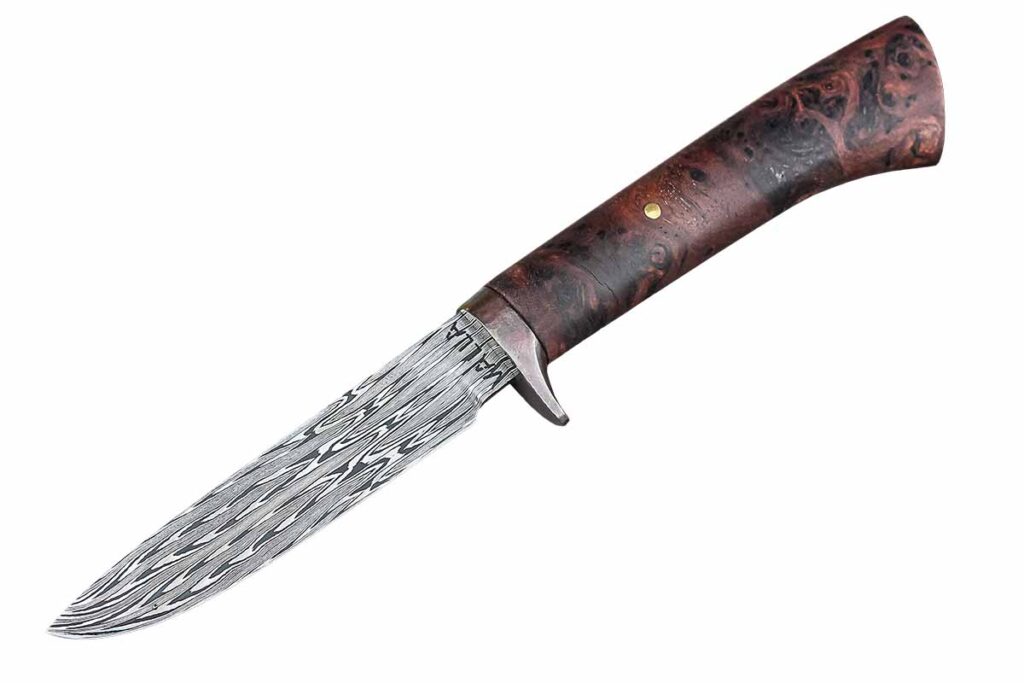
Knife type: Fixed blade Blade length: 3.6” Blade materials: Crushed W’s damascus of 1084 carbon and 15N20 nickel-alloy steels Blade grind: Flat Handle: Pōhutakawa wood w/domed brass pin Guard/bolster: Antiqued bronze Overall length: 7.6” Maker’s price for a similar knife: $750 at press-time exchange rate Maker: Liam Walle, liamvallaknives.com (Jocelyn Frasier image)
Cold Steel Full Metal Atlas
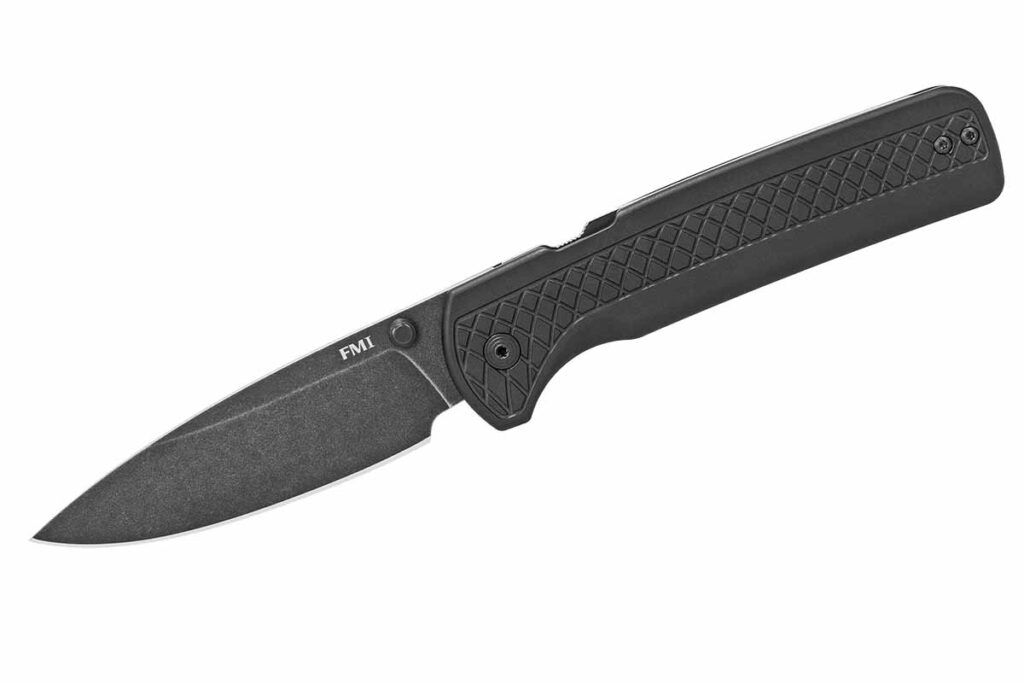
Knife type: EDC folder Blade length: 3.5” Blade steel: CPM S35VN stainless Blade grind: High saber Blade pattern: Drop point Blade opener: Thumb stud Lock: Atlas® Lock Handle: Textured titanium Weight: 3.8 ozs. Closed length: 5 7/8” Knife to know: Knife comes in all-black (shown) or standard stonewashed finishes; handle includes a single finger groove w/integral guard Country of origin: Taiwan MSRP: $229.99 Company: Cold Steel, www.coldsteel.com
Halfbreed Blades MIK-03P Gen-2 K340
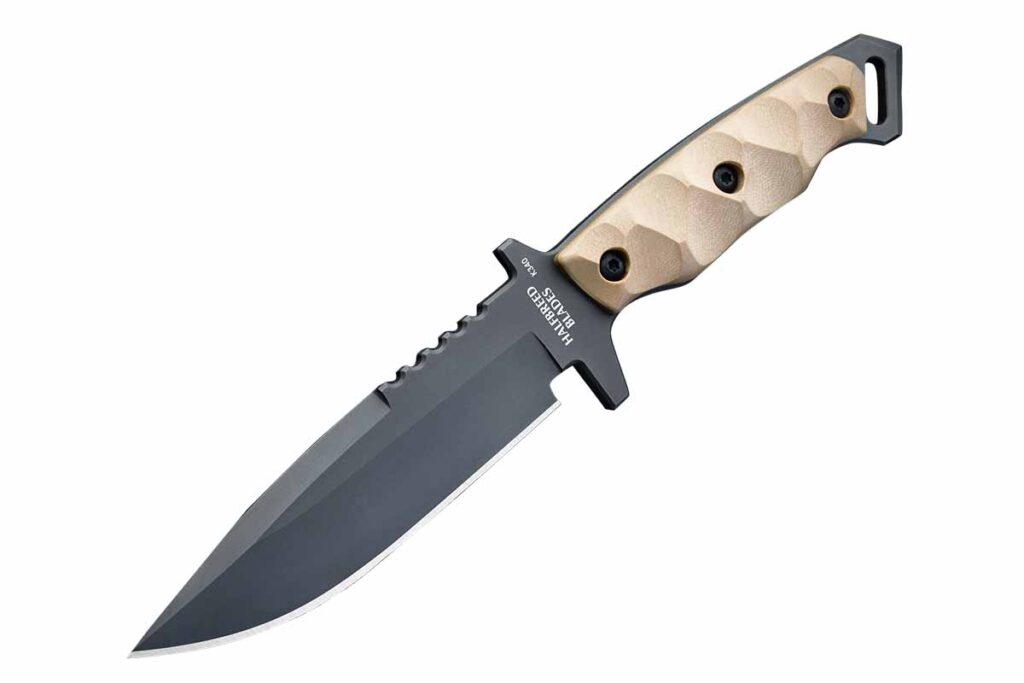
Knife type: Fixed blade Blade length: 5.31” Blade steel: K340 ISODUR Rockwell hardness: 59-60 HRC Blade @thickest: .25” Blade pattern: Modified drop point Blade finish: PVD coated Construction: One-piece full tang Handle: G-10 Weight: 11.14 ozs. Overall length: 10.43” Sheath: Injection-molded plastic w/belt & PALS/MOLLE mounting Knife to know: MIK stands for Medium Infantry Knife MSRP: $212 at press-time exchange rate Company: Halfbreed Blades, halfbreedblades.com.au
Four hot hatchets pack more punch for their size than most.
There’s a good reason hatchets have always been a staple of camp tools. They pack more punch for their size than just about anything else you can put in your hand. Sure, an axe can outperform its smaller sibling but can be both size and weight prohibitive on many outings. Saws are lighter but their blades can break, leaving you empty-handed without a hatchet in the wings.
CAS Iberia APOC Hundr
The CAS Iberia/APOC Hundr’s bearded hatchet head shaved bark off a wooden shaft via push cuts.
The CAS Iberia APOC Hundr gets its name from the Old Norse word meaning hound in reference to man’s best friend. It is a bearded-style hatchet with a main handle and head of quarter-inch-thick 9260 carbon steel. Quarter-inch-thick smooth black G-10 scales bring the handle’s overall thickness to three quarters of an inch. The sheath is a black thermoplastic unit that slides open-backed over the hatchet head and is secured by two nylon straps that snap into place.
CAS Iberia/APOC Hundr Hatchet Blade material: 9260 carbon steel Cutting edge: 3.75” Head length: 4.65” Head @ thickest: .235” Handle material: G-10 composite Design feature: Bearded style Weight: 1 lb., 7 ozs. Overall length: 12” Carry: Black synthetic sheath, MOLLE compatible, snap on Country of origin: China MSRP: $89
SOG Camp Axe
Hatchets take a ton of abuse, requiring sharpening from time to time. The author uses a fine-grit Eze-Lap diamond stone to touch up the edge of the SOG Camp Axe.
The SOG Camp Axe is the most modern looking entry and second bearded-style hatchet of the test bunch. Its 5-inch-long head is the longest of the review pieces, too. The head is attached by four Phillips-head screws to a black, ovate GRN (glass-reinforced nylon) handle, and an aluminum collar adds strength. The poll is a healthy .6 inch thick and the main handle is ribbed for added purchase. A minimalist blade cover has a strap that wraps around the back side of the hatchet head and, in a clever touch, hooks horizontally over the SOG logo on the opposite side.
SOG Camp Axe Specs Blade steel: 2Cr13 stainless Cutting edge: 3.1” Head length: 5” Head @ thickest: .6” Blade coating: Bright finish w/dark recess Handle material: GRN (glass-reinforced nylon) Design feature: Added poll thickness Weight: 16.1 ozs. Overall length: 11.5” Carry: Molded nylon sheath Country of origin: China MSRP: $68.69
Schrade Bedrock Axe
Hatchets such as the Schrade Bedrock can be used to point pegs for securing tents. Protective eyewear is recommended when the chips start flying. The author prefers gloves for a more comfortable grip, especially during extended use.
Dubbed the Bedrock Axe, Schrade’s entry has the test group’s largest poll, measuring 1.75 by .75 inch. Six-and-a-half inches of the handle is a grippy, black, hard rubber overmold. It is the heftiest of the review hatchets at 1 pound, 8.6 ounces. The black polyester sheath has a fabric-fastener flap at the rear.
Schrade Bedrock Axe Blade steel: 3Cr13MoV stainless Cutting edge: 3.5” Head length: 4.7” Head @ thickest: .79” Blade coating: Satin/black oxide Handle material: Black overmold Design feature: Thick poll Weight: 1 lb., 8.6 ozs. Overall length: 11.75” Carry: Black polyester/fabric-fastener sheath Country of origin: China MSRP: $39.99
Winkler Knives Highland Hatchet
The Winkler Knives Highland Hatchet proved a workhorse when it came to splitting wood both free-hand and with a baton. The head has a nice wedge shape for getting down to business.
The Winkler Knives Highland Hatchet has all the period visual trappings of Daniel Winkler’s full-blown custom work, though is made via the stock removal method only instead of mostly being forged. While it may be the smallest hatchet of the test bunch, it has the heart of a ram. The maple handle tapers gently toward the base and a lanyard hole. A heat-formed black Kydex sheath with two black nylon drop loops slips over the hatchet head and secures by a heavy-duty elastic rod that wraps around the sheath.
Winkler Knives Highland Hatchet Blade material: 80CrV2 carbon steel Cutting edge: 2.55” Head length: 4.8” Head @ thickest: .3” Blade finish: Black Caswell Handle material: Maple Sharp stuff: Period design Weight: 1 lb., 5 ozs. Overall length: 11” Carry: Kydex sheath, nylon straps MSRP: $550 Country of origin: USA
Testing Hatchets
The thicker the poll the easier it is to perform functions like hammering tent pegs. It also adds more weight behind the swing of the hatchet when chopping. The test group offers a selection of poll thicknesses and heights.
I started by checking out the hatchets’ bite with swinging overhand chops on a 14-inch-wide-by-12-inch-deep crosscut slice of seasoned oak. I took each hatchet and buried the upper blade into the cross-grain of the stump, and they all stood up on their own. From there I worked the edge at alternate angles with each hatchet to get an idea of its bite. None of the candidates gave any resistance and all averaged cuts of ¾-to-1-inch deep. I repeated the alternate cuts on a length of 2-inch-diameter green oak tree limb and got similar results with all the subjects.
I tested the hatchets on specific tasks such as pointing stakes, shaving bark and baton work, and the exercises brought out the differences in their dimensions and configurations. For instance, the two bearded hatchets—the SOG and CAS Iberia/APOC—excelled at shaving bark. The ability to grip them behind the blade to direct them simply makes shaving with precision much easier. The Schrade Bedrock, with its large, thin blade, edged out its brethren in pointing stakes.
The CAS Iberia/APOC (top) and SOG are the bearded type. The longer drop on the bottom front edge allows you to grip the handle and use it to shave or carve wood with precision.
The hatchets with thicker polls, the SOG and Schrade, did better at hammering tent stakes due to their ease of target acquisition and scope of impact. The Winkler Highland Hatchet excelled at baton work, its wedge shape and streamlined profile ideal for the task. The individual advantages along with the size of the hatchet can be priorities in choosing the right one for your needs. Keep in mind, however, just because I called out certain models as excelling at specific tasks, such as pointing stakes, doesn’t mean the others won’t serve you to some degree.
Hatchet Carry
The review hatchets offer four different takes on sheathing, from the minimalist SOG at bottom right to the top shelf Winkler Kydex version (second from right).
The sheaths range from the premium one provided with the Winkler Knives Highland Hatchet to the minimalist one accompanying the avante garde SOG Camp Axe. In my days of extended trips in the wild I preferred to pack-carry a hatchet, but some may like it on the belt, and the SOG can accommodate you there. Hatchets are typically made to take abuse but are relatively easy to sharpen, either with a bench stone around the shop or a portable sharpener in the field or on the trail.
Final Cut
Options abound in the hatchet world and those on a budget should have no trouble finding competent fare in the category. The Winkler may seem pricey but once you try it you’ll appreciate its rock solid construction and extraordinary fit and finish. You’ll never be caught saying, “They don’t make ’em like that anymore.” The best news is there is enough diversity in the category that you can choose a hatchet to fit both your needs and budget, and that’s always a good thing.
Top knife observers decipher the best custom huntering knives ever made.
It’s an ongoing discussion, or maybe a debate, slightly contentious but always cordial. When the question is pondered regarding who made the best custom hunting knives ever, a few names quickly come to mind.
Of course, there is no right or wrong answer. It’s a matter of interpretation, fit and finish, design, form and function, and the feel of the knife in the hand when it’s time to get down to the business of skinning and dressing game. Each respected and well-traveled knifemaker and observer consulted below can tell the stories that back up his top few. But in the end there is no doubt. Each of these revered custom makers and/or bladesmiths has got game. It’s proven in their work.
Bruce Voyles’ Take
BLADE Magazine Cutlery Hall-of-Fame® member and knife auctioneer Bruce Voyles accompanied his fellow Cutlery Hall of Famer, the legendary George Herron, on a few hunting trips and experienced his work in the field.
Among the top hunting knives BLADE Magazine Cutlery Hall-of-Fame® member George Herron made are the Model 6 (top) and the Model 3 skinner, aka Little Dude (bottom). The Model 6 sports a 4-inch blade and 9-inch overall length. Blade and overall lengths for the Little Dude: 2.75 and 6.75 inches. Respective blade steel, handle material and construction on each knife are ATS-34 stainless, curly maple and tapered tang. (Jay Mealing knife image)
“George was a fantastic hunter,” Bruce remembered. “When a group of us would go with him, we might kill three deer in a four-day morning and afternoon hunt, but he could get eight if he wanted to.”
Bruce tells the story of an Outdoor Writers Association hunt Herron organized after an invitation from a South Carolina country gentleman that George had helped change a tire. It seems the man owned a large tract of land, and in return for Herron’s kindness he was allowed to hunt deer on the property.
“When we got to that plantation, every guide there was carrying a George Herron knife,” Bruce commented. “The thing about George’s knives is that when you held one and used it, you were using a knife made by a man who had been there. He made tremendous skinning knives, and the balance and feel in the hand are unsurpassed. The balance, shape of the handle, and minor nuances of the tilt of the blade, its thinness, and the tapered tang set Herron knives apart.”
According to BLADE Magazine Cutlery Hall-of-Fame® member Bruce Voyles, the knives of Cutlery Hall-of-Famer Bill Moran feel like an extension of your hand. Mr. Moran’s engraved gentleman’s hunter in damascus and with one of his iconic moon logo sheaths is representative of Bruce’s sentiment. (Eric Eggly/PointSeven image)
According to Voyles, the knives of Herron, Jerry Fisk and Cutlery Hall-of-Famer Bill Moran feel like an extension of the hand. Herron also made knives that were affordable for a hunter to purchase. Since he put many knives in the hunters’ hands because of a reasonable price point, the praise of his work in the shop spread far and wide. Today, there are several quality custom knifemakers contending for recognition, and they include Ralph Smith, Larry Page and Wayne Hendrix to name just a trio, Bruce says.
“Wayne was one of the guys who trained in George’s shop, and while we were hunting he had his own shop set up on the grounds making knives to sell directly to hunters,” he noted. “He was a guide in South Carolina and approaches making hunting knives the same way George did. He’s the closest to George’s knives now.”
Jim Sornberger’s Take
Cutlery Hall-of-Fame knifemaker Jim Sornberger remembers the days years ago when names such as Harry Morseth and Cutlery Hall-of-Famers Bo Randall and Rudy Ruana were synonymous with excellence in hunting knife craftsmanship. He also mentions the fine work of Corbet Sigman and other contemporaries of the 1960s and ’70s.
“The first new model A.G. Russell made when he acquired Morseth Knives from Harry Morseth was the Model 1, also known as the Ozark Hunter,” Tom Krein noted. “It is a drop-point camp and hunting knife with a 3.5-inch blade, hidden tang, nice guard, and thin-shaped Micarta® handle that make the knife extremely light.” This version sports a stacked leather and fiber spacer handle with a stag butt. (Nordic Knives image)
“It goes back to when I was a kid and my uncle had a gun store in Redding, California,” Jim said. “Those names were famous, and I met Harry Morseth in the ’50s. His Cascade Skinner was my favorite hunting knife for many years with a great handle shape in leather or stag for a good grip and a guard, which is really important in a good hunting knife because you’ve got to hang onto an animal or fish if you’re working and you can’t afford to have the knife slip in your hand. The blades were laminated Brusletto steel from Norway, and the knives came with a safety sheath. Mine was copper-lined leather in the shape of the knife, and later models had a fiber material liner inside.”
Sornberger also mentions Cutlery Hall-of-Famer Gil Hibben, Ruffin Johnson and Clay Gault as makers of outstanding hunting knives. However, trying to identify custom makers that are in that rarefied air with the masters these days requires some reflection. “It’s tough because a lot of guys follow trends nowadays and they find it’s cheaper and faster to make a knife without a guard,” he opined. “Randy Lee has been around a long time and still makes a lot of good using knives. Dave Pitt in Redding, California, does as well, and that’s hunting country. Randy has a stubby little hunter with a 3.25-inch blade and nice guard, and that’s plenty of knife for most hunting applications.”
Tom Krein’s Take
Veteran knifemaker Tom Krein is upfront with his thoughts on the best maker of hunting knives.
“I actually worked for Bob Dozier and A.G. Russell from the mid-1990s to 2001, and honestly this is a tough one. We all use hunting knives differently in the field and for different things, but I would put Bob Dozier forward. He grew up hunting in the bayous and providing for his family, [and] he has a lot of experience making knives. He is an exceptional craftsman, and in the 1980s I feel one of the pioneers in the style of distilling everything down to make hunting knives easier to make and get them in everybody’s hands.”
Award-winning bladesmith Jerry Fisk’s Sendero hunter served as Tom Krein’s inspiration to make knives. (Eric Eggly/PointSeven image)
Krein likes the reasonable price point of a Dozier hunting knife and the attributes that characterize the maker’s outstanding work: a full tang, thinly ground blade, Micarta® handle, and often a Kydex sheath system for safety. “Dozier’s knives check all my boxes,” he related. “The Dozier Personal with a 2-inch blade works great on game, and an investment of $300 will get you a fine Dozier knife.”
Tom also has seen the Morseth line continue with A.G Russell and has tremendous respect for the maker’s legacy. “The first new model A.G. made when he acquired Morseth Knives from Harry was the Model 1, also known as the Ozark Hunter,” Krein noted. “It is a drop-point camp and hunting knife with a 3.5-inch blade, hidden tang, nice guard, and thin-shaped Micarta® handle that make the knife extremely light.”
Tom tips his hat to custom knifemaker Brian Goode, whose hunters and skinners are gaining notice, while he also acknowledges the great work of Jerry Fisk, whose Sendero served as Krein’s own inspiration to begin making knives. And then there’s the geometry and thinness of the blade in ABS master smith James Rodebaugh’s hunting knives that Krein calls “beautiful work.”
James Rodebaugh’s Take
Speaking of Rodebaugh, his thoughts on the best maker of hunting knives include George Herron, whose work he describes as “superb,” and two more greats, D. E. Henry and Cutlery Hall-of-Famer Jimmy Lile. “The first knife I ever owned was a Lile hunter, and he made one heck of a hunting knife,” James remarked. “That knife was my primary hunter before I even started making knives, and it did all I ever asked of it.”
ABS master smith James Rodebaugh is high on the work of Missouri-based maker Jason Coy and ABS master smiths Jason Knight and Adam DesRosiers. Adam’s clip-point hunter in damascus and stag is a stunner. (SharpByCoop image)
According to Rodebaugh, edge geometry is critical in a hunting knife, along with the design and profile of the handle and proper Rockwell hardness. Each of these characteristics is essential, and the Lile knife was “about as perfect as I’ve ever held, and I’ve dressed well north of 300 animals, not counting small game.”
Rodebaugh’s own knives are reflections of his hunting experience. He has been lauded for the field performance of his Raised Swedge Hunter, which some refer to as a harpoon point, that was actually inspired by a Marble’s hunter design. He has been making the Outfitter hunting knife for about 15 years, forging the blades in batches of five with O1 tool steel hardened to a Rockwell of 60-61 HRC, and a Micarta handle with a palm swell for added comfort.
James has been impressed recently with the work of Missouri-based maker Jason Coy and ABS master smiths Adam DesRosiers and Jason Knight. “Jason saw my raised swedge years ago and asked to use it, and I said ‘absolutely!’ Nobody has probably designed a ‘new’ blade in the last 1,000 years or so. Adam has worked with it as well, and now everybody in the country produces that design feature.”
Of Course, Bob Loveless
The names of custom makers past and present conjure images of their outstanding hunting knives. But no story on the topic would be complete without mention of Cutlery Hall-of-Famer Bob Loveless. While some have said Loveless was a fine maker, some have also said his fit and finish were reasonably good—not great. Nonetheless, the thing about Loveless was his eye for design.
According to BLADE Magazine Cutlery Hall-of-Fame® member Jim Sornberger, Randy Lee has been around a long time and still makes a lot of good using knives. An example is his drop point with an amber-spacer look reminiscent of the My Knife by BLADE Magazine Cutlery Hall-of-Fame® member D’ Holder, a pretty fair maker of hunting knives in his own right. (SharpByCoop image)
“Loveless went to design school,” Voyles explained. “He made a knife with eye appeal. It was different, and a lot of people don’t understand why, but it was the natural French curve. It was the design. People say Loveless made the perfect hunting knife because of the drop point, and to me it doesn’t work as good as one of George Herron’s knives.”
Sornberger knew Loveless well. “Bob was a good friend and signed for me to get into the Guild,” Jim began. “I think Bob found a universal handle shape that he used on all his knives, and it was a combination of a good kitchen knife and all with a guard except for a couple of models he made later on. All fit well in the hand. Bob got a lot of publicity. He could sell snow to Eskimos.”
Krein sees the Loveless drop point as iconic. “But there is a difference with the variance in game animals from squirrels to rabbits to deer, elk and moose. So best at what? I personally think the Loveless drop point is a fine design, but I wouldn’t take it into the woods,” he observed. “It’s just bigger than I like, and I like hidden tangs for hunting knives.”
Rodebaugh reminds that Loveless is a giant among custom knifemakers, and his hunters are noteworthy to say the least. “I met Bob many years ago and didn’t live far from him in California,” James recalled. “He made a good knife, and the drop point had a lot of impact on the industry, but contemporary with Bob were guys like Herron that produced excellent knives. Loveless made a solid working knife and took that to great heights through pretty good marketing, along with his popularizing of ATS-34 stainless blade steel.”
All hunters have a favorite knife, a trusted companion in the field that is handy, dependable, and built for the jobs encountered. While discussing the topic of just who might be the best custom maker of hunting knives is a never-ending exercise, suffice it to say that hunters are fortunate to find such steadfast companion tools when they are needed most.
Check Out More Outdoor Knives:
NESSMUK KNIFE: OPTIONS IN THE ALL-AMERICAN OUTDOOR KNIFE
BEST TOMAHAWKS: OUR TOP HAWKS FOR BACKWOODS TO BATTLEFIELDS
Understand how and why custom hunting knives cost what they do.
When I attend shows, one of my main goals is to talk with knifemakers and check the prices of various custom knives. One of the best shows to do that is the BLADE Show. This past June my goal in the Cobb Galleria Centre in Atlanta was to talk with 50 custom makers to get their takes on trends, material prices, overall demand, etc., regarding the knives they make and sell.
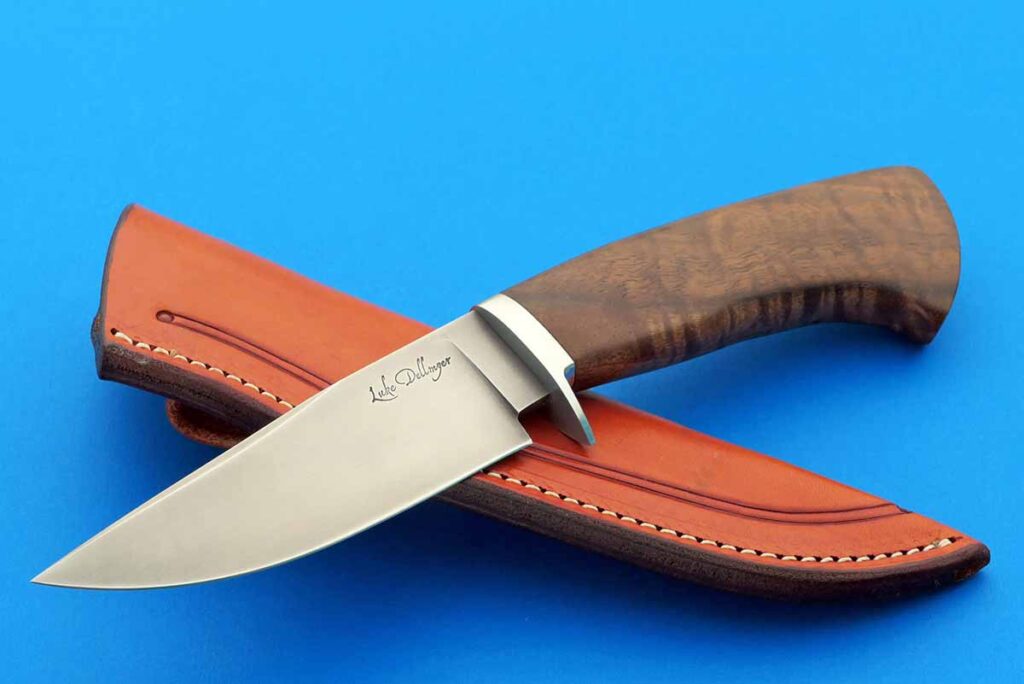
Luke Dellmyer custom hunting knife.
The custom knife that dominates the fixed-blade market is the hunter. This is due primarily to the fact that there seems to be an endless variety of hunting knives that can be made, and they usually have a lower price point than many other custom knives. Unlike other customs, hunting knives are often bought for use. Consequently, they are frequently tested by many users, from the casual outdoorsman to the professional hunting guide. The firearm may dispatch the game, but the knife provides the meat and potentially the trophy the taxidermist creates.
Over the years, thousands of articles have been written on and about hunting knives, including a few by this writer. In this article, I want to discuss not types or designs but pricing on knives in the hunter category.
Custom Hunting Knives Cost
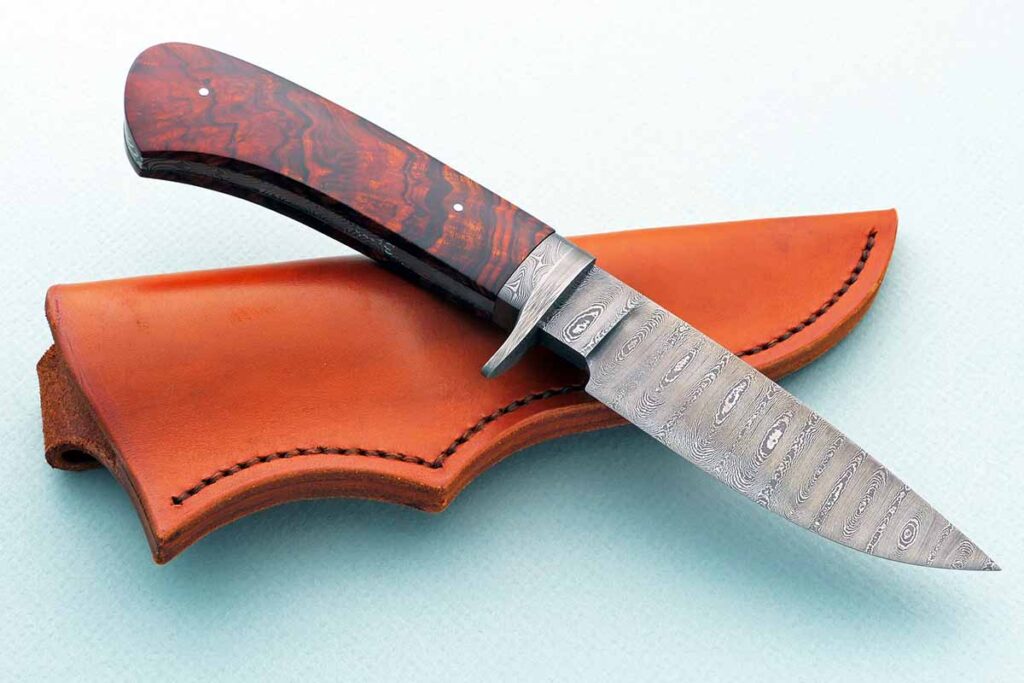
Wess Barnhill ladder-pattern damascus hunter.
Several factors go into the cost of building or making anything. Most makers need a place to make the knives, usually a garage or a shop. Next comes the equipment, which varies from maker to maker. Belts for grinding, polishing and putting an edge on the blade can be one of the more costly items a maker utilizes. Electricity, propane or wood provide the energy to work the materials that become the knife. No matter how the knife is built, these are typical costs shared by most makers. The costs vary depending on the prices of the materials to make the knife. Steel, guard/bolster material, handle material and leather if a sheath is required all impact the finished knife’s price, as will the maker’s skill at using these materials.
Custom Hunting Knives Blade Steel
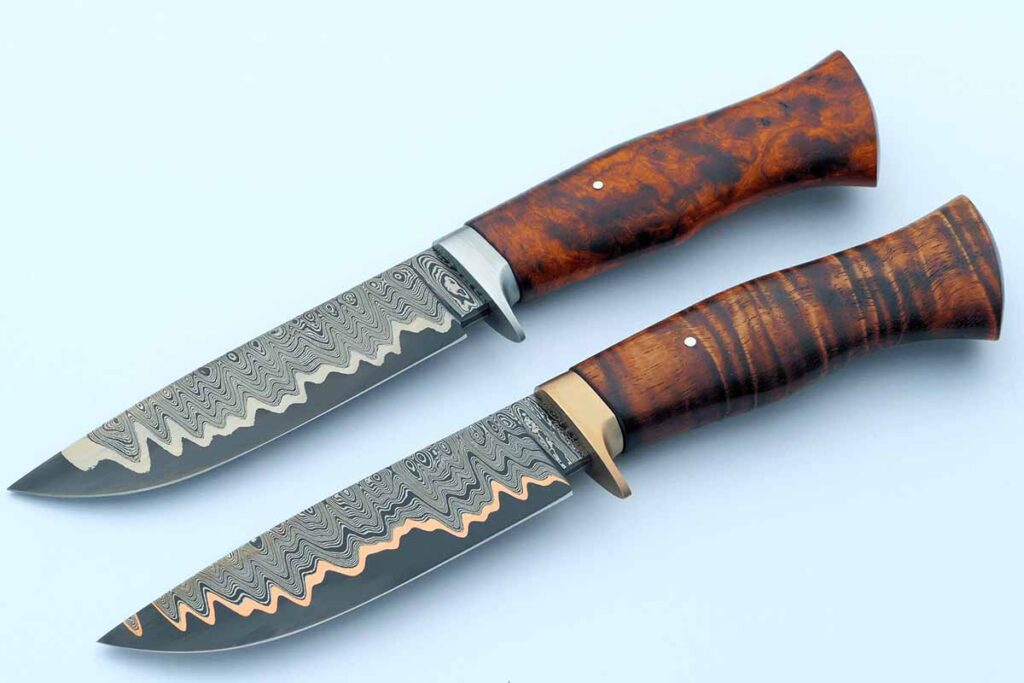
Dan Lewis’ dmascus and copper san-mai hunters, both striking outdoor options.
The majority of makers use either stainless or carbon steel. Each offers advantages and disadvantages. Because of the diversity of steel, hunters can select a knife with the steel that best suits their needs.
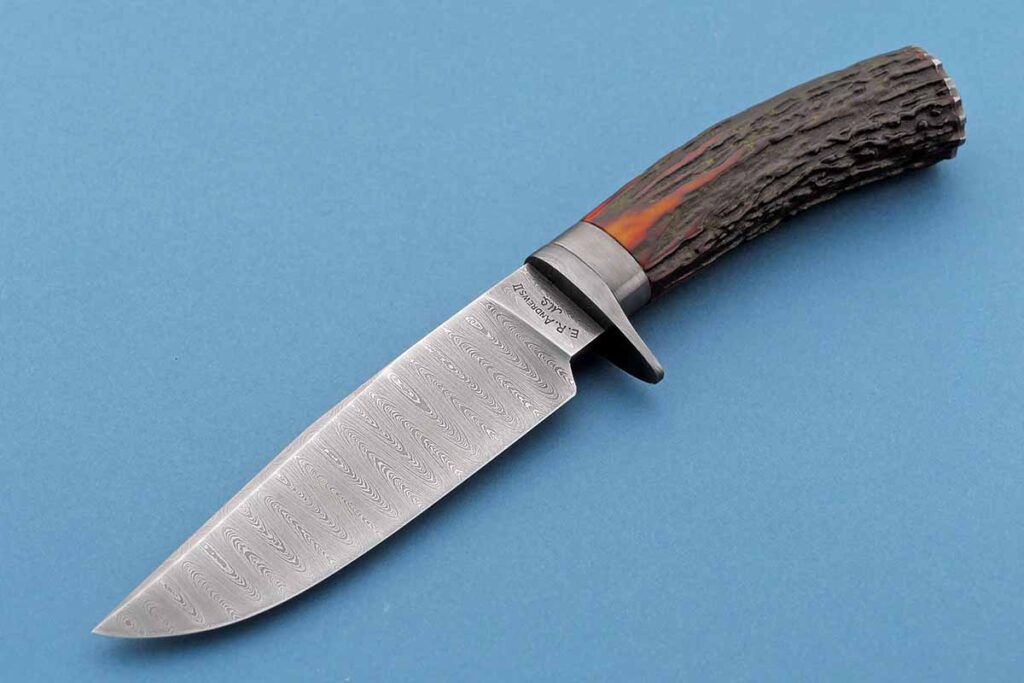
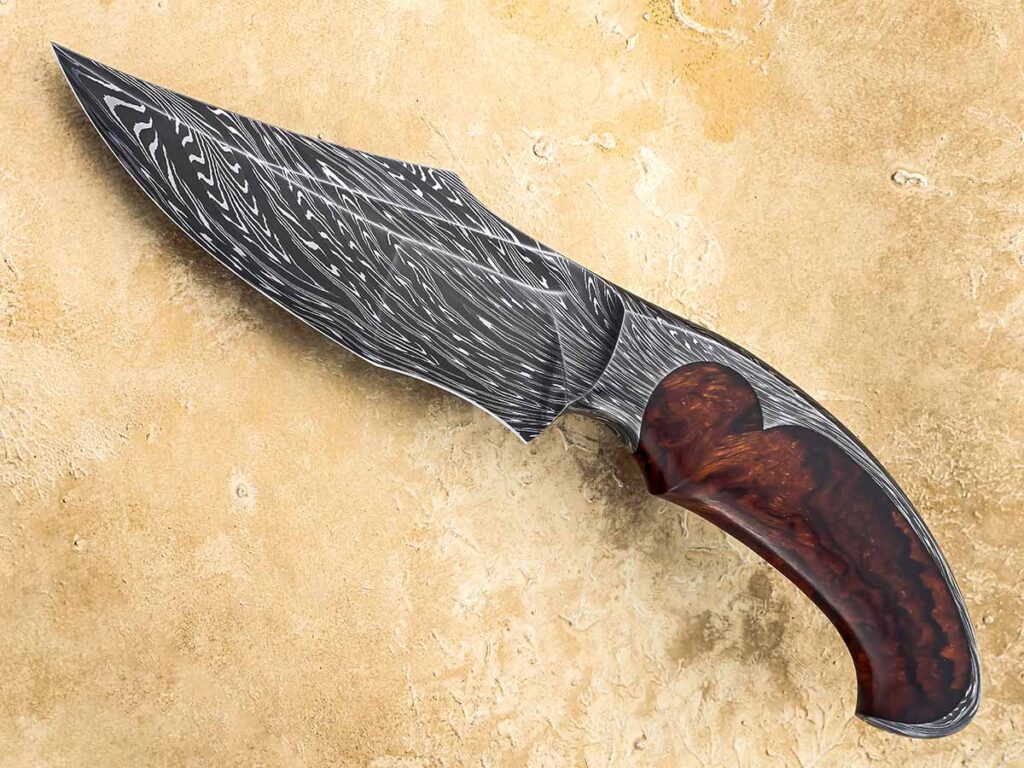
Some hunters prefer patterned damascus steel, such as the ladder pattern of the damascus hunter by ABS master smith Russ Andrews (see accompanying image). Some hunters indicate the damascus blade’s distal tapering and differential heat treatment give the knife a better edge-holding capability. Others prefer steel of a san-mai construction as in the knife of ABS journeyman smith Dan Lewis. By forge welding more malleable steel onto either side of a harder steel, san-mai provides the blade with more structural integrity without sacrificing its ability to hold an edge.
As you can imagine, creating these steels takes additional time and is an added expense. The steels can add anywhere from $150 to $400 to the knife’s cost.
Custom Hunting Knives Handle
Russ Andrews amber stag hunter is a looker.
The handle material varies from natural to such synthetic(s) as G-10, carbon fiber and Micarta®. Natural handle materials are even more diverse, including ivory, antler/horn, wood, mother-of-pearl and bone. The advantage of synthetics is they are not subject to the effects of weather and temperature and so do not shrink and/or expand. Also, Micarta and G-10 are less expensive than some natural handle materials.
Natural handle materials can give your knife a unique look, making it stand out from other knives. Ivory, predominantly mammoth or ancient walrus ivory, is among the most distinctive and expensive handle materials used on hunting knives. Mammoth ivory comes in the form of scales and can cost anywhere from $100 to $250. Ancient walrus ivory costs are largely determined by the color(s) and condition. Prices generally range from $200 to $400.
Antlers and horns of all types have been used as knife handles from the onset of knives being built. The most commonly used antler on custom hunting knives is Sambar stag. In addition to its classic look, the natural lands* and grooves of the antler will contour to your hand, giving you a better grip when using the knife. Stag’s demand and lack of supply over the past 15 years have driven the price up considerably. You can expect to add $125 to $175 to the cost of the knife for an excellent piece of stag.
Mike Malosh’s hunters are outfitted with either an elk and black Micarta or stacked leather washers.
Watching the price of stag increase encouraged me to look at other members of the deer family. One such member is the elk. It has many of the same characteristics as the stag antler, such as the natural lands, grooves and coloring. However, the price is considerably less than stag—around $50. The Elk Hunter (see accompanying image) by Mike Malosh gives you an idea of what an elk antler looks like on a custom hunting knife.
Wood is also a favorite handle material for both makers and collectors. Talk about diversity—wood offers just about any color you could want. Now, with the wood stabilization process commonplace, you eliminate most of the adverse effects of weather on the natural handle material. The price point for wood ranges from $5 to $50 to $75 for scales or a block of desert ironwood or koa. The damascus hunter by ABS journeyman smith Wess Barnhill features a beautiful set of desert ironwood scales. Its range of colors helps ironwood find its way to many knife handles.
Walnut is a hardwood favored by makers such as ABS journeyman smith Luke Dellmyer. It is a very stable, attractive wood that costs $30 a block. Another natural handle material I like, but you don’t see much, is stacked leather washers, as on the Mike Malosh Bear Hunter. One advantage I found with stacked leather is that, over time, the handle material will conform to your hand, providing you with a custom grip. You can expect stacked leather to add about $30 to the knife’s cost.
What Makes A True Value
As a professional custom knife purveyor, I offer prices based on my conversations with suppliers and makers and the materials I have bought over the years. As you know, everything gets more expensive, so prices may vary. The makers’ ability to combine the materials to create functional and aesthetically pleasing knives comes from years of honing their skills in their shops. Once you understand material pricing and can differentiate the skill levels of the different makers, you will realize that this is where the true value lies.
*Like on the inside of the barrel of a firearm, lands are the raised part of the antler and the grooves are the recessed part.
Check Out More Outdoor Knives:
NESSMUK KNIFE: OPTIONS IN THE ALL-AMERICAN OUTDOOR KNIFE
BEST TOMAHAWKS: OUR TOP HAWKS FOR BACKWOODS TO BATTLEFIELDS
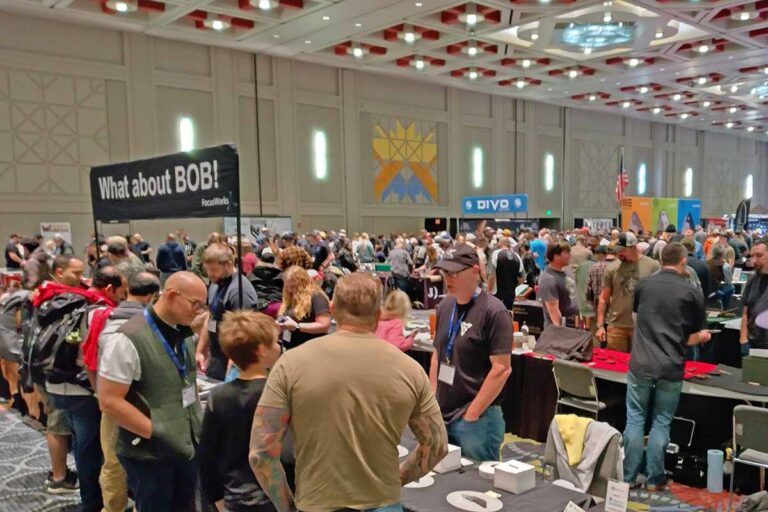
A larger show hall, more exhibitors, some of the world’s best makers and knives, entertaining seminars, awards and other sharp stuff beckon you to attend BLADE Show West Oct. 4-5 in the Salt Palace Convention Center in Salt Lake City, Utah.
A move to the Salt Palace’s exhibit hall No. 4 adds 15,000 square feet to this year’s show, and along with the added space come 30 more exhibitors to join the hundreds of knifemakers, bladesmiths, knife companies, knife suppliers and other knife professionals at the third annual rendition of the BLADE Show West held in Utah.
Among the top custom makers set to exhibit is an unbridled posse of South Texas Slipjoint Cartel members that includes BLADE Magazine Cutlery Hall-of-Fame® member Bill Ruple, award-winning makers Luke Swenson, Enrique Pena and Tim Robertson and others. An all-star list of ABS bladesmiths features Bill Burke, Shane Taylor, Steven Koster, Seth Lopez, Shayne Carter and Trevor Morgan, to name a few. Other top award-winning makers include Johnny Stout, Princeton Wong, Mick Strider, Duane Dwyer, Evan Nicolaides, Mike Tyre, Jared Oeser and Brian Nadeau. There are many more.
2024 BLADE Show West Classes And Demos
Let The Pro Critique Your Knife
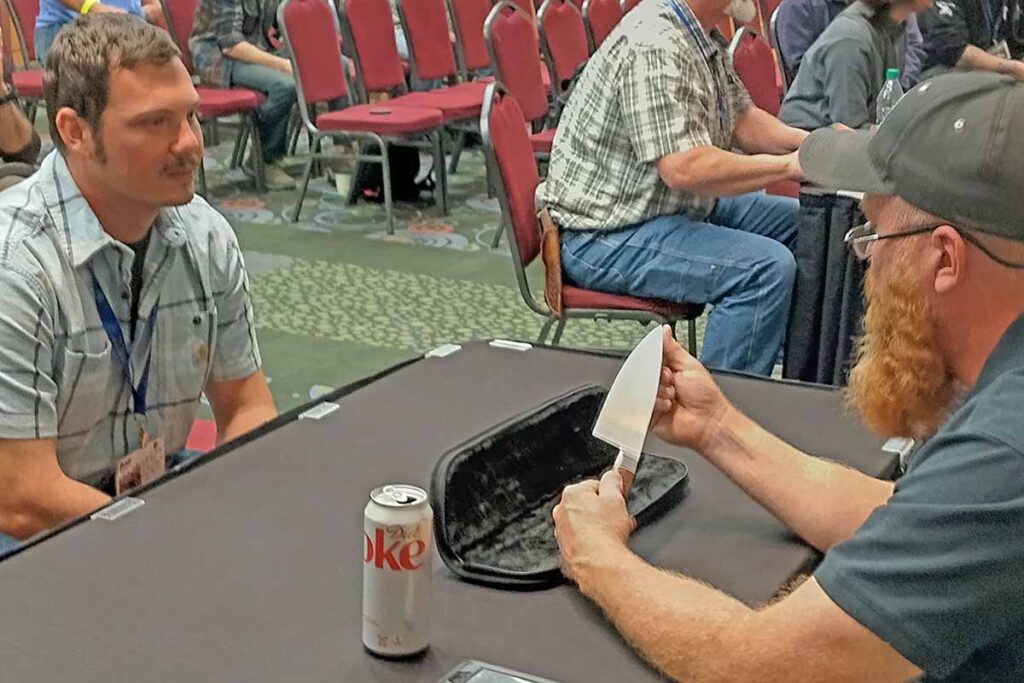
While the full seminar slate had not been set at press time, the popular Let the Pros Critique Your Knife session was set to return, with some of the leading custom maker show exhibitors expected to examine and critique knives made by assorted show attendees. As usual, it will be a limited-seating event and attendees can bring one knife only.
Select show attendees will have their knives examined by the world’s best custom makers in the popular “Let The Pros Critique Your Knife” seminar. Luke Swenson (right) inspects a patron’s knife at last year’s show. The makers participating in this year’s seminar were being assembled at press time. See the free BLADE Show West program at the show for more info.
Basecamp Essentials
Basecamp Essentials by Survival University will be a 30-to-45 minute demonstration designed to introduce essentials of wilderness living. “We will demo how to create various camp comforts such as benches, chairs, and other useful camp tools, using materials found in the natural environment,” a company spokesperson wrote. “This demo goes beyond the basics of survival, focusing on enhancing comfort and fostering a sense of community in the wilderness.”
West Coast Flipping Championships
Also set to return is the West Coast Flipping Championships hosted by Squid Industries. It will be the fifth annual version of the championships, with head-to-head/live balisong flipping matchups in an elimination/bracket-style competition. Awards and prizes will go to the top finishers. For the complete seminar schedule, see the free BLADE Show Program distributed at the show.
2024 BLADE Show West Awards
The show’s best custom and factory knives will be determined by a panel of judges assembled by the BLADE Show West staff. This year’s custom knife categories: Best in Show; Best Hunter; Best Kitchen Knife; Best Damascus; Best Slip Joint; Best Fixed Blade; Best Folder; Best M.A.C.K. (Machine Assisted Custom Knife); and Best of the Rest.
Winner of Best Fighter at BLADE Show 2024, bladesmith Seth Lopez will showcase his curvaceous creations. His recurve fighter boasts a compound-ground blade of a damascus of 1080 carbon and 15N20 carbon steels. Handle: desert ironwood burl. Overall length: 8.75 inches. (SharpByCoop image)
On the factory side, the award categories are Best American Made, Best Imported, Best EDC, Best Fixed Blade, Best Folder and Best in Show.
For the times and locations for the judging, signs and schedules will be prominently placed in and around the show hall. Also, see the free BLADE Show West Program distributed at the show for updates.
The winners will be announced and presented their awards in a special ceremony the Friday night of the show. See the free BLADE Show West Program for the time and venue.
2024 BLADE Show West Hidden Gems
The factory knife section is always a beehive of activity at BLADE Show West, and this year’s rendition promises more of the same. Leading exhibiting knife companies include CRKT; Emerson Knives, Inc.; Fox Knives; GiantMouse; Heretic; Hogue; Lionsteel; Pro-Tech; SOG; Spyderco; Squid Industries; McNees Knives; Suprlativ Knives; Tactile Knife Co.; TOPS Knives; WE Knife; White River Knife & Tool; and others. For the complete exhibitor list, visit bladeshowwest.com.
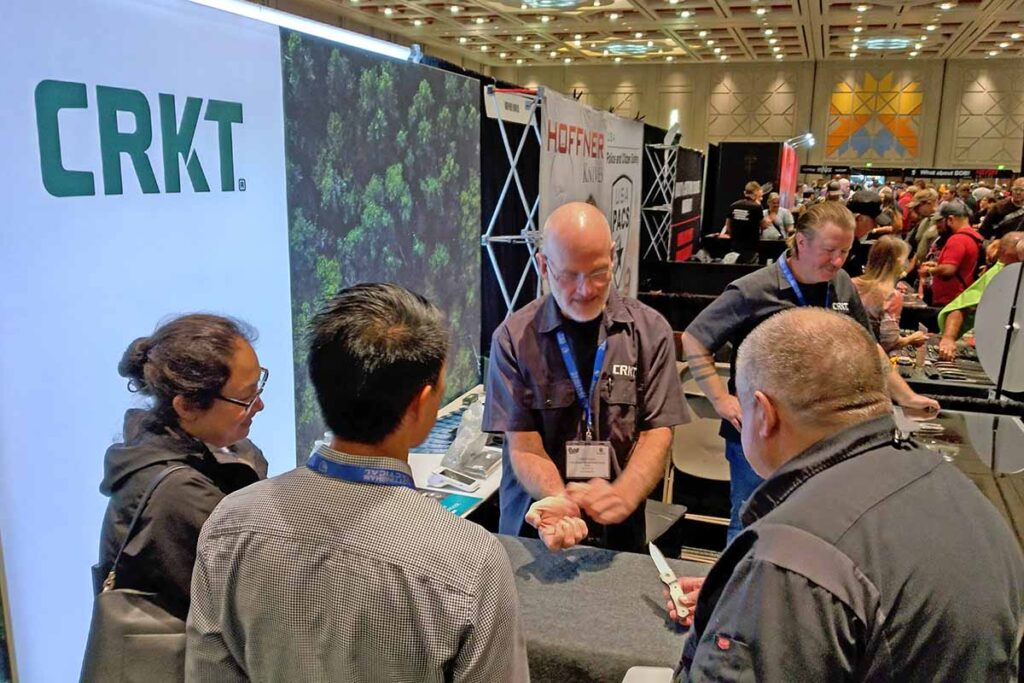
CRKT will host custom knifemaker/designer Richard Rogers and his wife Sally to answer questions about Richard’s latest CRKT designs. CRKT’s Doug Flagg (center) talks knives with Cutlery Shoppe’s Jeff Loffer (right) and two patrons at BLADE Show West 2023.
One of the hidden gems of the factory section is you never know who might show up, including custom makers who engage in collaborations with select companies. For example, the CRKT booth will feature award-winning custom knifemaker Richard Rogers, along with his wife Sally, to answer questions about Richard’s latest CRKT designs. Other CRKT maker/designers exhibiting at the show will be Eric Ochs, TJ Schwarz and Princeton Wong. Ochs will exhibit under Ochs Worx, Wong under Prince Customs and Schwarz under Schwarz Knives.
Danish knifemaker Jens Anso, along with fellow Danish maker Jesper Voxnaes the design team behind most if not all of GiantMouse knives, will be stationed at the GiantMouse booth. Knife designer Tony Sentmanat will be based at the WE Knives booth. WE maker/collaborators Ben Petersen and Zac Whitmore also will attend the show and may appear at the company’s booth at times.
While TOPS Knives won’t have any custom knifemaker designers on hand, it will have headman/head knife designer Leo Espinoza in attendance, as always. Case will continue showcasing its first Bill Ruple collaboration, and Bill will have a table at the show, too, so chances are he will make an appearance at the Case booth as well. There no doubt will be other company booths serving as the destination of custom makers/designers, custom makers in general, and more.
The Work Sharp Ken Onion Elite has been the standard for powered abrasive belt sharpening for about a decade. And it’s more than earned its place in knife enthusiasts’ sharpening stations. Yet, Onion and Work Sharp were just getting warmed up.
Unveiled at the beginning of 2024, the Ken Onion Elite Mk2 (KOE Mk2) aims to outdo the original in about every way. But does it?
That’s what I aimed to find out when I pulled out a bevy of knives and put the unit through its paces. Is the sharpener more user-friendly? Does it offer more functionality? Can it unseat the legendary Work Sharp Ken Onion Elite?
Let’s find out.
Work Sharp Ken Onion Elite Mk2 Grinding Attachment
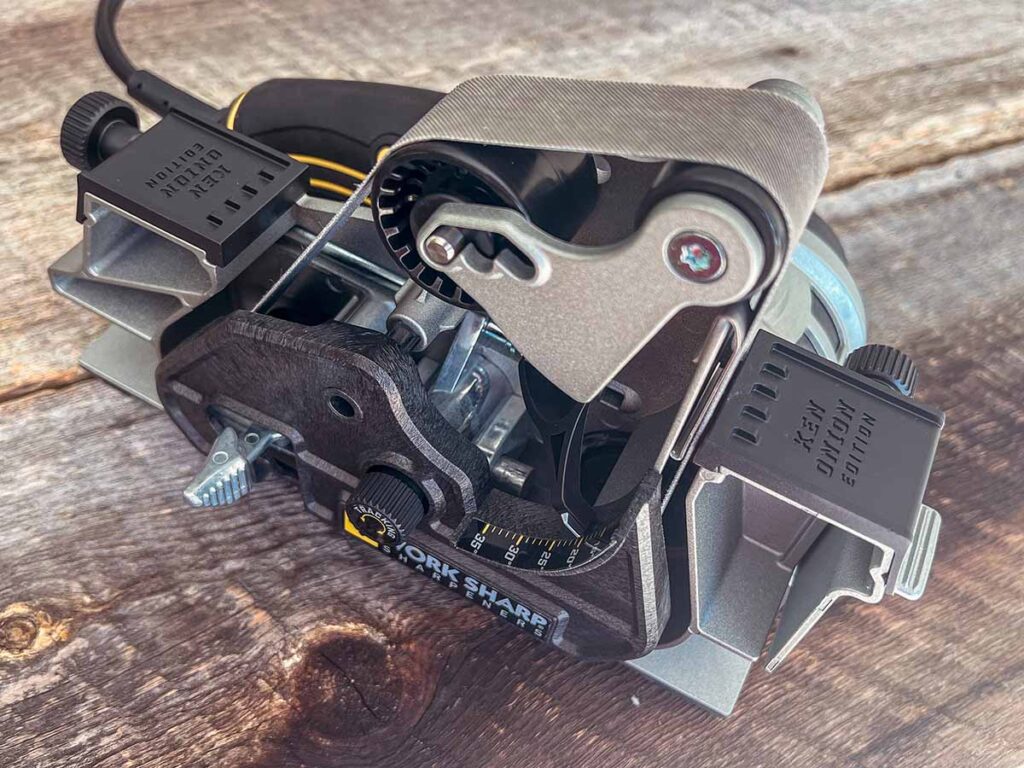
Work Sharp didn’t veer away from the basic functionality of the Work Sharp Ken Onion Elite in the Mk2. For example, blade grinding attachment still uses the same 1”x18” belts as the original and pretty much functions the same.
Onion and the company, however, have enhanced the operation of the attachment in several ways.
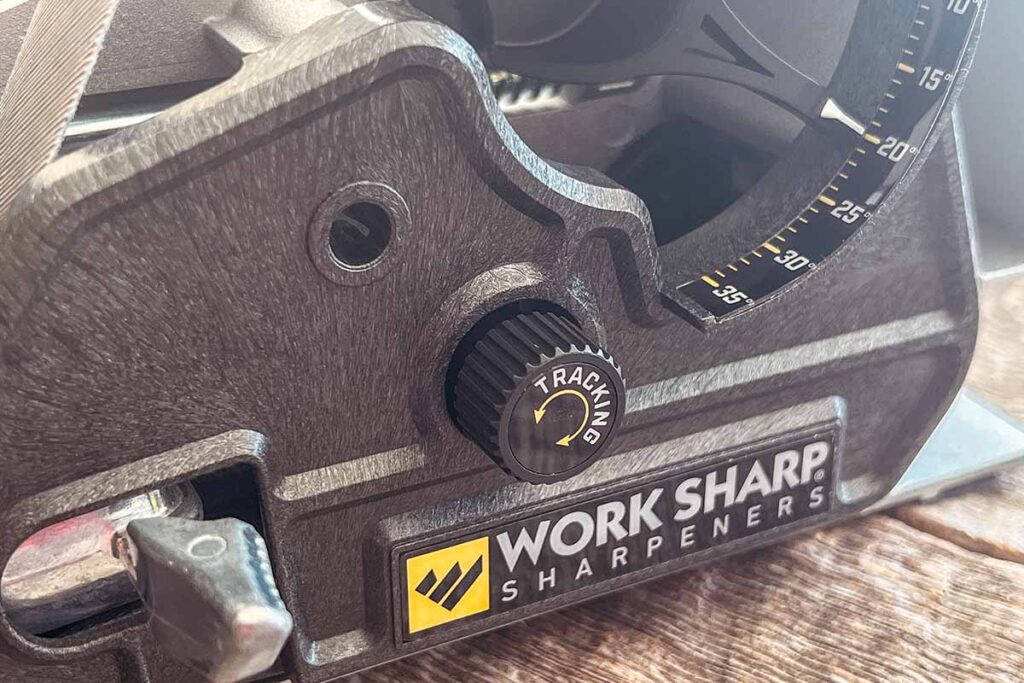
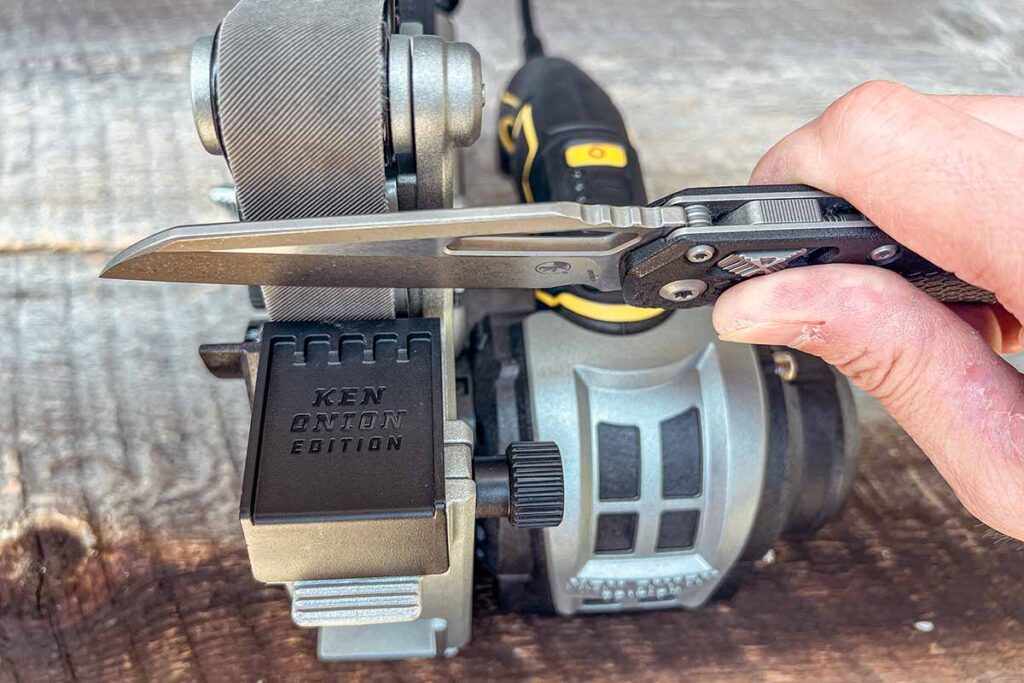
The angle adjustments on the grinding attachment now can be made on the fly and without de-tensioning the belt or even turning the unit off. This is done through a round nob under the plate controls, which raises and lowers the idler wheel. A built-in angle indicator allows you to dial in the exact edge.
The aforementioned idler wheel is also new to the system and can be set for three edge types: conventional V, low-angle convex, and high-angle convex. A major plus, this is achieved without tools or even de-tensioning the belt—though, the power must be off.
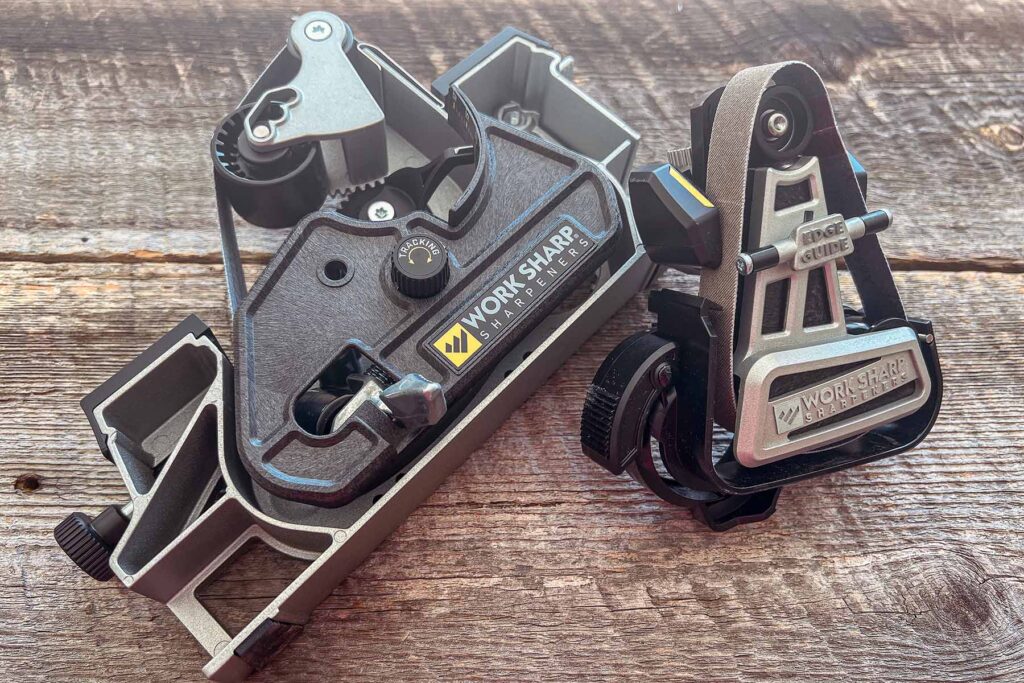
Work sharp has included a belt guard on the new model, gone are the days of the original’s open face. The guard has a port hole that you can place the hub fastener into (so you won’t lose it!) whenever you convert this unit to the standard three-pulley cassette.
Finally, the Mk2 has an adjustable height reference plate on the platen end of the grinding attachment. Quite simply, this allows for finer adjustments at the platen end.
Overall the build, of the new BGA is more substantial than the original, as there is now more weight to it.
Work Sharp Ken Onion Elite Mk2 Sharpening Head
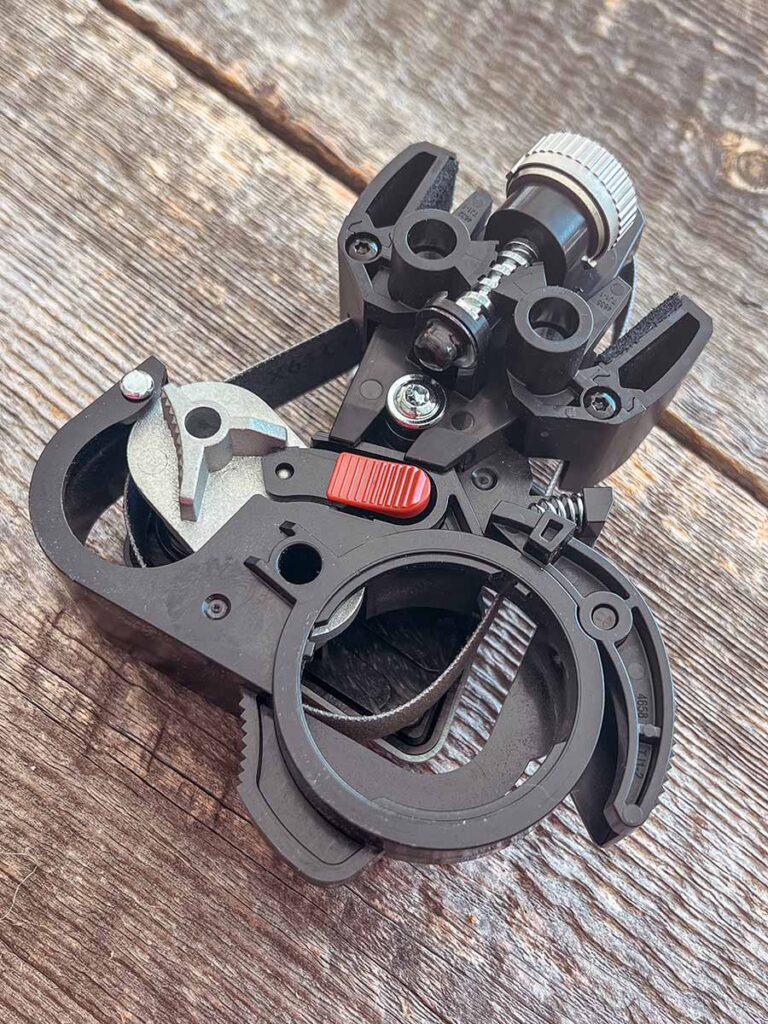
If you prefer to use the standard three-pulley cassette instead of the Blade Grinding Attachment, you can physically swap out the two easily. The power head attaches to either using a simple twist lock connection at the motor housing at the drive shaft.
A nice aspect of the cassette is it includes a scissor guide in addition to a knife guide, which is set at a 65-degree angle. For knives, you use the pull-through method, resting the blade on one of the leather-lined blade rests and pulling the blade through along the belt.
Selecting your edge angle is as easy as turning a dial, similar to the blade grinding attachment. Rotate the knob to the desired edge angle and both blade rests will move in or out simultaneously.
There’s also an included blade rest with plastic rollers that allow you to steady the blade as you pull it through. If you wish to not use these, they simply rotate out of the way and lock into the stowed position.
However, with the cassette, there is no option to adjust for different edge types (standard V, low convex, or high convex). You just get a regular convex edge only, but still razor sharp.
Work Sharp Ken Onion Elite Mk2 Power Head
As for the power head end of things, there are several improvements here. You’ll notice the larger motor housing and inside is a more powerful motor with electronic torque management. The motor senses the load placed on the belt and compensates for it, making this sharpener almost impossible to bog down in use.
The pushbutton speed control with LED light scale shows you at a glance how fast the belt is running. And slowing down or speeding up the belt is as easy as pushing a button.
The Mk2 has a constant on setting—you just squeeze the power trigger and press a button to lock in the setting. Shutting it off is a matter of hitting the stop button or squeezing the power trigger.
The body of the Mk2 has a cast metal overlay that adds rigidity as well as boosts the rough and tumble looks of the tool. Furthermore, the metal overlay makes the unit quieter and dampens vibrations.
Work Sharp Ken Onion Elite Mk2 Testing
Putting the Ken Onion Elite Mk2 to use is a pleasure. However, I’d say, that to step up to a tool of this nature you need to know your manual sharpening skills inside and out—especially when using the grinding attachment. If you don’t know what you’re doing you risk damaging blades or simply spinning your wheels with a sub-par sharpening. Given the guides, the cassette is more forgiving.
I have ten solid years of experience with the original Ken Onion Elite and know the limits of the machine. With this being said, the functionality of the Mk2 is identical to the original and the improvements mentioned make it more user-friendly, improving the overall experience.
I also found the Mk2 is easier to set up and dial in, as well as change angles instantly with the machine powered on. The ability to dial in the edge type (standard V, low convex, and high convex) allows you to tailor the edge format to your specific task for the knife.
Personally, I prefer the high convex, which allows you to cut the edge angle back 2-3 degrees more for enhanced edge sharpness. At the same time, it still retains enough “meat” in the center for lateral strength.
Final Cut
As it goes, the Work Sharp Ken Onion Elite Mk2 doesn’t come cheap with an MSRP of $300. It’s a bit steep for a sharpener. But when you look at what you get, it’s easy to see why it’s still valuable.
While this was primarily designed as a sharpening machine, it’s also a miniature variable speed belt sander that will work on metal, PVC, plastic, and wood. In turn, you receive two machines in one, plus it can handle knives and scissors as well as assist you with projects in your garage or shop. How can you beat that?
Honestly, if you want to take your sharpening game to the next level and beyond, invest in the Ken Onion Elite Mk2 from Work Sharp.










![Work Sharp Ken Onion Elite Mk2 Review [Hands On]](https://blademag.com/wp-content/uploads/Ken-Onion-WorkSharp-MK.2-15-768x512.jpg "Work Sharp Ken Onion Elite Mk2 Review [Hands On]")