Home Blog Page 50

Hunting Knife Sets: Hands-On And Tested

The latest hunting knife combos will exalt your outdoor experience.

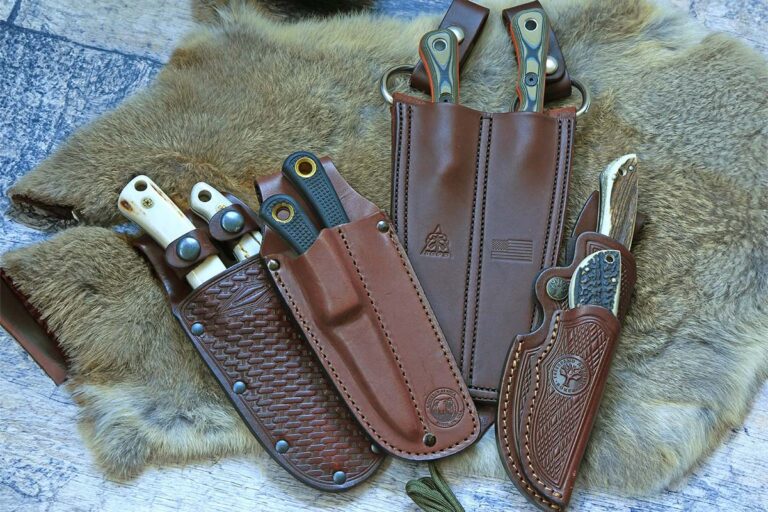
When choosing a hunting set of cutting tools, consider the quality of the tools and how they complement each other. Before you do that, though, be sure the set is properly outfitted.

A good set should include a gut hook, knife, saw and small hatchet for field dressing and processing game. Each tool serves a specific purpose:

  • Gut hook: makes opening the animal’s abdomen easier,
  • Sharp knife: essential for skinning and butchering
  • Saw: helps cut through bone or branches
  • Small hatchet: helps split bone or cut wood.

Consider durability and ease of use, as well as how the tools can be packed for transport.

Gut Hook Knives

A gut hook hunting knife serves multiple purposes in the field. Its primary function is to assist in the field dressing process by opening the animal’s abdomen with minimal damage to the internal organs. The hook feature helps prevent puncturing the organs while skinning and reduces the risk of cutting into the stomach or intestines. A gut hook can be used for cutting through tough connective tissues, tendons and cartilage, too. Its precision and specialized design make it an essential tool for hunters, allowing for efficient and safe processing of game in the field. It also works great for hooking under a bail and lifting hot pots and other items off a camp stove, etc.

Caping Knives

A caping knife in a hunting set serves various purposes, making it an essential tool for hunters. Its precision and maneuverability render it ideal for delicate tasks such as skinning around trophy areas, making intricate cuts, and separating hide from the meat. Also known as a caper, it is great for creating shoulder mounts or European mounts of game animals, preserving the hide for taxidermy purposes. The fine point and sharp blade allow for detailed, careful work without damaging the hide or underlying tissue. A caper is a versatile tool that adds value to any hunting tool set, especially for hunters looking to preserve trophies.

Boker Arbolito Guides Combo
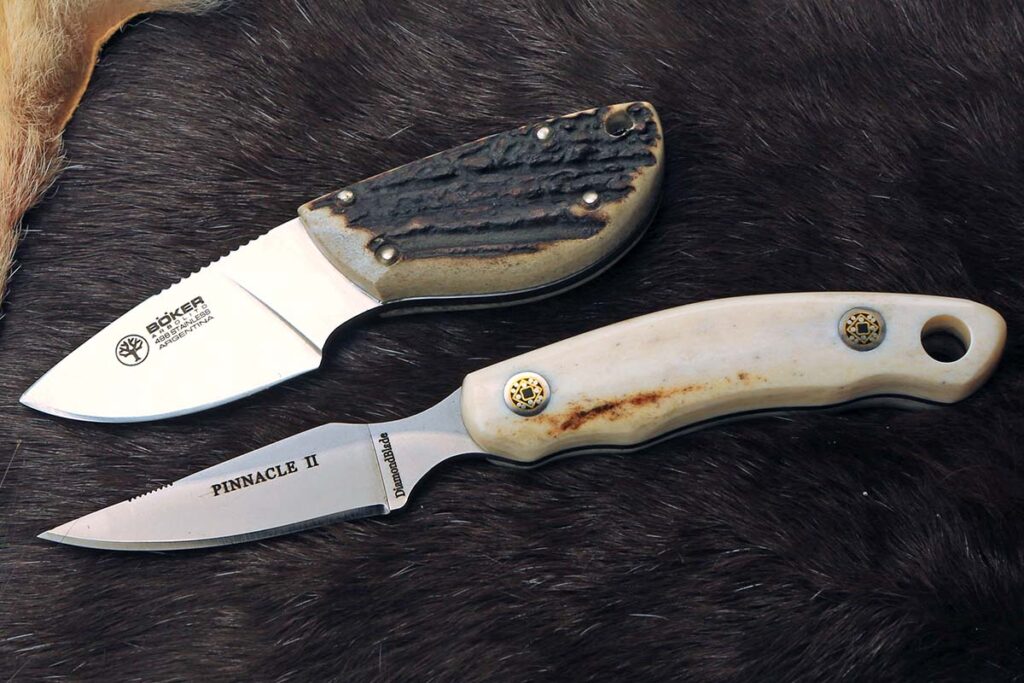
Boker 2.25-inch drop point and Diamond Blade Knives Pinnacle
The Boker 2.25-inch drop point and Diamond Blade Knives Pinnacle II are both classic caper/utility tools featuring handsome stag scales.

The Boker Arbolito Manufactory in Buenos Aires, Argentina, is known for crafting high-quality knives using premium materials, with an emphasis on hunting and outdoor models featuring handles of wood and stag. These traditional knives are designed to cater to a variety of needs and tasks, whether for professional use, sports, everyday carry or collectors with a keen interest.

A notable offering is the Arbolito Guides Combo set in satin blades and stag handles. It includes a 4.25-inch gut hook skinning blade and a 2.25-inch drop point hunter. The gut hook prevents accidental punctures during skinning and is designed with a large forward finger choil for enhanced control. The little drop point is suitable for small, detailed cutting tasks, providing precision cuts. It is an excellent utility blade for cutting cord, fishing line and packaging, and it can act as a small skinner. Both knives sport stag handles for a secure grip and a rustic appearance.

The set includes a brown leather piggyback belt sheath for easy carry. The gut hook pouch boasts a solid snap to ensure retention. The small drop point comes with a simple drop-in friction-fit pouch, which is easy to access and is held on the main sheath via a rivet. This set presents function and style for processing your next trophy animal or other outdoor tasks.

Arbolito Guides Combo Set Specs
Blade Lengths: Gut hook skinner 4.25”, drop point 2.25”
Blade Steel: Bohler N695 stainless
Blade Grinds: Skinner hollow, drop point flat
Blades @ Thickest: .125”
Blade Finish: Satin
Handle Material: White/brown stag
Overall Lengths: Skinner 8.6”, drop point 4.8”
Sheath: Leather piggyback
Country of Origin: Argentina
MSRP: $291 at press-time exchange rate

Knives of Alaska Caribou Combo
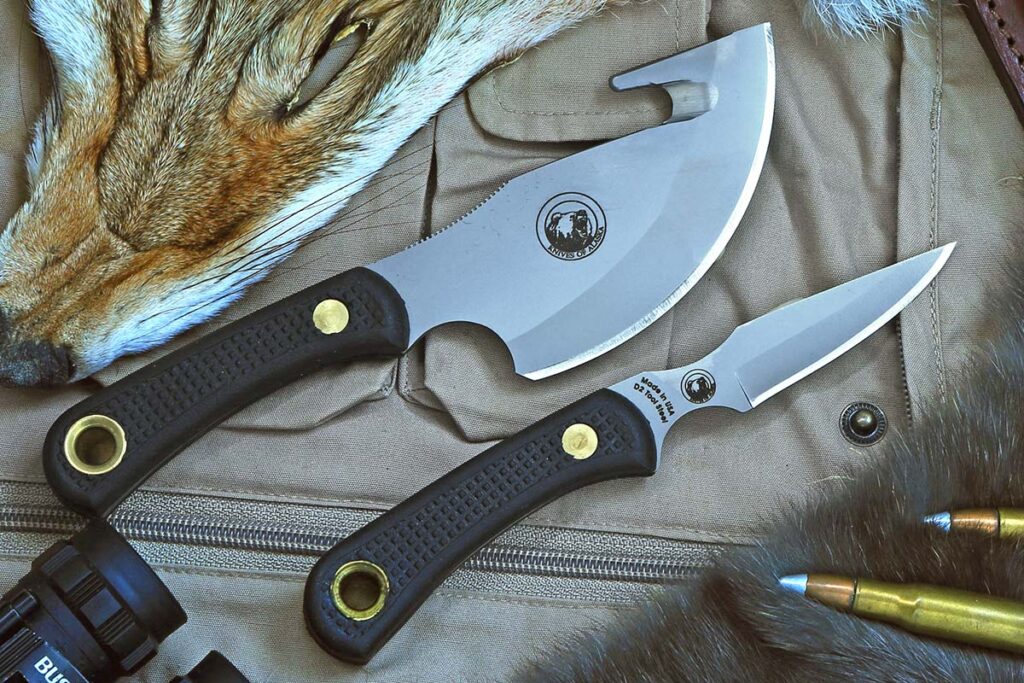
KOA Caribou Combo work well together
The two knives of the KOA Caribou Combo work well together. The skinner has a deep belly for slicing and enough weight to be a light cleaver. The Cub Bear is a tremendous caper that pulls triple duty as a fine carver and paring knife.

The Knives of Alaska Caribou Combo offers a slimmer alternative to the company’s Light Hunter Combo. The Caribou Combo features the same gut hook skinner design as the Light Hunter Combo but with a thinner blade for a sharper, longer-lasting cutting edge. The Caribou is ideal for those seeking a complete field dressing kit for whitetail deer and other medium-sized game.

The Caribou Combo includes two knives—a gut hook skinner and Cub Bear—in a side-by-side sheath. The skinner is a full-tang knife 7.5 inches overall. It has a .1-inch-thick D2 tool steel blade and a 4.25-inch cutting edge. It features thumb notches and a large-capacity gut hook.

The Cub Bear is a fine-detail-work knife of D2 with a blade 3/32 inch thick at the thickest. Both models feature black SureGrip handles with large, lined lanyard holes. For hunting deer, sheep and mountain goats, the Caribou Combo is an excellent choice.

The two knives work perfectly together. The skinner has a deep belly for slicing and enough weight to be a light cleaver. Besides the obvious skinning qualities and gut hook that opens the abdomen safely, it’s an excellent butcher knife. Using it to slice and chop up meat chunks for a rustic, slow-cooked meal was a breeze. The Cub Bear, meanwhile, is a tremendous caper that pulls triple duty as a fine carver and paring knife.

In my humble opinion, of the test group this set was by far the best buy for the money.

Caribou Combo Specs
Blade Lengths: Gut hook skinner 3.5”, Cub Bear 2.75”
Blade Material: D2 tool steel
Blade Grind: Saber
Blades @ Thickest: Skinner .1”, Cub Bear .09”
Blade Finish: Bead blast
Handle Material: Black SureGrip
Overall Lengths: Skinner 7.5”, Cub Bear 6.75”
Sheath: Brown leather double pouch
Country of Origin: USA
MSRP: $189.99

Diamond Blade Knives Summit Combo
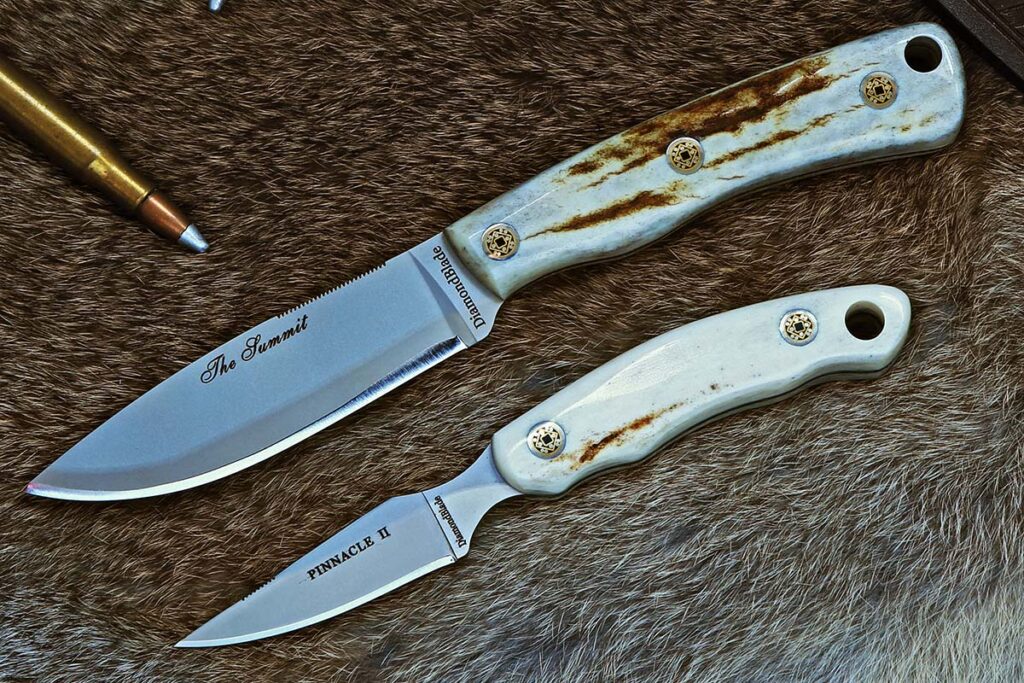
Summit has a long skinning radius, making it proficient at swiftly and effectively breaking down game. A scalpel-like knife, the Pinnacle II is ideal for caping and initial incisions
The Summit has a long skinning radius, making it proficient at swiftly and effectively breaking down game. A scalpel-like knife, the Pinnacle II is ideal for caping and initial incisions, boasting finger gimping and cutouts for optimal leverage.

The Summit Combo from Diamond Blade Knives is a pro hunter’s set meticulously crafted with the benefit of decades of hunting and field dressing expertise. It includes the Summit drop point and the Pinnacle II, both highly efficient field tools.

The Summit has a long skinning radius, making it the perfect tool for swiftly and effectively breaking down game. A scalpel-like knife, the Pinnacle II is ideal for caping and initial incisions, sporting finger gimping and cutouts for optimal leverage.

Designed for professional hunters, this versatile kit provides reliable and efficient tools for most aspects of field dressing. The set includes an American-made dual leather sheath with a Kydex insert for secure retention and easy access while preventing damage to the knives.

The substantial Summit proved ideal for effortlessly carving meat for a hearty stew or canning. The large handle gave ample space for various grips or when wearing gloves. The Pinnacle II did an excellent job on small detailed work, especially slicing herbs and peeling garlic.

The double sheath was my favorite of the test bunch because it held the knives perfectly in place, even with the snaps open, due to the Kydex insert. The attractive outer leather provides the best of both worlds.

Knives Summit Combo Specs
Blade Lengths: Pinnacle II Scalpel 2.55”, Summit Drop Point 3.75”
Blade Material: Friction Forged® D2 tool steel
Blade Grind: Flat
Blades @ Thickest: Pinnacle II Scalpel .09”, Summit Drop Point .125”
Blade Finish: Satin
Handle Material: Stag
Overall Lengths: Pinnacle II Scalpel 7”, Summit Drop Point 8.75”
Sheath: Leather double model w/Kydex insert
Country of Origin: USA
MSRP: $799

TOPS Knives Muley Skinner/Saw Combo
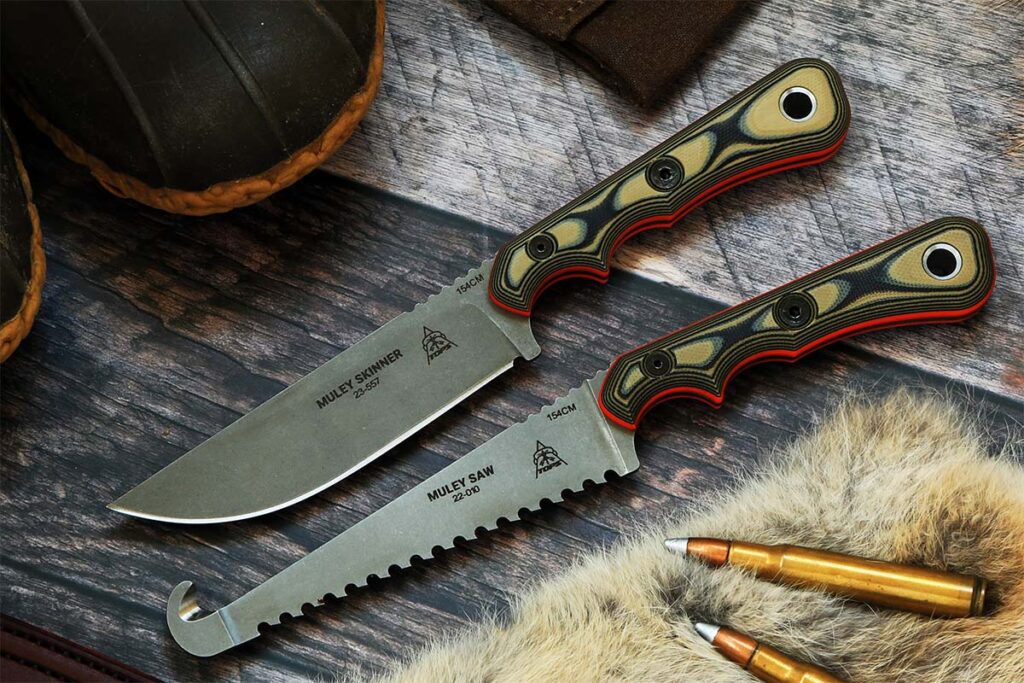
TOPS Knives Muley Skinner
The long, deep-bellied blade of the TOPS Knives Muley Skinner is well-suited for skinning game and performing campsite tasks such as prepping, kindling and food processing. The Muley Saw is a bone saw tailored for efficient game processing and can saw wood in emergencies.

Winner of Best Hunting Knife at BLADE Show West 2023, the TOPS Knives Muley Skinner/Saw Combo is a game changer. The Muley Skinner is a solid fixed blade for outdoor jobs. The long, deep-bellied blade is well-suited for skinning game and performing campsite tasks such as prepping, kindling and food processing. The Muley Saw is a bone saw tailored for efficient game processing and can serve as a wood saw in emergencies. The saw blade sports a razor-sharp gut hook for added function.

Due to in no small part to its flat grind, the skinner excelled at slicing meat. It also deboned chicken thighs, as the belly fit nicely between the joints while roll cutting. The robust build instills confidence for using the knife for baton cuts. The saw was aggressive and did equally well on bone as on branches. It was the most diverse tool of all those in the test sets.

Muley Combo Specs
Designer: Leo Espinoza
Blade Lengths: Skinner 4.5”, Saw 4.25”
Blade Steel: 154CM stainless
Rockwell Hardness: 58-60 HRC, cryo-treated
Blade Grind: Flat
Blades @ Thickest: .13”
Blade Finish: Tumble
Handle Material: Tan/Black G-10 w/orange G-10 liners
Overall Lengths: Skinner 8.75”, Saw 9”
Sheath: Brown leather double model
Knife to know: Winner of Best Hunting Knife at BLADE Show West 2023
Country of Origin: USA
MSRP: $550

Final Cut

The reviewed sets ensure you have everything you need for field dressing and processing game efficiently. A good hunting knife set can make the process quicker and more manageable, especially when dealing with larger game. Lastly, having a set of dedicated hunting tools helps preserve the sharpness and integrity of your everyday carry knife, as it won’t be subjected to the same level of wear and tear that field dressing often involves.

Check Out More Outdoor Knives And Tools:

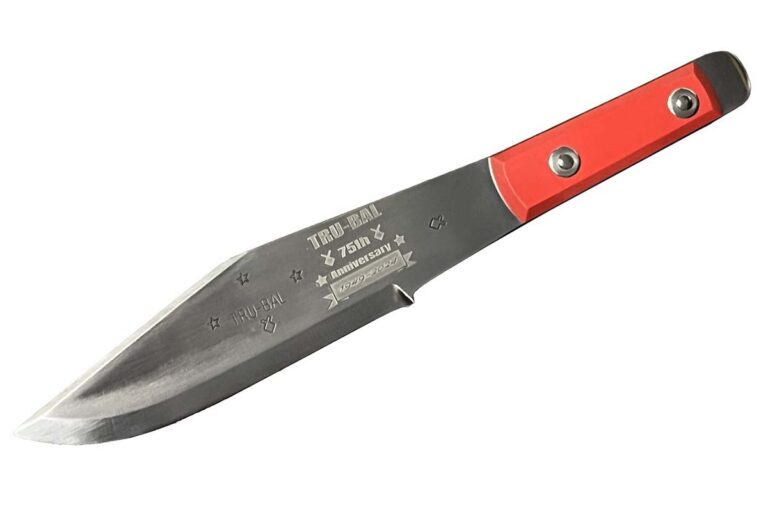
Tru Balance Knife Co.: 75 Years And Still On Target

Born as a side hustle, the legendary throwing knife company continues to hit the mark.

Small businesses that have operated continuously for 75 years are a testament to the quality of their products and the dedication of their founders and owners. Such businesses have stood the test of time and have been able to adapt to changing market conditions and consumer preferences. Knifemaking is no different.

In 1949, Harry K. McEvoy, who would soon be considered the father of modern-day knife throwing and one day be inducted into the BLADE Magazine Cutlery Hall of Fame®, was a long-time resident of Grand Rapids, Michigan. He worked for the Meyercord Co. as a traveling district salesman selling decals to wallpaper and decorating stores. In his spare time, Harry spent hours in his shop designing and crafting knives. His passion for knifemaking was fueled by his ongoing search for the perfect throwing knife.

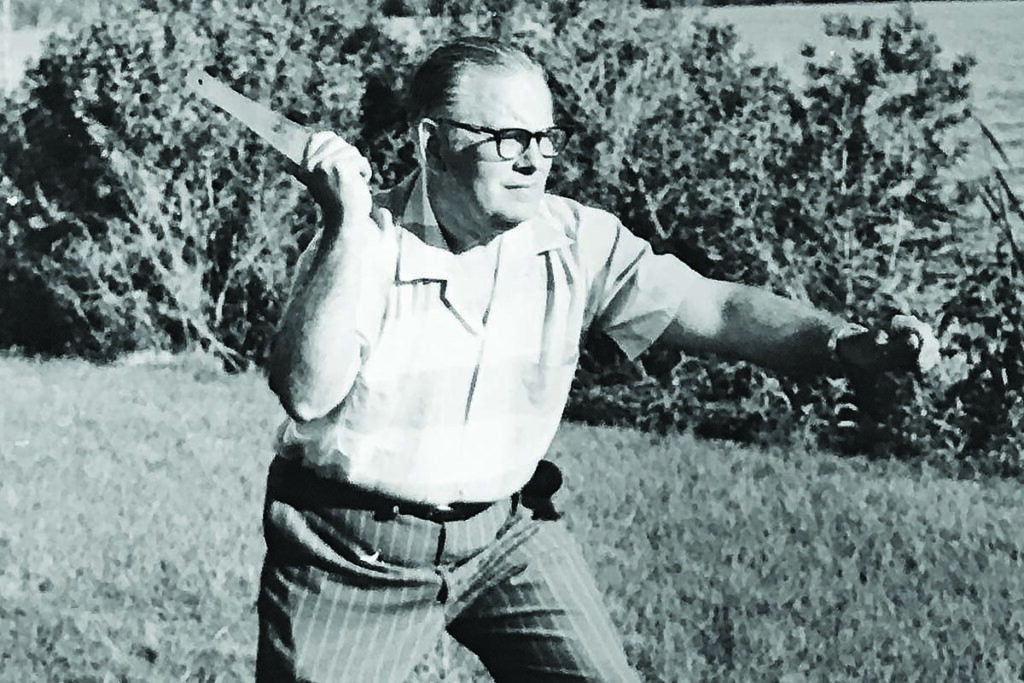
Harry McEvoy shows the form and throws one of the Tru Balance knives
BLADE Magazine Cutlery Hall-of-Fame® member Harry McEvoy shows the form and throws one of the Tru Balance knives that helped revolutionize knife throwing.

Knife throwing as a modern sport began shortly after World War II and centered around a few individuals who threw knives at stumps or targets in their backyards. The knives they used consisted of very primitive homemade throwers that were often much smaller than the ones you see today. Harry began making his own knives around this time because he was unable to find any commercial knives suitable for throwing.

While he practiced throwing knives in his backyard, neighbors would gather to watch. Intrigued by how well his throwers performed, the onlookers were compelled to discover the source of his knives. When he responded that he, in fact, had made them himself, they asked him to make knives for them and others who were interested, and thus was born the Tru Balance Knife Co.

Randall & Scagel’s Influence

Bobby Branton and Stephen McEvoy
The author (left) bought Tru Balance Knife Co. from Stephen McEvoy (right) in 2017. The business continued to grow but the author had to sell in 2021 due to physical issues.

Around 1951, Harry learned of a knifemaker from Orlando, Florida, and another future Cutlery Hall-of-Famer by the name of W. D. “Bo” Randall. As a fledgling hobby knifemaker, Harry decided to write to Bo about his knives and the two became fast friends, exchanging letters regularly.

McEvoy soon found out that Bo had an interest in throwing knives and was surprised to learn that a throwing knife could even be found in Bo’s catalog. As a father with young children, money was scarce for Harry, so he convinced Bo to trade a Randall thrower for a couple of McEvoy throwers. Generous and willing to help a fellow knifemaker, Bo was happy to oblige.

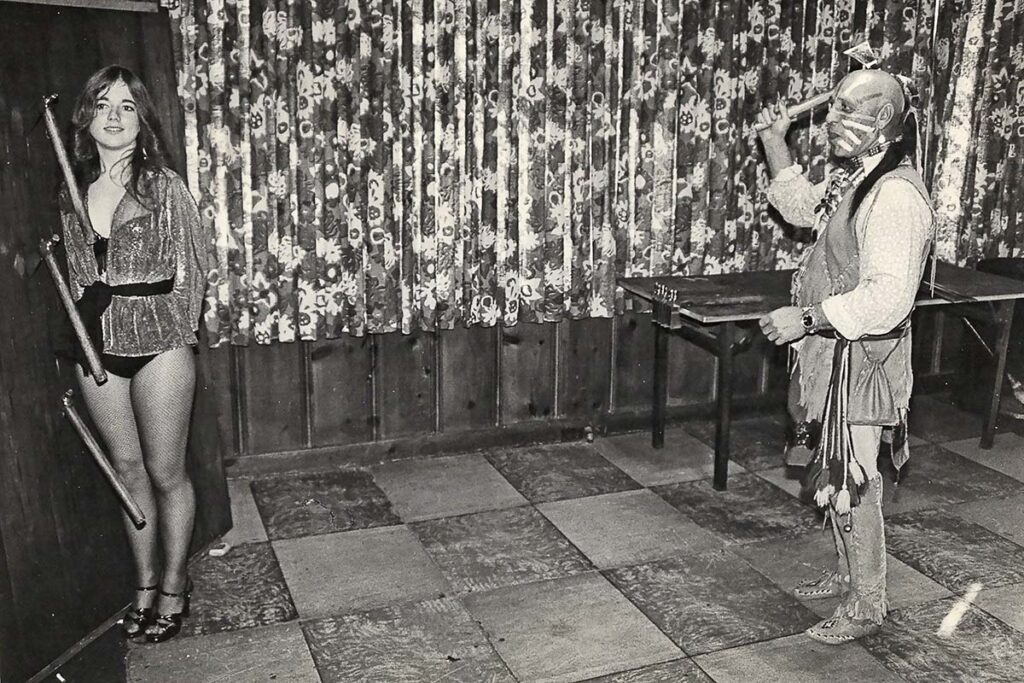
George E. “Skeeter” Vaughan
George E. “Skeeter” Vaughan made the most fantastic knife throw in recorded history, taking out a German sentry with a modified bayonet from 87 feet during World War II. Skeeter was also an outstanding tomahawk thrower, showing his skills here with the help of a “target girl.”

Around 1952, Bo asked Harry if he would visit yet another future Cutlery Hall-of-Famer, William Scagel, who lived very close to McEvoy in Fruitport, Michigan, and buy some of Scagel’s knives for his collection. McEvoy was more than happy to do his friend a favor. Harry would eventually befriend the reclusive Scagel, too, and on his visits watched him make knives and bought knives for himself and Bo. 

As their friendship grew, Harry would visit Bo at the Randall summer home in Michigan and would even travel to the Randall home in Orlando, Florida. The two became quite close and eventually, Bo decided to feature two Tru Balance Models in the Randall catalog. The Model #1 Professional Thrower and the now world-famous Bowie-Axe Throwing Knife made their catalog debut in early 1960, which resulted in a spike in sales for Harry.

Harry McEvoy grinding a knife
In his spare time, Harry McEvoy spent hours in his shop designing and crafting knives.

Bo thought so much of Harry’s work that he gifted one of Harry’s Tru Balance Bowie Axe throwers to astronaut Gordon Cooper. He also took Harry’s popular Bowie Axe design and modified it into a large machete-style knife and submitted it to NASA in the 1960s when NASA was looking for a machete for astronauts to carry on the Gemini missions. Unfortunately for Harry, NASA required a much thinner design and eventually chose another manufacturer, Case Knives, to make the machete.

AKTA 

Meanwhile, Tru Balance soon became the go-to company for anyone who wanted a high-quality professional throwing knife. Tru Balance throwing knives became highly sought after by soldiers heading to Vietnam, professional knife throwers and knife collectors around the world.

In 1971, Harry started the American Knife Throwers Alliance (AKTA) to aid and offer guidelines to individuals and groups who wished to organize competitively in their local areas. Harry became very close friends with professional knife throwers like Kenneth Pierce, aka Che Che Whitecloud, Paul LaCross and George E. “Skeeter” Vaughan, who holds the distinction of making the most fantastic knife throw in recorded history. Considering the circumstances surrounding his legendary feat of taking out a German sentry during World War II with a modified bayonet from 87 feet, he most likely will maintain his grasp on that honor for a long time to come. “The Saga of Skeeter Vaughan” is told by McEvoy in the April 1982 BLADE®.

Harry went on to author such books as Scagel: The Man and His Knives; Archery Today; Crusader in the Wilderness; Knife Throwing: A Practical Guide; Knife and Tomahawk Throwing: The Art Of The Experts; For Knives Lovers Only; and co-authored Knife Throwing a Modern Sport, with Charles Gruzanski. McEvoy also held two design patents and trademarks for his knife designs. He also authored other articles for BLADE, as well as for Knife World (today’s KNIFE), Muzzleloading Magazine, Fighting Knives Magazine and many more.

McEvoy Legacy

In 1991, McEvoy was inducted into the Cutlery Hall of Fame for his exceptional contributions to the world of knives. It was around this time McEvoy’s son Stephen had taken an interest in his father’s knives and had begun learning more about the business. Stephen eventually took over the company in 1993 following Harry’s passing from an illness.

Harry McEvoy surrounded by thrown knives
When McEvoy—here mugging during a lighter moment—practiced throwing knives in his yard, neighbors would gather to watch. The onlookers showed interest in the knives, and Tru Balance Knife Co. was born.

This writer, a friend of Harry’s and a fellow knifemaker, reached out to Stephen via telephone to offer condolences and advice. We chatted regularly and, over time, as we shared stories, we developed a friendship. Our phone conversations led to Stephen’s yearly visits to my home. During one of those visits, I asked him if I could take over the defunct American Knife Throwers Alliance (AKTA) and Stephen agreed.

Stephen would continue to run Tru Balance Knife Co. the same way his father ran it for many years. In 2015, after retiring from his job as an executive at a major insurance company, Stephen began speaking to me about slowing down and retiring from making knives. Already a full-time knifemaker with my own line of throwing knives, I envisioned bringing Tru Balance Knife Co. into the 21st century by selling Tru Balance knives on its own website and promoting the business via social media.

Skeeter Vaughan’s Cherokee Indian name is Grey Otter.
Skeeter Vaughan’s Cherokee Indian name is Grey Otter. He served as a chief of the Federated Indian Tribes for a number of years.

With the newfound success spearheaded by the new business plan, Stephen finally decided to fully retire from the business. A deal was brokered and I bought Tru Balance Knife Company in 2017, moving it to my hometown of Awendaw, South Carolina. The business would continue to grow but, not long thereafter, I developed some knee issues and struggled to keep up with the company’s new customer demands. Unable to find a qualified apprentice to help me fill orders, I decided to sell the business in 2021.

Tru Balance Heads Home

Though several companies made offers to buy the company, I decided I wanted to hand-pick my successor to ensure the legacy of the Tru Balance Knife Co. and that the knives would continue to be made in the USA. As the search for the right successor was underway, a mutual friend brokered a connection between me and two brothers from Michigan who had an interest in the business and the revitalization of the AKTA. The brothers made knives as a hobby and also happened to be skilled knife throwers.

Bill and James Bednarick turned out to be the perfect choice to preserve the company’s legacy and bring it back to its original home in Michigan. With their keen eye for detail, quality and passion for knife throwing, their dedication has ensured that the Tru Balance Knife Co. has lived on to see its 75th anniversary in 2024.

Plain Vs Serrated Knives: Which Is Best For Who

2

School yourself on which edge is best for you and your knife.

Coffee or tea? Pizza or hamburger? Ice cream or cake? Truck or car? Having choices in life is a good thing. You base the choices on such criteria as what you’re in the mood for to eat, how much you can afford for a nice vehicle and more. Likewise, you have tons of choices in knives, including plain, serrated or partially serrated/combo edges.

Most choose plain edges because plain edges provide the most versatile cutting format, regardless of task. They’re also the easiest to sharpen. Some have rougher slicing tasks to do, like cutting rope, cardboard, or webbing or plastic straps. If you undertake such tasks more frequently, a knife with a serrated edge will power through tough and fibrous materials with ease. 

Knowing the intended use for your knife will help you select the proper edge format, so let’s explore the possibilities for plain, serrated and partially serrated edges. Showing typical uses for all three should help you decide which edge format is for you.

CRKT Bugsy

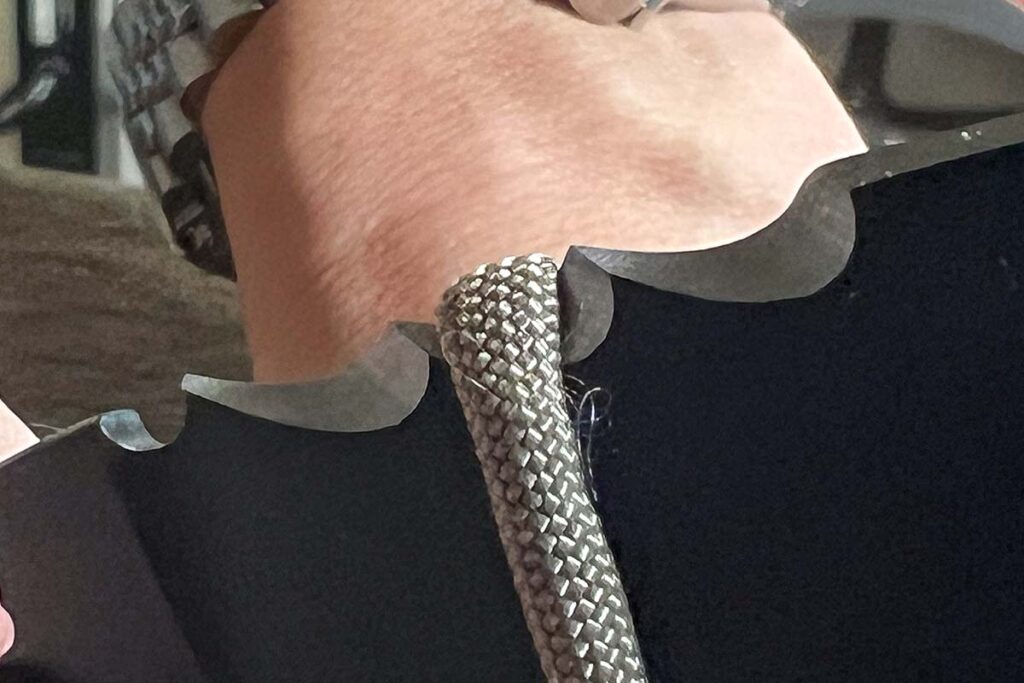
Bugsy’s Veff serrated teeth
Rest whatever you’re cutting inside one of the Bugsy’s Veff serrated teeth and it will help hold the material as well as cut it. 

Kaila Cumings, the three-time contestant on Discovery Channel’s Naked and Afraid reality TV show, designed the CRKT Bugsy. Kaila grew up hunting, fishing and camping with her father, thus starting her lifelong interest in survival skills and tools, including knives. She designed the Bugsy as a compact fixed blade with high utility characteristics and superior ergonomics. 

The 3.7-inch blade enables the knife to execute a variety of tasks related to camping/survival. The modified clip point shape with a defined tip is ideal for scoring, and the gentle sweep of the main bevel gives plenty of belly to facilitate slicing chores such as food prep. The 1095-blade steel provides good edge holding and ease of resharpening in the field. As a result, it is a favorite carbon steel of knife users. The handle’s finger grooves help lock in your grip, and their rounded edges melt into your hand.

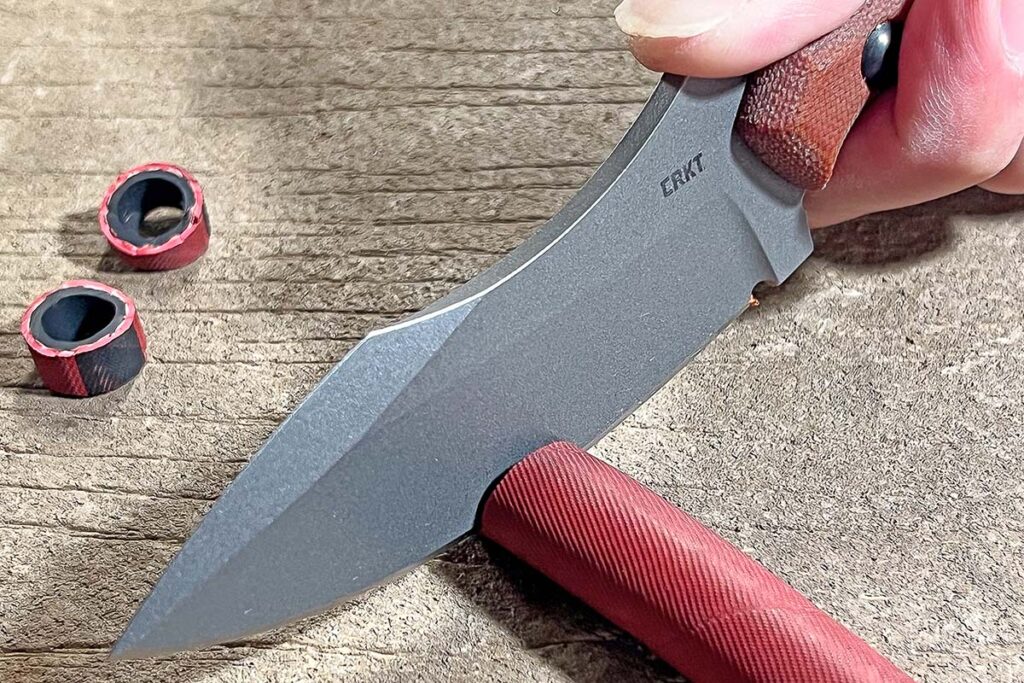
Plain edge Bugsy cutting hose
The plain edge Bugsy works well with utility chores such as cutting rubber hose. The curve of the edge makes for great slicing action.

There are two versions of the Bugsy: a plain edge blade in a gray Cerakote® finish, a tan Micarta® handle and a leather belt sheath, and a partly serrated blade in a black Cerakote finish, a black G-10 handle and a molded Kydex sheath.  The former is outdoor/hunting themed, the latter tactical—same design, two different personalities.

Performance-wise, the Bugsy is an ideal fixed-blade companion in either flavor. It’s just shy of 7.5 inches overall, making it very comfortable for everyday carry. It’s compact enough to carry well yet there is enough blade length to handle most cutting jobs. Both versions have an MSRP of $170 and are made in the USA for CRKT by TOPS Knives.

Spyderco Paramilitary 2

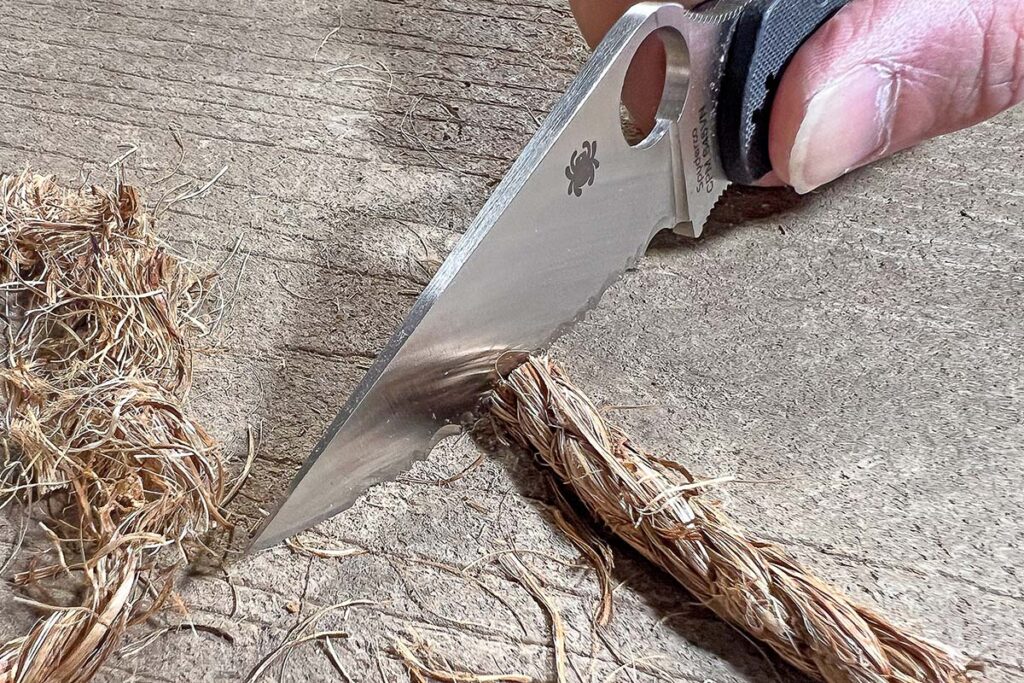
Spyderco Para2 cutting rope
This is where the fully serrated Spyderco Para2 shines. Manila rope is tough to cut and the Para2 handles it without any effort exerted. “If you cut rope regularly,” the author noted, “fully serrated is the way to go.”

The Paramilitary 2, aka Para2, is one of Spyderco’s hottest-selling folders. Taking what works for the company’s full-size Military model and making it a bit more compact and pocketable, the Para2’s design and performance lineage is undeniable. It has a full-flat-ground blade that makes the Military a lean, mean cutting machine. 

There’s also the ultra-strong Compression Lock that secures the blade open, yet is easy to manipulate and close one-handed. The ergonomically shaped G-10 handle sports a nice peel-ply texture that aids in grip retention. The Para2 is built for serious EDC use. The 3.4-inch clip point blade is CPM S45VN high-performance stainless steel for enhanced edge holding. 

The reasons for the Para2’s superior cutting performance are both the full flat grind and the distal taper from tang to blade tip. The resulting progressively thinning down of the blade allows it to sail effortlessly through whatever you’re cutting. The thumb rest and finger choil boast deep traction notches for a nonslip grip, allowing a choke-up grip when more control or pressure is required.

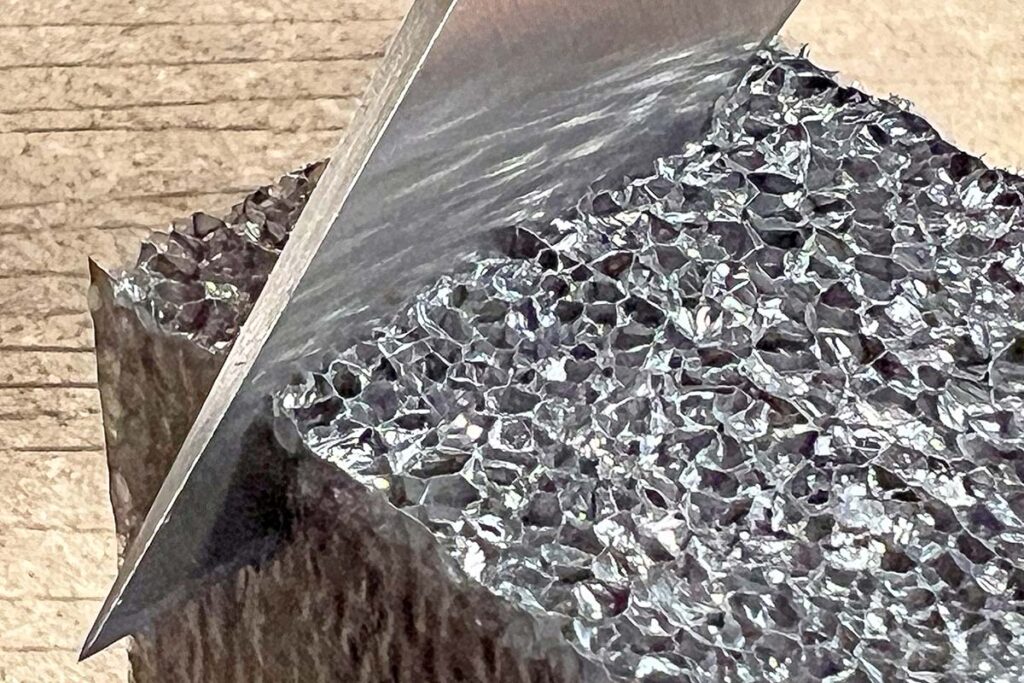
Plain edge Para2 has a slight distal taper
The full-flat-ground blade of the plain edge Para2 has a slight distal taper from tang to tip, which makes it bite hard and sink into the cutting media. It goes through foam block like a laser.

The edges of the G-10 are chamfered to prevent hot spots. An hourglass-shaped steel pocket clip mounts in one of four ways conducive for lefties and righties, as well as blade tip up or tip down. The Para2 carries well in whatever mode you select, making it a popular choice among Spyderco enthusiasts as well as those who fancy a well-made working folder.

Spyderco long has been known for its handle shapes, blending ergonomics with smart, practical design, resulting in a knife comfortable to use for extended periods. The Para2 handle has an integral guard just behind the finger choil. There’s also a generous swell in the grip area to accommodate your fingers comfortably. The butt swells just enough to prevent your hand from sliding rearward. 

With the Para2 you have a choice of a plain or fully serrated edge. Spyderco has long been known for its fully serrated blades, with its serration pattern regarded by many as the best in the industry. The tooth pattern cuts aggressively while still having a smooth action. MSRP for the plain or serrated Para 2 is $265. Country of origin: USA.  

Plain Vs Serrated Knives

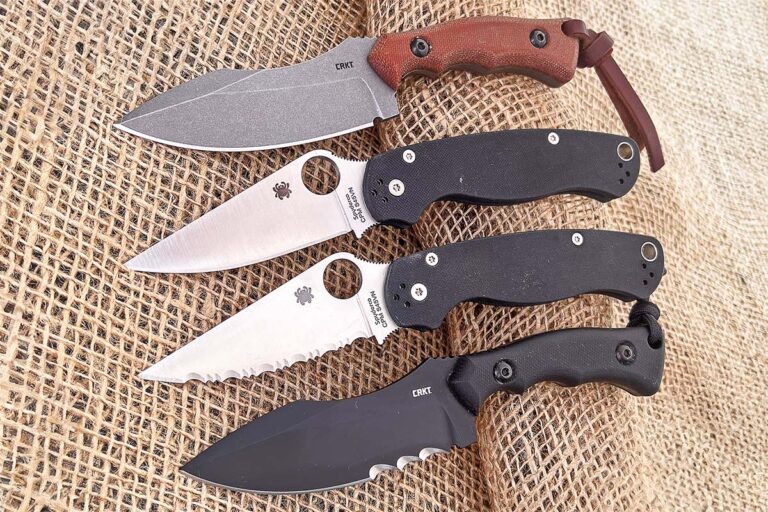
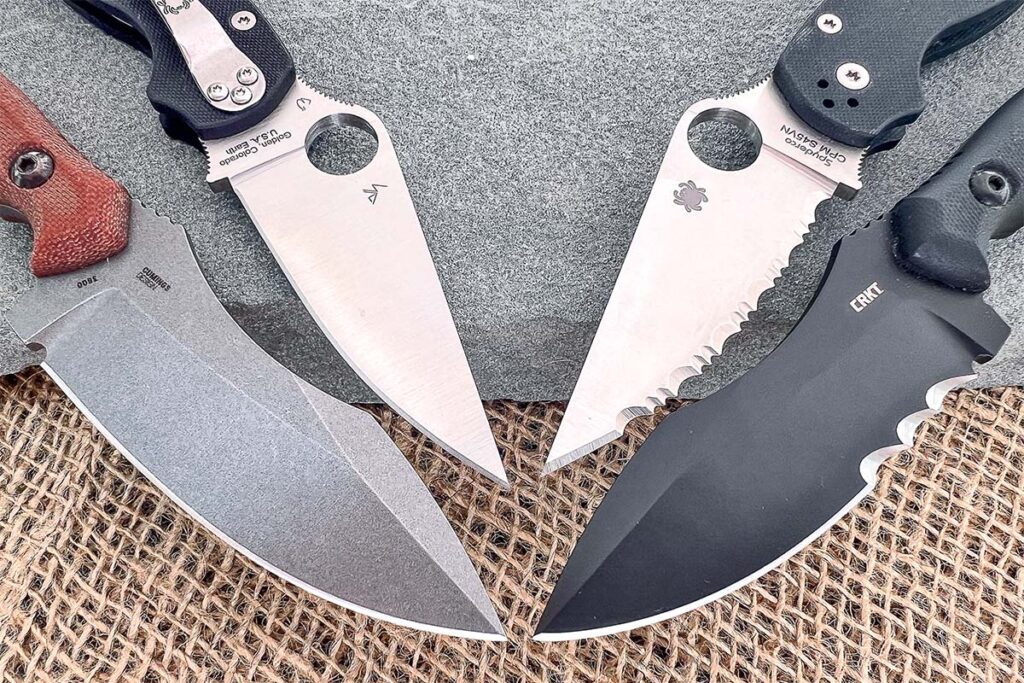
Plain and serrated or partly serrated edge versions of the same knife model, clockwise from bottom left: CRKT Bugsy plain, Spyderco Para2 plain, Para 2 fully serrated and Bugsy partially serrated.

Choose your edge format carefully to best suit most of your cutting needs. Most opt for a plain edge for the previously mentioned reasons. A plain edge does well in a variety of settings, from opening packages to stripping wire, doing light-duty scraping tasks, and even food prep. Ninety percent of cutting tasks are suited to plain edges while roughly 10 percent or so require more muscle.

Plain edge blades are easy to sharpen as well—just be sure to select your sharpener carefully based on steel type. Harder, more-wear-resistant steels like the CPM varieties require diamond sharpeners due to how aggressively diamond abrasives cut. Steels not as hard as the CPM varieties can be addressed with diamonds too, but other types of sharpeners like ceramic are very effective as well. A properly sharpened plain edge blade is all you need for most cutting jobs, big and small.

Remember that if you can reprofile the edge angle, you can decrease it by one or two degrees to get a sharper edge. For instance, most factory edge angles are 22 degrees, average. If you cut the angle back by just two degrees, you will be surprised at how much sharper the edge will be and therefore have more bite.

You need a sharpener specifically designed to address serrations. One is the Spyderco Sharpmaker 204. Set the 204 up to where the “points” of its triangular-shaped hones contact the serrated cutting edge. The points get inside each tooth as well as sharpen the tips of the serrations. There are others out there that address serrations but the best I have found is the 204. Some say serrations are difficult to sharpen but they aren’t if you use the correct sharpener.

Again, choose your edge format carefully to match the intended uses for your knife. You don’t want to cut open boxes or prep food with a serrated blade. You can do such tasks with a serrated blade if it’s the only blade you have, but, if given a choice, such tasks are better suited for a plain edge due to the smoothness of how it cuts.

Plain Vs Serrated Knife Analysis

The plain-edge versions of the Bugsy and Para2 work exceptionally well. The Bugsy’s blade belly makes slicing effortless and has plenty of bite. The Para2’s full flat grind with distal taper allows the blade to effortlessly cleave through tough materials. The excellent edge geometry enables the blade to bite in deep. In fact, the Para2’s blade makes cutting tasks easy and fun to complete, taking the work out of work.

The serrated versions of each knife have their own pluses and minuses. With the partially serrated Bugsy, the Veff serrations are ground at an angle, cutting most effectively on the pull rather than the push cut. The large scalloped teeth also help in cutting paracord, string for weed trimmers, twine, threads and zip tie ends. Just rest whatever you are cutting inside one of the teeth and that will help to hold the material as well as cut it. 

The serrations perform great but I felt that they were ineffective for some cutting work due to their limited length. You must saw back and forth with the blade to make effective use of the serrations, and sometimes that is just not feasible. A fully serrated blade would be nicer to allow for more edge real estate to apply the serrations and make full use of them. However, for what the Veff serrations are, they work well and are aggressive. I would not rely on them a whole lot but, as they say, they’re better than nothing.

There is a reason why Spyderco makes some of the best fully serrated blades on the market. The Para2 fully serrated version is a solid, proven performer. It’s pretty much an ultra-compact folding buzzsaw in your pocket. The two-step serration pattern typical of Spyderco is aggressive in bite and smooth in action. You need not even apply an excessive amount of pressure to make the cut as the serrations enable the blade to power itself through. 

Cutting manila rope is something that is tough on edges. The edge must be very sharp to do it. When I cut rope with the fully serrated Para2, I could immediately feel the edge bite in deep and effectively power its way through. Same for cardboard. The action is a bit rough but still, it gets the job done quickly.

The fully serrated Para2 also does a surprisingly good job cutting vegetables. You would think a plain edge blade would excel with the task and while you’re certainly not wrong in your thinking, you’ll be pleasantly surprised that a fully serrated blade can handle more delicate cutting tasks well, in addition to the tougher ones that require more horsepower.

More Knife Buyer’s Guides:

Spartan Blades Poros Review [Tested]

The Poros takes a beating and keeps on cutting.

The Poros by Spartan Blades is a great feeling folder. The flipper design is spot-on for hand placement.

Company co-founders Curtis Iovito and Mark Carey are excellent to work with and built Spartan from scratch. Both are retired from Special Forces and have a lot of pride in workmanship. The Poros is their field-grade-version linerlock. It might not have the fancy material and looks but the performance is top shelf.

Poros Light Cutting Duties

Initial slicing of 20-pound copy paper was excellent. The Poros was very smooth and aggressive. The blade shape really helped slicing paper, especially when I employed a roll cut. The flat-ground blade sliced straight with no curling of the paper.

Poros Cutting Leather
The 154CM stainless steel blade was exceptionally aggressive in the 8-ounce leather slice.

The Poros easily devoured single-walled cardboard. As with the copy paper, the blade sliced it both forcefully and effortlessly, resulting in nice, straight cuts. The slices were extremely quick with no resistance felt.

The folder was quite aggressive again in the 8-ounce leather slice. It was very easy to control the thickness of the skiving—I just needed to move my fingers faster. I had two fingernail nicks after the skiving. The edge remained sharp.

Poros Medium Cutting Duties

It was time to do a fire stick. The flat grind produced excellent curlicues. It sliced the wood incredibly fast and I had to slow down for more control to keep the curlicues on the stick. The handle was comfortable while making the deeper cuts. It was awfully simple to whittle with the knife.

Spartan Blades Poros cutting curlicues
The flat grind produced excellent curlicues. It sliced the wood awfully fast and the author had to slow down for more control to keep the curlicues on the stick.

For the next exercise I used 1-inch manila rope. The Poros crunched to 197 cuts before I ran out of rope. The edge was still good. The handle was very comfortable during heavy use. There were no issues with the blade lock. Nicely done, Spartan.

Poros Heavy Cutting Duties

I split kindling into smaller pieces to check lockup by doing baton work. There continued to be no issues with lockup or edge retention. The knife can handle a beating for sure. It’s not that I recommend baton work with a folder but if you have to it can be done with the Poros.

Poros splitting wood
The author split kindling into smaller pieces to check lockup via some baton work. There were no issues with lockup or edge retention.

To push the knife a bit further, I grabbed my trusty whitetail deer antler. After 30 hard whacks on it, the edge was still sharp with no rolling or chips, indicating spot-on heat treatment.

The last test was back to the copy paper slice. The Poros continued cutting smoothly and my arm was tired. Outstanding job, guys!

Final Cut

The Poros folder is worthy of riding in anyone’s pocket. It’s well designed, sharp and easy on—and comfortable in—the hand. I really don’t know what I’d change on this one, though I would love to see an A-2 tool steel version.

Poros Specs
Maker: Spartan Blades
Knife type: Flipper folder
Blade length: 3 7/8”
Blade steel: 154CM stainless
Rockwell hardness: 58-60 HRC
Blade finish: Black PVD
Handle: Carbon-fiber-patterned G-10
Lock: Linerlock
Closed length: 5 1/8”
Country of origin: USA
MSRP: $190

Check Out More Knife Reviews:

Massachusetts Supreme Court Strikes Down Switchblade Ban

Nearly 70-year-old automatic-knife ban meets its demise in a 5-0 decision.

Massachusetts hasn’t been a haven for arms rights since the shot that was heard around the world, but things are changing in the Bay State.

In a rather shocking 5-0 decision on Aug. 27, the Massachusetts Supreme Court struck the state’s nearly 70-year-old prohibition of the carry of automatic knives with blades greater than 1.5 inches. This is an enormous win for knife rights, given the state is among the most hostile to the carry of any weapon. And, with other recent cases, the decision shows a softening toward the possession and carry of automatic knives.

Canjura Switchblade Case

The Massachusetts ruling stemmed from the arrest of David E. Canjura in 2020 in Boston, in response to an altercation between him and his girlfriend. Upon searching Canjura, police found what they described as an “orange firearm-shaped knife with a spring-assisted blade” or in popular parlance, a switchblade.

Canjura subsequently challenged the constitutionality of the charge, arguing the knife was an arm and was protected under the Second Amendment. The Massachusetts Supreme Court agreed.

Justice Serge Georges Jr. authored the court’s 24-page written decision, drawing heavily upon landmark U.S. Supreme Court decisions of Bruen and Heller. Despite both cases pertaining to the Constitutional rights of possessing and carrying firearms, the opinions have carried over to the lawful possession and carry of other arms.

Pertinent to the Massachusetts ruling was the historic test laid out in the Bruen ruling, which requires historical precedent from when the Constitution was ratified in 1791 to maintain a prohibition on arms. Georges found this sorely lacking in Massachusetts’ ban on carrying switchblades.

Georges wrote in the decision, “Given the long history of folding pocket knives generally and switchblade knives in particular, switchblades constitute “bearable arms” within the protection of the Second Amendment.”

Massachusetts Ban

Like so many switchblade bans, Massachusetts dates back to the time of patent leather jackets and witch-trial-like panic over the supposed corruption of the nation’s youth. The state law was passed in 1957, several years after the publication of the anti-automatic knife article, The Toy that Kills. Despite being cinema classics, Rebel Without A Cause and Blackboard Jungle didn’t help out the switchblade’s reputation.

Massachusetts was a year ahead of the curve in pushing autos to the fringes of society, with the federal government passing the Switchblade Act of 1958. Drawing upon the federal government’s interstate commerce power, it act prohibited the purchase, sale, and trade of automatic knives between all 50 states.

Yeah, But…

Despite a good outcome for knife rights and following other wins for automatic knives nationwide, there are points Massachusetts enthusiasts should be aware of before throwing an auto in their pocket.

The potential stands the case may be appealed and the decision stayed. Furthermore, as pointed out by Knife Rights, there are some wrinkles knife owners to keep in mind to state on the right side of the law still.

  • Carry of any double-edged blade—including switchblades—is still prohibited.
  • Knife law preemption does not exist in Massachusetts, so cities and counties may have or might pass auto bans (check your local laws).
  • The state’s ban on the manufacture and sale of switchblades remains on the books.

Even with these prohibitions, Bay Staters should be pleased with the recent ruling.

More On Auto Knives:

Cool Custom: Rhidian Gatrill’s Safety Hunter Reproduction

0

Rhidian Gatrill reproduces the folding Marble’s Safety Hunter in grand style.

Rhidian Gatrill not only satisfied a personal goal of reproducing the classic Marble’s Safety Hunter but also parlayed it into Best Hunter and Best of Show at the 2024 Oregon Knife Show.

He said he had always wanted to reproduce the clever old pattern with the folding catch piece that covers the tip of the closed blade. Not only does the catch piece enable the folder to have a blade longer than the handle, it also locks the blade of the slipjoint knife open. As Rhidian noted, “I just thought the mechanism was really cool, and it’s a big knife. I like big knives, but mostly it’s just the mechanism.”

He found a copy of the original Marble’s patent drawing dated May 19, 1903, on the internet and used it as a reference to make the knife. ABS master smith Tommy Gann forged the damascus specifically for the repro. “Tommy and I discussed a collaboration, and I figured if a master smith was going to make some damascus for me then it should be for a big bad knife, and so the Safety Hunter was definitely it. I sent him my drawing,” Rhidian wrote, “and he forged the steel to fit the blade and parts.”

Gatrill Safety Hunter Specs
Knife: Marble’s Safety Hunter reproduction
Maker: Rhidian Gatrill
Blade length: 5”
Blade steel: A lower-layer, four-bar Turkish twist damascus forged by ABS master smith Tommy Gann
Swing guard: Same material as the blade and sculpted by Rhidian
Action: Slipjoint construction w/half stop; blade tip catch piece doubles as a lock to lock the blade open
Handle material: European red stag in a Coke bottle pattern
Bolsters: Stainless steel fluted by the maker
Closed length: 4.75”
Rhidian’s price for a similar knife: $5,000 ($3,500-$4,000 if in straight stainless or carbon blade steel)

See More Custom Knives:

First Look: Boker Plus Modern Gentleman

Hitting the right notes as a gentleman and EDC knife, the Boker Plus Modern Gentleman offers the best of both worlds.

Not every situation—or person’s routine—calls for a decked-out and oversized blade. Though, in some cases, EDC knives have trended this way. However, the pendulum may be returning to a more refined and aggressive design for a do-all tote around.

Case in point, Boker Plus’s Modern Gentleman.

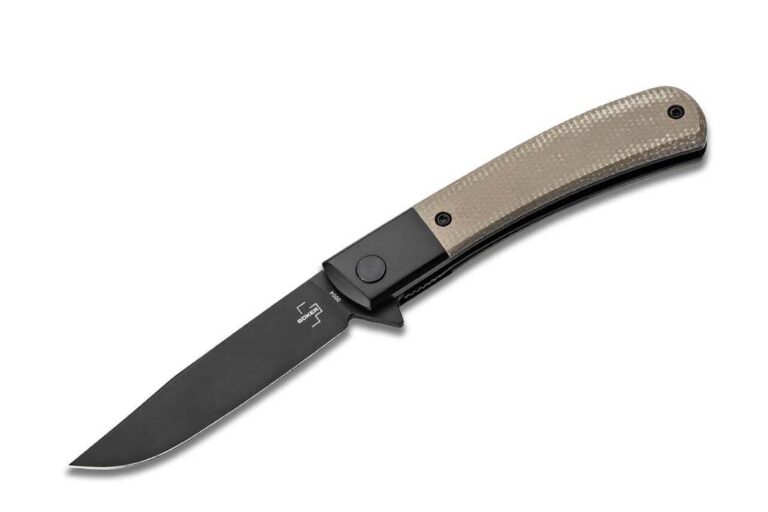
As the name suggests, the flipper/folder has the lines of a knife you wouldn’t be afraid to use among polite company or button-down business associates. However, it is proportioned right and ruggedly constructed to tackle heavier chores in which a true gentleman’s knife might falter. A hybrid of sorts, the Modern Gentleman offers the best of both worlds.

The knife features a relatively understated drop-point blade that at 2.95 inches offers plenty of utility. Constructed from Nitro-V, a nitrogen-enhanced steel with a reputation for good toughness; it’s a material that’s been picking up steam in recent years. As for the blade’s profile, it has just enough belly to enhance slicking duties, with a nice long straight section back to the choil for substantive push cuts. It comes to a pronounced tip, making it fairly capable of punctures and perforation.

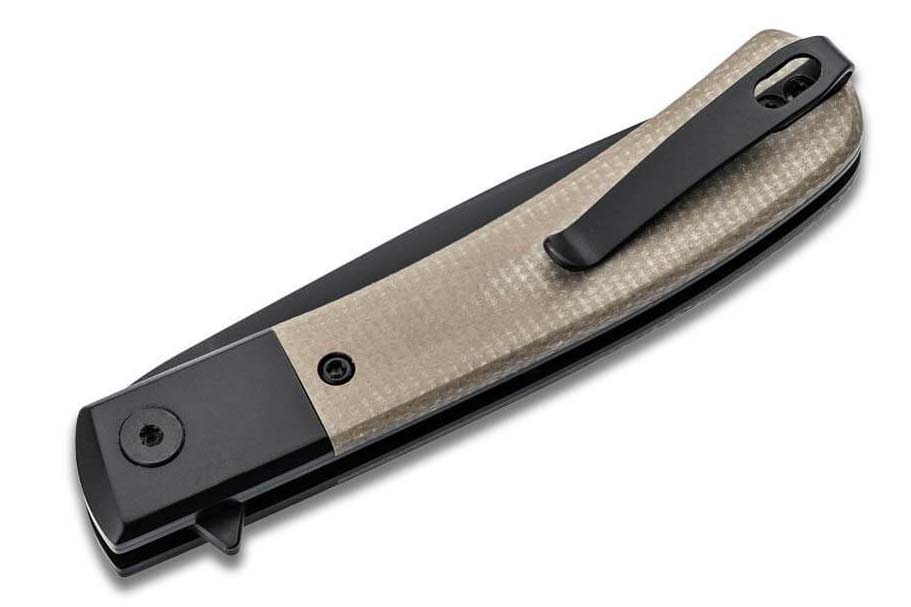
Boker Modern Gentleman Closed

Adding a touch of class to the Modern Gentleman’s design is a steel bolster, coated black—titanium—like the blade. The dark overtones of the steel components are offset by a canvas Micarta scale—a very fetching two-tone effect. While thin, the handle offers plenty of real estate to get a grip on the knife, measuring in at just a few ticks of the tape under 4 inches. Yet, its overall svelteness keeps the Modern Gentleman at a very carry-friendly 2.26 ounces.

Other points of interest, the knife has and low-key kicker that does its best to avoid deploying out of the pocket, yet with a tuned detent is quick to deploy. Though there is likely a sticky point in the liner for some—the clip is non-reversible. OK if you dig front-pocket, tip-up carry and you’re a righty, not so hot for others.

Overall, Boker prices the Modern Gentleman to move, listing it at $59.95 on its website. At that price, certainly, many knife enthusiasts will find the gentlemanly EDC the perfect companion, for work or play.

Modern Gentleman Plus Specs
Overall Length: 6.69 in
Blade Length: 2.95 in
Blade Thickness: 0.09 in
Weight: 2.26 oz
Blade Material: Nitro-V
Handle Material: Micarta
Opener: Flipper
Opening: Manual
Lock Type: Linerlock
MSRP: $59.98

More On Boker Knives:

Advertisement

Must Read Articles

Read this before you make a knife

Knifemaking 101 – Read This Before You Make a Knife

  by Wayne Goddard My experience has taught me that there's nothing like digging in and getting started. I've often said the hardest part of the...
how to forge damascus steel

How to Forge Damascus

Advertisement
Advertisement