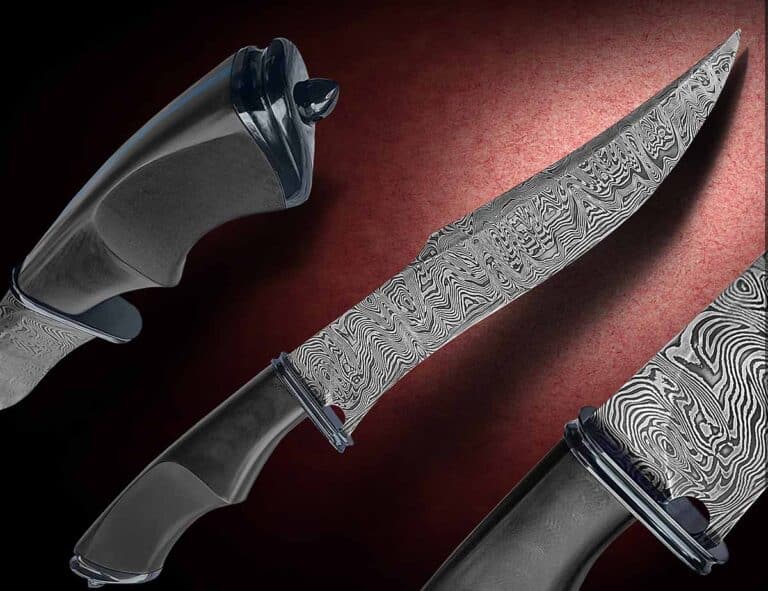
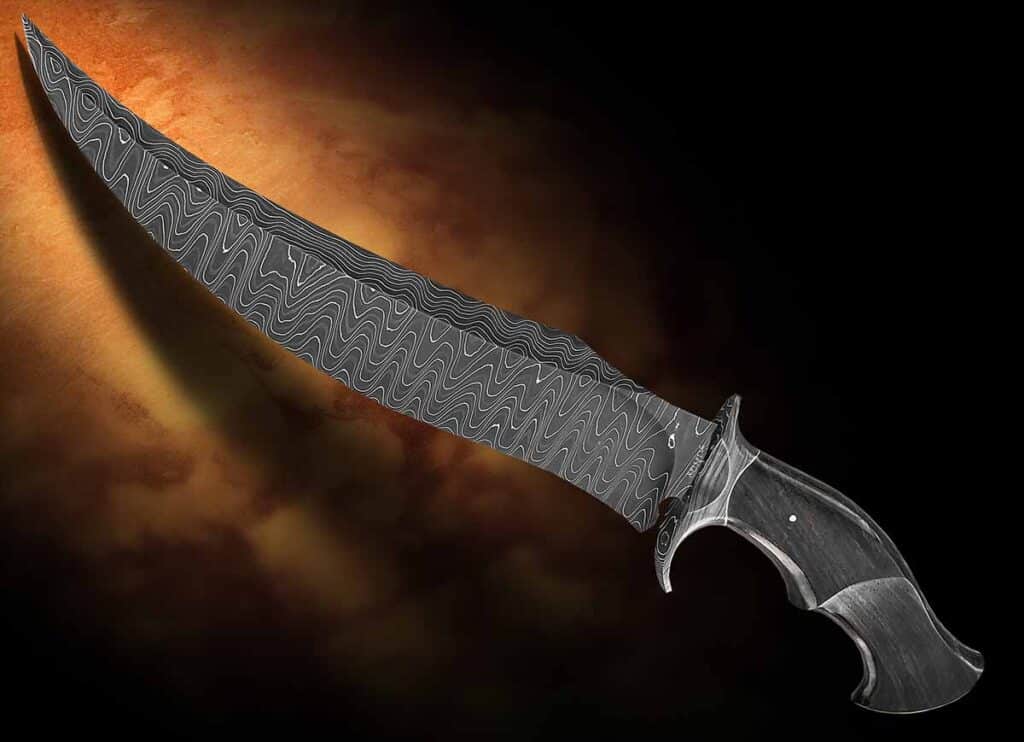
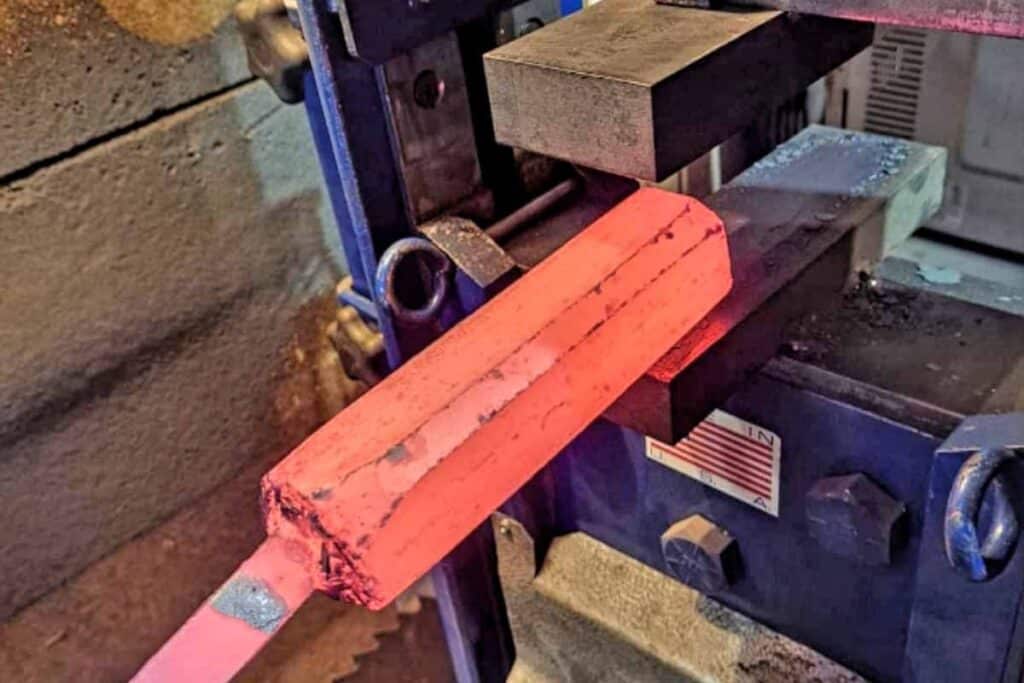
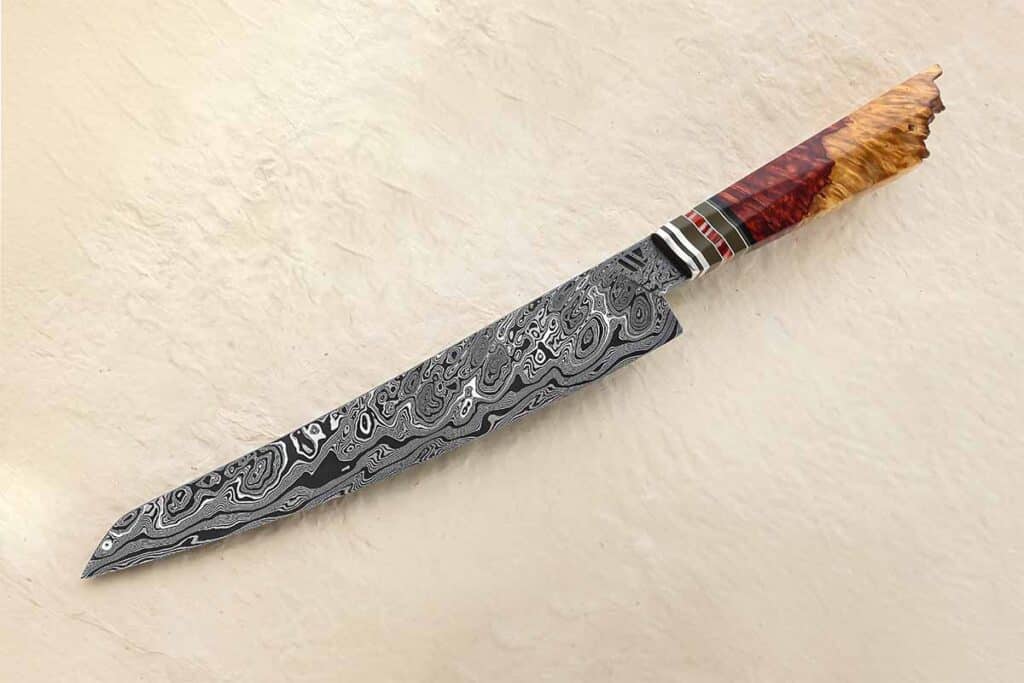
We break down what common steel alloying elements add to a knife.
Alloy… in the knife world we hear the word often. Blade aficionados—many almost journeyman metallurgists in their own rights—pour over steel composition. Newbies to collecting and making, however, might be a bit perplexed over exactly what the material modification is all about.
With this in mind, we’ve boiled down what certain elements—when alloyed with iron—bring to the table for your knife. Now this isn’t a deep dive into the nitty-gritty of what each element does in a steel alloy, complete with phase diagrams and quenching charts. Honestly, if you need to cut to this quick, we recommend Larrin Thomas’ website KnifeSteelNerd.com. The son of BLADE Cutlery Hall of Fame member Devin Thomas and PhD metallurgist and material scientist, Thomas offers a much more in-depth look at steel from an engineer and knifemaker’s point of view.
What we have here is a quick and dirty guide to alloy elements and what they bring to a knife.
What An Alloy Is
If your high school chemistry class is a bit foggy right now, perhaps we should take a moment to do a quick review of exactly what constitutes an alloy. Quite simply, an alloy is a mixture of two or more elements, where at least one of the elements is a metal. Note alloys are mixtures, not compounds—the former is a physical combination, the latter a chemical. For a mixture, think of something like oil emulsified in vinegar to create a tasty salad topping, while a compound is two gases like hydrogen and water bonding together to form water.
Alloying elements is done to enhance the properties of a material. In the case of knife steel elements are combined to improve toughness, wear resistance, corrosion resistance or other factors. While we won’t delve that deep in this article, we’ll point alloys can be classified into two main types:
Substitutional Alloys: In these alloys, the atoms of one element replace or substitute for the atoms of another in the metal lattice. An example is brass, which is an alloy of copper and zinc.
Interstitial Alloys: In these alloys, smaller atoms fit into the spaces (interstices) between the larger metal atoms in the lattice. Steel, which is an alloy of iron and carbon, is an example of an interstitial alloy.
Since we’ve dusted off some of those long-lost materials lessons you learned, let’s get into the down-and-dirty of what each common alloying element brings to knife steel.
Knife Steel Alloy Elements
Carbon: This ingredient makes the difference between iron and steel; all steel will have some amount of carbon. It is the most important hardening element, but it makes hardness by combining with other elements. As a simple generalization, the amount of carbon in the steel tells you a lot about the quality of the steel. Low-carbon steel has 0.3% carbon or less, medium has between 0.4-0.7% and high-carbon steel is 0.8% and above, maxing out at around 1.2% carbon for knife steels. Up to a point, the higher the carbon content within the range, the harder the steel will get.
Chromium: Chromium combines with carbon to make chromium carbides, which are resistant to corrosion. Stainless steel knives will have chromium as a major ingredient, typically at a minimum of 12-13%. Chromium also increases the strength of a knife to a degree, but adding chromium in large amounts decreases toughness.
Cobalt: In small amounts, cobalt increases toughness.
Manganese: This changes the rate of hardening. Manganese in carbon steels yields “deeper” hardening, which requires a slower speed quench and gives a wider range of acceptable heat before quench. If added in high quantities, it can increase brittleness. Manganese makes steel etch dark in damascus.
Molybdenum: Adding this maintains the steel’s strength at high temperatures.
Nickel: Nickel adds toughness to steel. It also makes steel etch bright in damascus.
Nitrogen: This element is sometimes used as a substitute for carbon in steel.
Silicon: Silicon increases strength and removes oxygen from the metal while it is being formed. It’s typically present in small quantities in most steels.
Sulfur: This increases machinability but decreases toughness.
Tungsten: Adding this increases wear resistance and forms tungsten carbides that are very hard.
Vanadium: Vanadium leads to smaller grains within the steel. Vanadium carbides are very small and hard, which increases wear resistance and edge retention.
We gathered up a bevy of new custom damascus blades that are sure to knock your socks off.
Our latest knife roundup features a stunning collection of new custom Damascus blades that are sure to impress. These meticulously crafted knives showcase the intricate patterns and superior craftsmanship that Damascus steel is known for, making each piece a work of art. Whether you’re a collector or simply appreciate high-quality blades, this selection is bound to knock your socks off with its blend of beauty, durability, and cutting-edge performance.
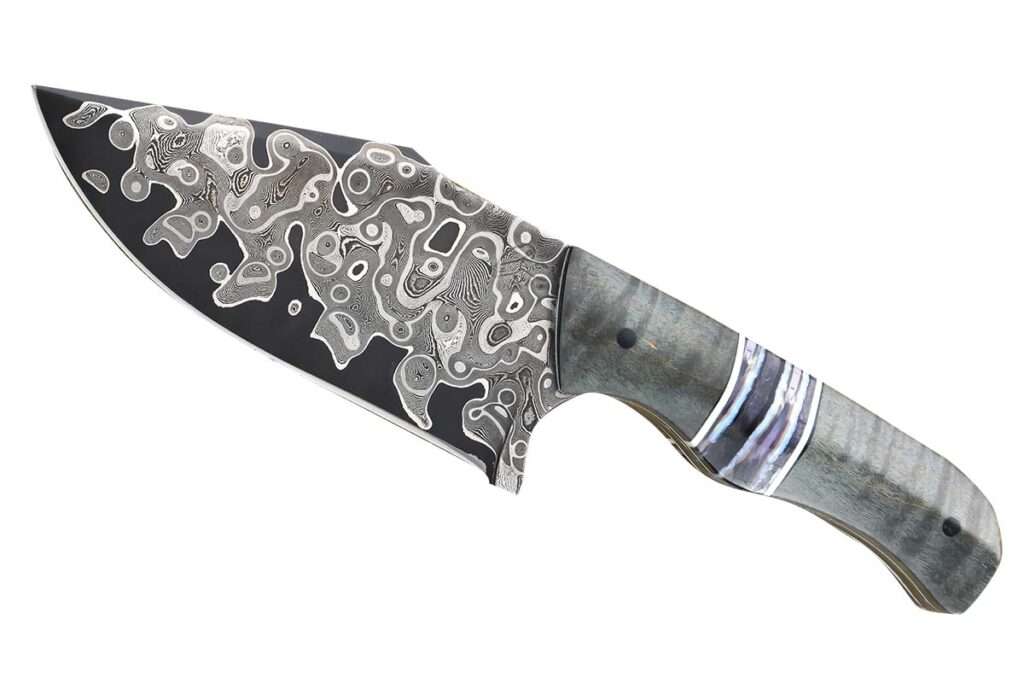
Brent Dignam Hunter
BLADE LENGTH: 5” BLADE MATERIAL: San-mai damascus w/1084 carbon steel core forged by Robert Corey Scott of Bulldog Damascus BLADE GRIND: Flat HANDLE MATERIAL: Curly maple LINER MATERIAL: G-10 SPACER MATERIAL: Mammoth molar OVERALL LENGTH: 9” MAKER’S PRICE FOR A SIMILAR KNIFE: $800 MAKER: Brent Dignam (SharpByCoop image)
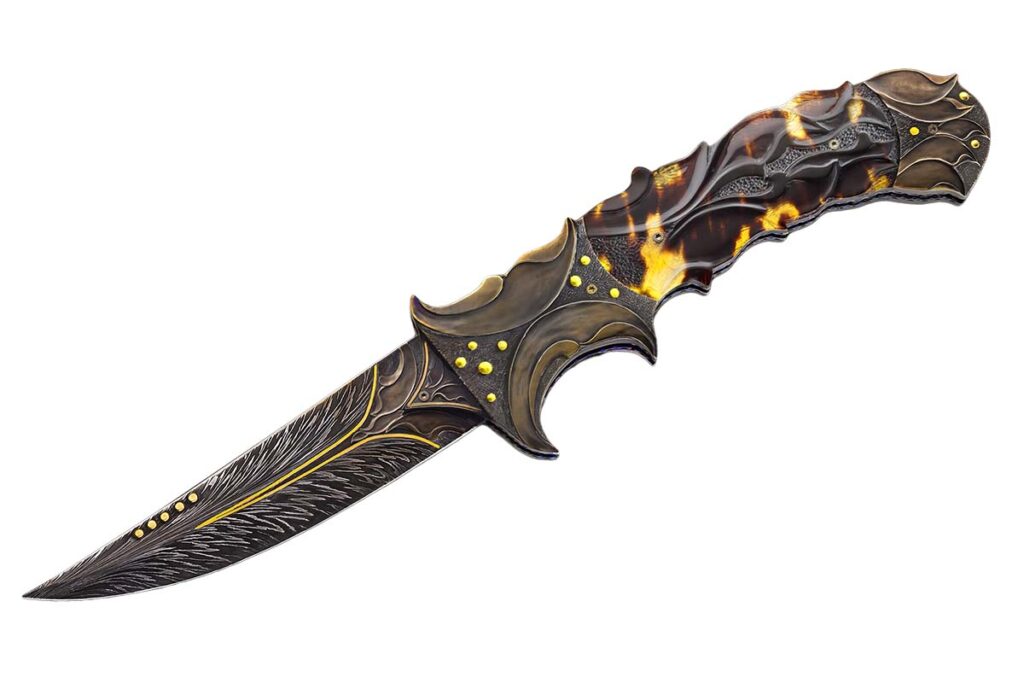
Rick Dunkerley Persian Folder
BLADE LENGTH: 4.25” BLADE MATERIAL: Feather pattern damascus of 1080 carbon and 15N20 nickel alloy steels; Dellana Dots in 18k gold BLADE GRIND: Double fighter HANDLE MATERIAL: Antique shell BOLSTERS: Milled steel EMBELLISHMENT: 24k-gold inlay in blade and bolsters CLOSED LENGTH: 5.25” MAKER’S PRICE FOR A SIMILAR KNIFE: $15,000 KNIFE TO KNOW: Rick Dunkerley is a master smith in the American Bladesmith Society MAKER: Rick Dunkerley (Mitchell Cohen image)
Mark Lambert Hunter
BLADE LENGTH: 4.75” BLADE MATERIAL: 320-layer ladder-pattern damascus of 1084 carbon and 15N20 nickel-alloy steels HANDLE MATERIAL: Bog oak GUARD MATERIAL: 413 stainless steel OVERALL LENGTH: 9 3/8” KNIFE TO KNOW: Contoured grip includes flats on either side starting around midway and extending to the bird’s-beak butt; Mark Lambert is an apprentice smith in the American Bladesmith Society MAKER’S PRICE FOR A SIMILAR KNIFE: Contact maker for more information MAKER: Mark Lambert (Jocelyn Frasier image)
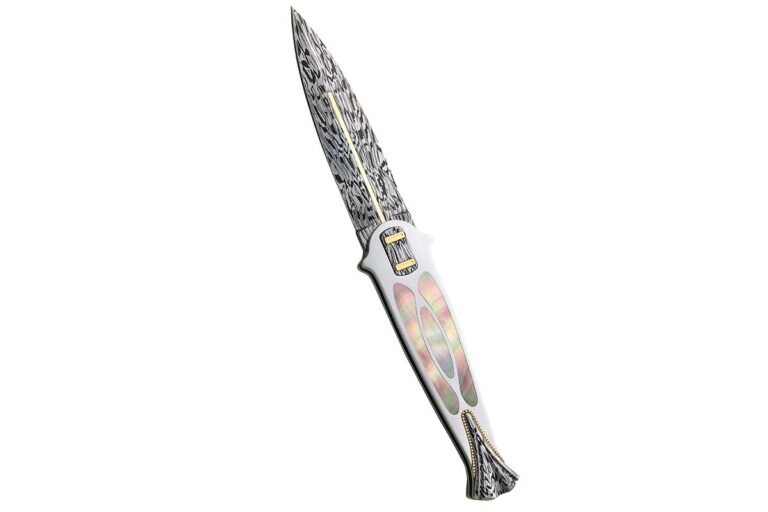
John Horrigan Automatic
BLADE LENGTH: 3.75” BLADE MATERIAL: 6-bar Turkish twist damascus w/Dellana Dots BLADE GRIND: Hollow BLADE OPENER: Push button HANDLE FRAME: 416 stainless steel HANDLE INLAY: Edwards black jade MAKER’S PRICE FOR A SIMILAR KNIFE: $5,200 KNIFE TO KNOW: John Horrigan is a master smith in the American Bladesmith Society and sole authors all of his knives MAKER: John Horrigan (Mitchell Cohen image)
Q Hardtner Blades Fixed Blade
KNIFE TYPE: Fixed blade BLADE LENGTH: 8.5” BLADE GRIND: Flat BLADE MATERIAL: Feather damascus of 1084 carbon and 15N20 nickel-alloy steels FURNITURE: 416 stainless steel HANDLE MATERIAL: Ancient walrus tusk CONSTRUCTION: Takedown OVERALL LENGTH: 13.5” SHEATH: Made and handcarved by Bob Bobbitt MAKER’S PRICE FOR A SIMILAR KNIFE: $2,200 KNIFE TO KNOW: Quintin Hardtner has been making knives for about two years and mentored under veteran maker Dan Graves MAKER: Q Hardtner Blades (SharpByCoop image)
Trevor Morgan Jr. Chef’s Knife
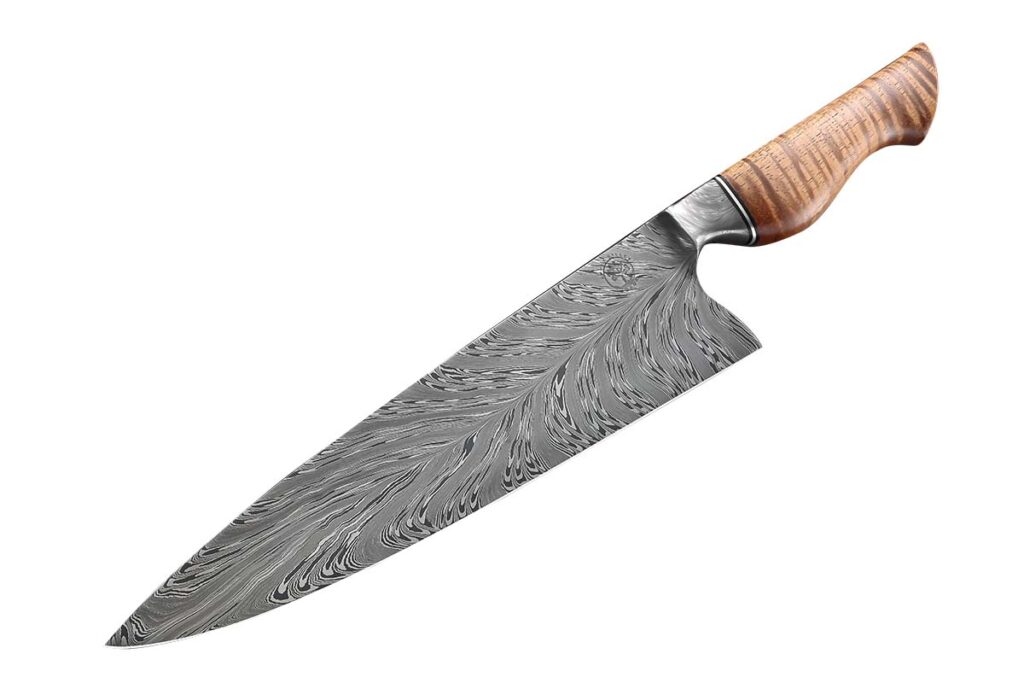
BLADE LENGTH: 9” BLADE MATERIAL: Feather-pattern damascus of 1084 carbon and 15N20 nickel-alloy steels BLADE GRIND: Slightly convex flat HANDLE MATERIAL: Curly koa BOLSTER: Integral OVERALL LENGTH: 14” MAKER’S PRICE FOR A SIMILAR KNIFE: $1,750 MAKER: Trevor Morgan Jr. (SharpByCoop image)
David Longworth Emergence
KNIFE TYPE: Folder BLADE LENGTH: 3.8” BLADE MATERIAL: Mosaic damascus of 1084 carbon and 15N20 nickel-alloy steels BLADE GRIND: Flat HANDLE FRAME: 416 stainless steel HANDLE MATERIAL: Black-lip mother-of-pearl LOCK: Rocker Lock CLOSED LENGTH: 4.9” KNIFE TO KNOW: The Rocker Lock locks the blade in the open and closed positions; when the knife is closed, push the lower side of the button to unlock the blade; when the knife is open, push the upper side of the button to unlock it; the knife is a California or assisted opener, so the blade pops out a little when the button is pushed; all steel on the knife is hardened MAKER’S PRICE FOR A SIMILAR KNIFE: $8,000 MAKER:David Longworth (SharpByCoop image)
Koen Knives Chef’s Knife
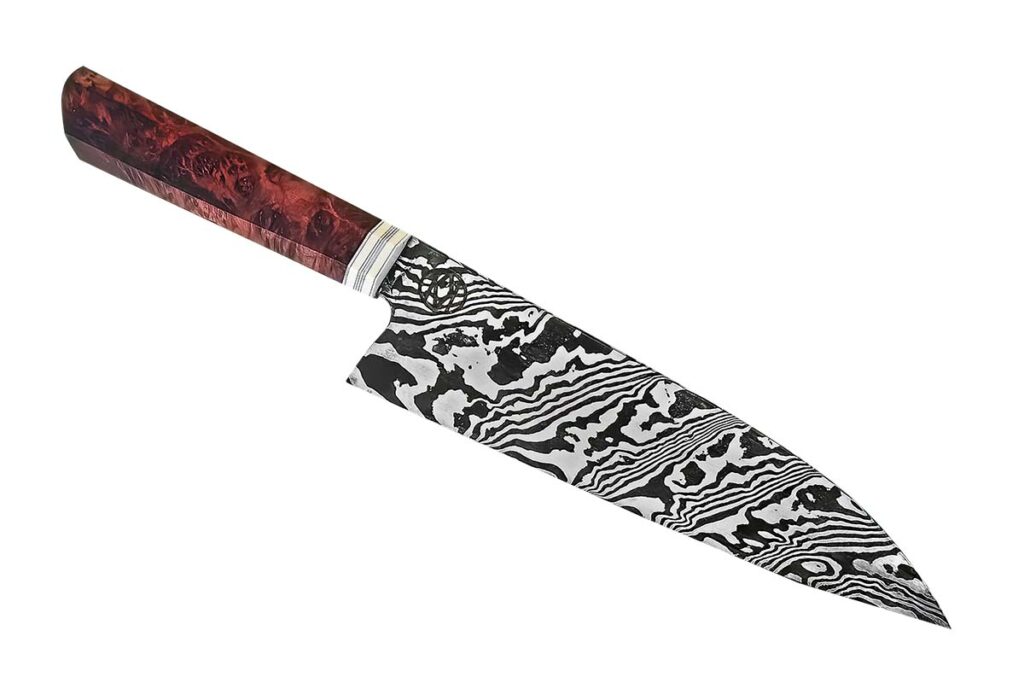
KNIFE PATTERN: Chef’s knife BLADE LENGTH: 7.87” BLADE MATERIAL: Damascus of 1084 carbon and 15N20 nickel alloy steels BLADE THICKNESS @RICASSO: .157” BLADE @ WIDEST: 2.165” BLADE GRIND: Full flat HANDLE MATERIAL: Stabilized red mallee burl FERRULE: Brass and G-10 OVERALL LENGTH: 13.38” MAKER’S PRICE FOR A SIMILAR KNIFE: $600 at press-time exchange rate MAKER: Koen Knives (Rod Hoare image)
Adamas Forge Integral Horizontal-Tang Damascus Chef’s Knife
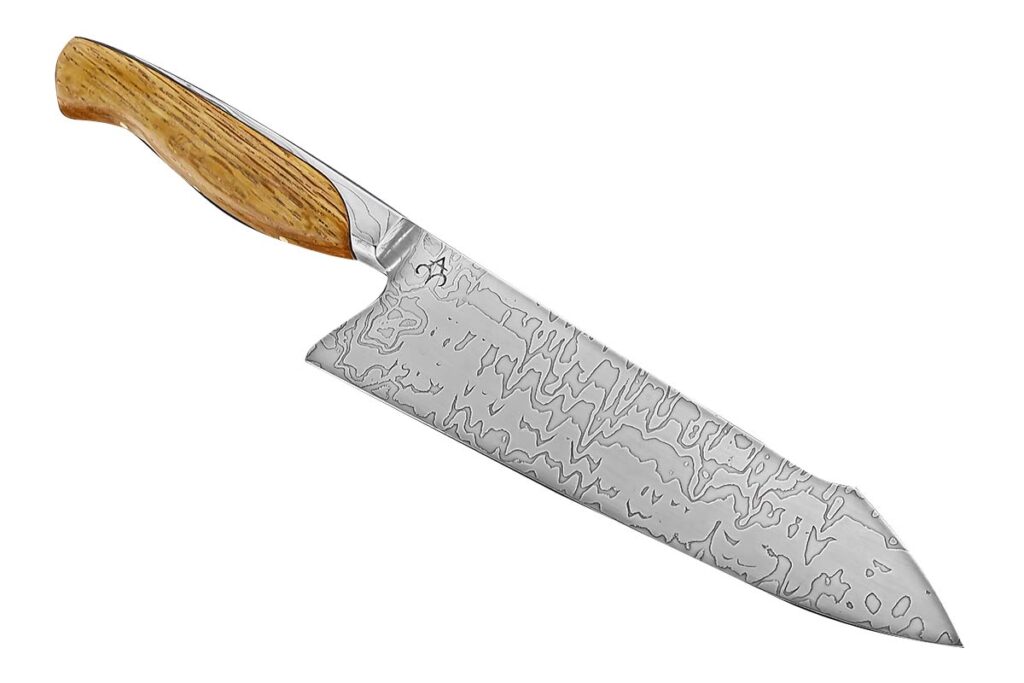
MODEL NAME: Horizontal Tang BLADE LENGTH: 7.87” BLADE MATERIAL: Damascus of 1084 carbon and 15N20 nickel-alloy steels BLADE @ THICKEST: .102” BLADE @ WIDEST: 2.04” BLADE GRIND: Full flat HANDLE MATERIAL: Stabilized white American oak OVERALL LENGTH: 12.59” MAKER’S PRICE FOR A SIMILAR KNIFE: Contact maker for more information MAKER:Adamas Forge (Rod Hoare image)
Brook Turner Integral Gyuto
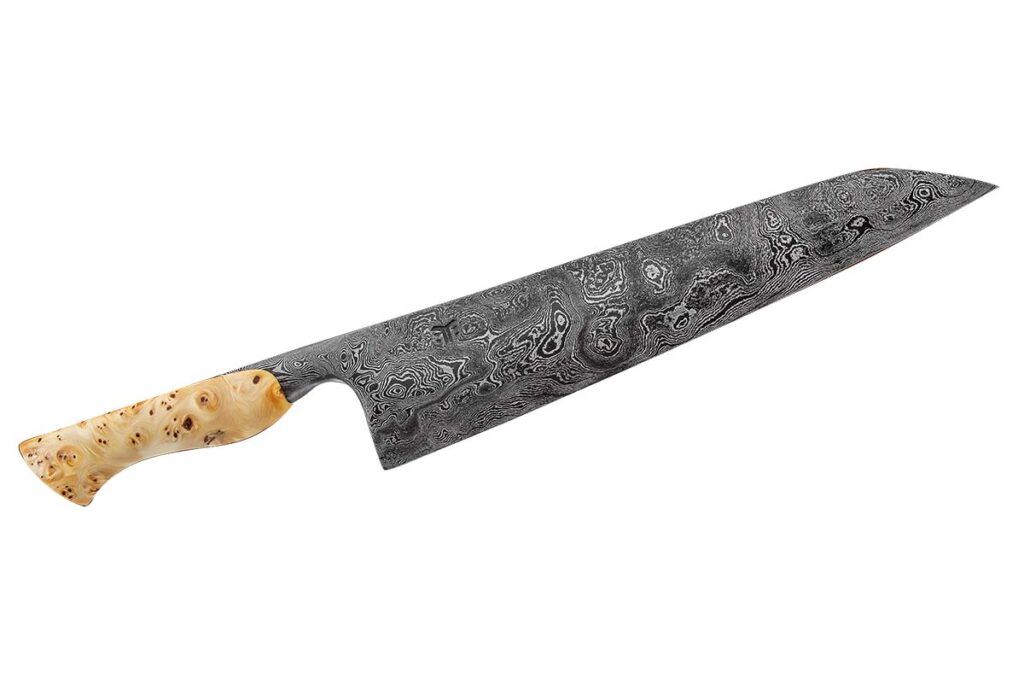
KNIFE PATTERN: Integral gyuto BLADE LENGTH: 9.05” BLADE MATERIAL: 280-layer random-pattern damascus of 1084 carbon and 15N20 nickel-alloy steels BLADE THICKNESS @RICASSO: .216” BLADE @ WIDEST: 2.04” BLADE GRIND: Convex HANDLE MATERIAL: Stabilized huon pine burl OVERALL LENGTH: 14.17” MAKER’S PRICE FOR A SIMILAR KNIFE: $1,500 KNIFE TO KNOW: Brook Turner is a member of the Australian Knifemakers Guild MAKER:Brook Turner Blades (Rod Hoare image)
Bob Ohlemann Freelancer XL Model 2
KNIFE TYPE: Folder BLADE LENGTH: 3.5” BLADE MATERIAL: Chad Nichols stainless Boomerang damascus BLADE GRIND: Full flat BLADE PATTERN: Recurve w/harpoon swedge BLADE FINISH: Hand rubbed/etched BLADE OPENER: Thumb stud HANDLE MATERIAL: Double black Micarta® LOCK: Linerlock POCKET CLIP: Timascus; right-handed, blade tip up LINERS: Titanium, jeweled and anodized BOLSTER & PIVOT SCREWS: Zirconium PIVOT COLLARS: Timascus™ BACKSPACER: Titanium in black Cerakote® finish CLOSED LENGTH: 4.5” MAKER’S PRICE FOR A SIMILAR KNIFE: $2,060 MAKER:Bob Ohlemann (Jocelyn Frasier image)
In the conclusion, consider the balance of the BLADE Show’s factory knife debuts
It’s hard to believe it’s been almost three months since BLADE Show 2024 blew the doors off the Cobb Galleria Centre in Atlanta. With all the commotion and introductions of new knives, even if you were there you couldn’t help but miss many.
Previously we featured some of the factory knives that debuted in the Cobb but, as those of you who were paying attention know, we didn’t have enough room for the balance of the few we were able to assemble. Ergo, the conclusion this time. We think you will enjoy them all. As for the many we are unable to publish in this two-part story due to space and other limitations, stay tuned to future issues of BLADE® for a goodly number of them.
Kershaw Tilt 50th Anniversary
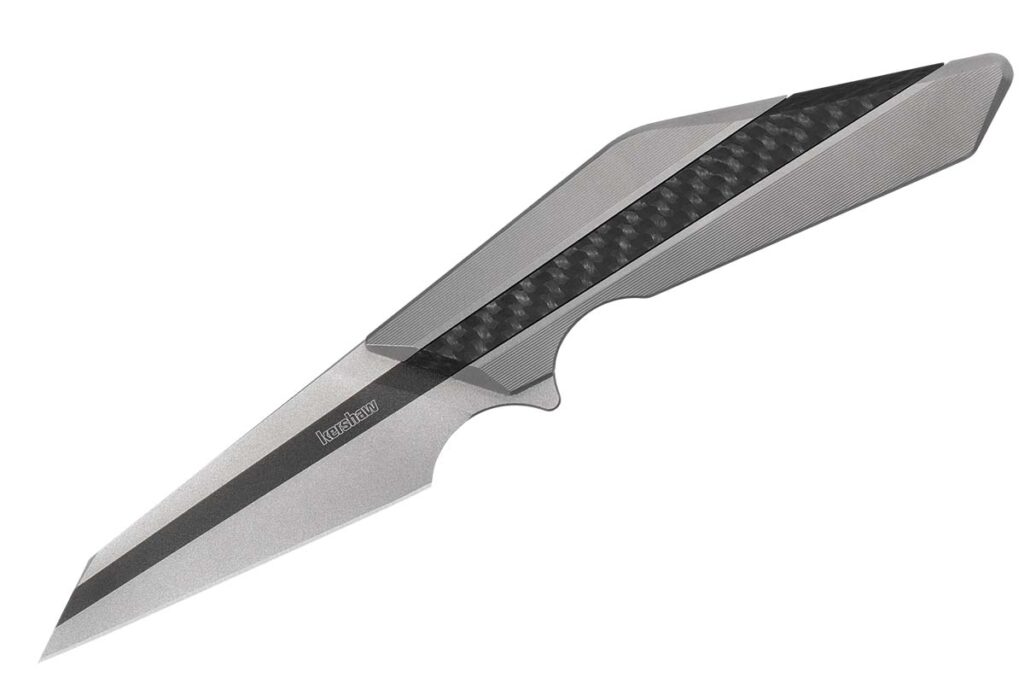
Knife type: Folder Blade length: 3.65” Blade steel: CPM CruWear, 14C28N Rockwell hardness: 60-62 HRC Blade grind: Flat Blade @ thickest: .156” Blade pattern: Composite Blade finish: Bead-blasted Blade opener: Flipper tab Handle material: Titanium Lock: Sub-Frame Pivot materials: KVT ball-bearings Pocket clip material: Titanium Weight: 5.7 ozs. Closed length: 5.8” Knife to know: Carbon fiber inlay front and bank; hidden hardware Country of origin: USA MSRP: $500 Available: NOW
A.G. Russell Knives Premium Scout
Model type: Traditional slipjoint pocketknife Designer: A.G. Russell Main blade length: 2 5/8” Blade steel: VG-10 stainless Rockwell hardness: 59-61 HRC Blade grind: Flat Blade @ thickest: .09” Blade pattern: Spear point Blade finish: Satin Blade opener: Nail nick Handle material options: Stag and red saw-cut bone Weight: 3.5-3.7 ozs. Closed length: 3 3/4” Special features: Can opener, screwdriver, caplifter & leather punch Country of origin: China MSRP: $74.95-$94.95 Available: NOW
CobraTec Koonsman
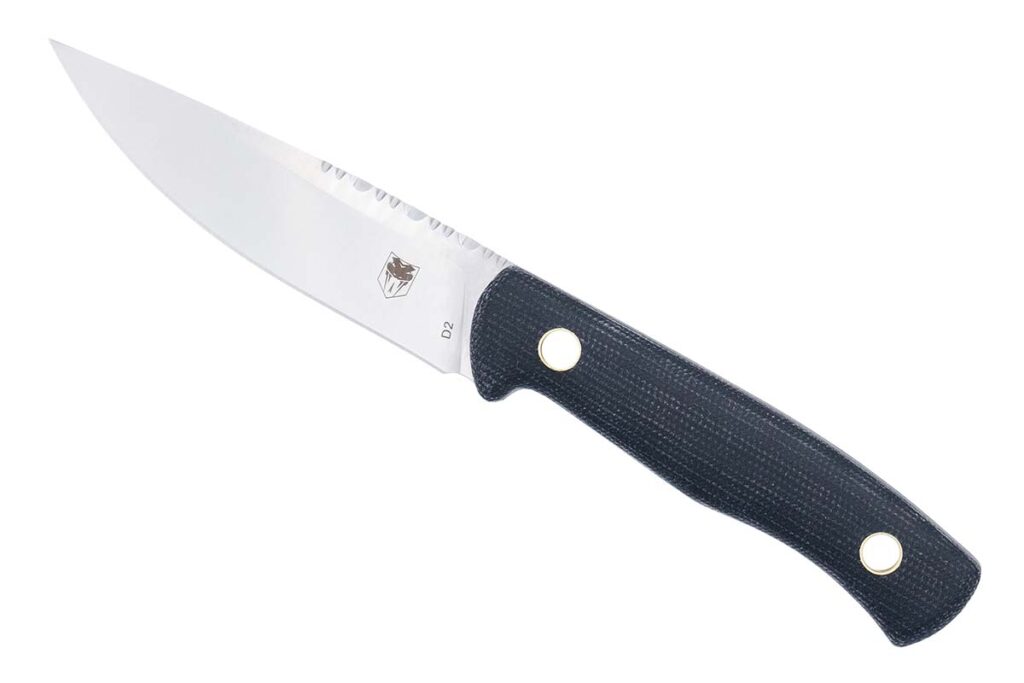
Knife type: Fixed-blade hunter Designer: Chad Cochran Blade length: 4” Blade material: D2 tool steel Rockwell hardness: 61 HRC Blade grind: Convex Blade @ widest: 1.125” Blade pattern: Drop point Blade finish: Satin Construction: Full Tang Handle material: Micarta® in color options of black, green and tan Weight: 5.7 ozs. Overall length: 8.4375” Sheath type and materials: Belt/pouch and leather Country of origin: China MSRP: $79.99 Available: NOW
Bradford USA Gatsby
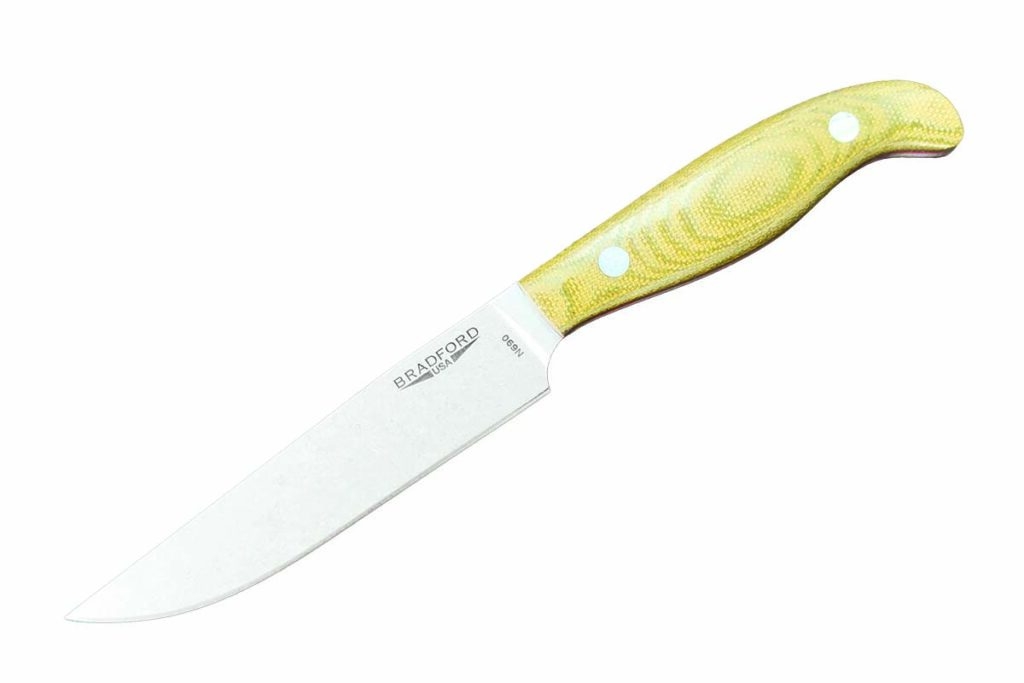
Knife type: Specialty steak knife Blade length: 4.5” Blade steel: N690 stainless Rockwell hardness: 61 HRC Blade grind: Full height flat Blade @ thickest: .11” Blade finish options: Stonewash and high polish Handle material options: Maroon, wheat, ivory canvas Micarta® and carbon fiber Overall length: 8.5” Country of origin: USA MSRP: $199 Available: NOW
Spyderco Techno 3
Knife type: Folder Designer: Marcin Slysz Blade length: 2.64” Blade steel: CTS XHP stainless Blade grind: High flat Blade @ thickest: .127” Blade pattern: Drop point Blade finish: Satin Blade opener: Flipper Handle material: Titanium Lock: Reeve Integral Lock (R.I.L.) Pivot material: Ball bearings Pocket clip material and type: Titanium, right-handed, tip-up Weight: 3.3 ozs. Closed length: 3.7” Country of origin: Italy MSRP: $400 Available: To be announced
Boker Plus Cutweazle
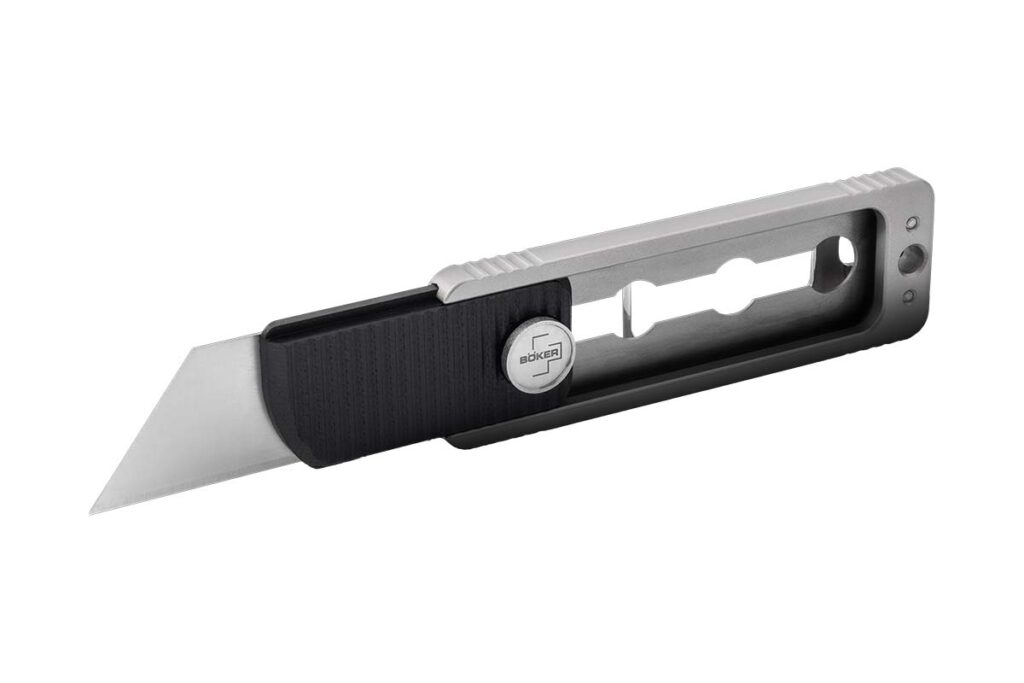
Knife type: Utility Designer: Ben Logan/Turnback Knife Co. Blade length: 1.18” Blade steel: Standard replaceable stainless utility blade Blade grind: Flat Blade @ thickest: .03” Blade finish: Satin Handle material: G-10/stainless steel Lock: Button lock Blade opener: Thumb slide Pocket clip material and type: Stainless steel, deep carry, right-handed, tip-down Weight: 1.38 ozs. Closed length: 3.7” Special features: Push button on slide lock allows the blade to be pushed forward in stages or in a single movement and locked in the predetermined recesses; retracts into the handle when pushed again w/a sliding movement Country of origin: China MSRP: $56.95 Available: September 2024
Browning Primal Scalpel 2-Blade
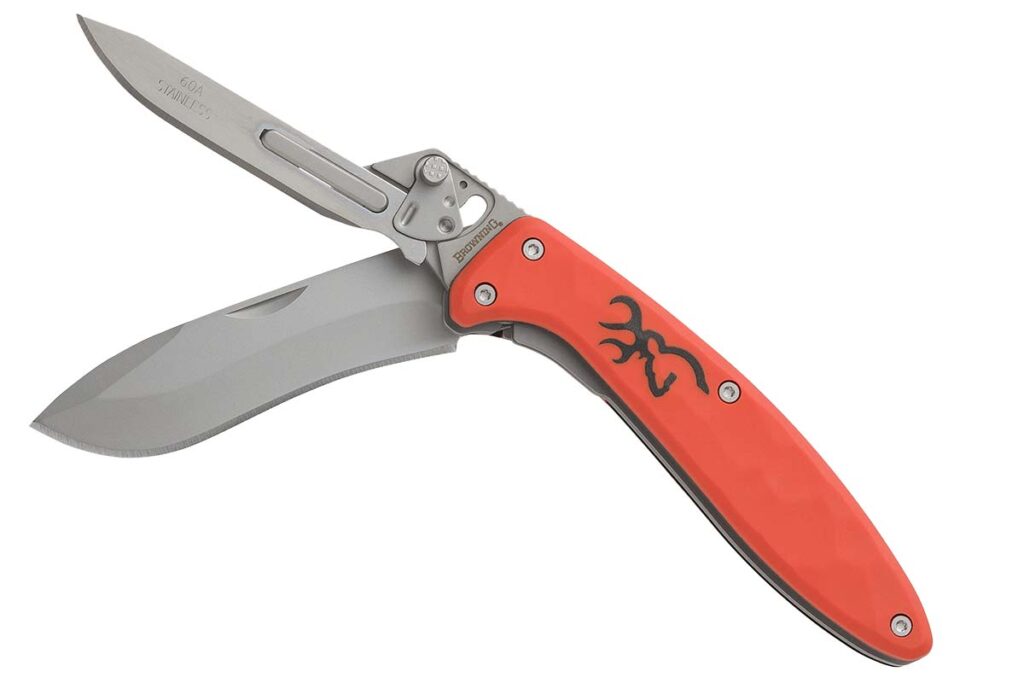
Main blade length: 2.75” Blade steel: 420-J2 stainless Rockwell hardness: Scalpel 50-55 HRC, drop point 55-59 HRC Blade openers: Thumb stud and nail nick Lock: Linerlock Handle: Synthetic in orange or black Pocket clip: Tip-up Closed length: 4 1/8” Country of origin: China MSRP: $59.99 Available: NOW
Stroup Knives MK2
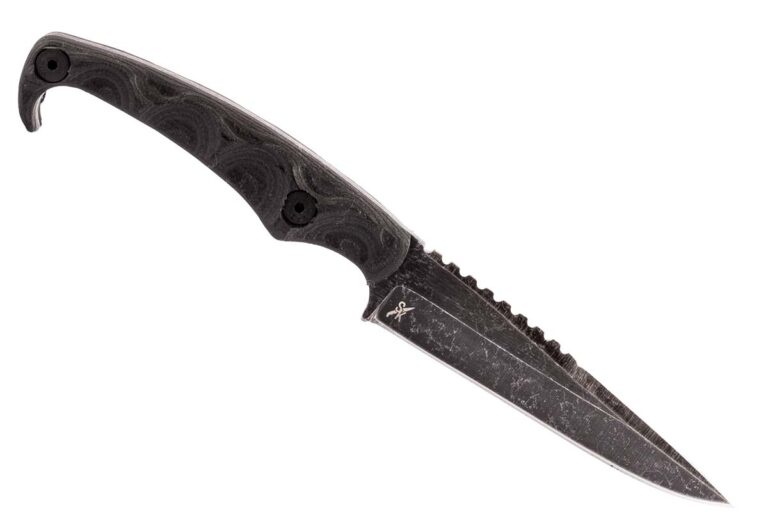
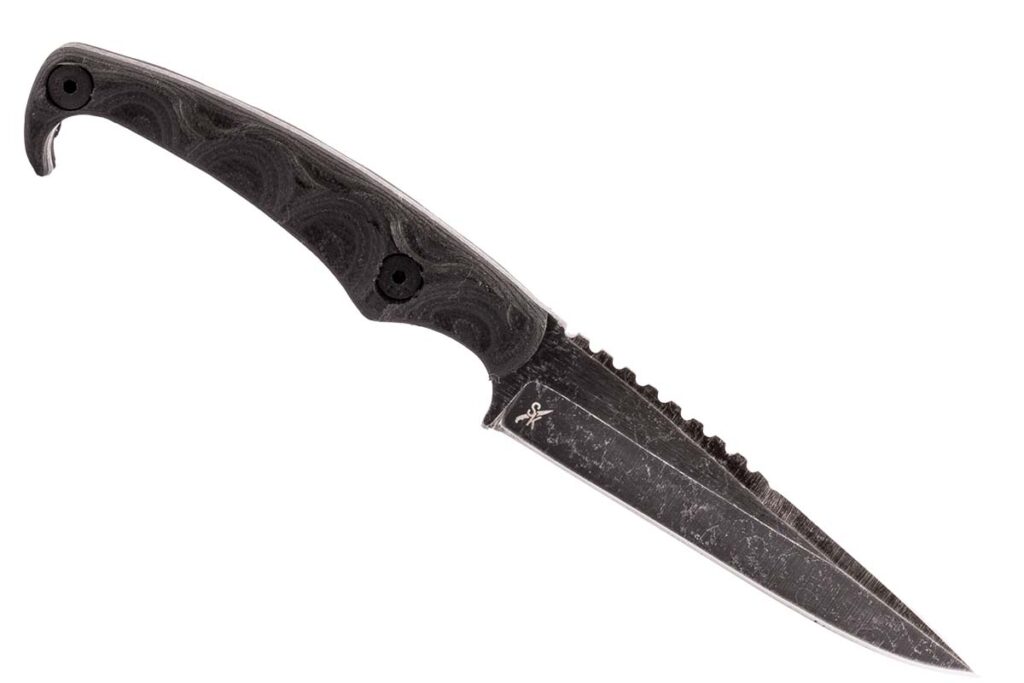
Knife type: Fixed blade Designer: Unnamed active-duty Tier 1 Operator Blade length: 4” Blade material: 1095 carbon steel Rockwell hardness: 58 HRC Blade grind: Flat Blade @ thickest: 3/16” Blade pattern: Spear point Blade finish: Acid etched & rock tumbled Construction: Full Tang Handle material: G10 & nitrile Pocket clip: Designed by Discreet Carry Concepts, Inc. Weight: 4.2 ozs. Overall length: 8” Sheath material: Kydex Knife to know: The nitrile in the handle provides extra grip, especially when wet Country of origin: USA MSRP: $279.99 Available: NOW
Lionsteel Twain
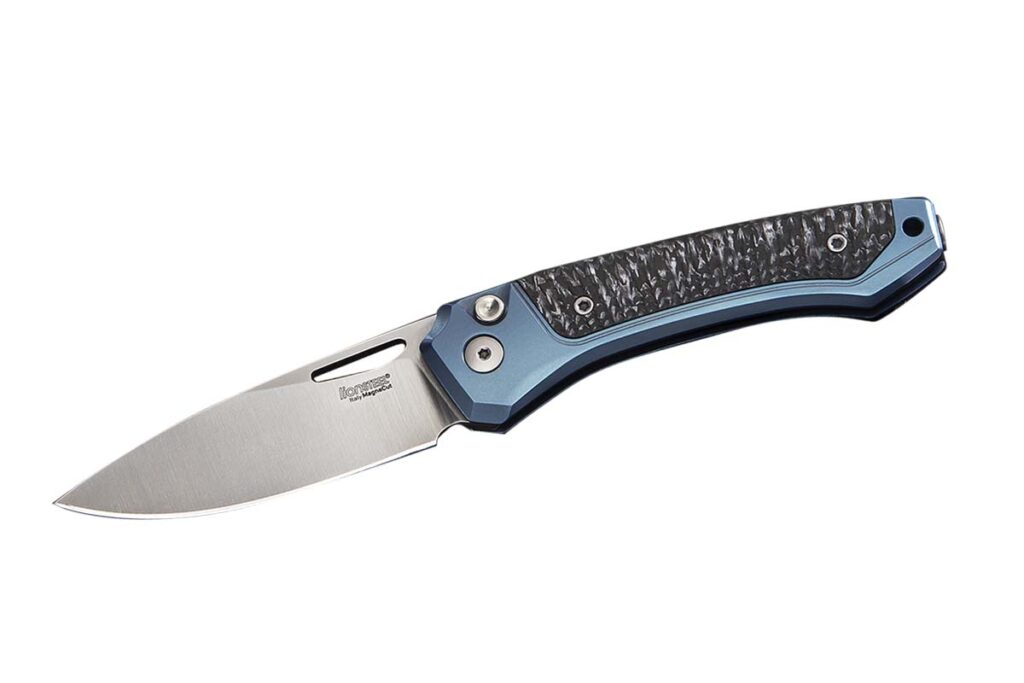
Model type: EDC folder Blade length: 3.15” Blade steel: CPM MagnaCut stainless Blade grind: Flat Handle material: Titanium + carbon fiber or Micarta® Lock: Button lock Pocket clip type and material: Bent steel Special features: Double Solid construction (integral frame and integral handle) Weight: 3.03 ozs. Closed length: 4.14” Country of origin: Italy MSRP: $380 Available: NOW
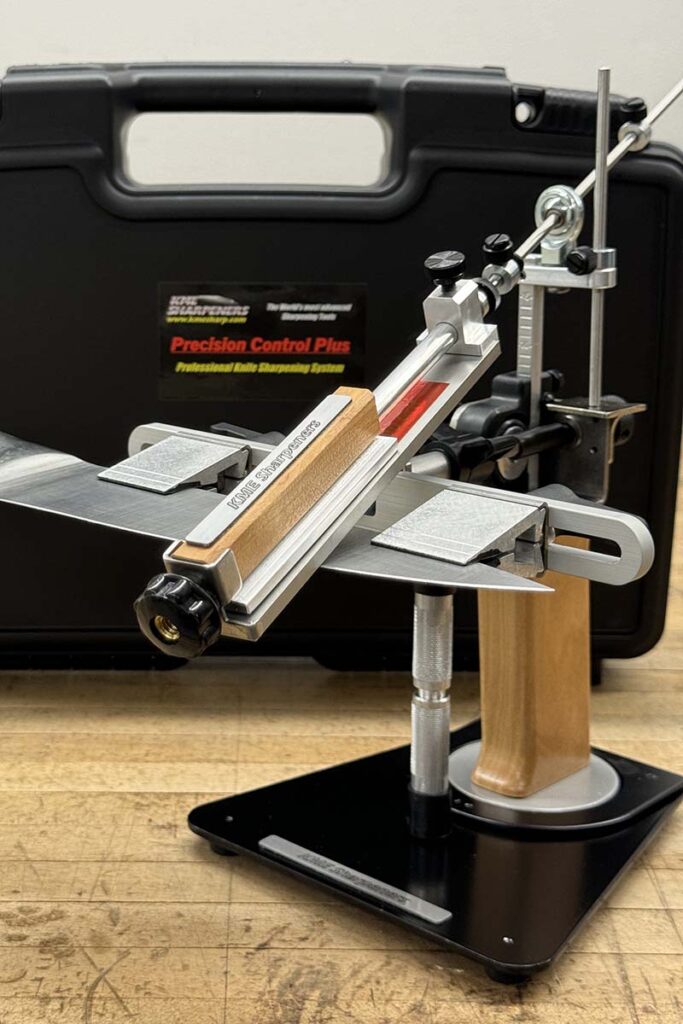
KME Precision Control Plus/Professional Knife Sharpening System
Abrasive type: Diamond-coated stones Grit assortment: 140, 300, 600, 1,500 Dimensions: 13” x 12” x 8” Construction materials: CNC-machined, anodized aluminum components, laser-cut, powder-coated steel base, CNC cherry hardwood grip, stainless-steel-backed diamond stones Weight: 2 lbs., 13.9 ozs. Blade sizes sharpened: Maximum-blade-thickness saber grind 3/8” or more and full flat grind 3/16” Angle range: 10 to 45 degrees per side Special features: Smooth friction-drive angle system w/micro adjustment feature; operates w/one hand and absolute angle control; rod end guide w/360° rotation; threaded Monopod brace provides rock-solid sharpening platform; adjustable stone carrier w/magnetic plate for angle cube sharpening uses any stone between 4” and 6”; full line of accessory stones, strops and diamond lapping films in both 4” and 6” lengths Country of origin: USA MSRP: $474.95 Available: NOW
CIVIVI Biophase
Knife type: Folder Blade length: 3.48” Blade steel: Nitro-V stainless Rockwell hardness: 58-60 HRC Blade grind: Hollow Blade @ thickest: .12” Blade finish: Black stonewash (satin finish and black stonewash w/satin flat and damascus are optional) Handle material: Aluminum & G-10 Lock: Button lock Blade opener: Flipper tab Pivot materials: Stainless steel pivot w/caged ceramic ball bearings Pocket clip material and type: Stainless steel, tip-up, ambidextrous Weight: 2.61 ozs. Closed length: 4.67” Country of origin: China MSRP: $98.70 at press-time exchange rate Available: Late summer
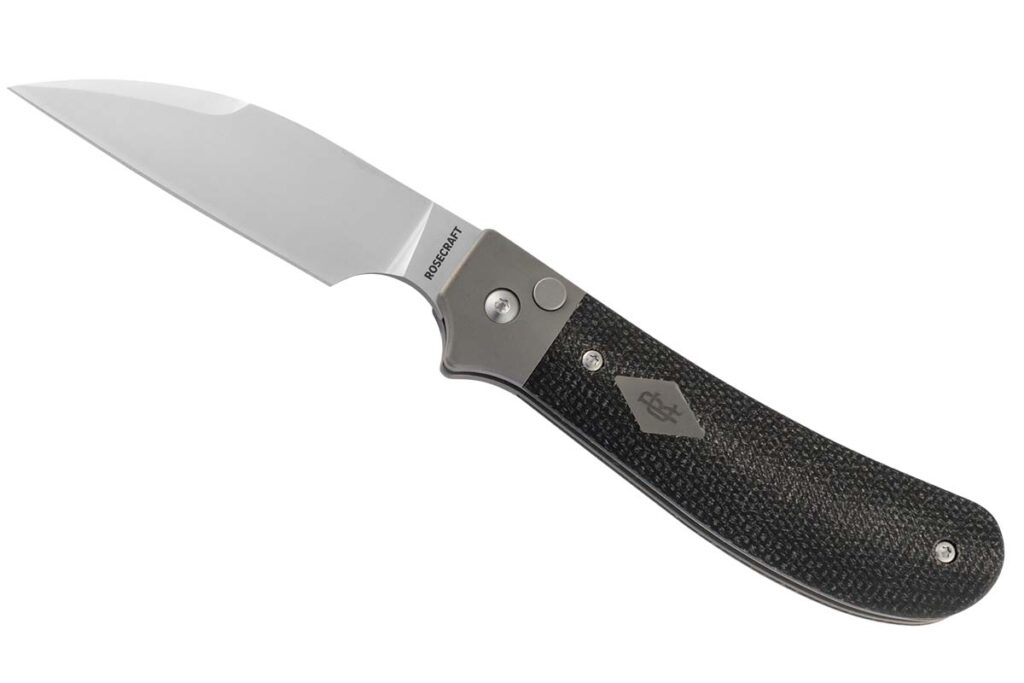
RoseCraft Clinch River Button Lock
Model type: Modern/traditional pocketknife Blade length: 3.125” Blade material: M390 stainless Blade grind: Flat Handle material: Micarta® or Ultem w/titanium bolster & liners Lock: Button lock Pocket clip material: Titanium Knife to know: Modern take on the Clinch River Swayback that won BLADE Magazine 2023 Imported Knife of the Year®; opens and closes via a button lock Weight: 2.8 ozs. Closed length: 4” Country of origin: China MSRP: $129.99 Available: NOW
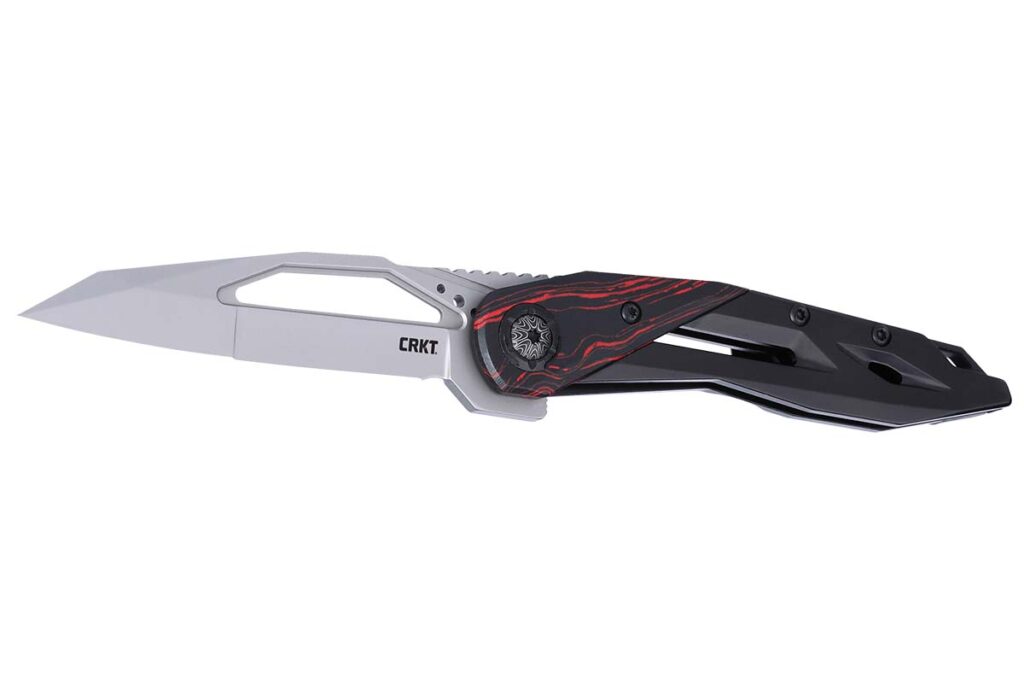
CRKT Nucleus
Knife type: Folder Designer: Princeton Wong Blade length: 3.19” Blade steel: 12C27 stainless Rockwell hardness: 58-60 HRC Blade grind: Flat Blade @ thickest: .13” Blade pattern: Reverse tanto Blade finish: Bead blast Construction: Screw Handle material: Stainless steel w/G-10 overlay Lock: Framelock Blade openers: Front and rear flipper tabs & blade hole Pivot material: Ikoma Korth Bearing System (ball bearings) Pocket clip material and type: Stainless steel; tip-up Weight: 3.1 ozs. Closed length: 4.19” Country of origin: China MSRP: $113 Knife to know: The knife opens three ways: front and rear flipper tabs and via the blade hole Available: NOW
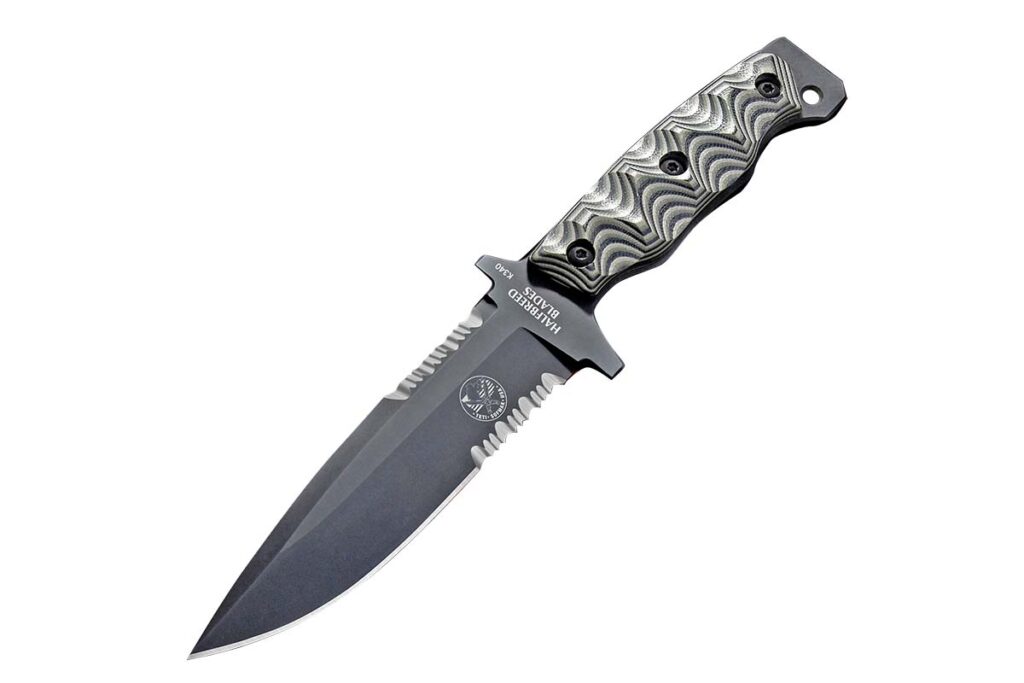
Halfbreed MIK-04 SOFMAK
Knife type: Fixed blade Blade steel: K340 stainless Rockwell hardness: 59-60 HRC Blade finish: PVD coat Blade style: Drop point Blade length: 5.31” Blade @ thickest: .25” Handle material: G-10 Weight: 11.14 ozs. Overall length: 10.31” Sheath material: Injection molded plastic Mounting: Belt & PALS/MOLLE (DOTS) Country of origin: Comprises Australian & Taiwanese make MSRP: $285 Knife to know: The knife is a collaboration between Halfbreed and Joseph Teti, Force Recon Marine and Army Special Forces Green Beret veteran and former operative with the CIA Special Activities Division/Special Operations Group; MIK stands for medium infantry knife and SOFMAK for special operations forces multi-purpose assault knife MSRP: $285 Available: September 2024
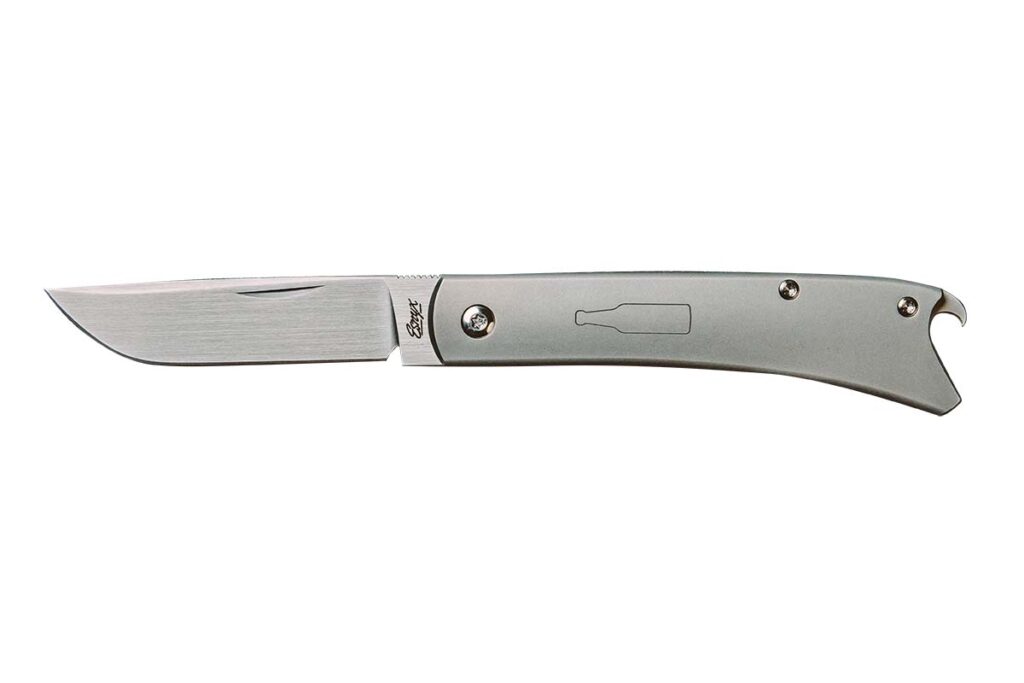
ESNYX Silver Line Beer Buster Jr.
Knife type: Slipjoint Blade length: 2.63” Blade steel: M390 stainless Blade @ thickest: .125” Blade grind: Flat Blade pattern: Drop point Blade finish: Handrubbed satin Blade opener: Nail nick Handle: Blasted titanium Weight: 2 ozs. Closed length: 3.5” Country of origin: China Knife to know: Slipjoint has half stop; bottle-shaped handle shield; bottle opener in butt MSRP: $265 Available: NOW
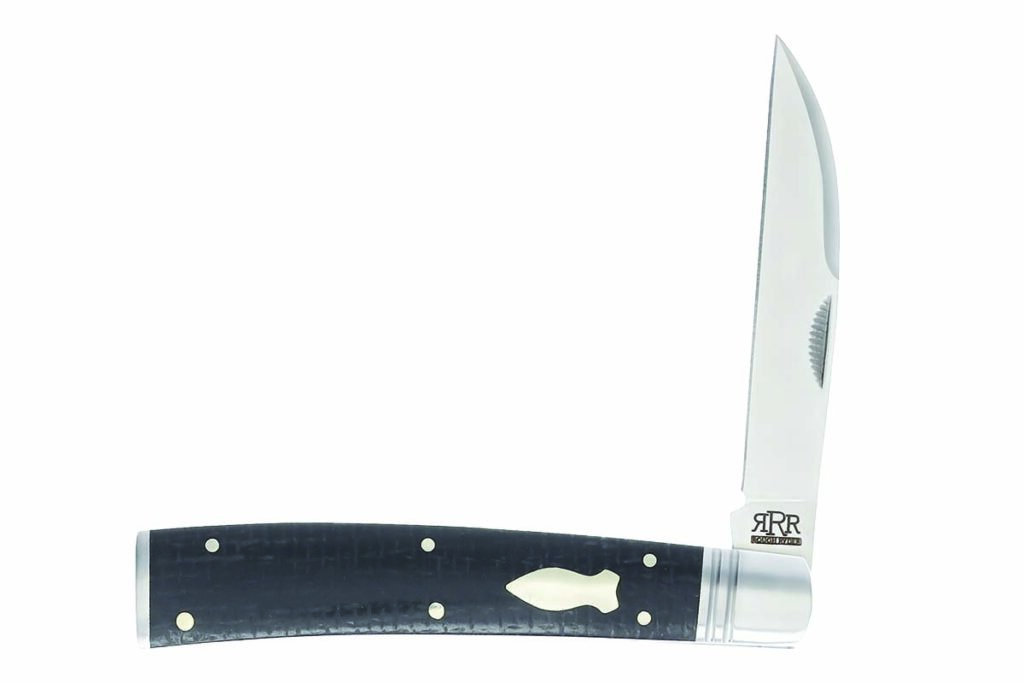
Rough Ryder Reserve Whiskey Ryder
Knife type: Swayback doctor’s knife slipjoint Designer: Brian Wilhoite Blade length: 3.5” Blade material: D2 tool steel Blade @ thickest: 3/16” Blade pattern: Wharncliffe Blade finish: Brushed satin Handle material: Black burlap Micarta® Weight: 3.2 ozs. Closed length: 4.5” Special features: Slipjoint features half stop Country of origin: China MSRP: $54.99 Available: NOW
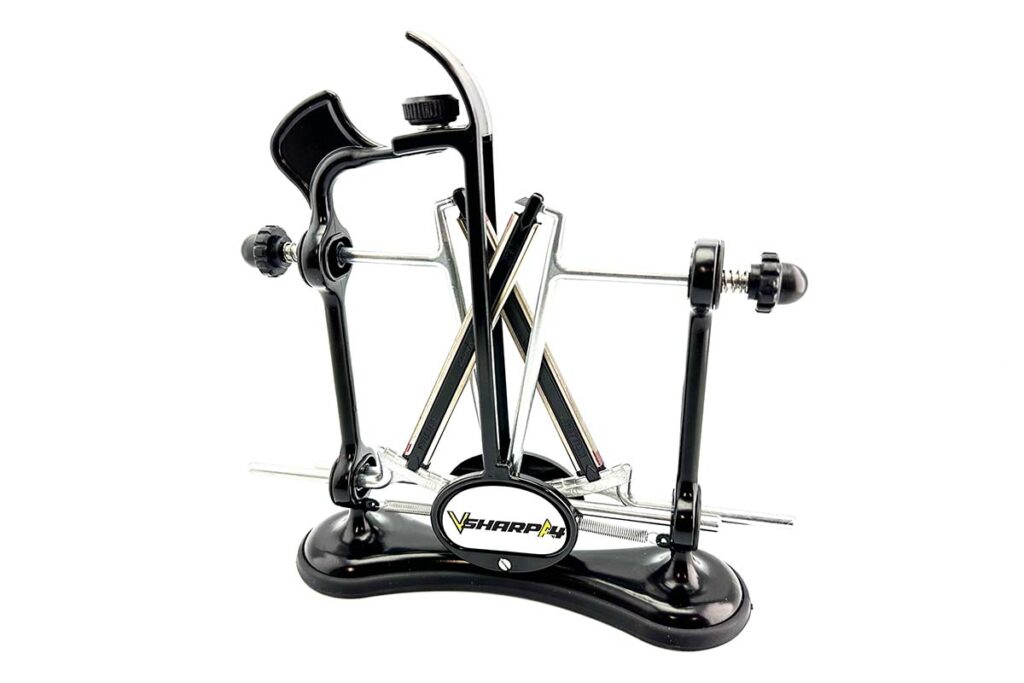
Warthog V-Sharp A4 Model
Sharpener Type: Patented V-Sharp spring-loaded pull-through Abrasive Type: Diamond-coated Grit selection: 325 grit natural diamond hone & hardened hone steel for finishing the edge (270, 325, 600, 1,000 and ceramic hones available) Dimensions: 8.75” x 8.25” x 2.25” Construction Materials: Lightweight zinc-cast metal frame, non-slip rubber base and durable powder coat finish Weight: 1.1 lbs. Special Features: Four adjustable sharpening angles: 15, 20, 25 & 30 degrees Types of blades sharpened: All plain-edge knives; serrated knives can be sharpened w/the ceramic hones Country of origin: South Africa MSRP: $109.99 Available: NOW
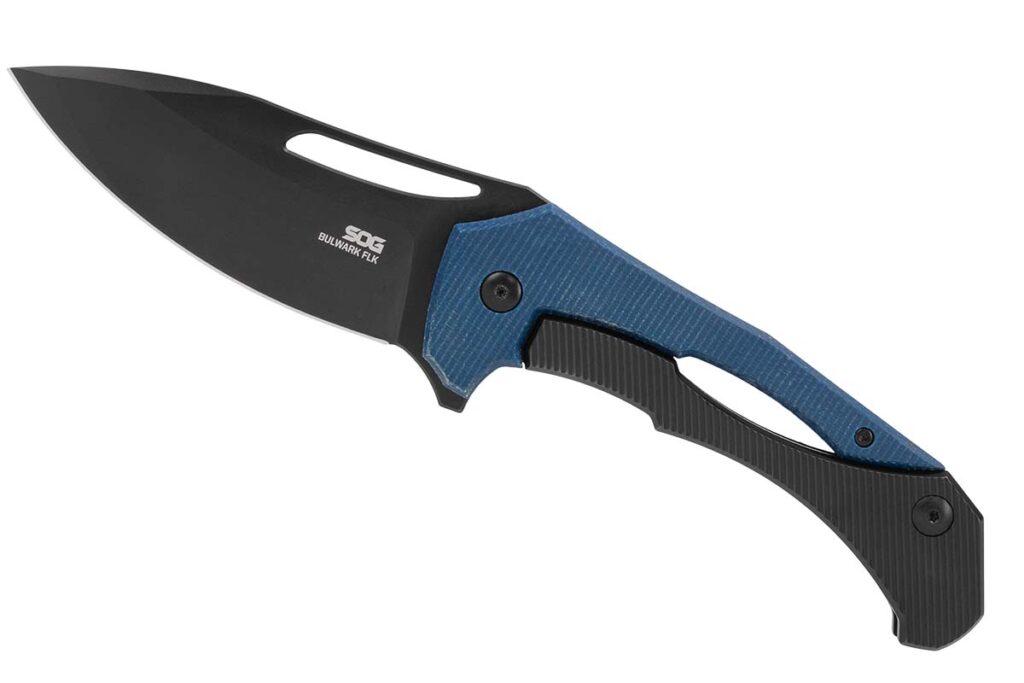
SOG Knives Bulwark
Designer: Mikkel Willumsen Knife type: EDC flipper folder Blade length: 3” Blade material: D2 tool steel Blade grind: Hollow Blade @ thickest: .14” Blade finish: Black PVD coat Blade pattern: Drop point Blade openers: Flipper tab and blade hole Handle material: Micarta® in blue and OD green color options Pocket clip: Tip-up Lock: Framelock Weight: 6.25 ozs. Closed length: 4.2” Country of origin: China MSRP: $134.99 Available: Late summer 2024
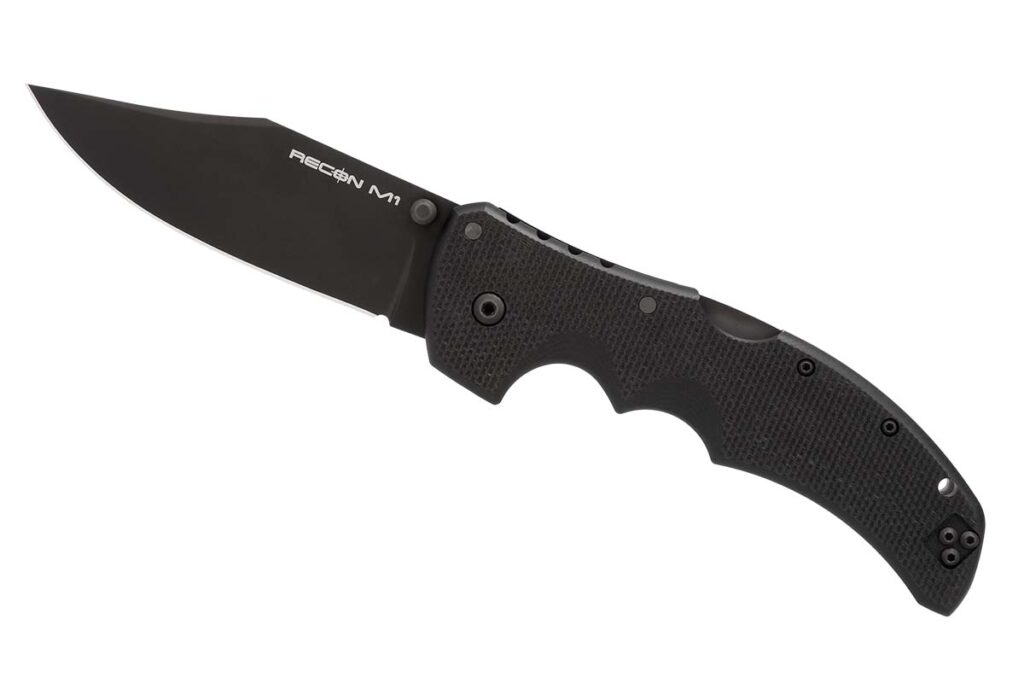
Cold Steel Recon M1
Knife type: EDC folder Blade length: 4” Blade steel: CPM MagnaCut stainless Blade finish: Stonewash Blade pattern: Clip point Handle material: G-10 Lock: Tri-Ad Pocket clip: Yes Weight: 5.2 ozs. Closed length: 5.5” Country of origin: Italy MSRP: $259.99 Available: NOW
Somewhere between an EDC and a gentleman’s knife, the ACE Bleecker looks to be a slick sidekick.
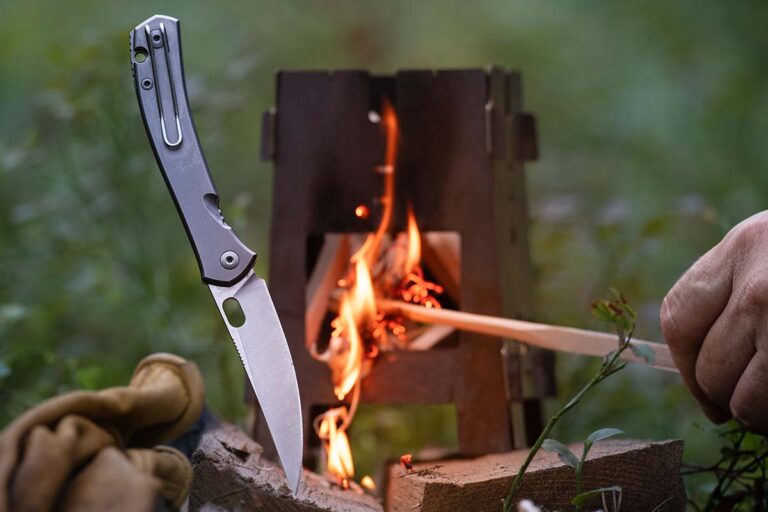
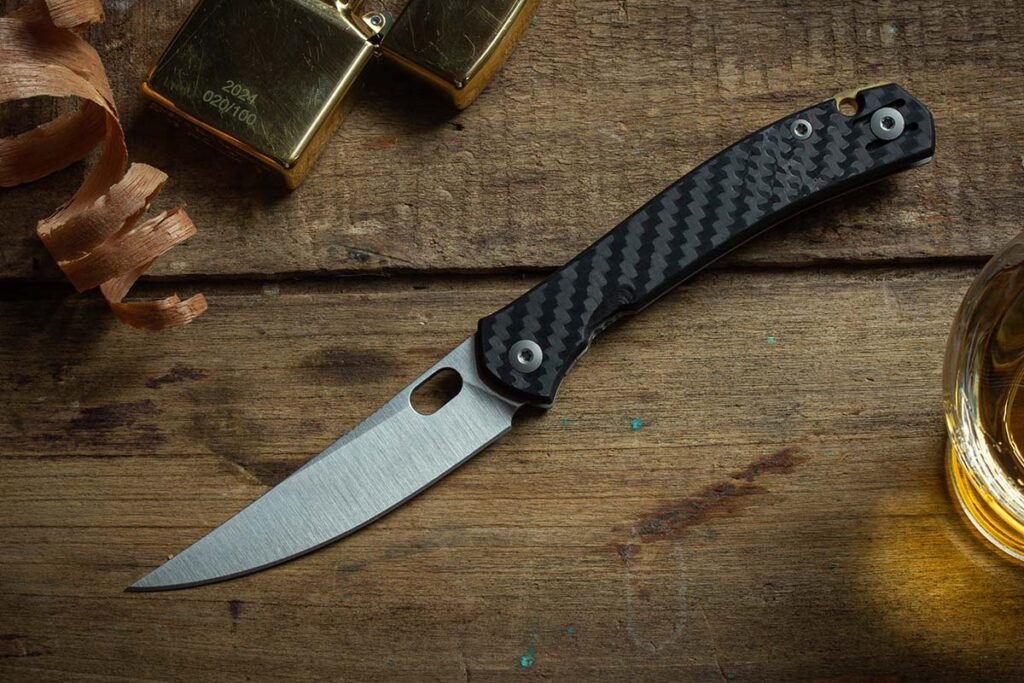
Giant Mouse is going gentlemanly but with an attitude. At least, that appears to happen with the newest addition to its catalog—the ACE Bleecker.
Named after Manhattan, N.Y.’s trendy Bleecker Street, the company seems to aim the frame lock toward hipsters’ hip pockets. The same with the sleek, yet somewhat understated lines. However, robustly built with premium steel and components the Italian import likely has the chops to pull off EDC duty—at least for those who tend to smaller knives.
Right off the bat, the notable aspect of the ACE Bleecker is its slim design accentuated by a trailing point blade. In many respects, it’s reminiscent of Giant Mouse’s Knife of the Year award-winning GMX, only smaller and without an integral handle. Despite its svelteness, the company has ensured the knife is capable of more than cutting the foil off wine bottles by making the handle full-sized. It is a bit skinny in the hand, yet it nestles in the palm well enough to handle more aggressive cutting duties.
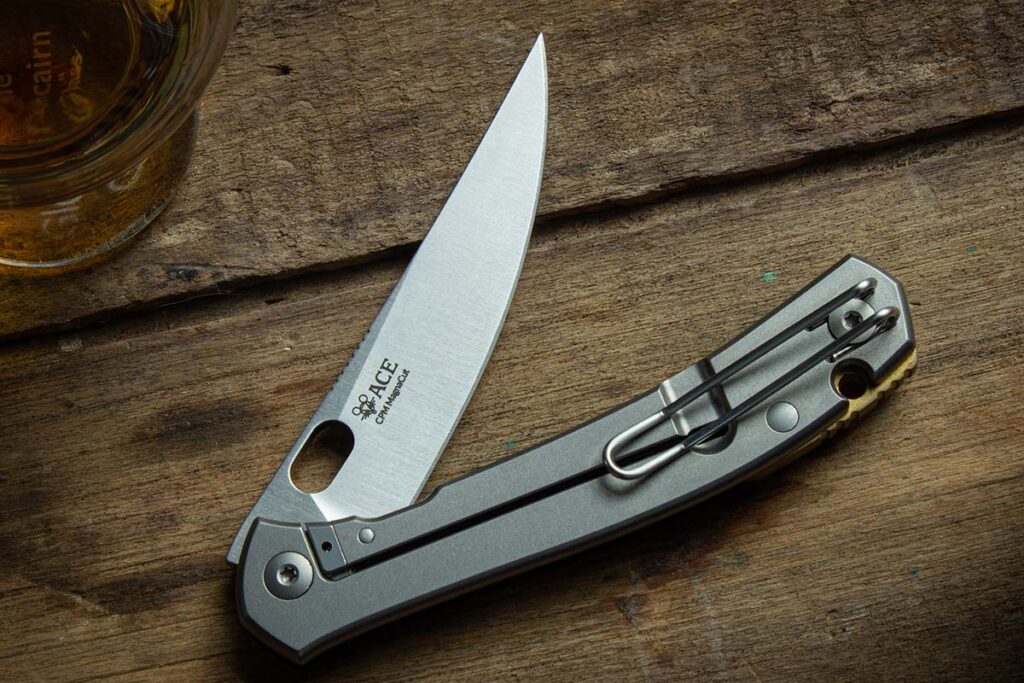
Giant Mouse went top-shelf for the blade steel, choosing Magnacut—albeit a softer version than some prefer. The company rates it at 62 HRC, a facet that might raise the hackles for the edge-retention obsessive. That aside, the geometry of the 3.26-inch blade is exquisite with a thick(ish) spine adding toughness to the design. The tip doesn’t jut too far above the spine, allowing users to choke up on the blade for finer work. And, boy howdy, should it ever prove apt at fine work, with a very fine tip.
The company has opted for a thumb hole as the opening mechanism on the Bleecker but has made it oblong. The choice is for more than aesthetics, making the knife deployable not only in the traditional style—the thumb—but also in reverse open. As an added benefit, this also makes the knife relatively left-hand friendly. The Bleecker’s well-tuned detent also goes a long way in adding to all these aspects—not so light as to facilitate a negligent deployment, but not overly stiff where users will struggle to get the blade to work.
As for the handle, Giant Mouse offers two options—titanium and carbon fiber. Both are attractive, though I tend to the titanium as it gives the knife more overall continuity and class. In both cases, the knife tips the scales at right around 2 ounces—the titanium a hair more—and measures at 7.43 inches in overall length. Worth note, Giant Mouse includes a notch on the thumb side and a chamfer on the lock that go a long way in making opening the knife simple. Also, it boasts a reversible wire pocket clip for tip-up carry.
With a gentleman’s design comes a gentleman’s price on the Bleecker. Giant Mouse lists the titanium model at $285 and the carbon fiber version at a slightly more affordable $245.
Daryl Meier’s star pupil pays tribute to a mentor who taught him oh so well.
Daryl Meier is a pattern-welding legend. He has influenced more modern pattern-welding experts than almost anyone I know, both in the USA and worldwide.
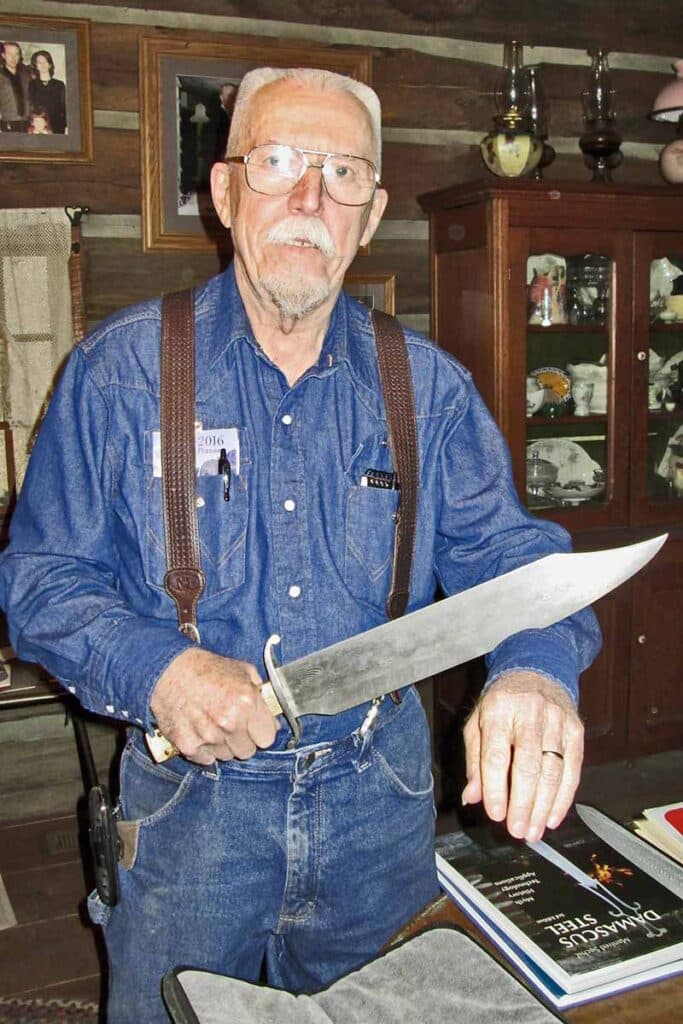
Daryl Meier in 2016 holding his American Spirit Bowie. (Tony Mannucci image)
Daryl was born just outside Carbondale, Illinois. In 1958 he moved into the small city, which is situated in the southern part of the state. There wasn’t much to see in Carbondale back then, though a local blacksmith worked there. It was in the blacksmith’s shop that Daryl developed an interest in forging which influenced his entire future career.
He influenced my work at levels I can’t even begin to explain.
Damascus Knife Renaissance
I started forging blades in 1972. I went to Alfred Pendray’s shop to learn how to forge weld and I was fortunate enough to learn from Alfred’s father, John Pendray, a master ferrier and a great blacksmith. Mr. John took a lot of the mystery out of the forge-welding process. To him, it was quite ordinary. He grew up doing it for a living.
There are many legends about pattern welding that have gone out of favor. It never really did. The history of pattern welding goes back unbroken for at least 2,000 years. Alfred told me that in the 1940s and ’50s, there were probably 40 or so ferriers around Ocala, Florida, alone who were putting tongs and hammers together out of different pieces of scrap steel of different alloys that, when etched, would show a pattern. This indicated the tongs and hammers were pattern welded, as far as I know, a common practice around any blacksmith shop or horse farm back in the day.
Pattern-welded material being used in knives in the USA began getting noticed in 1973. BLADE Magazine Cutlery Hall-of-Fame® member Bill Moran launched it all with the damascus knives he exhibited that year at The Knifemakers’ Guild Show in Kansas City.
Daryle Meier Cutting Edge Damascus
At the same time, Daryl began to put a group of guys together to research pattern-welded steel in Carbondale that included Daryl, Jim Wallace and Bob Griffith. The research involved extremely complex patterns stemming from the Merovingian culture (circa 450-750 A.D.). The pattern-welded material in Europe and Asia had continued to be produced for hundreds of years. There were several European makers in the 1800s and well into the 1940s actively making blades from the material (see “Who Made the First Damascus,” January 2015 BLADE®).
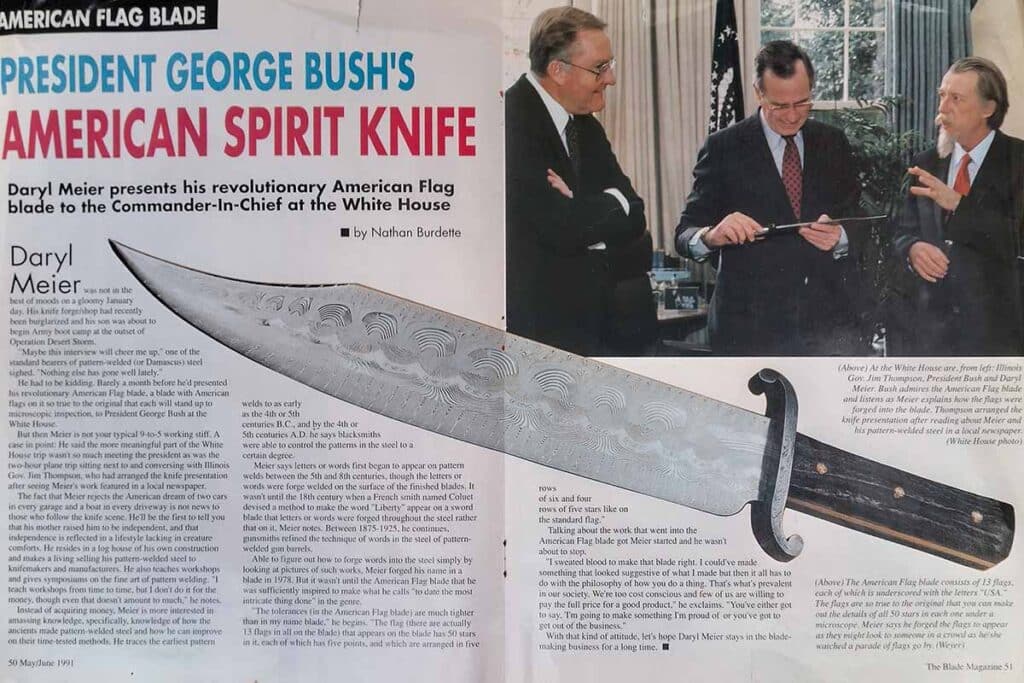
Daryl Meier made the American Spirit Bowie for President George H.W. Bush and presented it to the president at the White House in 1990. The story appeared in the May/June 1991 BLADE®.
The renaissance in America came in the early 1970s with Moran. A short time later, along with bladesmiths Bill Bagwell and Don Hastings and Cutlery Hall-of-Famer B. R. Hughes, Moran founded the American Bladesmith Society (ABS) in 1976. Moran made some simple pattern-welded knives and reintroduced the material to the knife industry. Through the ABS he spread the knowledge of pattern-welded steel to many.
Daryl and his crew were doing their research on very complex-style pattern welding in the early ’70s. They focused on redeveloping the complex techniques of the ancient smiths. Daryl was a great influence on Alfred Pendray, me and almost every other maker of pattern-welded material. As far as I know, Daryl was the first one who made steel for other knifemakers. There may have been some others making steel for other knifemakers—I don’t know for sure. If there were it was just a handful of guys, maybe a dozen or so, but by the early ’90s there were over 300 such makers producing steel in the USA.
Meier As A Teacher
I was extremely excited whenever I had the chance to talk to Daryl. I met with him on several occasions. Pendray and I stopped by Daryl’s shop on the way to a Kansas City Guild Show one year, and we were able to see his operation and gained a lot of useful information from him. Around 1982 I attended a big hammer-in held in Birmingham, Alabama, and Daryl was there. I’d been making pattern-welded steel for a while. I also was doing some mosaic damascus.
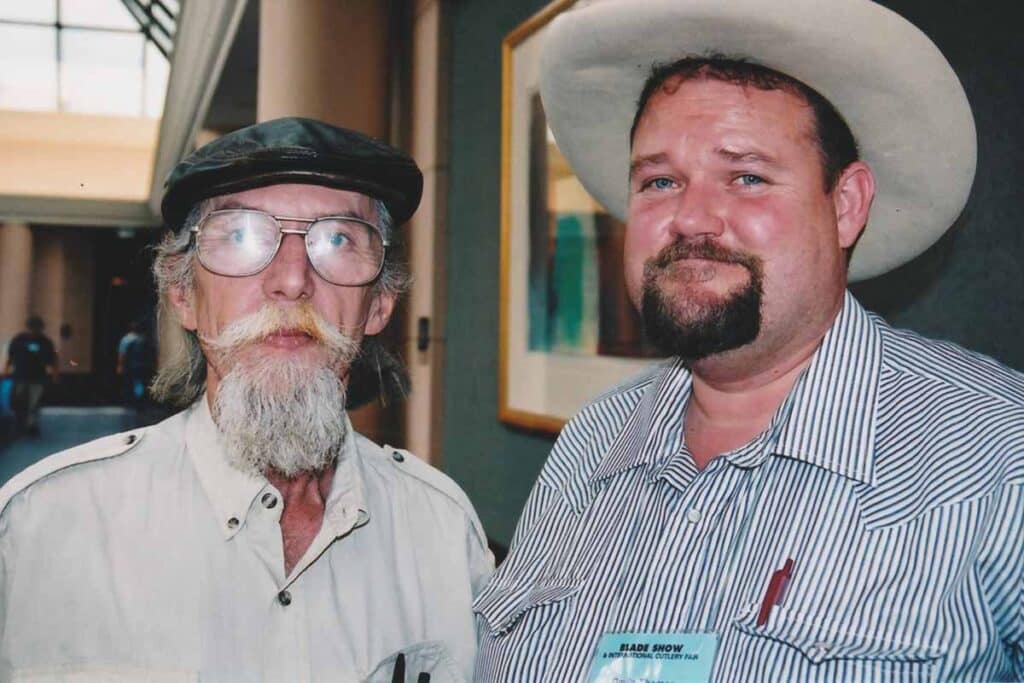
Daryl Meier (left) and BLADE Magazine Cutlery Hall-of-Fame® member Devin “Hoss” Thomas (right)—captured here at a past BLADE Show—comprise what is arguably the most dynamic duo of damascus makers in modern custom knife history.
Daryl was introducing me to a young man and I’m almost positive the young man was Rick Smith. He came up and they asked me how I did a particular pattern and when I explained how I did it, Daryl corrected me immediately. He said you don’t understand, Rick has his “ticket.” I said what’s his “ticket”? The young man immediately showed me a small slab of mosaic that had beautiful little chrome steps going up to a patterned center and a bar. He and I spent two hours together exchanging ideas. The lesson I learned: there were a lot of people working on mosaic damascus material who I did not know.
Later, as Daryl and I began to work on canister mosaic as a way to get around hot isothermal pressing, I devised a plan to use refrigeration hoses to introduce gas into the canister. I’d worked out this elaborate system with vacuuming and gassing, and, having experienced great success welding with very low temperatures, I could not wait to share the discovery with Daryl. He listened very patiently as I outlined the gear I used and said to me, “Well, what I do is add three or four drops of diesel or hydrocarbon [fuel] to my canister and I don’t have to use all that gear because the hydrocarbon will scavenge all the oxygen”—which is the bad thing, so my bubble was burst. It was one of many occasions where I approached Daryl with a new idea and he said either he thought it would work or, “I have a piece of that on my bench from a few years ago.” He has a great method of teaching.
Meier’s As An Innovator
Daryl was a great innovator and about 1990 made a knife called the American Spirit Bowie. Each side of the blade has 13 American flags all along its length with all 50 stars in each of them, and USA reading correctly from left to right no matter which side of the blade you viewed. It took Daryl 18 months and over 800 hours to build the blade, which he presented in person to President George H.W. Bush in the White House (see May/June 1991 BLADE®).
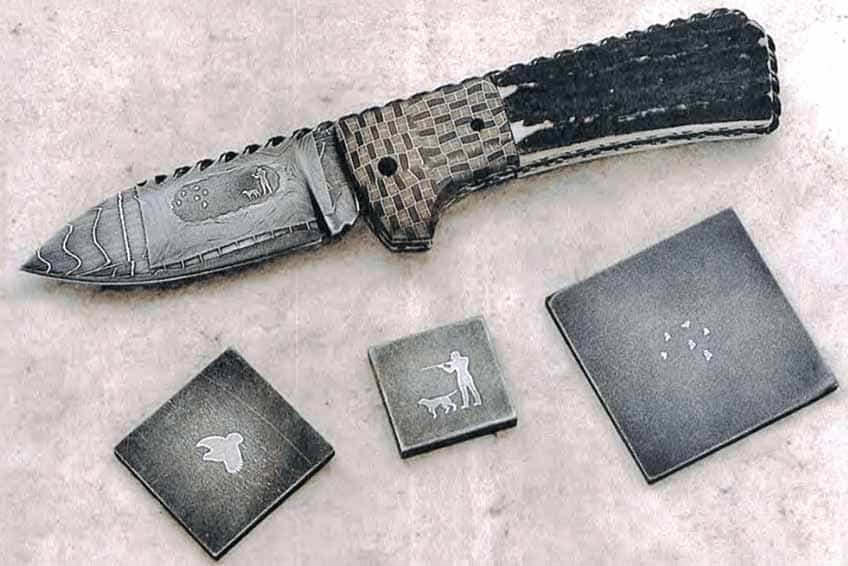
The Hunter’s Dream by the author is believed to be the first time anyone forged a scene into a mosaic damascus blade—and Daryl Meier played a large role in inspiring the author to do it.
Without doubt, Daryl’s work has influenced more makers than almost anyone else in the modern history of pattern welding. He’s still on the planet and still teaching from time to time. He’s done thousands of workshops over the years that added to the knowledge base of the entire industry. His presence influenced my work in more ways than I can count.
One of the major things he did for me was to push me to the limit of my abilities. After all, doing the easy stuff does not make you grow.
I made several panel blades consisting of all kinds of laminating and experimented with different patterns. I did some electrical discharge machining (EDM) work and Daryl used a bit of EDM in the American Spirit Bowie. He told me I should “make something real,” and that’s how my mosaic damascus shooting scene blade showing the hunter with his dog and the quail in flight came about. It was one of the most intense projects of my career.
Final Cut
Daryl’s students are legion and are some of the very best of the best—all the old guys that are considered the ancients, myself included, and a lot who are gone. A few of us are still around and Daryl was the guy we went to for information. We are standing on the shoulders of giants and one of the earliest ones is Daryl Meier. He may not give you a recipe for a cool new pattern, but he would give you the inspiration to go forward and explore it. He would always say the easy stuff does not make you grow. This is one of the main reasons I still teach because he took time with me.
Bladesmiths outline which carbon steel combos they use and why.
Damascus steel is a broad category with nearly infinite variations. It includes everything from low-layer random patterns to powdered canister creations and complex mosaic patterns.
The basics of damascus include forge-welded combinations of steels. Changes in the steel choices, in the welding or forging processes, and even in the etching method result in a wide variety of patterns and looks. Let’s dive into the many levels of damascus through the work of a few excellent smiths.
Smiths Takes On Damascus Steels
ABS apprentice smith Chris McPherson began making knives only four years ago, but he had a strong start attending classes taught by ABS master smiths Jason Knight and Josh Fisher. Now he forges his own damascus. One of his fighters (IMAGE 1) features a blade of 1075 carbon and 15N20 nickel-alloy steels.
Image 2 ABS journeyman smith Brian Sellers used three steels instead of the standard two to help provide a darker look for his blade of ladder pattern damascus. As he observed, “Adding a third steel to damascus gives a unique depth to the finished blade, kind of like adding shades of gray to a tattoo.” (Jocelyn Frasier image)
“I made the knife for a local state trooper benefit, for the teenage son of an officer who lost his life in the line of duty in March 2023,” Chris explained. When asked about why he chose 1075 for his fighter, he said he “just wanted to try it out” after making other billets with 1095, 1084 and 1080 carbon steels. Though he’d heard that the 1075 may have a bit less contrast due to its lower manganese levels, it came out with beautiful contrast after a deeper etch.
Knifemaker Brian Sellers likes to mix things up a bit. In addition to the standard carbon steels of 1095 or 1084, Sellers occasionally includes 1080, 5160 or 52100. “Adding a third steel to damascus gives a unique depth to the finished blade, kind of like adding shades of gray to a tattoo,” he says. For example, in a recent Persian fighter (IMAGE 2), Sellers included 1080 and 5160 along with 15N20 in a ladder pattern blade. Brian indicated all the steels work well with his equipment. He uses a 50-ton Riverside hydraulic press and a 50-pound Little Giant power hammer.
Damascus is time and labor intensive, and the maker loses a good bit of the steel in the forging process. Bladesmith Blake Nichols knows this and is from the “waste not, want not” school of thought.
Robert Wayman uses a hydraulic press to weld and draw out his damascus billet.
“My mentor Greg Shahan gave me the end cut of a feather damascus billet a few years ago,” Nichols said. “It sat on my shelf for a long time before I incorporated it into [one of my] hunters.”
Regarding his damascus, he added, “I wish I had a profound scientific answer as to why I use 15N20 and 1095 but I do not. The simple answer is it’s what I learned on. I’m comfortable with the heat-treating process. I also feel like I get the performance out of that combination that I desire.” I agree with Nichols when he said, “No matter what it’s made of, it has to function like a knife. Even the fancy ones need to hold up to the performance standards.”
Why 15N20 In Damascus?
Image 3 For a great example of a go-mai (five layer) damascus blade with the visual “pop” of nickel, Robert Wayman provides the fireworks via his sujihiki. Damascus outer layers and a damascus core work together with the handle of live edge amboyna burl to make a stunning knife. Overall length: 16 inches. (SharpByCoop image)
You may have noticed one thing the featured bladesmiths all have in common: they include 15N20 in their damascus billets. The 15N20 is a simple carbon steel, basically 1075, but has a relatively large amount of a special ingredient: nickel. The nickel content makes 15N20 etch more slowly and show more brightly when polished. Because of the similar composition to the 10-series steels (1080, 1084, etc.), it welds well and hardens in similar temperatures, making it the perfect steel for high contrast in the damascus pattern.
Some smiths use pure nickel foil or sheet in their damascus for the same effect. The challenge is that the pure nickel won’t harden, so it must be kept away from the edge in the forging process. The contrast is great but the nickel itself won’t hold an edge. I like a nickel layer in between layers of san-mai or go-mai damascus. It really pops!
Bladesmith Robert Wayman illustrates the go-mai technique well on one of his kitchen knives (IMAGE 3). The blade was made from a patterned go-mai billet. There’s a core layer running down the center of the blade with two layers of material on each side. The core is 100-layer random pattern damascus forged from 1084 and 15N20. On each side of the core steel is a layer of nickel and on the outside of the billet is a layer of matching random pattern damascus.
Key Element Comparisons by Steel
Steel
1084
1075
1095
15N20
1080
5160
52100
C
.865
.750
1.000
.750
.75-.88
.60
.98-1.10
Mn
.750
.550
.450
.375
.06-.09
.80
.24-.45
N
—
—
.200
1.950
—
—
—
*C-carbon, Mn-manganese, N-nickel; the double hyphens indicate trace amounts. Note the relatively high amounts of nickel of the 15N20 and of manganese of the 1084, two elements beneficial for high contrast damascus. This chart is for the elements pertinent to the subject at hand only and does not list all the elements of each steel.
Once the final billet is forge welded, some of the cladding material is removed with a grinder to create a visual effect in the pattern, and then the billet is drawn out to length. Keeping the core material centered during the process is very important. “You want to take your time when laying out your billet,” Wayman advised. “I typically use a thicker core material and a thinner cladding material, but it’s definitely taken some time and practice to dial it in.”
Other Damascus Steels
Before 15N20 and 10-series combos became prevalent for damascus, one of the standard high-contrast combinations was O1 and L6 tool steels. While the latter combo makes great damascus, the two steels are harder to find in today’s market. Simply put, properly sized and affordable 15N20 and 10-series steels are much more available than all the other combos on the market.
Damascus can be made of many things, including other damascus. These component bars became part of Robert Wayman’s chef’s knife.
Copper is another material that has caught on in the forging of copper-mai and other forms of copper damascus. Outfits like Baker Forge specialize in the process in which the copper is often clad over a standard carbon steel damascus core, as the copper itself won’t harden.
Titanium alloys have been pattern welded, often called Timascus™, and can be anodized in an array of wild colors. Unfortunately, it’s difficult to produce and doesn’t harden, so Timascus blades are probably not in your future. Instead, Timascus makes a great folder frame, bolsters and other non-blade knife parts.
What Metals To Avoid
Are there any materials that don’t make a great contrasting damascus? Sellers reports that the “S” series high silicon steels like S5 and S7 don’t work. He speculated that it was either the steel composition or improper heat control, but welds of S5 and S7 don’t stick during forging.
Robert Wayman welded these five pieces of steel together to make the go-mai damascus blade of his chef’s knife.
I can attest that meteorite is a tempting addition to damascus because various samples are often high in nickel and mostly made of iron. Unfortunately, every meteorite varies widely in terms of content, so that individual pieces of the same meteorite each may have a very different chemical composition. As another confounding factor, many meteorites contain high silicon or other elements besides iron, carbon and nickel. Each new element adds its own problems to the process.
I was able to produce a satisfactory pair of billets containing some meteorite by putting small chunks in a canister with 1084 powder, and then welding and re-stacking the billet with more 1084 bar stock until the final layer count was over 1,000. By adding only 1084, I was assured that any bright spots in the final pattern were from the nickel in the meteorite. Even with this process, there were a few inclusions/flaws in the final product. Could I have continued to push the layer count and minimized the flaws further? We’ll never know.
Some may think AEBL stainless steel is nice and shiny. Can it or another stainless steel be put in the mix with carbon steel? If you think that “shiny” makes sense for high contrast, that part is true. Unfortunately, the high chromium in stainless steels causes problems for damascus makers in two ways. First, chromium steels don’t like to weld together. The chromium oxidizes quickly and prevents the welds from sticking. Second, the chromium changes the hardening properties. In a hypothetical AEBL and 1084 billet, the AEBL hardens from 1,900°F while the 1084 hardens from 1,500°F. If you quench the hypothetical billet from 1,900°F, the 1084 will have huge, brittle grain. If you quench the same billet from 1,500°F, the AEBL won’t harden.
For the blade of his fancy hunter, Blake Nichols employs a damascus of 1095 carbon and 15N20 nickel alloy steels forged by Greg Shahan. Blake said he is comfortable with the heat-treating process and also feels like he gets the performance he wants from the combination of the two component steels. Overall length: 10 inches. The scrimshaw is by Charles W. Conner III. (SharpByCoop image)
While there are smiths who have figured out how to weld multiple types of stainless steel together in contrasting patterns, the process requires careful and precise heating and mitigation of oxygen, both procedures which are often beyond the scope of the backyard smith. Because of the complex process required to make it, stainless damascus commands premium prices.
Final Cut
Modern damascus retains strong demand in the knife market. By combining a choice of several standard carbon steels and 15N20, smiths can create damascus patterns that will make any knife stand out. Whether the pattern is random or ladder, raindrop or mosaic and more, a high-quality damascus knife is sure to be a winner.
Honing Rods. Honing Steel. Sharpening Steel. Here are our top picks.
Whether it’s in your knife block or you saw Gordon Ramsay using it on TV, you’ve probably seen a honing rod. While it’s a ubiquitous piece of kit in the kitchen, it’s a bit of an enigma. Many think that this long steel rod is meant to sharpen your knives, but that’s not the case. Beyond that, contemporary rods are made from materials other than stainless steel like ceramic and diamond-coated steel.
It isn’t known when honing steels were first invented, but there are records from the Company of Cutlers in Hallamshire making honing steels in Sheffield, UK as far back as the early 1600’s.
With such a long history of use by knife owners, it’s important to know what a honing rod is, how to use it, and how to find the right one for you.
What Is A Honing Rod?
While many people call it a sharpening rod, a honing rod or steel hones your blade rather than sharpens it. With regular use, your knives will start to lose their edge. Standard wear and tear such as cutting through fibrous meats or knicking the cutting board will eventually bend your knife’s edge at the microscopic level.
By using your honing rod, you fix those small deformations to keep your knife’s edge like new. It’s important to note that you’re not removing material like you do when sharpening on a stone. A honing rod won’t help you if a knife has a totally blunt edge.
The best way to think about it is that your honing steel should be used a few times a week, or even daily, while a proper sharpening of your knives should be done once or twice a year.
Honing Rod Vs. Kitchen Sharpener
Traditional honing steel will help keep your knives sharper longer. Newer honing rods made from ceramic and diamond-coated steel do remove a minimal amount of steel when honing, usually tiny bits hanging onto your blade by a thread. No matter what material rod you use, it is healthier for your knives to use them regularly to maintain the edge for as long as possible.
Popular YouTuber Ethan Chlebowski goes in-depth on honing and how to hone to keep your knives fit for daily use.
Best Honing Rods
Whether they’re made from steel, ceramic, or even coated in diamond, honing rods come in all sizes, materials, and even shapes. These stand out from the rest.
Best Honing Rods Comparison
Rod
Weight (Ounces)
Rod Material
Handle Material
Country of Origin
MSRP
Wusthof 9-Inch Classic Ikon Honing Steel
11.6
Stainless Steel
Polyoxymethylene
Germany
$200
Zwilling 12-Inch Professional Oval Sharpening Steel
14.4
Stainless Steel
Polyoxymethylene
Germany
$60
JB Prince Mac Black Ceramic Honing Rod With Grooves 10.5-Inch
13.4
Ceramic, Steel Core
Polypropylene
Taiwan
$64
Opinel 10-Inch Diamond Steel Sharpening Rod
24
Diamond-Coated Stainless Steel
Wood
China
$60
Green Elephant Ceramic Sharpening Rod
7.2
White Ceramic
Polypropylene
Taiwan
$30
Friedr Dick 10-Inch Honing/Polishing Rod
4.9
Stainless Steel
Plastic
Germany
$83
Kuma Kitchen Knife Sharpener
8.6
Stainless Steel
Polyoxymethylene
Japan
$48
Friedr Dick Multicut Steel
15
Stainless Steel
Plastic
Germany
$150
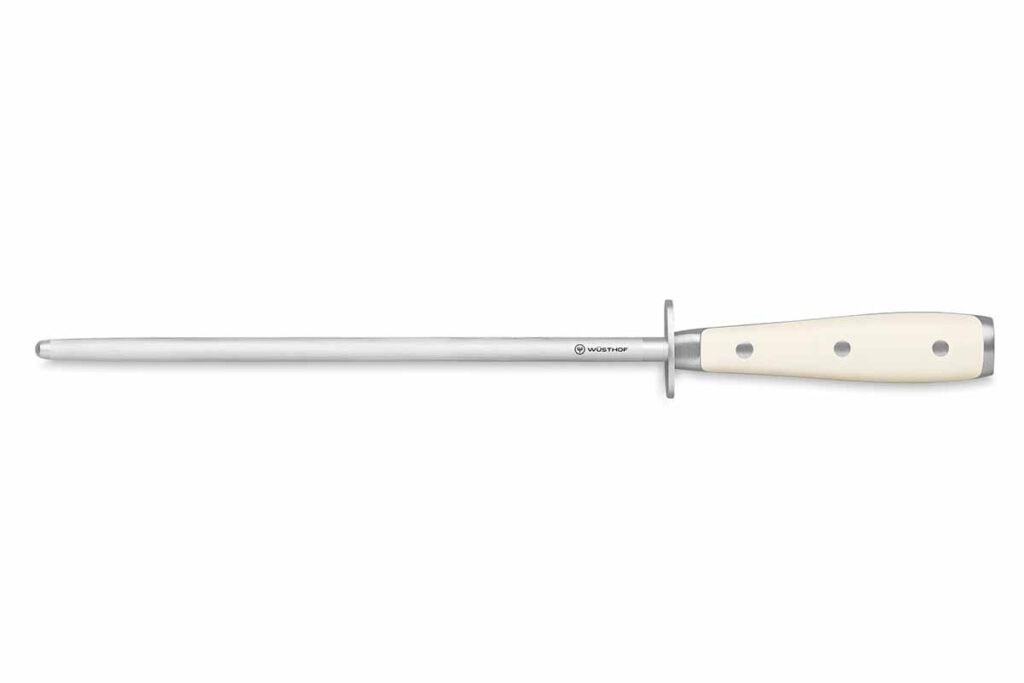
Wusthof 9-Inch Classic Ikon Honing Steel
Wusthof 9-Inch Honing Steel
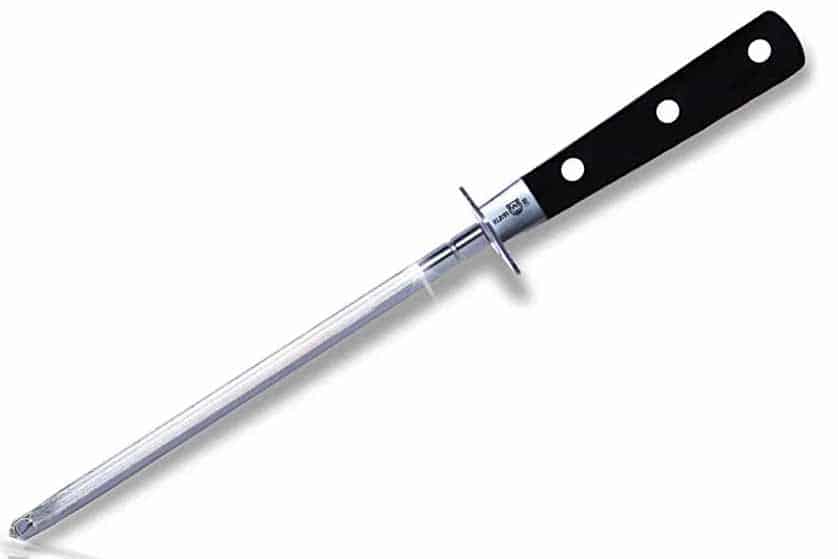
A classic honing steel by any measure, the Wusthof 9-inch steel is a great honing rod to have in your kitchen. Made of stainless steel, this is everything you want from a honing rod. It’s light and tough and made by a company with more than two centuries of history making knives.
A strong, robust honing rod is what every knife owner should be looking for, and this one checks the boxes.
Classic Ikon Honing Steel Specs Weight: 11.6 ounces Rod Material: Stainless Steel Handle Material: Polyoxymethylene Country of Origin: Germany MSRP: $200
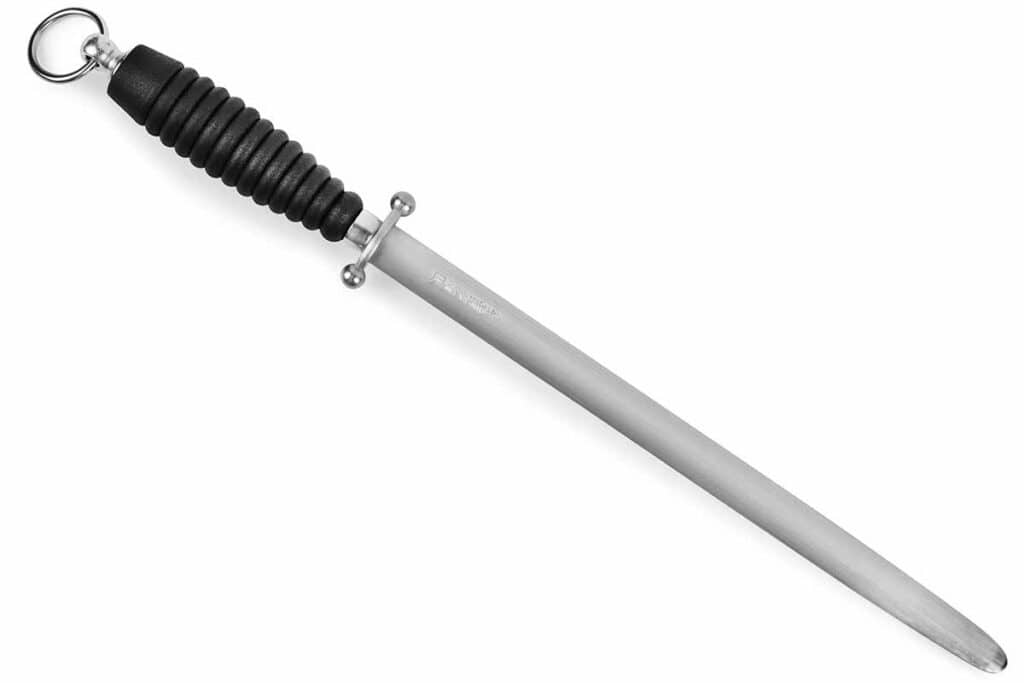
Zwilling 12-Inch Professional Oval Sharpening Steel
Zwilling 12-Inch Professional Oval Sharpening Steel
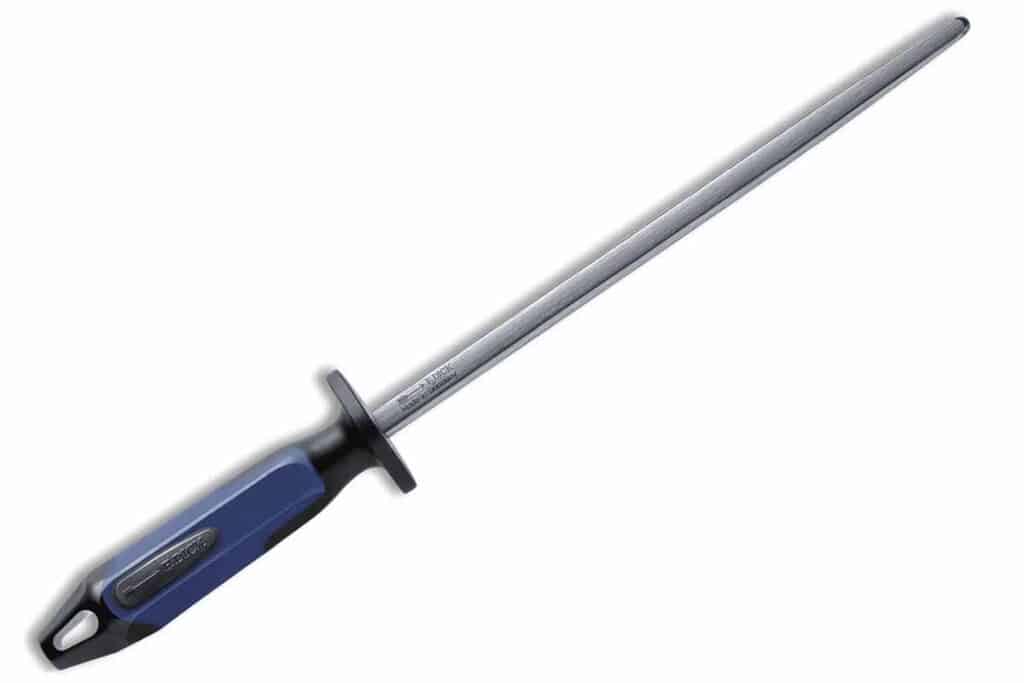
Sometimes you just need something a little bigger and heartier. This steel from Zwilling is up to the task. Its oval shape and longer length make it great for bigger knives. The chrome-plated steel is hard enough to hone most types of steel with ease and is easy to clean.
The loop at the end lets you hang it up easily too. Weighing in at just under a pound, don’t let that fool you. This is a heavyweight rod that will withstand years of use in your kitchen.
Professional Oval Sharpening Steel Specs Weight: 14.4 ounces Rod Material: Stainless Steel Handle Material: Polyoxymethylene Country of Origin: Germany MSRP: $60
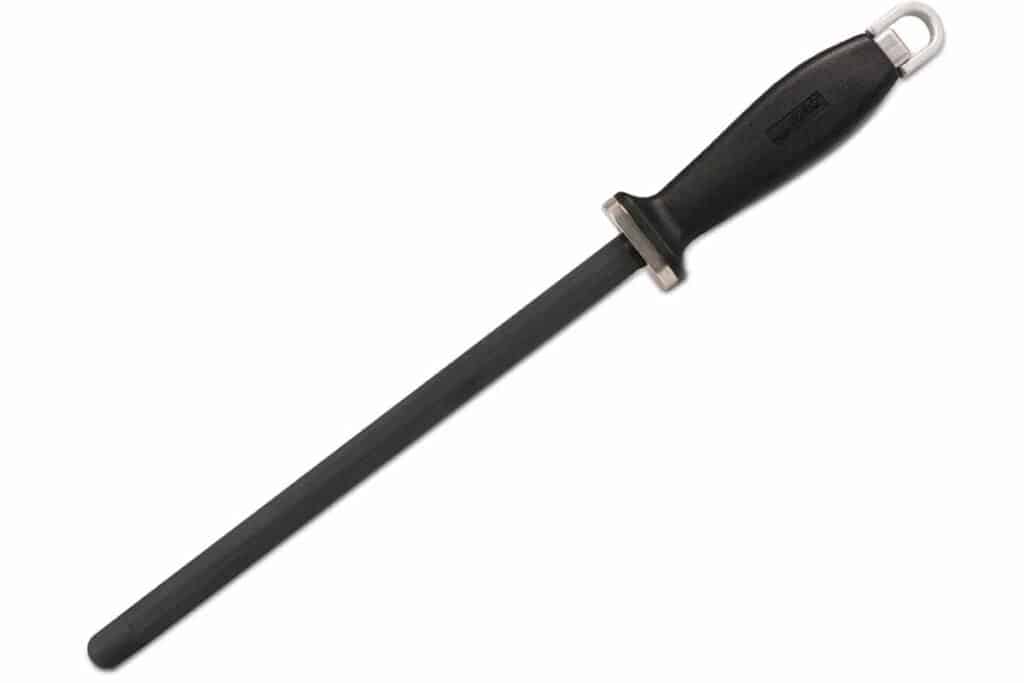
JB Prince Mac Black Ceramic Honing Rod With Grooves 10.5-Inch
With a fine 1200 grit, this ceramic rod from JB Prince is incredibly hard and durable. Its black ceramic coating is harder than both white ceramic and steel, and it’s also resistant to breaking so it can handle whatever you throw at it. Since it’s ceramic, it has the benefit of being completely rust-resistant, unlike traditional steel rods.
Most knife blocks that come with a honing rod will have a steel varietal, but looking beyond the block can lead you to quality rods like this one that can last a lifetime.
Mac Black Ceramic Honing Rod With Grooves 10.5-Inch Specs Weight: 13.4 ounces Rod Material: Ceramic, steel core Handle Material: Polypropylene Country of Origin: Taiwan MSRP: $64
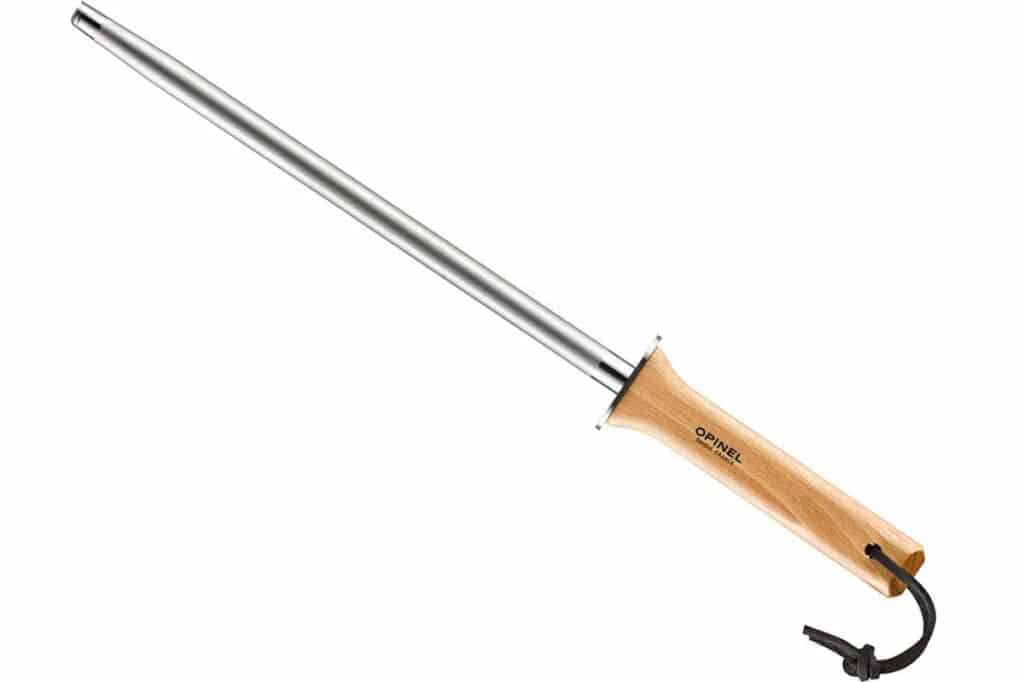
Opinel 10-Inch Diamond Steel Sharpening Rod
Opinel 10-Inch Diamond Steel Sharpening Rod
When it comes to rods that also sharpen, you can’t go better than diamond steel. This Opinel rod has a coating embedded with diamonds that sharpens as it hones. It’s good for both kitchen and pocket knives so you sharpen your EDC with it as well.
With a beechwood handle, and weighing 21 ounces, this rod feels good in the hand and will leave a pristine edge on your knives. Worth the price in every way for the discerning knife owner.
10-Inch Diamond Steel Sharpening Rod Specs Weight: 24 ounces Rod Material: Diamond-coated stainless steel Handle Material: Wood Country of Origin: China MSRP: $60
Green Elephant Ceramic Sharpening Rod
Yes, there are many ceramic rods on the market today, but you’d have a hard time finding one as robust and durable as this one from Green Elephant. With a grit of 1500, the rod is fine enough to lightly sharpen along with honing and realigning your blade. It’s also suitable for Japanese knives which may come with only one cutting edge instead of a Western, or German, style double-edged knife.
The silicone seal between the rod and the handle is designed to absorb vibrations and the whole construction is built to withstand being dropped without cracking. Lightweight and fairly-priced, this 11-inch rod is worth a look.
Ceramic Sharpening Rod Specs Weight: 7.2 ounces Rod Material: White ceramic Handle Material: Polypropylene Country of Origin: Taiwan MSRP: $30
Friedr Dick 10-Inch Honing/Polishing Rod
It is almost impossible to chip this rod thanks to being coated in diamond dust. From German maker Friedr Dick, this 10-inch rod is diamond-coated steel is designed for the heavy knife user in mind.
An oval shape allows more of the blade to contact the rod with each pass which means each knife takes less passes to hone. The ergonomic, dual-density polymer grip keeps everything safe and secure when passing the blade down the rod.
The catch-22 is the diamond itself. Yes, it will return your knife’s edge quicker, but use the rod too often and it’ll scrape off material far faster than other types of rods.
10-Inch Honing/Polishing Rod Specs Weight: 4.9 Rod Material: Stainless Steel Handle Material: Plastic Country of Origin: Germany MSRP: $83
Kuma Kitchen Knife Sharpener
Some rods are designed for only one type or knife or are too short to properly hone long chef’s or slicing knives. This honing steel from Kuma is the consummate all-arounder. The steel reliably restores your knife’s edge thanks to its carbon steel construction. The triple-riveted ergonomic handle is slip resistant so even honing wet knives (although you shouldn’t do that on a honing rod) can be done safely.
Unlike most of the other rods on this list, this steel will need more hands-on maintenance due to its carbon steel construction otherwise it will rust.
Kitchen Knife Sharpener Specs Item Weight: 8.6 ounces Rod Material: Carbon Steel Handle Material: Polyoxymethylene Country of Origin: Japan MSRP: $48
Friedr Dick Multicut Steel
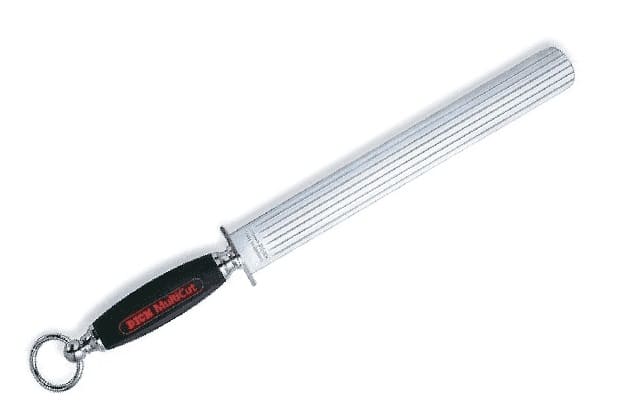
Another entry on this list from the German maker, this honing steel looks unlike anything else out there today. At first glance it’s easy to think this is a misplaced paddle, but in reality it’s a multi-dimensional honing steel.
The flat 11-inch blade has six parallel grooves running through it. Slide your knife down the main body of the steel and it’ll hone like any other rod. However, slide down one of the grooves and you can more precisely remove burrs and imperfections from the blade.
This is far and away the priciest honing steel on the list so you’ll need to determine if it’s worth the investment or if you would be better served using one of the other rods to hone your knives.
Multicut Steel Specs Weight: 15 ounces Rod Material: Stainless Steel Handle Material: Plastic Country of Origin: Germany MSRP: $150
Editor’s Note: This article was written by Mike Ableson.