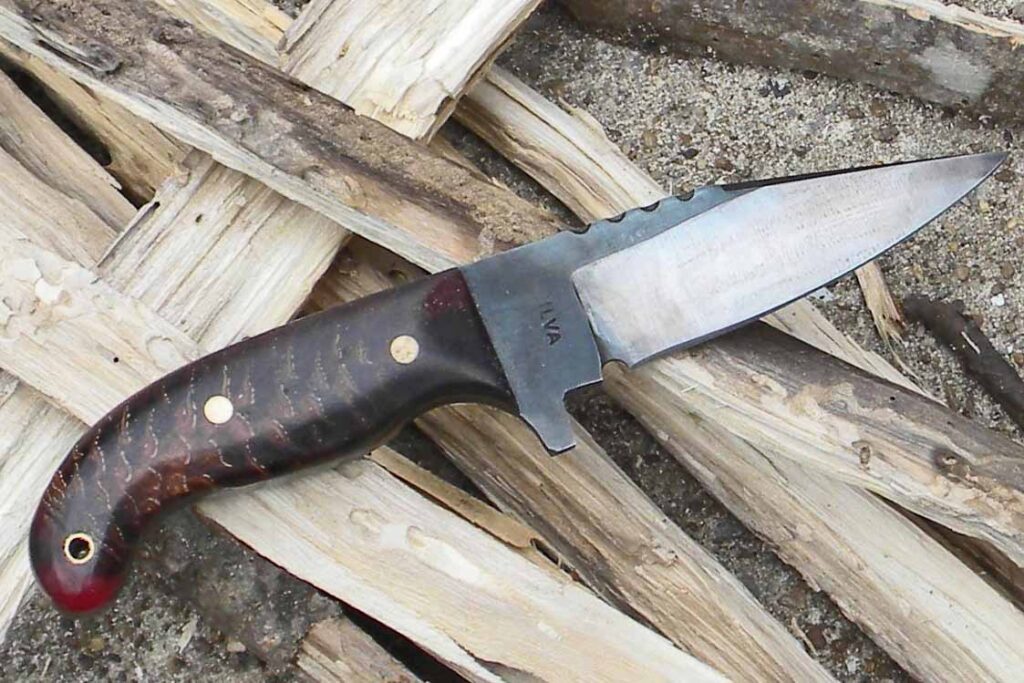
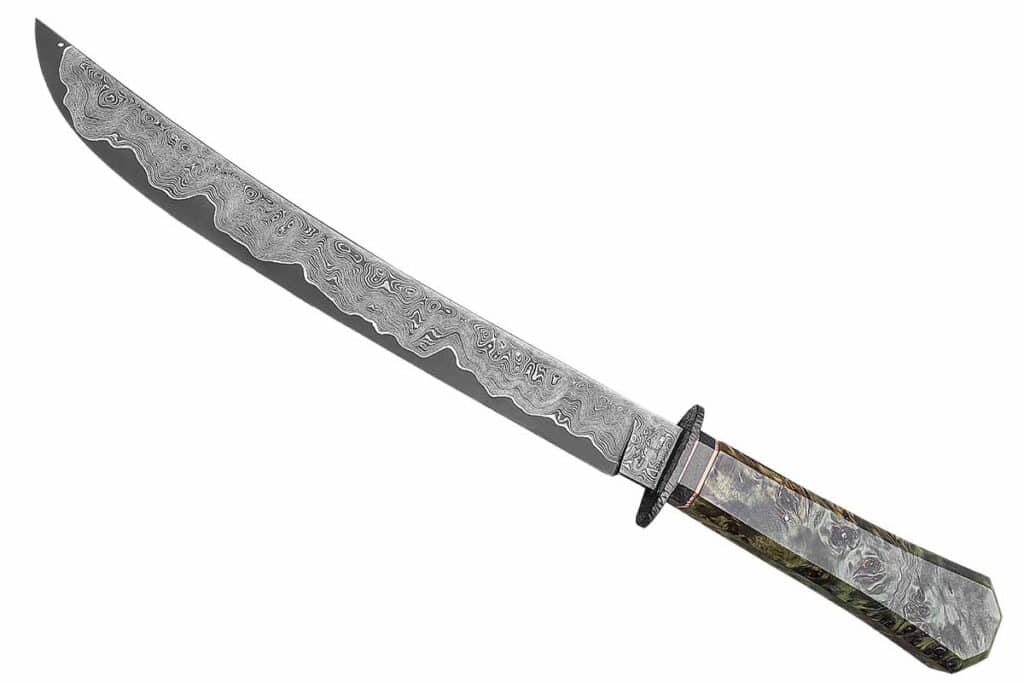
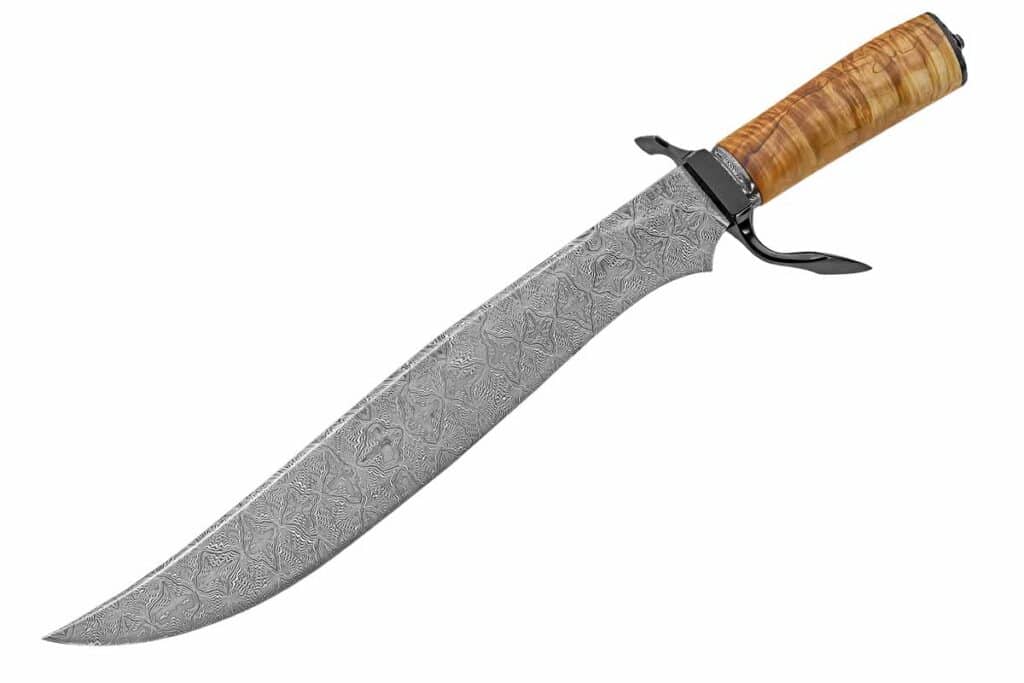
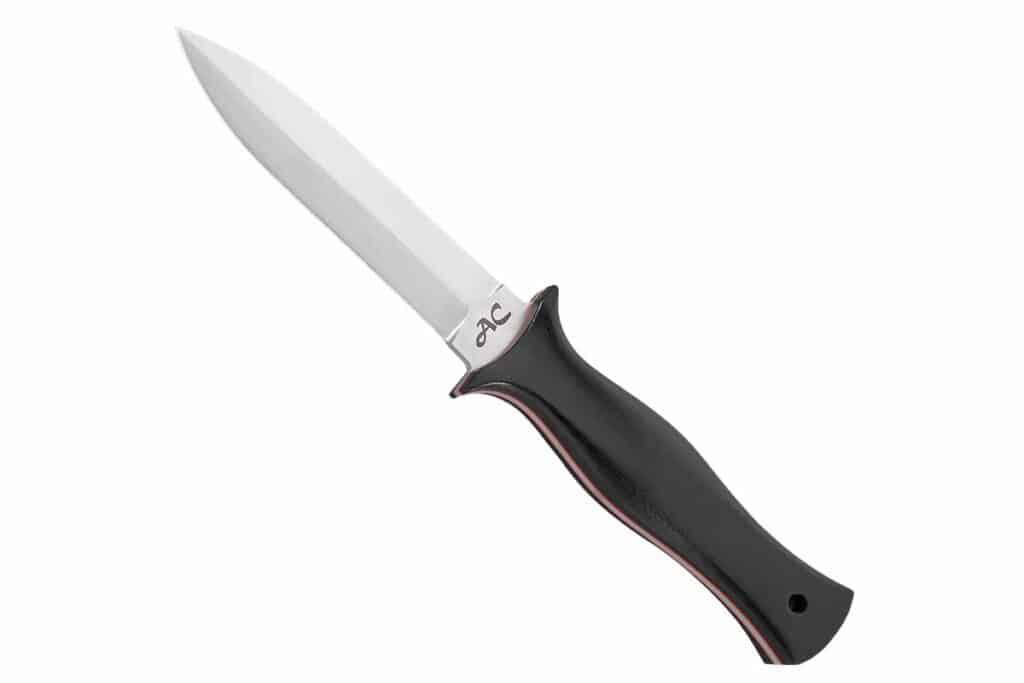
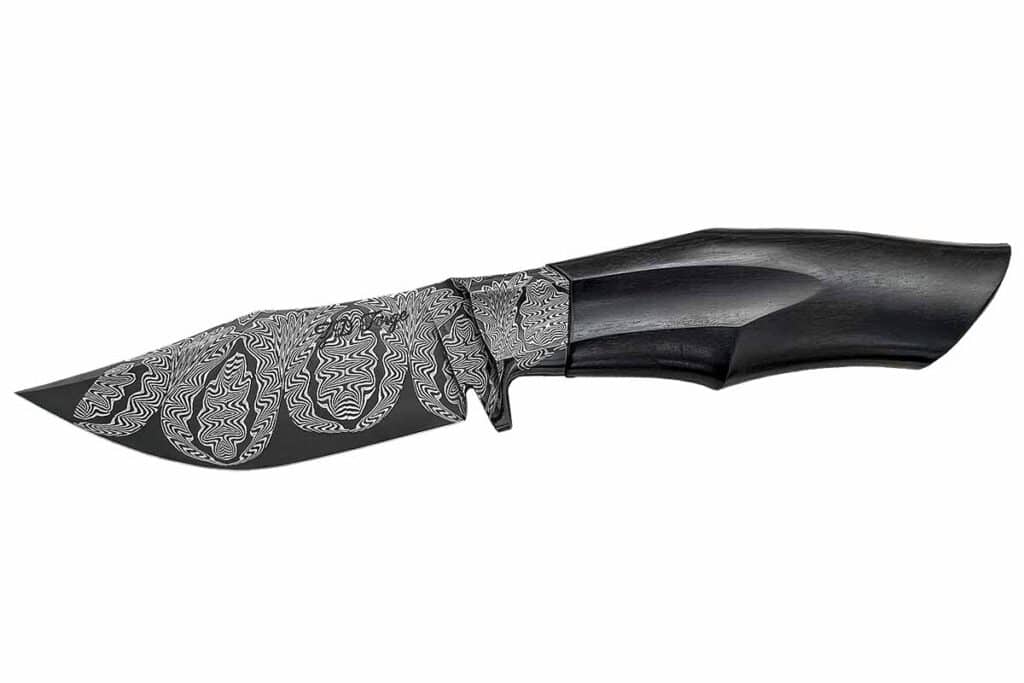
In on the ground floor of the damascus knife movement, Daryl Meier has left an indelible mark forging and teaching.
I haven’t seen Daryl Meier for a number of years but there was a time when he was a regular at the BLADE, Guild and other knife shows. Sporting a cross between a goatee and a van dyke, glasses and his ever-present octagonal cap covering longish hair, Daryl stood out in a crowd. He looked equal parts World War II French Resistance fighter, 1950s beatnik and Vincent van Gogh (minus the red hair). In fact, it almost would have been more fitting if his name were Daryl van Meier. I can see him looking at me now, shaking his head in mild disgust at such a notion.
Daryl has a soft, laid-back way of talking that has kind of a hypnotic effect. Then, just when you think you’re going into a trance, he makes an observation that snaps you back to reality, elicits a laugh or otherwise makes you think. He has a great sense of humor and never takes himself too seriously. There is no ego in Daryl. He’s just Daryl.
BLADE Magazine Cutlery Hall-of-Fame® member Steve Schwarzer has known Daryl much longer and much better than me. When I asked Steve to write a story about Daryl, he jumped at the chance, and the result is very enlightening as to Daryl’s impact on damascus and the teaching of bladesmithing in general.
Steve writing the story was more appropriate than I thought at the time. In researching Steve and Daryl, I rediscovered that they each have entries in the top 13 custom knives from the years 1989-2000: Schwarzer’s groundbreaking Hunter’s Dream in mosaic damascus at No. 3 and Meier’s American Spirit Bowie at No. 9. The knives were selected in a poll of industry authorities and appeared in the June 2013 BLADE® story, “A Decade of Excellence.” Daryl presented the American Spirit Bowie in person to President George H.W. Bush in the White House in 1990.
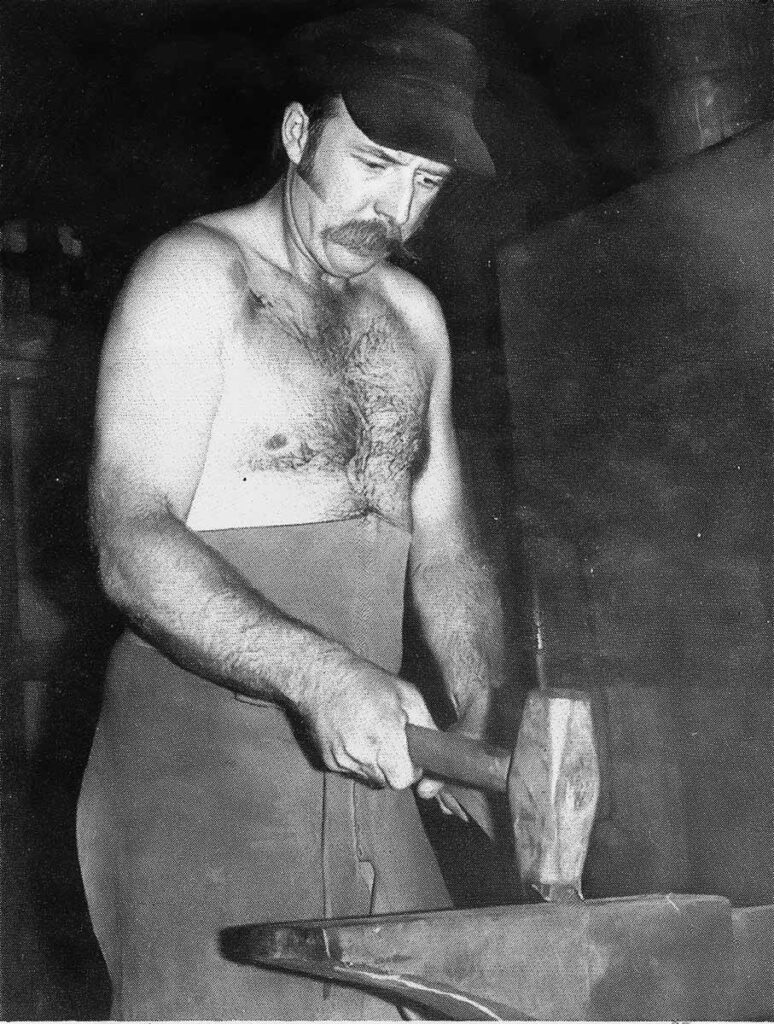
Daryl Meier forging steel in 1976.
Daryl’s contributions to damascus are legend.
As early as 1976 he was teaching a four-week course on forging damascus steel, no doubt one of the first such courses in the modern custom knife era. He was one of the first if not the first to write a regular column on damascus steel called—surprise!—“Damascus Steel” for BLADE in the early 1980s. One of the columns was titled “Wootz Revisited” and featured an image of a misspelled “Stephen Swertzer”—aka Steve Schwarzer—doing the ancient silk scarf-cutting test.
As important as Daryl’s contributions to the forging of damascus have been his dissemination of his damascus in general he probably has had more impact on the knife industry. Call him the Sensei of Steel. He was among the first if not the first to make damascus for use by other knifemakers, and helped inspire others to do the same, including Cutlery Hall-of-Famer Devin Thomas, Mike Norris, Bob Eggerling, Chris Marks, Gary House and others.
Today, making damascus for use by other knifemakers has long been a sub-industry unto itself—and Daryl was there at the beginning of it all. For these and other contributions, he was awarded the BLADE Magazine Industry Achievement Award in 2008.
The last time I talked to Daryl was about a year ago by phone. He sounded chipper and upbeat as ever. In fact, even in his early 80s he remains physically active and was all excited about a new pursuit—dancing—and how he was attending local dances on a weekly basis. Always ready to try new things, even in the fourth quarter of life—that’s Daryl. And I bet he can beat a mean rug, too!
We talk with those who know Bill Moran best to determine how many damascus blades the godfather of the craft forged.
BLADE Magazine Cutlery Hall-of-Fame® member Bill Moran is and will forever be remembered as the father of modern damascus steel. He and a few early devotees popularized damascus during an era when the art of bladesmithing was an endangered species in the realm of the artisan.
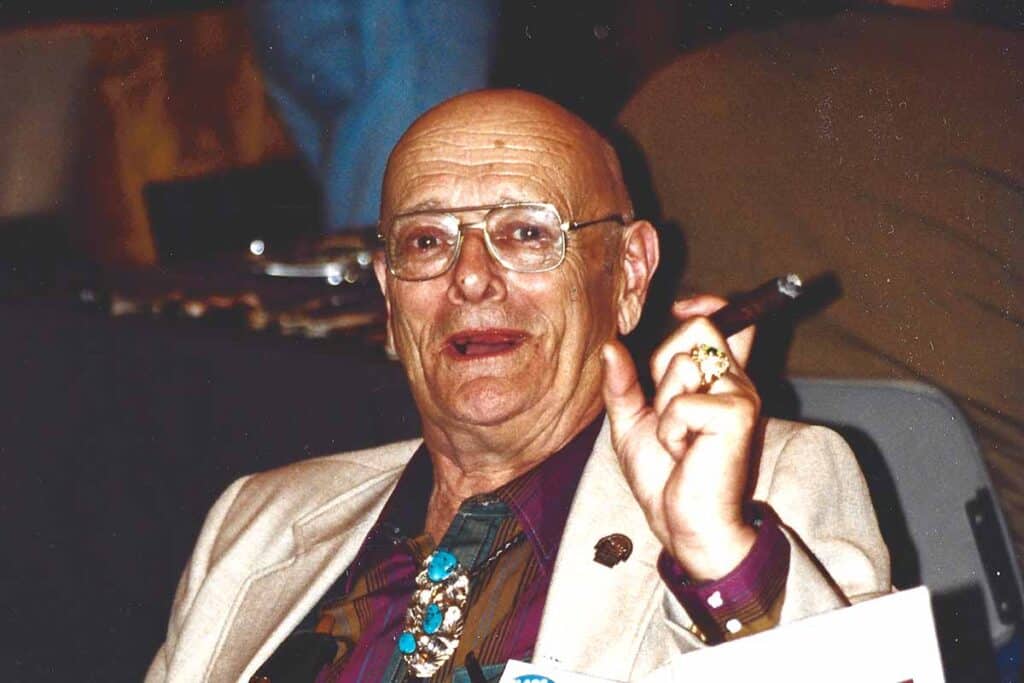
Though Moran was partial to smoking a pipe, he liked an occasional stogie as well. (Pete Cohan knife image)
It was Moran who shocked the custom knife world in 1973 when he brought eight knives to The Knifemakers’ Guild Show in Kansas City, Missouri. Those historic eight sported blades of Moran’s damascus steel and they created a sensation. Cutlery Hall-of-Famer, longtime journalist and friend of Moran’s, and a respected member of the knife community, B. R. Hughes remembered how the event electrified those who attended.
This is the first damascus knife Moran ever made. He forged “No. 1” circa 1972. It was misplaced for 30 years until Nancy Hendrickson found it in Moran’s house. (Pete Cohan knife image)
“When my wife [Carolyn] and I drove up to the Muehlebach Hotel in Kansas City, a friend of mine came out and said, ‘You gotta get in there and see the damascus knives Moran has on his table.’ Those knives were the talk of the show. Bill also had mimeographed sheets that explained what damascus steel was and how it was made. He gave those sheets away to anyone who desired one.”
Moran made basic damascus knives. “They weren’t elaborate and this, that and the other thing, but most of them were for use,” B. R. Hughes noted. (Exquisiteknives.com image)
Three years later, Hughes joined Moran and bladesmiths Bill Bagwell and Don Hastings as the quartet that founded the American Bladesmith Society (ABS). When the ABS was founded in 1976, bladesmithing was on life support, and probably fewer than a dozen smiths were forging knives. Today, the Society includes more than 2,000 members and the future of the craft has been secured. Meanwhile, Moran deserves the credit as the catalyst for modern bladesmithing.
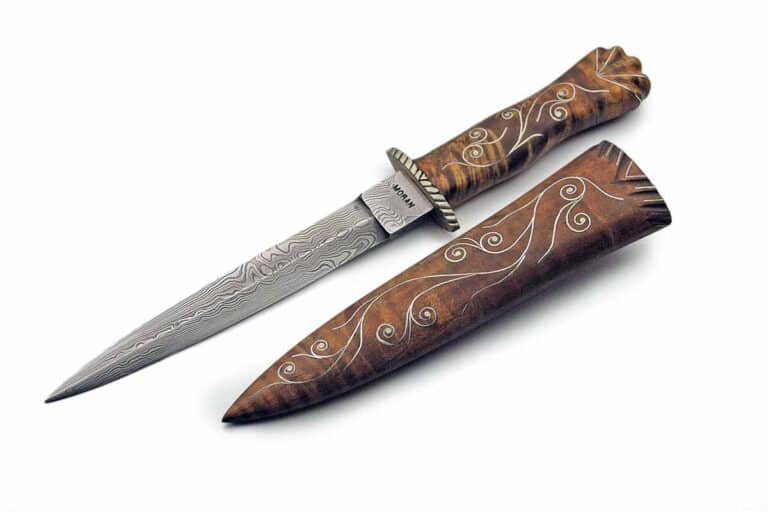
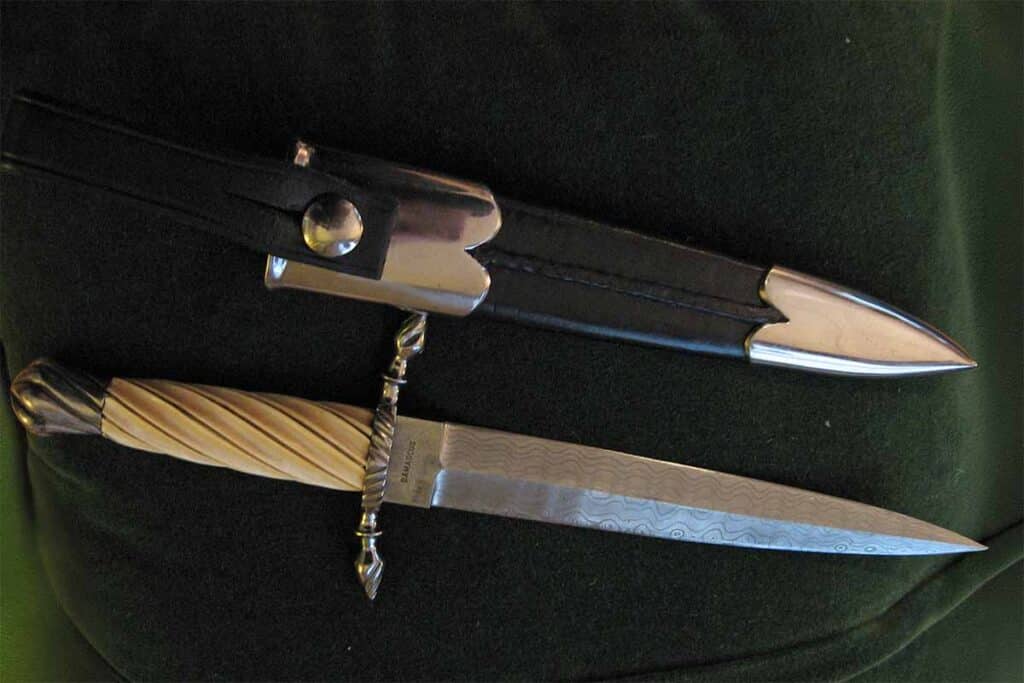
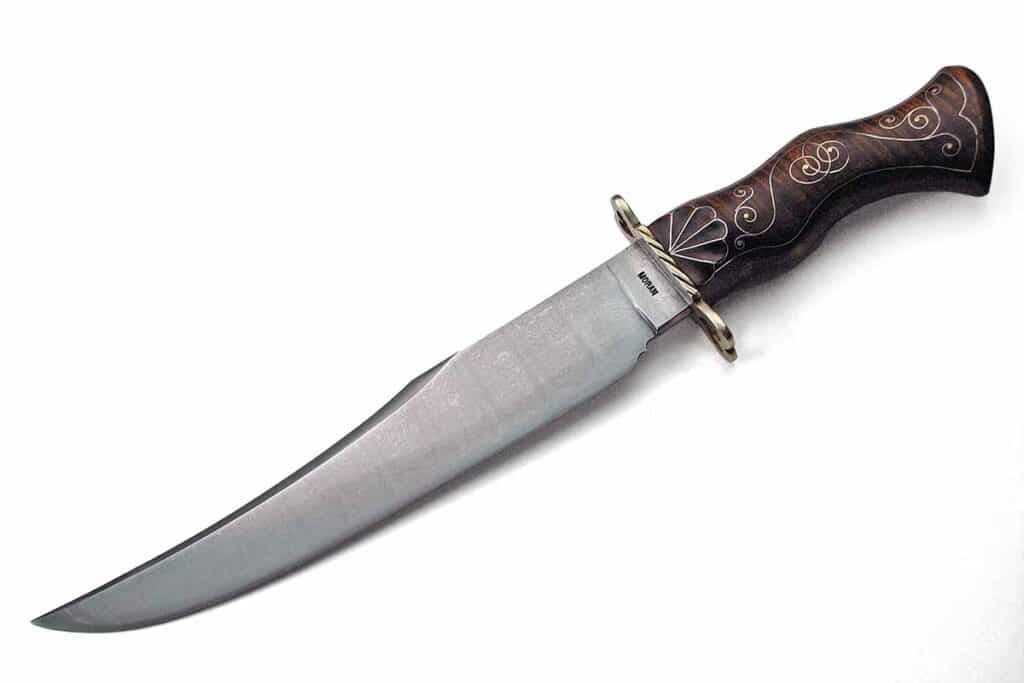
B. R. Hughes said Moran made some art daggers that “were a bit elaborate for the day.” An example is this large quillon dagger. (Exquisiteknives.com image)
How Many Damascus Knives Did Moran Make?
While there is no question that Moran and other dedicated disciples of the forged blade brought damascus and the ring of the hammer back to life in the early-to-mid-1970s, there is some conjecture as to just how many such knives the great Moran forged and completed himself. The thought of how many Moran damascus knives were made and exist today is tantalizing, and, of course, what’s a great legend without a bit of mystery and conjecture? Exploring Moran’s body of work and the damascus element within provides some insight into the man, the legend who padded about on the creaky floor of his Maryland shop, sometimes chewing tobacco, but rarely alone when his doors were open as crowds came to see the wizard work.
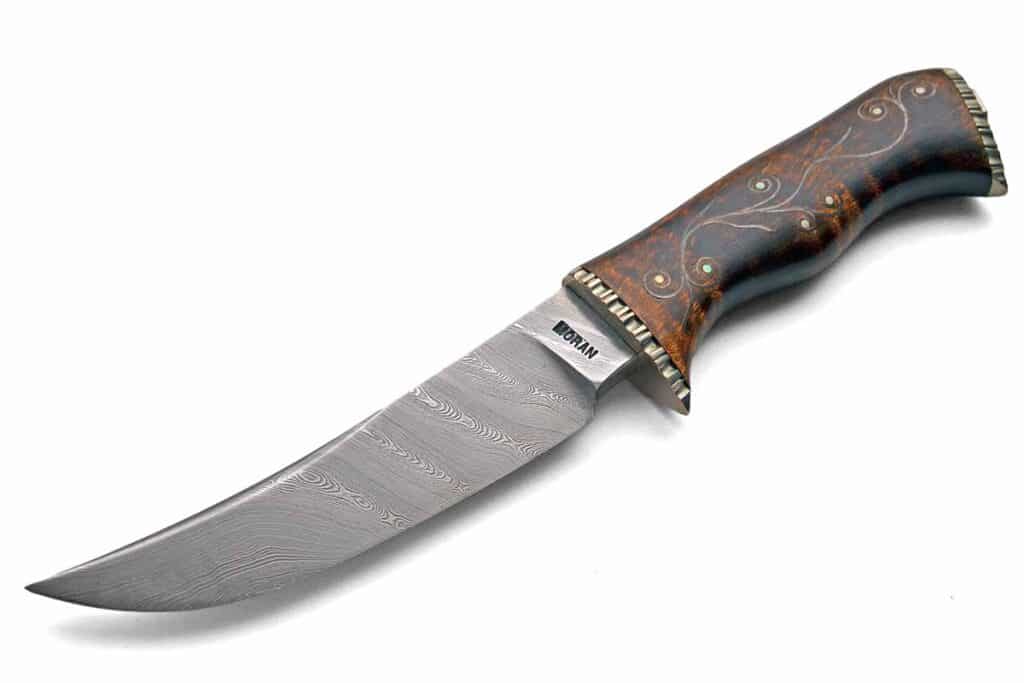
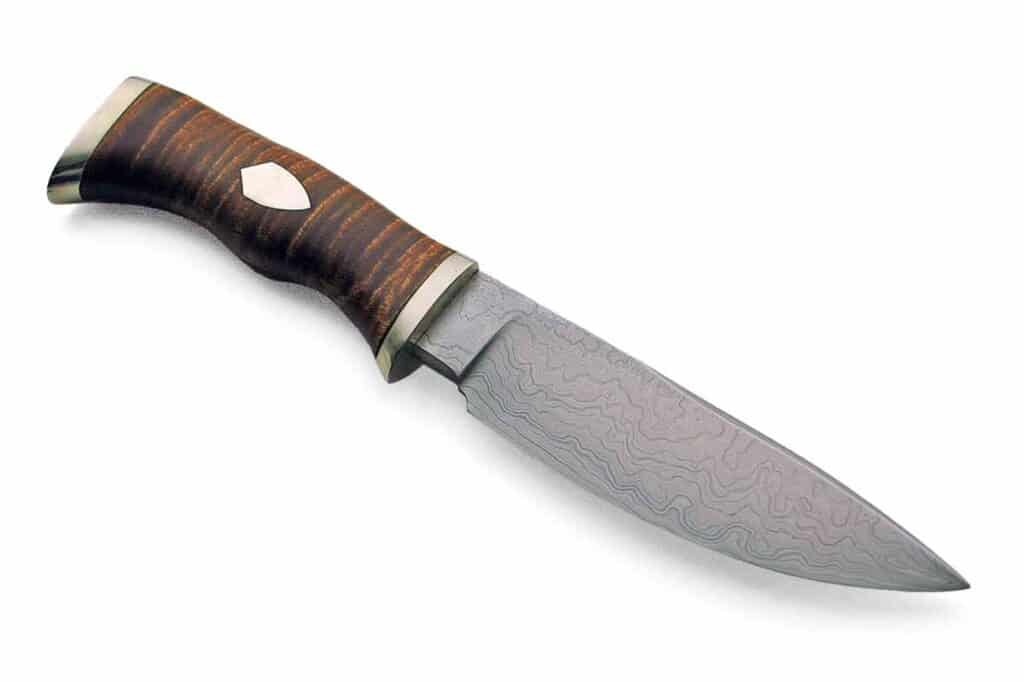
Back in the day, a Moran damascus knife was a challenge to own, considering the time Moran spent in his shop with the material actually able to work without the distraction of visitors, the many hours of labor required to produce a damascus billet, and the higher price for such a piece that naturally followed. (Exquisiteknives.com image)
Collectors such as Cutlery Hall-of-Famer Butch and Rita Winter bought the first of Moran’s damascus knives during that historic Guild Show more than a half-century ago, and, as Hughes relates, “Moran made basic damascus knives. Most of his were what folks would call ‘using’ knives. They weren’t elaborate and this, that, and the other thing, but most of them were for use. He did make some art daggers that I thought were a bit elaborate for the day.”
Dave Harvey, Nordic Knives
Hughes remembers that Moran himself was rather vague on the number of damascus knives he actually made. However, probably the best estimate is that fewer than 100 Moran damascus knives were made during a career that spanned more than 50 years.
“He liked the random pattern and the ladder pattern,” B. R. remembered, “and he could do some pretty good patterns, but it took a lot of time. He was very happy just making ladder pattern and stuff like that, and he continued making non-damascus knives and about 40 folders. When he was in his shop, there were always five or six locals in there talking to him and watching him work.” Agreed Cutlery Hall-of-Famer and ABS master smith Jay Hendrickson, a close friend of Moran for 30 years, “Bill had so many visitors to his shop on a daily basis that it is a wonder he ever got anything accomplished.”
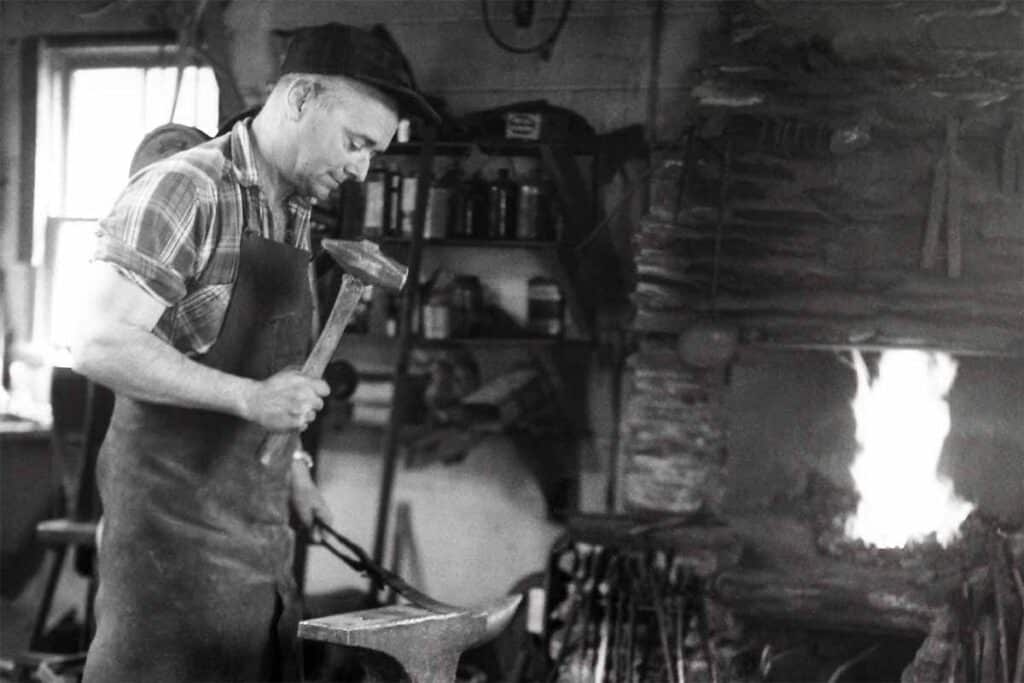
According to Jay Hendrickson, Moran made all of his damascus in a coal fire. “All of Bill’s experiments were with coal, as gas forges were not popular at the time,” Jay explained. “In today’s world, gas forges are almost always used for damascus making because of adjustable temperature and the cleanliness of propane gas.” (vintage photo of Moran in his shop circa the 1960s)
Hendrickson served as the executor of Moran’s estate and founded the Moran Foundation to preserve the great bladesmith’s legacy, serving as its president for 10 years. Jay observed that Moran made a workingman’s knife with quality that was spot-on, though there may have been an occasional flaw in the solder on his early pieces. Nonetheless, Jay says, Bill’s knives always cut.
As for Moran’s damascus knife productivity, Hendrickson offered, “This is strictly a judgment call on my part, but I would say Bill made less than 100 damascus knives. I counted 36 in our Forever A Legend book. I only know a few people that own Bill’s damascus knives, but I think they are sold and traded often between collectors. You also see Bill’s damascus knives occasionally sold at auctions.”
Butch and Rita Winter bought this damascus quillon dagger from Bill Moran at the 1973 Knifemakers’ Guild Show where Moran introduced modern damascus knives. It was one of eight damascus knives Moran brought to the show. The tang is marked DAMASCUS in all uppercase letters. (image courtesy of Rita Winter)
Jay verifies the original sale of a Moran damascus quillon dagger and sheath to Butch and Rita Winter and adds a bit more information. “Rita Winter recently sold Bill’s first damascus dagger to Mr. Doug Hook, a Tennessee collector,” he commented. “Two years ago, I repaired one of the twisted wires on the handle for Mr. Hook. Because of that contact I was able to confirm the original purchase as Doug has written verification of the original sales transaction and the invoice.”
So where are the majority of Moran’s damascus treasures today? Longtime purveyor Dave Harvey of nordicknives.com is straightforward—“in collections around the world. Values vary and depend largely on the particular knife. But they are generally worth at least double that of [one of Moran’s straight carbon steel blades], sometimes even more.”
Dave Ellis said the first of the Moran damascus knives are quite valuable and guessed they would start at least at $10,000 and go up from there. Dave holds an early 1970s Moran damascus hunter at BLADE Show 2023.
Back in the day, a Moran damascus knife was a challenge to own, considering the time Moran spent in his shop with the material actually able to work without the distraction of visitors, the many hours of labor required to produce a damascus billet, and the higher price for such a piece that naturally followed. Dave Ellis of Exquisiteknives.com reasoned, “I could not say how many damascus knives Moran made in his lifetime, but certainly not a large number. Many of Moran’s damascus pieces reside in private collections, as well as the Moran Museum. I personally have owned and still own some and have sold a number of the finer pieces to overseas clients.
“I believe he made four or five patterns. Damascus steel was and still is a laborious process. Bill’s prices for his damascus knives were quite high for the time, so he made and sold mostly carbon steel pieces. Damascus was reserved for higher-end clientele and foreign dignitaries. A good number of the damascus knives were fighters and bowies. Damascus hunters were also made, many with Bill’s twist pattern steel, maidenhair. I do not know of any mosaic steel knives that Moran made. The first of the Moran damascus knives are quite valuable, and I would guess that they would start at least at $10,000 and go up from there.”
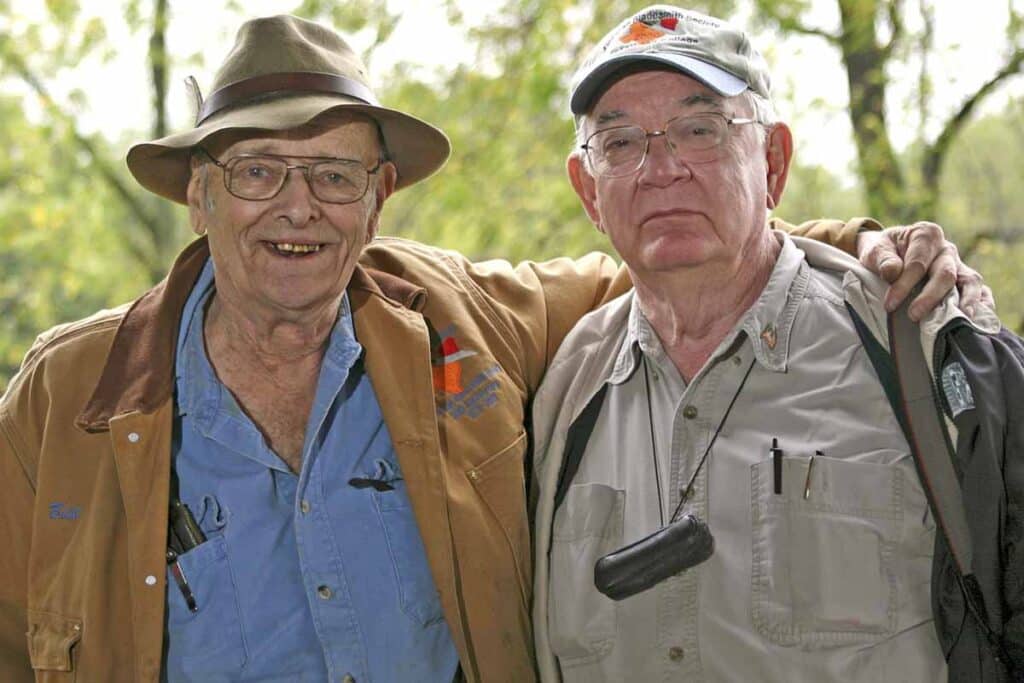
Along with Bill Bagwell and Don Hastings, Bill Moran (left) and B. R. Hughes (right) founded the American Bladesmith Society in 1976. Hughes is the only surviving founding member. (Buddy Thomason image)
HOW HE MADE THEM Hendrickson is familiar with Moran’s most common damascus patterns, the maidenhair twist, ladder pattern and others. “He knew how to fuse metal, as he learned that technique working on equipment on the family farm,” Jay remarked. “On the farm he made knives from whatever he could get his hands on, old springs, files, and rasps, for example. He could also buy steel from a local hardware store in town. Bill also knew the difference between plain iron and high carbon steel. His first damascus experience began by using one piece of steel and one piece of iron. He welded the two together, drew it out and folded it many times.”
The process yielded insight for Moran, and he learned from experience. At times during the process of hammering and folding, he realized that the steel was absorbing heat quicker than the iron because it was on the outside of the billet. Therefore, he moved to one piece of iron with steel in the center, and then a second piece of iron, using O1 tool steel and a carbon mix of 33 percent. According to Jay, this combination gave the billet the right hardness without the need for tempering. Moran’s test of the finished knife was to carve wood for two hours with no loss to the cutting edge, and he was satisfied with the results using this mixture.
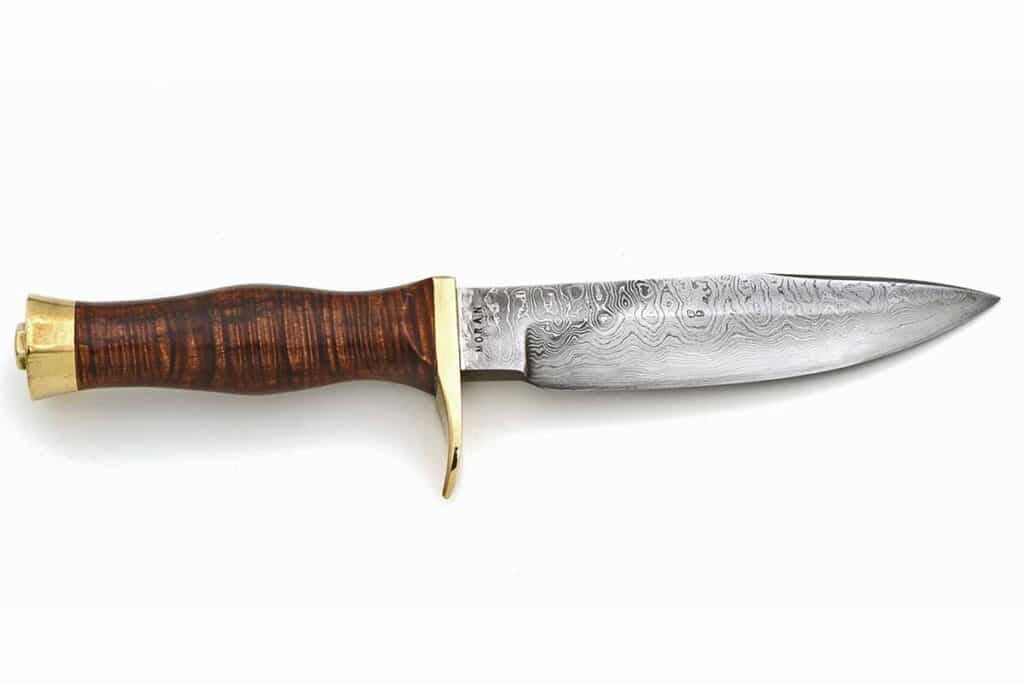
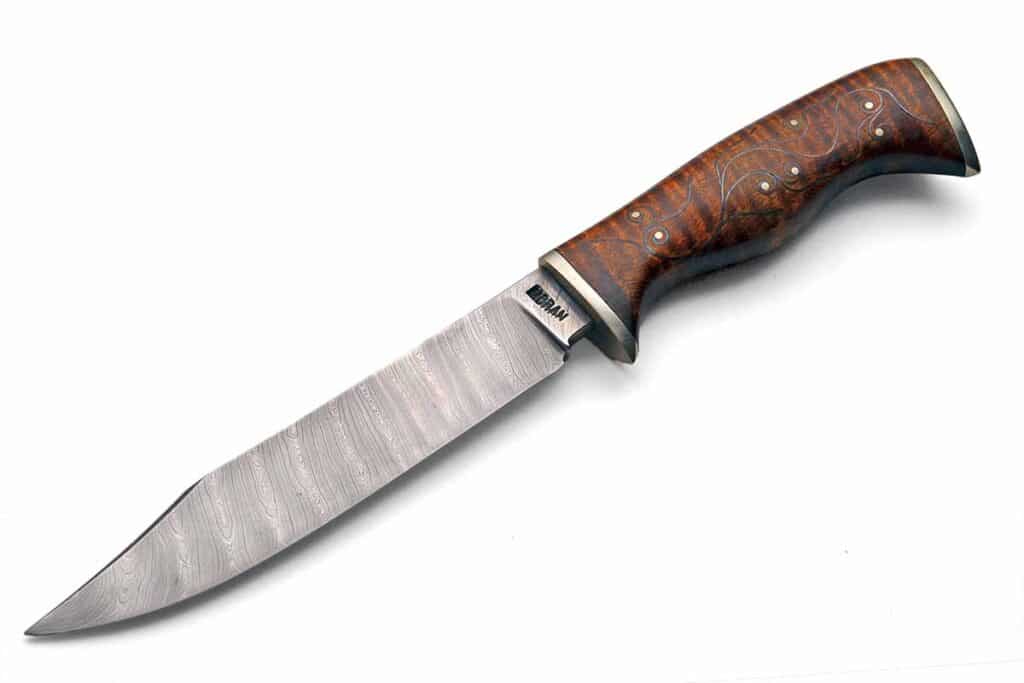
Moran’s test of the finished damascus knife was to carve wood for two hours with no loss to the cutting edge. An example is this clip-point model, again in a ladder pattern. (Exquisiteknives.com image)
“Bill made all of his damascus in a coal fire,” Hendrickson recalled. “A hot coal fire can melt steel as temperatures can reach over 2,700 degrees Fahrenheit, which is the melting point of steel. That is why Bill added iron to the outside of the billet, as iron is less apt to burn as quickly as steel. All of Bill’s experiments were with coal, as gas forges were not popular at the time. In today’s world, gas forges are almost always used for damascus making because of adjustable temperature and the cleanliness of propane gas. Therefore, the burning of steel to a great deal has been eliminated with the use of gas forges.”
Hendrickson attributes the relative scarcity of Moran damascus knives to the maker’s affinity for producing using knives, constraints on time and other factors. “Bill was truly a supporter of the art knife,” he noted, “and along with others they created that industry. Collectors were willing to pay big time for exceptionally well-made knives, and Bill, like other top-notch makers, profited as this industry took hold. However, Bill’s true passion was in using knives, such as camp knives, hunters and small utility knives, of which he made many. The vast majority of his knives came from customers wanting working knives.
A good number of Moran’s damascus knives were fighters and bowies, according to Dave Ellis. This classic ST-24 in ladder-pattern damascus and curly maple handle with fancy wire inlay is a favorite of Moran collectors. (Exquisiteknives.com image)
“Bill liked to experiment with damascus. For example, he would slip in an added piece of iron after many folds to gain toughness in the end product. Another example was where he completed a damascus billet to the desired number of welds. He then cut it in two and added a piece of high carbon steel to form the middle and welded the two damascus pieces on both sides of the high carbon steel. Once that was completed, Bill forged the billet into a knife. One might call the finished product a damascus san-mai. Bill liked the various patterns that were being developed beyond the more basic patterns that he originally developed. To Bill, mosaic knives were art knives, not to be used but just admired. He didn’t like the process of welding pieces together to make a knife. Remember, he was more into using knives where the grain within the steel followed the entire edge of the blade.”
Through the years, Moran became a legend, leaving a legacy of learning, teaching, giving information freely, and welcoming many to his shop. He paid tribute in steel to the wonder of damascus, the art knife and the using knife. Today’s body of bladesmiths still looks to him as the guiding light that led them to the glow of the forge and the spark of the hammer on hot steel. Those who own or admire the few damascus knives that Moran completed continue to do so for their beauty, their imagination, their rarity, and simply because they bear the touch of the master’s hand.
The best knives and stories are born from some essential reality that grows in the making and telling. For a knife, it is the nature of that reality that determines whether the ornamentations available to the knifemaker either reveal or conceal it. Simply put, some knives benefit from the generous application of various bells and whistles. Others are diminished by any additions beyond their essential form. Most fall somewhere in-between these extremes. But how do you tell the difference?
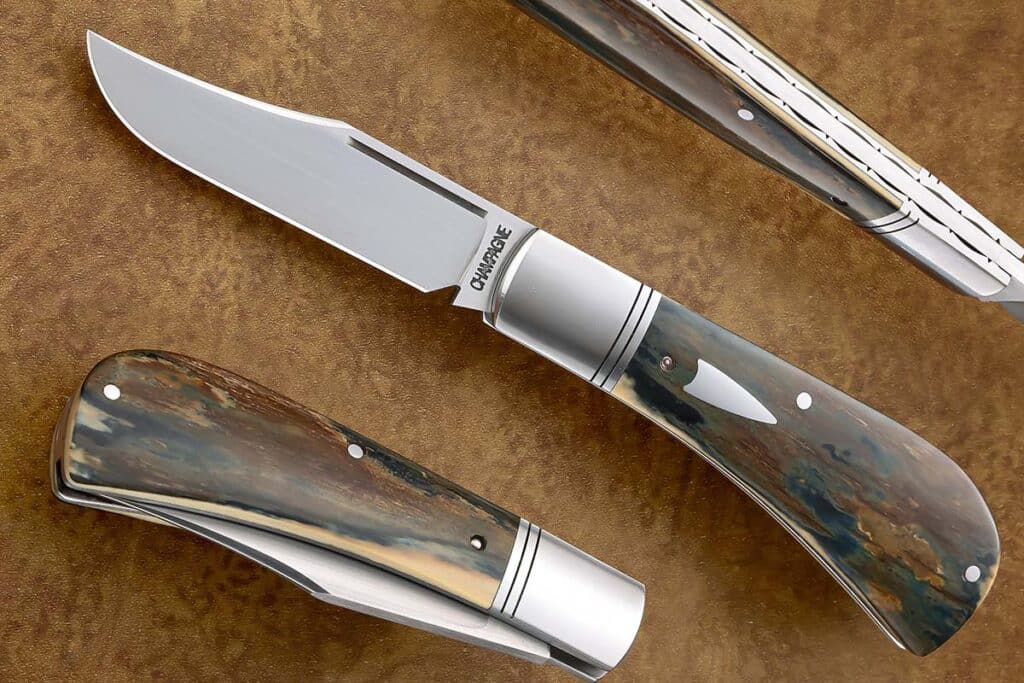
A Lanny’s Clip slipjoint by Ben Champagne is an example of how even a minimally embellished knife sends a clear message about the character of the maker.
First, consider that much like the vehicle you drive, the knife you carry or make says something about you. It can shine light on your character, priorities, economic or social status, or simply your tastes. Each knife can reflect something important about the maker, or it can evoke a response from the person that encounters it. As the maker, what story are you trying to tell and to whom are you trying to tell it? Any embellishment should be designed to ensure that that something is exactly the thing you want to say. A Lanny’s Clip slipjoint (IMAGE 1) by Ben Champagne is an example of how even a minimally embellished knife sends a clear message about the maker’s character. Every detail matters, even the ones that are invisible. Immaculate execution is a statement of its own.
In addition, each type of knife serves an essential purpose. Often the purpose is reflected in the name of the knife’s category—everyday carry (EDC), hunter, fighter, chopper, chef’s, even art knife—or by its shape, history and tradition, as in the case of daggers, machetes and bowies. In each case the design is constrained by the intended use, though with varying degrees of success.
Once you have a clear idea what your knife is for and the impact you want it to have, it is useful to write those down. The process of articulating your purpose in words has a way of clarifying things, and helps you keep a firm grasp on your idea as you move forward with your design. You have a much greater chance of creating an excellent knife if you allow your intent to guide your design decisions.
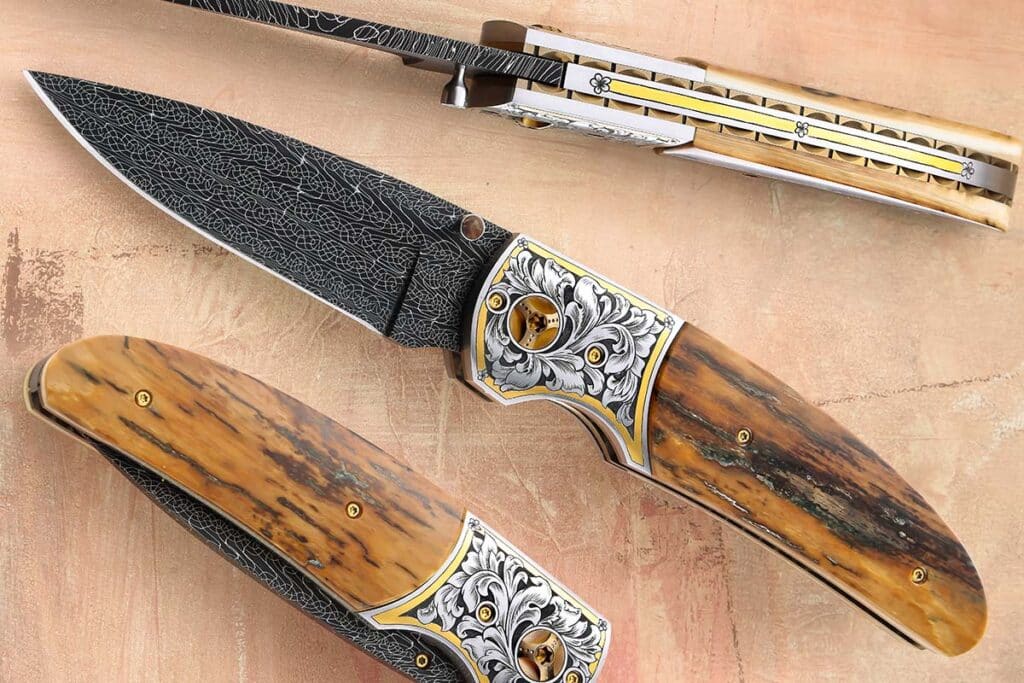
Image 3: The mammoth ivory scales, subtle filework and damascus blade of Andy Isaacks’ elegant linerlock highlight the detailed engraving by Alice Carter. Closed length: 4.5 inches.
A good next step is a detailed drawing, which will help you think through the details in a coherent manner; it is much easier to work through various design elements, material choices and additional embellishment ideas with a pencil than with steel. Here is your chance to test different ideas, keeping in mind that there will most certainly be deviations from your drawing that occur during the actual making process. Some ideas look good on paper but don’t translate as imagined into a three-dimensional object. The opposite is also true, and embracing the back-and-forth process yields the best results. Producing a cohesive design aligned with both your intended statement and the knife’s function is a process that often continues until the knife is complete.
Making A Knife Embellishment Plan
I don’t always embellish a knife, but when I do, I do it on purpose.
As you have gathered by now, the most valuable embellishment available to the knifemaker is outstanding, intentional design. Consequently, the best knives are those in which embellishments are specific, intentional design choices. Intentionality is essential; if you want to be good at something, you should do it on purpose. If a particular choice of ornament does not contribute to the function, visual impact or the statement you wish to make in a noticeable way, omit it. At the very least, choices of ornamentation should never inhibit the essential purpose of the knife.
Alice Carter’s gold engraving is the center of attention on a linerlock folder by G. Kent Carter. Closed length: 4 inches.
Selecting Type Of Knife Embellishment
When it comes to specific embellishments for a specific knife there are myriad choices at your disposal, but if you spend too much time thinking about it nothing will get done. Here are some ideas that can help you decide.
The first consideration is to determine what it is you’re trying to draw attention to. Certain shapes or lines like the S-curve, diagonal line and flow, and pointy or sharp triangular elements tend to naturally draw the eye. A dominant visual weight, strong contrasts of color or texture, or intentional disruptions in visual flow can also grab attention if used accordingly.
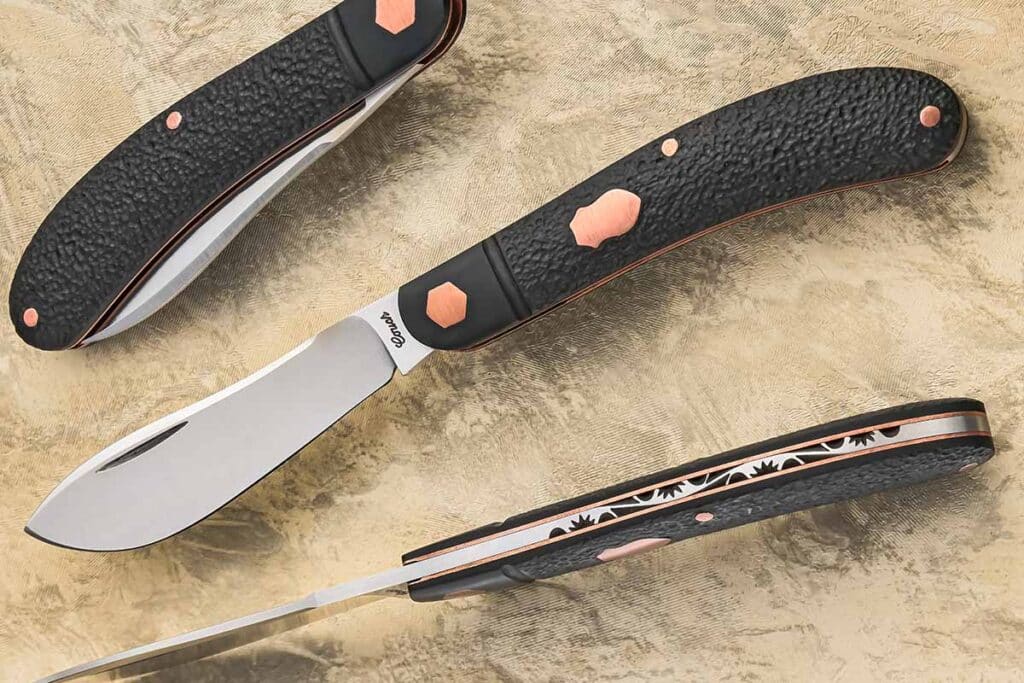
Tanner Couch uses copper to highlight the hardware of the textured black paper Micarta® handle and creative filework that covers only about half the backspring of his shadow pattern rabbit skinner. Closed length: 3.75 inches.
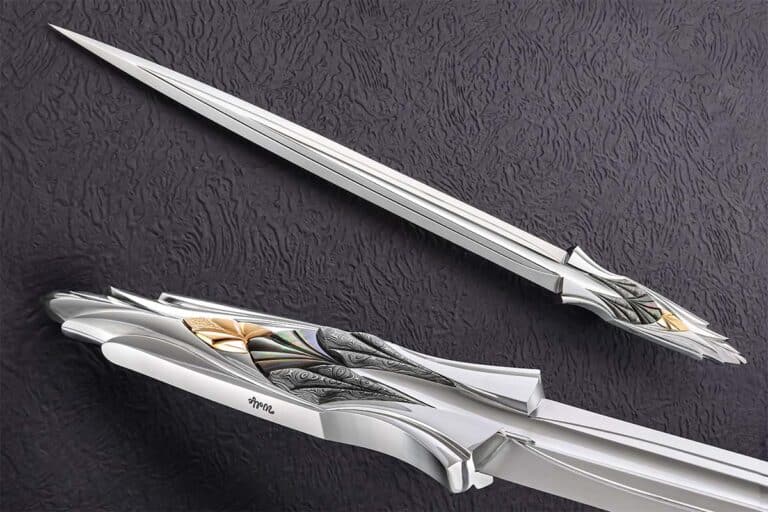
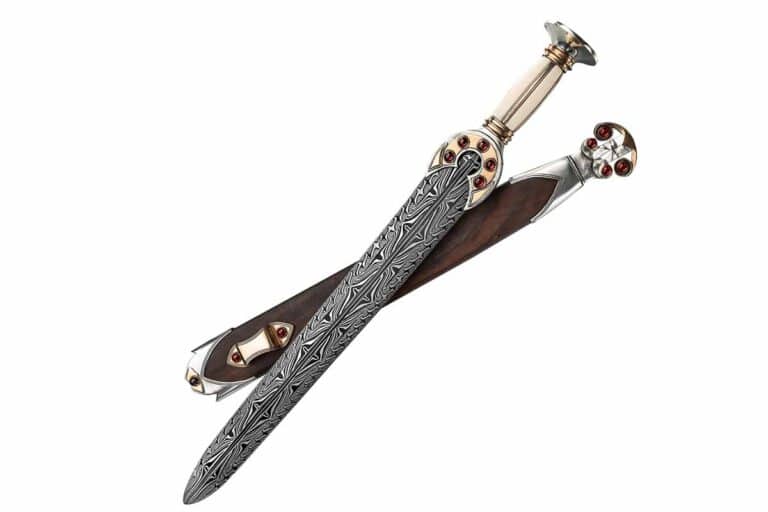
Usually, it is the clever combination of more than one of these elements that makes an arresting visual, and once the attention is firmly grasped the details can reveal themselves. An integral dagger by Wolfgang Loerchner (IMAGE 2) demonstrates how the masterful combination of curves, diagonals and triangles can command notice. Sharp contrasts in texture and color also arrest the eye. Once the attention is captured, it becomes clear that every element of the shape, materials and finish works together to create the essential whole.
The eye is also drawn to areas with more detail. A good rule of thumb is that for it to stand out, the area of sharpest detail should make up about a third of the overall visual composition. By applying this principle, an engraving can be the center of attention, can complement the overall knife design or can distract from it. When engraving is to be the center of attention, other design elements should be allowed to fade into the background. This does not mean that these other details are less important, but a handle with subdued colors and even texture, a satin polished blade, and understated filework will allow the engraving to be the focus.
A boldly patterned damascus blade paired with detailed engraving can overwhelm the eye and keep either element from being visually arresting. Counterintuitively, a finely detailed mosaic damascus blade can present a more neutral visual impact; the details become apparent only when you look closely. A wildly patterned or brightly colored handle material will similarly draw the attention, so use it if the handle material is what you want to visually emphasize.
For example, the mammoth ivory scales, subtle filework and damascus blade of Andy Isaacks’ elegant linerlock folder (IMAGE 3) highlight the detailed engraving by Alice Carter. Every element serves to ensure that the area with most detail draws the eye.
How Not To Embellish A Knife
The understated detail of the Star Crossed Lovers mosaic damascus blade provides a subtle contrast to the artifact walrus ivory handle with inlaid Oregon sunstone set in gold and pure iron guard covered in melted gold on the Behring Sea Artifact Dagger by ABS master smith David Lisch. Overall length: 10 inches.
No discussion about knife embellishment is complete without some reflection on what not to do.
Perhaps most importantly, if you can’t think of a good reason to add a particular type of embellishment, there’s a good chance that you shouldn’t do it. Sometimes it works out but often you waste time and possibly your money by adding elements that lack a clear intent. Similarly, if a knife is intended for hard use, consider what cumulative effects that use will have on your bling, and invest your enhancement efforts accordingly. Where does the value lie?
Despite everything else discussed, it’s worth saying that not every knife needs to be something other than a cutting tool. Indeed, some of the best knives make their statement with simplicity and function. There’s no minimum or maximum amount of embellishment you can add to a knife, but embellishments that aren’t done exceptionally well are worse than none. If you must err, err on the side of simplicity or subtlety. Extravagance can be beautiful but elegance is always understated. Both have a place in the alternatives of intentional design choice.
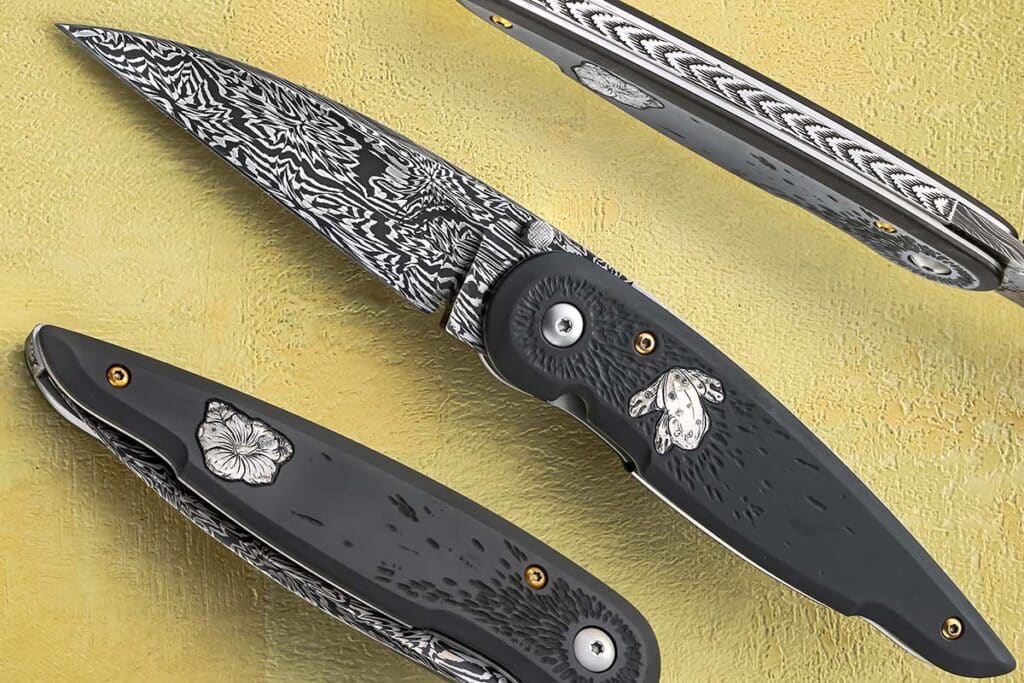
Is it a shield, modified unwrapped menuki or something else? Whatever the designation, the embellished reptile stands out from the all-black textured handle of an ABS master smith Andrew Meers peg-opening linerlock with a mosaic damascus wharncliffe blade.
Finally, your knives will benefit from embellishments done purposefully to increase impact, but can suffer from ornamentation added with the sole intent of increasing the sale price. Keep an eye on what’s best for the knife rather than simply tossing in expensive ornamentation for the sake of perceived collector or monetary value.
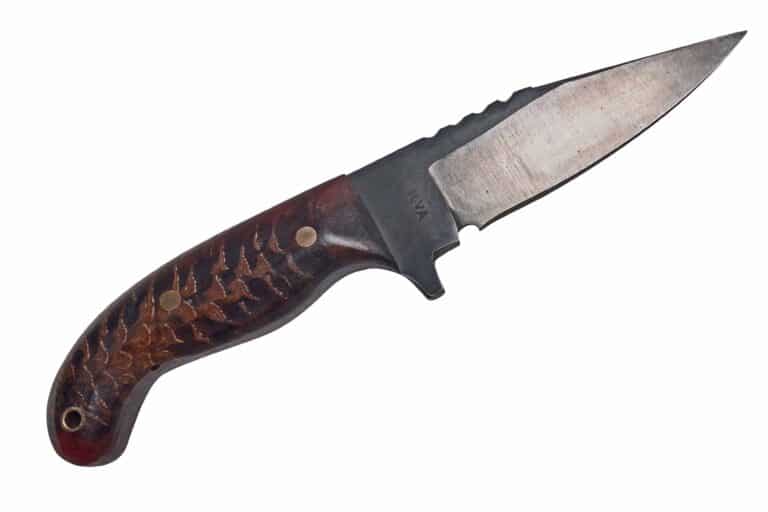
Vincent Silva’s Carver packs healthy cutting power in a compact package.
After Vincent Silva retired from the military, he came across HealingFlamesForge.org, a Tennessee-based non-profit blacksmith shop for veterans. He took to the hammers and hot steel quickly, which progressed into making knives. Creating a functional tool from a piece of steel became his goal, and the Carver is one result. It begged to be tested and I was only too happy to oblige.
Carver Light-Duty Cutting
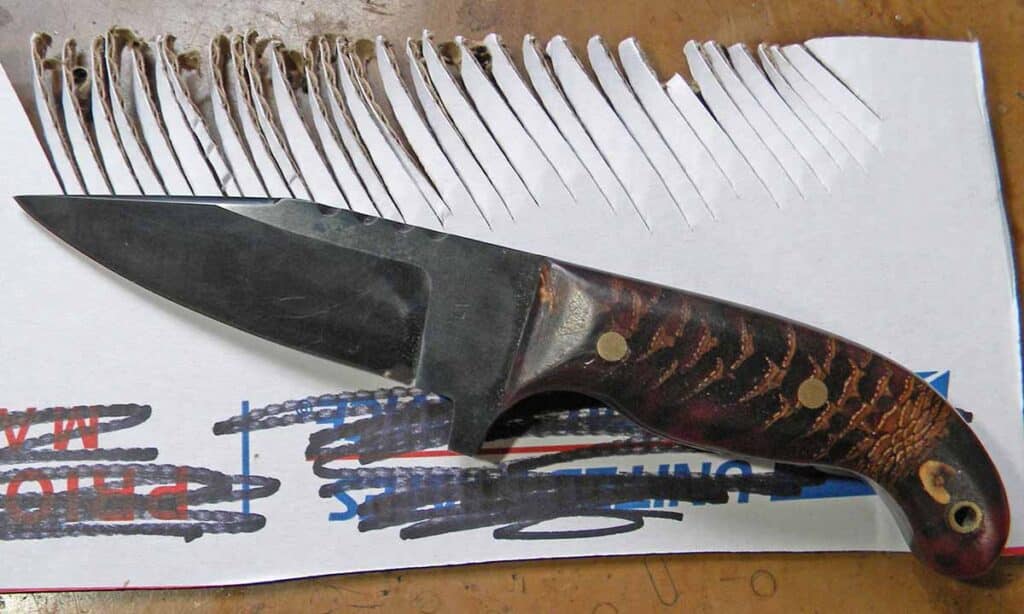
For the first edge test, the knife aggressively sliced into graphing paper even though the paper was slightly limp from the humidity. I applied smooth downward pressure and it cut cleanly. This is a well-balanced little blade.
Full-length push cuts went swiftly through the cardboard. The handle aided in blade control while keeping cuts as even as possible.
Single-walled cardboard supplied the next challenge. Full-length push cuts went quickly. It was hard to keep my fingers out of the cutting zone if I went too fast. The handle aided in control of the blade while keeping cuts as even as possible (in the cardboard, not my finger). I could hear a small crunch sound as the edge parted the material.
Carver Medium-Duty Cutting
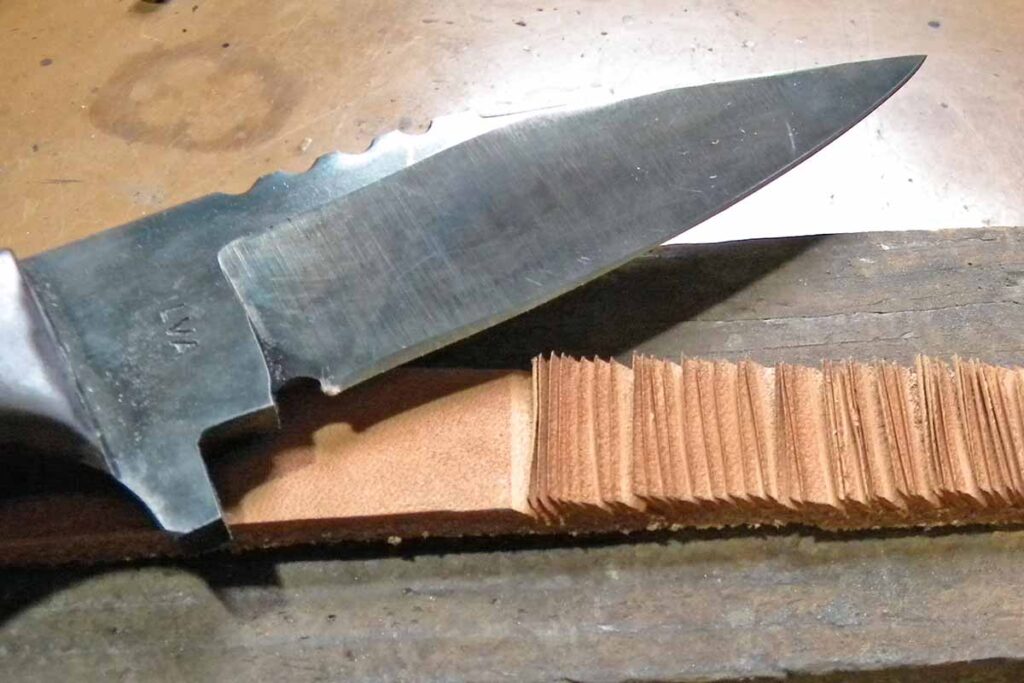
Next up: 8-ounce leather. The Carver zipped through it swiftly. The blade’s edge geometry is spot on for working leather. I used a push cut while skiving the material.
The Carver zipped through 8-ounce leather very quickly. The blade’s edge geometry is spot on for working leather. The author used a push cut while skiving the material.
I like to be ahead of the game during camping weather, so a good supply of fire sticks is always a must. The Carver produced nice, feathered curlicues in some pine. The handle shape made it easy to control the depth of the feathering. All cuts came out smooth with just enough curl.
Carver Heavy-Duty Cutting
The Carver might be on the small side but it can handle such large jobs as splitting wood. Using a dead-blow hammer, I repeatedly pounded the blade through seasoned hackberry. A nice pile of kindling was the result. The handle was comfortable throughout and the blade was just big enough to beat on the tip to split the wood completely. There was no damage to the blued finish or the edge. Nicely done, Vincent.
It was time for my favorite cutting medium, natural rope—in this case, half-inch sisal on a cutting board. The Carver crunched its way to 192 cuts before the edge started to slide. The handle created no hot spots. The gimping was a tad sharp for my thumb but great for ferro-rod use. This is one cutting little knife!
The knife is small but can handle such larger jobs as splitting wood. Using a dead-blow hammer, the author repeatedly pounded the blade through seasoned hackberry for a nice kindling pile.
It was back to the graphing paper for the final slice test. The blade still cut very well and lost only a bit of its aggressiveness.
To push things over the edge, I conducted a brass rod test to make sure the temper was done correctly. I could see the edge flex and return to true. Verdict: the heat treatment was spot on.
CHANGES To mee, the edges could be softened a bit more, especially on the spine gimping. However, the Carver is a very well-made EDC sheath knife that performs at a higher level. It’s a sweet little blade.
Carver Specs Maker: Vincent Silva of Iron Sapper Forge Blade length: 3.5” Blade material: 1095 carbon steel Blade grind: Flat Heat treatment: Differential Handle: Pinecone resin by @sappercsmwife (Instagram) Weight: 6.5 ozs. Overall length: 75/8” Sheath: Kydex or leather pouch Maker’s list price: $250
Fabulous forged knives, new smiths, new chairman top ABS annual meeting.
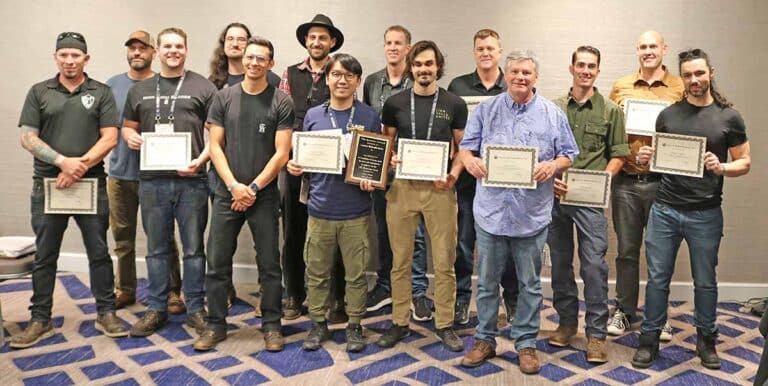
Some of the finest forged knives of the year, the newest American Bladesmith Society master and journeyman smiths and a brand new chairman helped highlight the annual meeting of the ABS held during BLADE Show 2024 at the Cobb Galleria Centre in Atlanta.
ABS master smith Kevin Cashen officially began his first term as ABS chairman at the annual meeting, succeeding ABS master smith Steve Dunn who passed away unexpectedly earlier this year. It was a bittersweet transfer of the office for all concerned, though a sparkling array of award knives and an impressive group of new master and journeyman smiths that includes those from Brazil, Europe, China, New Zealand and the USA were an appropriate way to greet the new chairman and pay tribute to the former one.
ABS Annual Awards
Award Winners
W. W. Scagel Award: Butch Sheely
Paul Burke Award: Robert A. Wilson
Distinguished Service Awards: Karen Cashen, Joel Worley
W. F. Moran Award: Matthew Parkinson
Antique Bowie Award, JS: Mace Vitale
Antique Bowie Award, MS: Karis Fisher
Joe Keeslar Award: Jason Chen
B. R. Hughes Award: Fabio Barros
Chairman’s Awards: Kevin Cashen, James Rodebaugh
Fabio Barros
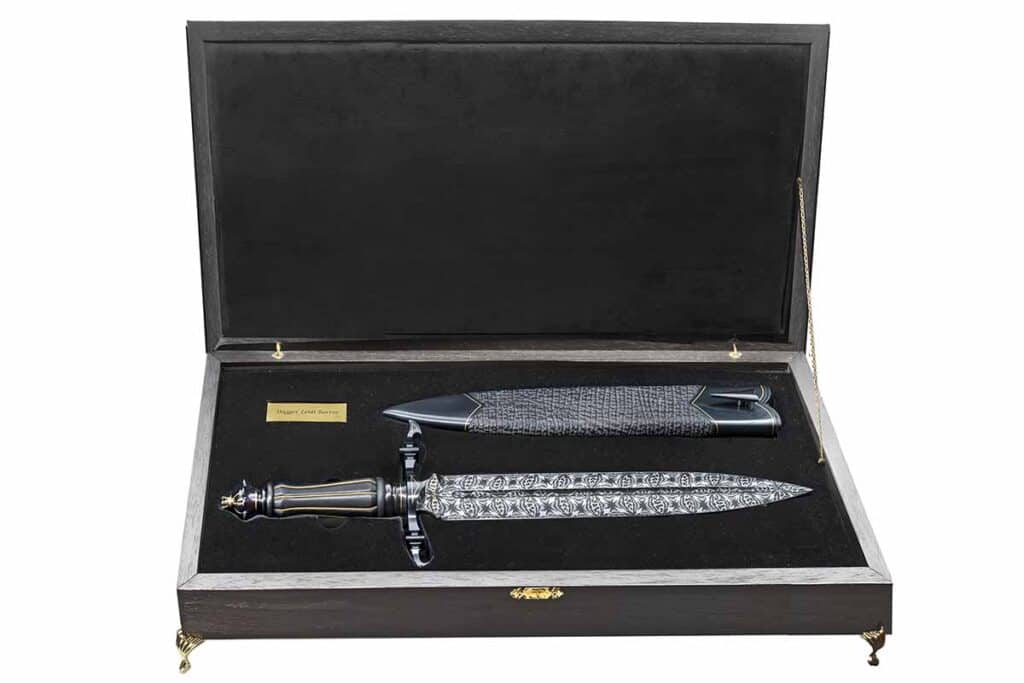
It was a weekend Brazil’s Fabio Barros probably will never forget. Not only was he the sole applicant to gain the coveted rating of ABS master smith, he also won the B. R. Hughes Award for the best knife submitted by such an applicant. In the eyes of some, that he was the only successful MS applicant might have detracted from his Hughes Award—if not for the fact that the same knife also won Best Art Knife at the concurrent BLADE Show.
B. R. Hughes Award Winner
B. R. Hughes Award Winner: Fabio Barros Knife name: Leidi Barros Dagger Maker/designer: Fabio Barros Blade material: Apricot pattern mosaic damascus w/four-sided roughing Construction: Take down Handle: Fluted ebony with gold-braid wire wrap Guard, shim and pommel: Black oxidation with gold appliqué Pommel stone: Onyx Sheath: Shark leather w/gold inlay Display: Ebony case w/exquisite finish Knife to know: The knife is named in honor of Leidiana Barros, wife of Fabio Barros; the handle design is inspired by the queen in a chess set
Karis Fisher
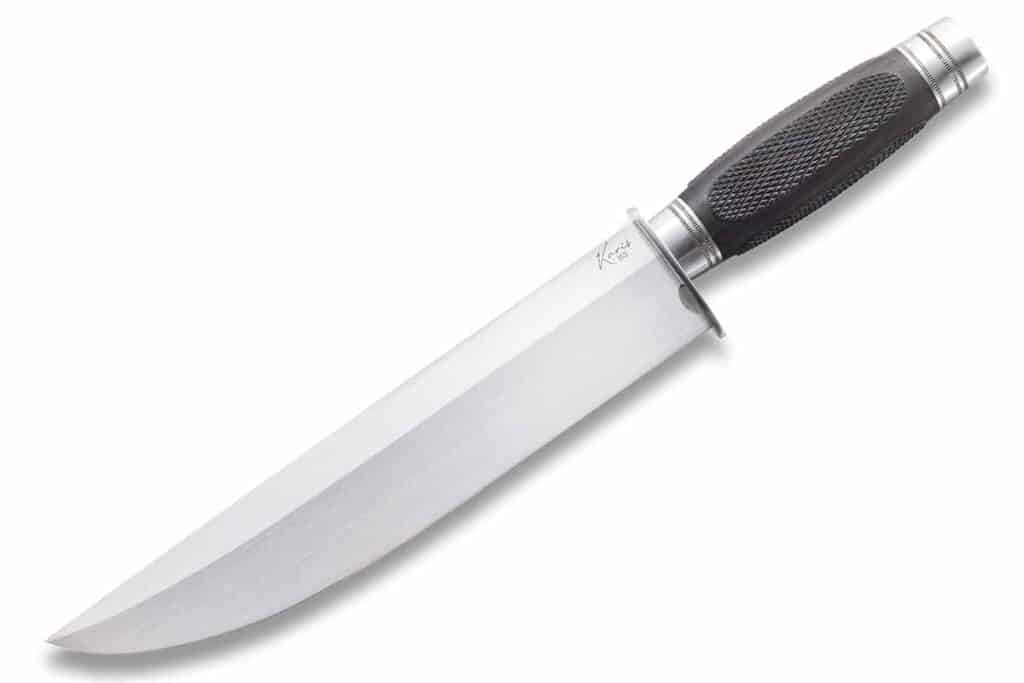
Karis Fisher added to her trophy case by winning the Antique Bowie Award for the best bowie in a 19th-century style by an ABS master smith. It was another feather in the cap of the young smith, who won for a reproduction of the Searles/Fowler bowie—with it being her first attempt at a repro to boot. Added Karis, “I’ve always wanted to try and make a reproduction, and I was drawn to the Searles bowie due to the mix of complexity and clean and timeless design.”
Antique Bowie Award, MS Winner
Antique Bowie Award, MS Winner: Karis Fisher Knife: Searles Reproduction Blade length: 9.25” Blade material: 52100 carbon steel Blade width: 2” Blade @ thickest: .25” Blade grind: Double ground Guard material: Stainless steel Handle material: African blackwood Ferrule and butt material: Stainless steel Ferrule and butt embellishment: Coined liners Overall length: 14.5” Special features: Half-moon cutout in blade and raised checkered panels on handle Knife to know: The knife is based on the Searles-Fowler bowie made by Daniel Searles in Baton Rouge, Louisiana, in 1828 Maker’s price for a similar knife: $2,500
The Challenge: “The most challenging part of this build was definitely the planning of the knife and trying to stay true to the original while building it solely off pictures.”
Matthew Parkinson
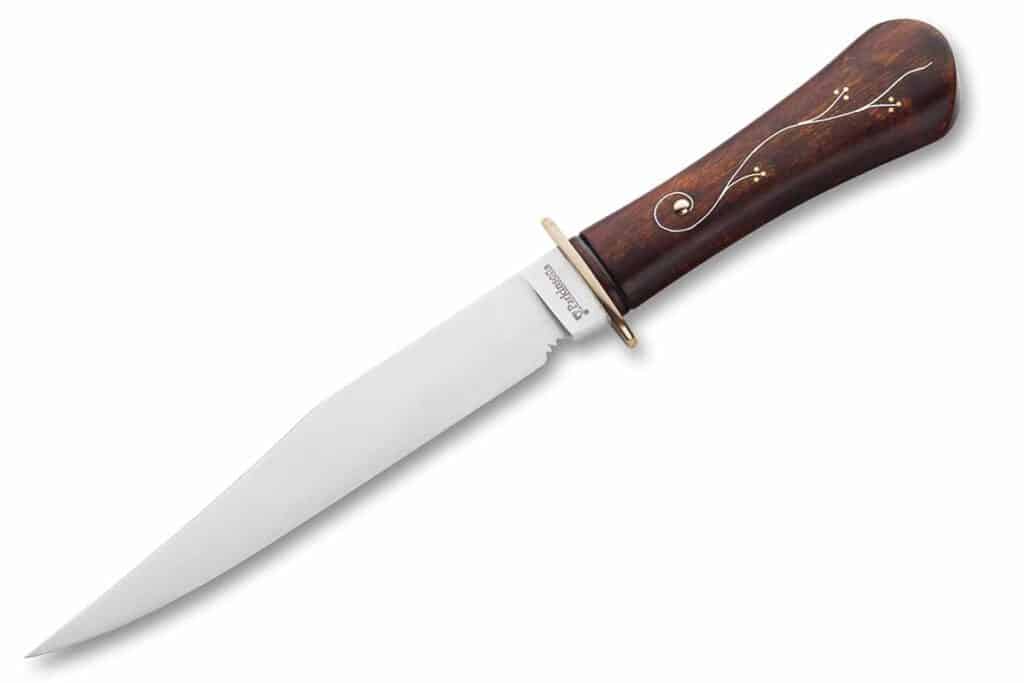
ABS journeyman smith Matthew Parkinson won the W. F. Moran Award for the best knife in the Moran style for his interpretation of a Moran fixed blade. “It wasn’t based on any one knife of his but more a general sort of impression of his body of work,” Matthew wrote. “That is to say, it is my design trying to work within his style—an interesting challenge!”
W. F. Moran Award Winner
W. F. Moran Award Winner: Matthew Parkinson Blade length: 7.25” Overall length: 12” Blade material: 1084 carbon steel Blade @ thickest: 3/16” Blade width: 1.125” Guard and pins: Bronze Handle: Maple Inlay: Sterling silver Maker’s price for a similar knife: $1,100
Maker’s remarks: “The Spanish Notch is just a detail to the choil rather than a plain rounded choil. I saw several similar examples on a knife that Mr. Moran had made and thought it might be a nice touch. The groove at the base of the handle is a carved molding. This is a detail I use frequently in knives that don’t have stabilized wood handles, as inlaid handles normally are. It helps keep a clean, even fit but still allows the wood to move, at the same time adding a nice visual feature that adds to the overall design.”
The Challenge: “I think the most challenging part of doing these is working within another maker’s aesthetic, especially one like Mr. Moran who has a huge and varied body of work. That’s the part that teaches you the most, I think. I find building one of these can give you insight into why another maker chooses one feature over another, or why a line or form is there. Those design ideas become incorporated into your own style and help you grow as a maker.”
Mace Vitale
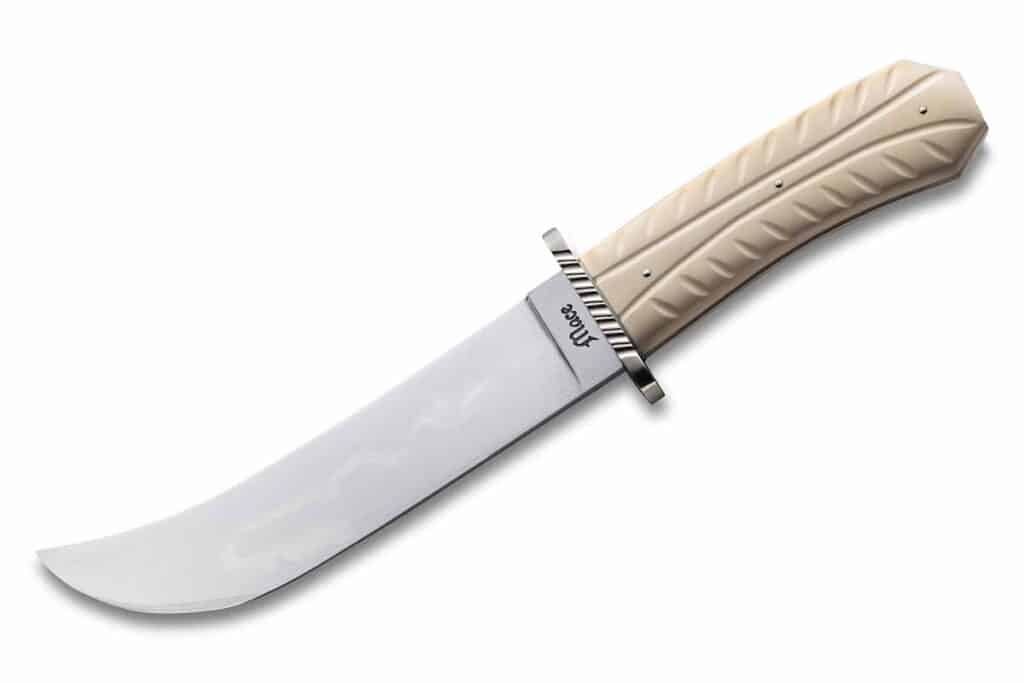
Mace Vitale captured the Antique Bowie Award for the best bowie in a 19th-century style by an ABS journeyman smith for a knife inspired by an antique piece made by Otto & Koehler of New York around 1850. The unusual knife features a markedly upturned blade tip and an ever-so-slightly downturned handle with a modified coffin-style butt featuring two carved lines and two rows of individually carved oblique divots that run its length. “The carving on the handles I’m positive were for extra grip. The knife has an excellent feel in the hand,” Mace observed. “There has been a bit of discussion as to the purpose of the original. As a knifemaker it was pretty clear to me when I picked up the original that it was very purposefully built to be a fighting knife.”
Antique Bowie Award, JS Winner
Antique Bowie Award, JS Winner: Mace Vitale Knife: Inspired by an antique fixed blade from New York makers Otto & Koehler from around 1850 Blade length: 6.5” Blade material: W2 tool steel Blade width: 1.25” Blade @ thickest: 3/16” Blade grind: Flat Fittings and pins: Nickel silver Handle: Mammoth ivory Overall length: 11”
The Challenge: “The most difficult part of building this knife was trying to keep all the parts going the way I wanted. When making a knife like this, it is put together and taken apart many, many times, and I found myself constantly putting the handle or guard on upside down. I was glad once it was done.”
Jason Chen
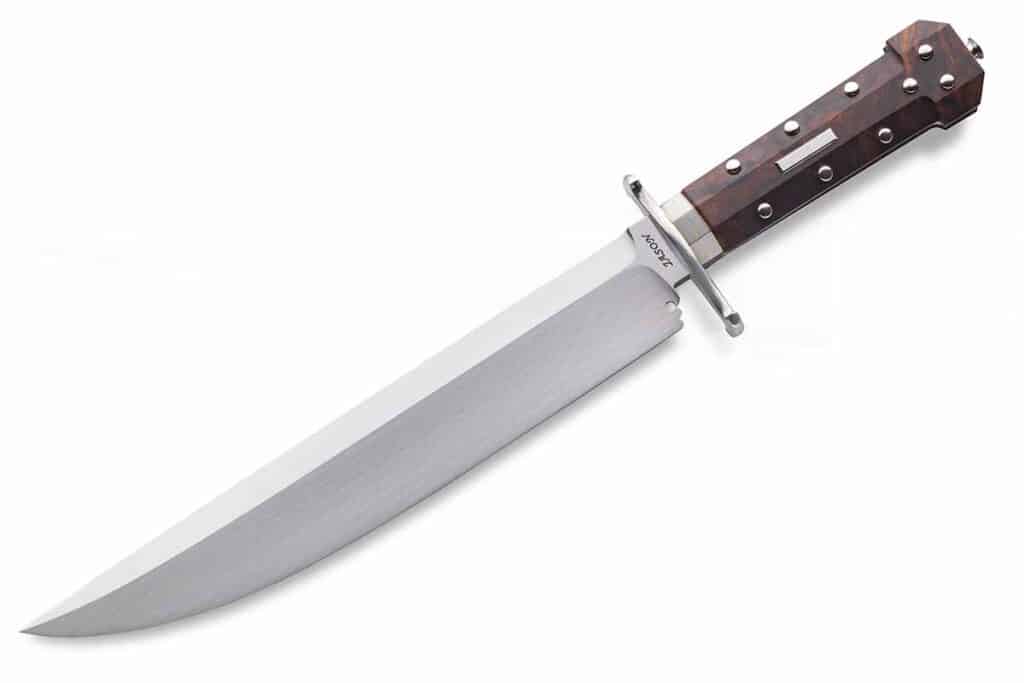
Newly minted ABS journeyman smith Jason Chen of YunNan, China, won the Joe Keeslar Award for the best knife submitted by a successful JS applicant for a spotless reproduction of a bowie not unlike the antique L. Kimball knife. The fact Jason prevailed over the best knives of 13 other successful JS applicants adds to the difficulty of his winning this year’s Keeslar Award. He is to be congratulated—as are all of those receiving top honors at the annual ABS meeting.
Newly minted ABS journeyman smith Jason Chen won the Joe Keeslar Award for the best knife submitted by a successful JS applicant for a bowie not unlike the antique L. Kimball knife.
New ABS Masters & Journeymen
Five applicants presented for ABS master smith and one passed. Twenty-four applied for ABS journeyman smith and 14 were approved. The panels of judges were chosen by the ABS. The smiths who made the grade were: ABS master smith: Fabio Barros, Brazil; ABS journeyman smiths: Cameron Alarcio, California; Jason Chen, China; Pieter-Paul Derks, Netherlands; Zane Dvorak, Ohio; Robin Gagchian, France; Chris Gardner, Nevada; Aidan Garrity, Connecticut; Erik Greiner, Texas; Tony Lewis, Arizona; Dan Lewis, New Mexico; Tony Severio, Louisiana; Warren Thacker, Tennessee; Thiago Vidotto, Washington; and Liam
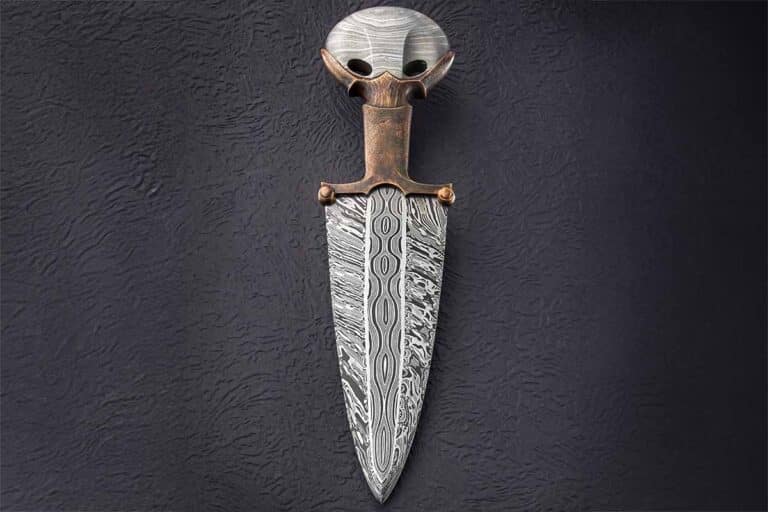
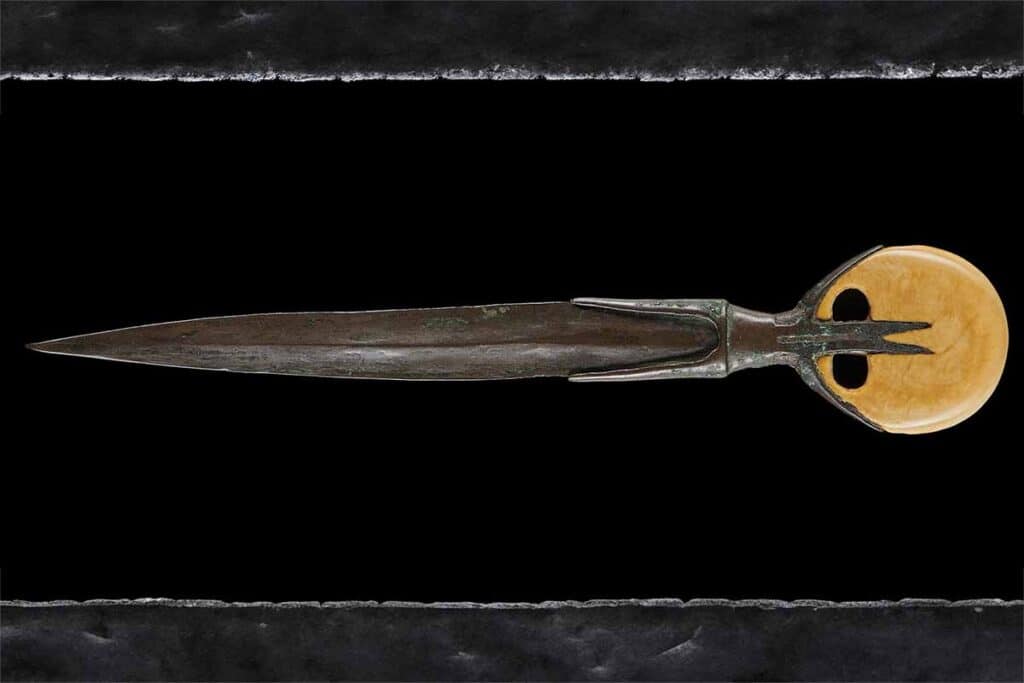
While it may appear to be an alien looking back at you, the Relic Dagger by ABS journeyman smith Ryan Breuer is inspired by Egyptian daggers from the Bronze Age that were made over 6,000 years ago.
The pommel on the originals are believed to have been made of hippo ivory.
“There’s such a striking shape to it,” Ryan said. “It very clearly looks like a human form in the handle holding up either a head or maybe the sun. It’s as if those who made the daggers thousands of years ago are looking back at me. It’s almost spooky.”
The damascus blade is a collaboration between Ryan and bladesmith Jason Morrissey, though Ryan gives Jason most of the credit for the steel. The blade is a composite mosaic damascus, with twisted mosaic edge bars of Jason’s steel and Ryan’s “eyes” mosaic in the core.
Ryan Breuer
Ryan ground, heat treated and finished the blade. The hilt is cast bronze made with the lost-wax process. The pommel is pattern-welded wrought iron and pure nickel, manipulated to imitate layers of organic ivory. Ryan drilled the two holes for the “eyes.”
Fantastic custom and factory fixed blades just hitting the market.
There’s just something about a solid fixed blade knife. At once, these knives are simple yet elegant—especially when crafted by a master. We’ve scoured the globe—or at least three continents—to bring you a dozen excellent fixed specimens. They range from fillet knives to fighters and everything in between, and each is certain to induce the expansion of wish lists.
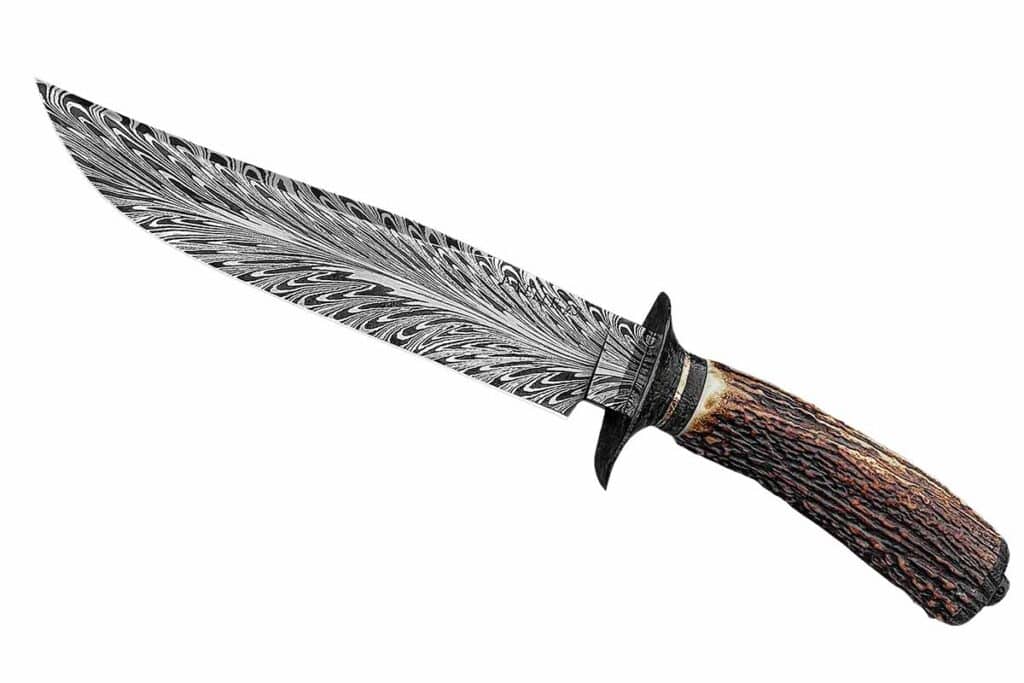
Jeremy Yelle Fighter
Blade length: 7.5” Blade material: Feather damascus forged of 1084 carbon and 15N20 nickel alloy steels Blade grind: Convex w/an unsharpened clip Handle material: Stag Furniture: Blackened 416 stainless steel Knife to know: Jeremy Yelle is a journeyman smith in the American Bladesmith Society Maker’s price for a similar knife: $1,700 Maker:Jeremy Yelle (Jocelyn Frasier image)
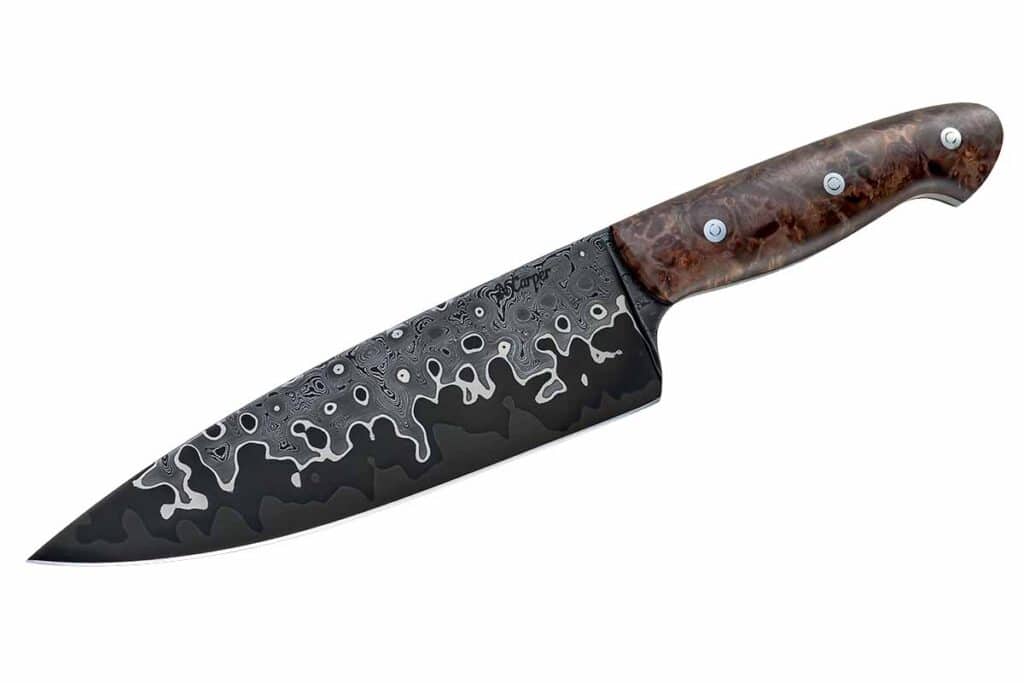
Nate Carper Custom Knives Acid Rain
Blade length: 7.25” Blade material: “I call this my Acid Rain pattern. I made a seven-layered billet using an 80CrV2 carbon steel core, 1084 carbon steel for the next two layers, nickel shim for two layers and followed up with 300 layers of a Raindrop pattern on the outside.” Blade grind: Full flat w/a tapered tang and distal taper Handle material: Dyed and stabilized maple secured w/Loveless bolts Overall length: 12” Maker’s price for a similar knife: Contact Nate Carper for more information Maker: Nate Carper Custom Knives (SharpByCoop image)
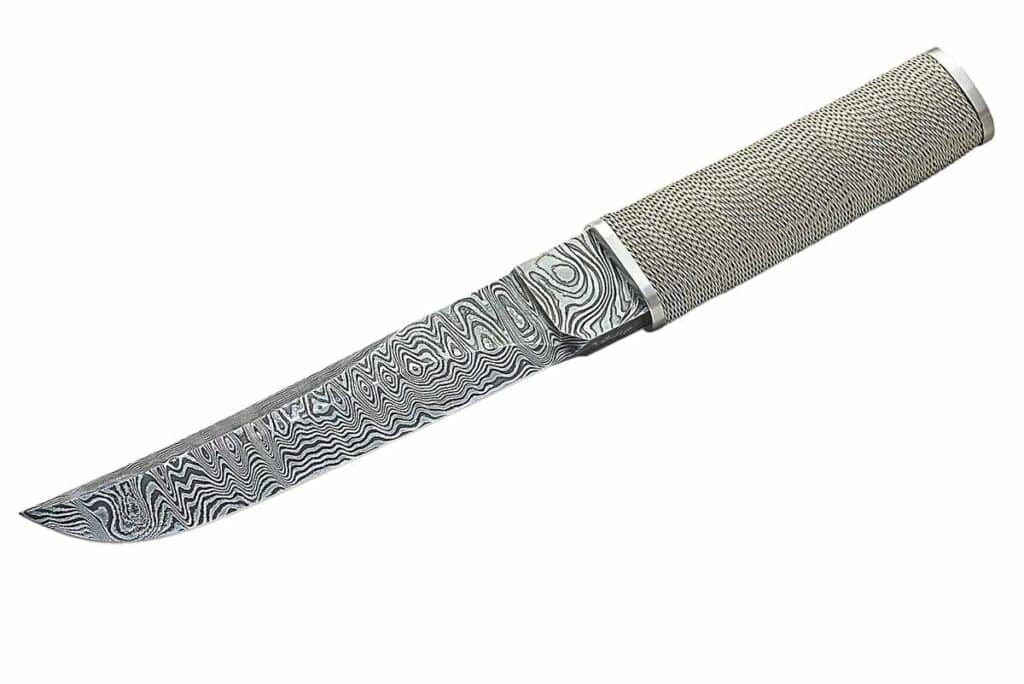
Tom Haslinger Damascus Kissaki-Moroha Tanto
Blade length: 6.7” Blade material: HCK damascus forged in 320 layers of 1080 carbon and 15N20 nickel alloy steels Rockwell hardness: 58 HRC Handle: Stainless steel wire wrap Tsuba (guard) material: Stainless steel Kashira (buttcap) material: Textured stainless steel Overall length: 12.65” Weight: 13 ozs. Saya (sheath): Lined cowhide w/koi leather overlay Maker’s price for a similar knife and sheath: $1,490 Maker:Tom Haslinger
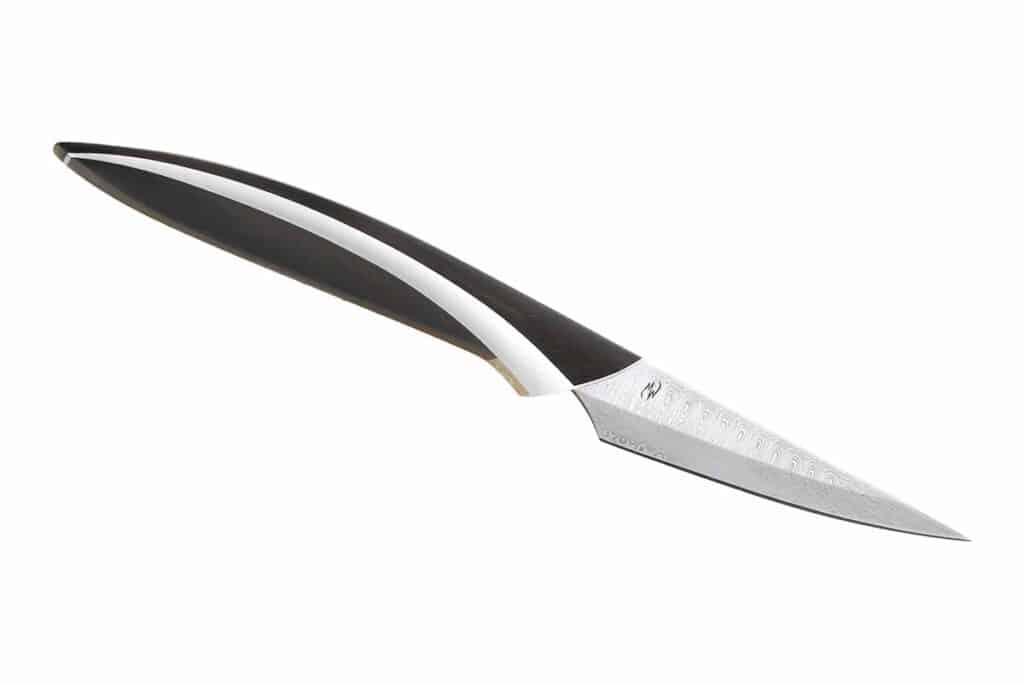
Michael West Silver Lining
Knife type: Fixed blade Blade length: 3.93” Blade material: Damasteel twist damascus Blade grind: Freehand hollow Furniture: Argentium silver Handle material: Ebony and argentium silver Overall length: 9.6” Sheath materials: Leather and argentium silver Maker’s price for a similar knife: $3,100 Maker:Michael West (SharpByCoop image)
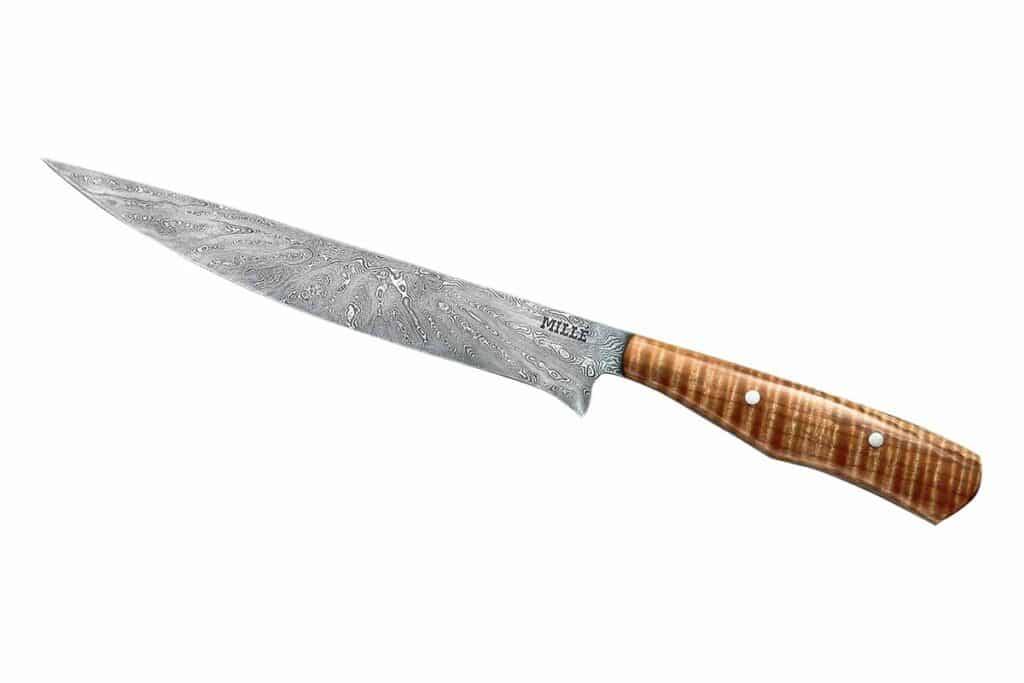
Mille Blades Fillet Knife
Blade length: 8” Blade material: Damascus forged of 1084 carbon and 15N20 nickel alloy steels Handle material: Stabilized tiger maple Overall length: 13” Maker’s price for a similar knife: Contact Adam Mille for more information Knife to know: Adam Mille is an apprentice smith in the American Bladesmith Society Maker: Mille Blades (SharpByCoop image)
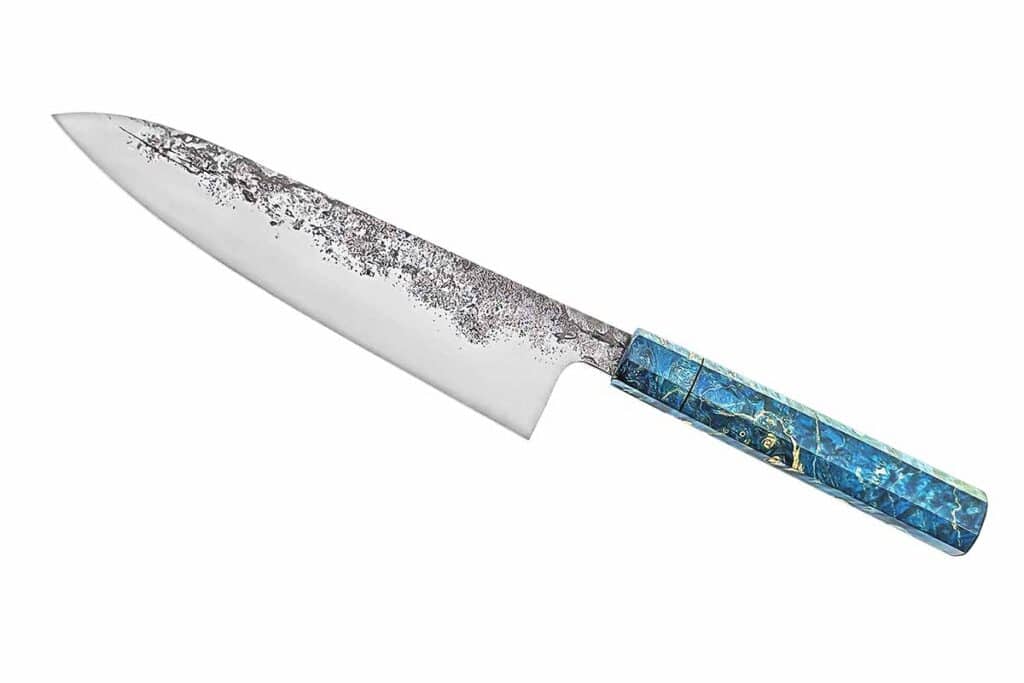
Andrew Bonavia Gyuto
Blade length: 8.5” Blade material: Forged 1084 carbon steel Blade grind: Full flat Blade @ widest: 2” Handle material: Dyed spalted maple Overall length: 14” Maker’s price for a similar knife: $531 at press-time exchange rate Knife to know: Andrew Bonavia is a member of the Australian Knifemakers Guild Maker: Andrew Bonavia (Rod Hoare image)
Brad Millman O-Tanto
Blade length: 11.75” Blade material: 120-layer 1095 carbon and 15N20 nickel alloy steels w/nickel cladding and an 80CrV2 carbon steel core Blade grind: Flat to convex near the edge Handle: Raffir poplar burl Bolster: Forged-finished stainless and copper Overall length: 16.25” Maker’s price for a similar knife: $1,200 Maker: Brad Millman (Jocelyn Frasier image)
Blacks Blades Mosaic Damascus Bowie
Blade length: 13.5” Blade material: Mosaic damascus Blade grind: Flat Blade thickness @ ricasso: .236” Handle material: Tassie blackwood Furniture: Hot blued mild steel Overall length: 19.5” Maker’s price for a similar knife and sheath: Contact Shane Partridge for more information Maker: Blacks Blades (Rod Hoare image)
Aimee’s Forge Boot Dagger
Blade length: 4” Blade steel: Nitro-V stainless Blade grind: Flat Construction: Full tang Handle material: Black and red G-10 Handle pins: Black G-10 Overall length: 8.75” Sheath: Leather w/belt clip Maker’s price for a similar knife: $431 at press-time exchange rate Knife to know: Aimee Conte is a member of the Australian Knifemakers Guild and an apprentice smith in the American Bladesmith Society Maker:Aimee’s Forge (Rod Hoare image)
Zane Dvorak Integral Hunter
Blade length: 4.25” Blade material: Black Edge mosaic damascus forged from 1084 carbon and 15N20 nickel-alloy steels Blade grind: Flat to convex Blade pattern: Clip point Handle material: African blackwood Overall length: 9.25” Sharp stuff: Forged integral single guard; carved handle groove matches the one in the bolster Maker’s price for a similar knife: $1,400 Maker:Zane Dvorak (Jocelyn Frasier image)
Jeroen Knippenberg Integral Chef’s Knife
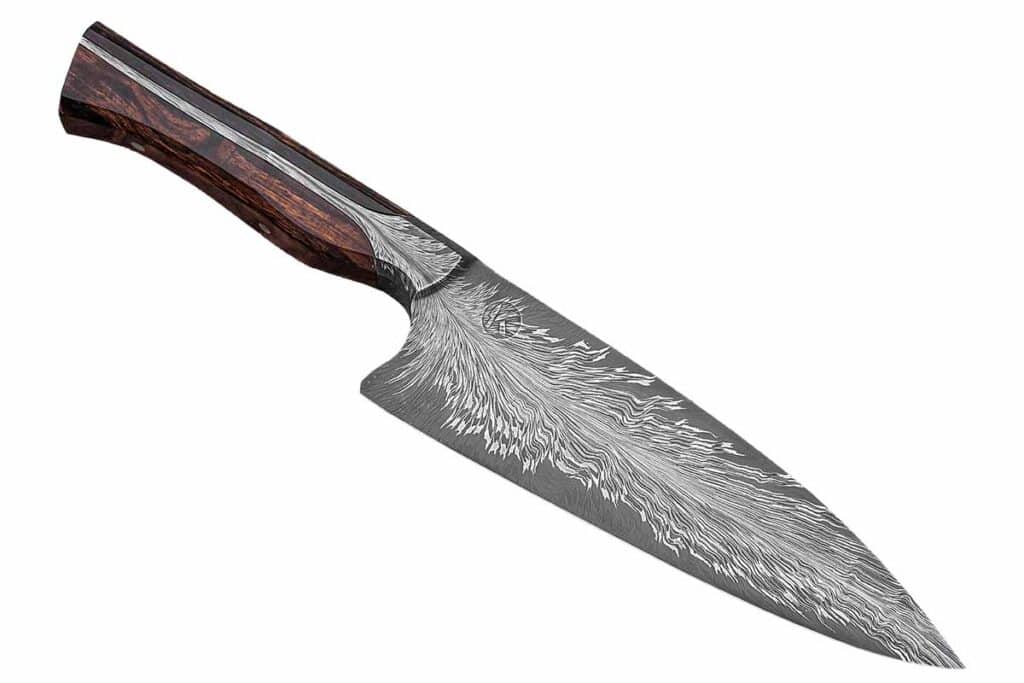
Blade length: 6.7” Blade material: A multi-color Feather damascus pattern forged from 15N20 nickel alloy and O2, O1 and 115W2 tool steels Blade grind: Convex Handle material: Desert ironwood Overall length: 11” Knife to know: Jeroen Knippenberg’s Integral chef’s knife won Best Chef’s Knife at the Dutch Knife Exhibition Maker’s price for a similar knife: $1,600-$2,140 at press-time exchange rate Maker:Jeroen Knippenberg (Jocelyn Frasier image)
Dragon’s Breath Forge Period Piece
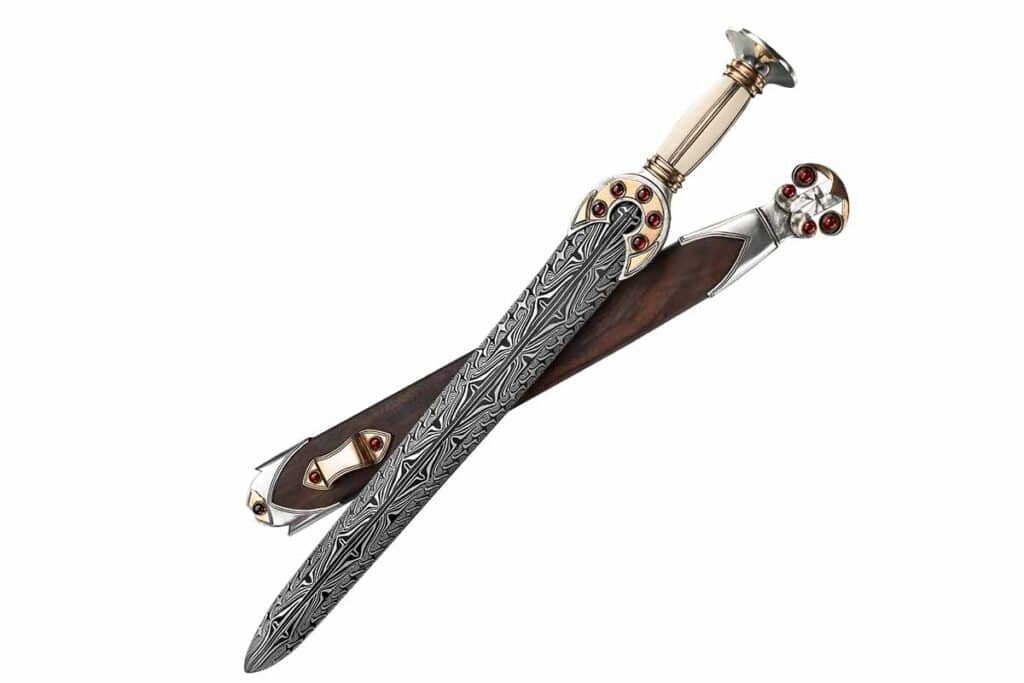
Blade length: 18” Blade material: 1080 carbon and 15N20 nickel alloy steels Handle material: Bronze and Elforen Bolster: Silver, bronze and garnet Overall length: 24” Maker’s price for a similar knife and scabbard: Contact Jamie Lundell for more information Maker:Dragon’s Breath Forge (SharpByCoop image)