Home Blog Page 65

Cool Customs: Darriel Caston’s Impish Split Handle

0

Barry Wood’s split-handle folder inspires Darriel Caston’s clever keychain knife.

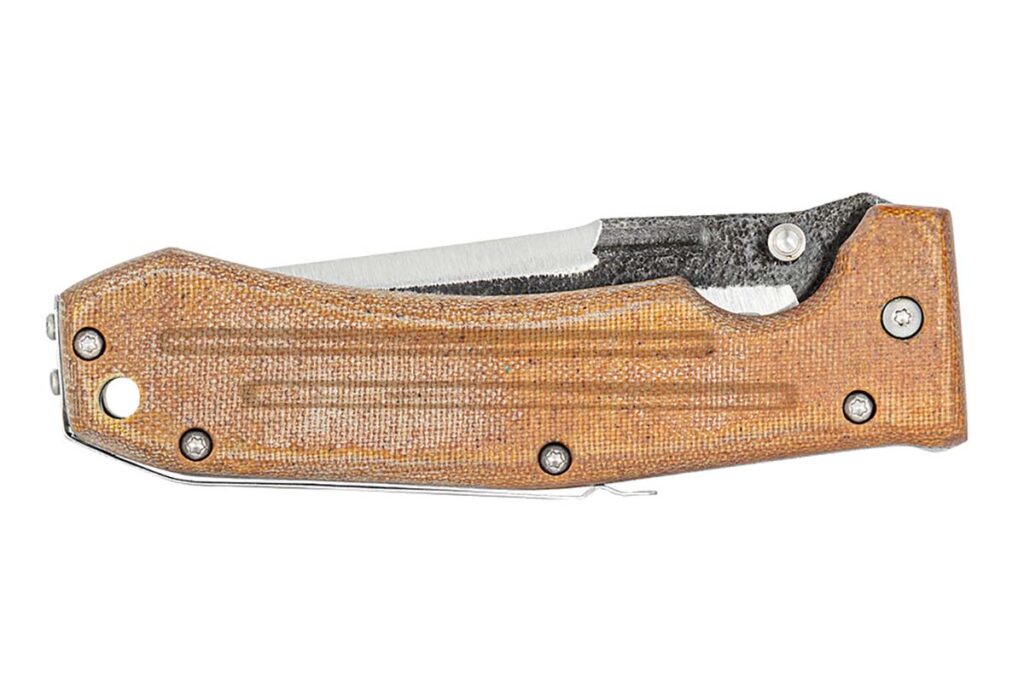
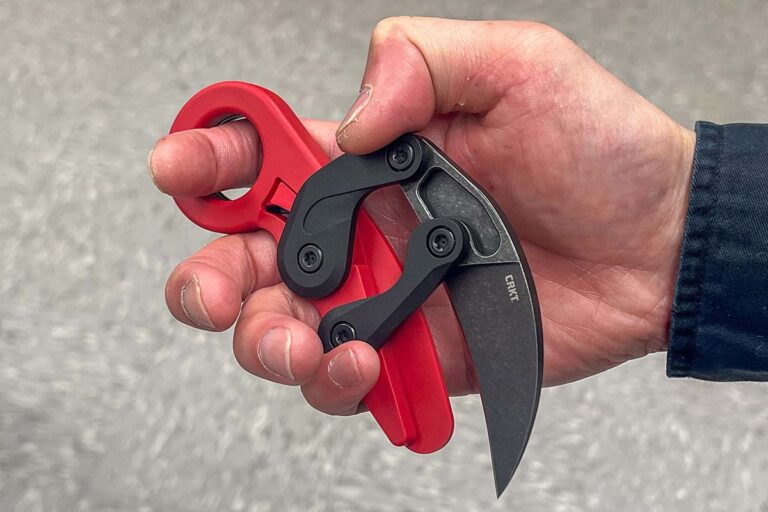
Inspired by the split-handle folding knife made famous by the late, great custom knifemaker Barry Wood, the Imp by Darriel Caston is a clever keychain knife ideal for EDC.

Like the Wood folder, the blade opens by pivoting one of the scales clockwise and closes by pivoting the same scale counterclockwise. At the same time, slots at the ends of the Imp’s scales accept a keychain when they’re open and form an enclosed elliptical oval to hold the keychain when they’re closed.

Darriel Caston

Instead of a ball detent affixed to the blade to help hold the knife open and closed, Darriel uses magnets affixed to the handle. Darriel and his daughter, Bella, were trying to come up with names for the knife when she observed that it was “a little booger,” and he said, “Yeah, like a little imp.”
And another knife name was born.

The Imp Specs
Blade length: .82”
Blade steel: M390 stainless
Blade grind: Modified compound tanto
Handle material: Titanium
Closed length: 1.75”
Maker’s price for a similar knife: In the $185-$200 range

Check Out More Cool Custom Knives:

2023 BLADE Show West Custom Knife Award Winners

See Who Took Top Honors In Salt Lake City For The 2023 BLADE Show West Custom Knife Awards.

BLADE Show West took place Oct.13-14, 2023, at the Salt Palace Convention Center in Salt Lake City, Utah. It was the show’s second year in Utah and drew custom makers, manufacturers and collectors from around the county and world.

It also drew an impressive cadre of entrants for the BLADE Show West Factory and Custom Knife Awards. For Factory Knives, awards were given in six categories, while the Custom Knives awarded nine categories.

The Custom section was evaluated by a panel of undisclosed industry experts who judged the blades on a number of factors, including utility, design, creativity, materials and other traits.

BLADE Show West Custom Knife Awards

Best In Show & Best Slip Joint: ESNYX Knives

Best Slip Joint: ESNYX Knives

Best Folder: Rhidian Knives

Best Folder: Rhidian Knives

Best Damascus: Apple Valley Forge

Best Damascus: Apple Valley Forge

Best Kitchen Knife: Apple Valley Forge

Best Kitchen Knife: Apple Valley Forge

Best Fixed Blade: Shane Atwood

Best Fixed Blade: Shane Atwood

Best Hunter: Ramm Bladesmithing

Best Hunter: Ramm Bladesmithing

Best M.A.C.K.: Heretic Pariah

Best M.A.C.K.: Heretic Pariah

Best Of The Rest: Jared Williams

Best Of The Rest: Jared Williams

See Past Knife Of The Year® Awards Winners:

  • 2022 Factory Knife Of The Year Award Winners
  • 2021 BLADE Show Knife-Of-The-Year® Award Winners & Custom Knife Award Winners
  • 2019 Knife of the Year® Award Winners & Custom Knife Award Winners
  • 2018 Knife of the Year® Award Winners & Custom Knife Award Winners

2023 BLADE Show West Factory Knife Award Winners

0

See Who Took Top Honors In Salt Lake City For The 2023 BLADE Show West Factory Knife Awards.

BLADE Show West took place Oct.13-14, 2023, at the Salt Palace Convention Center in Salt Lake City, Utah. It was the show’s second year in Utah and drew custom makers, manufacturers and collectors from around the county and world.

It also drew an impressive cadre of entrants for the BLADE Show West Factory and Custom Knife Awards. For Factory Knives, awards were given in six categories, while the Custom Knives awarded nine categories.

The Factory section was evaluated by a panel of undisclosed industry experts who judged the blades on a number of factors, including utility, design, creativity, materials and other traits.

BLADE Show West Factory Award Winners

Best In Show &Best Factory Import: WE Equivik

Best In Show &Best Factory Import: WE Equivik

Best Factory Folder: QSP Rhino

Best Factory Folder: QSP Rhino

Best Factory EDC: Mr. Mr. Designs D-Cipher Folder

Best Factory EDC: Mr. Mr. Designer D-Cipher Folder

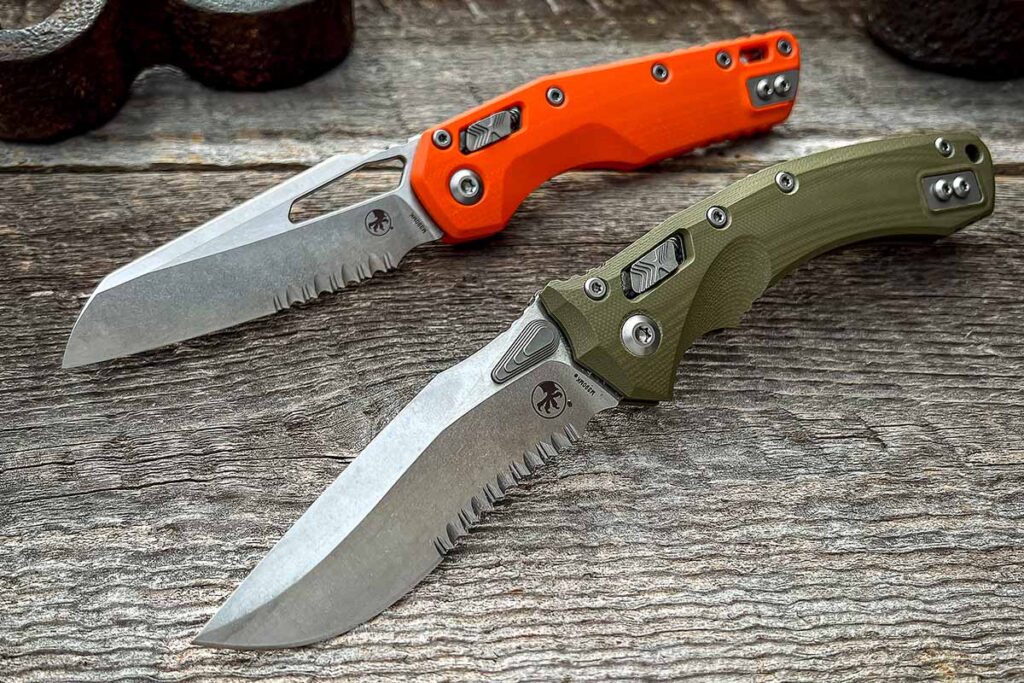
Best American Made: Microtech Knives MS1

Best American Made: Microtech Knives MS1

Best Factory Fixed Blade: Giant Mouse GMF4

Best Factory Fixed Blade: Giant Mouse GMF4

See Past 2023 Factory Knife Of The Year® Awards Winners:

  • 2022 Factory Knife Of The Year Award Winners
  • 2021 BLADE Show Knife-Of-The-Year® Award Winners & Custom Knife Award Winners
  • 2019 Knife of the Year® Award Winners & Custom Knife Award Winners
  • 2018 Knife of the Year® Award Winners & Custom Knife Award Winners

Spectacles In Steel: A Look At Definitive Damascus Patterns

Modern makers’ takes on this age-old steel art.

When BLADE Magazine Cutlery Hall-Of-Fame® member Bill Moran reintroduced knives with damascus blades at the 1973 Knifemakers’ Guild Show, little did he know how much damascus would evolve, redefine itself, expand into new media, and no telling what other recreations and rebirthings it has experienced in the half-century since that fateful weekend in the Muehlebach Hotel in downtown Kansas City.

On this page are some of today’s reincarnations of the material in its various forms, methods, materials and more. What’s staggering to consider is there are so many more variations—not only now but also to come. It is a phenomenon that is truly unique to the custom knife industry and should be celebrated and promoted whenever possible.

David Lisch Templars Mosaic

David Lisch’s dagger
David Lisch’s spectacular art dagger features a 12-inch blade of his Templars Mosaic Damascus, a blackwood handle with gold wire wrap and a guard of pure iron covered in melted gold. Overall length: 17.75 inches. The knife comes with a stand that includes an embellished templars’ cross and one carved in the base as well. (SharpByCoop knife images)

Sporting a pattern ABS master smith David Lisch christened Templars Mosaic, the blade for his dagger is one he forged from 15N20 nickel-alloy and 1080 carbon steels and etched in ferric chloride.

“I was aiming for a bold, bright pattern that had a cross-like shape but wanted it to be a bit organic,” he wrote. The Templars’ cross also is represented on the guard and the finial, and there is one on the stand that holds the knife as well. “All these parts are pure iron covered in melted gold,” he noted. The dagger also has a domed gold spacer between the guard and Dragon Thunder damascus spacer that the fluted-blackwood-with-gold-wire-inlay handle butts up against.

“I made this dagger out of the love I have for creating art with no concern about how long it took or how much money I would make from it,” David stressed. “I did the handle twice and I did the big finial twice. I sold the piece for $10,000 and will not be making another one like this. You can be sure that the love I have for creating will take me to a new dagger, sword or bowie knife that tries to fill the void in me that can only be filled by creating art.”

Jeremy Yelle Jellyroll Mosaic Turkish Twist

jellyroll mosaic Turkish twist pattern damascus
The steels for the jellyroll mosaic Turkish twist pattern damascus of the collaborative bowie by Jeremy Yelle (right) and Alex Houle (left) is forged from 1080 carbon and 15N20 nickel-alloy steels. Blade and overall lengths: 10.25 and 15.5 inches. Their list price for a similar knife: $2,600. (Jocelyn Frasier knife image edit)

The blade damascus of ABS journeyman smith Jeremy Yelle’s and SBK Cutlery’s stag bowie is a positively electric jellyroll mosaic Turkish twist pattern Jeremy forged in a collaboration with his friend Alex Houle of SBK. Alex forged the collaborative damascus into a blade and Jeremy made the handle.

“We began by welding a billet of alternate layers,” Jeremy wrote of the forging process. The pair drew the billet into a bar and jelly rolled it. “Then we squared it up and welded a four-way incorporating some 1-inch-square 1080,” he continued. They welded the billet, drew it out to ¾-inch square, cut and twisted it, and made a Turkish-twist stack that Alex forged into a blade. “You can also see the ‘fish mouth*’ weld Alex did so the edge bar and the spine meet properly,” Jeremy wrote. “He did a wonderful job making the blade.” Jeremy showed Alex how to work with stag and they finished the parts. Alex revealed the beautiful pattern via a two-step etching process using a solution of ferric chloride and finishing the etch with a coffee-darkening soak and hot wax finish.

Zane Dvorak Multi-Bar

multi-bar damascus
The 4.25-inch blade of Zane Dvorak’s hunter is a multi-bar damascus of 1084 carbon and 15N20 nickel-alloy steels. Overall length: 9.25 inches. His price for a similar knife: $2,400. (SharpByCoop image)

The blade of Zane Dvorak’s hunter is a multi-bar damascus of 1084 carbon and 15N20 nickel-alloy steels. Zane forged the blade/tang of four twisted bars of a twisted-bar pattern, and forged welded the guards and bolsters on with the same pattern. He bird’s mouthed the blade tip and rewelded it back together to create flowing outer bars. For etchant he used Gator Piss Acid from Baker Forge & Tool.

Bird’s mouthing is a process done on multi-bar, mosaic or other types of damascus patterns. According to Zane, it involves cutting a triangle out of the end of the rectangular parent bar—the shape of which somewhat resembles a bird’s mouth—then bringing the steel of the edge and spine back together to form the point of the blade. By doing so the blade exhibits a better consistency and overall flow of the pattern.

Andrew Blomfield Alternate Pattern

mosaic damascus Andrew Blomfield’s sub-hilt fighter
The mosaic damascus for Andrew Blomfield’s sub-hilt fighter is a combo of two separate billets welded in an alternate pattern. Blade and overall lengths: 9.5 and 14.5 inches. Blade grind: flat. Andrew’s price for a similar knife: $3,000. (SharpByCoop image)

The material mid-blade of Andrew Blomfield’s sub-hilt fighter is a combination of two separate billets of mosaic damascus welded in an alternate pattern. The edge is a straight feather pattern forge welded around the edge. The blade is a combination of pieces from three separate billets. The steels are 1084 carbon and 15N20 nickel alloy etched with ferric chloride.

The integral sub-hilt is 1020 low-carbon steel hot salt blued to a deep black finish. The handle is desert ironwood. The knife is of a full takedown construction.

Frank Edwards Palm Leaf Mosaic Pattern

 Palm Leaf mosaic damascus by Frank Edwards i
The Palm Leaf mosaic damascus by Frank Edwards is an interweaving river system of straight lines. The handle inlay is black-lip mother-of-pearl. Blade and closed lengths: 3 and 4.25 inches. His price for a similar knife: $1,900. (SharpByCoop knife image)

The multi-bar damascus of Frank Edwards’s folding dagger blade is in a Palm Leaf mosaic pattern. Starting with a billet of straight lines, he reduced it all into a square and then biased the squares, four-waying the billet into a 1.5-inch square.

As Frank explained his recipe, “Forge weld another billet of straight lines, keeping them straight as possible to .5 inch by 1.5 inches. Add that to the previous billet and forge weld and reduce to a 1×1-inch square. Then four-way it again. This will give you the frame around the palm leaves. Keep repeating that until you achieve the size of pattern for the knife you’re building.

“The key to getting good mosaics is a slower reduction [of the steel]. We have presses and power hammers that help but they can move too much metal too fast, which will destroy a mosaic in a hurry. The slower reduction allows the billet to stay uniform throughout the length of the bar.” 
To expose the pattern he etched the blade with a four-to-one mixture of water/ferric chloride in 10-minute cycles, using 2,000-grit sandpaper between cycles.

Jackson Rumble Stunning Pattern

unnamed damascus pattern
The 8-inch blade of an integral chef’s knife by Jackson Rumble boasts a mesmerizing and at press time unnamed damascus pattern forged from 1084 carbon and 15N20 nickel-alloy steels. The handle is African blackwood. Overall length: 13 inches. The maker’s price for a similar knife would start at $2,500. (SharpByCoop knife image)

The technique for the stunning pattern on newly named ABS master smith Jackson Rumble’s chef’s knife is what he calls a “pretty standard process” of four-way welding and re-square cycles. Not bad for “pretty standard,” eh (page 28, top left)? The initial stack has large sections of both light and dark steels interspersed through the alternating layers, and Jackson added extra-light steel to the billet in the later stages of the forging process.

“Finally, I used the Filicietti Flip method to transfer the pattern to the face of the billet,” he wrote. “For the etching process I used ferric chloride followed by coffee.”
OK, Jackson, so what’s the “Filicietti Flip method”?

“I’ve heard the Filicietti Flip called other names like the Ferry Flip, or just tile welding,” he explained. “Basically, after you’ve finished building the pattern in the end grain of the billet, you take it to a bandsaw and cut slices off the end at a 35-degree angle. This makes a bunch of pieces in the shape of parallelograms or tiles. The tiles can then be rotated and forge welded back together to form a new billet. Instead of having the pattern showing on the end of the billet, the pattern will repeat itself along the face of the billet.”

We’re glad we asked.

*Also called fish lips, fish mouth is when the tip of the billet begins to curl up on either side during rough forging to resemble a fish’s mouth or lips, thus the name. It is an easy fix for knowledgeable bladesmiths such as Alex Houle.

Check Out More Cool Custom Knives:

Gerber Knives: The Blades That Made It Legendary

0

From kitchenware to commando companions, we go over how Gerber Knives became legendary and some of their all-time best offerings.

Gerber Legendary Blades, often known as just Gerber among the knife community (not to be confused with the equally legendary makers of fine baby foods and formula), is a name that you’ve probably heard. It’s hard to go into any outdoor store without finding one of its many blades.

But how much do you really know about the company?

Today, we’re going to do a deep dive into this iconic knifemaker that has helped shape the knife industry for so many years. We’re going to cover everything from its history to its new and exciting premium knife offerings, along with all the truly legendary knives it’s released along the way. 

Let’s get started. 

History of Gerber Knives

Cooked Up In The Kitchen

In the early 1900s, the Gerber family began their corporate climb with a simple advertising firm in Portland Oregon. As a promotion, Joseph Gerber sent out 24 sets of handmade kitchen knives to clients during the holidays. 

Vintage Gerber Kitchen Knife set
Vintage Gerber Kitchen Knife set. Photo: WorthPoint

These proved so popular that Abercrombie & Fitch, then one of the largest catalog retailers, requested more for its 1939 spring edition. Gerber Legendary Blades was then founded shortly after. 

Originally, Gerber focused on camp, kitchen, and carving knives, and did brisk business around the holidays and wedding season in the spring when many registries included a new kitchen knife set for happy couples. 

Off To War

Following WWII, Gerber expanded its focus and began to work on knives for military contracts, including the now-legendary Mark II fighting knife. Al Mar, a prolific knife designer, added some serrations to the blade allowing it to be marketed as a survival knife as well. 

Since then, the Mark II has been discontinued in favor of the Prodigy and LMF II knives, which are both in service with various militaries. The LMF II in particular currently sees services as an aircraft survival knife. It features a specially insulated handle so that downed pilots can cut their way free of airframes without risk of an electrical shock, even if they have to cut through the fuselage of the aircraft. 

Vietnam Era Gerber Knives Mark II
Vietnam Era Gerber Knives Mark II. Photo: Sharpinvestments.net

Other Gerber knives such as the often-imitated LST lockback folder changed the shape of the knife-making landscape forever. The 06 Auto was, and is, hugely popular with U.S. and NATO forces in the Middle East and has earned a reputation as a tough piece of gear that gets the job done. 

Into Every Niche

Gerber has also collaborated with a wide variety of knife makers and designers, as well as police trainers, special forces operators, and world-class martial artists to design hard-use knives that meet any need in the field. 

One of my personal favorites is Gerber Guardian, a “boot knife” designed by Bob Loveless—the man who popularized the hollow-ground drop-point blade—and is generally considered one of the most innovative knife designers to ever live.

Gerber Bear Grylls compact Scout Knife

Another, now collector’s item, is the River Master, a collaboration with legendary knife maker Blackie Collins. The River Master is an aggressive dive knife designed to cut through fishing lines, nets, vegetation, and other obstacles that can spell doom for a diver—particularly in murky water. 

Blackie Collins, incidentally, gave us the assisted-opening spring mechanism that so very many knives today use, including the 06 FAST, the more budget-friendly, non-automatic version of the 06 Auto. Not to mention he was the founder of a little publication called American Blade (i.e. Blade Magazine).

There’s also the Bear Grylls collection, which includes the top-selling Ultimate Pro knife, which has become somewhat iconic in the years since its release. The original Ultimate was a bit of a flop as Gerber outsourced more of its manufacturing and quality control suffered. 

Thankfully, Gerber has taken things more firmly in hand these days, and while it still offers a variety of very budget-focused “beater” knives, its premium Reserve offerings stand tall with the best of the best in the production knife world today. 

Are Gerber Knives Any Good?

Yes, Gerber knives are good. The company’s more affordable lineup offers great value for the budget-conscious, and their higher-end offerings (particularly the Reserve line) are as good as anything you’ll find in the world of production knives.

Don’t make the mistake of thinking those $7.99 knives on the clearance rack in the camping section of your local big box store are all Gerber has to offer these days. 

The new(ish) Fastball cleaver, the Sedulo, Terracraft, and the now-iconic 06 Auto are all incredible knives I can personally vouch for (we’ll talk more about them later, plus a few other iconic Gerber knives). 

Today, Gerber also remains one of the largest suppliers of knives to the U.S. military and has grown into one of the most respected names in the knife industry. Though owned by Fiskars, a Finnish company also known for great blades, most of Gerber’s best knives are made right here in the US as well.

As a great man in the knife industry has often said, quality is about effort, not geography. But it’s always nice to support the home team, especially when it comes to knives. 

All-Time Greats: Best Gerber Knives to Pay Attention To

06 Auto

Gerber Knives Auto 06

The Gerber 06 Auto has been a top seller for ten years now and has been a big hit with US forces in Iraq and Afghanistan. This is a knife that has been issued to US forces and flown off the shelves at the PX as well, so it’s safe to say it has the military’s stamp of approval. 

It’s an automatic opening knife, with a 3.6-inch CPM S30V blade. The auto opening and the blade length make it a very useable knife for everything from camp meal prep to self-defense but be sure to check your local regulations before picking one up. 

My time with the 06 Auto has been great, and I’ve used it for all kinds of cutting and sawing tasks around camp and even used it to open a “spam can” of Russian surplus 7.62x54R ammo out in the desert when we absolutely had to have the ammo for a video shoot. 

All in all, a great knife, with a battle-proven pedigree. 

Mark II

Gerber Mark II

The Mark II was introduced just before the kickoff of the American involvement in Vietnam and is one of the most popular knives around. It features a 6.6-inch 420HC double-edged blade with a black oxide coating. It also features serrations on both sides near the handle, giving it its iconic look.

It was originally conceived as a fighting knife by Captain Bud Holzmann, who based the design on a Roman Gladius, specifically the Mainz Gladius, which is a very famous example of the Roman blade that was found in the Mainz River. 

The knife overall takes some cues from the Fairbairn-Sykes fighting knife issued to British commandos and was the second-most commonly carried knife by American Troops in Vietnam, only behind the iconic Ka-Bar. 

The knife has also been quite famously featured in films like The Road Warrior as the knife carried by Max himself, in Aliens (the cafeteria scene), in the excellent knife fight scene in Captain America: Winter Soldier, and in the bananas knife fight scene at the end of Under Siege with Stephen Seagal. 

LMF II Infantry 

Gerber Knives LMF II Infantry

Currently, the LMF II Infantry is Gerber’s primary tactical fixed blade, and a great option if you need something robust that can be used in the field for just about anything from camp tasks to self-defense (or offense, if you have a profession that sends you into dangerous situations on purpose).  

The blade is 4.84 inches of 420HC stainless with a full tang and a striker pommel that can be used for pounding tent stakes, breaking glass, or whatever other tactical shenanigans you need a striking tool for. 

It also has partial serrations near the guard to allow for quick work sawing tasks, especially if you need to cut rope or thin lengths of wood in a hurry. Or use it to saw open a can because Kevin forgot the can opener. 

The ASEK version has an insulated handle and a partial tang, so it’s less suited for civilian tasks like processing firewood or what have you, but better for say, cutting your way out of a downed aircraft. 

Unless you’re a bush pilot, or cutting copper out of drywall for totally legal and normal reasons, the regular AESK is probably the better option for most folks.

Sedulo

Gerber Sedulo

The Sedulo is a new favorite among Gerber fans, and it takes a bit of inspiration from another insanely popular knife, the Benchmade Bugout, including Gerber’s version of Benchmade’s Axis lock (called the Pivot Lock). 

The basic version retails for less than the Bugout and features a reversible deep-carry pocket clip, a textured FRN handle, and a 3.4-inch CPM S30V stainless blade. That blade length is uncontroversially under 3.5 inches, which is a key cut-off point in many areas in terms of what you can carry, by the way. 

Gerber hasn’t reinvented the wheel here, but they have produced a rock-solid EDC knife with all the modern features we’d expect and is made in America, at a price that won’t lead to any tears when it’s time to whip the debit or credit card out. 

All in all, the knife is something worth paying attention to and a promising direction for the company.

Fastball Cleaver

Gerber Fastball Cleaver

The Fastball is a great knife, but for me (and everyone I could find in an informal inter-office survey of about 20 people) the Cleaver version is just superior. 

It features a ball-bearing action with a precision detent and a robust liner lock mechanism that works well. The real highlight is the hefty 3-inch cleaver-style blade is it’s great for regular EDC tasks, camp kitchen prep, and anything else you can think of. 

The blade is ground very flat and relatively thin at just .11 inches, making it an incredibly good slicer, as well as something you can depend on for relatively detailed work despite the .88-inch blade width. That hefty cleaver profile helps with quite a few tasks and is surprisingly useful for opening packages and such as well.

The 20CV steel is a great choice as well, as it sharpens well while also holding an edge for quite a while. In testing, it held an edge about twice as long as 440C. While more prone to edge damage, it held an edge longer than M390 as well (another incredibly prolific and popular EDC steel). 

Terracraft

Gerber Terracraft

Bushcrafters, survivalists, and wilderness enthusiasts, this one is for you. The Terracraft, along with the Sedulo, is part of Gerber’s new Reserve lineup. The Reserve label is, well, reserved for their premium, American-made offerings. 

The Terracraft features a CPM S30V blade that has a thick drop point profile, and a 90-degree spine for easy fire starting with a ferro rod. The handle is a beautifully contoured G10 that is sculpted to provide maximum grip even with wet or gloved hands. 

If you’re out in the woods a lot and need a fixed blade, the Terracraft is a phenomenal option, especially if you’re a backcountry hunter, bushcrafter, or just like being able to do everything with just one knife.

Empower

Gerber Knives Empower

The Empower is another great EDC knife that fits in the same general niche as the regular Fastball. It has a 3.25-inch S30V blade with a black oxide coating that gives it a more tactical look than the Fastball. 

The Armored Grip handles are very high-friction and perfect for use with gloves or wet hands. The rest of the handle is coated with a Type III hard anodization that will stand up to hard use, or to years of riding around in a pocket. 

Like all of Gerber’s US-made stuff, it has a lifetime warranty as well, so you know you’re covered if anything does go wrong, which is always great to know.

River Master (Blackie Collins Clip Lock)

Gerber River Master

Alright, so technically Blackie Collins helped this publication, but I promise that’s not why his knife is on the list. The man had around 100 knife mechanism and design patents and is the inventor of the assisted opening mechanism that so many folding knives use today.

Having said that, I’m including the River Master on here because 1) It’s a great knife and 2) Blackie passed in 2011 and the knife was discontinued so there’s not really a conflict of interest here, and 3) I was stealing my dad’s River Master out of the tackle box 15 years ago before I ever worked here or heard of the guy. I just knew it was a great knife. 

The River Master is a dive-style fixed blade with a handle that is all one piece of stainless so there’s very little chance of anything breaking, or of rust hiding in a gap under a scale or anything like that.

If you’re looking for a classic dive knife, the Clip Lock, specifically the River Master, is a great one to search for on the secondary market. 

Final Verdict on Gerber Knives

Gerber is a name you’d probably already heard of before you opened this article, but you may not have known much about it. Hopefully, we’ve rectified that and opened your eyes to some of the great knives from this industry giant. 

More Gerber Knives:

Work Sharp Rolling Knife Sharpener A Smooth Operator

1

The dynamic system offers a host of advantages to knife sharpening.

Where do you need a sharpener most? Chew on it a bit. Unless you’re a professional wood carver or mending fishing nets is part of your gig, most of us dull our knives puttering around the kitchen. Be it chicken bones or pepper skins, the sheer amount of time a majority of us spend on culinary pursuits our food prep knocks the edge off our most utilized knives.

Recently expanding its kitchen sharpening collection, Work Sharp cobbled together an intriguing system to keep galley cutlery at its best.Dubbed the Rolling Knife Sharpener, the manually operated sharpener is designed to take the guesswork out of applying an edge to whatever kitchen knife requires honing—and likely more.

Rolling Knife Sharpener System

The Rolling Knife Sharpener system has two main components, a magnetic angle block and a rolling sharpener. As it suggests, the block has preset angles for the most common edges found— 15, 17,20, and 25 degrees—making it function on everything from common stainless steel to the acute edges found on Japanese chef’s knives. The roller holds the rotating 2.5-inch abrasive heads, with three grit sizes shipped along with the unit—a course 320 diamond grit, a find 600 diamond grit, and a ceramic polishing head. To use the system, the knife is attached to correct angle is found in the block, then the abrasive head is placed on the edge, from there it’s simply a matter of rolling the sharpener forward while maintaining contact with the knife.

Straightforward as it may sound, it’s a rather ingenious procedure. First off, given the sharpening surface is dynamic it ensures constant contact with the edge, always at the proper angle. Those who prefer the long and swooping bellies of traditional chef’s knives know, maintaining both facets proves tricky on each stroke. However, there’s another subtle feature at play in the Rolling Knife Sharpener—the entire length of the edge is honed with a fresh abrasive surface. Outside of Work Sharp’s belt-based sharpening system, there are few sharpeners that have this ability, which makes sharpening quicker and more precise, as well as extends the life of the abrasive itself. Pretty slick.

Rolling Knife Sharpener Work Sharp

Final Cut

Honestly, sharpener seems like a whizz for most kitchen implements and other medium and large blades. Additionally, might be just what the doctor ordered for a more exotic blade style. Potentially, kukri owners might find it a godsend. But the Rolling Knife Sharpener does seem have its limitations.

Given its size, the unit is going to live in your kitchen or workshop—it’s certainly not designed for the field and needs a uniform surface to do its job properly. Furthermore, it could prove a bit tricky to get the most out of it with your smaller blades. Could it touch up a spey blade on a pocketknife? Absolutely. But it might be a bit awkward.

At present, Work Sharp has the Rolling Knife Sharpener listed at $149.95 on its website, which puts it toward to tonier end of its catalog. For folks who always want to keep their edge—in the kitchen and out—that might prove a small price.

For more information, please visit worksharptools.com.

Check Out More Buyer’s Guides:

Bevy Of Drool-Inducing New Blades

0

We round up a dozen dazzlers that are certain to make your wish list grow.

One thing nobody has ever said: “I have enough knives.” In that sprite, we’ve gathered up a ton of new knives that have hit the market in recent months, each one sharp as a razor in looks and function.

Maverick Knives Cleaver

Maverik Knives Cleaver

KNIFE TYPE: Cleaver
BLADE LENGTH: 6.5”
BLADE MATERIAL: 1084 carbon and 15N20 nickel-alloy steels in a zebra-twist damascus pattern
BLADE GRIND: Flat w/convex edge
BLADE AT THICKEST: .135”
HANDLE MATERIAL: Amboyna burl
BOLSTER: Antiqued bronze
OVERALL LENGTH: 12”
KNIFE TO KNOW: Maverik Murdock is an ABS apprentice smith
MAKER’S PRICE FOR A SIMILAR KNIFE: $1,400
MAKER: Maverik Knives (SharpByCoop image)


S.K.MO Knives Fi

S.K.MO Knives Fi

KNIFE TYPE: Fixed blade
BLADE LENGTH: 13.25”
BLADE MATERIAL: Canister damascus of 1095 powder and nails
BLADE PATTERN: Harpoon
HANDLE MATERIAL: Black palm and water buffalo horn w/nickel spacers and star pin
GUARD/BOLSTER: Stainless steel
OVERALL LENGTH: 17.75”
KNIFE TO KNOW: S-guard and dropped-handle designs
MAKER: S.K.MO Knives (SharpByCoop image)


RMJ Tactical Kukri

RMJ Tactical Kukri

KNIFE TYPE: Kukri
BLADE LENGTH: 10.5”
BLADE MATERIAL: 80CrV2 carbon steel
ROCKWELL HARDNESS: 57-58 HRC
BLADE AT THICKEST: .27”
BLADE FINISH: Tungsten Cerakote®
HANDLE MATERIAL: 3D-machined G-10
CONSTRUCTION: Full tang
WEIGHT: 24 ozs.
OVERALL LENGTH: 15.5”
SHEATH: Molded Kydex w/low-ride M.O.C. straps
COUNTRY OF ORIGIN: U.S.A.
MSRP: $550
COMPANY: RMJ Tactical


Francois Mazieres Viking/Nordic Seax

Francois Mazieres Viking/Nordic Seax

KNIFE NAME: Viking/Nordic seax
KNIFE TYPE: Fixed blade
BLADE LENGTH: 9.33”
BLADE MATERIAL: Sup9 by Jake Mantel/Firepants Fabrication, w/proximal and distal tapers
BLADE GRIND: Flat; secondary bevel w/convex edge
BLADE AT THICKEST: .177”
HANDLE MATERIAL: Stabilized, Northern-Territory-grown, figured coolabah wood
OVERALL LENGTH: 14.96”
MAKER’S PRICE FOR A SIMILAR KNIFE: $500
KNIFE TO KNOW: Francois Mazieres is an ABS apprentice smith and a member of both the Australian Knifemakers Guild and The Knifemakers’ Guild
MAKER: Yandiwa (Rod Hoare image)


Tobin Hill Comanche

Tobin Hill Comanche

KNIFE NAME: Comanche
KNIFE TYPE: Folder
BLADE LENGTH: 3.75”
BLADE STEEL: CPM 154 stainless
BLADE GRIND: Hollow
HANDLE MATERIAL: Ancient mammoth ivory
GUARD/BOLSTER: 410 stainless
CLOSED LENGTH: 4.75”
KNIFE TO KNOW: The knife is a collaboration between Tobin Hill and ABS master smith Jason Knight
MAKERS’ PRICE FOR A SIMILAR KNIFE: $3,500
CONTACT: Tobin Hill (SharpByCoop image)


Steve Gatlin Chute

Steve Gatlin Chute

KNIFE NAME: Chute
KNIFE TYPE: Fixed blade
BLADE LENGTH: 4.5”
BLADE STEEL: CPM 154 stainless
BLADE GRIND: Hollow
BLADE FINISH: Mirror polish
HANDLE MATERIAL: Desert ironwood w/red liners
GUARD/BOLSTER: 416 stainless
OVERALL LENGTH: 9.125”
SHEATH: Custom made of leather
MAKER’S PRICE FOR A SIMILAR KNIFE: $1,400
MAKER: Steve Gatlin, (SharpByCoop image)


Allen Matthew Custom Knives Bushman's Knife

Allen Matthew Custom Knives Bushman’s Knife

MODEL NAME: Bushman’s Knife
KNIFE TYPE: Fixed blade
BLADE LENGTH: 12”
BLADE MATERIAL: 1095 carbon and 15N20 nickel-alloy steels in a damascus-clad san-mai construction
HANDLE MATERIAL: Ancient mammoth molar tooth w/stabilized and dyed amboyna burl and yoskizaki; Starmascus glow in the dark spacers & brass highlights
GUARD/BOLSTER: Damascus
OVERALL LENGTH: 19”
KNIFE TO KNOW: Bulldog Damascus forged the blade material
MAKER’S PRICE FOR A SIMILAR KNIFE: $2,300
MAKER: Allen Matthew Custom Knives (Rod Hoare image)


J.R. Cook Vaquero

J.R. Cook Vaquero

KNIFE NAME: Vaquero
BLADE LENGTH: 8”
BLADE MATERIAL: Damascus steel in a wolf-tooth pattern
HANDLE MATERIAL: Stag
FITTINGS: 416 stainless steel engraved in 24k gold by J.R. Cook
OVERALL LENGTH: 10.25”
SHEATH: Custom-fitted, tooled-leather belt model
KNIFE TO KNOW: The knife is sole authored; J.R. Cook is an ABS master smith and a past Arkansas Living Treasure
MAKER’S PRICE FOR A SIMILAR KNIFE: $6,200
MAKER: J.R. Cook (SharpByCoop image)


Kizlyar Supreme Delta AUS8 Black Titanium

Kizlyar Supreme Delta AUS8 Black Titanium

KNIFE NAME: Delta AUS8 Black Titanium
KNIFE TYPE: Tactical fixed blade
BLADE LENGTH: 6”
BLADE MATERIAL: AUS8 stainless steel
BLADE GRIND: Hollow
BLADE THICKNESS At GUARD: .185”
BLADE PATTERN: Harpoon
HANDLE MATERIAL: Contoured black Kraton/ABS synthetic w/lanyard hole
CONSTRUCTION: Full tang
OVERALL LENGTH: 11.1”
SHEATH: MOLLE compatible w/three-point locking system
KNIFE TO KNOW: Integral single guard, finger traction ridges on blade spine
COUNTRY OF ORIGIN: Russia
MSRP: $149
COMPANY: Kizlyar Supreme


Emerson Knives Overland Renegade

Emerson Knives Overland Renegade

KNIFE NAME: Overland Renegade
KNIFE TYPE: Fixed blade
BLADE LENGTH: 4.3”
BLADE STEEL: 154CM stainless
ROCKWELL HARDNESS: 57-59 HRC
BLADE GRIND: Conventional “V”
BLADE AT THICKEST: .125”
BLADE FINISH: Stonewashed
HANDLE MATERIAL: Black G-10 (also in Richlite)
OVERALL LENGTH: 9”
KNIFE TO KNOW: The Renegade is also available in a folding configuration
COUNTRY OF ORIGIN: U.S.A.
MSRP: $262.95
COMPANY: Emerson Knives


A.G. Russell Knives Skinny Brute

A.G. Russell Knives Skinny Brute

KNIFE NAME: Skinny Brute
KNIFE TYPE: Utility folder
BLADE LENGTH: 3.25”
BLADE STEEL: CPM S35VN stainless
BLADE GRIND: Flat
BLADE PATTERN: Drop point
BLADE FINISH: Satin
HANDLE MATERIAL: Carbon fiber (also comes in green G-10)
POCKET CLIP: None
LOCK: Lockback
CLOSED LENGTH: 41/8”
KNIFE TO KNOW: The knife is an update from the original released in the 1970s; the handle is a “skinny” linerless design that is just over .5” thick at the center swell
COUNTRY OF ORIGIN: China
MSRP: $135 ($99 in green G-10)
COMPANY: A.G. Russell Knives


Bear & Son Cutlery Auto Bold Action XV

Bear & Son Cutlery Auto Bold Action XV

KNIFE NAME: Auto Bold Action XV
KNIFE TYPE: Automatic folder
BLADE LENGTH: 31/8”
BLADE STEEL: Sandvik 14C28N stainless
ROCKWELL HARDNESS: 58-60 HRC
BLADE GRIND: Hollow
BLADE PATTERN: Reverse tanto
BLADE FINISH: Black
HANDLE MATERIAL: Black aluminum
POCKET CLIP: Carries blade tip up
LOCK: Lock safety
WEIGHT: 2.6 ozs.
CLOSED LENGTH: 4.5”
KNIFE TO KNOW: Ball-bearing pivot; safety lock switch just below the push button opener
COUNTRY OF ORIGIN: U.S.A.
MSRP: $179.99
COMPANY: Bear & Son Cutlery

Check Out More Cool Custom Knives:

Advertisement

Must Read Articles

Read this before you make a knife

Knifemaking 101 – Read This Before You Make a Knife

  by Wayne Goddard My experience has taught me that there's nothing like digging in and getting started. I've often said the hardest part of the...
how to forge damascus steel

How to Forge Damascus

Advertisement
Advertisement