Home Blog Page 67

Kershaw Blur Review: Focusing On The EDC Classic

A mainstay in the company’s catalog, the Ken Onion-designed, USA-Made Kershaw Blur remains a clear EDC choice.

Kershaw’s Blur has been in the company’s line for several years and it continues to be a good seller for the company. You get it all with the Blur—a handsome look, useful blade shape, and made-in-the-USA toughness.

Devised by custom knifemaker Ken Onion, the Blur exhibits the hallmarks of Onion’s design with its recurve drop point blade and optimized handle shape promoting user comfort, as well as safety. Plus, you get a choice of several variations with the Blur. Each differs by blade steel and handle color, adding some style and flair to your daily carry arsenal.

Kershaw Blur Blade

The Blur’s blade measures 3.4-inches long and is made of Sandvik 14C28N stainless steel. For those seeking a higher-performance steel, Kershaw offers an upgraded S30V version. Though the base-model steel is no slouch, as 14C28N holds an edge well, yet resharpens fairly easily. The Blur’s blade has plenty of bite right out of the box, thanks to its hollow grind.
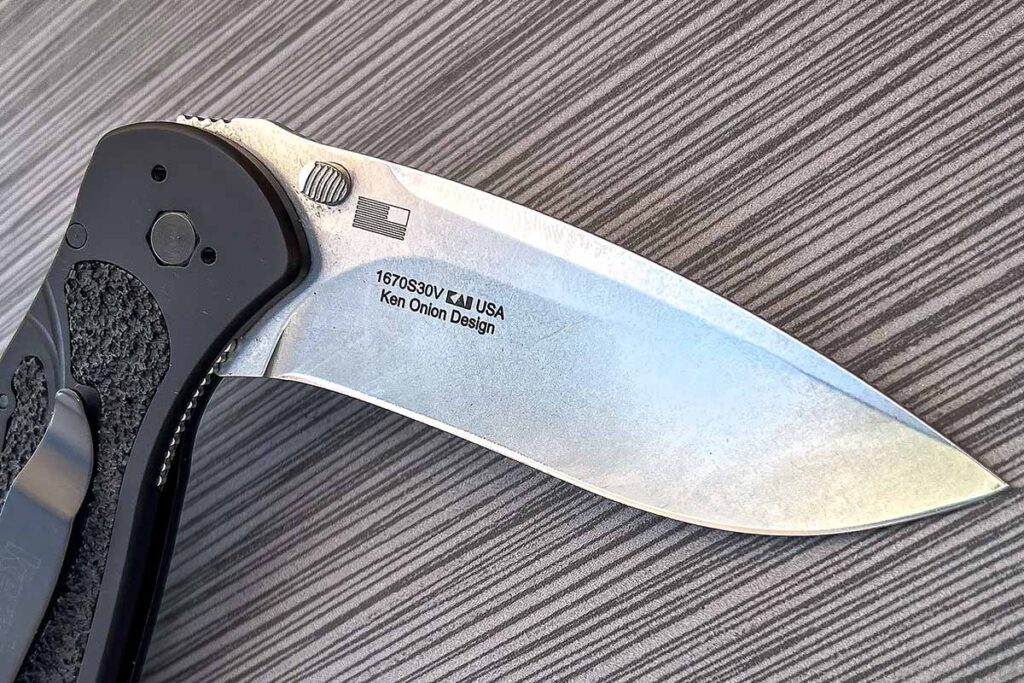
Kershaw Blur Blade
The Blur’s blade has plenty of bite right out of the box, thanks to its hollow grind. Photos Marty Stanfield

For deployment, the Blur uses ambidextrous thumb studs. These are custom-designed studs, with a unique slanted portion. This rake allows you to bump with your thumb and then back off immediately, so they won’t be in the way of opening.

Speed Safe System

Deployment speed doesn’t disappoint, thanks to Kershaw’s Speed Safe assisted opening technology. The Speed Safe system was developed by Ken Onion and serves as a way to quickly and effectively open a folding knife blade quickly with minimal user effort. Essentially, a torsion bar propels the blade open after the user initiates blade movement by pushing out on the thumb stud.

Kershaw Blur Handle

For those who appreciate a solid and comfortable grip (who doesn’t?) the Blur incorporates some interesting design elements.

Starting with the construction, Kershaw has opted for aluminum alloy, making the handle both lightweight and strong. The shape is also well thought out, offering an intriguing and aesthetically pleasing shape, that doesn’t compromise on comfort. It’s a good example of Onion’s profound understanding of knife ergonomics.
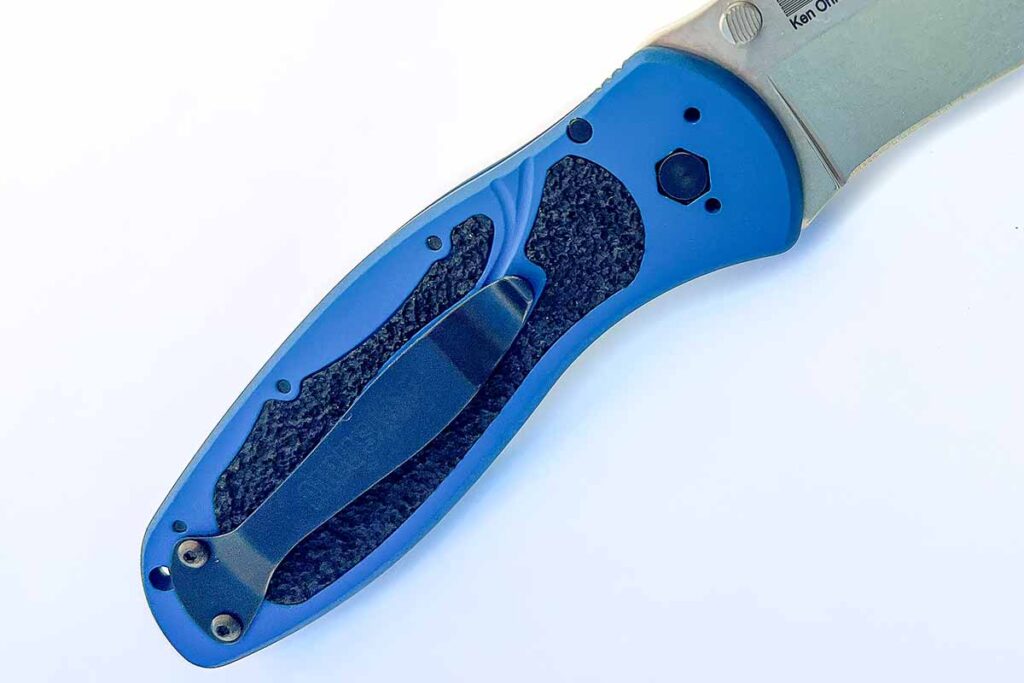
Blur Handle
A fluid shape, the Blur looks nice and fits the palm well. Photos Marty Stanfield

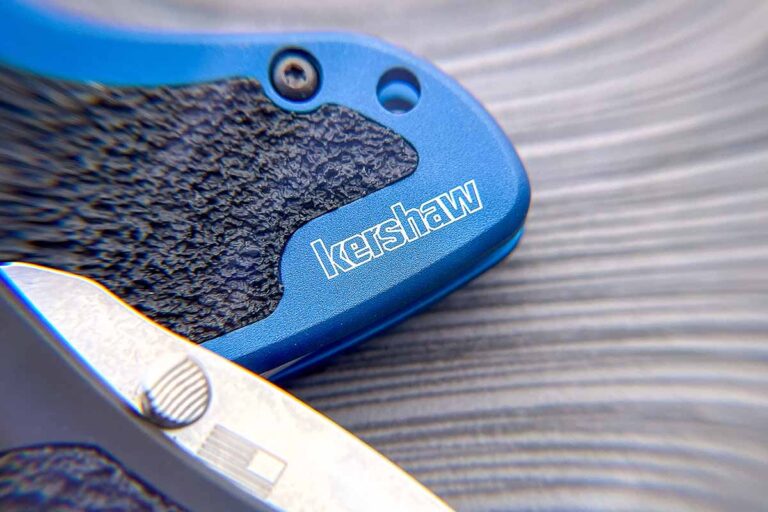
Furthering the usability, the Kershaw chamfers all the edges, ensuring there are no hotspots on the knife and textured rubber inlay inserts are a practical bonus, increasing grip traction tenfold with either wet or dry hands. Kershaw calls this material Trac Tech and it’s very similar to the self-adhesive grip tape you might find indoors in wet locations such as a swimming pool deck.

Interestingly, Trac Tech also helps with holding the knife to the pocket, making it a bit difficult to slide in and out. Depending on who you are and your particular activities, this can be a good thing or an annoyance. It is insurance from the knife falling out of your pocket, but it does slow retrieval time.

I like the use of Trac Tech on the blur simply because it gives the handle a more tactile feel to it.
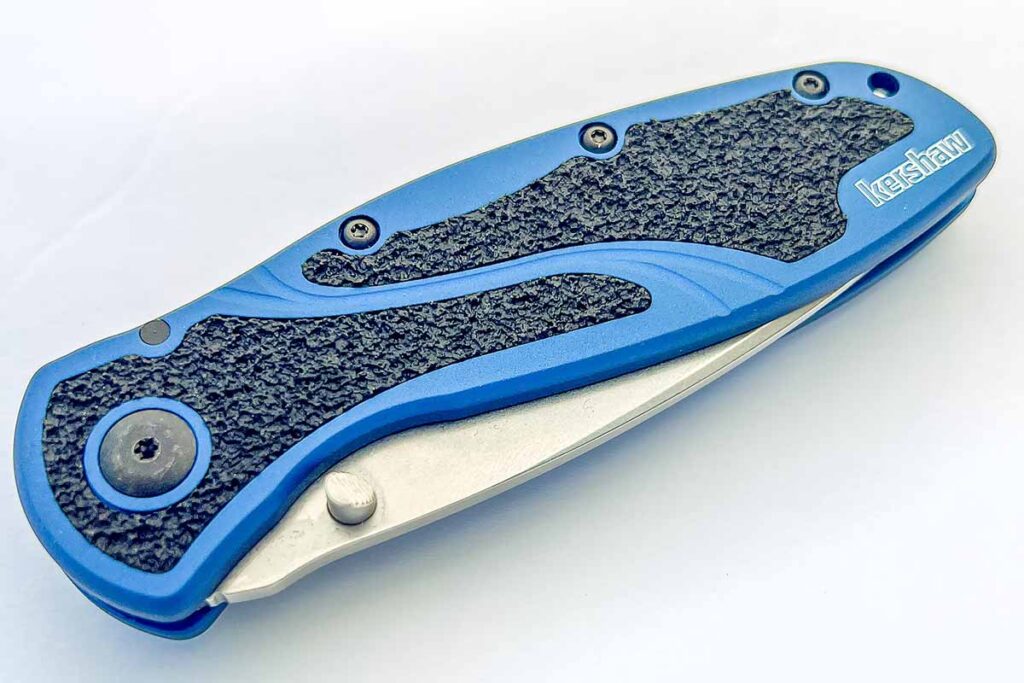
Trac Tech in a Blur
Looking for more grip, Trac Tech inserts gives the Blur more bite. Photos Marty Stanfield

The general open build of the handle makes cleaning easy, especially when using compressed air or rinsing out under tap water. There is a pocket clip that helps to carry the Blur in the pocket and Kershaw gives you the option of either tip-up or tip-down carry but for right-hand carry only. Sorry lefties!

Final Cut

The Blur is a stylish EDC folding knife that doesn’t back down when there is tough work ahead. The recurve blade cuts very well, and its ample belly makes it an efficient slicer.

The hollow grind really thins the blade out nicely without making it too slender, and therefore it will cut through tougher materials with greater ease. It really excels at cardboard. I like this material for testing as it is a good standard because of its thickness and slight abrasiveness. Both aspects test the edge’s geometry.
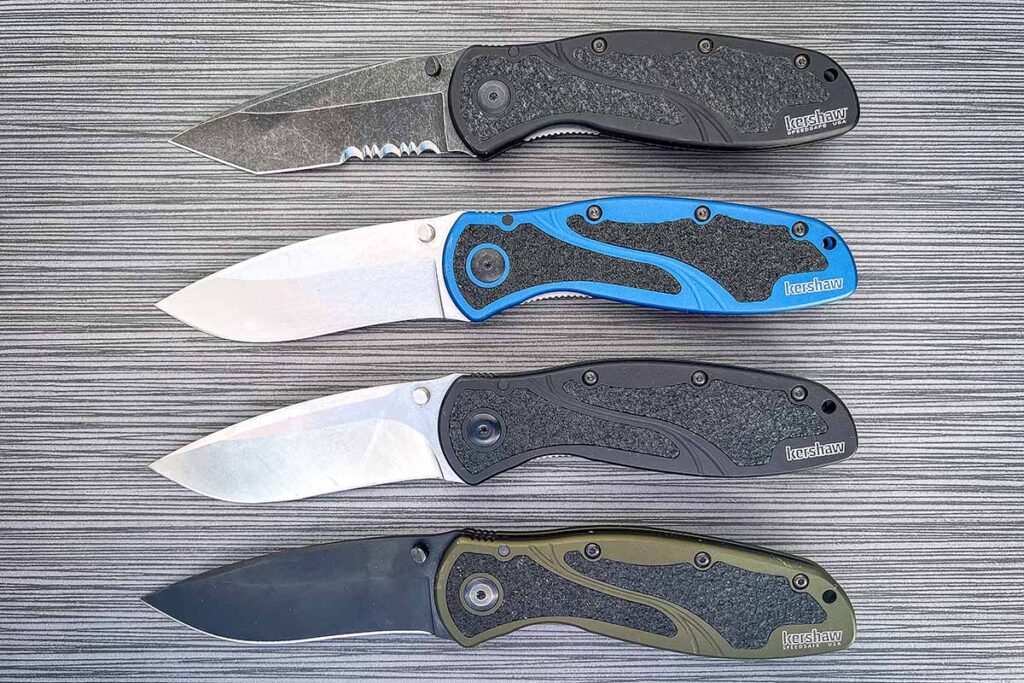
Several Kershaw Blurs
Kershaw offers several colors and blade options, helping the Blur fit most folks style. Photos Marty Stanfield

The liner lock of the Blur is dialed in nicely, it hits the tang on the lower third of the width of the blade and allows for some wear as the lock breaks in. Yet, the lockup is very secure. The exposed portion of the lock bar that you contact to release the lock has traction notches on it so you can get a good grip on it. I thought was a nice extra touch on Kershaw’s part.

Overall, the only nit to pick is I wish the clip was designed to carry the Blur deeper in the pocket. Other than this, no real issues to speak of with the knife

When it comes time to purchase a Blue, this might be the hardest decision because of the variety of models. There are a ton of colorways for the handle—black, navy blue, and olive green. Additionally, Kershaw offers several blade options, including plain edge and partly serrated as well as stonewashed, blackwash and Cerakote black finishes. If that weren’t enough, you also have a choice of a tanto blade as well, if that’s more your speed. Heck, there’s even an option with a carbide glass breaker at the end of the handle.
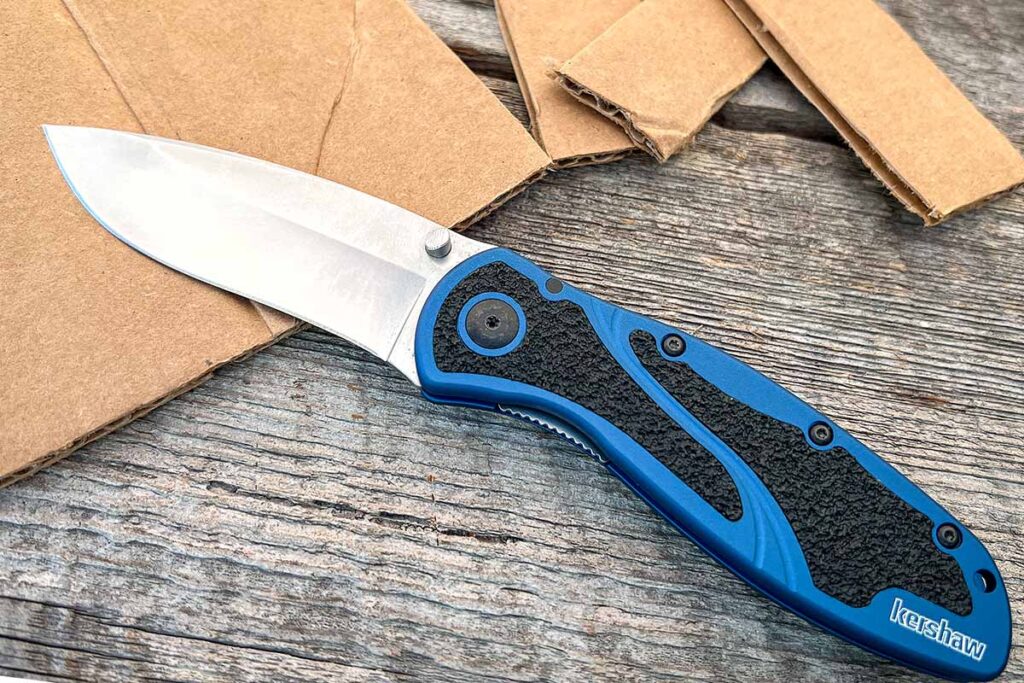
Blur and cardboard
Still a classic after all these years, the Kershaw remains a solid EDC option. Photos Marty Stanfield

The Blur’s MSRP starts at $135 and goes up from there to as much as $185 depending on blade finishes. Overall, the knife presents an overall package—Onion design, high function, nice styling and plenty of options choices. What this adds up to, is an EDC option that should be welcome in anyone’s collection.

Read More About Kershaw:

Delight Valley Veggie Slicer Review: Roughing Up Roughage

Specially formulated to knock vegetables down to size, the Veggie Slicer has an edge in the kitchen.

Never judge a book by its cover. That holds true for knives, too.

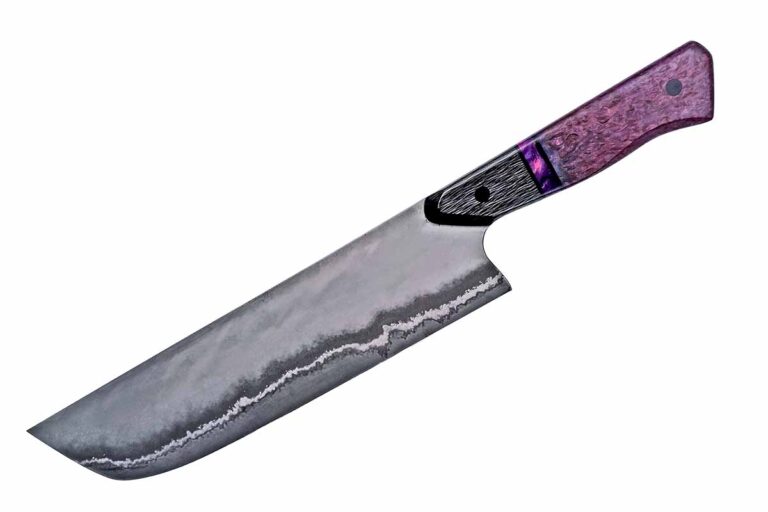
When I opened the box containing the Veggie Slicer from Delight Valley Blades, I noticed it did not have a tip like most knives. Well, at least I wouldn’t stab myself. The knife has a full flat grind to sharp, with a very fine edge. It’s made for slicing and dicing, though you know I will do more with it than that.

Veggie Slicer In The Kitchen

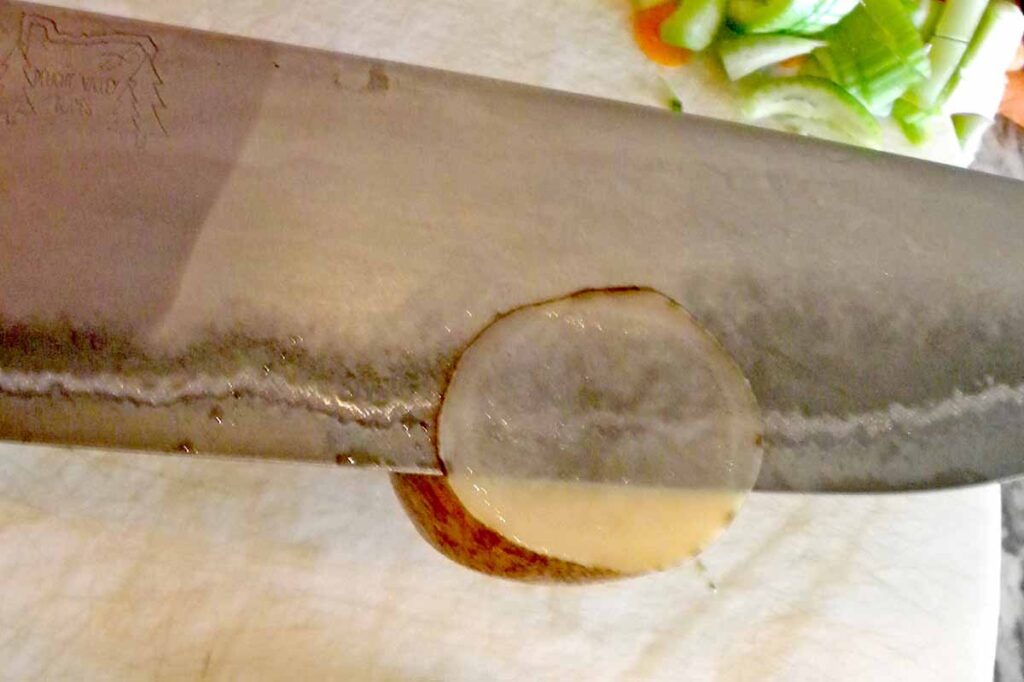
Since hunting season was starting, I made a big pot of vegetable beef soup before heading to the woods. I used the Veggie Slicer to slice and dice the veggies. It powered through the carrots very quickly and diced up the celery cleanly. I did my thinnest slice of onion ever. I could easily see the layers of the san-mai through the wafer-thin onion. I chopped the rest of the onion in a flash. On to the potatoes!

Veggie Slicer through a potato
The author sliced the potato so thin with the Veggie Slicer you can see the layers of san-mai through it.

I was expecting more resistance from the spuds. Light pressure was all it took. The knife being so sharp, I had to take care to keep all finger parts away from the edge. The Veggie Slicer will peel the skin from your finger before you can say Veg-O-Matic—and I had a few close calls.

Veggie Slicer Light Cutting Duty

With everything in the pot cooking, I headed out to the garage to slice up the non-edibles. I grabbed a sheet of 20-pound bond copy paper for slicing. I managed to suffer only one nail nick in making the paper fall apart. The knife is nasty sharp for sure. The slices were smooth and I used only the weight of the blade on the pull cuts.

I jumped up to double-walled cardboard to try and slow the edge down. That didn’t work, either. The Veggie Slicer ate through the cardboard as fast as I could get my fingers out of the way. I used both push and pull cuts to see if there was a difference. There was none.

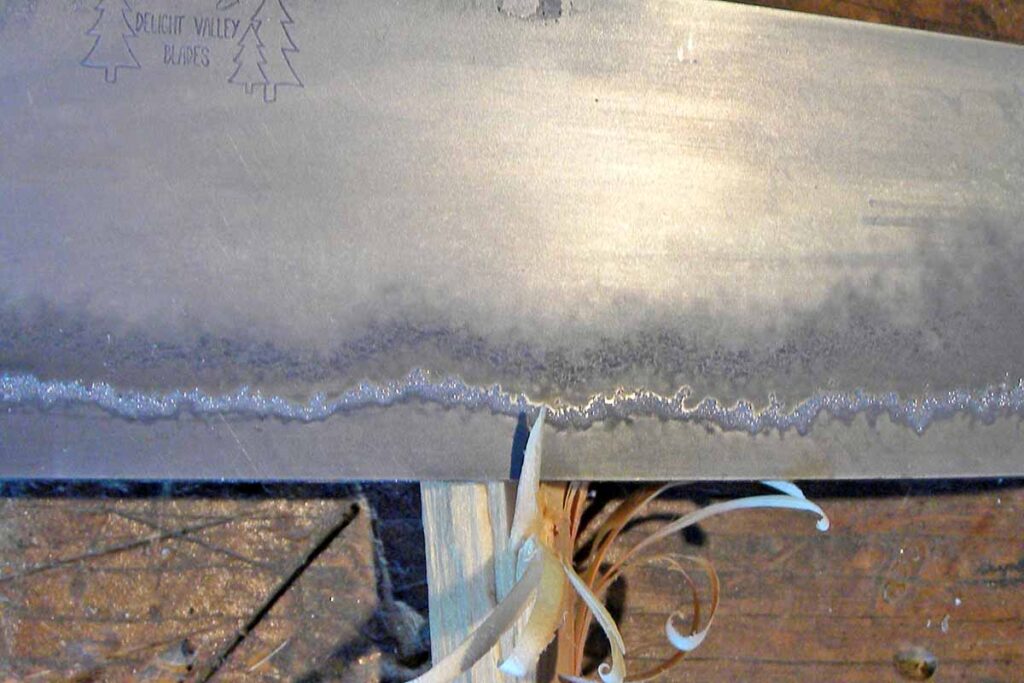
Delight Valley Veggie Slicer vs pine
Thin pine curlicues were the order of the day for the Veggie Slicer.

Heavy-Duty Cutting

It was on to whittling pine. The Veggie Slicer made very thin curlicues. I couldn’t choke up on the blade as the spine was cut at a 90-degree angle—too sharp for the insides of my fingers. As a result, control was a tad more difficult. The blade still cut deep and shallow without a challenge. It zipped into the pine quickly, still scary sharp.

It was time for some half-inch sisal rope. After the first 100 crunching cuts I let my guard down enough to take a nick out of my rope-holding finger. Thanks to all my callouses no blood was shed, but it was close. The second 100 went off without any dulling of the edge (or my finger).

I had to go one step further to see if the fine edge would hold up. I grabbed a whitetail deer antler and gave it 30 chops. The result: no edge damage whatsoever, a sign of perfect heat treatment.

Final Cut

The Veggie Slicer can slice, dice and a lot more if needed. It has one long-lasting edge.

Soup prep with Veggie Slicer by Delight Valley Blades.
The kitchen knife sliced and diced the veggies, powered through the carrots very quickly and diced up the celery cleanly. It’s soup!

I would soften the blade spine and choil and ricasso area so a wider selection of hand grips can be used.

Delight Valley Blades Veggie Slicer Specs
Blade length: 7.5”
Blade steels: 26C3 carbon core and 416 stainless cladding in a san-mai construction
Blade grind: Full flat
Blade width: 1.78”
Handle: Masur birch and carbon fiber
Pins and liners: G-10
Weight: 10.5 ozs.
Overall length: 12.25”
Maker’s price: $600

Read More Knife Reviews:

King Tut Dagger: The Rare Chance To Hold The Legend

1

A chance phone call out of the blue leads to the author’s opportunity to see and hold the iconic Warenski King Tut Dagger.

While in San Diego in summer 2015 for a work conference, I saw a flyer advertising a King Tut exhibit at the San Diego Museum of Natural History. The exhibit focused on recreating the experience of Howard Carter, the British archaeologist who found the lost tomb of Egyptian King Tutankhamun in 1922.

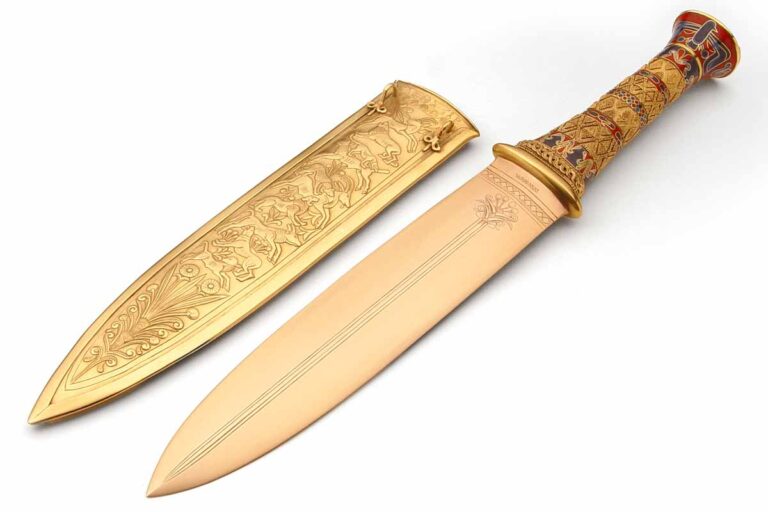
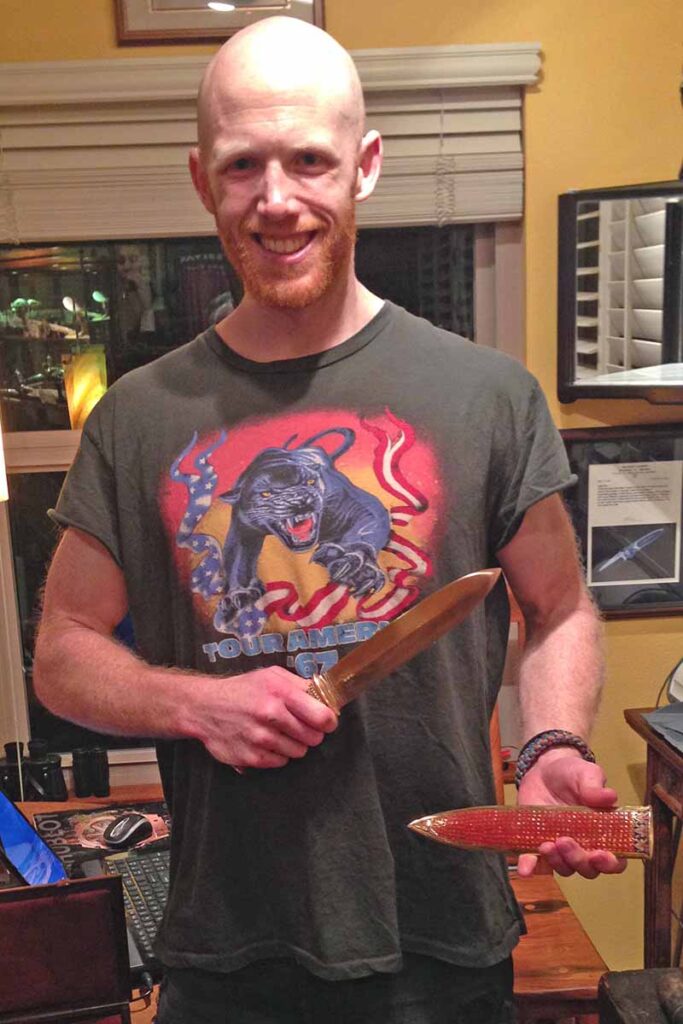
Chad Royer holds Buster Warenski’s reproduction of the King Tut Dagger.
The author holds Buster Warenski’s reproduction of the King Tut Dagger and sheath in the home of Phil and Judy Lobred. (image of Warenski’s Tut Dagger by SharpByCoop; image of the author by Phil Lobred)

The promotional materials advertising the exhibit indicated it would feature recreations of many of the artifacts found in the original tomb. Having been exposed to custom knives all my life through my father, Rick Royster, and being familiar with BLADE Magazine Cutlery Hall-Of-Fame® member Buster Warenski’s work, I wondered if Buster’s famous reproduction of the King Tut Dagger would be part of the exhibit.

I called the museum and asked the young lady who answered if Buster’s reproduction was in the exhibit. She said it was not, but my inquiry grabbed her attention. She didn’t go into much detail but alluded to the fact that the owner of the reproduction lived in the area. We hung up and I went about my trip not thinking anything else of it.

Later that day while visiting the San Diego Zoo I got a call from a strange number, and it was Cutlery Hall-Of-Famer Phil Lobred, owner of the King Tut Dagger reproduction. Apparently, the young lady from the zoo knew Phil and had reached out to him. Phil and I talked on the phone and I told him how my father had worked closely with Buster through the years on several custom pieces, and Phil invited me over to look at the knife. I told my girlfriend we had to hurry up at the zoo because I had somewhere more important to go.

Visiting The King Tut Dagger

I went to Phil’s house that evening. His wife, Judy, let me in and took me to him. We went upstairs to what must have been Phil’s corner of the house. Not only did he have dozens of knives, he also had tons of collectibles. What I remember most were the Eskimo artifacts. He knew what everything he had was and had a story to tell about how he got each one and what it was used for.

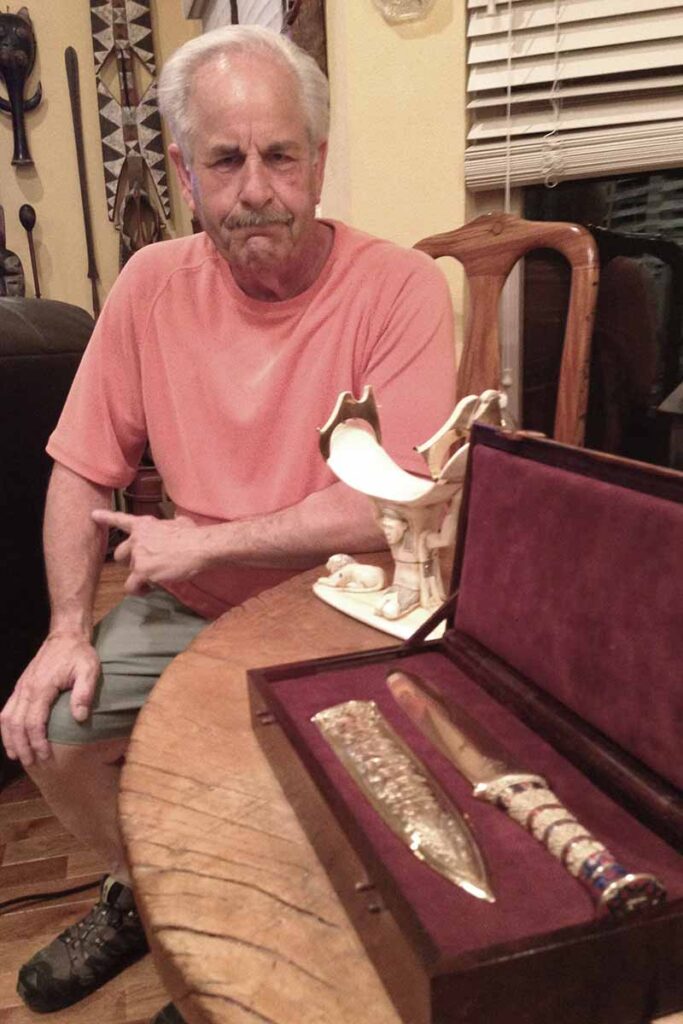
Phil Lobred sits by the King Tut Dagger
Phil Lobred sits by the King Tut Dagger reproduction and sheath in the presentation case, as well as the knife’s display cradle. On the wall at left are examples of the African art in his collection.

Then we got to the knives and finally the most extravagant of them all—the Warenski Tut Dagger. I couldn’t believe what I was seeing. It was a marvel to behold, a true masterpiece, something not many people in the world would ever have the opportunity to see up close. I was shocked when Phil asked if I wanted to hold it. He even photographed me holding it, the image of which appears with this story.

I must have been at Phil’s house several hours with him showing me all of his collectibles and talking about them. It was easy to lose track of time. He was a very nice man. It was very gracious of him to invite a total stranger to his house, and let me see and hold a one-of-a-kind piece of art.

It was a once in a lifetime experience.

More On Knife Collecting:

Spyderco Tenacious Review: The Relentless Workingman’s Knife

Built like a top-shelf Spyderco, but at a fraction of the price the Tenacious more than lives up to its name.

Spyderco’s knives are about as high-performance as you can get in a production knife. They look at things from all angles, from blade grinds to handle ergonomics and how each plays an important role in the other. It’s a symbiosis of sorts. Therefore, most of their knives are on the pricey side but very well worth it.

The use of high-end materials with superior ergonomics and cutting-edge blade steels get everyone drooling, but there is one factor that spoils it for some. The high price.

“No thank you”, some might retort. Then resort to looking at other brands, whose offerings might be a bit cheaper and more within their budget range. Still, they crave Spyderco.

Fear not my penny-pinching friends.

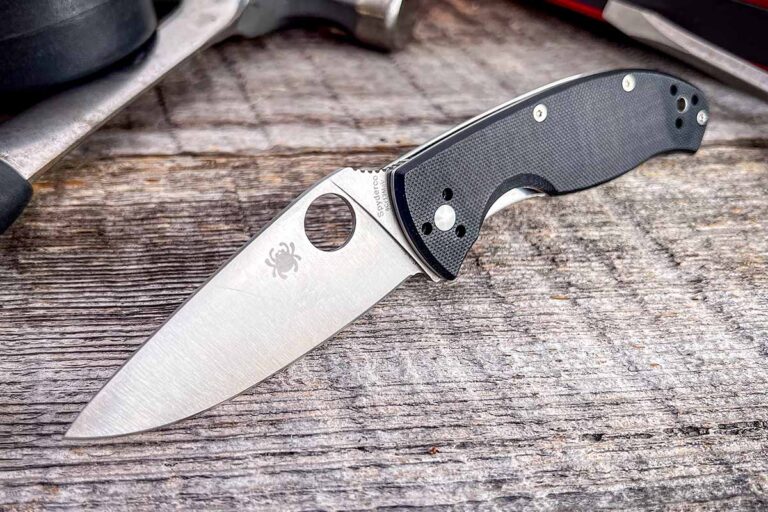
Spyderco Tenacious neutral open copy
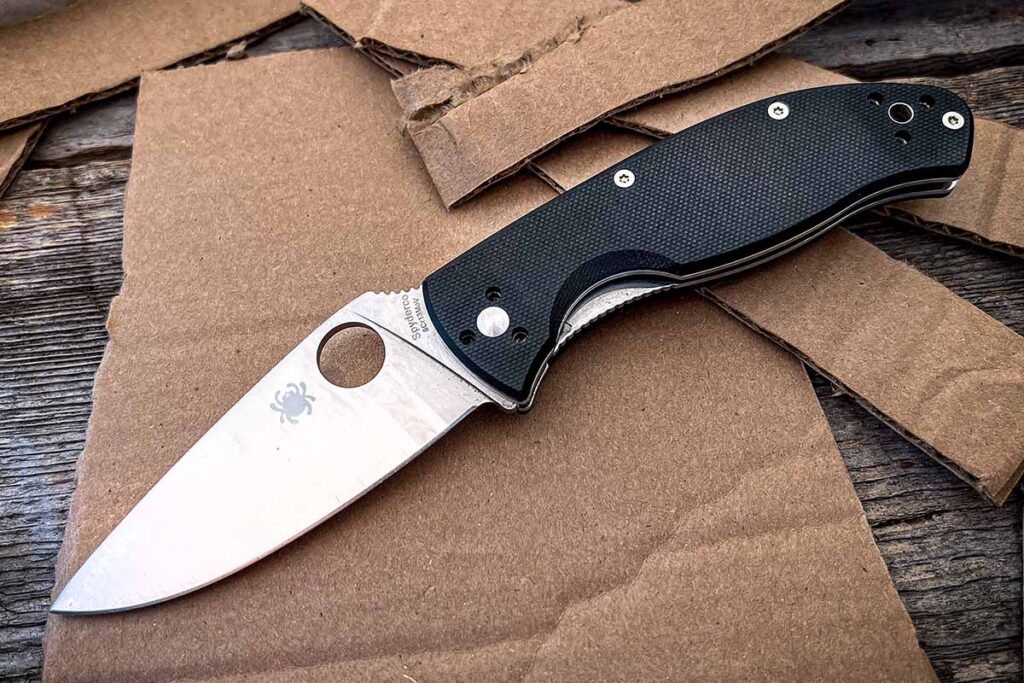
Affordable and capable, the Tenacious proves a capable workingman’s knife. Photo: Marty Stanfield

Spyderco had exactly you in mind when it unleashed the C122GP Tenacious. An excellent value folder from incorporating all the hallmarks of a Spyderco design and execution but without the scary high price tag. Essentially, it’s an everyman’s knife, with the elite performance the company has built its name on. 

How’s that for value?  

Spyderco Tenacious Blade

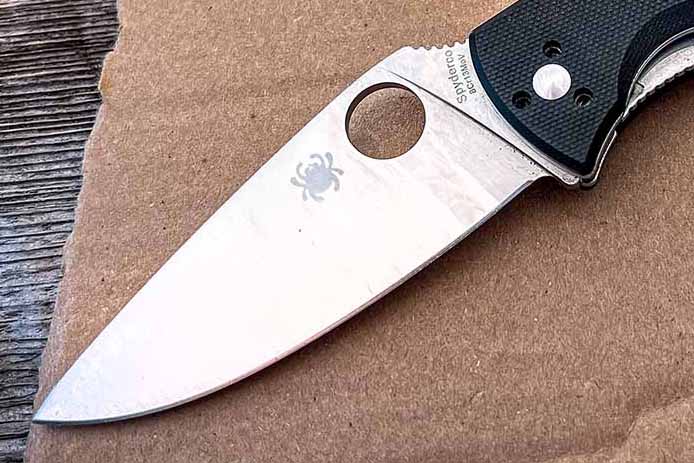
Starting with the modified clip point blade of the Tenacious, 8Cr13MoV stainless steel was chosen because of its great balance between edge retention, ease of sharpening and low cost. For those not familiar, 8Cr13MoV is the Chinese equivalent of the Japanese-made AUS-8. A lot of entry-level to mid-range knives have this steel. It makes a great choice for a working folder as 8Cr13MoV is relatively easy to resharpen and takes a good edge in minimal time.

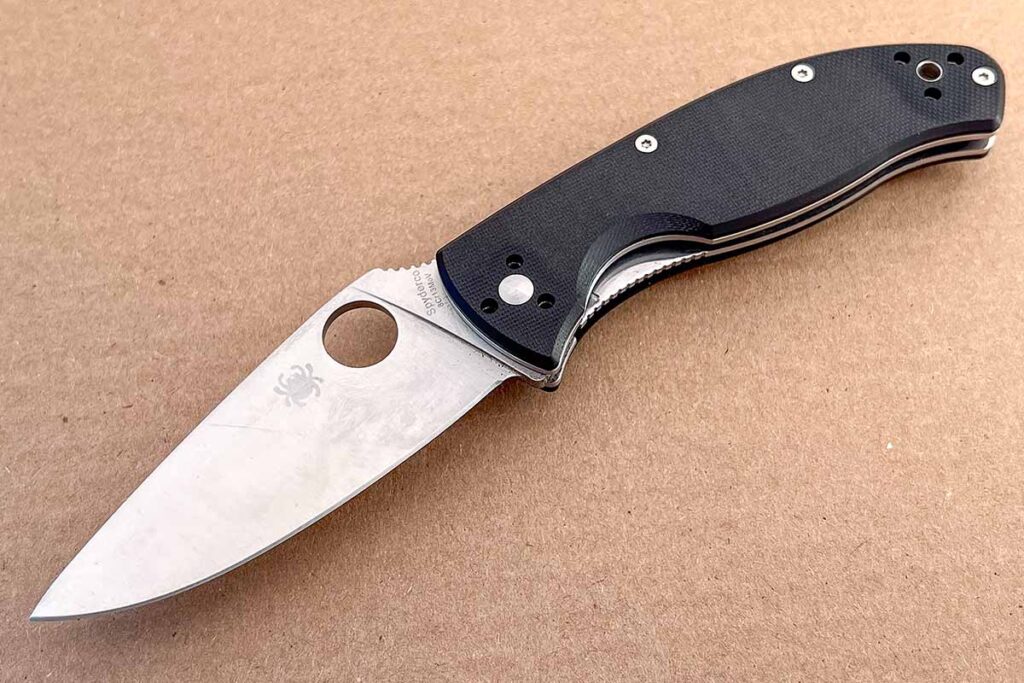
The blade length is 3 ⅜ inches, long enough to for serious work but short enough to carry easily in the pocket. Jimping on the thumb rest allows you to place your thumb there to apply downward pressure on the blade. The rest sample we were sent has a satin-finished blade, though, Spyderco offer the Tenacious with a black coated blade for low visibility, as well. 

Spyderco Tenacious Blade
A 8Cr13MoV drop-point blade offers respectable steel in a useful profile.Photo: Marty Stanfield

Additionally, partially serrated edge formats are available for enhanced cutting power. This blade design is a workhorse, with its flat grind and distal taper, which allows the blade to become a voraciously efficient slicing tool. Honestly, Tenacious in hand, you’ll be able to slice through your biggest and toughest cutting tasks with ease.  

Spyderco Tenacious Handle

Look at some other budget folding knives on the market and you can tell where corners were cut. One evident area is handle design. No so with the Tenacious.

Spyderco has some of the best handle designs on the market, the company has an intimate understanding of how to design a comfortable interface comfortable for extended hard usage. In this case, the knife uses a black textured G-10 phenolic resin handle for both reduced weight and an excellent grip. As a side note, the handle length is 4 7/16-inces long and overall, well thought out. In the hand, it proves comfortable, important with any knife. There are no hot spots to speak of and it seem designed for long periods of use without fatigue.

Spyderco Tenacious lock vertical copy
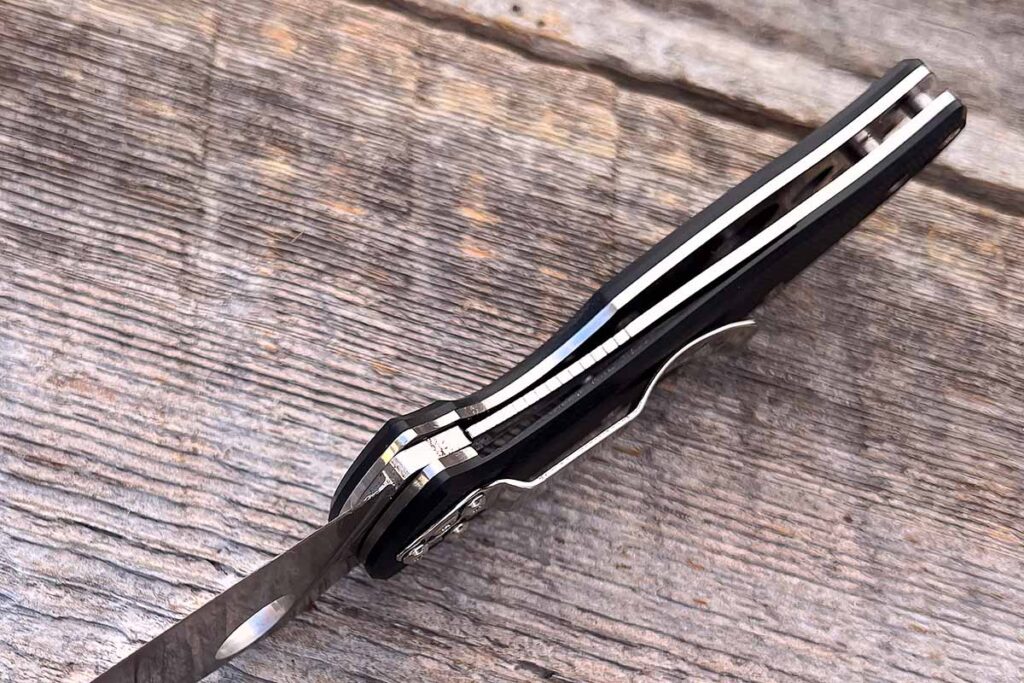
In addition to G10 scale, the Tenacious has a study double stainless-steel liner to provide the handle plenty of backbone. Photo: Marty Stanfield

Double stainless-steel liners provide a solid backbone for the handle, and a sturdy liner lock secures the blade in the open position for ultimate user safety. A radiused gripping area accommodates the fingers well and the perimeter of the G-10 is chamfered to reduce sharp corners for a comfortable grip. 

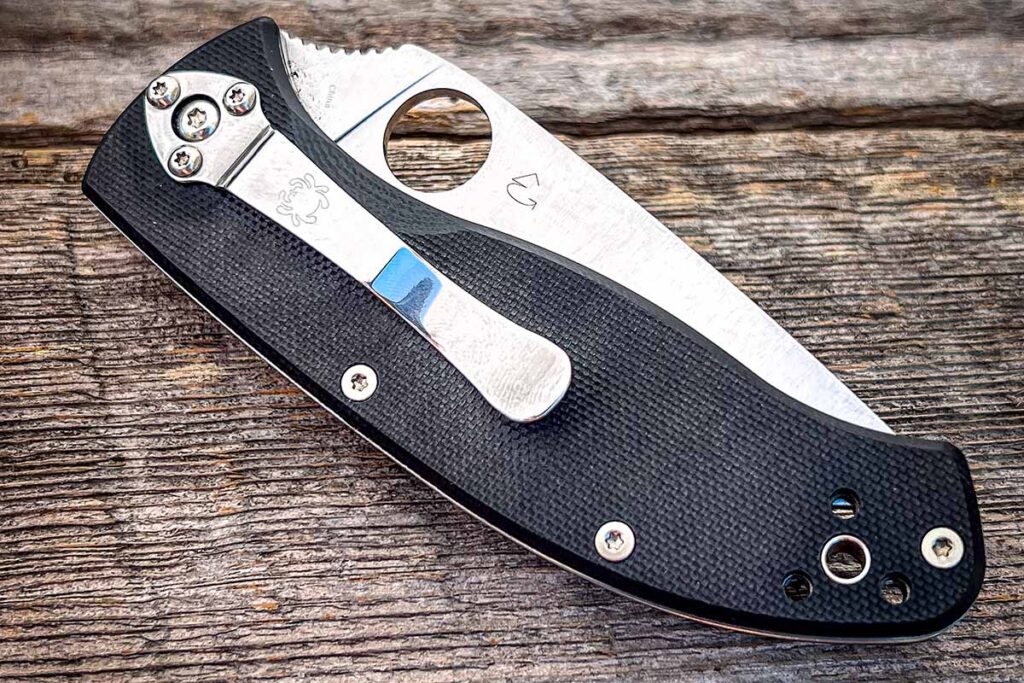
Four sets of clip screw holes are drilled into the handle, offering a have-it-your-way approach to pocket clip mounting. You can mount the clip for left-hand use or right-hand use and within these two, you can have either a tip-up or a tip-down configuration. The clip comes from the factory set up for right-handed, tip-down configuration.

Practicality Of The Spyderco Tenacious

If you are in any of the trades and use tools in your job—a knife being one of them—it’s very important to select your work knife carefully not just from a budget/financial standpoint but feature-wise as well. Just because it is a budget knife doesn’t mean it’s stripped down and basic. 

Budget knives can include some creature comforts that make work easier. The Tenacious packs in one hand ambidextrous opening, a secure blade lock, open handle construction with dual steel liners and textured G-10 handles. Furthermore it boasts a pocket clip with user-selectable modes of carry, and a properly designed blade that will cut efficiently. All this, in one knife.

Spyderco Tenacious clip_ copy
Righty, lefty, doesn’t matter. Spyderco enginereed a clip that caters to either hand and nearly any style of carry. Photo: Marty Stanfield

With this being said, the Tenacious lives up to its name as it is eager to tackle any cutting task that awaits. The MSRP for the Chinese made Tenacious is $86, which means it probably can be purchased online for around $60. This makes it a great bargain for a sturdy, well-designed work knife. And if you lose it, you are not out a lot of money.

If you have more expensive knives in your collection and are hesitant to beat on as a work knife, then the Tenacious fills that role well. What you have here is a midsize folding knife that feels good in the hand and cuts exceptionally well.

Final Cut

As an owner of quite a few high-end Spyderco models such as the Military, Paramilitary 2, Manix 2, Shaman, and a few others, I can honestly say the Tenacious performance-wise is almost identical. Bold statement, I know. But all Spyderco knives just have that feel to them—no matter the price. If you are a fellow Spyderco owner, you know exactly what I am talking about.

Spyderco Tenacious action 2 copy
Spyderco created an affordable gem in the Tenacious. Photo: Marty Stanfield

The 8Cr13MoV steel holds an edge well but don’t expect it to be like S30V and hold an edge for a long time. Maintenance in the field is possible with the right sharpener and the steel responds well to routine touch-ups.

Just do yourself a favor and purchase a Tenacious and put it to work. You won’t be disappointed. Spyderco did their homework with this budget-conscious folder that’s packed with features that also are found on their more expensive knives.  

More Spyderco Knives:

Cool Custom: John Dennehy’s Model 1 Alpine

2

John Dennehy carries on a family tradition with a Model Alpine 1 for Kristi Noem.

South Dakota Gov. Kristi Noem and her leadership skills have captured the imagination of many Americans, including Colorado knifemaker John Dennehy.

John’s been looking for a place to retire, and Noem’s handling of the pandemic put South Dakota square on his list of places to consider. “The state stayed open and came out of the pandemic with a strong economy,” John noted. “I like Kristi’s no BS approach and her conservative Christian values.”

Kristi Noem
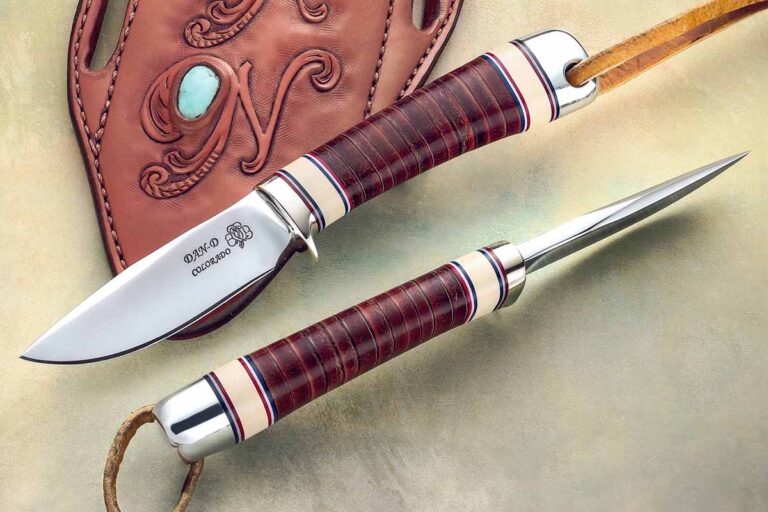
Kristi Noem with her custom Model 1 Alpine.

As a result, Dennehy decided to carry on a family tradition started by his father, BLADE Magazine Cutlery Hall-Of-Fame member Dan Dennehy, of making knives for notable individuals that he admires. John reached out to Kristi’s office and offered to make her the knife of her pick of his DAN-D models. One of Kristi’s aides got back to John and told him Kristi wanted the Model 1 Alpine general-purpose field knife.

John completed the knife and personalized the handsome leather sheath with Kristi’s initials and turquoise from King’s Manassa Turquoise mine near Manassa, Colorado. Though John didn’t get to talk to Kristi directly, she had a picture made of her holding the knife and had it sent to him. The smile on her face speaks volumes of how pleased she is with her sharp new gift.

Check Out More Cool Custom Knives:

D.I.Y. Power Hammer: Do You Really Need One?

0

Why a power hammer may or may not be for you.

I think almost every smith wishes at some point he or she had a power hammer. 

It’s loud, powerful and moves metal quickly. It’s also the key to improving the production speed of forging and making damascus steel, and speed without sacrificing quality quickly translates into increased revenue and more fun.

It’s under such conditions that the smith turns to the Internet and begins to look for a hammer. Quickly he or she discovers several things. 

First are stories of people who got incredible deals on a hammer stored in a barn somewhere. These are like hunting stories of novices killing giant whitetail bucks, or fishing stories of a kid catching a 12-pound largemouth bass. The stories are true but it’s not likely to happen to you that way. If you’re one of the lucky ones who find a running Little Giant 50-pound power hammer for $200 at a garage sale, I don’t like you and I don’t want to hear your story. LOL!

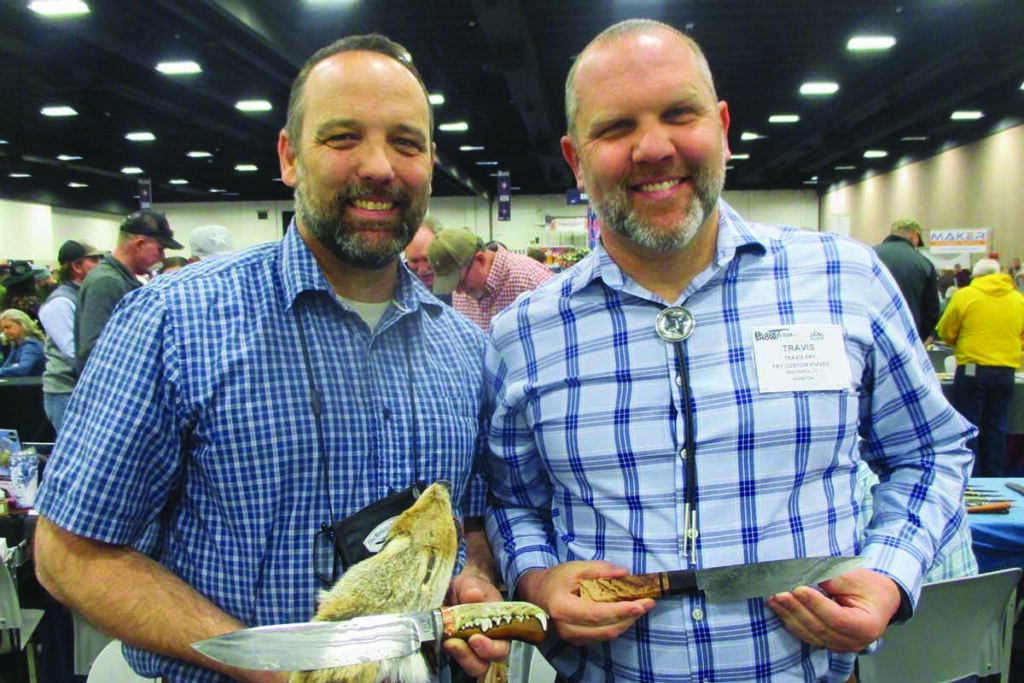
Jason Fry and Travis Fry
According to the author—at left with his brother/fellow maker Travis Fry at BLADE Show Texas—a good power hammer improves forging production speed without sacrificing quality. His sub-hilt fighter features “Trashcan” canister damascus. (SharpByCoop knife image)

The next thing the smith discovers is there are running hammers to be had in the world, and they’re expensive. Along with just about everything else, the prices of hammers have increased the past few years. The odds of finding a working used hammer in your area are slim, even if you are willing to pay retail.

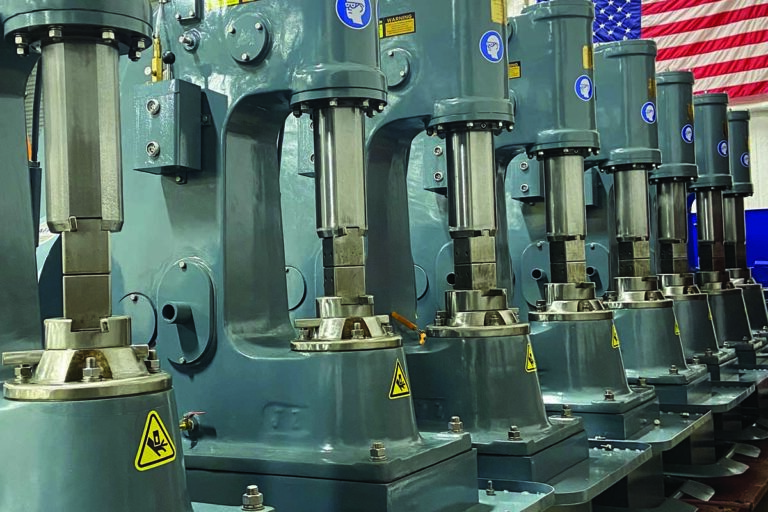
Whether you’re looking at the new production hammers or rebuilt old ones the price tag is steep, sometimes even $5,000 or $10,000. That’s a lot of knives and for many folks, there’s no way to justify the cost. On the other hand, if you can swing it, there are many high-quality production hammers on the market that will serve you well.

Meanwhile, desperate for a tool that seems just out of reach, the smith turns again to the Internet and searches “how to build a power hammer.”  

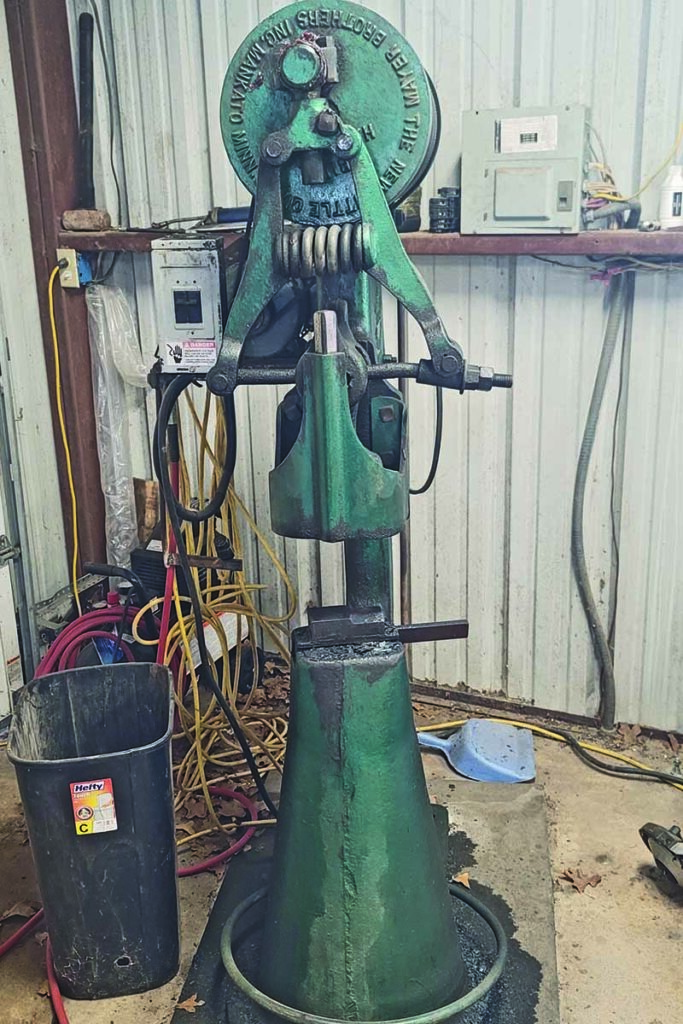
Little Giant was manufactured in 1917
This 50-pound Little Giant was manufactured in 1917 and is a clean-running example of what’s available on the used hammer market. (James Rodriguez image)

My D.I.Y. Power Hammer

I competed on the History Channel’s Forged in Fire in May 2018 (season five, episode 26, Qinglong Ji). I thought about several ways to prepare for the show. 

One was to practice various smithing techniques. I forged quite a few blades and practiced my forge welding. Another way to prepare is to work on equipment. I built a new forge out of castable refractory suitable for forge welding. I also decided to build a power hammer. 

I figured that if I made the final round on the show, I’d sure like to have a power hammer to use in the final build. If I were eliminated in the first two rounds I’d be disappointed, but in the end, I’d still have a tool that few smiths get to have.

Consequently, I spent five weekends in April and May building a spring helve power hammer, a style often called an Appalachian or Rusty hammer. Because I had a friend with an epic scrapyard, I was able to build the hammer for under $250. I did end up trading a few knives to my friend for the metal as well.

I spent about 50 hours of work building my hammer over the course of a month. I could have built roughly $2,000 worth of knives during that time, maybe more. Between the time I spent and the knives I traded, I estimate I have roughly $3,500 in my hammer. For that price, I could have purchased a running and functional hammer. The reason for me to take the DIY path was cash outlay—I had more time than money. 

D.I.Y. Power Hammer Considerations

I believe strongly that in order to successfully build a power hammer, you need several things. 

Piotr Delega DIY power hammer
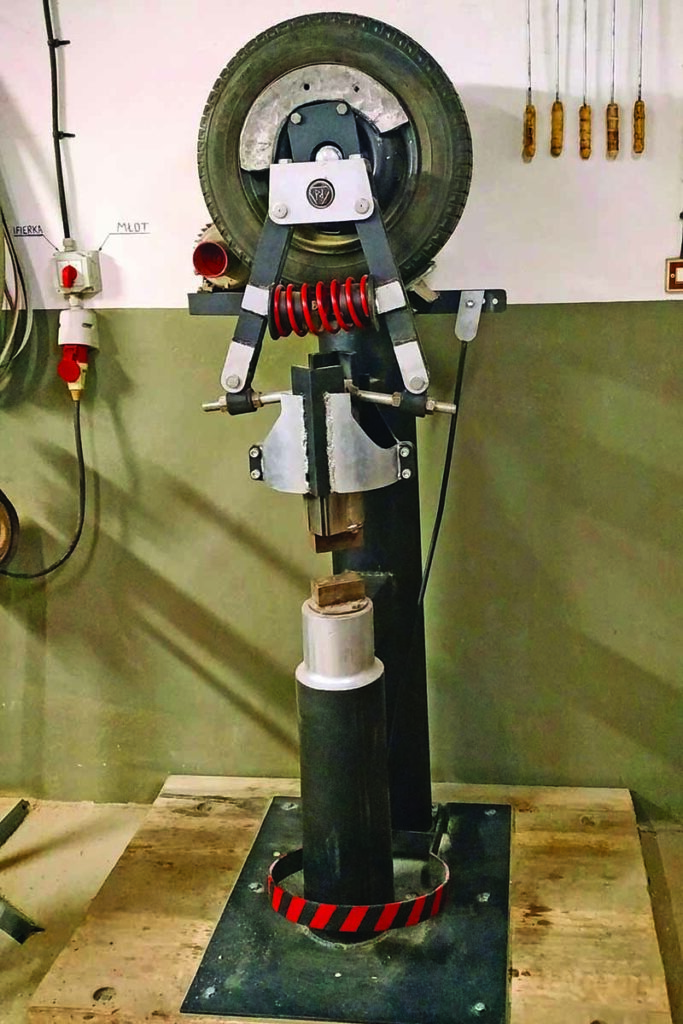
Poland’s Piotr Delega, who goes by SteelCraft on YouTube, built his own hammer. He’s a great fabricator with engineering skills and a completely stocked machine shop. He started with a fully functioning LEGO model, created a 3D software model, and then built this fine functioning hammer.

Mechanical Inclination

The first is to be mechanically inclined. Building a hammer from scrap is exactly like building a racecar from a tub of LEGOs, and nothing at all like building the same from a boxed LEGO set. In a set, there are step-by-step instructions with pictures and perfectly shaped pieces that fit together. If you build a hammer from scrap, there are no plans, instructions or pictures. You’ll have to sort through materials looking for a piece that fits or that will serve the purpose you need, just like when you dig through the LEGO tub looking for four matching wheels. 

If you don’t have the necessary experience in mechanical design and fabrication, if you can’t visualize and then build, if you can’t anticipate future problems before you weld everything together, you may be better with a tire hammer or purchasing a complete hammer.

Welding Ability

Second, you need to be able to weld, and you need a welding machine with high enough amperage to weld thick steel. An import 110v wire feed doesn’t have the power to weld the sizes of steel that you’ll need to build a hammer. I used a 220v 180-amp class wire feed, and it was underpowered for some of the heaviest welds on my hammer, requiring multiple passes to get adequate penetration. It’s not what I’d recommend, but it’s what I had.

Regarding your welding method, stick or MIG or flux core wire feed is up to you, as all can do the job if the machine is powerful enough and you have the skills. SPECIAL NOTE: If you don’t have confidence you can weld steel well enough for the weld to hold up under extreme stresses, then you should buy a hammer.

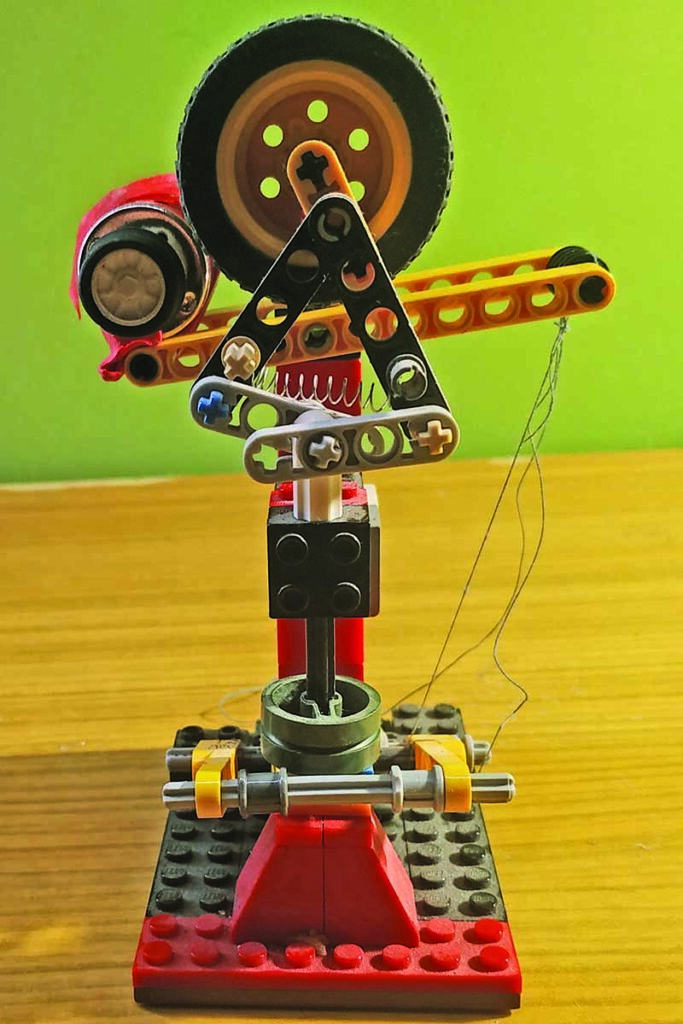
LEGO power hammer
This is the fully operational LEGO toy power hammer made by Piotr Delega. He built a 3D software model based on it and used the model as the game plan from which to construct the full-size functioning hammer shown above.

The Right Shop

Next, you’re thinking of building a machine that is loud and heavy.  If you work out of a one-car garage or live in an apartment, it just won’t work.  If you are a member of a homeowner’s association (HOA) or live in a city with zealous code enforcement officers, good luck. 

If you have employees and need OSHA approval or insurance for your shop, you should buy a hammer instead of trying to make one. If you have touchy neighbors who already don’t like the fact that you forge in the backyard because they’re irritated by your two-hour hand-hammer-and-anvil sessions on Saturday afternoons, good luck. I’m fortunate enough to have neighbors who think my hobby is cool, a city with weak code enforcement, and I have a shop in my backyard. 

With a proper base plate and a heavy anvil, you’re building a tool that could easily weigh 1,500 pounds. If you work in sales, oilfield, church or some other vocation where you move every few years, you need to think about how you’re going to move your hammer should the need arise. I built mine with several bolt-together joints so I can break it down into parts of a few hundred pounds each that can be lifted with an engine hoist.

Materials Source

Finally, a good source of scrap metal is a must if you want to build your hammer economically.  If you have to go buy steel at retail, you’ll end up spending as much as a new hammer costs. If you can score your steel for cheap to free, you’re good to build.

Read More On Knife Steel:

Throwing Knives: Ready For A Serious Fling?

0

Ready for a serious fling? We have the throwing knives–some of which are on target–to get you flying right off the bat.

While you’ll never nail an enemy sentry from 87 feet like Skeeter Vaughan reportedly did with a throwing knife during World War II, you can score a number of bull’s-eyes with today’s throwers.

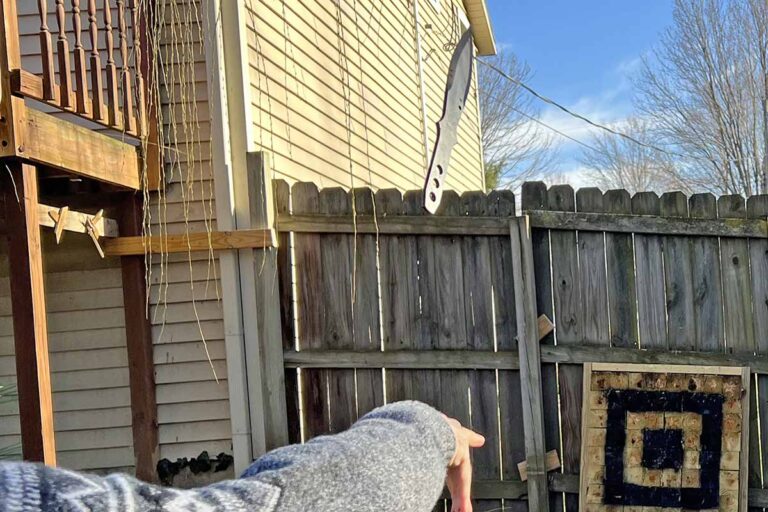
To test some of the latest airborne blades, I visited my buddy’s house. Together with a few friends, we had a good ol’ time flinging the throwers at a wood target.

Unlike many of my other BLADE® articles, I went into this with very little experience or prior knowledge, except that which I learned from previous backyard throwing sessions. None of my friends had additional experience, except for a buddy’s wife who was probably the best among us as far as results went. I feel that this was probably the best-case scenario.

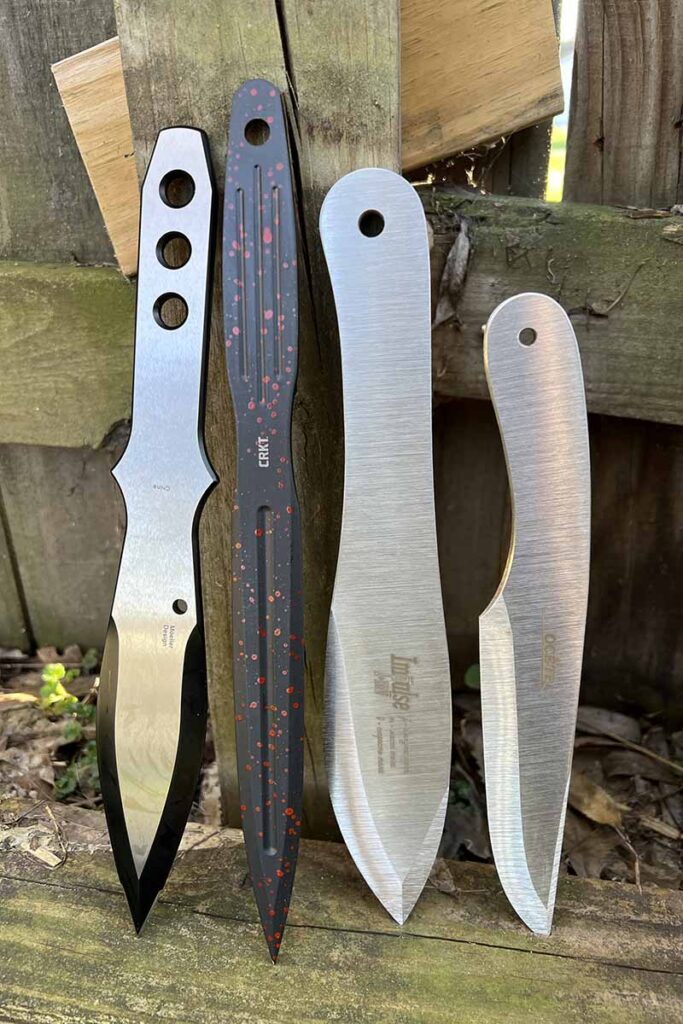
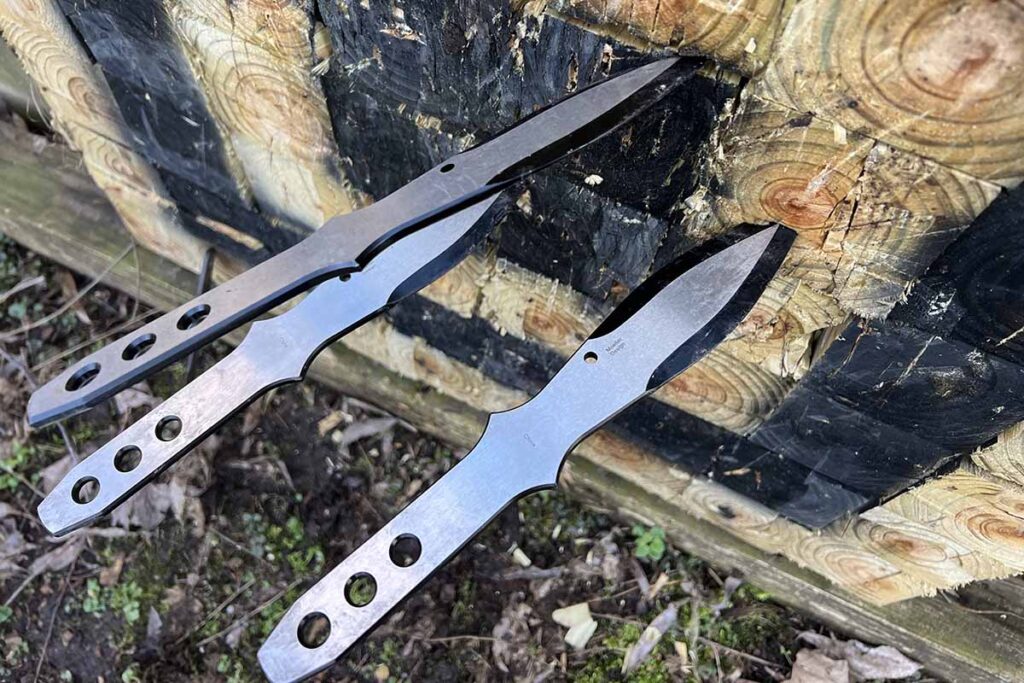
From left: Spyderco Thrower, CRKT Onion Throwing Knife, and Kizlyar Impulse and Kizlyar Ocetp.

In testing knives other times I went in with tons of previous experience from hunting, bushcrafting, skinning, fishing and other outdoor activities. The playing field was thus level and I was going to get the purest experience from these knives, as I had no prior notions of what success looked like—other than having fun.

As with most knives, there’s a science that goes into making throwers. I am in no way an expert. I approached the story with the distinct impression this would be more difficult than I thought. Most who are into throwing knives buy for either pure recreation or actual skill-building for competition. While I have no statistical way to prove it, I feel that 99.9 percent of people who buy throwers do so for recreation in the backyard, during cookouts with friends and family, etc.

Throwing Knives Tested

The featured knives are all factory made. The Spydercos are shaped like leaf-blade daggers with a slight crossguard and sharp, diamond-shaped tip. They come in a set of three with a handsome but tight-fitting leather sheath that will require a bit of break-in. While the knives all fit, the overall package is a bit heavy. The Spydercos were easily the favorite of the testing. They can be thrown with good accuracy using a variety of techniques. Out of the reviewed group they are a good starting set and offer the most feature-wise for the thrower looking to gain skill.

Onion Throwing Knives
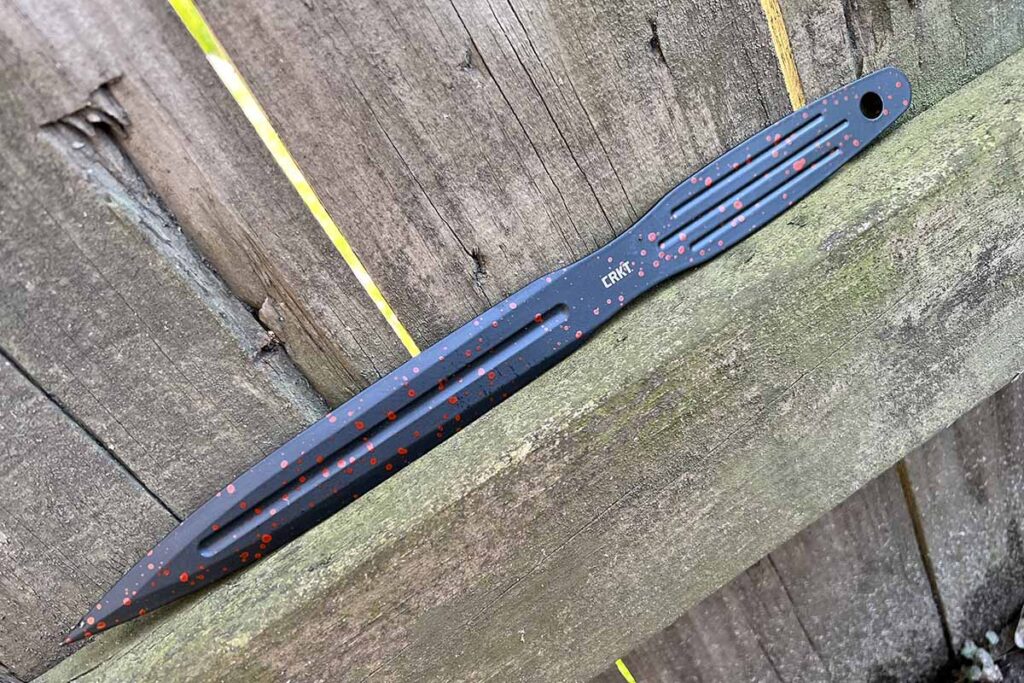
Minimalist in design, the Onion Throwing Knives are long and thin, with a red-and-black-splatter-finish scheme. They are Ken Onion’s first-ever throwing knife design for CRKT. (CRKT image)

Designed by BLADE Magazine Cutlery Hall-Of-Fame® member Ken Onion, the CRKT entries likewise come in a set of three, though are far more minimalist in design. They are long and thin, with a red-and-black-splatter-finish scheme. The knives come in a black nylon sheath. The profile of the knives is quite thin with a slender cross section. They are well balanced but have little meat mid-knife, making them have an iffy rotation in flight. The knives did perform well but were more or less hard to index in the hand.

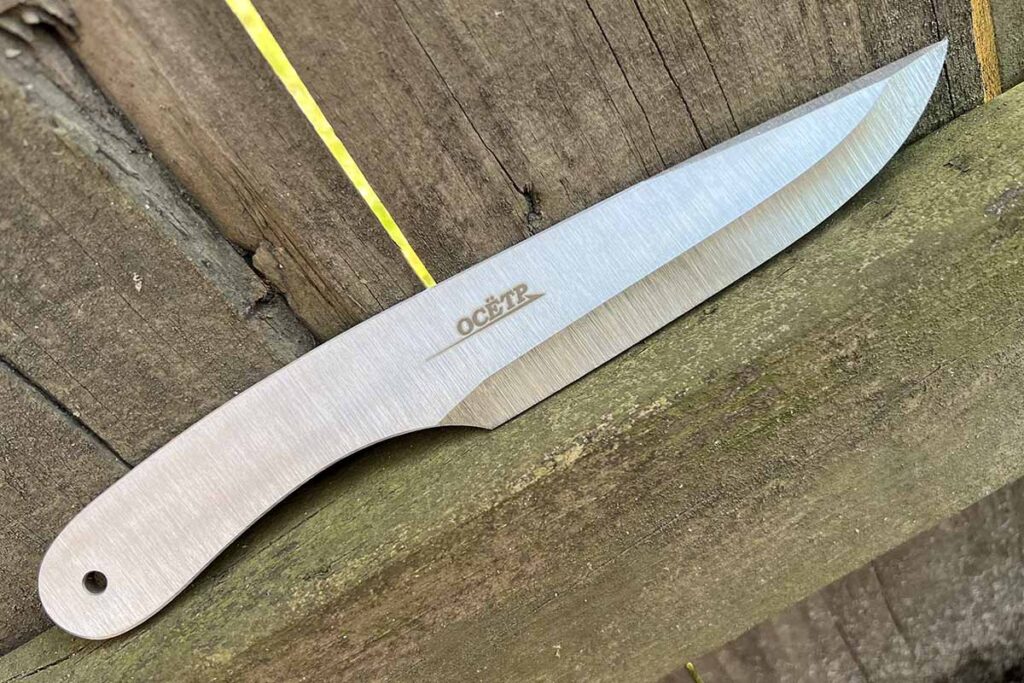
The two Russian-made knives from Kizylar Supreme vary in appearance, one reminiscent of a drop-point field knife and the other a large leaf-blade profile. The knives are roughly finished and have some issues when in use, which I’ll detail more below. The knives are somewhat hard to get these days with the various trade situations with Russia, but I wanted to put them through their paces anyway. They are solidly built and very rugged but are not for everyone. Neither knife came with a sheath or storage case.

Results

Factory-made throwers are, at least in my years of backyard trials, inconsistent at best and largely made to look cool. Most of these knives, including the ones used in this review, were only loosely able to give consistent results. The Spydercos were probably the most consistent among the people I roped into testing them. This was in large part due to the fact that one of my friends employed an underhand throw, using the holes in the handle as pendulum points to help get a consistent rotation.

Spyderco knives
The author stated the Spyderco knives were easily the favorite of the testing, in large part because they could be thrown by the testers with good accuracy using a variety of techniques.

Weight distribution among the review knives was all over the place. The Spydercos were a bit heavy across their entire length, but they did fly true for the most part. The CRKT knives ran into a bit of trouble with their relatively thin profiles. They seemed to easily spin out and rotate along the tip-to-pommel axis if they caught the air wrong. They were also significantly lighter than the rest, which made it just a bit difficult to gauge their feel in the hand when throwing. Most of the reviewers felt the Spydercos were the best, though perhaps a bit too heavy. The CRKT knives certainly look the coolest but were a bit too light and thin overall for true consistency.

The two Russian knives were the poorest performing in the test, mostly because they were just so large and heavy that they seemed to have no point of balance at all. Out of five people, myself included, none made consistent throws with either of the knives. The weight factor was a main issue. The knives are heavy, like throwing a piece of raw bar stock. We tried just about every possible style of throwing: overhand, underhand, tip hold, handle hold, etc. None of us could make them stick with certainty. This toyed with me because, in theory, a heavier knife should be easier to develop muscle memory with and should maintain more energy on impact to drive the tip home.

Ocetp designed by V.S. Kovrov
Along with the Impulse, the Ocetp is designed by V.S. Kovrov, a Russian “Grand Master” throwing knife instructor.

The tip profiles on both Kizlyar knives were wanting. Where the others were actually sharp and very pointy, these knives had a very thick, squared tip that resulted in a good number of bounce-off hits even if we got them to land straight-on. My only thought about this is that some provinces have restrictions on shipping sharp edged swords or specialty cutlery, with some places in Europe requiring a 1-millimeter edge so it’s not too dangerous to exist in their nanny states. If the intent is to sharpen the knives at home, it makes these the only throwing knives I’ve ever encountered that are not ready to go out of the box. My only other idea as to why these knives are shaped this way is they may have been intended to strike softer targets, such as hard foam. When used against wood, which I feel is safe to say is the most prevalent knife target material, they seem tremendously unsuited.

Why Fling Flyers?

Throwing knives is a lot of fun, and you should exercise a reasonable amount of caution when using them. If you want to get into the sport, these knives are a good place to start, and you’ll have a great time learning. You really can’t go wrong with any of these. I would hesitate a bit on the Russian knives, but if you have the time and patience, I’m sure that you would enjoy them as much as I enjoyed the struggle and laughs in trying to use them.

SPYDERCO THROWERS SPECS
DESIGNER: Harald Moeller
MODEL TYPE: Large
KNIVES IN SET: Three
BLADE LENGTHS: 6.63”
BLADE STEEL: 8Cr13MoV stainless
HEAT TREATMENT: Tough spring hardness
BLADE TIP: Sharpened diamond profile
BLADE EDGE: Non-sharp
HANDLE MATERIAL: Steel
WEIGHT: 10.2 ozs. each
OVERALL LENGTHS: 11.13”
SHEATH: Leather three-knife piggyback model w/belt loop
KNIFE TO KNOW: The knives are available in small- and medium-sized sets, too. Each set comes with a copy of Harald Moeller’s book, Knife Throwing: The Knives and Throwing Technique of Harald Moeller.
COUNTRY OF ORIGIN: China
MSRP: $166

CRKT ONION THROWING KNIVES SPECS
DESIGNER: Ken Onion
KNIVES IN SET: Three
BLADE LENGTHS: 6.25”
BLADE MATERIAL: 1050 carbon steel
BLADE EDGE: Non-sharp
BLADE FINISH: Corrosion-resistant powder coating
HANDLE MATERIAL: None
WEIGHT: 5.1 ozs. each
OVERALL LENGTHS: 11.66”
SHEATH: Black nylon w/belt-loop carry
COUNTRY OF ORIGIN: USA
MSRP: $75

KIZLYAR SUPREME THROWERS SPECS
DESIGNER: V.S. Kovrov, Russian throwing knife instructor
BLADE LENGTHS: 5.25” (Ocetp), 6.5” (Impulse)
BLADE STEEL: 420HC stainless
ROCKWELL HARDNESS: 42 HRC (edge) and 45 HRC (spine)
BLADE EDGE: Non-sharp
HANDLE MATERIAL: Steel
WEIGHT: 8.4 ozs. (Ocetp), 12.5 ozs. (Impulse)
OVERALL LENGTHS: 9.4” (Ocetp), 10.5” (Impulse)
SHEATH: None
COUNTRY OF ORIGIN: Russian Federation
MSRPs: $49 each

Check Out More Outdoor Knives And Tools:

Advertisement

Must Read Articles

Read this before you make a knife

Knifemaking 101 – Read This Before You Make a Knife

  by Wayne Goddard My experience has taught me that there's nothing like digging in and getting started. I've often said the hardest part of the...
how to forge damascus steel

How to Forge Damascus

Advertisement
Advertisement