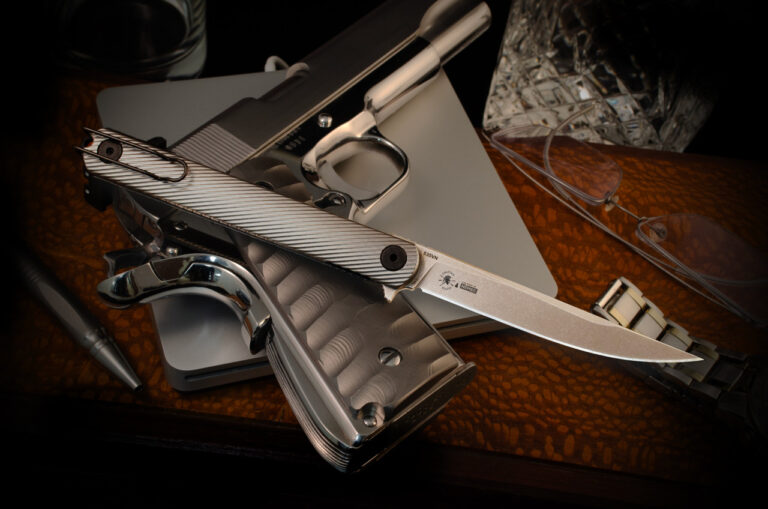
Collaboration between Spartan Blades and Ondřej Němec is sleek, slender and ready to serve.
Hard-use, tactical tools—Spartan Blades‘ designs are generally as conspicuous as a hand grenade in a sewing circle. That happens when the mucky muck has a Special Operations background.
But simply because the North Carolina concern favors brute superiority over frivolous aesthetics doesn’t mean it’s devoid of a sense of style. The freshly minted Spartan-Nemec Folder is more than proof.
Release in early December, the straight-back folder is a dashing addition to the Spartan Blade’s catalog. And while it appears more James Bond than Rambo, the knife offers up the same exceptional tactical performance for which Spartan is renowned.
Spartan-Nemec Design Background
For those who follow European knifemaking, the moniker of the new blade is a tip-off of its origins. Boasting a slightly Americanized play on Ondřej Němec’s surname, the knife is a collaboration with one of the Czech Republic’s premier designers. His company—Acta Non Verba Knives (ANV)—has become known for knives that have a desirable balance between modern lines and tactical practicality. Overall, his portfolio teams with clean design, with just enough swagger to catch the eye, without crossing over too gaudy. Which, in so many words, sums up the Nemec Folder.
Spartan-Nemec Folder Design Points
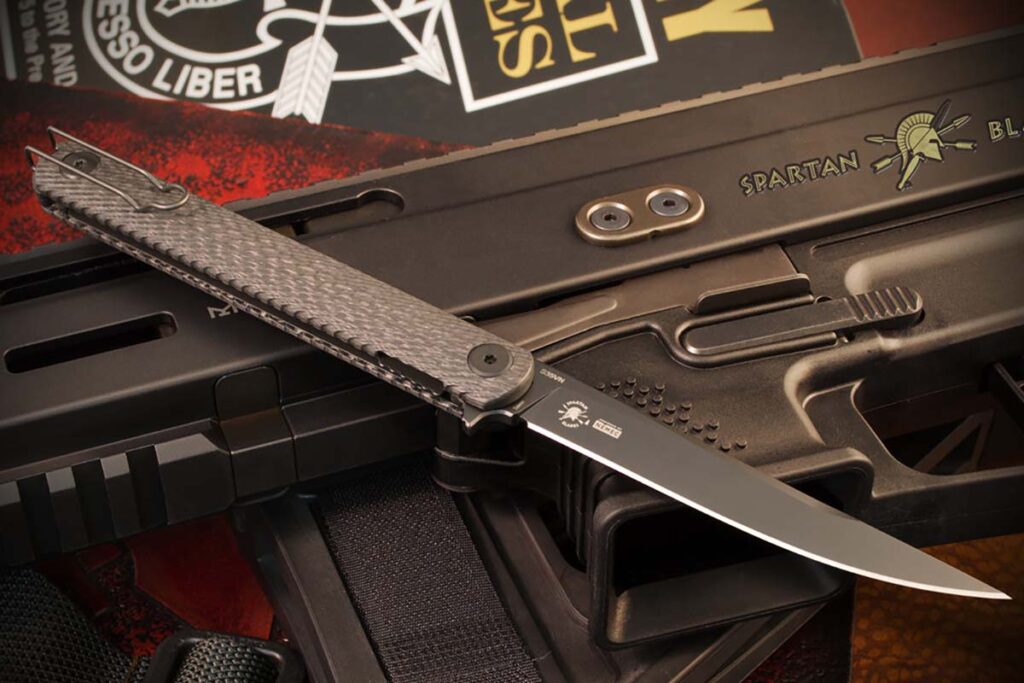
Spartan-Nemec with carbon-fiber handle.
Right off the tick, the Spartan-Nemec Folder grabs attention with its overall svelte design. Intentional, the 3.5-inch blade knife is meant to nearly disappear on the person and prove as unobtrusive as possible in carry. Along with its thin lines, Spartan and Němec have opted for lightweight scale materials, with the choice of titanium and carbon fiber. The scale is enhanced with attractive diagonal millwork—certain to improve the purchase of the knife.
The blade is S35VN, a well-rounded top-end stainless-steel, with a long drop-point profile and sporting the choice of finishes. Well, at least for the carbon-fiber model, which is offered with a tumbled or Black PVD blade. The titanium iteration is only available with a stone-washed blade.
The Nemec’s blade is deployed via an understated kicker, which blends in well with the rest of the design. Getting it into action is quick and smooth, thanks to a caged-bearing pivot system. Finishing off the package, a deep-carry wire clip (tip up), which makes the knife nearly disappear on person.
As for cost, the Spartan-Nemec folder falls in the toner end of production knives, with the carbon-fiber model boasting a $275 MSPR and the titanium a $295 MSRP.
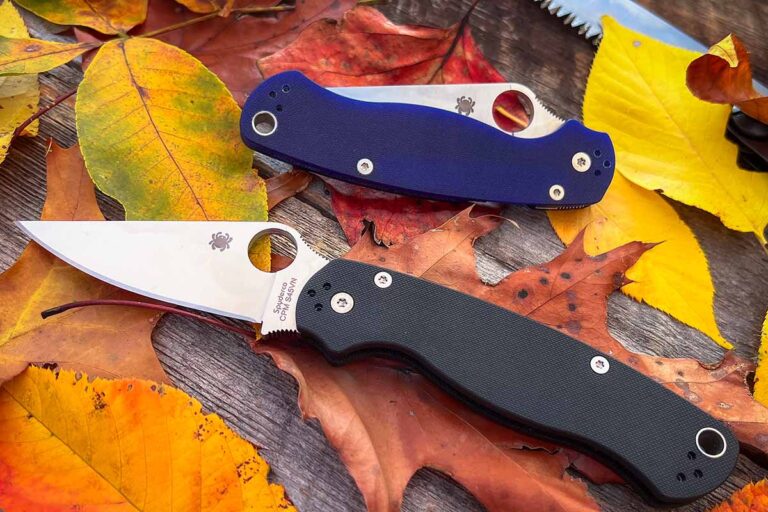
The Spyderco Paramilitary 2, simply known as the Para 2, is a part of the Military family of popular tactical folders in the Spyderco lineup. The Para 2 came about as a downsized version of the full-size Military model, answering the call from customers for a practical EDC option.
Smaller it might be, but the Para 2 retains the essence of what makes the Military a popular working folder. And because of this, the knife has developed a cult following. However, it’s not simply a shrunken-down facsimile of its larger predecessor, having gone through several design improvements that have dialed in the knife to users’ needs.
In this article, we’ll examine exactly what has made the Spyderco Para 2 such a winner in the company’s lineup. And why, if you need a truly rugged everyday option—or just want a classic in your collection—the legendary knife more than fits the bill.
Para 2 Blade
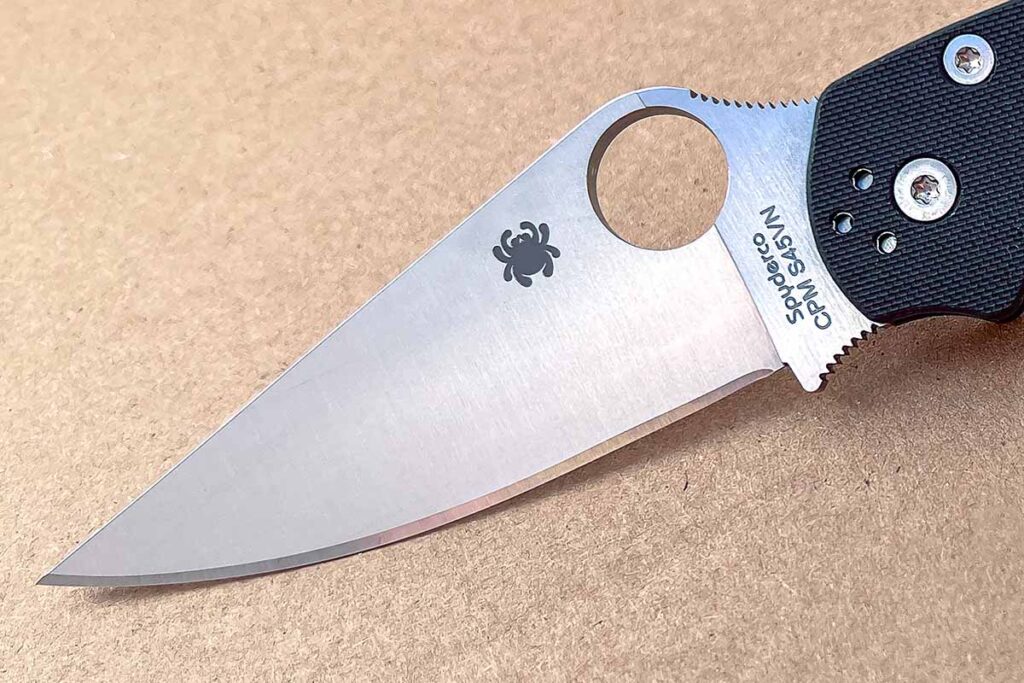
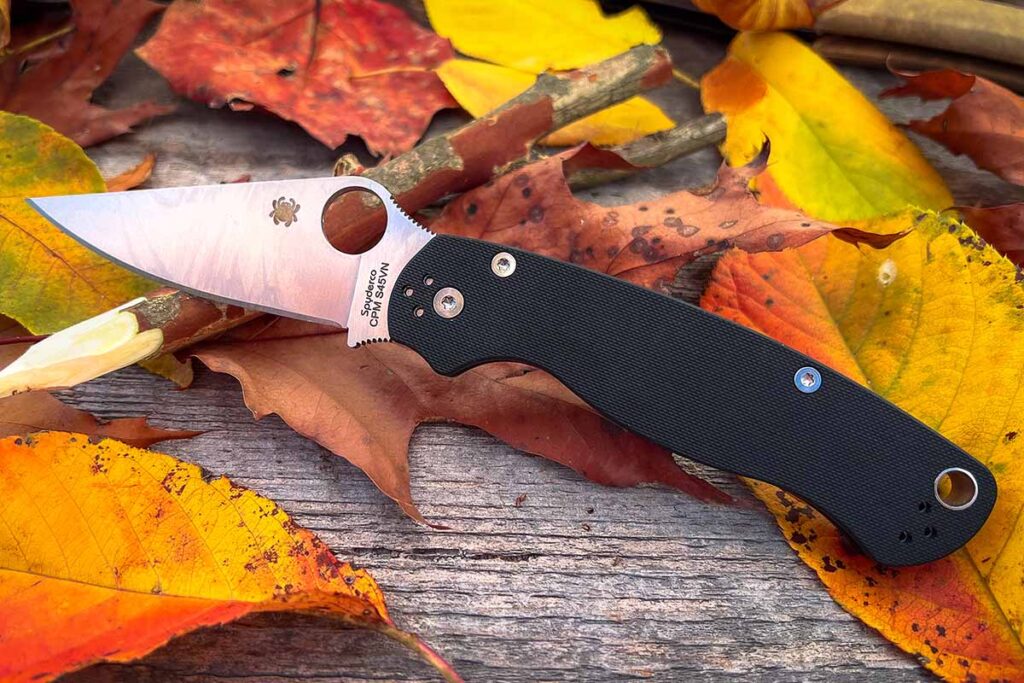
To start things off, the blade of the Para 2 sports a useful clip point shape, enhanced with a full flat grind. Furthermore, the knife has a gradual distal taper from the tang to the tip, evident when viewed from the top. The length of the blade measures 3.4 inches long, enough length to take care of heavy work but short enough for comfortable carry in a pocket.
A CPM S45VN stainless-steel blade brings toughness, excellent edge retenion and easy of sharpening to the game.
Constructed of CPM S45VN high-performance stainless steel, Spyderco picked the perfect material for a high-end knife. Compared to the gold standard of this class—S30V—S45VN proves a bit tougher, yet is remains easy to resharpen. That is if you have to. The blade’s toughness means it holds an edge extremely well, suiting it for long-haul work without interruption. A final point, S45VN is fairly renowned for its corrosion resistance, making the Para 2 excel in nearly any environment.
As those familiar with Spyderco can guess, the blade boasts the company’s trademark hole near the spine, at the rear. This has been the go-to deployment method for time immemorial on the firm’s knives. Rounding things out on the blade, there’s integrated chill formed by part of the blade and handle when the blade is opened. A choil permits the user to further choke up on the blade for extra control when needed.
Para 2 Handle
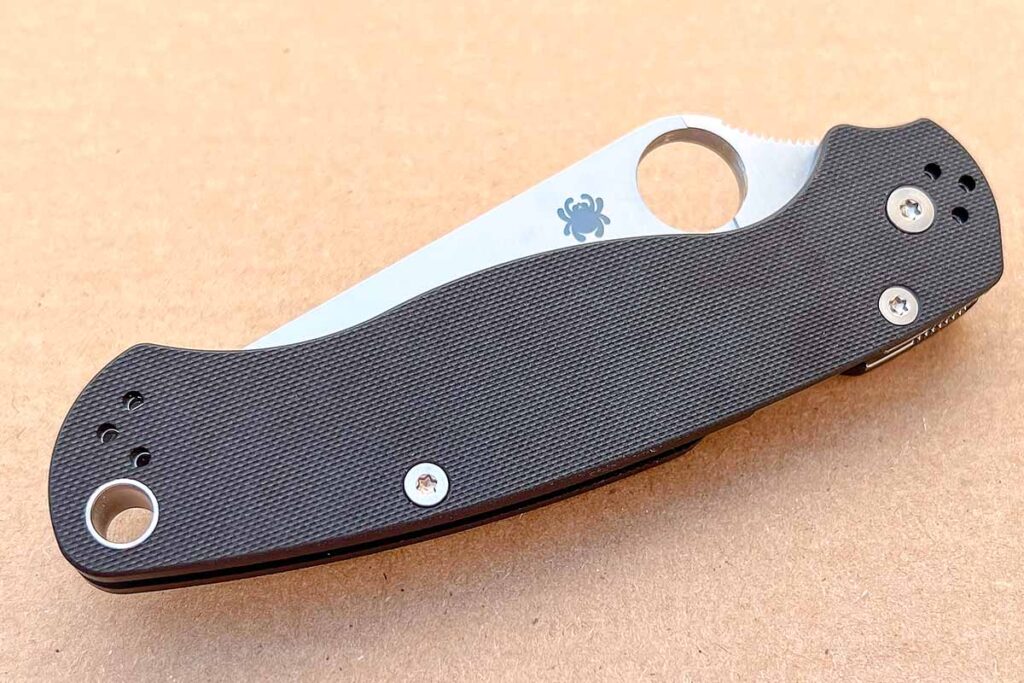
Spyderco opts for a black textured G-10 for the handle, which endows it with a few assets. First, it keeps the knife nimble, cutting down on the Para 2 overall weight. But this isn’t at the expense of strength—G10 is tough as cut nails—and a solid purchase on the knife.
Dark, dashing and useful, the Para 2’s G-10 handled gives users a firm grip on the knife.
The handles are milled out, allowing the slightly undersized stainless steel liners to sit flush with the G-10. Nicely, this reduces the overall width of the handle but doesn’t sacrifice the lateral strength of the liners. Spyderco also turns its eye to weight reduction with the liners, porting them to further lighten the load—while not compromising strength.
The handle shape itself is very ergonomic, like the full-size Military. There is an expanded, curved section that forms an integral finger guard to prevent your hand from sliding forward. The handle feels very secure in hand, and this inspires user confidence.
Compression Lock
With an extremely strong lockup, the Para 2’s Compression Lock adds confidence to the system.
The Para 2 utilizes Syperco’s Compression Lock to secure the blade, a solid system that has several benefits. For those unfamiliar with the mechanism, it’s an in-house design that provides an extremely strong lockup. It operates by the lock bar wedging itself onto a ramp on the blade’s tang and a hardened steel stop pin. As an added benefit, the release is situated on the handle spine, just behind the blade within reach of the thumb and forefinger. Not only is the design ambidextrous, but it also facilitates fast and intuitive one-hand opening (with a bit of practice) and closing.
Pocket Clip
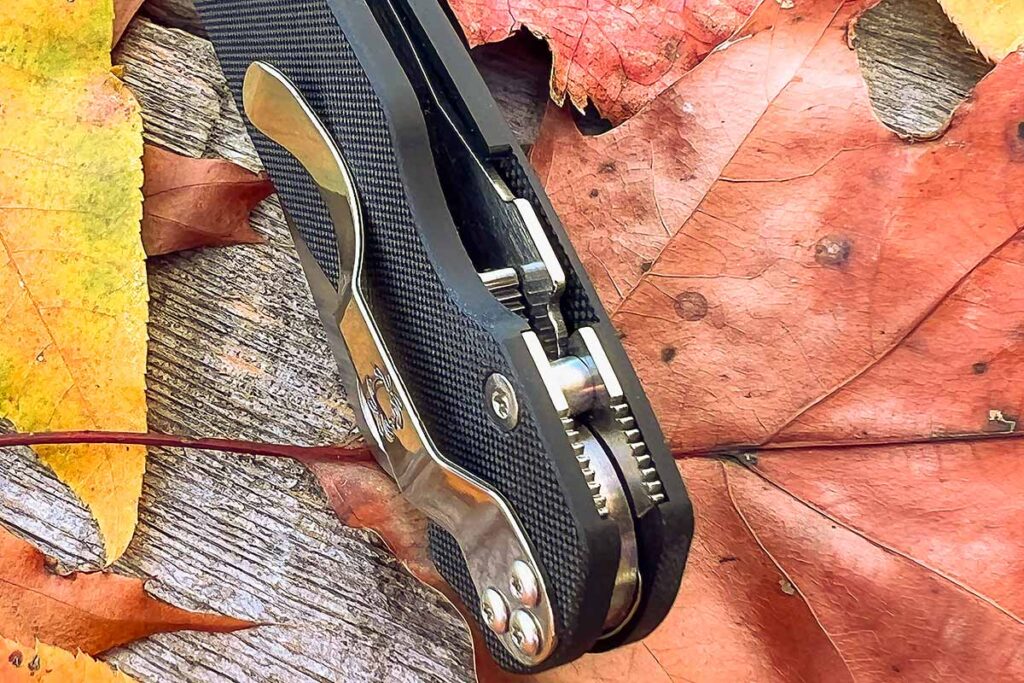
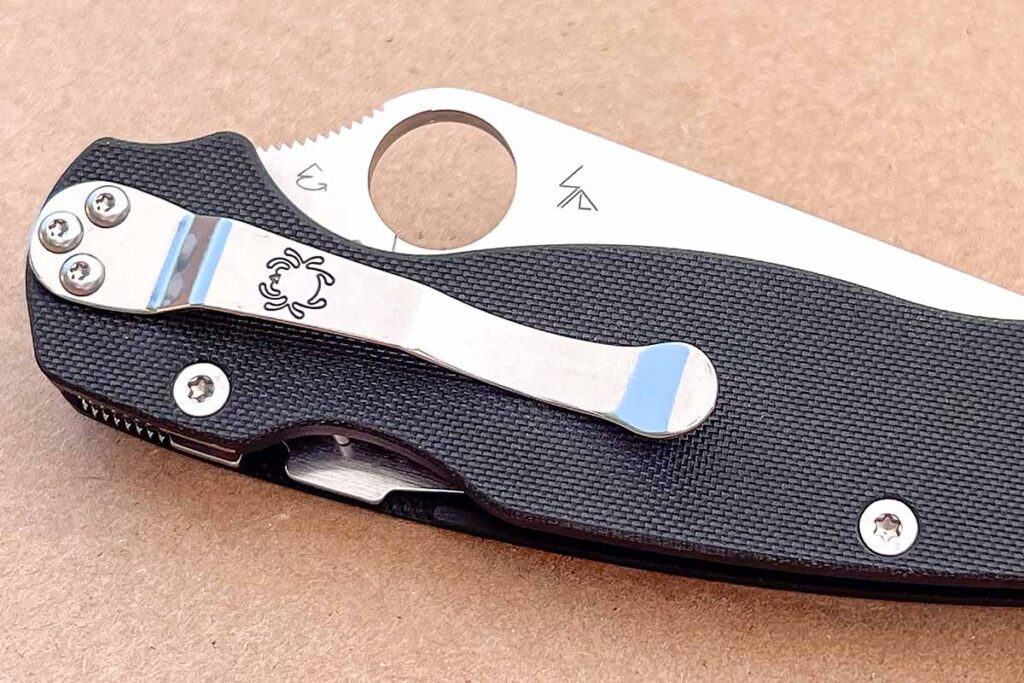
A steel pocket clip is attached to the handle in the right-hand, tip-down configuration. However, Spyderco has what they call 4-way clip mounting with the Para 2. This means the handle is drilled and tapped to modify the clip’s position, thus the carry style. Again, this makes the knife lefty- and righty-friendly, as well as allowing for tip-up or tip-down carry. Understandably, this is another facet of the Para 2 has that a lot of fans.
No matter how you carry or hand you use, you can move the clip to suit your needs.
The handle also has an open build, allowing you to effectively clean lint and other debris out of the inside of the handle by using either compressed air or tap water. The handle length is 4.8 inches, making the overall length of the Para 2 around 8.2 inches. I would consider any folder with an overall length of 9 inches to be large, so to say the Para 2 is a midsize folder is a stretch. It’s safer to say it’s on the upper end of being midsize. Still kind of compact, but large enough to handle some man-sized cutting jobs.
Para 2 In Action
The flat ground blade with distal taper helps the blade sail through anything with ease. This is exactly the reason why the full-size Military is a favorite among knife users the world over. You’ll notice the blade bites in and does so aggressively and it just takes off. Shoot, I have even used my Para 2 and Military in the kitchen to aid in food prep at times. The Para 2 makes for an effective paring knife.
An all-time classic, the Para 2 offers users an option fit to tackle most jobs.
Outside of the kitchen, the Para 2 slices through cardboard, plastic edging, styrofoam blocks, and even strips wire with ease. Spyderco’s cutting edges out of the box are nothing short of perfect. The Para 2 can be put to work immediately without modifications to the edge. S45VN’s durability is out of this world. You’ll benefit from the enhanced edge-holding capability of this steel by not having to sharpen as often. However, all this depends on your frequency of use and that can vary from person to person.
The handle ergonomics are very comfortable. The Para 2 didn’t leave any hot spots of any kind and is pleasurable to wield during extended periods of use.
Final Cut
I think you will find the Para 2 to be an excellent daily carry choice for you, if you are looking for a working folder that is also a super comfortable EDC knife. As for how much the Spyderco Paramilitary 2 will set you back, the MSRP starts at $265.00 for the black G-10 handle/satin-finished blade as tested here. There’s also a camo handle for the same price, and black DLC coated versions for a bit more at $285.
So, you’re going to build a power hammer… now’s the time to consider where to get your parts.
The first thing you’ll have to decide is which style of power hammer you will build. There are as many designs as there are folks who build hammers, but they fall into two basic categories: helve hammers and linkage hammers.
Power Hammer Styles
Linkage Hammer
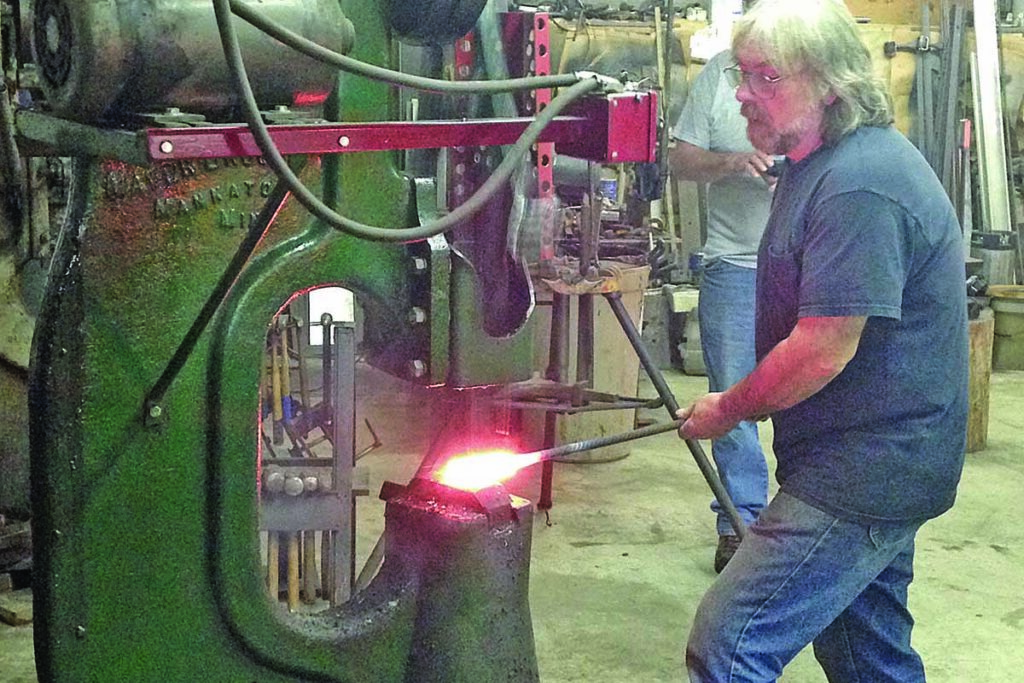
At the basic level, a helve hammer has an arm that moves up and down on a fulcrum to move the hammer head up and down. A linkage hammer uses a wheel, tire or disk that rotates and uses the rotation to move the hammer head up and down. The Little Giant power hammer design uses a linkage, as does the commonly home-built tire hammer.
The Little Giant power hammer design uses a linkage, as does the commonly home-built tire hammer. ABS master smith/BLADE® field editor Joe Szilaski pounds away with his 50-pound Little Giant. (Lori Szilaski image)
Helve Hammer
I chose to build an Appalachian-style spring helve hammer because I had access to a variety of leaf springs, and because the design is more intuitive and less mechanically precise. I figured correctly that I could build a helve hammer design from scratch, but that a tire hammer had some engineering points that would be difficult for me to figure out. If you have access to uniform steel sizes or must buy your steel, I suggest a tire hammer. I had good scrap steel and didn’t want to buy much.
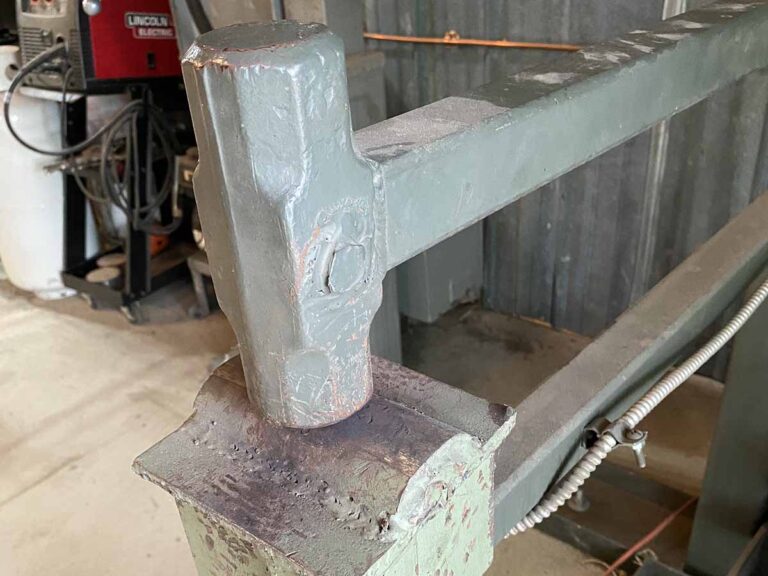
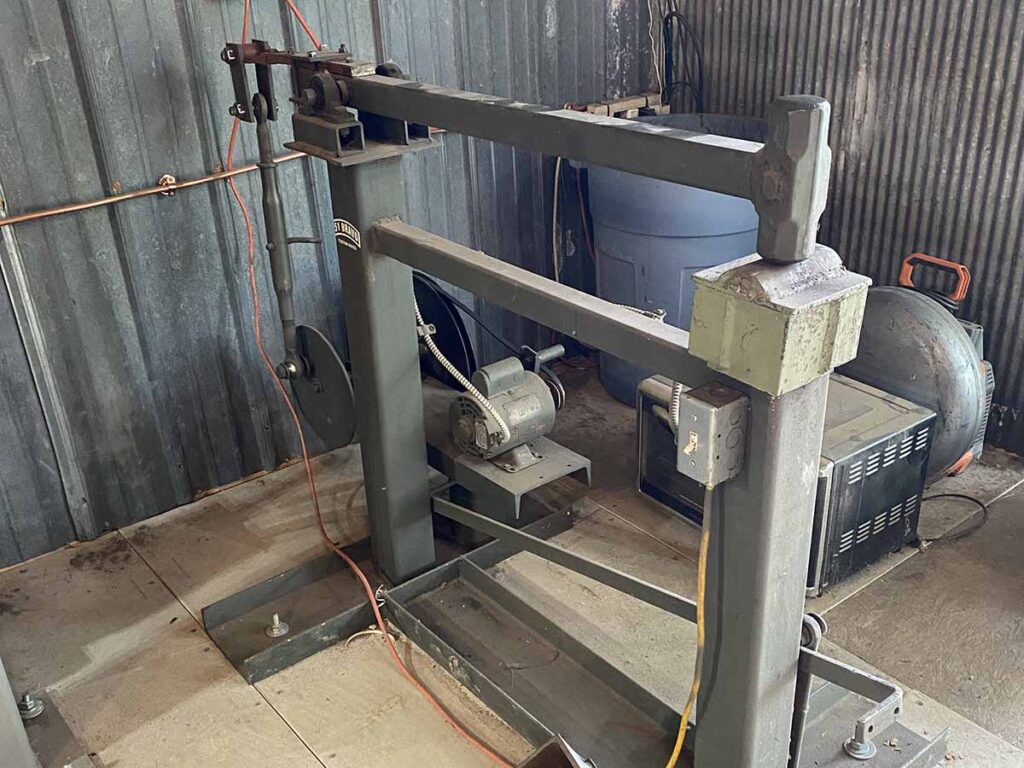
I’m focusing on the upright, heavier, more efficient metal-moving machines. Even so, it’s worth mentioning the smaller, simpler but less efficient helve hammers. I came across a good example in the shop of Shawn Moulenbelt, a Michigan bladesmith who was on season seven of Forged in Fire. His hammer used various sizes of hollow square tubing, a sledgehammer head and a half-horsepower motor. He used a slack belt clutch and interchangeable die plates. His hammer was built by Rusty Glovebox on YouTube and is a solid DIY (do-it-yourself) design.
Bladesmith Shawn Moulenbelt’s helve hammer uses various sizes of hollow square tubing, a sledgehammer head and a half-horsepower motor. On the upside, these hammers are quick and fairly straightforward to build. On the downside, they’re not all that great at their one job: moving metal. Even so, a similar light use-DIY power hammer is much more efficient than your arm, and much less likely to get tired.
On the upside, helve hammers are quick and fairly straightforward to build. On the downside, they’re not all that great at their one job: moving metal. Even so, a similar light use-DIY power hammer is much more efficient than your arm, and much less likely to get tired. In my mind, if you have the time and skill to build a small hammer, you can just as easily build a bigger one. Even so, the small helve hammers may be just the ticket for your shop.
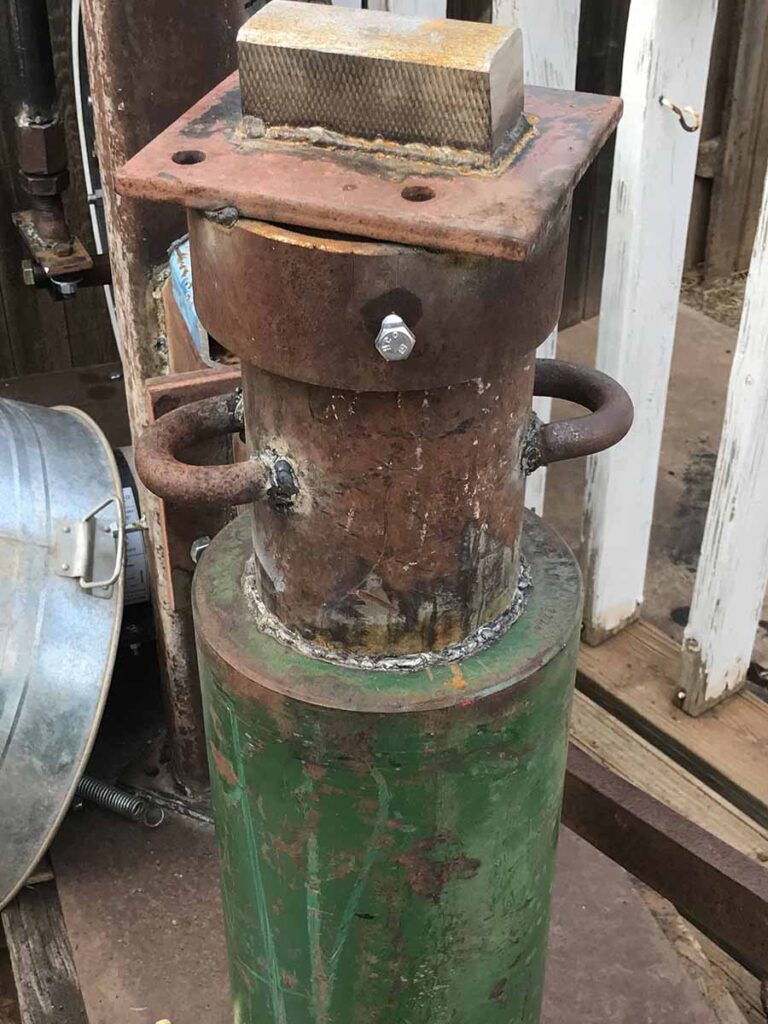
The author’s home-built hammer combines a 5-inch piece of round stock with a heavy sleeve from a “mud pump” to make an anvil that weighs around 400 pounds.
Resourcing An Anvil
There are many different things that can make a suitable anvil for a power hammer and many more things that cannot. What you are looking for in an anvil is a solid piece of steel that weighs anywhere from 150 to 600-800 pounds, which can be difficult to acquire.
Sometimes you can find solid square or round bar steel. Some folks recommend railroad axles. Others suggest forklift tines welded together. I’ve seen sections of a 2-inch square bar welded together into a solid 6×6. I’ve seen pieces of 1-inch plate welded where the hammer strikes the ends. Whatever you can find needs to be solid or able to be welded into a solid, single, massive piece, and your welder has to have the power to stick it all together. My hammer is built on a 32-inch piece of 5-inch round bar welded inside a mud pump sleeve that has a 5-inch bore. The total weight of my anvil is around 400 pounds.
What Not To Use
Don’t be tempted to think you can get a piece of something hollow like pipe or square tubing and fill it up and make a suitable anvil. Each stroke of your hammer pounds the steel in-between the hammer head and your anvil, pushing your anvil toward the ground. If you have any movement, vibration or give in your anvil, the force is absorbed by the movement and not efficiently transferred to your workpiece.
Anvil To Hammer Head Ratio
When you finally locate this difficult-to-find thing, it won’t likely be the size or shape you want. My anvil was round, which doesn’t easily weld to square tubing, for example. I had to deal with it. As noted, my anvil was around 400 pounds total weight. Yours may be more or less. You should design your hammer with a minimum 1:10 head-to-anvil ratio. Since I had a 400-pound anvil, I built a 40-pound head. If all you can find is a 200-pound hunk of steel for your anvil, you should stick to a 20-pound head or so. Design your hammer around your anvil, as the anvil is the hardest part to find. Alternatively, find the weight you need for the anvil and use the tire hammer plans.
Another consideration is the base for your hammer. I’d recommend the thickest steel plate you can find, mounted on the firmest foundation you can muster. If I could have built on 1-inch plate and bolted it to a 24-inch-deep concrete pad set into a concrete shop floor, I’d have done it. I had to make do with what I could find in my “free” scrapyard, and deal with the limitations of my shop setting.
Power Hammer Center Post
For any hammer you need a center post. The post should be heavy enough to withstand the extreme forces involved in rocking a spring arm or linkage with a heavy hammer on one end. I used a piece of 4-inch tubing with half-inch walls. Others have used thinner-walled but larger cross-section square or rectangular tubing, heavy walled pipe or sections of I beam. The tire hammer plans call for a 6-foot-long piece of quarter-inch wall and 5-inch square tubing.
Final Cut
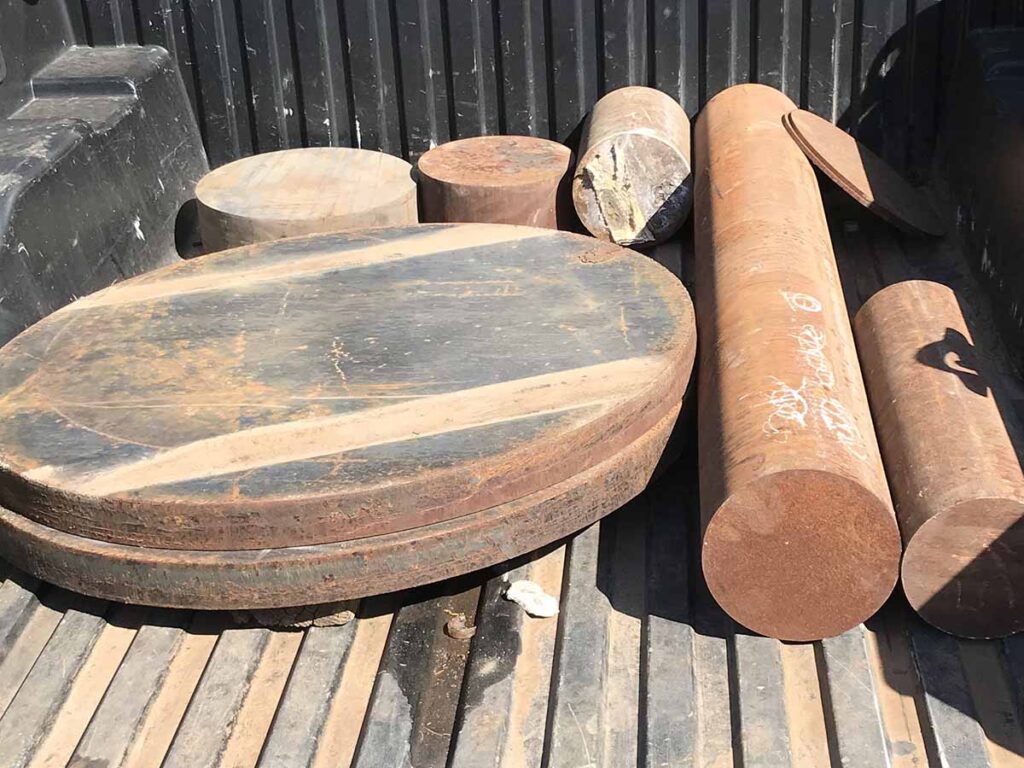
Another consideration is the base for your hammer. The author scored some 2-inch-thick, 30-inch-round, 300-pound base plates out of the “drop” pile at a local steel distributor, along with several other potential anvils.
My power hammer has become an essential tool in my shop, to the point that I sometimes wonder how I ever lived without it. I have only begun to explore its full potential. I built it for my appearance on Forged in Fire, where I was fortunate to make the final. I was able to come home and use my hammer to build my final edged piece for FIF. I lost the contest but ultimately still have a power hammer, and I can still take pride in the fact I built it myself from little more than a pile of junk.
It may take you a few months to gather all the primary parts, or you may get lucky and find them all in one place. Next month’s article will focus on building considerations for a spring helve hammer, and later we’ll discuss the Clay Spencer DIY tire hammer.
Chris Quinn of GP Knives gives his view of knife trends for the upcoming calendar year.
Chris Quinn of GP Knives is familiar with the ebb and flow of trends and styles in the knife industry and advises to approach the ’24 market with an appreciation of that ongoing phenomenon.
“The knife industry is quite the rollercoaster,” he related, “and what could be popular in the future is anybody’s guess and depends on a lot of things, but mostly the economy at the time. We are a disposable income industry. Over the past year, as inflation and interest rates continued to rise, our industry has had a noticeable slowdown. That said, items that continue to sell well are either hard to get, limited production and exclusive, or a good deal. I don’t see that changing anytime soon.”
Economical & Political Tides
Considering the economic influences and the fact that knife prices naturally rise in step with costs related to materials, production time, scarcity and maker branding, then keeping a keen eye on value is a watchword for the new year.
“2024 is an election year,” Quinn commented. “They are always tricky to navigate. Who’s next in office has a direct effect on the shooting and cutlery industries.”
Design Trends
With this influence, he looks forward to a couple of developing style aspects in the next year.
“The more fidgety the better,” he smiled. “A large percentage of knives aren’t used for more than fidget toys these days, or at least they need to function that way to impress the end user. Popular fidgety locks like Demko’s Shark Lock or WE Knife/CIVIVI’s SuperLock or Pro-Tech’s button lock are all the rage. The smoother and faster the opening and closing a folder can be the better. Traditional folders are hanging in there, but EDC is king. Also, the automatic category continues to grow as we see more and more states loosening their laws on ownership and carry.”
Summarizing, Quinn related, “I don’t have much in the way of predicting styles of knives and don’t see longstanding industry leaders lowering their prices soon, but I do see smaller makers getting more competitive to take the space the giants have abandoned.”
The award-winning knifemaker and designer passed at 82 after a life filled with adventure and craftsmanship.
Award-winning knifemaker and knife designer Grant Hawk of Hawk Knives passed away peacefully at his Idaho City, Idaho, residence on November 8. He was 82.
Born in Boise, Idaho, on Feb. 15, 1941, to Woodrow Allen “Kelly” Stroud and Dortha Bunce, Grant’s life was a remarkable journey of adventure, resilience and creativity. His early years were spent as a cowboy in Boise, where his connection with the outdoors and love for craftsmanship began. The 1960s saw Grant moving to California to make camper trailers, but he quickly became entangled in the revolutionary spirit of the era, leading to a brush with the law. This encounter prompted a pivotal decision in his life: to adopt a new identity and retreat to the Idaho mountains.
In his seclusion, living in a teepee, Grant’s interest in gold prospecting blossomed. This pursuit marked his gradual reintegration into society and laid the groundwork for his future endeavors. It was during this period of reflection and growth that he discovered his true calling in knifemaking.
Alongside his son, Gavin, Grant embarked on a remarkable journey in the world of craftsmanship. Together they forged a path in knifemaking, combining adventurous spirit with Grant’s innate skill and creativity. Their collaboration led to the creation of distinctive and innovative knife designs, earning acclaim in the knifemaking community.
His final accomplishment was completing his autobiography, which he delivered to the printer just two days before his passing. On the night of his death, he was in good spirits and feeling well, but unexpectedly fell ill and passed away gracefully within 15 minutes.
Grant’s life was a tapestry of diverse experiences, from cowboy to gold prospector, and finally to a revered knifemaker. His legacy lives on through his son Gavin and their shared creations, which continue to inspire and captivate knife enthusiasts around the world.
Grant’s story is a testament to the power of resilience, adaptation and the pursuit of passion. His memory will be cherished by his family, friends, and all who knew him as a man who carved his path, much like the knives he so skillfully crafted.