Home Blog Page 65

Benchmade Infidel Review: Breaking The Mold For OTF Autos

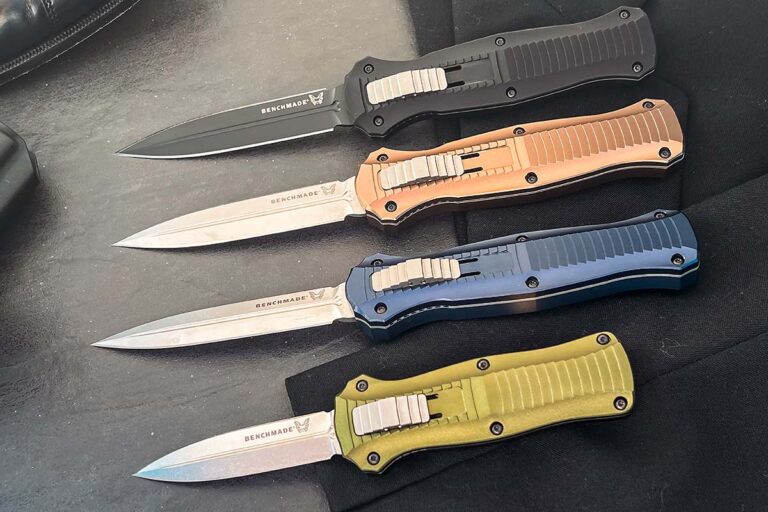
Breaking from the boxy OTF autos, the Benchmade Infidel cuts a unique profile that’s made it a hit among high-end knife lovers.

Out-the-front (OTF) automatic knives have long been popular with knife enthusiasts because they are different enough to be unique but not so odd as to be useable. OTF’s main mechanism of action is propelling the blade fore and aft in relation to the handle, as opposed to out the side in a radial fashion as most known automatic folding knives operate. Presently a few knife companies offer OTF automatics but there is one drawback to most designs (if you see it as such)—most have boxy handles.

This is primarily out of necessity. The handle shape in generally needs parallel sides to facilitate the fore and aft motion of the blade as it extends and retracts into the handle. And with the sliding switch actuation located on the spine, there isn’t much that companies can do with handle shape changes.

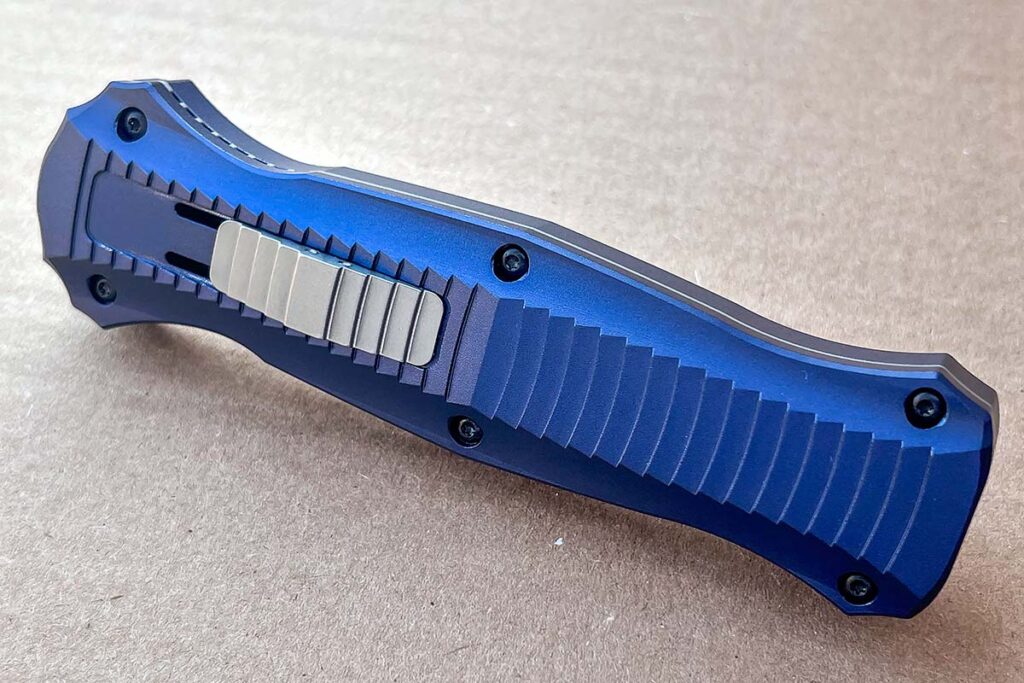
Enter the Benchmade Infidel, a high-end USA-made OTF with a curvy handle.
Benchmade Infidel Handle
Photo: Marty Stanfield – Marty Stanfield Photography

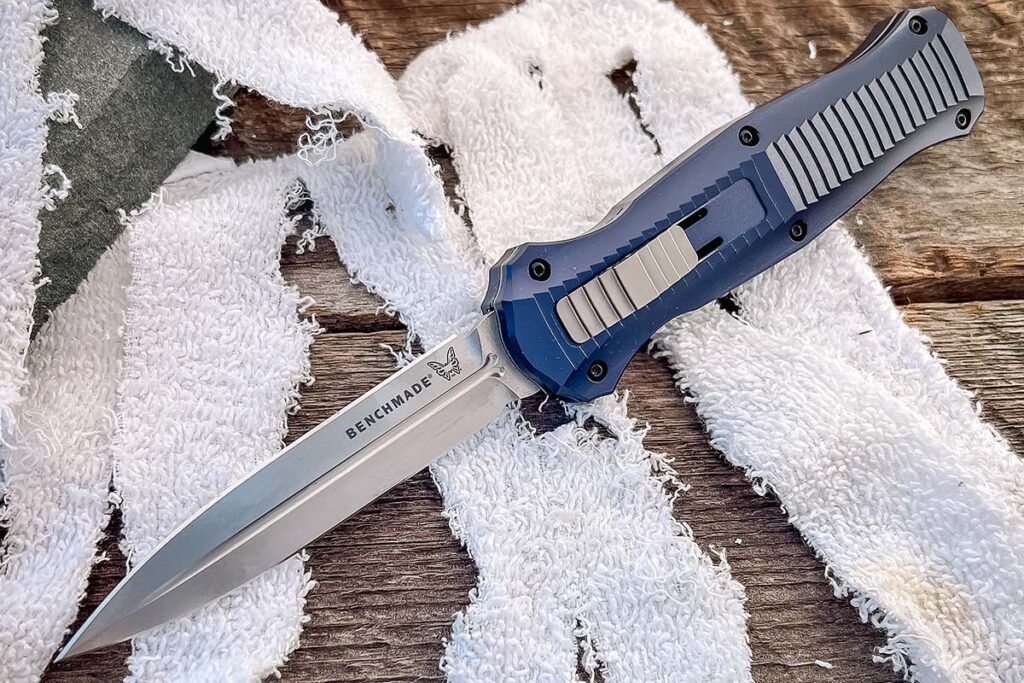
How did the company accomplish this? By relocating the actuation slide switch from the handle spine to the handle scale. Moving the switch opened up possibilities of experimenting with different handle shapes, even ones that enhance user grip and safety as well. The Infidel’s handle is curvy, yet symmetrical and sports a three-dimensional texturing pattern to boost hand traction.

Infidel Blade

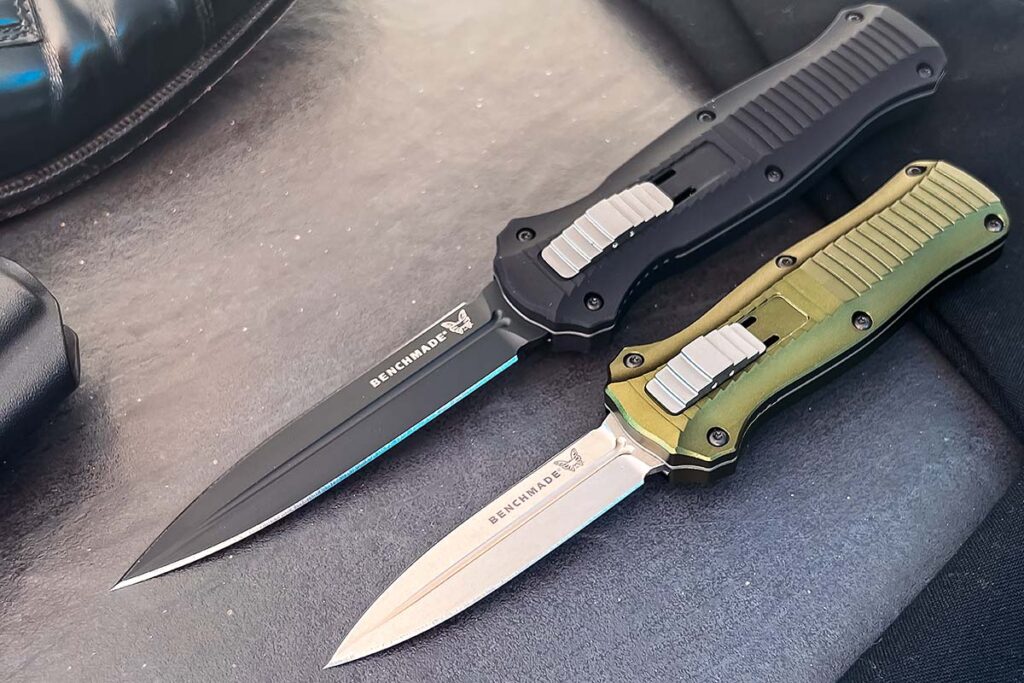
The Infidel’s dagger-shaped blade measures 3.9 inches in length and sports a traditional grind for this style of knife and a symmetrical appearance. This truly is a dagger blade with edges sharpened fully on both sides. Benchmade opted for D2 steel for the blade, selected for its known edge retention and toughness.
Infidel Blade
Photo: Marty Stanfield – Marty Stanfield Photography

A fuller is machined down the centerline of the blade, enhancing the appearance and giving it a bit of an edgy attitude. The blade is finished with a black coating, serving as an additional layer of corrosion resistance, as well as a low profile, non-glare finish. For those who might not be aware, D2 is not stainless steel and requires a little extra care. This coating accomplishes this job.

Infidel Handle

The handle measures 4.8-inches long and it is machined from aircraft-grade aluminum for both strength and weight reduction. The overall handle shape is inviting with its multiple curves that define a forward guard of sorts to park your hand in place. Moving towards the middle, there is a slight contour that helps to fill your grip more, and the expanded section at the rear of the handle aids in preventing rearward sliding.

Like the blade, the handle shape is symmetrical and very pleasing in appearance when you factor the blade’s uniformity. The handle sports bi-directional machining patterns helping to hold your hand in place. If the machining pattern look familiar, it should. It is the same style used on Benchmade’s Presidio automatic folder.
Benchmade Infidel Clip
Photo: Marty Stanfield – Marty Stanfield Photography

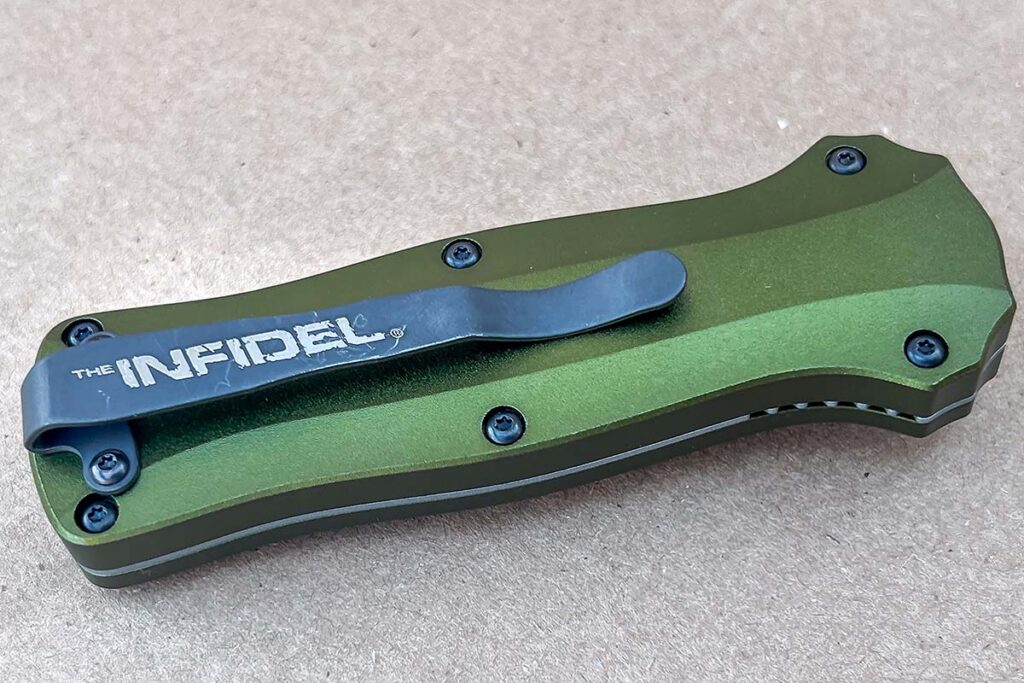
To fire the blade, there is a stepped slide switch on the presentation side of the handle. The machining pattern on the switch allows for positive thumb engagement to deploy and retract the blade. The reverse side of the handle is smooth and you find a deep carry, fold-over style pocket clip affixed to the handle to carry the Infidel tip down in the pocket. The clip easily attaches to your pants pocket and holds the knife securely.

Using The Infidel

While it is possible to EDC a dagger blade OTF (though, be sure to check your local laws first on knife carry), I will have to caution against the fact that its use as a working knife is rather limited given the blade design. The dagger grind makes the tip devastatingly sharp and pointy (a good thing), it also leaves the tip more susceptible to damage or even breakage if the knife is used heavily. This is especially true when prying or twisting while cutting actions may be involved.

With certain tasks where puncturing and cutting—such as opening bags of mulch or topsoil—the Infidel definitely excels. Push the blade through the bag and pull it to the side to slice the top open. It all happens effortlessly. Opening mail, opening packages, cutting cardboard, breaking down cardboard boxes, and cutting shrink wrap are some tasks that the Infidel can also handle with aplomb.
Benchmade Infidel In Use
Photo: Marty Stanfield – Marty Stanfield Photography

The ease of extending and retracting the blade simply by moving the slide switch forward or backward makes using the knife easy. One thing to note regarding the handle ergonomics in general, the Infidel is glove-friendly. With some knife handles, the handle feels lost in your gloved hand. You cannot manipulate it easily, it feels too thin. With the Infidel, the handle design translates well to gloves.

The D2 steel is respectable in performance, offering enhanced edge retention and toughness against wear and impact. It’s a well-known steel, especially in the outdoor knife market, where large camp knives and choppers may be made from D2 for these very reasons. While you are certainly not going to do any chopping or batoning with an OTF, it’s nice to know the blade is that tough and can take a fair amount of abuse before it needs to be sharpened.

I have always had good luck with D2 and found it to be a very good-performing steel for its price. Since you’re not going to be engaged in heavy work with the Infidel, D2 is perfect and when it does come time for a resharpening, D2 sharpens up quicker than all your high-performance steels. Another plus!

Infidel Variations

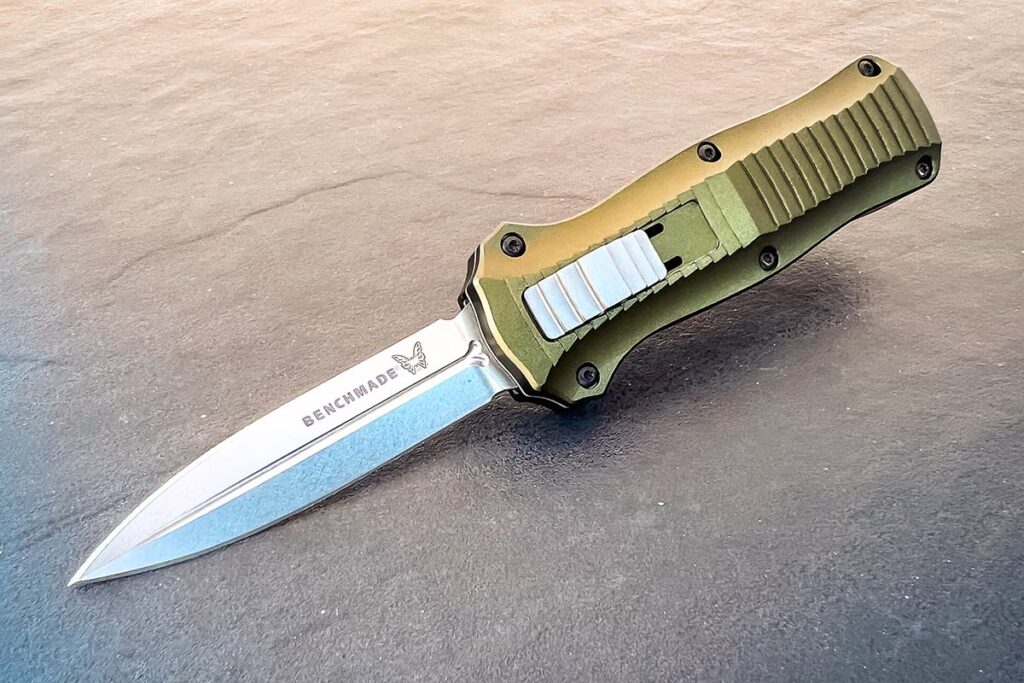
For those of you who wish for a smaller Infidel, there is the Mini Infidel which has a 3.1-inch long dagger blade. All the material specs are the same as the full-size Infidel. The overall length is 7.1 inches, and the Mini Infidel is a very pocket-friendly design. It’s sized right for daily carry and for those with smaller hands. Size wise it’s not as imposing as the full-size Infidel but its smaller size allows it to get in and out of more daily carry tasks like opening packages, mail, and some general cutting tasks as you work around the home, yard, and garage.
Infidel Mini
Photo: Marty Stanfield – Marty Stanfield Photography

Additionally, there is an upgraded model with a few bells and whistles. Benchmade dressed up the Infidel by offering three shades of nature-inspired colors: Crater Blue, Woodland Green, and Flat Dark Earth. These limited edition knives come out in 1,000 batches, and are also equipped with upgraded blade steel to satin-finished, premium CPM S30V. This is a long-time standard steel in the knife industry, known for its toughness and extreme wear resistance.

Final Cut

The Infidel is one of the more interesting OTF automatic knives on the market. It combines style, function and quality materials to equate to a long-lasting tool that will stand the test of time.

The Benchmade 3300BK Infidel has an MSRP of $550.00. The 3350BK Mini Infidel has an MSRP of $500. The Flat Dark Earth, Woodland Green, and Crater Blue full-size Infidel have an MSRP of $650.00 each. The same colors for the Mini Infidel are $600.00 each.

Check Out More On Benchmade:

How To Build An Appalachian Spring Helve Hammer

0

The Appalachian spring helve hammer, including springs, hammer head/tup and more.

Some people find great joy in precision and following rules and plans. For those of you who do, this is probably not your power hammer series. I enjoy the creativity of making a thing from scratch. It’s not the precision that turns my crank, it’s that eureka moment of, “It works!”

In this installment I’ll talk through the process of building a junkyard hammer in the Appalachian style. Junkyard refers to the DIY-type build made with what you can find. Appalachian refers to a common design that uses a spring helve. The most popular earlier Appalachian hammer designs were called the “Rusty” and the “Dusty.”

Rocker-Arm Springs

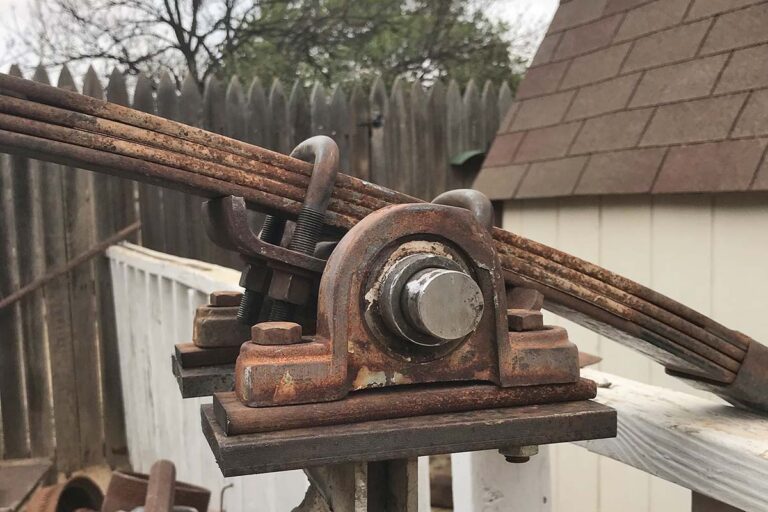
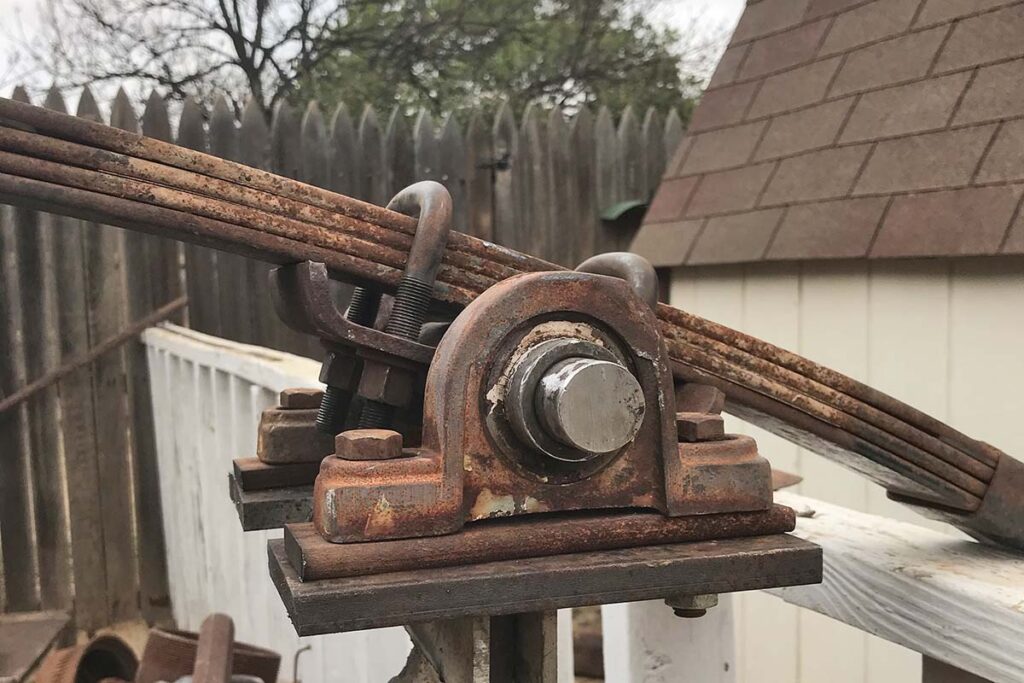
I used a set of leaf springs for my rocker arm. The arm is also called a helve. When it comes to selecting your springs, if you have several to choose from, choose a sufficiently stiff set. If you have the choice between sets that are more curved vs. those that are straighter, choose the straighter ones. If you have the choice between sets that are longer or shorter in overall length, either one will work, but you’ll have to consider whichever length you choose as you lay out the distance between the center post, the anvil and the drive wheel. The length of your spring pack coupled with your stroke length will impact the speed at which your hammer will safely run. The spring action and whip action of the spring set during cycling increase head speed at contact, which improves performance.

leaf springs for the rocker arm a power hammer.
The author used a set of leaf springs for the rocker arm of his power hammer. The arm is also called a helve.

Your spring set needs to swivel or rock on top of your center post. I built my hammer with the springs riding on top of the shaft, and the shaft riding in pillow block bearings. Others are built with flange bearings, and others with the shaft above the springs. Any configuration is fine provided you have the clearance you need for the springs to rock back and forth as the hammer operates. 

Your spring set will need a swivel on the end where it connects to the pitman arm (the rod that connects the spring arm to the drive wheel). Like the top pivot, there are as many different designs as there are guys building hammers.

The end of the spring set near the hammer head needs to be connected in a way where the arc of the spring travel is converted into direct linear up and down energy. Again, there are multiple ways to accomplish this. I went with a set of rollers on the hammer head, and the spring rides in and out on the rollers as it arcs up and down. I have seen designs with toggle linkage as well. 

Hammer Head And Tup

The entire assembly that makes up the hammer head is called the tup. When a smith says he has a 25-pound power hammer, he’s referring to the tup weight. You are looking for a tup weight that is roughly 1/10 of your anvil weight. I built my hammer with a piece of 2-inch-solid-square stock long enough to make a 40-pound tup. For heads that weigh less, you can use a piece of solid stock for the contact area, and tubing or pipe to make up the extra length you need. While a solid anvil is critical to the function of the hammer, the hammer head itself only needs to be solid on the striking end to properly transfer the force.

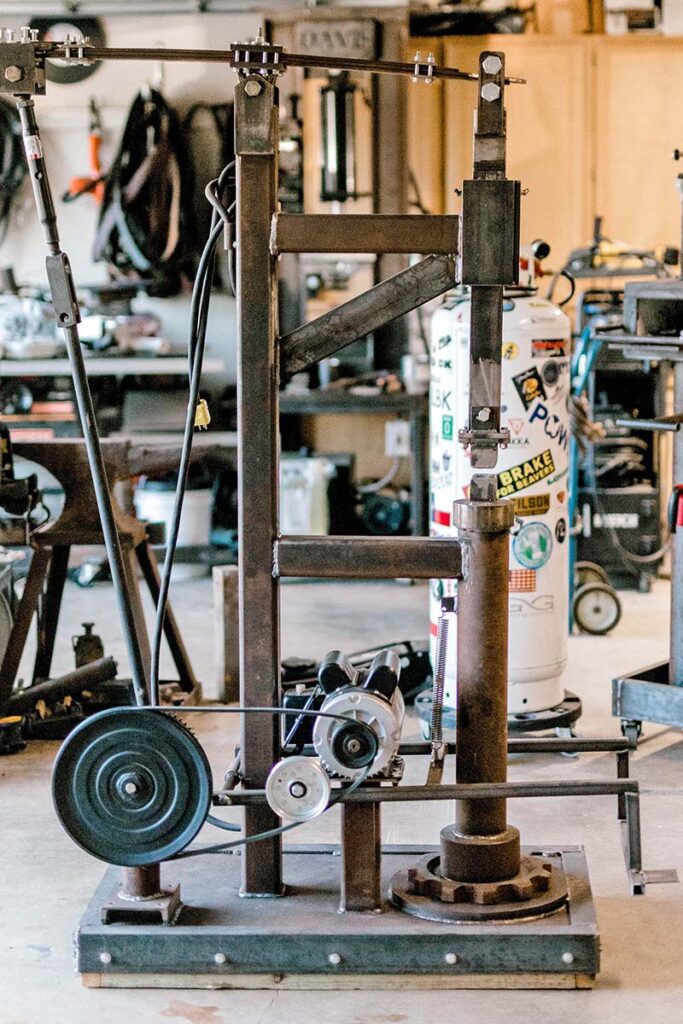
The DIY spring helve hammer built freestyle by Doug Davis
The DIY spring helve hammer built freestyle by Doug Davis of Lubbock, Texas, is shown in both instances here from the pulley side.

The tup rides up and down in a set of guides. You’re converting an arcing spring movement into a linear up-and-down hammer movement. One consideration is that your guides need to account for lateral movement in all four directions. The simplest way is for the guide to completely enclose the hammer shaft. Contact surfaces between the hammer head and guide should be lubricated, and steel on steel is not advised. Bearing surfaces should be made of UMHW (Ultra High Molecular Weight Polyethylene) plastic or of bronze. These surfaces benefit from a degree of adjustability to make sure that the hammer head is aligned properly with the anvil. 

I used set screws and a UMHW plastic cutting board on my hammer, with lithium grease as well. My hammer runs well with fresh grease and less well without. I grease the hammer shaft at the beginning of every forging session. The vertical position and length of your guides should accommodate the various stroke lengths of your hammer. You don’t want the hammer head hitting the bottom of the guide on the upstroke, nor the spring connector hitting the top of the guide on the downstroke.

Pitman Arm

A stiff arm connects the spring pack to the rotating wheel, converting the rotary action of the flywheel to a straight up-and-down rocking motion. This arm is called a pitman arm. It is adjustable for length, as the dimension will ultimately be changed as you tune your hammer by trial and error, or as you adjust your hammer to accommodate varying thicknesses of stock, or the use of swages, or top and bottom tools. I used a toggle linkage on the top and for the bottom of the arm I used large bolts welded to a piece of plate, which I then bolted to the hub of the tire used for a clutch. This is another area where your available parts and mechanical experience will dictate your design.

Read More On Knife Steel:

2025 Knife Buying Trends: Collectors Tighten Up Their Wallets

After smashing years in the post-pandemic, knife buying has somewhat cooled for the time being.

While the outward signs of the pandemic—masks, shutdowns, etc.—that ravaged the world in the earlier part of the decade are largely gone now, the economic impacts remain. That includes in the world of knives.

Factory knife sales rolled right along in the first couple of years or so of the pandemic, due partly to the federal government stimulus checks and extended unemployment benefits offered to many Americans. The checks and benefits eventually stopped but healthy knife sales continued unabated throughout much of the factory knife industry into mid-2022. That’s when one company experiencing record sales the first six months saw consumer spending “suddenly jerk to a halt in the second half” of the year.

“Dealers had loaded up with knives going into the summer because they expected the Covid spending wave to continue and were left holding a ton of inventory that’s been moving very slow ever since,” wrote the company’s spokesperson. Consequently, he noted, his company’s sales were down about 30 percent in 2023.

However, again according to the company spokesperson, as important a role as the end of the flow of the “free” government money to Americans would seem to have played in the knife sales downturn, it “was small potatoes” in comparison to two larger factors—a poor economy and a lack of consumer discretionary funds in general.

“Confidence is down, so people are being conservative with their discretionary spending,” he noted. “Second, not everyone has discretionary funds, so while the cost of pretty much everything continues to rise, income growth is stagnant for people who were already underpaid.”

Another company spokesperson who stated his company’s sales were down about 8 percent in 2023 cited another cause.

“There is also pent-up demand to go out to restaurants and clubs since the pandemic. People are spending money on experiences [instead of on knives],” he opined. “I see this as temporary and will subside as they realize hamburgers cost $18 and service stinks.”

Even though TOPS Knives’ sales were up 15 percent at BLADE Show West ’23 over the previous year’s show, company general manager Craig Powell indicated he still noticed a sign of conservative knife buying at this year’s show in Salt Lake City.

“We are seeing people tighten their belts and being a little more frugal than in years past,” he observed after the show. Rather than the belt-tightening being reflected in the prices paid for individual knives, Craig wrote, “We saw people that otherwise would have purchased two or three knives buy just the one.”

It should be noted that not every company BLADE® contacted experienced sales drops in ’23. For instance, Condor Tool & Knife reported sales were even compared to ’22, while Coast reported a solid increase of 12 percent in ’23. Officials of both companies indicated they would not be raising prices in ’24, though the aforementioned companies that suffered sales drops in ’23 will be.

“We have a few products going up in price in 2024,” one company spokesperson wrote, “somewhere between 3 and 5 percent, mostly to cover our increased costs in labor and fuel.” Another company spokesperson stated his company would be implementing a 5 percent increase across the board for similar reasons. “We’re hearing that other brands are raising their prices much more than that, so we’re doing everything we can to keep our knives as affordable as possible for consumers without reducing quality,” he observed.

It should be noted here that the companies cited in this story represent a small segment of the industry. Moreover, we at BLADE believe in the ebb and flow of knife sales as outlined by Chris Quinn of GP Knives, and that most of the players in the knife industry who experienced down years won’t be down for long.

Nonetheless, perhaps more than ever, BLADE urges you to monitor the prices charged for knives in 2024. Today’s knives are of higher production quality and materials than their predecessors but, as always, it’s up to you to ensure that you get the best knife with the best bang for your buck.

Check Out Our Buyer’s Guides:

Advertisement

Must Read Articles

Read this before you make a knife

Knifemaking 101 – Read This Before You Make a Knife

  by Wayne Goddard My experience has taught me that there's nothing like digging in and getting started. I've often said the hardest part of the...
how to forge damascus steel

How to Forge Damascus

Advertisement
Advertisement