From kitchen to camp and beyond, these puppies will perform.
Christmas may have passed and all your presents have been unwrapped, but that doesn’t mean you can’t start building out your wish list for the coming year. We’re here to help with a slew of new knives—and non-knives—that are certain to tantalize and tempt. From production options full of pomp and customs cutting one-of-a-kind profiles, there’s something for knife lover.
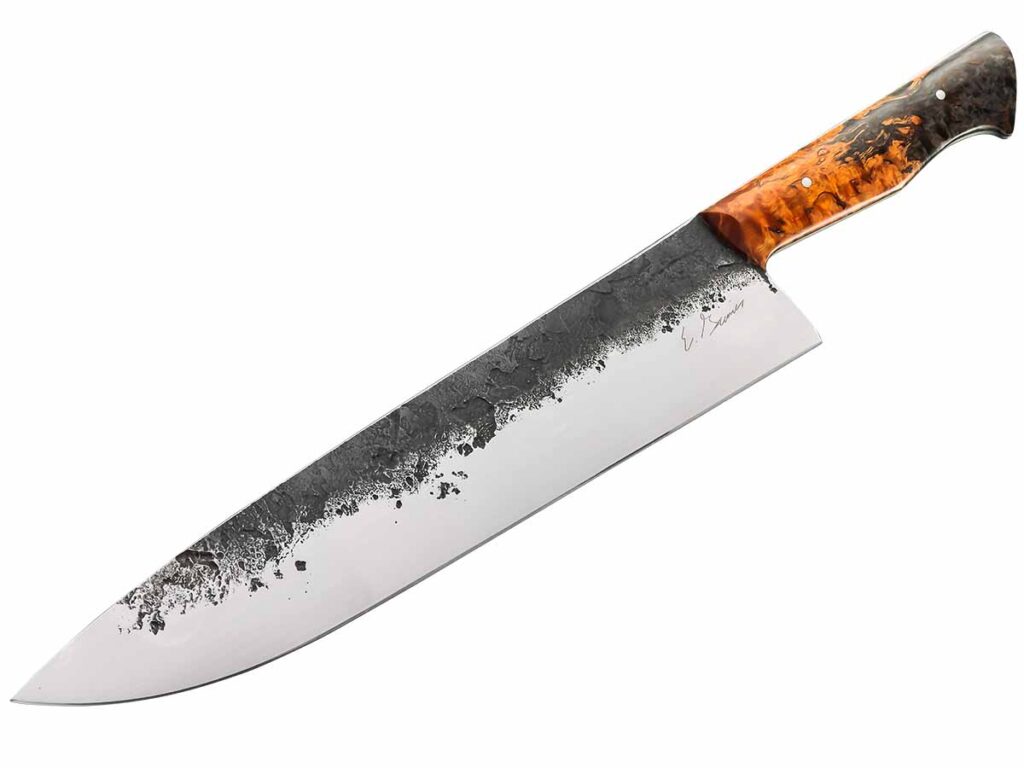
Greiner Chef’s Knife
Blade length: 10” Blade material: 80CrV2 carbon steel w/forged finish Blade grind: Flat Handle material: Double-stabilized karelian birch Overall length: 14.5” Maker’s price for a similar knife: $600 Maker: Erik Greiner, greinerblades.com (SharpByCoop image)
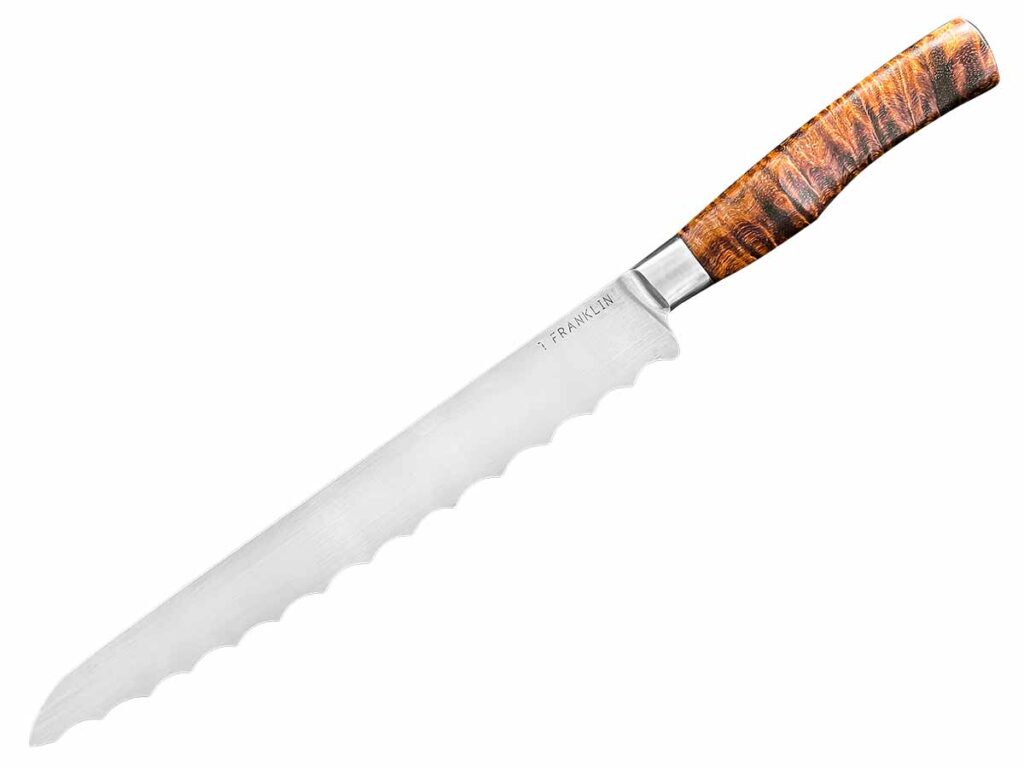
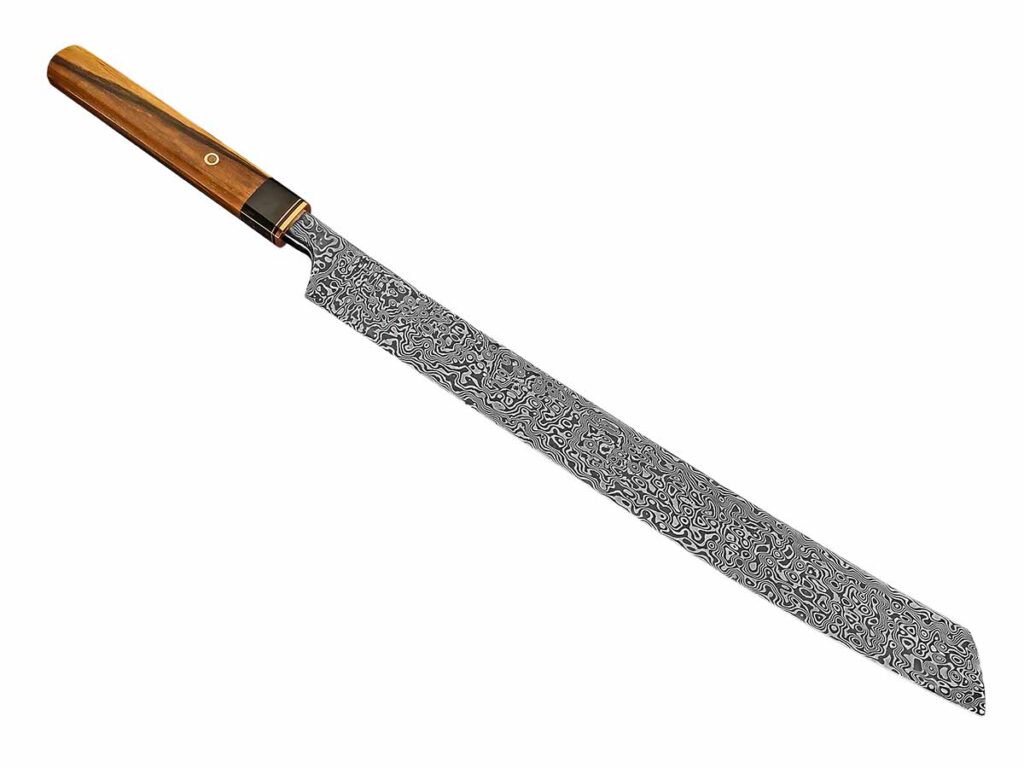
Franklin Bread Knife
Blade length: 9.25” Blade material: 52100 carbon steel Handle material: Hawaiian koa Overall length: 14” Maker’s price for a similar knife: $575 Knife to know: Also comes in a set of three that includes chef’s and paring knives w/a price of $1,750 for the entire set; Thomas Franklin is an ABS apprentice smith Maker: Thomas Franklin (Jfrasierphotography.com)
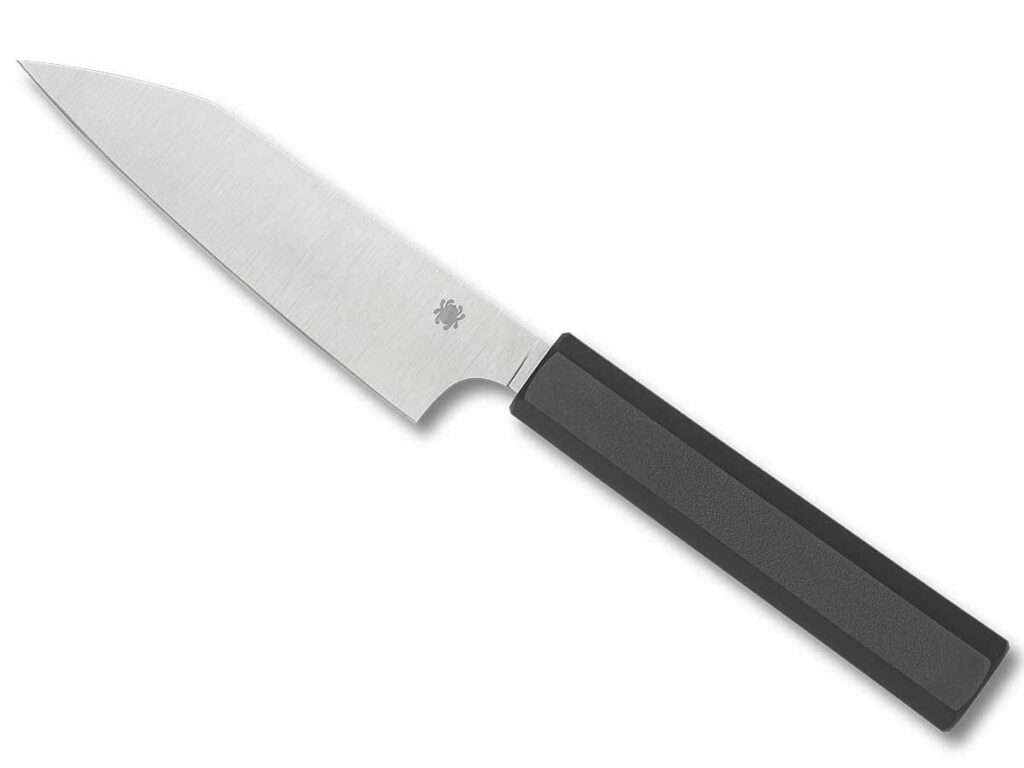
Spyderco Petty
Designer: ABS master smith Murray Carter Blade length: 4.64” Blade steel: CTS BD1N stainless Blade grind: Full-flat Blade @ thickest: .068” Handle design: Wa style (octagonal) Handle material: Black polypropylene Weight: 1.8 ozs. Overall length: 8.87” Knife to know: The Petty is part of Spyderco’s Minarai Series; meaning “to look and learn,” minarai is the Japanese way of describing the role of an apprentice Country of origin: Japan Company: Spyderco, spyderco.com
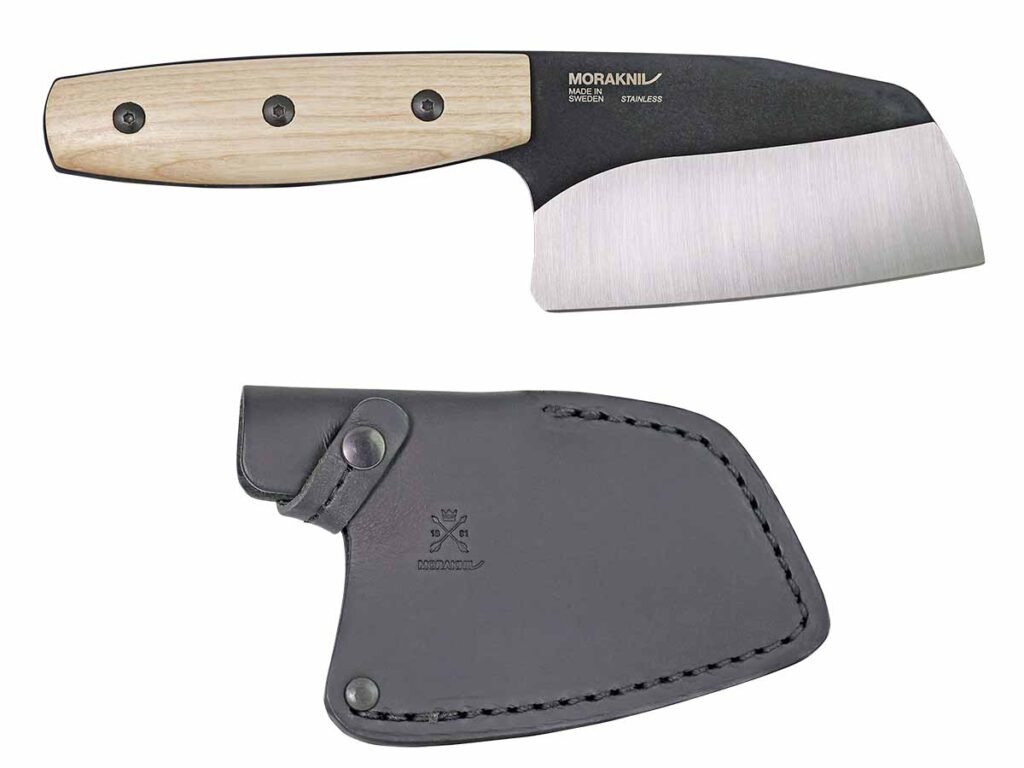
Morakniv Rombo
Model: Camp chef’s knife Blade length: 3.86” Blade steel: Swedish stainless Blade grind: Flat Blade @ thickest: .09” Blade finish: Two-tone Handle material: Wood Weight: 5.5 ozs. Overall length: 8” Country of origin: Sweden Knife to know: Designed for right-hand use MSRP: $230 (at press time rate of exchange) Company: Morakniv, industrialrev.com
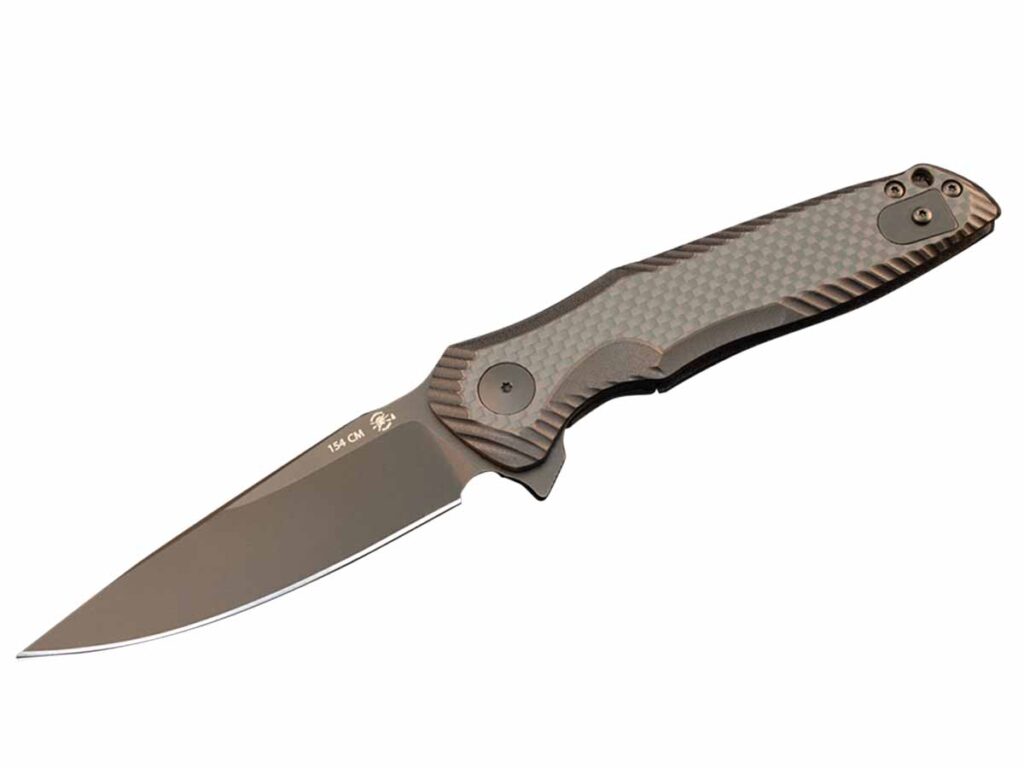
Spartan Blades Poros
Designer: Curtis Iovito Knife type: Flipper folder Blade length: 3.75” Blade steel: 154CM stainless Rockwell hardness: 58-60 HRC Blade grind: Flat Blade @ thickest: .125” Blade finish: Black titanium nitride coating Blade pattern: Drop point Pivot action: Ikoma Korth Bearing System (IKBS) Handle material: Carbon fiber/G-10 composite Lock: Linerlock Pocket clip: Deep carry Hardware & liner: Stainless steel w/black electro-deposit powder coating Weight: 5.3 ozs. Closed length: 4.25” Country of origin: USA MSRP: $190 Company: Spartan Blades, spartanbladesusa.com
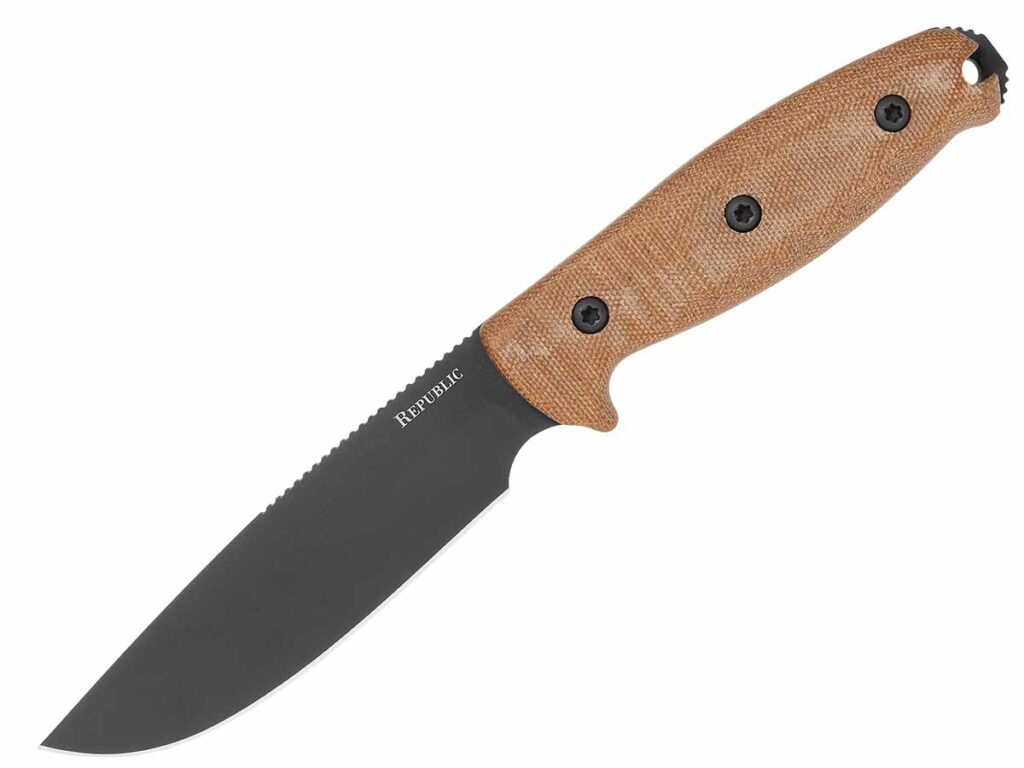
Cold Steel The Republic
Knife type: Bushcraft fixed blade Blade length: 5” Blade steel: CPM S35VN stainless Rockwell hardness: 58-60 HRC Blade @ thickest: .1535” Blade finish: Corrosion resistant/no-glare Ionbond Blade pattern: Drop point Handle material: Micarta® w/single integral guard and lanyard hole Knife to know: Handle is removable for customization based on situation/undertaking; spine gimping for extra control Weight: 8.4 ozs. Overall length: 10” Sheath: Leather pouch MSRP: $269.99 Country of origin: USA Company: Cold Steel, coldsteel.com
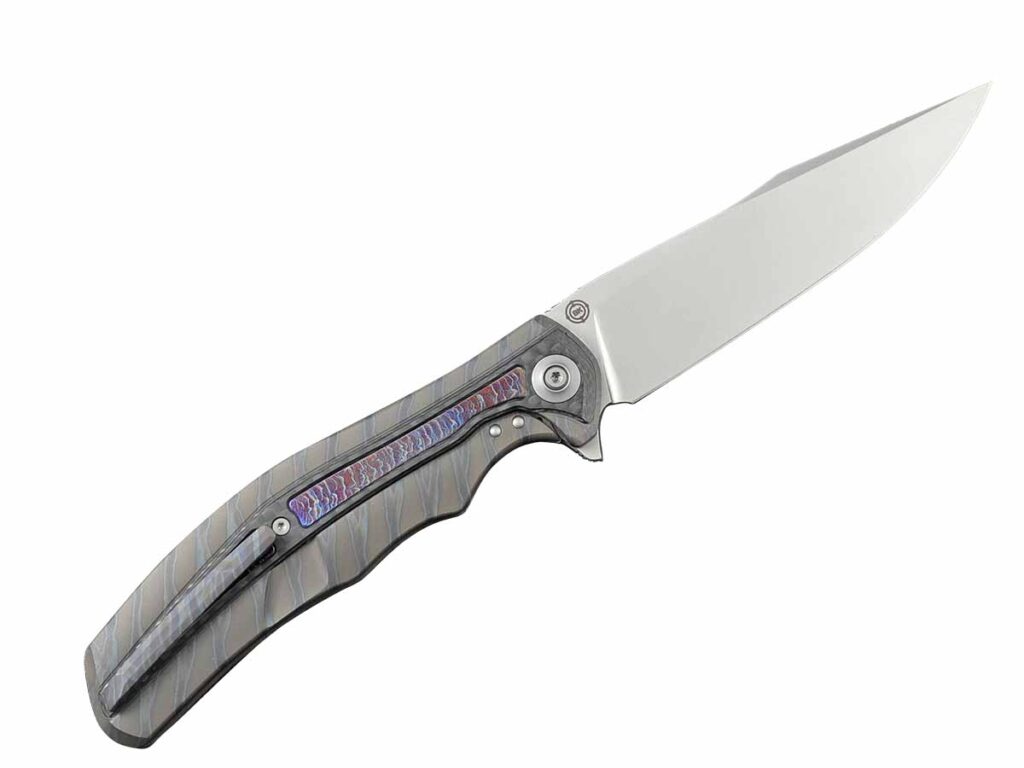
WE Knife Zonda
Pattern: Flipper folder Blade length: 4.04” Blade steel: CPM 20CV stainless Blade finish: Stonewashed Blade @ thickest: .13” Handle material: Black titanium w/flamed titanium inlay Pocket clip: Right-hand, blade-tip-up carry Lock: Framelock Closed length: 4.85” Country of origin: China MSRP: $480 Company: WE Knife, weknife.com
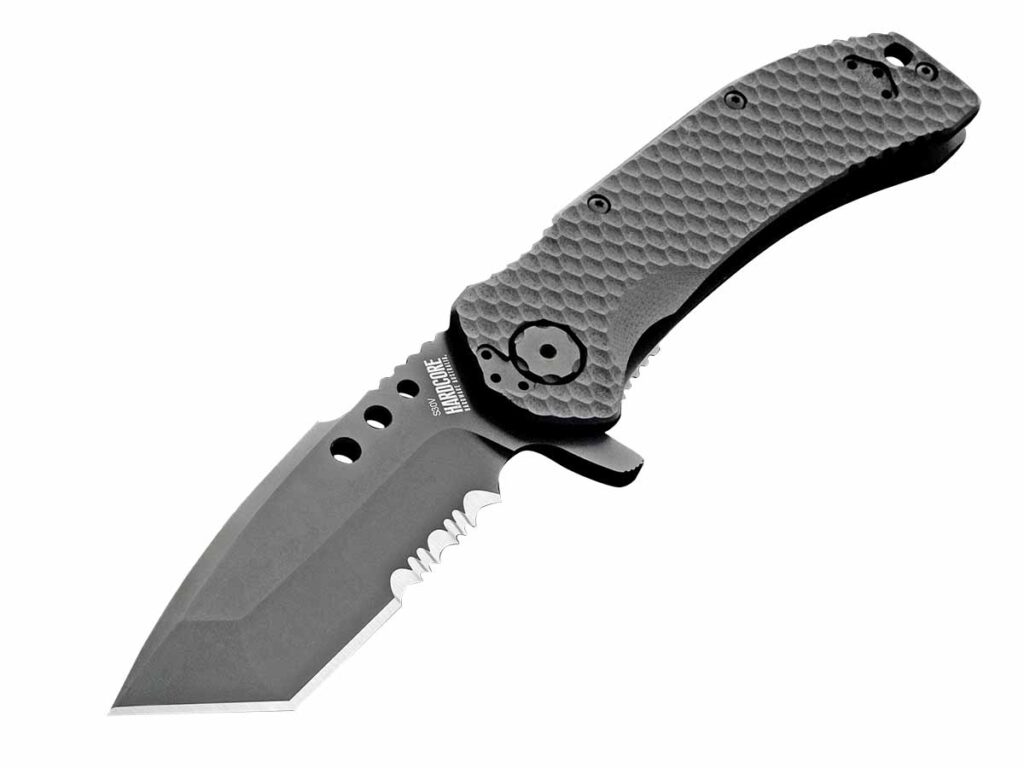
Halfbreed Blades MILF-03PS
Blade length: 3.54” Blade steel: CPM S30V stainless Rockwell hardness: 59-60 HRC Blade grind: Hollow Blade @ thickest: .19” Blade finish: PVD coat Blade pattern: Tanto Handle material: G-10 Washers: Phosphor bronze Weight: 7.34 ozs. Closed length: 5.51” Handle @ thickest: .59” Country of origin: Australian and Taiwanese make MSRP: $280 Company: Halfbreed Blades, halfbreedblades.com.au
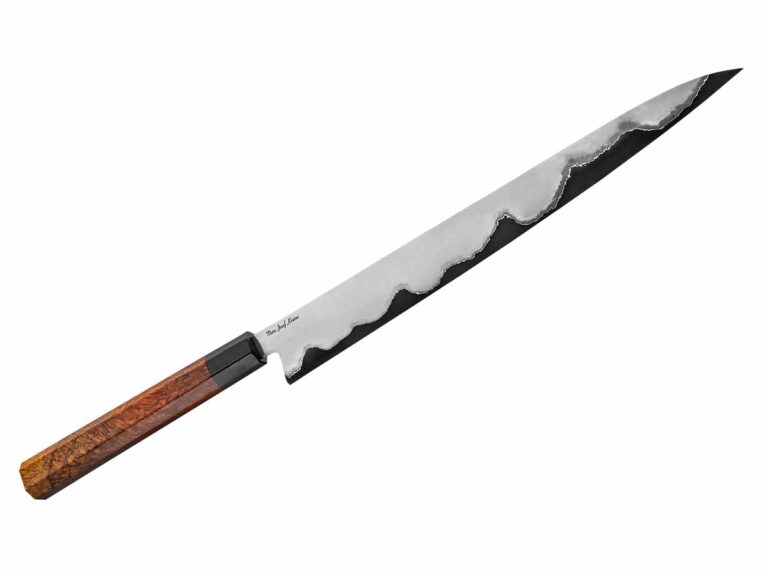
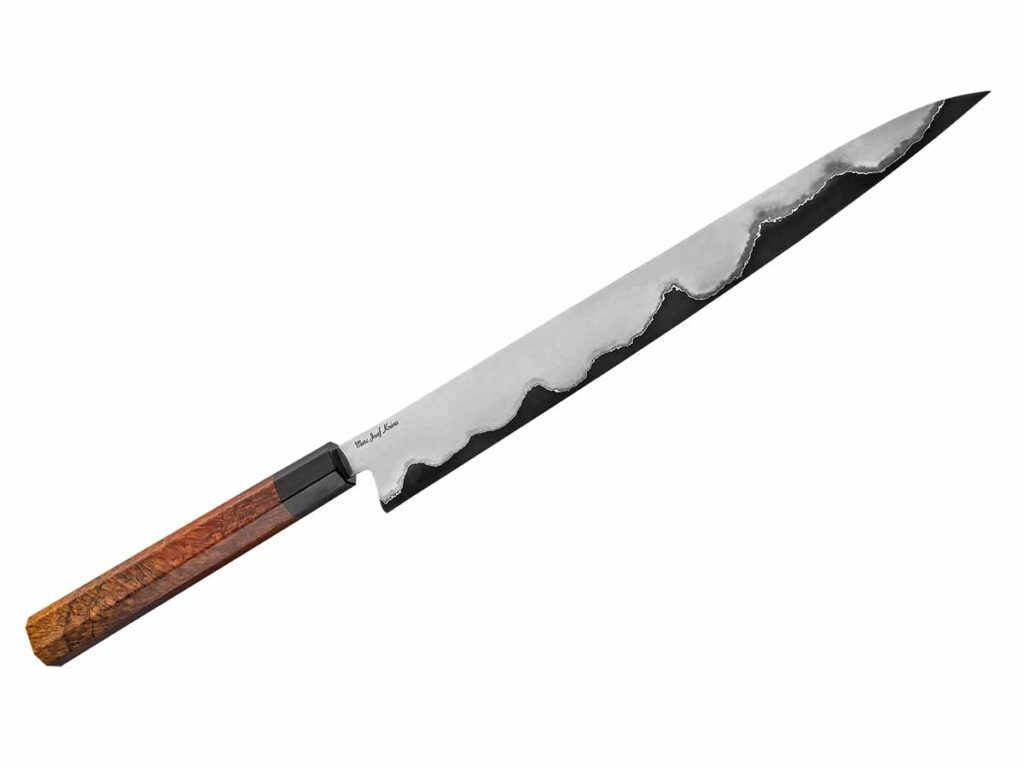
Pattern: Slicer Blade length: 11.8” Blade material: San-mai construction of 410 stainless steel, nickel and 52100 carbon steel forged by Brook Turner Rockwell hardness: 62 HRC Blade grind: Flat/convex Blade thickness @ ricasso: .118” Blade @ widest: 1.496” Handle material: Coolabah burl Bolster/guard: African blackwood Overall length: 18.5” Maker: Marc Stewart, Mark Josef Knives, marcjosefknives.com.au (Rod Hoare image)
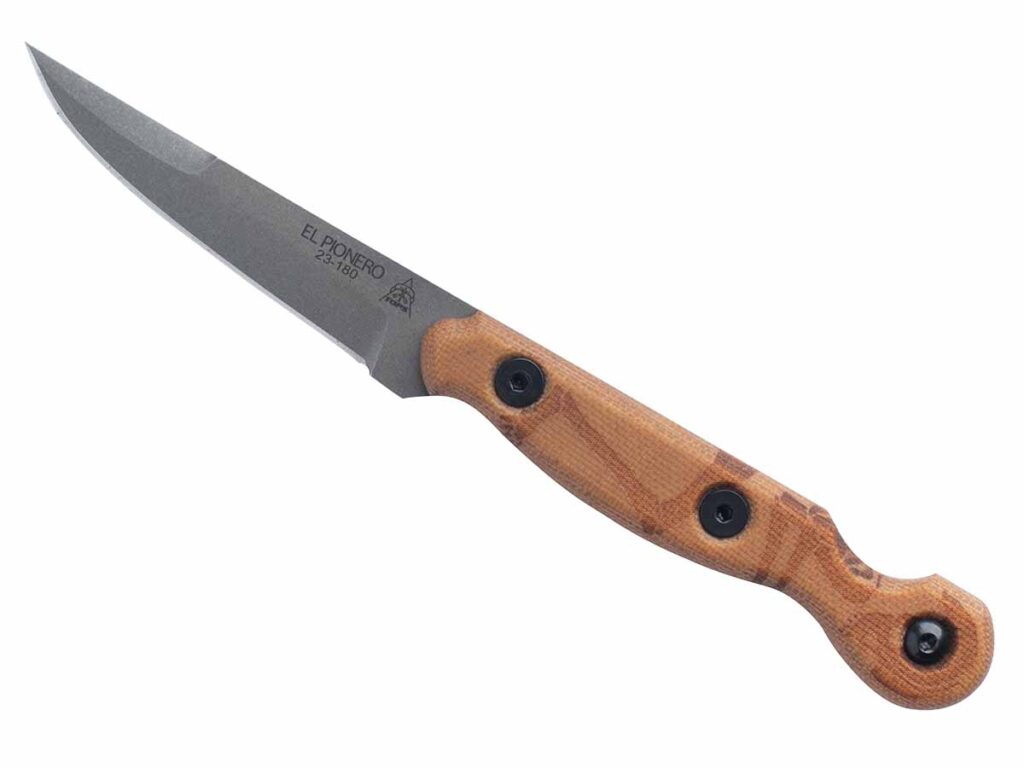
TOPS Knives El Pionero
Designer: Ed Calderon Blade length: 3.38” Blade material: 1095 carbon steel Blade @ thickest: .09” Blade finish: Tumble Handle material: Tan canvas Micarta® w/finger divot that aids in blade orientation, etc. Weight: 2.9 ozs. Overall length: 7.63” Sheath: Black Kydex Weight w/sheath: 4.1 ozs. Knife to know: The El Pionero is a “paring knife-esque design”; Ed Calderon (edsmanifesto.com) worked as a counter-narcotics officer in Mexico and more recently as a trainer and “guru in the tactical space” Country of origin: USA MSRP: $220 Company: TOPS Knives, topsknives.com
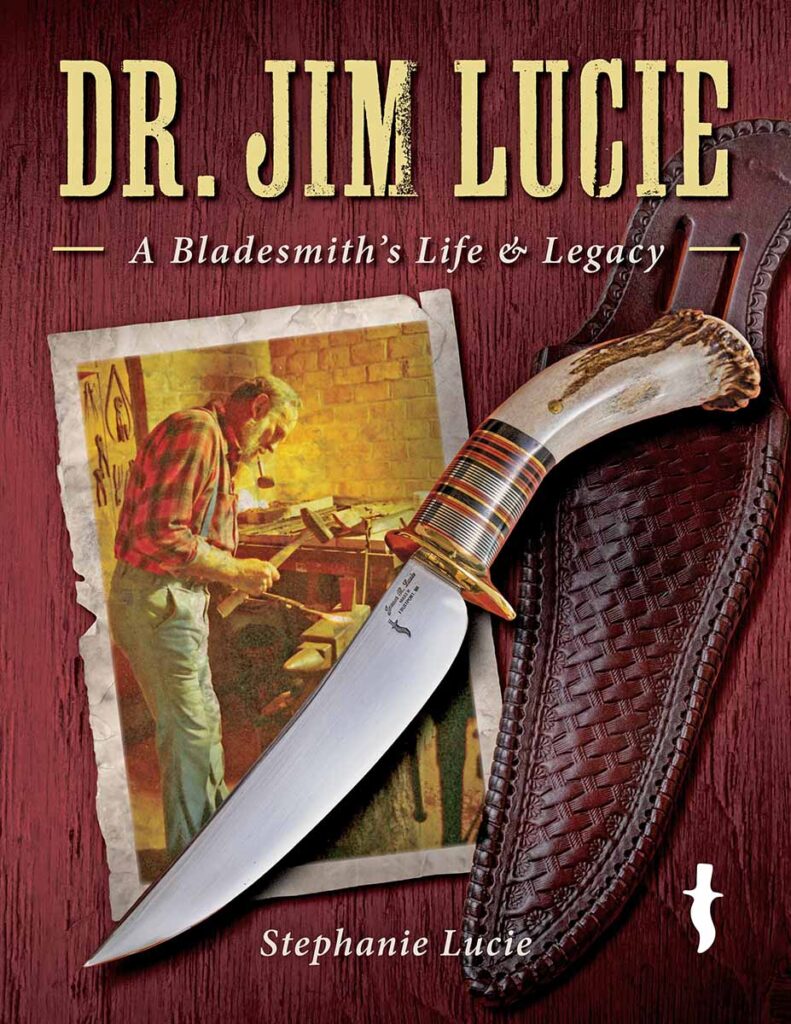
Dr. Jim Lucie: A Bladesmith’s Life & Legacy
What it’s about: ABS journeyman smith Dr. Jim Lucie had a unique background: he served as the personal physician for, and learned about knifemaking from, the man recognized as the grandfather of custom knives—BLADE Magazine Cutlery Hall-Of-Fame® member William Scagel. The author, Stephanie Lucie, is Lucie’s youngest of four daughters. She paints a picture of her father like no other, from childhood to adulthood, his bladesmithing mentors and friends, the many stories written about him and much more. Format: 9.25 x 12.5-inch hardback, limited to 1,500 copies in the first edition, over 300 color photos, including more than 200 knives Lucie made, and over 100 pictures of his life and accomplishments. MSRP: $120 Contact:jimluciebook.com
A Ken Onion design, the Kershaw Leek has cut a commanding profile.
It’s no wonder why the Kershaw Leek is such a phenomenal EDC folding knife. It has all the right elements that knife users crave—style, sturdy construction, premium materials, an impressive selection and is priced right.
The Leek is essentially the bigger brother of Kershaw’s Chive, answering the call from knife fanatics for a larger option of this Ken Onion design. And the petite option doesn’t disappoint.
We’ll examine why it’s been a popular seller for Kershaw, explore some popular variants and find out why this isn’t your garden-variety EDC knife.
Kershaw Leek Blade
The Leek’s blade measures 3 inches and is made from Sandvik 14C28N stainless steel, making it great at holding an edge. However, it’s the blade’s profile that demands attention. It’s a modified clip point and the profile tapers down to almost a needle tip. This is both a good and bad thing, which I will go into in depth later.
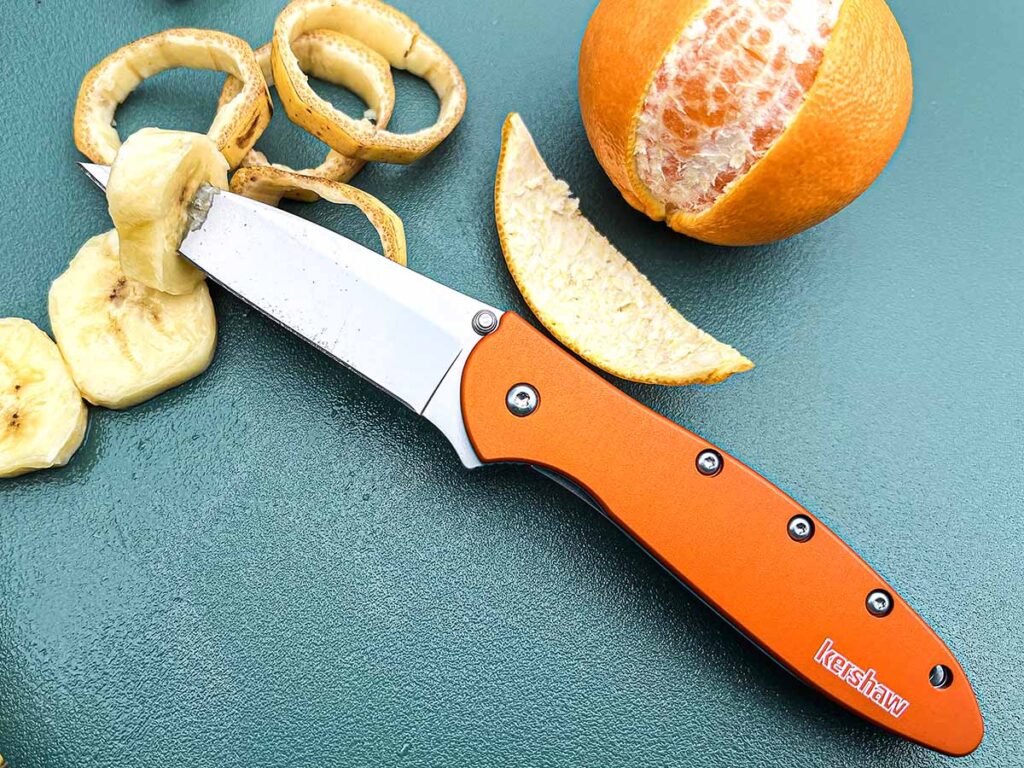
A born cutter, the Leek’s modified clip point blade made quick work of nearly any task set in front of it. Photos by Marty Stanfield, Marty Stanfield Photography
The hollow grind of the blade thins it down nicely to where the blade takes a smart, sharp edge easily. Dual thumb studs are present, but do not function as traditional thumb studs. Instead, they are used only for a positive stop in the open position.
Kershaw Leek Handle
The handle is a slender, elongated shape that favors daily carry due to its thin profile. The handle itself measures 4 inches, bringing the overall length of the Leek to 7 inches when open.
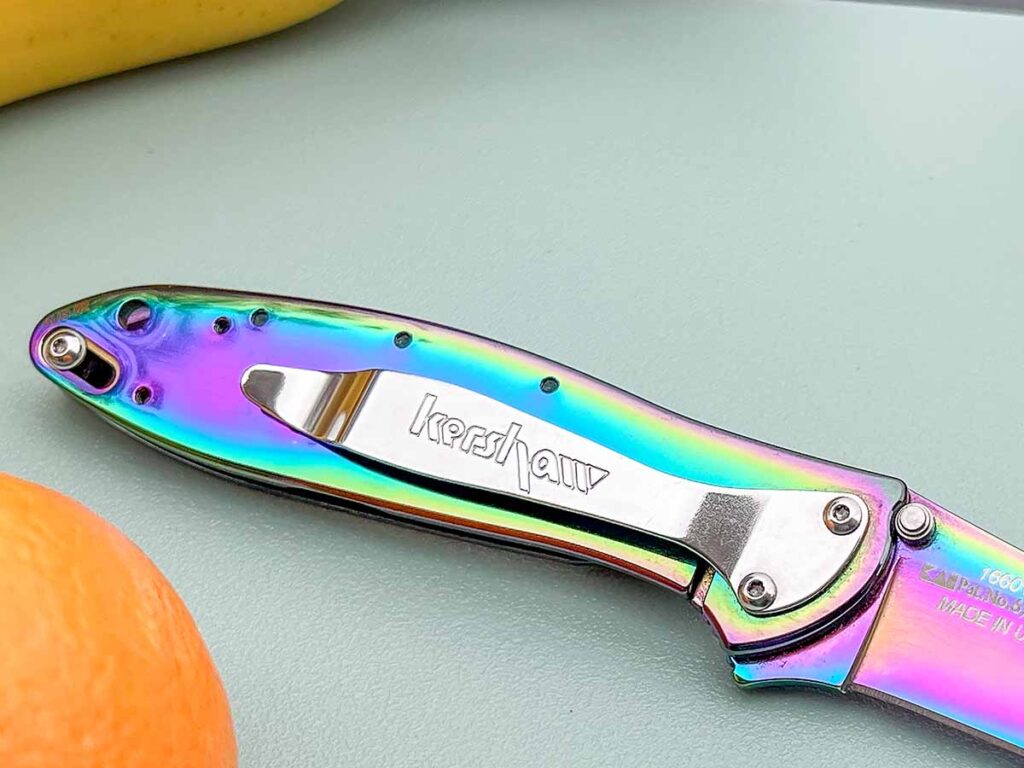
The handle sports a nice, comfortable chamfer all the way around making gripping it easier and presenting fewer hot spots. A large, steel pocket clip can be affixed to the handle to carry the Leek in the tip-up or tip-down position, whatever you wish to do. The clip holds the Leek securely in your pocket, and it can be removed as well should you desire to carry it in the bottom of your pocket.
A movable clip allows the Leek to be carried tip-up or tip-down. Photos by Marty Stanfield, Marty Stanfield Photography
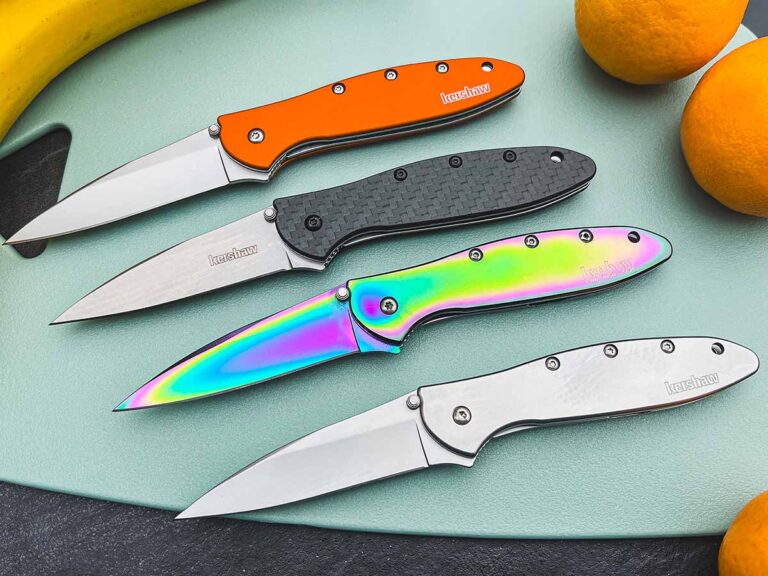
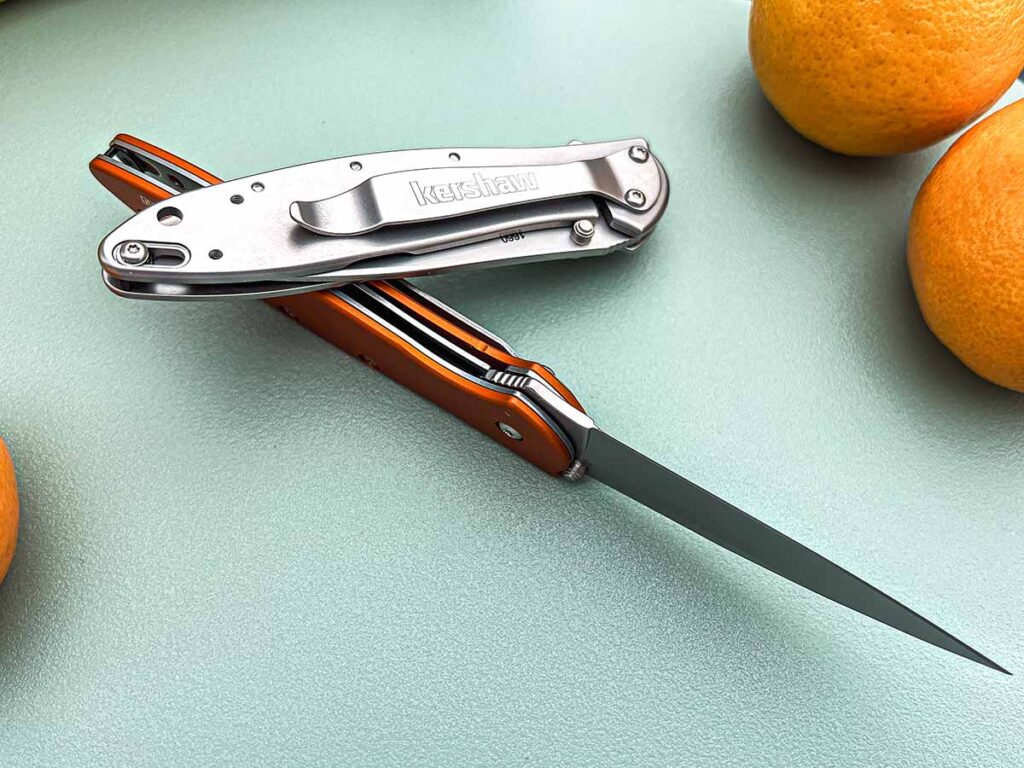
The base Leek (model 1660) has a handle of bead-blasted stainless steel with a matching bead-blasted blade. The Leek is available with a variety of handle finishes, from several colors of anodized aluminum to black PVD-coated, Blackwash and carbon fiber, to name a few.
As for the lock, it’s a frame lock that engages the blade tang positively, securing it in the open position. Very solid and easy to operate when you’re ready to stash the blade.
Testing The Leek
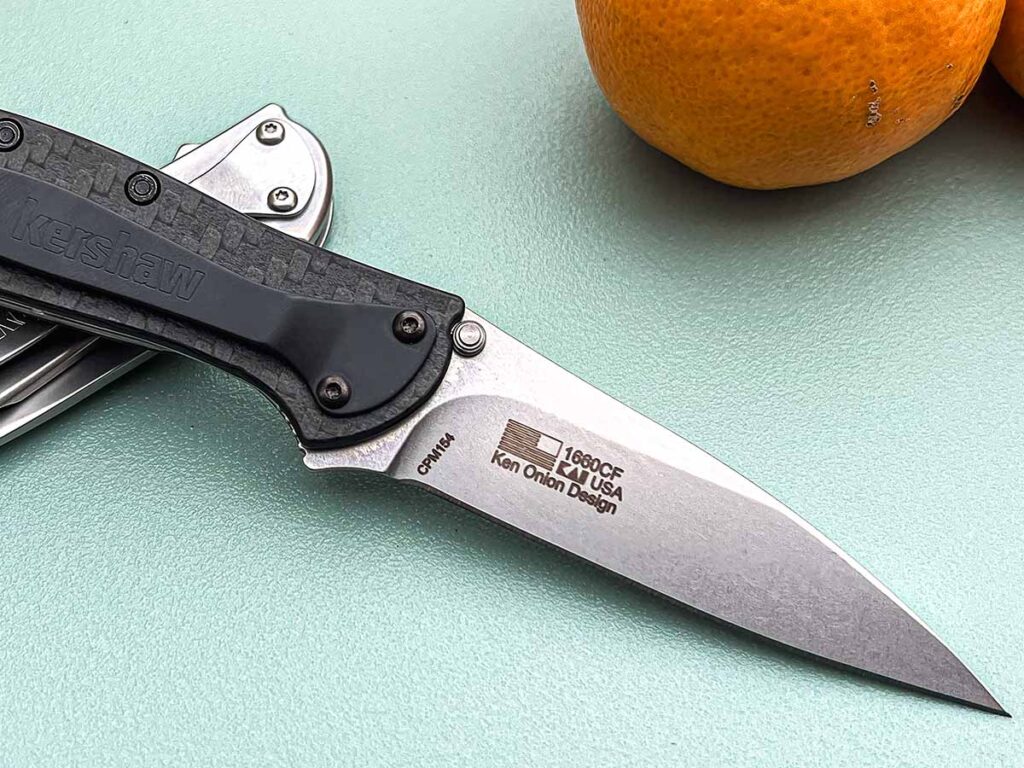
For this review, Kershaw sent me several of their popular selling Leek models for closer examination. I have the 1660 base model Leek with a bead blast finish on the blade and handle. The 1660OR is a liner lock and has orange-anodized aluminum handles. The Leek is available in an array of anodized aluminum colors. Speaking of colors, there’s also the very unique 1660VIB which is a high polish 1660 with the addition of a rainbow titanium coating. And finally, we have the high-tech 1660CF liner lock which features futuristic carbon fiber handles and upgraded blade steel to CPM154 for higher performance cutting and longer edge retention
My pick of this bunch is the 1660CF, given there’s a lot going on with this particular model. You get the benefit of the unique look and the lightweight of the carbon fiber, combined with the high-end blade steel. The 1660CF carries very well due to the reduced mass compared with the regular 1660 Leek framelock.
The Leek’s frame lock is sturdy and easy to manipulate. Photos by Marty Stanfield, Marty Stanfield Photography
Structurally speaking, the base model 1660 Leek frame lock has a very rock-solid lockup. It’s very hard to defeat and only closes when you deliberately command it to. It actually makes a good work knife as long as you use it as a cutting tool and nothing else that it wasn’t designed for (more on this in a bit).
Performance-wise, the Leek—across the board regardless of the blade steel or handle configuration—is definitely a slicer. The blade stock is very thin and when it is ground, it is attenuated even more.
Right out of the box, the leek has a lot of bite. It goes through thicker stuff like cardboard very easily. The tip being acute, makes for an excellent scoring tool as well. The Leek excels at being an all-around EDC cutter.
The blade opens fast, with the press of the exposed flipper tab on the blade spine, Kershaw’s Speed Safe assisted opening technology takes over and powers the blade to the fully open and locked position. It’s easy to see why the Leek remains a popular Kershaw model after all these years, it simply works well and is a good-looking design.
Leek Sticky Points
Two of the most common failures I have seen in the Leek are where folks misuse the knife as well as the sliding safety breaking.
While the blade is an accomplished cutter, it’s thin enough the tip is easily damaged when used to pry. Photos by Marty Stanfield, Marty Stanfield Photography
Because the tip of the blade is pointy, it’s a weak spot with the knife. Where you get into trouble is when you use the tip to pry, even lightly. This either results in a bend or break off entirely. This is a cutting tool, not a pry tool or screwdriver.
Each Leek also comes with a sliding safety that, when the blade is closed, you slide over the tip of the blade to physically block it from coming out of the handle. There is a hex screw on the backside you use your thumb to move and this moves the safety. Sometimes the safety can slide on its own while the blade is open; when you go to close the blade it comes down on the safety tab. If done hard enough this will cause the safety to break, as it is plastic. The nice part, the tab is replaceable.
Final Cut
Other than these points, the Leek is a proven EDC knife. It’s rather compact, slender, and doesn’t garner unwanted attention. It’s worth a look if you’re in the market for a blade that balances looks and performance.
As for price, the MSRP for the base 1660 Leek is $115. The 1660OR orange handle Leek is $105. And the Carbon Fiber 1660 CF runs $190. In the scheme of things, not bad pricing for USA-made EDC folding knife—particularly with an Onion pedigree!
Known for his custom kitchen knives, here are the tools Dmitriy Popov relies upon to craft his creations.
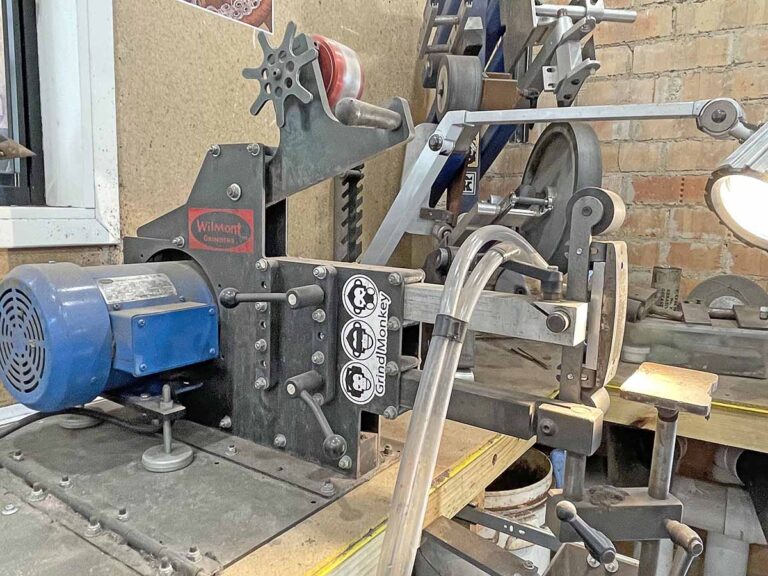
“I am not going to score any originality points for naming my belt grinder as the most important tool in the shop,” Dmitriy Popov begins with a smile. “I have had the pleasure of using a wide variety of grinders and the Wilmont TAG 101 is my favorite. Chris Williams, who builds it, is a knifemaker himself and it shows in the product. Also, Chris is only a message away in case you may need anything, not that you have to worry about it too much the way this machine is built.
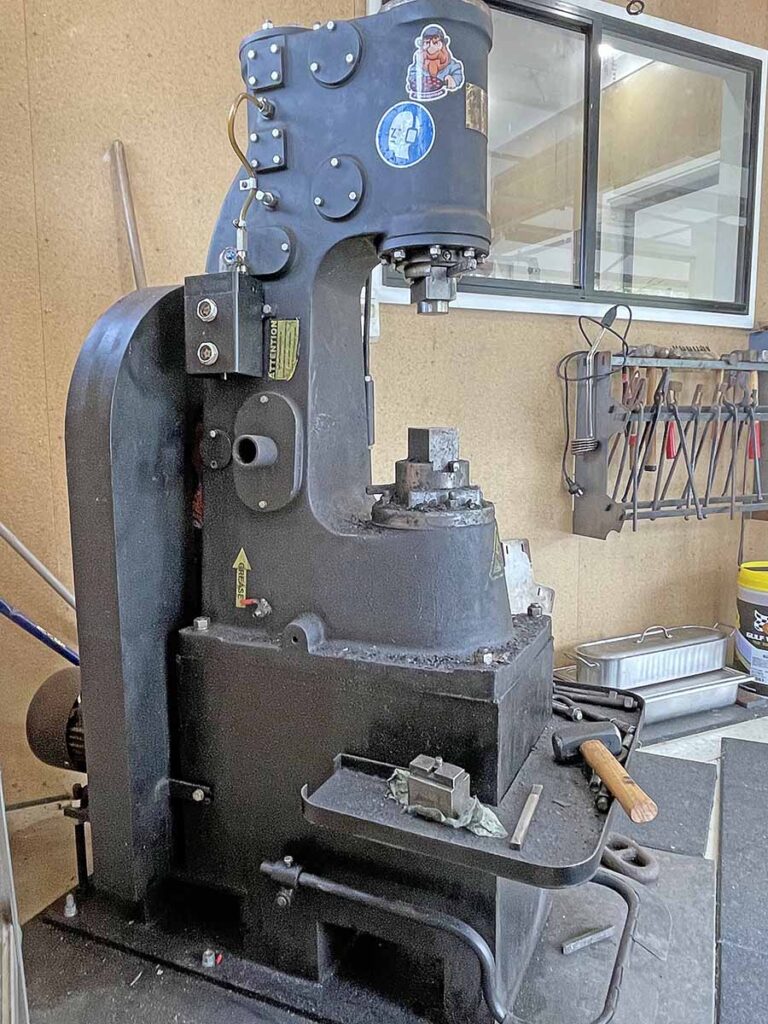
Popov’s 15-kilogram Anyang power hammer “gets the job done in no time.”
“I have a large variety of tooling accessories that I use with the grinder—radius platens, flat platens, rotary plates, large and small wheels, as well as a surface-grinding attachment. I run the grinder off a dedicated Genesis VFD [Variable Frequency Drive], which enables me to control the speed.
“Next up is my Toolmex 1-horsepower disk sander,” Dmitriy continues. “It took me a little while to get to know this machine and to incorporate it into my workflow—but these days I would struggle to make a knife without it. My sander is hooked up to yet another VFD, which is shared between the disk sander and my second belt grinder through a switch. I can slow it right down and change the rotation direction.
“I primarily use a disk sander for two purposes. First, to thin out the knife behind the edge. I do this very carefully with the aid of water cooling in order not to generate any heat that would negatively impact heat treatment. Secondly, I use it to shape facets on my knife handles, which are mostly wa [Japanese-style octagonal] handles these days.”
His power hammer is a real game-changer.
“I used to hate forging as tendinitis in my elbow would flare right up and would take weeks to settle,” he explains. Before Popov moved his shop to a rural area, getting a power hammer was not an option due to the noise level it generates. “Needless to say is how much easier, quicker and more pleasurable my forging experience is now,” he writes. “The hammer is only a 15-kilogram Anyang but it gets the job done in no time.”
Dmitriy does his own heat treating with a Paragon KM24 Pro Heat Treat oven. “Quite a high-ticket item this one,” he notes, “a three-zone 415V/3P/15A unit which reaches temperatures of 1,100° C/2,012 F° in just 15 minutes. It has super precise temperature control front to back, which is so crucial for me in order to be able to squeeze out the most of each steel I work with.
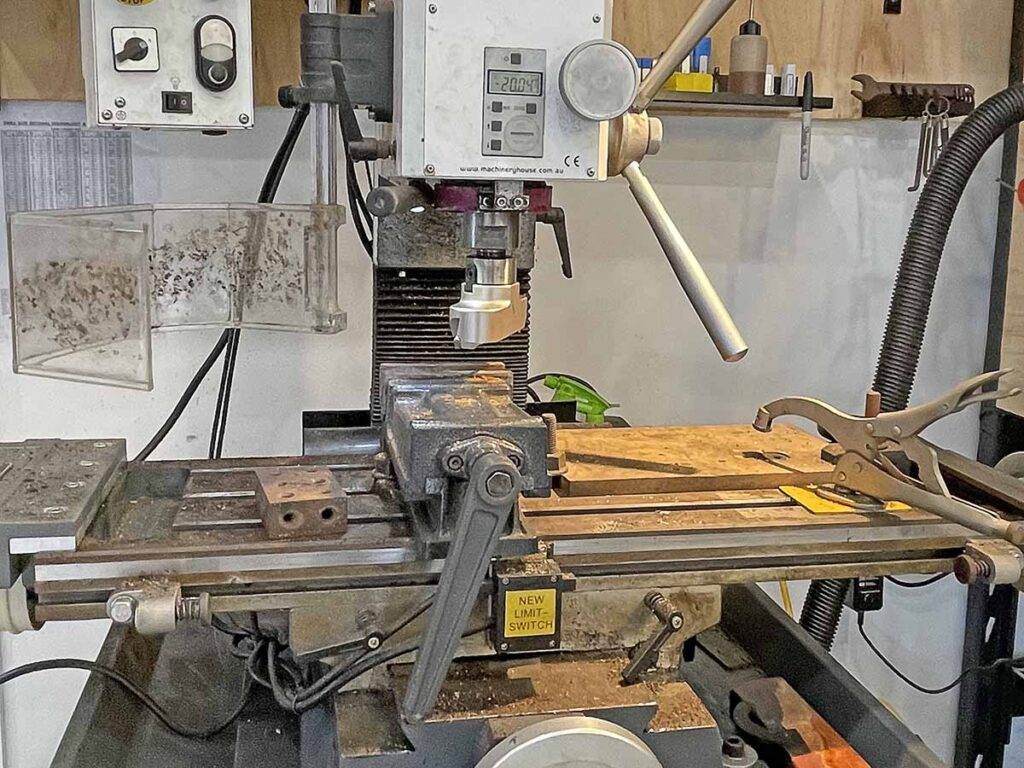
When selecting his milling machine, Dmitriy wanted something solid and with enough vertical clearance. As a result, he opted for the Optimum MH28V. He also fitted it out with an Optimum DRO (Digital Readout at top left) and a motorized slide table.
“My milling machine is definitely underutilized in my workshop. When selecting the mill, I wanted something solid and with enough vertical clearance. The Optimum MH28V fit the bill. Machine and tooling is not cheap and I use it only for a couple operations, but it is a real time saver.”
Last but not least, Dmitriy expounds the virtues of his large workbenches.
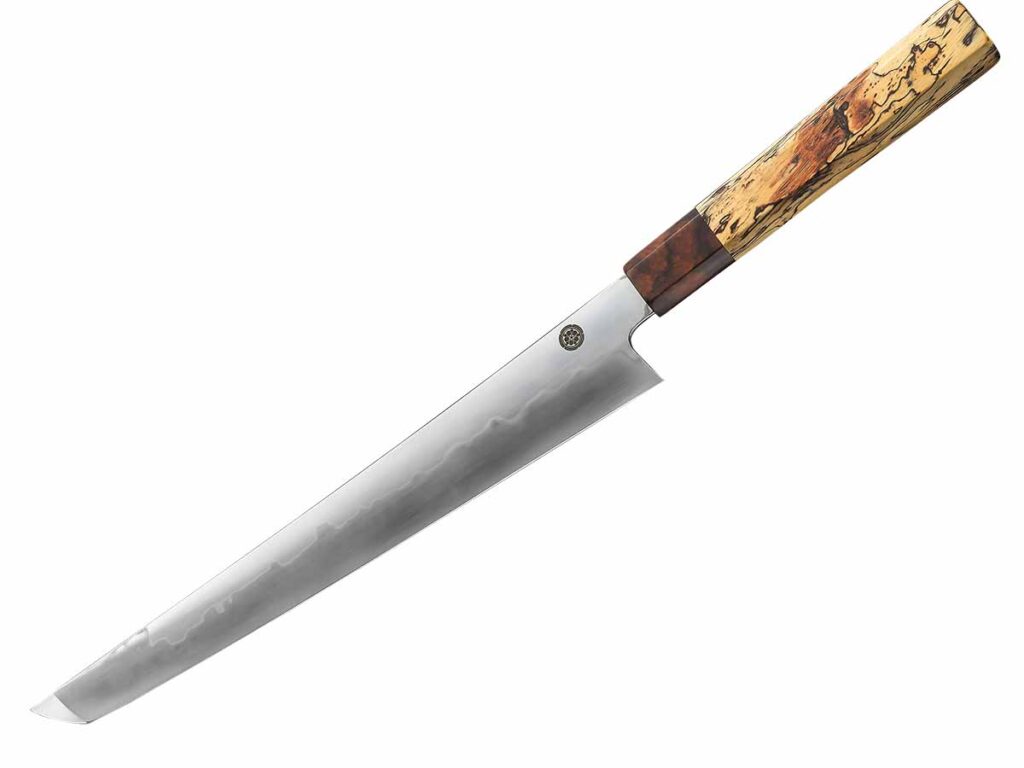
Dmitriy Popov specializes in custom kitchen knives such as his Honyaki Sujihiki Sakimaru in an 11.8-inch blade of differentially heat-treated W2 tool steel with hamon. The handle is stabilized spalted tamarind and ironwood. (SharpByCoop knife image)
“This seems simple but if you make knives, you know that you will end up using any horizontal surface available to you. I would say that one-third of my workshop floorspace (page 45) is taken up with workbenches which allow me to work on multiple projects at the same time, and stay organized and productive. I found that yellow-tongue flooring panel is a great workbench surface, and frames can either be built from timber or, alternatively, metal warehouse framing can be purchased from any hardware shop or Costco.”
The Tomahawk Is One Of The Most Popular Survival Tools Today. This Dozen Stands Out From The Pack.
The tomahawk has been used for centuries as a hand weapon in battle and a tool for everything from chopping wood to processing animals. In modern times, it has evolved into an all-around survival tool used by military and civilians alike.
The parallels between the use of the tomahawk in the 18th century and that of the modern battlefield are numerous and worth consideration. It turns out the reasons behind the tomahawk’s popularity in the woods of Colonial America are often the same reasons they are popular with U.S. troops and backwoodsmen today.
Tomahawk History
The word tomahawk is a variation of the Algonquian word tomahac (also spelled in English multiple ways), which means “to strike.” It was a term that was used originally for any striking weapon, from wooden clubs to axes made of stone.
In 1608, Capt. John Smith of Jamestown, Virginiawas the first person to record the word in English, mentioning it was used to describe the hatchets carried by his men. Axes and clubs were symbols of power and status for native cultures going back centuries.
This, combined with the numerous advantages held by the metal tomahawk over its stone predecessors, made the European-fashioned metal tomahawks popular trade items with the local tribes. As trade increased, new forms evolved to meet the demands of the market, and tomahawks with pipes, spikes and hammers were traded by the thousands.
Carl Russell, author of Firearms, Traps & Tools of the Mountain Men, speculates that, as the classic trade ‘hawk’ became the norm with Native tribes, newer, less pragmatic forms evolved to fill the warrior status niche.
Tomahawk Uses
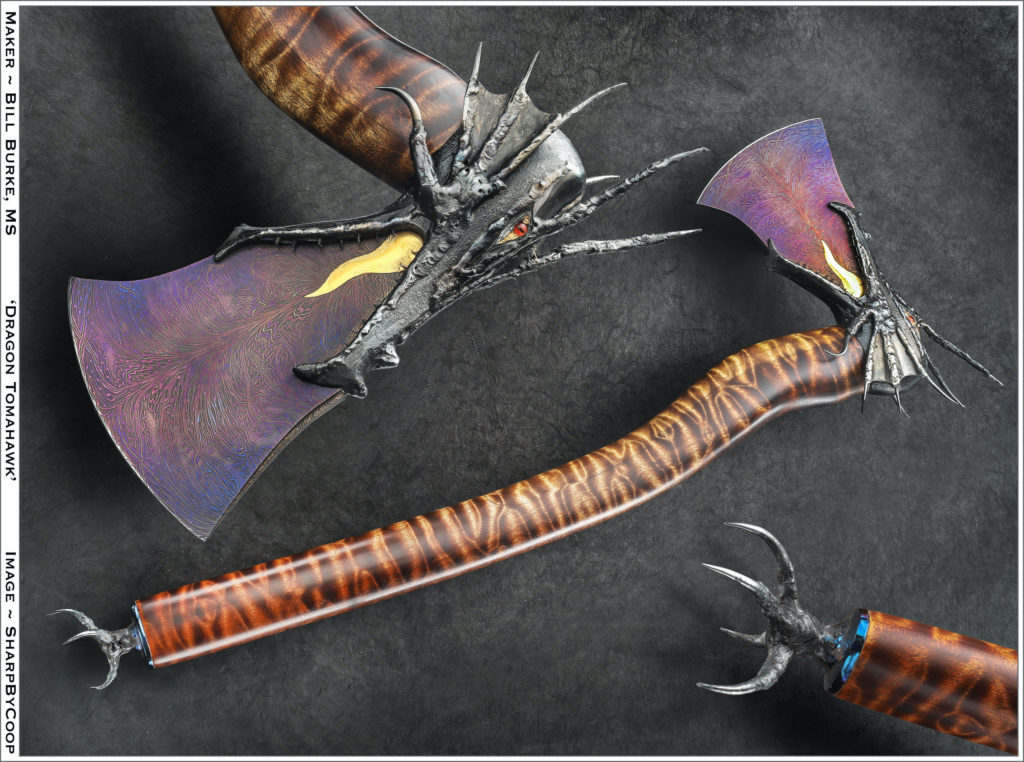
The Dragon Tomahawk is 20.5 inches overall, with a 4-inch cutting surface of damascus and a curly maple handle. The head is wrought iron and 1018 mild steel forged into a “W’s” pattern, and the blade steel is 1080, 15N20 and 201 series nickel forged together to create Bill’s Dragon’s Breath pattern. (SharpByCoop image)
The tomahawk is a true multi-purpose tool. With it one can dress game, chop wood, and clear brush. Choking up on the handle, the user can use it much like a knife. The length of the handle gives the blade tremendous velocity and force as well, making it a formidable weapon. These attributes were not lost on the Western frontiersmen who often adopted the tools and lifestyles of the Native tribes.
This adoption became even more apparent as the frontiersmen went to war. They employed the same guerrilla warfare tactics used by the Native tribes, and they carried the tomahawks so prized by them. One equipment list for volunteers into the American militias mentions “a sword or tomahawk” as a required item right along with a rifle, powder, and lead.
Tomahawk In The 21st Century
This rich history would be enough to secure the tomahawk’s place among the iconic tools and weapons of American history, but the story does not stop there.
Peter LaGana, founder of the American Tomahawk Company, was famous for his tomahawk made popular during the Vietnam War. Also privately purchased by soldiers, it proved a valuable tool and weapon in the jungles of Southeast Asia.
The true rebirth of the tomahawk, however, would be brought about by the Global War on Terrorism after the attacks on 9/11. Some members of the Special Operations community began carrying tomahawks as part of Col. John Mulholland’s Joint Special Operations Task Force, also known as Task Force Dagger, when only 300 Americans were in Afghanistan on the hunt for Osama Bin Laden.
The number of soldiers carrying tomahawks increased throughout the next decade of war, but why? The wars in Afghanistan and Iraq were asymmetric wars that had more in common with the guerrilla fighting of frontier America. The tomahawk once again served as a valuable tool and weapon in this environment.
Our 12 Best Tomahawks For 2023
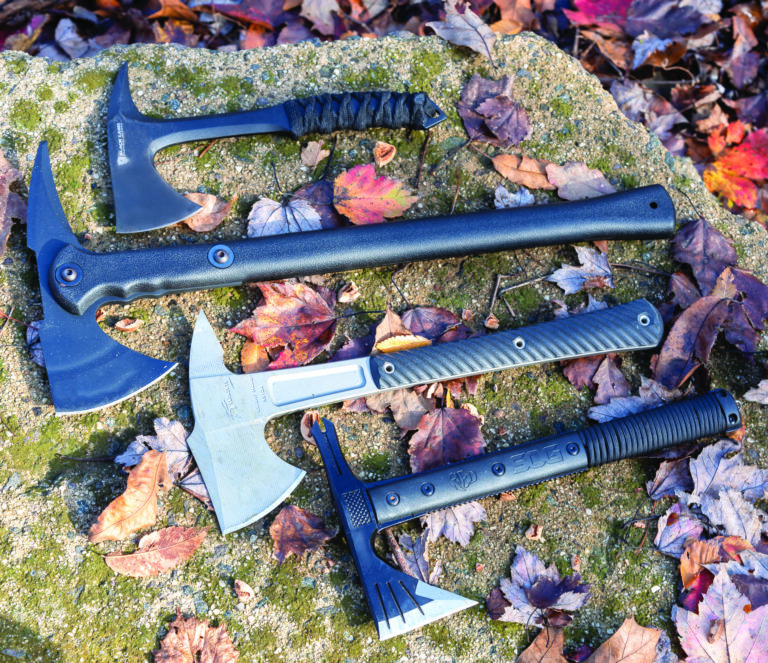
The modern tomahawk comes in all shapes and sizes with all sorts of uses and included features. These are a dozen across a variety of price points that show what the modern hawk is designed to do and how companies are getting creative with them.
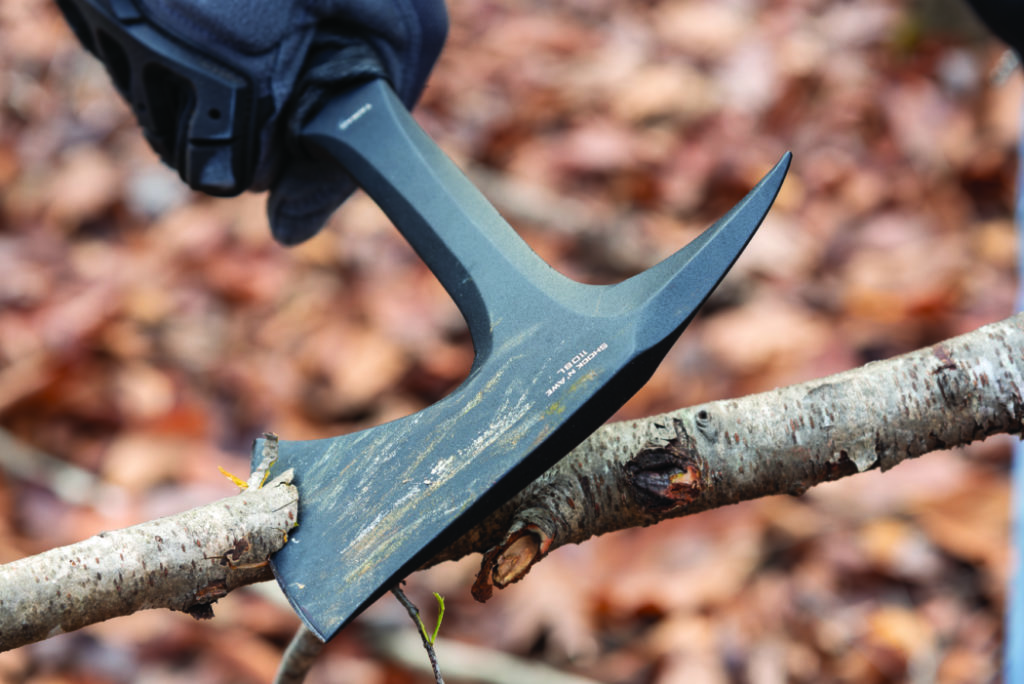
Browning Shock’ N Awe
The Browning Shock ‘N Awe is a compact tomahawk that packs a big punch. Despite its small size, it still has the heft to be a very effective chopper.
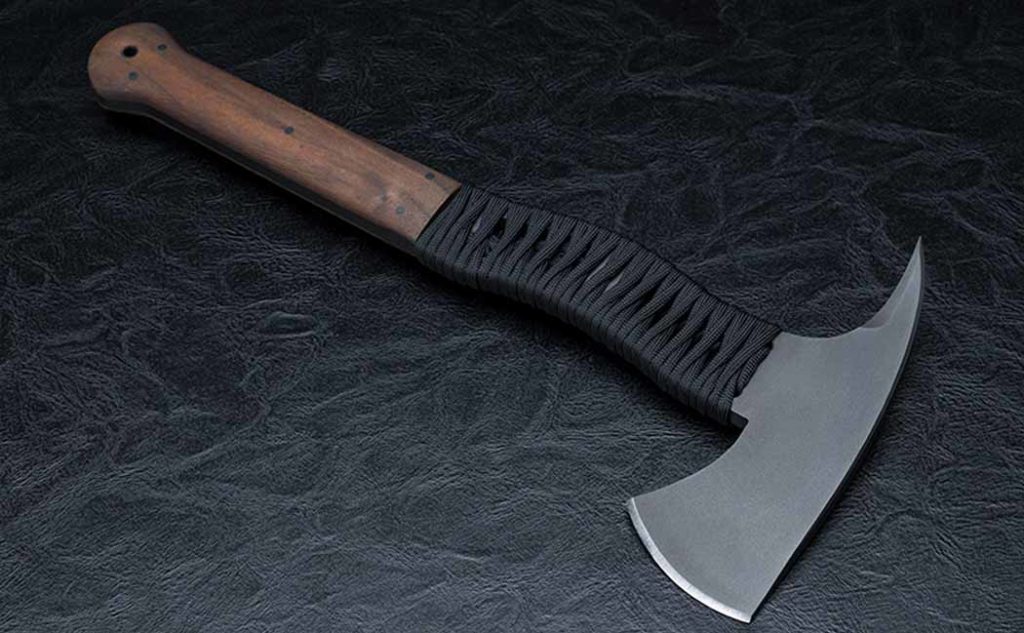
The Shock ‘N Awe is 10.5 inches overall. The head is 2.75 inches and offers a curved penetration spike for light breaching. The head, spike, and handle are forged from one piece of 1055 high carbon steel and covered in a black epoxy coating for corrosion resistance and low glare.
The handle is in a traditional Japanese style with a hand-wrapped overlapping cord. It looks great and it seems a perfect match for this size of hawk. The 3D nature of the wrap segments creates alternating ridges that help provide an ultra-secure grip in all conditions. The exposed pommel terminates in a skull-crusher shape.
The Shock ’N Awe comes with a molded polymer sheath with MOLLE-compatible attachment provisions. The sheath encases the entire head and spike which pivots into and out of the sheath. A locking tab that pivots down over the spike end of the sheath prevents the sheath halves from separating, effectively locking the hawk into the sheath.
The hawk gets into tight places easier and is more maneuverable than larger models. It’s easier to carry as well. It easily takes down small saplings and de-limbs them as well. The Shock ’N Awe would be great for splitting kindling, including via a baton.
The spike is pointy but not so much that it can break off. It penetrates wood and other materials effectively, and can be used for digging as well. It opened up a good-sized hole in plywood when used in a rocking motion after penetration.
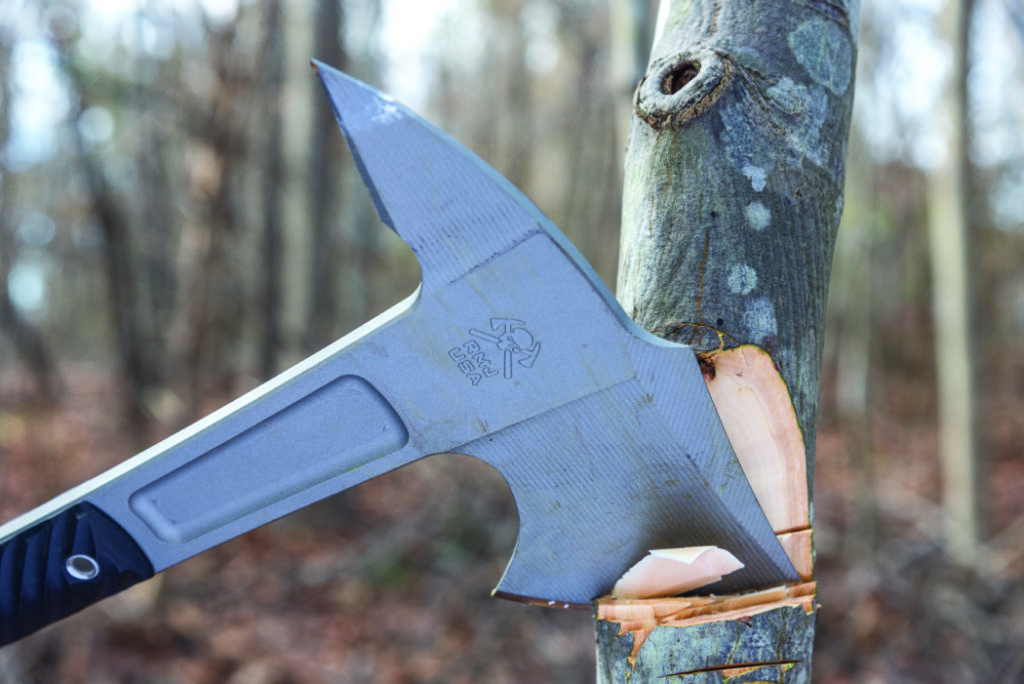
The RMJ Tactical Knight Hawk is an excellent chopper.
ABS master smith Jason Knight and RMJ Tactical co-designed the Tactical Knight Hawk to handle a variety of jobs, not just chopping. It’s 14.5 inches long and feels agile in the hand with a weight of 23 ounces. The cutting edge is 2.875 inches, and the blade is made from 80CRV2. Blade thickness: .275 inch. The handle is 3D-machined black G-10 riveted/permanently attached to the tang.
There is a slight downward turn to the cutting edge that accentuates power, which is in contrast to most hawks where the edge is parallel to the handle. As a result, the cutting edge engages and shears more effectively after impact. This is one reason why the Knight Hawk isn’t head heavy like many hawks, yet can outchop many of them.
This translates to extended use without wearing you out. By the same token, being agile in hand suits it for tasks few hawks are adept at, such as whittling and making fuzz sticks.
The spike is the shortest one of all the hawks tested, though that does not mean it is the least effective. Resembling a fat knife blade rather than a true spike, it sports a semi-sharpened edge at the bottom. The spine tapers down slightly but leaves more than enough material for tip strength and to withstand heavy penetration strikes.
The Knight Hawk is practically bulletproof, devastatingly effective, and a pleasure to use. It comes in a choice of three Cerakote® color options: Savage Steel , OD Green, and Desert Tan.
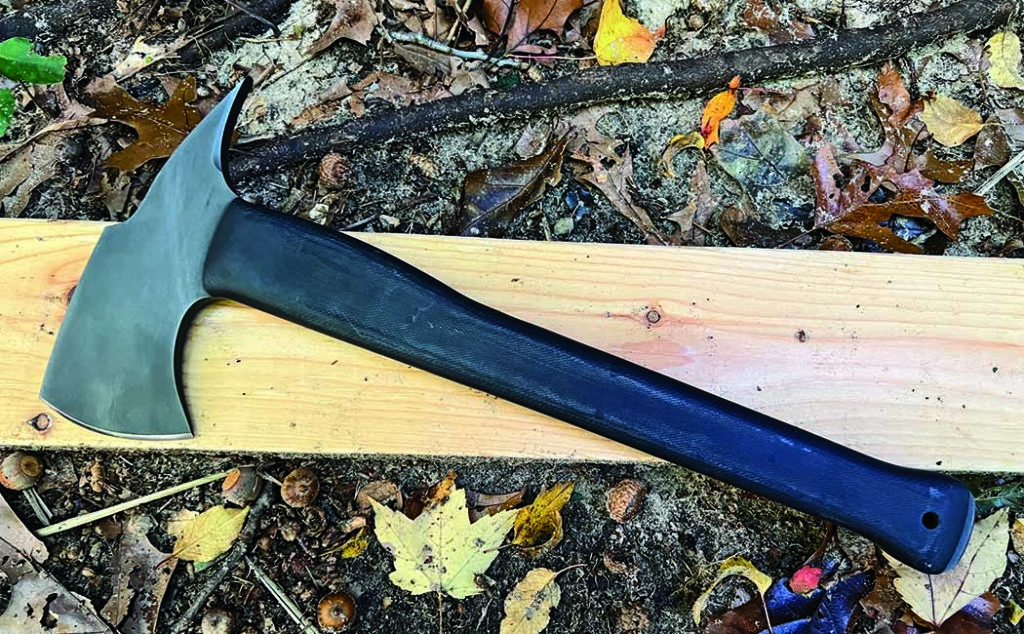
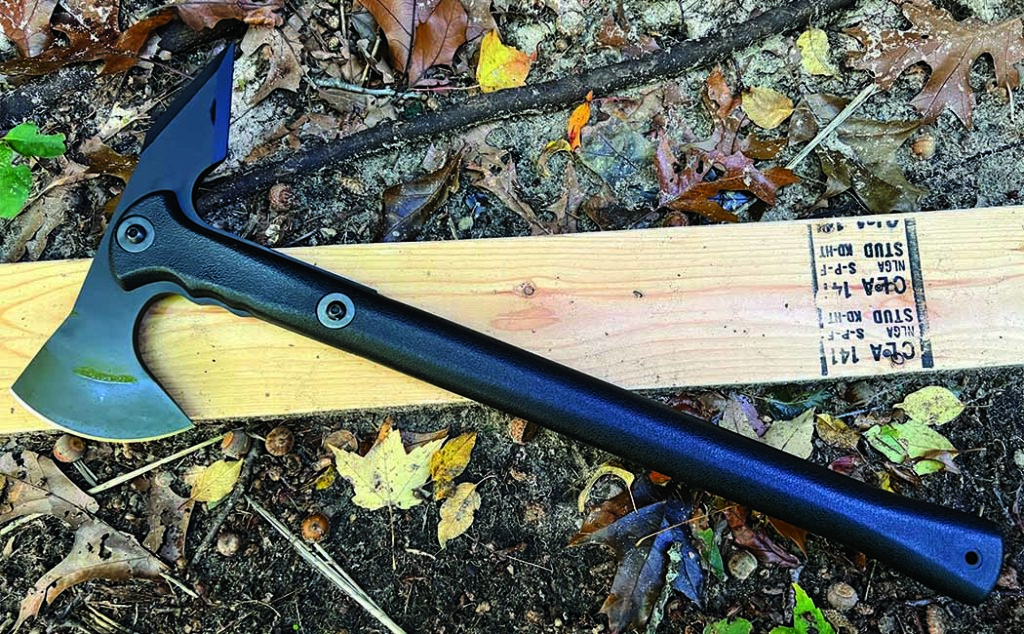
Measuring 19 inches overall, the Cold Steel War Hawk features a head of drop-forged 1055 carbon steel for toughness and a textured polypropylene handle. The partial tang is inset into the handle and secured by two large bolts, and you can replace it easily should it break.
The wide, bearded axe head excels at chopping and cutting. The tang area just behind the head has a few finger grooves for choking up for whittling or more precise cuts. The double-ground spike has a distinctive tanto-ish shape for maximum penetration and power. The spike is ground on top and bottom to remove material for enhanced penetration.
The handle is comfortable, and the texturing promotes good grip traction in various conditions. The sheath is a clever double-articulated design that encases most of the head. The sheath has two pivots—one at the spike end, the other at the beard end. The sheath is secure and doesn’t fall off. The only negative is there is no belt-attachment provision. Consequently, the War Hawk is ideal for storing in your truck for camping expeditions.
With the tanto-tip-beveled spike, the War Hawk had great penetration through plywood. In order for it to be an effective chopping/breaching tool, there must be zero flex in the handle. If Cold Steel went to a hickory wood handle it would improve the War Hawk’s performance. As is, it might make a great throwing tomahawk.
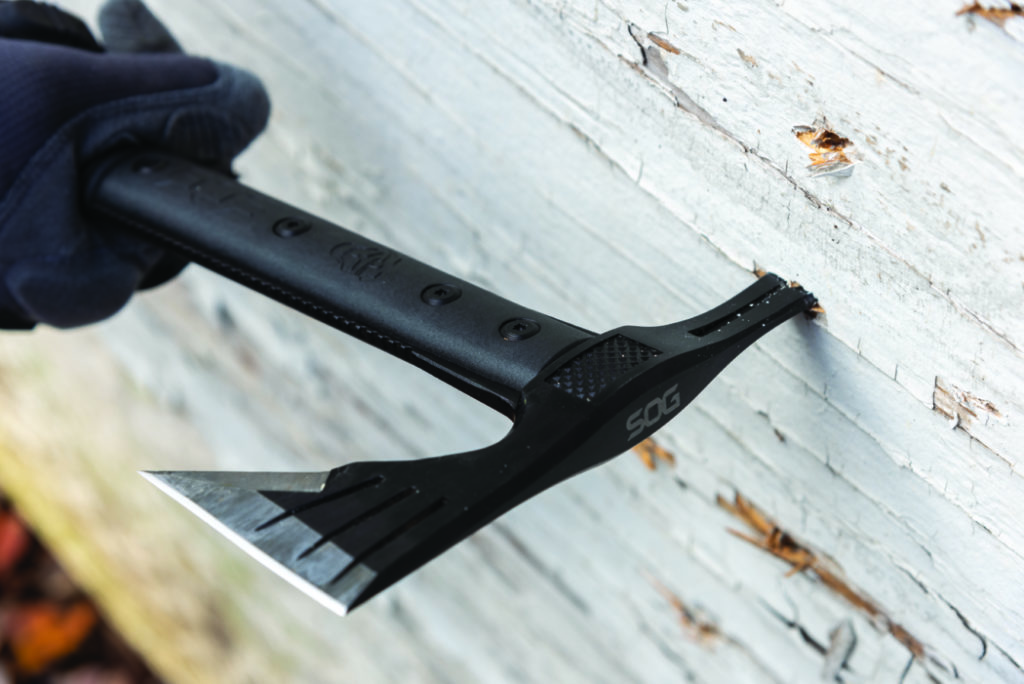
The spike of the SOG Survival Hawk works well and achieved good penetration into plywood.
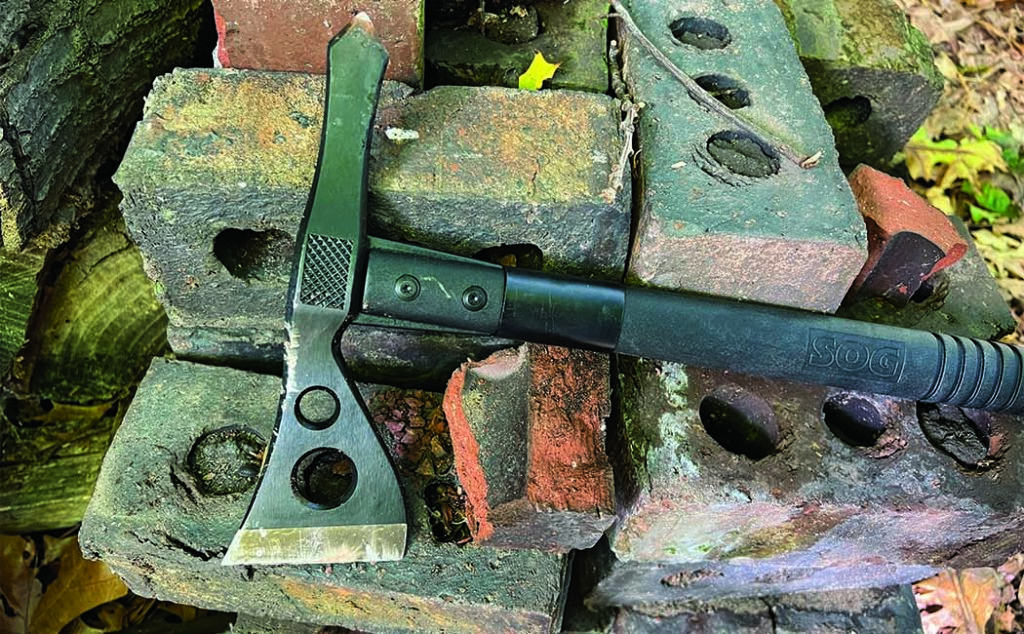
A little over a foot long, the Survival Hawk is compact enough to tote around while camping. The head is cast from 2Cr carbon steel with a cutting edge of 3 inches and a distinctive spike on the opposite end. The spike is not only designed for penetration, but the slot can be used to pull nails or bend wire. When held in the icepick grip with the head pointed toward the ground, the Survival Hawk can be employed as a hammer.
For added versatility, a fire-starting ferrocerium rod screws into the handle butt. The glass-reinforced-nylon-handle material is lightweight while the full-tang design promotes strength and superb balance. The gripping area of the handle is wrapped with paracord for comfort. The exposed portion of the tang in between the paracord handle and the head has a series of traction notches. Grip the area tightly up against the head to carve or whittle with extra control.
The head is all black but the grind bevels are satin finished, creating a striking visual contrast. At 19.5 ounces the Survival Hawk has the weight it needs to deal effective chopping blows. Given its light weight and compact length, don’t expect it to tackle heavy/extended chopping tasks, as you’ll end up having to use more arm power. It actually works pretty well and bit hard into saplings. If you need a hawk for chopping on an as-needed basis, then this is an ideal one to consider.
The Survival Hawk comes with a sturdy ballistic nylon sheath with a stiff inner liner and sports sewn and riveted construction. A button-snap flap closure secures the sheath around the head. A large nylon webbing loop provides easy belt attachment.
The spike works well, and the notch in the center serves as a nail puller. However, the spike might penetrate better without it. Nonetheless, it achieved decent penetration into plywood. However, just like with the head, the spike would also be more effective if the handle were longer for extra leverage for a more powerful swing. Conversely, the Survival Hawk is still loaded with useful features.
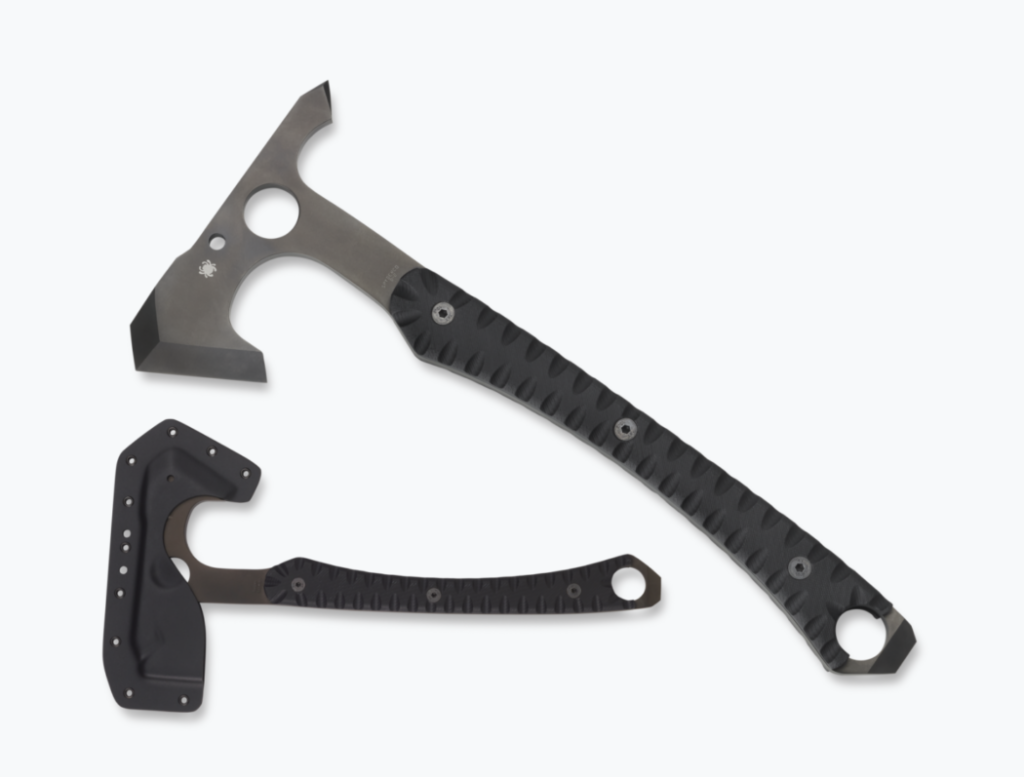
The holes are not just for aesthetics on the Spyderco Warrior Hawk. Designer Laci Szabo indicated the top hole can be used to create a leash similar to that used on ice axes, and a chain can be attached to the hole at the end of the handle so the hawk can double as a hook.
Laci Szabo, United States Marine Corps veteran and New Mexico police officer who served as a breacher on SWAT teams, designed an urban multi-tool to fill the bill. The result is the Spyderco Warrior Hawk, a striking modern design with an angular blade and Spyderco’s signature cutout holes.
The Warrior Hawk is designed to punch out tires, break vehicle windows, cut cables, and handle prying tasks. The apex of the angle ground into the cutting edge of the head concentrates the power of the swing while preventing the material from binding up on the edge.
The holes are not just for aesthetics. Szabo indicated that the top hole can be used to create a leash similar to that used on ice axes, and a chain can be attached to the bottom hole so the hawk can double as a hook.
Szabo wanted a handle different from existing tomahawk designs, so he configured the G-10 handle to resemble that of a conventional hammer. He said the overbuilt design consists of D2 tool steel that’s .3 inches thick, a material that can be heat treated to a high Rockwell hardness yet still has “wear resistance and pry ability,” according to Spyderco.
The challenge for Ryan Johnson in designing the Jenny Wren for CRKT was to make a pint-sized version of a tomahawk. The original version made by Johnson’s RMJ Tactical saw use by special operations forces starting in 2010. Meanwhile, the design also makes for a great outdoor tool.
When CRKT began offering its version of the Jenny Wren, the idea was to fill a need for people heading outdoors that were looking for durable and innovative axe designs.
One of the most notable features is the sharpened edge running across the top of the head. While it was originally designed to maximize slicing cuts, the edge also reduces drag. “It’s the material that is not in the way that makes a difference with this design,” Johnson said.
The ambidextrous sheath allows multiple modes of carry, including a belt, sling or attachment to a MOLLE system. “Everyone tends to forget the importance of the scabbard,” Johnson observed. “If you can’t carry it, you can’t use it. In the case of a tomahawk it’s important to have a safe way to carry it multiple ways.”
Designed by Jared Wihongi, this hawk features a Maori-inspired tribal motif on the head. The tomahawk-like patiti was a weapon of choice for Maori warriors in New Zealand shortly after they first began arming themselves with metal tools long ago, and the head design harkens back to that time.
The satin-finished 420 stainless head showcases the design well. At .25 inches thick, and coming it at 26.4 ounces, the hawk has the heft and size to make quick work chopping through most material. A semi-sharpened edge on the spike end allows for a moderately precise puncturing tool as well.
At 13 inches in length, it’s long enough to get a good whack without exerting your arm too much. The hawk features a paracord-wrapped polymer/composite handle, and where the head meets the handle is reinforced for sturdiness.
Daniel Winkler is tight-lipped when it comes to the teams and units he works with. His Winkler Knives Wild Bill tomahawk was designed with the help of Kevin Holland, Navy SEAL and U.S. Army Special Operations veteran
The axe was named after William “Wild Bill” Donovan, who was head of the precursor to the CIA, the Office of Strategic Services, during World War II.
The hawk is both a tool and art considering the craftsmanship that went into it. It starts with the flat-ground 80CrV2 blade with a black Caswell finish for improved corrosion resistance. The tapered-tang design ends at the integral spike at the butt of the axe, which works well to crush and pry. It’s not the best puncturing tool as it is unsharpened.
The 13.25-inch maple wood handle is wrapped in black cord for most of the top half of the handle for better grip, especially when choking up on the axe for precise slicing. The 22.2 ounces are distributed well, making for a great swing every time.
Wild Bill AxeSpecs Blade Material: 80CrV2 with black Caswell finish Overall Length: 13.25 inches Edge Length: 2.25 inches Weight: 22.2 ounces Handle Material: Maple Wood with Black Cord MSRP: $600
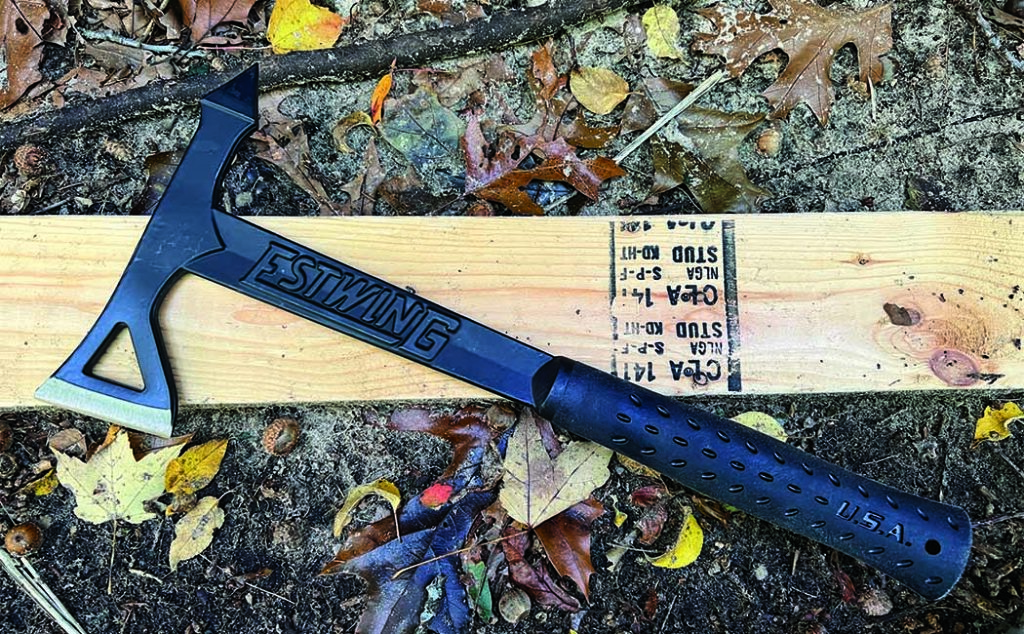
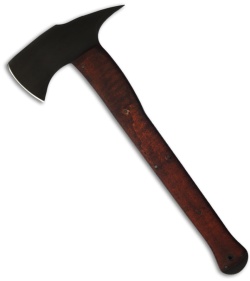
The Estwing Black Eagle Tomahawk feels much more like a tool than a hawk. The rubberized grip absorbs shock and is very comfortable. You can’t choke up on the head like you can some other hawks, though you could add some paracord for the purpose.
The Black Eagle is the epitome of durability. It’s not flashy and has the company’s logo deeply embossed on the tang. The balance is incorrect for throwing but that’s not really the Black Eagle’s role. It is a demolition tool, plain and simple. The head is dimensioned correctly for the same feel as swinging a hammer.
It has a raised equator from its high points, can be used to punch into various materials, and is very easy to withdraw. It can go through just about anything despite the fact it is not sharp on the corners and the tip is more or less rounded off.
In wet, grimy conditions it performed extremely well and goes through wood easily, both in destroying wood structures and splitting firewood. The hawk punches through sheet metal with ease. If you’re looking for a hawk that is less showpiece and more hard-working tool, this is your best bet.
At $600 the Winkler Combat Axe is not just a big chunk of change, it’s also an incredibly strong, rugged chunk of 80CrV2 carbon steel. Not only is it functional, it’s also forged at the company started by the individual largely responsible for the popularity of the modern tomahawk, Daniel Winkler.
The Combat Axe is easy to draw from the belt. The sheath is extremely functional and allows you to remove the Combat Axe one-handed with little effort. The handle runs all the way up to the head and provides an excellent grip at any point along its length.
Of note is the shape of the spike. It is reminiscent of a flat-end bayonet point commonly seen on Russian rifles like the SKS and Mosin-Nagant. Its shape allows it to be used as both a prybar and lever, and it can be swung into material with great force and then used to pull it apart.
The Combat Axe’s edge profile did just fine splitting light amounts of firewood. It also removes branches quite easily in one swing. Because the handle extends right up to the head, there is a risk of damage should you try to split large pieces of wood. The sheath is a major selling point.
The Combat Axe is definitely worth the price, though for the same amount you can buy numerous other hawks multiple times over.
When it comes to durability, the Cold Steel Trench Hawk is quite similar to many of the company’s edged tools. While none of Cold Steel’s functional cutters would win a beauty contest, they certainly have it where it counts when being used. The blade arrived razor sharp, almost too sharp for its own good. Likewise, the spike is substantially longer and much sharper than those of the other test models.
The Trench Hawk is a favorite for throwing.. The company sells replacement handles for around $7 should you break one. It severs branches with extreme ease, though such a task is more of a problem than you might think. The polypropylene handle doesn’t just go up to the head, it terminates right in the middle of it. If you strike too hard, it inevitably will drive the blade in up to the handle, which can cause damage.
The longest of the test hawks, it gains excellent velocity when swung. The handle shape, while correct for a tomahawk, is a bit too smooth and slippery when wet. Another issue is the spike’s length and profile. It’s simply so large that it borders on being unusable for standard chores. It punches through just about anything, from metal to wood, but tends to get stuck easily. Getting it dislodged can be somewhat dangerous
The SOG Pro Tactical Tomahawk is about as barebones as you can get while still being functional. Upon arrival it had a very sharp edge with a blunted, angular spike. The edge was covered in a transparent coating that flaked off during use. The balance of the hawk is excellent and, like the Estwing, has a modern, swept head with an upturned edge. It cuts deep, easily chops firewood, and is excellent for taking down branches. The overall shape and profile are quite minimal, a big plus across the board.
A major downside is the handle. While very strong, it’s rounded and the textured finger grooves don’t provide much extra grip. Because conditions were wet during most of the testing, it was difficult holding onto the handle if the swing wasn’t spot perfect. It wants to rotate in the hand and, while wearing a glove does fix some of that, it’s not an all-around solution.
The spike was functional but had a similar issue to the Cold Steel Trench Hawk in that once it punched through a material, it was hard to remove. For the price, it is an excellent working hawk. It could stand some improvement but should hold up quite well.
Pro Tactical TomahawkSpecs Blade Material: 420 HC Stainless Overall Length: 15.75 inches Edge Length: 2.75 inches Weight: 24 ounces Handle Material: Black Glass-Reinforced Nylon MSRP: $47.99
Editor’s Note: Dexter Ewing, Daniel Jackson, Josh Wayner, and Ryan M. Johnson contributed to this piece.
Bear & Son’s Mini Rancor IX and 778SR Sideliner come in at the right price for EDC performance.
Look at the calendar and it’s apparent the year is dwindling down to its final days. Yet, there are some knifemakers still as busy as ever, squeezing new models into the final days of 2023. Among these is Bear & Son Cutlery.
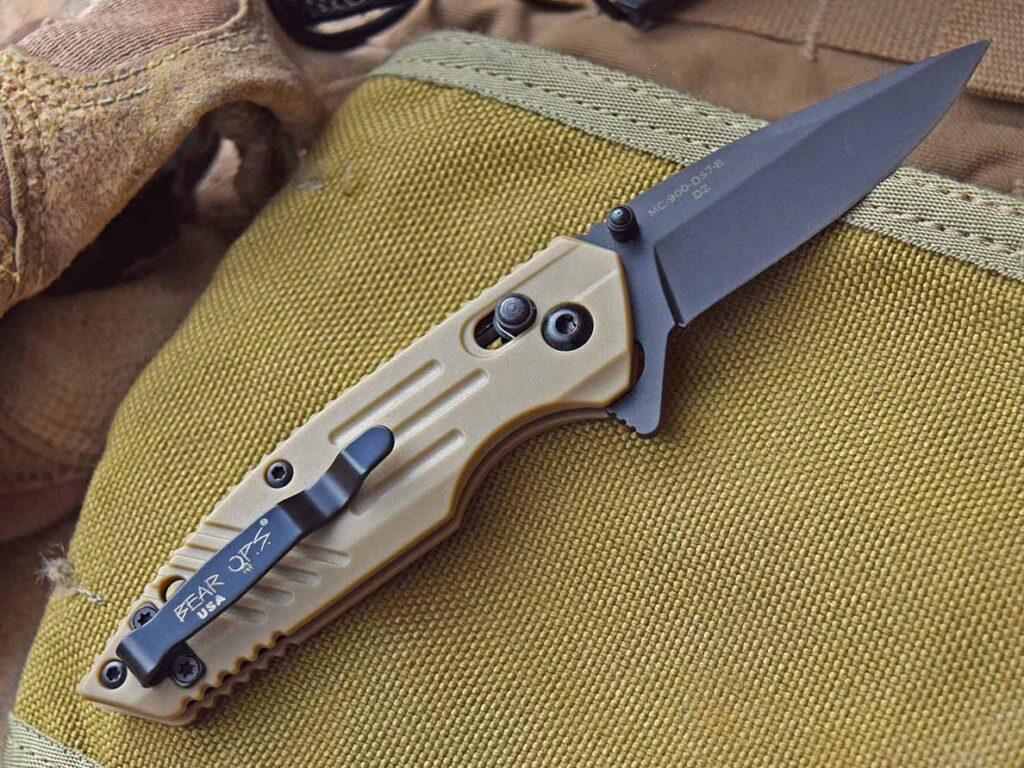
Earlier this month, the Jacksonville, Ala., manufacturer unveiled two new folders, each with the trappings of solid EDC options. The OPS Mini Rancor IX and 778SR Sideliner are both designed to provide everyday, at-hand performance. However, the knives go about offering this up in slightly different ways.
OPS Mini Rancor IX
Mini Rancor IX
No bigger than a minute, the drop point flipper is the smallest option in Bear & Son’s growing Rancor line. While its predecessors weren’t gargantuan by any stretch of the imagination, the Mini Rancor IX is sized much more practically for a day-to-day option and for lighter duty.
Bear outfits the knife with a 2.5-inch blade, for a package that measures in at a very nimble and usable 6 inches in overall length when deployed. The manufacturer opted for D2 stainless steel—a high carbon, high chromium alloy—a common option for higher-end production knives. The steel gives the blade excellent edge retention and wear resistance, plus the ability to easily get touched up when resharpening is required. Giving the stainless steel an extra layer of corrosion and stain resistance, Bear & Son applies a black finish.
The handle of the knife is Zytel—a thermoplastic from the nylon family—with jimping along the spine and along the lower front. Further enhancing the hold of the knife, Bear textures the grip with significant milling, which in the sand-colored handle gives it a dynamic look. The ergonomics appear comfortable and the tapered profile of the handle should give the user a supreme purchase on the knife.
Rounding the knife off is a slide lock—similar to an axis—with offers strong lockup, as well as a fast and safe ability to put the blade away. Also, with familiarity, the lock can also make deployment lightning fast. Adding to getting the blade into action are ambidextrous thumb studs and a kicker. The knife boasts a stainless steel insert to provide backbone and it comes outfitted with a deep carry, tip-up pocket clip.
Bear OPS Mini Rancor IX Specs: Model Number: MC-900-DS7-B Blade Material: D2 Tool Steel Handle Material: Tan Zytel Rockwell: 58-60 Closed Length: 3.62 inches Locking Type: Slide Lock Open Length: 6 inches Edge Length: 2.30 inches Weight: 1.60 ounces Extras: Thumb Studs, pocket clip, stainless steel inserts, Lifetime Warranty Origin: Jacksonville, Alabama MSRP: $91
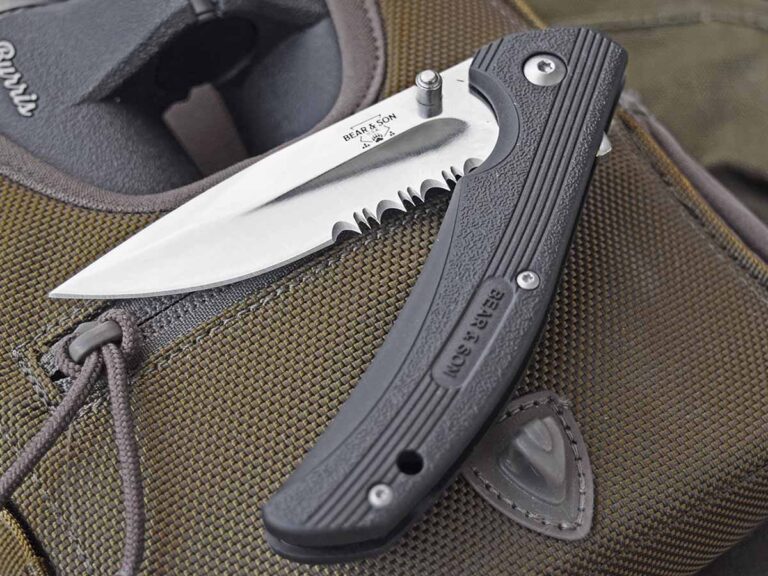
778SR Sideliner
A slightly larger option, the 778SR Sideliner nevertheless offers up a fairly tidy package for those looking for a budget knife. Catching the eye right off is the high-polished 3.25-inch, 440 stainless steel blade with a drop point profile. A quick note on the steel choice, it is softer than many other alloys but does—in general—provide a balanced package of edge retention and corrosion resistance. The tip comes to a very fine point, not only making it dexterous on fine-cutting jobs but also making it great at puncturing. Adding to its cutting prowess are aggressive serrations at the hind of the edge and terminating before the belly.
Again, Bear & Son opts for Zytel for the handle and gives it a pebble finish with some milling down the midline. Given its long and tapered shape, the thermoplastic should provide a comfortable grip and fit most hands fairly well. In its core, the liner lock has a stainless-steel liner, giving the knife a measure of overall ruggedness. Rounding out the package are both thumb studs and a kicker for deployment.
778SR Specs: Model Number: 778SR Blade Material: 440 Stainless Steel Blade Shape: Drop Point Handle Material: Black Zytel Lock Type: Linerlock Overall Length: 7-1/4 in. Edge Length: 3-1/4 in. Weight: 2.9 ounces Extras: Stainless Steel Pocketknife, Thumb Studs, Torx Screws, Lifetime Warranty Origin: Jacksonville, Alabama MSRP: $45
More than mere knife sharpeners, these options are complete honing systems that keep your blades razor-sharp.
Many of you probably learned to sharpen knives freestyle on a carbide, ceramic or diamond stone that required setting the proper angle by guesswork. The problem with sharpening a knife freehand is that no matter how good you are, the angle can vary with each stroke.
Fortunately, knife sharpening systems these days are so advanced they can virtually eliminate human error. Among other features, the systems allow the user to preset the blade angle and lock it in so it never varies throughout the sharpening process. Of course, systems that “lock in” sharpening angles are nothing new. However, the ways today’s angle-guide models do it not only are especially creative and user friendly, the best of them offer many other highly useful functions as well.
Before reviewing four of the latest examples, a word of advice when sharpening a knife: stop and gauge your progress as you go. It will help ensure you don’t miss a dull spot and also keep you from over sharpening/abrading, thus preserving the life of your blade.
Smith’s Edge Pro Electric Sharpener
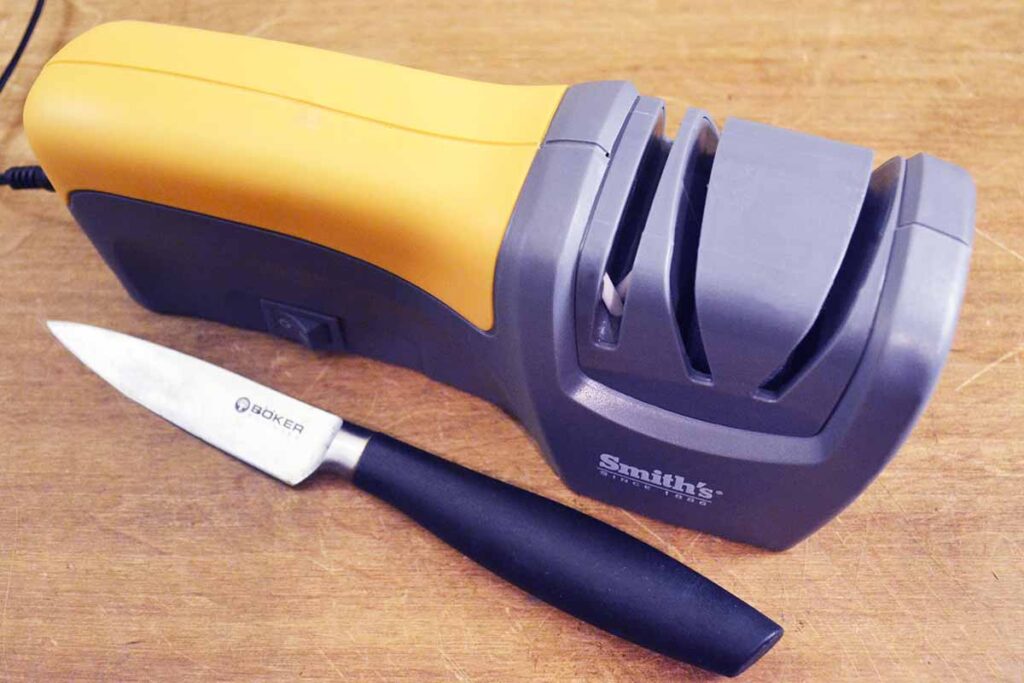
The Smith’s Edge Pro Electric Sharpener provides a competent edge in a minimum amount of time. It has angled, electric-powered left- and right-side coarse grinding slots (right), and a vertical manual ceramic rod slot (left) for fine honing. The knife is a Boker paring model.
Smith’s has gotten more into electric sharpeners lately and the Edge Pro Electric Sharpener is one of the company’s latest. It is a countertop unit with a 3-foot-tall main housing rounded at the top for gripping. It is a three-stage pull-through sharpener—right side blade, left side blade and vertical hone. The right and left side pull-through slots access coarse diamond wheels that sharpen each side of the blade via a motor turning the wheels, the end result being an angle of approximately 22 degrees. The non-electric third slot houses two crossed ceramic rods to hone and de-burr the edge. A detachable electrical cord with adapter plug is included and a rocker switch on the base cuts the unit on and off.
Sharpening with the Edge Pro is simple but some tips will make its use more efficient and hazard free. First, this is a pull-through sharpener, so do not try to push the blade through. Second, for the best edge keep the blade as close to level as possible. Last, don’t apply too much downward force—you can bog down the motor. Steady, moderate pressure works best. The hone slot removes any rough burrs and sharpens the edge. I finished the blade with a leather strop and the edge was shaving sharp.
Smith’s Edge Pro Electric Sharpener Specs Type: Benchtop electric, slotted Dimensions: 8.5” long, 3” wide, 3.5” tall Main body material: Plastic Sharpening slots: Two coarse, one fine Grit types: Diamond coarse and ceramic fine Carry: None; tabletop design Weight: 1 lb., 4 ozs. Country of origin: U.S.A. MSRP: $32.99
Cold Steel Benchtop Knife Sharpener
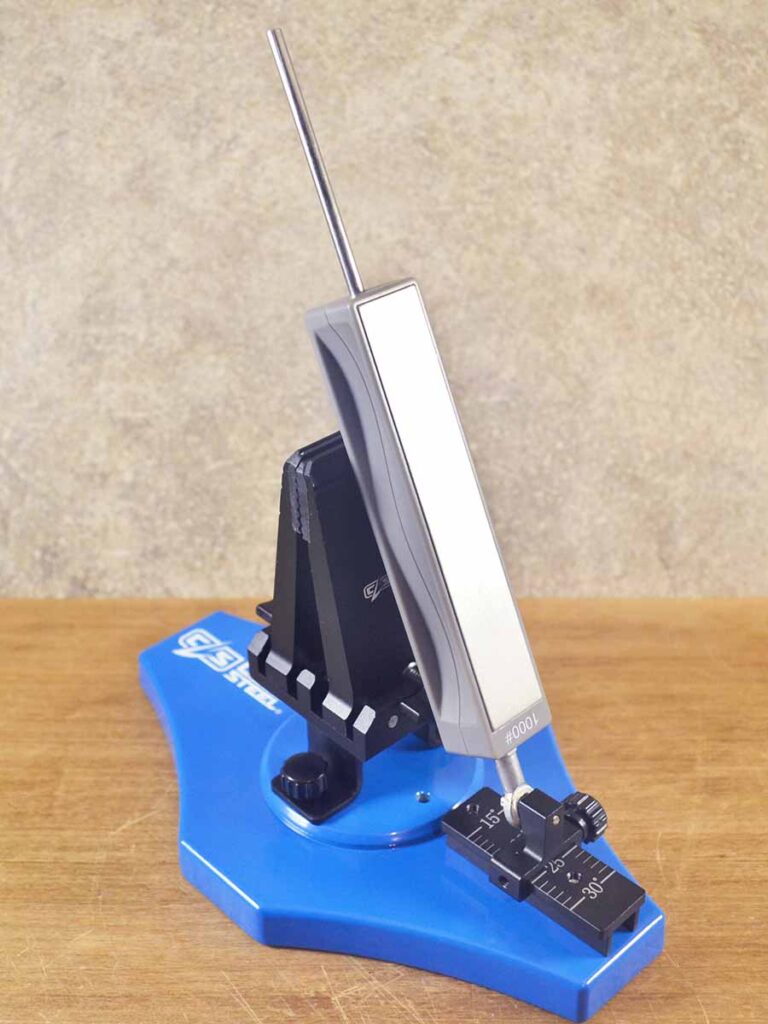
The rod angle of the Cold Steel Benchtop Knife Sharpener is adjustable from 15 to 30 degrees and is locked in by a thumbscrew on a sliding mount. To reverse the blade for sharpening the opposite edge, remove a thumbscrew from the base and rotate the tower 180 degrees.
The Cold Steel Benchtop Knife Sharpener is an affordable version of the variable fixed-angle sharpeners folks like to demonstrate on Instagram and Facebook. The knife is mounted blade-up* in the jaws of a clamp and the grit block sweeps across the edge horizontally. The blade is mounted at the top of the unit upside down, and the rod that holds the grit block is mounted on one long end of the base. The rod angle is adjustable from 15 to 30 degrees and is locked in by a thumbscrew on a sliding mount. To reverse the blade for sharpening the opposite edge you must remove a thumbscrew from the base and rotate the “tower” 180 degrees. There are two grit blocks, each with different diamond-coated surfaces: 300 and 600 on the coarse block, 800 and 1,000 on the fine one.
There’s a good reason for watching videos on complicated sharpeners such as these. I noticed the tower (my jargon for the sharpener’s tall main component) where it mates to the base had slack in it, allowing it to rock when sharpening. I watched two videos and saw why. When sharpening the edge with a grit block, the loose base allows you to follow the edge of the blade as the block traverses from base to tip. To hold the tower stable, use your free hand to keep the tower from tipping backward while your other hand sweeps the blade edge with the grit block. This is a bit awkward until you get the hang of it. When you finish one side of the blade, undo a thumb screw and rotate the knife 180 degrees to do the other side. Then start over again with the next finest grit until you finish with the 1,000 grit.
It seems time consuming but remember, this is a budget fixed-angle sharpener that costs less than many diamond bench stones. If you want to learn the basics, this compact sharpener is a good one. (Author’s note: The clamp jaws are wider than on the other fixed-angle sharpeners, which means it will not work with as narrow of a blade width as the others reviewed.)
Cold Steel Benchtop Knife Sharpener Specs Type: Fixed angle, horizontal swing Dimensions: 8” long, 5” wide, 9.75” tall Main body material: Steel Grit types: 300, 600, 800 and 1,000, diamond coated Carry: Hard-shell thermoplastic case Weight: 2 lbs. Country of origin: China MSRP: $129.99
Work Sharp Precision Adjust Knife Sharpener Elite
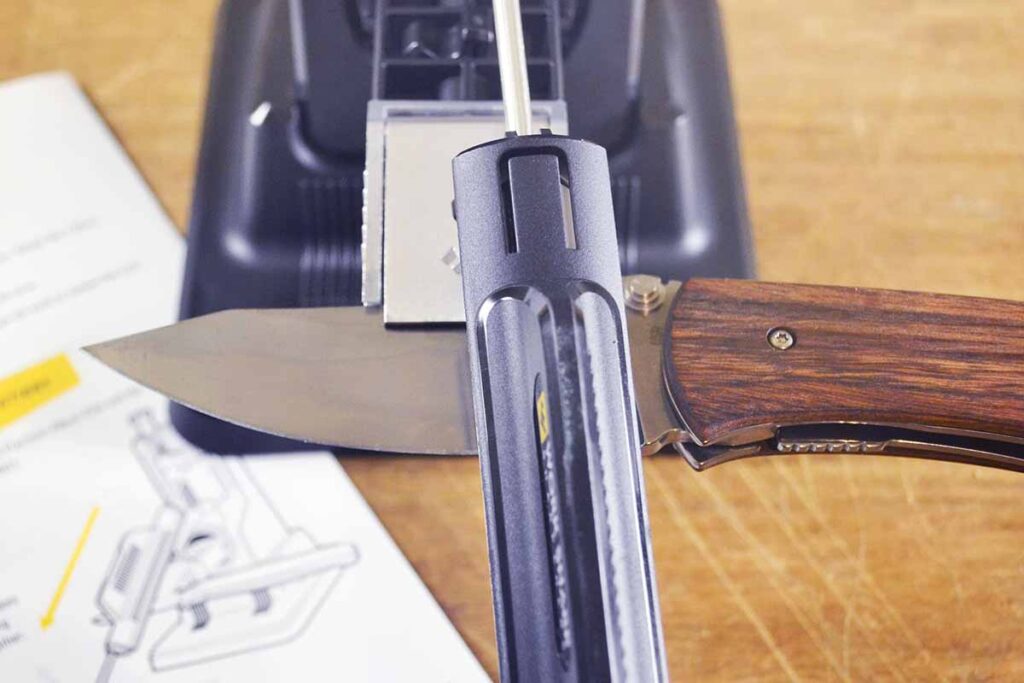
The Work Sharp Elite with the guide rod and a Tri-Brasive block is ready for action. According to the author, he snuck the Elite’s instruction pamphlet into the photo because Work Sharp does an outstanding job of providing set-up and use instructions, which is not always the case with some sharpeners.
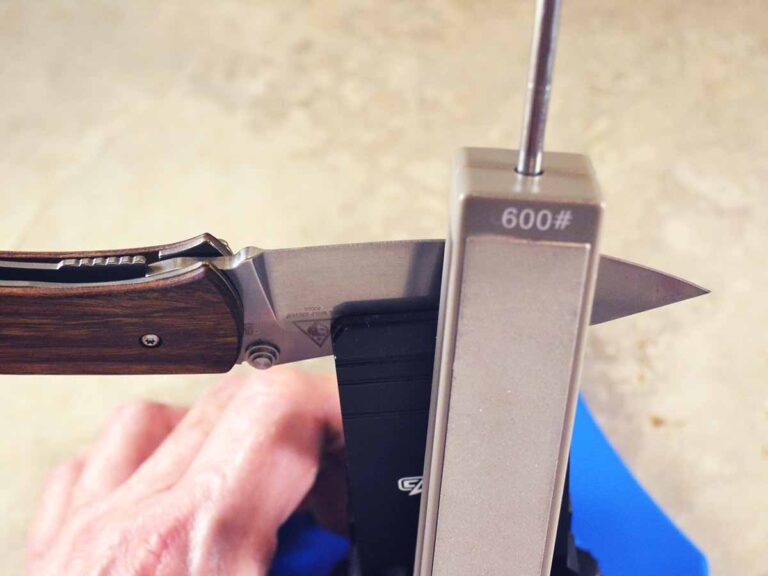
The Work Sharp Precision Adjust Knife Sharpener Elite is an affordable, sophisticated sharpening system. It is a fixed-angle unit that operates using rods with an array of grit blocks that would make the pickiest sharpening aficionado drool: 220, 320, 400, 600 and 800, a ceramic rod for serrations, and a leather strop. That’s right, you can even strop with it. The tower clamps the blade, sets the angle of the edge you prefer, and holds the rod and grit block. It is the only sideways/horizontal blade mount of the test bunch. The Tri-Brasive grits are held in a special housing with a finger grip, three to a block—two total except for the ceramic rod and strop, which have their own smaller housings. Each housing has its own rod, making it easy to install and use. The clamp holds the knife with the blade edge facing the user. (Author’s note: This is the budget version of the Work Sharp Professional Precision Adjust Knife Sharpener, the BLADE Magazine 2023 Accessory Of The Year [page 16, September BLADE®], which has grit widths of approximately 3/4 inch like the other fixed-angle sharpeners reviewed. The Elite model has 3/8-inch-wide grit slabs that may wear out faster.)
Assembly is shockingly easy—no tools required. Once the blade is mounted in the clamp, the grit housing/rod locks into place with a magnet located under the degree-setting brace on the tower, and that sets your blade angle. The edge faces you horizontally, making it easy to gauge your progress. Simply work your way up the consecutively finer diamond grits until it’s fine ceramic and strop time, which gives the razor-sharp edge a blazing shine. The ceramic rod for serrations is a nice addition. The only thing that might give you trouble is the base can tip forward if you put too much pressure on the blade. Easy does it is the byword here. All in all, the Work Sharp Precision Knife Sharpener Elite is a breeze to set up, easy to use for blisteringly sharp results, and packs up nicely when it comes time to stow. It is a tremendous value.
Work Sharp Precision Adjust Knife Sharpener Elite Specs Type: Fixed angle, horizontal swing Dimensions: 5” long, 4.5” wide, 7.25” tall Main body material: Steel Grit types: 220, 320, 400, 600, 800 diamond coated, ceramic and leather Carry: Soft case Weight: 1 lb., 8 ozs. Country of origin: Assembled in the U.S.A. using foreign-made parts MSRP: $139.93
Wicked Edge WE66 Obsidian
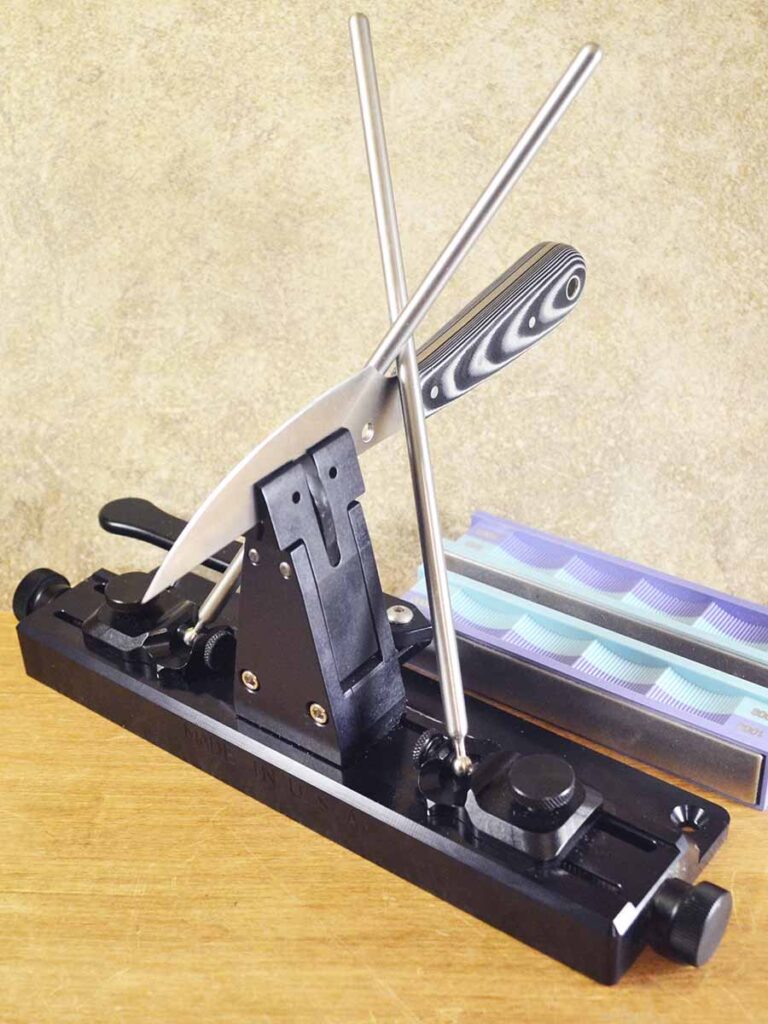
The Wicked Edge WE66 Obsidian is the only test model that sharpened both sides of the blade in one session without flipping the knife. The blade mounts atop the tower and the swing rods and grit blocks are used in alternating right- and left-hand sweeps. Note how the guide rods are held in mounts that also set the angle.
The Wicked Edge WE66 Obsidian is another upscale, state-of-the-art fixed-angle sharpener capable of delivering mind-blowing results. What sets it apart from the others is that you sharpen both blade sides in the same session—no flipping of the knife is required. The Obsidian is the largest of the sharpening systems reviewed and has an 8×11-inch base that weighs more than the system itself.
The Obsidian uses diamond blocks with two different consecutive grits on opposing sides. There are four blocks total, two each identical because you sharpen both sides of the blade at the same time. There are two sanding-block rods with orb-shaped bases that act like ball bearings in the mounts. The bases slide on a rail to set the sharpening angle. Despite sounding complicated, it’s actually quite simple. The angle settings are very easy to read on the side of the base. The blade mounts upside down in the jaws atop the center tower and locks in place via a lever.
To use the Obsidian, mount the knife so the edge points straight up, and operate the rods and blocks with opposing hands. Once you sweep the blade with one hand you switch to the other and repeat until that grit has done its business. Sharpen with the low grit and when done rotate to the higher grit on the other side. When you’re finished with that block, replace it with the other block of a higher grit. You’ll have to provide your own strop.
Wicked Edge WE66 Obsidian Specs Type: Fixed angle, horizontal swing Dimensions: 11” long, 3” wide, 4” tall Main body material: Steel Grit types: 200, 600, 800 and 1,000, diamond coated Weight: 2 lbs. 13 ozs. Country of origin: U.S.A. MSRP: $799
Due Diligence
Much of what is written here will make a lot more sense when you watch a video of the sharpener that strikes your fancy. It will make assembly easier as well.
There’s something for everyone here. If you don’t care to labor over sharpening but still want a very competent cutter, the Smith’s Edge Pro should suit you just fine. The Cold Steel Benchtop Sharpener offers fixed-angle sharpening at a budget price and is a perfect steppingstone for getting your feet wet in hi-tech sharpening. Finally, the Work Sharp Elite and Wicked Edge Obsidian are both lights-out sharpeners if you want outstanding performance. Both are truly state-of-the-art.
Editor’s note: Always practice extreme caution when working on a knife held in a clamp, vise, jig, etc., with the edge pointing up and/or toward you. When finished sharpening, remove the knife from the fixture immediately so the danger of accidental cutting is eliminated.
In the field, these knives always help you keep your edge.
And now for a style of edged tool that brings its own brand of controversy most wherever it goes—the replaceable-blade knife. No, not the utility knives you see in a ton of kitchen junk drawers, tradesman’s tool bags and on garage workbenches, but the models made for hunting and possible EDC use.
The controversy tends to surface between the traditional knife-carrying crowd and those who appreciate convenience. As one who loves and teaches sharpening, I tend to leave the replacement blades for my utility knives. These days, however, they have made their way into many different knife styles.
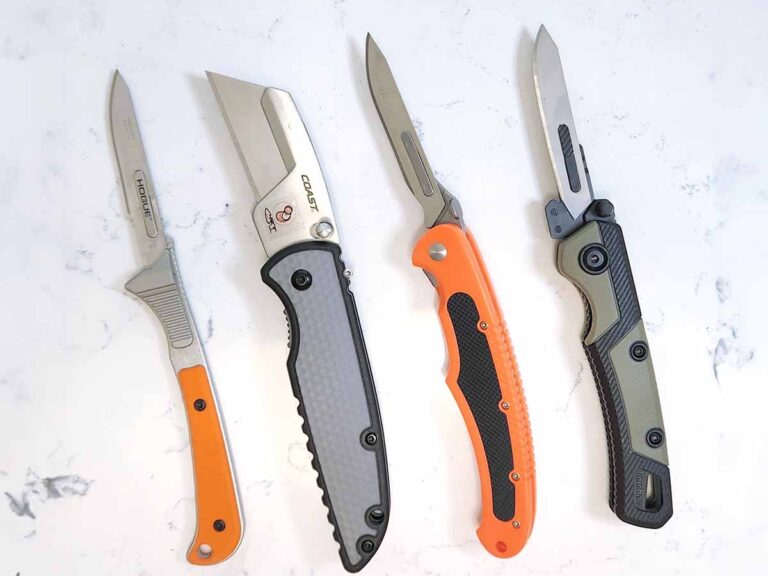
I’m going to gauge how four of the latest replacement models cut and handle, and, most importantly in my mind, how easy it is to change a blade on each one.
Hogue Expel Scalpel 2.5
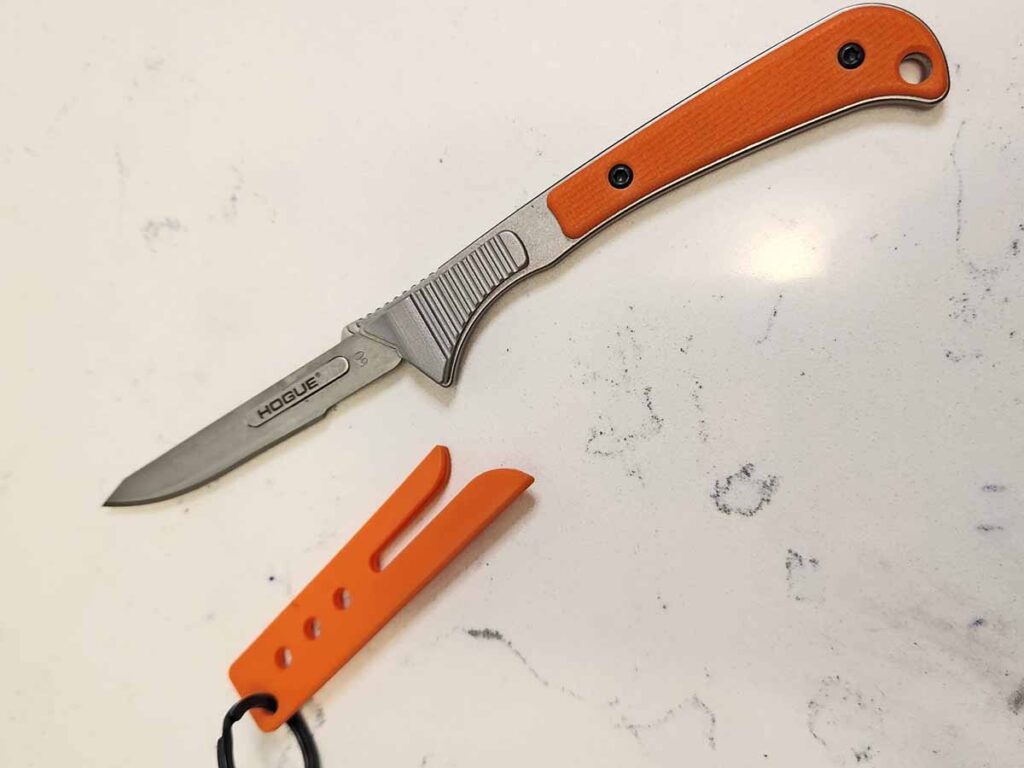
You get a sturdy full-tang design with Hogue’s Expel Scalpel. A tight-fitting cover with a split ring carries the blade. Country of origin: USA.
Right off the bat, you will notice the Hogue Expel Scalpel 2.5 is some serious gear. The handle is a steel tang construction with textured G-10 scales in a blaze orange. The front bolster area is gimped, complete with a thumb ramp. Though the bolsters are screwed on the thumb ramp is not reversible, so sorry to all you southpaws out there. The handle is American made but the blade is marked England and #60. A #60 scalpel is used in dental surgery and postmortem work (it’s nice to know medical examiners wait for the person to expire before they start hacking into them with such a scalpel). Instead of stainless the blade is a high carbon steel. If you want to prolong the life of the Expel’s replacement blade, you can easily strop it.
Since it is an actual scalpel blade, that means you should be able to source multiples of them easy enough. I would go online and order. Since the pattern is used for postmortem work, that would raise fewer eyebrows. I did a quick check and was able to find a pack of 20 of the blades for around $10.
Hogue’s design for its replaceable blade knife uses the traditional blade mounting system. The best way to change the blade is with a pair of pliers. Doctors usually use a set of forceps. Handling wise the knife is quick and nimble. You hold it like a regular scalpel, with your index finger along the blade spine, and guide the edge. It comes with a zipped pouch and a plastic sleeve that fits over the blade. Having the textured G-10 scales and beefier handle contour enhances purchase. I like the design. It fits my hand well. I had perfect control over the edge. I wouldn’t hesitate to take this with me hunting and use it as a caping knife. I certainly will be packing it for pheasant hunting this fall to process the birds and clean up the gizzards.
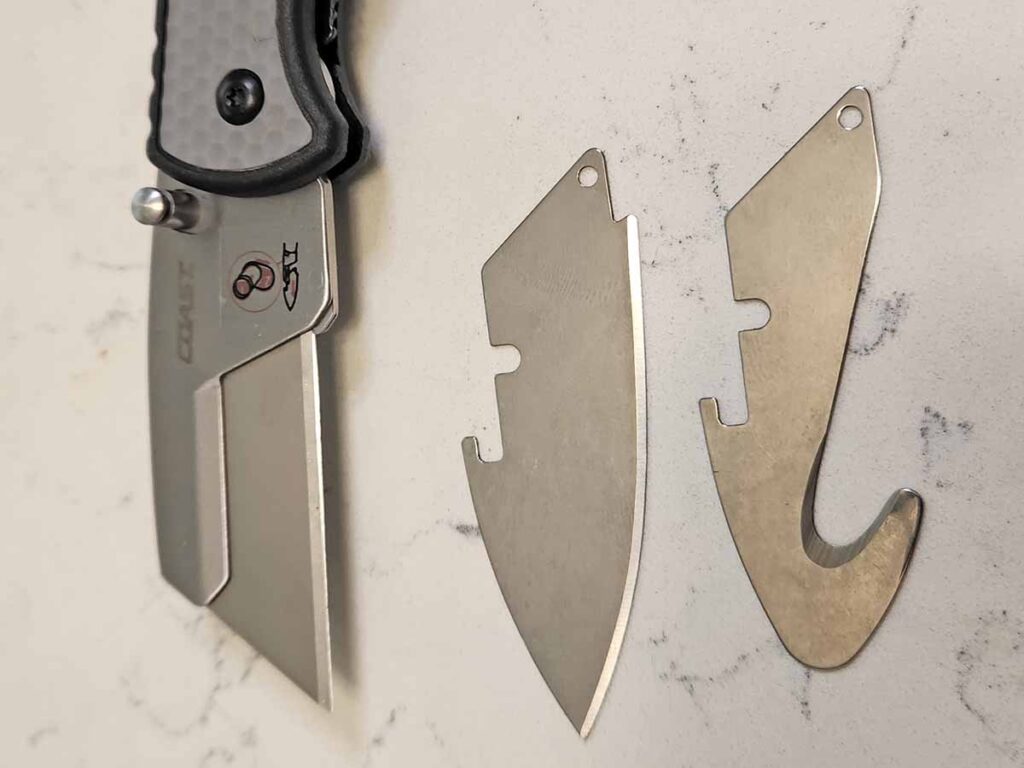
The selection of blades Coast supplies with the 1919 is compatible with regular utility blades. From top: an attached regular utility blade, drop point and gut hook. Country of origin: China.
With the 1919 Reserve Shift, Coast has gone with more of a traditional utility folder design. Don’t let that fool you, though, because the knife does offer some innovations. Coast has patented both the blade changing arrangement—called the swap out system—as well as the blade storage system. Two of the three blade styles that come with the knife are customized: the spear tip and gut hook. The third is a regular utility pattern. The system is compatible with standard utility blades, which means you can buy other patterns such as serrated and a roofer’s hooked blades. I don’t know why the company bothered designing a gut hook, as a hooked utility blade would work just as well. The handle is a glass reinforced nylon with a textured rubber insert. The 1919 carries in a pouch sheath.
There are two locking systems. The primary is a linerlock and a double lock prevents the liner from moving to the side. A thumb stud provides ambidextrous one-hand opening. The stud is also part of the opening system. Depress the button on the stud, slide the stud down and the blade comes out.
The blade release system works well but, as far as innovation goes, it doesn’t draw a “wow” from me. Conversely, that Coast bothered to care about how easy it is for you to access the extra blade storage is impressive. It is a straightforward arrangement but, after all, what good is a replaceable-blade system if you can’t get at the extra blades?
Overall, the knife handles like any other utility folder, but the devil is in the details. All the little extras help it edge out the other similar designs. Best of all, except for the proprietary blades, you can pretty much walk into a Walmart and get a blade for the 1919.
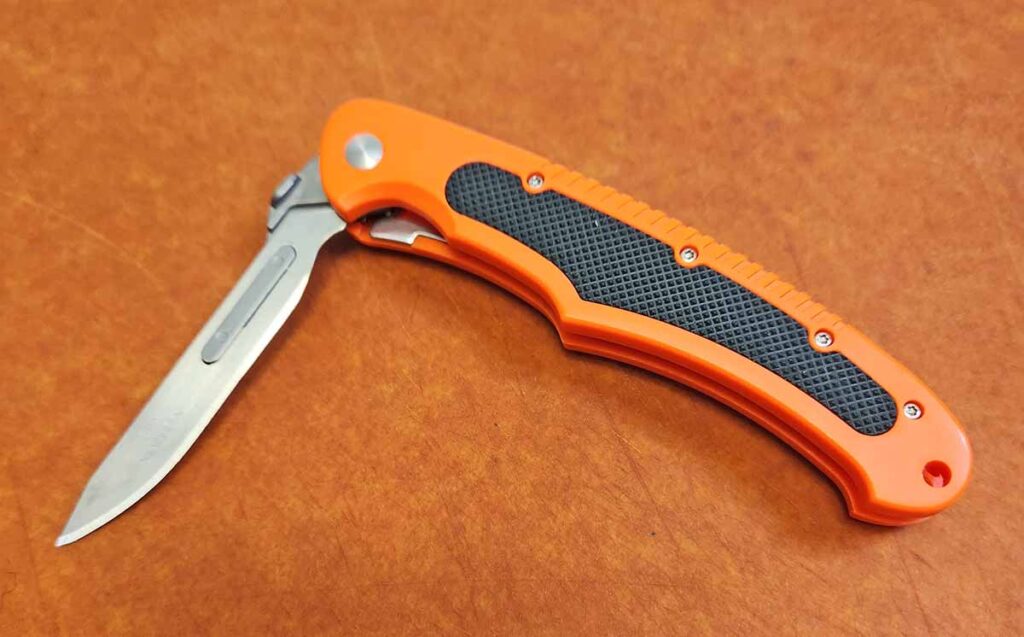
Note the thumb disc on the Havalon Bolt’s blade holder, which makes ambidextrous opening possible. Also, the bright orange ABS handle on this replaceable blade knife makes it more likely you will find the knife if you ever set it down. Country of origin: handle made in Taiwan and the blades are made in India.
The Havalon Piranta Bolt is a blend between the Coast 1919 and the Hogue Expel Scalpel. The Bolt uses a #60 surgical blade like the Expel Scalpel, though Havalon’s is marked 60A and listed as stainless steel. The blade opens via an ambidextrous thumb disc and locks via a linerlock like the 1919.
A belt carry case houses 12 extra blades. If you only occasionally stropped your blades instead of changing them out, you would have a ton of cutting time. The handle is a bright orange ABS plastic with a textured rubber insert. It feels blocky in the hand. Using ABS plastic keeps the knife lightweight. Between the lightweight feel of the plastic and the lack of contouring, it is not a comfortable grip. The small, trim-profile pocket clip is stronger than it looks.
Havalon gets innovative as far as providing a blade-replacing tool. When changing a scalpel blade, normally you take a set of forceps or a pliers and lift up the back end and push the blade forward. Havalon’s little clamshell-style tool closes around the blade so the edge is not exposed. Snap the tool closed and the rear of the blade bends upward, enabling you to pull the blade off the holder. It worked every time I tried it and it didn’t damage the blade. I was even able to reinstall the same blade. An issue is that there is no place to store the tool in the pouch and, due to its size, would be easy to misplace/lose.
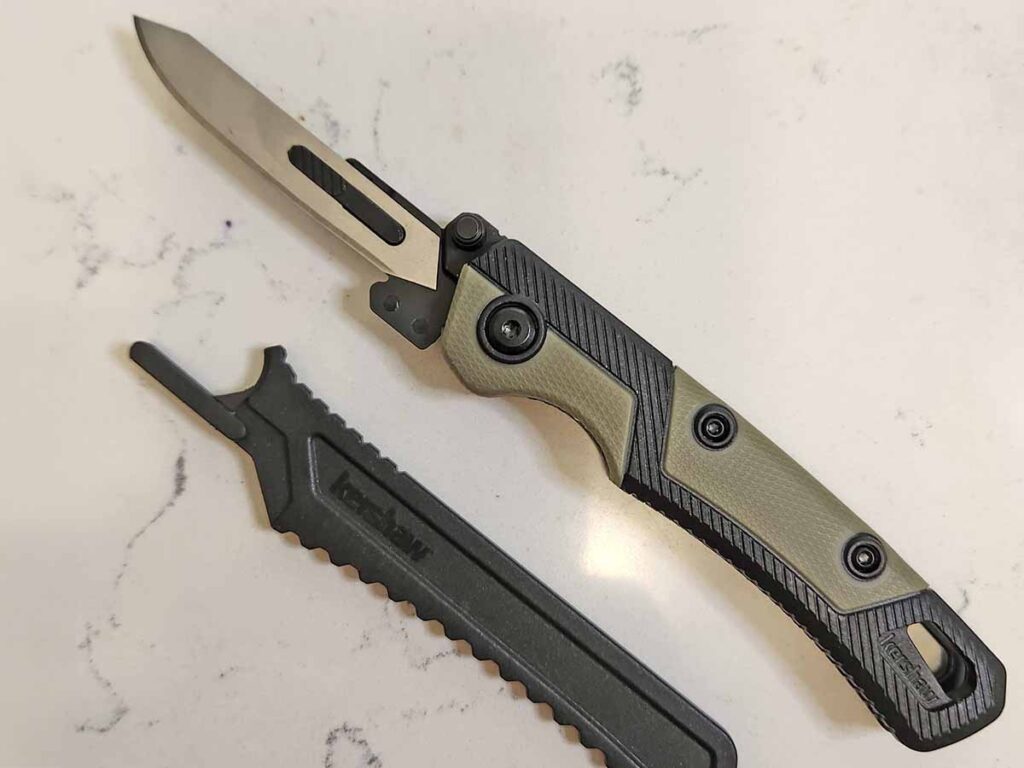
Kershaw also includes a fixed-blade handle with its replaceable blade knife’s kit. It’s lightweight and the texture and profile offer plenty of purchase power.
The Kershaw LoneRock RBK 2 is another replaceable model that uses a #60 scalpel blade. (I’m starting to feel like a few of these companies had a meeting and I wasn’t invited.) The RBK 2 comes with 14 extra blades in a carry case and one on the knife. A pocket in the belt pouch holds the carry case. A cool feature of the case is a slash pocket for the knife, making it easier to get a purchase on the handle for deployment.
Speaking of the handle, it’s glass filled nylon with rubber overlay. It’s listed as black and tan but looks more like black and green. If I had to pick something Kershaw should have had more foresight about, it’s the color. Green and black pretty much screams “lose me” for a hunting knife. On the other hand, for caping the #60 scalpel blades should do the trick. Also, Kershaw did a great job contouring the handle so it’s easy and comfortable to hold. The blade opens ambidextrously via the double thumb stud and secures via a linerlock. There is no pocket clip, though there is a hole for a lanyard.
Kershaw really put its thinking cap on when it comes to tool-less blade removal. A liner lifts the rear of the scalpel blade, enabling you to slide the blade off. However, I would still play it safe and grab the blade with, say, a pair of pliers. During use I never had an issue with the removal liner being bumped, but I will wait and see. I must say, Kershaw impressed me with this one.
Replaceable-blade knives add to the depth of edged tools available in the cutlery world. As with all knives, they have their place. They have already experienced some popularity among certain trades and professions. If you like to sharpen, remember that even a replaceable blade can be touched up at times.