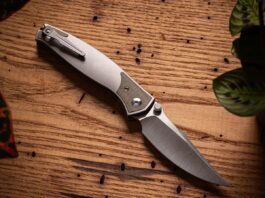
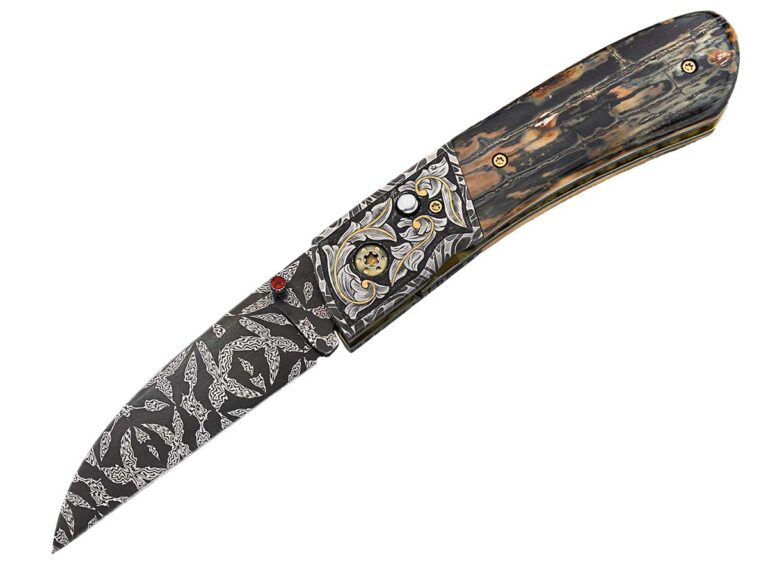
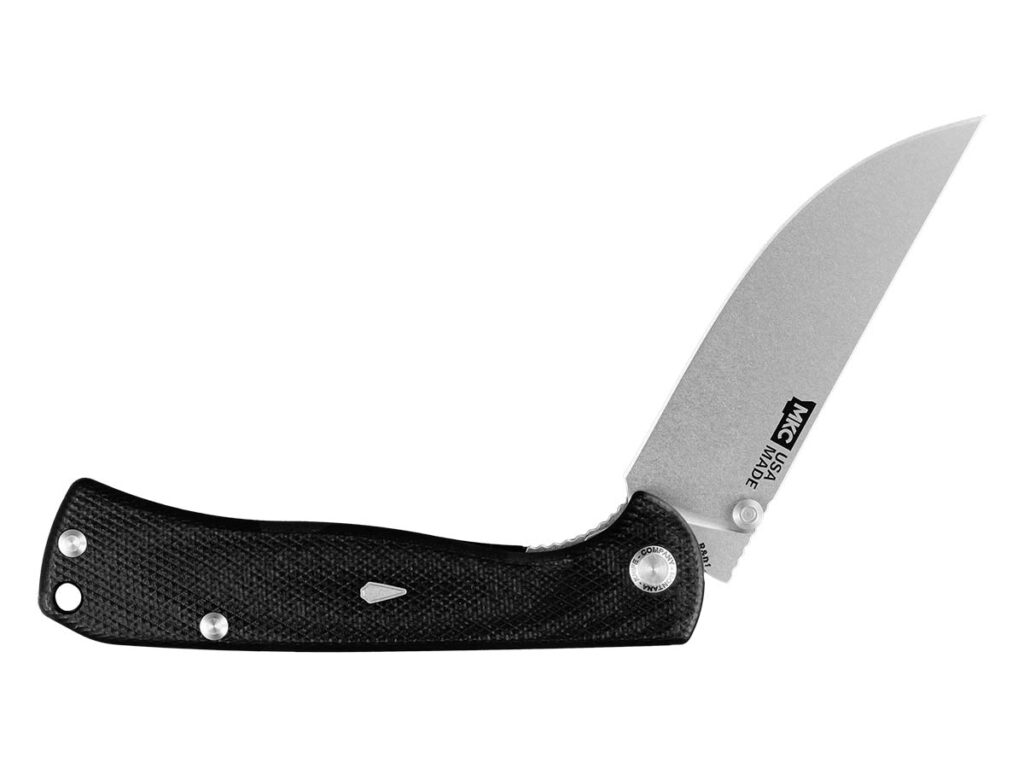
The technological advancements that have redefined the pocketknife as we know it.
When I stumbled onto the knife scene in 1985, the only pocketknives I had carried up to that point were slipjoints and lockbacks. Of course, slipjoints weren’t called slipjoints back then but simply pocketknives. Today, as far as BLADE® is concerned—not that it’s any major newsflash or anything—any knife you can carry in your pocket is a pocketknife.
All of which brings me to the subject at hand: my picks of the five most important pocketknife developments of the modern sporting knife era. In rough chronological order they are:
•The pocket clip:BLADE Magazine Cutlery Hall-of-Fame® member Sal Glesser’s introduction in 1981 of the Spyderco pocketknives with the hole in the blade and the pocket clip would turn the genre on its head. While the hole in the blade was a masterstroke in and of itself, it was the pocket clip that forever changed the way people would carry their pocketknives. Rather than rattling around in the bottom of a pocket with change, car keys and what have you, the closed knife was held on the pocket lip by the clip, free from pocket-bottom scratches and poised at the ready to be deployed to cut whatever needed cutting.
•The linerlock: Cutlery Hall-of-Famer Michael Walker invented the linerlock in 1981, but it would take a few more years before custom knifemakers—and shortly thereafter, factory makers—began readily adopting the lock that made one-hand manual opening and closing of the pocketknife an easy reality rather than an exercise in hand contortions. Today, the argument can be made that the linerlock is used on more sporting folders than any other lock.
•The flipper: While exactly who made the first folder with the flipper tab that manually deploys a folding blade with the tap of a finger may be up for debate, there is no debating that the person who popularized it was Cutlery Hall-of-Fame knifemaker Kit Carson. A simple addition to the pocketknife on its face, the flipper tab opens a blade as fast and easy as any other manual method—probably faster.
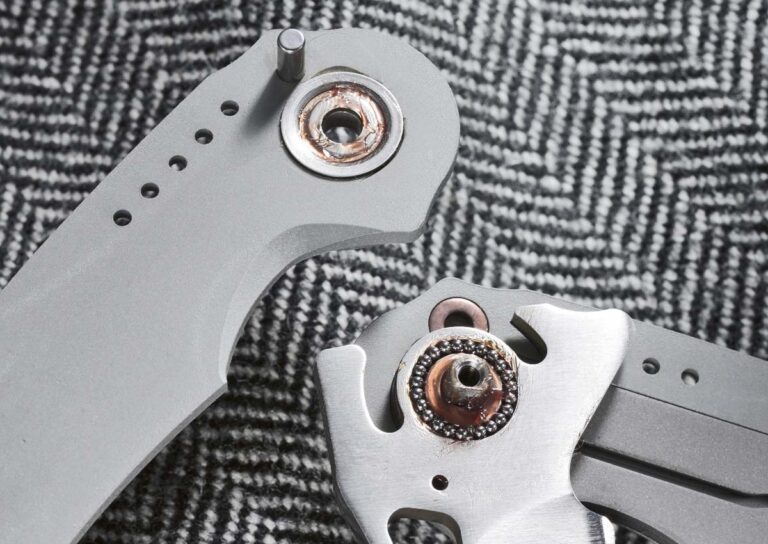
•The Ikoma Korth Bearing System (IKBS): Pivot systems that helped open folding blades quickly and smoothly had been around before, but it was the IKBS conceived in 2002 that took blade opening to a new level of quick and smooth. In conjunction with the flipper especially, the IKBS transformed one-hand pocketknife opening from fast to just this side of automatic. Developed by Brazilian custom knifemakers Flavio Ikoma and Ricardo “Rick” and Paulo Lala (the latter two collectively known as Korth), the IKBS is another masterstroke of design and invention.
•Material upgrades: These cover a number of materials and years, from Walker’s switch to titanium for his linerlock spring in 1983, to a wide array of other hi-tech substances in subsequent years for pocketknife handles, including titanium, thermoplastics, Micarta®, G-10, carbon fiber and other state-of-the-art materials that not only were super strong and tough but also were lightweight, reducing the weight of pocketknives to the point that they were basically unnoticeable in a pocket. Meanwhile, the advances in blade steels over that same stretch are too many to mention.
How about you? What are the most important pocketknife developments? Tell us in the comments.
Scorching new knives to keep you sharp this summer.
August’s new arrivals spotlight the full spectrum of modern knife making, blending production innovation with hand-crafted custom artistry. This month’s lineup captures everything from precision-engineered factory folders built for everyday carry to one-of-a-kind custom fixed blades tailored for serious collectors. Featuring fresh designs from established industry veterans and rising makers alike, these August 2026 releases highlight the cutting-edge materials, refined edge geometry, and field-ready performance defining today’s cutlery landscape.
Montana Knife Co. The Montana
Knife Type: Folder Blade Length: 3.25” Overall Length: 7.625” Blade Finish: Stonewash Blade Steel: MagnaCut Blade Opener: Thumbstud Handle Material: G10 Lock: Liner Lock Pocket Clip: Tip-up, right-hand Weight: 2.84 oz. Knife To Know: The Montana is the first folding knife from the Montana Knife Company. MSRP: $390 montanaknifecompany.com
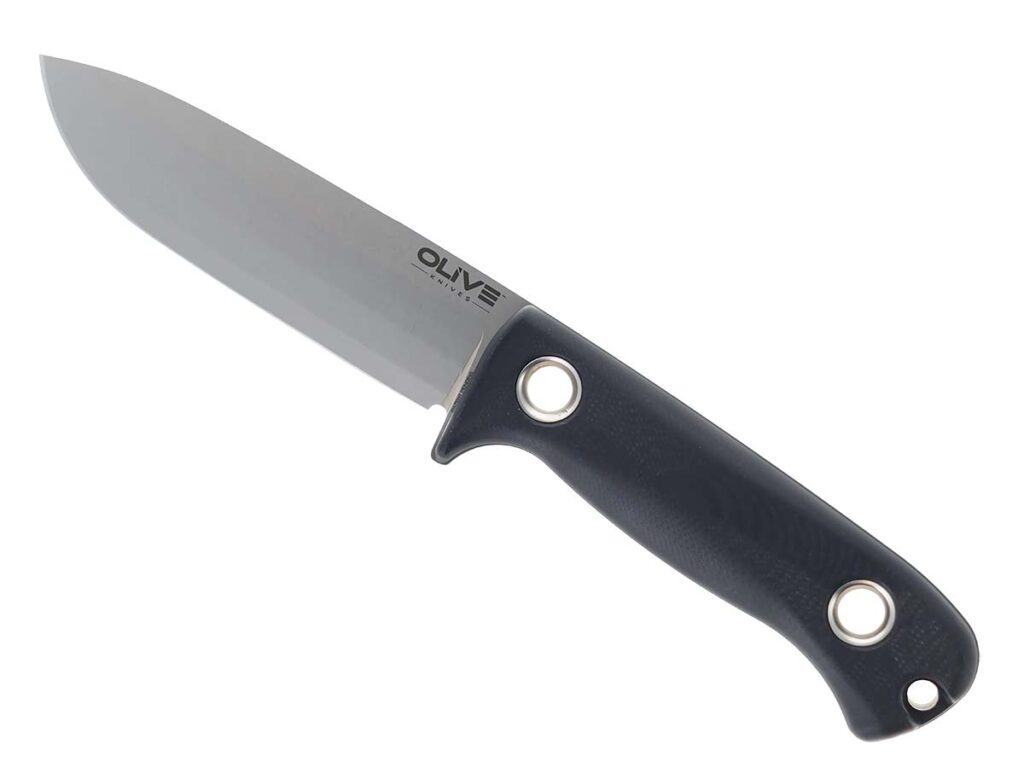
Olive Knives Arbor
Knife Type: Fixed-Blade Blade Length: 4.54” Blade Steel: Elmax Blade Grind: Fibonacci (Proprietary) Blade Finish: Stonewash Blade Profile: Drop Point Handle Material: G10 Weight: 9.14 oz. Knife To Know: Proprietary stepped grind combines convex strength, with sharpening ease of a flat grind. MSRP: $400 oliveknives.com
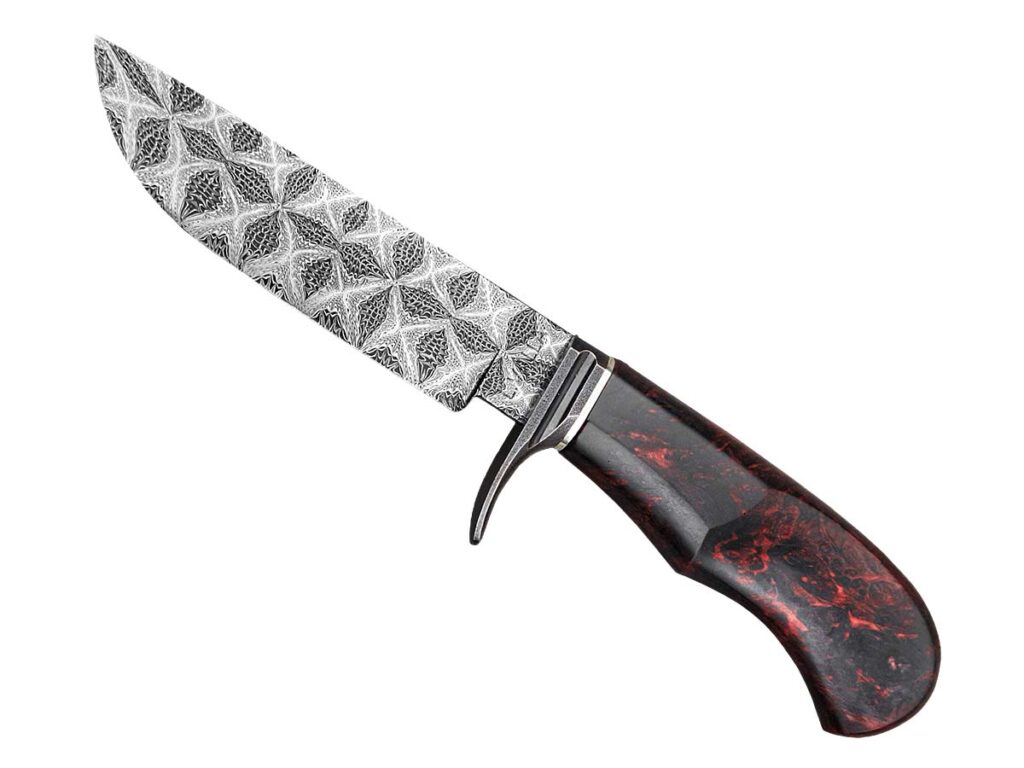
Liam Walle Anthazoa Hunter
Knife Type: Fixed Blade Blade Length: 7.75” Overall Length: 9.75” Blade Steel: 115n20/1084 Gorgon Flower Mosaic Blade Grind: Convex Handle Material: Honduran Rosewood Knife To Know: Bronze Bolster Maker’s Price For A Similar Knife: $2,300 liamvallaknives.com. Jocelyn Frasier image
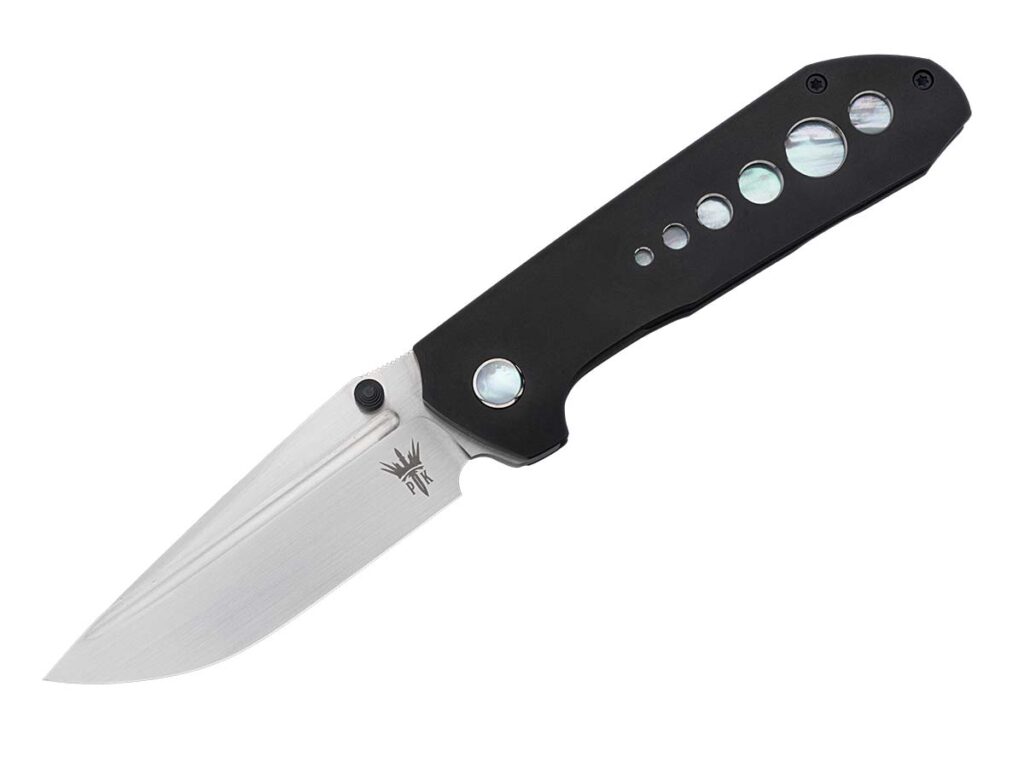
Blake Parthenay Saint
Knife Type: Folder Blade Length: 3.5” Overall Length: 8” Blade Steel: Elmax Blade Opener: Thumstud Handle/Frame Material: Blackened Titanium Knife To Know: Mother of pearl inlay in the handle, ceramic bearings Jocelyn Fraiser image
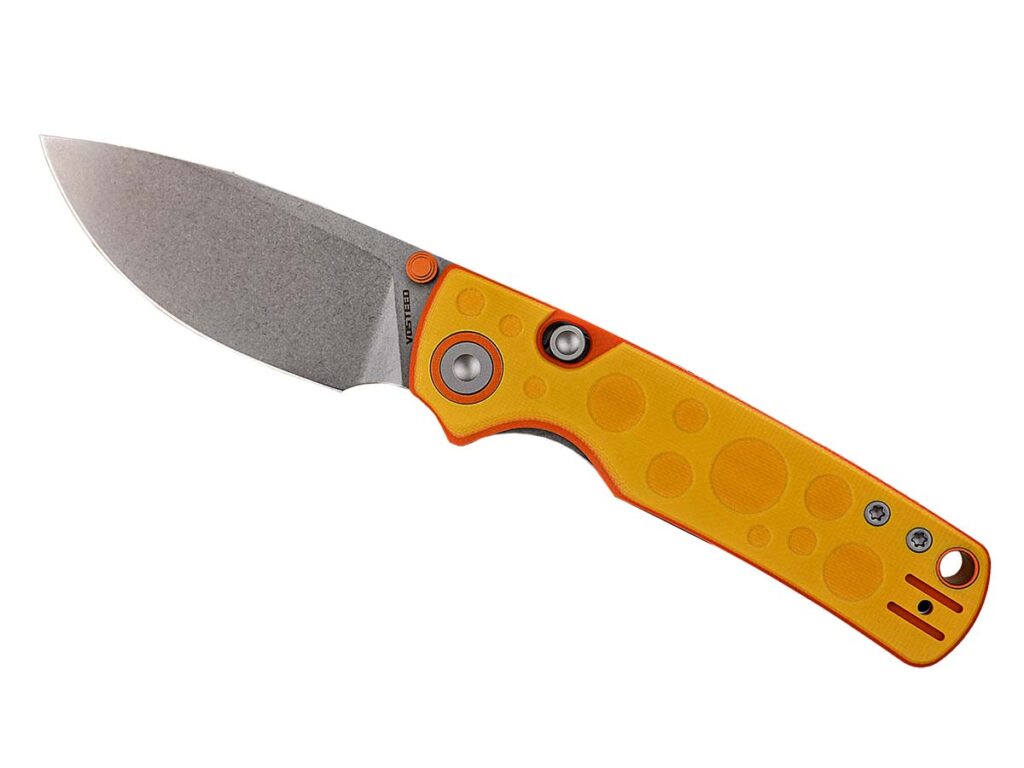
Knife Type: Folder Blade Length: 2.99” Overall Length: 7.16” Blade Steel: 14C28N Blade Profile: Drop Point Blade Opener: Thumbstud Handle Material: G10 Lock: Top Liner Lock Pocket Clip: Tip Up Weight: 3.55 oz. Special Features: Custom cheese-inspired handle. Knife To Know: Vosteed and Blade HQ plan to make a company-funded contribution to support animal rescue efforts All Paws Count from sales. MSRP: $69 vosteed.com
Mike Tyre OTS Automatic
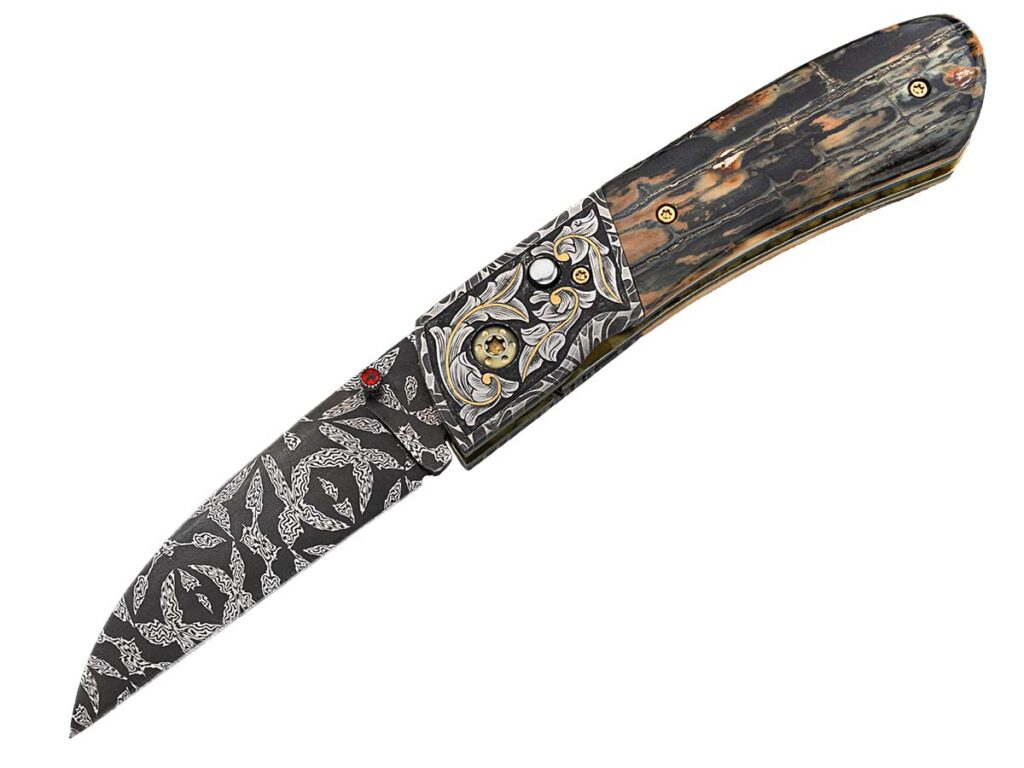
Blade Length: 3.5” Overall Length: 7.25” Blade Steel: 01/L6 damascus Blade Grind: Flat Convex Blade Opener: Button Handle Material: Mammoth Ivory Liners: Ice Finished Gold Anodized Titanium Knife To Know: Bolster engraved by Joe Mason Maker’s Price For A Similar Knife: $4,500 miketyrecustomknives.com. Jocelyn Frasier image
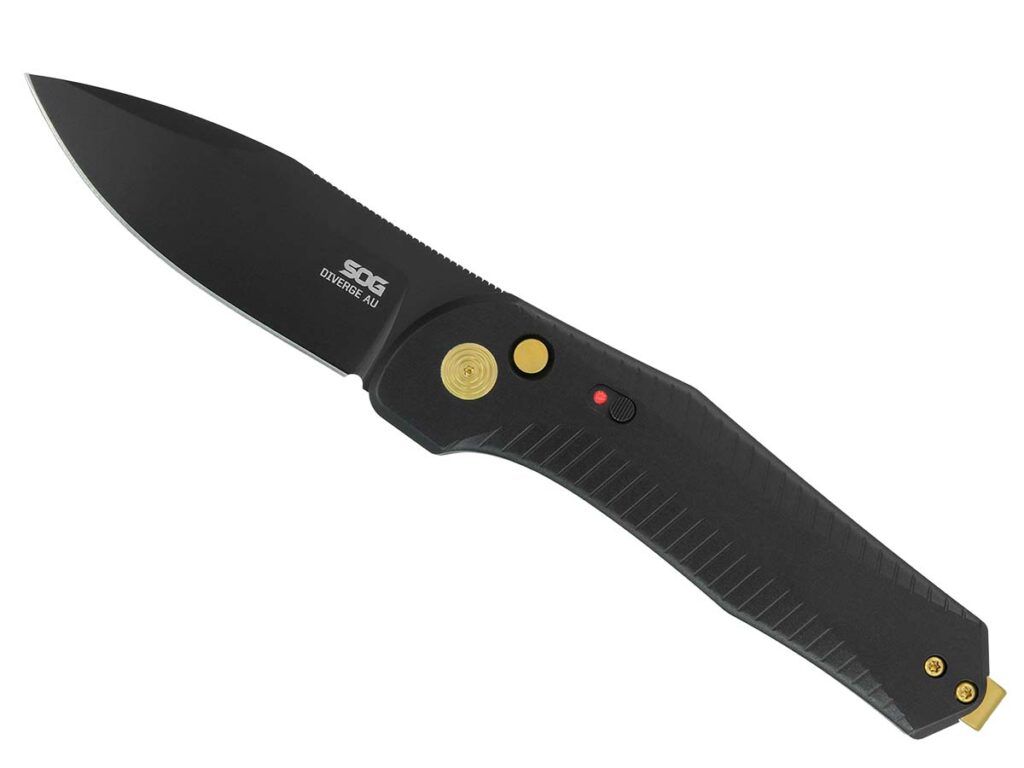
Knife Type: OTS Automatic Blade Length: 3” Overall Length: 7.3” Blade Steel: D2 Blade Profile: Drop Point Handle Material: Aircraft-Grade Aluminum Pocket Clip: Reversible Clip Weight: 3 oz. Knife To Know: Ambidextrous pocket clip and deployment lock. MSRP: $90 sogknives.com
Alex Hossom Collab With Charlie Bridges Void
Knife Type: Folder Blade Length: 3.75” Overall Length: 9” Blade Steel: 1084/1095/80crv2/Procut/15n20 Blade Grind: Symmetrical Hollow Blade Opener: Flipper Handle Material: McLaren Carbon Fiber Liners: Titanium Knife To Know: Titanium inlays in blade and pivot screws Maker’s Price For A Similar Knife: $3,000 brokenanvilknifeworks.com. Jocelyn Frasier image
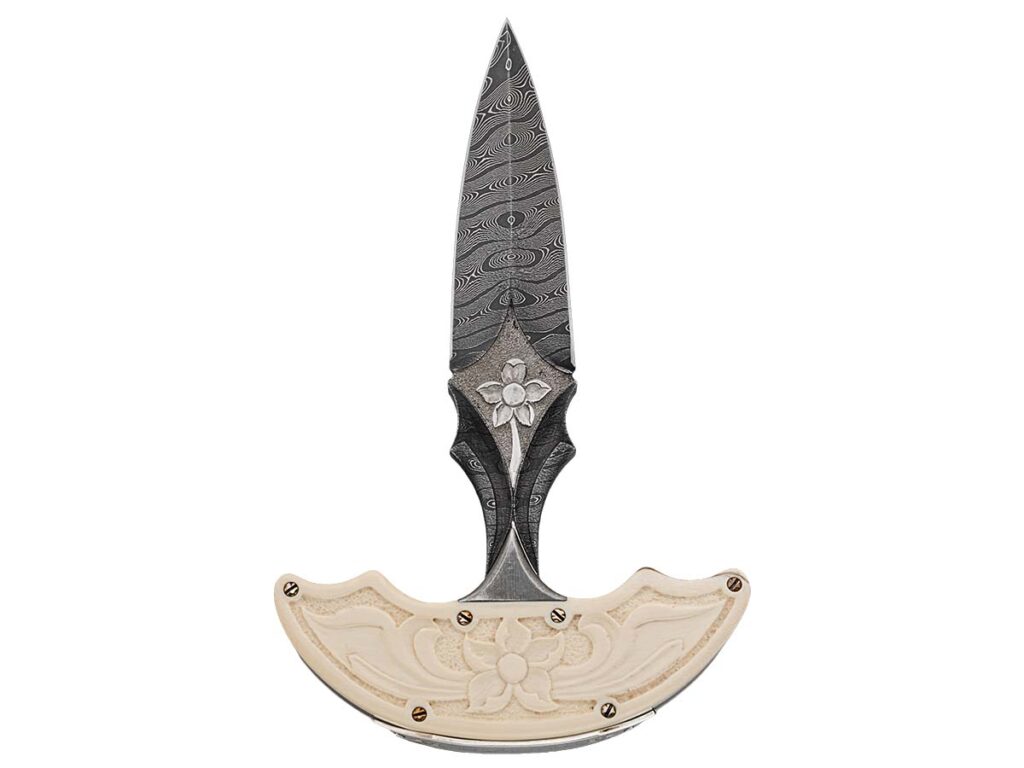
Frank Edwards Push Dagger
Blade Length: 3.25” Overall Length: 6.5” Blade Steel: 1084/15n20 twist Blade Grind: Dagger Handle Material: Mammoth Ivory Special Features: Carved flower on the interior of handle, matched with an engraved flower on blade. Maker’s Price For A Similar Knife: $2,550 Jocelyn Frasier image
When it comes to wood cutting, the Flexcut Whittlin’ Jack takes no prisoners.
The Whittlin’ Jack by Flexcut Carving Tools is the knife I wish I had when I was growing up. It would have made my outdoor life so much easier, not to mention much less painful. Granted, the blade edges are very fine and made for wood, so they tend to chip if you cut hard stuff.
Growing up a commercial fisherman on the Great Lakes, I was always cutting twine. The Whittlin’ Jack’s sharp blades would have saved me plenty of time resharpening and in doing such outdoor chores as marking sticks on a trapline. However, the best things about the knife are the sharpness of the edges during whittling, including for super fine cuts, and a very comfortable handle shape. The backspring holds the blade open tightly enough to stop accidental foldup while cutting, yet slowly closes the blade.
Flexcut Whittlin’ Jack Edge Test
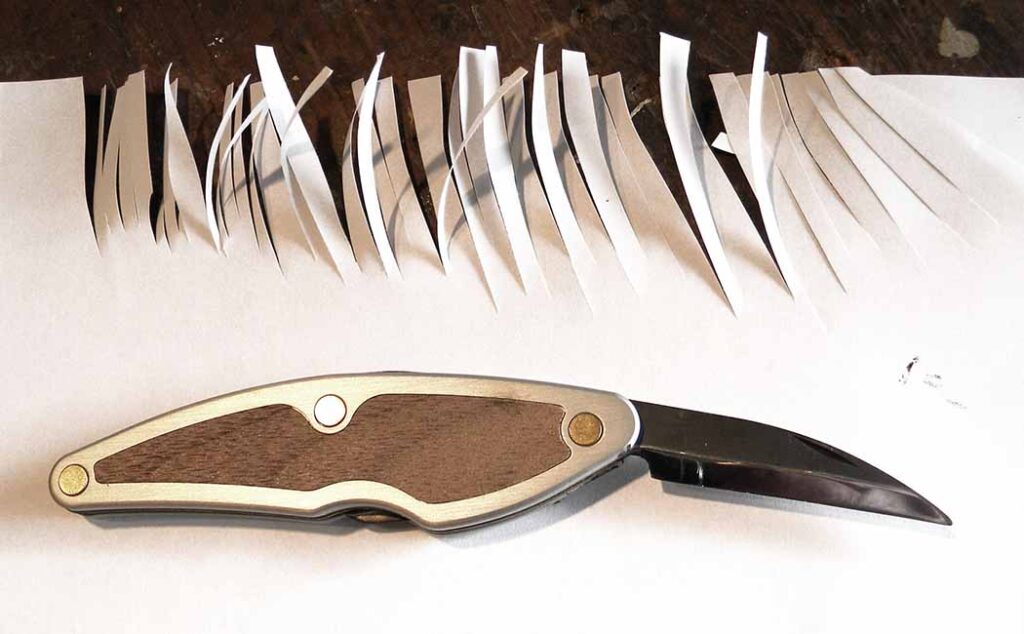
For the first edge-check medium, the author used his standard 20-pound bond copy paper. Both the roughing and detail blades zipped through the stationery way too fast. He just used the weight of the blade and pushed down.
For the first edge-check medium I used my standard 20-pound bond copy paper. Both the roughing and detail blades zipped through the stationery way too fast. I just used the weight of the blade and pushed down. I’m glad I had fingernails! Now I have four nicks in one. The knife was scary sharp from the get-go.
Whittlin’ Jack Vs Light-Duty Material
Next up was single-walled cardboard. The Whittlin’ Jack did not slow down one bit, though I did learn to move my finger faster. I could feel the blades cutting through the pockets in the cardboard. I made the longer cuts with the roughing blade.
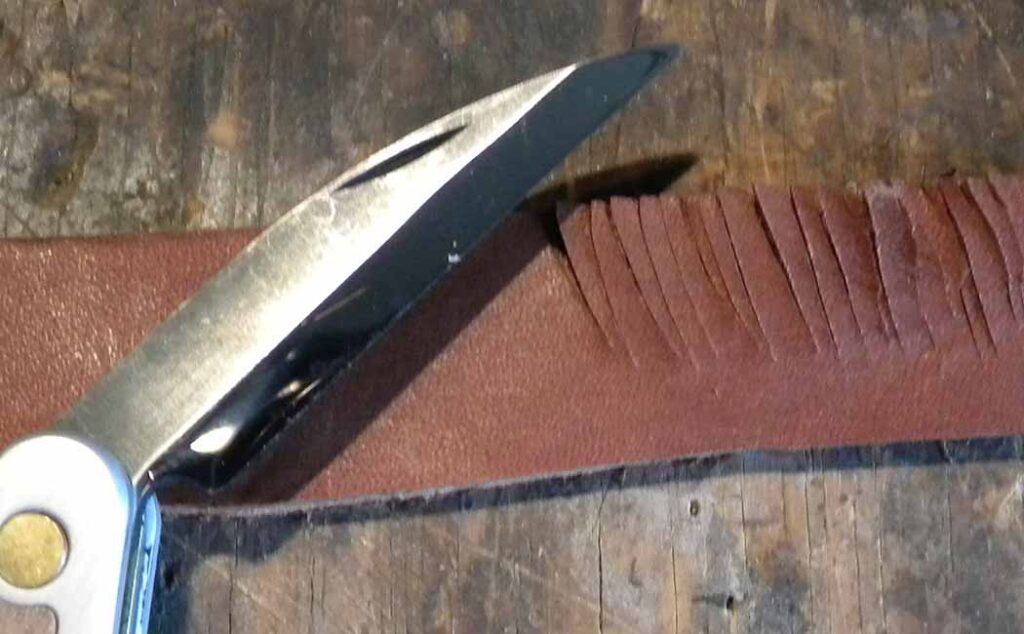
I made some straight cuts in 8-ounce leather to see how thin I could get the slices without the leather folding over. These blades are so scary sharp that I really had to watch how much pressure I was using so I didn’t cut the leather in half. Both blades were very controllable.
Cutting the end of the leftover leather at an angle, I did some skiving. I could hear a very aggressive crunching sound as the Whittlin’ Jack bit into the material. The slices were so thin I could actually see the polished bevel cutting through. Very sharp indeed!
Whittlin’ Jack Whittling
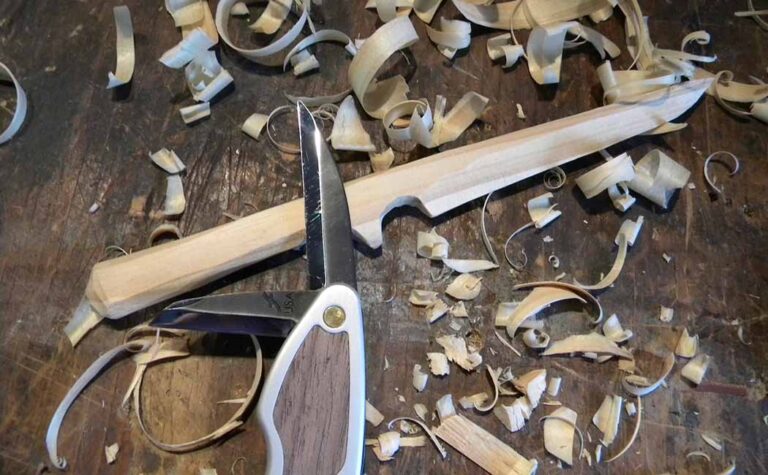
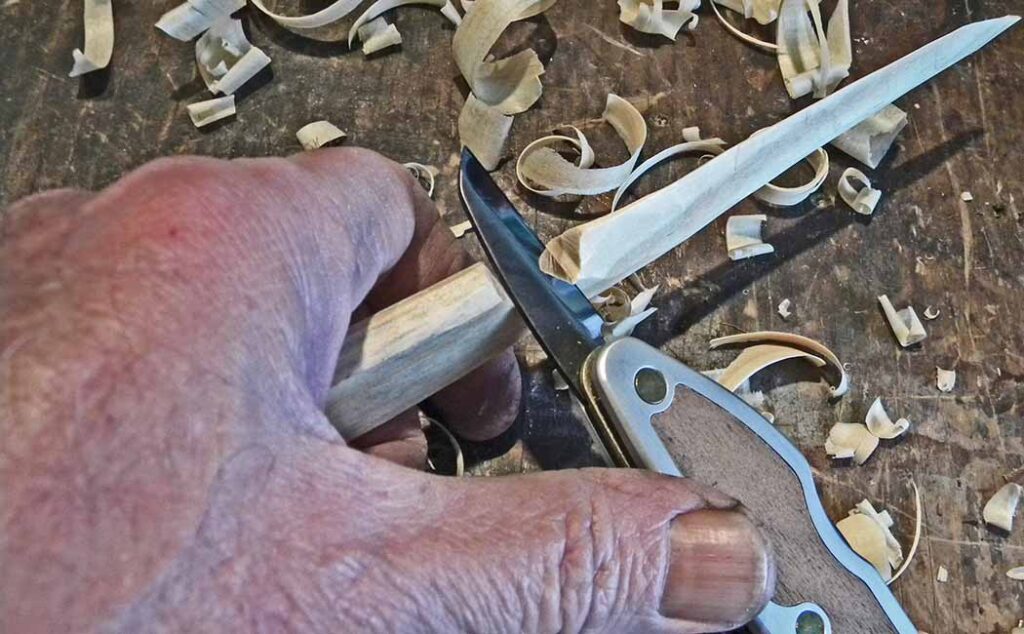
The curls were curlin’ as the author whittled a wooden tanto with the Whittlin’ Jack. Here he cuts the tanto’s choil with the detail blade.
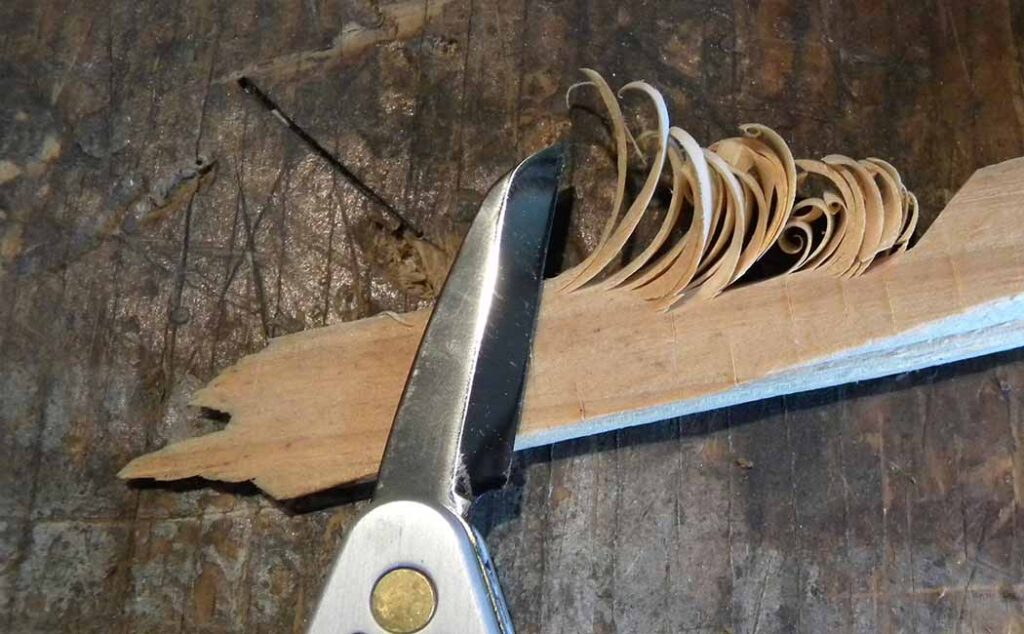
The Whittlin’ Jack is the first knife to ever give me curly curly-cues. It was amazingly simple and easy to do. Fine cuts or deeper cuts, it didn’t matter. The whittling was so smooth the blades just slid through the wood. I liked the detail blade better for making curly curly-cues. The handle shape really excels as it fills your palm, making the blades an extension of your hand. This is an outstanding design to say the least.
For some extra whittling fun, I carved a thin tanto-style knife in less than 5 minutes. The roughing blade did its job very quickly, thinning the wood and getting the overall shape. The detail blade made short work of cutting in the bevels and choil. It was amazing how smooth every cut was. Controlling the blades was easy with the handle design. The Whittlin’ Jack is the perfect knife for the job.
Whittlin’ Jack Vs Sisal Rope
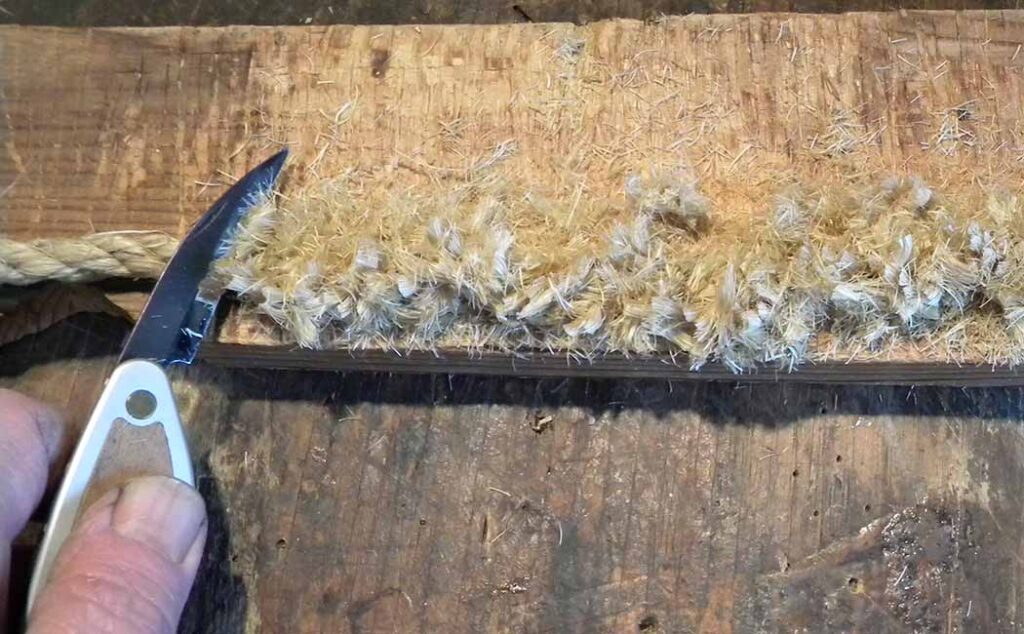
The knife crunched to 150 cuts in half-inch sisal rope in record time without any sliding. According to the author, it is the best overall Spec Sheet sisal rope cutter to date—that includes for both edge sharpness and handle comfort.
I used the roughing blade so my knuckles would clear the workbench. The knife crunched to 150 cuts in record time without any sliding. Since it would be a waste of sisal rope, I stopped cutting. The blade was still nasty sharp. This is the best overall Spec Sheet sisal rope cutter to date—that includes for both edge sharpness and handle comfort. Wow!
Recomendations
I might put a finer finish on the walnut handle inserts.
Bottom Line
The author indicated the Whittlin’ Jack was the first knife to ever give him curly-cues that were actually curly. He preferred the smaller detail blade for the purpose.
The Whittlin’ Jack really impressed me in both sharpness and handle comfort. I’ll place it in the top 1 percent of knives I’ve tested. I will be carrying one.
Flexcut Carving Tools warrants its knives against defects as long as the knife is not abused. Remember, this knife is made for wood use only and the blades do not lock in place.
Flexcut Carving Tools Whittlin’ Jack Specs Blade Patterns: Roughing and detail Blade Lengths: Roughing 2” and detail 1.5” Blade Material: In-house tool steel Blade Grinds: Flat Handle: Aluminum frame, walnut insert Non-Lock Mechanism: Slip joint Weight: 3 ozs. Closed Length: 4.125” Country Of Origin: USA MSRP: $63.95 Flexcut Tools
Fantastic custom and factory fixed blades just hitting the market.
There’s just something about a solid fixed blade knife. At once, these knives are simple yet elegant—especially when crafted by a master. We’ve scoured the globe—or at least three continents—to bring you a dozen excellent fixed specimens. They range from fillet knives to fighters and everything in between, and each is certain to induce the expansion of wish lists.
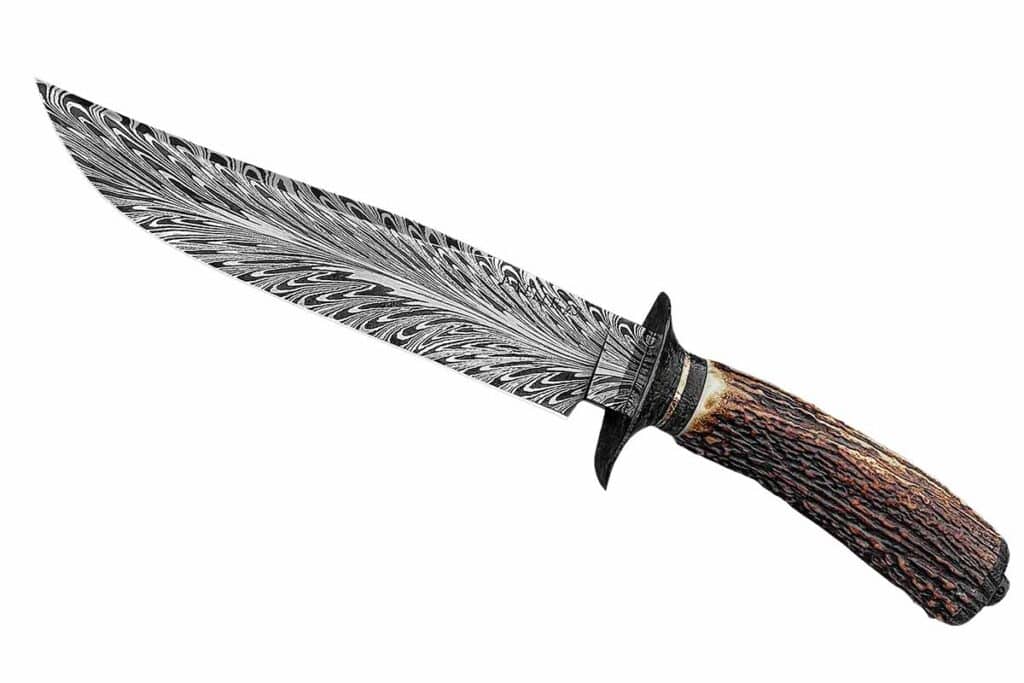
Jeremy Yelle Fighter
Blade length: 7.5” Blade material: Feather damascus forged of 1084 carbon and 15N20 nickel alloy steels Blade grind: Convex w/an unsharpened clip Handle material: Stag Furniture: Blackened 416 stainless steel Knife to know: Jeremy Yelle is a journeyman smith in the American Bladesmith Society Maker’s price for a similar knife: $1,700 Maker:Jeremy Yelle (Jocelyn Frasier image)
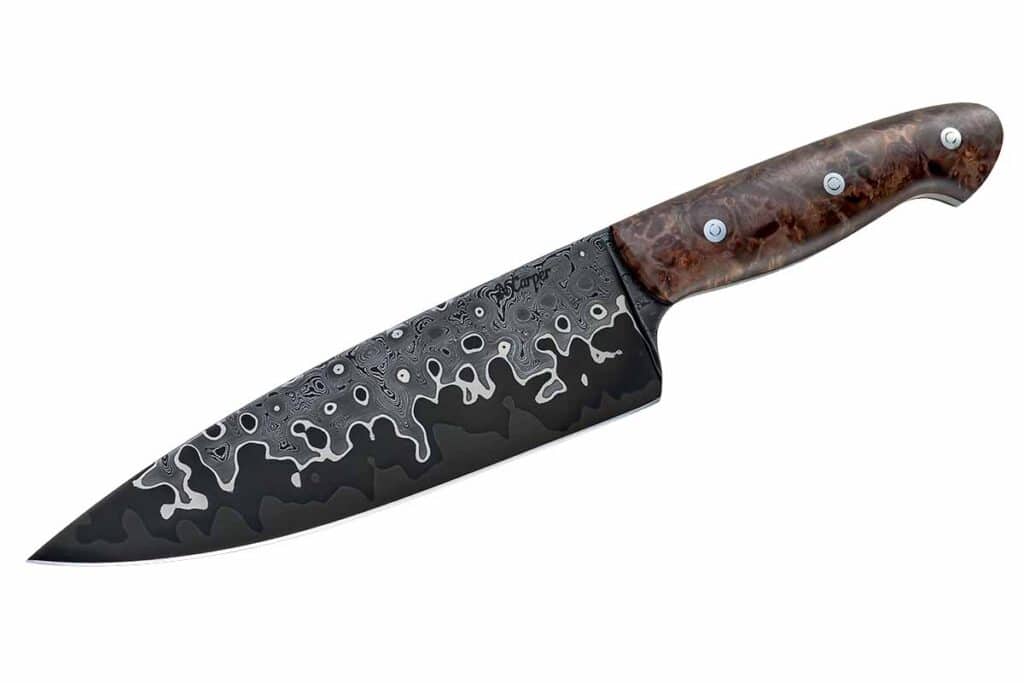
Nate Carper Custom Knives Acid Rain
Blade length: 7.25” Blade material: “I call this my Acid Rain pattern. I made a seven-layered billet using an 80CrV2 carbon steel core, 1084 carbon steel for the next two layers, nickel shim for two layers and followed up with 300 layers of a Raindrop pattern on the outside.” Blade grind: Full flat w/a tapered tang and distal taper Handle material: Dyed and stabilized maple secured w/Loveless bolts Overall length: 12” Maker’s price for a similar knife: Contact Nate Carper for more information Maker: Nate Carper Custom Knives (SharpByCoop image)
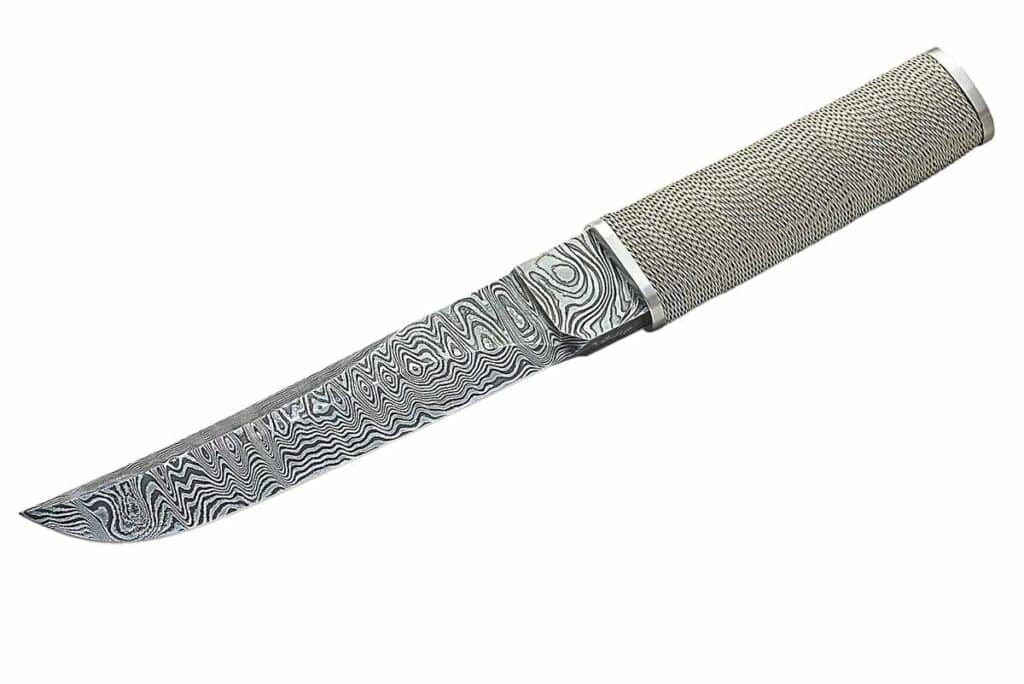
Tom Haslinger Damascus Kissaki-Moroha Tanto
Blade length: 6.7” Blade material: HCK damascus forged in 320 layers of 1080 carbon and 15N20 nickel alloy steels Rockwell hardness: 58 HRC Handle: Stainless steel wire wrap Tsuba (guard) material: Stainless steel Kashira (buttcap) material: Textured stainless steel Overall length: 12.65” Weight: 13 ozs. Saya (sheath): Lined cowhide w/koi leather overlay Maker’s price for a similar knife and sheath: $1,490 Maker:Tom Haslinger
Michael West Silver Lining
Knife type: Fixed blade Blade length: 3.93” Blade material: Damasteel twist damascus Blade grind: Freehand hollow Furniture: Argentium silver Handle material: Ebony and argentium silver Overall length: 9.6” Sheath materials: Leather and argentium silver Maker’s price for a similar knife: $3,100 Maker:Michael West (SharpByCoop image)
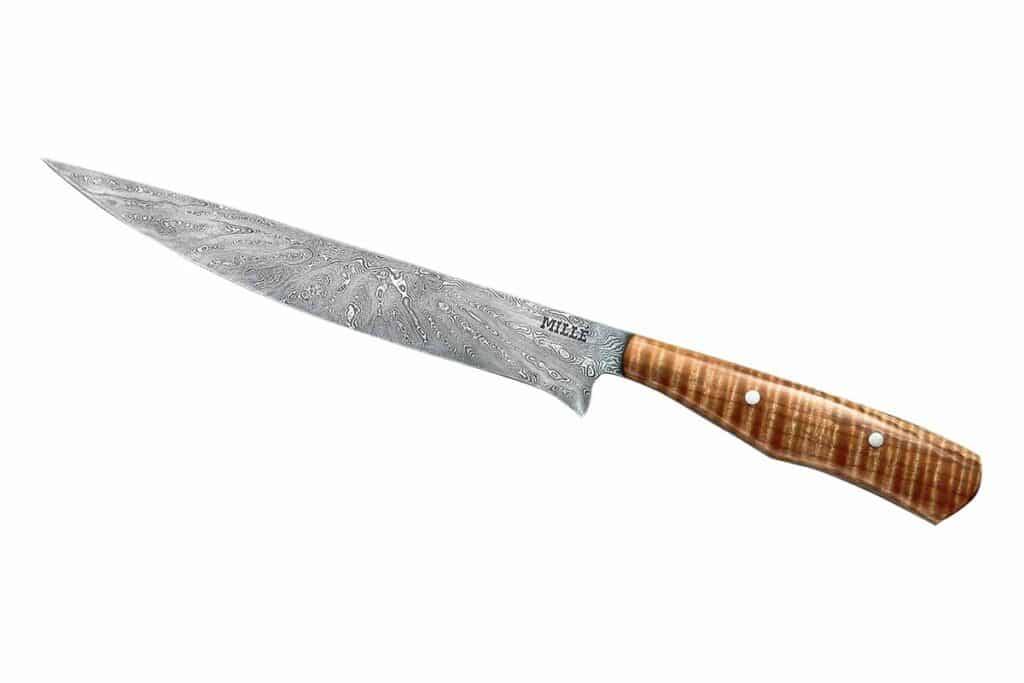
Mille Blades Fillet Knife
Blade length: 8” Blade material: Damascus forged of 1084 carbon and 15N20 nickel alloy steels Handle material: Stabilized tiger maple Overall length: 13” Maker’s price for a similar knife: Contact Adam Mille for more information Knife to know: Adam Mille is an apprentice smith in the American Bladesmith Society Maker: Mille Blades (SharpByCoop image)
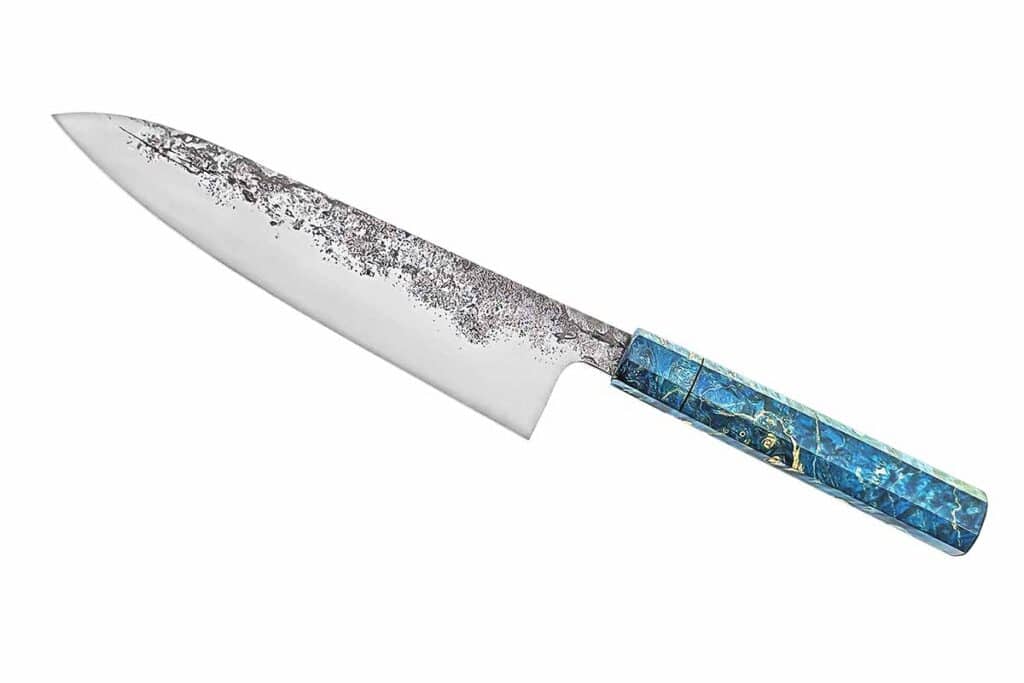
Andrew Bonavia Gyuto
Blade length: 8.5” Blade material: Forged 1084 carbon steel Blade grind: Full flat Blade @ widest: 2” Handle material: Dyed spalted maple Overall length: 14” Maker’s price for a similar knife: $531 at press-time exchange rate Knife to know: Andrew Bonavia is a member of the Australian Knifemakers Guild Maker: Andrew Bonavia (Rod Hoare image)
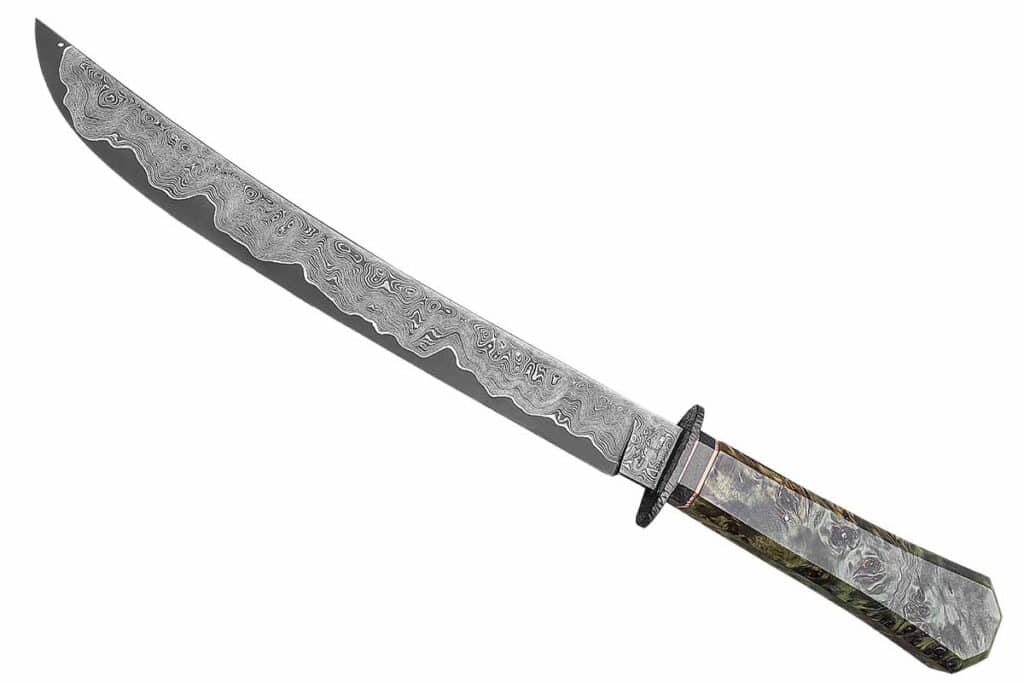
Brad Millman O-Tanto
Blade length: 11.75” Blade material: 120-layer 1095 carbon and 15N20 nickel alloy steels w/nickel cladding and an 80CrV2 carbon steel core Blade grind: Flat to convex near the edge Handle: Raffir poplar burl Bolster: Forged-finished stainless and copper Overall length: 16.25” Maker’s price for a similar knife: $1,200 Maker: Brad Millman (Jocelyn Frasier image)
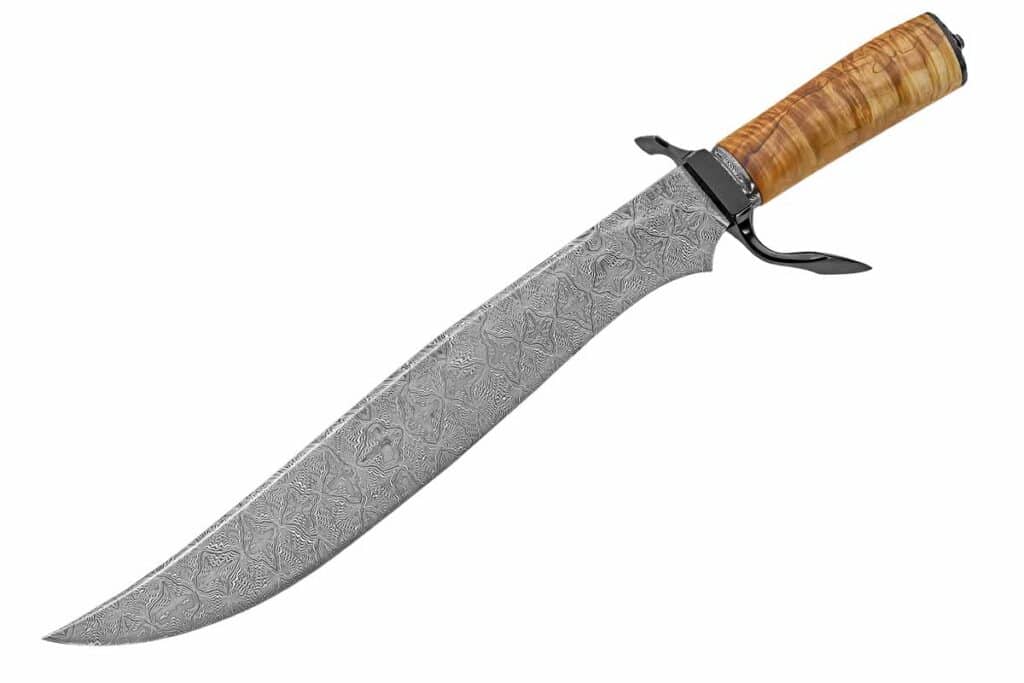
Blacks Blades Mosaic Damascus Bowie
Blade length: 13.5” Blade material: Mosaic damascus Blade grind: Flat Blade thickness @ ricasso: .236” Handle material: Tassie blackwood Furniture: Hot blued mild steel Overall length: 19.5” Maker’s price for a similar knife and sheath: Contact Shane Partridge for more information Maker: Blacks Blades (Rod Hoare image)
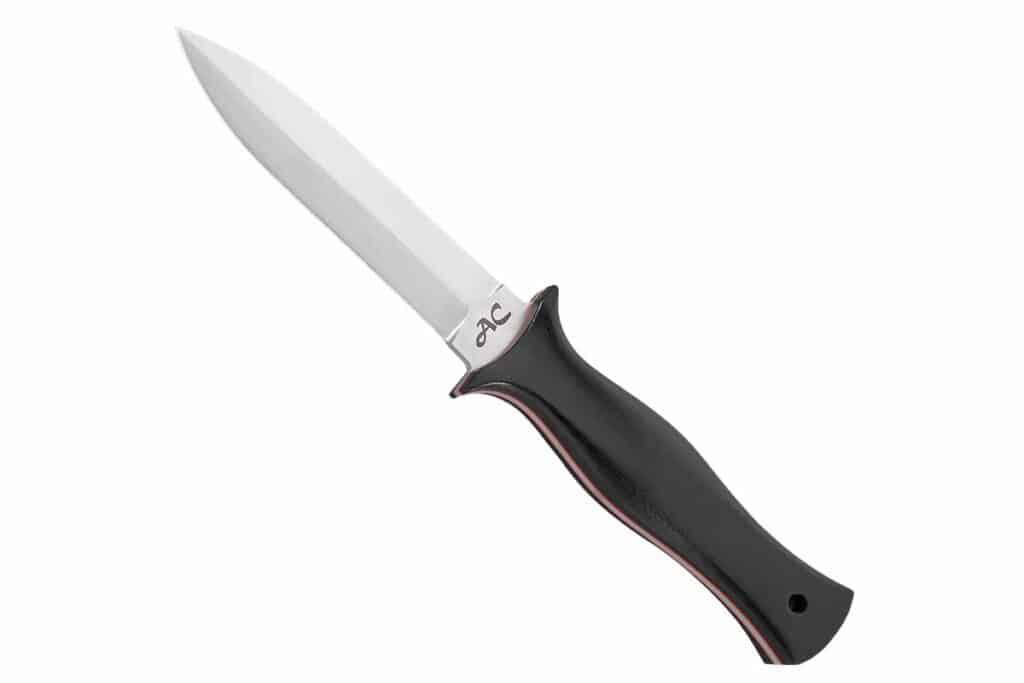
Aimee’s Forge Boot Dagger
Blade length: 4” Blade steel: Nitro-V stainless Blade grind: Flat Construction: Full tang Handle material: Black and red G-10 Handle pins: Black G-10 Overall length: 8.75” Sheath: Leather w/belt clip Maker’s price for a similar knife: $431 at press-time exchange rate Knife to know: Aimee Conte is a member of the Australian Knifemakers Guild and an apprentice smith in the American Bladesmith Society Maker:Aimee’s Forge (Rod Hoare image)
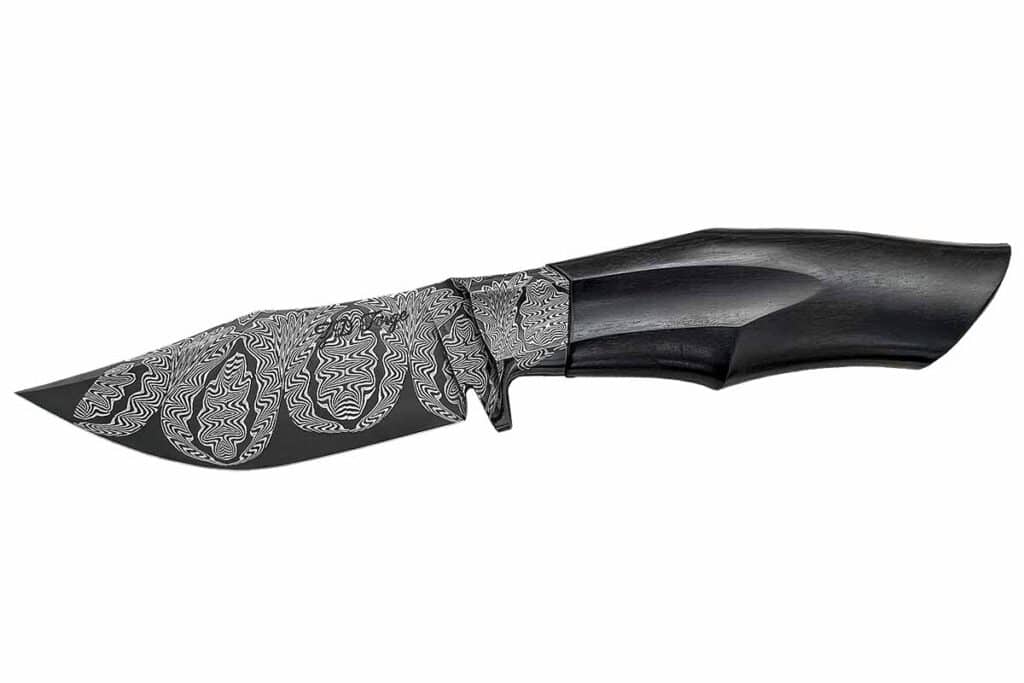
Zane Dvorak Integral Hunter
Blade length: 4.25” Blade material: Black Edge mosaic damascus forged from 1084 carbon and 15N20 nickel-alloy steels Blade grind: Flat to convex Blade pattern: Clip point Handle material: African blackwood Overall length: 9.25” Sharp stuff: Forged integral single guard; carved handle groove matches the one in the bolster Maker’s price for a similar knife: $1,400 Maker:Zane Dvorak (Jocelyn Frasier image)
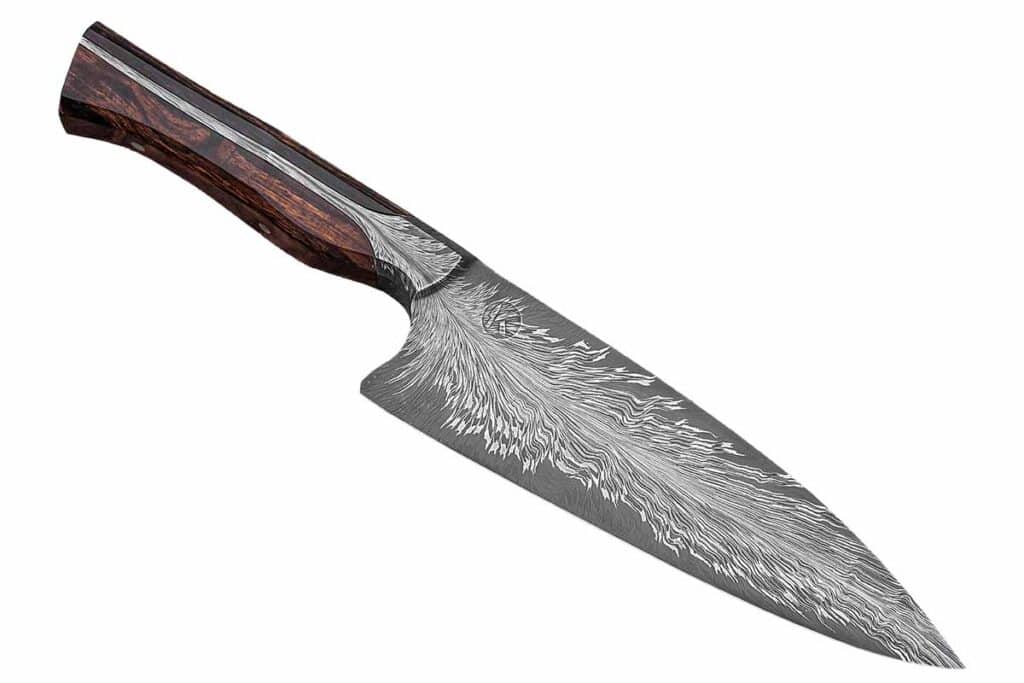
Jeroen Knippenberg Integral Chef’s Knife
Blade length: 6.7” Blade material: A multi-color Feather damascus pattern forged from 15N20 nickel alloy and O2, O1 and 115W2 tool steels Blade grind: Convex Handle material: Desert ironwood Overall length: 11” Knife to know: Jeroen Knippenberg’s Integral chef’s knife won Best Chef’s Knife at the Dutch Knife Exhibition Maker’s price for a similar knife: $1,600-$2,140 at press-time exchange rate Maker:Jeroen Knippenberg (Jocelyn Frasier image)
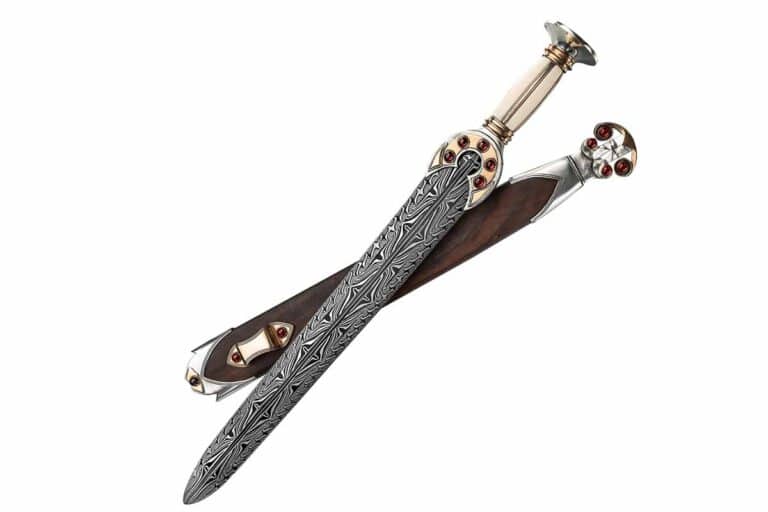
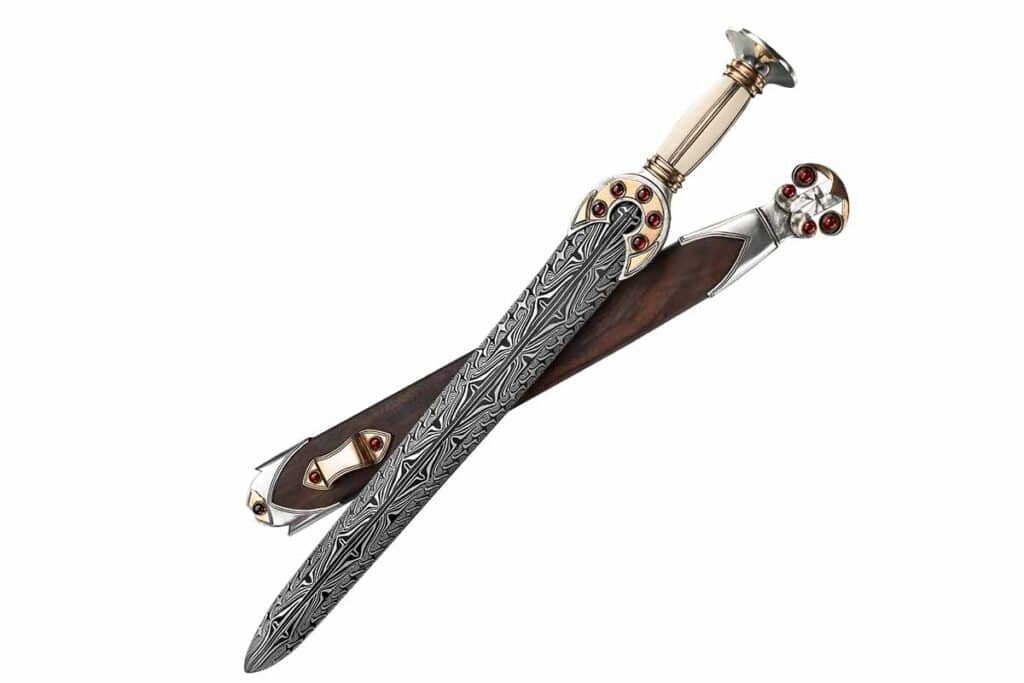
Dragon’s Breath Forge Period Piece
Blade length: 18” Blade material: 1080 carbon and 15N20 nickel alloy steels Handle material: Bronze and Elforen Bolster: Silver, bronze and garnet Overall length: 24” Maker’s price for a similar knife and scabbard: Contact Jamie Lundell for more information Maker:Dragon’s Breath Forge (SharpByCoop image)
Be it chopping wood or prepping a meal, a solid bushcraft knife is an essential piece of backwoods kit.
Bushcraft is a specialized skill set that ensures survival in the wilderness using foraging, hunting, fishing, shelter construction, and firecraft, all accomplished with minimal tools. The primary bushcraft implement is a fixed blade employed not only for food prep but the other mentioned skills, too.
As a result, such a fixed blade must be a tough tool capable of more than just standard cutting tasks, including whittling, carving, splitting wood or, in conjunction with a ferrocerium rod, starting a campfire.
What Defines A Bushcraft Knife?
Five basic chores of outdoor survival can be performed with a bushcraft knife. The tasks are elemental and a must-learn if you want to use a bushcraft knife to maximum effect.
Chopping
Batoning
Carving
Fire Starting
Food Prep
Chopping
Whereas a small hatchet, ax, or even a machete are better suited for the task, a bushcraft knife can turn the trick. Grip the handle as far back and as securely as you can, and chop as you would with a larger knife, ax, hatchet or machete.
Batoning
Basically, to baton a piece of kindling is to split it. Take a rather large/thick piece of wood to act as a baton/hammer in one hand, lay the blade edge on the end of the secured piece of kindling with the other, and, using firm, deliberate blows, pound the blade lengthwise through the kindling, effectively splitting it.
Again, an ax, hatchet or even a folding saw would be better, but if you lack any of these, your bushcraft knife is capable of handling such a task.
Carving
One of the most important bushcraft skills is to carve bowls, spoons, or even whittling sticks to roast hot dogs. Chopping and batoning are tasks using brute force; carving is more finesse and control.
This can be accomplished by using the knife and a ferrocerium (aka ferro) rod. The job is best done by using a knife that has a blade with a 90-degree spine as opposed to a chamfered or radiused one.
Grasp the knife firmly, cutting edge up. Lay the corner of the blade spine on the ferro rod and with one swift, downward motion, as if you are whittling o a piece of the rod, move the blade down it. Doing so will result in a white hot shower of sparks. The sparks can ignite tinder to start a fire.
The key to fire starting is always select a bushcraft knife with a 90-degree spine. If it lacks such a spine, you can always use the edge but this will dull the one spot on the edge faster than standard cutting will.
Food Prep
And, obviously, a bushcraft blade can also adeptly handle any cutting task related to food or campsite prep. Bushcraft knives prove a knife need not have sheer size and weight to be effective. It’s all in smart design of the blade and handle.
Our Picks For Best Bushcraft Knife
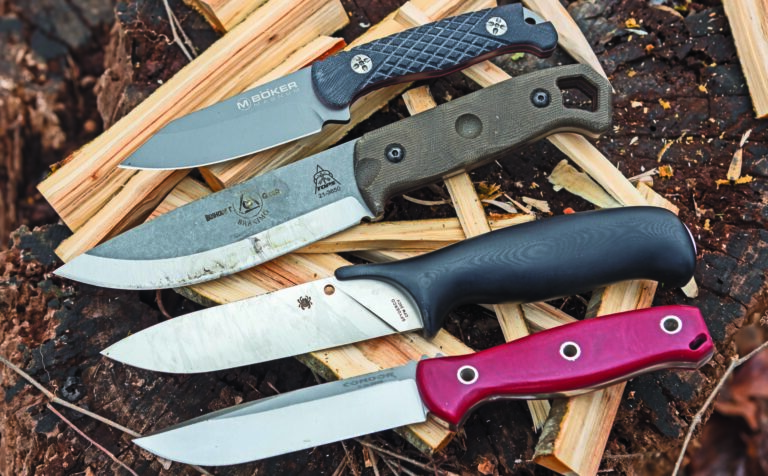
Boker Magnum Life Knife
Boker Magnum Life Knife
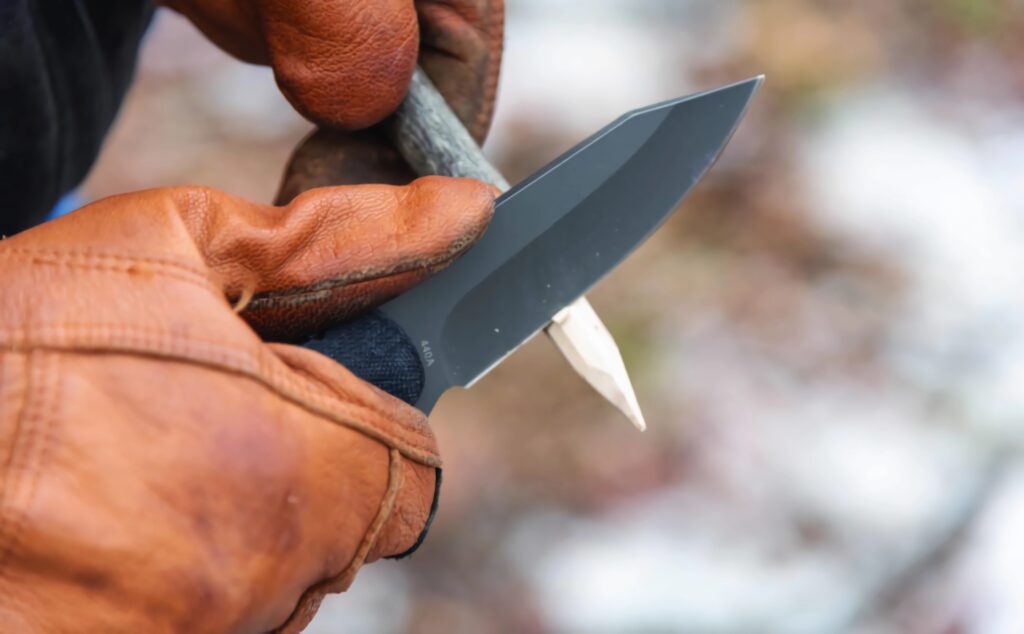
The most affordable bushcraft model of the test bunch, the Boker Magnum Life Knife has a 3.9-inch blade of 440A stainless steel in a modified clip-point pattern. Built rugged for the outdoors, the knife comes with a sturdy Kydex sheath for safe carry.
At 7.87 inches overall, the Life Knife sports a handle of machined black G-10 in a coarse crosshatched checkering pattern for enhanced hand traction regardless of conditions. The grooves in the crosshatching work are similar to those of a radial car tire by displacing moisture. Red fiber liners under the G-10 add a nice pop of color to an otherwise dark knife.
The handle includes integral forward and rear guards to prevent your hand from sliding in either direction. The three large traction notches in the thumb rest area of the blade spine also help improve grip. The handle felt a bit skinny in my hand, so I would prefer a slightly wider one.
Conversely, the Life Knife might be a great choice for those with smaller paws. The 3.9-inch blade is a great size for belt carry. The rather compact nature allows it to carry comfortably, with the length neither too long nor too short. The short blade tip accomplishes precise cutting chores easily.
The sheath is a simple fold-over design of Kydex with a Boker Plus clip for belt carry. The sheath features quality construction, retains the knife well, and is simple yet effective.
MSRP: $59.95
Condor Tool & Knife Bushcraft Bliss
Condor Tool & Knife Bushcraft Bliss
Composed of high-quality materials, the Bushcraft Bliss from Condor Tool & Knife boasts a 5-inch blade with a flat grind. The 1075 carbon steel can be rather easy to sharpen in the field and still retains an edge well. The modified clip point shape offers a generous belly for slicing and a defined point. A swedge gives the blade a bit of attitude, and bead-blasted flats and satin-finished bevels provide a two-tone finish that’s very eye-catching.
The ergonomic handle of red linen Micarta® is an excellent choice thanks to its being largely impervious to temperature and humidity changes. Three thong tubes fasten the scales to the full tang. Three large notches at the spine permit non-slip thumb placement so you can bear down on the blade. With its rounded edges, choil, and scale contouring, the handle felt as if it were molded to my hand.
The sheath is Condor’s hybrid molded Kydex and leather rig, an unusual material combo. The belt loop and securement strap are leather. The leather belt loop allows the sheath to move somewhat, unlike the more rigid molded clamshell fastener—which doesn’t—and makes it easier to sit down while wearing it. A thumb break molded into the top of the sheath assists in extracting the blade, which is a nice extra touch.
I found the handle to be very comfortable. A distinctive trait is the prominently elevated traction notches. They almost look like part of a gear. The feature ensures your thumb isn’t going anywhere.
The 5-inch blade makes baton work easy, as well as food prep tasks. Out of the box, the 1075 carbon steel was plenty sharp and ready for use. The Bushcraft Bliss is a consistent performer.
MSRP: $118
TOPS Knives Brakimo
TOPS Knives Brakimo
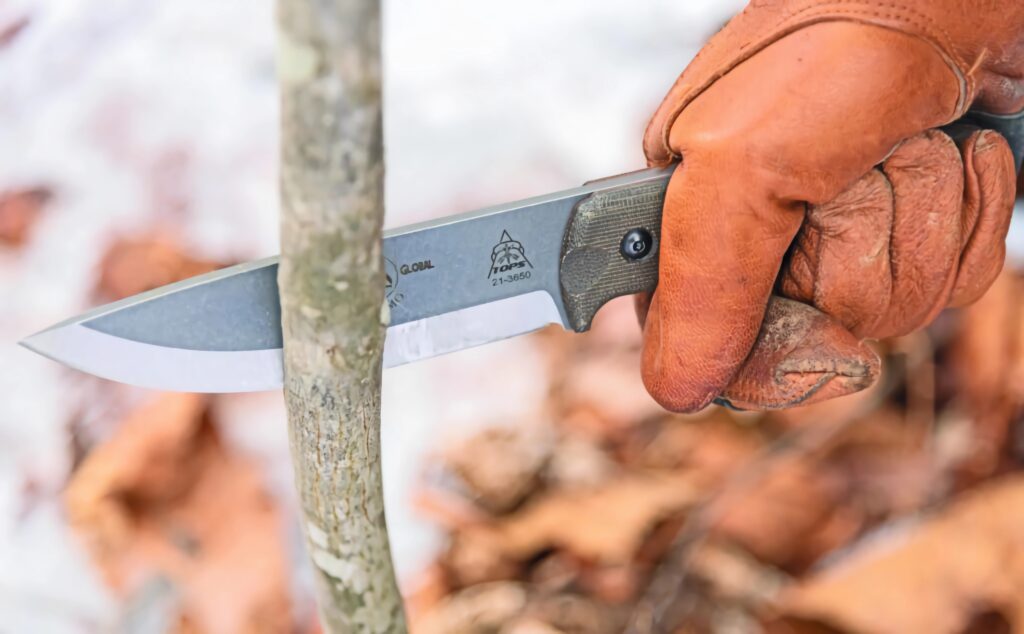
Joe Flowers runs Bushcraft Global, where he instructs students on basic and advanced survival skills while in the Amazon jungle. A notable authority in the field, he also designs knives, including the Brakimo from TOPS Knives, a tool that can carve, cut, split, and perform just about any task involving outdoor survival.
The 5.25-inch blade of 1095 carbon steel is a drop-point pattern with a Scandi grind. It has a generous belly for easy slicing and a defined point for delicate work.
The green Micarta handle is ideal for bushcraft given its stability and minimal weight. It is matte-finished for a nice grip quality without being overly aggressive. The integral front and rear guards provide a measure of safety that locks the knife in the hand. The divot in the handle is for use with a bow drill for making fire.
If there is a solid all-around performer of the test bunch, it’s the Brakimo. I like how it easily handles heavy work like chopping and baton work, as well as such lighter work as whittling and food prep. You can choke up on the handle for tasks requiring more control where a slicing or rocking motion is used. Grip the handle more toward the rear and feel how the balance point shifts to a blade-heavy profile for easy, effective chopping.
The Scandi grind acts as a wedge and splits the wood in a snap, almost as if no effort were invested—very impressive performance! For one knife that does it all, the Brakimo is it. In-hand it feels substantial and capable of taking on serious work.
MSRP: $225
Spyderco FB42G Zoomer
Spyderco FB42G Zoomer
Designed by Tony Zoomer, an outdoor enthusiast and survival skills instructor from the Netherlands comes the Spyderco FB42G Zoomer. Made of high-end materials, the knife is expertly configured and has a list of features that quite possibly makes it the most comfortable bushcraft knife you’ll use.
The 5-inch blade in a drop-point pattern is premium CPM 20CV stainless steel for enhanced edge retention. The blade has an ample belly for slicing and whittling/carving tasks and a defined point for close-up detail work. The full flat grind transitions to a convex edge, which is durable and extremely sharp.
The black G-10 scales are machined where they join the tang, so the handle is completely rounded in profile. This translates into a super comfortable grip that eliminates hot spots. An integrated rest at the blade spine permits placement of your thumb for additional pressure on cuts and for added control. The full tang extends a little beyond the end of the handle for use as a light-duty hammer.
The sheath is a custom-designed, well made leather drop-leg-style rig with a free-floating belt loop. It has an exterior storage pouch with a snap closure. The pouch can carry your choice of survival supplies, a large folding knife, a multi-tool, etc.
The free-floating belt loop allows the knife to swing freely as you move or pivot out of the way when you are seated. It also can temporarily break away in the event the sheath gets snagged by brush in the woods.
The Zoomer is a solid performer. The heavily contoured G-10 handle feels mighty good in the hand. The full flat grind allows the blade to sail through whatever you cut.
While the handle is comfortable, it felt big in my hand. Those with smaller hands might not take to it easily. While using high-performance CPM 20CV stainless steel is not typically a bushcraft thing, with some regular stropping and honing, you can prolong the edge and skip sharpening during your trip.
MSRP: $600
Fallkniven S1 Pro Forest Knife
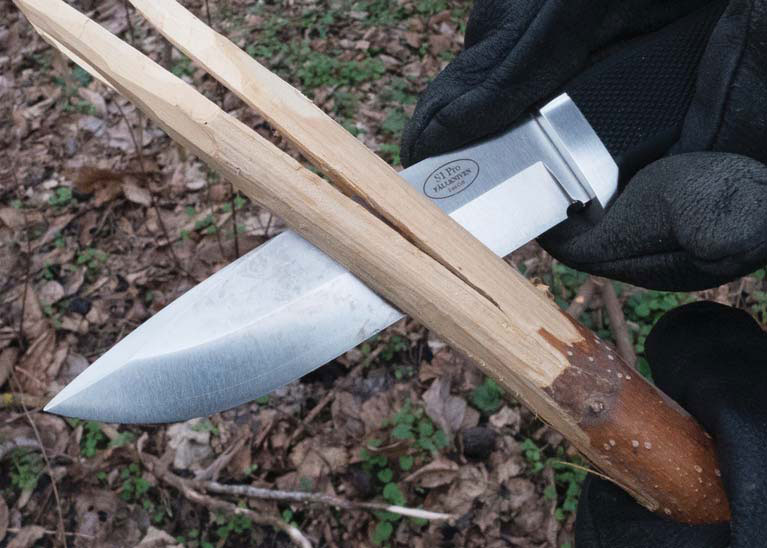
The Fallkniven S1 Pro Forest did fine work—as on this fish spear—with full control. (All images by Ash Ayres and Mary Lou Ayres)
Fallkniven’s S1 Pro Forest Knife is the evolutionary descendant of the company’s S1, which has been in production for over 20 years. The Pro version is made with better steel than the original S1, is more sophisticated and a better performer.
The S1 Pro simply does everything well and with no fuss. Its convex grind does not bind in deep cuts, goes through tough, knotty wood with little effort, peels bark, makes feather sticks, does fine work as on fish spear points with full control, and slices duck through skin, meat and bone like Luke Skywalker’s lightsaber. It cut through 2-inch-thick saplings in about a minute with little effort. The non-slip grip is comfortable and does not, in fact, slip.
Compact enough to always have on—or with a custom sheath, inside—your belt, the S1 Pro is as close as I’ve seen to the mythical “one knife to do it all.”
MSRP: $466
Ontario Bushcraft Woodsman
Bushcrafting chopping
The geometry of the Bushcraft Woodsman’s blade, combined with the overall design, good steel and heat treat, make for an exceptional big knife.
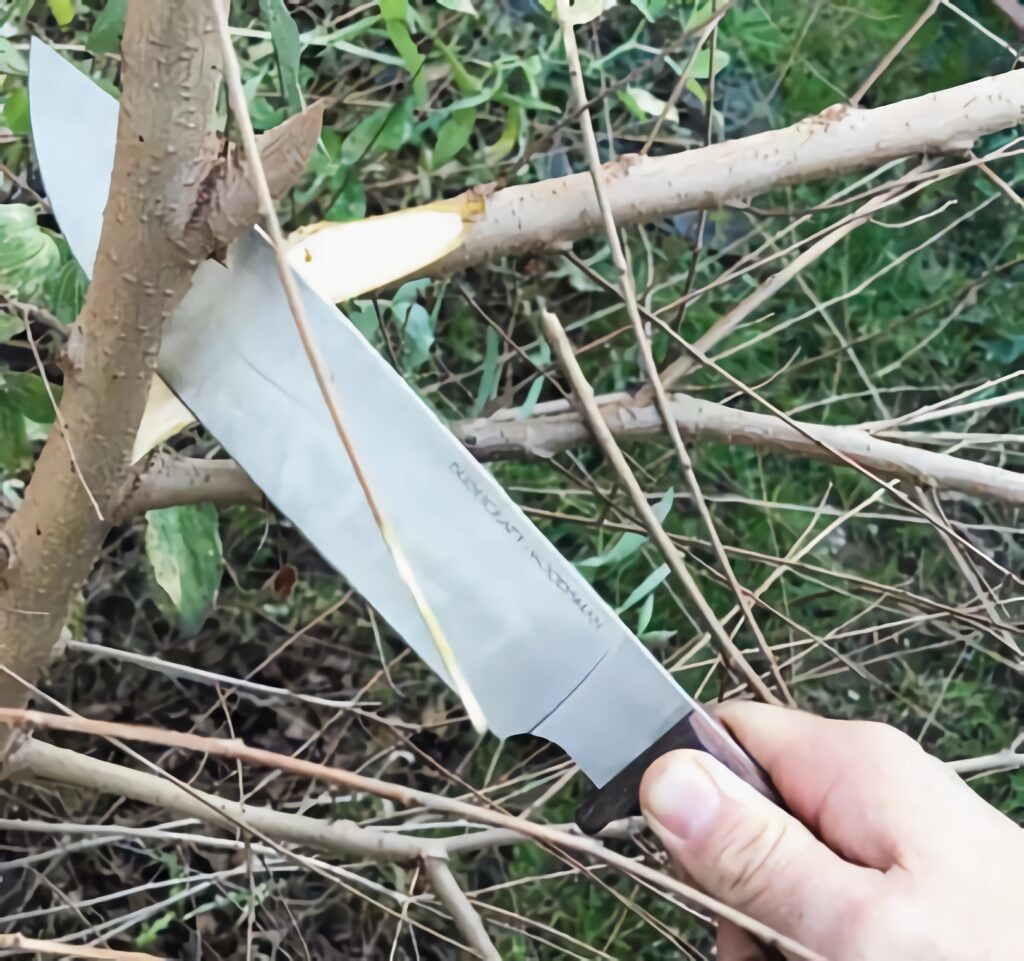
Veteran bladesmith Dan Maragni designed this issue’s cover knife, the Ontario Bushcraft Woodsman. The big blade shows his expertise and lineage as an accomplished smith, and is far more sophisticated than a first glance might suggest.
The distal taper gives it excellent balance, and, combined with the taper from spine to edge, great chopping ability.
We slashed through 2-inch-thick saplings with a single swipe, an important point in the calories-expended-vs.-results-achieved equation, and when night is falling and you need to get a fire going.
The blade’s geometry, combined with the overall design, good steel and heat treat, make for an exceptional big knife. Again referencing Tolkien, Ash called it the “Goblin Cleaver.”
Not as handy for fine work as the smaller knives, Dan’s design is a reassuring blade to have by your side in deep woods when the jackals are howling—or the Orcs.
MSRP: $137
Larry Roberts Signature Edition Gen6 Scandi (L.T. Wright Handcrafted Knife Co.)
Due to its scandi grind, which tends to hang up in deep cuts, an average of three minutes was required to get through 2-inch-thick saplings with the Gen6 Scandi.
The Larry Roberts Signature Edition Gen6 Scandi from L.T. Wright Handcrafted Knife Co. performs like a “Mora on steroids,” according to Ash. I agree.
If you’re familiar with the scandi grind, the only surprise with the LRSEG6S is that it takes scandi-ground blades to a higher level of performance. It excels at controlled shallow cuts, holds an edge well, and is strong enough that when batonning you can twist the blade with no worries and quickly pop the batonned material apart.
I like the longer 6-inch blade much better than the popular 4-inch pattern because you can get more stuff done faster and at no penalty to doing fine work. Due to the scandi grind, which tends to hang up in deep cuts, an average of three minutes was required to get through 2-inch-thick saplings.
Comfortable in the hand, it is also beautifully made and finished. A good all-around performer, it is a classic belt knife for the woods.
MSRP: $253
Editor’s Note: Dexter Ewing and James Ayres contributed to this post.
An American-made tactical EDC folder featuring a Sandvik 14C28N blade and lightweight aluminum handle.
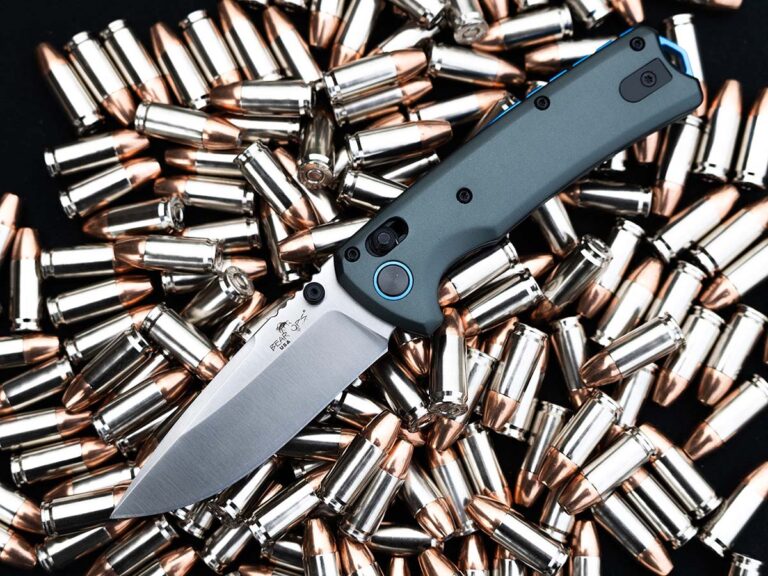
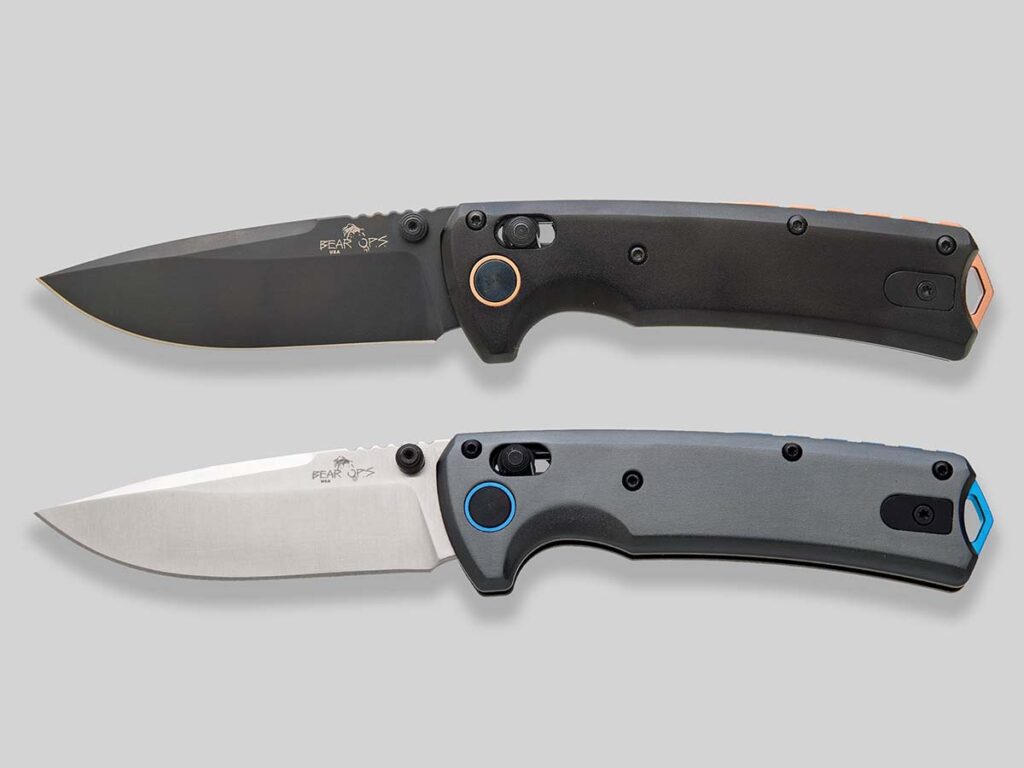
Bear OPS, the tactical division of Alabama-based Bear & Son Cutlery, is expanding its everyday carry lineup with the release of the Nekema II. Manufactured entirely at the company’s facility in Jacksonville, Alabama, this new folder is designed as a streamlined, budget-conscious option for tactical use, concealed carry, and general daily wear.
At the center of the design is a 3.5-inch modified drop-point blade made from Sandvik 14C28N stainless steel. This Swedish steel has become a staple for modern EDC knives due to its balanced performance, offering high corrosion resistance, user-friendly sharpening, and respectable edge retention. For users seeking extra protection and a non-reflective finish, Bear OPS is offering the blade with a black DLC (Diamond-Like Carbon) coating.
To keep the knife pocket-friendly, the Nekema II utilizes a lightweight aluminum handle, keeping the overall weight to a nimble 3.5 ounces. For deployment and lockup, the folder is equipped with dual thumb studs, ball-bearing washers for a smooth pivot action, and a secure slide-lock mechanism. A reversible pocket clip and Torx screw construction finish off the assembly.
The Nekema II is available in either Black & Copper or Gray & Blue colorways, with retail pricing set between $92.49 and $97.49 depending on the specific finish. For more details, visit local retailers or head over to the Bear & Son Cutlery website.
Today’s gent’s knives are what they are instead of what they used to be.
In years past, there was a genre of knife small, fancy and unobtrusive. It went by gent’s knife or Sunday-go-to-meeting knife, the latter where the hard-working sodbuster was laid down on the day of rest for something to better match the formal Sunday duds. Loosely defined, that knife consisted of fancier materials and a blade less than 3 inches long
However, the argument can be made that today’s gent’s knives are exclusively gent’s knives no more. According to officials of the knife companies that make them, all kinds of people spring for the knives popularly known as gent’s knives. There are sub genres, and their popularity is growing.
Take, for instance, A.G. Russell Knives, whose customers tend to gravitate not toward EDCs or tactical knives but smaller gent’s-type knives.
“In the past year or so, we are seeing an increase in interest in these smaller knives that can be carried unobtrusively, both with pocket clips and without,” the team at A.G. Russell wrote in an e-mail. The knives worn with the Sunday best tend to be more traditional, according to the company’s spokespeople. It’s a subcategory of small knives that sport a sharp appearance that includes premium handle materials. Added the Russell team, “A great gent’s knife is not too large, has an elegance about it, but still performs well.”
A.G. Russell Knives Vest Pocket Semi-Skinner
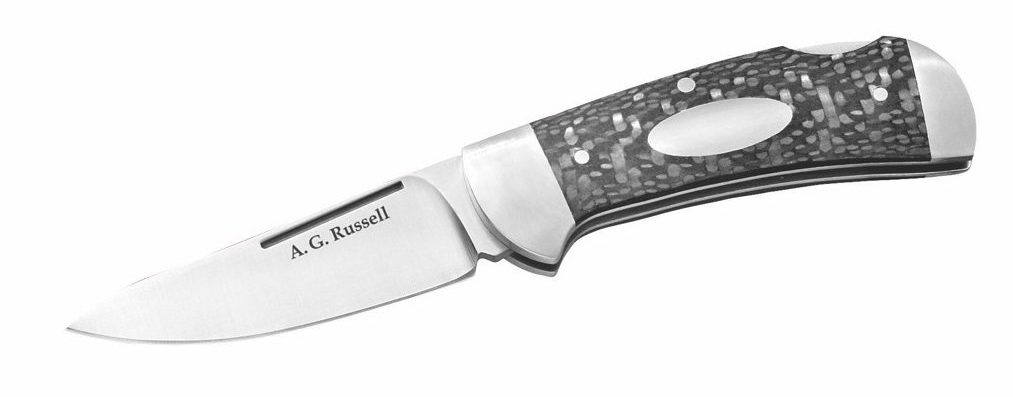
Bob Loveless introduced A.G. Russell to the semi-skinner blade shape and Russell fell in love with it, pairing it with a sparkling carbon-fiber handle in the Vest Pocket Semi-Skinner.
For an example of a piece that represents the new generation of gent’s knife, look no further than the A.G. Russell Vest PocketSemi-Skinner. Designed by the late company founder and BLADE Magazine Cutlery Hall-Of-Fame member® A.G. Russell, the knife is a mix between classic design and contemporary materials—the latter being a carbon-fiber handle and premium CPM S35VN stainless blade steel.
The heart of the knife is the bigger-than-it-should-be semi-skinner blade. As the company website noted, A.G. loved the semi-skinner blade, a pattern he credited Cutlery Hall-Of-Famer Bob Loveless for introducing to him. “A.G. saw the need for a small, lightweight pocket knife that would sit comfortable in any pocket, especially vest pockets, and the opportunity to create one with the blade he liked so much,” the site explains.
It is a blade shape that excels with work done at the tip, which is critical for a smaller knife.
“A good gent’s knife is really good at detail work,” the site notes,“in which blade and tip control are very important.” As a result, the Vest Pocket’s blade is at ground and boasts a thin edge geometry ideal for slicing cuts.
The stainless steel bolster is also critical to the design, as it covers the squared-off heel of the blade that connects with the lockbar. Unprotected, the heel could wear away at the fine fabrics of a vest pocket, for instance.
A.G.’s sketch of the knife (pictured below) was scanned into a CAD program in March 2018. Un-fortunately, he didn’t get to see the knife in production, as the iconic knife entrepreneur passed away in October of the same year before the design could be fully realized.
A.G. Russell Knives Vest Pocket Semi-Skinner Specs: Designer: A.G. Russell Blade Length: 2.53” Blade Steel: CPM S35VN stainless Blade Grind: Flat Handle Material: Carbon fiber Pocket Clip: None Bolsters: Stainless steel Lock: Lockback Weight: 2.5 ozs. Closed Length: 3.125” Country Of Origin: China MSRP: $100
Maserin Knives Turtle
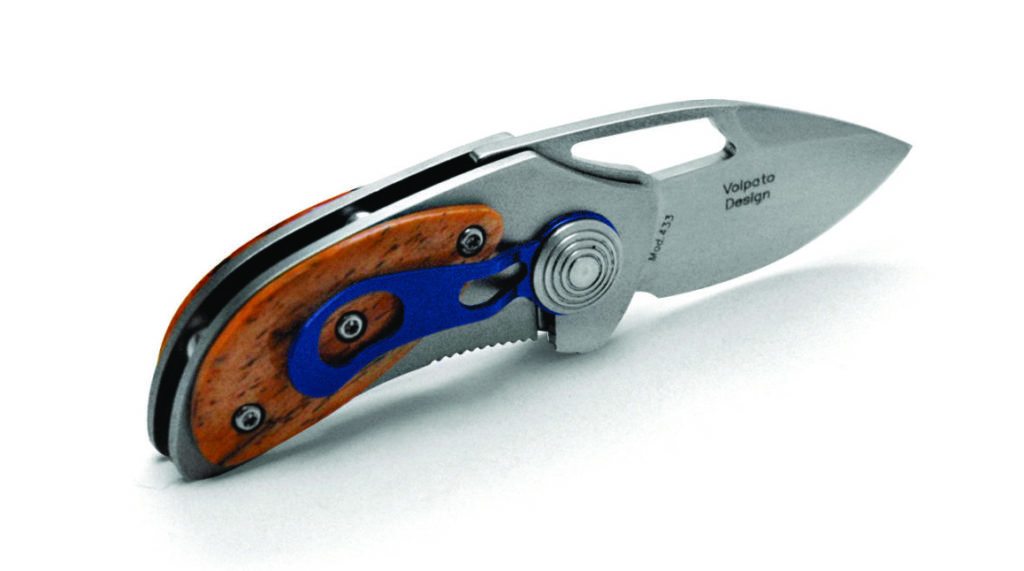
Some of the more notable features of the Turtle by Maserin Knives are the pivot pin with its concentric lines and the skeletonized titanium clip anodized blue.
No discussion of gent’s knives would be complete without mentioning the classic designs that hail from all over the globe. Take for example the Turtle, a timeless design Maserin injected with traditional materials and refinement throughout.
In 2006, Italian knifemaker Claudio Volpato designed a small knife with a blade under 2 inches and sent the prototype to Maserin. “We industrialized it,” recalled Claudia Maserin, along with her two brothers owner of Maserin, and the Turtle was born. “ The knife is still popular considering we first showed it long ago. The best handles are ebony and briarwood, and the damascus blade version is still very appreciated.”
Some of the small knife’s more notable features are the pivot pin with its concentric lines, and the skeletonized titanium clip anodized blue. Part of the goal was to take classic materials and transform them “We looked for elegant and traditional materials,” Claudia explained, “wooden handles like ebony and olive.”
Realizing that some women were gravitating to the Turtle because of its small size, Maserin officials handled the knife in pink giraffe bone several years ago. “We don’t design a knife thinking of final users in terms of gender but in projecting elegant knives,” Claudia stated. “We know they can be perfect both for women and men.”
Early versions of the blade were at ground of 440C stainless steel. Now, they are N690 stainless. The result is a knifes mall enough to slip into the small pocket of a pair of jeans and that opens easily one-handed.
“Our gent’s knife is good for everyday carry,” Claudia maintained. “You can open an envelope, a parcel, cut a fruit. It is the knife you need when you find yourself saying ‘If I had a knife …’
Maserin Knives Turtle Specs: Designer: Claudio Volpato Blade Length: 1.56” Blade Steel: N690 stainless or stainless damascus Blade Grind: Flat Handle Material: Woods of bocote, briar, ebony, olive or walnut Pocket Clip: Skeletonized titanium anodized blue Lock: Linerlock Weight: 2.05 ozs. Closed Length: 2.5” Country Of Origin: Italy MSRP: Depending on options, from about $77 to $19
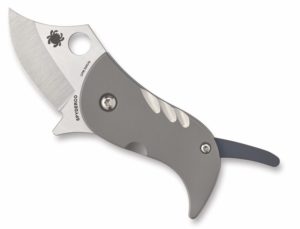
Spyderco Pochi
Like many small Spyderco knives, the Pochi is designed to offer large cutting power in a small package. “The dog tail rotates out to create a pinky shelf,” Joyce Laituri noted of the extension on the butt, “adding length to the handle for a better grip.”
Rigid definitions of a gent’s knife don’t quite cut it in Joyce Laituri’s book. The Spyderco spokesperson met a knife enthusiast at a knife show out to acquire some knives. The man towered well over 6 feet and was “built like an NFL linebacker, with paws like a bear,” she recounted. Though he appeared gentle-manly, a blade under 3 inches would be too small for him.
“In today’s industry,” Laituri began,“there is a broader view of what constitutes a dress knife. Is it its size, cost, function, materials, appearance? That definition is unique to each knife carrier.”
For some, a gent’s knife may be a small, elegant knife. Others, Laituri points out, decide that the most gentlemanly knife they can carry on their wedding day is a 5-inch folder or even a Spyderco Military model. The company eschews the term gent’s knives for prestige knives, Laituri said, in order to better describe the breadth of people who carry such edged tools. Meanwhile, a Spyderco knife that has attracted knife carriers for a whole slew of reasons is the Pochi, a flipper-folder collaboration with Japanese custom knifemaker Kazuyuki Sakurai.
“There is a market for anyone look-ing for the non-traditional,” Laituri said,“and the Pochi has been well received—surprisingly so—because it is so different from traditional pocketknives.
Some Pochi users, she added, like the design because they find it both charming and functional. Others are attracted to its upswept blade hollow ground from high-end CPM S45VN stainless steel. Some, attracted to the zoomorphism of the design, carry it because they like dogs, Laituri said.
Pochi, which roughly translates to the most common name for a dog in Japanese, has all the essential canine elements, resembling something like a pug on the go. Like many small Spyderco knives, Laituri said the Pochi is designed to bring large cutting power in a small package. “ The dog tail rotates out to create a pinky shelf,” Laituri noted, “adding length to the handle for a better grip.”
Spyderco Pochi Specs: Designer: Kazuyuki Sakurai Blade Length: 1.58” Blade Steel: CPM S45VN stainless Blade Grind: Hollow Handle Material: Titanium Pocket Clip: Titanium anodized blue;closed knife carries blade tip up Lock: R.I.L. (Reeve Integral Lock)WEIGHT:1.7 ozs. Closed Length: 2.6” Country Of Origin: Taiwan MSRP: $270
Bear & Son’s Bold Action
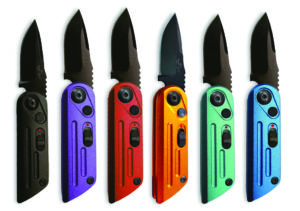
The Bear OPS Bold Action 14 comes in a wealth of different colors thanks to the anodization of its aluminum handle.
According to Matt Griffey of Bear &Son Cutlery, the world of gent’s knives has been changing and part of that has been due to the evolving nature of the workplace.
“We see less manufacturing professionals and more office setting careers,” he said. “Gentleman’s knives t the workforce movement and the lifestyles that come with it—accounting, computer techs, engineers and so on—with the knife having a small or slim physique and constructed from higher quality materials.”
At the same time, Griffey notes some of the slim knives are growing in size, and in the forefront of that change has been the increase in autos.
“Automatic knives have always intrigued both the traditional and modern knife enthusiast,” Griffey wrote, “and to-day more states are approving the daily carry and ownership of these types of knives.”
Trying to comply with many of the new auto laws, Bear & Son introduced the BearOPS Bold Action 14. The result is a knife available in a selection of color choices with its anodized aluminum handles and also the Sandvik 14C28N stainless steel blade, all made at Bear’s plant in Alabama.
Aluminum is a lightweight, low-maintenance material and 14C28 has a reputation of being corrosion resistant, durable and “an awesome performance steel”—essential features on a knife with a smaller blade and plenty of tasks to do.
“The Bold Action 14’s typical use would be common cutting chores around the office/home like opening small packages, cutting cordage and opening envelopes,”Griffey said, noting the knife can handle bigger tasks, too.
Meanwhile, expect more gent’s knives—or whatever you want to call the small fancy folders—in the future
“There is a market space for gentleman’s knives,” Griffey said. “Today, there are a lot of different choices and we’re lucky to and so many knife designers pushing the limits with materials, sizes and overall de-sign in the category.
Bear & Son’s Bold Action Specs: Designer: N/A Blade Length: 1.75″ Blade Steel: 14C28N Sandvik Blade Grind: Hollow Handle Material: Stainless Steel Pocket Clip: Reversable Bolsters: N/A Lock: Auto Weight: .14 oz Closed Length: 2.50″ Country Of Origin: USA MSRP: $140
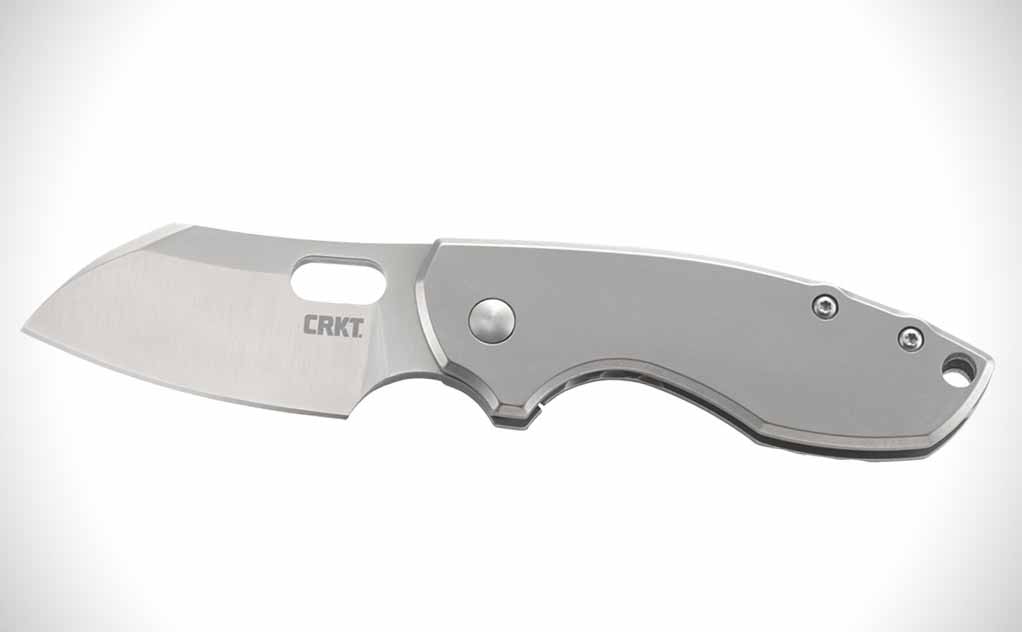
CRKT Pilar
Designed by Danish knifemaker Jesper Voxnaes of Vox Knives, the size and blade shape of the CRKT Pilar are well matched for heavy cutting jobs. The handle is very comfortable and secure in the hand.
How could CRKT and Voxnaes make the knife even better? The answer is to offer a new larger version for 2019. The Pilar II offers the same performance and ergonomic advantages as the original, including robust framelock construction with an all-steel handle. The 2.6-inch blade is 8Cr13MoV stainless steel and offers a great balance of edge holding and maintenance ease. It is the Chinese equivalent of the Japanese-made AUS- 8. Due to the increase in size and blade mass, the Pilar II features a flipper, something the Pilar lacks.
Voxnaes is known internationally for his straightforward designs with a nod to utility and outdoor applications. Originally he made prototypes of the Pilar in two versions: one with a flipper tab and one without. “With lots of people asking for a flipper version, it was an easy fix,” Jesper notes. The blade rides on Teflon washers and flips open nicely without the use of pivot bearings. It also sports an oblong hole for ambidextrous opening.
The stainless steel handle supplies heft and a solid backbone. The grip’s edges are chamfered, offering comfort and eliminating hot spots or general discomfort. A solid steel spacer adds handle strength. A steel pocket clip carries the knife tip up or down for right-hand carry only. If you prefer half-and-half-type handle construction with your framelock folder—that is, each handle side comes in a different material, in this case stainless steel and lightweight G-10—the Pilar II is so equipped. The G-10 offers a bit more weight savings plus a nice grippy texture. The all-steel-handle version has weight-saving pocket reliefs milled into the inside of the scale.
“At first it may seem we simply upscaled the original Pilar design, but the knife was actually redesigned from scratch to make the ergonomics feel perfect,” Jesper concludes.
Don’t let the gent’s knife label for the large Pilar fool you. It’s a knife that isn’t afraid to get down and dirty with its rugged build and utility-friendly blade shape. Like its little brother, the large Pilar is easy to carry and rides securely in a pocket. The choil indexes your grip and the rest of your fingers fall naturally around the handle. Due to the handle shape and size, those with larger hands may find the knife too small.
However, for those whose hands are filled nicely by the grip, the large Pilar is very comfortable to hold.
CRKT Pilar Specs: Designer: Jesper Voxnaes Blade Length: 2.40″ Blade Steel: 8Cr13MoV Blade Grind: Plain Handle Material: Stainless Steel Pocket Clip: Stainless Steel Bolsters: N/A Lock: Frame Lock Weight: 4.20 oz. Closed Length: 3.53″ Country Of Origin: China MSRP: $39
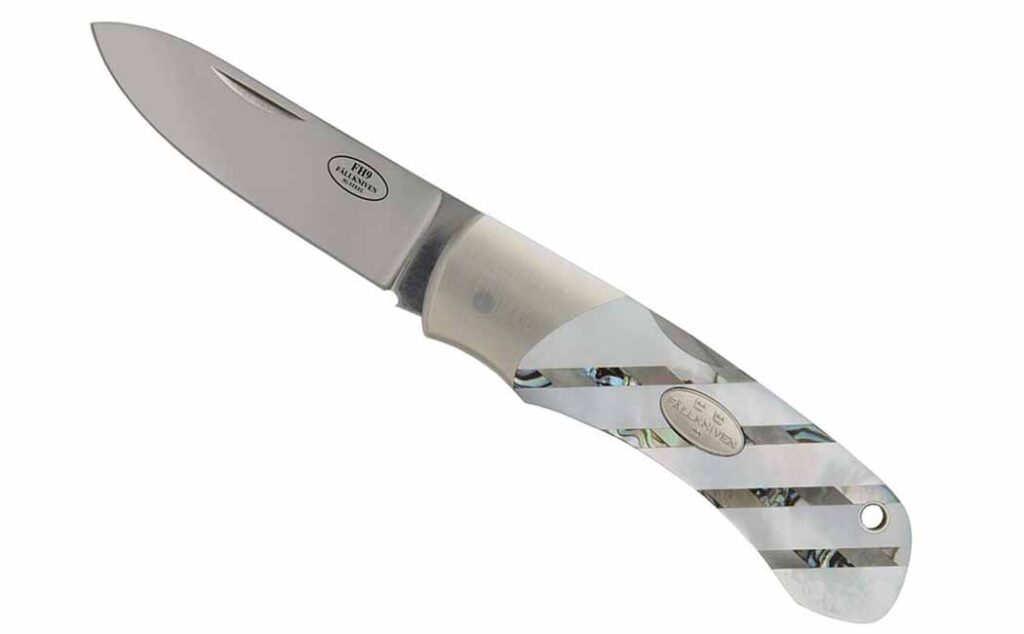
Fallkniven FH9 MOP
The Fallkniven FH9MOP is dressed to the nines with a mother-of-pearl handle accented by abalone and a mirror-polished blade. This is the knife you want to carry to dressy social functions, as the handle treatment sets the tone for an upscale outing or maybe even church on Sundays. According to Peter Hjortberger, Fallkniven president, the design is based on a folding hunter and a traditional lockback system.
Employing Fallkniven’s best blade material, a laminated 3G powder steel with a Super Gold steel core with a Rockwell hardness of 62 HRC, the FH9MOP is built for use. The 2.5-inch drop-point blade is neither too small nor too large. The knife is by far the best looking of the test bunch. The pearl handle and abalone accents create a stunning visual effect.
Structurally, the FH9MOP is built quite solid with dual stainless steel liners, steel bolsters and a steel handle spacer. Inlaid Fallkniven logo shields in the handle cap things off, and the blade sports a nail nick on each side for easy ambidextrous opening. A nice suede slip sheath protects the knife from rubbing up against keys, coins, etc., in your pocket.
The blade came out of the box razor sharp. I had no problem using it to open mail, cut stray threads, or any other similar gent’s knife duty. It is too beautiful a knife for the same jobs as a tactical folder, so use would be limited.
It sure is an eye-catcher, though. For a model more suited for general utility needs, step down to the standard FH9, which gives you the same blade steel but with the more work-friendly Micarta® handle material. Either way, the knives are sharpened pocket jewelry at its best.
Fallkniven FH9 MOP Specs: Designer: N/A Blade Length: 2.6″ Blade Steel: 3G Blade Grind: Plain Handle Material: Mother Of Pearl Pocket Clip: None Bolsters: Steel Lock: Lockback Weight: 3.35 oz. Closed Length: 3.625″ Country Of Origin: Sweden MSRP: $540
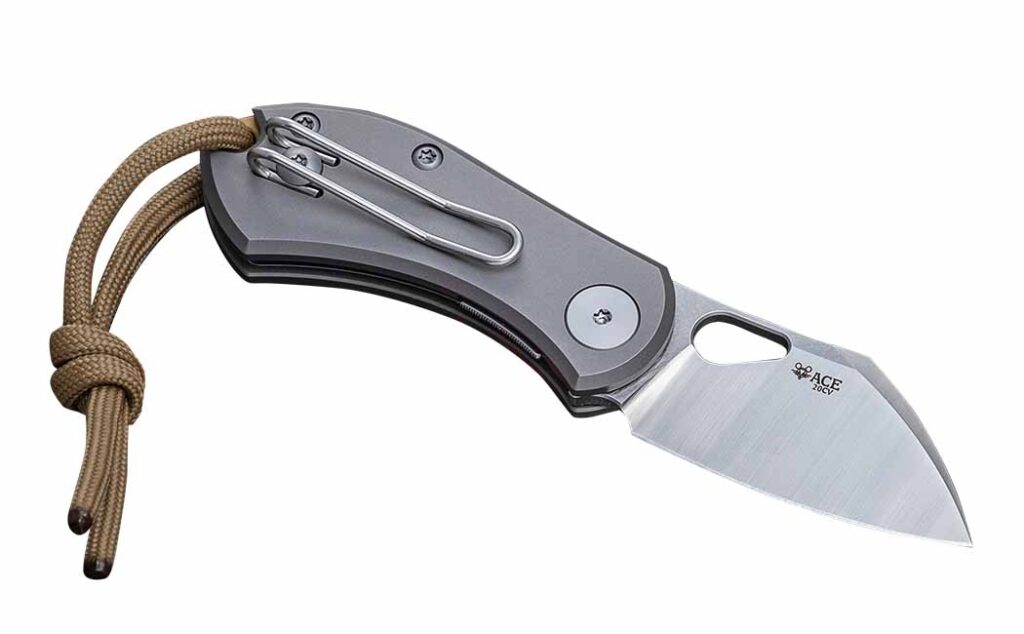
GiantMouse ACE Nibbler
Designed by custom knifemakers Jesper Vox and Jens Anso, the Nibbler holds fast via a reversible wire clip.
“A great gent’s knife is a fully functioning tool that stands strong in the ‘looks and class’ department,” explained Jim Wirth of GiantMouse. “It’s a knife that is capable of cutting tasks but also for social events, Sunday church or a Thursday evening cocktail.”
GiantMouse makes a bold statement among gent’s knives with the Nibbler, a compact, efficient folder that Wirth says works as a great EDC in areas and situations where size matters. “Although the Nibbler is small, it packs a serious punch,” he pointed out. “Our definition of a gentleman’s knife is a knife that you can EDC in almost any environment, from the church to the office so to speak, a knife that does not raise eyebrows but will be welcomed when put to use. This could very well be the modern definition of this type of knife.”
The Nibbler is bound to fill the bill for that light-cutting job and to exude a positive image. “It’s inspired by the fictional character Nibbles ‘Tuffy’ Mouse from the hit cartoon series Tom and Jerry,” Jim explained. “Nibbles may be small but he sure is mighty, just like our new ACE Nibbler, a petite folder that packs a serious punch and doesn’t lack in the fun department, either.”
Wirth concludes that both men and women will find the Nibbler a great choice for EDC. “We don’t think that making a pink handle on a knife will make it more suitable for women,” he reasoned. “We don’t believe in designing specifically for a gender; all our knives are equally suited for men or women.”
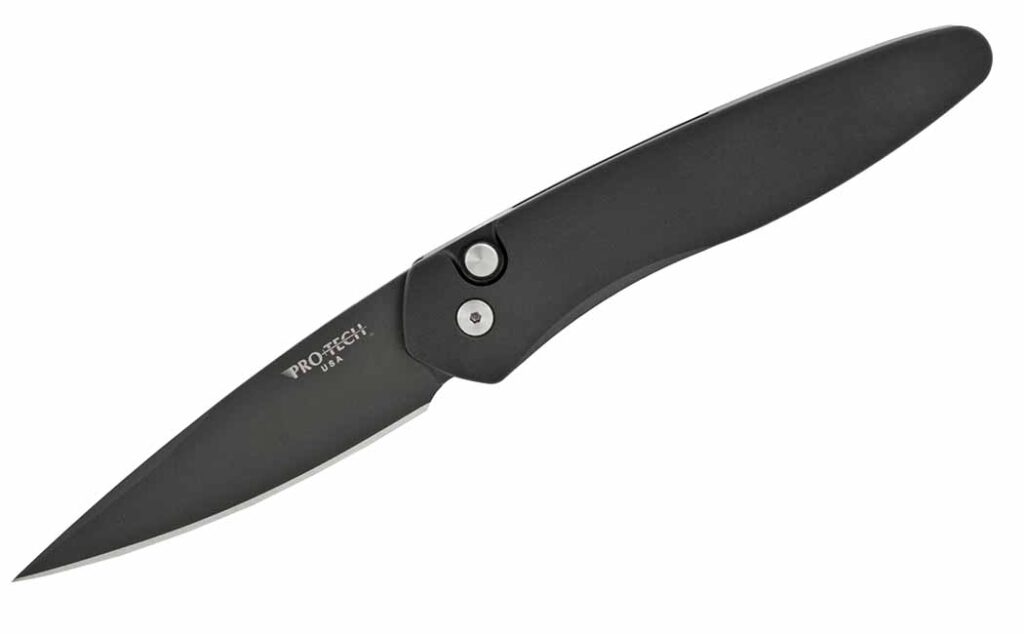
The thoughtfully designed deep carry clip and the thin, lightweight nature of the Pro-Tech Newport 3405 make it a good choice for wearing dress slacks, as it won’t tear up the pocket or be heavy enough to make it sag.
At Pro-Tech, Dave Wattenberg takes pride in the Newport, a gent’s knife that exudes personality. “It’s our thinnest and lightest full-size auto,” he commented. “It packs three inches of S35VN steel for all your EDC tasks into a precision-machined aircraft-aluminum frame that is only .38 inch thick.
The thoughtfully designed deep carry clip and the thin, light carry of the Newport make it a great choice for someone wearing a nice trouser or dress slacks, as it won’t tear up the pocket or be heavy enough to make it sag.”
Dave is excited about the versatility of the Newport, its swift deployment, unobtrusive profile, and variety when it comes to materials while running the gamut from EDC to investor/collector-grade presentations.
“From solid aluminum handle/stonewash base models all the way to investor customs, there’s a Newport model to suit just about any taste and budget,” he remarked. “Pro-Tech is well known, of course, for superior coil-spring-action auto knives, and while the Newport is no exception to this, users will find the action controlled, smooth and satisfying—not the huge snap of one of the tactical response series, but a more gentlemanly switchblade action.”
Pro-Tech Newport Specs: Designer: N/A Blade Length: 3″ Blade Steel: S35-VN Blade Grind: Plain Handle Material: Aluminum Pocket Clip: Tip-Up Bolsters: N/A Lock: Auto Weight: 2 oz. Closed Length: 4.125″ Country Of Origin: USA MSRP: $240
Sandrin Torino
The polyhedral tungsten carbide blade of the Sandrin Torino is designed to retain its razor-sharp edge far beyond that of steel blades in Sandrin’s “StaySharp Technology.”
The Sandrin Torino exemplifies the ideals of the gent’s knife, and Sandrin’s Rob Bianchin says he knows why. “The Torino is exceptionally lightweight at only 2.29 ounces,” he remarked. “It’s pretty easy to forget that you have it in your pocket. The lightweight characteristics are deceiving as the blade performance exceeds that of a steel knife for edge retention. For anyone who can appreciate metallurgy, the polyhedral tungsten carbide blade is a state-of-the-art super metal and was not thought possible just a few years ago.”
According to Rob, the entire Sandrin knife experience is centered around the blade material. Polyhedral tungsten carbide is not steel. Instead, according to Sandrin, it is an engineered “super metal” invented and patented for blades by Sandrin director Alessandro Colombatto. “Tungsten carbide can be used for cutting steel or for wear parts that undergo extraordinary stress and corrosion,” Bianchin added. “Polyhedral tungsten carbide has advantages over steel, such as consistent molecular structure. It cannot rust and typically is in the 71 [HRC] Rockwell hardness range* or higher.”
The polyhedral tungsten carbide blade lends itself nicely to the Torino gent’s knife presentation, and Rob sees a natural fit. “In my view, the definition of a gent’s knife has evolved with the times and includes knives of quality that are also effective cutting instruments and not just for show. The Torino can be carried and used daily but is also a point of conversation as it is still exceedingly rare to own a knife made from new metal.”
The appeal of the Torino once again embraces the spectrum of potential users—both men and women, factory or office workers. “Gender is not a design consideration,” Rob said. “The Torino is suited for men or women. Men are the predominant consumers of pocketknives, but I suppose in today’s world the industry should call such knives a ladies’ or gentlemen’s folder.”
Sandrin Torino Specs: Designer: N/A Blade Length: 2.95″ Blade Steel: HRC71 Blade Grind: Plain Handle Material: G-10 Pocket Clip: Titanium Bolsters: N/A Lock: Recoil Weight: 2.29 oz Closed Length: 4″ Country Of Origin: Italy MSRP: $260
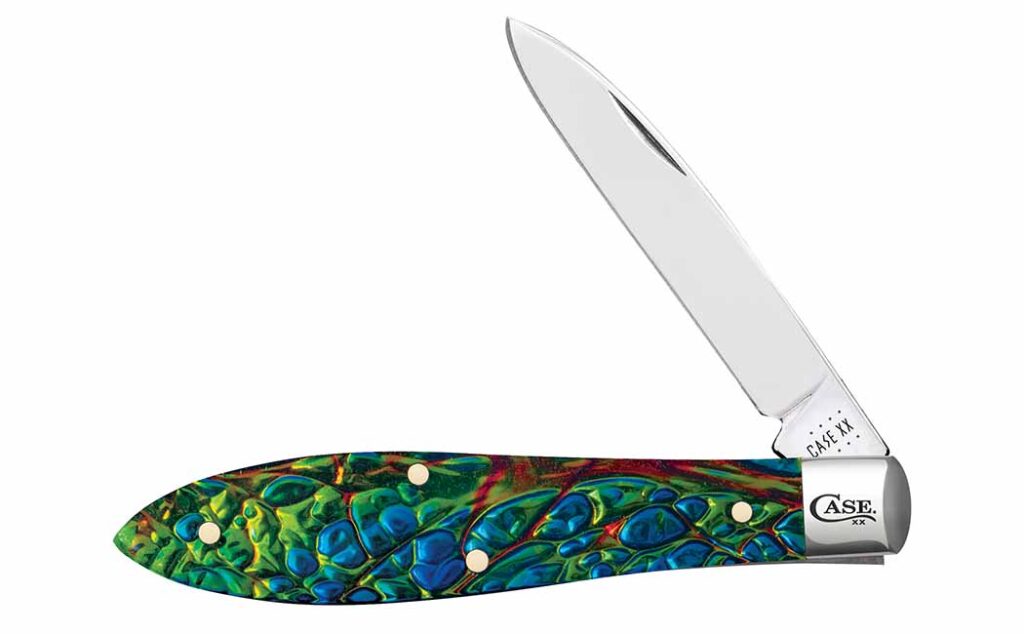
Case Black Sea Dichrolam Tear Drop
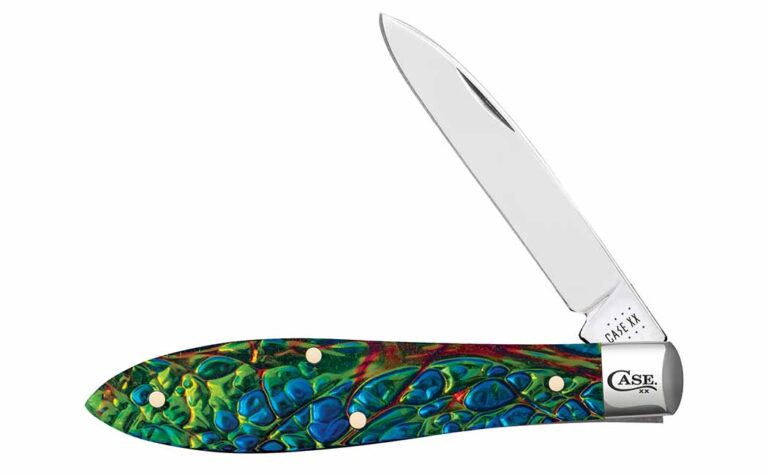
The Case Tear Drop Black Sea Dichrolam spear-point blade is designed with a strong tip for piercing, which comes in handy for such gent’s knife jobs as opening mail, packages and the like.
Case has long been a star performer in the manufacture and presentation of gent’s knives, and the company continues the tradition with the Black Sea Dichrolam Tear Drop, a beauty with a composite handle material that mimics the luster of an opal gemstone. Fitting nicely within the spectrum of gent’s knives, the Black Sea Dichrolam Tear Drop brings excitement to the Case fan base.
“Based on our interactions with knife enthusiasts at consumer events, our Classic Case folding patterns like the tear drop are considered by many as a ‘Sunday-go-to-meeting knife,’” commented Fred Feightner, Case director of marketing communications. “But more modern knives are more and more often carried and considered to be a ‘gentleman’s knife.’ The definition lies in the eye of the beholder.”
With the new tear drop entry, Case has bridged any perceived gap between men and women as far as carrying a dressy, functional knife. “We’ve definitely seen an uptick in people carrying Case pocketknives over recent years,” Fred continued, “and they realize that a good, sharp knife is handy to have on your person for all kinds of reasons, from hiking and camping to doing detail work that’s done by hand. Whether kept in a pocket, purse or hanging on a carabiner, a pocketknife is a must have for most any person.”
For occasions when an unobtrusive EDC knife is in the mix, Case fashioned the Black Sea Dichrolam Tear Drop. “Our tear drop pattern has a single spear-shaped blade,” Fred related. “The long, sharp edge can cover everything from cutting threads on clothing to gathering fruit or nuts outdoors. The tip adds functionality for tasks like piercing through a clam shell package or scoring leather to fashion a sheath.”
Case’s tear drops, particularly the Black Sea Dichrolam, perform as excellent light-duty tools, according to Fred. The slim design and small “form factor” make them great for close-up and close-in work, handy little EDC knives that are not only up to the tasks a gent’s knife is meant to perform, but easy on the eyes as well.
Case Black Sea Dichrolam Tear Drop Specs: Designer: John Blazy Blade Length: 2.44″ Blade Steel: Trusharp Surgical Steel Blade Grind: Plain Handle Material: Dichrolam Composite Laminate Pocket Clip: None Bolsters: N/A Lock: Slip Joint Weight: 1.4 oz. Closed Length: 3.63″ Country Of Origin: USA MSRP: $106
Editor’s Note: Dainel Jackson, Dexture and Mike Haskew contributed to this post.