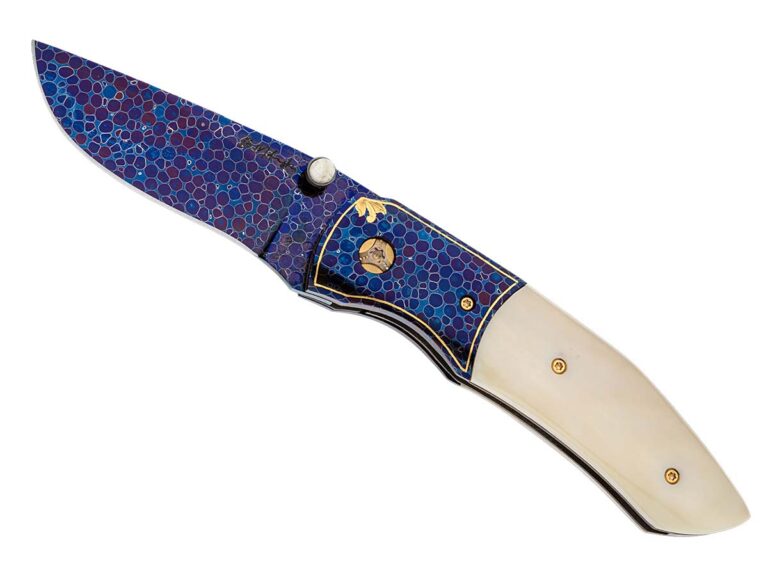
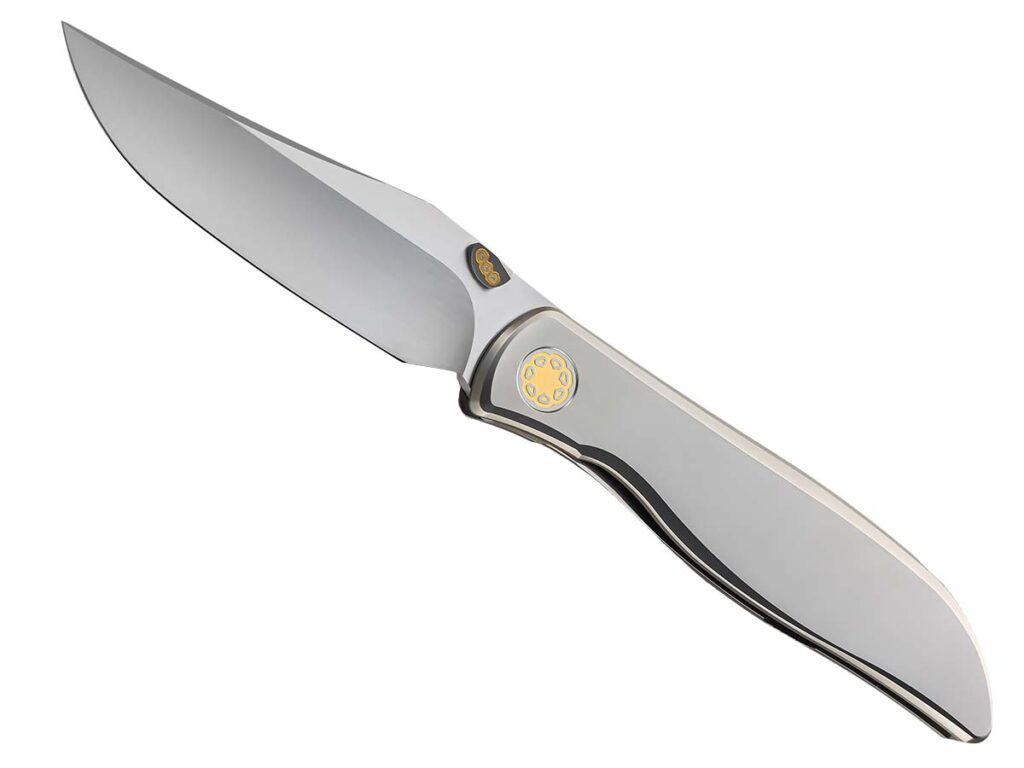
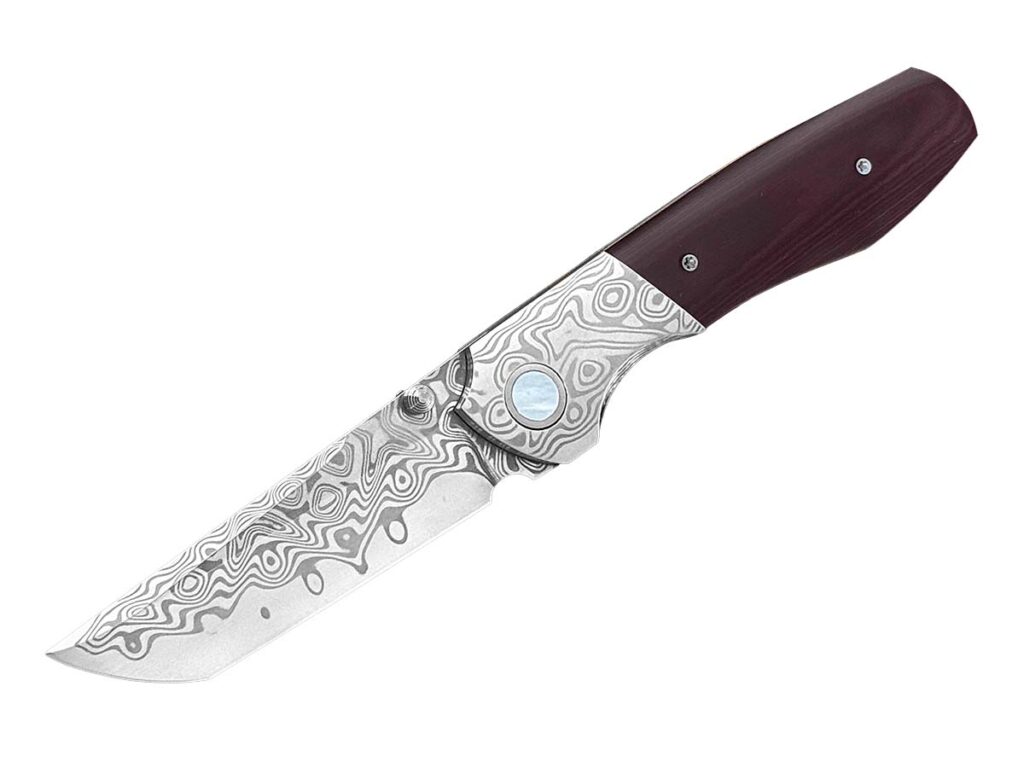
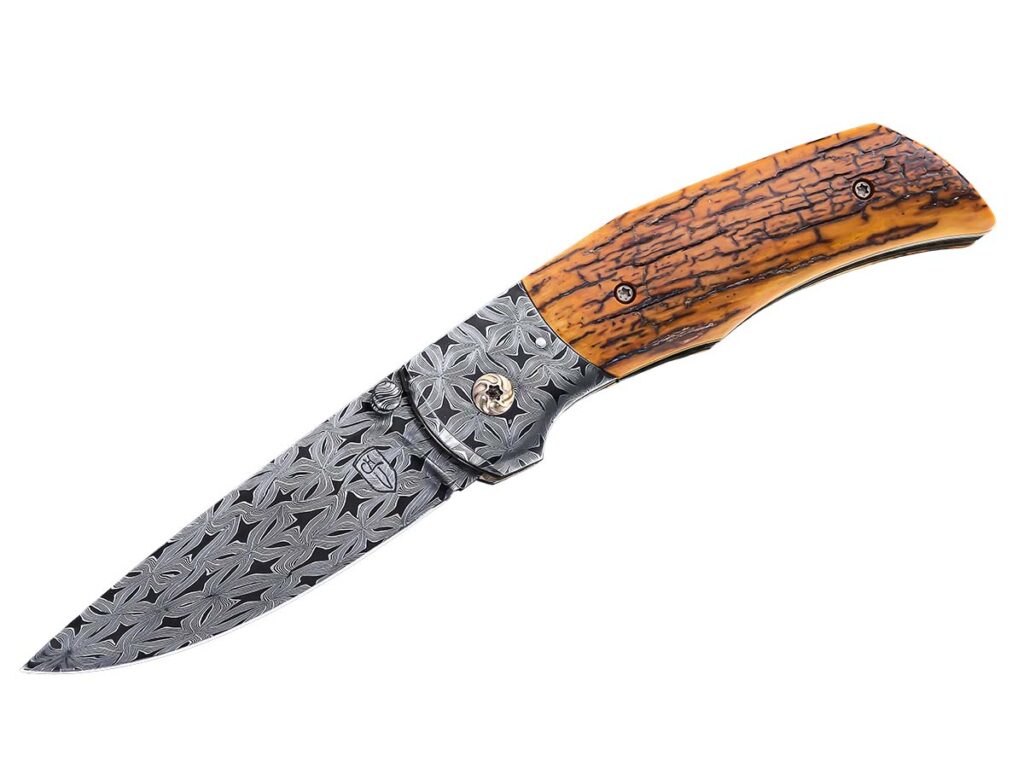
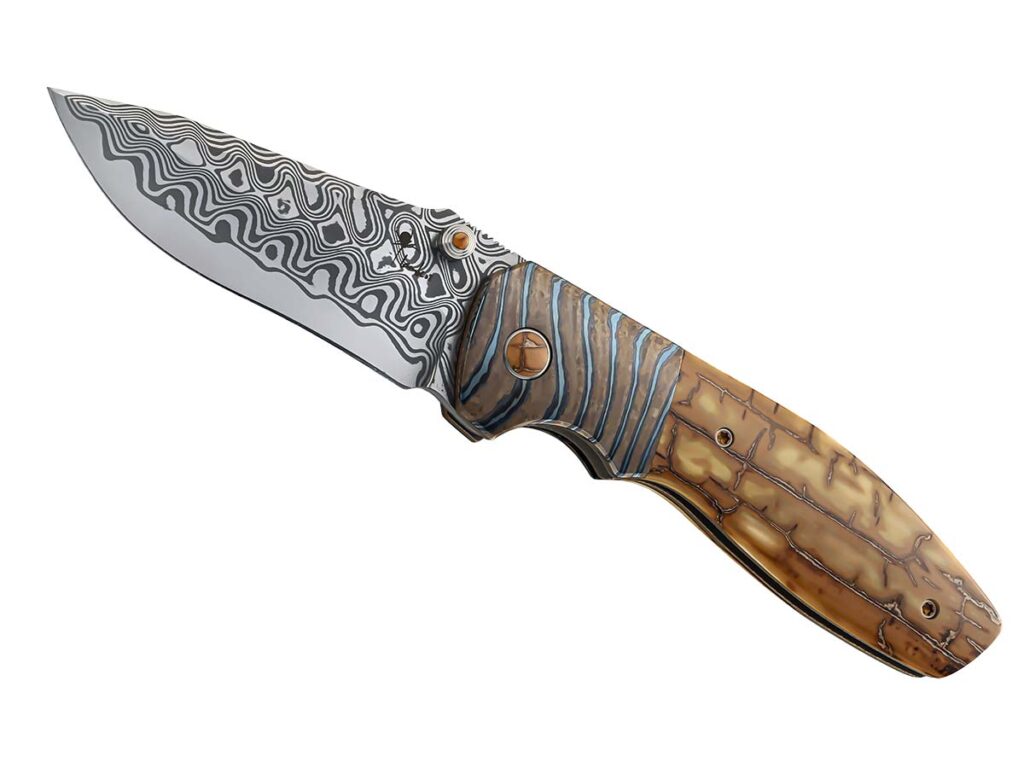
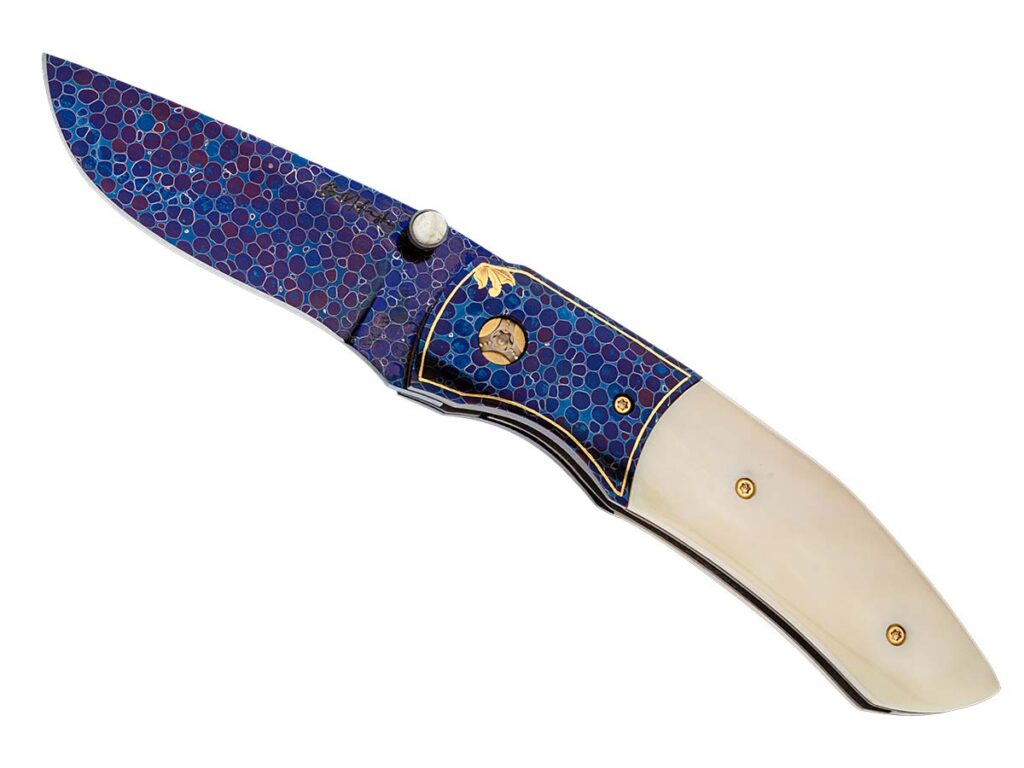
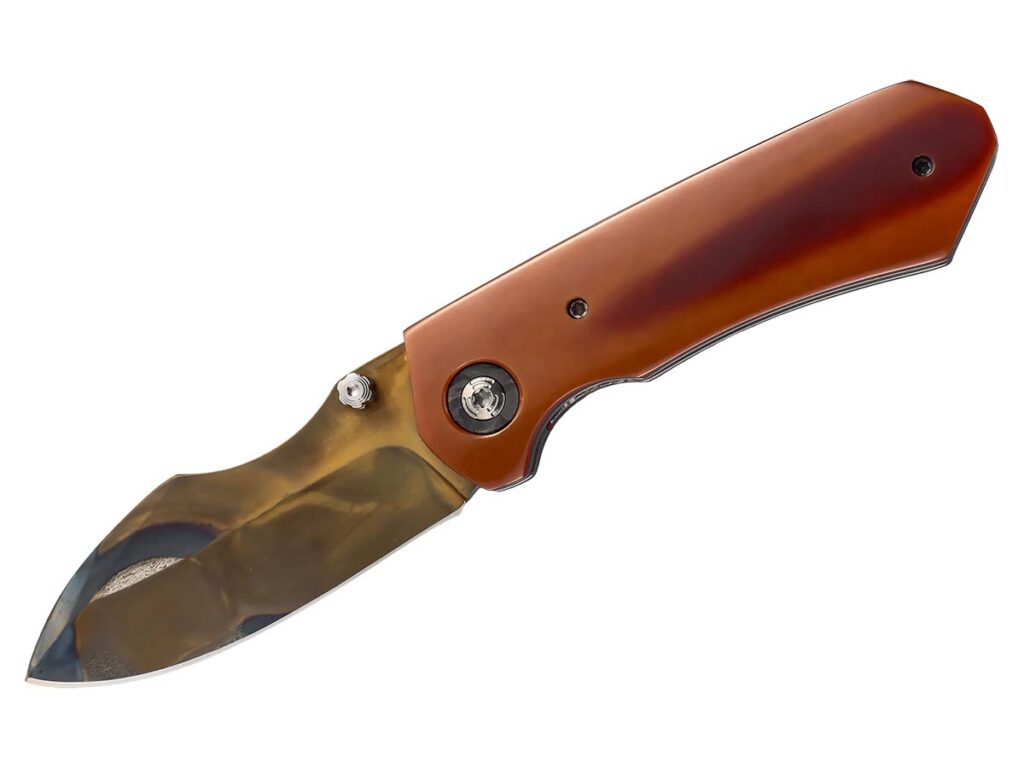
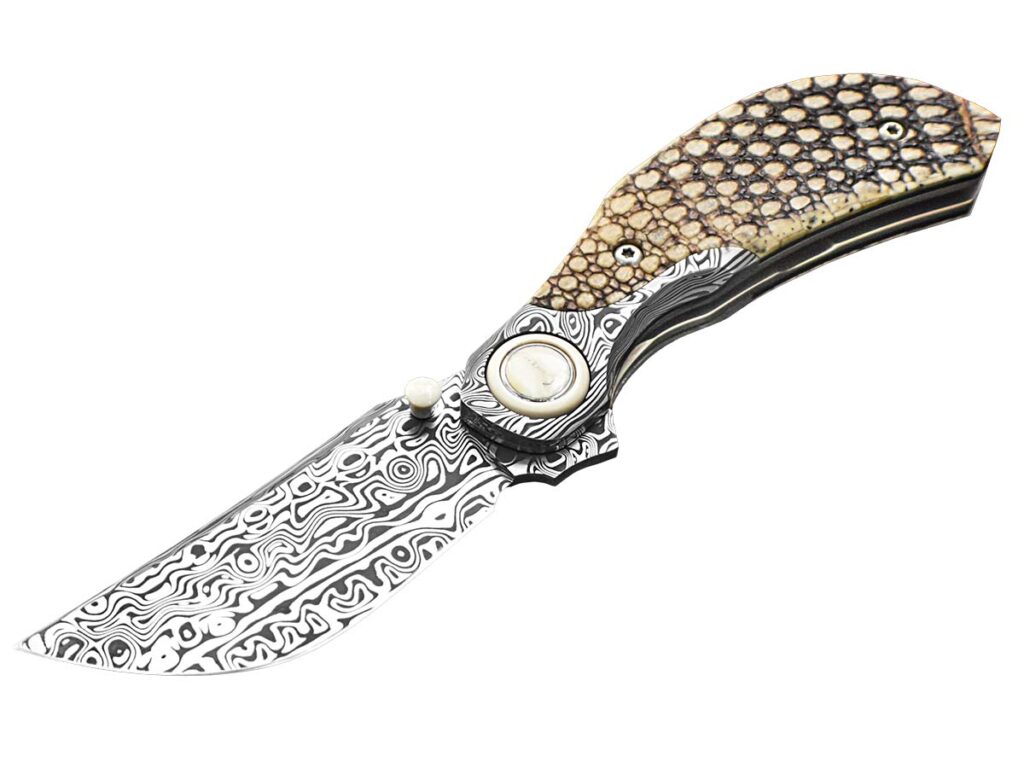
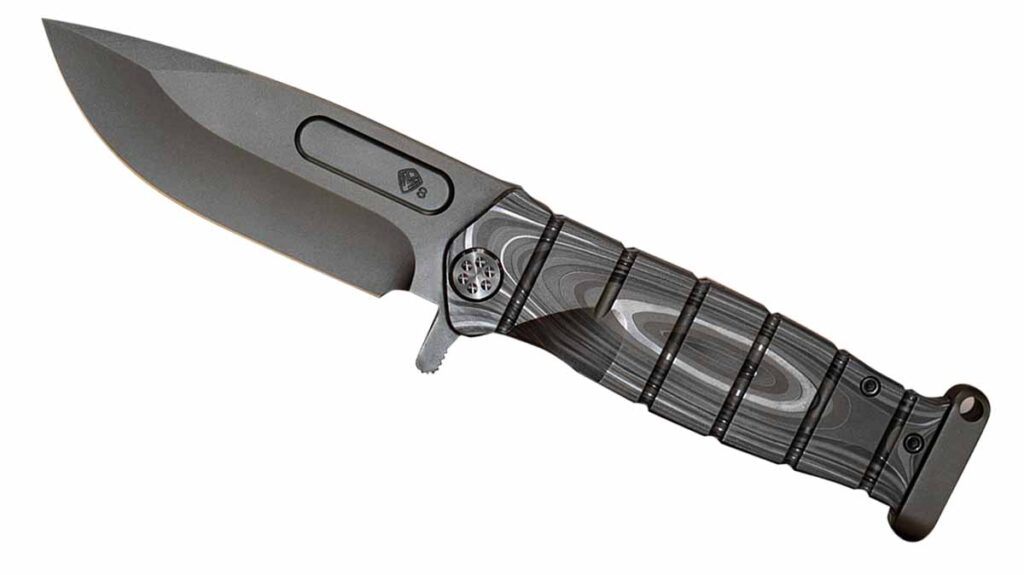
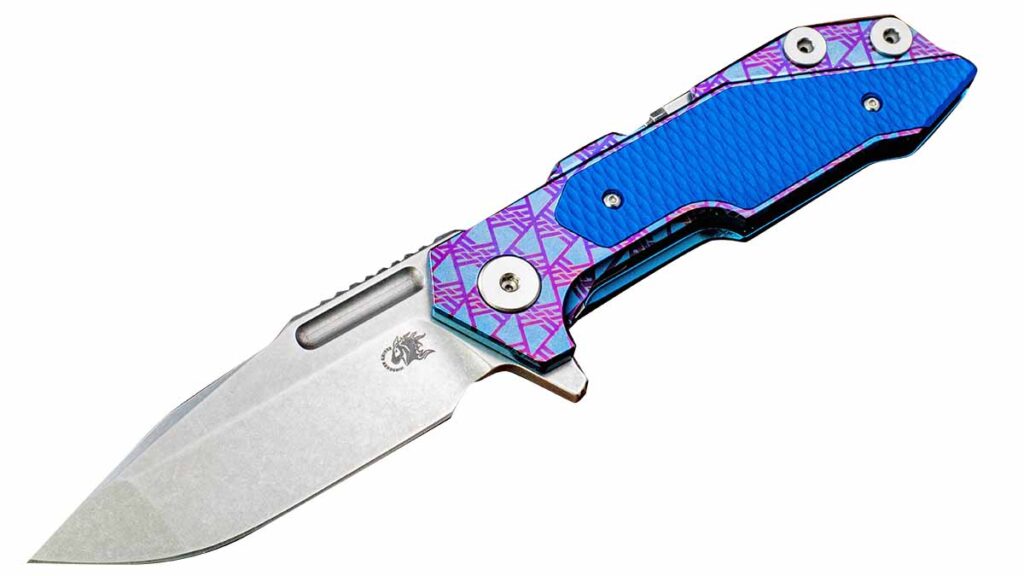
The thumb stud is reliable, time-tested and add dynamic dash to these customer folders.
Aside from the good ol’ nail nick, thumb studs are among the most enduring opening systems for folding knives. Why not? Typically ambidextrous, easy to manipulate and lightning fast, the reliable deployment feature has a lot going for it. Not to mention, on these custom knives, they add equal parts dash and traditional appeal.
Michael Raymond: Ziura folder
Forty-nine 24k gold inlays set into a 6-4 titanium frame elevate Michael Raymond’s Ziura folder. The swedge-ground Bohler M390 blade measures 3.53 inches with an 8.08-inch overall length. (SharpByCoop image)
David Beaver: Shogun Horizon Folder
Vintage red linen Micarta scales and a hollow-ground Damasteel Baldur on Damacore blade highlight David Beaver’s Shogun Horizon folder. Blade and overall lengths: 3.75 and 8.5 inches. The maker’s price for similar knife is $1,800. (Jocelyn Frasier image)
Cody Hofsommer: Mammoth Ivory Folder
Mammoth ivory scales and mosaic damascus bolsters define a sole-authorship flat-ground folder by Cody Hofsommer. The 1080/15n20 mosaic Damascus blade measures 3.375 inches with an 8-inch overall length. (SharpByCoop image)
Kirby Lambert: Augustus Mini Folder
A hollow-ground Damacore blade and mammoth ivory scales distinguish the Augustus Mini folder by Kirby Lambert. Bolsters are titanium and 2IRC damascus. Blade and overall lengths: 3.25 and 8 inches. (SharpByCoop image)
Brian Milinski: Paratrooper Elegante Linerlock
Nitre blued Rietveld damascus and fossilized walrus tusk scales characterize Brian Milinski’s Paratrooper Elegante linerlock. Joe Mason engraved and inlaid the matching bolsters. Blade and overall lengths: 3.25 and 7.75 inches. The maker’s price for a similar knife is $3,400. (Jocelyn Frasier image)
KC Gray: Titanium Folder
A 3.5-inch SM100 blade paired with vintage Micarta scales defines this 8-inch dress locking folder by Tucson maker KC Gray. The titanium frame includes marble carbon-fiber pivot collars and a black anodized clip. (SharpByCoop image)
Sean Alonzo: Ani
Sean Alonzo’s Ani 3.2 linerlock features armadillo carapace, warthog ivory, and a hollow-ground Yggdrasil Damasteel blade. Blade and overall lengths: 3.2 and 7.8 inches. Maker’s price for a similar knife $5,500. (Jocelyn Frasier image)
An iconic knifemaker, Benchmade had earned the respect of discerning knife aficionados. Here are some of the best of what it has to offer.
The Benchmade company as we know it today began in 1980 as Bali-Song, Inc., later Pacific Cutlery Corp. Before its knives got popular on the national scene, the company went through a couple of initial changes in how they produced knives and where, ultimately settling on the ‘Benchmade’ name in 1987.
The hallmark of Benchmade knives has always been extreme quality. When the company began, they were making knives one at a time. While that is not always the case today, the same spirit of persistence and dedication to the end-user remains. Benchmade has made a name for itself across the board with hunters, military, and law enforcement.
Why Benchmade Gets Props
There is an obvious and easy way to explain why Benchmade dominates the production knife market. Their stuff just works. If you buy a Benchmade, it will not necessarily be the cheapest knife on the shelf, but for damn sure, it will do exactly what it was designed to do. Unfortunately, this isn’t the case with a wide swath of the knife industry, where quantity over quality reigns supreme.
The overall quality of Benchmade knives is something that the consumer should be aware of when purchasing blades. In the author’s experience, Benchmade knives have typically outperformed, or at least equally matched any competing model, regardless of price. That is not something that can be said for most other knife companies.
What Benchmade knives offer is something akin to an investment, a lifetime of use should you take care of it.
Great Benchmade Knives
There is no disparity in quality in the Benchmade lineup. But, for this article, the author selected 10 models that best represent what is good about Benchmade, ranging from specialized hunting knives to out-the-front pocketknives. Not all of Benchmade’s lineup is being produced today, and some of the most well-respected versions have been retired, though their descendants are equally as good if not better.
535 Bugout
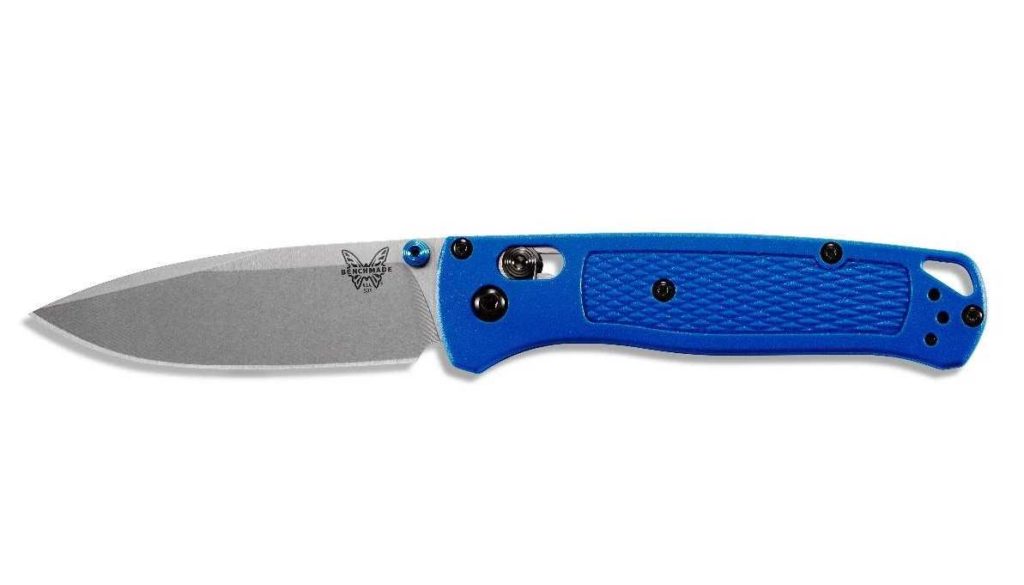
If there had to be a standard issue pocketknife for across-the-board use today, you would be hard-pressed to argue against the Bugout. It is not the most expensive knife in the lineup, but it is well over the cost of today’s average pocketknife. The Bugout is a well-respected, reliable design, that is both lightweight and has a very reliable, folding and locking mechanism. Designed to stand out, it is available in bright colors, in this case blue. The knife features a blade designed for optimal use in regular situations. It is not exactly an outdoor knife, although it would be at home for small games and fishing.
MSRP: $180
539GY Anonimus
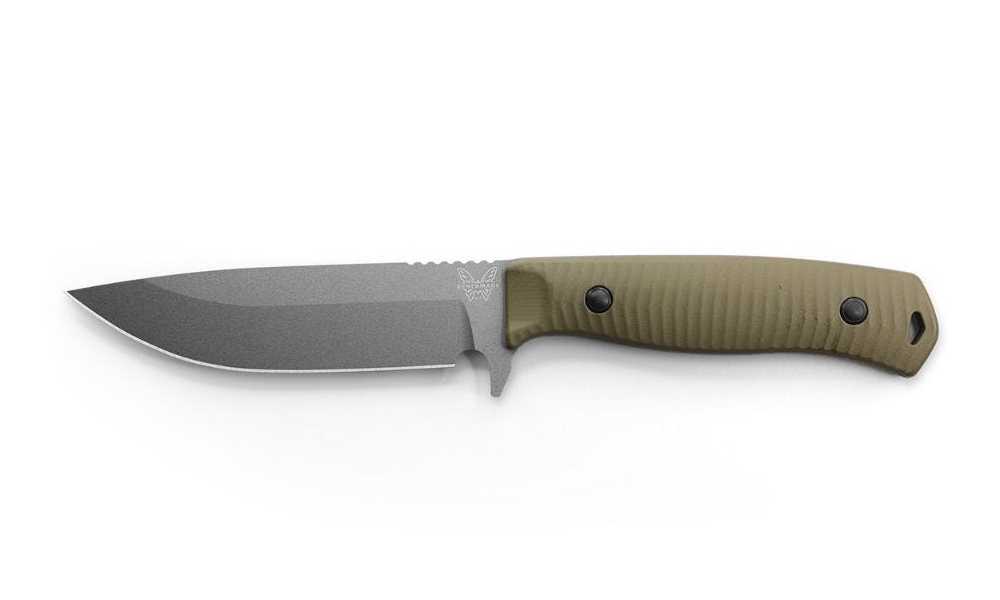
An interesting knife with an interesting name. This one is a hybrid field knife and every day carry fixed blade. The author received an early example of this knife from Benchmade and it has held up extremely well throughout use. The knife is low profile and has a relatively thin spine, making it unsuitable for some of the heavier camp chores and tasks. What it is great for is skinning deer size animals and smaller. To top it off, it has a wide degree of self-defense function. The knife has a notable choil to protect the finger—it makes for ample protection while thrusting hard or holding the knife tip down. Overall, this is a knife that meets a lot of needs and checks a lot of boxes while not being particularly flamboyant.
MSRP: $310
162 Bushcrafter
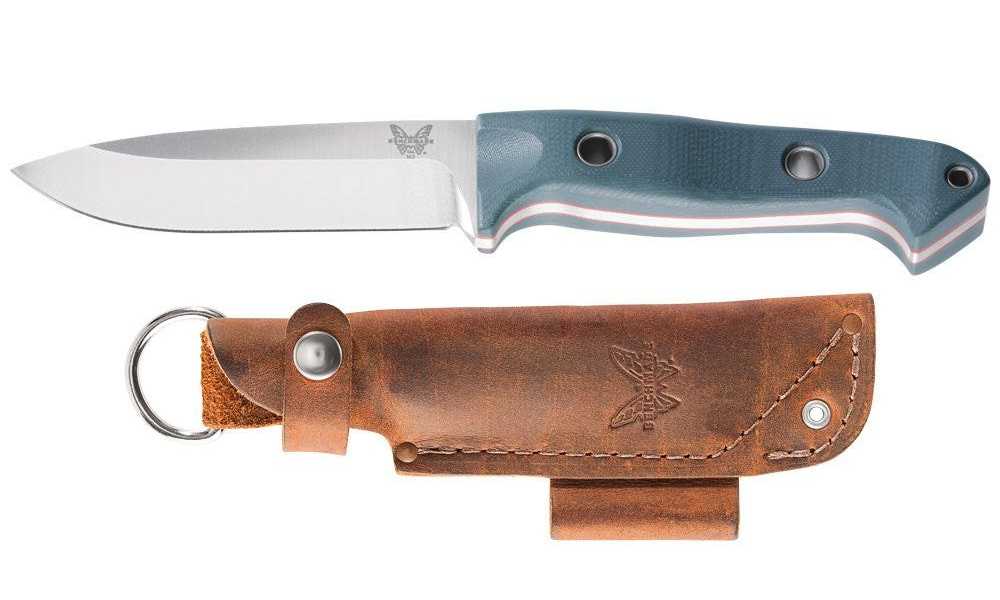
Out of all the knives on this list, the Bushcrafter is the model that the author has the most extensive experience. The author received this knife for an article in the print edition of Blade Magazine, where he put it through quite a bit of use. The knife has been a constant companion for outdoor chores and is an incredible product. A great deal of the author’s experience comes from fire making and working with bushcrafting materials, and while this knife certainly meets that task with flying colors, some criticisms can be had given the amount of time the author has spent with it.
The first of these is that this is a relatively small chore knife. The blade is not long enough for heavy work and wood splitting. It is a knife that is usable at the end stage after most of the splitting has been done, meaning you will need to carry additional tools. If you were trying to get a fire started with this knife it is great for striking a rod, which is sadly not included in the price. Many competing designs that have performed equally well if not better have come with striker rods in the same MSRP range. Why Benchmade included the loop but no striker is a mystery.
The handle ergonomics are a little bit more angular than is needed, competing knives that have smoother and more contoured handles are better for extended periods of work and generate fewer hot spots. For the casual camper, this is an exceptional knife. The author tends to fall into the category of outdoorsman that believes you need a 6-inch or 7-inch blade to get stuff done. Smaller blades are the favorite of many people, the author finds them to be fatiguing to use and many times difficult to dislodge from pieces of wood or harder to use when skinning large game on the ground. That said, this is a fantastic knife, the author wishes that Benchmade will come out with a slightly larger version with a thicker spine.
MSRP: $300
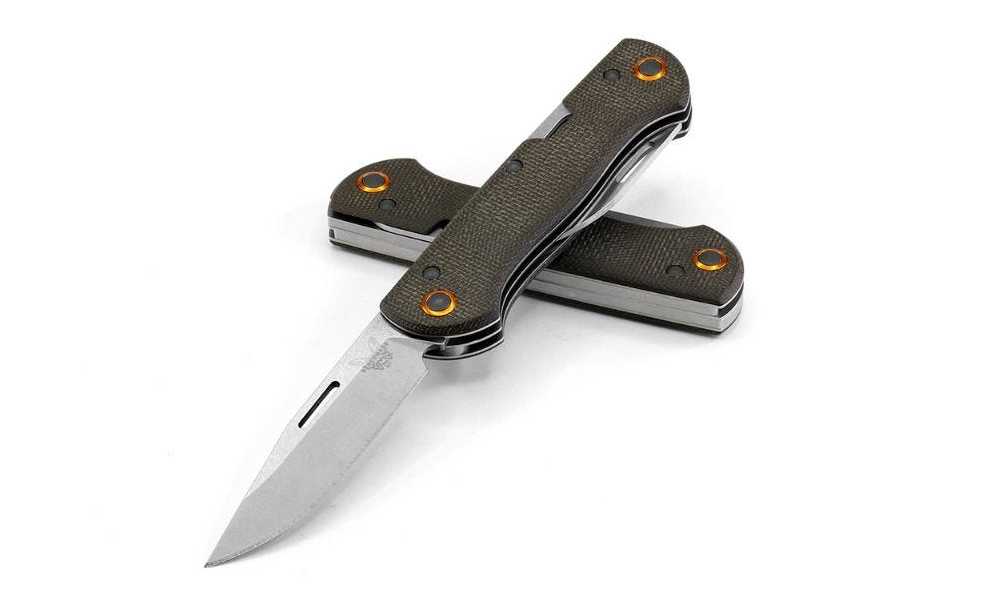
317-1 Weekender
If you are casually out and about with your friends on your party barge, this knife is an exceptional comrade. It is something of a modern pen knife in that it features two blades as well as a bottle opener. It is an excellent knife for daily use and covers just about all regular cutting chores you may encounter in your day-to-day existence, barring of course any heavy-duty uses. The knife is beautifully finished and has excellent accent work, it is surely something you will want to show to your friends.
MSRP: $275
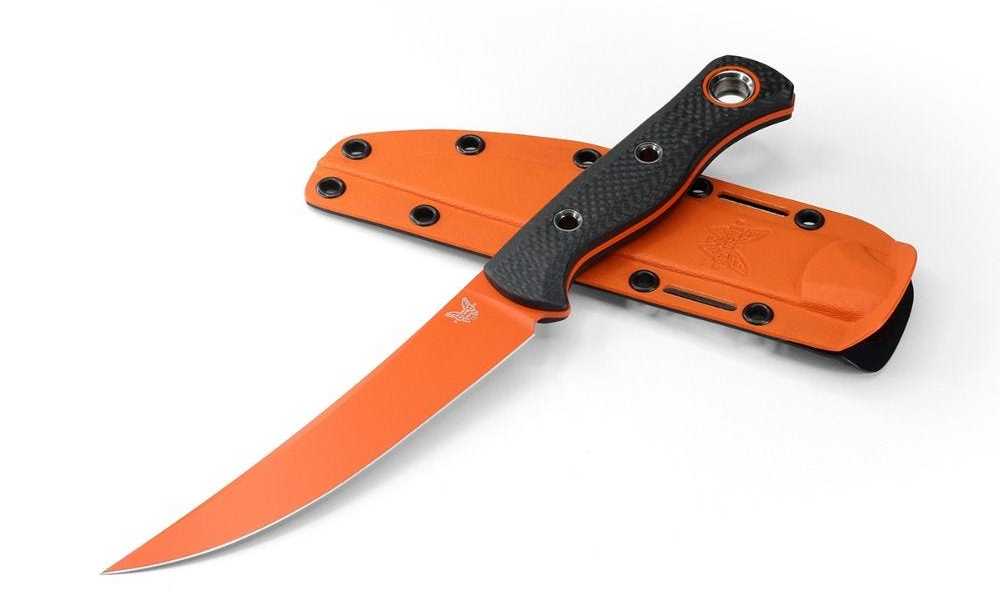
15000OR-2 Meatcrafter
This is another knife that the author reviewed for the print edition of Blade Magazine. The author received one of the first initial prototypes for testing. The Meatcrafter knife is an excellent tool, something of a hybrid between a fillet knife, a kitchen knife, and a hunting knife. It is relatively thin in the spine and cannot be used for tasks such as splitting wood, or really anything above cutting soft material.
Benchmade has a series of these knives now, available in a variety of colors and blade finishes. The knife is very well adapted to its specific role. The author butchered a deer with the prototype, and it proved to be an exceptionally sharp cutting tool, so much so that it simply glided through the meat with almost no effort. Because of its thin blade and very fine tip, it can be used for boning out meat at just about any angle. The blade is flexible enough that it can be used to get into some nooks and crannies that thicker and stiffer blades would have a hard time with. The knife does have limitations, though, and one should take care to not drop it on its tip or put it through use that results in extreme bending or pressure on the tip, an example of this would be cutting into the ball joint on the pelvis of a large game animal. There is arguably no finer game knife on the market today than this one. It is quite expensive, but it is something that will last you a lifetime with care.
MSRP: $450
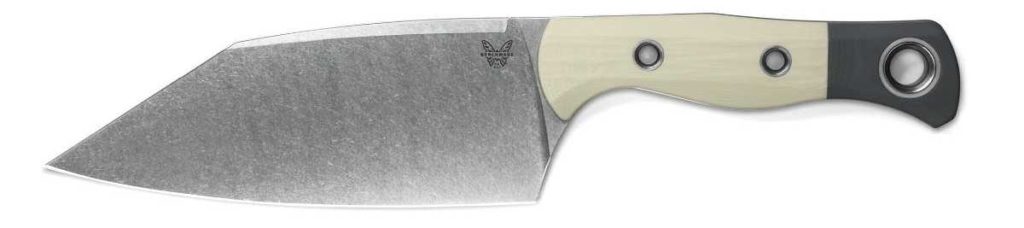
Station Knife
The Station Kinfe is available as a custom order option from Benchmade. The website has a configuration selector where you can pick out every detail of this knife. It is an all-purpose kitchen tool, able to do just about anything that you could imagine a knife could do, from slicing to dicing to breaking down meat and vegetables, as well as carving and serving. If you are a professional in the food service industry, this knife is something of the Holy Grail. Because of its unique shape, it can be used for a variety of cooking styles, not just traditional American cooking, but also different Asian, South American, and European styles. The use of the knife in these culinary arts tends to vary, and you’ll be prepared for all of them with the station knife.
MSRP: Starting at $280
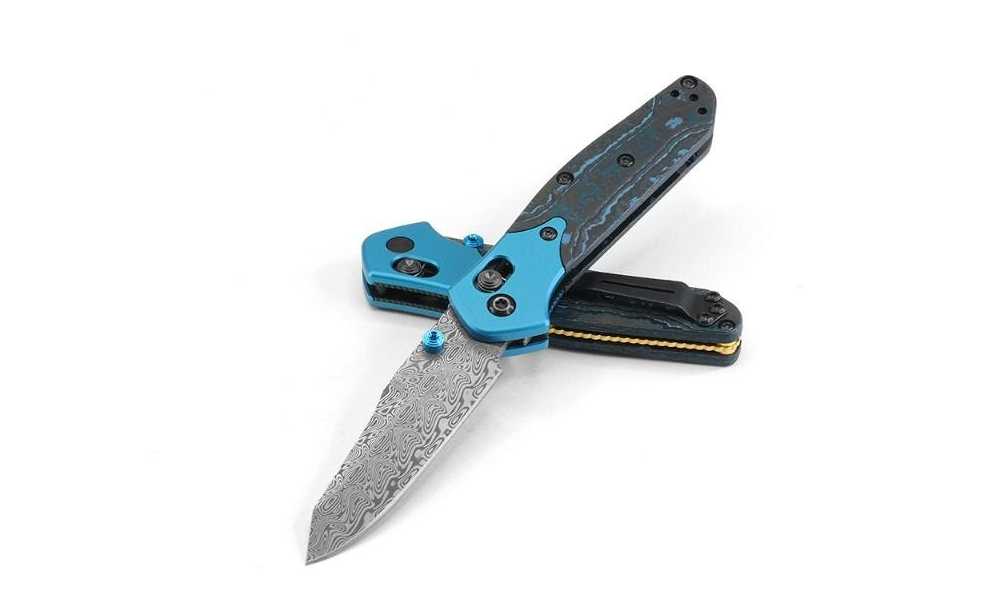
945-221 Mini Osbourne
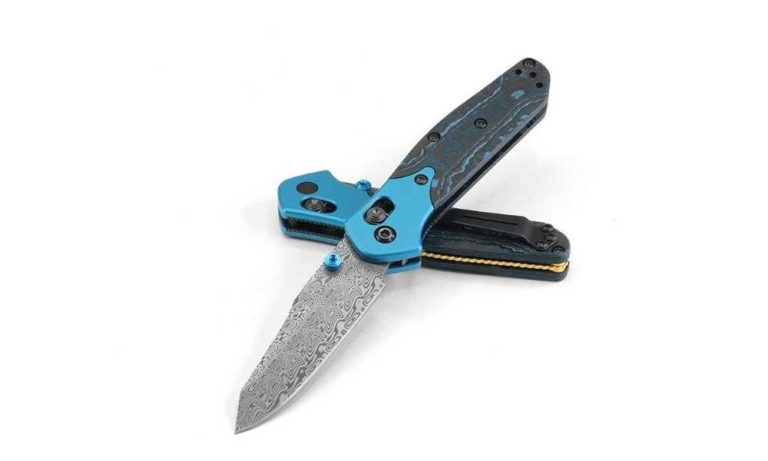
If you are looking for a pocketknife that truly sets you apart as a gentleman, the mini Osborne is one that you will certainly want to take a look at. The author has carried a version of this knife for a couple of years, it is not a heavy-duty, knife whatsoever, the blade is relatively thin, and the frame is lightly constructed. However, it is excellent at his job, which is a dedicated pocket knife. There are several variations of this knife available from Benchmade, it is a very popular design thanks to its lightweight and ease of use. The version shown here is at the top end of their design range, made of incredible materials, which will surely catch the eye.
MSRP: $700
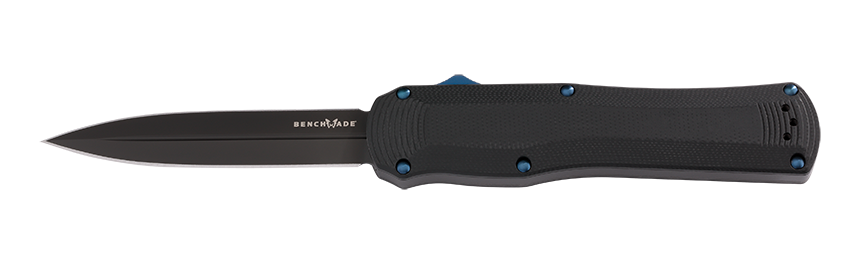
34000BK-1 Autocrat
This is arguably the king of out-the-front knives. Bench made has truly made a name for itself in this category of knives, while it is quite expensive, it has probably the most reliable mechanism of any OTF knife currently on the market and is constructed with durability in mind. The handle is, not gimmicky, rather, it is simple in overall appearance. Critics of the knife would like to see more embellishment, but the author is just the opposite, OTF knives are not an inherently strong or reliable design. In general, simplicity is king, and reliability stands above that.
MSRP: $500
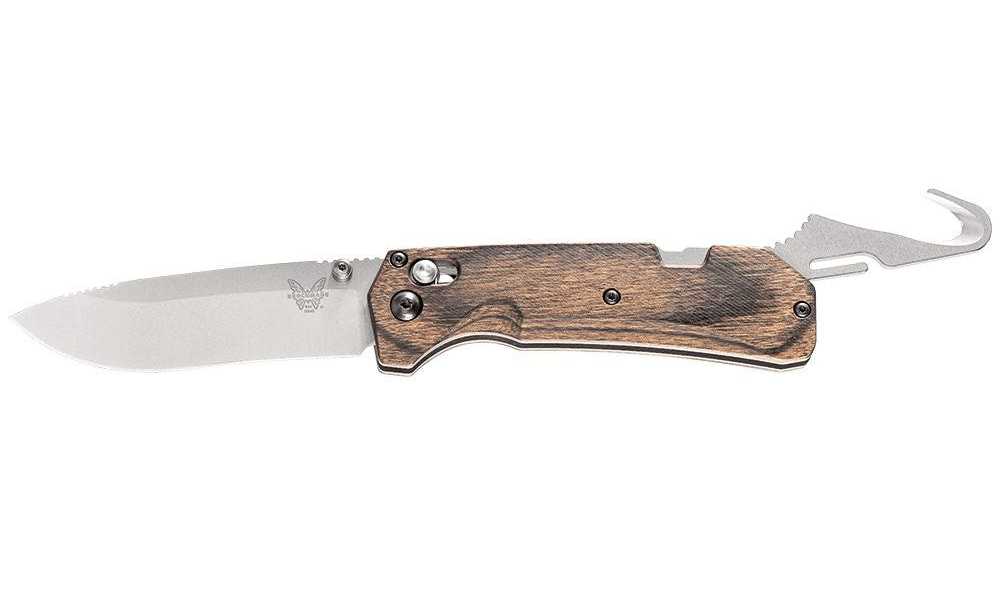
15060-2 Grizzly Creek
The Grizzly Creek is an excellent, professional-level field knife that can fit just about anywhere. It is not a camp knife in the sense that it can be used for a large amount of splitting or heavy chores, however, it is excellent for breaking down game, regardless of size. Because it is a folder, the blade is not especially long, making it not as good for big game. For all general hunting, it will work, though, you may have some struggles with large deer and above. The knife features a folding gut hook that can also be used to cut fishing line and a variety of other outdoor tasks. The price is right for a working knife; it is not the most embellished or interesting-looking product from Benchmade, but it will certainly do well given its features and intended use.
MSRP: $250
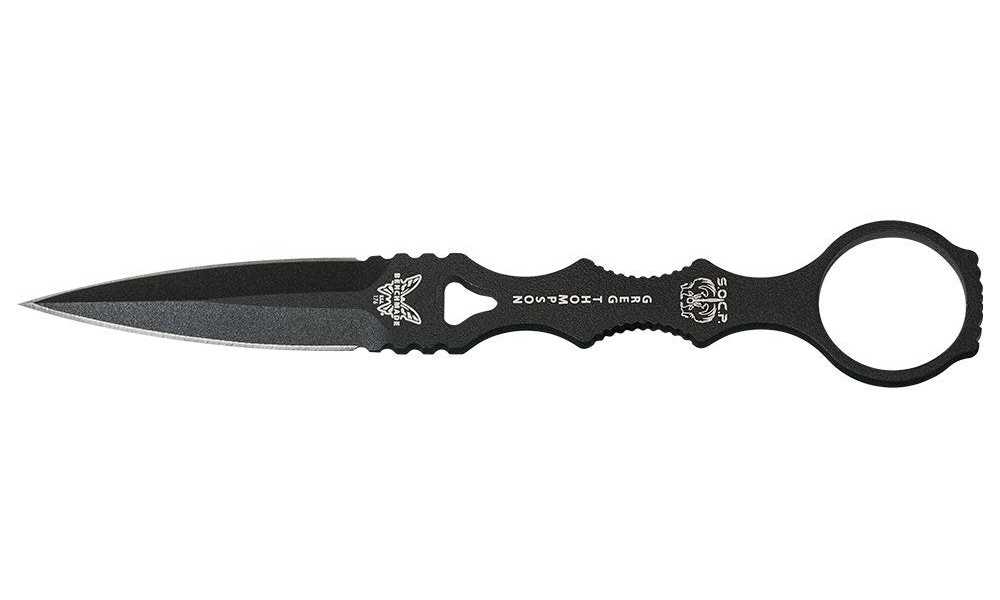
176BK SOCP
The last knife on our list is the discrete SOCP. This is a little dagger with a ring pommel designed to be used as a last-ditch item integrated into your gear. The knife can be used on just about any finger depending on what you’re trying to manipulate. At $130. It may seem a little bit overpriced for a small dagger, but it is a well-made tool that can get you out of some very sticky situations. It is worth noting, that not every municipality allows the carrying of a fixed-blade dagger, you’ll have to check your local laws if you plan to carry this knife.
Karambits continue to emerge as a viable EDC alternative.
The engineering is superb as the latest in karambits leverage the ever-popular “curve” appeal of the blade style. Materials, aesthetics and utilitarian aspects of this handy tool are getting noticed like crazy in the most recent offerings to hit the market. The karambit continues to emerge as a real, viable choice for everyday carry, and manufacturers are tuned into the possibilities.
According to knife designer Alessandra DeSantis, “Karambits are highly appreciated for cutting rope, cardboard and other utility tasks.” For more than a decade, Alessandra’s designs and perspective have influenced the marketplace, and the karambit is gaining momentum.
“Alessandra is the face of Hydra Design [hydra-design.it],” said Boker USA sales director Mike Gugliociello. “Her creations are characterized by a distinctive design that combines unique details with uncompromising functionality and high utility.”
Boker Plus HEL Karambit
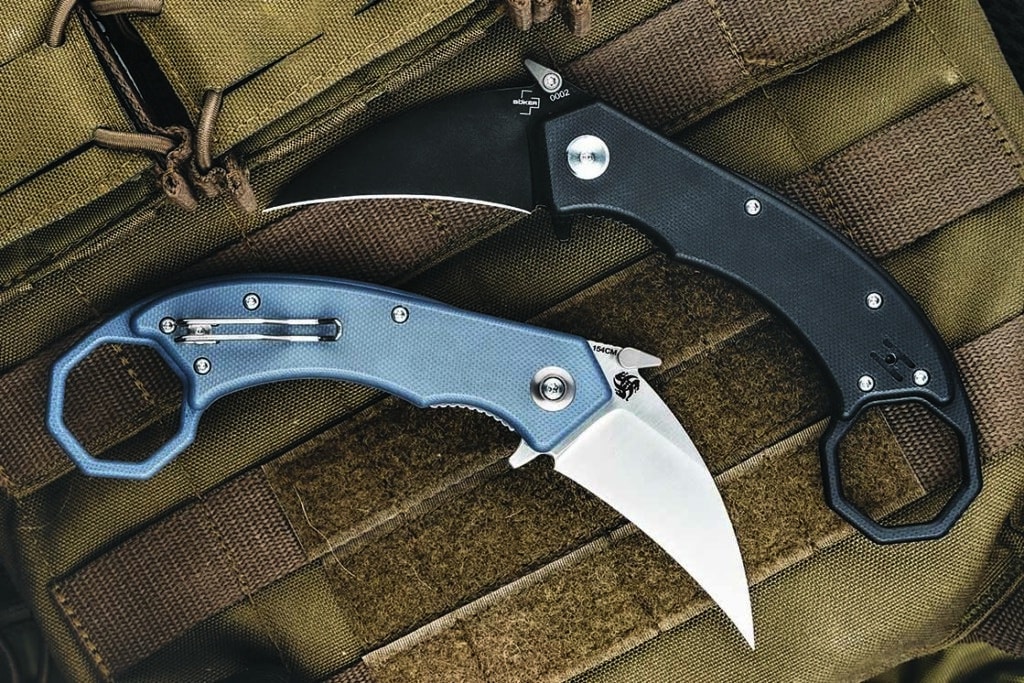
A notable feature of the Boker Plus HEL Karambit is the octagonal ring as opposed to the conventional round one. Thanks to the ring’s properly rounded corners and edges, users report no discomfort. Designer: Alessandra DeSantis.
The collaboration of Boker USA and DeSantis has produced the Boker Plus HEL Karambit. “The octagonal ring is a distinctive feature of Alessandra’s style,” Gugliociello noted. “Though some people may think that an octagonal ring can be annoying during the various knife [manipulation] tricks, actually the difference between an octagon and a circle is minimal, and with properly rounded corners and edges no discomfort is perceived.”
The striking HEL Karambit also features a screw-off feature and flipper tab to enhance everyday carry and ease of deployment. Alessandra commented, “As an alternative to smooth flipper opening, the HEL Karambit offers the screw-off thumb stud on the back of the blade. It can be removed by unscrewing the T6 Torx screw. The flipper tab also performs as a guard. Also, despite its compact size, the HEL Karambit can be gripped by either using the handle ring or not. Each karambit grip has optimal use, and each offers different maneuverability and effectiveness in various applications, so the grip depends on the intended uses.”
Hel Karambit Specs Knife Type: Folder Blade Length: 2.4” Blade Steel: 154CM stainless Handle Material: G-10 scales, liner and ring Weight: 3.28 ozs. Closed Length: 4.29” Country of Origin: China MSRP: $137.95
Halfbreed Blades CQC-02
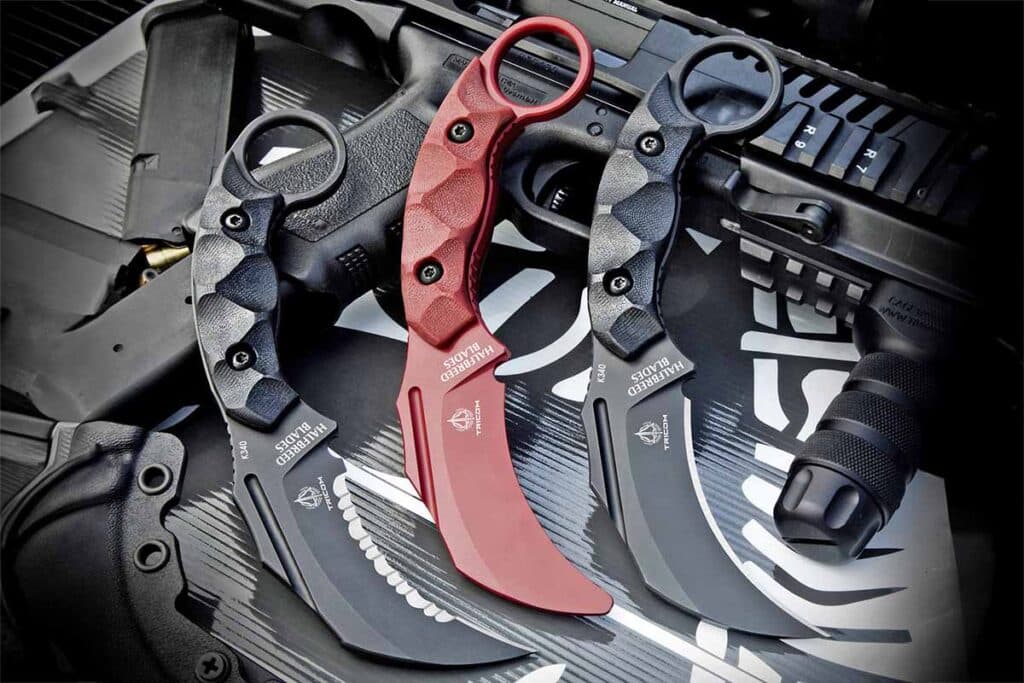
Designed by famed special operations and close quarters combat instructor Jared Wihongi in collaboration with TRICOM Training, the CQC-02 Close Quarters Combat comes in plain and serrated edge models and also a trainer.
At Halfbreed Blades, the CQC-02 Series Close Quarters Combat line is the latest partnership with famed special operations and close quarters combat instructor Jared Wihongi in collaboration with TRICOM Training, a leading global provider of premium close quarters combatives and defensive tactics training.
“In many regions worldwide, individuals carry blades for their practical use as tools,” explained Lili Ma, a director at Halfbreed. “Beyond their utilitarian purposes, knives are also carried by many for self-defense or as secondary weapons for those working with firearms or licensed to carry them. The CQC Talon series, developed with Filipino martial arts practitioners in mind, is a meticulously crafted design tailored to meet the needs of military and law enforcement professionals who rely on edged weapons in the line of duty, for example.”
Lili indicated the handle of the CQC-02 Close Quarters Combat series is designed to facilitate all popular grip styles and does not rely on the ring for carry or deployment. The ring aids retention in a high-stress clinch and the draw when the tool is concealed behind gear on a plate carrier.
“All of our tools are designed to form fit the hand. The ring, grip texture and carry system all work in unison to aid a quick deployment. We use USA-made Kydex for the fabrication of the sheath, while the retention is a molded friction lock design and mounting is via customizable DOTS attachments.”
The blade serrations appeal to a consumer segment and reflect the awareness of the Halfbreed design focus. “We like to cater to user preferences where possible,” Lili observed. “The market is divided into two groups: those that prefer a full plain edge and those that appreciate the added cutting power of serrations. In our opinion, serrations, when CNC-ground correctly, have unrivalled cutting power. They excel at cutting through clothing and other hard materials that would typically make a plain edge dull. This being said, they are not for everyone. Some believe serrations can snag or drag when cutting, and they take more effort to resharpen. These are subjective arguments, so there are pros and cons to both serration and plain edge designs.”
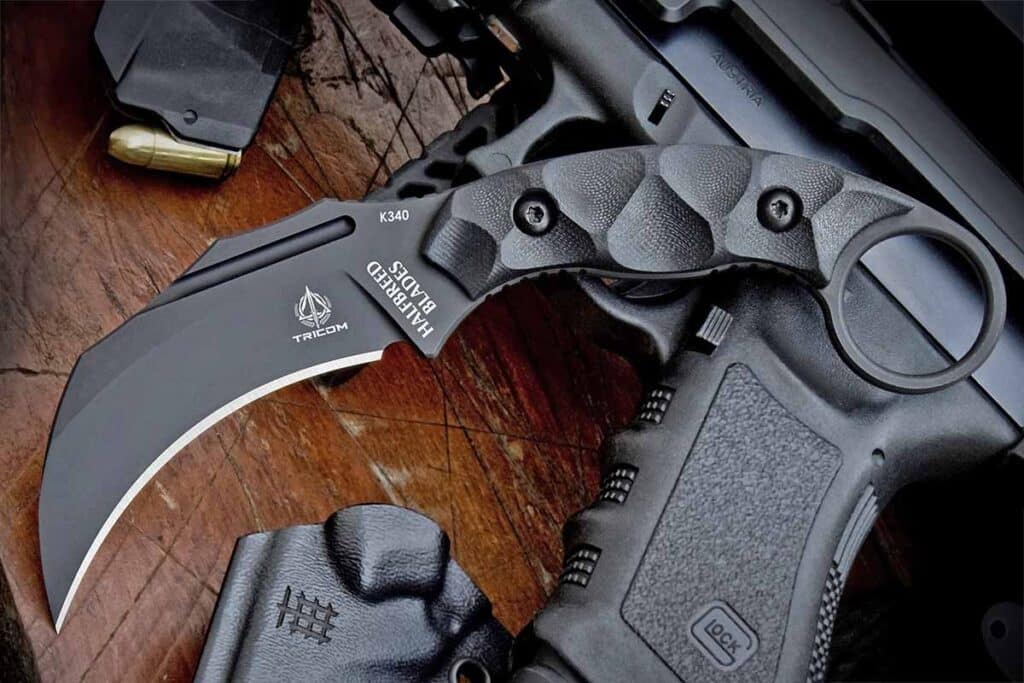
Like the Boker Plus HEL Karambit and RMJ Tactical Korbin, the handle of the Halfbreed CQC-02 Close Quarters Combat series is designed to facilitate all popular grip styles and does not rely on the ring for carry or deployment. Designer: Jared Wihongi.
Just below the blade spine, the CQC-02 Close Quarters Combat series is designed with a slot or fuller to reduce weight. It also allows control of the balance point of the blade while adding an aesthetic appeal in a fusion of “tactical function art” that drives the creativity of Halfbreed’s designers.
CQC-02 Close Quarters Combat Karambit Specs Knife Type: Fixed blade Blade Length: 3.54” Blade Material: Bohler K340 carbon steel Handle Material: G-10 Weight: 7.65 ozs. Overall Length: 7.48” Country of Origin: Comprises Australian and Taiwanese make MSRP: $220
CobraTec Karambit Double Action
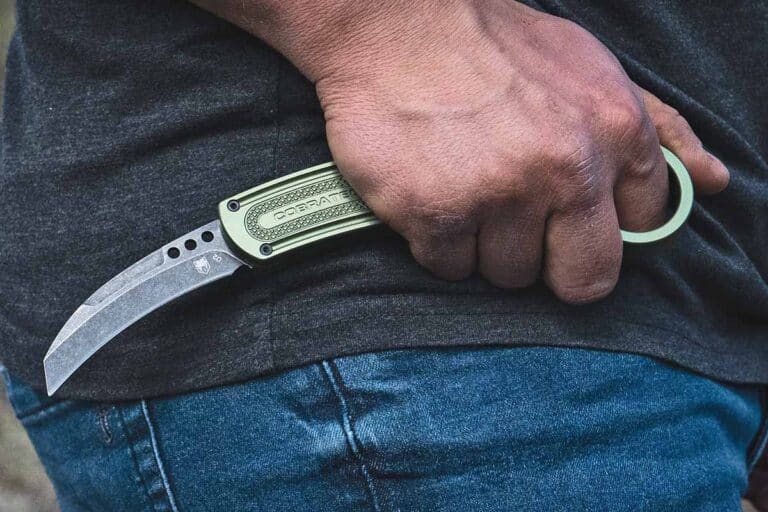
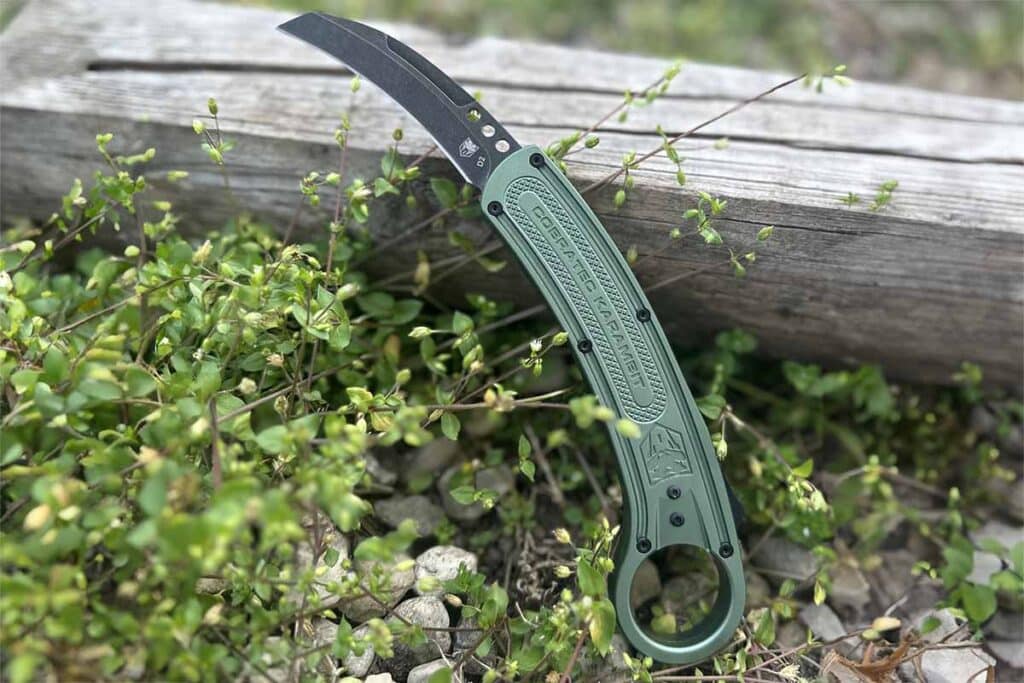
The CobraTec karambit carries in the pocket via a pocket clip with the retention ring exposed to ease deployment. Using an index finger in the retention ring, the knife easily extracts with one hand and falls into the palm ready to cut and complete chores as needed.
CobraTec is breaking new ground with its automatic entry, the Karambit in OD Green Double Action. “There were several considerations in designing the automatic karambit,” remarked company representative Eddie Johnson, “from aesthetics, function and ability to be used as a karambit, the fit and grip in the hand, along with the design of the retention ring to be used by various-sized individuals. The knife comes with two curved clips to hug the shape, and the clips are shaped to match the side of the knife you wish to carry it on.”
The automatic feature is, at the least, a conversation starter, and at best a feature that complements quick deployment and assurance of a secure lock-up. “The activation switch is located near the retention ring,” Johnson related. “As the knife is drawn for use, the index finger is through the retention ring, allowing the body of the handle to comfortably fit in the palm of your hand. The thumb naturally aligns with the activation switch, and the secure grip of the knife gives the perfect angles for activation of the blade.”
The Cobratec boasts two curved clips to hug the handle shape, and the clips are shaped to match the side of the knife you wish to carry it on. The activation switch for the double-action auto is located near the retention ring.
The CobraTec design allows the karambit to be carried in the pocket with the retention ring exposed to ease the knife’s deployment. With the index finger in the retention ring, the knife is easily extracted from the pocket and falls into the palm ready to cut and complete chores with one hand as necessary.
OD Green Karambit Spes Knife Type: Automatic Blade Length: 2.75” Blade Material: D2 tool steel Handle Material: 6061 T6 aluminum anodized green Weight: 4 ozs. Closed Length: 5.625” Country of Origin: China MSRP: $179.99
RMJ Tactical Korbin Karambit
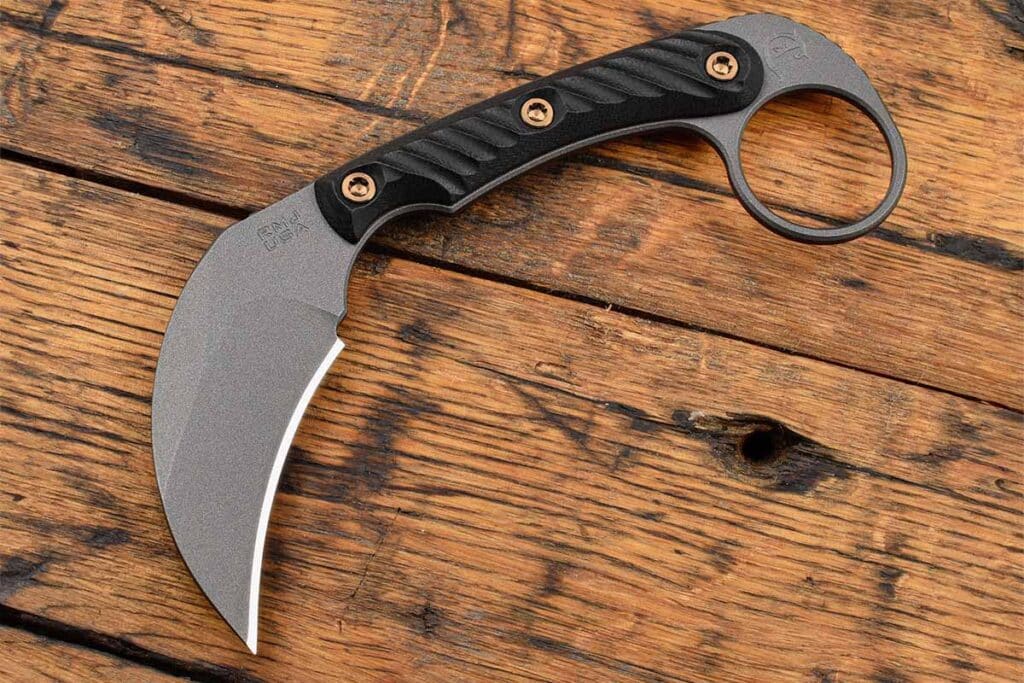
Rob Orlando of RMJ Tactical said the Korbin “can be held in the standard grip or reverse grip, either using the finger hole or not. Either way, there is a sure grip, and there is nothing protruding from the ring to prevent good purchase.”
“It’s a defensive blade with no other purpose,” related Rob Orlando of RMJ Tactical in describing the company’s Korbin karambit. “It can be held in the standard grip or reverse grip, either using the finger hole or not. Either way there is a sure grip, and there is nothing protruding from the ring to prevent good purchase.”
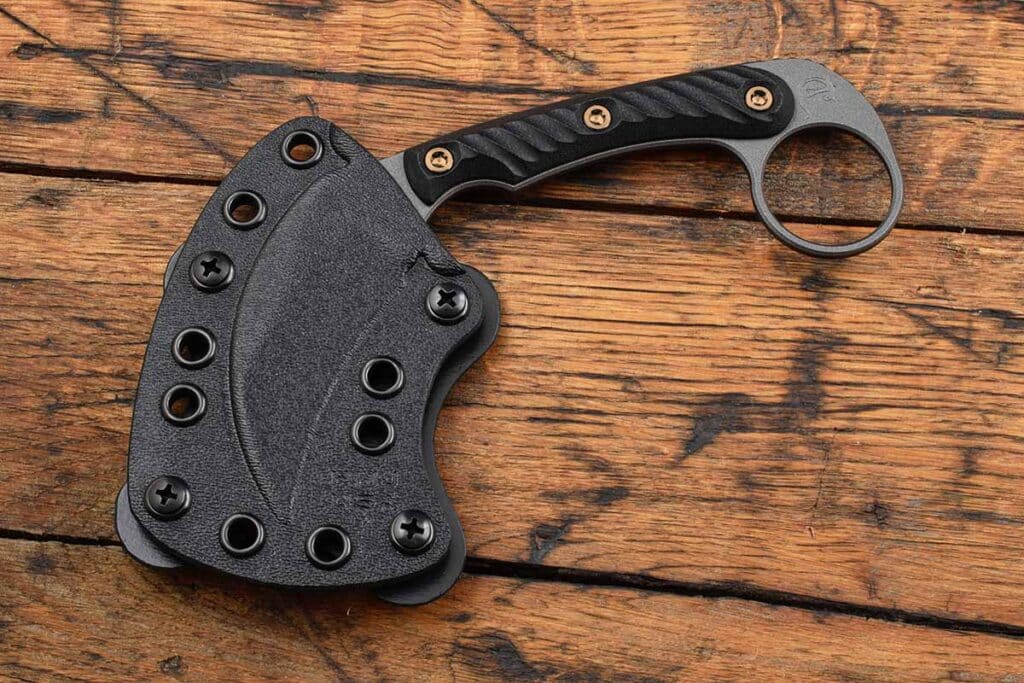
The Korbin has a Kydex sheath that includes a two-way belt adapter and allows ambidextrous vertical or horizontal carry options on a belt up to 1.5 inches wide. The sheath is also compatible with the RMJ-optional MAD straps to allow easy carry. The finger hole is 1.125 inches across and large enough to fit most finger sizes. Contoured G-10 scales allow strong grip characteristics in wet or dry conditions. Gimping on the spine both adds some traction and provides a bit of aesthetic flair.
The Korbin’s Kydex sheath includes a two-way belt adapter and provides ambidextrous vertical or horizontal carry on a belt up to 1.5 inches wide.
“The Korbin is easy to conceal,” Orlando added. “If a knife is large and heavy it will likely get left at home, but most of our everyday carry knives are deceptively light and easy to carry and conceal.”
Korbin Specs Knife Type: Fixed blade Blade Length: 3” Blade Steel: Nitro-V stainless Handle Material: G-10 Weight: 2 ozs. Overall Length: 6” Country of Origin: USA MSRP: $215
With a simple finger flick or even in promo art, today’s flipper knives fly.
Early flipper folders were used in conjunction with assisted-opening mechanisms as a means for initiating movement, allowing the spring or torsion assists to open the blades the rest of the way. A few years later, folder pivots incorporated ball bearings, nearly negating the need for assisted-opening mechanisms on flippers.
This reduced friction simplified folder construction and provided glassy smooth blade rotation. Although a few companies still offer assisted-opening flipper folders, most production versions rely on ball bearings.
Flipper Folders: Function Flows From Form
A flipper tab and ball bearings don’t necessarily equate a folder with quick action and secure deployment. A flipper mechanism will not work properly without a well-designed detent.
Imperative is the detent’s power to secure and hold the blade shut. When placing pressure on the flipper tab with an index finger, the user should be able to feel the grab of the detent. With more pressure on the flipper, the inertia of the blade overrides the pressure of the detent, and kinetic energy swings the blade into the fully open and locked position.
An imprecise detent results in either sloppy action or a flipper mechanism that requires too much pressure against the narrow tab. Optimally, with pressure on the flipper tab, the detent holds its load for a second before letting the blade go with enough energy to snap it open.
Finding Fun In The Fidget Factor
It’s the flipper action that is so satisfying. It imbues a “fidget factor” that causes knife users to snap open their folders while watching TV, talking on the phone, lying in bed or practicing any number of mundane daily routines.
The latest flipper folders not only offer pleasing aesthetics but stay true to the ideals of their predecessors. With premium materials, designs that make use a pleasure and looks that astound, they epitomize some of the coolest knives around.
Best Flipper Knives
Kershaw Inception
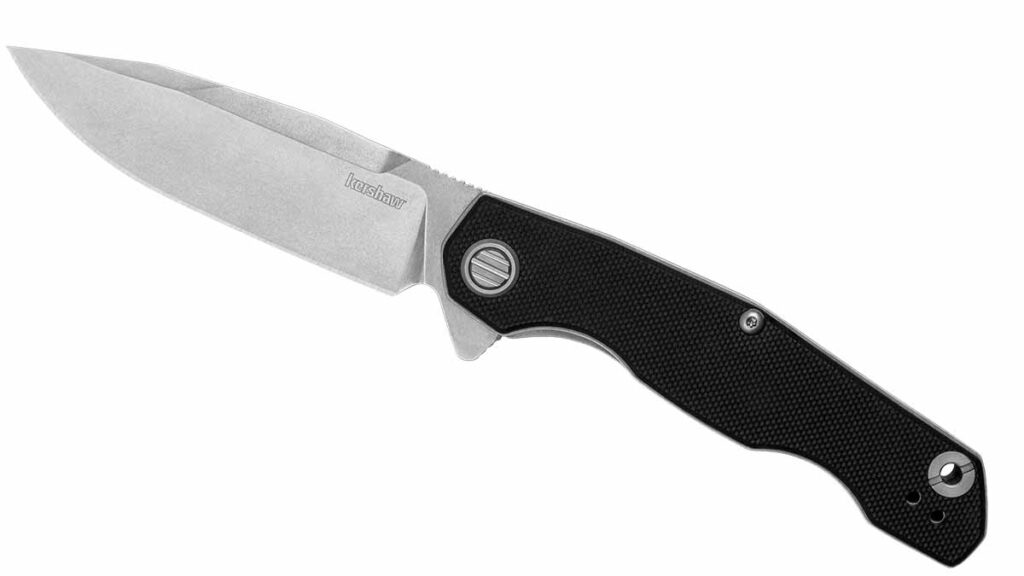
The stonewashed blade of the Kershaw Inception pivots on KVT ball bearings. The custom pivot collar adds a touch of class.
At Kershaw, the Inception is looking good with performance to match. “I love the clean, stylish look,” related Kershaw Marketing Manager Dominic Aiello, “but the satisfyingly smooth action is what really makes the Inception a top-notch manual everyday carry.”
The flipper tab was not designed with the intention of acting as a single guard, Aiello says, but rather in combination with the textured handle overlays to help prevent the user’s hand from slipping. Along with that, the D2 tool steel blade .11-inch at the thickest provides enough heft to balance durability and ease of slicing. The clip is reversible and deep carry with flush screws that won’t snag in the pocket or impede quick deployment.
Kershaw Inception Specs Company: Kershaw Blade Length: 3.25 inches Blade Material: D2 tool steel Handle Material: G-10 Lock: Linerlock Weight: 3.1 ounces Pocket Clip: Ambidextrous/reversible, deep carry, tip up Closed Length: 4 inches Country Of Origin: China MSRP: $99.99
Medford Knife & Tool USMC Fighter Flipper
The CPM S35VN stainless blade of the Medford Fighter Flipper is 3/16-inch thick at the thickest and has a Rockwell hardness of 58 HRC.
The USMC Fighter Flipper from Medford Knife & Tool boasts an iconic name and incorporates titanium along with other highly durable components. “Where to start?” commented Medford representative Geoff Oprandy. “First, the USMC Fighter Flipper has superior design, engineering and aesthetics. When Greg Medford was inspired to make this knife, it didn’t take long for initial sketches to appear. He wanted a worthy companion piece for our top-selling Fixed Fighter, which has been a category king for quite some time.”
Oprandy describes the USMC Fighter Flipper as “a unique mixture of titanium components with the best CPM S35VN blade steel. This is a big, manly knife that’s as comfortable working as it is cruising around in your pocket. There is so much going on with it that it’s hard to take in, from the retro milling on the handles, drop-point blade, and integral Ti pommel to the bearing pressed into the one-of-a-kind pocket clip. The tab is designed to be a tad longer and has a unique radius with a knurled feature. For being a large knife [it provides] great purchase, and the flipper tab combined with the finger-indexing groove enable a great grip. The knife runs on phosphor-bronze washers custom made to meet our specs.”
According to Geoff, the knife has a special connection with the United States Marines Corps. As designer Greg Medford related, “When you hold it in your hand, almost 250 years of Marines speak to your soul.”
The design is intended to feel at home with users who prefer the “connection” made with a large folder, Oprandy says. “When people position the knife correctly and begin to use it,” he stated, “the energy transfer seems balanced, natural and confidence inspiring.”
USMC Fighter Flipper Specs Company: Medford Knife & Tool Designer: Greg Medford Blade Length: 4.25 inches Blade Steel: CPM S35VN stainless Handle Material: Titanium Pivot Action: Phosphor-bronze washers Weight: 9.8 ounces Pocket Clip: Titanium; standard carry Closed Length: 5.25 inches Country Of Origin: U.S.A. MSRP: $840 and up
Rick Hinderer Knives Full Track Spearpoint “Nuked”
The Full Track Spearpoint “Nuked” has a removable tool seated in the spine for disassembly/assembly of the knife. The scale on the show side is removable to store spare washers and spacers.
Sam Santa Rita, general manager of Rick Hinderer Knives, says the Full Track Spearpoint “Nuked” is a bigger version of the company’s “very popular Half Track model. It is one of our larger folders at 3.75 inches and has titanium handles with G-10 inserts. The Full Track features a removable tool seated in the spine of the folder that is capable of complete disassembly of the knife.” The folder also utilizes a G-10 insert cover on its show side that hides a pocket for the storage of steel inserts and washers for the Rick Hinderer Knives Tri-Way Pivot System. This allows the user to easily swap from bearings to washers or vice versa depending on the situation.
“Its size and durability coupled with the ease of maintenance and ‘customizability’ makes the knife a perfect hard-use folder capable in any environment,” Sam added. The Full Track is available in stainless blade steel options of CPM S35VN, CPM 20CV and M390. Another blade steel option will be released later this year.
The Full Track flipper tab doubles as a single guard, while the blade pivots on caged thrust bearings. Meanwhile, the Tri-Way Pivot System allows for the aforementioned use of Teflon™ and phosphor-bronze washers as well, which come standard with the knife.
Full Track Spearpoint “Nuked” Specs Company: Rick Hinderer Knives Designer: Rick Hinderer Blade Length: 3.75 inches Blade Steel: CPM 20CV stainless Handle Material: G-10 Lock: Framelock Pocket Clip: Yes Weight: 6.9 ounces Closed Length: 5.125 inches Country Of Origin: U.S.A. MSRP: $820
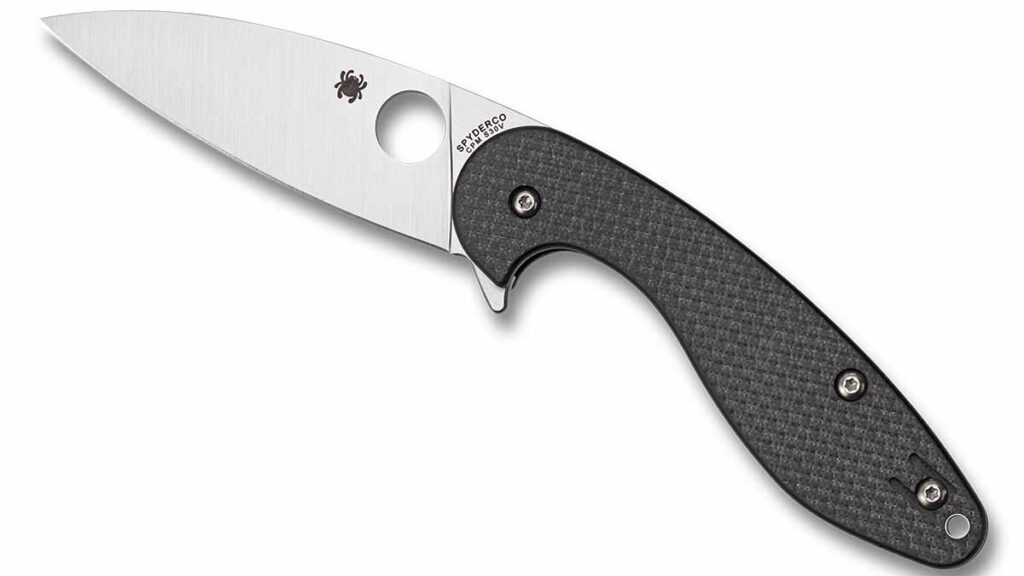
Spyderco Sliverax
The Sliverax is the first factory folder to combine Spyderco’s Compression Lock® with a flipper-style opener. Blade thickness and grind: .138 inch at the thickest and full flat.
The Sliverax is a bit of a departure for Spyderco. “It’s a flipper design, which is not common among Spydercos,” explained Joyce Laituri, company marketing manager. “The designer, Paul Alexander, is a different type of cutlery designer we have worked with in the past. He holds a doctorate in industrial design and mechanical engineering, and is a leading researcher for a company in the automotive industry.”
The Sliverax brings a shape with seamless flow and a slightly negative blade angle to enhance leverage, placing the point on the knife’s centerline for utility and control. “The negative angle also shortens the opening arc combined with the round hole and flipper mechanism for a full spectrum of positive, high-speed one-hand-opening options,” Joyce commented.
“The flipper tab doubles as a guard,” she continued, “and it’s easy to see and feel when the knife is held. There is a large, deep finger choil already, and the flipper mechanism in the open position extends the choil, creating a comfortable and deep guard for the index finger, or pinky if held in a reverse grip.”
Laituri describes the opening experience with the Sliverax as “slick as a Slip & Slide.” The mechanism features a phosphor-bronze bushing with ball bearings and a nested liner for structural strength. The CPM S30V stainless blade is exceptional in its combination of toughness, wear resistance and corrosion resistance as well, while the ergonomics of the handle are derived directly from its innovative shape, super-thin choil and expansion at the butt to fill the hand.
Spyderco Sliverax Specs Company: Spyderco Designer: Paul Alexander Blade Length: 3.48 inches Blade Steel: CPM S30V stainless Handle Material: Carbon fiber/G-10 laminate Lock: Compression Lock® Weight: 3.3 ounces Pocket Clip: Deep pocket, wire, ambidextrous, tip up Closed Length: 4.52 inches Country Of Origin: Taiwan MSRP: $306
Editor’s Note: Mike Haskew and Dexter Ewing contributed to this post.
Handy keychain knives are pocket pards ready to sever and serve.
As competitive as today’s cutlery market is, it behooves a factory knife company to fill as many categories as it can—including the keychain knife. In fact, keychain knives offer a number of the same utilitarian functions as many contemporary tacticals and EDCs. Whether you need a small knife to handle daily chores or a back-up to your back-up in an emergency, a keychain knife can answer the call.
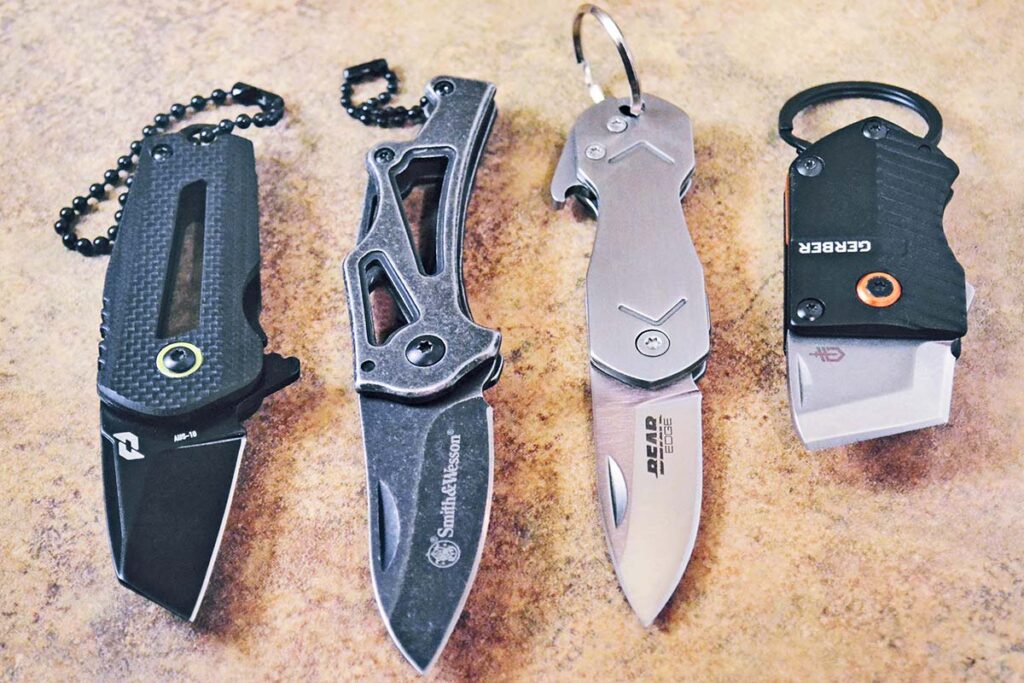
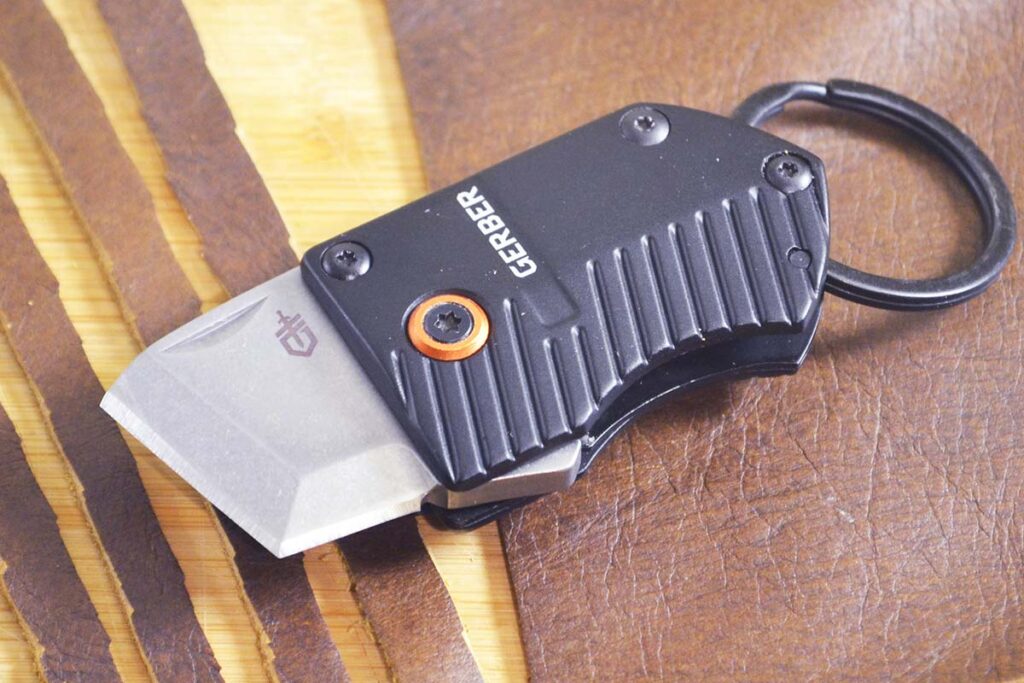
The test bunch, from left with manufacturer’s suggested retail prices in parentheses: Schrade Roadie ($25.99), Smith & Wesson Stonewash ($17.99), Bear & Son 3-inch Keychain Knife ($22.99) and Gerber Keynote ($27). All are made in China.
Bear & Son 3-inch Keychain Knife
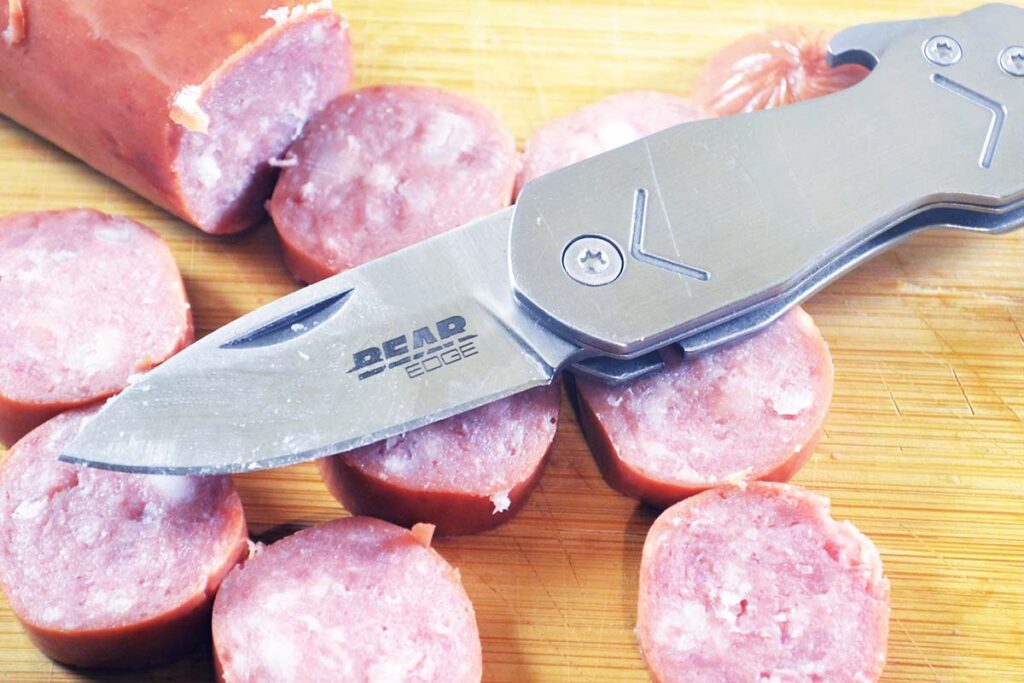
The Bear & Son’s 2-inch drop-point blade of 440 stainless steel in a brushed finish took off slices of 1-inch-diameter smoked sausage with no problem. Note the cap lifter on the rear of the handle spine. Weight: 2.3 ounces. Closed length: 2.8 inches.
The Bear & Son 3-inch Keychain Knife is a study in curves and its all-silver frame and blade add a classy touch. The blade sports a brushed finish and rolls out via a nail nick. Key hauling is handled by a 1-inch flat split ring on the base, very adequate unless you carry a large number of keys. In that case you can always add a larger split ring. A cap lifter is on the lower backside of the handle.
I sliced 1-inch-diameter smoked sausage and the blade performed admirably—not that you’d typically grab your keychain knife to perform such a task but it’s there if you need it. The cap lifter is handy. There is no pocket clip but the Bear & Son is not overburdening for loose pocket carry. This is a stout keychain knife well worth the money.
Schrade Roadie
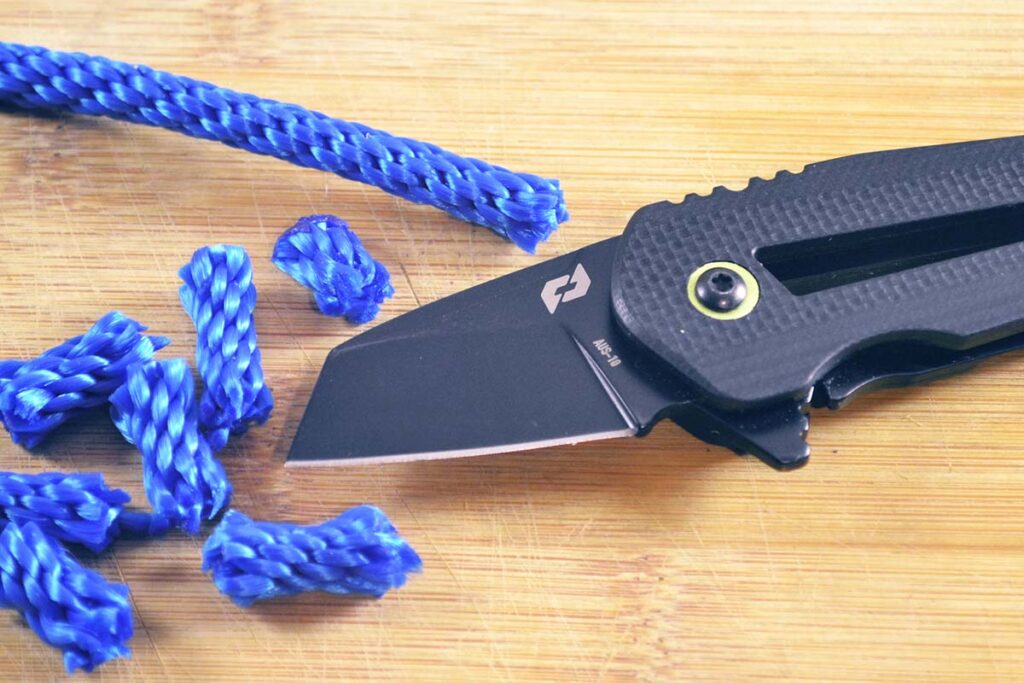
The Schrade Roadie is a little bulldog. The 1.5-inch blade of black-oxide-coated AUS-10 stainless steel bit through round after round of rappelling rope like a walk in the park. It’s a no-frills cutter meant for cutting. Weight: 2 ounces. Closed length: 3 inches.
The Schrade Roadie is a little bulldog of a keychain knife that doesn’t pretend to be anything else—it’s strictly a knife. In fact, it looks like a squeezed tactical folder. The blade opens via a flipper tab. The handle is black G-10 over black-coated stainless liners, with the rear liner serving as an unusual exposed locking leaf. Keys carry via a 4-inch black ball chain that dangles approximately 2 inches off a hole in the base.
I tested the blade on 3/8-inch synthetic rappelling rope to see how the reverse tanto pattern—a cousin to a modified wharncliffe—performed. It had no problem taking 3/8-to-1/2-inch slices in a single pass. The grip is excellent, aided even more by gimping on the upper rear handle close to the blade spine. This is a heck of a small knife and I only had one beef with it—the ball-chain key dangler. With the weight of keys tugging on the chain both sloshing around inside the pocket and while in use, you are asking for it to break. By the nature of ball-chain construction there are simply too many points along the way it can fail. I’ve got a remedy for that I’ll discuss later.
Smith & Wesson Stonewash Keychain
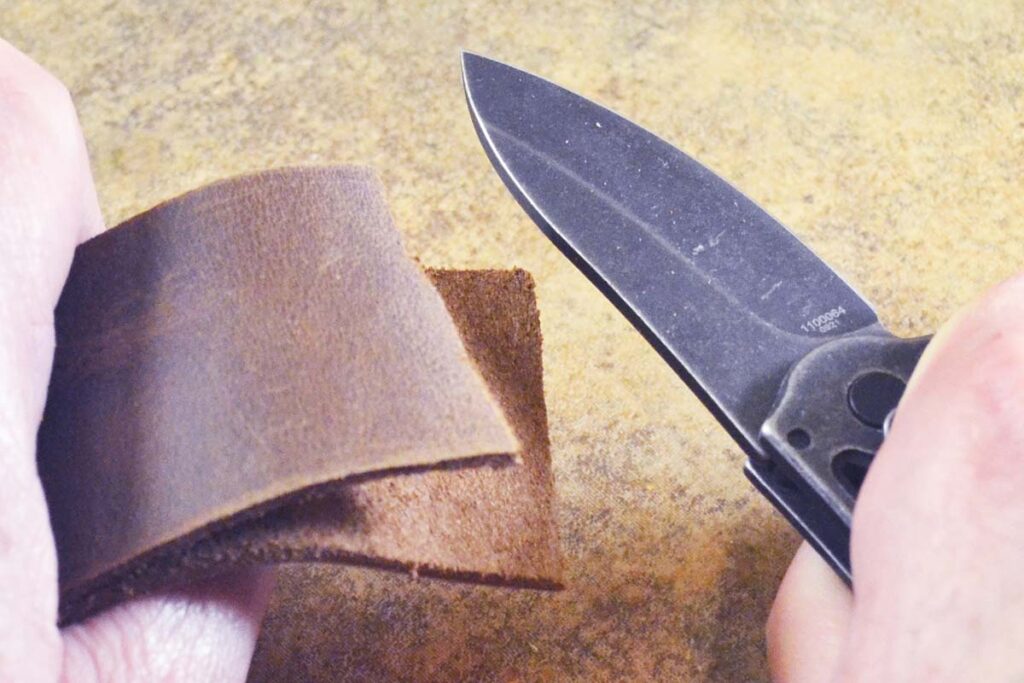
The Smith & Wesson’s 2.1-inch drop-point blade of ti-nitride-coated 8Cr13MoV stainless steel sliced its way through 1/8-inch harness leather, something the author indicated the other knives would have more trouble doing. Weight: 2 ounces. Closed length: 3.2 inches.
The Smith & Wesson Stonewash Keychain is the largest of the test bunch and it, too, resembles a scaled-down tactical folder. There’s a cap-lifter cut-out on the back frame slab. Keys mount at the base using a 3-inch ball-chain loop. This is the first of two review knives with a convenient pocket clip. The keys must be removed before using it because the clip is mounted for tip-up carry only, and if you use the keys they will hang out the top of your pocket. If this is acceptable to you, go for it.
I tested the blade on 2-inch-wide harness leather. Looping the leather strip over I did pull-throughs and found the little cutter more than up to the task. The framelock knife is built like a tank with the exception of a ball-chain key carrier which, as stated, I believe will give you issues down the road. That said, if you’re comfortable with it, go for it. I like this otherwise sturdy knife and it’s worth every penny of the price tag.
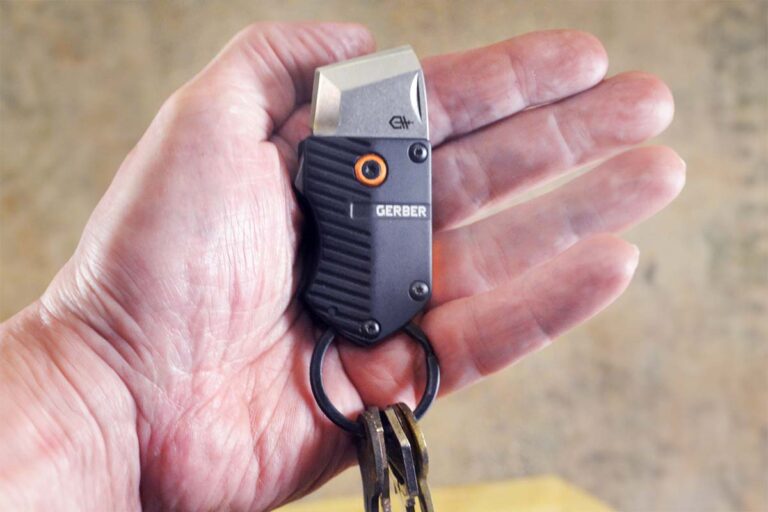
Gerber Key Note
The Key Note’s satin-finished 5Cr stainless blade is too short for slicing but the tip scores quite well.
The Gerber Key Note wins the Keychain Outside The Box Award for its sheer imaginative design. With a stubby tanto blade, this offering radically differs from the pack. Both praised and panned on YouTube, the Key Note’s stubby .8-inch double-ground blade is certainly different. The frame has black-anodized aluminum rails with black stainless steel liners, the front which houses a linerlock. A flipper on the back side of the tang gets the blade rolling but only deploys it halfway, after which you pinch it for full deployment. You can also use the nail nick. Two nice touches are a wide tip-down pocket clip and a healthy 1.25-inch-diameter split ring for holding keys.
The blade is limited by its small size but I found it useful in scoring mode taking off strips of suede leather, and it is a heck of a box cutter. It will also push-cut paracord on a flat surface. The beefy tip-down pocket clip can be used with keys attached. The amply sized split ring is the best of the test knives, providing plenty of room for key-a-holics.
Is the Gerber Key Note different? Yes, but it may do just what you need a keychain knife to do.
Keychain Knife Carry Options
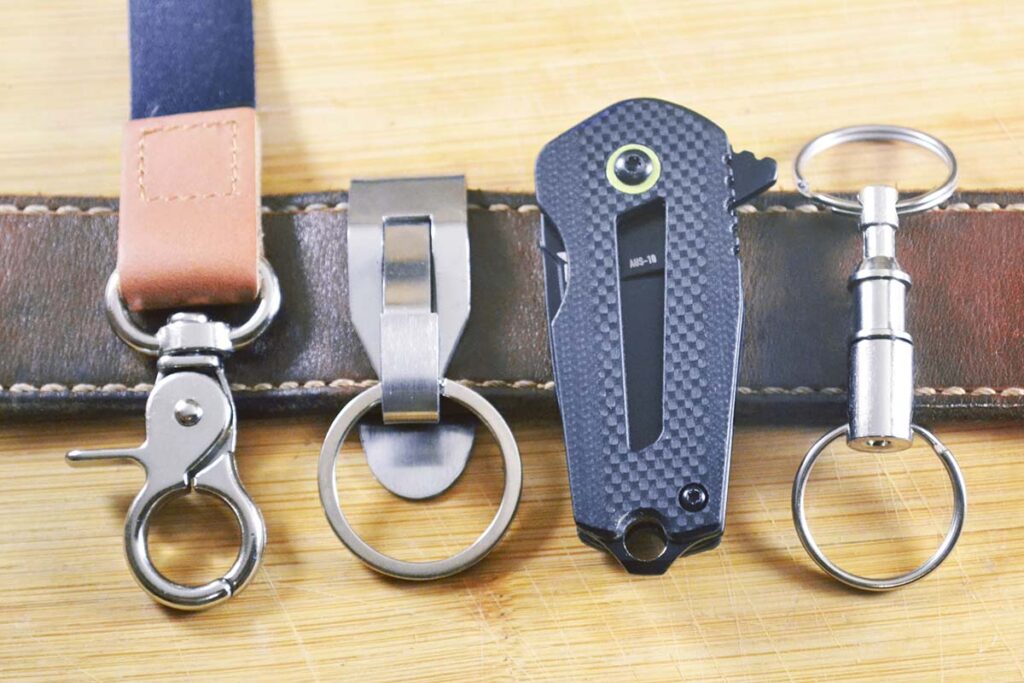
Modifying a keychain knife to suit your preferred carry can be done any number of ways. Examples include, from left: lanyard mini-carabiner for neck carry, a belt clip with split ring, the Roadie with ball chain removed, ready to modify, and a quick-release carrier that allows you to easily separate the knife from the keys.
There are other ways to carry these diminutive cutters than in or on the pocket. Accessories and findings (jewelry making parts) can be had by a various number of sources such as hobby stores, online at eBay and Etsy, or by doing an internet jewelry search such as Rio Grande Jewelry Making Supplies. Neck lanyards, belt clips, split rings large and small, breakaway connectors, small carabiners, and more are all available to modify your keychain carry to suit you. Any one of our candidates may suit your tastes as is, but if you want to mod it to suit your needs, there are plenty of options!
Fixed-blade focused Condor continues to branch out Tactical P.A.S.S. Com folder.
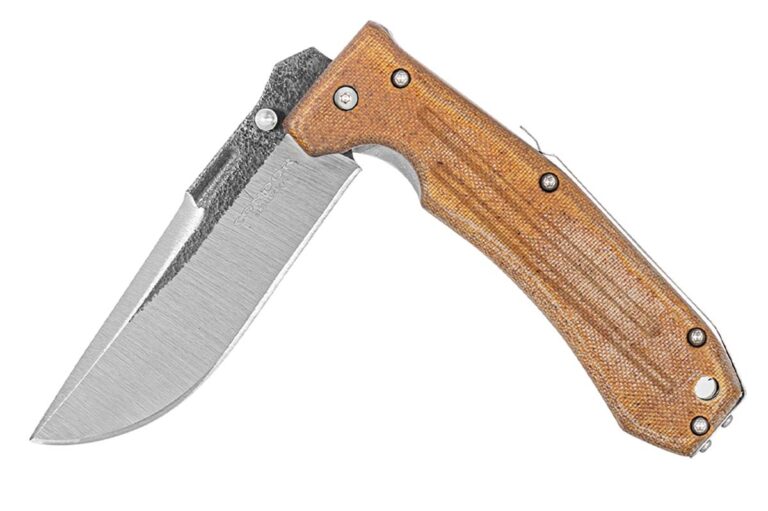
Condor Knife & Tool came heavy into SHOT Show 2024 with a bevy of new blades and variations. The company’s fans should be excited about the coming year. That said, one particular knife jumped — the Tactical P.A.S.S. Com.
Those who follow Condor know its bread and butter are fixed blades, usually the type fit to slice through the El Salvadorian jungle—home base for the company. But the manufacturer continued to branch out with the Tactical P.A.S.S. Com, a folder (not its first, mind you) that makes for an interesting break in Condor’s same old, same old. Trust me, you might be able to tuck it away in your pocket, but it’s every bit up to the company’s rugged standards.
Designed by Jason Breeden, who has conjured up a bevy of designs for Condor, the Tactical P.A.S.S. Com is modeled after an icon—Bob Loveless’ Chute knife. As an aside, Mike Haskew did a phenomenal piece on the development of this classic in his article on the original Chute knife. Breeden appears to have an affinity for the design, having created a more true-to-form fixed-blade rendition of it previously. The folder marks the continued expansion of Condor’s popular Mountain P.A.S.S. (Plain And Simple Survival) line, which has grown significantly in the past year.
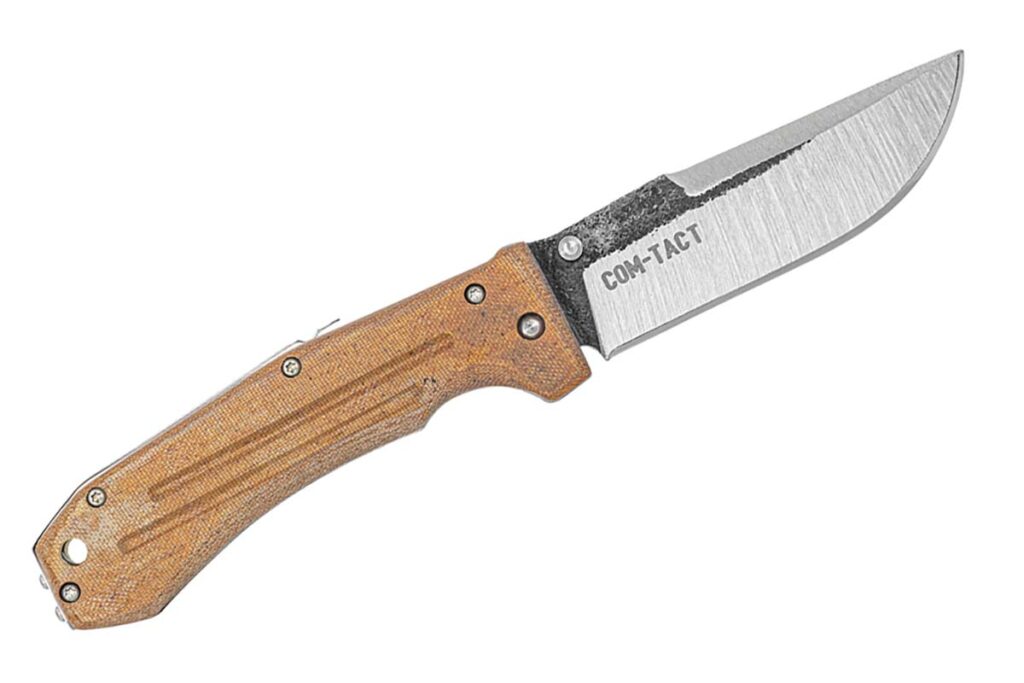
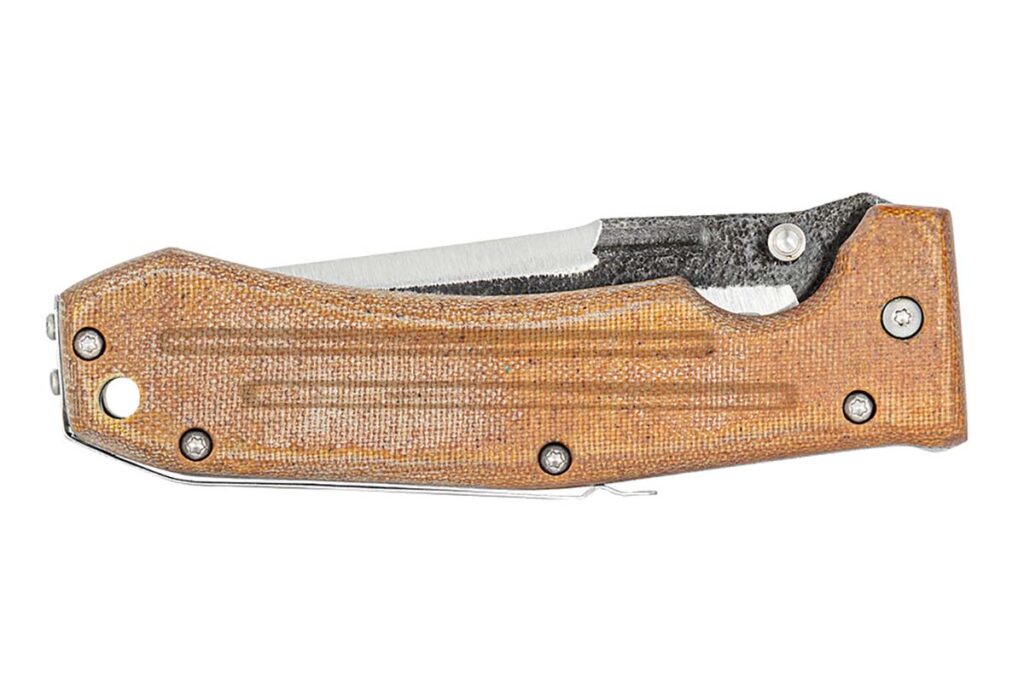
In brief, the knife looks to have the chops for tough outdoor use, as is the typical theme at Condor. Tactical P.A.S.S. Com boasts a 4.96-inch, drop-point blade constructed from 14C28N stainless steel. This is a budget stainless, but one not without its charms, particularly its respectable edge retention and toughness. And at .12 inches in thickness, Condor gives you plenty of material to work with on the flat-ground blade, particularly if called into play on more demanding tasks, such as batoning. I’ll say, the false edge is a nice touch, giving the blade an overall clean, yet rugged look tapering back into the hammer finish around the thumb studs.
As for the handle, it’s a tan Micarta with some milling down the midline and a single-finger groove to provide a comfortable yet firm grip. The liner lock’s stainless screws give the handle strong, if understated aesthetics, not to mention easy access if you need to crack baby open to clean.
While Condor pulls off a strong showing with the Tactical P.A.S.S. Com, I do have one nit to pick. The company opted for a spine-side, extended clip, which from my standpoint isn’t the most practical configuration. But with everything else the knife brings to the table, it’s far from a deal breaker for those who prefer a more traditional clip arrangement.
As for costs, Condor as usual keeps its edge but puts the Tactical P.A.S.S. Com within reach of most knife consumers. The company lists its MSPR at $150 at its site and has it on sale for less. Overall, the folder is a nice addition to a catalog of fixed blades and certainly seems on par with Condor’s ready-and-rugged standards.
Tactical P.A.S.S. Com Specs BLADE LENGTH: 4.96 in OAL: 9.66 in BLADE THICKNESS: 0.12 in WEIGHT: 7.27 oz BLADE MATERIAL: 14C28N Stainless Steel FINISH: Condor® Classic GRIND: Flat Grind w/ Second Bevel TYPE: Folding Knife HANDLE MATERIAL: Micarta® MSRP: $150
The Dirk Has A Long, Exciting History And Has Been Used For Everything From Farming To War All Around The World.
The general definition of a dirk is that of a one-handed thrusting knife. Depending on region and style, it may be single-edged or double-edged. It also may or may not have a defined cross guard and pommel.
Dirk as a term is loosely associated with several Scottish and English regions. It is most commonly credited to the former, though no one really knows for sure, and it also has a long history of use across medieval Europe. It was a very important object to people in the Highlands of Scotland at an individual level and had significant ceremonial and practical uses.
Weapons Before The Dirk
As is common in the era of gunpowder in Europe, many types of knives and daggers owed their roots to the bollocks dagger and other stabbing weapons that originated hundreds of years prior when soldiers wore heavy armor. Contrary to popular belief, most swords are not like how you see in the movies. These stabbing and thrusting weapons seldom had what we’d expect as edges, rather they were made to parry and bludgeon. Maces, picks, and hammers were very common in this time, prized for their ability to bash and smash, where swords, while deadly, were not always the first choice.
These long, thin daggers were sometimes the choice when things got up close and personal, though even then the textile layers of armor were hard to penetrate. All that changed with gunpowder weapons causing a wide decline in armor use, and the dirk as we know it today was the product of that evolution. The dirk became something quite different than other edged weapons of the time and developed in its own way, largely apart from other European designs.
The Scottish were some of the first to begin independent development of swords and daggers alongside guns in the post-armor age along with strategies to fight against firearm-equipped soldiers. The heavily tribal Scottish Highlands were not especially invested in standardized firearm technology.
Guns did figure heavily into the culture, but the Scottish never developed a well-oiled machine akin to what the British developed when it came to battles. The Scottish had two primary tools for the battlefield, the broadsword and the targe (buckler), itself a small shield held in the weak hand. The combination of buckler and broadsword allowed the Highlander to easily kill British soldiers, usually armed with nothing more than a musket and bayonet.
They specialized in fast ambushes, often called a ‘Highland Charge’ where they wore virtually no protection of any kind and ran headlong at their enemy. If the enemy didn’t flee on sight, they would only have one shot at most before they had to fight hand-to-hand.
How The Dirk Developed
The dirk traces its lineage to the Scottish Highlands.
The dirks developed in the post-armor era became focused on all-purpose use, not just stabbing or bludgeoning. As a result, sharp, light-bladed swords and short-sword like knives and daggers became the norm.
Slashing through clothing wasn’t difficult and the Highlanders found themselves at a distinct advantage using these tactics. That is, until the Battle of Culloden in 1746.
Here the entirety of the Highlander army was soundly defeated by the British in a battle that lasted an hour. The British faced them on an open field and modified their tactics to anticipate the Highland Charge, resulting in a complete defeat of the Scottish Jacobite movement that had made an invasion into England a year earlier.
Dirks were common even after Culloden. The carrying of knives wasn’t necessarily seen as carrying arms in most cases, and dirks were something of a common, everyday tool for most people. They would be not only used for self-defense but also for regular tasks like eating, splitting kindling, and standard daily chores.
Dirks vs Daggers
Is the dirk a dagger? The short answer is yes and no, and that is because there is a great degree of ambiguity in the definition. A dirk is classically a large, single-bladed knife with a blade anywhere from 12 inches all the way up to 20 inches.
Naval dirks were commonly used for ship-to-ship fighting as they were short enough to be used in tight confines yet large enough to still be effective. Daggers at this time would have been primarily understood to be stabbing weapons, whereas the dirk was large enough and stout enough to be used in a primary slashing role.
Daggers are, by type, geared mostly for stabbing. Rarely do companies refer to any large, single-edged knives as ‘daggers’, but the dirk is often classified right alongside them by name in many laws.
The American dirk which evolved in the early 1700s, was almost always single-edged and was primarily used as a support knife alongside the tomahawk and rifle. It could be said that a significant and wide-ranging number of knife styles, including the Bowie, evolved directly from the Scottish dirk on the American frontier.
Daggers as stabbing knives were somewhat uncommon in America because they lacked general utility in the field at a time when larger camp knives and multi-purpose tools saved weight.
Is It Legal To Own A Dirk?
Unfortunately, Dirks have a wide legal definition across the board that often describes them as daggers or stabbing weapons. In many municipalities, this type of weapon is not legal to carry. There is a blurred line in this definition, as many places considered double-edge, stabbing weapons as the verboten item. As many historical dirks are single-edged, there could be room in these laws that skirts one definition or another.
4 Best Dirks Available Today
COLD STEEL SCOTTISH DIRK- $119.99
Cold Steel is well known for making some very durable and interesting products. They pay great attention to detail and their Scottish Dirk is no different. While it is not the most costly, it is a step above the rest, and it is affordable and backed by Cold Steel’s legendary standard of excellence. The Cold Steel Scottish Dirk is a working tool that does everything the historical versions did and then some. If you’re looking for a hard-use dirk, look no further.
Knife Specs
Overall Length: 18.38 inches
Blade Length: 13 inches
Weight: 1 pound
Blade Steel: 1055 Carbon
Handle Material: Rosewood
WINDLASS BONNIE SCOTTISH DIRK- $149.00
If you’re looking for a prettier dirk than the rest, Windlass makes some excellent historical replicas that reflect various periods of Scottish history. The Bonnie Scottish Dirk is reminiscent of the late stage of refinement on these weapons. It is ornate yet functional and is sure to be a conversation starter. While other companies tend to take some liberties, this is a very accurate replica of what may have been on the belts of Highland Warriors at the Battle of Culloden.
Knife Specs
Overall Length: 17.5 inches
Blade Length: 11.75 inches
Weight: 18 ounces
Blade Steel: 1055 Carbon Steel
Handle Material: Wood
WINDLASS EARLY SCOTTISH DIRK- $139.95
This product is a replica of some early dirks as they would have looked descending from the bullock dagger. A functional reproduction, this early replica features a more basic feature set as would’ve been seen a few hundred years prior to the Battle of Culloden. Although it has unrefined features, it is still not out of place for costuming or period reenacting.
Knife Specs
Overall Length: 21.25 inches
Blade Length: 15 inches
Weight: 16.2 ounces
Blade Steel: 1055 Carbon Steel
Handle Material: Hardwood
CAS IBERIA (LEGACY ARMS) SCOTTISH DIRK- $159.00
This dirk has some classic lines, but is all about function. It will not look odd at a cultural event, although it is made with a slight skew to the modern. The handle design is reminiscent not of the bullock dagger, but the earlier Rondel form characteristic of the late medieval era prior to the renaissance. While it is the most expensive so far on the list, it is right in the same price range as most common dirks. If you prefer this look over the more classic Scottish design, this is the one for you.