
Buyer's Guides

You’re looking for a new knife in a certain style – we’ve got recommendations on the best blades for every price point.

Bearded Axe: Best Bashers From Here To Valhalla (2023)

0

Hot bearded axes go beyond just chopping.

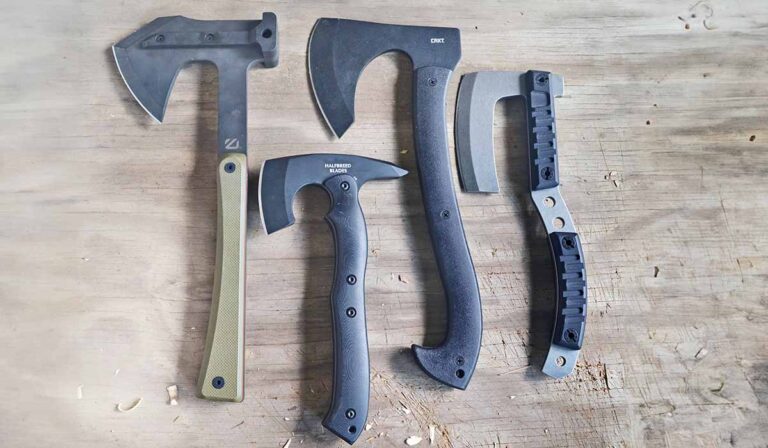
All axe heads have an edge, of course, but did you know some can give you an edge over others? The bearded axe chops just like any axe, but its beard can serve field duty beyond the norm.

The bearded axe was first used by the Scandinavian Norse people (Norsemen) in the Middle Ages and was called a skeggox—skegg for beard and ox for axe. Its distinctive shape allows you to grasp the handle at the base of the head and use the edge for woodworking chores.

It’s sometimes called a carving axe for its propensity for de-barking, shaving and notching wood, and other chores like slicing cord and rope—even serving as an ulu to prepare food. Not all bearded axes are made specifically for carving wood, however, as you’re about to find out.

CRKT James Williams Skeggox
Bearded Axe CRKT
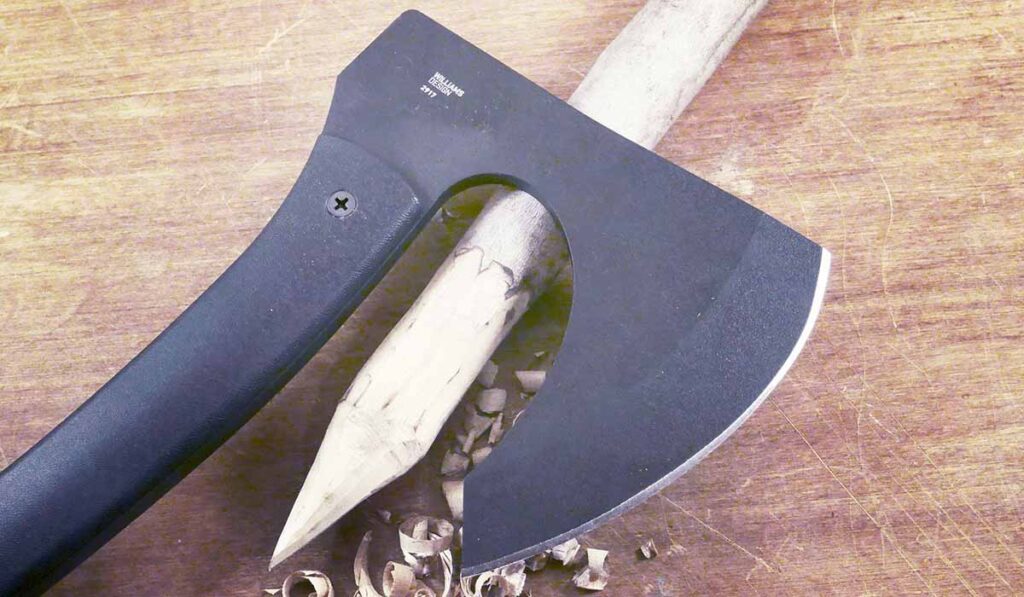
The CRKT Skeggox shaved bark and rendered nice shavings while debarking and pointing the tip of a hardwood stake. The SK5 carbon steel bit into the hardwood quite well and the handle scales offered a comfortable grip.

Columbia River Knife & Tool and martial artist/Japanese sword guru James Williams dipped back in time and chose the original Norse namesake for his design. The CRKT Skeggox is one of the larger two test axes.

The drop in the beard from the top of the inner curve to the bottom edge is 3.25 inches. The 11-inch handle has a lanyard loop at the base. The sheath features a black nylon keeper strap with a thermoplastic buckle to prevent slippage from the sheath. CRKT includes additional hardware for belt or MOLLE carry.

The SK5 carbon steel of the axe head has been compared to U.S.-produced 1084 and 1095 carbon steels, which typically fare well-working wood in the wild. I tested it for carving and immediately liked the deep drop and the “50 miles of elbow room” between the handle and the rear of the beard. I de-barked and pointed a fat hardwood tent peg, and the more I used the bearded blade the better my control got for taking off long shavings. This was in part due to the low profile of the quarter-inch steel and the nice bite of the high carbon alloy.

The Skeggox is also a good all-around chopper for firewood and clearing small trees. The sheath is economical and the option of belt or MOLLE carry is welcome. Better yet, it is the most affordable of the review axes and money well spent.

James Williams Skeggox Specs
Head Width: 4.874”
Blade Edge: 5”
Blade Material: SK-5 carbon steel (Japan)
Blade Thickness: .25”
Blade Finish: Black powder coat
Handle Material: Black FRN polymer
Weight: 26 ozs.
Overall Length: 13”
Sheath: Black thermoplastic
Country of Origin: Taiwan
MSRP: $113

Doublestar/Outlier Kodiak Camp Axe
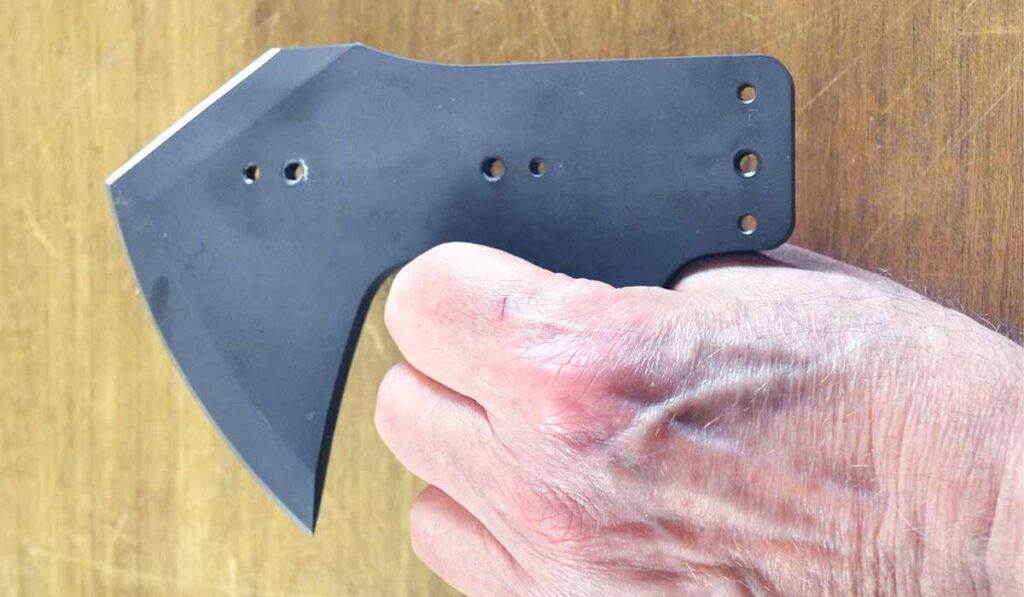
Bearded Axe Kodiak
The author removed the splitter attachment from the Outlier Kodiak Camp Axe to clear the way for using the blade for debarking and shaving wood. He used the longer, lower portion of the double-edged blade and was impressed with the performance of the 52100 carbon steel.

The Outlier (formerly Doublestar) Kodiak Camp Axe is the second of the larger test axes and comes with a twist. The axe head has a removable steel splitter attachment installed, specifically made for cleaving wood. It is also notable in that the blade edge has two grinds.

The beard drop is 2.5 inches. The handle scales are sumptuous at a half-inch thick each. The sheath covers the axe head and splitter until it reaches the widened rear of the splitter used for hammering. The front has a nylon belly strap with a thermoplastic buckle to secure the axe head.

The splitter increases weight, blocks access to the beard for slicing and shaving, and is too unwieldy for my tastes for finesse work. I removed it, reducing axe weight by 8 ounces and making the Kodiak much easier to manipulate. I thought the two angles of edge might make a difference in cutting surface—and I’m sure they would—but the longer, lower edge turned out to be all I needed for de-barking and shaving long slivers. The 52100 carbon steel cut like a house afire, slicing wood and ¾-inch rappelling rope with ease.

It was a different axe altogether without the splitter and more in line with the other text axes. The only recommendation I’d have is that Outlier offer the same axe with a full, single-edged head to increase the coverage of the edge. Other than that, it’s a beast.

Kodiak Camp Axe Specs
Head Width: 5.25”
Blade Edge: Varied
Blade Material: 52100 carbon steel
Blade Thickness: .25”
Blade Finish: Parkerized black
Handle Material: Green G-10 composite w/orange liners
Special Features: Splitter attachment
Weight: 40 ozs. (including splitter)
Overall Length: 13.125”
Sheath: Black thermoplastic
Country of Origin: U.S.A.
MSRP: $319

Halfbreed Compact Rescue Axe
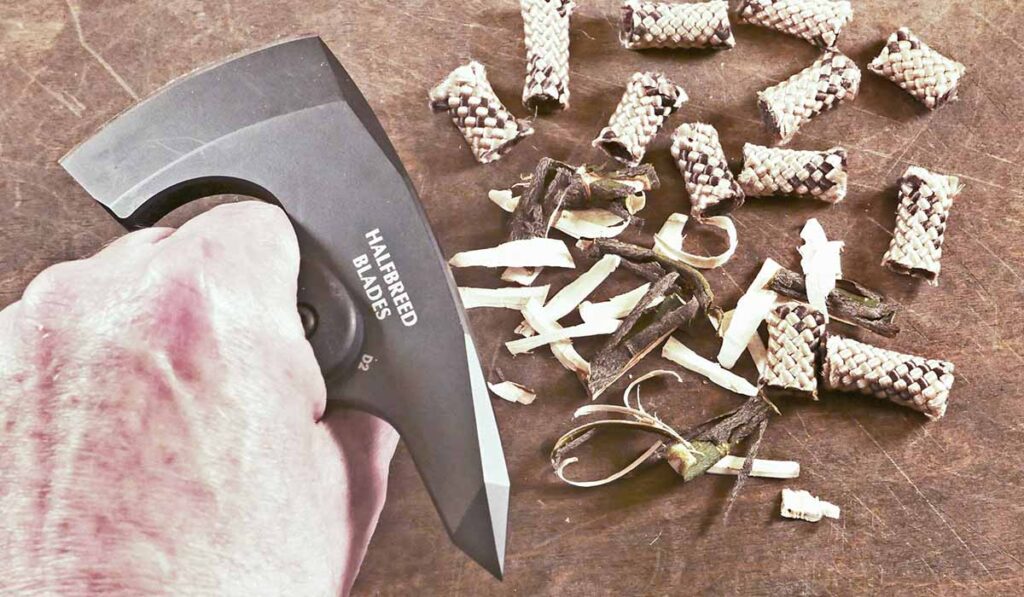
Bearded Axe Halfbreed
The Halfbreed Compact Rescue Axe shaved wood and sliced rappelling rope with flying colors. The axe head steel is the thickest of the test group.

The Halfbreed Compact Rescue Axe is the smallest of our bearded array yet is also the most overbuilt. It makes up for its smaller size with the thick axe head steel. There’s a nice palm swell at the lower grip area and a big finger groove at the top of the handle.

It has a beard drop of 1.5 inches. Out back is a 2-inch spike. The rear spine has gimping to enhance grip. The sheath offers full coverage and a keeper loop rolls under the bit to further secure the axe head. It has a mounted MOLLE-compatible plate, or you can swap it out with an optional DOTS Tek-Lok style attachment for belt carry.

While testing the Halfbreed I had to remind myself it is indeed a compact rescue axe. While all the other review subjects are geared for outdoor use, this small overbuilt wonder is more for city work. That said, the large finger groove at the top of the handle is custom-made for carving and slicing just as bearded axes were intended. I tested the little axe and it shaved bark, took off shavings, and sliced rappelling rope just fine, but its thick steel and superior weight-for-size ratio really shine when hacking and bashing. I have no doubt it would earn its stars as a close-quarters hawk.

I gave the spike a run on a pane of 3/16-inch door glass and it obliged, shattering it with gusto. The ample grip, with its added gimping, makes for excellent purchase, and the sheath—overbuilt like the axe—is the most comprehensive of the lot. In a nutshell, the Halfbreed is a handy axe—and a bulldog at that!

Compact Rescue Axe Specs
Head Width: 4.5”
Blade Edge: 2.55”
Blade Material: Bohler K110 (D2) tool steel
Blade Thickness: .31”
Blade Finish: Black Teflon coating
Handle Material: Black G-10 composite
Special Features: Faceted spike, gimping
Weight: 25.07 ozs.
Overall Length: 9.52”
Sheath: Black Kydex, MOLLE compatible
Country of Origin: Australia
MSRP: $310

Maserin Knives Mantis
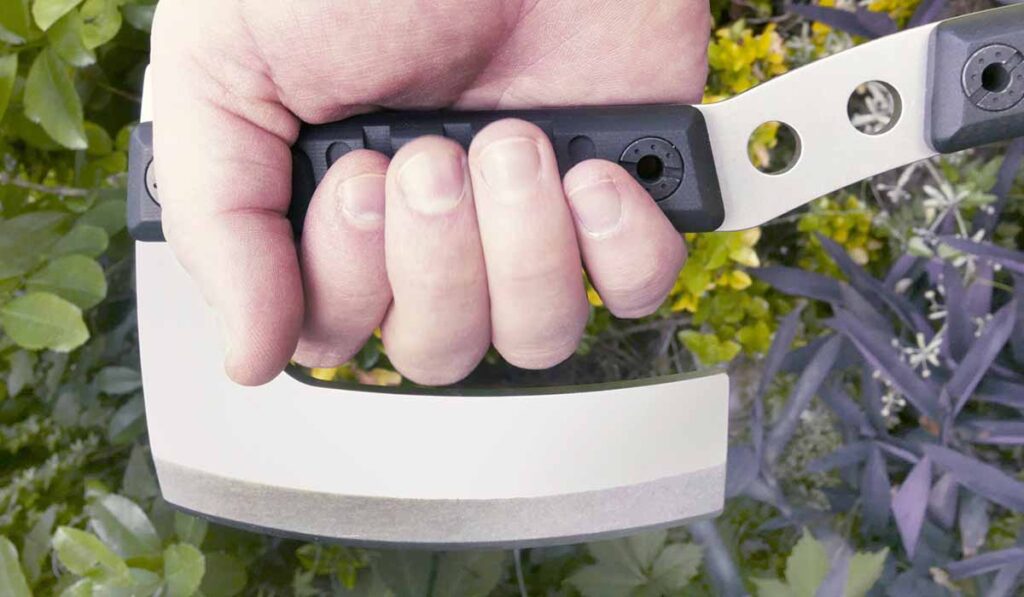
Bearded Axe Mantis
The unusual axe head of the Maserin Mantis offers full knuckle protection and then some. Note that the Mantis has a pair of upper scales just for the purpose of using the axe for shaving and slicing.

Maserin Knives may be giving us a glimpse into the future with its new, strikingly stylish Mantis. It is a small axe and you’ll notice the steep tool steel blade is quite lengthy for its size. In fact, the blade exceeds the width of the axe head—a bit unusual in a working axe.

“But wait, there’s more!” as the TV guy says. The Mantis has four (two sets) of scales: one at the top for carving comfort and the other on the lower portion of the handle for grip. At the base of the straight top scale the direction of the handle switches to an outward curve, and the exposed part on the handle has three lightening holes—plus there’s a lanyard hole and a spike on the base. The sheath fits the axe head only and butts against the top scale, and there’s a belt loop stitched to the back. It’s minimalism at its finest.

The Mantis has the longest beard drop of all the test axes at 3.75 inches and is the only one that offers full hand protection. The blade curve stands apart in that it is virtually symmetrical from end to end. It’s shape and full knuckle protection begged me to try it as an ulu for slicing, so I laid down some 3/8-inch rappelling rope and went at it. The Mantis sliced just like an ulu, taking off clean sections of rope. It performed even better when I reversed the grip with the handle facing away from me so it didn’t hit me in the belly. Voila! Instant ulu.

The Mantis shaved bark and carved off curls quite well and the full finger protection was welcome. It’s the lightest of the axes reviewed, which could put it at a disadvantage to the others when weight is a factor. You won’t be batonning this axe either because the top scales would block it from going past the front portion of the head. That said, there’s plenty to like about the Mantis’s utility value and its forward-thinking styling!

Mantis Specs
Head Width: 3.75”
Blade Edge: 4.527”
Blade Material: D2 tool steel
Blade Finish: Stonewashed
Blade Thickness: .326”
Handle Material: Black G-10 composite
Special Feature: Futuristic design
Weight: 20.23 ozs.
Overall Length: 11.02”
Sheath: Black Kydex
Country of Origin: Italy
MSRP: $216

More Axes, Hatchets And Tomahawks:

  • Best Hatchets For Survival And Camping
  • Best Tomahawks: Our Top Hawks For Backwoods To Battlefields
  • Wicked Breacher: Ben Seward’s SWAT Axe
  • Awesome Axes for Chopping Wood Like a True Lumberjack

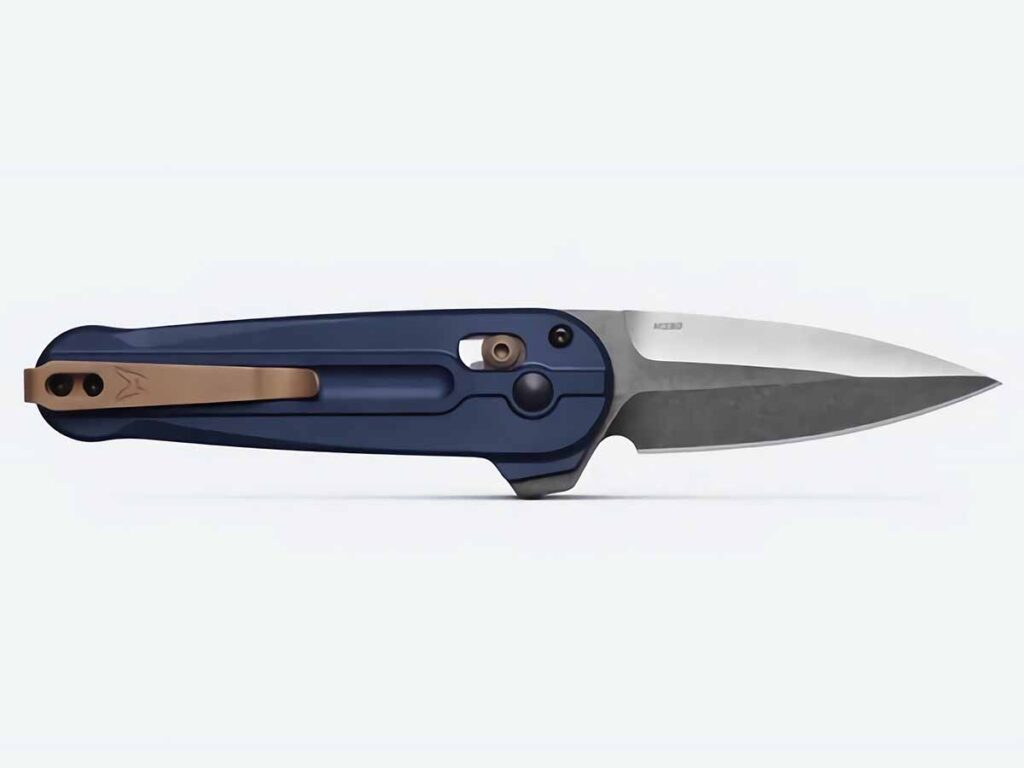
Benchmade Lowden Brings Rear Flipper Action AXIS Lock Lineup

A bold new release from Benchmade, the Lowden blends premium materials, M390 steel, and fidget-worthy deployment in a sleek, spear-point EDC design.

Benchmade just shook things up with the release of the Lowden—and if you’re into flippers, this one’s going to catch your eye.

Known for their rock-solid AXIS lock and high-quality builds, Benchmade isn’t typically the first brand you think of when it comes to rear flippers. But the Lowden changes that.

Benchmade Lowden clip

This sleek little blade flips open like a dream. You’ve got the option of using the flipper tab or sticking with the tried-and-true AXIS lock for one-handed deployment, and both are smooth and snappy. It’s a fun, fidget-friendly knife that doesn’t compromise on function.

The Lowden sports a 2.79-inch spear-point blade made from M390 super steel—translation: this thing holds an edge like a champ, resists corrosion, and is tough enough for serious work.

The handles are lightweight anodized aluminum with a stainless-steel inset frame, giving it that slim, dagger-inspired profile without skimping on strength. Plus, Benchmade matched the color on the AXIS button and deep-carry pocket clip for a clean, cohesive look.

Sure, a spear-point blade might seem like an odd choice for EDC or outdoor use, but in practice, it works. It’s surprisingly versatile, with great piercing power and slicing ability. The ergonomics are solid too—with an ample handle fitting comfortably in a wide range of hand sizes and offers a confident grip.

Benchmade Lowden disassembled

Are there a couple of nitpicks? Sure.

There’s no lanyard hole, which could be a downside for folks who like a little extra security, and the flipper tab could use some jimping. But overall, the Lowden is a refined, premium knife that’s just plain enjoyable to carry and use—classic Benchmade quality with a fresh twist.

Lowden Specs
Open Length: 6.81”
Blade Length: 2.79”
Blade Thickness: 0.09”
Closed Length: 4.05”
Handle Thickness: 0.502”
Mechanism: AXIS Lock
Blade Style: Spear-Point
Handle: 6061-T6 Anodized Aluminum
Pocket Clip: Yes
Blade Finish: Cerakote
Blade Color: Gray
Clip Color: FDE
Clip Finish: PVD Coated
Clip Position: Tip-Up
Clip Type: Standard Carry
MSRP: $330 Phoenix Red, $340 Crater Blue

Knife Reviews:

Samurai Chef’s Knives

Few Knives Have Been As Heavily Influenced By Japanese Methods As The Chef’s Knife. These Four Quality Blades Show Off The Modern Meeting The Historic.

The Japanese influence on custom knives is everpresent in the marketplace, and, aside from the tanto, nowhere is its flair and focus felt more than with chef’s knives. 

These tools of the culinary trade are functional as much as they are eye-catching, especially in examples of some of the top makers in the genre today.

Honyaki Byuto Hybrid By Dmitriy Popov

Popov Gyuto hybrid
Dmitriy Popov aligned the tip with the spine on his wide-bevel Honyaki Gyuto Hybrid for enhanced control during jobs requiring precise use of the tip. (SharpByCoop knife image)

Dmitriy Popov has conjured up a masterpiece he calls the wide-bevel Honyaki Gyuto Hybrid, a new take on a recognized Japanese style. 

“It isn’t a traditional gyuto, as it has an upswept tip and the height of a nakiri,” he commented. “Having the tip aligned with the spine of the knife gives the user a feeling of control for precise tasks requiring use of the tip. Having the extra height in the heel allows me to create a knife that is super thin behind the edge while also having a significant amount of mass above it.”

Popov’s creation includes a near 9.5-inch blade of differentially heat treated W2 tool steel and a handle combination of desert ironwood and osage orange complemented by a carbon fiber liner. His prices for similar knives range from $900 to $2,500 based on size and materials.

“The hamon and ashi* I am able to get out of the W2 is mesmerizing,” Dimitriy added, “and I spend a large part of my life going deep down the hamon rabbit hole. Honyakis are part art and part science, and the failure rate is a lot higher than I would like it to be. I really like the minimalist wa handle style [see page 14], and rounding off the bottom facet does not alter the traditional design much, while making the handle more comfortable in the hand.”

Having made knives since 2011, Dmitriy looks back at the beginning in everyday carry, tactical and camp models. After three years, he gravitated toward chef’s knives, and since 2016 they have been his sole focus.
“Everyone cooks, and at some point most cooks or chefs will come to appreciate the benefits of a good quality knife,” he observed of a chef’s knife field that has become quite crowded. “There are way more prospective customers than there are makers, so to succeed as a maker all you need is a very small slither of the pie and a drive to evolve your craft each day.”

Santoku-Style Knife By Eric Hemker

Hemker santoku
The long, nearly flat cutting edge of the damascus santoku by Eric Hemker enables it to slice, dice, and mince vegetables much easier than a blade with a sweeping belly. (SharpByCoop knife image)

While Eric Hemker admits he is still learning some subtleties of making chef’s knives, he has found that the santoku style is excellent for use in final food preparation. 

His custom-ordered version sports an 8-inch blade of random-pattern damascus forged from 1084 carbon and 15N20 nickel-alloy steels. The overall length is 14 inches, and the handle is exotic blue-dyed curly mango. His price for a similar knife is $960.

“The lack of a pointed tip on the blade means it is not well suited for delicate carving work such as breaking down bony proteins,” Eric explained. “However, its long and nearly flat cutting edge allows it to slice, dice and mince vegetables and proteins much easier than a knife with a sweeping belly on the cutting edge.”

Translating literally from the Japanese, santoku means “three virtues, or three uses,” and so the slicing, dicing, and mincing description is spot on. 

“This blade is 144-layer random-pattern damascus, and it features a full flat grind with a convex edge. The flat grind is my usual go-to grind for most general-purpose cutting needs that are common in the kitchen or in hunting-type knives. I also add a slight convex grind that leads into the cutting edge to aid in food release.”

Eric chose a modified wa handle configuration and attributes the decision to keeping step with traditional Japanese appeal. 

“The top of the handle has the traditional wa-style octagonal facets,” he said. “But I wanted to spruce this handle up a little to challenge myself, so the bottom is curved to give it a shield-shaped cross-section. The handle has a 304 stainless steel bolster and an heirloom-fit black G-10 spacer. One of the only things the customer specified was a colorful handle, so this piece of wood was a perfect fit.”

For Eric, the entire package comes together nicely, blending the good looks and function that are inherent in Japanese-inspired chef’s knives. 

“All these materials will hold up well in kitchens,” he remarked. “G-10 is a synthetic material that also holds up very well in any harsh environment, and since the wood is stabilized it should also hold up well in water and getting dirty in general. Since the handle is wood, it would still need to be oiled occasionally, and it should go without saying that a custom piece like this with a carbon steel blade and a wood handle should never go in the dishwasher.”

Eric began making knives six years ago and still considers himself at the beginning of a promising journey. 

“Kitchen knives have been some of my favorite knives to make from the beginning because everyone uses one,” he noted, “so they are some of the easiest pieces to sell and get feedback on.”

Meanwhile, he welcomes the expanding number of makers and buyers in the chef’s knife arena. 

“I don’t believe the custom chef’s knife market is overly saturated by any means,” he commented. “I think the demand really drives the market for these custom pieces, and I believe there will almost always be customers at every price point. In the last decade or so, there really has been a resurgence of demand for well-crafted handmade goods in almost every category of consumer goods, and I don’t believe that trend is going to be dying out anytime soon. This may be especially true for culinary knives when food is such a big part of many people’s lives.”

Straight-Edge Kiritsuke By Dre Laborde

kiritsuke by Laborde
The straight-edge damascus kiritsuke by Dre Laborde is specifically made to slice fish and some softer meats. The handle is curly maple from Realeyezwoodz. The sheath is stabilized maple and a joint project between Dre and Realeyezwoods. (SharpByCoop knife image)

The straight-edge kiritsuke from Dre Laborde is specifically made to slice fish and some softer meats, he says, and doesn’t necessarily lend itself to chopping vegetables. 

“I’m no expert on Japanese knives as a whole,” he noted, “but from what I can find the kiritsuke seems to be a cross between the longer yanagiba and the stockier gyuto. The steel is X-pattern-ladder damascus that I purchased from MVH Damast based in the Netherlands. These steels have given me nothing but positive results and I can’t recommend them enough.”

The blade is 9.5 inches and the overall length is 14.5 inches. The handle is curly maple from

Realeyezwoodz, and the price of a similar knife would probably exceed the featured piece. 

“It sold for $760,” explained Dre, “but it was a semi-experimental project for me, so a future project of this scale would cost more. The design, like all my knives, was drawn on paper to scale first and then made with the freedom to change the design as I see fit.”

The choice of handle material and design contributed to the overall appeal of the knife and its performance in the kitchen. 

“The wood is stabilized, which means it was put under vacuum in a resin and hardened,” said Laborde. “This makes it resistant to water and to staining. The handle design is a slight variation on the common shape I do, made slightly longer to fit the length of the knife.”

Dre has been making knives for about three years and in that time hasn’t seen the chef’s knife market becoming overcrowded, though he has heard such comments. “Those willing to pay for a custom chef’s knife often have many and recognize the price tag that comes with them,” he added.

Haetori Honesuki By Tony Cetani

Haetori Honesuki by Tony Cetani
The Haetori Honesuki by Tony Cetani is an all-around kitchen utility knife design based on the santoku and honesuki, the latter a Japanese boning knife. Whereas a traditional honesuki’s main task is for deboning poultry, Tony made the Haetori Honesuki to handle multiple kitchen jobs.

When Tony Cetani built his Haetori Honesuki with a 5.5-inch blade of Chevron copper-mai steel and an 80CrV2 core from Baker Forge and Tool, he added a handle of spalted box elder to complete the package and priced it at $1,000.

“Haetori means ‘jumping spider’ in Japanese,” he related, “and following my love for spiders this knife is named for the Haetori Gumo, a very common spider in Japan. It’s an all-around kitchen utility knife, and I based the design on the santoku and honesuki. Whereas a traditional honesuki’s main task is for deboning poultry, I made this to handle multiple tasks around the kitchen.”

Tony has been making knives since 2017 and tried chef’s knives for the first time three years later. 

“Once I got a few kitchen knives under my belt, I fell in love,” he smiled. “I wanted to put kitchen cutlery on the market that was different and not your traditional kitchen-style knives.”

He succeeded with this effort and chose a slightly innovative handle style. 

“This is a newer style that I designed specifically for this knife,” he said. “Adding a clip at the butt of the tang gives the palm a comfortable spot to rest when working the knife. I chose natural spalted box elder because it went well with the copper in the steel, and you can’t ever go wrong with box elder!”

As for today’s chef’s knife market, Tony sees strong demand and the capacity to supply it. 

“There are a lot of makers out there putting out phenomenal chef’s knives. I think every maker has their style, and the style is what grabs the attention of a potential customer.”

*Ashi are various notches or details in hamons. To produce ashi, the maker applies thin strips of clay from the spine of the blade to the edge during the clay tempering process, which contributes to interesting variations in the resulting hamons.

Read More

EDC Fixed Blades: Compact And Ready For Any Task

Four U.S.-made EDC sheath knives take the author’s test.

EDC knives have been influenced by folding designs since the inception of steel, if not before. However, historically speaking, compact fixed blades were daily edged tools long before folders.

Cultures worldwide, both known and no doubt unknown, carried short sheath knives for utility, survival and ceremony. Japan’s tanto pierced with precision and Viking seaxes sliced with status. Native Americans relied on trade knives and ulus for skinning and barter. Indonesia’s badik and short kris blended practicality with spiritual meaning.

These blades reflected local needs and traditions, proving compact straight knives were essential long before EDC became a modern gear category.

Wharncliffe Vs. Sheepsfoot Blades

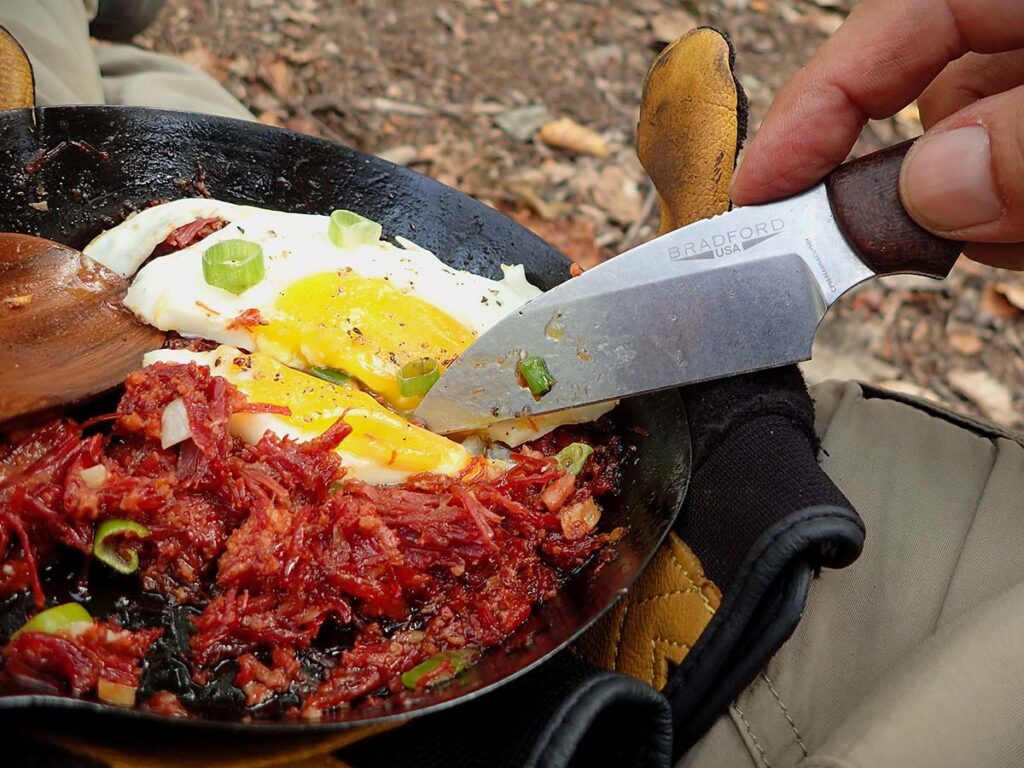
 The aptly named Bradford USA G3 Wharnie (top) has a classic wharncliffe blade while the Montana Knife Stockyard (bottom) boasts a modified sheepsfoot pattern.
The aptly named Bradford USA G3 Wharnie (top) has a classic wharncliffe blade while the Montana Knife Stockyard (bottom) boasts a modified sheepsfoot pattern.

Wharncliffe and sheepsfoot blades are similar and different. A wharncliffe features a long, straight cutting edge with a spine that tapers gradually to a fine, precise point. This geometry excels at controlled slicing, detailed scoring and utility work where accuracy at the tip is essential. The design allows steady pressure along the edge, making it ideal for carving, whittling and precision-driven EDC tasks.

A sheepsfoot, by contrast, has a straight edge with a spine that curves down sharply to meet the edge in a blunter tip. This greatly reduces the risk of piercing, making it safer for rescue work, controlled cuts and environments where safety matters most.

The wharncliffe offers versatility and precision for fine tasks, while the sheepsfoot provides dependable slicing power, rope-cutting efficiency and unmatched control under pressure. Together, they represent two specialized approaches to cutting—one prioritizing accuracy, the other emphasizing safety and reliability.—by Reuben Bolieu

Montana Knife Co. (MKC) Stockyard

The Montana Knife Stockyard whittled curly, thin feather sticks for a small twig stove. MKC offers free sharpening, cleaning and repair for life, ensuring the knife remains reliable for years to come.

Stockyard Specs
Blade Length: 3 3/8”
Blade @the Thickest: 0.115”
Blade Steel: MagnaCut stainless
Blade Finish: Stonewash
Scales: G-10
Weight: 3.14 ozs.
Overall Length: 7 5/8”
Sheath: Kydex
Country of Origin: USA
MSRP: $300

Pros

  • MagnaCut Steel Blade
  • Company After-Purchase Support
  • Light

Cons

  • Expensive

The Montana Knife Co. (MKC) Stockyard is made in the USA and hand-finished in Montana. It embodies the rugged traditions of ranch life and strikes a balance between compact carry and the strength needed for long days in the field. Its MagnaCut stainless steel is known for toughness, edge retention and corrosion resistance, and the blade’s thickness provides durability without excessive weight.

The sheepsfoot blade is designed for controlled slicing and safe utility, excelling in tasks such as cutting twine or trimming hooves where precision is crucial. The stonewash finish reduces glare and disguises wear, while the rugged G-10 scales in green and black ensure a secure grip, even in wet or gloved conditions. The ergonomic handle includes a “subtle hook profile” for extra control and quick deployment.

Each Stockyard comes with a USA-made Kydex sheath, featuring adjustable retention for a secure fit and both horizontal and vertical carry. The design keeps the knife accessible and comfortable, whether you’re riding fence lines or working in the shop. MKC also offers free sharpening, cleaning and repair for life, ensuring your knife remains reliable for years to come.

Bradford USA G3 Wharnie

Wharncliffe and sheepsfoot blades allow you to choke up toward the tip and use a forefinger for fine control work. The author used the technique with the Bradford USA G3 Wharnie on a fried egg eaten right out of his carbon-steel skillet.

G3 Wharnie Specs
Blade Length: 3.625”
Blade @the Thickest: 0.14”
Blade Steel: MagnaCut stainless
Rockwell Hardness: 63-64 HRC
Blade Finish: Stonewash
Scales: Natural burlap Micarta®
Weight: 3.96 ozs.
Overall Length: 6.875”
Sheath: Kydex
Country of Origin: USA
MSRP: $259

Pros

  • Compact
  • MagnaCut Blade Steel
  • Excellent Slicer

Cons

  • Might Not Be Good At Prying

Skilled makers in Kent, Washington, meticulously craft the Bradford USA G3 Wharnie, ensuring every detail meets the highest quality standards. The compact fixed blade strikes a balance between portability and cutting strength, making it ideal for everyday carry and outdoor use. The blade’s long, straight edge offers both reach and control, versatile enough for slicing tasks and utility work. The blade thickness provides durability without the weight, allowing for agility in the hand.

Forged from premium Bohler M390 or MagnaCut stainless, the blade excels in edge retention, toughness and corrosion resistance. The wharncliffe blade, featuring the straight edge and fine tip, is particularly suited for controlled slicing, scoring and detailed cutting. A choice between a stonewash or tumbled finish minimizes glare while concealing wear, giving the knife a rugged, industrious appearance.

The handle features 3D-contoured scales in a choice of G-10, Micarta, carbon fiber or G-Wood, ensuring a secure grip and long-lasting durability. The ergonomic shape fits comfortably in hand for extended use, whether in the field or workshop. Each G3 Wharnie comes with a taco-style Kydex sheath that offers secure retention and customizable carry options.

Big Idea Design Deano

Deano Specs
Designer: Mak Kelsay
Blade Length: 3.125”
Blade Steel: Nitro-V stainless
Blade @the Thickest: 0.14”
Blade Finish: Graphite black Cerakote®
Weight: 3.6 ozs.
Scales: Micarta®
Overall Length: 7.5”
Sheath: Kydex w/UltiClip 3.3
Country of Origin: USA
MSRP: $325

Pros

  • Versatile Blade
  • Good Carry System
  • Full-Sized Grip

Cons

  • Expensive

The Deano from Big Idea Design is made in America with global steel origins. Designed by Mak Kelsay in Chattanooga, Tennessee, it strikes a nice balance between compact carry and dependable working strength. The blade provides versatile cutting power for everyday carry, camping and outdoor use. It also offers durability without unnecessary bulk, keeping it agile in hand.

The Nitro-V stainless blade steel delivers excellent toughness, edge retention and corrosion resistance in demanding environments. The modified drop point emphasizes control and practical utility. It tracks straight, bites clean and handles detail cuts with confidence. A graphite-black Cerakote®/tumbled finish creates a rugged, battle-worn look while reducing glare and concealing wear.

Scales are durable Micarta in black or green, providing a secure grip in all conditions. The ergonomic contour ensures comfort during extended use, whether in the field, workshop or camp.

The Deano includes a scout-carry Kydex sheath with an UltiClip Slim 3.3, offering secure retention and versatile carry options. The sheath system rides comfortably on a belt or pack, keeping the knife accessible and protected at all times.

Bear Forest Knives Stumpy

Stumpy Specs
Designer: Garrett Tremblay
Blade Length: 2 1/8”
Blade @the Thickest: .125”
Blade Steel: Nitro-V stainless
Blade Finish: Raw matte
Weight: 3.2 ozs.
Scales: Various Micarta®/wood/Bearcarta
Overall Length: 5 7/8”
Sheath: By JRE Industries of black leather
County of Origin: USA
MSRP: $200

Pros

  • Hand Built
  • Grind Options
  • Good Ergonomics

Cons

  • Smallish Handle

The Bear Forest Knives Stumpy is built by hand in the USA for everyday carry and outdoor reliability. It offers a compact profile that disappears on your belt. The short blade delivers precise cutting power for utility, camp chores and daily shop tasks, and strikes a balance between strength and nimble handling, making it quick and responsive in the hand.

The Nitro-V stainless blade steel provides excellent hardness, edge retention and corrosion resistance in demanding environments. The blade features a full flat grind but is also available with a Scandi grind. It has a 90-degree spine ideal for generating sparks with a ferro rod and for scraping tinder. A raw matte finish gives the knife a resilient, understated look while reducing glare and hiding wear.

Scales are available in Micarta, wood or Bearcarta, each offering durability, comfort and a secure grip in most all conditions. The ergonomic design ensures the knife locks naturally into your hand, even during extended use.

Each Stumpy includes a premium JRE Industries black leather sheath, designed for secure retention and comfortable carry. The sheath rides well on a belt or lanyard, keeping the knife accessible and protected wherever you go.

Real World Tests

There are two teams here, as I see it—straight blades and, more commonly, curved blades. Or, MagnaCut vs. Nitro-V. The blades were all hair-popping sharp out of the box, as expected. This is always the first test of any edged tool I get.

The handles are all unusual. The Stockyard and The Deano have full-sized grips, while the Stumpy and G3 Wharnie have shorter, more compact handles. The latter two also have beefier, hand-filling scales, adding to user comfort.

I had the Stumpy with its full flat grind the longest. It is the only EDC in the batch to have a straight, 90-degree sharpened spine. The continuous curve of the belly aided in making feather sticks for a fire, as did the sharp spine for striking a ferro rod. The smallish handle was comfortable due to the textured Micarta and thick scales. Besides, who doesn’t like a good Mexican blanket print on the scales?

The Deano has a thin handle, as many EDC fixed blades do. The scales are smooth and comfy—sleek. The modified drop point has a slightly clip-point feel and look.

On the utility side, I slashed through mounds of cardboard to break down boxes. I cut cardboard, not tape. (There’s nothing more annoying than a sticky blade on a good knife.) Slicing along the side of a box helps open it up and saves your edge, since it separates a lot of area with minimal gumminess. The light gimping was perfect for my forefinger when slicing down. I never use my thumb on the spine— it’s a bushcraft habit.

Wharny Or Sheepy?

The wharncliffe and sheepsfoot are two similar blade shapes with distinct attributes. I received the Bradford G3 Wharnie in MagnaCut first and rekindled my love for the straight-edge style with a curved spine. Nothing screams utility more than a straight edge similar to that of an X-Acto knife blade. Any box-opener blade fits in with the crowd, as does a wharncliffe. Tip-forward pressure is excellent for drawing back slices.

Wharncliffe and sheepsfoot blades allow you to choke up toward the tip and use a forefinger for fine, controlled work. I used the technique on a fried egg eaten right out of my carbon-steel skillet. Only a small amount of steel came in contact with the egg and skillet, as draw cuts use minimal edge.

I ran the MKC and Bradford through identical testing on various fibrous materials for practical EDC use. I sliced scrap leather, nylon webbing, zip ties, phone-charging and lamp cords, and lots of cardboard, all with zero issues. The more challenging materials were plastic packaging banding and 15,000-pound tow strapping. I severed the latter two media on a cutting board, draw cutting and push cutting. The forward leverage obtained from the straight-edge blades was apparent and much appreciated. Both blades sliced through the din with no holdups.

As for the performance difference between MagnaCut and Nitro-V, it has more to do with edge geometry and the materials you’re cutting than anything else. It would take a long time cutting similar materials with identical grinds on two knives to see any real difference. Suffice to say, these are two top-tier stainless steels.

Carry Systems

The test knives come with sturdy Kydex sheaths ready for scout carry.

Besides the Bradford G3 Wharnie, two of the test knives are set up for scout carry with straps. The older model of the BFK Stumpy has one-strap retention for scout carry, which you can adjust to different positions. The MKC Stockyard has a Kydex fold-over sheath that easily attached to my belt while I was already wearing pants. The feature is incredibly convenient for those who often forget to put things on until it’s time to work.

The Deano came with options: scout carry strap set and UltiClip Slim 3.3, like a choose-your-own-adventure book. Bradford sent me a sturdy Kydex sheath without attachments. However, Bradford has order options on its website. I carried the Bradford entry like a slip sheath in my pocket and eventually attached it to a small carabiner to hang on my belt loop.

Check Out More Outdoor Knives:

New Knives: April 2026

0

Lightweight Innovation and Pocket-Friendly Precision.

The spring season brings a focused shift toward portability and pocket-ready performance, highlighting a diverse lineup of high-tech folders and streamlined carry options. This month’s selection focuses on the incredible versatility of the modern pocketknife, showcasing the work of veteran masters with nearly four decades of experience alongside award-winning new makers. Whether you are looking for an ultra-premium custom slipjoint to round out a collection or a hard-use MagnaCut automatic for daily carry, our April 2026 roundup proves that the industry’s drive for innovation remains as sharp as ever.


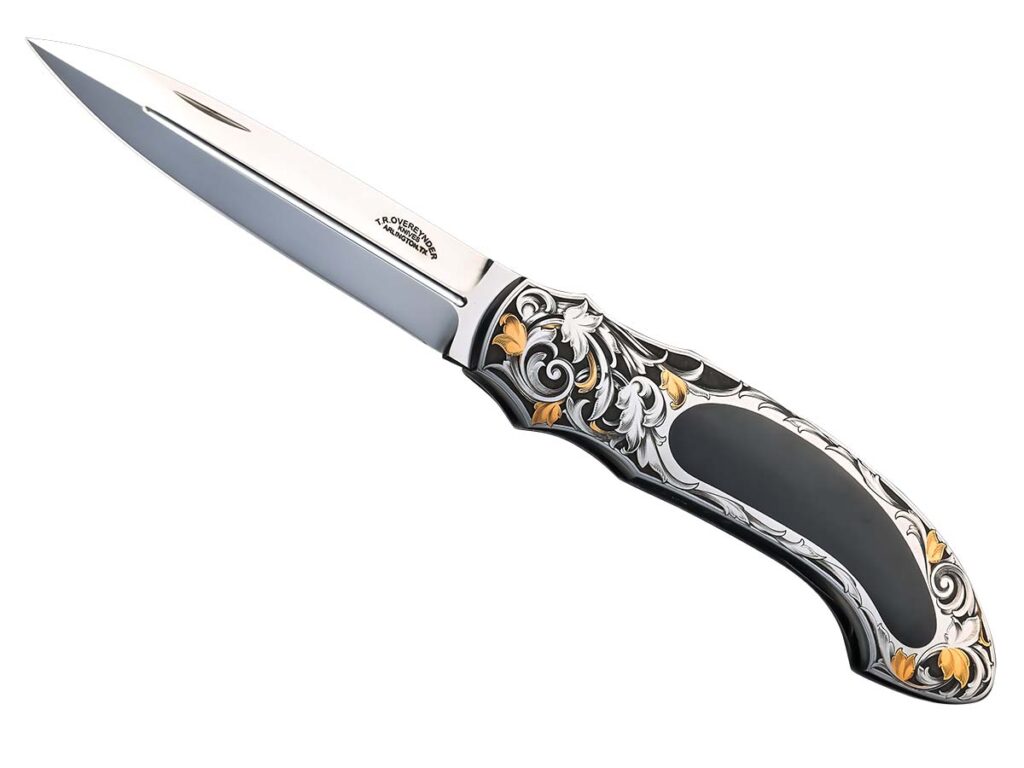
T.R. Overeynder M-30 Dagger

T.R. Overeynder M-30 Dagger

Knife Type: Folding Dagger
Blade Length: 3.625”
Blade Material: PFS-27
Blade Grind: Flat
Blade Finish: Hand-Rubbed Satin
Handle: Edwards Black Jade
Frame Material: 416 Stainless
Overall Length: 8.255”
Knife To Know: Engraving By Richard Quecke
Maker’s Price For A Similar Knife: $6,525
overeynderknives.com (SharpByCoop Image)


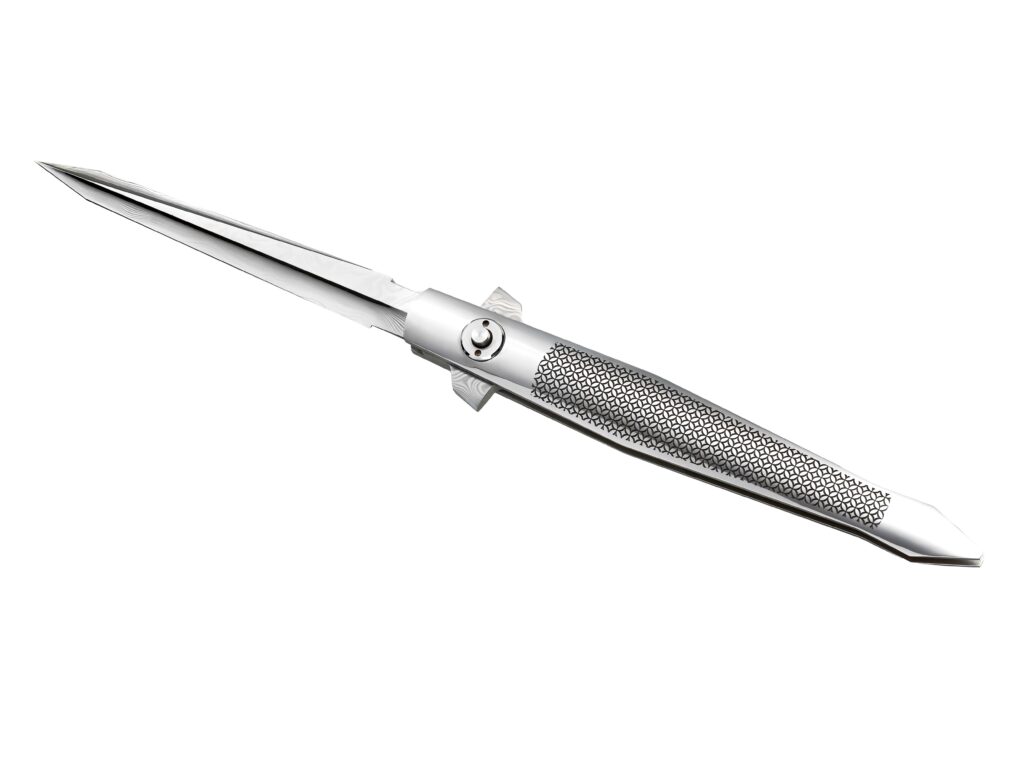
Vincenzo Fiore Florence Folder

Vincenzo Fiore Florence Folder

Blade Length: 4”
Blade Material: Damasteel Damascus
Blade Style: Stilo
Blade Finish: Mirror
Handle: Integral RWL-34
Overall Length: 9.5”
Knife To Know: Custom 17-4 ph Axial Button Lock, SS Micro Ball Bearing System With A Single Race Housing And SSL Washers
Maker’s Price For A Similar Knife: $8,500
fioreknives.com (SharpByCoop Image)


Javi Garcia Phantom Sultan

Javi Garcia Phantom Sultan

Knife Type: Lockback
Blade Length: 2.75”
Blade Material: AEB-L
Handle: Elephant ivory, MOP shield
Liner: G10
Overall Length: 7”
Knife To Know: Knife Features 24k Gold Inlay Screws
Maker’s Price For A Similar Knife: $4,000 (Jocelyn Fraiser image)


Spycraft Knives Sentinel

Spycraft Knives Sentinel

Blade Length: 4.09”
Blade Material: K340
Blade Finish: PVD
Handle: Multi-Cam G10
Overall Length: 9.01”
Sheath Type: Molded Kydex
Weight: 7.26 oz.
MSRP: $399
spybriefinggear.com


Toor Knives Draper

Toor Knives Draper

Blade Length: 3.5”
Blade Material: CPM Magnacut
Overall Length: 8.3”
Weight: 3.9 oz
Handle Material: G10
Action: Crossbar
Clip: Titanium
Hardware: Stainless Steel
Spacers: G10
MSRP: $325
toorknives.com


Maserin Frontier

Maserin Frontier

Blade Length: 3.23”
Blade Style: Clip point
Blade Material: Nitro X7
Blade Finish: Stonewashed
Grind: Flat
Handle: Off White Micarta
Clip: Reversible
Lock: Axis
Overall length: 7.87”
Weight: 3.88 oz
MSRP: $165
maserin.com/en/


Reate Knives Horizon X

Reate Knives Horizon X

Blade length: 3.2”
Blade steel: 14C28N
Blade finish: Stonewashed
Handle: Fatcarbon Glass
Locking Mechanism: Crossbar Lock
Overall length: 7.3”
Weight: 2.78 oz
MSRP: $97
reateknives.com


Heretic Knives Jinn

Heretic Knives Jinn

Knife Type: Automatic
Blade Length: 2.9”
Blade Style: Sheepsfoot
Blade Steel: Magnacut
Blade Finish: DLC
Blade Grind: Flat grind
Handle: 6061 Aluminum
Overall Length: 6.8”
Weight: 2.3 oz
MSRP: $269
hereticknives.com


Steve Vanderkolff Hawk’s Eye Slipjoint

Steve Vanderkolff Hawk’s Eye Slipjoint

Knife Type: Slipjoint
Blade Length: 2.375”
Blade Material: CPM154
Blade Grind: Hollow
Handle: 416SS Body With Hawks Eye (blue tigers eye) Inlay
Overall Length: 5.25”
Maker’s Price For A Similar Knife: $500
vanderkolffknives.com (Jocelyn Fraiser image)


Charlie Bridges Hunter Scalpel

Charlie Bridges Hunter Scalpel

Knife Type: Fixed
Blade Length: 2.25”
Blade Material: WWII Pocket Chang, 1084 Core
Blade Grind: Hollow
Handle: G10
Overall Length: 6.5”
Maker’s Price For A Similar Knife: $450
brokenanvilknifeworks.com (Jocelyn Fraiser Image)


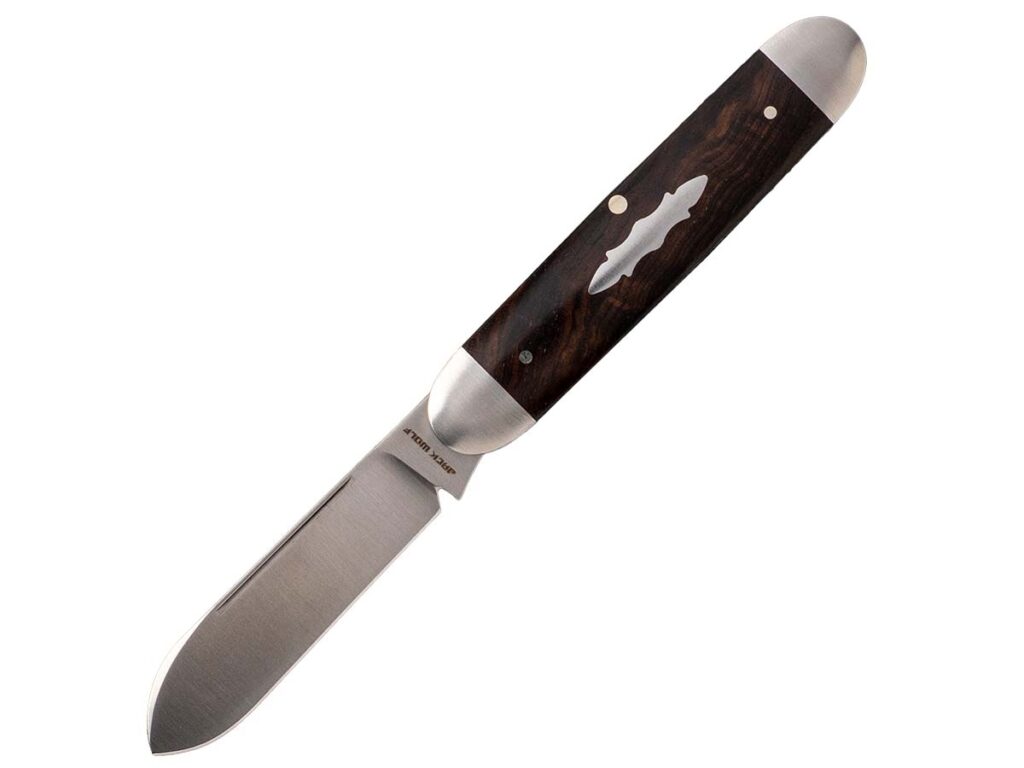
Jack Wolf Knives Equal End

Jack Wolf Knives Equal End

Knife Type: Slip Joint
Blade Length: 3.73”
Blade Style: Drop Point
Blade Material: Sandvik 14C28N
Blade Finish: Satin
Grind: Flat
Overall Length: 6.48”
Bolsters: Stainless Steel
Hardware: Nickel Silver Pins
Weight: 2.7 oz
MSRP: $70
jackwolfknives.com


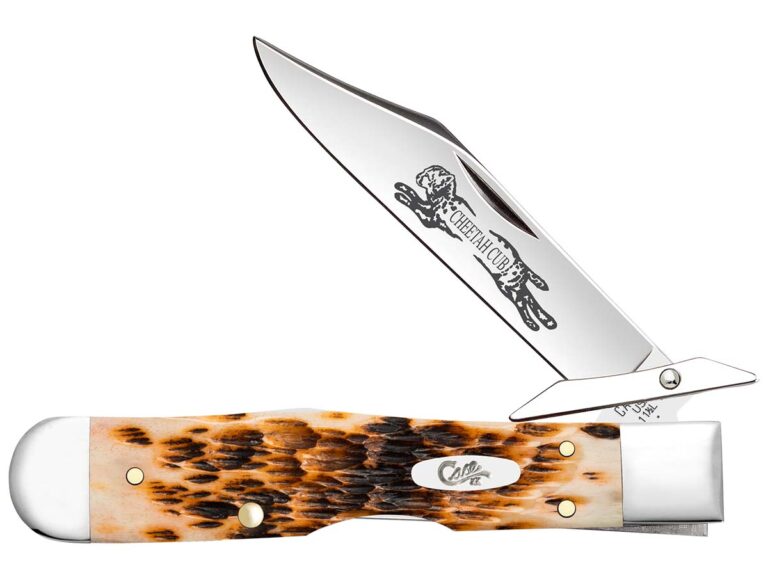
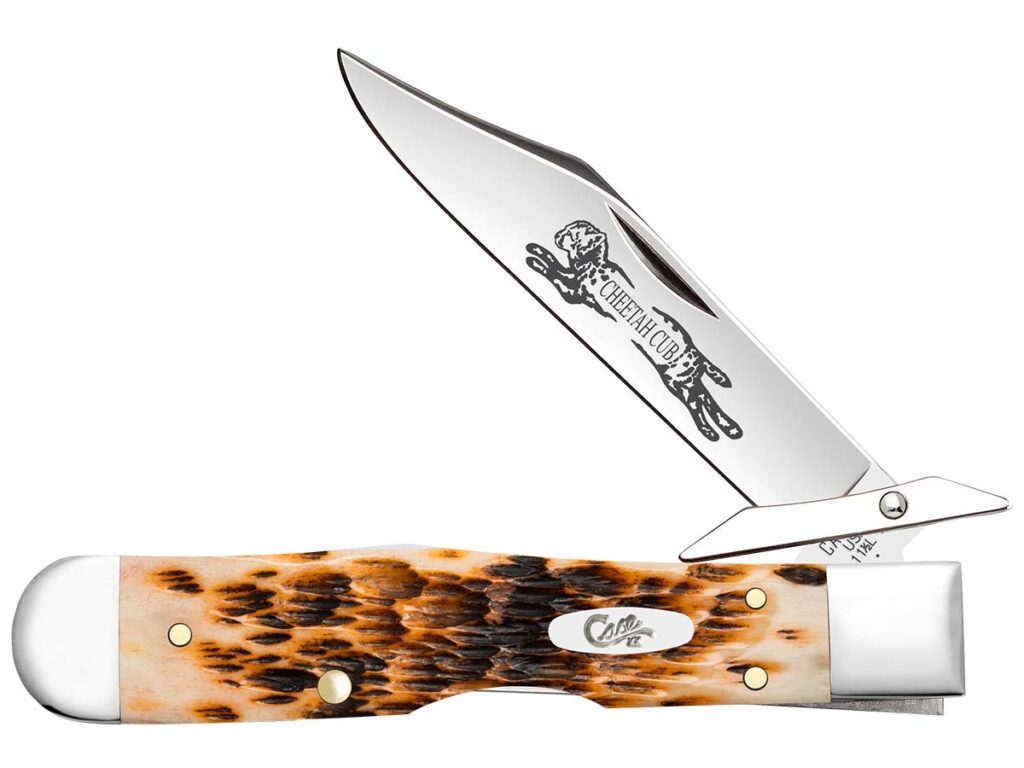
Case Knives Cheetah Cub

Case Knives Cheetah Cub

Knife Type: Lockback Clip Point
Blade Length: 2.58”
Blade Steel: Case Tru-Sharpe Surgical Steel
Blade Style: Locking Clip Blade
Blade Finish: High Polish
Blade Grind: Flat Taper
Handle: Smooth Antique Bone
Overall Length: 6.08”
Weight: 1.9 oz
MSRP: $119
wrcase.com


Check Out Other Months:

Game Shears: Affordable Options To Cut Bones And More Down To Size

1

Affordable game shears that offer cut, power, features, size and more…

When you think of processing game, a skinner is typically the first knife that comes to mind—and rightfully so. At the same time, game shears provide a viable role in the processing equation, particularly with small game like squirrels, rabbits, fowl and fish. A good pair of shears made for small game processing can cut through bone, slice hide, remove unwanted viscera and, in the case of fish, remove heads and fins. Many shears have extras thrown in, technically making them multi-tools, though that’s a bit of a stretch.

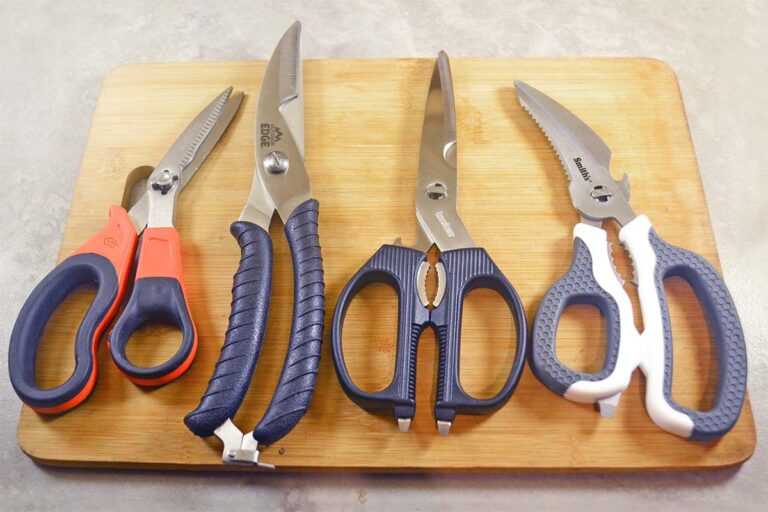
My team tested four current game shears to see how they perform and what they offer in the way of goodies. Just so we don’t get repetitive, it should be noted that all our candidates have take-apart pivots that allow the main blade/handle sections to separate for easy cleaning.

Gerber Vital Take-A-Part Shears

Gerber Vital Take-A-Part Shears
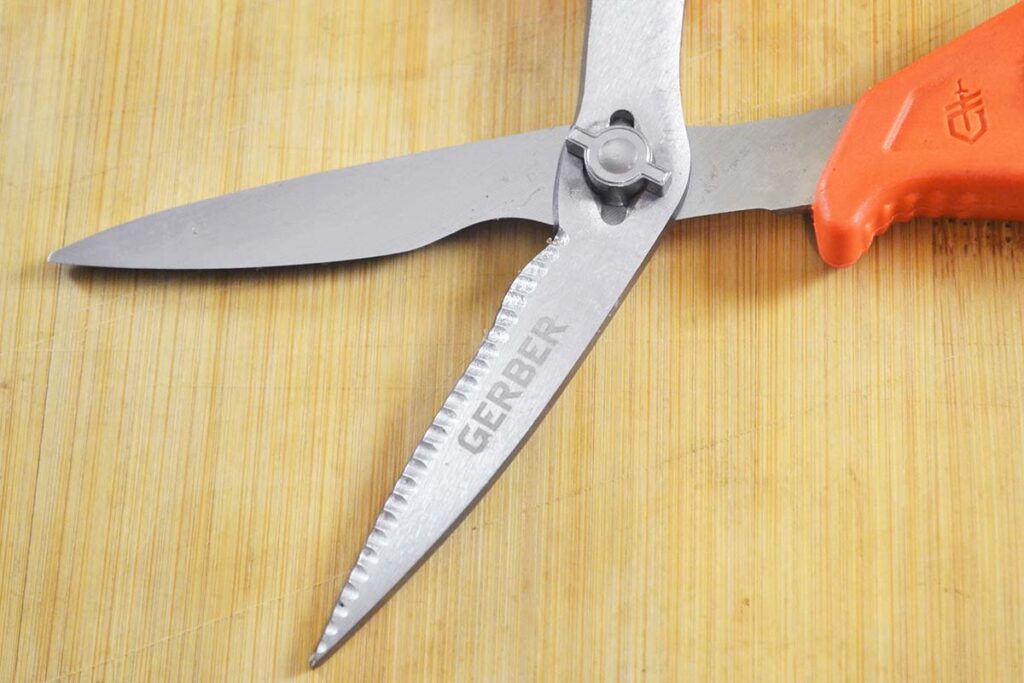
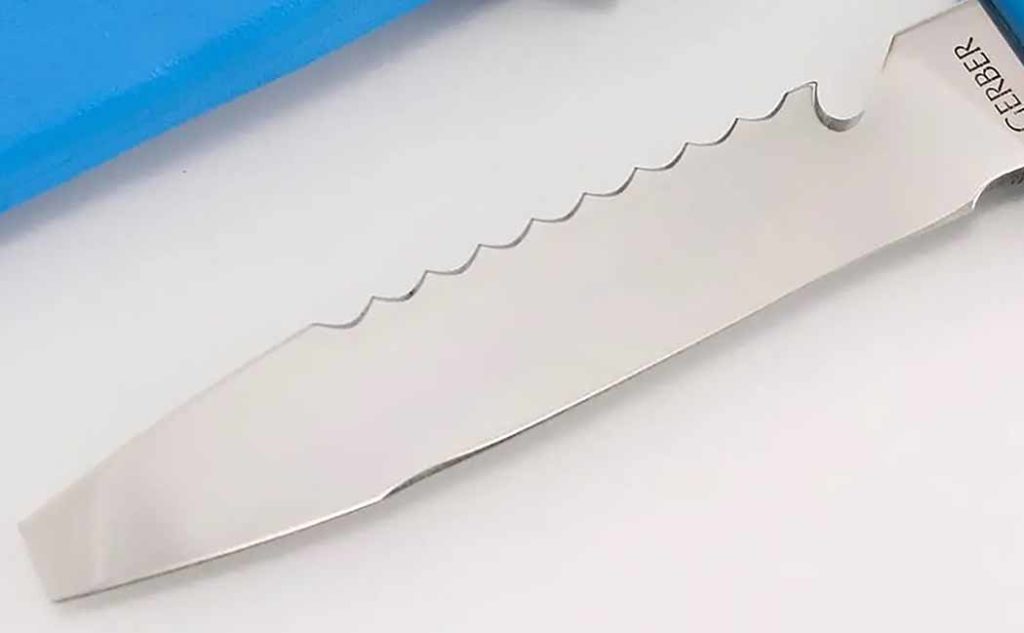
The Gerber has a humped portion of the serrated blade on the bone notch area that enables the blades to continue cutting the full length of the blade rather than bogging down at the notch. It is the only test shears with the feature.

The simplest and smallest of the test group is the Gerber Vital Take-A-Part Shears. The spear-shaped blades are 2.5 inches of 420J2 stainless steel. Overall length: 8 inches. The handles have a hard thermoplastic frame sporting rubbery Kraton™ overlays with an ovate hole for the fingers and a round one for the thumb. One blade is plain with a bone notch and the opposing one is fully serrated. A two-color nylon sheath matches the handle. Weight: 5 ounces. Country of origin: China. MSRP: $20.

Kershaw Taskmaster Shears

Kershaw Taskmaster Shears
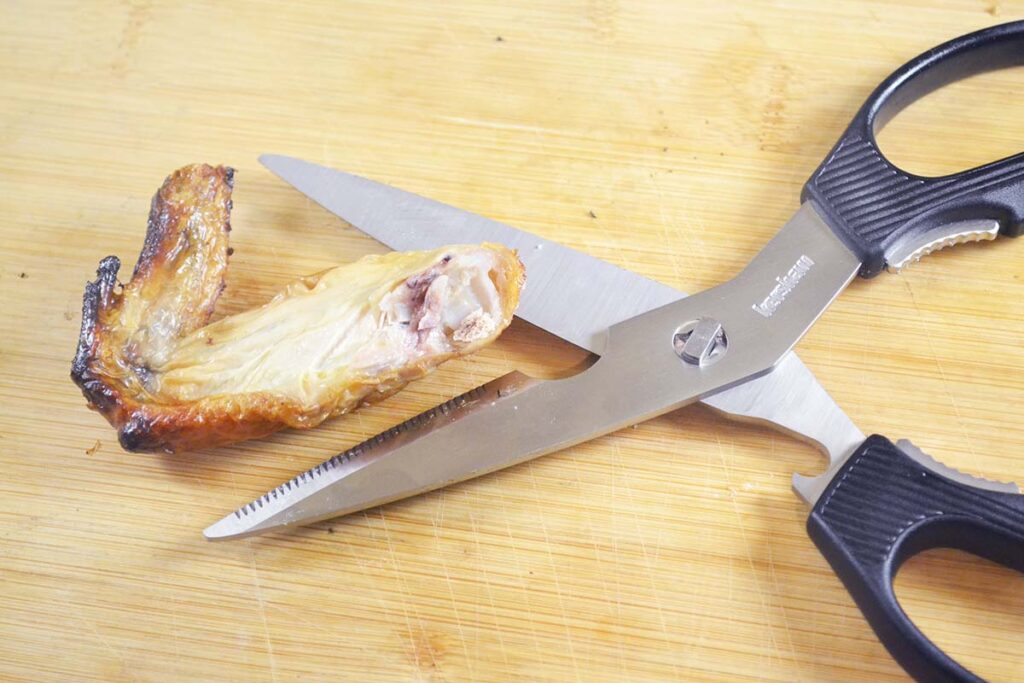
The Kershaw takes the end of a wing at the joint in fine fashion. The blade section did the handiwork, zipping through the cartilage and muscle at the convergence of two main wing sections.

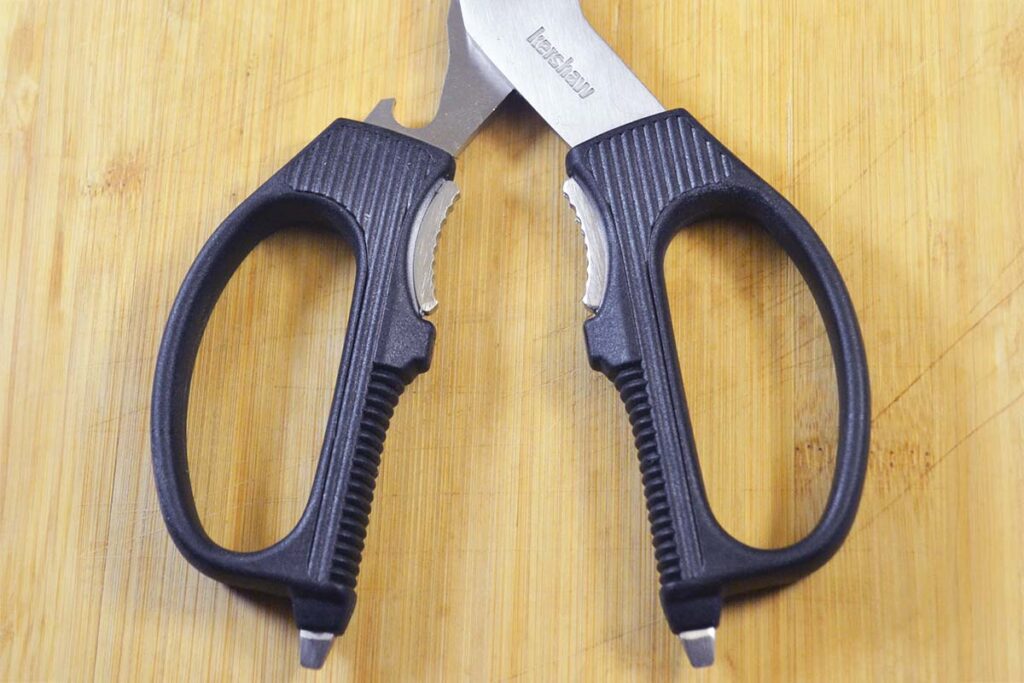
The Kershaw Taskmaster Shears is a straight-blade design with a nice assortment of built-in goodies. The 3.5-inch blades are stainless steel. The spear-point patterns include one plain edge and the other partially serrated with a bone notch. The grips are finger-loop style and overlaid in black Kraton. Additional features include a lid lifter, bottle opener, screwdriver, nutcracker and jar opener. Weight: 5.1 ounces. Overall length: 8.875 inches. Country of origin: China. MSRP: $26.73.

Smith’s Edgesport Bait & Game Shears

Outdoor Edge Game Shears
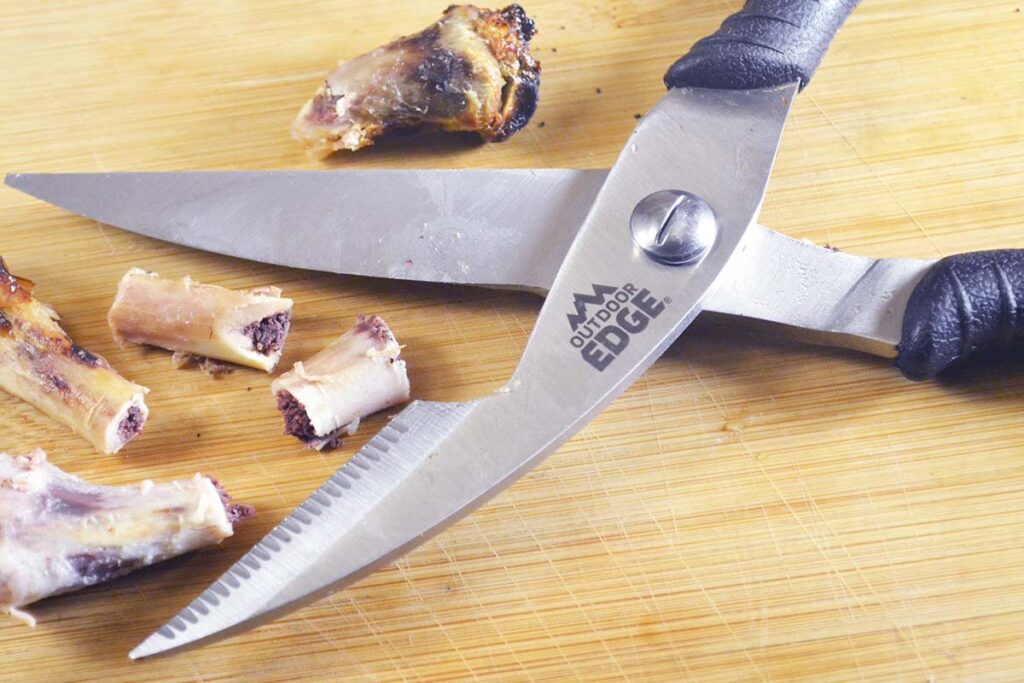
The Outdoor Edge is the largest of the test group. At 10.5 inches overall, it was the only model that could tackle the larger chicken bones. Note the hefty bone notch just below the serrations.

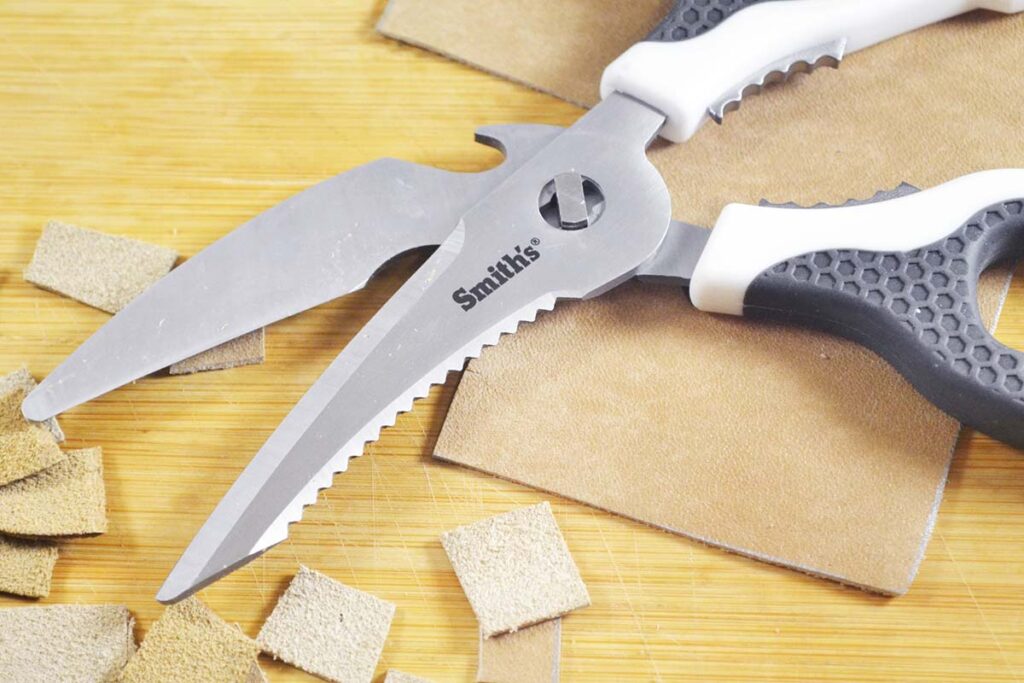
The Smith’s Edgesport Bait & Game Shears is the most elaborate of the group we tested. The curved blades are 3 inches each of stainless steel. One’s a plain edge and the other is serrated, but what really sets them apart is the curved fish scaler on the underside of the plain blade. The handles have a thumb hole and opposing finger hole with black Kraton over a white thermoplastic main frame. Additional functions include a nutcracker, screwdriver, bone notch and cap lifter. There is no pouch. Weight: 5.25 ounces. Overall length: 8.5 inches. Country of origin: China. MSRP: $28.99.

Outdoor Edge Game Shears

Outdoor Edge's shears are spring loaded
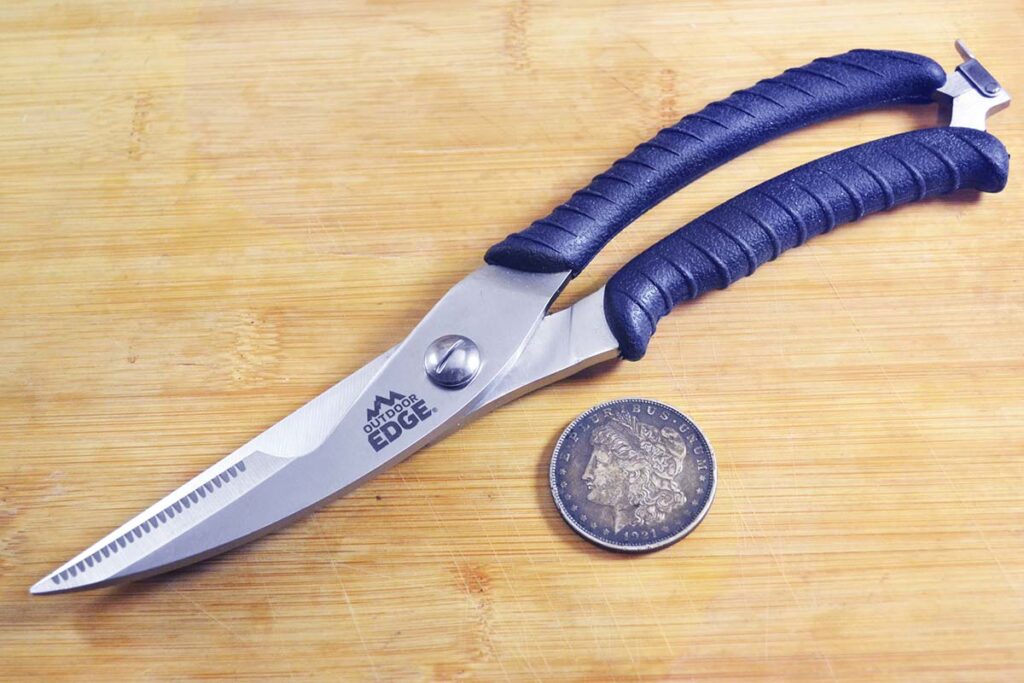
The Outdoor Edge shears is the only one tested that is spring-loaded—that is, no finger holes are required to open and close it. Note the catch at the base for keeping the handles closed while not in use.

The Outdoor Edge Game Shears is the juggernaut of the bunch. What it lacks in features it makes up for in size. Respective blade and overall lengths: 3.75 and 10.5 inches. Another distinguishing feature is it’s spring-loaded with a swing lock at the base. This negates the need for manually opening the blades after making a cut—the spring does it for you. The wharncliffe blades are a plain edge and the other partially serrated with a healthy bone notch. Handles are ribbed Kraton. Weight: 10.5 ounces. A pouch is included. Country of origin: China. MSRP: $49.95.

Testing Shears

I focused on the main job of shearing first. I started with some basic straight cutting exercises of suede leather to simulate animal hide. All the candidates performed the scissor cuts well with the exception of the Outdoor Edge shears, which are just too big for such small detail tasks. As you’ll see later, the Outdoor Edge more than makes up for this deficiency in other areas. The Gerber cut best because it is the only test shears that has a humped serrated blade opposite the bone notch. It just keeps on cutting like a standard scissors whereas the others bog down when they hit the notch.

Smith’s Edgesport Bait & Game Shears
All the blades on the smaller shears were adept at such detail work as cutting suede, and the Smith’s cutter was no exception. Note the pivot piece that rotates to take the two sections apart.

Next I tested each model’s bone notch, a great feature I’ve only seen on game shears that is worth its weight in gold. I used the shears on chicken bones as they were the easiest to get in the 15-to-25°F cold snaps we were experiencing at test time. The humerus and femur are the largest “rounded” bones in a chicken skeleton, offering the best way to gauge cutting power. This is where the Outdoor Edge shears excelled. It munched its way through the larger bones with ease while the smaller shears had a hard time opening up wide enough to be able to grip them. All the review shears performed well on smaller bones, as well as cutting through the cartilage and viscera around the joints.

Hightlighting Features

Kershaw did a nice job of organizing the additional functions on its shears.
Kershaw did a nice job of organizing the additional functions on its shears. Look closely and you’ll see a bottle opener, nutcracker, lid lifter, screwdriver and jar opener built into the design.

The Gerber and Outdoor Edge Shears are sparing in the multi-implement category. The Kershaw and Smith’s, on the other hand, offer a wide range of added features. Most impressive on the Kershaw is the way the lid lifter, bottle opener, screwdriver, nutcracker and jar opener are incorporated into the design. You don’t really notice the various little helpers, but you’ll be darn glad they’re there when you need them. What’s more, the fish scaler on the Smith’s shears could be a real game changer for the outdoorsman who enjoys fishing as much as hunting, or is solely into angling.

Final Cut

The good news for game shears users is choices abound in this small sliver of the overall cutlery industry. For starters, pricewise none of the test shears are going to break the bank. The small Gerber and large Outdoor Edge will please those who could care less about the extras. For them, a sharp shears with a bone notch is all they need. For those who like bonus functions on their shears, the well-organized Kershaw will perform a myriad of chores. Finally, the gamesman who prefers a loaded shears with a little something extra will appreciate the fish scaler on the Smith’s entry. Between the four choices there’s bound to be a game shears ready to work for you.

Check Out More Outdoor Knives:

What To Know To Get The Best Dive Knife

A vital safety tool for underwater adventure, a solid dive knife is a must-have for your dive kit. Here’s what you need to know to get the best one.

Dive knives are specialized edged tool that is made for people who spend time in the water. This seems like a wide definition, but water sports are a huge series of pastimes as well as a profession for millions of people across the world.

Diving, be it scuba or free diving, is inherently dangerous and rife with hazards, including the gear you may have on your person. The dive knife varies in profile and material, but in the end, it is a tool that can be relied on to remove yourself or another from a tangle of floating netting, a strap caught on an underwater branch, or to evacuate a struggling diver from their tank.

The dive knife is more than a rescue tool, though. In the alien environment that exists underwater it is a lifeline to the surface and a last resort in the worst situations.

Dive Knife Construction

In the course of use, most real-world knives are going to get wet, however, but are not meant to stay wet for extended periods. Getting caught in a rainstorm or left outside by the fire are things that happen, but being submerged in saltwater for weeks on end would destroy most knives as well as erode and damage handles and sheaths. Leather is not found on serious dive knives, nor is wood or carbon steel. These materials are simply eaten away by salt water and are also easily damaged in fresh water.

A safety tool, a dive knife is a worthy addition to many adventurer's underwater kit.

Dive knives are typically constructed using corrosion-resistant materials and have handles molded directly to them. The idea is to reduce the number of areas where water can enter, making the knives last longer. Very few materials are absolutely corrosion-proof, but they can be made resistant to the point where they won’t degrade for years or decades, sometimes even the lifetime of the owner.

Dive knives are also less rugged for on-land work. Most of the blades of dive knives are thin, sitting in the .12- to .16-inch range, making them unsuitable for heavy use on wood or for camp work. In the water, you’re likely not going to baton logs, so the thickness of the stock is unimportant except for its ability to cut through materials.

Nylon and plastic are the main prey of dive knives, it is the main material for everything from rope to fishing nets and is the basis of most straps on a diver’s gear. It is not that there is only one used in this sense, rather it is that the vast majority of materials a dive knife needs to cut are man-made and are of a relatively normative quality.

Dive Knife Features

When looking at the must-have features on dive knives, one finds that there is no specific answer.

As noted above, the general concept of a dive knife is to cut through maritime-related cordage. The secondary functions are almost irrelevant to this, self-defense isn’t even a tertiary topic considering that shark attacks are exceedingly rare. Natural obstacles like kelp can hang a diver up, and this is perhaps the only naturally occurring material dive knives are commonly used on.

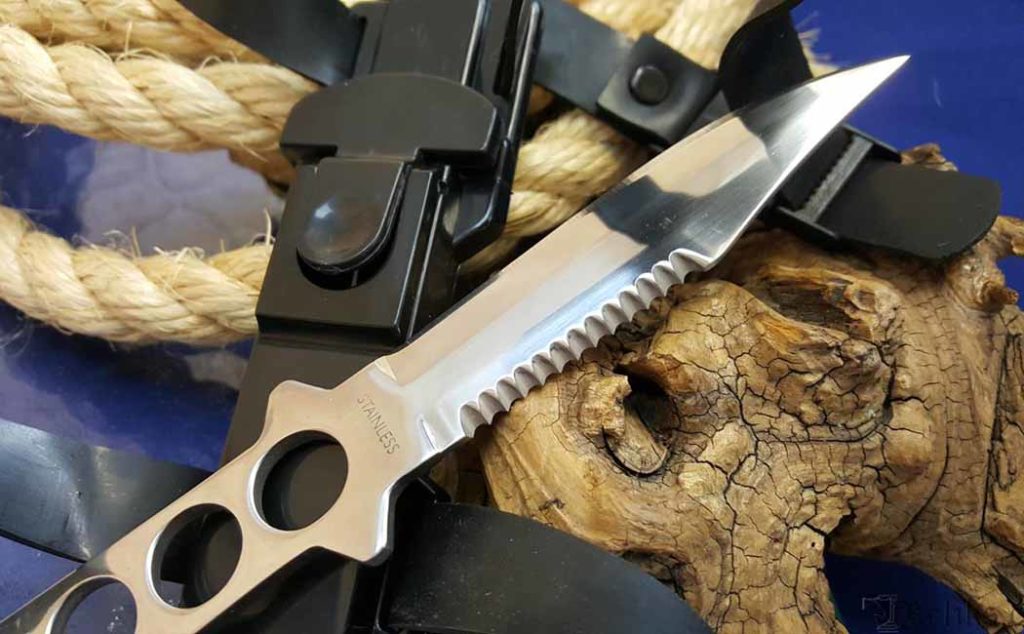
A Sharp edge is the knife’s the main feature and is simply a must—no questions asked. Serration is very ideal on a whole edge and is truly better for cutting rope or nets over a plain edge. A plain edge is great as well, but for cuts that don’t necessitate a sawing motion. Glass breakers in the pommel, paracord wraps, and other features aren’t necessary and may even get in the way. Simplicity is paramount in a dive knife, you should never have to guess where your edges are when working in poor lighting conditions with limited oxygen.

Dive Knife Designs

Popular profiles vary, usually by tip profile. Some divers prefer a Bowie style with a sharp, aggressive tip. This is nice for fine work, especially on primary knives that may be used for harvesting oysters and other such tasks.

A flat tip can prove a safety feature for some on dive knives.

The other main category is blunted or flat-tip knives. These have a tip similar to pry knives in that they have an abbreviated, square-edged tip. They can also be used for various purposes, but their main advantage is that they can be slipped under straps on a diver’s body safely without risking stabbing or lacerating them. Injuries can still occur, but the serious risk is reduced.

Best Dive Knife Size

There is a general limit to the effectiveness of a knife used underwater. Thrusts and slashes are slowed down by the resistance of the water itself, and you tire much easier than on land. As a result, there is certainly too big of a knife, with the lower limit being around 3 inches, or just enough to get under most straps and tie-downs.

The handle should not be too small, however. Many of these designs have a dagger-like overall profile, though, a good scuba or dive knife should not have a dagger handle. You need to know where the edge is by indexing the handle. As a result, a beefy handle and 3- to 5-inch blade are what you want to look for a dive knife.

Steel Vs Titanium Dive Knives

Titanium is hands-down the better material for use on dive knives from a corrosion perspective. Titanium, however, doesn’t hold an edge as well as steel, but when sharp it cuts maritime materials just as well. Sharpness is a main benefit of steel, though even the best steel can experience corrosion over extended saltwater exposure.

Steel or titanium (such as the one pictured), is an eternal debate over dive knife blade material.

Some divers swear by steel, others by titanium, and this seems to be an ongoing debate. Steel coatings are better and better these days, and some steel knives are available with a titanium coating. Again, the benefits are largely subjective, most users won’t notice a difference with regular maintenance. Like all hobbies, the vast majority of conjecture takes place in the 1-percent of professional or constant participants.

Best Dive Knives At All Price Points

Benchmade H20 Fixed Dive Knife

Benchmade H20 Fixed Dive Knife

Benchmade is well known for some incredible and durable products. The H2O fixed dive knife is an example of this.

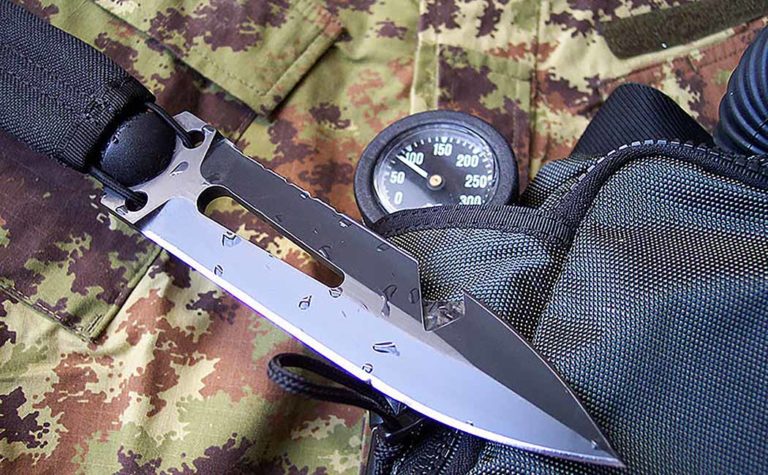
Designed for military use, the knife carries a national stocking number (NSN) and is exceptionally well laid out for its purpose. Interestingly, this knife has features that are not necessarily in line with what many of the experts say are best.

For starters, it has a relatively simple grip that lacks the excessive texturing found on many other dive knives. The blade is also made of steel, which stands in the face of those that say titanium is a must-have for saltwater exposure. This is not to say that it is the end-all, be-all knife for use in the water.

While the military has picked some good products in the past, it can’t be said that they are correct every time. This knife is a great starting point at a medium price, you get a blunted tip, strap cutter and serration, as well as a generous lanyard loop. The sheath, while relatively basic, can be adapted to many types of carry depending on what you’re doing in the water.

MSRP: $170

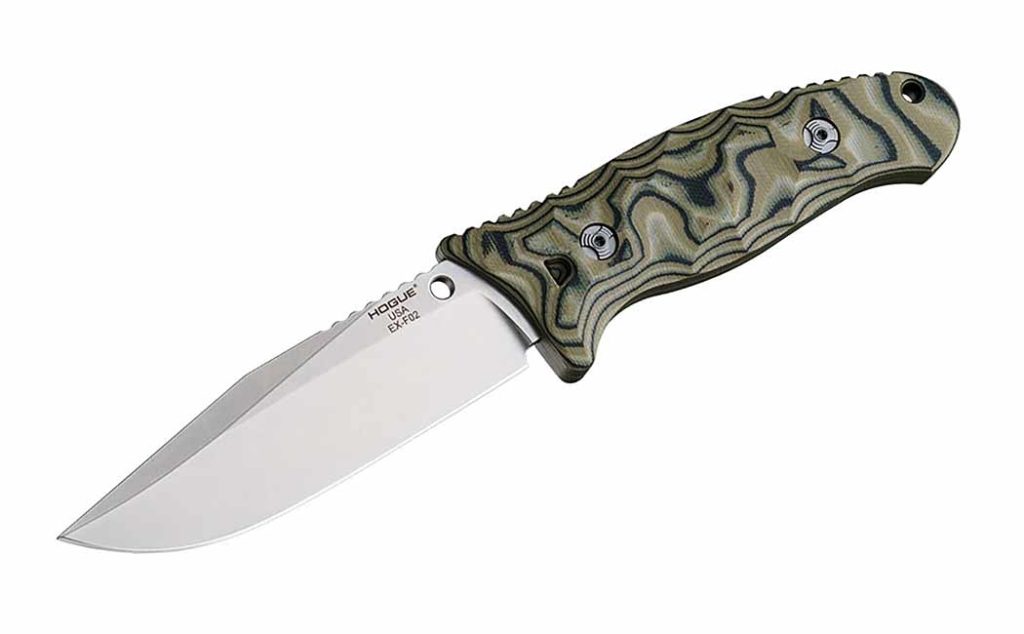
Hogue Knives EX-FO2 Dive Knife

Hogue Knives EX-FO2 Dive Knife

As a general purpose outdoor knife, Hogue has a winner in the EX-FO2. This knife is right in the “perfect size” range for a dive knife, however, it has some features that make it both spot-on and a bit questionable at the same time.

Looking at the positive angle first, this knife is very well laid out and has a nicely shaped handle that has positive reviews for water use. The sheath setup is also excellent, it comes ready for attachment to your arm or leg with a padded backer. This is a knife that has multiple end uses. It is sort of a hybrid of a fishing knife and bushcrafter in that it has a stout blade that can be great for filleting but strong enough for general use.

This knife is available as listed with only a tanto point or clip point. For general use this is fine, however, it can be a liability diving. A completely sharp tip is a negative to some, the risk of puncture or personal injury is potentially much higher as opposed to a blunted point.

MSRP: $159

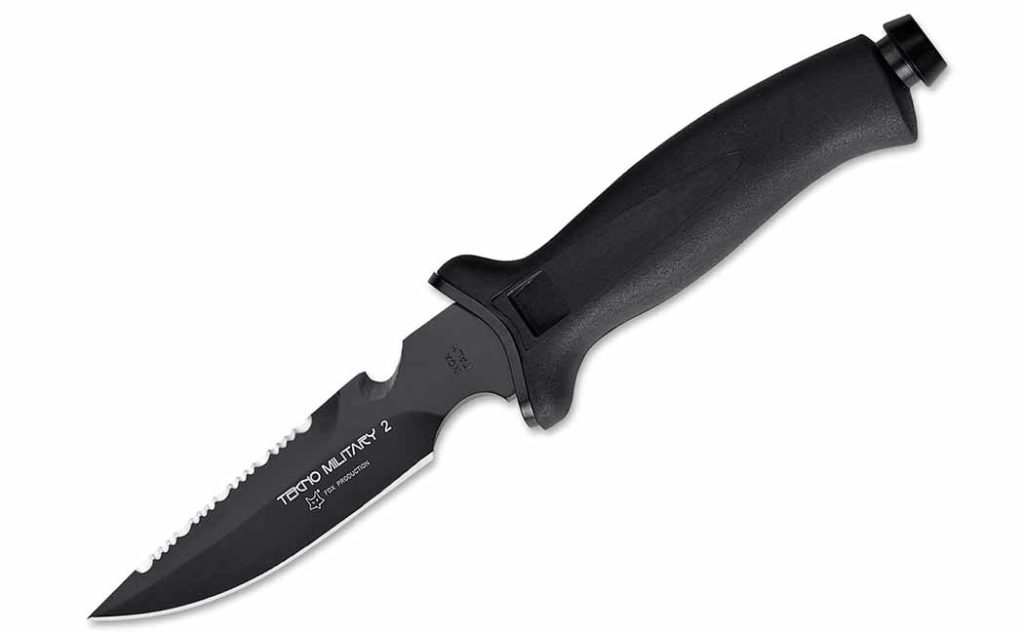
Fox Knives Tenko Military II Dive Knife

Fox Knives Tenko Military II Dive Knife

Fox Knives is an Italian company that makes high-quality products at reasonable prices. The author has used Fox products for quite some time, and all of them have held up very well.

Their dive knife is feature-rich, almost to a fault. The knife is double-edged, one serrated and the other clean. The rear part of the spine has a cord hook directly behind the separation. Unlike the others on this list, the Fox knife has a full cross guard that allows you to choke up on the blade for high-impact puncturing or slashing. This knife has a very fine tip, and while it is military-themed, this tip is a bit too aggressive for rescue work or freeing even yourself from a tangle. A bonus of this knife is that it has a full rubber handle as opposed to textured plastic.

MSRP: $117

Spyderco Salt Fish Hunter

Spyderco Salt Fish Hunter

Unlike the rest of the names on this list, the Fish Hunter is exactly that, a hunting knife. While many of these knives can be used for fishing in general, Spyderco’s product here is expressly made with the intent to be used as a companion for spearfishing and adventurous free divers. This is a specially designed product, and shouldn’t be confused with other dive knives or dedicated scuba knives.

The blade is hollow ground and comes to a very aggressive tip. Serration starts just after the tip and continues to the handle. Many fish are surprisingly thick-skinned and are quite difficult to kill, this knife makes it relatively effortless and the serration allows for quick cuts through even the thickest scales.

While this knife of course can be used to aid in an emergency, it would likely be best to bring a dedicated, blunted rescue tool as well. Spyderco designed their Salt line to fit this bill, and you can find products that are geared towards rescue and escape as well in their lineup.

MSRP: $196

Extrema Ratio Ultramarine

Extrema Ratio Ultramarine

By far the most expensive dive knife on this list, and perhaps the production market, the Italian-made Extrema Ratio Ultramarine is a purpose-built, do-all dive knife. Curiously, for being so costly, it is not made of titanium or another material less subject to corrosion.

Much like the Benchmade H2O, it is a steel knife. The Ultramarine is double-edged, one clean, and one serrated, and it includes a strap cutter and wrapped handle for a very sure grip underwater. The covering is removable. The knife comes with a functional sheath and case.

You may ask yourself just what you get in terms of the extra hundreds of dollars and, well, that is something only you can know. The possibility of losing such an investment in the deep is not something many people want to stomach considering that many dedicated dive knives are less than $100. This is one serious knife for perhaps the most serious users.

MSRP: $792

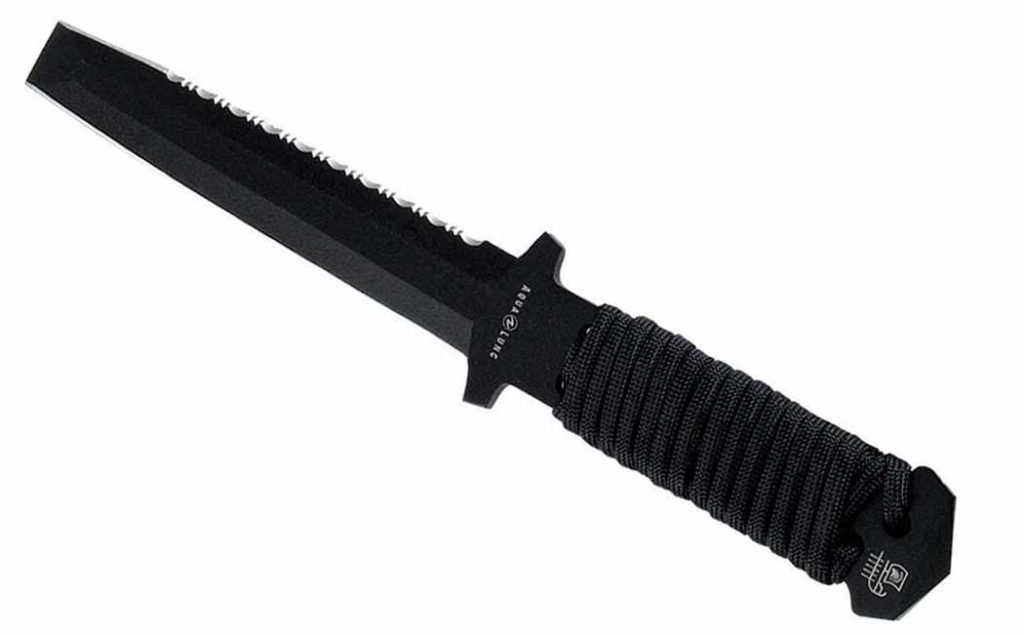
Aqua Lung Argonaut Blunt-Tip Titanium

Aqua Lung Argonaut Blunt-Tip Titanium

Aqua Lung has a real winner here with the Argonaut. This knife is available as a blunt tip, as well as what they call a Spartan tip, which has a leaf-shaped, pointed profile. For our purposes, here, the blunt-tip version is the knife that we are going to be looking at.

As a scuba knife, it is perfectly suited for the task. The squared, blunt tip profile allows it to easily get underneath any strap, and, depending on what you need to cut, it has a sharp plain edge and a serrated edge. The knife is made of titanium, which is a choice for many people that spend time in the water. This material is far less vulnerable to corrosion and is also quite light. It is relatively thin for its end use at .15 inch, so prying is not on the menu.

This knife comes with a dedicated leg or arm sheath and is moderately affordable at around $200 retail. The handle is simply wrapped in cord, which somebody finds to be a detriment over a high texture Nylon handle.

MSRP: $195

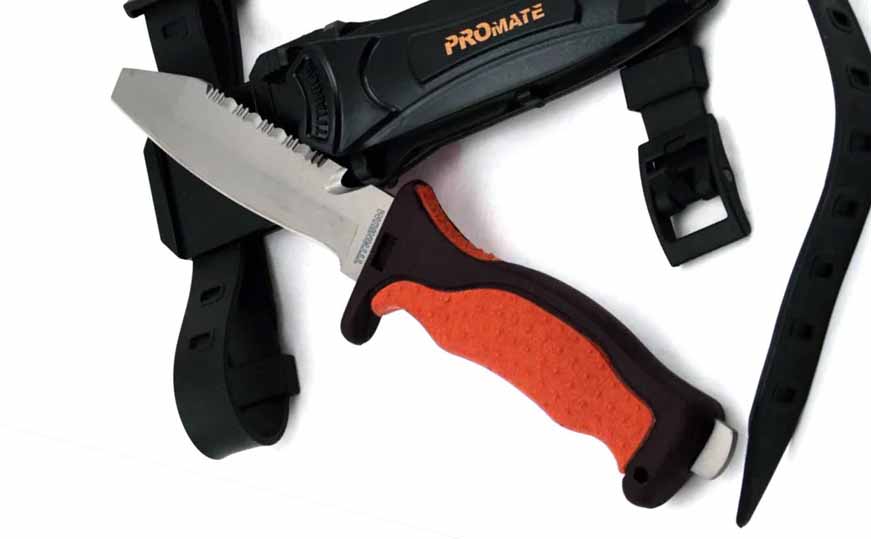
Promate Snorkel SCUBA Knife Titanium

Promate Snorkel SCUBA Knife Titanium

The Snorkel is an affordable, multi-function, titanium knife that is very well thought out. It has a plain main edge and a serrated spine with a cord cutter. While it is substantially less expensive than the others on this list, it boasts very high reviews across the board and is by all accounts the standard, by which all scuba knives are judged. If it does not perform as well as this affordable model, it probably is not going to perform at all.

The Snorkel is available as a blunt tip, as well as a very aggressive Bowie profile. Depending on what you’re going to do with it, the former is more functional for general use, while the latter is going to give you an advantage if you are spearfishing or free diving. Because they are half the price or less than almost everything on this list, you can get one of each and still have cash in hand. These knives are available in different colors to suit your interest and come with a functional sheath setup for use in the water.

MSRP: $75

Check Out More Buyer’s Guides:

Advertisement

Must Read Articles

Read this before you make a knife

Knifemaking 101 – Read This Before You Make a Knife

  by Wayne Goddard My experience has taught me that there's nothing like digging in and getting started. I've often said the hardest part of the...
how to forge damascus steel

How to Forge Damascus

Advertisement
Advertisement