Somewhere between an EDC and a gentleman’s knife, the ACE Bleecker looks to be a slick sidekick.
Giant Mouse is going gentlemanly but with an attitude. At least, that appears to happen with the newest addition to its catalog—the ACE Bleecker.
Named after Manhattan, N.Y.’s trendy Bleecker Street, the company seems to aim the frame lock toward hipsters’ hip pockets. The same with the sleek, yet somewhat understated lines. However, robustly built with premium steel and components the Italian import likely has the chops to pull off EDC duty—at least for those who tend to smaller knives.
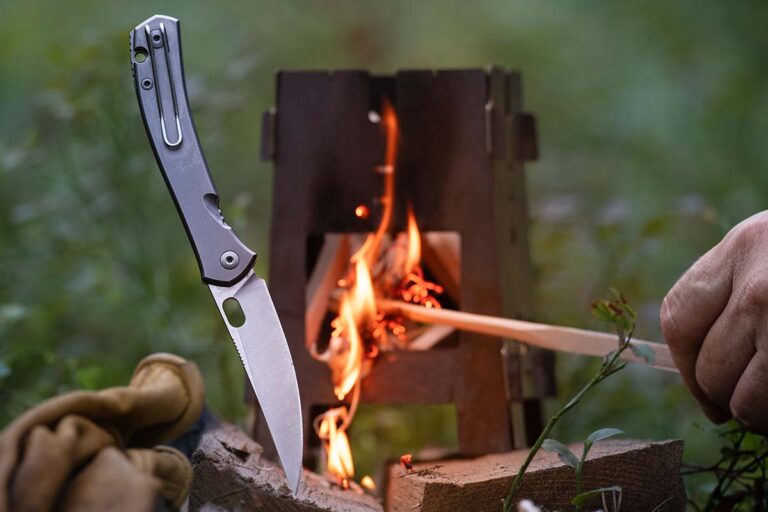
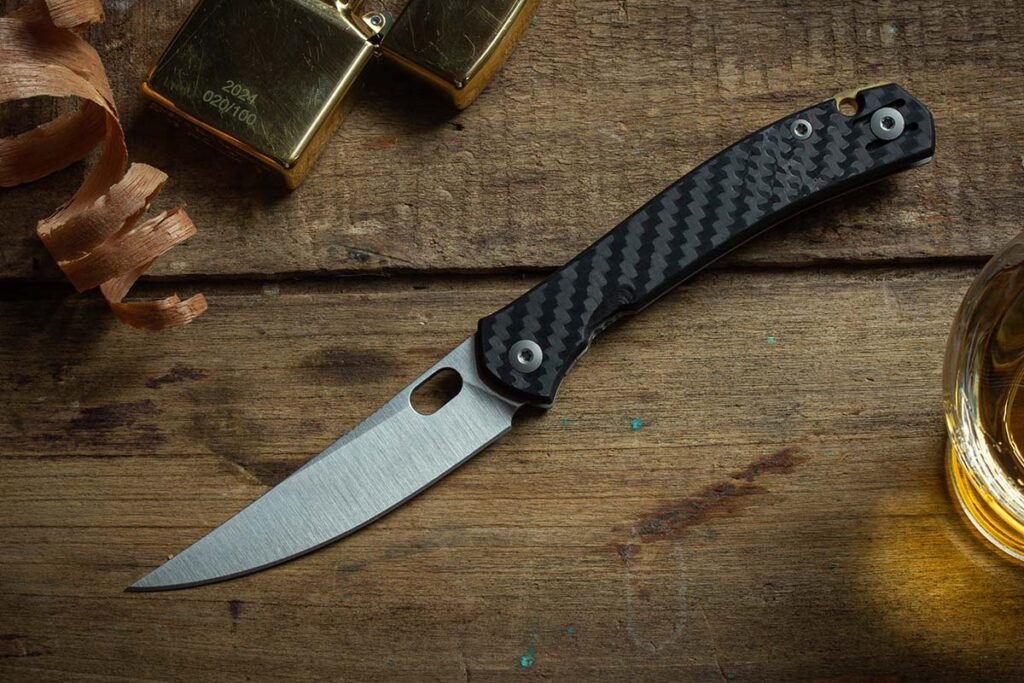
Right off the bat, the notable aspect of the ACE Bleecker is its slim design accentuated by a trailing point blade. In many respects, it’s reminiscent of Giant Mouse’s Knife of the Year award-winning GMX, only smaller and without an integral handle. Despite its svelteness, the company has ensured the knife is capable of more than cutting the foil off wine bottles by making the handle full-sized. It is a bit skinny in the hand, yet it nestles in the palm well enough to handle more aggressive cutting duties.
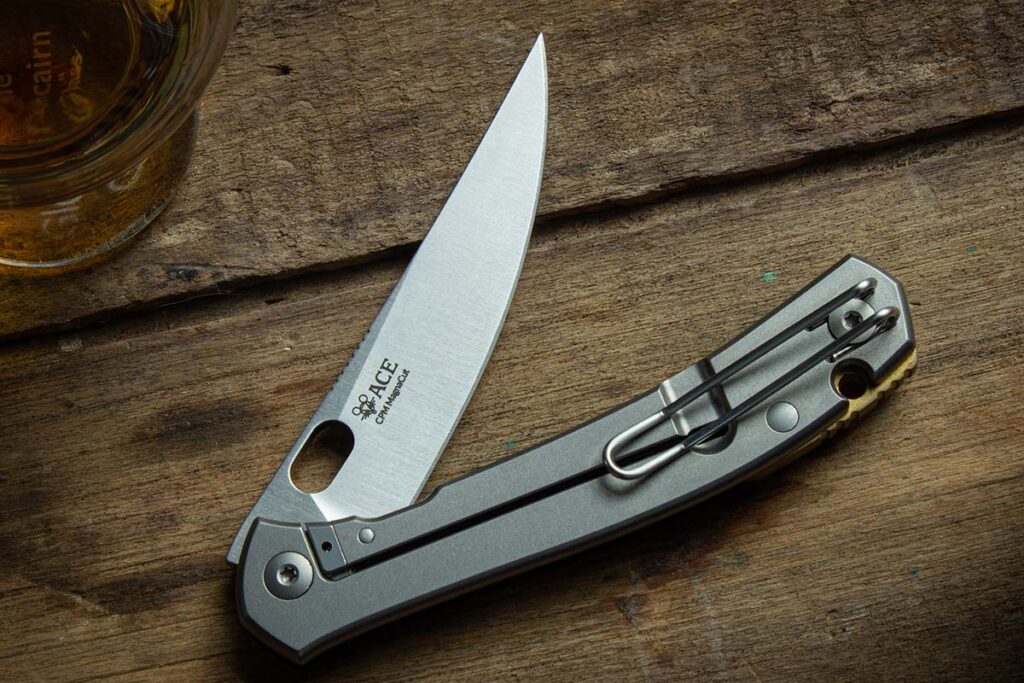
Giant Mouse went top-shelf for the blade steel, choosing Magnacut—albeit a softer version than some prefer. The company rates it at 62 HRC, a facet that might raise the hackles for the edge-retention obsessive. That aside, the geometry of the 3.26-inch blade is exquisite with a thick(ish) spine adding toughness to the design. The tip doesn’t jut too far above the spine, allowing users to choke up on the blade for finer work. And, boy howdy, should it ever prove apt at fine work, with a very fine tip.
The company has opted for a thumb hole as the opening mechanism on the Bleecker but has made it oblong. The choice is for more than aesthetics, making the knife deployable not only in the traditional style—the thumb—but also in reverse open. As an added benefit, this also makes the knife relatively left-hand friendly. The Bleecker’s well-tuned detent also goes a long way in adding to all these aspects—not so light as to facilitate a negligent deployment, but not overly stiff where users will struggle to get the blade to work.
As for the handle, Giant Mouse offers two options—titanium and carbon fiber. Both are attractive, though I tend to the titanium as it gives the knife more overall continuity and class. In both cases, the knife tips the scales at right around 2 ounces—the titanium a hair more—and measures at 7.43 inches in overall length. Worth note, Giant Mouse includes a notch on the thumb side and a chamfer on the lock that go a long way in making opening the knife simple. Also, it boasts a reversible wire pocket clip for tip-up carry.
With a gentleman’s design comes a gentleman’s price on the Bleecker. Giant Mouse lists the titanium model at $285 and the carbon fiber version at a slightly more affordable $245.
The popular pattern offers a complex combination of material and motif.
The variations on damascus steel themes are endless. The possibilities are tempered only by the maker’s time at the forge and his or her desire to create.
Among these many variations, one pattern has recently captured the spotlight. These days, feather damascus is trending and custom makers are producing knives that turn heads, captivating buyers with the intricate layering that produces hard steel intertwined with the look of the light and wispy. Feather damascus offers a medium of both performance and artistic expression that influences every aspect of the maker’s creativity.
Ethan Kolar of Plummer, Idaho, describes his interest in feather damascus as “chaotic flow.” He explains, “The pattern’s center seam, where the jagged W’s converge, creates a flow in the blade which really adds to the overall confluence of the knife as well as creating a controlled chaos as the pattern explodes from the center filling out the blade.”
Kolar enjoys the hint of “jaggedness” and the center line that ties the blade together, and in the making of his feather damascus, his focus lies in test etching every restack from the forge. He sees the pattern in many different forms with the observation that “a pattern is not right or wrong but more of what the maker envisions and creates and what is right to him for his knife.”
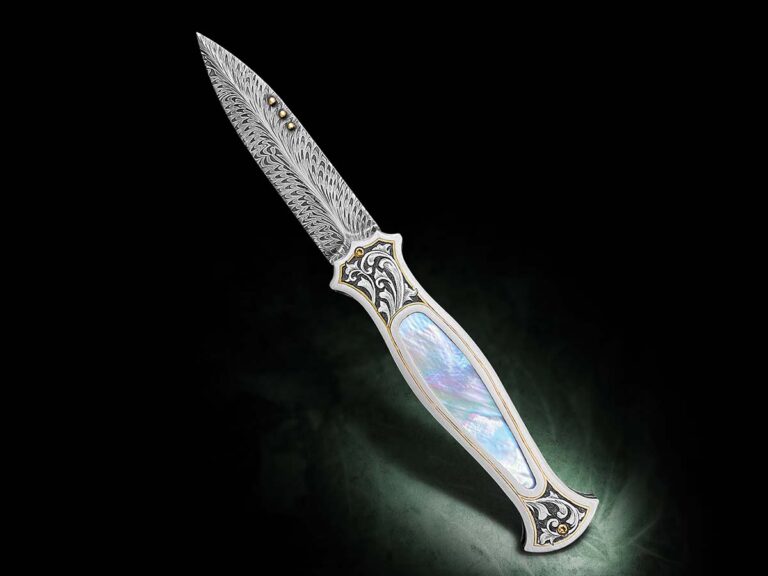
The folding dagger Ethan composed includes a 3-inch feather damascus blade of 1084 and 15N20 steels with an engraved gold inlay and scroll worked 416 stainless steel window frame fitted with exhibition-grade white-lip mother of pearl. Liners are 15N20 file-worked and nitre blued, while the backbar of 416 stainless is engraved and sports delicate file work. Its overall length is 7 inches.
“Most of the inspiration I have while making damascus comes from envisioning my final product,” Ethan remarked, “what engraving will go with it, the handle embellishment, and a lot to do with the overall color of the knife, deciding whether the pattern will be brighter or darker.”
Steel On Fire
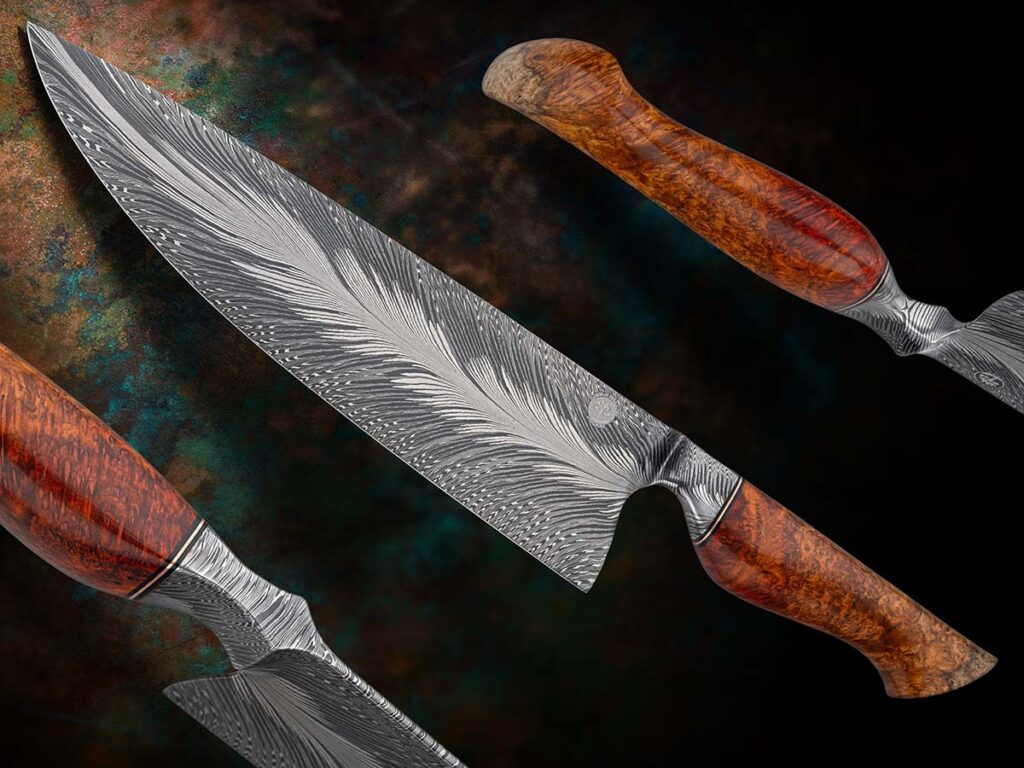
Winning Best Damascus at the 2025 BLADE Show West, Trevor Morgan’s “Torrent of Fire” chef’s knife includes a 9.25-inch blade of 1084 and 15N20 in a mix of W’s and straight layers with a fat core of 15N20. The knife’s overall length is 14.2 inches, and the handle is dark red tiger’s blood amboyna burl with a splash of sapwood for contrast. (Jocelyn Frasier image)
Another contemporary artisan exploring the feather damascus pattern is ABS journeyman smith Trevor Morgan. Having attended the Bill Moran School of Bladesmithing in Texarkana, Texas, in 2020, his goal with each feather damascus blade is to make the pattern “pop.” To achieve that look, his hand follows an artistic eye.
“Contrast, for sure, really makes any pattern cool,” said Trevor, “especially feather or mosaic damascus, larger pieces of dark and bright steel, gradients and that kind of thing. Also, out-of-the-ordinary stuff like feather [damascus] can be really cool to look at. Symmetry is always great with a feather pattern because it’s pretty easy to notice when something is out of whack with a feather due to the defined center. Complexity is also great. If it’s hard to figure out, all the better.”
According to Morgan, a resident of Apple Valley, California, the feather pattern can be challenging due to the hot-cut process, which puts enormous stress on the billet in somewhat weird ways and causes every forge weld to want to split open. The problem, however, can be mitigated by mig welding all the way around the seams. But this is his least favorite method of achieving the integrity of the billet because it requires grinding away the welds, wasting material and consuming time.
Trevor’s inspiration for feather damascus pieces comes from the world around him. “It’s places and people,” he commented, “from nature and the endeavor to make something organic and as lifelike as possible in steel. I regularly get swept up in the general zeitgeist surrounding the making of complex patterns. I see something on social media or somewhere, and I think, ‘Man, that’s really awesome! I’d love to try to make something like that.’ Then comes the real creative part, where I just get an idea of something that might look really cool and put it together.”
Morgan’s method is readily revealed in his featured piece, named “Torrent of Fire.” The knife includes a 9.25-inch blade of 1084 and 15N20 in a mix of W’s and straight layers with a fat core of 15N20. The knife’s overall length is 14.2 inches, and the handle is dark red tiger’s blood amboyna burl with a splash of sapwood for contrast.
Organic Appeal
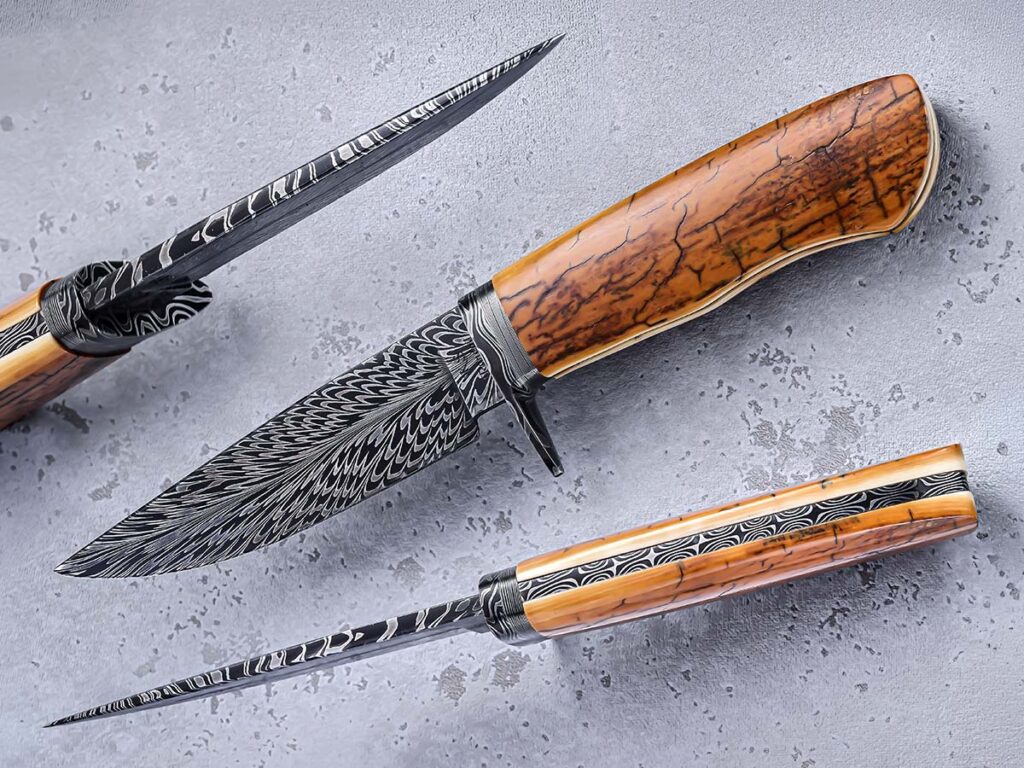
Splitting the billet down the center to maintain symmetry is among the trickiest aspects of feather damascus to Steve Randall. He nails it on his frame-handle hunter, with the axis of the pattern fountaining from the mastodon scales in a balanced and spectacular fashion. (SharpByCoop image)
Feather damascus has been a staple steel for ABS master smith Steve Randall for some time. He seeks a continual flow of the steel from the handle to the tip, and oriented so that the handle appears to actually hold a feather. “I was attracted to the feather pattern because of it’s a very cool, organic look,” he advised. “Like a snowflake, there are no two exactly the same. I’ve been forging feather damascus for at least seven years, and I’ve made several bowies and hunters.”
Randall, of Estancia, New Mexico, presents his feather damascus piece with frame-handle construction, showcasing mastodon scales with an overall length of 9½ inches and a blade of 4¾ inches. “Feather damascus is a more challenging pattern,” he said. “My tricks are patience and concentration. There are many welds involved in the pattern, which can contribute to cold shuts, which can destroy hours of hard work. The trickiest part is splitting the billet right down the middle and maintaining symmetry.”
While he describes the feather damascus forging process as complicated and labor-intensive, Steve sees the payoff in the harmony of the pattern and its related materials in the finished knife. “I always try to complement it with the best handle materials I have available,” he reasoned. “I prefer stag or ivory. If using wood, I avoid busy patterns and colors. I draw inspiration from many other makers. There are so many accomplished makers who produce a variety of feather patterns. It is one of my favorite patterns to forge because it can really accent the flow of the blade and give it a great overall look.”
Movement And Flow
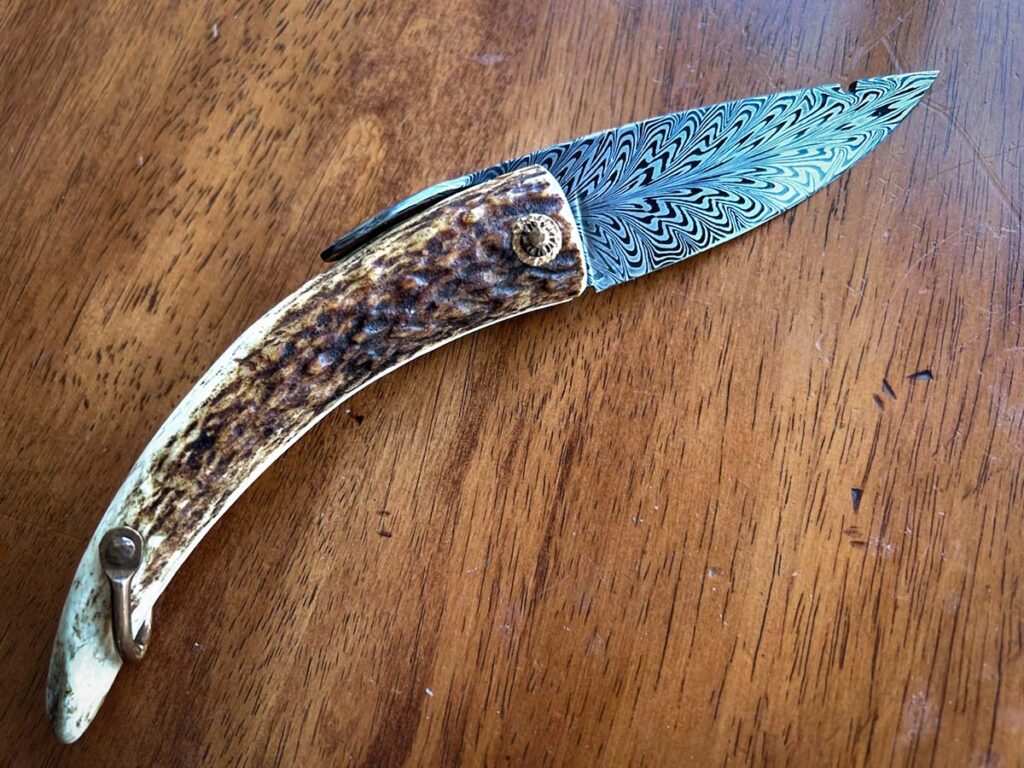
While David Lisch doesn’t feel he’s hit the limits of his Mountain Man folder, the style of knife is striking with its feather damascus blade set in stag-tip handle. Copper hardware and pivot give the knife its antediluvian look, while the flowing pattern of the blade anchors it in modern forge techniques. (David Lisch image)
It took a single demonstration by the great master smith Harvey Dean to convince David Lisch, who earned his ABS journeyman stamp in 2009 and his master stamp six years later, to try the feather pattern. “I was always attracted to feather damascus,” he remembered, “but around 2008 I had the chance to see Harvey Dean demonstrate it at an event at Josh Smith’s, and I went right home and made the tools needed and gave it a go. I’ve been making feather damascus since his demo, and my hat is off to Harvey.”
For David, the making of feather damascus is challenging, but he says book matching the blocks really helps with the constant flow of the pattern. Sometimes, he says, makers will intentionally disrupt the flow by spinning one block one way and one the other to enhance the look. If it is done intentionally, he advises, there is no wrong way to stack the blocks. Forging all begins with the initial stack, and David starts with a 12- to 15-pound billet, acknowledging that the pattern can be wasteful in material. He tries not to go too far or stop too short in the forging process and offers that sometimes less is actually more.
“I love feather damascus because it looks different from maker to maker,” added Lisch. “I like a feather with movement and flow, not too bold and not way too fine, something that is easy to look at. For me, the more the pattern follows the forging, the more I like it. The center should lift up into the bolster or ricasso, showing that the blade was forged rather than running off the blade under the ricasso, showing it was just ground into a shape that disrupts the flow.”
Lisch gained a measure of popularity with his Mountain Man 2 folder, and the pictured knife is an example of what he describes as a “deep dive” into the style while using stag tips. “I set out trying to create my own version of one of the oldest knife designs in America,” he remarked, “and I believe I did just OK. But I’m not finished. So far, I’ve made several versions of the folder and have taken it even further with help from my friend and mentor [master smith] Mike Vagnino.”
Lisch had brought together his feather damascus touch and innovative design composition by introducing a clocking adjustable pivot that he has incorporated into a slipjoint, linerlock, lockback and flipper, all in the Mountain Man style with bronze, copper, stag and, of course, feather damascus. He has yet to reach the outer limits of his Mountain Man creativity and says that more will come in due time.
Designers and companies join forces to help consumers win with these knife collaborations.
A collaboration knife is produced when a designer or knifemaker partners up with a knife company to produce a particular knife. And more often times than not, such models offer the best of both worlds. Designers able to focus purely on designing and not confined to the limits of their shop can shoot for the stars. While companies take the reigns of producing the knife to exacting specs and usually at a buyer’s price. In the end, the knife consumer wins. Here is a handful of the latest collaboration drops certain to get knife aficionados juices flowing.
Harlock Mini / Boker Plus
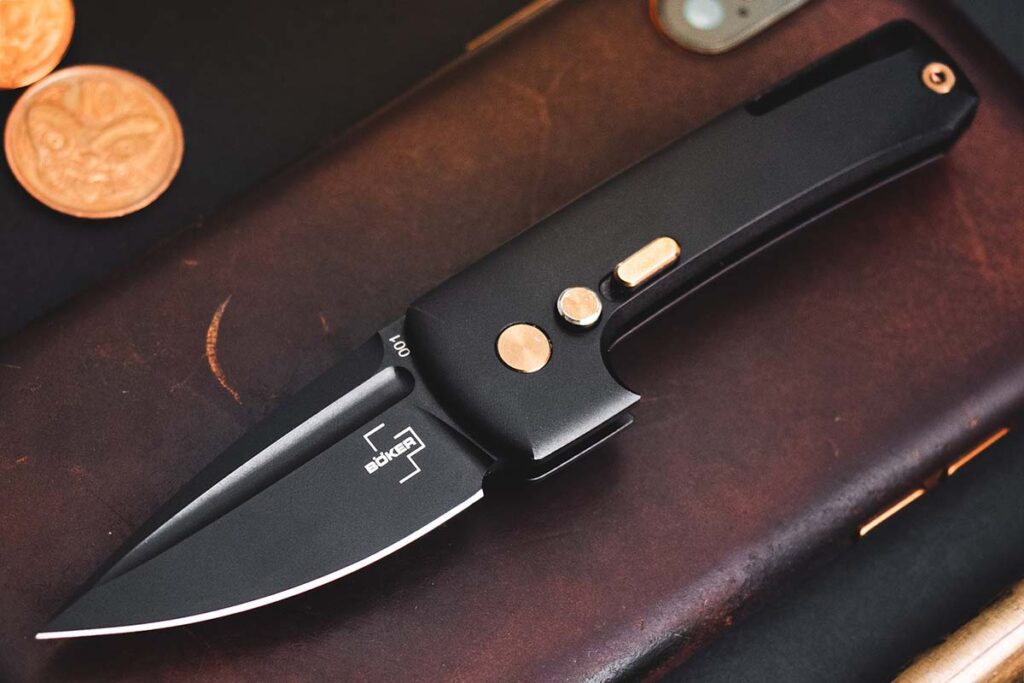
A blade only .11 inch at the thickest helps the Boker Plus Harlock Mini tip the scales at a scant 2.19 ounces. At about 2.87 inches closed and with a lean, sexy pocket clip, the Harlock Mini is made for executive wear. It comes with a nylon pouch.
If you’re looking for an elegant knife present for that special someone, you could do a lot worse than gift him or her the Boker Plus Harlock Mini designed by custom knifemaker Darriel Caston.
Designer: Darriel Caston Knife type: Push-button automatic Blade length: 2.05” Blade steel: Black-coated 154 CM stainless Blade grind: Convex Handle material: Black-coated aluminum Hardware: Brass Knife to Know: A latching slide lock locks the blade closed and prevents accidental release Closed length: 2.87” Carry: Pocket clip and nylon pouch Country of origin: USA MSRP: $146
A.P.C. (Always. Pocket. Carry.) / CRKT
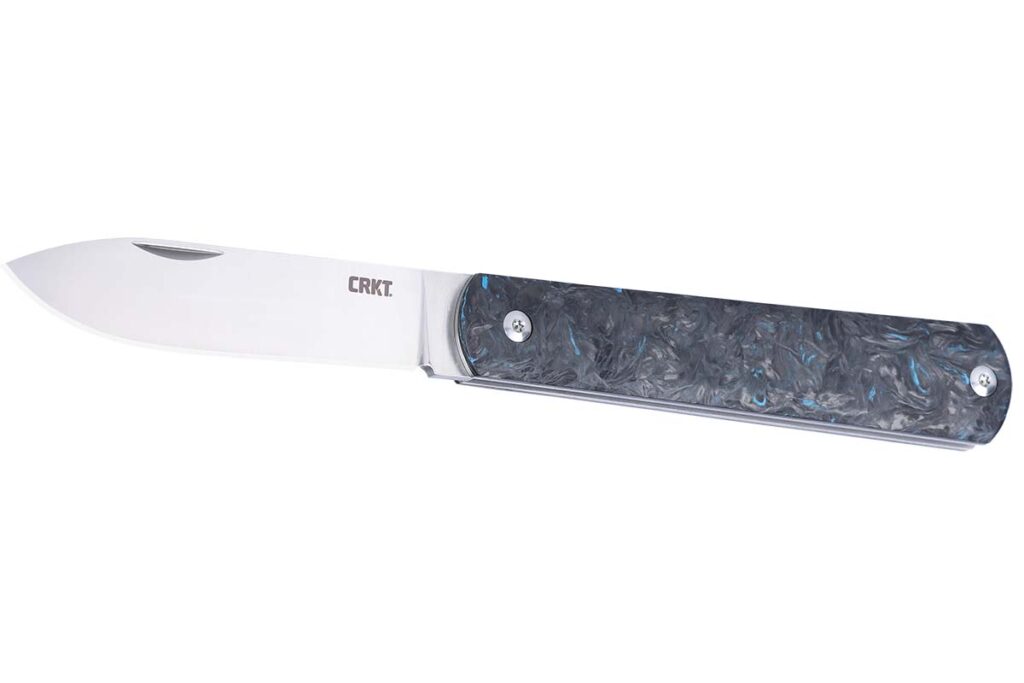
The A.P.C. is a two-hand opener, with the blade deploying via a traditional nail nick. The Fat Carbon Dark Matter handle material is strong and lightweight.
Unlike traditional slip joints, Steigerwalt’s new slip joint design for CRKT does not have a standard steel backspring. Instead, the slip joint springs from the liners and connects the liner springs with a hardened steel block that contacts the heel of the blade, eliminating the need for the backspring. Among other advantages, this reduces a fair amount of the weight a backspring would add, there is more space inside the handle to hold a wider blade, the position of the blade pivot pin can be changed and more.
Designer: Ken Steigerwalt Knife type: Slip joint Blade length: 2.88” Blade steel: Bohler M390 stainless Rockwell hardness: 59-61 HRC Blade grind: Flat Handle material: Fat Carbon Dark Matter Weight: 1.7 ozs. Closed length: 3.72” Country of origin: Taiwan MSRP: $175
The Sicilian / Fox Knives
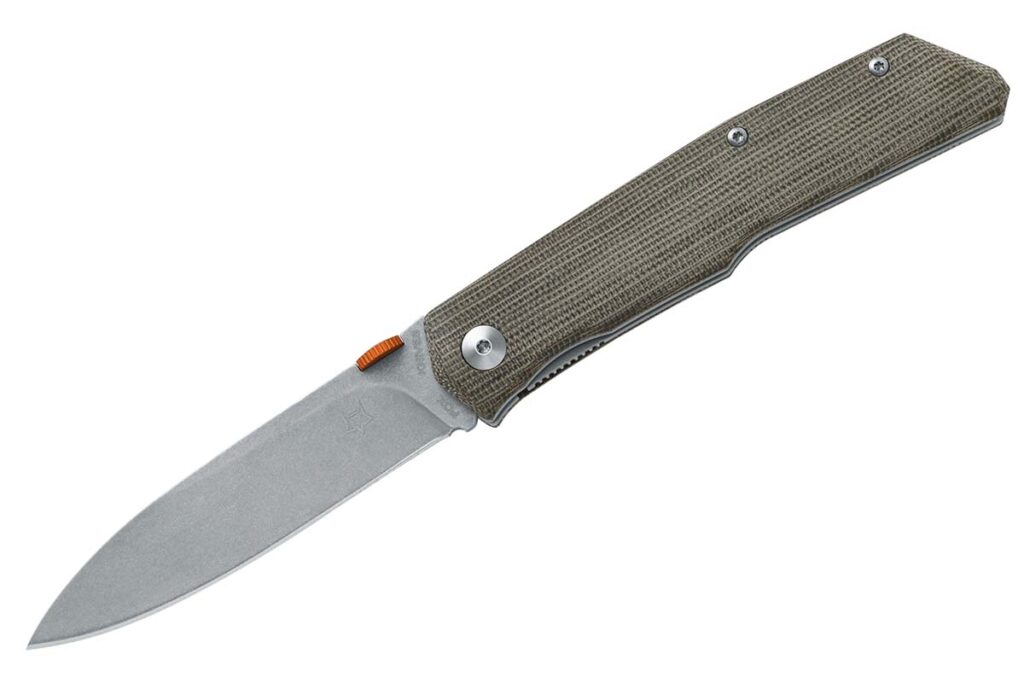
The Sicilian is a reinterpretation of Fox’s model FX-525, and the name pays homage to the Sicilian roots of Bob Terzuola’s family. Changes from the FX-525 include the BECUT stainless blade steel, the OD green canvas Micarta® handle and the wire pocket clip.
According to Fox’s Athena Greta Barbieri, “Bob Terzuola conceived the Sicilian taking inspiration from traditional knives used by ordinary people for everyday activities such as eating or working in the fields. The idea for this knife evokes images of landscapes warmed by the Sicilian sun and simple meals eaten among olive trees and vineyards.”
Designer: BLADE Magazine Cutlery Hall-Of-Fame® member Bob Terzuola Knife type: EDC folder Blade length: 3.35” Blade steel: BECUT stainless Rockwell hardness: 58-60 HRC Blade @ thickest: .12” Blade finish: Stonewashed Blade opener: Disc Handle material: OD green canvas Micarta® Spacer: Aluminum anodized orange Pocket clip: Wire Lock: Linerlock Weight: 3.53 ozs. Closed length: 4.52” Country of origin: Italy MSRP: $164
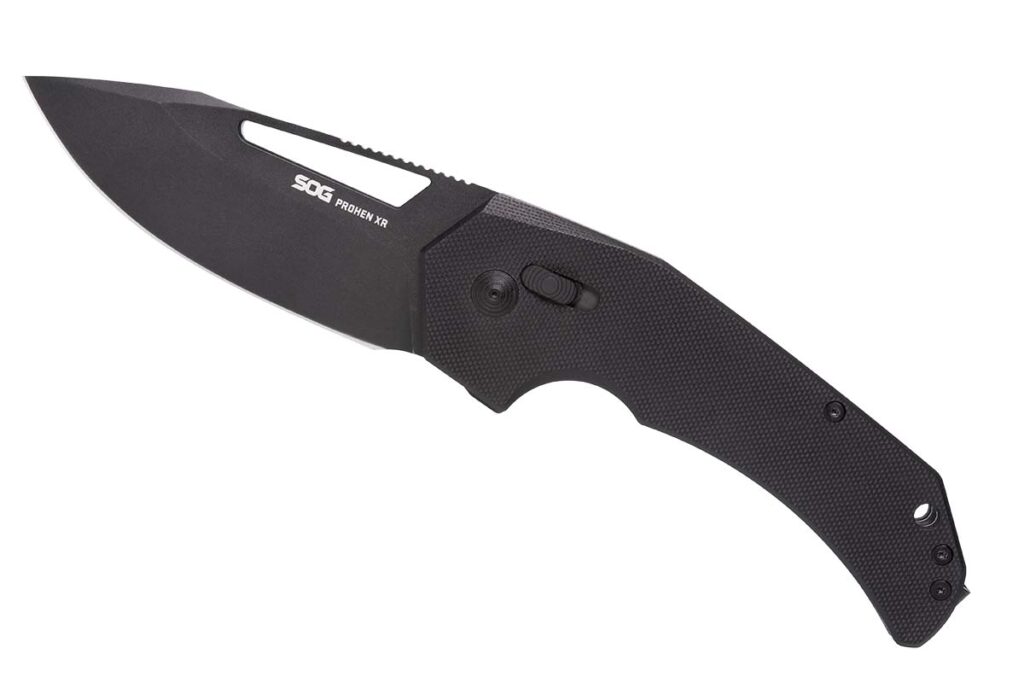
Prohen XR / SOG
The extremely strong G-10 handle is micro-textured for a secure, comfortable grip in wet or slippery conditions.
Designed by custom knifemaker Mikkel Willumsen for SOG, the beefy Prohen XR flipper folder is a mix of curves and angles that features the XR Lock, a sliding transverse bar that locks the blade in place and promotes ambidextrous one-hand operation.
Designer: Mikkel Willumsen Knife type: Flipper folder Blade length: 3.4” Blade material: Cryo D2 tool steel Blade @ thickest: .157” Blade grind: Flat Blade pattern: Drop point Blade finish: TiNi Blade opener: Flipper tab or thumb hole Handle: G-10 Pocket clip: Reversible, low carry Lock: XR Lock Knife to know: The XR Lock can withstand 1,500 lbs. of force Weight: 5.6 ozs. Closed length: 4.8” Country of origin: China MSRP: $70
Dmitry Sinkevich/ Spyderco
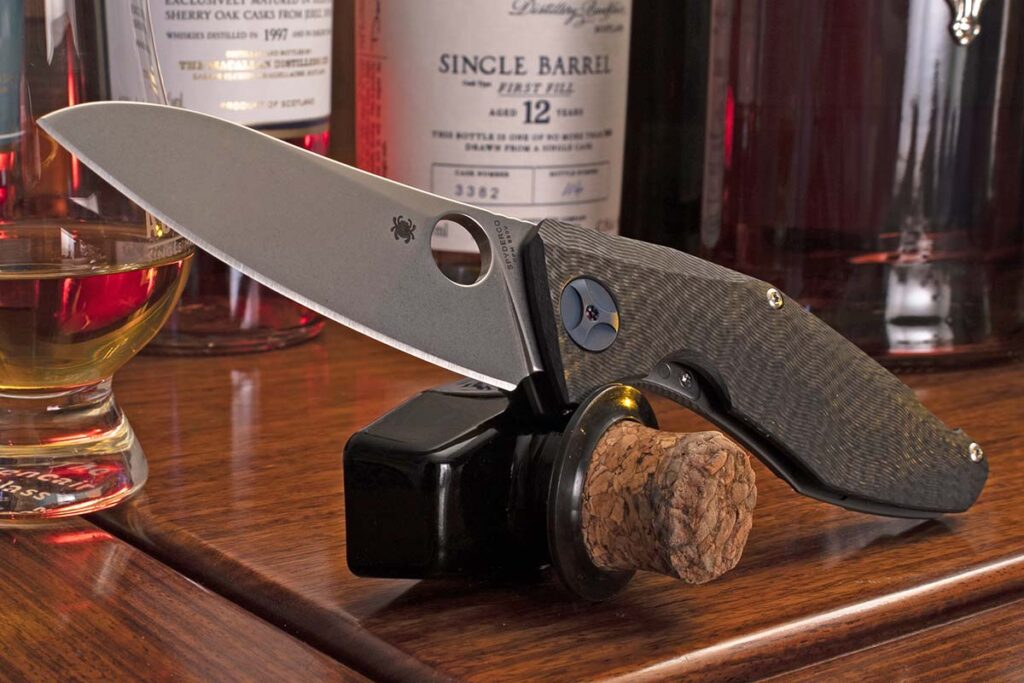
Drunken / Spyderco
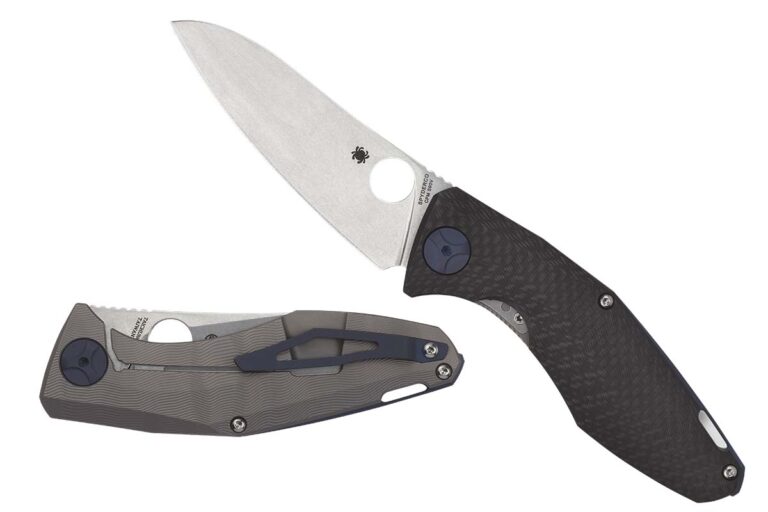
The Spyderco knife’s handle includes a titanium scale on one side and a solid carbon fiber scale and nested stainless steel liner on the other. The titanium scale is “webbed” to reduce weight and forms the basis for the knife’s Reeve Integral Lock (R.I.L.) mechanism, which includes a long-wearing stainless steel interface. Both scales are meticulously machined with the intricate “drunken” texture that gives the knife its name, and are accented by a matching color-anodized backspacer, pivot assembly, and right-side, tip-up pocket clip.
Designer: Dmitry Sinkevich Blade length: 3.45” Blade steel: CPM S90V stainless Blade grind: Full-flat Blade @ thickest: .138” Blade finish: Tumbled Handle: Carbon fiber/ titanium Pocket clip: Right-handed, blade tip up Lock: R.I.L. (Reeve Integral Lock) Weight: 3.8 ozs. Closed length: 4.61” Country of origin: Taiwan MSRP: $770
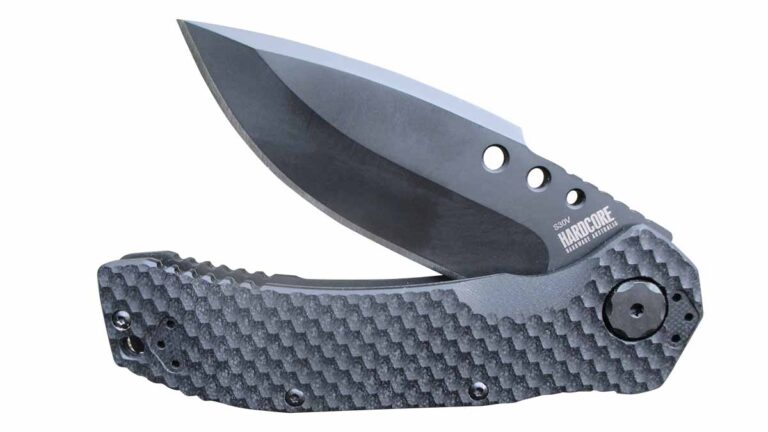
The Hardcore Hardware MILF-02 Is A Heavy-Duty Folder That’s Designed For Any Challenge Users Can Throw At It.
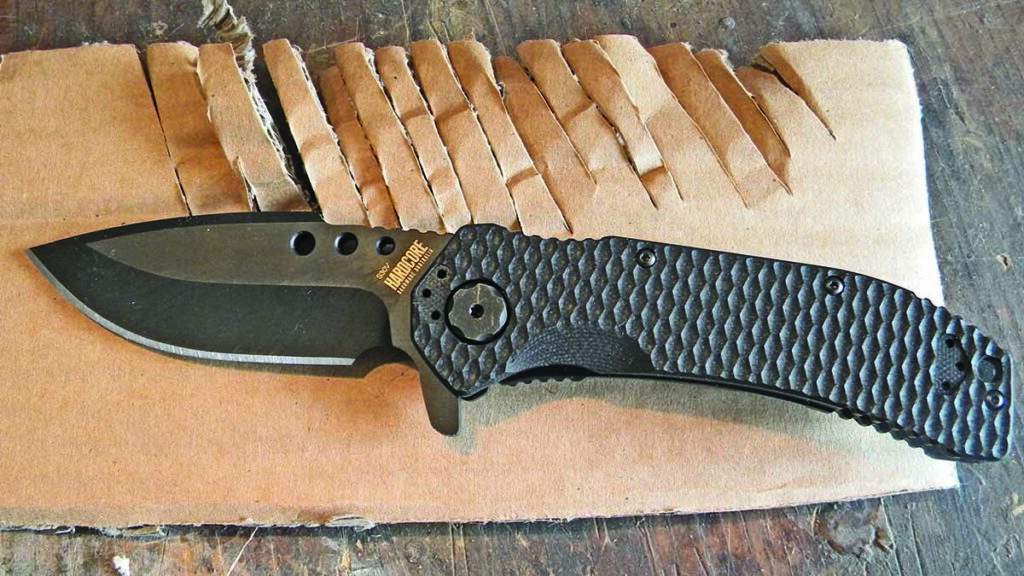
The MILF-02 folder from Hardcore Hardware is made for hardcore users. It’s big and beefy all the way around, has a dimple-textured handle and frame for an excellent non-slip grip, and a classic drop-point-blade shape.
The hollow grind extends halfway up the blade. Blade steel is CPM S30V stainless with a PVD (Physical Vapor Deposition) coating. It offers a classic black color on a framelock design with a flipper tab on the blade. It’s built heavy duty but it still has to cut.
Testing The MILF-02
The first inch of the cuts of the double-walled cardboard went well until the author had to use more pressure to push the cardboard over the thickness of the blade where the hollow grind stops. Once he got used to that, it was easy to overcome the twisting.
Right off the bat, the MILF sliced 20-pound-bond copy paper smoothly. The knife’s weight made the push cuts very easy. There were no snags or hang ups and it was simple to control the width of the slices.
Next: double-walled cardboard. The first inch of the cuts went well, then I had to use more pressure to push the cardboard over the thickness of the blade where the hollow grind stops. Once I got used to hitting this spot, it was easy to overcome the twisting. There were no edge hang ups at all.
I grabbed some 8-ounce leather for some skiving. The MILF was aggressive on every cut and emitted a crunching sound each time. Control was excellent in making fine slices and the handle filled my hand.
Cutting The Hard Stuff
The author gave the 2×4 chunk 20 hard chops and the MILF bit deep on every whack. The edges of each chop were smooth.
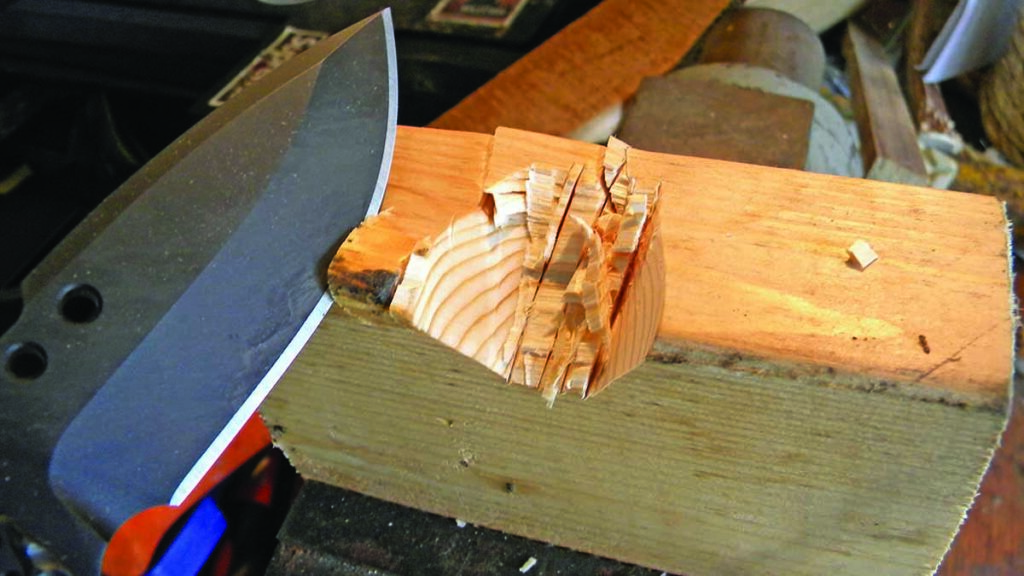
It was time for some whittling. The folder seemed to want to bite deep into the wood. I started off with a fine curly-cue and by the end of the cut the edge was well into the wood. The MILF didn’t hesitate at all on the deeper cuts; it just kept curling the wood. It is a heavy cutter for sure.
I put a 2×4 chunk in my vise and gave the wood 20 hard chops. The MILF bit deep on every whack. The edges of each chop were smooth. Lockup was still at 100 percent. The knife is a great chopper with the bigger handle and all, but the inside edges of the handle need softening. They’re a tad on the sharp side
I took the same 2×4 and used the folder to split it into smaller pieces. All it took was a light tap from a dead blow hammer and the wood split with a pop. The thicker blade worked great for this phase of the testing. Lockup was still at 100 percent.
Half-inch sisal rope was next on the slicing block. The MILF crunched through 200 clean cuts very quickly, showing no signs of slowing down. I stopped cutting to save on rope. Edge holding was excellent and the heat treatment was great.
To take the testing further, I grabbed a deer antler for some more whacking. I gave the antler 20 hard wallops and the blade edge suffered no rolling or chipping. I did manage to remove a very thin wire edge on the blade. However, the main edge was still very sharp.
I returned to the paper slice to recheck the edge. I noticed a few hang ups and found more of the wire edge still intact. Two strops on some leather and the edge was back to original sharpness. Excellent job on the heat treat!
Final Thoughts
I would soften the inside edges of the handle for a smoother grip. Beyond that, the MILF is a heavy-duty using folder that holds a great edge. It’s too big for my tastes but a cutter it is.
Find out why the Spartan Blades Clandestina took home Blade Knife of the Year, thanks to its standout tactical design, top-tier materials, and unbeatable performance.
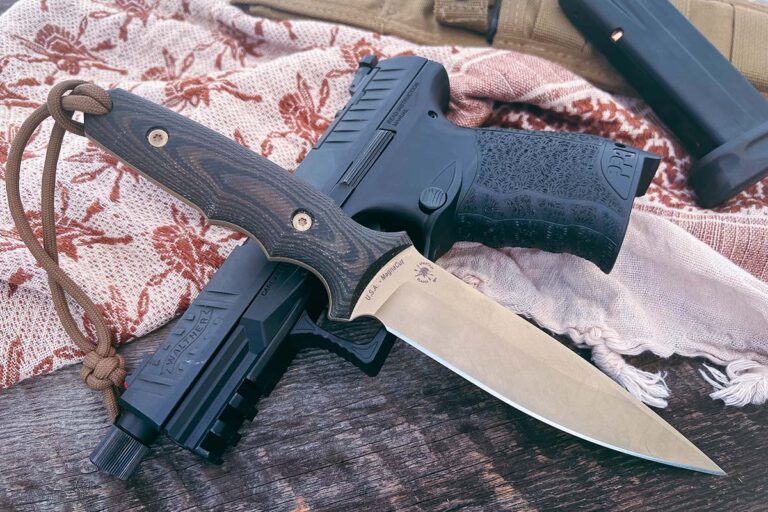
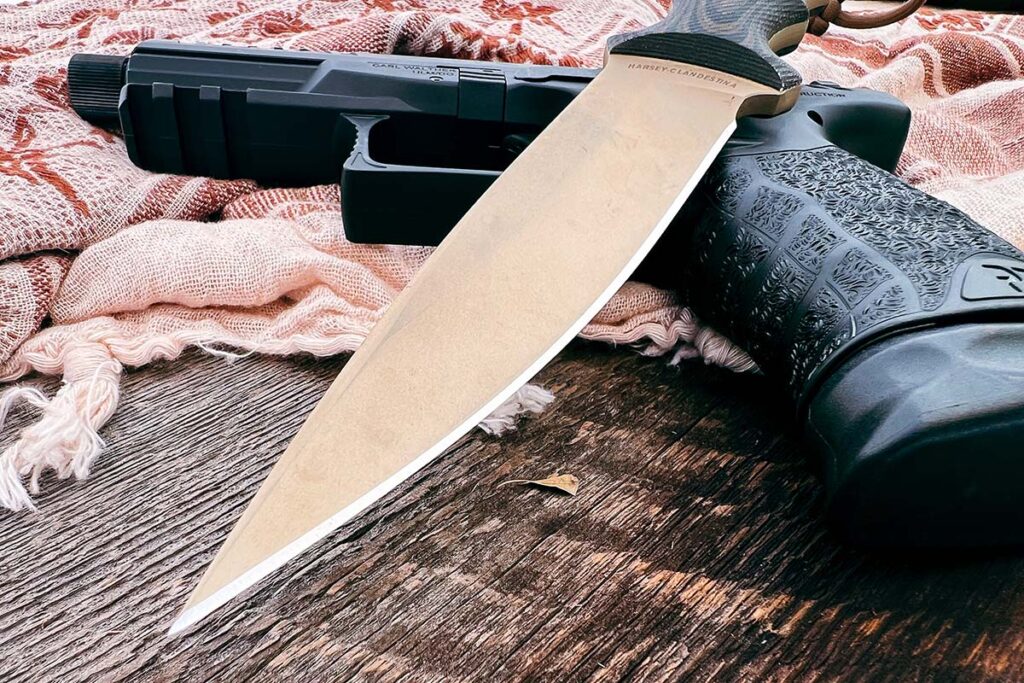
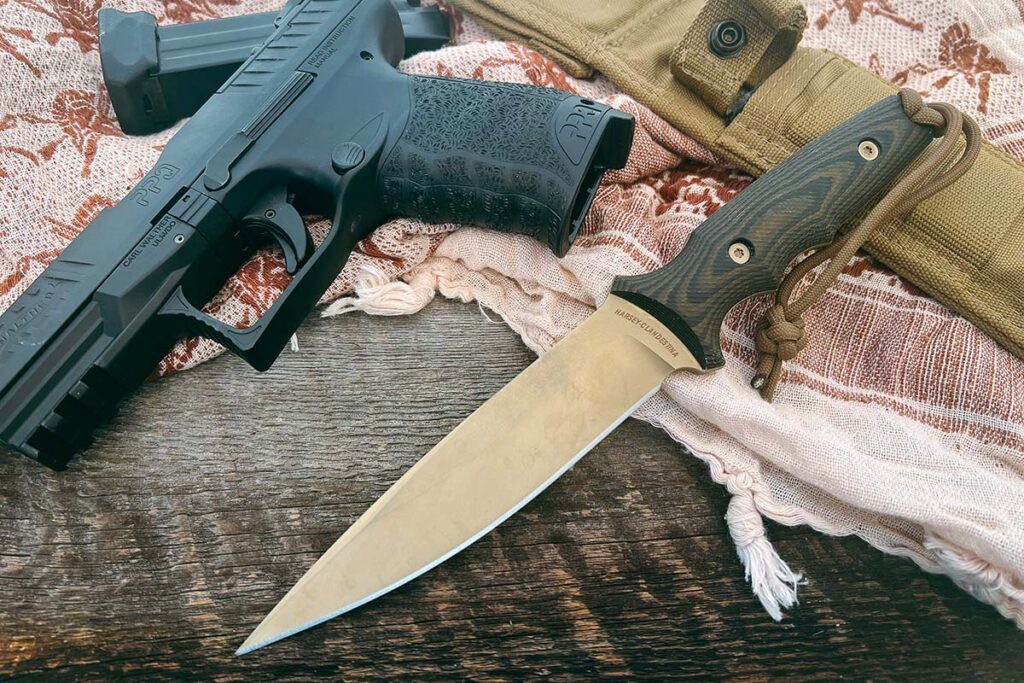
A deadly beauty, Spartan Blades’ Clandestina packages the best of both worlds. Yup, it’s a looker, but dang if it isn’t engineered to inflict damage.
The dueling personalities of the BLADE Knife of the Year aren’t surprising, given who cooked up this wicked fixed blade. Bill Harsey has built his reputation on designing robust outdoor and tactical knives.
Photos by Marty Stanfield, Marty Stanfield Photography
A favorite of Army Special Forces and figures such as Col. Rex Applegate, Harsey work also has a certain lethal aesthetic to it as well. But even with operators enamored with his work, Harsey’s Spartan project has an appeal beyond serving in foreign conflicts.
Spartan Clandestina Specs
Knife Type: Fixed Blade Type: Spear Point Blade length: 5.5 Blade steel: CPM MagnaCut Blade grind: Flat ground Handle material: Canvas Micarta Black and Camo Blade Hardness: 61-63 HRC Overall length: 10 3/16” Sheath type and material: MOLLE and Kydex options Special features: Available in Black and FDE PVD Coating, Double Deep Cryogenic Treatment MSRP:
Pros
Superior Ergonomics
Premium Blade Material
Sheath Options
Cons
Large For Everyday Carry
High Price Point
Niche Design
Spartan Clandestina Handle
Oddly enough for a knife review, I’m going to start at the handle. There’s a method in this madness, given this feature is what gives the Clandestina its edge.
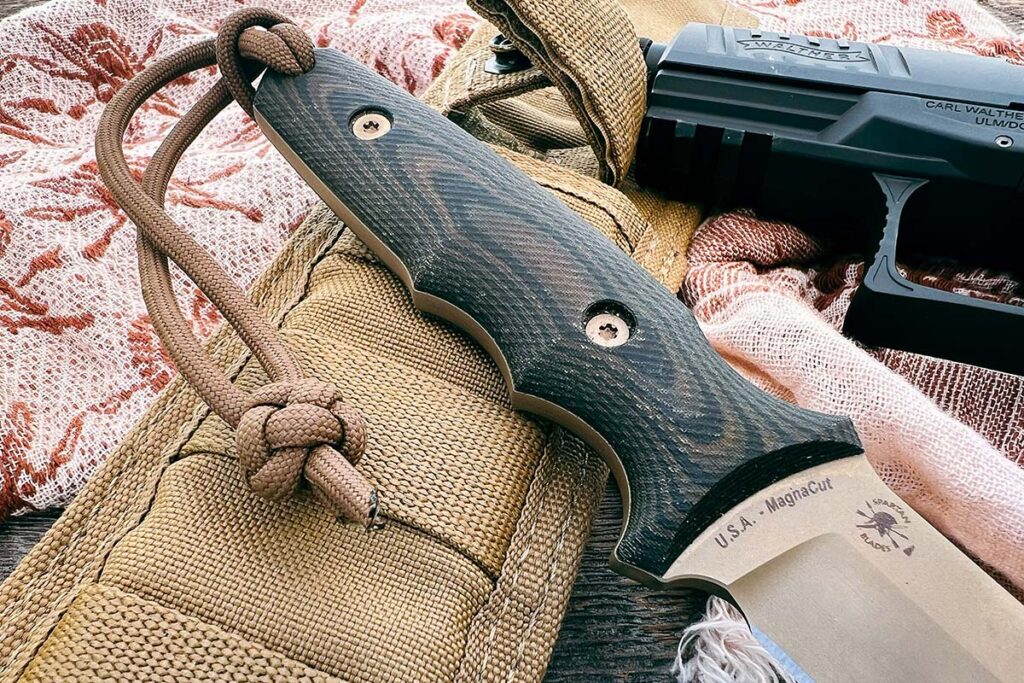
The canvas Micarta handle is slim in profile, even understated, yet sports big-league features.
Photos by Marty Stanfield, Marty Stanfield Photography
Boasting two-finger grooves leverage the use of the middle finger to help stabilize the knife in the user’s grip and help lock it in for security. The double guard is somewhat subtle but does its job very well.
The entire handle is rounded and therefore, extremely comfortable to hold. No hot spots or harsh angles to get in the way. Overall outstanding ergonomics make the knife one with the hand. In brief, it’s pure Harsey all the way.
Micarta itself was an excellent choice for the tactical fixed blade—it’s lightweight yet strong. Comprised of fabric saturated in phenolic resin, it is also impact-resistant and fluid-resistant.
These attributes were engineered in the Clandestina with combat in adverse conditions in mind. Yet, the everyday user benefits, given it’s a robust system that should last a lifetime. Not to mention, the Micarta is available in a multitude of colors, besides my black and camo.
Spartan Clandestina Blade
From the understated to the obvious—the knife’s nefarious.
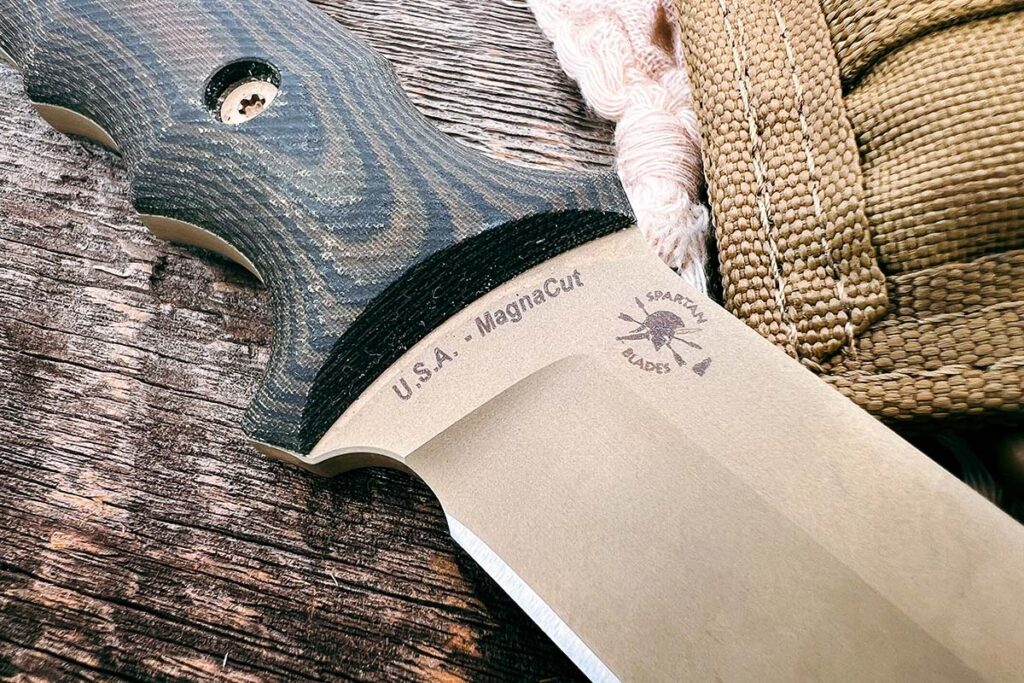
At 5.5 inches long and sporting a spear-point profile, the Clandestina was designed for more than opening boxes. A testament to this was Spartan opting for premium CPM Magnacut stainless steel.
Photos by Marty Stanfield, Marty Stanfield Photography
Know for its capability of long-term edge retention, the metal makes the ready to slash or perforate with ease. Again, this material also has superior corrosion resistance, adding to the overall hardiness of the knife.
The blade is flat ground and the factory edge right out of the box is outstanding. I found nothing needed to be done to improve the edge, I just took it out of the box and put it right to work!
While larger than most folks’ carry option, the blade length isn’t over the top. I found it nearly perfect for belt carry, hitting an elusive sweet spot many fixed-blades miss.
Spartan Clandestina Sheath
Sheath-wise, there are two options – form-fitting Kydex or a tried and true ballistic nylon. The sample knife shipped to me with the latter.
Photos by Marty Stanfield, Marty Stanfield Photography
I found the sheath is very well made, with double sewn edges and a button snap retention strap to hold the e knife in. A large belt loop allows the use of various widths of belts to be used.
Should you opt for Kydex, the sheath is of a riveted construction with a belt loop attachment. The form-fitting sheath locks up around the integral guard of the handle. There are two MOLLE straps that also double as belt loops.
Testing The Spartan Clandestina
Putting the Clandestina to work is nothing short of an excellent experience.
All of Harsey’s tactical fixed blade design expertise comes into play here, and you quickly realize you have a piece of serious bladeware in your possession. It makes slicing cuts with brash confidence thanks to the excellent factory edge coupled with the flat grind.
Photos by Marty Stanfield, Marty Stanfield Photography
The blade thickness tapers down progressively to the tip, allowing it to have the ability to do some serious piercing without being too thin where accidental breakage can occur. The overall blade profile is somewhat dagger-like, as you will notice.
The handle is downright comfortable. It allows the user to obtain a secure grip at all times, instilling and promoting user confidence. Thanks to the dual finger grooves, these allow the slender handle to have such a great grip quality. Locking your grip on the handle, it feels very stable and unlikely to rotate.
Furthermore, when you grip the handle and allow your thumb to rest on the blade spine, you can feel how secure this choke grip is and the knife is very controllable in this grip. Whittling and wire stripping are two such tasks that this grip facilitates. Simply put, the Spartan HARSEY Clandestina is built for use.
Short Cut
It’s definitely not a toy! Use it with confidence and use it hard. Spartan Blades’ craftsmanship skills are highly rated consistently, with each knife they turn out. You cannot go wrong with choosing the Clandestine.
With solid steel, bold styling, and a pocket-friendly profile, the Merino MM proves that great things really do come in small blades.
A lesson quickly learned in hunting, dressing game doesn’t require a big knife. Funny thing is, the same holds for most EDC chores for your EDC knife.
Certainly, a Crocodile-Dundee sized bowie raises eyebrows and wows crowds. What it doesn’t do is a better job of breaking down boxes and managing everyday emergencies than just the right amount of steel.
Size does matter and with a well-thought-out design and good looks to boot, Pepperwool’s Merino MM proves that more blade isn’t necessarily more better.
Merino MM Specs
Overall Length: 5.25″ Blade Length: 2.25″ Cutting Edge: 2.125″ Blade Width: 0.96″ Blade Thickness: 0.11″ Blade Material: CPM S35VN Blade Style: Clip point Finish: Blue Edge Type: Plain Handle Length: 3.00″ Handle Thickness: 0.35″ Handle Material: G-10 Color: White Weight: 1.60 oz. Pocket Clip: Tip-Up Lock Type: Axis Country of Origin: China MSRP: $130
Pros
Ultra-Lightweight
Smart Blade Geometry
Ambidextrous
Cons
Handle May Be Too Small for Larger Hands
Merino MM Concept
The Merino’s blade is terse, but punch well above its weight in most tasks.
The brainchild of Pepperwool founder Beren McKay, the Merino MM takes a hack at a high-functioning micro-EDC knife.
McKay’s thought process is petite beats beastly when it offers many of the same assets and is something you never second-guess throwing in your pocket. You won’t do that because the axis-lock flipper is about as convenient as your local 7-11.
By the tape, the initial offer from the relatively new company measures in at 3-inches closed, 5.25-inches open and .35-inches thick. At 1.6 ounces, it’s about like throwing a Zippo lighter in your pocket—and as easy to forget on your person.
Merino MM Blade Steel
As is obvious as the dawn, a knife is only as good as its blade and a blade is only as good as its steel. Pepperwool has succeeded here with the cryo-treated S35VN. The steel itself is well-rounded, with good hardness and edge retention when heat-treated properly.
The former is likely the more important factor here, given the wispy thickness of the blade. Despite being as thin as a shadow, the blade is stiff enough to punch above its weight on demanding cutting and prying jobs.
Merino MM Blade Profile
An axis lock, the Merino is ambidextrous and quick to deploy.
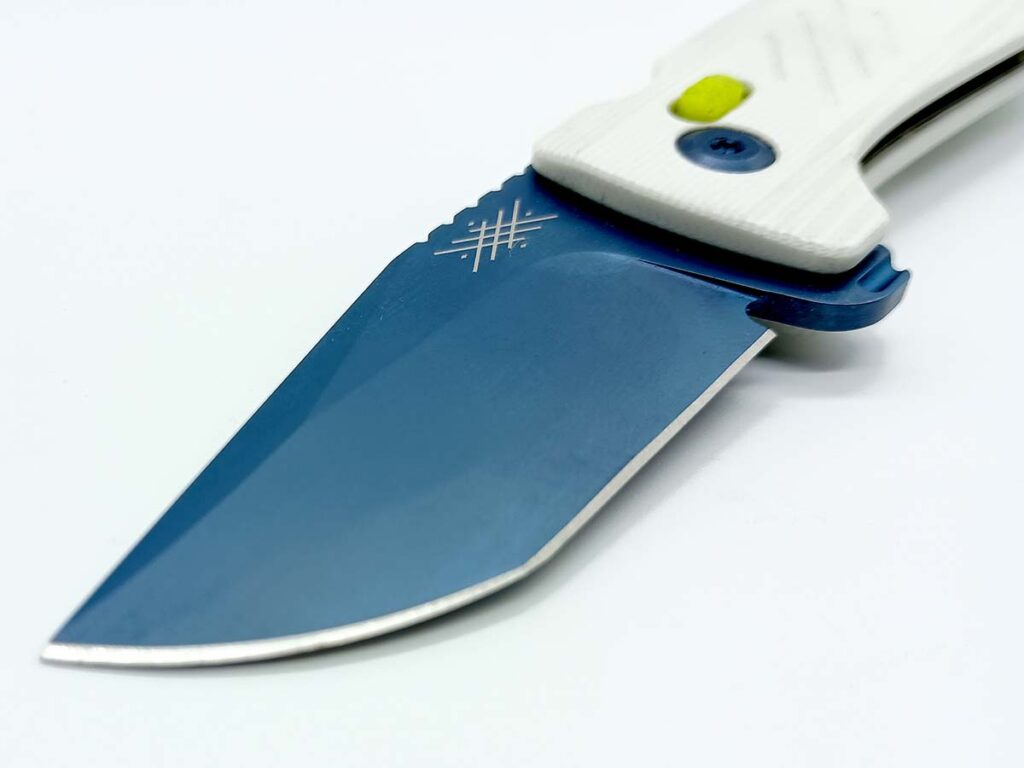
Here’s where I really like the Merino, and not simply because I’m a sucker for a clip point blade. And Pepperwool has included a dandy version on the knife with a generous upper blade a belly.
Given that the knife is natural to choke up onto the blade, it arms users with a very controllable slicing edge for very fine tasks. Still, if you need a straight edge for push or pull cuts, the Merino’s lower edge has a surprising amount of real estate.
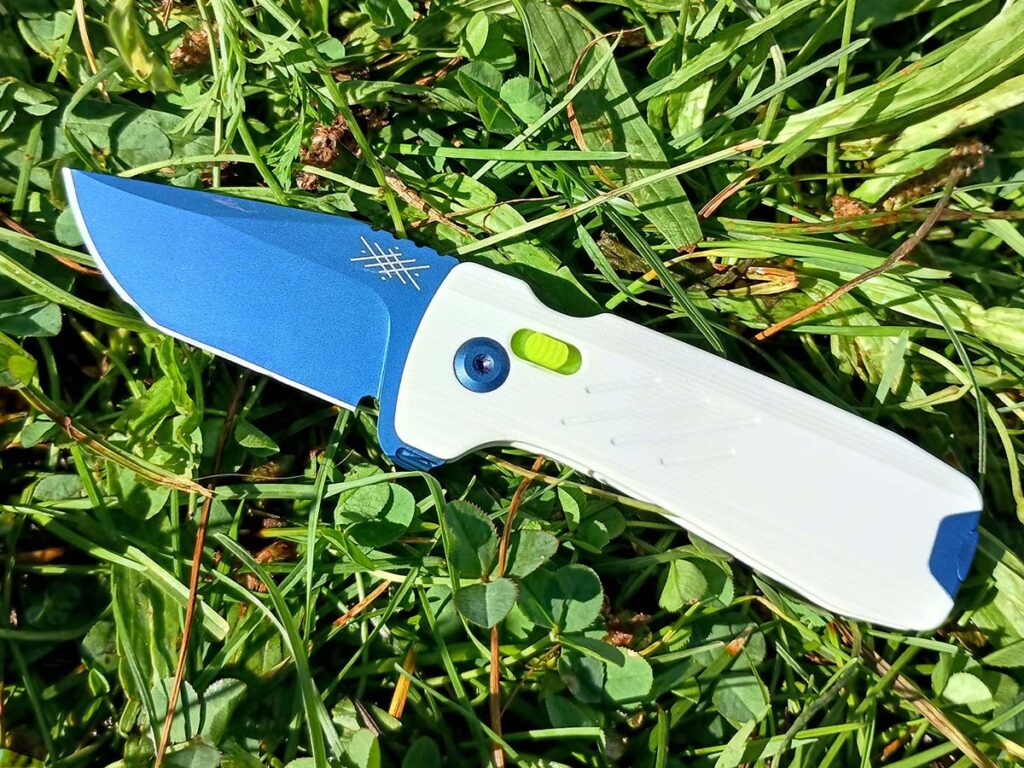
Worth noting, Pepperwool finishes the blade with titanium nitride for an extra level of corrosion and wear resistance. As a bonus, the ceramic is a very attractive cobalt blue for added panache.
Merino MM Handle
It’s tough to go wrong with G10 for a knife handle—the stuff just seems made for the job. And it’s welcome on the Merino.
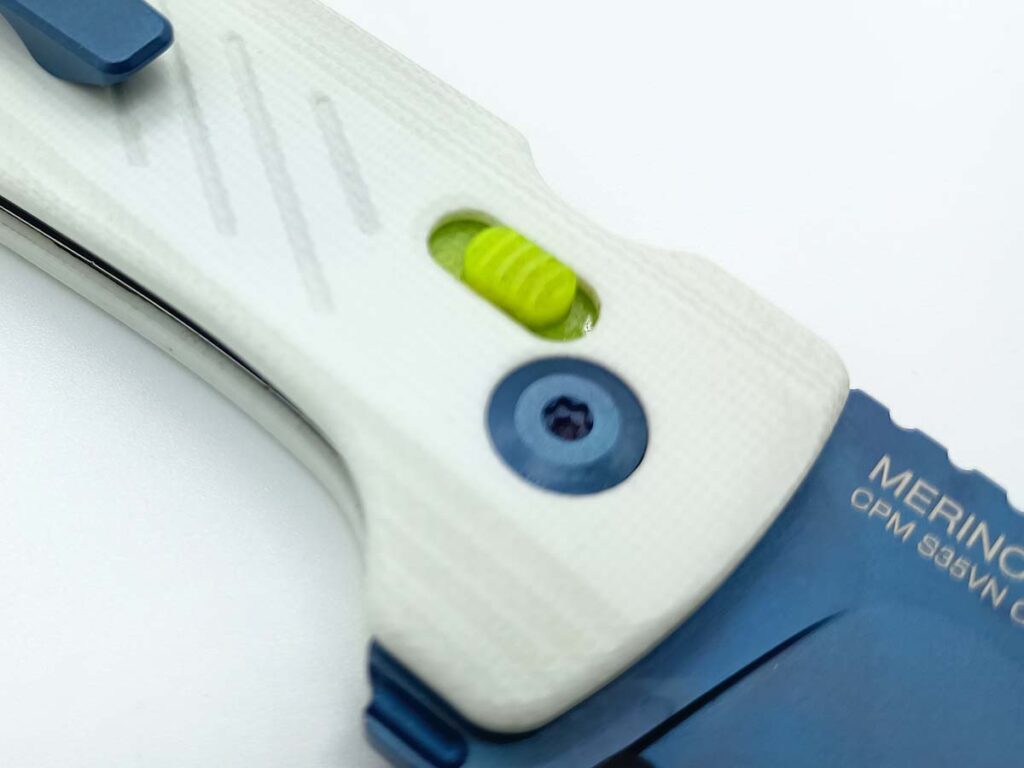
Since there isn’t a lot of knife to grip onto, the well-textured material gives the user a strong purchase on the tool. Furthermore, it’s slightly off-white, which matches up well with the blue blade—simply in the looks department.
Chamfered, the G10 also ensures there are no hotspots when the knife is in hand. This surprised me a bit, given the grip is boxy in geometry, which usually spells at least one edge that bites into your hand.
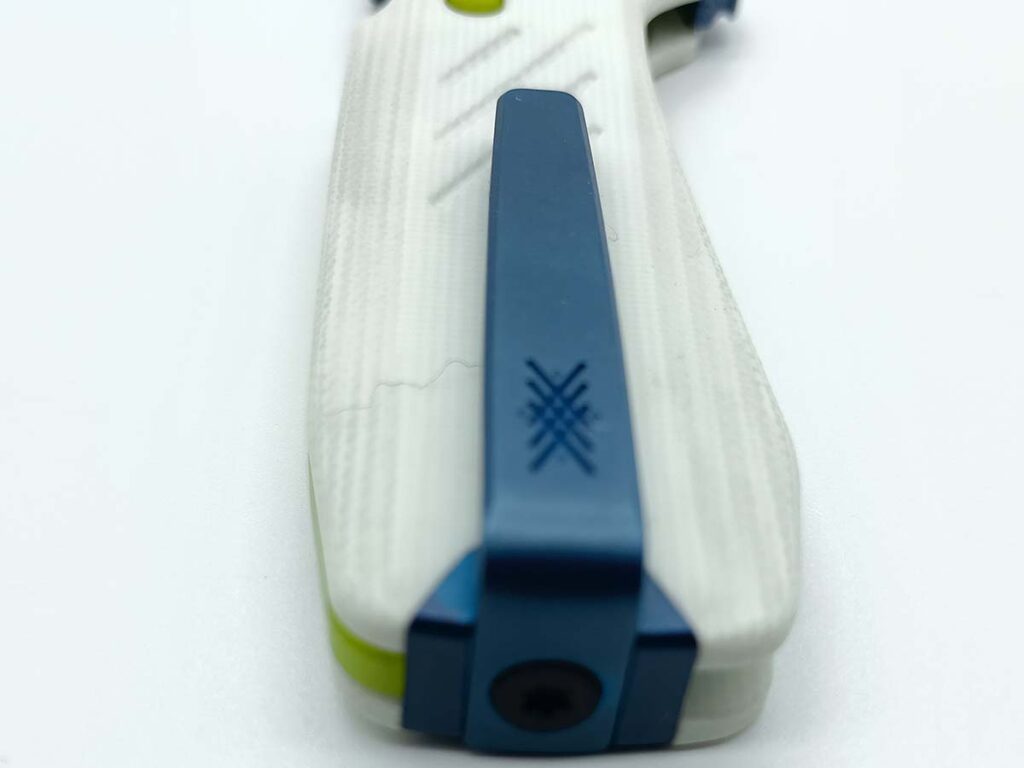
Topping everything off is a very sturdy pocket clip, also finished in dark blue. It sits level with the butt of the Marino, but is designed to sink the entire knife into your pocket, sight unseen. By the way, it is reversible from a single set screw, but the knife is strictly a tip-up carry affair.
Merino MM Lock
The pocket clip is very attractive. Good thing, because in the pocket it the only thing you’ll see on the knife.
This might be the belle of the ball on the knife, at least from a practicality standpoint. The axis lock isn’t anything new, but the convenience of the lock is ideal for an EDC knife. First off, it offers a quick opening and closing system to get the blade in or out of play. But more importantly, the lock makes the knife truly ambidextrous—a boon for lefties.
Testing The Merino MM
I didn’t set a challenge course of tasks for the Merino to accomplish in putting it through the wringer. Instead, for roughly two months of this summer, it was my go-to hiking and fishing knife—roles I’m certain Pepperwool figured it’d fill.
In this time, I used the knife for everything from cutting nylon cord and fishing line to prying open a paint can and, on one occasion, shaving feather sticks. On all counts, the knife proved its mettle.
The knife came sharp and until the latter part of the second month, only required the lightest touch-up to hone its edge. The blade was especially adept at finer tasks—such as trimming tags on hair rigs.
Admittedly, the handle is terse—my pinky hangs off—but with a nice tapper toward the guard, I always felt I had full control of the blade. And the action on deployment is effortless, but limited. For me, it’s always an index-finger affair; the one time I attempted with my thumb, it poked into my ring finger, due to the knife’s small size.
The knife is a solid choice for most outdoor adventures, particularly where weight might be an issue.
The best aspect of the knife, from my time with it, is that it’s absolutely a second thought to carry. Tucked away in the hip pocket, the Merino is easy to forget about given its size, and I did on more than one occasion.
The Merino MM certainly isn’t a first choice for more heavy-duty endeavors—it isn’t a bushcrafter by any stretch of the imagination. But as a piece of lightweight kit, exactly what I used it for—hiking, fishing, camping—it definitely has an edge.
Is there anything I dislike about the knife? Yes, I don’t care for the fluorescent green on the lock and liner, but that’s an eye-of-the-beholder deal. And it’s not a make-or-break feature of the knife.
Final Cut
Pepperwool’s aim was a knife you have no second thoughts about carrying. With style, function and convenience, the Merino MM scores on all points. And, I’d say it’s scored big enough that it’d make many question if it’s time to go small on their EDC.
Check Out More Outdoor Knives:
BEST TOMAHAWKS: OUR TOP HAWKS FOR BACKWOODS TO BATTLEFIELDS
The Navaja Is A Sleek, Svelte Folder Originating From Spain Hundreds Of Years Ago. Today It Remains Popular In Both The Real And Digital Worlds.
The Navaja is one of the most interesting knives in the world. Its history can be pinpointed to the Andalusia region of southern Spain, and its growth and evolution since its creation more than 400 years ago has been well-documented.
The History Of The Navaja
The first Navajas that resembled the modern version came to be in the 1600s. The name is derived from the Latin word “novacula” which means razor, and you can see the resemblance to a straight razor in its construction with the long, thin blade that folds away neatly into the handle.
The knife became popular during a period when, unless you were a nobleman, there were many restrictions on swords and other blades. This meant that the Navaja developed as a peasant’s knife and was used for all sorts of utility tasks. One thing that made using it a bit difficult was the fact that it didn’t lock when opened. Later Navajas would have locking mechanisms, but the first versions didn’t. Most notably the Navaja made a distinctive cracking/popping sound as the blade was opened, differentiating it from other knives.
Thanks to the steel innovations that allowed the knife to lock, the Navaja spread its wings and made its way out of Spain and to nearby countries like France. As the knife continued to evolve it was banned by rulers, then became a popular tool for rich and poor alike, and was used as a versatile combat knife. In fact, it became the knife of choice among muggers who would rob people in alleyways and other dark urban areas. Victims knew they were about to be robbed when they heard the unmistakable popping sound the Navaja made when a mugger opened it.
Roughly a century ago, the Navaja began to fall out of favor with knife lovers. However, it continues to endure thanks to a handful of makers crafting their versions, and, in an extremely modern twist, it has become a popular knife to use for players of the video game Counter-Strike: Global Offensive.
Kings County Tools Navaja-Style Knife
A great modern representation of the Navaja is seen in this folder from Kings County Tools.
The blade is not just razor sharp but also razor thin. At three inches in length and just .25 inch wide, the stainless steel knife is excellent at precise, detailed tasks. The brass and steel handle is both handsome and provides an excellent grip while cutting.
Not quite a razor and not quite a penknife, this Navaja shows what the knife can be and how different it is from other folders on the market.
MSRP: $34.75
Castillo Knives Navaja
Castillo Knives Navaja – Olive Wood Handle
A different interpretation of the Navaja comes from Spain-based Castillo Knives. Their Navaja is similar to contemporary lockback knives in many ways and is an all-rounder in every sense of the term.
The blade is made from Sandvik 14C28N stainless steel and the handle comes in a variety of materials, from two types of Micarta® to four types of wood. Every version looks great, and the 3-inch straight-back blade has a small bit of deep jimping on the spine to aid in grip and force when cutting. Every knife comes with a leather pocket sheath and a 240-grit bonded ceramic sharpening stone.




![Pepperwool Merino MM Review [Field Tested]](https://blademag.com/wp-content/uploads/Merino-2-768x579.jpg "Pepperwool Merino MM Review [Field Tested]")