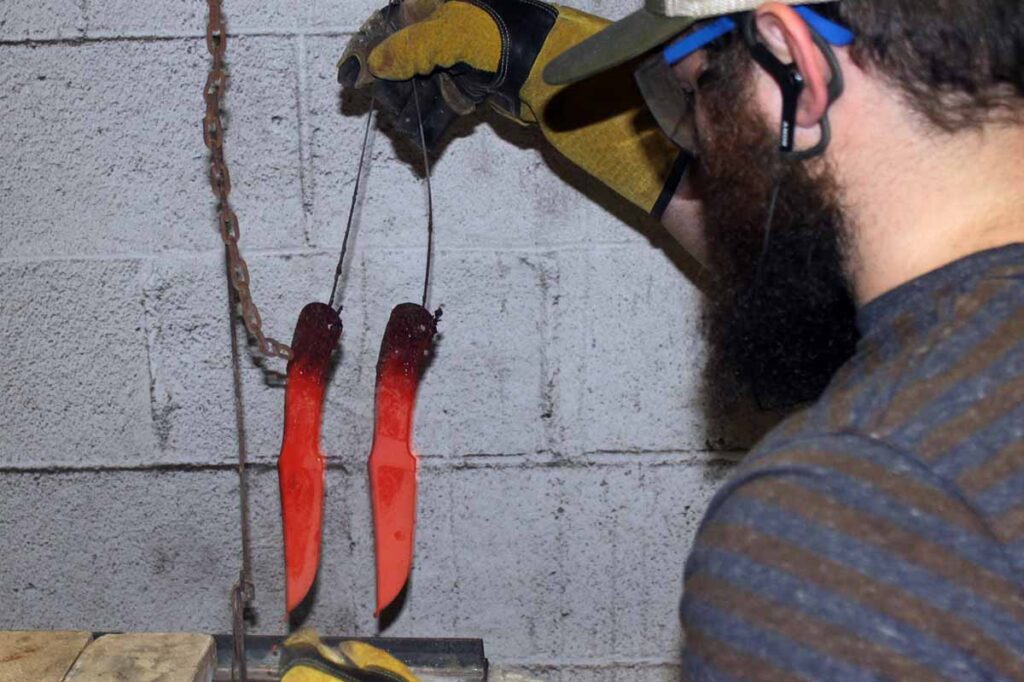
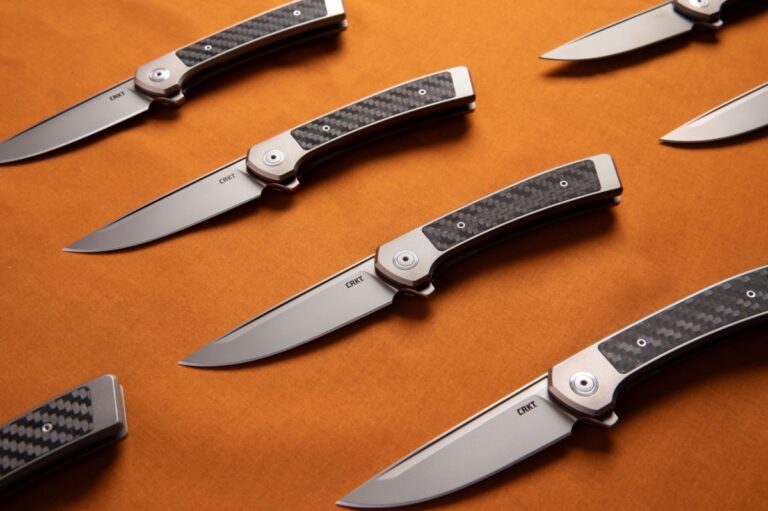
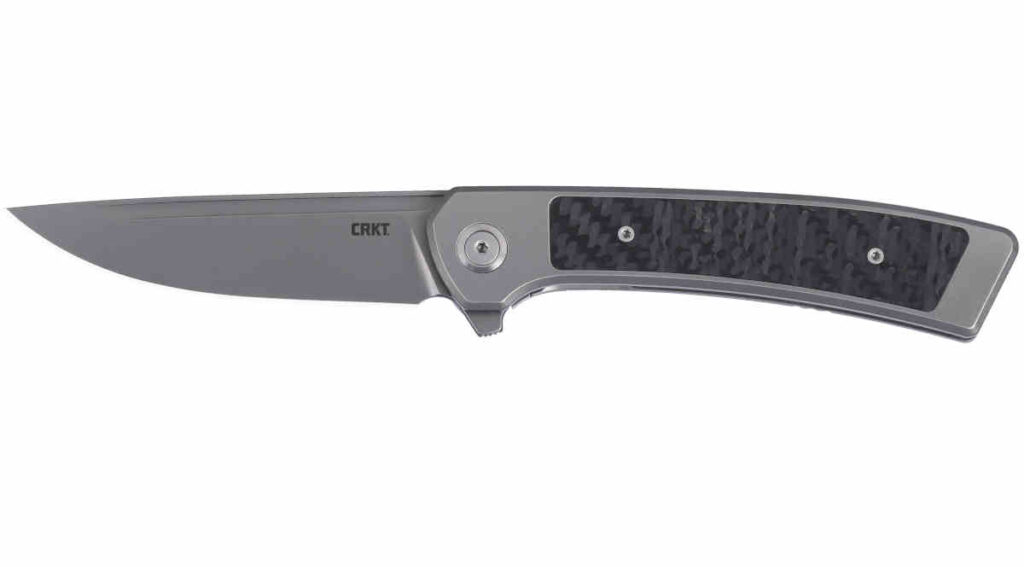
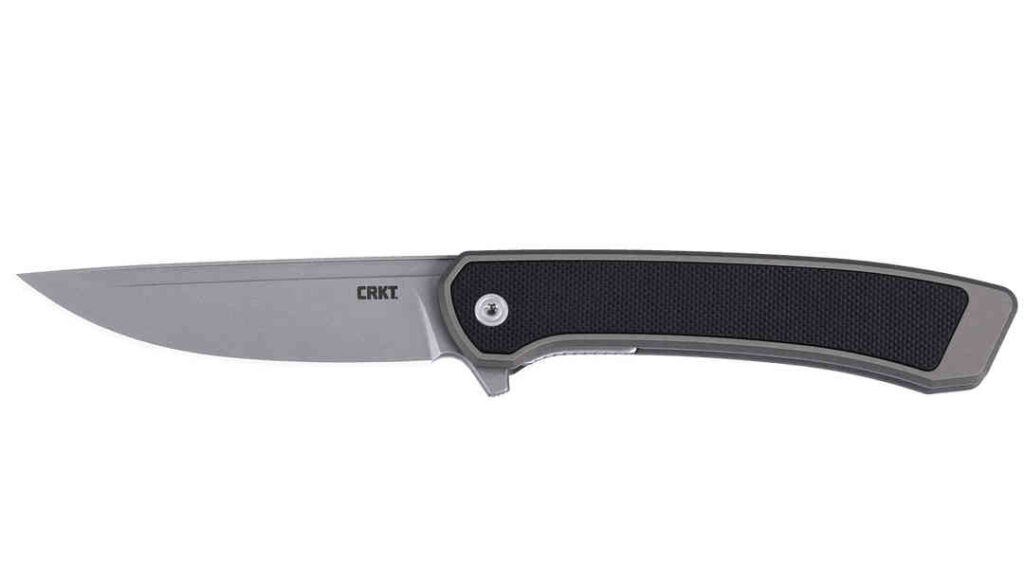
Ethan Becker and Dan Eastland collaborate on a sharp tool for the kitchen.
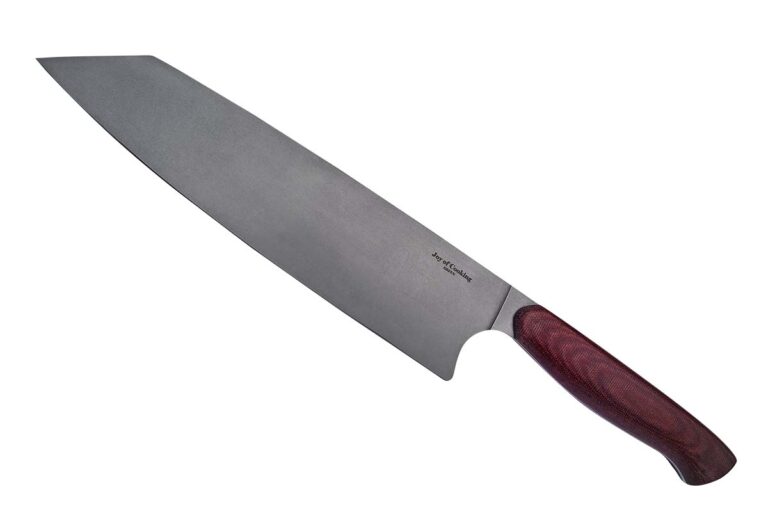
Long-time knife designer Ethan Becker and Dan Eastland of Dogwood Custom Knives have collaborated on a chef’s knife that combines each of the principals’ vision of exactly what such a knife should be.
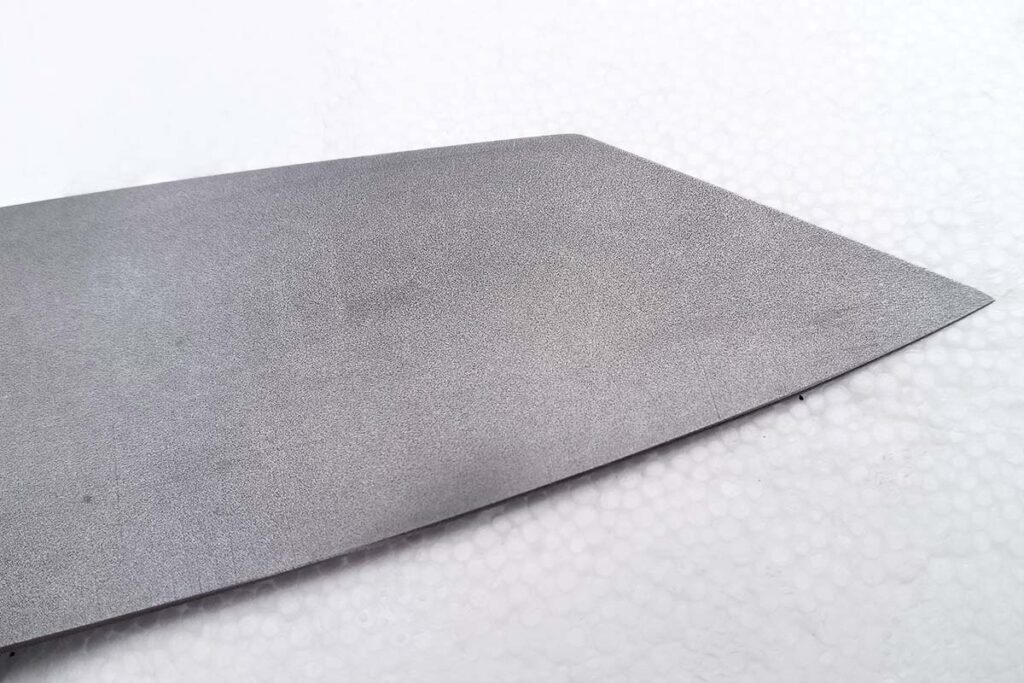
Introduced at BLADE Show 2024, the Joy of Cooking 8-inch K-tip chef’s knife is a mix of Japanese and Western styles and premium stainless steel and synthetic handle materials.
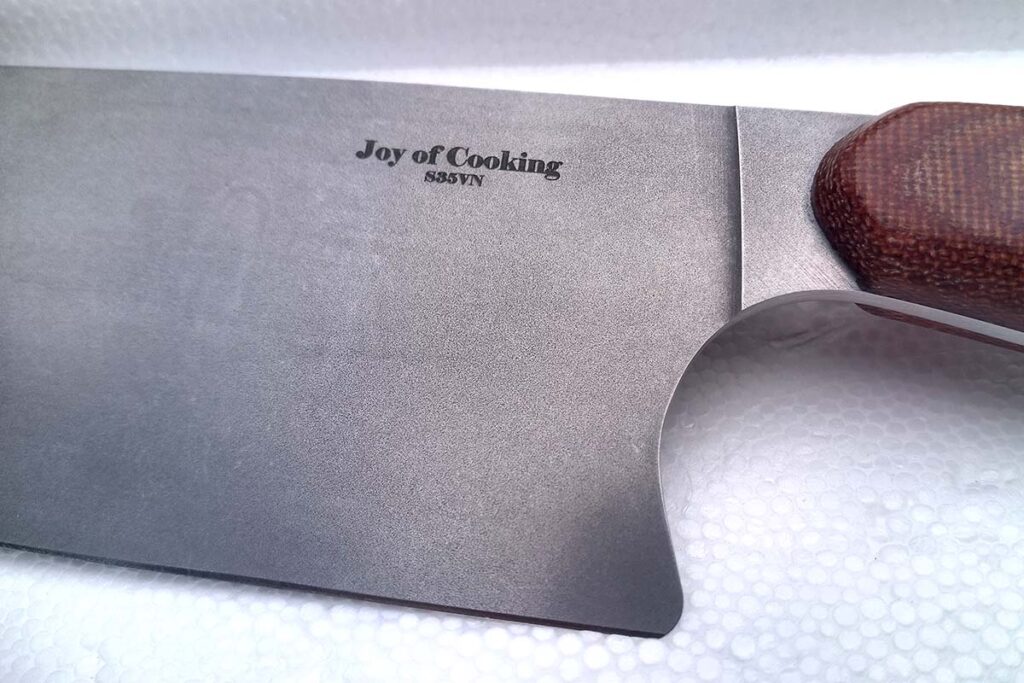
It also has the iconic Joy of Cookinglogo on the blade, Joy of Cooking the internationally renowned cookbook originally written by Becker’s mother, Irma Rombauer, and edited in some subsequent editions by Ethan. He handed those duties off and today the book is co-edited most ably by his son, John, and Megan Scott.
The heel of the blade curves toward the rear and sits flat on the surface for controlled cutting.
With extensive experience as both a knifemaker and a cook, Eastland brings the kind of know-how to the project that gives it edged gravitas.
“Dan is pretty much the perfect person to do this because he’s been in a commercial kitchen and knows his way around that,” Ethan said.
Dan also spent a number of years as an apprentice maker to Georgia Knife Makers Guild member Andy Roy of Fiddleback Forge in North Georgia, and now builds knives at Dogwood Custom Knives in Greenville, South Carolina.
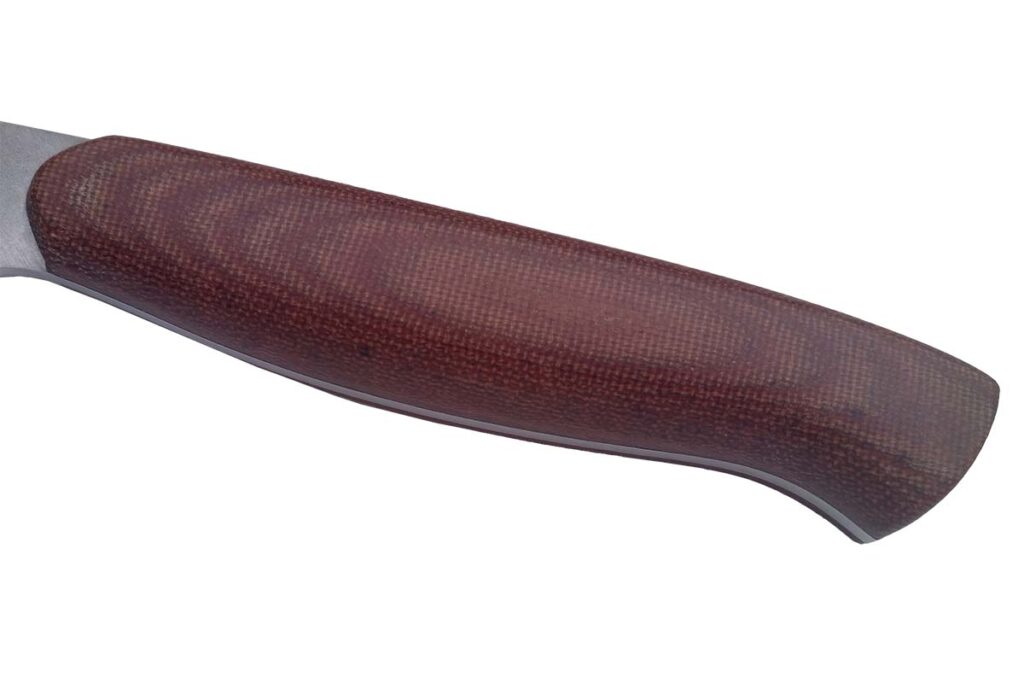
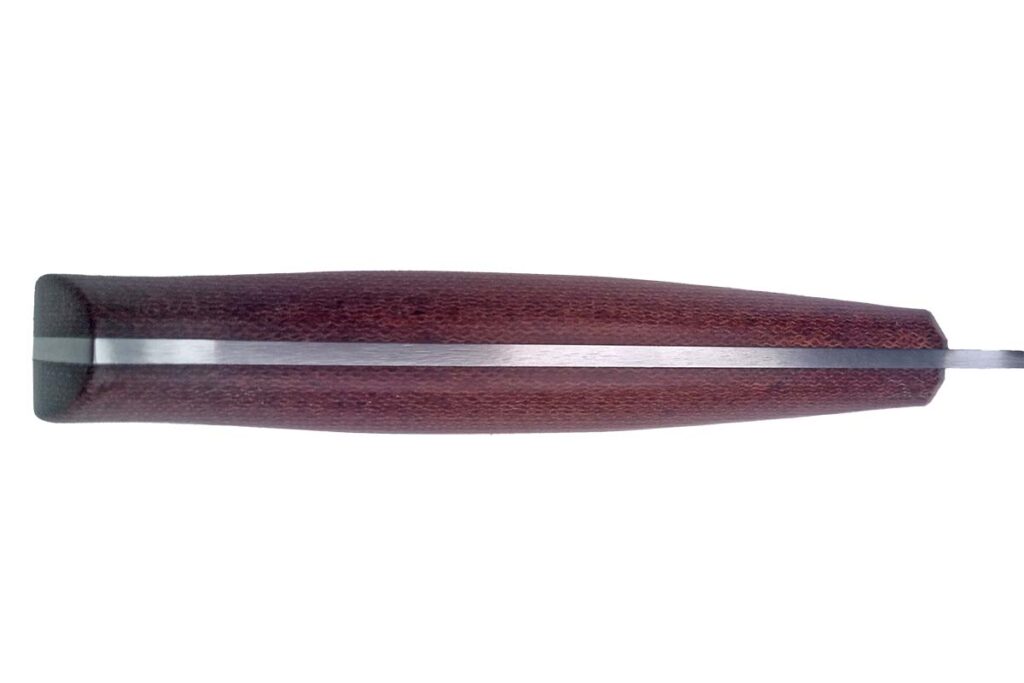
Handle materials come in a choice of natural (shown here; note the texture and grain) and black Micarta® and blue, red or black G-10.
As for the Joy of Cooking knife and its features, Dan approaches it all from the maker/cook perspective.
“The blade has a Japanese influence. I always liked Japanese blade geometry and balance, but I didn’t like their handles. Ethan and I both like a little palm swell,” he noted, “so we wanted more of a Western-style handle.”
In Joy of Cooking, Ethan writes about a grip for home cooks that’s comfortable, Dan said, so the handle has rounded corners to eliminate hot spots and an overall design that helps promote a pinch grip. The blade is weighted toward the front for balance and has the K tip for precise tip work.
The K tip gives the knife a piercing feature lacking in such Japanese designs as the santoku.
Ethan said he’s a big fan of the santoku style and has designed santokus and used them in the kitchen almost exclusively for 20 years.
“The one problem with the santoku is it really doesn’t have a good piercer,” he noted. “You can get by without a piercer if you keep the knife really sharp but guess what—most people don’t keep their knives sharp enough. But for such jobs as taking off the top of a tomato, for instance, the K tip works pretty good.”
Dan lauded the utility of the K tip for other tasks as well, adding, “My grandmother opened all the packaging with the tip of a kitchen knife. No matter what knife you gave her, she sliced the top of the package open with the tip and went to work.” The K tip is tailor made for such chores, as well as others.
The collaborators prefer a Western-style handle and gave the Joy of Cooking Knife grip a palm swell as a result.
The edge has a nice curvature for rock chopping and push cutting meats and vegetables. The heel of the blade also curves toward the rear and sits flat on the surface for controlled cutting.
“The neat thing is when the blade comes down [at the heel during a rocking cut or chop], it stops,” Ethan explained. “It’s also good for a push cut,” Dan added, “so it’s good for both a rock chop and push cut. And having that heel down a little bit it will bottom out, so you cut all the way through something and don’t wind up with little partially cut bits at the end.”
Joy Of Cooking Knife Details
The 8-inch blade is CPM S35VN stainless steel. The Rockwell hardness is 60 HRC and the blade is 3/32-inch thick at the thickest. Along with the contoured handle the knife weighs in at a scant 5.5 ounces.
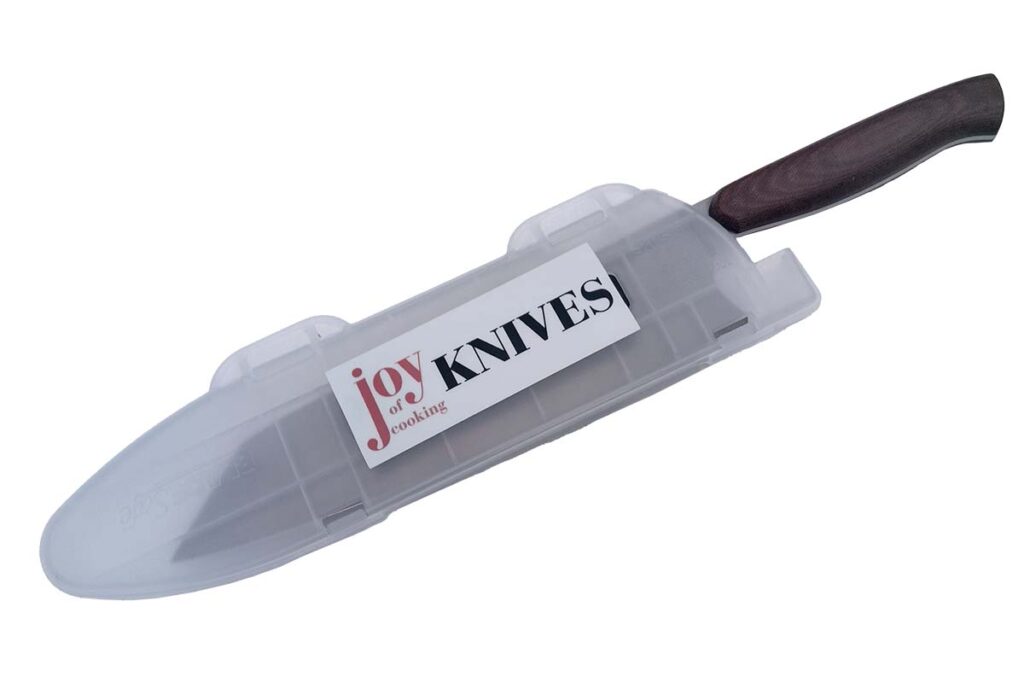
A hard plastic cover with plastic snaps contains and protects the knife.
“I’m of the opinion the Greeks told us everything we need to know about a double-inclined plane—the longer the plane and the lower the angle, the more efficient it is,” Dan said. “A knife blade is a double-inclined plane, and I wanted to make this knife as light as possible.”
He returned to his grandmother’s experience.
“And again, my grandmother used to complain that Henckels and Wusthof, she loved the knives, but they weighed almost as much as she did. By using the S35VN we’ve been able to thin it out and get a mechanically better cutting blade, but also a lighter blade.”
Ethan agreed that most kitchen knives are too heavy.
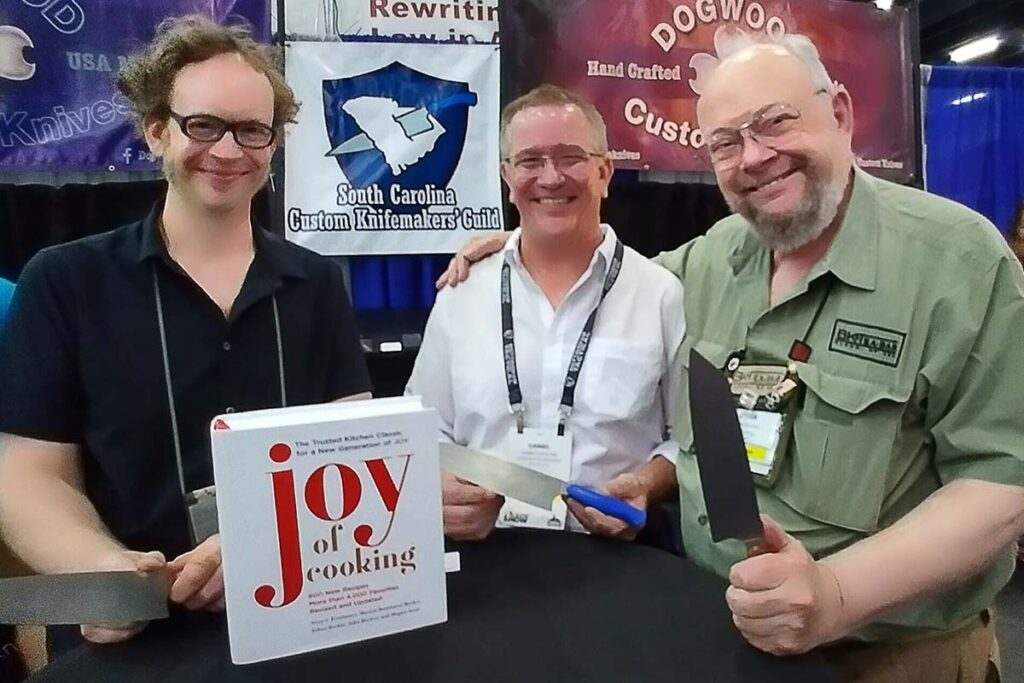
From left at BLADE Show 2024: John Becker, co-editor of Joy of Cooking, Dan Eastland of Dogwood Custom Knives and long-time knife designer Ethan Becker.
“The wrist gets tired easy and to be able to not have very much weight that you’re working with, hey, what’s wrong with that?” he observed. “Most traditional kitchen blades were thick because they were forged before they were ground … The cutlers in Europe were very, very concerned that the housewives would use the blades for things they weren’t supposed to, so they used soft steel so it wouldn’t nick and if they opened bottles with it it wouldn’t hurt it. The result was blades that didn’t hold an edge worth a damn and were not terribly efficient.”
Dan said the S35VN has good corrosion resistance and the edge retention is phenomenal.
“We tested the knife extensively in an industrial kitchen to ensure edge retention and durability, and I like S35VN because it’s a good balance of durability and edge retention. And we can get that 60 Rockwell so it can take a nice, keen edge and we don’t have to worry about it chipping out.”
As noted, Dan and Ethan wanted a Western-style handle with a palm swell and offer it in a choice of G-10 and Micarta®. The Micarta is available in black and natural versions, both with texture and grain for purchase. The G-10 comes in red, black and blue.
“Those colors will always be the same over time as we introduce other knives in the lineup, so you can buy a knife that will match whichever color knife you previously bought,” Dan said. The intent is for there to be a complete set of Joy of Cooking knives, though nothing was set in stone in that regard at press time.
Pros
Collaborative Expertise
Versatile Blade Design
Premium Blade Material
Cons
Higher Price Point
Plastic Snap Cover
Joy Of Cooking 8” Chef’s Knife Specs Designers: Ethan Becker and Dan Eastland Company: Dogwood Custom Knives Blade Length: 8” Blade Steel: CPM S35VN stainless Rockwell Hardness: 60 HRC Blade @Thickest: 3/32” Handle: Black and natural Micarta® and blue, red and black G-10 options Overall Length: 13” Carry: Plastic snap cover Knife to Know: K tip blade; lightweight design; hidden handle pins Country of Origin: USA MSRP: $200
Knife buying–particularly custom–can prove daunting. We gathered industry pros to give the top mistakes to avoid.
When it comes to acquiring knives, the informed buyer is most often the satisfied buyer when the transaction is complete. So in the spirit of friendly advice, BLADE® has enlisted the help of several knife industry pros to offer a few words on making the most of the knife-buying experience—or to put it another way, 11 mistakes to avoid when buying a knife.
Don’t Deal With Questionable Sellers
“A lot of it revolves around reputation,” said custom knife purveyor and collector Paul Farina of Farina Fine Arts. “Human beings can be different, but 80 to 90 percent of the people you meet out there are great. In the knife world, many of them will give you a refund if you aren’t happy.”
Dave Harvey of Nordic Knives echoed that sentiment. “Honest sellers are not hard to find, thankfully,” he said. “Look for those with years of experience. Generally speaking, dishonest sellers will not be in the business very long.”
Along the same lines, Daniel O’Malley of bladegallery.com cautions folks interested in buying online. “If purchasing online, make sure you are buying from a company that has been around a while,” he offered. “There are a lot of fraudulent websites out there these days—often ones that are trying to appear to be a well-known website. One dead giveaway that you may be on a fake purveyor website is if the prices are too good to be true. Unfortunately, you are unlikely to find a legitimate site selling knives for half the price of other legitimate sites.”
Don’t Buy Knives On Pictures Alone
“In most cases today, knives will be purchased online, and therefore you may have to judge the knife by photographs and listed descriptions,” O’Malley advised. “Since the value of the knife is greatly affected by small scuffs and scratches, it is important that the photos are clear enough that any imperfections will be noticeable.”
Along the same track, Harvey noted, “Pictures are great, but they never fully substitute for being able to see and hold a knife in person. Make sure you buy from someone or a dealer with a 100-percent-return guarantee. If you are not satisfied with your purchase, you should be able to return it in a reasonable period of time.”
Don’t Buy Knives On Steel Only
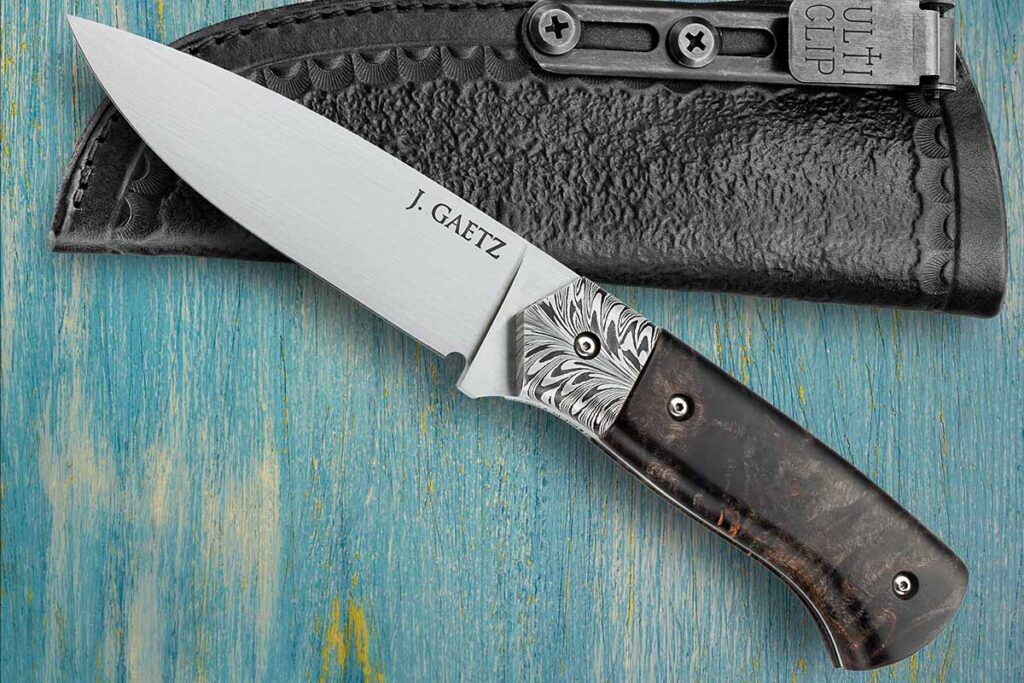
Daniel O’Malley advised that each year new miracle steels appear but often lose popularity after a year or two because they may not pan out. Conversely, tried and tested steels like CPM S35VN, Takefu SG2, 52100 and more are great benchmarks to test against. Jacob Gaetz forged the 4-inch blade of his fancy hunter from 52100. (Jocelyn Frasier image)
“I never talk to people too much about a particular blade steel,” commented Dave Ellis of Exquisite Knives. “I usually discuss with clients how the complete knife was made, how it was fashioned, and that is more important, I think. Someone may be enamored with a certain type of steel, but that is rare with my clientele and only a consideration in talking about the whole knife.”
Harvey reckons that few knife buyers take the “blade-steel-first” approach. “At least I would hope not,” he asserted. Farina added, “There are a few exotic blade steels out there right now, and these may be sought after just because they’re exotic. Also, some steels have been discontinued and knives with those steels may be selling because of the rarity.”
Taking the entire knife into account is the best way to reinforce a purchasing decision, according to O’Malley. “Knowing the stats on the knife is important,” he reasoned. “We want to know where it was made, who made it, in what country it was made, and what materials they used. That said, judging a knife by just the blade materials used ignores fit and finish as well as heat treatment quality. In some cases the identical steel at the identical Rockwell hardness can still have tremendously different edge holding. In fact, over the years I have found that the quality of heat treatment is perhaps even more important than the steel used.”
Don’t Buy Knives On The Handle Comfort
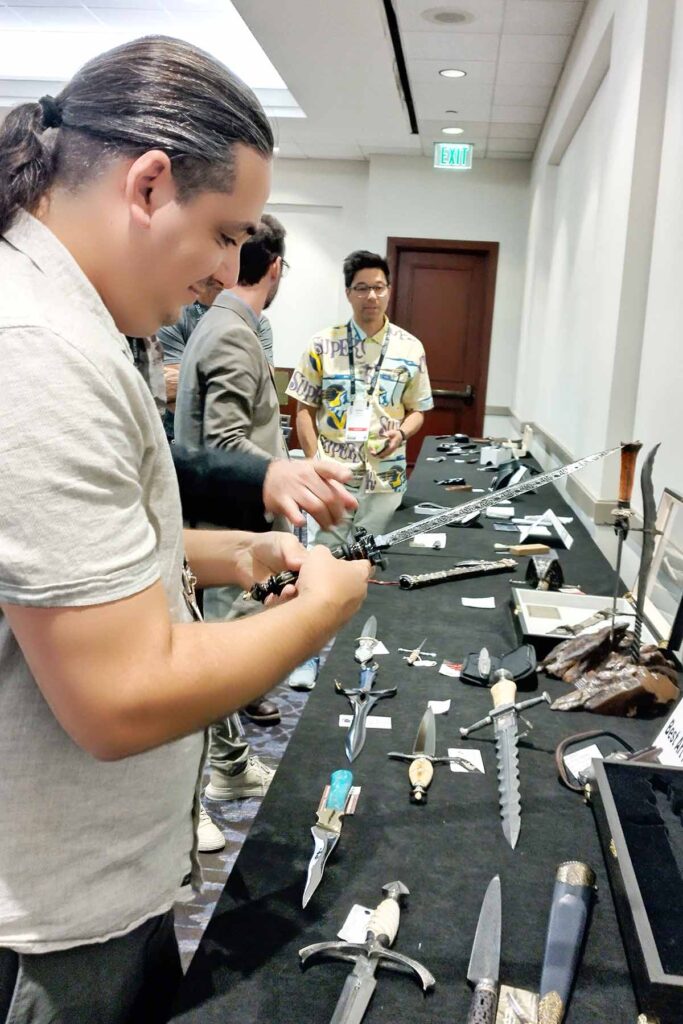
Daniel O’Malley said that even if it’s the best knife in the world, if you don’t like the way it feels it isn’t the best knife for you. Lee Lerman, a custom knife judge at BLADE Show 2024, checks the handle of one of the knives entered. In the background are observer Henry Wu (right) of the BLADE Show and judge Rodrigo Sfreddo (center).
“Getting a knife in hand and seeing what it feels like is ideal, though sometimes not possible if you are purchasing from far away,” O’Malley related. “I often advise potential buyers that even if they are holding the best knife in the world, if they don’t like the way it feels it isn’t the best knife for them. That said, some buyers feel a knife is comfortable just because it is familiar—similar to their last knife. They may have gotten used to the last knife and like the way it feels, but a different feel might actually be better, that is, a more ergonomic handle or lighter design. Sometimes it takes using the knife for a while before you know how you really feel about it.”
Don’t Adopt A Herd Mentality
“There are trends out there, but because I’m older and been around the art knife world so long, I’ve thought about the places to put my money,” Farina commented. “If you’re looking at an up-and-comer in knifemaking, check their quality, find out who taught them. That is how I get introduced to them. If they have been taught by an experienced maker, you can tell the quality, and the price may reflect in less money with younger guys.”
From the perspective of “hot styles,” Harvey remarked, “I don’t object to those who want to buy the ‘hot’ knives as long as they are styles and makers that they enjoy and collect. Buyers should always beware of ‘hot’ knife prices and not fall for overpricing.”
“What’s currently ‘hot’ isn’t always best,” O’Malley commented. “The knife industry develops relatively slowly and though each year we see new miracle steels come out, they often lose popularity after a year or two because they may not have panned out. Tried and tested steels like S35VN, Takefu SG2, 52100 and more are great benchmarks to test against.”
Don’t Overlook Makers By Name
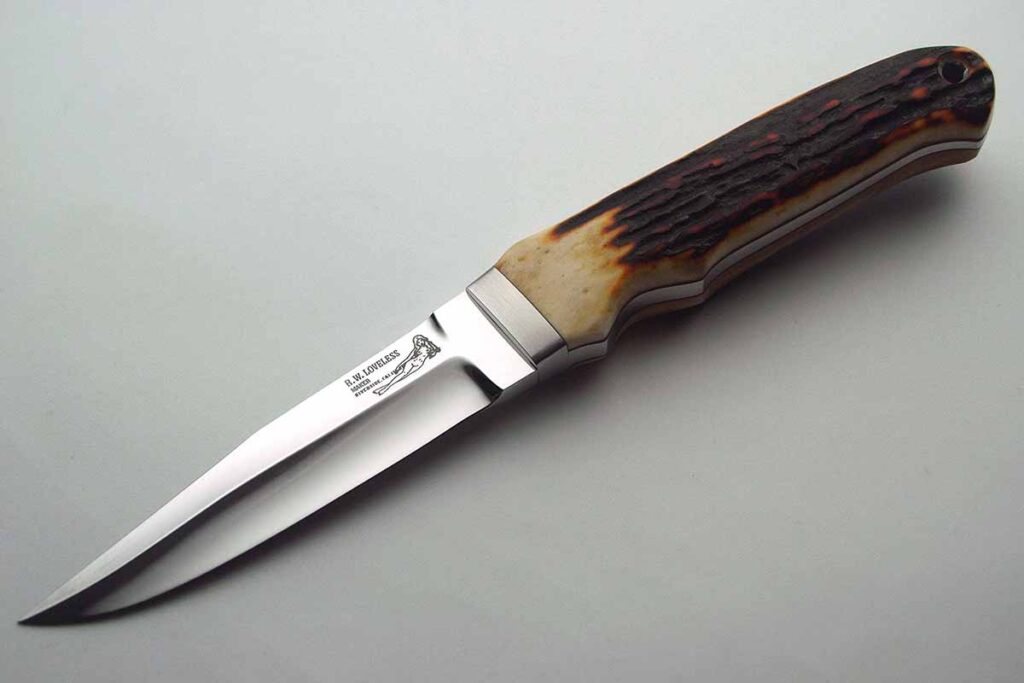
Dave Ellis said that instead of buying 10 knives you can afford, save up and buy one made by Bob Loveless. A Loveless hideout model in stag and with the iconic Naked Lady logo would be a good place to start. (Exquisiteknives.com image)
Ellis looks long-term and sees intrinsic value in the known commodities. “I recommend the blue-chip makers,” he declared. “Instead of buying 10 knives you can afford, save up and buy that one Loveless. This year I’ve sold 14 Lovelesses and the pricing has not gone crazy. So, an entry level $5,000 knife is not so ‘out there’ for someone.”
According to Harvey, most big-name makers have an established collector following, which typically relates to a lasting market for their knives down the road. However, O’Malley points out the benefits of considering numerous makers.
“The knife industry is full of tiny workshops that are doing the best work in the industry,” he noted. “While there are also some great big-name makers, these smaller shops are more likely to provide more bang for your buck. Additionally, in many cases, small workshops may be putting more attention toward quality of heat treatment, which can result in much higher performance.”
Don’t Overrate The Investment Factor
“Buying for investment is something I love because of the fact I can make money on knives,” Farina explained, “but this is not a blue-chip investment stock. So do it for the passion and love of the product. However, if the goal is only for investment, then be very structured. Listen to an adviser. I had a customer come to me after spending a lot of money in four years. He wanted to sell and make 20 percent profit on all the knives [he had bought]. Maybe that would happen on some stuff, but it is a bit unrealistic.”
O’Malley added, “Knives can be a great investment. Over the years, I have seen many knives increase dramatically in price, though certainly there are some that hold their price and even some that go down. Picking the right knives for investment does take a time commitment. You need to research and know the maker and their work. How does the knife fit in the range of knives that maker creates? Will the materials hold up over time? Where is the maker in his or her career? Taking all this into account, it is possible to collect knives as a great investment, though keep in mind that even with the best research not every investment will work out.”
For Harvey, the investment path requires some preparation. “Smart buyers can and do successfully invest in certain knives,” he said. “This does require a lot of knowledge and patience, as you generally won’t see significant increases in value in the short term. For most buyers, I suggest buying what you like and enjoy for your collection, not expecting a large return for it upon sale.”
Don’t Exceed Your Knife Buying Budget
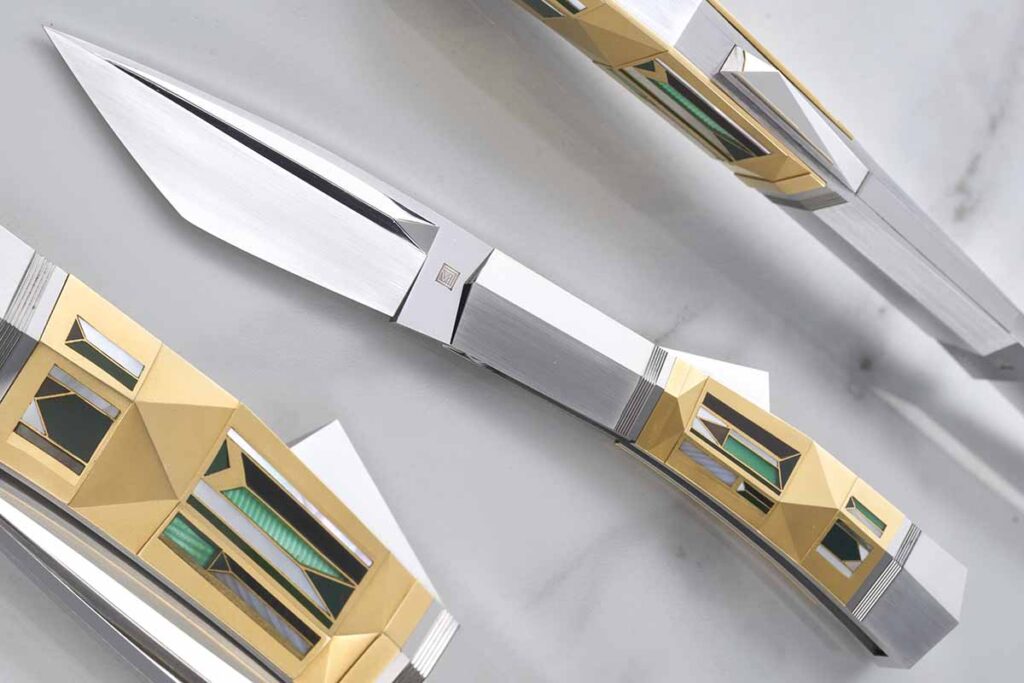
Dave Ellis recommended setting a price limit at auctions and don’t exceed it or you will find yourself paying a lot more than necessary. “I remember a particular Jurgen Steinau fixed-blade knife a few years ago when an overseas bidder and a guy from the Bay Area were in there. The knife went for $110,000,” Dave noted. “People were in there butting heads and then it became an ego thing.” Steinau’s unique style is reflected here in his Folding Knife LBS. (Eric Eggly/PointSeven image)
Ellis provides sound wisdom on auction bidding. “Set a price at the auction and don’t go over the limit and find yourself suddenly paying a lot more than you wanted to pay. I remember a particular Jurgen Steinau fixed-blade knife a few years ago when an overseas bidder and a guy from the Bay Area were in there. The knife went for $110,000,” he noted. “People were in there butting heads and then it became an ego thing. Also, don’t buy with an eye toward flipping the knife. Avoid bid ups like the plague.”
“Auction sites tend to have horrible photos, making it impossible to ascertain what a knife is really like—and what it is worth. Since fit and finish as well as condition are so important to value, figuring out what to bid can be near impossible. Additionally,” O’Malley opined, “auctions can be a way to end up paying much higher than a direct-from-maker price.”
Don’t Discount Second Opinions
“Second opinions are nice and not too hard to get on many knives,” Harvey pointed out. “There are online forums and other social media outlets where collectors share information on many makers and knives.” Take advantage, then, of the availability of information but consider the source always.
“Knives are pretty personal,” O’Malley observed. “What works for you might not work for your buddy. It’s always fun to walk around a show with someone so that you can bounce ideas off each other, but at the end of the day, buying what you like is probably most important.”
Don’t Buy Knives Under Duress
Never feel pressured to make a knife purchase. Don’t always accept the line that the knife you are considering could be gone in the next few minutes. Take a deep breath and make the most informed decision possible in the current environment. If you don’t feel totally positive, walk away.
“Many knives are literally one in the world,” O’Malley said. “This means that if you don’t buy it, there is a chance that it will be gone. Over the years, I’ve found a good way to evaluate is to ask yourself, ‘If this knife sells to someone else, in three to five weeks will I be frustrated and still want to purchase it?’ If the answer is no, you probably didn’t need to purchase the knife. There will always be others. There are, however, a few knives that I didn’t buy that even years later I wish I had purchased. Figuring out if this is one of those knives lets you know to buy it before someone else does. Any big collector has had a few knives they didn’t purchase quickly enough that they still regret not purchasing today.”
Don’t Always Discount Deposits
Over the years of buying and selling knives, Daniel O’Malley said he found that the quality of heat treatment is perhaps even more important than the steel used.
“If a maker requires a deposit, he or she must be a good accountant,” Farina related. “Some are not businessmen. They are artists and machinists. So, it’s about reputation and feeling good about the maker you are working with.”
Trust is a big factor across the board. “Paying for a knife before it is completed can be complicated,” O’Malley maintained. “A well-regarded maker once summed up the problem: ‘It’s very hard to work on a knife that’s already paid for.’ That said, collectors often commit to a purchase, have a knife made, and don’t complete the purchase or just ghost [stop communicating with] the seller. For this reason, I feel it is reasonable to pay a relatively minimal deposit, 10 to 20 percent of the cost of the knife, when purchasing directly from the maker. If working through a purveyor and having a knife made, it isn’t unusual to have to pay the full amount up front since the purveyor is committing to the purchase for you.”
Stay Informed
Advice is free, for sure, but it comes from the voices of experience. When buying a knife, it pays to listen to those already engaging in the process. Of course, every situation is a bit different. There are always additional considerations. The bottom line is to approach a knife purchase on an informed basis. That translates into a confident buy!
BLADE Show West hasn’t only grown to become one of the largest knife shows in the West, it’s also become a prime venue for late-season knife drops. With a bevy of new designs, CRKT has a bevy of new blades it plans to unveil to the public in Salt Lake City.
In all, the Oregon-based company will release five knives at the Salt Palace Convention Center, fittingly coming from a premiere Western knifemaker. Richard Roger’s prime gig New Mexico cattleman, but over the years has become a well-known custom maker whose designs perfectly combine clean lines, practicality, as well as eye-catching use of materials. The folder specialist’s knives are meant for use, but dang, if they aren’t pretty enough to show off.
Here’s a gander of what Rogers and CRKT have cooked up for BLADE Show West.
CRKT Q
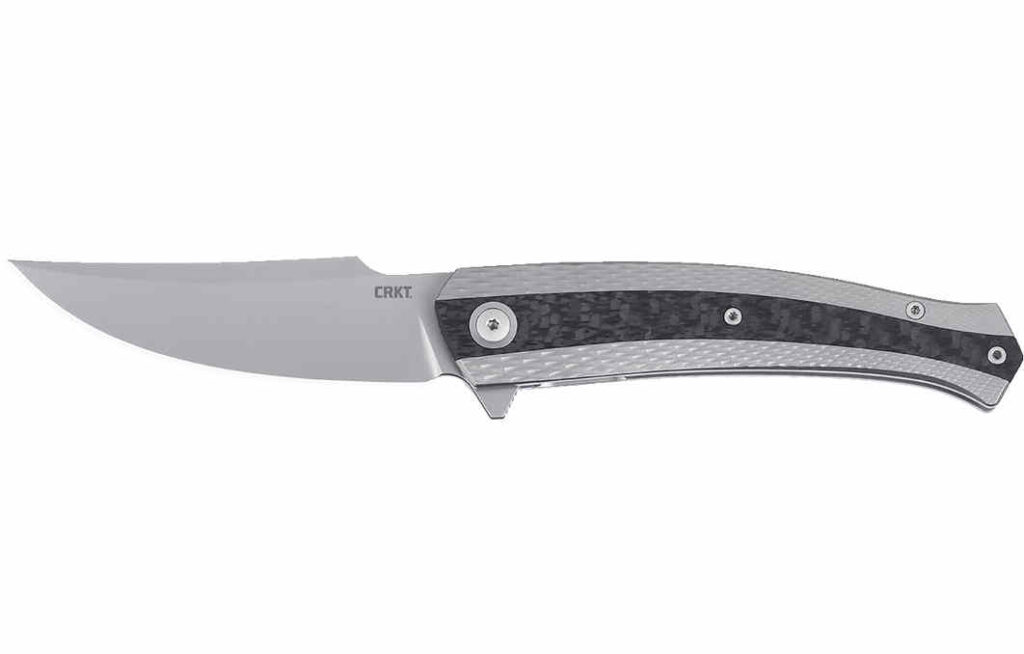
The limited-edition Q—based on Roger’s custom knife of the same name—has everything you want in a small-batch knife—chief among them, top-notch materials. The frame lock marries a titanium handle with carbon fiber inlay with a 3.31-inch MagnaCut steel blade. The lines on the drop-point knife are positively dialed in, with the point of the blade directly aligning with the pocket clip when deployed. The blade is put into action via a kicker. Topping off the Q is a floating backspacer that adds a splash of detail and hints at the knife’s premium nature, but otherwise, the Q remains perfectly understated. MSRP: $225.
CRKT Q Compact
Dang near identical to the Q, the compact model is simply scaled down for easier EDC carry. At 4 inches closed and only 2 ounces in weight, it fits the bill as an easy-to-tote option. The materials are different from the full-sized model, with an S35VN blade and a lightweight aluminum handle with G10 inlay. As well as, the small fry is also a liner lock. MSRP: $195.
CRKT Persian
Building on a fan-favorite Rogers classic, the upgraded Persian takes all the great features of the original and cranks them up a notch. The blade’s new “harpoon Persian” shape is eye-catching, and it’s crafted from tough MagnaCut steel, known for its superior strength, wear resistance, and corrosion protection. The titanium handle is lightweight, with a cool milled pattern inspired by Richard’s custom design. Made in Italy by Lionsteel Knives, this limited-edition folding knife is a must-have for collectors. MSRP: $275.
CRKT Pup
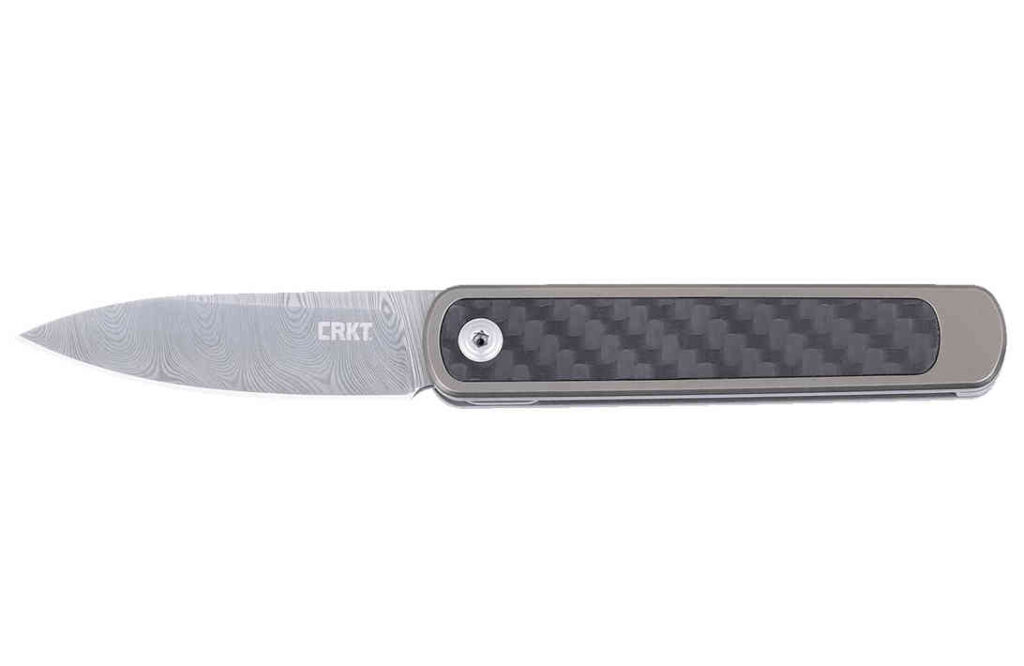
After the success of his CEO folding knife, Richard Rogers is back with the Pup, a compact everyday carry with smooth, rounded edges that slip easily into a pocket or purse. Built for modern life, it’s unobtrusive but ready to perform. The Pup comes in two models: a flipper with IKBS™ bearings, an AUS 10 steel blade, and a glass-reinforced nylon handle, or an Italian-made slip joint with a Super Dense Twist™ Damasteel® blade and a titanium handle with carbon fiber inlay for strength and style. MSRP: $70 and $275 respectively.
The Buckhorn collaboration is about as good as it gets without going custom.
Ketuo Knives partnered with renowned custom knifemaker and designer Ken Onion, to come out with a collaboration knife unlike any other collaboration Onion has previously done.
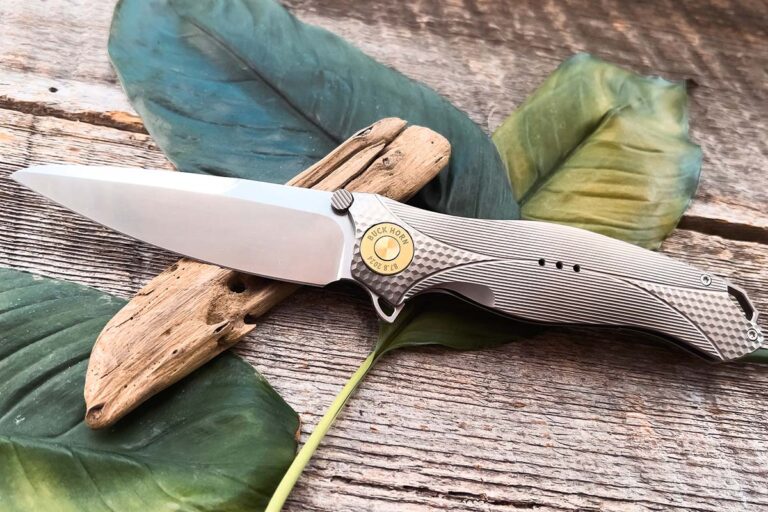
Dubbed the Buckhorn and marketed under the Karbon Knives banner, the knife debuted at the 2024 BLADE Show in Atlanta in June, and it won the 2024 Knife Collaboration of the Year in the Knife of the Year award. And it takes partnership knives to the next level offering a bevy of top-shelf features at a price that doesn’t blow your budget.
Honestly, it’s shocking!
BUCKHORN Blade
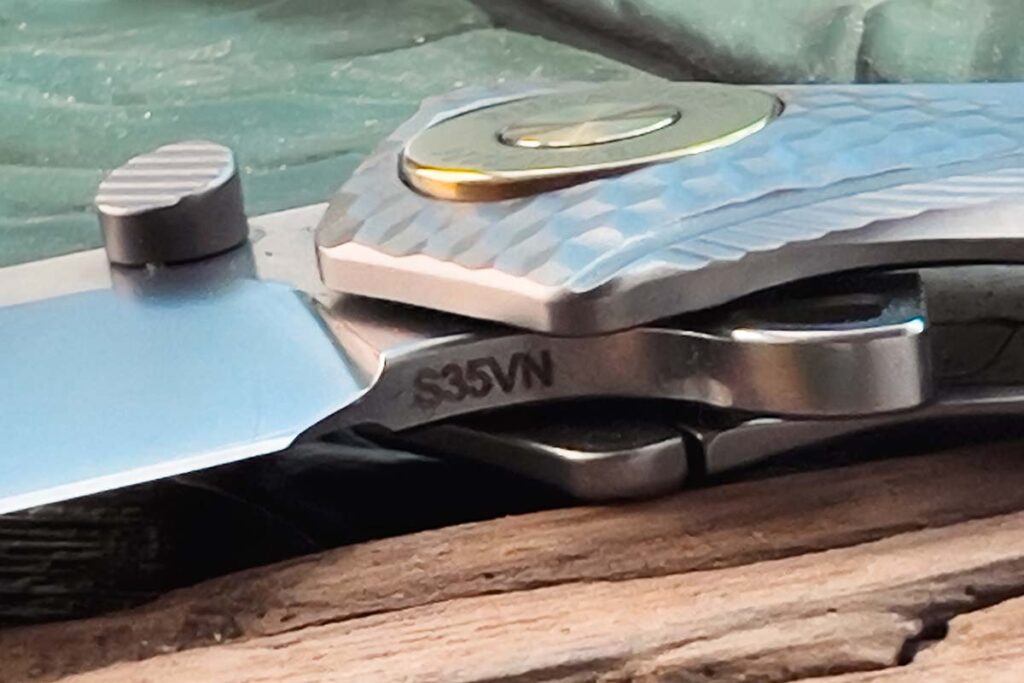
Known to hold up against heavy usage, the blade’s S35VN steel blade is a solid choice.
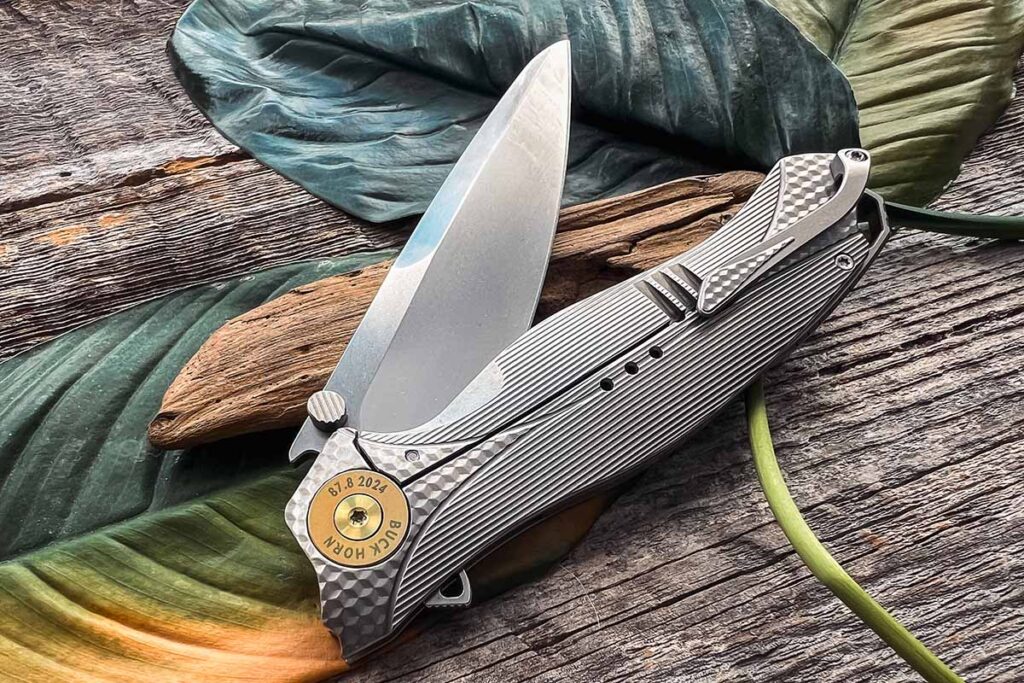
Onion has outfitted the Buckhorn with a modified 3.8-inch drop-point blade constructed from S35VN stainless steel. The material is a tried-and-true high-performance blade steel that holds an edge well and be fairly easy to sharpen when the need arises. To this is applied a high, flat grind that progressively thins down, giving the folder an elegant cross-section capable of cleaving through even tough materials. Topping it off, the blade is given a nice ceramic blast finish which is subdued but also has a nice sheen to it that is rather classy and dressy. Action
Onion opted for dual thumbstuds on the Buckhorn, making the folder friendly to both lefties and righties. Additionally, a flipper tab is included, for effortless blade deployment with the flick of your index finger.
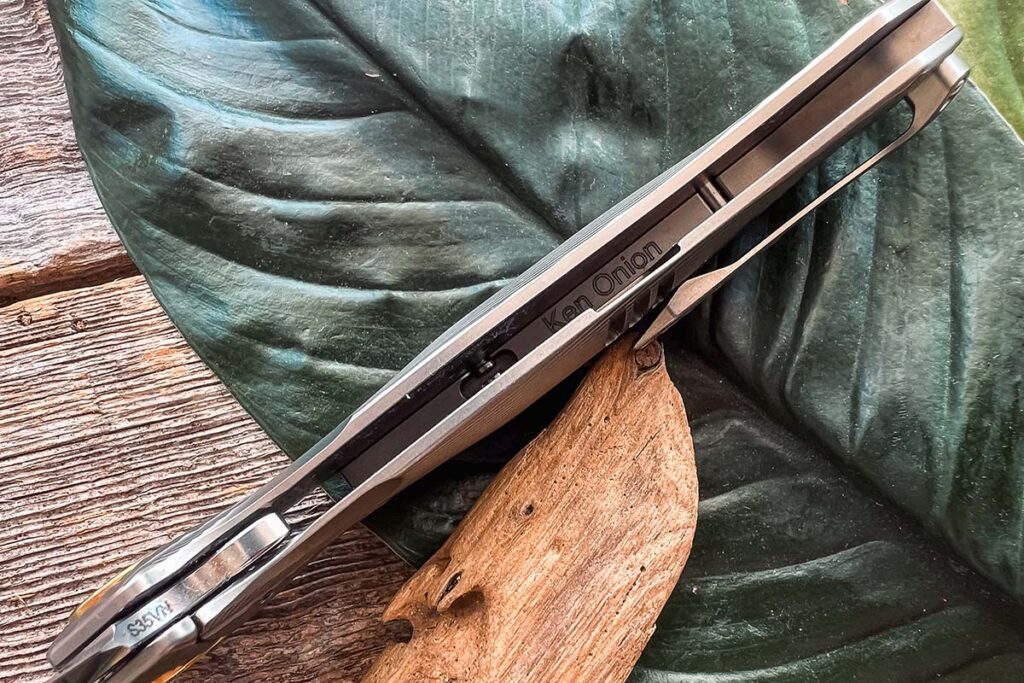
A hidden gem, Ken Onion is hidden away on the backside of the spacer.
The blade rides on a pair of caged ceramic bearings in the pivot for the ultimate smoothness in opening and closing. The flipper action is very dialed in as well. Place your index finger on the flipper and press on it for a second and you’ll feel it load up then the detent lets the blade go, and it rotates to the fully open and locked position effortlessly.
Buckhorn Handle
Very nicely textured and featuring a palm swell, the Buckhorn fits the hand just right.
The handle of the Buckhorn is really, where all the magic is.
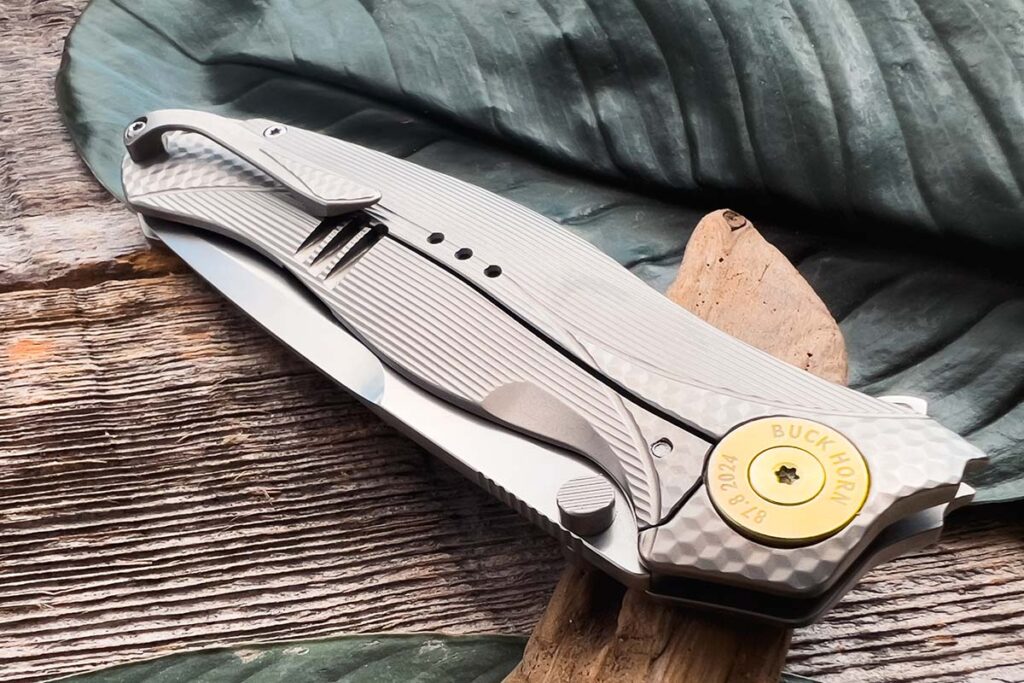
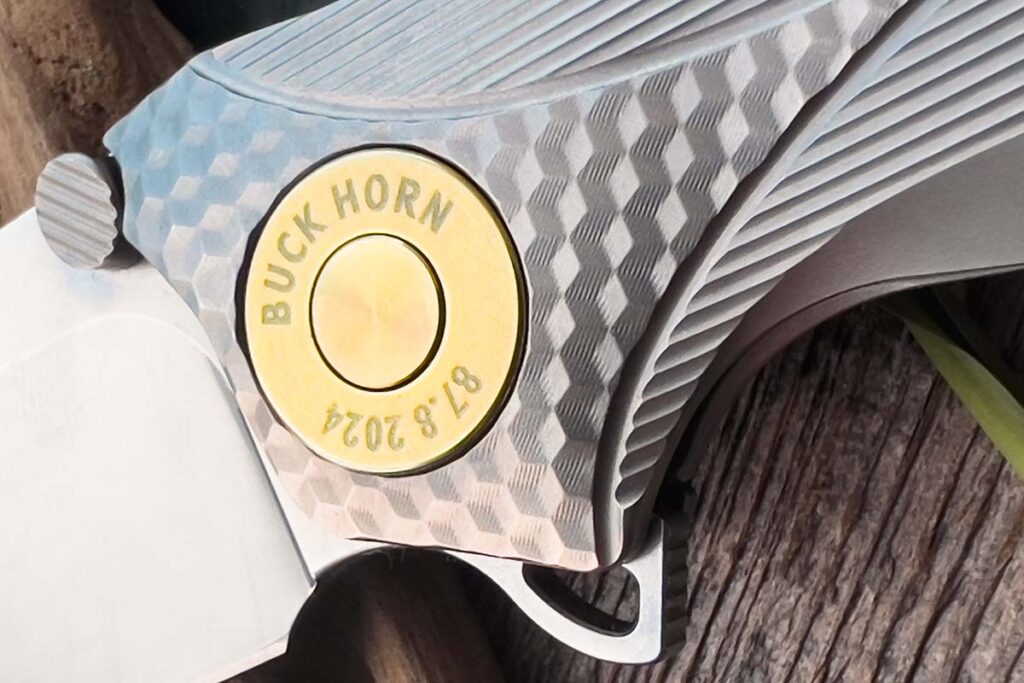
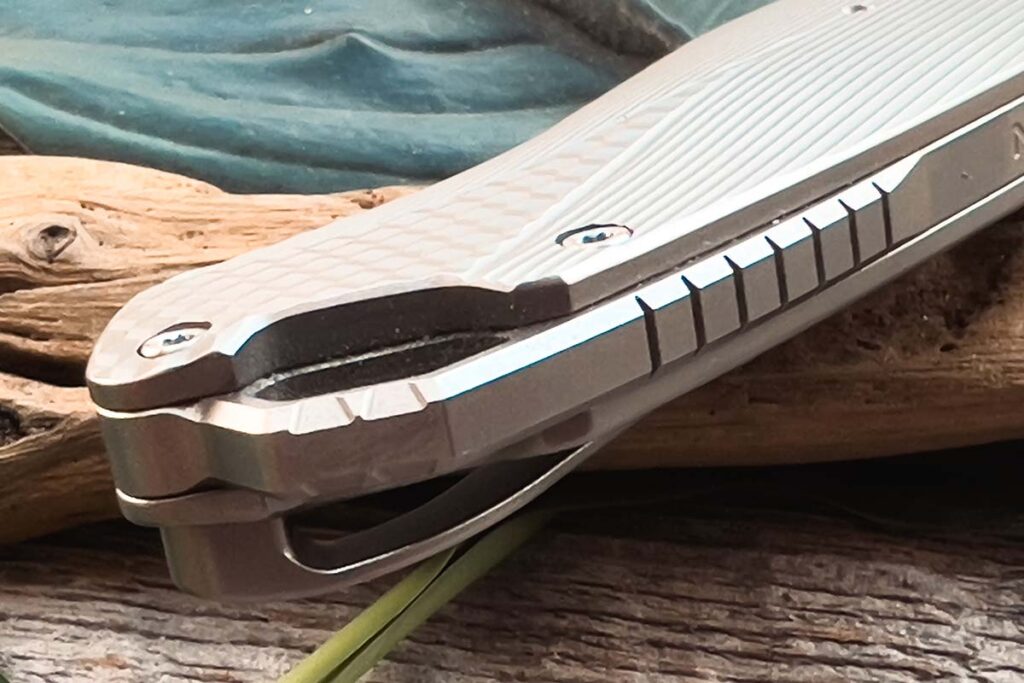
Perhaps the most unique design trait of the handle is the palm swell machined into the middle of the handle. This is employed to help seat the knife firmly in your hand and make it easier to grip. Continuing on, there’s the eye-catching 3D checkerboard micro-milling pattern at both ends of the handle, on both sides. Even the stylish minimalist titanium pocket clip sports the same 3D micro-milling pattern on the back, providing visual continuity to the clip side of the handle.
Speaking of the pocket clip, it is held onto the handle with one Torx screw. The handle end of the clip sits in a matching cavity to prevent it from rotating, thus remain secure with one fastening point.
The pivot screw is brass colored, as is the pivot ring. Eye-catching, the tandem give the illusion of the end of a shotgun shell, which is a unique aesthetic to the Buckhorn. The brass color pops against the bead-blasted handle. The matching titanium handle spacer covers about ¾ of the handle length, and at the end of the handle, the spacer forms an integral lanyard loop.
An absouletely stunning design point, the pivot screw looks like a shotshell head. Interestingly, the other side where the torx head is looks like a fired shell with a firing pin impression.
The framelock lockup engages the lower third of the width of the tang, so an easy lockup. It engages solidly without any movement in any direction. With a firm push of your thumb, the lock disengages allowing the blade to rotate closed.
I don’t believe you’re going to have any concerns over the lock holding or failing on this one. Ketuo did this one right!
Buckhorn Tested
Outfitted with thumbstuds and a kicker, the knife is quick into action.
In action, the Buckhorn is a very efficient cutting tool. It deploys easily and with the flat ground blade, it slices easily and effortlessly. The front section of the blade has the wedge and is the thinnest portion, sailing through various materials with ease. I like how the entire cutting edge has a graceful curve to it. Not only visually appealing, this feature allows you to make use of the entire length of the cutting edge.
S35VN is a top-performing steel and is an excellent choice for the Buckhorn. This steel will go the distance and withstand heavy usage. Also, dig the fact the ambidextrous thumb studs are positioned as far back on the blade as possible, this gets them out of the way to eliminate hanging up on material being cut. A smart move!
Then handle spacer is also titanium and forms an intergral lanyard loop at the aft of the knife.
With the handle’s ergonomic features, I felt in control of the knife at all times and found no hot spots to speak of. It just fits the hand so perfectly. This is a testament to Ken Onion’s design prowess and intimate understanding of handle design.
Final Cut
This knife is about as close as anyone will get to owning a full-blow custom knife from the man himself. At MSRP $275 and made in China, the Buckhorn is an excellent deal for what you get in return. It’s an exciting-looking design from one of the best in the game, using high-end materials with 3D machined titanium and S35VN, and a sturdy framelock. Well worth the price of admission.
Pros
Stunning overall design
Excellent materials
Crisp action
Priced right
Cons
Nice enough you may not want to carry it.
Buckhorn Specs Blade Material: S35VN Blade Angle: >60° Full Length: 8.78″ Handle Length: 4.84″ Blade Length: 3.85″ Type: Folding Blade Knife Handle Material: 6AL-4V Finishing: Bead blast & Anodizing Weight: 4.44 oz Color: Silver w/ Gold Ano Accents Designer: Ken Onion Brand: Karbon Knives Manufacturer: Ketuo Knife
Cooking a great filet mignon, ribeye or any good cut of meat is an art, so shouldn’t eating it be the same? Most of you have had a good cut of meat fall victim to a dull knife, sliding around on the plate like an ice skater on a rink, scattering peas and mashed potatoes to the wind. As blade-loving folk you know the benefits of a good cutter, so in BLADE®’s special kitchen knife issue let’s consider some of the more refined offerings in steak knives.
Best Steak Knives Specs Comparison
Knife
Blade Length (inches)
Blade Steel
Blade Pattern
Handle Material
Weight (ounces)
Overall Length
Carry
Country Of Origin
MSRP
Bradford Orwell Steak Knife
4.2
AEB-L Stainless
Clip Point
Tan Micarta®
3
8.5
Kydex Sleeve
USA
$128 ($168 with sheath)
Emerson Folding Steak Knife
3.9
154CM Stainless
Clip point
Tan/black layered Richlite
4.56
5
Blade-tip-up pocket clip
USA
$335
Sharps Bros. Meanstreak Grill & Steak Knife
5
S35VN Stainless
Clip point
Titanium
6
9.25
Black thermoplastic blade cover
USA
$110
Bradford USA Orwell Steak Knife
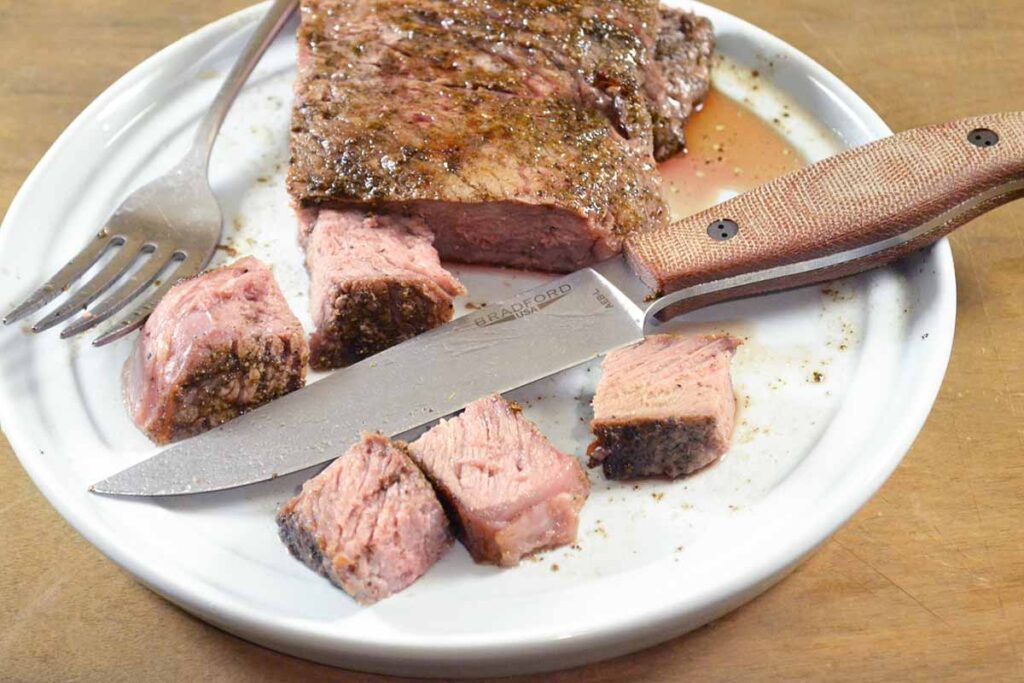
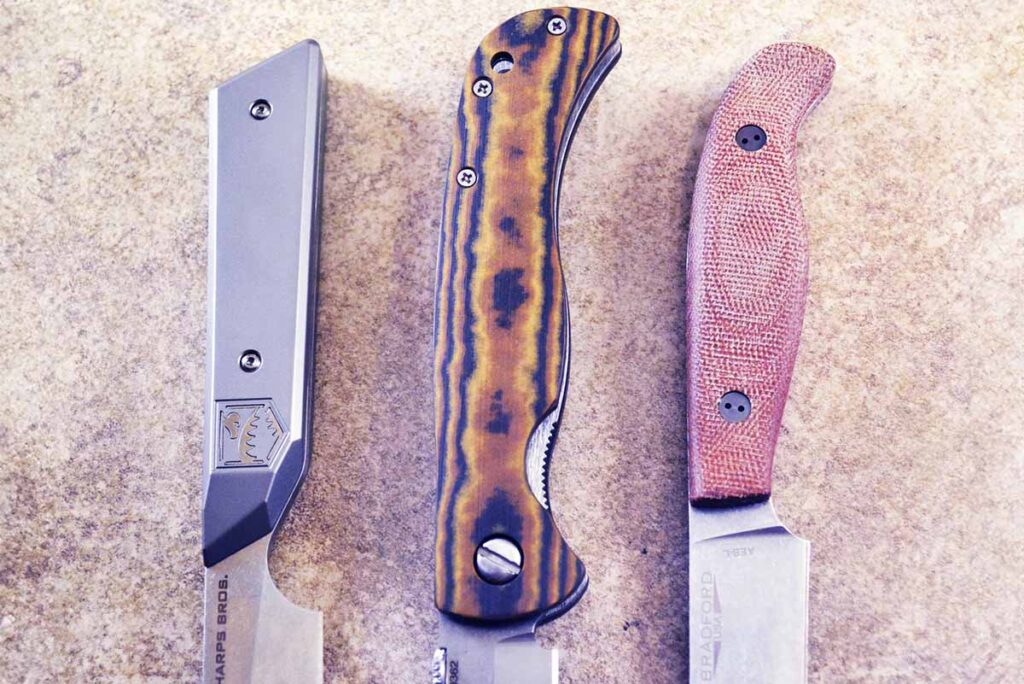
The author stated the Bradford USA Orwell handles and cuts like a steak knife should, adding “The level of construction and finish is very high throughout, and the Uddeholm AEB-L stainless steel blade is many cuts above that of the average steak knife.” Note the Micarta® handle with a nice palm swell for an enhanced grip and handling.
The Orwell Steak Knife from Bradford USA may look like a Webster Dictionary depiction of what a carnivore cutter should be, but there’s more than meets the eye in this upscale slicer.
The Orwell is a spinoff of the company’s Gatsby design with more handle options geared toward the tactical user and outdoorsman. The full, flat-ground, gently clipped blade has a stonewashed finish (a high polish is also optional). Handle scales on the test sample are tan Micarta®—black, camo and OD green are also available. The test Orwell was delivered with an optional black Kydex sheath.
Of the three review knives, the Orwell more closely resembles what most consider the norm among steak knives in size and configuration. Where it differs from the norm is in sheer quality of both materials and fit and finish.
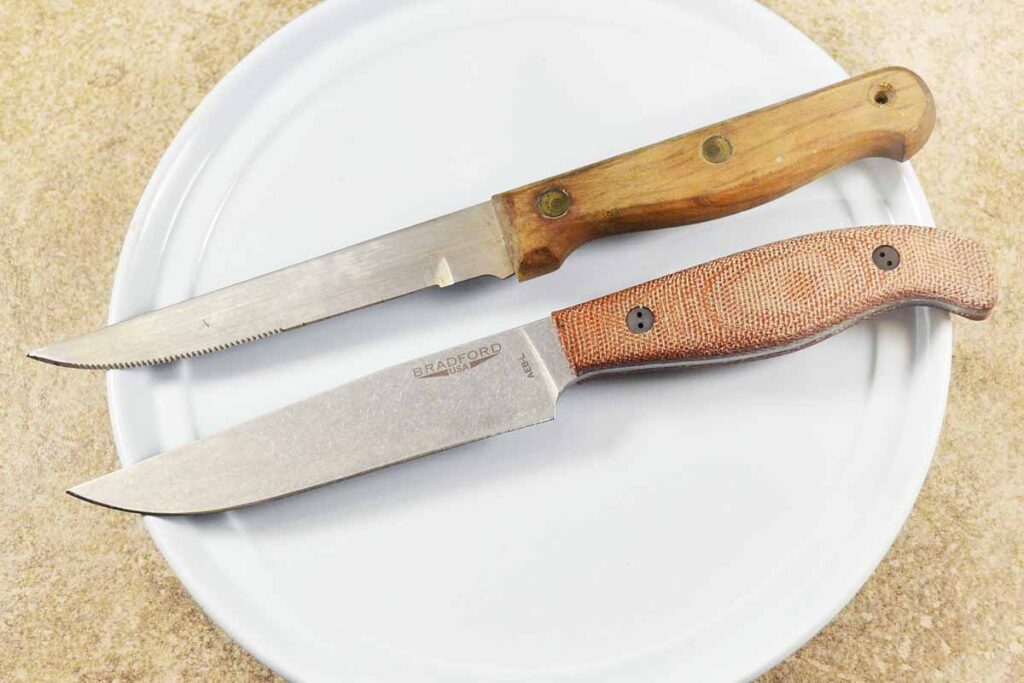
For your inspection: an inexpensive, run-of-the-mill steak knife and the Bradford. Note the pleasing line and flow of the Bradford compared to lack of same in the other knife. If you’re going to spend good money on an expensive cut of meat, why not spend money on a knife you’ll enjoy eating it with?
I cooked up a black Angus ribeye steak for the occasion and took the Orwell to task. The AEB-L stainless steel blade glided through the steak effortlessly, you might say, “Like an Uddeholm steel should.” This was also aided by the fact that Orwell was the thinnest test blade.
Bradford did a superb job on the handle scales with just the right amount of palm swell for gripping, along with a high degree of finishing for overall comfort. I really had no “druthers” with the Orwell at all, and the Kydex sheath is worth the price of admission both as a protective cover in the drawer or for field use.
Orwell Steak Knife Specs Blade length: 4.2” Blade steel: AEB-L stainless Blade pattern: Clip point Handle material: Tan Micarta® Weight: 3 ozs. Overall length: 8.5” Carry: Kydex sleeve, easily converted to belt Country of origin: USA MSRP: $128 ($168 w/sheath)
Orwell Deals
Arizona Custom Knives
$95
Bradford USA
$129
Ernest Emerson Folding Steak Knife
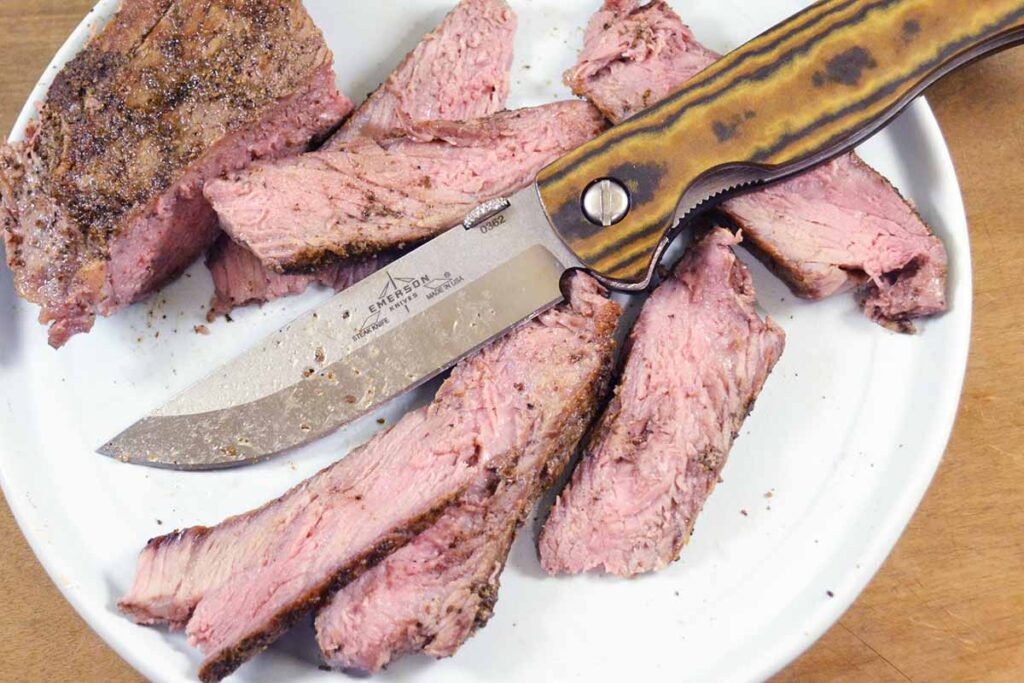
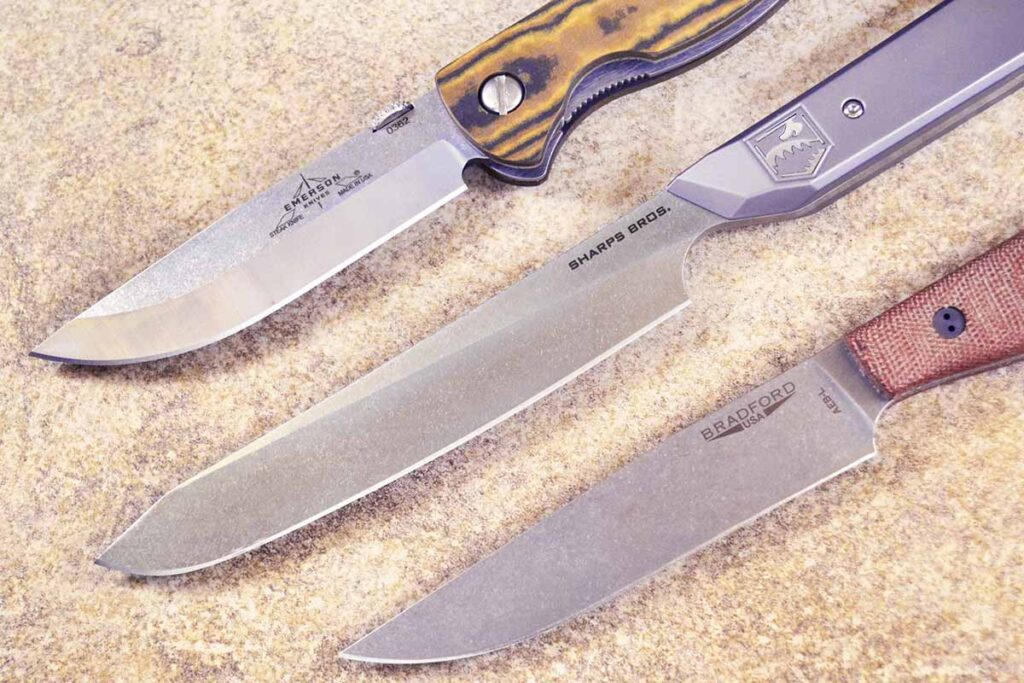
The author used the Emerson Knives Folding Steak Knife to cut strips of steak for fajitas. The knife is not as svelte as its two test counterparts but if you eat out frequently the portability is well worth the price of admission.
Leave it to Ernest Emerson to produce a steak knife folder. That’s his job, that’s what he does!
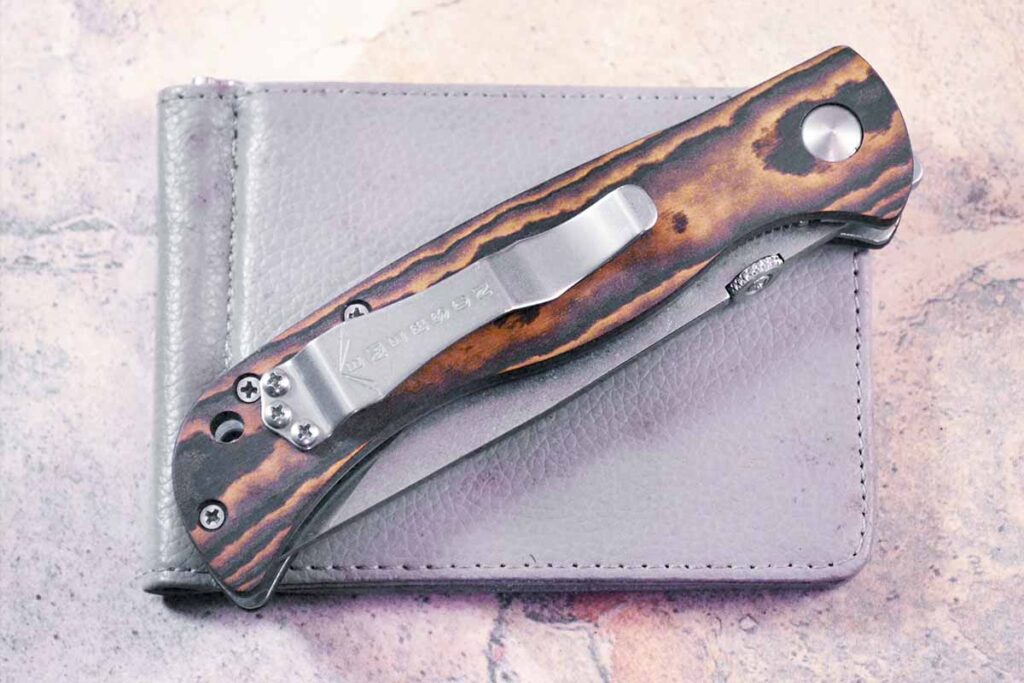
The blade of the Emerson Folding Steak Knife boasts an almost imperceptible clip point with a flat grind and rolls out via an ambidextrous thumb disc. The blade secures via a linerlock inside the open titanium frame. The brown layered handle slabs give the knife a rustic look, though you can go with black G-10 if you’ve got a tactical slant. An ample 2.3-inch pocket clip occupies the frame’s back side.
I devoted a portion of the ribeye to taking off approximately 1/8-inch slices for steak fajitas with the Emerson. The 154CM stainless steel blade did an admirable job of slicing, though it is slightly clumsier due to the bulk of the handle compared to, well, a fixed-blade steak knife. That’s the price you pay for portability.
If you eat out a lot and are out and about doing so, the Emerson may just be your best friend. You’ll never have to experience Sliding Steak Syndrome at a restaurant again!
Despite its size, the handle is comfortable and the Richlite scales are attractive. When you’re finished dining simply wipe the knife down with your cotton restaurant napkin, park the folder in your pocket, and go your merry way.
Folding Steak Knife Specs Blade length: 3.9” Blade steel: 154CM stainless Blade pattern: Clip point Handle material: Tan/black layered Richlite Carry: Blade-tip-up pocket clip Weight: 4.56 ozs. Closed length: 5” Country of origin: USA MSRP: $334.82
Folding Steak Knife Deals
Emerson Knives
$335
BladeHQ
$325
Sharps Bros. Meanstreak Grill & Steak Knife
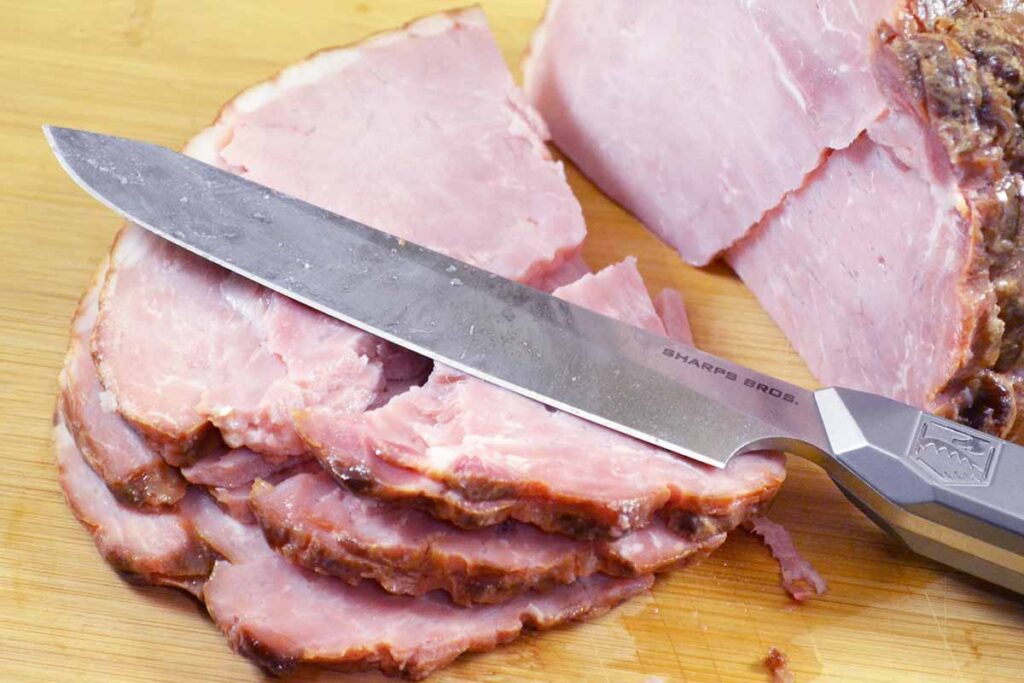
The Sharps Bros. Meanstreak Grill & Steak Knife’s longer 5-inch blade offers utility outside the dinner plate. The author indicated the knife sliced ham like it was a stick of butter. The CPM S35VN stainless steel blade performed “like a house afire” on ribeye steak as well.
The Sharps Bros. Meanstreak Grill & Steak knife is futuristic in style and loaded with upscale features. For starters, the full-tang steak knife boasts a clip-point blade of CPM S35VN stainless steel with a long, angled, flat grind that looks ready to launch.
With its longer blade the Meanstreak is meant not just for cutting meat but handling other chores such as flipping steak. I tested the blade on a hefty pound-and-a-half, 5-inch-across chunk of ham and it whipped through it like it was an afterthought—and the ribeye experienced the same results.
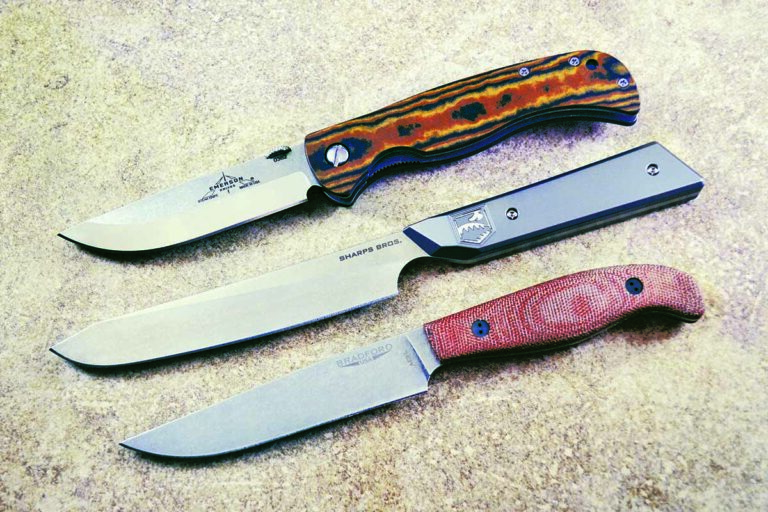
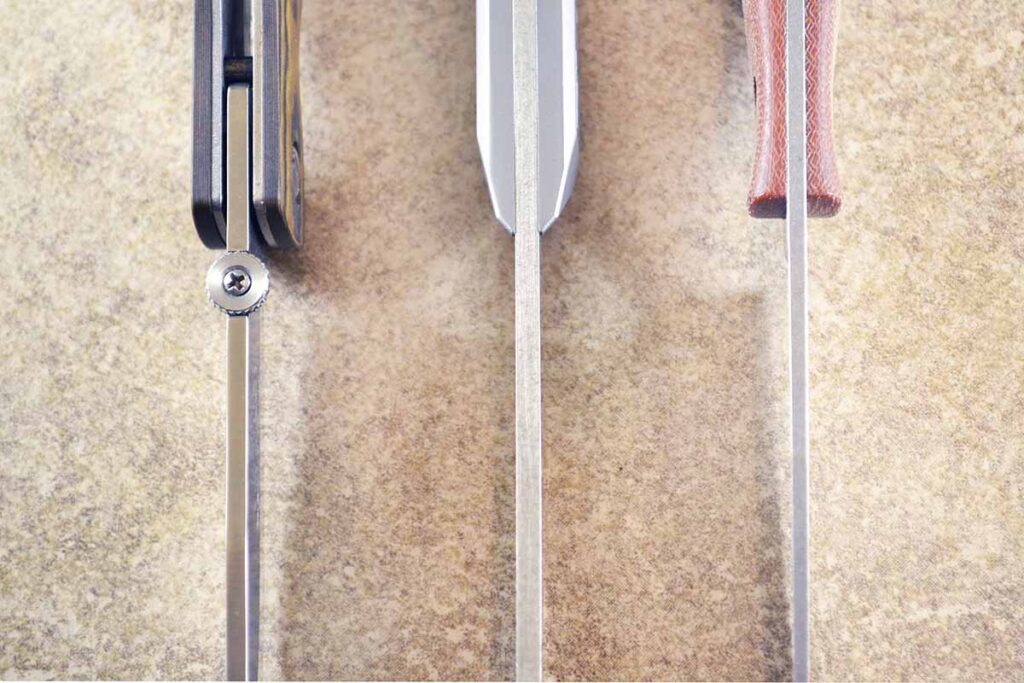
Blade thickness varies on the review group, from thickest on the larger Sharps Bros. (middle) to the thinnest on the Bradford (right). After testing all three steak knives, the author opined that the blade thickness was not much of a factor since all three knives had much better than average blade steel, properly heat treated and professionally edged.
The longest of the blades reviewed, the Meanstreak proved the superior cutter of the pack. Realistically, the extra half inch of blade length isn’t necessary, and some may think it’s too much knife, so it’s a trade-off.
Personally, I didn’t find it burdensome.
The titanium handle is not as comfortable as Micarta grips and the Meanstreak is twice the weight of the Bradford, but it’s easier to clean. These are all preferences you need to weigh when choosing your ideal steak knife.
Meanstreak Grill & Steak Knife Specs Blade length: 5” Blade steel: S35VN stainless Blade pattern: Clip point Handle material: Titanium Weight: 6 ozs. Overall length: 9.25” Carry: Black thermoplastic blade cover Country of origin: USA MSRP: $109.95
Meanstreak Grill & Steak Knife
Sharps Bros.
$106
Final Cut
Sharps Bros. opts for an angular titanium handle that matches its futuristic styling. The Emerson is the rare folding steaker replete with linerlock and pocket clip for easy toting. Bradford carries on a more traditional approach with all the traits of a refined custom.
If you’ve been using standard house fare, the three test steak knives should be a vast improvement. All three blade steels are heat-treated and honed to a high degree by professionals who know their steels and how to get the most from them. The biggest difference between the three knives is how you plan to use them.
The Bradford excels where run-of-the-mill steak knives fail. Bradford USA has used Uddeholm AEB-L stainless steel with success for over 10 years, and like every Bradford knife I’ve tested, the fit and finish is superb. This steak knife will spoil you.
The Emerson offers you the portability a fixed blade doesn’t, and that’s important to those who eat out a lot, both at restaurants or in the wild. The company also offers a fixed-blade version of the same knife.
All three test knives go with variations on the flat grind. Emerson uses a “V” flat grind halfway up the blade with a stonewashed flat area. Sharps Bros cements the futuristic styling with a flat grind that takes off like a rocket from choil to tip, and Bradford returns to earth with a full flat grind from spine to edge.
With its longer blade, the Sharp Bros. expands its usefulness beyond the dinner table in areas like meal prep and grilling. The Crucible blade steel is the most advanced blade option I tested, not to mention the titanium scales. If you prefer a knife that goes beyond the dinner plate, the Meanstreak will go there.
Three very different knives, three very different options—choose your slice!
See how an over-the-counter Henckels survives the Breed test.
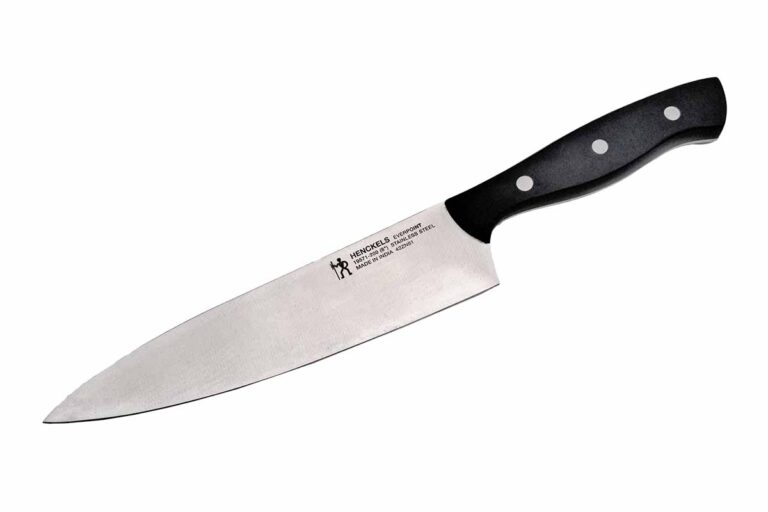
This time I decided to hit the local retail store trail for a knife just about anyone can buy anytime. Nothing tweaked my fancy till I hit a major chain store. There I found an inexpensive Henckels Everpoint 8-inch chef’s knife. Well, let’s just say I’m impressed with the quality of the Henckels. Read on and see why.
Henckels Everpoint Sharpness Test
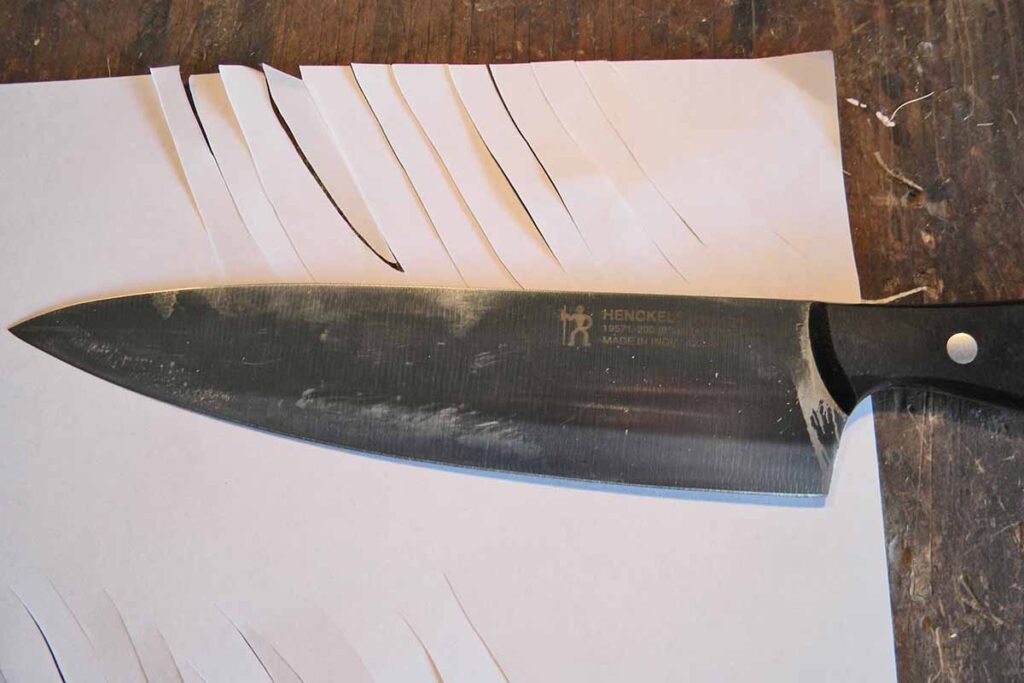
The knife had to slice paper once more to see if the horn whacks did any harm the author could not feel. It was still slicing and dicing like in the beginning.
First was the 20-pound-bond-copy-paper slice. The knife was very sharp and aggressive slicing the paper. I had to take care not to skin parts of my finger off. As fast as I could move, I could slice the paper. The knife was off to a great start.
Henckels Everpoint Food Prep
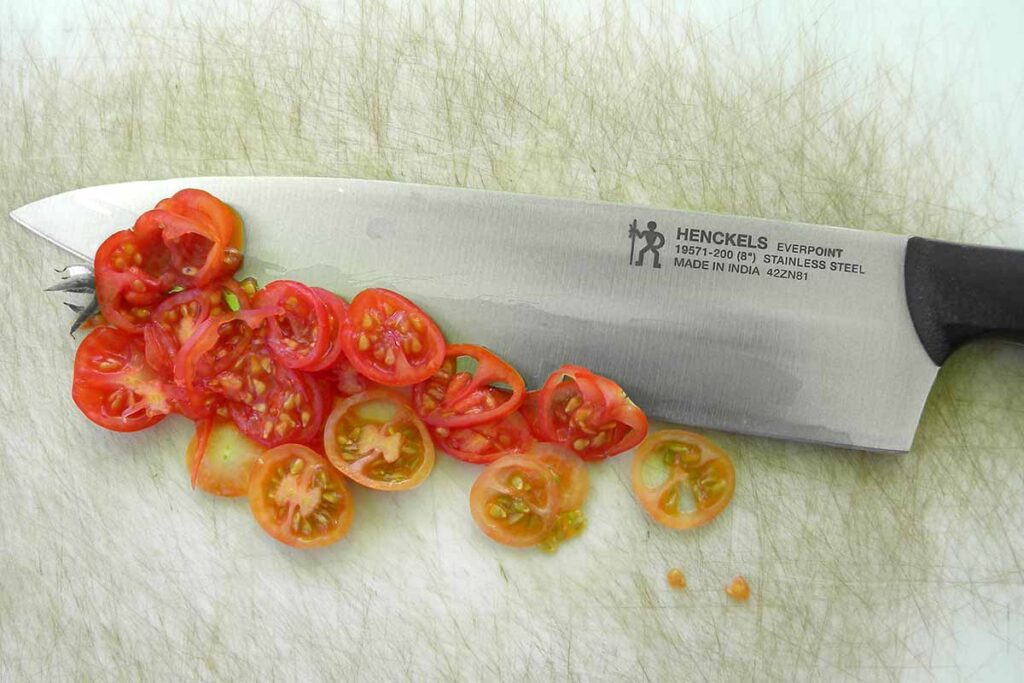
The knife sliced the tomatoes fast without mushing them and produced very thin slices.
Now to use the Everpoint for its intended purpose: food preparation. I picked some cherry tomatoes and the last yellow squash from the garden. The knife sliced the tomatoes fast without mushing them. I could get very thin slices. The same went for the yellow squash. The knife was light in hand and well balanced.
Henckels Everpoint Medium Duty Tests
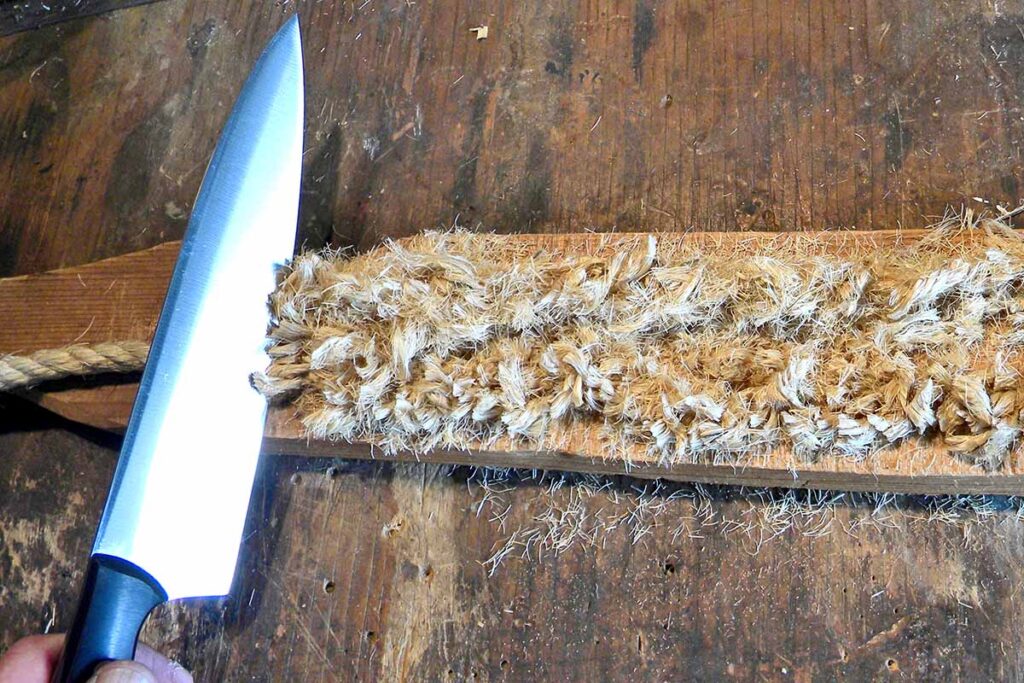
The Henckels surprised the author by making 200 crunching cuts in the sisal rope, and the knife was ready for more.
The rest of the test was to see how far the knife would go before the edge failed. Getting my technique down with some single-walled cardboard, the chef’s knife sailed through it aggressively with no problems. Very nice!
Next was some whittling on pine. The Henckels gave me some very smooth curlicues. I was surprised at how controllable the knife was, from very fine shavings to deep bites with heavy pieces. It’s a lot different whittling with an 8-inch chef’s knife but it came through with flying colors.
Skiving 8-ounce leather was next. The knife crunched aggressively with every cut, rendering very thin slices and one close call on my finger. The leather was no challenge at all. It was still fun to do quickly and I didn’t need to apply much pressure.
Henckels Everpoint Heavy Duty Tests
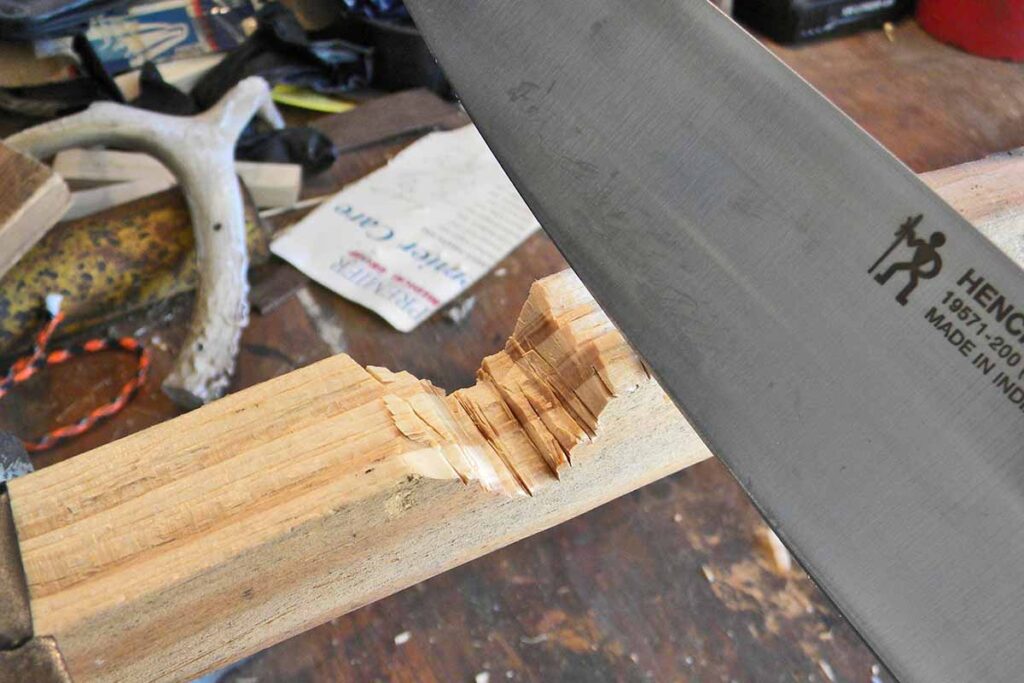
The Everpoint chopped the 2×4 very well. The balanced blade and comfortable handle made it a pleasure to use. The author whacked the wood “pretty hard” but could see or feel no damage to the edge.
It was time to move into the big leagues by chopping into part of a 2×4. The Everpoint chopped very well. The balanced blade and comfortable handle made it a pleasure. I was whacking pretty hard into the wood but I could see or feel no damage to the edge.
All knives have to cut sisal rope. No exceptions. The Henckels surprised me by going for 200 crunching cuts and was ready for more. The plastic scales were extremely comfortable. The knife floated in my hand on every cut. Heat treatment grade: excellent.
I returned to the paper slice to see if the edge had slowed down any. Nope, it sliced just as fast as before. This chef’s knife cuts!
All right, with such a thin blade I figured an antler chop should knock the edge down a bit. Dang, it proved me wrong. Thirty hard whacks into the whitetail horn and there was no edge damage whatsoever. I’m impressed. The knife had to slice paper once more to see if the horn did some harm I could not feel. It was still slicing and dicing like in the beginning. Outstanding!
Final Cut
This chef’s knife really impressed me—low price with top end performance.
Everpoint 8” Specs Blade Length: 8” Blade Steel: Stainless Blade Grind: Flat Blade @Thickest: .09” Blade Width: 1.75” Blade Finish: Satin Handle: Black plastic Rivets: Stainless Construction: Full tang Weight: 7 ozs. Overall Length: 13.25” Country of Origin: India MSRP: $14.88
Autumn is here and, unlike the weather, knifemakers show no signs of cooling down. If anything, factory and custom makers are as hot as ever with a ton of new knives hitting the market. We picked out 12 great-looking recent drops certain to carve a place into your heart.
Jess Hoffman Donegal
Knife pattern: Skinner Blade length: 4” Blade steel: AEB-L stainless Blade grind: Full flat Handle material: Camel bone Overall length: 8.25” Sheath: Leather Maker’s price for a similar knife and sheath: $230 Maker’s remarks: “My Donegal is a cross between a Nessmuk and a Canadian belt knife. It’s available in three different overall sizes: 8.25, 6.75 and 5.75 inches.” Maker: Jess Hoffman, jhoffmanknives.com (Jocelyn Frasier image)
Kyle Royer Damascene Hunter
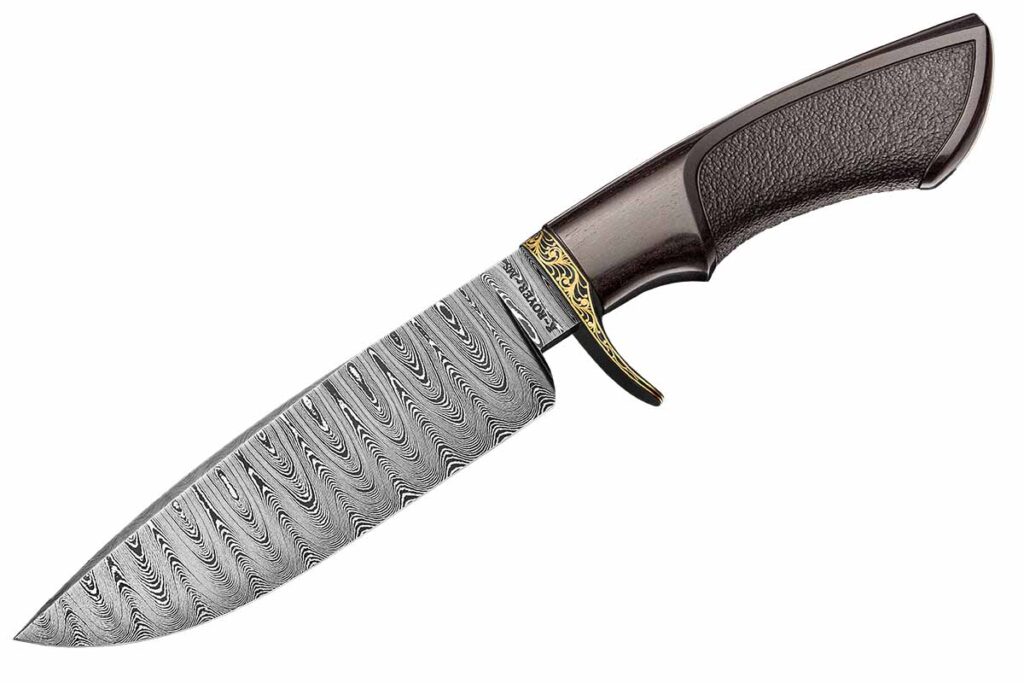
Knife type: Fixed blade Blade length: 5” Blade material: Ladder-pattern damascus of 1084 carbon and 15N20 nickel-alloy steels Blade grind: Flat w/convex edge Handle: Sculpted blackwood w/texturing Bolster: Damascene-covered guard w/24k gold and gun bluing Overall length: 9.25” Maker’s price for a similar knife: $9,500 Maker’s remarks: “This piece is particularly special as it’s the first gold overlay I’ve done using hundreds of tiny 24k-gold wires. Additionally, it has a beautifully textured blackwood handle.” Maker: Kyle Royer, kyleroyerknives.com (Jocelyn Frasier image)
Bear & Son Cutlery Farmhand
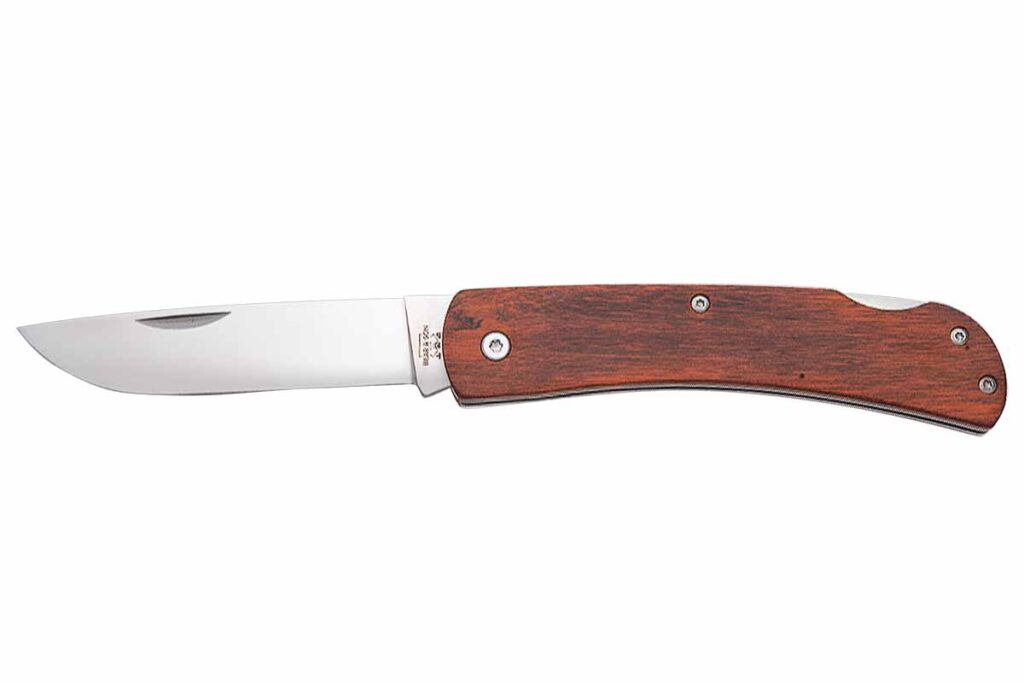
Blade length: 3 5/8” Blade steel: 440 stainless Blade pattern: Drop point Blade opener: Nail nick Handle material: Aluminum, bone and rosewood (shown) options Pocket clip: Yes Lock: Lockback Weight: 1.1 ozs. Closed length: 2.75” Knife to know: Handle color options include black, blue, orange, purple, red and white smooth bone, and brown rosewood Country of origin: USA MSRP: $37.49 to $51.99 Company: Bear & Son Cutlery, www.bearandsoncutlery.com
Craig Brosman Hunter
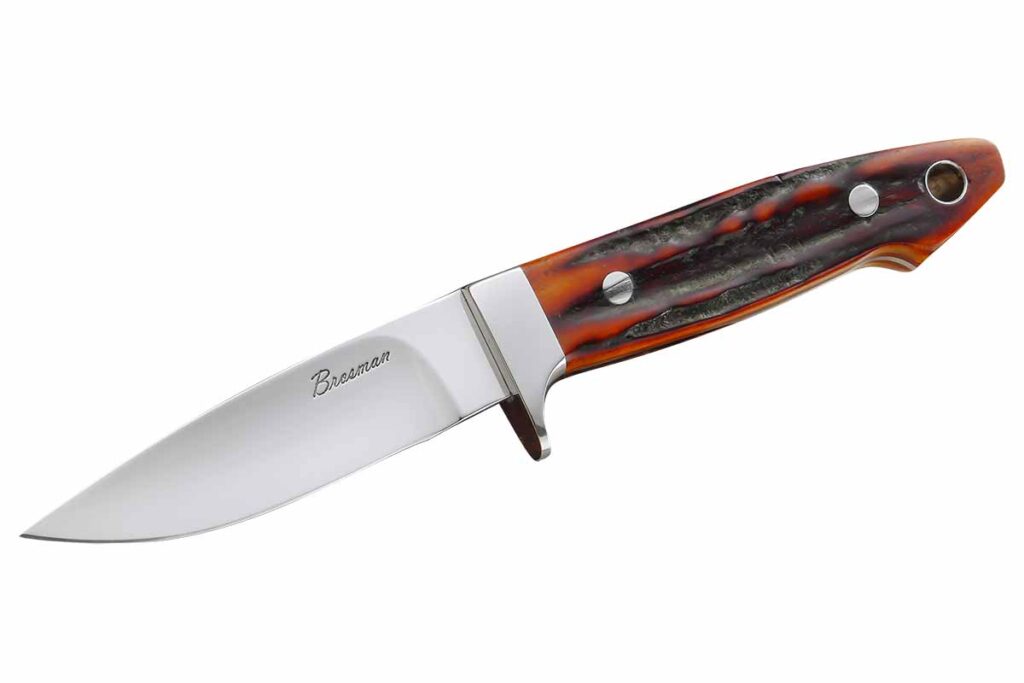
Blade length: 2.75” Blade steel: RWL 34 stainless Blade grind: Hollow Blade pattern: Drop point Blade finish: Mirror polished Handle material: European red stag and Westinghouse Micarta® liners; w/hole for lanyard Construction: Tapered tang Bolster/guard: 416 stainless Overall length: 6 9/16” Sheath: Leather pouch w/clip by Aaron Sybrant Maker’s price for a similar knife & sheath: $550 Maker: Craig Brosman, (SharpByCoop image)
Billy Pearce Hunter
Blade length: 5.1” Blade material: 1075 carbon steel Blade grind: “V” Blade thickness @ricasso: .177” Blade @widest: 1.18” Blade pattern: Clip point Handle: Bocote wood Spacer: G-10 Guard & pin: 416 stainless steel Overall length: 9.64” Knife to know: Billy Pearce is an apprentice smith in the American Bladesmith Society Maker’s price for a similar knife: Contact maker for info Maker: Billy Pearce, (Rod Hoare image)
RMJ Tactical Lady Death
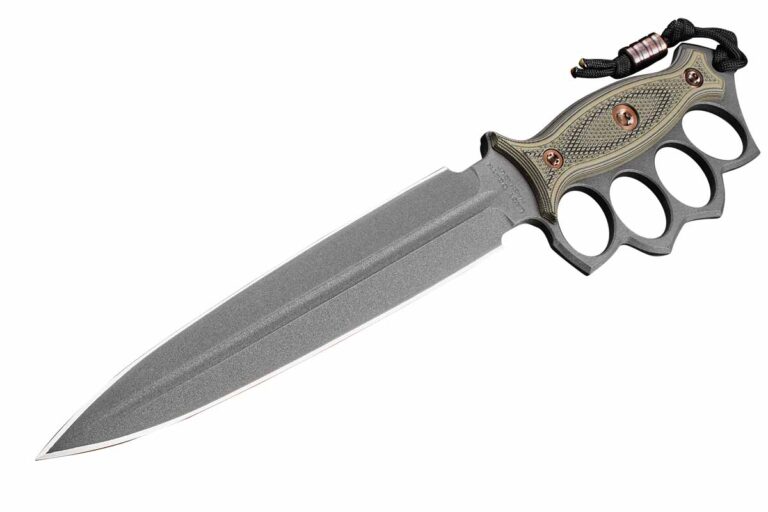
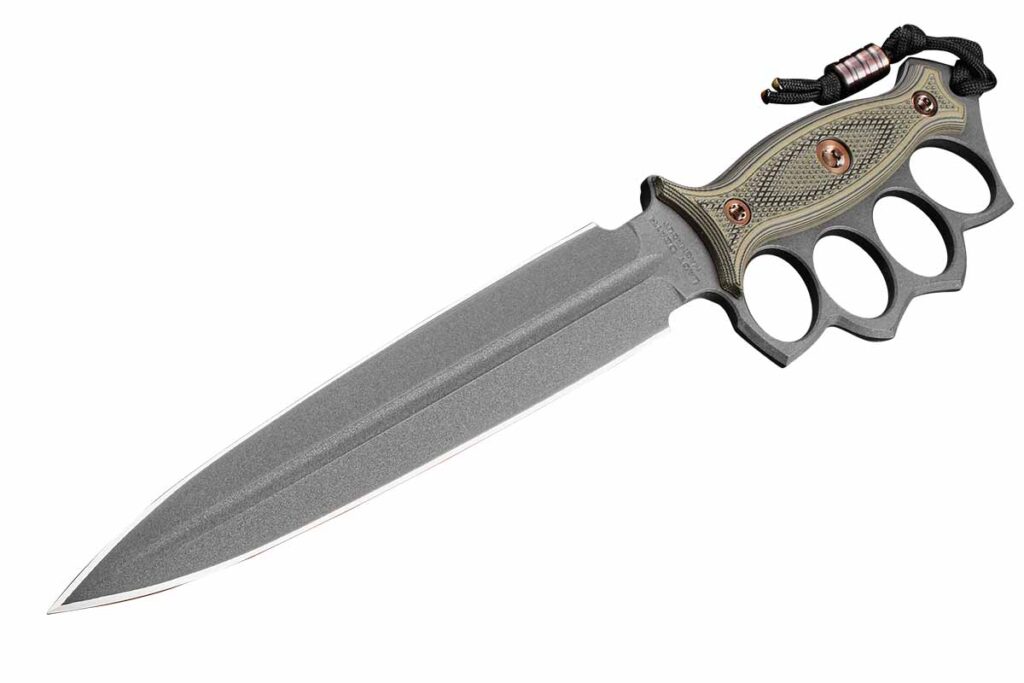
Knife pattern: Classic trench knife Blade length: 9 5/8” Blade material: CPM 3V carbon steel Rockwell hardness: 60-61 HRC Blade @thickest: 3/16” Blade finish: Cobalt Cerakote® Handle: Checkered Dirty Olive G-10 Handle hardware: Grade 5 titanium anodized bronze Weight: 18.3 ozs. Overall length: 15” Sheath: Brown leather w/green canvas inlay; ambidextrous and wears on a belt or attached to PALS webbing Knife to know: Double-edged blade w/long fuller; knuckle-duster-style handle; pommel pronounced for use as a hammer Country of origin: USA MSRP: $975 Company: RMJ Tactical, www.rmjtactical.com
GiantMouse Carryology Sonoma V2 Auxikko
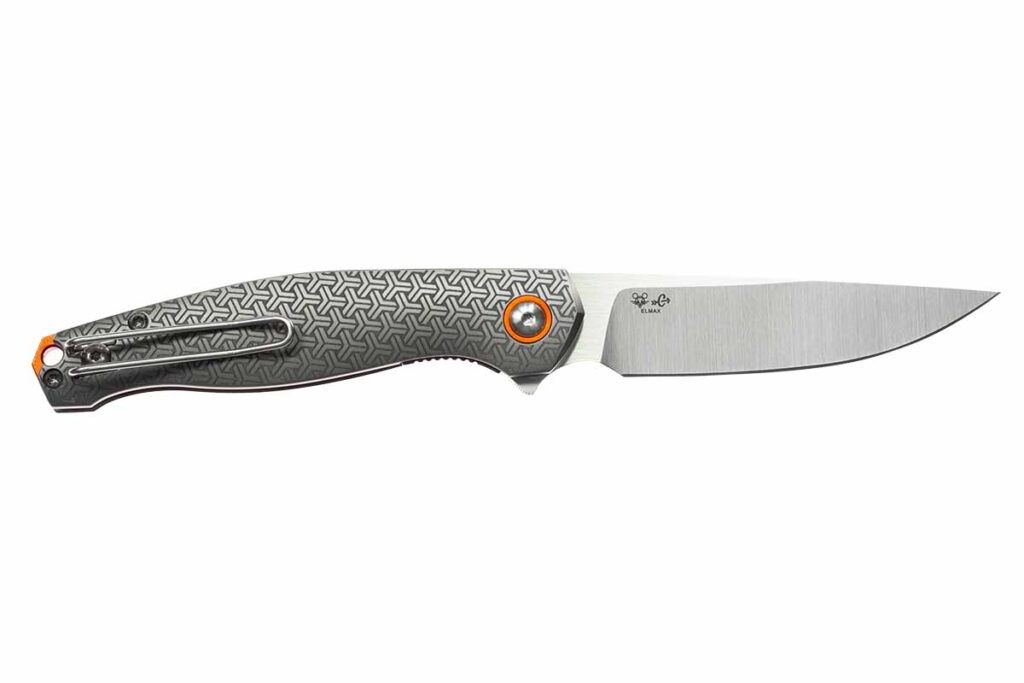
Knife type: EDC folder Blade length: 3.425” Blade steel: Elmax stainless Rockwell hardness: 60 HRC Blade @thickest: .138” Blade finish: Satin Lock: Linerlock Pivot hardware: Ball bearings Handle material: Titanium laser engraved w/the Carryology Auxikko pattern Backspacer: Aluminum anodized orange w/built-in hole for a lanyard Pocket clip: Wire, deep carry, reversible Weight: 3.8 ozs. Closed length: 4.5” Knife to know: Limited edition of 400 numbered pieces Country of origin: Made by Reate in China MSRP: $295 Company: GiantMouse, giantmouse.com
Gary Martindale Loveless Chute Knife Repro
Blade length: 4.25” Blade steel: CPM 154 stainless Blade grind: Hollow Handle: Amber stag Bolster/crossguard: 416 stainless Overall length: 9” Sheath: Basketweave-leather belt pouch w/snap Maker’s price for a similar knife: Contact maker for info Maker: Gary Martindale, (SharpByCoop image)
Grimdog Blades Australia Draugr Mk III
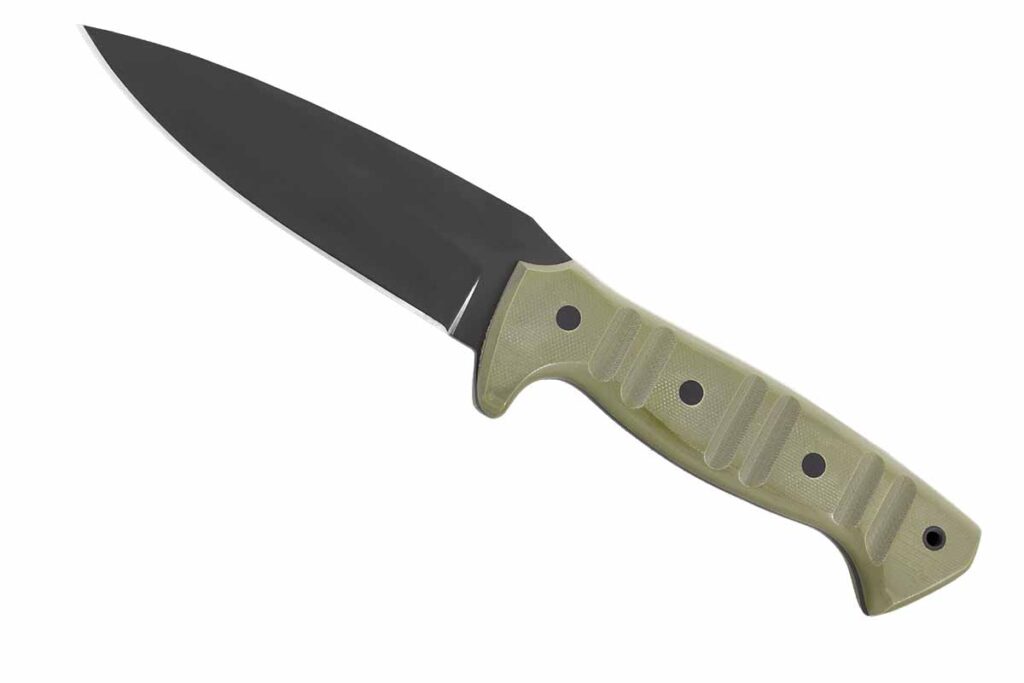
Knife type: Military utility Blade length: 4.9” Blade material: Thyssenkrupp 80CrV2 carbon steel Blade grind: Flat sabre Blade thickness @ricasso: .138” Blade finish: Cerakote® H190 Armour Black Handle material: Olive green G-10 Overall length: 10.47” Maker’s price for a similar knife: Contact maker for info Knife to know: Christian Holm is a member of the Australian Knifemakers Guild Maker: Grimdog Blades Australia, (Rod Hoare image)
Liam Walle Bird & Trout
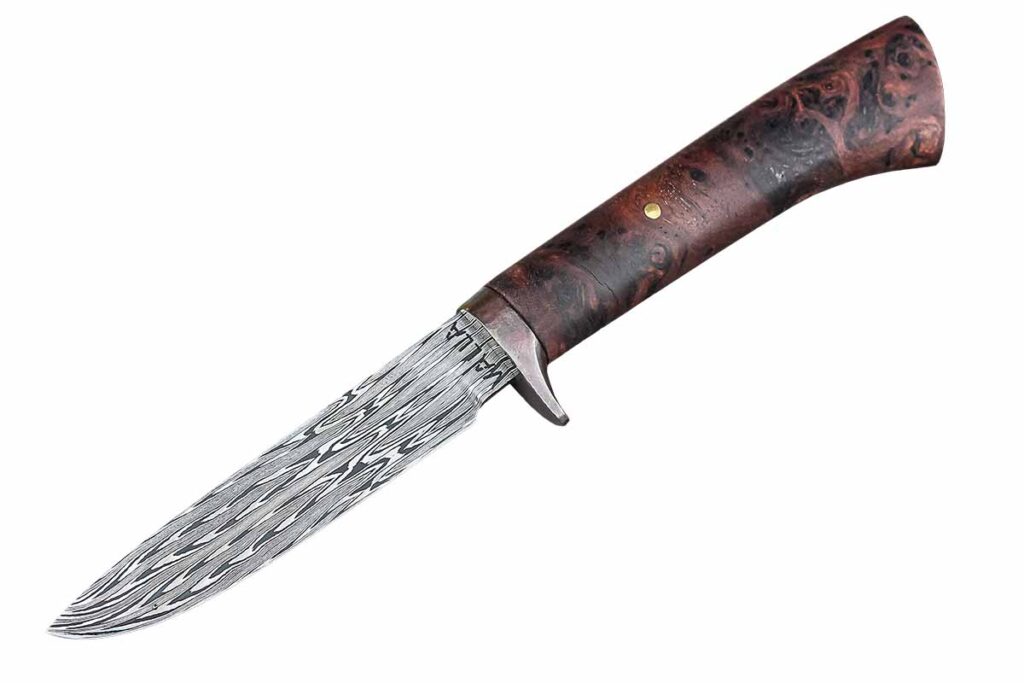
Knife type: Fixed blade Blade length: 3.6” Blade materials: Crushed W’s damascus of 1084 carbon and 15N20 nickel-alloy steels Blade grind: Flat Handle: Pōhutakawa wood w/domed brass pin Guard/bolster: Antiqued bronze Overall length: 7.6” Maker’s price for a similar knife: $750 at press-time exchange rate Maker: Liam Walle, liamvallaknives.com (Jocelyn Frasier image)
Cold Steel Full Metal Atlas
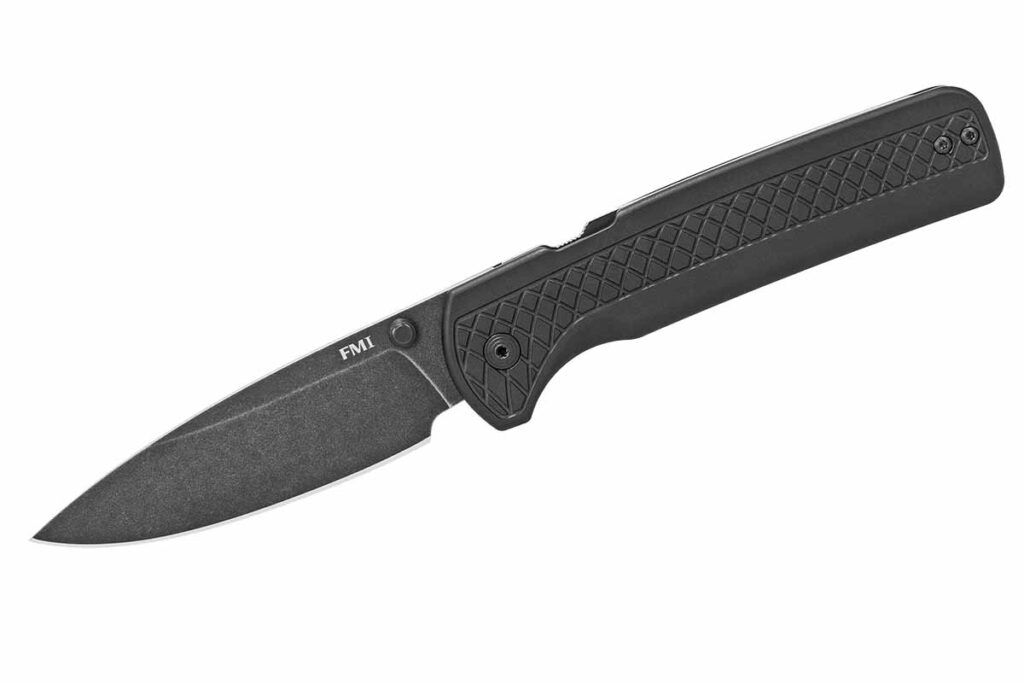
Knife type: EDC folder Blade length: 3.5” Blade steel: CPM S35VN stainless Blade grind: High saber Blade pattern: Drop point Blade opener: Thumb stud Lock: Atlas® Lock Handle: Textured titanium Weight: 3.8 ozs. Closed length: 5 7/8” Knife to know: Knife comes in all-black (shown) or standard stonewashed finishes; handle includes a single finger groove w/integral guard Country of origin: Taiwan MSRP: $229.99 Company: Cold Steel, www.coldsteel.com
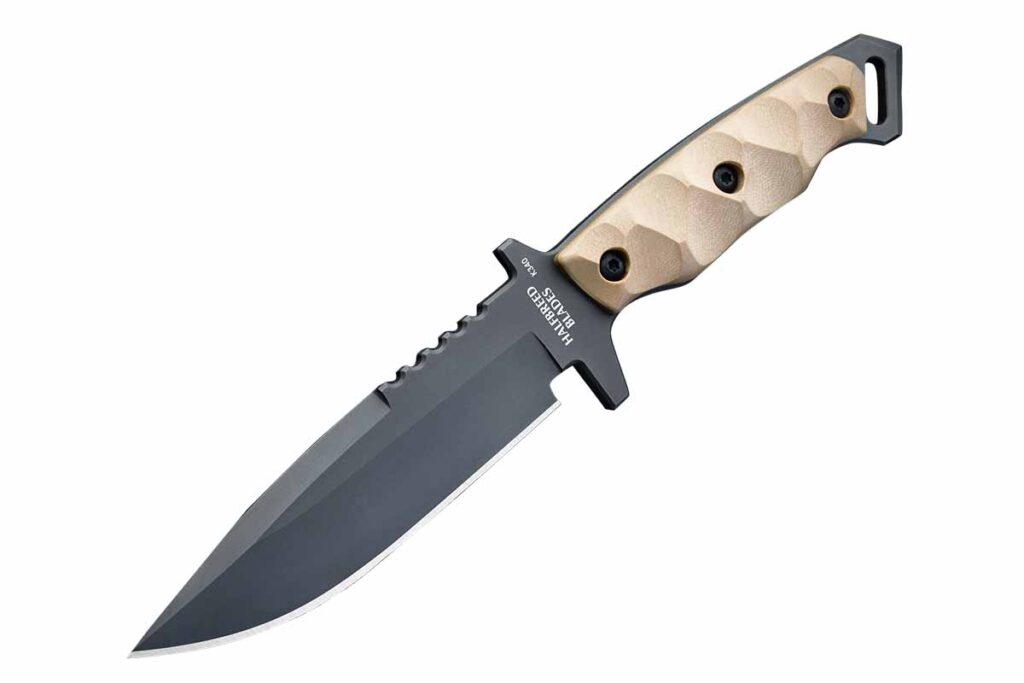
Halfbreed Blades MIK-03P Gen-2 K340
Knife type: Fixed blade Blade length: 5.31” Blade steel: K340 ISODUR Rockwell hardness: 59-60 HRC Blade @thickest: .25” Blade pattern: Modified drop point Blade finish: PVD coated Construction: One-piece full tang Handle: G-10 Weight: 11.14 ozs. Overall length: 10.43” Sheath: Injection-molded plastic w/belt & PALS/MOLLE mounting Knife to know: MIK stands for Medium Infantry Knife MSRP: $212 at press-time exchange rate Company: Halfbreed Blades, halfbreedblades.com.au