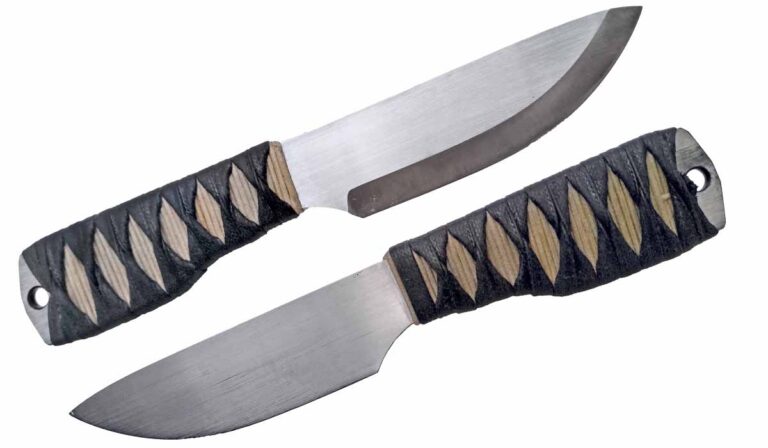
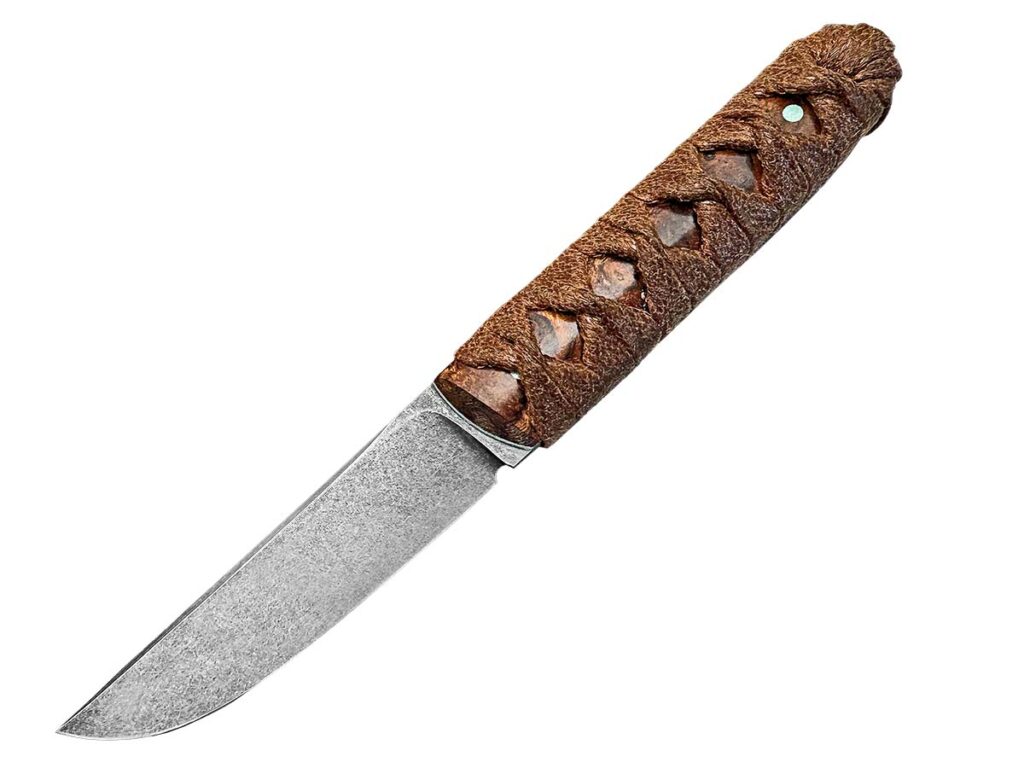
Large Work Knife takes the author’s favorite media to task.
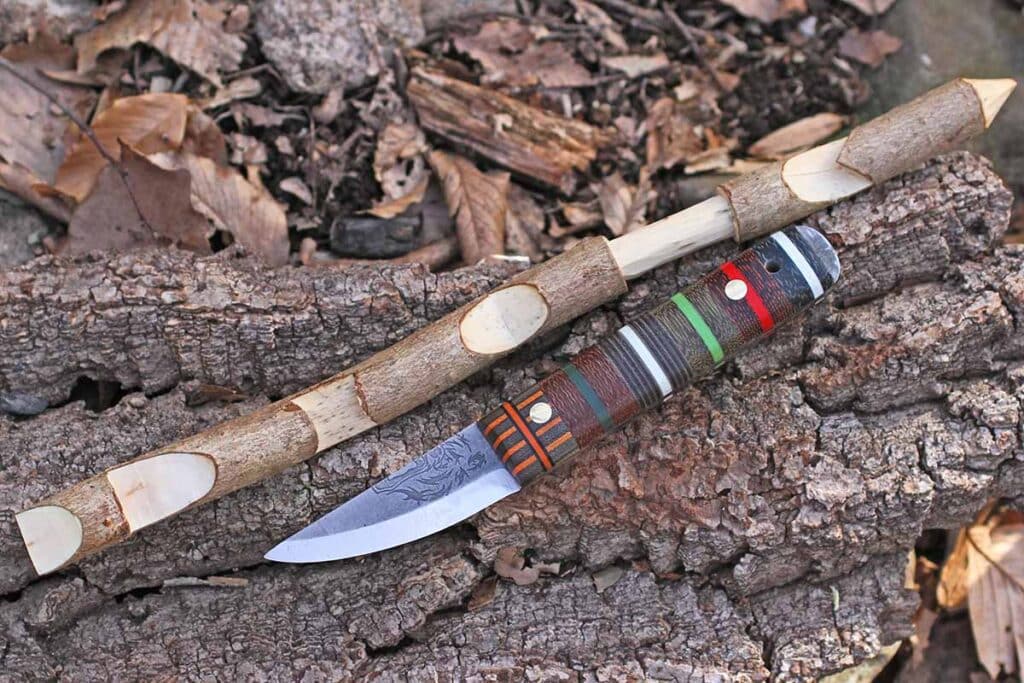
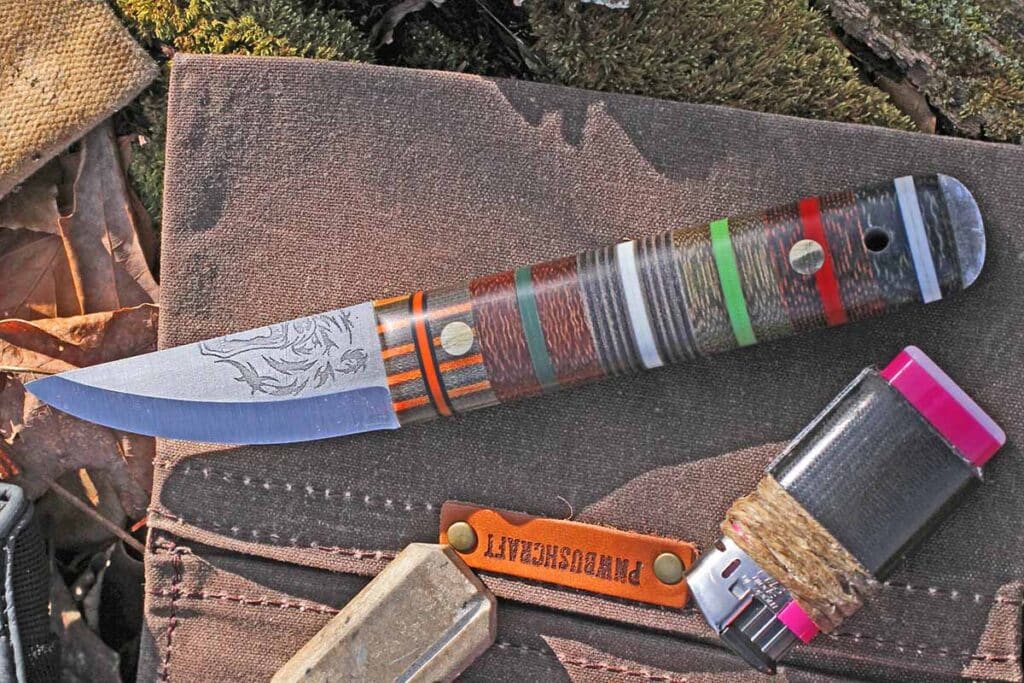
With camping season in full swing, it’s always a good idea to have a sharp knife at your side to build a lean-to or traps and make firesticks, to name a few. The Large Work Knife by KG Handcrafted Bladeware can fill the bill. Ground from 5/32-inch A2, a tool steel known for providing a keen edge, it begged for a good testing.
Large Work Knife Edge Test
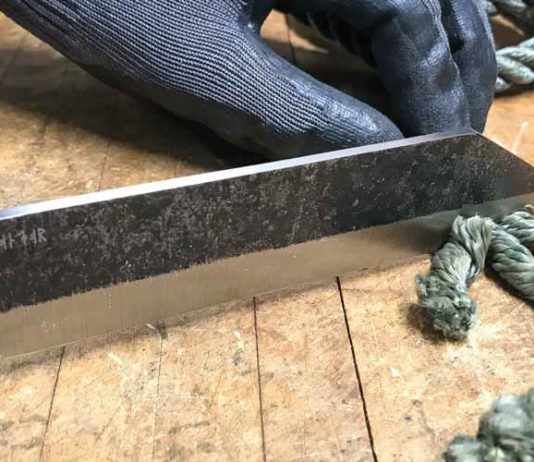
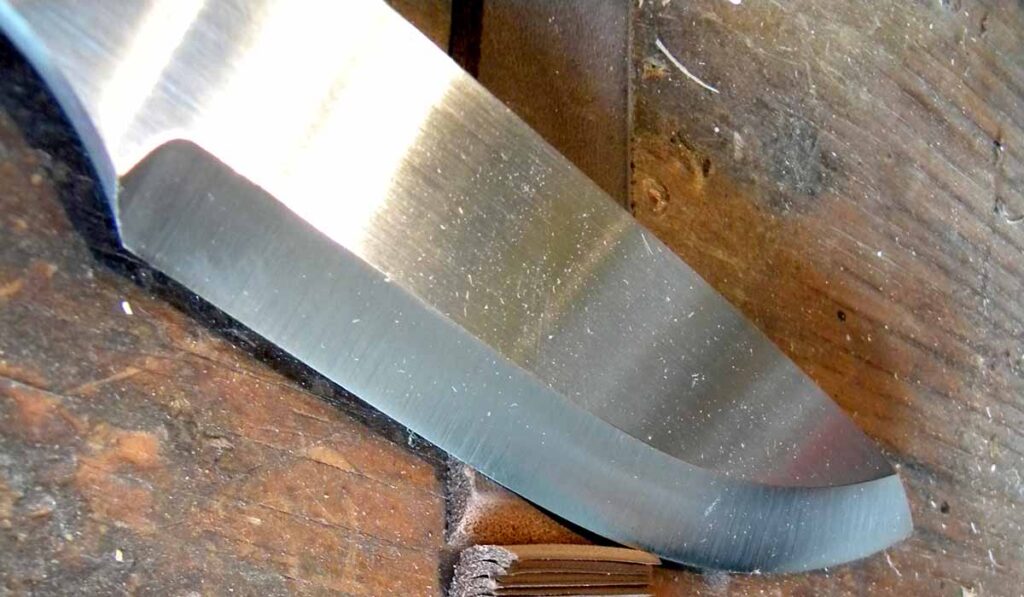
I like to start off by slicing 20-pound bond copy paper because it gives a good idea of edge profile and keenness of the edge. The knife sliced the paper smoothly with no resistance. It’s nasty sharp for sure. Though I’m not a big fan of the chisel grind and Scandi profile edge, each has its place.
The Large Work Knife excelled cutting the 8-ounce leather, providing very fine slices at the same thickness and angle.
I grabbed a piece of double-walled cardboard and commenced cutting. The edge was very aggressive and only a slight rolling of the cut pieces occurred from the Scandi profile edge. The handle made for great control. I really like it. It worked best by using a push cut.
Medium-Duty Cutting
Leather was next. The A2 blade zipped through it very fast. The edge created a nice crunching sound as it went and was very aggressive. The wrapped handle was great at controlling the width of each cut. It was fun to do but be sure to keep your fingers out of the way. Next, I skived 8-ounce leather. The blade made short work of it, providing very fine slices at the same thickness and angle.
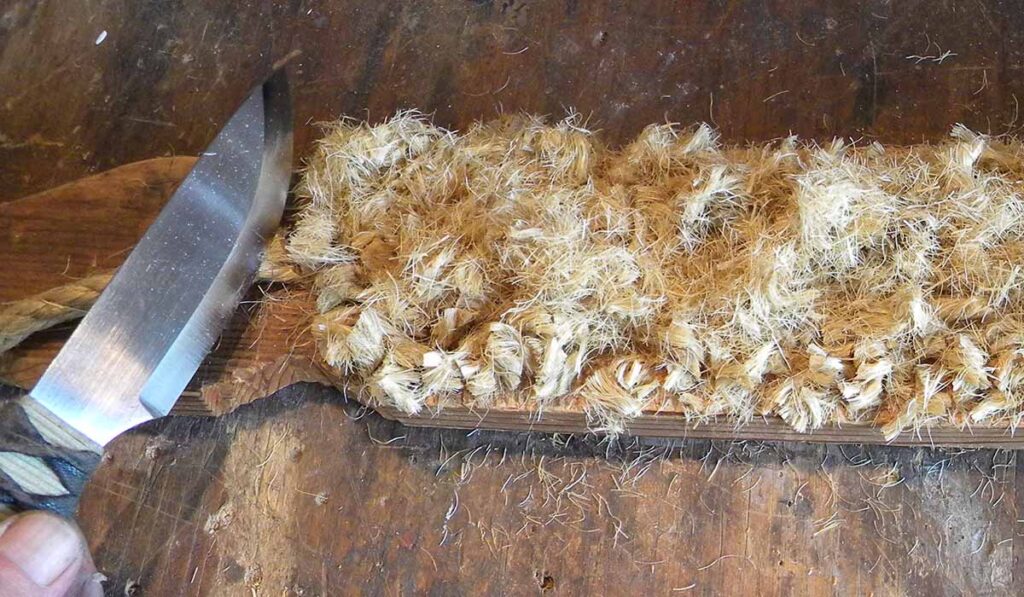
The knife powered through 200 clean, crunching cuts of sisal rope very quickly. The handle was comfortable and provided a non-slip grip with no hot spots.
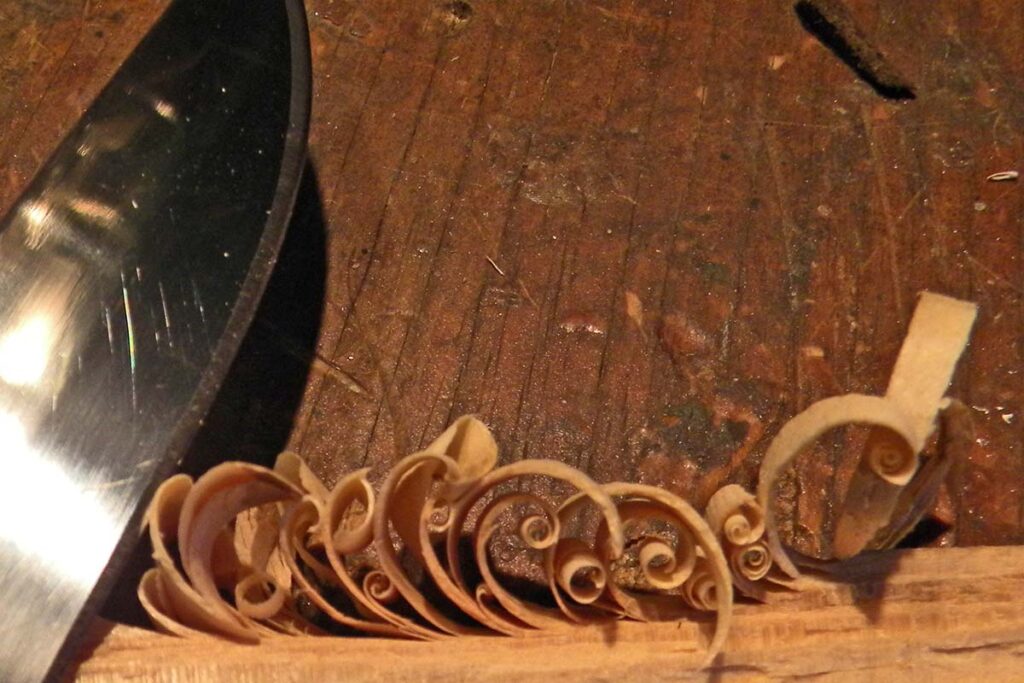
It was time to make firesticks. The knife made great curlicues. Cut depth was very manageable. It was a perfect use for the chisel grind on the correct side for a right hander. Nicely done, KG Handcrafted Bladeware! Woods seems to be the perfect medium for this blade style.
Now for my favorite, cutting sisal rope. The knife powered through 200 clean, crunching cuts very quickly. With no stopping in sight, I ended the cuts before I used up all my rope, another great medium for the chisel grind. The handle is comfortable and provided a non-slip grip with no hot spots.
Heavy-Duty Cutting
I batonned the Large Work Knife through a 1.5-inch-diameter branch. It split the first 2 inches quickly then started to drift to one side the farther down I got. The drifting could have been due to the fact it was old wood or a chisel grind. Either way, it worked with no damage to the knife whatsoever.
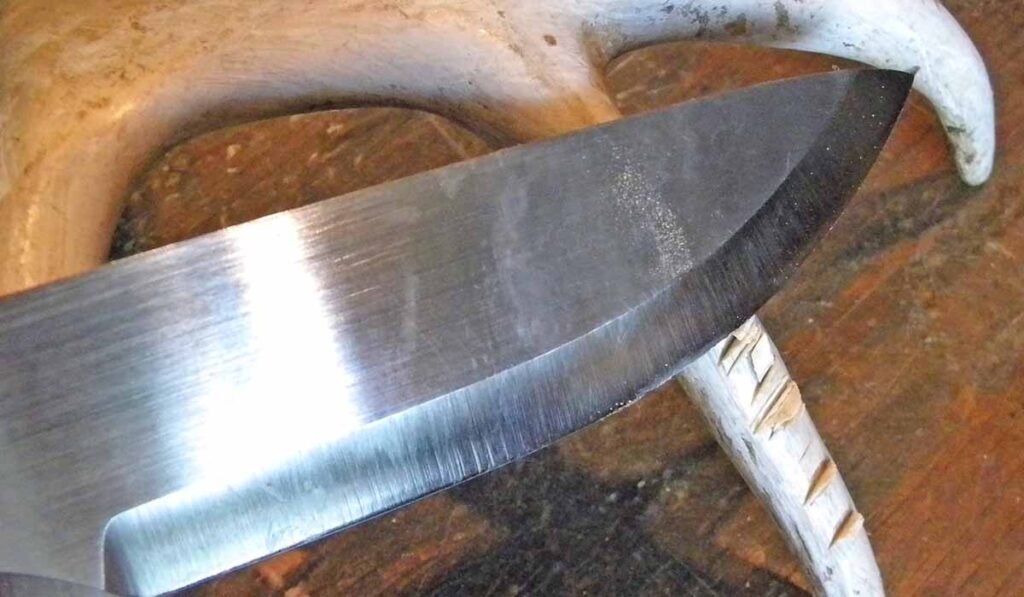
Thirty hard whacks into the antler put some very small chips in the fine edge an inch or so before the tip, as the author expected. When he returned to the copy paper, slicing was smooth with minimal tearing by the chip area. The knife was still nasty sharp.
Chopping deer antler to test how well a blade has been heat treated is not recommended and might void the warranty. I did it anyway. Thirty hard whacks into the antler managed to put some very small chips in the edge, as I expected it would. The fine edge will do exactly that.
Finally, I returned to the copy paper. Slicing was smooth with minimal tearing by the chip area. The knife was still nasty sharp. Job well done!
Overall Take On The Large Work Knife
This knife is well-made for EDC chores. I love the A2 steel. The handle is very comfortable.
Changes
The knife performs well for its designed purpose. I would just run the grind higher.
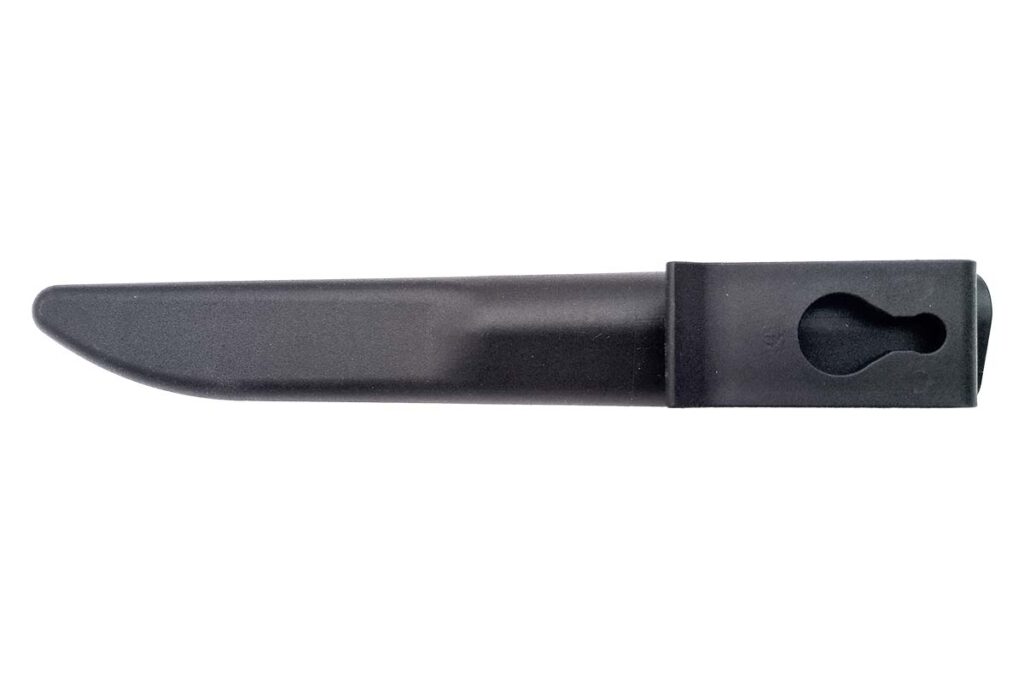
Large Work Knife Specs Maker: KG Handcrafted Bladeware Blade Length: 4” Blade Material: A2 tool steel Blade Grind: Chisel Blade at Thickest: 5/32” Blade Pattern: Semi drop point Handle Material: Waxed cotton string and resin cord wrap Weight: 6 ozs. Overall Length: 8.5” Sheath: Oil-tanned cowhide over aluminum and Kevlar® Weight w/Sheath: 9 ozs. Maker’s Price: $320
Fixed-blade focused Condor continues to branch out Tactical P.A.S.S. Com folder.
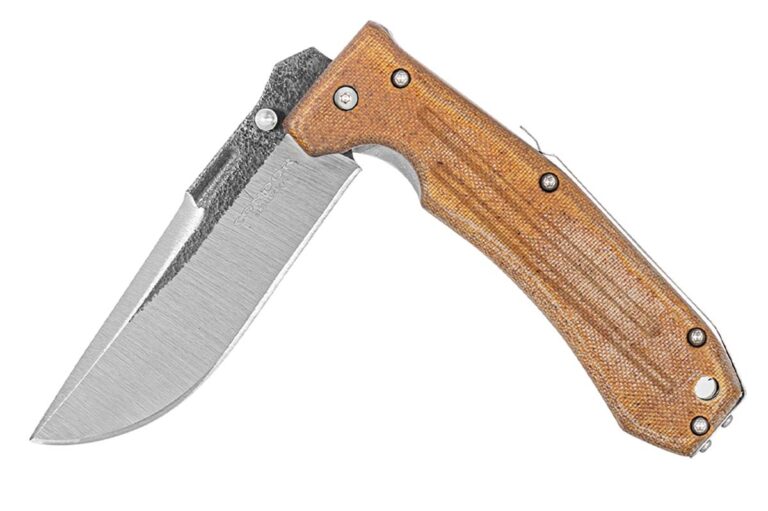
Condor Knife & Tool came heavy into SHOT Show 2024 with a bevy of new blades and variations. The company’s fans should be excited about the coming year. That said, one particular knife jumped — the Tactical P.A.S.S. Com.
Those who follow Condor know its bread and butter are fixed blades, usually the type fit to slice through the El Salvadorian jungle—home base for the company. But the manufacturer continued to branch out with the Tactical P.A.S.S. Com, a folder (not its first, mind you) that makes for an interesting break in Condor’s same old, same old. Trust me, you might be able to tuck it away in your pocket, but it’s every bit up to the company’s rugged standards.
Designed by Jason Breeden, who has conjured up a bevy of designs for Condor, the Tactical P.A.S.S. Com is modeled after an icon—Bob Loveless’ Chute knife. As an aside, Mike Haskew did a phenomenal piece on the development of this classic in his article on the original Chute knife. Breeden appears to have an affinity for the design, having created a more true-to-form fixed-blade rendition of it previously. The folder marks the continued expansion of Condor’s popular Mountain P.A.S.S. (Plain And Simple Survival) line, which has grown significantly in the past year.
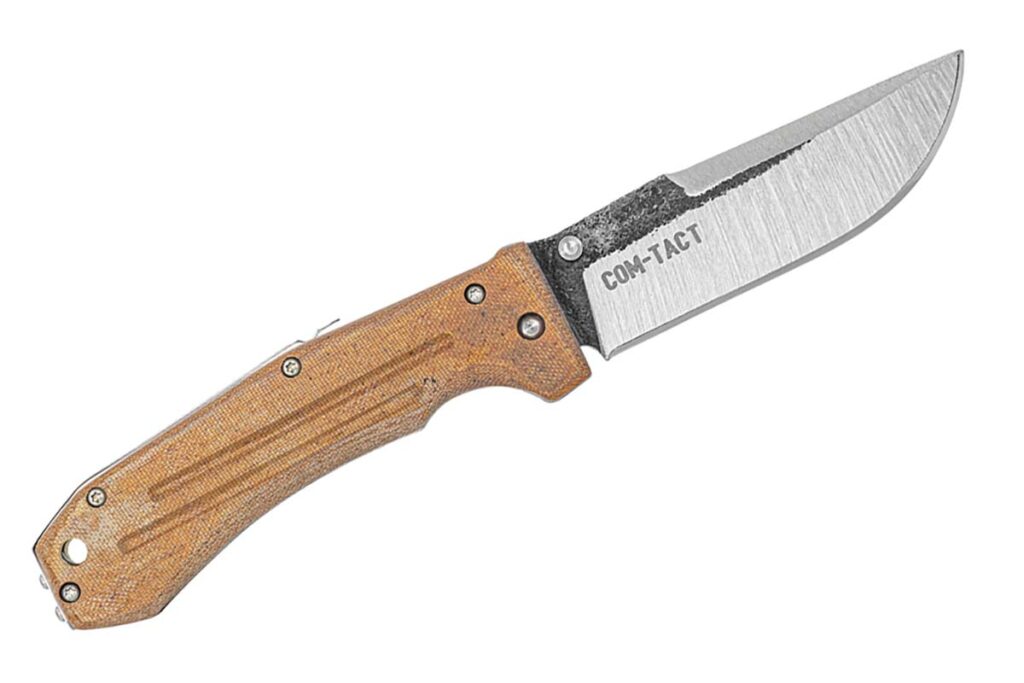
In brief, the knife looks to have the chops for tough outdoor use, as is the typical theme at Condor. Tactical P.A.S.S. Com boasts a 4.96-inch, drop-point blade constructed from 14C28N stainless steel. This is a budget stainless, but one not without its charms, particularly its respectable edge retention and toughness. And at .12 inches in thickness, Condor gives you plenty of material to work with on the flat-ground blade, particularly if called into play on more demanding tasks, such as batoning. I’ll say, the false edge is a nice touch, giving the blade an overall clean, yet rugged look tapering back into the hammer finish around the thumb studs.
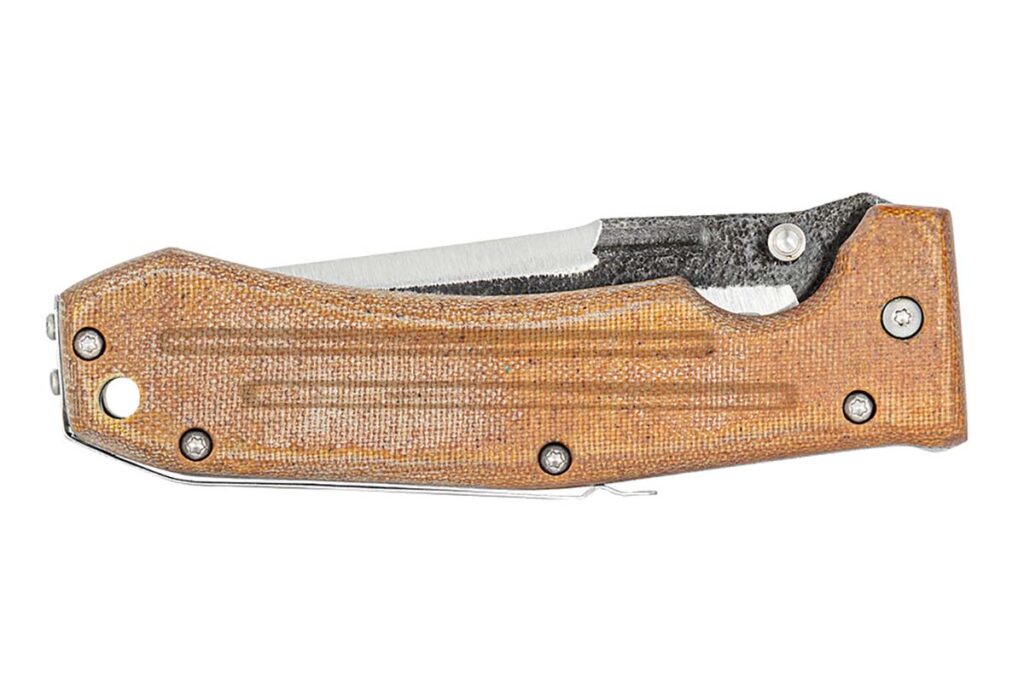
As for the handle, it’s a tan Micarta with some milling down the midline and a single-finger groove to provide a comfortable yet firm grip. The liner lock’s stainless screws give the handle strong, if understated aesthetics, not to mention easy access if you need to crack baby open to clean.
While Condor pulls off a strong showing with the Tactical P.A.S.S. Com, I do have one nit to pick. The company opted for a spine-side, extended clip, which from my standpoint isn’t the most practical configuration. But with everything else the knife brings to the table, it’s far from a deal breaker for those who prefer a more traditional clip arrangement.
As for costs, Condor as usual keeps its edge but puts the Tactical P.A.S.S. Com within reach of most knife consumers. The company lists its MSPR at $150 at its site and has it on sale for less. Overall, the folder is a nice addition to a catalog of fixed blades and certainly seems on par with Condor’s ready-and-rugged standards.
Tactical P.A.S.S. Com Specs BLADE LENGTH: 4.96 in OAL: 9.66 in BLADE THICKNESS: 0.12 in WEIGHT: 7.27 oz BLADE MATERIAL: 14C28N Stainless Steel FINISH: Condor® Classic GRIND: Flat Grind w/ Second Bevel TYPE: Folding Knife HANDLE MATERIAL: Micarta® MSRP: $150
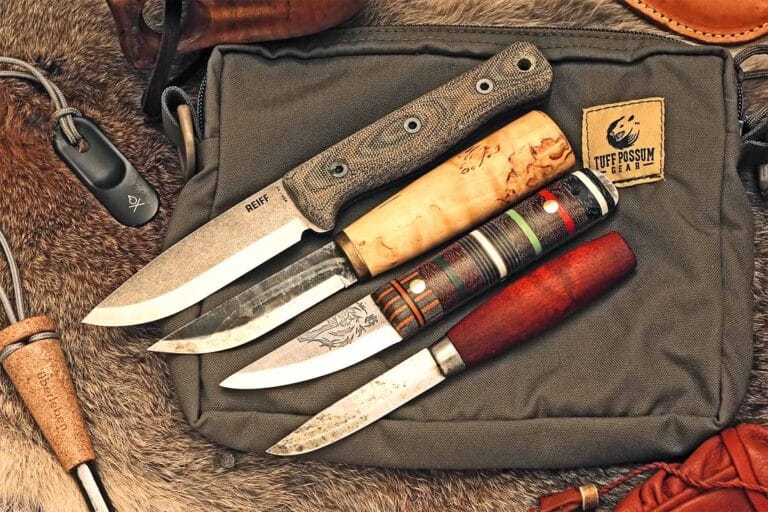
See how well four hot Scandi-ground puukkos cut and handle.
A multifunction knife, the puukko is integral to Nordic life, revered by scouts and symbolizing adulthood in Finland. The design—a palm-sized blade with a single edge and flat back—facilitates various tasks. It is ideal for carving and cleaning but lacks a guard because it’s crafted for slicing, not stabbing, with some models featuring finger grooves for wet conditions.
While men’s and women’s puukkos differ slightly in size and are ornately sheathed, both are equally esteemed. The puukko’s deep-carry sheath, easily attached to a belt or around the neck, makes it a practical tool for everyday use.
Puukko Grinds
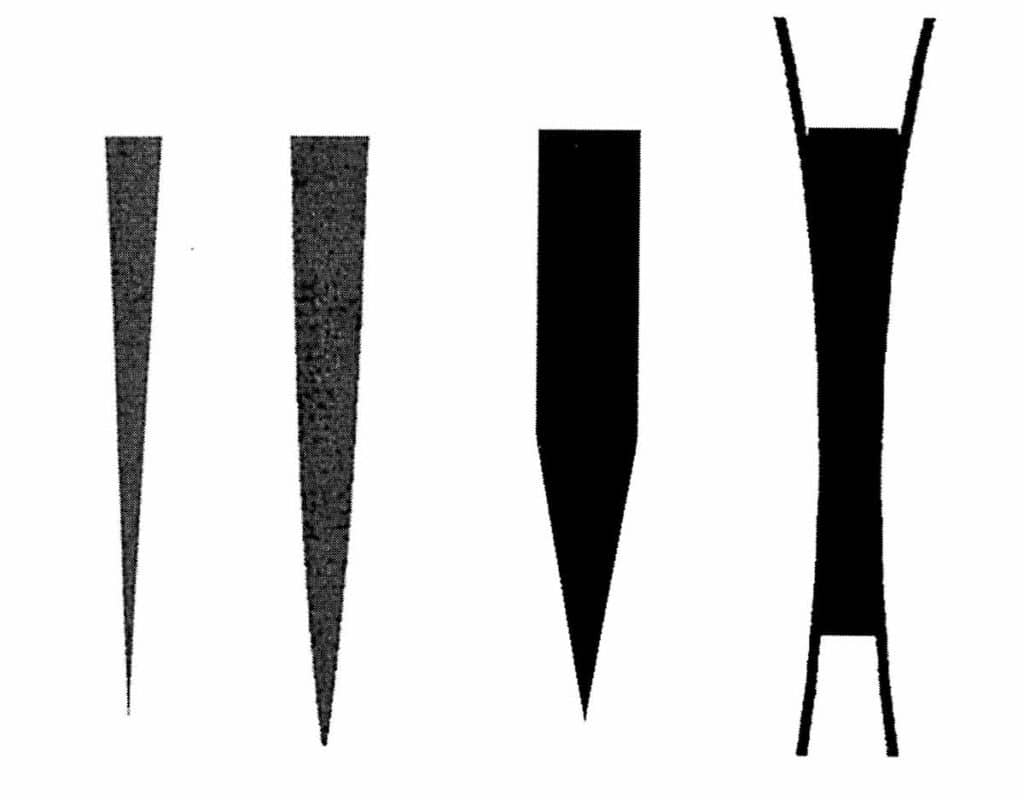
Assorted grinds, from left: flat, convex, Scandi and hollow. (from the BLADE® files)
Scandinavian knives are renowned for the unique grind that sets them apart from other knives with flat, hollow, saber and other grinds. Most knives have primary and secondary bevels that meet at the cutting edge. However, Scandinavian or Scandi grinds feature just one bevel that starts near the blade center and tapers to the edge. The design creates an acute angle that produces a razor-sharp edge, making it incredibly easy to slice through even the most rigid materials. Additionally, sharpening Scandi knives is a breeze, as you don’t have to worry about getting the correct angle. Simply lay the blade on the stone with the edge against the honing surface, and voila!—you automatically get the perfect angle.
Marttiini Arctic Bush Knife
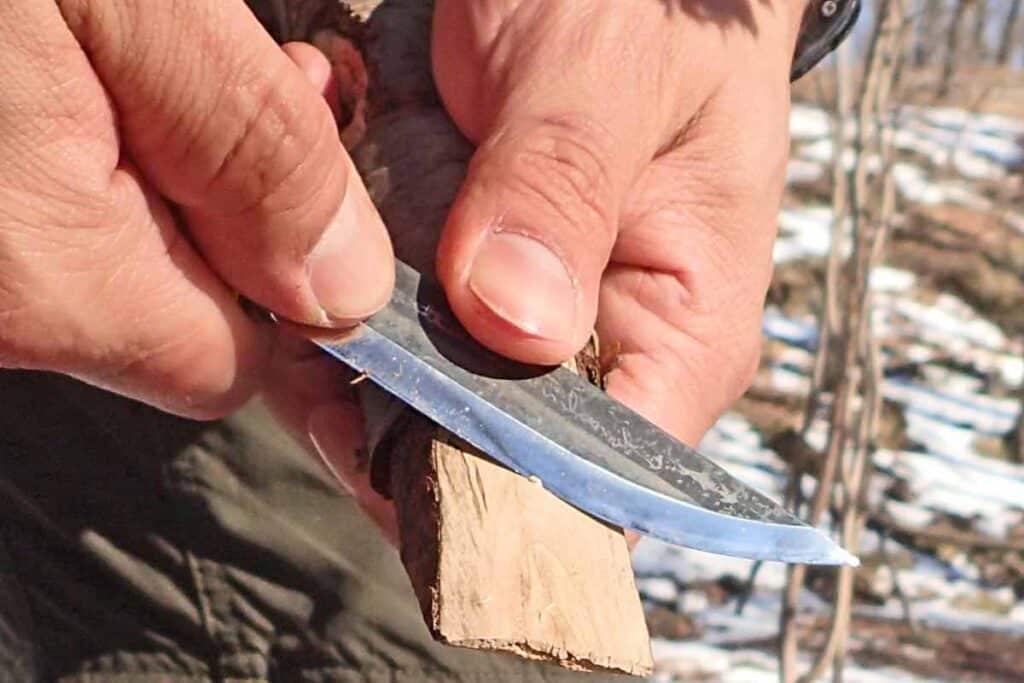
Fine-tuning a wooden wedge using the chest-lever grip with the Marttiini Arctic Bush Knife (ABK) is effortless for precise and challenging cutting tasks.
Marttiini knives are Nordic puukkos crafted in the Arctic Circle using generations of craftsmanship and modern technology. Founded in 1928 by blacksmith Janne Marttiini, the company produces high-quality utility knives made of natural materials like leather, curly birch and reindeer antlers, along with ultra-sharp blades of carbon steel. The knives are designed for use in harsh conditions.
Also known as Kiehinen in Finland, the Marttiini Arctic Bush Knife (ABK) is a beautiful, traditional stick-tang-style knife with a 3.5-inch blade. Made of stunningly grained curly birch, the handle is handsome and incredibly comfortable, a characteristic common to all top puukkos.
The ABK is an excellent choice for those who prefer a blade under 4 inches and have other tools for chopping or sawing. It is easy to use in winter conditions, even when wearing wool mittens or leather work gloves. The deep pocket carry sheath ensures the knife is easy to grip and deploy. Overall, it is an excellent choice for anyone looking for a traditional yet functional knife that offers both comfort and aesthetics.
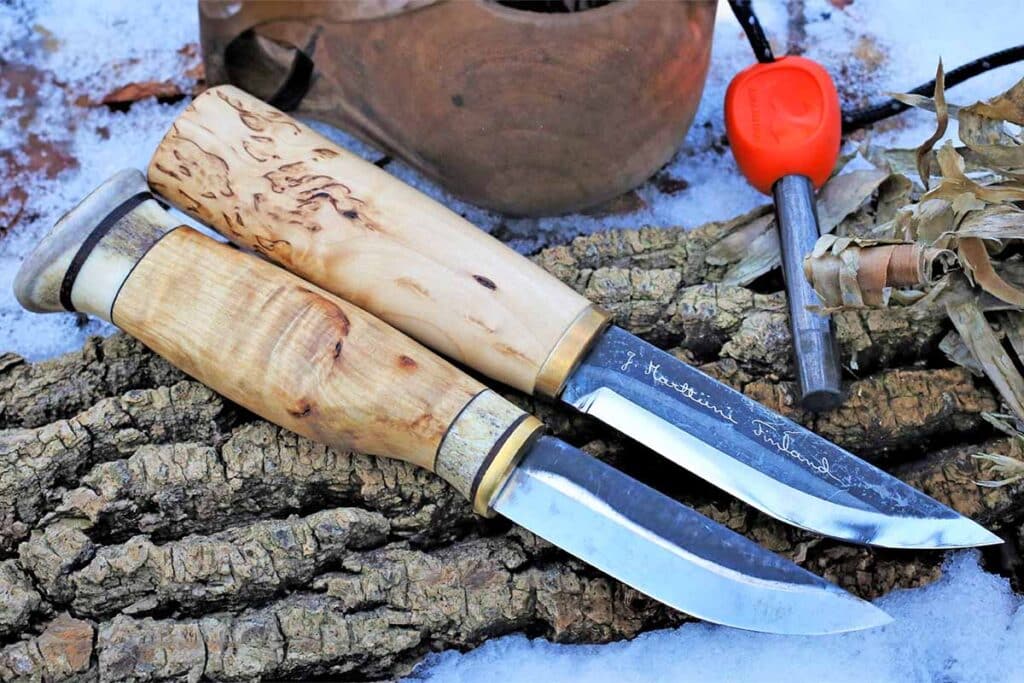
Finland is known for crafting high-quality puukkos that can withstand harsh conditions. It is the world’s largest producer of puukkos. Two of the most popular brands are Marttiini (top) and Wood Jewel (bottom).
This past winter I had to carve hardwood wedges for splitting logs in camp. While axes (page 48) are the traditional tools for the task, I decided to use the ABK instead. It features an oval, tapered grip designed to provide a secure hold during challenging cutting tasks. The Scandi edge sliced through the dry maple with ease, even when encountering knots.
I was pleasantly surprised at how comfortable the knife was in a chest-lever grip for fine carving. I wanted to tackle the task while the knife was still sharp before moving to more knife-suitable camp craft such as making stakes out of beech and maple. In addition to carving wedges, I usually try to turn out about six good fuzz sticks before leaving camp for the next fire—sort of an early set-up. The ABK excels at the task as much as any Scandi blade would, making it a valuable addition to my gear.
Morakniv Classic
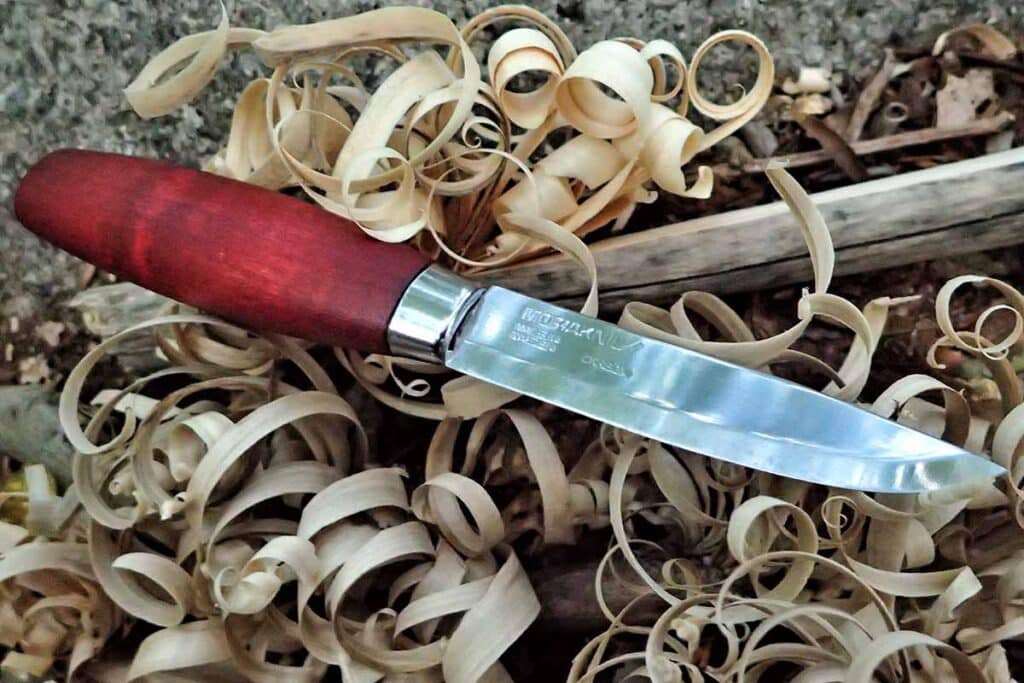
The Classic No. 1/0 has a 3-inch blade designed for carving feather sticks and whittling, making it great for fire preparation.
Morakniv knives are made exclusively in Mora, Sweden, where the company has been for centuries. Combining the benefits of handforged blades with industrial manufacturing, Morakniv is known for quality, consistent, sharp knives. They are recognized as a national symbol of Sweden and have been granted a Royal Warrant of Appointment by the King*.
The Morakniv Classic knives are a popular choice among outdoor enthusiasts and professionals alike. The blades are carbon steel and the distinct barrel-shaped handles are red-stained birch. The Classic knives have been around for nearly a century, and while some changes have been made over the years, the basic design has remained essentially unchanged.
In 2020, Morakniv updated the Classic series. The edge angles and blade shapes remain the same but all the knives have rattail tangs. The new polymer sheath is sleek and polished and features the Swedish Coat of Arms. The belt strap is Swedish vegetable-tanned leather designed to last generations.
The Morakniv Classic No. 1/0 has been renamed and upgraded from the Classic No. 2/0, with slight differences in handle width and blade thickness. The blade is .078 inch at the thickest. I like the trim blade. It is a hair longer than the 2/0 at 3 inches.
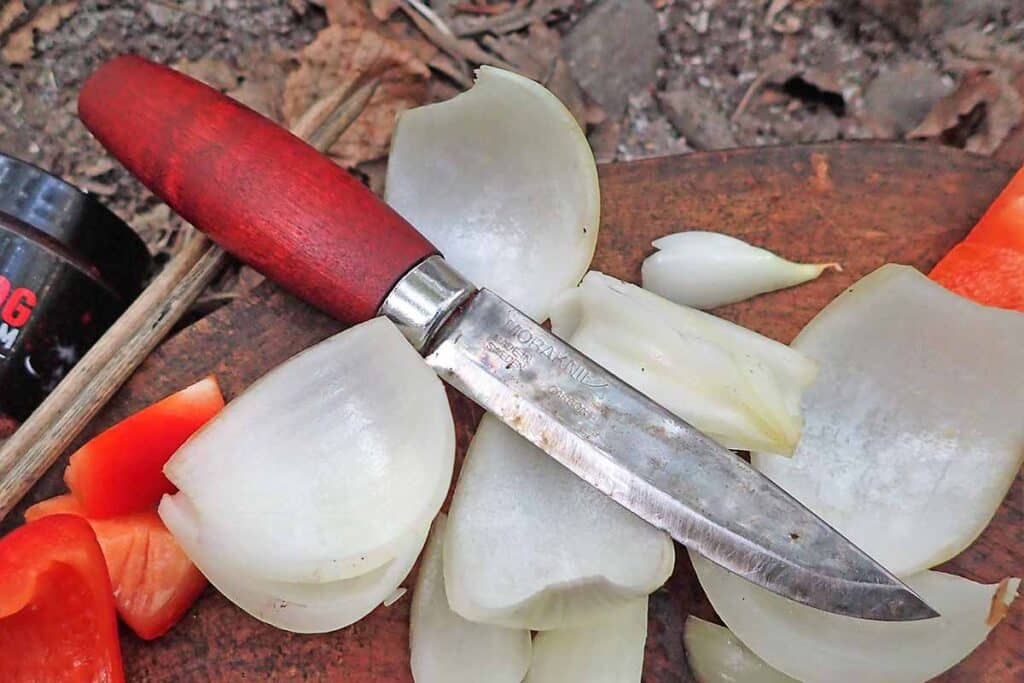
The Morakniv Classic No. 1/0 has a thin .078-inch blade useful for slicing onions, peppers, mushrooms and tomatoes.
I carried the bite-sized knife on a small carabiner hooked to my belt loop. I used it on dry poplar, hickory and maple to make feather sticks. It performed precisely as a Morakniv Classic should, slicing and curling wood with every stroke. Sitting by the fire, whittling and filling up my tinder/kindling coffee can with shavings was my nighttime routine with the 1/0.
The small, very able cutter regularly sliced peppers, onions and mushrooms for camp kabobs or morning omelets. Due to its kitchen knife-like thinness, the blade sliced food exceptionally well for a Scandi grind.
Bear Forest Knives Simple 3
The author used the Bear Forest Knives Simple 3 to carve a seven-notch try stick from semi-dry wood. The sharp zero grind excels on green and dry wood.
Based in the USA, Bear Forest Knives is keeping the puukko knife alive and thriving. The company recently released its latest addition to the Simple series, the Simple 3.
The full-tang Finnish puukko-style knife packs a compact and convenient 3-inch blade of 8670 carbon steel. Its straight-back 90-degree spine and zero Scandi grind ensure remarkable control and precision, making it ideal for intricate tasks. The Simple 3 features an exposed pommel perfect for light hammering tasks, which wasn’t an option on previous knives in the series. The 8670 is typically found in large circular saw blades, much like old-timey puukkos made in Scandinavia. The Simple 3’s compact size makes it highly versatile for various woods tasks.
The Simple 3 is a versatile puukko for camping, bushcrafting or hunting. The 3-inch 8670 carbon steel blade has a straight back, 90-degree spine and zero Scandi grind for control and precision.
Using the knife, I created a mini try stick and enjoyed some woodcarving. The handle was comfortable and filling, while the zero Scandi was perfect for removing a lot of material. I used semi-dry wood, which the Scandi grind works better on than a flat or saber grind. I continued crafting tent stakes and making fuzz sticks, which a puukko excels at most. Additionally, the super sharp spine was exceptionally helpful, as it helped me to ignite the nicely feathered shavings for fire using my ferro rod.
Reiff Knives F4 Scandi Bushcraft
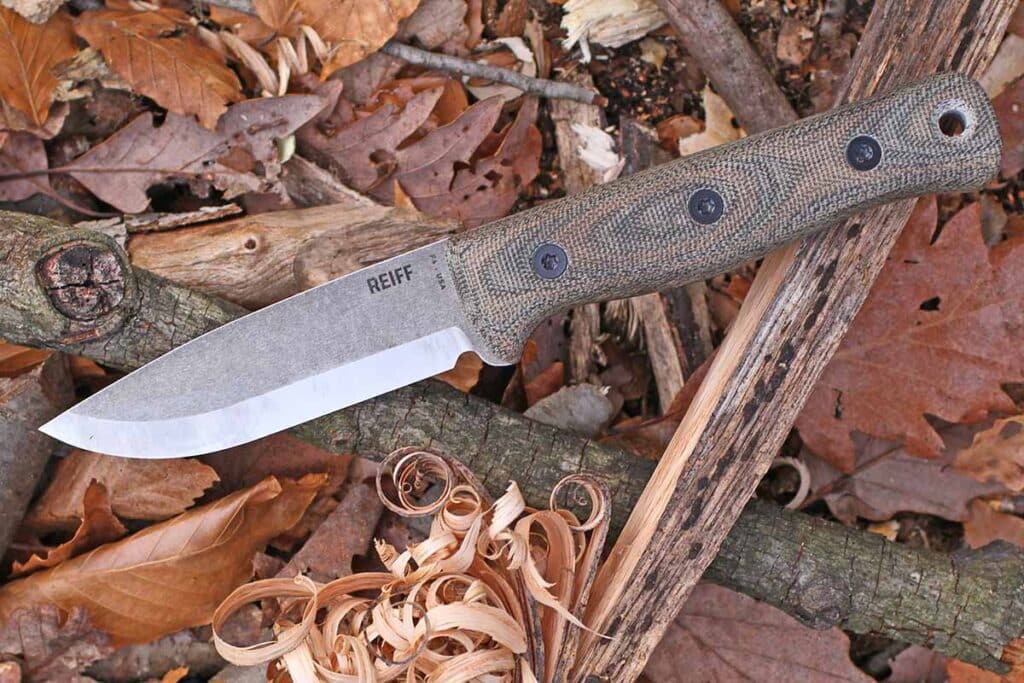
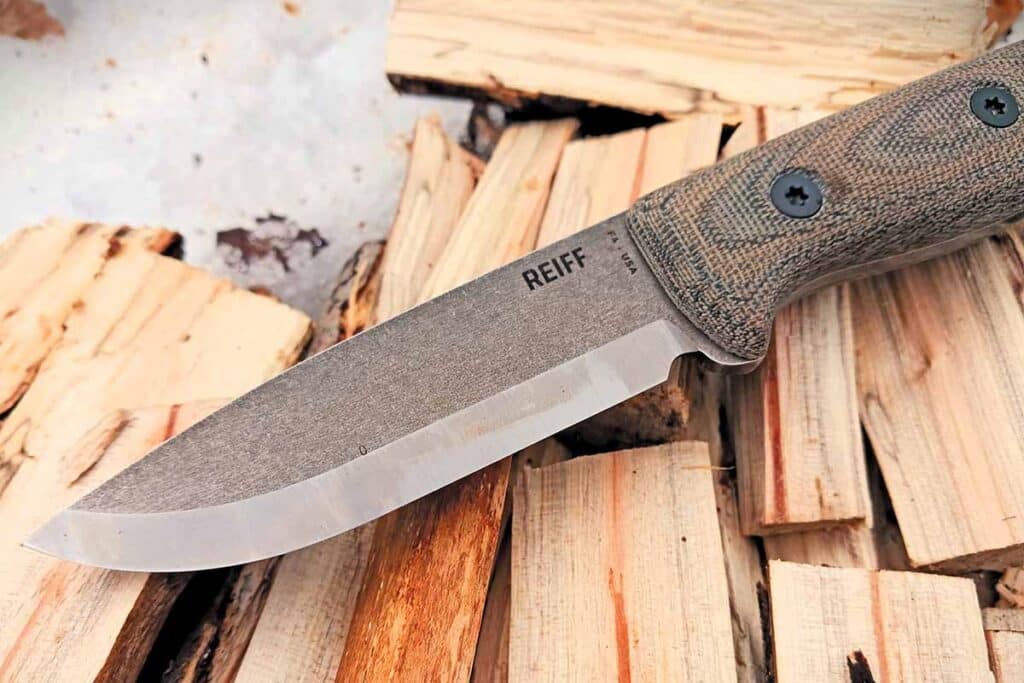
The Reiff F4 Scandi Bushcraft made feathering wood a breeze. The large handle helped ease the blade through hard oak to make thin, curly feathers.
The F4 Scandi Bushcraft is the latest homage to the puukko from Reiff Knives. The company keeps the contemporary rendition of the famed knife alive with modern craftsmanship and materials in a full-tang construction.
A knife with a Scandi-ground blade is a must-have for bushcraft enthusiasts. The F4 blade is CPM 3V carbon steel 5/32 inch thick at the thickest with a steep grind angle of 12.5 degrees per side. Its ability to effortlessly slice through wood, animal hides and food is remarkable. The textured canvas Micarta® scales are available in four colors.
The F4 Scandi is a new breed of knife that, thanks to the tough CPM 3V carbon blade steel, had no problem batonning through frozen wood in the winter.
The robust F4 Scandi helped split several chunks of maple, oak and poplar with a baton for my winter cookouts. It also kept an Uberleben wood stove and one cold hiker well-fed. The Scandi edge was not damaged when used on frozen wood in freezing weather. After heavy splitting—not usually recommended for a Scandi blade—it was time for tinder shavings. I made several fuzz sticks and marveled at how comfortably the 5-inch handle navigated the edge, elegantly feathering the wood. Reiff has it going on!
*Royal warrants of appointment have been issued for centuries by royal families of assorted European countries to tradespeople who supply goods or services to a royal court or certain royal personages. The royal warrant enables the suppliers to advertise the fact that they supply to the issuer of the royal warrant, thus lending prestige to the suppliers.
Check Out More Outdoor Knives:
BEST TOMAHAWKS: OUR TOP HAWKS FOR BACKWOODS TO BATTLEFIELDS
A very simple and practical design, Cold Steel’s Laplander-inspired knife cuts through chores.
It’s nice to see a lightweight knife that can fill a multiple range of uses. While attending Norway’s ski school, I was introduced to the Laplander style of knife.
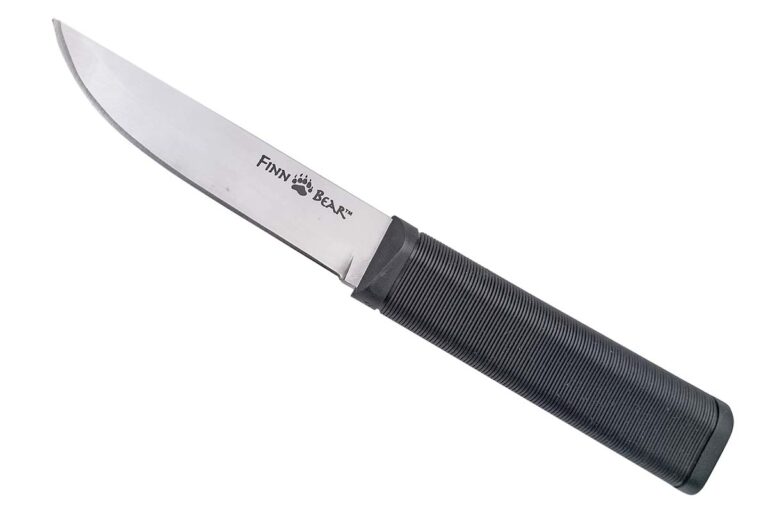
Very light and super sharp, it is used for most every cutting chore. The Cold Steel Finn Bear reminds me of such knives. And don’t let the thin blade fool you, it’s a sturdy cutting instrument.
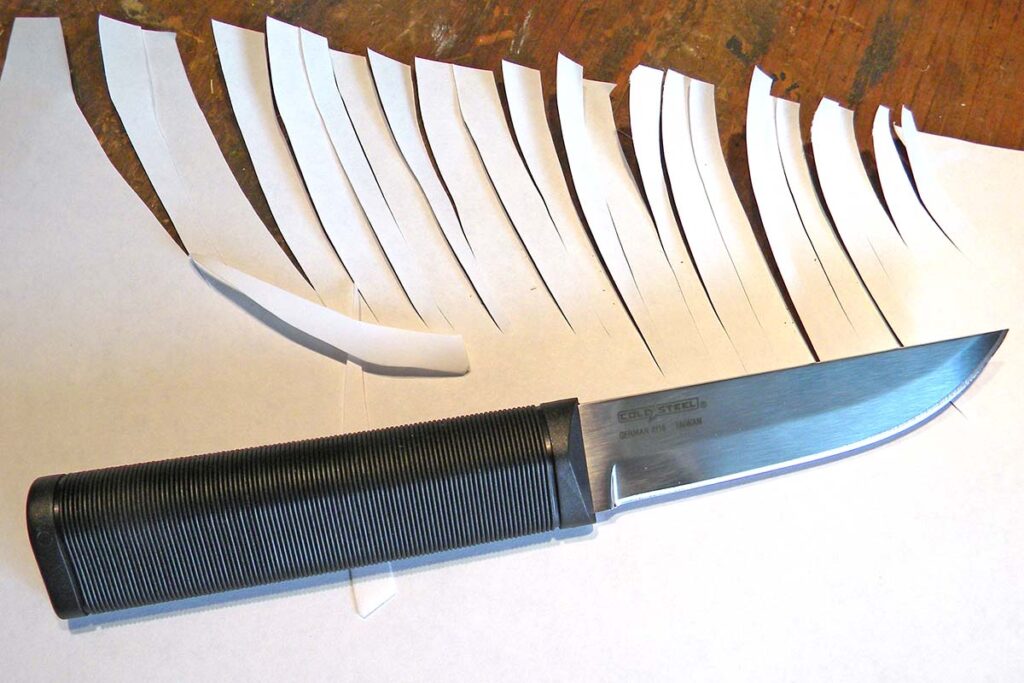
The author checked the new edge for sharpness on the copy paper and the blade sliced quickly and smoothly.
Slicing 20-pound bond paper checked the new edge for sharpness. It sliced quickly and smoothly. I had to move my fingers quickly so I didn’t nick myself. It was a great factory edge to start off with.
Finn Bear Light-Duty Cutting
Double-walled cardboard was next on the docket. Again, the Finn Bear was very smooth in its slices. It worked faster with a push cut rather than a pull cut. The knife made full-blade-length slices. The edge was very aggressive. The tear-drop handle shape designed by Tapio Wirkkala provided great control.
I fetched a piece of scrap 8-ounce leather to slice next. The material offered no resistance to the super-sharp blade. I could hear the edge biting into the leather. It was hard to control the depth of cutting as the blade zipped straight to the bottom of the medium.
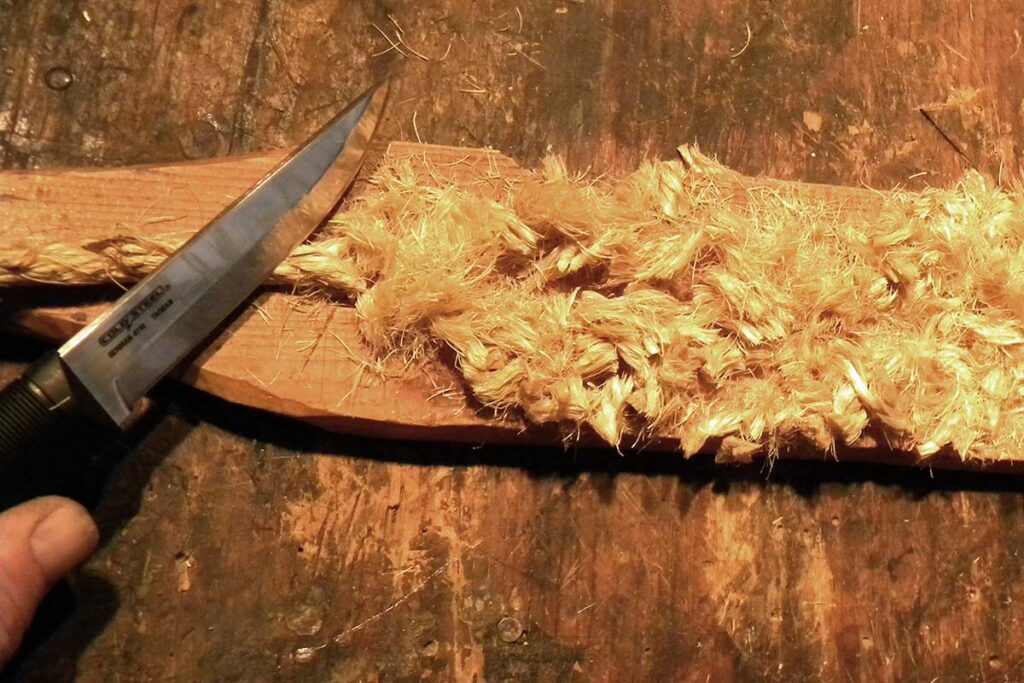
The Finn Bear quickly made 200 cuts in the half-inch sisal rope and was ready for more.
Using the other side of the leather strip, I did some skiving. The blade was very aggressive and cut as fast as I could move my fingers out of the way. It rendered smooth slices in the animal skin with hardly any pressure. I could hear the leather crunching sound with each pass. The tear-drop handle was very controllable.
Finn Bear Heavy-Duty Cutting
It was time to whittle a firestick from pine/fir wood. The Finn Bear produced the best curlicues I’ve seen in a long time—smooth wood cuts with multiple curls on each whittle. Performance at the task was excellent.
Next up: baton the knife into a 2×3. The thin blade split the wood in no time with no edge damage. Gripping the handle tighter to control the knife made the bottom of the tear drop seem too pointy for the shape of my hand—not uncomfortable, just harder to grip.
The Finn Bear produced the best curlicues the author’s seen in a long time—smooth wood cuts with multiple curls on each whittle.
It was on to the half-inch sisal rope. The Finn Bear quickly crunched to 200 cuts and was ready for more. I had to change my grip to more of a sidewinder style. I couldn’t place my thumb on the spine because of the blade’s thinness. No matter how I held the knife, it cut the rope. The knife is very sharp indeed.
Finn Bear Edge Retention Test
For the final test, it was back to the 20-pound bond paper. The Finn Bear sliced the medium just as quickly as the first time. I did have two tears in the paper but that was due to it being soggy. It rained the whole time I was testing.
Final Cut
A sturdy integral clip attaches the synthetic pouch sheath to a vest, pack, etc.
I would make the bottom of the handle a tad wider for a better grip. The Finn Bear is a “should have” knife. It’s lightweight and cuts like the wind. It’s perfect for everything from camp chores up to chopping.
No need to go big to make a large impact, as these small fixed blades more than prove.
Few knives capture the spirit of cut as well as small fixed blades. The ideal size for makers of all skill levels to recreate, they never cease to amaze in their various blade and handle shapes, materials and other differences in design features so slight as to be almost imperceptible to all but the most discerning eye.
Neal Green and Christopher Adelhardt: Kwaiken
The Kwaiken by Neal Green and Christopher Adelhardt comes in a 3.5-inch blade of CPM 154 stainless, and an ironwood handle with G-10 liners and a brown tsukamaki (handle wrap). Overall length: 7.25 inches. It comes with a leather sheath (not shown) by Adelhardt. (Jocelyn Frasier image)
Peter Cocks: Hunter
Australian Knifemakers Guild member Peter Cocks won Best Hunter at the 2025 Perth Knife Show for Slug Life in a 3.55-inch blade of a flat-ground mosaic damascus of 1084 carbon and 15N20 nickel alloy steels. Scales: ringed gidgee. (Rod Hoare image)
Tracy Jones: Cowgirl
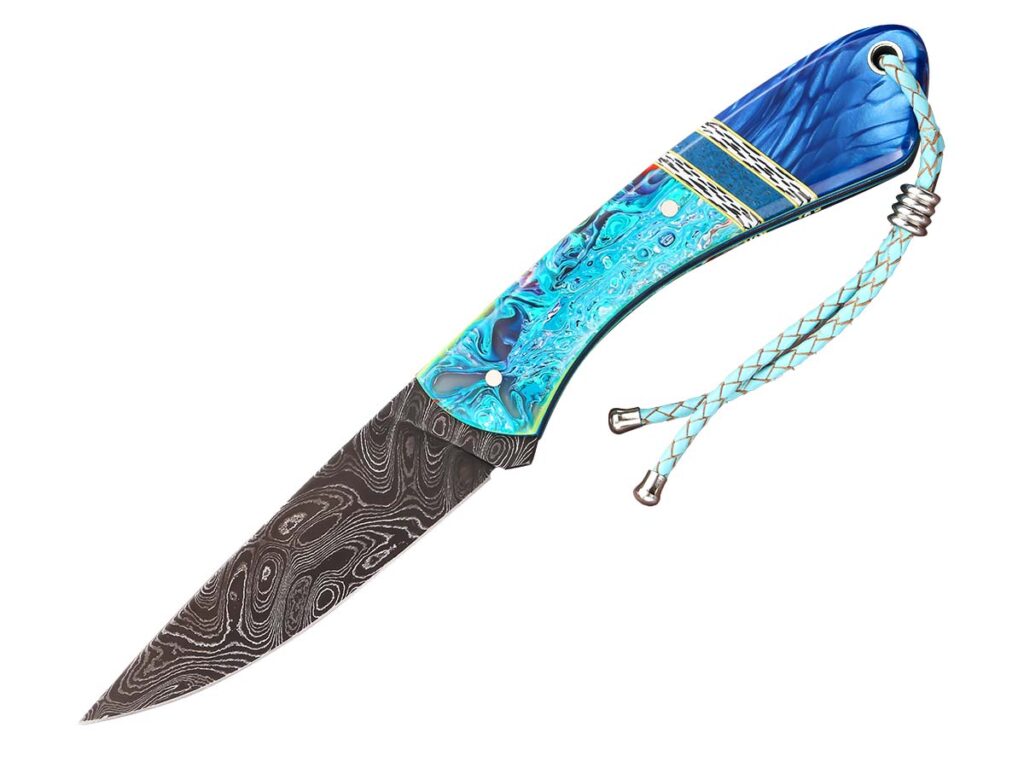
Cowgirl by Tracy Jones earned the maker the Best General Member award at the 2025 Texas Select Custom Cutlery Event. The 4-inch blade is flat-ground damascus and the scales are by Sara. Overall length: 8 inches. (SharpByCoop image)
Daniel M. Gutierrez: Utility Fixed Blade
Daniel M. Gutierrez: Utility Fixed Blade
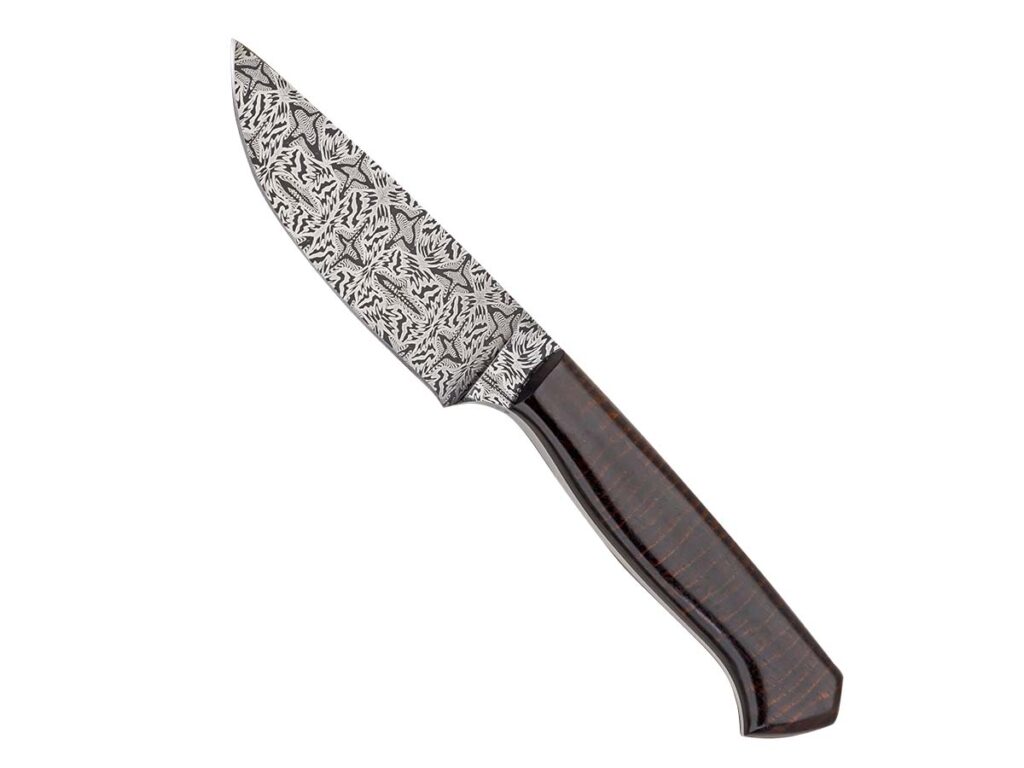
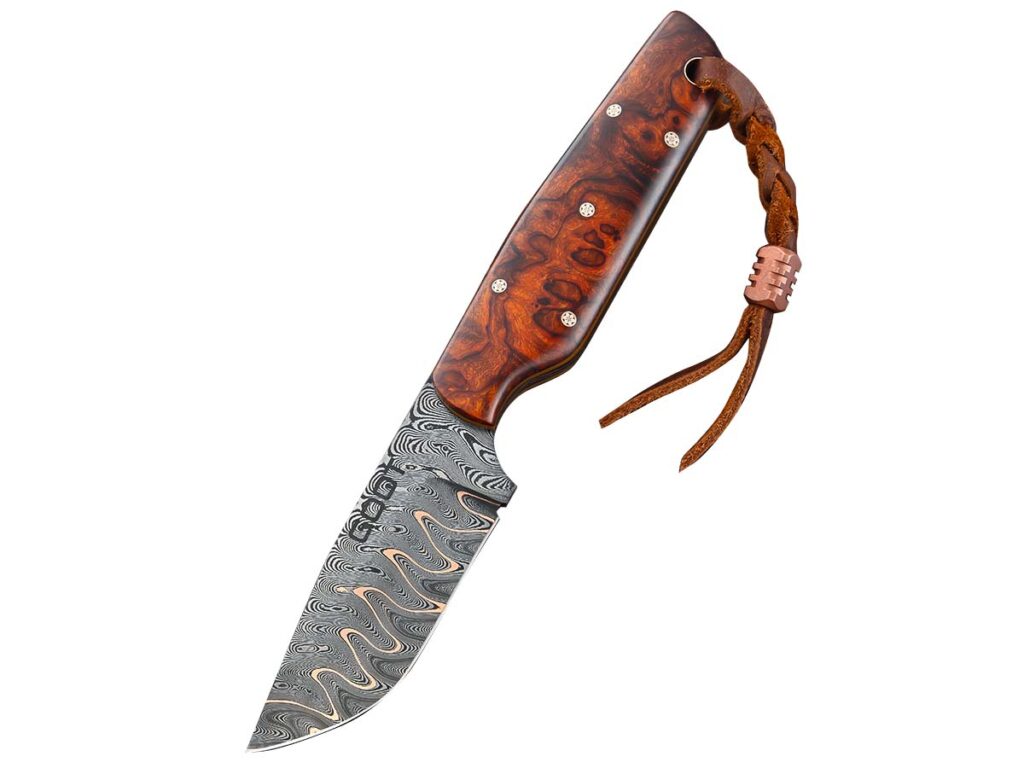
A 3-inch blade of a damascus of 1084 carbon and 15N20 nickel alloy steels and copper shim forged by Baker Forge & Tool, and a handle of ironwood burl help complete a utility fixed blade by Daniel M. Gutierrez. Blade grind: flat. Overall length: 7 inches. (SharpByCoop image)
Chad Jones: Panther Fixed Blade
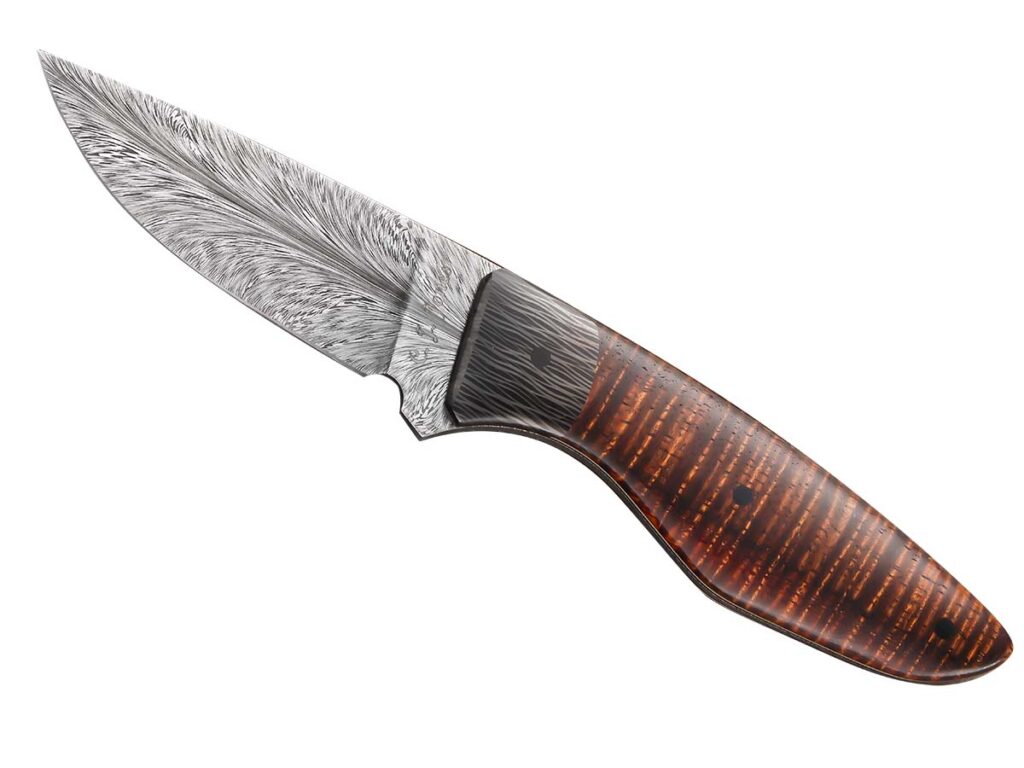
Chad Jones captured the title of Best Ranger Member at the 2025 Texas Select Custom Cutlery Event for his Panther fixed blade. The 3.25-inch blade is feather damascus and the scales are zebra carbon fiber and curly koa. Overall length: 7.25 inches. (SharpByCoop image)
Jason Howell: EDC Fixed Blade
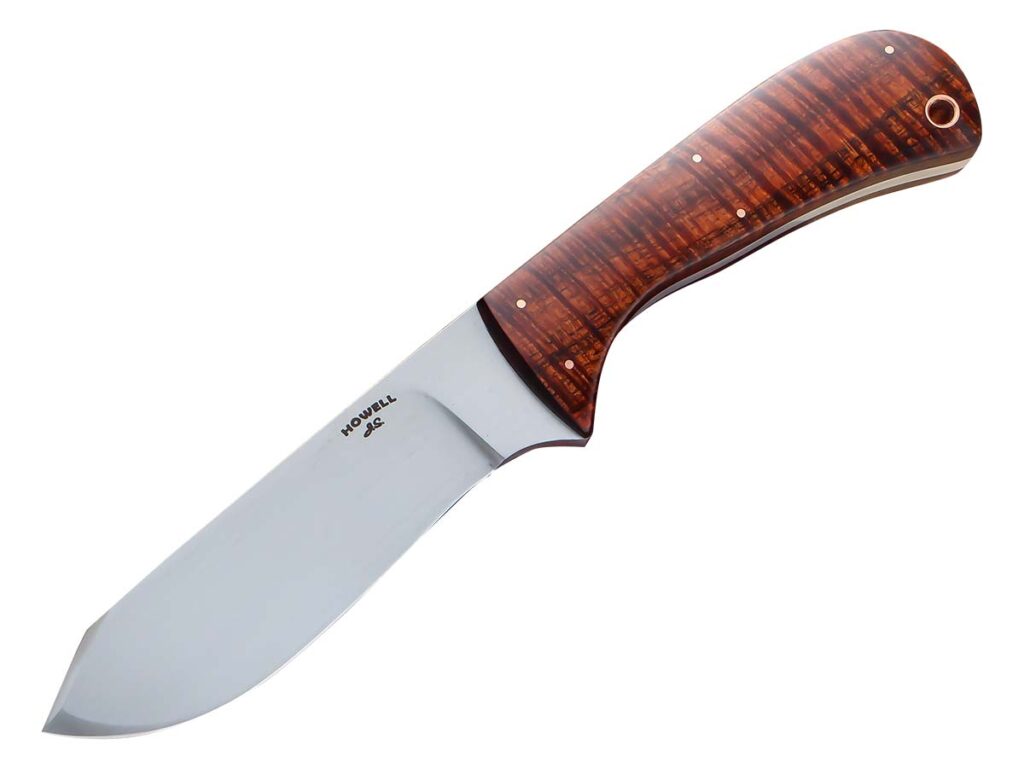
Jason Howell won the award for Troop 36 Scout Favorite at the 2025 Texas Select Custom Cutlery Event for his EDC fixed blade. The 3.75-inch spey blade is flat-ground 52100 carbon steel and the scales are French walnut. Overall length: 8.75 inches. The pouch sheath (not shown) is by Richard Epting. (SharpByCoop image)
Dr. Terry Schreiner: Brown Trout Bird & Trout Knife
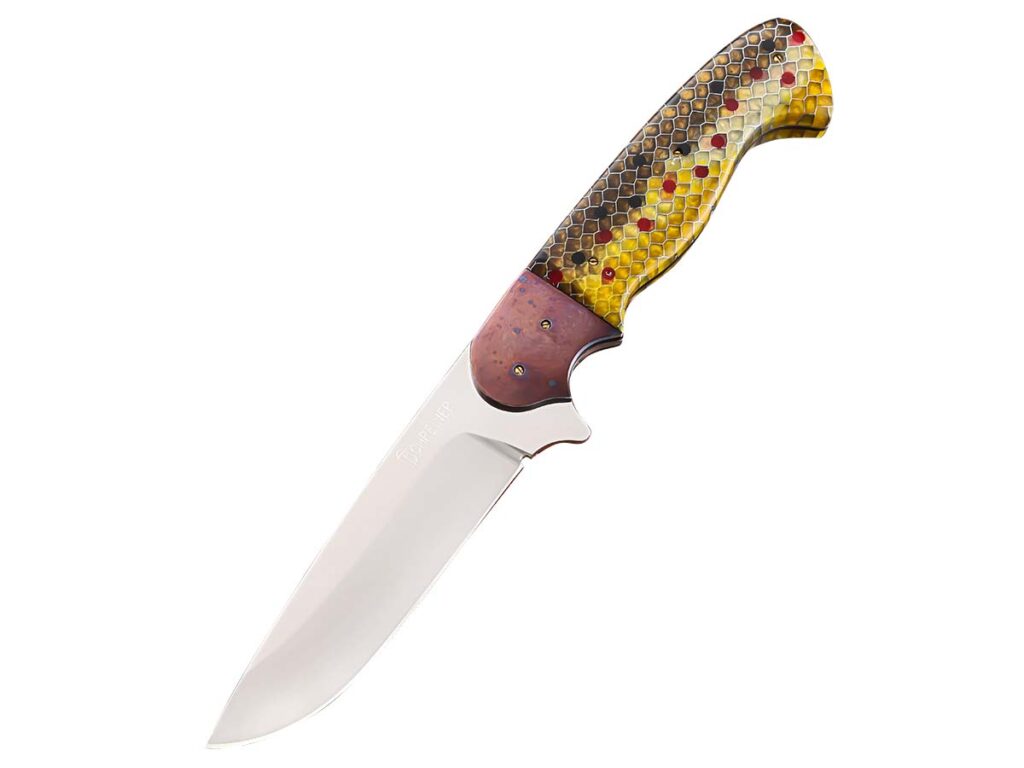
The brown trout/bird & trout knife by Dr. Terry Schreiner has a 4 1/16-inch blade of flat-ground CPM 154 stainless. The scales are a brown trout acrylic and the bolster is O1 tool steel. Overall length: 8 7/8 inches. (SharpByCoop image)
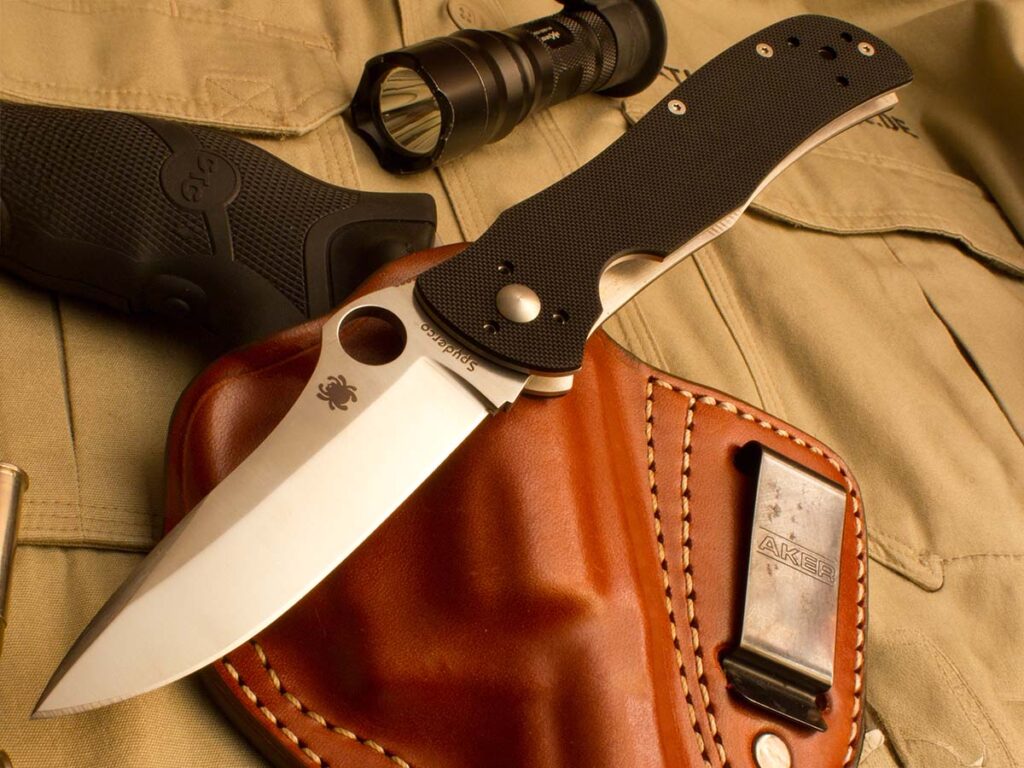
Sprint Run Spyderco Starmate salutes Bob Terzuola and Sal Glesser.
“If I have seen further than others, it is by standing upon the shoulders of giants.”—Isaac Newton
Although Newton penned these words centuries ago, the spirit of his quote is timeless. Applied to the world of knives, today’s high-performance, state-of-the-art tactical folders are the direct result of two cutlery industry giants: legendary custom knifemaker Bob Terzuola and Spyderco co-founder Sal Glesser.
Both members of the BLADE Magazine Cutlery Hall of Fame®, independently these men each had a tremendous influence on the knife world. However, when they joined forces their impact was even more profound. One of their more influential collaborations was the Starmate, which combined the best elements of Terzuola’s iconic ATCF (Advanced Technology Combat Folder) and Glesser’s revolutionary CLIPIT platform.
To celebrate the 25th anniversary of this pivotal design—and commemorate several other important historical landmarks as well—Spyderco has introduced a limited-edition Sprint Run expression of the Starmate. To truly appreciate the knife, however, you need to appreciate the men behind it.
Brooklyn Boys
Sal Glesser (left) and Bob Terzuola (right).
Robert G. Terzuola was born in Brooklyn, New York, on Sept. 14, 1944. A diligent student, he earned a full scholarship to New York University, where he majored in vocational education. Upon graduation, he joined the Peace Corps and served in a variety of roles in Panama, Puerto Rico and Guatemala. During that time, he taught himself the art of jade carving and ultimately became the general manager of a jade jewelry company in Antigua, Guatemala. There he met Col. James Atwood, a former U.S. military intelligence officer, military edged weapons historian and CIA contract worker. Recognizing Terzuola’s skills as an artisan, Atwood suggested he try his hand at knifemaking and introduced him to many of his earliest customers—adventurers and soldiers of fortune in Central America.
With Atwood’s encouragement, in 1980 Terzuola began crafting handmade fixed blades. In 1982, he joined The Knifemakers’ Guild based on endorsements from the legendary Bob Loveless and Frank Centofante, Cutlery Hall of Famers in their own right. That same year Terzuola met Glesser at the New York Custom Knife Show.
A fellow Brooklyn native, Sal was—and still is—a passionate entrepreneur and inventor. He operated several successful businesses before he and his wife Gail founded Spyderco in 1976. Sal’s first knife-related product was the Tri-Angle Sharpmaker, an improved expression of the ceramic Crock Stick knife sharpener he and Gail sold at fairs and shows across the country.
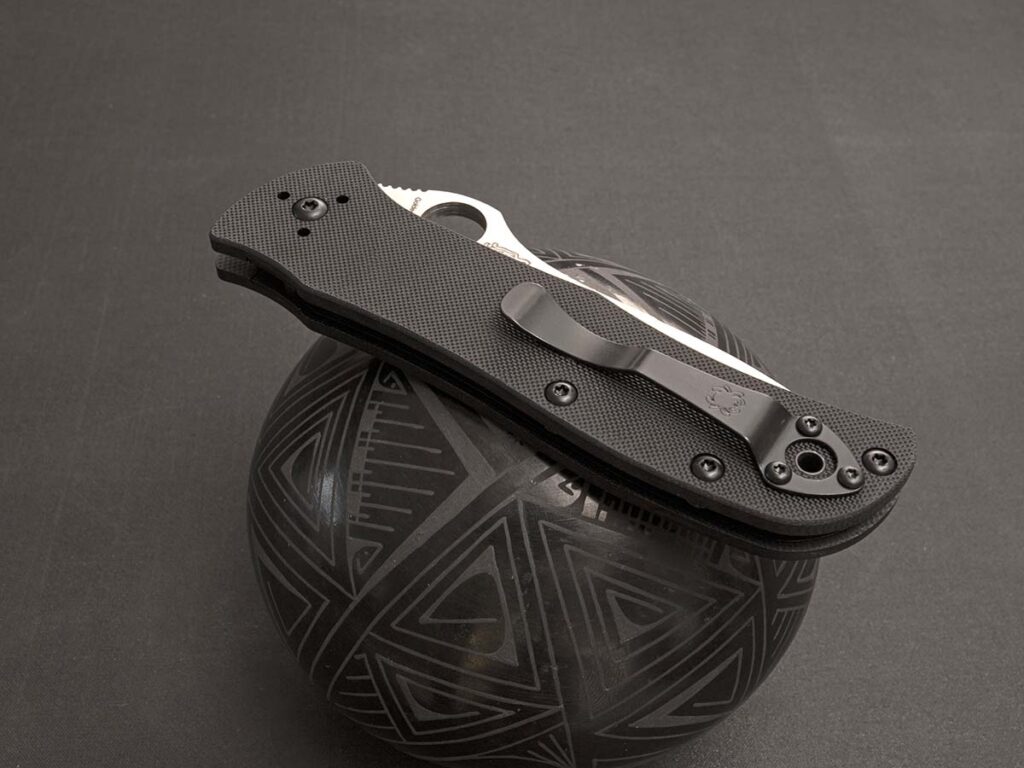
A broad-based, four-position pocket clip supports all carry modes for the revival of the Starmate.
In 1981, Sal introduced the first Spyderco knife: the Worker. Its revolutionary design was the first to include a pocket clip for convenient, top-of-the-pocket carry and Spyderco’s signature Trademark Round Hole for swift one-hand opening with either hand. The inaugural member of Spyderco’s groundbreaking CLIPIT family, a year later the Worker was also the first commercial folder to offer the aggressive cutting power of a serrated blade. Together, these features defined the form of the modern folding knife that still endures today.
Synergy For SpyderCo
When Bob first met Sal at the New York Custom Knife Show, he was impressed with Sal’s showmanship as a salesman of the Sharpmaker. Terzuola was equally taken with the CLIPIT folding knife concept and its revolutionary features. Similarly, Sal appreciated the impeccable craftsmanship of Bob’s knives and their no-nonsense style. The fact that both men hail from Brooklyn gave them additional common ground, and they quickly became good friends.
In 1984, Terzuola moved to Santa Fe, New Mexico, and began making knives full time. A year later, he learned the intricacies of making a linerlock folding knife directly from its inventor, renowned custom knifemaker and Cutlery Hall-of-Famer Michael Walker. Bob also asked Sal’s permission to incorporate the pocket clip into his folding knife designs. Sal not only gave Bob his blessing but generously sent him a box of Spyderco’s early three-screw clips.
Eric Glesser (right), today’s driving force behind Spyderco, was the catalyst behind the Starmate project.
Armed with the knowledge he had learned from Michael Walker and the inspiration of Sal’s CLIPIT concept, Terzuola turned his focus toward making folding knives. His first two designs—the Model 1 Utility and the Model 2 Mariner—were primarily utilitarian in nature. Both offered one-hand opening via a thumb disk, which Terzuola pioneered, and early versions were crafted with Spyderco clips.
After the success of those designs, Bob turned his focus back to the needs of his original clientele—soldiers and armed professionals—to create a low-profile, no-nonsense folding knife suitable for both defensive and utilitarian use. His third folder design, the ATCF, became Terzuola’s most iconic model, and Bob was attributed by many with coining the term “tactical folding knife,” aka “tactical folder.” With that, he became a pioneer of the genre.
First Collaboration
At the 1989 SHOT Show, Sal and Bob were discussing Spyderco’s growing line of CLIPIT knives when Bob commented that, despite their groundbreaking features, they were ugly. Sal quickly countered with an offer: “You design a pretty one and I’ll make it.” Terzuola took Sal’s challenge to heart and not only delivered a design that showcased both his personal style and Spyderco’s Trademark Round Hole, but a series of specific conditions for its production.
Spyderco ultimately discontinued the first-generation Starmate but reintroduced the knife in 2012. Crafted in Japan, the reintroduction featured full stainless-steel liners and a VG-10 stainless steel blade.
That design, the C15 Bob Terzuola, established Bob as Spyderco’s first collaborative designer. It also made history as the company’s first made-in-the-USA model, the first Spyderco knife to feature a linerlock, the first production knife to use ATS-34 stainless blade steel, the first factory-made knife to use a laser-cut blade, and the first CLIPIT to offer two-position carry. Introduced in 1990 with machined aluminum scales, in 1994 it made history again as the first factory knife to feature a G-10 handle. It was later joined by a smaller counterpart, the C19 Bob Terzuola Jr., which also was made with both aluminum and G-10 scales.
The Starmate
By 1999, Terzuola had established himself to many knife enthusiasts as the “Godfather of the Tactical Folding Knife” and among the world’s premier custom makers. Drawing inspiration from his acclaimed ATCF and his Century Starfighter designs, he partnered with Spyderco again to create the Starmate.
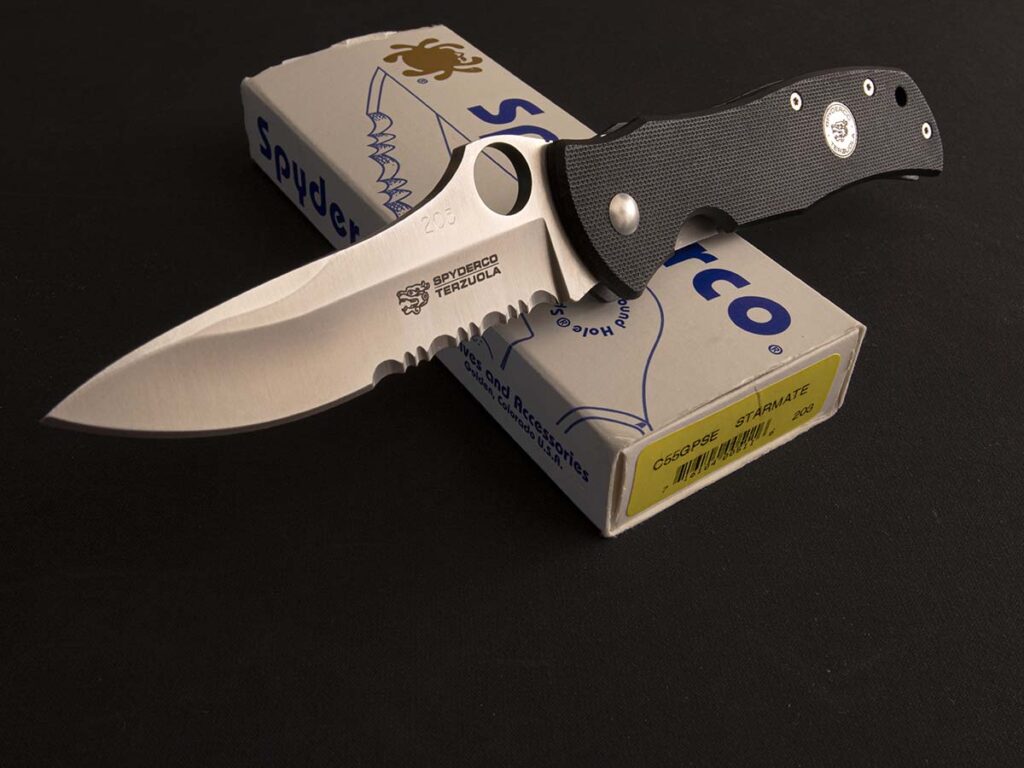
Manufactured in Golden, Colorado, the original Starmate featured a hollow-ground blade crafted from CPM 440V particle metallurgy stainless steel, smooth black G-10 scales, a single, nested stainless-steel liner, a linerlock, a round Spyderco/Terzuola inlay, and a pocket clip with a broad, triangular base configured for right-side, tip-down carry. It was produced in both PlainEdge and partially serrated CombinationEdge formats, and was an immediate hit with serious tactical knife users.
The original Spyderco Starmate was introduced in 1999.
Here’s a first-generation model with an original product box. Note Terzuola’s distinctive dragon head blade logo inspired by the Mayan god of flint tools and edged weapons, Etz Nab.
Although the first-generation Starmate was ultimately discontinued, in 2012 Spyderco resurrected and updated the design. This time it was manufactured in Japan with a saber-ground VG-10 stainless steel blade, full stainless-steel liners, peel-ply-textured G-10 scales, and a four-position pocket clip configurable for left or right-side, tip-up or tip-down carry. The rebirth of the model introduced a new generation of knife enthusiasts to Terzuola’s exceptional designs, which included two other Spyderco collaborations—the non-locking C131 Terzuola SLIPIT and the C174 Double Bevel.
Milestones
Reflecting on the rich history of Terzuola’s many accomplishments and his longstanding relationships with Glesser and Spyderco, in 2025 Sal’s son and heir, Eric, decided to create a special Sprint Run expression of the Starmate. Eric’s goal was to commemorate Bob’s 45th year as a knifemaker, his 81st birthday and the 35th anniversary of his first Spyderco collaboration. Like all Sprint Run projects, this limited-edition version of the design features a combination of materials unique for Spyderco and that the company will produce only once. Manufactured at Spyderco’s factory in Golden, Colorado, it pays homage to the profound impact both Terzuola and Glesser have had on the knife industry and their pioneering roles in creating the genre of the modern tactical folding knife.
Bob Terzuola (left) delivered the induction speech for Sal Glesser (right) when Sal entered the BLADE Magazine Cutlery Hall of Fame® in 1999. Terzuola was inducted in 2023.
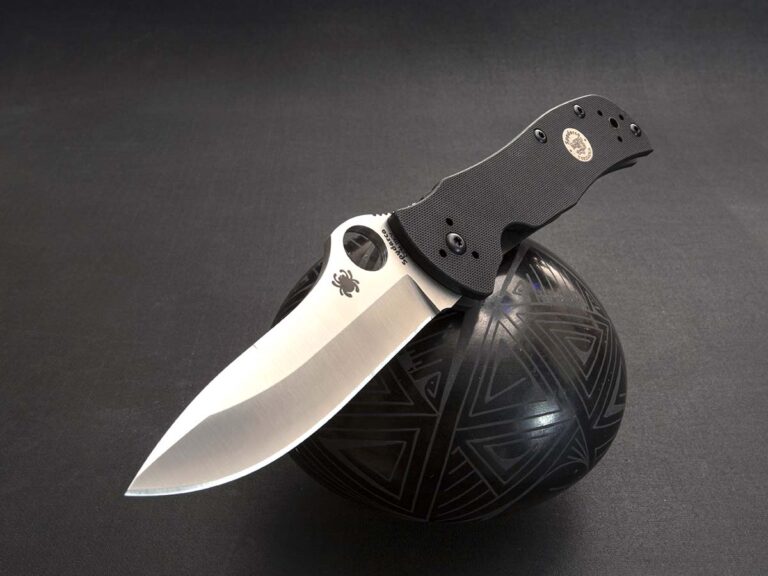
The Starmate Sprint Run edition faithfully revives Terzuola’s iconic design and elevates it with a blade crafted from CPM 20CV—a highly wear-resistant, powder metallurgy stainless steel that contains a high volume of vanadium carbides and the highest amount of chromium of any vanadium-rich stainless steel currently available. This distinctive alloy composition gives it a remarkable combination of edge retention, corrosion resistance and toughness and makes it ideal for the Starmate’s intended scope of use. The knife’s hollow-ground blade features a handsome satin finish and a prominent swedge (unsharpened bevel) on the spine that adds distinctive style while ensuring an acute, utilitarian point. It also includes a large Trademark Round Hole accessible for ambidextrous one-hand opening and announces the knife’s Spyderco pedigree. A section of gimping above the hole provides a high-traction thumb purchase for enhanced control during use. The blade’s reverse side features a laser-engraved dragon head—Terzuola’s distinctive logo inspired by the Mayan god of flint tools and edged weapons.
The Starmate’s blade is supported by a sturdy linerlock and housed in a handle of black G-10 scales and nested, skeletonized stainless steel liners. The scales have a peel-ply texture for a non-slip grip and, like the original version, are accented by an inlaid Spyderco/Terzuola logo. To allow convenient carry, keep the knife poised for instant access and pay homage to the time-tested CLIPIT concept, it includes a four-position hourglass pocket clip. The broad-based clip is easily configurable for left- or right-side, tip-up or tip-down carry and, in the tip-up position, straddles a lanyard hole that allows the easy attachment of fobs, lanyards or security lines. In keeping with the knife’s tactical styling, the clip and handle hardware all feature stealthy black coatings. To complete the package, every knife comes complete with a zippered nylon pouch embroidered with the Spyderco “bug” logo and a detailed product information guide explaining the design’s history.
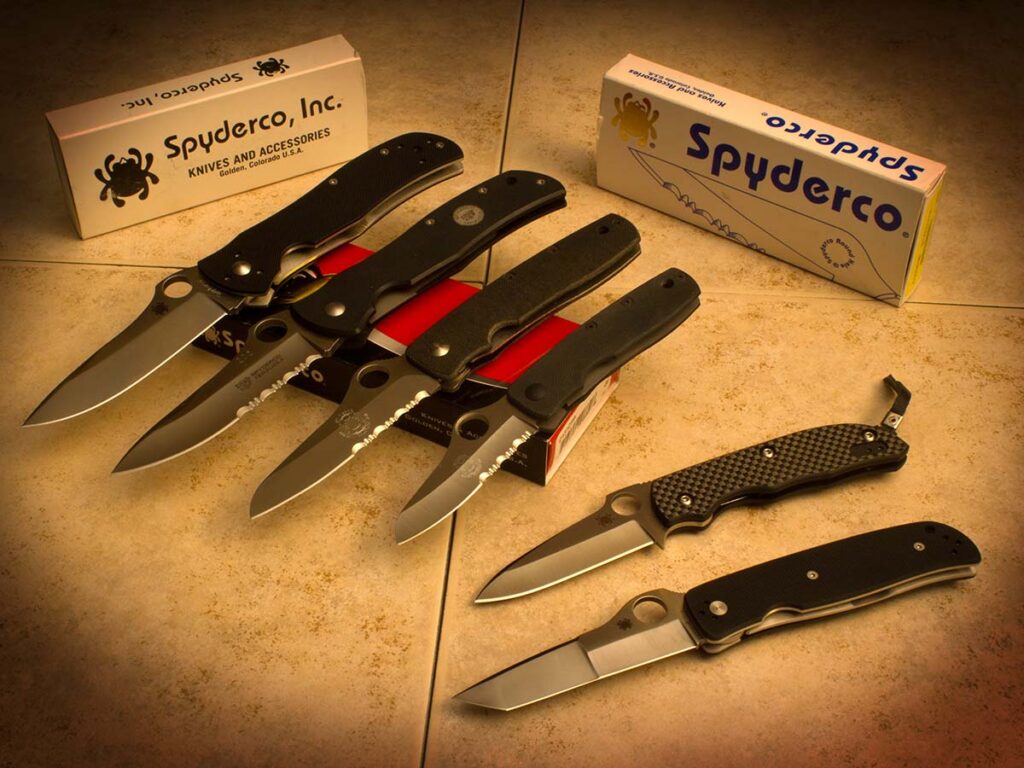
Bob Terzuola was Spyderco’s first collaborator and still reigns as one of the company’s most prolific collaborators. Here’s a selection of Terzuola-designed Spyderco folders.
Spyderco’s limited-edition Starmate is a proud tribute to two of knifemaking’s most legendary and influential figures. It is also a vivid reflection of their individual innovations, their longstanding friendship and mutual respect, and the powerful synergy of their collaborative efforts. This elite expression of the Starmate will be available while supplies last through Spyderco’s worldwide dealer network and directly from Spyderco.com.
Spyderco Starmate Sprint Run Specs Designer: Bob Terzuola Blade Length: 3.74” Blade Steel: CPM 20CV stainless Blade Thickness: 0.145” Blade Grind: Hollow Edge Length: 3.68” Handle Material: G-10 Lock Type: Linerlock Pocket Clip: Ambidextrous; 4-position Knife Weight: 4 ozs. Closed Length: 4.99” Country of Origin: United States MSRP: $450
TOPS Offers Surface-Level Performance, Subsurface Strength In Pair Of Water-Focused Blades.
For years, the dive knife market has been saturated with “emergency only” gear—tools often made from low-grade stainless steel that prioritize corrosion resistance at the total expense of edge retention. TOPS Knives is challenging that status quo with a dual-release born from their annual Employee Design Challenge. The Sidekick Diver and the Snake River Rescue represent a shift in philosophy: these are high-performance cutting tools first, engineered to survive the brine while maintaining the surgical bite expected of a professional blade.
Both models utilize N690 stainless steel, a cobalt-enriched alloy known for its ability to hold a fine edge and resist the aggressive nature of saltwater. To ensure these blades could handle real-world neglect, TOPS subjected prototypes to high-salinity brine soaks, allowing them to air-dry without rinsing—a “torture test” designed to mimic the exact conditions where most dive gear fails.
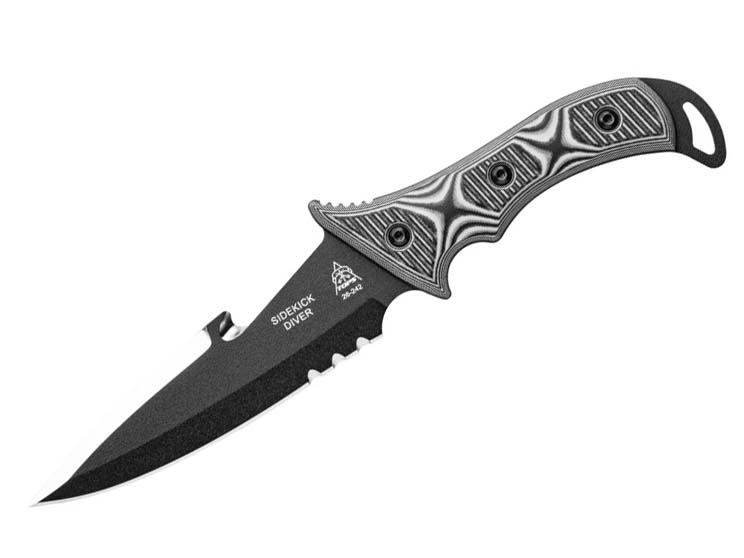
The Sidekick Diver, designed by Ana Espinoza, is a formidable 11.25-inch tool tailored for the spearfisherman. With a 5.75-inch blade featuring a fine tip and an integrated spine-mounted line cutter, it is built for the precision tasks of dispatching fish and clearing entangled lines. The contoured gray and black G10 handles are sized for a locked-in grip, whether you are bare-handed or wearing thick neoprene gloves.
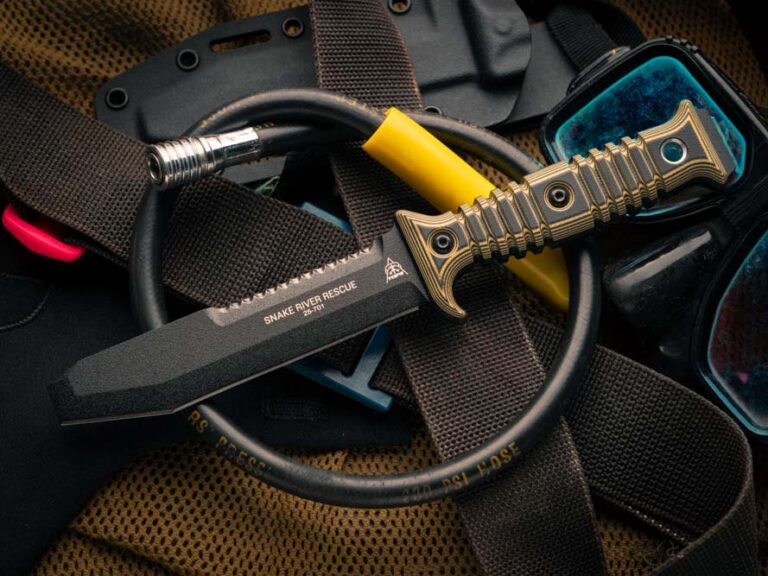
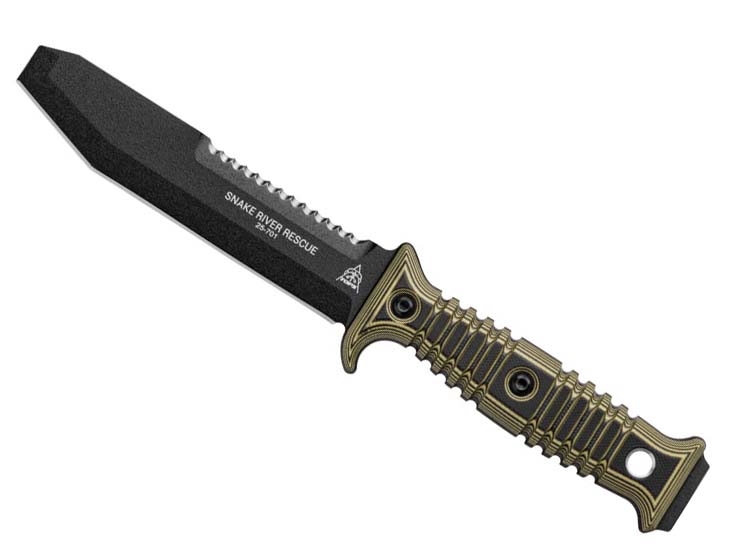
In contrast, the Snake River Rescue, designed by Jon Garcia, serves the needs of SCUBA and rescue professionals. It features a blunt safety tip to prevent accidental punctures in high-stress, low-visibility underwater environments. The high-visibility yellow and black G10 scales ensure the tool is easy to locate if dropped, while an extended metal pommel serves as a functional tank tapper for signaling and monitoring air supply. Its dual-edge geometry, featuring a 2.5-inch fully serrated section on the spine, is specifically tuned for sawing through heavy rope and netting.
Both knives are finished in a Black Traction Coating for added protection and ship with a secure Kydex sheath. By moving away from the “disposable” mindset of traditional dive gear, TOPS has delivered a pair of aquatic workhorses built to be used, sharpened, and relied upon long after the first dive.