
Buyer's Guides

You’re looking for a new knife in a certain style – we’ve got recommendations on the best blades for every price point.

Kephart Knife: Options In The Outdoors Do-All

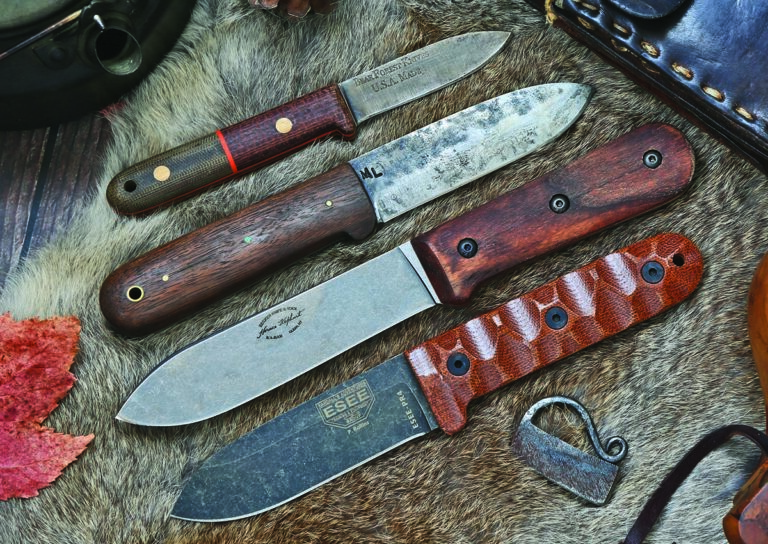
Four repros emulate the knife Horace Kephart made famous.

Before Rambo provoked people to rush to their local sporting goods stores searching for a hollow-handle, saw-back survival knife and long before Ray Mears popularized the quest for the perfect Scandi-ground knife, a timeless classic woods knife endured the test of time—the Kephart.

Who Was Horace Kephart

Horace Kephart (1862-1931) was a prominent figure known for his contributions as an author, librarian and outdoorsman. His extensive exploration of the Southern mountains led him to conduct valuable research on the region and its inhabitants.

Among his many books, he is best known for Our Southern Highlanders and Camping and Woodcraft, with the latter serving as an enduring guide for outdoor living. Both works are still widely available and highly regarded. In the 1920s, Kephart was pivotal in advocating for establishing the Great Smoky Mountains National Park.

What Is a Kephart Knife?

The Kephart-style knife features a spear-point blade and an oval cross-section handle. The blade is typically 4-to-5 inches long, 1095 carbon steel, and forged using techniques reminiscent of 18th-to-19th-century bladesmithing. The blade is typically an eighth inch at the thickest, supporting a sturdy and durable structure. A distinctive feature is the asymmetrical spear point with a full-length edge enhancing its utility in various cutting tasks. The scales are often walnut or maple. The overall design aims for simplicity, with attention to detail to ensure comfort and usability.

In the words of Horace Kephart, “A camper has use for a common-sense sheath-knife, sometimes for dressing big game, but oftener for such homely work as cutting sticks, slicing bacon, and frying ‘spuds.’ For such purpose, a rather thin, broad-pointed blade is required … It is tempered hard enough to cut green hardwood sticks, but soft enough so that when it strikes a knot or bone it will, if anything, turn rather than nick.”

ML Knives Kephart
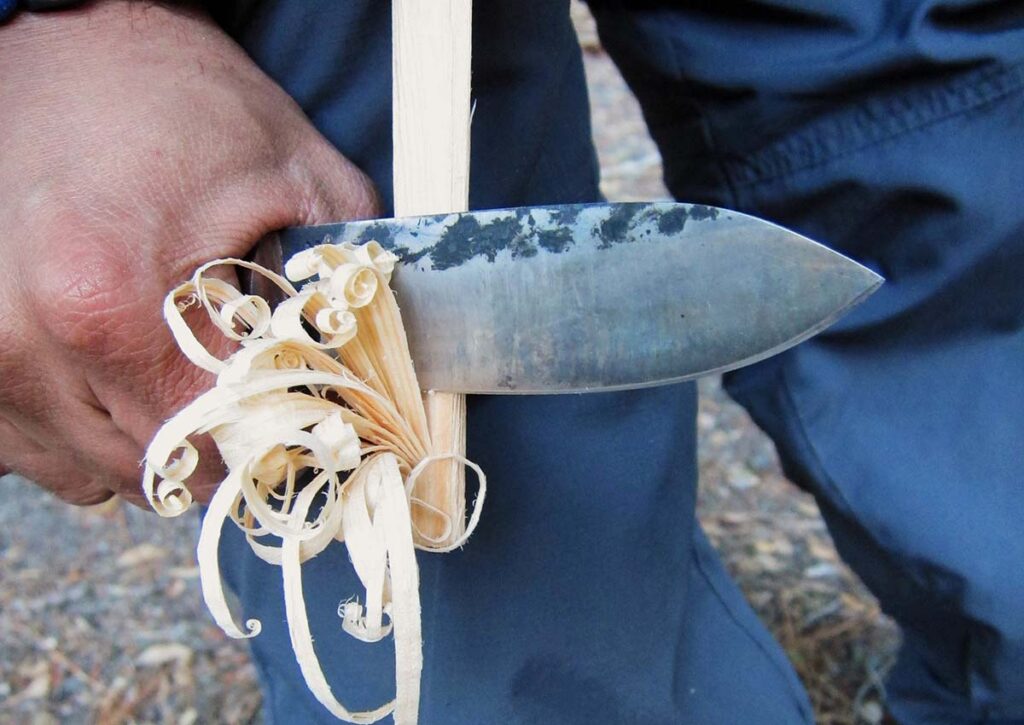
The author stated he prefers to make feather sticks freehand, without a solid base, to feel the edge better and have more control. The technique is best practiced before it’s needed and the ML Kephart convex edge excelled at the task.

Kephart Specs
Blade Length: 4”
Blade Material: 1095 carbon steel
Blade Grind: Convex
Blade @Thickest: .125”
Blade Finish: Forged
Handle Material: Tiger maple
Overall Length: 8.25”
Sheath: Leather
Country of Origin: USA
MSRP: $295

I received my first Kephart-style knife from Matt Lesniewski of ML Knives back in 2007, and it instantly became my favorite. The craftsmanship of the piece is truly remarkable, as Matt employed early 18th-to-19th-century bladesmithing techniques, using 1095 carbon steel and handforging each blade. The handcrafted sheaths are also stunning works of art that truly stand out.

My ML Kephart features a 4-inch blade and a 4.25-inch handle, with scales of beautiful tiger maple. The handle’s oval cross-section provides a comfortable grip, with just the right amount of rounding to prevent discomfort during use. The spear-point blade and eighth-inch thickness, along with the full convex edge and visible forge marks, give the knife a rustic yet simple charm.
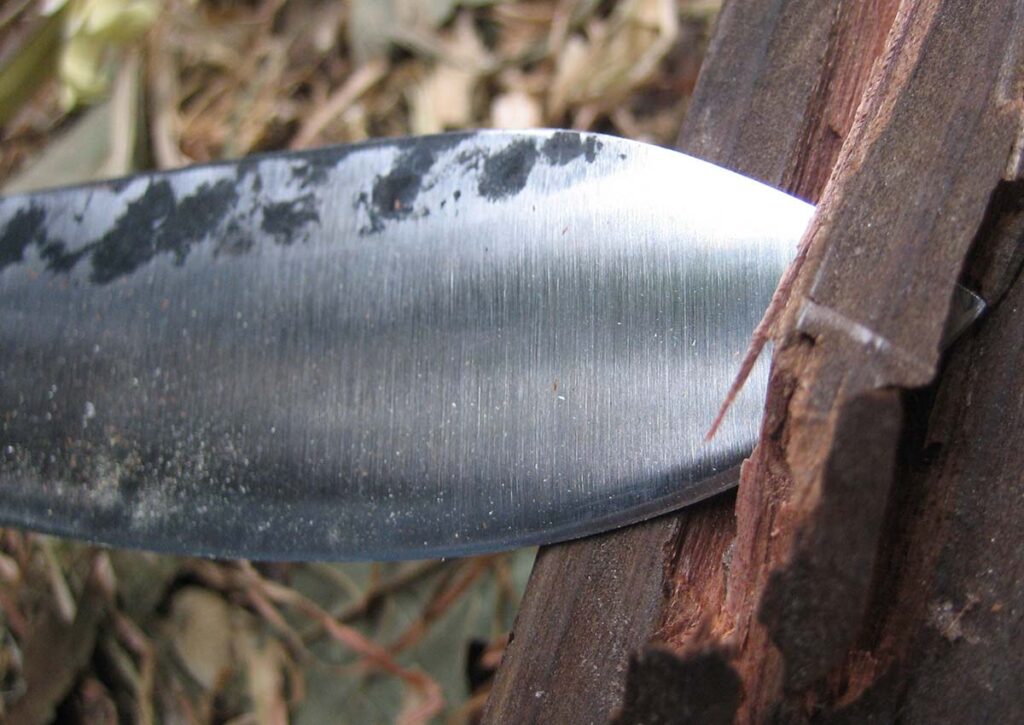
A spear point is a versatile blade pattern and tough as woodpecker lips. The ML Kephart drilled with authority and split/pried wood for kindling.

Naturally, after reading Horace Kephart and Nessmuk, I made many backcountry trips and always had a stout, reliable fixed blade. When traveling afoot, as the old timey adventurers would say, I had minimal kit and seldom took a large axe or saw. I used a light tomahawk, as Kephart spoke of, and a jackknife in the form of a Swiss Army knife. I had to do more with the fixed blade, and I did. The ML Kephart excelled at woodcraft as the convex edge was ultrasharp and robust.

I always test every cutting tool by shaving arm hair*, whether it’s an axe, long blade or anything with an edge. The next task is always shaving wood, as a fire is ultra important when camping or woodcrafting. The ML excelled at the task—but could it drill? I broke a few old seasoned planks apart by drilling through and twisting them for kindling. The handle seemed comfy, and the natural maple gave me enough traction to keep a solid grip during any task. The flat primary grind with a convex edge is the best of both worlds. And no camp food or sandwich was safe from the ML Kephart.

KA-BAR/Becker Knife & Tool BK62 Kephart
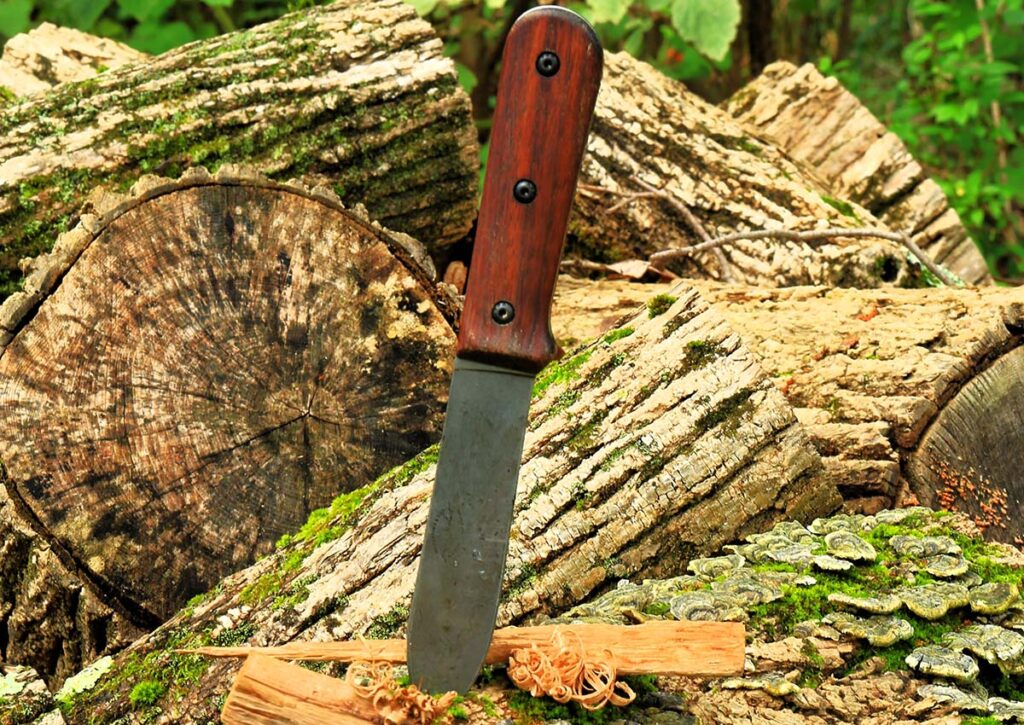
The Becker Kephart held its own in both carving and piercing work.

BK62 Specs
Blade Length: 5.125”
Blade Material: 1095 Cro-Van carbon steel
Blade Grind: Flat
Blade @Thickest: .158”
Blade Finish: Satin
Handle Material: Walnut
Overall Length: 9.625”
Sheath: Leather
Country of Origin: USA
MSRP: $232.29

The KA-BAR/Becker Knife & Tool BK62 Kephart is a modern tribute to the classic American bushcraft knife based on the version of renowned author, outdoorsman and gear designer Ethan Becker. “Many copies of the Kephart are based on the one at Western North Carolina University because it was the only one anybody knew about,” Ethan said. He added that his design is based on the only known example, which was virtually pristine, outside a museum. That’s why Ethan said the BK62 is the closest anyone can get to the original Kephart.

Precision crafted, the BK62 features a 5.125-inch blade of 1095 Cro-Van carbon steel, known for its durability and edge retention. Overall length: 9.62 inches. The blade’s full flat grind and spear-point design make it versatile for wood carving and food preparation. The handle is walnut, providing a comfortable grip and a timeless aesthetic. The BK62 is a functional tool and a piece of history, as it closely replicates the original Kephart knife, which played a significant role in the early 1900s wilderness culture. Each Becker Kephart comes with a leather sheath.
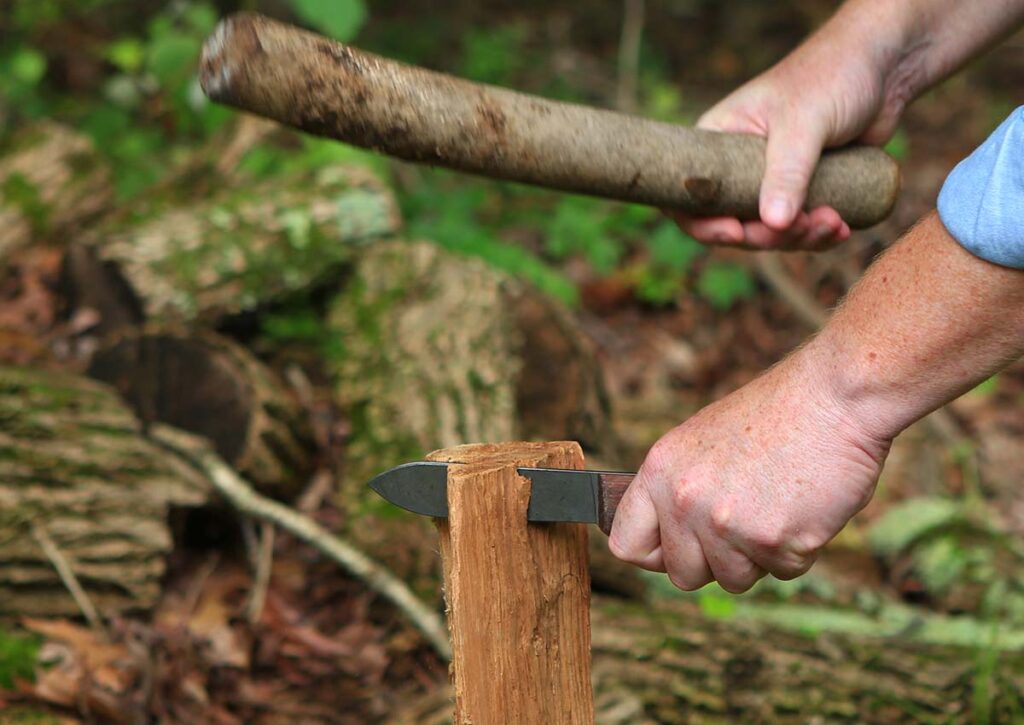
The KA-BAR/Becker BK62 split the seasoned oak. Completing the task simply yet effectively says a lot about a woods knife.

The BK62 arrived when I was about to do a little cooking, so I quickly put it into service cutting roast and chicken breast. The flat-ground blade sliced meat like a champ. It performed like a kitchen knife and felt natural in the hand. The BK62 did its share of slicing potatoes, carrots and beef for a pot roast. Thoroughly convinced of its ability to handle food, I moved on to the woods test.

I performed two tasks with the BK62. The first was batonning practical pieces of wood approximately the width of a pencil. The blade’s .158-inch thickness allowed it to glide into the wood, and a twist of the wrist made the seasoned oak split. However, it didn’t perform as well as a saber grind for the latter chore. The next task was feathering hard oak, and this is where the blade’s thinness shone. The feathers were thin and curly, perfect for tinder with a ferro rod or coarse kindling.

ESEE Knives PR4
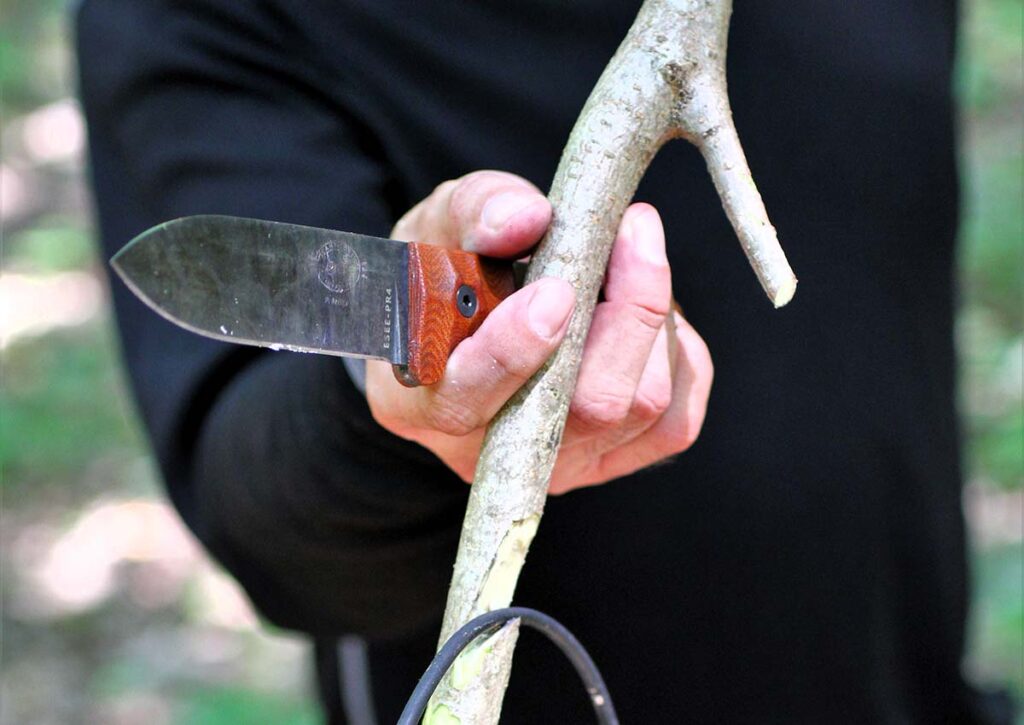
One of the ESEE PR4’s earliest tests was to create a pot hanger for boiling water. The task involved cross-grain batonning and carving, and the knife did very well at both.

PR4 Specs
Designer: Patrick Rollins
Blade Length: 4.19”
Blade Material: 1095 carbon steel
Blade Grind: Saber
Blade @Thickest: .125”
Blade Finish: Tumbled black oxide
Handle Material: Sculpted Micarta®
Overall Length: 8.9”
Sheath: Leather
Country of Origin: USA
MSRP: $190.64

The PR4 is part of the Camp-Lore series from ESEE Knives and is named after the initials of its designer, Patrick Rollins, lead instructor for Randall’s Adventure & Training.** The knife features a 4-inch 1095 carbon steel blade with a high saber grind. It pays homage to the timeless Kephart design while incorporating Patrick’s modifications. The approximately 4.5-inch handle is suitable for large hands or use with work or winter gloves. The knife has a black oxide tumble finish resembling a patina but not a coating. The handle is fitted with textured brown Micarta® scales for a distinct look and comfortable grip. The knife comes with a plain tan leather sheath made by Wickett and Craig, one of the oldest tanneries in the USA.

I used the PR4 extensively in the Eastern Woodlands for various camp tasks. The knife proved versatile and was particularly effective for making camp implements and starting fires. It excelled in splitting small sticks and igniting the ferro rod to create a fire. Its sharp spine was practical without being overly flashy.
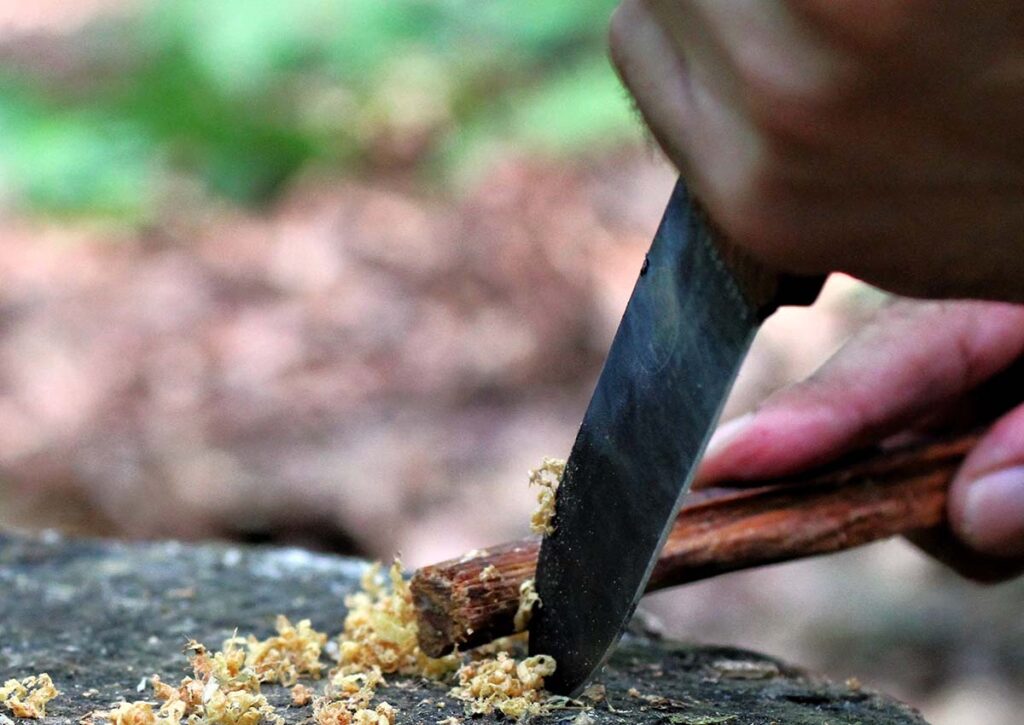
Scraping fatwood with the blade spine was easy using the PR4. It boasts the sharpest spine in ESEE’s Camp-Lore series and rapidly created a pile of fatwood.

While I don’t typically baton wood when a chopper is available, I found the PR4 excellent for cross-grain baton work, making precise stop cuts on trap parts, stakes and pot hooks. I also used the PR4 to carve a chisel point on a thick piece of maple for a digging stick and found that it easily sliced dry maple. The knife remained effective despite exposure to various weather conditions.

After establishing a fire, the PR4 proved equally adept at culinary tasks, precisely slicing onions, peppers, potatoes, mushrooms, garlic and sausages for a stew. The thin grind made kitchen tasks a breeze, especially achieving paper-thin garlic slices. The knife performed exceptionally well in all tasks, including prepping tinder from fatwood and dry, split poplar. The high saber grind and sharp spine made the PR4 ideal for camp and woodcraft chores.

Bear Forest Knives GT-3
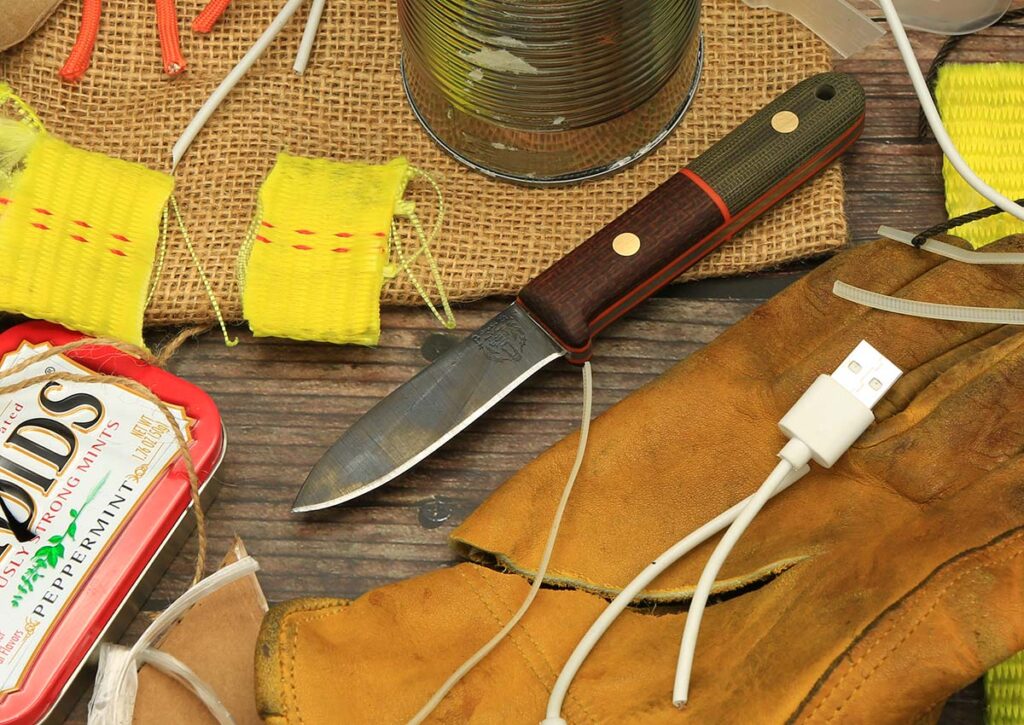
As an EDC/utility knife, the GT-3 cut assorted materials, including tin cans, leather, cordage, zip ties, toe strapping and more.

GT-3 Specs
Blade Length: 3”
Blade Material: 80CrV2 carbon steel
Blade Grind: Flat
Blade @Thickest: .125”
Blade Finish: Rock tumbled acid wash
Handle Material: Micarta®/G-10
Overall Length: 7.25”
Sheath: Black kydex (.08”) w/nylon cross-draw/Scout belt loop
Country of Origin: USA
MSRP: $149.99

Garrett Tremblay of Bear Forest Knives based the company’s GT-3 on his favorite bushcraft knife, the ESEE PR4. After discussing it with the knife’s designer, Patrick Rollins, and receiving approval, Garrett developed the Bear Forest entry.

The knife boasts a striking design, featuring a full-flat-ground, 80CrV2 carbon steel blade with a black oxide finish. The handle showcases an exceptional blend of burgundy and green burlap Micarta scales complemented by vibrant orange G-10 liners, all held together by Corby bolts. The difference in cutting performance between the full-flat-ground edge and the PR4’s saber grind was instantly noticeable. The GT-3 is equally at home as an everyday carry tool, a useful household companion or a reliable camping partner.

The knife is perfect for making notches for tarp stakes and trimming the ends to a chisel point to pound into the ground. The 90-degree spine is ideal for scraping poplar tinder and striking ferro rods. The 3-inch blade is just the right complement for a campsite that includes a bow saw and tomahawk/hatchet.
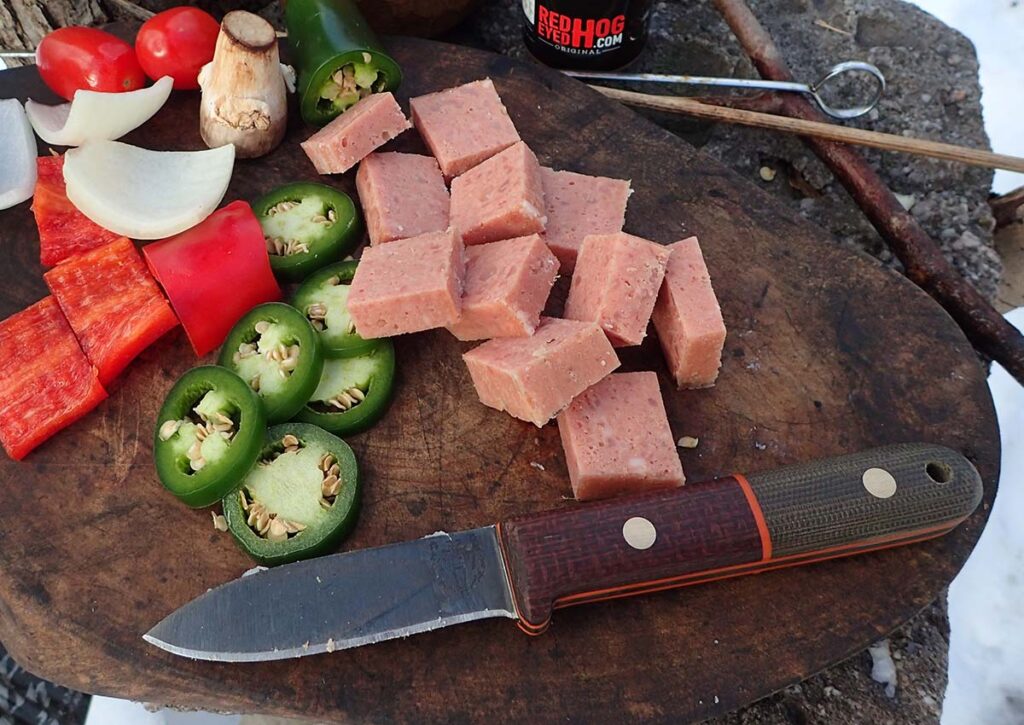
While camping, the author relied on kabobs for meals. The Bear Forest Knives GT-3 handled all the prep work, including slicing vegetables and starting the fire.

As Horace Kephart mentioned, a sheath knife is always “get-at-able” for quick tasks, which saves the jackknife from the messier work. This perfectly describes the GT-3. The handle is consistently comfortable. I keep a charred coffee can full of wood shavings—tinder and kindling—in camp. I whittle poplar and maple until the can is full. This is the last but most important task of the night, as it prepares for the next morning’s fire. The GT-3 is always up for the task.

*BLADE does not recommend shaving arm hair as a test of edge sharpness as it can cause injury.

**Both ESEE Knives and Randall’s Adventure Training (RAT) are owned by Jeff Randall and Mike Perrin under the parent corporation of TransEquatorial Solutions, Inc.

Check Out More Outdoor Knives:

New Knives September 2025

Explore this collection of new hunting knives featuring custom blades forged with premium materials. Find your next heirloom fixed blade.

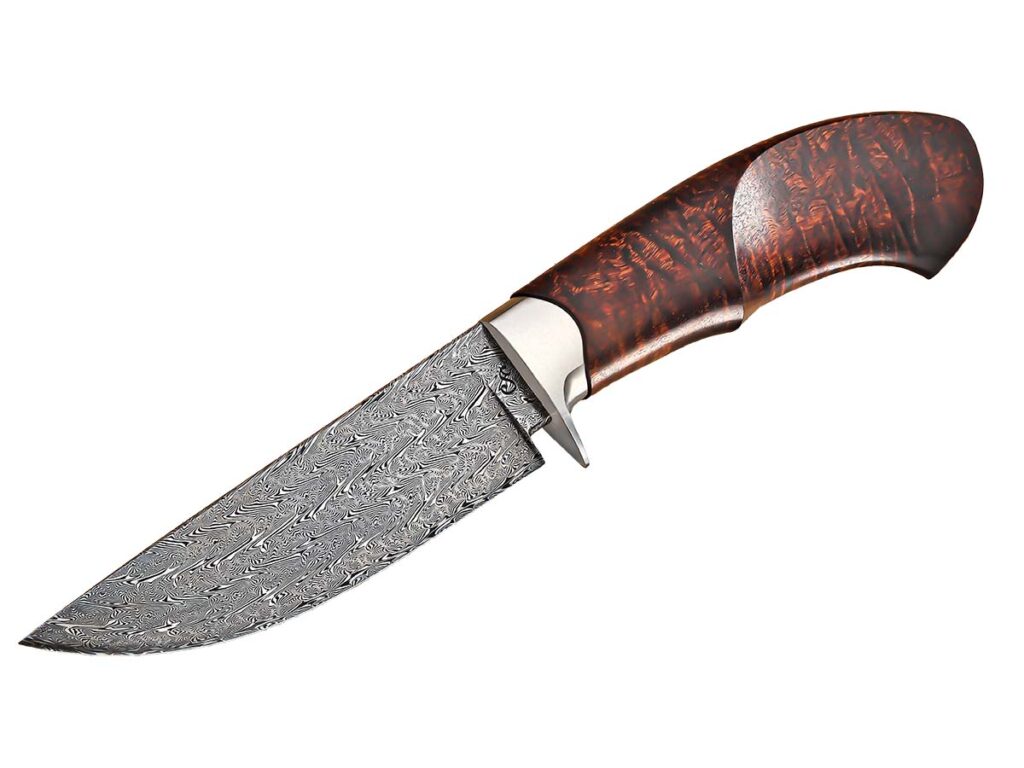
Step into the world of custom-crafted cutlery, where art and function meet in the field. This collection showcases the diverse and spectacular work of today’s finest knifemakers. We’re taking a look at a stunning array of new hunting knives, each forged with meticulous detail, featuring exotic materials like Sambar stag, ironwood, camel bone, and intricate Damascus steel.

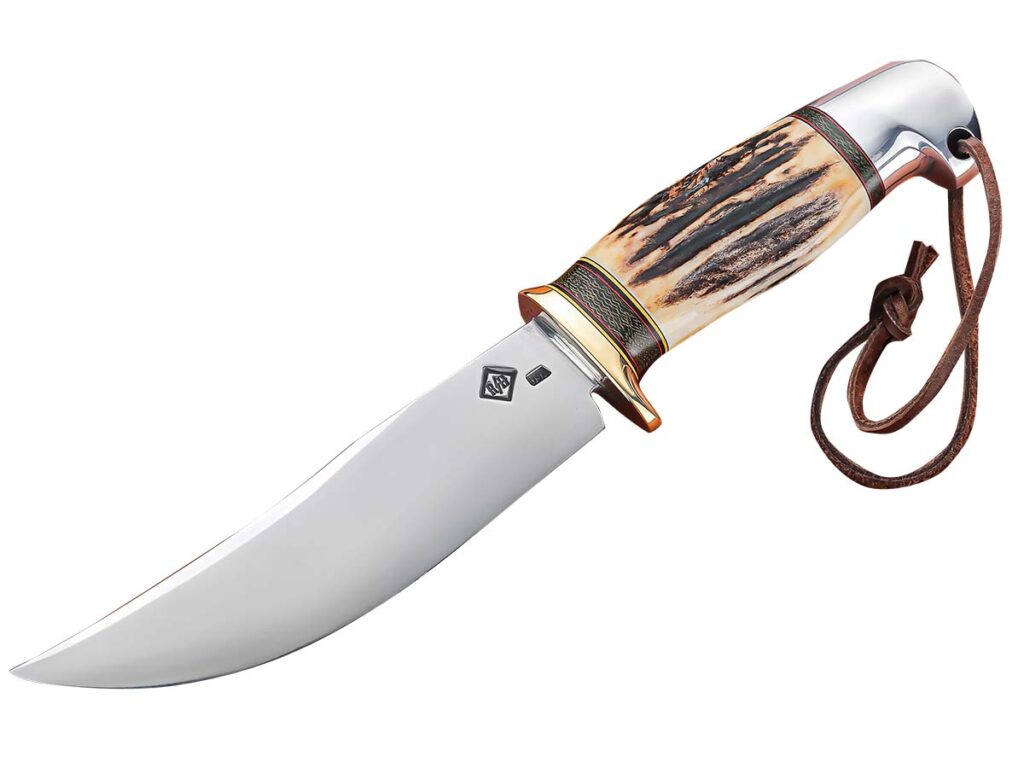
Rocco Handmade Bear Creek Hunter

Bear Creek Hunter

Blade length: 6”
Blade material: 1095 carbon steel
Blade grind: Convex
Scales: Sambar stag
Spacers: OD green canvas Micarta® and vintage tan, red and black fiber
Pommel: Aluminum
Guard: Soldered brass
Overall length: 10.5”
Sheath: Leather belt model w/snap strap
Maker’s price for a similar knife and sheath: $495
Maker: Rocco Handmade (SharpByCoop image)


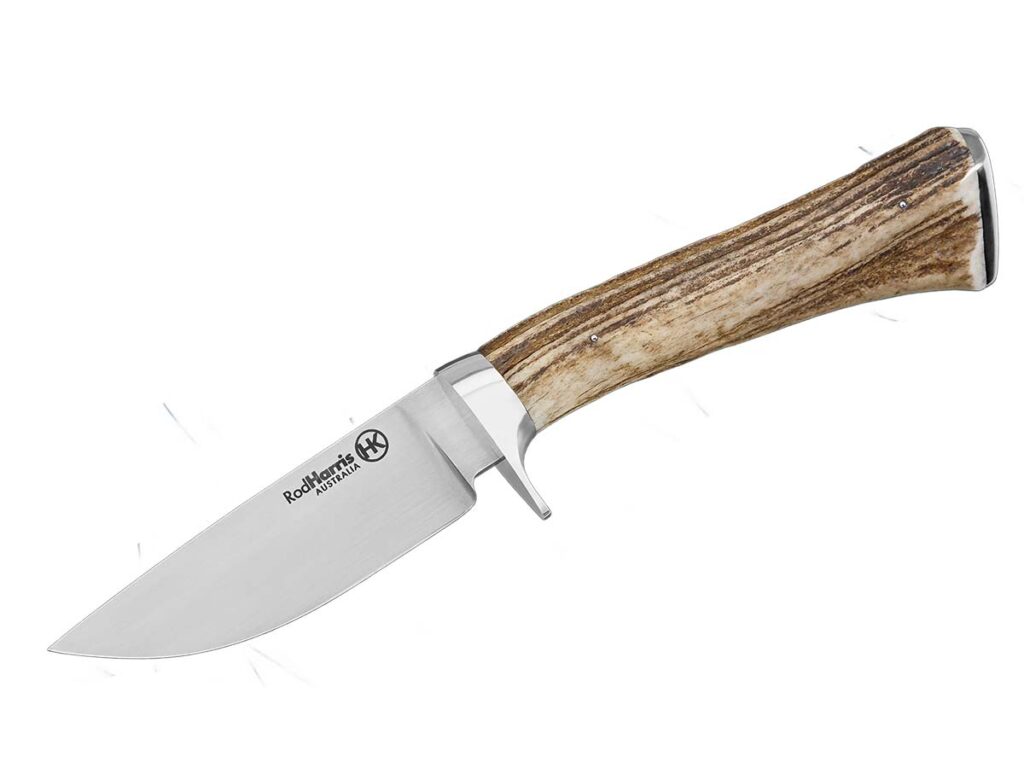
Rod Harris Antler Hunter

Antler Hunter

Blade length: 4”
Blade steel: S35VN stainless
Blade grind: Flat
Scales: Sambar stag
Guard: 416 stainless
Overall length: 9.25”
Knife to know: The stag is from the customer’s first deer kill; Rod Harris is a member of the Australian Knifemakers Guild
Maker’s price for a similar knife: $650 at press-time exchange rate
Knife to know: The Antler Hunter is the first time Rod Harris has both had one of his knives published and made a knife with a stag handle
Maker: Rod Harris (Rod Hoare image)


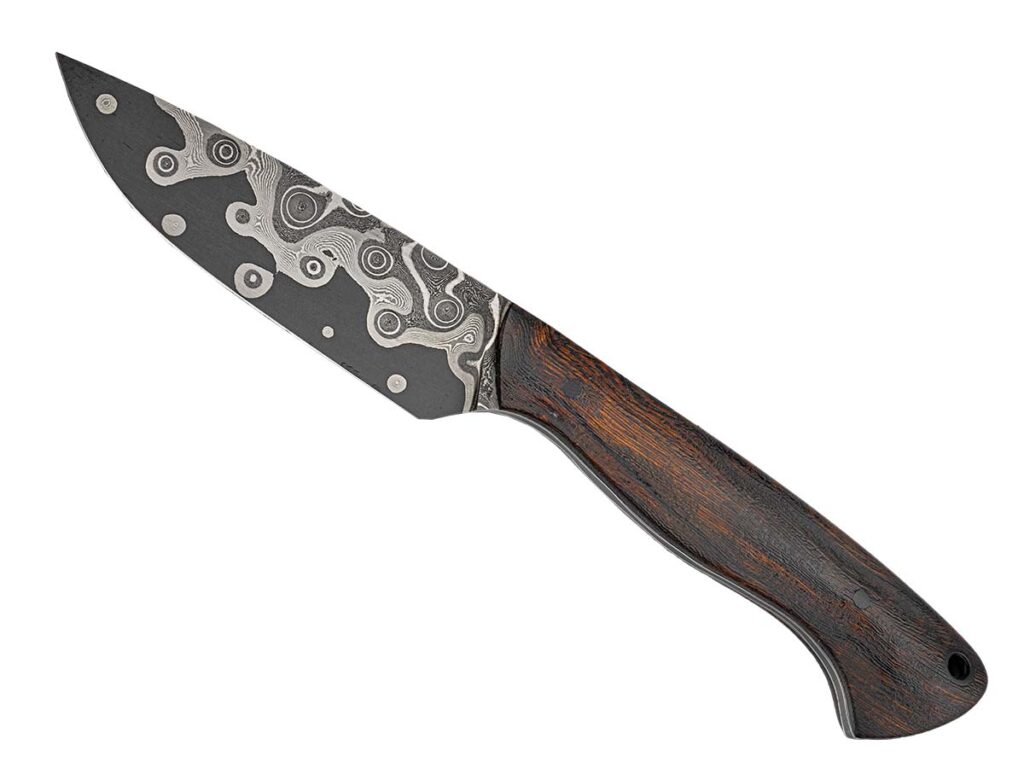
Eland Green Huntin Buddy

Huntin Buddy

Knife type: Hunter
Blade length: 3.5”
Blade material: Bulldog damascus san-mai
Blade grind: Flat
Scales: Bead-blasted ironwood
Overall length: 7.5”
Sheath: Belt model, tooled black leather
Maker’s price for a similar knife: $400
Maker: Eland Green, lostwoodknives.com (Jocelyn Frasier image)


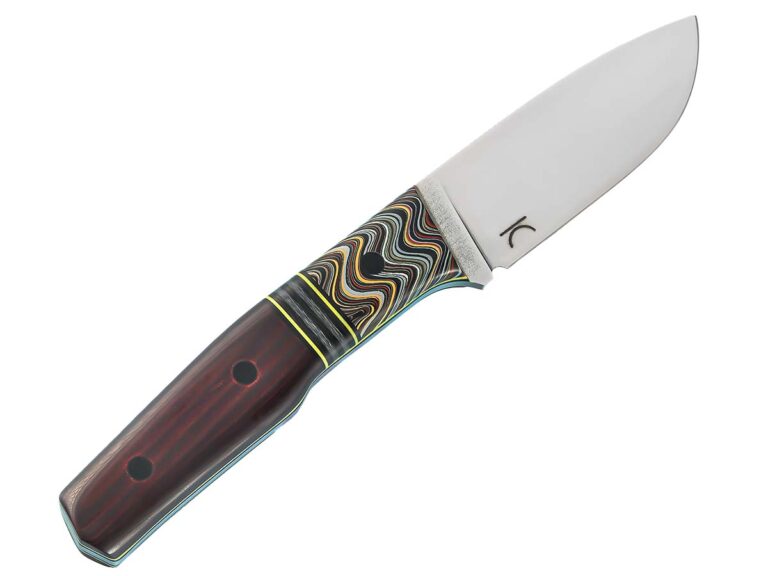
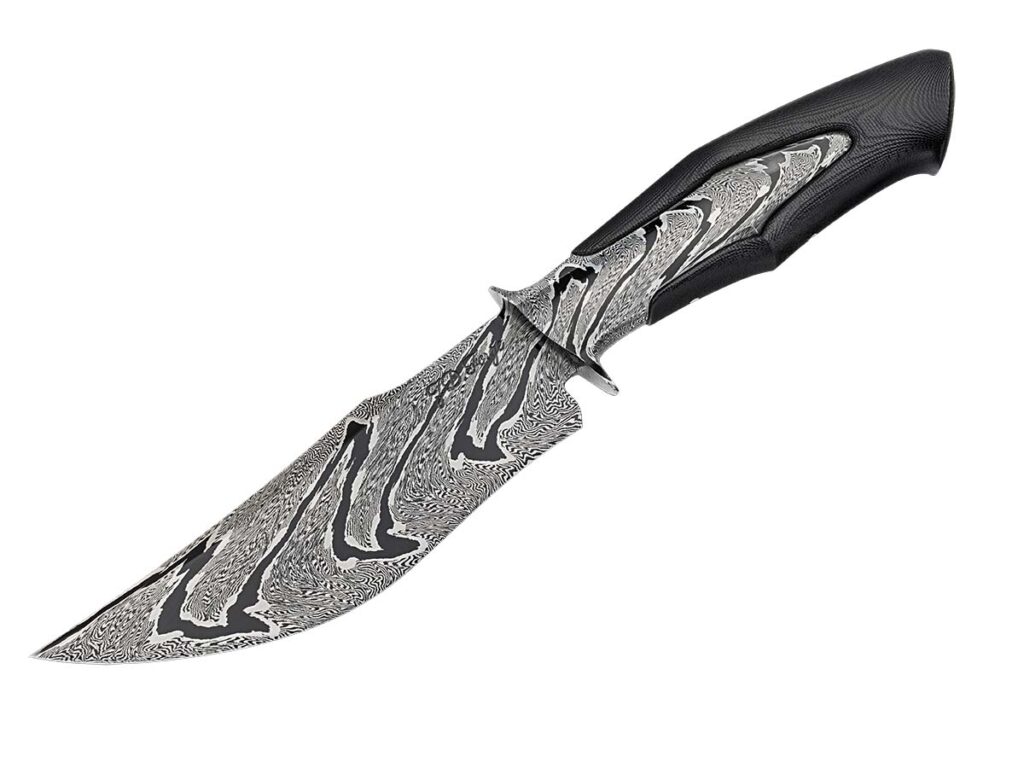
Zane Dvorak Integral XL Hunter

Integral XL Hunter

Knife name: Integral XL Hunter
Blade length: 5.5”
Blade material: Ghost-Fire Damascus of 1084 carbon and 15N20 nickel-alloy steels
Blade grind: Convex
Scales: Black G-10
Overall length: 10.5”
Maker’s price for a similar knife: $2,500
Maker: Zane Dvorak, zdforge.com (Jocelyn Frasier image)


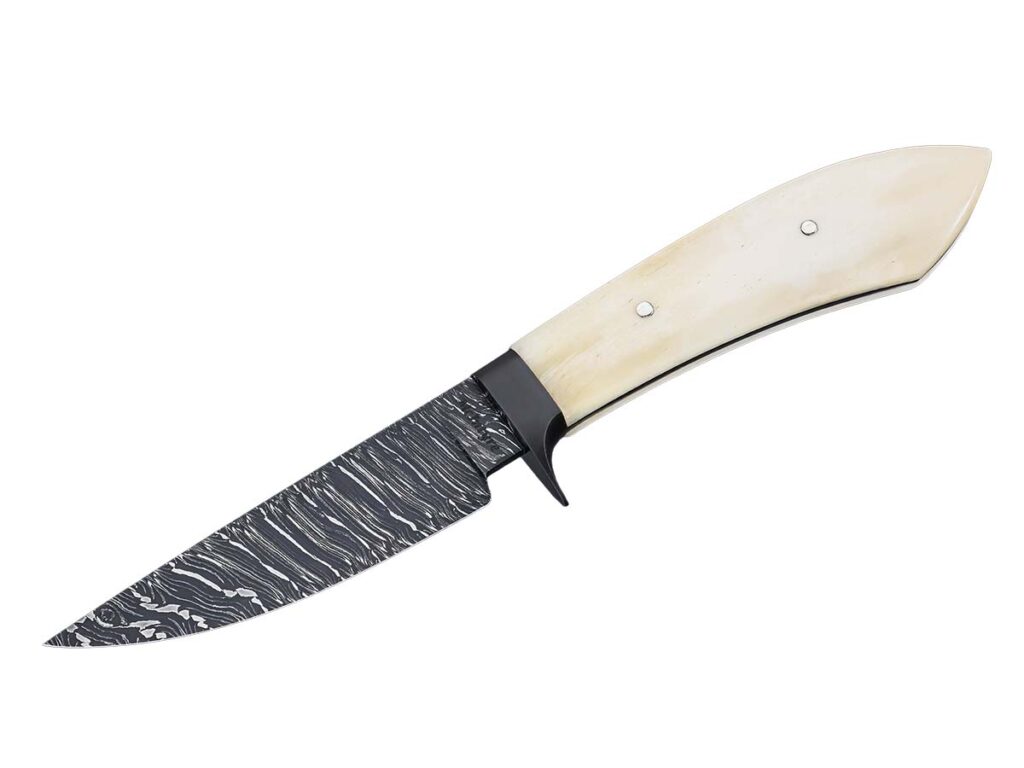
Shawn McIntyre Dress Hunter

Dress Hunter

Blade length: 3.75”
Blade material: A twist W’s damascus of 1084 carbon and 15N20 nickel-alloy steels
Blade grind: Flat w/convex edge
Scales: Heirloom-fit camel bone
Handle frame: 1065 carbon steel w/matte blue finish
Guard: Same material as frame
Overall length: 7.75”
Maker’s price for a similar knife: Check w/maker for more info
Knife to know: Best Hunter Award Winner, 2025 Australian Knifemakers Guild Melbourne Knife Show; inspired by the classic Jerry Fisk Sendero hunter; Shawn McIntyre is an ABS master smith

Maker: Shawn McIntyre (Rod Hoare image)


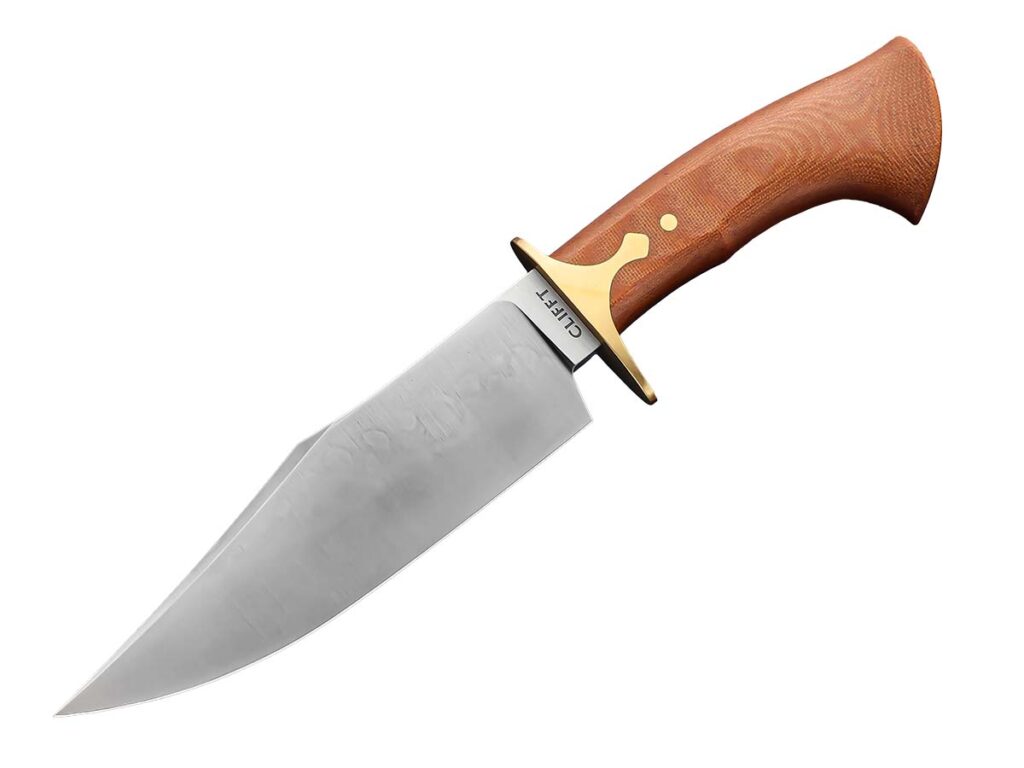
Dauntless Clifft Bowie

Clifft Bowie

Knife name: Clifft Bowie
Blade length: 7”
Blade material: 125Cr1 carbon steel
Blade @the thickest: .25”
Blade pattern: Clip point (also comes in a harpoon point)
Construction: Hidden tang
Scales: Natural canvas Micarta® (also in black G-10)
Overall length: 13”
Country of origin: USA
Sheath: Leather w/retention strap; ambidextrous carry; by Chattanooga Leather Works
Knife to know: Won Best American-Made Knife at BLADE Show Texas 2025
MSRP: $575
Company: Dauntless, dauntlessmanufacturing.com (SharpByCoop image)


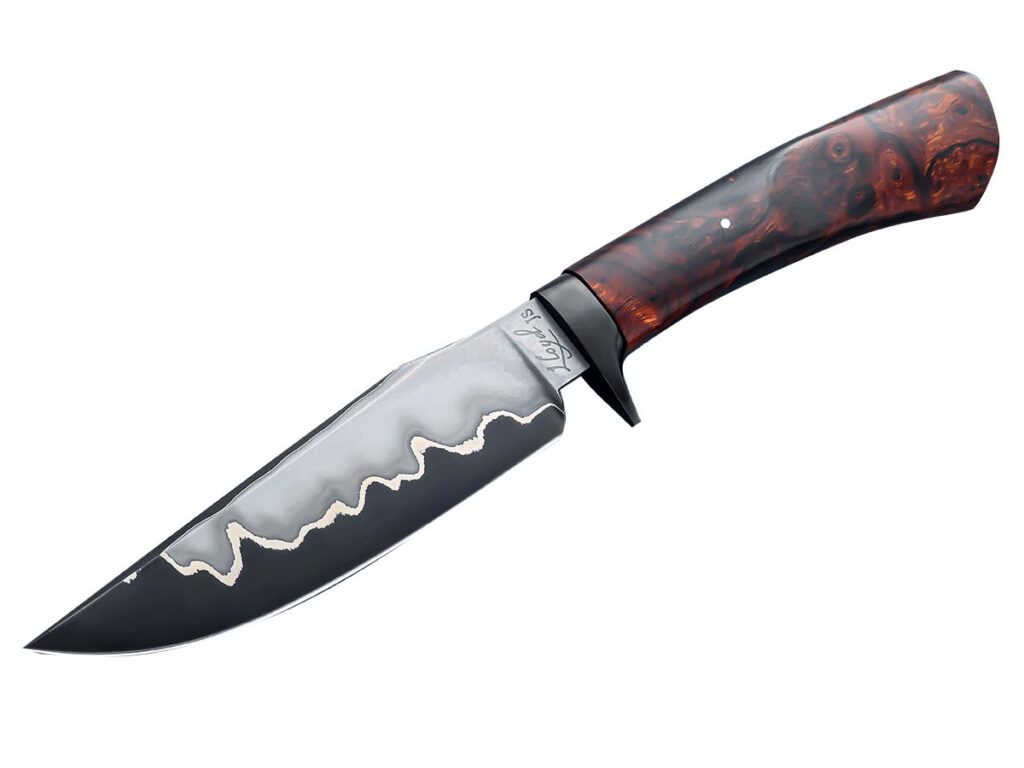
Charlie Lloyd Hunter

Hunter

Blade length: 5.75”
Blade material: Cu-mai
Blade grind: Flat
Scales: Ironwood
Guard: Hot blued
Overall length: 10.5”
Knife to know: Charlie Lloyd is an ABS journeyman smith
Maker’s price for a similar knife: $750
Maker: Charlie Lloyd (SharpByCoop image)


Camille Sennegon Hunter

Camille Sennegon Hunter

Blade length: 4.5”
Blade material: W’s multi-bar (6 bars) damascus of O2 carbon and 15N20 nickel-alloy steels
Blade grind: Flat w/convex edge
Scales: Curly gidgee
Guard: 304 stainless steel
Overall length: 9.25”
Maker’s price for a similar knife: $1,300
Knife to know: Camille Sennegon is a journeyman smith in the ABS
Maker: Camille Sennegon (SharpByCoop image)


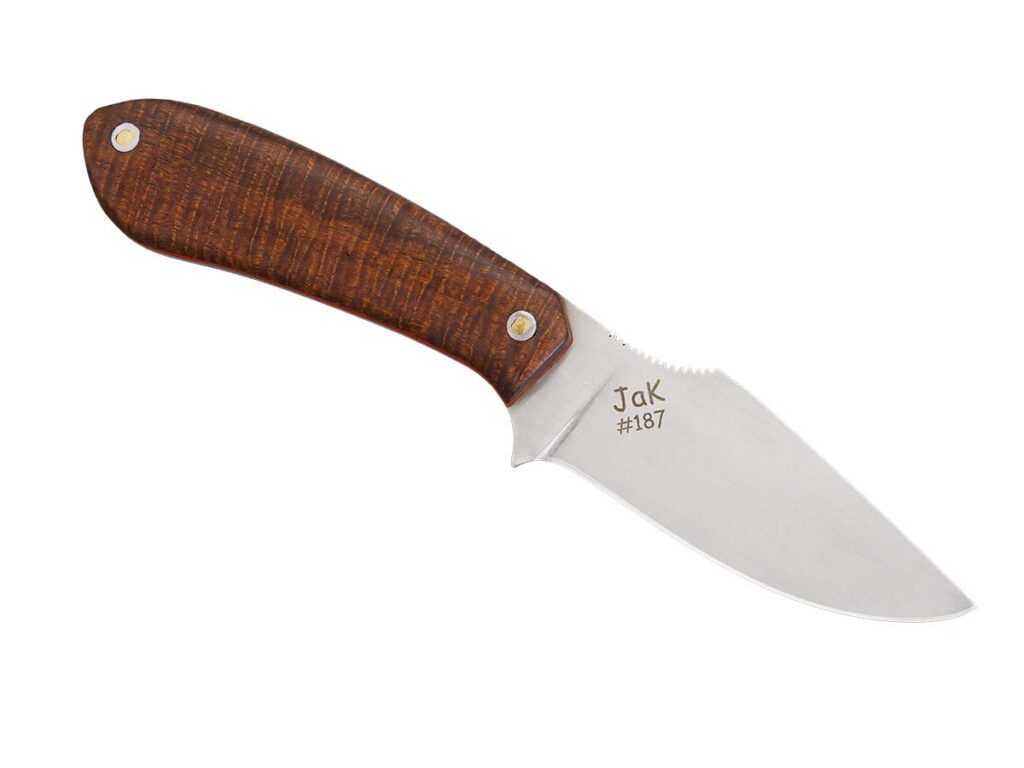
Jak Knives #187

#187

Knife type: Hunter
Blade length: 4.1”
Blade steel: 14C28 stainless
Blade thickness @ricasso: .118”
Blade grind: Flat
Blade pattern: Drop point
Scales: A Western Australia desert hardwood called Minniritchie
Liners: G-10
Overall length: 8.85”
Sheath: Leather belt model
Maker’s price for a similar knife and sheath: $300-$400 at press-time exchange rate
Maker: Jak Knives (Rod Hoare image)


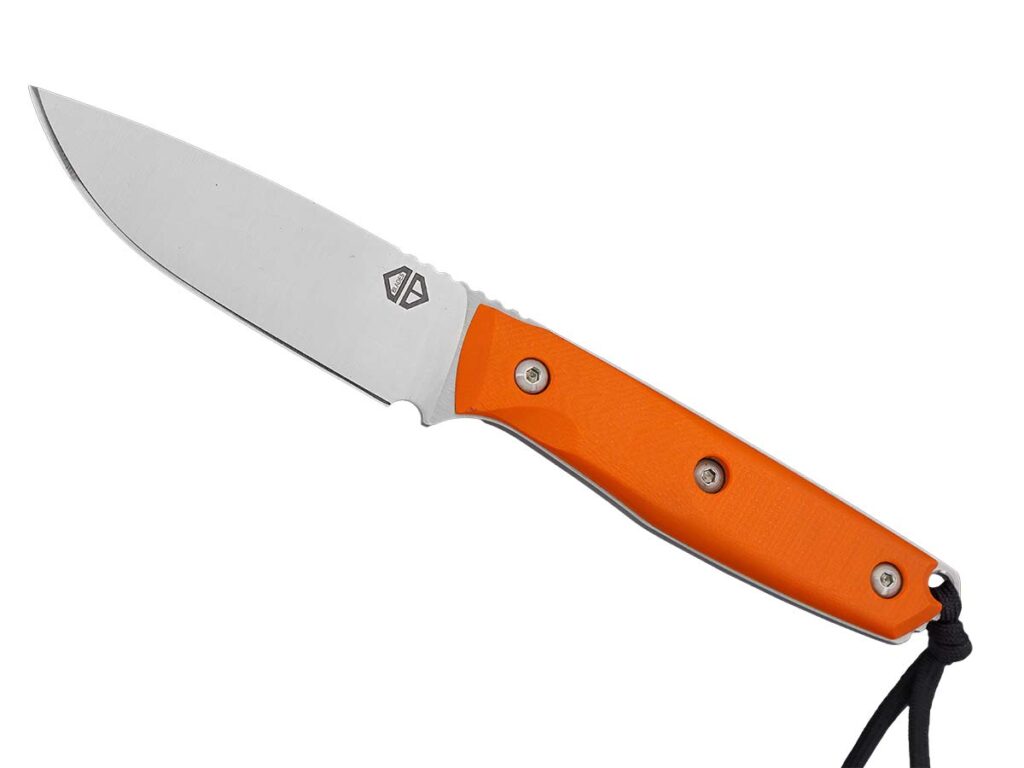
DB Blades Varis

Varis

Blade length: 3.9”
Blade steel: Nitro V stainless
Blade grind: Flat
Blade thickness @ricasso: .157”
Scales: G-10
Overall length: 8.66”
Sheath: Synthetic
Knife to know: Varis won the Best Hunting Knife Award at the 2025 Queensland Knife Show; Dominic Binker is a member of the Australian Knifemakers Guild
Maker: DB Blades (Rod Hoare image)

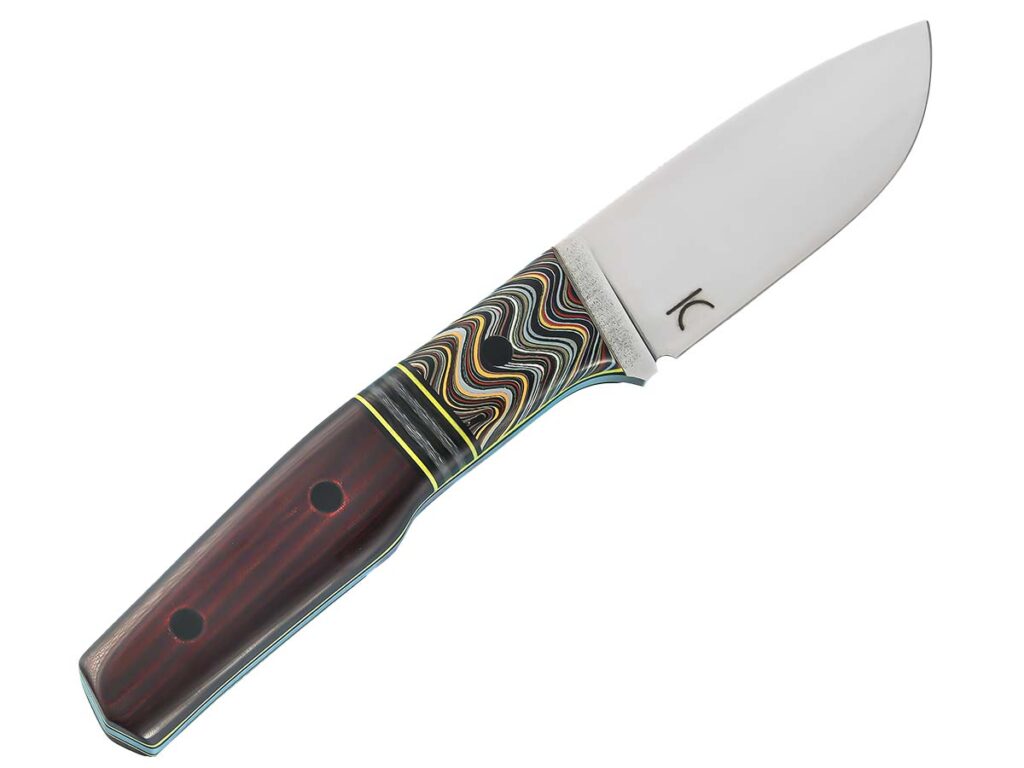
Under The Bridge Knife and Tool M.O.A.

M.O.A.

Knife type: Hunter
Blade length: 2.75”
Blade material: Cruwear carbon steel
Blade grind: Full flat
Handle material: Burgundy linen Micarta®, Fordite and silver metallic carbon fiber
Overall length: 6.75”
Maker’s price for a similar knife: $375
Maker: Under The Bridge Knife and Tool (SharpByCoop image)

Pcocks Customs Slug Life

Slug Life

Blade length: 3.54”
Blade material: Mosaic damascus of 1084 carbon and 15N20 nickel-alloy steels
Blade grind: Full flat
Scales: Ringed gidgee
Pins: Carbon fiber
Knife to know: Tapered tang; Slug Life won the Best Hunter Award at the 2025 Perth Knife Show; Peter Cocks is a member of the Australian Knifemakers Guild
Sheath: Belt model of Australian leather bearing Peter’s leather texturing stamp and finished w/a Barry King border stamp
Maker’s price for a similar knife and sheath: $750 at press-time exchange rate
Maker: Pcocks Customs (Rod Hoare image)

Check Out Other Months:

Taking The Foot Path: Top Sheepsfoot Knives

Three unique sheepsfoot blades for top pocket performance.

A sheepsfoot blade hides its edge behind a quiet profile. It slices clean and never wanders. These three nowhere-near-a-kind blades remind you why the shape keeps earning loyal fans.

Sheepsfoot Advantage

A sheepsfoot blade shape delivers straight, predictable cuts without risk of a piercing tip. The sheepsfoot blade gets its name from its shape, which resembles a sheep’s hoof. The edge runs flat so the user can push through rope, cardboard and fabric with complete control. The dropped, rounded nose keeps the point out of the work, which helps during rescue tasks and close-quarters cutting. The shape shines in utility roles, but it trades away penetration and fine-tip detail work. Users who need a safe, steady cutter reach for a sheepsfoot. Users who need a sharp, probing point usually look elsewhere.

Reiff Knives Circadia

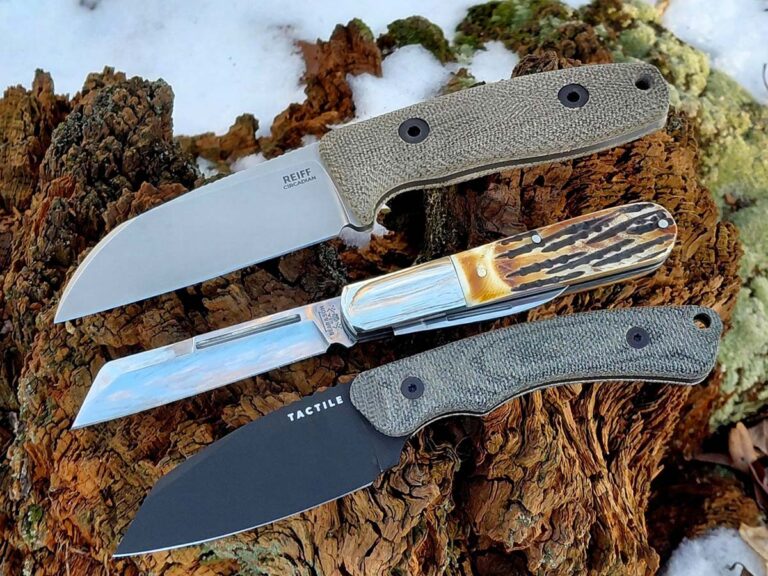
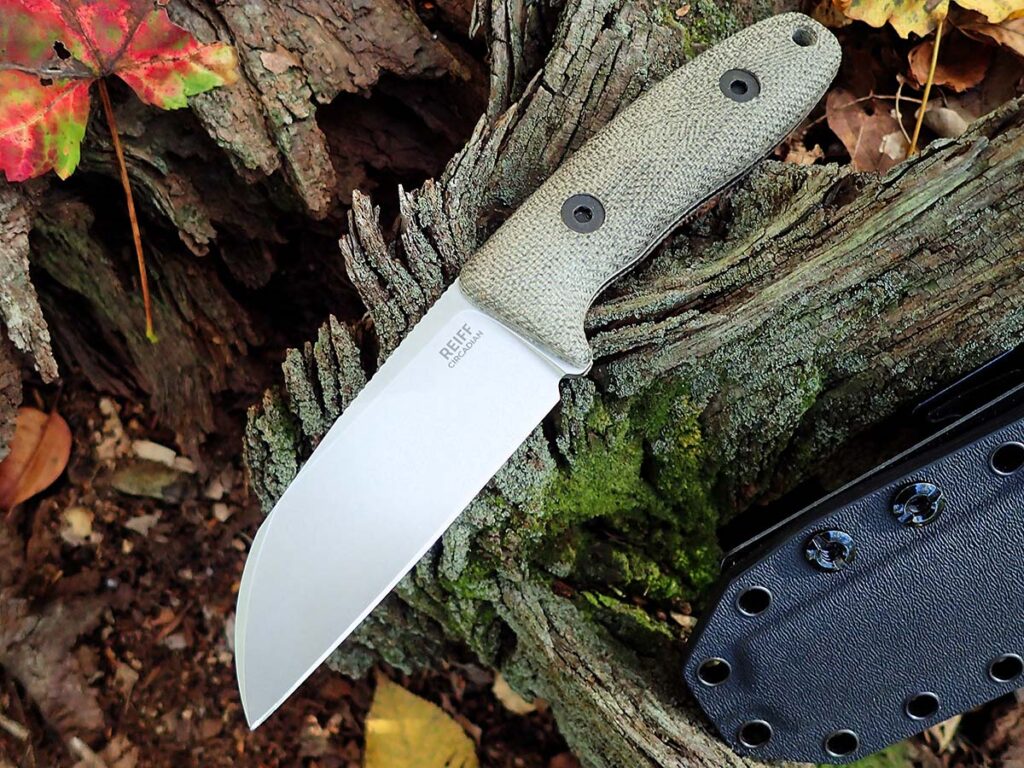
Taking it into the woods, the author found the Reiff Knives Circadian Sheepsfoot performed like a larger knife due to the full-sized handle and wide blade. The perfect tool for both the camp and kitchen.

Reiff Knives built its reputation on hard-use tools designed for people who work and live outdoors. The Circadian Sheepsfoot fits that mission cleanly. Reiff Knives is a family run and veteran-owned company, and it’s carved out a niche by blending modern steels with field-driven ergonomics. Its knives aren’t showpieces—they’re workhorses built to survive real use in the backcountry, the shop or the boat. The Circadian line has been one of the company’s best sellers, and the sheepsfoot variant pushes the platform into pure utility.

The Circadian Sheepsfoot features a compact EDC profile, measuring roughly 7 inches in overall length, depending on the sheath and scale configuration. The blade measures about 3 inches and is cut from CPM MagnaCut, a steel chosen for its balance of toughness, edge retention and corrosion resistance—a smart match for a knife meant to live outdoors. Reiff offers the blade in stonewash or black DLC, both finishes built for durability and low glare. The 90-degree spine is sharp enough to spark from a ferro rod, adding value for fieldcraft.

Handle scales are available in canvas Micarta, colored black or green depending on the model. The geometry favors control: a deep index cut, a neutral mid-section and a palm swell that locks the hand without forcing a grip. It’s a compact knife that still feels anchored during push cuts, rope work and fine carving.

Reiff pairs the Circadian Sheepsfoot with a Kydex sheath, sold in multiple colors and patterns, including black, OD green and multicam. Reiff designed the sheath for belt or pack-strap carry with enough retention for active movement. It’s an EDC fixed blade—small enough for daily tasks and tough enough for field abuse.

Circadian Sheepsfoot Specs
Overall Length: 7.25”
Blade Length: 3.28”
Blade Thickness: 0.120
Steel: CPM-MagnaCut Stainless
Finish: Stonewash
Weight: 4.10 oz.
Scales: OD Green Canvas Micarta
Sheath: Ambidextrous Universal Kydex with Tek-Lok
Made in the U.S.A.
MSRP: $285

Circadian Performance

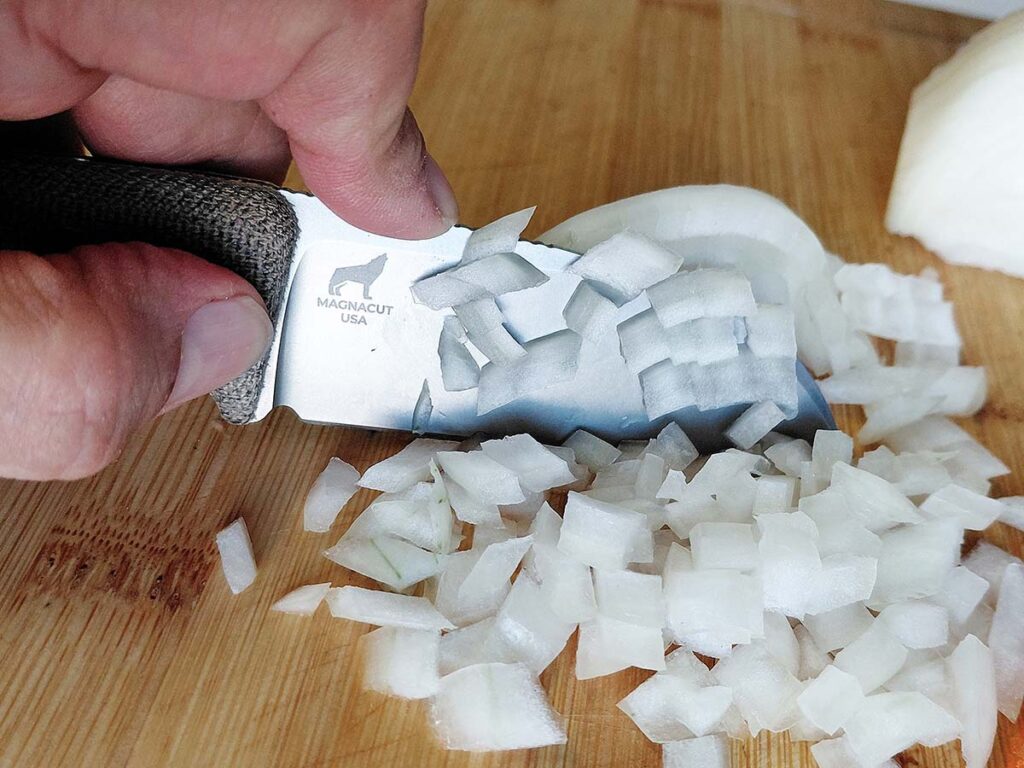
Sheepsfoot blades excel in the kitchen, similar to a santoku knife with a flat blade. The Circadian slices with authority, performing pull slices with the tip.

Even though these three knives are in the EDC realm, the Circadian Sheepsfoot feels like the big brother. I have to give comfort and solidness to it. The knife has the heft to baton wood for the dry parts, and the edge geometry to feather wood like an ordained bushcraft knife. On top of that, the 90-degree spine showered sparks on every part, even the jimping.

It acts like a mini santoku knife in the woods, cabin and home kitchen. It performs draw cuts like a champ on food, cardboard, cordage, paper and leather. I made it my woods sheepsfoot blade and relied on it solo and teamed up with a chopper/splitter in the winter months. I touched up the MagnaCut blade once while testing it, and it wasn’t a chore, because I never let it get dull enough to need the sharpening stone.

I added an UltiClip to the sheath, carried it in my utility pocket and called it good!
The Circadian Sheepsfoot delivers reliable cutting performance for those who need a dependable tool that never falters. It’s simple, rugged and purpose-driven—exactly what Reiff Knives promises with every tool they ship!

Bear & Son Culery Large Sheepfoot Barlow

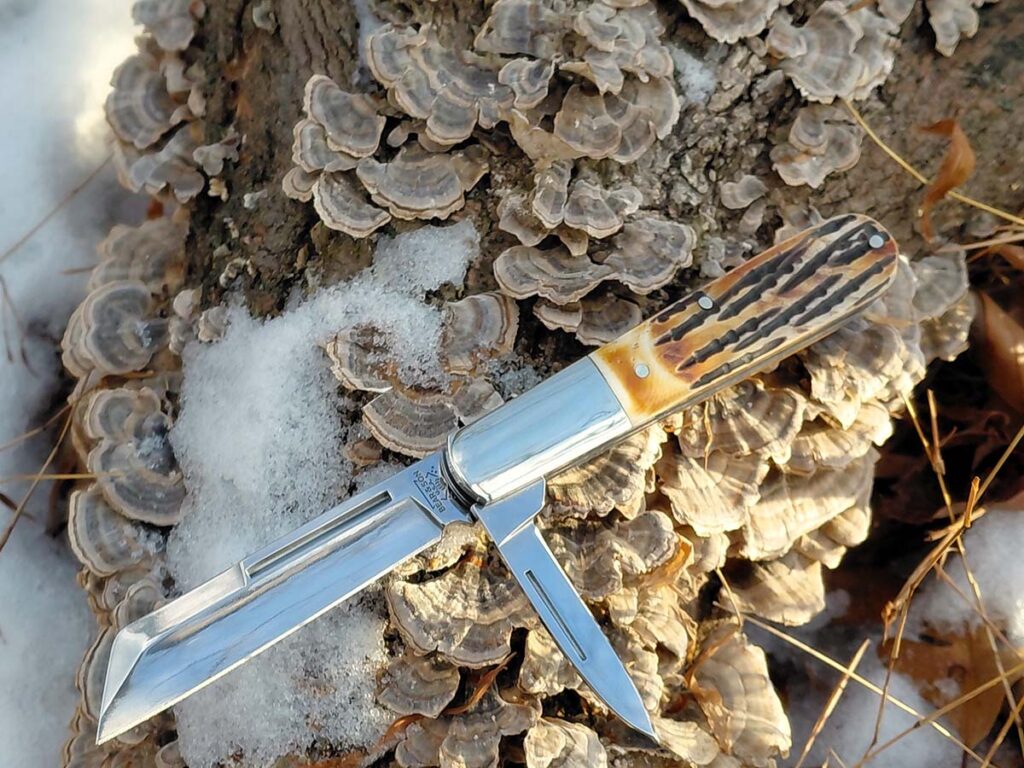
Bear & Son blends tradition with Alabama craftsmanship in the Large Sheepfoot Barlow, featuring simple mechanics and quality materials. Even living up to modern performance expectations, the author found the stag handle gave it “old-timey” appeal.

Bear & Son Cutlery operates out of Jacksonville, Alabama, where it machines, grinds, assembles and sharpens every knife under one roof. That full-control approach gives its traditional patterns a level of consistency collectors and working users both appreciate. The Large Sheepfoot Barlow sits squarely in that tradition. It blends a classic American pattern with modern steel choices and multiple handle options, giving the user a pocket tool that feels familiar but performs with modern reliability.

The knife measures 7 inches in overall length and 4 inches closed. Bear & Son fits the frame with a 2.75-inch sheepsfoot blade cut from stainless steel. The second blade mirrors a traditional Barlow layout, providing a backup edge for finer work. The sheepsfoot profile drives straight cuts through rope, cardboard and daily tasks with predictable control. The company shapes the spine with a clean, squared feel, which helps during controlled push cuts and scraping chores.

Handle options include rosewood, Genuine India Stag Bone and white smooth bone. Each material gives the knife a different personality: rosewood for warmth, stag for texture and smooth bone for a classic pocket-worn look. Nickel-silver bolsters anchor the Barlow silhouette and add durability at the pivot.

The knife is a slipjoint, so it stays legal in most jurisdictions and fits the traditional-carry crowd. Bear & Son ships it without a sheath, as expected for a pocket Barlow. The weight lands at 3.7 ounces, which keeps it planted in the pocket without feeling bulky.

2-Blade Barlow Sheepsfoot
Overall Length: 7”
Blade Length: 3”
Closed: 4”
Blade Thickness: 0.90″
Steel: Stainless
Finish: Satin
Weight: 2.9 oz.
Scales: Rosewood, Genuine India Stag Bone, White Smooth Bone
Sheath: None
Made in the U.S.A.
MSRP: $79

Large Sheepfoot Barlow Performance

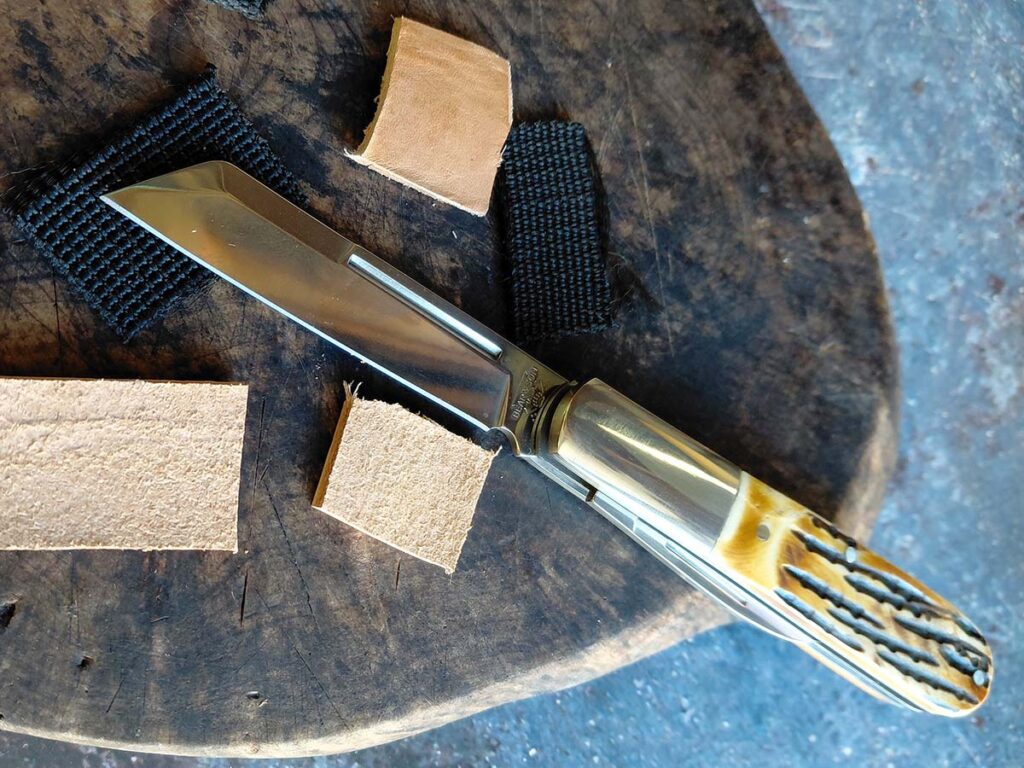
The Sheepfoot Barlow's large blade cut through leather and nylon webbing easily. Meanwhile, the comfortable, tapered handle made pull slicing smooth.
The Sheepfoot Barlow’s large blade cut through leather and nylon webbing easily. Meanwhile, the comfortable, tapered handle made pull slicing smooth.

The Large Sheepfoot Barlow had some weight and an old-timey impression. It made me feel classy when I used it and it sliced like a champ. Its solid feel was substantial, though I took extra care when pulling the blades out. The liners inside the handles were sharp—near paper-cut sharp. But I didn’t draw blood when I opened it. They were just rough to the touch.

Both blades were wicked sharp. The smaller blade had a more awl-like shape and was thick enough to use as one. Or it could be your up-close, carving-in-tight-places blade. Pick your poison. The main blade excels at slicing rope, and the sharp tip makes short work of leather. What surprised me most was how detailed the sheepsfoot was mincing fresh garlic in the kitchen. Naturally, the stainless steel remained worry-free around moisture.

Bear & Son continues to push traditional patterns forward while keeping the work in Alabama. The Large Sheepfoot Barlow reflects that mission: simple mechanics, honest materials and a pattern that earned its place over generations.

Tactile Knife Co. Redhawk

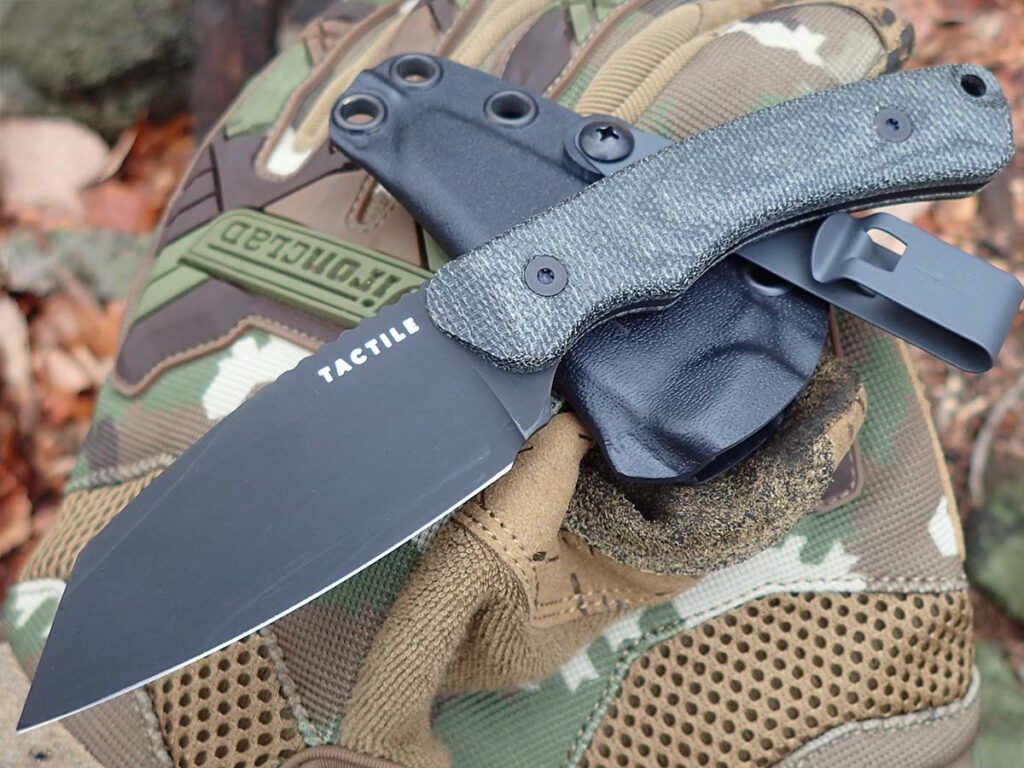
Kept to the company’s tight tolerances, the Tactile Knife Co. Redhawk is a versatile cutter designed for everyday use—indoors or outdoors. The author found the knife’s design and build quality impeccable.

The Redhawk marks Tactile Knife Co.’s push into the compact fixed-blade EDC space, and it carries the same machining pedigree that put the Dallas-based shop on the map. Tactile started as a precision pen company before expanding into knives, but its through-line never changed: tight tolerances, clean lines and American-made materials. Its shop in Texas machines nearly every component in-house, and the company leans hard into heirloom-grade build quality. The Redhawk reflects that ethos—simple, durable and purpose-driven.

Taylor Martin created the Redhawk after years of carrying fixed blades that fell short. It’s a compact knife punching above its size without feeling delicate. It measures just under 7 inches in overall length (6.9 inches OAL) with a 2.75- or 3-inch blade, depending on the variant. The blade, cut from CPM MagnaCut, is a steel chosen for its balance of toughness, edge retention and corrosion resistance. Its reverse tanto/modified sheepsfoot profile gives it a tall cutting surface and a fine, workable tip. Blade stock runs 0.12-inch, keeping it slicey without feeling thin.

Handle scales are made of Micarta and come in multiple colors. Tactile shaped them with a scalloped pinch-grip area for control during fine work and heavy cuts using a chest-lever grip. Finish options include stonewashed, tumbled Cerakote and black Cerakote, depending on the retailer. The spine is ground clean and crisp, suitable for scraping tinder or striking a ferro rod. Tactile doesn’t explicitly market it as a 90-degree spine, but it behaves like one in use.

The knife ships with either a Kydex or leather sheath, both set up for pocket carry with a clip, making it a true EDC fixed blade rather than a belt-only option.

Redhawk Specs
Designer: Taylor Martin
Overall Length: 6.9”
Blade Length: 2.75”
Blade Thickness: 0.120
Steel: CPM-MagnaCut Stainless
Finish: Cerakote (black)
Weight: 3.16 oz.
Scales: 3D Contoured Micarta Handles (black)
Sheath: Kydex Discreet Carry Concepts Sheath Clip
Made in the U.S.A.
MSRP: $249

Redhawk Performance

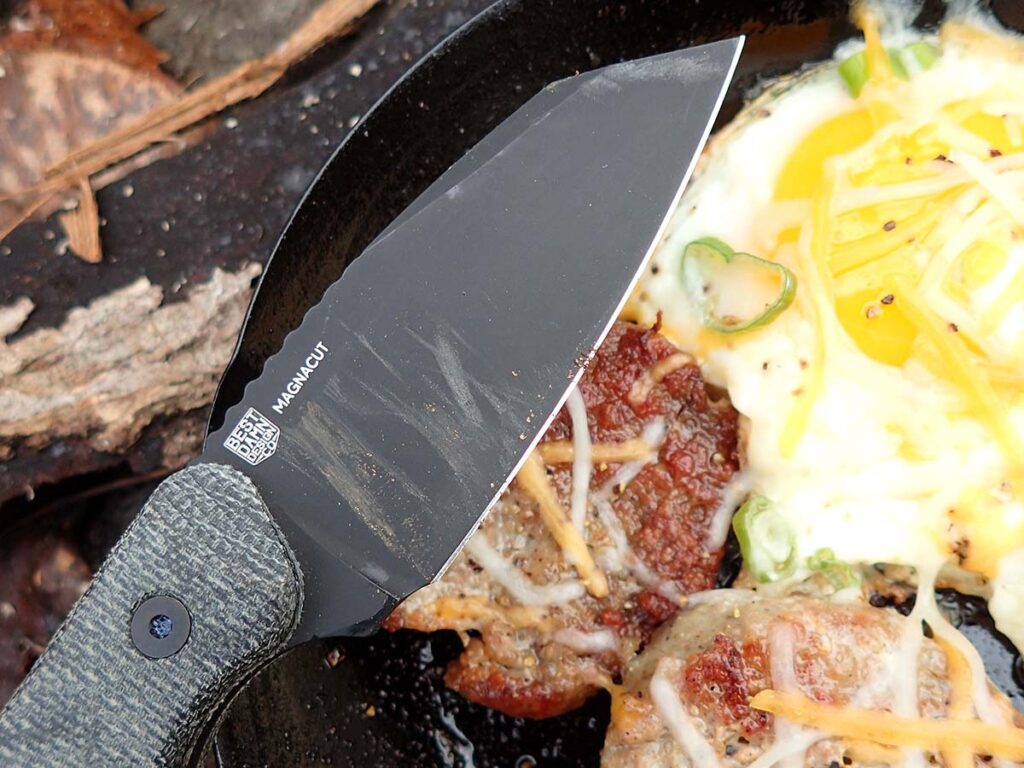
The Redhawk was a woods camp breakfast companion during the author’s testing. The sheepsfoot both helped with fire, food prep and eating.

I first saw the Redhawk in Taylor Martin’s hand at an outdoor event. We talked about it later that evening, and I was eager to get one and put it through the wringer. First stop—the Irish pub to show the guys. After show-and-tell, it was nearing the holiday season and the Redhawk went to work on package duty. Work included heavy plastic strapping, paper and plastic packaging, bubble wrapping and—as little as possible—tape. I hate sticky blades, so usually I cut through cardboard when breaking them down flat. Believe it or not, paper, grass and cardboard are all hard on an edge.

In the woods, the Redhawk made feather sticks for a fire from wet wood and went on to slice ham and sausages. It kept a small bio stove well fed in the colder end of autumn. The blade performed as expected—well! The handle was nimble, yet substantially comfortable. The scalloped grooves in the Micarta scales did their job, especially in chest-lever and pinch grips.

The Redhawk is a compact cutter built for daily tasks, but it carries the machining DNA of a much larger knife. It’s a minimalist tool with maximum intent—exactly what Tactile Knife Co. set out to build.

Closing

The sheepsfoot blade shape shares genetic material with many knives, such as the Malaysian parang, the Japanese santoku knife, rescue knives and Serbian-style cleavers. There’s no escaping this timeless pattern!

Knife Reviews:

Everything You Wanted To Know About Arkansas Sharpening Stones

Novaculite still rocks knife sharpening!

Timeless and iconic, it remains practical and complementary to other options today.

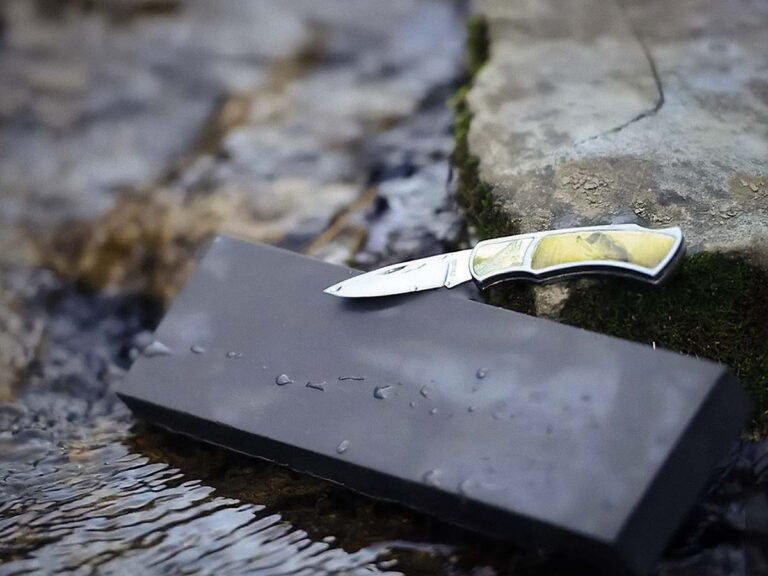
The novaculite sharpening stone is a wonder of nature. Almost pure microcrystalline quartz in content, this dense, fine-grained rock was formed from 318 to 416 million years ago during the Devonian and Mississippian periods in ancient seabeds and later pushed toward the surface with the peaks of the Ouachita Mountains of western and central Arkansas. Massive sedimentary layers ranging from 250 to 900 feet thick produced the stone, which takes its name from the Latin novacula, meaning “sharp knife” or “razor.”

From there, the stone was destined for a rendezvous with the knife blade, rendering a sharp edge that gets the job done and holding a place in working knife history dating back centuries.

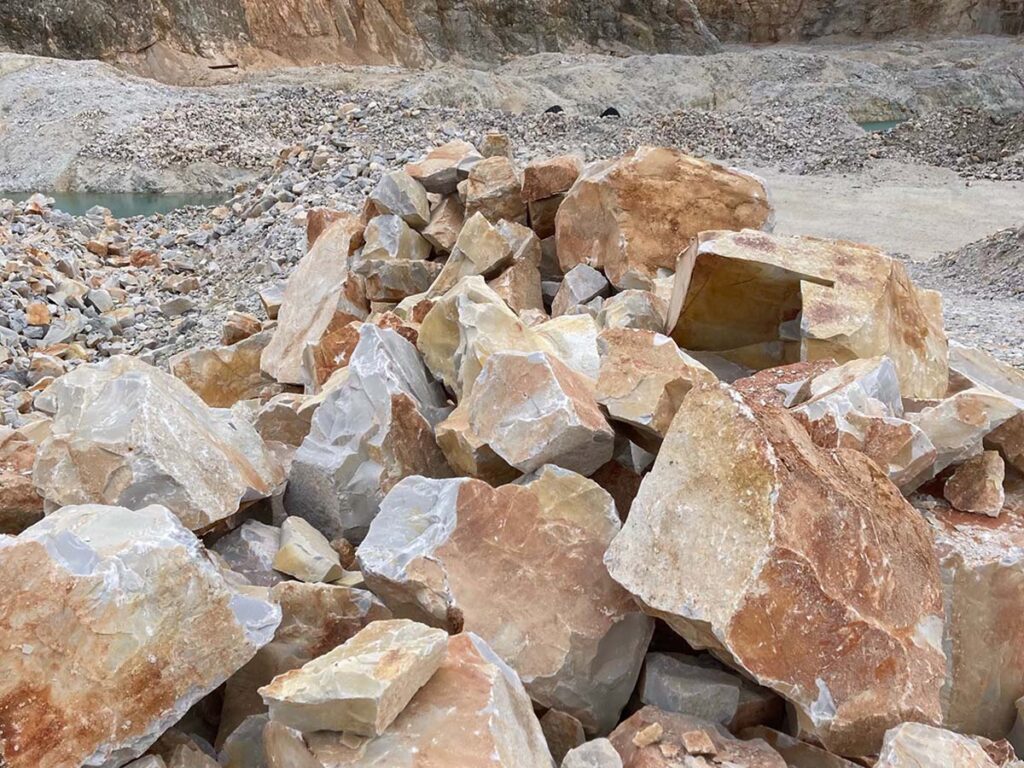
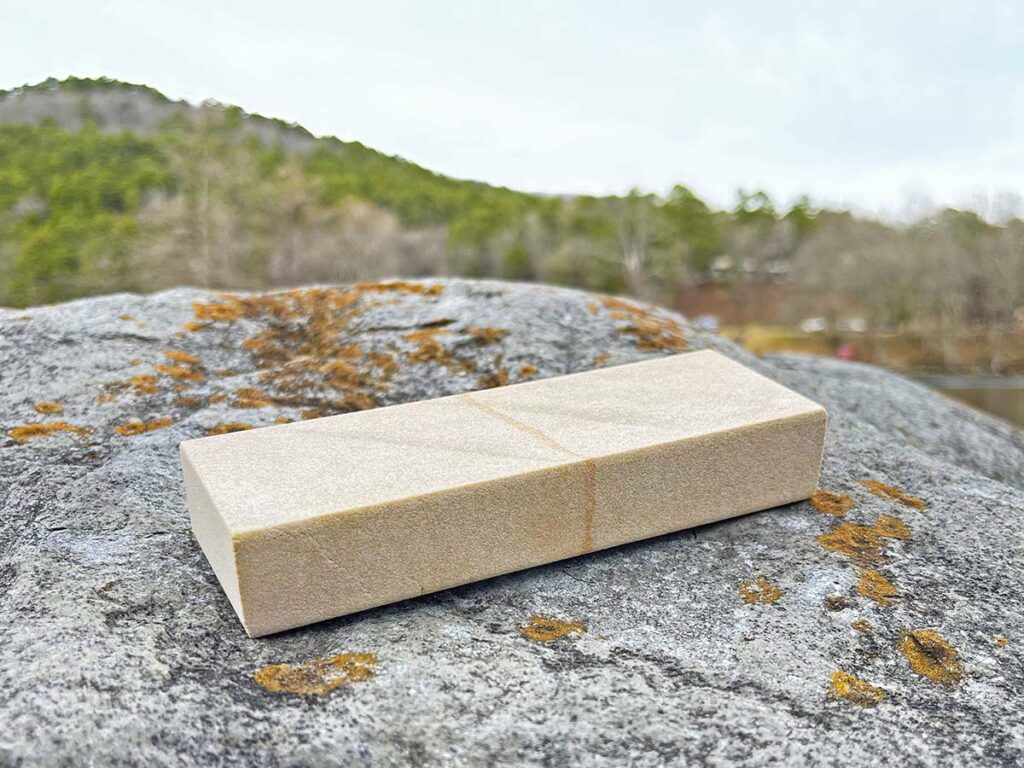
The novaculite deposits in Arkansas were formed 318 to 416 million years ago and it takes plenty of mechanical muscle to push around the material. The deposits run from 200- to 900-feet thick, in turn the operations are substantial. And while the weathered novaculite is somewhat bland to the eye, once broken up the beauty of the natural material shines through. (Images courtesy of Chis Stillian)

Today, however, there is a bit of … well … friction as some may claim modern synthetic stones are eclipsing or at least competing with novaculite for some nebulous title of “best.” Synthetic stones often offer faster sharpening and convenience, while novaculite is valued for its refined finish and traditional appeal. Truth is that each has its place, and novaculite was and is a key participant in the knife-sharpening exercise.

“It gives a razor-sharp, polished edge with smooth feedback that many prefer over synthetics,” explained Chris Stillian, owner of Natural Whetstone, LLC. The company was founded by close friend David Davenport two decades ago, and when David passed away during the COVID-19 pandemic, Chris and his father, Shawn, kept the central Arkansas company going.

“The stones wear very slowly,” Chris continued. “Some last decades because they’re 99 percent plus pure quartz with no fillers. They’re natural, made in the USA and work great for chefs, woodworkers and knife users.”

Danny Kirschman founded Dan’s Whetstone Company, Inc., in Pearcy, Arkansas, in 1976, and his son Steve is currently CEO of the family venture. His roots in novaculite are long and deep. “The erosion-resistant quartz formations of the Ouachitas produced the finest and rarest natural abrasive in the world,” he offered. “Danny Kirschman’s opinion and what we share with others is that the one thing that sets novaculite products apart from other sharpeners is their unique crystalline structure. The novaculite stones wear less aggressively than most manmade abrasives due to the natural bonding of the crystals.”

Best Steel For Novaculite

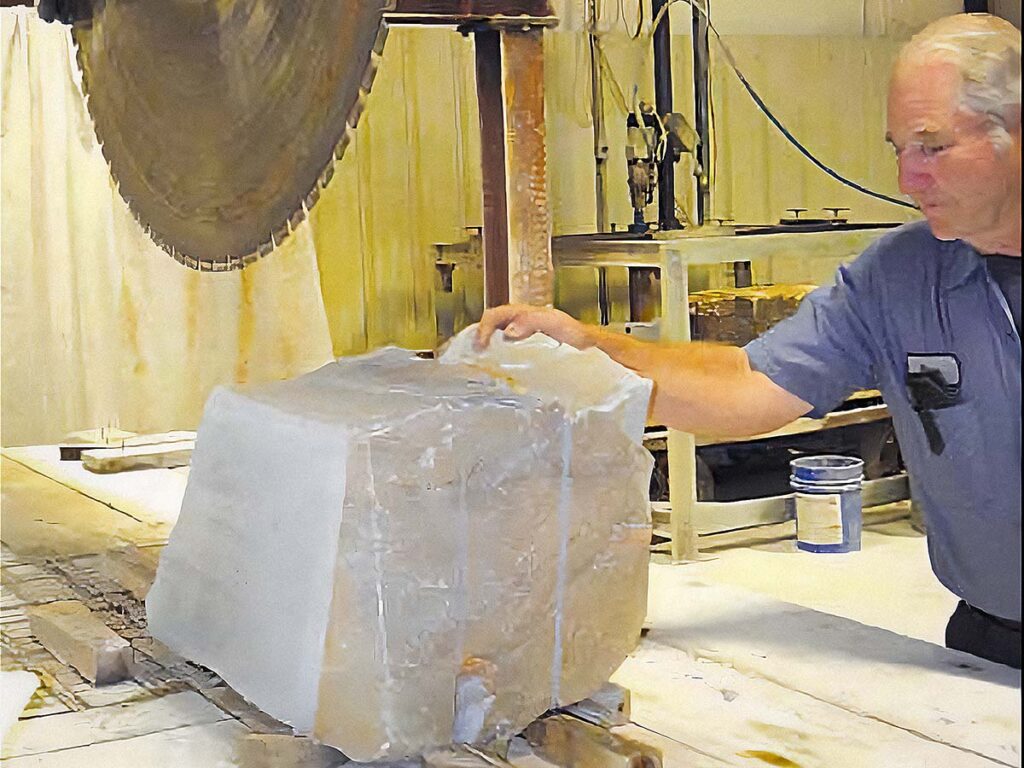
Dan Kirschman, by the company’s largest saw, spent his formative years as a mining engineer, until his hobby of cutting and polishing novaculite developed into a full-time business. Dan’s Whetstones now has a 500-acre quarry and manufactures more than 300 different products from the stone. (Images courtesy of Dan’s Whetstone)

Both Stillian and Kirschman agree that the disadvantages of novaculite usage lie in cutting speed and other aspects. Chris commented, “It cuts slower than diamond or water stones, so it’s better for refining edges than heavy profiling. It needs oil instead of water, can glaze if not cleaned and doesn’t bite hard on modern super steels. Top grades cost more because the dense material is rare.”

Steve added, “The most common complaint is their low abrasion rate. Because the stones are exceptionally hard and dense, they remove material much more slowly than synthetic stones. They are best suited for maintaining an already sharp edge rather than ‘hogging off’ metal to repair chips or reprofile a blade. There is no truly coarse Arkansas stone. Even the soft Arkansas is relatively fine compared to a coarse synthetic stone. Novaculite is composed of quartz, which has a Mohs hardness of around 7. While this is harder than standard carbon steel, it is softer than the vanadium and chromium carbides found in modern, high-alloy super steels.”

Further, since Arkansas stone is a natural product, every stone is unique and may exhibit internal flaws, cracks or variable grit. Oil is required to keep metal particles, or swarf, from clogging the pores, which leads to a bit more cleanup. Lubrication keeps the stone from “loading” with metal, which can reduce its effectiveness.

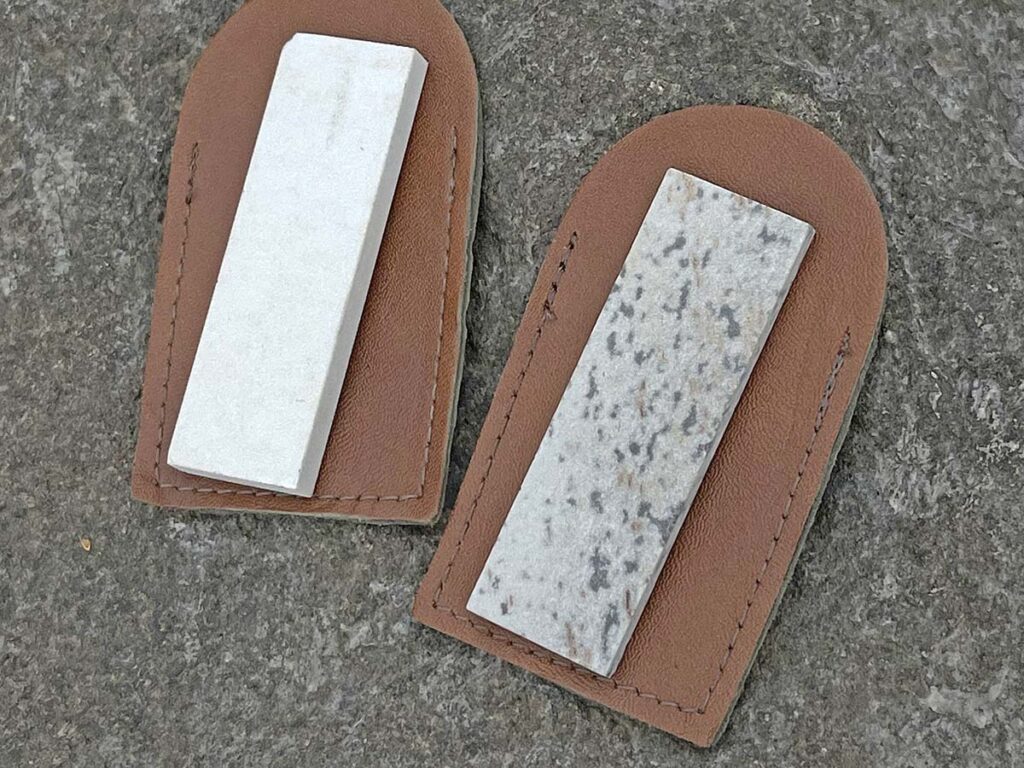
Similar to many sharpening systems, Arkansas stones of different grit sizes are used in conjunction. On the right is a soft stone with a courser grit, good for raising a burr and initial honing. On the left is hard stone, used for final edge polishing and day-to-day maintenance. (Image courtesy of Chris Stillian)

Novaculite works best with simple carbon and low-alloy stainless steels like 1095, O-1, 440C and A2. Since such steels are commonly found on hunting, working, kitchen, bushcraft/survival and everyday slipjoint and fixed-blade knives, a broad area of application exists. High vanadium super steels such as S35VN, M390, CPM-3V and others—often seen in premium chefs’ knives and high-end custom knives—are best served with diamond stones, for example, because their carbides are harder than the quartz in novaculite.

Reviving Arkansas Rock

Even the casual observer can, therefore, discern the proper employment of the novaculite sharpening stone with the blade steel that will produce the best results. One giant of the knife industry recognized the value of the Arkansas stone years ago and built a catalog empire on its sturdy reputation.

The late BLADE Magazine Cutlery Hall of Fame® member A.G. Russell began selling Arkansas sharpening stones in the mid-1960s after moving his family back home to northwest Arkansas from Marin County, California. During the move, he discovered that his whetstones had gotten lost in transit.

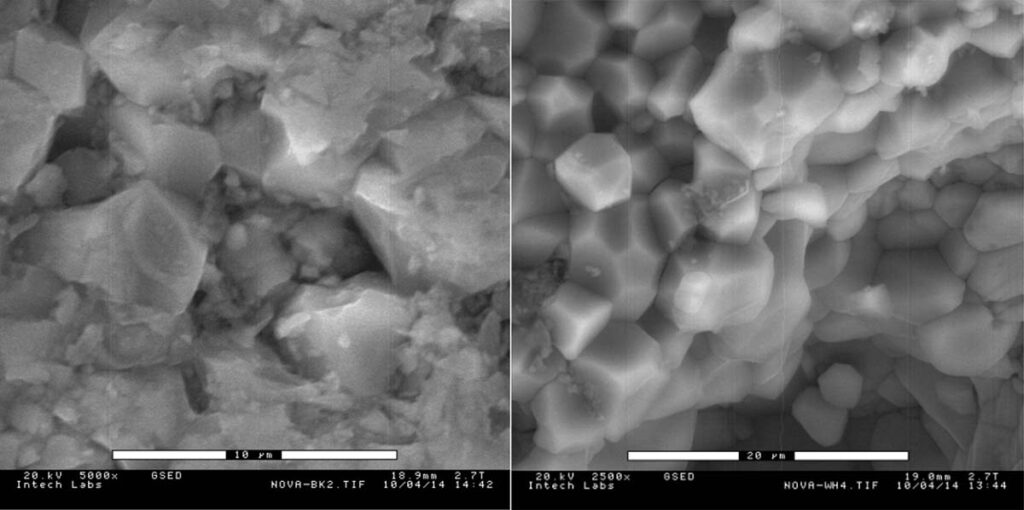
Novaculite is microcrystalline quartz in structure and while it can seem extremely smooth to the naked eye, at the microscopic level the formation’s cutting properties become evident. On the left is ultra-fine black stone at 5000x magnification and the right hard Arkansas stone at 2500x magnification. (Image courtesy of Dan’s Whetstones)

“He tried to buy replacements in local hardware stores, but none stocked them,” remembered A.G.’s wife and fellow hall-of-famer Goldie Russell, who runs the company today. “Having lived in Hot Springs, Arkansas, for a while when he was a teenager, A.G. knew that the only deposit of novaculite was in that area. A.G. went to Hot Springs and found someone who was cutting stones. He purchased stones and began selling them to local hardware stores.”

From there, A.G. bought ads in magazines, particularly Guns & Ammo and The American Rifleman. Soon enough, he became a supplier to Brownells, a major gun retailer, capitalizing on the mutual affinity of gun enthusiasts for knives. Together with the magazine effort and his own sales acumen, Russell re-energized the popularity of the Arkansas stone.

“The frequency of A.G.’s ad in magazines and then the offering of these stones in the A.G. Russell Catalog of Knives was very important in making these stones readily available nationwide through the late 1960s and the 1970s,” observed Goldie. “There is still a large quantity of the small stones that he had cut during those years in our inventory. That is how he started what became A.G. Russell Knives.”

It’s a misnomer Arkansas stone’s hardness corresponds to its color. Similar colors can be noted in different grades, as the coloration is purely a matter of trace mineralization in the stones. (Image courtesy of Chris Stillian)

Novaculite stones, therefore, maintain their place in the practical and the historical aspects of the knife industry, and their relevance is not likely to fade. Those who are familiar with their capabilities remain loyal. They appreciate the investment of time and effort required to bring out that razor-sharp edge, and there is something timeless and reaffirming in the process.

Novaculite Grades

The stones themselves are available in four major grades. “Users should be aware that color is not the determining factor in grading novaculite,” explained Kirschman. “Some users have been defining whetstone grades by color, but the same colors may be seen in more than one grade. Color is caused by trace minerals that are dispersed through the rock during sedimentary formation more than 350 million years ago and subsequent geological activity.”

The major grades of novaculite include the following:

  • Soft Arkansas: The most popular all-purpose stone often used by wood carvers, sportsmen, butchers, commercial knife sharpeners and even housewives who desire keen, polished edge in a minimum of time.
  • Hard Arkansas: A fine grit stone good for everyday maintenance and popular among woodcrafters and the dental industry.
  • Translucent and True Hard Arkansas: An extra fine stone with a glassy feel and used in industrial applications requiring an extremely fine polish. It appears in a variety of colors.
  • Black Arkansas: Sometimes referred to as “surgical black” stone, the finest grade abrasive available today, delivering a mirror polish.     
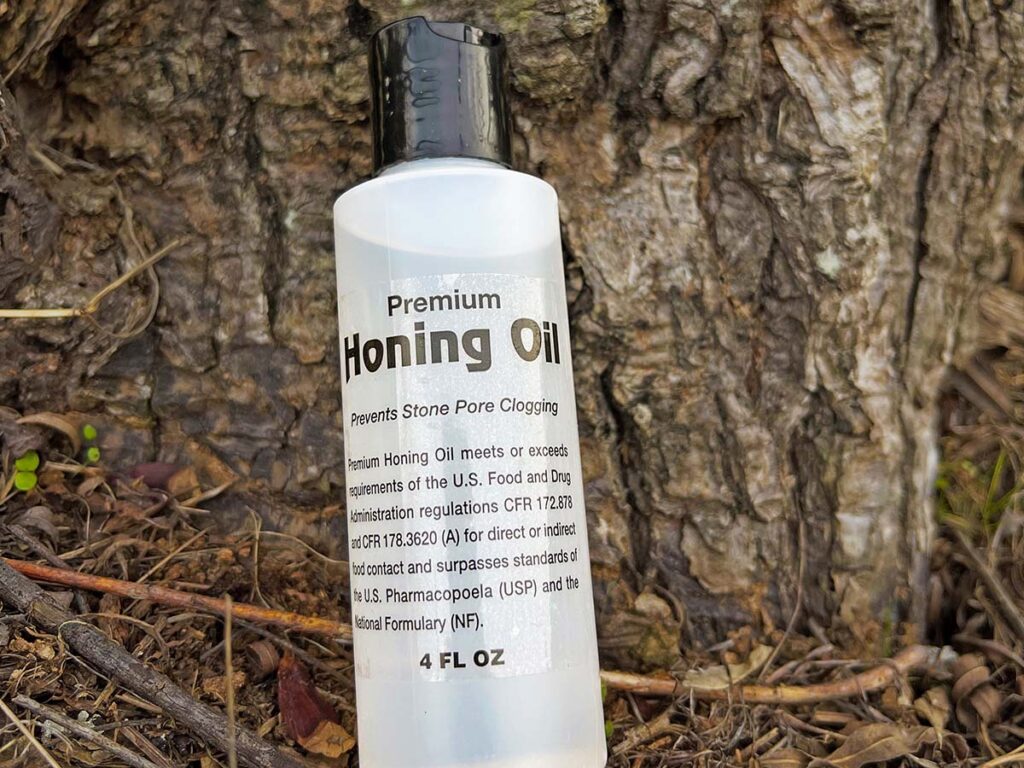
Among the most critical factors of using natural stones to sharpen knives is using honing oil. Oil keeps metal particles, or swarf, from clogging the stone’s natural pores, thus reducing its effectiveness. (Image courtesy of Chris Stillian)

The proper method of sharpening with a novaculite stone involves preparation and practice. “It’s an oil stone, so put a few drops of honing oil on it,” advised Stillian. “Hold a consistent angle, 15 to 20 degrees for most knives, use light to moderate pressure, and take smooth strokes. Start on soft or hard if the edge is dull, and finish on black or translucent. Raise a burr, then lighten pressure. Clean with soap or solvent to avoid glazing. Strop afterward for extra keenness, if you like.”

Those About To Rock

According to Chris, consistent purchasers and users include enthusiasts, woodworkers and chefs who “keep buying them for the feel, longevity and heritage. Synthetics rule high-volume work, but real Arkansas novaculite—especially the rare translucent and black grades—still sell at a premium to people who want the genuine article.”

Steve sees emerging interest as well. “The rising D.I.Y. (do it yourself) sharpening culture is a major driver,” he commented, “with the hobbyist segment now accounting for nearly 35 percent of total whetstone sales worldwide. Online tutorials and a deeper appreciation for craftsmanship have fueled this demand. Sustainability is a driver, as well. Modern consumers increasingly view natural stones as a “green” alternative to synthetics.

“Niche premium positioning, even while high-end market saturation is slowing growth in North America to about 4 percent, means natural stones remain a staple for professional chefs who prefer them for maintaining blade integrity,” Steve concluded. “And technological integration means that manufacturers are now developing beginner-friendly kits and instructional digital content to tap into 62 percent of home users who are interested in traditional sharpening but lack confidence in the technique.”

The future presents an atmosphere of coexistence among the Novaculite and synthetic options. The global whetstone market topped $457 million in value in 2024 and is expected to reach $677 million within eight years. Natural stone demand should stay steady, supported by its faithful and traditional users while welcoming explorers to these Ouachita wonders.

More On Sharpening:

Best Kitchen Knife Set To Upgrade Your Galley

Whether Three Pieces Or More Than A Dozen, A Great Kitchen Knife Set Can Completely Change How Work With Food.

Kitchen knife sets are extremely popular, and it’s easy to see why. They keep all your knives safe, easily accessible, and add a touch of style to your kitchen counter. It’s important to keep a few things in mind when shopping for a knife set, whether for the home or a professional kitchen.

The Block Is A Piece

When you see that a set is three, six, or 15 pieces, it’s important to remember the knife block itself will count as one of the pieces. So don’t fret if you think there’s a missing knife because there isn’t.

Get A Set That Fits

If you’re a parent looking for a good set of knives that will last and help cook the family’s meals for years to come, don’t feel like you need to spend hundreds or thousands of dollars on a set with dozens of specialty pieces. Sometimes less is more and that six-piece set might be the perfect one for you.

Follow The Maintenance Directions

Just because your butter knives go into the dishwasher doesn’t mean that your kitchen knives will necessarily need to as well. Follow the care instructions of your set carefully so you get the most out of your knives and don’t see rust spots start appearing on your blades.

Best Kitchen Knife Sets

Japanese, German, forged, and stamped. These are descriptors of our five best kitchen knife sets. Large sets, small sets. We made sure to select something for everyone with our list.

Calphalon 321

Calphalon 321

What’s better than an affordably-priced knife set? How about one with a sharpener built into the block itself. That’s what you’ll get with the Calphalon 321. This set includes half a dozen steak knives to go with an eight-inch chef’s knife, serrated utility knife, paring knife, shears, and santoku knife.

Made from forged high-carbon steel, the blades prove tough and are able to maintain an edge. And their full-tang construction adds balance to the knives. 

The wooden block features a built-in ceramic sharpener in the slots for the chef’s knife, santoku, and paring blade. This means that every time you pull one out of the block, it passes through the sharpener to maintain its edge. Another handy feature is the printed label on the end of each knife so you’ll know what you’re grabbing at a glance.

In totality, this is an excellent budget knife block. MSRP: $169.99

Buck 13-Piece Cutlery Set

Buck 13-Piece Cutlery Set w/Rosewood DymaLux Handles

Buck? On a list of kitchen knives? Oh yes, and the set is just as high quality as the company’s famous folders. By far, this is the largest set on the list.

The set features an 8-inch chef’s knife, slicer, two different paring knives, a spreader, serving/grilling fork, and six steak knives. Buck constructs the blades from 420HC stainless, except for the spreader, which is 410HC. Triple-rivited, the handles are durable and attractive.

There are two styles of handles. The Slate PaperStone is dishwasher safe while the Rosewood DymaLux is hand-wash only. And everything safely stores away in the wooden knife block.

This set is lovely and meets the lofty expectations you would expect from any other Buck product. MSRP: $599.99 for the Slate Paperstone, $749.99 for the Rosewood DymaLux.

Henckels Statement 12-Piece Kitchen Knife Set With Block

Henckels Statement 12-Piece Kitchen Knife Set With Block

A leader in kitchen cutlery, Henkels‘ set hits home run. 

The set features single-piece stamped stainless steel blades that are full tang and precision-honed to give them a perfect edge right out of the box. The polymer handle also provides an excellent grip and is easy to clean. The wood block fits all the pieces which include an eight-inch chef’s knife, santoku knife, paring knife, bread knife, sharpening steel, and a set of six steak knives.

This set covers nearly every scenario you’ll encounter in a home kitchen, and it’s also the most affordable set on our list. MSRP: $119.95.

Mercer Culinary Genesis Six-Piece Knife Block Set

Mercer Culinary Genesis Six-Piece Knife Block Set

This kitchen knife set from Mercer Culinary has the most unique appearance of the items on our list, but it is so much more than just looks. 

The glass block allows for a 360-degree display of the knives. The windows are attached on either side of the beechwood block which holds five knives.

This set of forged knives includes an 8-inch chef’s knife, paring knife, bread knife, boning knife, and utility knife. All of them are made from high-carbon German steel ground to a 15-degree edge and outfitted with a Santoprene handle for comfort and grip. 

It’s a conversation piece. It’s a quality knife set. It’s an absolute bargain for the quality of the product. MSRP: $156.

Shun Classic 5-Piece Starter Block Set

Shun Classic 5-Piece Starter Block Set

Shun makes professional-caliber knives, and its Classic Five-Piece set maintains that standard. 

There are only three knives included in the set, but they are of the highest quality. The 8-inch chef’s knife, paring knife, and utility knife are all made from 68 layers of stainless damascus cladding around a VG-Max core. They all tuck away in the Slimline Bamboo Black knife block, along with a honing rod. The trio of Japanese-style knives has ebony-finished Pakkawood handles with a full tang. 

A unique aspect of this set is there are more slots than knives. The block comes with two extra slots, one of which is designed for shears. This gives you to tailor your tools to your needs in the kitchen. 

Even though this is the smallest set on our list, it is the priciest due to the time and craftsmanship that went into every element of it. MSRP: $593.

Read More

The Navaja: A Spanish Gem

The Navaja Is A Sleek, Svelte Folder Originating From Spain Hundreds Of Years Ago. Today It Remains Popular In Both The Real And Digital Worlds.

The Navaja is one of the most interesting knives in the world. Its history can be pinpointed to the Andalusia region of southern Spain, and its growth and evolution since its creation more than 400 years ago has been well-documented. 

The History Of The Navaja

The first Navajas that resembled the modern version came to be in the 1600s. The name is derived from the Latin word “novacula” which means razor, and you can see the resemblance to a straight razor in its construction with the long, thin blade that folds away neatly into the handle.

The knife became popular during a period when, unless you were a nobleman, there were many restrictions on swords and other blades. This meant that the Navaja developed as a peasant’s knife and was used for all sorts of utility tasks. One thing that made using it a bit difficult was the fact that it didn’t lock when opened. Later Navajas would have locking mechanisms, but the first versions didn’t. Most notably the Navaja made a distinctive cracking/popping sound as the blade was opened, differentiating it from other knives.

Thanks to the steel innovations that allowed the knife to lock, the Navaja spread its wings and made its way out of Spain and to nearby countries like France. As the knife continued to evolve it was banned by rulers, then became a popular tool for rich and poor alike, and was used as a versatile combat knife. In fact, it became the knife of choice among muggers who would rob people in alleyways and other dark urban areas. Victims knew they were about to be robbed when they heard the unmistakable popping sound the Navaja made when a mugger opened it.

Roughly a century ago, the Navaja began to fall out of favor with knife lovers. However, it continues to endure thanks to a handful of makers crafting their versions, and, in an extremely modern twist, it has become a popular knife to use for players of the video game Counter-Strike: Global Offensive.

Kings County Tools Navaja-Style Knife

Navaja

A great modern representation of the Navaja is seen in this folder from Kings County Tools.

The blade is not just razor sharp but also razor thin. At three inches in length and just .25 inch wide, the stainless steel knife is excellent at precise, detailed tasks. The brass and steel handle is both handsome and provides an excellent grip while cutting.

Not quite a razor and not quite a penknife, this Navaja shows what the knife can be and how different it is from other folders on the market.

MSRP: $34.75

Castillo Knives Navaja

Castillo Navaja
Castillo Knives Navaja – Olive Wood Handle

A different interpretation of the Navaja comes from Spain-based Castillo Knives. Their Navaja is similar to contemporary lockback knives in many ways and is an all-rounder in every sense of the term. 

The blade is made from Sandvik 14C28N stainless steel and the handle comes in a variety of materials, from two types of Micarta® to four types of wood. Every version looks great, and the 3-inch straight-back blade has a small bit of deep jimping on the spine to aid in grip and force when cutting. Every knife comes with a leather pocket sheath and a 240-grit bonded ceramic sharpening stone.

All told, this 6.5-inch piece is a well-made gem.

MSRP: $109 (Micarta versions), $119 (wood versions)

Read More

Civivi Cogent Review: How Versatile Is This Flipper?

The Cogent Flipper Folder From Civivi Is Ready To Cut Through Pretty Much Anything

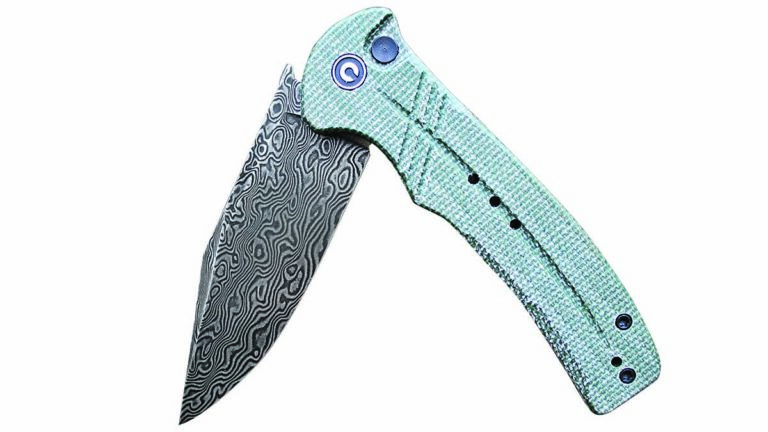
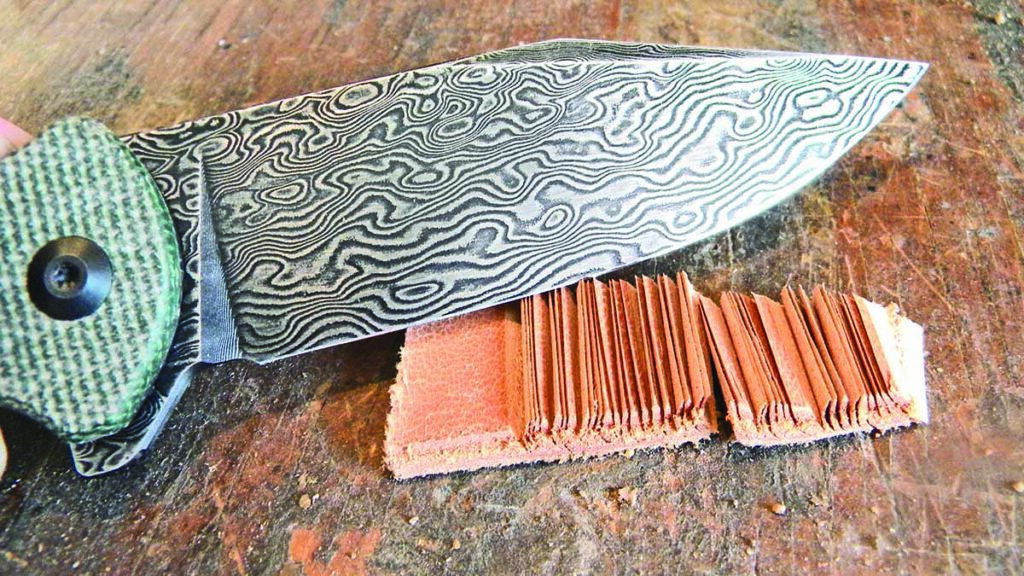
The Cogent button-lock folder from Civivi is well put together. It has a great feel and a classy blackened stainless steel damascus blade. 

Civivi uses 10Cr15CoMoV and 9Cr18MoV stainless steels in the damascus mix. The blade has a full flat grind designed to slim the edge geometry down for efficient slicing.

Testing The Civivi Cogent

Civivi Cogent skiving leather
Skiving 6-ounce leather was no problem as the Cogent did the job aggressively and noisily—the author easily could hear the crunch on each skive.

First up on the test agenda: 20-pound bond copy paper. The Cogent zipped through it without hesitation. The blade was super smooth during slicing. I used a push cut for a full slice. The knife most definitely has a fine edge.

Staying with a push cut, I used the Cogent to effortlessly slice single-walled cardboard to shreds. The edge never stalled in dispatching the medium. Man, this thing is wicked sharp! There was no twisting of cuts, just straight slices. In fact, it sliced so quickly I had to really watch my fingers to avoid cutting them.

I took it up a notch by slicing plastic board. It was like there was no variation at all in the speed and control of cutting. The only difference was the absence of the zipping noise emitted by the cutting of the cardboard. It was nice, quiet slicing with no hang ups.

There was some 6-ounce leather on the bench for skiving. I decided to slice just a part of it up first. Talk about aggressive cutting! I could easily hear the crunching from every skive. The Cogent sounded like it was actually taking a bite out of the leather—which I guess it was. I did some skiving on another piece of leather with similar results. This knife is a wicked sharp cutter.

Wood & Rope

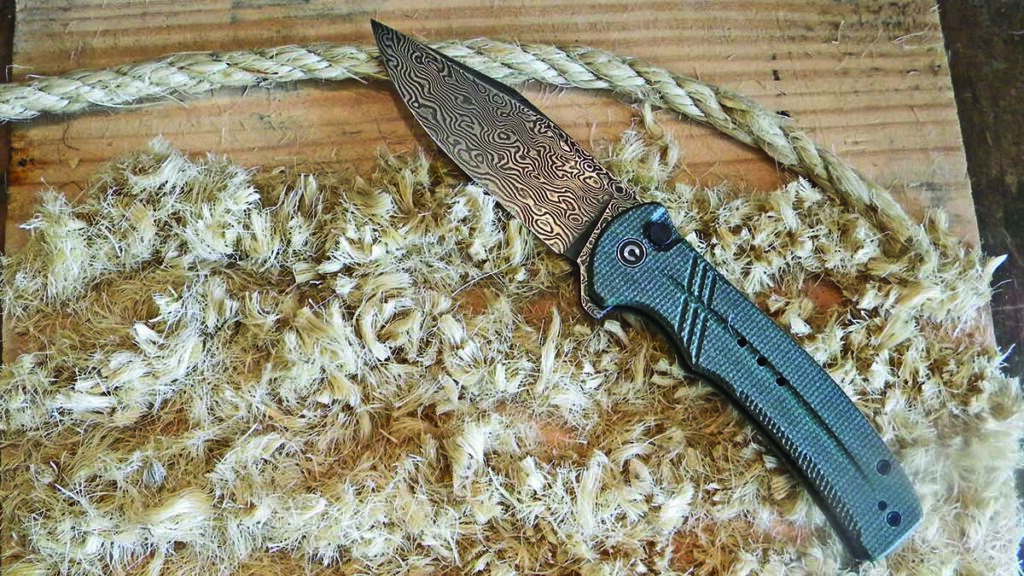
Civivi Cogent cutting rope
The Cogent worked its way to 214 crunching cuts on the 3/8-inch rope before the author got tired and quit.

It was time for some firestick making. Utilizing the fine edge, I whittled some curly-cues in a pine stick. I did some very fine curly-cues and some thicker ones. The Cogent was excellent controlling curly-cue thickness. The thumb notches were very comfortable during the deeper bites. The handle was quite comfy.

For some splitting action to test the lockup, I batonned the Cogent into a half-inch-thick board. It split the wood very quickly with no smears on the blade. The button lock stayed at 100 percent lockup. No wiggle here!

The last challenge was the 3/8-inch sisal rope. The Cogent worked its way to 214 crunching cuts before I got tired. The edge would still shave hair from my arm*. The blade boasts excellent heat treatment. I didn’t find one hot spot on the handle and the knife was very comfortable for heavy cutting.

Civivi Cogent: Final Thoughts

I would carry this knife every day. It holds a sharp edge longer than most. The second-best thing is the comfortable handle. It is made for using. The Cogent is an excellent folder. I’d maybe add more handle color options. I love everything else.

*Editor’s note: BLADE® does not recommend shaving arm hair to test blade cutting ability. It can result in injury or worse.

Civivi Cogent Knife Specs

Blade length: 3.47”
Blade material: Blackened stainless damascus
Blade thickness at the thickest: 1/8 of an inch at ricasso and tapers to the tip
Rockwell hardness: 58-60 HRC
Handle: Green Micarta®
Liners: Stainless steel
Opening: Flipper
Lock: Manual button lock
Knife to know: Open-handle construction for easy cleaning; handle textured; thumb notches on base of blade spine
Country of origin: China
Weight: 4 ounces
Closed length: 4.25 inches
MSRP: $115

Read More

Advertisement

Must Read Articles

Read this before you make a knife

Knifemaking 101 – Read This Before You Make a Knife

  by Wayne Goddard My experience has taught me that there's nothing like digging in and getting started. I've often said the hardest part of the...
how to forge damascus steel

How to Forge Damascus

Advertisement
Advertisement