
Buyer's Guides

You’re looking for a new knife in a certain style – we’ve got recommendations on the best blades for every price point.

Down To The Nitty Gritty: Caping Knives

Caping Knives, Or Capers, Are Necessary For The Finer Parts Of Creating Taxidermy. They’re Also Capable Carving Knives Or A Great EDC.

Caping knives, a.k.a. capers, aren’t mentioned very often in the grand scheme of all things cutlery—though don’t tell that to those who like to mount their trophy game. The caper is a huge part of skinning game in preparation for taxidermy where preserving the fine details is absolutely essential.

Tasks such as trimming around the animal’s eye sockets and mouth area are particularly critical, and the blade must be sharp and small enough to get down to the nitty gritty. That’s not to say a caper can’t handle other functions, such as fine carving and cutting cord. Heck, it can even be used as an EDC.

WEB Pocket Hunter-Caper

 The A.G. Russell Knives Pocket Caper cut nice, tight circles in the suede thanks to the sharp tip and thin blade geometry. The two cutouts at lower right were made with the Russell blade, and the one on the lower left by another blade that didn’t fare as well.
The A.G. Russell Knives Pocket Caper cut nice, tight circles in the suede thanks to the sharp tip and thin blade geometry. The two cutouts at lower right were made with the Russell blade, and the one on the lower left by another blade that didn’t fare as well.

The WEB Pocket Hunter-Caper is produced under the War Eagle Blades division of A.G. Russell Knives, hence the WEB in the name. We’ll just call it the Russell Pocket Caper for simplicity’s sake—and what a simply utilitarian knife it is! The hidden-tang fiberglass-reinforced-nylon (FRN) handle comes in black or bright orange. The blade is a straight-back style with a V-grind from edge to spine. The snap-lock FRN color-coordinated sheath has a tubed hole in the base to hold a lanyard or neck knife cord/chain.

Since one main function of a caper is precision cutting, I wanted to see which of our test knives could turn on a dime—or in this case, a nickel. Using spray adhesive, I tacked a square of suede to a smooth wood surface and drew a group of circles using the perimeter of a nickel as a guide. I then hand-cut each circle to see how precise I could be in removing it from the base. The Russell Pocket Caper, with its much thinner blade, allowed the tip to glide around the outline of the nickel with precision and cut the suede with very little effort. As you might guess, the thinner the blade, the less resistance I encountered.

Bear & Son Rosewood Caper

 Two nice features of the Bear & Son Rosewood Caper handle are 1) the choil adds excellent purchase and 2) the gimped thumb rest on the spine enables you to choke up on the blade.
Two nice features of the Bear & Son Rosewood Caper handle are 1) the choil adds excellent purchase and 2) the gimped thumb rest on the spine enables you to choke up on the blade.

The Bear & Son Rosewood Caper is a modern take on the classic trailing-point knife many of us grew up with. The upswept blade is devoted to cutting chores. The knife’s weight is very manageable and a natural leather belt sheath is included.

The Bear & Son has the second thinnest blade of the test group and placed second to the Russell in cutting out suede circles. I also tested the knives on slicing graceful curves and upward pull-through cuts and found the Bear & Son to have its own advantages.

The generously gimped thumb rest enables you to choke up on the blade, which allows more precision and force to be placed on the task at hand, and, just as importantly, with great comfort. Similarly, the index finger has a nice place to land in the reverse grip while executing pull-throughs, which makes skinning—an equally important part of caping—easier.

Puma SGB Smooth White Bone Caper

 The Puma SGB Smooth White Bone Caper slices like a house afire, cutting strips of tanned leather with ease. Drop-point blades are skinners at heart and this little gem does the job well.
The Puma SGB Smooth White Bone Caper slices like a house afire, cutting strips of tanned leather with ease. Drop-point blades are skinners at heart and this little gem does the job well.

The Puma SGB Smooth White Bone Caper is the smallest of the test subjects but makes up for anything it may lack in size with stylish good looks. The decked-out caper boasts a hollow-ground recurved blade in a drop-point pattern. Like most all of the more budget-friendly SGB models, the blade is made in Germany and the knife is assembled in Asia.

The handle is curvaceous, tapering upward from the base to a bolster that serves as a guard. A round Puma shield graces the scales and a hole in the base has a leather lanyard attached. (I removed the lanyard for photographic purposes.)

With its recurved drop point, the Puma SGB is a totally different blade design than the other test capers. Drop-point patterns are well known for their skinning ability, particularly riding under flesh without piercing organs. This is where the White Bone Caper is at home—slipping under skin and separating viscera from its meaty rewards. It wasn’t as agile cutting out tight circles of suede because where the blade is wide at the tip got in the way as I turned it. That said, it’s a superb slicer.

Utica Shoehorn Elk 1

 The Utica Shoehorn Elk I is the bull of the woods among the test capers. The blade is 4 inches long, 3.75 of that in cutting edge. Though similar in blade configuration to the Bear & Son offering below it, the Shoehorn Elk I dwarfs it in size.
The Utica Shoehorn Elk I is the bull of the woods among the test capers. The blade is 4 inches long, 3.75 of that in cutting edge. Though similar in blade configuration to the Bear & Son offering below it, the Shoehorn Elk I dwarfs it in size.

The Utica Shoehorn Elk 1 is by far the largest of the test knives. The drop-point blade has a healthy choil and a two-inch dip on the spine that serves as a thumb rest. The handle sports ample, curvaceous scales. The knife weighs over twice that of any of the other review capers. Considering the knife’s size, the price is very reasonable.

The Shoehorn Elk 1 is not billed as a caper but it has a blade configuration very similar to that of the Bear & Son test model. The Elk in the name is a dead giveaway that the knife is meant for caping and skinning large game.

I deviated from the suede leather in testing the blade and went to something tougher. I glued together three layers of tight-patterned, corrugated postal board—stout stuff—and gave the knife a go at slicing it the hard way: across the grain. It took some pressure but the blade severed 5.25-inch lengths in single strokes. I have no doubt the Shoehorn Elk 1 could take on tough hide—even alligator scute. While the tip mauled the circle in the nickel-size precision test, it would perform much better on game proportionate to its size.

Finding The Best Caper

All of the knives brought something to the table in the tests. For tight precision caping on small-to-medium game, the Russell and Bear & Son capers were virtually neck-and-neck—the former slightly more geared to precision, the latter a tad more versatile. The Puma SGB excelled more in slicing and a bit less in precision. The Utica can handle the tough hide of larger game the others can only dream of.

Bottom line, it’s really just a matter of choosing which caper fits your needs the best.

Read More

Sharp In Reverse: 5 Reverse Tanto Blades Worth Your Time

The Reverse Tanto Is One Of The Most Interesting Blade Designs. By Putting A Spin On A Classic Pattern, The Reverse Tanto Stands Out From The Pack.

In general terms, a knife profile isn’t something that seems like it should be reversed. The American tanto blade pattern, commonly seen on modern tactical and combat knives, is a modified version of the somewhat longer and more flowing traditional Japanese tanto. While there are variations, the American tanto blade features a hard angle in the belly curve up to the shallow, chisel-ground tip.

A reverse tanto profile keeps the hard angle of the tanto profile but moves it to the spine, thus “reversing” the conventional tanto style. This edge profile doesn’t usually have as harsh of an angle on the spine; on a tanto the tip usually curves up, akin to the larger katana profile. By flipping the edge over, the tip is brought into a straighter line with the hand and offers a good deal more stabbing ability.

An interesting point is that, at least in my direct experience, the reverse tanto is much better at cutting and stabbing tasks than the tanto. Profile matters a great deal in this case. The reverse tanto can be thought of as a very muted bowie in that it has a narrow tip and smooth edge, yet a good height to the spine; the tip can get into a medium easily and the rest follows with minimal effort. 

An American tanto profile’s chisel-type tip has a more severe geometry that doesn’t easily lend itself to going through materials or fine cutting work. The area on an American tanto that usually takes the most damage is the tip angle itself. Not only that but, thanks to the severe angles, it is difficult to keep sharp.

The reverse tanto offers an easily maintainable edge and fine tip while having the strength of a larger blade. This allows the profile to be ground quite thin and remain very strong. The reverse tanto folders in this article are some of the lightest I’ve ever tested, and they cut far above their weight class.

Leatherman Skeletool KBX

Leatherman Skeletool KBX

The Leatherman Skeletool KBX is the smallest knife in the test—so small it could probably ride on a key ring. It is the only serrated knife of the test bunch. Despite being so small, the KBX offers a wide degree of general utility. It is not a heavy cutter like a few in this review. It is neither comfortable enough nor large enough to commit to hard use. It is instead something of a mini multi-tool suitable for the most basic use. It has an integrated bottle opener, which is a very nice touch—and it works!

The size of the piece is the best part and also the worst. As an EDC knife, it is somewhat small. However, for the right person wanting a low-profile knife, this one fits the bill. For basic work like opening boxes, cutting string, or just popping open a cold one, it’s great.

MSRP: $39.95

Benchmade Mini Osborne

Benchmade Mini Osborne

The Benchmade Mini Osborne is a perfect EDC folder. Not only is it extremely lightweight, it’s comfortable in the hand for medium tasks. The AXIS® lock is easy to operate. Closing the knife is not a challenge, though it is something of a two-hand operation in that you must pull back on the lock and then fold the blade down. Locked open it is very strong and has no flex or movement when working.

The Benchmade is probably the best balance of weight to cutting ability in the review. Consequently, it is also relatively costly. Benchmade has an understandable reputation as a top brand and this little folder demonstrates that a knife can be light, comfortable, and very sharp. It is great for domestic and simple chores and can be used to make kindling and spark. Like the Skeletool, it is really too small to be anything other than a light-duty blade.

MSRP: $210

Krudo Vice BA

Krudo Vice BA

The Vice BA (Bad Attitude) folder from Krudo is the largest knife in the test and the heaviest. There is a substantial difference between it and the other test models in terms of cutting ability and the size of materials it can digest. The Krudo has a large disc/thumb rest atop the spine, not only for ease of opening but also as a place to apply downward pressure for cutting. This alone puts the knife in a different category altogether in that it can break down medium sticks, and can even be used to hack off medium limbs. It excels at making tinder and has a thick blade and strong lock mechanism. It is easy to strike with as well.

The knife’s size is both a benefit and a downfall. It’s the toughest in the test but also meaty enough that you are aware of it in your pocket most of the time. If you’re in the woods or on the job site, the Vice BA would be a welcome friend and easy to use constantly.

MSRP: $244

Kershaw Lithium

Kershaw Lithium
Kershaw Lithium

The Kershaw Lithium is the only assisted opener in the bunch. It has a large amount of utility for the moderate cost and is a great EDC knife that offers a keen, clean edge and a very sharp point. The knife is heavy in the blade and comfortable in the grip. 

It cuts quite well and can be worked with for extended periods of time comfortably, unlike the two smaller test knives. It has a matte finish, isn’t flashy, and offers nothing to immediately catch the prying eye of a passerby.

The tip can punch through most common materials and there’s enough mass to the blade that it can slash as well. As far as general utility, it can spark and is useful for making kindling and dealing with minor twigs and branches. It lacks true chopping power but like the others will work given the necessity.

MSRP: $51.99

Artisan Cygnus ATZ

Artisan Cygnus ATZ
Artisan Cygnus ATZ

The Artisan Cygnus ATZ arrived very, very sharp and with a most aggressive tip design. The blade is slender and light and lacks forward mass. As a result, it lends itself well for use in a stabbing motion, easily penetrating many materials. However, the grip is geometric and somewhat angular, thus making repeated stabs somewhat uncomfortable. It is a thin blade and shouldn’t be used to pry (a use most knives shouldn’t be put to in the first place).

While quite visually appealing, the ATZ takes up more space than all but the Krudo. The Artisan offers the best cutting ability of the bunch in general slicing. In the course of testing it maintained an edge very easily and the tip proved strong despite being thin. 

While not designed as an outdoor knife or for preparing kindling, it sparks nicely. If you spend most of your time in town, this one is a bit flashier than the rest but still isn’t outside the realm of daily use, and likely won’t draw much attention from snooping eyes.

MSRP: $85.99

The reverse tanto excels at domestic cutting tasks. All the test folders would make fine EDCs, my preference being the Benchmade in terms of weight to size. You really can’t go wrong with any of the review knives as long as you keep the end use to a realistic setting. Don’t try to make any of these knives your primary outdoor tool. There are better knife styles for such use, though the reverse tanto works if it’s all you have.

Editor’s note: Bob Lum is credited by many with designing the original custom American tanto, while Cold Steel popularized the blade pattern in the factory knife industry.

Read More
D’souza Cerberus Review: Strong Showing Budget Blade

A budget option, the D’souza Cerberus punches above its price point.

Adrian D’souza’s Damned Designs folders are very sturdy and exhibit smooth action. D2 tool steel for the blade and a G-10 handle highlight his Cerberus model. Adrian paid a lot of attention to the handle to make it feel very comfortable during use.

As for how well it performs, well, let’s see.

D’souza’s Damned Deigns Cerberus Initial Test

The Cerberus cruised through the initial test of slicing 20-pound bond paper. It was very aggressive slicing and I had to move my fingers out of the way quickly to keep from nipping them. I used the weight of the knife only for the pull stroke. Cutting the paper was kind of addictive—I just kept rotating it looking for a clean edge to slice.

The Cerberus was very aggressive slicing cardboard.

Moving on to a piece of single-walled cardboard, the Cerberus didn’t slow down a bit—zip, zip, zip on every slice. Again, the hardest part was moving my fingers out of the way fast enough for the next cut. The Cerberus was very aggressive slicing cardboard. The handle was extremely comfy and caused nary a hotspot.

Cerberus Heavy Use Tests

Splitting Wood

I had some leftover fencing slats that work great for kindling. The Cerberus penetrated half to three-quarters of an inch on every chop. With a quick twist of my wrist, the half-inch wood split. The lock stayed 100 percent engaged throughout chopping. The softened handle edges kept my hand comfortable during the hacking as well.

Batoning

To add more pressure to the lock, the author batonned the blade into the kindling eight times. It split the half-inch wood very fast, with the author using only a light tap from the dead-blow hammer. No loosening of the lockup occurred.

To add more pressure to the lock, I batonned the blade eight more times. It split the half-inch wood very fast, using only a light tap from the dead-blow hammer. No loosening of the lockup occurred. Grade: very stout design in the lock department with excellent workmanship.

Whittling Firesticks

I whittled firesticks from some of the split pieces. The Cerberus provided excellent control on the depth of cut. It powered through thicker pieces as well as thin, making some great curly-cues. There were still no hotspots and the edge was hair-popping sharp.

Skiving And Slicing Leather

When the author started cutting the full thickness of the leather, the crunching sound became quite audible. The handle shape aided in controlling skiving and slicing depth.

Moving on to some 8-ounce leather for slicing and skiving, I skived a corner very quickly. I could hear the crunching cuts. It worked quite well, yielding very thin slices of leather. When I started cutting the material full thickness, the crunching sound became quite audible. The handle shape aided in controlling skiving and slicing depth. This puppy is really comfortable to use.

Sisal Rope

I looked for half-inch sisal rope for the final test medium and realized I had only a foot length of it left. Well, it was better than nothing! The challenge was to make short but full rope cuts. Any dullness on the edge would be very easy to detect, as a dull edge would just slide out and over the sisal. After 20 crunching cuts, I had two nicks in my thumbnail. It was time to don Kevlar® gloves. In record Spec Sheet time the Cerberus crunched out 141 cuts in the rope, and I still had my fingertips to boot—an excellent outcome! The blade was not even close to slowing down. (I apologize for the shortage of rope. I have more on order.)

Overall Evaluation Of The Cerberus

The action is smooth and the blade locks up nice and tight.

The Cerberus is an excellent folder. The D2 blade has outstanding heat treatment, the handle is very comfortable and lockup is 100 percent secure. I would use it as my EDC.

Potential Changes

I really couldn’t find anything to change. I would recommend that Damned Designs continues to not get too sharp on the handle edges and keep them soft like they are.

Damned Designs warrants its knives to be free of defects. No knife abuse is allowed! For more information contact Adrian D’souza at www.damneddesigns.com, [email protected], and Instagram @damneddesigns.

Cerberus Specs
Company: Damned Designs
Knife Type: Flipper folder
Blade Length: 3.5 inch
Blade Material: D2 tool steel
Blade Thickness At The Thickest: 1/8 inch
Blade Finish: Stonewashed
Handle: G-10
Pocket Clip: Blade tip up
Lock: Linerlock
Liners: Titanium
Weight: 6 ounces
Closed Length: 4.5 inch
MSRP: $49

Check out More of Our Buyer’s Guides

Outdoor Edge Pivot: Light, Nimble And Affordable

Oh, the Outdoor Edge Pivot is a budget option, but not one without its charms.

Traditionally outdoor focused—hence the name—Outdoor Edge has crept into other knife niches. Perhaps it’s a directive from the powers on high at Revo Brand Group (think Real Avid), who acquired the knife company in 2022. Or perhaps it’s because you can only make so many gut hooks and replaceable-blade caping knives. In either case, the company has come out with some intriguing EDC designs that are definitely budget options, but ones that get the job done.

Its most recent unveiling is the lightweight, skeletonized handled Pivot. For most knife enthusiasts, it’s difficult not to like what Outdoor Edge has offered up in the redesign of the company’s Le Hawk and Le Duck knives —particularly its price. A cool $30 ($29.99) puts the fixed blade on your beltline, giving you an edged tool you can treat like a rented mule and not shed any tears if a rough task delivers a coup de gras. Everybody needs one of those to pry away at rusty latches and strip spools of copper wire.

Pivot’s Steel

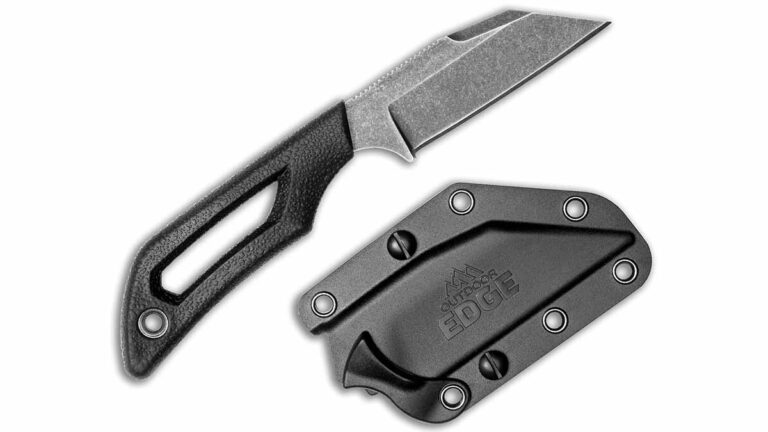
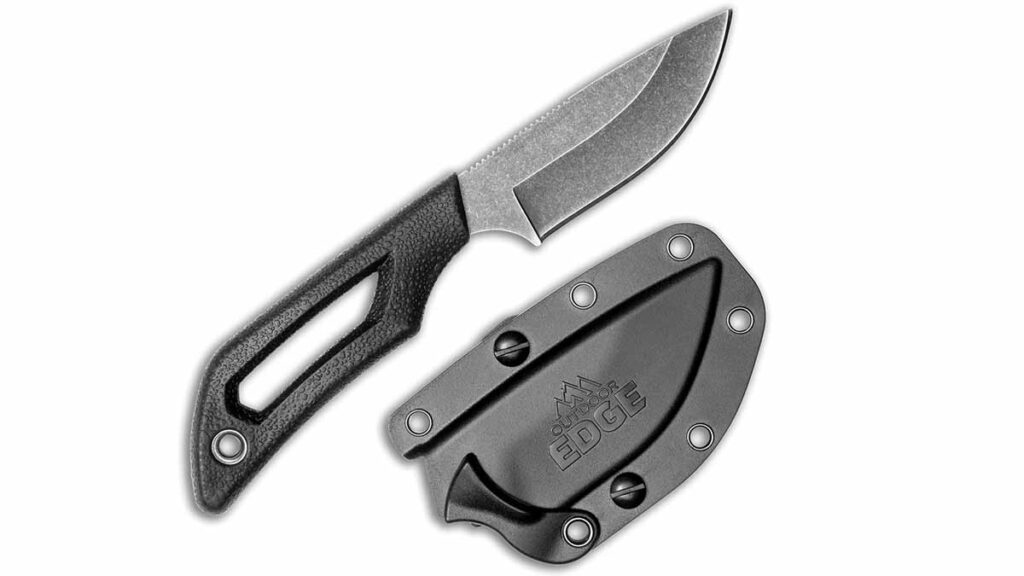
Outdoor Edge Pivot drop point

Constructed from 8Cr13Mov stainless steel, the knife was likely birthed in China—it’s one of the country’s budget stainless options. While inexpensive, the steel generally acquits itself well in wear and corrosion resistance but maybe doesn’t earn top honors in hardness (57 HRC) and edge retention. Though, 8Cr13Mov is known to be pretty forgiving in sharpening, so its edge is quickly regained. Outdoor Edge gives the Pivot’s blade an extra barrier to environmental factors with what it calls its Blackstone Coating, which also gives the knife a dark appeal.

Blade Profiles

The company offers two blade styles on the model, a drop-point and Wharncliffe both virtually the same length. The drop-point measures in at 2.5 inches, and the Wharncliffe is another .1-inch longer. In either case, married to a roughly 4-inch handle, the blade should prove fairly nimble and quite deft at most everyday tasks around the home, ranch or worksite. As mentioned, the handle is skeletonized, which cuts the Pivot’s weight down to a svelte 3.2 ounces. And Outdoor Edge applies a rubberized coat to it, giving the knife a fairly positive grip even if wet.

Where Exactly Does It Pivot?

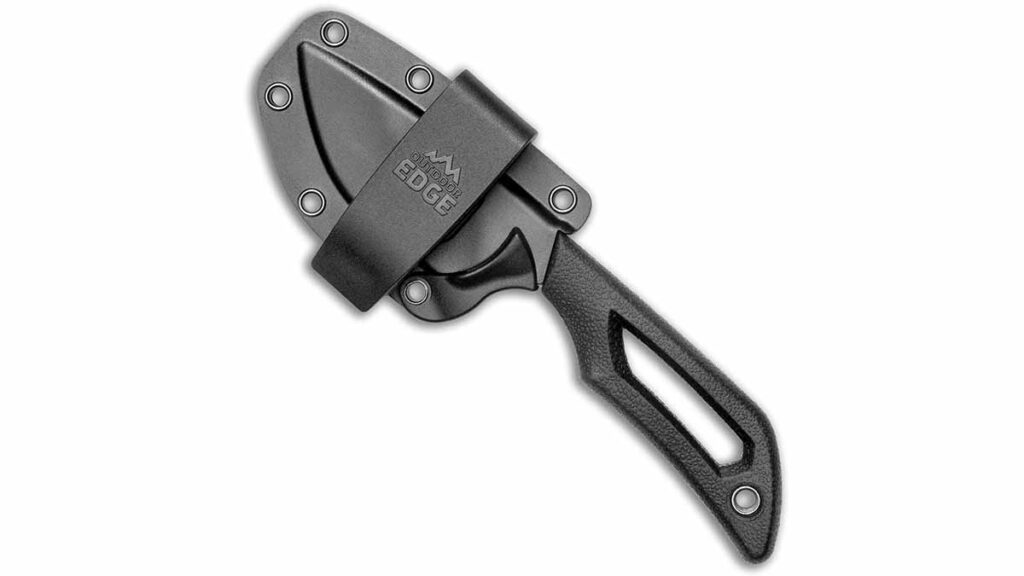
Outdoor Edge Pivot sheath

Now we get to the name of the knife—the Pivot—which seem much more apt for a folder than a fixed blade. But there’s a method in Outdoor Edge’s madness, with it referring to the carrying system. The polypropylene sheath comes with a quick-release locking latch and a removable 360-degree rotating clip (there’s the pivot point) for easy attachment to a belt or MOLLE webbing. It’s a nice system, allowing the user to adjust the cant to their carry style, putting the blade at quick access no matter where it’s carried.

Most would agree the Outdoor Edge Pivot isn’t the Superman of EDC knives, nor the one somebody pulls out for bragging rights. But for a blade to use and abuse on your day’s dirtiest jobs, well it pretty well fits the bill.

More On Fixed Blades:

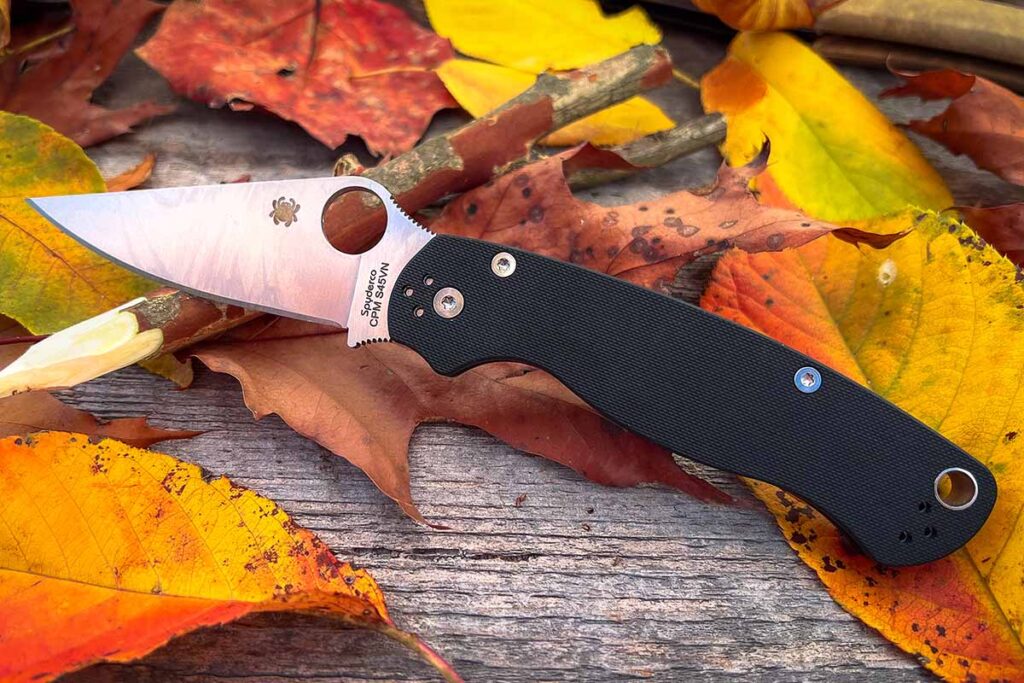
Spyderco Paramilitary 2 Review: Still A Cut Above The Rest

The Spyderco Paramilitary 2, simply known as the Para 2, is a part of the Military family of popular tactical folders in the Spyderco lineup. The Para 2 came about as a downsized version of the full-size Military model, answering the call from customers for a practical EDC option. 

Smaller it might be, but the Para 2 retains the essence of what makes the Military a popular working folder. And because of this, the knife has developed a cult following. However, it’s not simply a shrunken-down facsimile of its larger predecessor, having gone through several design improvements that have dialed in the knife to users’ needs.

In this article, we’ll examine exactly what has made the Spyderco Para 2 such a winner in the company’s lineup. And why, if you need a truly rugged everyday option—or just want a classic in your collection—the legendary knife more than fits the bill.

Para 2 Blade

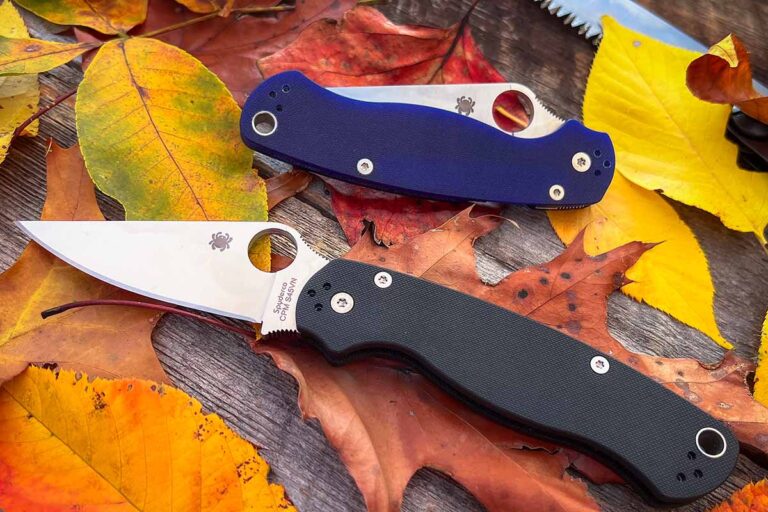
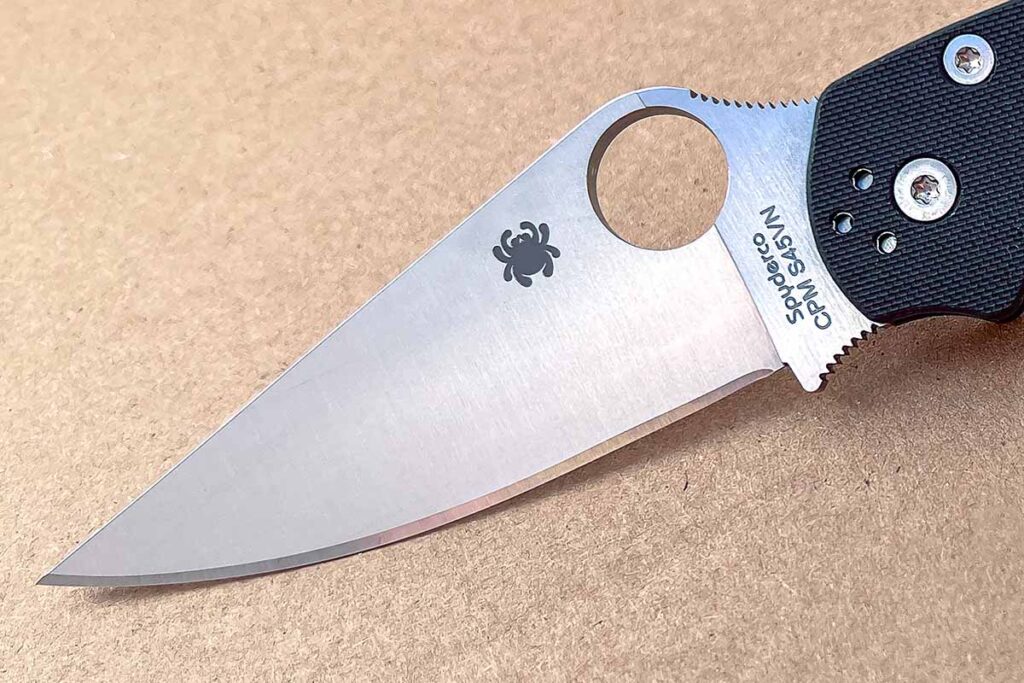
To start things off, the blade of the Para 2 sports a useful clip point shape, enhanced with a full flat grind. Furthermore, the knife has a gradual distal taper from the tang to the tip, evident when viewed from the top. The length of the blade measures 3.4 inches long, enough length to take care of heavy work but short enough for comfortable carry in a pocket. 

Para 2 blade
A CPM S45VN stainless-steel blade brings toughness, excellent edge retenion and easy of sharpening to the game.

Constructed of CPM S45VN high-performance stainless steel, Spyderco picked the perfect material for a high-end knife. Compared to the gold standard of this class—S30V—S45VN proves a bit tougher, yet is remains easy to resharpen. That is if you have to. The blade’s toughness means it holds an edge extremely well, suiting it for long-haul work without interruption. A final point, S45VN is fairly renowned for its corrosion resistance, making the Para 2 excel in nearly any environment.

As those familiar with Spyderco can guess, the blade boasts the company’s trademark hole near the spine, at the rear. This has been the go-to deployment method for time immemorial on the firm’s knives. Rounding things out on the blade, there’s integrated chill formed by part of the blade and handle when the blade is opened. A choil permits the user to further choke up on the blade for extra control when needed.  

Para 2 Handle

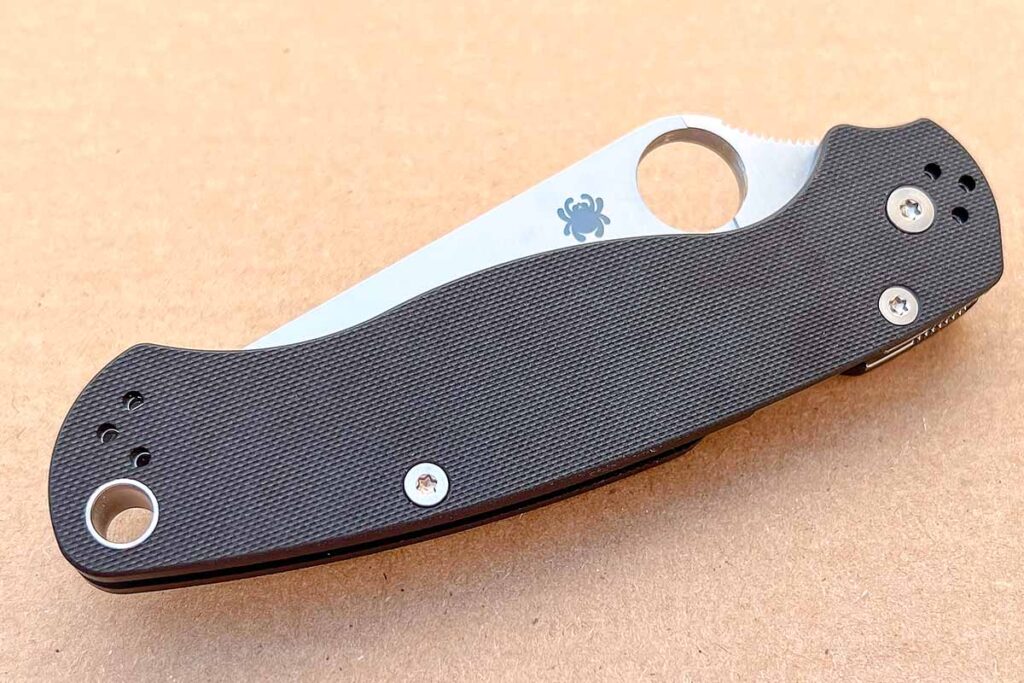
Spyderco opts for a black textured G-10 for the handle, which endows it with a few assets. First, it keeps the knife nimble, cutting down on the Para 2 overall weight. But this isn’t at the expense of strength—G10 is tough as cut nails—and a solid purchase on the knife.

Paramilitary 2 handle
Dark, dashing and useful, the Para 2’s G-10 handled gives users a firm grip on the knife.

The handles are milled out, allowing the slightly undersized stainless steel liners to sit flush with the G-10. Nicely, this reduces the overall width of the handle but doesn’t sacrifice the lateral strength of the liners. Spyderco also turns its eye to weight reduction with the liners, porting them to further lighten the load—while not compromising strength. 

The handle shape itself is very ergonomic, like the full-size Military. There is an expanded, curved section that forms an integral finger guard to prevent your hand from sliding forward. The handle feels very secure in hand, and this inspires user confidence. 

Compression Lock

Compression lock
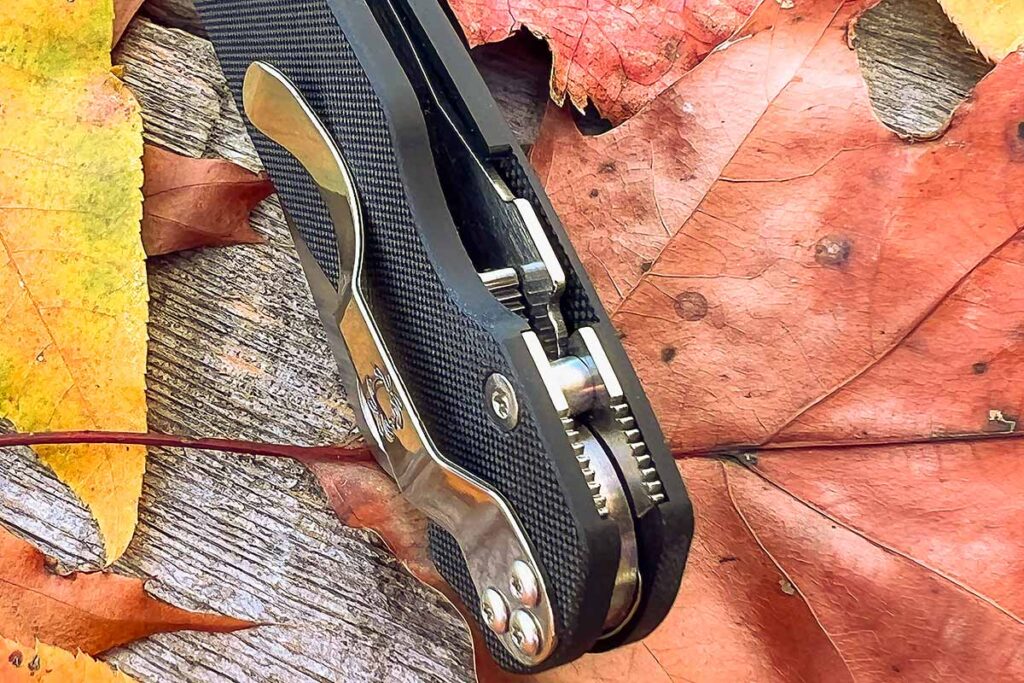
With an extremely strong lockup, the Para 2’s Compression Lock adds confidence to the system.

The Para 2 utilizes Syperco’s Compression Lock to secure the blade, a solid system that has several benefits. For those unfamiliar with the mechanism, it’s an in-house design that provides an extremely strong lockup. It operates by the lock bar wedging itself onto a ramp on the blade’s tang and a hardened steel stop pin. As an added benefit, the release is situated on the handle spine, just behind the blade within reach of the thumb and forefinger. Not only is the design ambidextrous, but it also facilitates fast and intuitive one-hand opening (with a bit of practice) and closing. 

Pocket Clip

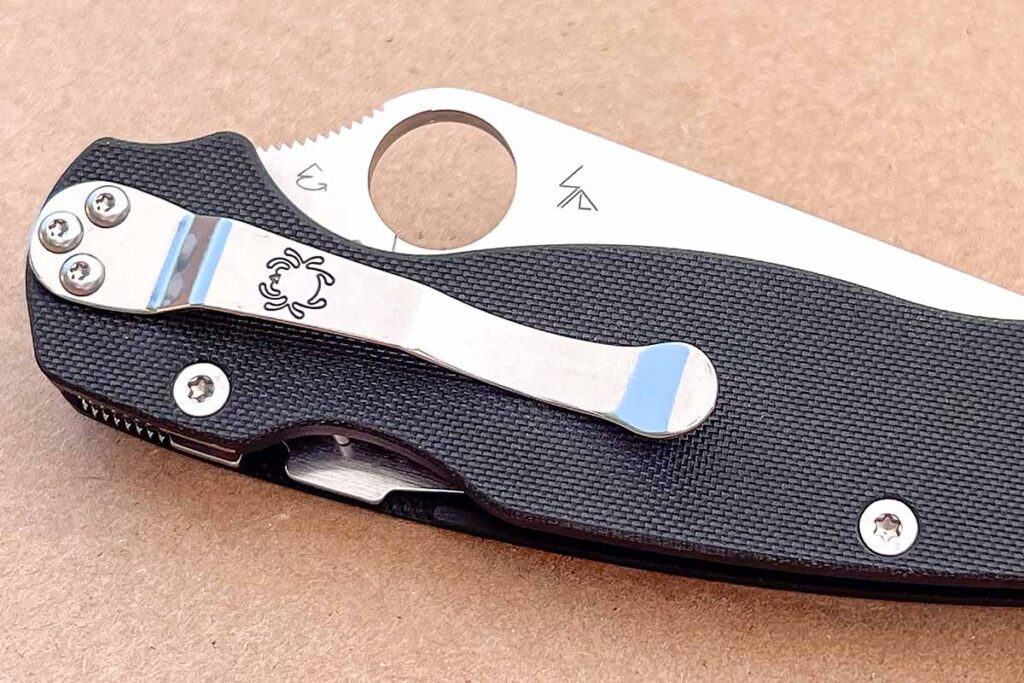
A steel pocket clip is attached to the handle in the right-hand, tip-down configuration. However, Spyderco has what they call 4-way clip mounting with the Para 2. This means the handle is drilled and tapped to modify the clip’s position, thus the carry style. Again, this makes the knife lefty- and righty-friendly, as well as allowing for tip-up or tip-down carry. Understandably, this is another facet of the Para 2 has that a lot of fans. 

Para 2 clip
No matter how you carry or hand you use, you can move the clip to suit your needs.

The handle also has an open build, allowing you to effectively clean lint and other debris out of the inside of the handle by using either compressed air or tap water. The handle length is 4.8 inches, making the overall length of the Para 2 around 8.2 inches. I would consider any folder with an overall length of 9 inches to be large, so to say the Para 2 is a midsize folder is a stretch. It’s safer to say it’s on the upper end of being midsize. Still kind of compact, but large enough to handle some man-sized cutting jobs. 

Para 2 In Action

The flat ground blade with distal taper helps the blade sail through anything with ease. This is exactly the reason why the full-size Military is a favorite among knife users the world over. You’ll notice the blade bites in and does so aggressively and it just takes off. Shoot, I have even used my Para 2 and Military in the kitchen to aid in food prep at times. The Para 2 makes for an effective paring knife. 

Paramilitary 2 open
An all-time classic, the Para 2 offers users an option fit to tackle most jobs.

Outside of the kitchen, the Para 2 slices through cardboard, plastic edging, styrofoam blocks, and even strips wire with ease. Spyderco’s cutting edges out of the box are nothing short of perfect. The Para 2 can be put to work immediately without modifications to the edge. S45VN’s durability is out of this world. You’ll benefit from the enhanced edge-holding capability of this steel by not having to sharpen as often. However, all this depends on your frequency of use and that can vary from person to person. 

The handle ergonomics are very comfortable. The Para 2 didn’t leave any hot spots of any kind and is pleasurable to wield during extended periods of use. 

Final Cut

I think you will find the Para 2 to be an excellent daily carry choice for you, if you are looking for a working folder that is also a super comfortable EDC knife. As for how much the Spyderco Paramilitary 2 will set you back, the MSRP starts at $265.00 for the black G-10 handle/satin-finished blade as tested here. There’s also a camo handle for the same price, and black DLC coated versions for a bit more at $285.

More Spyderco Knives:

Factory Drops: New Knives Hitting The Market This Spring

Five knives fit for EDC to the outdoors.

Does the flow of new knives ever cease? Lord, I hope not.

Midspring is as good a time as any for knife companies to drop new models, variations and what have you. And with this round, we have five new blades from three manufacturers worth a gander.

These knives range across the board, from a very collectible outdoor option to a bevy of affordable pocket pals. Even if they don’t exactly tickle your fancy, these blades are worthwhile window-shopping fodder.

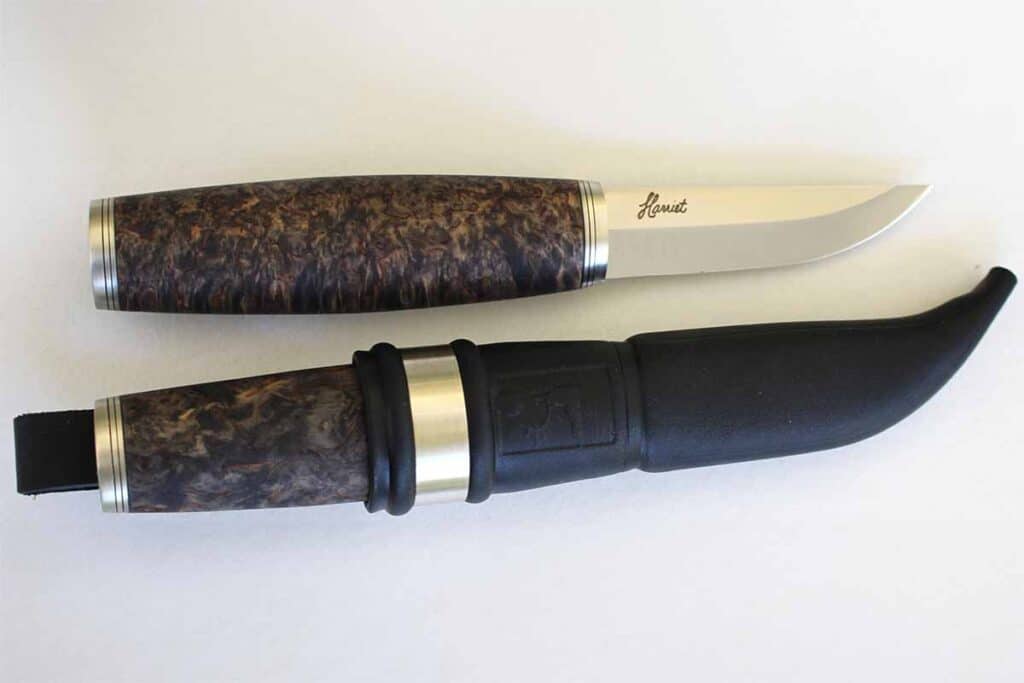
Kellam Knives Harriet70

Kellam Harriet70

Puukos are bread and butter at Kellam but its most recent introduction of this style of belt knife might prove better on the mantlepiece than on the hip.

Dubbed the Harriet70, the classic design is a tribute to Harriet Kellokoski, the wife of Kellam’s headman  Jouni Kellokoski, for her 70th birthday.

There are a lot of nice points on this limited-edition knife, but what jumped out for me immediately was the handle—more exactly its wood.
In this case, it’s arctic curly birch, darkly dyed and lightly oiled for the finish.

The curl pops and plays a beautiful counter to the nickel silver bolster and polished stainless-steel blade.

With 3-inches of wicked-sharp steel to play around with it’d make a solid hunting or fishing option, one dripping with class.

CRKT BOT Deadbolt

CRKT BOT Deadbolt

I can never complain about a design that puts fast deployment at the forefront of its engineering. Hence the BOT Deadbolt hits a sweet spot for me.

Assisted open with IKBS bearings, the action of this flipper doesn’t disappoint with the drop-point blade winking out in the blink of an eye.

Designed by Flavio Ikoma, the knife also features the Brazilian’s innovative lock—the Deadbolt—which relies on two lugs for extremely strong lockup.

This a much larger knife than what the Deadbolt is usually found on, intentionally so, since Ikoma was aiming for an overall robust system from tip to pocket clip.

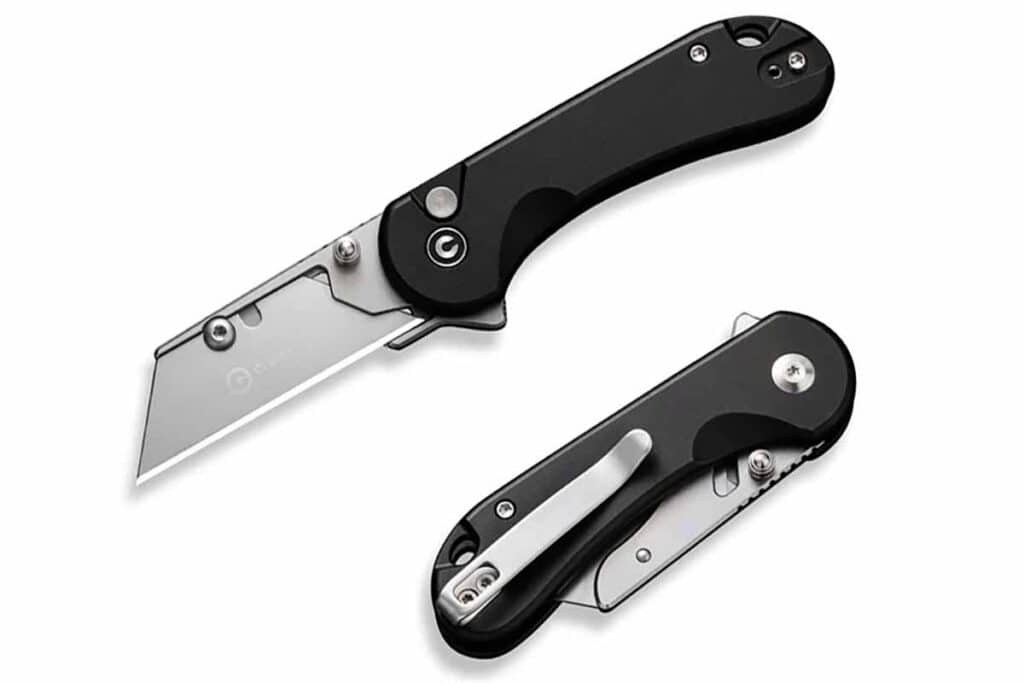
CIVIVI Elementum Utility

CIVIVI Elementum Utility

Quietly, there’s a utility knife war brew in the knife world. I, for one, say it’s about dang time.

An oft-overlooked corner of the blade world is getting some much-needed attention with the latest enhancement coming from juggernaut CIVVI.

Essentially a flipper/folder utility knife, the Elementum Utility offers perhaps the most important aspect of this class of knives—single-hand deployment. And it delivers it not in one, but three ways via kicker, thumb stud and button lock—if you like flicking out your blade.

CIVVI also delivers a bit of panache with the line, offering the replaceable-blade knife in a slew of colorways on its aluminum handle.

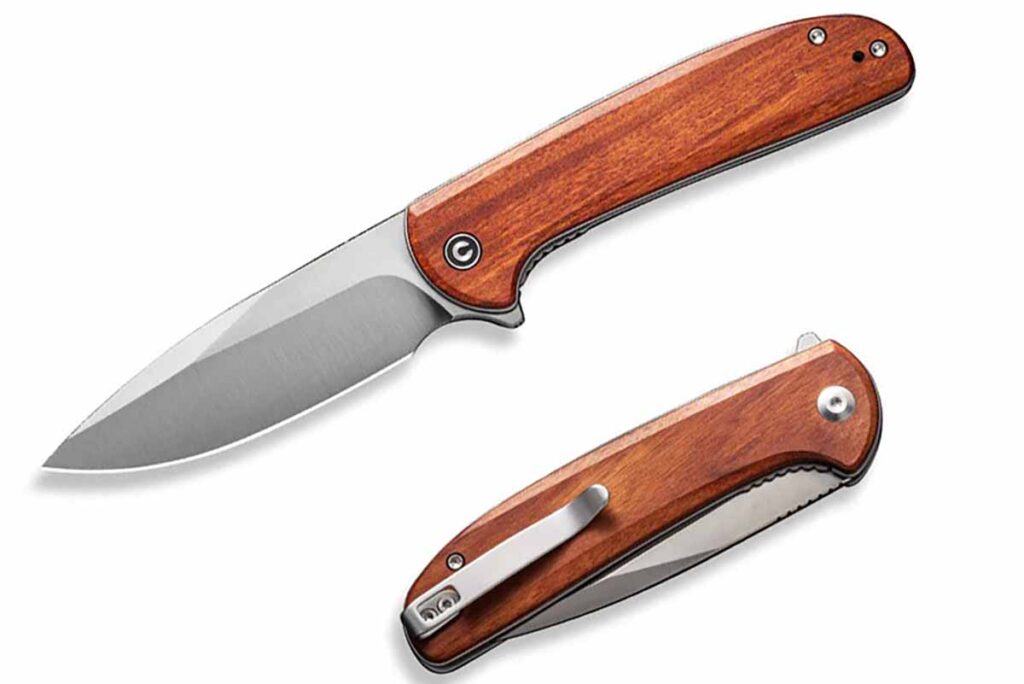
CIVIVI Primitrox

CIVIVI Primitrox

Even without looking at the branding, I think most knife aficionados would have sussed out this is a CIVIVI… or WE or Sencut. It just has the look, design points and action of the tirade’s knives and is close to several other options that already exist in the company’s catalog.

The one that comes to my mind is the WE Saakshi.

However, the Primitrox comes in a bit bigger thanks to a larger 3.89-inch drop-point blade.

The extra steel works to the knife’s advantage giving it not only a more robust design but more mass that flings the blade forward when opening.

I have to say, the handle options on the knife are nice as well, particularly the Guibourtia wood scale option, which gives the Primitrox a dignified look.

CIVIVI RS71

CIVIVI RS71

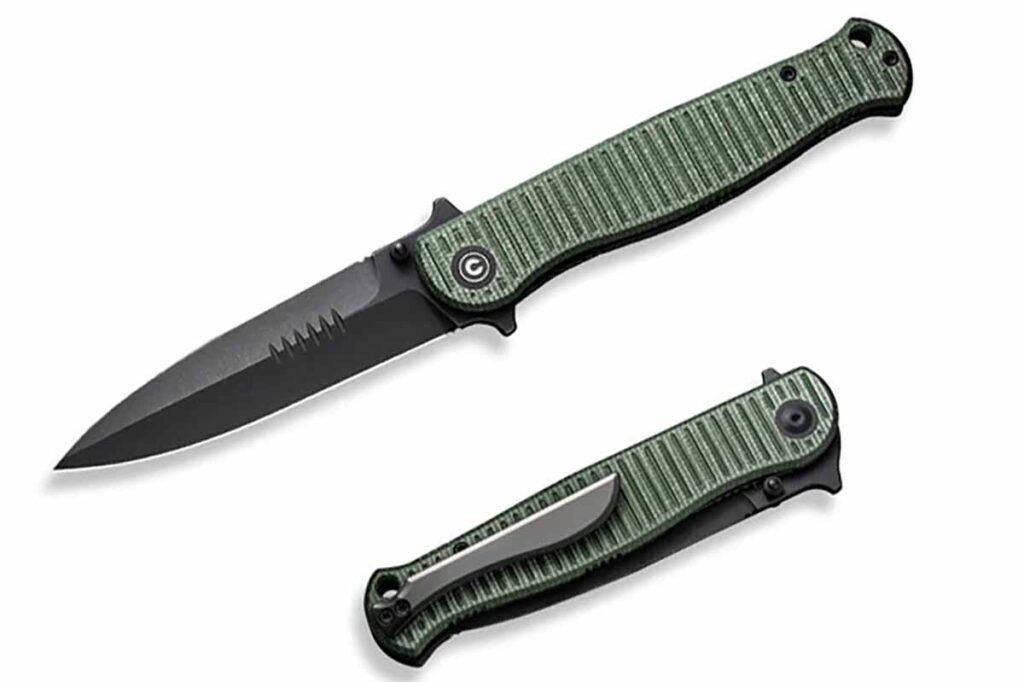
I have to confess this knife intrigues me. Of course, you’d have to have a heart of stone not to get geeked up over a dagger—or dagger-style—blade.

A Rob Saniscalchi design, the RS71 takes the deadly-looking blade style and tames it down for EDC with plenty of style.
But plan on having plenty of pocket space to tote it around, because the CIVIVI borders on behemoth with a full 4-inch blade and 9.31-inch deployment length.

The knife fills the hand, yet the contoured handle makes it very manageable.

I also like the grooving on the scale, which gives it more purchase in the palm and a downright distinctive look.

Check Out More Knife Drops:

Henckels Everpoint Review: More Knife Than Meets The Eye

See how an over-the-counter Henckels survives the Breed test.

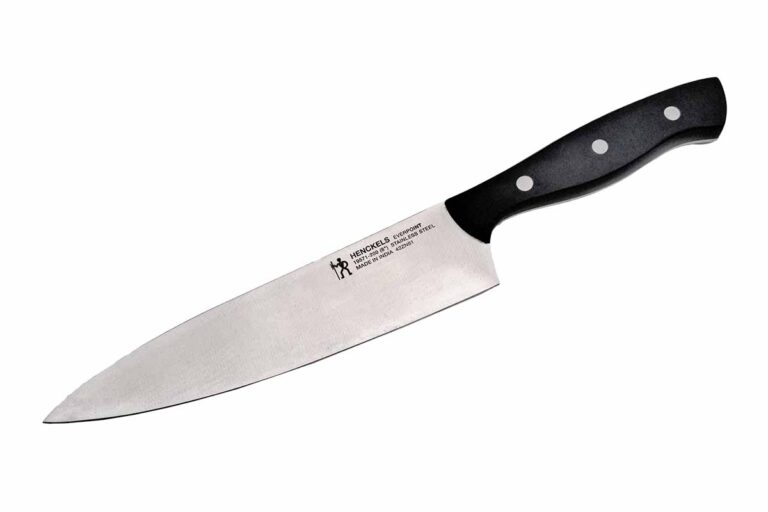
This time I decided to hit the local retail store trail for a knife just about anyone can buy anytime. Nothing tweaked my fancy till I hit a major chain store. There I found an inexpensive Henckels Everpoint 8-inch chef’s knife. Well, let’s just say I’m impressed with the quality of the Henckels. Read on and see why.

Henckels Everpoint Sharpness Test

Henckels Everpoint stays sharp
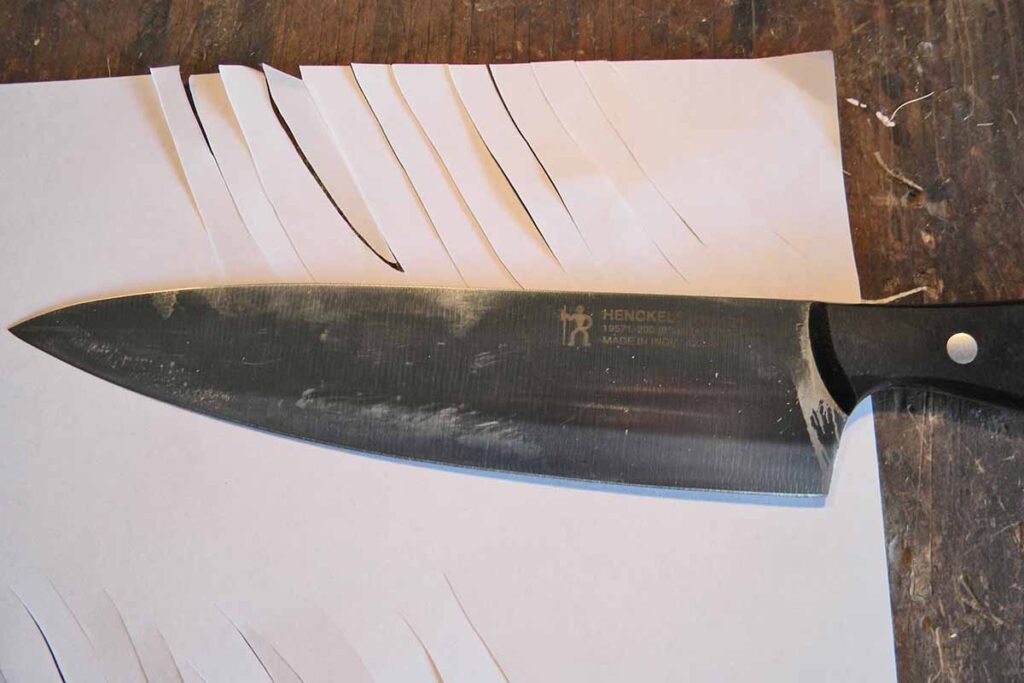
The knife had to slice paper once more to see if the horn whacks did any harm the author could not feel. It was still slicing and dicing like in the beginning.

First was the 20-pound-bond-copy-paper slice. The knife was very sharp and aggressive slicing the paper. I had to take care not to skin parts of my finger off. As fast as I could move, I could slice the paper. The knife was off to a great start.

Henckels Everpoint Food Prep

Everpoint slicing tomatoes
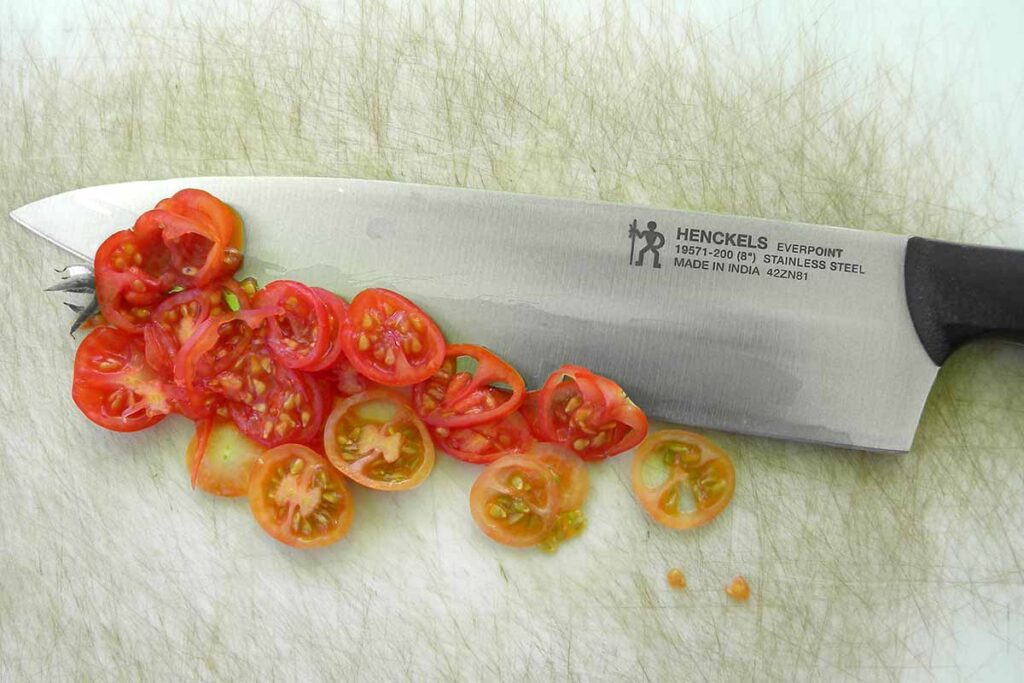
The knife sliced the tomatoes fast without mushing them and produced very thin slices.

Now to use the Everpoint for its intended purpose: food preparation. I picked some cherry tomatoes and the last yellow squash from the garden. The knife sliced the tomatoes fast without mushing them. I could get very thin slices. The same went for the yellow squash. The knife was light in hand and well balanced.

Henckels Everpoint Medium Duty Tests

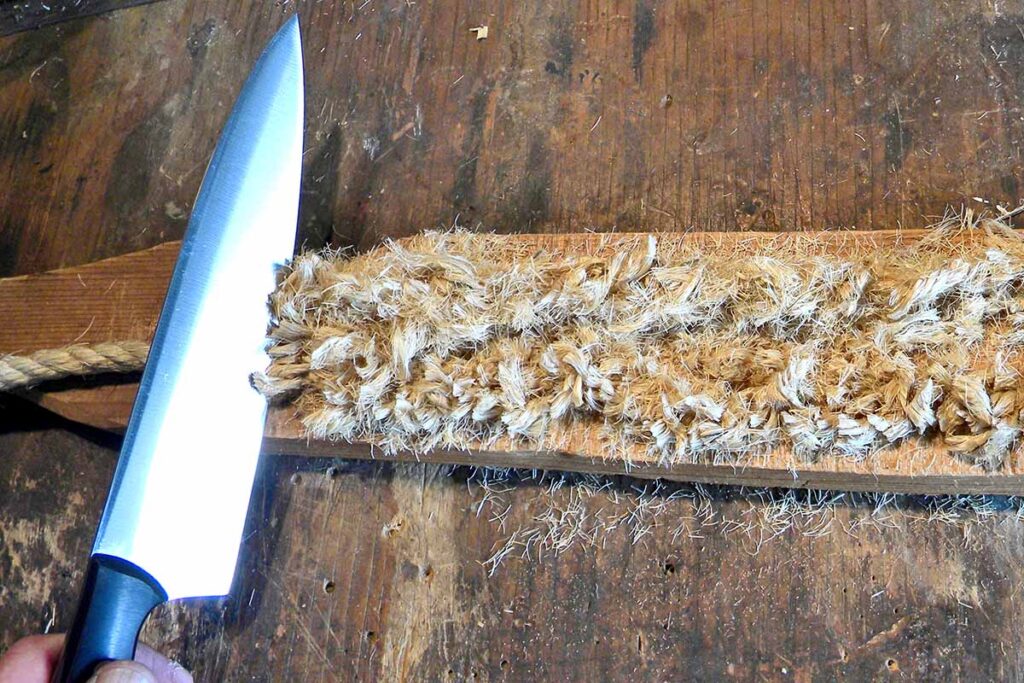
Henckels Everpoint cuts rope.
The Henckels surprised the author by making 200 crunching cuts in the sisal rope, and the knife was ready for more.

The rest of the test was to see how far the knife would go before the edge failed. Getting my technique down with some single-walled cardboard, the chef’s knife sailed through it aggressively with no problems. Very nice!

Next was some whittling on pine. The Henckels gave me some very smooth curlicues. I was surprised at how controllable the knife was, from very fine shavings to deep bites with heavy pieces. It’s a lot different whittling with an 8-inch chef’s knife but it came through with flying colors.

Skiving 8-ounce leather was next. The knife crunched aggressively with every cut, rendering very thin slices and one close call on my finger. The leather was no challenge at all. It was still fun to do quickly and I didn’t need to apply much pressure.

Henckels Everpoint Heavy Duty Tests

Henckels chops wood
The Everpoint chopped the 2×4 very well. The balanced blade and comfortable handle made it a pleasure to use. The author whacked the wood “pretty hard” but could see or feel no damage to the edge.

It was time to move into the big leagues by chopping into part of a 2×4. The Everpoint chopped very well. The balanced blade and comfortable handle made it a pleasure. I was whacking pretty hard into the wood but I could see or feel no damage to the edge.

All knives have to cut sisal rope. No exceptions. The Henckels surprised me by going for 200 crunching cuts and was ready for more. The plastic scales were extremely comfortable. The knife floated in my hand on every cut. Heat treatment grade: excellent.

I returned to the paper slice to see if the edge had slowed down any. Nope, it sliced just as fast as before. This chef’s knife cuts!

All right, with such a thin blade I figured an antler chop should knock the edge down a bit. Dang, it proved me wrong. Thirty hard whacks into the whitetail horn and there was no edge damage whatsoever. I’m impressed. The knife had to slice paper once more to see if the horn did some harm I could not feel. It was still slicing and dicing like in the beginning. Outstanding!

Final Cut

This chef’s knife really impressed me—low price with top end performance.

Everpoint 8” Specs
Blade Length: 8”
Blade Steel: Stainless
Blade Grind: Flat
Blade @Thickest: .09”
Blade Width: 1.75”
Blade Finish: Satin
Handle: Black plastic
Rivets: Stainless
Construction: Full tang
Weight: 7 ozs.
Overall Length: 13.25”
Country of Origin: India
MSRP: $14.88

Henckels Everpoint Deals

Amazon$25
Wal-Mark$15Check Price
Zwilling$69Check Price

More Culinary Knives:

Advertisement

Must Read Articles

Read this before you make a knife

Knifemaking 101 – Read This Before You Make a Knife

  by Wayne Goddard My experience has taught me that there's nothing like digging in and getting started. I've often said the hardest part of the...
how to forge damascus steel

How to Forge Damascus

Advertisement
Advertisement