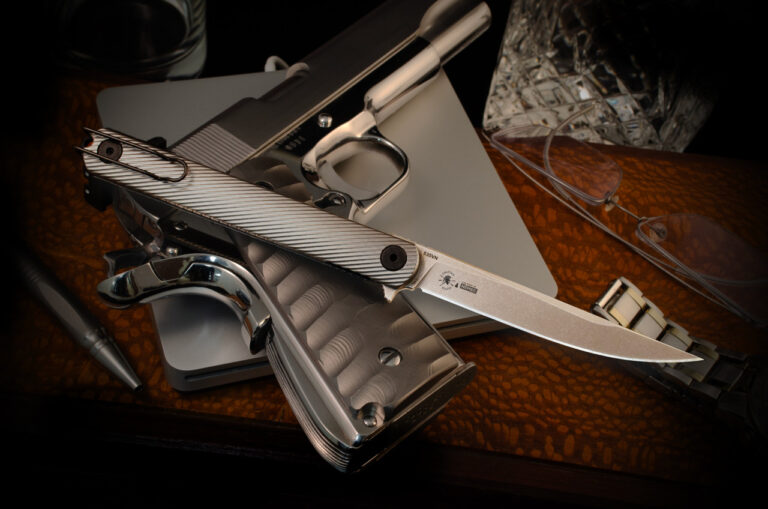
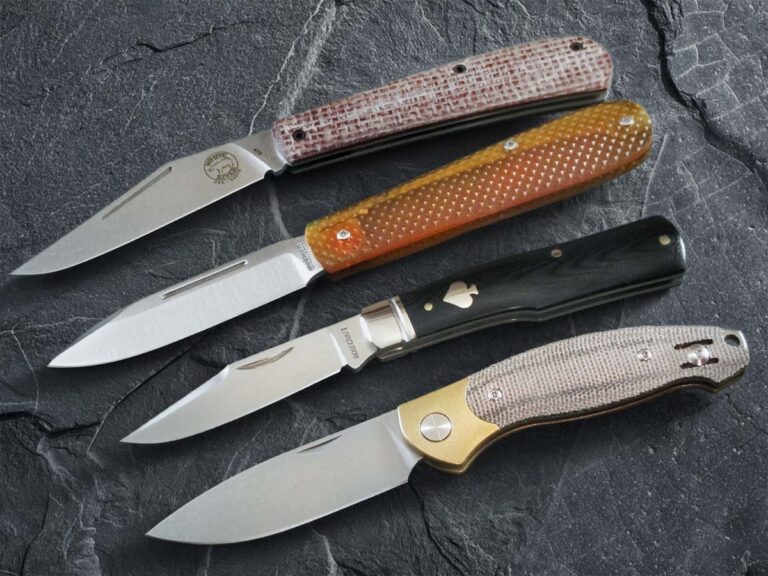
Collaboration between Spartan Blades and Ondřej Němec is sleek, slender and ready to serve.
Hard-use, tactical tools—Spartan Blades‘ designs are generally as conspicuous as a hand grenade in a sewing circle. That happens when the mucky muck has a Special Operations background.
But simply because the North Carolina concern favors brute superiority over frivolous aesthetics doesn’t mean it’s devoid of a sense of style. The freshly minted Spartan-Nemec Folder is more than proof.
Release in early December, the straight-back folder is a dashing addition to the Spartan Blade’s catalog. And while it appears more James Bond than Rambo, the knife offers up the same exceptional tactical performance for which Spartan is renowned.
Spartan-Nemec Design Background
For those who follow European knifemaking, the moniker of the new blade is a tip-off of its origins. Boasting a slightly Americanized play on Ondřej Němec’s surname, the knife is a collaboration with one of the Czech Republic’s premier designers. His company—Acta Non Verba Knives (ANV)—has become known for knives that have a desirable balance between modern lines and tactical practicality. Overall, his portfolio teams with clean design, with just enough swagger to catch the eye, without crossing over too gaudy. Which, in so many words, sums up the Nemec Folder.
Spartan-Nemec Folder Design Points
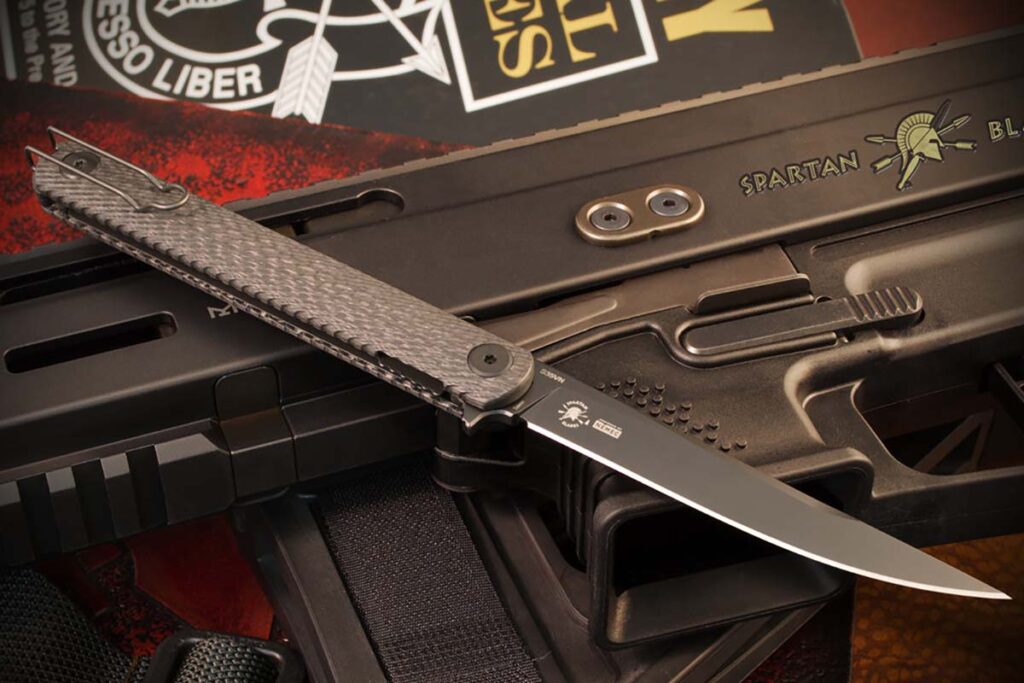
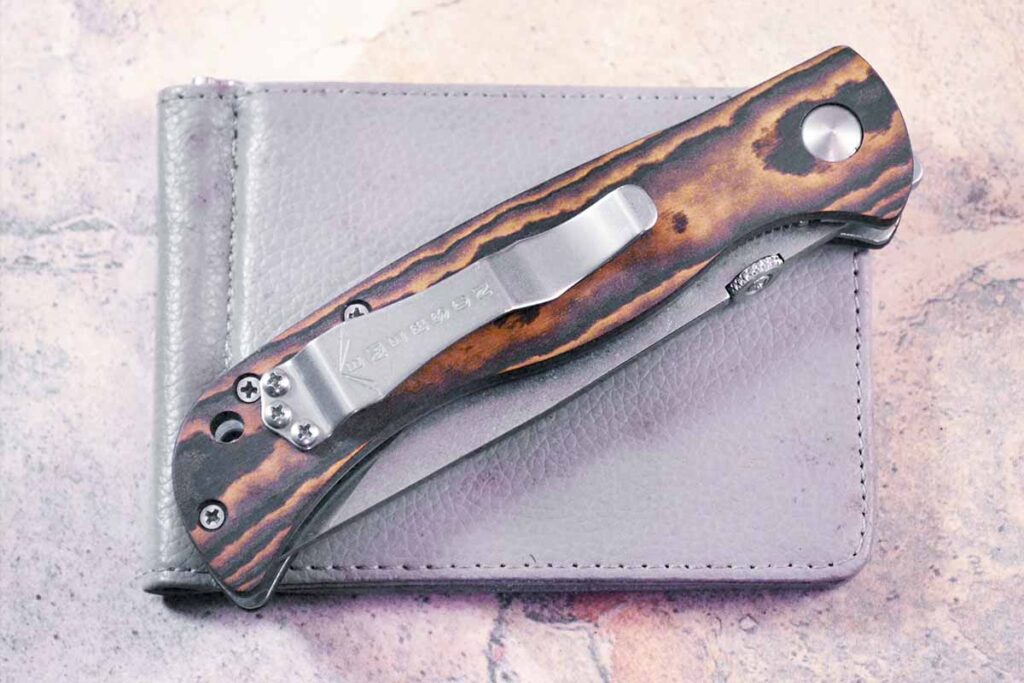
Spartan-Nemec with carbon-fiber handle.
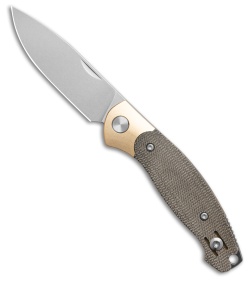
Right off the tick, the Spartan-Nemec Folder grabs attention with its overall svelte design. Intentional, the 3.5-inch blade knife is meant to nearly disappear on the person and prove as unobtrusive as possible in carry. Along with its thin lines, Spartan and Němec have opted for lightweight scale materials, with the choice of titanium and carbon fiber. The scale is enhanced with attractive diagonal millwork—certain to improve the purchase of the knife.
The blade is S35VN, a well-rounded top-end stainless-steel, with a long drop-point profile and sporting the choice of finishes. Well, at least for the carbon-fiber model, which is offered with a tumbled or Black PVD blade. The titanium iteration is only available with a stone-washed blade.
The Nemec’s blade is deployed via an understated kicker, which blends in well with the rest of the design. Getting it into action is quick and smooth, thanks to a caged-bearing pivot system. Finishing off the package, a deep-carry wire clip (tip up), which makes the knife nearly disappear on person.
As for cost, the Spartan-Nemec folder falls in the toner end of production knives, with the carbon-fiber model boasting a $275 MSPR and the titanium a $295 MSRP.
The gun maintenance equipment company tackles knives.
Any of you who tinker around with guns should be familiar with the name Real Avid. The company offers up some fairly innovative gun maintenance gear at a pretty decent price. But now the Minnesota concern is dipping its toe into the knife world with the release of what it calls its RAV series.
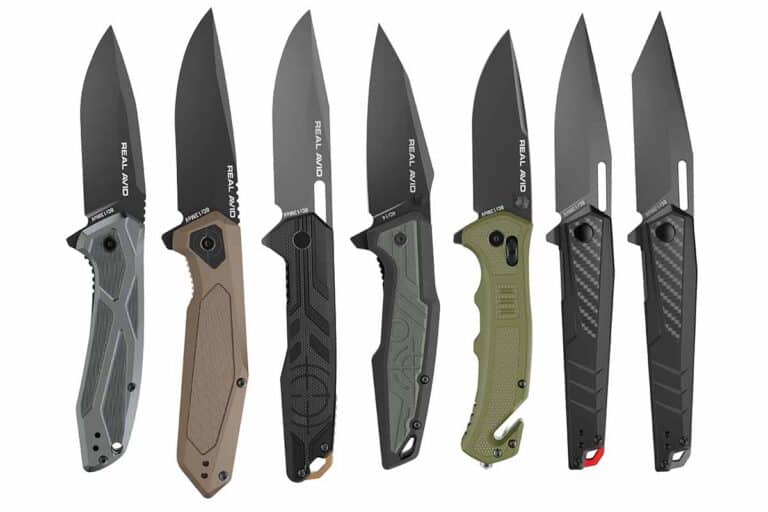
In all, the line folders comprise seven knives—all of them well falling into the budget end of the market. The offerings range from $29.99 to $49.99, making them ready for rough use and if need be worry-free replacement if your chores prove too taxing. Nearly across the board Real Avid 8Cr13MoV for the blade steel, except for the RAV-1—the most budget-conscious model—which has a 4cr14 blade. Overall, the steels sharpen well, but you’ll likely have to hone their edges plenty as retention in these stainless steels is marginal.
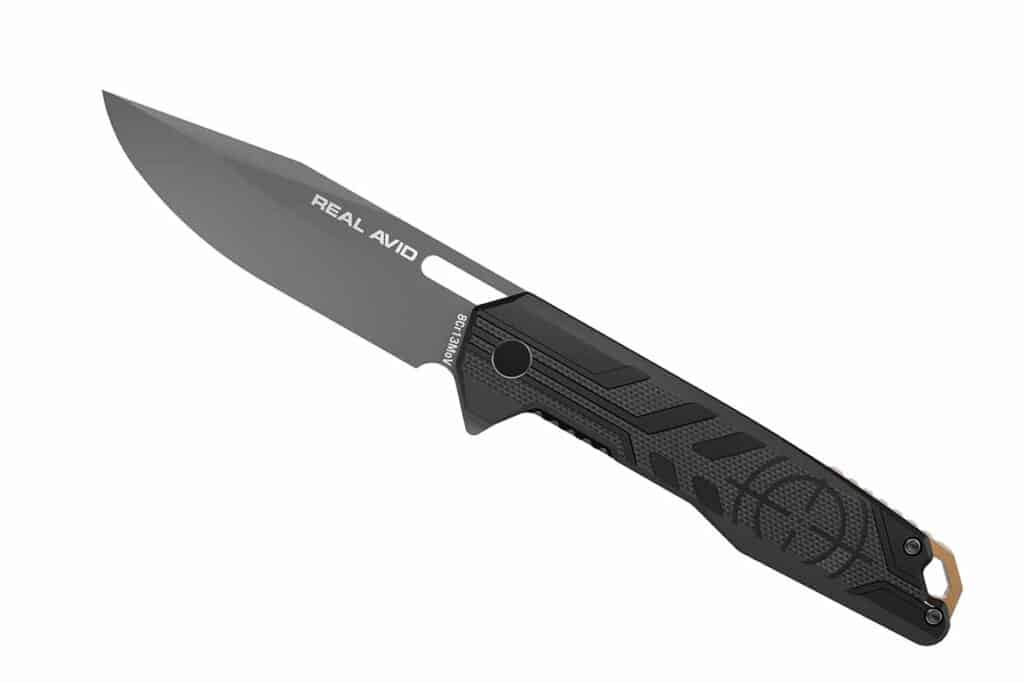
Real Avid RAV 7 with the bullseye pattern in it’s G-10 handle.
Almost every one of the RAVs has a drop or clip point of some style, except the 6, which stands as the lone tanto in the bunch. As for the handles, nylon, aluminum and stainless steel are pretty much the order of the day. However, the tonier RAV-7 does boast a G-10 handle with some nice texturing and a bullseye pattern in the middle. All of them are flippers, though a few models have been outfitted with thumbholes to offer multiple deployment options.
For the most part, these knives fit into Real Avid’s MO as a gun accessories company. Certainly, the blades aren’t going to knock the socks off your blade-aficionado friends. But for something to carry in a range bag, pry out stuck cartridges, unseal a can of ammo, or any other such thing, they’re right in line.
Cooking a great filet mignon, ribeye or any good cut of meat is an art, so shouldn’t eating it be the same? Most of you have had a good cut of meat fall victim to a dull knife, sliding around on the plate like an ice skater on a rink, scattering peas and mashed potatoes to the wind. As blade-loving folk you know the benefits of a good cutter, so in BLADE®’s special kitchen knife issue let’s consider some of the more refined offerings in steak knives.
Best Steak Knives Specs Comparison
Knife
Blade Length (inches)
Blade Steel
Blade Pattern
Handle Material
Weight (ounces)
Overall Length
Carry
Country Of Origin
MSRP
Bradford Orwell Steak Knife
4.2
AEB-L Stainless
Clip Point
Tan Micarta®
3
8.5
Kydex Sleeve
USA
$128 ($168 with sheath)
Emerson Folding Steak Knife
3.9
154CM Stainless
Clip point
Tan/black layered Richlite
4.56
5
Blade-tip-up pocket clip
USA
$335
Sharps Bros. Meanstreak Grill & Steak Knife
5
S35VN Stainless
Clip point
Titanium
6
9.25
Black thermoplastic blade cover
USA
$110
Bradford USA Orwell Steak Knife
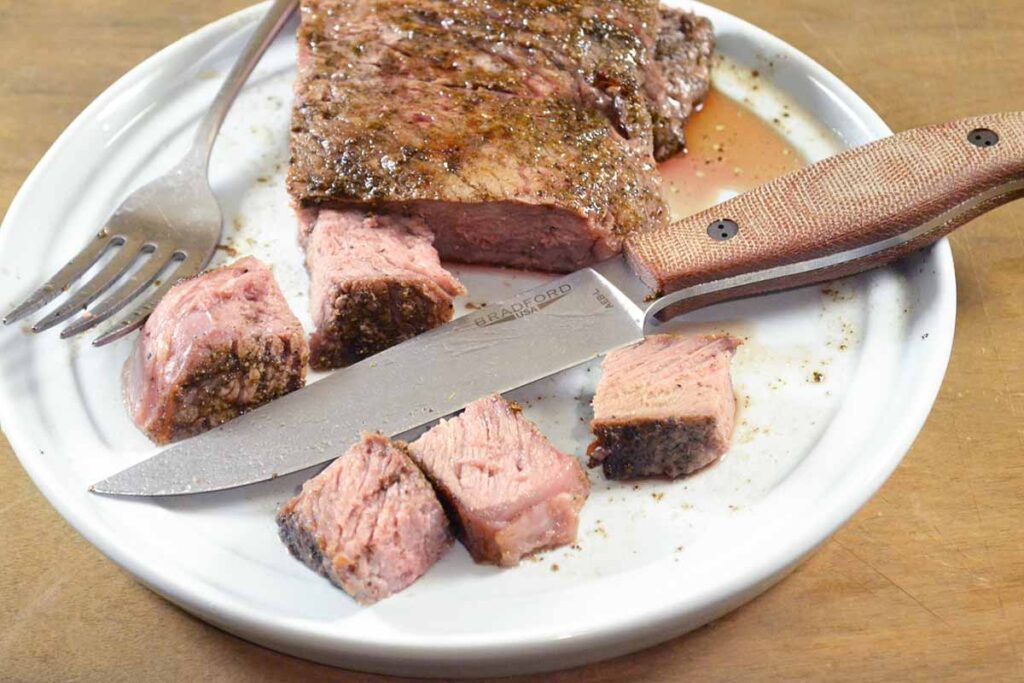
The author stated the Bradford USA Orwell handles and cuts like a steak knife should, adding “The level of construction and finish is very high throughout, and the Uddeholm AEB-L stainless steel blade is many cuts above that of the average steak knife.” Note the Micarta® handle with a nice palm swell for an enhanced grip and handling.
The Orwell Steak Knife from Bradford USA may look like a Webster Dictionary depiction of what a carnivore cutter should be, but there’s more than meets the eye in this upscale slicer.
The Orwell is a spinoff of the company’s Gatsby design with more handle options geared toward the tactical user and outdoorsman. The full, flat-ground, gently clipped blade has a stonewashed finish (a high polish is also optional). Handle scales on the test sample are tan Micarta®—black, camo and OD green are also available. The test Orwell was delivered with an optional black Kydex sheath.
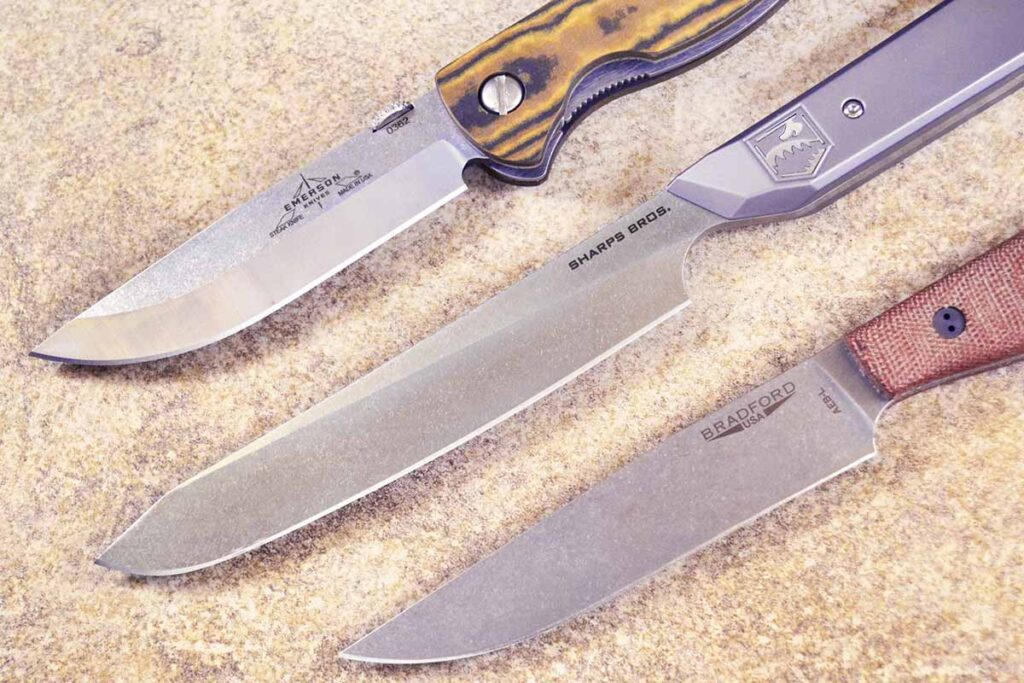
Of the three review knives, the Orwell more closely resembles what most consider the norm among steak knives in size and configuration. Where it differs from the norm is in sheer quality of both materials and fit and finish.
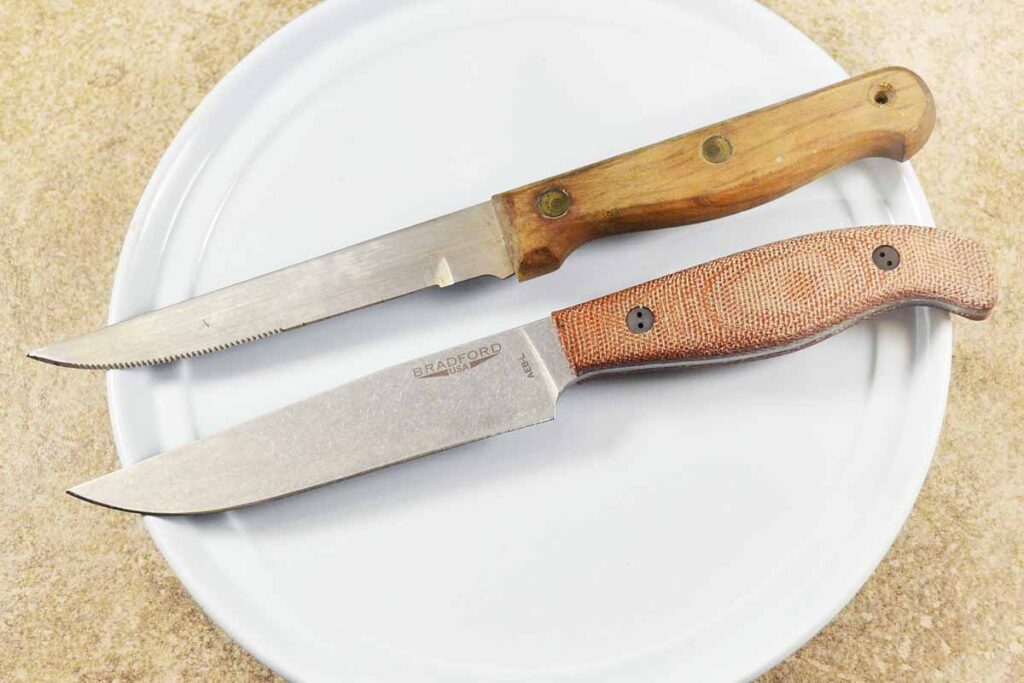
For your inspection: an inexpensive, run-of-the-mill steak knife and the Bradford. Note the pleasing line and flow of the Bradford compared to lack of same in the other knife. If you’re going to spend good money on an expensive cut of meat, why not spend money on a knife you’ll enjoy eating it with?
I cooked up a black Angus ribeye steak for the occasion and took the Orwell to task. The AEB-L stainless steel blade glided through the steak effortlessly, you might say, “Like an Uddeholm steel should.” This was also aided by the fact that Orwell was the thinnest test blade.
Bradford did a superb job on the handle scales with just the right amount of palm swell for gripping, along with a high degree of finishing for overall comfort. I really had no “druthers” with the Orwell at all, and the Kydex sheath is worth the price of admission both as a protective cover in the drawer or for field use.
Orwell Steak Knife Specs Blade length: 4.2” Blade steel: AEB-L stainless Blade pattern: Clip point Handle material: Tan Micarta® Weight: 3 ozs. Overall length: 8.5” Carry: Kydex sleeve, easily converted to belt Country of origin: USA MSRP: $128 ($168 w/sheath)
Orwell Deals
Arizona Custom Knives
$95
Bradford USA
$129
Ernest Emerson Folding Steak Knife
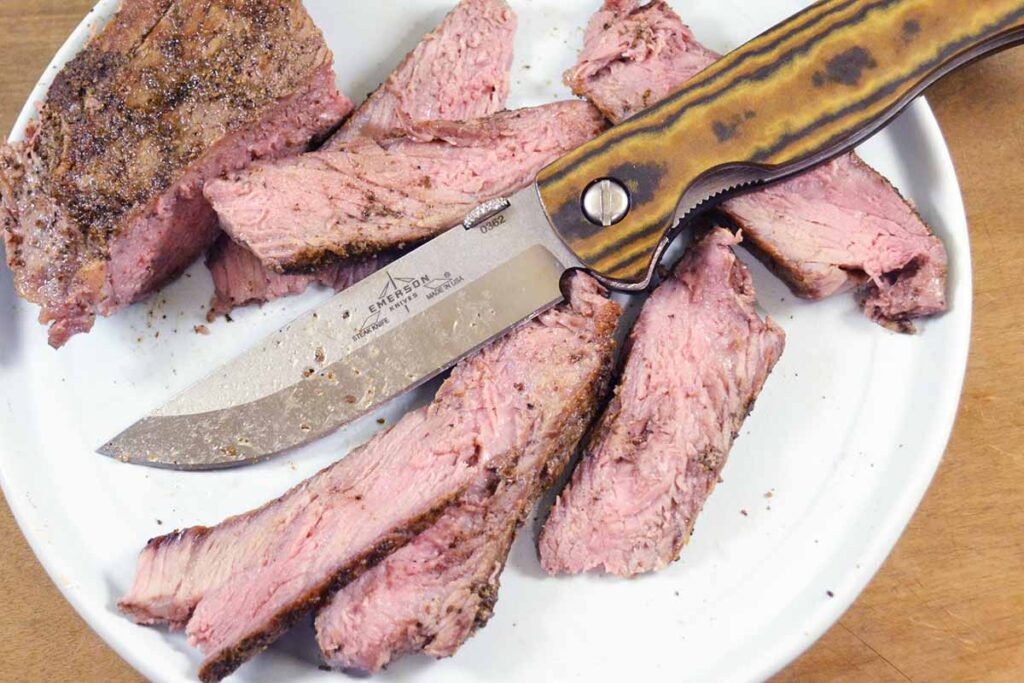
The author used the Emerson Knives Folding Steak Knife to cut strips of steak for fajitas. The knife is not as svelte as its two test counterparts but if you eat out frequently the portability is well worth the price of admission.
Leave it to Ernest Emerson to produce a steak knife folder. That’s his job, that’s what he does!
The blade of the Emerson Folding Steak Knife boasts an almost imperceptible clip point with a flat grind and rolls out via an ambidextrous thumb disc. The blade secures via a linerlock inside the open titanium frame. The brown layered handle slabs give the knife a rustic look, though you can go with black G-10 if you’ve got a tactical slant. An ample 2.3-inch pocket clip occupies the frame’s back side.
I devoted a portion of the ribeye to taking off approximately 1/8-inch slices for steak fajitas with the Emerson. The 154CM stainless steel blade did an admirable job of slicing, though it is slightly clumsier due to the bulk of the handle compared to, well, a fixed-blade steak knife. That’s the price you pay for portability.
If you eat out a lot and are out and about doing so, the Emerson may just be your best friend. You’ll never have to experience Sliding Steak Syndrome at a restaurant again!
Despite its size, the handle is comfortable and the Richlite scales are attractive. When you’re finished dining simply wipe the knife down with your cotton restaurant napkin, park the folder in your pocket, and go your merry way.
Folding Steak Knife Specs Blade length: 3.9” Blade steel: 154CM stainless Blade pattern: Clip point Handle material: Tan/black layered Richlite Carry: Blade-tip-up pocket clip Weight: 4.56 ozs. Closed length: 5” Country of origin: USA MSRP: $334.82
Folding Steak Knife Deals
Emerson Knives
$335
BladeHQ
$325
Sharps Bros. Meanstreak Grill & Steak Knife
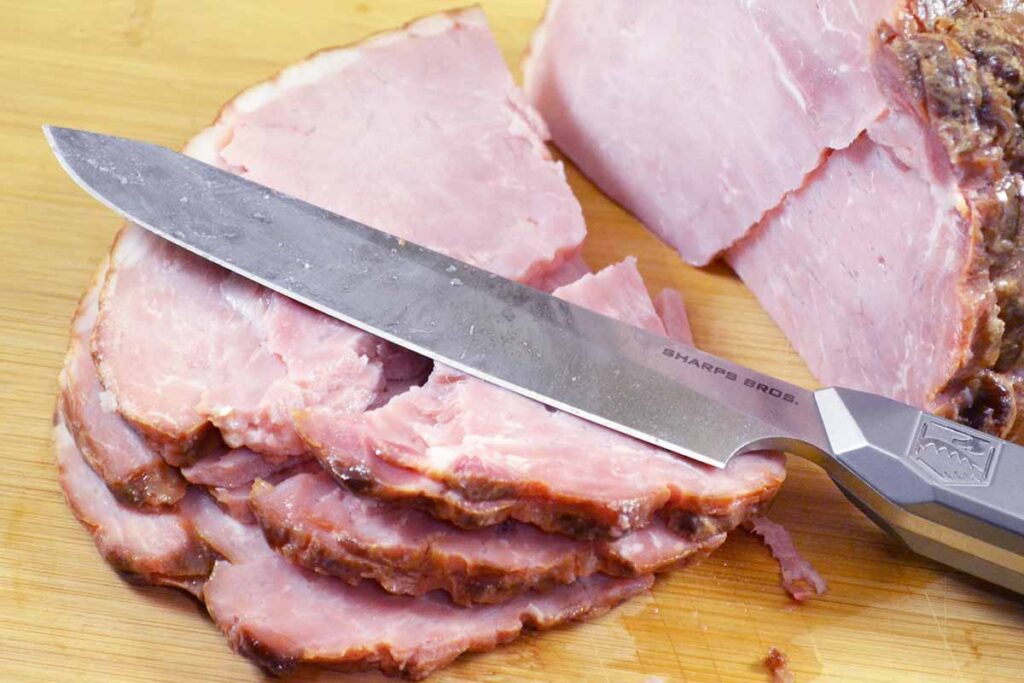
The Sharps Bros. Meanstreak Grill & Steak Knife’s longer 5-inch blade offers utility outside the dinner plate. The author indicated the knife sliced ham like it was a stick of butter. The CPM S35VN stainless steel blade performed “like a house afire” on ribeye steak as well.
The Sharps Bros. Meanstreak Grill & Steak knife is futuristic in style and loaded with upscale features. For starters, the full-tang steak knife boasts a clip-point blade of CPM S35VN stainless steel with a long, angled, flat grind that looks ready to launch.
With its longer blade the Meanstreak is meant not just for cutting meat but handling other chores such as flipping steak. I tested the blade on a hefty pound-and-a-half, 5-inch-across chunk of ham and it whipped through it like it was an afterthought—and the ribeye experienced the same results.
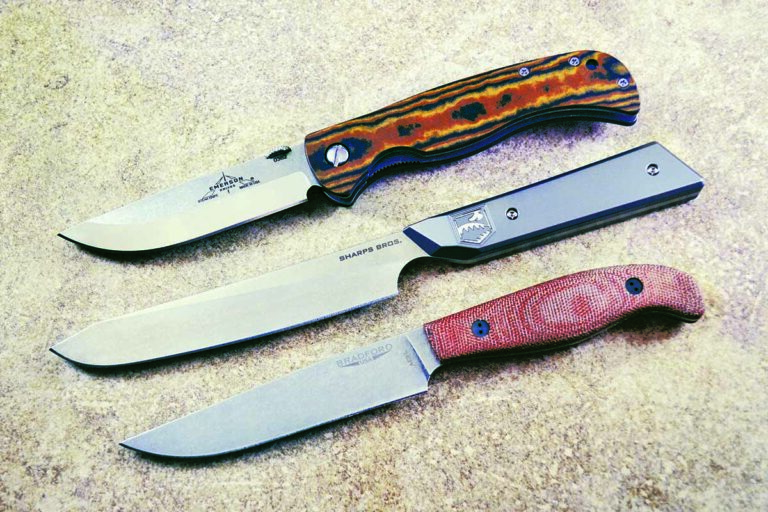
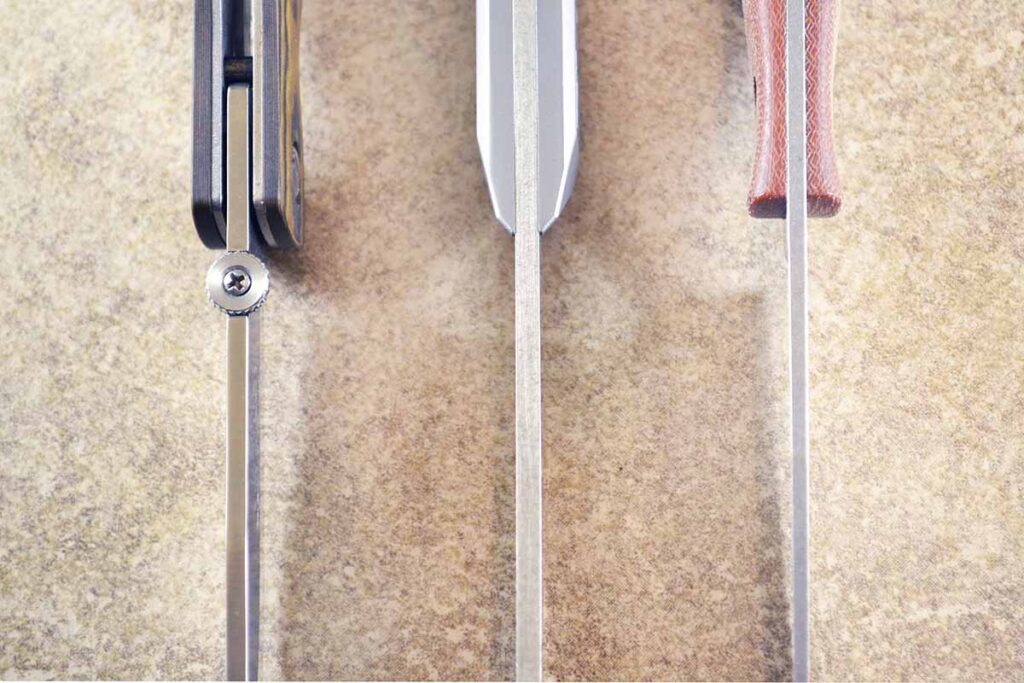
Blade thickness varies on the review group, from thickest on the larger Sharps Bros. (middle) to the thinnest on the Bradford (right). After testing all three steak knives, the author opined that the blade thickness was not much of a factor since all three knives had much better than average blade steel, properly heat treated and professionally edged.
The longest of the blades reviewed, the Meanstreak proved the superior cutter of the pack. Realistically, the extra half inch of blade length isn’t necessary, and some may think it’s too much knife, so it’s a trade-off.
Personally, I didn’t find it burdensome.
The titanium handle is not as comfortable as Micarta grips and the Meanstreak is twice the weight of the Bradford, but it’s easier to clean. These are all preferences you need to weigh when choosing your ideal steak knife.
Meanstreak Grill & Steak Knife Specs Blade length: 5” Blade steel: S35VN stainless Blade pattern: Clip point Handle material: Titanium Weight: 6 ozs. Overall length: 9.25” Carry: Black thermoplastic blade cover Country of origin: USA MSRP: $109.95
Meanstreak Grill & Steak Knife
Sharps Bros.
$106
Final Cut
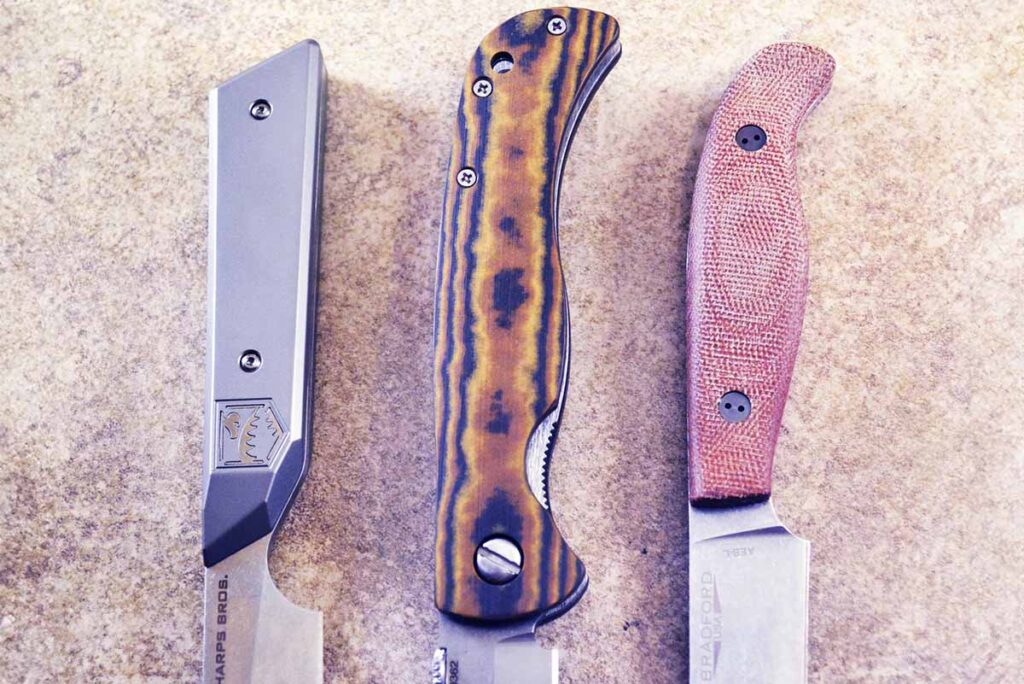
Sharps Bros. opts for an angular titanium handle that matches its futuristic styling. The Emerson is the rare folding steaker replete with linerlock and pocket clip for easy toting. Bradford carries on a more traditional approach with all the traits of a refined custom.
If you’ve been using standard house fare, the three test steak knives should be a vast improvement. All three blade steels are heat-treated and honed to a high degree by professionals who know their steels and how to get the most from them. The biggest difference between the three knives is how you plan to use them.
The Bradford excels where run-of-the-mill steak knives fail. Bradford USA has used Uddeholm AEB-L stainless steel with success for over 10 years, and like every Bradford knife I’ve tested, the fit and finish is superb. This steak knife will spoil you.
The Emerson offers you the portability a fixed blade doesn’t, and that’s important to those who eat out a lot, both at restaurants or in the wild. The company also offers a fixed-blade version of the same knife.
All three test knives go with variations on the flat grind. Emerson uses a “V” flat grind halfway up the blade with a stonewashed flat area. Sharps Bros cements the futuristic styling with a flat grind that takes off like a rocket from choil to tip, and Bradford returns to earth with a full flat grind from spine to edge.
With its longer blade, the Sharp Bros. expands its usefulness beyond the dinner table in areas like meal prep and grilling. The Crucible blade steel is the most advanced blade option I tested, not to mention the titanium scales. If you prefer a knife that goes beyond the dinner plate, the Meanstreak will go there.
Three very different knives, three very different options—choose your slice!
The great ancient knife designs aren’t history as they top-notch reproductions prove.
The ancient history of knife design is long, storied and colorful. From Bronze Age daggers to 19th-century dress bowies alone, vintage configurations capture the imagination like a gladiator’s net from the early days of the Roman Coliseum. Tour the classics with these remarkable reproductions.
Colton Arias Scylla
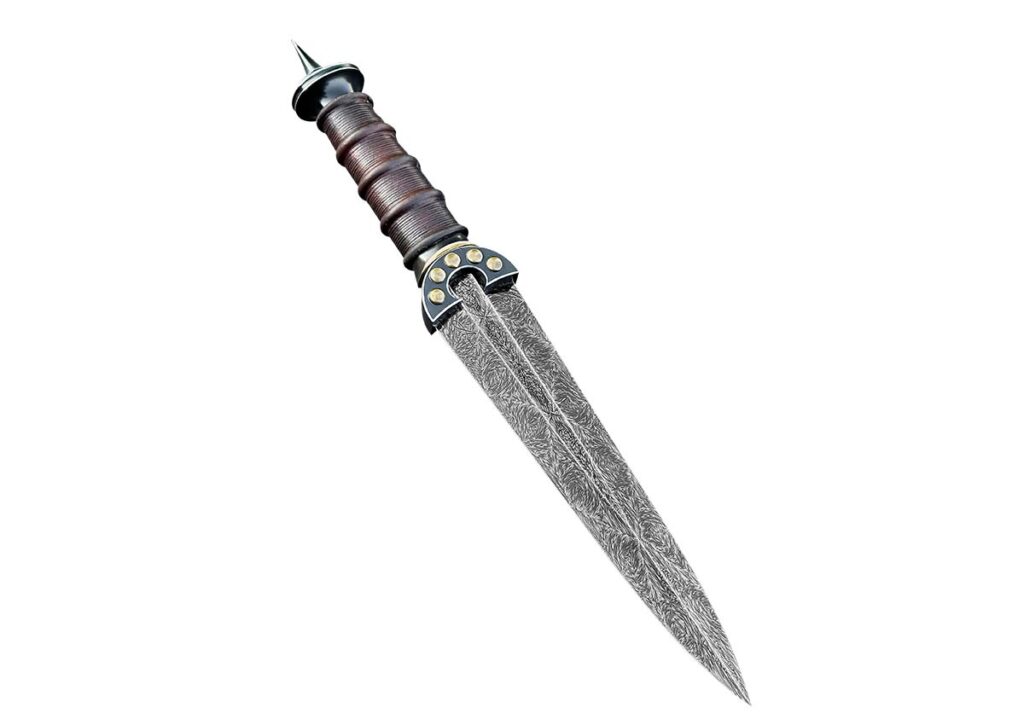
Named after an Etruscan-era mythological monster, Scylla is a repro of an Etruscan Bronze Age dagger by Colton Arias. The 7-inch blade with tapering fuller is a triple feather mosaic damascus of 1084 carbon and 15N20 nickel alloy steels. The spiked-pommel handle is a goat leather wrap and the bolster is mild steel with brass accents. Overall length: 12 inches. (Jocelyn Frasier image)
Dane Standen Cinquedea
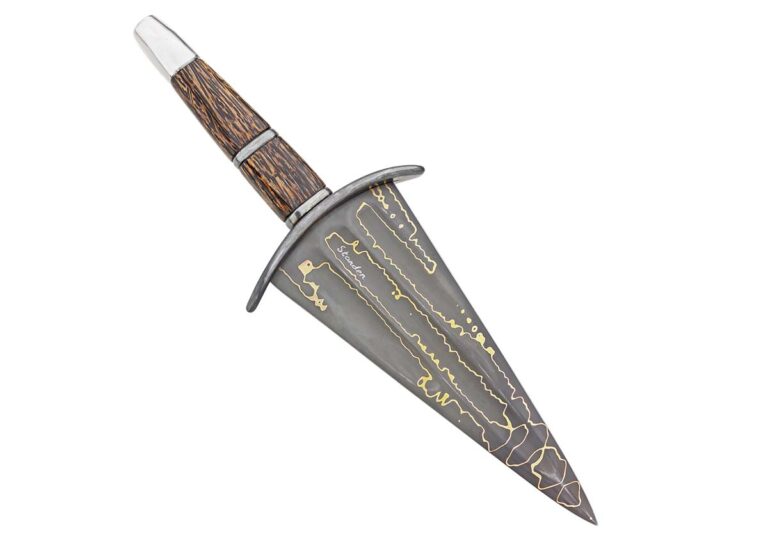
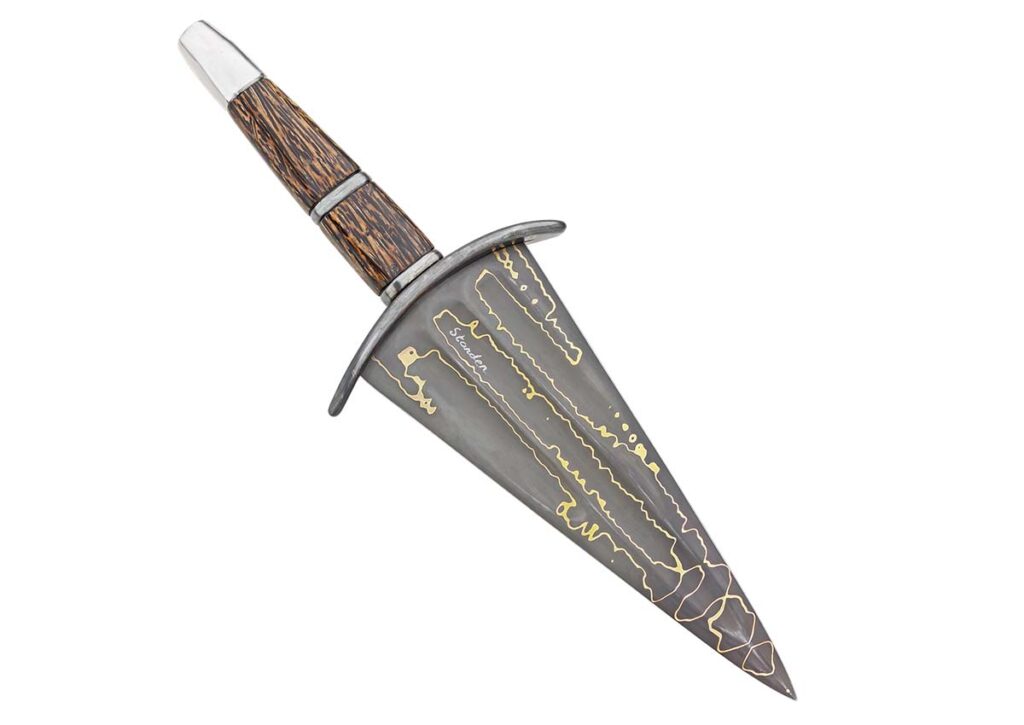
Dane Standen outfits his modified cinquedea with a three-fullered blade in multiple welds of 1084, cu-mai, 1084, cu-mai and 1084 carbon steels. Blade length: 8.27 inches. The handle of a takedown construction is stabilized black palm and the fittings are mild steel, copper and nickel damascus. Overall length of the centuries-old Italian design: 14 inches. (Rod Hoare image)
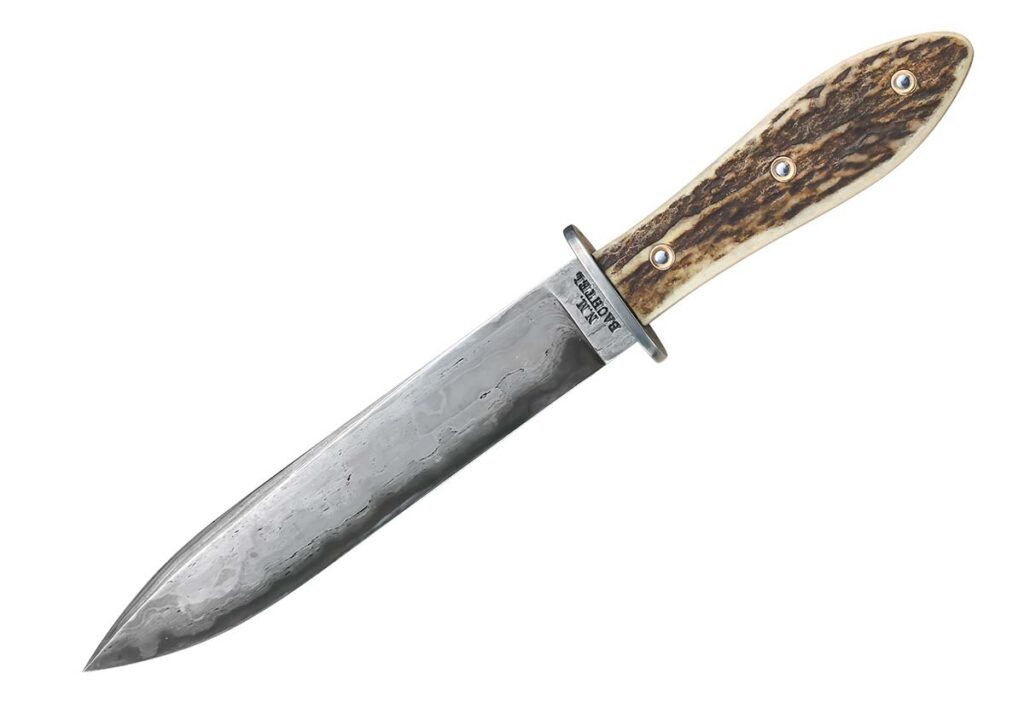
Nick Bachtel Dress Bowie
A 7-inch blade of wrought-iron in a san-mai construction and a handle of elk antler and curly ash highlight a repro of a 19th-century dress bowie by Nick Bachtel. Overall length: 12 inches. The guard is steel and bronze and the knife comes with a traditional bronze sheath (not shown). (SharpByCoop image)
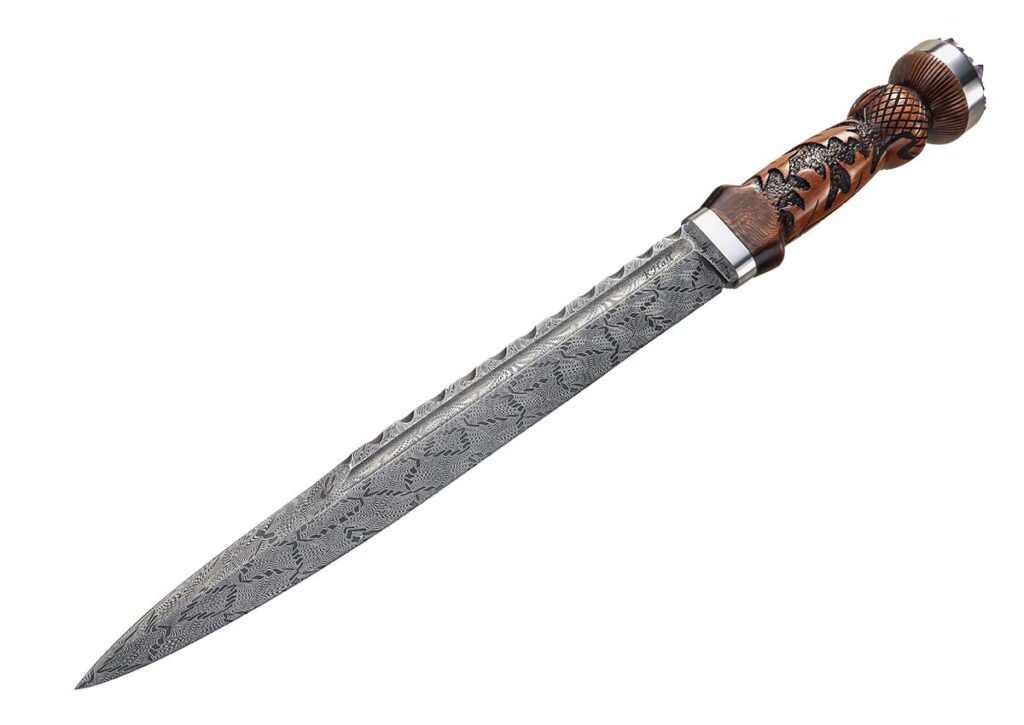
Ken Hall Scottish Dirk
A 12-inch fullered/fileworked blade of an absorbing mosaic damascus and a handle of stained stabilized cherry carved to symbolize a thistle distinguish a stunning Scottish dirk by ABS journeyman smith Ken Hall. Pommel stone: amethyst crystals. Overall length: 17.5 inches. Sheath (not shown): tooled leather. (SharpByCoop image)
Matthew Berry Edinburgh Skean
The Edinburgh Skean by Matthew Berry is a reproduction of a knife by the same name from 1677. The originals were combat knives of Ireland. The blade is 1075 carbon steel and the intricately carved handle is boxwood. Blade and overall lengths: 15.25 and 19 inches. The form-fitting sheath (not shown) is highly detailed leather with a wrap strap. (SharpByCoop image)
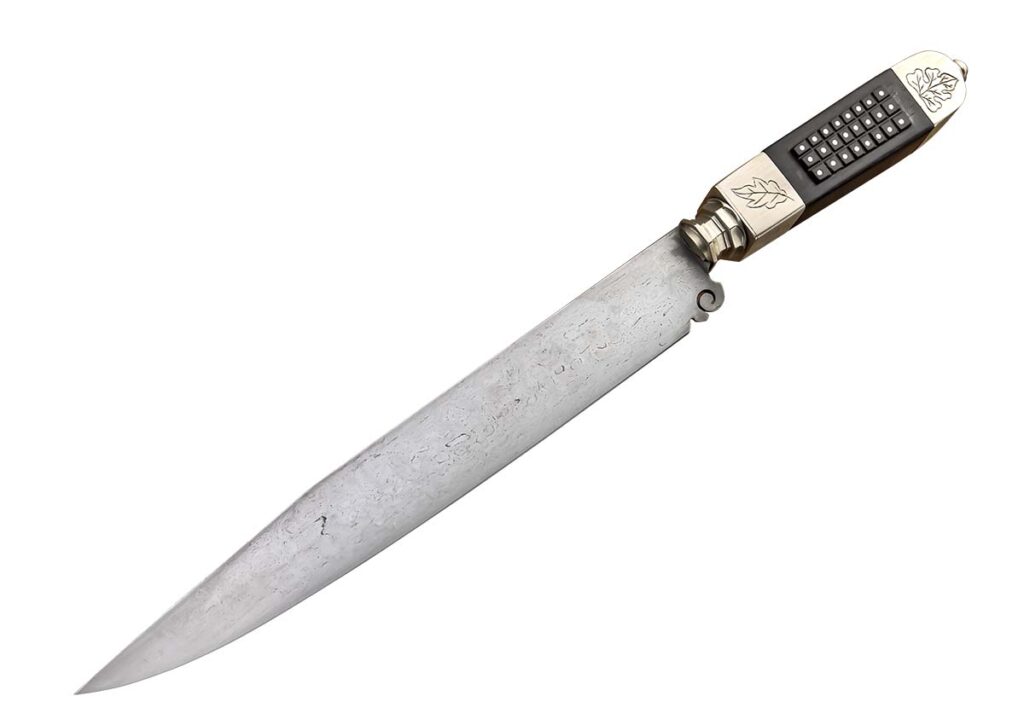
J.J. Simon Samuel Bell Dirk
ABS journeyman smith J.J. Simon forged the 12-inch flat-ground blade with Spanish notch for his repro of a 19th-century Samuel Bell dirk from bloomery steel. The handle is blackwood with silver pins and the fittings are nickel silver. Overall length: 17 inches. (SharpByCoop image)
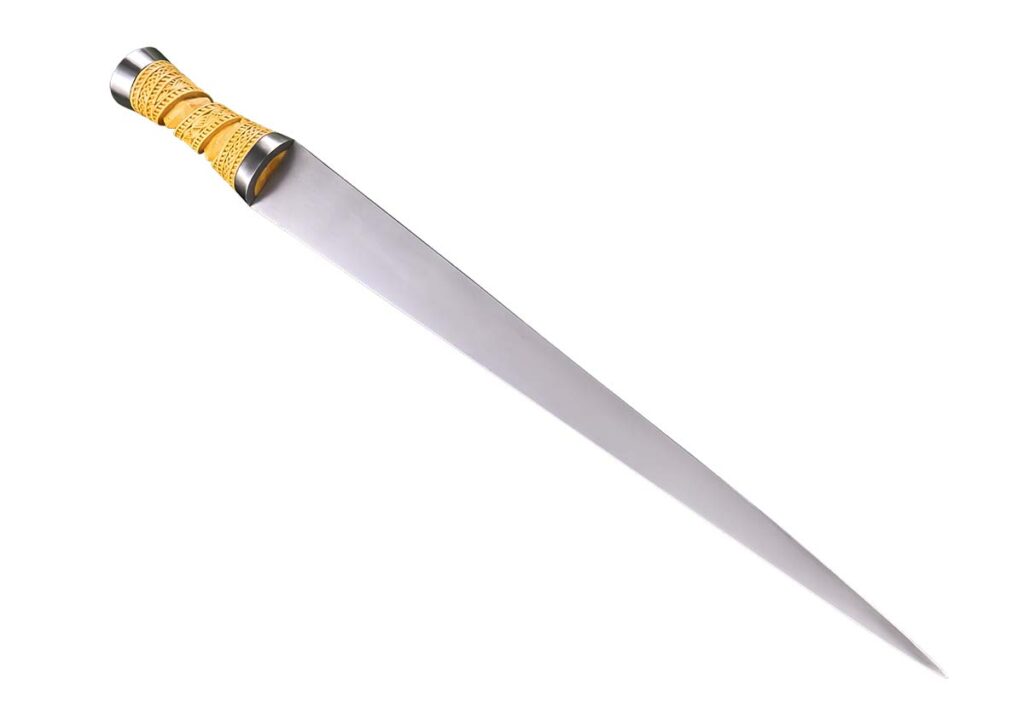
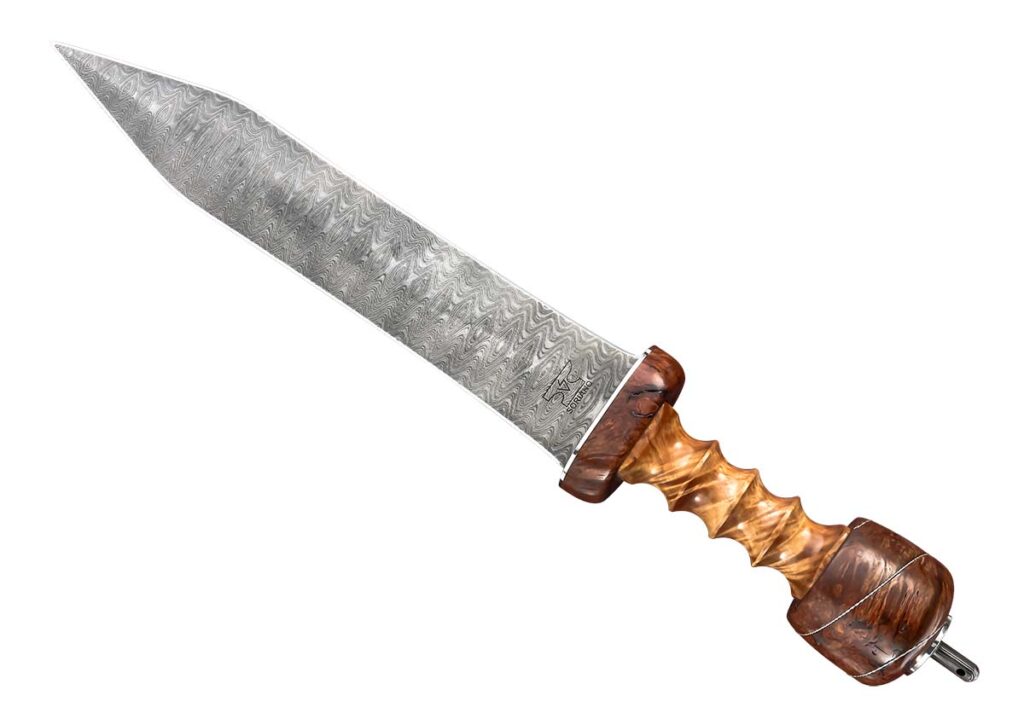
Vincent Soriano Mainz-Pattern Gladius
ABS apprentice smith Vincent Soriano goes full Roman with his Mainz-pattern gladius. Called the Proeliator, it boasts a 14-inch damascus blade of 1075 carbon and 15N20 nickel alloy steels and pure nickel. The handle is curly maple and the guard and pommel are eucalyptus. Overall length: 22.5 inches. Sheath (not shown): leather. (SharpByCoop image)
Mike Bradshaw’s Large Hunter smokes the author’s test regimen.
I came across Mike Bradshaw’s knives thanks to a recommendation by a knifemaker friend, R.W. Fred. The knifemaking community always helps other knifemakers—call it the “Brotherhood of the Blade.” After visiting his social media account for a quick look, I messaged Mike and he sent me his Large Hunter to test.
Bradshaw’s Large Hunter Specs
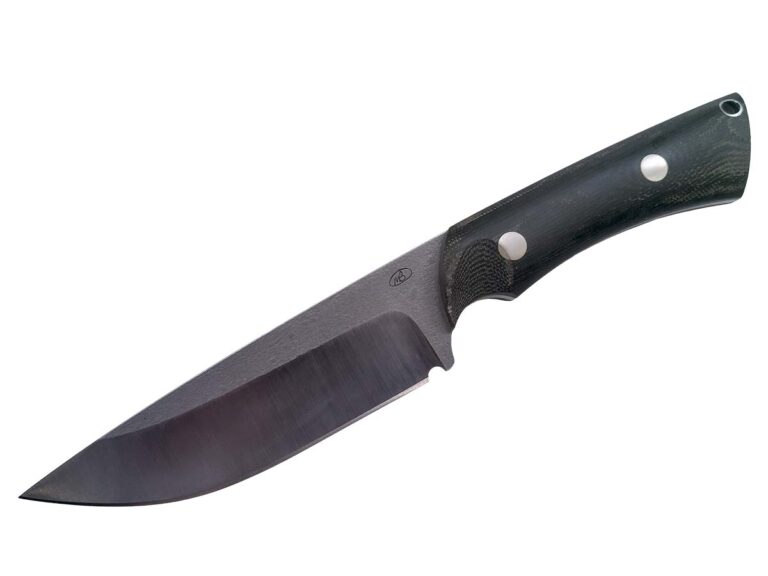
Knife: Large Hunter Maker: Mike Bradshaw Blade length: 4.5” Blade steel: CPM MagnaCut stainless Rockwell hardness: 63.5 HRC Blade @the widest: 1.375” Blade @the thickest: .13” Blade grind: Hollow on a 12” wheel Scales: OD green G-carta by GL Hanson Fittings: Nickel silver Overall length: 9.125” Sheath: Black Kydex Maker’s price for a similar knife: $200
Light Cutting Tasks
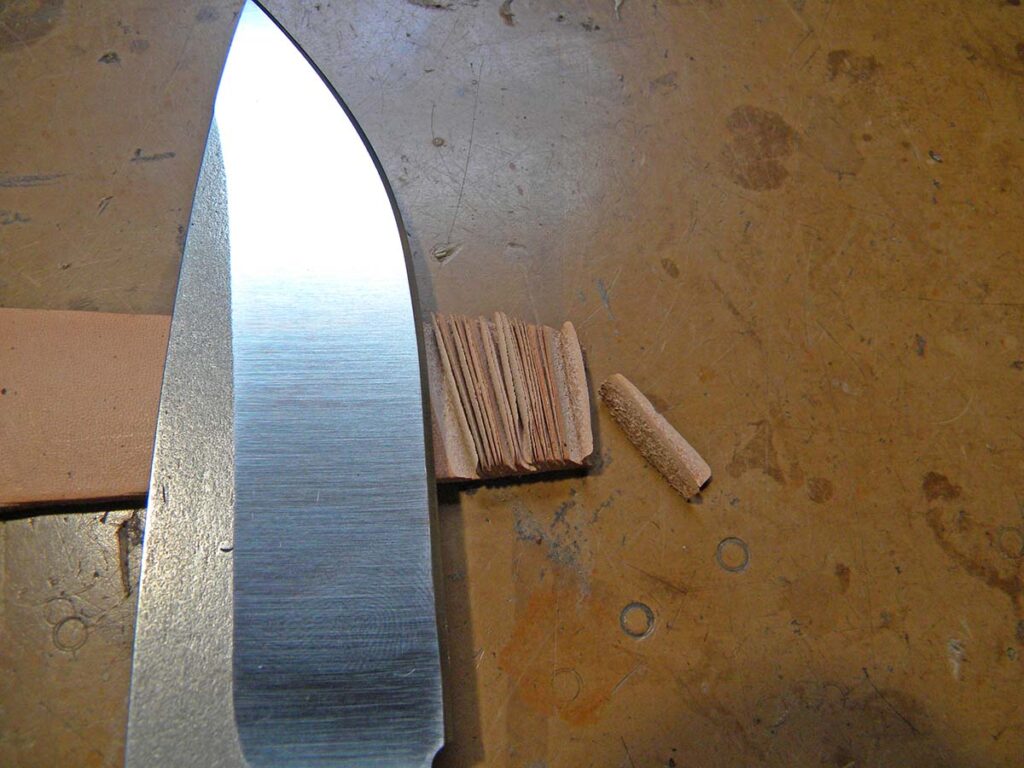
The author indicated the Large Hunter produced some of the thinnest slices he has ever made skiving 8-ounce leather.
Up first: the paper slice to check the original edge. This is the best way to show slicing in the still-image format of publications. The Large Hunter zipped through drafting paper in a jiffy, making a nice zipping sound on each cut. The edges of the slices were smooth with no tears. I had a hard time keeping my fingers out of the way, nicking one fingernail in the process.
Skiving 8-ounce leather was next on the agenda, and the Large Hunter produced some of the thinnest slices I have ever cut. It crunched the leather very smoothly in even slices that were controllable. The hardest part was moving my fingers out of the way fast enough. In addition to skiving the leather, I also sliced it. Again, the cuts were straight with no tearing.
Medium-Duty Cutting Tasks
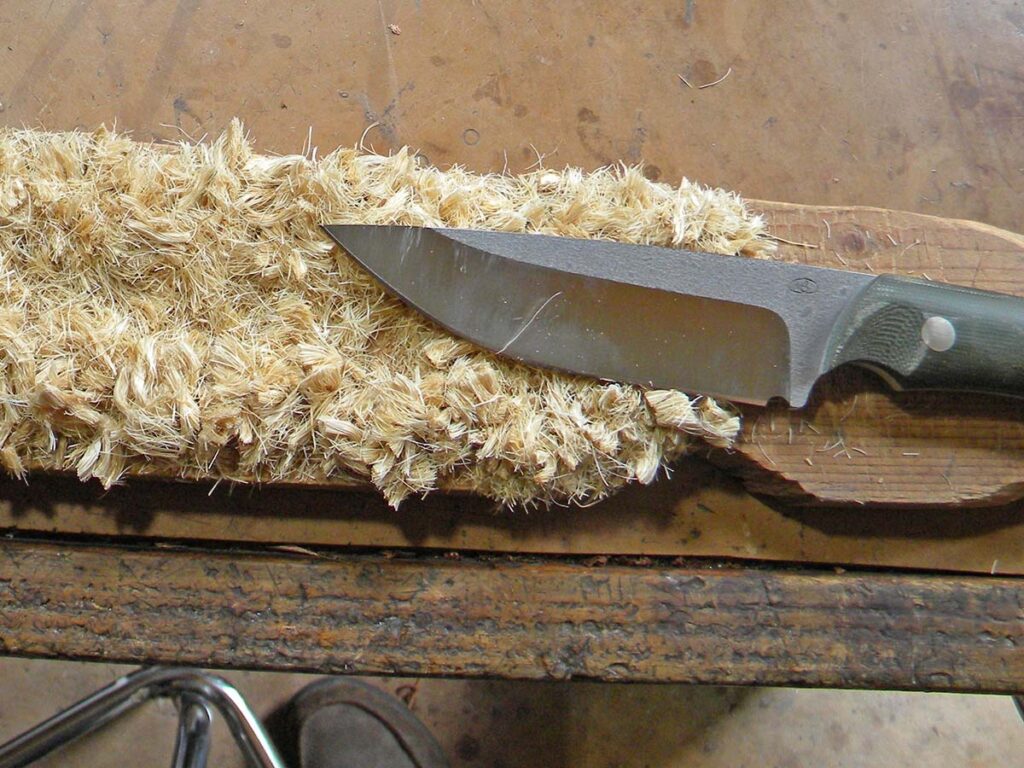
Mike Bradshaw’s knife crunched its way to 200 clean cuts in half-inch sisal rope.
It was time to whittle a firestick from seasoned cedar. The Large Hunter came through in flying colors, producing perfect curlicues with clean cuts. It was easy to control cutting depth but the handle was a tad sharp in the choil area. The unwanted sharp spot showed up again when I applied more pressure for deep cuts. A little touch up with sandpaper would fix the problem.
Batonning the Large Hunter through a cedar block was next. Four whacks and the cedar was split. I split it four times then split those four pieces four more times for kindling. The knife batonned great, with good balance between blade and handle. There was no damage to the edge.
Heavy Cutting Tasks
After being whacked into the antler 30 times, the edge emerged (far left) with no chips or rolling—a sign of excellent heat treatment.
From there, half-inch sisal rope was on the slicing block. The Large Hunter crunched its way to 200 clean cuts pronto. This knife is extremely sharp and holds an edge perfectly. The handle had a few hot spots that could be corrected fast with a piece of 220-grit sandpaper. If you’re wearing gloves, it’s no problem.
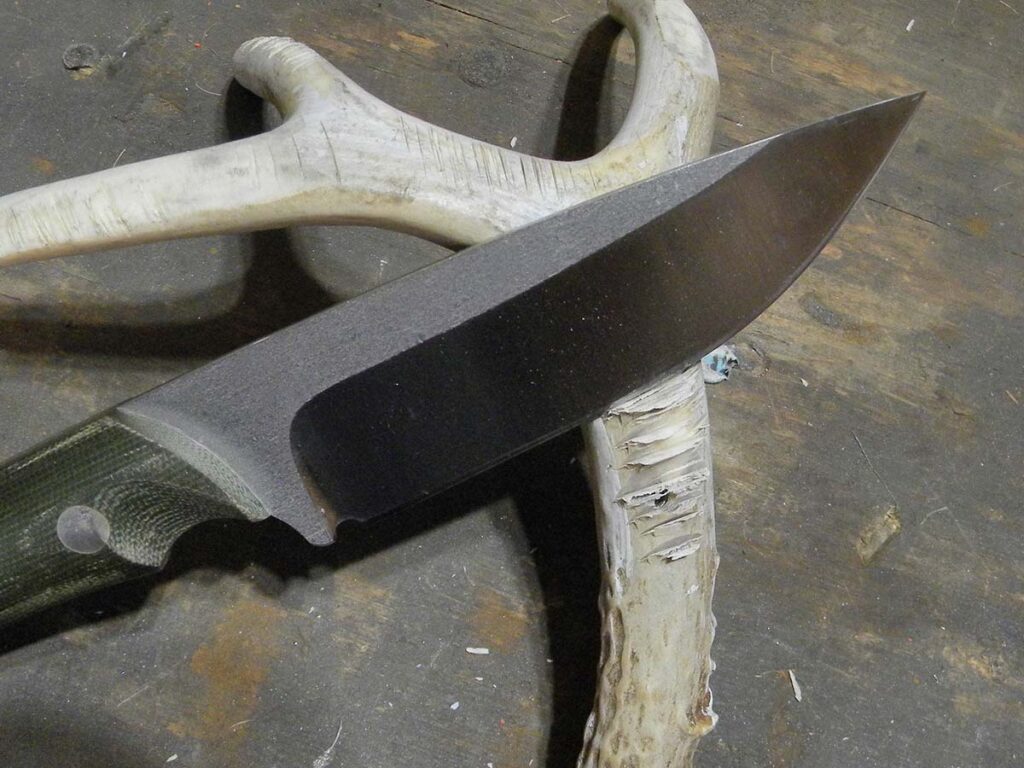
To push the edge further, I gave it 30 hard whacks into a whitetail deer antler. All that did was scatter antler chips all over my workbench—it didn’t do a thing to the edge. Excellent heat treatment, Mike!
As a final gauge of the edge, it was back to the paper slice to see if the edge picked up any damage or dulled at all. Nope, still sharp and smooth cutting. Great job, Mike.
Final Cut
Soften the edges of the handle more to relieve the hot spots. Easy fix. The Large Hunter can tackle a lot more than field processing big game. It has a super sharp edge for slicing and a bite for the larger chores.
Check Out More Outdoor Knives:
BEST TOMAHAWKS: OUR TOP HAWKS FOR BACKWOODS TO BATTLEFIELDS
These factory slip joint folders prove the design is alive and well.
Those of us who were around long before just about every folding knife had a lock of some sort have fond memories of slip joints. These non-locking folders are still around, but you need to make Google your friend and look—not just in the U.S., but overseas—to root them out. Surprisingly, there are good ones to be had; you just have to do a little digging to find the gems. We’ve done the homework on a nice selection of fresh slip joints for BLADE® readers and present them to you now in these glossy pages.
RoseCraft Savage Creek
The gunstock folder pattern has been around for well over a century and seems to be a rite of passage for most slip joint manufacturers. Up-and-coming RoseCraft Blades has done a nice job of producing many traditional folders, and its Savage Creek Gunstock slip joint is a solid addition to its catalog. This company’s version has a 3.625-inch black Micarta handle with polished steel bolsters and a nickel silver spade escutcheon. The blade is a 2.8-inch swedge-ground D2 steel clip point with a nail nick. The gunstock handle is nicely done with a tastefully curved rise on the inside curve of the handle. MSRP on the RoseCraft Gunstock is $60.
Rosecraft Blades makes an impressive knife for the price. Its gunstock is just a tad over the 3.5-inch standard of the industry and can easily fit in the pocket to handle everyday chores. I tested its blade by cutting some paracord and found its D2 very much to my liking. I also tested it by slicing some thin-skinned leather and was also impressed. This steel has been around for many years; though it’s not true stainless, it has enough chromium content that it rarely rusts. D2 steel is a reliable steel that still finds its way on a lot of custom knives.’
Savage Creek Specs Design: Gunstock Folder Overall Length: 6.4” Blade Style: Clip Point Blade Steel: D2 Blade Length: 2.8” Handle Material: Black Micarta Handle Length: 3.625” Special Features: Spade Shield Weight: 2.7 oz. Country of Manufacture: China Retail Price: $60
GiantMouse Ace Farley V2
The GiantMouse Ace Farley V2 Slip Joint is everything you’d expect in a finely made pocketknife and more. I tested the colorful green canvas Micarta version with a brass bolster, which added a little color to my carry. This version is 6.375 inches fully opened and closes to 3.625 inches—very much in the standard pocketknife realm. The main body of the dark green Micarta is topped by an elliptical-base, flat-finished guard and a simple, reversible pocket clip resides at the base. The 2.75-inch Elmax stainless steel blade is a fully ground drop point with a common curved nail nick. The total weight of the knife is a svelte 2.6 ounces. MSRP is on the knife is $156.
This is a less expensive version of the Ace Farley V2 I tested in an earlier issue of BLADE, but I like the brass and green Micarta combination versus the somewhat staid titanium/carbon-fiber version. And this one is less expensive. This folder is similar in length to the previous RoseCraft, but the handle has much more girth, which offers a plusher grip and a wider blade. I tested this version on a much thicker, quarter-inch synthetic cord and it cut through nicely. It’s amazing the difference a fuller, more comfortable handle makes when slicing through tough material.
Ace Farley V2 Green Micarta Specs Design: EDC Pocketknife Overall Length: 6.375” Blade Style: Drop Point Blade Steel: Elmax Blade Length: 2.75” Handle Material: Green Micarta, Brass bolster Handle Length: 3.625” Special Features: Slip joint action w/half stops Weight: 2.6 oz. Country of Manufacture: China Retail Price: $156
Giantmouse ACE Farley V2 Pocket Knife Drop Point ELMAX Stonewashed Blad
White River Knife & Tool entered the market in 2011 and has been a popular choice among fixed-blade users ever since. Finally, the company released its first folding knife—the Trailhead Trapper—and it was worth the wait. My first impression of the knife was that its ample 3.1-inch S35VN stainless steel blade is all business. The knife, designed for White River by Smith & Sons Knife Company, looks like it wants to cut! The brown 4.2-inch natural burlap Micarta handle features an excellent grip, with the burlap variety offering a slightly more substantial grip than the standard smooth Micarta. The weight is 2.5 ounces, and the $258 price tag is worth every penny.
An extra inch or more of handle and blade make huge difference on a folder. There’s more blade to cut with and more handle to grip and manipulate the knife. The White River Trailhead Trapper allowed me to extend the knife’s grip much better, and the longer blade was able to separate and remove whatever I cut more easily—in this case, sausage. With more room added to the equation, every task you tackle with a longer knife is easier.
Trailhead Trapper Specs Design: Classic Trapper Overall Length: 7.5” Blade Style: Clip Point Blade Length: 3.1” Blade Steel: S35VN Handle Material: Natural Burlap Micarta Handle Length: 4.2” Special Features: Half Stop Weight: 2.5 oz. Country of Manufacture: U.S.A. Retail Price: $259
White River Knives Trailhead Trapper Pocket Knife Clip Point CPM S35VN Blade Ri
We don’t get a lot of folding knives designed primarily for self-defense, so it’s good to see one enter the fray. The Böker Coffin Ultem is as purposeful as it is good-looking. The Coffin’s handle is a manageable 4.15 inches long, and you can clip it to the pocket or carry it loose in a pants pocket. The blade is 3.15 inches of premium MagnaCut stainless steel, so between that and the Ultem handle, there is no scrimping on Böker’s part. The Coffin opens the old-fashioned way, via a nail nick and a nice diagonal square texture. The length of the handle enhances the grip. This is a simple, well-made slip joint, especially for its MSRP of $285.
The designers at Böker wisely opted for a long, straight clip point blade for the Coffin to give the user more versatility outside of a pure defensive role. This adds to its usefulness in utility when cord or rope needs cutting and other roles such as meal prep in the field or on the go.
Coffin Ultem Specs Design: Self Defense Overall Length: 7.3” Blade Style: Spear Point Blade Length: 3.15” Blade Steel: MagnaCut Handle Material: Ultem Thermoplastic Handle Length: 4.15” Special Features: See-through Ultem Handle w/ Pocketclip Weight: 1.94 oz. Country of Manufacture: Solingen, Germany Retail Price: $230
Still Alive And Slippin’
Judging from our crop of slip joints, these simpler folders seem to be doing quite well in today’s cutlery market. Just the sheer variety of types and styles is impressive. Want traditional and hard-nosed? The White River Knife & Tool Trailhead Trapper and RoseCraft Blades Savage Creek Gunstock should whet your whistle. For outside the box and downright fancy, the Böker Coffin Ultem and GiantMouse V2 Green Micarta will whet it some more.
These are fat times for slip joint aficionados in the aftermarket as well. If your folder doesn’t come equipped with a pocket clip, there are plenty to be found in all sizes and types from aftermarket suppliers. Similarly, you can find leather and nylon belt sheaths for carrying your folder at the ready outside the pocket as well.
If for no other reason than simpler is better, with less to break and gum up your plans, I’ll leave you with this. A noted old-time knifemaker once left me with a piece of advice as to why he chooses to use a slip joint over any of the multitude of locks available for folding knives today. He simply said, “I know which side of the blade cuts.”
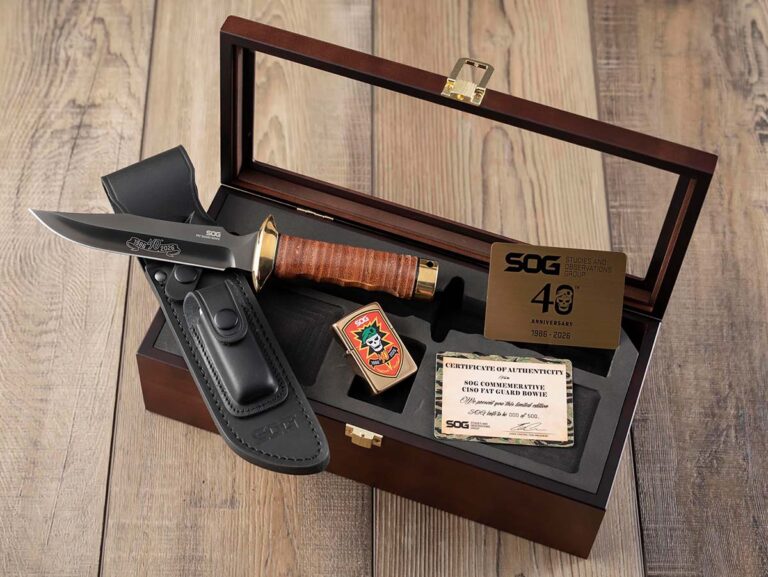
SOG marks four decades with a limited, 500-piece run honoring its original MACV-SOG combat bowie root.
To mark four decades in business, SOG Knives has released a limited-edition homage to the blade that started it all: the 40th Anniversary Fat Guard Bowie. Drawing direct design cues from the original S1 Bowie introduced in 1986, the new release pays tribute to the covert fighting knives carried by MACV-SOG personnel during the Vietnam War.
Historical Roots, Modern Production
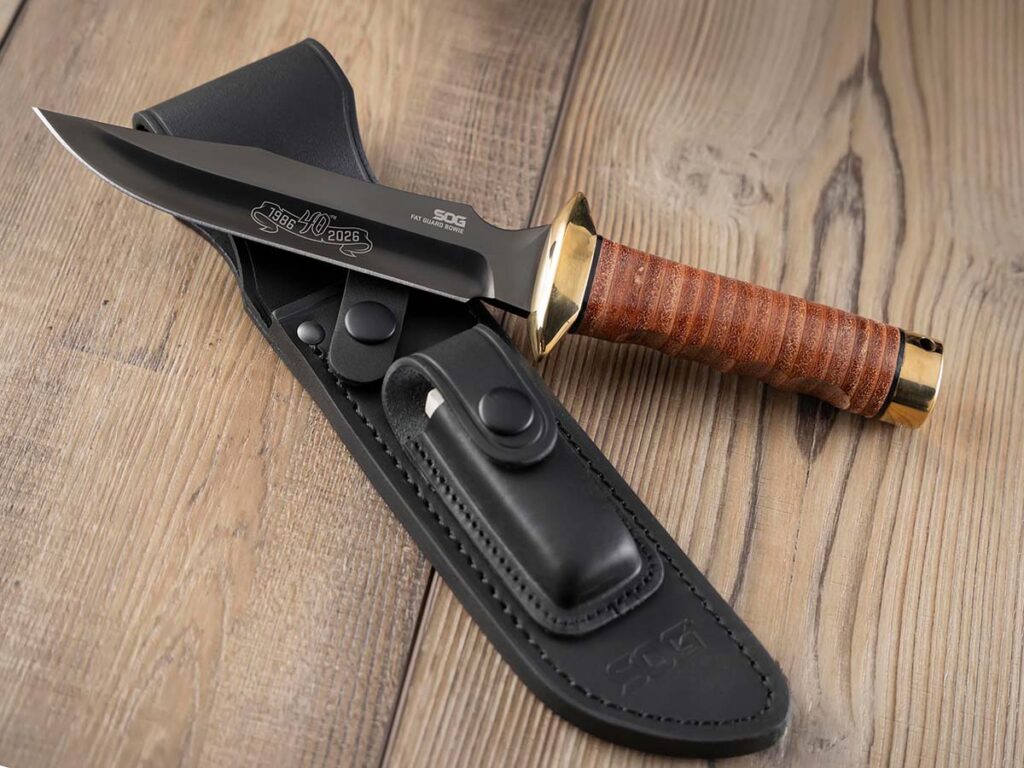
The 40th Anniversary model centers around a 6.1-inch clip-point blade forged from AUS-8 stainless steel. SOG finished the steel with a black PVD coating for added corrosion resistance and reduced reflection.
True to the traditional combat bowie silhouette, the handle is built from stacked leather, offering a classic aesthetic alongside a contoured grip. A substantial brass guard and matching butt cap frame the handle assembly. Production is strictly capped at 500 individually serialized units, with each knife’s specific number etched directly into the pommel.
Commemorative Display Package
Rather than shipping as a standalone tool, SOG packaged the anniversary Bowie as a complete collector’s set. The knife sits inside a handcrafted pine display case outfitted with a clear glass viewing lid and an engraved anniversary plaque.
Accompanying the fixed blade inside the presentation box is a custom SOG 40th anniversary Zippo lighter and a signed certificate of authenticity. For field carry or storage, the set includes a heavy-duty black leather belt sheath, complete with a front-mounted snap pocket containing a touch-up sharpening stone.
The 40th Anniversary Fat Guard Bowie package is available directly through SOG’s website while supplies last.