If You Can Only Have One Knife In The Kitchen, The Chef’s Knife Is The One To Get.
When it comes to knives in the kitchen the alpha and the omega, without question, is the chef’s knife. A quality chef’s knife can do just about everything from butchering a side of beef and dicing up vegetables to crushing garlic and skinning a salmon filet.
Whether Japanese or German, stainless or high-carbon, forged or stamped, there are an amazing variety of chef’s knives available today, and there will be one at the right price for you.
History Of The Chef’s Knife
Humans, and their ancestors, have been eating hunted meats and foraged fruits for millions of years. The first predecessor of the chef’s knife, in the most liberal sense of the term, dates back 2.5-million years to what is now Ethiopia. Known as Oldowan knives, these sharp stone pieces were made by smashing rocks together to form fragments with razor edges to cut through game.
The first proto-knife found with protein residue on it dates back 250,000 years and was discovered in the Azraq Oasis in Jordan. It had the residue of horse, cow, and rhinoceros on it.
As time progressed, knives evolved along with humans. The discovery of fire along with different types of metals allowed the creation of the earliest forged pieces. The bronze and iron ages saw more quality metals turned into knives by skilled artisans.
Each new material allowed for better, more durable knives and paved the way for the steel models we have today. Chef’s knives, as we know them now, have been found dating back to before the Roman Empire and were modified versions of swords and other weapons.
Why Should I Buy A Chef’s Knife?
Look, if you want to try and cut through a medium-rare ribeye or slice veggies with a standard butter knife, good luck.
A quality chef’s knife will make your life in the kitchen much easier than if you tried to force it with a standard dinner knife. Will the chef knife be more money? Absolutely, but, as you’ll see with our list, it’s incredibly easy to find a strong, capable model without breaking the bank.
So you should have a chef’s knife in the same way you should have proper running shoes if you are a marathoner or a good driver if you golf. You could do those things without the right equipment, but it’s much easier and enjoyable when you have the right tools for the job.
5 Best Chef’s Knives
Chef’s knives, Japanese or German, should make you feel comfortable and secure in the kitchen, as well as make work there easier. This list has a little of everything from pro-quality damascus blades, to stamped models strong enough to be an everyday workhorse.
Misen Chef’s Knife
Misen Chef’s Knife
Award-winning cookbook author J. Kenji Lopez-Alt called this knife “the holy grail of inexpensive chef’s knives.” The 8-inch blade is made from Aichi AUS-10 high-carbon stainless steel, is ground to a 15-degree edge, and has a 58 HRC.
The sloped bolster and handle design encourages a safe grip while chopping. It’s light in the hand at only 8 ounces in weight and can mince herbs and cut through chicken bones just as easily.
An added bonus is that there are four choices for the handle color (blue, red, gray, and black). For a budget knife, this piece from Misen really is about as good as it gets.
MSRP: $65
Wusthof Classic Ikon 8-Inch Chef’s Knife
Wusthof Classic Ikon 8-Inch Chef’s Knife
An icon of German engineering, Wusthof has been making knives in Solingen, Germany since 1814. The Classic Ikon is a timeless all-around blade that makes an excellent addition to your home, while also having the chops to cut it (pun intended) in a professional kitchen.
The forged blade is triple-riveted to the black synthetic handle and has a 58 HRC. The half bolster cuts down on weight while also making it easier to sharpen. When you buy a Wusthof you can trust in the two centuries of work that has built the company into what it is today, and this model won’t disappoint.
MSRP: $200
Mac Knife Pro Series 8-Inch Chef’s Knife With Dimples
Mac Knife Pro Series 8-Inch Chef’s Knife With Dimples
This professional-level Japanese chef’s knife is a popular choice for chefs and home cooks alike. The 8-inch hollow-edge blade is made from alloy steel and a Pakkawood, triple-riveted handle.
What sets this knife apart from the rest on our list are the dimples on the blade. Known as a Granton edge, these dimples are more common on a Santoku knife than on a chef’s knife. Regardless, they allow for food to more easily slide off while cutting so you don’t have to deal with the frustrating task of peeling bits off the blade when you’re cutting stickier foods like potatoes or apples.
Made in Seki, Japan, the traditional home of Japanese knifemaking, Mac Knife has made something modern built with techniques developed over centuries.
MSRP: $195
Victorinox Fibrox Pro Chef’s Knife
Victorinox Fibrox Pro Chef’s Knife
The lowest-priced knife on our list punches above its weight and is a great addition to your kitchen. The price is kept down because the blade is stamped, but don’t let that fool you. This model has the same quality you would expect from everything else Victorinox offers.
The eight-inch stainless blade is married to an ergonomic, non-slip handle that feels great in the hand. Made in Switzerland along with the brand’s famous Swiss Army knives, the Fibrox Pro is easy and efficient to use. While it is listed as dishwasher safe, we recommend hand-washing and drying it as that will preserve the blade for longer.
An added bonus of the stamped blade is that this is the lightest knife on our list, coming in at just 6 ounces.
MSRP: $42.95
Miyabi Chef’s Knife
Miyabi Chef’s Knife
This is a professional knife and it looks the part. Made of 100 layers of damascus steel around a Cryodur-hardened SG2 micro-carbide steel core, it is topped off with a Masur birch handle. The damascus blade has a ridiculously hard 63 HRC and is ground to an edge between 9-12 degrees using the traditional Japanese three-stage honbazuke process. That sees the blade polished twice on custom whetstones and polished to a mirror finished on leather wheels.
This is one of the highest-quality kitchen knives on the market today. It’s also a love note to Japanese knifemaking from its tip to the end of the handle. Miyabi’s whole set of chef’s knives is of similar quality and if maintained properly, can last you a lifetime.
While Not As Plentiful As They Once Were, Quality Folding Hunters Can Still Be Had. These 4 Knives Meld The Robustness Of A Hunter With The Ease Of An EDC.
Folding knives have been used for hunting and skinning since they were first made. Today, the American knife industry has moved quite far in the direction of fixed blades for use in the field.
However, folding knives are seen in the pocket of just about every self-respecting individual these days and are still the top choice for daily use. Time and fashion being what they are, many pocket folders have become somewhat fragile and unsuitable for anything other than opening mail or packages. In short, they have lost their value as serious tools that can be used in the field as well as daily life. Nonetheless, luckily there are a number of very suitable hunting knives that fold and ride in the pocket.
The largest downside to folding hunters is they can be very difficult to clean and have the propensity to break under hard use. Folding knives promoted for hunting are, at least to me, a bit of an exaggeration in that they function but are much harder to get along with on big game. As a result, I try to limit my folders to small game where the weight of the animal has little bearing on blade stress.
Cleaning and maintaining a folding knife exposed to blood and other fluids is a challenge. The mechanical function of such knives can in many cases be impeded with fat, and likewise made dangerous if, for instance, a linerlock gets clogged up.
Washing a folding hunter is easy in some respects, but the best method remains soaking it in hot water with dish soap to dissolve fats and blood. Rust and corrosion can easily occur internally, so you’ll need to oil the knife after soaking it to prevent corrosion.
Lastly, ergonomics and blade length create the most limits for the big game hunter. Because most folders are designed to lay flat against the body in the pocket, they tend to be thin in profile, which can fatigue the hand if you have a great deal of work to do.
Since the blade fits in the handle, you’ll never really get as long a blade as you need for animals like deer without getting a handle that is proportionately as long. This makes for a degree of awkwardness in that you can only get more blade if you get more handle, and at that point a fixed blade is better.
Emerson Knives Market Skinner
I have developed a great fondness for Emerson knives. In fact, as much as I love carrying fixed-blade Winklers, I have ended up going about much of my daily life with an Emerson in my pocket. Much of the utility for me comes down to how well it fits my hand. The Market Skinner is a well-balanced and very functional cutting/slashing knife that has a mixture of hunting and tactical features.
The grip has a fine yet aggressive texture, and is easy to hold onto even when working with fatty meat. The blade has Emerson’s Wave Feature, thus allowing for instant opening coming out of the pocket.
I got to work in the kitchen on some small game and meat. The Market Skinner is designed to emulate the type of blade profiles used in old-world butcher shops to break down large cuts. Having spent the better part of my college years working for a high-end butcher shop, I had a good feel for what this type of knife could do.
For general use, the Emerson, above the others here, was probably the most functional for light-to-medium use. It was also by far the easiest to clean internally. Its open-handle design allows you to wash it easily.
The added upward curve at the Wave on the spine allowed me to put a great amount of pressure on the blade to cut deeply. When covered in fat it was functional. However, the very fine handle material was hard to clean and pulled fiber from my rags. Not a huge deal, just something to be aware of.
While it is profiled as a hunting blade, the tactical features are there and the knife is easy to use thanks to how quick it opens. The clip is righthanded and very stiff. If you intend to carry it lefthanded, Emerson offers a service to drill and tap the other side for you.
MSRP: $267.95
Boker Hunter’s Knife Duo
Styled in the manner most favored by German and European sportsmen, the Boker Hunter’s Knife Duo is not just a functional piece of art but also a very rugged tool. It is so nice looking that you’ll want to make sure to keep it that way—meaning don’t toss it in your gear drawer after a hunt.
Unlike the other test models, the Boker features two edged tools—one, a knife blade, the other a saw. In testing on a lamb rack, the saw performed extremely well and allowed me to make nice, even chops. The teeth are exceptionally aggressive, which is a positive for cutting bone, but they clog easily with fat and sinew.
The Hunter’s Knife Duo is made in Germany and the quality of each part is amazing. A notable feature is the real stag grip panels, a rarity on many production knives today. Care must be taken to not introduce this natural material to stress or harsh cleaning chemicals. Soap and water for cleanup is best, followed by a light coat of oil. In terms of mechanical function, this is a classic gentleman’s knife, slow to deploy and not designed with a day’s labor in mind.
Equal parts showpiece and tool, the Boker is best on small-to-medium game. Since it has no pocket clip, it will likely ride in a belt pouch or simply in a pocket.
The only real problem is the shape and contour of the handle. If your hands have blood or fat on them, the grip tends to be slippery. This is a very slick knife and every metal part is as smooth as glass. Under such conditions sawing also can be slightly hazardous, as can cutting should your hands slip up onto the blade. That being said since a true gentleman is never in a hurry, the Boker is the perfect find for rabbits, pheasant, and turkey, preferably with a fine double gun in hand.
MSRP: $409
Case Kickstart Mid-Folding Hunter
The smallest of the test knives, the Case Kickstart Mid-Folding Hunter performed very well considering its size and blade length. This is in no way a knife you would want to have if you were trying to take down a deer; however, for small game, medium cuts like lamb or chicken, or out harvesting spices in the garden, the Case is perfectly capable.
Like the Boker, it is a very, very slick knife—both visually and in terms of the limited amount of texture it has on the blade and grip. While it can be easy to work with, the knife is prone to slip or rotate in the hand.
In terms of cutting ability, it did just fine. The downward-swept blade lends itself to fine cuts, but very little else. The knife can be used and held like a pen. A full grip of the handle isn’t very safe.
The lock mechanism is easy to use—a bit too easy. The blade can be unlocked and closed with almost no effort, which can present a dangerous situation if you aren’t careful. Of note is that the blade is assisted, and it opens incredibly fast. It also has a pocket clip for easy carry.
MSRP: $127.99
A.G. Russell Folding Gent’s Hunter II
In the vein of classic sport folders from the 1960s and ’70s, the A.G. Russell Folding Gent’s Hunter II is designed along clean lines and minimalist features. It came out of the box with a very sharp edge and a functional, ergonomic grip. Despite being a full-size knife, it is the lightest of the review folders, lighter even than the smaller Case.
Using and cleaning the A.G. Russell was about the same as the others. However, the wood panels required a coat of oil after I used soap on them to remove fat. The blade sliced meat very easily, and it was also rigid enough to approach some larger projects and game. While I’d probably take the Market Skinner if I knew I was working on an adult deer, the A.G. Russell would come in a close second, its only downside being that it got slippery when wet.
This knife is right on the money for a walking hunter going after rabbit or fowl. It’s very light and sharp and still maintains classic lines. Because it is so light, it seems to disappear in the pocket and, if carried daily, won’t draw any unwanted attention. It has “classy” written all over it.
Is The Versa Rescue Knife As Good As Advertised Or Does It Come Up Short Even With All The Extra Features?
When he worked for the Central Intelligence Agency, Jason Hanson came across tool needs the average knife did not fulfill. Enter the Versa rescue knife.
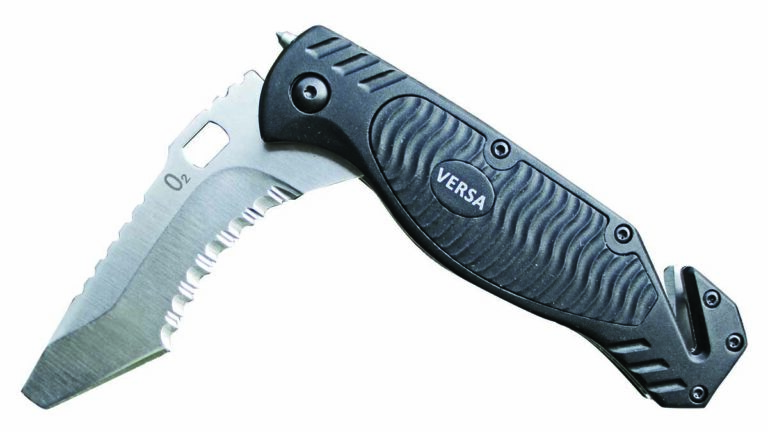
Besides the blade having two distinct edges—one short and flat, the other recurved and serrated—the tip is flattened for a screwdriver. When you close the knife, a glass breaker sticks out the front of the handle.
On the butt is a mini pry bar and a webbing/line cutter. Yes sir, there are lots of things going on with this rescue tool. However, I’m mostly concerned with testing the Versa’s cutting capabilities, so here goes.
Testing The Versa Rescue Knife
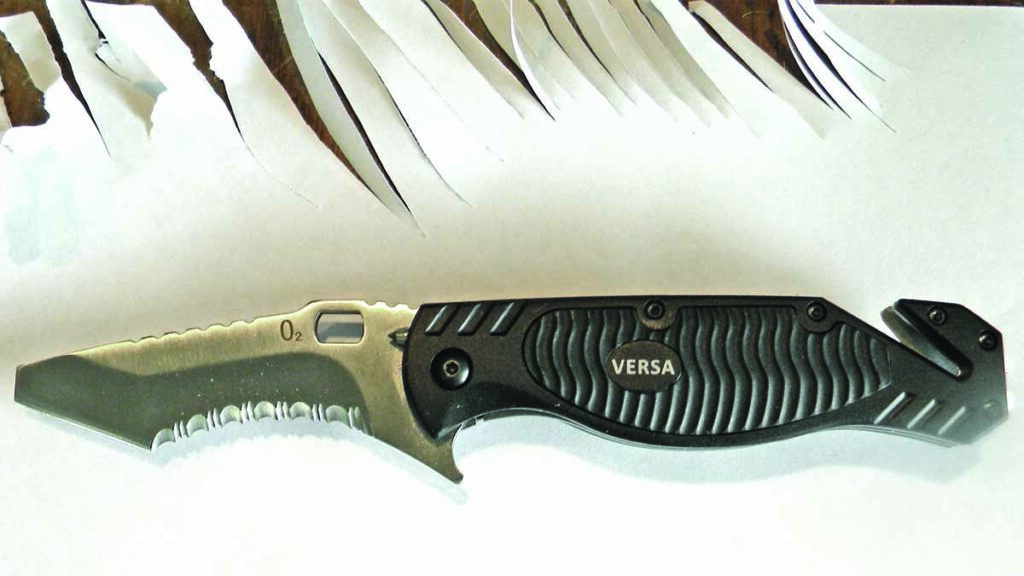
Via a push cut, the flat edge zipped through the paper smooth and clean, though it was somewhat challenging to use the flat front edge of the blade to start the cut.
Slicing 20-pound bond copy paper was first on the list. Via a push cut, the flat edge zipped through the paper smooth and clean. It was somewhat challenging to use the flat front edge of the blade to start the cut.
Onto the serrated edge, the paper tore sometimes depending on whether I started with the tips of the serrations or the bottoms during push cuts. The serrations did better used in a slight forward motion, giving cleaner cuts.
From there, the knife easily dispatched double-walled cardboard. With only a slight twisting of the blade, the serrated portion cut aggressively through the medium. Likewise, the flat edge sliced effortlessly and was very controllable, providing nice, even cuts.
The flat edge cut smooth through six-ounce leather, producing a bit of a crunching sound. It was very easy to control the cuts. The aggressiveness of the serrations really went to work on the leather, emitting loud crunching noises as it bit deep—and without need of a sawing motion at that.
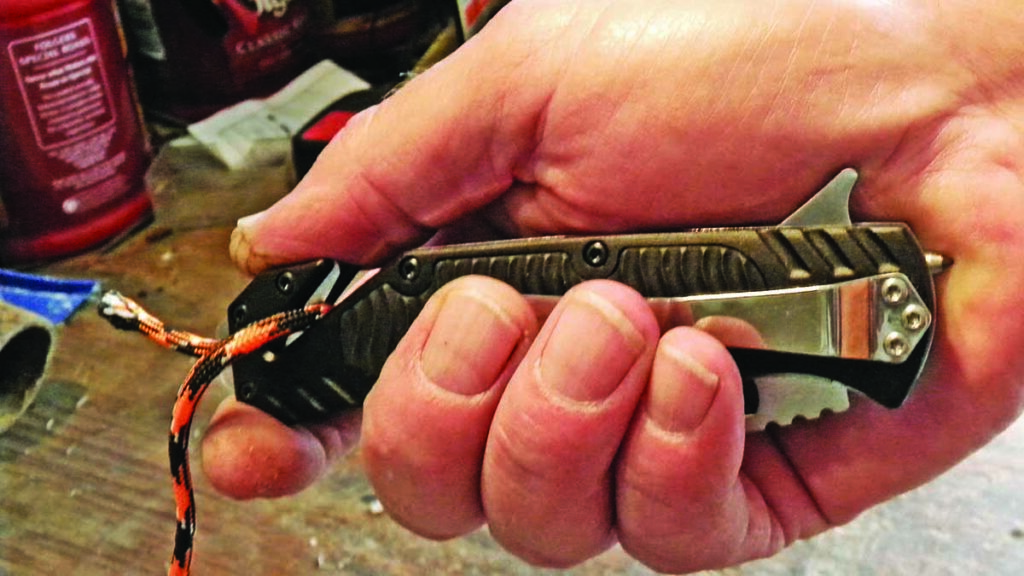
To test the webbing/cord cutter, I used 550 cord. With one end of the cord locked in a vise, I held the loose end and pulled the cutter through the material. The cutter worked great with no resistance, severing the ends of the cord clean.
Carrying The Versa
Even though the glass breaker works, the author didn’t like it poking him in the hand each time he grabbed the knife.
I carried the Versa for a week to see how it rode in my pocket. It’s a bit on the heavy side for my taste. The pocket clip held the knife secure with no side-to-side movement while I climbed a tree.
Even though the glass breaker works—I’ve used the type before—I didn’t like it poking me in the hand each time I grabbed the closed knife. Clipped in your pocket, it will also poke your hip when you’re wearing shorts and sit down. The concept behind the glass breaker is sound and useful, but it suffers from the same poking problem as on all the similarly equipped knives I’ve tested.
On the other hand, the pry bar rode great without sticking me in the leg. The handle design is very comfortable and the rubber inserts are perfect for a non-slip grip—a great using design.
Versa Rescue Knife: Final Thoughts
I would reduce the Versa’s weight for pocket carry and design a glass breaker that doesn’t poke the user. (Editor’s note: Also, the flipper/blade action is sluggish and needs work to make the knife open easier and smoother).
I would carry the Versa in a pouch or stashed in my vehicle. It works/functions great.
We hack away at meaty machetes that cut to the quick and take no mercy on brush.
In many parts of the U.S.A., greenery is busting out all over with the year’s early warmth and rain. People are trimming shrubs, cutting grass, whacking vines and other yard tasks. If you are a camper or own land, chances are you have a need for a good machete to help clear brush and take down saplings.
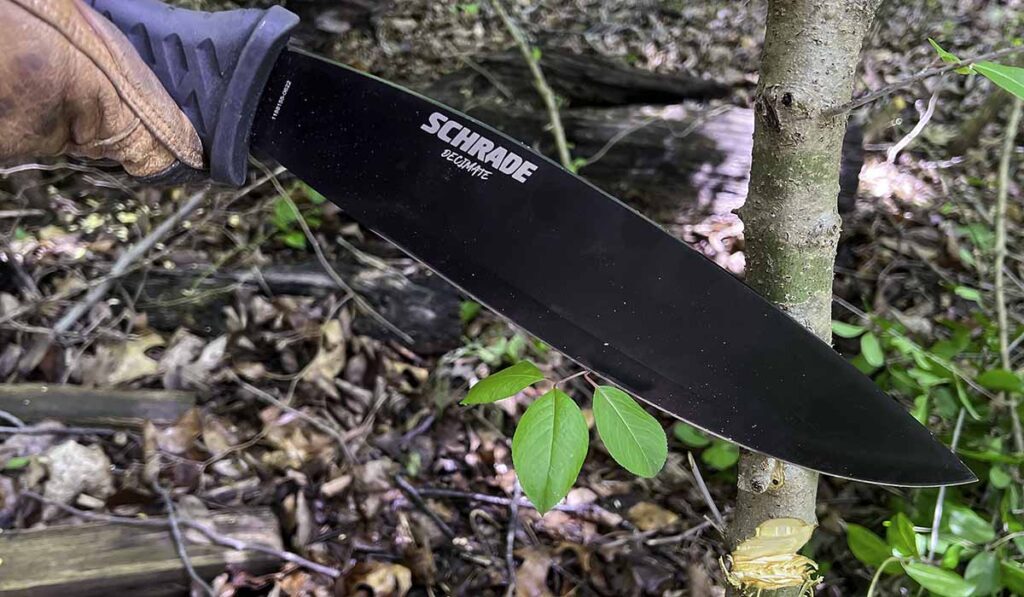
Schrade Delta Class Decimate Bolo
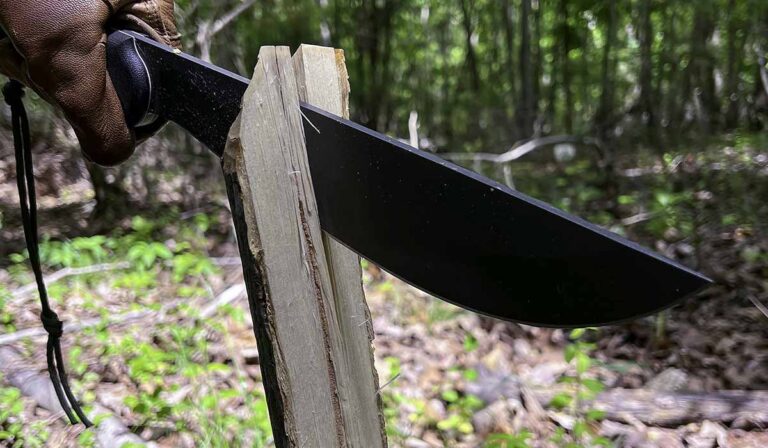
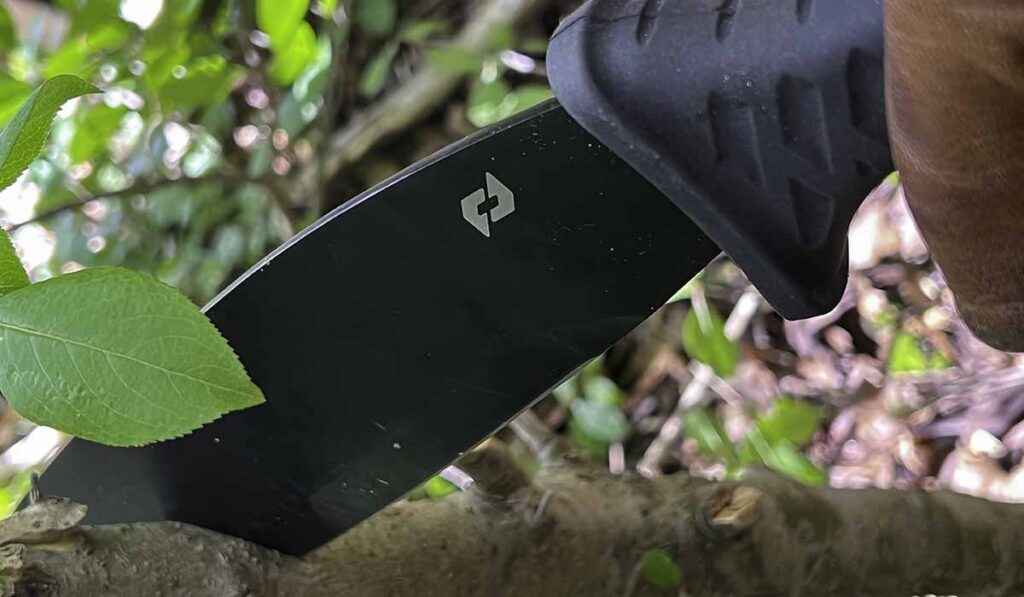
The shallow blade grind enables the Schrade Decimate Bolo to bite deep into green wood.
The Decimate Bolo machete is part of Schrade’s Delta Class line of knives, and offers a good balance of performance and value pricing. The 12-inch blade and 8-inch handle make it a formidable slashing/chopping tool. The 3Cr13 stainless steel blade has the power and durability to hack through the toughest jobs without “decimating” your wallet. The steel seems to hold a decent edge and is easy to resharpen. I would compare it to 440A stainless. The blade shape is a fat spearpoint, offering easy forward-heavy balance that works well for extended use. A black coating enhances corrosion protection as well as low-profile visibility.
The handle seems well thought out with several key features. The integral guard prevents forward hand movement, while the bird’s-beak butt prevents rearward sliding of same. A generous swelling mid-handle fills your grip nicely. A heavy molded-in texture aids a nonslip grip and the black rubber overmold has a slightly tacky grab-you-back quality that works well with gloves or without. Wrap your hand around the grip and it feels secure and instills user confidence.
The accompanying sheath, a ballistic nylon/covered flexible plastic with a riveted construction, is basic but works. Two button snaps near the handle allow the sheath to open wider for easy insertion and removal. A button snap strap affixes the handle to the sheath. The most interesting feature is it carries via a strap and not traditionally on a belt. The back and bottom have two eyelets for strap attachment. Adjustable in length, the strap can fit around your torso to carry sling style for easy portability.
The Schrade Decimate Bolo is an effective chopper due to the weight of the blade and the gentle curve of the cutting edge.
A broad profile lends the blade forward balance for delivering effective chopping blows that can take down saplings easily. The shallow grind enables the blade to bite deep into green wood. The slight-downward-angle-kukri-style-blade-to-handle design helps accentuate cutting power. One thing: At first it felt like the handle was oversized and too big for my hand. When I put the machete to use, it became apparent the oversized nature is on purpose. I could employ two grip styles to maximize effectiveness.
If you grip it close to the forward guard, it allows you to execute detailed chopping maneuvers. The blade feels more controllable. But, when you slide your hand rearward to where your pinky catches on the bird’s-beak butt, it locks your grip in and promotes maximum leverage and power for strong chopping strokes. You never feel like the knife will get away from you. The rubber handle also assists in mitigating impact shock, which translates into a more comfortable user experience.
At an MSRP of $49.99, the Decimate Bolo is a fairly decent machete if you want to step up from something of lesser quality in a hardware store. Country of origin: China.
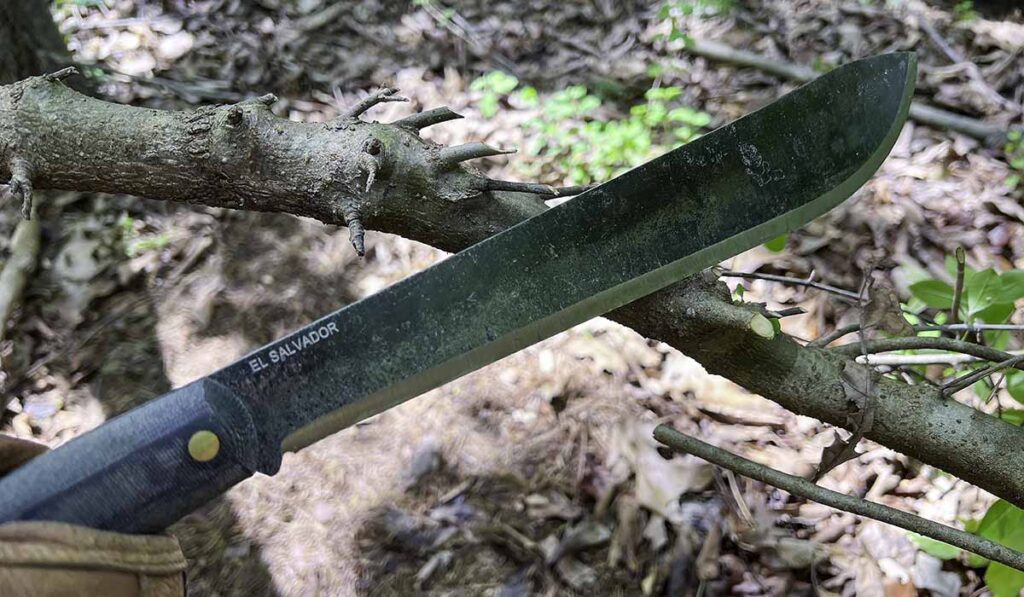
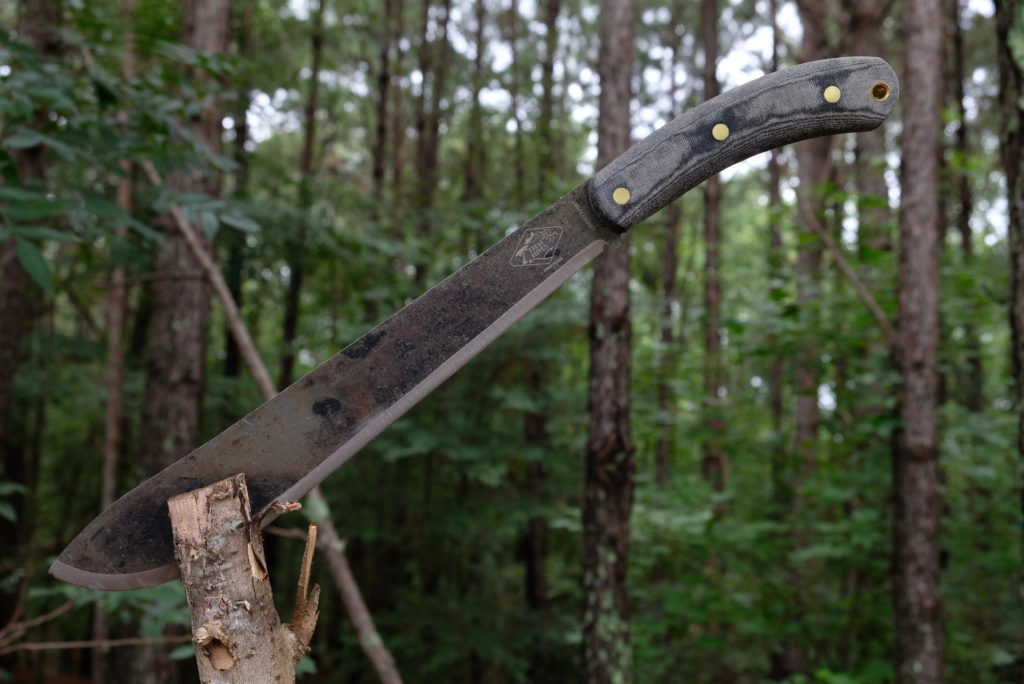
ESEE Knives Expat Darien Machete
The ESEE Expat Darien is not only a great chopper but also good for more delicate work such as quickly removing smaller limbs in one motion.
The ESEE Knives Expat Darien Machete is ruggedly made with a 12.4-inch blade of 1075 carbon steel. The blade has a notable two-tone appearance from the heat-treat scale left on the flats and the satin finish of the main grind bevels. It gradually tapers from belly to tang, evening out balance somewhat while having enough blade-forward weight to facilitate easy swinging.
The 6-inch Micarta® handle has some girth and fills your hand well. The downward curve profile helps lock in your grip and prevents rearward slippage. Three large brass rivets hold the Micarta slabs securely to the full tang. I like how the grip is a bit oversized, allowing you to wrap your hand around it while still feeling comfortable and secure. At 18 inches overall, the machete is an ideal size for serious work yet compact enough for comfortable carry and storing in a truck, SUV or side-by-side.
The reinforced ballistic nylon sheath is of a sewn, riveted construction, offering the toughness needed for housing the Darien. The desert tan nylon fabric offers a great alternative to the standard, ubiquitous black sheath. A single-button snap strap secures the knife. A large loop accommodates the thickest belts and is sewn securely to the sheath. It’s definitely well-made. MSRP: $120 Country of origin: El Salvador.
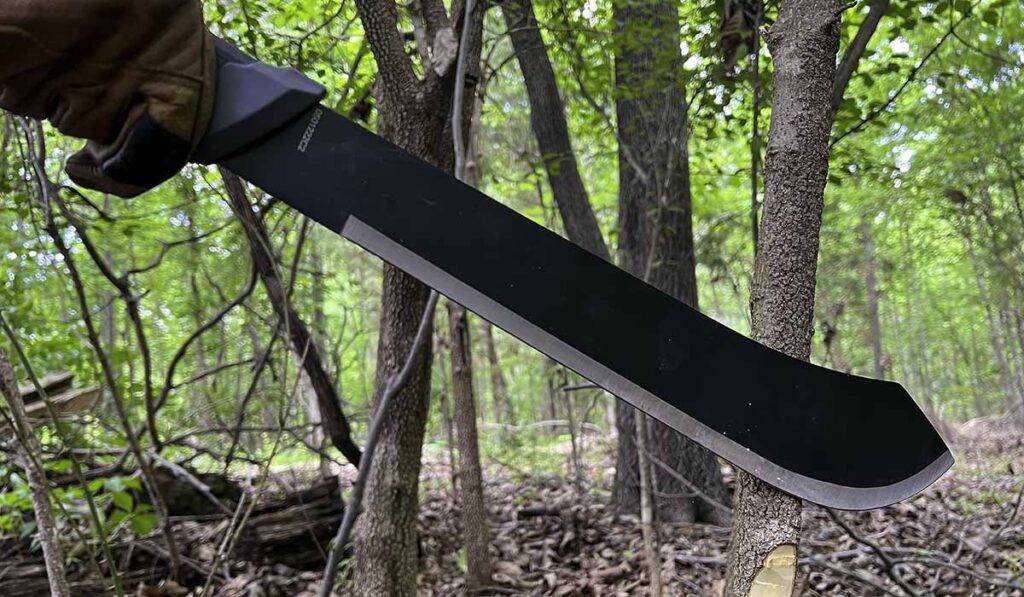
Gerber Gator Bolo
Chopping power is aplenty with the Gerber Gator Bolo and its longer blade. It has enough punch to make chopping saplings an easy task.
The Gerber Gator Bolo’s bolo-style blade flares at the tip to add a pronounced forward balance point that delivers powerful chops. The 15.4-inch blade is 1055 carbon steel in a black coating to resist corrosion. Overall length: 22.4 inches. The handle is a molded FRN with a textured rubber overmold for comfort in wet or dry conditions. The texturing is the same for all Gator series handles, with a simulated alligator hide pattern. Full-tang construction provides strength and improves balance.
The sheath is ballistic nylon lined with plastic to prevent blade puncture. A series of rivets holds the sheath together and a zippered portion opens it wide for easy removal/insertion. Two D-ring attachment points on the back anchor a shoulder strap. What’s weird is the strap is not included. You must supply your own. Neither is there a belt loop, which is somewhat surprising.
The lengthy blade is ideal for taking out vines, tall weeds, etc. It can fell saplings, though delivering the necessary chopping blows can get tiring. It nonetheless remains an effective machete if weeds and assorted vegetation are your primary target. Out-of-the-box edge quality was sharp enough to do the job.
The handle is comfortable. A large finger recess at the guard is well-suited for wrapping your hand around the grip. The simulated gator-hide texturing excels at holding your hand in place, gloved or no. The lanyard works well in the event you lose your grip. Some users say lanyards are a danger as letting go of the handle may cause the dangling machete to swing around on you as opposed to letting it drop to the ground safely. If you don’t want the lanyard, cut it off.
I found the Gator Bolo an effective chopper despite its dramatic blade-heavy balance. Just remember to let the weight and gravity do their thing on the downstroke. The blade bit hard into green wood and the shallow grind thins out the cutting edge nicely. The blade held an edge fairly well and is easy to resharpen. I improved edge quality using a coarse-grit diamond sharpening rod followed by a fine-grit ceramic honing rod—not even five minutes and I had a good edge on it. MSRP: $60. Country of origin: China. If you need a machete with reach, this one’s for you.
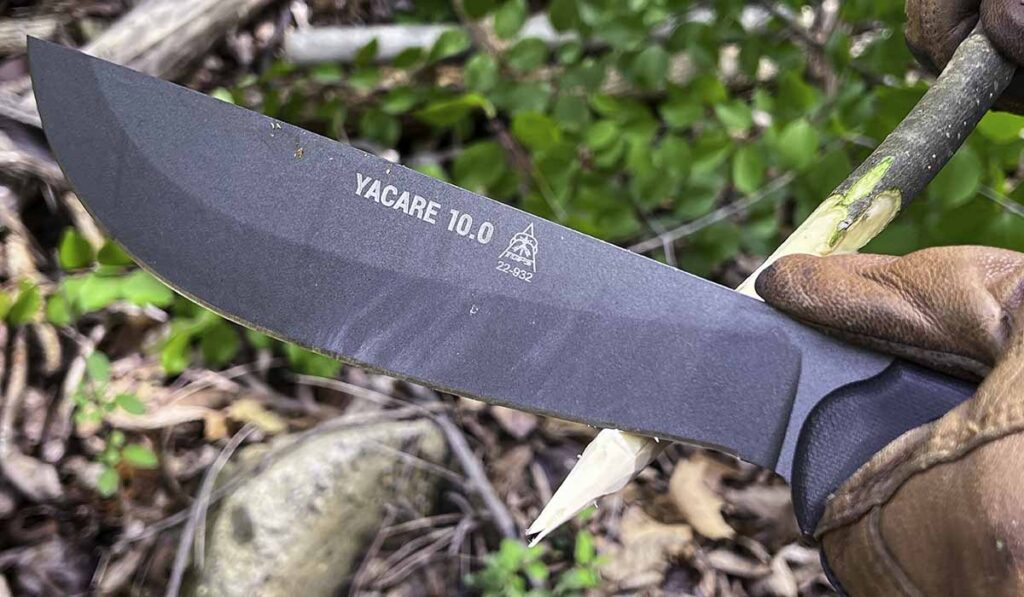
TOPS Knives Yacare
Whittling is possible with the TOPS Yacare and its great balance and gently curving cutting edge. It’s got an excellent edge with plenty of bite right out of the box.
Designed by company general manager Craig Powell, the TOPS Knives Yacare 10.0 is a barong-style machete 15.5 inches overall. The blade is 1095 carbon steel, a good performing material that’s easy to sharpen, and 10.25 inches—easily long enough for serious work. The blade’s forward balance works well as both a machete and a wood-chopping tool for dispatching saplings, vines and brush. The knife feels very controllable too, which is great for finer cutting tasks, something larger machetes normally don’t do well. The blade bites hard with every swing. The continuously curving cutting edge almost constantly presents itself at an angle to whatever is being cut, which enhances efficiency at powering through tall grass, weeds and saplings.
The black Micarta handle features integral front and rear guards to capture your hand and is definitely a user. The grip edges are contoured and rounded for comfortable purchase, and white fiber spacers add a nice visual pop. Micarta has long been a favorite handle material of mine and I prefer it on fixed blades such as this one. It’s a very durable, lightweight material that is dimensionally stable and impervious to fluid absorption. It can be textured to add grip traction without being overly aggressive. Hence, TOPS uses Micarta in a lot of its knives, both big and small.
The sheath is heavy-duty and well-made. It’s a ballistic nylon material that is quite rigid. A wide fabric-fastening strap secures the handle. As a nice added touch, there’s an exterior accessory pouch with a Fastex buckle closure. It stores things like a medium folder, sharpener or even a multi-tool. The belt loop is the same width as the sheath and heavy duty as well. MSRP: $270. Country of origin: U.S.A.
More Machetes
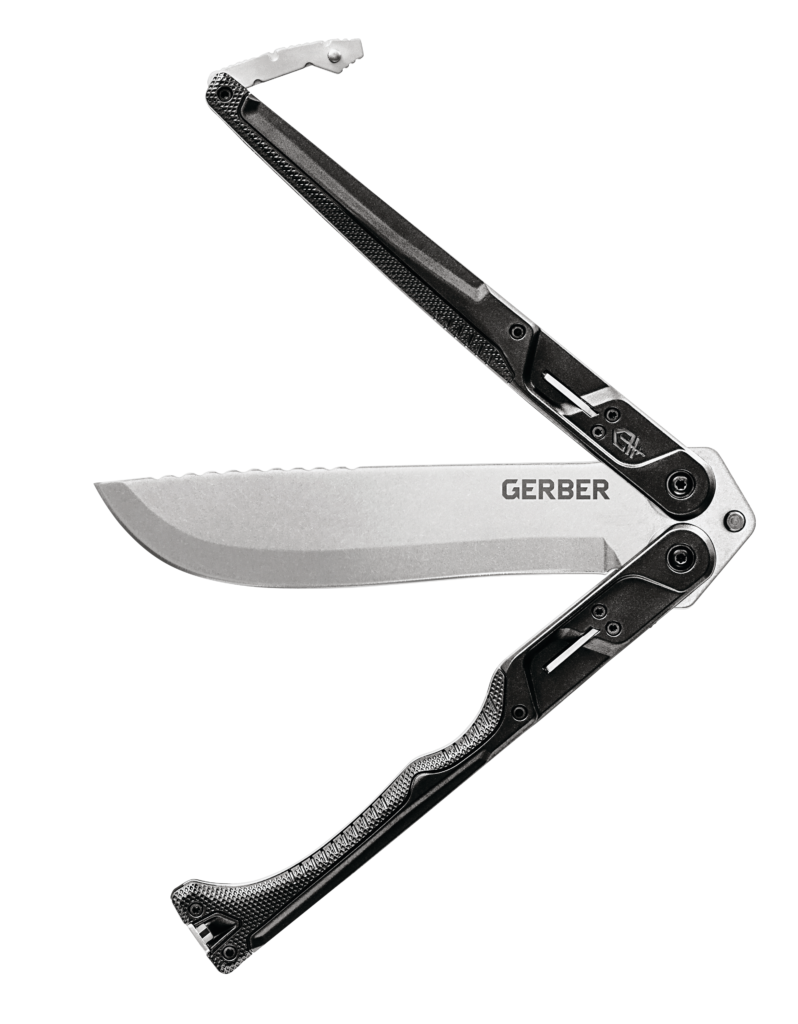
GERBER DUBLEDOWN FOLDING MACHETE
Blade length: 6.75” Blade steel: 420HC stainless Blade pattern: Recurve drop point Blade Finish: Stonewashed Weight: 18 ozs. Overall length: 15.1” Knife to know: Available in a green or black handle and a choice of blade finishes Sheath: MOLLE/belt carry Country of origin: USA MSRP: $129-$139
ESEE Darien
The ESEE Darien features an ergonomic Micarta® handle for comfort and comes with a rugged canvas sheath. According to ESEE, the knife is a chopping machine whether in the Amazon, the jungle or your own backyard. It carries the same “no questions asked” warranty as the knives in the standard ESEE line.
ESEE DARIEN Blade Length: 12.38” Blade Material: 1075 carbon steel Rockwell hardness: 54-56 HRC Blade’s Maximum Thickness: .094” Handle: Micarta® Knife weight: 15.5 ozs. Overall Length: 18.18” Sheath: Canvas Sheath weight: 4.5 ozs. Country of origin: El Salvador MSRP: $100 and up
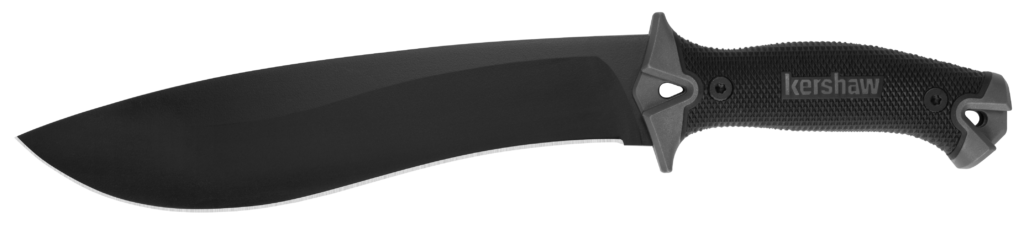
Kershaw Camp 10
Though a camp knife in design, the Kershaw Camp 10 doubles as a machete, too. Clearing brush, making kindling and more, it does the trick. The integral crossguard is a nice safety feature and the handle has holes for either a forward or rear lanyard.
KERSHAW CAMP 10 Blade length: 10” Blade material: 65Mn spring steel Blade finish: Black powdercoat Blade pattern: Recurve drop point Handle: Full tang, glass-filled nylon with Sure-Grip overmold Knife weight: 1 lb. 2.3 ozs. Overall length: 16” Sheath: Glass-filled nylon w/gear straps and belt loop Sheath weight: 5.7 ozs. Country of origin: Design, prototype and quality control in USA; manufactured in China MSRP: $80.84
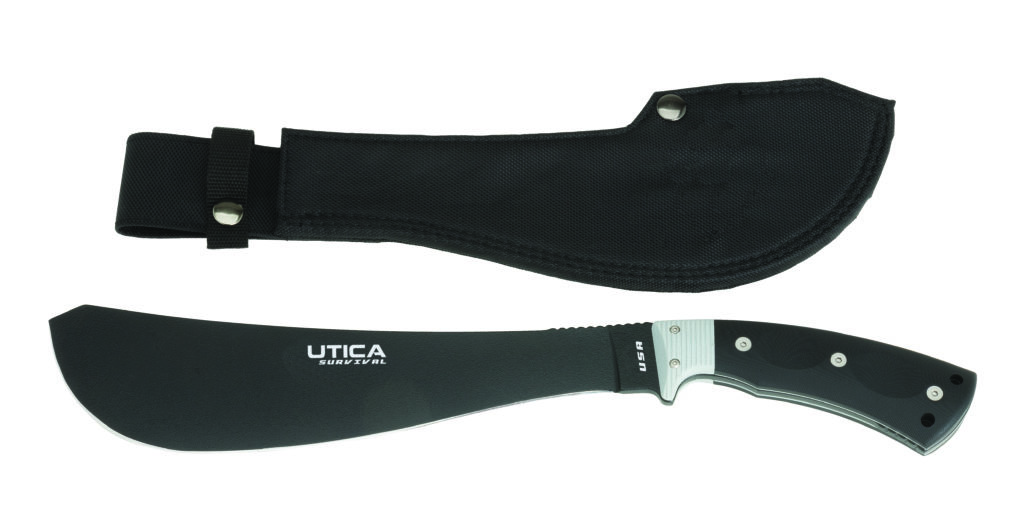
Utica Stealth I
The combination of a deep blade belly and dropped handle is designed to maximize the Utica Stealth I’s chopping and brush clearing performance. A single integral guard enhances user safety. The nylon belt sheath has a button strap to help secure the knife when sheathed.
UTICA STEALTH I Blade length: 11.25” Blade material: 1095 carbon steel Blade finish: Black oxide Handle material: Micarta® Weight: 21.87 ozs. Overall length: 17.5” Sheath: Nylon Country of origin: USA MSRP: $129.60
Coast F1400 Machete
A D-guard and full-tang construction help highlight the Coast F1400 machete. The sheath has a metal clasp for a secure hold.
COAST F1400 Blade length: 14” Blade steel: 3Cr13 stainless Blade finish: Black oxide over glass bead Handle material: Fiberglass-filled Nylon 6 Lanyard: Paracord Weight: 1 pound, 1.2 ozs. Overall length: 19.2” Special feature: Sawback blade Sheath: Nylon with hard plastic liner and riveted/sewn edge; includes belt loop Country of origin: China MSRP: $29.99
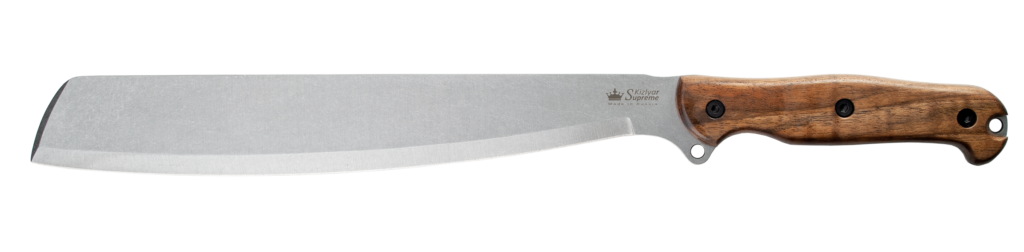
Kizlyar Supreme Bushmate
The Kizlyar Supreme Bushmate looks as much like a competition cutter as a machete, but the thin blade and Scandi grind makes it perform much better in the bush. The handle has two lanyard holes for rear or forward attachment, the latter doubling as an integral single guard.
KIZLYAR SUPREME BUSHMATE Blade length: 10 7/8” Blade steel: 420HC stainless Blade grind: Scandi Blade’s maximum thickness: .039” Blade finish: Satin Handle material: Caucasus walnut Weight: 13 ozs. Overall length: 17 3/8” Knife to Know: The Bushmate is also available in a convex AUS-8 stainless steel version with a maximum blade thickness of .1889” and a 19-oz. weight Sheath: Embossed leather Country of origin: Russia MSRP: $185
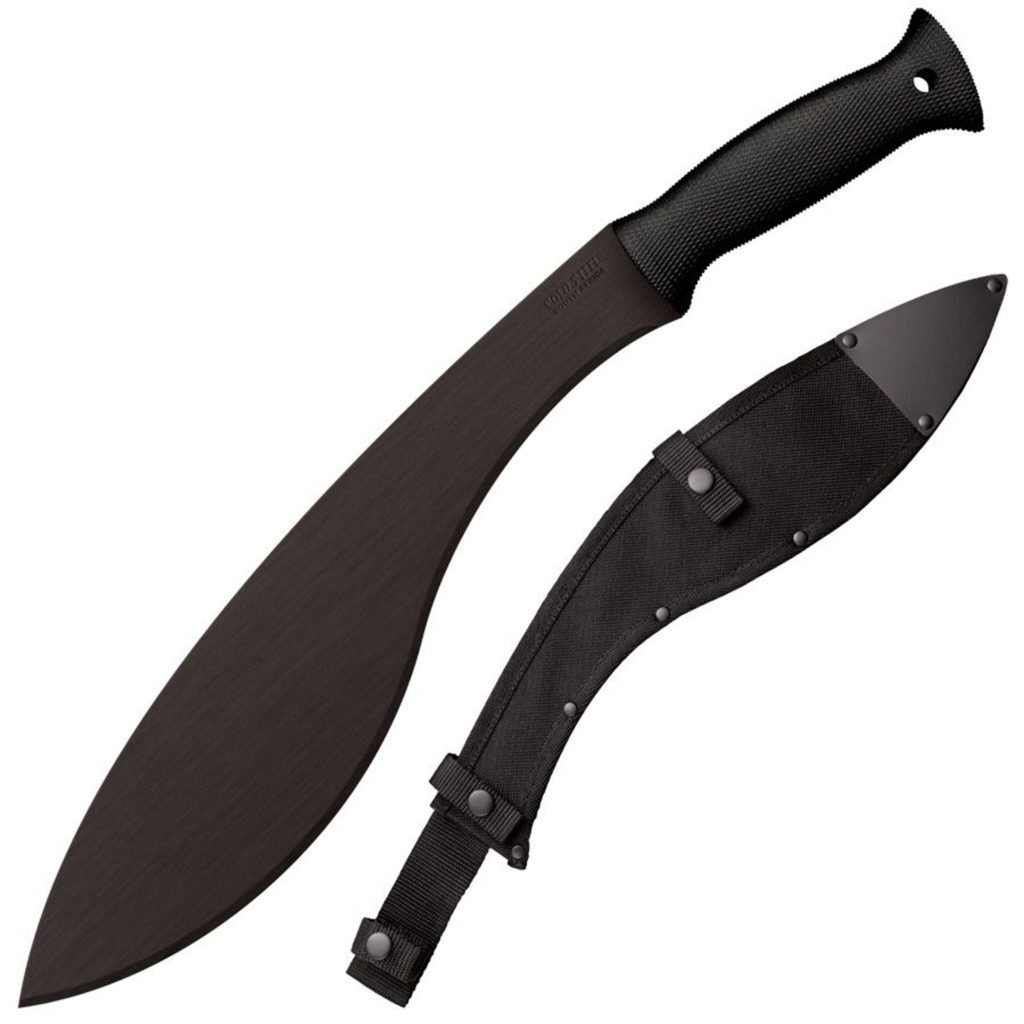
Cold Steel Kukri Machete
The Cold Steel Kukri Machete comes in two deep-bellied blade lengths: 13 (shown here) and 17 inches. Either is designed as a lightweight cutter for belt carry or lashed to a pack. The sheath comes with a reinforced tip and multiple snap downs.
COLD STEEL KUKRI MACHETE Blade length: 13” Blade material: 1055 carbon steel Blade finish: Black baked-on anti-rust matte Handle material: Polypropylene thermoplastic w/hole for a lanyard Handle length: 5” Weight: 16 ozs. Overall length: 18” Sheath: Cor-Ex® Country of origin: Import MSRP: $29.99
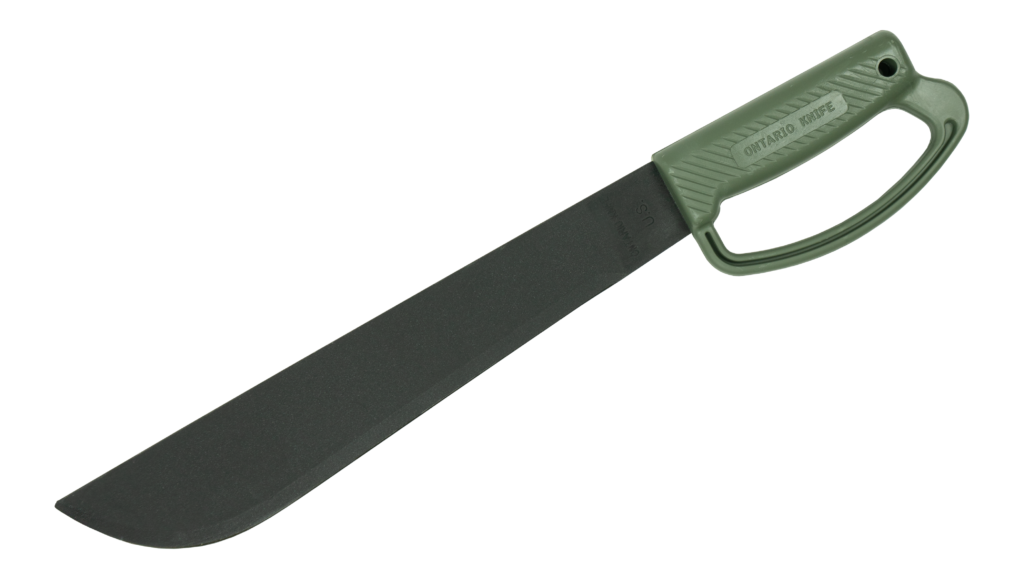
Ontario Camp Plus Machete
The Ontario Camp Plus Machete includes an ample D-guard handle for user safety. The carbon steel’s Rockwell hardness of 52-55 HRC renders the blade malleable enough to better endure high impacts.
ONTARIO CAMP PLUS MACHETE Blade length: 12.5” Blade material: 1075 carbon steel Blade finish: Phosphate coated Handle material: OD green molded plastic Weight: 1.65 lbs. Overall length: 17.7” Sheath: Black denier nylon packcloth w/heavy liner and belt loop Country of origin: USA MSRP: $29.07 (sheath sells separately for $11.95)
Smith & Wesson Cleaver Machete
The Smith & Wesson Cleaver Machete boasts blade cutouts to lighten the load, full-tang construction, an integral guard, and an ergonomic dropped handle with finger groove and a hole for a lanyard.
SMITH & WESSON CLEAVER MACHETE Blade length: 10” Blade steel: 420 stainless Handle: Overmolded rubber Special features: Sawback blade and textured hammer pommel Weight: 1.12 lbs. Overall length: 16.54” Sheath: Synthetic w/zipper and snap strap MSRP: $51.99
Editor’s Note: Dexter Ewing contributed to this post.
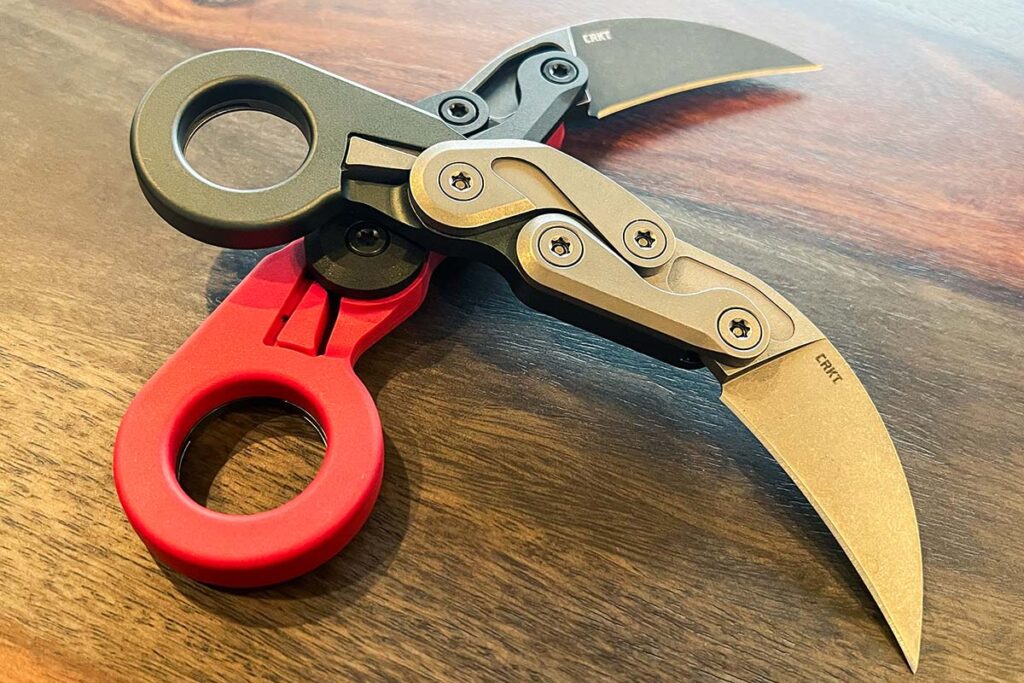
A mechanical wonder with practical functionality, the CRKT Provoke incites wonder.
Karambits are unique knives, originating in southeast Asia as an agricultural tool and later adapted as a weapon. Its signature claw-shaped blade allows effective slashing, and given its cutting edge is always oriented to the target at an angle, it also delivers wicked slices from point to hilt.
Just think about how a cat grabs, holds, punctures and cuts its prey and you have a pretty solid idea about how a karambit operates. The age-old design still inspires and intimidates, and some manufacturers have even figured out how to put a new spin on the longstanding design.
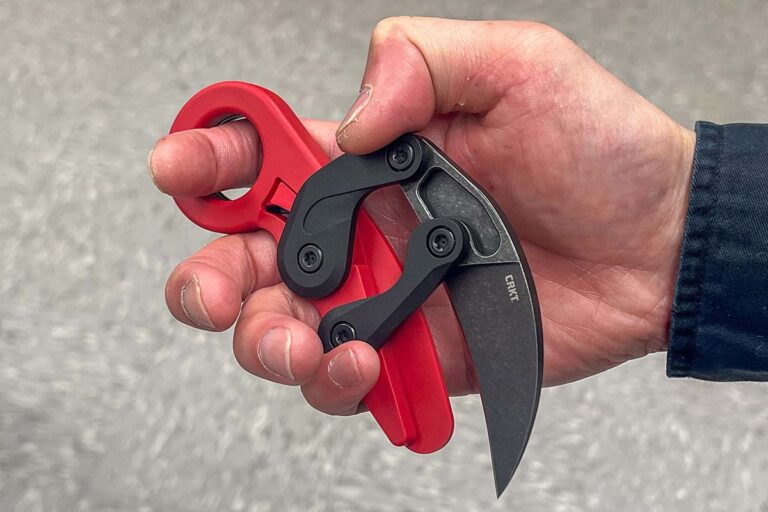
The Provoke offers a wicked chisle grind for maximum slicing, cutting and punturing ability.
Knifemaker Joe Caswell took the concept of a folding karambit and made it a bit different. Instead of the blade simply folding into the handle, the Provoke’s steel lunges out and back in with a simple flick of the thumb. In the ancient art of knifemaking it’s difficult to come up with something unique, but Caswell did.
The Provoke not only incites wonder in collectors but also elicits excitement in serious users.
Provoke Blade
The blade of the Provoke (MSRP $200) is 2.4-inches long and is made from D2 steel for superior edge retention. To work properly with the deployment mechanism, the blade is chisel ground. The flat side is faces in toward the handle, laying flush against the frame when closed. This is mainly a safety precaution, protecting the user from cuts or torn clothing when the blade isn’t in use.
Provoke Action
The mechanical action of the Provoke is one of a kind.
The Provoke’s signature action is what Caswell dubbed “kinematic”. It works thusly, the blade is attached to a pair of movable arms anchored into the handle. To deploy the blade, it is held in reverse grip and the thumb presses on the exposed end of the blade. The arms pivot and the blade leaps forward. Closing is equally as effortless. Just press down on the exposed locking tab just below the finger ring, then the blade is retracted backward until it rests fully against the handle frame.
Nicely, given it doesn’t take much force to open or close, the blade locks in the open position. Honestly, it’s a really neat, mechanical motion. Fairly self-evident, the movement of the Provoke is unlike anything else available on the market today and has the ability to capture even a jaded knife aficionado’s attention.
Getting Clipped
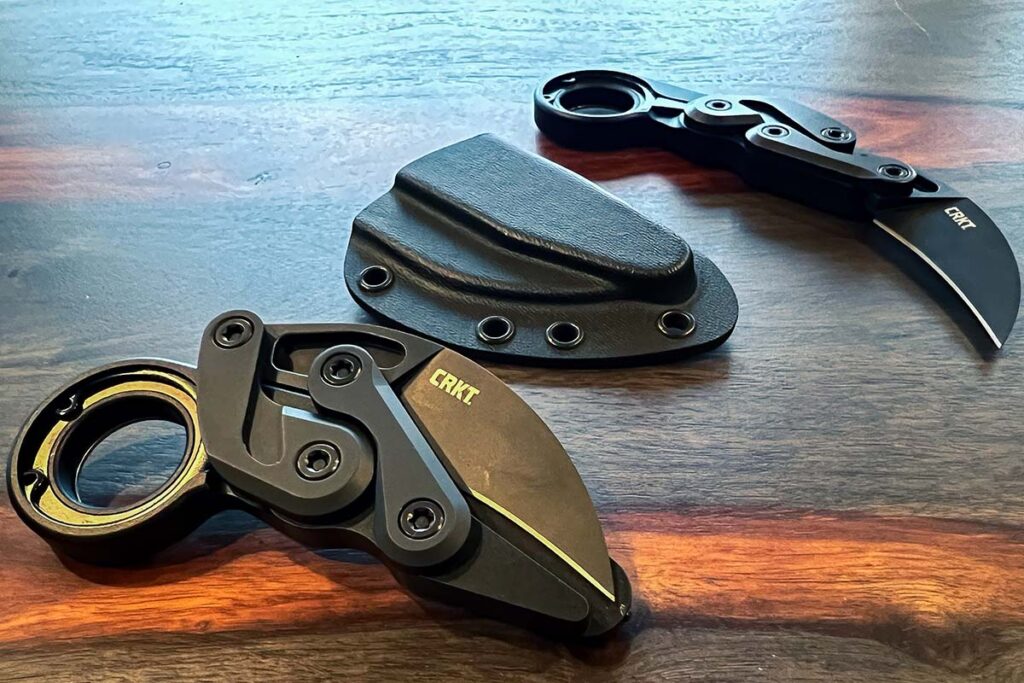
As unique as the action is the Provoke’s pocket clip, which lays flat until needed.
Another intriguing aspect of the CRKT offering is its pocket clip. Often used, rarely discussed and poured over, the clip is one of those unsung if not massively simple aspects of the knife. Even here the Provoke takes a different twist in design.
The clip is spring-loaded and rests against the finger ring completely. To open, you simply push down on a notched portion of the clip and it rises up. Some might complain it’s overly complex, but it does fit nicely in a knife defined by its mechanical ingenuity. Not to mention, in hand, you do not feel the clip at all—a break from nearly every other option with in a standard configuration.
Provoke Variations
Provoke Compact
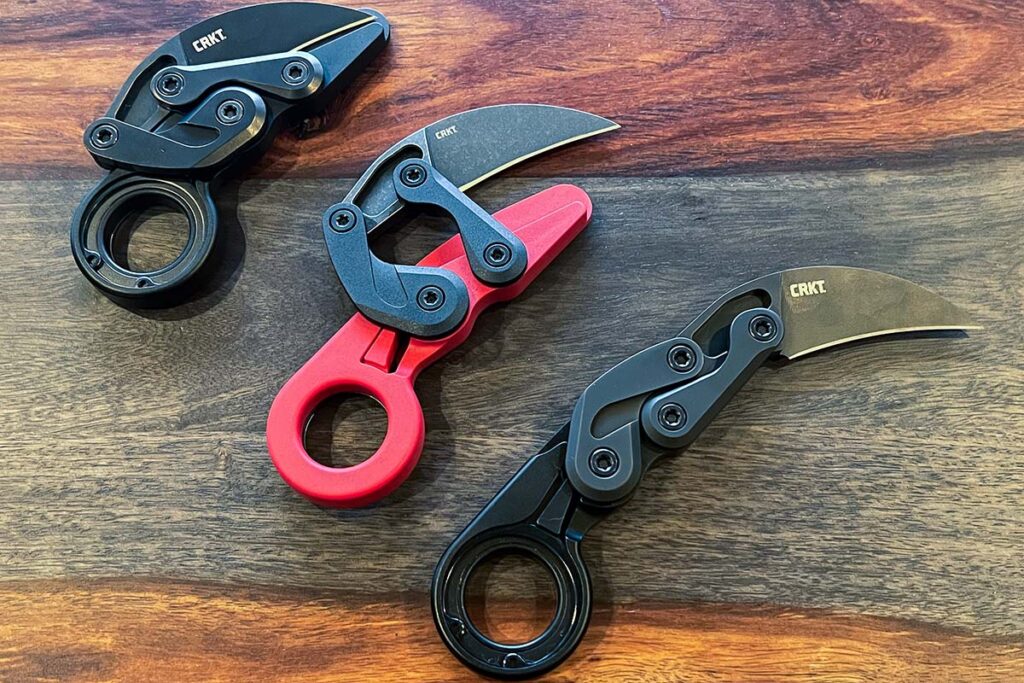
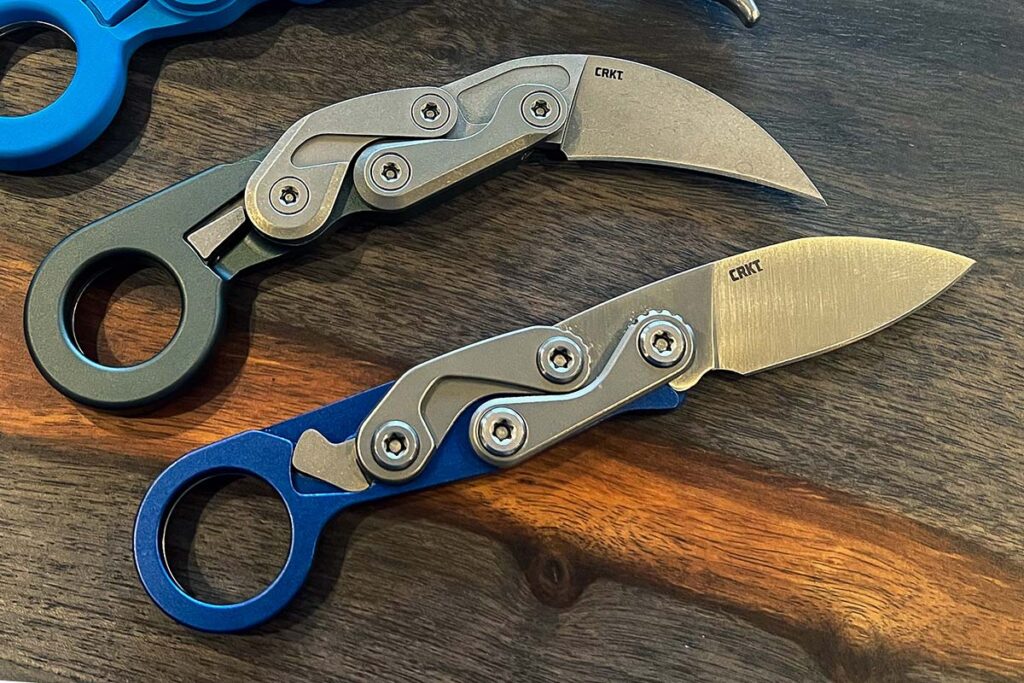
Provoke Compact (top) and Provoke Grivory (bottom) offer two lightweight EDC options.
In addition to the full-size Provoke, there is a scaled-down version in the form of the Provoke Compact (MSRP $150). Essentially, it’s the same knife but with a blade length of 2.2 inches. Where this petite Provoke earns its stripes is ease of carry, as it is much less cumbersome in the pocket than its big brother. And, from my perspective, this smaller version’s action is a bit crisper than the full-sized, perhaps due to the smaller blade.
Provoke Grivory
Again, aiming at EDC, CRKT also offers the lightweight Provoke Grivory (MSRP $100). You guessed it, the handle is made from injection-molded Grivory—a very stiff but lightweight glass-reinforced thermoplastic. Here you have a host of choices in handle colors, including fluorescent green, red, blue, and orange—adding some pop to an already exciting knife. Regardless of the color, the blade’s arms are always black Grivory, providing a nice contrast to the frame and matching the blade’s black stonewash finish.
It’s also worth noting that the Grivory arms are reinforced with steel to provide strength and rigidity to the material for superb blade action. The lightweight version weighs 4.7 ounces; for comparison, the full-size Provoke weighs 6.1 ounces. So there is considerable weight savings.
As for the action on the Grivory, it feels a bit different than the aluminum handle versions—in a good way. For me, it felt a bit lighter and faster in deployment.
Provoke First Responder
For the save and serve professionals, CRKT offers the Provoke First Responder (MSRP $225)—the full-size knife with a 2.4-inch blade. However, it does have some value adds life-saving professionals should appreciate, such as a ceramic glass breaker point inserted into the end of the handle frame.
The Provoke’s curved blade is especially suited for rescue work, particularly cleaving through seatbelts with a single, swift pulling motion. In addition to the standard integrated pocket clip that all Provoke models feature, the First Responder also includes a molded sheath with multiple carry options to offer carry flexibility if desired.
Provoke EDC
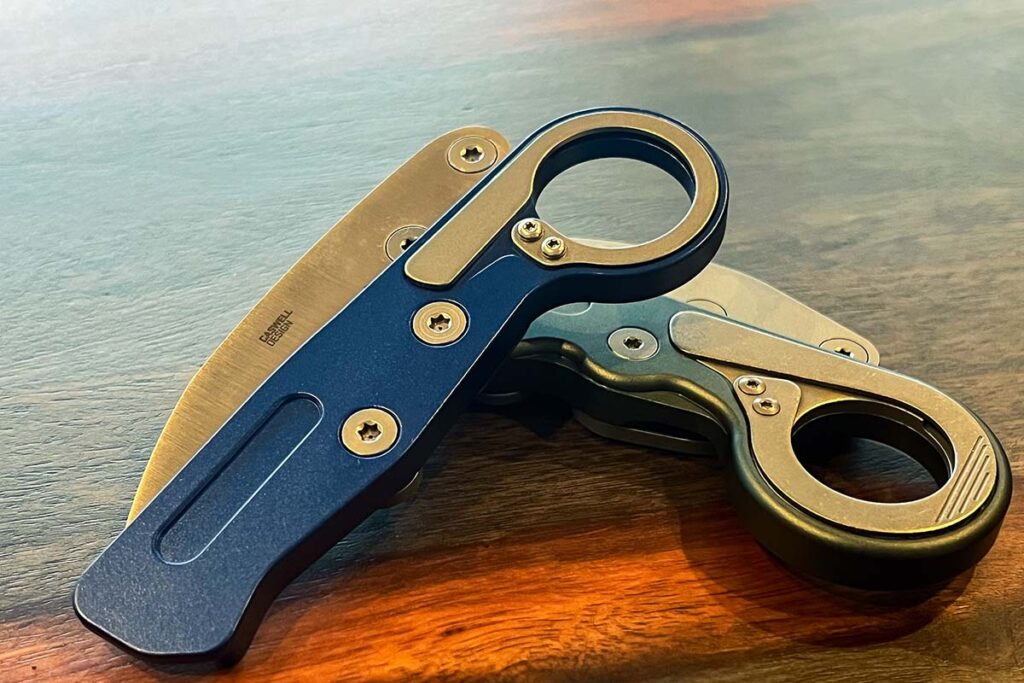
The EDC (bottom) next to the Compact (top). The EDC may prove more practical for some users.
The Provoke EDC (MSRP $175) features a 2.5-inch long drop point blade of D2. This iteration replaces the knife’s standard talon-shaped blade with a blade shape that is more friendly to daily cutting tasks. Honestly, it’s perhaps my favorite out of the entire Provoke family.
The action is very quick on this one, though once open you have to reorient your grip from a reverse to a forward grip. The blade’s lock release on the EDC version has been reoriented from the position of the other Provoke models, to make one-handed closing of the blade possible. You can deploy the Provoke EDC one-handed as well as close it one-handed. It does require some practice to close one-handed but once you get it down, you will be able to do that easily.
Provoke Trainer
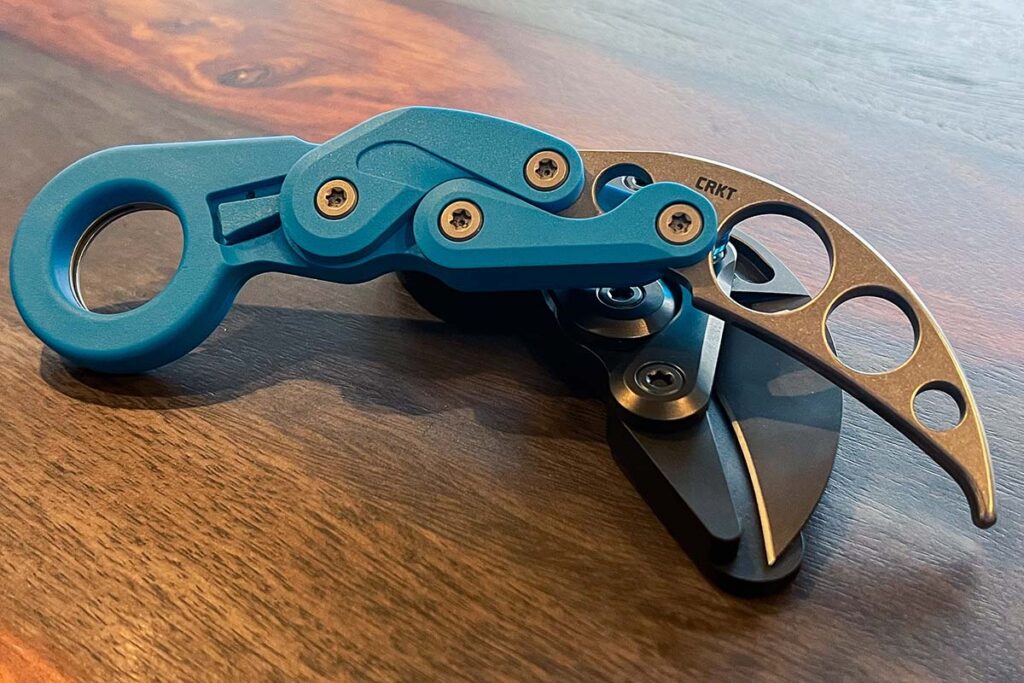
No need to upgrade your health insurance when practicing with the Provoke Trainer.
For those who might be serious about employing the Provoke for self-defense, or simply like to fiddle with the knife’s action as a fidget toy, CRKT offers a trainer model (MSRP $100). Built exactly like the live-bladed lightweight Provoke, it sports a dulled and blunted blade. In short, there’s no danger of accidental cuts or stabs while working with the knife.
Furthermore, a series of holes drilled into the blade blank subtracts weight so it is the same as the live-bladed version. The trainer is only available in an all-blue handle, signifying its purpose.
Using The Provoke
When using the regular Provoke, you’re limited to a pulling motion for cutting, though it has a defined blade tip for precise cutting and scoring. If you intend to carry one on an EDC basis then the Provoke EDC is a better candidate because of its double ground drop point blade, which is more conducive to general utility use.
Due to the more common blade shape along with the short length, this model allows you to get into places where a larger knife blade cannot. This means using the Provoke EDC to open mail, packages, strip wire, cut cardboard, and other general working tasks that a knife of this size would be called upon to do. The D2 steel does an excellent job at holding an edge yet when it comes time to resharpen, it’s still a great steel.
Final Cut
If you like knives that are a step away from ordinary—not to mention are conversation starters—the Provoke series is for you. If you like mechanical things…the Provoke has your name on it. However, I would pick the Provoke EDC as the best of this bunch if you are just going to carry one for daily cutting purposes.
Each model is made with excellent fit, finish, and sharp ess right out of the box, however. I think this design is perhaps one of the most inimitable knives out there right now. It may not be for everybody, though. But if your knife tastes venture into the unique and different, then the CRKT Provoke series has your name on it.
As always, a slew of new knives are hitting the custom and factory markets. We scoured both to bring you some of the latest and greatest handmade and production gems. Keep your eyes peeled for these fantastic options hitting dealers’ shelves soon.
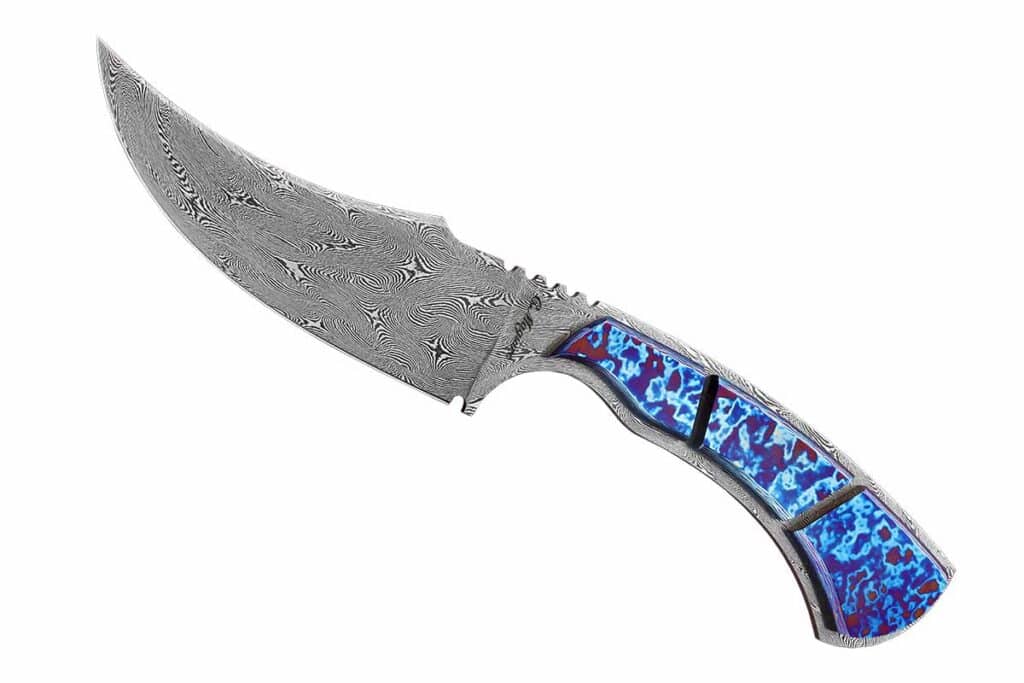
Collin Maguire Alien Vest Bowie
KNIFE TYPE: Fixed blade BLADE LENGTH: 4 1/8” from tip to plunge cut BLADE MATERIAL: 4-bar Turkish twist damascus BLADE GRIND: Flat BLADE PATTERN: Harpoon/trailing point HANDLE MATERIAL: Timascus™ OVERALL LENGTH: 8.25” CONSTRUCTION: Integral MAKER’S PRICE FOR A SIMILAR KNIFE: $1,200 MAKER: Collin Maguire, Dept., (SharpByCoop image)
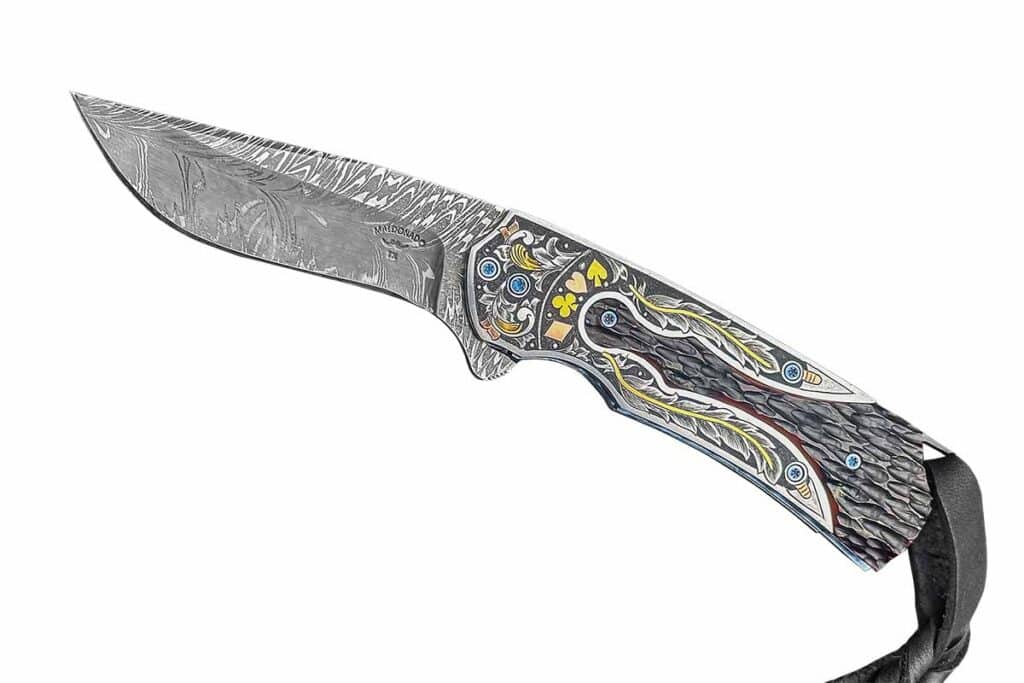
Eliot Maldonado Diamond Keyhole
BLADE LENGTH: 2.75” BLADE MATERIAL: A damascus pattern of 1084 carbon and 15N20 nickel alloy steels HANDLE: Amber jigged bone LINERS: Titanium BOLSTER: 416 stainless steel engraved by Dale Bass CLOSED LENGTH: 3.25” MAKER: Eliot Maldonado, (Jocelyn Frasier image)
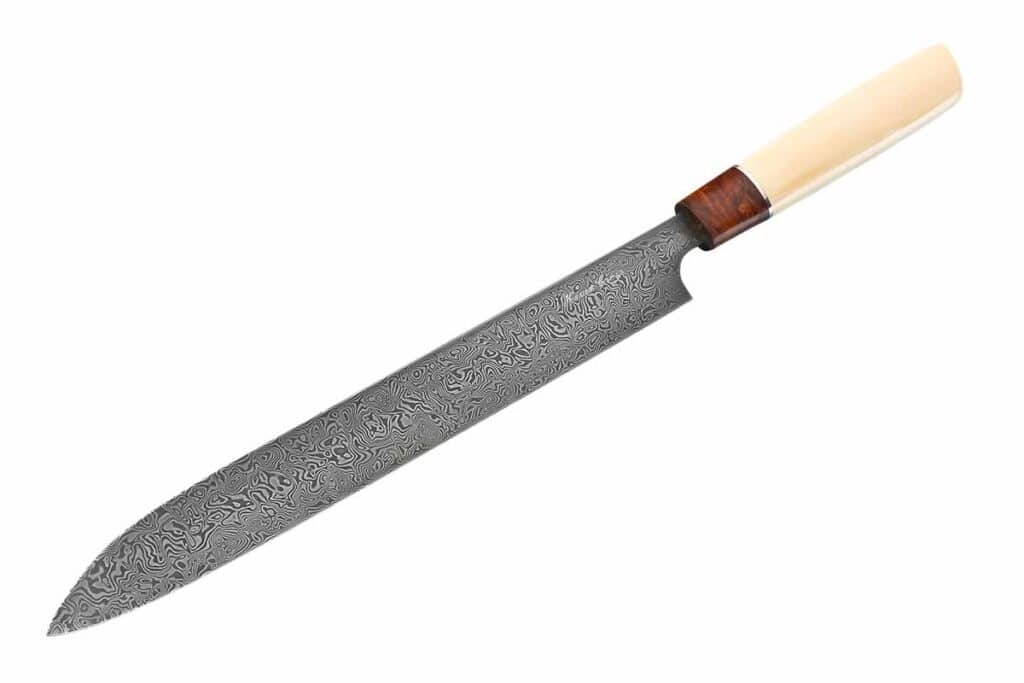
Kevin Cross Yanagiba
KNIFE TYPE: Sushi/sashimi knife BLADE LENGTH: 10.6” BLADE STEEL: Damascus forged by Damasteel BLADE GRIND: Single bevel on dominant hand side, concave on the other, aka urasuki HANDLE MATERIAL: Mammoth ivory BOLSTER: Honduran rosewood OVERALL LENGTH: 17” SAYA (sheath): Wood MAKER’S PRICE FOR A SIMILAR KNIFE AND SHEATH: $1,800 MAKER: Kevin Cross, kevincrossknives.net (SharpByCoop image)
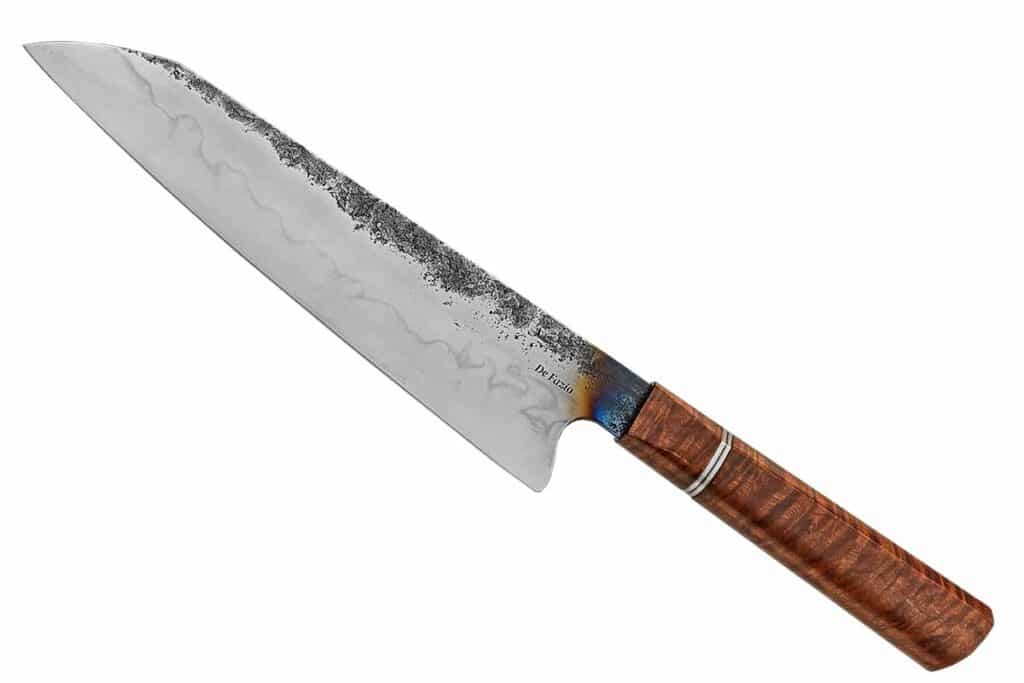
Aiden De Fazio Gyuto Chef’s Knife
BLADE LENGTH: 8.27” BLADE MATERIAL: W2 tool steel BLADE GRIND: Slightly convex BLADE THICKNESS @ RICASSO: .138” BLADE @ WIDEST: 2.05” HANDLE MATERIAL: Ringed gidgee SPACERS: San-mai damascus OVERALL LENGTH: 14.17” MAKER’S PRICE FOR A SIMILAR KNIFE: $470 at press-time exchange rate MAKER: Aiden De Fazio, (Rod Hoare image)
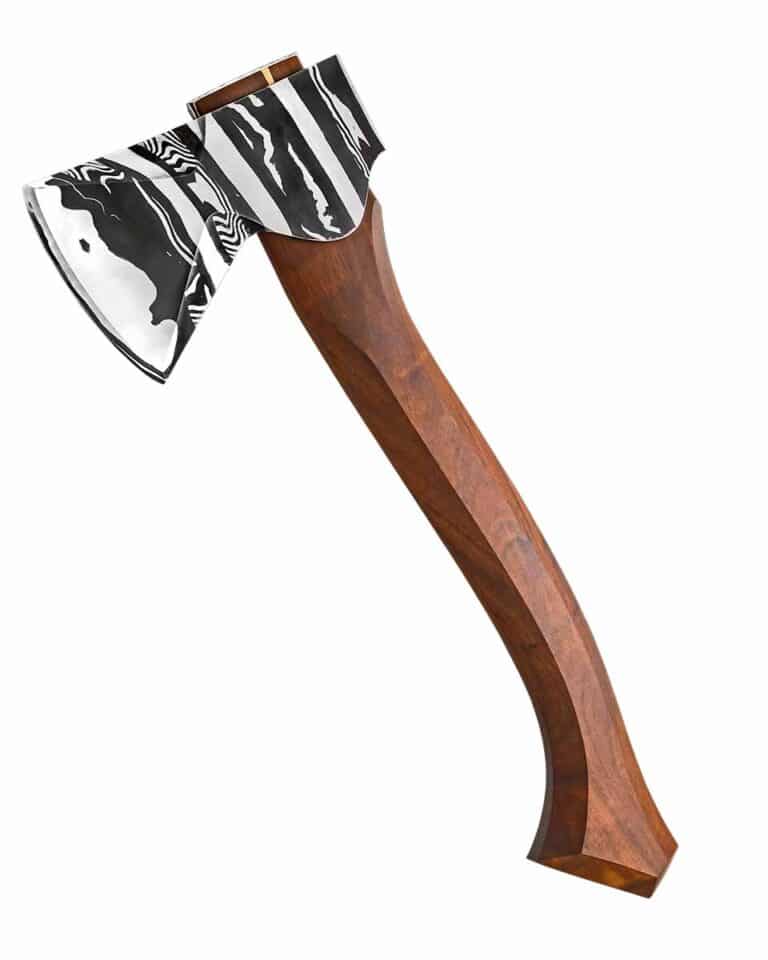
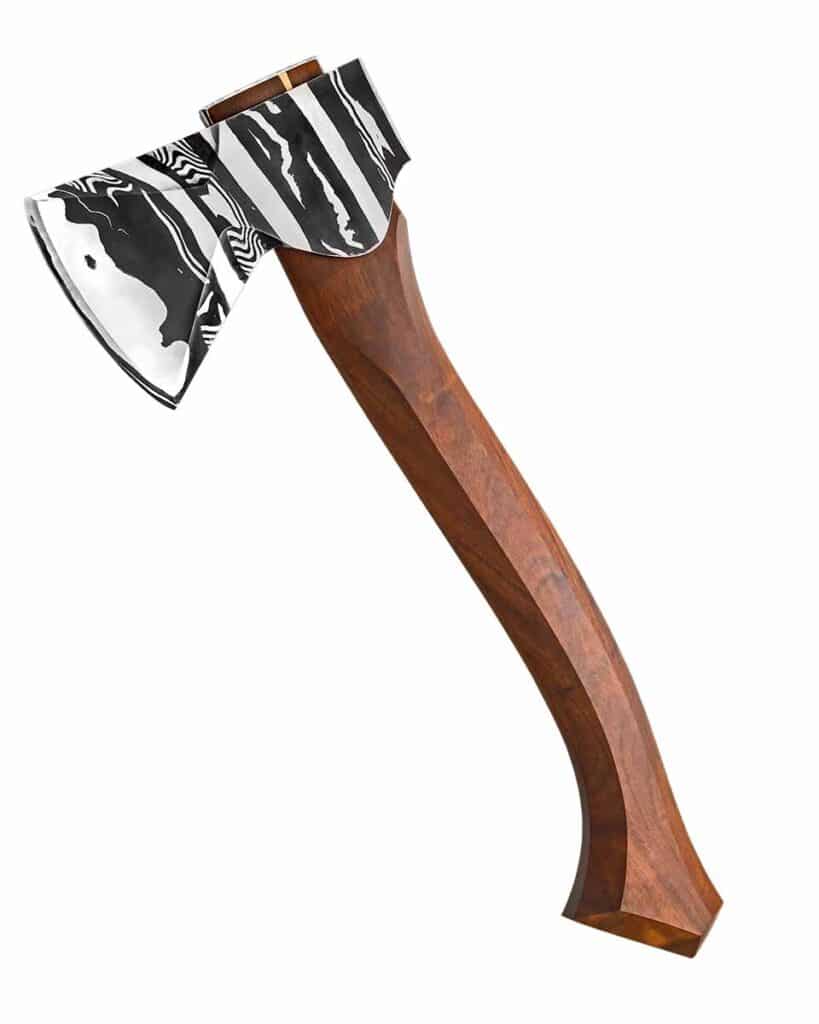
The Farmers Forge The Zebra
MODEL TYPE: Axe/hatchet BLADE LENGTH: 3.35” BLADE MATERIAL: Damascus of 1084 carbon and 15N20 nickel alloy steels BLADE GRIND: Convex HANDLE: Wedge is piened stainless steel FRAME MATERIAL: Australian cudgee OVERALL LENGTH: 14.2” MAKER’S PRICE FOR A SIMILAR PIECE: $1,000 at press-time exchange rate MAKER: The Farmers Forge, thefarmersforge.com.au (Rod Hoare image)
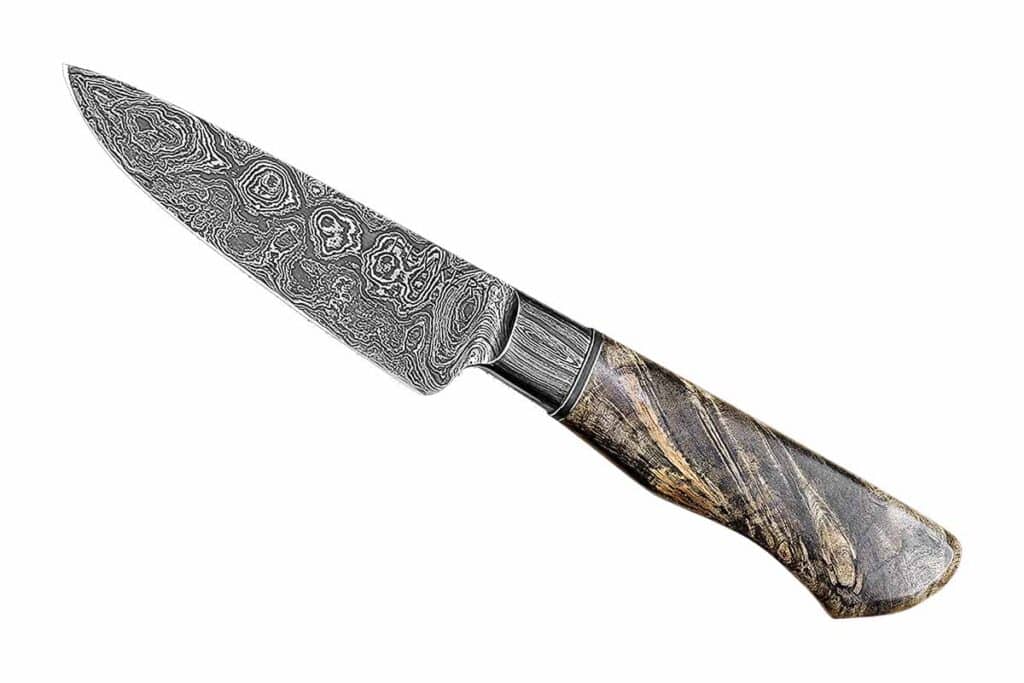
BLADE LENGTH: 3.75” BLADE MATERIAL: A 351-layer random pattern damascus of 1084 carbon and 15N20 nickel alloy steels HANDLE: Natural buckeye burl HANDLE SPACERS: Green G-10 and stainless steel OVERALL LENGTH: 8.37” KNIFE TO KNOW: Eric Hemker is an apprentice smith in the American Bladesmith Society MAKER: Eric Hemker, Armada, Michigan, hemkerblacksmithing.com (Jocelyn Frasier image)
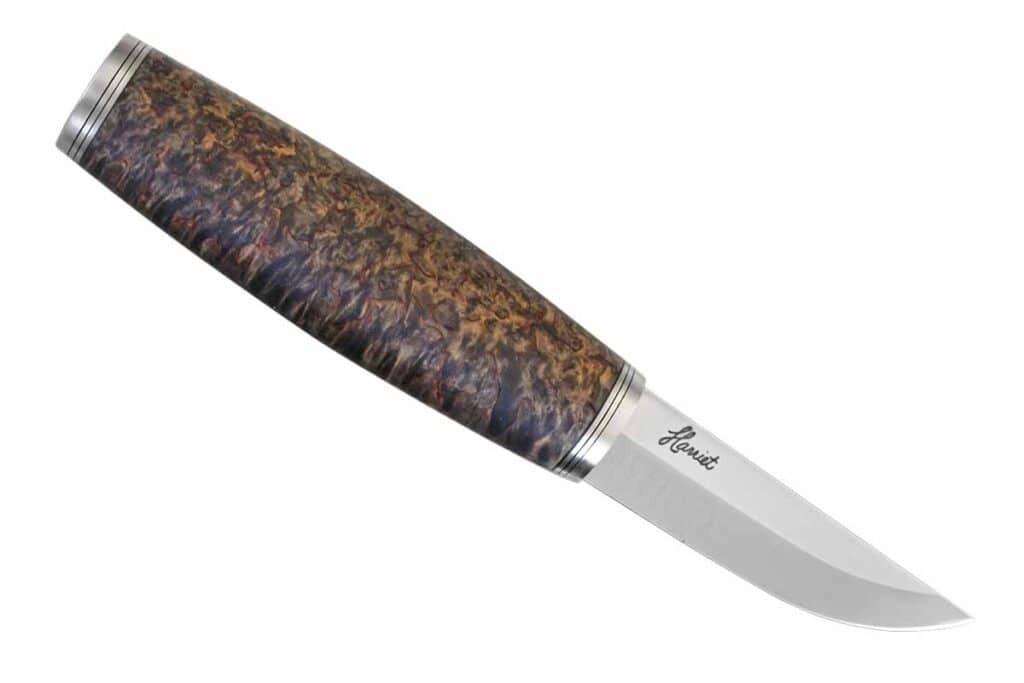
Kellam Knives Worldwide Harriet 70
KNIFE TYPE: Puukko BLADE LENGTH: 3” BLADE STEEL: Polished stainless BLADE GRIND: Scandi HANDLE: Dark-dyed Arctic curly birch BOLSTERS: Tri-layered nickel silver CONSTRUCTION: Full-tapered tang OVERALL LENGTH: 7.5” SHEATH TYPE/MATERIAL: Swinger style/dark-stained ox hide leather w/stainless band KNIFE TO KNOW: The knife is named for Harriet Mars-Kellokoski, wife of company headman Jouni Kellokoski; Harriet has worked with the company for many years, was involved in the knife’s design and her signature appears on the blade; the first 70 editions are numbered MSRP: $179.98 COMPANY: Kellam Knives Worldwide, kellamknives.com
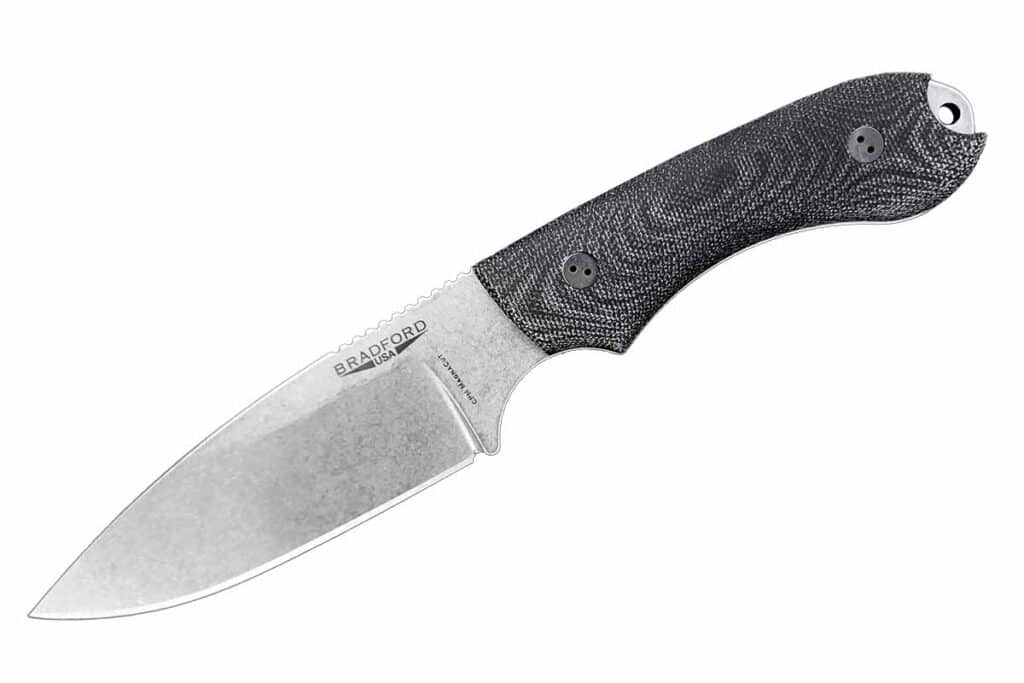
Bradford USA Guardian 4.2
KNIFE TYPE: Fixed blade BLADE LENGTH: 4.825” BLADE STEEL: CPM MagnaCut stainless BLADE GRIND: Sabre and full height HANDLE MATERIAL: Choice of G-10, Micarta® and carbon fiber WEIGHT: 6.7 ozs. OVERALL LENGTH: 9.375” SHEATH TYPE/MATERIAL: Vertical bridle/leather COUNTRY OF ORIGIN: USA MSRP: $269 COMPANY: Bradford USA, [email protected]
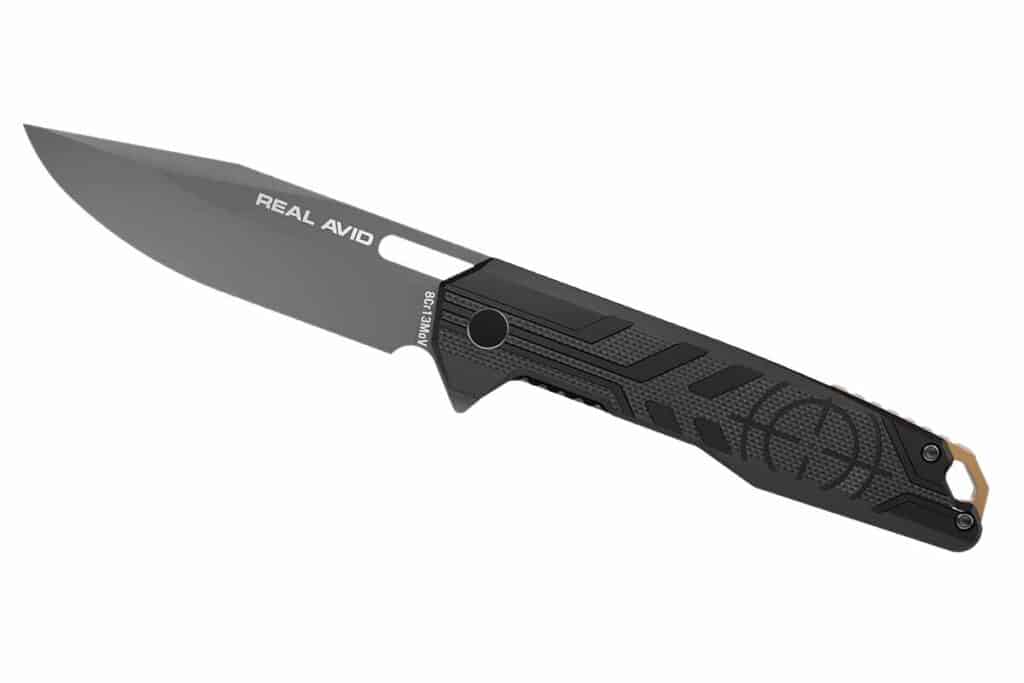
Real Avid RAV Series
KNIFE TYPE: Folder BLADE LENGTHS: Depending on the choice of drop point, tanto or modified clip point, 3.25 or 3.4” BLADE STEELS: A choice of 4Cr14 and 8Cr13MoV stainless BLADE FINISHES: Black oxide or titanium HANDLE MATERIAL: Choice of nylon, aluminum, aluminum/stainless steel, glass-filled nylon, aluminum/carbon fiber and G-10 POCKET CLIP: Yes LOCKS: Spring-assisted linerlock or AXIS lock KNIFE TO KNOW: The RAV series includes a variety of knives named RAV-1 through RAV-7 COUNTRY OF ORIGIN: Engineered in the USA, manufactured in China MSRPs: Range from $24.99 to $49.99 COMPANY: Real Avid, realavid.com
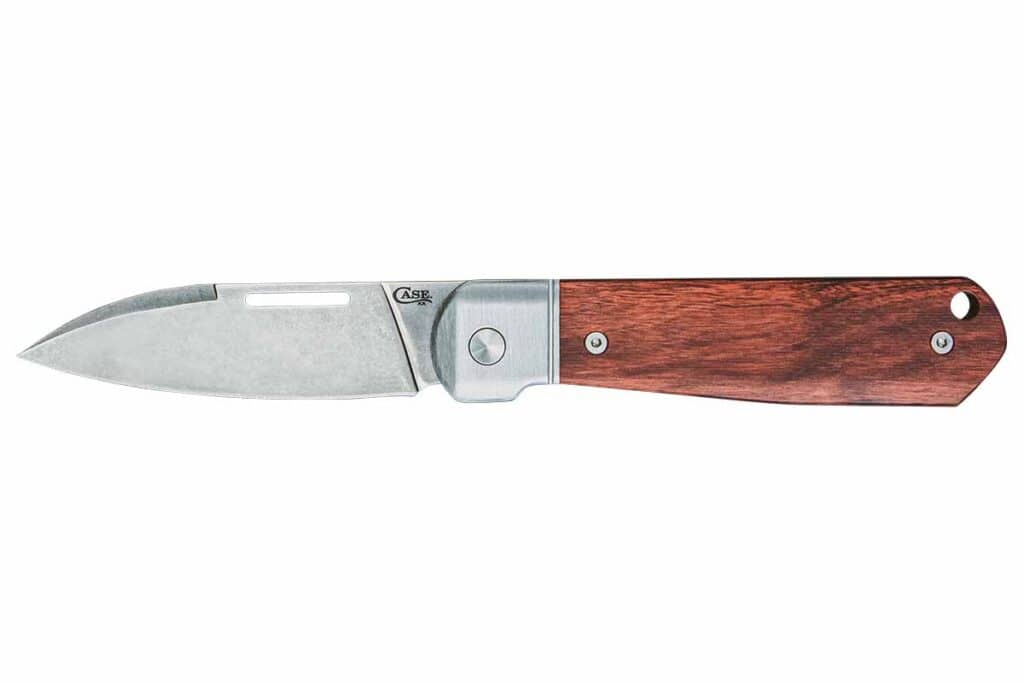
W. R. Case Longhouse
KNIFE TYPE: Slipjoint BLADE LENGTH: 2.75” BLADE STEEL: CPM 20CV stainless BLADE PATTERN: Modified wharncliffe BLADE FINISH: Stonewash satin HANDLE MATERIAL: Choice of black burlap and OD green Micarta® and rosewood BOLSTER: Pinched and fluted POCKET CLIP: Deep carry CONSTRUCTION: Screw design WEIGHT: 3.3 ozs. CLOSED LENGTH: 4” COUNTRY OF ORIGIN: USA MSRP: $189.99 COMPANY: W. R. Case, www.wrcase.com
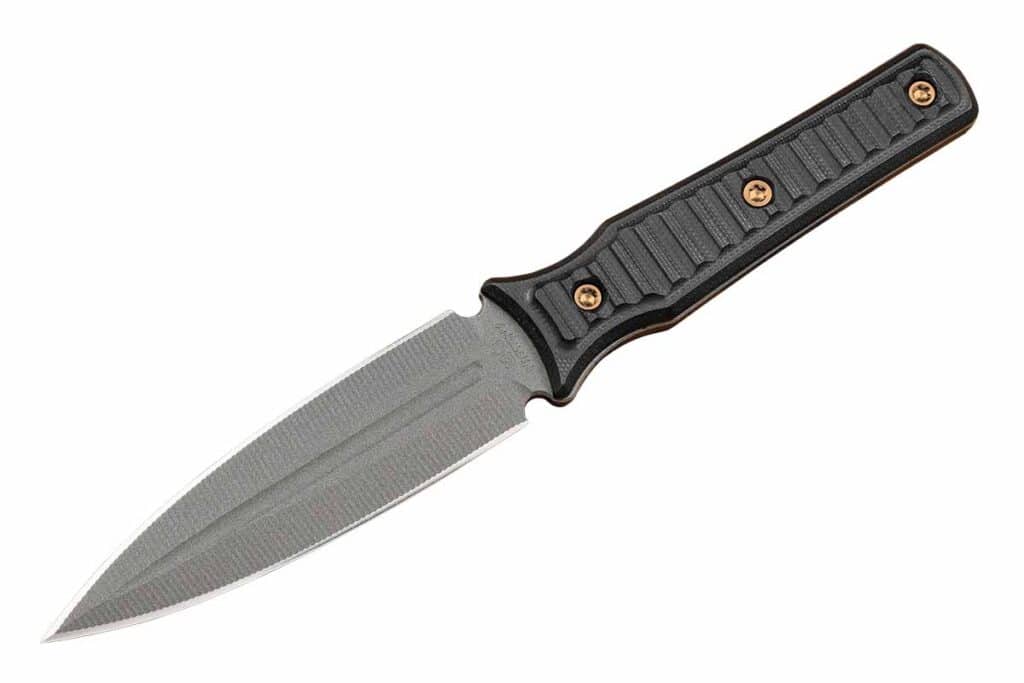
RMJ Tactical Orlando Special
BLADE LENGTH: 4.5” BLADE STEEL: Nitro V stainless ROCKWELL HARDNESS: 59-60 HRC BLADE @ THICKEST: 1/8” BLADE FINISH: Tungsten gray Cerakote® BLADE STYLE: Clovis HANDLE MATERIAL: Choice of black G-10, dirty olive and hyena brown HANDLE FASTENERS: Torx Grade 5 titanium anodized bronze WEIGHT: 4.6 ozs. OVERALL LENGTH: 8 7/8” SHEATH: Kydex w/1.5” belt clip COUNTRY OF ORIGIN: USA MSRP: $295 MAKER: RMJ Tactical, www.rmjtactical.com
There’s no knife job too small for a compact cutter.
Folders come in all sizes and shapes.
Over the years, I have carried every size from compact and handy to needing to visit my chiropractor at the end of the day. I carry a Spyderco Para Military most often and other times I carry a Benchmade Griptilian. I can tell you that when I take out the Spyderco I get more comments on the size of the knife than the Griptilian.
I used to be a compact knife carrier and one of my favorites was the SOG Twitch II. I also favored two Kershaw Chives. To be fair, outside of some exceptions a compact carry did pretty much the majority of work I needed in an average day. I moved to the Spyderco only for the unexpected chores.
This time the focus is on smaller carries, the kind of carry a person in my age range would choose because his work is selling life insurance and he doesn’t need a blade that opens a person’s eyes as wide as a harvest moon. I put aside my regular carries for a number of weeks and downsized to bring you my thoughts on four factory compact carries.
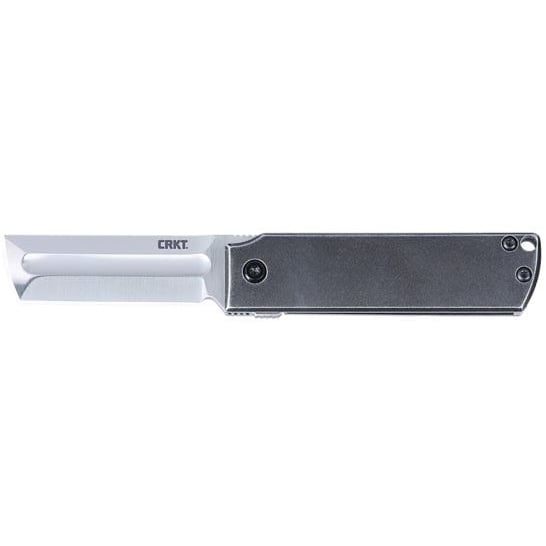
CRKT MinimalX
The fuller on the CRKT blade gives your index finger a nice purchase point for a controlled push cut while using a pinch grip.
CRKT MinimalX Frame Lock Overall length: 5.3″ Blade length: 2.19″ Closed length: 3.2″ Stainless blade steel: 12C27 Scale material: Stainless steel Locking system: Framelock Pocket clip: Right side, low profile Opening system: Flipper Country of origin: China MSRP: $60
Pros
Compact
Blade Utility
Aesthetic and Functional Features
Cons
Slick Handle Finish
Flipper Design Challenges
The first thing that strikes you about the CRKT MinimalX is how streamlined and compact it is. As probably will be the case with all four test knives, people with big hands might find them a bit difficult to use, a price you pay for the knives being compact and lighter.
To start, I have an issue with the handle finish. The stainless steel scales are a bit too slick. I find my thumb lacks purchase while opening the blade. To deploy the blade you use a flipper that sits even with the spine of the scales. CRKT provides a trim pocket clip mounted on a standoff platform. When closed, the knife is about the size of a pack of chewing gum.
The CRKT’s flipper is not proud of the back of the scales. According to the author, the tumble finish is a bit slick, though the finish color and smoothness accent the knife’s trim, compact proportions.
CRKT uses a pseudo chisel shape for the blade profile. It has a straight primary edge with a rounded chisel style tip. The blade works great for an urban EDC. As a handyman I used it several weeks for some fine trimming on door lock cuts in door frames, along with using it to scrape. Having a fuller on such a small blade adds character. It also provides a purchase point for a pinch hold.
The Darriel Caston design was hair popping sharp right out of the box. Lock up is solid as a vault. For a small carry, this is a well-built and excellent compact design. A knife like this could serve someone the better part of a lifetime.
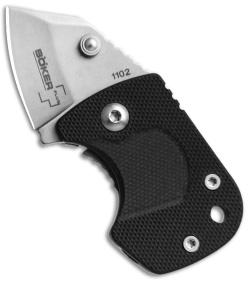
Boker provides a great little storage case with the DW-1. “Good EDC cases are hard to find, and expensive,” the author wrote. “I was excited about the case as much as the knife.”
Boker Plus DW-1 Specs Overall length: 2.8″ Blade length: 1.06″ Closed length: 1.6″ Stainless blade steel: AUS-8 Scale material: Zytel/stainless steel Locking system: Framelock Pocket clip: Right hand, tip up Opening system: Thumb stud Country of origin: China MSRP: $39.99
Pros
Ultra-Compact
Specialized Utility
Durable Construction
Cons
Awkward Ergonomics
Limited Functionality
I would have to drop the term compact and switch it to micro for the Boker Plus DW-1. Designed by Chad Los Banos, the smallest of the review knives comes with a solid pocket clip and framelock. One scale is stainless steel and the other is Zytel. The knife has Chad’s trademark design written all over it.
This is a minimalist carry. It is a great little blade for opening Amazon packages, cutting loose threads and string—basically all the little chores. Bigger jobs are not in the DW-1 domain. If you tried spreading peanut butter with it to make a sandwich for lunch, you would not be able to eat the same day.
The DW-1 is great for those small jobs that you don’t want to risk a visit to the dentist on. Face it, everyday life doesn’t normally have you felling a mighty oak with your pocketknife.
Don’t get me wrong, the knife is made well and would be great for someone who worked retail stocking shelves and the like. As for fighting off a zombie horde, you could sharpen a small stick with it.
It would fit someone who needs an available edge but wants a subtle carry. If I worked retail, I would use it as a companion edge to my full-size model so I would not accidently shred the contents of the box—not that I ever did (hint, hint).
Boker Plus DW-1 Lock Money Clip Knife Zytel 01BO573
The GiantMouse just barely falls into a compact size for the author. It offers two opening options: blade hole and flipper.
GiantMouse Ace Riv LL Specs Overall length: 5.75″ Blade length: 2.44″ Closed length: 3.375″ Stainless blade steel: CPM MagnaCut Scale material: Double black canvas Micarta® Locking system: Linerlock Pocket clip: Ambidextrous, tip up Opening system: Thumb hole Country of origin: Italy MSRP: $276
Pros
Smooth Deployment
Stylish
Reversible Pocket Clip
Cons
Premium Pricing
There is nary a hot spot on the Ace Riv LL from GiantMouse. The bearings make the blade simply pop open via a flipper or thumb hole. Housing a linerlock, the textured Micarta® handle provides a good surface for a secure grip. The blade has a tip down profile, making it good for utility cuts.
“I like Spyderco’s Compression lock,” the author noted. “The system certainly screams innovation. However, it is not as agile operating one handed as other systems.”
GiantMouse provides a wire-style reversible pocket clip. I dislike wire pocket clips. Over the years, I have found them to be the least sturdy and they often get bent. The knife is a great compact carry with some style and not so small as to be heavily limited.
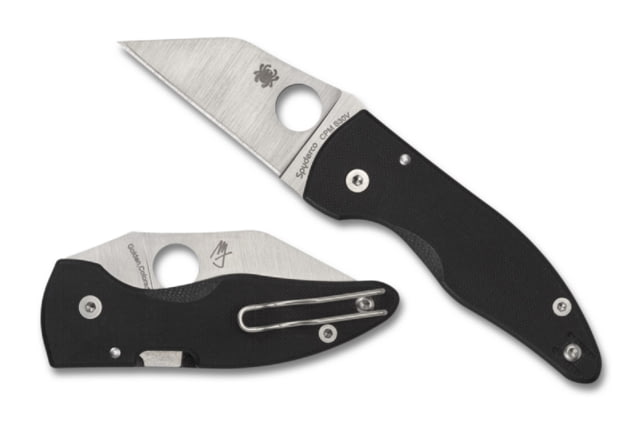
Spyderco MicroJimbo
The MicroJimbo blade has a very aggressive yet highly controllable tip. Only the slightest bit of pressure can puncture several materials.
Spyderco MicroJimbo Specs Overall length: 6.22″ Blade length: 2.45″ Closed length: 3.8″ Stainless blade steel: CPM S30V Scale material: G-10 Locking system: Compression Lock Pocket clip: Ambidextrous, tip up Opening system: Thumb hole Country of origin: United States MSRP: $245
Pros
Ergonomic Handle
Utility Blade Design
Compression Lock System
Cons
Borderline Midsize
Expensive
The Spyderco MicroJimbo is based on the original Yojimbo design named after a Japanese Samurai movie character. First off, the MicroJimbo borders on midsize. The handle size has always been a bit larger in proportion on the Spyderco Yojimbo line. Even on a compact carry, I favor having a handle that fits my hand. Control is key to enjoying any knife.
The MicroJimbo uses a utility style blade with a straight edge and aggressive tip. A stylized spine profile really sets the blade off. Spyderco uses the Compression blade-lock system. The textured scales are black G-10 with a wire pocket clip.
Consider two different styles of wire pocket clips. The lip on the clip of the GiantMouse (left) is tighter to the scale, with a slight lift. The Spyderco (right) lifts the lip a bit to aid in trapping the pocket rim.
The shapes of Spyderco’s clips are more effective for attaching to a variety of pocket styles than most, though the fact that it’s in the wire style gives it the same issues as mentioned with the GiantMouse. Due to its distinctive look, the MicroJimbo might not be everyone’s cup of tea. It is a solid carry with an unusual style and loads of function.
Spyderco Microjimbo Sprint Run Pocket Knife 2.45" Wharncliffe CPM S30V Black DLC Blade G-10 Handle Pink
Compact cutters will do the majority of most common daily knife tasks. Add a little creativity and you can stretch their function sometimes.
My EDC kit consists of my wallet, keys, pen, butane lighter, flashlight, bandana and my knife. That sounds like a lot, and it is. There are times when I add to the kit depending on what I’m doing. No doubt, it obviously increases weight and bulk.
Carrying a large kit means that I buy cargo pants only for daily wear. If there is anything I can do to save space and weight, I start by carry more compact versions of my gear. Obviously, my knife would be a start.