Summer Steel: June’s Hottest Custom and Production Knives You Need to Know.
From mosaic fighters to modern flippers, this month’s standout blades bring a mix of artistic craftsmanship and everyday utility. Whether you’re in the market for a hand-forged Damascus showpiece or a no-nonsense EDC, June’s lineup has something sharp for every collector and user. Here’s a closer look at what’s turning heads in the knife world this month.
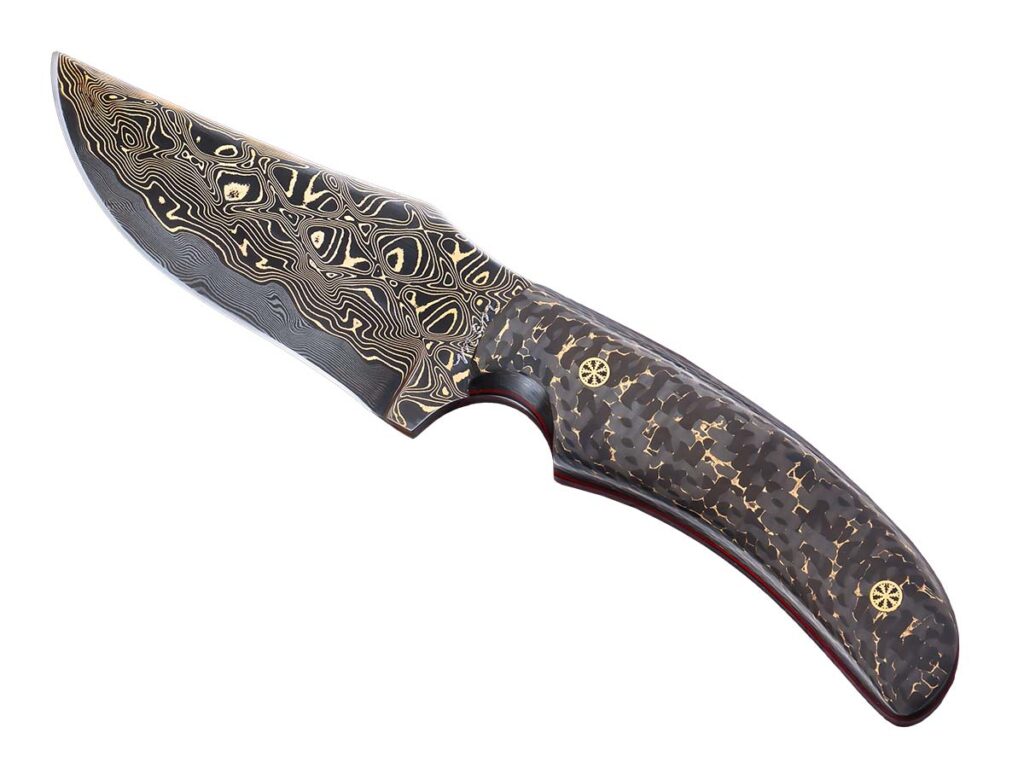
Miguel Navarro Fixed Blade
Blade length: 4.25” Blade material: Diamond Damascus by Baker Forge & Tool Blade grind: Hollow Scales: Fat Carbon Gold Snake w/black and red G-10 liners Weight: 7.4 ozs. Overall length: 9” Maker’s price for a similar knife (includes custom sheath): $550-$600 Maker: Miguel Navarro (SharpByCoop image)
Dale Holt Mosaic Fighter
Blade length: 10” Blade materials: 1084 carbon and 15N20 nickel alloy steels Blade grind: Flat Blade pattern: Clip-point recurve Handle material: Spalted sassafrass Spacers: Textured brass and nickel silver Guard: Blued mild steel Knife to know: Design features include an S-guard and dropped handle; Dale Holt is an ABS journeyman smith Overall length: 15” Maker’s price for a similar model: Contact maker for details Maker: Dale Holt (Jocelyn Frasier image)
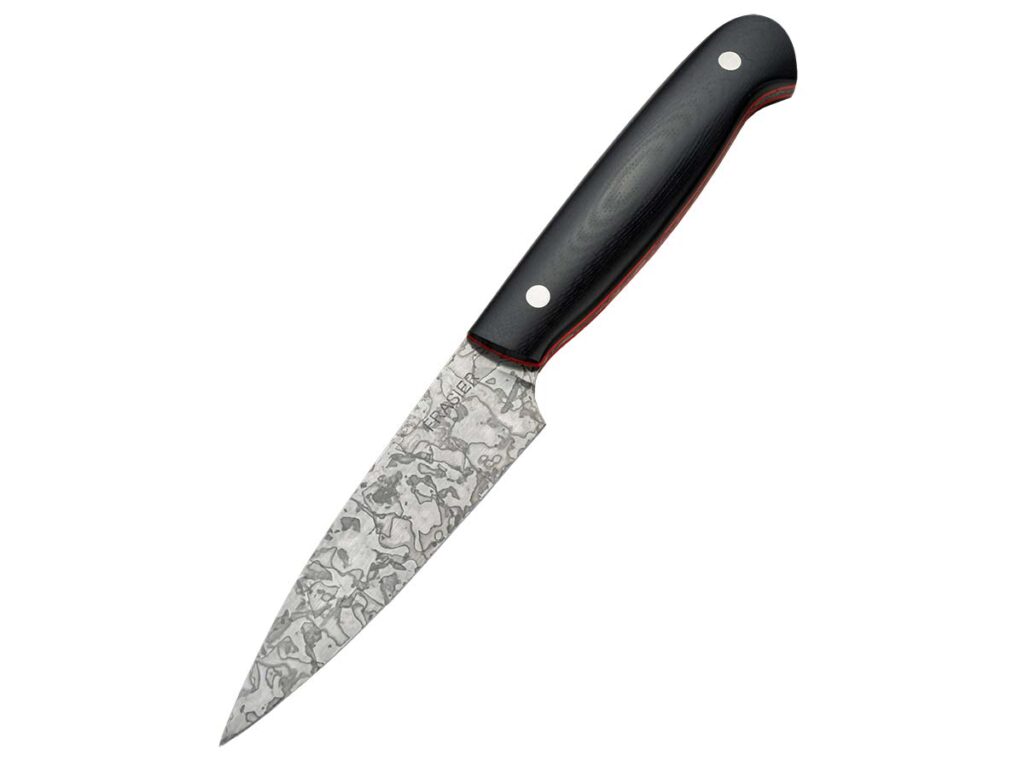
Kelly Frasier Paring Knife
Kelly Frasier Paring Knife Blade length: 3.5” Blade material: 26C3 carbon steel Blade grind: Flat Blade finish: Mustard patina Scales: G-10 w/red liners Overall length: 7.5” Maker’s price for a similar model: Contact maker for details Maker: Kelly Frasier (Jocelyn Frasier image)
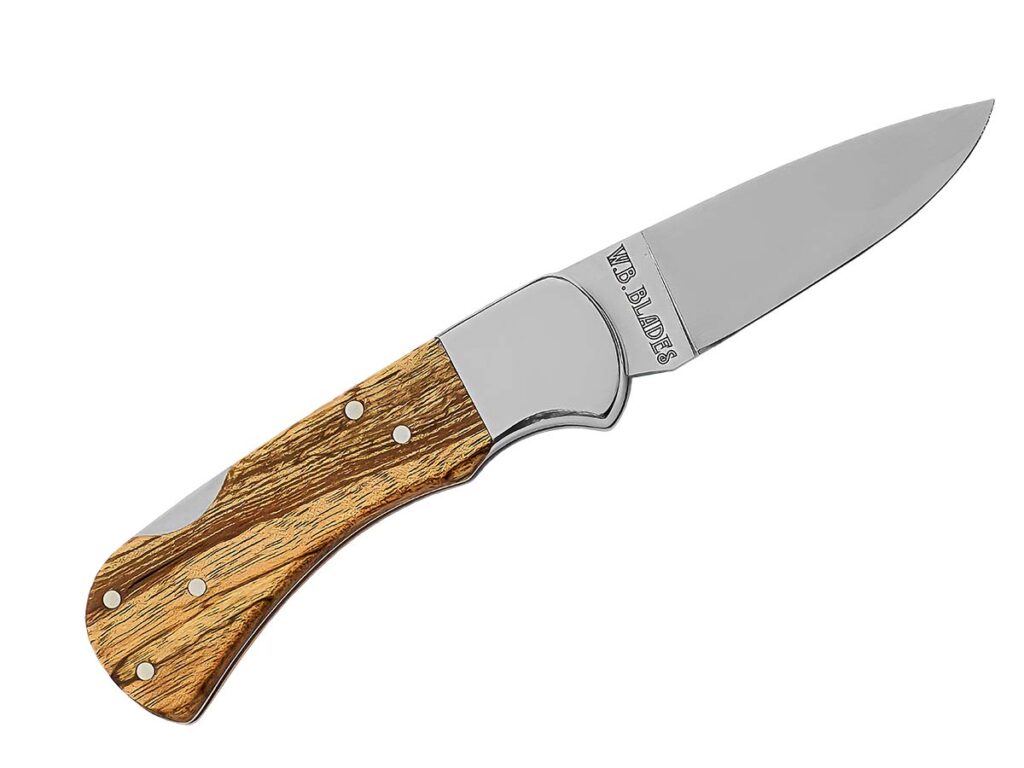
Sam Renwick Farmer’s Lockback
Knife type: Folder Blade length: 2.78” Blade steel: Nitro-V stainless Blade grind: Flat Blade @thickest: .98” Scales: Spalted maple Frame & bolsters: 416 stainless Knife to know: The bolsters are dovetailed Weight: 5.3 ozs. Closed length: 3.38” Maker’s price for a similar knife: $291 at press-time rate of exchange Maker: Sam Renwick (Rod Hoare image)
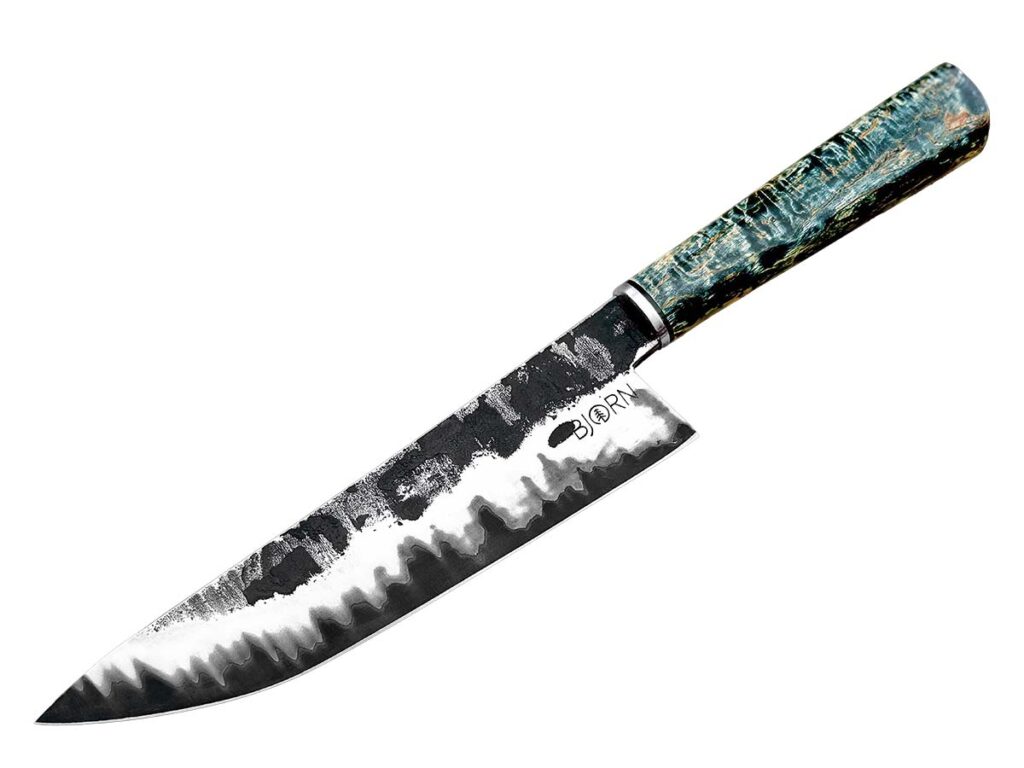
Bjorn Jacobsen Ghost Recon Chef
Blade length: 7.87” Blade material: 1084 (the black core) laminated w/stainless steel etched Blade grind: Flat w/forged texture on top half Blade @thickest: .118” Blade @widest: 1.97” Handle: Curly birch dyed w/black leather dye and sanded w/600 grit paper, then sanded mostly off again at 1500 grit, blue leather dyed and sanded w/1500 grit yet again; finished w/Uncle Bjorn’s Handle Finish Fittings: Stainless Weight: 6 ozs. Overall length: 12.6” Knife to know: Blade etched in ferric chloride to make the carbon migration “pop,” then left in instant coffee overnight to make the 1084 core black Maker’s price for a similar knife: $320 at press-time exchange rate Maker: Bjorn Jacobsen (Rod Hoare image)
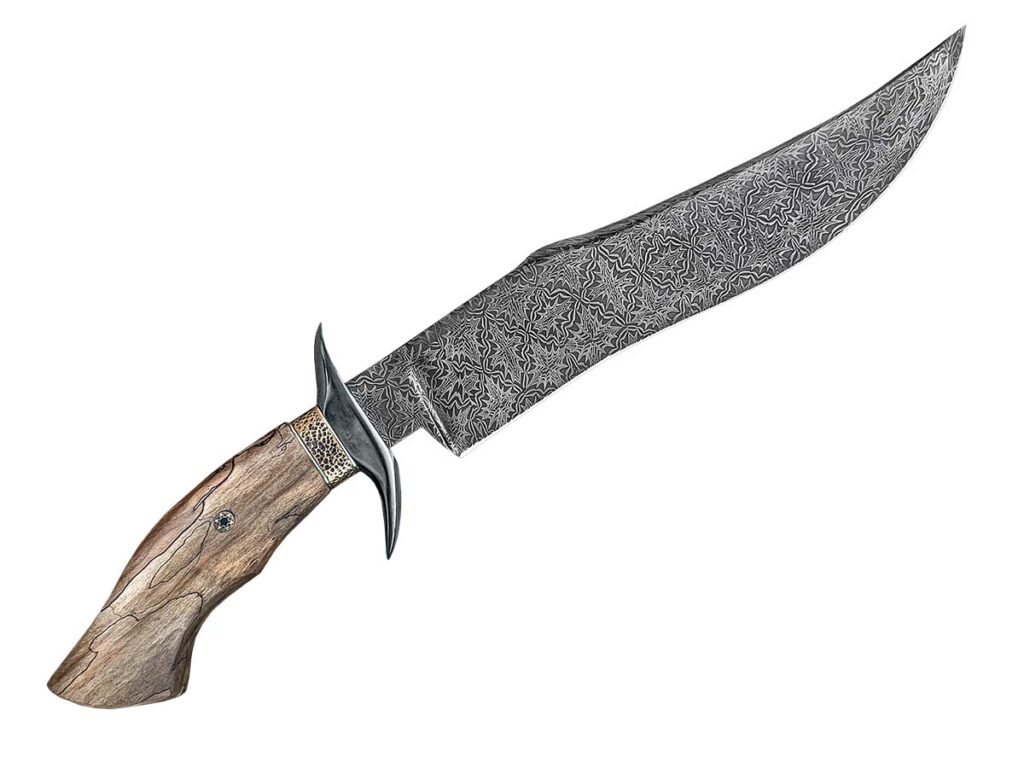
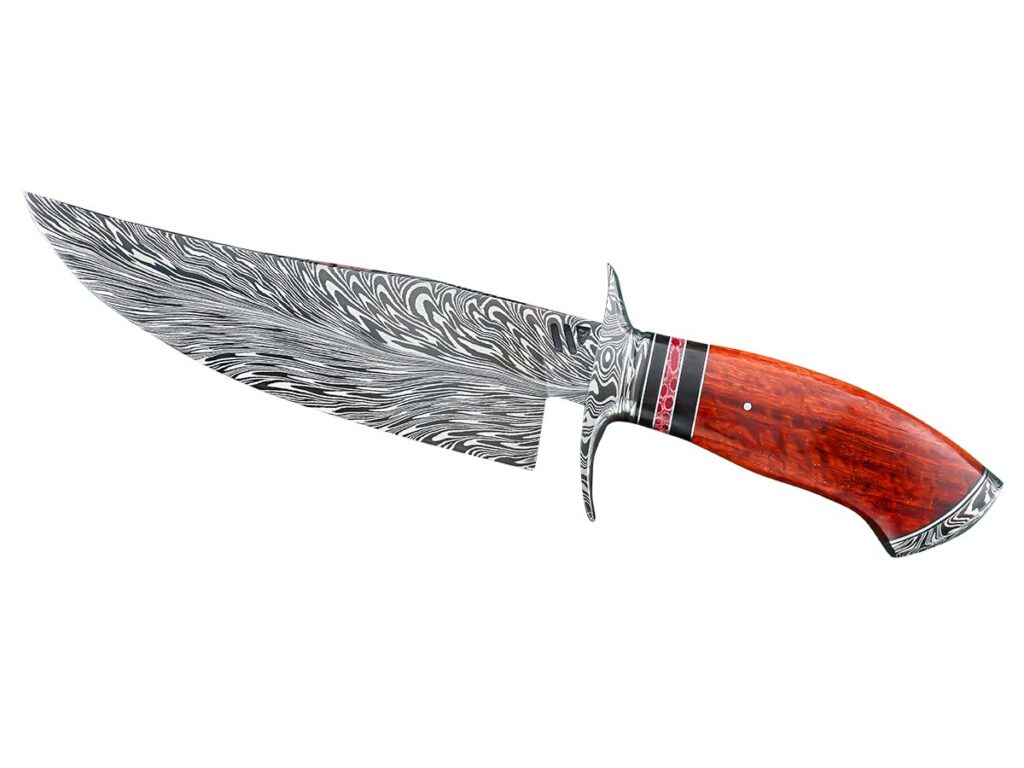
Rob Wayman Knives Feather Damascus Fighter
Blade length: 8” Blade material: Feather damascus of 1084 carbon and 15N20 nickel-alloy steels Blade grind: Full flat Handle materials: Stabilized bog oak, black G-10 and stainless steel spacers, dyed/stabilized fossilized brain coral, and stabilized curly narra Guard & pommel: Feather damascus Overall length: 13.75” Sheath: By Rob Wayman; belt model of vegetable-tanned leather w/stingray inlay Maker’s price for a similar knife and sheath: $2,400 Maker’s remark: “I’m all about sole authorship, so I make all my own steel and keep everything in house.” Maker: Rob Wayman Knives (SharpByCoop image)
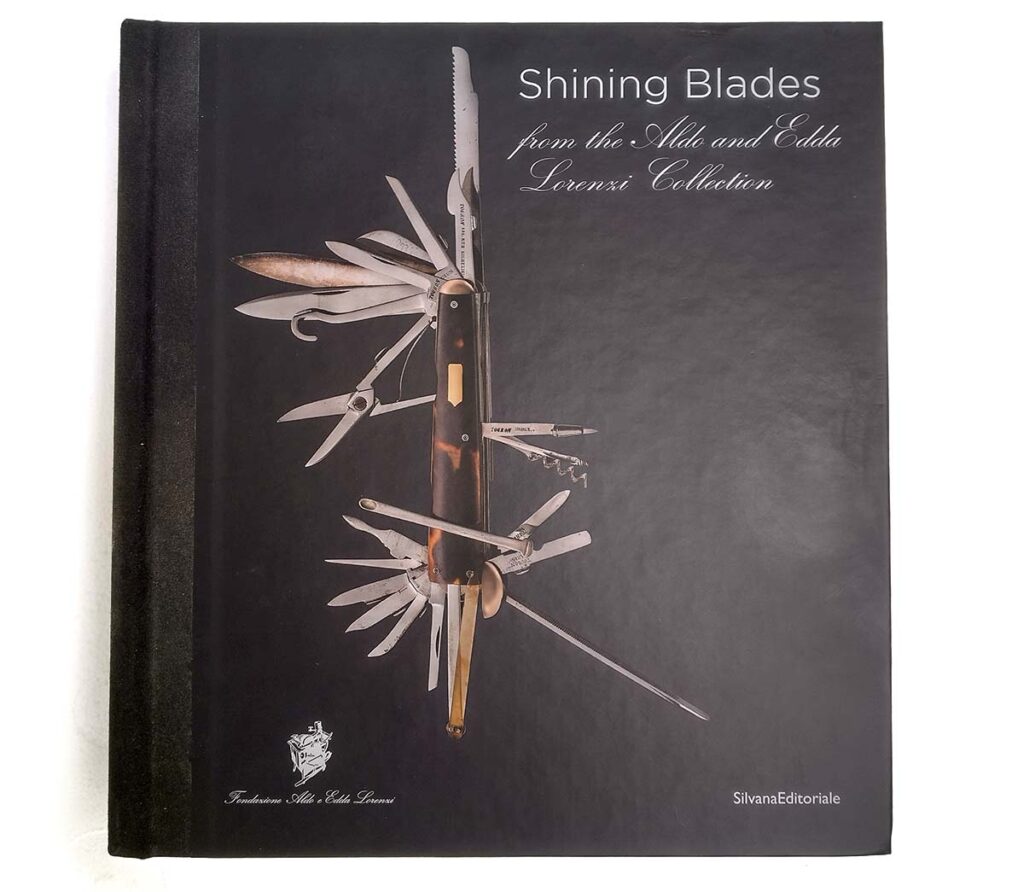
Shining Blades: From the Aldo and Edda Lorenzi Collection
Authors: Aldo and Edda Lorenzi Format: Hardcover, 9 x 9.75 inches Pages: 344, including 280 in color Publication date: May 27, 2025 Publisher: Silvana Editoriale Content: BLADE Magazine Cutlery Hall-of-Fame® members, the authors operated the G. Lorenzi retail knife shop in Milan, Italy, from 1959 to 2014. To stock their store and to add to their collection, they traveled far and wide in search of all manner of knives, scissors, razors, corkscrews and other edged tools. They acquired over 2,000 pieces from the Etruscan period to the present, many incredible specimens of which are illustrated in their book—including those by some of the most famous custom knifemakers of all time—along with the stories of how the Lorenzis obtained the pieces, met the makers and much more. A must read for true knife and edged tool aficionados, both present and future alike. List price: $50 Order: artbooks.com
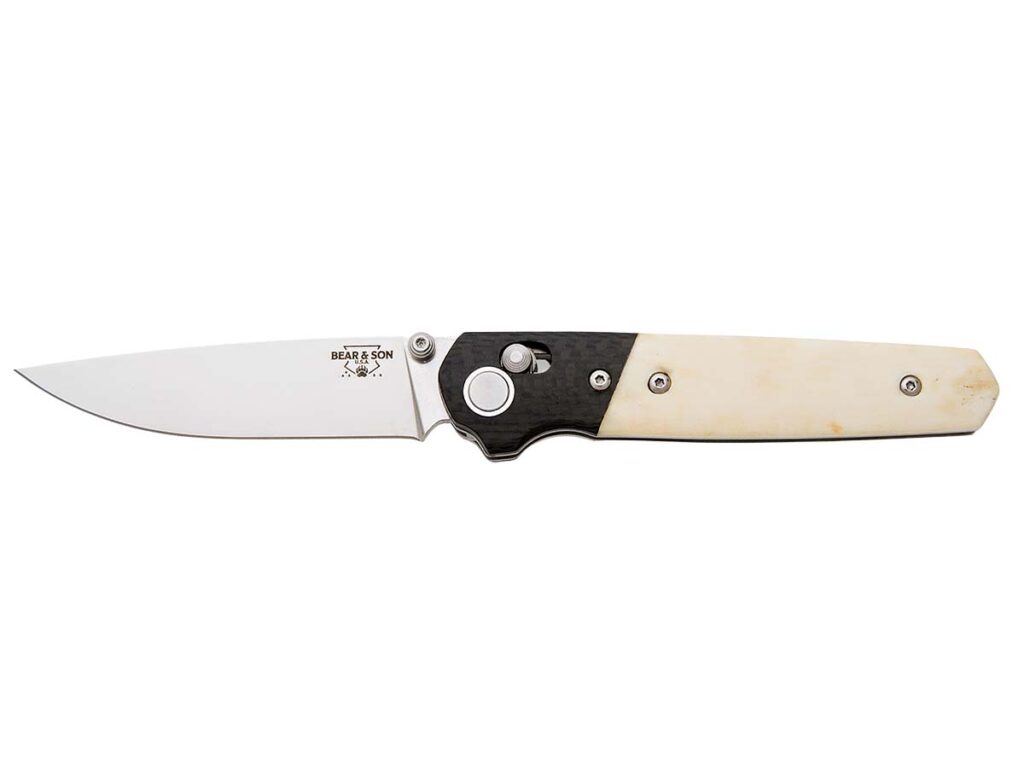
Bear & Son Cutlery Lawman
Bear & Son Cutlery Lawman Knife type: EDC folder Blade length: 3.25” Blade material: D2 tool steel Rockwell hardness: 59-61 HRC Blade grind: Taper Blade finish: Polished Blade opener: Thumb stud Pivot: Ball-bearing washers Scales: White smooth bone Bolsters: Carbon fiber Lock: Slidelock Pocket clip: Blade tip up Weight: 3.5 ozs. Closed length: 4 3/8” City & state of origin: Jacksonville, Alabama MSRP: $119.99 Company: Bear & Son Cutlery
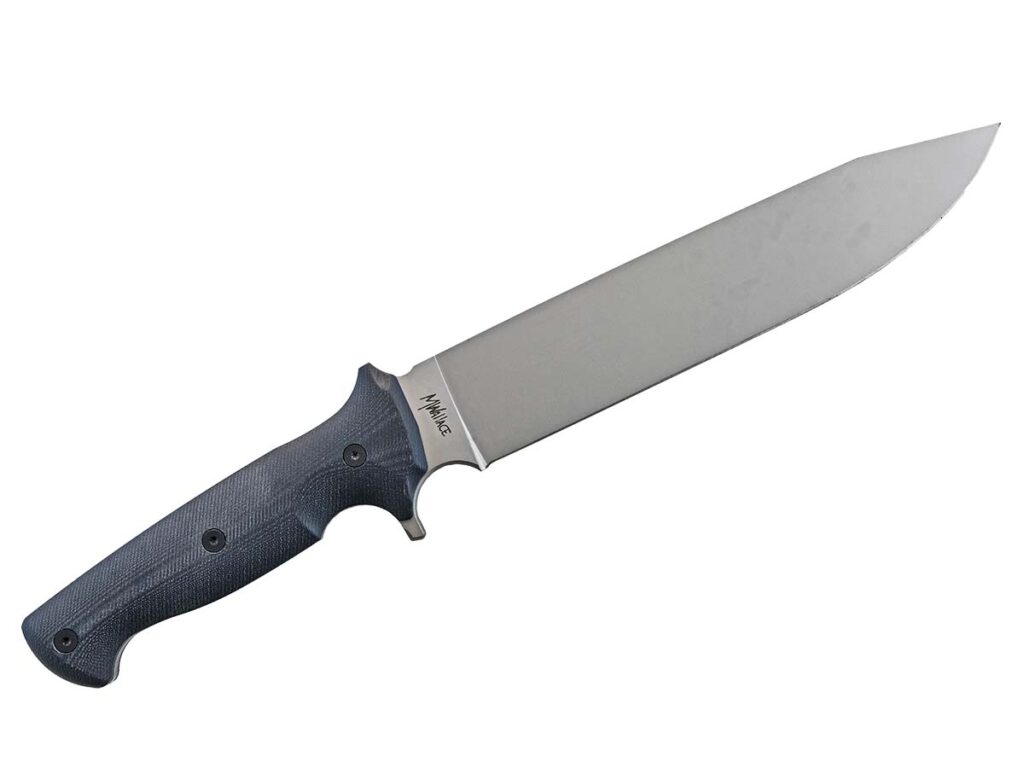
APOC Wallace Bowie
Designer: Mike Wallace Blade length: 9 5/8” Blade material: D2 tool steel Blade thickness @guard & tip: .256” & .039” Blade finish: Titanium coat Slabs: G-10 Knife to know: Handle screws accept a size T9 Torx or star bit; any other bit used may strip the screws Weight: 1 lb., 5 ozs. Overall length: 15 1/8” Sheath: Kydex, vertical or horizontal carry, MOLLE compatible Country of origin: China MSRP: $117 Company: APOC
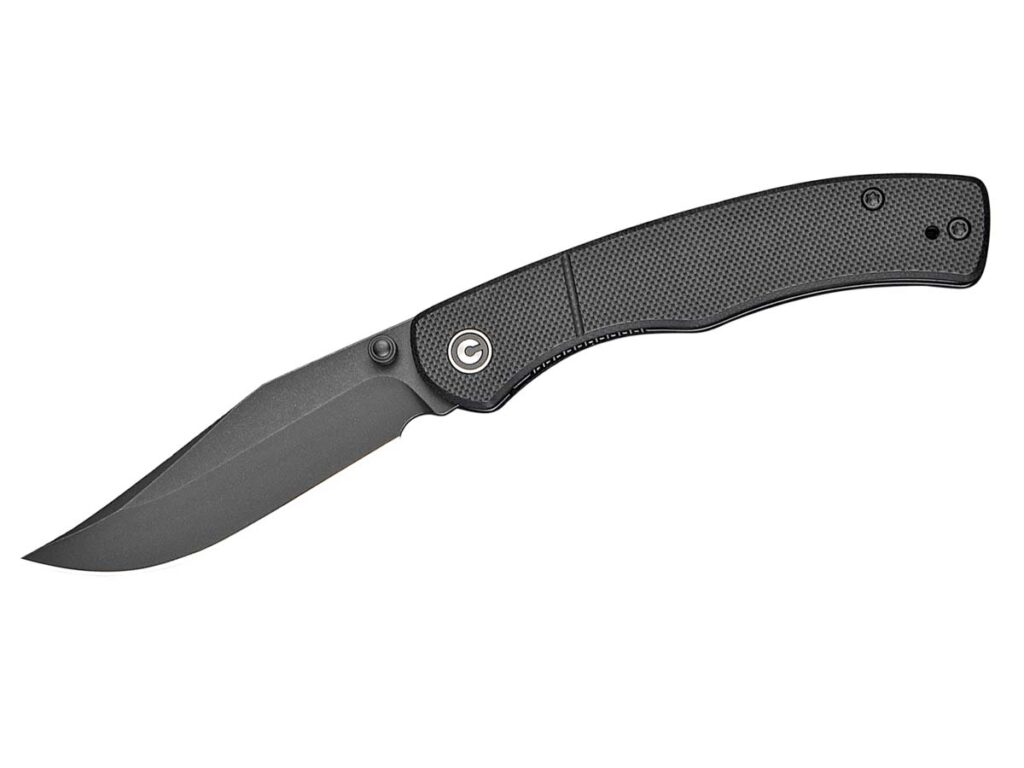
CIVIVI Clingman
Designer: Taylor Martin Knife type: Flipper folder Blade length: 2.99” Blade steel: Nitro-V stainless Rockwell hardness: 58-60 HRC Blade grind: Hollow Blade @thickest: .12” Blade finish: Black stonewashed Pivot: Caged ceramic ball bearings Lock: Linerlock Scales: Black G-10 Handle @thickest: .47” Liners: Stainless steel Pocket clip: 6Al4V titanium; ambidextrous, tip up Weight: 2.8 ozs. Country of origin: China MSRP: $71.70 Company: CIVIVI
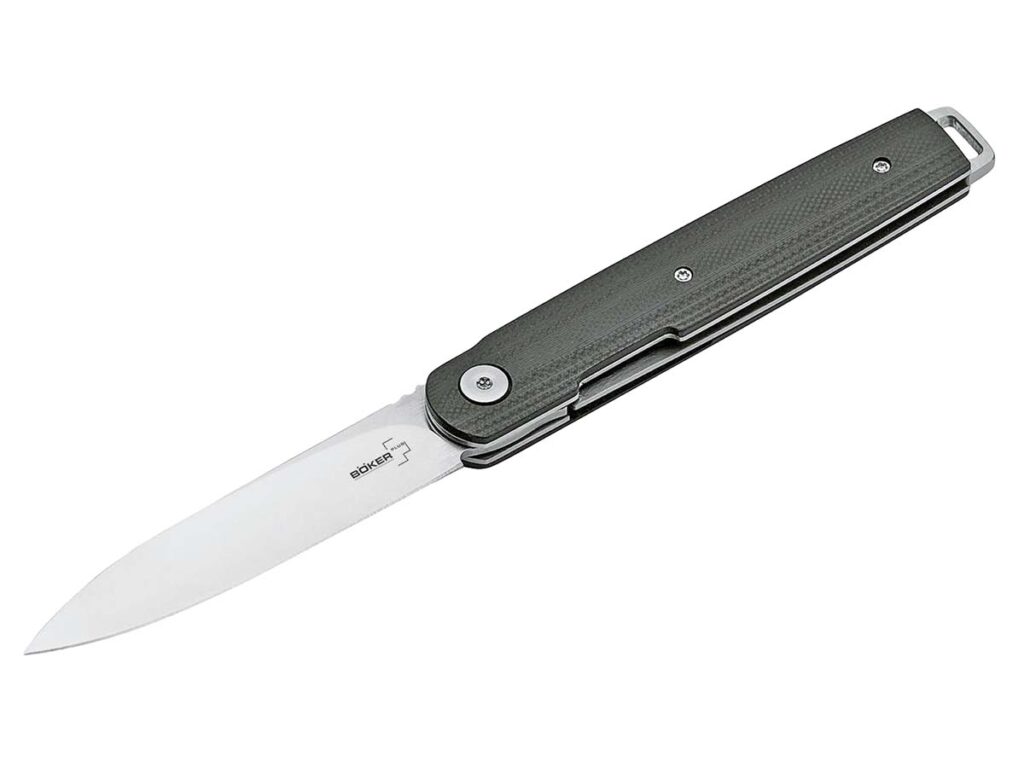
Boker Plus LRF G10
Knife type: Flipper folder Designer: Japanese knifemaker Kansei Matsuno Blade length: 3.07” Blade steel: VG-10 stainless Blade @thickest: .075” Pivot: Ball bearings Scales: G-10 Lock: Linerlock Weight: 1.94 ozs. Closed length: 4” Continent of origin: Asia MSRP: $108.69 at press-time exchange rate Company: Boker Plus
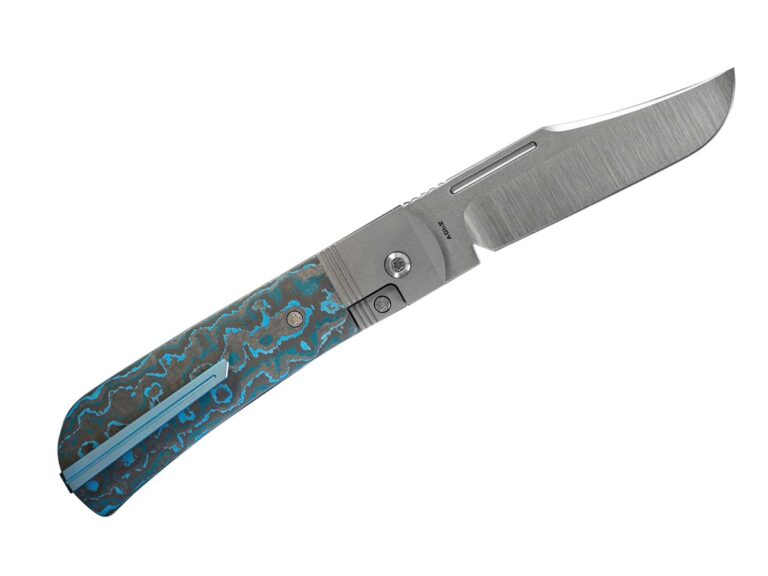
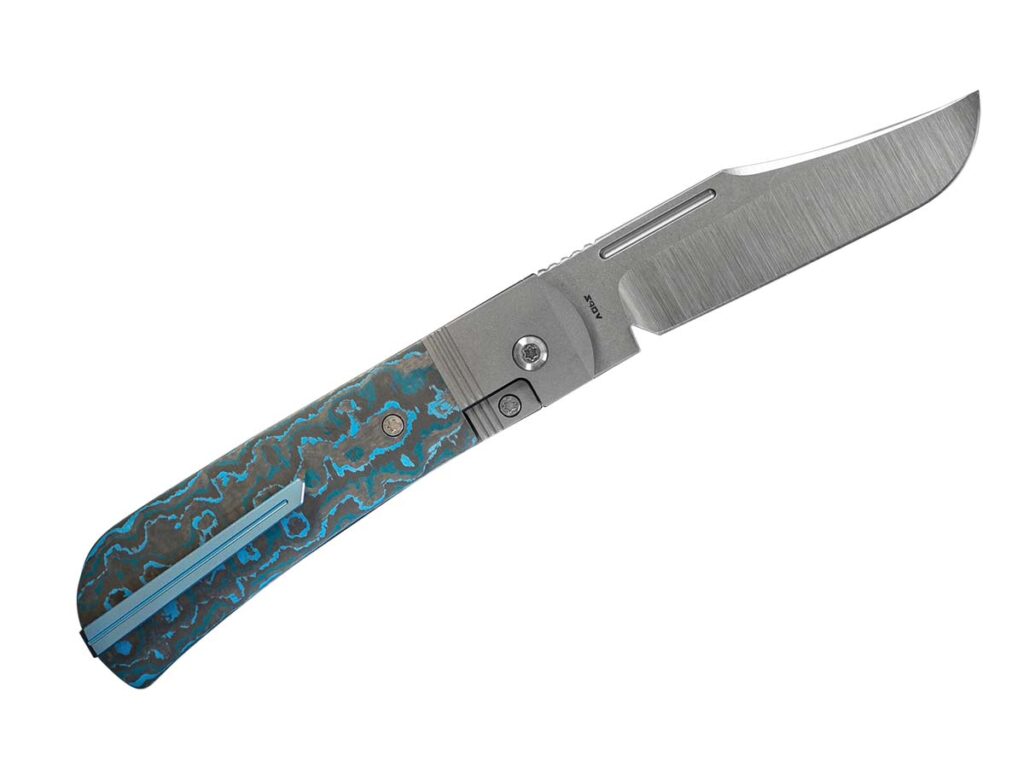
Jack Wolf Knives The Benny Fat Carbon Arctic Storm
Knife type: Slipjoint Pattern: Lanny’s Clip Blade length: 3.25” Blade steel: CPM S90V stainless Rockwell hardness: 60-61 HRC Blade grind: Hollow Blade finish: Belt satin Blade @thickest: .12” Lock: Framelock/bolster lock Pivot: Ceramic bearings Scales: Fat Carbon Arctic Storm Bolsters: 6Al/4V dark-blasted titanium Pocket clip: Titanium anodized a light blue Knife to know: A pocket-clip recess plug provides clipless carry option Weight: 3.5 ozs. Country of origin: China MSRP: $279.99 Company: Jack Wolf Knives
Four U.S.-made EDC sheath knives take the author’s test.
EDC knives have been influenced by folding designs since the inception of steel, if not before. However, historically speaking, compact fixed blades were daily edged tools long before folders.
Cultures worldwide, both known and no doubt unknown, carried short sheath knives for utility, survival and ceremony. Japan’s tanto pierced with precision and Viking seaxes sliced with status. Native Americans relied on trade knives and ulus for skinning and barter. Indonesia’s badik and short kris blended practicality with spiritual meaning.
These blades reflected local needs and traditions, proving compact straight knives were essential long before EDC became a modern gear category.
Wharncliffe Vs. Sheepsfoot Blades
The aptly named Bradford USA G3 Wharnie (top) has a classic wharncliffe blade while the Montana Knife Stockyard (bottom) boasts a modified sheepsfoot pattern.
Wharncliffe and sheepsfoot blades are similar and different. A wharncliffe features a long, straight cutting edge with a spine that tapers gradually to a fine, precise point. This geometry excels at controlled slicing, detailed scoring and utility work where accuracy at the tip is essential. The design allows steady pressure along the edge, making it ideal for carving, whittling and precision-driven EDC tasks.
A sheepsfoot, by contrast, has a straight edge with a spine that curves down sharply to meet the edge in a blunter tip. This greatly reduces the risk of piercing, making it safer for rescue work, controlled cuts and environments where safety matters most.
The wharncliffe offers versatility and precision for fine tasks, while the sheepsfoot provides dependable slicing power, rope-cutting efficiency and unmatched control under pressure. Together, they represent two specialized approaches to cutting—one prioritizing accuracy, the other emphasizing safety and reliability.—by Reuben Bolieu
Montana Knife Co. (MKC) Stockyard
The Montana Knife Stockyard whittled curly, thin feather sticks for a small twig stove. MKC offers free sharpening, cleaning and repair for life, ensuring the knife remains reliable for years to come.
The Montana Knife Co. (MKC) Stockyard is made in the USA and hand-finished in Montana. It embodies the rugged traditions of ranch life and strikes a balance between compact carry and the strength needed for long days in the field. Its MagnaCut stainless steel is known for toughness, edge retention and corrosion resistance, and the blade’s thickness provides durability without excessive weight.
The sheepsfoot blade is designed for controlled slicing and safe utility, excelling in tasks such as cutting twine or trimming hooves where precision is crucial. The stonewash finish reduces glare and disguises wear, while the rugged G-10 scales in green and black ensure a secure grip, even in wet or gloved conditions. The ergonomic handle includes a “subtle hook profile” for extra control and quick deployment.
Each Stockyard comes with a USA-made Kydex sheath, featuring adjustable retention for a secure fit and both horizontal and vertical carry. The design keeps the knife accessible and comfortable, whether you’re riding fence lines or working in the shop. MKC also offers free sharpening, cleaning and repair for life, ensuring your knife remains reliable for years to come.
Bradford USA G3 Wharnie
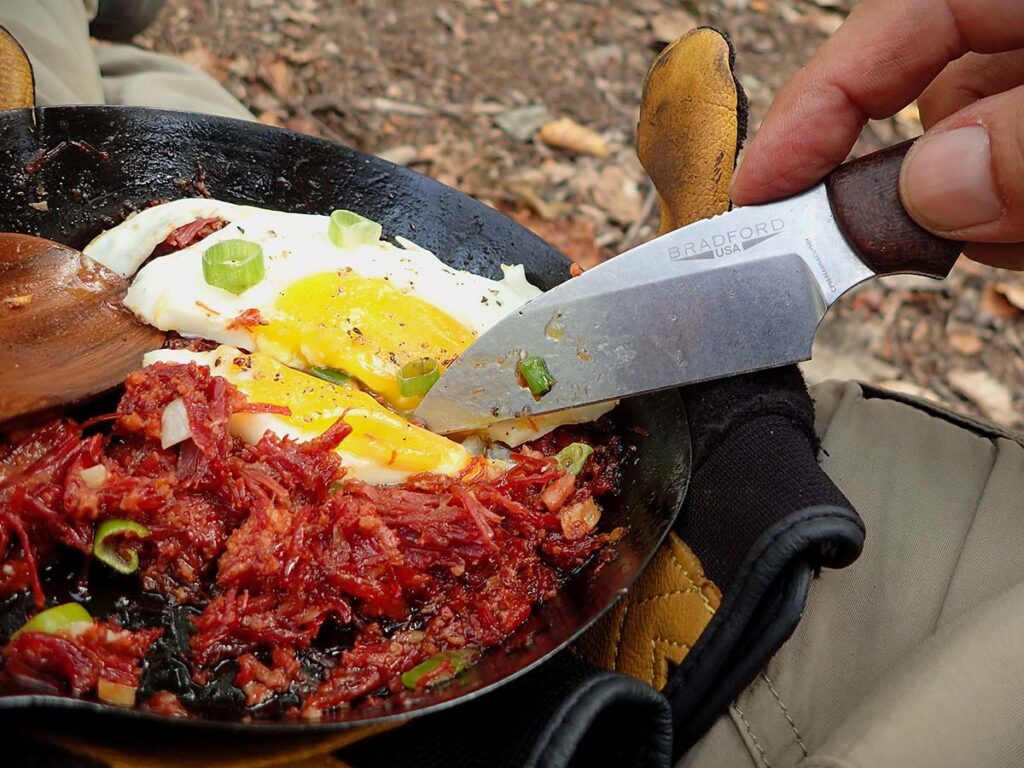
Wharncliffe and sheepsfoot blades allow you to choke up toward the tip and use a forefinger for fine control work. The author used the technique with the Bradford USA G3 Wharnie on a fried egg eaten right out of his carbon-steel skillet.
Skilled makers in Kent, Washington, meticulously craft the Bradford USA G3 Wharnie, ensuring every detail meets the highest quality standards. The compact fixed blade strikes a balance between portability and cutting strength, making it ideal for everyday carry and outdoor use. The blade’s long, straight edge offers both reach and control, versatile enough for slicing tasks and utility work. The blade thickness provides durability without the weight, allowing for agility in the hand.
Forged from premium Bohler M390 or MagnaCut stainless, the blade excels in edge retention, toughness and corrosion resistance. The wharncliffe blade, featuring the straight edge and fine tip, is particularly suited for controlled slicing, scoring and detailed cutting. A choice between a stonewash or tumbled finish minimizes glare while concealing wear, giving the knife a rugged, industrious appearance.
The handle features 3D-contoured scales in a choice of G-10, Micarta, carbon fiber or G-Wood, ensuring a secure grip and long-lasting durability. The ergonomic shape fits comfortably in hand for extended use, whether in the field or workshop. Each G3 Wharnie comes with a taco-style Kydex sheath that offers secure retention and customizable carry options.
Big Idea Design Deano
Deano Specs Designer: Mak Kelsay Blade Length: 3.125” Blade Steel: Nitro-V stainless Blade @the Thickest: 0.14” Blade Finish: Graphite black Cerakote® Weight: 3.6 ozs. Scales: Micarta® Overall Length: 7.5” Sheath: Kydex w/UltiClip 3.3 Country of Origin: USA MSRP: $325
Pros
Versatile Blade
Good Carry System
Full-Sized Grip
Cons
Expensive
The Deano from Big Idea Design is made in America with global steel origins. Designed by Mak Kelsay in Chattanooga, Tennessee, it strikes a nice balance between compact carry and dependable working strength. The blade provides versatile cutting power for everyday carry, camping and outdoor use. It also offers durability without unnecessary bulk, keeping it agile in hand.
The Nitro-V stainless blade steel delivers excellent toughness, edge retention and corrosion resistance in demanding environments. The modified drop point emphasizes control and practical utility. It tracks straight, bites clean and handles detail cuts with confidence. A graphite-black Cerakote®/tumbled finish creates a rugged, battle-worn look while reducing glare and concealing wear.
Scales are durable Micarta in black or green, providing a secure grip in all conditions. The ergonomic contour ensures comfort during extended use, whether in the field, workshop or camp.
The Deano includes a scout-carry Kydex sheath with an UltiClip Slim 3.3, offering secure retention and versatile carry options. The sheath system rides comfortably on a belt or pack, keeping the knife accessible and protected at all times.
Bear Forest Knives Stumpy
Stumpy Specs Designer: Garrett Tremblay Blade Length: 2 1/8” Blade @the Thickest: .125” Blade Steel: Nitro-V stainless Blade Finish: Raw matte Weight: 3.2 ozs. Scales: Various Micarta®/wood/Bearcarta Overall Length: 5 7/8” Sheath: By JRE Industries of black leather County of Origin: USA MSRP: $200
Pros
Hand Built
Grind Options
Good Ergonomics
Cons
Smallish Handle
The Bear Forest Knives Stumpy is built by hand in the USA for everyday carry and outdoor reliability. It offers a compact profile that disappears on your belt. The short blade delivers precise cutting power for utility, camp chores and daily shop tasks, and strikes a balance between strength and nimble handling, making it quick and responsive in the hand.
The Nitro-V stainless blade steel provides excellent hardness, edge retention and corrosion resistance in demanding environments. The blade features a full flat grind but is also available with a Scandi grind. It has a 90-degree spine ideal for generating sparks with a ferro rod and for scraping tinder. A raw matte finish gives the knife a resilient, understated look while reducing glare and hiding wear.
Scales are available in Micarta, wood or Bearcarta, each offering durability, comfort and a secure grip in most all conditions. The ergonomic design ensures the knife locks naturally into your hand, even during extended use.
Each Stumpy includes a premium JRE Industries black leather sheath, designed for secure retention and comfortable carry. The sheath rides well on a belt or lanyard, keeping the knife accessible and protected wherever you go.
Real World Tests
There are two teams here, as I see it—straight blades and, more commonly, curved blades. Or, MagnaCut vs. Nitro-V. The blades were all hair-popping sharp out of the box, as expected. This is always the first test of any edged tool I get.
The handles are all unusual. The Stockyard and The Deano have full-sized grips, while the Stumpy and G3 Wharnie have shorter, more compact handles. The latter two also have beefier, hand-filling scales, adding to user comfort.
I had the Stumpy with its full flat grind the longest. It is the only EDC in the batch to have a straight, 90-degree sharpened spine. The continuous curve of the belly aided in making feather sticks for a fire, as did the sharp spine for striking a ferro rod. The smallish handle was comfortable due to the textured Micarta and thick scales. Besides, who doesn’t like a good Mexican blanket print on the scales?
The Deano has a thin handle, as many EDC fixed blades do. The scales are smooth and comfy—sleek. The modified drop point has a slightly clip-point feel and look.
On the utility side, I slashed through mounds of cardboard to break down boxes. I cut cardboard, not tape. (There’s nothing more annoying than a sticky blade on a good knife.) Slicing along the side of a box helps open it up and saves your edge, since it separates a lot of area with minimal gumminess. The light gimping was perfect for my forefinger when slicing down. I never use my thumb on the spine— it’s a bushcraft habit.
Wharny Or Sheepy?
The wharncliffe and sheepsfoot are two similar blade shapes with distinct attributes. I received the Bradford G3 Wharnie in MagnaCut first and rekindled my love for the straight-edge style with a curved spine. Nothing screams utility more than a straight edge similar to that of an X-Acto knife blade. Any box-opener blade fits in with the crowd, as does a wharncliffe. Tip-forward pressure is excellent for drawing back slices.
Wharncliffe and sheepsfoot blades allow you to choke up toward the tip and use a forefinger for fine, controlled work. I used the technique on a fried egg eaten right out of my carbon-steel skillet. Only a small amount of steel came in contact with the egg and skillet, as draw cuts use minimal edge.
I ran the MKC and Bradford through identical testing on various fibrous materials for practical EDC use. I sliced scrap leather, nylon webbing, zip ties, phone-charging and lamp cords, and lots of cardboard, all with zero issues. The more challenging materials were plastic packaging banding and 15,000-pound tow strapping. I severed the latter two media on a cutting board, draw cutting and push cutting. The forward leverage obtained from the straight-edge blades was apparent and much appreciated. Both blades sliced through the din with no holdups.
As for the performance difference between MagnaCut and Nitro-V, it has more to do with edge geometry and the materials you’re cutting than anything else. It would take a long time cutting similar materials with identical grinds on two knives to see any real difference. Suffice to say, these are two top-tier stainless steels.
Carry Systems
The test knives come with sturdy Kydex sheaths ready for scout carry.
Besides the Bradford G3 Wharnie, two of the test knives are set up for scout carry with straps. The older model of the BFK Stumpy has one-strap retention for scout carry, which you can adjust to different positions. The MKC Stockyard has a Kydex fold-over sheath that easily attached to my belt while I was already wearing pants. The feature is incredibly convenient for those who often forget to put things on until it’s time to work.
The Deano came with options: scout carry strap set and UltiClip Slim 3.3, like a choose-your-own-adventure book. Bradford sent me a sturdy Kydex sheath without attachments. However, Bradford has order options on its website. I carried the Bradford entry like a slip sheath in my pocket and eventually attached it to a small carabiner to hang on my belt loop.
Check Out More Outdoor Knives:
NESSMUK KNIFE: OPTIONS IN THE ALL-AMERICAN OUTDOOR KNIFE
BEST TOMAHAWKS: OUR TOP HAWKS FOR BACKWOODS TO BATTLEFIELDS
Assisted open knives that get the job done … quickly.
Although their popularity has leveled off in recent years, manufacturers still embrace the assisted-open genre and continue to produce new models. For those new to the hobby, who may not be familiar with this style of knife, allow us to explain how they work.
Assisted openers are usually EDC and tactical folding knives equipped with some sort of torsion spring affixed to the tang of the blade that aids in propelling it to full open. What results is a crisp and quick action akin to a fully automatic knife. But, and here’s the good part, it remains legal in most jurisdictions.
There is a downside to the assisted opener; the spring creates a weak link. If it fails, the snappy action is absent. The knife remains usable, but, impetus gone, it’s practically a manual opener. Hence, some enthusiasts shun the assisted opener like the plague. Yet, the design still has its enthusiasts, who can’t get enough of its brisk and fast actions.
No matter where you stand on that spectrum, there are assisted-open knives worthy of consideration. We’ll cover four of the latest and greatest that deliver the thwack users love.
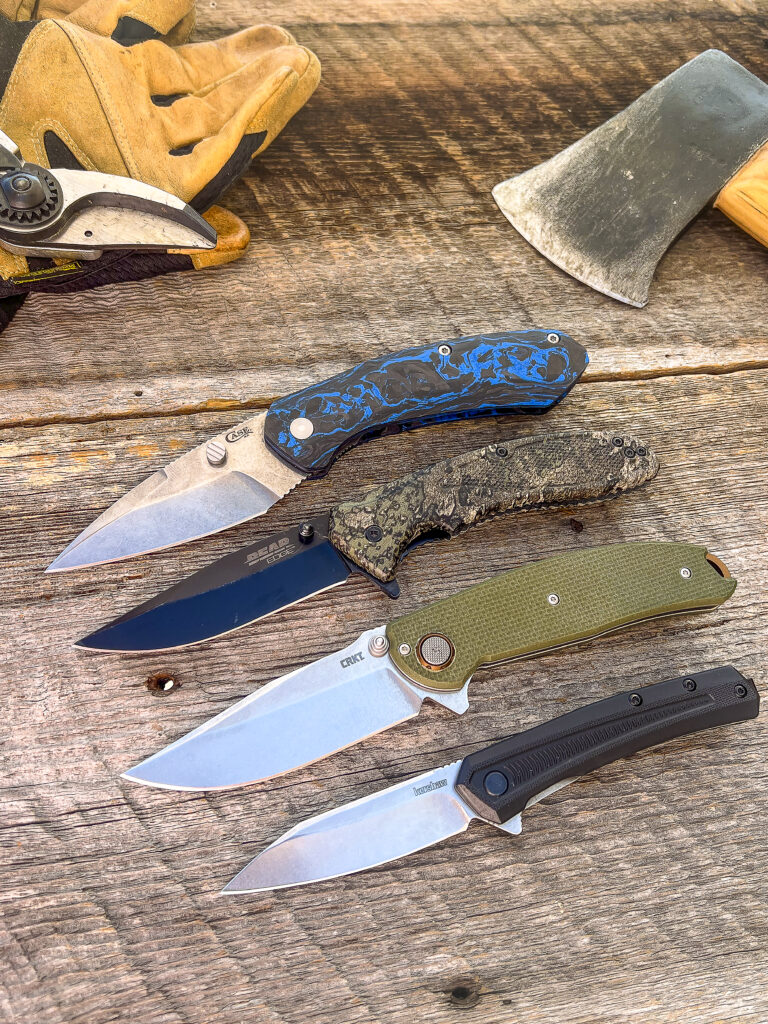
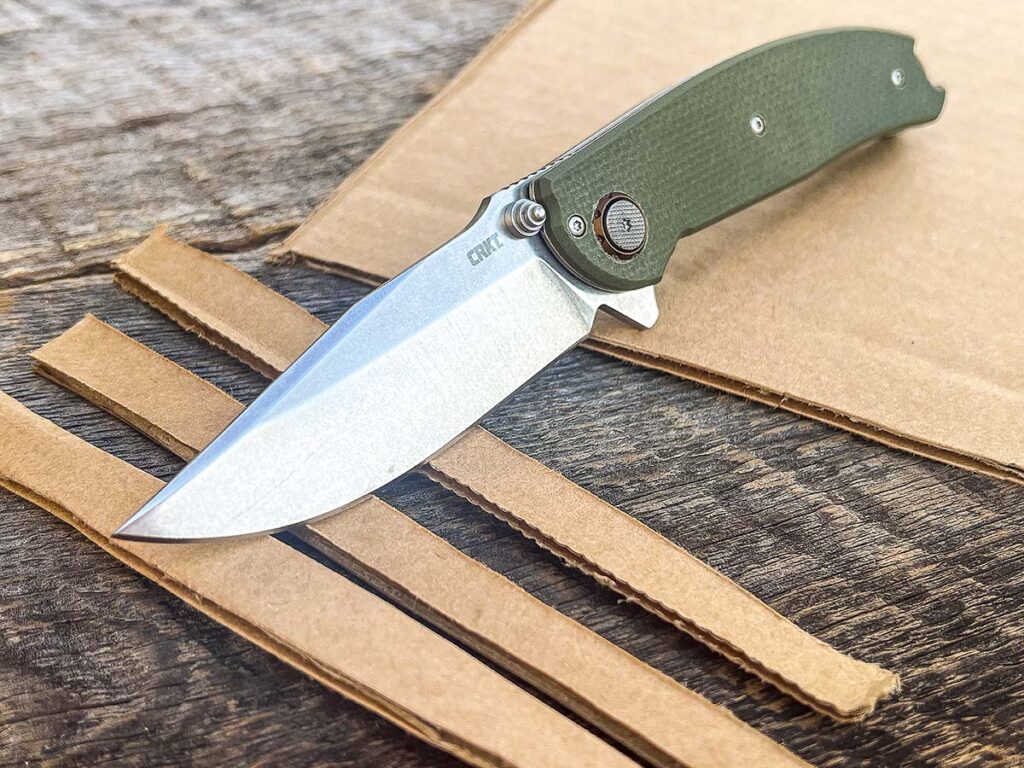
CRKT Butte
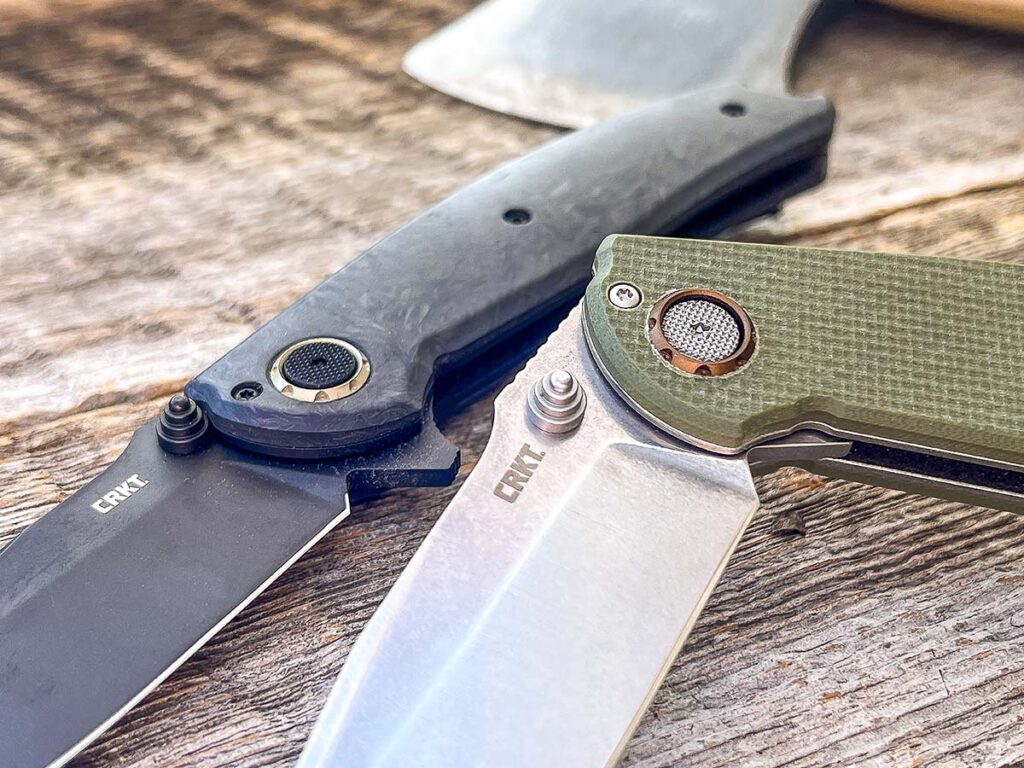
The Butte was designed by knifemaker Lucas Burnley and features CRKT Deadbolt lock. The author found the clip-point blade exceptional and the knife overall sized right.
The Butte is named after its designer’s—Lucas Burnley’s—hilly hometown of Bend, Oregon. Like this rugged terrain, the CRKT knife is heavy-duty and blends style and function into one package, geared for the outdoors.
The Butte boasts a 3.3-inch blade with a clip point and is constructed from D2 tool steel. The material choice gives the knife enhanced edge holding capabilities and is relatively easy to sharpen. Additionally, the steel has good impact resistance, though it’s not stainless, so plan to exercise more care in its upkeep.
Moving down, the handle is OD green peel ply G-10, with dual steel liners providing the backbone. A bronze anodized aluminum back spacer rounds out the handle features.
CRKT utilizes its Deadbolt lock mechanism on the Butte, a solid choice for a knife meant for rough outdoor work. The system, developed by Brazilian custom knifemaker Flavio Ikoma, is essentially a button lock, but with two actuating steel posts. In the case of the Butte, the button design plays well into the overall streamlined look of the knife. It resides on the blade pivot and melts away into the knife’s lines.
The Butte’s lock release is disguised as a pivot bolt, which makes unlocking the blade intuitive, even while wearing work gloves. It also keeps the knife’s sleek look.
To keep the knife handy, CRKT outfits the assisted opener with a pocket clip oriented in the right-handed, tip-up-carry position. Unfortunately for lefties, the clip cannot be reconfigured.
The Butte’s size makes it very capable of tackling a wide variety of chores inside the home or in the great outdoors. Folding hunter or general work knife are both well within its wheelhouse. Could be an outdoor knife, could possibly be a folding hunter, or could be a general working knife.
Of its assets, I like the peel ply G-10, which is more grippy than regular G-10. The handle is also very comfortable, and the lock release is oriented smartly—it’s out of the way of the hand.
Flat out, I think the Butte is a winner when it comes to a working assisted-open. With an MSRP of $120, it’s also a great value.
Kershaw Raygun
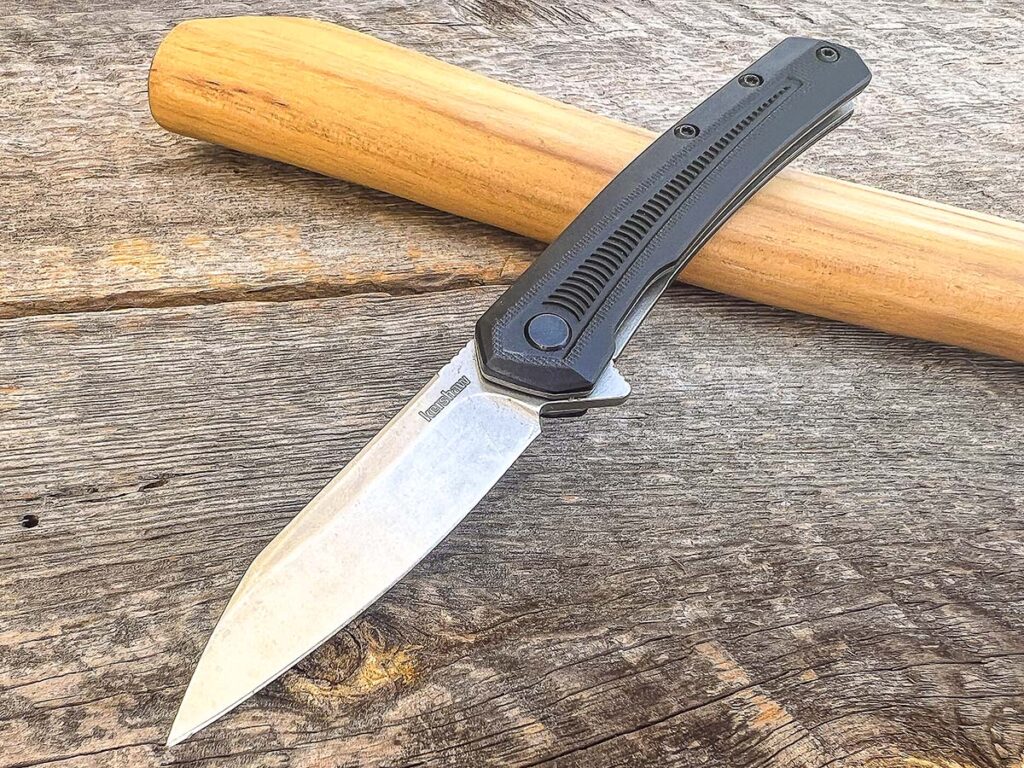
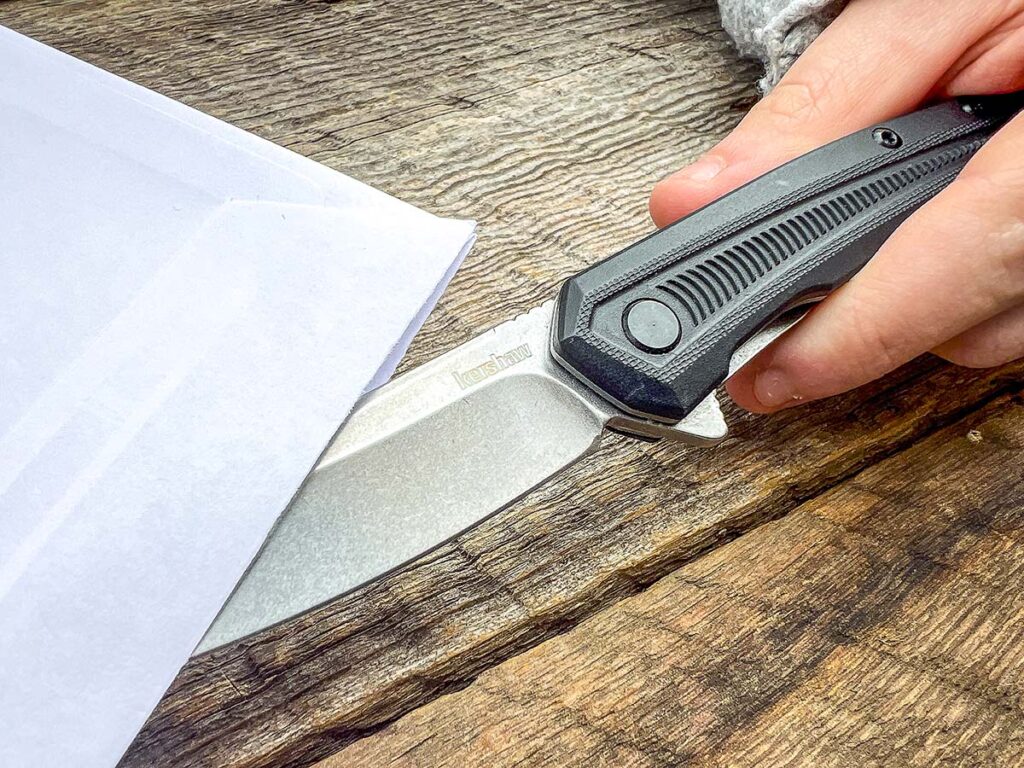
The reverse tanto blade shape of the Kershaw knife makes it user friendly, with what the author describes as a gently sweeping edge that maximizes cutting efficiency.
Kershaw’s Raygun offers high utility, a slim form factor and assisted opening in one affordable package. Though it comes in smaller than the rest, with just 2.8 inches of blade to work with; however, a hollow-ground edge gives the compact option aggressive cutting abilities.
As does Raygun’s reverse tanto blade. The profile supplies a gently sweeping cutting edge for maximum efficiency, along with a defined tip for scoring. As to the knife’s steel, it’s 4Cr14 stainless. This is a compromise, balancing solid edge retention and price. Kershaw gives the blade an added layer of protection, stonewashing it to hide any scratches obtained along the way.
Deployment is strictly a flipper affair, which is nice given that it maintains the knife’s sleek look. And Kershaw—like many of its models—makes certain the deep-carry clip is ambidextrous, though strictly a tip-up affair.
Steel composes the liner lock’s liner and Kershaw outfits the handle with glass-filled nylon scale. It’s chamfered, cutting down on hot spots and well textured. The center features a wave pattern of increasing size toward the pivot. This provides the most traction on the handle.
The Raygun features a slender construction and compact size, paired with a highly utilitarian reverse tanto blade. Despite its size, the knife can tackle a variety of tasks, large and small.
The assisted opening mechanism is a classic, Kershaw’s own Speed Safe. For those who don’t know, this is a design of Blade Magazine Cutlery Hall of Fame® member Ken Onion, and is credited with kick-starting the assisted opening trend. It’s fast, durable and a mainstay in Kershaws.
The Raygun cuts efficiently, quickly and its compact size carries easily in slacks, jeans or even clipped to the waist of jogging shorts or sweatpants. I did find the knife’s size a plus and a minus. The downside, bigger hands might find it too difficult to manipulate and use. The upside, its opening is precise and predictable. Given the short, narrow blade, there isn’t a lot of blade mass to move.
With an MSRP of $38, you get a lot of knife in a small package with the Raygun.
Case Westline
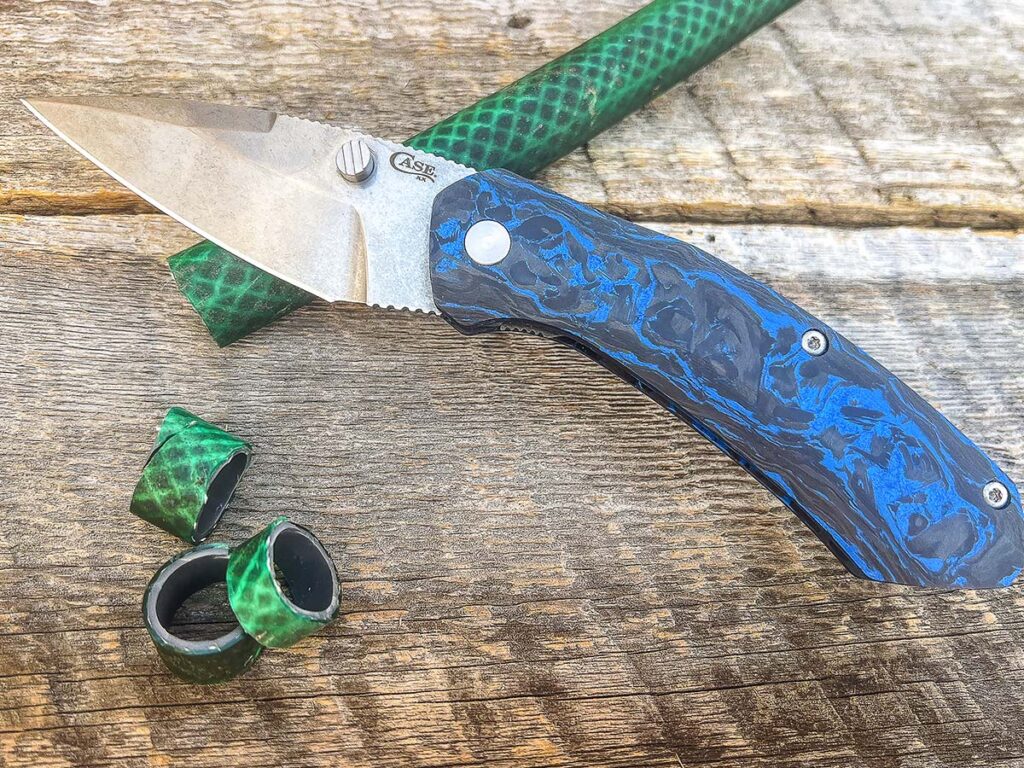
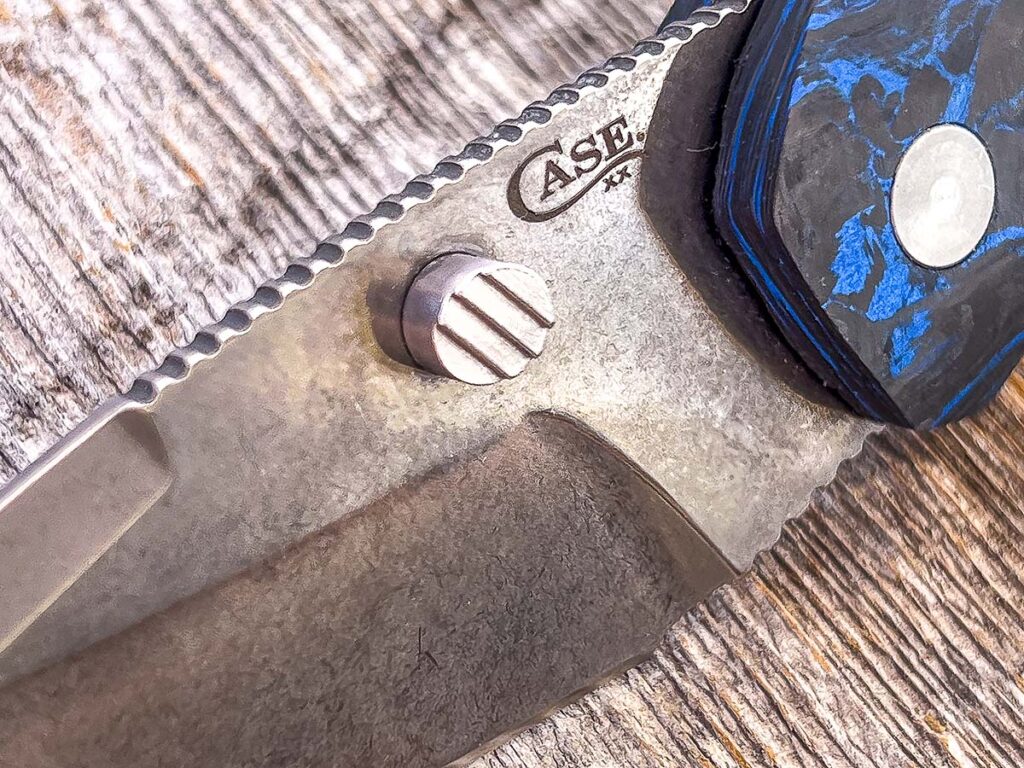
The Westline series of folders have drop point blades and a contoured handle. This particular specimen has eye-catching and lightweight blue and black carbon-fiber handles, paired with a stonewashed S35VN blade. The bigger blade helps to handle larger cutting chores like cutting thick hose.
An interesting twist to the Case Knives plot, a few years ago, it designed and manufactured a line of modern folding knives. Finally, granddad’s pocketknife company embraced the EDC theme with blade locks, one-hand opening and high-tech materials. At the vanguard, the Westline series. The line also introduced assisted opening to Case.
The Westline I looked at was outfitted with 3.23-inch modified drop point blade, made from premium CPM S35VN stainless steel with a stonewash finish. This is a Crucible Industries material, one of the super steels, renowned for its exceptional toughness and edge retention.
The blade spine features a run of traction notches, allowing added pressure to a cut with your thumb or index finger. Furthermore, there are notches on the tang behind the cutting edge. Used in conjunction with the blade spine, you can choke up on the blade for more precise control.
As far as the handle goes, it is made from striking blue and black marbled carbon fiber that catches the eye. Underneath are two nested steel liners providing the backbone for the Westline’s handle. It is a liner lock, which engages smoothly and holds the blade secure in the open position. Finishing it off, a steel pocket clip is mounted to the handle to carry the knife in the tip-up configuration.
Large, angled and stepped thumbstuds make the blade of the Case Westline easy to open.
The blade deploys in either hand thanks to two large ambidextrous beveled thumbstuds. Speaking of opening, the Westline’s action is predictable, controllable and smooth. Case makes this a certainty, outfitting the knife with pivot bearings.
The Westline would make a great working folder where general-purpose cutting chores reign. It carries well, deploys fast and has a blade steel well known for its performance. It cut through a variety of materials with ease for me. My only complaint is the thumb stud placement. Case could have moved the studs back toward the tang more, thus shortening the arc of travel. The MSRP of the Case Westline with blue and black carbon fiber is $197, and it is made in the USA.
Bear & Son Bear Edge True-Timber Sideliner
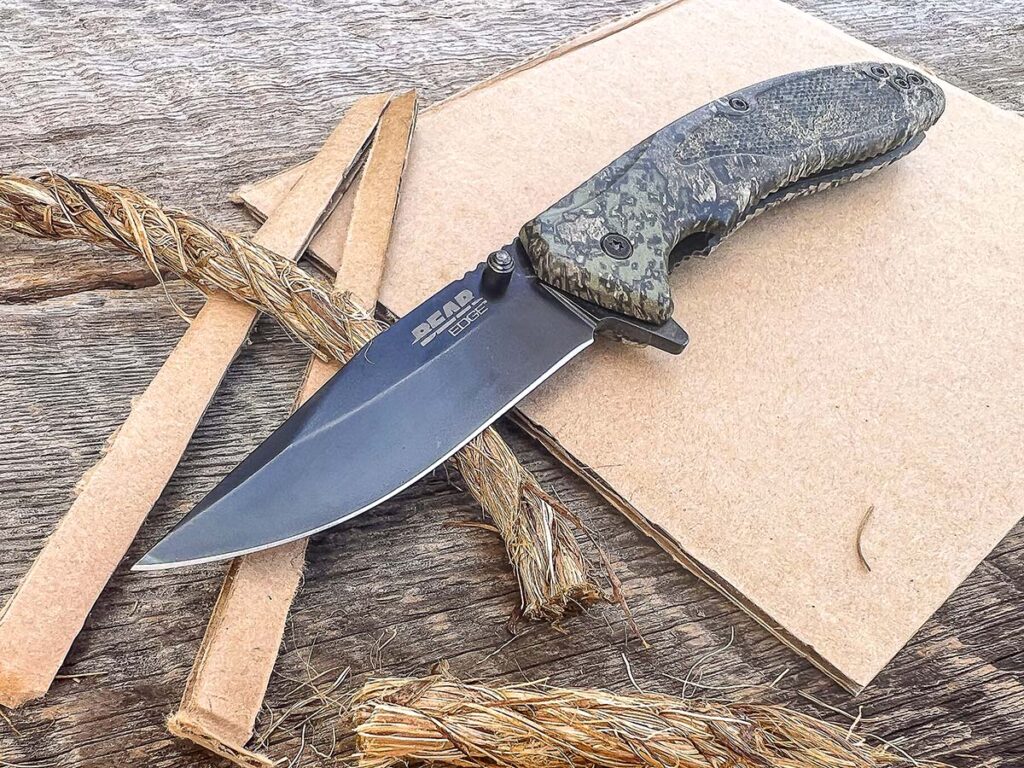
The Sideliner is a cutting champ, thanks to its hollow-ground blade. The assisted-opener made mincemeat of cardboard, rope and a variety of other materials.
The Bear & Son Bear Edge True-Timber Sideliner folder offers a lot of desired features in an affordable package. The clip-point blade is 3.5 inches in length and is made from 440A stainless steel, a lower-end blade steel that is inexpensive but easy to sharpen.
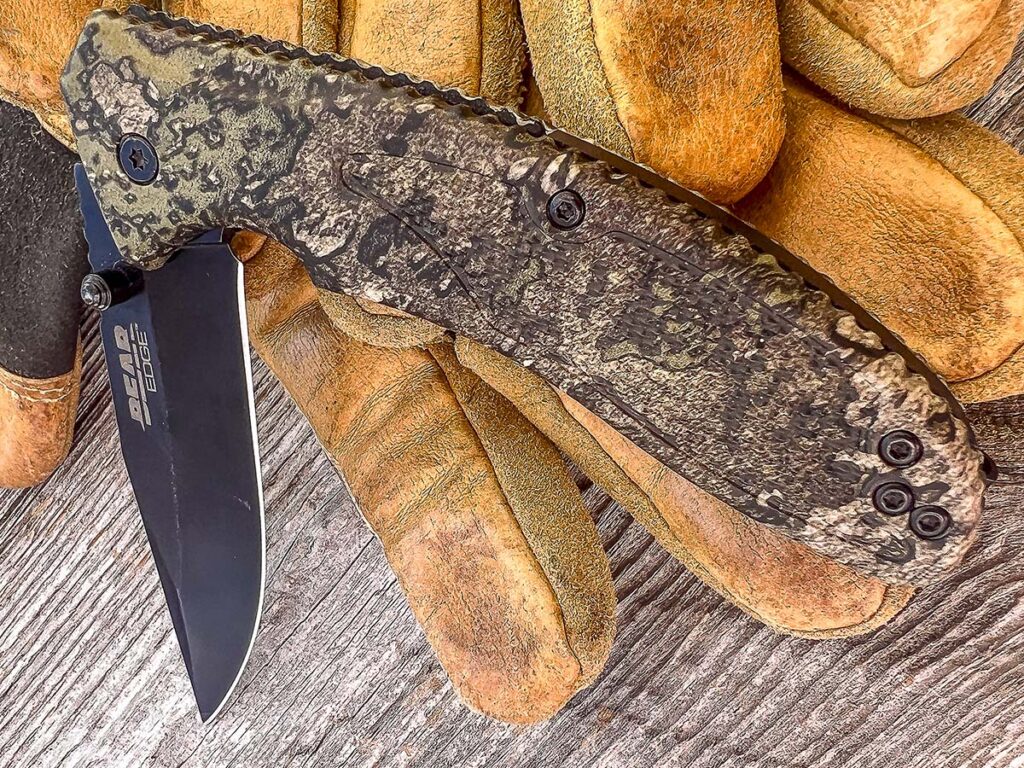
The TrueTimber camo Zytel handle is lightweight, impact-resistant, and impervious to the weather as well as fluid absorption. It incorporates several ergonomic features, such as a primary finger recess with lower hand guard, screw-together construction, checker texturing that helps to improve grip, and there are traction notches all around the perimeter of the handle to aid in nonslip grip as well.
A deep carry pocket clip is attached to the handle to carry the knife in the tip-up position, and it can be switched to the opposite side for lefties.
I would say this Sideliner folder is a very viable option for those who want a good, solid, reliable folding knife at a very reasonable price. The hollow grind makes it easy to slice through any material with ease, but the factory edge out of the box was just OK in my observation. It would cut, but I did notice an improvement in performance once I was able to put my own edge on it.
The Bear & Son knife’s handle has textured grip panels for hand traction, as well as traction notches around the perimeter for an excellent all-weather grip.
The Sideliner’s assisted opening action is quick and sure. A firm push out of one of the thumbstuds causes the blade to spring into action. However, whenever there is a flipper option, I prefer using that instead, as it’s easier and faster to get to. A simple press on the flipper will activate the assist, and the blade is opened, locked and ready for action.
The 440A stainless steel isn’t going to hold an edge like the mid-grade or high-grade stainless steel, but it is easy to resharpen, so there’s that. There’s a trade-off for an MSRP of $60. Still, it really is not a bad price for this piece. Knowing you will generally pay a bit less than this makes it a great buy.
When It Comes To Tactical Pocketknives, These Five Blades That Are Worth Your Money And Your Time
The term “tactical knife” was created roughly 30 years ago to describe a specific-looking knife. In general, tactical knife has meant a non-reflective blade and a synthetic handle. However, over time the genre has grown to feature numerous looks and types of blades.
Today, tactical pocketknives are incredibly popular. Whether it’s a traditional flipper, an assisted opener, or even an OTF knife, the market has exploded and knife lovers are the biggest beneficiaries. Our list features five folders to show just how diverse the world of tactical pocketknives is today.
5 Best Tactical Pocketknives
The traditional pocketknife folds and easily slides away into your pocket, and there are many tactical pocketknives that fit that description. These five stand out from a crowded field.
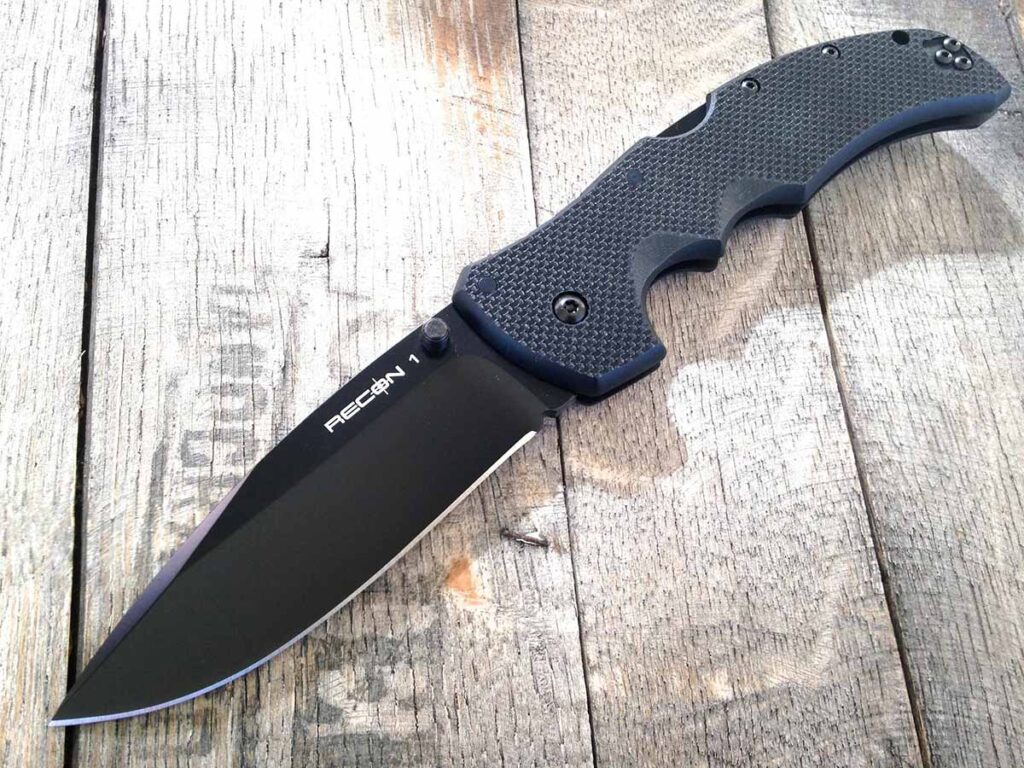
Cold Steel Recon 1 Spear Point
Cold Steel Recon 1 Spear Point
From one of the leaders in tactical knives comes the Recon 1 Spear Point. Cold Steel has made a knife popular with both first responders and civilians that is scalpel sharp and over-engineered to the point nearly everything has been thought of. The American S35VN blade has a DLC coating. The Tri-Ad lock is shock resistant and will keep you safe when deployed. The G-10 handle scales provide excellent grip.
Visually, the Recon 1 just looks cool. The all-black color scheme gives the knife a kinetic feel and encourages you to use it throughout your day.
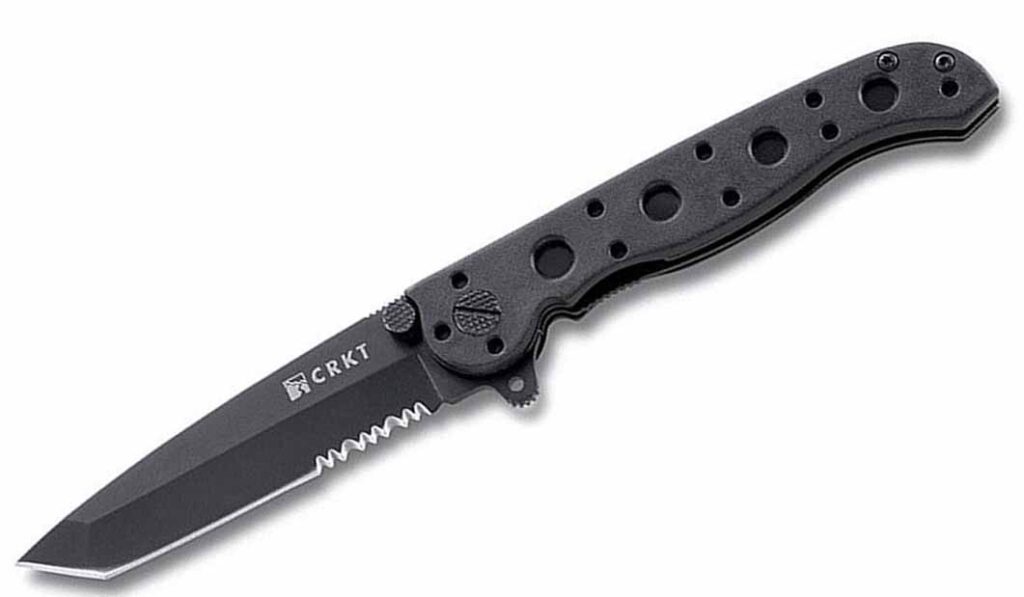
This Kit Carson-designed blade from CRKT is a versatile knife. The dual-grind tanto blade features a partial flat edge and partial Veff serrations. This gives you excellent cutting strength along with the ability to make different types of cuts in tight quarters.
The 1.4116 steel blade is Teflon-coated and connected to a G10 handle. The liner lock keeps the blade securely in place when open. Due to the knife’s open build, two Carson flippers can be incorporated into the piece to create a true hilt, a rarity in folding knives.
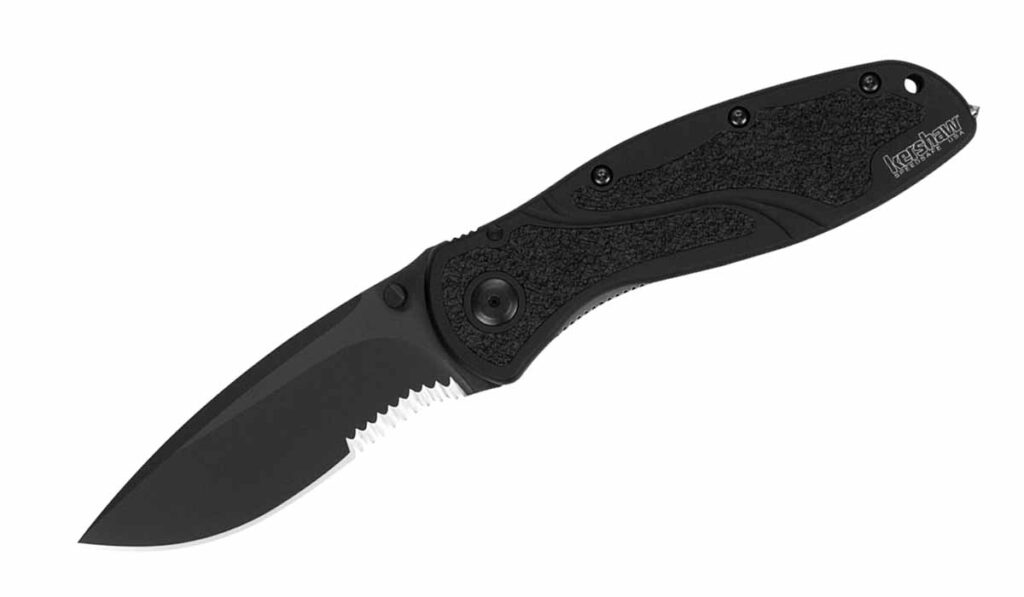
Light. Strong. Serrated. Those are just a few ways to describe this assisted folder from Kershaw. The all-black Blur is just under four ounces and is packed with features starting with the fast-moving assisted-opening mechanism.
The blade itself has a slight recurve, and in the recurve are a series of serrations to make the knife more multi-dimensional. The blade is finished in Cerakote to provide more durability and corrosion resistance. The carbide glassbreaker at the butt of the handle provides yet another way to use the Blur in your day-to-day.
This Ken Onion-designed knife is an excellent piece.
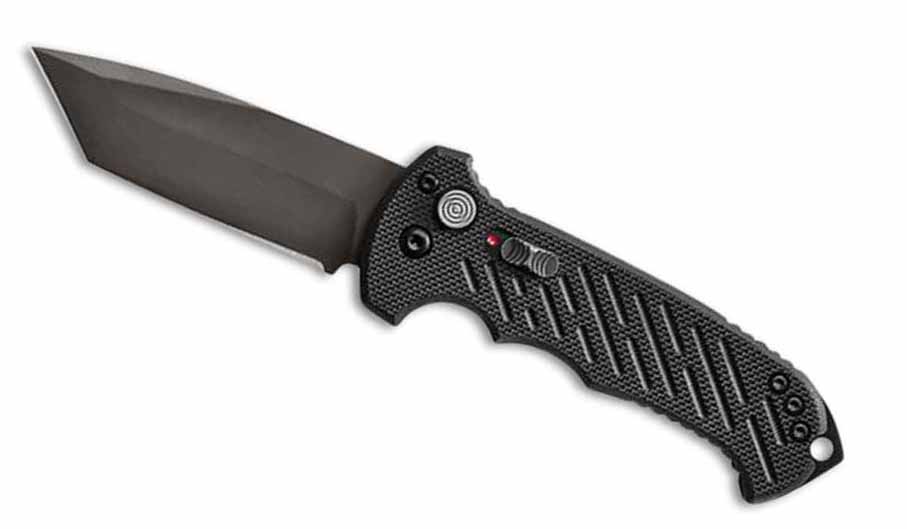
From Gerber Gear, this fully automatic folder is a rugged beast. The push button fires the stonewashed blade out at a high rate of speed, making using the knife that much easier and faster. It feels great in the hand thanks to a slightly higher weight that will give you the confidence to use the 06 in more intense situations.
The aluminum handle can hold up to the use and abuse of everyday life, and the long plain-edged blade makes cutting a breeze. The striking pommel with lanyard hole provides more use for the knife and allows you to travel with it easily.
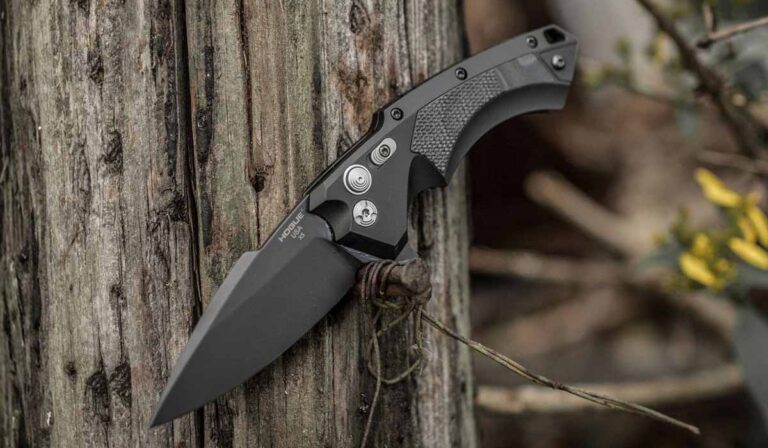
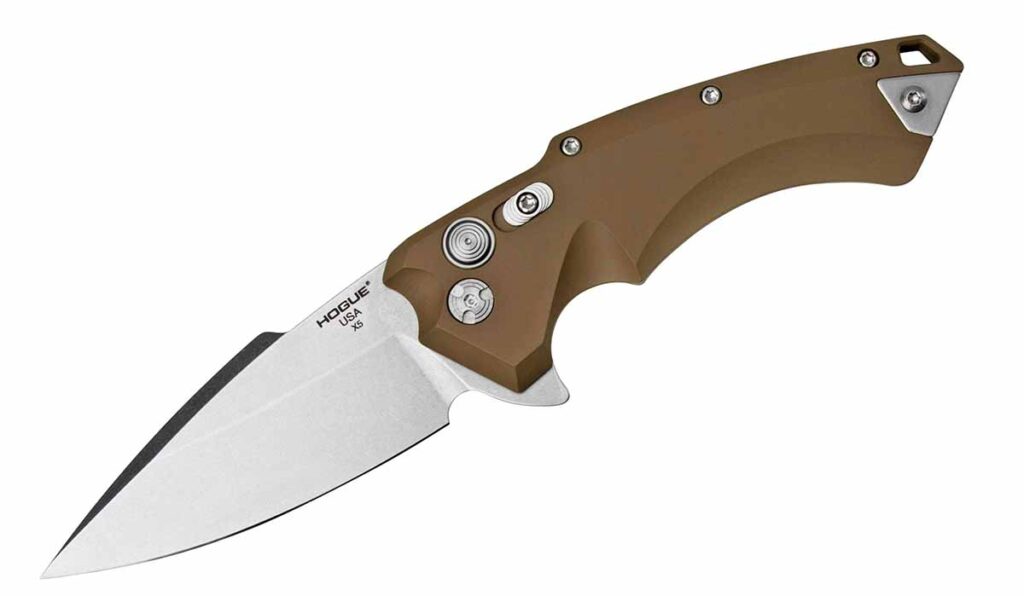
Coming in either a modified Wharncliffe or spear point blade style, the Hogue X5 is a cool, sexy knife. The flipper deploys the blade so fast you would think it is assisted, but it is a manual knife. The Cerakote finish on the blade looks great, and the aluminum handle can stand up to pretty much anything. The push-button lock lets you easily, and safely, close the knife one-handed, and the tip-up pocket clip allows for a deep, discrete carry.
Everything about this knife is cool and begging to be used. Hogue has made a tactical folder that is built well and is somehow even better than the sum of its parts.
The Dirk Has A Long, Exciting History And Has Been Used For Everything From Farming To War All Around The World.
The general definition of a dirk is that of a one-handed thrusting knife. Depending on region and style, it may be single-edged or double-edged. It also may or may not have a defined cross guard and pommel.
Dirk as a term is loosely associated with several Scottish and English regions. It is most commonly credited to the former, though no one really knows for sure, and it also has a long history of use across medieval Europe. It was a very important object to people in the Highlands of Scotland at an individual level and had significant ceremonial and practical uses.
Weapons Before The Dirk
As is common in the era of gunpowder in Europe, many types of knives and daggers owed their roots to the bollocks dagger and other stabbing weapons that originated hundreds of years prior when soldiers wore heavy armor. Contrary to popular belief, most swords are not like how you see in the movies. These stabbing and thrusting weapons seldom had what we’d expect as edges, rather they were made to parry and bludgeon. Maces, picks, and hammers were very common in this time, prized for their ability to bash and smash, where swords, while deadly, were not always the first choice.
These long, thin daggers were sometimes the choice when things got up close and personal, though even then the textile layers of armor were hard to penetrate. All that changed with gunpowder weapons causing a wide decline in armor use, and the dirk as we know it today was the product of that evolution. The dirk became something quite different than other edged weapons of the time and developed in its own way, largely apart from other European designs.
The Scottish were some of the first to begin independent development of swords and daggers alongside guns in the post-armor age along with strategies to fight against firearm-equipped soldiers. The heavily tribal Scottish Highlands were not especially invested in standardized firearm technology.
Guns did figure heavily into the culture, but the Scottish never developed a well-oiled machine akin to what the British developed when it came to battles. The Scottish had two primary tools for the battlefield, the broadsword and the targe (buckler), itself a small shield held in the weak hand. The combination of buckler and broadsword allowed the Highlander to easily kill British soldiers, usually armed with nothing more than a musket and bayonet.
They specialized in fast ambushes, often called a ‘Highland Charge’ where they wore virtually no protection of any kind and ran headlong at their enemy. If the enemy didn’t flee on sight, they would only have one shot at most before they had to fight hand-to-hand.
How The Dirk Developed
The dirk traces its lineage to the Scottish Highlands.
The dirks developed in the post-armor era became focused on all-purpose use, not just stabbing or bludgeoning. As a result, sharp, light-bladed swords and short-sword like knives and daggers became the norm.
Slashing through clothing wasn’t difficult and the Highlanders found themselves at a distinct advantage using these tactics. That is, until the Battle of Culloden in 1746.
Here the entirety of the Highlander army was soundly defeated by the British in a battle that lasted an hour. The British faced them on an open field and modified their tactics to anticipate the Highland Charge, resulting in a complete defeat of the Scottish Jacobite movement that had made an invasion into England a year earlier.
Dirks were common even after Culloden. The carrying of knives wasn’t necessarily seen as carrying arms in most cases, and dirks were something of a common, everyday tool for most people. They would be not only used for self-defense but also for regular tasks like eating, splitting kindling, and standard daily chores.
Dirks vs Daggers
Is the dirk a dagger? The short answer is yes and no, and that is because there is a great degree of ambiguity in the definition. A dirk is classically a large, single-bladed knife with a blade anywhere from 12 inches all the way up to 20 inches.
Naval dirks were commonly used for ship-to-ship fighting as they were short enough to be used in tight confines yet large enough to still be effective. Daggers at this time would have been primarily understood to be stabbing weapons, whereas the dirk was large enough and stout enough to be used in a primary slashing role.
Daggers are, by type, geared mostly for stabbing. Rarely do companies refer to any large, single-edged knives as ‘daggers’, but the dirk is often classified right alongside them by name in many laws.
The American dirk which evolved in the early 1700s, was almost always single-edged and was primarily used as a support knife alongside the tomahawk and rifle. It could be said that a significant and wide-ranging number of knife styles, including the Bowie, evolved directly from the Scottish dirk on the American frontier.
Daggers as stabbing knives were somewhat uncommon in America because they lacked general utility in the field at a time when larger camp knives and multi-purpose tools saved weight.
Is It Legal To Own A Dirk?
Unfortunately, Dirks have a wide legal definition across the board that often describes them as daggers or stabbing weapons. In many municipalities, this type of weapon is not legal to carry. There is a blurred line in this definition, as many places considered double-edge, stabbing weapons as the verboten item. As many historical dirks are single-edged, there could be room in these laws that skirts one definition or another.
4 Best Dirks Available Today
COLD STEEL SCOTTISH DIRK- $119.99
Cold Steel is well known for making some very durable and interesting products. They pay great attention to detail and their Scottish Dirk is no different. While it is not the most costly, it is a step above the rest, and it is affordable and backed by Cold Steel’s legendary standard of excellence. The Cold Steel Scottish Dirk is a working tool that does everything the historical versions did and then some. If you’re looking for a hard-use dirk, look no further.
Knife Specs
Overall Length: 18.38 inches
Blade Length: 13 inches
Weight: 1 pound
Blade Steel: 1055 Carbon
Handle Material: Rosewood
WINDLASS BONNIE SCOTTISH DIRK- $149.00
If you’re looking for a prettier dirk than the rest, Windlass makes some excellent historical replicas that reflect various periods of Scottish history. The Bonnie Scottish Dirk is reminiscent of the late stage of refinement on these weapons. It is ornate yet functional and is sure to be a conversation starter. While other companies tend to take some liberties, this is a very accurate replica of what may have been on the belts of Highland Warriors at the Battle of Culloden.
Knife Specs
Overall Length: 17.5 inches
Blade Length: 11.75 inches
Weight: 18 ounces
Blade Steel: 1055 Carbon Steel
Handle Material: Wood
WINDLASS EARLY SCOTTISH DIRK- $139.95
This product is a replica of some early dirks as they would have looked descending from the bullock dagger. A functional reproduction, this early replica features a more basic feature set as would’ve been seen a few hundred years prior to the Battle of Culloden. Although it has unrefined features, it is still not out of place for costuming or period reenacting.
Knife Specs
Overall Length: 21.25 inches
Blade Length: 15 inches
Weight: 16.2 ounces
Blade Steel: 1055 Carbon Steel
Handle Material: Hardwood
CAS IBERIA (LEGACY ARMS) SCOTTISH DIRK- $159.00
This dirk has some classic lines, but is all about function. It will not look odd at a cultural event, although it is made with a slight skew to the modern. The handle design is reminiscent not of the bullock dagger, but the earlier Rondel form characteristic of the late medieval era prior to the renaissance. While it is the most expensive so far on the list, it is right in the same price range as most common dirks. If you prefer this look over the more classic Scottish design, this is the one for you.
Push daggers are experiencing something of a renaissance in the knife world these days, as more and more people are coming to realize their value as a self-defense tool. More and more makers are releasing push daggers, and I for one couldn’t be happier.
To celebrate this resurgence of the push dagger, and as a bit of an aficionado of the genre, I thought this was as good a time as any to take a look at the push dagger in depth.
We’re going to start with some background on the push dagger, including its history, how to use it, why to use (and perhaps why not), some legal issues surrounding them, and finally we’re going to take a look at the best push daggers on the market today.
The push dagger, at least as we know it, originated in the early 1800s in the United States. At a time when small pocket pistols like the derringer weren’t yet reliably available, many people wanted a discrete, concealable weapon with which to defend themselves.
The push dagger arose to fill that niche, along with other concealable force multipliers like brass knuckles. They became especially popular with gamblers and other folks in places like New Orleans, Savannah, and other busy ports.
It also became popular with politicians and others who wanted to stay armed, without openly carrying a weapon. In turn, push daggers weren’t an uncommon thing to carry in various state houses, particularly throughout the South.
In New Orleans in particular, the “gimlet knife,” as the local version of the push dagger was known, became so popular and was used in so many different riots, brawls, and back-alley muggings, it eventually was banned in the city in 1879.
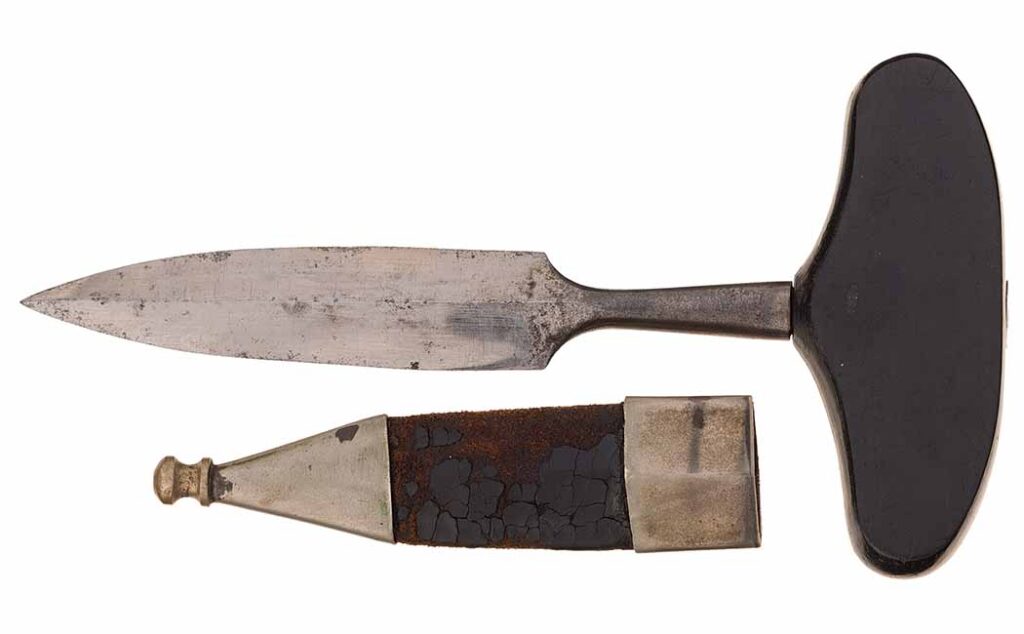
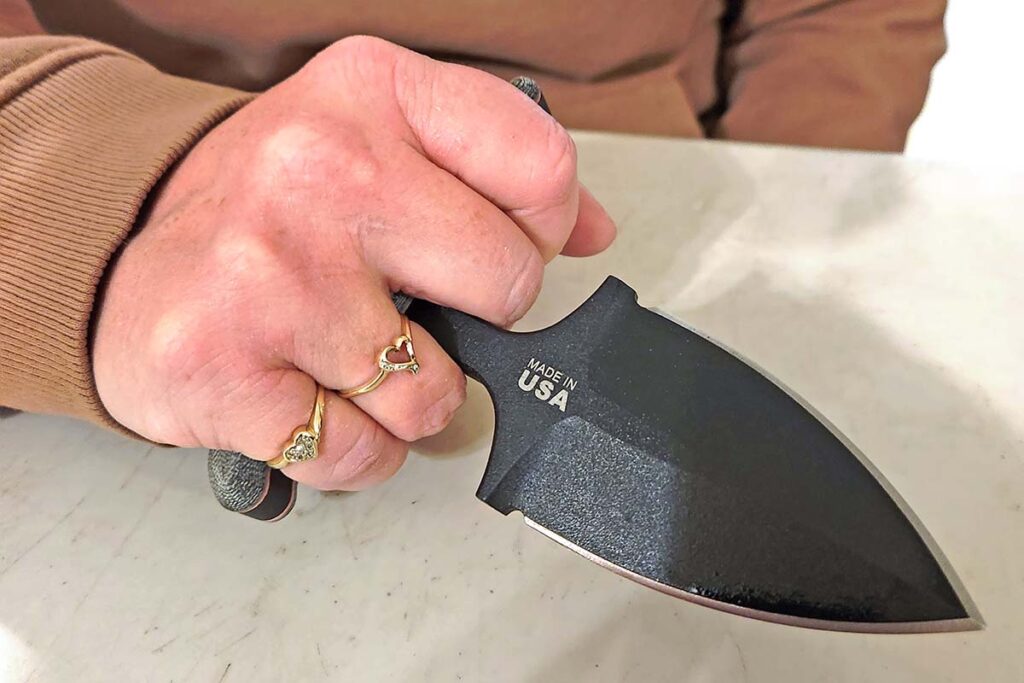
This version of the knife would live on and become the most popular variation of the push dagger. Its simply a T-handle gripped with a closed fist, featuring a tang that extends between the middle and ring fingers to form a short blade, usually 2-3 inches in length at most.
Abroad, sailors and other travelers brought the push knife to Germany, where local cutlers immediately took to it, and the faustmesser or “fist-knife” began to spread to other European countries, particularly England, France, and Spain.
Wartime Use
By the time of World War I, push-daggers of many different designs became a backup weapon for soldiers fighting in trenches on both sides as pistols were often in short supply. Everything—from straightened and braided wire to bent nails—was used to improvise punch dagger-style knives. Manufactured options were available as well.
Throughout World War II, the push-dagger became the domain of the special forces, particularly the British SAS and SOE infiltration forces who needed a very effective and concealable defensive tool (or assassination weapon).
It was also employed by French resistance forces who were not allowed weapons by occupying German forces.
Later, push daggers saw another surge in popularity during the 1980s when several US manufacturers started producing them again as tactical or self-defense weapons. That’s a trend continuing to this day.
Using a Push Dagger Correctly (and Safely)
A push dagger is fairly easy to use, though a bit limiting in some ways compared to other more traditional knives. It only has one practical use (defense) so we’ll look at it in that context. This is not the style of knife to pick up for, say, bushcrafting or folk art carving.
It can open packages, which is all most of us use our knives for anyway, but beyond that, this is a tool that’s always been designed to keep the wielder safe.
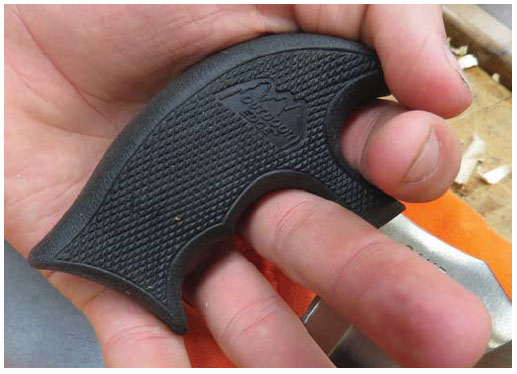
Towards that end, using it is relatively instinctive. Simply wrap your fingers around the (usually) T-shaped grip, and close your hand with the tang of the blade extending between your middle and ring fingers.
From here, you can punch more or less as you normally would, albeit with an immense amount of additional damage-dealing potential.
Off-Hand Comments
One thing not so intuitive is you will typically put the knife on your non-dominant hand. This is typically going to be your more forward hand in a fighting stance and will save your dominant hand for grabbing your opponent’s body or interacting with your environment.
Most people naturally want to wield the knife in their dominant hand, but that’s less than optimal if you ever have to use it in a true self-defense situation.
Your non-dominant hand isn’t going to be as strong or dexterous as your dominant one, but you’re not writing a letter or opening a jar…you’re throwing a punch. And while an off-hand jab isn’t the most powerful blow, when you have a knife extending over your knuckles, it doesn’t need to be.
Pros and Cons of the Push Dagger
These days, push daggers are still used as a very concealable self-defense tool. They’re fairly intuitive because most everyone has a basic idea of how to throw a punch. Those with any martial arts experience are likely to find them comfortable and familiar to use instinctively.
The predominant variety these days is the New Orleans-style version with the T-shaped handle, but some others do exist. Whichever variety you go with, know you aren’t going to be doing a whole lot of slashing.
These are tools meant for piercing and stabbing, so some traditional knife fighting techniques aren’t going to translate here. Experienced Kali/Escrima practitioners will likely not have any problems at the end of the day, but the knife just isn’t optimized for cutting blows.
Legality of the Push Dagger: Perhaps the Biggest Con
First, let me say none of this is legal advice. I’m not a lawyer, I’m just some guy on the internet who likes knives. Everything here is just what I’ve come to understand from my own research and is subject to be wrong.
Do your research about where you live and plan to own or carry a push knife and ask a licensed attorney.
Bans and Restrictions on Push Daggers
Now, while push knives aren’t outright banned in most states, several do have restrictions on “daggers” and knives designed to cause harm to another person without an obvious other purpose like a hunting knife.
Most push knives have a blade length of less than 3 inches, and many are single-edged so they don’t meet the “dagger” definition in states where this is part of the definition of a dagger. Also, many states have laws about carrying a knife with “intent to harm,” but that applies to any knife.
The things to look out for are the differences in what your state allows you to own versus what you can carry. If you just want to own a push knife as a collector piece, you’re going to have a much easier time than if you want to carry one.
That said, many states have weapons carry licenses/concealed carry permits that not only allow you to carry a firearm, but also a knife, such as a push dagger.
In general, all we can say is to check your state and local laws and make sure you’re not going to violate them by owning or carrying a push knife. Few states flat out say they’re illegal to own, but many have limits on carrying them, especially concealed.
When to Take Special Care
I would advise special caution to anyone living in the following states: California, Connecticut, Hawaii, Iowa, Kentucky, Maine, Maryland, Massachusetts, Michigan, Mississippi, Montana, Nevada, New Jersey, New York, North Dakota, Oklahoma, Pennsylvania, Rhode Island, Virginia, Washington, and West Virginia.
All of these states have some restrictions on what knives you can carry, some have restrictions on ownership in general, and many mention “daggers” without really defining what they consider a dagger.
As always, do your research and cover your backside. Don’t rely on anyone else to do it for you. Other states may have laws I don’t know about or didn’t find information on, and your local city government may have ordinances as well.
Best Push Daggers on the Market Today
Today, we have a huge number of great push daggers on the market, which is both a good and bad thing. On the one hand, we have more choices than ever, which means there’s something out there to fit every need
On the other hand…we have more choices than ever, which can make it hard to choose.
Let’s take a look at the best options on the market today, and narrow the field a bit while also highlighting the best of the best in the world of push knives.
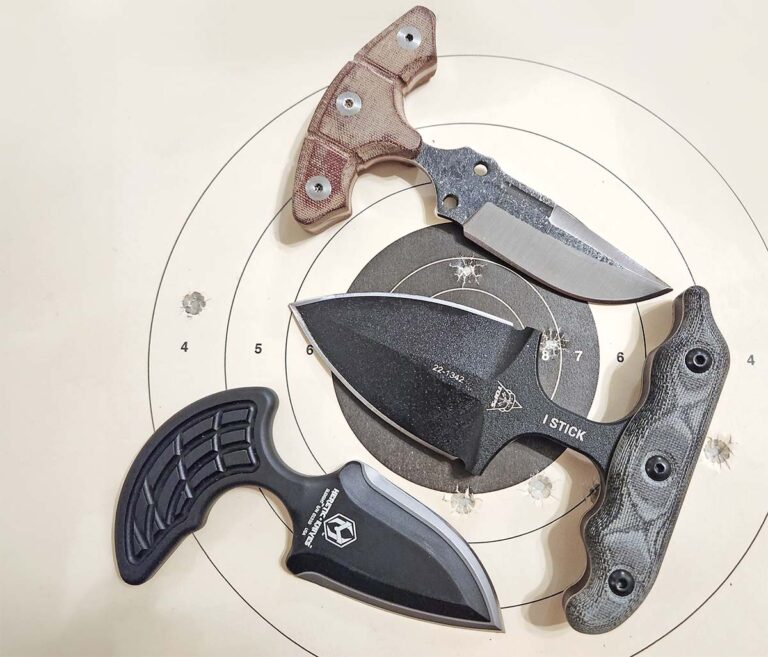
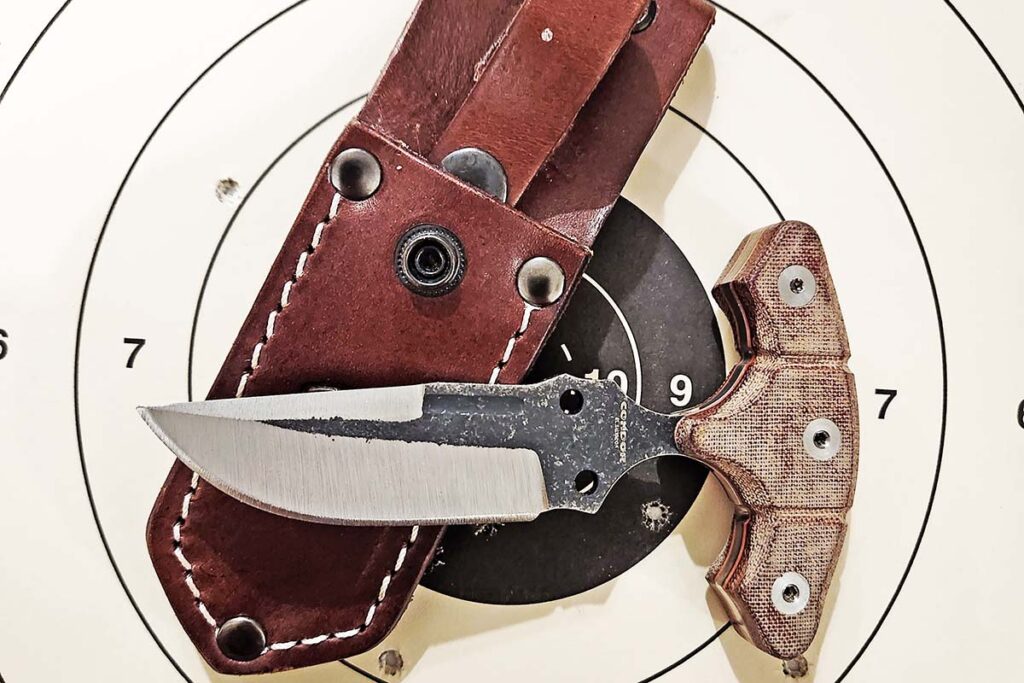
Right off the bat I must say I like the blade of the Tactical P.A.S.S. from Condor Tool & Knife because it departs from the traditional symmetrical dagger design. It pays often enough to try something different, and here it works. The hammer-finished look along with the clip point and false grind give it a rustic appearance. Condor also offers a fixed blade called the Tactical P.A.S.S. with the exact same blade pattern.
Now to talk about a practical bonus of the design. In some states double-edged blades are illegal. Condor’s false edge would allow you to carry the push dagger in such states and stay on the safe side of the law.
The handle size seems just right for my large, meaty hand. In most knives I look for that contoured fit. Due to the fact I want any resistance encountered by this blade absorbed by my palm and wrist, I want the handle to have a broad radius. The P.A.S.S. is in that Goldilocks position.
If I had to give any negative feedback, and I do when I find something wrong, it would be the leather sheath. Oddly enough, it is constructed very well. There are minor issues with the fit and finish but overall it is a sturdy, good-looking build.
My issue is with the design. Condor includes a full belt loop but I find that gets in the way when trying to make a smooth, full, fast purchase. For knives used for self-defense that is what you want—a solid grip and you want it fast. A horizontal and vertical carry patch is on the sheath’s back but will accommodate MOLLE-sized straps only. I know it might seem picky but keep in mind this is a push dagger, and the same rules apply for it as a pistol draw. I think the set-up would be taken to another level if the carrying system was mounted to the back of the sheath only and was large enough to accommodate regular-size belts. Such a change would leave the handle free and open to a quick, secure grasp.
Does the sheath make the knife a bad value? No, most people are either satisfied with the sheath or they aren’t. As a result, your decision to buy a P.A.S.S. might factor in an aftermarket sheath. The knife is still spot on.
Heretic Knives Sleight
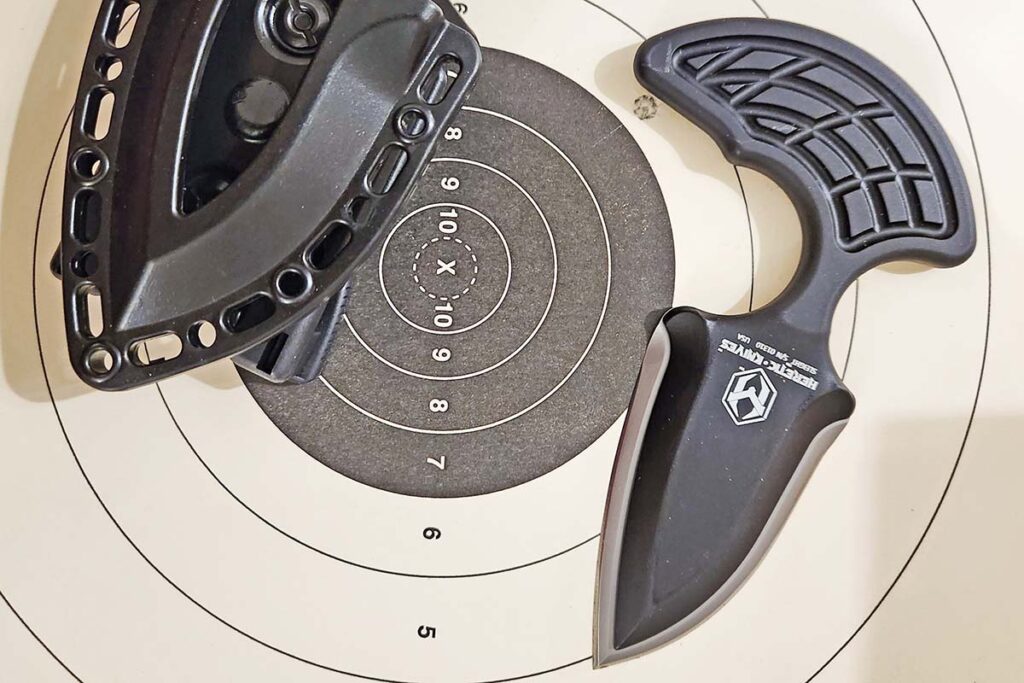
The Sleight from Heretic Knives is a sleek little design. Of the test group it’s the most compact and concealable. The blade is part of an aluminum body with a thin CPM 20CV layer mechanically fastened with screws to it to produce an edge. Such a design gives you the cutting power of a heavier metal while reducing weight. The aluminum body has an asymmetrical, CNC-textured handle. Heretic uses more of a pistol-grip design, enabling you to palm it quickly and have accurate control over the tip.
The Sleight is a great-looking piece of kit. Heretic even gets creative with the sheath, carrying through on the theme of decorative but lightweight. It has a Blade-Tech belt clip on the back for vertical carry.
The small design makes it easier to use for certain cutting chores without drawing too much attention. On the other hand, smaller knives lack the effectiveness of larger ones in self-defense situations.
One thing that bothered me is how difficult it is to draw the knife from the sheath. The first time I did it I thought I was going to have to follow up with a visit to my chiropractor. (OK, an exaggeration, but I must have at least one overstatement per story.) It was and still is difficult to draw and definitely not on the smooth side. Moreover, if you’re trying to pull it out of the sheath in a stealthy manner there is a loud click upon drawing. Perhaps over time it will break in as I sit fidgeting with it while watch Kung Fu reruns.
The Sleight is well made and well designed. It will make a good EDC blade once the sheath is broken in.
TOPS Knives I Stick
Of the test push daggers, the I Stick by TOPS Knives has to be the largest. According to TOPS, the I Stick weighs 12.6 ounces. When using a knife such as this, size can count—especially in the blade length. At this weight, though, you’d better be prepared for a long day. On its own the weight might not be that much, but when you start adding on your other everyday carry gear it gets burdensome. I am not normally one to point out the weight of a knife, but when they get this heavy you start to notice.
The blade is .38 inch at the thickest. You won’t have to worry about this knife breaking. Scales are black and green Micarta®. I do find the handle a bit big for my hand. The size does allow for a quick, solid grip, though. TOPS structures the handle to be asymmetrical so you can get a full thumb wrap around it. Being able to completely close your fist around the handle makes a world of difference in grip strength. The molded Kydex sheath has belt loops for vertical carry. Before carrying the I Stick, I recommend you practice drawing it from the sheath, as the sheath needs breaking in.
Overall, it is a good knife and has a respectable edge out of the box. Seeing as how it’s on the large side, the decision to purchase it would be something you would need to think over. A knife of this nature is no good if you don’t have program compliance and carry it. If you are not used to carrying a lot of weight, before buying it try carrying around something of comparable size and weight. As far as value, the I Stick is built like a tank. I am sure it will outlast us all and be handed down to future generations.
TOPS Knives Grim Ripper
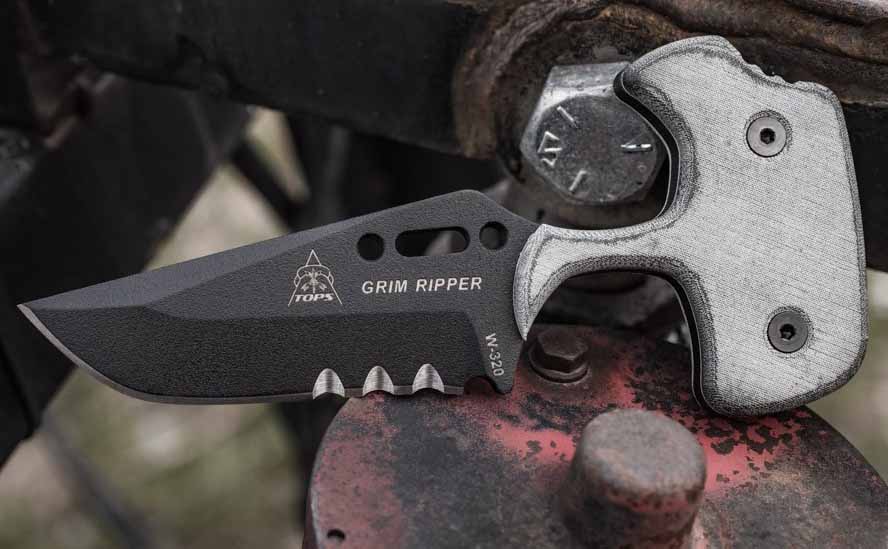
If you want a slightly more utility-focused knife, the TOPS Knives Grim Ripper might be up your alley. It features a shorter two-finger grip that is shaped to lock into your hand. It feels just as secure when wielding, but is less likely to dig into your side or what have you when carrying it.
It features a single-edge blade designed with some wavy semi-serrations ahead of the sharpening choil designed to quickly slice through webbing or ropes in the event of an emergency.
The handle is a very nice gray micarta that won’t get slick if held with wet hands. I felt very secure wielding the Grim Ripper in a variety of light camp tasks and it was easy to slice boxes as well, thanks to the well-designed handle.
The blade is a 3.75-inch long tanto-shaped affair made out of 1095 high-carbon steel for great edge retention and sharpness.
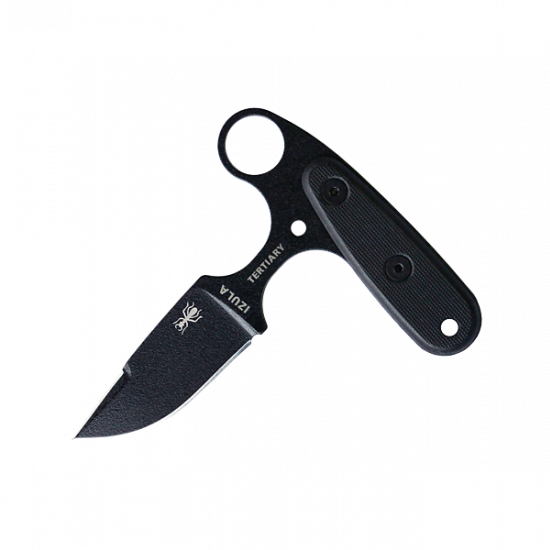
Esee Izula Tertiary
The Esee Izula is a wildly-popular small fixed blade that’s good for everything from opening a reluctant Amazon box to whittling by the fire. But the Tertiary version is geared strongly towards defense with its T-shaped handle and perpendicular blade.
“Izula” is the local Peruvian word for the bullet ant, one of the fiercest insects on the planet and the one with the most painful sting. I’d say Esee named its knife appropriately.
It is very compact and concealable, but easy to draw quickly when you need it. The grip allows for you to easily hold the stem between your first and second or second and third fingers, depending on your preferences, and is comfortable and secure in the hand.
The 2.625-inch blade is made out of 1095 steel and features a clip point so it is more acceptable in those places that might take issue with someone concealing a double-edged blade.
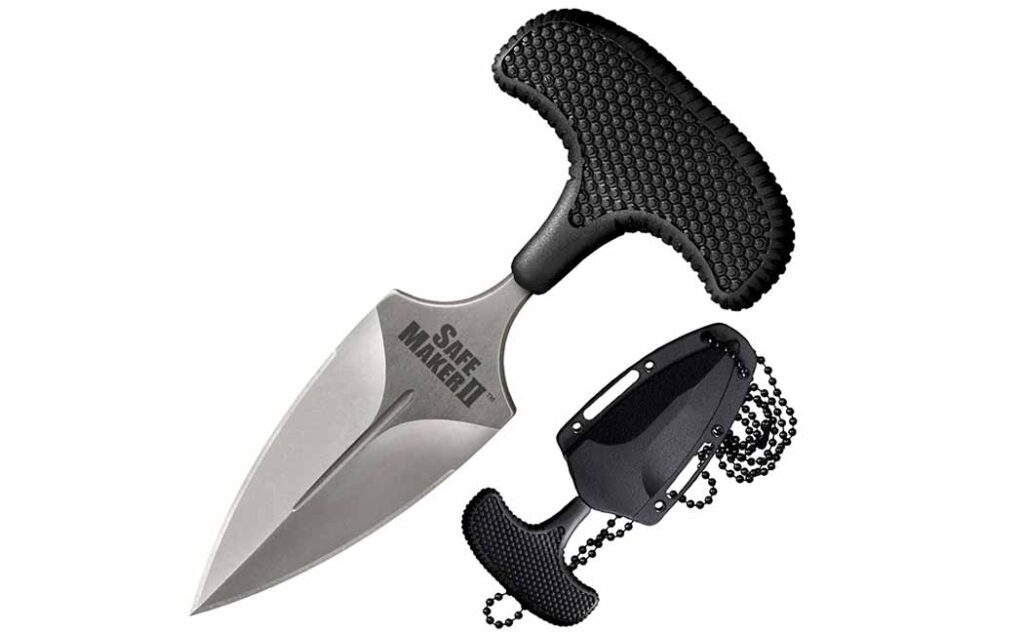
Cold Steel Safemaker II
The Cold Steel Safemaker is, in my opinion, one of the knives that’s most true to the origins of the push dagger or push knife. It’s cheap, easy to conceal, and it’ll put a hole in an attacker. For those looking for an affordable and discrete means of protection, it’s difficult to argue against it.
Is the AUS-A8 steel the best? No. Does it have the best handle? No. Does it do what you need it to and will it hold up well in a self-defense situation? Absolutely.
Remember, this isn’t meant to be your EDC knife you blunt the edge on by opening boxes and slicing through tape all day…its meant for self-defense. To that end, if you do ever use it, it probably only really needs to be sharp once.
I’m all about lowering the barrier of entry to self-defense. I think too much emphasis is sometimes put on high-speed, low-drag designs made with the highest-quality materials out there and sometimes that distracts from the fact you don’t need any of those features most of the time.
I say that as someone who carries a $400 knife as my main EDC. I get it. But I also recognize the fact knives can be expensive for folks who have other priorities and other things they need to spend money on. That shouldn’t keep them from being able to defend themselves though.
The last I’ll say about it is a little anecdote that has stuck with me.
I had a friend tell me a story about a fellow Marine who chuckled during a briefing at the idea of facing a likely enemy armed with decades-old AKs. The unfortunate Marine’s Sergeant then sharply reminded him “Cain got the job done with a rock.”
That’s something I like to keep in mind when talking about weapons. Sometimes, you don’t need the best materials. Sometimes, you just need something to get the job done. And the Safemaker and the smaller Safemaker II will get the job done.
The Safemaker II has a 3.5-inch blade made out of very budget-friendly AUS-A8 steel.
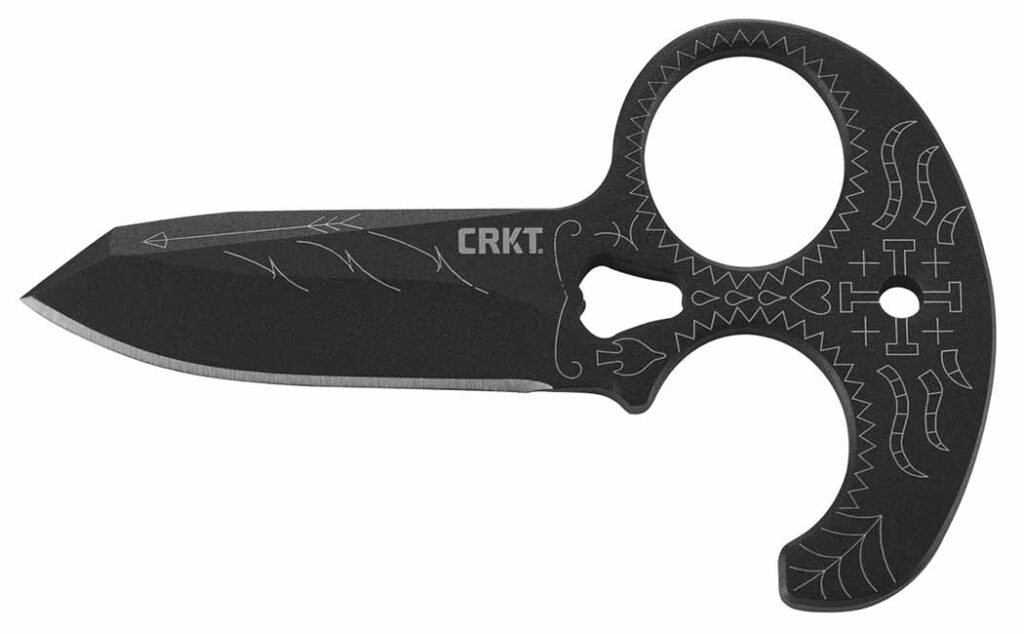
CRKT Tecpatl
The Tecpatl by CRKT is a modern take on the push dagger designed by Army Special Forces veteran Michael R. Rodrigues as part of CRKT’s high-end Forged By War line of knives designed by or in collaboration with combat veterans.
Mr. Rodrigues is a bladesmith himself, and brought years of front-line experience to his version of the push dagger. It features an upswept Warncliffe profile making it fairly effective at utility tasks in a pinch, but it’s clear this is a knife meant to do damage to an attacker.
The handle is ergonomically shaped to give you a few different grip options depending on your preferences and what you’re doing with the knife, and I found it to be very comfortable and secure no matter what I was doing with it.
The 3.375-inch hollow-ground blade is made of Japanese SK5 carbon steel.
GTI Push Knife
Gingrich Tactical Innovations has (somewhat predictably, if you know anything about Justin Gingrich and his style) turned their attention to the push knife. Equally predictably they’ve given us something excellent.
GTI’s take on the push knife features a full tang design incorporating a generous handle to give you a secure grip in difficult conditions, like say, when you’re desperately defending yourself. Always nice to see the practicalities of being in a knife fight take precedence in a defensive knife design.
It also comes with a nice Kydex sheath that, on the one I handled, was one of the better examples of a push knife sheathe I’d seen. It covers everything but the oversized handle to protect the steel from moisture, but still allows the knife to slip free easily when you need it.
That big chunky handle is covered in excellent non-slip Micarta scales and tapers down to a sensible 2.6-inch blade made out of D2 steel.
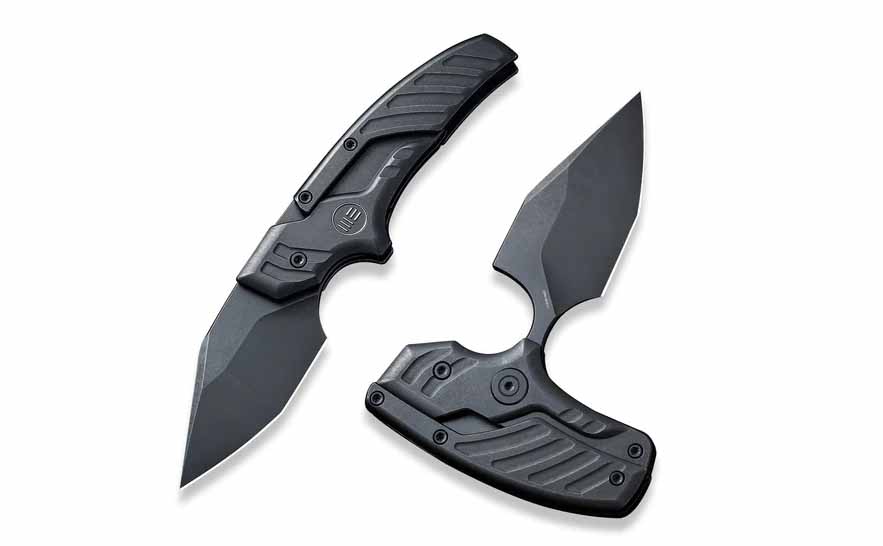
WE Knives Typhoeus
Lastly, we have the most unique knife on this list. The WE Knives Typhoeus, which is essentially a push knife that transforms into a more standard fixed-blade knife. But it’s not a fixed blade and it’s not a folder either… it’s confusing, I have to admit.
Even WE Knives seems unsure how to classify the Typhoeus because of the way it works. At its default, holstered state, it’s a fairly standard push knife, with an asymmetrical T-shaped handle that is very comfortable to grip.
But you can then push the knife blade up and have it snap forward parallel to the handle, giving you a more traditionally shaped knife you can use for everyday knife tasks.
It is available in three different finishes and uses an excellent CPM-20CV steel in the 2.27-inch blade.
Editor’s Note: Matt Collins and Abe Elias contributed to this article.
These tactical fixed blade knives are set to conquer the most extreme tasks.
When the Gulf War took off in Iraq in the early 1990s, the knife industry took off, too, and a steady stream of tactical fixed blades has surfed the wave ever since.
Needless to say, there are military fixed blades aplenty in the cutlery industry with no single design or manufacturer having a chokehold on today’s market. This has given knife users an abundance of choices, from pure fighters to utility users and everything in between.
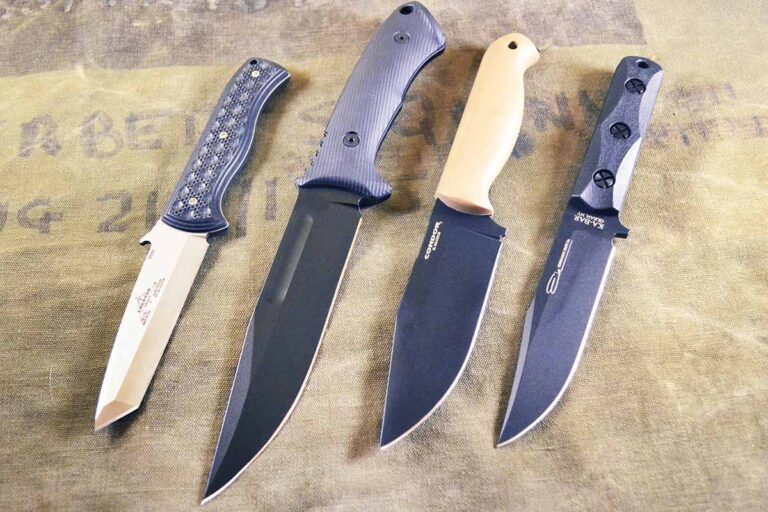
A diverse quartet of the genre includes the Condor Fighter Knife, Emerson CQC-7 Fixed Blade, KA-BAR/John Ek Commando Short Clip and Spartan Blades Harsey Fighter. To determine their strengths and weaknesses, the first order of business was a common test for penetration.
Testing
I set up a heavy-duty corrugated-board box with a 1-inch Styrofoam™ liner made for shipping frozen foods. I tested each knife by thrusting the blade into the side of the box forcefully, and then pushing it through from a standstill with the tip resting on the box. All the knives penetrated the thick, layered material with ease—not surprising considering they have either clip-point or tanto blade patterns, both adept at stabbing. There was very little differential from one model to the next. What follows is a look at each knife and how it performed other chores.
Condor Tool & Knife Fighter Knife
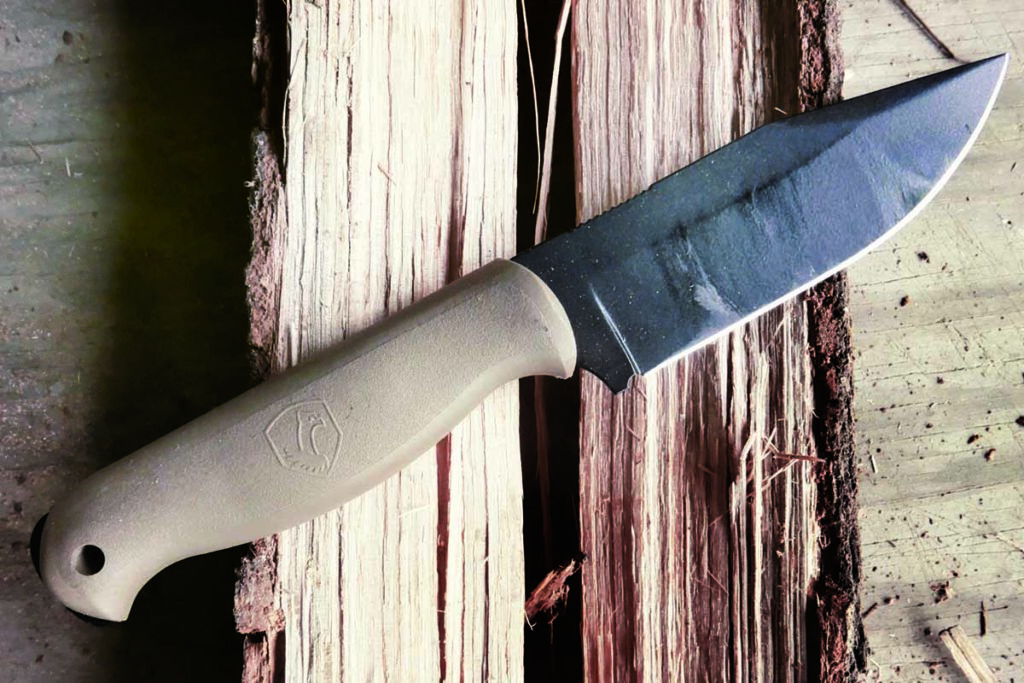
The author took the Condor to task batonning a length of seasoned hardwood with good effect. According to him, “This is one versatile knife that even a bushcrafter would love.”
Condor Tool & Knife specializes in bang-for-the-buck blades and the Fighter Knife is no exception. Indeed, it is the most affordable of the test group. From the side the knife appears to be pudgy but it is actually quite nimble. The clip-point blade has jimping on the rear of the spine for enhanced purchase on detail cuts.
The tan handle is hidden tang in construction with a fine stippled surface texture, an ample palm swell in the middle and a lanyard loop. The exposed steel at the butt can be used for hammering. The sheath is MOLLE compatible, injection molded and features a black leather drop loop.
The knife easily switches from combat to field chores—not surprising as the company specializes in both. The wider blade is similar to that of many field knives, as is its deep grind. Slicing 3/8-inch rappelling rope and taking curls for firestarter were a breeze. I set the blade across the end of a 15-inch piece of tough seasoned hardwood, 25/8 inches across, and drove it clean through. This is a rugged knife. The sheath is relatively unobtrusive and rides about 2 inches above the beltline.
Condor Fighter Knife Specs Blade length: 4.91” Blade material: 1075 carbon steel Blade grind: Flat w/secondary bevel Blade finish: Black Cerakote® Handle length: 4.83” Handle material: Tan polypropylene Weight: 8.82 ozs. Overall length: 9.74” Sheath: Tan polypropylene/leather belt strap Country of origin: El Salvador MSRP: $100
KA-BAR John Ek Commando Short Clip
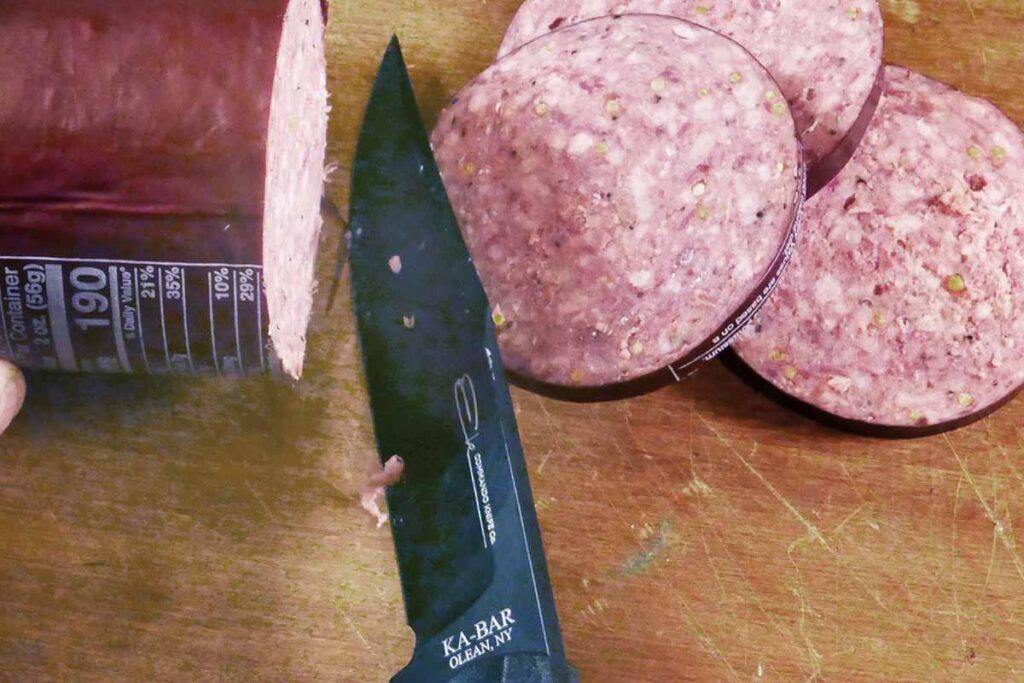
The Commando Short Clip tackled a 2.75-inch-diameter chub of summer sausage admirably. The blade is 5.125 inches of 1095 Cro-Van carbon steel, a time-proven KA-BAR favorite.
The John Ek Commando Short Clip is one in a series of military-type models KA-BAR Knives offers by the cutlery legend. This one is all black and a timeless, no-nonsense John Ek design. The blade is complemented by a 4.125-inch “stick” handle with scales affixed by big, fat screws, an Ek hallmark. The blade clip breaks with a slight harpoon kick, which I’m not sure Ek ever used, though it works wickedly, and there’s a short guard below the blade. The symmetrical handle has a lanyard hole at the butt. All of this is delivered with a modern, MOLLE-compatible sheath.
KA-BAR has done an admirable job picking up the John Ek banner and blending the old with the new. The Commando Short Clip’s narrow blade—1.31 inches wide—proved proficient at slicing. I tested it on paracord, 3/8-inch rappelling rope and a large round of 2.75-inch summer sausage, and it did a masterful job of tackling them all. It is a combat knife at heart and its light weight is not as skillful at tough field chores like hacking wood, but that’s not its department.
The handle is fine for small and medium hands but could be a challenge for those with large ones. The modern sheath is very well done and rides with the butt of the handle just above the waistband. Overall, this modern take on a classic leans toward a combat knife with enough utility to get you by.
KA-BAR/Ek Commando Short Clip Specs Blade length: 5.125” Blade material: 1095 Cro-Van carbon steel Blade grind: Flat Blade finish: Black powder coat Handle length: 4.125” Handle material: Polymer Weight: 10.4 ozs. Overall length: 9.25” Sheath: Black polymer Celcon/MOLLE compatible Country of origin: USA MSRP: $155
Emerson Knives CQC-7
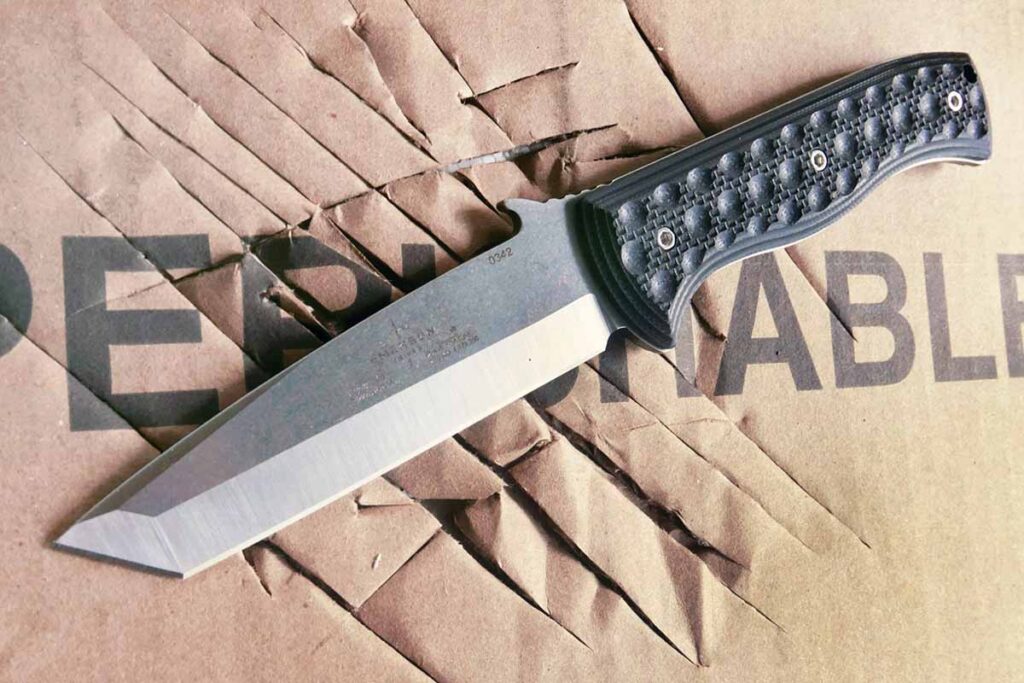
The CQC-7 Fixed Blade has an appetite for slicing and slashing. The 154CM stainless steel tanto blade was extremely sharp and penetrated both layers of the shipping box with controlled slices.
The Emerson Knives CQC-7 Fixed Blade hasn’t gotten a lot of face time because the overwhelming amount of tactical knife coverage of the company is devoted to folders. It’s the way of the world. The Emerson is the shortest of the review subjects and is also the one that tilts more toward being a pure combat knife—something its designer, martial arts specialist/custom knifemaker/cutlery entrepreneur Ernest Emerson, knows a thing or two about. The tanto blade sports a flat V-grind and a stonewashed finish. The blade has three straight grinds: the main edge, tip grind and a clipped saber grind. An Emerson Wave shape on the rear of the blade spine serves as a thumb ramp. The handle has a nice palm swell, a symmetrical dimpled texture for enhanced purchase and a lanyard hole in the butt.
The blade’s 7/16-inch edge grind was delivered wicked sharp and I took it to task slicing one of my favorites, 3/8-inch rappelling rope. The rope is extremely strong because lives depend on it. In one test I pulled the edge through three consecutive cross sections of rope. The drag on the blade was much less than I normally encounter—a pleasant surprise. It slashed the corrugated board outer layer into the Styrofoam effortlessly, and when I slowed the process down with a little more pressure, it dug through the foam as well. The sheath is a study in minimalism, but that’s what you want when concealment is at a premium.
Emerson CQC-7 Fixed Blade Specs Blade length: 4.125” Blade steel: 154CM stainless Blade grind: V-grind Blade finish: Stonewashed Handle length: 4.625” Handle material: Black G-10 composite Weight: 5.86 ozs. Overall length: 8.75” Sheath: Black Kydex® Country of origin: USA MSRP: $237.95
Spartan Blades Harsey Fighter
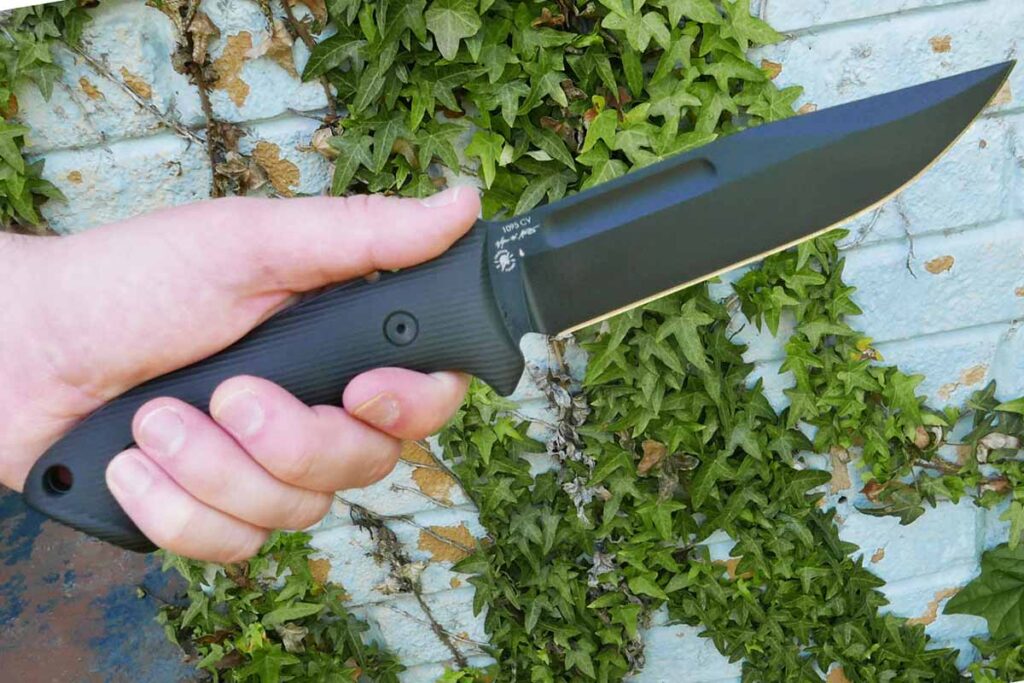
The Harsey Fighter’s ample 5.35-inch handle has black G-10 scales with a ribbed pattern machined into the surface. The flare atop the handle offers excellent finger protection and the grip accommodates the biggest of mitts.
A goodly portion of observers seem to believe the Spartan Blades Harsey Fighter is noted knifemaker Bill Harsey’s consummate work and, though he has a load of nice designs in his stable, I wouldn’t argue. It is the largest of the test knives and a blend of modern styling with traditional cues. It is the Pineland Cutlery version manufactured by KA-BAR under the Spartan label. The clip-point blade has a fuller that butts up against the ricasso. The handle surface boasts a diagonal rib pattern for enhanced grip and an ample lanyard hole at the butt. The sheath has a fabric-fastener drop loop and retention strap. There’s also a swing-out lock at the rear guard that secures the knife in the main body of the sheath.
It’s amazing what a couple of inches in length, a couple of ounces in weight, plus an extra inch in the handle add to the versatility of a knife. That’s on average what the Harsey Fighter has over the other knives tested. This is not a knock on the others, just the advantage of having more knife.
For chopping ability I tested the blade on a thick-skinned cantaloupe. I had to chop the melon off center to clear the handle but the blade made its point in one fell swoop. The extra weight allowed me to tackle tougher chores and the added blade length made for excellent slicing and hacking. You can clear a camp with the Harsey Fighter. The comfortably sculpted handle can accommodate the largest of hands and the upper flare offers good finger protection. The sheath is very well made but the guard lock takes some getting used to and is one added step for a quick draw. All in all, the Harsey Fighter earned its mettle in spades.
Spartan Blades Harsey Fighter Specs Blade length: 6.125” Blade material: 1095 Cro-Van carbon steel Blade grind: Flat Blade finish: Black powder coat Handle length: 5.35” Handle material: Black G-10 composite Weight: 11.5 ozs. Overall length: 11.5” Sheath: Black polymer/nylon belt loop/MOLLE compatible Country of origin: USA MSRP: $195