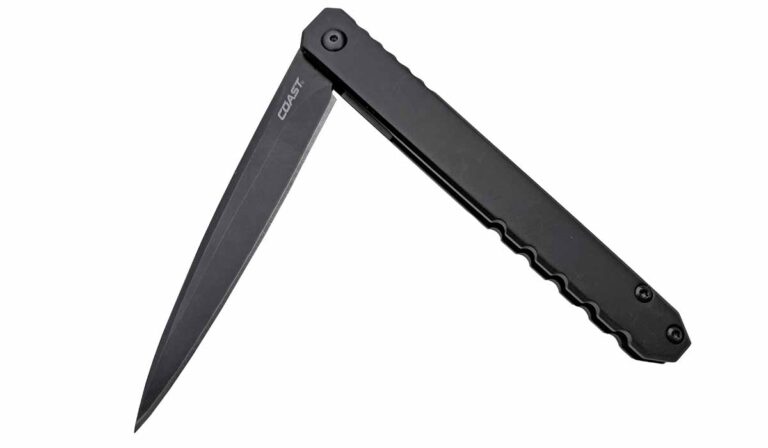
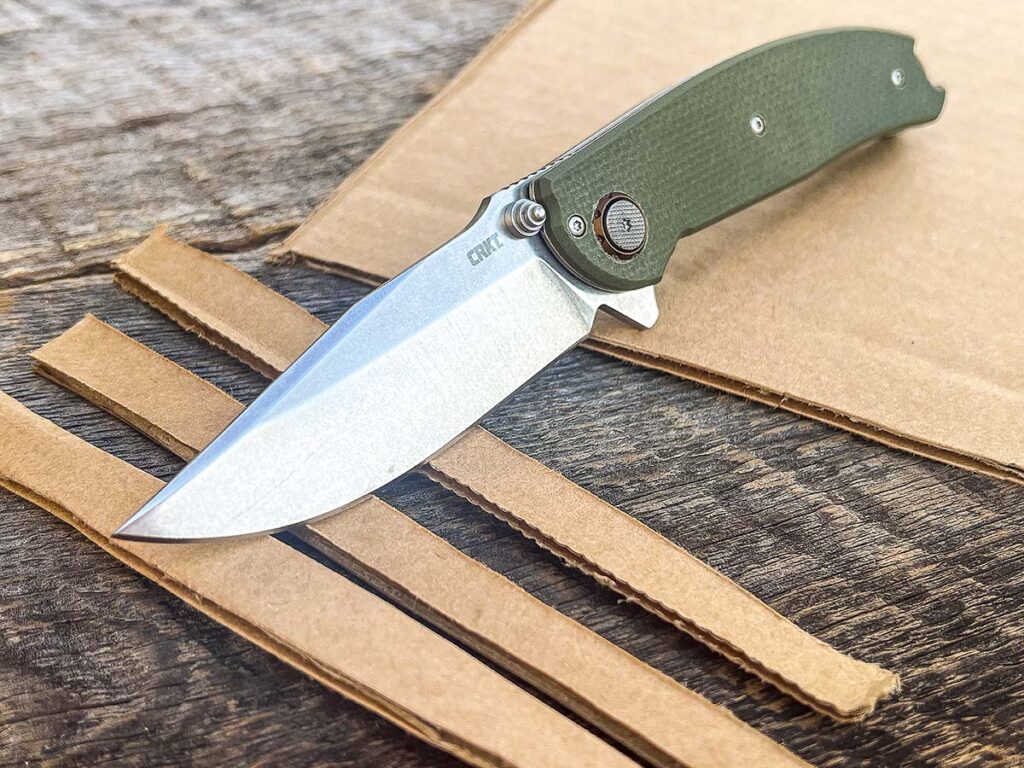
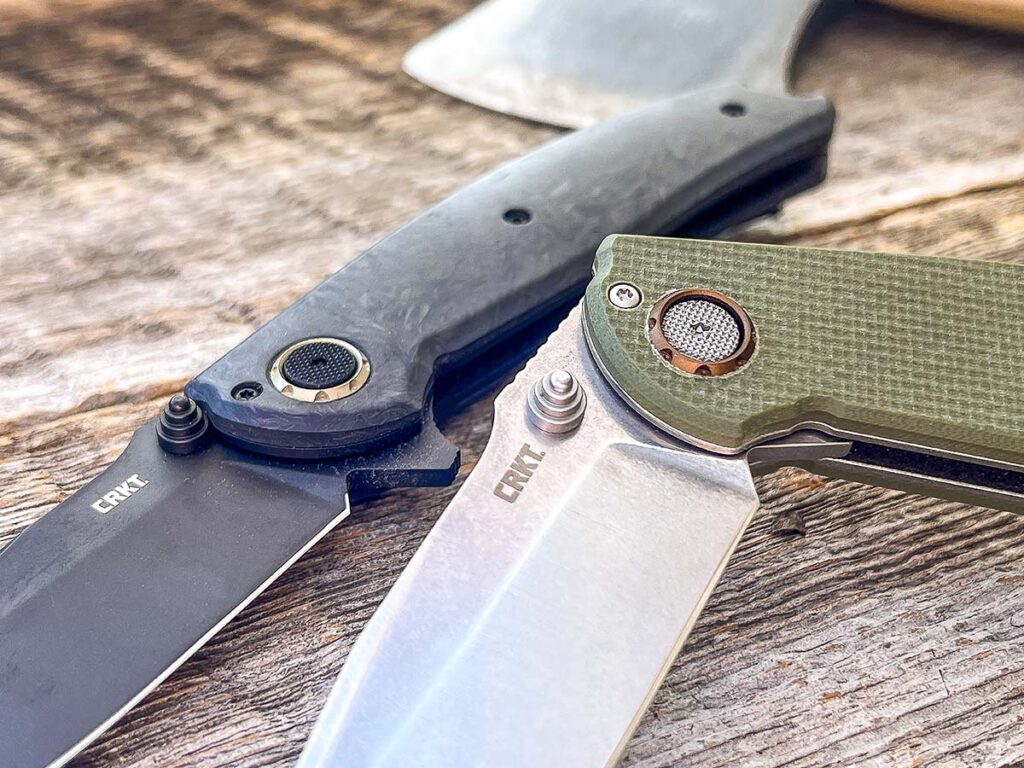
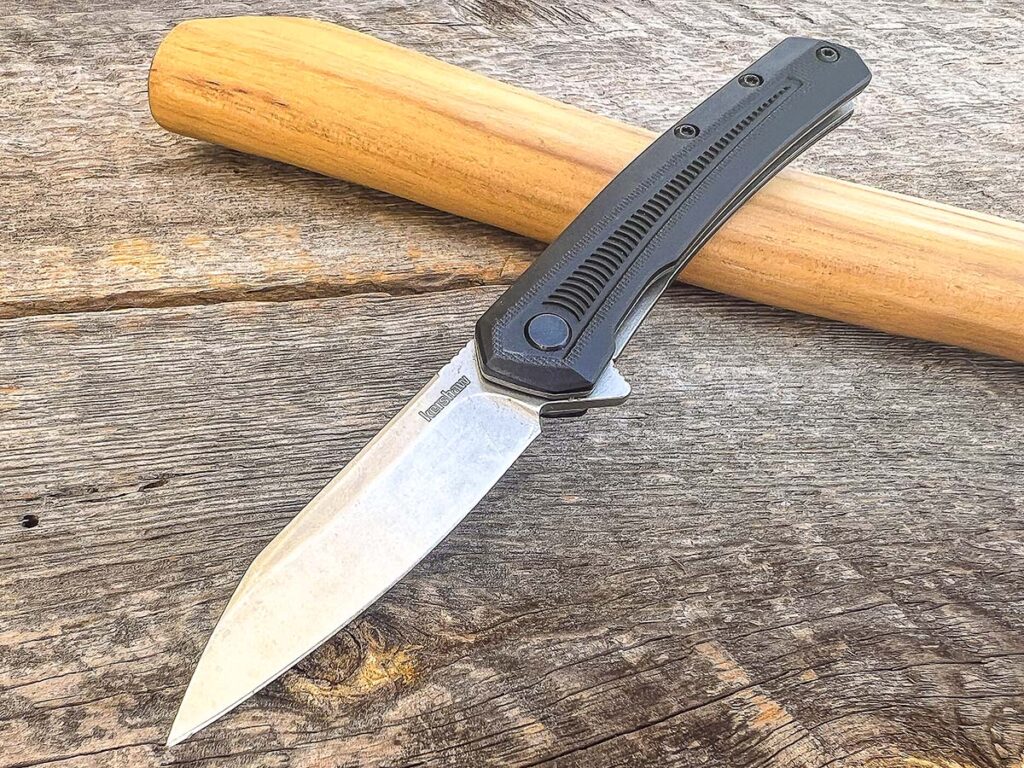
Every now and then I come across a folder that just feels right both in my hand and in my pocket, one that’s not too large nor too small, yet still has that sleek look to it. The Coast LX532 framelock does it all for me. I really love the blade shape. However, it still must be able to slice and dice to get a top place in my book.
Coast LX532 Edge Test
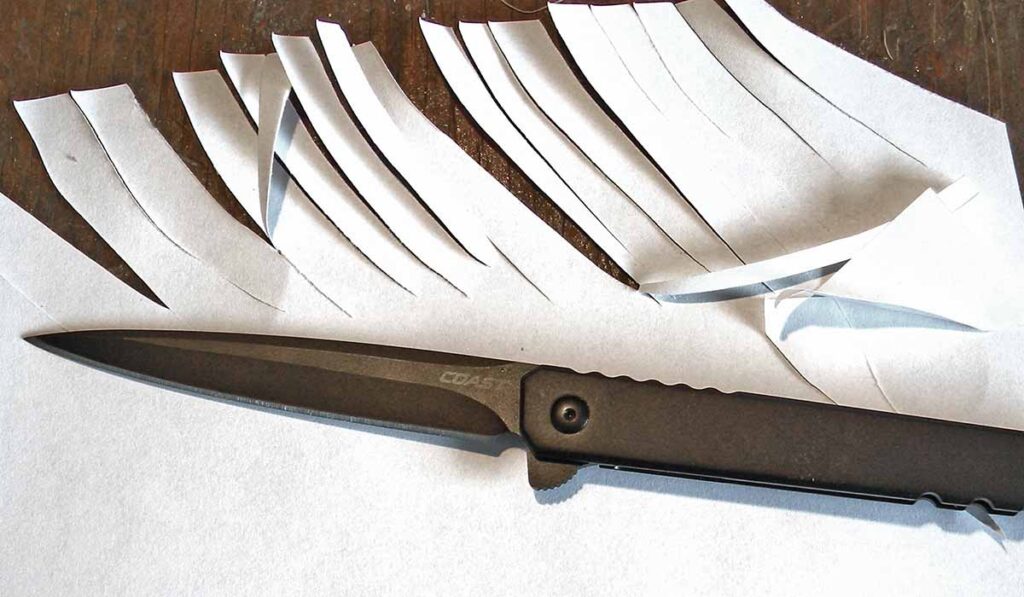
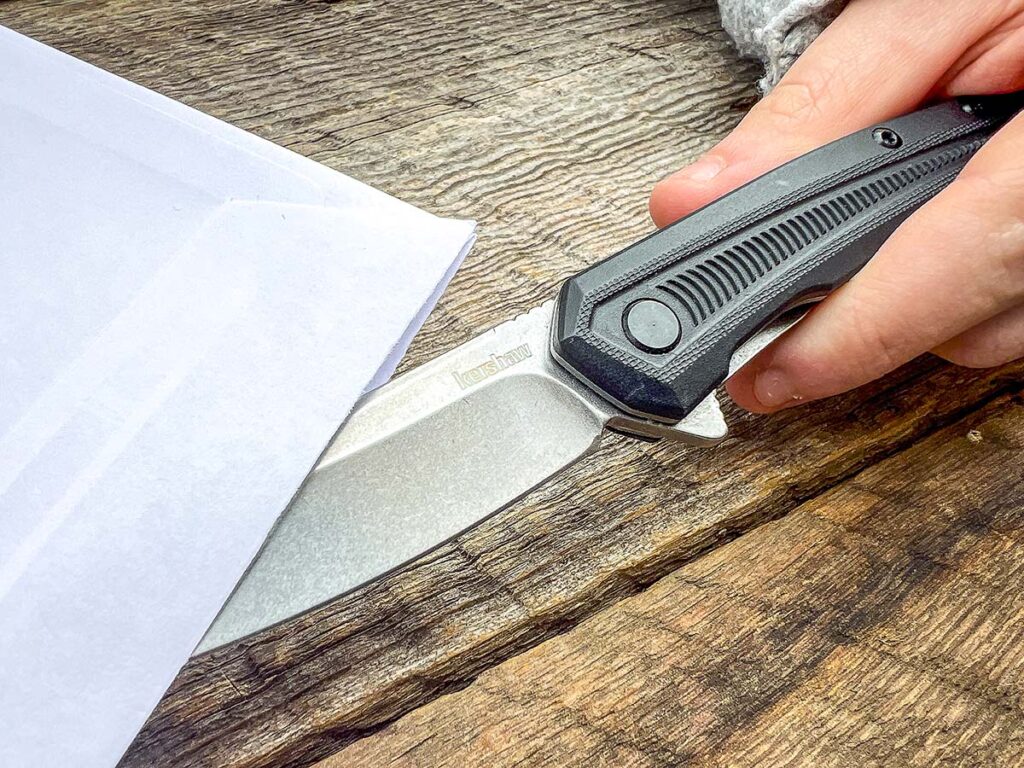
The good ol’ paper slice worked for starters. The LX532 sliced very smooth with no effort. The thin blade made for great control during the cuts. The only challenge was getting my fingers out of the way fast enough.
It was back to 20-pound bond copy paper for the final edge test. The LX532 didn’t miss a lick, slicing very smooth, aggressive cuts.
It was time for the single-walled cardboard. The knife was quite aggressive in cutting it. Again, control was great. The thinner handle takes some getting used to but that’s not a big deal. There was some twisting on the cut pieces but that was me getting accustomed to the handle.
Plastic board was next. The LX532 handled it with ease. The thumb notches on the handle spine really came in handy as more pressure was needed to make the cuts. They notches stopped the thin blade from twisting in my hand while cutting.
LX532 Meduim-Duty Cutting
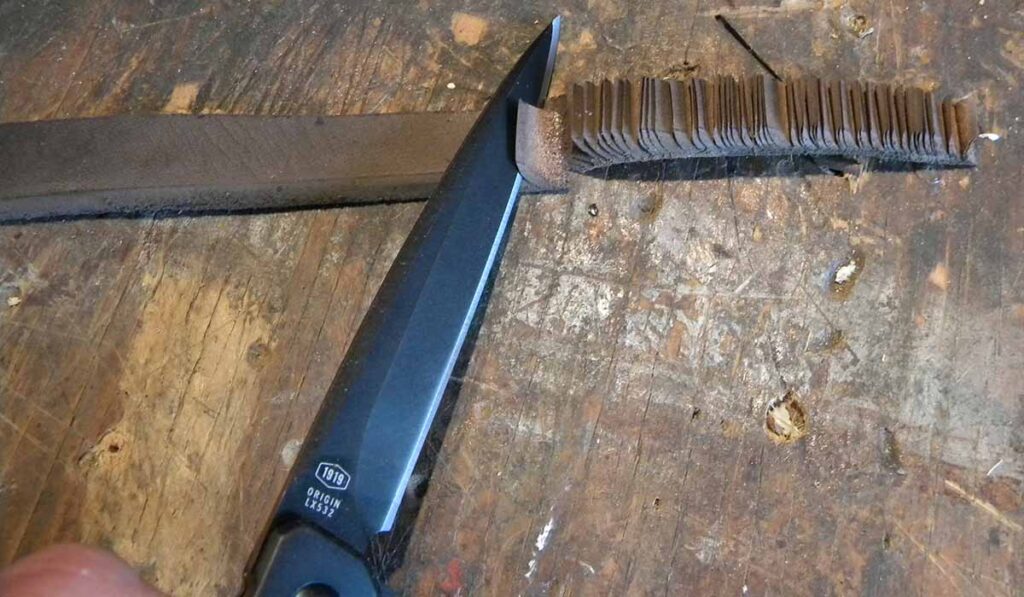
I had some leftover dense foam from the Kydex press to change out, so I decided to slice it up. The folder went through the foam like butter. The thin blade is extraordinarily sharp to say the least. Control was great yet again and I had to continue slowing my slicing down to keep my fingers intact.
The knife went through the foam like butter. The thin blade is extremely sharp to say the least.
Eight-ounce leather, anyone? I did some normal up-and-down slicing, along with some skiving. The edge was quite forceful slicing leather. I could hear each and every cut. The knife is exceptionally smooth and controllable for straight cutting. I switched positions and laid the leather flat for some skiving. The LX532 was very loud and aggressive slicing the material. I cut through the leather more times than I want to say. (It makes a better picture if the leather is all together rather than a bunch of smaller pieces.)
LX532 Heavy-Duty Cutting
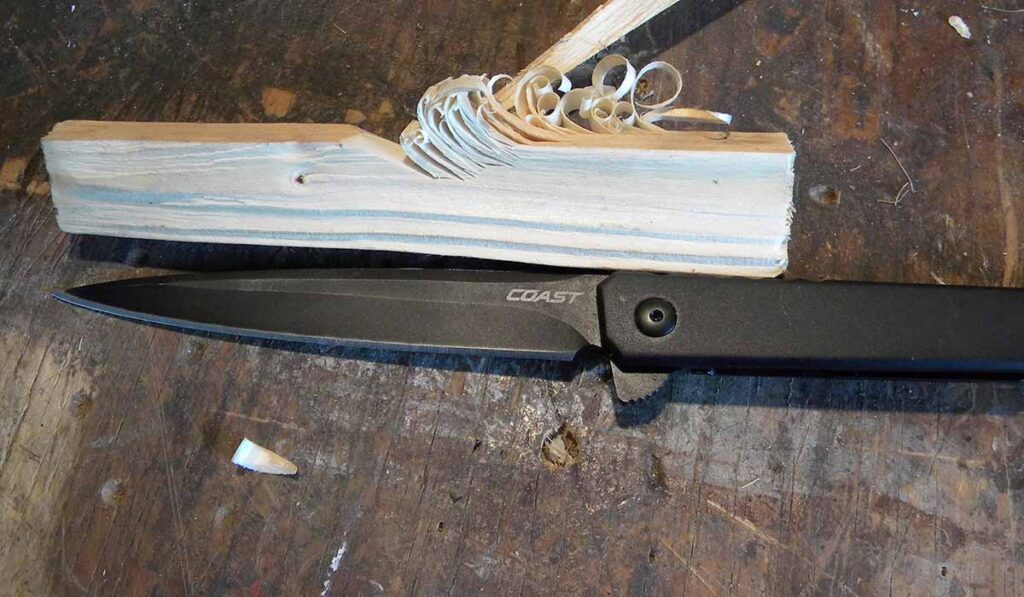
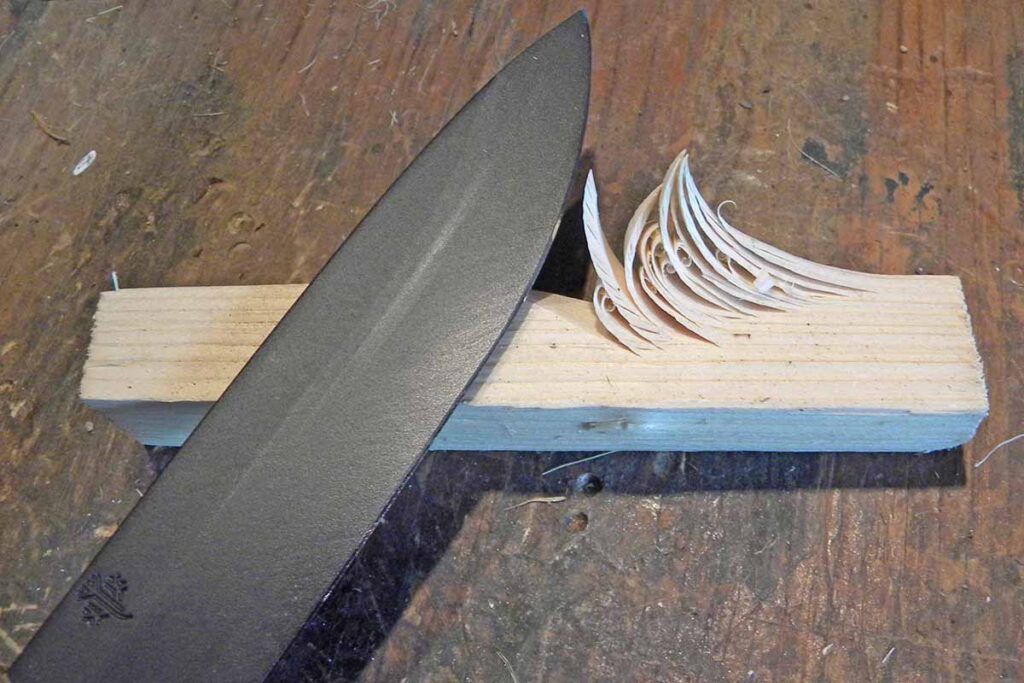
With camping season in full swing, I needed to stock up on firesticks to start the campfire. The LX532 worked perfectly. It made great thin curlicues in the pine. It also took deeper bites if needed. The blade zipped through the wood. Control was great with my thumb on top of the handle. It was a lot of fun to do.
The blade zipped through the pine and made great thin curlicues. It also took deeper bites if needed.
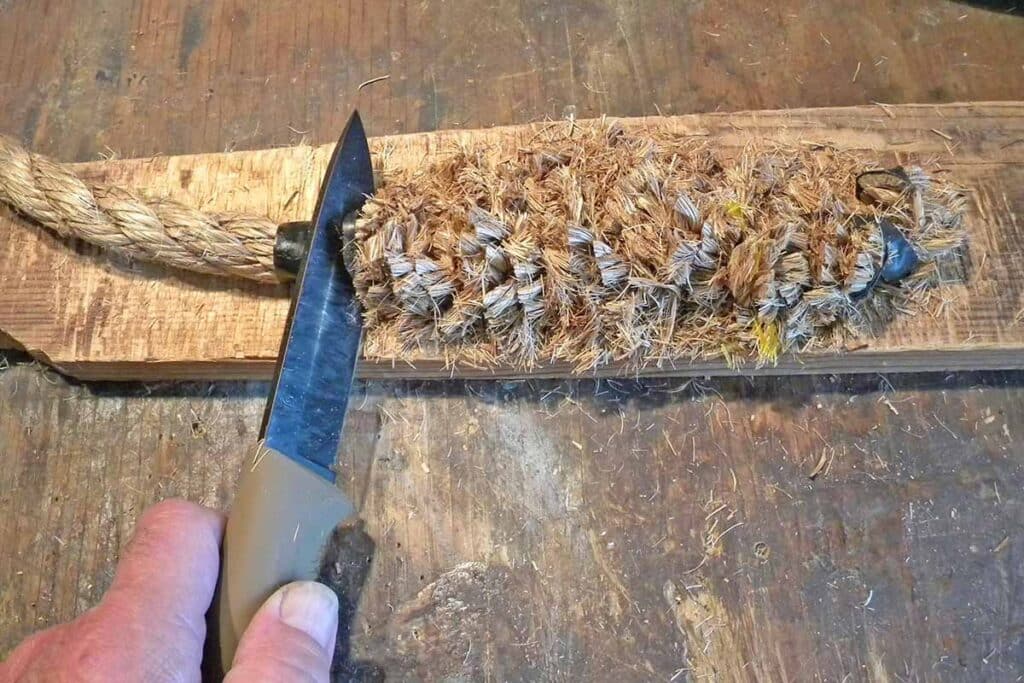
I had my doubts about cutting sisal rope with such a slim knife. However, the folder proved it could go the distance, providing 200 crunching cuts before I stopped. The knife was still going strong. I was impressed. The framelock stayed at 100 percent engagement the whole time and was still smooth upon closing. Hats off to the folks at Coast.
It was back to 20-pound bond copy paper for the final edge test. The LX532 didn’t miss a lick, making extra-smooth, uncompromising cuts.
Overall Take
The LX532 is one sweet framelock. The slim overall shape is right up my alley. Performance is in the top 10 percent. Excellent job, Coast. I wouldn’t change a thing. Maybe some texturing of the handle?
The EDC fixed blade proves itself more than just a pretty face.
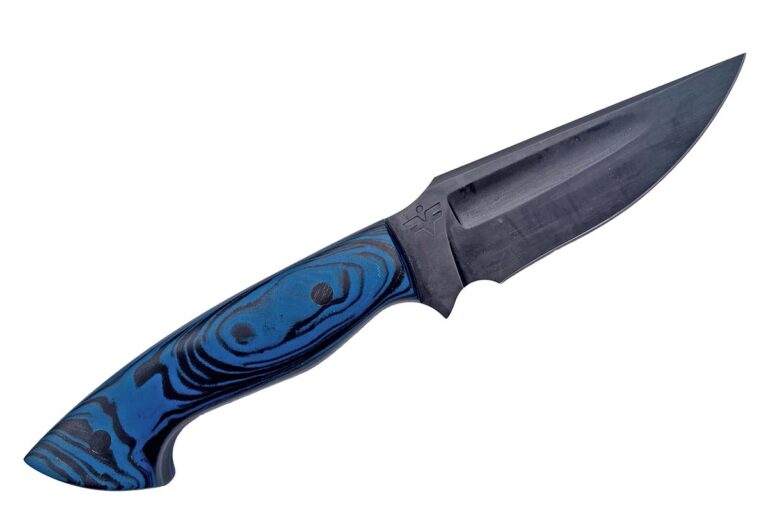
After finding First Degree Forge’s website, I reached out to Joshua Brown about testing one of his knives for “Spec Sheet.” He agreed and sent me his EDC Fighter. The shape really caught my eye, along with the blue-and-black handle. The grinds are symmetrical from side to side. I checked the handle for any epoxy gaps and found none, though I did find a few areas that might cause a hot spot or two while cutting.
Light Cutting Tests
I went straight to the 20-pound bond copy paper for the initial sharpness check. The EDC Fighter zipped through the material quickly and repeatedly. I had to really concentrate on moving my fingers quickly so I didn’t leave any DNA on the paper or the knife. Joshua’s blade is very sharp indeed.
I had an extra box to pull a slicing piece from. The cardboard parted quickly. I could feel some friction as I finished the cuts. It was the medium dragging on the thick blade spine, giving the cardboard a slight curl. However, there was no slowdown in cutting.
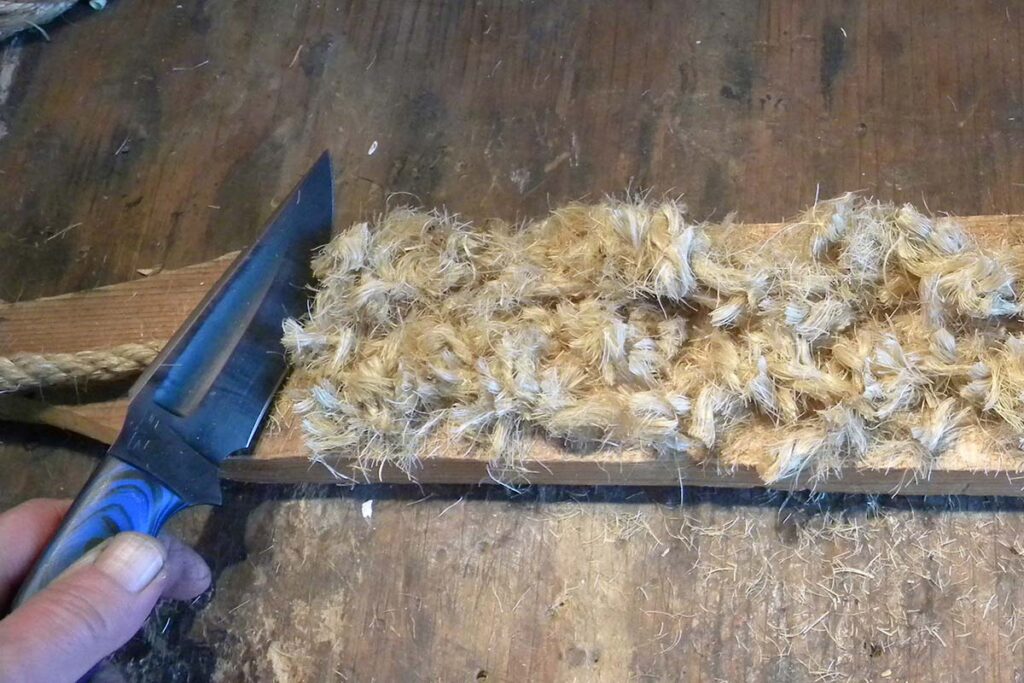
The EDC Fighter crunched its way through 190 cuts in the sisal rope.
A piece of 8-ounce leather was next. The EDC Fighter sliced it smoothly and aggressively. I could hear every crunching slice, a sound that brings a smile to my face. The handle was comfortable but felt a tad thick for my hand.
I rolled right into some skiving with the same leather. The edge crunched into the material cleanly. Overall, the EDC Fighter was quite controllable at keeping the spacing between slices even. The flat-ground blade indexed perfectly off my finger.
Heavy Cutting Tests
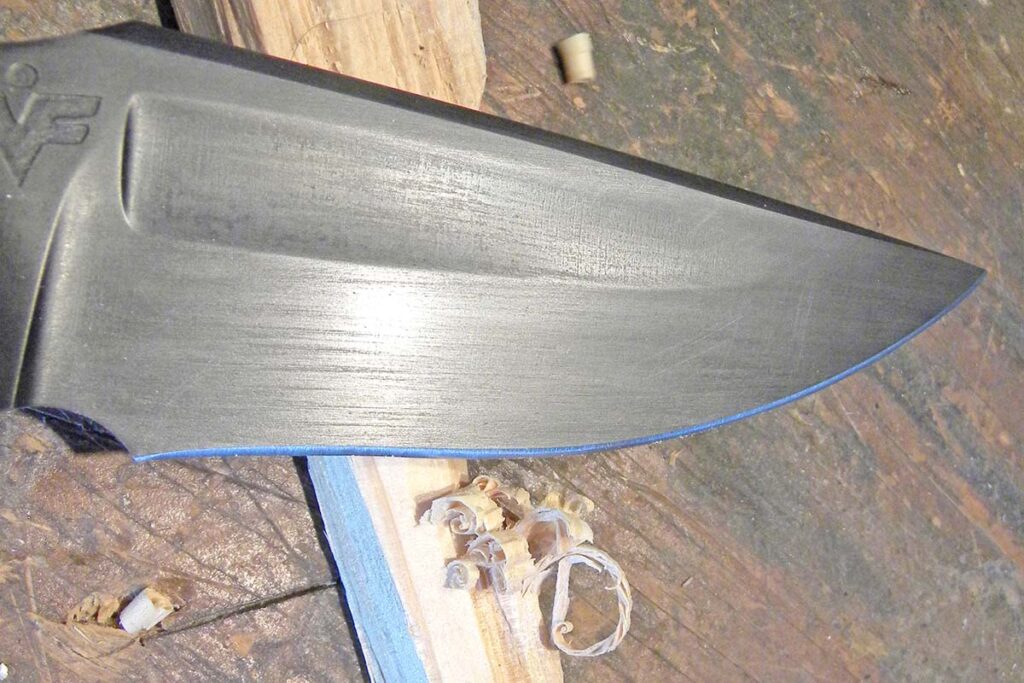
Whittling time! The edge produced some thick curly-cues and wanted to bite deep into the wood (there was some possible wood grain deflection). The handle made for a secure cutting grip but the steel near the choil was sharp on my skin. A little sandpaper would remove the unwanted sharpness.
Next on the menu was some baton work on a knotted pine 2×4. The large handle was comfortable and stopped any shock from transferring to my hand. The blade drove smoothly through the wood with little damage—only a little smear on the finish.
The edge produced some thick curly-cues and wanted to bite deep into the wood. The handle made for a secure cutting grip but the steel area by the choil was unnecessarily sharp on the author’s skin. A little sandpaper would remove the unwanted edge.
The sharpness test on sisal rope awaited. The EDC Fighter crunched its way through 190 cuts. I found that the thumb rest also had a sharp edge to it—again, an easy fix with sandpaper. The handle was comfy and the palm swells worked great.
The final paper slice was barely different from the first. What little problem there was mostly was caused by the paper picking up some dampness in the air. The edge remained very sharp.
Last of all was my regular semi-destructive test—whacking the edge into a whitetail deer antler. I gave the knife 30 good antler chops and didn’t hurt the edge at all. Heat-treatment grade: great!
Botton Line
The EDC Fighter is a very nice knife, comfortable to hold and an outstanding performer.
Changes
Soften the previously mentioned non-blade sharp edges where fingers or thumb meet steel.
A kitchen do-all, the Santoku is a must-have for foodie pros and novices alike. Here’s what to look for to get the best, plus our top picks.
Santoku knives are becoming increasingly popular in the West, especially among foodies, passionate home chefs, and anyone who brings a knife roll to work in a kitchen. If you’ve been dying to learn more about this great Japanese knife, you’re in luck.
We’re going to go over everything you need to know about the Santoku, from its origins and design, to how to buy and use one in your own kitchen. We’re also going to go over the top Santoku knives on the market right now, in case you’re looking to pick one up for yourself (or as a gift).
Origin of the Santoku
Traditionally, in Japanese cooking, knives have different roles based on what you’re preparing, more than how it’s being prepared. Around 100 years ago, you would commonly see a Gyuto (basically what Westerners call a chef’s knife) used to cut beef, pork, and chicken, a Nakiri to cut vegetables, and a Deba to cut fish.
Each of these is designed for its specific task, and so they are specialized. Of course, they can be used differently, but the idea is to have a knife for every task, rather than a knife for any task.
Around the 1940s, as steel started to come at a bit of a premium due to some noted historical world conflicts, the desire for multi-purpose kitchen cutlery rose, and out of that desire came the Santoku, or “three virtues” knife.
The purpose of the Santoku, also translated as “three uses”, was to be able to handle most food prep duties with just one knife. To that end, it is designed to be able to handle chopping, slicing, and cutting tasks, which is another interpretation of the meaning of the name.
Santoku Design
A Santoku typically uses a sheep’s foot blade and tip, which gives you a long, relatively flat blade edge and a tip that sweeps back up in a large radius towards the spine.
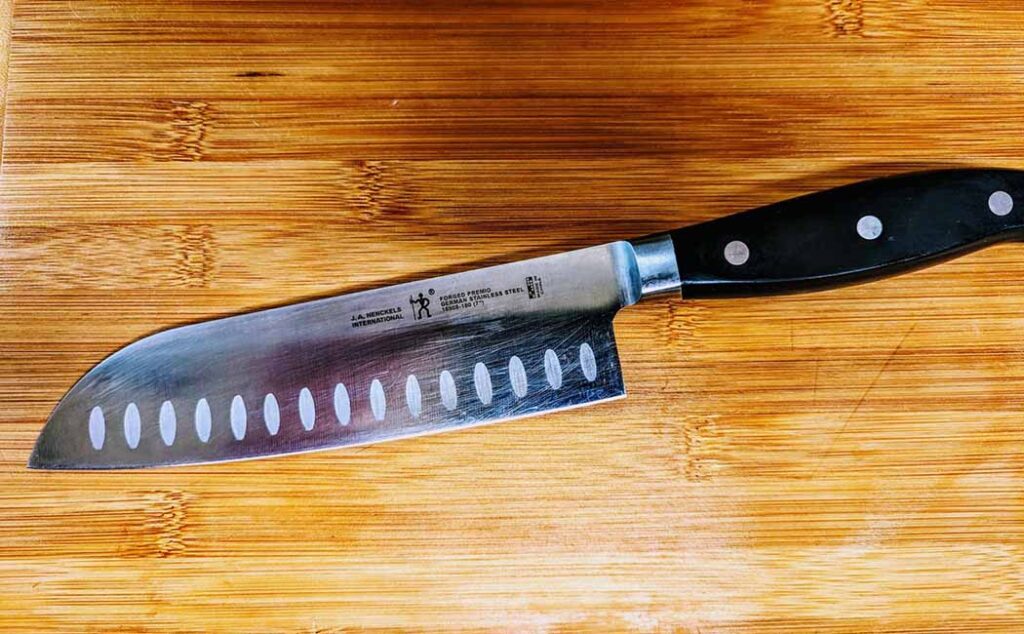
A mid-range Santoku from my personal kitchen.
Edge
Most are between 5 and 7 inches and have an edge with a very Western-style bilaterally cutting edge with a 12 to 15-degree shoulder. Many Japanese knives are ground to a chisel edge, which is only sharpened on one side, but a classic Santoku has a more familiar Western-style edge geometry.
This does mean that, for those of us in the West, sharpening isn’t too much different than with any other kitchen knife, just with a different angle. It also means that Santokus are typically made of very hard steel to prevent damage to that thin wedge.
This makes them an absolute dream for slicing and chopping tasks. If you’ve ever wanted to reliably get those paper-thin tomato slices, you’ll have every advantage with a Santoku.
Handle
Most Santokus have no bolster, which may also take a bit of getting used to depending on your grip. However, many have a handle that tapers down towards the blade, making it very comfortable for the classic pinch grip most of us home cooks are probably used to.
Granton Edge
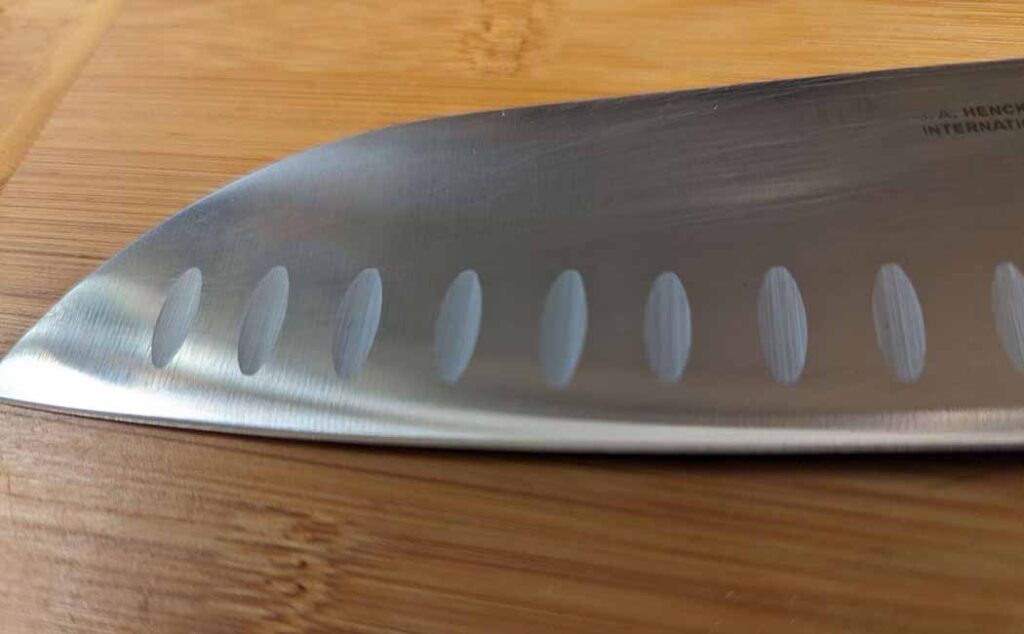
Lastly, many Santokus feature a “Granton edge”, which you can recognize by the slightly scalloped sides of the blade that look like someone took an ice cream scoop to the steel and removed little bits of the blade.
These little scallops help sticky, wet foods like meats and certain vegetables from sticking to the side of the blade as you’re chopping. If you’ve ever tried to slice tomatoes quickly or dice something like a chicken thigh, you’ll know how helpful this feature can be.
What To Look For In A Santoku
Here’s a fun fact I don’t get to bring up in my writing career a lot: I’ve worked as a chef in kitchens all over the South for a good portion of my 30ish years on this planet. In that time I’ve held a lot of knives.
Cooking may not be my main gig anymore, but it is something I’m still passionate about. I cook most meals for my family, and I still help out with the occasional catering gig when my chef friends need an extra hand.
All of which is to say, I’ve got some battle-tested, dinner-rush-proven opinions about what to look for in a kitchen knife, and we’re going to apply those to our Santoku shopping.
Blade Length
While Santokus come in a range of lengths, for your first one I definitely recommend sticking to a 5 to 7-inch blade. This is a good range for all the common tasks you’d likely want a Santoku for and makes for a very handy blade.
This gives you a blade that’s most likely shorter than your standard Western-style chef’s knife (or Gyuto), but still more than sufficient for chopping large, hearty vegetables when needed. It’s also not too big to quickly filet a fish, or other delicate tasks.
Steel
Blade steel is an important consideration with any knife, but especially the Santoku. As we discussed above, a Santoku has a very thin edge and narrow blade geometry.
While the thin edge gives you immense slicing and chopping performance when we’re dealing with vegetables, it’s potentially a liability. Specifically, the edge is more prone to rolling if you’re doing something like hacking through a chicken carcass.
To protect against such occurrences, a typical Santoku—and Japanese knives in general—are treated to a higher hardness than Western-style knives. Japanese knives like the Santoku are also typically high-carbon steel.
Practically, this means that you’ll have to put in more work to sharpen a high-quality Santoku than a Western-style knife. On the flip side, the edge will likely last you a good bit longer. This makes the Santoku a good everyday kitchen knife, especially if you don’t love sharpening.
Stay away from stainless steel, unless you’re really on a budget and want to try the Santoku out on the cheap before committing to a more expensive model. (We’ll have some very good budget-friendly options below if you want to go that route.)
Stick to a high-carbon steel of Japanese or German origin if possible, and look for something with a Rockwell hardness of 57 or higher at a minimum. I like 60 plus but that starts to get expensive quickly.
When in doubt, when it comes to any kitchen knife really, buy from one of the countries that lost WWII and you’ll probably do alright (I have similar opinions about cars).
Blade Height
Blade length and width are familiar decision points when buying a knife, but for something like a Santoku blade height (the distance from the blade edge to the spine) is also important.
Because these knives are designed for slicing and chopping against a cutting board, you want to make sure the blade is tall enough to keep your knuckles comfortably off the cutting board when using the knife.
This tall blade also makes it easier to create nice, even slices. The edge is less likely to wander to the left or right as you slice, and you have a nice large flat surface to index whatever you’re cutting against as you’re slicing.
A Note on Scalloped Edges, or Granton Edge
You will probably notice in your Santoku shopping many of these knives, and Japanese knives in general, tend to have a Granton edge. You’ll see dimples on the side of the blade.
The dimples on my personal general-use Santoku.
The idea behind these dimples is to relieve the suction effect when slicing through thick vegetables or meats and keep things from sticking to the blade. How much does that help? I’ll be honest, I don’t know.
A lot of it depends on the geometry of the dimples, what exactly you’re cutting through, and its moisture content. In other words, you may not see a huge difference, so don’t get too hung up on the dimples.
Done right, they can definitely help though, so don’t completely discount them either.
Using a Santoku
Actually using a Santoku is a bit different from a Western-style chef’s knife, but don’t let that keep you from buying one!
With a Santoku, the chief difference from the knives you’re probably used to for general food prep is the thickness and the angle of the cutting edge.
A Santoku has an edge that is ground to a much more extreme angle than most Western-style knives, and the edge of the blade is fairly linear compared to your average chef’s knife here in the US or Europe.
Why does that matter?
Where a knife with a pronounced belly, like a Western-style chef knife, will slice downward and then you rock the blade forward just a bit to complete your cut. With a Santoku, the motion is more of a flat downward chop, with very little rocking.
I promise, it’s not actually all that different in practice, but you will have to adjust a little bit when you’re first learning to use the knife.
The other thing to keep in mind is that a Santoku is more prone to chipping if you really hammer it into something hard like bone. This is not what you should be using to hack through carcass joints. Use a cleaver for that and leave the Santoku for slicing and cutting meats, fruits, and vegetables.
Santoku vs Western-style Chef’s Knives
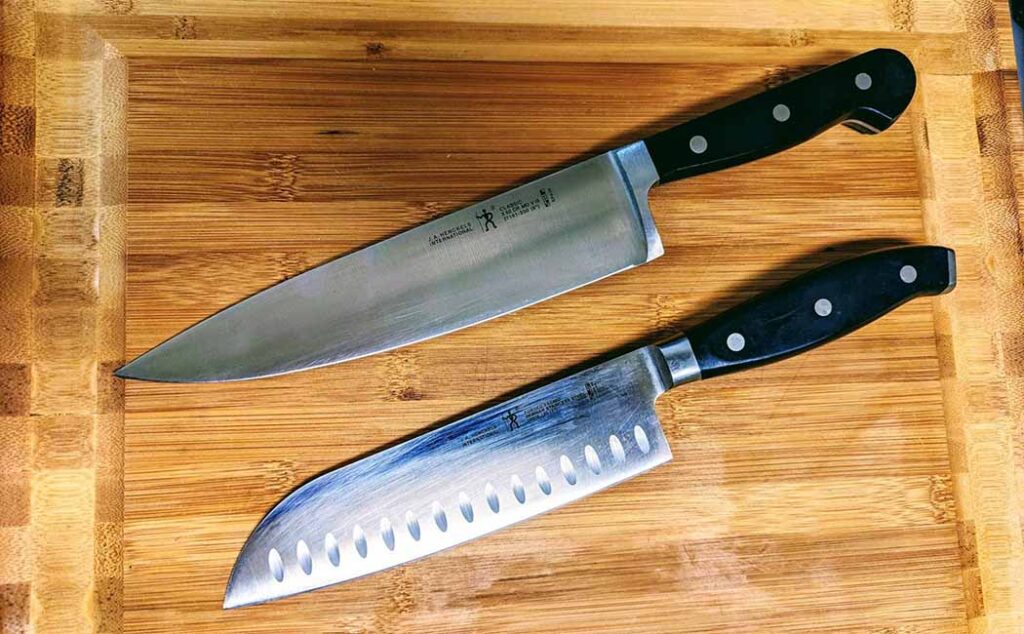
The Santoku is a multi-purpose knife with a similar role to the Western-style knives you’re probably familiar with, but with a very different design.
Compared to a Western chef knife, it is typically shorter, thinner, and consequently lighter. The lack of a pronounced “belly” to the edge also means you will have to adjust your technique if you’re used to cutting with a Western-style chef
A Western-style knife, or Gyuto, is going to have an easier time with fine tip work, and will typically have more of a “belly” to the blade to make it easier to rock back and forth on a cutting board.
In my kitchen, I have both and use them regularly. Like most cooks, I find that a Santoku excels in slicing tasks, particularly if you’re trying to get thin, even slices. If you’re caramelizing onions, slicing tomatoes for a BLT, or dicing up chicken into bite-sized pieces, a Santoku is excellent.
If you’re doing something that requires more of a rough chop, such as dealing with a large number of fresh herbs, a Western-style chef’s knife is probably going to be a better option as you can simply rock the knife back and forth through the herbs and be good to go.
A Western-style knife is also much better for preparing heavier proteins, such as breaking down a chicken carcass or carving up a roast. For one, the blade is longer which makes long drag cuts and slices through thick pieces of meat much easier.
The edge profile of the chef’s knife also handles hacking through bones whereas you’re basically asking to chip or roll your edge if you do that with a Santoku.
For things like fish where you’re typically working with much smaller portions, and you have lighter, thinner bones to deal with, a Santoku excels. Its shorter length is a boon instead of a hindrance here, and the thin edge and blade profile keeps those thin slices of fish from sticking.
As a general rule, for something like fish, garlic, or very wet vegetables and fruits that like to stick to your knife, a Santoku is better. For heavier tasks that require a beefier edge, or a longer cutting surface, your Western-style knife is better.
The type of work you’re doing also matters, with a Santoku being much better for a straight up-and-down chop or slice, and a Western-style knife being better for a rocking slice.
Best Santoku Knives for Any Budget
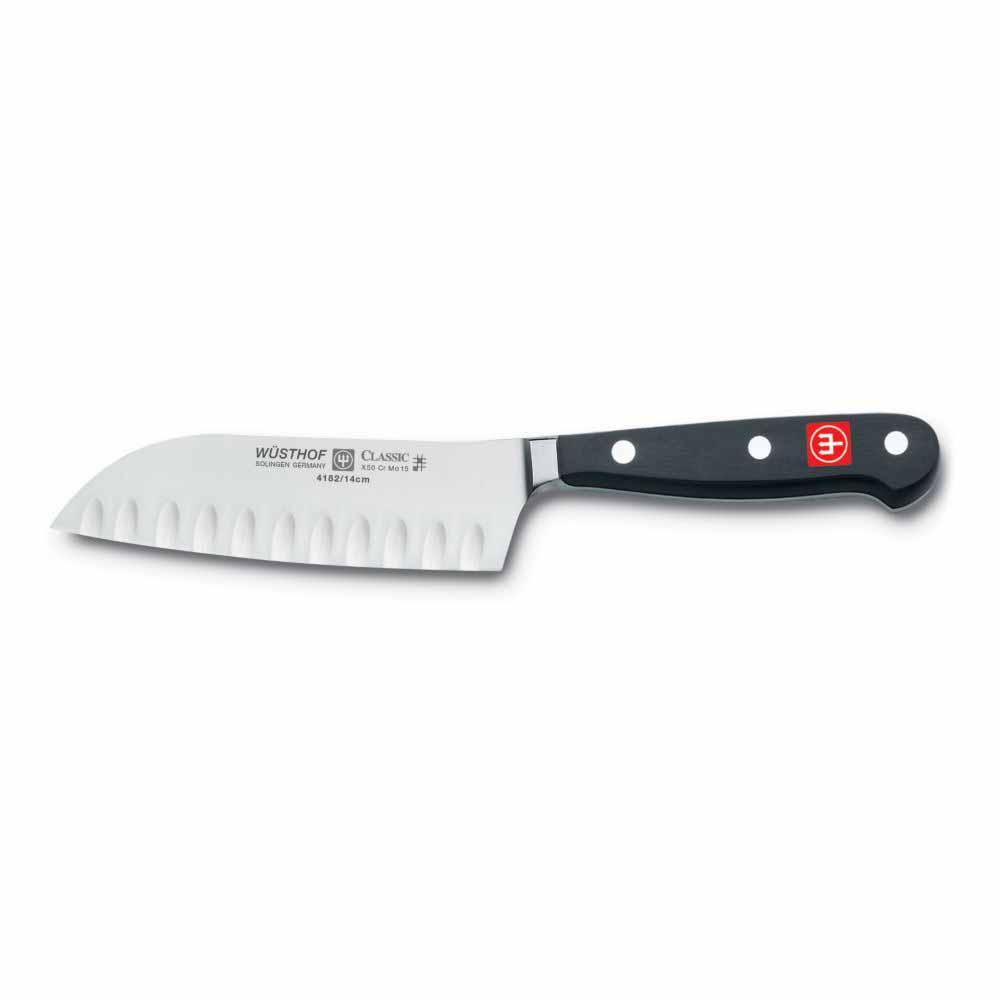
Wusthof Classic Hollow Edge Santoku Knife
First up, we have a favorite of professional kitchens, the Wusthof Classic series Santoku. Wusthof, as you can probably tell from the name, is a German company, and they’re known for making outstanding cutlery. This Santoku is no exception.
This is getting into the upper end of the Santoku market (there will be cheaper options below, never fear) but it is still an excellent value if you’re looking for a durable, well-designed option that’s going to see some heavy use.
I’ve personally used this knife for years, and have one in my personal kitchen at home. In my experience, this is the best-slicing knife out there for vegetables and fish, and I use mine several times a week.
It has a 5-inch hollow-edge blade made of X50CRMOV15 high-carbon stainless steel, making it perfect for home cooks and pros alike.
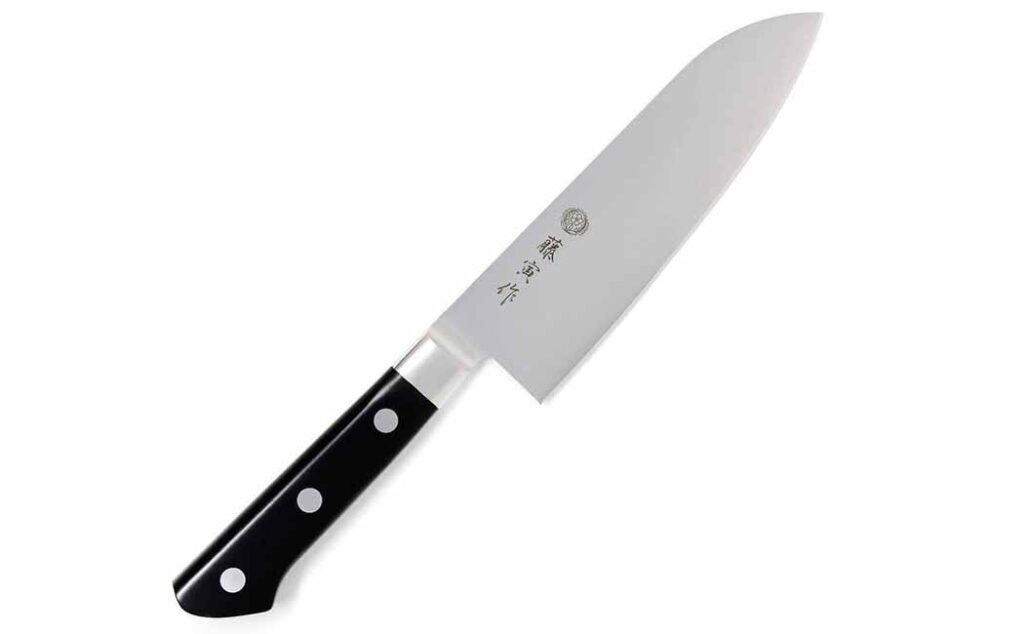
Tojiro 6.7-Inch Santoku
If the thought of paying more than $100 for a kitchen knife makes you a little itchy in the wallet area, don’t worry. Tojiro has you covered.
This Santoku is a bit on the longer side, making it a great choice for almost any kitchen task. I’ve personally used these knives for a number of years now, and I find them to be a bit chunky, but then I’ve got short sausage fingers. Your results may vary.
Even with my diminutive digits though, this knife absolutely sails through fish, chicken, and other light proteins, and slices fruit and veg like a dream. It has a bolster, and an evenly ground edge so it’s perfect for those used to more Western-style knives.
This knife has a 6.7-inch blade made of cobalt alloy steel clad in VG10, which is high-end Japanese steel with high chromium content. This makes it a great budget option for those who don’t want to spend a lot of time sharpening.
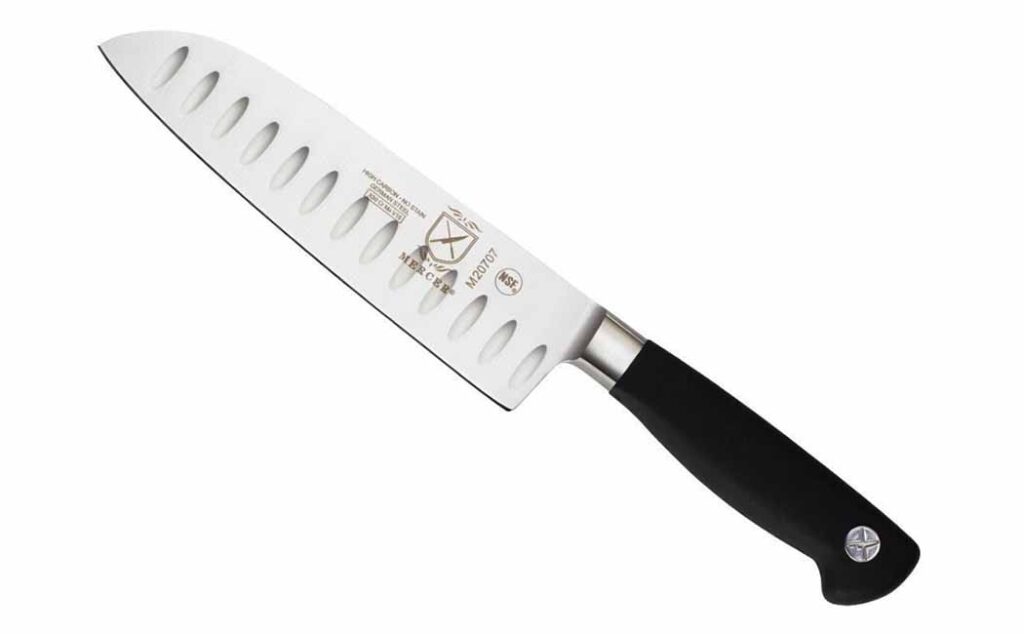
Mercer Culinary Genesis Forged Santoku Knife
For the even more budget conscious, the Mercer Culinary Genesis Forged series is a great place to start. Yes, you can absolutely get an entire knife block for $40, but they’re going to be less than stellar.
You don’t need to spend a fortune on cooking gear, but there are some places where you definitely get what you pay for. With this knife from Mercer Culinary, you’re getting a solid knife that will last for years, without breaking the bank. This is about as cheap as I’d go, personally, but it’s no less effective for that.
The Genesis Forged Santoku has a 7-inch blade made of X50CRMOV15 high-carbon stainless.
MAC Professional Santoku Knife
This is another staple of professional kitchens and a great option for passionate home cooks, as well. MAC’s Professional line is a great option for foodies and pros, and their Santoku is no exception.
I actually think I like the handle on this knife the most of any on this list, but that’s down mostly to personal preference. The blade has a 15-degree edge that slices like a dream. The high-carbon alloy is sub-zero tempered to increase hardness and wear resistance.
The handle is made of a very lightweight wood laminate that is very tough and grippy in the hand. The blade is 6.5 inches long and is made from MAC’s Sub-Zero alloy steel.
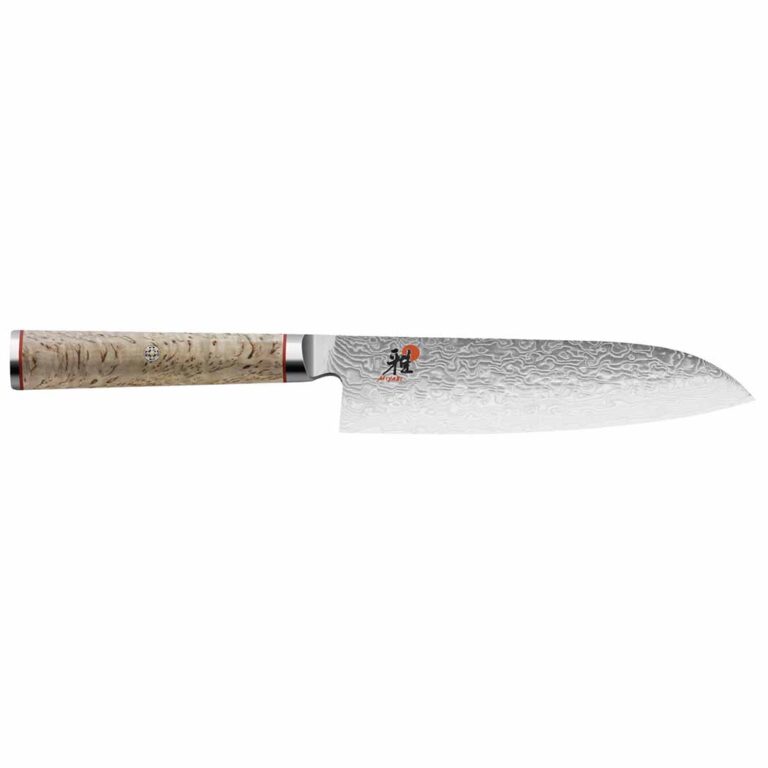
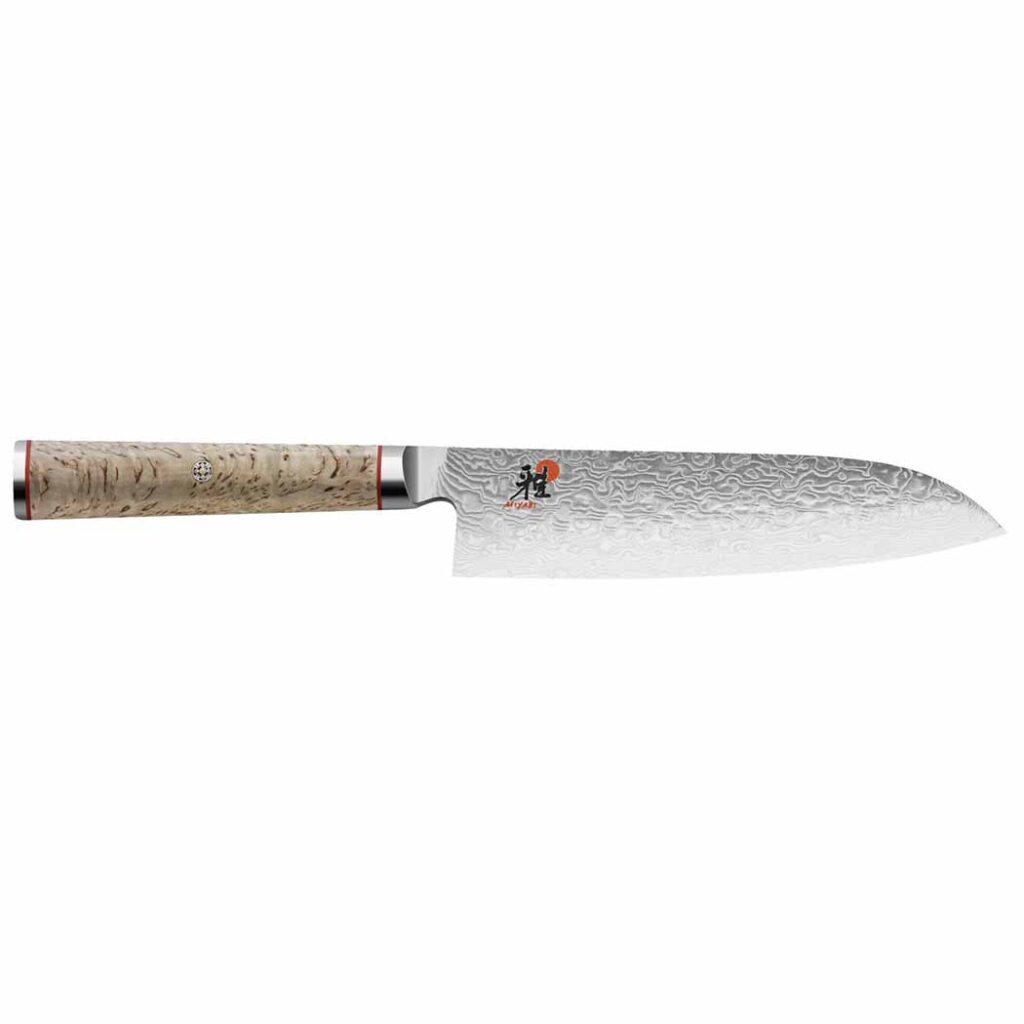
Miyabi Birchwood Santoku
If you’re looking for something that really reflects the Japanese heritage of the Santoku, a knife that has an aesthetic as nice as its cutting performance, this Santoku from Miyabi’s Birchwood line is a great option.
With a blade made from powdered high-carbon steel that’s been folded over a hundred times and a handle made of a beautiful Karelian birch (the only wood to ever be used in a Fabergé egg), this knife is a serious showpiece that you’ll want on display somewhere.
It also cuts like Wolverine’s claws.
Seriously, if you want a beautiful gift to give that special chef in your life, or you just want a super high-end knife that looks great and slices even better, this is a great option.
The Miyabi Birchwood Santoku has a 7-inch hand-honed blade made of G2 micro-carbide powdered steel in a folded, flower pattern Damascus.
J.A. Henckels Zwilling Hollow Edge Santoku Knife at Amazon
Our last two knives are from the same manufacturer, J.A. Henckels, possibly the biggest name in kitchen knives (with good reason).
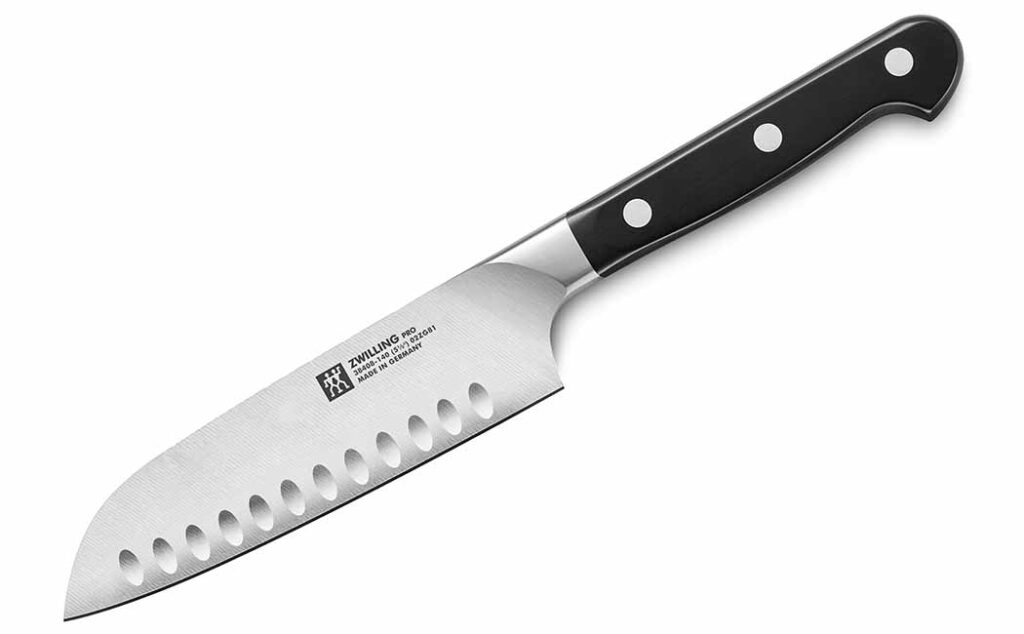
The Zwilling Signature series is one of its higher-end options, featuring a hollow-ground edge and a very comfortable handle with a very minimal bolster. This is a good cross between a traditional Santoku handle and a more modern Santoku handle design.
The 7-inch blade is made of an ice-hardened (Friodur) steel that is proprietary to J.A. Henckels that lasts for a very, very long time in between sharpenings. For a bonus, you can get it custom-engraved for basically nothing since J.A. Henckels does everything in-house.
J.A. Henckels Zwilling Pro 7 Hollow Edge Rocking Santoku Knife
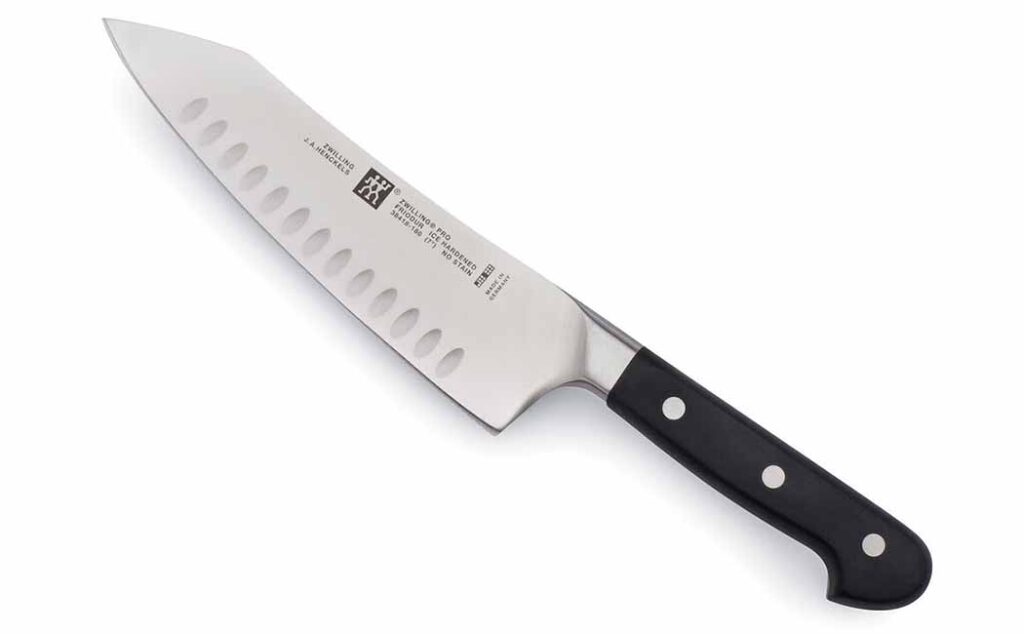
Lastly, we have a very similar knife to the one above, but with a more Western-style edge profile geared more towards the familiar rocking motion most of us know already. It still has a relatively flat edge, so you do get all of that Santoku performance, but with a little more versatility when it comes to a rocking chop.
Like the model above, it features a very comfortable handle, but the Pro series features a more pronounced, Western-style bolster, ideal for the pinch grip that we use here in the West.
It has a 7-inch blade made of proprietary high-carbon SIGMAFORGE steel (I don’t know what SIGMAFORGE means either, you’ll have to ask Henckels about it).
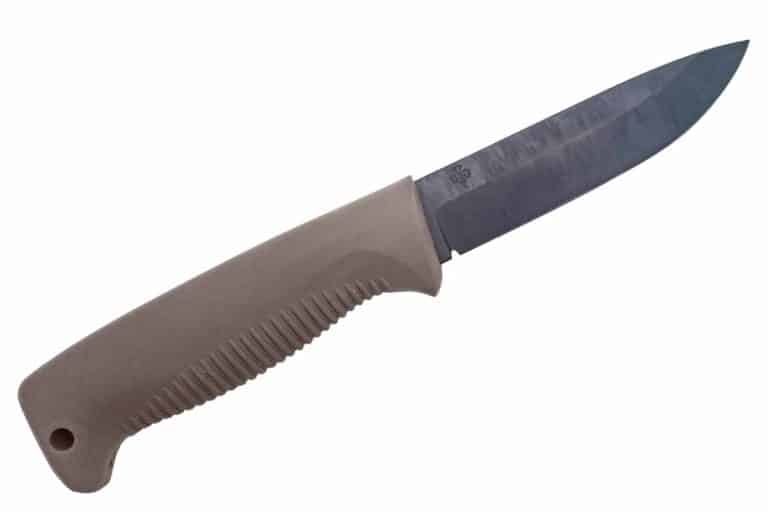
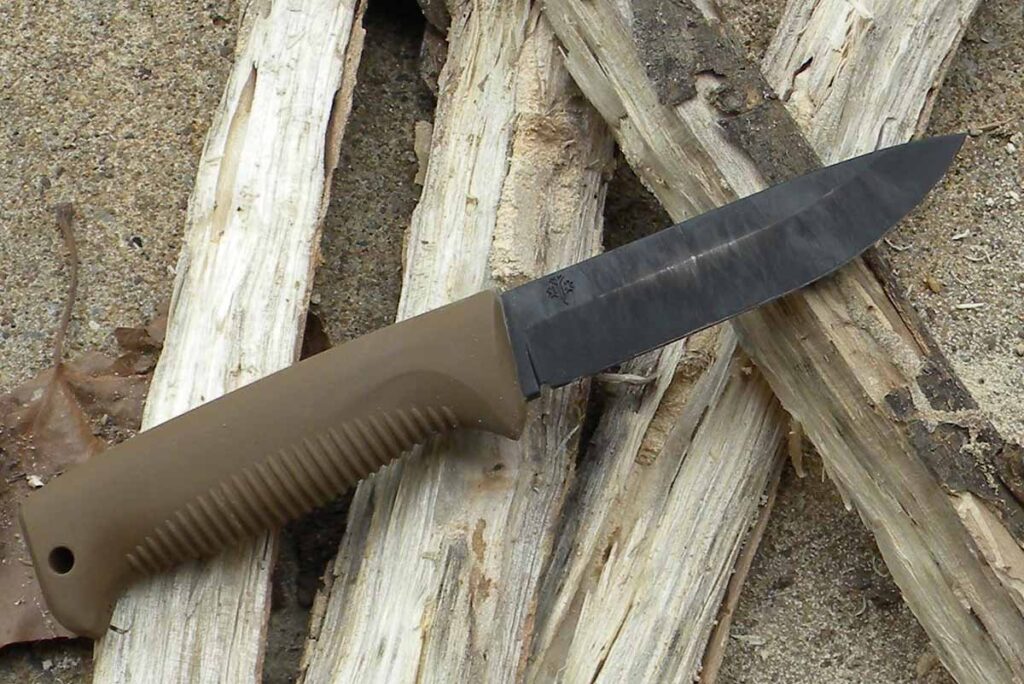
Peltonen M07 Ranger Puukko makes the author’s all-time-best test list.
When I received the M07 Ranger Puukko from Peltonen Knives, I was really surprised to find that the Finnish company was using my favorite carbon steel, 80CRV2, my go-to blade material for the knives I make. It has suburb edge retention and a toughness equal to 5160 carbon steel. The TPV handle is firm but provides a great non-slip grip. However, the knife still has to come together as a comfortable cutter. Let’s get to the fun stuff.
M07 Ranger Sharpness
As I do with my blades to check for sharpness, the hair on my arm has to pop off. The M07 did not disappoint. It was hair popping from the start. For those who prefer the paper-slice sharpness test, using the weight of the knife only, I found the M07 very aggressive slicing the medium. You could hear every slice. The handle gave me great control.
Medium-Duty Cutting Tests
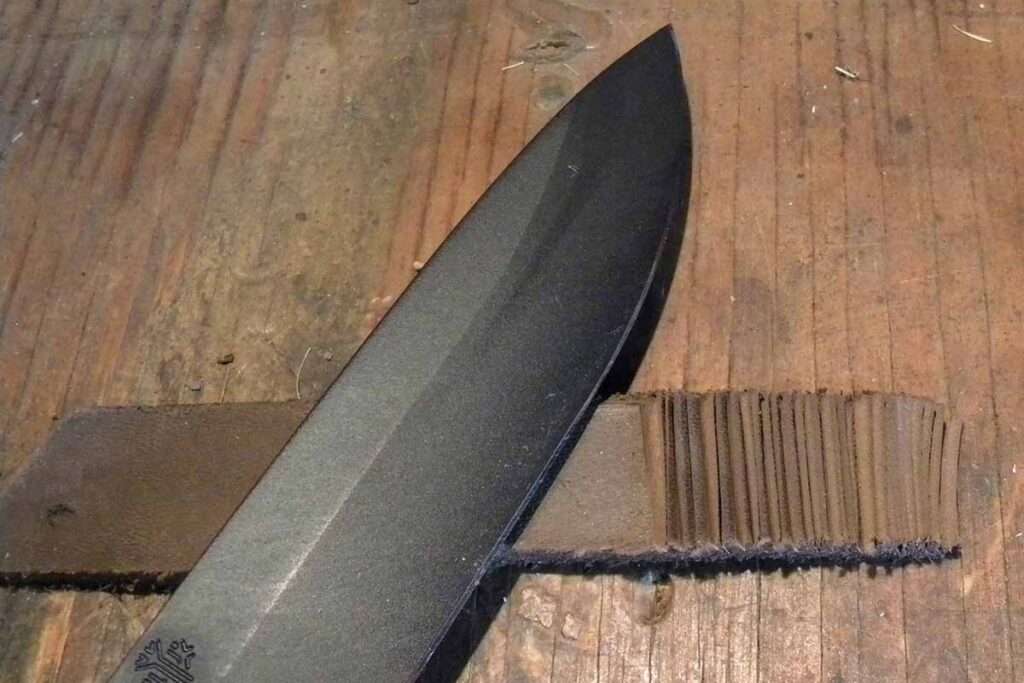
The author really had to control the cut of the 8-ounce leather with just a quick touch; any pushing and the knife was clear through the material.
I grabbed some heavy double-walled cardboard and continued slicing. The M07 parted the material quickly with no snagging. I could feel it biting into the cardboard. I had to be careful not to nick my finger. The knife is that scary sharp.
When I started skiving 8-ounce leather, the M07 sliced all the way through as soon as I laid the edge on the medium. I really had to control the cut with just a quick touch; any pushing and the knife was clear through the leather.
Seventy crunching cuts of the 1-inch manila rope and there was no sign of slowing down. The knife is perfectly formed for heavy cutting chores.
I had enough half-inch sisal rope for the M07 to crunch to 200 cuts with no problem. So, I grabbed my last piece of 1-inch manila rope. It was no challenge for the M07. Seventy crunching cuts later and there was no sign of slowing down. The knife is perfectly formed for heavy cutting chores.
Heavy-Duty Cutting Tests
It did not matter if it took a small bite or a deeper one, the M07 produced nice curlicues.
It did not matter if it took a small bite or a deeper one, the M07 produced nice curlicues. I could hear the knife cut the wood. The soft handle made controlling the sharp blade easy. Again, the cutting was quite aggressive.
It was time to hack some seasoned hackberry. Using a dead blow hammer, I pounded the M07 through the log. The handle absorbed all the shock from the blows, making the baton job a comfortable experience. The blade bit deep with each blow. In less than 30 seconds I had the log quartered. There were wood smears on the blade and some of the coating at the top of the grind showed a little wear. The edge was still extremely sharp. Great job, Peltonen.
The M07 made short baton work of the hackberry log.
It was back to the paper slice for the final test. There were two snags due to catching my thumbnail with the edge. The knife zipped through the rest of it.
Final Cut
The only change I’d make is to bring the grind line up closer to the blade spine. Otherwise, the M07 has to be in the top 1 percent of the sharpest knives I’ve tested in the past 30 years, and also the most comfortable handle. You could use this knife all day long and not get a sore spot. And the heat treating is excellent.
Originally A Karambit, The New Provoke EDC From CRKT Takes The Kinematic Technology Into The Realm Of More Casual Knives.
Do you love Joe Caswell’s innovative Kinematic deployment system but don’t need a knife as aggressive as the CRKT Provoke? Say hello to the newest knife in the line: the Provoke EDC.
The knife takes all the best parts of the original Provoke but with one more casual, but massive difference: a drop point blade–the first in the line to veer from the karambit design.
Provoke EDC Blade
The drop point is just 2.56 inches long, but it really makes its money thanks to its thickness. It’s .27 inches thick, 22-percent thicker than the blade on the original Provoke and more than twice the girth of any of CRKT’s seven most-popular pocketknives.
This makes for a knife adept at heavy work, be it batoning wood or slicing through rope or even prying open anything short of a manhole cover.
At 3.6 ounces and 4.66 inches when closed, it’s light and easy to carry. The flush-mounted clip keeps it invisible in your pocket and quick to pop out. When deployed, the knife is 7.25 inches and is easy to control thanks to the handle. The handle is molded, similar to the original Provoke, so hot spots are non-existent as it sits flush in the hand when cutting.
Kinematic Action
The one-of-a-kind kinematic action is unlike any other deployment system on the market today. When released it’s fast-moving, smooth, and keeps that thick blade securely in place. It’s nearly impossible to flex the blade when deployed, a sign of a strong lock.
The action is powered by two pivoting arms connected to both the handle and the back of the blade. When released the arms swing forward, sending the blade out and locking it in place.
It is a dynamic system and is an excellent fidget, however, it may be a bit cumbersome for those with smaller hands. Since the handle was originally designed for a karambit, which is traditionally deployed in a reverse grip, it could be tricky to securely hold when trying to deploy the knife one-handed. To some, this might not prove as intuitive as a flipper or folder.
Other Provoke EDC Features
Beyond the blade, the most noticeable feature of the knife is its brilliant blue handle. The anodized aluminum visually pops and perfectly complements the satin-finished blade. And, since it’s aluminum, it is lightweight and can hold up to pretty much anything you can throw at it.
Overall, the Provoke EDC is a fresh take on everyday carry and is going to appeal to knife lovers looking for something that stands out.
Assisted open knives that get the job done … quickly.
Although their popularity has leveled off in recent years, manufacturers still embrace the assisted-open genre and continue to produce new models. For those new to the hobby, who may not be familiar with this style of knife, allow us to explain how they work.
Assisted openers are usually EDC and tactical folding knives equipped with some sort of torsion spring affixed to the tang of the blade that aids in propelling it to full open. What results is a crisp and quick action akin to a fully automatic knife. But, and here’s the good part, it remains legal in most jurisdictions.
There is a downside to the assisted opener; the spring creates a weak link. If it fails, the snappy action is absent. The knife remains usable, but, impetus gone, it’s practically a manual opener. Hence, some enthusiasts shun the assisted opener like the plague. Yet, the design still has its enthusiasts, who can’t get enough of its brisk and fast actions.
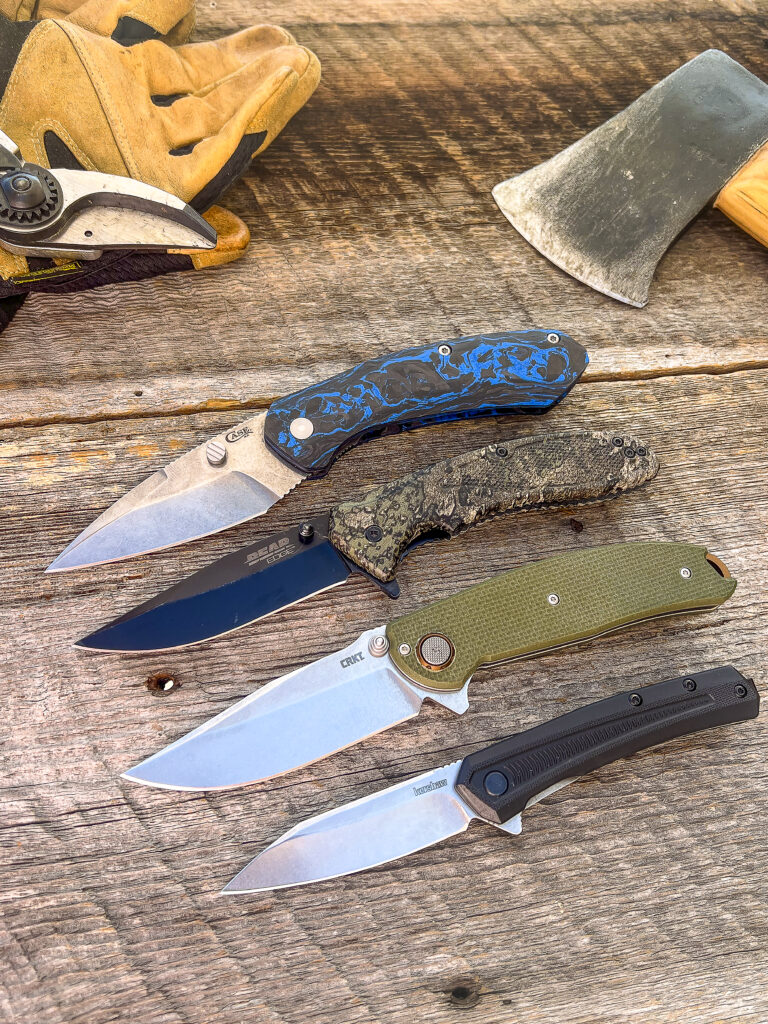
No matter where you stand on that spectrum, there are assisted-open knives worthy of consideration. We’ll cover four of the latest and greatest that deliver the thwack users love.
CRKT Butte
The Butte was designed by knifemaker Lucas Burnley and features CRKT Deadbolt lock. The author found the clip-point blade exceptional and the knife overall sized right.
The Butte is named after its designer’s—Lucas Burnley’s—hilly hometown of Bend, Oregon. Like this rugged terrain, the CRKT knife is heavy-duty and blends style and function into one package, geared for the outdoors.
The Butte boasts a 3.3-inch blade with a clip point and is constructed from D2 tool steel. The material choice gives the knife enhanced edge holding capabilities and is relatively easy to sharpen. Additionally, the steel has good impact resistance, though it’s not stainless, so plan to exercise more care in its upkeep.
Moving down, the handle is OD green peel ply G-10, with dual steel liners providing the backbone. A bronze anodized aluminum back spacer rounds out the handle features.
CRKT utilizes its Deadbolt lock mechanism on the Butte, a solid choice for a knife meant for rough outdoor work. The system, developed by Brazilian custom knifemaker Flavio Ikoma, is essentially a button lock, but with two actuating steel posts. In the case of the Butte, the button design plays well into the overall streamlined look of the knife. It resides on the blade pivot and melts away into the knife’s lines.
The Butte’s lock release is disguised as a pivot bolt, which makes unlocking the blade intuitive, even while wearing work gloves. It also keeps the knife’s sleek look.
To keep the knife handy, CRKT outfits the assisted opener with a pocket clip oriented in the right-handed, tip-up-carry position. Unfortunately for lefties, the clip cannot be reconfigured.
The Butte’s size makes it very capable of tackling a wide variety of chores inside the home or in the great outdoors. Folding hunter or general work knife are both well within its wheelhouse. Could be an outdoor knife, could possibly be a folding hunter, or could be a general working knife.
Of its assets, I like the peel ply G-10, which is more grippy than regular G-10. The handle is also very comfortable, and the lock release is oriented smartly—it’s out of the way of the hand.
Flat out, I think the Butte is a winner when it comes to a working assisted-open. With an MSRP of $120, it’s also a great value.
Kershaw Raygun
The reverse tanto blade shape of the Kershaw knife makes it user friendly, with what the author describes as a gently sweeping edge that maximizes cutting efficiency.
Kershaw’s Raygun offers high utility, a slim form factor and assisted opening in one affordable package. Though it comes in smaller than the rest, with just 2.8 inches of blade to work with; however, a hollow-ground edge gives the compact option aggressive cutting abilities.
As does Raygun’s reverse tanto blade. The profile supplies a gently sweeping cutting edge for maximum efficiency, along with a defined tip for scoring. As to the knife’s steel, it’s 4Cr14 stainless. This is a compromise, balancing solid edge retention and price. Kershaw gives the blade an added layer of protection, stonewashing it to hide any scratches obtained along the way.
Deployment is strictly a flipper affair, which is nice given that it maintains the knife’s sleek look. And Kershaw—like many of its models—makes certain the deep-carry clip is ambidextrous, though strictly a tip-up affair.
Steel composes the liner lock’s liner and Kershaw outfits the handle with glass-filled nylon scale. It’s chamfered, cutting down on hot spots and well textured. The center features a wave pattern of increasing size toward the pivot. This provides the most traction on the handle.
The Raygun features a slender construction and compact size, paired with a highly utilitarian reverse tanto blade. Despite its size, the knife can tackle a variety of tasks, large and small.
The assisted opening mechanism is a classic, Kershaw’s own Speed Safe. For those who don’t know, this is a design of Blade Magazine Cutlery Hall of Fame® member Ken Onion, and is credited with kick-starting the assisted opening trend. It’s fast, durable and a mainstay in Kershaws.
The Raygun cuts efficiently, quickly and its compact size carries easily in slacks, jeans or even clipped to the waist of jogging shorts or sweatpants. I did find the knife’s size a plus and a minus. The downside, bigger hands might find it too difficult to manipulate and use. The upside, its opening is precise and predictable. Given the short, narrow blade, there isn’t a lot of blade mass to move.
With an MSRP of $38, you get a lot of knife in a small package with the Raygun.
Case Westline
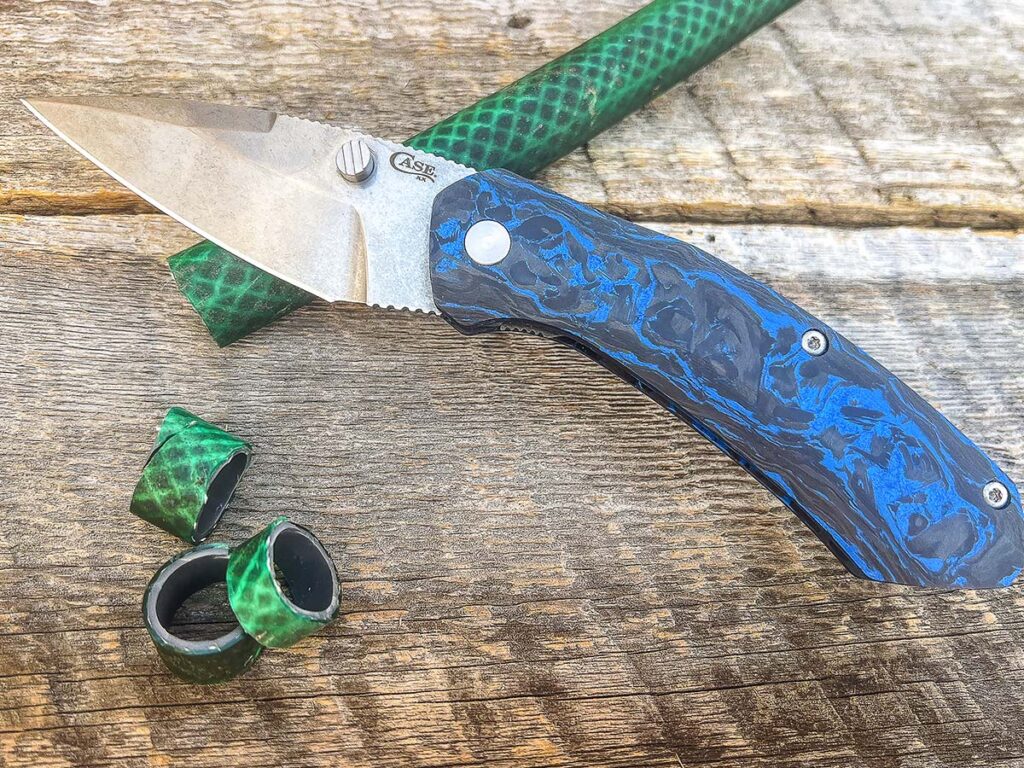
The Westline series of folders have drop point blades and a contoured handle. This particular specimen has eye-catching and lightweight blue and black carbon-fiber handles, paired with a stonewashed S35VN blade. The bigger blade helps to handle larger cutting chores like cutting thick hose.
An interesting twist to the Case Knives plot, a few years ago, it designed and manufactured a line of modern folding knives. Finally, granddad’s pocketknife company embraced the EDC theme with blade locks, one-hand opening and high-tech materials. At the vanguard, the Westline series. The line also introduced assisted opening to Case.
The Westline I looked at was outfitted with 3.23-inch modified drop point blade, made from premium CPM S35VN stainless steel with a stonewash finish. This is a Crucible Industries material, one of the super steels, renowned for its exceptional toughness and edge retention.
The blade spine features a run of traction notches, allowing added pressure to a cut with your thumb or index finger. Furthermore, there are notches on the tang behind the cutting edge. Used in conjunction with the blade spine, you can choke up on the blade for more precise control.
As far as the handle goes, it is made from striking blue and black marbled carbon fiber that catches the eye. Underneath are two nested steel liners providing the backbone for the Westline’s handle. It is a liner lock, which engages smoothly and holds the blade secure in the open position. Finishing it off, a steel pocket clip is mounted to the handle to carry the knife in the tip-up configuration.
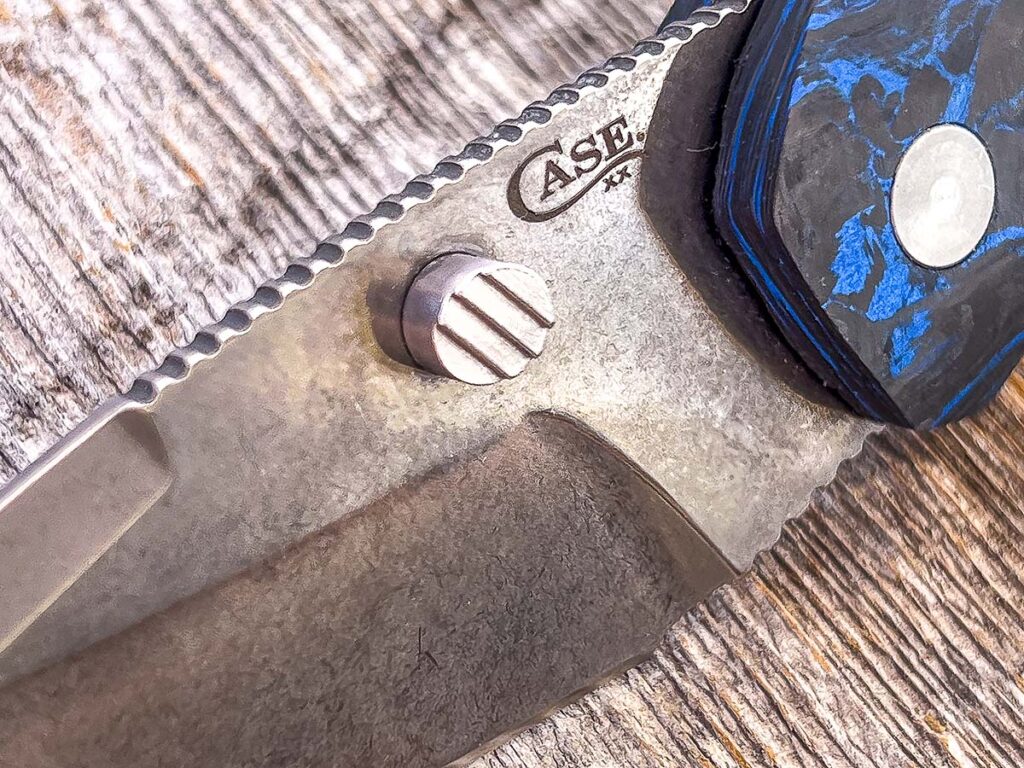
Large, angled and stepped thumbstuds make the blade of the Case Westline easy to open.
The blade deploys in either hand thanks to two large ambidextrous beveled thumbstuds. Speaking of opening, the Westline’s action is predictable, controllable and smooth. Case makes this a certainty, outfitting the knife with pivot bearings.
The Westline would make a great working folder where general-purpose cutting chores reign. It carries well, deploys fast and has a blade steel well known for its performance. It cut through a variety of materials with ease for me. My only complaint is the thumb stud placement. Case could have moved the studs back toward the tang more, thus shortening the arc of travel. The MSRP of the Case Westline with blue and black carbon fiber is $197, and it is made in the USA.
Bear & Son Bear Edge True-Timber Sideliner
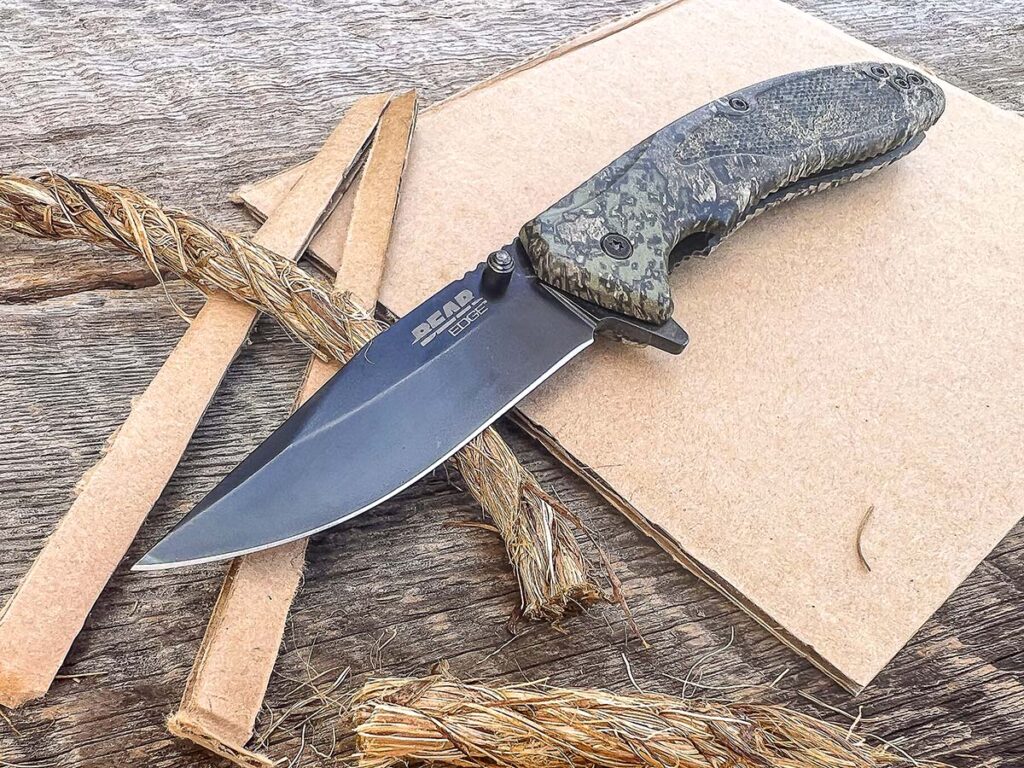
The Sideliner is a cutting champ, thanks to its hollow-ground blade. The assisted-opener made mincemeat of cardboard, rope and a variety of other materials.
The Bear & Son Bear Edge True-Timber Sideliner folder offers a lot of desired features in an affordable package. The clip-point blade is 3.5 inches in length and is made from 440A stainless steel, a lower-end blade steel that is inexpensive but easy to sharpen.
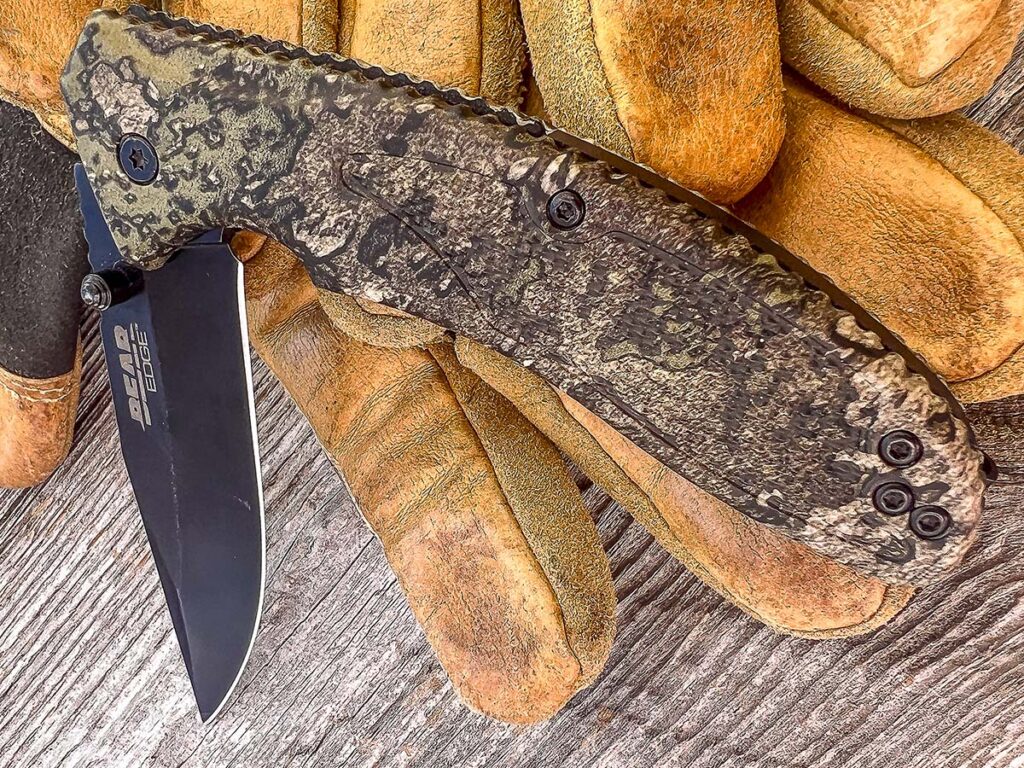
The TrueTimber camo Zytel handle is lightweight, impact-resistant, and impervious to the weather as well as fluid absorption. It incorporates several ergonomic features, such as a primary finger recess with lower hand guard, screw-together construction, checker texturing that helps to improve grip, and there are traction notches all around the perimeter of the handle to aid in nonslip grip as well.
A deep carry pocket clip is attached to the handle to carry the knife in the tip-up position, and it can be switched to the opposite side for lefties.
I would say this Sideliner folder is a very viable option for those who want a good, solid, reliable folding knife at a very reasonable price. The hollow grind makes it easy to slice through any material with ease, but the factory edge out of the box was just OK in my observation. It would cut, but I did notice an improvement in performance once I was able to put my own edge on it.
The Bear & Son knife’s handle has textured grip panels for hand traction, as well as traction notches around the perimeter for an excellent all-weather grip.
The Sideliner’s assisted opening action is quick and sure. A firm push out of one of the thumbstuds causes the blade to spring into action. However, whenever there is a flipper option, I prefer using that instead, as it’s easier and faster to get to. A simple press on the flipper will activate the assist, and the blade is opened, locked and ready for action.
The 440A stainless steel isn’t going to hold an edge like the mid-grade or high-grade stainless steel, but it is easy to resharpen, so there’s that. There’s a trade-off for an MSRP of $60. Still, it really is not a bad price for this piece. Knowing you will generally pay a bit less than this makes it a great buy.
The Informant By Greg Wesley Is Another Quality Fixed-Blade EDC. But Just How Good Is This Small Custom Knife?
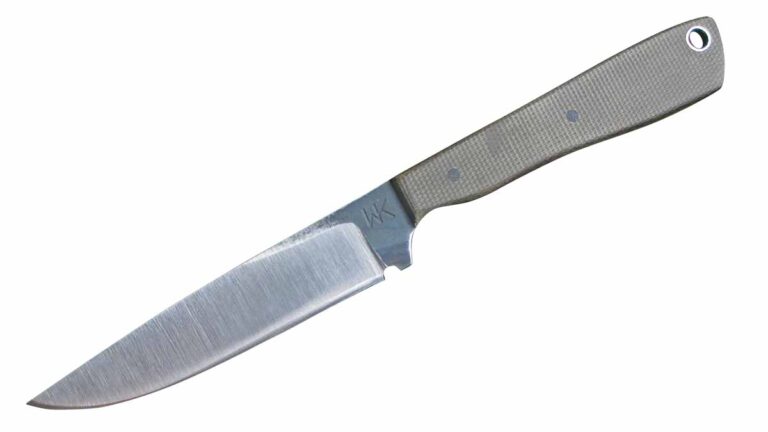
The trend for smaller EDC knives is still going strong. Set up with a leather sheath for belt or pocket carry, the Informant from Wesley Custom Knives fits the bill perfectly. Greg Wesley grinds them all by hand. This one is lean and mean.
Testing The Wesley Informant
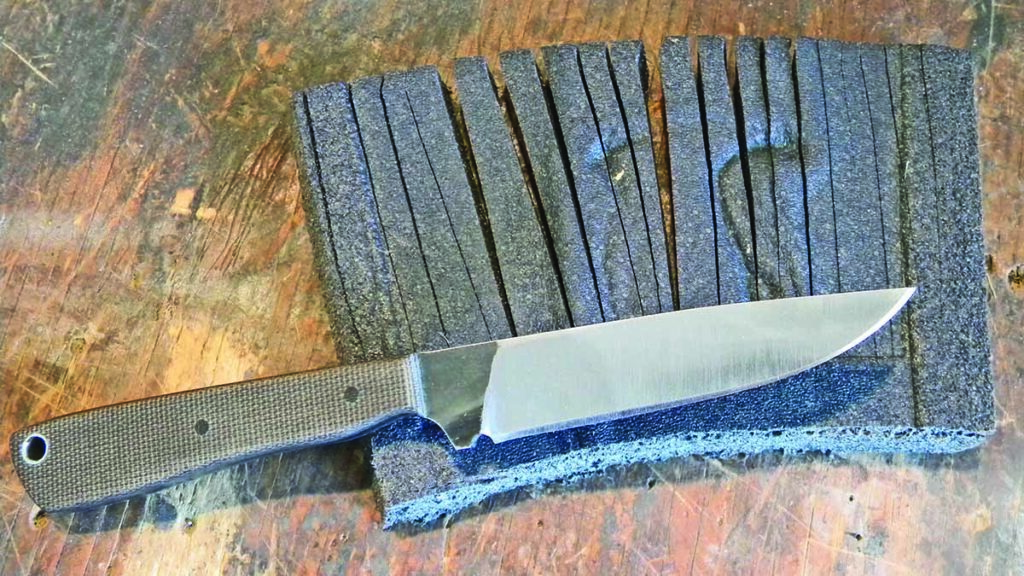
It was easy to control the width of cuts in the foam, all of which were straight without bending the medium.
I started with a piece of dense foam I use for making my Kydex sheaths. Manipulated with push and pull cuts, the knife started biting, slicing cleanly and quickly. It was easy to control the width of cuts, all of which were straight without bending the foam. Very nice.
One of my favorite tests,the 20-pound bond copy paper slice, provided little resistance. It puts a smile on my face when I hear every cut. I used a pull motion to shred the paper. The Informant came razor sharp. The balance of the blade made for a very quick test.
The knife had no challenges cutting through double-walled cardboard. I got carried away and pushed the blade too far into the cardboard, hitting the choil area and messing up the cut. The Informant is just fun to use. Cuts were mostly straight unless I took too big of a bite and the cardboard pinched the blade and slowed it down.
Plastic board was easy for the knife. It cut the plastic very quickly and I barely felt any resistance. Once I had the rhythm slicing, it was finished. This is a sharp little knife. Cuts were very controllable.
Pushing the Wesley Informant
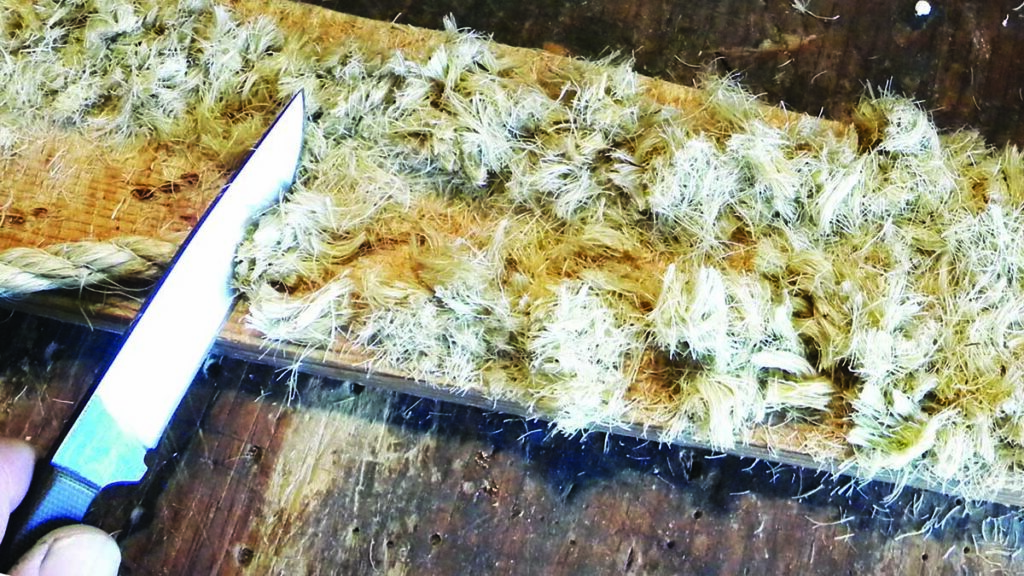
The Informant crunched its way to 188 cuts on the sisal rope before the edge started to slide a bit.
I grabbed some 8-ounce leather for skiving (thin, tapered slices). With a louder crunching sound, the Informant bit quickly. The thinness of the knife made controlling the skiving simple—I just had to move my fingers faster to keep from losing DNA. The edge remained just as sharp as when I started.
I had to whittle to get a better feel of the little fixed blade. The cuts in the wood were extremely smooth. The Informant peeled large curly-cues one after another. The blade spine was somewhat sharp on my thumb but not too bad. The handle was a great fit to my hand—no hot spots at all. Nice job, Greg.
The Informant crunched its way to 188 cuts of sisal rope before the edge started to slide a bit. Impressive! The handle was still comfortable with the extra power added for the high number of cuts. The knife’s light weight didn’t impact its cutting ability.
The last test is a little destructive at times: the antler chop. I gave a whitetail antler 20 hard chops with the Informant. I rolled a thin wire edge in a few places but the blade was still very sharp, so the heat treatment is good.
Final Thoughts
I would soften the blade spine a tad more and maybe round the scales a bit, though that’s being picky. The Informant is a small, high-performing utility tool that can handle most any knife chore. It’s a great EDC choice.