Ethan Becker and Dan Eastland collaborate on a sharp tool for the kitchen.
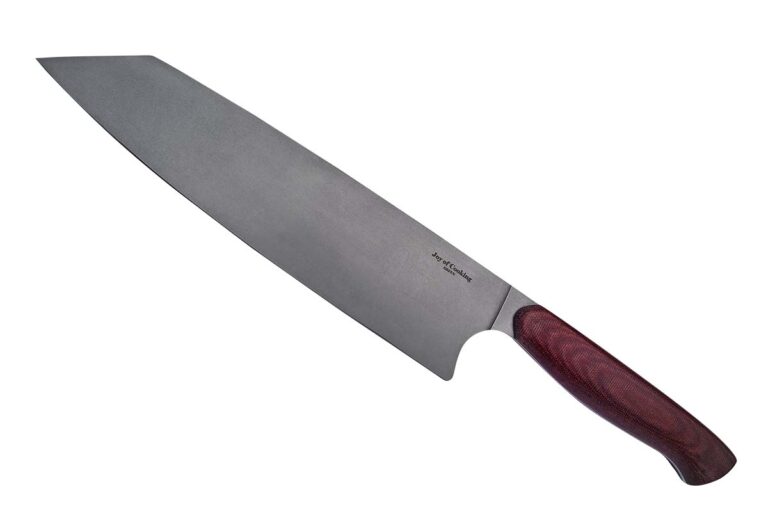
Long-time knife designer Ethan Becker and Dan Eastland of Dogwood Custom Knives have collaborated on a chef’s knife that combines each of the principals’ vision of exactly what such a knife should be.
Introduced at BLADE Show 2024, the Joy of Cooking 8-inch K-tip chef’s knife is a mix of Japanese and Western styles and premium stainless steel and synthetic handle materials.
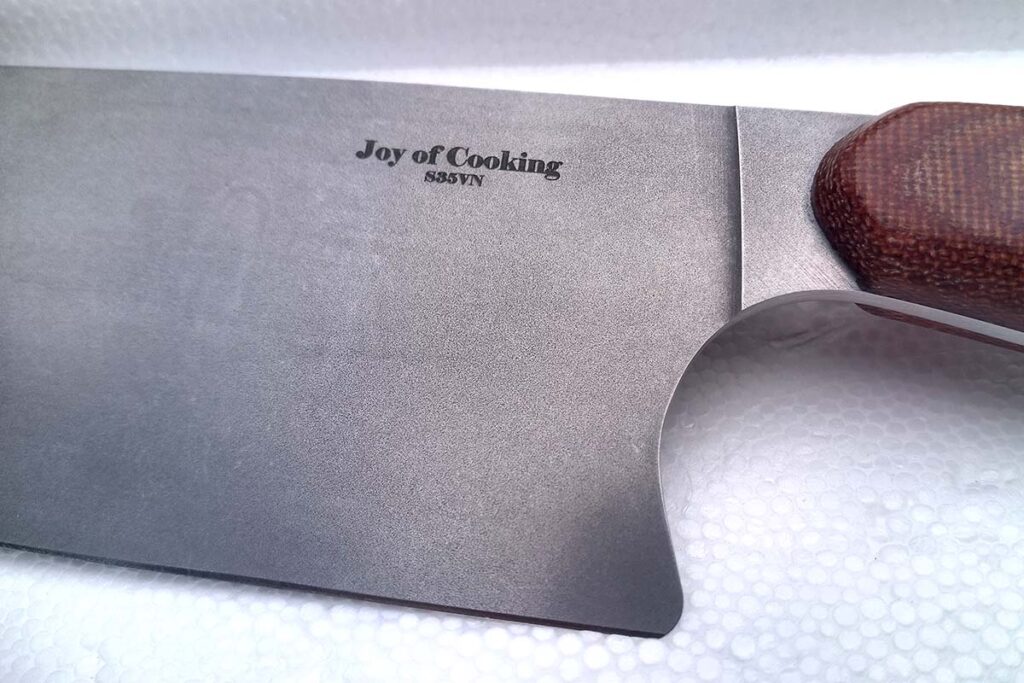
It also has the iconic Joy of Cookinglogo on the blade, Joy of Cooking the internationally renowned cookbook originally written by Becker’s mother, Irma Rombauer, and edited in some subsequent editions by Ethan. He handed those duties off and today the book is co-edited most ably by his son, John, and Megan Scott.
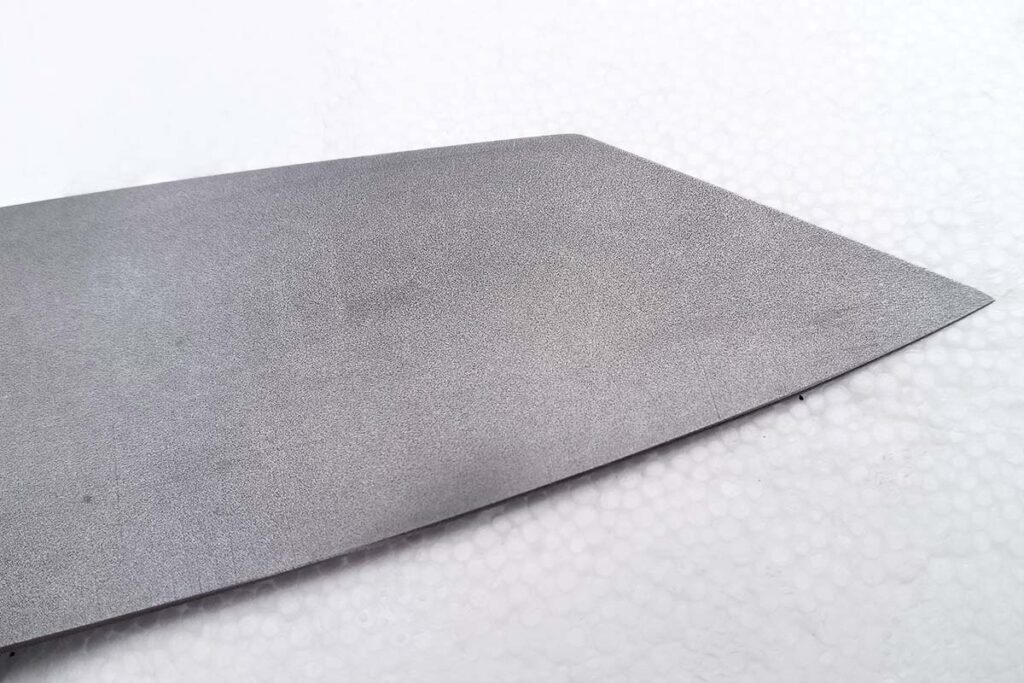
The heel of the blade curves toward the rear and sits flat on the surface for controlled cutting.
With extensive experience as both a knifemaker and a cook, Eastland brings the kind of know-how to the project that gives it edged gravitas.
“Dan is pretty much the perfect person to do this because he’s been in a commercial kitchen and knows his way around that,” Ethan said.
Dan also spent a number of years as an apprentice maker to Georgia Knife Makers Guild member Andy Roy of Fiddleback Forge in North Georgia, and now builds knives at Dogwood Custom Knives in Greenville, South Carolina.
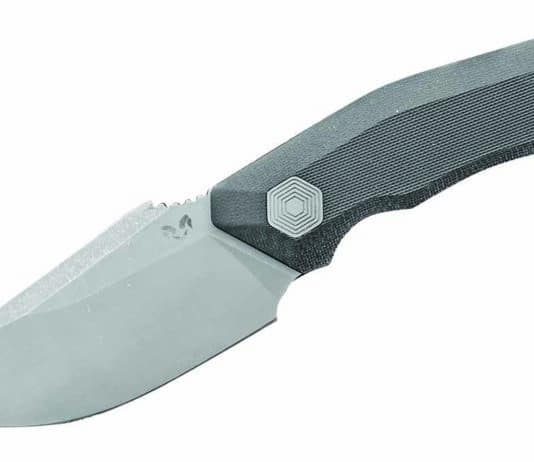
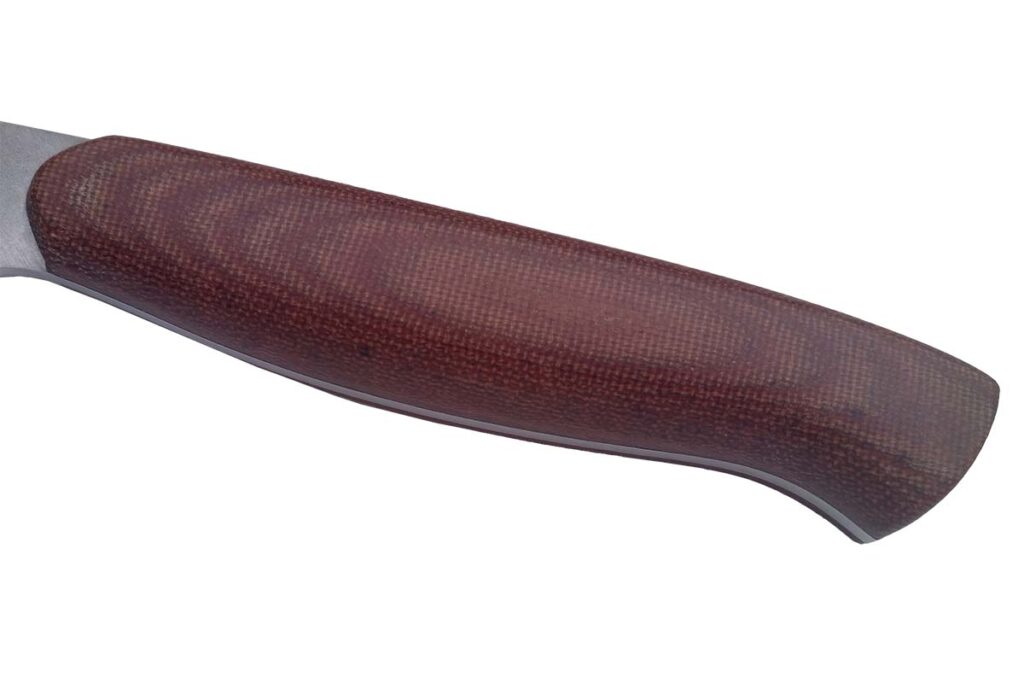
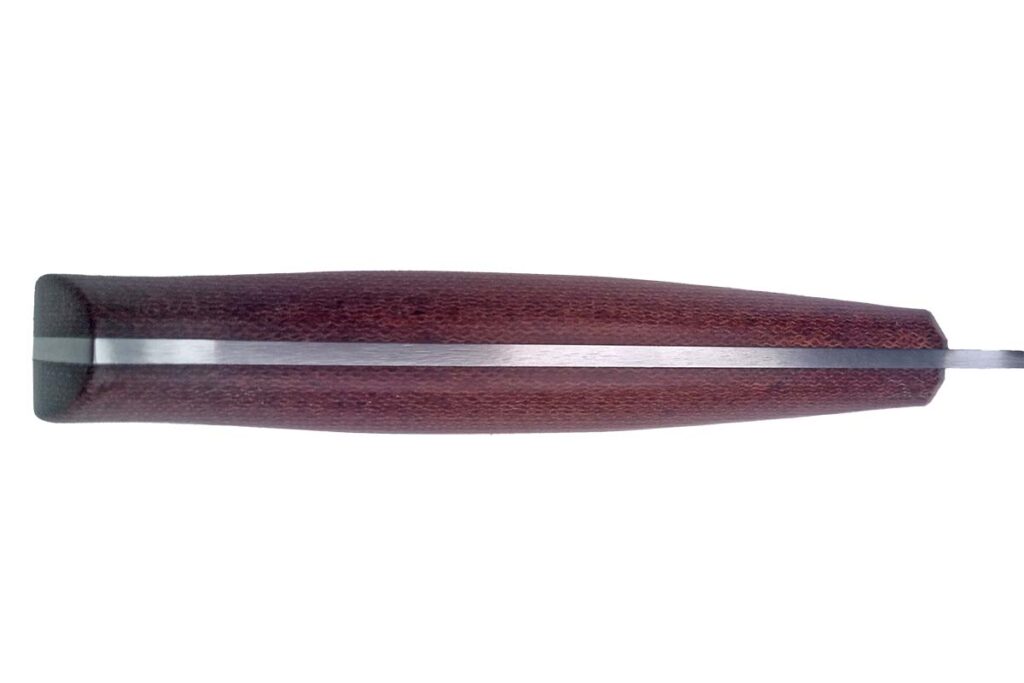
Handle materials come in a choice of natural (shown here; note the texture and grain) and black Micarta® and blue, red or black G-10.
As for the Joy of Cooking knife and its features, Dan approaches it all from the maker/cook perspective.
“The blade has a Japanese influence. I always liked Japanese blade geometry and balance, but I didn’t like their handles. Ethan and I both like a little palm swell,” he noted, “so we wanted more of a Western-style handle.”
In Joy of Cooking, Ethan writes about a grip for home cooks that’s comfortable, Dan said, so the handle has rounded corners to eliminate hot spots and an overall design that helps promote a pinch grip. The blade is weighted toward the front for balance and has the K tip for precise tip work.
The K tip gives the knife a piercing feature lacking in such Japanese designs as the santoku.
Ethan said he’s a big fan of the santoku style and has designed santokus and used them in the kitchen almost exclusively for 20 years.
“The one problem with the santoku is it really doesn’t have a good piercer,” he noted. “You can get by without a piercer if you keep the knife really sharp but guess what—most people don’t keep their knives sharp enough. But for such jobs as taking off the top of a tomato, for instance, the K tip works pretty good.”
Dan lauded the utility of the K tip for other tasks as well, adding, “My grandmother opened all the packaging with the tip of a kitchen knife. No matter what knife you gave her, she sliced the top of the package open with the tip and went to work.” The K tip is tailor made for such chores, as well as others.
The collaborators prefer a Western-style handle and gave the Joy of Cooking Knife grip a palm swell as a result.
The edge has a nice curvature for rock chopping and push cutting meats and vegetables. The heel of the blade also curves toward the rear and sits flat on the surface for controlled cutting.
“The neat thing is when the blade comes down [at the heel during a rocking cut or chop], it stops,” Ethan explained. “It’s also good for a push cut,” Dan added, “so it’s good for both a rock chop and push cut. And having that heel down a little bit it will bottom out, so you cut all the way through something and don’t wind up with little partially cut bits at the end.”
Joy Of Cooking Knife Details
The 8-inch blade is CPM S35VN stainless steel. The Rockwell hardness is 60 HRC and the blade is 3/32-inch thick at the thickest. Along with the contoured handle the knife weighs in at a scant 5.5 ounces.
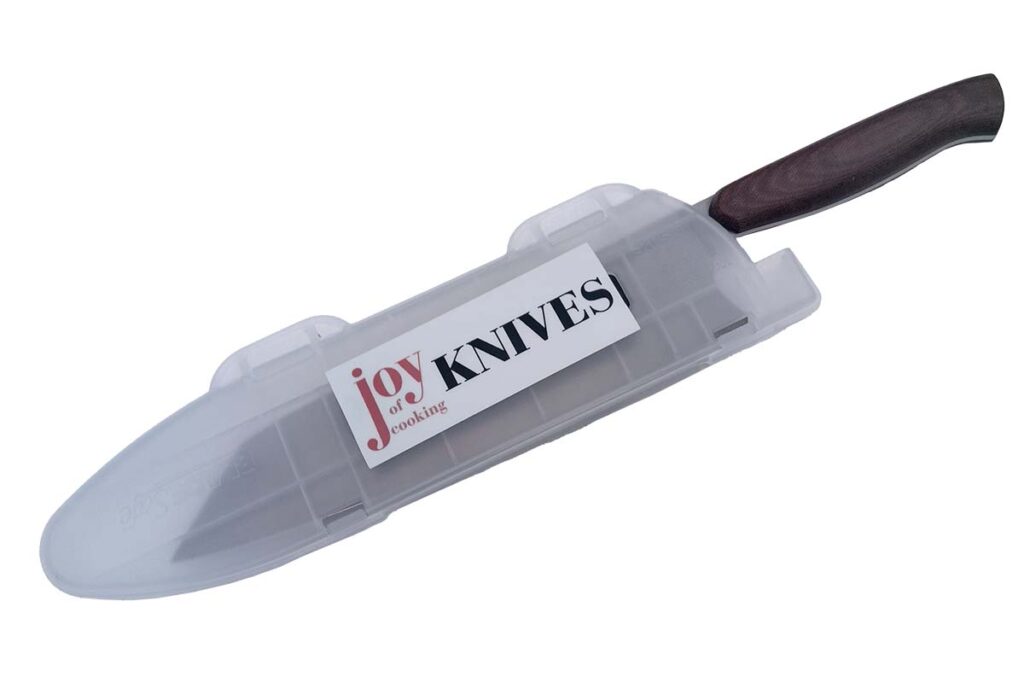
A hard plastic cover with plastic snaps contains and protects the knife.
“I’m of the opinion the Greeks told us everything we need to know about a double-inclined plane—the longer the plane and the lower the angle, the more efficient it is,” Dan said. “A knife blade is a double-inclined plane, and I wanted to make this knife as light as possible.”
He returned to his grandmother’s experience.
“And again, my grandmother used to complain that Henckels and Wusthof, she loved the knives, but they weighed almost as much as she did. By using the S35VN we’ve been able to thin it out and get a mechanically better cutting blade, but also a lighter blade.”
Ethan agreed that most kitchen knives are too heavy.
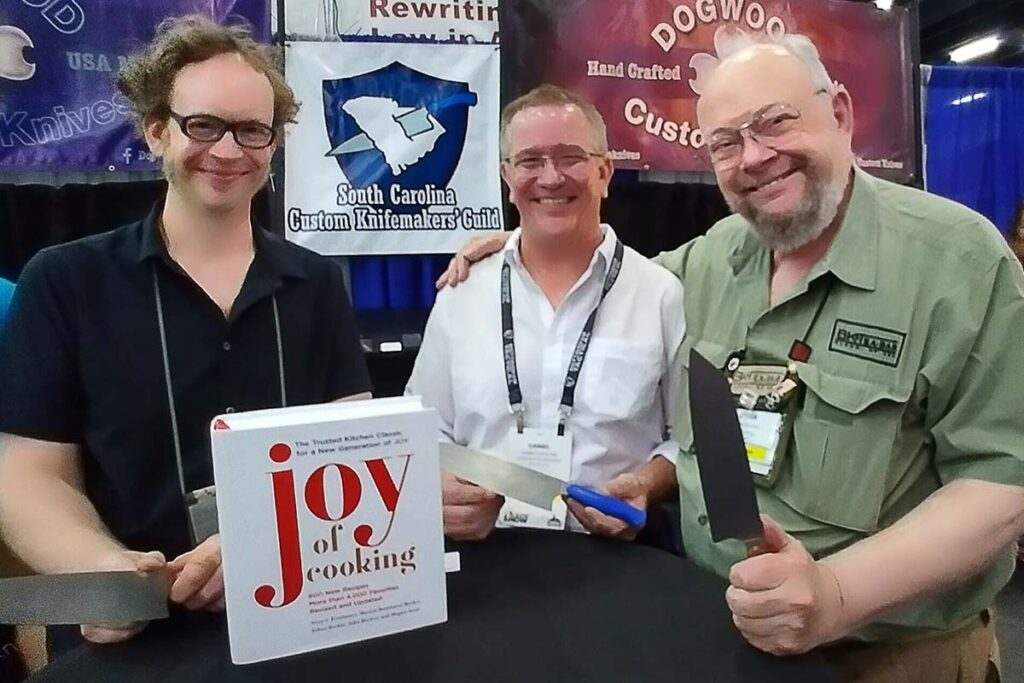
From left at BLADE Show 2024: John Becker, co-editor of Joy of Cooking, Dan Eastland of Dogwood Custom Knives and long-time knife designer Ethan Becker.
“The wrist gets tired easy and to be able to not have very much weight that you’re working with, hey, what’s wrong with that?” he observed. “Most traditional kitchen blades were thick because they were forged before they were ground … The cutlers in Europe were very, very concerned that the housewives would use the blades for things they weren’t supposed to, so they used soft steel so it wouldn’t nick and if they opened bottles with it it wouldn’t hurt it. The result was blades that didn’t hold an edge worth a damn and were not terribly efficient.”
Dan said the S35VN has good corrosion resistance and the edge retention is phenomenal.
“We tested the knife extensively in an industrial kitchen to ensure edge retention and durability, and I like S35VN because it’s a good balance of durability and edge retention. And we can get that 60 Rockwell so it can take a nice, keen edge and we don’t have to worry about it chipping out.”
As noted, Dan and Ethan wanted a Western-style handle with a palm swell and offer it in a choice of G-10 and Micarta®. The Micarta is available in black and natural versions, both with texture and grain for purchase. The G-10 comes in red, black and blue.
“Those colors will always be the same over time as we introduce other knives in the lineup, so you can buy a knife that will match whichever color knife you previously bought,” Dan said. The intent is for there to be a complete set of Joy of Cooking knives, though nothing was set in stone in that regard at press time.
Pros
Collaborative Expertise
Versatile Blade Design
Premium Blade Material
Cons
Higher Price Point
Plastic Snap Cover
Joy Of Cooking 8” Chef’s Knife Specs Designers: Ethan Becker and Dan Eastland Company: Dogwood Custom Knives Blade Length: 8” Blade Steel: CPM S35VN stainless Rockwell Hardness: 60 HRC Blade @Thickest: 3/32” Handle: Black and natural Micarta® and blue, red and black G-10 options Overall Length: 13” Carry: Plastic snap cover Knife to Know: K tip blade; lightweight design; hidden handle pins Country of Origin: USA MSRP: $200
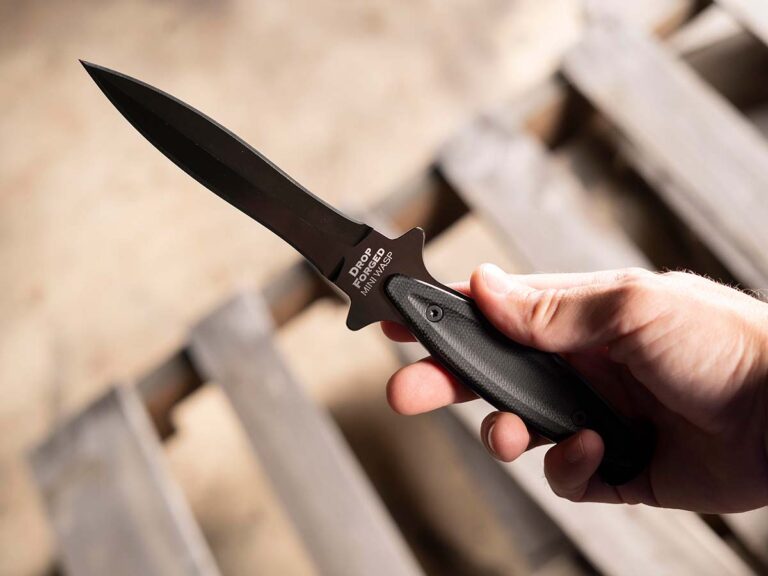
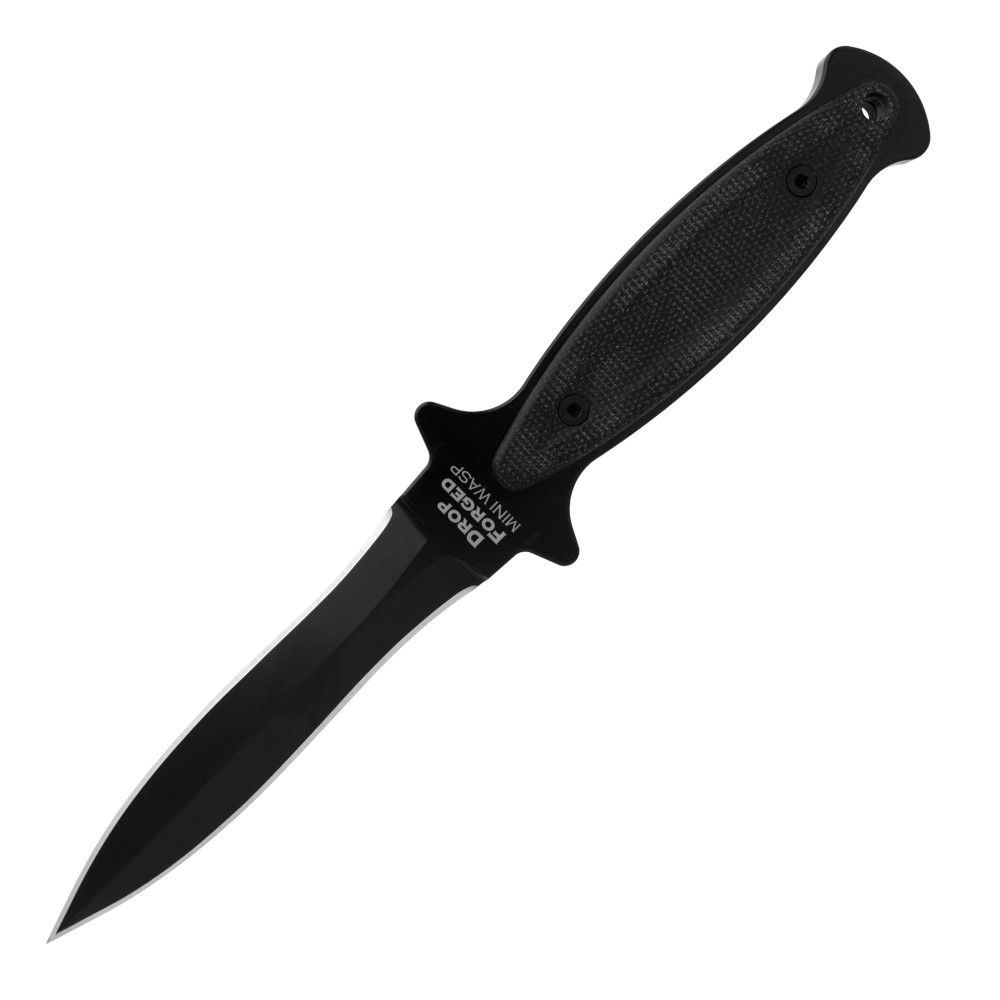
Discover the Cold Steel Mini Wasp Stinger. Get full cutting power in a compact, discreet EDC fixed blade forged from premium 52100 steel for ultimate reliability.
When you think of Cold Steel, you’re probably thinking about the gear trusted by professionals and enthusiasts who rely on their tools daily. They’re seriously recognized as a leader in the outdoor knife and tool industry, always pushing boundaries with performance and craftsmanship. But let’s talk about an EDC essential that packs a serious punch while keeping a low profile: the Drop Forged Mini Wasp Stinger.
Compact Carry, Full Power
This isn’t your average pocket knife; it’s a masterful blend of compact design and unrelenting strength. The whole idea here is to give you full-sized precision and cutting power in a discreet package that “flies under the radar.” Seriously, weighing in at a mere 7.6 oz. and with a sleek 10.25-inch overall length, this fixed blade dagger is portable enough to ride unnoticed until you need it.
So, what makes it so tough?
It’s drop-forged from premium 52100 high carbon steel. This material ensures the 4-inch dagger-style blade delivers both exceptional durability and razor-sharp performance. Plus, with a robust 6mm thickness, this thing is engineered to tackle even the toughest tasks without breaking a sweat.
Precision and Confidence in Your Hand
Beyond the blade, the design is all about control. The handle features Micarta handle scales that ensure a secure, comfortable grip and, most importantly, a slip-resistant one in any conditions. That’s a huge boost of confidence for all tasks.
To keep you ready for action, the Mini Wasp Stinger comes complete with a Secure-Ex® Sheath for safe, easy storage and quick access.
This tactical dagger is truly engineered for those who demand both precision and reliability. If you’re looking for an ideal companion for discreet carry without sacrificing an ounce of power, the Mini Wasp Stinger might just be the EDC that belongs in your collection.
Be it chopping wood or prepping a meal, a solid bushcraft knife is an essential piece of backwoods kit.
Bushcraft is a specialized skill set that ensures survival in the wilderness using foraging, hunting, fishing, shelter construction, and firecraft, all accomplished with minimal tools. The primary bushcraft implement is a fixed blade employed not only for food prep but the other mentioned skills, too.
As a result, such a fixed blade must be a tough tool capable of more than just standard cutting tasks, including whittling, carving, splitting wood or, in conjunction with a ferrocerium rod, starting a campfire.
What Defines A Bushcraft Knife?
Five basic chores of outdoor survival can be performed with a bushcraft knife. The tasks are elemental and a must-learn if you want to use a bushcraft knife to maximum effect.
Chopping
Batoning
Carving
Fire Starting
Food Prep
Chopping
Whereas a small hatchet, ax, or even a machete are better suited for the task, a bushcraft knife can turn the trick. Grip the handle as far back and as securely as you can, and chop as you would with a larger knife, ax, hatchet or machete.
Batoning
Basically, to baton a piece of kindling is to split it. Take a rather large/thick piece of wood to act as a baton/hammer in one hand, lay the blade edge on the end of the secured piece of kindling with the other, and, using firm, deliberate blows, pound the blade lengthwise through the kindling, effectively splitting it.
Again, an ax, hatchet or even a folding saw would be better, but if you lack any of these, your bushcraft knife is capable of handling such a task.
Carving
One of the most important bushcraft skills is to carve bowls, spoons, or even whittling sticks to roast hot dogs. Chopping and batoning are tasks using brute force; carving is more finesse and control.
This can be accomplished by using the knife and a ferrocerium (aka ferro) rod. The job is best done by using a knife that has a blade with a 90-degree spine as opposed to a chamfered or radiused one.
Grasp the knife firmly, cutting edge up. Lay the corner of the blade spine on the ferro rod and with one swift, downward motion, as if you are whittling o a piece of the rod, move the blade down it. Doing so will result in a white hot shower of sparks. The sparks can ignite tinder to start a fire.
The key to fire starting is always select a bushcraft knife with a 90-degree spine. If it lacks such a spine, you can always use the edge but this will dull the one spot on the edge faster than standard cutting will.
Food Prep
And, obviously, a bushcraft blade can also adeptly handle any cutting task related to food or campsite prep. Bushcraft knives prove a knife need not have sheer size and weight to be effective. It’s all in smart design of the blade and handle.
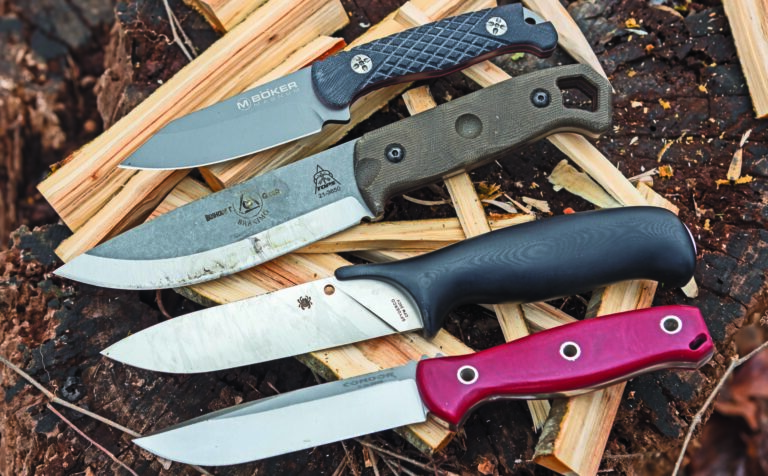
Our Picks For Best Bushcraft Knife
Boker Magnum Life Knife
Boker Magnum Life Knife
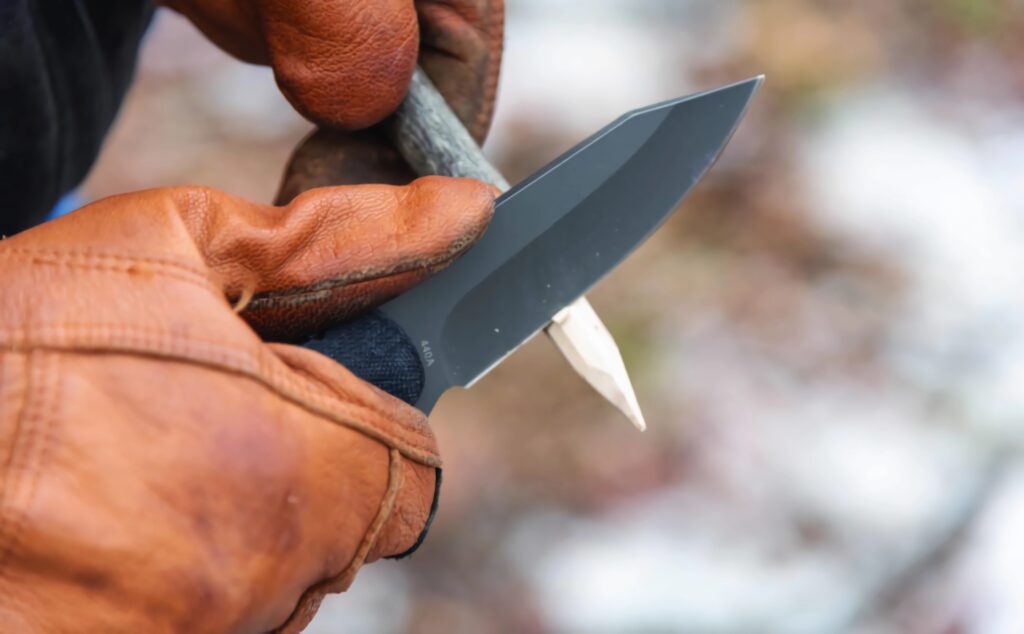
The most affordable bushcraft model of the test bunch, the Boker Magnum Life Knife has a 3.9-inch blade of 440A stainless steel in a modified clip-point pattern. Built rugged for the outdoors, the knife comes with a sturdy Kydex sheath for safe carry.
At 7.87 inches overall, the Life Knife sports a handle of machined black G-10 in a coarse crosshatched checkering pattern for enhanced hand traction regardless of conditions. The grooves in the crosshatching work are similar to those of a radial car tire by displacing moisture. Red fiber liners under the G-10 add a nice pop of color to an otherwise dark knife.
The handle includes integral forward and rear guards to prevent your hand from sliding in either direction. The three large traction notches in the thumb rest area of the blade spine also help improve grip. The handle felt a bit skinny in my hand, so I would prefer a slightly wider one.
Conversely, the Life Knife might be a great choice for those with smaller paws. The 3.9-inch blade is a great size for belt carry. The rather compact nature allows it to carry comfortably, with the length neither too long nor too short. The short blade tip accomplishes precise cutting chores easily.
The sheath is a simple fold-over design of Kydex with a Boker Plus clip for belt carry. The sheath features quality construction, retains the knife well, and is simple yet effective.
MSRP: $59.95
Condor Tool & Knife Bushcraft Bliss
Condor Tool & Knife Bushcraft Bliss
Composed of high-quality materials, the Bushcraft Bliss from Condor Tool & Knife boasts a 5-inch blade with a flat grind. The 1075 carbon steel can be rather easy to sharpen in the field and still retains an edge well. The modified clip point shape offers a generous belly for slicing and a defined point. A swedge gives the blade a bit of attitude, and bead-blasted flats and satin-finished bevels provide a two-tone finish that’s very eye-catching.
The ergonomic handle of red linen Micarta® is an excellent choice thanks to its being largely impervious to temperature and humidity changes. Three thong tubes fasten the scales to the full tang. Three large notches at the spine permit non-slip thumb placement so you can bear down on the blade. With its rounded edges, choil, and scale contouring, the handle felt as if it were molded to my hand.
The sheath is Condor’s hybrid molded Kydex and leather rig, an unusual material combo. The belt loop and securement strap are leather. The leather belt loop allows the sheath to move somewhat, unlike the more rigid molded clamshell fastener—which doesn’t—and makes it easier to sit down while wearing it. A thumb break molded into the top of the sheath assists in extracting the blade, which is a nice extra touch.
I found the handle to be very comfortable. A distinctive trait is the prominently elevated traction notches. They almost look like part of a gear. The feature ensures your thumb isn’t going anywhere.
The 5-inch blade makes baton work easy, as well as food prep tasks. Out of the box, the 1075 carbon steel was plenty sharp and ready for use. The Bushcraft Bliss is a consistent performer.
MSRP: $118
TOPS Knives Brakimo
TOPS Knives Brakimo
Joe Flowers runs Bushcraft Global, where he instructs students on basic and advanced survival skills while in the Amazon jungle. A notable authority in the field, he also designs knives, including the Brakimo from TOPS Knives, a tool that can carve, cut, split, and perform just about any task involving outdoor survival.
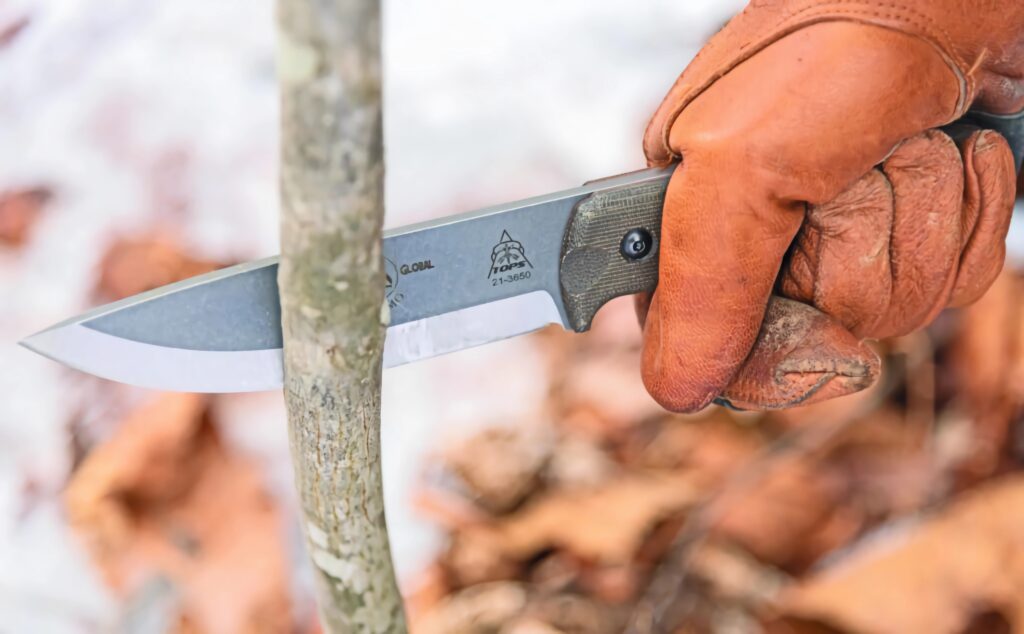
The 5.25-inch blade of 1095 carbon steel is a drop-point pattern with a Scandi grind. It has a generous belly for easy slicing and a defined point for delicate work.
The green Micarta handle is ideal for bushcraft given its stability and minimal weight. It is matte-finished for a nice grip quality without being overly aggressive. The integral front and rear guards provide a measure of safety that locks the knife in the hand. The divot in the handle is for use with a bow drill for making fire.
If there is a solid all-around performer of the test bunch, it’s the Brakimo. I like how it easily handles heavy work like chopping and baton work, as well as such lighter work as whittling and food prep. You can choke up on the handle for tasks requiring more control where a slicing or rocking motion is used. Grip the handle more toward the rear and feel how the balance point shifts to a blade-heavy profile for easy, effective chopping.
The Scandi grind acts as a wedge and splits the wood in a snap, almost as if no effort were invested—very impressive performance! For one knife that does it all, the Brakimo is it. In-hand it feels substantial and capable of taking on serious work.
MSRP: $225
Spyderco FB42G Zoomer
Spyderco FB42G Zoomer
Designed by Tony Zoomer, an outdoor enthusiast and survival skills instructor from the Netherlands comes the Spyderco FB42G Zoomer. Made of high-end materials, the knife is expertly configured and has a list of features that quite possibly makes it the most comfortable bushcraft knife you’ll use.
The 5-inch blade in a drop-point pattern is premium CPM 20CV stainless steel for enhanced edge retention. The blade has an ample belly for slicing and whittling/carving tasks and a defined point for close-up detail work. The full flat grind transitions to a convex edge, which is durable and extremely sharp.
The black G-10 scales are machined where they join the tang, so the handle is completely rounded in profile. This translates into a super comfortable grip that eliminates hot spots. An integrated rest at the blade spine permits placement of your thumb for additional pressure on cuts and for added control. The full tang extends a little beyond the end of the handle for use as a light-duty hammer.
The sheath is a custom-designed, well made leather drop-leg-style rig with a free-floating belt loop. It has an exterior storage pouch with a snap closure. The pouch can carry your choice of survival supplies, a large folding knife, a multi-tool, etc.
The free-floating belt loop allows the knife to swing freely as you move or pivot out of the way when you are seated. It also can temporarily break away in the event the sheath gets snagged by brush in the woods.
The Zoomer is a solid performer. The heavily contoured G-10 handle feels mighty good in the hand. The full flat grind allows the blade to sail through whatever you cut.
While the handle is comfortable, it felt big in my hand. Those with smaller hands might not take to it easily. While using high-performance CPM 20CV stainless steel is not typically a bushcraft thing, with some regular stropping and honing, you can prolong the edge and skip sharpening during your trip.
MSRP: $600
Fallkniven S1 Pro Forest Knife
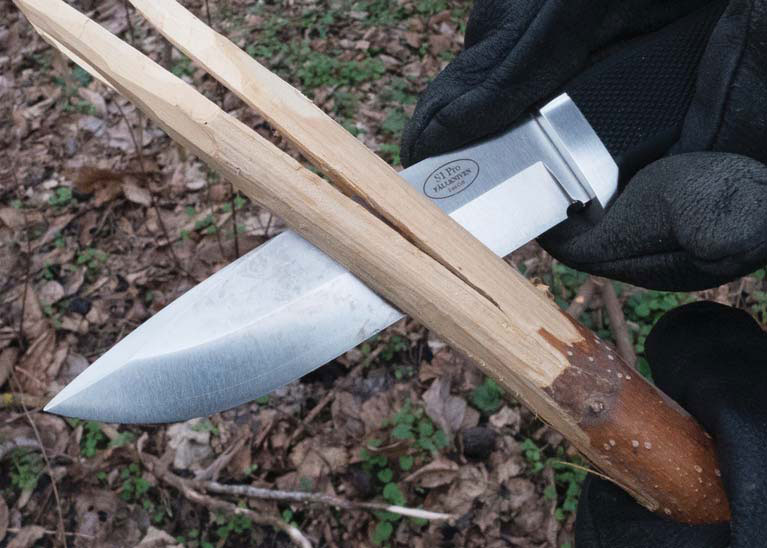
The Fallkniven S1 Pro Forest did fine work—as on this fish spear—with full control. (All images by Ash Ayres and Mary Lou Ayres)
Fallkniven’s S1 Pro Forest Knife is the evolutionary descendant of the company’s S1, which has been in production for over 20 years. The Pro version is made with better steel than the original S1, is more sophisticated and a better performer.
The S1 Pro simply does everything well and with no fuss. Its convex grind does not bind in deep cuts, goes through tough, knotty wood with little effort, peels bark, makes feather sticks, does fine work as on fish spear points with full control, and slices duck through skin, meat and bone like Luke Skywalker’s lightsaber. It cut through 2-inch-thick saplings in about a minute with little effort. The non-slip grip is comfortable and does not, in fact, slip.
Compact enough to always have on—or with a custom sheath, inside—your belt, the S1 Pro is as close as I’ve seen to the mythical “one knife to do it all.”
MSRP: $466
Ontario Bushcraft Woodsman
Bushcrafting chopping
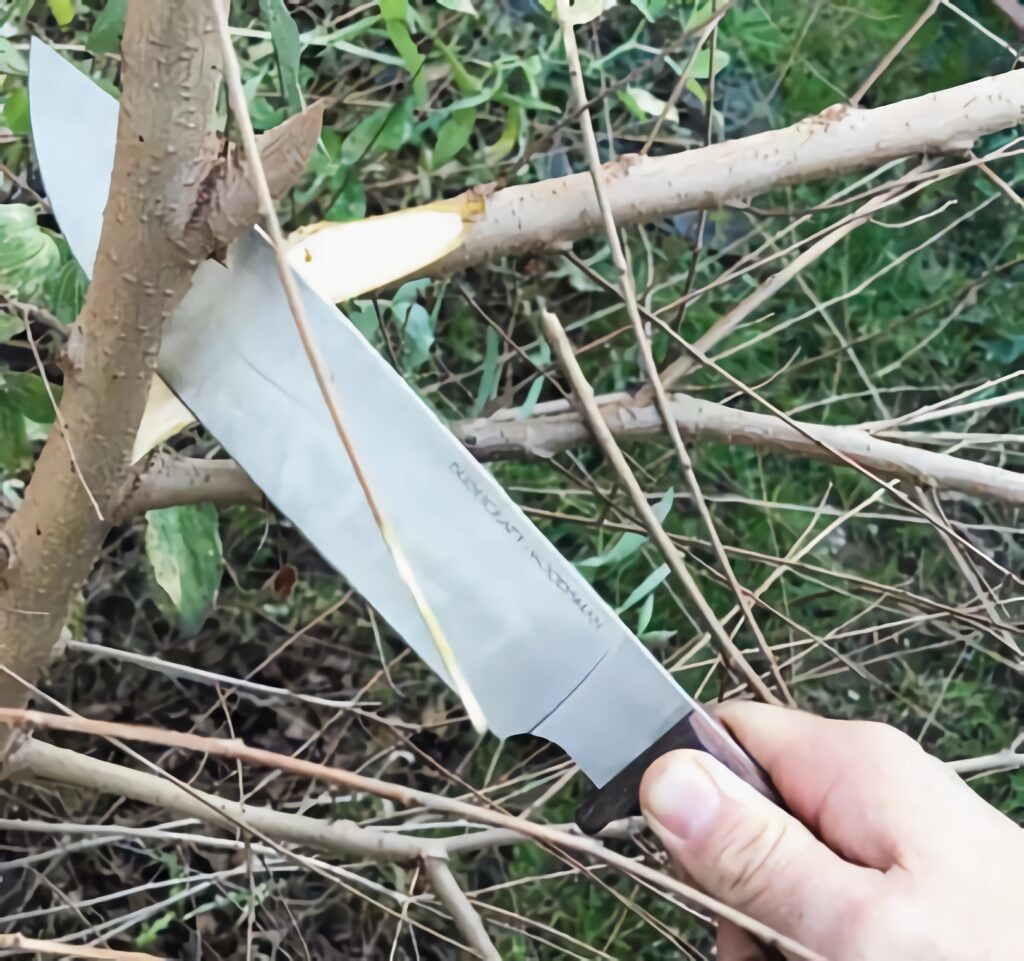
The geometry of the Bushcraft Woodsman’s blade, combined with the overall design, good steel and heat treat, make for an exceptional big knife.
Veteran bladesmith Dan Maragni designed this issue’s cover knife, the Ontario Bushcraft Woodsman. The big blade shows his expertise and lineage as an accomplished smith, and is far more sophisticated than a first glance might suggest.
The distal taper gives it excellent balance, and, combined with the taper from spine to edge, great chopping ability.
We slashed through 2-inch-thick saplings with a single swipe, an important point in the calories-expended-vs.-results-achieved equation, and when night is falling and you need to get a fire going.
The blade’s geometry, combined with the overall design, good steel and heat treat, make for an exceptional big knife. Again referencing Tolkien, Ash called it the “Goblin Cleaver.”
Not as handy for fine work as the smaller knives, Dan’s design is a reassuring blade to have by your side in deep woods when the jackals are howling—or the Orcs.
MSRP: $137
Larry Roberts Signature Edition Gen6 Scandi (L.T. Wright Handcrafted Knife Co.)
Due to its scandi grind, which tends to hang up in deep cuts, an average of three minutes was required to get through 2-inch-thick saplings with the Gen6 Scandi.
The Larry Roberts Signature Edition Gen6 Scandi from L.T. Wright Handcrafted Knife Co. performs like a “Mora on steroids,” according to Ash. I agree.
If you’re familiar with the scandi grind, the only surprise with the LRSEG6S is that it takes scandi-ground blades to a higher level of performance. It excels at controlled shallow cuts, holds an edge well, and is strong enough that when batonning you can twist the blade with no worries and quickly pop the batonned material apart.
I like the longer 6-inch blade much better than the popular 4-inch pattern because you can get more stuff done faster and at no penalty to doing fine work. Due to the scandi grind, which tends to hang up in deep cuts, an average of three minutes was required to get through 2-inch-thick saplings.
Comfortable in the hand, it is also beautifully made and finished. A good all-around performer, it is a classic belt knife for the woods.
MSRP: $253
Editor’s Note: Dexter Ewing and James Ayres contributed to this post.
Timeless and iconic, it remains practical and complementary to other options today.
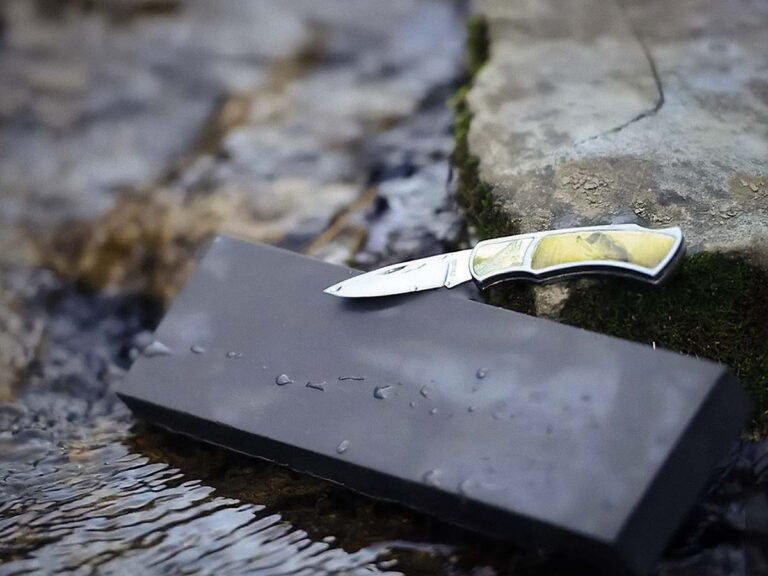
The novaculite sharpening stone is a wonder of nature. Almost pure microcrystalline quartz in content, this dense, fine-grained rock was formed from 318 to 416 million years ago during the Devonian and Mississippian periods in ancient seabeds and later pushed toward the surface with the peaks of the Ouachita Mountains of western and central Arkansas. Massive sedimentary layers ranging from 250 to 900 feet thick produced the stone, which takes its name from the Latin novacula, meaning “sharp knife” or “razor.”
From there, the stone was destined for a rendezvous with the knife blade, rendering a sharp edge that gets the job done and holding a place in working knife history dating back centuries.
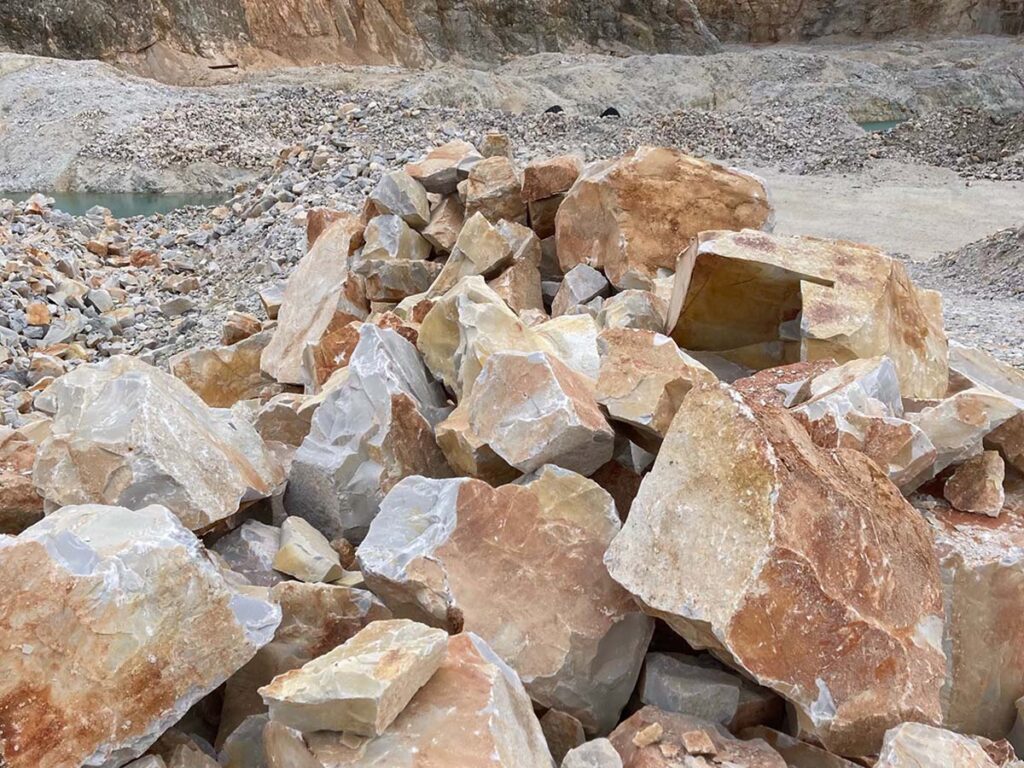
The novaculite deposits in Arkansas were formed 318 to 416 million years ago and it takes plenty of mechanical muscle to push around the material. The deposits run from 200- to 900-feet thick, in turn the operations are substantial. And while the weathered novaculite is somewhat bland to the eye, once broken up the beauty of the natural material shines through. (Images courtesy of Chis Stillian)
Today, however, there is a bit of … well … friction as some may claim modern synthetic stones are eclipsing or at least competing with novaculite for some nebulous title of “best.” Synthetic stones often offer faster sharpening and convenience, while novaculite is valued for its refined finish and traditional appeal. Truth is that each has its place, and novaculite was and is a key participant in the knife-sharpening exercise.
“It gives a razor-sharp, polished edge with smooth feedback that many prefer over synthetics,” explained Chris Stillian, owner of Natural Whetstone, LLC. The company was founded by close friend David Davenport two decades ago, and when David passed away during the COVID-19 pandemic, Chris and his father, Shawn, kept the central Arkansas company going.
“The stones wear very slowly,” Chris continued. “Some last decades because they’re 99 percent plus pure quartz with no fillers. They’re natural, made in the USA and work great for chefs, woodworkers and knife users.”
Danny Kirschman founded Dan’s Whetstone Company, Inc., in Pearcy, Arkansas, in 1976, and his son Steve is currently CEO of the family venture. His roots in novaculite are long and deep. “The erosion-resistant quartz formations of the Ouachitas produced the finest and rarest natural abrasive in the world,” he offered. “Danny Kirschman’s opinion and what we share with others is that the one thing that sets novaculite products apart from other sharpeners is their unique crystalline structure. The novaculite stones wear less aggressively than most manmade abrasives due to the natural bonding of the crystals.”
Best Steel For Novaculite
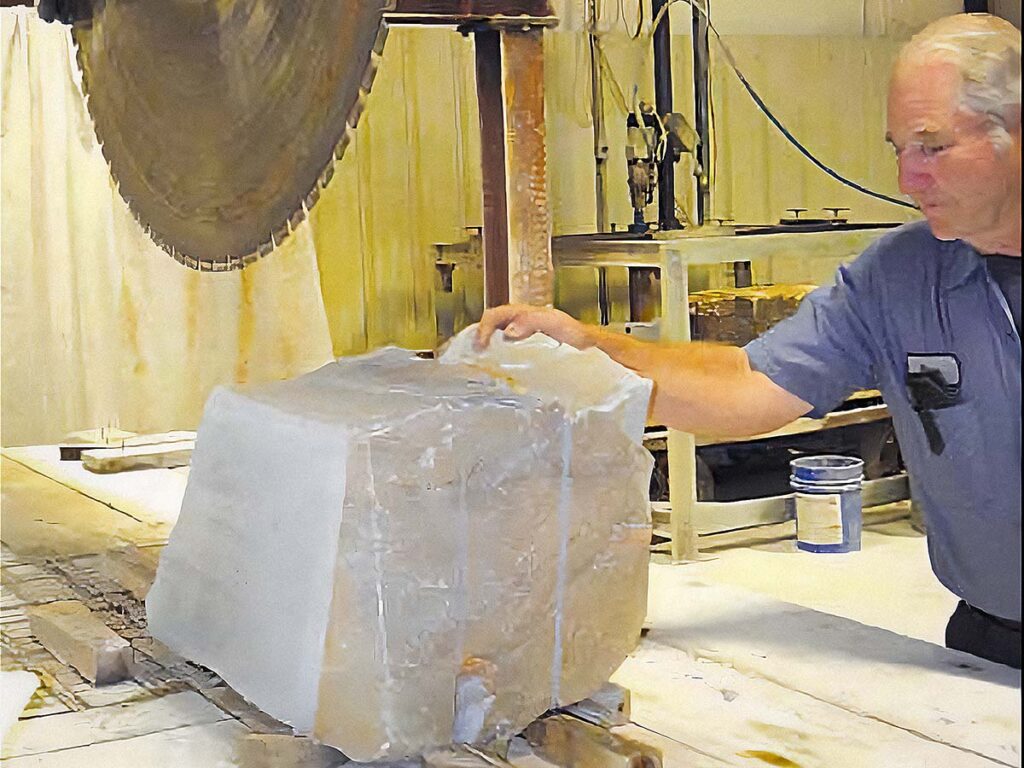
Dan Kirschman, by the company’s largest saw, spent his formative years as a mining engineer, until his hobby of cutting and polishing novaculite developed into a full-time business. Dan’s Whetstones now has a 500-acre quarry and manufactures more than 300 different products from the stone. (Images courtesy of Dan’s Whetstone)
Both Stillian and Kirschman agree that the disadvantages of novaculite usage lie in cutting speed and other aspects. Chris commented, “It cuts slower than diamond or water stones, so it’s better for refining edges than heavy profiling. It needs oil instead of water, can glaze if not cleaned and doesn’t bite hard on modern super steels. Top grades cost more because the dense material is rare.”
Steve added, “The most common complaint is their low abrasion rate. Because the stones are exceptionally hard and dense, they remove material much more slowly than synthetic stones. They are best suited for maintaining an already sharp edge rather than ‘hogging off’ metal to repair chips or reprofile a blade. There is no truly coarse Arkansas stone. Even the soft Arkansas is relatively fine compared to a coarse synthetic stone. Novaculite is composed of quartz, which has a Mohs hardness of around 7. While this is harder than standard carbon steel, it is softer than the vanadium and chromium carbides found in modern, high-alloy super steels.”
Further, since Arkansas stone is a natural product, every stone is unique and may exhibit internal flaws, cracks or variable grit. Oil is required to keep metal particles, or swarf, from clogging the pores, which leads to a bit more cleanup. Lubrication keeps the stone from “loading” with metal, which can reduce its effectiveness.
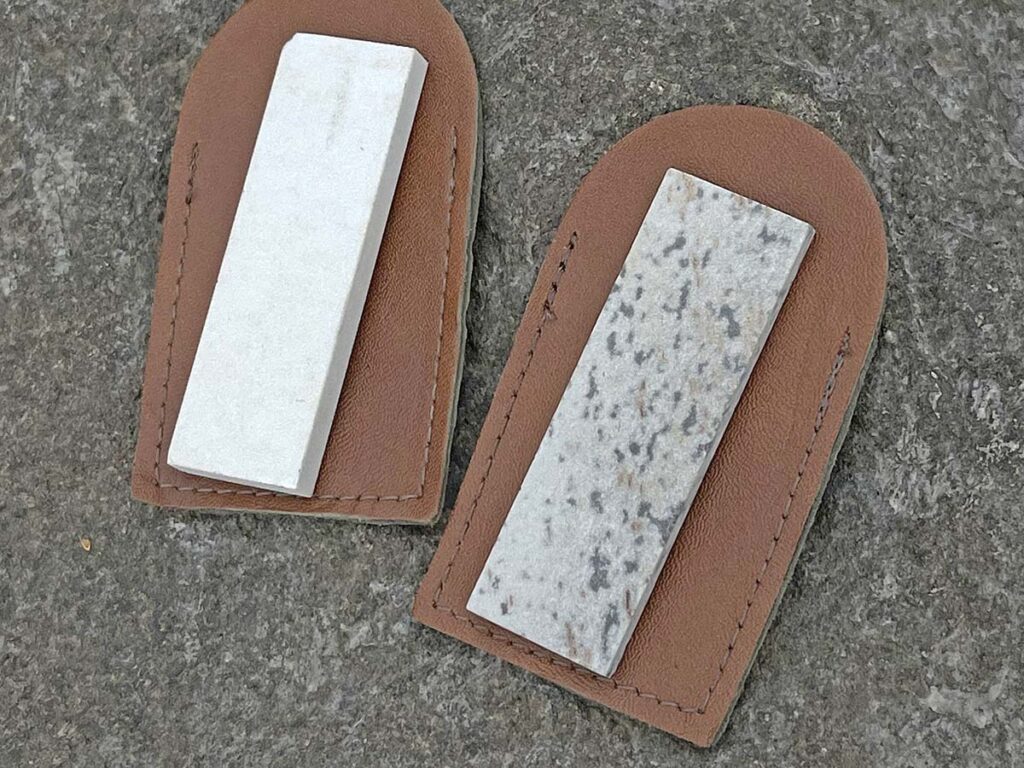
Similar to many sharpening systems, Arkansas stones of different grit sizes are used in conjunction. On the right is a soft stone with a courser grit, good for raising a burr and initial honing. On the left is hard stone, used for final edge polishing and day-to-day maintenance. (Image courtesy of Chris Stillian)
Novaculite works best with simple carbon and low-alloy stainless steels like 1095, O-1, 440C and A2. Since such steels are commonly found on hunting, working, kitchen, bushcraft/survival and everyday slipjoint and fixed-blade knives, a broad area of application exists. High vanadium super steels such as S35VN, M390, CPM-3V and others—often seen in premium chefs’ knives and high-end custom knives—are best served with diamond stones, for example, because their carbides are harder than the quartz in novaculite.
Reviving Arkansas Rock
Even the casual observer can, therefore, discern the proper employment of the novaculite sharpening stone with the blade steel that will produce the best results. One giant of the knife industry recognized the value of the Arkansas stone years ago and built a catalog empire on its sturdy reputation.
The late BLADE Magazine Cutlery Hall of Fame® member A.G. Russell began selling Arkansas sharpening stones in the mid-1960s after moving his family back home to northwest Arkansas from Marin County, California. During the move, he discovered that his whetstones had gotten lost in transit.
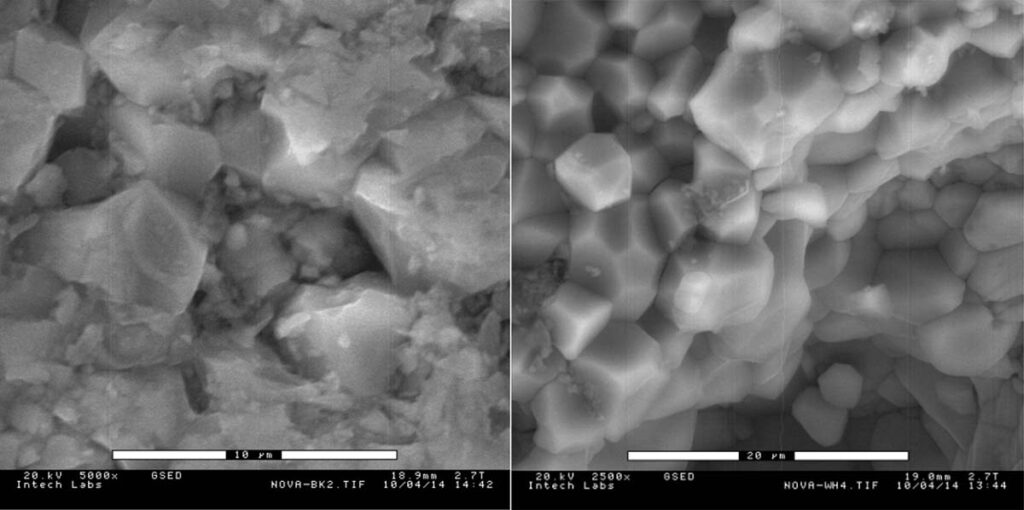
Novaculite is microcrystalline quartz in structure and while it can seem extremely smooth to the naked eye, at the microscopic level the formation’s cutting properties become evident. On the left is ultra-fine black stone at 5000x magnification and the right hard Arkansas stone at 2500x magnification. (Image courtesy of Dan’s Whetstones)
“He tried to buy replacements in local hardware stores, but none stocked them,” remembered A.G.’s wife and fellow hall-of-famer Goldie Russell, who runs the company today. “Having lived in Hot Springs, Arkansas, for a while when he was a teenager, A.G. knew that the only deposit of novaculite was in that area. A.G. went to Hot Springs and found someone who was cutting stones. He purchased stones and began selling them to local hardware stores.”
From there, A.G. bought ads in magazines, particularly Guns & Ammo and The American Rifleman. Soon enough, he became a supplier to Brownells, a major gun retailer, capitalizing on the mutual affinity of gun enthusiasts for knives. Together with the magazine effort and his own sales acumen, Russell re-energized the popularity of the Arkansas stone.
“The frequency of A.G.’s ad in magazines and then the offering of these stones in the A.G. Russell Catalog of Knives was very important in making these stones readily available nationwide through the late 1960s and the 1970s,” observed Goldie. “There is still a large quantity of the small stones that he had cut during those years in our inventory. That is how he started what became A.G. Russell Knives.”
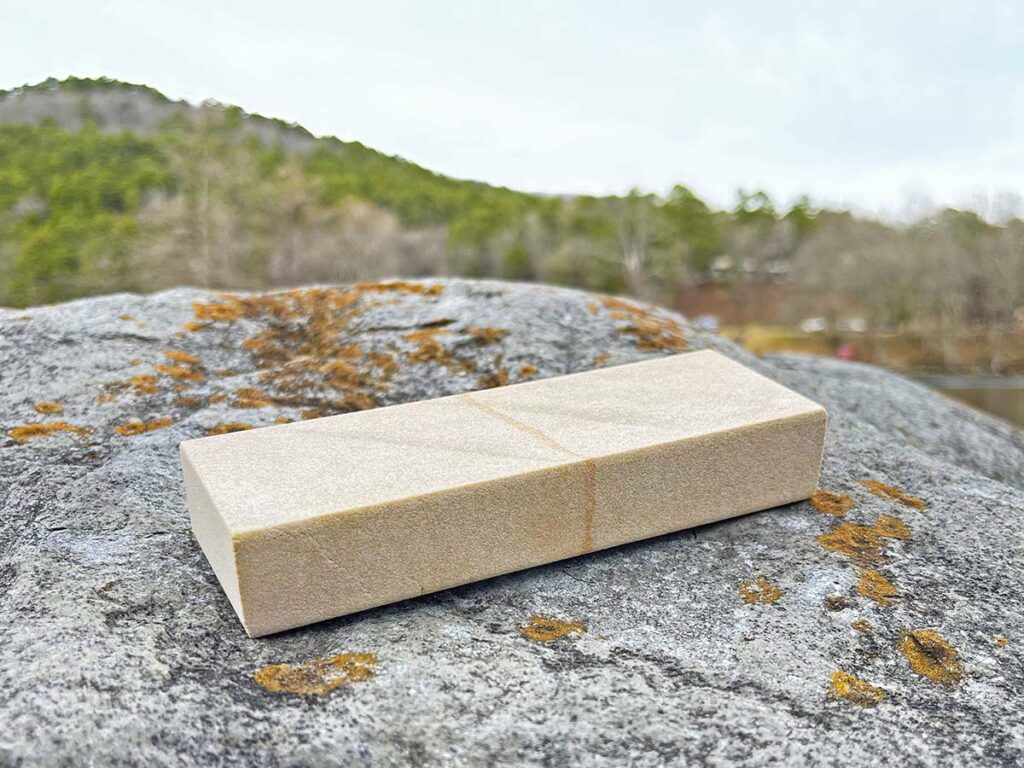
It’s a misnomer Arkansas stone’s hardness corresponds to its color. Similar colors can be noted in different grades, as the coloration is purely a matter of trace mineralization in the stones. (Image courtesy of Chris Stillian)
Novaculite stones, therefore, maintain their place in the practical and the historical aspects of the knife industry, and their relevance is not likely to fade. Those who are familiar with their capabilities remain loyal. They appreciate the investment of time and effort required to bring out that razor-sharp edge, and there is something timeless and reaffirming in the process.
Novaculite Grades
The stones themselves are available in four major grades. “Users should be aware that color is not the determining factor in grading novaculite,” explained Kirschman. “Some users have been defining whetstone grades by color, but the same colors may be seen in more than one grade. Color is caused by trace minerals that are dispersed through the rock during sedimentary formation more than 350 million years ago and subsequent geological activity.”
The major grades of novaculite include the following:
Soft Arkansas: The most popular all-purpose stone often used by wood carvers, sportsmen, butchers, commercial knife sharpeners and even housewives who desire keen, polished edge in a minimum of time.
Hard Arkansas: A fine grit stone good for everyday maintenance and popular among woodcrafters and the dental industry.
Translucent and True Hard Arkansas: An extra fine stone with a glassy feel and used in industrial applications requiring an extremely fine polish. It appears in a variety of colors.
Black Arkansas: Sometimes referred to as “surgical black” stone, the finest grade abrasive available today, delivering a mirror polish.
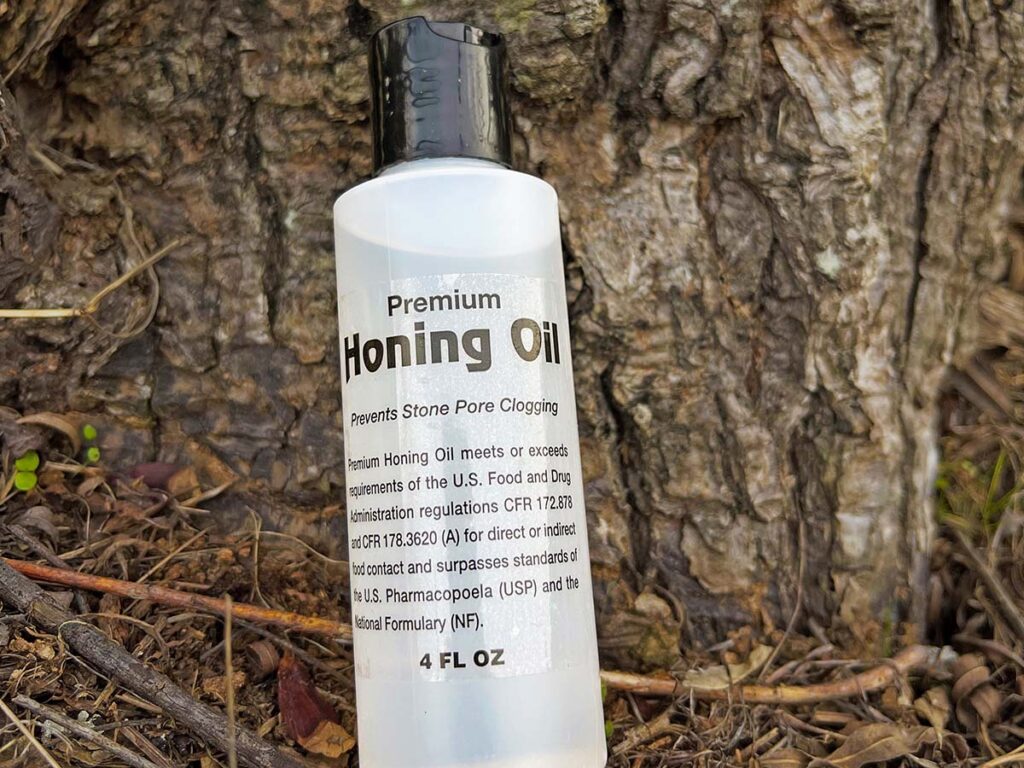
Among the most critical factors of using natural stones to sharpen knives is using honing oil. Oil keeps metal particles, or swarf, from clogging the stone’s natural pores, thus reducing its effectiveness. (Image courtesy of Chris Stillian)
The proper method of sharpening with a novaculite stone involves preparation and practice. “It’s an oil stone, so put a few drops of honing oil on it,” advised Stillian. “Hold a consistent angle, 15 to 20 degrees for most knives, use light to moderate pressure, and take smooth strokes. Start on soft or hard if the edge is dull, and finish on black or translucent. Raise a burr, then lighten pressure. Clean with soap or solvent to avoid glazing. Strop afterward for extra keenness, if you like.”
Those About To Rock
According to Chris, consistent purchasers and users include enthusiasts, woodworkers and chefs who “keep buying them for the feel, longevity and heritage. Synthetics rule high-volume work, but real Arkansas novaculite—especially the rare translucent and black grades—still sell at a premium to people who want the genuine article.”
Steve sees emerging interest as well. “The rising D.I.Y. (do it yourself) sharpening culture is a major driver,” he commented, “with the hobbyist segment now accounting for nearly 35 percent of total whetstone sales worldwide. Online tutorials and a deeper appreciation for craftsmanship have fueled this demand. Sustainability is a driver, as well. Modern consumers increasingly view natural stones as a “green” alternative to synthetics.
“Niche premium positioning, even while high-end market saturation is slowing growth in North America to about 4 percent, means natural stones remain a staple for professional chefs who prefer them for maintaining blade integrity,” Steve concluded. “And technological integration means that manufacturers are now developing beginner-friendly kits and instructional digital content to tap into 62 percent of home users who are interested in traditional sharpening but lack confidence in the technique.”
The future presents an atmosphere of coexistence among the Novaculite and synthetic options. The global whetstone market topped $457 million in value in 2024 and is expected to reach $677 million within eight years. Natural stone demand should stay steady, supported by its faithful and traditional users while welcoming explorers to these Ouachita wonders.
Keep your knife cutting ready with today’s top sharpeners.
It’s not much of a knife if it’s dull. Getting a blade sharp and keeping it that way is what the top sharpeners are all about. Pull throughs, V sharpeners, adjustable angle models and more, contemporary sharpeners not only will keep your knives keen, some are multi-tools with Torx tools and bits, screwdrivers, fire starters and window breakers. From those for use in the kitchen, camp or workshop to portable use and more, make way for today’s sharp makers.
Lansky Master’s Edge Sharpener
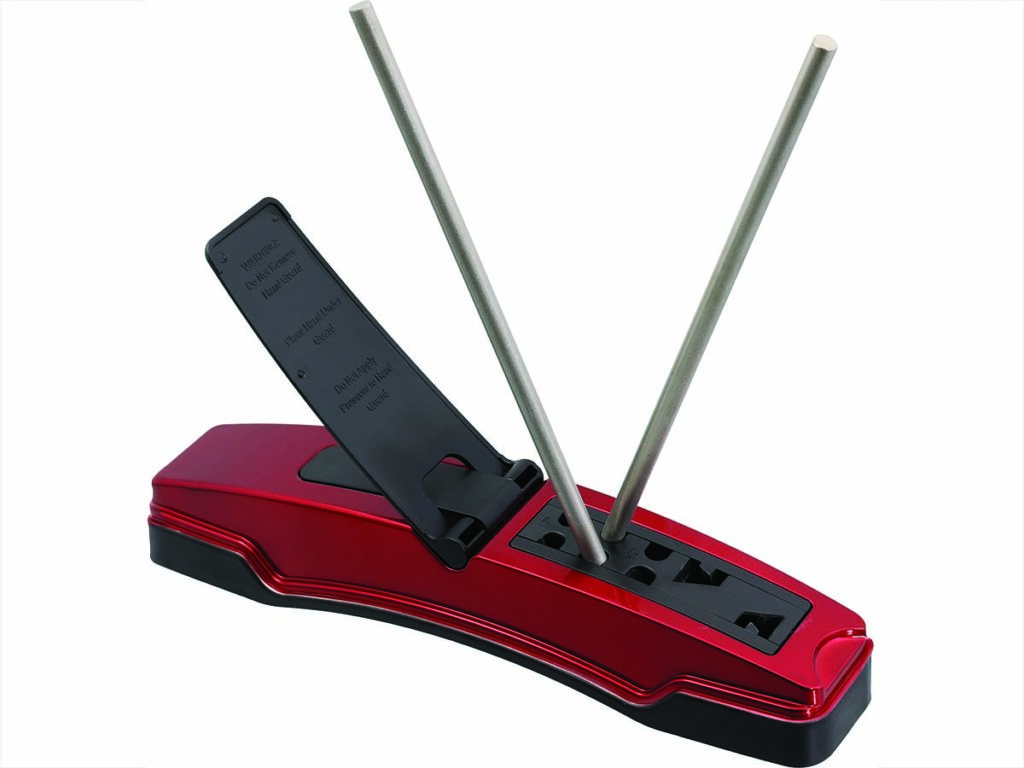
The Lansky Master’s Edge All Diamond Sharpener has a rubberized non-slip base with integrated hand guard for safe use.
Master’s Edge All Diamond Sharpener Model type: V sharpener Type of abrasive: Diamond coated Grit: 400 & 600 grit round rods; triangular rod for serrations Types of knives sharpened: Fillet/slicing, butcher, paring, skinning/kitchen/hunting, camping, utility and chef’s Types of edges sharpened: Plain and serrated Weight: 1.4 lbs. Country of origin: China MSRP: $139.95
Inspired by the design of Lansky’s top-selling Master’s Edge Sharpener, the Master’s Edge All Diamond Sharpener and its diamond-coated abrasives put a factory edge on hunting, utility, kitchen and other knives with just a few strokes. The unit includes a pair of medium (400 grit) and fine (600 grit) diamond-coated-abrasive rods for sharpening and polishing at your choice of preset angles: 17, 20 and 25 degrees. The 17-degree setting is for fillet and fine slicing knives, while the 20-degree angle is for slicing, butcher, paring and skinning knives. The 25-degree setting sharpens hunting, camping, utility and chef’s knives. A diamond-coated triangular rod sharpens serrated blades and also awls and fishhooks. A rubberized non-slip base with integrated hand guard ensures safe use and features easy snap-in storage in its underside. The unit can be kept on a counter or stores easily in a drawer.
Work Sharp Folding Field Sharpener
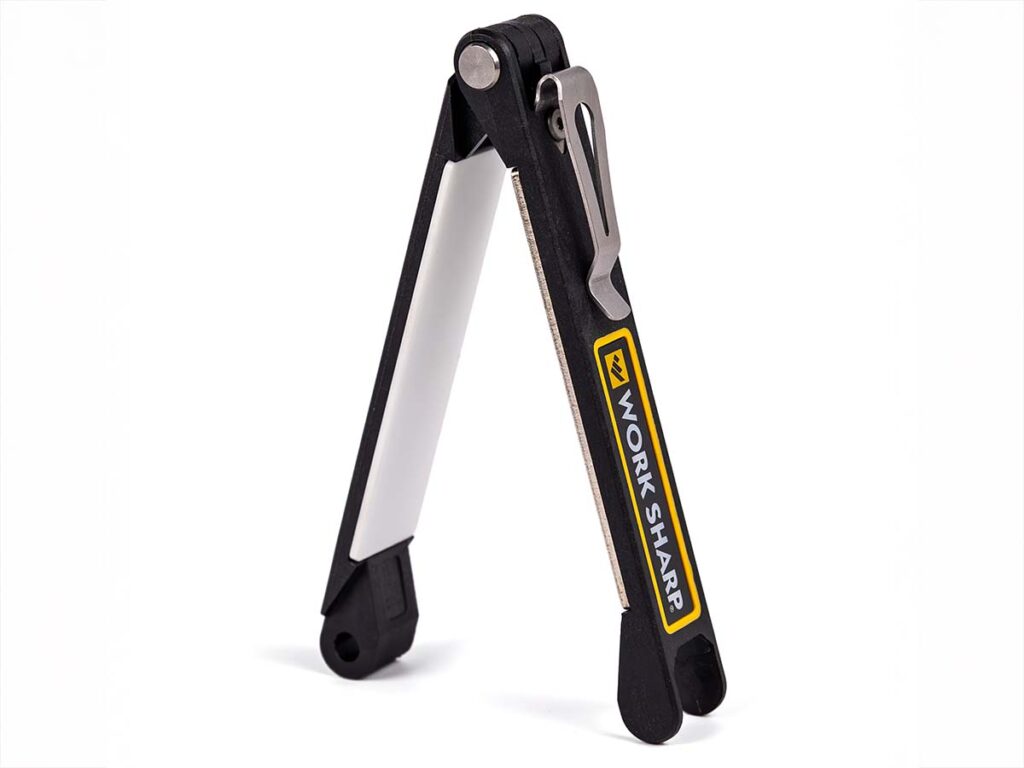
Especially effective on EDC knives, the new Work Sharp Folding Field Sharpener is one whiz-bang of a portable unit.
Folding Field Sharpener Model type: Compact field sharpener Type of abrasive: Diamond grit plate and fine grit ceramic plate Grit: Coarse 400-grit for each plate Unit dimensions: 4.75 x .75 x .5” Unit materials: Sharpening plates, plastic, aluminum Types of knives sharpened: Pocketknives, hunting knives, EDC Types of edges sharpened: Plain Special features: Folding design; edge angle guides (20 & 25 degrees) help maintain a consistent angle when sharpening and honing; pocket clip Weight: 4.6 ozs. Country of origin: Designed, calibrated and quality checked in Ashland, Oregon, using foreign components MSRP: $29.95
The Work Sharp Folding Field Sharpener is a compact, lightweight model designed for on-the-go sharpening. It features a 400-grit diamond plate with 20-degree sharpening guides and a fine-grit ceramic plate with 25-degree honing guides, ensuring consistent, reliable edges wherever you are. The folding design and integrated pocket clip make it easy to carry almost everywhere. A big package in a small platform, it’s designed to bring back an edge after a hard day’s use or simply for touchups. Especially effective on EDC knives, it is one whiz bang of a portable-type sharpener.
CRKT Knife Maintenance Tool
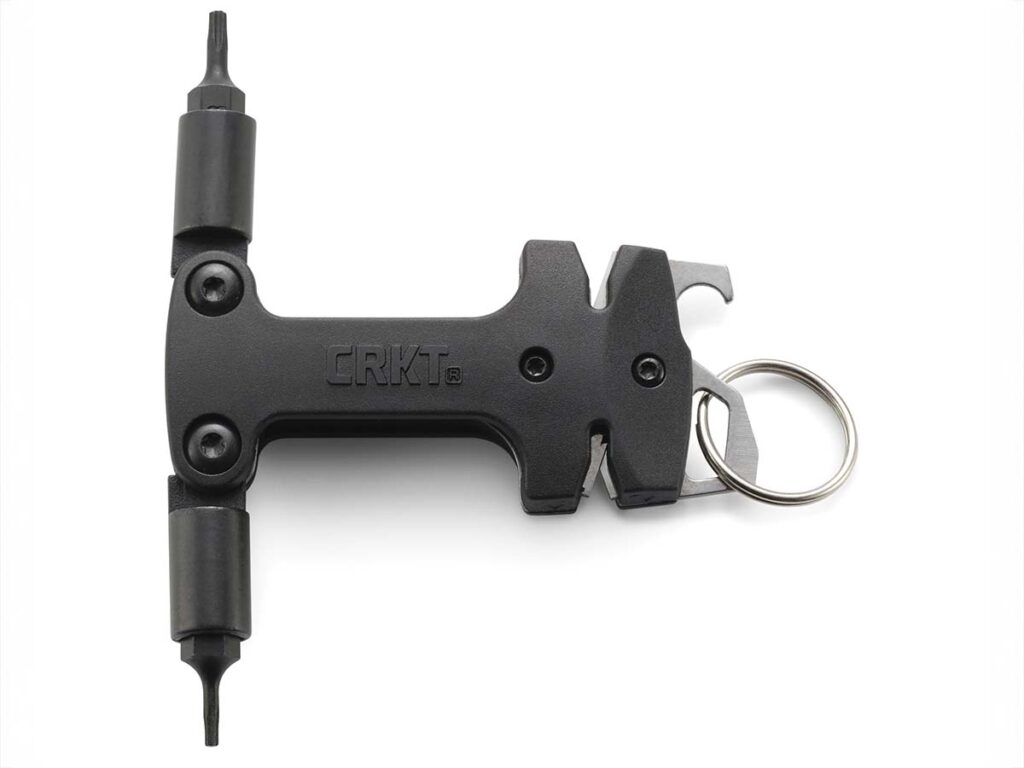
Designed by Tom Stokes, the CRKT Knife Maintenance Tool is two sharpeners and a multi-tool all rolled into one.
Knife Maintenance Tool Model type: Keychain/pocket field sharpener and multi-tool Type of abrasive: Tungsten carbide sharpener with ceramic honing edge Unit dimensions: 2.7 x 1.18 x .47” Handle: Glass-reinforced nylon Types of knives sharpened: Pocketknives, EDC Types of edges sharpened: Plain Special features: T6 and T8 Torx tools/bits, flathead screwdriver, bottle opener, keychain compatible Weight: 2.2 ozs. Country of origin: China MSRP: $30
Designed by mechanical engineer Tom Stokes, the CRKT Knife Maintenance Tool is a multi-tool sharpener that reflects Tom’s more than 25 years of experience in the aerospace industry, including his work with CAD software and rapid prototyping technology. He designed the Knife Maintenance Tool to prepare you for life’s various exigencies, everything from emergency repairs, popping a top on your favorite beverage—and, yes, sharpening your knives.
The Tool includes two pull-through sharpeners—one a tungsten carbide abrasive to establish a sharp edge, the other a ceramic abrasive to fine tune it—and two sizes of Torx tools/bits: T6 and T8. The sharpeners are on either side of the front of the handle, which is topped off with a bottle opener and flat-head screwdriver/lanyard hole for a keychain loop. The Torx tools are also on either side of the handle and fold out independently of one another for torquing screws pistol-grip style.
Wicked Edge GO-WE60 Precision Knife Sharpener
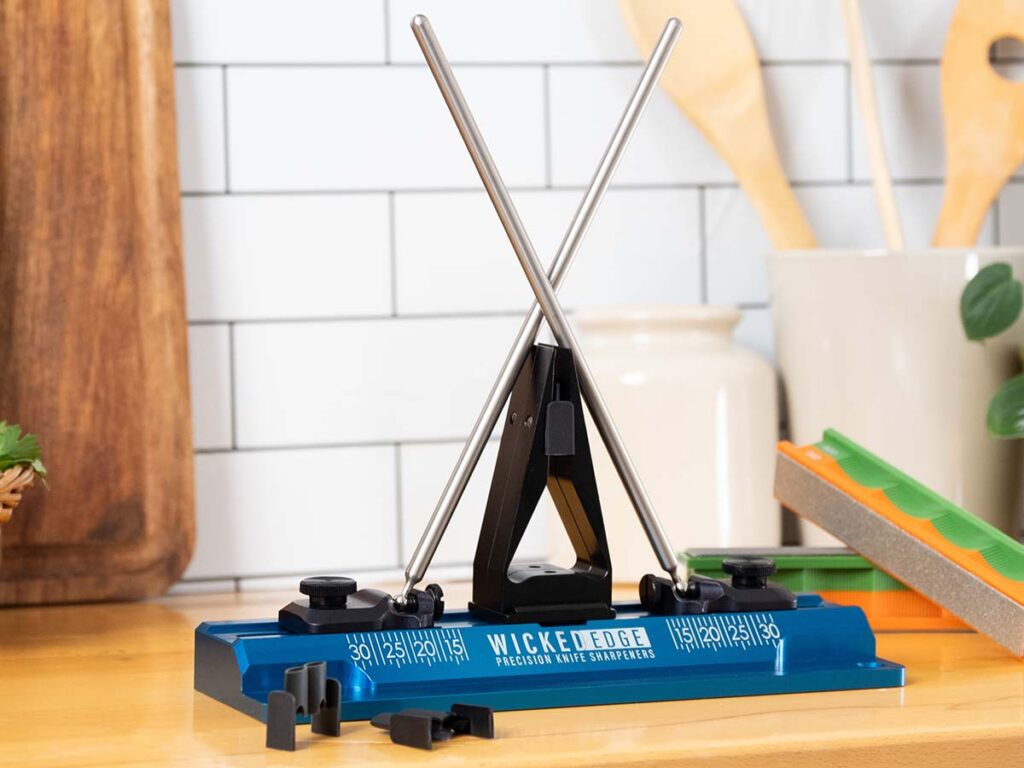
Premium abrasives on the Wicked Edge GO-WE60 are 200/600 grit monocrystalline diamond-coated stones.
GO-WE60 Precision Knife Sharpener Blade Length Capacity: Up to 15” Blade Thickness Capacity: Up to .25” (longer screws available for thicker blades) Angle Markings: Calibrated for the blade’s edge to sit at 5/8” above the top of the vise Guide Rod Length: 8.75” Unit Weight: 3.6 lbs. Country of origin: USA MSRP: $299
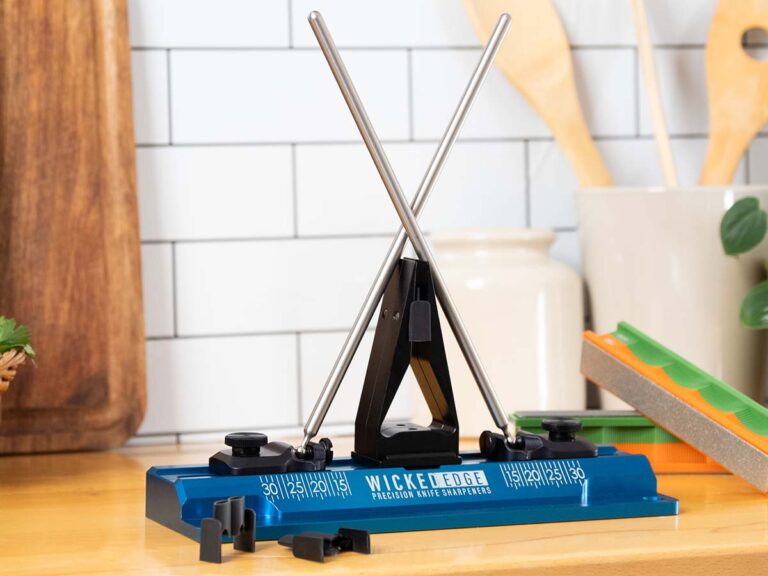
The Wicked Edge GO-WE60 Precision Knife Sharpener is designed for novices and seasoned old pros alike, whether at home, in the field or on the road. A redesigned standard vise clamps fully flat-ground and distally tapered blades such as on pocketknives and household cutlery. Sharpening angles are adjustable from 13 to 31 degrees per side (26-62 degrees inclusive) in 1-degree increments for precise edge maintenance. Premium abrasives are 200/600 grit monocrystalline diamond-coated stones. Mounting options include securing to any flat surface with the included C-clamp or attaching directly using predrilled holes.
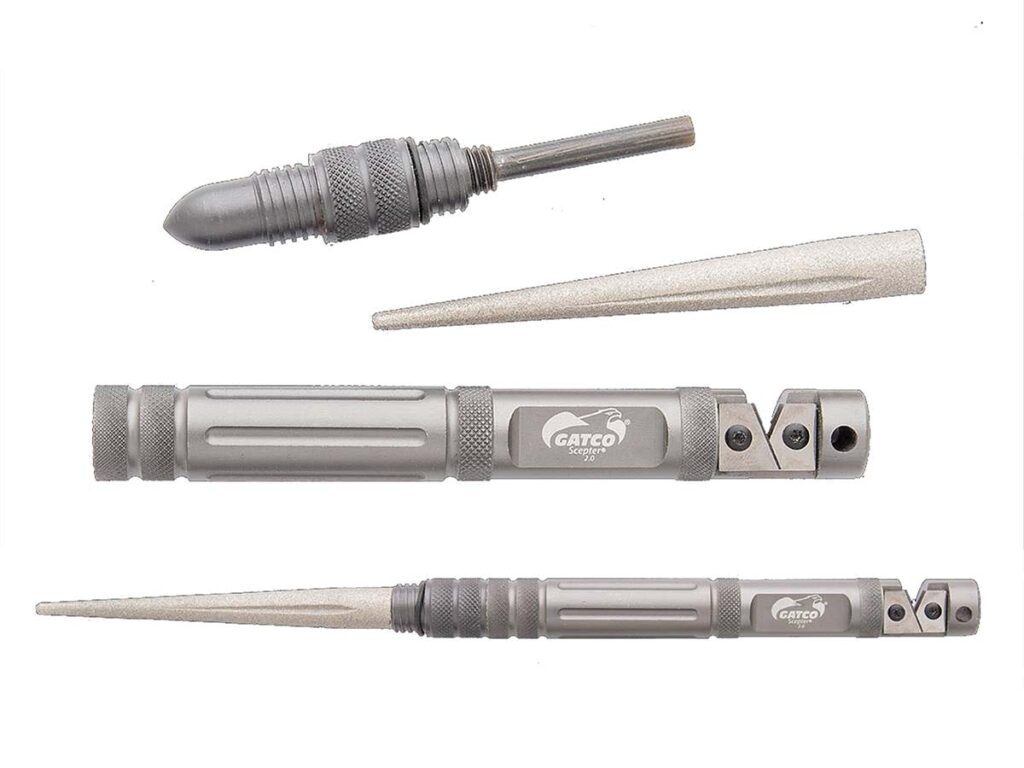
Bear & Son GATCO Scepter 2.0 Diamond
The multi-purpose GATCO Scepter 2.0 sharpens plain and serrated edges and has a magnesium rod for starting fires.
GATCO Scepter 2.0 Model type: Pull through and tapered diamond rod Type of abrasive: Diamond coated and tungsten carbide Unit dimensions: 6.125″ Unit material: 6061-T6 aluminum housing Types of knives sharpened: Hunting, EDC, kitchen Types of edges sharpened: Plain and serrated Special features: Tapered diamond rod, magnesium fire starter rod, window breaker Weight: 3.2 ozs. Country of origin: China MSRP: $49.99
The compact GATCO Scepter 2.0 Diamond Take Down Sharpener & Fire Survival Tool from Bear & Son is a multi-purpose implement for everyday pocket carry, the toolbox, to take camping and/or makes an ideal necessity for your bug-out bag. A magnesium rod for fire starting stows inside the tapered diamond sharpener, the latter which includes a groove for sharpening fishhooks. The rod and tapered sharpener are contained inside the CNC-machined, 6061-T6 aluminum carbide body, which has a pull-through tungsten carbide sharpener on the end. Each component features precision-machined threads and an outer “O” ring.
The Victorinox Swiss Army Knife Is An Icon. The Small Red Knife Has A Remarkable History And Is Popular All Around The World
Few knives are as immediately recognizable as the Swiss Army knife. The small red multi-tool has been manufactured for over a century and is known around the globe for its versatility and durability. Still made in Switzerland today by Victorinox, the Swiss Army knife has evolved as a tool since the founding of Victorinox in 1884.
History Of The Victorinox Swiss Army Knife
Victorinox was founded in the small town of Ibach in the canton of Schwyz in central Switzerland by Karl Elsener. It was initially just a small cutler’s workshop run by Karl and supported by his mother Victoria.
Just seven years later, Elsener was able to deliver his first major batch of knives to the Swiss military, and six years later patented the original “Swiss Officer’s and Sports Knife. That set the stage for a whole range of knives, each of which would be included under the umbrella name of Swiss Army knife, or SAK for short.
The Victorinox brand name came into existence in 1921. After Victoria’s passing in 1909, Karl chose her name as the brand name, but 13 years later the innovation of stainless steel swept through the knifemaking world. At the time the steel was known as “Inox,” and by combining that with his mother’s name, Karl created the brand name of Victorinox that has endured for more than a century.
After World War II, American GIs stationed in Europe took a liking to the Swiss Army knife and bought many of them, turning them into a popular souvenir to bring back to the states.
Since then, and the brand has continued to grow. Victorinox now makes other types of cutlery along with outdoor gear and watches. Rival maker Wenger, which also made a claim to the Swiss Army knife, was acquired by Victorinox in 2005, and its knives were absorbed into the Victorinox brand eight years later. The Wenger brand lives on through watches and other licensed products.
In 2017 the company produced its 500 millionth Swiss Army knife, a testament to the quality and popularity of the brand.
What Is The Best Swiss Army Knife?
That question depends on what you want out of your knife. Most all operate the same way, a slip joint with tools coming out of both ends of the knife thanks to a special spring system innovated in 1897 that every Swiss Army knife still uses today.
If you’re looking for a tool that can solve simple, everyday problems, there are many smaller models that will handle your needs. Many of those even fit on a keychain.
If you’re more of an outdoors person or just want something more rugged and diverse, there are many models that have dozens of different tools in them. You’ll see one with 73 tools in it shortly. Regardless of your wants or needs, Victorinox will have a knife for you.
Swiss Army Knife Options
The Victorinox Swiss Army knife is a living, breathing tool. New models come out regularly, and the team in Switzerland continues to find ways to create new tools and designs for the knives. Below are a trio that shows off what the SAK is capable of, from something simple to the opulently extravagant.
Signature Lite
Signature Lite
This is a prime example of how much can be deftly fit into a space so small. The Signature Lite is 2.3 inches long and weighs just .8 of an ounce. Even in those tiny dimensions, there are seven tools including a ballpoint pen, screwdriver, knife blade, and scissors. This is a quintessential Swiss Army knife. It can fit on a keychain and follow you wherever you go.
MSRP: $39.99
Trekker
Trekker
The Trekker shows how robust a Victorinox Swiss Army knife can be. This model features a dozen tools including three different screwdrivers, a can opener, and a wood saw. It’s designed for the outdoorsman, the hiker, the person camping under the stars. The Trekker does have a keychain loop although it’ll probably be better folded up in your pocket. At 4.6 ounces it’s far heavier than the Signature Lite but still far lighter than many other factory knives.
MSRP: $69
Swiss Champ XXL
Swiss Champ XXL
Last on our list is the most expensive model sold by Victorinox not including limited edition pieces. The XXL has so many tools in it that it doesn’t feel real. It’s 3.6 inches long, and in that space there are 73 individual tools. That’s not a typo. 73 tools.
Seven screwdrivers. Six blades. Three wire strippers. Too many wrenches to count. All that’s missing is the partridge in a pear tree.
The XXL also features some of the most unusual Swiss Army knife tools made today. That includes the pharmaceutical spatula, watch opener, fish scaler, and hook disgorger.
At 12.5 ounces it is a beast, and it even comes in a lined, branded case. While it might not be necessary for you, the Swiss Champ XXL flexes the design and manufacturing capabilities that Victorinox has developed in its decades of existence.
MSRP: $379
Editor’s Note: This post was written by Mike Ableson.
With a simple finger flick or even in promo art, today’s flipper knives fly.
Early flipper folders were used in conjunction with assisted-opening mechanisms as a means for initiating movement, allowing the spring or torsion assists to open the blades the rest of the way. A few years later, folder pivots incorporated ball bearings, nearly negating the need for assisted-opening mechanisms on flippers.
This reduced friction simplified folder construction and provided glassy smooth blade rotation. Although a few companies still offer assisted-opening flipper folders, most production versions rely on ball bearings.
Flipper Folders: Function Flows From Form
A flipper tab and ball bearings don’t necessarily equate a folder with quick action and secure deployment. A flipper mechanism will not work properly without a well-designed detent.
Imperative is the detent’s power to secure and hold the blade shut. When placing pressure on the flipper tab with an index finger, the user should be able to feel the grab of the detent. With more pressure on the flipper, the inertia of the blade overrides the pressure of the detent, and kinetic energy swings the blade into the fully open and locked position.
An imprecise detent results in either sloppy action or a flipper mechanism that requires too much pressure against the narrow tab. Optimally, with pressure on the flipper tab, the detent holds its load for a second before letting the blade go with enough energy to snap it open.
Finding Fun In The Fidget Factor
It’s the flipper action that is so satisfying. It imbues a “fidget factor” that causes knife users to snap open their folders while watching TV, talking on the phone, lying in bed or practicing any number of mundane daily routines.
The latest flipper folders not only offer pleasing aesthetics but stay true to the ideals of their predecessors. With premium materials, designs that make use a pleasure and looks that astound, they epitomize some of the coolest knives around.
Best Flipper Knives
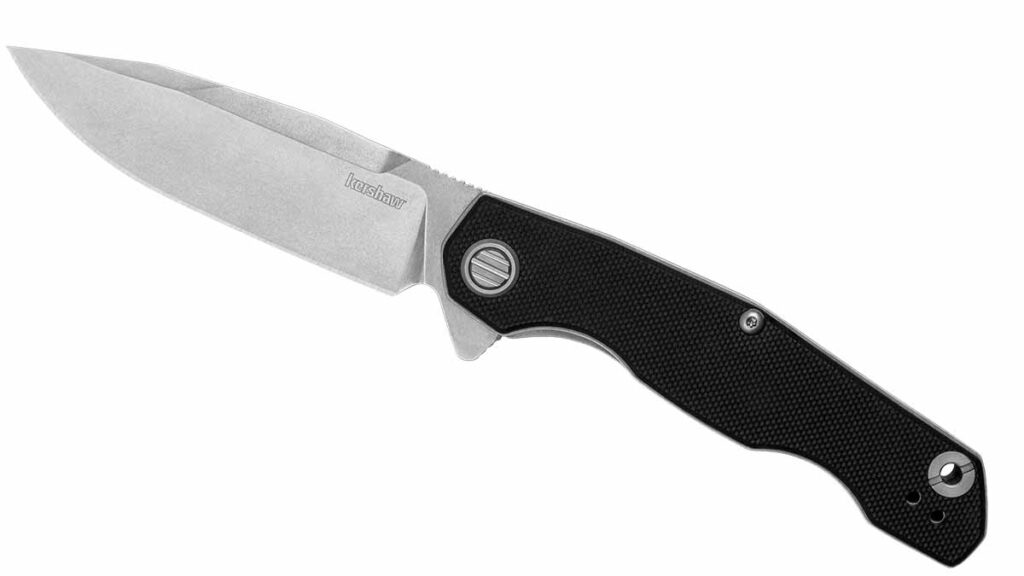
Kershaw Inception
The stonewashed blade of the Kershaw Inception pivots on KVT ball bearings. The custom pivot collar adds a touch of class.
At Kershaw, the Inception is looking good with performance to match. “I love the clean, stylish look,” related Kershaw Marketing Manager Dominic Aiello, “but the satisfyingly smooth action is what really makes the Inception a top-notch manual everyday carry.”
The flipper tab was not designed with the intention of acting as a single guard, Aiello says, but rather in combination with the textured handle overlays to help prevent the user’s hand from slipping. Along with that, the D2 tool steel blade .11-inch at the thickest provides enough heft to balance durability and ease of slicing. The clip is reversible and deep carry with flush screws that won’t snag in the pocket or impede quick deployment.
Kershaw Inception Specs Company: Kershaw Blade Length: 3.25 inches Blade Material: D2 tool steel Handle Material: G-10 Lock: Linerlock Weight: 3.1 ounces Pocket Clip: Ambidextrous/reversible, deep carry, tip up Closed Length: 4 inches Country Of Origin: China MSRP: $99.99
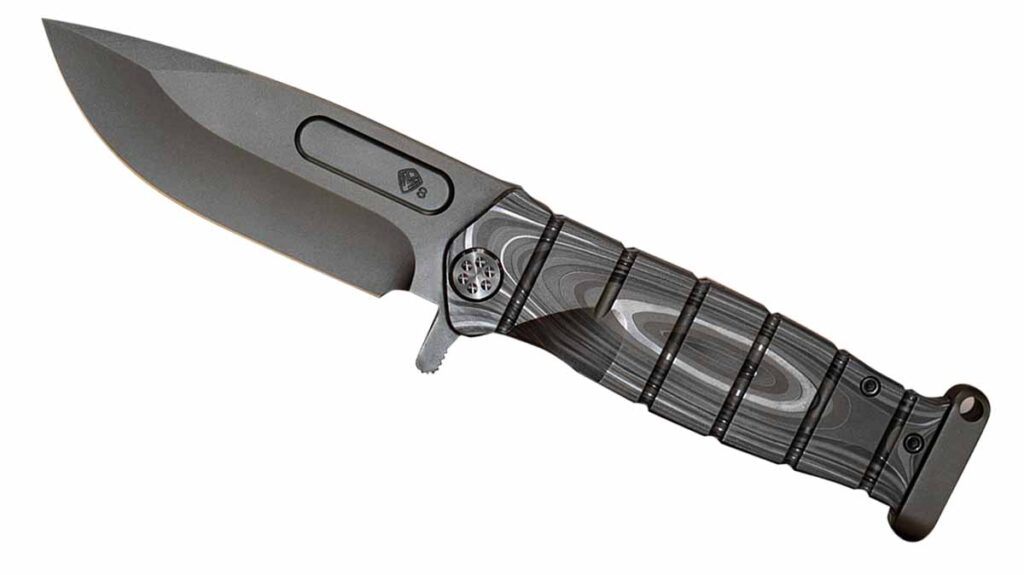
Medford Knife & Tool USMC Fighter Flipper
The CPM S35VN stainless blade of the Medford Fighter Flipper is 3/16-inch thick at the thickest and has a Rockwell hardness of 58 HRC.
The USMC Fighter Flipper from Medford Knife & Tool boasts an iconic name and incorporates titanium along with other highly durable components. “Where to start?” commented Medford representative Geoff Oprandy. “First, the USMC Fighter Flipper has superior design, engineering and aesthetics. When Greg Medford was inspired to make this knife, it didn’t take long for initial sketches to appear. He wanted a worthy companion piece for our top-selling Fixed Fighter, which has been a category king for quite some time.”
Oprandy describes the USMC Fighter Flipper as “a unique mixture of titanium components with the best CPM S35VN blade steel. This is a big, manly knife that’s as comfortable working as it is cruising around in your pocket. There is so much going on with it that it’s hard to take in, from the retro milling on the handles, drop-point blade, and integral Ti pommel to the bearing pressed into the one-of-a-kind pocket clip. The tab is designed to be a tad longer and has a unique radius with a knurled feature. For being a large knife [it provides] great purchase, and the flipper tab combined with the finger-indexing groove enable a great grip. The knife runs on phosphor-bronze washers custom made to meet our specs.”
According to Geoff, the knife has a special connection with the United States Marines Corps. As designer Greg Medford related, “When you hold it in your hand, almost 250 years of Marines speak to your soul.”
The design is intended to feel at home with users who prefer the “connection” made with a large folder, Oprandy says. “When people position the knife correctly and begin to use it,” he stated, “the energy transfer seems balanced, natural and confidence inspiring.”
USMC Fighter Flipper Specs Company: Medford Knife & Tool Designer: Greg Medford Blade Length: 4.25 inches Blade Steel: CPM S35VN stainless Handle Material: Titanium Pivot Action: Phosphor-bronze washers Weight: 9.8 ounces Pocket Clip: Titanium; standard carry Closed Length: 5.25 inches Country Of Origin: U.S.A. MSRP: $840 and up
Rick Hinderer Knives Full Track Spearpoint “Nuked”
The Full Track Spearpoint “Nuked” has a removable tool seated in the spine for disassembly/assembly of the knife. The scale on the show side is removable to store spare washers and spacers.
Sam Santa Rita, general manager of Rick Hinderer Knives, says the Full Track Spearpoint “Nuked” is a bigger version of the company’s “very popular Half Track model. It is one of our larger folders at 3.75 inches and has titanium handles with G-10 inserts. The Full Track features a removable tool seated in the spine of the folder that is capable of complete disassembly of the knife.” The folder also utilizes a G-10 insert cover on its show side that hides a pocket for the storage of steel inserts and washers for the Rick Hinderer Knives Tri-Way Pivot System. This allows the user to easily swap from bearings to washers or vice versa depending on the situation.
“Its size and durability coupled with the ease of maintenance and ‘customizability’ makes the knife a perfect hard-use folder capable in any environment,” Sam added. The Full Track is available in stainless blade steel options of CPM S35VN, CPM 20CV and M390. Another blade steel option will be released later this year.
The Full Track flipper tab doubles as a single guard, while the blade pivots on caged thrust bearings. Meanwhile, the Tri-Way Pivot System allows for the aforementioned use of Teflon™ and phosphor-bronze washers as well, which come standard with the knife.
Full Track Spearpoint “Nuked” Specs Company: Rick Hinderer Knives Designer: Rick Hinderer Blade Length: 3.75 inches Blade Steel: CPM 20CV stainless Handle Material: G-10 Lock: Framelock Pocket Clip: Yes Weight: 6.9 ounces Closed Length: 5.125 inches Country Of Origin: U.S.A. MSRP: $820
Spyderco Sliverax
The Sliverax is the first factory folder to combine Spyderco’s Compression Lock® with a flipper-style opener. Blade thickness and grind: .138 inch at the thickest and full flat.
The Sliverax is a bit of a departure for Spyderco. “It’s a flipper design, which is not common among Spydercos,” explained Joyce Laituri, company marketing manager. “The designer, Paul Alexander, is a different type of cutlery designer we have worked with in the past. He holds a doctorate in industrial design and mechanical engineering, and is a leading researcher for a company in the automotive industry.”
The Sliverax brings a shape with seamless flow and a slightly negative blade angle to enhance leverage, placing the point on the knife’s centerline for utility and control. “The negative angle also shortens the opening arc combined with the round hole and flipper mechanism for a full spectrum of positive, high-speed one-hand-opening options,” Joyce commented.
“The flipper tab doubles as a guard,” she continued, “and it’s easy to see and feel when the knife is held. There is a large, deep finger choil already, and the flipper mechanism in the open position extends the choil, creating a comfortable and deep guard for the index finger, or pinky if held in a reverse grip.”
Laituri describes the opening experience with the Sliverax as “slick as a Slip & Slide.” The mechanism features a phosphor-bronze bushing with ball bearings and a nested liner for structural strength. The CPM S30V stainless blade is exceptional in its combination of toughness, wear resistance and corrosion resistance as well, while the ergonomics of the handle are derived directly from its innovative shape, super-thin choil and expansion at the butt to fill the hand.
Spyderco Sliverax Specs Company: Spyderco Designer: Paul Alexander Blade Length: 3.48 inches Blade Steel: CPM S30V stainless Handle Material: Carbon fiber/G-10 laminate Lock: Compression Lock® Weight: 3.3 ounces Pocket Clip: Deep pocket, wire, ambidextrous, tip up Closed Length: 4.52 inches Country Of Origin: Taiwan MSRP: $306
Editor’s Note: Mike Haskew and Dexter Ewing contributed to this post.