A budge-priced EDC cleaver that is priced for rough use.
Cleavers have broken out of the butcher shop and kitchen in recent years to become a sought-after EDC. Seems counterintuitive, but there’s a method in the knife-buying world’s madness.
One of the more interesting conversations I had at BLADE Show West 2024 came with a crane rigger who favored this style of blade. With the flat cutting edge that makes mincemeat of heavy-duty rope and a muted tip, he didn’t have to worry about perforating himself, the knife class is highly practical in the pocket.
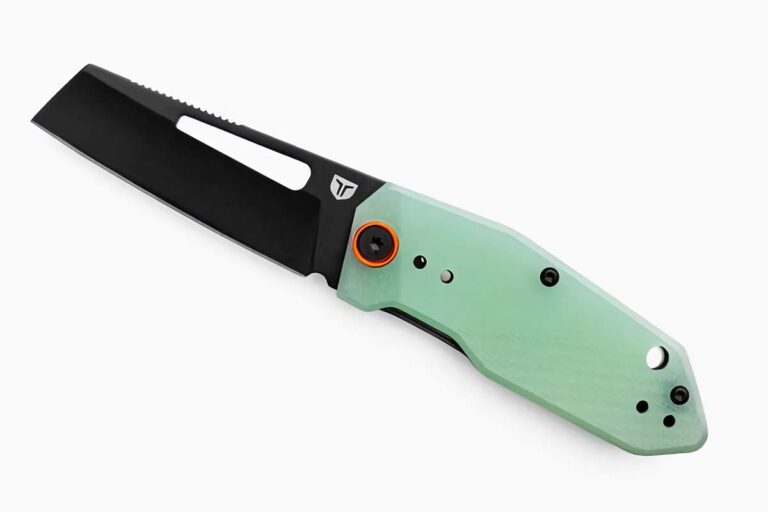
This is all a long way to say, there’s a new pocket cleaver in town with True Knives dropping the Berm Cleaver Flipper.
Part of the brand’s new Berm series, the knife offers a budget option most users won’t shy away from rough use. Yet, for its price, the knife offers a nice profile, though it might lack some in the steel True Knives uses for the blade.
Berm Cleaver Flipper Blade
To that point, the Berm Cleaver Flipper is constructed of 7Cr17MoV, a popular choice in budget knives. While the metal does take a good edge and has respectable hardness and excellent corrosion resistance, it has a few hitches in its giddyap. In particular, its toughness—particularly in thinner blades—is wanting, and edge retention is not among the best.
Still, this is a budget EDC we’re talking about. Despite the steel’s drawback, True Knife has come up with a fairly spiffy blade profile. The knife has a fairly traditional cleaver look, though the 2.5-inch blade boasts a slight belly and does have a bit of a tip. The tip is welcome, making the knife more useful for everyday tasks where a puncturing point is required.
The brand includes generous jimping on nearly the entirety of the spine, offering extra purchase on chopping tasks. Additionally, there is a good choil on the blade, which helps in making sure you can sharpen the entire blade.
Berm Cleaver Flipper Handle
The grip is where the cleaver shines, with a relatively nice affair laid out. First off, I’m a sucker for the translucent green G-10, it gives the knife a modern look without being too audacious. Plus, particularly on a build at this price point, the G-10 is a solid material choice—textured nicely to make it stick to the hand.
Also appreciated, the cleaver’s clip is not only reversible but can be situated for tip-up or down carry. A versatile bonus on the knife.
Berm Cleaver Flipper Action
As its name suggests, the Berm Cleaver Flipper, though it’s a front flipper offering both index finger and thumb deployment. Additionally, it has a prominent thumb hole.
Smartly, True Knives has cut away some of the handle to offer access to the deployment mechanism, allowing users plenty of leverage options to get the blade to work. Caged bearing aids in a smooth and fast opening.
Final Cut
With an MSRP of $30, the Berm Cleaver Flipper is made for heavy use and abuse. The best part, if you put it through the wringer you won’t cry over a broken knife.
The M7 Bayonet Has Been Used By The United States Military For Almost 60 Years. The Dynamic, Multi-Purpose Tool Is Just As Useful Now As When It First Went Into Service.
When you first think of a bayonet your mind probably goes to the battlefields of the Revolutionary and Civil Wars. But no, bayonets aren’t some relic from a bygone era. While the days of bayonet charges are long long, the knives are still in use by the military today and have evolved into a multi-faceted tool.
The M7 Bayonet stands out due to its longevity. Built on the back of the M4 bayonet, which was issued toward the tail end of World War 2, the M7 is designed to be used with the M16 or the M4 carbine, although it can fit on numerous other rifles.
The History Of The M7 Bayonet
The M7 was first introduced in 1964 during the Vietnam War. The knife was initially made by Bauer Ord Company, but numerous companies did eventually manufacture the M7. Today, the lone remaining maker of combat-deployed M7 bayonets is Ontario Knife, though the knife is still available from at least one other company (Smith & Wesson).
Despite being issued by the United States military, the M7 was also made in Canada, West Germany, Australia, and in several countries in Asia.
How Does The M7 Work?
The M7 connects to the M16 via a lug thanks to a dual-lever locking mechanism. This secures the blade to the barrel while keeping the muzzle unblocked. A release mechanism on the pommel of the knife allows it to detach from the firearm easily.
Ontario Knife Company M7 Bayonet
Ontario Knife Company M7 Bayonet
Ontario Knife Co. was one of many makers to manufacture the M7, and it is the last to make the military issue variety of the blade. There is also a commercial version as well, which will be reviewed here.
It starts with a 1080 carbon steel blade with a zinc phosphate finish married to a modified Kraton handle. The blade is 6.7 inches long, and the whole construction is just shy of a foot in length. It tips the scales at 1.15 pounds. It looks beefy and feels hefty in the hand, as you would expect from a such a knife.
The included molded plastic sheath is a pistol belt clip. The lightweight sheath allows for safe, easy transport of the knife. While this knife is designed for combat, it’s burly design allows for multiple different uses. This would be a an excellent all-rounder when camping.
Today’s pocketknives come in assorted locks, no locks, blades, handles and more.
Eyes always peeled, we’re on the look out for the latest and the greatest. We think we’ve found a bevvy of them this March. So, with out further adieu, here’s our latest round of new knives.
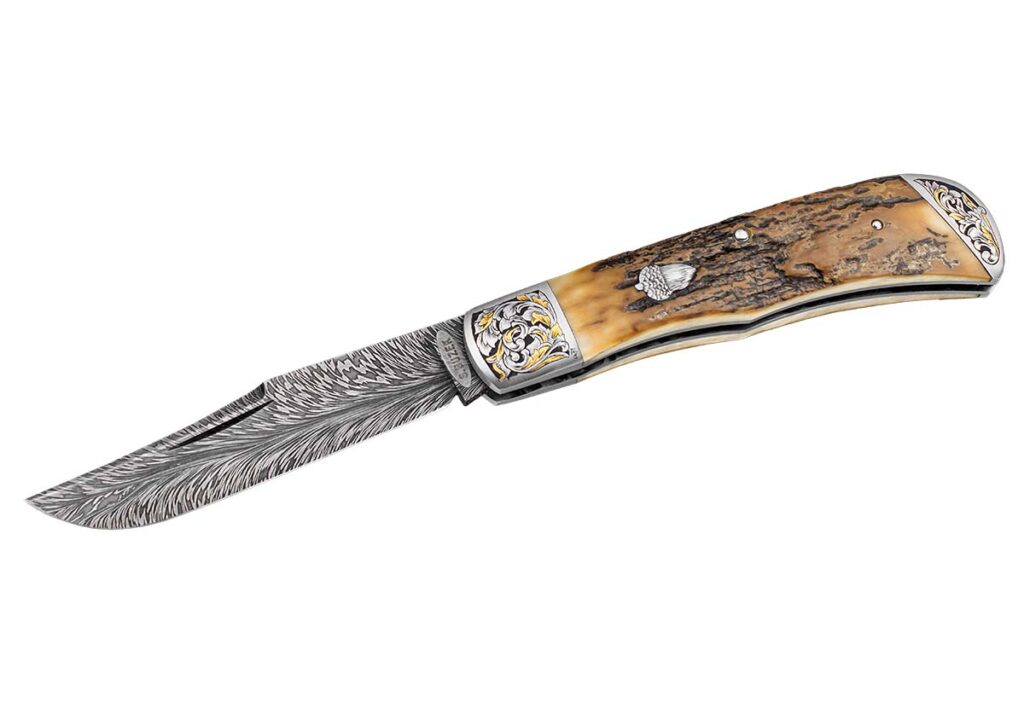
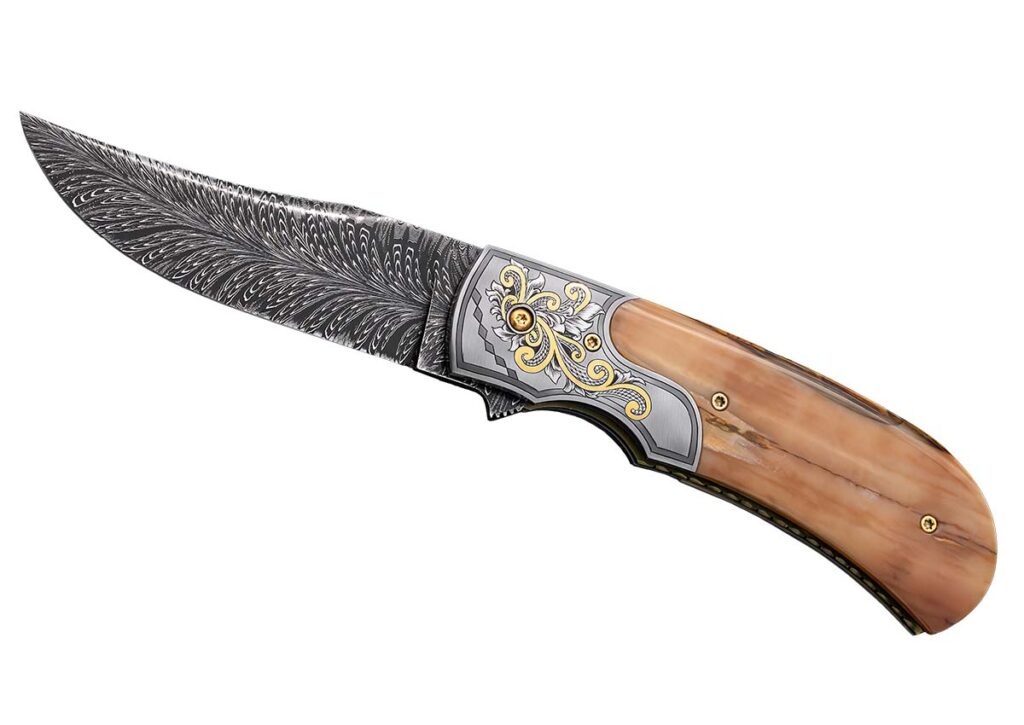
Stanley Buzek Single-Blade Slipjoint
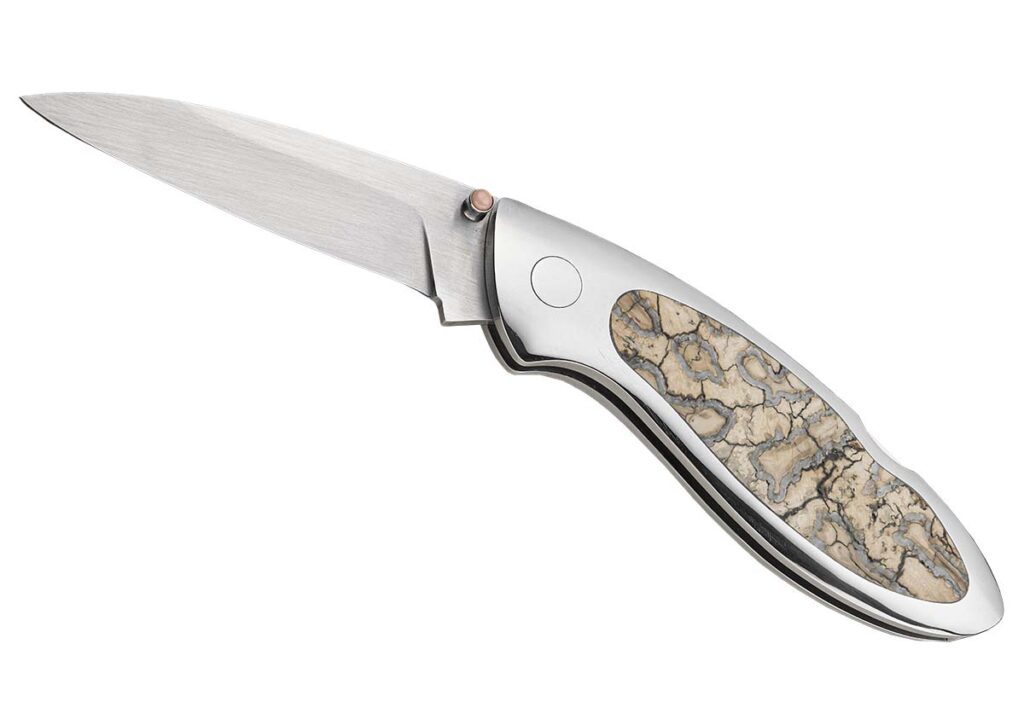
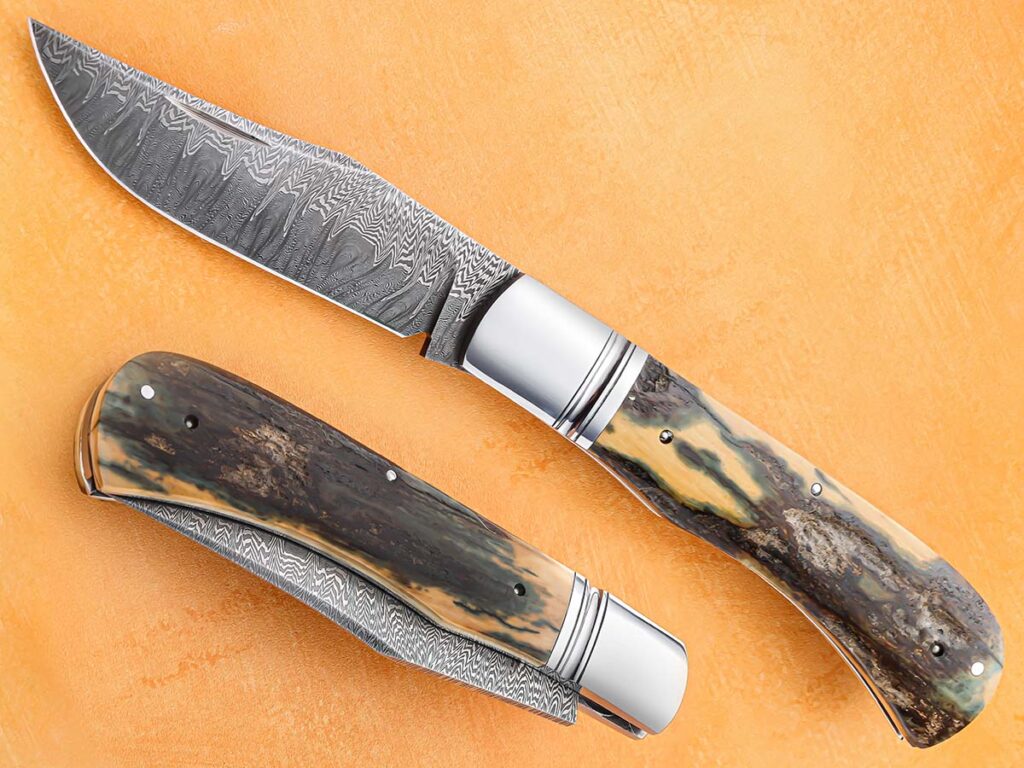
Blade length: 3 3/8” Blade steel: Feather damascus forged by ABS journeyman smith Mike Tyre Blade grind: Hollow Blade pattern: Clip point Blade opener: Nail pull Scales: Mammoth ivory Liners/bolsters: 416 stainless in an integral construction Engraving: Alice Carter, including 24k-gold inlay Knife to know: Fileworked liners and acorn shield Closed length: 4.25” Maker’s price for a similar knife: $2,800 Maker: Stanley Buzek, sbuzekknives.com (Jocelyn Frasier image)
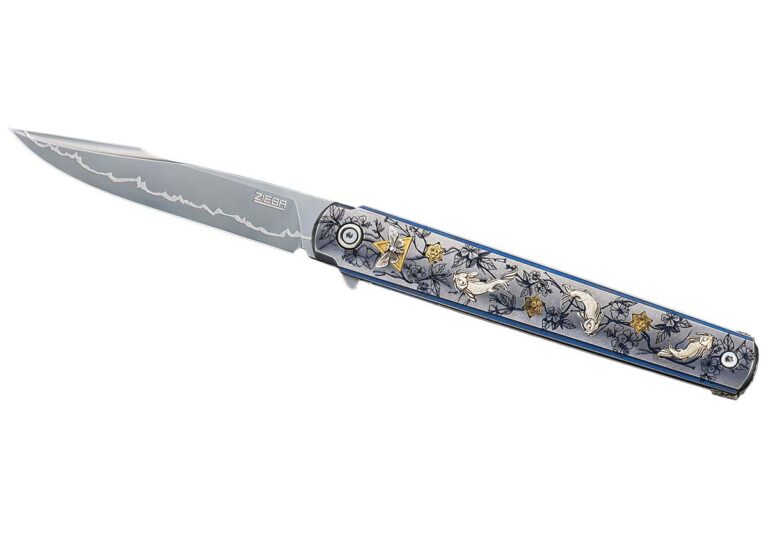
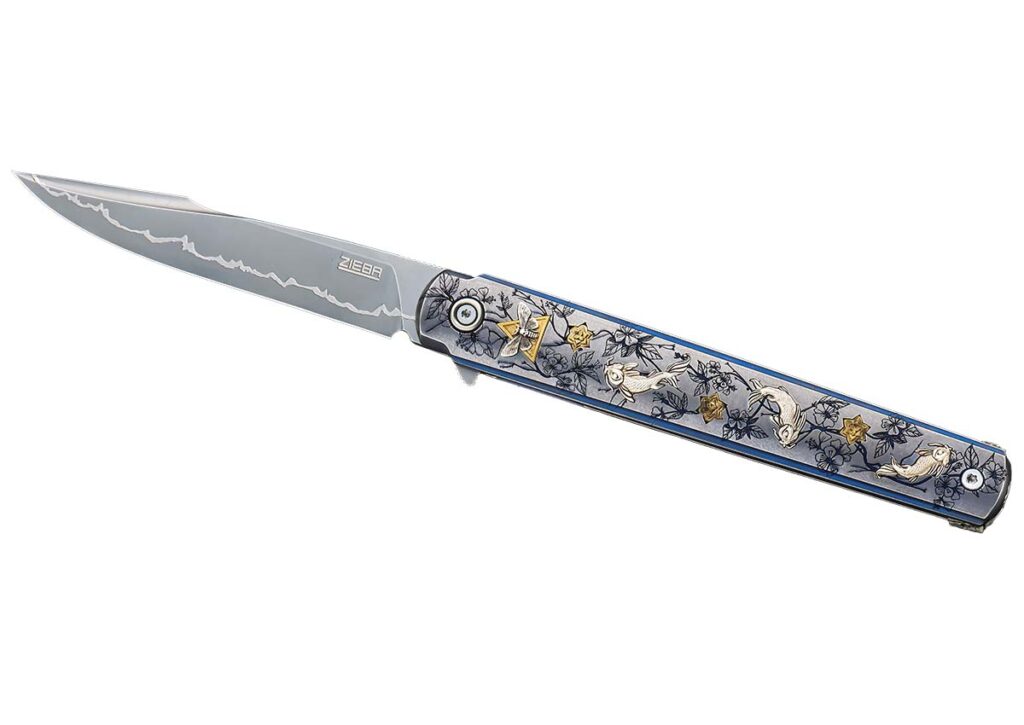
Michael Zieba Nine Silver Kois
Knife type: Side flipper Blade length: 4.126” Blade steel: CPM MagnaCut stainless Rockwell hardness: 62-63 HRC Blade grind: Flat Blade @thickest: .159” Pivot: Ceramic ball bearing washers Handle & pocket clip: Titanium w/24k-gold koi, lotus and moth inlay Weight: 5.07 ozs. Closed length: 5.5” Knife to know: Air pockets for weight reduction; ceramic detent; white brass skull spacer Maker’s price for a similar knife: $3,300 Maker: Michael Zieba, (SharpByCoop image)
Curt Zimmerman Flipper Folder
Blade length: 3” Blade steel: Feather damascus Blade grind: Flat Blade pattern: Clip point Lock: Linerlock Scales: Ancient walrus ivory Bolster: Stainless steel engraved by Alice Carter w/24k-gold inlay Liners: Titanium; fileworked and anodized Screws: 24k-gold plated Closed length: 3 15/16” Maker’s price for a similar knife: $2,500 Maker: Curt Zimmerman (Jocelyn Frasier image)
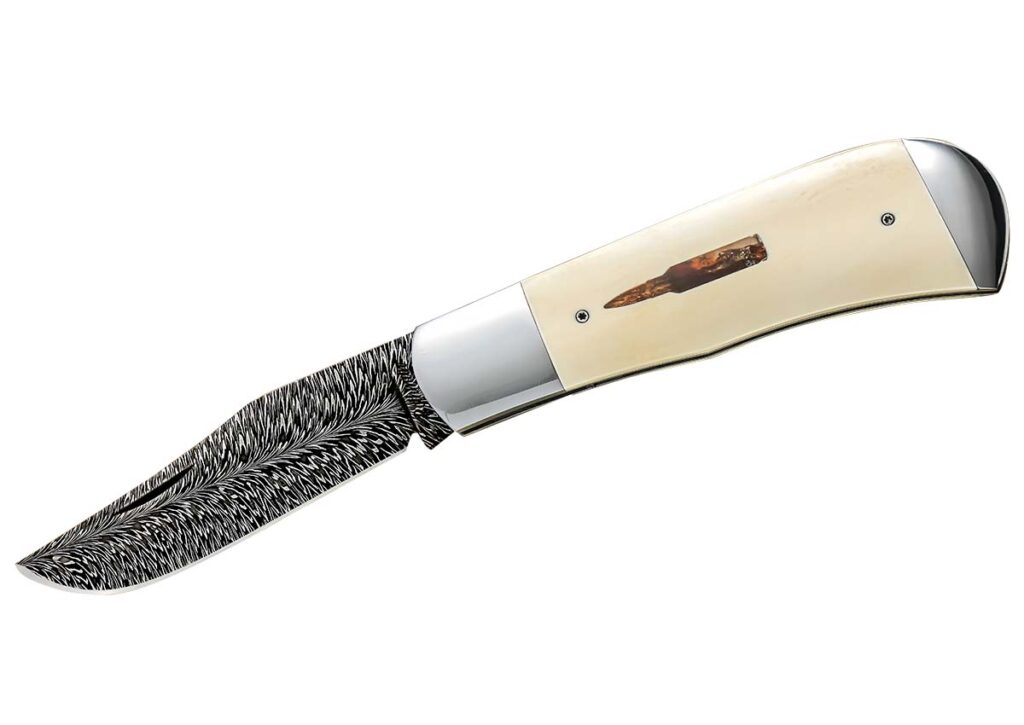
Rothman Knives Backpocket
Knife type: Dress slipjoint Blade length: 3.25” Blade steel: Feather damascus forged by Adam Deville Blade grind: 14” hollow Blade pattern: Clip point Scales: Interior mammoth Bullet shield: Dark mammoth Frame: 416 stainless in an integral construction Closed length: 4.75” Knife to know: Fileworked liners and embellished backspring; Michael Rothman is a member of the Knifemakers’ Guild Maker’s price for a similar knife: $1,500 Maker: Rothman Knives, rothmanknives.com (SharpByCoop image)
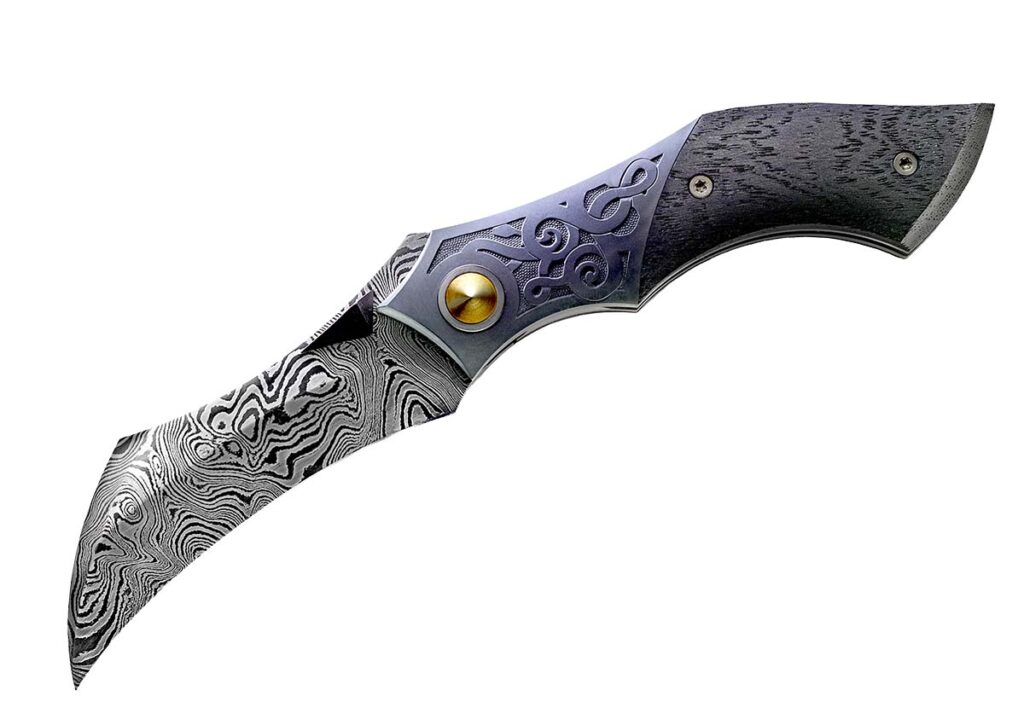
Jeremy Marsh Mini Assassin
Knife to know: A collaboration between Jeremy Marsh and Jonathan Quill Blade length: 3.5” Blade steel: Damascus of 1084 carbon and 15N20 nickel-alloy steels forged by Quill and finished by Marsh w/a dark, deep etch and “a great deal of hand finishing” Scales: 10,000-year-old bog oak from Ireland w/a coarse-grained, oily look Liners: Feature a distressed rock finish along the edges applied by Marsh and traditional vine filework applied by Quill Bolsters, thumbstuds and hardware: Zirconium toned lightly bronze and burnished for highlights Embellishment: Quill engraved the bolsters and pocket clip in a Celtic/Norse theme Closed length: 4.5” Make’s price for a similar knife: $8,000 Maker: Jeremy Marsh (Mitchell Cohen image)
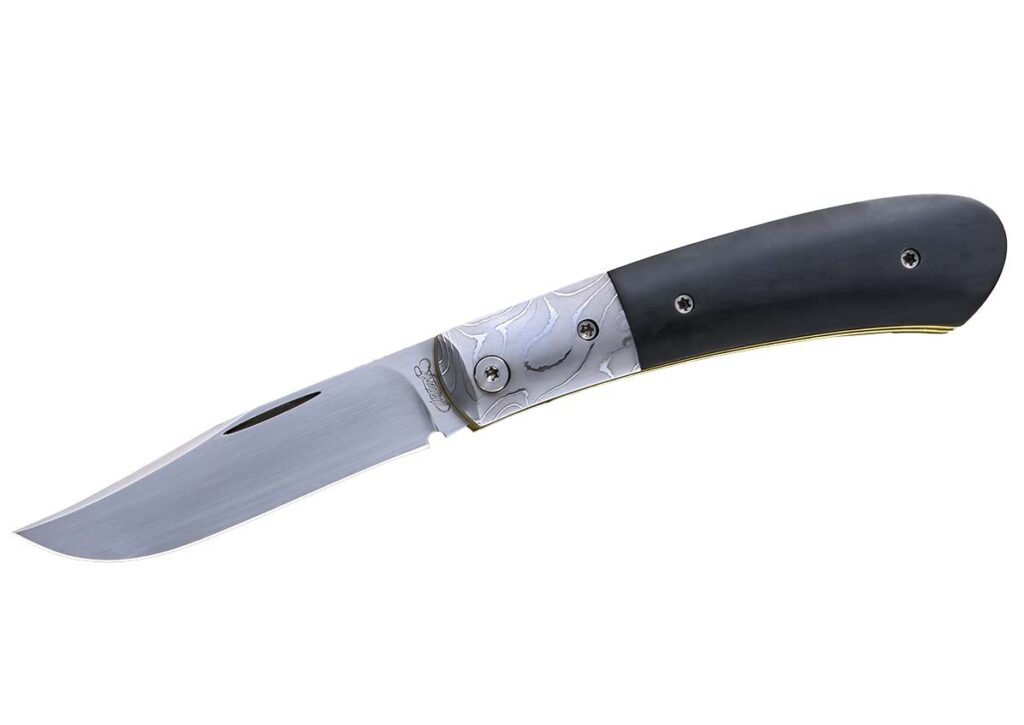
Maverik Knives Dress Slipjoint
Blade length: 3” Blade steel: CPM 154 stainless Blade grind: High flat Blade pattern: Clip point Scales: Black paper Micarta® Frame: Brass Bolster: Straight twist damascus Hardware: Titanium Closed length: 4” Knife to know: Maverik Murdock is an ABS apprentice smith Maker’s price for a similar knife: $750 Maker: Maverik Knives, maverikknives.com (SharpByCoop image)
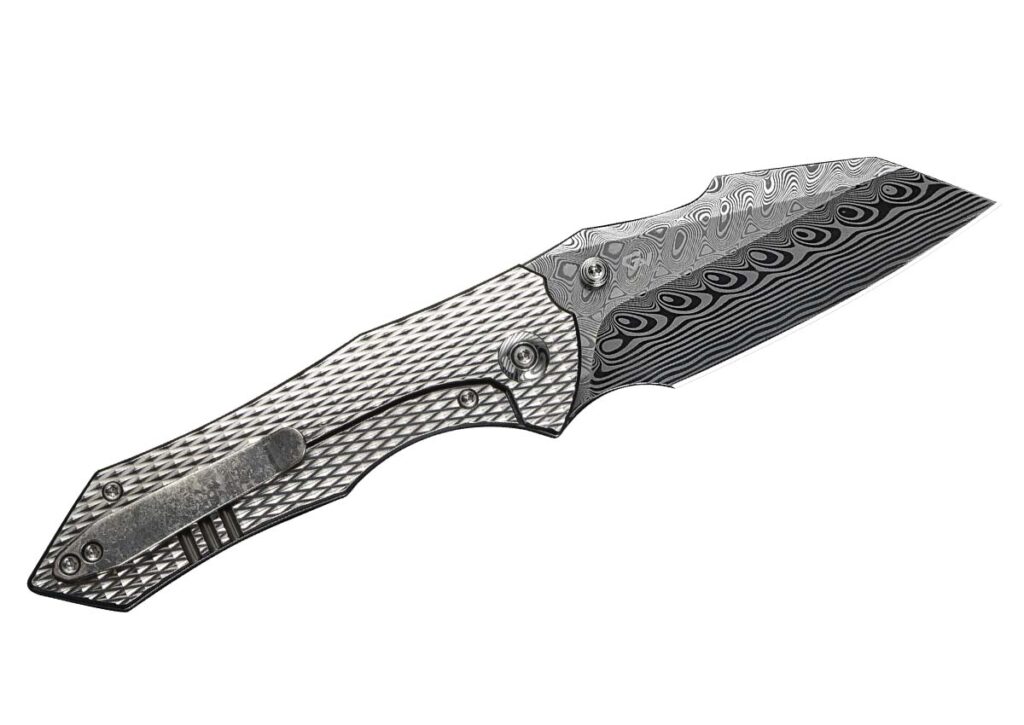
WE Knife High-Fin XL
Designer: Gavko Knives Blade length: 3.48” Blade steel: Hakkapella damascus by Damasteel Rockwell hardness: 59-61 HRC Blade grind: Hollow Blade pattern: Reverse tanto Pivot: Caged ceramic ball bearings Handle: Satin-polished 6Al4V titanium in a diamond-pattern texture Pocket clip: Crystallized gray 6Al4V titanium; blade tip up, right-handed Lock: Framelock Weight: 4.03 ozs. Closed length: 4.67” Country of origin: China MSRP: $740 Company: WE Knife, weknife.com
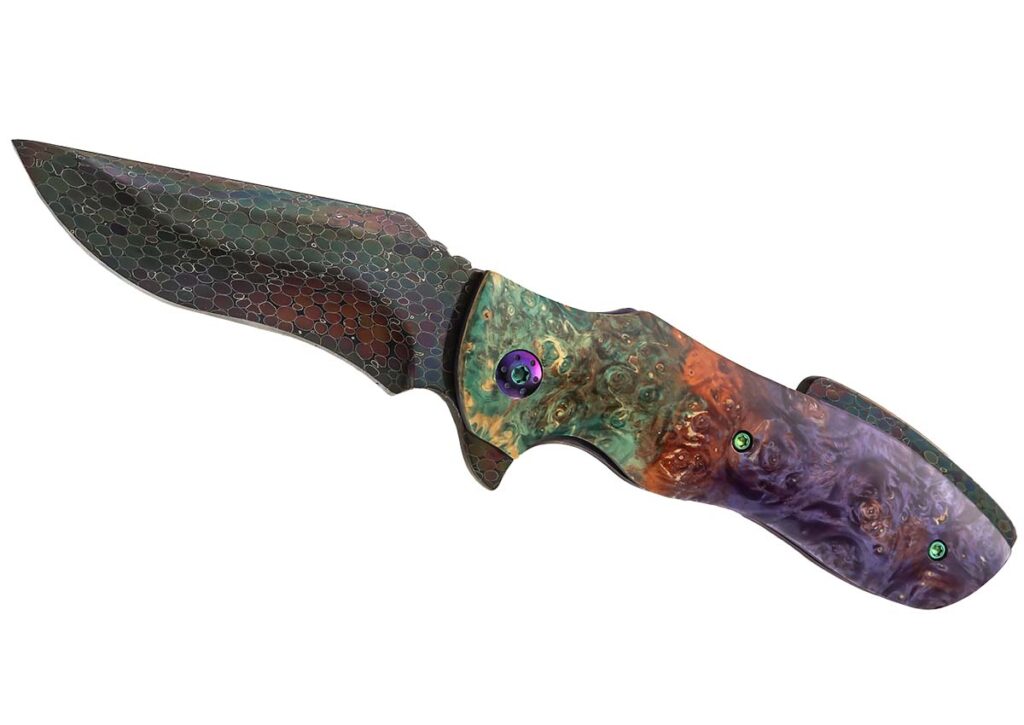
David Kulis Spectre XL
Knife type: Dress tactical flipper folder Blade length: 3.5” Blade steel: Dragonskin damascus forged by Bertie Rietveld Blade grind: 8” hollow Blade shape: Recurve Handle: Purple/orange/green burl Liners: Titanium Knife to know: All titanium hardware anodized to match the Timascus pocket clip Closed length: 5.25” Maker’s price for a similar knife: $1,500 Maker: David Kulis (SharpByCoop image)
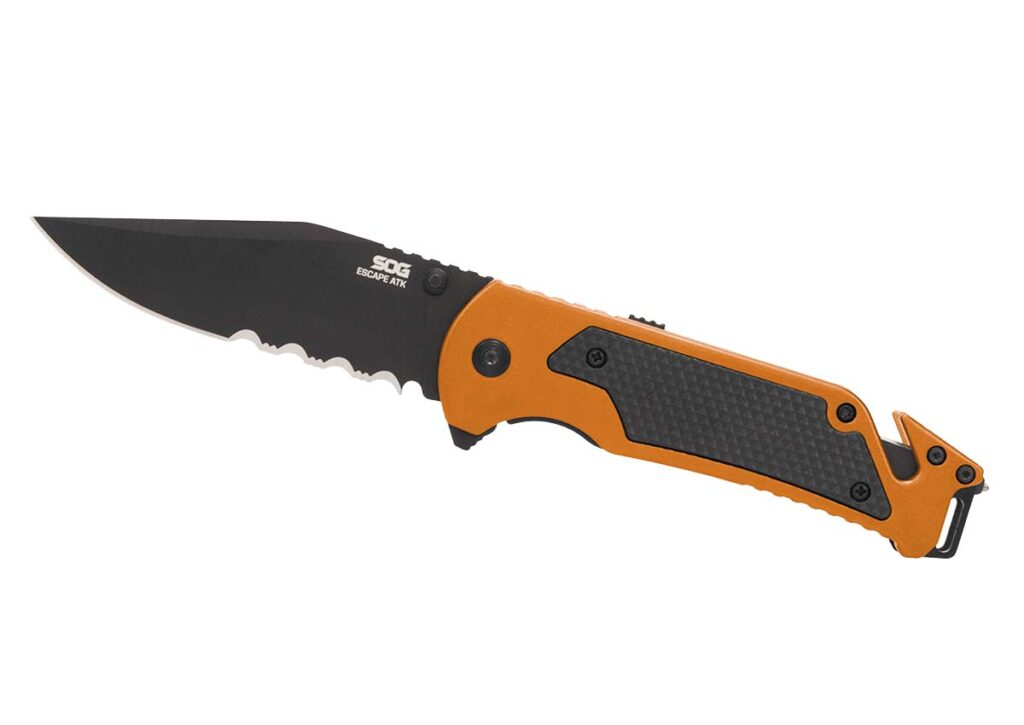
Knife type: Rescue folder Blade length: 3.4” Blade steel: AUS-8 stainless Blade mechanism: Assisted opening Handle: 6061 aluminum Lock: Linerlock Pocket clip: Low carry Weight: 4.4 ozs. Closed length: 4.6” Knife to know: Belt cutter and glassbreaker in the butt; spare blade for the belt cutter stores in the handle Country of origin: China MSRP: $54.95 Company: SOG Knives, www.sogknives.com
Jerry Fisk Saddlehorn-Style Slipjoint
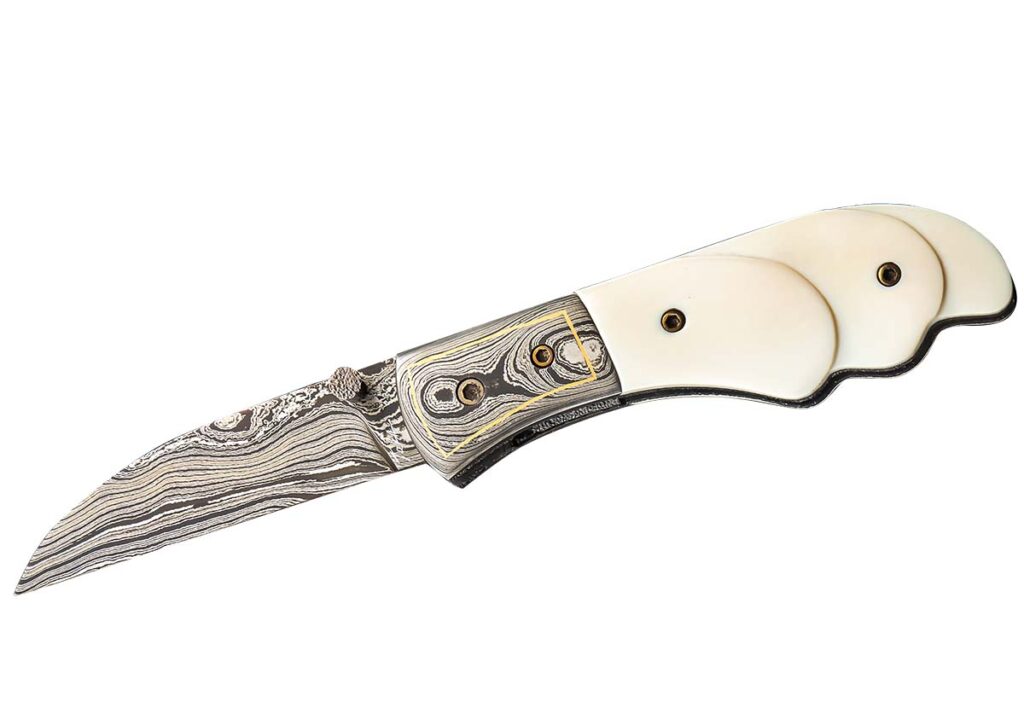
Blade length: 3.33” Blade material: Damascus Blade pattern: Clip point Blade opener: Nail pull Scales: Wood from one of the last walnut trees planted by President George Washington Bolster: Spring steel engraved by Jerry Fisk Maker’s price for a similar knife: $5,900 (includes a bottle of whiskey from George Washington’s Distillery) Knife to know: In 1999, Jerry Fisk was named a National Living Treasure by the Museum of World Cultures at the University of North Carolina at Wilmington Maker: Jerry Fisk (Jocelyn Frasier image)
Chris Richardson Lockback Folder
Blade length: 3.25” Blade steel: CPM 154 stainless Blade grind: Flat Blade pattern: Modified wharncliffe Handle inlay: Mammoth ivory Thumbstud inlay: Angelskin coral Bolster: 416 stainless in an integral construction Closed length: 4.75” Maker’s price for a similar knife: $850 Maker: Chris Richardson (Jocelyn Frasier image)
These slip joint knives overcome the mechanical challenges of the style to qualify as works of art.
The slip joint is the most recognized of any folding knife design. Variations on the theme continue to guide the custom knifemaker and the consumer through a journey of creativity and craftsmanship that is indeed endless.
The latest slip joints are true to this standard and don’t disappoint in looks or legs—easy on the eyes while walking and talking at the same time. They complement their makers’ personalities and demonstrate their skill sets in fit and finish, as well as mechanics. They provide pure inspiration for collectors and buyers alike, setting their own standard of excellence.
Standley Caldwell Five-Blade Cattle Knife
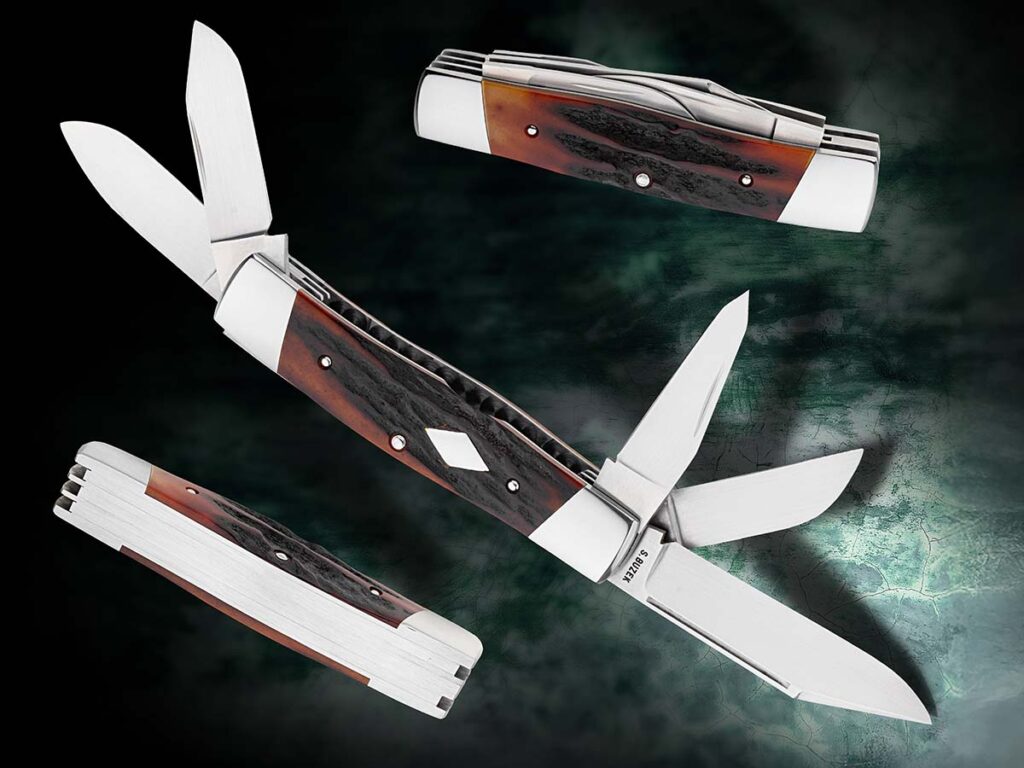
“The five-blade cattle knife is a very difficult build,” Stanley Burzek confesses. Not only are aesthetics at play, but mechanical aspects, such as the blades clearing frame and timed right, not to mention executing multiple grinds. Tackling more complex slip joints has been a natural progression for Stanley. The Texas maker began with single- up to three-blade stockmen but saw the more difficult projects as pushing his craftmanship to the next level. (Jocelyn Frasier image)
A slip joint maker for 18 years, Stanley Buzek of Caldwell, Texas, brought a beautiful five-blade cattle knife to life recently. Featuring a CPM 154 hollow ground blade with 416 stainless integral bolsters and liner, along with stag handle scales, the knife was a particular challenge.
“The five-blade cattle knife is a very difficult build, getting all the blades timed and working properly with everything flush in all positions,” Stanley explained, “and getting the blades to clear inside the frame in such a small area. The multiple offset grinds and the dagger grind of the awl blade make it especially challenging.”
Tackling the cattleman works right into the increasingly difficult projects Stanley has pitted himself against—even if it was a daunting proposition. “The five-blade was just a natural progression from the single-blade trapper, two-blade, three-bladed Stockman, and so on, to push myself to the next level of knifemaking,” he confided. “Actually, the hardest part was just getting over my fear of screwing it up and getting started on the build. It is an intimidating knife to build, having to pack so much into such a small area that you can paralyze yourself with the fear of getting started.”
Buzek got the pattern for the five-blade from Tim Robertson. He drew inspiration from the work of Tony Bose, whom he credits with bringing the pattern back. He has also seen photos of Reese Bose’s take on the pattern.
“I have received help from many great makers through the years,” Stanley reflected. “Bill Ruple and Rusty Preston were a huge help, and the South Texas Slip Joint School that I went to back in 2011 really increased my knowledge in how slip joints actually work. Right now, a lot of credit goes to Tim Robertson for pushing me and helping me with problems and us bouncing ideas off each other.”
Buzek makes all his slip joints with integral liners and bolsters accompanied by jeweling on the interior. He prefers slanted bolsters while gravitating toward natural handle materials such as jigged bone, mammoth and stag. “I think the single-blade slip joint will be the most popular for a long time for ease of carry and ease of build in the custom world,” he predicted. “Multi-blades, though not as popular, will push makers to step outside their comfort zone and show collectors and the general public alike the technicality and perfection and precision at which some of these pieces are made and will help makers improve their overall methods.”
Ted Friesenhahn Two-Blade Trapper
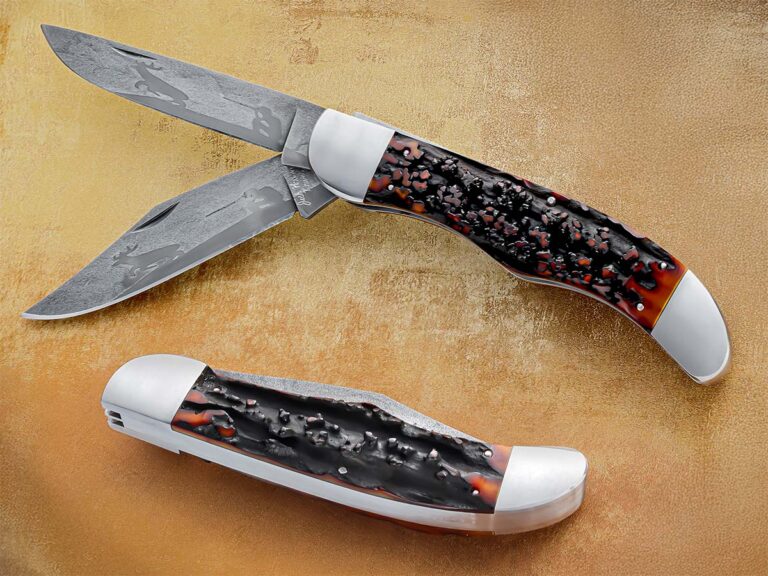
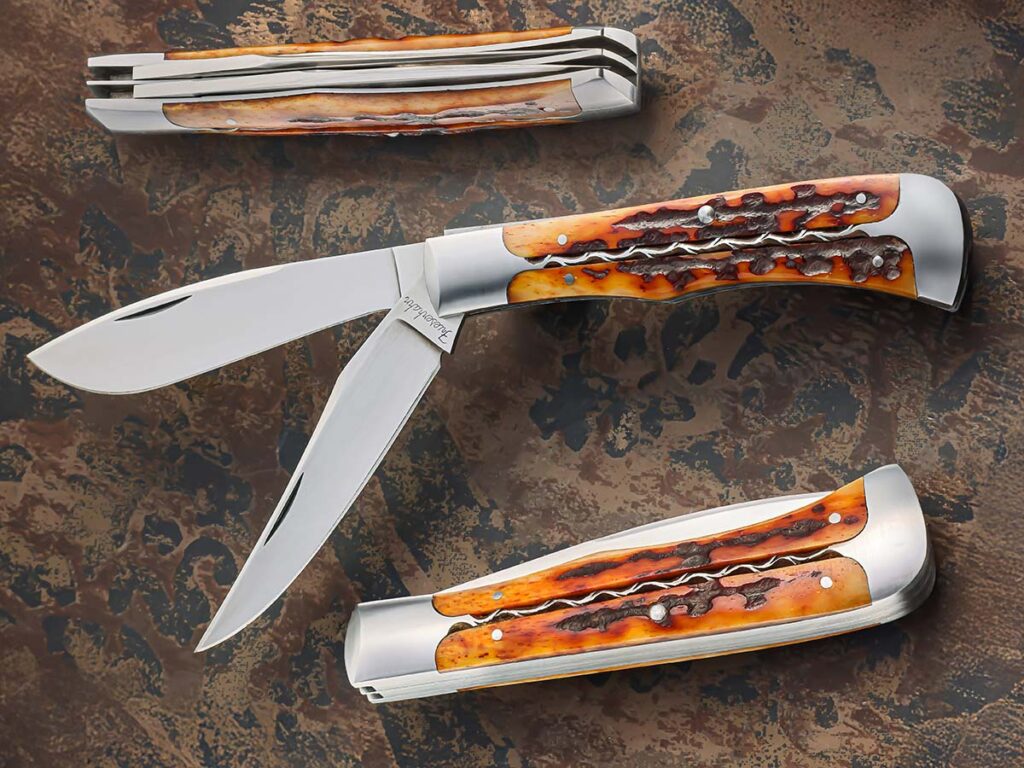
Like most custom makers, the most challenging aspect of the slip joint for Friesenhahn is getting the rise and fall of the blade correct. Add in embellishments, like the delicate vine filework down the center of his trapper’s handle, and the project becomes a taxing undertaking. (SharpByCoop image)
When Ted Friesenhahn took up the task of making his two-bladed trapper, he chose to make the second blade a “simmy” skinner. “This is the most popular slip joint, especially in Texas,” said the resident of Seguin, who has been a toolmaker since the age of 18. “I’ve worked in several different tool shops and have had the pleasure of teaching mill classes at hammer-ins.”
For his trapper, Ted chose a hollow ground blade of CPM 154 with a 416 stainless steel frame and bolster and a jigged bone handle. He added, “All of my knives have integral liners, and in this knife, the center is left standing. I have had this idea in my head for a while before I finally did it. I wanted something different and to be able to embellish it, so I chose to do vine filework.”
The most difficult aspect of the slip joint for Friesenhahn is common to most custom knifemakers—getting the rise and fall of the blade correct and flushed at closed, half stop, and open positions. “Of course, the walk and talk are key after all that fit and finish,” he said. “My first knife was an Old Timer Stockman that I had when I was growing up in the country. I have always carried a pocketknife, so like most makers and knife enthusiasts in this area, I had heard of Bill Ruple.
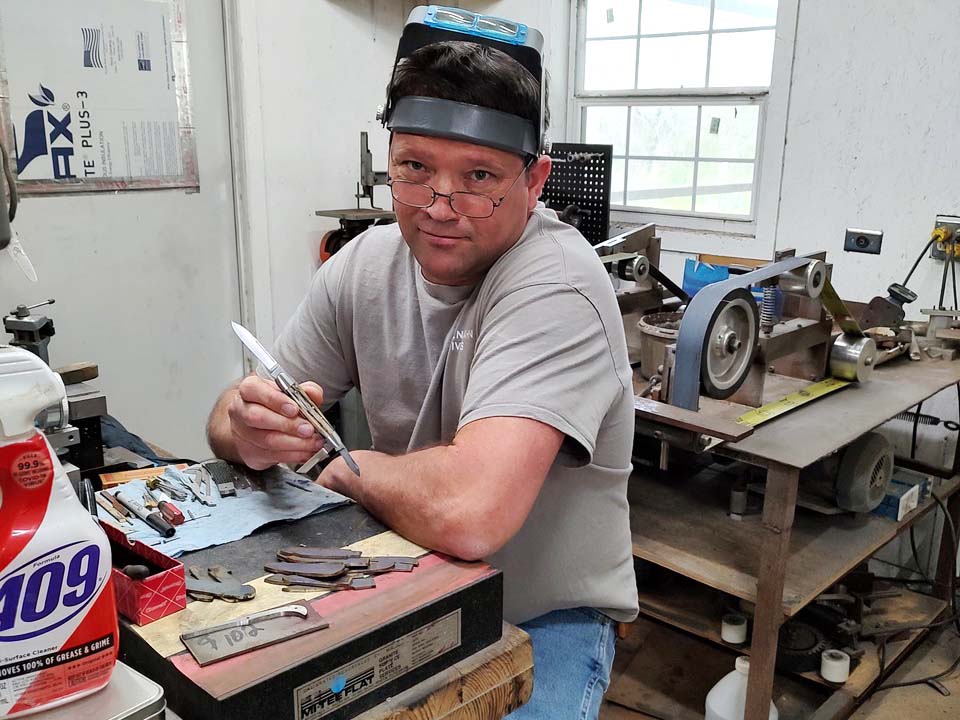
Ted Friesenhahn in his shop.
“Many years ago now, Johnny Stout and [ABS master smith and BLADE Magazine Cutlery Hall of Fame® member] Harvey Dean put on a hammer-in at Johnny’s shop in New Braunfels, Texas, where I first met Bill Ruple,” Ted continued. “He was teaching the slip joint classes, and he had a jig he came up with to measure the rise and fall of the blade and spring. It came to be called the Ruple jig … I still use this jig on every knife I build.”
Interestingly, Friesenhahn sees variations on patterns as emerging in popularity. “The current direction is in patterns being turned into different patterns,” he said, “in multi-blades like the stockman lockback whittler and sowbelly whittler. There seems to be a craze with the whittler, and of course, I have one of these variations in the works.”
Bill Burke Single-Blade Trapper
“This knife came about as a class demo for slip joint folders that I taught at Jim Poor’s Flatland Forge in Tuscola, Texas,” said Bill Burke of his single blade trapper, with a 3-inch stainless damascus blade and blacklip mother-of-pearl handle scale. (SharpByCoop image)
Master smith Bill Burke of Boise, Idaho, recently produced a handsome single-blade trapper with a hollow ground 3-inch blade of stainless damascus steel, blacklip mother-of-pearl handle scales, and 416 stainless integral bolster and liner.
“This knife came about as a class demo for slip joint folders that I taught at Jim Poor’s Flatland Forge in Tuscola, Texas,” said Bill. “The pattern for the class was the ever-popular large single-blade trapper. I added my personal preferences of filework and bolster fluting to this knife, as well as incorporating a piece of Jim Poor’s waterfall pattern damascus into the blade. The only guide I had was a pattern drawn on a piece of paper and e-mailed to me by Luke Swenson.”
Burke has found the most challenging aspect of the slip joint to be mechanical, sharing that observation with other makers. “The most difficult part of any slip joint, at least for me, is getting the timing right so that the spring is level with the frame/liners in all three positions, closed, half stop and open, while also keeping the end of the spring even with the end of the tang in the closed position,” he commented.
“I made my first slip joint folder in about 2001,” Burke continued. “It was a large trapper like this knife. I traced a friend’s knife on a piece of paper and used calipers to measure the dimensions of the tang. This knife was made because I had carried a slip joint pocketknife with me since I was about 5 years old. I can remember sharpening a pencil for a first grade teacher with my pocketknife.
“Over the years, I continued to make slip joints, and they did get better,” he observed. “But I always struggled with the spring timing. Fast-forward 16 years, and a friend of mine from Australia, [journeyman smith] Bruce Barnett, and I went to visit the maestro of the South Texas Slip Joint Cartel, Bill Ruple. We were at Bill’s shop for four days making slip joints. While there, Bill taught me the proper use of the Ruple jig, that little contraption he had put together to make timing of a slip joint something of a science instead of a swag. This little bit of knowledge changed my slip joints from being functional to well-working tools that I am proud of. Bill Ruple and Luke Swenson continue to motivate me to make better slip joint knives.”
As a master smith and forger of knives, Burke sometimes takes on that dimension completing the slip joint. “The only challenge is forging the steel, whether damascus, carbon or stainless, which is not commonly forged,” he advised. “Most people who do forge do not actually forge folder blades but instead forge the steel and then stock remove the blade from the forged steel. There are some who will forge damascus folder blades to get a specific pattern of damascus to follow the curve of the blade shape. This can be seen in the knives made by Owen Wood, Tim Foster, [master smith] Mike Quesenberry and a few others.
“I have forged san mai and damascus folder blades to shape when circumstances made it necessary but do not commonly do so,” Burke concluded. “The challenge making a slip joint knife from forged materials in my opinion is no different than doing stock removal with the possible exception of san mai blades and springs where careful attention has to be paid to ensure the hard core of blade and spring line up precisely so the components stay in alignment, keeping the spring from wandering off to one side of the blade. If this happens and is not corrected, eventually the bolsters will be forced apart and the spring will continue to wear on one side of the blade making the knife useless.”
Bubba Crouch Single-Blade Trapper
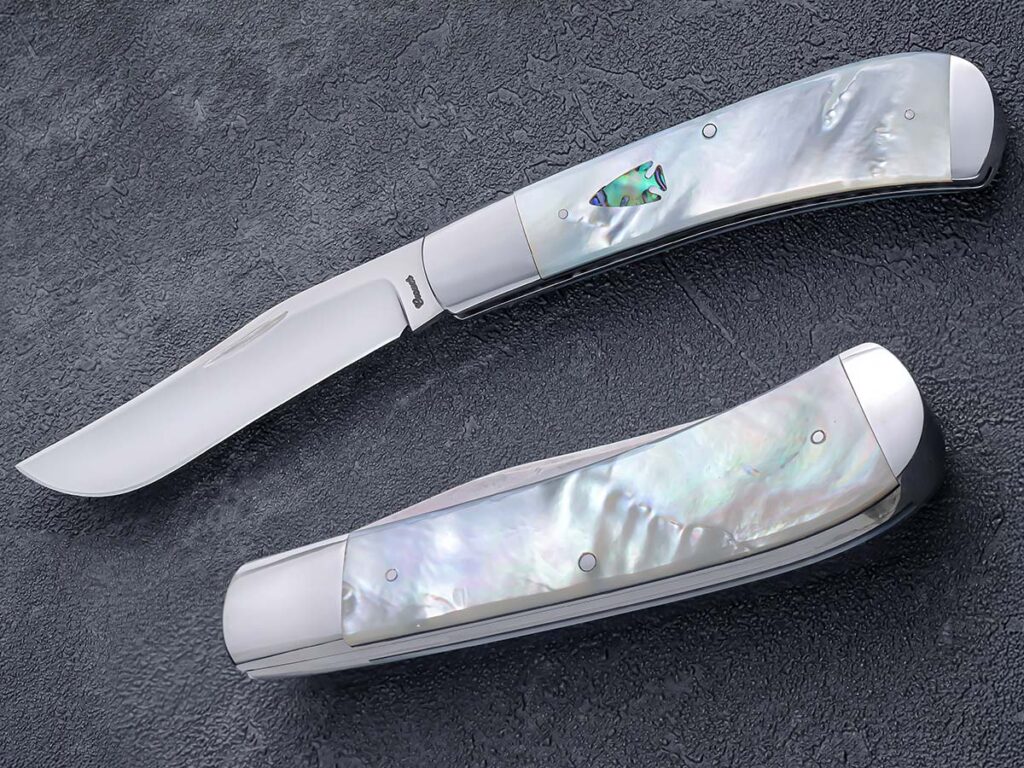
Bubba Crouch points to the influence of Slip Joint Cartel icon Bill Ruple in his career. More than anything, Ruple taught him to “make the next knife better than the last one.” Crouch’s pearl-handled trapper demonstrates that the knifemaker has taken this lesson to heart. The natural scale presented concerns in chipping, shattering, and even burning. (SharpByCoop image)
Bubba Crouch has been making knives in Pleasanton, Texas, since 2001 and lives just down the road from his friend and mentor Bill Ruple. While Ruple is the leader of the South Texas Slip Joint Cartel, Crouch is a founding member and revels in the lively exchange of ideas and the friendly banter that it provides.
Ruple’s influence is pervasive among slip joint makers, and Crouch is no different. “Bill taught me everything I know about knives,” commented Bubba. “I guess the most important thing he has taught me is to make the next knife better than the last one. That is hard to do!”
Recently, Crouch completed and sold the featured single-blade trapper to a resident of Philadelphia. His available knives sold out in two days during the last 10-day Las Vegas show, and the demand for his work is on the rise. This particular trapper features a 3¾-inch hollow-ground blade of CPM 154 stainless steel, an integral 416 stainless steel frame, and handle scales of pearl with an abalone arrowhead inlay.
“I do all 416 integrals,” Bubba noted. “So, I mill my liners instead of spot welding or soldering, and I have had a lot more luck keeping them flat and even. That makes a better knife, I think, and the integral frame prevents issues with warping and that type of thing.”
The biggest challenge in creating this trapper came with working in pearl, a natural material that presents concerns in chipping, shattering, and even burning. When working with the pearl, Bubba uses a thin liner material glued to the surface to stabilize it, and with the final grind, he removes the liner material while shaping the pearl to fit the handle space.
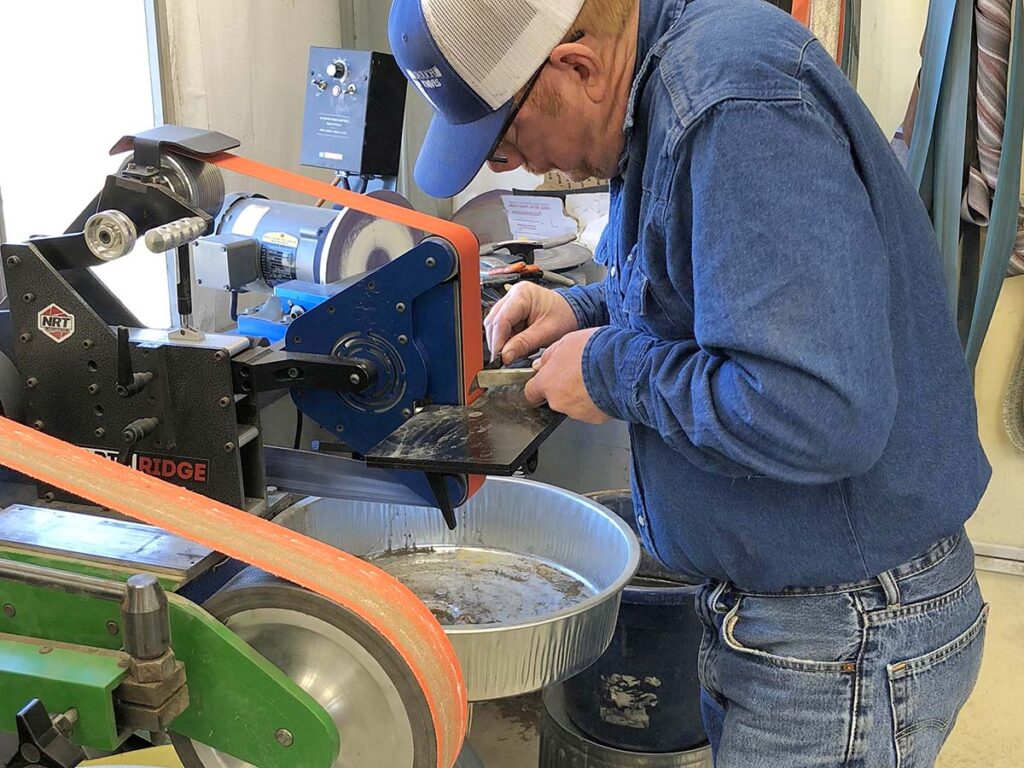
Bubba Crouch at his grinds a blade.
“If you look at the pearl on some knives, you can see a yellow edge from the heat sometimes,” he said. “I fit the pearl in the handle and then remove it, shaping it to the bolster to avoid the heat before putting it back in. When I’m sanding the pearl, I wet sand, and when I drill, I squirt water on it after starting the hole.”
The abalone inlay gives Bubba’s trapper a distinctive flair, and the process of inserting it is relatively simple. “I have a pantograph machine and use templates to cut the abalone and cut the pocket for it in the pearl,” he said. “You’ve got to be careful and don’t want to pop it in and out too many times. I drill a hole through the pocket that is pretty small and comes out the liner to test fit.”
Crouch enjoys building what he likes, and for now, that is the single- and two-blade slip joint. Multi-blades don’t have great appeal. “My clientele is the everyday carry guy,” he concluded. “So, I build those knives. I don’t see the slip joint market getting soft. It’s traditional and will stay stable. It’s what your grandpa and your dad carried, and as long as there are memories like that, there will always be a market for the slip joint.”
Demand doesn’t seem to waver with the slip joint, and today’s makers are eager to oblige the marketplace.
The Drop Point Blade Is One Of The Most Utilitarian Blade Styles. From Outdoor Knives To EDC Folders, The Drop Point Is The Way To Go.
The drop-point blade is perhaps the most useful shape for outdoor knives. It’s an excellent cutting tool and the point makes it good at puncturing too. Whether it’s cleaning a kill or just opening up a gift box, the drop point is an excellent all-rounder that any knife lover should have.
Ka-Bar/Becker Knife & Tool BK16 Short Becker
The wide drop-point blade of the KA-BAR/Becker BK16 has the ideal edge geometry to handle precise tasks like whittling.
It is a midsize knife that is easy to carry, handle and use. The 4-inch blade of flat-ground 1095 Cro-Van steel can hold a respectable edge and sharpens quickly in the field. The black textured epoxy coating is non-glare and corrosion-resistant.
The Zytel handle is a typical Becker design—highly ergonomic with a palm swell that fills the hand nicely. The handle edges are rounded to eliminate hot spots. Part of the tang is exposed for the lanyard hole. There’s also traction notches on the spine to choke up for added control. When you hold the BK16, notice how solid it feels. Even though one of the smaller knives in the line, it still feels capable of handling most cutting or camp tasks.
The sheath is a ballistic nylon with a rigid plastic liner. An accessory pouch holds a small lockblade folder or sharpener. The knife secures in the sheath via two button-snap nylon straps. The BK16 holds snugly inside the sheath with no rattling. Made in China, the sheath is of very good quality.
The BK16 is a workhorse. The drop-point shape is utility friendly and covers a broad range of general camp chores, from food prep to field dressing. The flat grind ensures optimum slicing.
The handle shape is classic Becker. A forward finger recess forms the lower guard and a palm swell mid-handle seats the hand comfortably. All edges are rounded for maximum comfort during prolonged use. The BK16 comes with two sets of scales: black Zytel and coyote tan. I opted for the tan. I love the contrast with the black blade.
I successfully batonned the knife through wood. The knife shrugged the task off and repeatedly came back for more. Whittling was easy. The ergonomic grip is comfortable and you’re able to use the exact pressure needed. The BK16 handles food prep with confidence.
If you need a compact fixed blade capable of tackling large tasks, the BK16 is it. Made in the USA, it has an MSRP of $132.
Fallkniven F1 Pro
The Fallkniven F1 Pro’s blade geometry makes baton work almost effortless.
The Fallkniven F1 Pro features an extra-heavy-duty build and ELMAX high-performance stainless blade steel, which offers enhanced edge holding and toughness. With a 4-inch, convex-ground blade and 8.5-inch overall length, it is a formidable knife, weighing in at 6.1 ounces.
The blade stock thickness is .19 inches, fairly thick for a knife this size. The full tang extends through the Thermorun rubber handle and is exposed on the butt for excellent torsional rigidity.
The handle sides feature a heavy checkering pattern for an excellent grip with wet or dry hands. The Thermorun material has a sort of a grip-you-back quality, similar to Kraton. The oblong handle shape rests in your grip comfortably so that you feel in control of the knife.
The sheath is well made of heavy-duty Zytel with a nylon webbing belt loop and button-snap retention strap. At first, the nylon webbing may seem a bit cheap but in reality it’s very smart.
Why? The webbing allows the sheath to move freely at your side in case it gets snagged by branches, or to self-adjust when you are seated in a chair or a vehicle. Most rigid sheaths do not allow for this. Not to mention, the nylon webbing material is weather and moisture-resistant.
The knife locks into the sheath via the guard as it engages a spring-loaded tab in the sheath’s side. This alone is enough to hold the knife inside, but securing the handle with the snap strap guarantees the knife stays put until you release it. The sheath’s bottom is open to allow moisture to escape and resist blade corrosion.
The F1 Pro and the BK16 are the heaviest-duty ones of the test bunch. The F1 Pro easily completed baton work. The thick blade stock and flat grind split wood like a wedge. For whittling, the convex edge has a ton of bite. It shaved off thick chunks of wood as I carved multiple stakes to a point. It made fast work of the task but, at the same time, was controllable and made precise cuts when needed.
In some respects it worked as hard as a larger knife. In the kitchen, don’t dismiss the F1 Pro due to the thick blade. It slices vegetables with precision, proof this beast of a knife can handle delicate tasks as well.
There were no problems with the Thermorun handle. My hands got a bit sweaty during outdoor use and the handle never felt like it was going to slip in my hand. The checkered texturing is the right amount and not overly aggressive to your skin.
With an MSRP of $407.95, the F1 Pro ELMAX is one of the most expensive knives you will find in this class, but the chosen materials and highest quality of build offset the cost. You get what you pay for and this is a high-quality tool.
White River Knife & Tool Hunter
The blade of the White River Hunter is flat ground for optimal cutting performance, and the steel offers toughness and high edge-retention qualities.
The White River Knife & Tool Hunter is a simple design, with a 3.5-inch drop-point blade paired with an ergonomic handle. Blade steel is CPM S35VN high-performance stainless, and the handle comes in several material options. The 8.25-inch overall length is well-suited for field dressing and possible bushcraft use, too.
The blade is flat ground for optimal cutting performance and the steel offers toughness and high edge-retention qualities. A polished finish makes the blade a snap to clean and also seals micropores, thus helping prevent rust. It’s kind of unusual to see a mirror polish on such a blade due to it being a labor-intensive finish; most such blades have either machine satin, stonewash, or even bead-blasted finishes.
A large finger recess helps index your grip, and a significant palm swell rests the knife in your hand comfortably. The butt has a bird’s beak pommel to prevent your hand from sliding backward.
As for handle material choices, they include three Micarta® flavors: natural burlap, black burlap, and black/OD green. Micarta is an excellent choice for an outdoor knife, as it is dimensionally stable and impervious to the elements and absorption of fluids. It also has a tactile feel that aids in grip retention in all conditions.
We selected the natural burlap for the test, as it has a very organic appearance, almost a wood tone. The feel is akin to that of canvas Micarta. The sheath is formfitting Kydex, with a molded Kydex belt loop that accommodates belts up to 2 inches wide.
The cutting performance is superb. The knife is efficient and simple to maneuver. The flat-ground blade sails through meat and vegetables. Being a smaller fixed blade means it can be used for more delicate or intricate cutting.
I like the burlap Micarta. It’s very durable, looks great, and has a great in-hand feel. Burlap micarta isn’t common in production knives, so this is a bit rare—for now.
The shorter-length blade handles kitchen utility tasks well. Who knows—this knife might wind up in your kitchen pulling permanent duty when it’s not out with you in the woods. The White River Hunter retails for $180 for any of the handle material options. This is a really good price for a USA-made fixed blade with premium blade and handle materials. If you like refined fixed-blade hunters, the White River Hunter is for you.
Chris Reeve Knives Backpacker
The Chris Reeve Backpacker handles like a dream. The knife is balanced perfectly and feels like an extension of your hand. It’s very predictable in use and is a slicer by nature. (Dexter Ewing image)
The newest fixed blade from Chris Reeve Knives, the Backpacker is for outdoorsmen and backpack hunters who want a fairly lightweight sheath knife that is quite usable with a smart design and high-end materials.
It features a 4-inch drop-point blade hollow ground from CPM Magnacut, the latest of the high-performance stainless super steels. Magnacut reportedly has the best edge retention of any high-end blade steel. The Backpacker will go the distance with edge holding. A stonewash finish gives the blade a slight industrial look. Stonewash finishes do a good job of hiding scratches that occur during use.
The handle has a hollowed-out full tang, which helps keep weight to a minimum (3.8 ounces) and improves balance. The scales are canvas Micarta in black or natural. The Micarta is sculpted to provide placement of the hand and fingers, enhancing user comfort and blade control.
Canvas Micarta has a grippy nature and seems to get better when your hands are wet, unlike other materials that may feel less tactile when wet. Two pairs of hex-head bolts secure the scales which are removable, resulting in a skeletonized fixed blade to further reduce weight and bulk.
The integral guard formed by the blade’s height is a smart design I really like. It allows you to choke up on the handle for precise control, as well as keeping your hand in place.
The Backpacker comes with a Kydex sheath which locks around the lower portion of the exposed tang that forms the guard. It does not encompass the handle scales as most fixed-blade Kydex sheaths do. This is done on purpose so if you do decide to remove the scales and use the Backpacker skeletonized, the sheath will still work and lock on the knife for safe carry.
A flat-head screw at the end allows you to fine-tune how tight the sheath locks onto the blade. Not many sheaths have this feature. The rivet spacing allows use of a large Tek-Lok belt fastener (the knife does not come with a provision for belt attachment, so it’s up to the buyer to supply such).
The Backpacker handles like a dream! The hollow grind slices easily. I used the knife to cut meats and vegetables. The cutting performance is predictable, efficient, and precise. It’s like driving a nice European sports car.
Handle comfort is first class; I love the way the Micarta feels in-hand. It’s light as a feather for a fixed blade of its size, and no doubt the minimal weight does a lot to improve handling. When you choke-up on the handle with your thumb placed on the blade spine, you can feel how the ergonomics work to lock your grip on.
The Backpacker is a high-end, USA-made hunting/camping fixed blade. MSRP: $300. A CRK knife for $300 is a great price, actually, and you get a lot in return, including high-end materials and the company’s design and manufacturing/engineering expertise.
Buck 112 Ranger
Buck 112 Ranger
Buck makes great knives, and this folder certainly is one of their best. The Ranger is a variation on the famous 110 Folding Hunter with a drop point instead of the original’s clip point.
The knife is beautiful with an ebony handle and ethically-sourced Crelicam ivory. While the handle is stunning, the star of the show is still the blade. Made from 420 HC stainless with a satin finish, the 3-inch blade is everything you would want in an EDC. With a thick belly and thick tip, the blade slices and punctures confidently.
The heat treat imbues the blade with excellent corrosion resistance and durability. It’s hardened to an HRC 58 so the knife can handle the wear and tear of everyday use with ease. This is a classy knife at a great price.
MSRP: $63.99
Benchmade Bugout
Benchmade BK-2
When it comes to drop point EDC knives the Benchmade Bugout is one of the most iconic. It was designed for outdoor use which makes it overpowered as an EDC for so many reasons.
There are many versions of the Bugout, and all are excellent, but for this piece we chose the BK-2 for its affordability in relation to other knives in the line.
The BK-2 is a fully blacked out version of the Bugout with a CF-Elite handled married to the CPM-S30V blade. The steel comes in a black Cerakote finish and is treated to a 58-60 HRC. The knife shines in large part thanks to its weight. At just 1.8 ounces, the BK-2 is so light and nimble in the air that it can feel like cutting with air.
It’s the Bugout. It’s great. It’s one of the highest-quality drop point knives on the market.
MSRP: $190
Kizer Drop Bear
This knife was released over the summer and it is excellent. We have already written an in-depth review of the Drop Bear, and it’s worthy of a second mention.
The 154CM steel blade is meted to an aluminum handle. At 3.8 ounces it’s a substantial little knife that can handle the day-to-day tasks asked of it and can even be used as a kitchen knife in a pinch.
The knife’s clutch lock, Kizer’s newly-adopted Axis-style lock, is fun to use and keeps the blade secure at all times. This is an excellent new addition to the world of drop point pocketknives.
MSRP: $158
Editor’s Note: Mike Abelson provided content for this piece.
A fillet knife that sharpens while you cut? That’s the bold promise Relentless Knives make with its Curved Fillet Knife.
In its pursuit of the elusive long-lasting edge, Relentless Knives called on titanium, carbide, crushed diamonds and nature. Using beaver teeth as a model, the company promotes blades that “sharpen as they cut.”
A “Power Strip” consisting of ultra-hard carbide and crushed diamonds is permanently bonded to one side of the titanium edge. The basic concept is that as you use the knife, the softer back side of the blade wears away, exposing more of the hard edge. The need for constant resharpening is eliminated, ergo Perpetual Edge Technology.
According to Relentless, you need not worry about your blade rusting or discoloring, even in saltwater, a dream for commercial operations or the fisherman who forgets to wipe his knife off after use. The base line is that the knife—in this case the Relentless 6-inch Fillet Fixed Blade—must cut. Let’s see if it does.
Relentless Knives Curved Fillet Knife Specs
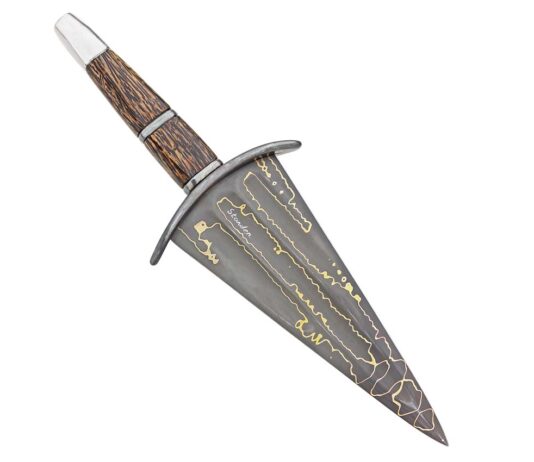
A “Power Strip” consisting of ultra-hard carbide and crushed diamonds is permanently bonded to one side of the titanium edge. The basic concept is that as you use the knife, the softer back side of the blade wears away, exposing more of the hard edge.
Company: Relentless Knives Blade length: 6” Blade material: Grade 5 titanium Power Strip: Carbide/crushed diamond Blade grind: Flat Blade flex: Medium to stiff Handle material: True Grit glass-reinforced ABS Weight: 6 ozs. Overall length: 12” Sheath: Leather w/snap strap Country of origin: USA MSRP: $150
Pros
Innovative Perpetual Edge Technology
Rust and Corrosion Resistance
Exceptional Cutting Performance
Cons
Initial Roughness
Expensive
Curved Fillet Knife Cutting Tests
The paper slice is a quick way to check any edge. The fillet knife sliced strips of 20-pound copy paper without pressure, and I could feel the Power Strip grab the paper. Sharp, coarse cuts, the slices were not difficult to control and the handle felt comfortable.
The fillet knife crunched forcefully to 200 cuts very quickly. The author stated it cut great but it was weird feeling the flex. It seemed to slice smoother toward the last 50 cuts.
Single-walled cardboard was next. The first couple of slices were rough cuts, then it seemed to smooth out a bit making for faster slicing. The True Grit handle material really keeps the knife locked in your grip.
I started cutting scrap 8-ounce leather. At first the edge was still grippy while slicing, then seemed to find its groove and got smoother. The cutting action was very aggressive—I could hear every cut. Using the other end of the leather strip, I did some skiving. The slices were thin and I still heard every cut. Using a choke-up grip, control was very easy.
The knife produced nice curlicues. Note: use the edge close to the guard for stability. The Power Strip wanted to dig deeper into the scrap pine, so the author had to control cutting depth.
It was scrap-pine whittling time. The knife produced some nice curlicues. Note: use the edge close to the guard for stability. The Power Strip wanted to dig deeper into the wood, so I had to control cutting depth. It’s fun to try but watch out for your fingers!
It was on to half-inch sisal rope. The fillet knife crunched aggressively to 200 cuts very quickly. The challenge on my part was to watch for the blade flexing. It cut great but it was weird feeling the flex. It seemed to slice smoother toward the last 50 cuts. I was probably knocking the newness off the Power Strip.
Curved Fillet Knife Processing Game
Hunting season was in full swing where I live at press time, and I like cooking fresh venison backstrap. The fillet knife zipped through the meat quite smoothly and cleanly. With the temperature at 22°F, the handle stayed tight in my cold hand.
The knife zipped through the venison quite smoothly and cleanly. With the temperature at 22°F, the handle stayed tight in the author’s cold hand.
I found some whole tilapia to fillet. After thawing, it was ready for action. The knife excelled at preparing the fish. It glided along the bones in short order. Dang, I needed this blade when I was younger working for a commercial fish house in Wisconsin! I went back in to thaw out my fingers and fry some fish.
The final test was back to slicing the copy paper. What a difference from the first test. The edge was smooth slicing and a lot cleaner in the cuts. The more you use the knife the better it gets. Perpetual Edge all the way!
Final Cut
I’m impressed with the Relentless blade’s ability to stay sharp by itself. It’s very well suited for saltwater and freshwater use. Hats off to the Relentless crew. I would have to do a lot more testing to come up with any changes. I’m waiting for a Relentless hunting-style knife to come out soon. Stay tuned to the Relentless website (see below) for more details.
The M-1 Folding Pocketknife From MECHFORCE Takes A Licking And Keeps On Cutting No Matter What’s In Front Of It.
Most people don’t like carrying a thick knife. They already have enough stuff without a bulky folder blocking access to the other goodies in their pockets.
I really like the blade thinness of the M-1 folder by MECHFORCE. Add a deep-set pocket clip and the M-1 is low profile when attached to the lip of your pocket. Meanwhile, the handle feels great.
The blade is a classic drop-point shape and cuts like … well, let’s see!
M-1 Folder Takes On Paper And More
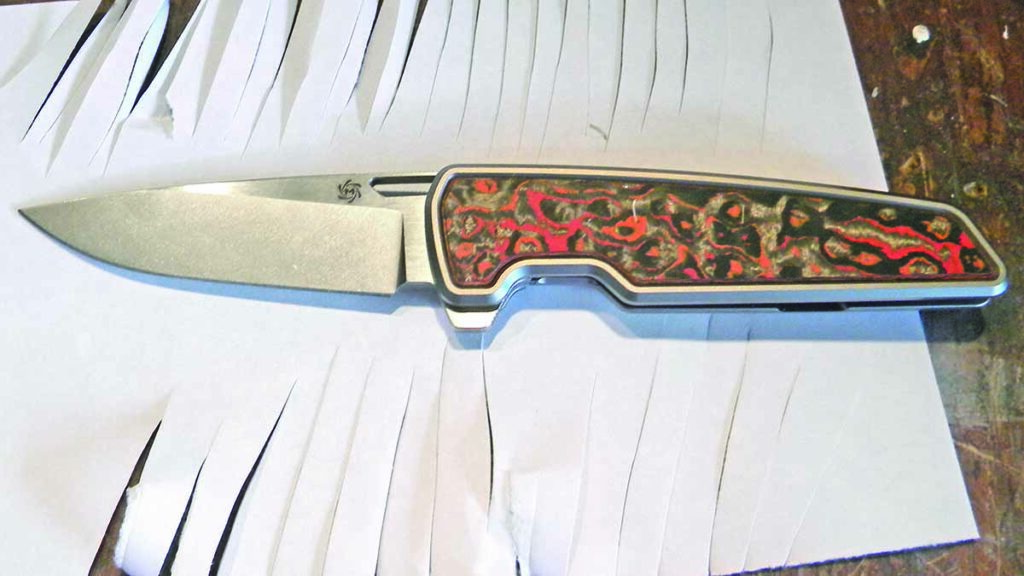
The M-1 sliced the 20-pound bond copy paper smoothly and quickly.
Twenty-pound bond copy paper is the first way to test the factory edge. The M-1 sliced the stationery smoothly and quickly. I put a few nicks in my fingernail by moving too slow. I could hear every slice in the paper. Very sharp!
On to double-walled cardboard. The blade bound a tad at the bottom of the cut and during withdrawal. The thicker slice is where I noticed the binding. Thinner slices were not a challenge. It sliced the cardboard fast overall.
I used some plastic board for the next medium. The M-1 sailed through every slice. It was easy to control the width of the cut. I like the shape of this handle a lot. It really gives me control with my sidewinder cutting style.
The M-1 bit into 8-ounce leather and did so with gusto. I could hear the aggressive sounds of the edge biting through the material—this is very addictive to do as you crunch away. The knife would excel at skinning game.
I did some skiving to check the control of the depth of the cut. There were no issues whatsoever on the leather—super thin cuttings every time. The flat grind really helped in cut-depth control.
Pushing The M-1 Folder
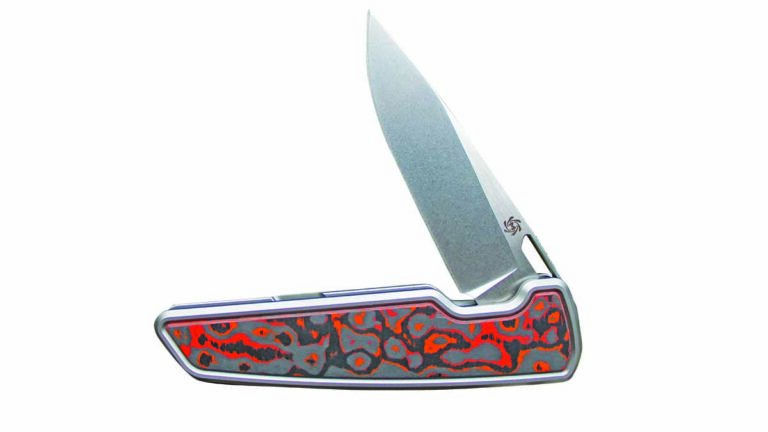
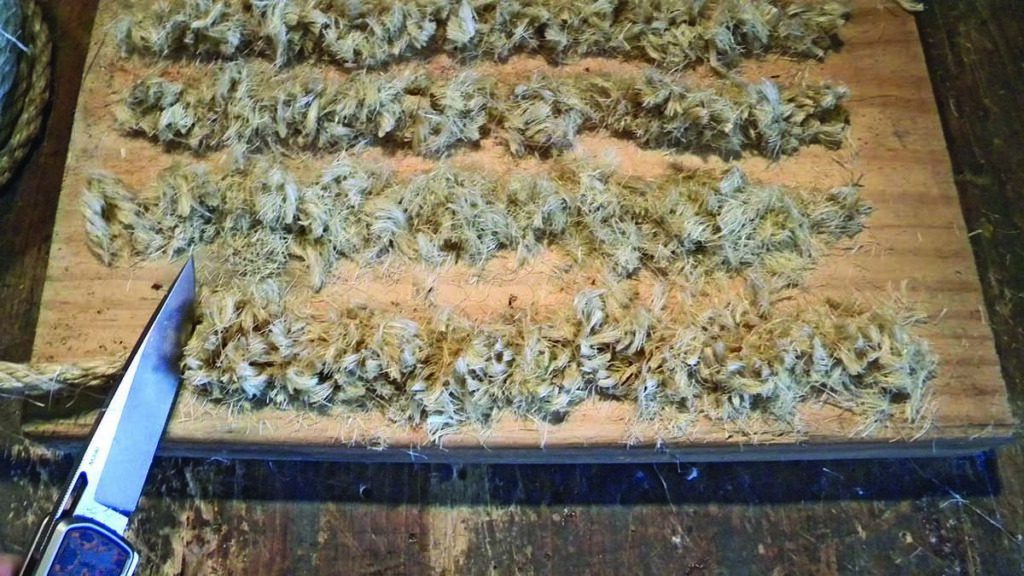
The M-1 Folder wore the author’s wrist out after 250 crunching cuts of half-inch sisal rope.
Next up: half-inch sisal rope—time to use more pressure on the M-1. The knife wore my wrist out after 250 crunching cuts. It still had more bite but I was done for the day on rope cutting. The knife gave me no hot spots and I found zero sharp areas on the handle. It was very comfortable with pressure cutting. Excellent work, MECHFORCE!
To give the edge a heavy workout, I grabbed an old whitetail antler and gave it 30 whacks. I expected to see a few small chips in the edge but none showed. The edge was still sharp with no snags, sure signs of tough steel and excellent heat treatment.
I switched back to slicing 20-pound bond paper to see if the edge was still field ready. It sliced cleanly throughout to the end of the testing.
The M-1 comes with a maintenance kit that includes how-to instructions, two sets of replacement adhesive strips, take-down wrench and a bandage. It’s well thought out.
Final Thoughts
Not much to say here—maybe add some skateboard tape inserts for a no-slip grip. The M-1 is a high-performance knife that takes a licking and keeps on cutting. It makes a great pocket addition.
M-1 Folder Knife Specs
Knife style: Flipper folder Blade length: 3.5 inches Blade steel: M390 stainless Blade thickness at thickest: ⅛ inches Blade grind: Full flat Blade finish: Matte Blade pattern: Drop point Handle frame: 6Al4V titanium Handle inserts: Mars Valley carbon fiber Pocket clip: Deep set Lock: Framelock Weight: 5 ounces Closed length: 4-11/16 inches Knife to know: Features hidden-screw design Country of origin: Partially made in the USA MSRP: $385






![Relentless Knives Curved Fillet Knife Review [Tested]](https://blademag.com/wp-content/uploads/Relentless-Knives-7-768x512.jpg "Relentless Knives Curved Fillet Knife Review [Tested]")