Want to know what steel to fling and what at? We break down how to choose the best throwing knife and targets for high-flying fun.
Simply put, a throwing knife is an object that is either a true knife (capable of cutting and other work) or a pointed/tipped/edged object that is solely designed to be thrown with no other intended capability.
Any knife in theory can be thrown, however, most all knives are not intended to be thrown. There are several reasons for this, among them the fact that knives are edged tools and are reliant on their edge profile, blade shape, and handle style to be functional in their intended role. For instance, a chef’s knife isn’t designed to be batoned through wood. A knife it is, but it is not *that* type of knife.
Likewise with throwers—a throwing knife is purpose-made for the role and is usually stripped down to a point where it is not functional in most other roles.
Selecting A Throwing Knife
In selecting a throwing knife, you need to first look at what you want to throw it at and what type of throwing interests you.
Steel
The first criterion here is important because you want to choose steel of a high enough grade that throwing it doesn’t damage it. Knives break all the time and even the strongest edge can chip or even snap if it hits a hard surface with sufficient speed and force.
If you are a recreational thrower who likes to have some fun at your weekend cookout, you really can’t go wrong across the board. Lower-cost knives in sets mean you can get more of your friends involved and the good times can be made that much better. These knives are usually made of lower-quality steel, and it is not uncommon to see broken tips. These knives are usually inexpensive and are only made to maintain a tip, not an edge.
The medium-skill thrower is probably going to graduate to some better steels and more common profiles. It is in this category you start seeing true blade steels like 1055 and 1095 come up as opposed to just generic ‘stainless steel’. The knives at this stage are still affordable but are typically sold as individual pieces, meaning building a set gets pricey. At this level, you start to see real effort put into blade profiles and balance points, as well as an emphasis on the ability to throw repeatably.
Advanced throwing knives start to get expensive, sometimes into the hundreds of dollars—some even custom-made. These are the knives you see the most serious competition throwers using. The average recreational thrower would benefit from them, but unless you’re throwing every day the expense is not going to aid you. That said, an expert’s knives are going to be balanced perfectly as well as featured tailored grip style, tip and body to provide the most consistent performance. These are also nearly identical in weight and in the distribution of that weight along the blade and handle.
Designs
Some knives are tip-heavy, others handle-heavy. Others are slotted or have holes drilled to allow the addition of weight where necessary. The weight distribution of a knife largely depends on how you grip it—a topic too large to cover here. The abridged version is balance points vary depending on your throwing method, and as you learn you may gravitate to one or another depending on what works best. Typically, it is advisable to start with a perfectly balanced knife and then, once you have that skill, learn what style your body and throwing performs best.
Throwing Styles
Throwing styles vary depending on what you are trying to do and what style of knife you’re throwing. There are many methods to do this, not just the classic ‘hold by the tip and hope for the best’. There are two main types of throwing, rotational and non-rotational, and certain types of knives are balanced better for each.
Rotational throwing is where you throw the knife, and it rotates in the air before contacting the target. You’ll need to know or be able to estimate the number of rotations needed to arrive at the target with the tip. This is harder, but the more common type you see practiced in backyards everywhere.
The next is non-rotational, where the knife is launched straight on without spinning. This is usually for shorter ranges inside 15 feet.
Throwing Knife Targets
Throwing knife targets are wide-ranging. There are dedicated throwing targets that exist, but you should know examples made of foam or modern composite usually do not hold up for the long run.
Archery targets are commonly misused as knife targets, which is fine if you like wasting your money. Archery targets made of rubber foam are meant to stop target point arrows, in a sense, it catches them by means of friction. A knife can cut through these layers and ruin them and increase the danger of a rebound back at the thrower.
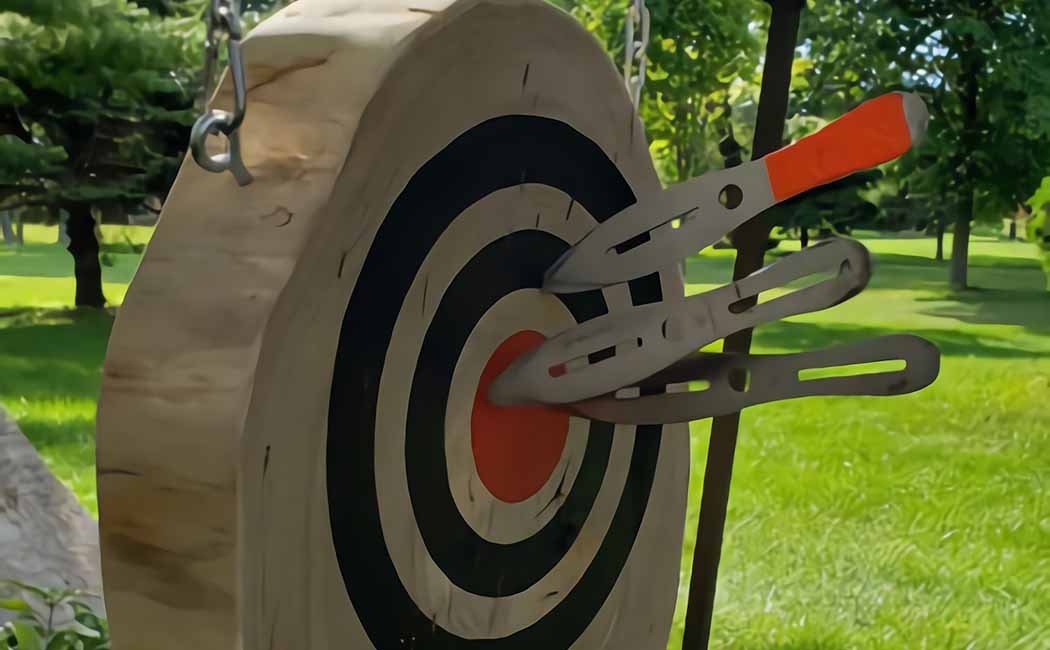
The best material for throwing knives is wood, especially slices of a tree trunk. It is not good to throw at living trees, as while the knives themselves won’t kill the tree, they can allow insects in which will destroy it.
Log slices have been used as throwing targets for time immemorial and there is hardly a substitute. They last for years, can be painted over again and again, and are cheap to replace. Most people make a stand to mount them on that can be folded up and moved.
If you are handy and like woodworking, you can make a wood block target using 4×4 posts cut into sections and glued together with the grain facing the thrower. This simulates a log slice but is more uniform in shape. The author has made this type of target and found it cosmetically nice, but not more functional than a log slice.
why Throw Knives?
To ask this question you need to understand that there is a very serious and well-researched answer… because it’s a hell of a good time!
Knife throwing has very little to do with self-defense these days, and while not out of the realm of possibility, it is just not a highly relevant skill. Today it is now common to find establishments called ‘axe bars’, where throwing blades and tossing back a few cold ones are the name of the game.
There are pro-level competitions out there, just like there are in any game or sport. There is some money in it if you’re good enough, but most people just like to do this because it is a good way to spend time together and win bragging rights.
Some Of The Best Throwing Knife Options
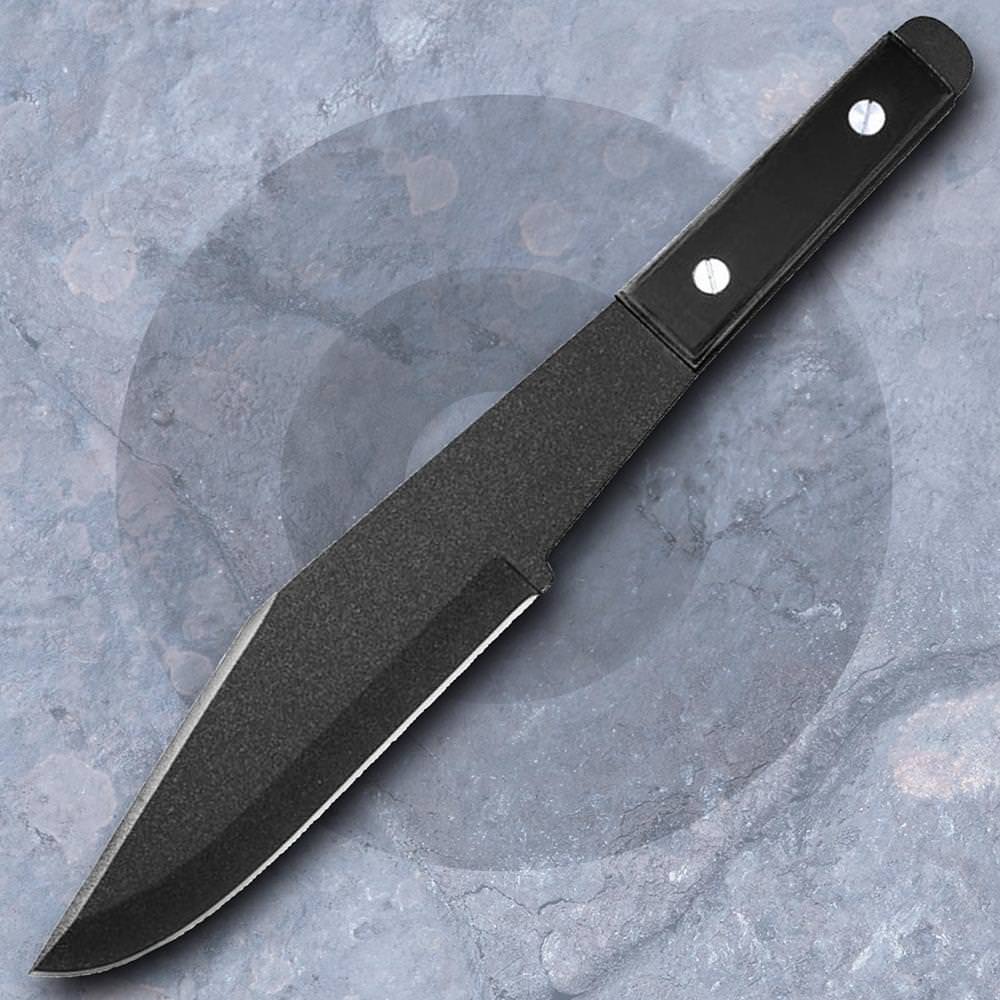
Cold Steel Perfect Balance Thrower
Resembling the company’s tough, powerful bowie knives, the Cold Steel Perfect Balance Thrower is every bit as rugged as its fellow products. But it is designed for the purpose of throwing, not necessarily day-to-day tasks. Though it is one of the few on this list with handle scales, it isn’t held up by this feature at all. This knife was designed to offer repeatable accuracy thanks to its well-managed profile, tip shape, and handle layout. A large thrower at 13.5-inches long and almost 1 pound in weight, it has no problem carrying enough energy to punch in and stick. The knife is not sold as a set, the price is for one without any carrying system.
MSRP: $38
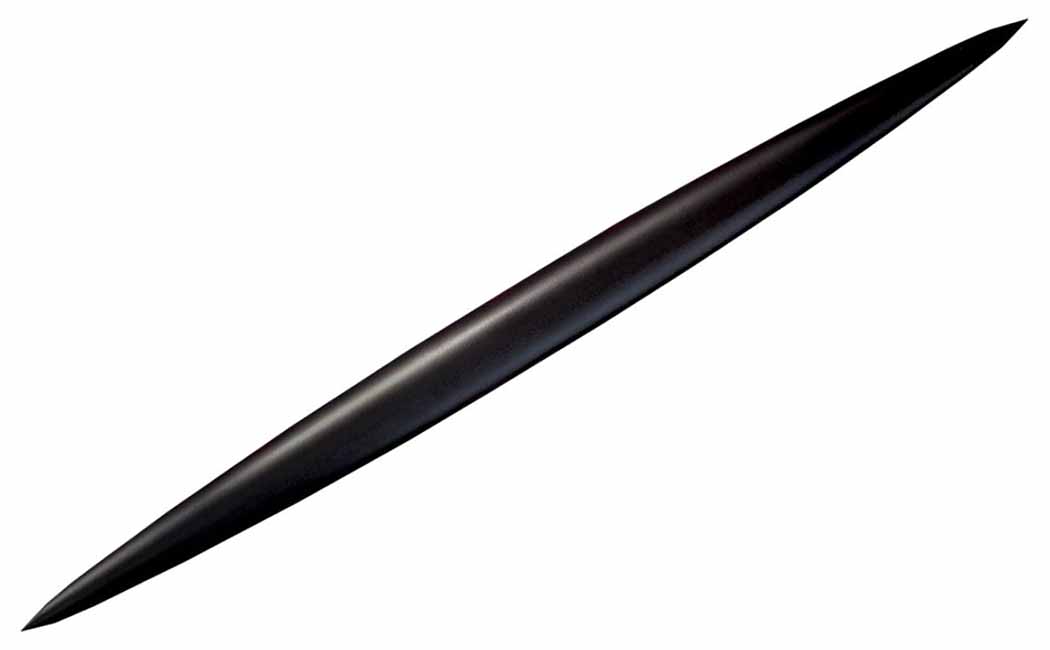
Cold Steel Torpedo
Probably the most unique thrower on this list, Cold Steel’s Torpedo is deceptively simple, yet extremely effective. The Torpedo isn’t necessarily a knife. However, most throwing knives aren’t knives in the true sense either. They are in the same shape as a knife but aren’t meant for cutting or really anything else other than throwing.
The Torpedo is a 15-inch long, 1-inch thick, 32-ounce piece of steel sharpened into conical points at each end. It carries a tremendous amount of mass and is large enough it can be used for self-defense and even some types of hunting at close distances on small game. This thrower is a design that exceeds its simplicity and crosses into the practical for ownership.
Survival schools teach throwing for hunting, and many native and indigenous cultures have used similar methods for millennia. The fact that a direct hit from this massive steel cylinder results in a huge, deep wound is enough to convince even the most dedicated primitive survivalist of its utility.
MSRP: $38 each
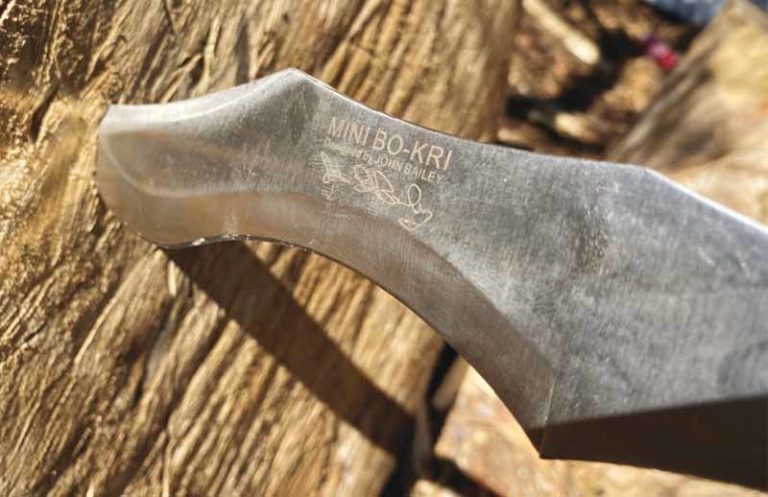
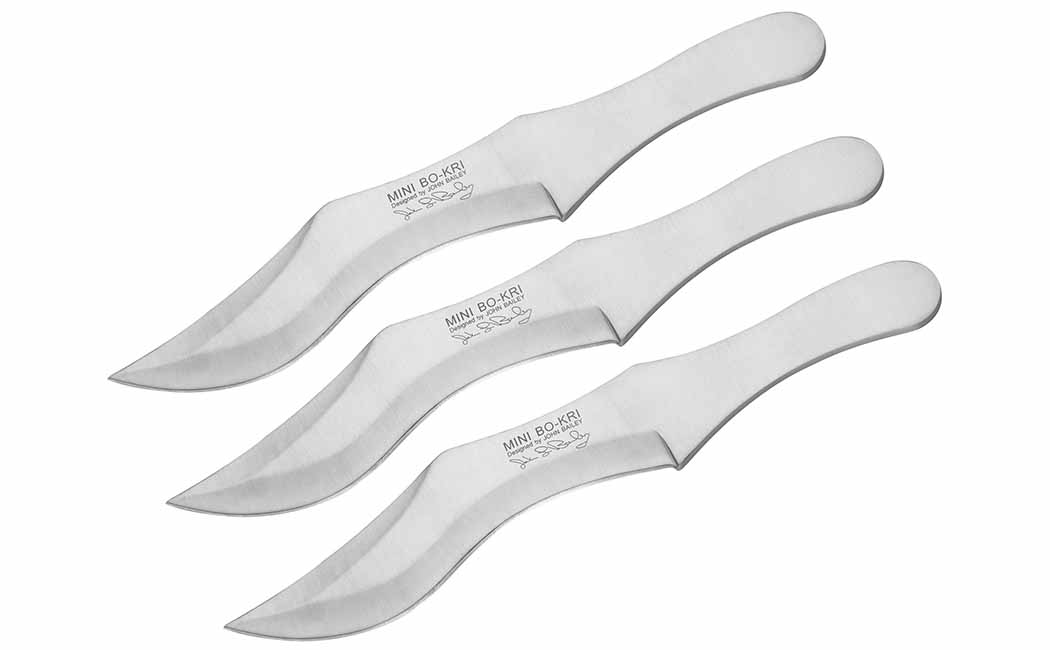
Boker Magnum Mini Bo-Kri
Boker makes excellent knives and is known the world over for their quality. The Mini Bo-Kri is an example of this, as not only a well-balanced thrower, but unique in appearance and functionality. The knife comes with a dedicated leather sheath, which is an interesting addition considering most knives of this type aren’t carried in anything, but nylon covers. The shape is a hybrid profile featuring a Bowie tip profile and a Kukri blade curvature. This shape brings the tip to the centerline and allows for very accurate throwing using a few different styles.
MSRP: $43 each
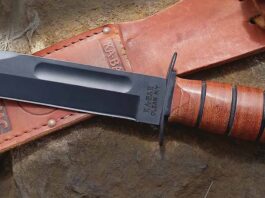
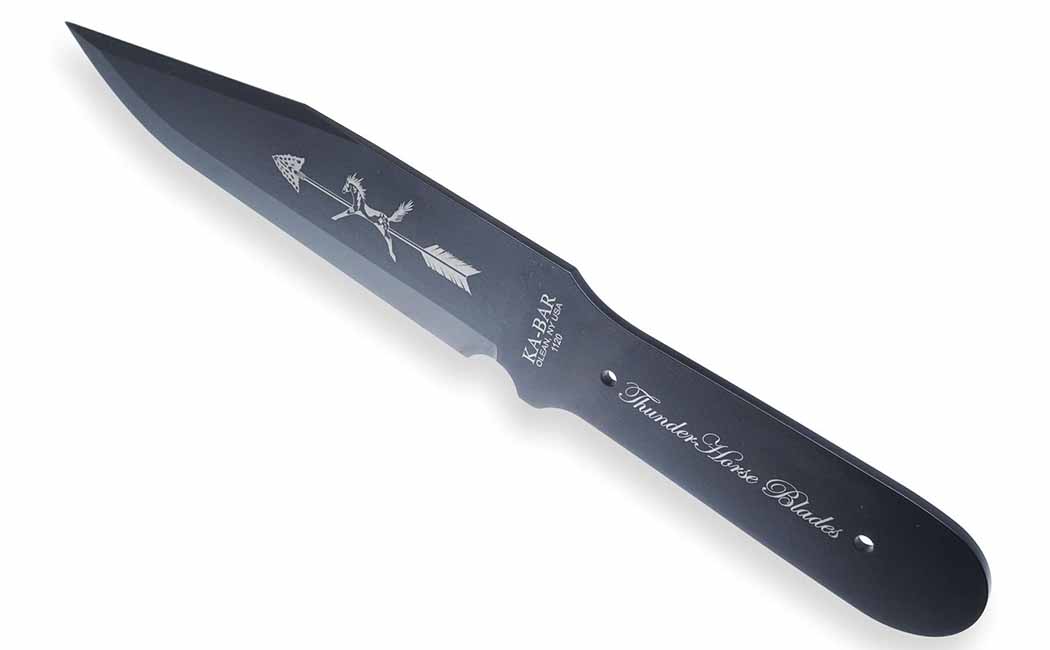
Ka-Bar Thunderhorse Thrower
The only dedicated throwing knife to carry the Ka-Bar name, the ThunderHorse is a big knife at 15.6 inches in overall length and is made in the USA out of 1095 stainless steel. There are some important things to take note of when looking to purchase this knife.
The first is that it is relatively expensive for what it is, however, it is one of the better-rated throwers out there. It is very well-balanced and has a rugged surface finish. It is made of heavy-duty steel that can sharpened to hold an edge. Of note is that the handle has pinholes, so if you need to change the point of balance you can add weights or scales.
The ThunderHorse does not come with either a sheath or as part of a set, the price is per each. If you want the best in American quality from a well-known name, you should seriously consider looking at buying a few of these to complete a competition set for your next backyard BBQ or serious game at a local match.
MSRP: $70
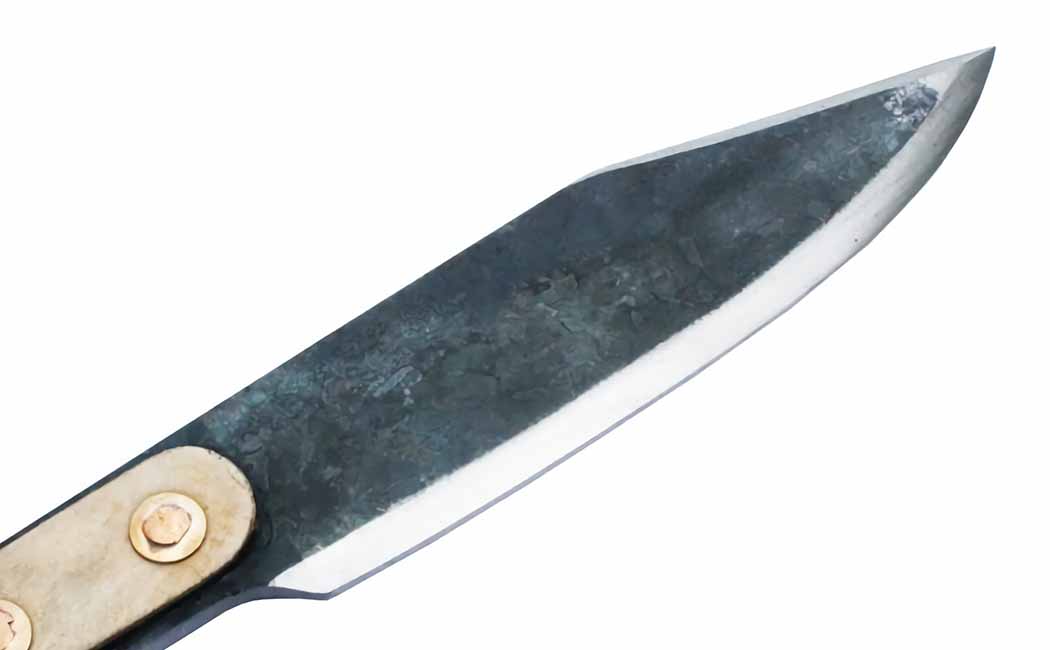
Thrower Supply Traditional Mountain Man Knife
Any time you gather a bunch of guys together in the middle of nowhere with guns, knives, axes, and a plentiful supply of liquor you inevitably end up with a competition. Marksmanship has been the hallmark of these frontier gatherings, often called Rendezvous, for the past couple of centuries. This is not where knife throwing started, but it could be argued that it became a true sport.
The Traditional Mountain Man thrower considers not just how the original throwing knives looked, but also design features that are very close to what was used in history. The first camp throwers were just that, hunting and skinning knives that were thrown for accuracy. Over time, people inevitably realized that handles were easy to break, so stripped-down elements were added, and blades became heavier and stouter.
In historical fashion, the Mountain Man thrower has leather handle scales held in place with copper rivets. This is easily replaced in camp with basic tools if need be. The knife we see here comes with a matching, historical-themed sheath. It is sold per each, which is a bonus if you want to show off wearing your set at your buddy’s house. Nothing says you like throwing knives like three of these bad boys on your belt in matching scabbards.
MSRP: $47 each
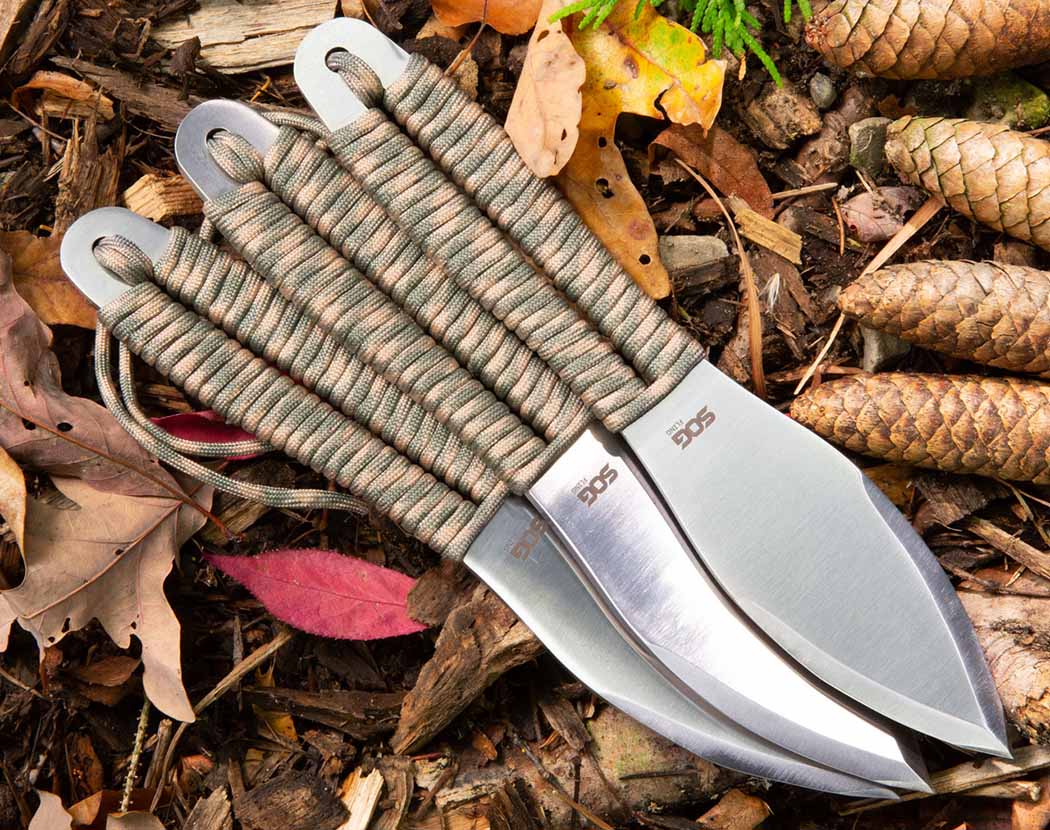
SOG Fling Set
SOG is well-known for making affordable and rugged tools to cover all uses. The Fling knives are meant for the recreation end of the spectrum, and they sure are fun!
The knives come as a set of three, which is what you need for low-cost backyard fun. The blades are spade-shaped, making them strong and stout, ideal for common backyard targets that are less than professional in construction.
It should be noted that these knives are not what you’d call a ‘professional’ set. They come wrapped in 21 feet of paracord each—not something that cuts air easily and facilitates superior balance. However, these are fun knives and enjoy a far greater range of ownership than higher-end throwers.
For a person interested in getting into throwing or if you just want a fun day in the yard, these are an excellent choice at a very modest price.
MSRP: $47 set of three
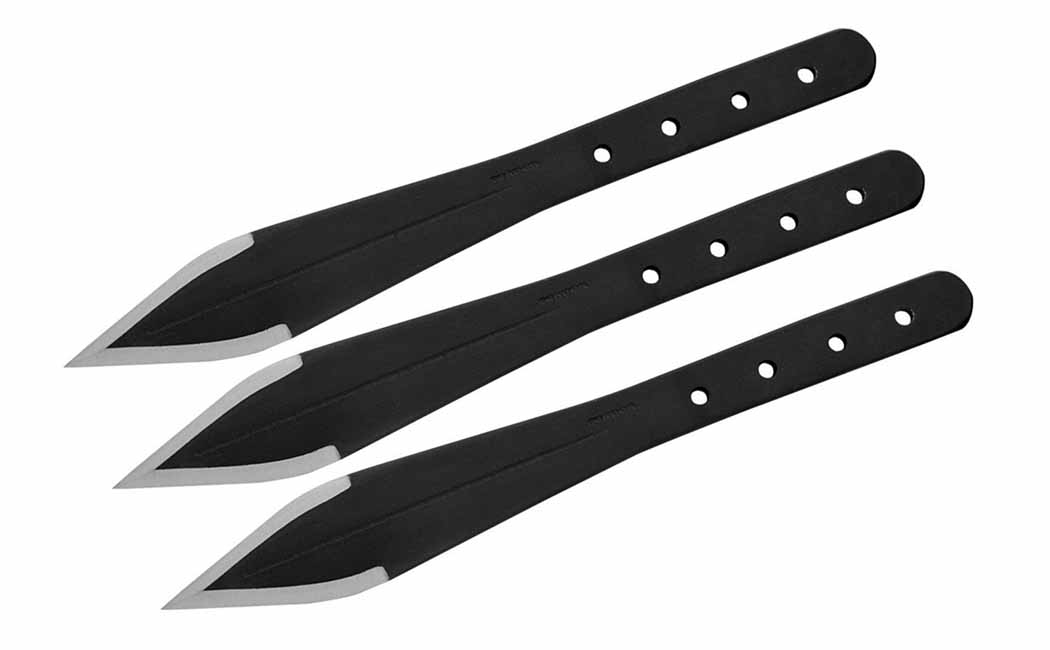
Condor Dismissal Set
Condor makes a huge range of affordable weapons and tools for just about any use. Despite being an El Salvadorian company, it makes functional versions of just about any historical sword, including Japanese style, huge German Messers, right on down to survival knives and recreational items like the Dismissal set.
These knives are highly refined for the price and have a set of features that make them suitable for backyard use as well as for serious competition. The knives have four holes in the handle area, allowing the user to add weights or scales should they wish to adjust balance. The tip profile of this knife is aggressively pointed and can punch into most regular materials but is also obtuse enough to not to get damaged in the process.
If you are just entering the knife-throwing sports, this set is inexpensive enough to get you started but also feature-rich enough to let you hone your skills and truly improve.
MSRP: $102
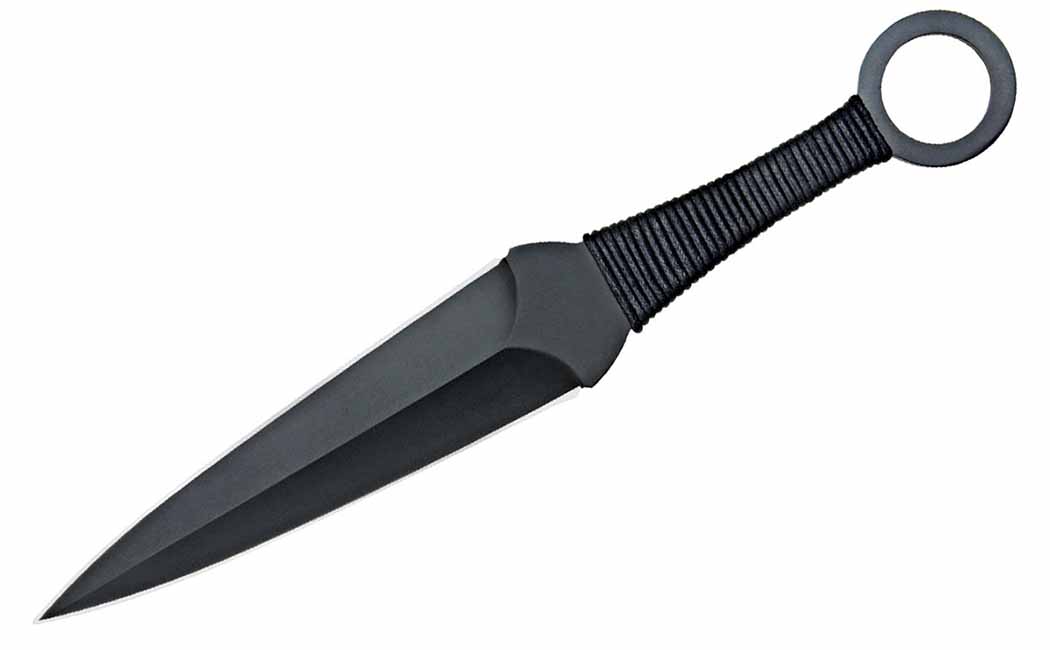
United Cutlery Expendables Kunai Set
The Expendables movie series has been out for a while now, and it is always fun to watch. Many of the actors have a history with the knife industry, arguably none more iconic than Sylvester Stallone, who also happens to be the chief character in the series. While better known for Rambo and that character’s famous knives, Stallone’s crew in the films uses a wide range of knives and this set of throwers are replicas of the screen.
Anytime you get movie prop replicas you are reminded that most prop designers have no idea how they work, but this is not the case. These throwers are functional and feature unique ring pommels that can function in the same way as a karambit in the hand. This adds security for stabbing or slashing and also making it harder to get out of the hand in a fight. A word of caution, as much fun as these would be to spin on your finger, be aware that they are sharp enough to do some damage! The knives come as a set of three in a sheath.
Whether A Stone, A Rod, Or An Electronic Device, There Are Many Quality Knife Sharpeners Out There. Here are five of the best.
There are all sorts of knife sharpeners out there. Some can fit in your pocket. Some are full-on appliances. Some are literal stones. No matter the type of sharpener you use, it’s important to make sure you get the best bang for your buck.
That’s why we’ve scoured the world of sharpeners to show you a variety of the five best out there today. Whether you’re looking for something quick and easy to give your knives a once over or a sharpener the pros use, there’s a knife sharpener out there for you.
Chef’s Choice Model Trizor 15XV 3-Stage Professional Electric Knife Sharpener, Platinum
Chef’s Choice Model Trizor 15XV 3-Stage Professional Electric Knife Sharpener, Platinum
The first one on this list could be called the Cadillac of home knife sharpeners. Named the best knife sharpener by numerous organizations including America’s Test Kitchen, the Trizor 15XV by Chef’s Choice is a beast of an electric knife sharpener.
It utilizes three separate stages to sharpen, hone, and polish your knives. It sharpens using proprietary diamond abrasives and then stropping discs to polish. It even adjusts between 15 and 20 degrees so you can sharpen multiple types of knives.
Yes, this is made for chefs and their kitchen knives but it’ll sharpen your EDC knives just as well. It’ll even sharpen serrated knives too! While it can’t sharpen ceramic knives or larger outdoor blades like axes, it does pretty much handles any other edge in your home or workshop.
It is pricey with an MSRP of $179.99, but if you want to sharpen like the pros you won’t find a better option on the market today.
Sharp Pebble Premium Whetstone 2 Side 1000/6000 Waterstone
Sharp Pebble 1000/6000 waterstone
I love sharpening my knives freehand. I find it meditative, fun, and refreshing. As more and more people look to whetstones as a way to sharpen their knives, there’s a glut of products on the market.
This is the type of stone I’ve used for the last several years, and it’s an excellent entry point into whetstones. Sharp Pebble has made a quality stone out of aluminum oxide that can sharpen and polish your straight-edge knives.
Starting with the coarse 1000-grit side, and finishing with the fine 6000-grit side, you can give your knives the love and care they need to stay sharp and cut at their best.
Another reason I like this stone is its accessories. It comes with a bamboo base to keep the stone secure as you sharpen. And it comes with an angle guide if you’re not confident in being able to keep the angle steady as you grind away.
While I love using my whetstone, it can be a bit confusing to jump into at first. Luckily, popular Youtube Ethan Chlebowski goes over the most common mistakes people make while using a stone and how to avoid them.
At an MSRP of $40.99, Sharp Pebble has made an affordable stone and a great entry point for those interested.
WorkSharp Guided Field Sharpener
WorkSharp Guided Field Sharpener
Need a sharpener while hunting or camping? The team at WorkSharp has you covered with their Guided Field Sharpener (GFS). Smaller than your cell phone, the GFS is packed with features any outdoorsman can appreciate.
The sharpener comes with two stones of 320 and 600-grit diamond and a 20-degree angle guide so each pass counts. It also comes with two finishing options, a ceramic honing rod and a leather strop, to polish your blade. You can even remove the diamond sharpening plates to reveal a small storage compartment with a built-in broadhead wrench.
And did we mention it can sharpen straight-edge blades, serrated knives, and even fish hooks? It really can do it all outside for you. It even has a lanyard hole so you can carry it without worry about losing it on the trail.
At an MSRP of $34.95, you get so much for the price and the peace of mind that comes with buying something sturdy from WorkSharp.
KitchenIQ Edge Grip 2-Stage Knife Sharpener
KitchenIQ Edge Grip 2-Stage Knife Sharpener
If you’re looking for a sharpener on a budget, this little countertop sharpener packs a big punch.
Available at numerous retailers, this sharpener from KitchenIQ is priced between $10-12 and will get your knives back to a sharp edge.
It uses two angled slots, one coarse (carbide) and one fine (ceramic), for you to pull your knife through. You hold it down with one hand and pull your knife through with the other. Pulling it through 5-10 times a side should be enough to reset the edge and polish it back to new.
Your sharpening time is seconds. If you’re looking for a sharpener that’s easy to use, doesn’t take much time, and gets your knives back to fighting fit, this is the sharpener for you.
Wusthof 9-Inch Honing Steel
Wusthof 9-Inch Honing Steel
The last piece on this list isn’t a sharpener, per se. Honing steels, or honing rods, are used to fix the small, microscopic imperfections that affect a knife over time. Using a honing steel will help get the edge back to where it was before but without removing material, as occurrences when sharpening.
A good honing steel should be used a few times a week while sharpening should be done a few times a year, and you can’t go wrong with this steel from Wusthof. From a company with more than two centuries of experience making knives, the honing steel is made from stainless and will help restore the edge of your kitchen knives.
With a low MSRP of just $25, you can’t go wrong with a steel from one of the most trusted knife brands in the world.
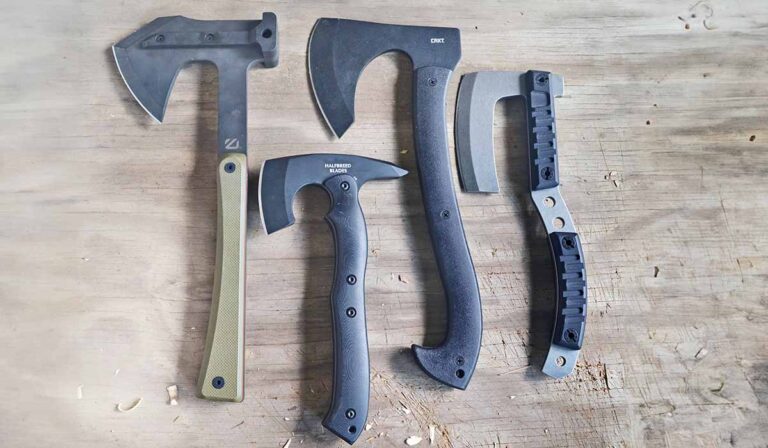
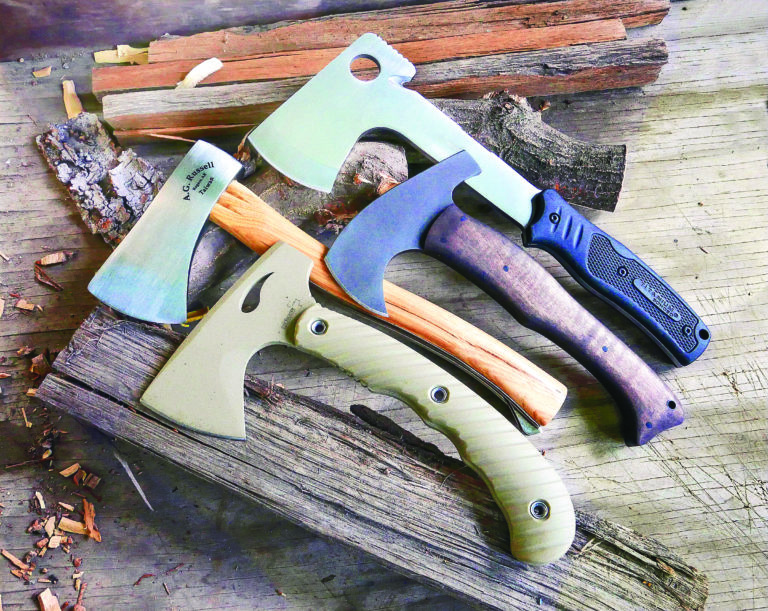
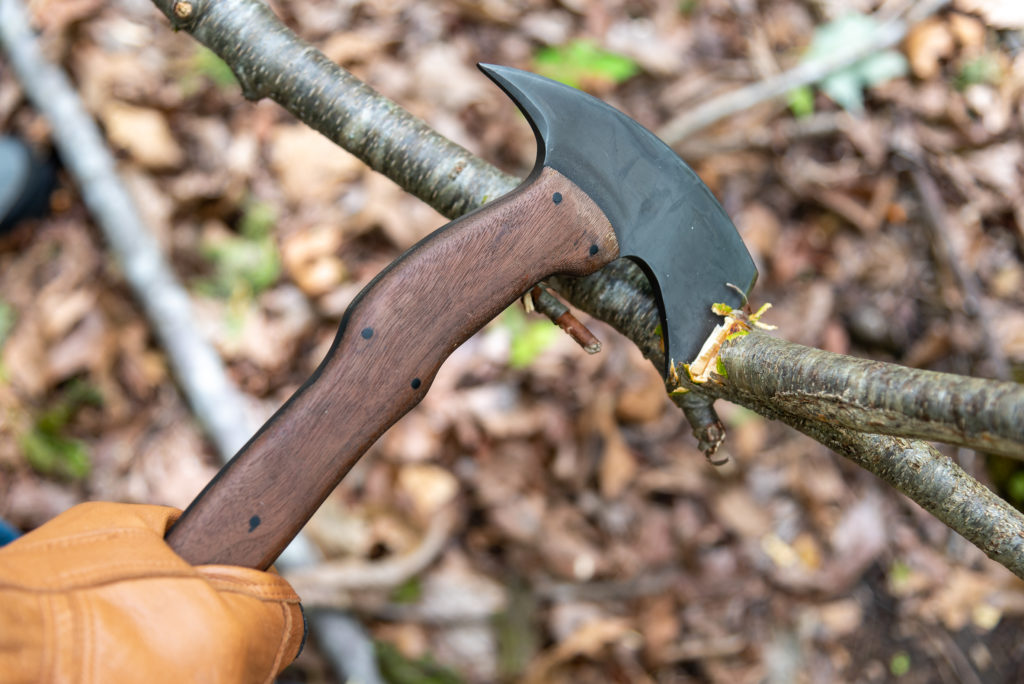
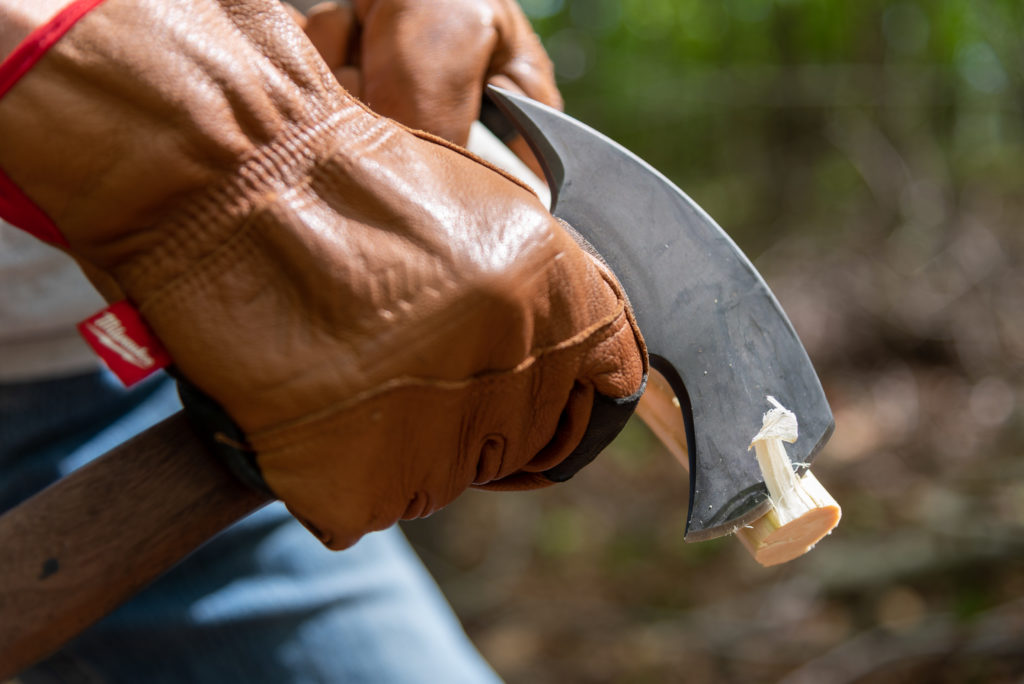
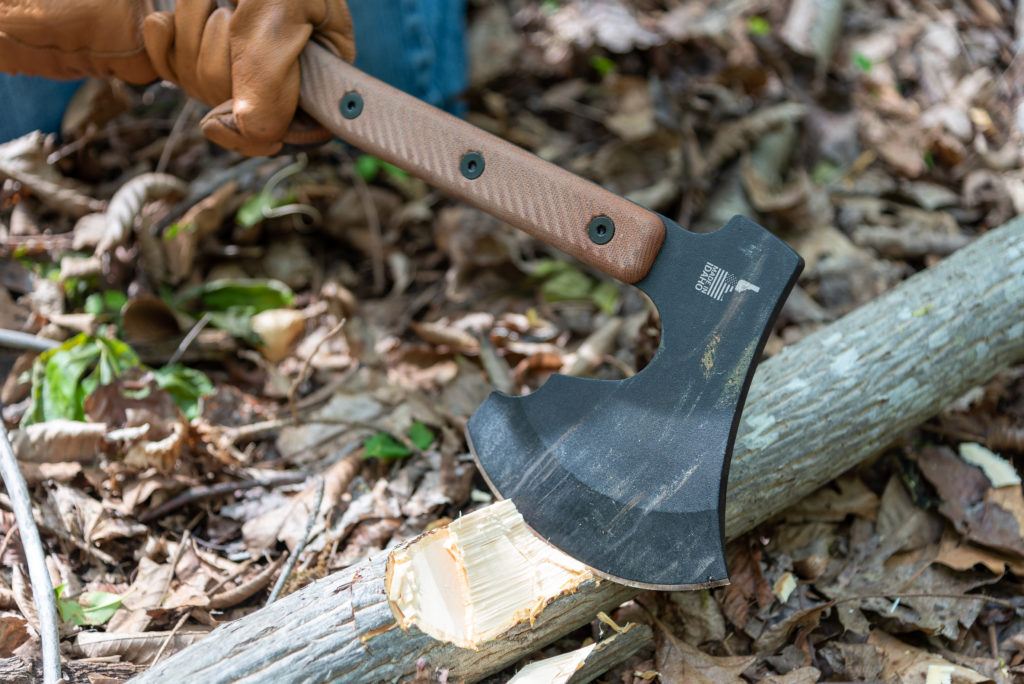
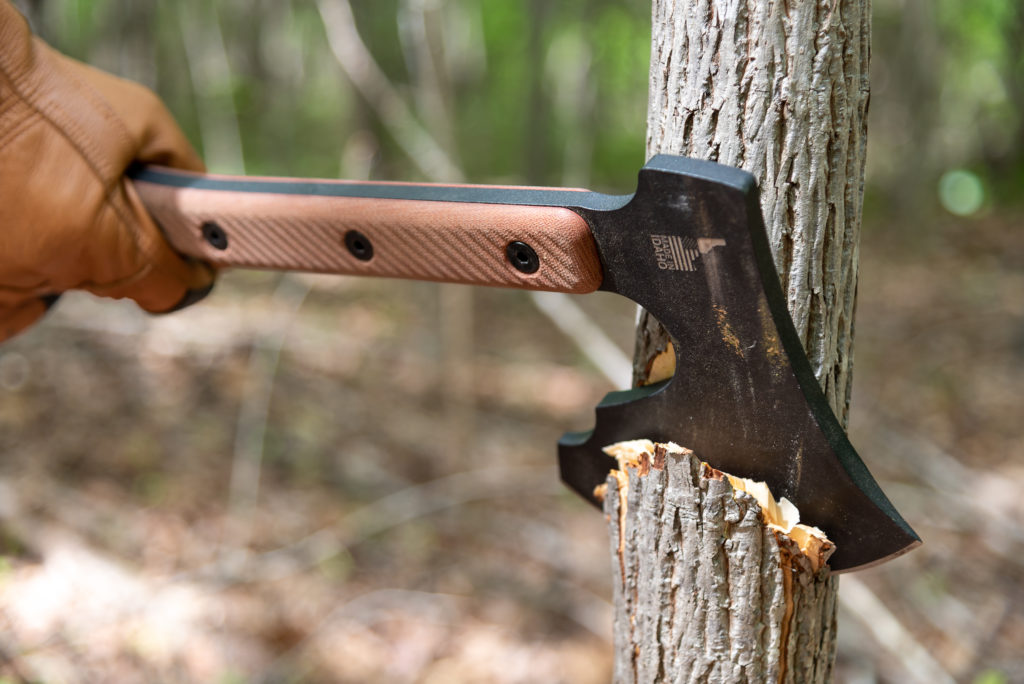
All axe heads have an edge, of course, but did you know some can give you an edge over others? The bearded axe chops just like any axe, but its beard can serve field duty beyond the norm.
The bearded axe was first used by the Scandinavian Norse people (Norsemen) in the Middle Ages and was called a skeggox—skegg for beard and ox for axe. Its distinctive shape allows you to grasp the handle at the base of the head and use the edge for woodworking chores.
It’s sometimes called a carving axe for its propensity for de-barking, shaving and notching wood, and other chores like slicing cord and rope—even serving as an ulu to prepare food. Not all bearded axes are made specifically for carving wood, however, as you’re about to find out.
CRKT James Williams Skeggox
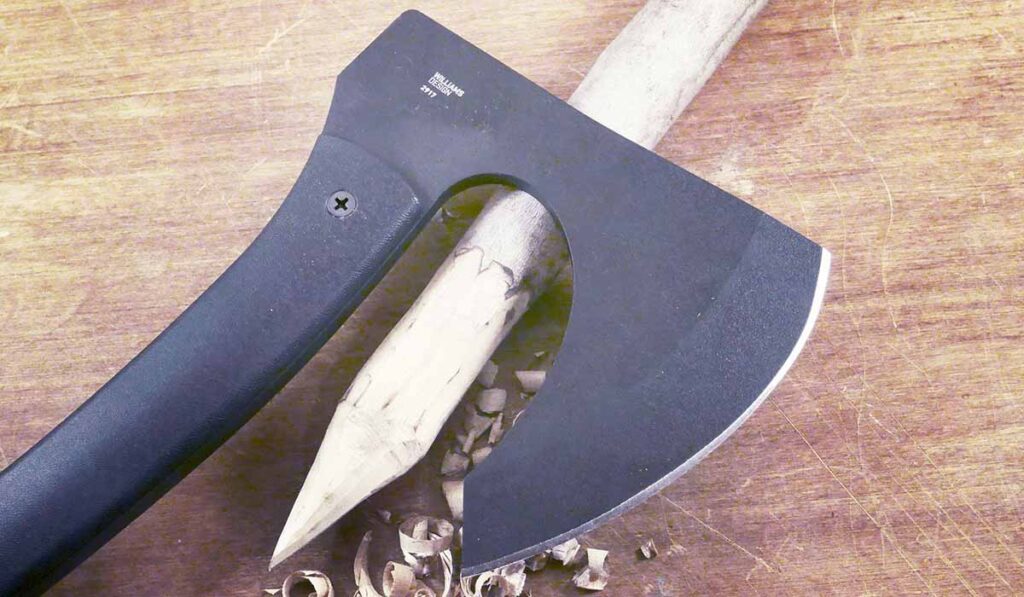
The CRKT Skeggox shaved bark and rendered nice shavings while debarking and pointing the tip of a hardwood stake. The SK5 carbon steel bit into the hardwood quite well and the handle scales offered a comfortable grip.
Columbia River Knife & Tool and martial artist/Japanese sword guru James Williams dipped back in time and chose the original Norse namesake for his design. The CRKT Skeggox is one of the larger two test axes.
The drop in the beard from the top of the inner curve to the bottom edge is 3.25 inches. The 11-inch handle has a lanyard loop at the base. The sheath features a black nylon keeper strap with a thermoplastic buckle to prevent slippage from the sheath. CRKT includes additional hardware for belt or MOLLE carry.
The SK5 carbon steel of the axe head has been compared to U.S.-produced 1084 and 1095 carbon steels, which typically fare well-working wood in the wild. I tested it for carving and immediately liked the deep drop and the “50 miles of elbow room” between the handle and the rear of the beard. I de-barked and pointed a fat hardwood tent peg, and the more I used the bearded blade the better my control got for taking off long shavings. This was in part due to the low profile of the quarter-inch steel and the nice bite of the high carbon alloy.
The Skeggox is also a good all-around chopper for firewood and clearing small trees. The sheath is economical and the option of belt or MOLLE carry is welcome. Better yet, it is the most affordable of the review axes and money well spent.
James Williams Skeggox Specs Head Width: 4.874” Blade Edge: 5” Blade Material: SK-5 carbon steel (Japan) Blade Thickness: .25” Blade Finish: Black powder coat Handle Material: Black FRN polymer Weight: 26 ozs. Overall Length: 13” Sheath: Black thermoplastic Country of Origin: Taiwan MSRP: $113
Doublestar/Outlier Kodiak Camp Axe
The author removed the splitter attachment from the Outlier Kodiak Camp Axe to clear the way for using the blade for debarking and shaving wood. He used the longer, lower portion of the double-edged blade and was impressed with the performance of the 52100 carbon steel.
The Outlier (formerly Doublestar) Kodiak Camp Axe is the second of the larger test axes and comes with a twist. The axe head has a removable steel splitter attachment installed, specifically made for cleaving wood. It is also notable in that the blade edge has two grinds.
The beard drop is 2.5 inches. The handle scales are sumptuous at a half-inch thick each. The sheath covers the axe head and splitter until it reaches the widened rear of the splitter used for hammering. The front has a nylon belly strap with a thermoplastic buckle to secure the axe head.
The splitter increases weight, blocks access to the beard for slicing and shaving, and is too unwieldy for my tastes for finesse work. I removed it, reducing axe weight by 8 ounces and making the Kodiak much easier to manipulate. I thought the two angles of edge might make a difference in cutting surface—and I’m sure they would—but the longer, lower edge turned out to be all I needed for de-barking and shaving long slivers. The 52100 carbon steel cut like a house afire, slicing wood and ¾-inch rappelling rope with ease.
It was a different axe altogether without the splitter and more in line with the other text axes. The only recommendation I’d have is that Outlier offer the same axe with a full, single-edged head to increase the coverage of the edge. Other than that, it’s a beast.
Kodiak Camp Axe Specs Head Width: 5.25” Blade Edge: Varied Blade Material: 52100 carbon steel Blade Thickness: .25” Blade Finish: Parkerized black Handle Material: Green G-10 composite w/orange liners Special Features: Splitter attachment Weight: 40 ozs. (including splitter) Overall Length: 13.125” Sheath: Black thermoplastic Country of Origin: U.S.A. MSRP: $319
Halfbreed Compact Rescue Axe
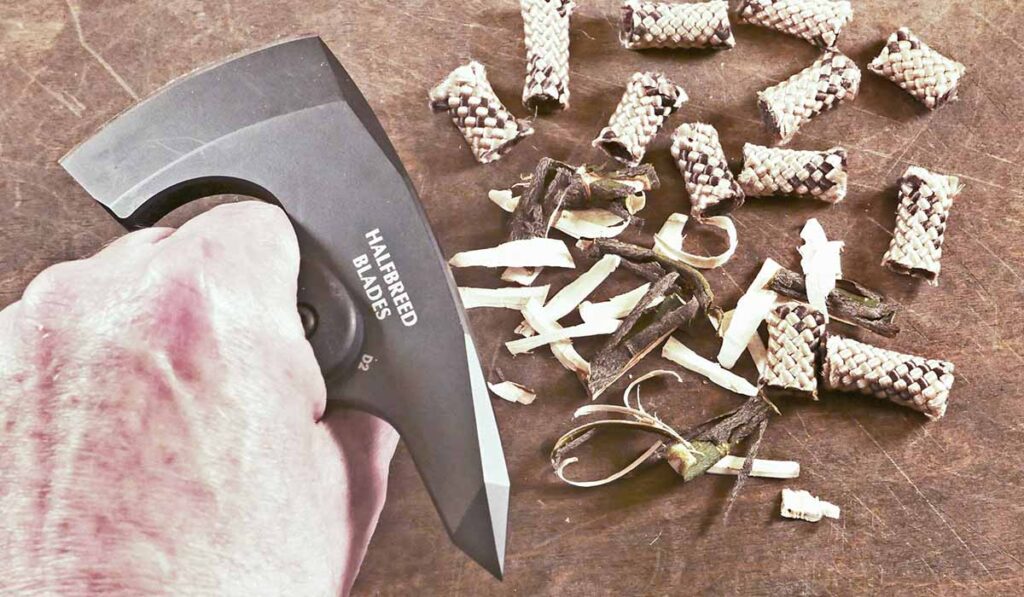
The Halfbreed Compact Rescue Axe shaved wood and sliced rappelling rope with flying colors. The axe head steel is the thickest of the test group.
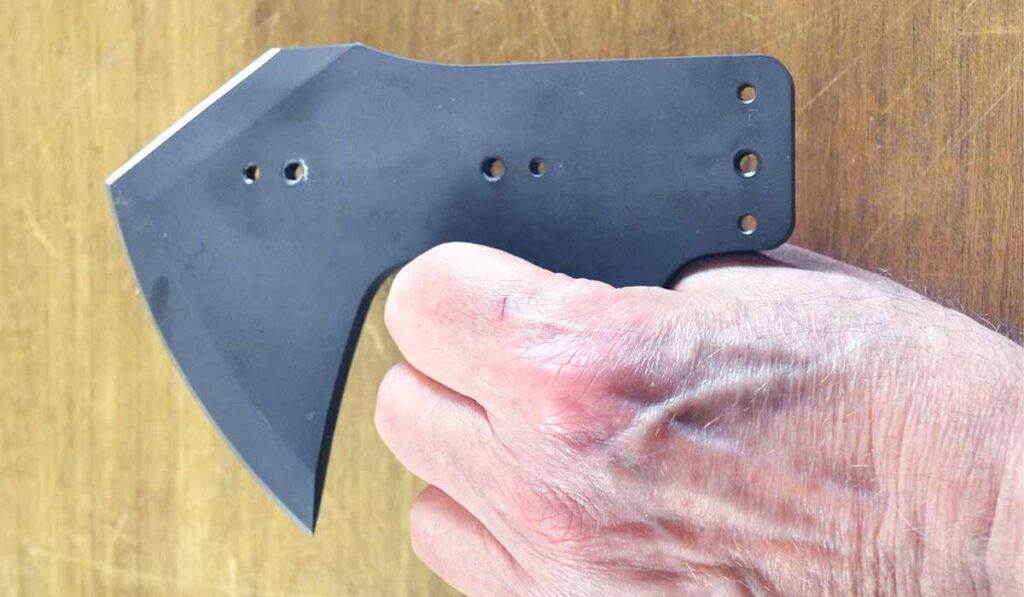
The Halfbreed Compact Rescue Axe is the smallest of our bearded array yet is also the most overbuilt. It makes up for its smaller size with the thick axe head steel. There’s a nice palm swell at the lower grip area and a big finger groove at the top of the handle.
It has a beard drop of 1.5 inches. Out back is a 2-inch spike. The rear spine has gimping to enhance grip. The sheath offers full coverage and a keeper loop rolls under the bit to further secure the axe head. It has a mounted MOLLE-compatible plate, or you can swap it out with an optional DOTS Tek-Lok style attachment for belt carry.
While testing the Halfbreed I had to remind myself it is indeed a compact rescue axe. While all the other review subjects are geared for outdoor use, this small overbuilt wonder is more for city work. That said, the large finger groove at the top of the handle is custom-made for carving and slicing just as bearded axes were intended. I tested the little axe and it shaved bark, took off shavings, and sliced rappelling rope just fine, but its thick steel and superior weight-for-size ratio really shine when hacking and bashing. I have no doubt it would earn its stars as a close-quarters hawk.
I gave the spike a run on a pane of 3/16-inch door glass and it obliged, shattering it with gusto. The ample grip, with its added gimping, makes for excellent purchase, and the sheath—overbuilt like the axe—is the most comprehensive of the lot. In a nutshell, the Halfbreed is a handy axe—and a bulldog at that!
Compact Rescue Axe Specs Head Width: 4.5” Blade Edge: 2.55” Blade Material: Bohler K110 (D2) tool steel Blade Thickness: .31” Blade Finish: Black Teflon coating Handle Material: Black G-10 composite Special Features: Faceted spike, gimping Weight: 25.07 ozs. Overall Length: 9.52” Sheath: Black Kydex, MOLLE compatible Country of Origin: Australia MSRP: $310
Maserin Knives Mantis
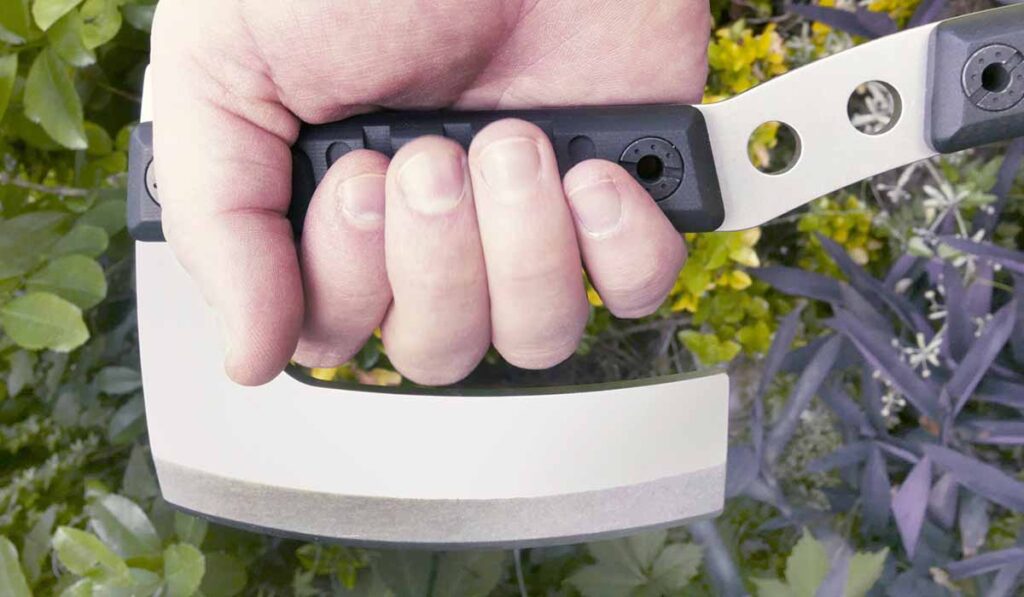
The unusual axe head of the Maserin Mantis offers full knuckle protection and then some. Note that the Mantis has a pair of upper scales just for the purpose of using the axe for shaving and slicing.
Maserin Knives may be giving us a glimpse into the future with its new, strikingly stylish Mantis. It is a small axe and you’ll notice the steep tool steel blade is quite lengthy for its size. In fact, the blade exceeds the width of the axe head—a bit unusual in a working axe.
“But wait, there’s more!” as the TV guy says. The Mantis has four (two sets) of scales: one at the top for carving comfort and the other on the lower portion of the handle for grip. At the base of the straight top scale the direction of the handle switches to an outward curve, and the exposed part on the handle has three lightening holes—plus there’s a lanyard hole and a spike on the base. The sheath fits the axe head only and butts against the top scale, and there’s a belt loop stitched to the back. It’s minimalism at its finest.
The Mantis has the longest beard drop of all the test axes at 3.75 inches and is the only one that offers full hand protection. The blade curve stands apart in that it is virtually symmetrical from end to end. It’s shape and full knuckle protection begged me to try it as an ulu for slicing, so I laid down some 3/8-inch rappelling rope and went at it. The Mantis sliced just like an ulu, taking off clean sections of rope. It performed even better when I reversed the grip with the handle facing away from me so it didn’t hit me in the belly. Voila! Instant ulu.
The Mantis shaved bark and carved off curls quite well and the full finger protection was welcome. It’s the lightest of the axes reviewed, which could put it at a disadvantage to the others when weight is a factor. You won’t be batonning this axe either because the top scales would block it from going past the front portion of the head. That said, there’s plenty to like about the Mantis’s utility value and its forward-thinking styling!
Mantis Specs Head Width: 3.75” Blade Edge: 4.527” Blade Material: D2 tool steel Blade Finish: Stonewashed Blade Thickness: .326” Handle Material: Black G-10 composite Special Feature: Futuristic design Weight: 20.23 ozs. Overall Length: 11.02” Sheath: Black Kydex Country of Origin: Italy MSRP: $216
The technological advancements that have redefined the pocketknife as we know it.
When I stumbled onto the knife scene in 1985, the only pocketknives I had carried up to that point were slipjoints and lockbacks. Of course, slipjoints weren’t called slipjoints back then but simply pocketknives. Today, as far as BLADE® is concerned—not that it’s any major newsflash or anything—any knife you can carry in your pocket is a pocketknife.
All of which brings me to the subject at hand: my picks of the five most important pocketknife developments of the modern sporting knife era. In rough chronological order they are:
•The pocket clip:BLADE Magazine Cutlery Hall-of-Fame® member Sal Glesser’s introduction in 1981 of the Spyderco pocketknives with the hole in the blade and the pocket clip would turn the genre on its head. While the hole in the blade was a masterstroke in and of itself, it was the pocket clip that forever changed the way people would carry their pocketknives. Rather than rattling around in the bottom of a pocket with change, car keys and what have you, the closed knife was held on the pocket lip by the clip, free from pocket-bottom scratches and poised at the ready to be deployed to cut whatever needed cutting.
•The linerlock: Cutlery Hall-of-Famer Michael Walker invented the linerlock in 1981, but it would take a few more years before custom knifemakers—and shortly thereafter, factory makers—began readily adopting the lock that made one-hand manual opening and closing of the pocketknife an easy reality rather than an exercise in hand contortions. Today, the argument can be made that the linerlock is used on more sporting folders than any other lock.
•The flipper: While exactly who made the first folder with the flipper tab that manually deploys a folding blade with the tap of a finger may be up for debate, there is no debating that the person who popularized it was Cutlery Hall-of-Fame knifemaker Kit Carson. A simple addition to the pocketknife on its face, the flipper tab opens a blade as fast and easy as any other manual method—probably faster.
•The Ikoma Korth Bearing System (IKBS): Pivot systems that helped open folding blades quickly and smoothly had been around before, but it was the IKBS conceived in 2002 that took blade opening to a new level of quick and smooth. In conjunction with the flipper especially, the IKBS transformed one-hand pocketknife opening from fast to just this side of automatic. Developed by Brazilian custom knifemakers Flavio Ikoma and Ricardo “Rick” and Paulo Lala (the latter two collectively known as Korth), the IKBS is another masterstroke of design and invention.
•Material upgrades: These cover a number of materials and years, from Walker’s switch to titanium for his linerlock spring in 1983, to a wide array of other hi-tech substances in subsequent years for pocketknife handles, including titanium, thermoplastics, Micarta®, G-10, carbon fiber and other state-of-the-art materials that not only were super strong and tough but also were lightweight, reducing the weight of pocketknives to the point that they were basically unnoticeable in a pocket. Meanwhile, the advances in blade steels over that same stretch are too many to mention.
How about you? What are the most important pocketknife developments? Tell us in the comments.
Cool collaborations offer the best of both blade worlds.
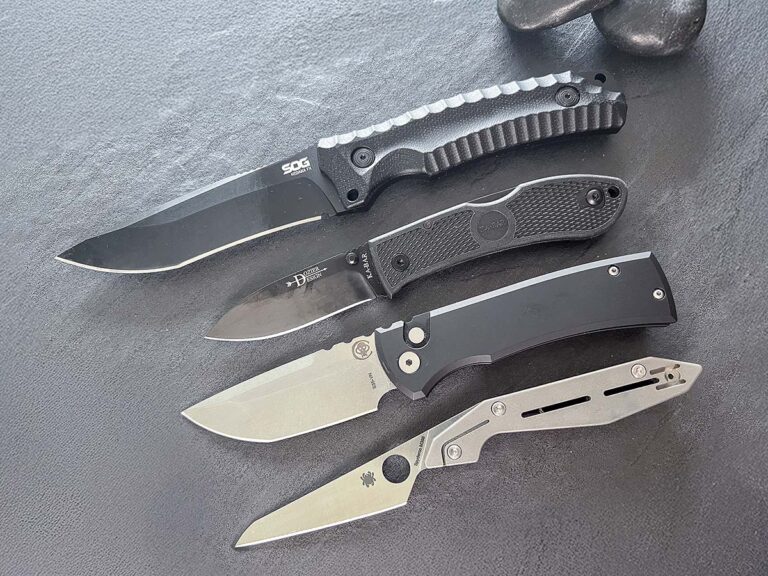
Custom/factory collaboration knives have long been popular sellers. A custom knifemaker designs the knife and the company either makes or has it made, providing cutlery consumers with a knife at a lower price point and readier availability than almost always is the case when ordering a custom version directly from a custom maker.
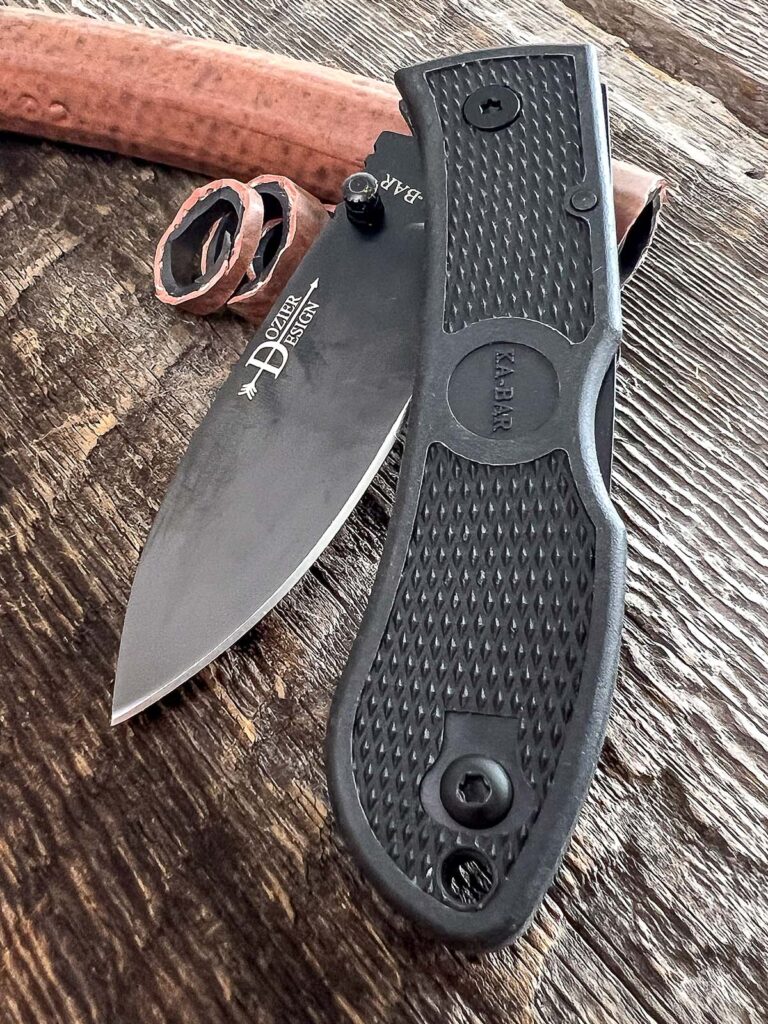
KA-BAR Dozier Folding Hunter
Thicker materials like cardboard and hose are no match for the blade of the SOG Hidaka FX 3V, a Kiku Matsuda design. A slight hint of a recurve to the main cutting edge no doubt helps cutting power. Overall length: 10 inches.
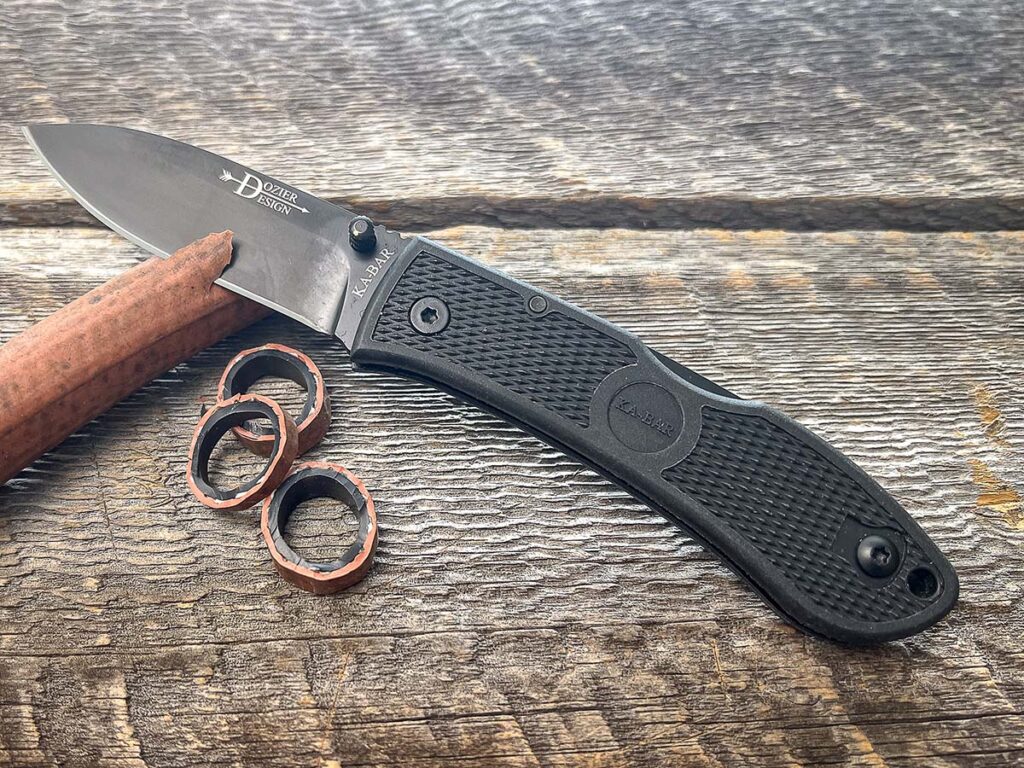
A long-time example of the genre is the collaborations between KA-BAR Knives and veteran knifemaker Bob Dozier. The original Dozier Folding Hunter series consists of mid-sized lockbacks with manufacturers’ suggested retail prices south of $50, offering plenty of bang for the buck. The knives provide ease of portability combined with the high utility of a drop-point blade.
The series proved such an excellent seller for KA-BAR that the company decided to also market it in a higher-grade steel to enhance performance and edge holding: CPM S35VN stainless. The standard KA-BAR Dozier Folding Hunter has D2, a very respectable, hard-wearing blade steel that’s tried and true in the industry. MSRP: $47.58. The S35VN iteration has an MSRP of $97.01 and like the D2 version is made in Taiwan.
While somewhat of a significant price increase, remember, you’re getting a high-end blade steel in return. S35VN behaves a lot like its predecessor, S30V, with a bit more edge-holding power. It’s also easier to resharpen than S30V. S35VN will go the distance, drastically increasing your intervals of sharpening over standard D2. This is especially important if you field dress game on a regular basis. Even though S35VN is stainless, the knife comes with a DLC-coated blade for low glare as well as added corrosion resistance.
Even though S35VN is stainless, the Dozier comes with a DLC-coated blade for low glare as well as added corrosion resistance. Raised diamond texturing molded into the handle does a great job at keeping your hand in place even when wet. Country of origin: Taiwan. Closed length: 4.25 inches.
Out of the box the edge on the sample was good, but not quite there for my tastes. So, with a bit of work I got the blade hair-popping sharp. The 3-inch blade is a sweet spot length for EDC—big enough to tackle most cutting chores and small enough to carry comfortably without added bulk or length.
The handle’s slender nature also enhances EDC ability. It’s flat and doesn’t “print” in the pocket. Raised diamond texturing molded into the black, lightweight Zytel scales does a great job keeping your hand in place even when wet. It might not be the best-looking grip but it’s definitely geared for function, and that’s very important in a working folder. The pocket clip carries the knife blade tip up and is reversible to accommodate lefties.
The single thumb stud deploys the blade easily and the action is smooth. The knife is very controllable at all times, a testament to both its overall size and handle design/ergonomics. The lockback mechanism is swift and secure. I had no problems with it at all. For a nice, sturdy, compact lockback folder, the Dozier in S35VN is hard to beat.
Spyderco/Paul Alexander SLIPIT
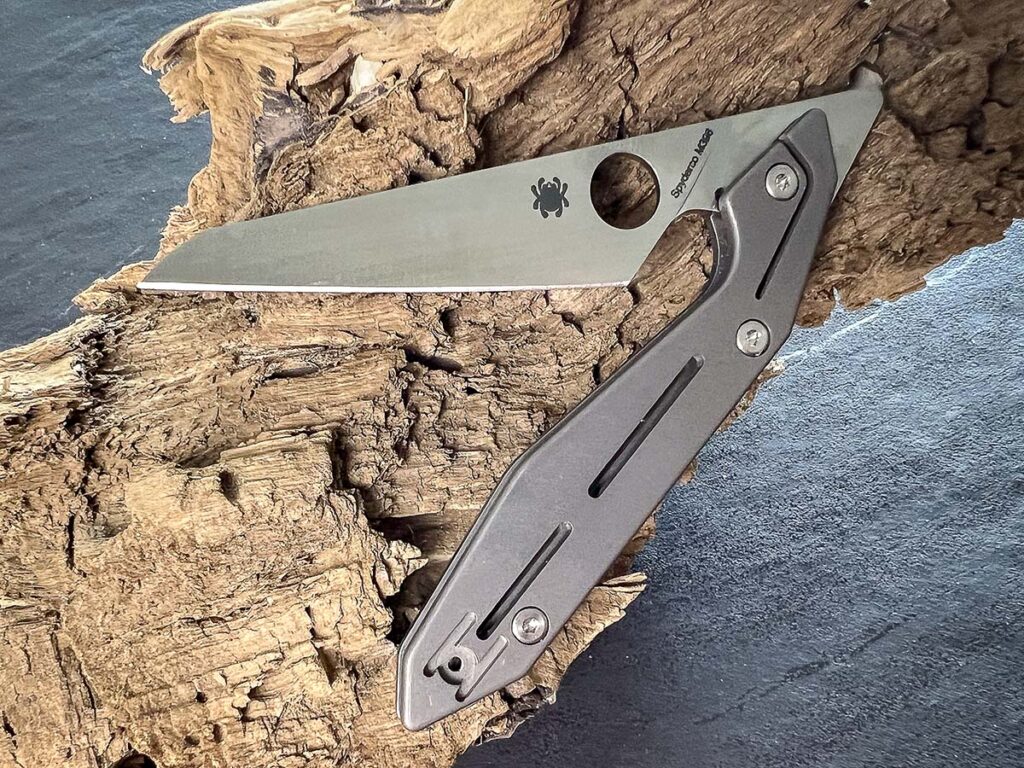
Designed by Paul Alexander, the Spyderco Nand and its angular handle theme carries over into the ergonomics, with finger recesses and a choil as well. Despite its angular appearance, the handle is quite comfortable. Closed length: 4.66 inches.
When it comes to collaborations, Spyderco has always been in the forefront of the genre. It also has some interesting folders in its SLIPIT family of non-locking folders. The Nand is an unusual, exciting example of both. Designed by Paul Alexander, an accomplished automotive mechanical engineer and a seasoned knife enthusiast, the Nand combines an angular approach to folding knife design with high-tech materials, all with the precise execution that Italian manufacturing offers. The result is sort of the Cybertruck of folders.
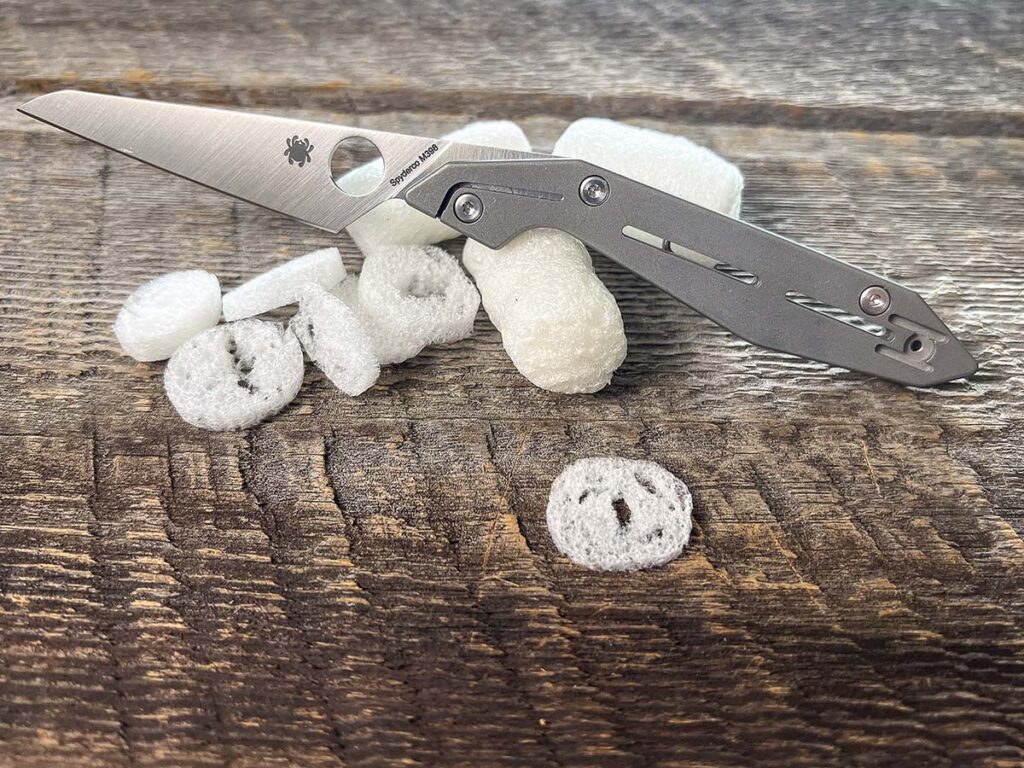
The 3.19-inch reverse tanto blade is fully flat ground from a new super stainless steel from Bohler called M398. Basically, Bohler took its M390 and increased the carbon and vanadium content for even more edge holding.
There are two methods of deploying the blade. The trademark Spyderco round hole is present as well as the extended blade spine that allows the Nand to be thumbed open similarly to a straight razor. The correct terminology for it is a front flipper.
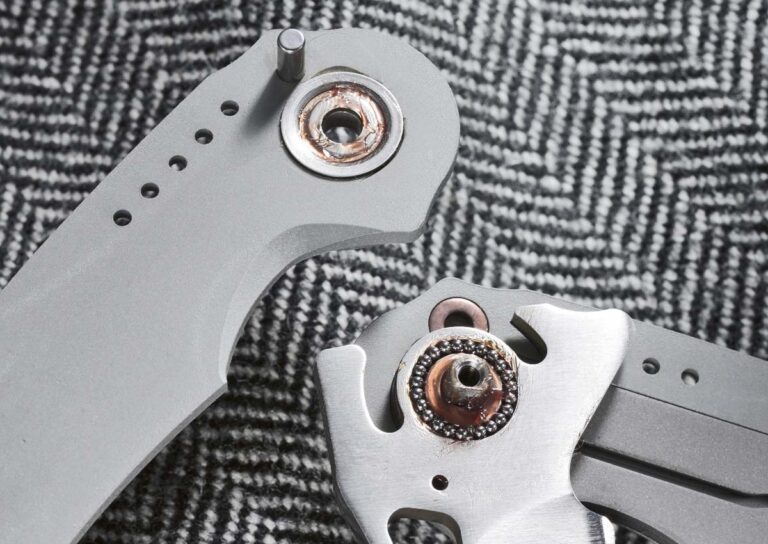
Machined of titanium, the handle translates into an extremely lightweight knife and is where things get a bit interesting. The integral double-ball-bearing detent system not only holds the blade closed but also provides a positive detent when the blade is open. The “spring arms” for the detents are cut out of each handle half and, to create pressure, are bent in a similar manner to a framelock. Ceramic balls implanted on the ends of the spring arms create the open and close detents.
The wharncliffe blade has a full flat grind, which makes the Nand an excellent slicer. Out of the box, the knife cut plastic foam peanuts easily.
The handle’s angular features might make the knife look a bit awkward but don’t dismiss it until you put the Nand in your hand (see what I did there?). With the knife open, a kind of choil forms so you can choke up on the blade for an extra measure of control. Barring that, you can hold the knife a bit further back with your index finger resting inside the handle’s finger recess. Either grip brings your hand over the blade spine of the opened knife and helps secures the blade open as an added measure to prevent accidental closure. The minimalist wire clip is reversible to accommodate ambidextrous carry.
While the Nand may look a bit different, it’s easy to use and holds its own as an EDC folder. The reverse tanto blade has a highly effective tip that pierces easily. The straight-line cutting edge is simple to resharpen, has a lot of bite and slices through tough materials effortlessly. The knife feels very secure despite its slender nature. Choking up around the choil feels good and secure in-hand, rendering the Nand easily controllable.
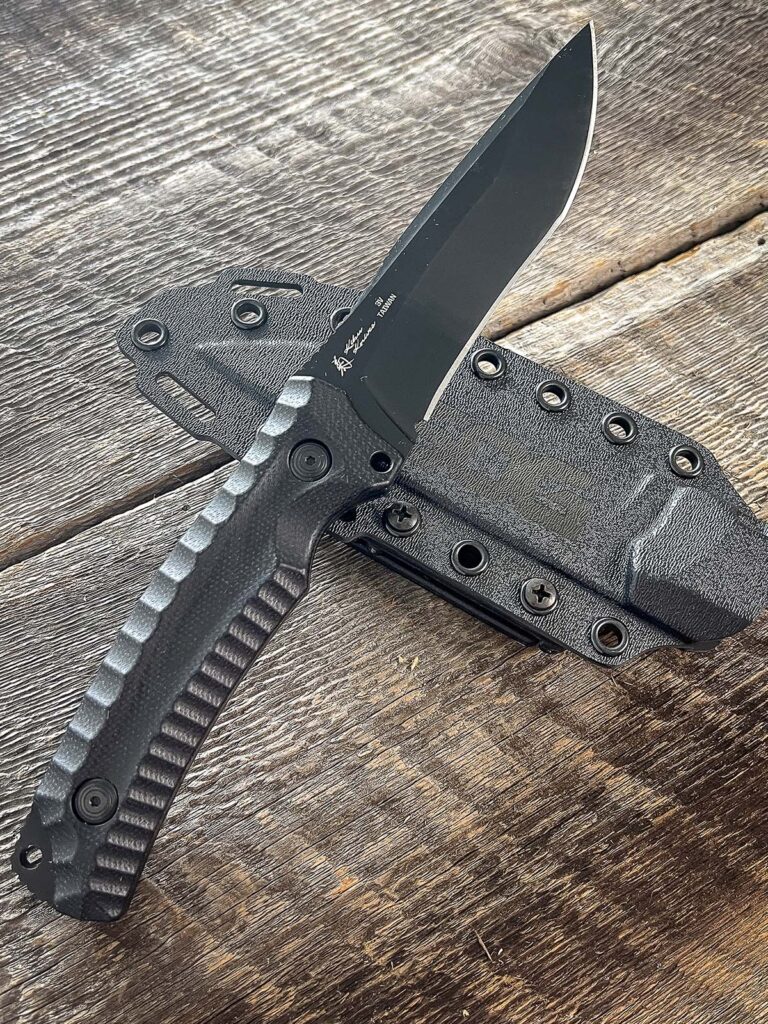
SOG KNIVES Kiku Matsuda Hidaka FX 3V
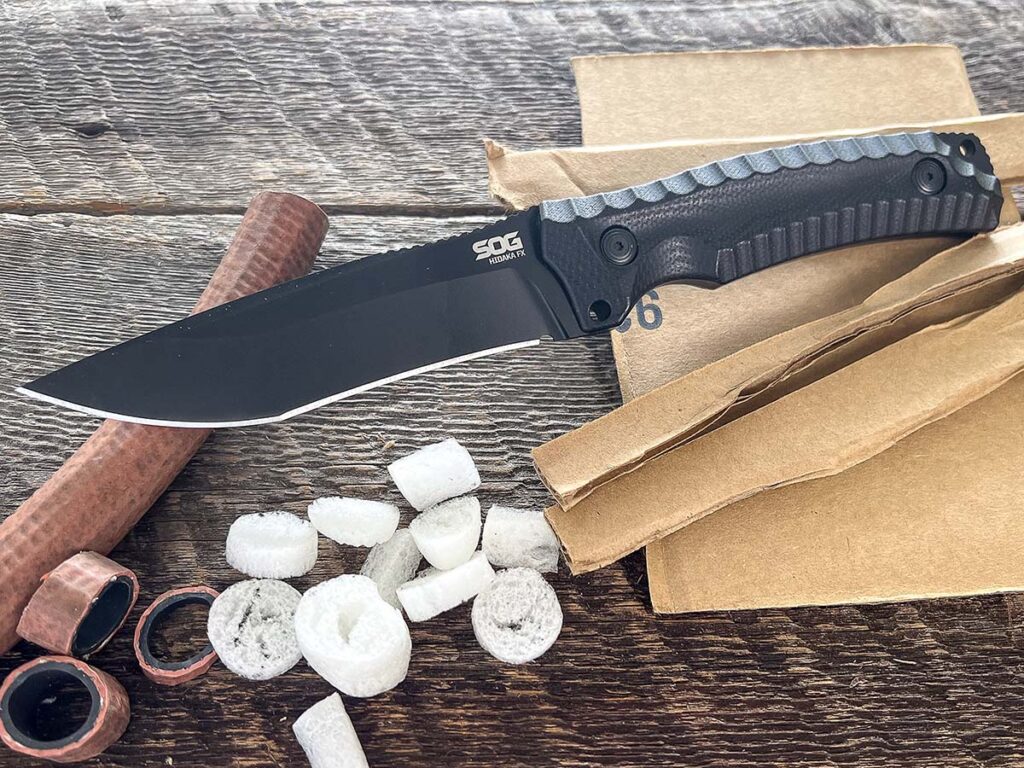
Thicker materials like cardboard and hose are no match for the blade of the SOG Hidaka FX 3V, a Kiku Matsuda design. A slight hint of a recurve to the main cutting edge no doubt helps cutting power. Overall length: 10 inches.
The Hidaka FX 3V is a continuation of the exciting collaboration between SOG Knives and legendary Japanese knifemaker Kiku Matsuda. Known for their distinctive, flowing design style, intricately sculpted handles and hollow-to-flat compound-ground blades, Matsuda’s designs stand out.
His new SOG entry is an exciting tactical/outdoor fixed blade with a 4.8-inch tanto blade ground from ultra-tough CPM 3V carbon steel paired with a multi-faceted sculpted handle of black Micarta®. The blade’s angled tanto tip has a flat grind and the primary cutting edge is hollow ground. When you look at the blade in the light, you can see the grinds transition. Very cool—not too many factory knives have this feature and no doubt it’s much trickier to pull off than a standard tanto blade.
The flat-ground tip has a thicker cross section for greater penetration strength and general tip durability during hard use. The hollow-ground main bevel allows the blade to slice easily. Notches on the thumb-rest portion enhance control and a non-slip grip when bearing down on the blade. A black PVD coating helps with corrosion resistance and low-profile visibility.
The handle is as interesting as the blade. The distinct, intricately sculpted grip features are a Matsuda trademark. The sculpting is not purely for looks but where form follows function. The middle of the handle is hollowed out on each side like one long groove. The handle edges sport a heavy chamfer and a series of scallops all the way around, the latter to enhance grip. A prominent groove helps seat the index finger and provide an anchor point. The total blacked-out look—handle screws included—gives a somewhat sinister tactical appearance. The exposed pommel also sports traction notches for a better thumb purchase.
The SOG’S handle edges sport a heavy chamfer and a series of scallops all the way around, the latter to enhance grip. A sturdy molded Kydex sheath holds the blade securely and an audible snap lets you know when the knife is fully seated.
Overall, the Hidaka FX 3V is just an interesting fixed blade. Not only does the compound-ground blade look cool but it is also very practical. Thicker materials like cardboard and hose are no match for it. A slight hint of a recurve to the main cutting edge no doubt helps cutting power.
The knife comes with a sturdy molded Kydex sheath. It holds the blade securely and an audible snap lets you know when the knife is seated. A hinged fastener affixes the sheath to your belt. The device is similar to the Blade-Tech Tek-Lok and operates similarly. The knife rides comfortably on a belt and the handle is easily accessible. Country of origin: Taiwan. MSRP: $309.95.
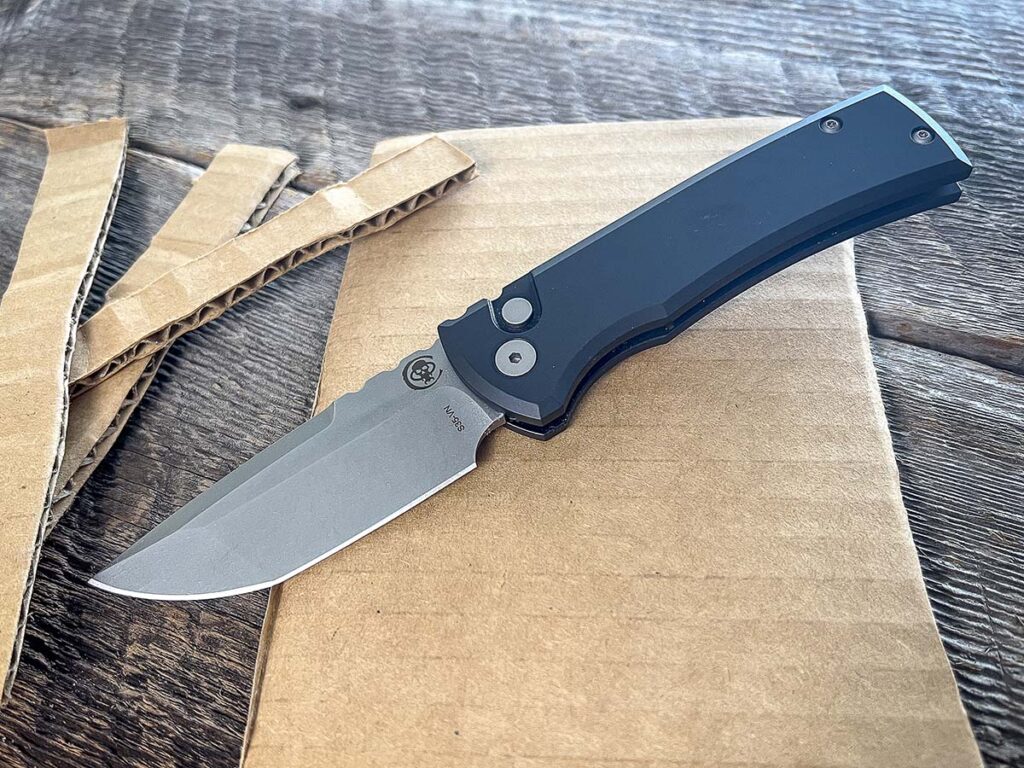
Pro-Tech Knives Ramon Chavez Redencion 229
The Redencion 229 is a workhorse folder. The aluminum handle and S35VN steel blade denote that it’s in it for the long haul. Cardboard is no match.
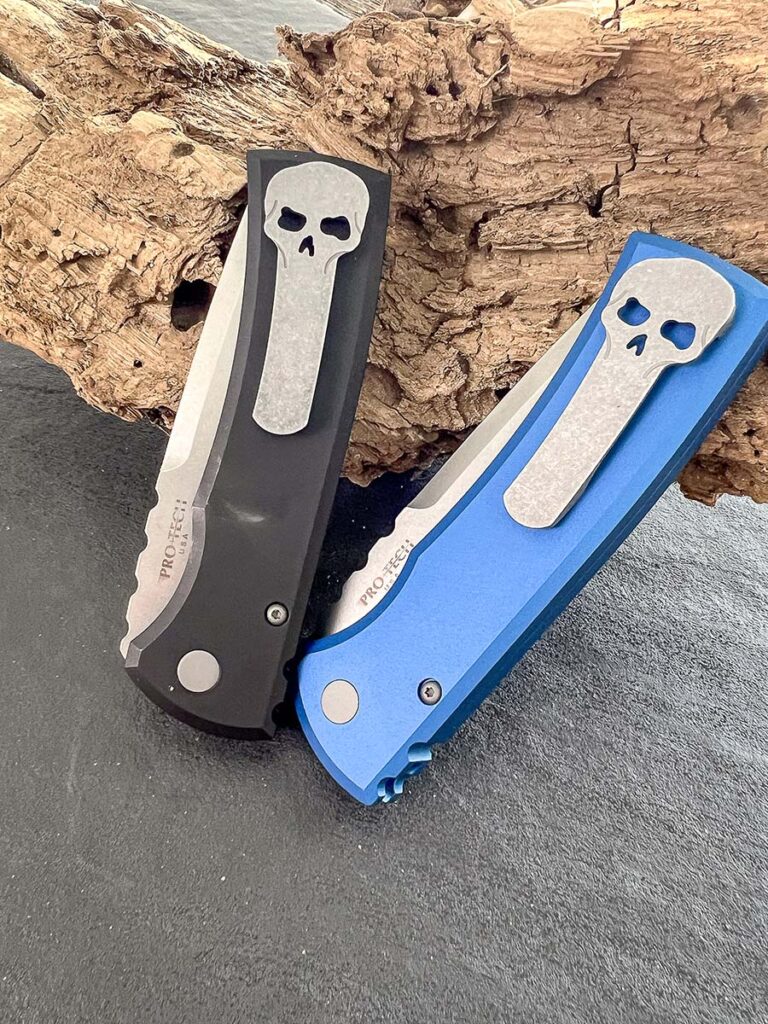
One of the most exciting factory automatics going is the Chaves Redencion 229 by Pro-Tech Knives. Designed by knifemaker Ramon Chavez, the auto combines his bold design style with Pro-Tech’s excellent manufacturing capabilities and automatic action. The 3.3-inch tanto blade is high-performance CPM S35VN. The handle is T6-6061 hard-anodized aluminum for light weight and strength. The Chavez signature skull pocket clip adds attitude to the hard-firing automatic. At 4.5 inches closed, the folder carries well and works hard.
With the press of a button, the blade flies with authority and hits hard when it locks. If you’ve played with Pro-Techs you know what I’m talking about. The blade is flat ground and comes with a very sharp cutting edge out of the box. It will easily handle most tough cutting chores. It goes through cardboard and hose easily.
Designed by Ramon Chavez, the Pro-Tech Redencion 229 and its skull pocket clip stand out. Given the clip’s width, it’s also highly functional and durable. You are not going to spring this clip from your pocket accidentally. Note that the clip screws are inserted from inside the handle for a cleaner look.
The blocky handle allows for a secure grip. I noticed no hotspots or any hand discomfort. The aluminum scales are solid and generally hold up to hard use. Some might be apprehensive about the pocket clip as I was at first. Its size and width makes it hard to feel in-hand. Another good thing is the width means it won’t accidentally disengage if caught on anything. It’s stout! It provides the right amount of tension when the knife is clipped to the pocket. Another neat thing is you see no clip mounting screws because the clip is screwed to the handle from the inside—a very cool extra touch.
The Redencion 229 is a great EDC automatic that has attitude and high utility all in one interesting folder. Made in the USA, the model with a stonewashed blade and black anodized handle has an MSRP of $300. Black blade iterations are also available, as well as a recently released drop-point version.
The great ancient knife designs aren’t history as they top-notch reproductions prove.
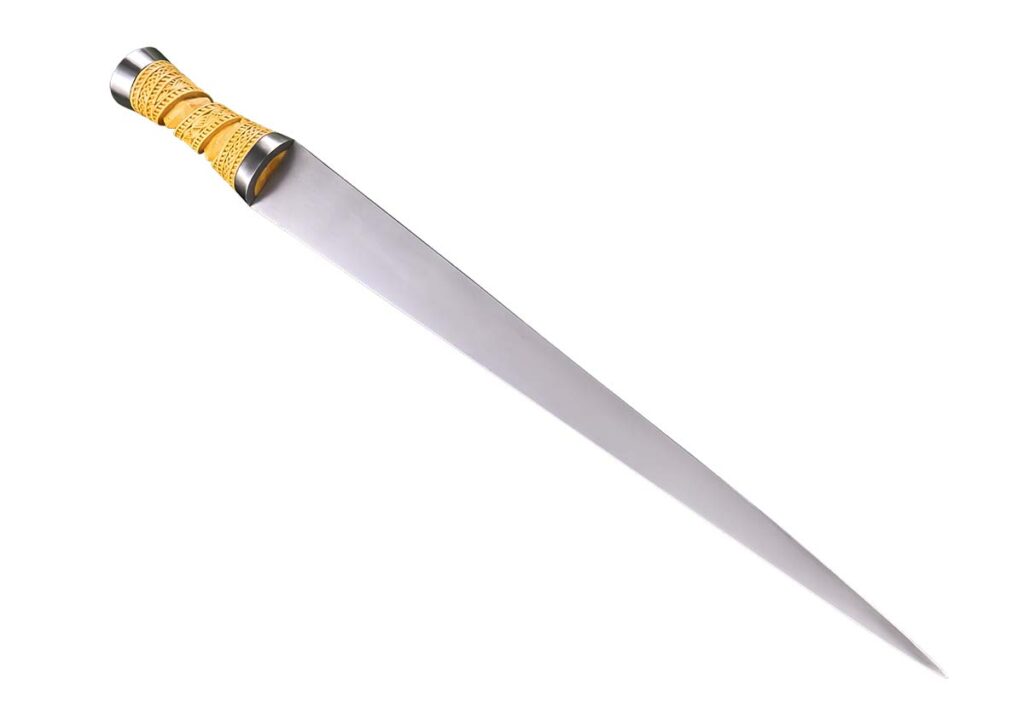
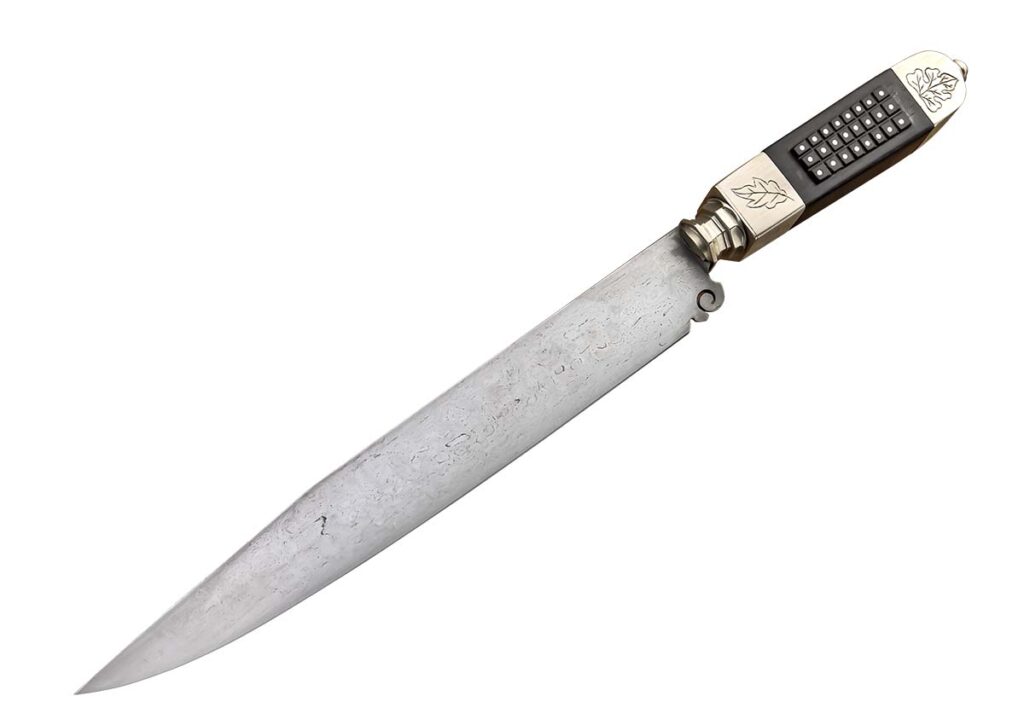
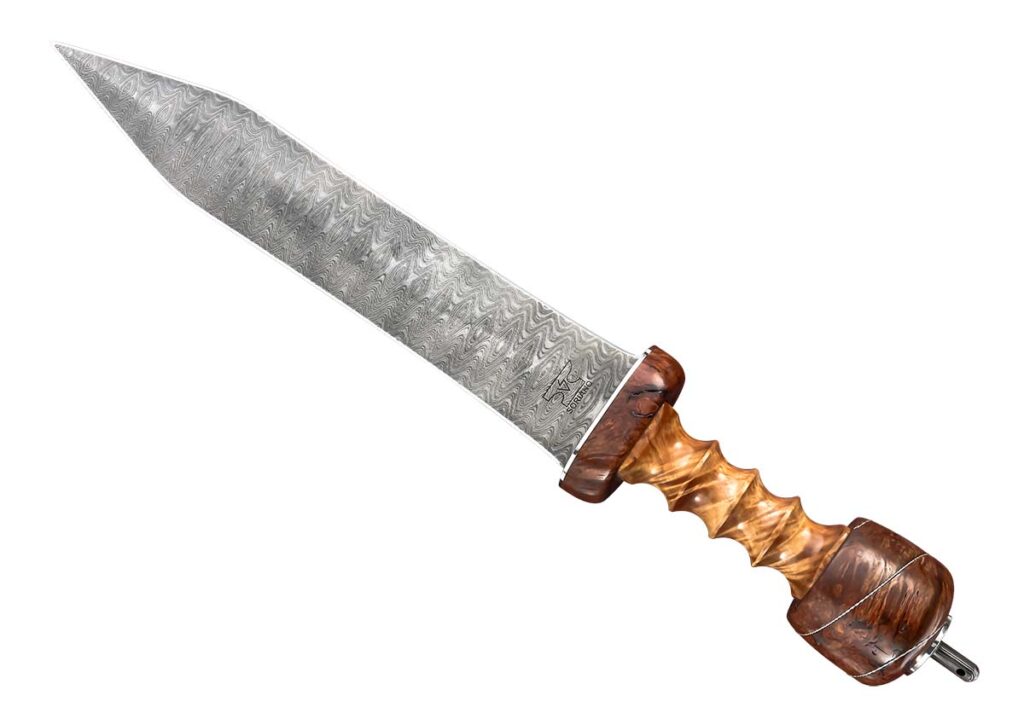
The ancient history of knife design is long, storied and colorful. From Bronze Age daggers to 19th-century dress bowies alone, vintage configurations capture the imagination like a gladiator’s net from the early days of the Roman Coliseum. Tour the classics with these remarkable reproductions.
Colton Arias Scylla
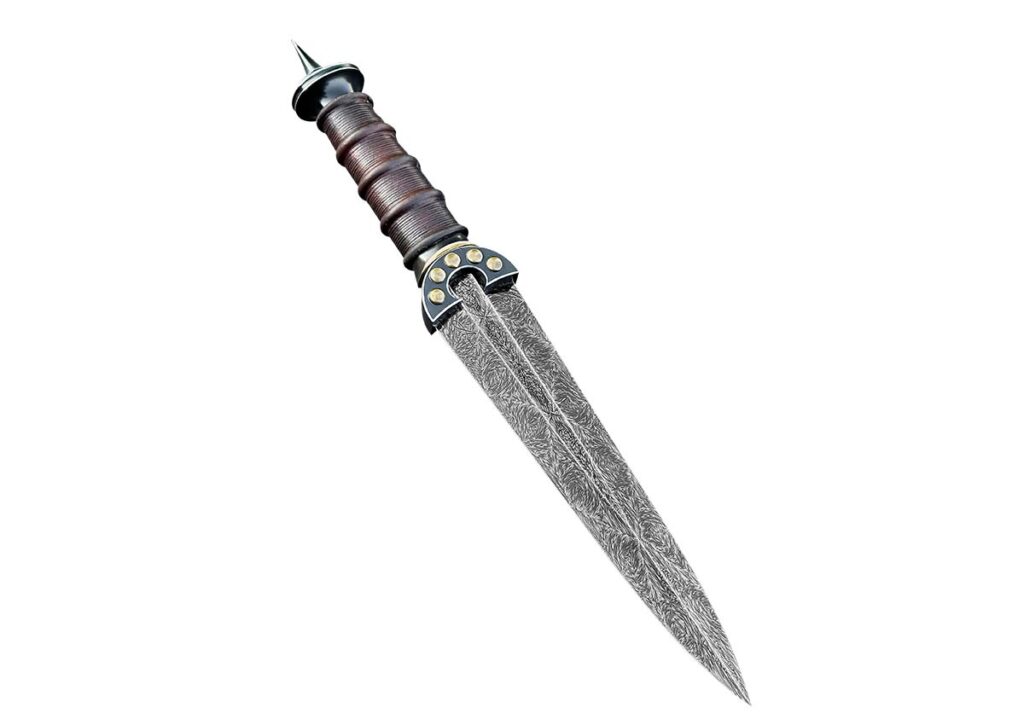
Named after an Etruscan-era mythological monster, Scylla is a repro of an Etruscan Bronze Age dagger by Colton Arias. The 7-inch blade with tapering fuller is a triple feather mosaic damascus of 1084 carbon and 15N20 nickel alloy steels. The spiked-pommel handle is a goat leather wrap and the bolster is mild steel with brass accents. Overall length: 12 inches. (Jocelyn Frasier image)
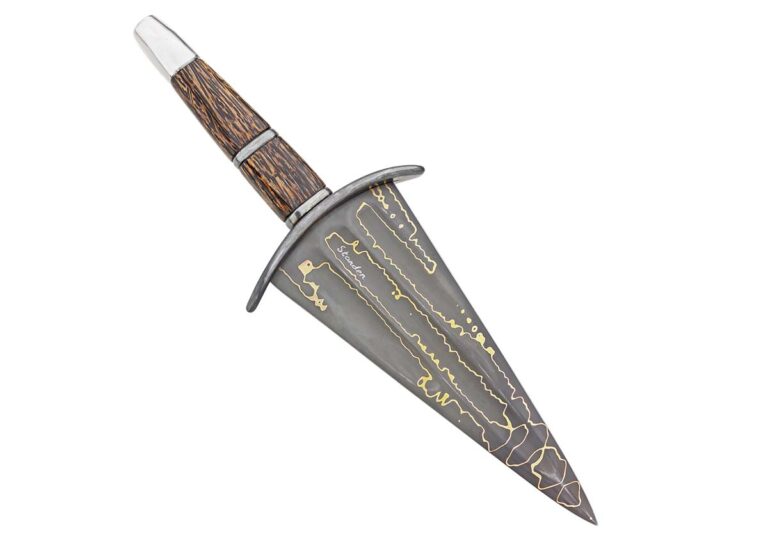
Dane Standen Cinquedea
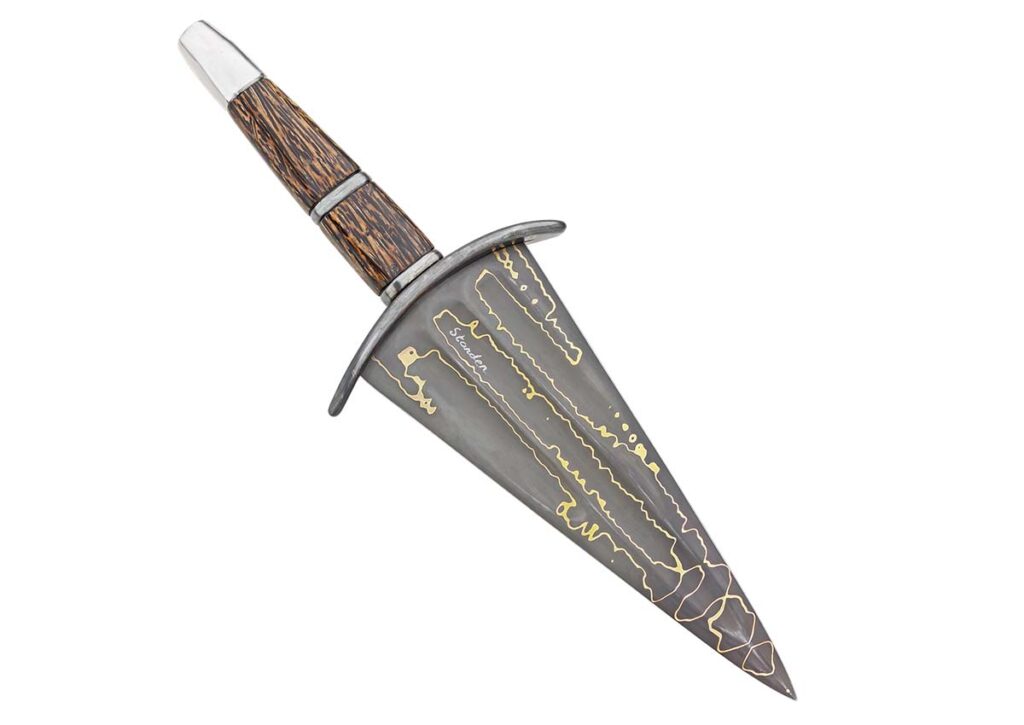
Dane Standen outfits his modified cinquedea with a three-fullered blade in multiple welds of 1084, cu-mai, 1084, cu-mai and 1084 carbon steels. Blade length: 8.27 inches. The handle of a takedown construction is stabilized black palm and the fittings are mild steel, copper and nickel damascus. Overall length of the centuries-old Italian design: 14 inches. (Rod Hoare image)
Nick Bachtel Dress Bowie
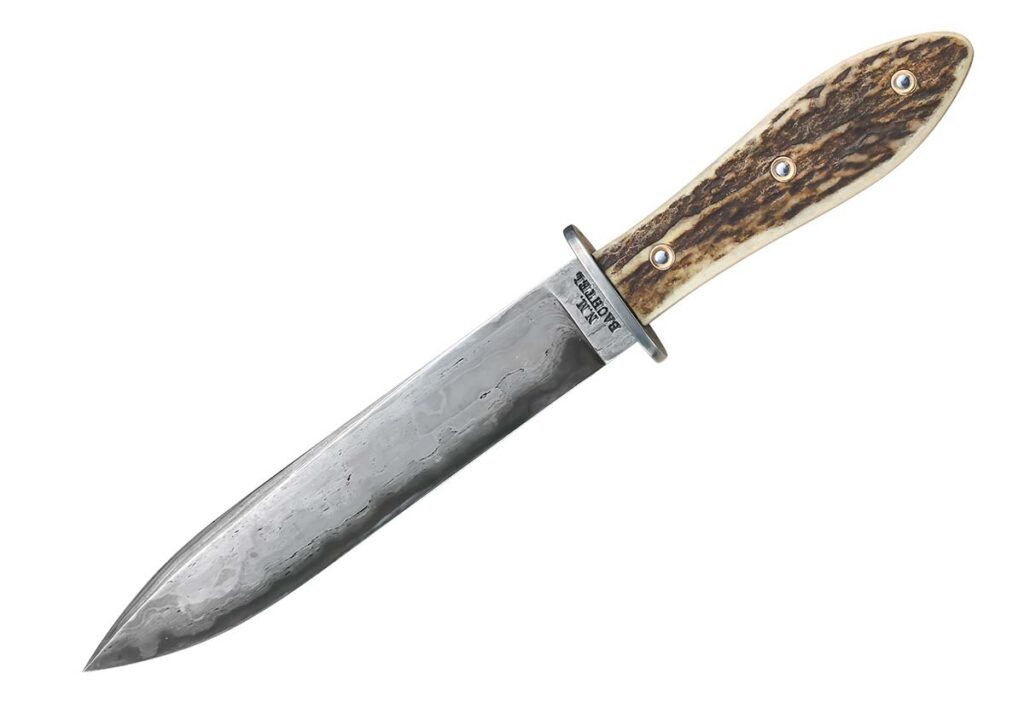
A 7-inch blade of wrought-iron in a san-mai construction and a handle of elk antler and curly ash highlight a repro of a 19th-century dress bowie by Nick Bachtel. Overall length: 12 inches. The guard is steel and bronze and the knife comes with a traditional bronze sheath (not shown). (SharpByCoop image)
Ken Hall Scottish Dirk
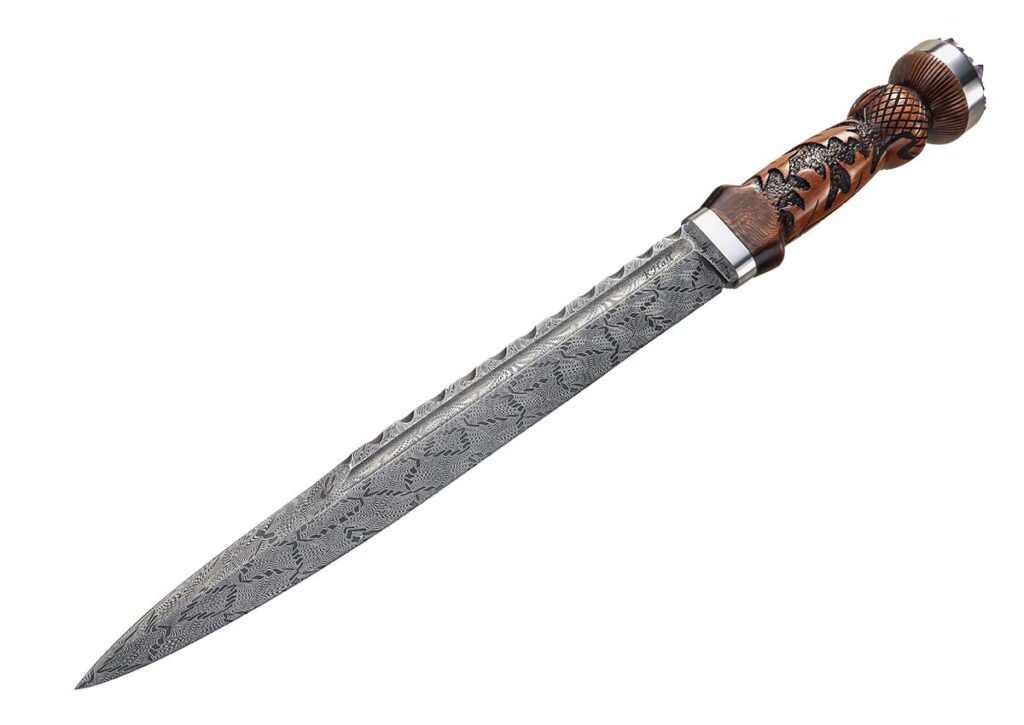
A 12-inch fullered/fileworked blade of an absorbing mosaic damascus and a handle of stained stabilized cherry carved to symbolize a thistle distinguish a stunning Scottish dirk by ABS journeyman smith Ken Hall. Pommel stone: amethyst crystals. Overall length: 17.5 inches. Sheath (not shown): tooled leather. (SharpByCoop image)
Matthew Berry Edinburgh Skean
The Edinburgh Skean by Matthew Berry is a reproduction of a knife by the same name from 1677. The originals were combat knives of Ireland. The blade is 1075 carbon steel and the intricately carved handle is boxwood. Blade and overall lengths: 15.25 and 19 inches. The form-fitting sheath (not shown) is highly detailed leather with a wrap strap. (SharpByCoop image)
J.J. Simon Samuel Bell Dirk
ABS journeyman smith J.J. Simon forged the 12-inch flat-ground blade with Spanish notch for his repro of a 19th-century Samuel Bell dirk from bloomery steel. The handle is blackwood with silver pins and the fittings are nickel silver. Overall length: 17 inches. (SharpByCoop image)
Vincent Soriano Mainz-Pattern Gladius
ABS apprentice smith Vincent Soriano goes full Roman with his Mainz-pattern gladius. Called the Proeliator, it boasts a 14-inch damascus blade of 1075 carbon and 15N20 nickel alloy steels and pure nickel. The handle is curly maple and the guard and pommel are eucalyptus. Overall length: 22.5 inches. Sheath (not shown): leather. (SharpByCoop image)
A reliable camping hatchet or axe can be the difference between mere survival and a truly memorable camping experience
Do any sort of camping and you’re more than aware there truly are the right tools for the job. While implements such as a bushcraft knife are an absolute must to get you out of a backwoods switch, they are, at best, only adequate for certain tasks. Chief among these is processing any amount of wood.
This, when your kit requirements allow, is where the good old camp hatchet or axe comes into play. Antiquated for large tree-felling projects nowadays, these lightweight and heavy-duty tools bring your woodcraft abilities to a new level. From facilitating more elaborate shelter-building attempts and arming you with the ability to collect a magnitude more firewood, hatches and small axes prove a godsend in the harshest environments.
Let’s hack away at what goes into the best of these sometimes overlooked camping and survival tools and what presently are some of the top choices in the wilderness tools.
Camp Axes vs Hatchets
While there is no bright line from when you crossover from an axe to a hatchet, there is a generally safe rule of thumb. Axes sport enough handle to facilitate a two-handed grip, while hatchets are generally wielded with one hand—hence their moniker “hand axe”. Most times too, axes boast a slightly larger and heavier head with a slighter taper. Hatchets, you’ll find, have a much more pronounced taper to their heads in addition to some having other functions incorporated—such as a hammer.
Given this, axes provide more striking power, thus a bit more versatility since they’re capable of heavier work than hatchets, in addition to all the tasks the smaller tool is proficient at. Bushcraters have understood this for some time, with some favoring relatively small axes that make shelter building and wood splitting much less labor intensive. There is a tradeoff in going the axe route, however—no matter what, the great majority of axe options will weigh more than a hatchet.
A hatchet, aside from convenience, has some underlying benefits. Splitting wood in camp is much easier and safer with the hand axe given it’s more controllable and can function in smaller spaces. Many—as mentioned—are tailored to the tasks of camping with multiple functions engineered into them—a tent stake puller is always nice. And even in the realm of bushcrafting, the hatchet proves nimbler than the axe on many tasks—such as using it to whittle wood.
Which is Right For The Wilderness?
Overall, the winner of axe vs hatchet debate when it comes to the outdoors is only something you can determine by analyzing exactly what your needs are when out in the wild.
If your outdoor plans require a deep push into the backcountry, where woodfires are a secondary source of heating and cooking, a hatchet seems more logical. The same goes for excursions where you plan to collect fuel wood immediately around your campsite, as opposed to cutting down a tree.
Conversely, if wood fires are your main source of heat and cooking, even in deeper parts of the forest, and you’re on extended trips an axe might prove more useful. Furthermore, if you are going straight up Grizzly Adams and virtually living off the land, building your own shelters, well an axe provides an advantage. Hunters too, in blind building from fallen trees, could also benefit from the extra leverage allotted by an axe.
Again, these are not hard and fast rules, simply examples of where a hatchet might trump an axe and vice versa. Using each as well as understanding your needs and capabilities in the wilderness will likely point you to making the right choice.
Best Hatchets And Camp Axes
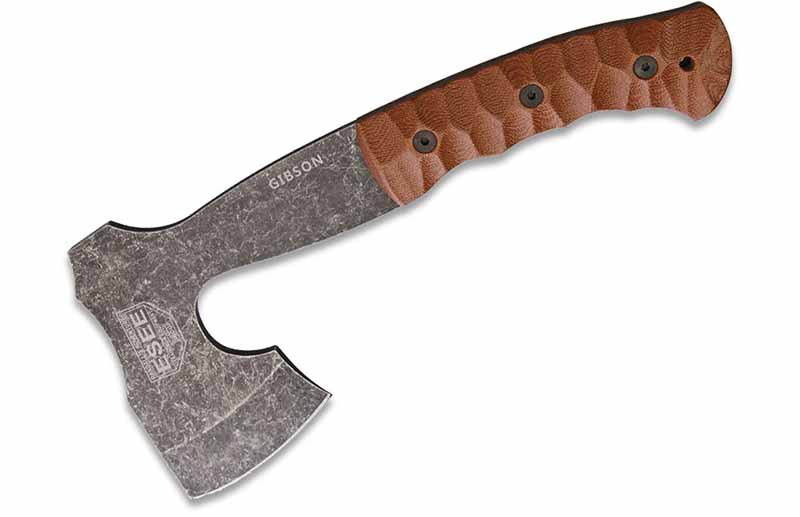
ESEE Gibson Axe
After the ESEE Gibson Axe was made, James Gibson learned a hidden feature of his design: it has enough finesse to carve small objects. He says he sharpens pencils with it and once cleaned a trout with it as well.
The hatchet is a James Gibson design which is now offered by ESEE. A knifemaker, flintknapper, and bushcraft instructor, James originally designed the Gibson Axe for himself, something to throw into a backpack as he tramped the hills and hollers of East Tennessee. As he tweaked his design, eventually cutting out a prototype made from thin plywood, he focused on its balance and “rocker.”
“An axe with perfect rocker is one of the best handling axes you can handle,” James said. “And I got the rocker perfect on this axe.”
And just what is rocker?
Gibson explains it’s when you take the hatchet and stand it up edge down on a straight surface. As he puts it, the bit’s edge should meet the surface in the “middle of the blade, the cutting edge and its dead center, and the handle [butt] should touch at the same time.”
When he showed a couple of prototypes of the axe to the folks at ESEE at a BLADE Show one year, they decided to add it to their lineup. At the time, ESEE was hearing from its customers that they wanted the company to offer an axe—and Gibson’s hatchet fit the bill.
James designed the handle to have finger grooves and a knob to secure the hand while swinging it. After the axe was made, he learned a hidden feature of his design: it has enough finesse to carve smaller objects. He says he sharpens pencils with it and once cleaned a trout with it. The result “is capable of doing some real work as well. It also has exceptional balance and you can choke up on it and use it like a knife for many applications,” explains Shane Adams, ESEE’s marketing director.
Of course, it being ESEE, the hatchet comes in the company’s oft-used blade material: 1095 carbon steel. “It’s us,” Adams said. “We know 1095 well.” It’s a steel that handles all the variables of the outdoors. “You can sharpen it with a rock if need be,” the marketing director advises. “Stones or systems, it doesn’t matter. I always like to finish on a loaded leather strop when possible.”
Gibson Axe Specs Company: ESEE Cutting Edge: 4.5″ Head Material: 1095 carbon steel Head At Its Thickest: .25″ Handle: Micarta Weight: 1.3 lbs. Overall Length: 10.5″ Sheath: Leather MSRP: $269
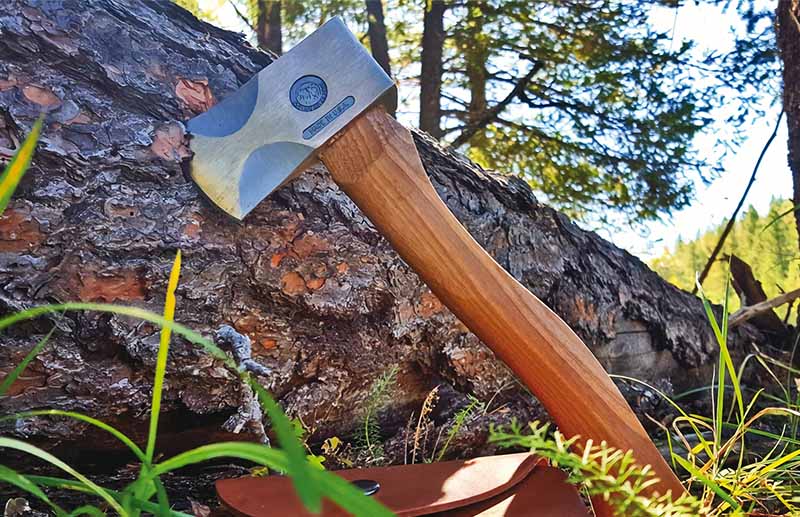
Knives Of Alaska Hunter’s Hatchet
“Hatchets are still one of the most useful tools a real outdoorsman can have in the fi eld,” says Charles Allen of Knives of Alaska, “and they can save your life by enabling you to quickly make a warming fire or emergency shelter.” The KOA Hunter’s Hatchet is designed to fi ll that bill in all regards.
Charles Allen, president and owner of Knives of Alaska (KOA), knows the importance of being prepared. The Alaskan master big-game guide who has flown in the Alaskan skies professionally for almost three decades always keeps a hatchet stashed in his bush plane—and for good reason.
“When you look back at the old photos of the early trappers and hunters, you will see three things: a rifle, a knife, and a hatchet or tomahawk on their belts,” he said. “Hatchets are still one of the most useful tools a real outdoorsman can have in the field, and they can save your life by enabling you to quickly make a warming fire or emergency shelter.” When consumers demanded a multi-purpose hatchet, Allen studied the designs carried by the folks who make preparedness their motto: the Boy Scouts. “I looked at the historic Boy Scout’s hatchet I grew up with and know that it is a proven design that is hard to improve on,” he says.
But improve on the Boy Scout model he did with the KOA Hunter’s Hatchet. The hickory handle remains tough yet easy on the hands. Heat-treated properly, the S7 tool steel is designed to absorb the shocks of hard blows. With a Rockwell hardness of 50-54 HRC, the edge of the Hunter’s Hatchet is intended to dent if it collides with something hard, Allen says, such as bone while butchering game. And the head can be returned to a razor-sharp bite with Allen’s recommended sharpening tool: a flat, fine-toothed file.
When designing the Hunter’s Hatchet, Allen was sure to include a wide-enough poll so that users could pound stakes, nails and the like with it, too.
Hunter’s Hatchet Specs Company: Knives of Alaska Cutting Edge: 4.25″ Head Material: S7 tool steel Handle: American red hickory Weight: 1 lbs. Overall Length: 11″ Sheath: Leather MSRP: $169
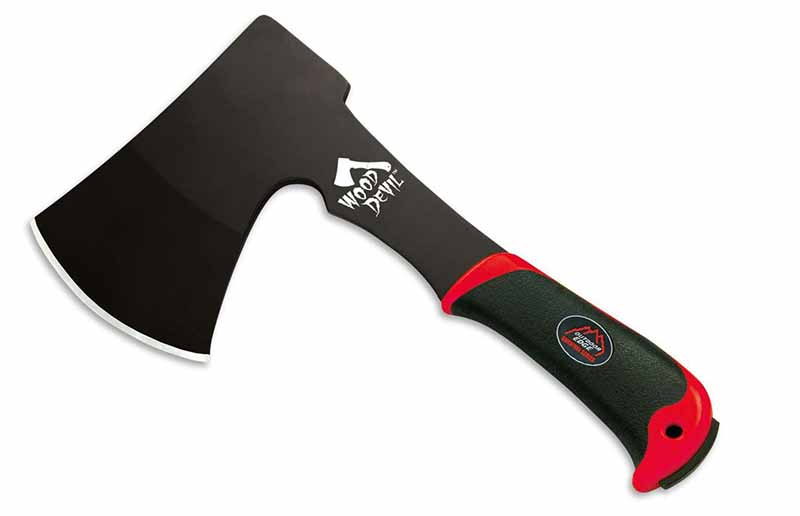
Outdoor Edge Wooddevil
David Bloch, president and founder of Outdoor Edge, wanted a hatchet that could out-cut its class: Something small enough to carry easily but with enough heft to take down a medium-sized tree. And thus the WoodDevil was born.
David Bloch, president and founder of Outdoor Edge, wanted a hatchet that could out-cut its class: Something small enough to carry easily but with enough heft to take down a medium-sized tree.
“I looked at and tested a number of compact hatchets on the market and came to the conclusion that most full-size hatchets were too large and heavy to take on outings where weight and volume were limiting factors,” Bloch said. “I also found that most every compact hatchet I tested, while cute in appearance, was not an effective chopping tool.”
During outdoor treks when the quality of your tools will make or break the trip, the Outdoor Edge WoodDevil may be a guardian angel, made possible by the marriage of a combination of the right balance, a good handle and a wide cutting head.
“The WoodDevil stands up to its name,” David said. “With a 4-inch cutting surface, it has the ability to cut through large diameter material with the respect of its compact size.” Plus, its compact size makes it unobtrusive in the camping bin or pickup truck until needed for whatever task—from hammering tent stakes to “slicing tinder shavings,” he adds.
The 3Cr13 stainless steel in a Rockwell hardness of 52-54 HRC is malleable and resharpens easily, and the black oxide finish allows it to better resist corrosion. The TPR rubber handle provides a non-slip grip that soaks up the shock and vibration during use. It’s packaged in a nylon sheath retained with a fabric fastener that can hang from a belt.
Wooddevil Specs Company: Outdoor Edge Cutting Edge: 4″ Head Steel: 3Cr13 stainless Handle: Red ABS plastic with black rubberized TPR Weight: 1.2 lbs. Overall Length: 10″ Sheath: Nylon MSRP: $40
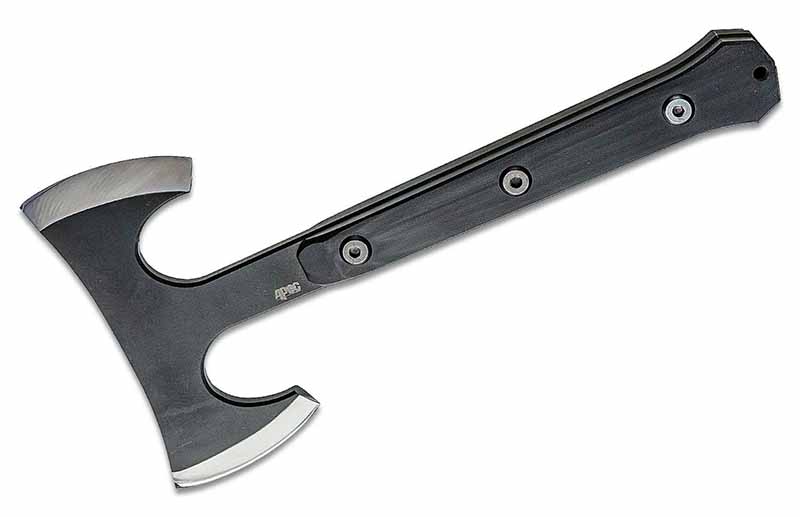
APOC Double Mukk
As Blake Pogue, product manager of CAS Iberia, tells it, the creation of the Double Mukk started with some pencil, plenty of erasing, and an idea.
“We wanted to bring a full-tang hatchet to market with some unique features at a good price point,” he said. Double-bit axes don’t seem as common as they used to be, but the Double Mukk’s design is grounded in some very real field experience. In fact, it is a design championed by George Sears, the famed outdoor writer with the nom de plume of Nessmuk.
“George Sears was an avid outdoorsman, canoe enthusiast, writer, and conservationist in the late 1800s,” Blake said. “He famously employed a trio of tools for woodcraft —a small folding knife, a thin-bladed belt knife and a short, double-bit hatchet.”
Pogue said after some field testing of their own, the makers learned they didn’t need to tweak much from Nessmuk’s favorite design. APOC Survival Tools makes the hatchet at a forge in Dalian, China, and it’s distributed by CAS Iberia. The blade is 9260 carbon steel, the same material used for swords, among others.
The double edge grants the hatchet additional versatility, as one side is flat ground for delicate carving tasks. The other side is convex ground to better slam through tough cutting jobs. Pogue recommends sharpening a hatchet with a hockey-puck-style sharpener designed for axes because it can easily follow the tool’s convex edges.
“I wanted one tool that could readily build a shelter, prep a fire for a meal, and do the intricate work required to make traps like the figure four,” he said. “If we can accomplish those three requirements, there isn’t much else you’d need but a small knife for food prep, and even then the carving side of the Double Mukk is no slouch!”
Double Mukk Specs Company: APOC Survival Tools Cutting Edge: 2.75″ Head Material: 9260 carbon steel Head At Its Thickest: .236″ Handle: G-10 Weight: 1.5 lbs. Overall Length: 11.75″ Sheath: MOLLE compatible MSRP: $99
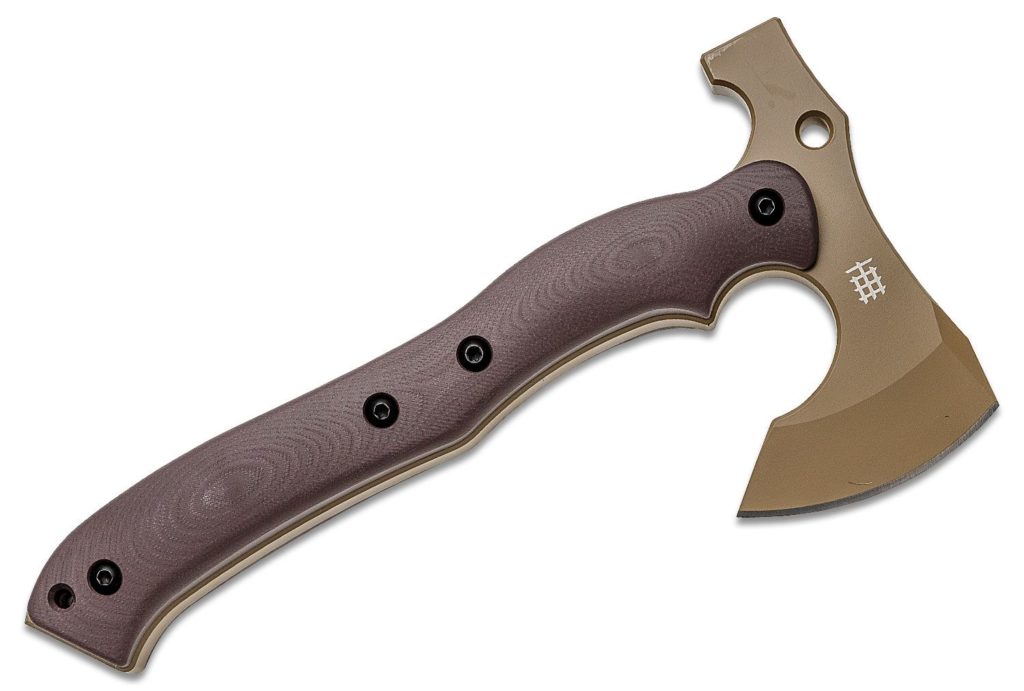
Halfbreed Blades CRA-01
The Halfbreed Blades CRA-01 Hatchet: Made ready for extreme hard use, this multi-purpose tool is ideally suited for MOE, CQB, Rescue, and Survival roles and tasks. Photo Source: knifecenter.com
The Halfbreed is a very heavy-duty piece. It is thick and hefty, and capable of taking a serious beating and dishing one out. This variant is finished in a dark earth color and comes with a substantial sheath that allows for secure carry adaptable to a variety of belts and packs.
Notable is how heavy the little hatchet is. It feels very nice in the hand and allows for either a low or high grip depending on the task. The grip is round in profile and consists of somewhat smooth scales. The edge out of the box was shaving sharp and easily removed hair from the arm.
The high, comfortable grip allowed for great control when scraping tinder. It also was a beast breaking bricks to make a windbreak for small fires. That said, it is not great for splitting tasks and, due to the thickness of the edge, does not bite deep for chopping. The grip is very comfy for general chores, though because the hatchet has equal weight dispersion along its length, it can fatigue your hand in use. It can be swung quite hard but there is a great deal of wasted energy in each strike because the head doesn’t carry the bulk of the forward momentum.
The dark earth finish was also the fastest to come off in heavy use. This is to be expected; however, be aware that if used heavily, the hatchet head likely will show wear far more than the other review subjects.
In terms of fire-starting ability, the CRA-01 proved mediocre as a striking tool, though it was very easy to control the direction of the sparks. Overall, it is fine for small fire-starting work and if it was what I had, I could easily make it work.
HALFBREED BLADES CRA-01 SPECS: Style: Tomahawk Head Style: Curved edge w/hammer poll Blade Material: K110 D2 tool steel Head Thickness: .31” Blade Finish: Dark earth (available in Ranger green and black) Handle Material: G-10 Weight: 1.7 lbs. Sheath: Kydex w/safety strap, belt and PALS/MOLLE mounting options Overall Length: 9.52” MSRP: $400+
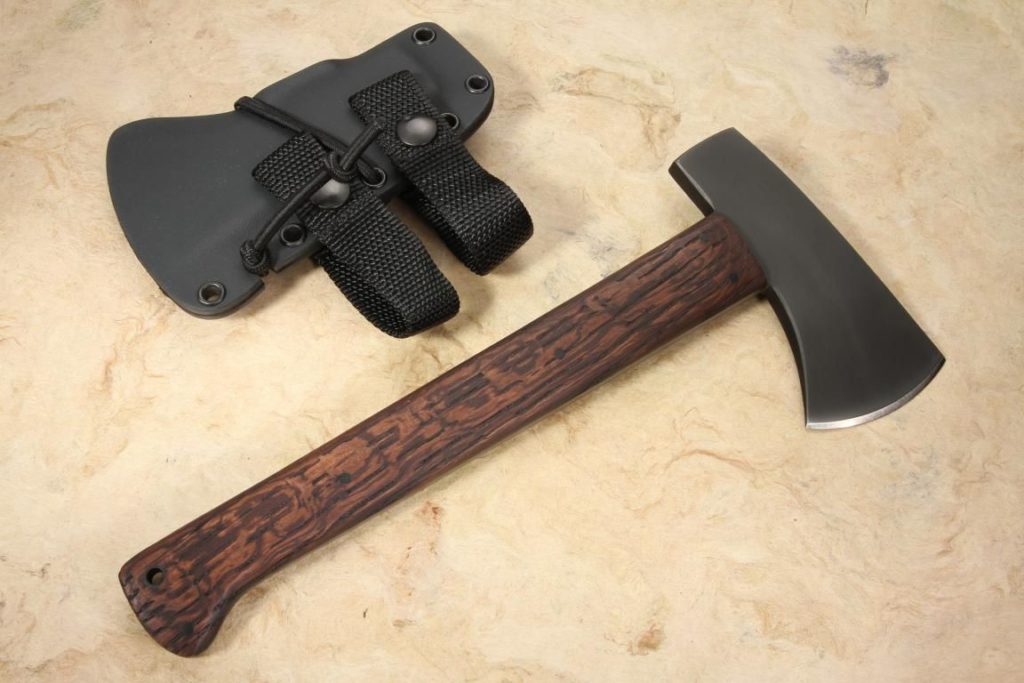
Winkler Knives Highland Hatchet
The Winkler has a full tang with scales attached. Worrisome for fear of the handle cracking in hard testing but it held up nicely. The finish is matte and held up well. It has a durable sheath that is simple and intuitive to use.
Despite the edge angles, it bit right into most wood, easily de-limbed trees and handled very light splitting. It stood no chance of taking a large log apart, though anything under 3 inches in diameter was taken to task.
For hammering and strength testing the Winkler held up extremely well. It broke bricks in a single strike and took very little finish damage in the process. Tent stakes were easy to drive in and were barely worth a mention, as a nice part of this little hatchet is it handles just like a 4-ounce tack hammer.
The Highland is a reliable fire maker, generating a showers of sparks and getting a flame going given equal materials. The edge showed no handicap in making kindling.
SPECS: WINKLER KNIVES HIGHLAND HATCHET Style: Camp hatchet Designer: Daniel Winkler Head Profile: Hammer poll Blade Material: 80CrV2 carbon steel Blade Finish: Black oxide Head Thickness: .336” Handle Material: Maple (laminate and walnut available) Weight: 20 ozs. Overall Length: 10 7/8” Sheath: Lined Kydex MSRP: $550
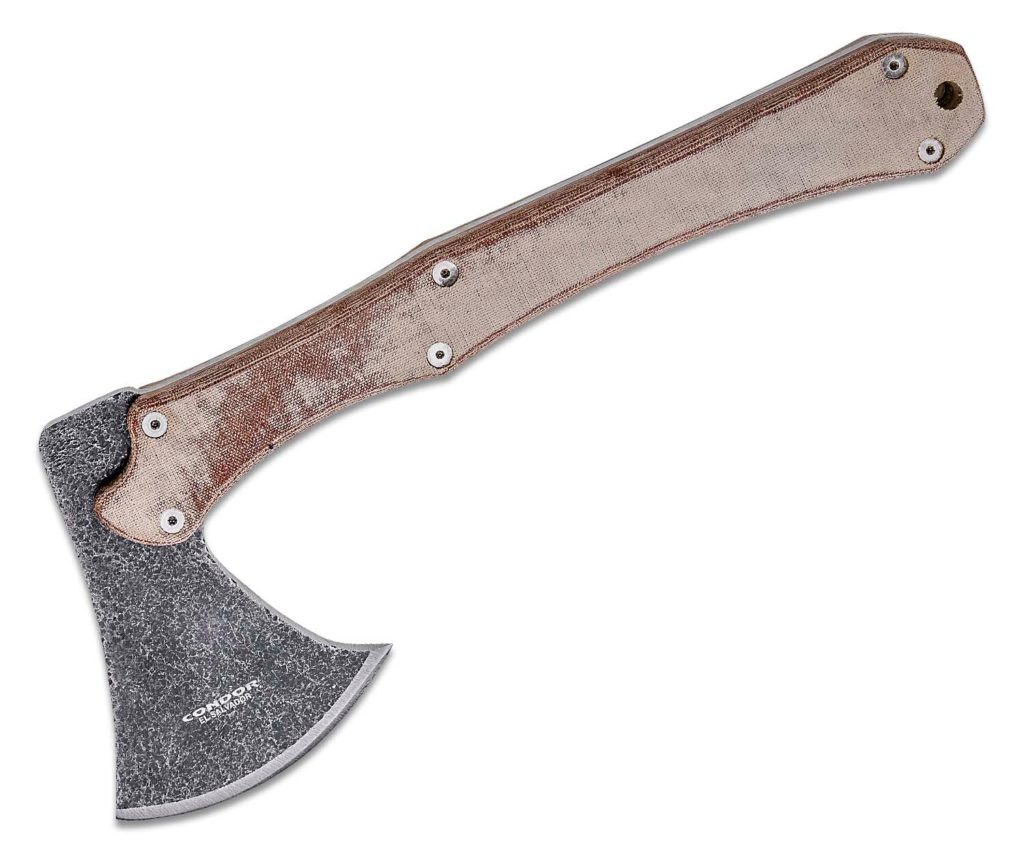
Condor Tool & Knife Mountain Pass AXE
knifecenter.com
The Condor Tool & Knife Mountain Pass might be classified as a jungle hatchet. It has a low beard and narrow thickness that is arguably much better at cutting wet wood, vines and bamboo in fast, repeated swings. For all intents and purposes, it is a foliage tool. As such it isn’t something for heavy splitting and camp chores. It ships with a very nice sheath of brown leather.
Swinging the Mountain Pass allowed for fast, accurate strikes. It bit in deep with each blow and was easy to withdraw. The edge was perfect for a camp axe when it arrived—not too sharp, not too obtuse. It handled limbs like a pro but was not up to heavy splitting. It sank in but lacked the mass to deliver sufficient splitting energy on the strikes.
A downside to hitting hard wood and other materials is Condor’s profile of the grip. It is visually appealing and very functional but narrow in cross section and wide front-to-back, thus making the impact of each hit apparent in a smaller area of the hand. If the grip was even 1/16 inch wider on each side it would have been an easy favorite in this test.
As far as hard camp work it broke brick easily with one hit, took little damage and easily drove tent stakes. It is not intended for either of these roles, but it did just fine considering it lacks a hammer poll.
The Mountain Pass was not particularly good at splitting fine kindling, but it did well and was easy to strike on, if not a bit large. Putting it in this role immediately made me realize it was really not meant for the work; it’s far better for clearing brush and gathering medium branches to process with a smaller tool.
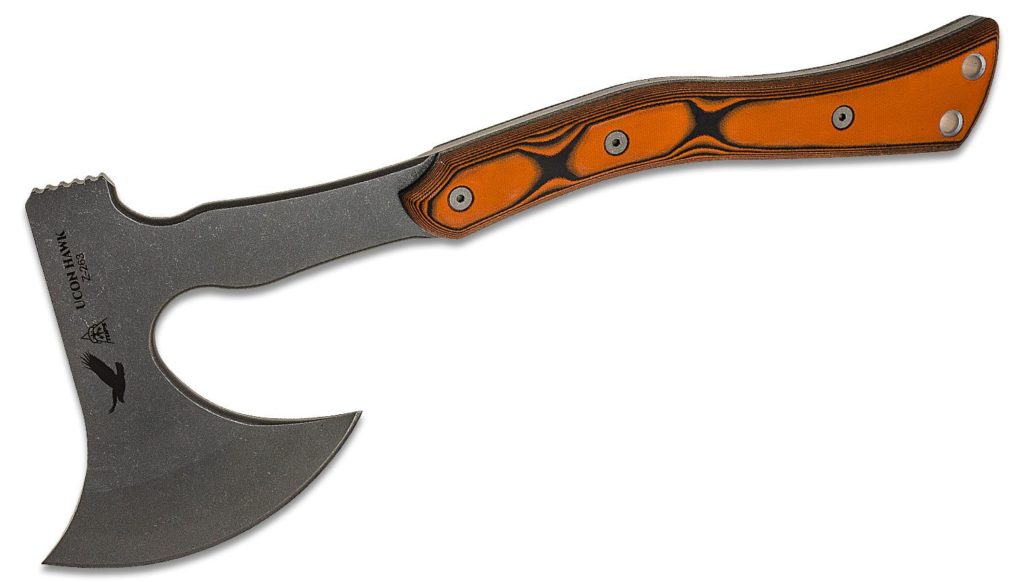
The Ucon Hawk from TOPS Knives is probably the most visually striking hatchet in the evaluation, as well as the sharpest. It’s large with a wide cutting edge and deep belly. It has a long, very pointy and sharp beard and a substantial grip. It’s questionable the edge needs to be as sharp as it is; a dull knife is clearly a danger but an extremely sharp, full-size hatchet can be a hazard.
The Ucon’s size makes it adept for general camp tasks. However, when it came to splitting, the deep belly and sharp tips made pulling it out of a stubborn log relatively dangerous as the blade rarely penetrated all the way, thus leaving the tips exposed. If you were to put your foot on the log to apply pressure to withdraw the head, a possibility exists that you could injure your foot in the process.
That said, performance was fantastic as a camp tool and it could simply lop off branches in a single swing. The finish held up nicely and the edge stayed sharp even after hard use. It should be noted that only the TOPS and the Winkler had edges unaffected by use. The Ucon ships with a two-part sheath—one part goes over the blade and the other is a belt loop the hatchet can slip through.
For heavy-duty tasks it did well, easily passing through limbs. Splitting was possible, though the hatchet was a bit thin and grip-heavy to dive deep enough to separate a full-size piece of firewood. Breaking brick with the hammer poll was easy; it left virtually no damage to the tool. Driving tent stakes also was easy.
Making fire was a challenge in that you had to be extremely aware of where the tips of the edge were at all times. If you get in the mode where you’re striking rapidly, say if you’re cold and frustrated, you need to calm down and take your time (as you should always do when using any sharp edge). The Ucon produced the finest kindling of the bunch by scraping with its sharp edge. The hatchet needs to lose the super-pointy beards—otherwise it is a great performer.
SPECS: TOPS KNIVES UCON HAWK Style: Camp axe Designer: Leo Espinoza Blade Material: 1095 carbon steel Blade Finish: Tumble Head Profile: Curved blade, hammer poll Head Thickness: .25” Handle Material: Orange and Black SureTouch G-10 Weight: 1.94 lbs. Overall Length: 15” Sheath: Black leather MSRP: $330
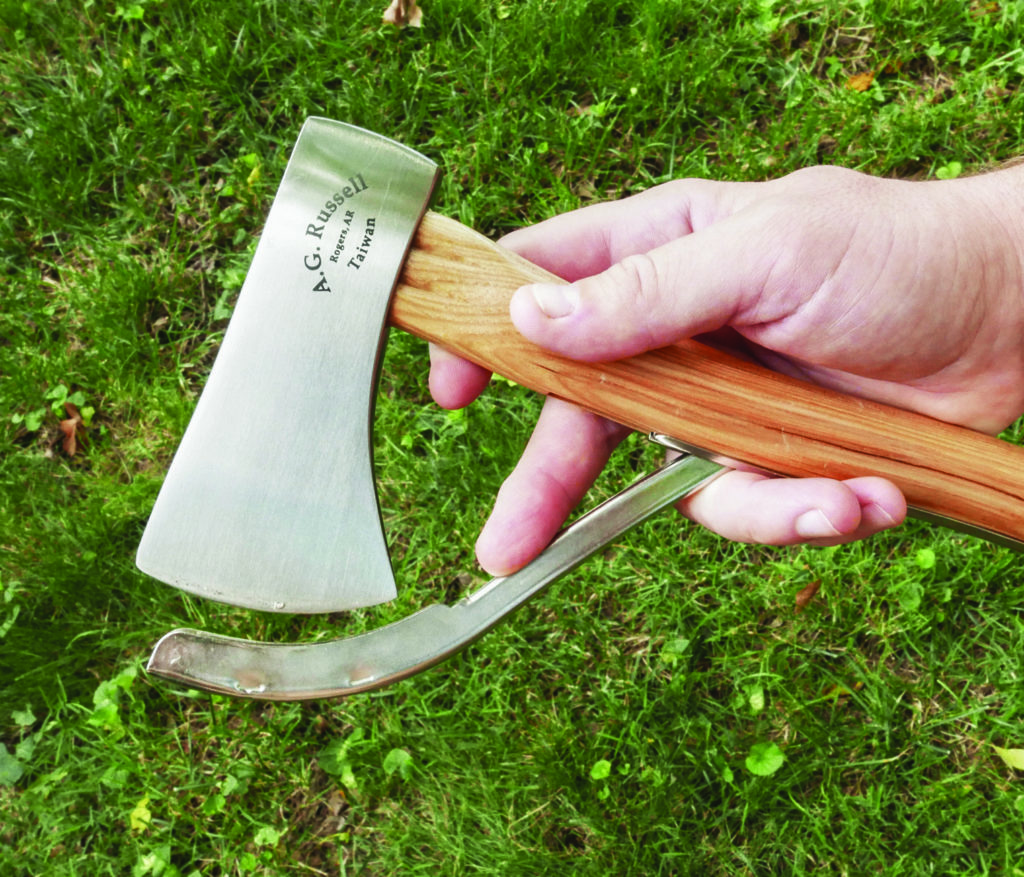
A.G. Russell Pocket Safety Axe
The fold-out blade shield of the Russell Pocket Safety Axe is pure wizardry, especially considering the design is well over 100 years old. You won’t be caught saying “Where did I put the sheath?” with this one.
The A.G. Russell Pocket Safety Axe is a Marble’s design from circa the early 20th century. Marble took a small hatchet, 10.6 inches overall, and designed a fold-out metal shield in the handle to cover the bit in lieu of a sheath. Simply ingenious. The A.G. Russell version has a 4.5-inch 1070 spring steel head with a 2.4- inch cutting edge, and a typical old-school hammering base at the rear. The head has a distinctive three-slot mounting system Marble deemed superior to the standard oval style. The 8.8 inch handle is hickory and the whole kit and caboodle weighs 1 pound. Manufacturer’s suggested retail price: $79.95.
With much of its overall weight in the head, this is a very top-heavy hatchet—which can work to its advantage. In the bite test on the privet log, the Pocket Safety Axe finished first simply because the business end has a lot more weight (see the side-by-side comparison image on head thicknesses). Consequently, it chopped each test material well.
The fold-out bit shield has pluses and minuses. On the upside, it’s very convenient and there’s no sheath to keep up with. On the other hand, you have to pack it since there’s no belt-sheath option. Also, you’ll want to wear gloves for extended use, as the hinge mechanism in the handle can dig into the inner fingers. All in all, though, the Pocket Safety Axe is a stellar performer.
SPEC CHECK: A.G. RUSSELL POCKET SAFETY AXE Cutting Edge: 2.4” Blade Material: 1070 spring steel Head Width: 4.5” Head Thickness: .7” at the thickest Blade Coating: None Handle Material: Hickory Special Features: Metal blade cover in handle Carry: Pocket or pack Weight: 1 lbs. Overall Length: 10.6” MSRP: $80
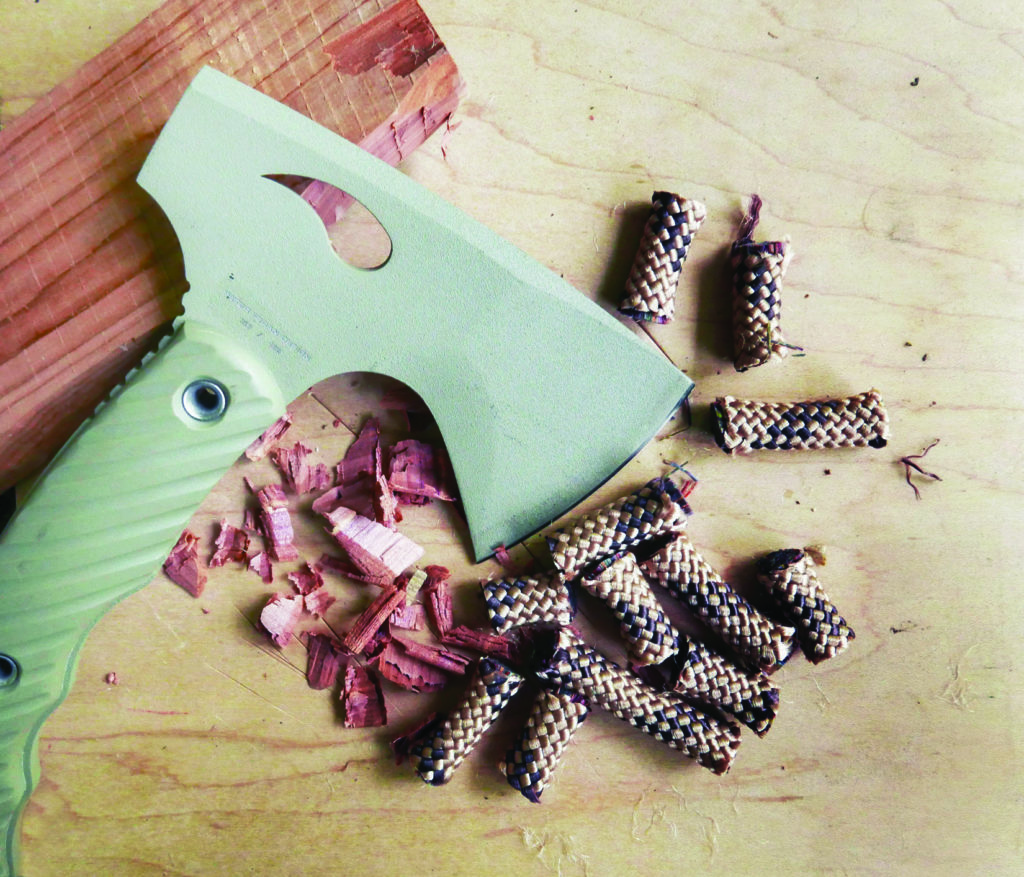
Boker Plus Escape Hawk
Designed by Australian knifemaker/ designer Peter Fegan, the Boker Plus Escape Hawk is tactical in design. Hawks are primarily used for breaching and combat but can full other chores as well. Only 9 inches overall, the Escape Hawk has a 4.75-inch head of quarter inch-thick SK5 tool steel and a 2.56- inch cutting edge. The head has enough beard to be used for carving, and the curved 7-inch handle is adorned with nicely sculpted, diagonally grooved FRN ( berglass-reinforced nylon) scales. The butt can be used for hammering. The steel is protected throughout with a powder coat. A dual-strap Kydex sheath covers the head. MSRP: $189.95.
The Boker Plus Escape Hawk is a hatchet in disguise. The small hack-it’s 2.56-inch SK5 tool steel bit chopped rope in nice, clean lops, and hacked off nice-sized cedar tinder chips with ease.
Due to its small size, you won’t be doing much breaching with the Boker Escape Hawk, but the pint-sized hack proved its worth. The SK5 steel had plenty of hack, chopping rope in nice, clean cuts, and knocking out chunks of seasoned cedar for tinder. Though the bearded bit can be used for carving, the inward slant of the handle mounting to the head impedes its effectiveness for the purpose a tad. The handle has full-length scales—a bonus for freedom of grip—and the diagonal grooves afforded it the best purchase of the bunch. The Boker Escape Hawk is a hawk that thinks it’s a hatchet.
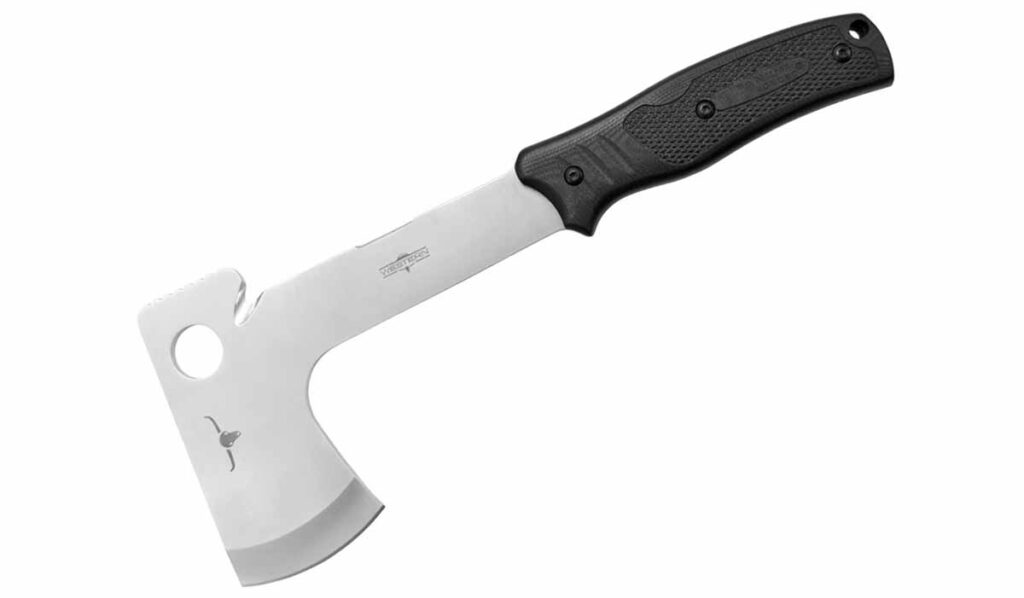
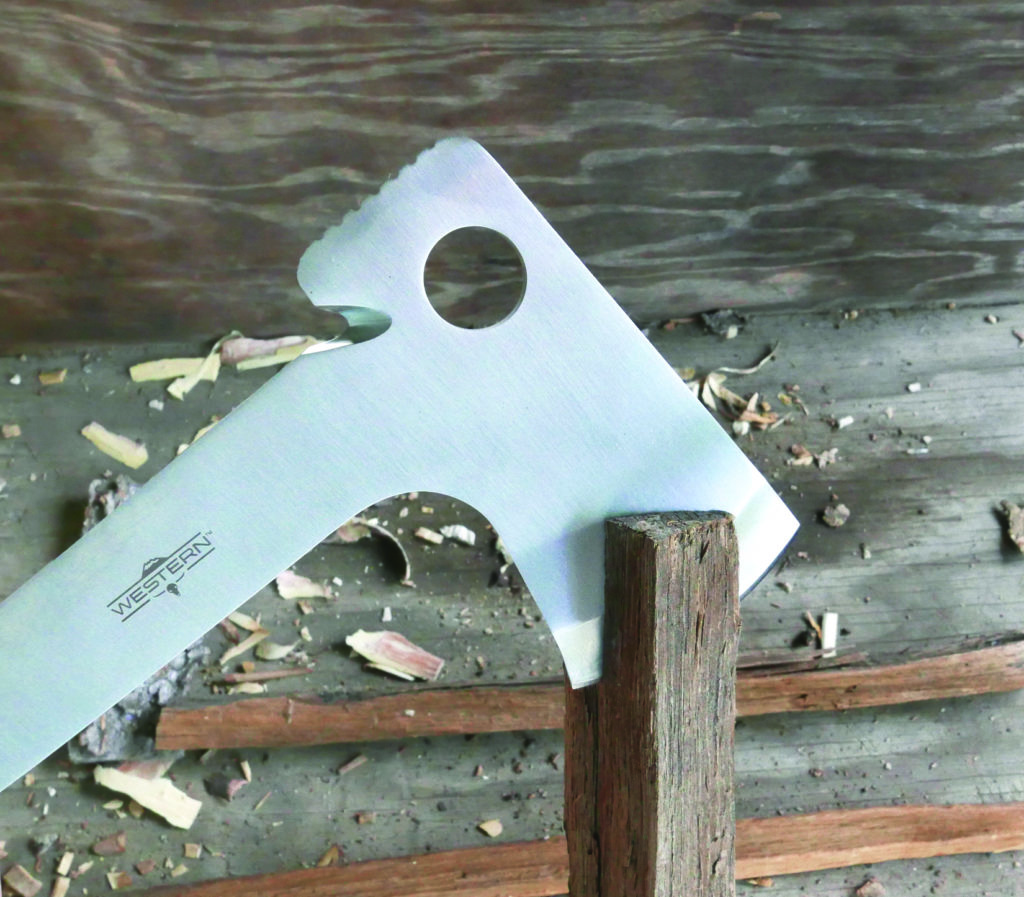
At 11.5 inches, the Western Blackriver Long Hatchet from Camillus is, indeed, the longest of the test hack-its. It sports a 4.5-inch-wide head with a 2.5-inch chopping edge. On the back side of the head is a gimped flat edge for hammering and a sharpened diagonal slot for cutting cord. The 9.5-inch handle has 5.25-inch black checkered rubber scales, and there is a shaving slot midway between the handle and the head. A ballistic nylon sheath with a firesteel pouch—with firesteel—is included. MSRP: $31.98.
The Western Blackriver Long Hatchet from Camillus is the batonner of the bunch. The thin bit cleaved into the tight hardwood grain like a thief in the night. Once the head was in, the final splitting was done by batonning the upper handle.
The Blackriver has the lightest head of the test group so it didn’t win the chopping wars, but its length and handle design give it a leg up on the others in some functions. The thin head is ideal for batonning, enhanced by the 4 inches of exposed steel below the bit, which can be used as a striking surface. The grip is very comfortable, the rubber scales aiding in impact absorption. The Blackriver will handle many chores around the camp, and the bonus firesteel and pouch on the sheath add value. It’s also by far the most affordable of the group.
Camillus/Wester Blackriver Long Hatchet Specs Cutting Edge: 2.5” Blade Steel: 420 stainless Head Width: 4.5” Head Thickness: .2” Blade Coating: Titanium bonded Handle Material: Rubber Special Features: Firesteel included Carry: Ballistic nylon belt sheath Weight: 1 lbs. Overall Length: 11.5” MSRP: $32
Winkler Hunter Axe LT
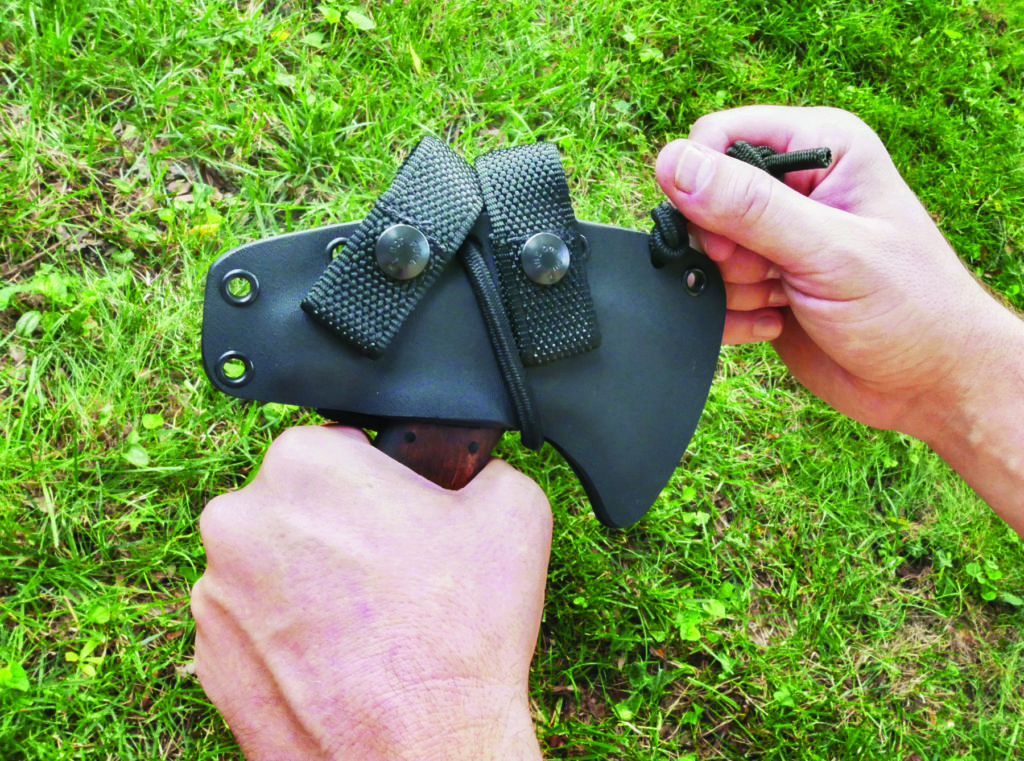
At only 9 inches long, the Winkler Hunter Axe LT is a small hack-it, but packs a full 19 ounces of weight—and that’s with a skeletonized handle tang. The Hunter Axe LT has a 3.5-inch-wide, bearded 80CrV2 carbon steel head with 2 inches of cutting edge, and there’s a hammering base out back. The steel thickness is a healthy .25 inch and is coated head to toe in Caswell black oxide. The scales are full-length, highly attractive curly maple. A padded Kydex sheath with nylon belt loops covers the head, and employs a shock-cord retention system for a quick draw. MSRP: $450.
The Winkler Hunter Axe LT’s Kydex sheath has a bungee-style tension cord for quickly releasing the axe from its housing. The sheath as a whole is very well made—a Daniel Winkler trademark.
The Hunter Axe LT may be short but at 19 ounces is the heaviest of the test hack-its—a full 2 ounces more than its nearest rival. The LT almost won the bite contest but didn’t due in part to its weight being more equally distributed than the top-heavy Russell Pocket Safety Axe. The 80CrV2 steel chops extremely well and the Caswell finish is very tough. Though not a carving axe per se, the LT was our best candidate for the chore and would have performed even better with a lower grind angle on the lead edge. The price is high but the Winkler is as close to a custom as you’ll get—plus, the sheath is a marvel in itself.
WINKLER HUNTER AXE LTSpecs Cutting Edge: 2” Blade Material: 80CrV2 carbon steel Head Width: 3.5” Head Thickness: .28” Blade Coating: Caswell black oxide Handle Material: Curly maple Special Features: Skeletonized handle Carry: Kydex belt sheath w/tension release Weight: 1.9 lbs. Overall Length: 9” MSRP: $450
Gerber Freescale Axe
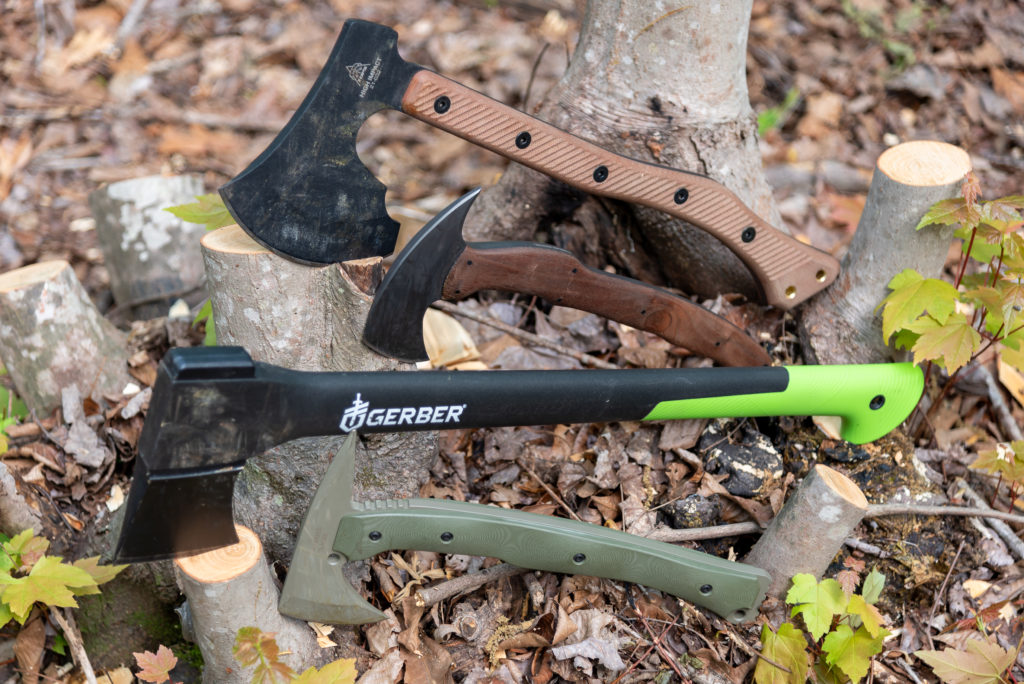
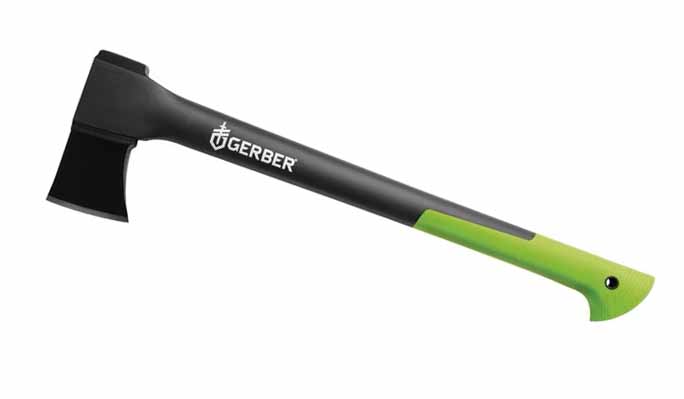
Gerber has had a successful series of axes and hatchets made in Finland that feature one-piece, hollow, molded handles for lightweight, optimum strength. An example is the 23.5-inch model in its Freescale series. The forged steel head is mated permanently to a lightweight composite handle, so there is little worry the handle will come loose during use. The oblong profile handle is hollow, which shifts the balance of the axe to being head-heavy. It is very forward weighted and that is a good thing. Use gravity to your advantage as you employ the axe, allowing it to fall naturally as you guide it. A tactile gripping surface in a contrasting green graces the handle. The handle flares at the butt, allowing your bottom hand to hook into it, trapping the handle in your hand so it doesn’t go flying. The handle style reportedly is virtually indestructible during heavy use.
The forged head exhibits a nice, steep “V” profile to help bite hard and deep into wood. A primary edge bevel thins the edge some and makes resharpening easier. A black PTFE coating provides additional corrosion resistance as well as a nonstick surface. A poll is designed as a hammer.
The Freescape is among the least expensive of the review axes, though don’t discount its performance based solely on price. Truth is, this axe is devastatingly effective. With each swing you can feel the forward-weighted balance power the Freescape through wood. The thickness and shape of the handle are just right, allowing a secure grip with both hands. Gerber includes a plastic caddy that seals the cutting edge and protects you and your belongings from being cut. The caddy has a large handle to carry the axe safely, as well for hanging on a pegboard in your garage or utility shed. For how it performs versus what you pay, it is an excellent value. If you’re a frequent axe user or just an occasional one, the Freescape will serve you very well.
Gerber Freescape Axe Specs Cutting Edge: 3.5″ Head Material: Stainless Steel Head At Its Thickest: N/A Handle: GFN Weight: 3.6 lbs. Overall Length: 23.5″ Sheath: Plastic, carry handle MSRP: $70
Winkler KnivesRnD Compact Axe
The tang sports a distal taper toward the handle butt of the Winkler RnD Compact to improve balance and shift weight distribution toward the head. Note the humpback in the handle.
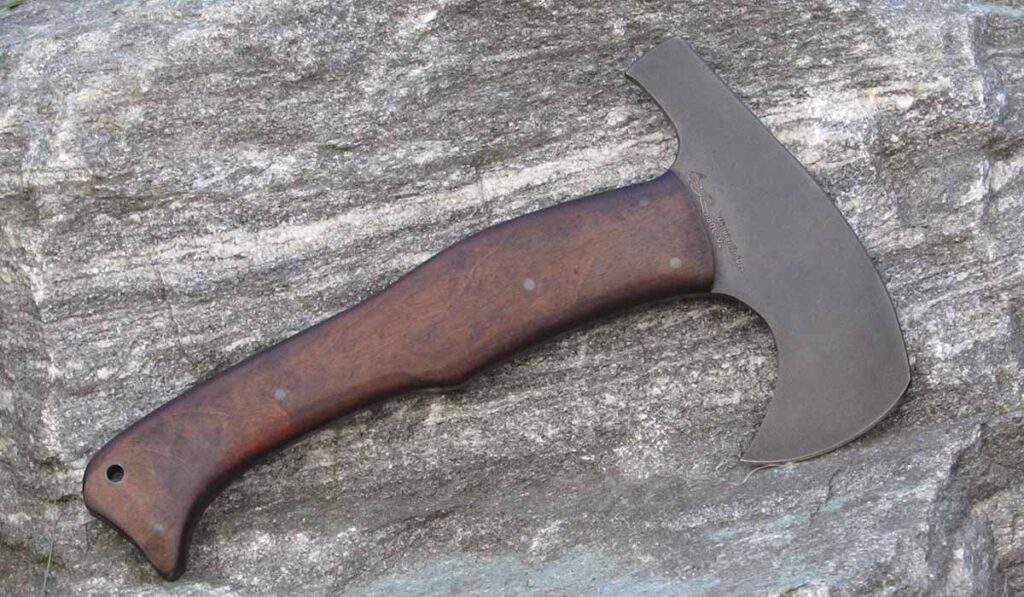
A spike model, the RnD Compact Axe is the smallest in the Winkler Knives (WK) axe line, though that doesn’t mean it’s the least capable. The hatchet-like head is only 5.5 inches long. The 80CrV2 carbon steel head is ⅜ inch wide. The tang sports a distal taper toward the handle butt to improve balance and shift weight distribution toward the head. The spike is commonly found on tomahawks and does everything from prying to puncturing. WK also offers a front spike option integrated into the head’s main cutting edge. A black oxide finish helps resist corrosion.
The 80CrV2 offers extreme toughness and edge retention. It withstands an impressive amount of abuse yet remains easy to resharpen, even in the field. Daniel Winkler is a fan of 80CrV2 and uses it a lot for both his knives and axes.
The handle features two prominent grip positions. One is the traditional axe grip held close to the butt. A series of subtle finger grooves seats your fingers, and the butt has a bird’s-beak design that hooks the handle into your hand to prevent it from sliding from your grip. A secondary close-quarters grip is below the axe head at the handle’s humpbacked portion. This facilitates choking up for control in carving, whittling and using the cutting edge like a knife. The RnD feels very balanced and agile in the latter grip, one the other review axes don’t offer. The Winkler would be great at processing kindling and bushcraft chores that require more control with close-in cutting or whittling. Due to its length and weight, it would not be a primary use axe but maybe a complement to a larger model that does heavy splitting or felling chores.
A secondary close-quarters grip is just below the head of the RnD Compact at the handle’s humpbacked portion. This facilitates choking up to provide control for carving, whittling and using the cutting edge like a knife.
The walnut handle looks luxurious but pay heed to where you lay it down in the woods. The walnut’s color blends in well with leaf ground cover and you might lose it easily. Thread a loop of brightly colored pink, red or yellow paracord through the lanyard hole to make the handle stand out. The RnD comes in three handle materials: black Micarta®, maple and walnut.
A molded form-fitting sheath of Boltaron encloses the head. A thick shock-cord-quick-release-retention device secures the sheath in place, yet releases easily and quickly. An interior felt lining facilitates the easy slipping on/off of the sheath, as well as muffling the sound. Two nylon webbing belt loops enable the RnD to ride comfortably at your side. MSRP is $815, the most expensive of the test group. WK is very well known for manufacturing excellence and attention to detail, and the RnD Compact is no exception. For a bigger axe in the same design, check out the full-size model.
Winkler KnivesRnD Compact Axe Specs Cutting Edge: 2.25″ Head Material: 80CrV2 carbon steel Head At Its Thickest: 3/8″ Handle: Walnut Weight: 1.3 lbs. Overall Length: 11″ Sheath: Boltaron MSRP: $815
TOPS Knives High Impact
The High Impact’s curved cutting surface allows it to be devastatingly effective as a chopper, including sectioning the trunk of a sapling for easier handling.
The TOPS Knives High Impact is a full-sized hatchet/small axe hybrid that packs a punch. At 20 inches overall and around 3.5 pounds, it is a formidable chopping tool that can be used with two hands as a traditional axe or one handed a la a hatchet.
Starting with a backbone of .38-inch-thick 1075 carbon steel, the High Impact’s main cutting edge is a little over 5 inches—plenty of cutting surface for large and small chopping jobs alike. The Black Traction Coating creates a layer of protection against corrosion and wear. The ergonomic handle is tan Micarta®, with a diagonal machined groove pattern for hand traction. Five pairs of large hex head screws fasten the Micarta scales, and there are two large brass-lined lanyard holes. The handle has a distinctive bulge that helps seat your grip, especially for one-hand use. The handle flares at the butt, creating a comfortable seat for your bottom hand when using two hands.
The first thing you notice is the High Impact’s weight. It’s impressive but will take some getting used to. Once acclimated with the heft, you will discover it is also an advantage for getting momentum in your swing. And when it hits, it lives up to its name. The High Impact takes out chunks of wood with each blow. TOPS has the heat treat on the carbon steel dialed in perfectly. The 1075 retains an edge really well but sharpens easily and quickly.
The TOPS Knives High Impact is a beast. It has heft and momentum to bite deep and hard with each swing. The ergonomic handle makes it possible to use the axe with one or both hands.
I tried both grip styles. With one hand, this is where the weight takes some getting used to. Due to the axe’s weight, one-handed use might be limited to short spells. Conversely, using two hands is where the power of this beast is unleashed. You can put power behind the swing and each blow is devastating. You can feel the axe head bite in with each blow. It’s a sure bite as well. The performance with one or both hands is equally impressive. Due to its weight, it’s a great candidate to store in your truck or ATV.
A nicely made leather holster fastens over the head, sealing the edge. Two button-snap straps secure it, though only the one at the end needs to be undone to slide the sheath off. Note the absence of a belt loop attachment to carry the axe. It’s just too heavy. Despite the weight being a factor, the High Impact packs a serious punch and is the heavyweight champ of the test bunch. MSRP: $360. TOPS makes the axe in its factory in Idaho Falls, Idaho.
TOPS Knives High Impact Specs Cutting Edge: 5.75″ Head Material: 1075 RC 56-58 Head At Its Thickest: .38″ Handle: Tan Canvas Micarta Weight: 3.7 lbs. Overall Length: 20″ Sheath: Leather MSRP: $420
Wolf Valley Forge Camp Axe
The Wolf Valley Forge axe ate bundle after bundle of firewood like there was nothing to it.
The Wolf Valley Forge Camp Axe is in a class of its own. It came not with just a functional sling and cover, but also a small whetstone and a jar of wax by Axe Wax to help preserve it. Carrying the Camp Axe is comfortable and allows for a free hand while trekking. The handle is perfectly shaped and came with a leather strike guard.
Ike Bullington is the maker and the quality is immediately noticeable the second you unpack it. It is all properly shaped, textured and balanced for real work and has a very pleasing appearance. However, it is not a wall-hanger. The head is of a traditional profile and designed for a lifetime of work.
The edge arrived razor sharp, easily sharper than most knives. Not only that, but the edge is extremely durable and completely dispels the notion that you need a wedge-shaped splitter.
A sharp axe truly cuts the work in half and this one almost effortlessly passed through wood regardless of grain angle. In taking down bigger trunks it drove in the deepest and was the easiest to free. Chips flew with each chop and it made very short work of even the toughest test materials.
In addition to cutting wood, it was tested driving tent stakes and making kindling, which it did easily. As a camp axe it is very nice in the batoning role, and yes, you can baton an axe the same as you would a knife—so long as you grip it high up to the head and perform the task in a safe standing position as to not deflect the blade into your knee.
Wolf Valley Forge Camp Axe Specs Cutting Edge: 4″ Head Material: 4142 Head At Its Thickest: N/A Handle: Hickory Weight: 2.5 lbs. Overall Length: 23.62″ Sheath: Leather MSRP: $375
Fox Sekira
Considering what you get, the Fox Sekira is a great axe and relatively inexpensive. It handles like a traditional axe in the swing but has a crescent-profile edge that is shaped much the same as a carpentry axe, though with a longer handle. The head is wide at the cheeks and quite narrow in the blade. It splits very nicely though isn’t particularly deep-biting on each swing.
The head, while substantial, isn’t overly massive and there is a large concentration of weight in the handle. The weight is distributed across the axe, which could lend to some of the increased effort in getting it to send splinters flying.
As far as general performance, the Sekira is about as good as a traditionally constructed axe gets, and lacks nothing in utility. It stayed sharp and experienced no edge chipping, even after quite a bit of heavy use. The only noticeable downside is that the handle, while comfortable and very nicely finished, is somewhat on the large side and rounded from front-to-back.
When hands get wet or cold the axe has the tendency to want to rotate, which can be dangerous if you’re not holding on tight. Other than that minor issue, the Sekira is a fantastic axe that should offer years of hard-use service.
Fox Sekira Cutting Edge: 4.33″ Head Material: Carbon Steel C45 Head At Its Thickest: N/A Handle: Hickory Weight: 3.35 lbs. Overall Length: 23.62″ Sheath: Leather MSRP: $150
Editor’s note: Dexter Ewing, Josh Wayner and Daniel Jackson contributed to this post.