
Shaving Sharp

Thanks To The Internet, Straight Razors Are Back In Style. These Trio Of Blades Can Keep You Looking Sharp And Feeling Smooth.

Mastering shaving with a sho-nuff handheld straight razor is a lost art that has recently become more popular thanks to social media shaving gurus and those who like a good challenge. 

Straight razors never went away, the internet just has a knack for making old things new and cool again. Let’s look at a trio of current offerings and shave them through their paces.

Boker King Cutter

Boker King Cutter

Boker has been producing straight razors since 1869 and the company offers many models today. The King Cutter, the company’s most popular razor, features a carbon steel blade with a deep hollow grind. The handle is a black polymer with a brass Boker Tree Brand logo escutcheon. The King Cutter was the lightest of the three review pieces, tipping the scales at a svelte 1.47 ounces. It features a monkey tail tang for quick blade access.

Being the most expensive of the test lot by a long shot and from a company that has been making straight razors for over 150 years, you’d expect the King Cutter to perform well. Simply put, it did. The blade was, ahem, razor-sharp right out of the box and glided through my two-day stubble clean as a whistle. I never had to back up and go over an area to get it smoother.

 The thinnest of the review blades, it got into tight spots a bit easier. However, a word of warning is in order. An extremely sharp blade like this will cut you faster, too, so take your time! The King Cutter’s high price tag may scare some away, though there are other straight razors out there that cost much more.

MSRP: $189.95

Rough Ryder Cinnamon Bone Stag Razor

Rough Ryder Cinnamon Bone Stag Razor

Rough Ryder’s Cinnamon Bone Stag Razor has all the trappings at a budget price, including the good looks of a traditional straight razor. The cinnamon bone stag handle, replete with an acorn escutcheon, is downright handsome—and Rough Ryder does bone stag well. 

The cutting portion of the blade has a light yet distinctive damascus pattern running across its face, and a barber’s notch at the point aids in safely opening and deploying the blade. A monkey tail tang completes the package.

Right out of the box, the Rough Ryder entry shaved the stubble straight from my face. The blade was plenty sharp and I was able to get into tight spots with good results. When you get down to the nitty-gritty, there are differences between this razor and an expensive one like the Boker.

There is a tad more drag on the blade and I had to back up a few times to get the area I was shaving totally smooth. To be honest, I expect this from a razor at this price point, and you should, too. That said, the Rough Ryder Cinnamon Bone got the job done and was no slouch. I recommend this razor to those who want to get their feet wet before taking the plunge on a high-dollar cutter. And, by golly, it was the most attractive of the bunch!

MSRP: $29.99

TOPS Knives Tac-Raze 2

TOPS Knives Tac-Raze 2

The TOPS Knives Tac-Raze 2 is designed as an EDC and not billed as a straight razor. Nonetheless, we threw it into the fray to see if we could shave with it, letting the chips fall where they may. 

A full 2.625 inches of the blunt-tipped blade has a slightly bowed edge. There’s a rat-tail tang reminiscent of the old friction folders, though not forged. The Tac-Raze 2 has a deep choil below the blade edge that splits time with the handle. TOPS includes a dark brown leather slip and a small bottle of protectant.

Would an EDC with a razor-style blade shave? Given how many YouTube videos there are of guys shaving with everything from bowies to kitchen fare, I figured why the heck not? A cursory check right out of the box with the blade warmed up and a light coat of shaving cream on a cheek gave me surprising results. Not only did the Tac-Raze 2 shave my stubbled skin with ease, it was darn smooth! Next, I cleaned the blade up and stropped it, and the shave was as smooth as I could get with a standard straight razor.

As I worked around my face I found some gremlins with the TOPS EDC. The handle is not nearly as nimble as a standard straight razor, which is to be expected since it’s not a standard straight razor. I found getting into tight areas like the crack between my upper lip and cheek particularly dicey. Bottom line? What you lose in dexterity with the Tac-Raze 2 you gain in versatility since, after all, this is an EDC knife with all the benefits—and it comes with a slick leather slip.

MSRP: $139

Scoring The Straight Razors

All three in our razor trio had their strengths and weaknesses, but all got the job done. The Boker King Cutter is the pro razor of the bunch. The Rough Ryder Cinnamon Bone is a nice entry-level shaver, and the TOPS Tac-Raze 2 is certainly the most versatile.

One final note: don’t be afraid to try a straight razor. As a knife enthusiast, chances are you’ve already developed a healthy respect for sharp blades. Wade in slowly and carefully—once you get a feel for the straight razor, it will feel right at home in your hand.  Happy shaving!

Read More

A Day At The New England Bladesmithing Symposium

Knifemakers From Around North America Came To Auburn, Maine For The 2022 New England Bladesmithing Symposium

The 12th annual New England Bladesmithing Symposium brought nearly 100 knifemakers and enthusiasts together for the first hammer-in since 2019.

The event ran from July 15-17 in Auburn, Maine at the New England School of Metalwork and featured classes and workshops galore. Throughout the weekend there was something to scratch any itch you may have had about knives.

Master Smith Lin Rhea presented a tutorial on how to make his dynamic X-Rhea knife. There were workshops on everything from how to build out your knifemaking business to forging recurves. 

It was a brutally hot Saturday in the Pine Tree State, yet it didn’t dampen spirits, particularly for the main event– the Battle of the Bladesmiths. The 2-hour competition to pushed four makers to their limits, and drew the largest crowds and interest.

Learning From The Best

The classroom at the NESM is covered wall to wall with tools and other metalwork made by past students just like this.

During the afternoon I was able to drop into a few of the classes. The one I got the most out of was led by Master Smith Christoph Deringer. 

Derringer class about the anatomy of the knife was a joy, particularly the care he gave answering questions. His wry sense of humor even out, like when he called flux a crutch pertaining to forge welds. In that particular case, he suggested simply listening to the metal and letting it guide you when you forge weld, no flux is needed.

He taught everyone a neat trick for adding patina to a blade, as well. The crux, you hang the knife above a piece of heated copper. Heating the copper causes it to emit gasses that rise up and patina the blade to an almost bronze color.

A Successful Weekend

It was a big weekend for the school, gathering makers from the Northeast, Eastern Canada, and even as far west as California. For NESM director Dereck Glaser, it was a successful weekend, particularly given the COVID-related lapse in the symposium the past few years.

“The school, in general, draws from around New England,” Glaser said. “I’m excited to see more Canadians here, to be honest. We can’t forget we have a whole other country on our border. I can’t be pulling students out of the Atlantic Ocean so Canada’s a really good option.”

It’s important for anyone with even a passing interest in knifemaking to visit their local school and learn. Not only can you save yourself toil and trouble, but supporting the broader community of makers helps it survive and thrive even in the lean times.

Journeyman smith Mace Vitale runs a workshop on handle shaping.

“It saves exponentially the number of years,” Glaser said. “Indebting yourself to a week and about $600 could potentially save you 3-5 years of trial and error on your own. The amount of compressed skill and support you get in 4-5 days of a course, answering those questions that’ll take 3-5 years to figure out on your own.”

Glaser said that even with the uncertain economy, he believes the future of the school and knifemaking is bright because the passion is boundless.

“The fiscal issues we’re having is making it rough. It’s 90+ percent an enthusiast kind of hobby and craft for most people,” Glaser said. “Where inflation and cost of living’s gone, everyone’s seeing a toll in the crafts. We’re even seeing it in the welding, which is an employment-based skill. But on a whole, I  think the energy is still there. The love for it is greater than ever. A lot of people did a lot of things to better themselves in it through the pandemic, so I think coming out on the other end I think people are kind of stronger.”

The Passion For Knives

A nice bit of camraderie. Two of the battle contestants Leo Potter (in the hat) and Jeremy Yelle share a fun moment ahead of the contest.

As informative and enlightening as the classes were the attendee’s conversations. Everyone was excited, whether it was to learn from a particular smith, show off a piece they made, or for the battle at night, everyone was open and welcoming.

A Previous winner of the Battle of the Bladesmiths, Emiliano Carrillo (owner of Sun and Stars Forge), was particularly poetic in what he said about the process of making his own steel.

“When I started the smelt earlier in the day the sand runs through my fingers, and by the time the day’s done it’s a lump of material that can be turned into something,” the owner of Massachusetts-based Sun and Stars Forge said. “It goes from being this throwaway material to something that’s actually useful. I think that’s crazy. It really is alchemy to me. It’s addictive. You do it and it works and you do it again and again and it breaks your heart, and then you have some successes.”

The day ended with the battle. Four young smiths were tasked with turning a one-foot bar of 1084 into a complete knife in just two hours. You can read all about the contest here.

In total, the symposium was absolutely worth the trip and should be on your checklist if you’re a serious maker in the Northeast U.S. or Eastern Canada.

To learn more about the New England School of Metalwork, click here.

Read More

Smokin’ Cutters

Cigar Cutters Come In Three Distinct Styles. Picking The Best One For You Is A Matter Of Personal Taste.

Few gentlemen’s pastimes are as nuanced as the art of smoking a cigar. The choice of stogie, cutter and method of carry are, for better or worse, an indicator of just how serious an aficionado the person in question is. The little things can say a lot about the owners, and a lack of appropriate accoutrements is all some need to pass judgment on a peer.

I sat down with Alex Gregorian of Georgetown Tobacco & Pipe in Washington, D.C. He was kind enough to provide me with some choice cigars from the shop to use in this review. Gregorian first took up stogies as a hobby a decade ago and has since proceeded to transform his avocation into a job that benefits from his peerless expertise. 

Georgetown Tobacco & Pipe has catered to many in government and a slew of celebrities, including actors Pierce Brosnan and Arnold Schwarzenegger, among others. Being in the nation’s seat of government affords Gregorian the opportunity to rub shoulders with an incredible clientele of cigar smokers, and I take his word as fact when it comes to picking out the right tools for enjoying a proper smoke.

“The first thing you’re looking for is something that will last longer than five cigars. The quality of the blade, like any cutting edge, is important,” he notes. “The cap, the portion where it is folded over on the end, is the most delicate part of a cigar. If you cut too far down the cap you risk losing smoke quality, and the cigar itself may become unwrapped. You want the cut to be small, just a nip off the end. No cigar should be completely flat or square on both ends. You’re not looking to make a cylinder; the cap end should have a taper to the mouth.”

While Gregorian’s store may or may not stock the three test pieces, the general basis for cutters falls into three main styles: scissor, guillotine and knife. One of each category is demonstrated here and I will later give my thoughts on their use and features.

Picking The Right Cigar Cutter

 Each cutter is paired here with the cigar it cut. Note that the 208 (middle), a friction folder, caused some crushing. The author stated it is difficult to maintain a good cutting angle with consistent pressure when cutting a cigar with a friction folder.

“The scissor-style cutter is effective,” Alex opines. “It is basically a double guillotine and is much easier to make a flat, clean cut with. The scissor cutter is better in that it is far less likely to cause crushing or pulling apart of the tobacco at the cap. A single-blade cutter can get dull faster and can very much damage the cigar; two cutting surfaces will stay sharper longer and give a better cut.”

This is not to say that single-edge cutters are of no use, rather they require a steady hand and deliberate pressure on the cut. In my limited experience, at least compared to Gregorian, I have used single-bladed cutters and have generally failed to find one that works well enough to keep it in my rotation when I socialize in the few places that still allow smoking in my area.

“Things to watch out on single-bladed cutters are the angle of the cut and the edge type,” Alex advises. “Many cheap cutters end up just ripping or pushing the cap off, and this is no good for a nice smoke. You really want a good, thin, razor-sharp blade that goes through quickly and cleanly; you don’t want loose tobacco coming out in your mouth when you smoke.”

In closing with Gregorian, I wanted to see what a seasoned tobacco man smoked. Since you’re reading BLADE® I assume you’re cultured and have fine taste, and this advice will no doubt encourage you to pick up some cigars that befit those qualities.

“I recommend Davidoff for cigars. They are the top quality cigar made today. [Davidoff officials] are extremely selective on the tobacco they use, and each cigar is a work of art. It shows on each one you take out of the box,” Alex says. “The standard Davidoff runs about $25—not bad for a great smoke. Padron [cigars are] another I highly recommend. They are made with Nicaraguan tobacco.”

Fox Cutlery’s Acid-Etched Figaro Cigar Cutter

Fox Cutlery’s Acid-Etched Figaro Cigar Cutter

The lightest and most compact piece tested was Fox Cutlery’s Acid-Etched Figaro Cigar Cutter. It is an incredibly stylish and minimalist scissor-style tool, so light that you can easily forget it is in your jacket. It is also the lightest on the wallet of the three test models, though it cuts far above its price point and delivers great results. As a dedicated cigar cutter, it has no additional function.

What I really like about the Figaro is that it doesn’t try to be anything other than great at its job. It has no bells or whistles and slices nice and clean. It also offers a very precise slice as the cutter itself is so thin, there is no guessing where both blades are indexed. The larger test cutters are thick like a pocketknife and it is easy to overestimate angle, or how far the cap has been inserted through them when cutting.

MSRP: $75

TOPS Knives 208 Clipper Cigar Cutter

TOPS Knives 208 Clipper Cigar Cutter

While the 208 Clipper Cigar Cutter from TOPS Knives is advertised as a cigar cutter, I suspect this has more to do with skirting knife rules than it does its true role as an EDC multitool. While the 208 certainly can cut cigars, it does not do it as well as the other two test models. However, the other two cutters cannot be used for self-defense in non-permissive areas like the 208 can, either.

The TOPS entry has the most features of the group, but this comes at the cost of weight and safety. It is a friction folder and, unless carried in a sheath, is somewhat prone to unintentional opening.

The 208 is highly functional and also features a bottle opener on the tang. As a general utility tool that pops bottle tops, clips cigars, slices a seat belt and impresses your buddies, it’s great. As a dedicated cigar cutter it is somewhat wanting. The blade grind is very steep and thick, almost chisel-like in profile. This causes tobacco to tear as you cut with it, though for some, having the extra features and ability to use the 208 as a knife supersedes a rough stogie slice.

MSRP: $230

Benchmade 1500 Cigar Cutter

Benchmade 1500 Cigar Cutter

The Benchmade 1500 Cigar Cutter is a luxury item. It has no ability to function as a knife, but, unlike the Fox Figaro, easily can be mistaken for one—even up close. It features Benchmade’s AXIS lock system, a handy feature that is sure to draw interest.

As a dedicated cutter it functions extremely well. It is easily the sharpest of the review group and effortlessly passes through cigar caps. I experienced no tears or bad cuts, though it was very easy to sever the cap too far up if I didn’t take my time.

There is no doubt the 1500 is a very high-quality tool; for many it could be considered a status symbol. It is marginally more expensive than the TOPS 208, though it has none of the tactical vibe. Benchmade collectors I know drooled over it, so I figure the 1500 is something that at least stokes envy among the initiated.

Beyond the coolness factor, the Benchmade is truly a dedicated cigar tool, and its uses are limited to that arena. You would need to decide if so high end a cutter is worth it considering that a world-class tool like the Figaro can be had for a fraction of the cost and weight, and offer basically equal performance. If you enjoy several cigars a day or week, I can see how you would like the luxury of the 1500.

MSRP: $250

Gent’s Prerogative

The style and features of a man’s personal effects often tell you a great deal about what he prioritizes. Purely for cost and effectiveness, the Fox Figaro is hard to beat. I value this because I’m an amateur tobacco enthusiast. I’m not aiming to impress with my tools; rather, I just want to have something light and easy to keep on hand for that rare evening out with friends around the campfire.

Editor’s note: Don’t smoke tobacco—it can cause cancer. Secondary tobacco smoke also can cause cancer, so if you must partake, do so in a way that best protects the health of those in your immediate area.

Read More

Return Of The Tactical Fixed Blade

0

It Never Disappeared, But The Tactical Fixed Blade Has Long Been Overshadowed By Other Knives. Now It’s Back In A Big Way.

When developing a new product or their version to enter an established market, most industry professionals rely on product lifecycle management. The basic version has four steps—development and introduction, growth, maturity/stability, and decline—and applies to most all products that are sold, including custom knives. 

However, trends must be accounted for in the cycle with the added step of saturation, a step that is particularly applicable to custom knives. As a result, the lifecycle for custom knives has five steps: development and introduction, growth, maturity/stability, saturation, and decline.

The most recent example of saturation in the tactical folder was seen over the past 10 years, even though the knife began to take off in the early 1990s. Tactical folders featuring new openers, stabilizers, bolsters, and handle materials were all the rage. The growth was spurred when both makers and collectors who had been respectively making and collecting other types of folders came into the market. 

Prices spiraled upward and it seemed the good times would never end. In the case of tactical folders, market maturity and saturation occurred almost simultaneously. The decline began when those who overpaid for a tactical folder hoped there would be the next collector to sell or “flip” the knife to. They found out that the next collector wasn’t there and they were now the owner of a knife on which they would never recoup their investment.

Custom Knife Copies

When a collectible or a market gets hot within custom knives, makers want to join that market sector, as the path has already been made. I have always been struck by the dichotomy of many of the custom knifemakers I have dealt with over the past 30 years. Many perceive themselves as artists, yet are quick to embrace a trend or flat-out copy other makers’ work.

A case in point: those who make their versions of knives created by BLADE Magazine Cutlery Hall-Of-Fame® member Bob Loveless. Without a doubt, his custom knife designs are the most copied in the world. Why don’t those who reproduce Loveless designs build their own designs instead? The answer is simple: the path has already been made.

Without a doubt, the custom knife designs of BLADE Magazine Cutlery Hall-Of-Fame® member Bob Loveless are the most copied in the world. Why don’t those who reproduce Loveless designs build their own? The answer is simple: the path has already been made. (SharpByCoop image)

It is much easier to copy someone else’s work and then compete in that very saturated market. With few exceptions, most such makers get lost in that market as more and more enter it every year.

The idea of a custom knife is that it is made by a craftsman who can incorporate your ideas into a piece that will meet your needs, and not just create a copy of a knife others made famous.

Rising Tides

The aphorism “a rising tide lifts all boats” is associated with the idea that an improved economy will benefit all participants. This is exactly what has happened to the custom knife market over the past decade. In other words, the high prices many tactical folders received over the past 10 years made other market sectors seem like a bargain. Meanwhile, the prices realized for every other sector of the custom knife market also rose.

Currently, this is obvious in three sectors: slip joint/multi-blade folders, chef’s knives, and forged blades. As the realized prices for these knives continue to increase, the market is becoming saturated. 

The commonality with the three markets is that all are seeing booms in numbers of makers. Conversely, they are not bringing enough additional collectors to support the makers in the increasingly saturated markets. Makers are quicker to pivot to new markets than collectors, primarily due to the makers’ ability to potentially increase their sales.

Cyclical Nature Of Knife Trends

The custom knife market is a circle. The top half is folders and the bottom half is fixed blades. We knife enthusiasts have all witnessed the circle moving from folders to fixed blades. Almost without exception the reason it moves is because of pricing. Most custom makers do not know their position in the market. Subsequently, they do not price their knives commensurate with the market. The custom knife buyers will sort that out. 

Bob Terzuola made this tactical fixed blade for a U.S. Army Ranger before the Ranger’s deployment in the Gulf War in 1991. One of Bob T’s modified M18 Combatmaster models, it features D2 blade steel.

Demand and value for the money will separate those makers who continue down the market sector path and those who do not.

One of the trends I noticed at BLADE Show 2021 was the reemergence of tactical fixed blades. Like most custom categories, tactical fixed blades never went away completely. Instead, they were just overshadowed by the more popular market sectors.

The Meaning Of Tactical

Sometime around 1995, the marketing term tactical was created to identify the look of a particular knife market sector. The concept was a simple one: it was primarily the look of the knife. The blade had a non-reflective finish that could be bead blasted, tumbled, coated, etc. 

Unlike the latest iteration of tactical folders, if a tactical fixed blade had a damascus blade, it was a damascus bowie, fighter, hunter, etc. If the blade had a mirror finish, it was a presentation or art knife. The tactical definition indicated that if the knife had a guard, it also should feature a non-reflective finish. The handle material would be synthetic, that is, Micarta®, G-10, carbon fiber, etc. A natural handle material on a tactical knife would move the knife into another category.

Tactical fixed blades can range from practical to fantasy, neck knives to huge choppers. I bought my first custom tactical fixed blade in 1984, so I’m a fan! I am also a user and collector of knives from this market sector.

Today the advantage of the tactical fixed blade market sector is it offers knives for all budgets. The knives also offer the biggest steel selection of any market sector. Stainless, powdered, and carbon steels are all on the menu.

It will be on you to do your homework about what different steels will and won’t do for your tactical fixed blade. Rockwell hardness and heat treating will also come into play, as these knives are designed and built to be used. Hype is very pervasive in this market sector. This is why homework is necessary for the user/collector. Do not rely on the thousands of internet commandos and “experts” for your information. 

Experienced and entry-level makers alike in the market build tactical fixed blades that feature a blade and two pieces of handle material combined in a utilitarian design featuring a cool look that catches the buyer’s eye. With such knives be sure to check for unwanted sharp edges usually found in squared-off integral guards, etc., and also price. These knives should generally sell for $500 or less.

Options For Collectors

One of the trends the author noticed at BLADE Show 2021 was the reemergence of tactical fixed blades. A maker whose tactical fixed blades have always been in demand exhibiting at the show was Walter Brend (left). (Whetstone Studio image)

For custom collectors, numerous options are available dating back to the 1930s. To not step on anyone’s toes, I will say these are the tactical fixed blade makers I have or have had in my collection: RJ Martin, Rod Chappel, Bill Luckett, Bob Terzuola, GW Stone and Ralph Bone, and Cutlery Hall-Of-Famers Jimmy Lile, Dan Dennehy and Gil Hibben. There are plenty to choose from.

Before you start writing to the editor complaining about my glaring omission, I intentionally left Walter Brend off the list above. While I do have Walter’s work in my collection, it is not a collectible per se. The knife is in far from mint condition. It is the knife I have had with me since 1986. 

For high-end users, I can assure you it is the finest tactical fixed blade in the world. I do not make this statement lightly. Having handled more than my fair share of custom knives, I feel very confident in my statement. While I understand that most who buy Walter’s work put the knife in a collection, for those of you who own one of his knives and have never used it, more the pity.  

Buy The Knife For You

Whether you are looking for a good, solid budget-conscious user, a collectible, or the best the category has to offer, I recommend you check the emerging knives in the tactical fixed blade market. Do your homework to help with hype and enjoy using your knives. After all, that’s what they’re meant for!

Read More

Best Kitchen Knife Set To Upgrade Your Galley

Whether Three Pieces Or More Than A Dozen, A Great Kitchen Knife Set Can Completely Change How Work With Food.

Kitchen knife sets are extremely popular, and it’s easy to see why. They keep all your knives safe, easily accessible, and add a touch of style to your kitchen counter. It’s important to keep a few things in mind when shopping for a knife set, whether for the home or a professional kitchen.

The Block Is A Piece

When you see that a set is three, six, or 15 pieces, it’s important to remember the knife block itself will count as one of the pieces. So don’t fret if you think there’s a missing knife because there isn’t.

Get A Set That Fits

If you’re a parent looking for a good set of knives that will last and help cook the family’s meals for years to come, don’t feel like you need to spend hundreds or thousands of dollars on a set with dozens of specialty pieces. Sometimes less is more and that six-piece set might be the perfect one for you.

Follow The Maintenance Directions

Just because your butter knives go into the dishwasher doesn’t mean that your kitchen knives will necessarily need to as well. Follow the care instructions of your set carefully so you get the most out of your knives and don’t see rust spots start appearing on your blades.

Best Kitchen Knife Sets

Japanese, German, forged, and stamped. These are descriptors of our five best kitchen knife sets. Large sets, small sets. We made sure to select something for everyone with our list.

Calphalon 321

Calphalon 321

What’s better than an affordably-priced knife set? How about one with a sharpener built into the block itself. That’s what you’ll get with the Calphalon 321. This set includes half a dozen steak knives to go with an eight-inch chef’s knife, serrated utility knife, paring knife, shears, and santoku knife.

Made from forged high-carbon steel, the blades prove tough and are able to maintain an edge. And their full-tang construction adds balance to the knives. 

The wooden block features a built-in ceramic sharpener in the slots for the chef’s knife, santoku, and paring blade. This means that every time you pull one out of the block, it passes through the sharpener to maintain its edge. Another handy feature is the printed label on the end of each knife so you’ll know what you’re grabbing at a glance.

In totality, this is an excellent budget knife block. MSRP: $169.99

Buck 13-Piece Cutlery Set

Buck 13-Piece Cutlery Set w/Rosewood DymaLux Handles

Buck? On a list of kitchen knives? Oh yes, and the set is just as high quality as the company’s famous folders. By far, this is the largest set on the list.

The set features an 8-inch chef’s knife, slicer, two different paring knives, a spreader, serving/grilling fork, and six steak knives. Buck constructs the blades from 420HC stainless, except for the spreader, which is 410HC. Triple-rivited, the handles are durable and attractive.

There are two styles of handles. The Slate PaperStone is dishwasher safe while the Rosewood DymaLux is hand-wash only. And everything safely stores away in the wooden knife block.

This set is lovely and meets the lofty expectations you would expect from any other Buck product. MSRP: $599.99 for the Slate Paperstone, $749.99 for the Rosewood DymaLux.

Henckels Statement 12-Piece Kitchen Knife Set With Block

Henckels Statement 12-Piece Kitchen Knife Set With Block

A leader in kitchen cutlery, Henkels‘ set hits home run. 

The set features single-piece stamped stainless steel blades that are full tang and precision-honed to give them a perfect edge right out of the box. The polymer handle also provides an excellent grip and is easy to clean. The wood block fits all the pieces which include an eight-inch chef’s knife, santoku knife, paring knife, bread knife, sharpening steel, and a set of six steak knives.

This set covers nearly every scenario you’ll encounter in a home kitchen, and it’s also the most affordable set on our list. MSRP: $119.95.

Mercer Culinary Genesis Six-Piece Knife Block Set

Mercer Culinary Genesis Six-Piece Knife Block Set

This kitchen knife set from Mercer Culinary has the most unique appearance of the items on our list, but it is so much more than just looks. 

The glass block allows for a 360-degree display of the knives. The windows are attached on either side of the beechwood block which holds five knives.

This set of forged knives includes an 8-inch chef’s knife, paring knife, bread knife, boning knife, and utility knife. All of them are made from high-carbon German steel ground to a 15-degree edge and outfitted with a Santoprene handle for comfort and grip. 

It’s a conversation piece. It’s a quality knife set. It’s an absolute bargain for the quality of the product. MSRP: $156.

Shun Classic 5-Piece Starter Block Set

Shun Classic 5-Piece Starter Block Set

Shun makes professional-caliber knives, and its Classic Five-Piece set maintains that standard. 

There are only three knives included in the set, but they are of the highest quality. The 8-inch chef’s knife, paring knife, and utility knife are all made from 68 layers of stainless damascus cladding around a VG-Max core. They all tuck away in the Slimline Bamboo Black knife block, along with a honing rod. The trio of Japanese-style knives has ebony-finished Pakkawood handles with a full tang. 

A unique aspect of this set is there are more slots than knives. The block comes with two extra slots, one of which is designed for shears. This gives you to tailor your tools to your needs in the kitchen. 

Even though this is the smallest set on our list, it is the priciest due to the time and craftsmanship that went into every element of it. MSRP: $593.

Read More

First Look: Gerber Dual-Force

0

Gerber Has Reinvented The Multi-Tool With The Dual-Force. Incredibly Strong And Versatile, The Dual-Force Is As Rugged As It Gets

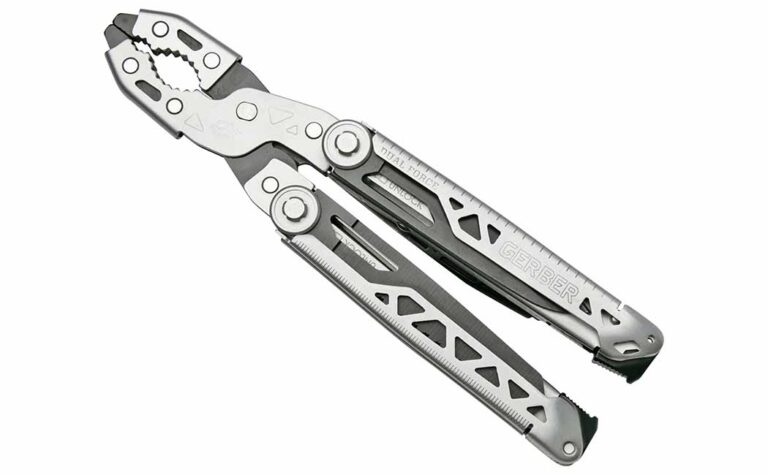
The multi-tool is beloved by many for its flexibility and ability to be useful in many situations. Gerber Gear has ripped up the book on the multi-tool and reinvented the genre with the 12-tool Dual-Force. 

It is a monster. The Dual-Force is similar to other multi-tools in terms of the implements within it, but the strength level has been ratcheted up. The screwdriver and saw are beefier than in a Swiss Army knife. The driver is 3.25 inches and features Center-Drive tech so it feels and operates like a standard driver.

The Dual-Force has a dozen different tools.

The tool also includes a 3.25-inch plain-edge blade, which rivals that of many standard pocketknives. 

But the star of the show is the pliers. There are so needle-nose pliers here. The Dual-Force features a robust set of jaws with a twin-position dual-lock design and large teeth for more control. The jaws dwarf the pliers offered on most other multi-tools. 

The Dual-Force brings the quality you expect from Gerber Gear and an innovative design that makes it stand apart from all the other choices on the market today. MSRP: $110.

Editor’s Note: This post was written by Mike Ableson.

Read More

 

10 All-American Knives

On This Independence Day We Here At Blade Want To Celebrate All-American Knives

America is celebrating its 246th birthday today. In all those years the knife has been an integral tool to the growth of the United States, and, as such, we here at Blade want to celebrate it on this beautiful Independence Day.

These are 10 beautiful All-American knives to get you in the holiday spirit.

MTech USA 440 Steel USA Design Pocket Knife

MTech USA 440 Steel USA Design Pocket Knife

The name may be a mouthful, but the knife is a beaut. MTech has made a spring-assisted folder out of 440 stainless with an aluminum handle. The handle is decorated with an American flag design and the opening text of the Constitution. This drop point has an MSRP of $15.95.

Berg American Flag Themed Bowie Knife

Berg American Flag Themed Bowie Knife

Custom-made to order by knifemaker Dan Berg, this Bowie is 11 inches long and can be made out of 1095 carbon steel or AEBL stainless. The metal is etched with a patriotic star pattern and the handle has a flag pattern made out of Micarta or cast resin. This beautiful knife has an MSRP of $300.

Mega Knife American USA Flag Spring-Assisted Folding Open Pocket Knife 

Mega Knife American USA Flag Spring-Assisted Folding Open Pocket Knife 

A bright, bold American flag on the handle shines bright on this piece from Mega Knife. The stainless steel blade features a blackwash finish, and the pocket clip lets you bring this knife everywhere. This folder has an MSRP of $19.95

CobraTec Knives Small  CTK-1 Cerakote American Flag

CobraTec Knives Small  CTK-1 Cerakote American Flag

This CobraTec double-action OTF knife featured a striking American flag handle made of aluminum alloy married to a 2.75-inch D2 steel blade. You can pick between four different blade styles (drop point, tanto, dagger, Wharncliffe), and all but the Wharncliffe have serrated options as well. It features a nylon sheath, pocket clip, and a glass breaker at the end of the handle. This comes with an MSRP of $149.99.

Modern Artisans 3-Inch Pocket Knife With American Flag Stonework

Modern Artisans 3-Inch Pocket Knife With American Flag Stonework

This 3-inch folder from Modern Artisans has a stunning damascus blade made of a core of VG-10 wrapped in 32 layers of stainless. The brilliant American flag handle is made from lapis lazuli, red coral, and mother of pearl. This knife has an MSRP of $132.99.

Victorinox Super Tinker

Victorinox Super Tinker

From the makers of the famous Swiss Army Knife, Victorinox has made an All-American medium pocket knife that has the option of an American flag design and not just the classic red. It features 14 tools including two blades, three screwdrivers, and scissors. It has an MSRP of just $43.99.

Orklo Knife Custom Handmade Damascus Folding Pocket Knife

Orklo Knife Custom Handmade Damascus Folding Pocket Knife

The twist damascus pattern steals the show for this model from Orklo Knife. The three-inch, HRC 55-58 blade is connected to a four-inch red, white, and blue handle made of dollar sheet and inlaid with a star mosaic pin. This piece has an MSRP of $69.99

Cabela’s Flag Tanto Blade Folding Knife Two-Pack

Cabela’s Flag Tanto Blade Folding Knife Two-Pack

Two knives are always better than one, and Cabela’s has an affordable patriotic combo pack. Both knives have blades made of 8Cr13MoV steel. The larger blade is three inches long and partially serrated. The shorter of the two is 2.75-inches long and features a flat edge. The combo has an MSRP of $19.97.

KCCEdge 8-Inch Two-Piece Large American Flag Throwing Knife Set

KCCEdge 8-Inch Two-Piece Large American Flag Throwing Knife Set

For something fun, you can go wrong with these throwing knives. These KCCEdge knives feature a top-to-bottom flag design that was embossed printed on the blades. What could be more fun than watching Old Glory fly through the air? These could be yours for the MSRP of $14.

Red Dot Laser Engineering “The Patriot” Folding Knife

Red Dot Laser Engineering “The Patriot” Folding Knife

Red Dot Laser Engraving, a veteran-owned business, has made a stainless steel folding knife with an American flag engraved on both sides of the blade and an aluminum body. The design won’t wear off so you’ll be able to proudly show it off for decades. The MSRP is $17.76.

ASR Outdoor Patriotic Locking Pocket Knife

ASR Outdoor Patriotic Locking Pocket Knife

Adorned with the head of a bald eagle on the handle and atop the the American flag on the handle, this knife from ASR Outdoor screams American pride. The steel alloy clip point opens with a nail nick, and the whole piece is eight inches in length. It also comes with a collectible display box. The MSRP is $14.99

Advertisement

Must Read Articles

Read this before you make a knife

Knifemaking 101 – Read This Before You Make a Knife

  by Wayne Goddard My experience has taught me that there's nothing like digging in and getting started. I've often said the hardest part of the...
how to forge damascus steel

How to Forge Damascus

Advertisement
Advertisement