

What is a Drawknife? Three Examples

Whether for bushcraft, carving, or just straight woodworking, drawknives are handy tools that range quite a bit in size, function, and style. There are large drawknives to peel bark or hew small logs, as well as models for specialty purposes such as coopering or making chair seats. There even used to be specialty drawknives for shaping round handles small in diameter for brooms, rakes, and other implements.

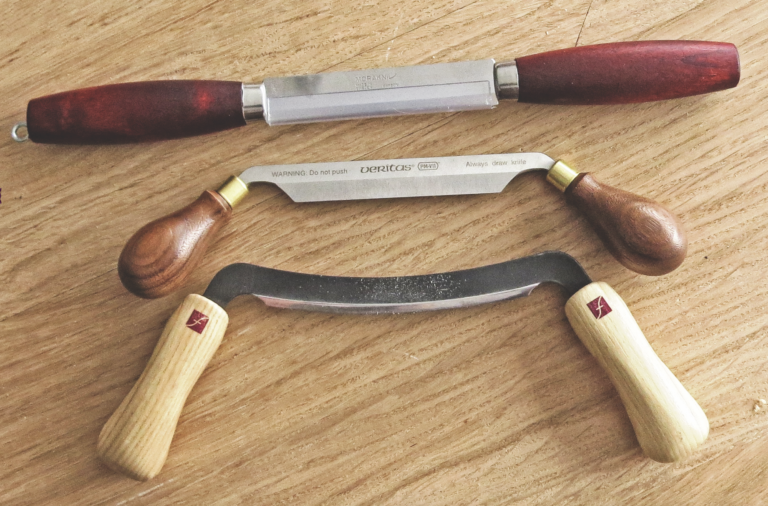
Three small drawknives for carving and crafting are the focus this time: the MoraKniv Classic wood splitting knife, Flexcut Drawknife, and Veritas Drawknife. They are great because they are relatively compact and portable, and help comprise part of what you could call a portable rustic tool kit.

DUAL BEVEL

I know, right off the bat the MoraKniv Classic is called a wood splitting knife and not a drawknife. I thought this model would be interesting to test because it departs from the regular one-bevel blade geometry. The handle positioning is straight, giving the tool a compact configuration for transporting. It also comes with a sheath.
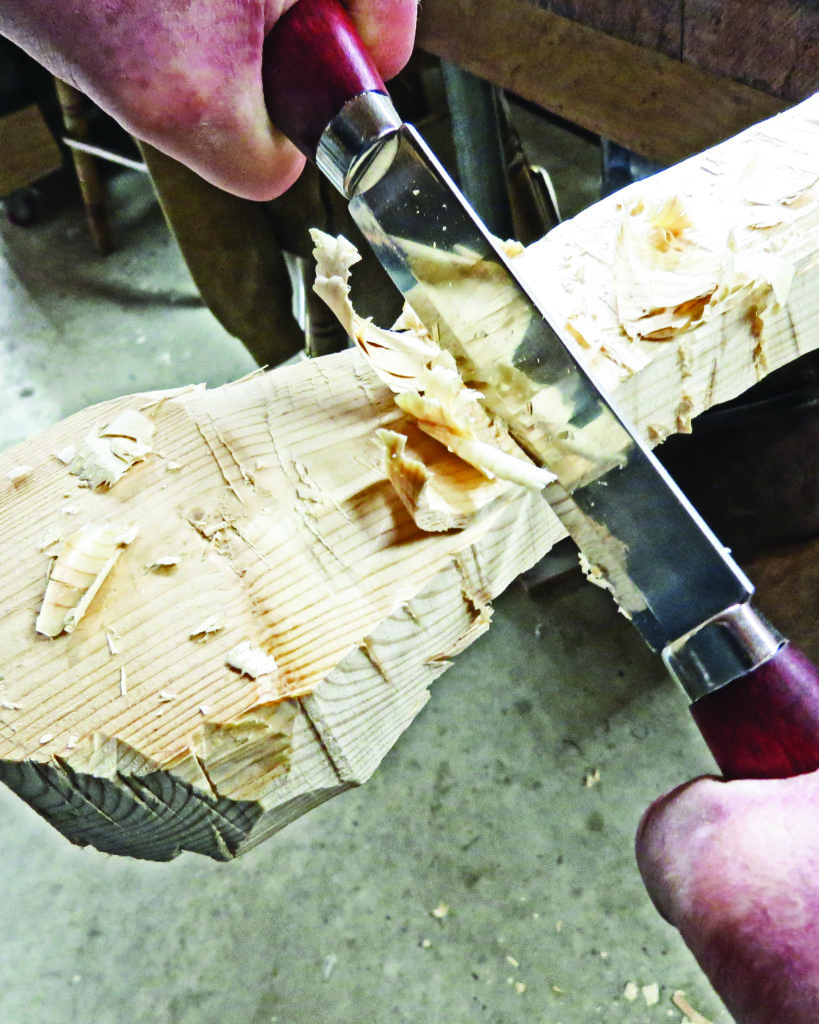
The author uses the MoraKniv Classic wood splitting knife in a push-cut motion to perform a stop cut while contouring the grip on a paddle.

Over the years, I’ve seen many a bushcrafter try and find a way for a standard knife to act as a drawknife. You can do many bushcraft chores with the MoraKniv Classic, from spoon work to shaping a tenon on a stool leg. You can do some of the same things with a regular knife, but with a drawknife it can be easier.

The 4.5-inch carbon steel blade has a dual bevel. An advantage of such a bevel is it makes the knife more versatile. A disadvantage is you don’t have depth control on a cut like you do with a single bevel. Single-bevel blades provide control similar to using a woodworking plane or a chisel. You shear through the levels you need to and, once you establish your depth of cut, you can remove material without bogging down by using a bit of depth control. Given that the dual bevel is a Scandi grind, it makes control easier than, say, a grind with a micro and major bevels on both sides. Control is most certainly easier than, for instance, with a convex grind. In the end, it is no big deal. Having to control a blade only becomes a problem when its design is not conducive to the job at hand.
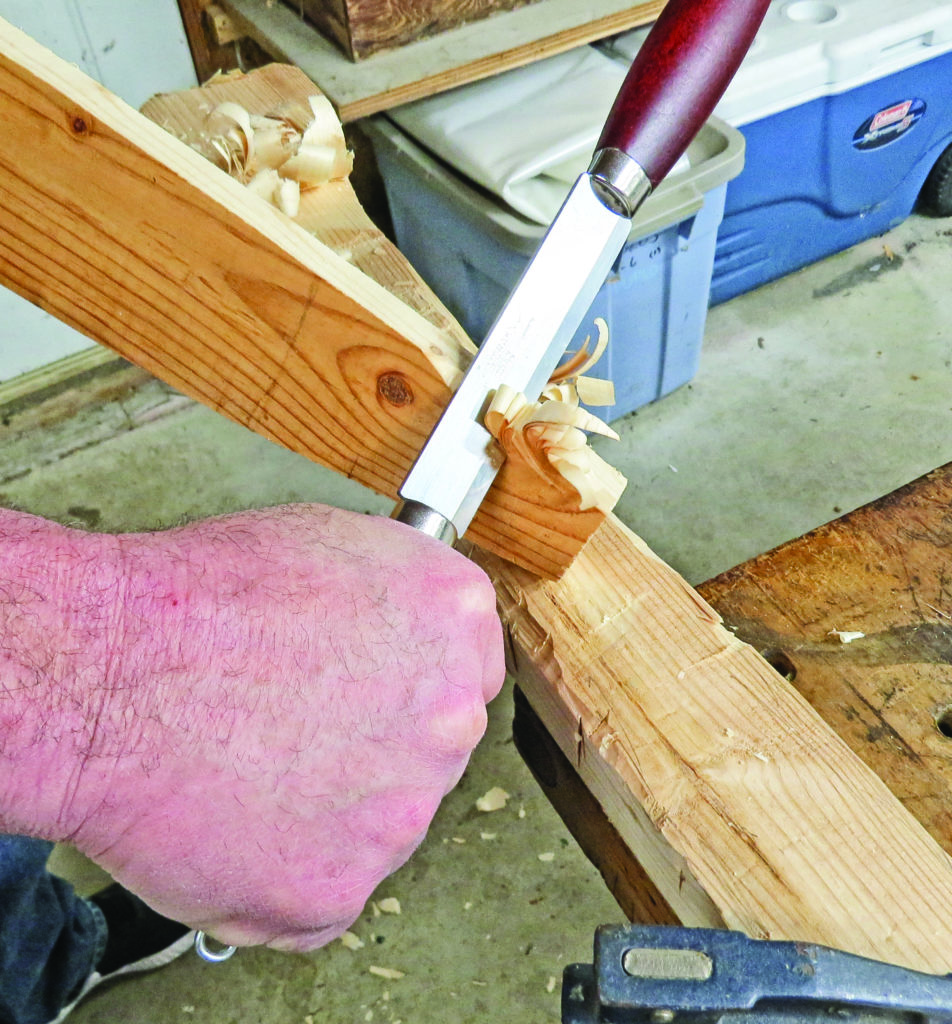
Having in-line handles and a dual bevel, the Mora allows use like a sheath knife. It adds to the tool’s versatility and saves time, as you don’t have to put one knife down and pick up the other.

For the most part, control affects how much energy you put into making the blade do exactly what you want. In the case of a convex-ground blade, if you want to make a long, straight cut at the same depth, you will expend more energy than you should trying to keep the blade from “porpoising” (that is, front to rear bouncing of the blade). The alternative is simply getting used to making shorter controlled cuts more frequently.

The Classic cuts extremely well. Due to the straight handles and dual-bevel blade, you can switch and use it like a sheath knife in a split second.


WESTERN TRADITIONAL

Flexcut has a variety of tools covering chip, relief, and decoy carving, just to name three. The company also has a couple of drawknife styles. The Flexcut Drawknife is more of a traditional Western version. The 5-inch blade is 1095 carbon steel with the bevel brought to a mirror shine.
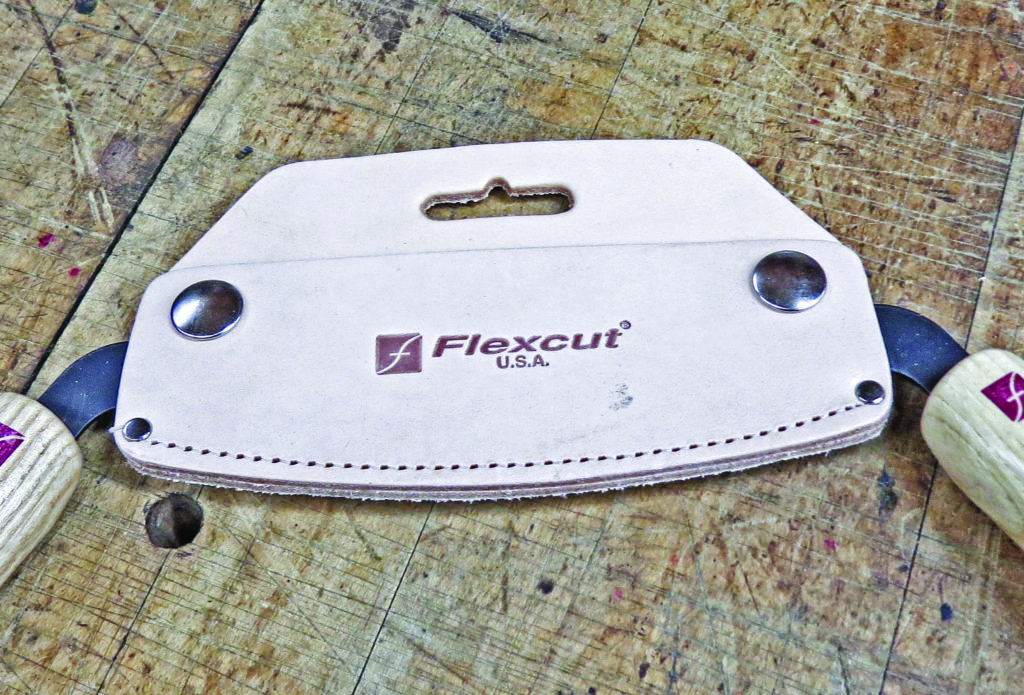
The Flexcut comes with a well-made sheath. It is always nice to have something protecting the edge—if not for safety’s sake, for that of preserving the edge from accidental harm.

Right out of the box, this thing is wicked sharp. It comes in a leather case with a peg-hole loop. It has a curved blade, which gives it a natural tendency to skew in a leading edge cut. If you haul the spine up a bit on your cuts, it will make more of a scraping action for a hollowing effect. It is a thin blade and not suited for hogging off large amounts of wood at one time. It is great for detailed jobs like the subtle contours you might find in a canoe yoke.
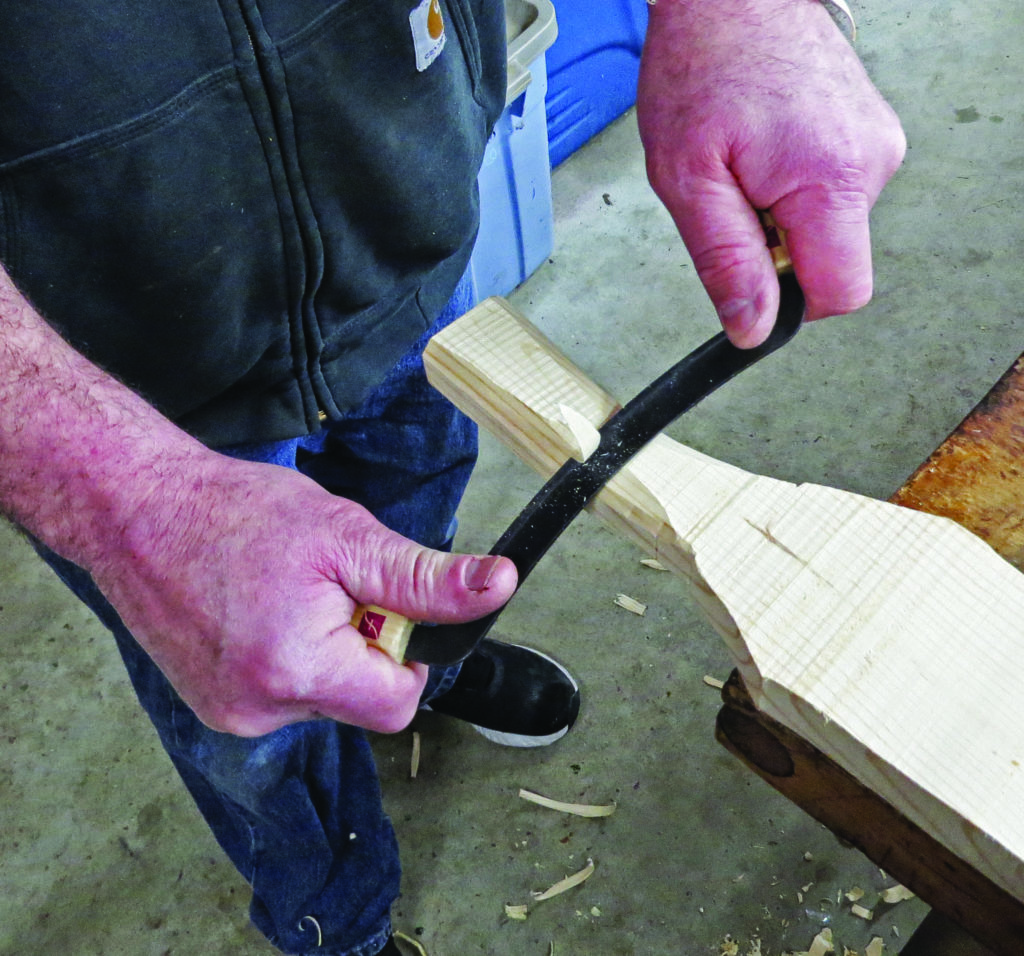
Using the Flexcut Drawknife, the author shapes the handle for a flat-board atlatl. The efficiency you gain using a drawknife is hard to beat for control and energy.

Such a small drawknife is a good tool not only to create art but to make utilitarian items. Given its Western-style handles, it doesn’t make a streamlined package for carrying in a pack like the Mora does, but it still has very little bulk and weight. The arched blade can be sharpened with a flat stone, though I find sharpening it with a small handheld stone and using a dynamic sharpening method easier. The Flexcut Drawknife is the kind of tool that suits the creative mind.

HOB-KNOBBER

The Veritas tool company manufactures the last of the test drawknives in Ottawa, Canada. Sporting a 4-inch blade, it is a small carving-style model. Steel is PMV-11, a stainless with a Rockwell hardness of 61-63 HRC. Veritas made the switch from traditional tool steels like O1 and A2 to up cutting performance and edge retention. A case for the knife sells separately.
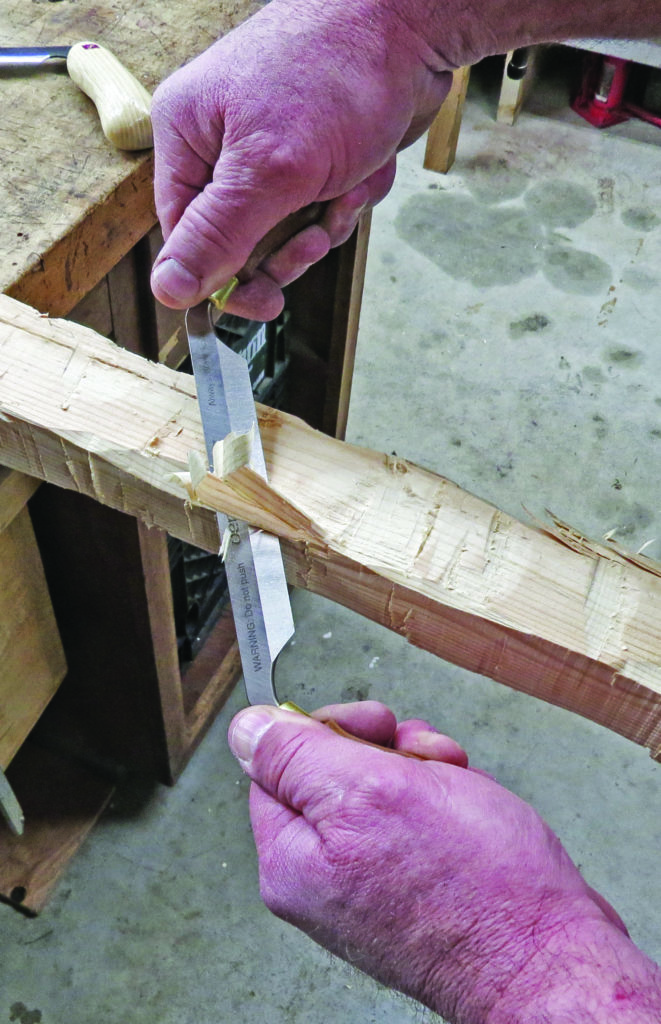
The Veritas Drawknife’s 20-degree angle cuts aggressively and you have complete control with the well-shaped handles. Here the knife is skewed compared to its cutting path. Skewing the knife provides a leading edge to the cut, reducing resistance

The company’s technical information says the bevel is ground at 20 degrees. To sharpen the Veritas, be sure the sharpener is of a flat design. Given the knife’s size, you can sharpen it in either a dynamic or a static style*. To cover/sharpen the entire bevel, you will need a flat surface. There is no micro bevel on the Veritas, though that’s not to say you can’t apply one. However, if you want to keep it original, you will need to cover the bevel.

The angling of the handles is a traditional Western style, though they have more of an elongated knob shape to them. The shape helps reduce fatigue. Because of the handle angling the Veritas does not offer as compact of a carry as the Mora, but the .125-inch-thick blade makes it a bit sturdier user than the
Flexcut. Handle material is torrefied maple. Due to the kilning process, the material has a greater stability to it without the use of chemicals. At the top of each handle is a brass ferrule.
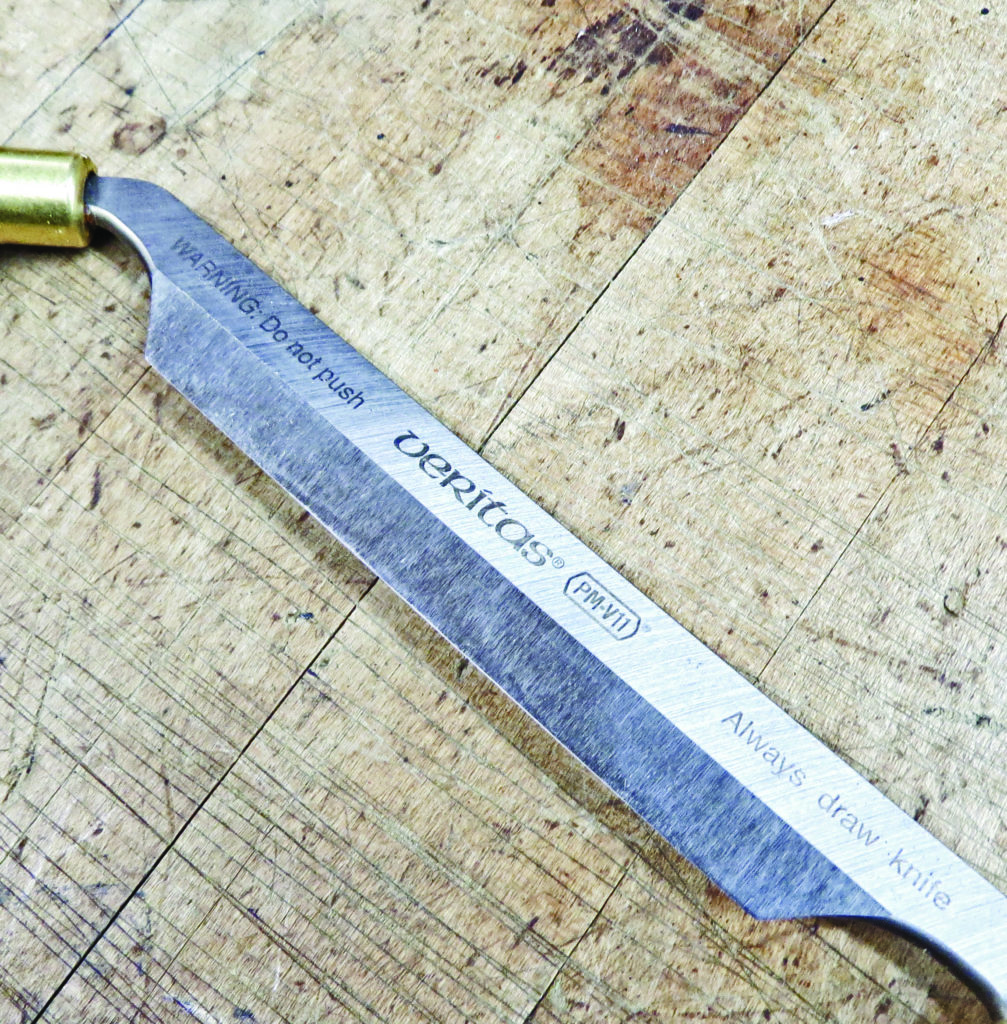
The author stated he has been known to push a drawknife to make a quick cut. The Veritas Drawknife clearly warns not to do that. At a 20-degree bevel, you take a chance of damaging the edge if you were to catch and roll it.

It is a good-looking product and out of the box is ready to work. It is the most expensive of the review knives, yet is not so much more that you wind up scratching your head. A drawknife like this can be put to work doing a number of things limited only by your imagination. Veritas promotes it more as a carving tool and actually shows it making a decoy in the company’s marketing media.

Staying within the bounds of this tool, I can’t think why you couldn’t get chores done or entertain yourself by making pieces of art with it. Keeping you busy in the woods and not necessarily only during a survival situation promotes better mental health. It is a great little package and a good tool—I just think the company could include the sheath. When you hold the knife you see where the extra cost is as the precision work shows in the fit and finish.

EXPLORING OPTIONS

Once you leave the big city behind, in order to thrive you must know how to make what you need. Many of the tools you carry will depend on what you plan on doing. If you’re building up a getaway spot, you might need to build items for the camp. When planning to build a more substantial base, you will need more tools. Again, it all depends on what you plan on doing. A good drawknife can greatly increase your cutting and carving options—not to mention that being able to use two hands greatly reduces fatigue. If you haven’t tried a drawknife yet, I highly recommend doing so.

*Static sharpening is when the stone is stationary, and dynamic is when the stone is moving.
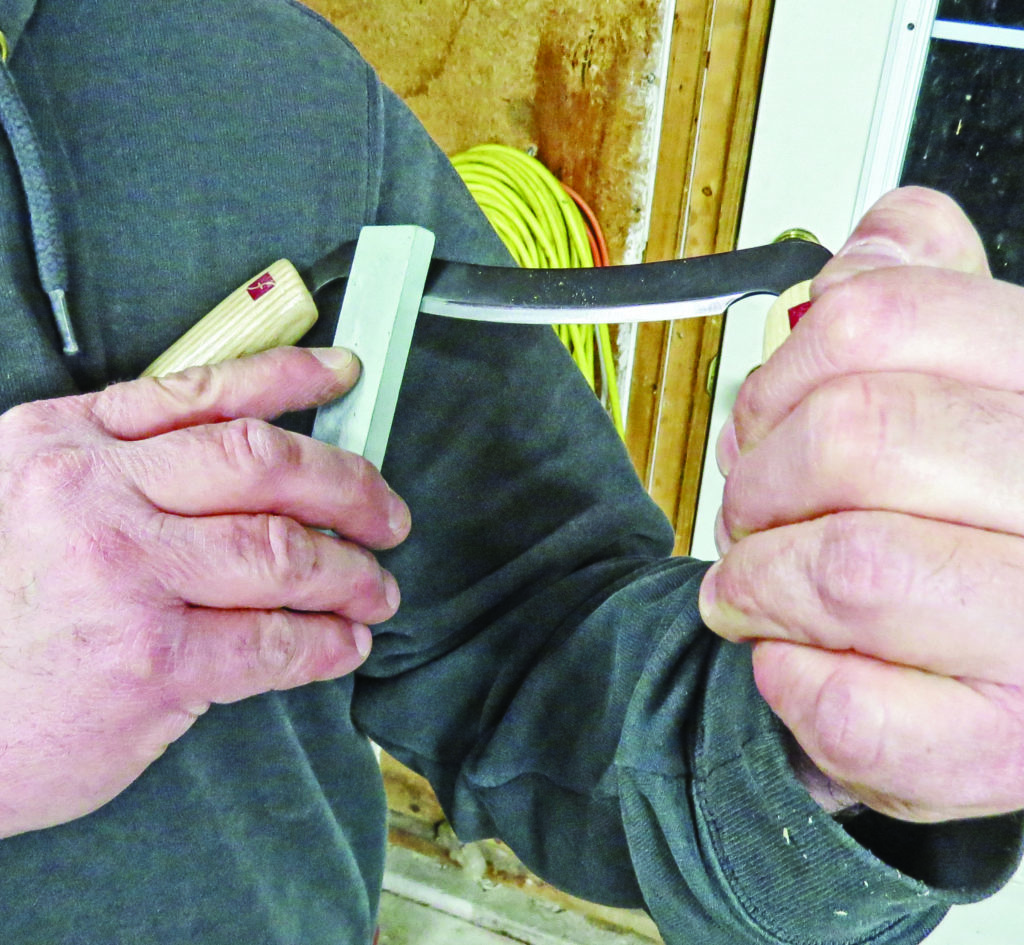
A trick to sharpening drawknives both in the shop and field is to brace one handle against your armpit or chest. After bracing the knife, simply use a dynamic sharpening method with a small stone running parallel to the edge.

The Sea of Mud Knife: James Bowie’s Knife Found? Pt. 2

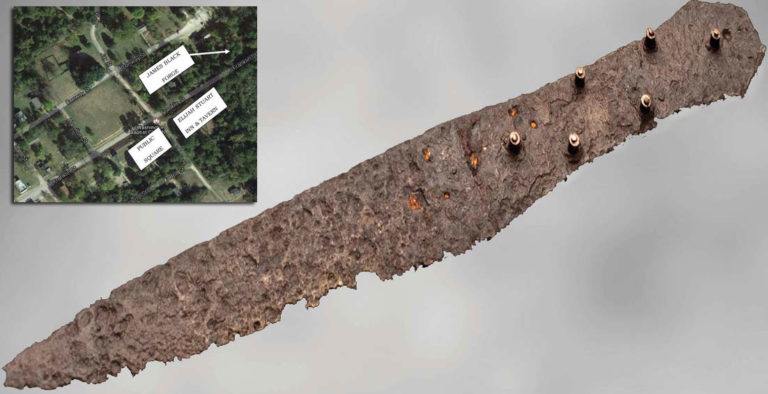
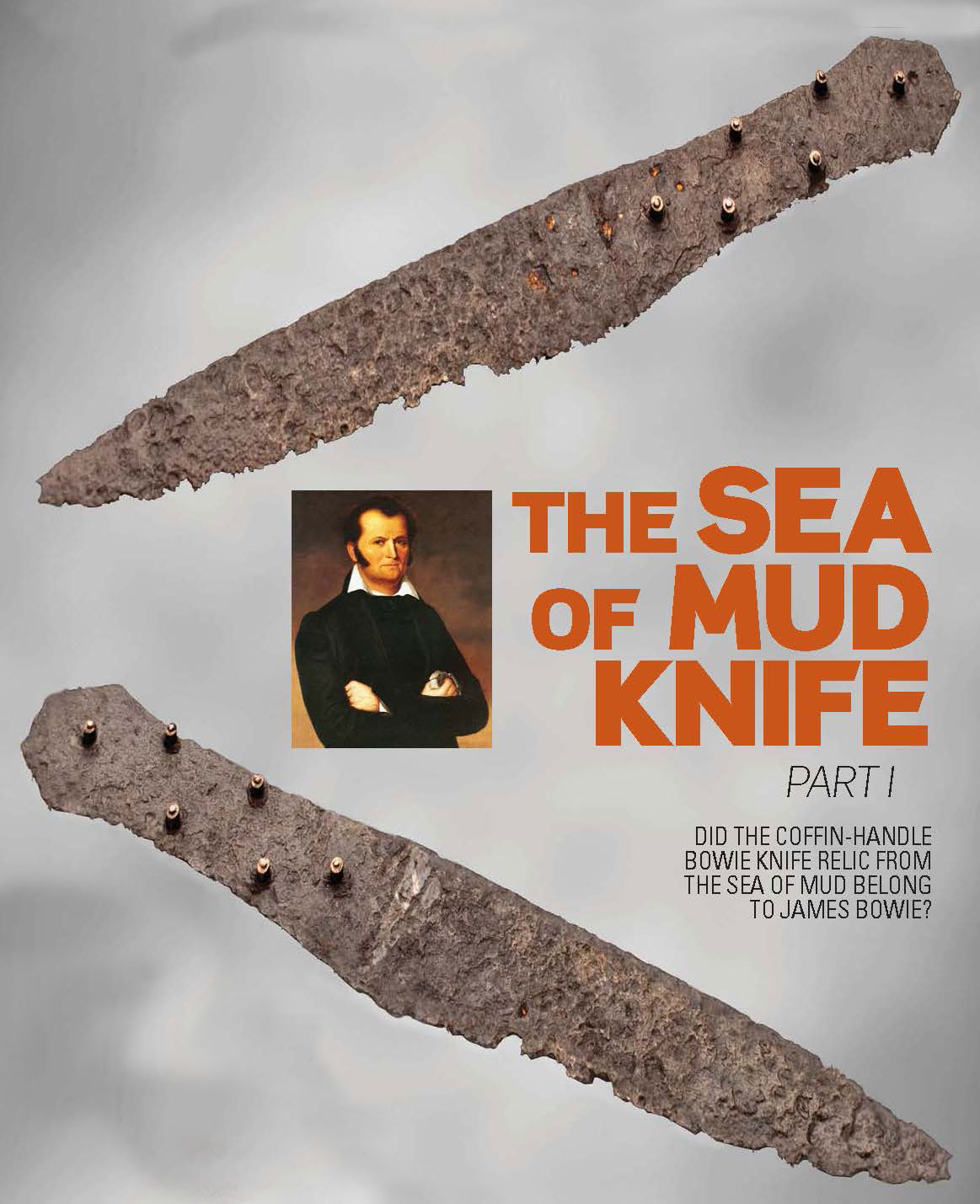
Sea of Mud knife

James Black’s original blacksmith shop was located on Franklin Street, one block northeast of the town square in Washington, Hempstead County of the Arkansas Territory. According to the author, Black made the Sea of Mud Knife. Click image for a larger view. (relic image courtesy of the Cushing Memorial Library and Archives, Texas A&M University Libraries)

Editor’s note: Read the first part of this series about the “Sea of Mud Knife” here.

“Only Men of Means Could Own One”

To acquire a James Black silver-mounted coffin-handle knife similar to how the Sea of Mud Knife originally appeared, you would have had to visit Black’s shop circa 1830 or so. The price would have been high—more than $20, which would be at least 500 in today’s dollars. Only men of means could own one.

There are indications Black made knives that were less ostentatious for the common man. These were tools and as tools were worn out and discarded. Few have survived.

James Black blacksmithing shop

The Pioneer Washington Restoration Foundation built a recreation of James Black’s blacksmithing shop in Washington, Arkansas, in 1960.

Black’s shop was located on Franklin Street, one block northeast of the town square in Washington, Hempstead County of the Arkansas Territory. Black had apprenticed for Stephen Henderson in Philadelphia, Pennsylvania, for at least nine years. Henderson learned the art and craft of making Sheffield silver plate in Sheffield, the cutlery center of England.

He could clad silver sheet to the ricasso area of the blade.

Black had set up his blacksmith shop on his town lot in 1829 after he married Anne Shaw. Black had worked in William Shaw’s shop doing general blacksmithing for five to six years. Black made knives of cast steel, the best steel known at the time from Sheffield. He knew how to heat treat to get the best cutting edge. Back then, most crossroads blacksmiths made knives of inferior steel with hardly any heat-treating expertise. Some were even made of wrought iron. Black’s knives became known for their edge holding, craftsmanship and beauty.

Plaque James Black blacksmithing shop

A cat keeps vigil on the rock pedestal that marks the original 1829-1832 location of Black’s shop (right). The iron plaque on the pedestal gives one version of how the original bowie knife was made. There are other versions, too.

The Southwest Trail

The frontier town of Washington is located on a sand hill in southwest Arkansas on the Southwest Trail. The Southwest Trail, or the Military Road, led from St. Louis, Missouri, diagonally across Arkansas through Washington to Fulton on the Red River. It was only 12 miles from Washington to Fulton. Across the Red River is Texas. In Texas, Trammel’s Trace led to Nacogdoches and to El Camino Royal—and to San Antonio de Bexar and the Alamo.

The Southwest Trail was the major land route from the Northern United States to Texas. You left Washington, D.C., by the National Road to Parkersburg, West Virginia, and boarded a steamboat to the Falls of the Ohio River at Louisville, Kentucky. You crossed the river to New Albany, Indiana, and took a stagecoach to East St. Louis, and crossed the Mississippi River to the Southwest Trail. You could also go by steamboat down the Mississippi River and up the Arkansas River to Little Rock and down the Southwest Trail.

Three other roads intersected at Washington. The road due west led to Fort Towson in the Indian Territory above the Red River and the ferry crossing into Jonesboro, Texas. A road led due east past Nick Trammel’s Tavern through Camden to Gaines Landing on the Mississippi River in Chicot County, Arkansas. Trammel’s Trace, the route in Texas to Nacogdoches, originated at Trammel’s Place and crossed the Red River at Dooley’s Ferry below Fulton. The other trail led south to Natchitoches, Louisiana, and to Texas.

From 1832 to 1834 most of the Choctaw Nation was removed from Mississippi and Alabama down the Southwest Trail from Little Rock, or from Gaines Landing across the Mississippi River from the Choctaw Trail, which intersected the Natchez Trace in Mississippi. From Washington they proceeded down the Fort Towson Road to Doaksville, Oklahoma, one mile west of Fort Towson.

Black’s Shop Visitors

Two struggling young lawyers from Logan County Kentucky who died at the Alamo, Daniel William Cloud, 21, and Peter James Bailey III, 26, passed by Black’s Shop in the fall of 1835 on their way to Texas. Could they have bought the Sea of Mud knife from Black? They had headed to Illinois where they heard there were more clients.

However, they found the weather too cold, the fees too low, and the “Yankee Lawyers” too active. They went down the Southwest Trail in Missouri and found the same thing. So they went further south through Arkansas to the Red River. From there they took the road to Natchitoches, Louisiana.
James Black blacksmithing shop

The sign outside the recreation of James Black’s blacksmith shop carries the year 1961. According to at least one other source, the recreation was built in 1960.

On Dec. 29, 1835, near Natchitoches, Cloud wrote his brother a letter describing his trip to Texas:

“We found Arkansas Territory in some places rich, well watered and healthy and society tolerably good, but the great body of the country is stony, sandy, and mountainous, in passing through, we traveled ten days constantly in crossing the mountains.

“On Red River the lands were immensely rich, and planters also, many of them worth two and three hundred thousand dollars. Had we chosen to locate in Arkansas, we could have made money rapidly if blessed with health and life; dockets and fees being large.

“The reason for our pushing still further on must now be told, and as it is a master one, it will suffice without the mention of any other one. Ever since Texas has unfurled the Banner of Freedom, and commenced warfare of liberty or death, our hearts have been enlisted in her behalf. The progress of her cause has increased the ardor of our feeling until we have resolved to embark in the vessel which contains the Flag of Liberty and sink or swim in its defense.”

An Englishman, George William Featherstonhaugh (pronounced “Fenshawe”) came down the Southwest Trail through Washington in late November or early December 1834.

He writes in his journal, Excursions Through the Slave States of North America:

“And we made an agreeable excursion in the neighborhood, calling for a short time at the little insignificant wooden village of Washington, where the government land sales were holding.

“I was not desirous of remaining long at this place. General Houston was here, leading a mysterious sort of life, shut up in a small tavern, seeing nobody by day and sitting up all night … There were many persons at this time in the village from the states lying adjacent to the Mississippi, under the pretense of purchasing government land, but whose real object was to encourage the settlers in Texas to throw off their allegiance to the Mexican government.”

Sam Houston was back from his peacemaking journey among the Texas Indians. He was staying at Elijah Stuart’s Tavern that was next to Black’s shop on one side and the town square on the other.

Plantation Bound

“It was a charming sunny day, the thermometer (Dec 11) stood at 74 degrees out of doors, and not a cloud in the sky,” Featherstonhaugh wrote.

The Englishman crossed the Red River at Dooley’s Ferry into what the ferryman called “Spain.” After three or four miles, Featherstonhaugh came upon a dry and black land called Lost Prairie, “a tract of about 2,000 acres of incredible beauty and fertility, bearing extraordinary crops of cotton, and gracefully surrounded by picturesque woods.”

James Black Judge Buzzard bowie knife history

After James Black (believed to be at left in the above vintage daguerreotype) lost his eyesight, Dr. Isaac Newton Jones tried to restore it circa 1840. Around the same time, Black went to live with Judge Jacob Buzzard (believed to be at right) on Buzzard Bluff southeast of Dr. Jones’ plantation.

He rode to Dr. Isaac Newton Jones’ plantation and spent the night. After a short stay exploring this area of Texas, Featherstonhaugh returned to Little Rock upon his steed, Missouri, loaded down with bundles of Texas treasures. He then went to New Orleans by steamboat.

The Jones plantation is located about 3.5 miles south of Fulton in Miller County, Arkansas. In 1835, Lost Prairie was in the Texas province of Mexico but was also claimed as part of the Arkansas Territory. Arkansas Gov. Daniel Webster Jones was born on the plantation on Dec. 15, 1839.
Southeast of the Jones plantation is Buzzard Bluff, home of Judge Jacob Buzzard. In about 1840 after James Black had lost his eyesight, Black lived with Jacob Buzzard on Buzzard Bluff. Buzzard died in 1842.

Meanwhile, try as he might, Dr. Isaac Newton Jones could not restore Black’s eyesight. However, he took Black into his home and cared for him.

After Jones died in 1858, his wife and the Jones’s son, Daniel Webster Jones, cared for Black until Black’s death in 1872. Daniel penned the definitive story of Black’s life in 1902. In that story he wrote: “About 1833 or 1834, perhaps earlier, James Bowie came to Washington and gave Black an order for a knife …”

Read part three of this series here.

Keep Learning About Knife History

BLADE magazine back issues

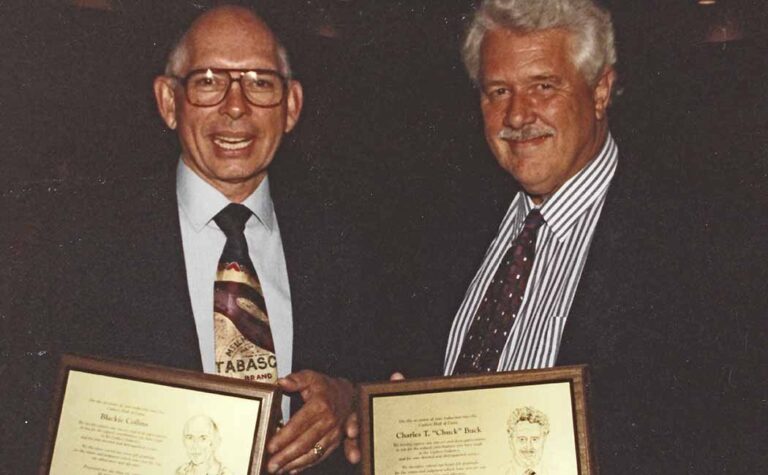
Walter “Blackie” Collins: Applying The Edge To BLADE Magazine

0

Blackie Collins brought The American Blade to an audience thirsting for knife news.

Editor’s note: This year marks BLADE®’s 50th anniversary. In recognition of that milestone, we are presenting a series of stories celebrating our half-century birthday. This time, how Blackie Collins founded the magazine then known as The American Blade.

Whether designing a new knife, making a knife of his own creation, flying along on a motorcycle—or starting a magazine—BLADE Magazine Cutlery Hall-Of-Fame® member Walter Wells “Blackie” Collins was a risk taker.

Fifty years ago, Blackie spearheaded the first issue of The American Blade, the original name of today’s BLADE® Magazine. It’s unlikely he ever thought his creation would endure as it has, or that it would grow to become the World’s No. 1 Knife Publication. But back then, the time was right to give it a try.

“I was in business with a friend of mine buying and selling knives, and Blackie would supply us with cutlery. He was an excellent custom knifemaker,” remembered Roger Aiple of New Orleans. “He was a close friend and you might say he was thinking about producing a magazine. He asked me what I thought about it, and, knowing Blackie and his dedication to knives, I said it was a great idea but that producing a magazine was not the easiest thing in the world.”

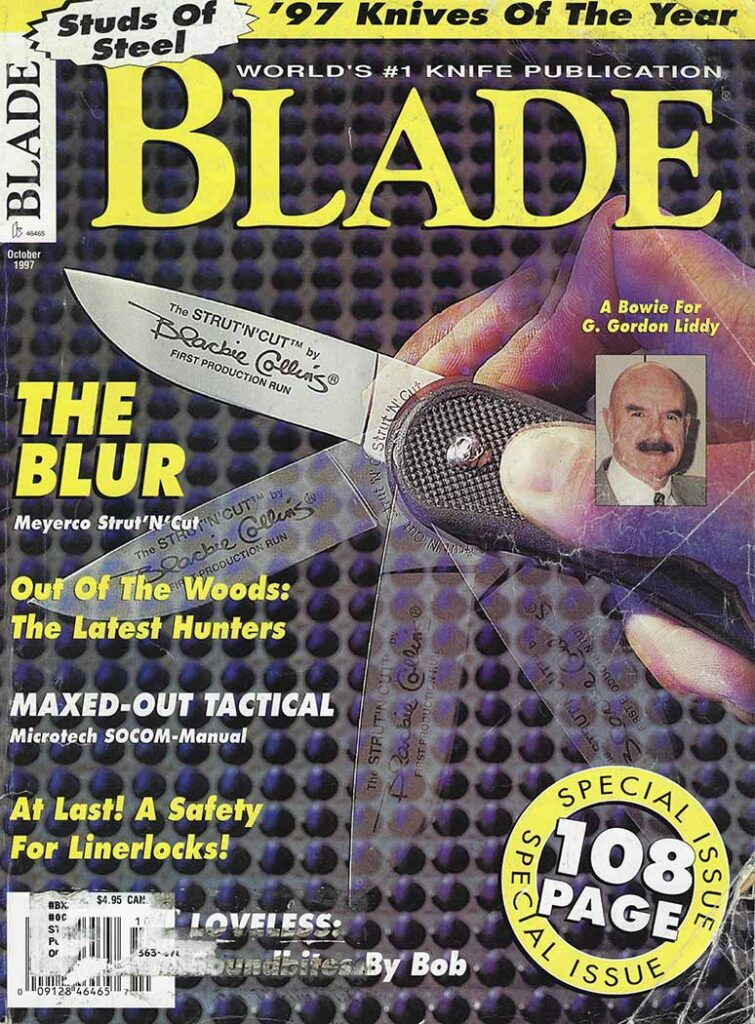
Blackie Collin's Knife on cover of blade
Blackie Collins loved motorcycles, including those by Ducati. In fact, he based the opening mechanism of his revolutionary Strut’N’Cut assisted-opening knife (inset gracing the cover of the October 1997 BLADE®) on the Ducati’s single-strut suspension system. He was killed in a motorcycle accident on July 20, 2011, at the age of 71.

Aiple introduced Blackie to Mal Mele and Sonny Molenaar, the owner of Molenaar Printing Company, in nearby Metairie, Louisiana, and the three men worked out a deal. Apparently, Mele and Molenaar were willing to share some of their insights on how magazine production worked, including printing, distribution, and other nuts and bolts items. Then, of course, there was editorial content to produce, copy to be written, and photos to be taken and reproduced for the new publication.

Blackie devoted energy and ideas to The American Blade, and there were two very good reasons for his drive to see the magazine concept become a reality. “Can you think of a better way, if you’ve got knives or knife designs, to get with other knife companies and everybody in the business?” reasoned Susan Collins, Blackie’s sister-in-law and wife of his brother, Michael. “The American Blade opened the door for him to walk into a shop or factory and say, ‘Let me do an article on you or on this or that subject.’ Blackie knew everybody, and it helped to make him very successful and Michael, too.”

While Blackie was putting The American Blade together, Michael was working away in the brothers’ shop. He knew Blackie was up to something but wasn’t sure exactly what was going on.

“I was working on knives and grinding blades, and he wouldn’t tell me what he was doing,” Michael smiled. “It was a surprise to me, but he got it done and it turned out well. Sometimes Blackie would do things and people would wonder why. He did a really good job of putting the magazine together and getting it published, and I sat back and watched it happen.”

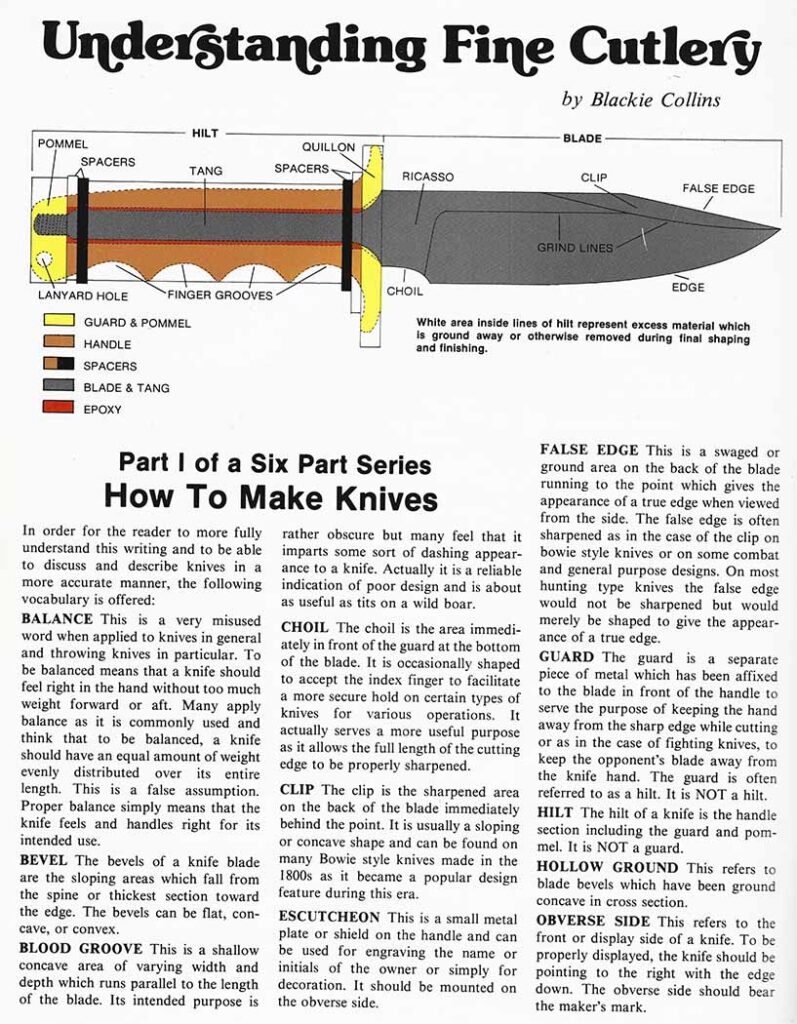
Blackie Collins article
Blackie Collins wrote a series for the magazine titled, “Understanding Fine Cutlery,” and did his best to spread the good word of how to make knives, providing tips and pointers to up-and-coming makers.

Michael related that the two knives that graced the first cover of The American Blade were both his creations. After all, something had to go on that first cover, right? “He would set his mind to something, and that is what he was going to do,” Michael said of his industrious brother. “Sometimes, he would go a while before he would tell you what he was doing.”

Voice Of American Knifemaking

Cutlery Hall-Of-Famer Bill Adams, owner of long-time knife retailer Atlanta Cutlery for many years, was responsible in large part for the excitement that surrounded the knives of Sheffield, England, in the magazine in the early to mid-1970s. Sheffield was a center of knife production in Europe, and the quality of its cutlery was unsurpassed in the factory setting from the late 18th century until the early 20th century. After Bill put in long hours and travelled to Sheffield to search through the old local knife factories and make some key purchases, he had become an authority on Sheffield knives and co-wrote/wrote two articles on the topic in the first two issues of The American Blade. He later advertised Atlanta Cutlery in the magazine, too.

“There was something happening back at that time, and I thought The American Blade was an important development in the knife field,” Adams explained. “Up to that time, there was practically no news or information about custom knives, factory knives, sales outfits, or anything else if you were interested in collecting. Seems like I did write some articles for the magazine, and we probably swapped payment for advertising.”

Adams was right. There was something happening in the knife world in the 1970s, and The American Blade made information available to an ever-widening readership. Longtime knife-and-gun writer and one of the founders of the American Bladesmith Society, Cutlery Hall-Of-Famer B. R. Hughes, once said, “In the latter part of the 1960s, A.G. Russell supplied me with a list of all the custom knifemakers he knew at that time. There were 21 names on the list. The American Blade appeared in 1973, and there are literally thousands of known makers in America today. This is due primarily to BLADE’s features on knifemaking, prominent knifemakers, techniques, materials and the like, as well as information on knifemaking schools and expositions. This dramatic explosion of custom makers would never have occurred without BLADE.”

Walter and Jane Collins
Jane Collins (right) said Blackie read and wrote constantly, and it was not unusual for him to stop his motorcycle on the side of the road or to get up in the middle of the night to write down an idea for a knife design or knife project.

And the big idea for The American Blade belonged to Blackie Collins. The magazine debuted with the May-June 1973 issue, and soon enough there was a buzz building up among knife people. Some of the most recognized custom makers in the industry were appearing with regularity in the pages of the magazine. D. E. Henry and Cutlery Hall-Of-Famer Bill Moran were members of its “Board of Editors,” while Bob Dozier made a knife that was given away in one issue to a lucky winner, a Mr. T. L. Cox of League City, Texas. Dozier, Moran, Lloyd Hale, Ted Dowell, Pat Crawford, Chubby Hueske, Herman Schneider, Cutlery Hall-Of-Famers Bob Loveless, Ron Lake, Buster Warenski, Wayne Goddard and Billy Mace Imel, and a host of other great custom makers were featured in one way or another in the succeeding issues. Dowell, Michael Collins, John Nelson Cooper, Jim Small, and Hueske also contributed giveaway knives that generated quite a swirl of excitement among early readers.

Bringing Knifemaking To The Masses

Blackie wrote a series for the magazine titled, “Understanding Fine Cutlery,” and did his best to spread the word on how to make knives, providing tips and pointers to up-and-coming makers. “There were a lot of people who wanted to learn how to make knives,” recalled Jane Collins, Blackie’s wife. “He had written a book about how knives are made, and he wanted to put the magazine out there to help new makers, too. It was so everybody could learn from it. He had learned from other people, and other people had learned from him.”

Jane remembers Blackie’s drive and commitment to various projects throughout his life, and The American Blade was an all-consuming endeavor for a while. “It caught on well. He was a writer, and he wrote and read constantly. He had the most interesting way of thinking about stuff,” she recalled. “He might be riding a motorcycle and have something come to mind and stop and write it down with a pencil and paper he carried. Sometimes, he woke up in the middle of the night and would run out to the workshop to make notes.”

Blackie always seemed to have a formula to make something go. His dedication to The American Blade in those early days was as intense as his new knife designs that always seemed to be in high demand.

“The magazine was such a good idea then because of our love of cutlery,” Roger Aiple observed. “We knew all of those first custom knifemakers, and the magazine was intended to promote knives. Blackie didn’t have any idea how to publish a magazine back then, but when I introduced him to Mal and to Sonny, they worked it out and helped him get it printed to start things.”

Soon after The American Blade got off the ground, Blackie must have felt that old familiar tug to move along to some new project. He had been listed on the magazine masthead as managing editor, editor and publisher, and of course, he had written articles as well. Some of the details from those days gone by have literally been lost to history, but it is safe to say that Blackie’s energy got things going, gave the publication the push that it needed, and set the stage for something that would have a far-reaching impact on the knife world.

Knife designed by Blackie Collins
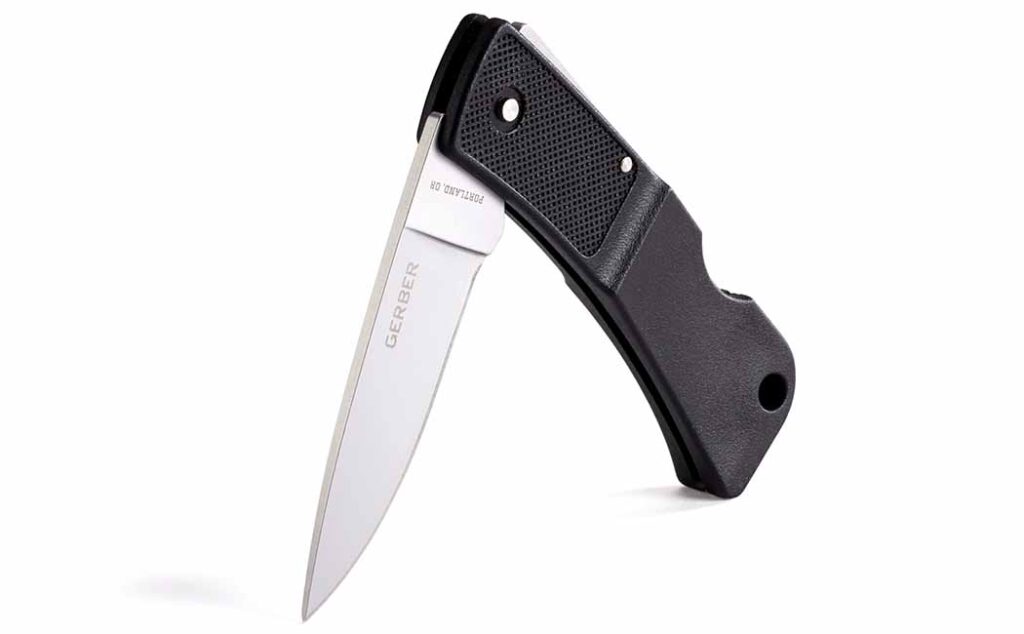
Blackie Collins designed the Gerber L.S.T. (1983), the first knife ever to have a handle of glass-filled nylon.

“Blackie was the kind of guy that would put things together, make some money and move on,” Aiple observed. “He was a great custom knifemaker, but his heart was in designing knives and having someone else make them. He did sell the magazine. I think he had gotten tired. It was taking up too much of his time, and it does take a lot of time to put a magazine together, writing articles, getting advertising, having photos prepared.”

Blackie resigned from The American Blade within months of the magazine’s launch, and an announcement ran in the November-December 1974 issue. The new editor, William L. Cassidy, noted that his predecessor was moving on and commented on Blackie’s important role in establishing a solid foundation and tapping into the knife community so well. “Blackie is, after all, the fellow who began this magazine—who lived with it through triumph and failure alike—and for this we all certainly owe him a debt of gratitude,” Cassidy wrote.

Blackie worked on the first seven issues of The American Blade in 1973-74. He saw his creation grow and prosper, becoming the icon in the knife publishing world that it is today. After half a century, BLADE’s staying power is proven. It still delivers on the desire of its founder to spread the good word about knives, and its message is as enduring as one of Blackie’s great knife designs that so many people have carried and used with pride through the years.

Read More On BLADE Magazine And Show:

Folding Knives: 4 Unusual Opening Mechanisms

weird knives
Here are four folding knives that employ unusual opening mechanisms.

“Cool Factor”

Some knives have a “cool factor” that makes your eyes pop out. Whether sporting creative designs, spine-tingling handles and blade shapes or—in this case—ingenious mechanisms, such knives always have that special something which sets them apart.

odd knives
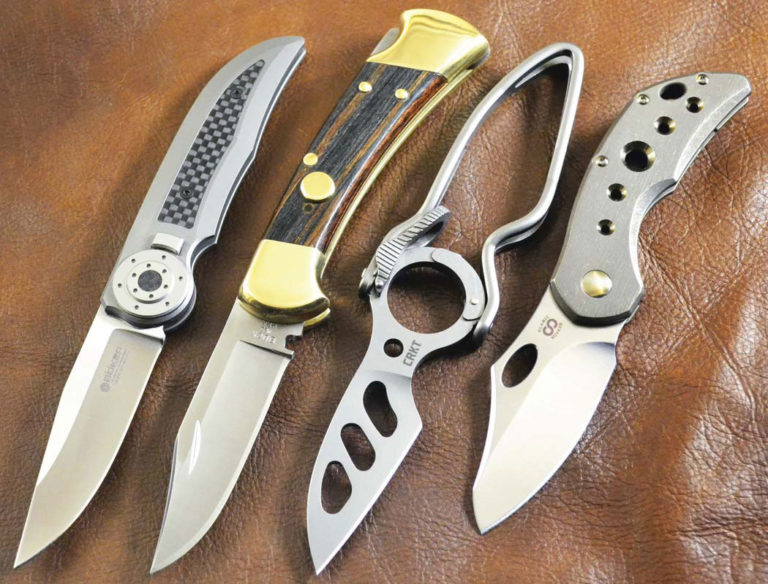
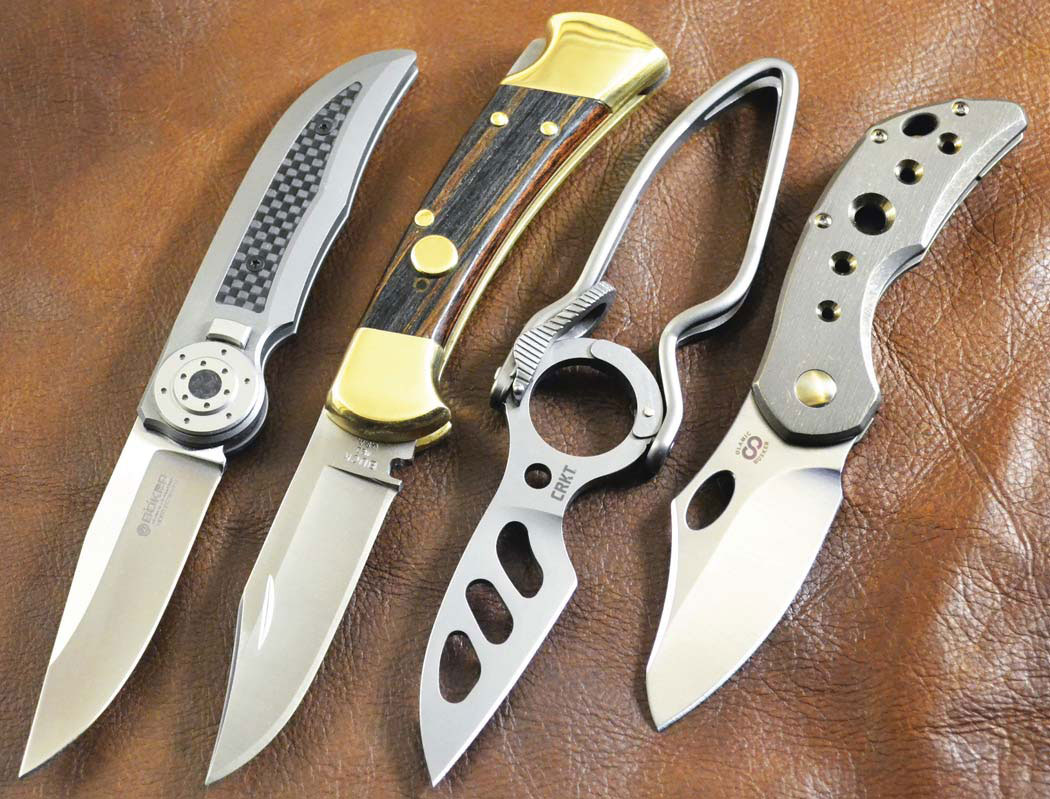
Cool can be anything from a notable mechanism to a standout design. From left: Boker Tucan, AIK Buck 112 Ranger Double-Action Auto, CRKT Daktyl and Olamic Busker Semper.

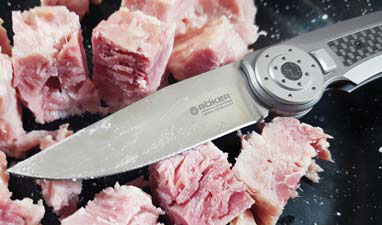
Boker Tucan


boker tucan knife review
The Boker Tucan is a stately looking folder, but its 3-inch blade of Bohler N690 stainless
steel is all business.

Boker’s sleek Tucan would be cool on its design alone, but designer Wilfried Gorski’s innovative blade-release mechanism puts the folder over the edge. A slide release just below the oversized pivot pops the blade out of the frame so it can be opened manually, and the release also serves to deploy the blade. Simply thumb it down and the blade is ready to fold into the frame.

Everything about the Tucan is upscale, from its stealthy 3-inch Bohler N690 stainless steel clip-point blade to its beautifully sculpted 3.875-inch titanium frame with carbon-fiber inlays.

There is no pocket clip but no matter—the Tucan is meant for loose pocket carry. At a weight of 2.82 ounces that is not a problem.

MSRP: $339.


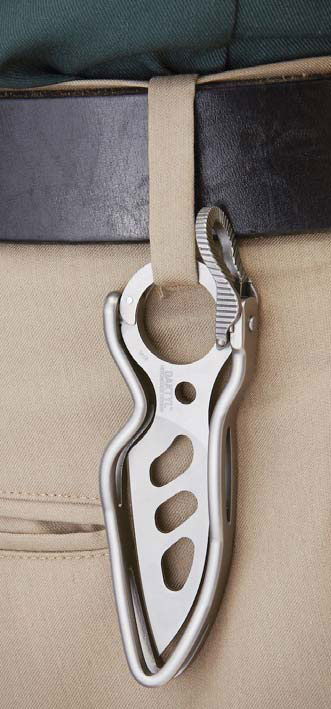
CRKT Daktyl

CRKT Daktyl folding knife
(CRKT image)

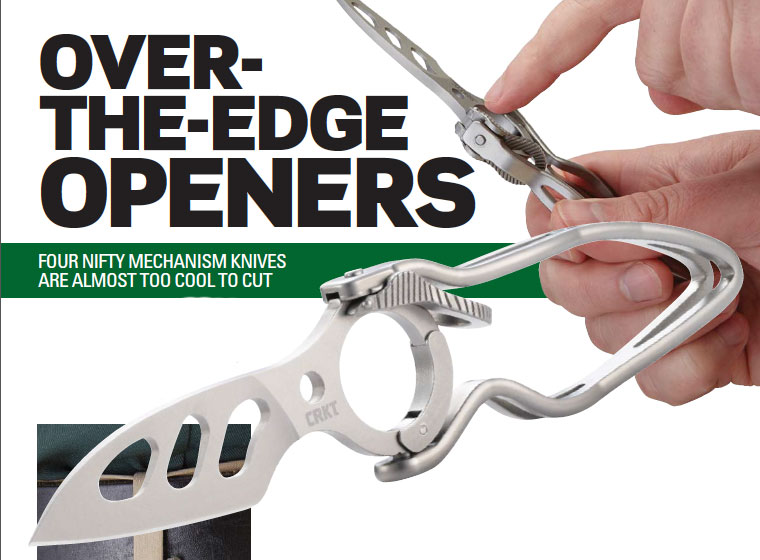
The CRKT Daktyl is a revised version of the Tom Hitchcock “Hole In One” design.

Every bit as enigmatic as the original, if not more, the Daktyl has a 3.05-inch 420J2 stainless steel blade that rotates out of a 4.42-inch wire-frame handle.

The fun begins trying to figure out how to release the blade via Hitchcock’s Slide Lock mechanism, which requires sliding and tipping back the thumb lever.

Once you get the hang of it the Daktyl is pure fun and will amaze your friends. The modified wharncliffe blade has cutouts for lightening and a round carabiner at the base allows you to clip it to a belt loop, keychain or pack and—get this—pop a beer cap.

The Daktyl has a pleasant beadblast finish overall and weighs in at 2.4 ounces.

MSRP: $59.99.


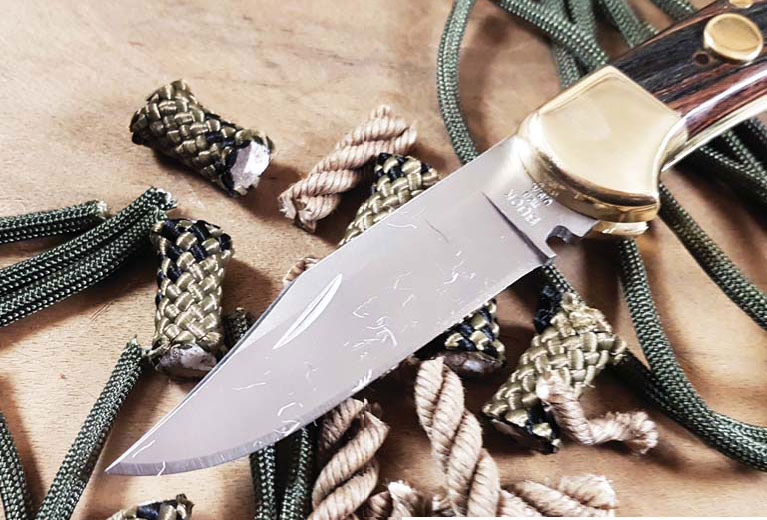
Buck 112 Ranger DA Auto (Adams International Knifeworks conversion)

Buck 112 double action auto
Adams International Knifeworks Buck Ranger 112 DA Auto has all the traits of the original. The 3-inch 420HC stainless steel blade whipped and sliced through paracord, 3/8-inch rappelling rope and tough waxed lasso rope with ease.

Adams International Knifeworks (AIK) has been specializing in automatics and distinctive knives since 1987, and conversions have been one of its fortes. The Buck 112 Ranger DA Auto is one such conversion and it’s a little beast.

Unlike the new Buck 110 Auto, the AIK version of the smaller 112 Ranger differs in that it is a double action—opens both manually and automatically—and uses a leaf spring on the spine as opposed to a coil. The blade is employed via a flush brass button on the front, which matches the bolsters nicely.
Blade deployment is via the standard lockback on the rear base.

Everything else is Buck 112 Ranger, from the Dymondwood lockback grip to the 3-inch 420HC stainless steel clip-point blade and black leather belt sheath.

MSRP: $160.


Olamic Cutlery Busker Semper

Olamic Cutlery is known for making fashionable knives and the Busker Semper model, designed in-house, exudes coolness on every level. The folder sports curvaceous lines from stem to stern, including its ability to open 10 different ways (see above video), including a top-mounted flipper.

It is a small knife—6 inches open—featuring a 2.375-inch Bohler M390 modified wharncliffe blade and a 6Al4V titanium framelock handle. Other features include a machined pocket clip, caged bearing pivot system, stainless steel lockbar insert with an over-travel stop, ceramic detent ball, and ceramic pocket clip retention ball. In a nutshell, this is the good stuff!

The test model was delivered with a deep-brushed surface texture and gold anodized accents.

MSRP: starts at $365.


See More Innovations at BLADE Show

Huber Foxworth Bowie: The Men Behind The Blade

The men behind the Huber Foxworth Bowie are as captivating as the knife itself.

This is the story of a knife named in honor of an incredibly special man. In this highly populated world not many people get their name attached to anything. I do, however, know for a fact that Craig Fox Huber was very proud of the idea that people would be wanting the knife that bore his name for decades to come. He told me so in person. He lived a life that so many would aspire to but very few would have the moxie to follow through on. He was the real deal.

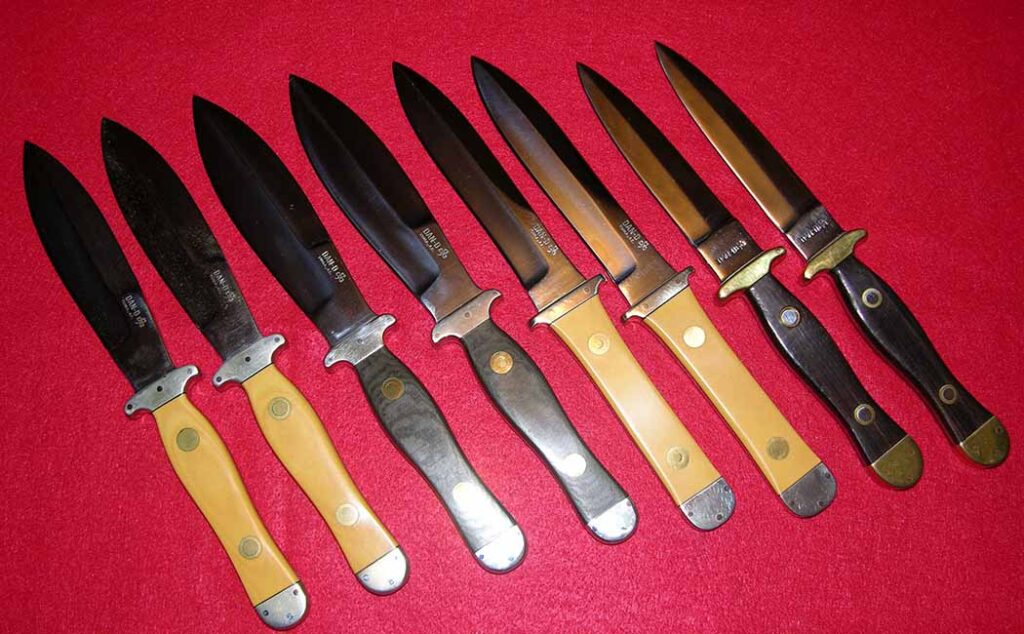
So, how did Craig impact a knifemaker to the point of naming a knife the Huber Foxworth Bowie? Here’s what my father, BLADE Magazine Cutlery Hall-Of-Fame® member Dan Dennehy, wrote about Craig in his 1970 Dan-D Knives Brochure:

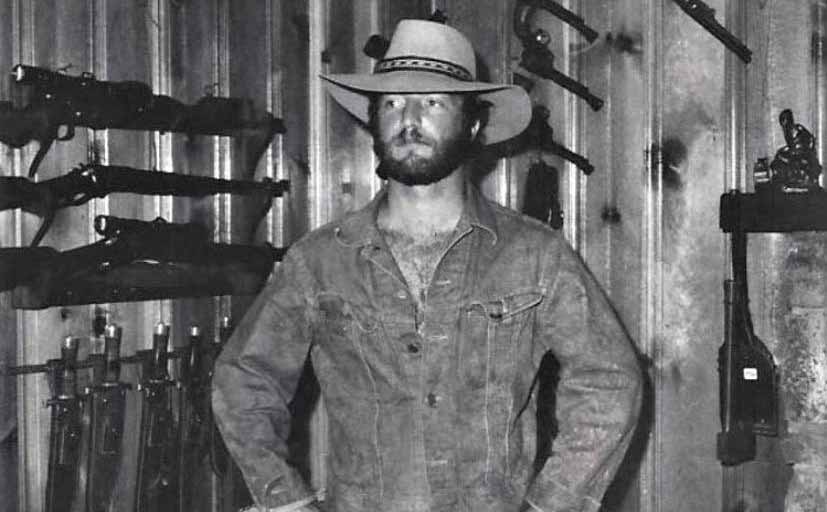
Many self-styled “experts” have stopped by my shop from time to time to suggest to me how I should design the “perfect” knife … Not long ago a trim bearded crewcut type found his way to my shop, and we started talking knives. [Circa the late 1960s] I took an immediate liking to this handsome, rather cocky gent and was pleasantly surprised to learn that he spoke about knives with a rather rare understanding of design and more than just a rudimentary knowledge of metallurgy that I found uncommon even among some men whose names would be familiar to you as supposed “experts.” He not only talked good theory and design, but he spoke with considerable authority on how a fighting knife should be used.

Craig Huber
That’s Craig Fox Huber inset circa 1970 at the Fox Den’s second location in Mountain Home, Arkansas.

During our conversation I learned that he had earned three Purple Hearts while serving with a Marine Recon Unit in Viet Nam, and enough other “breast hardware” that when he spoke, I listened with both ears, and rather attentively.

Those who knew Dan might realize that these comments mean he really respected the “cocky gent.” And Craig respected Dan. Their long friendship stayed the course until the end. I also had a lot of respect for Craig and his vast knowledge of knives and other things.
I met him in the early ’70s at The Fox’s Den, his gun shop located in the small ranch community of Kirkland, Arizona. Dan took me there to meet Craig when I was about 13. I shook hands with a man wearing a drop-loop gun belt with rounds in every loop and a .45 Long Colt pistol in the holster. I was in awe. I also got to see some of the knives he carried and to learn why he carried them.

About a year later my family bought a small ranch in the area. I visited the gun shop at every chance. Dan would take me to Craig’s home occasionally. I was equally impressed at his collections. The next summer I worked for Craig, helping with his horses and other stuff around his place. They were good times and I must say that it was from his influence that I went to see the United States Marine Corps recruiter a few years later.

Craig Huber: Christian Patriot

Craig’s son Hunter can tell you better than anyone about his father. Of Craig he wrote:

Dad was a lot of things. He was a soldier, a gunfighter, inventor, storyteller, adventurer, hunter, fisherman, survivalist, outfitter, collector, gunsmith, writer, and the list goes on. He was a patriot and a Christian. He lived his life to the absolute fullest and would fight for everything he believed in and loved.

Two sides of bowie knife
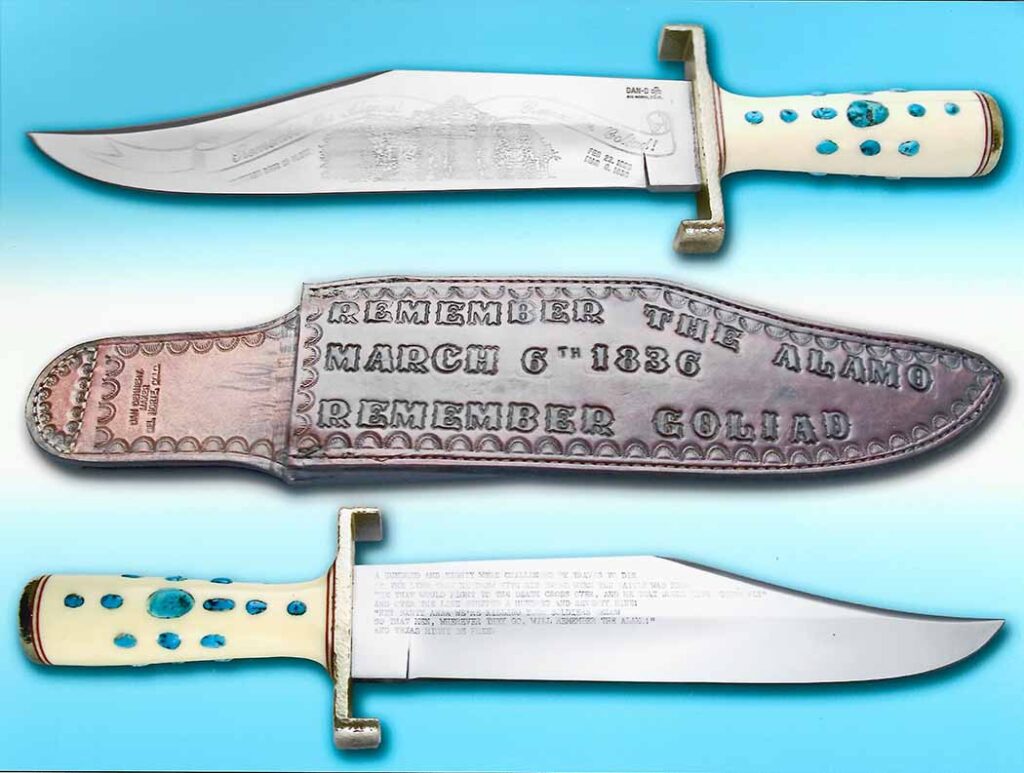
In his vast collection of Dan Dennehy knives, Craig’s favorites were the Dan-D Alamo Bowie and the Huber Foxworth Bowie. The Alamo Bowie has a 12-inch hollow-ground blade a quarter-inch thick and 2 inches wide. The blade’s non-mark side is etched with an eight-line poem that commemorates Col. Travis’s call for “defenders to step forward.” The handle is walrus ivory inlaid with 18 turquoise cabs. Overall length: 16.5 inches. The custom sheath is cowhide. (Bob Glassman image)

Despite having the option to go work for his father’s rapidly growing company in York, Pennsylvania, that was obviously of no interest to Dad so he went into the military. Even though he had trouble with authority and rules, he thrived in the Marines.

After the military his life got really interesting. His resume speaks for itself but here is a summary: police officer; sheriff; private investigator; horse wrangler; hunting guide, Ozark Mountains; fishing guide, French River, Canada; gun shop owner, Fox’s Den (Kirkland, Arizona, and Mountain Home, Arkansas); salesman, Camillus Knives and Levis; personal protection, bodyguard for Saudi Royal Family; professional hunter, South Africa; writer, Whitetail Times magazine and several personal protection books; gunsmith; gun dealer; private security, consulting and training; fugitive recovery; and much more. This is a very general overview and it took him to some very interesting places and dangerous spots, and he met some really interesting people along the way.

So here is what Dad loved. He loved his country and God. He loved our mom. He loved me and my sister. He loved adventure. And he loved guns and knives. Dad was an encyclopedia of firearms, handloading and ballistics. He had a real passion for Rugers, Ruger M77s in any and every caliber they make, but especially 7×57 and Ruger single action pistols. He was also a 1911 fanatic. I don’t remember a single occasion in my life where I ever saw Dad without a 1911 on his side or in a shoulder holster.

And he loved knives. Man did he love knives. I don’t know exactly where in his life this interest started, but he was as passionate about knives as guns, and maybe more. And this is coming from a guy whose gun collection is over 500. He loved all knives and always carried at least two at a time. He had a real appreciation for a good blade and considered knives the most valuable tool an outdoorsman or soldier could have.

Fox's Den Gun Shop
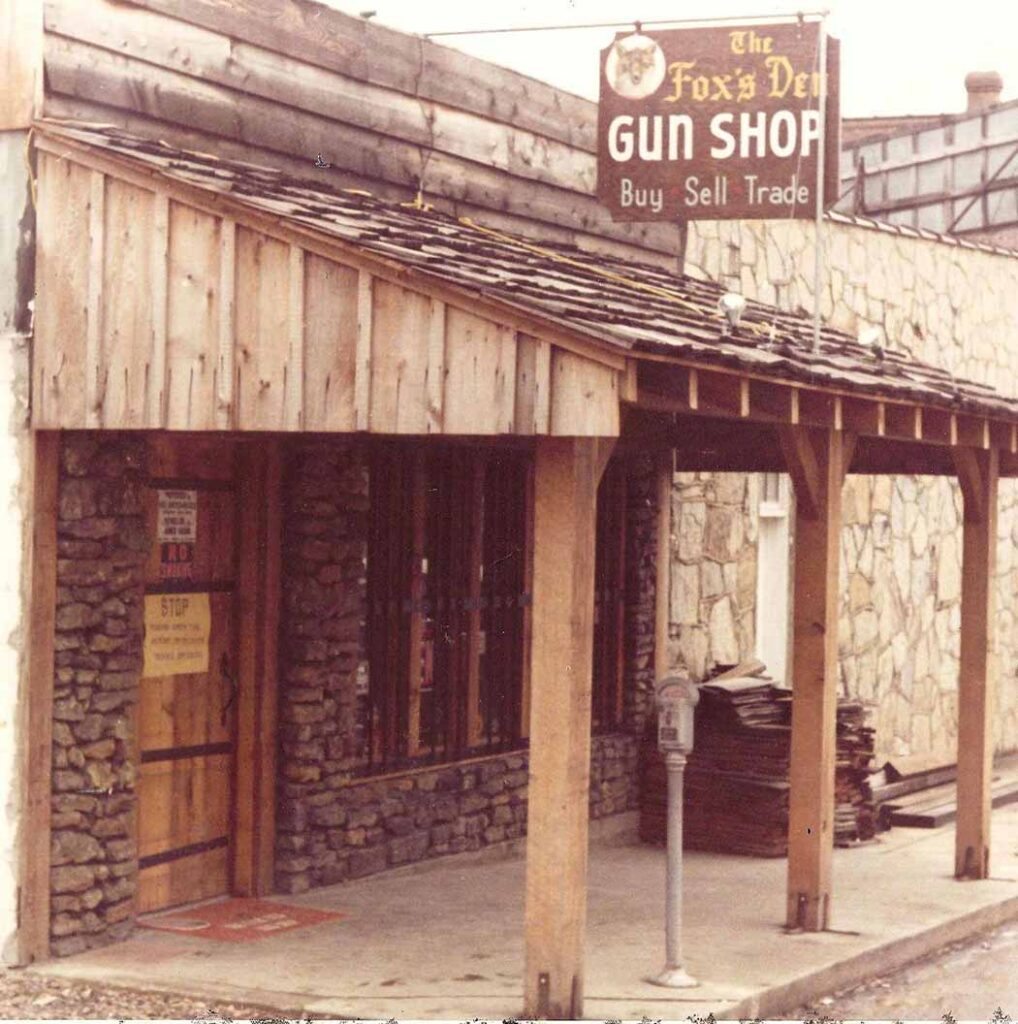
Here’s the second iteration of The Fox’s Den Gun Shop as it appeared in Mountain Home, Arkansas. Note the sidewalk parking meter.

As you would expect, just like factory rifles with factory ammo were not suitable for Dad’s standards, neither were factory knives. As a result he started reaching out to custom knifemakers and collaborating. He formed relationships with Bo Randall, Jimmy Lile, Art Wiman, Clyde Fischer, Blackie Collins, Harold Corby and George Herron, and most notably Dan D. Dad spoke of Dan D. with a manner of respect and admiration that he did not offer up lightly to many. A shared respect and appreciation for the art and skill behind making the ultimate tool, something that was practical and efficient, beautiful and deadly. Dad’s collection of Dan D. knives is vast but his two most prized are the Alamo Bowie and the Huber Foxworth Bowie.

Dad was the toughest man I’ve ever known. A real fighter, rock solid, set in his ways and unshakeable. No matter, if you had a problem, my Dad would be your first call and the man you wanted in your corner. Dad had a lot of fans and a lot of enemies. He had many acquaintances and peers and only a small handful of good friends. He always said if you get through life and only have a few good friends, real true friends, then consider yourself lucky. Dan D. was a true friend of Dad’s.

Machete and knife
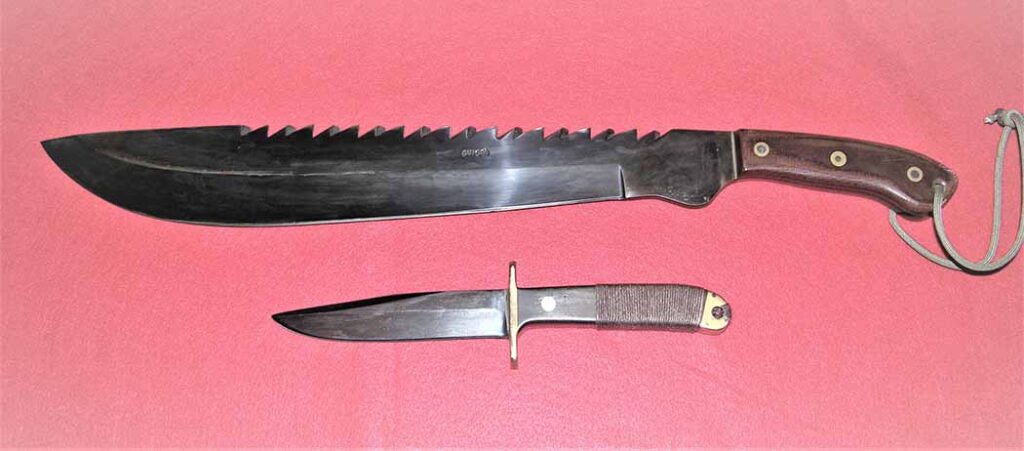
Two of Craig’s favorite Dan-D users included a survival machete and a Woodsman model. Craig designed both, with Dan-D making the former and helping Craig make the latter in the Dan-D shop. Craig carried the Woodsman more than any other knife for over 40 years.

Craig was one of those rare characters you meet along the road of life and always remember. Later he told me stories of discussions with Cutlery Hall-Of-Famer Bo Randall and knife designs for different purposes. Another story was how he talked to Cutlery Hall-Of-Famer Bob Loveless about the simplicity of balancing a knife using his personal theory of the tapered tang. He visited with his friend Cutlery Hall-Of-Famer Jimmy Lile long before the Rambo knife was created. John Horrigan told me about their hunting trip in Africa. Since Craig was a licensed guide the trip was arranged in exchange for a knife identical to the one John presented to President George W. Bush.

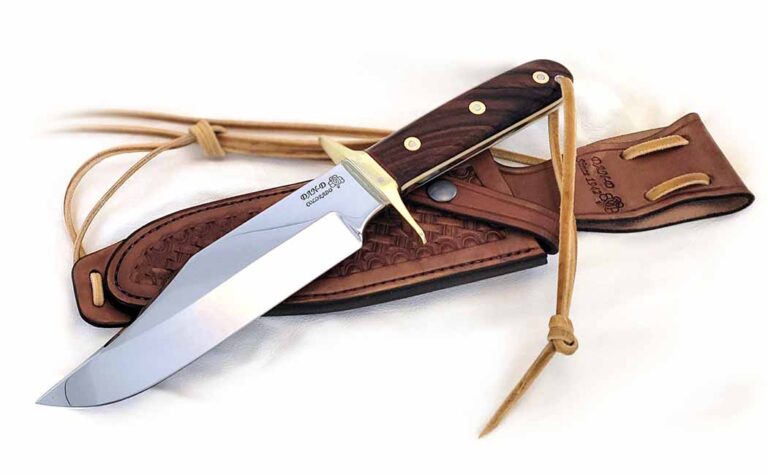
Huber Foxworth Bowie

But back to the Huber Foxworth Bowie. The brochure description continues:

This knife is a pure and simple Bowie style but with the handle dropped slightly which seems to give it a much better “pointing” ability and maneuverability not found in most common Bowie styles. [Craig] had a prototype of this knife made for him by a Philippine Negrito instructor while he was attending the armed forces Jungle Survival School in the Philippines. Pound for pound these little Negritos are about as slick and fierce a knife fighter as will be found anywhere.

Knives
In a 2011 email to the author Craig wrote, “This [image] shows all four pair of boot knives your Dad did for me, including two pairs of my Model III. All have been carried extensively over the past 40 years, and two of the knives have saved my life.”
The blade is 8 inches long, 1.75 inches wide and in quarter-inch stock of 154 CPM stainless steel heat treated by Cutlery Hall-Of-Famer Paul Bos. It has a double guard and a 4.75-inch handle. According to the brochure, “This is a knife you could bet your life on.”

A couple of years ago, Hunter contacted me and told me of his father’s passing. Craig lived 76 years his way and made his mark in the world. His passion for God, his country and living life to the fullest extent had been accomplished. Hunter went on to explain that out of all the knives they cannot find the one that meant more to Craig than the Huber Foxworth Bowie.

Check Out More Cool Custom Knives:

10 New Custom Knives Too Cool for Summer

Summer might be hot, but these custom knives stay cool with innovative designs, expert craftsmanship, and cutting-edge materials.

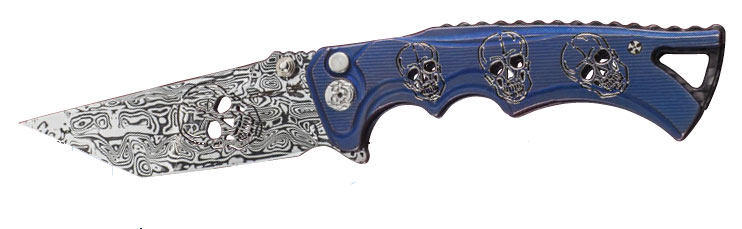
Tighe Fighter (Brian Tighe)

Brian Tighe fighter knife

  • BLADE LENGTH: 3 7/8”
  • BLADE MATERIAL: Damasteel damascus
  • HANDLE MATERIAL: Titanium
  • LOCK: Button-lock flipper
  • CLOSED LENGTH: 5 1/16”
  • SKULL STUFF: Pierces Skull Design waterjet cut with a .015-inch-diameter stream; titanium engraved over the piercing to enhance detail
  • MAKER’S LIST PRICE FOR A SIMILAR KNIFE: $1,500

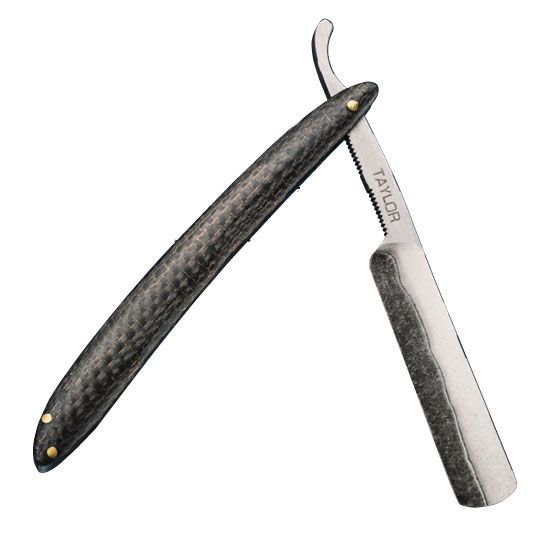
Straight Razor (Chris Taylor)

Chris Taylor custom razor

  • BLADE MATERIAL: Stainless steel and 410 over 1084 carbon steel core in a san-mai construction by Randy Haas of HHH Knives
  • BLADE GRIND: Hollow
  • HANDLE: Bronze lightning-strike carbon fiber
  • PINS: Bronze

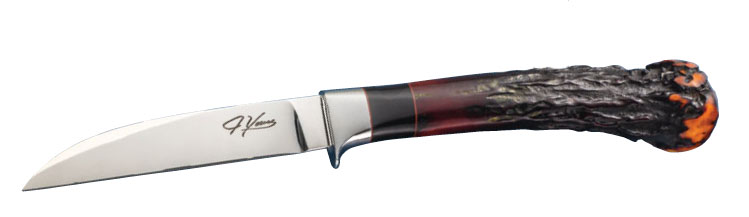
Desk Knife (John Young)

John Young Desk Knife

  • KNIFE TYPE: Fixed utility
  • BLADE STEEL: RWL-34 stainless
  • HANDLE: Sambar stag
  • BOLSTER: 416 stainless steel
  • MAKER’S LIST PRICE FOR A SIMILAR KNIFE: $650

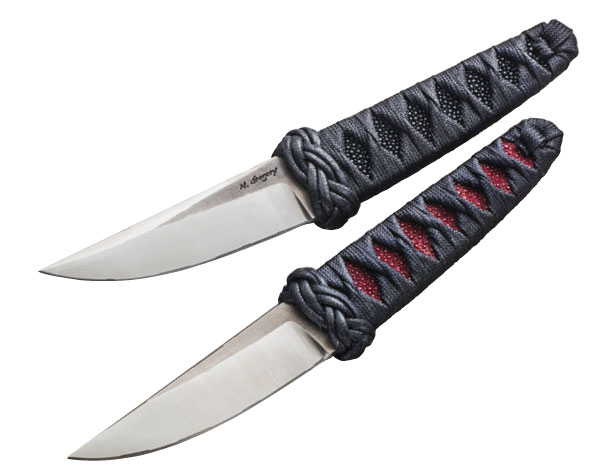
Kwaiken (Mike Walton, Matt Gregory)

Custom Kwaiken knife

  • KNIFE TYPE: Fixed fighter
  • BLADE LENGTHS: 4”
  • BLADE STEEL: CPM S60V stainless
  • HANDLE MATERIALS: Stingray and tsukaito
  • INSIDE SCOOP: Made as a matched pair

AbOhlone (D Rocket Squared Collaboration)

AbOhlone (D Rocket Squared Collaboration)

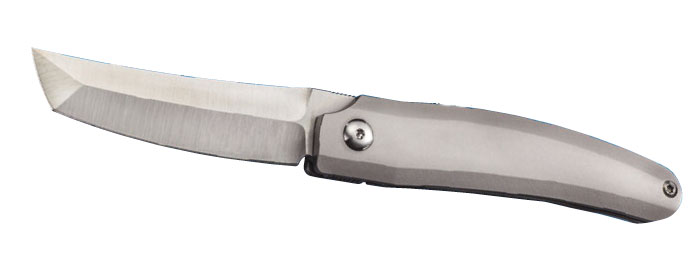
  • KNIFE TYPE: Dress locking folder
  • BLADE LENGTH: 2.75”
  • BLADE STEEL: CTS-XHP stainless
  • HANDLE & FRAME: Titanium
  • APPROXIMATE CLOSED LENGTH: 3.5”
  • MAKER’S LIST PRICE FOR A SIMILAR KNIFE: $850

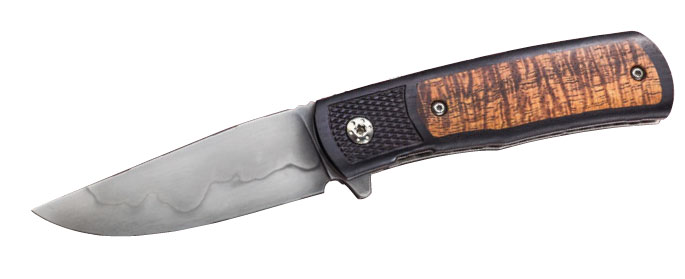
Dress Locking Folder (John Doyle)

John Doyle dress locking folder

  • BLADE LENGTH: 3 1/8”
  • BLADE STEEL: W2 tool
  • HANDLE: Blackwood w/koa inlays
  • FRAME: Titanium
  • BOLSTER: Checkered blackwood
  • SPECIAL STUFF: Jeweled titanium liners, bronze fileworked backspacer
  • CLOSED LENGTH: 4”
  • MAKER’S LIST PRICE FOR A SIMILAR KNIFE: $1,350

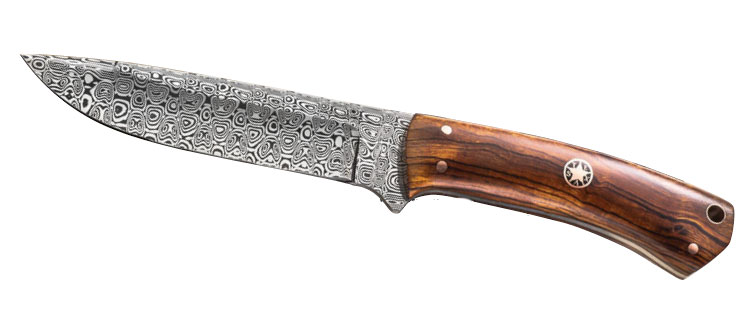
The Gambler (Andrew A. Griggs)

Andrew Griggs custom knife

  • KNIFE PATTERN: Fixed hunter
  • BLADE LENGTH: 4.25”
  • BLADE MATERIAL: Damasteel AB Munin pattern
  • HANDLE: Desert ironwood
  • OVERALL LENGTH: 9”
  • SHEATH: Leather by CC Leathers
  • MAKER’S LIST PRICE FOR A SIMILAR KNIFE: $600+

Bowie (Wade Colter)

Wade Colter custom knife

  • BLADE LENGTH: 7.75”
  • BLADE MATERIAL: Damascus
  • HANDLE MATERIAL: Ancient walrus ivory
  • FITTINGS: Nickel silver
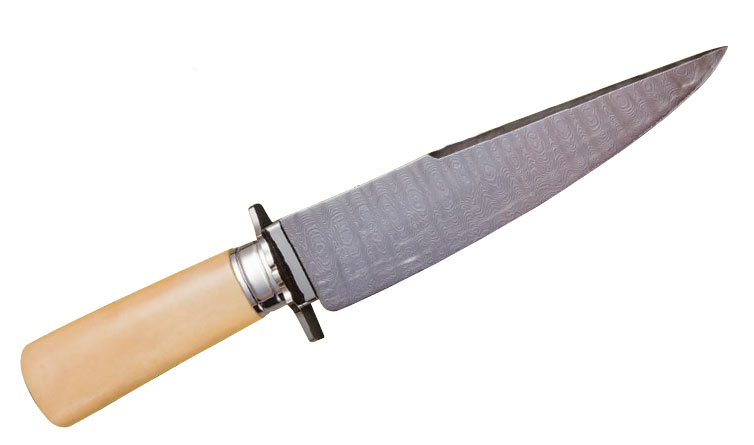
  • OVERALL LENGTH: 12.5” 

Hunter (Feldman Custom Knives)

Feldman Custom Knives

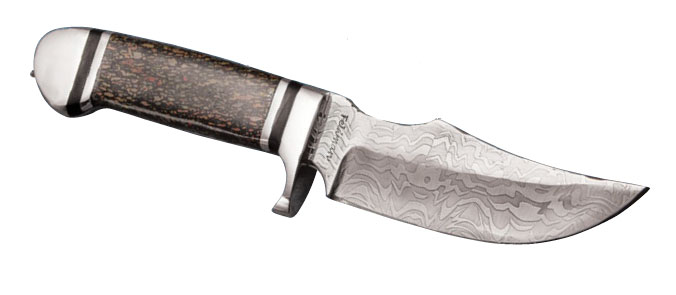
  • BLADE LENGTH: 4 5/8”
  • BLADE MATERIAL: Damascus
  • HANDLE MATERIAL: Dinosaur bone
  • FITTINGS: Stainless steel

Linerlock Folder (Tony Miller)

Tony Miller Custom Knives

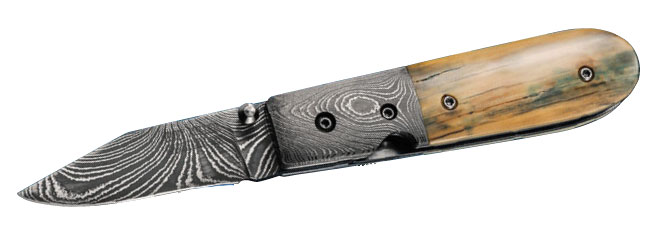
  • BLADE MATERIAL: Devin Thomas twist pattern stainless damascus
  • HANDLE MATERIAL: Mammoth ivory
  • BOLSTERS & BACKSPACER: Same as blade
  • LINERS: .045-inch-thick titanium
  • FITTINGS: Stainless steel
  • MAKER’S LIST PRICE FOR A SIMILAR KNIFE: $545

Knifemaker to Watch: Phil Jacob

knifemaking phil jacob
Phil Jacob

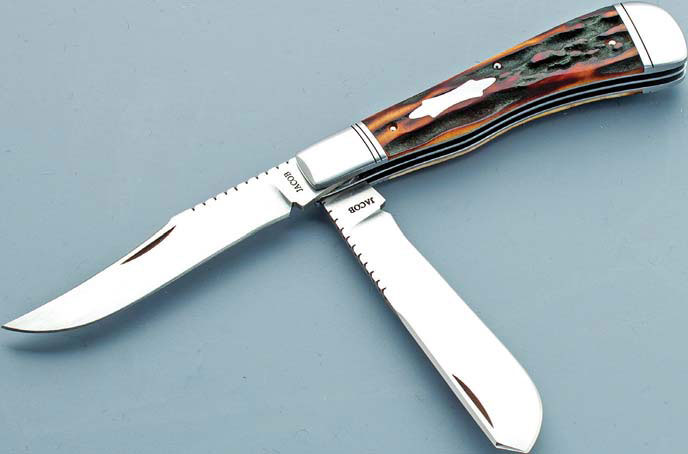
Phil Jacob took home the Best New Maker award from BLADE Show 2017, which is as good as it gets for someone getting started in knifemaking. The achievement is also good news for knife collectors looking for a guiding light for their collections. “Best New Maker” translates to “best new opportunity” for ROIs on investment.

Jacob, who calls Kansas home, specializes in slip joint folders. The addition of exotic handle materials and attention to detail offset any cliches about this traditional style. Just take a look at the double-bladed trapper that made waves at BLADE Show.

best new maker blade show 2017

Specs:

  • Blade lengths: 3.125”
  • Blade steel: CPM 154 stainless
  • Handle: Stag dyed amber
  • Folding mechanism: Slip joint
  • Weight: 5.1 oz
  • Closed length: 4.5”
  • Maker’s list price for a similar knife: $875 to $1,100

Jacob maintains a healthy social media presence, which is another benefit to collectors interested in a commission or a resale. His Facebook page is full of status updates and photos. 

He’s not big on the video front yet, but here’s a sample:

And here are some photos of his recent work.

Best of all, you can meet him at this year’s BLADE Show. Get tickets here.

Advertisement

Must Read Articles

Read this before you make a knife

Knifemaking 101 – Read This Before You Make a Knife

  by Wayne Goddard My experience has taught me that there's nothing like digging in and getting started. I've often said the hardest part of the...
how to forge damascus steel

How to Forge Damascus

Advertisement
Advertisement