
Best Gyuto Knife: East And West Meet Over Dinner

The Japanese take on Western chef’s knives are mighty mealmakers. Here are some top-notch options.

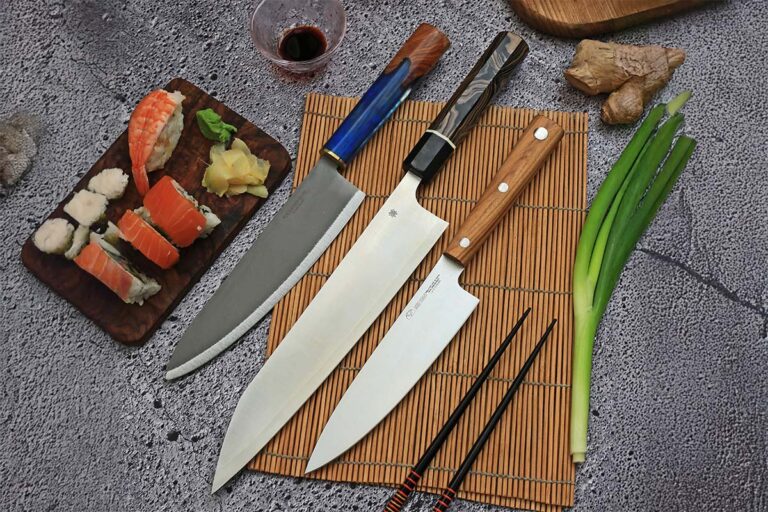
A gyuto is a versatile, multi-purpose kitchen knife perfect for professional chefs and home cooks. It typically features a thinner, lighter blade than traditional chef’s knives, sharpened at a steeper angle for extremely precise and clean cuts. It often has a flatter profile toward the heel and a more gradual curve near the tip, making it versatile for various cutting techniques. The handle is often lighter and more agile, reflecting the Japanese emphasis on nimble and efficient movements in the kitchen.

Fox Knives Gyuto 2C 504 0L

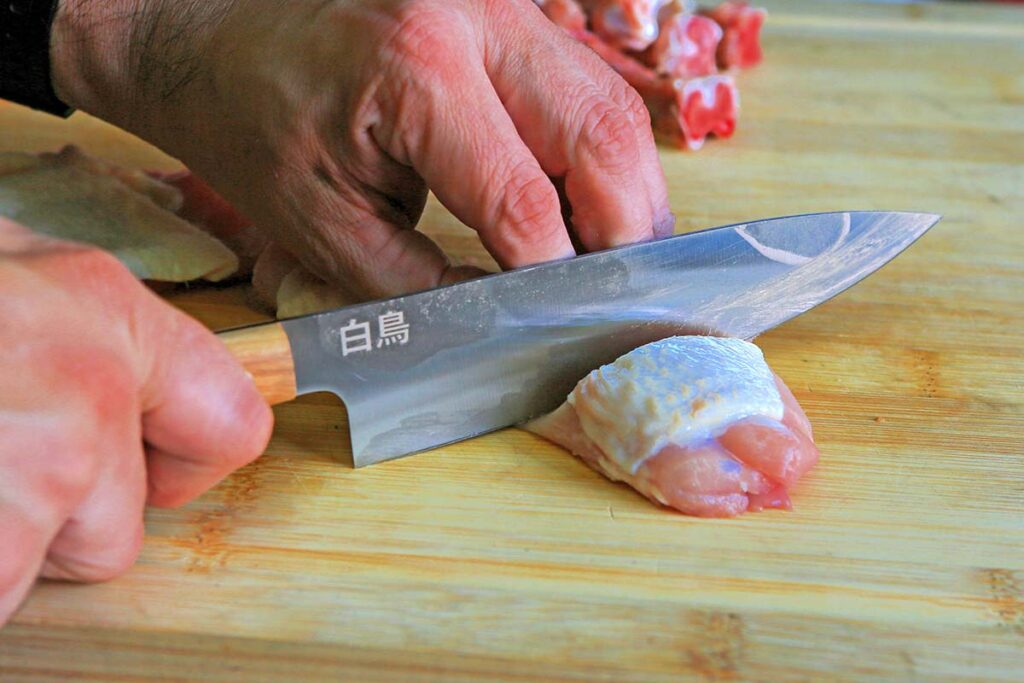
Fox gyuto effortlessly cuts chicken thighs
The Fox gyuto effortlessly prepared chicken thighs for delicious teriyaki chicken and yakitori, trimming excess fat and skin.

FOX Knives Gyuto 2C 504 OL
Blade Length: 6.69”
Blade Steel: 4119 nitro-B stainless
Blade Grind: Flat
Blade @Thickest: .08”
Blade Finish: Satin
Handle Material: Olive wood
Overall Length: 11.81”
Country of Origin: Italy
MSRP: $75.70

Pros

  • Durable 4119 Nitro-B Stainless Steel Blade
  • Exceptional Balance and Lightweight Design
  • Comfortable Olivewood Handle

Cons

  • Limited Grip for Large Hands

The Fox Knives Gyuto 2C 504 0L is a representative example of the genre. Crafted with precision and passion, it features a razor-sharp blade that is durable and holds an edge. The elegant handle offers a comfortable grip and a smidge of rustic charm.

At just 5.11 ounces, this featherweight beauty is a breeze to manipulate and perfectly balanced for effortless slicing, dicing and chopping. The 4119 nitro-B stainless steel blade’s Rockwell hardness of 55-57 HRC guarantees superior resilience, while the satin finish adds a touch of sophistication. Equipped with sturdy stainless-steel rivets, this gyuto is a culinary companion you can trust, not just a kitchen tool.

When in Japan, I love ordering yakitori—skewered, grilled chicken with a savory, slightly sweet flavor and smoky aroma. Making the dish was a team effort using specific knives for deboning and slicing the chicken into proper portions for the skewers. The key is to use a slow rocking/chopping motion to make clean, decisive slices rather than sawing through the meat, resulting in “chainsaw chicken.”

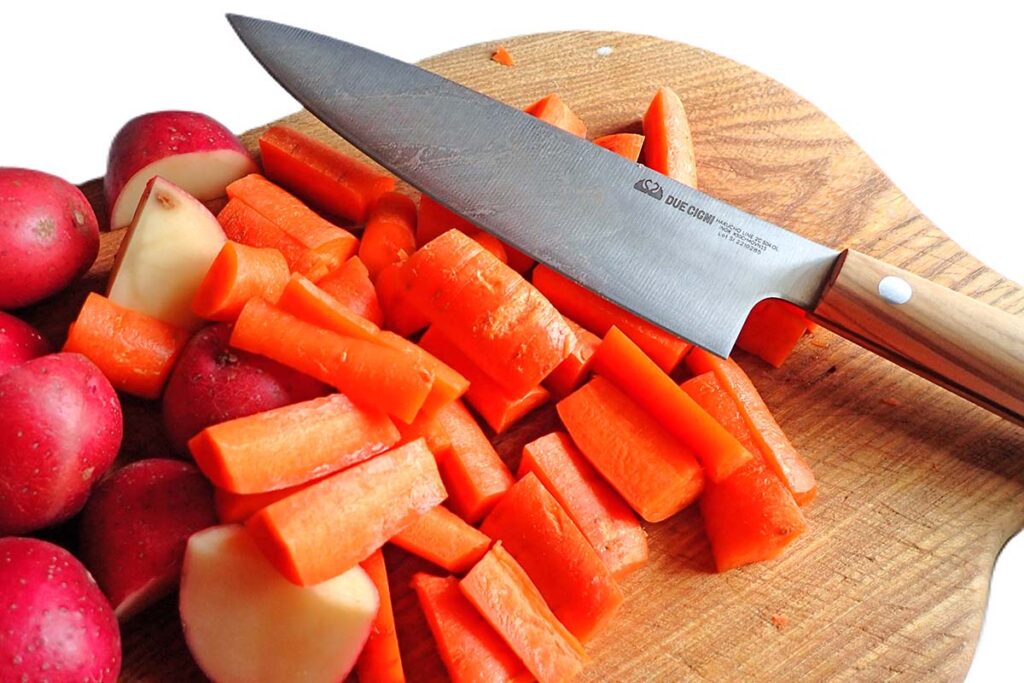
Fox knife cuts potatoes and carrots
The Fox sliced potatoes, onions, garlic and carrots for pot roast. The thin edge and super comfortable handle were unmatched.

Since the gyuto is the Japanese version of the archetypal Western chef’s knife, I made a Western dish—beef pot roast—and did the vegetable prep with the Fox. Slicing vegetables, potatoes, carrots and onions was a breeze with this slicing machine. I keep it simple, using rock chops, cross chops and pull cuts 90 percent of the time. Push cuts with the heel of the blade work well for hard veggies. Meanwhile, the olivewood handle remained comfy with no hot spots and grippy even when wet or covered with chicken fat. Leave it to the Italians to utilize this stunningly underused wood. Regarding plating, the Fox sliced the most elegant roast beef that ever graced a dish.

Fox Knives$78Check Price
BladeHQ$35Check Price

Condor Tool & Knife Shefu Kitchen Gyuto

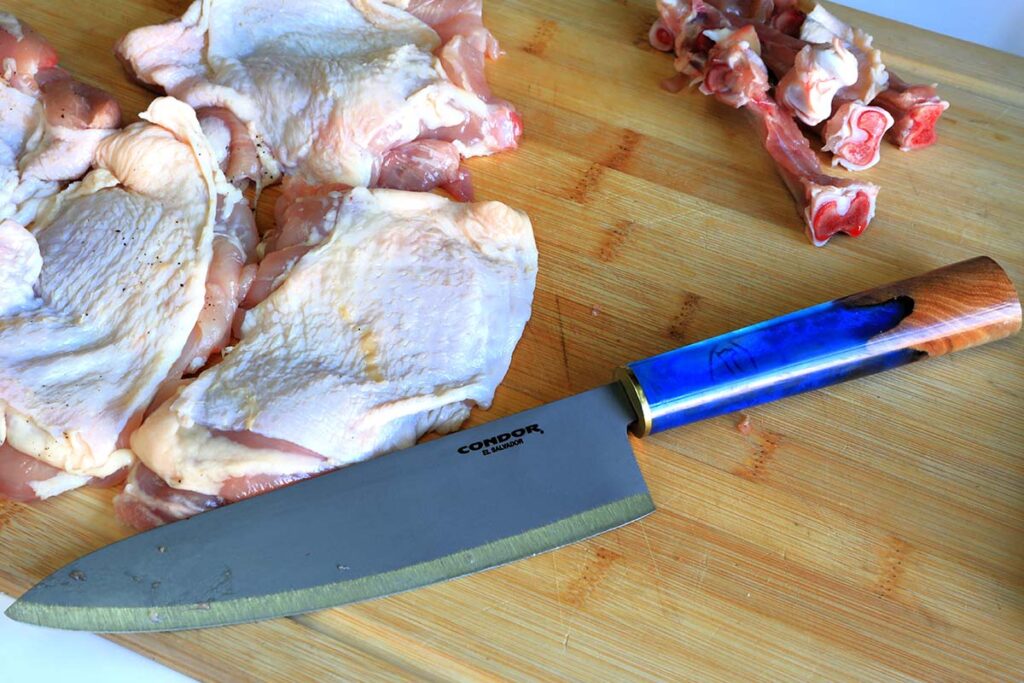
Condor gyuto deboned chicken thighs
The Condor Shefu deboned multiple chicken thighs using a roll-cutting method for yakitori skewers and teriyaki chicken.

Shefu Kitchen Gyuto Specs
Blade Length: 7.83”
Blade Steel: 440C stainless
Blade Grind: Full flat w/second bevel
Blade @Thickest: .12”
Blade Finish: Blasted satin
Handle Material: Epoxy resin and hickory
Overall Length: 12.92”
Sheath: Welted leather
Country of Origin: El Salvador
MSRP: $154.98

Pros

  • Versatile Outdoor and Culinary Tool
  • Comfortable and Ergonomic Handle
  • Full Flat Grind with Second Bevel

Cons

  • Bit hefty

The Shefu Kitchen Gyuto from Condor Tool & Knife is a multi-use knife designed for bushcraft enthusiasts who want to prepare delicious meals while enjoying the great outdoors. Crafted with precision in mind, the Shefu is perfect for slicing vegetables and expertly preparing meat and fish. It is a versatile tool ready to tackle any culinary challenge.

The Condor gyuto is hardy and beautiful. The full flat grind with a second bevel ensures optimal slicing performance, while the handle provides a comfortable, secure grip. The knife strikes the perfect balance between heft and maneuverability. The leather sheath provides safe storage and easy transport.

I pushed the Shefu into service sectioning beef roast and deboning and trimming six chicken thighs. The knife tackled the tasks with ease. Slicing 3.5-pound roast required a sharp yet hefty slicer like a cleaver. The Shefu fit the bill and delivered. Bottom round roast is tough as woodpecker lips, and a thin, flexible blade need not apply here. At 9.88 ounces, the Condor’s robust blade strikes the perfect balance between heft and finesse.

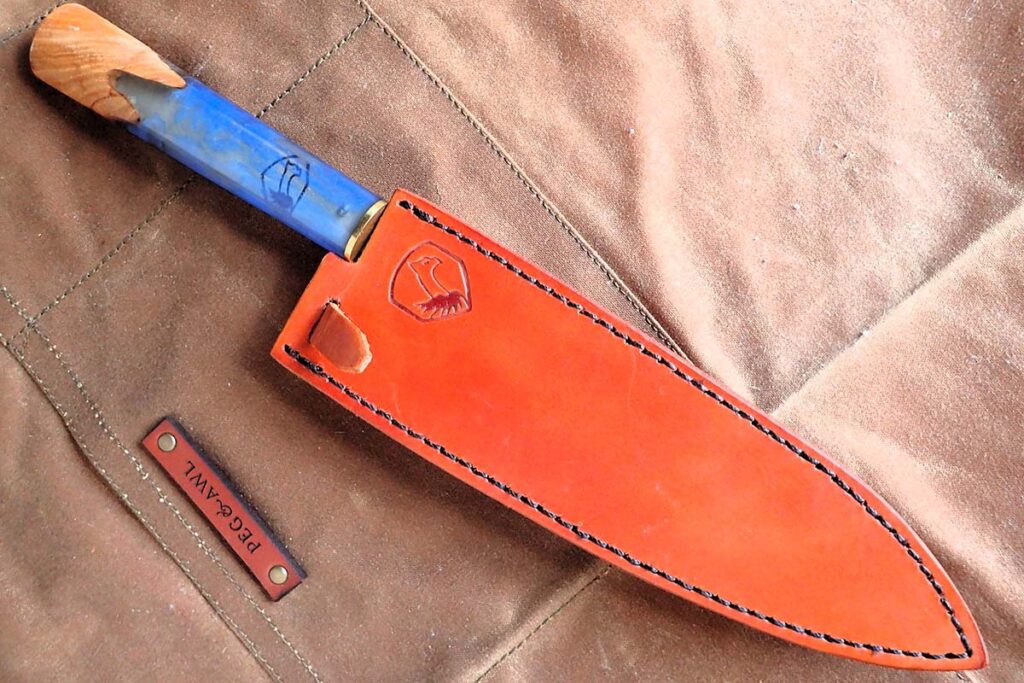
Condor gyuto in sheath
The Condor has the only sheath of the test bunch, of a beautifully handcrafted welted leather for safe storage and easy transport.

The handle has a colorful, comfortable oval shape that nestles in the hand. Hot spots and fatigue are nearly impossible with this grip. The full tang offers strength and security while keeping balance and weight at the forefront. The Shefu is an essential for any cooking enthusiast, whether at home or in the wild.

Condor$155Check Price
SMKW$132Check Price

Spyderco Itamae Gyuto

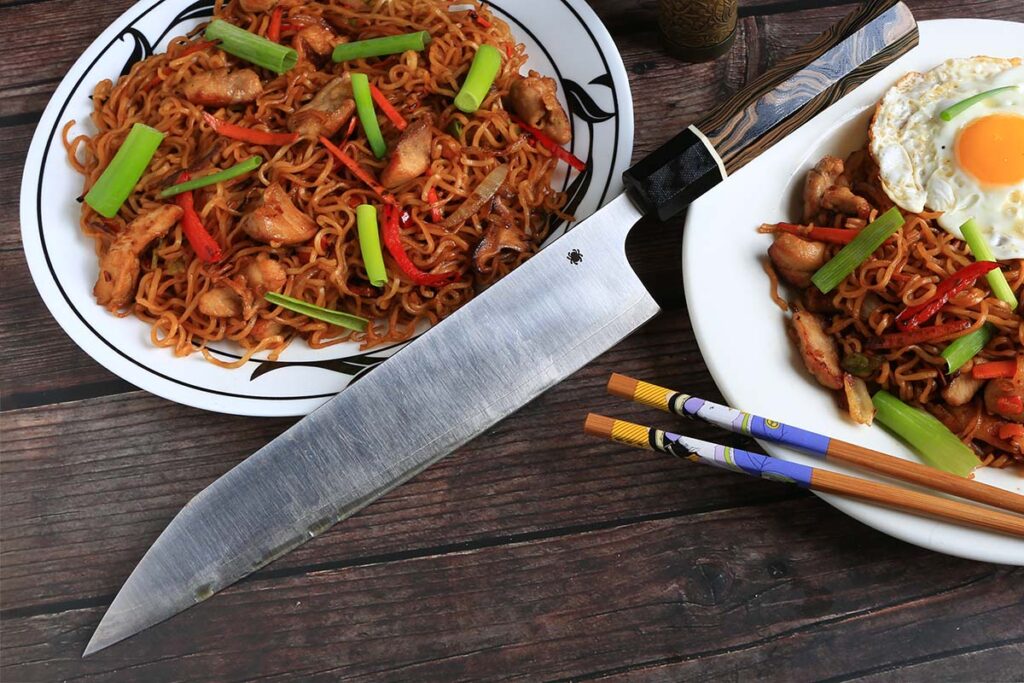
Spyderco Gyuto prepares food
The author prepared the chicken yakisoba using the Spyderco. The knife sliced and diced carrots, onions, peppers, shiitake mushrooms, chicken and green onions for garnish.

Itamae Gyuto Specs
Designer: Murray Carter
Blade Length: 10.06”
Blade Steel: Super Blue/SUS410
Blade Grind: Full flat
Blade @Thickest: .094”
Blade Finish: Satin
Handle Material: Burl G-10 in the octagonal wa style
Overall Length: 15.35”
Country of Origin: Japan
MSRP: $334

Pros

  • Exceptional Blade Construction
  • High-Quality, Ergonomic Handle
  • Beautiful Design and Craftsmanship

Cons

  • Higher Price Point

The Itamae Gyuto is part of the Spyderco Murray Carter Collection Itamae Series. The elite cutlery series is designed for highly skilled sushi chefs and showcases uncompromising craftsmanship and premium materials.

The Itamae Gyuto features a blade expertly crafted from laminated steel—an Aogami Super Blue core clad between layers of high-quality stainless. The three-layer construction ensures exceptional durability and sharpness, with Carter’s signature “Carter Elbow*” adding strength to the blade’s tip.

Paired with a traditional wa-style octagonal handle of stunning burl G-10 and highlighted with a black G-10 ferrule, the Itamae Gyuto embodies the spirit of Carter’s coveted custom kitchen knives. Tipping the scales at 7.4 ounces, it sets an impressive standard in high-performance household cutlery.

The Itamae Gyuto is a sushi knife and I’m a fan. Part of my time in Japan was seeking out various types of sushi. The second most rewarding part was watching the chefs work precisely as if it were the most critical game of Operation ever played—they are pros!

I used the test model to prepare carrots, onions, shiitake mushrooms, peppers, green onions and chicken for the famed yakisoba dish: fried street food noodles choked full of veggies, savory sauce and protein. Simple ingredients still require various knife techniques.

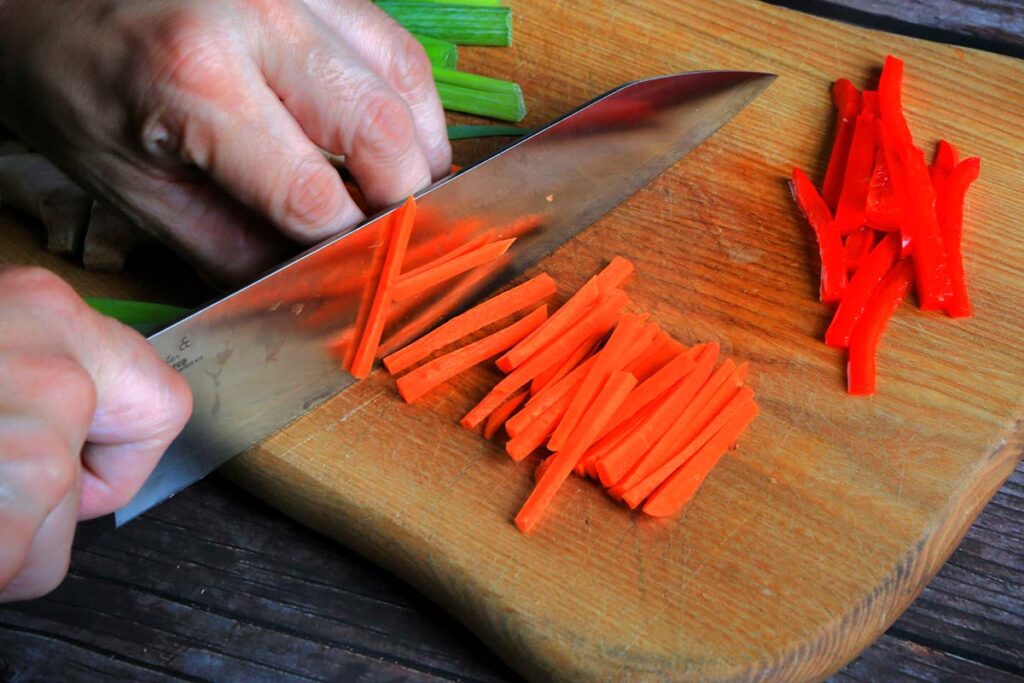
I used push-cuts on the tough carrots to square them to a safe position to stabilize them and make thin slices. From there, I stacked the slices for some rock-chopping to julienne a pile of carrots—in this instance, to make matchstick-sized carrot sticks. The secret to stir-fry cooking is preparation and cutting relatively equal-sized pieces of food to ensure equal cooking time.

Spyderco juliennes carrots
To create julienne slices, the author employed the rock-chopping method with the Spyderco, again utilizing a chef’s pinch-grip and a claw grip with the offhand to support the food.

I used rock chopping and pull cuts—two techniques in which the Itamae excels—to slice the red peppers. To pull cut them, I placed the knife tip down on the board and sliced backward. By this time, the laminated steel had formed a nice patina from avocado, peppers, onions and chicken on the bevel, giving it a nice used look. Crafted in Japan, the Itamae Gyuto is an ultimate favorite among professional chefs and passionate cooking enthusiasts.

*Editor’s note: Through the Carter Elbow, Murray Carter combines the best features of a traditional Japanese wabocho kitchen knife with his Wharncliffe Brute neck knife. The design feature allows more steel to reinforce the forward tip of the blade compared to standard gyuto or French-style chef’s knife profiles.

Spyderco Inc.$334Check Price
Knife Center$334Check Price

More Kitchen Knives:

Spartan Blades Clandestina Review: 2024 Blade Knife of the Year

Find out why the Spartan Blades Clandestina took home Blade Knife of the Year, thanks to its standout tactical design, top-tier materials, and unbeatable performance.

A deadly beauty, Spartan Blades’ Clandestina packages the best of both worlds. Yup, it’s a looker, but dang if it isn’t engineered to inflict damage.

The dueling personalities of the BLADE Knife of the Year aren’t surprising, given who cooked up this wicked fixed blade. Bill Harsey has built his reputation on designing robust outdoor and tactical knives.

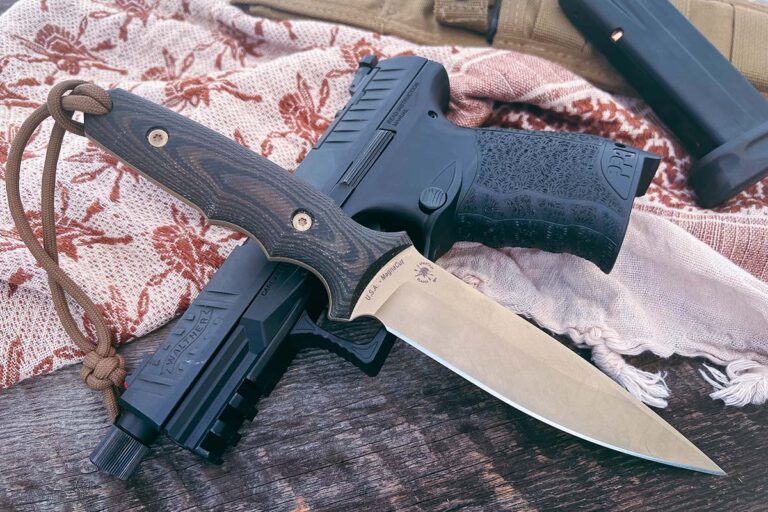
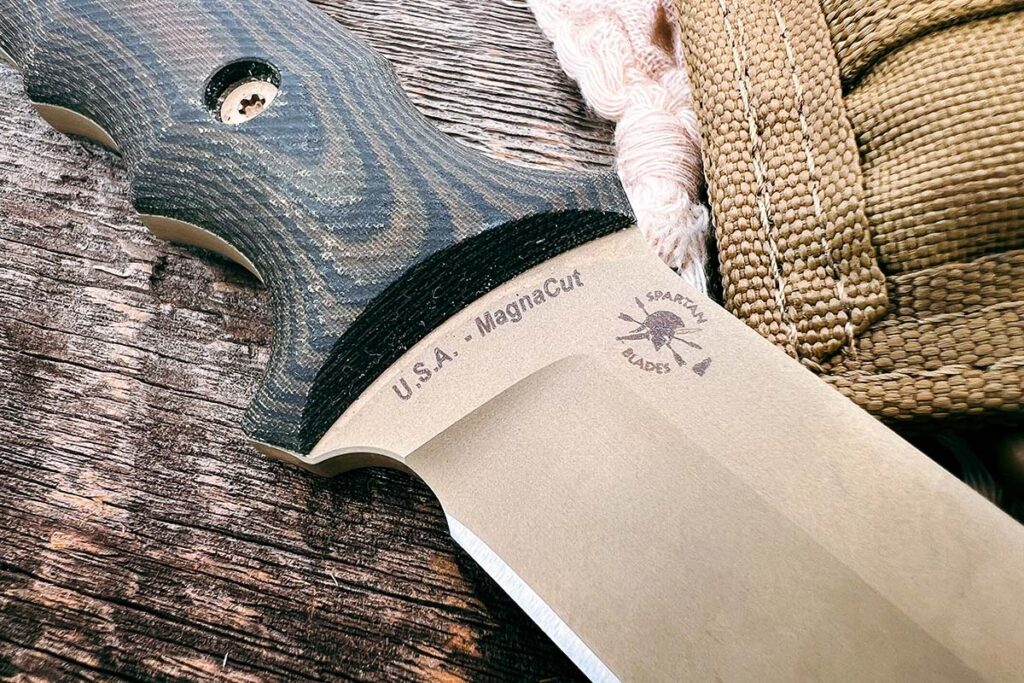
Spartan Blades Clandestina blade markings
Photos by Marty Stanfield, Marty Stanfield Photography

A favorite of Army Special Forces and figures such as Col. Rex Applegate, Harsey work also has a certain lethal aesthetic to it as well. But even with operators enamored with his work, Harsey’s Spartan project has an appeal beyond serving in foreign conflicts.

Spartan Clandestina Specs

Knife Type: Fixed
Blade Type: Spear Point
Blade length: 5.5
Blade steel: CPM MagnaCut
Blade grind: Flat ground
Handle material: Canvas Micarta Black and Camo
Blade Hardness: 61-63 HRC
Overall length: 10 3/16”
Sheath type and material: MOLLE and Kydex options
Special features: Available in Black and FDE PVD Coating, Double Deep Cryogenic Treatment
MSRP:

Pros

  • Superior Ergonomics
  • Premium Blade Material
  • Sheath Options

Cons

  • Large For Everyday Carry
  • High Price Point
  • Niche Design

Spartan Clandestina Handle

Oddly enough for a knife review, I’m going to start at the handle. There’s a method in this madness, given this feature is what gives the Clandestina its edge.

The canvas Micarta handle is slim in profile, even understated, yet sports big-league features.

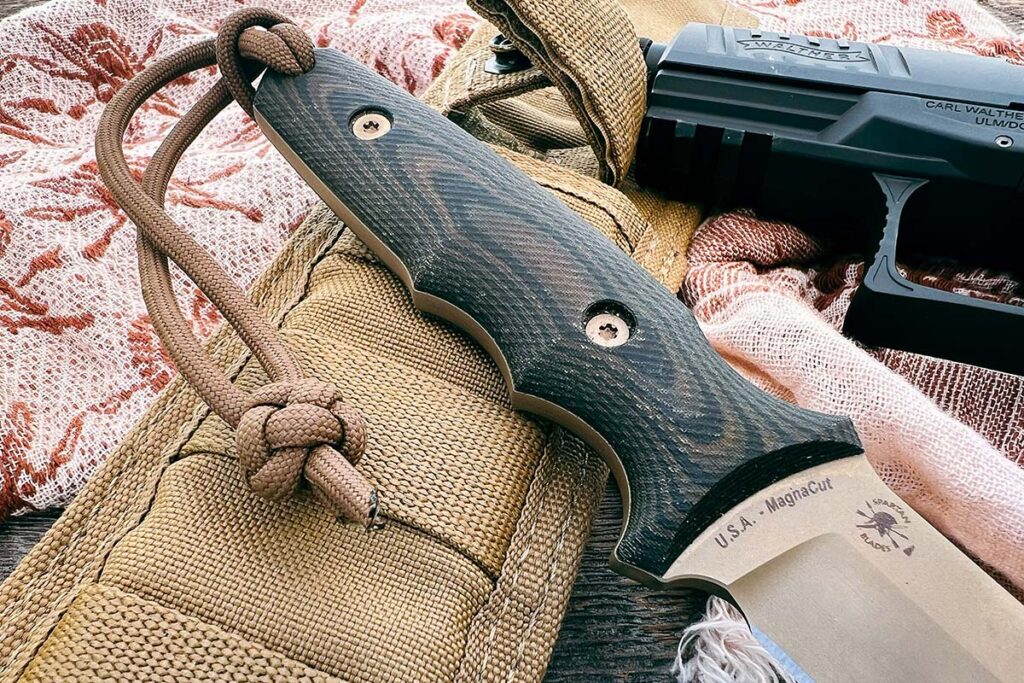
Spartan Blades Clandestina handle
Photos by Marty Stanfield, Marty Stanfield Photography

Boasting two-finger grooves leverage the use of the middle finger to help stabilize the knife in the user’s grip and help lock it in for security.  The double guard is somewhat subtle but does its job very well.  

The entire handle is rounded and therefore, extremely comfortable to hold. No hot spots or harsh angles to get in the way. Overall outstanding ergonomics make the knife one with the hand. In brief, it’s pure Harsey all the way.

Micarta itself was an excellent choice for the tactical fixed blade—it’s lightweight yet strong.  Comprised of fabric saturated in phenolic resin, it is also impact-resistant and fluid-resistant. 

These attributes were engineered in the Clandestina with combat in adverse conditions in mind. Yet, the everyday user benefits, given it’s a robust system that should last a lifetime. Not to mention, the Micarta is available in a multitude of colors, besides my black and camo.

Spartan Clandestina Blade

From the understated to the obvious—the knife’s nefarious.

At 5.5 inches long and sporting a spear-point profile, the Clandestina was designed for more than opening boxes. A testament to this was Spartan opting for premium CPM Magnacut stainless steel.

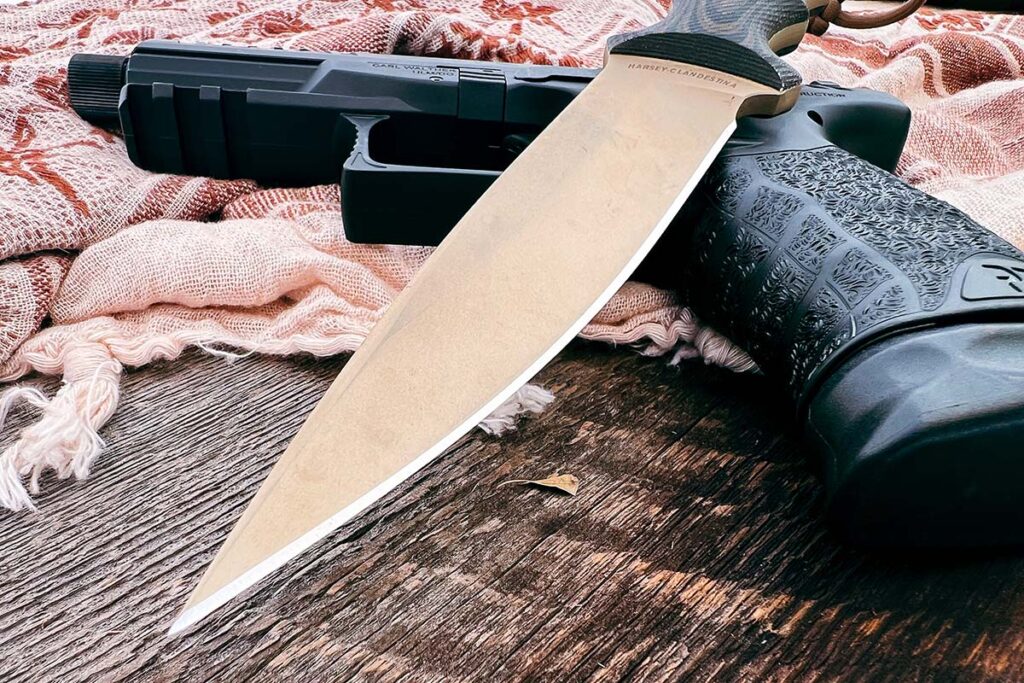
Spartan Blades Clandestina blade
Photos by Marty Stanfield, Marty Stanfield Photography

Know for its capability of long-term edge retention, the metal makes the ready to slash or perforate with ease. Again, this material also has superior corrosion resistance, adding to the overall hardiness of the knife.

The blade is flat ground and the factory edge right out of the box is outstanding. I found nothing needed to be done to improve the edge, I just took it out of the box and put it right to work! 

While larger than most folks’ carry option, the blade length isn’t over the top. I found it nearly perfect for belt carry, hitting an elusive sweet spot many fixed-blades miss.

Spartan Clandestina Sheath

Sheath-wise, there are two options – form-fitting Kydex or a tried and true ballistic nylon.  The sample knife shipped to me with the latter.

Spartan Blades Clandestina sheath
Photos by Marty Stanfield, Marty Stanfield Photography

I found the sheath is very well made, with double sewn edges and a button snap retention strap to hold the e knife in.  A large belt loop allows the use of various widths of belts to be used.

Should you opt for Kydex, the sheath is of a riveted construction with a belt loop attachment.  The form-fitting sheath locks up around the integral guard of the handle. There are two MOLLE straps that also double as belt loops.

Testing The Spartan Clandestina

Putting the Clandestina to work is nothing short of an excellent experience. 

All of Harsey’s tactical fixed blade design expertise comes into play here, and you quickly realize you have a piece of serious bladeware in your possession. It makes slicing cuts with brash confidence thanks to the excellent factory edge coupled with the flat grind. 

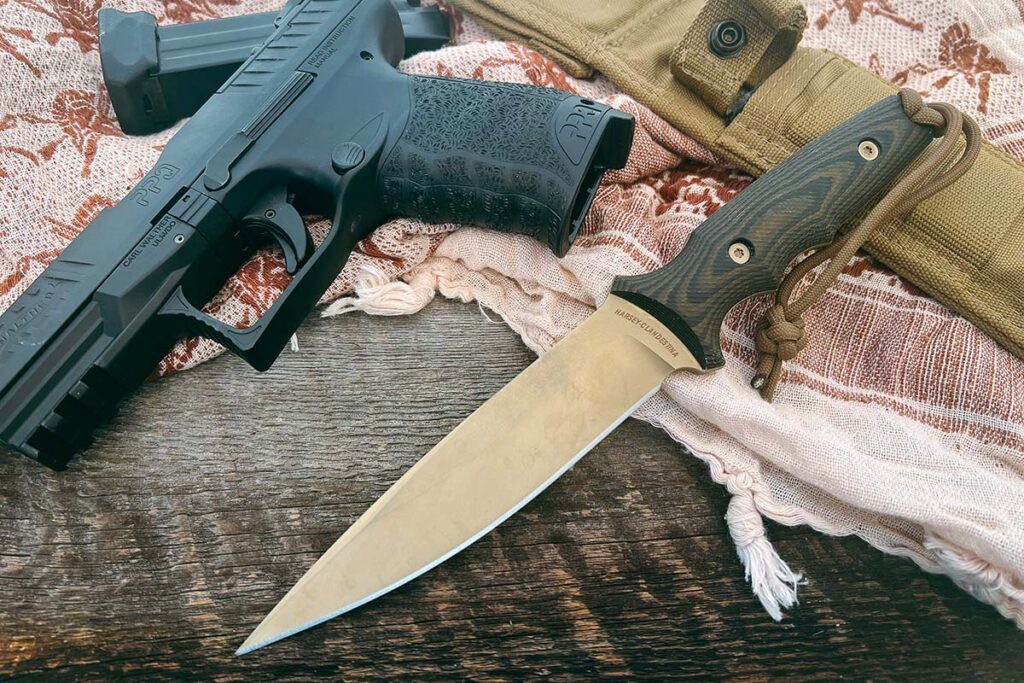
Spartan Clandestina Sheath and pistol side by side
Photos by Marty Stanfield, Marty Stanfield Photography

The blade thickness tapers down progressively to the tip, allowing it to have the ability to do some serious piercing without being too thin where accidental breakage can occur. The overall blade profile is somewhat dagger-like, as you will notice. 

The handle is downright comfortable.  It allows the user to obtain a secure grip at all times, instilling and promoting user confidence. Thanks to the dual finger grooves, these allow the slender handle to have such a great grip quality. Locking your grip on the handle, it feels very stable and unlikely to rotate. 

Furthermore, when you grip the handle and allow your thumb to rest on the blade spine, you can feel how secure this choke grip is and the knife is very controllable in this grip. Whittling and wire stripping are two such tasks that this grip facilitates.  Simply put, the Spartan HARSEY Clandestina is built for use.   

Short Cut

It’s definitely not a toy!  Use it with confidence and use it hard.  Spartan Blades’ craftsmanship skills are highly rated consistently, with each knife they turn out.  You cannot go wrong with choosing the Clandestine.

Spartan Blades$360Check Price
DLT$390Check Price

More On Tactical Knives:

The Joy of Cooking Knife Review

Ethan Becker and Dan Eastland collaborate on a sharp tool for the kitchen.

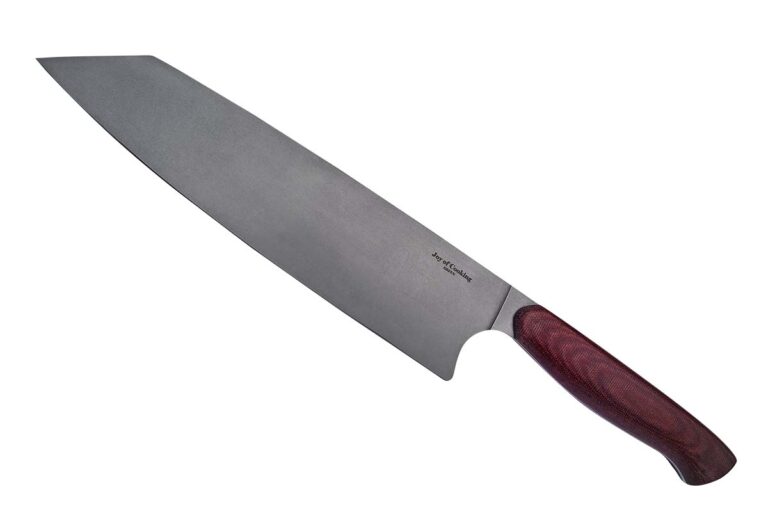
Long-time knife designer Ethan Becker and Dan Eastland of Dogwood Custom Knives have collaborated on a chef’s knife that combines each of the principals’ vision of exactly what such a knife should be.

Introduced at BLADE Show 2024, the Joy of Cooking 8-inch K-tip chef’s knife is a mix of Japanese and Western styles and premium stainless steel and synthetic handle materials.

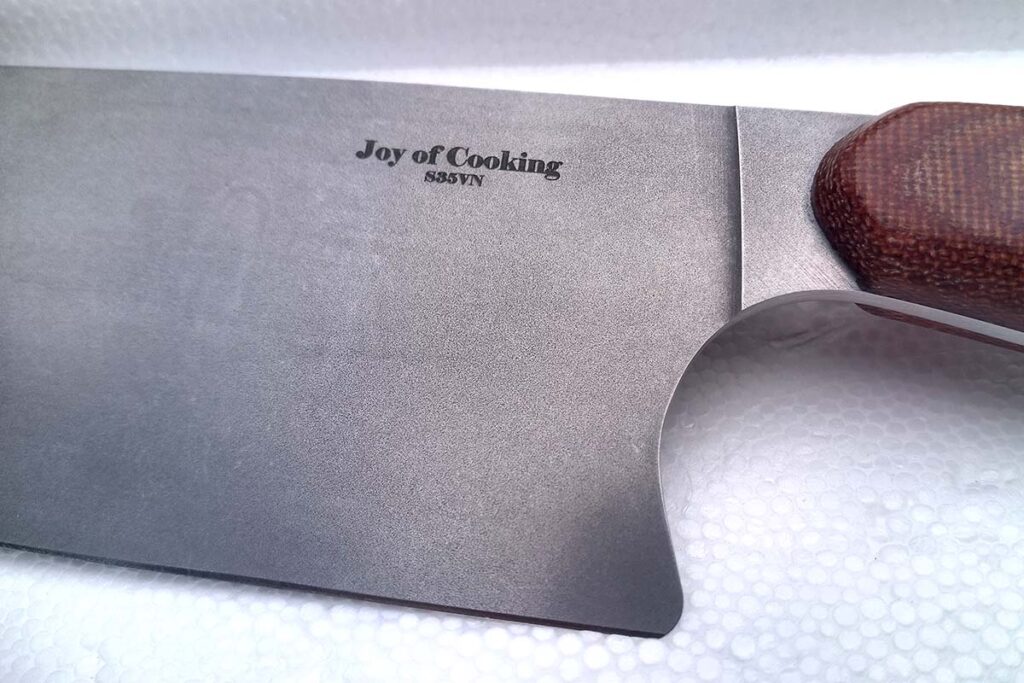
It also has the iconic Joy of Cooking logo on the blade, Joy of Cooking the internationally renowned cookbook originally written by Becker’s mother, Irma Rombauer, and edited in some subsequent editions by Ethan. He handed those duties off and today the book is co-edited most ably by his son, John, and Megan Scott.

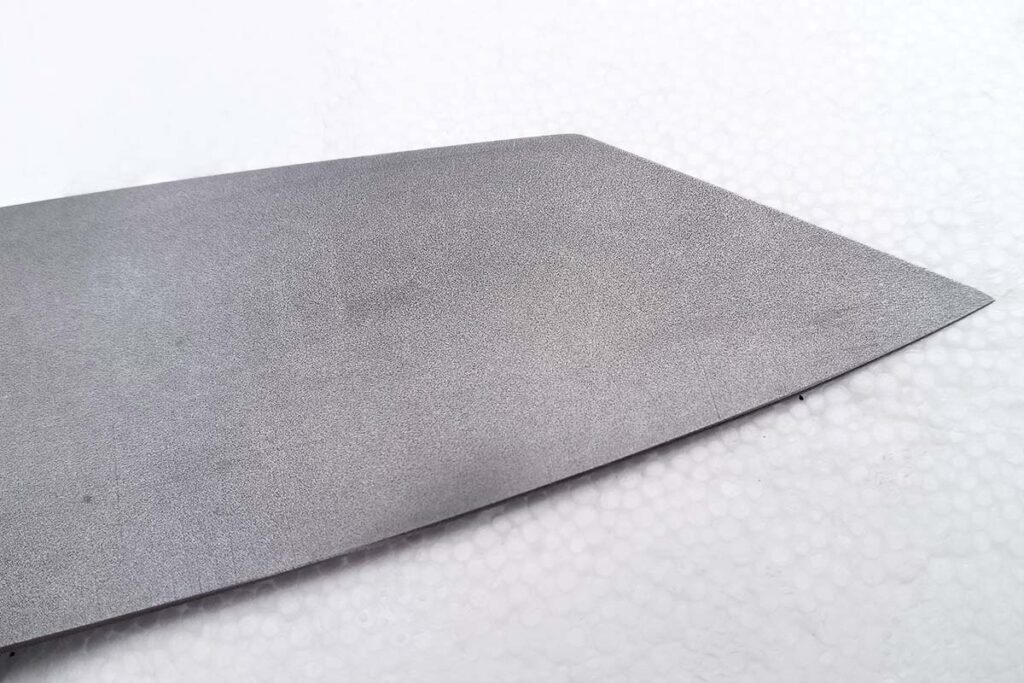
Joy of cooking logo on blade
The heel of the blade curves toward the rear and sits flat on the surface for controlled cutting.

With extensive experience as both a knifemaker and a cook, Eastland brings the kind of know-how to the project that gives it edged gravitas.

“Dan is pretty much the perfect person to do this because he’s been in a commercial kitchen and knows his way around that,” Ethan said.

Dan also spent a number of years as an apprentice maker to Georgia Knife Makers Guild member Andy Roy of Fiddleback Forge in North Georgia, and now builds knives at Dogwood Custom Knives in Greenville, South Carolina.

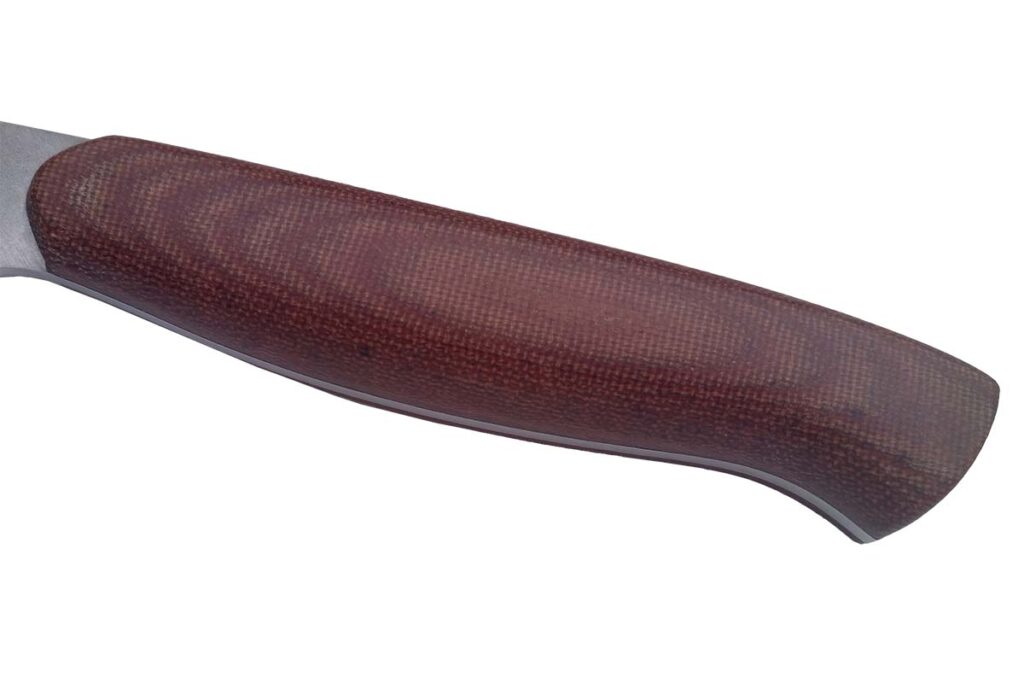
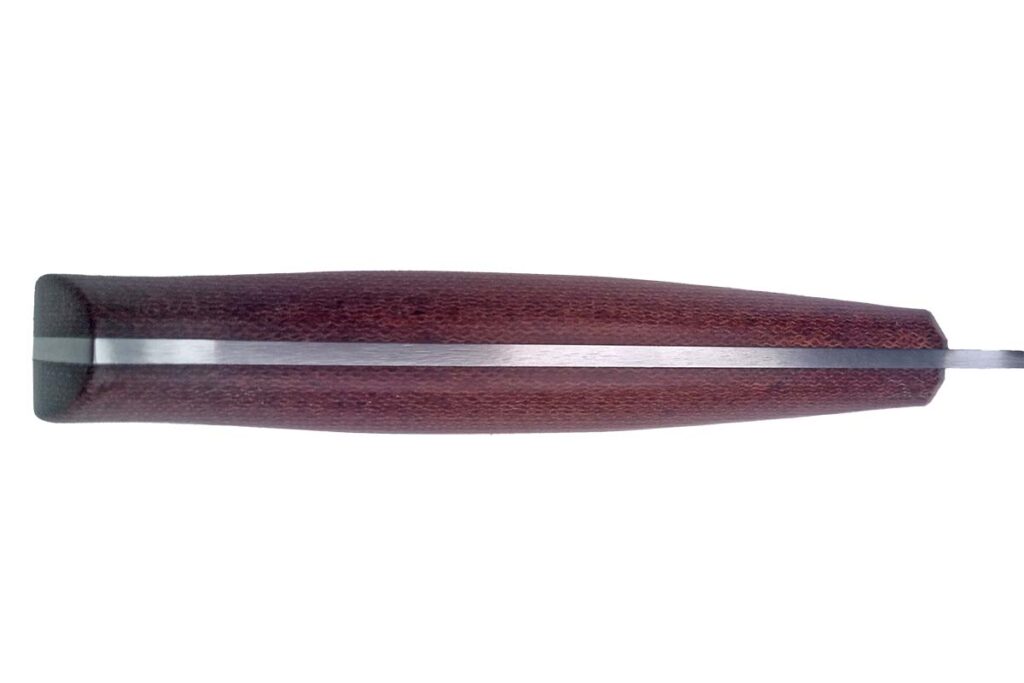
Joy of cooking knife handle
Handle materials come in a choice of natural (shown here; note the texture and grain) and black Micarta® and blue, red or black G-10.

As for the Joy of Cooking knife and its features, Dan approaches it all from the maker/cook perspective.

“The blade has a Japanese influence. I always liked Japanese blade geometry and balance, but I didn’t like their handles. Ethan and I both like a little palm swell,” he noted, “so we wanted more of a Western-style handle.”

In Joy of Cooking, Ethan writes about a grip for home cooks that’s comfortable, Dan said, so the handle has rounded corners to eliminate hot spots and an overall design that helps promote a pinch grip. The blade is weighted toward the front for balance and has the K tip for precise tip work.

Tip of the joy of cooking knife
The K tip gives the knife a piercing feature lacking in such Japanese designs as the santoku.

Ethan said he’s a big fan of the santoku style and has designed santokus and used them in the kitchen almost exclusively for 20 years.

“The one problem with the santoku is it really doesn’t have a good piercer,” he noted. “You can get by without a piercer if you keep the knife really sharp but guess what—most people don’t keep their knives sharp enough. But for such jobs as taking off the top of a tomato, for instance, the K tip works pretty good.”

Dan lauded the utility of the K tip for other tasks as well, adding, “My grandmother opened all the packaging with the tip of a kitchen knife. No matter what knife you gave her, she sliced the top of the package open with the tip and went to work.” The K tip is tailor made for such chores, as well as others.

Joy of cooking knife handle palm swell
The collaborators prefer a Western-style handle and gave the Joy of Cooking Knife grip a palm swell as a result.

The edge has a nice curvature for rock chopping and push cutting meats and vegetables. The heel of the blade also curves toward the rear and sits flat on the surface for controlled cutting.

“The neat thing is when the blade comes down [at the heel during a rocking cut or chop], it stops,” Ethan explained. “It’s also good for a push cut,” Dan added, “so it’s good for both a rock chop and push cut. And having that heel down a little bit it will bottom out, so you cut all the way through something and don’t wind up with little partially cut bits at the end.”

Joy Of Cooking Knife Details

The 8-inch blade is CPM S35VN stainless steel. The Rockwell hardness is 60 HRC and the blade is 3/32-inch thick at the thickest. Along with the contoured handle the knife weighs in at a scant 5.5 ounces.

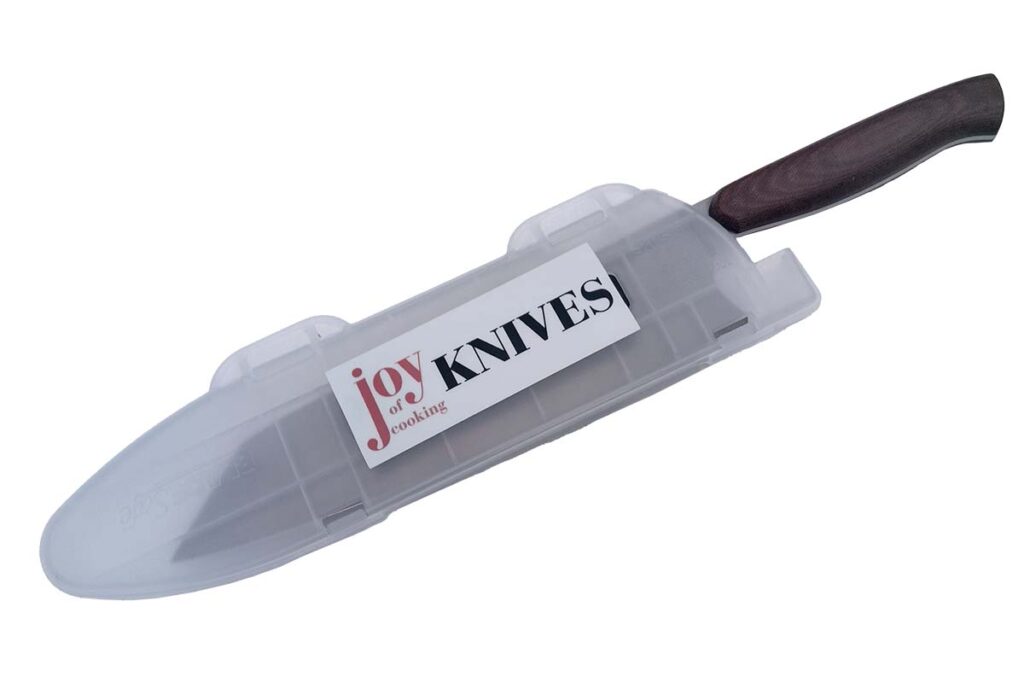
Joy of cooking knife sheath
A hard plastic cover with plastic snaps contains and protects the knife.

“I’m of the opinion the Greeks told us everything we need to know about a double-inclined plane—the longer the plane and the lower the angle, the more efficient it is,” Dan said. “A knife blade is a double-inclined plane, and I wanted to make this knife as light as possible.”

He returned to his grandmother’s experience.

“And again, my grandmother used to complain that Henckels and Wusthof, she loved the knives, but they weighed almost as much as she did. By using the S35VN we’ve been able to thin it out and get a mechanically better cutting blade, but also a lighter blade.”

Ethan agreed that most kitchen knives are too heavy.

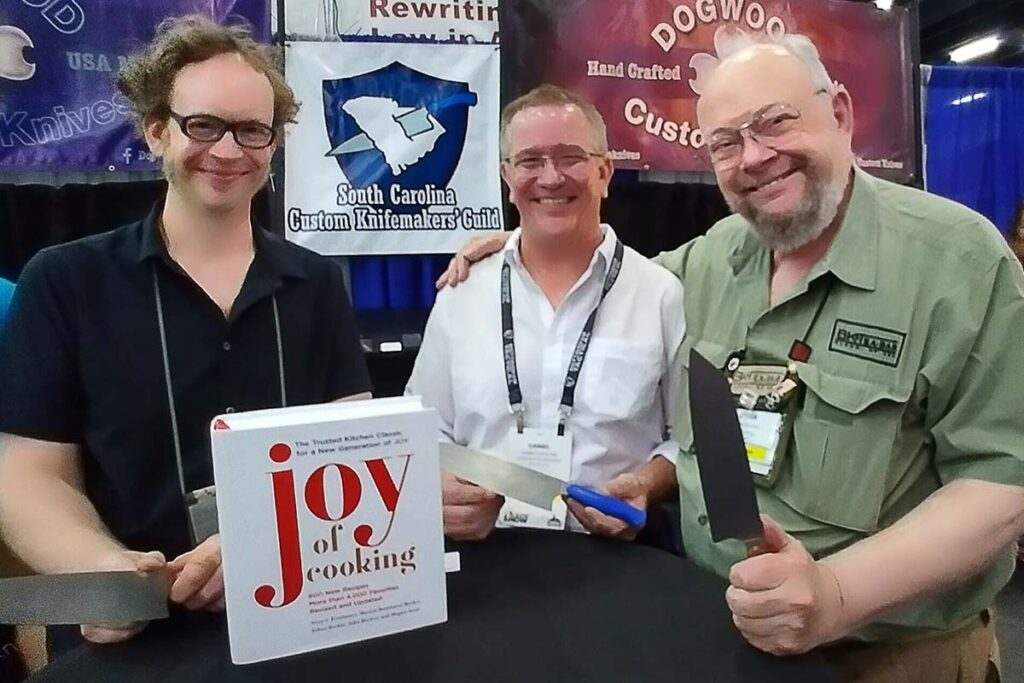
From left at BLADE Show 2024: John Becker, co-editor of Joy of Cooking, Dan Eastland of Dogwood Custom Knives and long-time knife designer Ethan Becker.

“The wrist gets tired easy and to be able to not have very much weight that you’re working with, hey, what’s wrong with that?” he observed. “Most traditional kitchen blades were thick because they were forged before they were ground … The cutlers in Europe were very, very concerned that the housewives would use the blades for things they weren’t supposed to, so they used soft steel so it wouldn’t nick and if they opened bottles with it it wouldn’t hurt it. The result was blades that didn’t hold an edge worth a damn and were not terribly efficient.”

Dan said the S35VN has good corrosion resistance and the edge retention is phenomenal.

“We tested the knife extensively in an industrial kitchen to ensure edge retention and durability, and I like S35VN because it’s a good balance of durability and edge retention. And we can get that 60 Rockwell so it can take a nice, keen edge and we don’t have to worry about it chipping out.”

As noted, Dan and Ethan wanted a Western-style handle with a palm swell and offer it in a choice of G-10 and Micarta®. The Micarta is available in black and natural versions, both with texture and grain for purchase. The G-10 comes in red, black and blue.

“Those colors will always be the same over time as we introduce other knives in the lineup, so you can buy a knife that will match whichever color knife you previously bought,” Dan said. The intent is for there to be a complete set of Joy of Cooking knives, though nothing was set in stone in that regard at press time.

Pros

  • Collaborative Expertise
  • Versatile Blade Design
  • Premium Blade Material

Cons

  • Higher Price Point
  • Plastic Snap Cover

Joy Of Cooking 8” Chef’s Knife Specs
Designers: Ethan Becker and Dan Eastland
Company: Dogwood Custom Knives
Blade Length: 8”
Blade Steel: CPM S35VN stainless
Rockwell Hardness: 60 HRC
Blade @Thickest: 3/32”
Handle: Black and natural Micarta® and blue, red and black G-10 options
Overall Length: 13”
Carry: Plastic snap cover
Knife to Know: K tip blade; lightweight design; hidden handle pins
Country of Origin: USA
MSRP: $200

More Kitchen Knives:

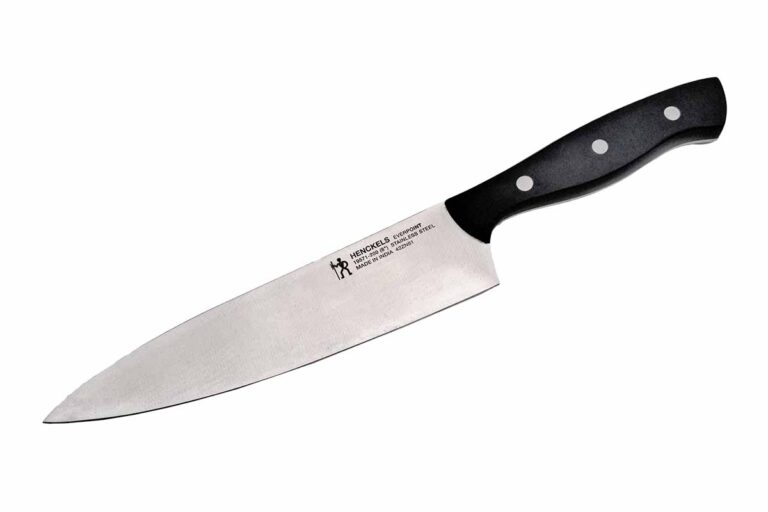
Henckels Everpoint Review: More Knife Than Meets The Eye

See how an over-the-counter Henckels survives the Breed test.

This time I decided to hit the local retail store trail for a knife just about anyone can buy anytime. Nothing tweaked my fancy till I hit a major chain store. There I found an inexpensive Henckels Everpoint 8-inch chef’s knife. Well, let’s just say I’m impressed with the quality of the Henckels. Read on and see why.

Henckels Everpoint Sharpness Test

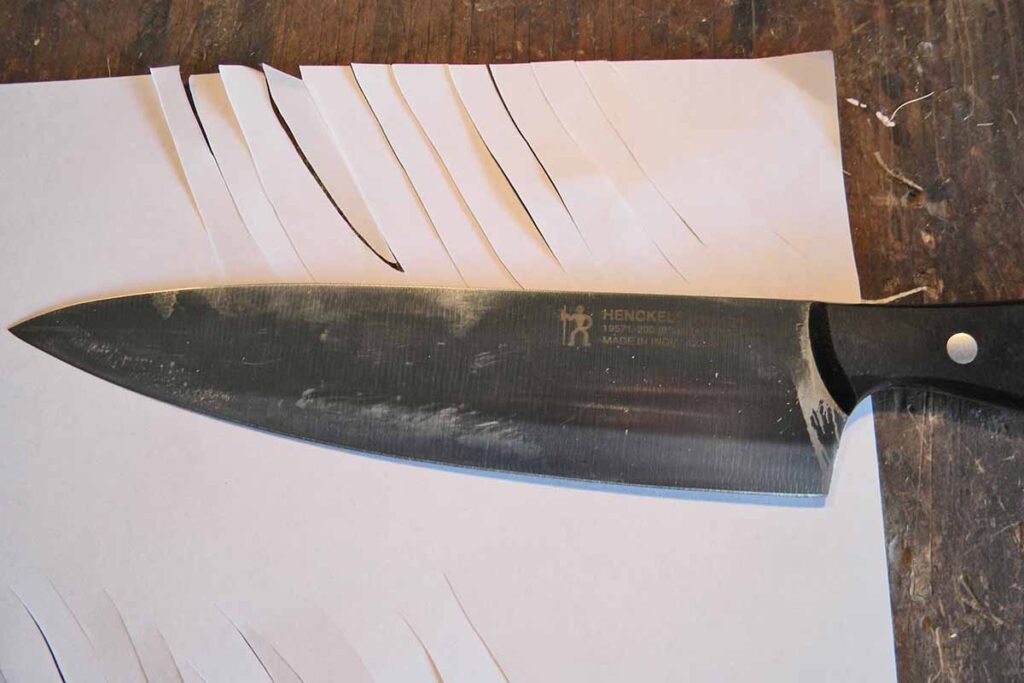
Henckels Everpoint stays sharp
The knife had to slice paper once more to see if the horn whacks did any harm the author could not feel. It was still slicing and dicing like in the beginning.

First was the 20-pound-bond-copy-paper slice. The knife was very sharp and aggressive slicing the paper. I had to take care not to skin parts of my finger off. As fast as I could move, I could slice the paper. The knife was off to a great start.

Henckels Everpoint Food Prep

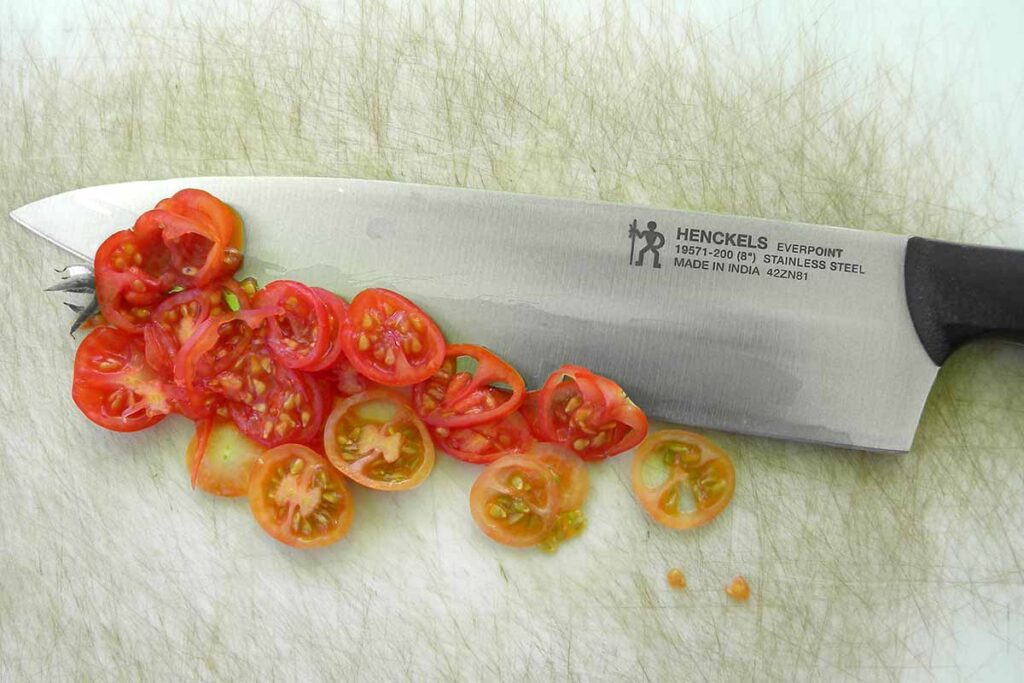
Everpoint slicing tomatoes
The knife sliced the tomatoes fast without mushing them and produced very thin slices.

Now to use the Everpoint for its intended purpose: food preparation. I picked some cherry tomatoes and the last yellow squash from the garden. The knife sliced the tomatoes fast without mushing them. I could get very thin slices. The same went for the yellow squash. The knife was light in hand and well balanced.

Henckels Everpoint Medium Duty Tests

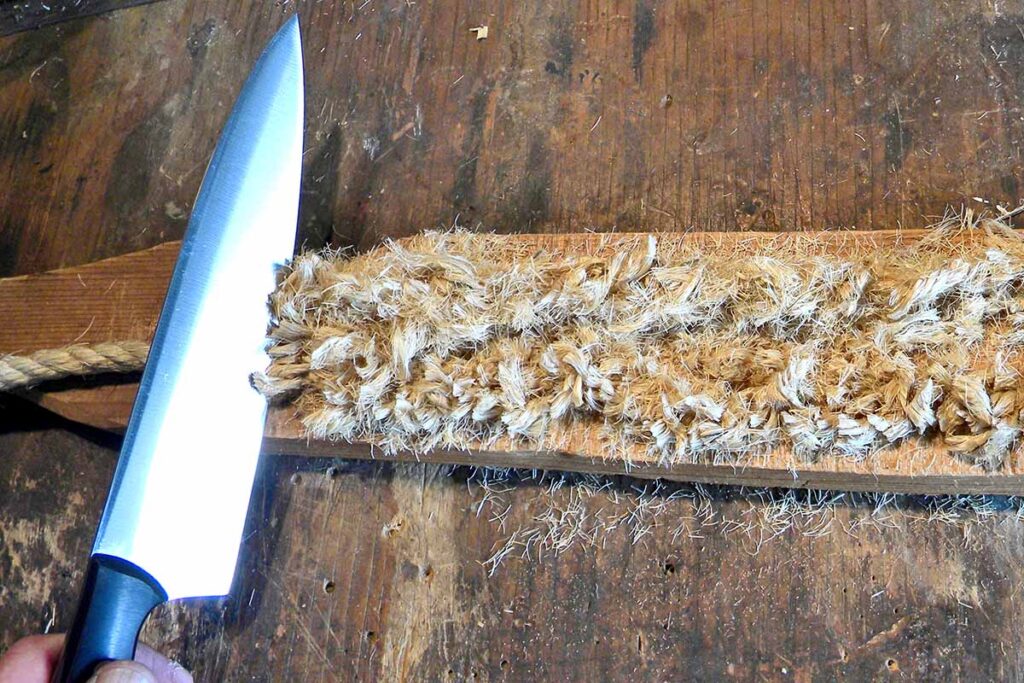
Henckels Everpoint cuts rope.
The Henckels surprised the author by making 200 crunching cuts in the sisal rope, and the knife was ready for more.

The rest of the test was to see how far the knife would go before the edge failed. Getting my technique down with some single-walled cardboard, the chef’s knife sailed through it aggressively with no problems. Very nice!

Next was some whittling on pine. The Henckels gave me some very smooth curlicues. I was surprised at how controllable the knife was, from very fine shavings to deep bites with heavy pieces. It’s a lot different whittling with an 8-inch chef’s knife but it came through with flying colors.

Skiving 8-ounce leather was next. The knife crunched aggressively with every cut, rendering very thin slices and one close call on my finger. The leather was no challenge at all. It was still fun to do quickly and I didn’t need to apply much pressure.

Henckels Everpoint Heavy Duty Tests

Henckels chops wood
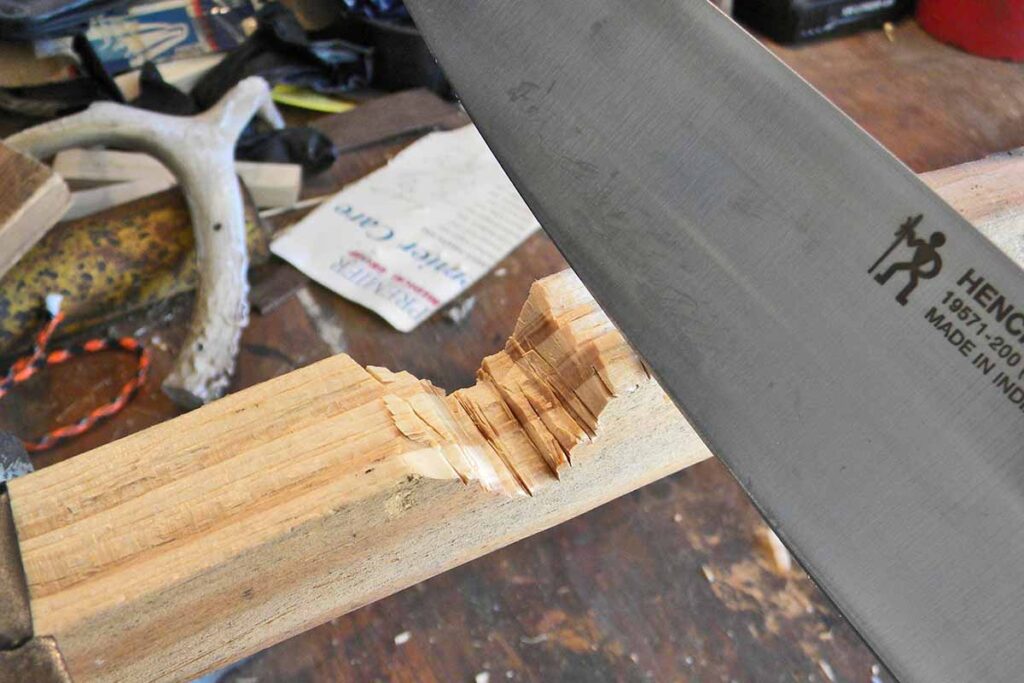
The Everpoint chopped the 2×4 very well. The balanced blade and comfortable handle made it a pleasure to use. The author whacked the wood “pretty hard” but could see or feel no damage to the edge.

It was time to move into the big leagues by chopping into part of a 2×4. The Everpoint chopped very well. The balanced blade and comfortable handle made it a pleasure. I was whacking pretty hard into the wood but I could see or feel no damage to the edge.

All knives have to cut sisal rope. No exceptions. The Henckels surprised me by going for 200 crunching cuts and was ready for more. The plastic scales were extremely comfortable. The knife floated in my hand on every cut. Heat treatment grade: excellent.

I returned to the paper slice to see if the edge had slowed down any. Nope, it sliced just as fast as before. This chef’s knife cuts!

All right, with such a thin blade I figured an antler chop should knock the edge down a bit. Dang, it proved me wrong. Thirty hard whacks into the whitetail horn and there was no edge damage whatsoever. I’m impressed. The knife had to slice paper once more to see if the horn did some harm I could not feel. It was still slicing and dicing like in the beginning. Outstanding!

Final Cut

This chef’s knife really impressed me—low price with top end performance.

Everpoint 8” Specs
Blade Length: 8”
Blade Steel: Stainless
Blade Grind: Flat
Blade @Thickest: .09”
Blade Width: 1.75”
Blade Finish: Satin
Handle: Black plastic
Rivets: Stainless
Construction: Full tang
Weight: 7 ozs.
Overall Length: 13.25”
Country of Origin: India
MSRP: $14.88

Henckels Everpoint Deals

Amazon$25
Wal-Mark$15Check Price
Zwilling$69Check Price

More Culinary Knives:

New Knives September 2024

Damascus, drop points and much, much more…

Autumn is here and, unlike the weather, knifemakers show no signs of cooling down. If anything, factory and custom makers are as hot as ever with a ton of new knives hitting the market. We picked out 12 great-looking recent drops certain to carve a place into your heart.


Jess Hoffman Donegal

Donegal

Knife pattern: Skinner
Blade length: 4”
Blade steel: AEB-L stainless
Blade grind: Full flat
Handle material: Camel bone
Overall length: 8.25”
Sheath: Leather
Maker’s price for a similar knife and sheath: $230
Maker’s remarks: “My Donegal is a cross between a Nessmuk and a Canadian belt knife. It’s available in three different overall sizes: 8.25, 6.75 and 5.75 inches.”
Maker: Jess Hoffman, jhoffmanknives.com (Jocelyn Frasier image)


Kyle Royer Damascene Hunter

Damascene Hunter

Knife type: Fixed blade
Blade length: 5”
Blade material: Ladder-pattern damascus of 1084 carbon and 15N20 nickel-alloy steels
Blade grind: Flat w/convex edge
Handle: Sculpted blackwood w/texturing
Bolster: Damascene-covered guard w/24k gold and gun bluing
Overall length: 9.25”
Maker’s price for a similar knife: $9,500
Maker’s remarks: “This piece is particularly special as it’s the first gold overlay I’ve done using hundreds of tiny 24k-gold wires. Additionally, it has a beautifully textured blackwood handle.”
Maker: Kyle Royer, kyleroyerknives.com (Jocelyn Frasier image)


Bear & Son Cutlery Farmhand

Farmhand

Blade length: 3 5/8”
Blade steel: 440 stainless
Blade pattern: Drop point
Blade opener: Nail nick
Handle material: Aluminum, bone and rosewood (shown) options
Pocket clip: Yes
Lock: Lockback
Weight: 1.1 ozs.
Closed length: 2.75”
Knife to know: Handle color options include black, blue, orange, purple, red and white smooth bone, and brown rosewood
Country of origin: USA
MSRP: $37.49 to $51.99
Company: Bear & Son Cutlery, www.bearandsoncutlery.com


Craig Brosman Hunter

Hunter

Blade length: 2.75”
Blade steel: RWL 34 stainless
Blade grind: Hollow
Blade pattern: Drop point
Blade finish: Mirror polished
Handle material: European red stag and Westinghouse Micarta® liners; w/hole for lanyard
Construction: Tapered tang
Bolster/guard: 416 stainless
Overall length: 6 9/16”
Sheath: Leather pouch w/clip by Aaron Sybrant
Maker’s price for a similar knife & sheath: $550
Maker: Craig Brosman, (SharpByCoop image)


Billy Pearce Hunter

Billy Pearce Hunter

Blade length: 5.1”
Blade material: 1075 carbon steel
Blade grind: “V”
Blade thickness @ricasso: .177”
Blade @widest: 1.18”
Blade pattern: Clip point
Handle: Bocote wood
Spacer: G-10
Guard & pin: 416 stainless steel
Overall length: 9.64”
Knife to know: Billy Pearce is an apprentice smith in the American Bladesmith Society
Maker’s price for a similar knife: Contact maker for info
Maker: Billy Pearce, (Rod Hoare image)


RMJ Tactical Lady Death

RMJ Tactical Lady Death

Knife pattern: Classic trench knife
Blade length: 9 5/8”
Blade material: CPM 3V carbon steel
Rockwell hardness: 60-61 HRC
Blade @thickest: 3/16”
Blade finish: Cobalt Cerakote®
Handle: Checkered Dirty Olive G-10
Handle hardware: Grade 5 titanium anodized bronze
Weight: 18.3 ozs.
Overall length: 15”
Sheath: Brown leather w/green canvas inlay; ambidextrous and wears on a belt or attached to PALS webbing
Knife to know: Double-edged blade w/long fuller; knuckle-duster-style handle; pommel pronounced for use as a hammer
Country of origin: USA
MSRP: $975
Company: RMJ Tactical, www.rmjtactical.com


GiantMouse Carryology Sonoma V2 Auxikko

GiantMouse Carryology Sonoma V2 Auxikko

Knife type: EDC folder
Blade length: 3.425”
Blade steel: Elmax stainless
Rockwell hardness: 60 HRC
Blade @thickest: .138”
Blade finish: Satin
Lock: Linerlock
Pivot hardware: Ball bearings
Handle material: Titanium laser engraved w/the Carryology Auxikko pattern
Backspacer: Aluminum anodized orange w/built-in hole for a lanyard
Pocket clip: Wire, deep carry, reversible
Weight: 3.8 ozs.
Closed length: 4.5”
Knife to know: Limited edition of 400 numbered pieces
Country of origin: Made by Reate in China
MSRP: $295
Company: GiantMouse, giantmouse.com


Gary Martindale Loveless Chute Knife Repro

Blade length: 4.25”
Blade steel: CPM 154 stainless
Blade grind: Hollow
Handle: Amber stag
Bolster/crossguard: 416 stainless
Overall length: 9”
Sheath: Basketweave-leather belt pouch w/snap
Maker’s price for a similar knife: Contact maker for info
Maker: Gary Martindale, (SharpByCoop image)


Grimdog Blades Australia Draugr Mk III

Grimdog Blades Australia Draugr Mk III

Knife type: Military utility
Blade length: 4.9”
Blade material: Thyssenkrupp 80CrV2 carbon steel
Blade grind: Flat sabre
Blade thickness @ricasso: .138”
Blade finish: Cerakote® H190 Armour Black
Handle material: Olive green G-10
Overall length: 10.47”
Maker’s price for a similar knife: Contact maker for info
Knife to know: Christian Holm is a member of the Australian Knifemakers Guild
Maker: Grimdog Blades Australia, (Rod Hoare image)


Liam Walle Bird & Trout

Liam Walle Bird & Trout

Knife type: Fixed blade
Blade length: 3.6”
Blade materials: Crushed W’s damascus of 1084 carbon and 15N20 nickel-alloy steels
Blade grind: Flat
Handle: Pōhutakawa wood w/domed brass pin
Guard/bolster: Antiqued bronze
Overall length: 7.6”
Maker’s price for a similar knife: $750 at press-time exchange rate
Maker: Liam Walle, liamvallaknives.com (Jocelyn Frasier image)


Cold Steel Full Metal Atlas

Cold Steel Full Metal Atlas

Knife type: EDC folder
Blade length: 3.5”
Blade steel: CPM S35VN stainless
Blade grind: High saber
Blade pattern: Drop point
Blade opener: Thumb stud
Lock: Atlas® Lock
Handle: Textured titanium
Weight: 3.8 ozs.
Closed length: 5 7/8”
Knife to know: Knife comes in all-black (shown) or standard stonewashed finishes; handle includes a single finger groove w/integral guard
Country of origin: Taiwan
MSRP: $229.99
Company: Cold Steel, www.coldsteel.com


Halfbreed Blades MIK-03P Gen-2 K340

Halfbreed Blades MIK-03P Gen-2 K340

Knife type: Fixed blade
Blade length: 5.31”
Blade steel: K340 ISODUR
Rockwell hardness: 59-60 HRC
Blade @thickest: .25”
Blade pattern: Modified drop point
Blade finish: PVD coated
Construction: One-piece full tang
Handle: G-10
Weight: 11.14 ozs.
Overall length: 10.43”
Sheath: Injection-molded plastic w/belt & PALS/MOLLE mounting
Knife to know: MIK stands for Medium Infantry Knife
MSRP: $212 at press-time exchange rate
Company: Halfbreed Blades, halfbreedblades.com.au


Check Out More Knife Drops:

Best Custom Hunting Knives: Is There A Consensus?

Top knife observers decipher the best custom huntering knives ever made.

It’s an ongoing discussion, or maybe a debate, slightly contentious but always cordial. When the question is pondered regarding who made the best custom hunting knives ever, a few names quickly come to mind.

Of course, there is no right or wrong answer. It’s a matter of interpretation, fit and finish, design, form and function, and the feel of the knife in the hand when it’s time to get down to the business of skinning and dressing game. Each respected and well-traveled knifemaker and observer consulted below can tell the stories that back up his top few. But in the end there is no doubt. Each of these revered custom makers and/or bladesmiths has got game. It’s proven in their work.

Bruce Voyles’ Take

BLADE Magazine Cutlery Hall-of-Fame® member and knife auctioneer Bruce Voyles accompanied his fellow Cutlery Hall of Famer, the legendary George Herron, on a few hunting trips and experienced his work in the field.

George Herron' Model 6 and Model 3 skinners
Among the top hunting knives BLADE Magazine Cutlery Hall-of-Fame® member George Herron made are the Model 6 (top) and the Model 3 skinner, aka Little Dude (bottom). The Model 6 sports a 4-inch blade and 9-inch overall length. Blade and overall lengths for the Little Dude: 2.75 and 6.75 inches. Respective blade steel, handle material and construction on each knife are ATS-34 stainless, curly maple and tapered tang. (Jay Mealing knife image)

“George was a fantastic hunter,” Bruce remembered. “When a group of us would go with him, we might kill three deer in a four-day morning and afternoon hunt, but he could get eight if he wanted to.”

Bruce tells the story of an Outdoor Writers Association hunt Herron organized after an invitation from a South Carolina country gentleman that George had helped change a tire. It seems the man owned a large tract of land, and in return for Herron’s kindness he was allowed to hunt deer on the property.

“When we got to that plantation, every guide there was carrying a George Herron knife,” Bruce commented. “The thing about George’s knives is that when you held one and used it, you were using a knife made by a man who had been there. He made tremendous skinning knives, and the balance and feel in the hand are unsurpassed. The balance, shape of the handle, and minor nuances of the tilt of the blade, its thinness, and the tapered tang set Herron knives apart.”

Bill Moran’s engraved gentleman’s hunter
According to BLADE Magazine Cutlery Hall-of-Fame® member Bruce Voyles, the knives of Cutlery Hall-of-Famer Bill Moran feel like an extension of your hand. Mr. Moran’s engraved gentleman’s hunter in damascus and with one of his iconic moon logo sheaths is representative of Bruce’s sentiment. (Eric Eggly/PointSeven image)

According to Voyles, the knives of Herron, Jerry Fisk and Cutlery Hall-of-Famer Bill Moran feel like an extension of the hand. Herron also made knives that were affordable for a hunter to purchase. Since he put many knives in the hunters’ hands because of a reasonable price point, the praise of his work in the shop spread far and wide. Today, there are several quality custom knifemakers contending for recognition, and they include Ralph Smith, Larry Page and Wayne Hendrix to name just a trio, Bruce says.

“Wayne was one of the guys who trained in George’s shop, and while we were hunting he had his own shop set up on the grounds making knives to sell directly to hunters,” he noted. “He was a guide in South Carolina and approaches making hunting knives the same way George did. He’s the closest to George’s knives now.”

Jim Sornberger’s Take

Cutlery Hall-of-Fame knifemaker Jim Sornberger remembers the days years ago when names such as Harry Morseth and Cutlery Hall-of-Famers Bo Randall and Rudy Ruana were synonymous with excellence in hunting knife craftsmanship. He also mentions the fine work of Corbet Sigman and other contemporaries of the 1960s and ’70s.

A.G. Russell made Herry Morseth designed Model 1
“The first new model A.G. Russell made when he acquired Morseth Knives from Harry Morseth was the Model 1, also known as the Ozark Hunter,” Tom Krein noted. “It is a drop-point camp and hunting knife with a 3.5-inch blade, hidden tang, nice guard, and thin-shaped Micarta® handle that make the knife extremely light.” This version sports a stacked leather and fiber spacer handle with a stag butt. (Nordic Knives image)

“It goes back to when I was a kid and my uncle had a gun store in Redding, California,” Jim said. “Those names were famous, and I met Harry Morseth in the ’50s. His Cascade Skinner was my favorite hunting knife for many years with a great handle shape in leather or stag for a good grip and a guard, which is really important in a good hunting knife because you’ve got to hang onto an animal or fish if you’re working and you can’t afford to have the knife slip in your hand. The blades were laminated Brusletto steel from Norway, and the knives came with a safety sheath. Mine was copper-lined leather in the shape of the knife, and later models had a fiber material liner inside.”

Sornberger also mentions Cutlery Hall-of-Famer Gil Hibben, Ruffin Johnson and Clay Gault as makers of outstanding hunting knives. However, trying to identify custom makers that are in that rarefied air with the masters these days requires some reflection. “It’s tough because a lot of guys follow trends nowadays and they find it’s cheaper and faster to make a knife without a guard,” he opined. “Randy Lee has been around a long time and still makes a lot of good using knives. Dave Pitt in Redding, California, does as well, and that’s hunting country. Randy has a stubby little hunter with a 3.25-inch blade and nice guard, and that’s plenty of knife for most hunting applications.”

Tom Krein’s Take

Veteran knifemaker Tom Krein is upfront with his thoughts on the best maker of hunting knives.

“I actually worked for Bob Dozier and A.G. Russell from the mid-1990s to 2001, and honestly this is a tough one. We all use hunting knives differently in the field and for different things, but I would put Bob Dozier forward. He grew up hunting in the bayous and providing for his family, [and] he has a lot of experience making knives. He is an exceptional craftsman, and in the 1980s I feel one of the pioneers in the style of distilling everything down to make hunting knives easier to make and get them in everybody’s hands.”

Jerry Fisk’s Sendero hunter
Award-winning bladesmith Jerry Fisk’s Sendero hunter served as Tom Krein’s inspiration to make knives. (Eric Eggly/PointSeven image)

Krein likes the reasonable price point of a Dozier hunting knife and the attributes that characterize the maker’s outstanding work: a full tang, thinly ground blade, Micarta® handle, and often a Kydex sheath system for safety. “Dozier’s knives check all my boxes,” he related. “The Dozier Personal with a 2-inch blade works great on game, and an investment of $300 will get you a fine Dozier knife.”

Tom also has seen the Morseth line continue with A.G Russell and has tremendous respect for the maker’s legacy. “The first new model A.G. made when he acquired Morseth Knives from Harry was the Model 1, also known as the Ozark Hunter,” Krein noted. “It is a drop-point camp and hunting knife with a 3.5-inch blade, hidden tang, nice guard, and thin-shaped Micarta® handle that make the knife extremely light.”

Tom tips his hat to custom knifemaker Brian Goode, whose hunters and skinners are gaining notice, while he also acknowledges the great work of Jerry Fisk, whose Sendero served as Krein’s own inspiration to begin making knives. And then there’s the geometry and thinness of the blade in ABS master smith James Rodebaugh’s hunting knives that Krein calls “beautiful work.”

James Rodebaugh’s Take

Speaking of Rodebaugh, his thoughts on the best maker of hunting knives include George Herron, whose work he describes as “superb,” and two more greats, D. E. Henry and Cutlery Hall-of-Famer Jimmy Lile. “The first knife I ever owned was a Lile hunter, and he made one heck of a hunting knife,” James remarked. “That knife was my primary hunter before I even started making knives, and it did all I ever asked of it.”

Adam’s clip-point hunter
ABS master smith James Rodebaugh is high on the work of Missouri-based maker Jason Coy and ABS master smiths Jason Knight and Adam DesRosiers. Adam’s clip-point hunter in damascus and stag is a stunner. (SharpByCoop image)

According to Rodebaugh, edge geometry is critical in a hunting knife, along with the design and profile of the handle and proper Rockwell hardness. Each of these characteristics is essential, and the Lile knife was “about as perfect as I’ve ever held, and I’ve dressed well north of 300 animals, not counting small game.”

Rodebaugh’s own knives are reflections of his hunting experience. He has been lauded for the field performance of his Raised Swedge Hunter, which some refer to as a harpoon point, that was actually inspired by a Marble’s hunter design. He has been making the Outfitter hunting knife for about 15 years, forging the blades in batches of five with O1 tool steel hardened to a Rockwell of 60-61 HRC, and a Micarta handle with a palm swell for added comfort.

James has been impressed recently with the work of Missouri-based maker Jason Coy and ABS master smiths Adam DesRosiers and Jason Knight. “Jason saw my raised swedge years ago and asked to use it, and I said ‘absolutely!’ Nobody has probably designed a ‘new’ blade in the last 1,000 years or so. Adam has worked with it as well, and now everybody in the country produces that design feature.”

Of Course, Bob Loveless

The names of custom makers past and present conjure images of their outstanding hunting knives. But no story on the topic would be complete without mention of Cutlery Hall-of-Famer Bob Loveless. While some have said Loveless was a fine maker, some have also said his fit and finish were reasonably good—not great. Nonetheless, the thing about Loveless was his eye for design.

Randy Lee drop point hunting knife
According to BLADE Magazine Cutlery Hall-of-Fame® member Jim Sornberger, Randy Lee has been around a long time and still makes a lot of good using knives. An example is his drop point with an amber-spacer look reminiscent of the My Knife by BLADE Magazine Cutlery Hall-of-Fame® member D’ Holder, a pretty fair maker of hunting knives in his own right. (SharpByCoop image)

“Loveless went to design school,” Voyles explained. “He made a knife with eye appeal. It was different, and a lot of people don’t understand why, but it was the natural French curve. It was the design. People say Loveless made the perfect hunting knife because of the drop point, and to me it doesn’t work as good as one of George Herron’s knives.”

Sornberger knew Loveless well. “Bob was a good friend and signed for me to get into the Guild,” Jim began. “I think Bob found a universal handle shape that he used on all his knives, and it was a combination of a good kitchen knife and all with a guard except for a couple of models he made later on. All fit well in the hand. Bob got a lot of publicity. He could sell snow to Eskimos.”

Krein sees the Loveless drop point as iconic. “But there is a difference with the variance in game animals from squirrels to rabbits to deer, elk and moose. So best at what? I personally think the Loveless drop point is a fine design, but I wouldn’t take it into the woods,” he observed. “It’s just bigger than I like, and I like hidden tangs for hunting knives.”

Rodebaugh reminds that Loveless is a giant among custom knifemakers, and his hunters are noteworthy to say the least. “I met Bob many years ago and didn’t live far from him in California,” James recalled. “He made a good knife, and the drop point had a lot of impact on the industry, but contemporary with Bob were guys like Herron that produced excellent knives. Loveless made a solid working knife and took that to great heights through pretty good marketing, along with his popularizing of ATS-34 stainless blade steel.”

All hunters have a favorite knife, a trusted companion in the field that is handy, dependable, and built for the jobs encountered. While discussing the topic of just who might be the best custom maker of hunting knives is a never-ending exercise, suffice it to say that hunters are fortunate to find such steadfast companion tools when they are needed most.

Check Out More Outdoor Knives:

Custom Hunting Knives: Hunting For The Best Value

Understand how and why custom hunting knives cost what they do.

When I attend shows, one of my main goals is to talk with knifemakers and check the prices of various custom knives. One of the best shows to do that is the BLADE Show. This past June my goal in the Cobb Galleria Centre in Atlanta was to talk with 50 custom makers to get their takes on trends, material prices, overall demand, etc., regarding the knives they make and sell.

Luke Dellmyer custom hunting knife.

The custom knife that dominates the fixed-blade market is the hunter. This is due primarily to the fact that there seems to be an endless variety of hunting knives that can be made, and they usually have a lower price point than many other custom knives. Unlike other customs, hunting knives are often bought for use. Consequently, they are frequently tested by many users, from the casual outdoorsman to the professional hunting guide. The firearm may dispatch the game, but the knife provides the meat and potentially the trophy the taxidermist creates.

Over the years, thousands of articles have been written on and about hunting knives, including a few by this writer. In this article, I want to discuss not types or designs but pricing on knives in the hunter category.

Custom Hunting Knives Cost

Wess Barnhill ladder-pattern damascus hunter.

Several factors go into the cost of building or making anything. Most makers need a place to make the knives, usually a garage or a shop. Next comes the equipment, which varies from maker to maker. Belts for grinding, polishing and putting an edge on the blade can be one of the more costly items a maker utilizes. Electricity, propane or wood provide the energy to work the materials that become the knife. No matter how the knife is built, these are typical costs shared by most makers. The costs vary depending on the prices of the materials to make the knife. Steel, guard/bolster material, handle material and leather if a sheath is required all impact the finished knife’s price, as will the maker’s skill at using these materials.

Custom Hunting Knives Blade Steel

Dan Lewis' dmascus and copper san-mai hunters, both striking outdoor options.
Dan Lewis’ dmascus and copper san-mai hunters, both striking outdoor options.

The majority of makers use either stainless or carbon steel. Each offers advantages and disadvantages. Because of the diversity of steel, hunters can select a knife with the steel that best suits their needs.

Some hunters prefer patterned damascus steel, such as the ladder pattern of the damascus hunter by ABS master smith Russ Andrews (see accompanying image). Some hunters indicate the damascus blade’s distal tapering and differential heat treatment give the knife a better edge-holding capability. Others prefer steel of a san-mai construction as in the knife of ABS journeyman smith Dan Lewis. By forge welding more malleable steel onto either side of a harder steel, san-mai provides the blade with more structural integrity without sacrificing its ability to hold an edge.

As you can imagine, creating these steels takes additional time and is an added expense. The steels can add anywhere from $150 to $400 to the knife’s cost.

Custom Hunting Knives Handle

Russ Andrews amber stag hunter is a looker.

The handle material varies from natural to such synthetic(s) as G-10, carbon fiber and Micarta®. Natural handle materials are even more diverse, including ivory, antler/horn, wood, mother-of-pearl and bone. The advantage of synthetics is they are not subject to the effects of weather and temperature and so do not shrink and/or expand. Also, Micarta and G-10 are less expensive than some natural handle materials.

Natural handle materials can give your knife a unique look, making it stand out from other knives. Ivory, predominantly mammoth or ancient walrus ivory, is among the most distinctive and expensive handle materials used on hunting knives. Mammoth ivory comes in the form of scales and can cost anywhere from $100 to $250. Ancient walrus ivory costs are largely determined by the color(s) and condition. Prices generally range from $200 to $400.

Antlers and horns of all types have been used as knife handles from the onset of knives being built. The most commonly used antler on custom hunting knives is Sambar stag. In addition to its classic look, the natural lands* and grooves of the antler will contour to your hand, giving you a better grip when using the knife. Stag’s demand and lack of supply over the past 15 years have driven the price up considerably. You can expect to add $125 to $175 to the cost of the knife for an excellent piece of stag.

Mike Malosh's hunters are outfitted with either an elk and black Micarta or stacked leather washers.
Mike Malosh’s hunters are outfitted with either an elk and black Micarta or stacked leather washers.

Watching the price of stag increase encouraged me to look at other members of the deer family. One such member is the elk. It has many of the same characteristics as the stag antler, such as the natural lands, grooves and coloring. However, the price is considerably less than stag—around $50. The Elk Hunter (see accompanying image) by Mike Malosh gives you an idea of what an elk antler looks like on a custom hunting knife.

Wood is also a favorite handle material for both makers and collectors. Talk about diversity—wood offers just about any color you could want. Now, with the wood stabilization process commonplace, you eliminate most of the adverse effects of weather on the natural handle material. The price point for wood ranges from $5 to $50 to $75 for scales or a block of desert ironwood or koa. The damascus hunter by ABS journeyman smith Wess Barnhill features a beautiful set of desert ironwood scales. Its range of colors helps ironwood find its way to many knife handles.

Walnut is a hardwood favored by makers such as ABS journeyman smith Luke Dellmyer. It is a very stable, attractive wood that costs $30 a block. Another natural handle material I like, but you don’t see much, is stacked leather washers, as on the Mike Malosh Bear Hunter. One advantage I found with stacked leather is that, over time, the handle material will conform to your hand, providing you with a custom grip. You can expect stacked leather to add about $30 to the knife’s cost.

What Makes A True Value

As a professional custom knife purveyor, I offer prices based on my conversations with suppliers and makers and the materials I have bought over the years. As you know, everything gets more expensive, so prices may vary. The makers’ ability to combine the materials to create functional and aesthetically pleasing knives comes from years of honing their skills in their shops. Once you understand material pricing and can differentiate the skill levels of the different makers, you will realize that this is where the true value lies.

*Like on the inside of the barrel of a firearm, lands are the raised part of the antler and the grooves are the recessed part.

Check Out More Outdoor Knives:

Advertisement

Must Read Articles

Read this before you make a knife

Knifemaking 101 – Read This Before You Make a Knife

  by Wayne Goddard My experience has taught me that there's nothing like digging in and getting started. I've often said the hardest part of the...
how to forge damascus steel

How to Forge Damascus

Advertisement
Advertisement