Handy keychain knives are pocket pards ready to sever and serve.
As competitive as today’s cutlery market is, it behooves a factory knife company to fill as many categories as it can—including the keychain knife. In fact, keychain knives offer a number of the same utilitarian functions as many contemporary tacticals and EDCs. Whether you need a small knife to handle daily chores or a back-up to your back-up in an emergency, a keychain knife can answer the call.
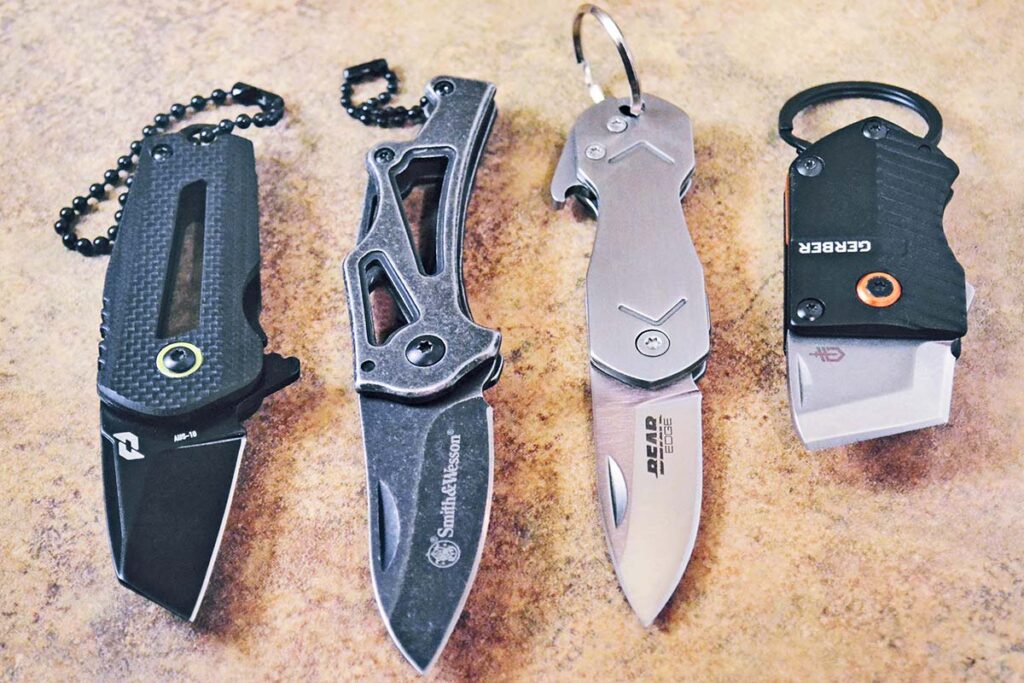
The test bunch, from left with manufacturer’s suggested retail prices in parentheses: Schrade Roadie ($25.99), Smith & Wesson Stonewash ($17.99), Bear & Son 3-inch Keychain Knife ($22.99) and Gerber Keynote ($27). All are made in China.
Bear & Son 3-inch Keychain Knife
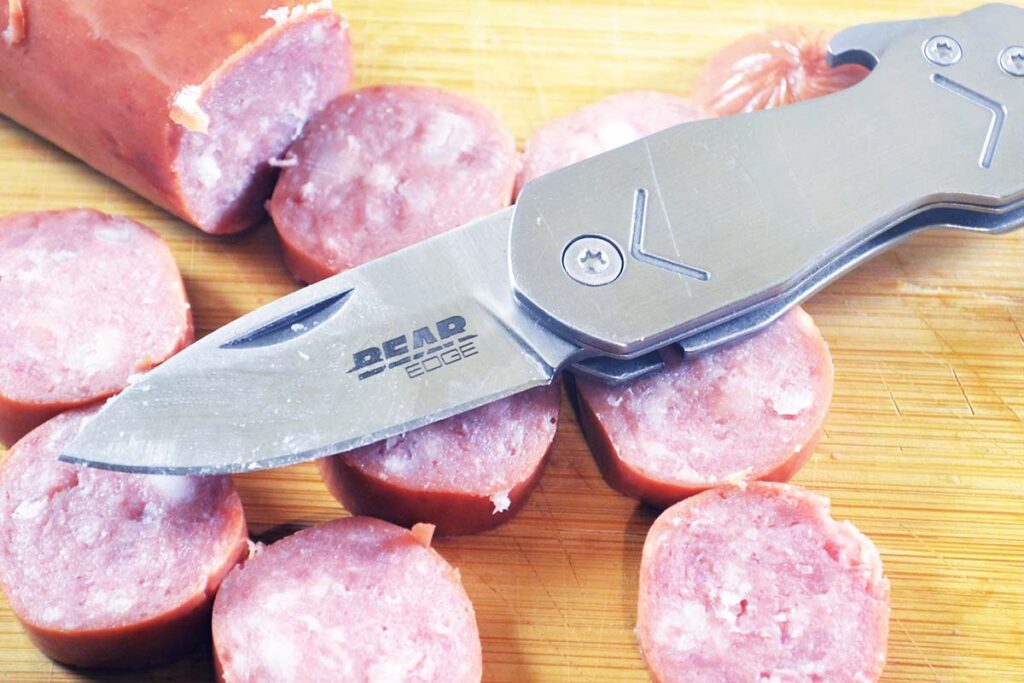
The Bear & Son’s 2-inch drop-point blade of 440 stainless steel in a brushed finish took off slices of 1-inch-diameter smoked sausage with no problem. Note the cap lifter on the rear of the handle spine. Weight: 2.3 ounces. Closed length: 2.8 inches.
The Bear & Son 3-inch Keychain Knife is a study in curves and its all-silver frame and blade add a classy touch. The blade sports a brushed finish and rolls out via a nail nick. Key hauling is handled by a 1-inch flat split ring on the base, very adequate unless you carry a large number of keys. In that case you can always add a larger split ring. A cap lifter is on the lower backside of the handle.
I sliced 1-inch-diameter smoked sausage and the blade performed admirably—not that you’d typically grab your keychain knife to perform such a task but it’s there if you need it. The cap lifter is handy. There is no pocket clip but the Bear & Son is not overburdening for loose pocket carry. This is a stout keychain knife well worth the money.
Schrade Roadie
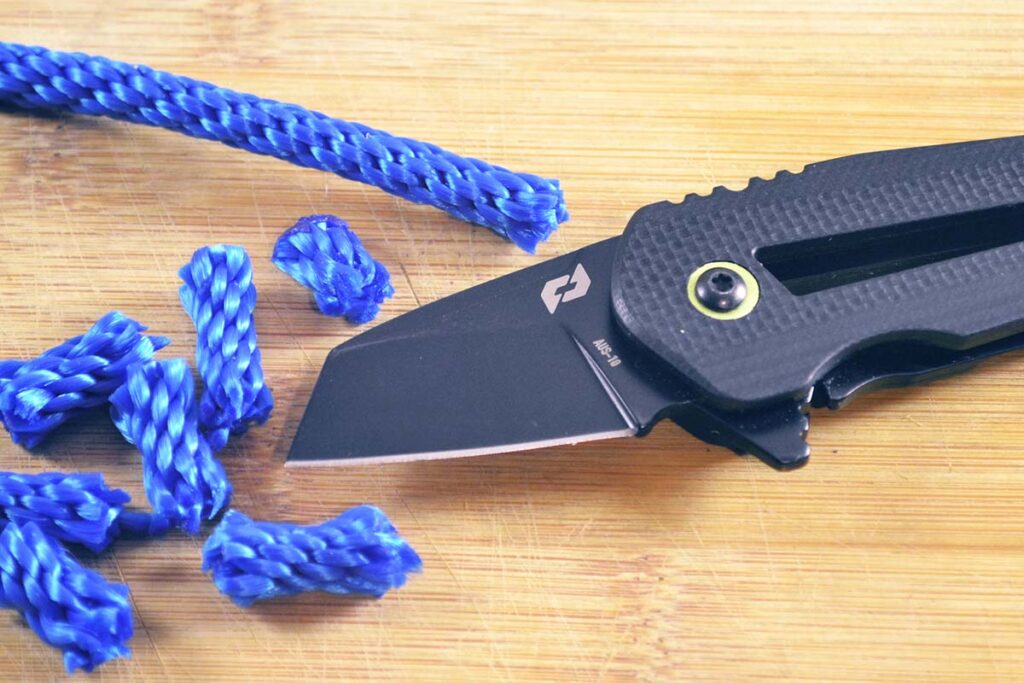
The Schrade Roadie is a little bulldog. The 1.5-inch blade of black-oxide-coated AUS-10 stainless steel bit through round after round of rappelling rope like a walk in the park. It’s a no-frills cutter meant for cutting. Weight: 2 ounces. Closed length: 3 inches.
The Schrade Roadie is a little bulldog of a keychain knife that doesn’t pretend to be anything else—it’s strictly a knife. In fact, it looks like a squeezed tactical folder. The blade opens via a flipper tab. The handle is black G-10 over black-coated stainless liners, with the rear liner serving as an unusual exposed locking leaf. Keys carry via a 4-inch black ball chain that dangles approximately 2 inches off a hole in the base.
I tested the blade on 3/8-inch synthetic rappelling rope to see how the reverse tanto pattern—a cousin to a modified wharncliffe—performed. It had no problem taking 3/8-to-1/2-inch slices in a single pass. The grip is excellent, aided even more by gimping on the upper rear handle close to the blade spine. This is a heck of a small knife and I only had one beef with it—the ball-chain key dangler. With the weight of keys tugging on the chain both sloshing around inside the pocket and while in use, you are asking for it to break. By the nature of ball-chain construction there are simply too many points along the way it can fail. I’ve got a remedy for that I’ll discuss later.
Smith & Wesson Stonewash Keychain
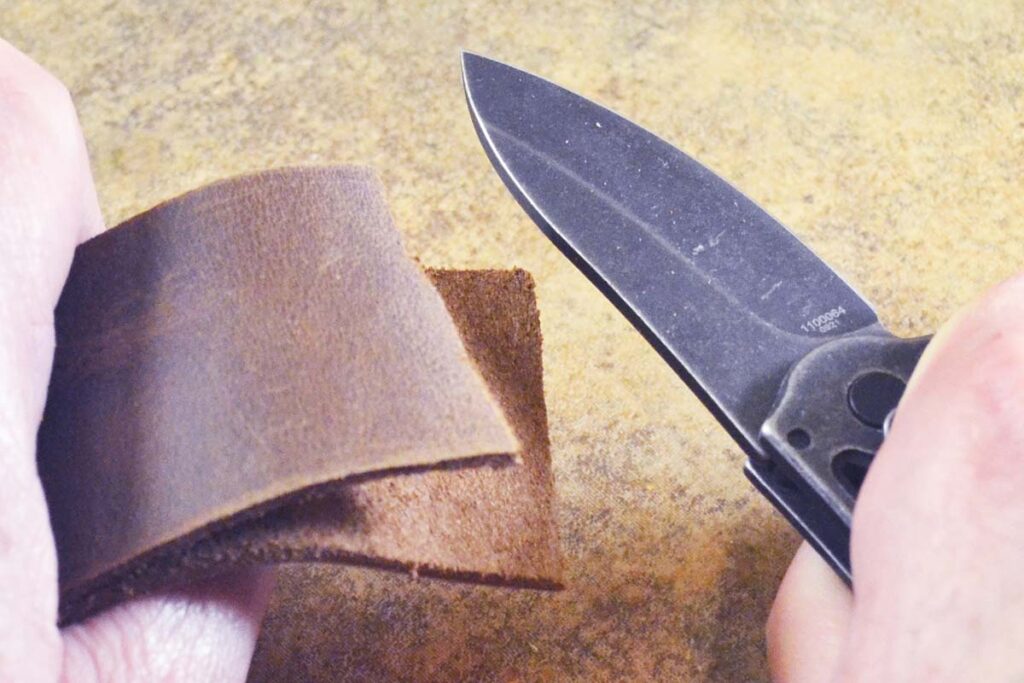
The Smith & Wesson’s 2.1-inch drop-point blade of ti-nitride-coated 8Cr13MoV stainless steel sliced its way through 1/8-inch harness leather, something the author indicated the other knives would have more trouble doing. Weight: 2 ounces. Closed length: 3.2 inches.
The Smith & Wesson Stonewash Keychain is the largest of the test bunch and it, too, resembles a scaled-down tactical folder. There’s a cap-lifter cut-out on the back frame slab. Keys mount at the base using a 3-inch ball-chain loop. This is the first of two review knives with a convenient pocket clip. The keys must be removed before using it because the clip is mounted for tip-up carry only, and if you use the keys they will hang out the top of your pocket. If this is acceptable to you, go for it.
I tested the blade on 2-inch-wide harness leather. Looping the leather strip over I did pull-throughs and found the little cutter more than up to the task. The framelock knife is built like a tank with the exception of a ball-chain key carrier which, as stated, I believe will give you issues down the road. That said, if you’re comfortable with it, go for it. I like this otherwise sturdy knife and it’s worth every penny of the price tag.
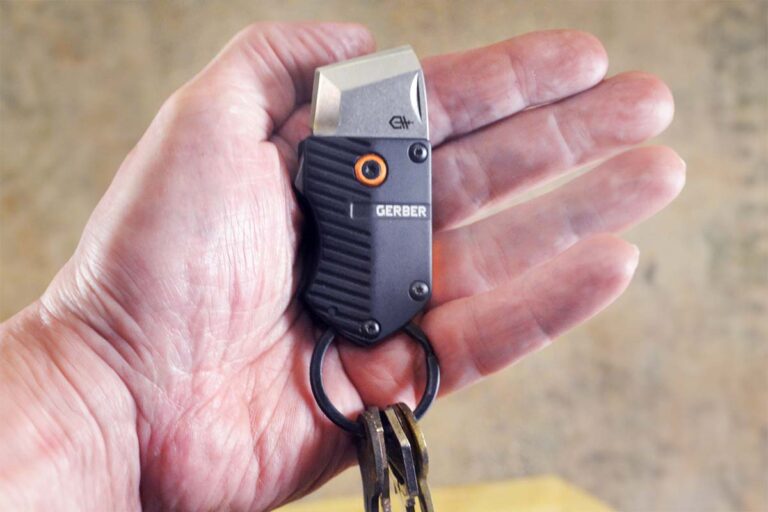
Gerber Key Note
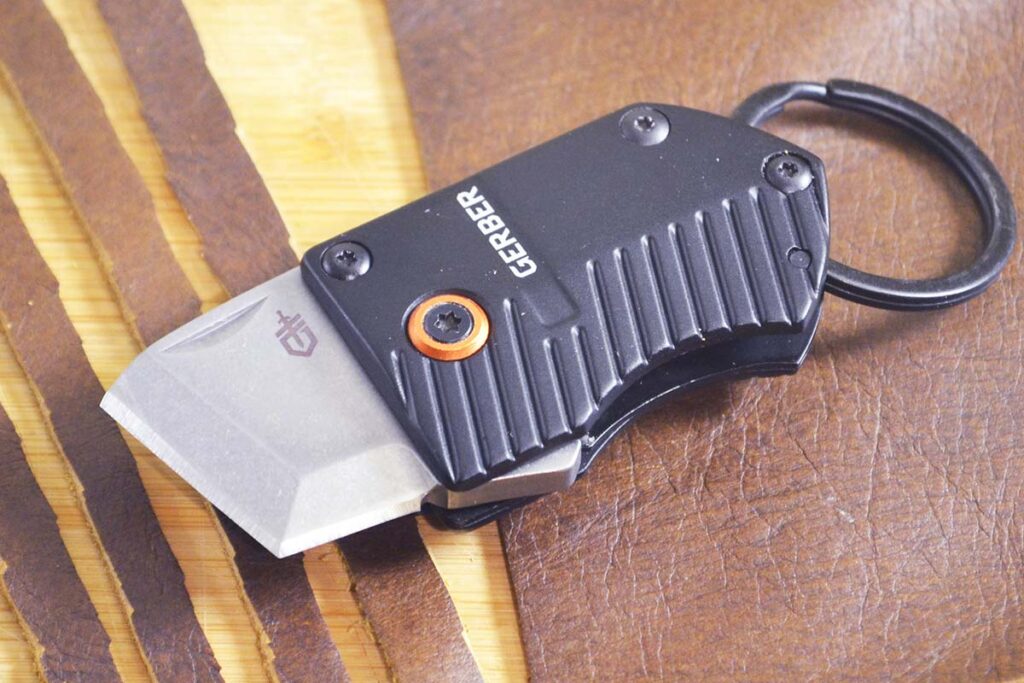
The Key Note’s satin-finished 5Cr stainless blade is too short for slicing but the tip scores quite well.
The Gerber Key Note wins the Keychain Outside The Box Award for its sheer imaginative design. With a stubby tanto blade, this offering radically differs from the pack. Both praised and panned on YouTube, the Key Note’s stubby .8-inch double-ground blade is certainly different. The frame has black-anodized aluminum rails with black stainless steel liners, the front which houses a linerlock. A flipper on the back side of the tang gets the blade rolling but only deploys it halfway, after which you pinch it for full deployment. You can also use the nail nick. Two nice touches are a wide tip-down pocket clip and a healthy 1.25-inch-diameter split ring for holding keys.
The blade is limited by its small size but I found it useful in scoring mode taking off strips of suede leather, and it is a heck of a box cutter. It will also push-cut paracord on a flat surface. The beefy tip-down pocket clip can be used with keys attached. The amply sized split ring is the best of the test knives, providing plenty of room for key-a-holics.
Is the Gerber Key Note different? Yes, but it may do just what you need a keychain knife to do.
Keychain Knife Carry Options
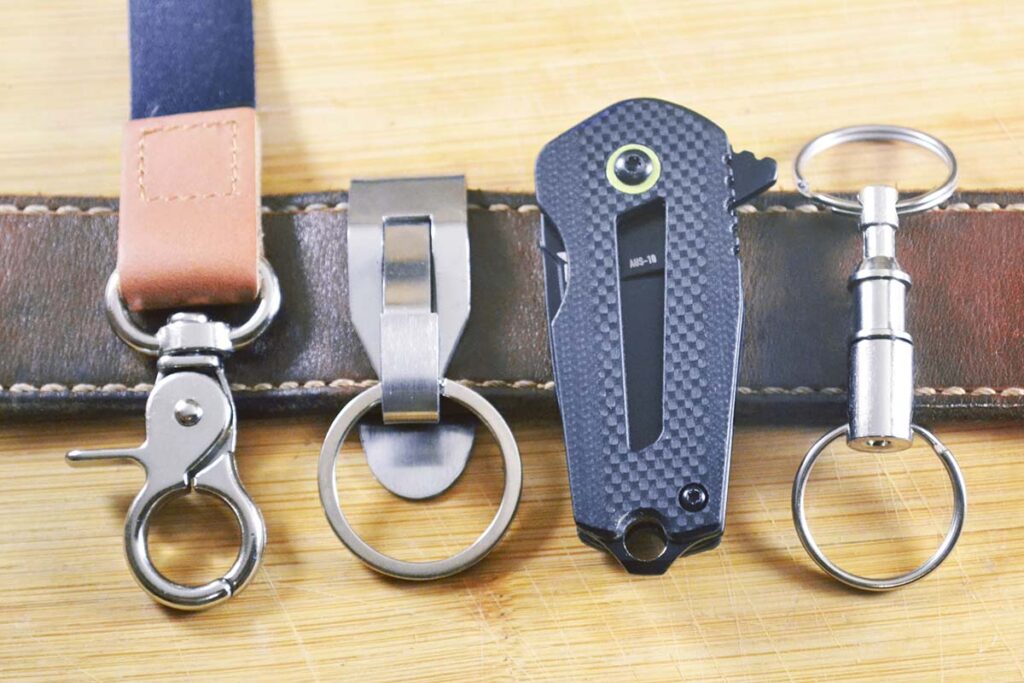
Modifying a keychain knife to suit your preferred carry can be done any number of ways. Examples include, from left: lanyard mini-carabiner for neck carry, a belt clip with split ring, the Roadie with ball chain removed, ready to modify, and a quick-release carrier that allows you to easily separate the knife from the keys.
There are other ways to carry these diminutive cutters than in or on the pocket. Accessories and findings (jewelry making parts) can be had by a various number of sources such as hobby stores, online at eBay and Etsy, or by doing an internet jewelry search such as Rio Grande Jewelry Making Supplies. Neck lanyards, belt clips, split rings large and small, breakaway connectors, small carabiners, and more are all available to modify your keychain carry to suit you. Any one of our candidates may suit your tastes as is, but if you want to mod it to suit your needs, there are plenty of options!
Decades ago in America the pocketknife was universal, with such patterns as the barlow, stockman, trapper and folding hunter well represented in the pockets of our fathers, grandfathers and great-grandfathers. But what about today, when the most likely pocketknife task is opening an Amazon box or trimming a string off a shirt? To find out not only what folks are carrying but why, BLADE® asked several industry insiders, “What makes the perfect pocketknife?”
Pocket Knife Funtionality
Let’s begin our hunt with a look at the past. Many BLADE readers know Joe Culpepper for his and wife Kristi’s knife handle material business, Culpepper & Co. For many years the Culpeppers have provided the knife industry with quality jigged bone, Sambar stag and other exotic materials. Joe is also a student of the slip-joint/traditional pocketknife in all its variations, and sells vintage knives under the business name of Old School Knife Works.
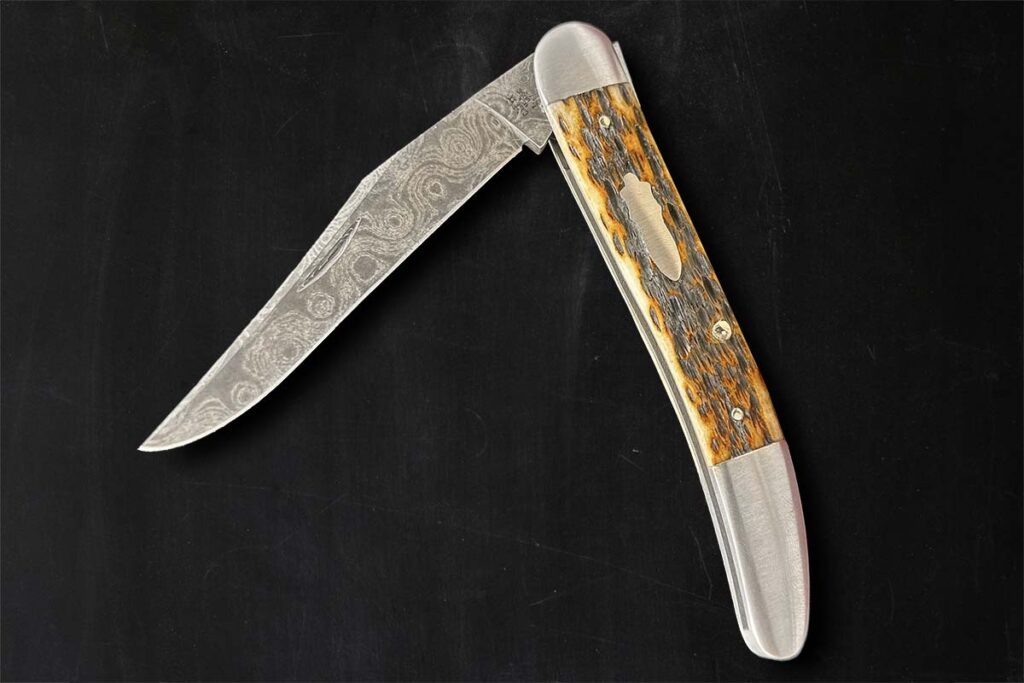
A Case knife in damascus is in the traditional fish knife pattern, an early folding fillet knife. (Old School Knife Works image)
“A good pocketknife first and foremost should perform and function reliably in the way it was designed,” he began. “Whether we’re talking about an electrician’s knife, fish knife, melon tester or trapper, the most important thing is that it does its job.”
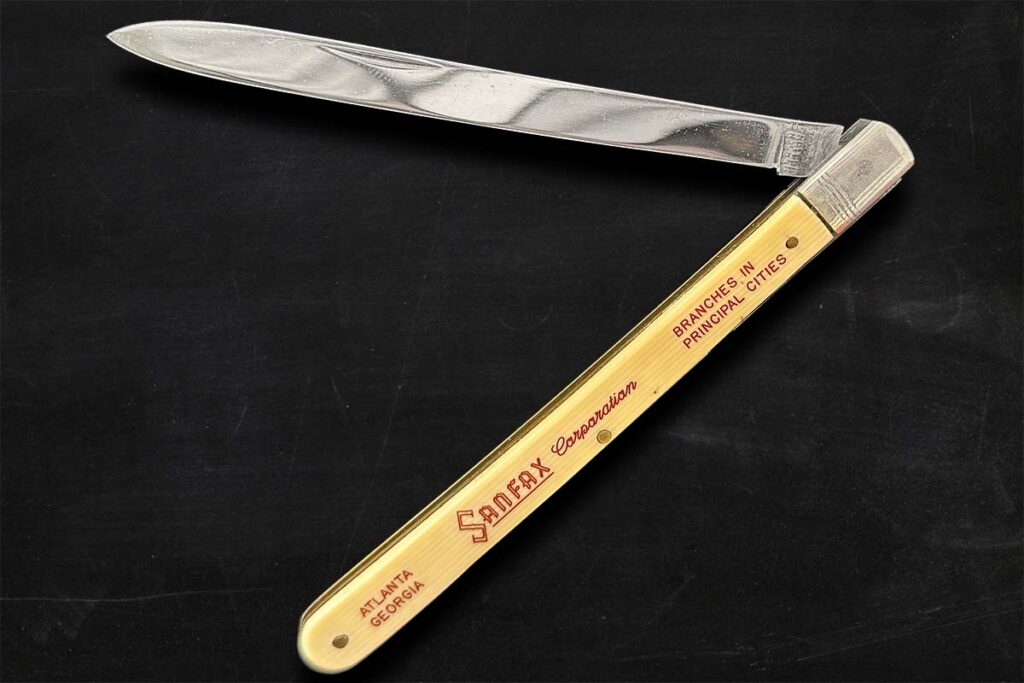
The melon tester pattern, here in an advertising knife configuration, almost always has a long, thin single blade. (Old School Knife Works image)
It has been a while since I used a knife to test a melon and Joe, too, was quick to acknowledge that many of the knife tasks of yesteryear have fallen by the wayside. “Frankly,” he admitted, “many of our pocketknives are simply just really nice box cutters.”
Pocket Knife Blade Size
Sticking with the nice box cutter theme, Knafs co-founder Ben Petersen added that he likes knives suited to the “dad life”—cutting apples cleanly without splitting them, opening boxes and whittling the occasional stick. “I’m not out to stab people,” he grinned. “For me, I think a 2.9-inch blade is perfect. Being under 3 inches keeps you safe from most restrictive knife laws, and it also is the perfect length for the finger test.” Ben went on to explain. “Most of the time when I cut, I put my index finger along the spine of the blade,” he noted. “I want the point of the blade right in the middle of my fingertip where it won’t cut me, but also gives me very precise control.”
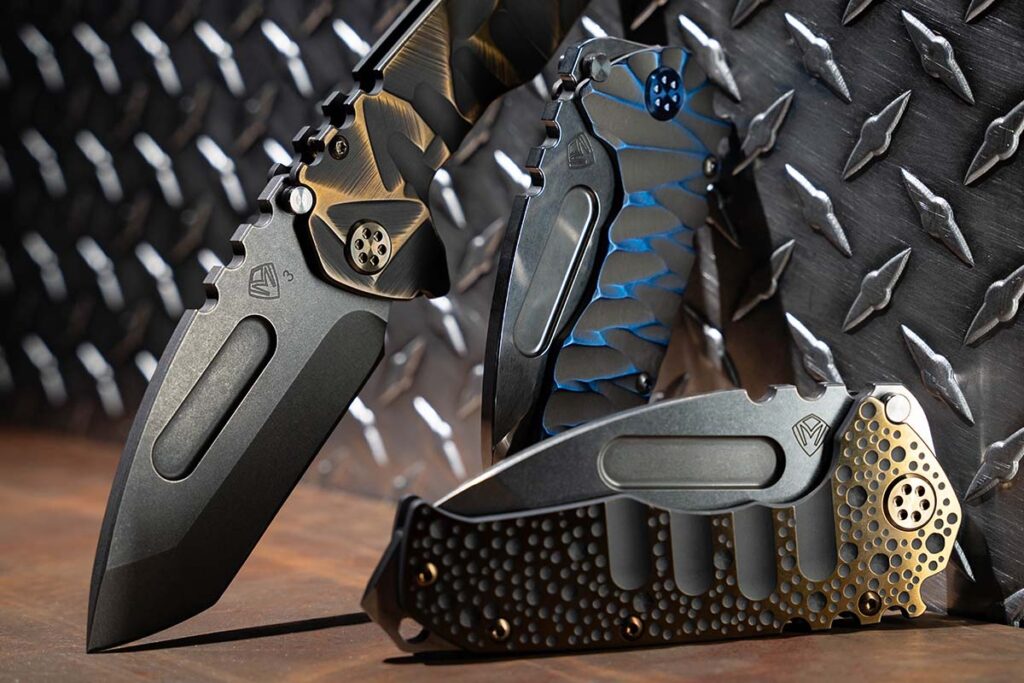
Medford Knife & Tool offers a range of titanium framelock folders, including the Praetorian T in CPM S35VN stainless blade steel. Weight: 9.3 ounces. Closed length: 4.9 inches. MSRPs start at $785.
Ben had a fun take on the perfect knife. “You know,” he reflected, “to a 12-year-old a gas station knife* is perfect. The perfect knife is totally different to everyone.” I smiled, remembering how much joy my 14-year-old son got from a rusty Bass Pro Shops framelock, missing a screw, that we found in a pasture on a dove hunt.
Types Of Pocketknives
Most of us BLADE readers probably already have a good idea of what we like in a pocketknife. We know if we like small ones or bigger ones for everyday carry. We know the steel types we like, and whether we prefer a single or multi-blade. Joe offered some generalizations that match my experience.
Tradional
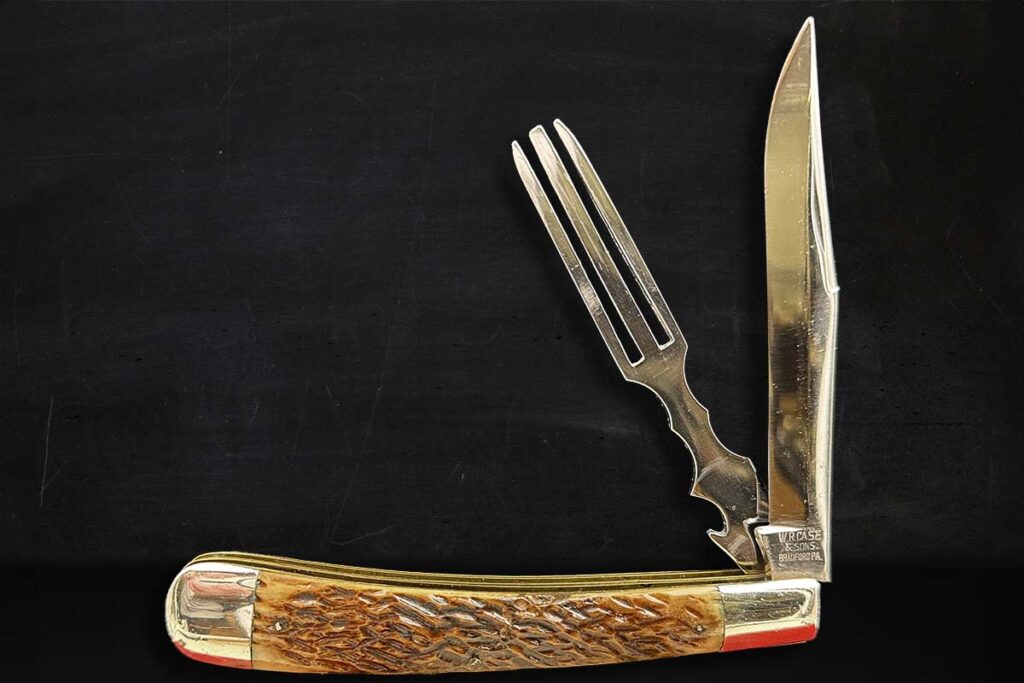
Another older Case edition, the hobo knife features a blade and fork in a handy pocket-sized folding knife. (Old School Knife Works image)
“As we get more into knives we tend to evolve into one of two categories, and they’re often correlated with age,” he reasoned. “The older generation tends to go for the more traditional slip joints with natural materials and carbon steel like their dad or grandad carried.”
Joe considers some “classic” patterns and brands among his favorites, particularly the knives manufactured pre-1970 by the old American firms that mostly have gone out of business. “When you hold an old Schrade, Empire, Robeson or even a vintage Case you get a certain sense of nostalgia,” he noted.
Modern
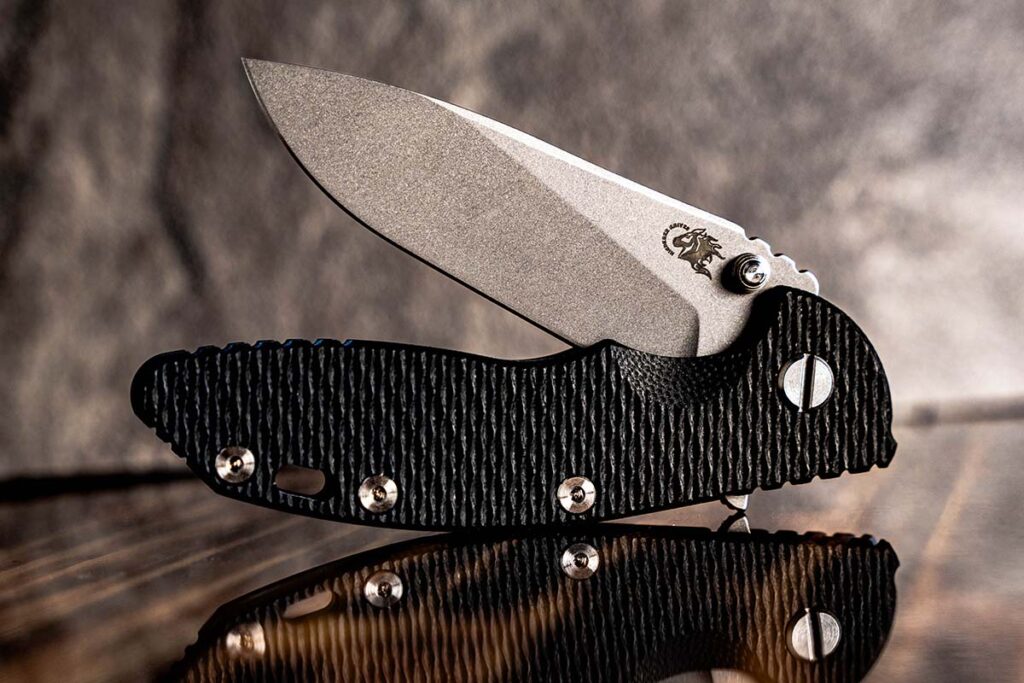
Jordan Wagner said the market is strong for high-quality USA-made titanium framelocks. Among those fitting the niche is the XM-18 3.5 flipper folder from Rick Hinderer Knives. Closed length: 4.75 inches.
As for the other category, Joe finds that younger folks tend to lean toward modern conveniences like pocket clips, modern steels and the more tactical types of knives like Benchmades. Being just a bit on the older side myself, as well as a bit of a traditionalist, I reached out to Jordan Wagner at DLT Trading for some thoughts about what makes a “perfect pocketknife” from a modern point of view.
From an online merchant’s perspective, he said the market is very strong for quality USA-made framelocks. Titanium framelocks from makers like Rick Hinderer Knives, Chris Reeve Knives, Medford Knife & Tool and custom knifemaker Les George in the $400-to-600 price range continue to be popular.
Knives in the modern category tend to have a few common characteristics. They feature premium blade steels. They all have some kind of one-hand-opening device such as a thumb stud, blade hole, flipper tab, etc. In general, these are mid-tech production or small batch customs made in shops as often as in factories. The next level below the mid-techs are the larger-batch manufactured knives by companies like Zero Tolerance, Spyderco and Benchmade. They’re often high quality, built in factories to tight tolerances and most often made in the USA.
Often within these and other brands are quality, lower-price-point knives made overseas as well, such as the production Demko AD 20.5 made in Taiwan. There are also quality knives made by China-based companies like Reate, WE and its sister brand CIVIVI and others.
Case remains the leader in the current production of traditional patterns. But is it because there’s a demand by knife users for a two-blade trapper? Maybe, maybe not. The folks at Case know and understand that there are two big segments of customers that they serve—users and collectors—and they make patterns to please both groups.
The Perfect Pocketknife?
I think about “perfect” in terms of pragmatism. When was the last time the average knife user needed a hobo knife with a fork? Have you ever seen a titanium framelock melon tester? Culpepper has his finger on the vintage-slip-joint market, and his take is that the rise of social media has opened up huge new audiences to the vintage knives.
“The unique patterns always have a market and a strong following,” he said. “For the unique vintage knives there’s good demand, whether they’re made in the USA or even England or Germany.”
Tradition meshes with modern in today’s new-age factory slip joint knives.
Like all tools, slip-joint pocketknives have seen their own evolutionary journey. In the olden days there were quality tools and then there were ones produced to be a bit more affordable, yet they still had their utility. These days many people buy knives for their utility, and I would say a number buy them for what I call the “Gucci factor.” As times change what’s considered attractive changes too, and, of course, makers leave their marks with their own innovations.
This time we’re not only going to test the latest in factory slip joints but also examine how companies and designers are innovating the age-old design to ensure it’s useful enough for the user and pretty enough for the collector. I took them all for a spin by shoehorning them into my everyday carry (EDC) rotation. The results are revealing.
CRKT Forebear
CRKT Forebear
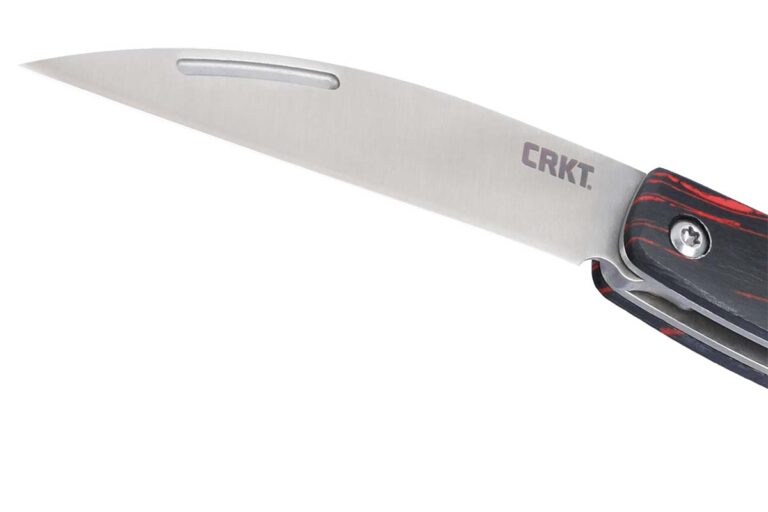
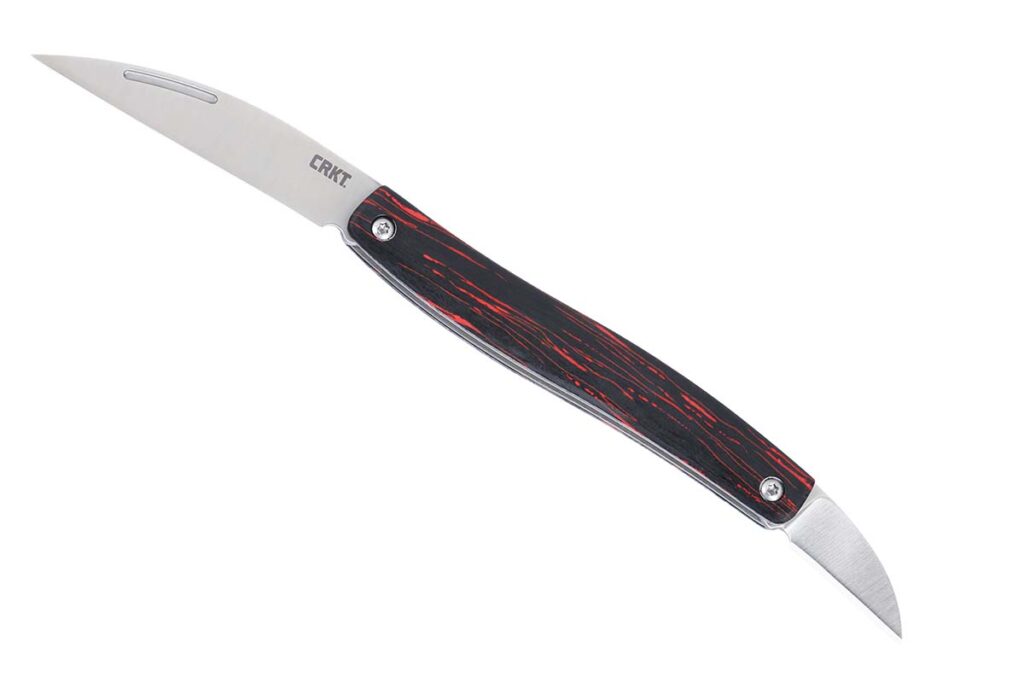
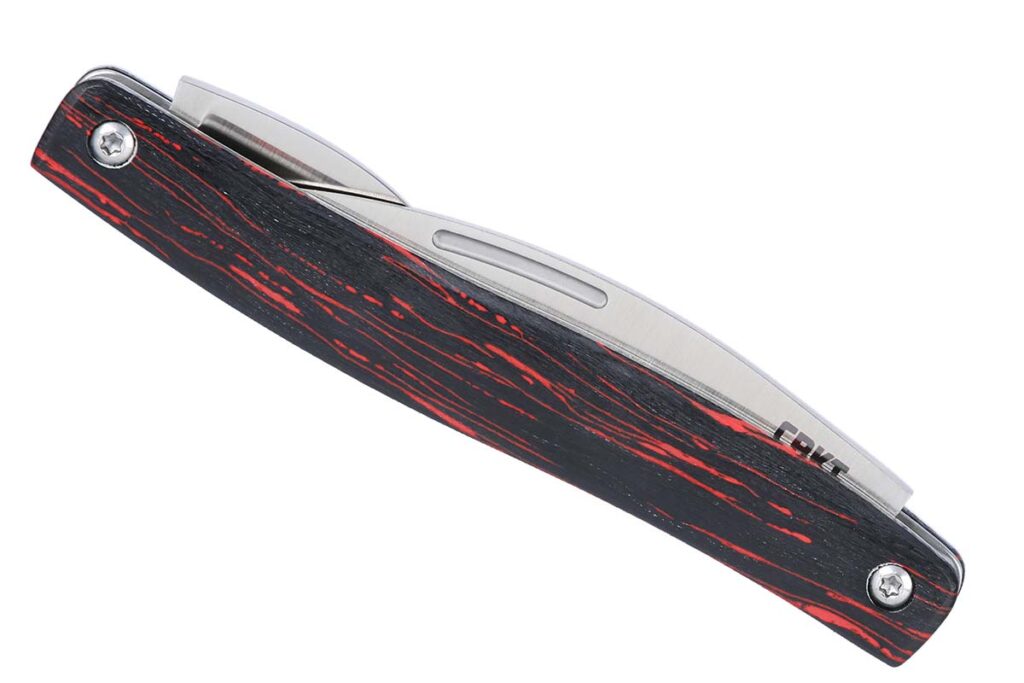
A couple of things update the CRKT Forebear. The first is the modified wharncliffe blades of 12C27 stainless steel. They’re not too big of a departure from the traditional style but still enough to make you notice. They are streamlined with an aggressive tip. Second is the use of a streaked-red-and-black G-10 handle. Unlike using texture to add dimension like, say, in a jigged material such as bone, the handle has two contrasting colors instead.
The knife is in a two-blade configuration—small and large wharncliffes—designed by custom maker Darriel Caston. The blades remind me of those on German chip-carving knives. Such blades are excellent for detail work and chores at which utility-style blades excel. They are flat ground and have long nail nicks that follow the spine.
I must say I was disappointed with the out-of-the-box finished edges on the blades. They were very uneven. One side had a larger micro bevel than the other. Machines do the great majority of the work creating the parts of a factory knife. In the end, though, the final edge is most often applied by hand. Before getting full use out of the knife I had to even out the bevels.
A handle closeup gives you a good idea of the depth the two-colored G-10 scales bring to the Forebear. At 3.43 inches closed, it’s a nice size for the watch pocket on your jeans.
Again, fit and finish was a bit of a disappointment, especially coming from CRKT. I have come to expect great value from the finishes on the company’s knives. Both scales exhibited shaping flaws and were left unpolished in spots, leaving an uneven appearance.
I actually like the design. It has great potential for everyday use with the two wharncliffes. It needs some work as mentioned on the edges. With a user knife it’s easier to overlook some fit-and-finish errors. After all, knives become better looking with familiarity as enthusiasts grow attached to their EDCs. As for the edge, it’s very fixable but it should come ready to use out of the box.
Boker Plus Koteyka
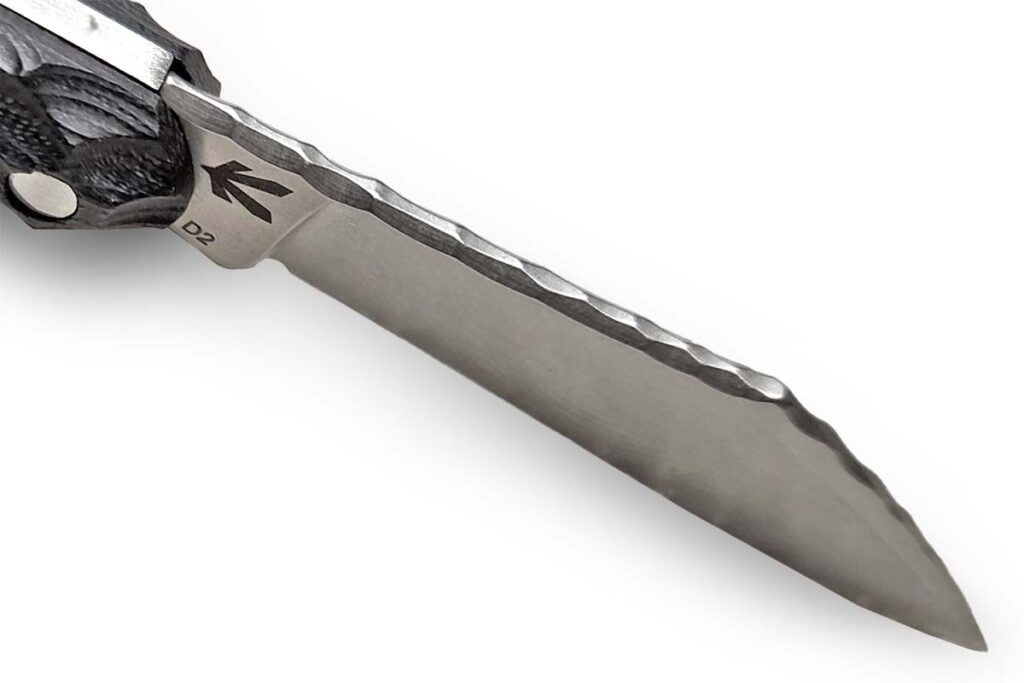
The file-style work on the spine of the Koteyka breaks up the profile and gives the blade some character.
The Boker Plus Koteyka is a stylized clip-point-blade folder. The handle is jigged black G-10. The blade is flat-ground D2 tool steel and opens via a nail nick. Closed length: 3.5 inches. I really like that Boker Plus sends the Koteyka in a box wrapped in wax paper like the old-time knives. On the back of the blade is some machining that resembles filework.
Out of the box it cut very well after I stropped it to bring it to the crazy sharp level. The finish on the G-10 has machining marks for a rustic look. One day I will end up hitting it on a buffing wheel. With a high luster polish I think it would be killer. Granted, the MSRP is only $69, so I’m just expressing my own thoughts on its presentation. Texture wise it can be a little rough on your hand, so that is another reason why I will buff it. The blade action and spring tension are good. It is a great little pocketknife update. I look forward to using it further.
Lionsteel Bestman
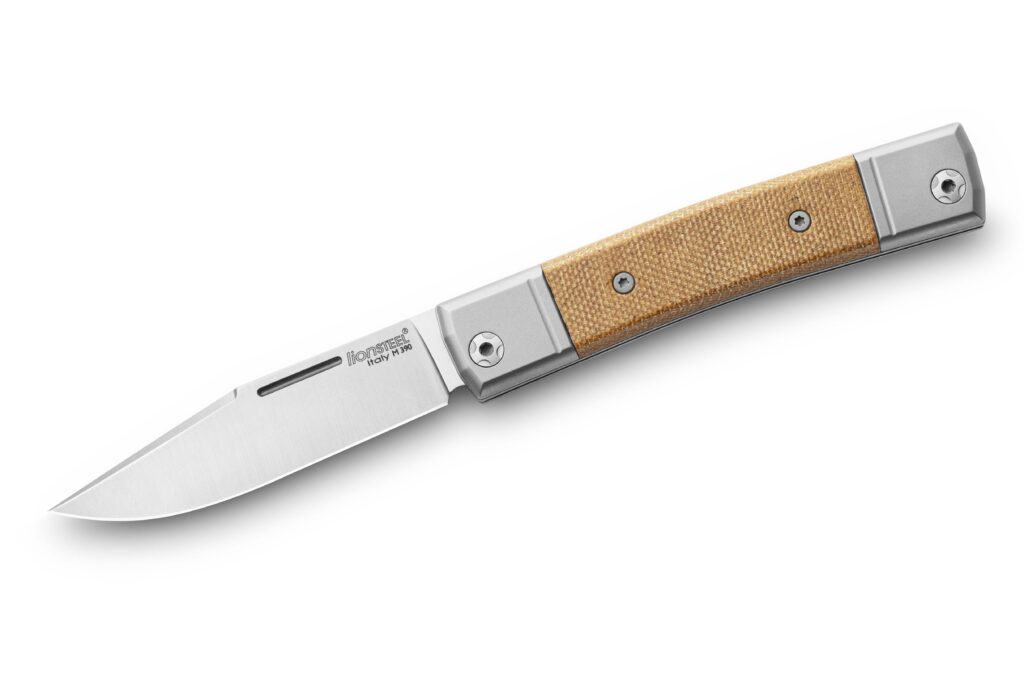
Lionsteel Bestman
In the Bestman, Lionsteel offers a pocketknife with all the traditional elements, though it’s the presentation and materials that give it the updated look. The folder has three choices of blade configuration: clip and spear points and a combination two-blade set up of clip point and wharncliffe. I received the clip point for the test. Blade steel: M390 stainless. Closed length: 3.75 inches.
The Bestman features two sets of bolsters with a decorative groove. Handle materials come in an array of natural or synthetic materials, from olive wood to carbon fiber. I chose the canvas Micarta® for the rugged look. Lionsteel kept the design blocky while smoothing over the edges to avoid hot spots. None of the metal on the knife is polished. It has a satin finish, as did some of the older high-end brands in which one side of the blade would be polished and the other side hand rubbed. In place of pins are Torx fasteners. Even the execution of the grind on the clip point departs from the traditional by keeping all the lines crisp.
The blade opens via a nail nick. The blade action is smooth yet has a definite half stop. The spring tension is dead on. I must say I am impressed and like it. It came right out of the box ready for work. The materials and design will last a lifetime of chores.
Heretic Jinn
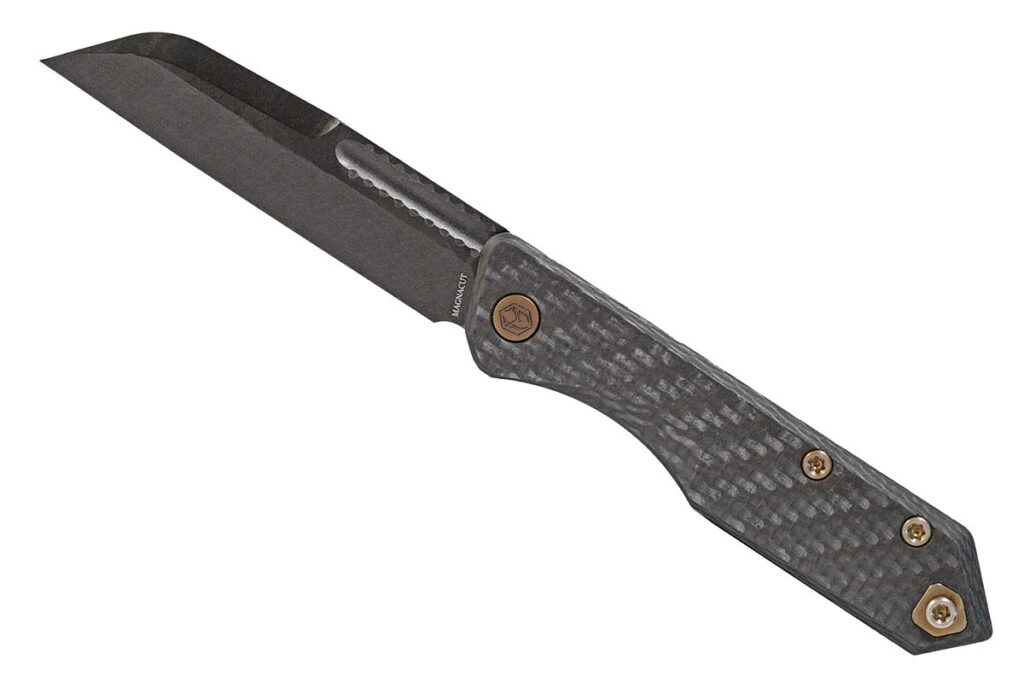
Heretic JInn
At first, adding the Jinn by Heretic Knives to the review was iffy at best for me. I saw it on the company’s website and I somewhat reluctantly included it. To me, a pocketknife design from Heretic is akin to having a thrasher band perform Simon & Garfunkel. Nothing personal, I just thought Heretic couldn’t pull it off. In the end, though, I am the fool standing there clapping after the rest of the audience has stopped.
The sheepsfoot blade of CPM MagnaCut stainless with a combination serrated/plain edge has great application for EDC use. It can cut everything from soup to nuts. For style Heretic includes a false grind. The knife opens via a long nail nick at the blade’s back half. If I had one criticism it would be the position of the nail nick. There would be a greater advantage in opening the blade if the nick were farther away from the pivot point. Just pinching the blade closer to the tip allows for a smoother pull-on opening.
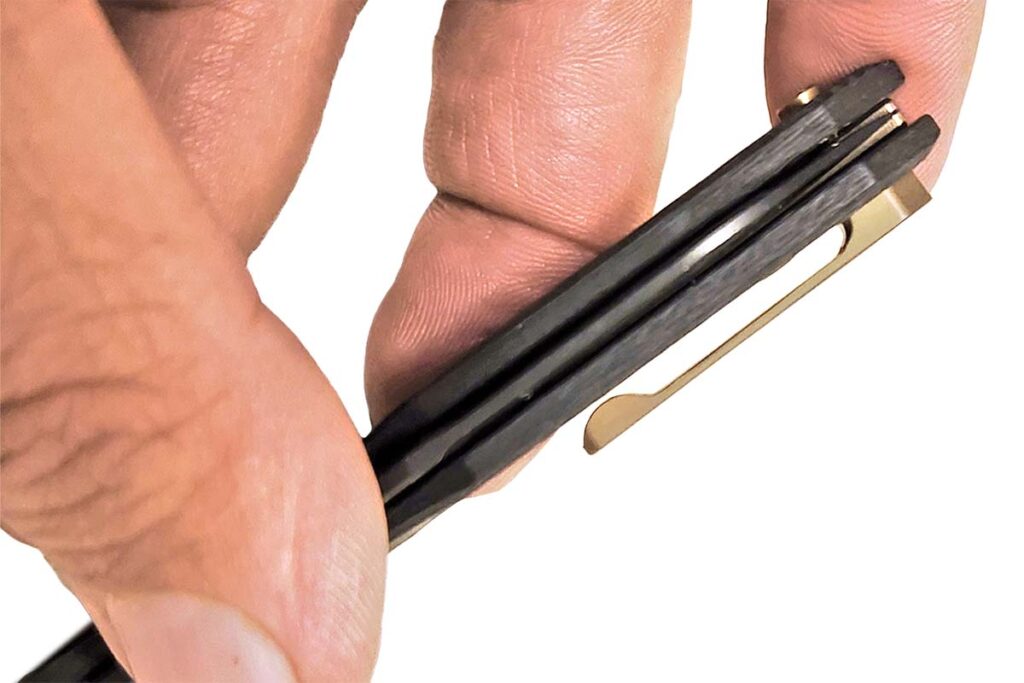
The Jinn is the only slip joint reviewed with a pocket clip.
A half stop enhances user safety and the knife is finished off in carbon fiber scales with a trim, low-profile pocket clip. The clip is my next issue. It is too tight to easily clip onto floppy and thick pocket rims. The design is such that you really don’t want to bend the clip, either.
All else considered, the Jinn really surprised me. It is a great worker. Overall, its looks fit right in with any modern one-hand-opening pocketknife. Closed length: 3.8 inches.
A CERTAIN ROMANCE Slip joints have a certain romance to them. On a base level the designs have tons of utility, and updating their appearances helps keep consumers interested. Of course, there will always be the ongoing love affair with the traditional designs. Many wouldn’t have it any other way.
The simple pockeknife still holds its own after all these years.
Whether a four-figure custom slip joint, an inexpensive factory keychain knife or what you, if it’s a knife that carries in a pocket, it is a pocketknife. Pocketknives have a colorful heritage, one that not only represents some of the best cutting tools mankind has ever produced but at times has been on the right side of history as well.
Some of the first known folding knife designs date to the Roman era, if not earlier. However, the fact many Romans wore togas or tunics—most if not all of which were pocketless—precluded most of them from carrying pocketknives. If not, Brutus and his co-conspirators likely would’ve used pocketknives instead of the daggers they employed to dispatch Julius Caesar. Daggers suffered centuries of bans afterward and continue to be targeted by misguided anti-knifers to this day. If pocketknives could talk, the feeling here is they would probably thank the pocketless togas and/or tunics.
Fast forward to Sheffield, England, where the Masters of the London Cutlers Guild listed members as early as the 16th century. The pocketknives made in Sheffield for centuries remain some of the most remarkable specimens ever. Meanwhile, a number of the Sheffield makers came to America in the 19th century. Their influence helped jump start the U.S. pocketknife industry in the 1800s and aided in revolutionizing it in the 20th century. From the barlow to the stockman and scores of other patterns, many Americans carried pocketknives daily for almost every chore under the sun. That tradition was passed down from generation to generation and became an American institution.
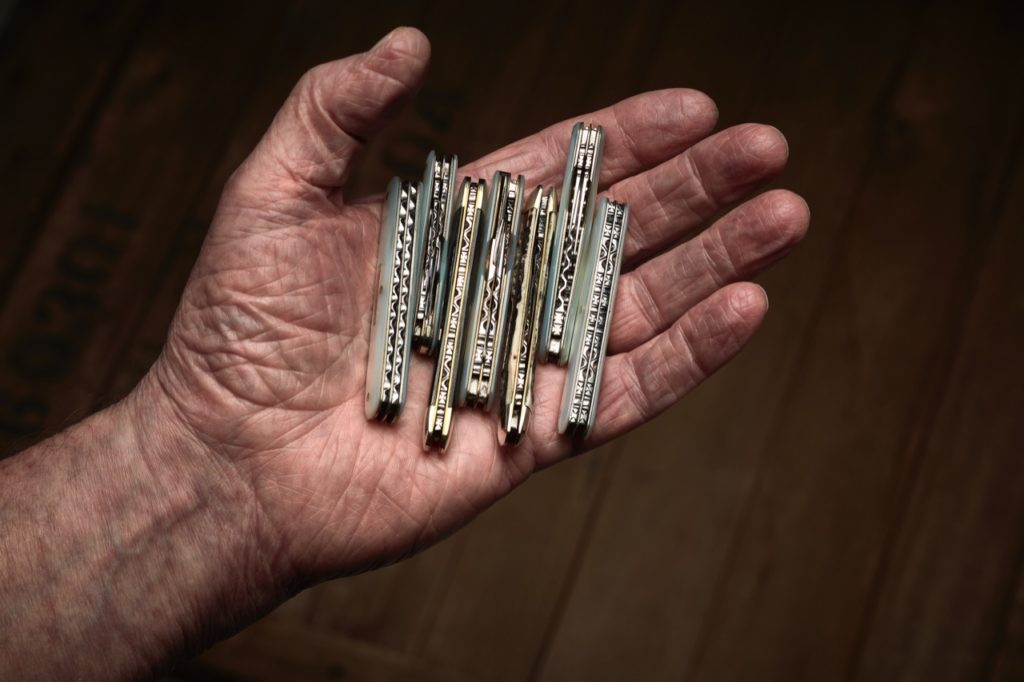
A sampling of Stan Shaw’s pocketknives with richly fileworked blade spines and backsprings. Look close and you can see the Maltese crosses for which Stan was so well known. (image by Carl Whitham, Sheffield)
The most famous of Americans carried pocketknives, including presidents such as George Washington and Abraham Lincoln. Acting icon John Wayne used pocketknives in some of his movie roles, including as Jacob McCandles in Big Jake and Capt. Nathan Brittles in She Wore a Yellow Ribbon, to name but two. Even Boy Scouts and Girl Scouts had pocketknives made expressly for them, with the latter holding the distinction of being among the first if not the first sporting knives designed expressly for the feminine gender.
Closer to home, the argument can be made there would be no BLADE Show without pocketknives, as the two men who created the show—BLADE Magazine Cutlery Hall-Of-Fame® members Bruce Voyles and Jim Parker—parlayed their love of traditional pocketknives into long cutlery careers that helped make knife collecting something worth doing. Jim, Bruce and others were among many in the South who celebrated the early trading of pocketknives on the courthouse steps of local communities, and eventually helped capture the imagination of knife enthusiasts everywhere.
Pocketknives are not just a British/American phenomenon but a worldwide one. The navaja of Spain, the Opinel of France, German models of many stripes, and perhaps the most famous pocketknife of all, the Swiss Army knife (SAK) of Switzerland, are but four examples.
Two of the leading knife genres of the past half century, tactical folders and EDCs, owe much of their appeal to being pocketknives. In fact, pocketknives have provided the platform for the introduction of some of the most influential advancements in cutlery, including assorted opening and locking mechanisms, hi-tech materials and knifemaking methods, and much more.
Give it up for pocketknives. Without them, cutlery would be nowhere near—in fact, about half—the vibrant worldwide industry it is today.
The OKNIFE Beagle emerges from testing as one well-bred blade.
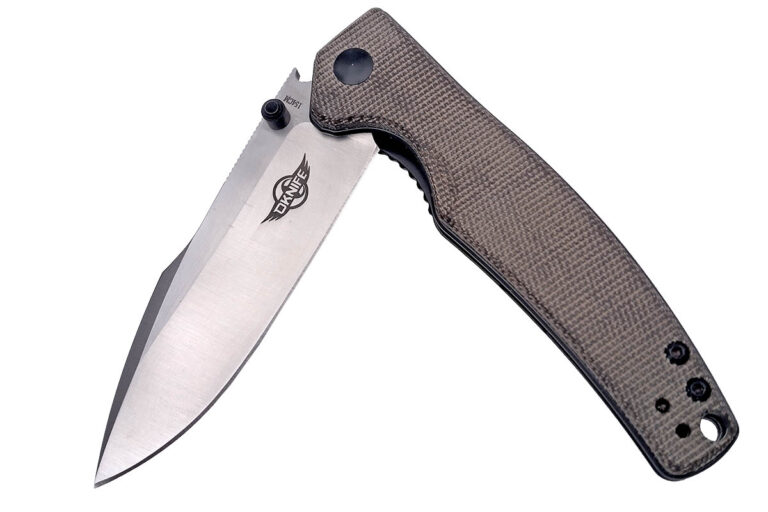
The Beagle by OKNIFE is a mid-sized folder that rides great in a pocket—big enough to handle most cutting chores but small enough to be comfortable to carry every day. As a heavy knife user, I always carry. It has to ride comfortable and perform or I won’t consider it. The Beagle was on my side for 30 days with no carry issues. Check the first block. Now for the performance side.
The Beagle was very sharp out of the box. A quick paper slice with 20-pound bond copy paper proved it. Via a push cut it sliced quite smoothly with no snags or tears. The handle shape made for easy control of the width of slices.
Next up: single-walled cardboard. The Beagle made zipping noises during the push cuts. Again, it was very controllable on the slice widths, nice and aggressive on every pass, with no snags or tears.
A scrap piece of 8-ounce leather was next. I sliced it similarly to the cardboard to see if I could get the same zipping noises. The Beagle didn’t disappoint. It zipped and crunched during every cut. I really liked the forcefulness in the leather cutting.
The knife made thin, even slices in the 8-ounce leather. The handle shape aided in controlling the thickness of each cut.
Using another piece of leather, I did some skiving. The knife made thin, even cuts. As noted, the shape of the handle really aids in controlling the thickness of the cuts. The blade was smooth and uncompromising on each slice.
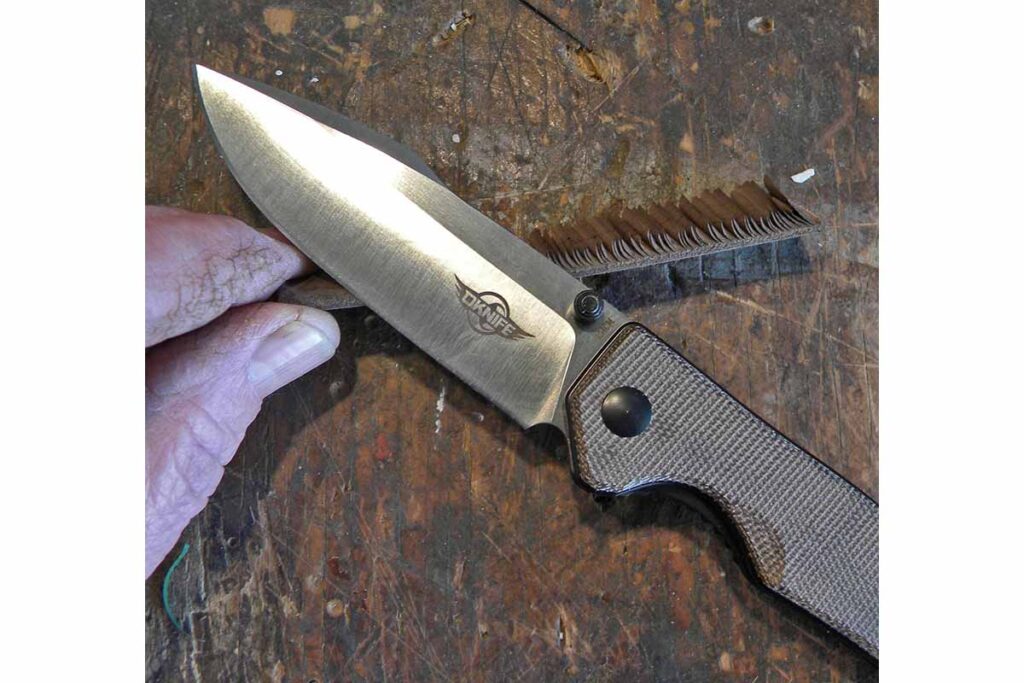
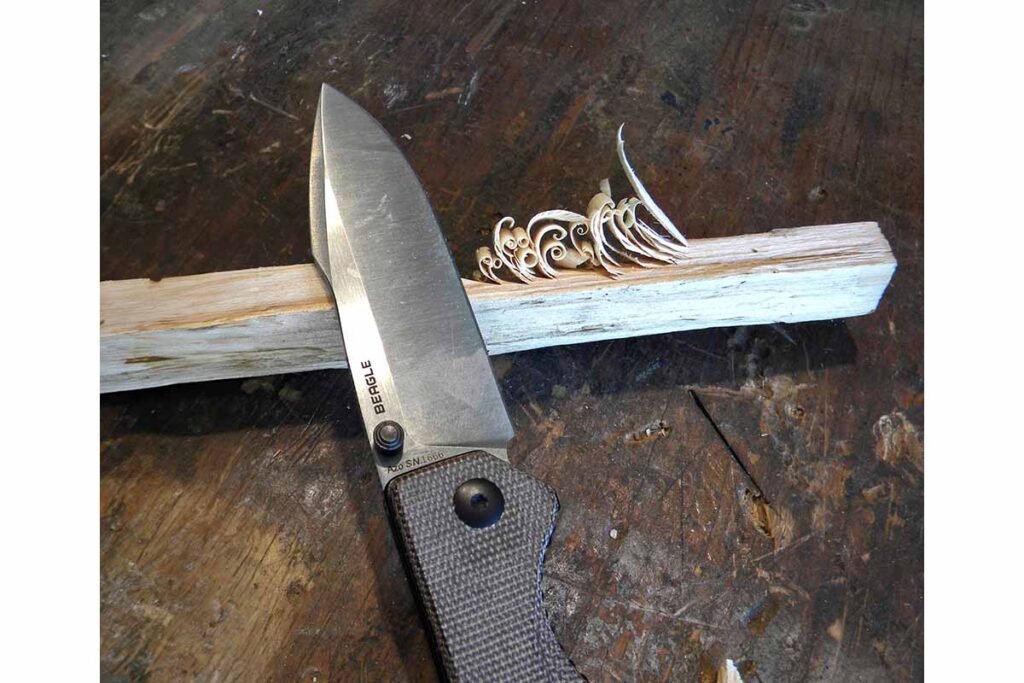
I grabbed some scrap pine and whittled a bit. The Beagle produced excellent curlicues, taking deep bites. The notches on the blade spine are just grabby enough to keep your thumb in place without abrading it. There were no hot spots on the handle.
The Beagle took deep bites in producing excellent curlicues. The notches on the blade spine are just grabby enough to keep your thumb in place without abrading it.
STRENGTH TEST
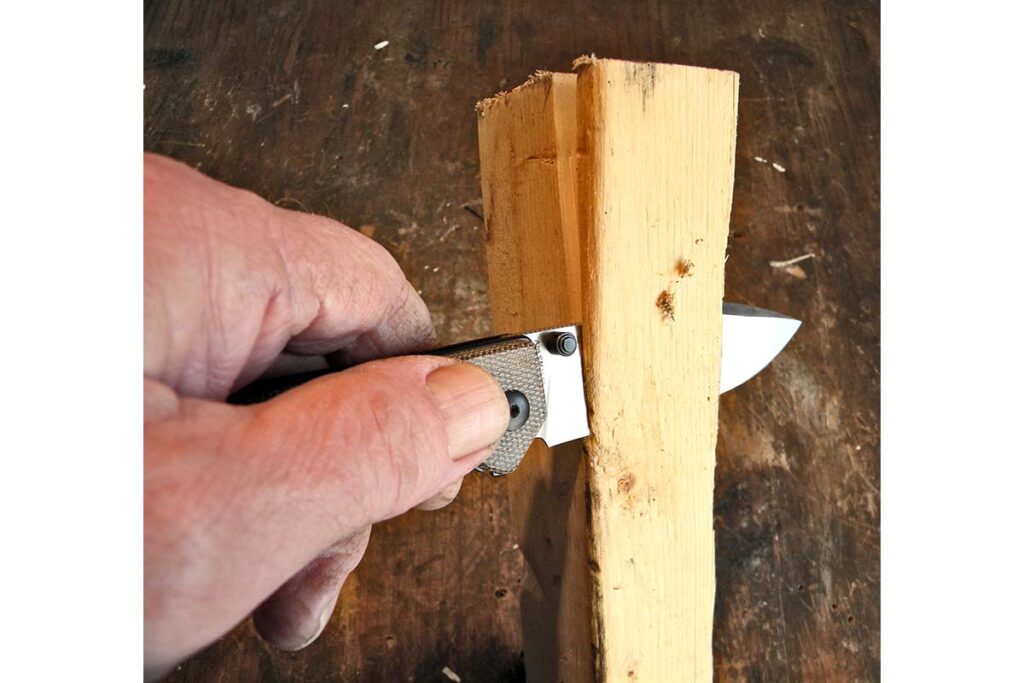
Baton cutting with a linerlock folder is not recommended but I did it anyway. On the other hand, it is a serious strength test for the lockup and liner. After several whacks there were pine pieces all over the work bench. The lockup stayed at 100 percent on every whack. The handle was comfortable throughout.
Baton cutting with a linerlock folder is not recommended but the author did it anyway. On the other hand, it is a serious strength test for the lockup and liner. After several whacks the lockup stayed at 100 percent, though the spring does appear to engage the tang too far to the right (inset). Upon later examination, however, the spring had returned more toward the left, possibly due to repeated opening/closing of the knife.
It was time to break out the half-inch sisal. The Beagle made 192 crunching cuts in the rope. I was surprised at how comfortable the handle was during cutting—not a single hot spot, warm spot or liner pinch. I’m very pleased OKNIFE paid attention to this detail. Job well done!
The Beagle made 192 crunching cuts in the half-inch sisal rope. The handle was comfortable throughout—not a single hot spot, warm spot or liner pinch.
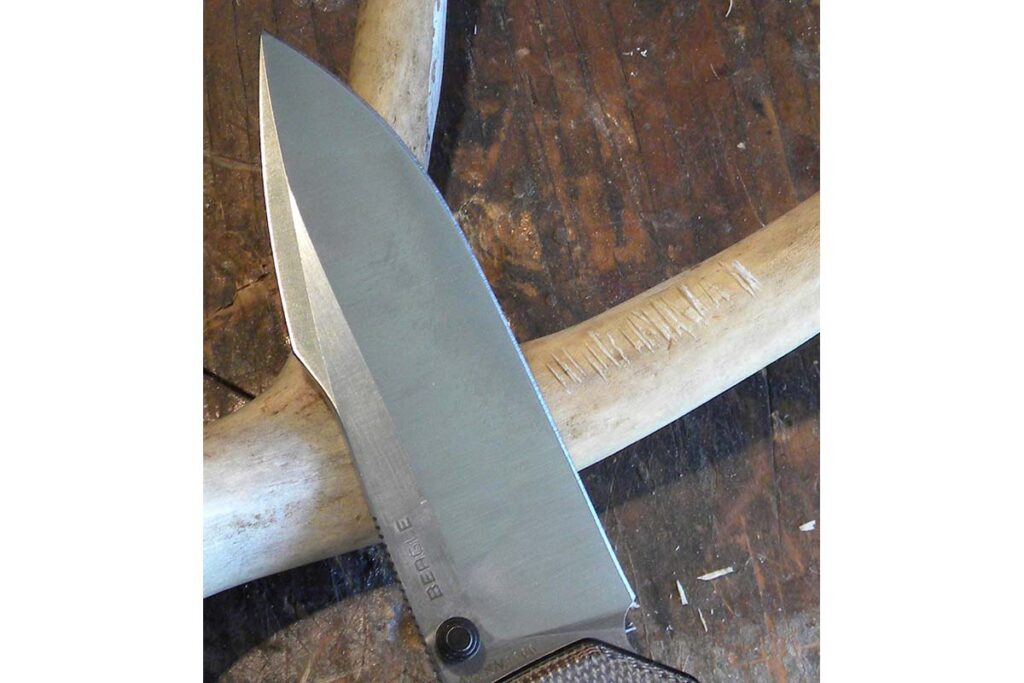
The last test for the edge and lock was chopping into a whitetail deer antler. Thirty hard whacks later and the edge had no damage. The lock was just as tight as when I started—100 percent.
In the final test, the Beagle chopped the antler 30 times with no edge damage. Verdict: heat treat spot on!
CHANGES
Maybe a few grooves in the handle for added grip?
BLADE GRADE
With its comfortable handle and sharp blade, the Beagle is a great folder for everyday carry.
OKNIFE BEAGLE Specs
Blade length: 33/8” Blade steel: 154cm stainless Blade grind: Flat Blade finish: Satin Blade pattern: Harpoon Blade opener: Thumb stud Handle: Green canvas Micarta® Lock: Linerlock Liners: Stainless Pocket clip: Yes Weight: 4 oz. Closed length: 4.25” Country of origin: China MSRP: $79.95
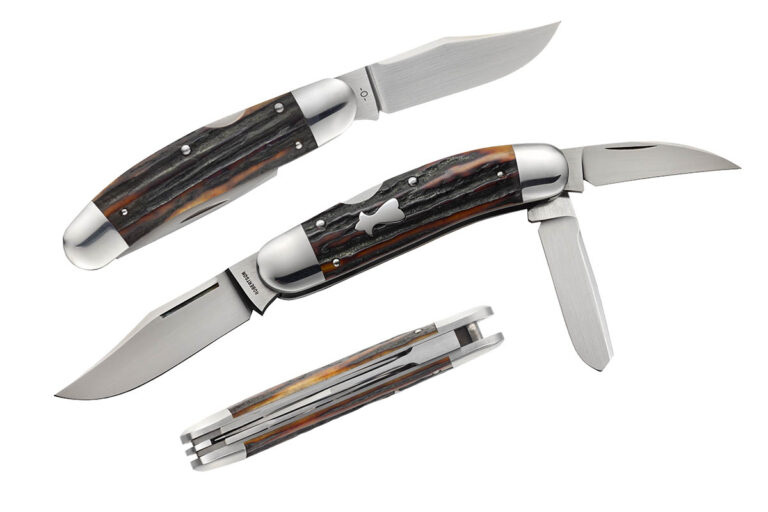
Tony Bose said if you can make a lockback whittler, you have arrived as a knifemaker.
While the whittler is a classic pocketknife pattern that dates back at least to the 1850s, a variation on the theme incorporating both the lockback and slip joint mechanisms offers a challenge to the custom knifemaker and a delight to the owner of this intriguing style.
Custom knifemaker David Taber explains his take on the whittler as a three-blade knife with the main blade on one end and two secondary blades on the other. Simple as that. However, from definition to completed construction it’s a bit more complicated, particularly when the lockback mechanism is thrown into the mix.
“The whittler as originally designed was very functional in that the larger main blade is used for making larger cuts and the two smaller blades are for more detailed cutting,” Taber advised. “The knife is necessarily thin by design with the two small blades nestled on either side of the main blade in the closed position, which makes for a slim, pocket-friendly knife.”
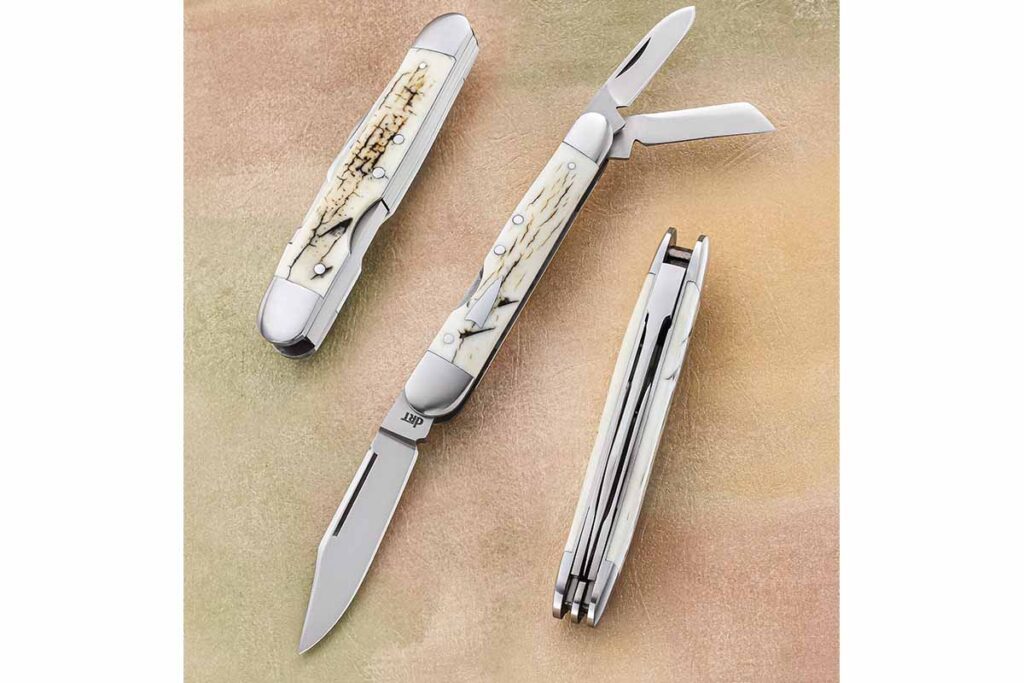
Taber’s rendering of the lockback whittler features hollow-ground blades of CPM 154 stainless steel and a mammoth ivory bark handle. The main locking blade length is 3 inches and his price for a comparable piece would be $2,100. He attributes an early interest in the lockback whittler to comments made by BLADE Magazine Cutlery Hall-Of-Fame® member Tony Bose in a 2008 issue of BLADE® relating to the skill level required to make one.
BLADE Magazine Cutlery Hall-Of-Fame® member Tony Bose (Kerry Hampton image)
“I was intrigued and called Tony,” David remembered. “That single conversation started a lasting friendship and started me collecting and eventually making knives. In later years he challenged me to make a lockback whittler and shared his pattern with me. He said, ‘If you can make one of these, David, you will have arrived.’”
Taber took on the task with gusto and through personal experience describes the challenge. “The difficulty, in my opinion, lies in centering the main locking blade in the closed position between the two slip-joint blades at the opposite end without rubbing during function. Equally difficult is balancing the two springs that operate the two slip joints on the one end and the underside of the lockbar on the other end. Think of it like a sophisticated teeter-totter,” he explained. “Care must also be taken to maintain the length, particularly the end that controls the lock tab. It has been my experience that to shorten it even the slightest amount will increase the load deflection rate and thereby make the lock tab not function properly.”
David Taber’s lockback whittler sports hollow-ground blades of CPM 154 stainless steel, stainless bolsters and a mammoth ivory bark handle. His price for a similar knife: $2,100. (SharpByCoop knife image)
The level of difficulty in making the lockback whittler contributes to its collectability, Taber says, which in turn makes the design rarer in the marketplace. “The typical collector of the lockback whittler is usually aware of the skill required to make such a knife and achieves great satisfaction from owning one,” he reasoned.
MOST DIFFICULT?
Knifemaker Luke Swenson shares a connection to Bose with Taber. The Case-Bose collaboration effort introduced Swenson to the design. “The blade configuration and the smaller blades being half the thickness of the main blade set it apart from other patterns,” he commented. “Some whittlers have a ‘catch bit’ or a piece of liner material to hold the blades apart at one end so the main blade clears, and some have a tapered wedge, commonly called a splitback. In the case of the lockback whittler, there is a full spacer that rests between the rear slip-joint blades. Also, in a lockback whittler the small blades and spacer are exactly one-third the thickness of the main blade. The main blade locks, and I believe this is for safety and allows for harder use.”
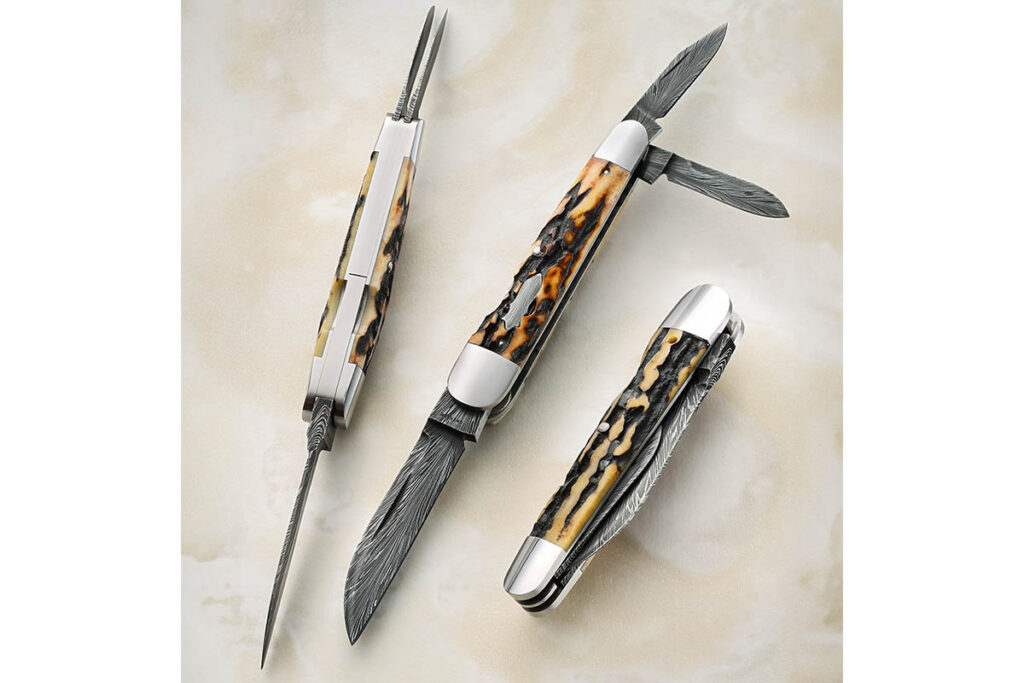
Swenson’s lockback whittler features a hollow-ground 2.8-inch blade of feather damascus forged by Mike Tyre. The fittings are 416 stainless steel and the handle is natural stag. Luke’s price for a similar piece is around $3,000. He describes the lockback whittler as “the most difficult pattern to build, even more so than a six-blade. I believe it isn’t just the combining of elements, but the springs are somewhat tricky in that you have to be paying attention—one false move, or even one over-aggressive pass on your grinder, and you’ll be making new springs. Grinding the small blades isn’t easy and requires a developed feel for getting them right. Very challenging! But if it’s right, the results are magic.”
Feather damascus forged by Mike Tyre comprises the hollow-ground blades of a lockback whittler by Luke Swenson (inset)in natural stag and integral bolsters and liners of 416 stainless. Closed length: 4 inches. Luke’s price for a similar knife: $3,000. (SharpByCoop knife image)
According to Luke, the construction of the slip joint and the lockback are completely different, at least in the opening stages. Putting the two mechanisms together with tiny parts, delicate springs and narrow tolerances tests the skills of the knifemaker in an extraordinary way. “The blades have to sit in the handle to make their tips sit in the handle,” he concluded, “and yet the nail nicks have to be accessible. That takes time and patience to get right.”
Renowned custom knifemaker Wolfgang Loerchner happened past Swenson’s table at the East Coast Custom Knife Show some time back and asked if Luke could make a lockback whittler. “This was in the March of that year, and we agreed on a BLADE Show delivery in June,” Luke laughed. “Keep in mind I’m an unknown maker, and starstruck doesn’t quite describe what I was feeling. I said, ‘Sure, I can get one built.’”
From there, Swenson went to “The Maestro,” Cutlery Hall-Of-Famer Bill Ruple. “He was quite amused and laughed, a little more than was polite I thought, but he agreed to help me through the process,” Luke recalled. “Like all my slip-joint making, anything I learned to do right was in Bill Ruple’s shop. He was key. I don’t believe I would have made the deadline if he hadn’t helped me. I’d send him pictures, and he’d say, ‘remake this and fit it like this instead.’”
The bottom line for the Swenson lockback whittler is its tremendous appeal. “It is a sleek, streamlined beauty,” he offered. “Like anything Tony Bose decided to do, it is elegant and feels comfortable in the hand.”
COMPLEX SIMPLICITY
When knifemaker Tim Robertson envisions his next lockback whittler project, he knows what he’s getting into. “What truly makes the lockback whittler so difficult to build is the way the springs operate,” he noted. “The slip joint is a standard arch spring pushing down on the blade tang while also lifting up at an equal force on the rear of the lockbar, keeping the blade firmly in position. Too much load on either end loosens the opposite end. In a nutshell, the springs have to be balanced between lockbar function and slip-joint function.”
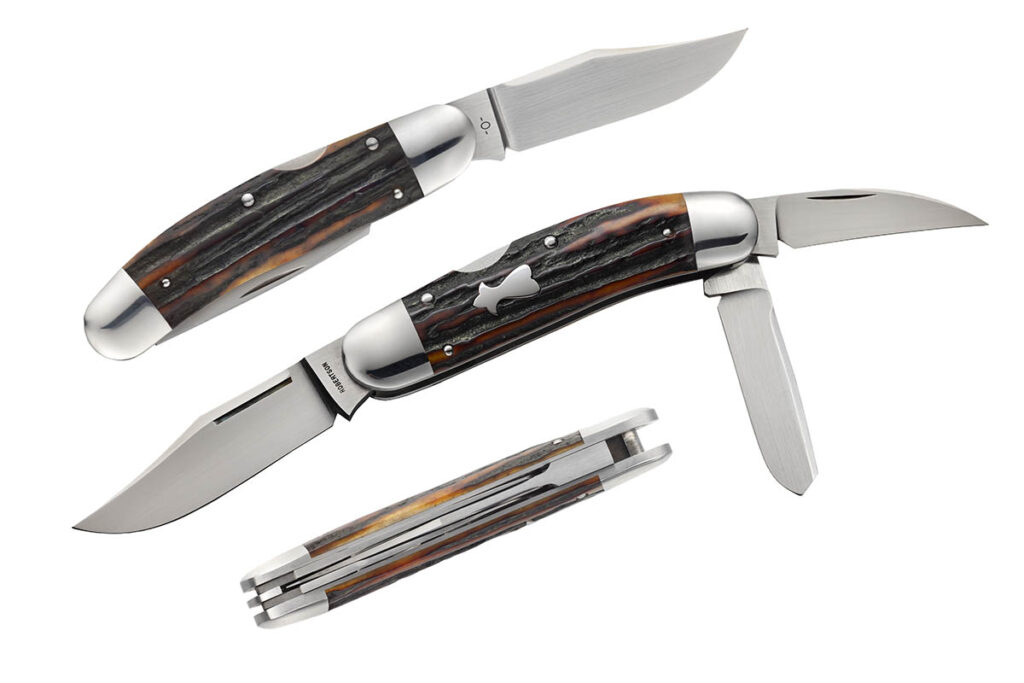
According to Tim Robertson, “The lockback whittler is appealing due to the complexity of the multiple parts and simplicity of design and operation.” Note the spacer that separates the two smaller blades Robertson mentions in the story at the bottom of the closed knife at right. (Mitchell Cohen knife image)
Robertson has become well known for his lockback whittler proficiency, and two recent examples have won awards. His winners of Best Locking Folder at BLADE Show West 2022 and the 2023 Knifemakers’ Guild Best Multiblade Folder both sport CPM 154 stainless blade steel, 416 stainless frames and stag handles. His prices for similar knives would be about $2,500 each.
With a simple explanation for his foray into lockback whittlers, Robertson remarked, “I just wanted to see if I could do it. The lockback whittler is appealing due to the complexity of the multiple parts and simplicity of design and operation.”
Defining the whittler as a knife with three blades and two springs, Tim commented, “The most common types are the splitback variety with a tapered spacer separating the two pen blades. The reason for the tapered spacer is to allow clearance for the blade to fold into the handle without having to have the main blade thickness increased, and then offset ground for the clearance so that one pen blade falls on each side of the main blade.”
SIDE-BY-SIDE KNIVES
Knifemaker Rhidian Gatrill consulted friend and historian Neal Punchard on the origin of the lockback whittler. In response, Rhidian learned that the earliest examples of it were probably made in Sheffield, England, a major center of European cutlery, and later by German and American cutlers.
“It is a premium pattern and difficult to make, so not many companies took on the challenge,” Gatrill explained. “Some of the early Sheffield multiblade sportsman knives and a few rare jackknives had lockback main blades and slip-joint blades, but they are basically two knives side by side. There’s nothing quite like the lockback whittler. There are a few other pocketknives that have locking main blades and slip-joint secondary blades, but they’re not lockback knives. The electrician knives, for example, have a [locking liner] on the screwdriver blade. And there are pen-blade-release knives where the small secondary pen blade gets pushed in to unlock the main blade.”
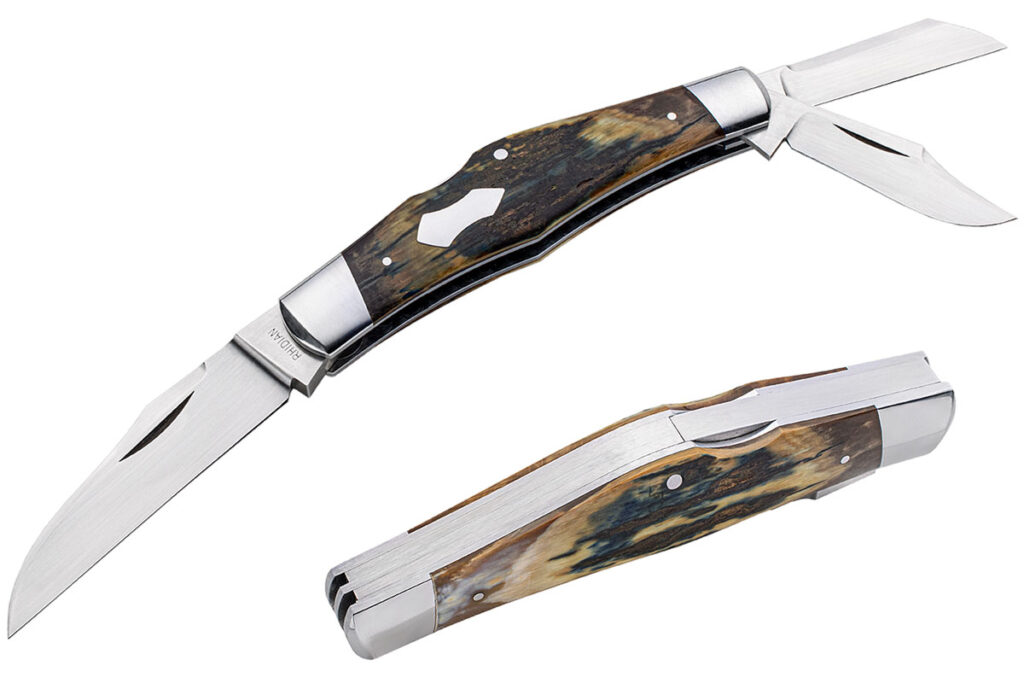
Rhidian Gatrill’s Lockback Rhiddler captured Best Folder in the custom category at last year’s BLADE Show West. The cleverly named lockback whittler features a locking 2 7/8-inch flat-ground wharncliffe and 2-inch hollow-ground slip-joint clip and coping blades of CPM 154 stainless steel. His price for a similar knife: $2,600. (Jocelyn Frasier knife image)
Motivation to make the challenging pattern was easy for Gatrill, who won Best Folder at BLADE Show West 2023 for his lockback whittler cleverly named Lockback Rhiddler. “I like interesting mechanisms and figuring out how to make them work,” he related. “I wanted to challenge myself and see how hard it was to make. Plus, I was attending my first knife show ever, which was the Oregon Knife Collectors Association show in Eugene, Oregon, and I wanted to take something that would possibly win an award. That knife ended up winning Best Folder and Best of Show.”
Looking for examples of lockback whittlers that were striking in appearance and function, Rhidian did some research and recalls, “Like most pocketknife makers, I admire the knives of Tony Bose, Bill Ruple, Ken Erickson and other masters that came before me. I traced photos of their knives and read forum posts that give a few tips, and I asked a few questions from other maker friends that have made lockback whittlers.”
That research led to an opportunity to present a lockback whittler interpretation that resonated with the collector community. “I believe knife collectors like them for their rarity, complexity of mechanism, and interesting function of combining the lockback blade with the slip-joint blades,” Rhidian concluded. “They also look cool with the thick tang on the main blade that steps down thinner and tapers to a point. A locking blade is always a little safer than a slip joint technically, so there’s that for the user. Not many custom makers have made them, and those who do don’t make many!”
Not one of his everyday builds, the Taka v2s by Brian Brown features a notable blade, handle and lock.
Brian Brown likes a good, pointy tanto.
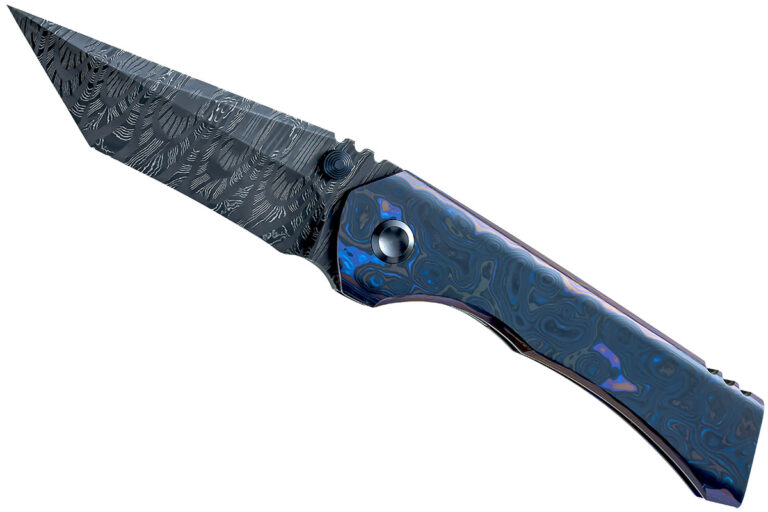
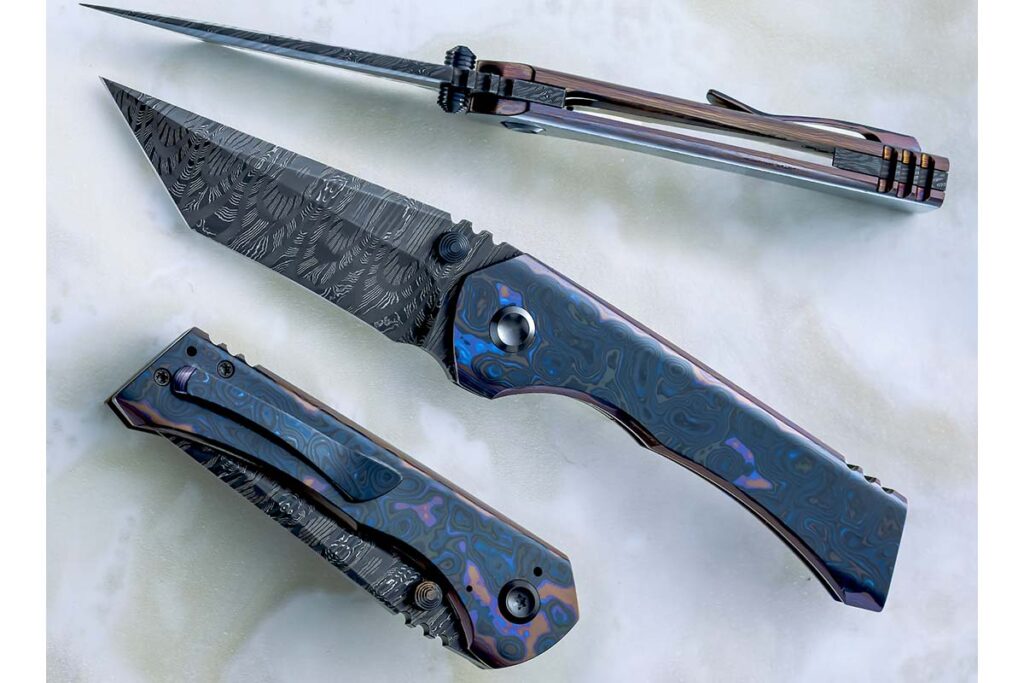
“It’s kind of a straight hollow grind all the way from the choil to the tip in a climbing grind,” he explained of the blade on his Taka v2s dress tactical folder. Grinding it that way helped him keep the blade extremely thin from the recurve edge to the tip. “You’ve got to be really careful [at the edge] because that’s gonna be the lowest spot where it gets thinnest the fastest—and I’ve burned through them before,” he noted.
Brian Brown said he had to be careful grinding/removing the top layer of the Black Top Timascus™ handle material by Alpha Knife Supply or he would expose too much of the titanium and change the color—somewhat visible here on the spine. The 3.125-inch blade is FireClone 2 forged by Mike Norris, which Brian lauded as some of the best stainless damascus anywhere. Closed length: 4.375 inches. (SharpByCoop knife image)
Only the second one he’s done, the folder’s linerlock-like inset lock enabled him to use the fancy handle material paired with a straight, solid piece of Grade 5 titanium for the lockbar. There are several more steps involved but the upshot is the scales are symmetrical as with a linerlock—a symmetry Brian prefers to that of a framelock. Plus, the inset lock results in a thinner handle than with a linerlock because the lock side must be relieved to make room for the lockbar.