Shop Dump: Murray Carter’s Tools Stick To His Knifemaking Roots

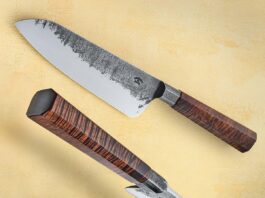
Carter’s training at the elbow of a Japanese master smith shows in his shop.

Ever since I was a young boy I have been fascinated with blades,” ABS master smith Murray Carter writes. “Why some blades would cut and others would not was a mystery to me that I felt compelled to solve.

“A chance encounter at age 15 with a karate instructor began my love affair with Japan. A trip to Japan, when I was 18 years old, led to an unexpected encounter with an amazing man, Sensei Yasuyuki Sakemoto, who I would come to learn was the 16th-generation Yoshimoto bladesmith and whose family custom forged samurai swords for some of Japan’s most influential feudal lords. My relationship with Sensei Sakemoto led to a unique six-year apprenticeship, and upon its completion, I was asked to continue on in the 420-year-old family bladesmithing tradition as the 17th-generation Yoshimoto bladesmith.”

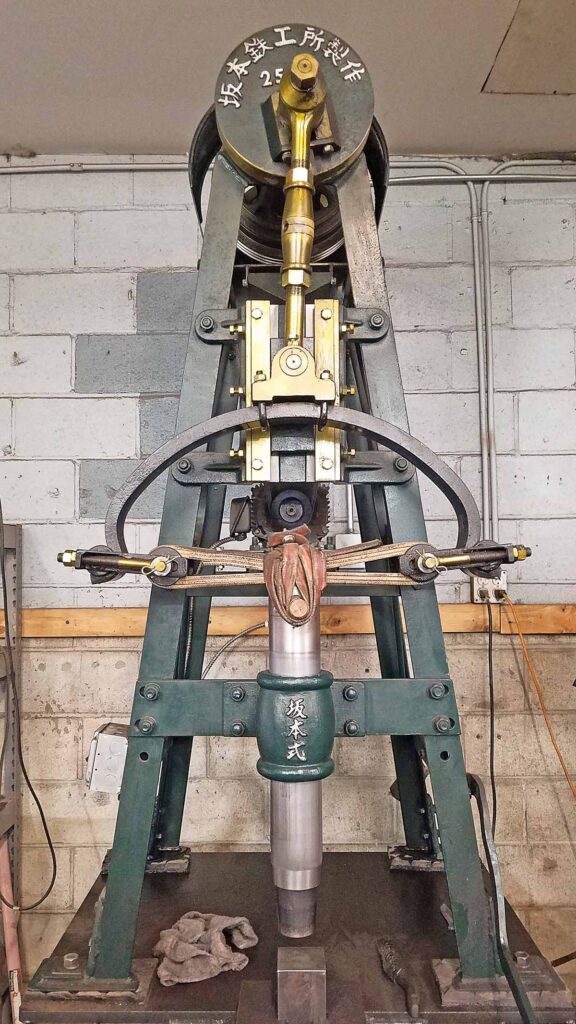
Sakamoto-Shiki Japanese spring hammer
Murray’s forging hammer is a 25-kilogram version of a Sakamoto-Shiki Japanese spring hammer. Japanese laminated steel is heated in a solid fuel forge and forged under the spring hammer with 800 to 1,000 individual hammer blows to achieve a blade that is very close to its final shape and thickness, and with extreme grain refinement.

Murray was off to the races. “I worked as a village bladesmith for 12 more years, constantly availing myself to other industry experts to glean what I could, and spent many long hours in the forge putting my newfound skills and knowledge to practice. I introduced my handforged Japanese kitchen knives to the Western market in June 1997 and achieved the ABS master smith rating in June 2001. In 2005, I moved to Oregon and have been busy plying my trade ever since.”

His shop is steeped in Japanese knifemaking history and his equipment reflects it. He begins with his forging hammer. “The Sakamoto-Shiki Japanese Spring Hammer is a 25-kilogram version,” Murray notes. “This particular hammer is the last-ever spring hammer to be manufactured by Sakamoto Ironworks in Tosayamadacho on the island of Shikoku, Japan. Blades are forged both hot and cold under this spring hammer. The 25-kilogram ram strikes the steel with enough kinetic energy to actually heat up the steel as it is being forged. One of our spring hammers has forged over 40,000 blades to date without breakage or malfunction.”

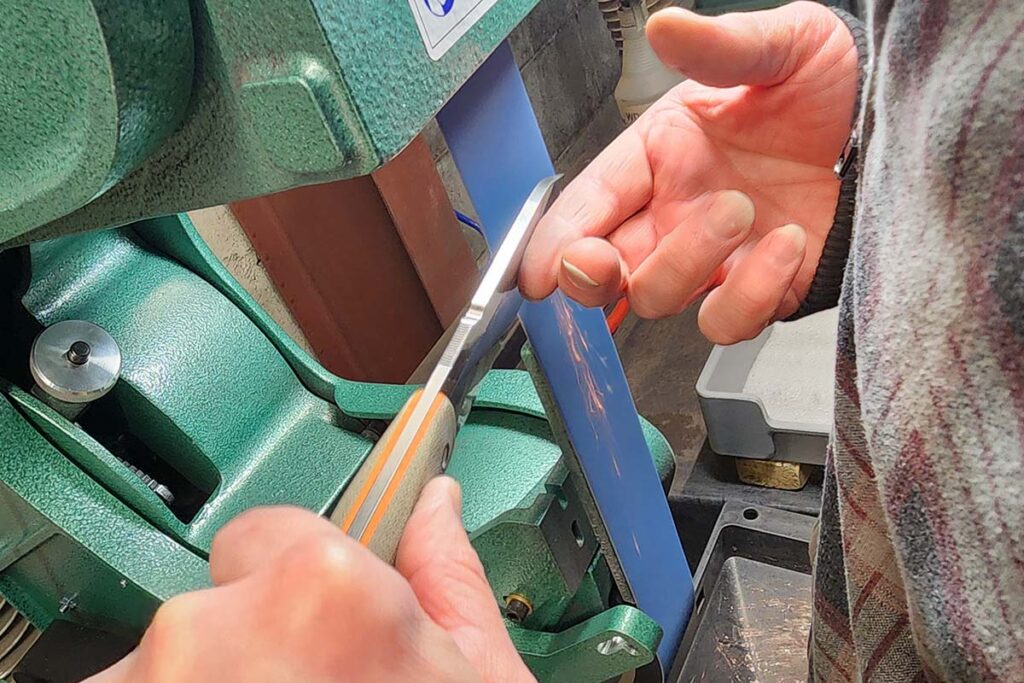
Next up is his rotating waterstone. “Keeping with traditional Japanese bladesmithing methods, handforged blades are quenched fully thick and then blade geometry is ground by hand on the rotating Japanese waterstone,” he explains. “When purchasing stones from Japan was no longer possible, Radiac Abrasives, Inc., from Salem, Illinois, stepped up and fabricated this stone for us.”

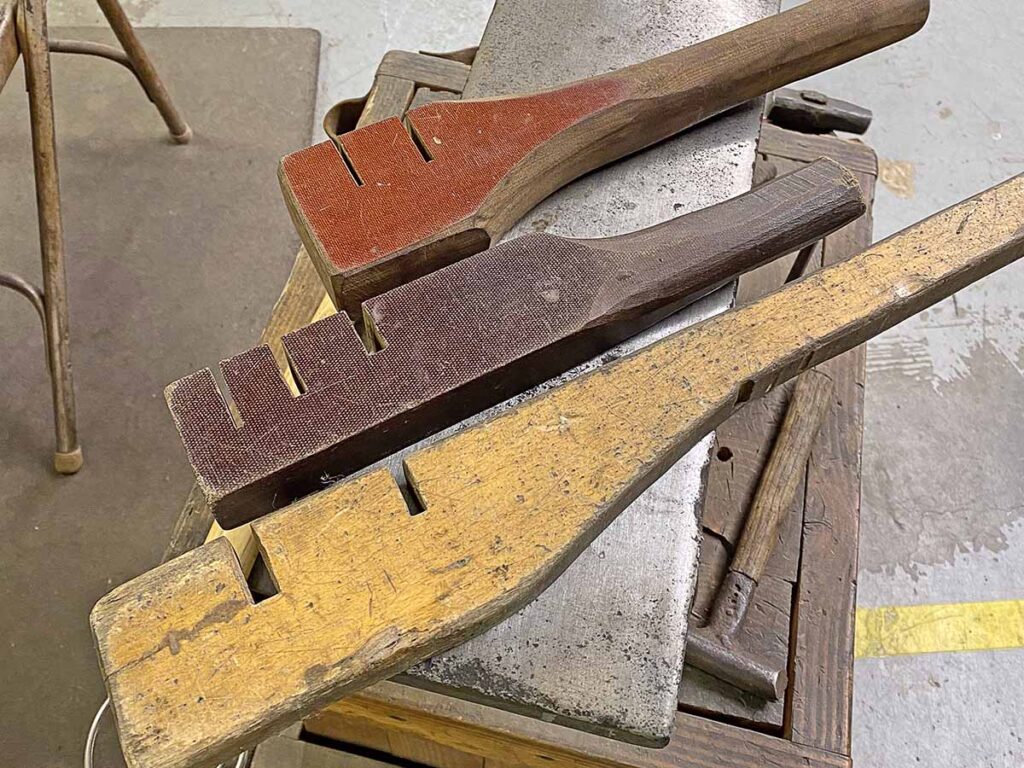
bending sticks
The mage-bou custom made ‘bending stick’ with slots of varying thicknesses is used to straighten hardened laminated blades. It can be made from most any hard material, including oak or Micarta®.

Murray’s forging hammer bears little resemblance to American fare. “The Japanese tagane hammer is made by brazing a carbide bit into a regular hammer,” he writes. “This is a specialized tool skillfully used to straighten bent homogenous steel knives after hardening. It is hammered into the concave side of an unwanted curve in a blade, and the carbide bit penetrates the surface of the metal and moves a tiny bit of steel in either direction, perpendicular to the length of the bit. Handforged saw blades before the days of disposable saw blades used this straightening technique heavily.”

For further blade straightening Carter uses a simple yet effective tool. “The mage-bou custom made ‘bending stick’ with slots of varying thicknesses is used to straighten hardened laminated blades,” he observes. “The bent blade is forced true via the lever and fulcrum effect. Care must be taken not to snap a stiffer blade by applying too much force.”

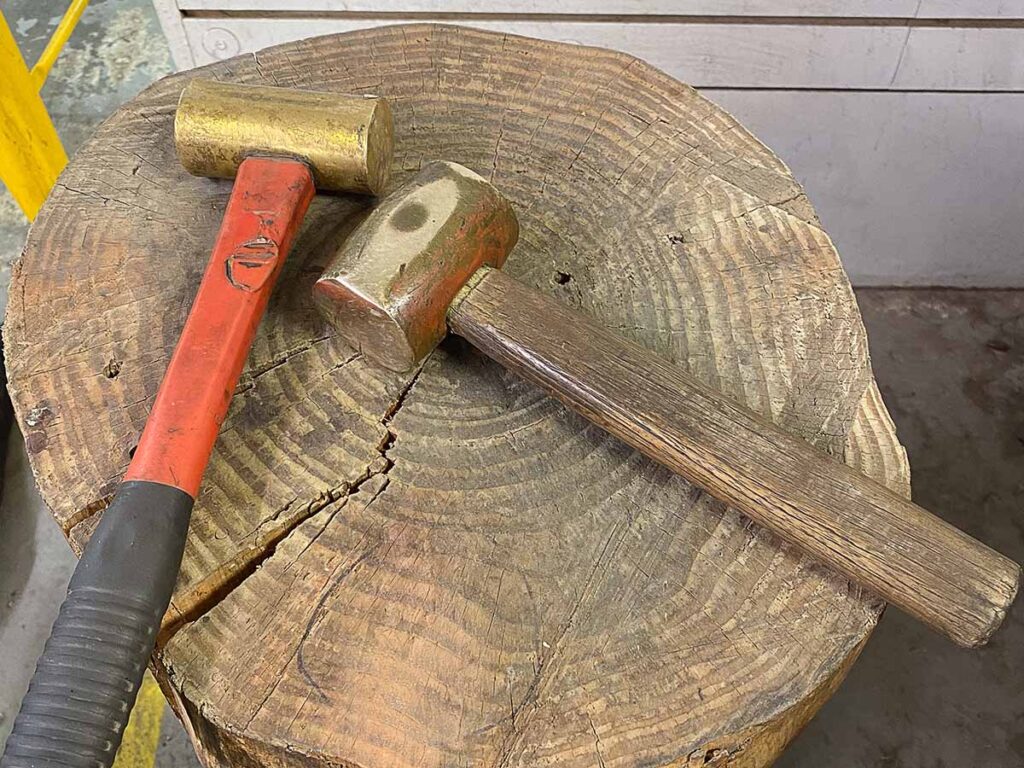
brass hammer and wood stump
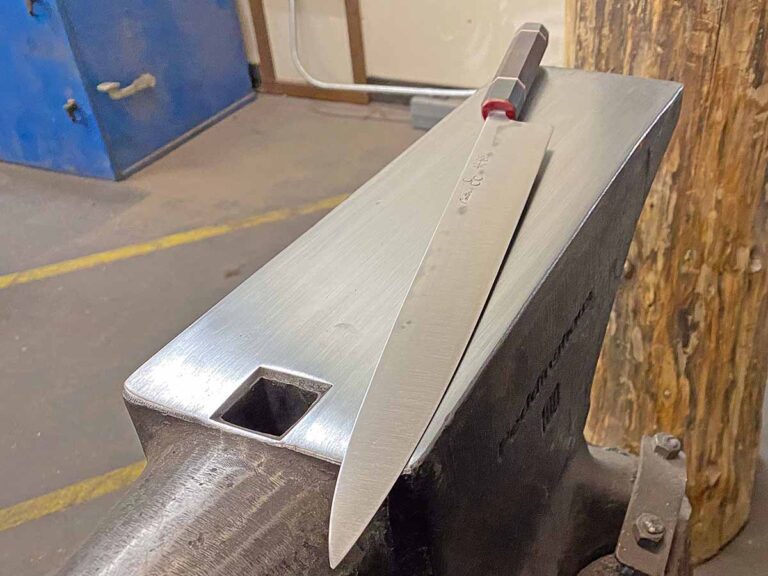
The brass hammer and wood stump are used to fine tune the straightening of blades after heat treatment. The convex side of a curve is placed face-up on the stump and judiciously hammered with the brass hammer.

Sometimes it just takes experience and a good eye in lieu of hi-tech. “The brass hammer and wood stump are used to fine tune the straightening of blades after heat treatment,” Murray notes. “It’s probably the most-used workstation at Carter Cutlery. The convex side of a curve is placed face-up on the stump and judiciously hammered with the brass hammer. Examining by eye the effects on the blade after each single hammer blow is the most effective way to do it.”

Check Out More Of Tools Of The Pros:

New Knives: Must-Have Production And Custom Blades

From kitchen to camp and beyond, these puppies will perform.

Christmas may have passed and all your presents have been unwrapped, but that doesn’t mean you can’t start building out your wish list for the coming year. We’re here to help with a slew of new knives—and non-knives—that are certain to tantalize and tempt. From production options full of pomp and customs cutting one-of-a-kind profiles, there’s something for knife lover.

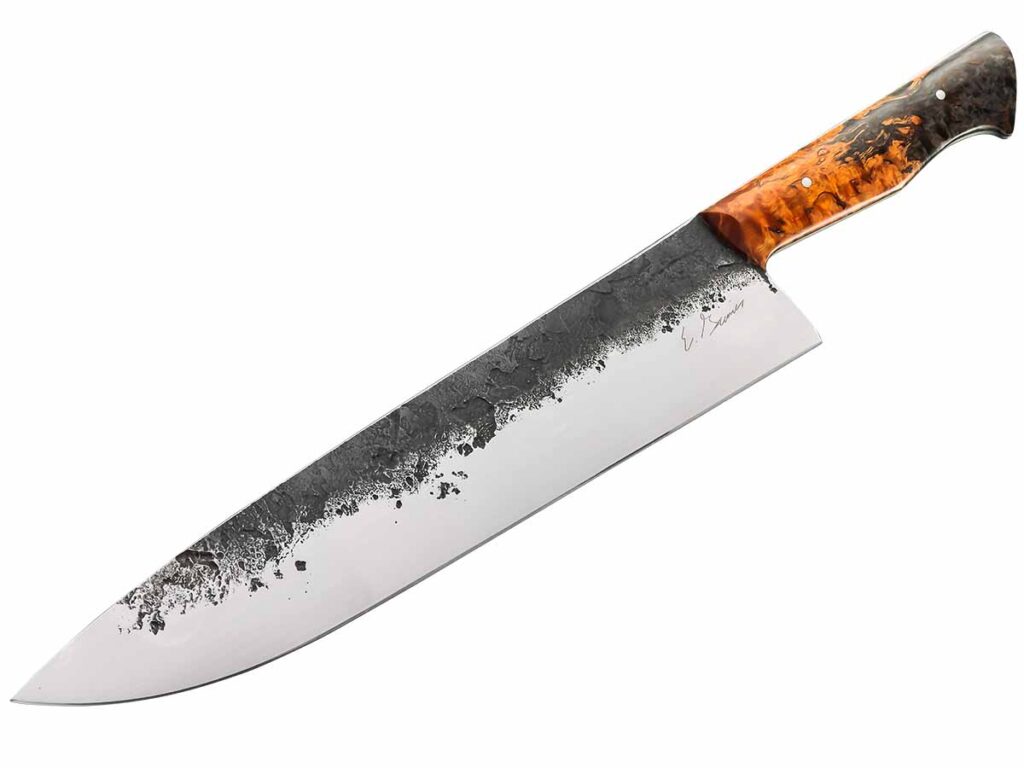
Greiner Chef’s Knife

Greiner Chef's Knife

Blade length: 10”
Blade material: 80CrV2 carbon steel w/forged finish
Blade grind: Flat
Handle material: Double-stabilized karelian birch
Overall length: 14.5”
Maker’s price for a similar knife: $600
Maker: Erik Greiner, greinerblades.com (SharpByCoop image)


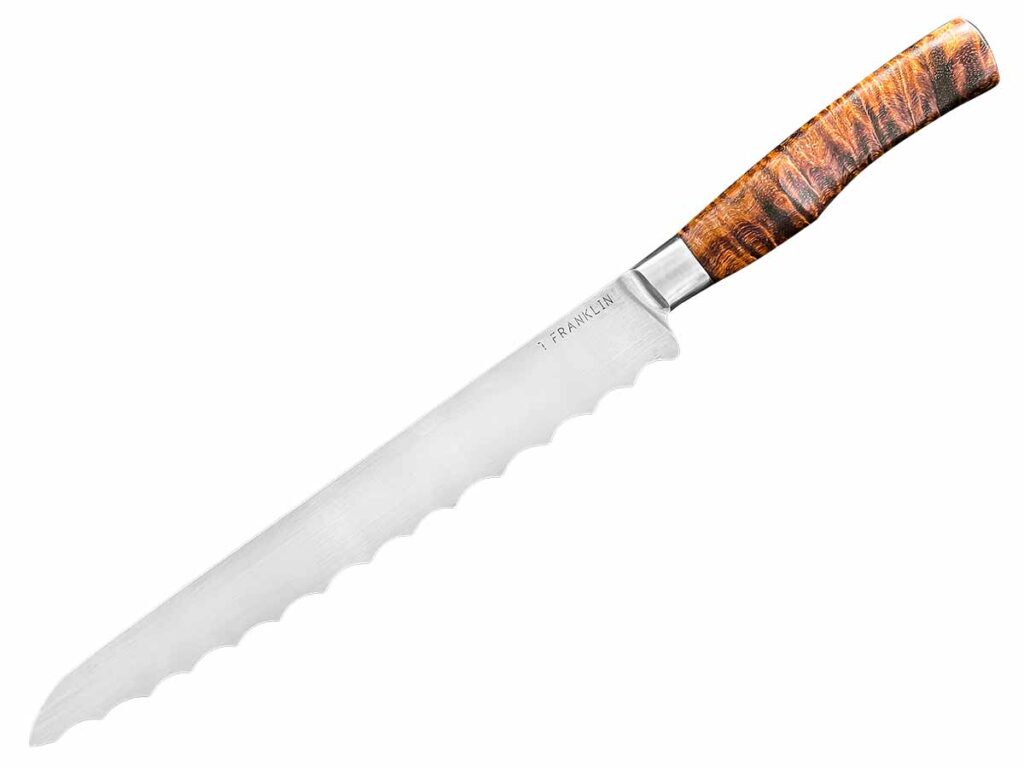
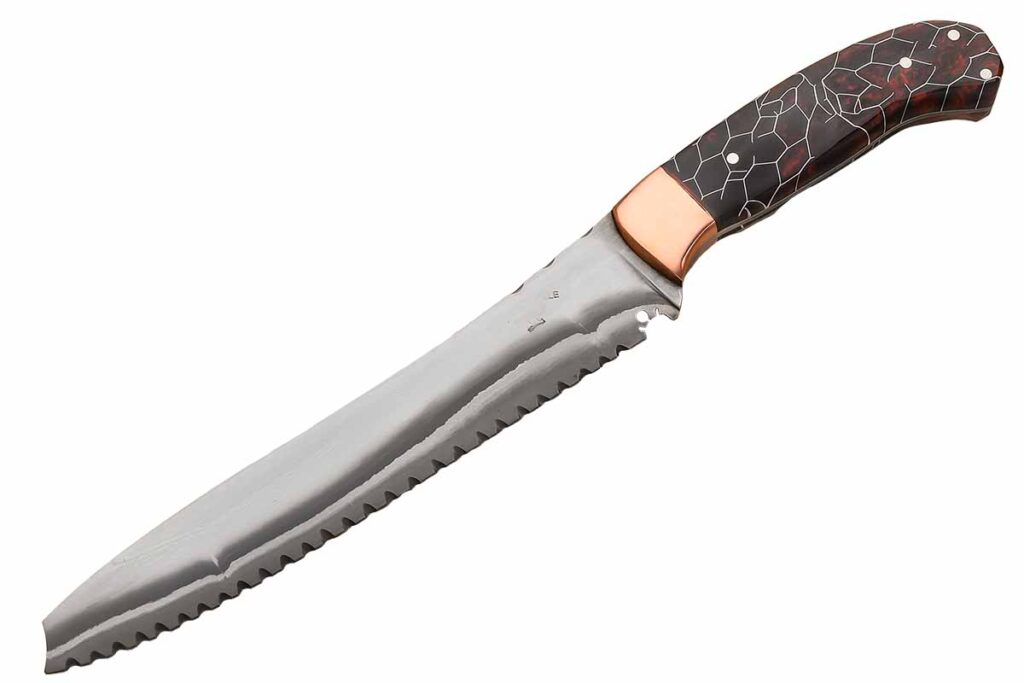
Franklin Bread Knife

Franklin Bread Knife

Blade length: 9.25”
Blade material: 52100 carbon steel
Handle material: Hawaiian koa
Overall length: 14”
Maker’s price for a similar knife: $575
Knife to know: Also comes in a set of three that includes chef’s and paring knives w/a price of $1,750 for the entire set; Thomas Franklin is an ABS apprentice smith
Maker: Thomas Franklin (Jfrasierphotography.com)


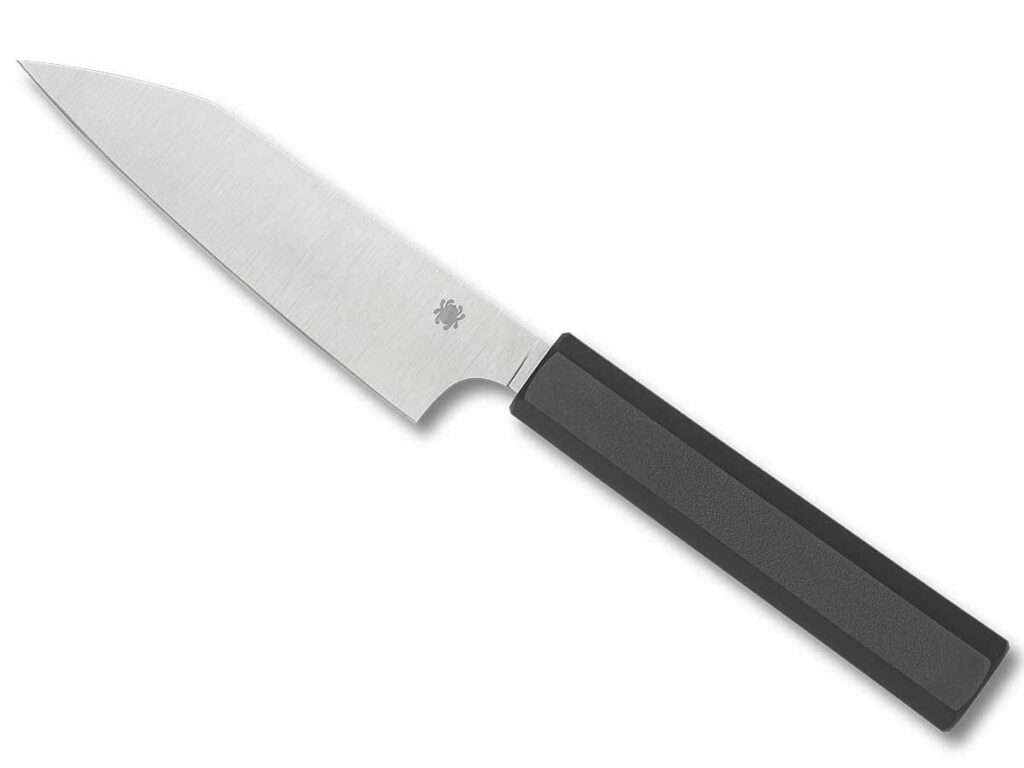
Spyderco Petty

Spyderco Petty

Designer: ABS master smith Murray Carter
Blade length: 4.64”
Blade steel: CTS BD1N stainless
Blade grind: Full-flat
Blade @ thickest: .068”
Handle design: Wa style (octagonal)
Handle material: Black polypropylene
Weight: 1.8 ozs.
Overall length: 8.87”
Knife to know: The Petty is part of Spyderco’s Minarai Series; meaning “to look and learn,” minarai is the Japanese way of describing the role of an apprentice
Country of origin: Japan
Company: Spyderco, spyderco.com


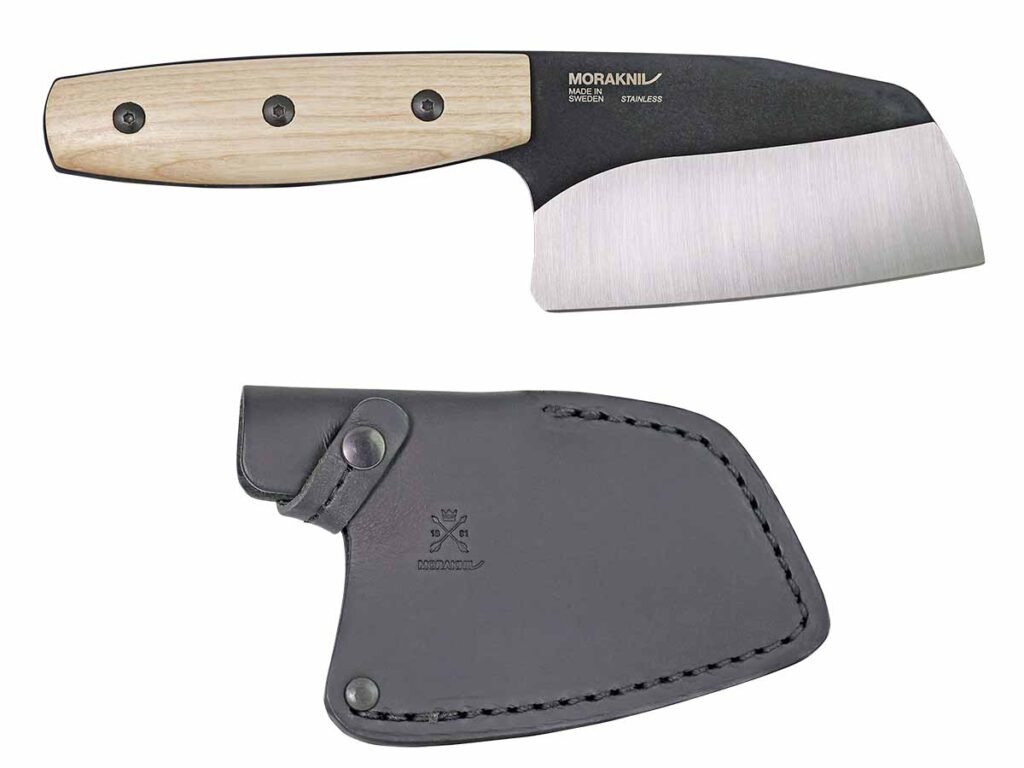
Morakniv Rombo

Morakniv Rombo

Model: Camp chef’s knife
Blade length: 3.86”
Blade steel: Swedish stainless
Blade grind: Flat
Blade @ thickest: .09”
Blade finish: Two-tone
Handle material: Wood
Weight: 5.5 ozs.
Overall length: 8”
Country of origin: Sweden
Knife to know: Designed for right-hand use
MSRP: $230 (at press time rate of exchange)
Company: Morakniv, industrialrev.com


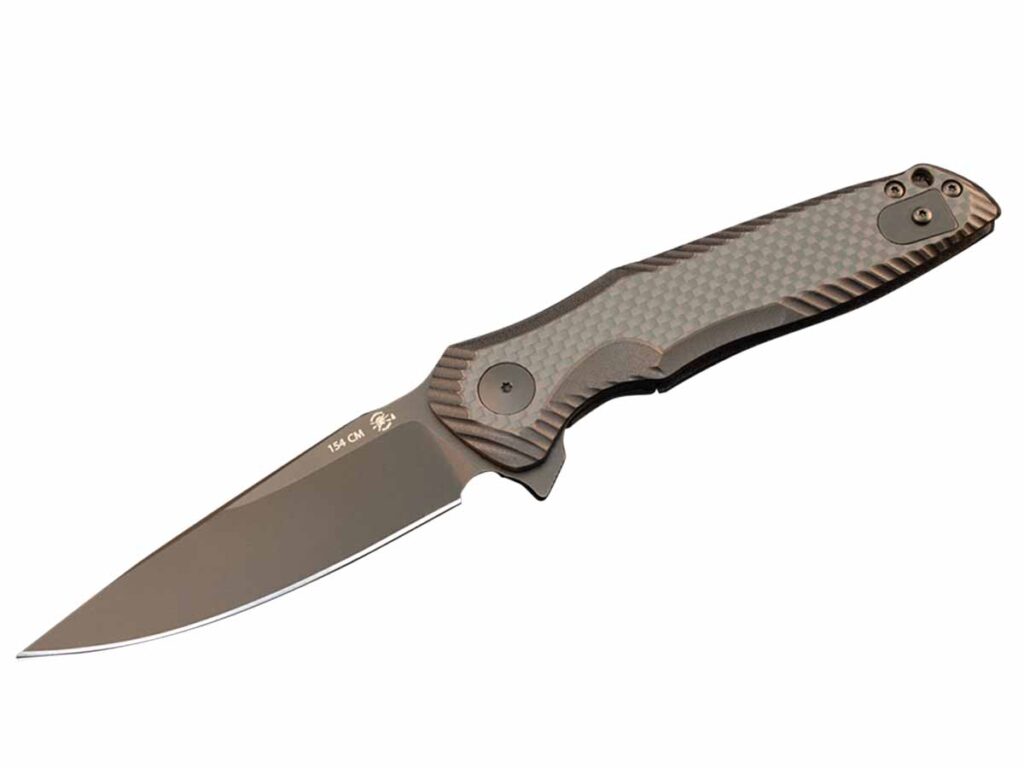
Spartan Blades Poros

Spartan Blades Poros

Designer: Curtis Iovito
Knife type: Flipper folder
Blade length: 3.75”
Blade steel: 154CM stainless
Rockwell hardness: 58-60 HRC
Blade grind: Flat
Blade @ thickest: .125”
Blade finish: Black titanium nitride coating
Blade pattern: Drop point
Pivot action: Ikoma Korth Bearing System (IKBS)
Handle material: Carbon fiber/G-10 composite
Lock: Linerlock
Pocket clip: Deep carry
Hardware & liner: Stainless steel w/black electro-deposit powder coating
Weight: 5.3 ozs.
Closed length: 4.25”
Country of origin: USA
MSRP: $190
Company: Spartan Blades, spartanbladesusa.com


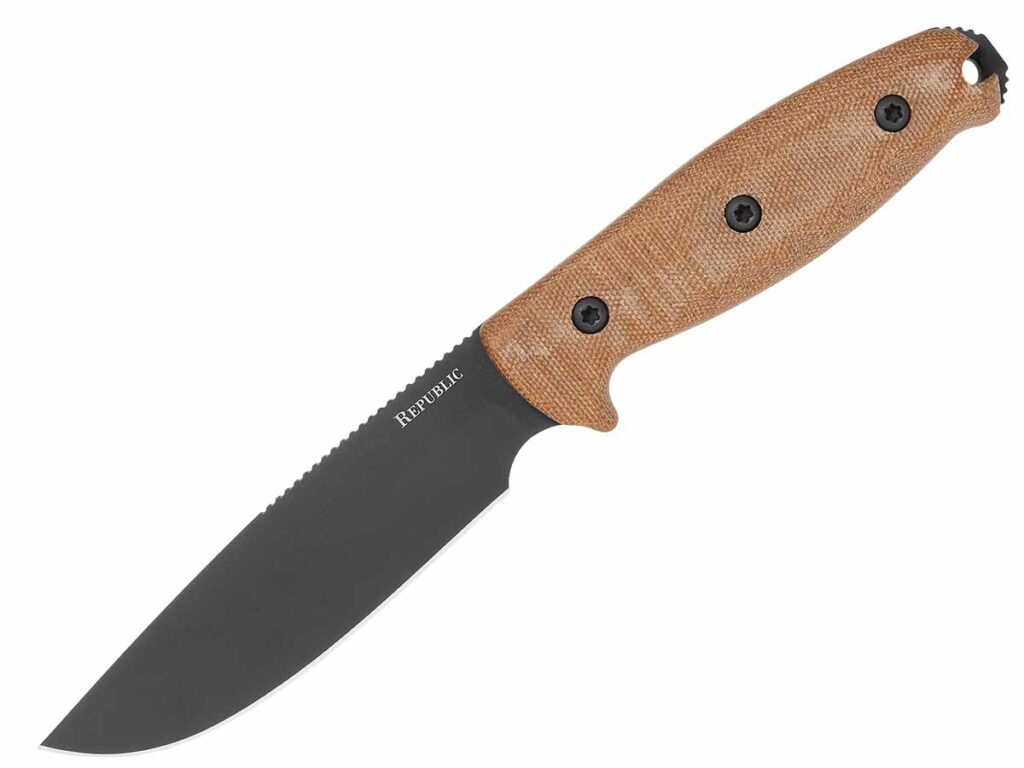
Cold Steel The Republic

Cold Steel The Republic

Knife type: Bushcraft fixed blade
Blade length: 5”
Blade steel: CPM S35VN stainless
Rockwell hardness: 58-60 HRC
Blade @ thickest: .1535”
Blade finish: Corrosion resistant/no-glare Ionbond
Blade pattern: Drop point
Handle material: Micarta® w/single integral guard and lanyard hole
Knife to know: Handle is removable for customization based on situation/undertaking; spine gimping for extra control
Weight: 8.4 ozs.
Overall length: 10”
Sheath: Leather pouch
MSRP: $269.99
Country of origin: USA
Company: Cold Steel, coldsteel.com


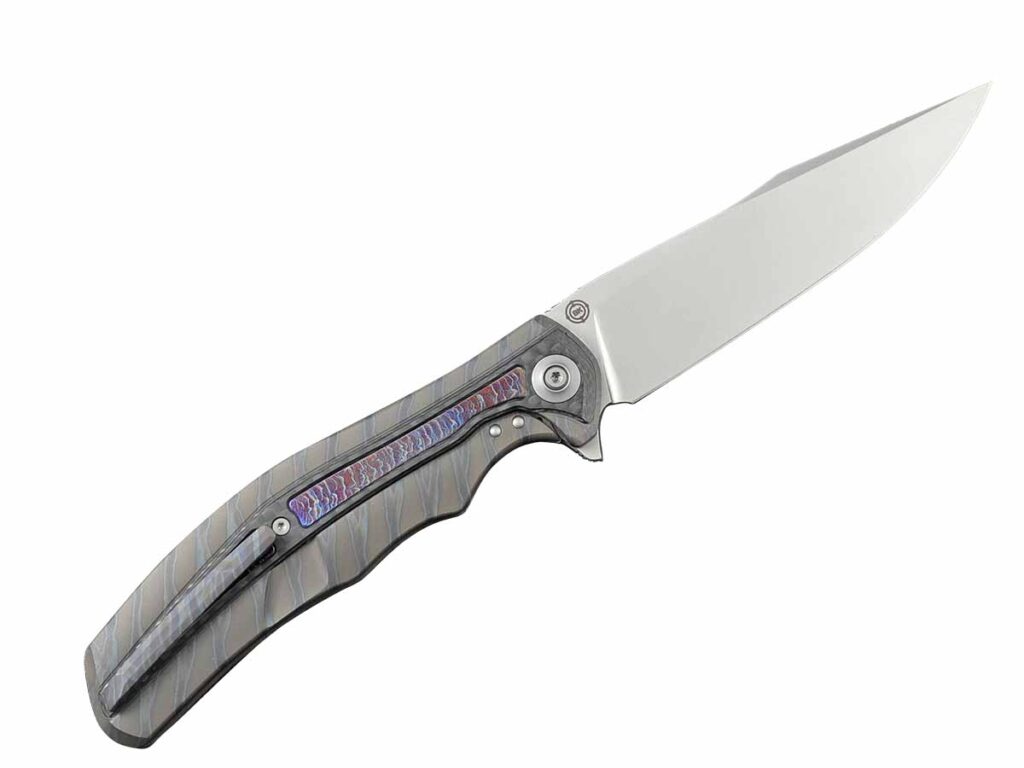
WE Knife Zonda

WE Knife Zonda

Pattern: Flipper folder
Blade length: 4.04”
Blade steel: CPM 20CV stainless
Blade finish: Stonewashed
Blade @ thickest: .13”
Handle material: Black titanium w/flamed titanium inlay
Pocket clip: Right-hand, blade-tip-up carry
Lock: Framelock
Closed length: 4.85”
Country of origin: China
MSRP: $480
Company: WE Knife, weknife.com


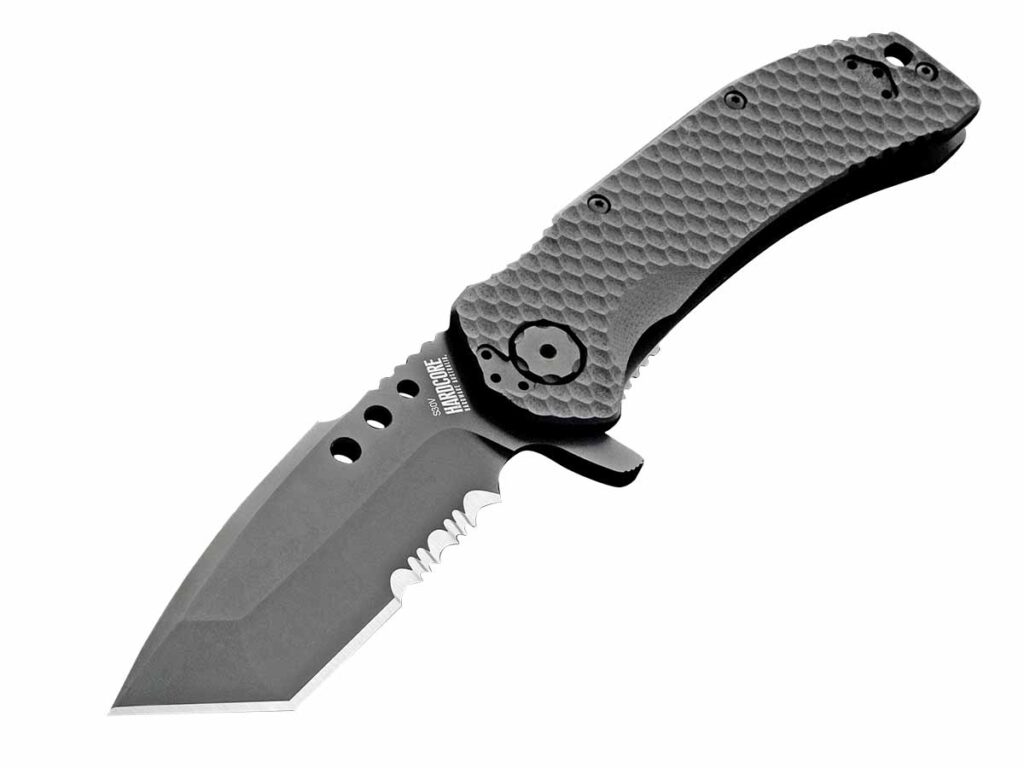
Halfbreed Blades MILF-03PS

HHA MILF

Blade length: 3.54”
Blade steel: CPM S30V stainless
Rockwell hardness: 59-60 HRC
Blade grind: Hollow
Blade @ thickest: .19”
Blade finish: PVD coat
Blade pattern: Tanto
Handle material: G-10
Washers: Phosphor bronze
Weight: 7.34 ozs.
Closed length: 5.51”
Handle @ thickest: .59”
Country of origin: Australian and Taiwanese make
MSRP: $280
Company: Halfbreed Blades, halfbreedblades.com.au


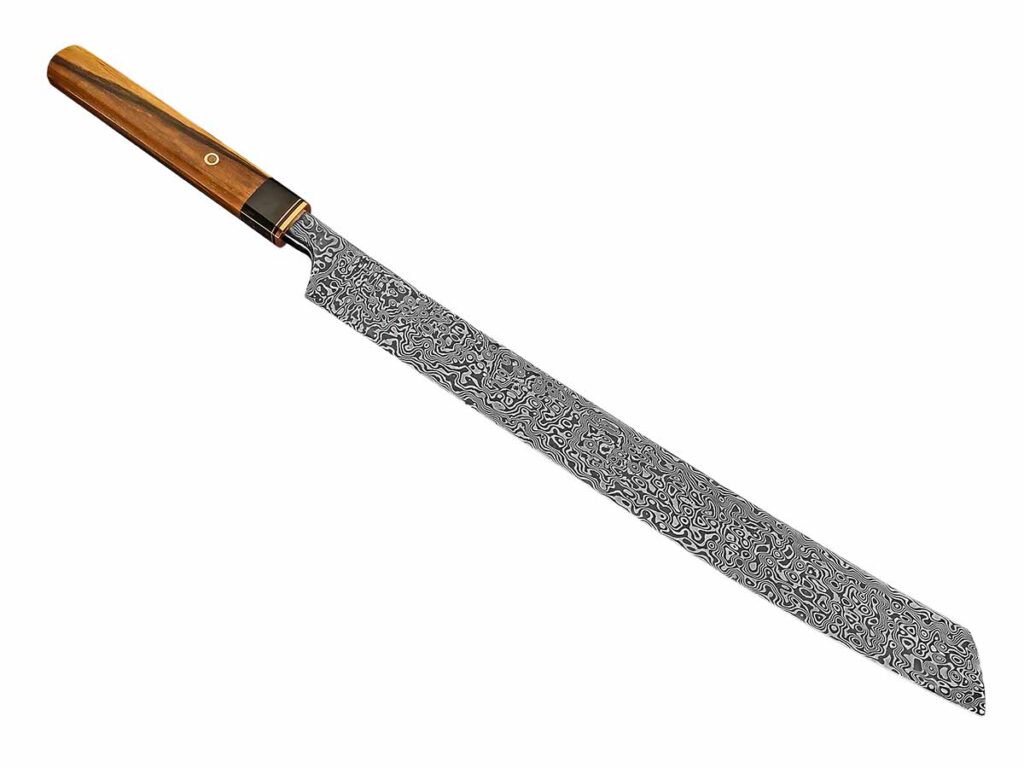
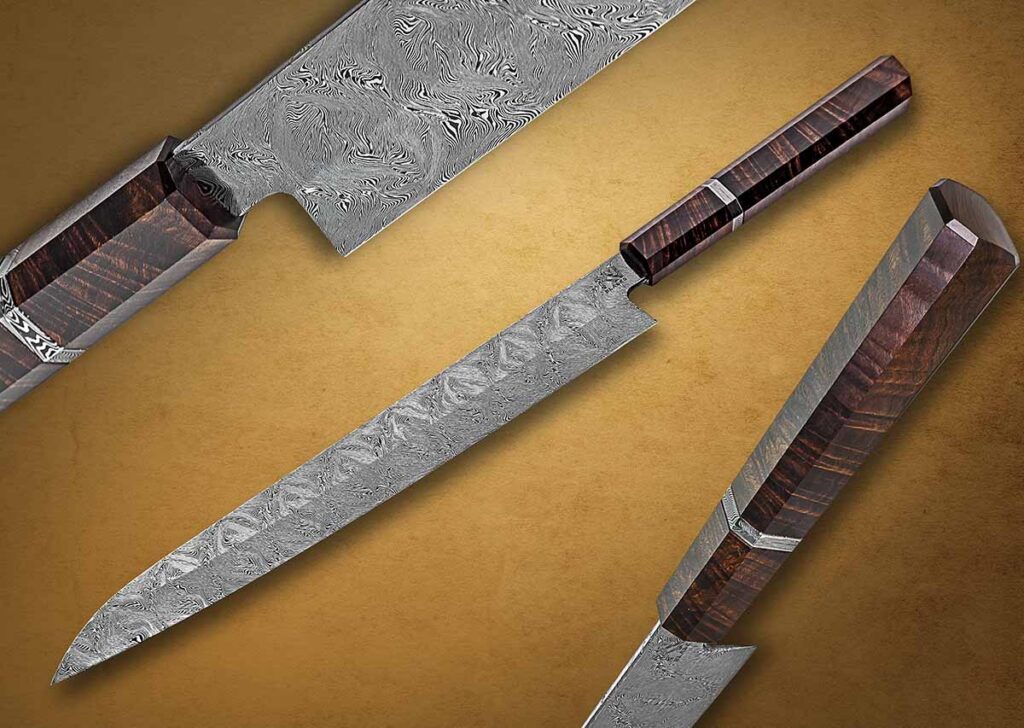
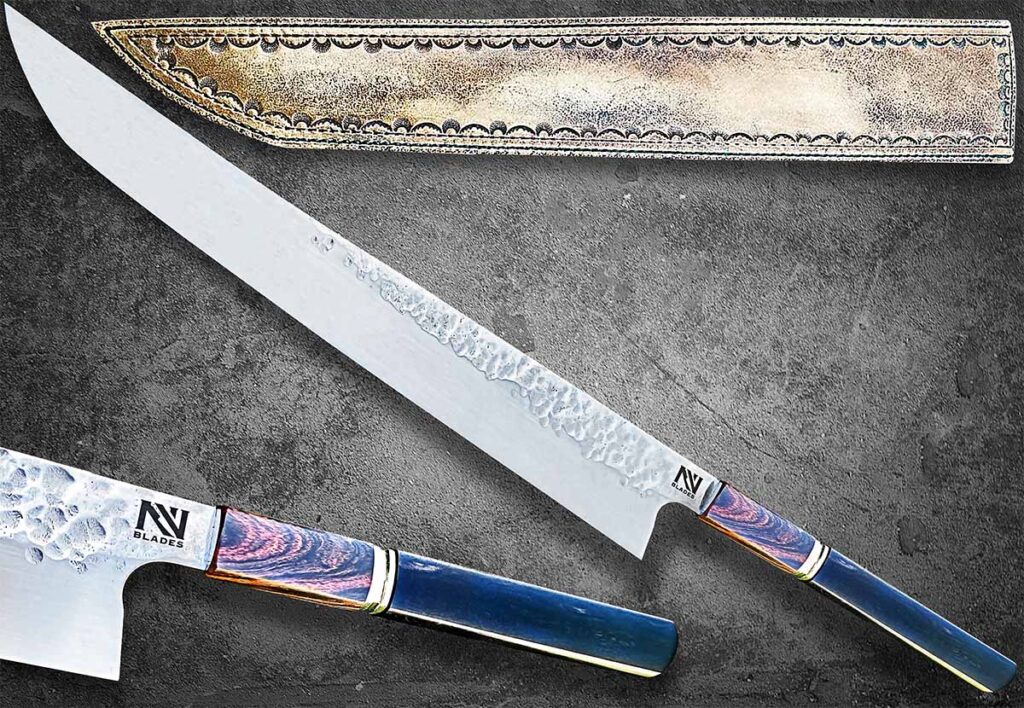
Schubert Knives Large Damascus Slicer

Schubert Knives Large Damascus Slicer

Blade length: 19.3”
Blade material: 90-layer raindrop-pattern damascus of 1084 carbon and 15N20 nickel-alloy steels
Blade grind: Flat
Blade @ widest: 1.77”
Bolster/guard material: Copper and buffalo horn w/soldered joint
Handle material: Stabilized blackheart sassafras
Handle pins: Turned whale tooth and bamboo
Overall length: 26.4”
Scabbard (not shown): Glass lacquered wood inlaid w/black heart sassafras, buffalo horn, copper and whale tooth
Maker: Bruce Schubert (Rod Hoare image)


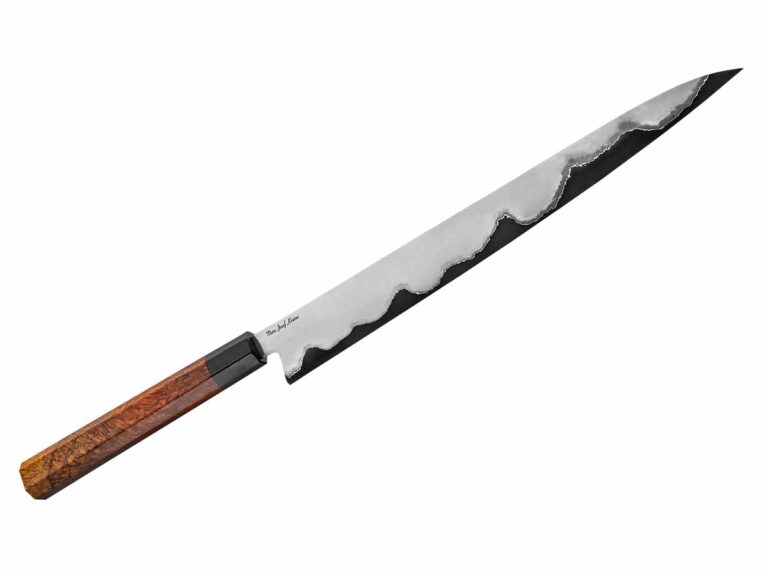
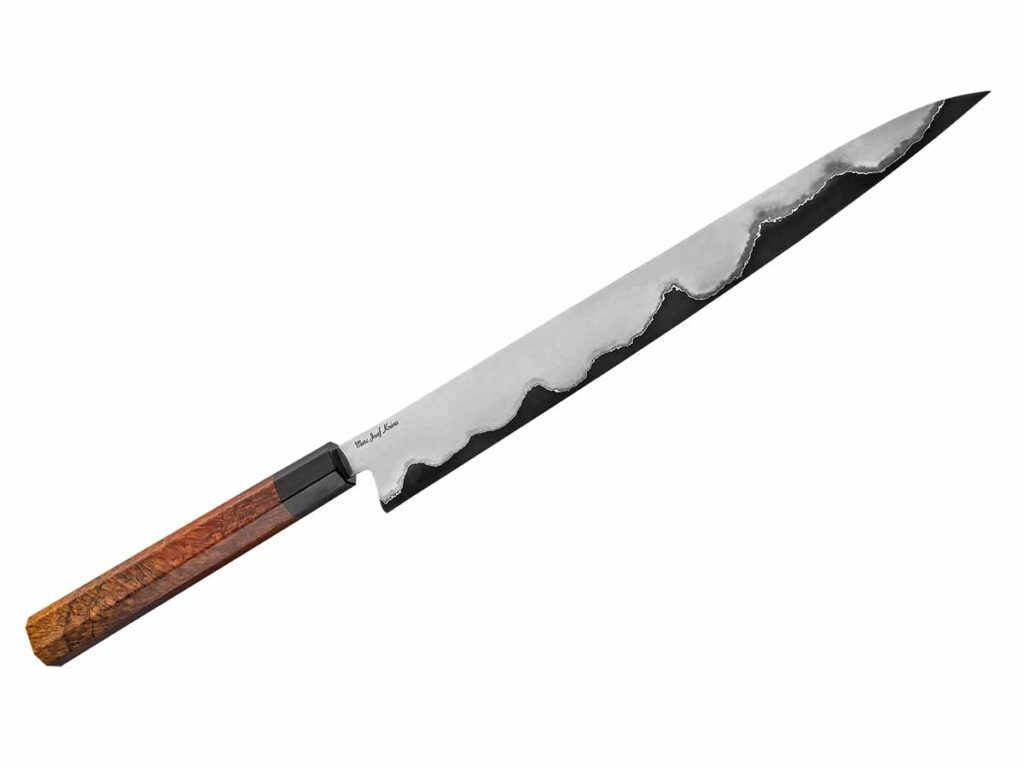
Mark Josef Knives Sujihiki

Mark Josef Knives Sujihiki

Pattern: Slicer
Blade length: 11.8”
Blade material: San-mai construction of 410 stainless steel, nickel and 52100 carbon steel forged by Brook Turner
Rockwell hardness: 62 HRC
Blade grind: Flat/convex
Blade thickness @ ricasso: .118”
Blade @ widest: 1.496”
Handle material: Coolabah burl
Bolster/guard: African blackwood
Overall length: 18.5”
Maker: Marc Stewart, Mark Josef Knives, marcjosefknives.com.au (Rod Hoare image)


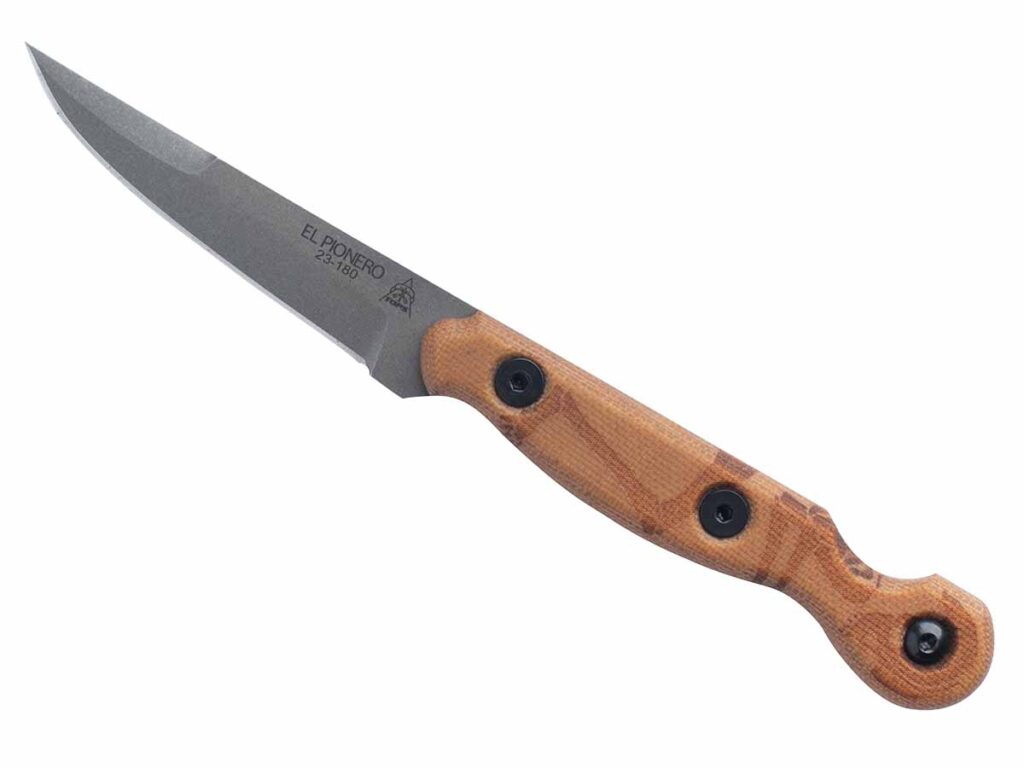
TOPS Knives El Pionero

TOPS Knives El Pionero

Designer: Ed Calderon
Blade length: 3.38”
Blade material: 1095 carbon steel
Blade @ thickest: .09”
Blade finish: Tumble
Handle material: Tan canvas Micarta® w/finger divot that aids in blade orientation, etc.
Weight: 2.9 ozs.
Overall length: 7.63”
Sheath: Black Kydex
Weight w/sheath: 4.1 ozs.
Knife to know: The El Pionero is a “paring knife-esque design”; Ed Calderon (edsmanifesto.com) worked as a counter-narcotics officer in Mexico and more recently as a trainer and “guru in the tactical space”
Country of origin: USA
MSRP: $220
Company: TOPS Knives, topsknives.com


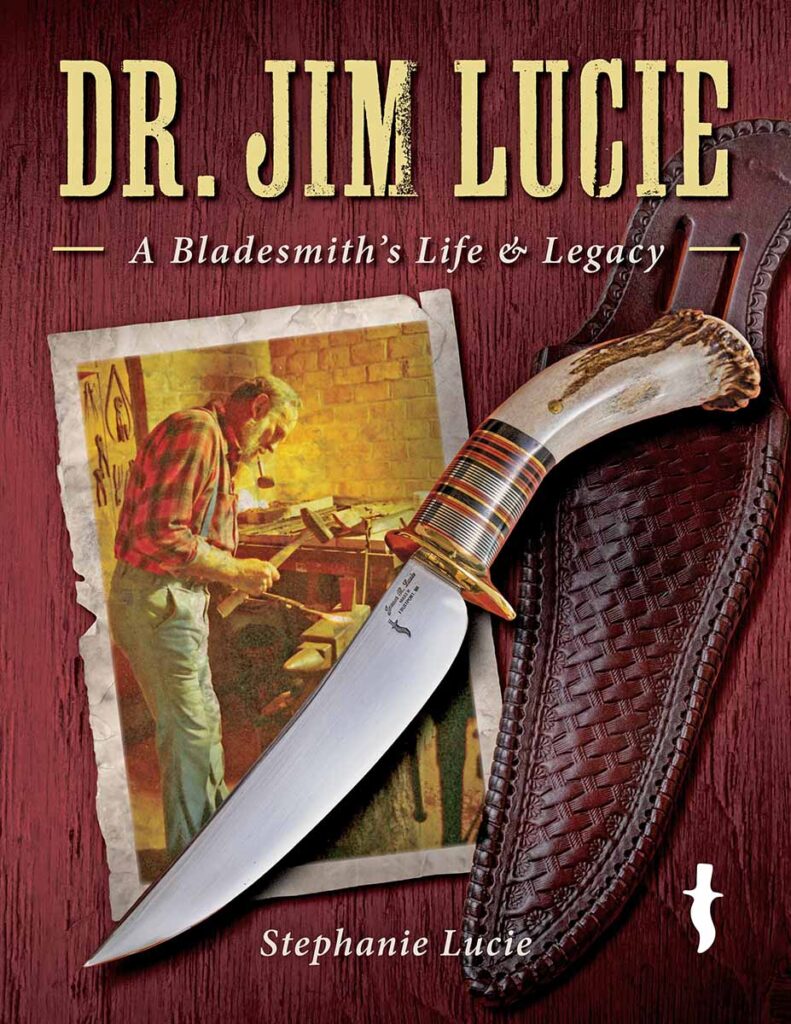
Dr. Jim Lucie: A Bladesmith’s Life & Legacy

Dr. Jim Lucie: A Bladesmith’s Life & Legacy

What it’s about: ABS journeyman smith Dr. Jim Lucie had a unique background: he served as the personal physician for, and learned about knifemaking from, the man recognized as the grandfather of custom knives—BLADE Magazine Cutlery Hall-Of-Fame® member William Scagel. The author, Stephanie Lucie, is Lucie’s youngest of four daughters. She paints a picture of her father like no other, from childhood to adulthood, his bladesmithing mentors and friends, the many stories written about him and much more.
Format: 9.25 x 12.5-inch hardback, limited to 1,500 copies in the first edition, over 300 color photos, including more than 200 knives Lucie made, and over 100 pictures of his life and accomplishments.
MSRP: $120
Contact: jimluciebook.com

Check Out More Knife Drops:

Delight Valley Veggie Slicer Review: Roughing Up Roughage

Specially formulated to knock vegetables down to size, the Veggie Slicer has an edge in the kitchen.

Never judge a book by its cover. That holds true for knives, too.

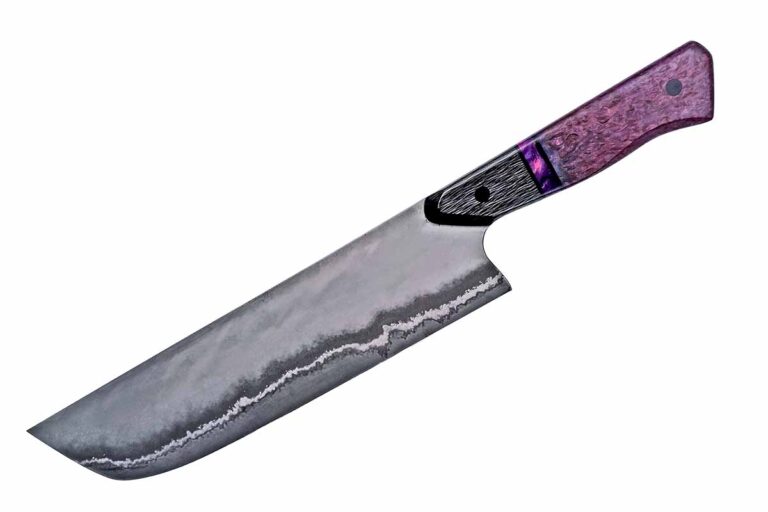
When I opened the box containing the Veggie Slicer from Delight Valley Blades, I noticed it did not have a tip like most knives. Well, at least I wouldn’t stab myself. The knife has a full flat grind to sharp, with a very fine edge. It’s made for slicing and dicing, though you know I will do more with it than that.

Veggie Slicer In The Kitchen

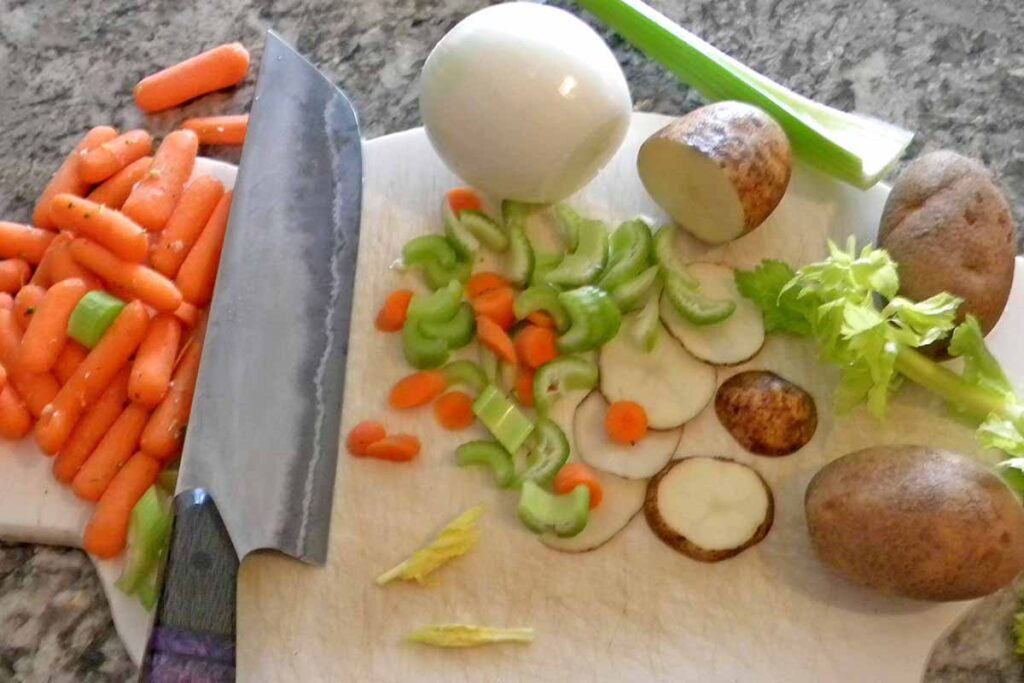
Since hunting season was starting, I made a big pot of vegetable beef soup before heading to the woods. I used the Veggie Slicer to slice and dice the veggies. It powered through the carrots very quickly and diced up the celery cleanly. I did my thinnest slice of onion ever. I could easily see the layers of the san-mai through the wafer-thin onion. I chopped the rest of the onion in a flash. On to the potatoes!

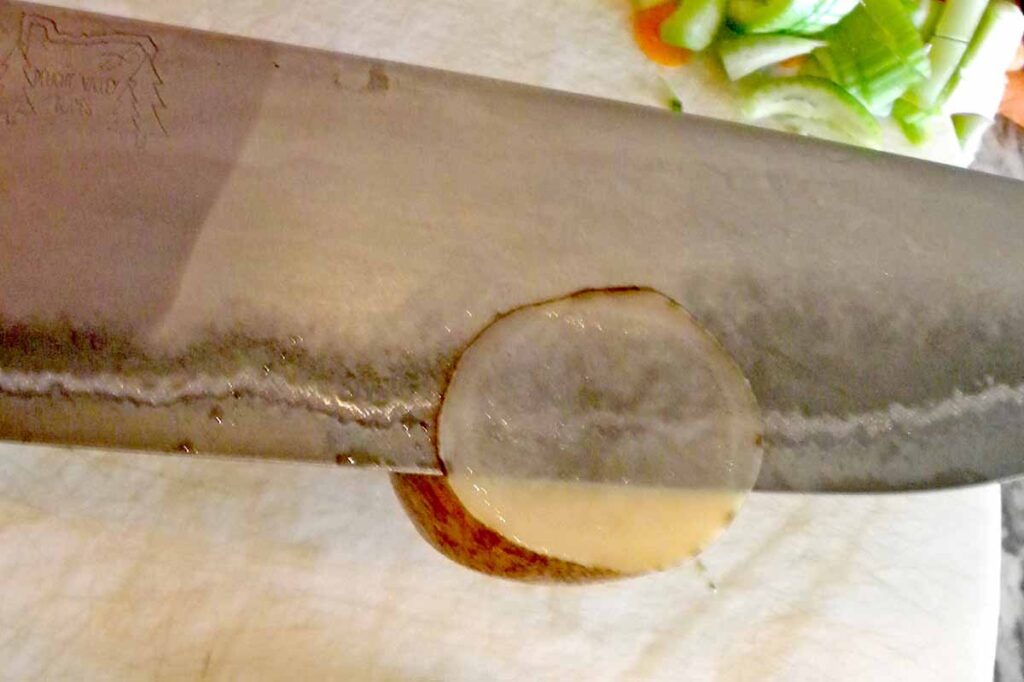
Veggie Slicer through a potato
The author sliced the potato so thin with the Veggie Slicer you can see the layers of san-mai through it.

I was expecting more resistance from the spuds. Light pressure was all it took. The knife being so sharp, I had to take care to keep all finger parts away from the edge. The Veggie Slicer will peel the skin from your finger before you can say Veg-O-Matic—and I had a few close calls.

Veggie Slicer Light Cutting Duty

With everything in the pot cooking, I headed out to the garage to slice up the non-edibles. I grabbed a sheet of 20-pound bond copy paper for slicing. I managed to suffer only one nail nick in making the paper fall apart. The knife is nasty sharp for sure. The slices were smooth and I used only the weight of the blade on the pull cuts.

I jumped up to double-walled cardboard to try and slow the edge down. That didn’t work, either. The Veggie Slicer ate through the cardboard as fast as I could get my fingers out of the way. I used both push and pull cuts to see if there was a difference. There was none.

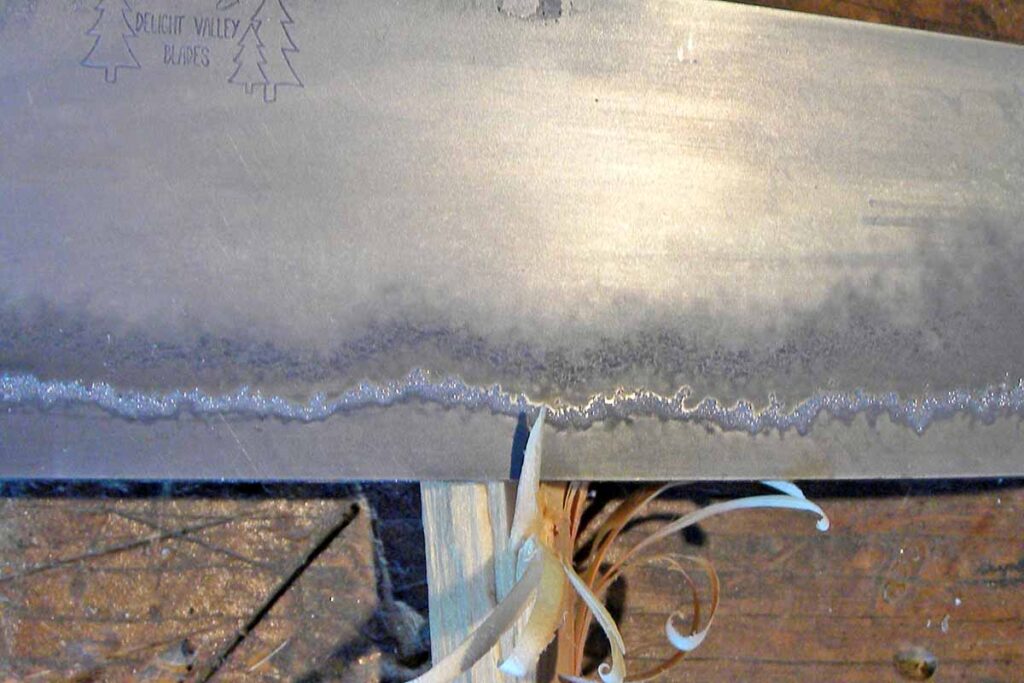
Delight Valley Veggie Slicer vs pine
Thin pine curlicues were the order of the day for the Veggie Slicer.

Heavy-Duty Cutting

It was on to whittling pine. The Veggie Slicer made very thin curlicues. I couldn’t choke up on the blade as the spine was cut at a 90-degree angle—too sharp for the insides of my fingers. As a result, control was a tad more difficult. The blade still cut deep and shallow without a challenge. It zipped into the pine quickly, still scary sharp.

It was time for some half-inch sisal rope. After the first 100 crunching cuts I let my guard down enough to take a nick out of my rope-holding finger. Thanks to all my callouses no blood was shed, but it was close. The second 100 went off without any dulling of the edge (or my finger).

I had to go one step further to see if the fine edge would hold up. I grabbed a whitetail deer antler and gave it 30 chops. The result: no edge damage whatsoever, a sign of perfect heat treatment.

Final Cut

The Veggie Slicer can slice, dice and a lot more if needed. It has one long-lasting edge.

Soup prep with Veggie Slicer by Delight Valley Blades.
The kitchen knife sliced and diced the veggies, powered through the carrots very quickly and diced up the celery cleanly. It’s soup!

I would soften the blade spine and choil and ricasso area so a wider selection of hand grips can be used.

Delight Valley Blades Veggie Slicer Specs
Blade length: 7.5”
Blade steels: 26C3 carbon core and 416 stainless cladding in a san-mai construction
Blade grind: Full flat
Blade width: 1.78”
Handle: Masur birch and carbon fiber
Pins and liners: G-10
Weight: 10.5 ozs.
Overall length: 12.25”
Maker’s price: $600

Read More Knife Reviews:

Brisket Knife: These Carving Blades Are Bad To The Bone

0

Prepare massive meat feast with one of these barbecue beasties at hand.

The barbecue/brisket knife is an indispensable tool for those who prepare brisket and other large-scale meat dishes. Makers go the extra mile to provide the toughness and tensile strength needed, along with a tip that stays sturdy to separate meat and prepare it for serving. Individual recipes include the good looks and visual appeal that make owning and using the best in such knives a pleasure.

Ben Anderson: Brisket Slicers For The Barbie

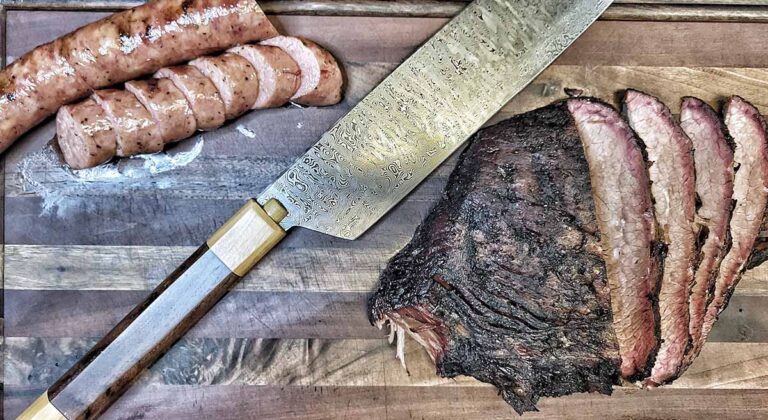
Ben Anderson forged the 12.6-inch blade of his Mosaic Brisket Slicer
Ben Anderson forged the 12.6-inch blade of his Mosaic Brisket Slicer from 1084 carbon and 15N20 nickel-alloy steels. Done in the Japanese wa (octagonal) style, the handle is ringed gidgee with a damascus spacer. Overall length: 19.7 inches. (Rod Hoare image)

Ben Anderson of Gold Coast, Queensland, Australia, features his artisan’s perspective in two beauties that allow form and function to seamlessly blend. He calls both brisket slicers, and in each case he has styled the big carbon steel blade for use with large pieces of meat. One features a blade of 52100 high carbon steel, handle of ironwood and ebony with textured and filed brass spacer, overall length of 27.5 inches, blade of 19.7 inches, and leather sheath. The second is a stunning piece with a 12.6-inch blade of mosaic damascus in 1084 carbon and 15N20 nickel-alloy steels, and a handle of ringed gidgee with a damascus spacer. Overall length: 19.7 inches.

“The blade shape just seems to be a favorite of the brisket guys [in Australia],” Ben commented. “I think people like it because it’s just an aggressive-looking shape that’s a bit reminiscent of a katana. Most of my time as a maker I’ve offered full customization for my clients, so this really pushed me to try all different shapes, sizes and color combinations.”

A custom knifemaker for about six years now, Anderson uses precision specifications in crafting his brisket knives to perform. “On my standard kitchen knives I’ve always aimed for a ricasso height of around 18 millimeters [.7 inch], which made my handles around 20 millimeters [.79 inch] tall at the front and tapered out to around 5 millimeters [.196 inch] bigger at the back. On the bigger brisket knives I aimed for a ricasso height of around 23 millimeters [.9 inch], which made the handles around 25 millimeters [.98 inch] tall at the front and again tapered to around 5 to 7 millimeters [.196 to .275 inch] bigger at the back. I like to scale the handles up with the blades,” he noted, “so it all looks in proportion. It also helps with the balance a bit.”

Ben Anderson’s brisket slicer is one in a 19.7-inch blade of 52100 carbon steel
Yet another example of Ben Anderson’s brisket slicer is one in a 19.7-inch blade of 52100 carbon steel, and an ironwood and ebony handle with a textured, filed brass spacer. Overall length: 27.5 inches. (Rod Hoare image)

Anderson’s brisket knives have found their way into competitions with a customer who uses them to prep and slice. Ben’s maintenance and upkeep includes Renaissance Wax for long-term storage after a good cleaning. For everyday servicing a bees wax or mineral oil wipe down for the handle works best.

Of course, since Ben is Australian, his take on the barbecue event itself is enlightening. “A barbecue here is often as simple as a 24-pack of sausages and a loaf or two of bread and some basically burnt-to-a-crisp onion,” he laughed. “As for myself, I’m usually pretty happy with a simple steak and sausages.”

Peter Pruyn: San-Mai Slicer

Peter Pruyn’s brisket slicer
Peter Pruyn’s brisket slicer is designed for slicing large pieces of beef. It has a long, thin, Granton-style blade with a tad of distal taper and vertical scallops its entire length. The Granton blade is ideal for cutting large pieces of meat, and the handle supports slicing with a pulling motion. His price for a similar knife: $1,000. (SharpByCoop image)

Peter Pruyn of Grant’s Pass, Oregon, recently produced a brisket slicer that is pleasing to work with and also admire next to the cutting board. His 13-inch blade in a stainless/high-carbon san-mai construction of respective 416 and 52100 steels is complemented by a handle of his favorite handle material from Voodoo Resins, and a copper spacer. Overall length: 18 inches. A zippered, padded pouch is included.

The pouch, Pete says, is more practical in a kitchen setting and protects the knife. If the knife is included in a set, his preference for protection is a leather knife roll.

“This particular knife is designed for slicing large pieces of beef,” Pruyn related. “I made it for a customer who uses it for commercial-size briskets. When I needed to design a knife for that purpose, I called a friend, Rob Baptie, who barbecues and cooks briskets and other meats professionally. He described a very long, thin blade with a little distal taper and vertical scallops the entire length of the blade. Often referred to as a Granton-style blade, it has a handle that supports slicing with a pulling motion.”

Peter forged the blade to about 1/8-inch thick. “The 52100 has always been an excellent steel for butcher and chef’s knives due to its abrasion resistance, and it takes an excellent edge and retains it very well. The stainless protects the core steel and makes it easier to maintain,” he observed. “I also etched the blade, which makes the 52100 more rust resistant, like a forced patina.”

The Voodoo Resins handle material is easy to work with and extremely durable. “It doesn’t change with time, temperature or humidity,” Peter said. “Its creator, Matt Peterson, made a custom color for this knife, which was part of a 14-piece set. For the bolsters I chose copper more for its aesthetic appeal with the other materials than anything else. When you make a custom knife for something like this you have to think about how it looks and not just a comfortable handle and a practical, durable design. It’s part of the whole package.”

Matt Williams: Barbecue Balance

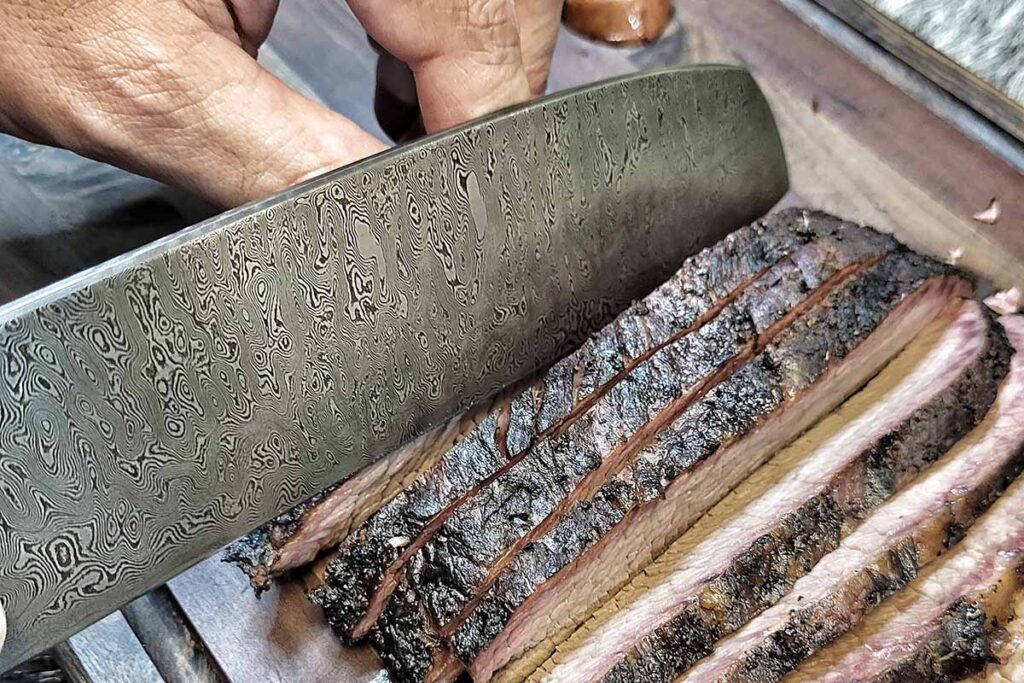
Brisket knife cutting meat
The BBQ Chef’s Knife by Matt Williams is a meat-slicing machine. He outfits it in a 9-inch blade of 400-layer damascus forged from 1084 carbon and 15N20 nickel-alloy steels, and a handle of spalted pecan and cedar elm with a white oak dowel. Overall length: 15 inches. His price for a similar knife: $750. (SharpByCoop knife image)

A heavy chef’s knife with a santoku influence was the goal for Matt Williams of Bastrop, Texas, with his beauty of 400-layer random-pattern damascus in 1084 carbon and 15N20 nickel-alloy steels. The blade is 9 inches long and the handle is spalted pecan, cedar elm and a white oak dowel in a combination that evokes the maker’s woodworking skills. His knives are influenced by feedback from customers who have told him what they really want in a solid performing knife. His price for his BBQ Chef’s Knife starts at $750.

“The blade’s distal taper is .169 to .05 inch,” Matt noted, “and this distal allows for some more delicate work to be done at the end of the blade. Sometimes you need to slice up some peppers or dice up something tasty. The handle is long to balance the heavy blade out. It’s thin because I like wa [octagonal] handles, and this is my interpretation done on a wood lathe. I turn the whole handle and the dowel. I harvest, mill and stabilize most of my wood. They are all local hardwoods. I know these woods well and their capacities.”

When designing his BBQ Chef’s Knife, Matt relies more heavily on balance than weight. His perspective counts on a solid feel in a pinch grip. “Prepping 200 fruit and veggie trays in eight hours will test your wrist,” he smiled. “I learned not to fight a forward-leaning blade. I worked in food prep when I was younger and I have always been drawn to this shape for its overall utility.

“I want the knife to slice well through meat and to be able to break a joint,” he concluded. “Afterwards, it will also look pretty next to a pile of barbecue!”

Editor’s note: Due to fluid market conditions, all prices listed are subject to change. Please check with the applicable maker for the latest in pricing.

Read More

Petty Knife: The Mama Bear Of Food-Prep Tools

0

Larger than a paring knife, smaller than a chef’s knife, the petty knife is right-sized for heavy-duty precision work.

Sometimes food preparation calls for something especially suited for close, even intricate, work. The petty knife was made for such employment.

While it may be a bit smaller in stature than other knives chefs regularly use, the petty knife makes short work of otherwise laborious functions.

Its name is derived from the French petit or small, but it’s big on getting the job done.

“Ask a dozen makers what the petty knife is and you’ll get a dozen different answers,” offered custom maker Ian Ronald of Elderslie, New South Wales, Australia. “But for me, I would define a petty knife as a culinary knife that is shorter than a chef’s knife but with a broader blade than a paring knife. I find a petty knife to be incredibly handy for household food preparation tasks, with a blade that is big enough to cut most food items but not so large as a full-sized chef’s knife, making it a little more versatile for ‘in hand’ food prep tasks such as cutting avocados and similar things. I have a few in my kitchen and they are the most commonly used knives in the knife block by far.”

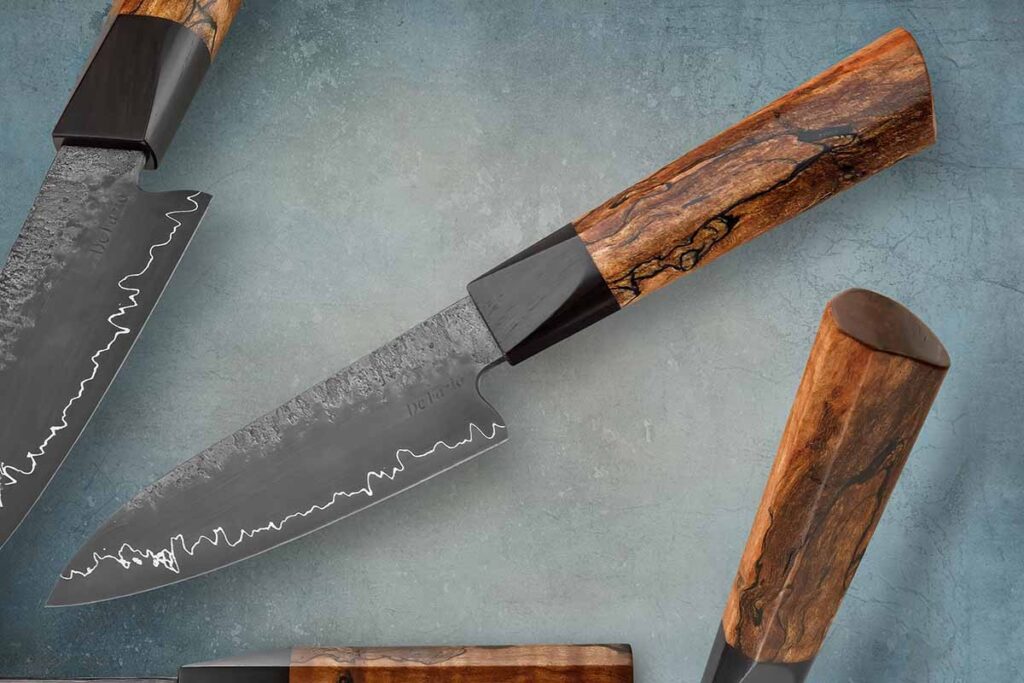
The full-flat-ground blade of 18-year-old Aidan De Fazio’s petty knife.
The full-flat-ground blade of 18-year-old Aidan De Fazio’s petty knife is also slightly convex to preserve edge longevity and provide better food release. (Rod Hoare knife image)

Representative of Ronald’s petty knife work is a piece the price of which varies depending on materials chosen. With a 4.92-inch blade of Takefu Special stainless clad in san-mai fashion over V-Toku2 carbon steel, a desert ironwood handle and 9.25-inch overall length, the petty remains with the maker—and he uses it frequently.

“I designed this knife with quite clean lines and simple shapes, as it was intended to be a workhorse from the beginning,” Ian commented. “I used some premium materials but I didn’t add any embellishments or unnecessary details. I follow that aesthetic with most of the knives I make, preferring to let the form follow the function for the most part. This particular knife has a relatively deep blade with a reasonably high tip profile, which allows it to be used for [rocking/chopping] and push cuts despite its unassuming size.”

The steel combination on Ronald’s knife includes a carbon core with stainless cladding from the Takefu steel company of Japan. According to Ian, it is quite corrosion resistant and maintains a bright appearance, as the carbon steel core etches dark and develops character and patina with use. The blade grind is nearly flat with a slight convex slant near the edge, which is intended to create a fine cutting edge while maintaining toughness.

Precision Worker Petties

Sixty-year-old Australian Zohar Oshinsky has been making knives since he was 12 but became more serious about his work just a few years ago, becoming a full-time maker in the past five years. His petty knife features a 5.12-inch blade of M390 stainless damascus steel from Sanwa Special Steel of Japan, handle scales of stabilized red mallee burl timber—a hardwood from the York peninsula of South Australia—and an overall length of 10.04 inches.

Ian Ronald said a petty knife has a blade big enough to cut most food items.
Ian Ronald said a petty knife has a blade big enough to cut most food items but not so large as a full-sized chef’s knife, making it a little more versatile for avocados and similar things. Overall length of his Kitchen Petty: 9.25 inches. (Rod Hoare knife image)

“This petty knife is a smaller Japanese utility knife,” Zohar said, “generally used for precision knife work and fine slicing. My knives are often made to order, so the material is to the customer’s liking. The san-mai is an excellent steel for kitchen knives in this construction with a very high rust resistance and excellent edge retention. The damascus cladding is made from 67 layers of 410 and high nickel stainless.”

Oshinsky says his blade grind is shallow, convex, very thin and incredibly sharp. The blade’s soft cladding protects the core from shock and provides a small amount of flexibility.

Semi-Dark Theme Petty Knives

Aidan De Fazio is all of 18. He began his knifemaking journey at 11 and his progress has been steady. His petty knife includes a 4.5-inch, full-flat-ground blade of san-mai in 1084 clad carbon steel with nickel. The handle is stabilized spalted maple and ebony. The blade is slightly convex ground to preserve edge longevity and provide better food release. Overall length: 9 inches.

Charlie Ellis and BLADE Magazine Cutlery Hall-Of-Fame® member Steve Schwarzer collaborated on the Penrose Petite Chef.
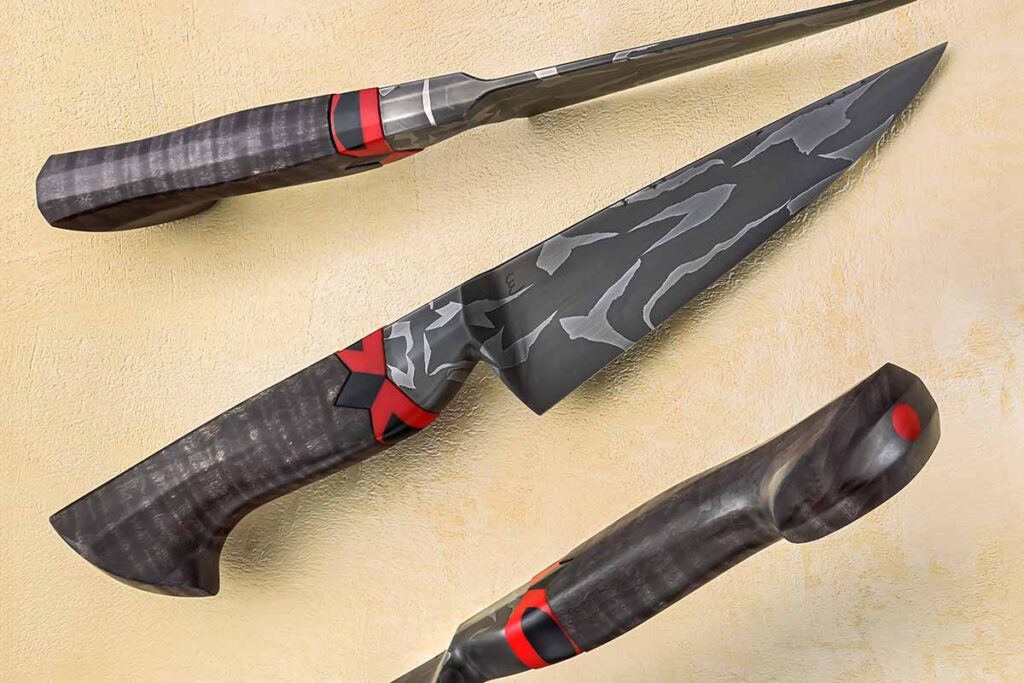
Charlie Ellis and BLADE Magazine Cutlery Hall-Of-Fame® member Steve Schwarzer collaborated on the Penrose Petite Chef. The 6-inch blade is Penrose tiling billet of 15N20 nickel-alloy steel in a pattern based on never-repeating Penrose tiling. Overall length: 11.75 inches. (SharpByCoop image)

“The petty knife is a small general-purpose knife,” Aidan explained. “It’s used for peeling, shaping, and slicing fruits and vegetables, chopping herbs, and making garnishes. I design everything by eye and chose this design because everything flowed nicely, and it just looked right. I was going for a semi-dark-themed knife, so to complement the dark san-mai I chose a piece of ebony with some heavily spalted maple for the handle.

“As this is a carbon steel knife, it will change color with use,” Aidan continued. “It’s a patina and it’s a good thing. It develops on carbon steel when exposed to air for extended periods of time or to acids for short periods of time. It is a type of oxidation that helps ward off the rust that eats away at steel and destroys your knife.”
De Fazio recommends regular care for his petty knife, washing lightly with soap and water, avoiding abrasives that could scratch the patina, and then wiping dry for storage.

Light, Thin, Comfy Kitchen Tools

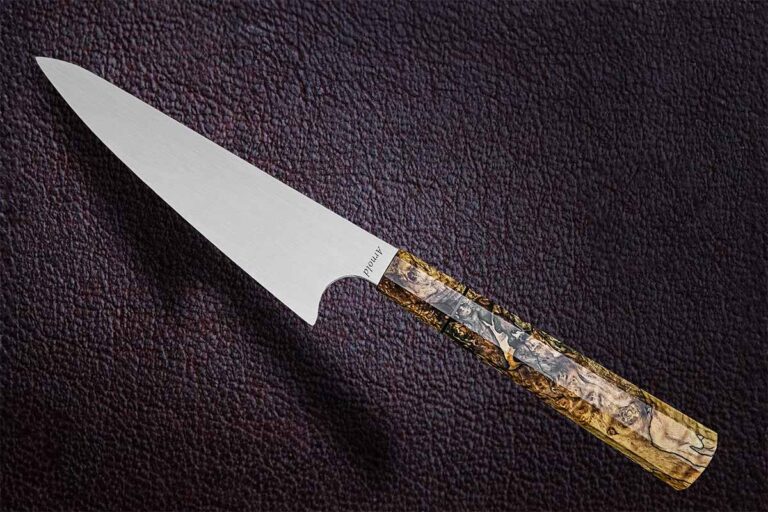
When Ross Arnold makes a petty knife—or any other style knife for kitchen use—he is leveraging experience to produce the most utilitarian design he can. “To me, a petty knife is an all-around food preparation knife for use when a larger knife is not necessary or possible,” he said. “In my earlier years, I worked in kitchens every night. I had a good idea of what worked and what was comfortable for me. This design was focused on being light, thin and comfortable. This resulted in a knife that weighs only 3.8 ounces, and the rounded choil and spine make it a pleasure to use all day every day.”

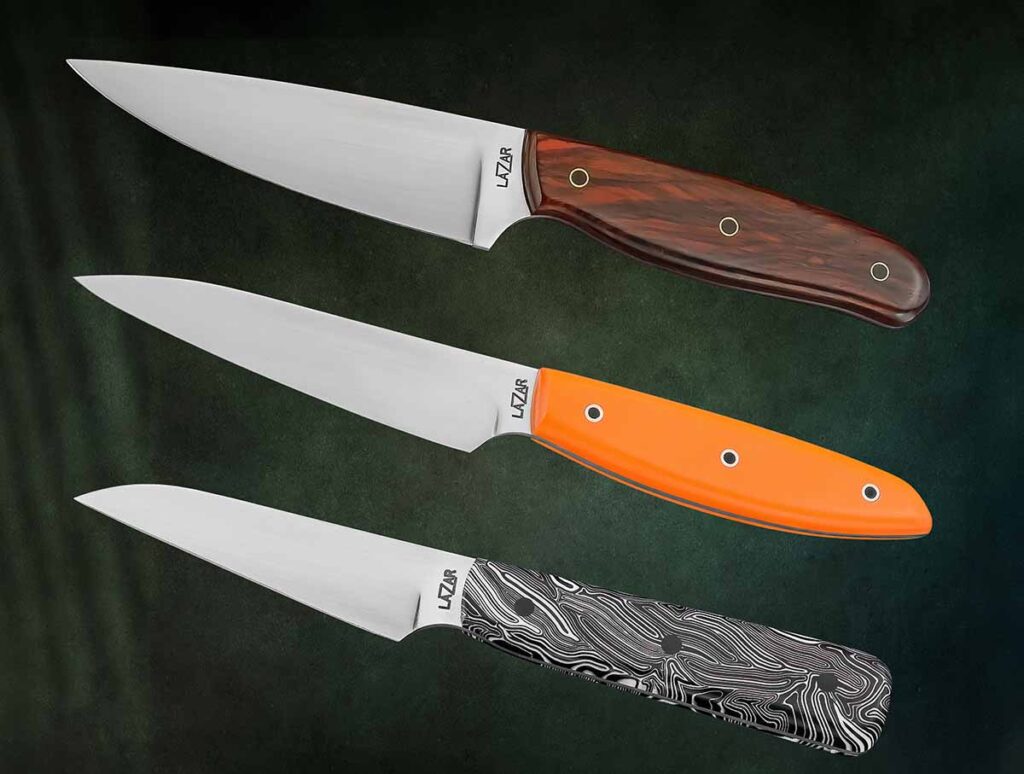
Andrew Lazarevic offers his petty knives in a selection of handle materials.
Andrew Lazarevic offers his petty knives in a selection of handle materials affixed with brass and carbon fiber pins. The blades are flat ground of AEB-L stainless steel. Overall lengths: approximately 9 inches each. (Rod Hoare image)

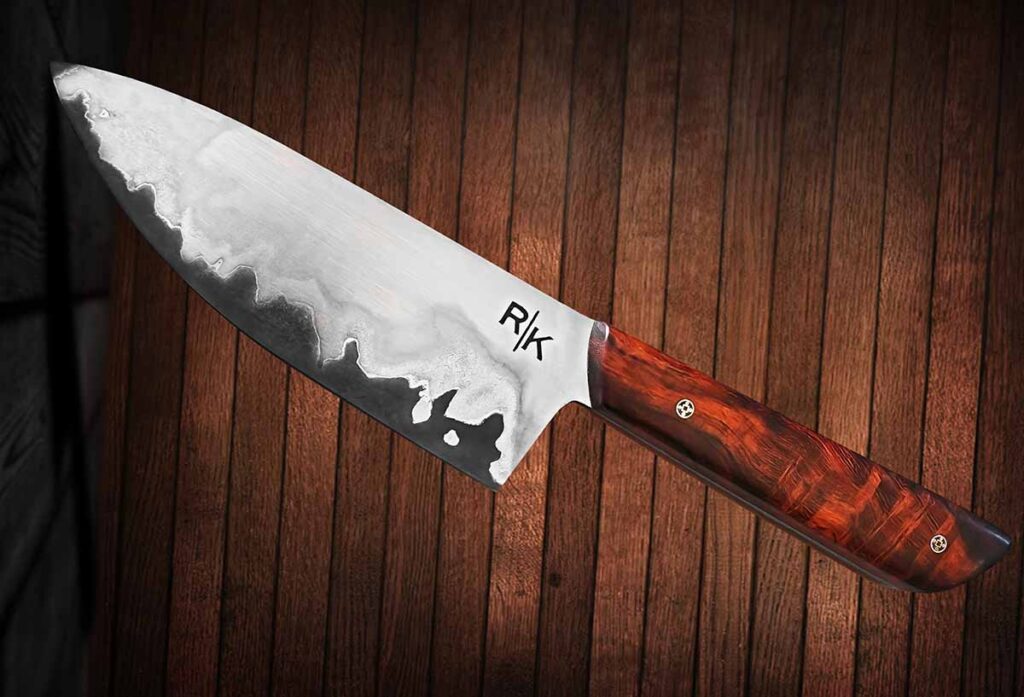
A resident of Glenalta, Australia, Arnold learned a great deal from custom maker Peter Bald early in his career. Ross finished his petty knife with a 5.91-inch blade of RWL-34 stainless steel and a handle of spalted sassafras wood. Overall length: 11.02 inches. His price for a similar knife: $390.

“I went with a traditional Japanese hexagonal handle purely for aesthetics,” he related. “As I use this knife primarily with a pinch grip, the handle shape does not have a massive impact on usability. That being said, it is still very comfortable to hold normally. I ground the blade with a plunge-less distal taper design. I came up with the grind design myself, but I’m sure it’s probably been done before. In my opinion, it is a solid performing grind as it gives the knife a light and flexible blade that isn’t super thick toward the tip.”

The petty knife is up to the challenge when a more intricate or tight kitchen job is at hand. The latest custom examples are affordable, provide good looks and perform with style. Dig in.

Editor’s note: All prices are in U.S. dollars and are according to the press time rate of exchange. Due to fluid market conditions, all are subject to change. Please check with the applicable maker for the latest in pricing.

Read More

GiantMouse Kitchen Knives: Cooking Up Something New

GiantMouse takes a stab at the culinary world with a kitchen knife line.

EDC knives of a variety of stripes have been GiantMouse’s bread and butter, helping the Danish-design concern kick a solid toehold into the knife industry. This success somewhat culminated earlier this month in Atlanta, with the company’s GMX earning Knife-Of-The-Year® accolades at the 2023 BLADE Show. This trophy in hand is a pretty good indicator you’re doing things right. But, GiantMouse is far from living off past achievements.

In fact, it has a new vista in sight—kitchen knives.

Following a well-trod recent trend in knife manufacturing, GiantMouse is dipping its toe into the culinary end of the pool with the introduction of four kitchen knives. While this drop might prove unexpected to some, the expansion is something the company said has been in the works for nearly two years now. At least, that’s been the personal testing period of designers Jens Ansø and Jesper Voxnaes (Vox), refining the minutia of the knives. So, how did it shake out?

At first blush—and without a knife-in-hand, tomato-dicing torture test—not too shabby. The four-knife line appears attractively utilitarian, nice enough to show off along with your next dinner party. But the knives aren’t so pretty as to scare you off from actually using them in your day-to-day culinary adventures. At arm’s length, it’s difficult to discuss ergonomics, balance and performance. However, GiantMouse doesn’t appear to have to broken any of the major kitchen-knife rules, attempting to displace function for novel form. Though, the slightly hooking heel on the larger knives might prove a sore point—pun intended—for some.

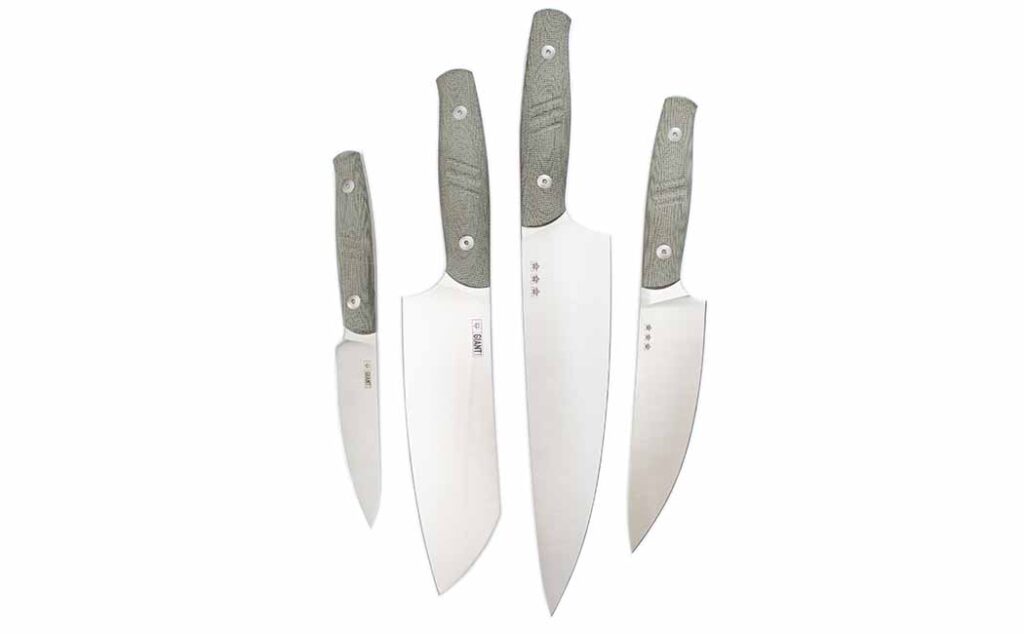
The line, at present, includes:

  • Santoku
  • Chef
  • Carving
  • Paring
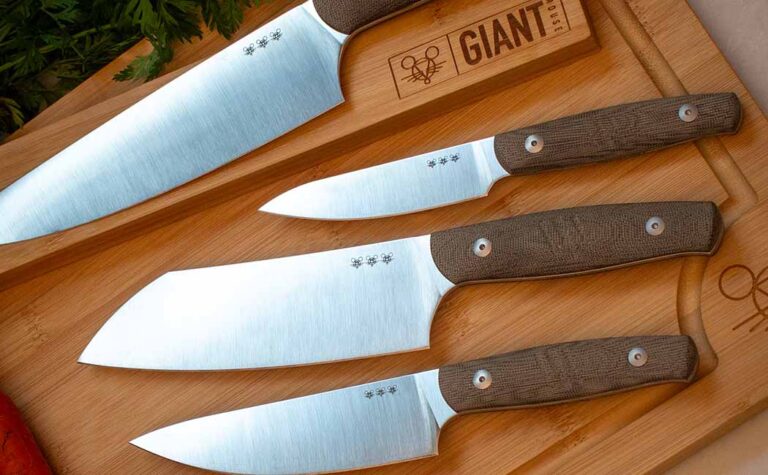
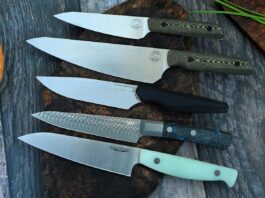
GiantMouse Kitchen Knives in a line

Essentially, GiantMouse has homed in on the basic food prep tools every kitchen requires. The knives are sold individually and as a set; there’s a branded bamboo magnetic knife bar available, as well. And, in the company’s announcement, it certainly sounds as if it has designs to continue expanding into more corners of the culinary arts. No hint on what that might include.

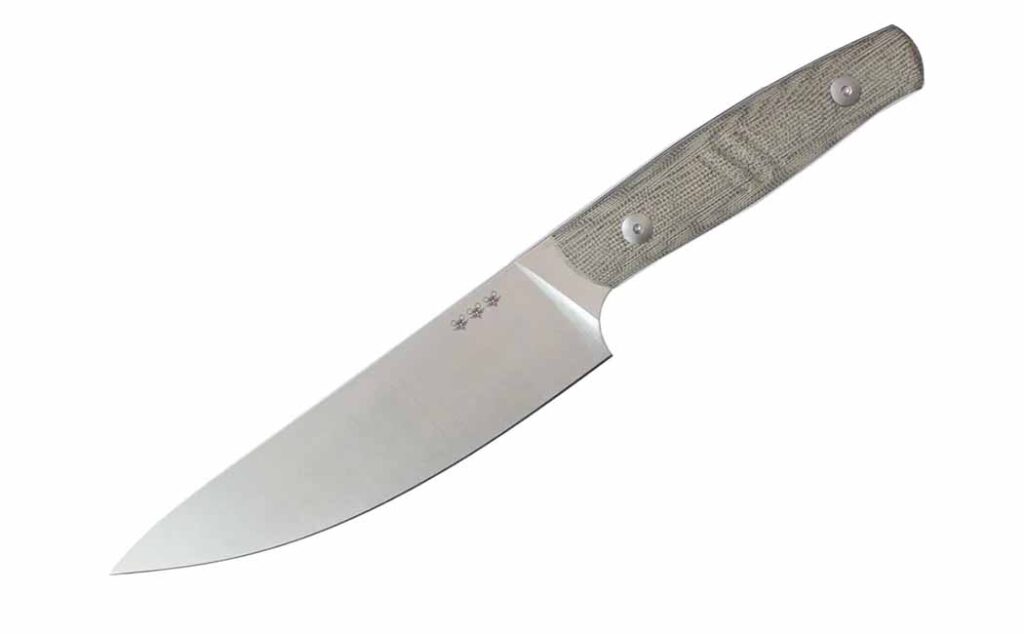
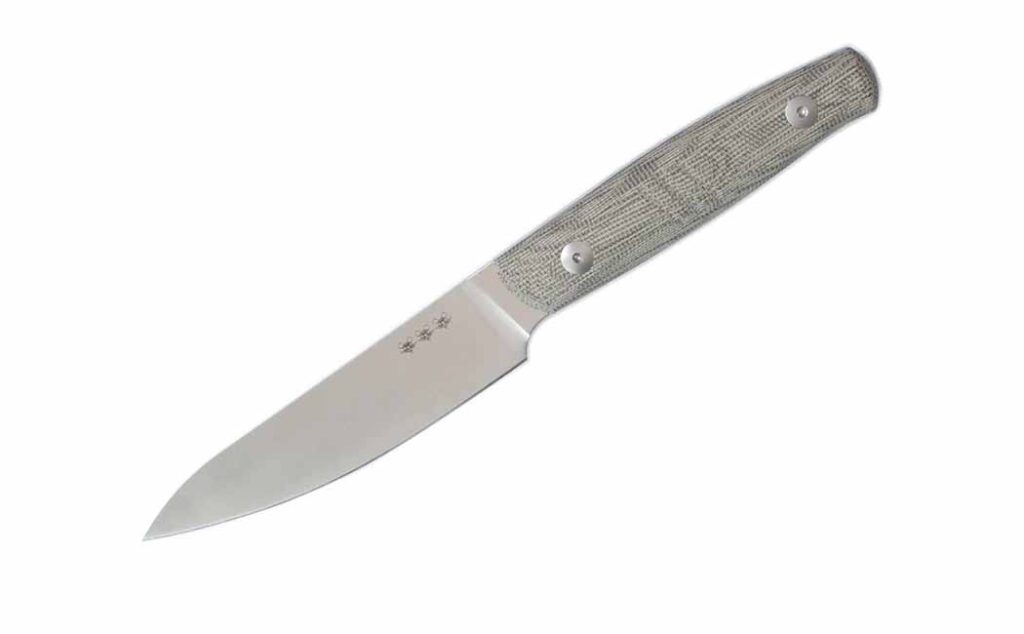
As to the Italian-made knives themselves, GiantMouse has opted for Nitro-B for the blade steel and given them an unstated satin finish. Having grown in popularity in recent years, high-nitrogen steel (.21% in the case of Nitro-B) has spurred its share of debates as well. Sufficed to say, it should thrive in a kitchen environment if for no other reason than its corrosion resistance. To top it off, the blades are stamped with a tirade of the company’s murine logo—jaunty, to say the least.

To this, the company has outfitted the knives with green micarta handles, which should prove popular. Generally providing an excellent gripping surface, even when wet, GiantMouse has further enhanced it with a run of three serrations at the midpoint to provide a bit more purchase.

As for price, expect to drop $95 to get into GiantMouse’s paring knife at the low end and $175 for the chef or santoku at the high end.

GiantMouse Kitchen Knives Specs:

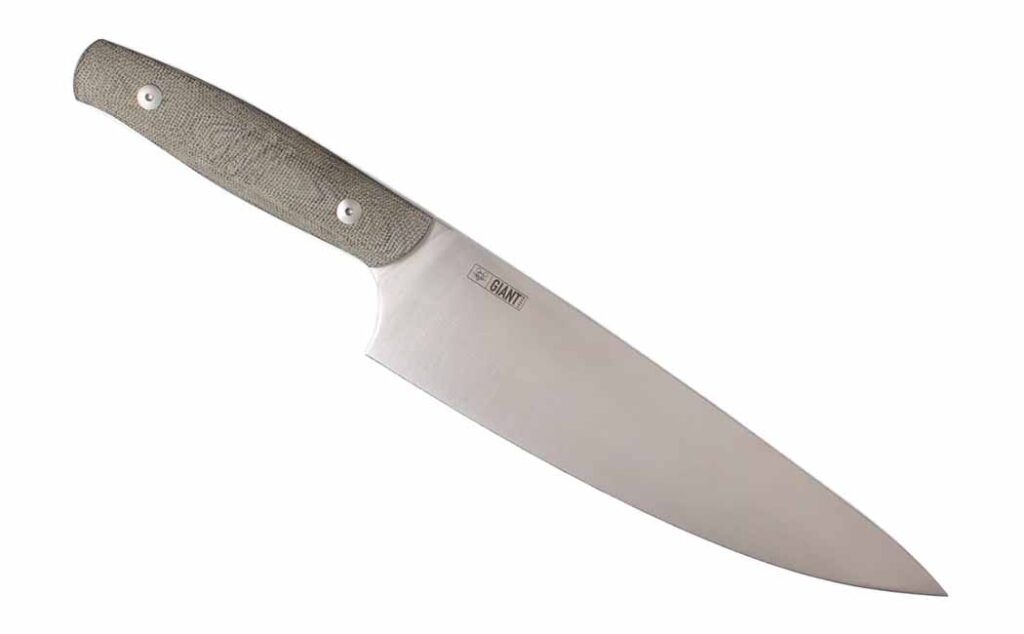
GiantMouse Chef Knife


Chef Knife
Blade Length: 8.375″ (212.725mm)
Weight: 6.9oz (195.612g)
Overall Length: 13.125″ (333.4mm)
Steel: Nitro B
Blade Thickness: .1125″ (2.875mm)
Finish: Satin
Handle: Green Micarta
MSRP: $175

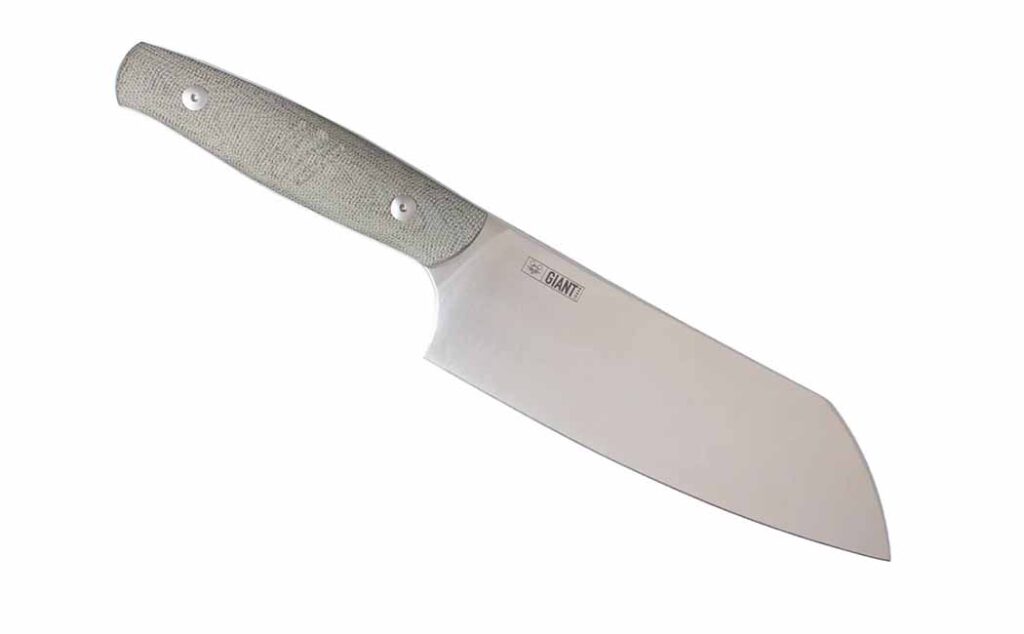
GiantMouse Santoku

Santoku
Blade Length: 6.75″ (171.45mm)
Weight: 6.8oz (192.777g)
Overall Length: 11.4″ (289.56mm)
Steel: Nitro B
Blade Thickness: .1125″ (2.875mm)
Finish: Satin
Handle: Green Micarta
MSRP: $175

GiantMouse Carving Knife

Carving Knife
Blade Length: 5.58″ (141.732mm)
Weight: 4.6oz (130.408g)
Overall Length: 9.75″ (247.65mm)
Steel: Nitro B
Blade Thickness: .116″ (2.87mm)
Finish: Satin
Handle: Green Micarta
MSRP: $125

GiantMouse Paring Knife

Paring Knife
Blade Length: 4.2″ (106.68mm)
Weight: 2.6oz (73.708g)
Overall Length: 8.250″ (209.55mm)
Steel: Nitro B
Blade Thickness: 0.0675″ (1.71mm)
Finish: Satin
Handle: Green Micarta
MSRP: $95

Read More

Cool Customs: Isaiah Schroeder’s Gyuto

Isaiah Schroeder’s Gyuto Comes In A Spectacular Damascus Pattern And Showcases The Maker’s Skill.

Isaiah Schroeder considers his gyuto the best knife he’s made, and the blade’s electrifying stainless damascus pattern and the ergonomic handle make it hard to argue the point.

Of the blade Isaiah said, “It’s a pretty simple pattern, one I’ve done in carbon steel quite a bit. A low-layer lazy twist is what I call it.” It consists of only 11 or so alternating layers that he twists three or four times. “That’s pretty much all it is,” he observed. “I love the way it turns out with the bold layer lines and everything. It looks kind of topographical and I always like that.” The darker steel is AEB-L stainless and the lighter parts are 154CM stainless.

He said the convex blade grind works great for food release. He is especially proud of the look and feel of his thin handle design that includes silver fittings done in the lost-wax-casting method. Combined with the 1/8-inch-thick blade, he said it’s, “Thin to win for a kitchen knife.”

A full-time knifemaker based in Madison, Wisconsin, Schroeder makes kitchen knives of all types in the Japanese style including a sujihiki, a long knife made for fine slicing of meats, fish, and precisely cutting through sinew. He also makes a petty knife as well in damascus. 

Gyuto Knife Specs
Pattern: Gyuto Japanese chef’s knife
Blade length: 9.44 inches
Blade material: Low-layer lazy twist damascus of AEB-L and 154CM stainless steels
Blade grind: Convex
Handle material: African blackwood
Fittings: Fine silver (2 ozs. worth)
Overall length: 14.44 inches
Maker’s price for a similar knife: $2,000
Knife to know: Isaiah is a full-time knifemaker

Read More

Advertisement

Must Read Articles

Read this before you make a knife

Knifemaking 101 – Read This Before You Make a Knife

  by Wayne Goddard My experience has taught me that there's nothing like digging in and getting started. I've often said the hardest part of the...
how to forge damascus steel

How to Forge Damascus

Advertisement
Advertisement