Isaiah Schroeder’s Gyuto Comes In A Spectacular Damascus Pattern And Showcases The Maker’s Skill.
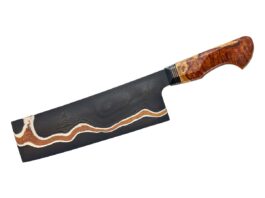
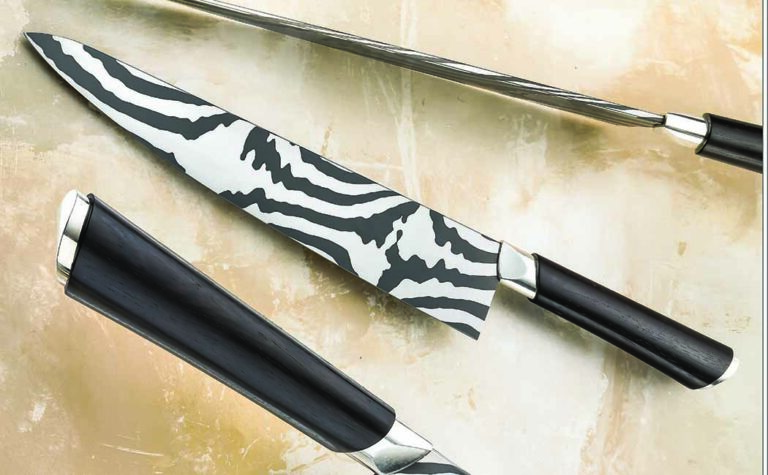
Isaiah Schroeder considers his gyuto the best knife he’s made, and the blade’s electrifying stainless damascus pattern and the ergonomic handle make it hard to argue the point.
Of the blade Isaiah said, “It’s a pretty simple pattern, one I’ve done in carbon steel quite a bit. A low-layer lazy twist is what I call it.” It consists of only 11 or so alternating layers that he twists three or four times. “That’s pretty much all it is,” he observed. “I love the way it turns out with the bold layer lines and everything. It looks kind of topographical and I always like that.” The darker steel is AEB-L stainless and the lighter parts are 154CM stainless.
He said the convex blade grind works great for food release. He is especially proud of the look and feel of his thin handle design that includes silver fittings done in the lost-wax-casting method. Combined with the 1/8-inch-thick blade, he said it’s, “Thin to win for a kitchen knife.”
A full-time knifemaker based in Madison, Wisconsin, Schroeder makes kitchen knives of all types in the Japanese style including a sujihiki, a long knife made for fine slicing of meats, fish, and precisely cutting through sinew. He also makes a petty knife as well in damascus.
Gyuto Knife Specs Pattern: Gyuto Japanese chef’s knife Blade length: 9.44 inches Blade material: Low-layer lazy twist damascus of AEB-L and 154CM stainless steels Blade grind: Convex Handle material: African blackwood Fittings: Fine silver (2 ozs. worth) Overall length: 14.44 inches Maker’s price for a similar knife: $2,000 Knife to know: Isaiah is a full-time knifemaker
A Woodworker By Trade, Matt Williams Crafts Knives Meant For Rugged Use, Including His BBQ Chef’s Knife.
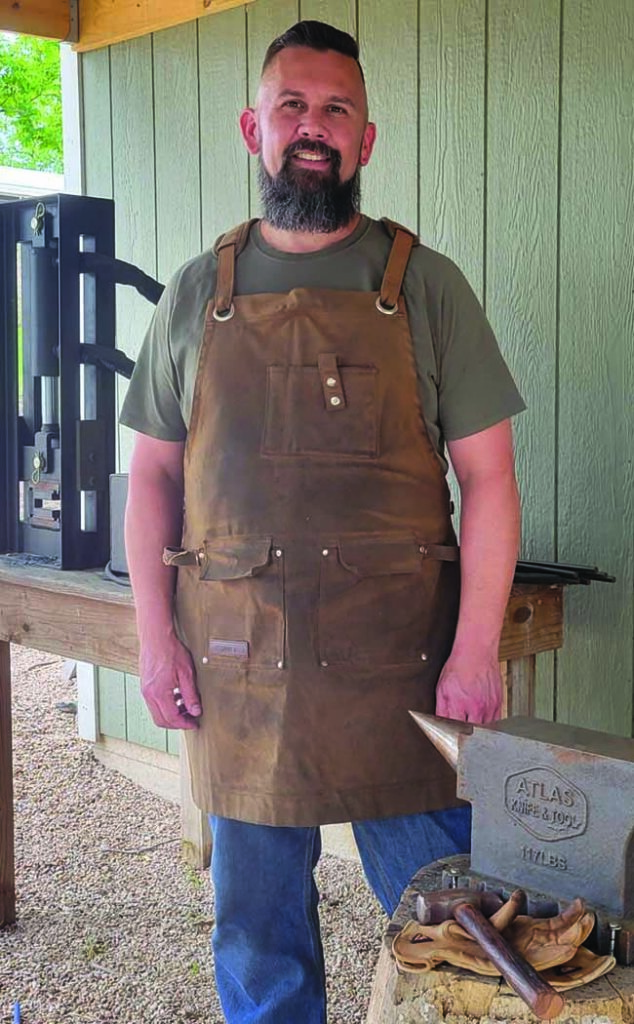
A woodworker by profession that includes making cutting boards, Matt Williams got into knifemaking too and is glad he did because of the feedback he gets from customers. His BBQ Chef’s Knife is a case in point.
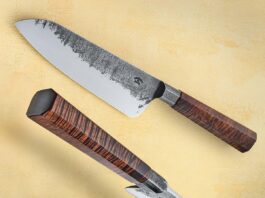
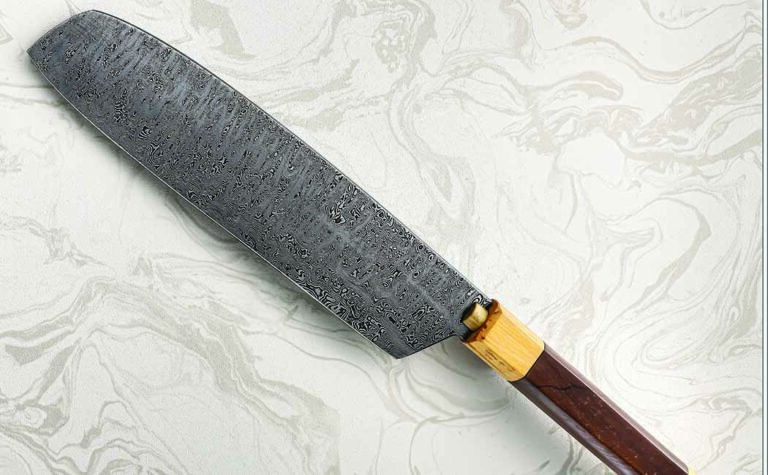
His clients told him his chef’s knives were too thin, especially the local Texas barbecue chefs who need thick, tough blades for separating ribs and joints in competitive barbecue events. As a result, he built the BBQ Chef’s Knife on a santoku cutting base with a thicker blade and a “really aggressive feel” built to take abuse.
Matt lives on an old pecan orchard by the Colorado River and stabilizes and spalts the pecan for his turned-wood handles. The handle for his BBQ model is done in a wa style split down the middle with round dowels of white oak left proud to contrast with the darker pecan. He also forged the steel and made pretty much everything but the coffee for the blade etch.
The combination of his new-style chef’s knives and cutting boards is just the ticket for the highly competitive local Texas barbecue chefs. Along with his custom knife work, Williams also makes one-of-a-kind cutting boards as well that he sells through his website.
BBQ Chef’s Knife Specs Blade Length: 9 inches Blade Material: 400-layer damascus of 15N20 nickel alloy and 1084 carbon steels Hande Material: Spalted pecan, cedar elm and white oak Handle Style: Wa Overall Length: 15 inches Knife To Know: The blade tapers from .169 of an inch at the thickest point to .05 of an inch at the thinnest point Maker’s Price For A Similar Piece: $750
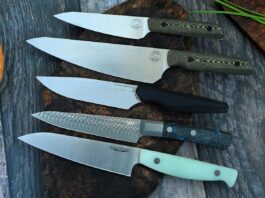
Knives Are Becoming More Multidimensional Every Year. These Sporty Kitchen Knives Are Ready For The Cutting Board Or The Campsite
When many of us blade enthusiasts think kitchen knives, we don’t necessarily associate them with outdoor or sport use. Likewise, many of us would not consider bringing our hard-use blades into the kitchen for prep work. Nonetheless, there are a few knives that have a broad range of uses in both the kitchen and camp.
I tend to see a knife not just by the edge but by its blade thickness. While there is a utility to extremely thin-edged knives with thin spines, such blades are almost always designed for secondary or finishing uses. In my opinion, the thicker the spine the more utility a knife has for crossover work between kitchen and field.
On the other hand, the thicker the spine gets, the harder it is to use for fine work—it can even be dangerous. Thinner blades are much better in the kitchen. As far as field use goes, they are pretty much only for light work and very small amounts of game processing. I’ve seen many thin blades break while working on deer. Some of these have resulted in injuries to the user.
Best 3 Sporting Kitchen Knives
There is a sweet spot for crossover, though, and the test knives fit the mold. None would be my preference for dressing a whitetail, but all certainly would be at home in camp or the kitchen after the heavy lifting has been accomplished.
The TOPS Frog Market Special test knives could be used as skinning knives, as could the White River, but the main enemy of any thin blade is going to be breaking and edge chipping. Of the test group, the White River is the only one thick enough to be a primary use hunting knife, but it is a rather small knife with a slender handle. On small game it will work, if it’s not a bit obtuse in spine thickness, though when moving large amounts of muscle and skin, the hand would fatigue.
So, if we tend to think of a kitchen sporty as a secondary tool, a wide number of its features become handy that would not be so great on a primary field knife or even a primary kitchen knife. The first is the ease of cleaning and the ability to hold an edge.
I put the review knives to work quite extensively in the kitchen, doing everything short of fully deboning large game. All were used on cuts of meat, to cut vegetables, peel apples, cook over an open flame, and as eating knives at the table or camp. In the process, I learned a few things about each one.
White River Exodus 4
Of the test group, the White River Exodus 4 is probably the most well-rounded for field and table use. A relatively small knife, it is very slender in overall profile, both grip and blade. For general use, it is extremely functional. I found it suitable for virtually all small game, able to process a whole chicken and an excellent skinner.
It could be used for slicing vegetables, chopping onions, and cutting many other types of fruit and produce as well. The edge profile does not lend itself to fine cuts. For presentation or fancy plates, it tends to split rather than give clean cuts, especially in apples and things like cucumbers. This is not a major concern, just something to note.
The Micarta® handle is contoured superbly and cleans easily. It isn’t slippery when wet. Notably, it’s a full-tang blade that’s extremely strong. Despite its size, it has a blade profile thick enough for baton work on small pieces of wood, though it would not be my first choice for such a job. The blade spine has a sharp 90-degree profile excellent for use with a ferro rod.
There aren’t many if any, downsides to this knife. It can be used in just about any setting and will not look out of place if you take it to town for dinner. You also will not look like “that guy” if you use it to cut a sandwich in half or an apple for your kids in public. Note: The sheath is a bit stiff when you first get it but it breaks in fairly quickly. The knife was very easy to keep clean and sharp.
MSRP: $175
TOPS Knives Frog Market Special
I’ve used the Frog Market Special (FMS) models by TOPS Knives for a couple of years. They’ve given me a long time of service in the kitchen as well as around the campfire. They’re available as individual pieces or a set. If you get the set, it comes with a piggyback sheath. The sheath is very nice and has a belt clip.
Steven Dick, U.S. Army ranger veteran and editor of the old Tactical Knives magazine, based his design for the FMS on knives he saw on a trip to Hanoi, Vietnam. He watched butchers and fishmongers using knives of a pattern he’d never seen before. They prepared meats and fish of many varieties easily using the blades.
I’ve done just about everything you can imagine with my FMS knives in the kitchen, and also processed dozens of deer with them. They maintain their edges very well and required only occasional resharpening. Because of the unusual blade shape, the knife can cut just about any type of meat and vegetable, including slicing, chopping, and in a rocking motion. They’ve replaced several other knives in my kitchen and serve as my go-to set.
While they have a large, deep-bellied profile, the FMS knives aren’t especially durable for field use. I have not used them to break down large game for the same reason I would be afraid of breaking any thin-spined knife. They excel for chicken and duck, as well as other small game. The Micarta handle is very comfortable and slip-resistant.
I’ve had an extremely good time with these knives but they have a downside—the blade finish. I’ve had excellent luck with all my TOPS knives, though I’ve never been a fan of the finish. I prefer knives that are bare metal. I don’t like it when the coatings begin to chip away. In a couple years of use, the finish has begun to flake and the metal underneath has become discolored, even with oiling and care. While it is a minor gripe, for knives used to process food I don’t like the idea I may also be eating blade coating. I would like to see this profile in some sort of stainless, or perhaps a slightly thicker spine in a tougher steel.
MSRP: $375 for the set
Spyderco Utility Knives
Spyderco offers some very affordable and high-performance knives that are at home in the kitchen and easy to clean and maintain in the field. The company sent me its 4.5-inch Utility Knife with a serrated edge and red handle, as well as a plain edge 6.5-inch model in black.
The first thing about these knives is they are extremely slender and likely would not be suitable for hard field use. However, if you are already at camp, these are exceptional for end processing and cooking. I used them for weeks straight for all my cooking and they never dulled or chipped. They were both so sharp at the end of the review that they could still cut paper-thin slices of tomato, a hard feat for most knives.
One of the most important parts of these knives is they are essentially foolproof. Even after cooking with them for several meals a day for a long time, I cleaned them without issue and returned them to the knife block. The fact they are so easy to clean and stay sharp for so long really makes them worth the already low price. You don’t really have to worry about oiling them or keeping them in a special container.
In a pinch, the knives can be used for striking on a rod, though I would not recommend it long term. Their utility in the field is very limited, though when it comes to fishing or pursuits that don’t involve moving large animals, they’re just fine. I would not replace my fillet knives with either of these, though they certainly work for the task.
The New Titanium Devour From Gerber Gear Is Far More Than Just An Eating Utensil. This Multi-Tool Really Is Unlike Any Other On The Market.
Not every multi-tool needs to feature a knife or have a set of pliers built into it. The new Devour, made from Titanium, from Gerber Gear flips the idea of a multi-tool on its head.
At first glance, it looks like nothing more than a rugged eating utensil, great for eating by the campfire. And it is that, but it is so much more. This multi-tool has nine functions and weighs just an ounce. The star of the show is the tool that mounts to the back of the fork.
The tool that snaps onto the back of the eating utensil
This tool features a package opener, a can opener, a pry bar, both a phillips and a flathead screwdriver, and a flat cut/scrape edge. When connected to the back of spork it keeps it propped up and off the table, which is great for keeping your utensil clean and free from dirt and debris when eating outside.
Since everything is made from corrosion-resistant T4A titanium, the tool won’t rust and will remain strong under pretty much any circumstance. The Devour can save you so much time packing, and space in your pack, you’ll wonder why you didn’t get it sooner.
And the cherry on top of it all: it’s an inexpensive piece of kit that will more than pay for itself quickly.
Few Knives Have Been As Heavily Influenced By Japanese Methods As The Chef’s Knife. These Four Quality Blades Show Off The Modern Meeting The Historic.
The Japanese influence on custom knives is everpresent in the marketplace, and, aside from the tanto, nowhere is its flair and focus felt more than with chef’s knives.
These tools of the culinary trade are functional as much as they are eye-catching, especially in examples of some of the top makers in the genre today.
Honyaki Byuto Hybrid By Dmitriy Popov
Dmitriy Popov aligned the tip with the spine on his wide-bevel Honyaki Gyuto Hybrid for enhanced control during jobs requiring precise use of the tip. (SharpByCoop knife image)
Dmitriy Popov has conjured up a masterpiece he calls the wide-bevel Honyaki Gyuto Hybrid, a new take on a recognized Japanese style.
“It isn’t a traditional gyuto, as it has an upswept tip and the height of a nakiri,” he commented. “Having the tip aligned with the spine of the knife gives the user a feeling of control for precise tasks requiring use of the tip. Having the extra height in the heel allows me to create a knife that is super thin behind the edge while also having a significant amount of mass above it.”
Popov’s creation includes a near 9.5-inch blade of differentially heat treated W2 tool steel and a handle combination of desert ironwood and osage orange complemented by a carbon fiber liner. His prices for similar knives range from $900 to $2,500 based on size and materials.
“The hamon and ashi* I am able to get out of the W2 is mesmerizing,” Dimitriy added, “and I spend a large part of my life going deep down the hamon rabbit hole. Honyakis are part art and part science, and the failure rate is a lot higher than I would like it to be. I really like the minimalist wa handle style [see page 14], and rounding off the bottom facet does not alter the traditional design much, while making the handle more comfortable in the hand.”
Having made knives since 2011, Dmitriy looks back at the beginning in everyday carry, tactical and camp models. After three years, he gravitated toward chef’s knives, and since 2016 they have been his sole focus.
“Everyone cooks, and at some point most cooks or chefs will come to appreciate the benefits of a good quality knife,” he observed of a chef’s knife field that has become quite crowded. “There are way more prospective customers than there are makers, so to succeed as a maker all you need is a very small slither of the pie and a drive to evolve your craft each day.”
Santoku-Style Knife By Eric Hemker
The long, nearly flat cutting edge of the damascus santoku by Eric Hemker enables it to slice, dice, and mince vegetables much easier than a blade with a sweeping belly. (SharpByCoop knife image)
While Eric Hemker admits he is still learning some subtleties of making chef’s knives, he has found that the santoku style is excellent for use in final food preparation.
His custom-ordered version sports an 8-inch blade of random-pattern damascus forged from 1084 carbon and 15N20 nickel-alloy steels. The overall length is 14 inches, and the handle is exotic blue-dyed curly mango. His price for a similar knife is $960.
“The lack of a pointed tip on the blade means it is not well suited for delicate carving work such as breaking down bony proteins,” Eric explained. “However, its long and nearly flat cutting edge allows it to slice, dice and mince vegetables and proteins much easier than a knife with a sweeping belly on the cutting edge.”
Translating literally from the Japanese, santoku means “three virtues, or three uses,” and so the slicing, dicing, and mincing description is spot on.
“This blade is 144-layer random-pattern damascus, and it features a full flat grind with a convex edge. The flat grind is my usual go-to grind for most general-purpose cutting needs that are common in the kitchen or in hunting-type knives. I also add a slight convex grind that leads into the cutting edge to aid in food release.”
Eric chose a modified wa handle configuration and attributes the decision to keeping step with traditional Japanese appeal.
“The top of the handle has the traditional wa-style octagonal facets,” he said. “But I wanted to spruce this handle up a little to challenge myself, so the bottom is curved to give it a shield-shaped cross-section. The handle has a 304 stainless steel bolster and an heirloom-fit black G-10 spacer. One of the only things the customer specified was a colorful handle, so this piece of wood was a perfect fit.”
For Eric, the entire package comes together nicely, blending the good looks and function that are inherent in Japanese-inspired chef’s knives.
“All these materials will hold up well in kitchens,” he remarked. “G-10 is a synthetic material that also holds up very well in any harsh environment, and since the wood is stabilized it should also hold up well in water and getting dirty in general. Since the handle is wood, it would still need to be oiled occasionally, and it should go without saying that a custom piece like this with a carbon steel blade and a wood handle should never go in the dishwasher.”
Eric began making knives six years ago and still considers himself at the beginning of a promising journey.
“Kitchen knives have been some of my favorite knives to make from the beginning because everyone uses one,” he noted, “so they are some of the easiest pieces to sell and get feedback on.”
Meanwhile, he welcomes the expanding number of makers and buyers in the chef’s knife arena.
“I don’t believe the custom chef’s knife market is overly saturated by any means,” he commented. “I think the demand really drives the market for these custom pieces, and I believe there will almost always be customers at every price point. In the last decade or so, there really has been a resurgence of demand for well-crafted handmade goods in almost every category of consumer goods, and I don’t believe that trend is going to be dying out anytime soon. This may be especially true for culinary knives when food is such a big part of many people’s lives.”
Straight-Edge Kiritsuke By Dre Laborde
The straight-edge damascus kiritsuke by Dre Laborde is specifically made to slice fish and some softer meats. The handle is curly maple from Realeyezwoodz. The sheath is stabilized maple and a joint project between Dre and Realeyezwoods. (SharpByCoop knife image)
The straight-edge kiritsuke from Dre Laborde is specifically made to slice fish and some softer meats, he says, and doesn’t necessarily lend itself to chopping vegetables.
“I’m no expert on Japanese knives as a whole,” he noted, “but from what I can find the kiritsuke seems to be a cross between the longer yanagiba and the stockier gyuto. The steel is X-pattern-ladder damascus that I purchased from MVH Damast based in the Netherlands. These steels have given me nothing but positive results and I can’t recommend them enough.”
The blade is 9.5 inches and the overall length is 14.5 inches. The handle is curly maple from
Realeyezwoodz, and the price of a similar knife would probably exceed the featured piece.
“It sold for $760,” explained Dre, “but it was a semi-experimental project for me, so a future project of this scale would cost more. The design, like all my knives, was drawn on paper to scale first and then made with the freedom to change the design as I see fit.”
The choice of handle material and design contributed to the overall appeal of the knife and its performance in the kitchen.
“The wood is stabilized, which means it was put under vacuum in a resin and hardened,” said Laborde. “This makes it resistant to water and to staining. The handle design is a slight variation on the common shape I do, made slightly longer to fit the length of the knife.”
Dre has been making knives for about three years and in that time hasn’t seen the chef’s knife market becoming overcrowded, though he has heard such comments. “Those willing to pay for a custom chef’s knife often have many and recognize the price tag that comes with them,” he added.
Haetori Honesuki By Tony Cetani
The Haetori Honesuki by Tony Cetani is an all-around kitchen utility knife design based on the santoku and honesuki, the latter a Japanese boning knife. Whereas a traditional honesuki’s main task is for deboning poultry, Tony made the Haetori Honesuki to handle multiple kitchen jobs.
When Tony Cetani built his Haetori Honesuki with a 5.5-inch blade of Chevron copper-mai steel and an 80CrV2 core from Baker Forge and Tool, he added a handle of spalted box elder to complete the package and priced it at $1,000.
“Haetori means ‘jumping spider’ in Japanese,” he related, “and following my love for spiders this knife is named for the Haetori Gumo, a very common spider in Japan. It’s an all-around kitchen utility knife, and I based the design on the santoku and honesuki. Whereas a traditional honesuki’s main task is for deboning poultry, I made this to handle multiple tasks around the kitchen.”
Tony has been making knives since 2017 and tried chef’s knives for the first time three years later.
“Once I got a few kitchen knives under my belt, I fell in love,” he smiled. “I wanted to put kitchen cutlery on the market that was different and not your traditional kitchen-style knives.”
He succeeded with this effort and chose a slightly innovative handle style.
“This is a newer style that I designed specifically for this knife,” he said. “Adding a clip at the butt of the tang gives the palm a comfortable spot to rest when working the knife. I chose natural spalted box elder because it went well with the copper in the steel, and you can’t ever go wrong with box elder!”
As for today’s chef’s knife market, Tony sees strong demand and the capacity to supply it.
“There are a lot of makers out there putting out phenomenal chef’s knives. I think every maker has their style, and the style is what grabs the attention of a potential customer.”
*Ashi are various notches or details in hamons. To produce ashi, the maker applies thin strips of clay from the spine of the blade to the edge during the clay tempering process, which contributes to interesting variations in the resulting hamons.
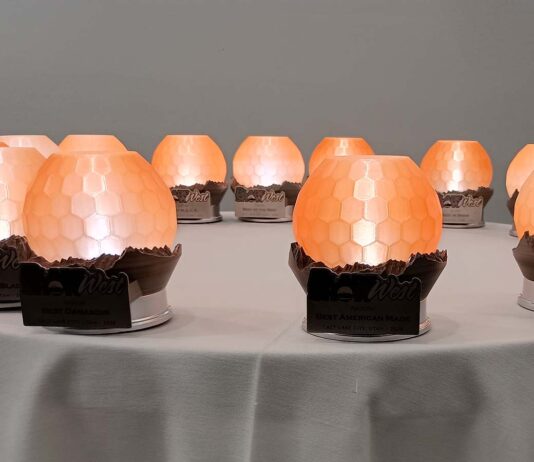
Awards Were Given Out In Nine Different Custom Knife Categories Including Best In Show At BLADE Show West In Salt Lake City.
Dozens of makers entered knives in competition across eight different custom knife categories. The skill on display was tremendous, and numerous knives wowed the judges. However, these were the blades that stood out from the crowd and took home the awards. All images are SharpByCoop Images.