Knife Collecting

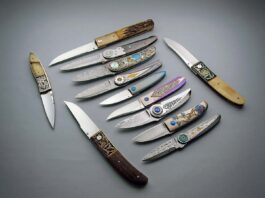
Knife collecting is an extremely rewarding experience for knife enthusiasts. There truly is a knife for everyone. Many increase or hold their value throughout the years, making collecting knives something to pass on to the next generation of knife collectors.

Best Steel For Knives: How To Choose

Intended cutting use and blade style help determine the ideal alloy for you and your knives.

Knives Annual
This article is an excerpt from the KNIVES 2025 annual, available at GunDigestStore.com.

Three critical aspects of creating or choosing a quality blade are steel selection, heat treatment and geometry. This feature focuses on the first of these, and the first any aspiring knifemaker or enthusiast will be tasked with—choosing the right blade steel for you and your knives.

To the casual observer, the steel selection process wouldn’t seem like such a big deal, but as in-depth as this article is, it barely scratches the surface of the topic.

Not all steels are created equal. Each varies as much as knife style and is designed for a specific application. So, matching the correct steel to the specific blade, intended use, and maker or user can be critical in creating a quality tool. Choosing the best alloy for your purpose can mean the difference between achieving the highest performance by effortlessly allowing the steel to do what it does best and struggling to pound a square peg into a round hole by forcing it to do something it was never designed to accomplish.

From my observations after a lifetime of providing metallurgical consulting services for various industrial clients and countless knifemakers, the latter rarely select steel with the same analytical vigor as the former. Rather than independent research to match steel chemistry to a process and product, knifemakers often choose whatever alloy everybody else is using.

American Bladesmith Society Journeyman Smith John Schultz chose well with 1075 steel for its natural toughness on his recurved chopper.

Be it a ubiquitous old favorite or the newest rage in the “steel of the month club,” no single alloy is the best fit for every knife, use or maker. On the other hand, the one area where knifemakers often exceed my industrial clients is letting frugality make the choice. The number of knifemakers who have told me they use a specific type of steel because of their access to a cheap or free supply is unfortunate.

The trouble with these approaches is needlessly steepening the learning curve for many a new maker or knife user. I can’t count the number of times I have heard a frustrated knifemaker state that an alloy they have tried is a bad steel. But there is no such thing as bad steel. Industry wouldn’t bother wasting time, effort or money on steel that wasn’t optimum for its intended purpose. There are poor application choices and bad heat treatments. Any fault lies with the knifemakers or bladesmiths and not the steel.

A36 is an excellent steel choice for use in buildings and bridges, but it is a bad reflection on knifemakers if they insist on making a blade with it. The steel properties of A36 are not conducive to knife blades. Alloys like 1095 or O-1 can make good hunting knife blades, but if the steels are heat treated like 5160, they won’t measure up in edge performance. I can’t tell you how often I’ve bitten my tongue when shown a blade fashioned from steel with barely enough carbon for adequate strength or an abrasion-resistant edge.

If knifemakers have to deviate from standard heat treatment practices with unorthodox extra steps, it is most likely the result of a steel choice that does not match their application or methods. You can under-soak or over-temper a 1% carbon steel sword or use an alloy better suited for such a blade. You can add several steps to heat-treating richly alloyed steel in your forge or choose a steel that readily responds to that heat source.

Intended Knife Use

Rather than using hard and soft layers for damascus, the author, Kevin Cashen, has always combined toughness with abrasion resistance, as in this O1/L6 skinner.

The problem is that we often proceed from the wrong direction. Whatever the reason, many knifemakers have already settled on their steel before determining what knife they will fashion, but how can you make the right choice in a material before you even know its intended use?

A better model for success is letting the primary tasks a knife is meant to perform determine needs and goals. Develop a plan to achieve those goals by designing a hand tool that will perform a specific task or even multiple tasks, keeping in mind that the intended uses of a single knife can be much more varied than people think. With the desired tasks for the edged tool in mind, choose the material based on the desired properties inherent to each steel’s specific chemistry. Equally important is recognizing the limits of a maker’s abilities to work with a given chemistry.

To explain how to choose the correct steel for you and your knives, the myriad of blade designs is distilled down to two primary categories. The first group—fine-cutting knives—is designed to perform keen slicing or aggressive slashing. They are most often used in a draw-type cut that is optimized like a saw at the microscopic level. Think of scalpels, skinning and hunting knives, and many kitchen knives. Their edges are thin, flat or hollow ground for cutting various soft, fibrous materials.

This group has a subcategory of blades, including some kitchen knives and razors, that will be identical in many design features and desired properties, but they are used more in a push cut. Regardless, impact toughness is not nearly as crucial as abrasion resistance for knives like this.

The effects of carbon content in a simple steel can be seen on the Iron-Carbon phase diagram.

In contrast, the second group—choppers—is used in straight-on, push-type motions, cleaving, or cutting that often involves impact. These knives cut more like a chisel than a blade drawn into a cut like a saw. Camp knives, some bowies, and many swords fall into this category. They benefit from polished, beefier, convex edge grinds that don’t require abrasion resistance as much as impact toughness.

By definition, a knife is a cutting tool. If we should ever find ourselves detracting from a blade’s ability to cut in any part of our plan or execution thereof, we may need to consider whether making a knife or another tool is the better option.

Thus, all the properties discussed herein are relevant to cutting. A fundamental condition for a blade to slice through material is that it must be stronger than the cutting medium. There is tremendous load pressure at the microscopic level, where the cut is initiated. So, almost by definition, strength must be a top priority in any knife edge.

For this article, strength is the ability to resist deformation under load. Opposing this prized quality of strength is ductility, or the ability to easily deform without edge or blade failure. Knifemakers heat treat steel to replace ductility with strength. For millennia, it was the job of the blade maker to find the most acceptable compromise between strength and ductility for their blades to cut while avoiding brittle failure.

Steel Strength

The graph shows the total hardness from proper solution in steels soaked for 1 minute and 10 minutes, respectively, illustrating the effects alloying can have on heating requirements.

There are many types of strength in steel. Examples are compressive strength and tensile strength. These and shear strength are not as apparent in general knife use, so knifemakers more easily conceptualize them as hardness.

The other quality prized in a blade is toughness, which should be viewed as the steel’s ability to withstand shock from sudden loads rather than bending in a ductile manner under gradual load. These are two entirely different behaviors, with one being more relevant to a blade used in chopping. Rather than the Faustian bargain of trading strength for ductility, the Holy Grail of blade making is maintaining high strength with impact toughness. In chopping-type blades, impact toughness is almost as valuable as strength.

The next property to consider in a knife blade is abrasion resistance. Microscopically, the knife edge is subjected to tremendous wear, even when cutting seemingly soft materials. It is this wear that results in the tool dulling when used. Abrasion resistance is the steel’s ability to withstand such friction effects. While this property does increase with overall hardness, steel’s unique makeup gives it abrasion resistance above and beyond hardness and even independently from it. Within the steel, there might also be carbide particles with a hardness that far exceeds the overall Rockwell measurement numbers of the blade. Fine cutting and slicing blades benefit more from abrasion resistance than impact toughness.

Although the possible steel choices for modern knifemakers are endless, for simplicity’s sake, this discussion is limited to non-stainless alloys commonly used by forgers and grinders alike. Although many knifemakers have become dependent on AISI (American Iron and Steel Institute) or SAE (Society of Automotive Engineers) steel names, such titles as 1084, W-2 or 80CrV2 lack specificity and meaning compared to studying the individual steel’s chemistry in determining its potential properties.

The more alloying helps us in gentler quenches, the more attention must be paid to proper heating, making some steels a better match for a forge and others a digital oven.

I strongly encourage knifemakers to study the chemistry of any potential steel choices to decide which one to use and how to work it. A supplier that provides the chemistry for your steel understands this and is well worth doing business with rather than a source that omits the alloy’s makeup.

Carbon content is the first consideration within a steel’s chemistry and perhaps the most important. Carbon is the main element responsible for strength in steel. The more carbon a steel has, the greater strength can be achieved in hardening. However, this is only true to a certain point; maximum hardness in carbon steel is achieved at around .80% carbon, and beyond this, not much more is gained in that area. Putting more carbon than .80% into the solution during the hardening process can harm a bladesmith’s goals. However, carbon beyond this optimum level will add abrasion resistance if allowed to stay in carbide form.

This sweet spot in carbon levels around .80% is known as the eutectoid. It is the most efficient use of carbon in steel, with no leftover iron (ferrite) or any leftover carbide (cementite). Steels with less than .80% carbon content are inherently tougher and less brittle, while steels with more can have much greater abrasion resistance with a tendency to be less tough. This is important to consider when choosing steel for your intended blade purpose. Does a machete need abrasion resistance? Does a skinning knife need to be tough? Choosing 1075 for one or 1095 for the other could make all the difference in having a steel that will work for you or against you in creating that blade.

In centuries past, bladesmiths had no choice but to compromise between strength and ductility when working with simple iron-carbon material. But then, starting in the early 19th century, alloying changed everything. Finally, with the intentional addition of other elements to steel, bladesmiths could have their cake and eat it, too.

Steel Alloys

Combining it in one chart helps select the correct steel based on knife use and a knifemaker’s heat-treating equipment.

A sword in the 13th century that had to be kept in the low hardness ranges could now be just as tough at much higher hardness levels. Fine slicing cutters could have an abrasion-resistant carbide boost far exceeding simple cementite abilities. But with these gains in performance came greater demands for more precise controls in heat treating, atmosphere, and more refined blade quenches. Today, even the most basic carbon steels have enough alloys to radically differentiate them from the old steel. Anybody who thought they would water quench 1084, just like traditional tamahagane steel, can attest to this fact.

For this reason, another critical factor must be considered in proper steel selection beyond the type of knife being made. It is why the premise of this article is choosing the right steel for you and your knife. Our modern steel alchemists may have created the perfect high-tech steel for a knifemaker’s application. But if they’re learning the ropes, or all they own is a humble forge, it could still be a terrible choice for their knife.

If your shop is equipped with a digitally controlled oven, all the many modern alloy options are available if you learn the rules each steel choice requires. The same chemistry that makes one steel harden in almost any oil or air makes it much more finicky when heated before being quenched. An alloy steel may have the potential to outperform a simple carbon steel, but not if you lack the equipment necessary to unlock that potential.

Figure 1 shows the as-quenched hardness results of a series of tests involving simple heating versus a standard 10-minute soak on commonly used steels. Here, the effect of increased alloying is plain to see when looking at each steel’s time and temperature requirements, which many open-flame heat sources or forges may struggle to meet. Unless armed with an excellent understanding of the metallurgy, a smith desiring to stick with more traditional tools would be better served by more traditional steels. Simple carbon steels such as “W” or 10XX series are like what forges were initially made for and will allow the traditional smith to produce a fine blade effortlessly.

Knowing what each of the additional alloying elements brings to the table is valuable in knowing what to seek in steel. If you’re looking for impact toughness, consider chemistries that include nickel or silicon. These additions affect the iron’s atomic lattice, which acts like a shock absorber. For a knife needing abrasion resistance, a boost from the more powerful carbide formers can give you longer wear than simple cementite, with two of the most common examples being vanadium (above .25% of overall elements) or tungsten. Chromium will also help in this area to a lesser extent.

If you wish to achieve a fully hardened blade with minimal effort, manganese over 1% or relatively modest additions of chromium are just the ticket for leaving behind your stressful days of the water quench. And, of course, for applications where simple carbon steels would rust too quickly, chromium over 11% will also help resist corrosion.
The chart in Figure 2 brings together all these considerations. On a final note, it must be conceded that a skilled bladesmith with a solid knowledge of heat treatment could push several of these alloys into adjacent categories. Still, here, we’ve focused on the path of least resistance.

By capitalizing on the characteristics of an alloy’s chemistry, a maker can spend less time getting it to behave in the desired manner and more time maximizing its performance.

More On Knife Steel:

Cool Custom: Jordon Berthelot’s Integral Hunter

Jordon Berthelot marries two electric materials in one knife.

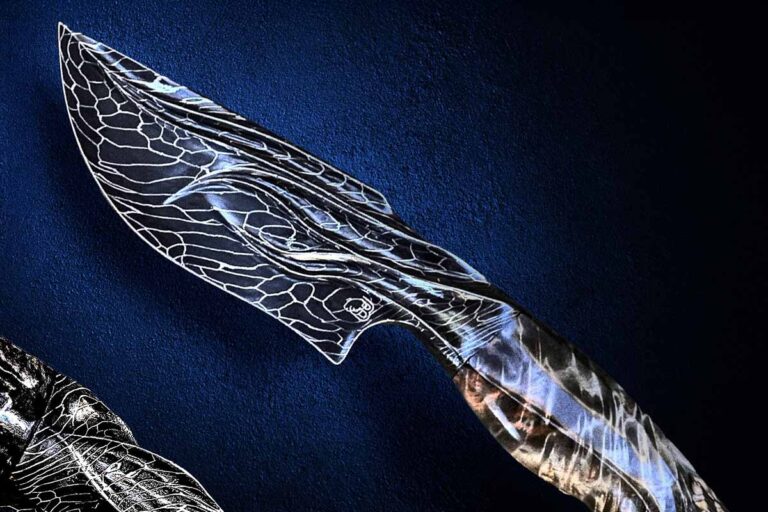
Jordon Berthelot achieves a hypnotic union of blade and handle materials in his integral hunter.

The blade is his HHH lightning damascus and the handle is cottonwood from Robswildwood.

“I used a wide variety of different bits and burrs with Foredom and Dremel tools to freehand carve the blade and handle,” he wrote.

Jordon Berthelot

“As my teacher Spencer Aplin always says, the most difficult part is deciding what to carve and how to give it the flow I want, which is so true,” Berthelot said. “I decided to incorporate the blade carving into the handle so it gave the whole piece a complete look, and also added some great purchase of the handle in multiple different grips.”

Berthelot Integral Hunter Specs
Blade length: 4.5”
Blade material: HHH lightning damascus forged from W1 tool steel/nickel rods w/4800 powder
Handle material: Cottonwood from Robswildwood
Overall length: 9”
Maker’s price for a similar knife: $3,500

See More Custom Knives:

Buying Custom Knives: Four Lessons To Get A Deal

We give you the tips to avoid mistakes when buying a custom knives.

Of course, every rule or principle has its exceptions and counter-principles. You do get what you pay for, but only when you have an honest and informed assessment. Is that micarta real Westinghouse Micarta? Is the fit and finish and reputation of the maker in line with the price? Did the maker grind the knife themselves, or is this a production knife?

You’ll have to do some homework if you want to get “good deals.” One of the oldest tricks in the book is for the seller to exaggerate demand and conceal supply. “This is the last one, and they’ve been buying them fast all day!” may be true or may be a dishonest sales pitch.

The warning is “buyer beware” more often than “seller beware” after all. Many a “bad deal” comes not from mutual disagreement, but from one side taking advantage or being dishonest.

Economic generalities aside, let’s look specifically at the knife market.

Lesson 1: Don’t Buy The Hype

Some people want the latest and greatest thing. They get great enjoyment out of buying what is the ultimate “grail” knife of a given season, often hyped up on social media, on online forums, by word of mouth, in magazines and at events. For these buyers, the thrill is in the hunt and in the showing of the trophy.

If you want to be that kind of buyer, buy what you want and enjoy the heck out of it! Keep in mind that demand will be lower for last year’s hot thing, and so will the resale price. I won’t go so far as to say don’t buy the hot knife. Many of us spend money on experiences (what do you gain long term from a concert or a trip to the movies?) or on depreciating possessions like cars or boats. In some ways, if you enjoy it, it doesn’t matter if you lose some money on a knife or it’s not a good “investment.”

Many of us “regular” folks have to be a little more careful with our funds. If you chase what’s hot, you’ll end up buying at times of peak demand, which means you’ll pay a higher price. By the time you get tired of that knife or want to sell, everyone else just might be tired of it as well, as the knife world will have moved on to the next hot thing. If you’re one of the folks for whom a sour ending ruins the whole experience, don’t buy hot. If you have an eye toward appreciation of values and want to “make money” on your knife collecting hobby, don’t buy hot.

For some people, the thrill is in finding the next hot one, before it gets hot. Wouldn’t we all have loved to have purchased a bunch of Microsoft stock in 1993? If we were better at predicting the future, we’d make better knife picks for our collection, just like we’d make better choices in our stock portfolio. Still, if you “hit” one once in a while—buy the maker’s work right before he hits the big time and make lots of money—it can be quite a thrill and keep you buying knives on a regular basis.

Another point of caution when it comes to hype has to do with the “flash in the pan” types who grow smoking hot quickly, beyond their market position or ability to produce. It has happened in the knife world before and will happen again. Someone may be better at marketing than knifemaking, or better at Instagram videos than filling knife orders. If the hype of a particular maker turns you off or looks suspicious, trust your gut and hold off on purchasing. Sometimes makers flame out as spectacularly as they rose to fame.

Lesson 2: Don’t Overspend At The Beginning

“Walk before you run” is good advice. Knife collecting is about finding joy in knives, and at the beginning, small mistakes hurt less. If you start with $500 and buy five quality production knives at $100 each, you may enjoy them a long time. If you start with the same $500 and buy a custom at a show from an overhyped maker who quickly fades away, you may sour to collecting altogether. When you gamble more, the losses cost more.

The opposite is somewhat true as well, however. If you spend your $500 on 50 $10 gas station knives, you’ll have a great big pile of crappy knives when you’re done. The trick is finding a good balance between price and quality. Finding that balance takes time to learn.

As you learn more about the market segment you’re interested in, don’t be afraid to invest more as you grow. You may reach a point where you don’t want the Chinese ones, but rather the American ones. Or maybe you don’t want production, you want midtech. Or maybe you won’t want the midtech one with the maker’s name on it, you may want the custom one made by the maker himself.

Hopefully, your budget will grow to accommodate your growing expertise and preferences.

Lesson 3: It’s Not Just The Knife You’re Buying

When you invest in Amazon stock, you are making a rich man richer. You’re buying a piece of paper or an electronic data point that says you “own” a tiny piece of the company, and you expect a mathematically increasing return for your investment.

When you buy a knife, odds are good your money won’t go to that knifemaker’s yacht payment or summer home fund. When you buy a knife from an individual knifemaker, you’re more likely sending his kids to daycare or piano lessons, paying for his electricity and buying his wife new shoes. If you buy at a knife show, you probably bought the maker’s dinner. When you invest in a knife, you support a specific person, not “the man behind the curtain.”

Even if you find joy by investing in a person by buying their product, you still owe it to yourself to invest wisely. Of course, you should buy a knife you like, that you find useful or that may make you a decent return on your money. At the same time, you should be looking for people to help, individual makers whose lives you will improve by your relationship and the purchases you make over time. You may be making friends, not just money, which can add another degree of magnitude to your enjoyment of knife collecting.

Lesson 4: Buy What You Know

The more you know, the fewer expensive mistakes you’re likely to make and the more deals you’re likely to find. The less you know, the more likely it is that you’ll get a bad deal, purchase a knife you’ll be dissatisfied with or a knife you later regret. The more you know, the better. This seems to be a universal principle of life and economics, and it applies to knives as well.

First off, buy knives from brands or people you know have a good market position. Many times, a well-known brand is successful for good reasons. A classic brand like Case or Spyderco may be a great place to start, or a well-known Knifemakers’ Guild member or somebody from the “Slipjoint Cartel.” When you have the chance to know the maker or seller personally, that knowledge makes your purchases more likely to bring you joy or a good return on your investment.

Second, buy knives from reputable dealers or purveyors. While you may get a “great deal” from a pawn shop or somebody’s cousin who is a knife collector, there is some measure of protection in buying from well-known retailers such as Blade HQ, AG Russell, Arizona Custom Knives and others. Until you become familiar enough with the market to know exactly what you’re looking at, it’s wise to stick with the major dealers.

As another example, consider buying from the folks who advertise in the knife magazines, such as BLADE. If their business is legitimate enough to afford the expense of advertising in print, they’re more likely to be honest and stick around.

Third, buy the knives you’re familiar with. You may get joy out of buying a knife the first time you’ve ever seen or heard of it. On the other hand, you’re even likelier to enjoy a knife that you know in your heart is a great one, because you’ve studied it, chased it, pursued it, and finally purchased after careful consideration. Sometimes the journey is as fun as the destination, and the pursuit of the grail is worth as much as the grail itself.

You may get in a rut and feel like you’re buying the same knife over and over. That’s no good either. Balance your knowledge with both width and depth. You may dive deep into one model, one maker or one brand, or you may spread your collection broadly by buying one knife from as many different people and places as possible. Either way, you’ll get familiar with the knives that you like, and you’ll end up going as deep or as broad in your collection as you like.

Check Out More Cool Custom Knives:

The Best Boning Knives

Editor’s note: The author (Josh Wayner) spent the better part of five years working in a high-end specialty butcher shop in coastal west Michigan. That shop is no longer in business, though what he learned there has stayed with him and, as he noted, is very dear to his heart. We thought him to be the ideal writer to do a story on five of today’s factory boning knives. We think you will agree.

A former butcher’s mate gives boning knives the full test treatment to find the best boning knife.

I hunt deer and other large game regularly and own all my own professional processing equipment. Among these items is the most basic and essential tool: the boning knife. As a butcher’s mate and now as a full-time outdoor writer, I have some opinions on these blades and how to best use them.

A boning knife is a rather specialized tool, and getting the right shape for removing meat from bone is the name of the game. In my span hunting I’ve either shot or helped process hundreds of deer. I hunt the most game-rich areas in Michigan, and it’s common for my party to land a dozen deer in a night. The best knife for working on a deer is a 5-to-7-inch saber-ground blade of a steel about 3/16 inch thick that features an ample, comfortable handle.

The knife you absolutely do not want is a boning knife for this type of work. In my experience, a boning knife is for kitchen work, though I favor it as a primary knife for game under 50 pounds live weight.

The reason I offer here is that I’ve never seen an injury with a proper large-format field knife. Where I have seen horrible injuries is with thin-bladed knives like those in this article. They have the sickening tendency to snap off when going through sternums and joints; the flexibility has a limit and I’ve personally witnessed a dozen snapped blades, with half of the snaps resulting in a serious hand injury. Extreme care must be taken with ultra-thin, razor-sharp blades. In the process of creating this article, my friend who helped me process the deer meat in the photos was cut to the bone himself with an errant flick of the blade.

Best Boning Knives

  • Best Dedicated Boning Knife: The Knives of Alaska (KoA) Professional Boning Knives
  • Kitchen Functional Boning Knife: Ontario 72-6
  • General Use Boning Knife: Condor Tool & Knife Butcher Knife
  • Scalpel Sharp Boning Knife: Benchmade Meatcrafter

Best Boning Knives Specs Comparison

KnifeBlade Length (inches)Blade MaterialHandle MaterialWeight (ounces)Overall Length (inches)Sheath Country of Origin MSRP
Ontario 72-66.251095 springHardwood4.8 10.75N/AUSA$15
Condor Tool & Knife Butcher Knife71075 carbon
steel
Walnut5.312N/AEl Salvador$38
Benchmade Meatcrafter6.08CPM S45VN stainlessCarbon fiber4.52 11.06Black and orange polymerUSA$400
Knives of Alaska (KoA) Professional Boning Knives5D2 tool steelHard rubber4.2 9.625Black KydexUSA$50

Best Dedicated Boning Knife: Knives of Alaska Professional Boning Knife

The two versions flexible and semi-flexible-of the Knives of Alaska boning knife come in what the author calls a choice size and profile for medium-duty processing.

Pros

  • Designed For The Job
  • Ergonomic Handle
  • Great Value for Performance

Cons

  • Limited Versatility

KNIVES OF ALASKA PROFESSIONAL BONING KNIFE
BLADE LENGTH:
5″
BLADE MATERIAL: D2 tool steel
HANDLE MATERIAL: Hard rubber
SPECIAL FEATURES: Available in two different flexes: flexible and semi-flexible
WEIGHT: 4.2 ozs.
OVERALL LENGTH: 9.625″
SHEATH: Black Kydex
COUNTRY OF ORIGIN: USA
MSRP: $49.99

The KoA knives ship with polymer sheaths.

The Knives of Alaska (KoA) Professional Boning Knives—I tested both flexibility models—are exactly as their name implies. They are a bit more of an investment at about $50 each. They are however, inexpensive enough that they can be easily replaced if broken or lost in the field. These are truer dedicated boning knives and display a curved, upward-swept profile that forces the whole edge into use. The handle angle promotes a full grip while working on both meat on the bone and on a flat prep surface such as a cutting board.

These knives are superior to the first two reviewed in this story. They have an extremely fine point that gets into the bone and allows you to clean off nearly every meat bit. For the price, they are eminently functional and require minimal maintenance. They are my choice out of the bunch. They are an exact fit for their role, while not pretending to be something else. I like that the KoAs felt the closest to what I had in the butcher shop all those years ago.

“The KoA knives performed the best for the dollar in boning tasks,” the author assessed. “They are shaped properly for butchering tasks and don’t fatigue the hand thanks to the blade angle.”
KoA$69Check Price
DLT $70Check Price

Kitchen Functional Boning Knife: Ontario 72-6

Above: The Ontario 72-6 appears as it arrived at the author’s. “It is a good cutter and excellent for breaking down large sections of meat.”

Pros

  • Affordable
  • Durable Edge
  • Effective Breaking Down Large Cuts

Cons

  • Corrosion-Prone Steel
  • Unsealed Handle

ONTARIO OLD HICKORY 72-6 BONING KNIFE
BLADE LENGTH: 6.25″
BLADE MATERIAL: 1095 spring
HANDLE MATERIAL: Hardwood
SPECIAL FEATURES: Inexpensive and available in bulk quantities for rants and kitchens
WEIGHT: 4.8 ozs.
OVERALL LENGTH: 10.75″
COUNTRY OF ORIGIN: USA
MSRP: $14.99

Boning knives are a relatively distinctive category in that they span the range from essentially disposable to extremely high-end, yet are intended for the same purpose. Looking at the four in this article, the least expensive is the Ontario 72-6, which is available in bulk quantities and can be had for as little as $8. It is a good cutter, and excellent for breaking down large meat sections. The straight edge is less ideal for getting into ridges in the shoulder bone, but it is serviceable. In the case of this knife, the steel is very prone to corrosion and the handle is likewise unsealed or treated. To fight the corrosion, wash and dry the knife thoroughly after each use. Apply a light coat of oil on the blade on occasion as well.

“The Ontario has a mostly straight edge and handle, making it hard to work with in organic curves or between bones,” the author stated. “It is a good slicer, but beware of your grip as there is nothing to stop your hand from sliding onto the blade.”

The ‘Old Hickory’ lettering on the handle came off after I washed the knife, and the steel began to spot immediately. This knife has a somewhat textured blade and is not smooth and even. Fat and blood can easily build up on the blade flats. That said, the edge out of the package was sharp, if not a little obtuse in terms of geometry. Despite my best efforts to dull it in use, it stayed sharp and functional. It has no guard or projection and is similar to a puukko in terms of the care that must be taken to not allow the hand to slip up and onto the blade. My impression of this blade is that it is a functional but essentially disposable kitchen tool.

OKC$18Check Price
Optics Planet$22Check Price

General Use Boning Knife: Condor Tool & Knife Butcher Knife

The curved belly of the Condor Butcher Knife’s bowie blade pattern does most of the cutting work.

Pros

  • Sharp And Durable Edge
  • Effective For Large Cuts
  • Durable Construction

Cons

  • Handle Logo Fouls
  • Uneven Edge Usage

CONDOR TOOL G KNIFE BUTCHER KNIFE
BLADE LENGTH: 7″
BLADEMATERIAL: 1075 carbon steel
HANDLE MATERIAL: Walnut
SPECIAL FEATURES: Thin, light and practical for kitchen tasks
WEIGHT: 5.3 ozs.
OVERALL LENGTH: 12″
COUNTRY OF ORIGIN: El Salvador
MSRP: $37.78

The Condor Tool & Knife Butcher Knife has a similar handle to the 72-6, but the blade is longer and wider. The edge out of the box was sharp and held up. An immediate point of concern for sanitary purposes is the deeply cut logo in the grip. The logo is somewhat uneven and large and is a collection point for fat and blood. It also digs into the fingers a bit when cutting, something that is not a major comfort issue, just a moderate annoyance.

As the author noted, the Condor Butcher Knife struggles from the same straight-edge problems as the 72-6—it is a better general-purpose kitchen knife than a boning knife, but can be a jack-of-all-trades.

The blade is oddly shaped for use as a boning tool. The bowie-style point is hard to use in tight spaces and doesn’t allow for the “scoop motion” when getting meat out of valleys in the bones. Where it does well is in breaking down large sections of meat on the table. The blade shape puts virtually all the pressure on the belly near the tip; the rear edge nearest the handle is seldom used due to the blade’s inability to get close to the cutting board for slicing strips. Once the belly of the blade gets dulled, its ability to cut and slice dramatically decreases and it needs to be sharpened. I’d rate this as a functional general-use knife for the kitchen, but its utility as a boning knife is questionable.

Condor$40Check Price
Amazon$34Check Price

Scalpel Sharp Boning Knife: Benchmade Meatcrafter

The Benchmade Meatcrafter is scalpel sharp and razor thin. The orange coating allows for visibility in the field. 

Pros

  • Exceptional Sharpness
  • Premium Craftsmanship
  • High-Visibility Design

Cons

  • High Price

BENCHMADE MEATCRAFTER
BLADE LENGTH: 6.08″
STEEL: CPM S45VN stainless
FINISH: Cerakote™ coating
HANDLE MATERIAL: Carbon fiber
SPECIAL FEATURES: Ergonomic and extremely sharp
WEIGHT: 4.52 ozs.
OVERALL LENGTH: 11.06″
SHEATH: Black and orange polymer
COUNTRY OF ORIGIN: USA
MSRP: $400

The Benchmade Meatcrafter* in this story is the first production version of this particular model from the company, literally the first of its kind off the line. It is a high-end knife eight times the price of each of the Knives of Alaska models tested. Benchmade’s quality is evident and this status symbol is not a “safe queen.”  It is one of the sharpest—if not the sharpest—knives I have ever seen from the factory. I was actually taken aback when it went through a huge deer ham with no effort. It is scalpel sharp and held that level of sharpness the entire test. I for one was not used to a knife this sharp. I had to retrain my hand to use less force in cuts because it was risky.

This is a knife I would proudly use and display, but even with its orange blade (for higher visibility). I would be very cautious in its use for fear of breaking it. This is one that I know I’d fear losing at the cost alone. Things happen in the field, and I’ve lost a lot of gear. The reality is I’d rather break or lose a $50 knife than something like this. 

Meatcrafter Deals

Scheels$185Check Price
Amazon$450Check Price

Read More On Game And Butcher Knives:

Blade Grinds: A Down And Dirty Guide

Knife edges come in all different styles. We break down the major types in this quick guide to blade grinds.

Cutting performance is greatly influenced by the way in which the maker grinds the knife. Each grind will have different cutting characteristics. A good knifemaker will consider whether the grind of the knife is suited to the chosen task. You as a buyer will also need to consider if the grind of a knife will suit the tasks you have in mind.

Blade Grinds
Blade grinds you’ll often come across can be seen here. (Image courtesy of Knafs.com)

Flat Grind

A flat-ground knife is a simple wedge and may be thick or thin. Flat grinds are good for slicing and deep cuts. I personally prefer a flat grind that goes all the way to the spine. A thinner flat grind will cut more smoothly than a thicker flat grind, where a thicker grind may be more durable.

Hollow Grind

A hollow-ground knife has a slightly concave bevel, which makes it thinner behind the cutting edge. This makes for good skinning and shallow cut work, without giving up overall blade heft or durability. Deep cuts or chopping are not well suited to a hollow grind.

Convex Grind

Convex grinds have slightly rounded bevels, which increases their edge stability. While they may not excel at slicing, they’re the way to go for hard use cutting and chopping.

Scandi Grind

Scandi grinds are a short flat grind with no secondary bevel. “Scandi” refers to the Scandinavian countries where that grind style is popular, especially Finland. This grind style cuts very well but can be difficult to sharpen properly.

Compound Grind

A compound grind may combine several of the basic grind shapes. Particularly on tactical and folding knives, many modern grinds are aesthetically interesting, but at the occasional sacrifice of performance. If you’re collecting for aesthetic reasons, however, these grinds could be all you ever wanted out of a knife.

More Knife Basics:

Knife Steel Trends: What To Look Forward To In 2025

Knife industry pros give their takes on what the hot knife steels will be in the year ahead.

Every cutlery buyer faces a dizzying array of steel choices when it comes to buying that next knife, an array that represents the proverbial “double-edged sword.” While it’s nice to have choices, it can also be hard to keep up with so many options. Fortunately, industry professionals are available to help sort out which stainless and carbon varieties are either catching fire or cooling off.

Hot Steels for 2025

  • CPM Magnacut: Folders and fixed blades
  • CPM S30V: Hunting knives, tactical folders, custom knives
  • CPM S35VN: Tactical folders, custom knives, factory outdoor knives
  • CPM 154: Hunting knives, EDC knives, custom knives
  • CPM 20CV: EDC knives, custom knives, knives requiring heightened wear and corrosion resistance
  • CPM S90V: Knives requiring heightened wear and corrosion resistance
  • CPM Cruwear: Bushcraft knives and tactical fixed blades
  • CPM 3V: Bushcraft knives, survival knives, hard-use knives, tactical fixed blades
  • CPM 4V: Competition cutters, hard-use knives
  • M390: EDC knives, custom knives
  • 1095: Factory outdoor knives

*The steels are listed in no particular order by the knife patterns/types for which they are favored most by users and makers, according to the story’s sources.

MagnaCut Reigns Supreme

Last year when BLADE took the temperature of steel suppliers, the clear-cut champion of blade materials was Crucible Industries’ CPM MagnaCut stainless. The creation of steel guru Larrin Thomas, MagnaCut remains on top and will stay there for the foreseeable future. Bob Shabala, president of Niagara Specialty Metals, praised the high-performance blade material last year and still does today.

CRKT MagnaCut blade knife
CPM MagnaCut stainless ruled among knife steels in 2024 and will continue to hold sway in 2025. A representative example is the new CRKT Q, a folder in titanium and carbon fiber designed by Richard Rogers. Country of origin: Italy. MSRP: $225.

“We have sold about 320 tons of CPM MagnaCut since its introduction in 2020. It is our biggest selling cutlery grade right now and I don’t expect that to change anytime soon,” Bob said, adding the qualifier, “This is from Niagara Specialty Metals’ limited perspective. I’m sure other mills are working on new grades which I’m not privy to.”

One reason MagnaCut is so popular is it embraces all cutlery genres with ease.

“CPM MagnaCut remains in high demand across various knife patterns,” Bob observed. “Some customers currently using MagnaCut for fixed blades are expanding into folding knives and have expressed plans to continue using the steel for their new designs, reflecting its versatility and ongoing popularity.”

Larrin Thomas
MagnaCut maestro Larrin Thomas

Scott Devanna, vice president of technology and a metallurgist for SB Specialty Metals, tends to concur.

“I’m not sure there will be a new ‘super steel’ introduced in 2025. The introduction of new steels seems to have a three-to-four-year cycle, and with the recent intro of CPM MagnaCut such new introductions may be a few years off. We sell a lot of MagnaCut,” he stated. “I’ve learned over the years that new is very often the primary driver when new grades are introduced. This is what happened with CPM S30V, CPM 20CV and its European equivalent M390, and a few other grades.”

It should be noted that MagnaCut technically is going into its fifth year of existence. As you can see, it takes a while for a steel to work its way into the manufacturing pipeline and be given a thumbs up or thumbs down by the end user.

Specialty Grade Steels

Meanwhile, other specialty grade steels aren’t being ignored. In fact, many knife consumers prefer other steels that suit their needs better, both of the stainless and carbon varieties.

David Fleming Cowboy Knife
CPM 154 stainless will continue to be a steel of choice for custom hunting knives, here on the Cowboy Knife by David Fleming in a handle of sheep horn from a Rocky Mountain bighorn. Overall length: 7 inches.

“CPM S30V, one of the original cutlery-grade steels, continues to be one of our best-selling products,” Shabala noted. “Despite its age*, S30V maintains a strong position in the market, demonstrating its enduring reliability and widespread appeal among knifemakers.

Devanna agrees.

“CPM S30V is still a favorite for hunting knives, as well as CPM 154,” he noted. “For everyday carry folders, M390, CPM 20CV and CPM 154 are still used quite a bit as well.”

Scott said CPM S30V and S35VN remain strong for tactical folders.

Bob Shabala
Bob Shabala, Niagara Specialty Metals

Custom knifemakers aren’t as easily swayed by trends and tend to go with steels they are comfortable using, are time-proven to them personally, or geared to their particular customer base. While many are on the MagnaCut train, they tend to be more diverse in their choices.

“Other steels popular among custom knifemakers are M390, CPM 20CV, CPM 154, and to a lesser extent CPM S30V and CPM S35VN,” Devanna stated. “I have heard that CTS-XHP will be re-introduced, and this grade developed quite a following when it was readily available—especially for kitchen knives and high-end folders.”

Added Shabala, “CPM 154 is always popular with the custom makers.”

Carbon Steel

THE CARBON EQUATION
The outdoor crowd—bushcrafters, survivalists and open-air tactical users—has to be pleased with the attention they’ve been getting from the industry. These users’ requirements are different and they prefer a subset of steels all their own.

TOPS Shadow Hunter
While major outdoor knife manufacturers like TOPS and ESEE still sell the bulk of their knives in 1095, they have been gradually offering their customers more steel diversity, including stainless versions such as S35VN. The TOPS Shadow Hunter has a 4.5-inch blade of 1095 carbon steel in a tungsten Cerakote®. Country of origin: USA. MSRP: $250.

“CPM 3V and 4V are favored for hard-use knives due to the steels’ toughness, while CPM S90V and 20CV are popular among users who prioritize wear and corrosion resistance,” Shabala observed. “CPM 3V and CPM 4V are carbon steels that continue to sell well in specific areas. 3V is in high demand for bushcraft knives and 4V is being used by the current national champion in BladeSports International cutting competitions, Ben Propst. His wife Sue Ann is now using it and in 2024 they both won cutting events in Kokomo and the Smoky Mountain Knife Works fall festival.”

“I think CPM 3V and CPM Cruwear—mostly for bushcraft/survival knives as well as tactical fixed blades—are gaining popularity in the market,” Devanna opined. “CPM 3V has proven itself over the years and continues to be a popular grade. CTS PD#1 was in this category but availability of this grade is a problem.”

While major outdoor knife manufacturers like TOPS and ESEE still sell the bulk of their knives in 1095 carbon steel, they have been slowly offering their customers more diversity in their lines, including such stainless versions as S35VN.

Overall Take

As Shabala and Devanna noted, MagnaCut will be the top dog among steels in 2025, but it’s certainly not the only hound in the kennel.

Scorpion 6 Knives
Shane Magnussen uses the CPM S90V supplied by New Jersey Steel Baron on his model BBV2 folder. Closed length: 4.54 inches. (SharpByCoop image)

The cutlery industry is so diverse in the competition among manufacturers, custom makers, genres of knives and budget categories, there’s room for many different stainless and carbon steels. While what’s in the works remains unknown to most, you can bet there are teams of metallurgists working on the next great knife steel as these words are written.

As a knife enthusiast and cutlery buyer your choices are bountiful in all categories—from EDC to outdoor, fixed blade to folder—and affordable to expensive. Some users buy one knife to last for years while others rotate their carry or require cutting fare for specific purposes.

The good news is your knife and steel options have never been better!

*Editor’s note: The first-ever steel both designed and made specifically for knife blades, CPM S30V has been used for knives since 2001.

More On Knife Steel:

Knife Buying Don’ts: How To Avoid Cutting Pitfalls

Knife buying–particularly custom–can prove daunting. We gathered industry pros to give the top mistakes to avoid.

When it comes to acquiring knives, the informed buyer is most often the satisfied buyer when the transaction is complete. So in the spirit of friendly advice, BLADE® has enlisted the help of several knife industry pros to offer a few words on making the most of the knife-buying experience—or to put it another way, 11 mistakes to avoid when buying a knife.

Don’t Deal With Questionable Sellers

“A lot of it revolves around reputation,” said custom knife purveyor and collector Paul Farina of Farina Fine Arts. “Human beings can be different, but 80 to 90 percent of the people you meet out there are great. In the knife world, many of them will give you a refund if you aren’t happy.”

Dave Harvey of Nordic Knives echoed that sentiment. “Honest sellers are not hard to find, thankfully,” he said. “Look for those with years of experience. Generally speaking, dishonest sellers will not be in the business very long.”

Along the same lines, Daniel O’Malley of bladegallery.com cautions folks interested in buying online. “If purchasing online, make sure you are buying from a company that has been around a while,” he offered. “There are a lot of fraudulent websites out there these days—often ones that are trying to appear to be a well-known website. One dead giveaway that you may be on a fake purveyor website is if the prices are too good to be true. Unfortunately, you are unlikely to find a legitimate site selling knives for half the price of other legitimate sites.”

Don’t Buy Knives On Pictures Alone

“In most cases today, knives will be purchased online, and therefore you may have to judge the knife by photographs and listed descriptions,” O’Malley advised. “Since the value of the knife is greatly affected by small scuffs and scratches, it is important that the photos are clear enough that any imperfections will be noticeable.”

Along the same track, Harvey noted, “Pictures are great, but they never fully substitute for being able to see and hold a knife in person. Make sure you buy from someone or a dealer with a 100-percent-return guarantee. If you are not satisfied with your purchase, you should be able to return it in a reasonable period of time.”

Don’t Buy Knives On Steel Only

Jacob Gaetz forged the 4-inch blade of his fancy hunter
Daniel O’Malley advised that each year new miracle steels appear but often lose popularity after a year or two because they may not pan out. Conversely, tried and tested steels like CPM S35VN, Takefu SG2, 52100 and more are great benchmarks to test against. Jacob Gaetz forged the 4-inch blade of his fancy hunter from 52100. (Jocelyn Frasier image)

“I never talk to people too much about a particular blade steel,” commented Dave Ellis of Exquisite Knives. “I usually discuss with clients how the complete knife was made, how it was fashioned, and that is more important, I think. Someone may be enamored with a certain type of steel, but that is rare with my clientele and only a consideration in talking about the whole knife.”

Harvey reckons that few knife buyers take the “blade-steel-first” approach. “At least I would hope not,” he asserted. Farina added, “There are a few exotic blade steels out there right now, and these may be sought after just because they’re exotic. Also, some steels have been discontinued and knives with those steels may be selling because of the rarity.”

Taking the entire knife into account is the best way to reinforce a purchasing decision, according to O’Malley. “Knowing the stats on the knife is important,” he reasoned. “We want to know where it was made, who made it, in what country it was made, and what materials they used. That said, judging a knife by just the blade materials used ignores fit and finish as well as heat treatment quality. In some cases the identical steel at the identical Rockwell hardness can still have tremendously different edge holding. In fact, over the years I have found that the quality of heat treatment is perhaps even more important than the steel used.”

Don’t Buy Knives On The Handle Comfort

Lee Lerman, a custom knife judge
Daniel O’Malley said that even if it’s the best knife in the world, if you don’t like the way it feels it isn’t the best knife for you. Lee Lerman, a custom knife judge at BLADE Show 2024, checks the handle of one of the knives entered. In the background are observer Henry Wu (right) of the BLADE Show and judge Rodrigo Sfreddo (center).

“Getting a knife in hand and seeing what it feels like is ideal, though sometimes not possible if you are purchasing from far away,” O’Malley related. “I often advise potential buyers that even if they are holding the best knife in the world, if they don’t like the way it feels it isn’t the best knife for them. That said, some buyers feel a knife is comfortable just because it is familiar—similar to their last knife. They may have gotten used to the last knife and like the way it feels, but a different feel might actually be better, that is, a more ergonomic handle or lighter design. Sometimes it takes using the knife for a while before you know how you really feel about it.”

Don’t Adopt A Herd Mentality

“There are trends out there, but because I’m older and been around the art knife world so long, I’ve thought about the places to put my money,” Farina commented. “If you’re looking at an up-and-comer in knifemaking, check their quality, find out who taught them. That is how I get introduced to them. If they have been taught by an experienced maker, you can tell the quality, and the price may reflect in less money with younger guys.”

From the perspective of “hot styles,” Harvey remarked, “I don’t object to those who want to buy the ‘hot’ knives as long as they are styles and makers that they enjoy and collect. Buyers should always beware of ‘hot’ knife prices and not fall for overpricing.”

“What’s currently ‘hot’ isn’t always best,” O’Malley commented. “The knife industry develops relatively slowly and though each year we see new miracle steels come out, they often lose popularity after a year or two because they may not have panned out. Tried and tested steels like S35VN, Takefu SG2, 52100 and more are great benchmarks to test against.”

Don’t Overlook Makers By Name

Loveless hideout model in stag
Dave Ellis said that instead of buying 10 knives you can afford, save up and buy one made by Bob Loveless. A Loveless hideout model in stag and with the iconic Naked Lady logo would be a good place to start. (Exquisiteknives.com image)

Ellis looks long-term and sees intrinsic value in the known commodities. “I recommend the blue-chip makers,” he declared. “Instead of buying 10 knives you can afford, save up and buy that one Loveless. This year I’ve sold 14 Lovelesses and the pricing has not gone crazy. So, an entry level $5,000 knife is not so ‘out there’ for someone.”

According to Harvey, most big-name makers have an established collector following, which typically relates to a lasting market for their knives down the road. However, O’Malley points out the benefits of considering numerous makers.

“The knife industry is full of tiny workshops that are doing the best work in the industry,” he noted. “While there are also some great big-name makers, these smaller shops are more likely to provide more bang for your buck. Additionally, in many cases, small workshops may be putting more attention toward quality of heat treatment, which can result in much higher performance.”
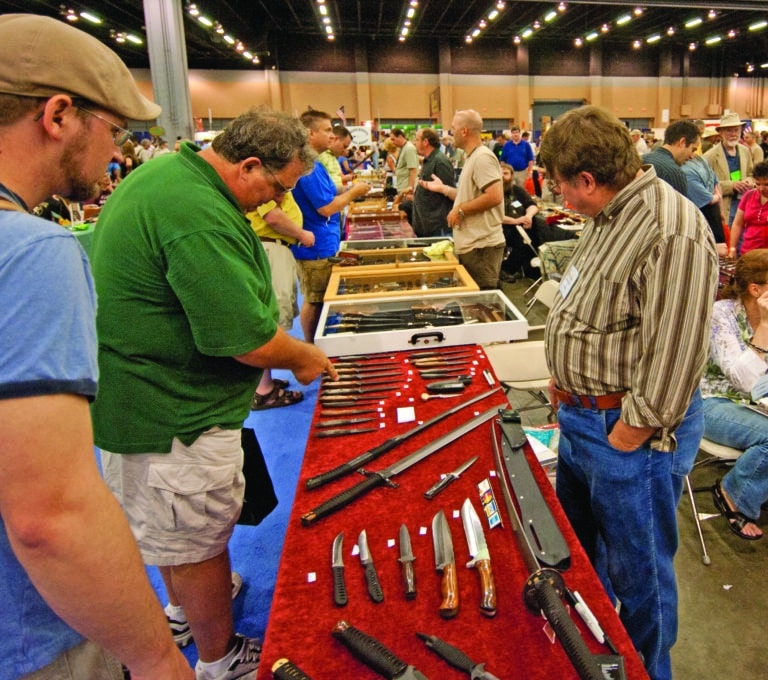
Don’t Overrate The Investment Factor

“Buying for investment is something I love because of the fact I can make money on knives,” Farina explained, “but this is not a blue-chip investment stock. So do it for the passion and love of the product. However, if the goal is only for investment, then be very structured. Listen to an adviser. I had a customer come to me after spending a lot of money in four years. He wanted to sell and make 20 percent profit on all the knives [he had bought]. Maybe that would happen on some stuff, but it is a bit unrealistic.”

O’Malley added, “Knives can be a great investment. Over the years, I have seen many knives increase dramatically in price, though certainly there are some that hold their price and even some that go down. Picking the right knives for investment does take a time commitment. You need to research and know the maker and their work. How does the knife fit in the range of knives that maker creates? Will the materials hold up over time? Where is the maker in his or her career? Taking all this into account, it is possible to collect knives as a great investment, though keep in mind that even with the best research not every investment will work out.”

For Harvey, the investment path requires some preparation. “Smart buyers can and do successfully invest in certain knives,” he said. “This does require a lot of knowledge and patience, as you generally won’t see significant increases in value in the short term. For most buyers, I suggest buying what you like and enjoy for your collection, not expecting a large return for it upon sale.”
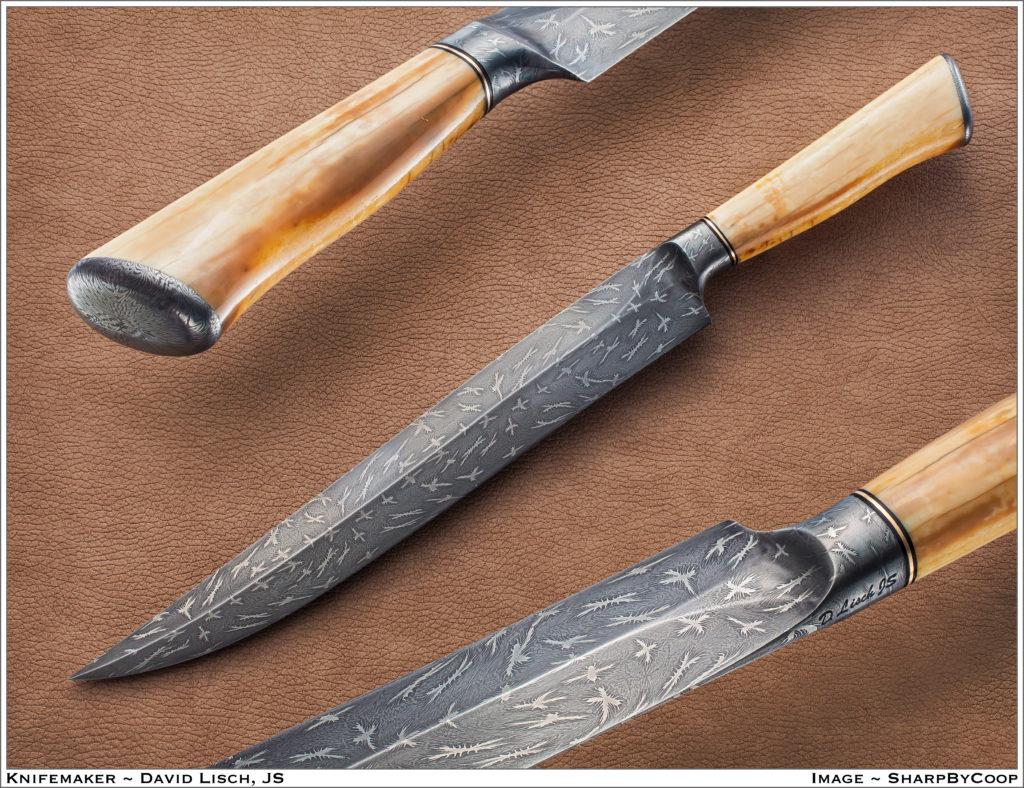
Don’t Exceed Your Knife Buying Budget

Jurgen Steinau fixed-blade knife
Dave Ellis recommended setting a price limit at auctions and don’t exceed it or you will find yourself paying a lot more than necessary. “I remember a particular Jurgen Steinau fixed-blade knife a few years ago when an overseas bidder and a guy from the Bay Area were in there. The knife went for $110,000,” Dave noted. “People were in there butting heads and then it became an ego thing.” Steinau’s unique style is reflected here in his Folding Knife LBS. (Eric Eggly/PointSeven image)
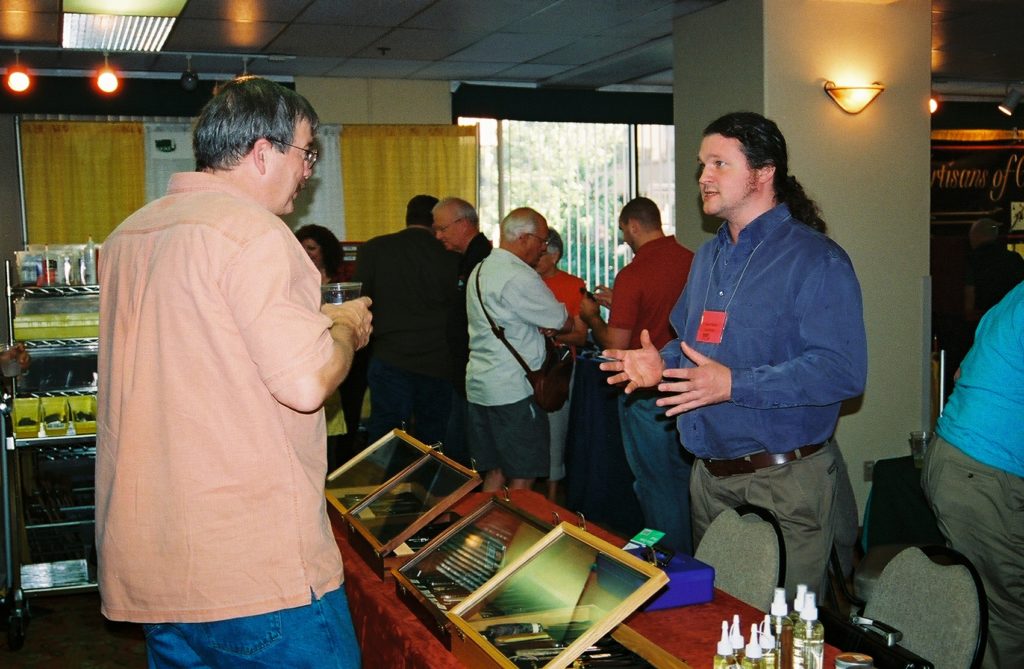
Ellis provides sound wisdom on auction bidding. “Set a price at the auction and don’t go over the limit and find yourself suddenly paying a lot more than you wanted to pay. I remember a particular Jurgen Steinau fixed-blade knife a few years ago when an overseas bidder and a guy from the Bay Area were in there. The knife went for $110,000,” he noted. “People were in there butting heads and then it became an ego thing. Also, don’t buy with an eye toward flipping the knife. Avoid bid ups like the plague.”

“Auction sites tend to have horrible photos, making it impossible to ascertain what a knife is really like—and what it is worth. Since fit and finish as well as condition are so important to value, figuring out what to bid can be near impossible. Additionally,” O’Malley opined, “auctions can be a way to end up paying much higher than a direct-from-maker price.”

Don’t Discount Second Opinions

“Second opinions are nice and not too hard to get on many knives,” Harvey pointed out. “There are online forums and other social media outlets where collectors share information on many makers and knives.” Take advantage, then, of the availability of information but consider the source always.

“Knives are pretty personal,” O’Malley observed. “What works for you might not work for your buddy. It’s always fun to walk around a show with someone so that you can bounce ideas off each other, but at the end of the day, buying what you like is probably most important.”

Don’t Buy Knives Under Duress

Never feel pressured to make a knife purchase. Don’t always accept the line that the knife you are considering could be gone in the next few minutes. Take a deep breath and make the most informed decision possible in the current environment. If you don’t feel totally positive, walk away.

“Many knives are literally one in the world,” O’Malley said. “This means that if you don’t buy it, there is a chance that it will be gone. Over the years, I’ve found a good way to evaluate is to ask yourself, ‘If this knife sells to someone else, in three to five weeks will I be frustrated and still want to purchase it?’ If the answer is no, you probably didn’t need to purchase the knife. There will always be others. There are, however, a few knives that I didn’t buy that even years later I wish I had purchased. Figuring out if this is one of those knives lets you know to buy it before someone else does. Any big collector has had a few knives they didn’t purchase quickly enough that they still regret not purchasing today.”

Don’t Always Discount Deposits

heat treatment of knives
Over the years of buying and selling knives, Daniel O’Malley said he found that the quality of heat treatment is perhaps even more important than the steel used.

“If a maker requires a deposit, he or she must be a good accountant,” Farina related. “Some are not businessmen. They are artists and machinists. So, it’s about reputation and feeling good about the maker you are working with.”

Trust is a big factor across the board. “Paying for a knife before it is completed can be complicated,” O’Malley maintained. “A well-regarded maker once summed up the problem: ‘It’s very hard to work on a knife that’s already paid for.’ That said, collectors often commit to a purchase, have a knife made, and don’t complete the purchase or just ghost [stop communicating with] the seller. For this reason, I feel it is reasonable to pay a relatively minimal deposit, 10 to 20 percent of the cost of the knife, when purchasing directly from the maker. If working through a purveyor and having a knife made, it isn’t unusual to have to pay the full amount up front since the purveyor is committing to the purchase for you.”

Stay Informed

Advice is free, for sure, but it comes from the voices of experience. When buying a knife, it pays to listen to those already engaging in the process. Of course, every situation is a bit different. There are always additional considerations. The bottom line is to approach a knife purchase on an informed basis. That translates into a confident buy!

More On Custom Knives:

Advertisement

Must Read Articles

Read this before you make a knife

Knifemaking 101 – Read This Before You Make a Knife

  by Wayne Goddard My experience has taught me that there's nothing like digging in and getting started. I've often said the hardest part of the...
how to forge damascus steel

How to Forge Damascus

Advertisement
Advertisement