Knife collecting is an extremely rewarding experience for knife enthusiasts. There truly is a knife for everyone. Many increase or hold their value throughout the years, making collecting knives something to pass on to the next generation of knife collectors.
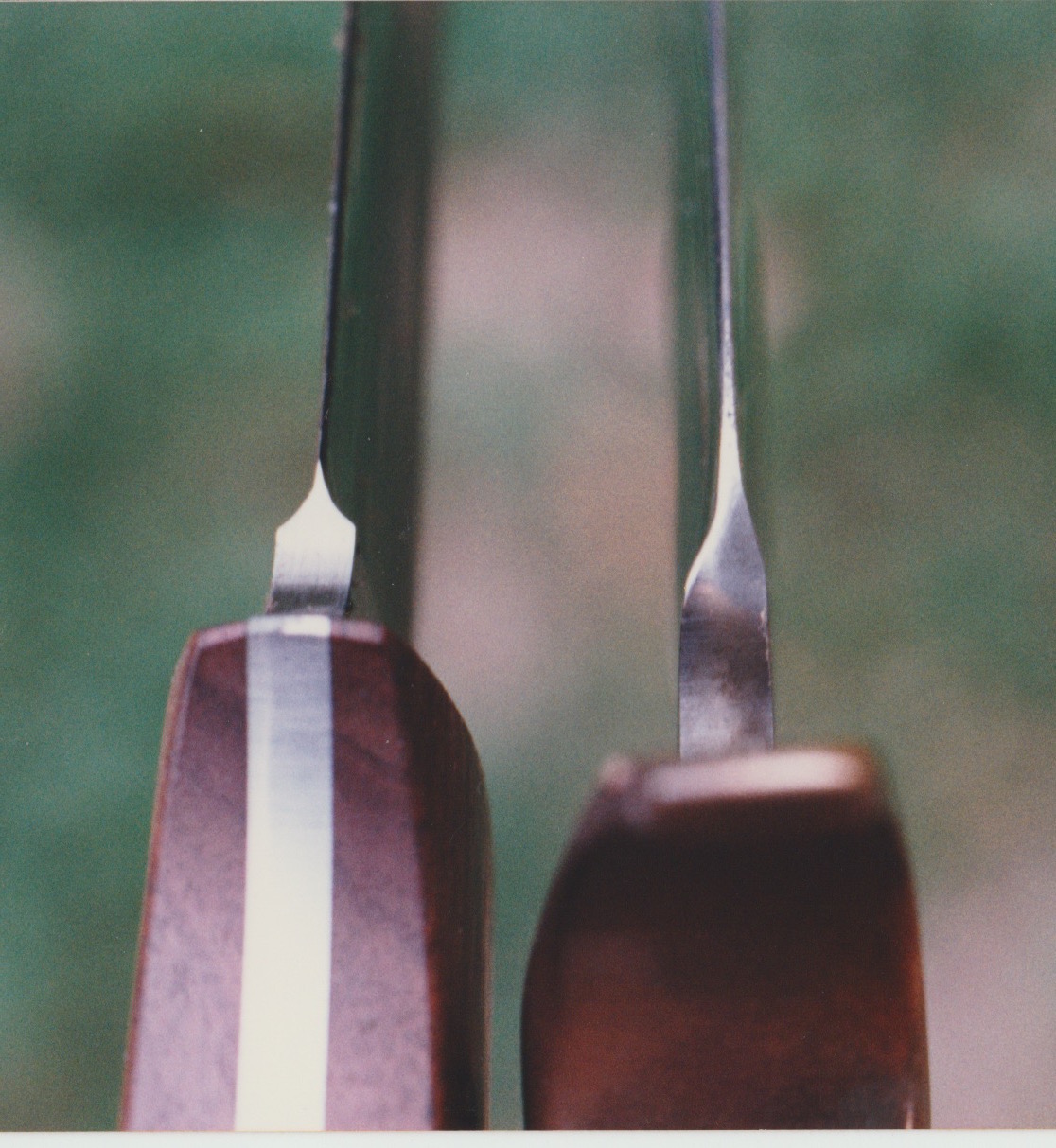
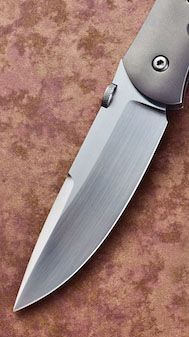
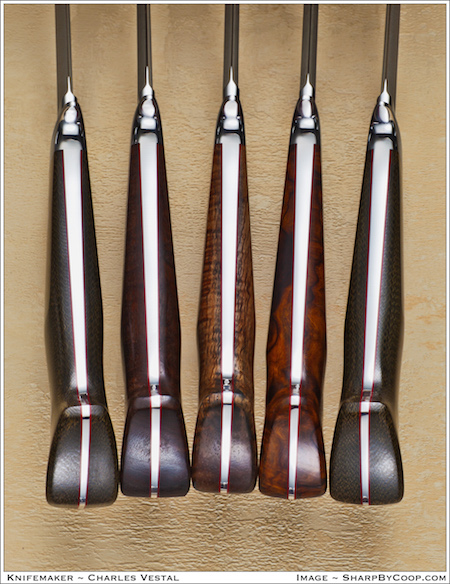
Plunge cuts should reflect each other in terms of symmetry on each side of the knife blade. The plunge cuts at left do so and the ones at right do not. (B.R. Hughes image)Note the symmetry of the satin finish flowing from the plunge cut to the tip of the blade on John W. Smith’s SD-2 tactical knife. (SharpByCoop.com image)The blade should be centered in the handle when the knife is closed, as on Brian Nadeau’s folder. (SharpByCoop.com image)There should be a correspondence in shape, size and lines between both sides of the knife’s blade and handle, as on these fighters made by Charles Vestal for members of the Custom Knife Collectors Association. (SharpByCoop.com photo)
Fit and finish is a term used to identify the earmarks of a quality made knife. In a nutshell, fit and finish is an arrangement of balanced proportions and symmetry in the entire piece.
With the dividing line being the knife’s spine, there should be a correspondence in shape, size and lines between both sides of the blade and handle. The blade tip must be centered, as should the grind as it moves along the blade toward the ricasso. The blade must have no warping, nor should it exhibit bends where there should be none. The entire run of the blade’s bevel lines, whether primary or secondary, must be even and straight. There should be no flaws, imperfections, wrinkles, creases or cracks in the blade’s surface, nor, in the case of a forged blade, can there be any bad welds. The blade’s finish, whether bead blast, satin, mirror polish, stonewash or what have you, must be consistent throughout the area of the blade to which it is applied.
There should be no gaps between the handle material and the bolster, nor the blade and the guard. The handle sides must have equal thickness and be contoured evenly and smoothly. All materials should be rich and vibrant. For example, if ironwood, it must have nice striations instead of just being a blank piece of wood.
In addition to the above, if the knife is a folder there should be no gaps or differences in elevation between the backspring and the blade when the knife is open. There must be smooth opening and closing of the blade, and the blade should snap both open and closed—known as “walk and talk” among old-time pocketknife collectors. The blade must exhibit little to no vertical or horizontal wiggle, ride dead center in the handle when the knife is closed, and, if a multi-blade, the blades should not rub against each other upon opening and closing.
HOW to LOOK for PROPER FIT and FINISH
There should be no gaps in the knife’s joints, such as between the guard and blade. Mark Knapp’s fixed hunter exhibits a nice guard-blade fit. (SharpByCoop.com photo)
•A loupe/magnifier is unnecessary. Average eyesight is fine. Check the knife in standard light conditions;
•Rotate the knife slowly and study it from all angles;
•Examine folders with them in both the open and closed positions. Feel how smoothly the blade opens, closes and locks into place;
•Remember, no knife is perfect. Each one will have at least one minor imperfection. Learning to recognize the differences between such a knife and one with poor fit and finish requires attending knife shows and handling and studying as many knives—with each individual maker’s permission, of course—as you can.
Finally, while checking for proper fit and finish is a great way to identify a well-made knife, the fact that a knife has proper fit and finish does not necessarily mean that it will cut, feel right in your hand or even be all that attractive to you. The latter three are things you must be determine for yourself.
After going to knife shows for a few years, Dominick Gold of Manchester, New Jersey, had to try making a knife himself. He started reading and learning.
“I couldn`t believe how all the makers I met were willing to help the new guy,” Dominick noted.
He met Joe Szilaski at a New York knife show and took classes with him on stock removal and forging.
“I worked in the wholesale seafood industry out of the Fulton Fish Market in New York [City] and really learned how to use a knife,” he stated.
Best-selling knife patterns: skinners, hunters, bird-and-trout and mini tactical tomahawks
Preferred blade steels: 1095 for hamon, CPM 154 for hard or outdoor use, and AEB-L for fine edge holding in a slicer
Blade grinds: flat w/convex edge and hollow
How he tests his knives: paper slice, cardboard cut, 4×4 wooden post chop and user feedback
Favorite handle materials: koa, redwood, maple, also Micarta®, G-10 and the occasional resin pinecone
Price range: $200-$400
Knife shows he attends: Northeast Cutlery Collectors Association, Mystic, Connecticut; Lehigh Valley Knife Show, Easton, Pennsylvania; Great Middletown Firearm and Knife Show, Middletown, New York
Forums he participates in: Northeast Cutlery Collectors Association and the knife gods Group on Facebook.
Dominick does everything in house except heat treating stainless steel, which he leaves to Paul Bos. He hand-stitches his sheaths.
The Knife
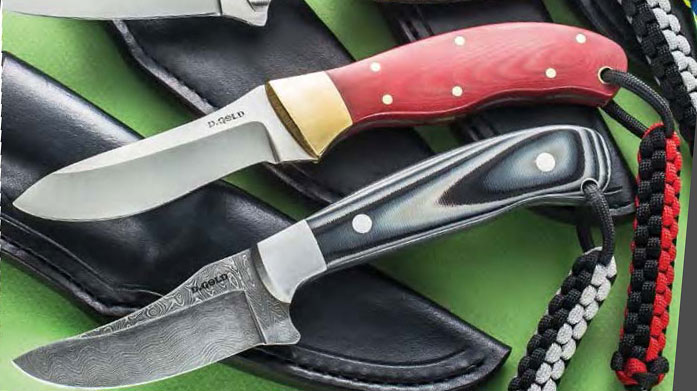
His skinner has a 3.5-inch hollow-ground blade of AEB-L stainless steel. The knife has dovetailed brass bolsters with a satin finish, red linen Micarta scales and is finished with a 550 paracord fob.
“There isn’t a straight line on the knife,” Dominick added. Maker’s list price: $250.
Contact Dominick Gold, 908-309-7541, [email protected] and on Facebook at Dominick Gold.
Wayne Meligan
Wayne Meligan didn’t know why knifemaking came so easily to him, he just knew it did.
When Wayne was a boy, his father would pick him up after school with a change of clothes and they’d go fishing. He’s been carrying a knife ever since, fishing from the backwoods swamps to the Gulf of Mexico. After high school Wayne earned his bachelor of science degree in nursing, and today works full time as an assistant managing nurse in a critical care open-heart unit. He’s married with a 3-year-old at home, so his time for knifemaking is limited.
And yet, he spends every minute he can in his shop. Then his grandmother mentioned that his great-granddad used to make knives, and so did his grandfather.
Yet, nobody else in the extended family had picked up the craft, just Wayne. It all made sense—the compulsion to make knives was in his blood and had just skipped a generation.
Favorite blade steels: 5160 for its workhorse qualities, 1095, 80CrV2
Blade grind: flat
How he tests his knives: push-cut newspapers for chef’s knives; sportfish, hunt and camp for camp knives; cut a nail for heat-treat check on all models, or run through sheet metal
Favorite handle materials: local hardwoods like snakewood and walnut
Price range: $200 and up
Forums he participates in: Bladesmithing for Beginners Groups on Facebook
The Knife
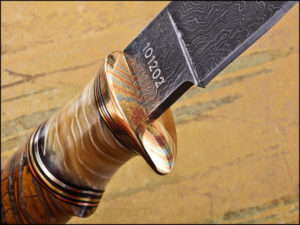
This hidden tang all-around knife has a 7-inch blade of ladder-patterned steel from Alabama Damascus Steel. The angled integral guard is brass. The walnut handle looks wet because once the rough sanding is completed, the finish sanding goes from 220- to 2,000-grit. Finally a coating of Danish wood oil is applied.
Maker’s list price: $350.
Contact Wayne Meligan, 850-503-3335, [email protected] and Pirate Forge on Facebook.
Rob Ratliff
(SharpByCoop knife image)
Knifemaker Rob Ratliff specializes in fashioning gemstone handle knives, specifically using stone, minerals and fossils.
“My inventory consists of material from nearly every place on earth,” he claims. “I especially enjoy embellishments, such as filework and a variety of knife finishes. All of my work is in house with the exception of engraving.”
Preferred blade steels: D2 for edge retention, CPM steels for corrosion resistance and performance, and stainless damascus because of its beauty and overall performance
Blade grinds: hollow, flat and convex, depending on the knife’s intended use
How he tests his knives: rope and paper cutting, feedback from customers, and edge flexes
Favorite handle materials: gemstones for their unique, colorful, durable finishes, as well as Micarta®, wood and other materials upon request
Price range: $100 and up for neck knives, and $400 and up for folders
Knife shows he attends: BLADE Show, Gateway Area Knife Club Cutlery Fair and the Mt. Vernon Knife Show
“My background in woodworking and a career as a welder and in ornamental iron fabrication made my transition into knifemaking feel natural,” says Ratliff, who started making knives in 2007.
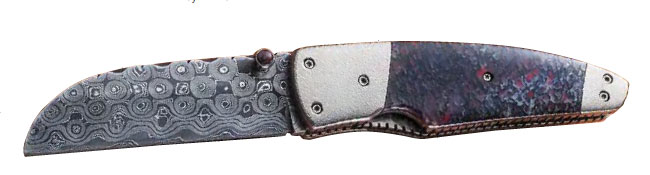
The wharncliffe-style, locking-liner folder sports a 3.25-inch Mike Norris damascus blade, dinosaur bone scales, fileworked titanium liners, “orange-peel-finished” titanium bolsters, and a dinosaur-bone inlaid titanium thumb stud. Ratliff’s list price: $1,050.
Knifemaking is a new pursuit for Marty Jelinek. His 14-year-old son asked if he could help make a hunting knife for him, and the passion grew from there. Marty has no formal knife training but a background in fabrication helps.
“For heat treating and tempering I have taught myself using TTT [time-temperature transformation] charts and gleaning information from steel makers’ guidelines,” Marty explained.
He lives in the outback where Internet access is spotty, TV reception is poor, and there is nobody nearby to lean on or compare and contrast with.
“My day job is as a farm hand on a crop farm, and this leaves little spare time, but it does allow me the opportunity to field test my blades in the tough Australian outback conditions.”
Best-selling knife patterns: 3-inch everyday carry drop-point, 4-inch drop-point hunter and the occasional kitchen knife
Preferred blade steels: SUP9/5160 in the form of recycled planting discs; also 12C27, 1095, 15N20, 1075 and D2
Blade grinds: full flat with a 25-degree secondary and the occasional zero-degree
How he tests his knives: field testing around the farm, hunting, cooking
Preferred handle materials: stabilized burl, G-10, horn and, by customer request, inlace acrylic. “The harsh Australian conditions call for tough hard-wearing handles, especially on working knives.”
Price range: $250-$300 with hand-tooled sheath
Forums he participates in: Assorted ones on Facebook, and Australian Blacksmith and Knifemaker
The Knife
“I am just a bloke in the bush having a red-hot go, making a few knives to pay for equipment to make a few more knives, Marty added.
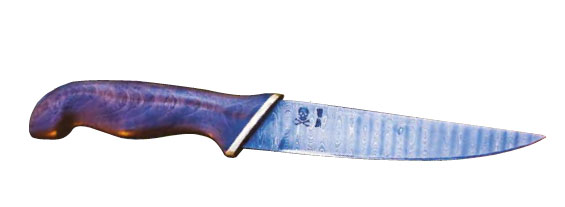
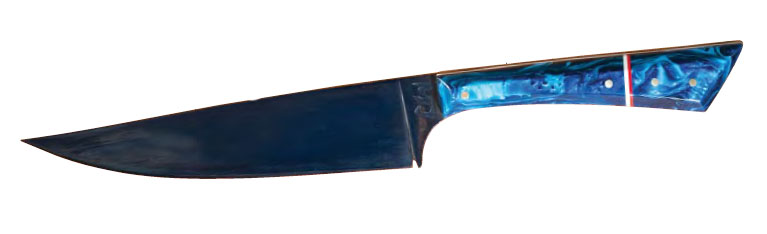
His kitchen carving knife has a 7-inch blade with blued 5160/SUP9 steel. The inlace acrylic handle includes G-10 liners and spacers. Overall length is 12 inches. Maker’s list price: $300.
Contact Marty Jelinek, +61 4 28 299 690, [email protected], on Facebook at Handmade Knives by Marty Jelinek.
Rudy Dean
(Caleb Royer image)
Edmund Davidson, friend and mentor for over 25 years, sparked Rudy Dean’s interest in knifemaking.
Rudy was taught the art of pattern-welding steel by Herb Derr, who also encouraged him to make knives. American Bladesmith Society master smith Jim Crowell was Rudy’s instructor in the ABS Intro to Bladesmithing class, continues to guide his forging techniques and supervised Rudy’s journeyman smith performance test.
After 27 years as a retail store owner, Rudy retired in January and has become a full-time bladesmith. He also enjoys farming, beekeeping and sharpening his bushcraft skills in the mountains of the Shenandoah Valley.
Best-selling knife patterns: hunters and tomahawks made with patternwelded steel, and forged bowies
Preferred blade steels: his own forge-welded steel using 1084 and 15N20, 1075 for hamon, D2 for stock removal and CPM S30V for kitchen knives
Blade grinds: flat and the occasional hollow
How he tests his knives: wood and rope cutting, occasional destructive tests
Favorite handle materials: burls and spalted woods for natural beauty, vintage Micarta® for ruggedness and cast materials by J. Hue Customs
Price range: $250-$900
Knife shows he attends: BLADE Show, International Custom Cutlery Exposition, the Moran Association All Forged Show and the Shenandoah Valley Knife Collectors Show
Member of: ABS, The Knifemakers’ Guild, William F. Moran, Jr. Museum and Foundation, Shenandoah Valley Knife Collectors Club and the North Carolina Custom Knifemakers Guild
Rudy runs a “sole authorship” shop, performing all aspects of his builds in house.
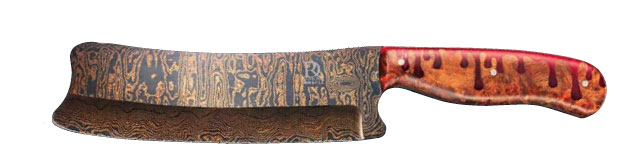
In his Urban Cleaver Rudy incorporates 261 layers of pattern-welded 1084 and 15N20 steels in a 5½-inch, partial-hollow-ground blade. The knife is 10 1/4 inches overall with amboyna burl Blood Drip scales from J. Hue Customs. Maker’s list price: $500.
Tim Flack’s bladesmithing journey began when he saw the Western approach to traditional Japanese fine metalwork in pieces made by South Africans such as Ford Hallam and Tiaan Burger.
“I loved the traditional approach they took using hand chisels—called tagane—to carve metal,” Tim noted.
He lost his job a few months later and Pokémon GO was out, so he made a few sterling silver pendants of Pokémon and realized it paid the bills.
A friend asked him to make a knife and he called the local knife club for help. Rick Afonso introduced him to his mentor and friend, Stan Hohowsky.
“I forged my first knife, a kozuka, and that had me hooked,” Tim said.
Stan and friend Brad Woollon have mentored him ever since. Both studied under South Africa’s only American Bladesmith Society master smiths, Kevin and Heather Harvey.
Best-selling knife patterns: ultra-thin kitchen knife co-designed and manufactured with Woollon, his yanagiba, drop-point hunter and bowie
Preferred blade steels: O1 and 5160 for ready availability in South Africa. “I’d love 52100 for my kitchen blades, but it’s hard to get in flat bar and we forge it out of bearings here,” Tim explained.
Blade grinds: flat on kitchen blades for push cutting
How he tests his knives: wood chopping, push cutting ropes, bottle chops
Favorite handle materials: local woods like camphor bush burl, stink ebony and wenge
Price range: $60-$300
Knife shows he attends: local shows in Cape Town
Member of: The Cape Town Knife Club
Forums he participates in: Facebook Groups
The Knife
His kitchen knife has a 7.38-inch flatground, convex-edged blade of Bohler K460 steel. Overall length is 11.81 inches. The handle is made of treated zebrano wood and fastened with mosaic pins.
Contact Tim Flack at +27 60 6054562, [email protected], on Facebook at Tim Flack; on Instagram @journey_of_a_metalsmith and on Twitter @tim_meh87.
Find More Custom Knifemakers with BLADE‘s Directory
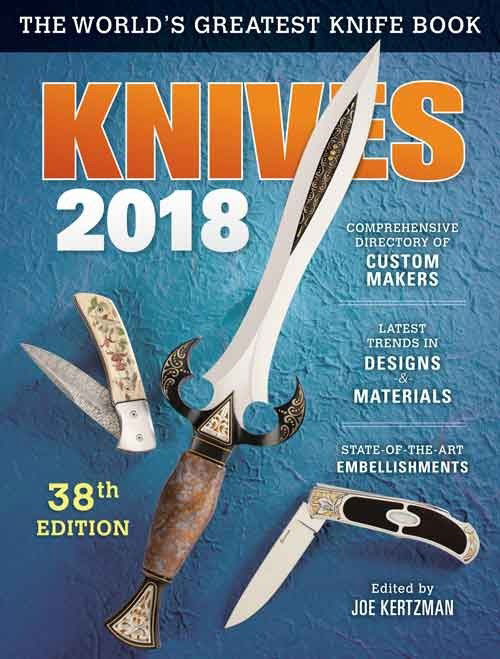
A full directory of custom knifemakers around the world can be found in the Knives 2018 book.
Author James Morgan Ayres said the Nuclear Meltdown Special Forces Natural Outlaw by Busse Combat Knife Co. split logs with ease. Blade Length: 8.25 inches. Blade Stock: .240 inch. Blade Finish: Satin. Handle: Brown and black G-10. Overall Length: 14 inches. MSRP starts at $327.
By James Morgan Ayres
Busse knives are advertised as efficient cutters and durable, extreme hard-use combat knives—but are they really “hard use”?
My son and I gave the Busse “Steel Heart” model a hard workout a few years ago in which I used it to cut through an auto body. There was no damage to the blade and it retained a usable edge afterward. Over a period of a few weeks we used the Steel Heart on about anything for which a big knife is suited. It was tough. It cut well.
That was then. Do today’s Busse knives perform as well? We aimed to find out.
Recently we tested four new Busse knives, though first, a few words regarding our field reviews. If a maker advertises his creation as a collector’s piece, we will treat it tenderly and review it appropriately. If he presents his knife as a tool and weapon for the military, as a combat knife or a survival knife, we will review it as it could be used and as similar knives have been used.
Any knife designated as a combat knife by its maker we strike on the back with another knife as might be encountered in a blade-on-blade confrontation. We strike both the spine and the lateral surfaces. Some highly touted “combat blades” shatter on impact with another blade. Usually we use an old Sabatier carbon steel chef’s knife or an Old Hickory “Sticker” as the impact knife. If your $400 combat/survival knife will not stand up to this simple test, you need to have a talk with its maker.
Along with yours truly, my fellow testers included my friends, Shawn Carlson and Richard Figueroa. In our reviews, we use any knife billed as “combat/survival/hard use” to grind mortar from between concrete blocks, cut through heavy sheet metal or steel doors and auto bodies, and for similar escape-and-evasion scenarios. Why? Because today’s conflict areas are often urban and because anyone, civilian or military, can find himself in a building that comes down around him, or could be trapped in an auto and needs to cut his way out.
We also drive blades into trees or wedge them between rocks, stone blocks or whatever is handy, and use them as climbing aids and self-arresting devices. The need for a knife that will bear the owner’s weight in an emergency is desirable. We use this test with a large measure of caution and consideration for the designed function of the knife. It is unreasonable to expect a Swiss Army knife to support the weight of a 270-pound linebacker, but it is well within reason to expect a survival/hard use knife to support the weight of a 175-pound person.
We did all these things with the four Busse test knives. Moreover, we used all of them to cut roasts and ribs, a pile of cardboard, and 20 yards of hemp rope.
We encountered one problem with the Busse knives: All, regardless of model, performed so well the whole thing got kind of boring. Set up the object to be cut, apply edge to object, object is cut. Denim, rubber sneaker soles, pork rib bones, tri-tip roasts, stacks of wood, etc., all fell to the Busse edge. We struck the blades with the Sabatier and the only effect was a few more dings in the Sabatier. The mid-sized, colorfully named Nuclear Meltdown Special Forces Natural Outlaw (NMSFNO) easily supported the weight of a 235-pound reviewer.
Jerry Busse has been making knives for 30 years. Busse Combat Knife Co. has been operating for 20 years and uses a proprietary steel and heat treat called INFI. According to Busse, “INFI brings the best elements and performance characteristics together in a steel and heat-treating protocol that we have found to be unmatched in an extreme performance blade steel.”
All Busse knives have a convex grind. “We have found that a convex edge eliminates the ‘shoulder’ at the top of a flat edge, which in turn reduces the concentrated friction at that point,” Busse stated. “In our tests, the convex edge displayed greater strength under heavy impacts as well.
He attributes many virtues to his INFI steel, including the ability to bend “over 70 degrees without catastrophic damage,” along with edge retention and an absence of edge damage in hard use. I am not a metallurgist or a knifemaker. I do not know how to analyze the technical properties of INFI. However, I do know a fair bit about using knives, and I can say with confidence that Busse knives are very tough and take and hold an excellent edge.
In addition, over the years I have found—all things being equal (which they never are)—a convex edge will outperform other edge grinds in hard use. During this field review we found the Busse knives perform at the top of their class in each size range. The slab handles are reasonably comfortable, if not totally ergonomic. The blades cut efficiently. They showed no signs of damage in extreme use.
Busse gives colorful names to his knives. The “Anorexic BOSS Street” is an example in a smaller size. Its 4.25-inch blade makes it handy for daily use, and probably is the most useful Busse model for utility cutting jobs. The “BOSS Jack LE” with a 6.25-inch blade and the NMSFNO with its 8.25-inch blade seem the best choices for active-duty military. If you need a knife that combines some characteristics of an ax, a hooligan tool and a butcher’s breaking blade, the “Nuclear Meltdown Fusion Battle Mistress” with its 11.25-inch blade—this issue’s cover knife—should suffice.
In sum, the big Busse knives chopped better than the little ones, and the latter were handier for whittling. All shared similar performance characteristics. These are not delicate sushi slicers but tough field knives.
Handles: Options include but are not limited to textured canvas and paper Micarta® in a variety of colors, Tigerhide and Snakeskin; textured G-10 in a variety of colors, and Ghost; G-Rex black and green stabilized ash; G-10 and wood; and G-Rex and white bone
Sheaths: Kydex™ by Mashed Cat and leather by Armor All Leather
MSRP Range: $227-$597 and up
For more on the latest knives, knife legislation, knifemaking instruction, knife trends, knifemakers, what knives to buy and where and much more, subscribe to BLADE Magazine, the World’s No. 1 Knife Publication.
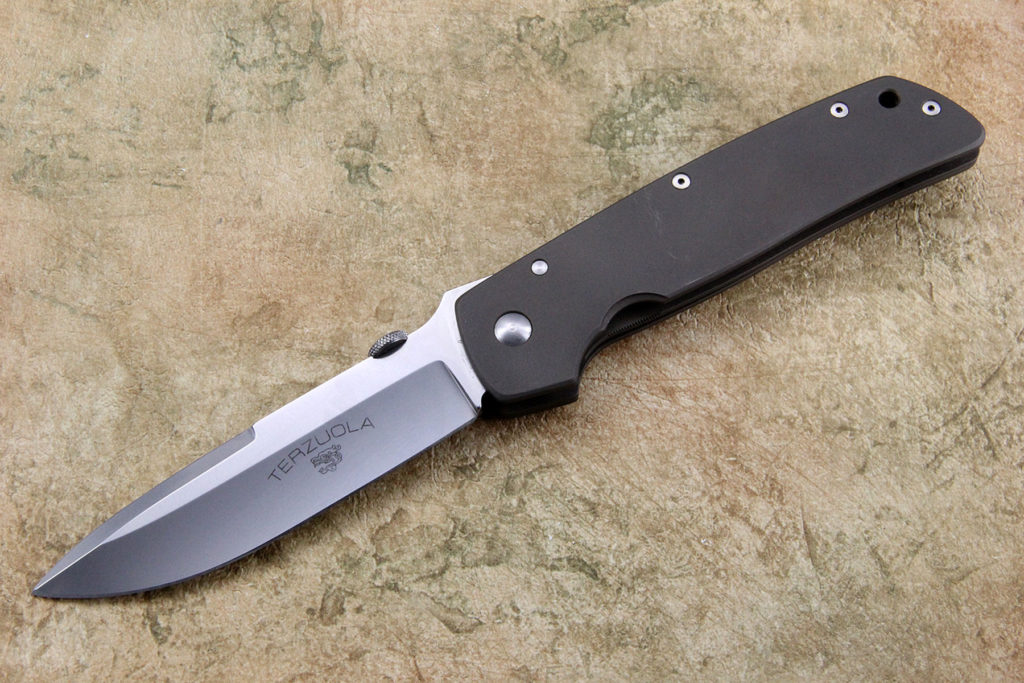
Bob Terzuola’s ATCF remains among the most iconic of tactical folders and is featured in the latest BLADE®.The Gunny shares his ample knife knowledge in the special military issue of BLADE®.
What are the top 5 U.S. military knives of all time? What’s it like to be married to the military, each other and knives all at the same time? Can the modern knife age be divided into two eras—before and after tactical folders? The latest issue of BLADE®, our special annual military issue, answers these questions and more, and is on newsstands and/or available in the digital editionnow!
The top 5 U.S. military knives of all time–wow, that covers a lot of ground, don’t you think? BLADE polled such military veterans as USMC Staff Sgt. R. Lee “The Gunny” Ermey, Special Forces MSG/BLADE field editor Kim Breed, Navy EOD Chief Petty Officer Rob Cude, Special Forces/Green Beret Mark Carey, USMC Sgt. Les George and others to determine the elite knife grouping. Find out the results on page 42.
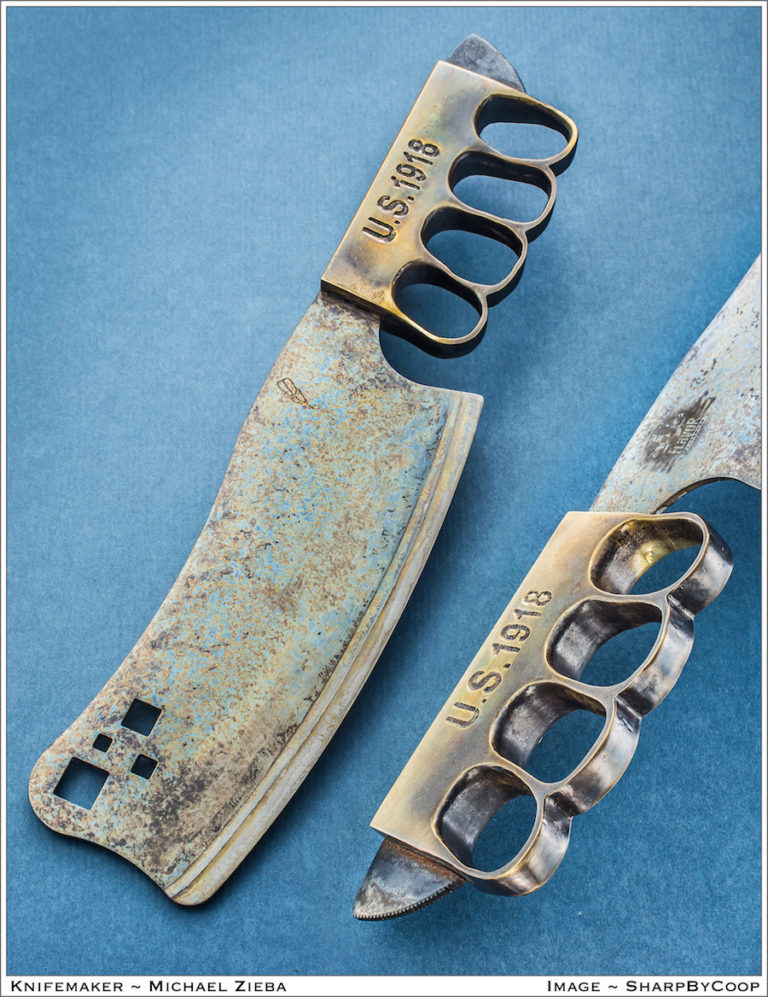
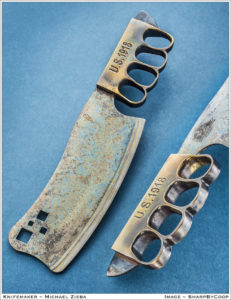
Michael Zieba’s Trench Cleaver includes a handle from the iconic World War I Trench Knife in the latest BLADE®.
Army SFC Michael “Rod” Rodriguez (retired) of the 7th Special Forces Group and SFC Kelly Rodriguez and also CW3 Jeremy Valdez (retired) and Sgt. Rachel Valdez (retired) are respective husband-and-wife teams who saw action in Iraq and Afghanistan, and now design knives for CRKT in the company’s “Forged By War” series. Read how these military heroes served their country above and beyond the call and their connection to knives—including Rod, who forges knives and had his portrait painted by President George W. Bush for Bush’s book, Portraits of Courage: A Commander In Chief’s Tribute To America’s Warriors—and more in Erin Healy’s story, “On-Point With Love & War.”
Ever since tactical folders became the hottest knives of all in the 1990s, knife observers have predicted time and again that the folders had peaked and/or were on their way out. Now, about a quarter of a century later, tactical folders maintain their lofty position as being among the most popular knives anywhere. Get the complete story on the longest-lasting knife trend going in Mike Haskew’s “The Renaissance Knife.”
See how many of the Top 5 U.S. Military knives of all time you can pick in the latest BLADE®!
There’s much more in the latest issue but you’re going to have to buy it to find out what all that entails. Get your copy on newsstands or the digital edition, or subscribe to the domestic, Canadian or international print editions, or to the digital edition now!
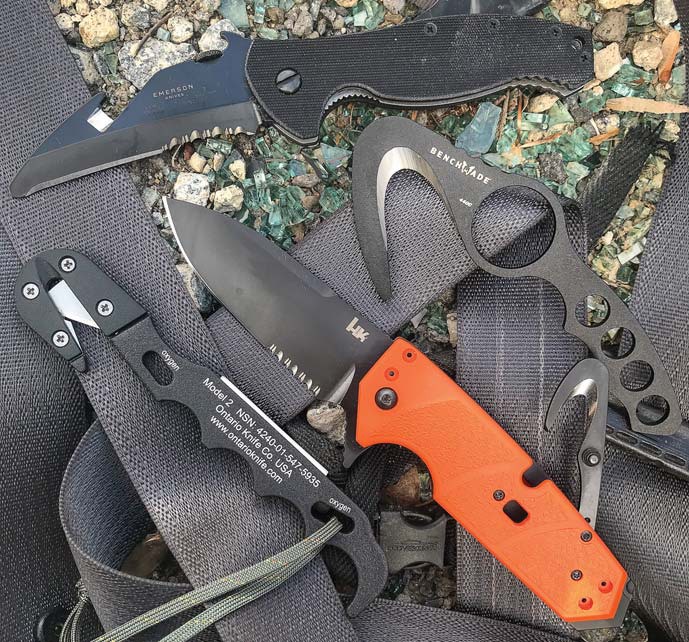
A question often asked is, “How in the world do I sharpen seat belt cutters?” It’s not really as difficult as you might think. All you need is the correct sharpener.
The Best Sharpener for Seat Belt Cutters
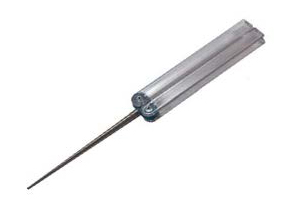
The DMT FSKC serrated sharpener is a great choice for tuning up seat belt cutters. (DMT image)
Because you’re sharpening a cutting tool that has limited access to the actual cutting edge, I recommend something like the DMT FSKC serrated sharpener. It is a coarse-grit, diamond-coated, tapered rod commonly known as a rattail file.
Sharpening Seat Belt Cutters
Working the cutting edge from the ground side only, carefully work the file with light pressure, ensuring you run it over all of the exposed cutting edge.
On the reverse side of the blade, which is flat, feel very carefully for the burr that will form. Once you feel the burr, you know you have done it right. On the flat side, take the rattail file and, holding it as flat to the blade as you can, lightly “wipe off ” the burr. You might have to return to the ground side to wipe it back to the flat side.
Stropping Seat Belt Cutters
Another thing that helps is stropping the inside of the hook with a leather shoelace. Have someone hold the unsheathed/opened blade by the handle for you, then firmly grasp both ends of the shoelace and lightly “floss” the inside of the cutting hook. Move the leather string only in one direction—down the cutting edge. If you move into the edge, it will cut the shoelace in two.
Repeat the correct motion a few times to strop the ground side. It is basically the same principle as stropping a straight razor.
Sharpening Tips
Provided you don’t use the cutting hook for anything outrageous, such as cardboard, and you use it sparingly, you won’t need to sharpen or strop often. However, in the event you do need to restore the edge, this is how it’s done.
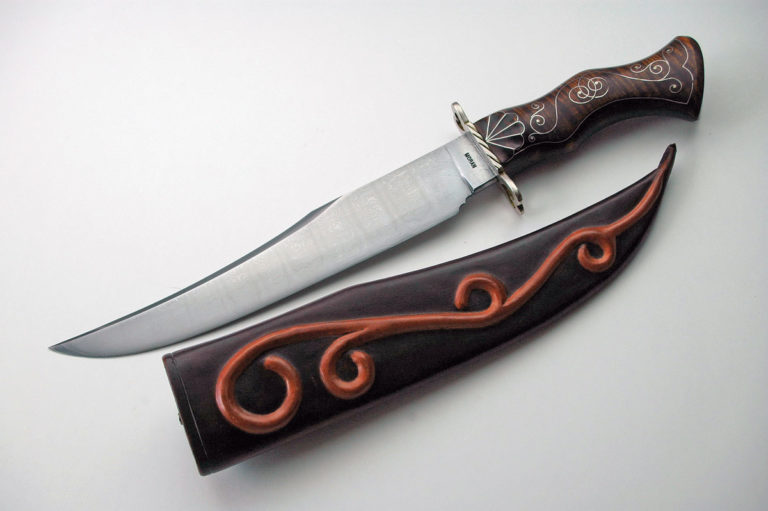
Bill Moran is one of the godfathers of modern knifemaking. Above are four knives that demonstrate his iconic style and show why he continues to inspire generations of knifemakers.
Here is the master at work:
Learn Knifemaking from a True Legend
Bob Loveless is another legendary knifemaker. He wrote a guide to turning out knives like a pro, and BLADE‘s online store is one of the few places carrying it. Get your copy of How to Make Knives here from ShopBlade.com.
Rebooting collections works wonders. OK, so not everyone does it, but many who have done it one or more times seem to enjoy their collecting more.
Chris Nolen has successfully rebooted his knife collection several times since he started collecting. He began in his pre-teens, fueling his cutlery appetite by mowing lawns, and he even wrote a term paper on hunting knives.
Rebooting collections has paid dividends for Chris Nolen, here with wife Linda and their bowie knife collection.
“I was married at 24 and started collecting handmade hunting knives. Most were stag drop points or skinners,” Chris recalls. “I met a great local maker named Jerry Berry of Natchitoches, Louisiana, who got me interested in not just the handles, but the steel in the blades. Of course, I would buy BLADE® and other knife magazines, and I would always find myself looking for big bowies.
“One day I was sitting at my desk and drew out a large, sort of re-curved, stag-handled bowie. I mailed it to Jerry and realized it was time to reboot my collection of maybe 40 knives. And reboot I did! I sold most of the old hunters to make money for my new passion for large bowies.” Nolen is an avid collector of fine bowies to this day and is as enthusiastic as ever.
J.T. Oldham is a long-time folder collector of the modern tactical type and has rebooted his collection on occasion.
“I was a regular customer of the House of Blades in Fort Worth, Texas, where I found many great knives, and also bought up all of the back issues of BLADE I could lay my hands on,” Oldham states. “Production knives were just a way to whet my appetite, as I soon realized that what I wanted to collect was custom knives—and those knives had to have damascus steel.”
As a result, J.T. rebooted and started collecting upscale custom folders—and does to this day.
“At the ICCE [International Custom Cutlery Exposition] show in Kansas City last year, I bought a knife from my No. 1 knife hero, Ralph Turnbull. He was the knifemaker who really started it all for me. I remember looking on his website and in the pages of BLADE Magazine and thinking, ‘If I could only someday own one of Ralph’s knives I would really be a true collector.’”
Since retiring, however, Oldham has tempered his budget a bit. “I no longer have the disposable liquid capital I once enjoyed, so my purchases are now somewhat limited,” he lamented. “However, I follow the custom knife industry with the same interest that I focus on my retirement investments.”
Conversely, rebooting collections is something Kevin Jones has never tried.
“My preference for knives hasn’t changed over the 15 years I’ve been collecting,” Kevin relates. “I started out collecting American Bladesmith Society hunting knives and bowies, and that’s still what interests me. I consider myself a custom knife collector and investor. I’ve found to be successful on the investor side it helps to limit your area of interest so as to become very knowledgeable on both the knives—and the particular knife market—for the knives you collect.”
To REBOOT or NOT to REBOOT?
Why should you consider the concept of rebooting collections?
“Many collectors end up rebooting collections early on as a result of buying their first knives on impulse prior to them acquiring the knowledge and exposure to determine what type and style of knives are going to hold their interest long term,” Jones observes.
Before rebooting, you need to answer questions concerning not only your preferences and current status, but outside realities as well.
Rebooting collections is not for everyone. Kevin Jones has collected ABS hunting knives and bowies and nothing but for 15 years, and has no plans to reboot anytime soon.
“I guess one of the first things to consider is, are you really ready and willing to reboot your collection and take it in an entirely new direction? Has your perspective or your interest changed? Is this an artistic response or a reaction to market trends? For me, a complete reboot means to liquidate your current collection and re-invest in another direction,” Oldham notes. “Are you no longer happy with your knives? Has there been a downturn which has you concerned your collection has lost value? Are you eager to participate in the latest trend?”
Rebooting collections also raises questions as to whether you should sell your current knife collection to finance a new one.
“I feel that’s up to the individual collector,” Jones opines. “However, many need to sell knives in their current collection to help finance them rebooting. I always recommend that while selling an entire collection through a purveyor or auction may be quicker, selling or liquidating piecemeal via a variety of methods will result in a better return.”
Nolen offers a word of caution he discovered after selling off his first collection to reboot.
“Back then I put ads on internet boards and in the newspaper,” he recalls. “I see some knives on eBay that go for hundreds of dollars now that I only paid six to 12 dollars for back in the ’60s and ’70s. I wish now I had most of those back!”
BEST WAYS to LIQUIDATE
What is the best way to liquidate knives if you do decide to sell off your current collection to finance your new one?
“I feel it’s best to use a variety of methods in selling custom knives,” Jones advises, “including contacting other collectors who are interested in the type knives you are selling, selling some on the better knife purveyor sites, and I’ve been very successful selling knives on my ‘collector website.’ It’s very important to have good photos of your knives listed on the internet. You are basically putting your knives out there for the world to see.”
Rebooting collections began for J.T. Oldham when he bought a folder from his hero, custom knifemaker Ralph Turnbull, maker of this damascus linerlock.
“I, for one, would never consider using eBay. Not for my collection,” Oldham states. “And there are just too many trolls on the knife forums! I know that there are decent knife forums, but I simply would not regard that as the right place to offer my knives. I would work one-on-one with certain interested parties—and those individuals may be found on forums. This is all said from my perspective and the knowledge I have of certain individuals with whom I have dealt with in the past. I have a rather large and reliable network of purveyors and collectors whom I trust. A good resource for purveyors is BLADE and the KNIVES annual for a comprehensive listing of those who are associated with the knife community.”
Studying and researching the professionals who deal in knife sales, and then determining who among them are the most knowledgeable and reliable for advice is a must.
“Your purveyor of choice is your best ally in determining what would be in your best interest,” Oldham continues. “If this reboot is purely for financial or investment purposes, no one knows the value of knives better than those who actually determine the value of knives on a day-to-day basis. While they may be able to provide a rough ballpark estimate for your collection, values are subject to change. Be prepared to be presented with values which may be far less than you expected or you’re willing to accept. Be willing to make compromises in order to achieve your goal and obtain what you are truly after, as in any business deal.”
Also keep in mind that when selling to purveyors it is important to remember they are in the business to make money, so they must have a profit margin built into the knives they buy.
IS IT TIME?
As you can see from the comments of our seasoned aficionados, collectors are a distinctly different lot—but that’s what makes the whole avocation of cutlery collecting interesting. As human beings we all have a level of curiosity to see what’s on the other side of the door. Once we have opened it we can either leave or explore. Keep in mind a reboot does not have to be an overnight decision. You can always wade into another genre or style without a full commitment. Whether you wish to upgrade your collection, totally switch gears or seek an investment, there are fresh new knives out there to satisfy any desire.