Knife collecting is an extremely rewarding experience for knife enthusiasts. There truly is a knife for everyone. Many increase or hold their value throughout the years, making collecting knives something to pass on to the next generation of knife collectors.
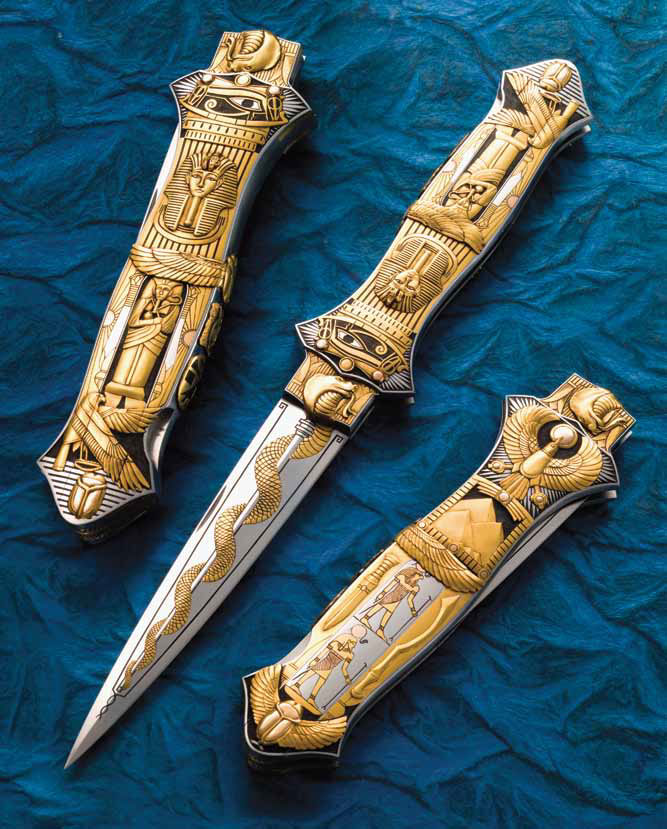
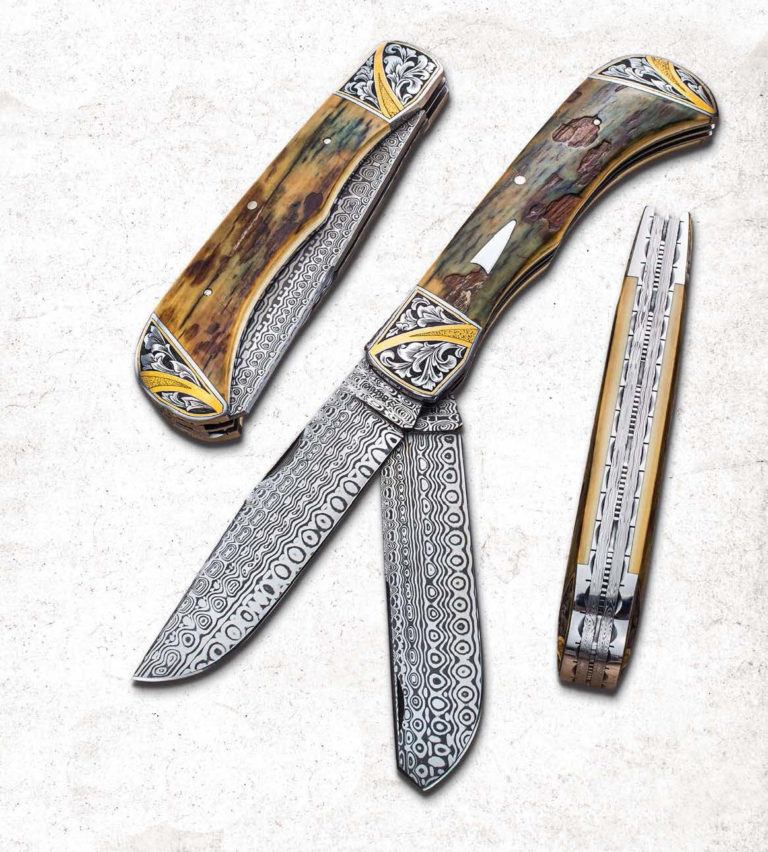
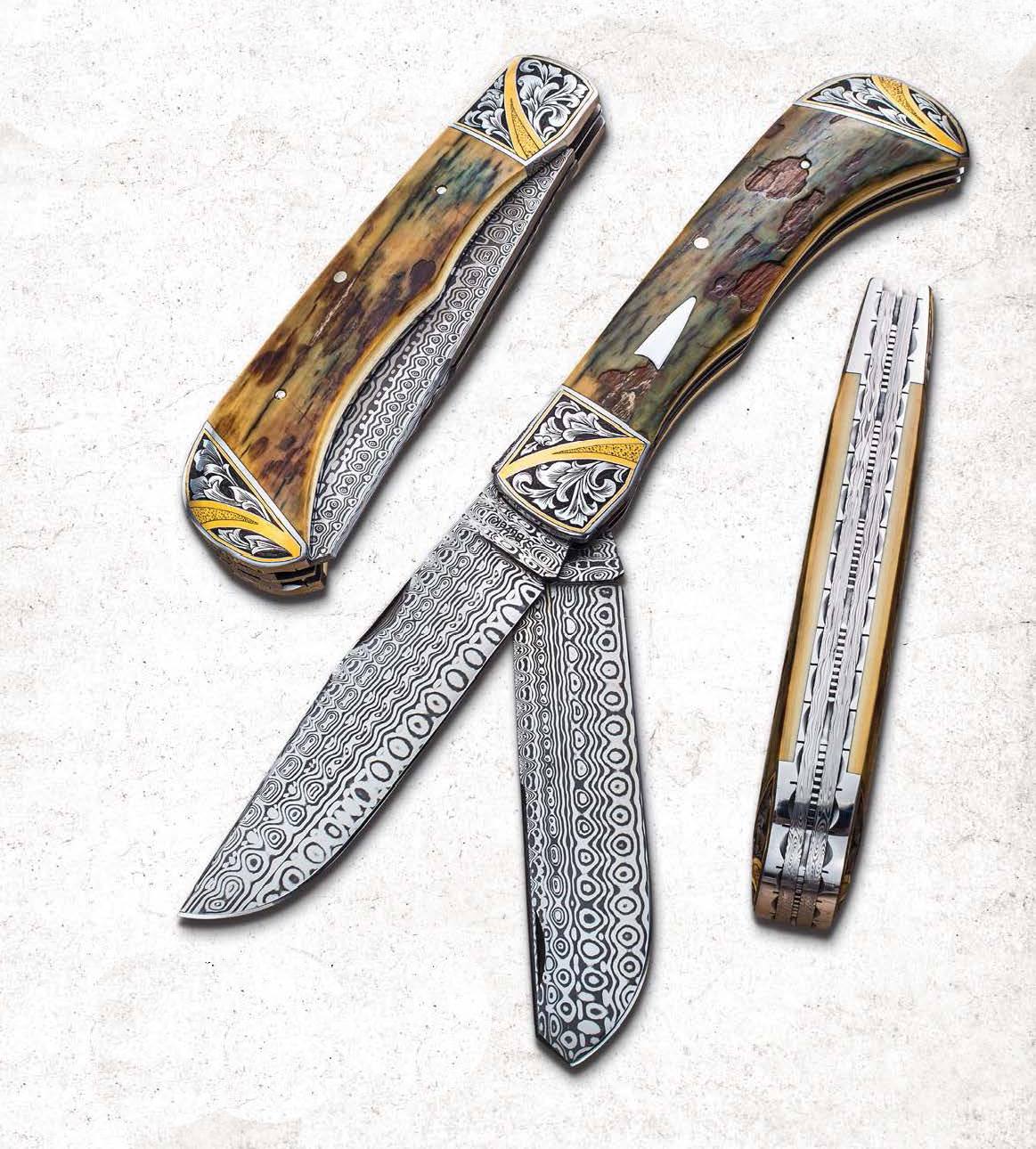
The Pocket Locket is considered one of the most flexible engraving platforms of all time. This is just one example of the versatility of Joe Kious’s design, and it’s a stunner.
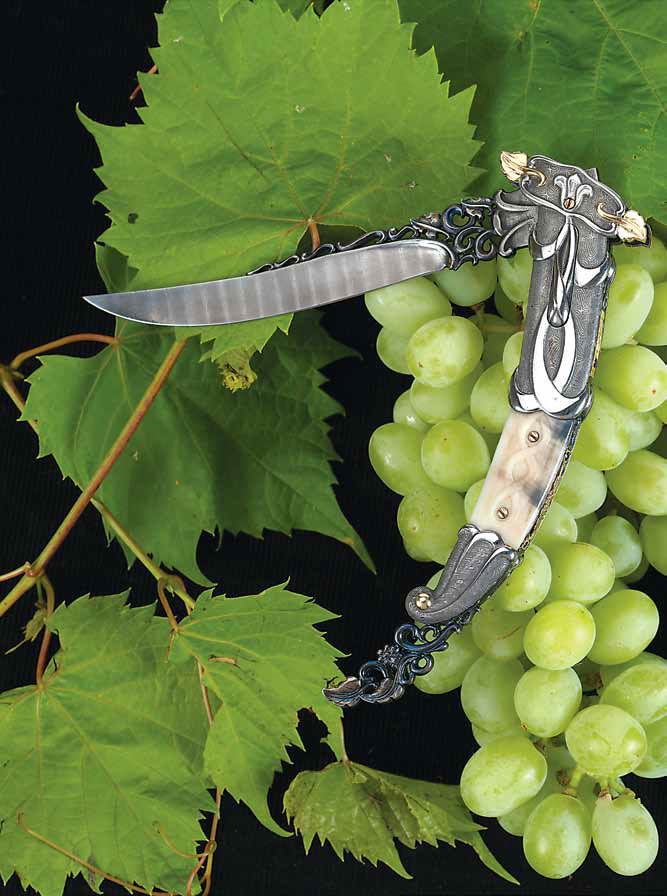
Grapes of Wrath – Stephen Olszewski
Art knives don’t get much more complex yet graceful as Stephen Olszewski’s Grapes of Wrath.
“To this day, I have not seen another art knife with as many flowing lines, curves, carving and piercing of the steel in such a masterful way,” Michael Donato, of KnifePurveyor.com, told BLADE.
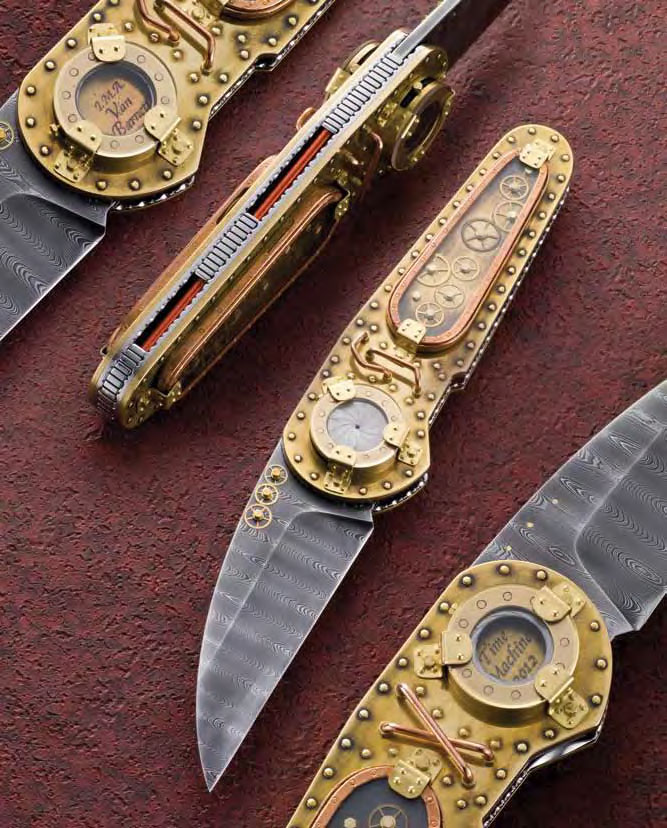
Time Machine – Van Barnett
This steampunk-inspired piece sits at the intersection of knives and luxury watches. As a result, the Time Machine caught the attention of those outside of the usual crowd.
“It also brought much-needed new collectors to the custom knife world,” Donato said.
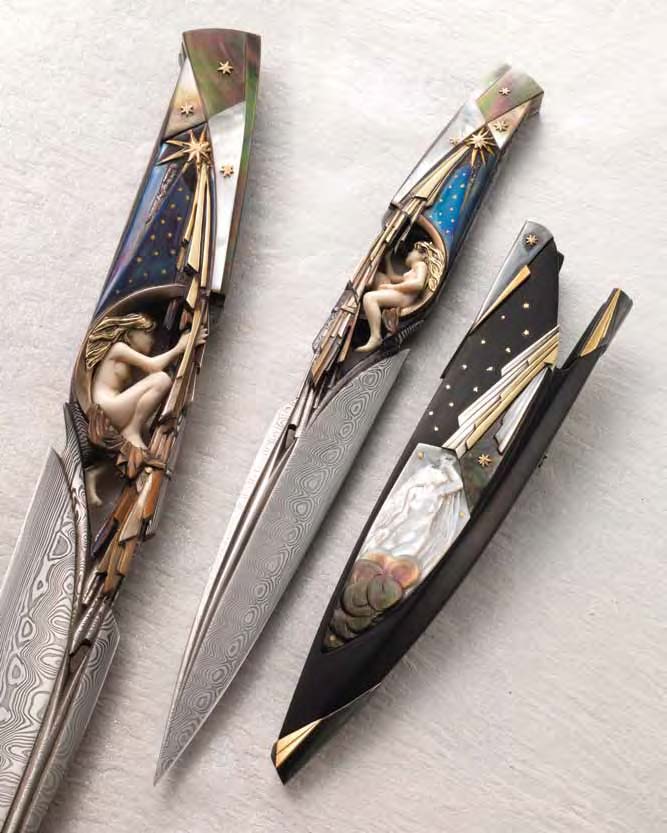
Luna – Arpad Bojtos
Words won’t do justice to the interplay between the handle, blade and sheath in this mixed media masterpiece. This is the art knife’s art knife.
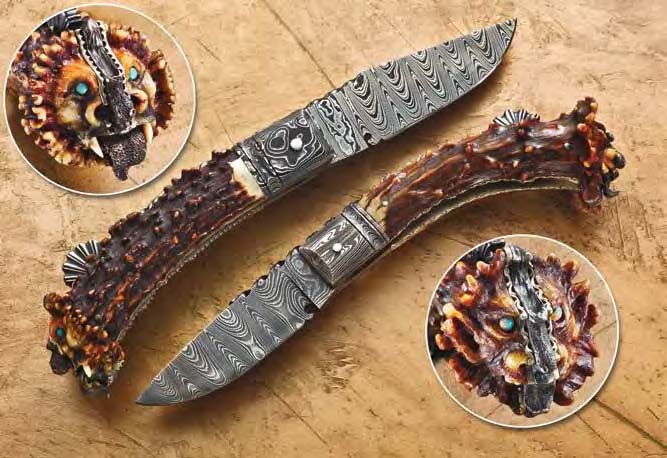
Goblin Folder – Jim Schmidt
Many imitators followed Jim Schmidt’s lead after the Goblin Folder hit the scene, shaping faces into pommels. It’s proof that imitation is the sincerest form of flattery.
See More Art Knives
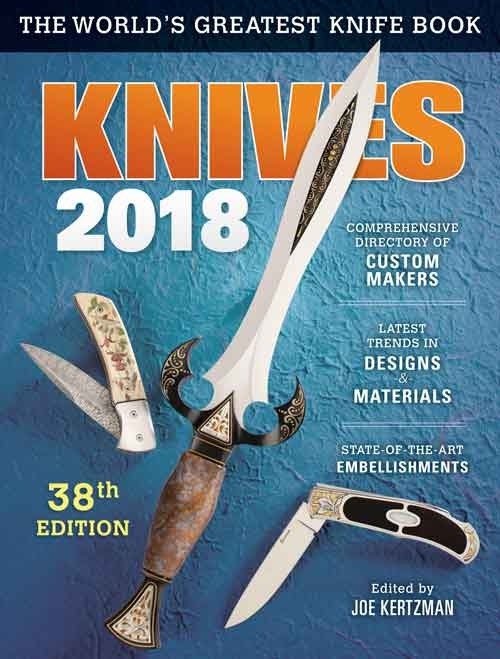
Art knives litter the pages of Knives 2018, and they’re all in full color. Get a terrific price on the world’s greatest knife book at ShopBlade.com.
The best sharpening angle depends on the use of the knife, the thickness of the blade, the type of blade steel, the sharpening materials used and more.
What is the Best Sharpening Angle?
What determines the best sharpening angle? The answer is one that plagues knife neophytes and old hands alike.
“The best angle of sharpening is one of those very intriguing topics that many have explored but most have come up with different answers,” states Jake Broce, online marketing coordinator for A.G. Russell Knives.
Agrees Kyle Crawford, brand manager for Work Sharp, “The answer is often different for everyone.”
He says the two keys are knife type/use and edge retention/maintenance. In fact, all of our story sources cited the intended use of the knife as a deciding factor. For tough chores such as chopping or batonning, a wider angle is best.
“Generally, the wider the angle of edge, the more steel is behind it, which increases the edge’s toughness,” Broce observes.
“For kitchen knives that see light duty cutting food on cutting boards, or a task-specific hunting knife like a camping knife, a low angle is ideal,” counters Crawford.
By “low” he means an edge angle between 15 and 20 degrees.
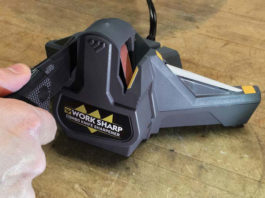
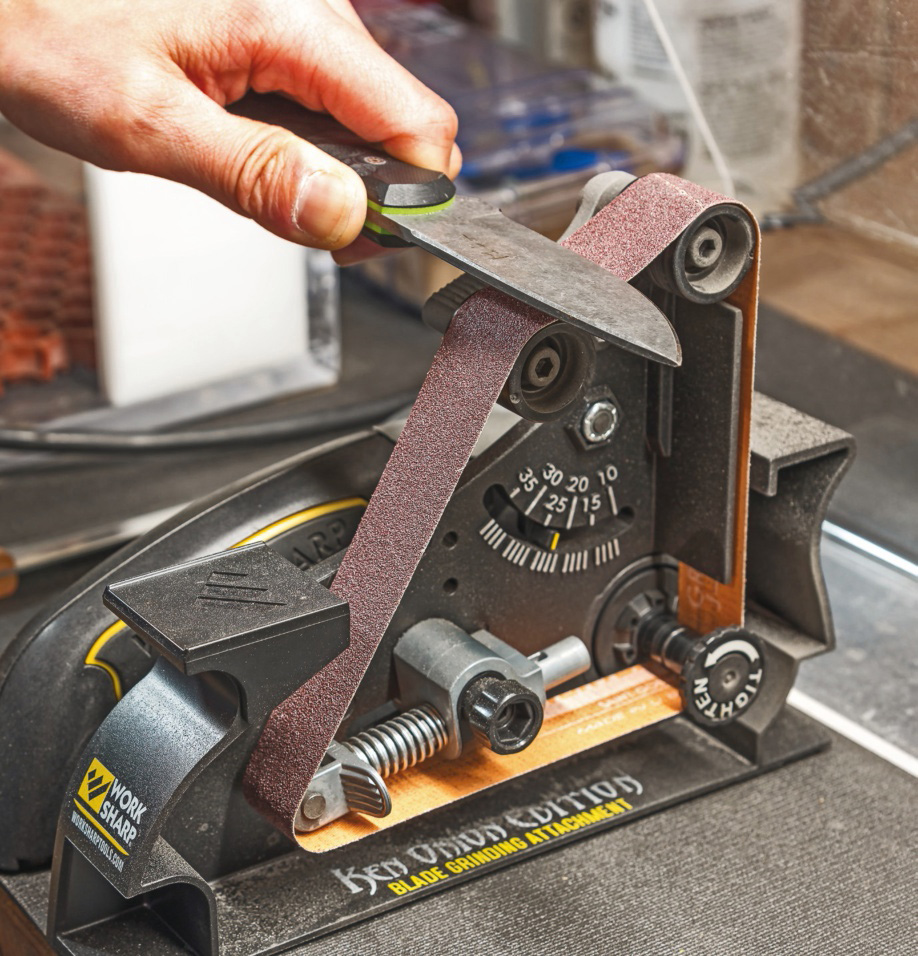
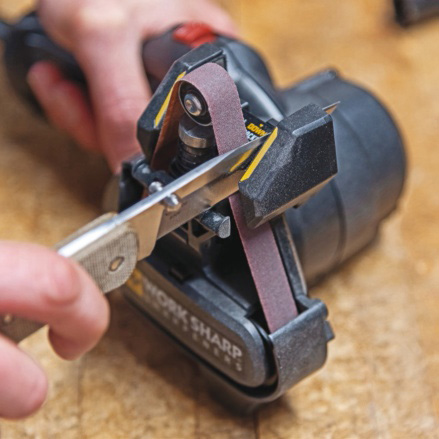
Knives come with a standard edge from the factory, around 22 degrees inclusive. The edge is sharp and durable, and a good middle-of-the-road angle that is a good balance between durability and cutting ease. The Work Sharp Ken Onion Elite sharpener is set here to sharpen at 22 degrees. (Marty Stanfield Photography)
Edge angle also affects edge retention.
“If you sharpen your heavy-use EDC knife to a low angle such as 15 degrees, it will be incredibly sharp,” Crawford says, “but the trade-off you are making is edge retention and durability.”
Conversely, he adds, if you sharpen at a wider angle, such as 25 degrees, the edge will still be very sharp but you gain improved edge retention and, thus, eliminate the need for more frequent maintenance.
However, Kendra Tobler, marketing communications manager for Benchmade Knife Co., indicates grades of blade steel also factor in as well.
“A harder steel with higher yield strength can be ground to a small included angle with less worry about rolling or deforming the edge,” she says. “Conventionally cast steels with large carbides are better suited to larger included angles.”
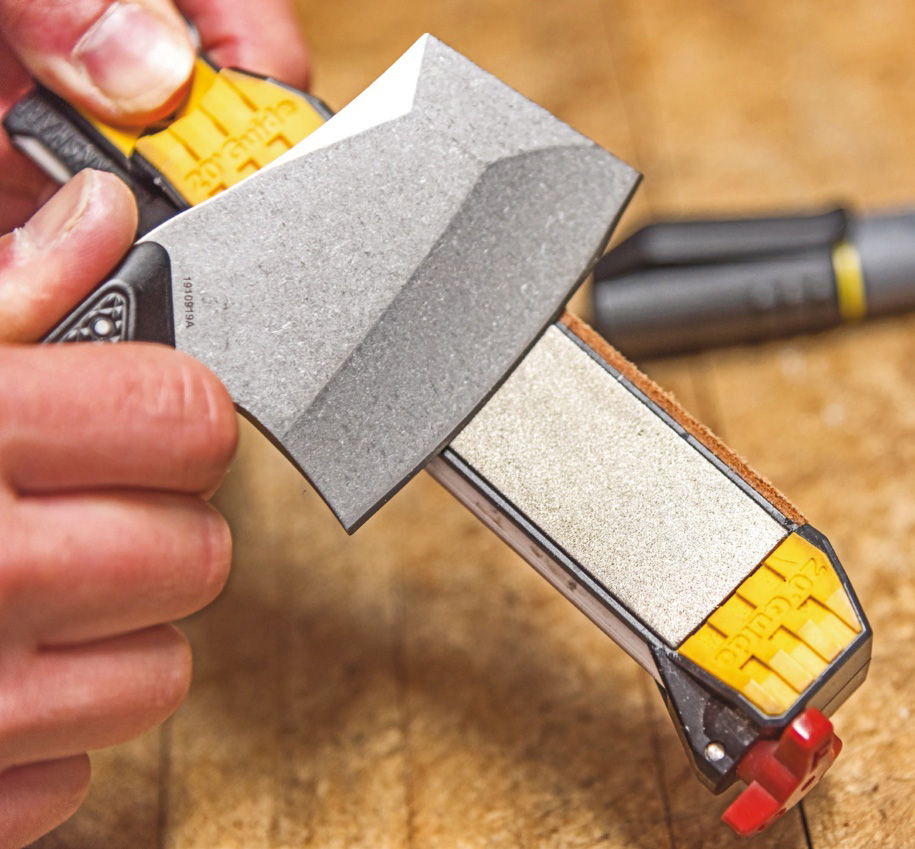
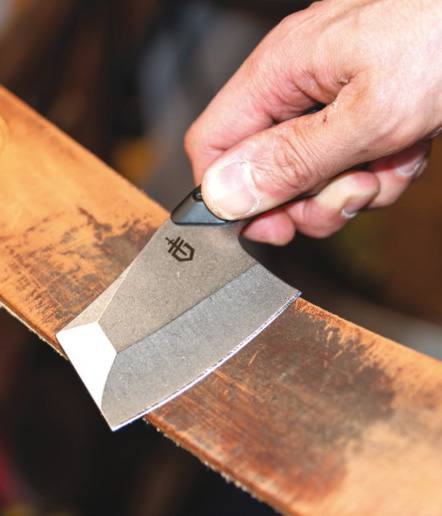
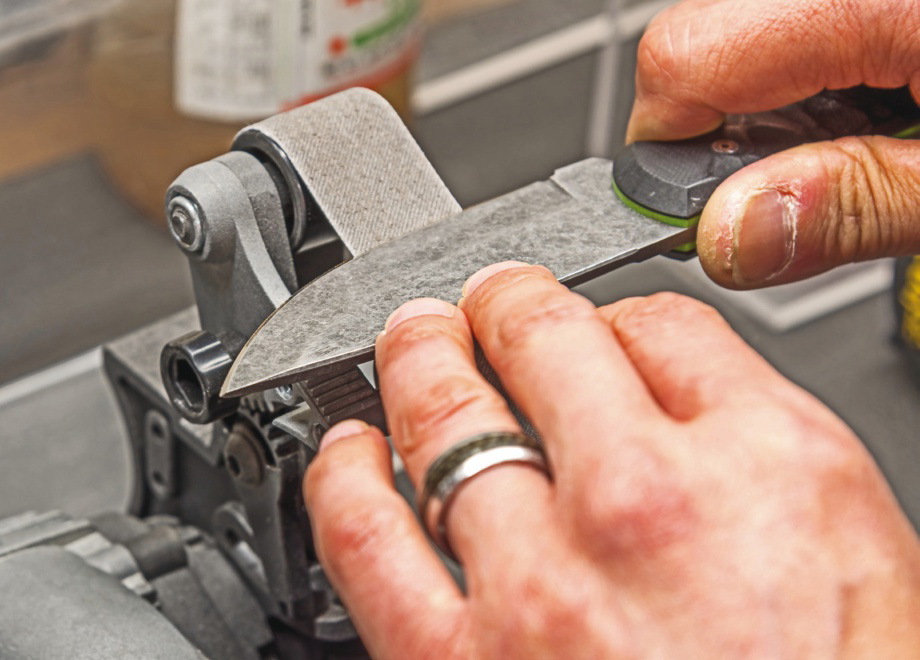
Lesser grades of steel such as the 7Cr17MoV stainless of the Gerber Tri-Tip should not be taken down to an acute angle. (Marty Stanfield Photography)
This is done so for edge durability. A prime example of Tobler’s point is Benchmade’s 15017-1 Hidden Canyon Hunter, a compact drop-point fixed blade in premium CPM S90V stainless steel well known for its extreme edge-holding ability.
Benchmade uses its SelectEdge 14-degree included edge on the knife. It is ground thinner because S90V is a high-yield-strength steel that can retain its strength with a thinner edge without deforming or chipping.
With task-specific knives of high-yield-strength steels for hunting/field dressing, you may opt for a more acute edge angle, anywhere between 15 and 20 degrees. (Marty Stanfield Photography)
Blade thickness is a factor as well.
“Thin blades are much easier to sharpen to low edge angles than thick knives,” Crawford states. “The thicker the blade, the more material you will have to remove to create a low edge angle.”
And it usually takes time to thin down a thick blade.
As he warns, “If you choose to sharpen a low edge angle onto a thick blade, be prepared to be patient.”
Blade thickness is a factor as well. “Thin blades are much easier to sharpen to low edge angles than thick knives,” Crawford states. “The thicker the blade, the more material you will have to remove to create a low edge angle.” (Marty Stanfield Photography)
Establishing Angles
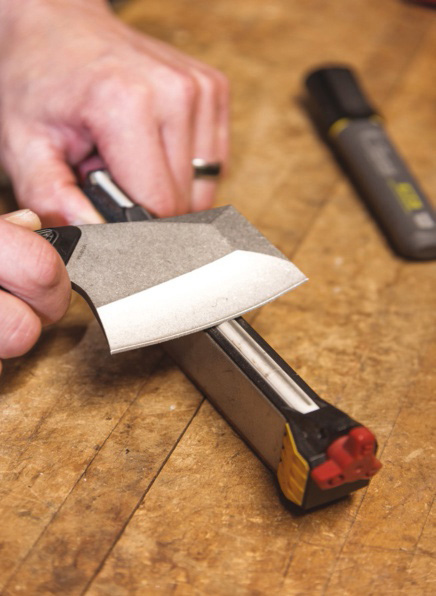
How should you go about establishing the edge angle when you sharpen? A safe bet is to invest in a sharpener that sets and maintains the edge angle for you—all you have to do is set the sharpener to the desired angle.
“Angle guides are tried and true and solve one of the biggest sharpening challenges—establish the angle and be consistent,” Crawford says.
Cautions Broce, “The first time you use [a guide kit] on your knife will usually take the longest, as your edge angle adjusts to the way you use the sharpener.”
The angle guide kits subtract the science of maintaining a consistent angle, so all you need do is concentrate on getting the edge sharp. The kits have been a game changer for consumers who struggle with freehand sharpening on a bench stone.
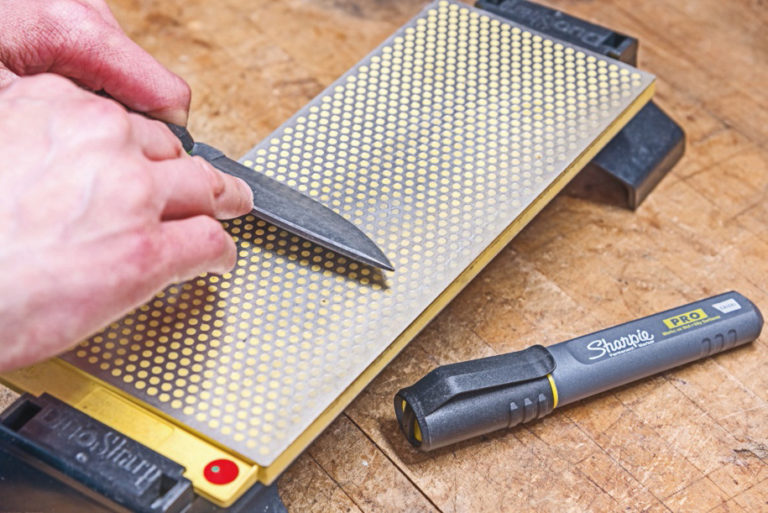
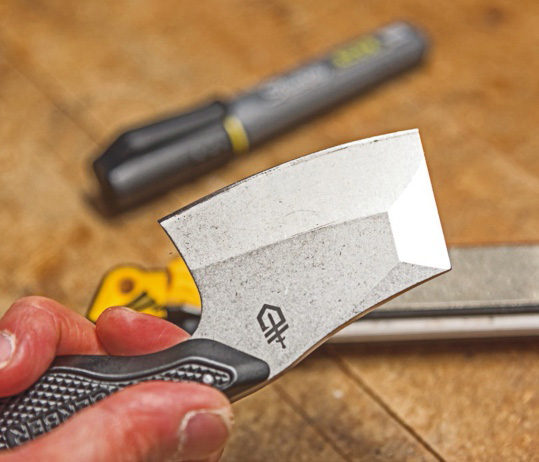
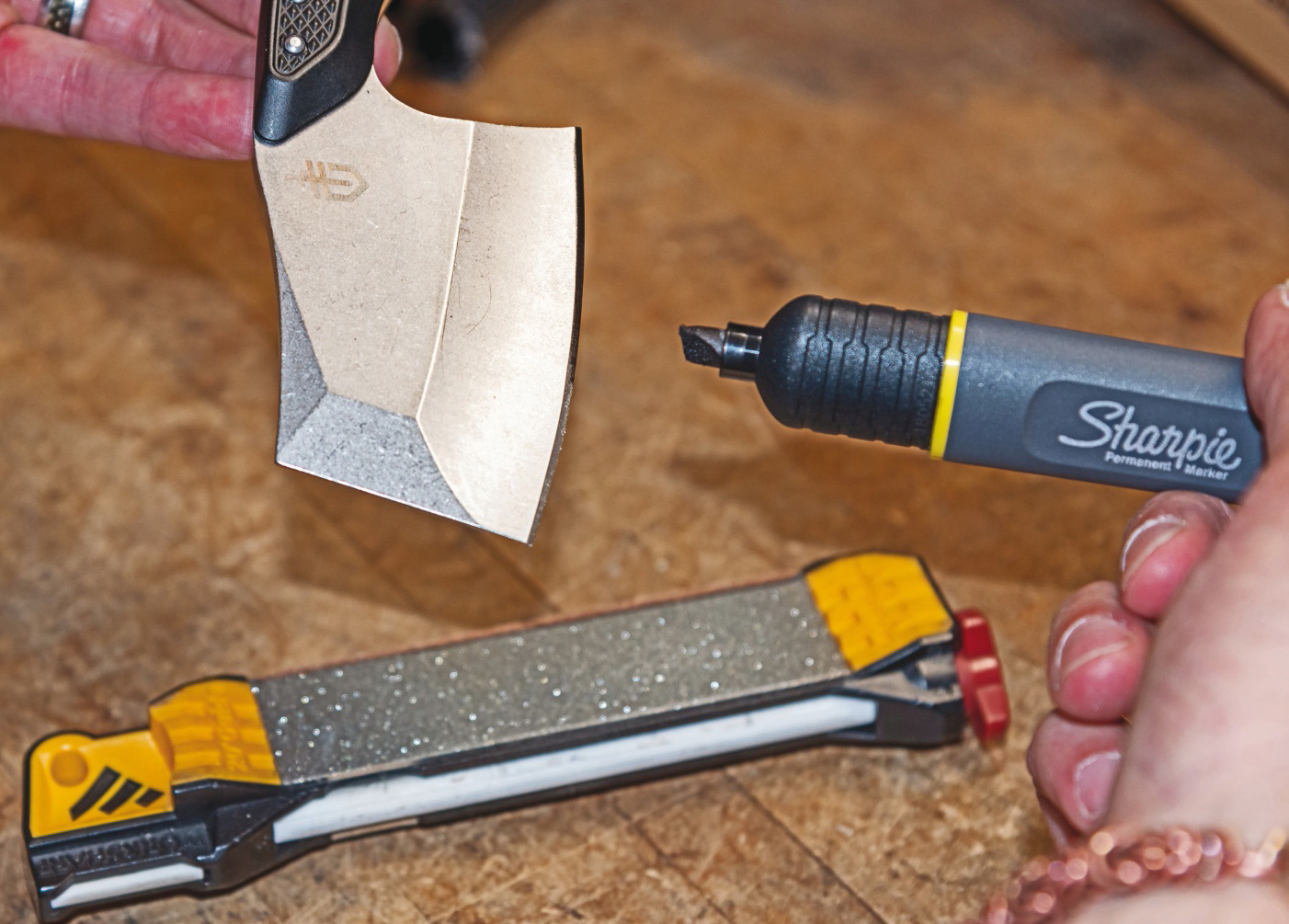
A good tip is the black marker trick. Using a permanent black marker with a wider chisel tip, color the edge bevel on both sides of the blade. The goal is to sharpen the blade—here on the Gerber Tri-Tip—removing the black marker ink from both sides. (Marty Stanfield Photography)
Another good tip, regardless of which sharpener you use, is the tried-and-true black marker trick. Using a permanent black marker with a wider chisel tip, color the edge bevel on both sides of the blade. The goal is to sharpen the blade, removing the black marker ink from both sides. When you accomplish this, your edge angle is correct and you should have a sharp blade.
“The goal is to remove all of the ink in one swipe,” Crawford says. “If you are removing the marker at the cutting edge, your edge angle is too high and you are micro-beveling.”
From there adjust your edge angle to a lower degree and take a few more passes to see how the ink is being removed.
“It is a process of trial and error,” Crawford notes.
Tobler is another proponent of the marker method. “It helps for matching the edge angle already on the blade when resharpening,” she observes.
According to Jason Broce of A.G. Russell Knives, “The blade grind determines how much steel is behind the edge. More steel behind the edge improves edge stability, whereas less material behind the edge can improve the pass-through.” (Marty Stanfield Photography)
You can use the method in conjunction with one of the guide kits even if the kit holds the angle constant for you. The method enables you to see how much more you must sharpen off in order for the edge bevel to be reestablished.
In this regard, you’re using it to determine how much more you have to go as opposed to if you’re holding the angle correctly.
Another tip is sharpen in a well-lighted area. Good visibility is very important and key to doing a thorough, well-executed sharpening job. And if you use the marker method a lot, abundant lighting helps you see clearer without eye strain.
Finally is sharpener selection. You can use any quality sharpener as long as it fits the steel type. The key here is to select a sharpener you feel very comfortable in using.
Another tip is sharpen in a well-lighted area. Good visibility is very important and key to doing a thorough, well-executed sharpening job. And if you use the marker method a lot, abundant lighting helps you see clearer without eye strain. (Marty Stanfield Photography)
Knife Sharpening Safety
Sharpening can be dangerous, so be sure you are in the right frame of mind when you do it—not mentally or physically tired, nor pre-occupied. Focus on sharpening with little to no distractions.
Not only is your own personal safety at stake, but the more focused you are, the better job you can do. This is especially true if you’re learning a new sharpening technique, such as re-establishing edge angles.
Most of all, be safe, have fun and take satisfaction in the knowledge that, once you master establishing edge angles, you have become self-sufficient at sharpening.
Focus on sharpening with little to no distractions. Not only is your own personal safety at stake, but the more focused you are, the better job you can do. (Marty Stanfield Photography)
Stan Buzek based his slip joint on a Bill Ruple two-blade trapper. The hollow-ground blades are Damasteel damascus and 3.5 inches each. The fileworked liners are 416 stainless steel. Closed length: 4 3/8 inches. Buzek’s list price to make a similar piece: $1,950. (SharpByCoop photo)
Blade Counts Count
Custom slip joints are hot again and have been for a while. Why are they so hot and how long will their popularity run this time?
“I have seen a bit of an uptick in pocketknife sales in the last couple of years,” notes custom knifemaker Stan Buzek, whose turnaround time on orders is three to four months. “I think this is due to the fact you can have both multiple- and single-blade slip joints,” as opposed to the single blades of tactical and other locking folders (though lockbacks are experiencing somewhat of a surge in sales, too).
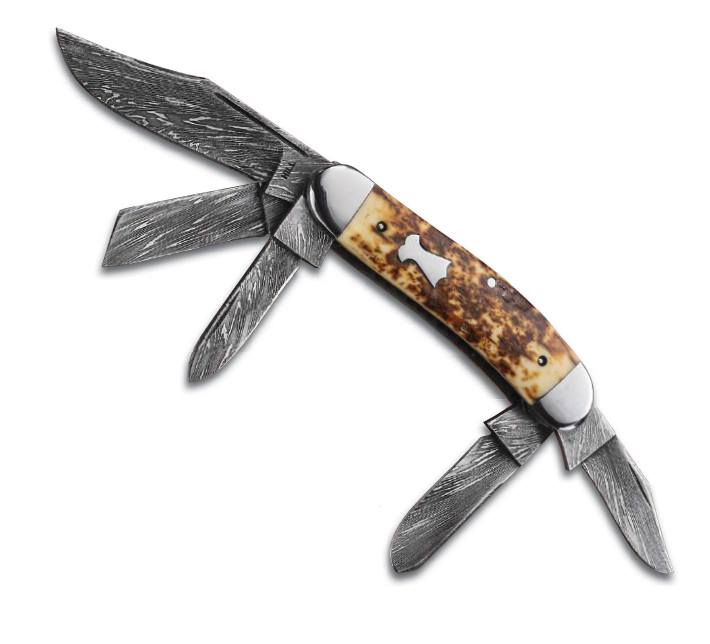
Tobin Hill’s five-blade sowbelly sports feather-pattern damascus blade steel in hollow grinds and a mammoth ivory handle. The maker’s list price for a similar piece: $1,200.
A Bright Future Ahead For Slip Joints
Adds Johnny Stout, who has a backlog of six to eight months, “From what I’m seeing at the shows and online in the past few years, pocketknives are alive and well. I see a bright future for slip joints.”
“I have seen slip-joint groups on Facebook grow by 300 percent in the last three years,” Tracy LaRock states. “I also have a group called ‘Making Slip Joints and Lockbacks’ that has grown a lot recently, with many new slip-joint makers.”
As for his sales, Tracy says, “My books are closed but I intend to open them in early 2020 when I retire from the military. In the meantime I list available pieces in my Facebook group and on Instagram.”
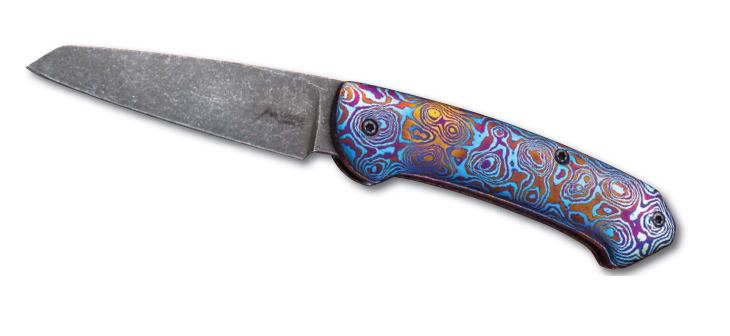
Tracy LaRock pushes the envelope of traditional slip-joint design with his Ethan Jack. The 3-inch blade is D2 tool steel and the handle and frame are Timascus™. Closed length: 4 inches. His list price to make a similar knife: $900. (SharpByCoop photo)
Pocketknife Sales Are Up In General
“I think there’s an upswing in pocketknife sales,” Tom Ploppert agrees. “Plus, a strong economy hasn’t hurt anything.”
Tom says he continues to take orders and has no idea how far behind he is.
“I will write an order down. I do not take deposits. I will call when it’s your turn. If you commit, then we will discuss price and I will start on building it,” he says matter-of-factly.
Turnaround time notwithstanding, the exquisite slip joints by Stout, Buzek, LaRock and Ploppert are well worth the wait—though you might want to get a leg up now. The more demand increases, the longer you’ll have to bide your time until you can get your hands on one of these gems.
Larry Roberts used the L.T. Wright Knives’ Genesis to survive as a participant on the History channel’s “Alone.”
Larry Roberts, runner-up in the second season of the History channel’s wilderness survival show “Alone,” lasted 64 days in the harsh environs of Vancouver Island with one knife: the Genesis made by L.T. Wright Knives. L.T. Wright knew Roberts as a customer and because he wrote articles for the company’s Self Reliance Illustrated magazine. What he didn’t know, because “Alone” participants are not allowed to discuss the show, was which knife Roberts used on the show. When Roberts was allowed to talk about his experiences, he raved to Wright about how much he appreciated the Genesis. Wright suggested they team up, and a winning partnership was born.
On Dec. 16, LTWK introduced its Larry Roberts Signature Edition Genesis to the public. Fans of the “Alone” star and members of the LTWK Pout House club were eligible for pre-release access for 24 hours prior to the general release.
The premise of the reality show is that a group of outdoorsmen and women are deposited in a remote locale—alone—and whoever can survive the longest, wins—$500,000 to be exact. They are positioned so that natural obstacles prevent them from encountering each other. There is no crew; the participants film themselves and are resupplied with batteries and camera chips. They must build shelters, find enough to eat without expending too many calories, stave off hypothermia and marauding animals, and maintain their sanity.
So, how exactly did Roberts use his knife? The list is extensive. He built small game traps and a fish trap. He used it batonning, feather-sticking, harvesting spruce sap and cedar bark, gutting and filleting fish, processing mice and prying shellfish off of rocks. He used it to make a spoon, a spatula and a fork. He harvested mushrooms with his Genesis, cut cordage and used the sharp 90-degree spine of the knife to strike his ferrocerium rod to start fires. He used the knife to make a spear and tent stakes, and even for first-aid and hygiene tasks, such as removing a splinter or cleaning his fingernails.
The Larry Roberts version of the LTWK Genesis has a broomstick handle and sharpened spine to assist in firebuilding.
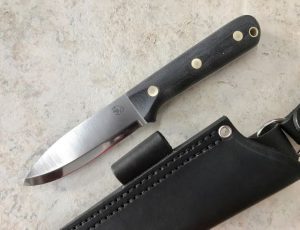
The knife measures 9 inches overall. The 4.25-inch blade has a Scandinavian grind, and the chiseled edge is ideal for bushcrafting skills like making kindling, tent stakes and stripping bark, L.T. Wright explained. It used to be, he continued, that outdoor knives were overbuilt to account for hard use in the field, but now that the education and skill level of outdoorsmen has advanced, often through watching and practicing skills learned just on YouTube, thinner-edged knives are sought after by outdoorsmen and survivalists. Roberts, too, praised the knife’s ability to bite deeply into wood.
The Genesis offers a 1/8-inch-thick spear-point blade made of A2 tool steel, following a Kephart design overall. The knives are tested to 57 to 59 HRC on the Rockwell hardness scale, so they are tough but hold an edge, Wright said. The A2 steel, in the opinion of both Wright and Roberts, outperforms O1 and 1095 for edge retention, and corrosion and stain resistance. For his time on the island, Roberts only stropped his knife on his leather belt to remove micro-oxidation from humidity and moisture. He never had to resharpen it at all.
The Roberts version of the Genesis has a broomstick handle because Roberts found the thicker handle easier to hold and control. It also has thumb scallops and a sharpened spine for striking a fire steel against. LTWK made the black Micarta handle with white liners because Roberts likes the black-and-white contrast. The blade is stamped with Roberts’ rendition of his Vancouver Island nemesis: a mouse. “It became an obstacle for me to overcome,” he said of the creature he battled during the show.
The MSRP of the Larry Roberts Signature Edition Genesis is $225 and includes a true 8-ounce black leather sheath with a dangler and 3/8-inch ferro rod loop. Wright prefers to purchase 10-ounce double-died leather from Spen Stelzer, the owner of JRE Industries in Illinois, and have it split to 8 ounces so there are no discrepancies. “We can control consistency better that way,” he explained.
Roberts wanted the largest ferrocerium rod he was allowed to have during the show, so he went with a ½-inch rod and wasn’t able to use the loop that comes with the Genesis sheath. Roberts did use the dangler, however. He explained that it allowed the knife to hang where his hand fell naturally for easy access—just like a gunslinger in a western—and yet carry out of the way of a backpack or any other gear.
Wright grew up playing Tarzan and Rambo in the woods as a boy, and, of course, the tactical use of knives and their implementation in hunting and bushcraft interested him all along. But he wanted to make a living making knives, so he listened to what people told him they wanted. “If you go to a show and come home with all the knives you brought, you’re not going to be in business long,” he said. Like the survivalist industry itself, as the education and skill levels of users advance, so too must the sophistication of the knives. Wright listened.
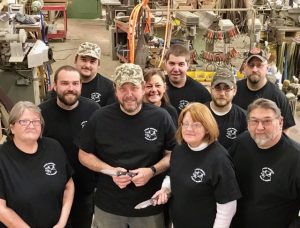
L.T. Wright (front row, second from left) was surprised and happy to find out his Genesis was the knife Larry Roberts used on the “Alone” series.
At first he made knives as L.T. Wright then as Blind Horse Knives and he’s back as L.T. Wright Knives. Wright learned to make knives from R.W. Wilson, who made the tomahawks for the 1972 movie “Jeremiah Johnson,” a cult favorite among outdoorsmen. “He’s probably sold off all of those,” Wright said, “but I do have a prototype of a tomahawk he made for the Texas Rangers.”
So, it is fitting that Wright should partner up with a man who carried his knife in a reality-based outdoorsman show for the small screen. Roberts grew up in Oregon, spending as much time outside as he could, bait-fishing for steelheads in the Rogue River and bow hunting. His first knife was probably a 3-inch lockback Buck pocketknife, he said. He married his high-school sweetheart, and they had a son and a daughter, now grown and on their own.
Roberts attended the Pathfinder School, LLC Survival Classes offered in Jackson, Ohio, through Self Reliance Outfitters. An instructor at the top-rated school, Dave Canterbury, had been on Discovery Chanel’s “Dual Survival” show, and Roberts had heard about “Alone” from a season one participant named Josh Chavez. Roberts had been looking for a challenge, a real-world way to apply the skills he’d learned. “This was it,” he said, and applied online.
You can be a superb outdoorsman, Roberts pointed out, but if you can’t express yourself in front of a camera, you won’t be selected for the show. Although more shy in real life, Roberts is a natural in front of the camera. He sent along hours of footage of himself conducting survival skills. He made the cut, and a total of 20 finalists attended a boot camp in New York. They were tested on their comfort level in the outdoors in a city park. They underwent both medical and psychological testing, and were trained extensively on how to operate the cameras they would be using to film themselves for the show.
Even though Roberts eventually had to “tap out” because he could not get enough food to compensate for the calories he expended, his life has changed from being on “Alone.” He teaches now for Pathfinder and privately on his own farm. He attended the Primitive Living Skills Conference, Rabbitstick, in September in Idaho and will be attending Winter Count, Feb. 12-18 in Maricopa, Arizona.
Roberts can’t say enough good things about the LTWK Genesis. It’s everything he ever wanted in a knife, in every way. Similarly, he can’t say enough good things about L.T. and his crew at LTWK. It was on the island, at night, when Roberts began designing a tattoo he wanted to get. It incorporated everything that was important to him during the “Alone” challenge. You can read about his experiences on the show and how the tattoo both gave him something to think about and something to look forward to getting in “Star of History Channel’s ‘Alone’ Talks Survival and Tattoos,” an interview by Kirstie Kovats in Inked magazine.
Of course, the mouse figures prominently in the design, as does the knife.
Dave Canterbury, instructor at top-rated wilderness survival Pathfinder School in Ohio, explains the 5 Cs of survivability in his “Bushcraft 101.”
Not sure where to start with your quest to master wilderness survival skills? Dave Canterbury, the primitive arts instructor at Pathfinder School in Ohio mentioned above, has written a book that’ll help you get back to basics, enjoy the outdoors and understand the essentials of wilderness survival.
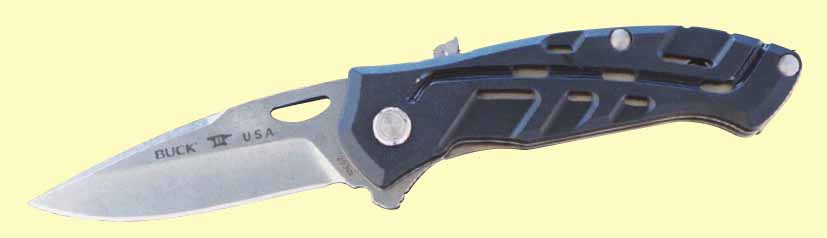
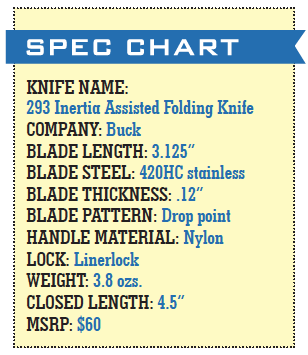
BLADE magazine review: For an MSRP of $60, it’s tough to beat the Buck Inertia as an EDC knife. The locking blade keeps accidental opens at a minimum. (Mary Lou Ayres photo)
Why the Buck Inertia is a Great EDC Knife
The Buck 293 Inertia Assisted Folding Knife stands out with a mechanism to lock the blade closed. An open blade in a waistband or pocket could be a painful, bloody mess.
With the lock disengaged, pushing the hole in the blade opened the knife smoothly and strongly without it threatening to jump from my hand. The liner locked the blade open securely.
On all cutting materials the drop-point blade performed with predictable results—well. I mean, come on, it’s a Buck!
The skeletonized scales lightened the knife and gave it a nice balance right at the index finger. The clip was strong but a little too short to prevent the knife from moving when worn with elastic-waisted athletic pants. The tip-up position required a shift of grip to get to a cutting hold after withdrawing the knife.
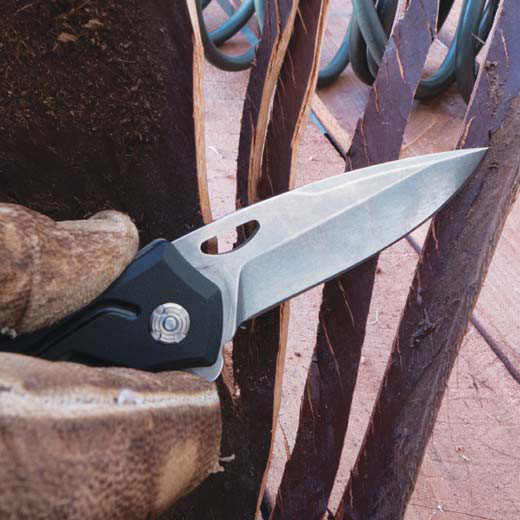
Cutting strips of dried palm fronds with the Buck Inertia. (Mary Lou Ayres photo)
The Verdict
All in all, the Inertia is a good example of a contemporary assisted opener at a modest price from an old-line company known for decades of quality.
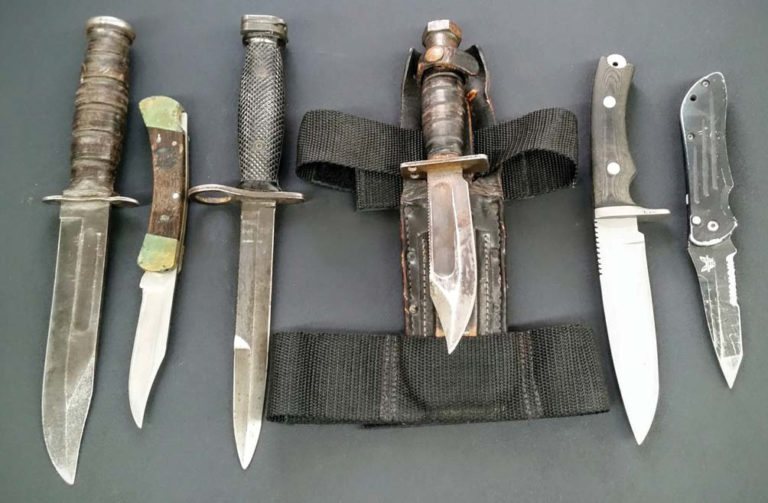
While the definition of the “perfect” or “4.0” military knife is subjective, those who have been there know well how their knives perform and what it takes to build confidence that the indispensable tool can deliver.
So, with a clean slate, how would veterans of the military and the knife industry construct the finest knife for their own use?
1) Easy
“Durability and maintenance are primary, as they are with any tool or gun,” assessed Rob Cude, who spent 24 years in the U.S. Navy and retired in 2006 as an Explosive Ordnance Disposal Chief after completing tours in Africa, Yemen, Afghanistan and Iraq, with combat duty as a member of the CIF (Commanders in Extremis Force), a group of exceptionally trained Special Operations personnel.
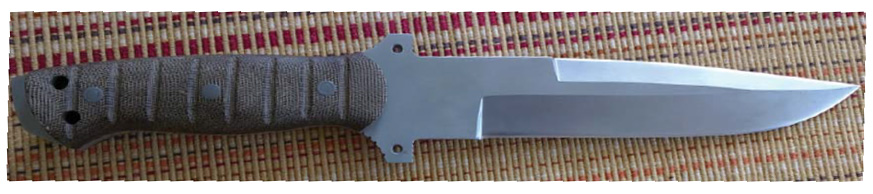
Retired Navy EOD Chief Rob Cude prefers any of the “SV” stainless steels such as CPM S30V and paper or canvas micarta with a thread exposing finish on his military knives. Stellite® 6K—such as that on this fighter by Kit Carson—is another Cude favorite for blade material. (Cude image)
“The knife must be easy to maintain and built of quality materials that stay sharp, are easy to sharpen, and strong,” Cude continued. “Any of SV [CPM S30V, etc.] series steels are really good, and Stellite® for some uses such as diving. High carbon can also be used as blade steel, but it’s all about finish and coating. My handle choice is paper or canvas Micarta with a thread-exposing finish, but the aggressive G-10 textures on fixed blades like those by Strider Knives are really good as well. The material needs to be durable and chemical resistant with a slip-resistant finish when wet.”
While on active duty, Cude carried a Spyderco Police, Benchmade and Emerson folders, and Gerber fixed blades.
“In 1996, I contacted a few custom makers to help us with a fixed blade that met a variety of needs,” he remembered. “Later, I carried Kit Carson, Jones Brothers, Strider and R.J. Martin, all excellent knives that withstood the test of time and extreme conditions.”
His friendship with Cutlery-Hall-Of-Famer Kit Carson and contributions to a military knife design resulted in variants of the U2, which Buck Knives picked up as the Intrepid.
“Kit was not only a friend but a mentor in military career,” Rob noted.
2) Simple
A Pacific Cutlery Fer-de-Lance designed by the late David E. Steele was always with Kim Breed on deployment. Breed also carried a Swiss Army knife Champion in no small part for its tweezers and scissors for removing thorns. (Breed image)
Retired 5th Special Forces Master Sergeant and BLADE field editor Kim Breed makes knives and has done design work for Spartan Blades. He applies the KISS principle, always keeping it simple.
“The more moving parts, the higher the chance of failure,” he reasoned. “I make it a point to serve the military by providing the best knife with the soldier’s interest in mind. They provide me with important feedback on how my knives have performed, which allows me to tailor their needs into my designs.”
While serving with the Special Forces, Breed preferred lightweight knives that could perform a wide variety of tasks since most of his active duty time was spent living out of his rucksack.
“A Ferde-Lance designed by David E. Steele was always with me on every deployment. I also carried a Swiss Army knife Champion, as the tweezers and scissors were the best for removing thorns.”
For Kim, experience still points to the multifunctional blade style with a comfortable handle, and high carbon steel and Micarta are the most requested materials from active service personnel. Comfort, edge-holding ability and ease of sharpening are the top priorities.
“The fixed blade will always have a place with the soldier,” he asserted, “and some folders will be used for smaller tasks. Kydex seems to be the sheath of choice, as it is approved for airborne operations and securely holds the knife in a variety of positions. Blade shapes run the whole spectrum, but most are a version of a drop point or slightly upswept blade. A few soldiers like guards, but as long as the knife has a finger notch to keep the hand from slipping, it’s good. A bead-blasted finish is a favorite. A non-reflective blade is a must.”
3) Environmental Versatility
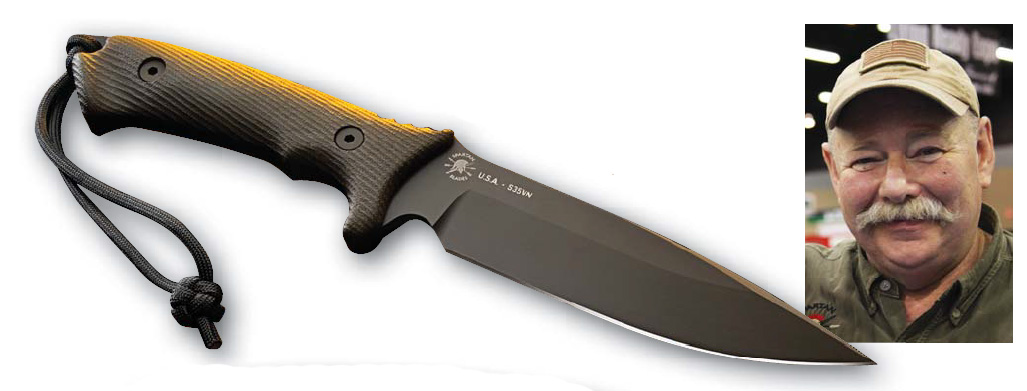
The steel of choice for Bill Harsey (inset) is CPM S35VN, which he says mimics the traits of a true tool steel but with stainless characteristics. S35VN blade steel and a handle of another Harsey favorite, Micarta, help complete the Harsey-designed Difensa from Spartan Blades. (Spartan Blades knife image)
William “Bill” Harsey Jr. has been around military-style knives for decades and worked in design with legendary Cutlery Hall-Of-Famer Col. Rex Applegate, as well as Chris Reeve Knives and Spartan Blades.
He says canvas Micarta handles are tough to beat for control in harsh conditions, including wet and cold and even in darkness. They have been approved for cleanup after exposure to chemical or biological weapons, too.
“I also believe that a knife must be able to retain its sharpness in hot and humid conditions such as marine, riverine and jungle environments,” he commented. “This takes some amount of stain resistance, as an edge can ‘go away’ in the sheath without ever being used.”
The steel of choice for Harsey is CPM S35VN, which he says mimics the traits of a true tool steel but with stainless characteristics. While he adds that good makers can utilize a range of blade steels and produce outstanding knives, non-stainless steels require more maintenance.
“One thing I’ve learned about discussing knives with members of the military is that the topic elicits strong responses, kind of like which handgun is the best,” said Harsey, who has made knives individually and in collaboration with U.S. Army Special Forces, U.S. Navy Special Warfare personnel and Canadian Special Forces.
“Many of the warfighters I know carry several knives in the field and when not in the field. Folders, fixed blades and tools all count.”
Harsey sees the basics as the most important aspects of the ideal military knife.
“I think the requirements for a good military use knife, which can be mission and region specific, are that the blade has a point, cuts and can be carried in a good sheath that works with the rest of the kit carried by the warfighter,” he concluded.
Forget the Movies
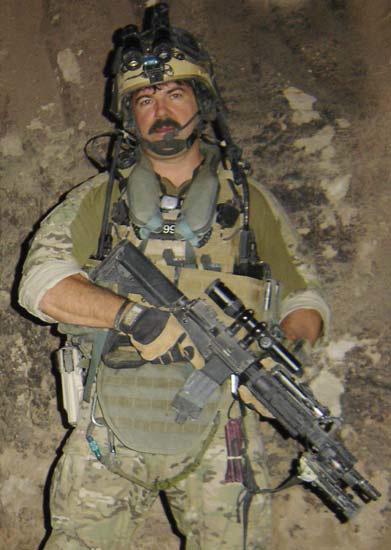
An Army veteran of the 7th Infantry Division (Light) during the invasion of Panama, the 82nd Airborne Division during the Gulf War of 1991, the 173rd Airborne Brigade during the Balkans air war, and a special mission unit in Special Operations during the global war on terrorism in Iraq and Afghanistan, Jack Stottlemire retired with the rank of sergeant major. (Stottlemire image)
During stints with the U.S. Marine Corps and Army, Jack Stottlemire, who makes custom knives for military personnel at Fort Bragg, North Carolina, near his home, has seen many a global hotspot.
A veteran of the 7th Infantry Division (Light) during the invasion of Panama, the 82nd Airborne Division during the Gulf War of 1991, the 173rd Airborne Brigade during the Balkans air war, and a special mission unit in Special Operations during the global war on terrorism in Iraq and Afghanistan, he retired with the rank of sergeant major. Jack also has carried numerous knives.
He put away his Gerber Mk II after carrying it briefly and went with a KA-BAR that performed well in multiple functions. He also has used a Buck 110 folder, M7 bayonet, Leatherman multi-tool, Air Force survival knife, Benchmade Stryker auto, and a Horrigan Fighter made by his squadron mate, Bob Horrigan, who was killed in action June 17, 2005.
“Unlike what you see in the movies,” Stottlemire explained, “soldiers and Marines do not carry large crew-served knives like in Rambo or The Expendables. A knife is a cutting tool for everyday tasks. For silent killing when warranted, a spike hawk is used more often than not in lieu of a knife in Special Operations on today’s battlefield.”
Stottlemire’s custom knives are made under the Rustick Knives brand, and word of mouth drives his sales. He has a large following among Navy SpecWar Teams and Air Force Combat Control Teams.
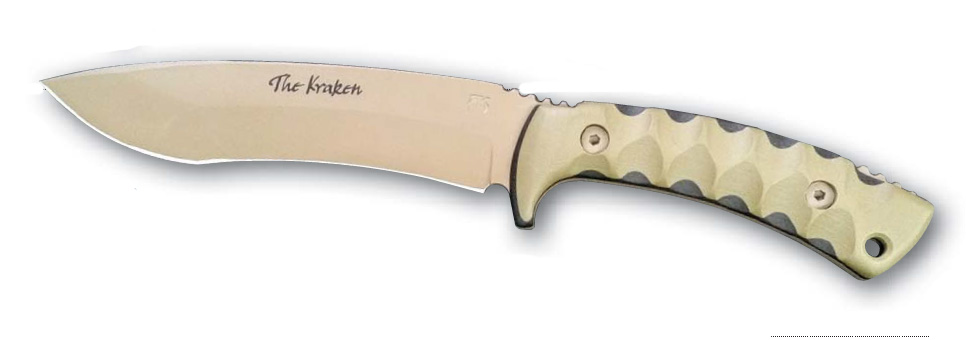
One of Jack Stottlemire’s best-selling knives for military personnel is the 6-inch-blade Kraken. The blade is finished in Cerakote™ with a flat-dark-earth color. The handle is G-10. (Stottlemire image)
“Carbon steel knives that are treated to 57-59 Rockwell are easier to sharpen in the field than most stainless steels,” he remarked. “Carbon is more affordable for the average ‘Joe’ also. I was surprised when a SEAL platoon ordered knives from me and did not want stainless. They preferred carbon with a Cerakote™ finish. Now, stainless does have its place, especially in a humid environment like Central America where you can actually watch an unprotected edge rust. But with proper maintenance and protective finishes, carbon can excel in these areas.”
Jack’s handle material of choice is G-10 and he uses that on all the custom knives he produces.
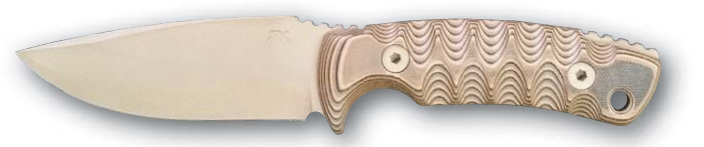
Another of Jack Stottlemire’s best-selling knives for military personnel is the 4-inch blade utility/combat knife. The handle is G-10 and the blade is finished in a flat-dark-earth Cerakote™. (Stottlemire image)
“It’s very tough and durable stuff that stands up to any abuse you throw at it,” he said. “Micarta would my second choice.”
From a military man’s perspective, Stottlemire says a knife needs to do one thing well—cut. Added options such as wrenches, screwdrivers or bottle openers are unnecessary in the field. A good point with a blade of 4-to-5 inches is usually more than enough to do the job well.
It Comes Down to Individual Preference
Overall, both fixed blades and folders useful in the field. Handles of durable synthetic such as Micarta are the top choice, while blade steel is a toss-up between carbon and stainless.
A blade length of up to 5 inches is ideal. Personal preference, though, remains a major factor, and the individual has the opportunity to decide what knife or knives to employ.
Note: As of this writing, the Hogue K320 is so new that the photos haven’t been released yet. However, BLADE is able to give you this preview of what is sure to be an outstanding knife. Learn more here.
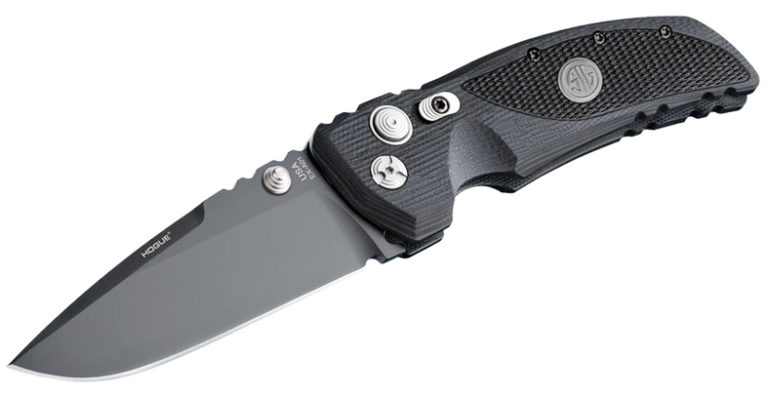
Hogue Knives has partnered together with SIG SAUER® to deliver a full line of quality SIG® branded knives. A highlight knife from the partnership is the K320. It’s designed to pair with the SIG SAUER P320 as a full duty, tactical knife. The P320 stands as a leader in SIG’s premier pistol line, and the K320 duly embodies the same precision manufacturing standards, prevailing as the pistol’s trustworthy companion.
The knife boasts a robust blade of CPM S30V premium steel, chosen for its excellent edge retention and leading corrosion resistant properties. Each blade is finished from the same exact vendor as SIG SAUER firearms in Black or Coyote PVD. The blade provides a high grind profile and keen edge.
A Nylon 12 polymer frame matches the same composition and color concentrations as the P320 pistol. The blade gently falls into the frame with precision clearance and minimal leak points for debris. The K320’s frame isn’t cored out, resulting in increased overall strength as well as a uniform balance between the blade and frame.
This knife is geared towards the tactical user. A triangular window is utilized for low profile deployment allowing the thumb to glide across the blade surface for ease of action, as well as matching the aesthetic of the triangular magazine release on the P320 pistol.
Manual models house an ABLE Lock™ mechanism, slightly recessed into the polymer surface for minimal interference and swift action. Automatics offer immediate deployment via button lock spring mechanism. The knife is finished with an ambidextrous pocket clip with machined louvres that can be positioned in a tip up or down, right or left hand configuration.
The K320 is made in the USA and is available in a wide range of variations to match specific models from the SIG P320 line, including the P320 Nitron, P320 X5 LEGION, and the P320 M17. The MSRP ranges from $149.95 – $179.95.
BLADE
• Styles: Drop Point or Tanto with Tactile Deployment Window
• Thickness: 0.125”
• Material: CPM S30V Stainless Steel
• Hardness: 58-61 HRC
• Treatment: Cryogenically Heat Treated
• Finish: Black or Coyote PVD
• High Grind Profile – Hand Honed Edge (M17 variations include partial serrations)
FEATURES
• SIG SAUER® Firearm Match: P320, P320 Nitron, P320 M17, P320 X5 LEGION
• Locking Mechanisms: Push Button Lock (Automatic) or ABLE Lock™ (Manual)
• Frame: Nylon 12 Polymer with P320 texture (same exact polymer and texture as SIG P320 pistol frame)
• Pocket Clip: Stainless Steel Ambidextrous – Right or Left Handed, Tip Up or Down Carry; Includes machined louvres to assist with quick retrieval
• Triangular Lanyard Hole